<?xml version="1.0" encoding="ISO-8859-1"?><article xmlns:mml="http://www.w3.org/1998/Math/MathML" xmlns:xlink="http://www.w3.org/1999/xlink" xmlns:xsi="http://www.w3.org/2001/XMLSchema-instance">
<front>
<journal-meta>
<journal-id>0187-7151</journal-id>
<journal-title><![CDATA[Acta botánica mexicana]]></journal-title>
<abbrev-journal-title><![CDATA[Act. Bot. Mex]]></abbrev-journal-title>
<issn>0187-7151</issn>
<publisher>
<publisher-name><![CDATA[Instituto de Ecología A.C., Centro Regional del Bajío]]></publisher-name>
</publisher>
</journal-meta>
<article-meta>
<article-id>S0187-71512009000300005</article-id>
<title-group>
<article-title xml:lang="en"><![CDATA[Morphogenesis of the gametophytes of eight Mexican species of Blechnum (Blechnaceae)]]></article-title>
<article-title xml:lang="es"><![CDATA[Morfogénesis de los gametofitos de ocho especies mexicanas de Blechnum (Blechnaceae)]]></article-title>
</title-group>
<contrib-group>
<contrib contrib-type="author">
<name>
<surname><![CDATA[Mendoza-Ruiz]]></surname>
<given-names><![CDATA[Aniceto]]></given-names>
</name>
<xref ref-type="aff" rid="A01"/>
</contrib>
<contrib contrib-type="author">
<name>
<surname><![CDATA[Pérez-García]]></surname>
<given-names><![CDATA[Blanca]]></given-names>
</name>
</contrib>
</contrib-group>
<aff id="A01">
<institution><![CDATA[,Universidad Autónoma Metropolitana-Iztapalapa , Área de Botánica Estructural y Sistemática Vegetal Departamento de Biología]]></institution>
<addr-line><![CDATA[México D.F.]]></addr-line>
<country>México</country>
</aff>
<pub-date pub-type="pub">
<day>00</day>
<month>07</month>
<year>2009</year>
</pub-date>
<pub-date pub-type="epub">
<day>00</day>
<month>07</month>
<year>2009</year>
</pub-date>
<numero>88</numero>
<fpage>59</fpage>
<lpage>72</lpage>
<copyright-statement/>
<copyright-year/>
<self-uri xlink:href="http://www.scielo.org.mx/scielo.php?script=sci_arttext&amp;pid=S0187-71512009000300005&amp;lng=en&amp;nrm=iso"></self-uri><self-uri xlink:href="http://www.scielo.org.mx/scielo.php?script=sci_abstract&amp;pid=S0187-71512009000300005&amp;lng=en&amp;nrm=iso"></self-uri><self-uri xlink:href="http://www.scielo.org.mx/scielo.php?script=sci_pdf&amp;pid=S0187-71512009000300005&amp;lng=en&amp;nrm=iso"></self-uri><abstract abstract-type="short" xml:lang="en"><p><![CDATA[A comparative study of the gametophytes of eight Mexican species of the genus Blechnum (Blechnaceae) is described. Fertile plants for spore collection were obtained at different Mexican localities. The spores were sown in agar enriched with Thompson media and cultured at 22-25 °C, with a light regime of 12 hours. Spores of all species are monolete, ellipsoidal to spheroidal, and non-chlorophyllous. Vittaria-type germination occurred after 6-14 days followed by a 2-6-cell-long filament and Aspidium-type prothallial development. Adult gametophytes are cordiform-spatulate to cordiform-reniform and have wide wings with numerous unicellular marginal and superficial hairs. Sporophytes developed only in B. occidentale and B. polypodioides.]]></p></abstract>
<abstract abstract-type="short" xml:lang="es"><p><![CDATA[Se describe el estudio comparativo de la fase sexual de ocho especies del género Blechnum para México. Las plantas fértiles para la obtención de las esporas fueron recolectadas en distintas localidades del país. Éstas se sembraron en agar enriquecido con medio nutritivo de Thompson y se pusieron a germinar temperatura de 22-25 °C y con un régimen lumínico de 12 h luz. Las esporas de todas las especies son monoletes, elipsoidales a esferoidales, no clorofílicas; presentan germinación tvpo-Vittaria, filamento de 2-6 células de longitud, desarrollo protálico tipo-Aspidium. Los gametofitos adultos son cordiforme-espatulados a cordiforme-reniformes, presentan amplias alas con numerosos pelos unicelulares marginales y superficiales; los gametangios son del tipo de los heléchos leptosporangiados. Los esporofitos sólo se formaron en B. occidentale y B. polypodioides.]]></p></abstract>
<kwd-group>
<kwd lng="en"><![CDATA[Blechnaceae]]></kwd>
<kwd lng="en"><![CDATA[Blechnum]]></kwd>
<kwd lng="en"><![CDATA[fern]]></kwd>
<kwd lng="en"><![CDATA[gametophytes]]></kwd>
<kwd lng="en"><![CDATA[Mexico]]></kwd>
<kwd lng="en"><![CDATA[morphogenesis]]></kwd>
<kwd lng="es"><![CDATA[Blechnaceae]]></kwd>
<kwd lng="es"><![CDATA[Blechnum]]></kwd>
<kwd lng="es"><![CDATA[gametofitos]]></kwd>
<kwd lng="es"><![CDATA[helécho]]></kwd>
<kwd lng="es"><![CDATA[México]]></kwd>
<kwd lng="es"><![CDATA[morfogénesis]]></kwd>
</kwd-group>
</article-meta>
</front><body><![CDATA[ <p align="center"><font face="verdana" size="4"><b>Morphogenesis of the gametophytes of eight Mexican species of <i>Blechnum</i> (Blechnaceae)</b></font></p>     <p align="center"><font face="verdana" size="2">&nbsp;</font></p>     <p align="center"><font face="verdana" size="3"><b>Morfog&eacute;nesis de los gametofitos de ocho especies mexicanas de <i>Blechnum</i> (Blechnaceae)</b></font></p>     <p align="center"><font face="verdana" size="2">&nbsp;</font></p>     <p align="center"><font face="verdana" size="2"><b>Aniceto Mendoza&#150;Ruiz* and Blanca P&eacute;rez&#150;Garc&iacute;a</b></font></p>     <p align="justify"><font face="verdana" size="2">&nbsp;</font></p>     <p align="justify"><font face="verdana" size="2"><i>Universidad Aut&oacute;noma Metropolitana&#150;Iztapalapa, &Aacute;rea de Bot&aacute;nica Estructural y Sistem&aacute;tica Vegetal, Departamento de Biolog&iacute;a, Apdo. postal 55&#150;535, 09340 M&eacute;xico, D.F. M&eacute;xico E&#150;mail: <a href="mailto:amr@xanum.uam.mx">amr@xanum.uam.mx</a></i></font></p>     <p align="justify"><font face="verdana" size="2">&nbsp;</font></p>     <p align="justify"><font face="verdana" size="2">Recibido en enero 2009.    <br> Aceptado en abril 2009.</font></p>     ]]></body>
<body><![CDATA[<p align="justify"><font face="verdana" size="2">&nbsp;</font></p>     <p align="justify"><font face="verdana" size="2"><b>ABSTRACT</b></font></p>     <p align="justify"><font face="verdana" size="2">A comparative study of the gametophytes of eight Mexican species of the genus <i>Blechnum </i>(Blechnaceae) is described. Fertile plants for spore collection were obtained at different Mexican localities. The spores were sown in agar enriched with Thompson media and cultured at 22&#150;25 &deg;C, with a light regime of 12 hours. Spores of all species are monolete, ellipsoidal to spheroidal, and non&#150;chlorophyllous. <i>Vittaria</i>&#150;type germination occurred after 6&#150;14 days followed by a 2&#150;6&#150;cell&#150;long filament <i>and Aspidium</i>&#150;type prothallial development. Adult gametophytes are cordiform&#150;spatulate to cordiform&#150;reniform and have wide wings with numerous unicellular marginal and superficial hairs. Sporophytes developed only in <i>B. occidentale </i>and <i>B. polypodioides.</i></font></p>     <p align="justify"><font face="verdana" size="2"><b>Key words:</b> Blechnaceae, <i>Blechnum, </i>fern, gametophytes, Mexico, morphogenesis.</font></p>     <p align="justify"><font face="verdana" size="2">&nbsp;</font></p>     <p align="justify"><font face="verdana" size="2"><b>RESUMEN</b></font></p>     <p align="justify"><font face="verdana" size="2">Se describe el estudio comparativo de la fase sexual de ocho especies del g&eacute;nero <i>Blechnum </i>para M&eacute;xico. Las plantas f&eacute;rtiles para la obtenci&oacute;n de las esporas fueron recolectadas en distintas localidades del pa&iacute;s. &Eacute;stas se sembraron en agar enriquecido con medio nutritivo de Thompson y se pusieron a germinar temperatura de 22&#150;25 &deg;C y con un r&eacute;gimen lum&iacute;nico de 12 h luz. Las esporas de todas las especies son monoletes, elipsoidales a esferoidales, no clorof&iacute;licas; presentan germinaci&oacute;n <i>tvpo&#150;Vittaria, </i>filamento de 2&#150;6 c&eacute;lulas de longitud, desarrollo prot&aacute;lico tipo&#150;<i>Aspidium. </i>Los gametofitos adultos son cordiforme&#150;espatulados a cordiforme&#150;reniformes, presentan amplias alas con numerosos pelos unicelulares marginales y superficiales; los gametangios son del tipo de los hel&eacute;chos leptosporangiados. Los esporofitos s&oacute;lo se formaron en <i>B. occidentale y B. polypodioides.</i></font></p>     <p align="justify"><font face="verdana" size="2"><b>Palabras clave:</b> Blechnaceae, <i>Blechnum, </i>gametofitos, hel&eacute;cho, M&eacute;xico, morfog&eacute;nesis.</font></p>     <p align="justify"><font face="verdana" size="2">&nbsp;</font></p>     <p align="justify"><font face="verdana" size="2"><b>INTRODUCTION</b></font></p>     ]]></body>
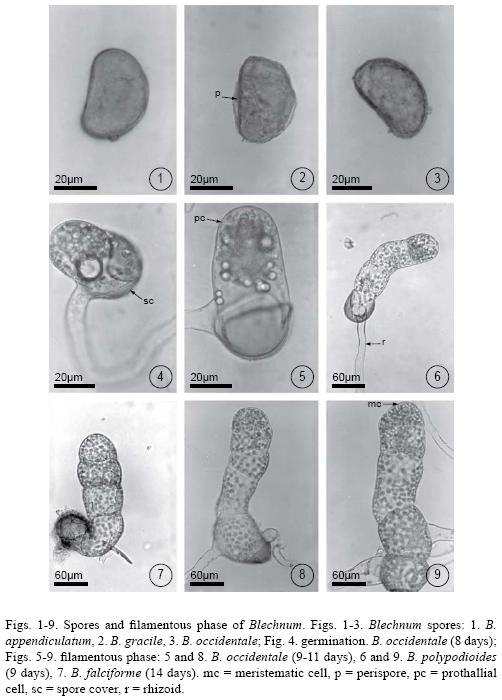
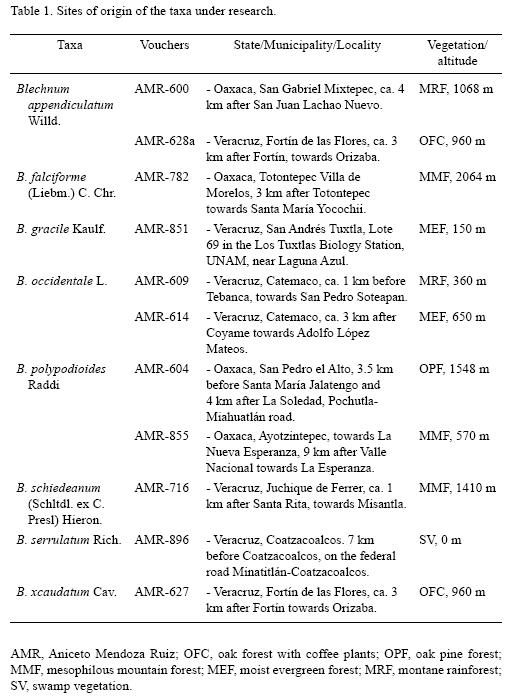
<body><![CDATA[<p align="justify"><font face="verdana" size="2"><i>Blechnum </i>L. is the largest genus of the family Blechnaceae (Pteridophyta). The nearly 200 species are primarily tropical. There are 15 species <i>of Blechnum </i>in Mexico. Mexican species are terrestrial, hemiepiphytic or epiphytic and most are widespread, extending into Central and South America. The genus has sometimes been divided on the basis of monomorphic <i>(Blechnum) </i>vs. dimorphic fronds <i>(Lomaria </i>Willd.), but there are several further groupings of dimorphic&#150;fronded species, each of which could conceivably be considered a distinct genus (Smith, 1981; Mickel &amp; Beitel, 1988; Moran, 1995; Mickel &amp; Smith, 2004).</font></p>     <p align="justify"><font face="verdana" size="2">Gametophyte morphology of several species of <i>Blechnum </i>has already been studied, mostly in Old World species such as <i>B. gibbum </i>(Lab.) Mett., <i>B. orientale </i>L. and <i>B. spicant </i>(L.) Wither (St&uuml;bner, 1882; Lampa, 1901; D&ouml;pp, 1927; Karpowicz, 1927; Stokey, 1951; Stokey &amp; Atkinson, 1952a, 1952b; Kachroo, 1955; Stone, 1961; Nayar, 1962; Nayar, et al., 1966; Beisvag, 1970; Cousens, 1979, 1981; Chiou, 1989; Fern&aacute;ndez et al., 1997; Men&eacute;ndez et al., 2006a, 2006b), but it is scarcely known for the American species, with the exception of some from South America, mainly Chile and Argentina (Rodr&iacute;guez&#150;R&iacute;os, 1973; Dur&aacute;n &amp; de la Sota, 1996; P&eacute;rez&#150;Garc&iacute;a et al., 1996).</font></p>     <p align="justify"><font face="verdana" size="2">Considering the morphological differences that exist in the <i>Blechnum </i>sporophyte, it is necessary to continue studies on the development of the gametophytic phase, in order to determine whether there are features that allow to recognize groups on infrageneric level.</font></p>     <p align="justify"><font face="verdana" size="2">This paper describes the gametophytic morphogenesis <i>of Blechnum appendiculatum </i>Willd., <i>B. falciforme </i>(Liebm.) C. Chr., <i>B. gracile </i>Kaulf., <i>B. occidentale </i>L., <i>B. polypodioides </i>Raddi, <i>B. schiedeanum </i>(Schltdl. ex C. Presl) Hieron., <i>B. serrulatum </i>Rich. and <i>B. &times;caudatum </i>Cav. All species are native to Mexico.</font></p>     <p align="justify"><font face="verdana" size="2">&nbsp;</font></p>     <p align="justify"><font face="verdana" size="2"><b>MATERIALS AND METHODS</b></font></p>     <p align="justify"><font face="verdana" size="2">Spores were obtained from numerous locations in Mexico (<a href="#t1">Table 1</a>). Fertile pinnae with mature sporangia were stored inside paper envelopes and left to dry in laboratory conditions to facilitate spore release. After several days, the contents of the envelopes were sifted with a metallic mesh with openings 0.074 mm in diameter to eliminate the remains of sporangia and indusia. Spores of all species were sown in Petri dishes 5 cm in diameter (20 dishes for each species, with three replicates for each species) containing previously sterilized agar with Thompson's nutrients (Klekowski, 1969; Mendoza&#150;Ruiz &amp; P&eacute;rez&#150;Garc&iacute;a, 2005). The spores were spread on the surface of the solidified medium with a thin brush, with an average density of 100&#150;150 spores/cm<sup>2</sup>.</font></p>     <p align="center"><font face="verdana" size="2"><a name="t1"></a></font></p>     <p align="center"><font face="verdana" size="2"><img src="/img/revistas/abm/n88/a5t1.jpg"></font></p>     <p align="justify"><font face="verdana" size="2">The Petri dishes were maintained in transparent plastic bags to avoid dehydration and contamination under a 12 h light/darkness photoperiod (with 75 watts "day&#150;light" lamps) at 22&#150;25 &deg;C temperature. Each dish was initially opened every third day in order to determine when germination began and to observe the different developmental stages of the gametophyte, as well as to dampen the growth media with sterilized distilled water and enable sperm to move once the gametophytes became sexually mature. To investigate light requirements for germination and development, two dishes of each species were kept in darkness and opened 100 days after they had been sown. Spore sizes were also measured from material in water, using a compound microscope equipped with an ocular micrometer. For the average size of spores, thirty spores were measured for each species (Erdtman &amp; Sorsa, 1971).</font></p>     ]]></body>
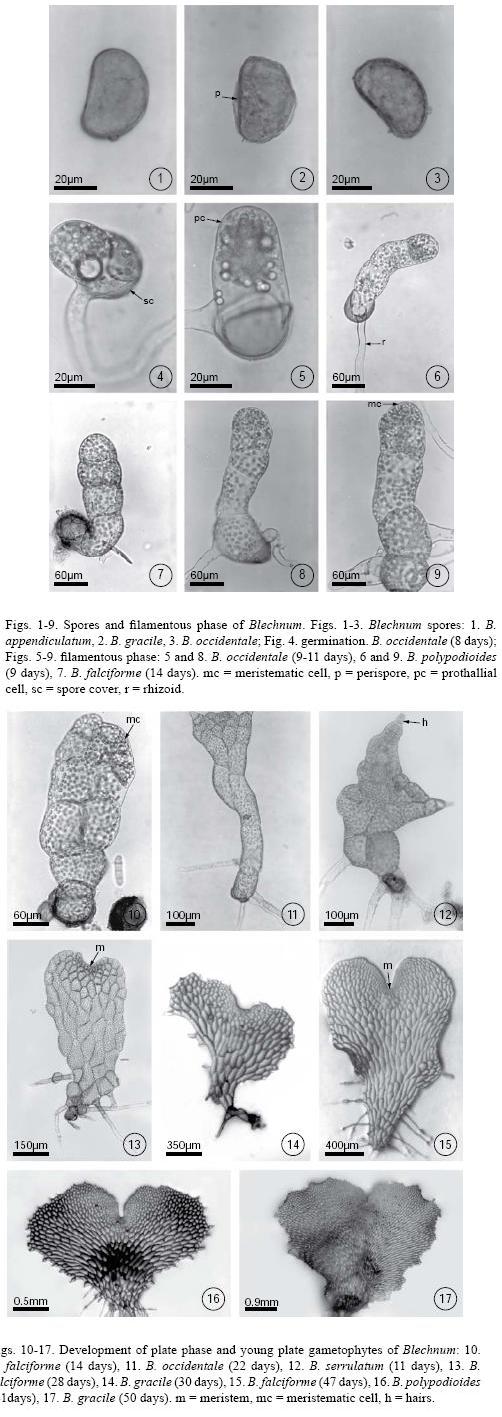
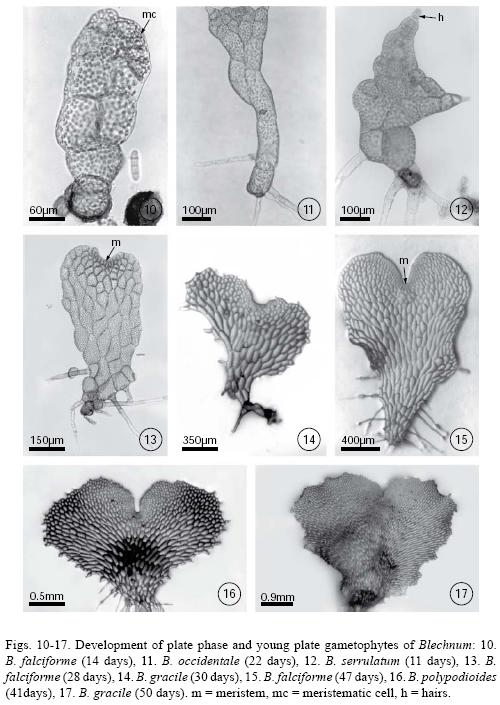
<body><![CDATA[<p align="justify"><font face="verdana" size="2">Photomicrographs were taken of live material through a stereoscopic microscope and optic microscope, with black and white, 35 mm, TIMAX&#150;100 film an OLYMPUS BX41 microscope, with Digital Camera Olympus C&#150;5060 wide zoom.</font></p>     <p align="justify"><font face="verdana" size="2">&nbsp;</font></p>     <p align="justify"><font face="verdana" size="2"><b>RESULTS</b></font></p>     <p align="justify"><font face="verdana" size="2">The spores of all studied species were monolete, ellipsoidal to spheroidal, light to dark brown or yellow, and achlorophyllous. The perispore was smooth, with small papillae, or reticulate. Spore size varied within the following ranges for each species: <i>Blechnum appendiculatum, </i>37(41)49 &micro;m long x 24(27)31 &micro;m wide (<a href="#f1">Fig. 1</a>); <i>B.falciforme, </i>53(57)68 x 37(40)49 &micro;m;<i> B. gracile, </i>41(43)47 x 27(29)31 &micro;m (<a href="#f1">Fig. 2</a>); <i>B. occidentale, </i>34(37)40 x 22(24)26 &micro;m (<a href="#f1">Fig. 3</a>); <i>B. polypodioides, </i>37(40)43 x 23(25)28 &micro;m ;<i> B. schiedeanum, </i>64(67)74 x 44(49)54 &micro;m ;<i> B. serrulatum, </i>34(38)40 x 25(28)39 &micro;m; and <i>B.<sup> X</sup>caudatum, </i>37(45)54 x 25(28)32 &micro;m.</font></p>     <p align="center"><font face="verdana" size="2"><a name="f1"></a></font></p>     <p align="center"><font face="verdana" size="2"><img src="/img/revistas/abm/n88/a5f1.jpg"></font></p>     <p align="justify"><font face="verdana" size="2">Spores <i>of Blechnum gracile, B. occidentale, B. polypodioides, B. serrulatum, </i>and <i>B. <sup>X</sup>caudatum </i>germinated from day 6, whereas those of <i>B. falciforme </i>and <i>B. </i><i>schiedeanum </i>germinated on day 14. All had <i>Vittaria</i>&#150;type germination according to the criteria of Nayar &amp; Kaur (1971). The first cellular division produced the hyaline rhizoidal cell, perpendicular to the polar axis of the spore. Subsequently, the prothallial cell, which was short and with abundant chloroplasts, emerged from the spores cover (<a href="#f1">Fig. 4</a>). Because spores kept in the dark did not germinate after 100 days, they are considered positively photoblastic.</font></p>     <p align="justify"><font face="verdana" size="2">The prothallial cell underwent periclinal divisions giving rise to 2&#150;6&#150;cell&#150;long uniseriate filaments. This was a short phase that began on day 10 and lasted until day 20 (<a href="#f1">Figs. 5&#150;9</a>). Once the filament was differentiated, a two&#150;dimensional thallus developed in two ways: 1) from the apical cell of the filament which divided crosswise forming two unequal cells whose function is to form a meristematic cell that will initiate the development of the plate, or 2) through the lengthwise division of the intercalary cells of the filament that gave place to the plate phase and, later, to the establishment of a pluricellular meristem (<a href="#f5">Figs. 9&#150;11</a>). These two developmental types are present in some species <i>of Blechnum.</i></font></p>     <p align="center"><font face="verdana" size="2"><a name="f5"></a></font></p>     <p align="center"><font face="verdana" size="2"><img src="/img/revistas/abm/n88/a5f5.jpg"></font></p>     ]]></body>
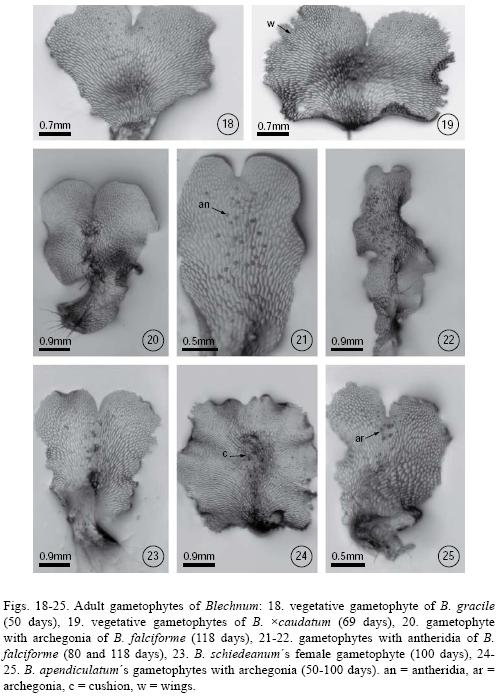
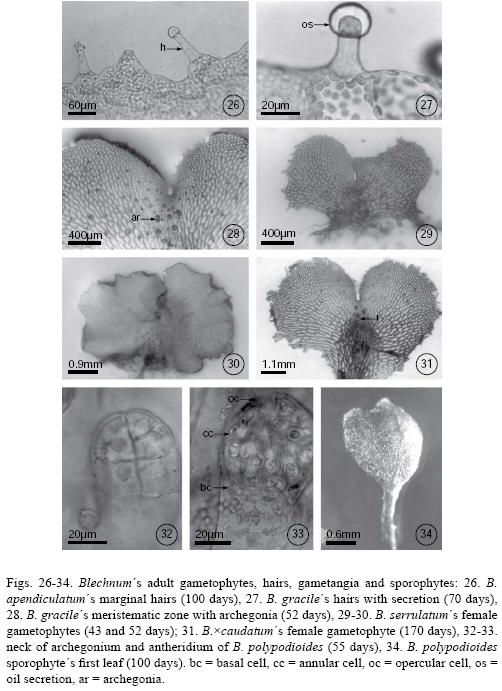
<body><![CDATA[<p align="justify"><font face="verdana" size="2">Plate phase formation began between days 20&#150;40 with an orientation change in the division plane of the apical cell, showing a variation in the prothallial development pattern. In <i>Blechnum gracile, B. occidentale, B. polypodioides, B. serrulatum, </i>and <i>B. <sup>X</sup>caudatum, </i>the apical cell of the filament divided crosswise to form two unequal cells whose function was to form a meristematic cell from which the plate phase will later develop (<a href="#f2">Fig. 10</a>). However, in <i>B. falciforme </i>and <i>B. schiedeanum </i>the plate phase began with the lengthwise division of the filament's intercalary cells to form the plate and the subsequent establishment of a pluricellular meristem, which then formed the gametophytes (<a href="#f2">Figs. 11&#150;15</a>). Gametophyte development in all species corresponded to the <i>Aspidium</i>&#150;type<i>, </i>according to Nayar &amp; Kaur (1969). During this stage, the gametophytes were vegetative. Rhizoids were few in number, light brown, and longer than the gametophyte (<a href="#f2">Figs. 13&#150;17</a>). It is during this stage that the development of marginal unicellular hairs began in all the studied species (<a href="#f2">Figs. 11&#150;12</a>).</font></p>     <p align="center"><font face="verdana" size="2"><a name="f2"></a></font></p>     <p align="center"><font face="verdana" size="2"><img src="/img/revistas/abm/n88/a5f2.jpg"></font></p>     <p align="justify"><font face="verdana" size="2">All species were unisexual and gametangia (initially archegonia) differentiated between day 50 and day 80. Archegoniate individuals were the first to develop (protogynous) within a population and did so within an asynchronous manner. In <i>Blechnum falciforme, </i>archegonia were apparent by day 40; in <i>B. gracile, B. polypodioides, </i>and <i>B. schiedeanum, </i>by day 50; in <i>B. occidentale, B. serrulatum, </i>and <i>B. &times;caudatum </i>by day 60; and in <i>B. appendiculatum </i>by day 70. Female gametophytes were spatulate&#150;cordiform to cordiform&#150;reniform and the wings broad. The cushion became well differentiated between day 70 and 100 (<a href="#f3">Figs. 21&#150;22</a>) with numerous unicellular capitate hairs in the gametophyte margin and, in lesser amounts, on both surfaces (<a href="#f4">Figs. 26&#150;27</a>). The archegonia were distributed on the cushion near the meristematic zone (<a href="#f3">Figs. 20, 23&#150;25</a>, <a href="#f4">28, 30, 31</a>). Their necks were elongated, 4&#150;5 cells long, and slightly curved towards the basal region of the gametophyte. The mouth was composed of 4 cells, and the necks of four rows 3&#150;5 cells long (<a href="#f4">Fig. 32</a>).</font></p>     <p align="center"><font face="verdana" size="2"><a name="f3"></a></font></p>     <p align="center"><font face="verdana" size="2"><img src="/img/revistas/abm/n88/a5f3.jpg"></font></p>     <p align="center"><font face="verdana" size="2"><a name="f4"></a></font></p>     <p align="center"><font face="verdana" size="2"><img src="/img/revistas/abm/n88/a5f4.jpg"></font></p>     <p align="justify"><font face="verdana" size="2">The antheridia developed after the archegonia, between day 60 and day 70 in most species, with the exception of <i>Blechnum appendiculatum </i>in which they developed after day 80 (<a href="#f3">Figs. 21&#150;22</a>). Male gametophytes were spatulate&#150;elongated to spatulate&#150;cordiform, their cushion scarcely differentiated between 60&#150;80 days, and their wings were narrower than those of females (<a href="#f3">Figs. 18&#150;25</a>). Antheridia were oblong, sometimes with a slightly narrowed base, and composed of a basal cell, an annular or ring cell, and a very conspicuous opercular cell (<a href="#f4">Fig. 33</a>). They were distributed irregularly on the on the ventral face of spatulate gametophytes.</font></p>     <p align="justify"><font face="verdana" size="2">Sporophytes developed in <i>Blechnum occidentale </i>and <i>B. polypodioides </i>90 days after the spores had been sown. The first leaves were spatulate to bilobate with open dichotomous venation (<a href="#f4">Fig. 34</a>). The petiole was long and terete with hyaline, capitate hairs. Stomata were found only on the abaxial side of the blade and lacked subsidiary cells.</font></p>     ]]></body>
<body><![CDATA[<p align="justify"><font face="verdana" size="2">&nbsp;</font></p>     <p align="justify"><font face="verdana" size="2"><b>DISCUSSION</b></font></p>     <p align="justify"><font face="verdana" size="2">The species studied here can be placed in two groups based on spore size and frond morphology. The first contains species with monomorphic leaves, such as <i>Blechnum appendiculatum, B. gracile, B. occidentale, B. polypodioides, B. serrulatum </i>and <i>B. &times;caudatum, </i>which have small spores measuring on average 37 to 43 &micro;m long by 24 to 31 &micro;m wide. The second group contains <i>B. falciforme </i>and <i>B. schiedeanum, </i>which have dimorphic leaves and larger spores measuring on average 57 to 67 &micro;m long by 40 to 49 &micro;m wide. Duration of the pre&#150;germination phase following exposure to agar based media corresponded with spore size, with smaller spore species germinating earlier than species with the two largest spores (i.e., <i>B. falciforme </i>and <i>B. schiedeanum</i>).</font></p>     <p align="justify"><font face="verdana" size="2">The <i>Aspidium</i>&#150;type differs from all others in that there is often a margin of variability in the process of development and that it is conditioned by early hair formation in the young gametophyte.</font></p>     <p align="justify"><font face="verdana" size="2">The <i>Aspidium</i>&#150;type of development is a constant characteristic except in some Australian and Chilean species as <i>Blechnum nudum </i>Mett., <i>B. penna&#150;marina </i>(Poir.) Kuhn and <i>B. chilense </i>(Kaulf.) Mett., which lack hairs during the entire developmental stage and therefore have the <i>Adiantum&#150;type </i>of gametophyte development.</font></p>     <p align="justify"><font face="verdana" size="2">In the <i>Adiantum</i>&#150;type, the terminal cell of the germ filament divides by a wall oblique to the long axis of the filament, and this is followed by another division by a wall at right angles to it. Thus, a transverse row of three daughter cells is formed, of which the middle one is wedge&#150;shaped and acts as a meristematic cell (Nayar, 1962; Nayar &amp; Kaur, 1971; Rodr&iacute;guez&#150;R&iacute;os, 1973; Dur&aacute;n &amp; de la Sota, 1996; P&eacute;rez&#150;Garc&iacute;a et al., 1996).</font></p>     <p align="justify"><font face="verdana" size="2">Hair abundance varies among species and depends on the stage of prothallial development. In some species, such as <i>Blechnum cycadifolium </i>(Colla) Sturm., <i>B. orientale </i>L., and <i>B. gibbum </i>(Lab.) Mett., young prothallia are glabrous, with the hairs developing only when they are mature. In other species such as <i>B. buchtienii </i>Rosenst., <i>B. brasiliense </i>Desv. and <i>B. spicant </i>(L.) Roth, gametophytes develop hairs soon after attaining a plate phase as is the case for the species studied here (Atkinson, 1973). On the other hand, gametophytes of the Australian species <i>B. nudum </i>and <i>B. penna&#150;marina, </i>and the Chilean species <i>B. chilense, </i>are completely glabrous during their entire development (Stokey &amp; Atkinson, 1952a, 1952b; Stone, 1961; P&eacute;rez&#150;Garc&iacute;a et al., 1996).</font></p>     <p align="justify"><font face="verdana" size="2">Although <i>Blechnum </i>is often considered to be a big genus, it is relatively homogeneous for such a large group. Morphological differences in the sporophytes such as monomorphic and dimorphic fronds and size of spores, seemingly share a similar pattern of germination and development prothallial, and gametophytes of <i>Blechnum </i>are not sufficiently known to provide information for an adequate infrageneric classification (<a href="/img/revistas/abm/n88/a5t2.jpg" target="_blank">Table 2</a>). Study of the whole genus, especially the gametophytes, will be necessary to provide data for establishing relationships within the section, fronds dimorphic groups or fronds monomorphic groups (Smith, 1981, Tryon &amp; Tryon, 1982; Mickel &amp; Beitel, 1988; Mickel &amp; Smith, 2004).</font></p>     <p align="justify"><font face="verdana" size="2">&nbsp;</font></p>     <p align="justify"><font face="verdana" size="2"><b>ACKNOWLEDGMENTS</b></font></p>     ]]></body>
<body><![CDATA[<p align="justify"><font face="verdana" size="2">We wish to thank to Victor Steinmann, Jacqueline Ceja, Gary K. Greer, and all our reviewers for the comments and suggestions made to the manuscript, and to Jorge Lodigiani for printing the photographic material.</font></p>     <p align="justify"><font face="verdana" size="2">&nbsp;</font></p>     <p align="justify"><font face="verdana" size="2"><b>LITERATURE CITED</b></font></p>     <!-- ref --><p align="justify"><font face="verdana" size="2">Atkinson, l. R. 1973. The gametophytes and family relationships. In: Jermy, A. C., J. A. Crabbe &amp; B. A. Thomas (eds.). The phytogeny and classification of the ferns. Bot. J. Linn. Soc. 67(Suppl. 1): 73&#150;90.</font>&nbsp;&nbsp;&nbsp;&nbsp;&nbsp;&nbsp;&nbsp;&nbsp;[&#160;<a href="javascript:void(0);" onclick="javascript: window.open('/scielo.php?script=sci_nlinks&ref=027038&pid=S0187-7151200900030000500001&lng=','','width=640,height=500,resizable=yes,scrollbars=1,menubar=yes,');">Links</a>&#160;]<!-- end-ref --><!-- ref --><p align="justify"><font face="verdana" size="2">Beisv&acirc;g, T. 1970. An electron microscopic investigation of the young gametophyte of <i>Blechnum spicant </i>(L.) Roth. Grana Palynol. 10: 121&#150;135.</font>&nbsp;&nbsp;&nbsp;&nbsp;&nbsp;&nbsp;&nbsp;&nbsp;[&#160;<a href="javascript:void(0);" onclick="javascript: window.open('/scielo.php?script=sci_nlinks&ref=027039&pid=S0187-7151200900030000500002&lng=','','width=640,height=500,resizable=yes,scrollbars=1,menubar=yes,');">Links</a>&#160;]<!-- end-ref --><!-- ref --><p align="justify"><font face="verdana" size="2">Chiou, W. I. 1989. The gametophytes and juvenile sporophytes of <i>Blechnum orientale </i>L.Yushania 6: 1&#150;8.</font>&nbsp;&nbsp;&nbsp;&nbsp;&nbsp;&nbsp;&nbsp;&nbsp;[&#160;<a href="javascript:void(0);" onclick="javascript: window.open('/scielo.php?script=sci_nlinks&ref=027040&pid=S0187-7151200900030000500003&lng=','','width=640,height=500,resizable=yes,scrollbars=1,menubar=yes,');">Links</a>&#160;]<!-- end-ref --><!-- ref --><p align="justify"><font face="verdana" size="2">Cousens, M. I. 1979. Gametophyte ontogeny, sex expression, and genetic load as measures of population divergence in <i>Blechnum spicant. </i>Amer. J. Bot. 66: 116&#150;32.</font>&nbsp;&nbsp;&nbsp;&nbsp;&nbsp;&nbsp;&nbsp;&nbsp;[&#160;<a href="javascript:void(0);" onclick="javascript: window.open('/scielo.php?script=sci_nlinks&ref=027041&pid=S0187-7151200900030000500004&lng=','','width=640,height=500,resizable=yes,scrollbars=1,menubar=yes,');">Links</a>&#160;]<!-- end-ref --><!-- ref --><p align="justify"><font face="verdana" size="2">Cousens, M. I. 1981. <i>Blechnum spicant: </i>habitat and vigor of optimal, marginal and disjunct populations, and field observations of gametophytes. Bot. Gaz. (Crawfordsville) 142: 251&#150;258.</font>&nbsp;&nbsp;&nbsp;&nbsp;&nbsp;&nbsp;&nbsp;&nbsp;[&#160;<a href="javascript:void(0);" onclick="javascript: window.open('/scielo.php?script=sci_nlinks&ref=027042&pid=S0187-7151200900030000500005&lng=','','width=640,height=500,resizable=yes,scrollbars=1,menubar=yes,');">Links</a>&#160;]<!-- end-ref --><!-- ref --><p align="justify"><font face="verdana" size="2">D&ouml;pp, W. 1927. Untersuchungen &uuml;ber die Entwicklung von Prothallien einheimischer Polypodiaceen. Pflanzenforschung 8: 1&#150;58.</font>&nbsp;&nbsp;&nbsp;&nbsp;&nbsp;&nbsp;&nbsp;&nbsp;[&#160;<a href="javascript:void(0);" onclick="javascript: window.open('/scielo.php?script=sci_nlinks&ref=027043&pid=S0187-7151200900030000500006&lng=','','width=640,height=500,resizable=yes,scrollbars=1,menubar=yes,');">Links</a>&#160;]<!-- end-ref --><!-- ref --><p align="justify"><font face="verdana" size="2">Dur&aacute;n, M. L. &amp; E. R. de la Sota. 1996. Delayed sex expression of hybrid gametophytes in <i>Blechnum. </i>In: Gibby, J. M. &amp; R. J. Johns (eds.). Pteridology in perspective. Royal Botanical Gardens. Kew. p. 515.</font>&nbsp;&nbsp;&nbsp;&nbsp;&nbsp;&nbsp;&nbsp;&nbsp;[&#160;<a href="javascript:void(0);" onclick="javascript: window.open('/scielo.php?script=sci_nlinks&ref=027044&pid=S0187-7151200900030000500007&lng=','','width=640,height=500,resizable=yes,scrollbars=1,menubar=yes,');">Links</a>&#160;]<!-- end-ref --><!-- ref --><p align="justify"><font face="verdana" size="2">Erdtman, G. &amp; P. Sorsa. 1971. Pollen and spore morphology/plant taxonomy. Pteridophyta. Almqvist &amp; Wiksell. Stockholm. 302 pp.</font>&nbsp;&nbsp;&nbsp;&nbsp;&nbsp;&nbsp;&nbsp;&nbsp;[&#160;<a href="javascript:void(0);" onclick="javascript: window.open('/scielo.php?script=sci_nlinks&ref=027045&pid=S0187-7151200900030000500008&lng=','','width=640,height=500,resizable=yes,scrollbars=1,menubar=yes,');">Links</a>&#160;]<!-- end-ref --><!-- ref --><p align="justify"><font face="verdana" size="2">Fern&aacute;ndez, H., A. M. Bertrand &amp; R. S&aacute;nchez&#150;Tam&eacute;s.  1997. Gametophyte culture and antheridiogen activity <i>in Blechnum spicant </i>L. Plant Cell Tissue Org. Cult. 50: 71&#150;74.</font>&nbsp;&nbsp;&nbsp;&nbsp;&nbsp;&nbsp;&nbsp;&nbsp;[&#160;<a href="javascript:void(0);" onclick="javascript: window.open('/scielo.php?script=sci_nlinks&ref=027046&pid=S0187-7151200900030000500009&lng=','','width=640,height=500,resizable=yes,scrollbars=1,menubar=yes,');">Links</a>&#160;]<!-- end-ref --><!-- ref --><p align="justify"><font face="verdana" size="2">Kachroo, P. 1955. Gametophytes <i>of Blechnum orientale </i>L. <i>and Blechnum </i>spp. Sci. &amp; Cult. 20: 402&#150;403.</font>&nbsp;&nbsp;&nbsp;&nbsp;&nbsp;&nbsp;&nbsp;&nbsp;[&#160;<a href="javascript:void(0);" onclick="javascript: window.open('/scielo.php?script=sci_nlinks&ref=027047&pid=S0187-7151200900030000500010&lng=','','width=640,height=500,resizable=yes,scrollbars=1,menubar=yes,');">Links</a>&#160;]<!-- end-ref --><!-- ref --><p align="justify"><font face="verdana" size="2">Karpowicz, W.   1927.  Studien &uuml;ber die Entwicklung der Prothallien und der ersten Sporophyllbl&auml;tter der einheimischer Farnkr&auml;uter (Polypodiaceae). Bull. Int. Acad. Polon. Sci. Lettr. S&eacute;r. B 1: 1&#150;26.</font>&nbsp;&nbsp;&nbsp;&nbsp;&nbsp;&nbsp;&nbsp;&nbsp;[&#160;<a href="javascript:void(0);" onclick="javascript: window.open('/scielo.php?script=sci_nlinks&ref=027048&pid=S0187-7151200900030000500011&lng=','','width=640,height=500,resizable=yes,scrollbars=1,menubar=yes,');">Links</a>&#160;]<!-- end-ref --><!-- ref --><p align="justify"><font face="verdana" size="2">Klekowski, E. J., Jr. 1969. Reproductive biology of the pteridophyta. III. A study of the Blechnaceae. J. Linn. Soc. Bot. 62: 361&#150;377.</font>&nbsp;&nbsp;&nbsp;&nbsp;&nbsp;&nbsp;&nbsp;&nbsp;[&#160;<a href="javascript:void(0);" onclick="javascript: window.open('/scielo.php?script=sci_nlinks&ref=027049&pid=S0187-7151200900030000500012&lng=','','width=640,height=500,resizable=yes,scrollbars=1,menubar=yes,');">Links</a>&#160;]<!-- end-ref --><!-- ref --><p align="justify"><font face="verdana" size="2">Lampa, E. 1901. &Uuml;ber die Entwicklung einiger Farnprothallien. S. B. Akad. WISs. Wien 110: 95&#150;111.</font>&nbsp;&nbsp;&nbsp;&nbsp;&nbsp;&nbsp;&nbsp;&nbsp;[&#160;<a href="javascript:void(0);" onclick="javascript: window.open('/scielo.php?script=sci_nlinks&ref=027050&pid=S0187-7151200900030000500013&lng=','','width=640,height=500,resizable=yes,scrollbars=1,menubar=yes,');">Links</a>&#160;]<!-- end-ref --><!-- ref --><p align="justify"><font face="verdana" size="2">Mendoza&#150;Ruiz, A. &amp; B. P&eacute;rez&#150;Garc&iacute;a. 2005. An&aacute;lisis comparativo de la fase sexual de dos especies de <i>Microgramma </i>(Polypodiaceae, Pleopeltoideae). Acta Bot. Mex. 71:1&#150;10.</font>&nbsp;&nbsp;&nbsp;&nbsp;&nbsp;&nbsp;&nbsp;&nbsp;[&#160;<a href="javascript:void(0);" onclick="javascript: window.open('/scielo.php?script=sci_nlinks&ref=027051&pid=S0187-7151200900030000500014&lng=','','width=640,height=500,resizable=yes,scrollbars=1,menubar=yes,');">Links</a>&#160;]<!-- end-ref --><!-- ref --><p align="justify"><font face="verdana" size="2">Men&eacute;ndez, V., A. M. Revilla &amp; H. Fern&aacute;ndez. 2006a. Growth and gender in the gametophyte of<i> Blechnum spicant </i>L. Plant Cell Tissue Org. Cult. 86: 47&#150;53.</font>&nbsp;&nbsp;&nbsp;&nbsp;&nbsp;&nbsp;&nbsp;&nbsp;[&#160;<a href="javascript:void(0);" onclick="javascript: window.open('/scielo.php?script=sci_nlinks&ref=027052&pid=S0187-7151200900030000500015&lng=','','width=640,height=500,resizable=yes,scrollbars=1,menubar=yes,');">Links</a>&#160;]<!-- end-ref --><!-- ref --><p align="justify"><font face="verdana" size="2">Men&eacute;ndez, V., A. M. Revilla, P. Bernard, V. Gotor &amp; H. Fern&aacute;ndez. 2006b. Gibberellins and antheridiogen on sex in <i>Blechnum spicant </i>L. Plant Cell Rep. 25: 1104&#150;1110.</font>&nbsp;&nbsp;&nbsp;&nbsp;&nbsp;&nbsp;&nbsp;&nbsp;[&#160;<a href="javascript:void(0);" onclick="javascript: window.open('/scielo.php?script=sci_nlinks&ref=027053&pid=S0187-7151200900030000500016&lng=','','width=640,height=500,resizable=yes,scrollbars=1,menubar=yes,');">Links</a>&#160;]<!-- end-ref --><!-- ref --><p align="justify"><font face="verdana" size="2">Mickel, J. T. &amp; J. M. Beitel. 1988. Pteridophyte flora of Oaxaca, Mexico. Mem. New York Bot. Gard. 46: 1&#150;568.</font>&nbsp;&nbsp;&nbsp;&nbsp;&nbsp;&nbsp;&nbsp;&nbsp;[&#160;<a href="javascript:void(0);" onclick="javascript: window.open('/scielo.php?script=sci_nlinks&ref=027054&pid=S0187-7151200900030000500017&lng=','','width=640,height=500,resizable=yes,scrollbars=1,menubar=yes,');">Links</a>&#160;]<!-- end-ref --><!-- ref --><p align="justify"><font face="verdana" size="2">Mickel, J. T. &amp; A. R. Smith. 2004. The pteridophytes of Mexico. Mem. New York Bot. Gard. 88: 1&#150;1054.</font>&nbsp;&nbsp;&nbsp;&nbsp;&nbsp;&nbsp;&nbsp;&nbsp;[&#160;<a href="javascript:void(0);" onclick="javascript: window.open('/scielo.php?script=sci_nlinks&ref=027055&pid=S0187-7151200900030000500018&lng=','','width=640,height=500,resizable=yes,scrollbars=1,menubar=yes,');">Links</a>&#160;]<!-- end-ref --><!-- ref --><p align="justify"><font face="verdana" size="2">Moran, R. C. 1995. Blechnaceae. In: Moran R. C. &amp; R. Riba (eds.). Flora Mesoamericana Vol. I. Psilotaceae a Salviniaceae. Instituto de Biolog&iacute;a, Universidad Nacional Aut&oacute;noma de M&eacute;xico, Missouri Botanical Garden and The Natural History Museum (London). pp. 325&#150;332.</font>&nbsp;&nbsp;&nbsp;&nbsp;&nbsp;&nbsp;&nbsp;&nbsp;[&#160;<a href="javascript:void(0);" onclick="javascript: window.open('/scielo.php?script=sci_nlinks&ref=027056&pid=S0187-7151200900030000500019&lng=','','width=640,height=500,resizable=yes,scrollbars=1,menubar=yes,');">Links</a>&#160;]<!-- end-ref --><!-- ref --><p align="justify"><font face="verdana" size="2">Nayar, B. K. 1962. The gametophyte of some species of <i>Blechnum. </i>J. Indian Bot. Soc. 41:33&#150;44.</font>&nbsp;&nbsp;&nbsp;&nbsp;&nbsp;&nbsp;&nbsp;&nbsp;[&#160;<a href="javascript:void(0);" onclick="javascript: window.open('/scielo.php?script=sci_nlinks&ref=027057&pid=S0187-7151200900030000500020&lng=','','width=640,height=500,resizable=yes,scrollbars=1,menubar=yes,');">Links</a>&#160;]<!-- end-ref --><!-- ref --><p align="justify"><font face="verdana" size="2">Nayar, B. K., N. Bajpai &amp; F. Raza. 1966. Morphological studies on some species of <i>Blechnum, Doodia, Woodwardia </i>and <i>Stenochlaena&#150;I: </i>The gametophytes and juvenile sporophytes. J. Linn. Soc. Bot. 59: 405&#150;423.</font>&nbsp;&nbsp;&nbsp;&nbsp;&nbsp;&nbsp;&nbsp;&nbsp;[&#160;<a href="javascript:void(0);" onclick="javascript: window.open('/scielo.php?script=sci_nlinks&ref=027058&pid=S0187-7151200900030000500021&lng=','','width=640,height=500,resizable=yes,scrollbars=1,menubar=yes,');">Links</a>&#160;]<!-- end-ref --><!-- ref --><p align="justify"><font face="verdana" size="2">Nayar, B. K. &amp; S. Kaur. 1969. Types of prothallial development in homosporous ferns. Phytomorphology 19: 179&#150;188.</font>&nbsp;&nbsp;&nbsp;&nbsp;&nbsp;&nbsp;&nbsp;&nbsp;[&#160;<a href="javascript:void(0);" onclick="javascript: window.open('/scielo.php?script=sci_nlinks&ref=027059&pid=S0187-7151200900030000500022&lng=','','width=640,height=500,resizable=yes,scrollbars=1,menubar=yes,');">Links</a>&#160;]<!-- end-ref --><!-- ref --><p align="justify"><font face="verdana" size="2">Nayar, B. K. &amp; S. Kaur. 1971. Gametophytes of homosporous ferns. Bot. Rev. 37: 295&#150;396.</font>&nbsp;&nbsp;&nbsp;&nbsp;&nbsp;&nbsp;&nbsp;&nbsp;[&#160;<a href="javascript:void(0);" onclick="javascript: window.open('/scielo.php?script=sci_nlinks&ref=027060&pid=S0187-7151200900030000500023&lng=','','width=640,height=500,resizable=yes,scrollbars=1,menubar=yes,');">Links</a>&#160;]<!-- end-ref --><!-- ref --><p align="justify"><font face="verdana" size="2">P&eacute;rez&#150;Garc&iacute;a, B., A. Mendoza &amp; M. Ricci. 1996. Morfog&eacute;nesis de la fase sexual de <i>Blechnum </i><i>chilense </i>y <i>Blechnum cycadifolium </i>(Blechnaceae). Rev. Biol. Trop. 44: 491&#150;497.</font>&nbsp;&nbsp;&nbsp;&nbsp;&nbsp;&nbsp;&nbsp;&nbsp;[&#160;<a href="javascript:void(0);" onclick="javascript: window.open('/scielo.php?script=sci_nlinks&ref=027061&pid=S0187-7151200900030000500024&lng=','','width=640,height=500,resizable=yes,scrollbars=1,menubar=yes,');">Links</a>&#160;]<!-- end-ref --><!-- ref --><p align="justify"><font face="verdana" size="2">Rodr&iacute;guez&#150;R&iacute;os, R. 1973. Morfolog&iacute;a de los protalos y esporofitos j&oacute;venes de algunas especies chilenas de <i>Blechnum </i>(Polypodiaceae s.l.). Gayana, Bot. 22: 1&#150;30.</font>&nbsp;&nbsp;&nbsp;&nbsp;&nbsp;&nbsp;&nbsp;&nbsp;[&#160;<a href="javascript:void(0);" onclick="javascript: window.open('/scielo.php?script=sci_nlinks&ref=027062&pid=S0187-7151200900030000500025&lng=','','width=640,height=500,resizable=yes,scrollbars=1,menubar=yes,');">Links</a>&#160;]<!-- end-ref --><!-- ref --><p align="justify"><font face="verdana" size="2">Smith, A. R. 1981. Pteridophytes. In: Breedlove, D. E. (ed.). Flora of Chiapas. Vol. 2. California Academy of Sciences. San Francisco. 370 pp.</font>&nbsp;&nbsp;&nbsp;&nbsp;&nbsp;&nbsp;&nbsp;&nbsp;[&#160;<a href="javascript:void(0);" onclick="javascript: window.open('/scielo.php?script=sci_nlinks&ref=027063&pid=S0187-7151200900030000500026&lng=','','width=640,height=500,resizable=yes,scrollbars=1,menubar=yes,');">Links</a>&#160;]<!-- end-ref --><!-- ref --><p align="justify"><font face="verdana" size="2">Stokey, A. G. 1951. The contribution by the gametophyte to the classification of the homosporous ferns. Phytomorphology 1: 39&#150;58.</font>&nbsp;&nbsp;&nbsp;&nbsp;&nbsp;&nbsp;&nbsp;&nbsp;[&#160;<a href="javascript:void(0);" onclick="javascript: window.open('/scielo.php?script=sci_nlinks&ref=027064&pid=S0187-7151200900030000500027&lng=','','width=640,height=500,resizable=yes,scrollbars=1,menubar=yes,');">Links</a>&#160;]<!-- end-ref --><!-- ref --><p align="justify"><font face="verdana" size="2">Stokey, A. G. &amp; L. Atkinson. 1952a. The gametophyte of <i>Stenochlaena palustris </i>(Burm.) Bedd. Phytomorphology 2: 1&#150;9.</font>&nbsp;&nbsp;&nbsp;&nbsp;&nbsp;&nbsp;&nbsp;&nbsp;[&#160;<a href="javascript:void(0);" onclick="javascript: window.open('/scielo.php?script=sci_nlinks&ref=027065&pid=S0187-7151200900030000500028&lng=','','width=640,height=500,resizable=yes,scrollbars=1,menubar=yes,');">Links</a>&#160;]<!-- end-ref --><!-- ref --><p align="justify"><font face="verdana" size="2">Stokey, A. G. &amp; L. Atkinson. 1952b. The gametophyte <i>of Blechnum spicant </i>(L.) Wither and <i>B. buchtienii </i>Rosenst. Phytomorphology 2: 9&#150;15.</font>&nbsp;&nbsp;&nbsp;&nbsp;&nbsp;&nbsp;&nbsp;&nbsp;[&#160;<a href="javascript:void(0);" onclick="javascript: window.open('/scielo.php?script=sci_nlinks&ref=027066&pid=S0187-7151200900030000500029&lng=','','width=640,height=500,resizable=yes,scrollbars=1,menubar=yes,');">Links</a>&#160;]<!-- end-ref --><!-- ref --><p align="justify"><font face="verdana" size="2">Stone, I. 1961. The gametophytes of the victorian Blechnaceae I. <i>Blechnum nudum </i>(Labill.) Luerss. Austral. J. Bot. 9: 120&#150;136.</font>&nbsp;&nbsp;&nbsp;&nbsp;&nbsp;&nbsp;&nbsp;&nbsp;[&#160;<a href="javascript:void(0);" onclick="javascript: window.open('/scielo.php?script=sci_nlinks&ref=027067&pid=S0187-7151200900030000500030&lng=','','width=640,height=500,resizable=yes,scrollbars=1,menubar=yes,');">Links</a>&#160;]<!-- end-ref --><!-- ref --><p align="justify"><font face="verdana" size="2">St&uuml;bner, G. A. 1882. Beitrag zur Entwicklungsgeschichte des Vorkeims der Polypodiaceen. 13 Berichte &uuml;ber die K&ouml;nigliche Realschule I. Ordnung und Landwirtschaftsschule zu D&ouml;beln. 19 pp.</font>&nbsp;&nbsp;&nbsp;&nbsp;&nbsp;&nbsp;&nbsp;&nbsp;[&#160;<a href="javascript:void(0);" onclick="javascript: window.open('/scielo.php?script=sci_nlinks&ref=027068&pid=S0187-7151200900030000500031&lng=','','width=640,height=500,resizable=yes,scrollbars=1,menubar=yes,');">Links</a>&#160;]<!-- end-ref --><!-- ref --><p align="justify"><font face="verdana" size="2">Tryon, R. M. &amp; A. F. Tryon. 1982. Ferns and allied plants, with special reference to tropical America. Springer&#150;Verlag. New York. 857 pp.</font>&nbsp;&nbsp;&nbsp;&nbsp;&nbsp;&nbsp;&nbsp;&nbsp;[&#160;<a href="javascript:void(0);" onclick="javascript: window.open('/scielo.php?script=sci_nlinks&ref=027069&pid=S0187-7151200900030000500032&lng=','','width=640,height=500,resizable=yes,scrollbars=1,menubar=yes,');">Links</a>&#160;]<!-- end-ref --> ]]></body><back>
<ref-list>
<ref id="B1">
<nlm-citation citation-type="book">
<person-group person-group-type="author">
<name>
<surname><![CDATA[Atkinson]]></surname>
<given-names><![CDATA[l. R.]]></given-names>
</name>
</person-group>
<article-title xml:lang="en"><![CDATA[The gametophytes and family relationships.]]></article-title>
<person-group person-group-type="editor">
<name>
<surname><![CDATA[Jermy]]></surname>
<given-names><![CDATA[A. C.]]></given-names>
</name>
<name>
<surname><![CDATA[Crabbe]]></surname>
<given-names><![CDATA[J. A.]]></given-names>
</name>
<name>
<surname><![CDATA[Thomas]]></surname>
<given-names><![CDATA[B. A.]]></given-names>
</name>
</person-group>
<source><![CDATA[The phytogeny and classification of the ferns.]]></source>
<year>1973</year>
<volume>67</volume>
<page-range>73-90</page-range><publisher-name><![CDATA[Bot. J. Linn. Soc.]]></publisher-name>
</nlm-citation>
</ref>
<ref id="B2">
<nlm-citation citation-type="journal">
<person-group person-group-type="author">
<name>
<surname><![CDATA[Beisvâg]]></surname>
<given-names><![CDATA[T]]></given-names>
</name>
</person-group>
<article-title xml:lang="en"><![CDATA[An electron microscopic investigation of the young gametophyte of Blechnum spicant (L.) Roth.]]></article-title>
<source><![CDATA[Grana Palynol]]></source>
<year>1970</year>
<volume>10</volume>
<page-range>121-135</page-range></nlm-citation>
</ref>
<ref id="B3">
<nlm-citation citation-type="journal">
<person-group person-group-type="author">
<name>
<surname><![CDATA[Chiou]]></surname>
<given-names><![CDATA[W. I.]]></given-names>
</name>
</person-group>
<article-title xml:lang="en"><![CDATA[The gametophytes and juvenile sporophytes of Blechnum orientale L.]]></article-title>
<source><![CDATA[Yushania]]></source>
<year>1989</year>
<volume>6</volume>
<page-range>1-8</page-range></nlm-citation>
</ref>
<ref id="B4">
<nlm-citation citation-type="journal">
<person-group person-group-type="author">
<name>
<surname><![CDATA[Cousens]]></surname>
<given-names><![CDATA[M. I.]]></given-names>
</name>
</person-group>
<article-title xml:lang="en"><![CDATA[Gametophyte ontogeny, sex expression, and genetic load as measures of population divergence in Blechnum spicant.]]></article-title>
<source><![CDATA[Amer. J. Bot.]]></source>
<year>1979</year>
<volume>66</volume>
<page-range>116-32</page-range></nlm-citation>
</ref>
<ref id="B5">
<nlm-citation citation-type="journal">
<person-group person-group-type="author">
<name>
<surname><![CDATA[Cousens]]></surname>
<given-names><![CDATA[M. I.]]></given-names>
</name>
</person-group>
<article-title xml:lang="en"><![CDATA[Blechnum spicant: habitat and vigor of optimal, marginal and disjunct populations, and field observations of gametophytes.]]></article-title>
<source><![CDATA[Bot. Gaz.]]></source>
<year>1981</year>
<volume>142</volume>
<page-range>251-258</page-range><publisher-loc><![CDATA[Crawfordsville ]]></publisher-loc>
</nlm-citation>
</ref>
<ref id="B6">
<nlm-citation citation-type="journal">
<person-group person-group-type="author">
<name>
<surname><![CDATA[Döpp]]></surname>
<given-names><![CDATA[W]]></given-names>
</name>
</person-group>
<article-title xml:lang="en"><![CDATA[Untersuchungen über die Entwicklung von Prothallien einheimischer Polypodiaceen.]]></article-title>
<source><![CDATA[Pflanzenforschung]]></source>
<year>1927</year>
<volume>8</volume>
<page-range>1-58</page-range></nlm-citation>
</ref>
<ref id="B7">
<nlm-citation citation-type="book">
<person-group person-group-type="author">
<name>
<surname><![CDATA[Durán]]></surname>
<given-names><![CDATA[M. L.]]></given-names>
</name>
<name>
<surname><![CDATA[de la Sota]]></surname>
<given-names><![CDATA[E. R.]]></given-names>
</name>
</person-group>
<article-title xml:lang="en"><![CDATA[Delayed sex expression of hybrid gametophytes in Blechnum.]]></article-title>
<person-group person-group-type="editor">
<name>
<surname><![CDATA[Gibby]]></surname>
<given-names><![CDATA[J. M.]]></given-names>
</name>
<name>
<surname><![CDATA[Johns]]></surname>
<given-names><![CDATA[R. J.]]></given-names>
</name>
</person-group>
<source><![CDATA[Pteridology in perspective.]]></source>
<year>1996</year>
<page-range>515</page-range><publisher-name><![CDATA[Royal Botanical Gardens]]></publisher-name>
</nlm-citation>
</ref>
<ref id="B8">
<nlm-citation citation-type="book">
<person-group person-group-type="author">
<name>
<surname><![CDATA[Erdtman]]></surname>
<given-names><![CDATA[G]]></given-names>
</name>
<name>
<surname><![CDATA[Sorsa]]></surname>
<given-names><![CDATA[P]]></given-names>
</name>
</person-group>
<source><![CDATA[Pollen and spore morphology/plant taxonomy. Pteridophyta.]]></source>
<year>1971</year>
<page-range>302</page-range><publisher-loc><![CDATA[Stockholm ]]></publisher-loc>
<publisher-name><![CDATA[Almqvist & Wiksell]]></publisher-name>
</nlm-citation>
</ref>
<ref id="B9">
<nlm-citation citation-type="journal">
<person-group person-group-type="author">
<name>
<surname><![CDATA[Fernández]]></surname>
<given-names><![CDATA[H]]></given-names>
</name>
<name>
<surname><![CDATA[Bertrand]]></surname>
<given-names><![CDATA[A. M.]]></given-names>
</name>
<name>
<surname><![CDATA[Sánchez-Tamés]]></surname>
<given-names><![CDATA[R]]></given-names>
</name>
</person-group>
<article-title xml:lang="en"><![CDATA[Gametophyte culture and antheridiogen activity in Blechnum spicant L.]]></article-title>
<source><![CDATA[Plant Cell Tissue Org. Cult.]]></source>
<year>1997</year>
<volume>50</volume>
<page-range>71-74</page-range></nlm-citation>
</ref>
<ref id="B10">
<nlm-citation citation-type="journal">
<person-group person-group-type="author">
<name>
<surname><![CDATA[Kachroo]]></surname>
<given-names><![CDATA[P]]></given-names>
</name>
</person-group>
<article-title xml:lang="en"><![CDATA[Gametophytes of Blechnum orientale L. and Blechnum spp.]]></article-title>
<source><![CDATA[Sci. & Cult.]]></source>
<year>1955</year>
<volume>20</volume>
<page-range>402-403</page-range></nlm-citation>
</ref>
<ref id="B11">
<nlm-citation citation-type="journal">
<person-group person-group-type="author">
<name>
<surname><![CDATA[Karpowicz]]></surname>
<given-names><![CDATA[W]]></given-names>
</name>
</person-group>
<article-title xml:lang="en"><![CDATA[Studien über die Entwicklung der Prothallien und der ersten Sporophyllblätter der einheimischer Farnkräuter (Polypodiaceae).]]></article-title>
<source><![CDATA[Bull. Int. Acad. Polon. Sci. Lettr. Sér. B]]></source>
<year>1927</year>
<volume>1</volume>
<page-range>1-26</page-range></nlm-citation>
</ref>
<ref id="B12">
<nlm-citation citation-type="journal">
<person-group person-group-type="author">
<name>
<surname><![CDATA[Klekowski]]></surname>
<given-names><![CDATA[E. J.]]></given-names>
</name>
</person-group>
<article-title xml:lang="en"><![CDATA[Reproductive biology of the pteridophyta. III. A study of the Blechnaceae.]]></article-title>
<source><![CDATA[J. Linn. Soc. Bot.]]></source>
<year>1969</year>
<volume>62</volume>
<page-range>361-377</page-range></nlm-citation>
</ref>
<ref id="B13">
<nlm-citation citation-type="journal">
<person-group person-group-type="author">
<name>
<surname><![CDATA[Lampa]]></surname>
<given-names><![CDATA[E]]></given-names>
</name>
</person-group>
<article-title xml:lang="de"><![CDATA[Über die Entwicklung einiger Farnprothallien.]]></article-title>
<source><![CDATA[S. B. Akad. WISs. Wien]]></source>
<year>1901</year>
<volume>110</volume>
<page-range>95-111</page-range></nlm-citation>
</ref>
<ref id="B14">
<nlm-citation citation-type="journal">
<person-group person-group-type="author">
<name>
<surname><![CDATA[Mendoza-Ruiz]]></surname>
<given-names><![CDATA[A]]></given-names>
</name>
<name>
<surname><![CDATA[Pérez-García]]></surname>
<given-names><![CDATA[B]]></given-names>
</name>
</person-group>
<article-title xml:lang="es"><![CDATA[Análisis comparativo de la fase sexual de dos especies de Microgramma (Polypodiaceae, Pleopeltoideae).]]></article-title>
<source><![CDATA[Acta Bot. Mex.]]></source>
<year>2005</year>
<volume>71</volume>
<page-range>1-10</page-range></nlm-citation>
</ref>
<ref id="B15">
<nlm-citation citation-type="journal">
<person-group person-group-type="author">
<name>
<surname><![CDATA[Menéndez]]></surname>
<given-names><![CDATA[V]]></given-names>
</name>
<name>
<surname><![CDATA[Revilla]]></surname>
<given-names><![CDATA[A. M.]]></given-names>
</name>
<name>
<surname><![CDATA[Fernández]]></surname>
<given-names><![CDATA[H]]></given-names>
</name>
</person-group>
<article-title xml:lang="en"><![CDATA[Growth and gender in the gametophyte of Blechnum spicant L.]]></article-title>
<source><![CDATA[Plant Cell Tissue Org. Cult.]]></source>
<year>2006</year>
<volume>86</volume>
<page-range>47-53</page-range></nlm-citation>
</ref>
<ref id="B16">
<nlm-citation citation-type="journal">
<person-group person-group-type="author">
<name>
<surname><![CDATA[Menéndez]]></surname>
<given-names><![CDATA[V]]></given-names>
</name>
<name>
<surname><![CDATA[Revilla]]></surname>
<given-names><![CDATA[A. M.]]></given-names>
</name>
<name>
<surname><![CDATA[P]]></surname>
<given-names><![CDATA[Bernard]]></given-names>
</name>
<name>
<surname><![CDATA[Gotor]]></surname>
<given-names><![CDATA[V]]></given-names>
</name>
<name>
<surname><![CDATA[Fernández]]></surname>
<given-names><![CDATA[H]]></given-names>
</name>
</person-group>
<article-title xml:lang="en"><![CDATA[Gibberellins and antheridiogen on sex in Blechnum spicant L.]]></article-title>
<source><![CDATA[Plant Cell Rep.]]></source>
<year>2006</year>
<volume>25</volume>
<page-range>1104-1110</page-range></nlm-citation>
</ref>
<ref id="B17">
<nlm-citation citation-type="journal">
<person-group person-group-type="author">
<name>
<surname><![CDATA[Mickel]]></surname>
<given-names><![CDATA[J. T.]]></given-names>
</name>
<name>
<surname><![CDATA[Beitel]]></surname>
<given-names><![CDATA[J. M.]]></given-names>
</name>
</person-group>
<article-title xml:lang="en"><![CDATA[Pteridophyte flora of Oaxaca, Mexico.]]></article-title>
<source><![CDATA[Mem. New York Bot. Gard.]]></source>
<year>1988</year>
<volume>46</volume>
<page-range>1-568</page-range></nlm-citation>
</ref>
<ref id="B18">
<nlm-citation citation-type="journal">
<person-group person-group-type="author">
<name>
<surname><![CDATA[Mickel]]></surname>
<given-names><![CDATA[J. T.]]></given-names>
</name>
<name>
<surname><![CDATA[Smith]]></surname>
<given-names><![CDATA[A. R.]]></given-names>
</name>
</person-group>
<article-title xml:lang="en"><![CDATA[The pteridophytes of Mexico.]]></article-title>
<source><![CDATA[Mem. New York Bot. Gard.]]></source>
<year>2004</year>
<volume>88</volume>
<page-range>1-1054</page-range></nlm-citation>
</ref>
<ref id="B19">
<nlm-citation citation-type="book">
<person-group person-group-type="author">
<name>
<surname><![CDATA[Moran]]></surname>
<given-names><![CDATA[R. C.]]></given-names>
</name>
</person-group>
<article-title xml:lang="en"><![CDATA[Blechnaceae.]]></article-title>
<person-group person-group-type="editor">
<name>
<surname><![CDATA[Moran]]></surname>
<given-names><![CDATA[R. C.]]></given-names>
</name>
<name>
<surname><![CDATA[Riba]]></surname>
<given-names><![CDATA[R]]></given-names>
</name>
</person-group>
<source><![CDATA[Flora Mesoamericana]]></source>
<year>1995</year>
<volume>I</volume>
<page-range>325-332</page-range><publisher-loc><![CDATA[London ]]></publisher-loc>
<publisher-name><![CDATA[Instituto de Biología, Universidad Nacional Autónoma de MéxicoMissouri Botanical GardenThe Natural History Museum]]></publisher-name>
</nlm-citation>
</ref>
<ref id="B20">
<nlm-citation citation-type="journal">
<person-group person-group-type="author">
<name>
<surname><![CDATA[Nayar]]></surname>
<given-names><![CDATA[B. K.]]></given-names>
</name>
</person-group>
<article-title xml:lang="en"><![CDATA[The gametophyte of some species of Blechnum.]]></article-title>
<source><![CDATA[J. Indian Bot. Soc.]]></source>
<year>1962</year>
<volume>41</volume>
<page-range>33-44</page-range></nlm-citation>
</ref>
<ref id="B21">
<nlm-citation citation-type="journal">
<person-group person-group-type="author">
<name>
<surname><![CDATA[Nayar]]></surname>
<given-names><![CDATA[B. K.]]></given-names>
</name>
<name>
<surname><![CDATA[Bajpai]]></surname>
<given-names><![CDATA[N]]></given-names>
</name>
<name>
<surname><![CDATA[Raza]]></surname>
<given-names><![CDATA[F]]></given-names>
</name>
</person-group>
<article-title xml:lang="en"><![CDATA[studies on some species of Blechnum, Doodia, Woodwardia and Stenochlaena-I: The gametophytes and juvenile sporophytes.]]></article-title>
<source><![CDATA[J. Linn. Soc. Bot.]]></source>
<year>1966</year>
<volume>59</volume>
<page-range>405-423</page-range></nlm-citation>
</ref>
<ref id="B22">
<nlm-citation citation-type="journal">
<person-group person-group-type="author">
<name>
<surname><![CDATA[Nayar]]></surname>
<given-names><![CDATA[B. K.]]></given-names>
</name>
<name>
<surname><![CDATA[Kaur]]></surname>
<given-names><![CDATA[S]]></given-names>
</name>
</person-group>
<article-title xml:lang="en"><![CDATA[Types of prothallial development in homosporous ferns.]]></article-title>
<source><![CDATA[Phytomorphology]]></source>
<year>1969</year>
<volume>19</volume>
<page-range>179-188</page-range></nlm-citation>
</ref>
<ref id="B23">
<nlm-citation citation-type="journal">
<person-group person-group-type="author">
<name>
<surname><![CDATA[Nayar]]></surname>
<given-names><![CDATA[B. K.]]></given-names>
</name>
<name>
<surname><![CDATA[Kaur]]></surname>
<given-names><![CDATA[S]]></given-names>
</name>
</person-group>
<article-title xml:lang="en"><![CDATA[Gametophytes of homosporous ferns.]]></article-title>
<source><![CDATA[Bot. Rev.]]></source>
<year>1971</year>
<volume>37</volume>
<page-range>295-396</page-range></nlm-citation>
</ref>
<ref id="B24">
<nlm-citation citation-type="journal">
<person-group person-group-type="author">
<name>
<surname><![CDATA[Pérez-García]]></surname>
<given-names><![CDATA[B]]></given-names>
</name>
<name>
<surname><![CDATA[Mendoza]]></surname>
<given-names><![CDATA[A]]></given-names>
</name>
<name>
<surname><![CDATA[Ricci]]></surname>
<given-names><![CDATA[M]]></given-names>
</name>
</person-group>
<article-title xml:lang="en"><![CDATA[Morfogénesis de la fase sexual de Blechnum chilense y Blechnum cycadifolium (Blechnaceae).]]></article-title>
<source><![CDATA[Rev. Biol. Trop.]]></source>
<year>1996</year>
<volume>44</volume>
<page-range>491-497</page-range></nlm-citation>
</ref>
<ref id="B25">
<nlm-citation citation-type="journal">
<person-group person-group-type="author">
<name>
<surname><![CDATA[Rodríguez-Ríos]]></surname>
<given-names><![CDATA[R]]></given-names>
</name>
</person-group>
<article-title xml:lang="es"><![CDATA[Morfología de los protalos y esporofitos jóvenes de algunas especies chilenas de Blechnum (Polypodiaceae s.l.).]]></article-title>
<source><![CDATA[Gayana, Bot.]]></source>
<year>1973</year>
<volume>22</volume>
<page-range>1-30</page-range></nlm-citation>
</ref>
<ref id="B26">
<nlm-citation citation-type="book">
<person-group person-group-type="author">
<name>
<surname><![CDATA[Smith]]></surname>
<given-names><![CDATA[A. R.]]></given-names>
</name>
</person-group>
<article-title xml:lang="en"><![CDATA[Pteridophytes.]]></article-title>
<person-group person-group-type="editor">
<name>
<surname><![CDATA[Breedlove]]></surname>
<given-names><![CDATA[D. E.]]></given-names>
</name>
</person-group>
<source><![CDATA[Flora of Chiapas.]]></source>
<year>1981</year>
<volume>2</volume>
<page-range>370</page-range><publisher-loc><![CDATA[San Francisco ]]></publisher-loc>
<publisher-name><![CDATA[California Academy of Sciences]]></publisher-name>
</nlm-citation>
</ref>
<ref id="B27">
<nlm-citation citation-type="journal">
<person-group person-group-type="author">
<name>
<surname><![CDATA[Stokey]]></surname>
<given-names><![CDATA[A. G.]]></given-names>
</name>
</person-group>
<article-title xml:lang="en"><![CDATA[The contribution by the gametophyte to the classification of the homosporous ferns.]]></article-title>
<source><![CDATA[Phytomorphology]]></source>
<year>1951</year>
<volume>1</volume>
<page-range>39-58</page-range></nlm-citation>
</ref>
<ref id="B28">
<nlm-citation citation-type="journal">
<person-group person-group-type="author">
<name>
<surname><![CDATA[Stokey]]></surname>
<given-names><![CDATA[A. G.]]></given-names>
</name>
<name>
<surname><![CDATA[Atkinson]]></surname>
<given-names><![CDATA[L]]></given-names>
</name>
</person-group>
<article-title xml:lang="en"><![CDATA[The gametophyte of Stenochlaena palustris (Burm.) Bedd.]]></article-title>
<source><![CDATA[Phytomorphology]]></source>
<year>1952</year>
<volume>2</volume>
<page-range>1-9</page-range></nlm-citation>
</ref>
<ref id="B29">
<nlm-citation citation-type="journal">
<person-group person-group-type="author">
<name>
<surname><![CDATA[Stokey]]></surname>
<given-names><![CDATA[A. G.]]></given-names>
</name>
<name>
<surname><![CDATA[Atkinson]]></surname>
<given-names><![CDATA[L]]></given-names>
</name>
</person-group>
<article-title xml:lang="en"><![CDATA[The gametophyte of Blechnum spicant (L.) Wither and B. buchtienii Rosenst.]]></article-title>
<source><![CDATA[Phytomorphology]]></source>
<year>1952</year>
<volume>2</volume>
<page-range>9-15</page-range></nlm-citation>
</ref>
<ref id="B30">
<nlm-citation citation-type="journal">
<person-group person-group-type="author">
<name>
<surname><![CDATA[Stone]]></surname>
<given-names><![CDATA[I]]></given-names>
</name>
</person-group>
<article-title xml:lang="en"><![CDATA[The gametophytes of the victorian Blechnaceae I. Blechnum nudum (Labill.)]]></article-title>
<source><![CDATA[Luerss. Austral. J. Bot.]]></source>
<year>1961</year>
<volume>9</volume>
<page-range>120-136</page-range></nlm-citation>
</ref>
<ref id="B31">
<nlm-citation citation-type="book">
<person-group person-group-type="author">
<name>
<surname><![CDATA[Stübner]]></surname>
<given-names><![CDATA[G. A.]]></given-names>
</name>
</person-group>
<source><![CDATA[Beitrag zur Entwicklungsgeschichte des Vorkeims der Polypodiaceen.]]></source>
<year>1882</year>
<page-range>19</page-range><publisher-name><![CDATA[Ordnung und Landwirtschaftsschule zu Döbeln.]]></publisher-name>
</nlm-citation>
</ref>
<ref id="B32">
<nlm-citation citation-type="book">
<person-group person-group-type="author">
<name>
<surname><![CDATA[Tryon]]></surname>
<given-names><![CDATA[R. M.]]></given-names>
</name>
<name>
<surname><![CDATA[Tryon]]></surname>
<given-names><![CDATA[A. F.]]></given-names>
</name>
</person-group>
<source><![CDATA[Ferns and allied plants, with special reference to tropical America.]]></source>
<year>1982</year>
<page-range>857</page-range><publisher-loc><![CDATA[New York ]]></publisher-loc>
<publisher-name><![CDATA[Springer-Verlag]]></publisher-name>
</nlm-citation>
</ref>
</ref-list>
</back>
</article>