<?xml version="1.0" encoding="ISO-8859-1"?><article xmlns:mml="http://www.w3.org/1998/Math/MathML" xmlns:xlink="http://www.w3.org/1999/xlink" xmlns:xsi="http://www.w3.org/2001/XMLSchema-instance">
<front>
<journal-meta>
<journal-id>0187-7151</journal-id>
<journal-title><![CDATA[Acta botánica mexicana]]></journal-title>
<abbrev-journal-title><![CDATA[Act. Bot. Mex]]></abbrev-journal-title>
<issn>0187-7151</issn>
<publisher>
<publisher-name><![CDATA[Instituto de Ecología A.C., Centro Regional del Bajío]]></publisher-name>
</publisher>
</journal-meta>
<article-meta>
<article-id>S0187-71512008000400003</article-id>
<title-group>
<article-title xml:lang="en"><![CDATA[Rediscovery of Fuirena repens (Cyperaceae), a rare endemic of the mexican High Plateau]]></article-title>
<article-title xml:lang="es"><![CDATA[Redescubrimiento de Fuirena repens (Cyperaceae), un taxon raro endémico de la Altiplanicie Mexicana]]></article-title>
</title-group>
<contrib-group>
<contrib contrib-type="author">
<name>
<surname><![CDATA[Rosen]]></surname>
<given-names><![CDATA[David J.]]></given-names>
</name>
<xref ref-type="aff" rid="A01"/>
</contrib>
<contrib contrib-type="author">
<name>
<surname><![CDATA[Reid]]></surname>
<given-names><![CDATA[Christopher S.]]></given-names>
</name>
<xref ref-type="aff" rid="A02"/>
</contrib>
<contrib contrib-type="author">
<name>
<surname><![CDATA[González Elizondo]]></surname>
<given-names><![CDATA[M. Socorro]]></given-names>
</name>
<xref ref-type="aff" rid="A03"/>
</contrib>
<contrib contrib-type="author">
<name>
<surname><![CDATA[Kral]]></surname>
<given-names><![CDATA[Robert]]></given-names>
</name>
<xref ref-type="aff" rid="A04"/>
</contrib>
</contrib-group>
<aff id="A01">
<institution><![CDATA[,S. M. Tracy Herbarium Department of Ecosystem Science & Management ]]></institution>
<addr-line><![CDATA[ Texas]]></addr-line>
<country>U.S.A.</country>
</aff>
<aff id="A02">
<institution><![CDATA[,Louisiana Natural Heritage Program Louisiana Department of Wildlife and Fisheries ]]></institution>
<addr-line><![CDATA[Baton Rouge LA]]></addr-line>
<country>U.S.A.</country>
</aff>
<aff id="A03">
<institution><![CDATA[,Instituto Politécnico Nacional Centro Interdisciplinario de Investigación para el Desarrollo Integral Regional Unidad Durango]]></institution>
<addr-line><![CDATA[Durango Durango]]></addr-line>
<country>México</country>
</aff>
<aff id="A04">
<institution><![CDATA[,Botanical Research Institute of Texas  ]]></institution>
<addr-line><![CDATA[Fort Worth TX]]></addr-line>
<country>U.S.A.</country>
</aff>
<pub-date pub-type="pub">
<day>00</day>
<month>10</month>
<year>2008</year>
</pub-date>
<pub-date pub-type="epub">
<day>00</day>
<month>10</month>
<year>2008</year>
</pub-date>
<numero>85</numero>
<fpage>39</fpage>
<lpage>43</lpage>
<copyright-statement/>
<copyright-year/>
<self-uri xlink:href="http://www.scielo.org.mx/scielo.php?script=sci_arttext&amp;pid=S0187-71512008000400003&amp;lng=en&amp;nrm=iso"></self-uri><self-uri xlink:href="http://www.scielo.org.mx/scielo.php?script=sci_abstract&amp;pid=S0187-71512008000400003&amp;lng=en&amp;nrm=iso"></self-uri><self-uri xlink:href="http://www.scielo.org.mx/scielo.php?script=sci_pdf&amp;pid=S0187-71512008000400003&amp;lng=en&amp;nrm=iso"></self-uri><abstract abstract-type="short" xml:lang="en"><p><![CDATA[Fuirena repens was known for many years only from the Mexican state of San Luis Potosí, where it is documented by a few historical specimens. Recent field and herbarium studies have revealed two additional stations for this species in the states of Queretaro and most recently, Durango. We present a key to Mexican species of Fuirena and an updated description of F. repens based on the new collections. The few existing records suggest F. repens is rare and endemic to the Mexican High Plateau.]]></p></abstract>
<abstract abstract-type="short" xml:lang="es"><p><![CDATA[Fuirena repens se conoció por más de un siglo únicamente de San Luis Potosí, documentada de unos pocos ejemplares históricos. En este trabajo se revelan dos localidades adicionales de la planta para los estados de Querétaro y de Durango; se presenta una clave para las especies mexicanas de Fuirena y una descripción de F. repens basada en la información obtenida de los nuevos materiales. Los pocos registros existentes parecen indicar que F. repens es un taxon raro, endémico a la Altiplanicie Mexicana.]]></p></abstract>
<kwd-group>
<kwd lng="en"><![CDATA[Cyperaceae]]></kwd>
<kwd lng="en"><![CDATA[Durango]]></kwd>
<kwd lng="en"><![CDATA[endemic]]></kwd>
<kwd lng="en"><![CDATA[Fuirena]]></kwd>
<kwd lng="en"><![CDATA[Mexico]]></kwd>
<kwd lng="en"><![CDATA[Queretaro]]></kwd>
<kwd lng="es"><![CDATA[Cyperaceae]]></kwd>
<kwd lng="es"><![CDATA[Durango]]></kwd>
<kwd lng="es"><![CDATA[endemismo]]></kwd>
<kwd lng="es"><![CDATA[Fuirena]]></kwd>
<kwd lng="es"><![CDATA[México]]></kwd>
<kwd lng="es"><![CDATA[Querétaro]]></kwd>
</kwd-group>
</article-meta>
</front><body><![CDATA[ <p align="center"><font face="verdana" size="4"><b>Rediscovery of <i>Fuirena repens (Cyperaceae)</i>, a rare endemic of the mexican High Plateau</b></font></p>     <p align="center"><font face="verdana" size="2">&nbsp;</font></p>     <p align="center"><font face="verdana" size="3"><b>Redescubrimiento de <i>Fuirena repens (Cyperaceae)</i>, un taxon raro end&eacute;mico de la Altiplanicie Mexicana </b></font></p>     <p align="center"><font face="verdana" size="2">&nbsp;</font></p>     <p align="center"><font face="verdana" size="2"><b>David J. Rosen<sup>1</sup>, Christopher S. Reid<sup>2</sup>, M. Socorro Gonz&aacute;lez Elizondo<sup>3</sup> and Robert Kral<sup>4</sup></b></font></p>     <p align="justify"><font face="verdana" size="2">&nbsp;</font></p>     <p align="justify"><font face="verdana" size="2"><sup><em>1 </em></sup><em>S. M. Tracy Herbarium, Department of Ecosystem Science &amp; Management, Texas A&amp;M University, College Station, Texas 77843-2138, U.S.A.</em> <a href="mailto:txplants@yahoo.com">txplants@yahoo.com</a></font></p>     <p align="justify"><font face="verdana" size="2"><i><sup>2</sup> Louisiana Natural Heritage Program, Louisiana Department of Wildlife and </i><i>Fisheries, Baton Rouge, LA 70898, U.S.A.</i> <a href="mailto:creid@wlf.louisiana.gob">creid@wlf.louisiana.gob</a></font></p>     <p align="justify"><font face="verdana" size="2"><i><sup>3</sup> Instituto Polit&eacute;cnico Nacional, Centro Interdisciplinario de Investigaci&oacute;n para el </i><i>Desarrollo Integral Regional, Unidad Durango. Sigma s.n. Fraccionamiento 20 de Noviembre II, 34220 Durango, Durango, M&eacute;xico.</i> <a href="mailto:herbario_ciidir@yahoo.com.mx">herbario_ciidir@yahoo.com.mx</a></font></p>     <p align="justify"><font face="verdana" size="2"><i><sup>4 </sup>Botanical Research Institute of Texas, Fort Worth, TX 76102-4060, U.S.A.</i></font></p>     ]]></body>
<body><![CDATA[<p align="justify"><font face="verdana" size="2">&nbsp;</font></p>     <p align="justify"><font face="verdana" size="2">Recibido en mayo 2008.     <br> Aceptado en agosto 2008.</font></p>     <p align="justify"><font face="verdana" size="2">&nbsp;</font></p>     <p align="justify"><font face="verdana" size="2"><b>Abstract</b></font></p>     <p align="justify"><font face="verdana" size="2"><i>Fuirena repens </i>was known for many years only from the Mexican state of San Luis Potos&iacute;, where it is documented by a few historical specimens. Recent field and herbarium studies have revealed two additional stations for this species in the states of Queretaro and most recently, Durango. We present a key to Mexican species of <i>Fuirena </i>and an updated description of <i>F. repens </i>based on the new collections. The few existing records suggest <i>F. repens </i>is rare and endemic to the Mexican High Plateau.</font></p>     <p align="justify"><font face="verdana" size="2"><b>Key words:</b> Cyperaceae, Durango, endemic, <i>Fuirena, </i>Mexico, Queretaro.</font></p>     <p align="justify"><font face="verdana" size="2">&nbsp;</font></p>     <p align="justify"><font face="verdana" size="2"><strong>Resumen</strong></font></p>     <p align="justify"><font face="verdana" size="2"><i>Fuirena repens </i>se conoci&oacute; por m&aacute;s de un siglo &uacute;nicamente de San Luis Potos&iacute;, documentada de unos pocos ejemplares hist&oacute;ricos. En este trabajo se revelan dos localidades adicionales de la planta para los estados de Quer&eacute;taro y de Durango; se presenta una clave para las especies mexicanas de <i>Fuirena </i>y una descripci&oacute;n de <i>F. repens </i>basada en la informaci&oacute;n obtenida de los nuevos materiales. Los pocos registros existentes parecen indicar que <i>F. repens </i>es un taxon raro, end&eacute;mico a la Altiplanicie Mexicana.</font></p>     ]]></body>
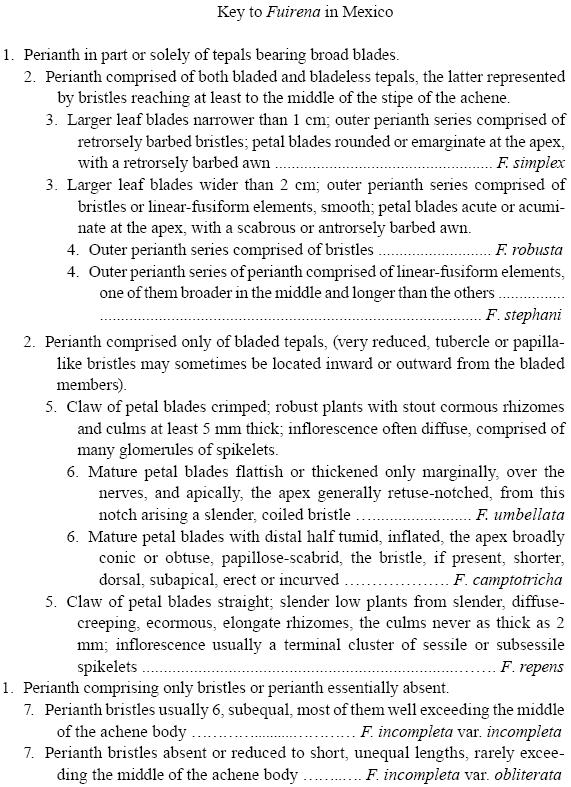
<body><![CDATA[<p align="justify"><font face="verdana" size="2"><b>Palabras clave:</b> Cyperaceae, Durango, endemismo, <i>Fuirena, </i>M&eacute;xico, Quer&eacute;taro.</font></p>     <p align="justify"><font face="verdana" size="2">&nbsp;</font></p>     <p align="justify"><font face="verdana" size="2"><i>Fuirena </i>Rottb. (Cyperaceae) comprises over 30 species usually of wetland habitats in warm temperate to tropical regions worldwide (Kral, 1978, 2002). For Mexico, Kral (1978) treated five species: <i>F. camptotricha </i>C. Wright, <i>F. incompleta </i>Nees, <i>F. repens </i>Boeck., <i>F. simplex </i>Vahl, and <i>F. umbellata </i>Rottb. Later, <i>F. robusta </i>Kunth was recorded for the country by Adams (1994) and Espejo-Serna y L&oacute;pez-Ferrari (1997), and a new species, <i>F. stephani </i>Ramos &amp; N. Diego, was described from a collection from Campeche (Ramos-&Aacute;lvarez and Diego-P&eacute;rez, 2002). <i>Fuirena repens </i>was previously known from very few collections, all presumably near the type locality in San Luis Potos&iacute; (Kral, 1978). Herbarium work by Anton A. Reznicek and S. Gonz&aacute;lez revealed a more recent collection of <i>F. repens </i>from Queretaro and subsequent field work has led to collections of the same species from seepage wetlands in the Mexican High Plateau in Durango. The Durango plants were growing in clear shallow water on mucky substrate associated with <i>Bidens </i>sp., <i>Cyperus </i>spp., <i>Eleocharis </i>spp., <i>Fimbristylis </i>sp., <i>F. incompleta </i>var. <i>obliterata </i>Kral, <i>Leersia hexandra, Potamogeton </i>sp. and <i>Rhynchospora </i>sp. Based on our current knowledge, <i>F. repens </i>is a rare endemic of the Mexican High Plateau. The plants from Durango represent a bigger, copiously hirtellous variant. The following <a href="#key">key</a> and description modified from Kral (1978) reflects an updated concept of this species based on recent collections and field observations.</font></p>     <p align="center"><font face="verdana" size="2"><a name="key"></a></font></p>     <p align="center"><font face="verdana" size="2"><img src="/img/revistas/abm/n85/a3key.jpg"></font></p>     <p align="justify"><font face="verdana" size="2"><b>Fuirena repens </b>Boeck. Bot. Jahrb. Syst. 7: 277. 1886. Type: Mexico, San Luis Potos&iacute;, 1879, <i>J. G. Schaffner 196 </i>(Holotype: B-presumably destroyed, Lectotype (designated by Kral, 1978 as neotype): NY; Isolectotypes: C, MICH).</font></p>     <p align="justify"><font face="verdana" size="2">Slender low perennial, rhizomes creeping, fleshy, slender but swollen at irregular intervals into narrowly fusiform thickened zones, white to pale reddish-brown, internodes frequently 1.3-2.3 cm long, often forking or 3-branched or producing compact, narrowly fusiform, several-noded rhizomatous offshoots, these developing apically into leafy shoots. Shoots erect, low, to 4.2(-5) dm, the lowermost part scaly, smooth, the leaves of midculm longest; sheaths tubular-cylindric, rather loosely investing the culms and often overlapping, multicostate, hirsute, the Iigular orifice scarious, oblique, ciliate, pale brown; larger leaf blades narrowly linear, ascending or spreading, to 19 cm long but usually much shorter, rarely broader than 6 mm, attenuate from near the base to the slender apex, smooth to sparsely or copiously hirtellous with weak, translucent hairs, sparingly spreading-ciliate proximally. Culms smooth proximally, multicostate, with internodes becoming spreading hirtellous upward, terminating in a subcapitate cluster of (1-)3-7 spikelets subtended by 1-3 leaflike bracts, these shorter than to ca. three times the length of the spikelets, spreading to ascendent, hirtellous-hirsute proximally, smooth to scabrid distally. Spikelets ovoid to lance-ovoid, greenish or olivaceous, the longest ca. 1 cm long. Fertile scales obovate, thin, ca. 2.5 mm long, the backs hispidulous and sparingly strigose, medially 3-nerved, these converging to form a spreading-ascending mucro to 2.5 mm long. Perianth of three bladed petals, the calyx bristles reduced to minute sharp-tipped tubercles; petals ca. 2-2.5 mm long, the claw ca. 0.4 mm long, the blade ovate, proximally flattish and triple-nerved, the distal 1/2 inflated and tapering into a slender, erect to incurved awn. Anthers ca. 2 mm long. Achene ca. 1.5 mm long altogether, the stipe shorter than to nearly as long as the sharply trigonous body, the stylar end slender elongate, slightly broadening and scaberulous-papillose distally; achene surface pale, minutely cancellate-punctate, the 3 edges smooth, wirelike, glassy.</font></p>     <p align="justify"><font face="verdana" size="2">Additional specimens examined: Mexico: Durango, Presa Santiago Bayacora, off of the road to Aserradero La Flor (Hwy. 115), 16.7 km S of the intersection of MX Hwy. 40 and MX Hwy. 45 in the City of Durango, elev. 1988 m, N 23&deg;52'35.7" W 104&deg;40'29.7", 2 Oct. 2007, <i>Rosen etal. </i>4519 (TAES, TEX, VDB); same date and locality, <i>Reid 6329 </i>(LSU); same date and locality, <i>S. Gonz&aacute;lez et al. 7371 </i>(CIIDIR, IEB, MEXU, MICH, SLPM); same date and locality, <i>P. M. Peterson et al. 21239 </i>(CIIDIR, US). San Luis Potos&iacute;, "ex convalli San Luis Potos&iacute;", 1877, <i>J. G. Schaffner 567 </i>(MEXU-2); San Rafael, S.L.P., 1877, <i>J. G. Schaffner 567 </i>(MEXU). Quer&eacute;taro, mpio. La Ca&ntilde;ada, Rancho El Pinalito, cerca de La Laborcilla, 2400 m, 14 Sept. 1990, &amp; <i>Zamudio y E. P&eacute;rez C. 8107 </i>(CIIDIR, IEB).</font></p>     <p align="justify"><font face="verdana" size="2">&nbsp;</font></p>     <p align="justify"><font face="verdana" size="2"><b>ACKNOWLEDGEMENTS</b></font></p>     ]]></body>
<body><![CDATA[<p align="justify"><font face="verdana" size="2">The first three authors thank colleagues Paul M. Peterson and Jeff Saarela for transportation, campfire songs, and companionship in the field. Funding for travel for Reid was provided by the Louisiana Department of Wildlife and Fisheries. Socorro Gonz&aacute;lez thanks to Comisi&oacute;n de Operaci&oacute;n y Fomento de Actividades (COFAA) and Secretar&iacute;a de Investigaci&oacute;n y Posgrado of the Instituto Polit&eacute;cnico Nacional for research support. We greatly appreciate the suggestions provided by two anonymous reviewers, which helped to improve the manuscript.</font></p>     <p align="justify"><font face="verdana" size="2">&nbsp;</font></p>     <p align="justify"><font face="verdana" size="2"><b>LITERATURE CITED</b></font></p>     <!-- ref --><p align="justify"><font face="verdana" size="2">Adams, C. D. 1994. <i>Fuirena </i>(Cyperaceae). In: Davidse, G., M. Sousa y A. O. Chater (eds.). Flora Mesoamericana. Vol. 6. Universidad Nacional Aut&oacute;noma de M&eacute;xico-Missouri Botanical Garden-The Natural History Museum. London. pp. 450-452. </font>&nbsp;&nbsp;&nbsp;&nbsp;&nbsp;&nbsp;&nbsp;&nbsp;[&#160;<a href="javascript:void(0);" onclick="javascript: window.open('/scielo.php?script=sci_nlinks&ref=024688&pid=S0187-7151200800040000300001&lng=','','width=640,height=500,resizable=yes,scrollbars=1,menubar=yes,');">Links</a>&#160;]<!-- end-ref --><!-- ref --><p align="justify"><font face="verdana" size="2">Espejo-Serna, A. y A. R. L&oacute;pez-Ferrari. 1997. Las monocotiled&oacute;neas mexicanas. Una sinopsis flor&iacute;stica. 1. Lista de referencia. Parte V. Cyperaceae. Universidad Aut&oacute;noma Metropolitana-Comisi&oacute;n Nacional para el Conocimiento y Uso de la Biodiversidad. M&eacute;xico, D.F. 98 pp. </font>&nbsp;&nbsp;&nbsp;&nbsp;&nbsp;&nbsp;&nbsp;&nbsp;[&#160;<a href="javascript:void(0);" onclick="javascript: window.open('/scielo.php?script=sci_nlinks&ref=024689&pid=S0187-7151200800040000300002&lng=','','width=640,height=500,resizable=yes,scrollbars=1,menubar=yes,');">Links</a>&#160;]<!-- end-ref --><!-- ref --><p align="justify"><font face="verdana" size="2">Kral, R. 1978. A synopsis <i>of Fuirena </i>(Cyperaceae) for the Americas north of South America. Sida 7: 309-354. </font>&nbsp;&nbsp;&nbsp;&nbsp;&nbsp;&nbsp;&nbsp;&nbsp;[&#160;<a href="javascript:void(0);" onclick="javascript: window.open('/scielo.php?script=sci_nlinks&ref=024690&pid=S0187-7151200800040000300003&lng=','','width=640,height=500,resizable=yes,scrollbars=1,menubar=yes,');">Links</a>&#160;]<!-- end-ref --><!-- ref --><p align="justify"><font face="verdana" size="2">Kral, R. 2002. <i>Fuirena. </i>In: Editorial Committee (ed.). Flora of North America, Vol. 23. Oxford Univ. Press. New York. pp. 32-37. </font>&nbsp;&nbsp;&nbsp;&nbsp;&nbsp;&nbsp;&nbsp;&nbsp;[&#160;<a href="javascript:void(0);" onclick="javascript: window.open('/scielo.php?script=sci_nlinks&ref=024691&pid=S0187-7151200800040000300004&lng=','','width=640,height=500,resizable=yes,scrollbars=1,menubar=yes,');">Links</a>&#160;]<!-- end-ref --><!-- ref --><p align="justify"><font face="verdana" size="2">Ramos-&Aacute;lvarez, C. H. y N. Diego-P&eacute;rez. 2002. Una especie nueva de <i>Fuirena </i>(Cyperaceae) del estado de Campeche, M&eacute;xico. Acta Bot. Mex. 58: 51-55.</font>&nbsp;&nbsp;&nbsp;&nbsp;&nbsp;&nbsp;&nbsp;&nbsp;[&#160;<a href="javascript:void(0);" onclick="javascript: window.open('/scielo.php?script=sci_nlinks&ref=024692&pid=S0187-7151200800040000300005&lng=','','width=640,height=500,resizable=yes,scrollbars=1,menubar=yes,');">Links</a>&#160;]<!-- end-ref --> ]]></body><back>
<ref-list>
<ref id="B1">
<nlm-citation citation-type="book">
<person-group person-group-type="author">
<name>
<surname><![CDATA[Adams]]></surname>
<given-names><![CDATA[C. D.]]></given-names>
</name>
</person-group>
<article-title xml:lang="en"><![CDATA[Fuirena (Cyperaceae)]]></article-title>
<person-group person-group-type="editor">
<name>
<surname><![CDATA[Davidse]]></surname>
<given-names><![CDATA[G]]></given-names>
</name>
<name>
<surname><![CDATA[Sousa]]></surname>
<given-names><![CDATA[M]]></given-names>
</name>
<name>
<surname><![CDATA[Chater]]></surname>
<given-names><![CDATA[A. O.]]></given-names>
</name>
</person-group>
<source><![CDATA[Flora Mesoamericana]]></source>
<year>1994</year>
<volume>6</volume>
<page-range>450-452</page-range><publisher-loc><![CDATA[London ]]></publisher-loc>
<publisher-name><![CDATA[Universidad Nacional Autónoma de MéxicoMissouri Botanical GardenThe Natural History Museum]]></publisher-name>
</nlm-citation>
</ref>
<ref id="B2">
<nlm-citation citation-type="book">
<person-group person-group-type="author">
<name>
<surname><![CDATA[Espejo-Serna]]></surname>
<given-names><![CDATA[A]]></given-names>
</name>
<name>
<surname><![CDATA[López-Ferrari]]></surname>
<given-names><![CDATA[A. R.]]></given-names>
</name>
</person-group>
<source><![CDATA[Las monocotiledóneas mexicanas. Una sinopsis florística. 1.]]></source>
<year>1997</year>
<page-range>98</page-range><publisher-loc><![CDATA[México^eD.F. D.F.]]></publisher-loc>
<publisher-name><![CDATA[Universidad Autónoma MetropolitanaComisión Nacional para el Conocimiento y Uso de la Biodiversidad]]></publisher-name>
</nlm-citation>
</ref>
<ref id="B3">
<nlm-citation citation-type="journal">
<person-group person-group-type="author">
<name>
<surname><![CDATA[Kral]]></surname>
<given-names><![CDATA[R]]></given-names>
</name>
</person-group>
<article-title xml:lang="en"><![CDATA[A synopsis of Fuirena (Cyperaceae) for the Americas north of South America]]></article-title>
<source><![CDATA[Sida]]></source>
<year>1978</year>
<volume>7</volume>
<page-range>309-354</page-range></nlm-citation>
</ref>
<ref id="B4">
<nlm-citation citation-type="book">
<person-group person-group-type="author">
<name>
<surname><![CDATA[Kral]]></surname>
<given-names><![CDATA[R]]></given-names>
</name>
</person-group>
<article-title xml:lang="en"><![CDATA[Fuirena]]></article-title>
<collab>Editorial Committee</collab>
<source><![CDATA[Flora of North America]]></source>
<year>2002</year>
<volume>23</volume>
<page-range>32-37</page-range><publisher-loc><![CDATA[New York ]]></publisher-loc>
<publisher-name><![CDATA[Oxford Univ. Press]]></publisher-name>
</nlm-citation>
</ref>
<ref id="B5">
<nlm-citation citation-type="journal">
<person-group person-group-type="author">
<name>
<surname><![CDATA[Ramos-Álvarez]]></surname>
<given-names><![CDATA[C. H.]]></given-names>
</name>
<name>
<surname><![CDATA[Diego-Pérez]]></surname>
<given-names><![CDATA[N]]></given-names>
</name>
</person-group>
<article-title xml:lang="es"><![CDATA[Una especie nueva de Fuirena (Cyperaceae) del estado de Campeche, México]]></article-title>
<source><![CDATA[Acta Bot. Mex.]]></source>
<year>2002</year>
<volume>58</volume>
<page-range>51-55</page-range></nlm-citation>
</ref>
</ref-list>
</back>
</article>
