<?xml version="1.0" encoding="ISO-8859-1"?><article xmlns:mml="http://www.w3.org/1998/Math/MathML" xmlns:xlink="http://www.w3.org/1999/xlink" xmlns:xsi="http://www.w3.org/2001/XMLSchema-instance">
<front>
<journal-meta>
<journal-id>0187-7151</journal-id>
<journal-title><![CDATA[Acta botánica mexicana]]></journal-title>
<abbrev-journal-title><![CDATA[Act. Bot. Mex]]></abbrev-journal-title>
<issn>0187-7151</issn>
<publisher>
<publisher-name><![CDATA[Instituto de Ecología A.C., Centro Regional del Bajío]]></publisher-name>
</publisher>
</journal-meta>
<article-meta>
<article-id>S0187-71512008000200004</article-id>
<title-group>
<article-title xml:lang="en"><![CDATA[Bloom of Peridinium quinquecorne Abé in la Ensenada de La Paz, Gulf of California (july 2003)]]></article-title>
<article-title xml:lang="es"><![CDATA[Florecimiento de Peridinium quinquecorne Abé in La Ensenada de La Paz, Golfo de California (Julio 2003)]]></article-title>
</title-group>
<contrib-group>
<contrib contrib-type="author">
<name>
<surname><![CDATA[Gárate-Lizárraga]]></surname>
<given-names><![CDATA[Ismael]]></given-names>
</name>
<xref ref-type="aff" rid="A01"/>
</contrib>
<contrib contrib-type="author">
<name>
<surname><![CDATA[Muñetón-Gómez]]></surname>
<given-names><![CDATA[María del Socorro]]></given-names>
</name>
<xref ref-type="aff" rid="A02"/>
</contrib>
</contrib-group>
<aff id="A01">
<institution><![CDATA[,Instituto Politécnico Nacional Centro Interdisciplinario de Ciencias Marinas Departamento de Plancton y Ecología Marina]]></institution>
<addr-line><![CDATA[La Paz Baja California Sur]]></addr-line>
<country>México</country>
</aff>
<aff id="A02">
<institution><![CDATA[,Centro de Estudios Tecnológicos del Mar  ]]></institution>
<addr-line><![CDATA[La Paz Baja California Sur]]></addr-line>
<country>México</country>
</aff>
<pub-date pub-type="pub">
<day>00</day>
<month>04</month>
<year>2008</year>
</pub-date>
<pub-date pub-type="epub">
<day>00</day>
<month>04</month>
<year>2008</year>
</pub-date>
<numero>83</numero>
<fpage>33</fpage>
<lpage>47</lpage>
<copyright-statement/>
<copyright-year/>
<self-uri xlink:href="http://www.scielo.org.mx/scielo.php?script=sci_arttext&amp;pid=S0187-71512008000200004&amp;lng=en&amp;nrm=iso"></self-uri><self-uri xlink:href="http://www.scielo.org.mx/scielo.php?script=sci_abstract&amp;pid=S0187-71512008000200004&amp;lng=en&amp;nrm=iso"></self-uri><self-uri xlink:href="http://www.scielo.org.mx/scielo.php?script=sci_pdf&amp;pid=S0187-71512008000200004&amp;lng=en&amp;nrm=iso"></self-uri><abstract abstract-type="short" xml:lang="en"><p><![CDATA[Microalgae blooms are frequent and periodic throughout the year in La Ensenada de La Paz, a lagoon formed by a large sand bar enclosed at the southern end of the Bahía de La Paz in the southwestern Gulf of California. Brown patches of the dinoflagellate Peridinium quinquecorne Abé, an armored dinoflagellate that is cosmopolitan in neritic and estuarine waters, were observed in July 2003 near a beach at the mouth of the lagoon. The patches were about 50-100 m long by 10-15 m wide and persisted for two days when water temperature was 26.2 to 27 °C. The blooms occurred after four days of a heavy rain. Abundance of P. quinquecorne varied from 3.4 to 6.4 × 10(6) cells 1-1 and chlorophyll a varied from 13.20 to 17.75 mg m-3. Concentrations of nutrients in this area were higher than normal, related to a continuous re-suspension of sediment caused by wave action. The higher nutrient content promoted formation of patches of P. quinquecorne in this part of the lagoon.]]></p></abstract>
<abstract abstract-type="short" xml:lang="es"><p><![CDATA[Los florecimientos de microalgas son frecuentes y periódicos a lo largo de todo el año en La Ensenada de La Paz, una laguna formada por una barra de arena larga que se encuentra al extremo sur de la Bahía de La Paz, ubicada al suroeste del Golfo de California. En julio de 2003 se observaron parches de color café de Peridinium quinquecorne Abé en la playa cercana a la boca de esta laguna. P. quinquecorne es un dinoflagelado tecado, el cual es cosmopolita en aguas neríticas y estuarinas. Los parches presentaron 50 y 100 m de largo por 10-15 m de ancho y fueron observados durante dos días cuando la temperatura del agua era de 26.2 a 27 °C. Los parches de P. quinquecorne se detectaron cuatro días después de haber llovido. La abundancia de P. quinquecorne varió de 3.4 a 6.4 × 10(6) céls 1-1, y la clorofila a lo hizo entre 13.20 y 17.75 mg m³. Las concentraciones de nutrientes en esta área fueron más altas que las normales, lo cual puede deberse a la resuspensión de sedimentos causados por acción de la marea. El alto contenido de nutrientes promovió la formación de parches de P. quinquecorne en esta porción de la laguna.]]></p></abstract>
<kwd-group>
<kwd lng="en"><![CDATA[Ensenada de La Paz]]></kwd>
<kwd lng="en"><![CDATA[Gulf of California]]></kwd>
<kwd lng="en"><![CDATA[Mexico]]></kwd>
<kwd lng="en"><![CDATA[microalgae bloom]]></kwd>
<kwd lng="en"><![CDATA[Peridinium quinquecorne]]></kwd>
<kwd lng="es"><![CDATA[Ensenada de La Paz]]></kwd>
<kwd lng="es"><![CDATA[florecimiento de microalgas]]></kwd>
<kwd lng="es"><![CDATA[Golfo de California]]></kwd>
<kwd lng="es"><![CDATA[México]]></kwd>
<kwd lng="es"><![CDATA[Peridinium quinquecorne]]></kwd>
</kwd-group>
</article-meta>
</front><body><![CDATA[ <p align="justify"><font face="verdana" size="4">Art&iacute;culos</font></p>     <p align="center"><font face="verdana" size="2">&nbsp;</font></p>     <p align="center"><font face="verdana" size="4"><b>Bloom of <i>Peridinium quinquecorne</i> Ab&eacute; in la Ensenada de La Paz, Gulf of California (july 2003)</b></font></p>     <p align="center"><font face="verdana" size="2">&nbsp;</font></p>     <p align="center"><font face="verdana" size="3"><b>Florecimiento de <i>Peridinium quinquecorne</i> Ab&eacute; in La Ensenada de La Paz, Golfo de California (Julio 2003) </b></font></p>     <p align="center"><font face="verdana" size="2">&nbsp;</font></p>     <p align="center"><font face="verdana" size="2"><b>Ismael G&aacute;rate&#150;Liz&aacute;rraga<sup>1</sup> and Mar&iacute;a del Socorro Mu&ntilde;et&oacute;n&#150;G&oacute;mez<sup>1,2</sup></b></font></p>     <p align="justify"><font face="verdana" size="2">&nbsp;</font></p>     <p align="justify"><font face="verdana" size="2"><i><sup>1</sup> Instituto Polit&eacute;cnico Nacional, Centro Interdisciplinario de Ciencias Marinas. Departamento de Plancton y Ecolog&iacute;a Marina, Avenida Instituto Polit&eacute;cnico Nacional s/n, Colonia Playa Palo de Santa Rita, Apdo. postal 592, 23096 La Paz.Baja California Sur, M&eacute;xico.</i> <a href="mailto:igarate@ipn.mx">igarate@ipn.mx</a>.</font></p>     <p align="justify"><font face="verdana" size="2"><i><sup>2 </sup>Centro de Estudios Tecnol&oacute;gicos del Mar n&uacute;m. 4, Avenida Instituto Polit&eacute;cnico Nacional y Calle Cetmar s/n, 23096 La Paz, Baja California Sur, M&eacute;xico.</i></font></p>     ]]></body>
<body><![CDATA[<p align="justify"><font face="verdana" size="2">&nbsp;</font></p>     <p align="justify"><font face="verdana" size="2">Recibido en agosto de 2006    <br>   Aceptado en diciembre de 2007</font></p>     <p align="justify"><font face="verdana" size="2">&nbsp;</font></p>     <p align="justify"><font face="verdana" size="2"><b>ABSTRACT</b></font></p>     <p align="justify"><font face="verdana" size="2">Microalgae blooms are frequent and periodic throughout the year in La Ensenada de La Paz, a lagoon formed by a large sand bar enclosed at the southern end of the Bah&iacute;a de La Paz in the southwestern Gulf of California. Brown patches of the dinoflagellate <i>Peridinium quinquecorne </i>Ab&eacute;, an armored dinoflagellate that is cosmopolitan in neritic and estuarine waters, were observed in July 2003 near a beach at the mouth of the lagoon. The patches were about 50&#150;100 m long by 10&#150;15 m wide and persisted for two days when water temperature was 26.2 to 27 &deg;C. The blooms occurred after four days of a heavy rain. Abundance of <i>P. quinquecorne </i>varied from 3.4 to 6.4 &times; 10<sup>6</sup> cells 1<sup>&#150;1</sup> and chlorophyll <i>a </i>varied from 13.20 to 17.75 mg m<sup>&#150;3</sup>. Concentrations of nutrients in this area were higher than normal, related to a continuous re&#150;suspension of sediment caused by wave action. The higher nutrient content promoted formation of patches of <i>P. quinquecorne </i>in this part of the lagoon.</font></p>     <p align="justify"><font face="verdana" size="2"><b>Key words:</b> Ensenada de La Paz, Gulf of California, Mexico, microalgae bloom, <i>Peridinium quinquecorne.</i></font></p>     <p align="justify"><font face="verdana" size="2">&nbsp;</font></p>     <p align="justify"><font face="verdana" size="2"><b>RESUMEN</b></font></p>     <p align="justify"><font face="verdana" size="2">Los florecimientos de microalgas son frecuentes y peri&oacute;dicos a lo largo de todo el a&ntilde;o en La Ensenada de La Paz, una laguna formada por una barra de arena larga que se encuentra al extremo sur de la Bah&iacute;a de La Paz, ubicada al suroeste del Golfo de California. En julio de 2003 se observaron parches de color caf&eacute; de <i>Peridinium quinquecorne </i>Ab&eacute; en la playa cercana a la boca de esta laguna. <i>P. quinquecorne </i>es un dinoflagelado tecado, el cual es cosmopolita en aguas ner&iacute;ticas y estuarinas. Los parches presentaron 50 y 100 m de largo por 10&#150;15 m de ancho y fueron observados durante dos d&iacute;as cuando la temperatura del agua era de 26.2 a 27 &deg;C. Los parches de <i>P. quinquecorne </i>se detectaron cuatro d&iacute;as despu&eacute;s de haber llovido. La abundancia de <i>P. quinquecorne </i>vari&oacute; de 3.4 a 6.4 &times; 10<sup>6</sup> c&eacute;ls 1<sup>&#150;1</sup>, y la clorofila <i>a </i>lo hizo entre 13.20 y 17.75 mg m<sup>3</sup>. Las concentraciones de nutrientes en esta &aacute;rea fueron m&aacute;s altas que las normales, lo cual puede deberse a la resuspensi&oacute;n de sedimentos causados por acci&oacute;n de la marea. El alto contenido de nutrientes promovi&oacute; la formaci&oacute;n de parches de <i>P. quinquecorne </i>en esta porci&oacute;n de la laguna.</font></p>     ]]></body>
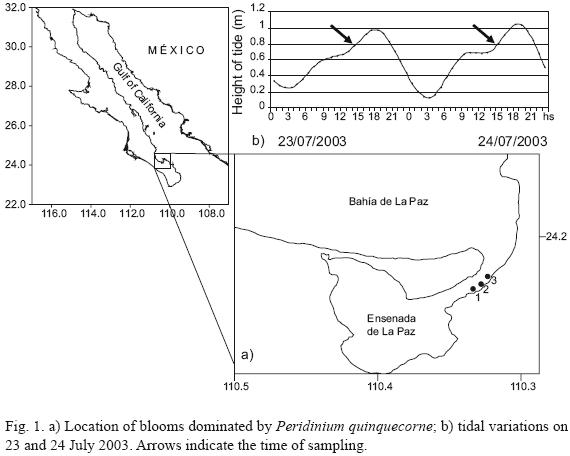
<body><![CDATA[<p align="justify"><font face="verdana" size="2"><b>Palabras clave:</b> Ensenada de La Paz, florecimiento de microalgas, Golfo de California, M&eacute;xico, <i>Peridinium quinquecorne.</i></font></p>     <p align="justify"><font face="verdana" size="2">&nbsp;</font></p>     <p align="justify"><font face="verdana" size="2"><b>INTRODUCTION</b></font></p>     <p align="justify"><font face="verdana" size="2">Microalgae blooms are proliferations of different species of phytoplankton including dinoflagellates, diatoms, raphidophytes, cyanobacteria and ciliates in coastal marine environments. Dinoflagellate blooms are often referred as red tides because of the color imparted by algae suspended in the seawater. Most species of microalgae or phytoplankton are not harmful and serve as energy producers at the base of the food web. Microalgae blooms have increased in the past 15 years in the Gulf of California (Cort&eacute;s&#150;Altamirano &amp; Licea&#150;Dur&aacute;n, 2004; G&aacute;rate&#150;Liz&aacute;rraga et al., 2006a). Natural events, as well as human activities, have contributed to this increase; however, some of the increased notoriety, could be related to an increase of publications by Mexican researchers (Cort&eacute;s&#150;Altamirano &amp; Alonso&#150;Rodr&iacute;guez, 1997; G&aacute;rate&#150;Liz&aacute;rraga et al., 2001; 2004a; 2006a; Alonso&#150;Rodr&iacute;guez &amp; Ochoa, 2004; Cort&eacute;s&#150;Altamirano &amp; Licea&#150;Dur&aacute;n, 2004; Band&#150;Schmidt et al., 2005). Along the Pacific coast of Mexico, species with the greatest increase are the ciliate <i>Myrionecta rubra </i>(Lohman) Jankowsky and the dinoflagellate <i>Gymnodinium catenatum </i>Graham (G&aacute;rate&#150;Liz&aacute;rraga et al., 2006b).</font></p>     <p align="justify"><font face="verdana" size="2">The order Peridiniales includes dinoflagellates having a transverse flagellar furrow normally located within the middle third of the length of cell; the theca is composed of several tens of cellulose plates organized in several series paralleling the transverse furrow. They are free&#150;living, photosynthetic or nonphotosynthetic dinoflagellates occurring in marine, brackish, and freshwater environments (Fensome et al., 1993). Blooms of species in this order, such as <i>Ceratium balechii </i>Meave, Okolodkov &amp; Zamudio, <i>Ceratium furca </i>(Ehrenberg) Claparade &amp; Lachman, <i>Gonyaulaxpolygramma </i>Stein, <i>Peridinium quinquecorne </i>Ab&eacute;, <i>Heterocapsa triquetra </i>(Ehrenberg) Stein, and <i>Scrippsiella trochoidea </i>(Stein) Loeblich, (Cort&eacute;s&#150;Altamirano &amp; Alonso&#150;Rodr&iacute;guez, 1997; G&oacute;mez&#150;Aguirre, 1998; G&aacute;rate&#150;Liz&aacute;rraga et al., 2001; 2006a; Pe&ntilde;a&#150;Manjarrez et al., 2005) were reported from the coasts of Mexico. <i>Peridinium </i>Ehrenberg is a large genus of small&#150;to&#150;medium&#150;sized dinoflagellates. Some, but not all, are photosynthetic. The latter are brown because of their accessory photosynthetic pigments and occur in freshwater and marine habitats worldwide. At least a few photosynthetic species can form significant blooms, some of them associated with obnoxious odors, and fish kills. There are few reports of blooms of <i>P. quinquecorne </i>along the Pacific coast of Mexico (Cort&eacute;s&#150;Altamirano, 2002; G&aacute;rate&#150;Liz&aacute;rraga et al., 2006a).</font></p>     <p align="justify"><font face="verdana" size="2">Bah&iacute;a de La Paz is an area where blooms have been frequently sighted since 1984. More than forty blooms and twenty&#150;five bloom&#150;forming taxa have been recorded in this bay, including La Ensenada de La Paz (G&aacute;rate&#150;Liz&aacute;rraga et al., 2006a). The bloom&#150;forming species belong to different phytoplankton groups: dinoflagel&#150;lates, diatoms, raphidophytes, planktonic cyanobacteria, and the ciliate <i>Myrionecta rubra. </i>This study describes the conditions in which <i>P. quinquecorne </i>proliferated at the mouth of a lagoon in the southwestern part of the Gulf of California.</font></p>     <p align="justify"><font face="verdana" size="2">&nbsp;</font></p>     <p align="justify"><font face="verdana" size="2"><b>MATERIAL AND METHODS</b></font></p>     <p align="justify"><font face="verdana" size="2">On 23&#150;24 July 2003, brown patches appeared in the mouth of the Ensenada de La Paz (24&deg;06' &#150; 24&deg;11' N, 110&deg;19' &#150; 110&deg;26' W), a lagoon formed by the very large sand spit at the southern end of the Bah&iacute;a de La Paz (<a href="#f1">Fig. 1</a>). The inlet is 1.2 km wide, 4 km long and 7 m deep. At mean sea level, the surface area of the lagoon is approximately 45 km<sup>2</sup>. The lagoon is shallower than the inlet; with depths from 2 to 6 m. The tide regimen is a mixed semidiurnal type (Obeso&#150;Niebla et al., 1993).</font></p>     <p align="center"><font face="verdana" size="2"><a name="f1"></a></font></p>     ]]></body>
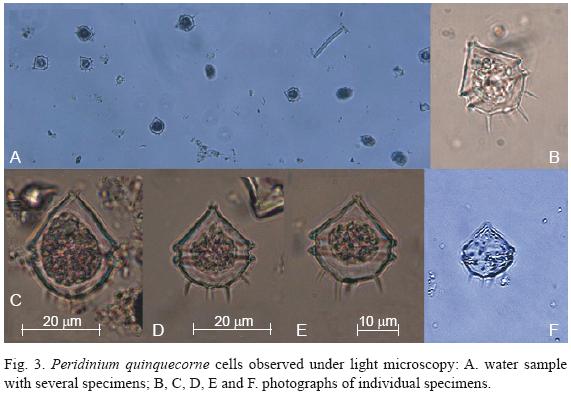
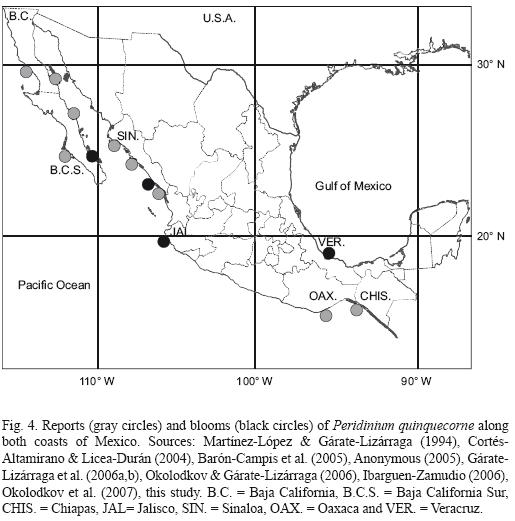
<body><![CDATA[<p align="center"><font face="verdana" size="2"><img src="/img/revistas/abm/n83/a4f1.jpg"></font></p>     <p align="justify"><font face="verdana" size="2">Sea surface temperature was measured with a bucket thermometer (Kahlsico International Corp., El Cajon, CA, USA). Water samples were collected in plastic bottles to determine nutrient concentrations (NH<sub>4</sub>, NO<sub>3</sub>, PO<sub>4</sub>, and SiO<sub>4</sub>), pigments, and identification and abundance of species of phytoplankton. Samples of phytoplankton from the bloom areas were fixed and preserved with Lugol's solution for identification and cell counts. We estimated abundance of phytoplankton at the same time as we identified the microorganisms. Cell counts were made in 5&#150;ml settling chambers under an inverted phase contrast microscope (Hasle, 1978). Photographic documentation of the main representative dinoflagellate species was made with a digital camera (Cool SNAP&#150;Pro Media Cybernetics, Silver Spring, MD, USA) and imaging software (Image&#150;Pro Plus 4.1, Media Cybernetics).</font></p>     <p align="justify"><font face="verdana" size="2">To quantify phytoplankton biomass 250&#150;ml seawater was passed through Whatman GF/F filters and the filters were frozen at &#150;20 &deg;C until further analysis. Filters were thawed and extracted in 10 ml of 90% acetone overnight at 4 &deg;C in the dark. Chlorophyll <i>a </i>concentrations were calculated from spectrophotometric absorbance measurements using the equations of Jeffrey &amp; Humprey (1975). Nutrients were measured according to Strickland &amp; Parson (1972). Tidal records were obtained from a meteorological station located 200 m from the southwestern shore of the Ensenada de La Paz.</font></p>     <p align="justify"><font face="verdana" size="2">&nbsp;</font></p>     <p align="justify"><font face="verdana" size="2"><b>RESULTS</b></font></p>     <p align="justify"><font face="verdana" size="2">Brownish patches (~50&#150;100 m long, 10&#150;15 m wide) were directly observed for two days in the mouth of the lagoon during rising tides (<a href="#f1">Fig. 1b</a>). Surface water temperature in the bloom ranged from 26.2 to 27.0 &deg;C. The patches were observed for two days after four days of rain. Concentrations of nutrients (in &micro;m) were higher during the first day and varied as follows: ammonium (1.01 to 3.56), nitrites (0.26 to 1.86), nitrates (0.31 to 3.59), orthophosphates (0.65 to 1.42), and silicates (2.13&#150;10.21) (<a href="#f2">Figs. 2a, 2b</a>).</font></p>     <p align="center"><font face="verdana" size="2"><a name="f2"></a></font></p>     <p align="center"><font face="verdana" size="2"><img src="/img/revistas/abm/n83/a4f2.jpg"></font></p>     <p align="justify"><font face="verdana" size="2">The phytoplankton samples were mainly dominated by <i>P. quinquecorne </i>(&gt;99% of the total phytoplankton abundance). A total of 26 microalgae species were identified. Dinoflagellates were by far the most important group in abundance (9 species), but diatoms were more diverse (17 species) (<a href="/img/revistas/abm/n83/a4t1.jpg" target="_blank">Table 1</a>). The density of phytoplankton at the sampling stations was similar on both days, varying from 3.823 to 6.208 &times; 10<sup>6</sup> cells 1<sup>&#150;1</sup> on day 1 and 3.408 to 6.429 &times; 10<sup>6</sup> cells 1<sup>&#150;1</sup> on day 2 (<a href="#f2">Fig. 2c</a>; <a href="/img/revistas/abm/n83/a4t1.jpg" target="_blank">Table 1</a>). Of this biomass, <i>P. quinquecorne </i>ranged from 3.8 to 6.2 &times; 10<sup>6 </sup>cells 1<sup>&#150;1</sup> on day 1 and 3.4 to 6.4 &times; 10<sup>6</sup> cells 1<sup>&#150;1</sup>. Phytoplankton chlorophyll <i>a </i>varied from 15.84 to 16.91 mg m<sup>&#150;3</sup> on day 1 and 13.20 to 17.75 mg m<sup>&#150;3</sup> on day 2 (<a href="#f2">Fig. 2c</a>). <i>Peridinium quinquecorne </i>cells varied greatly in size. Cells were 20 to 32 &micro;m long (25 to 36 &micro;m with spines) and 16 to 18 &micro;m wide. <i>P. quinquecorne </i>cells have a pointed apex, and a number of projections from the hypocone (<a href="#f3">Fig. 3a, b, c, d</a>). The girdle is comparatively wide and located at the middle of the cells. Chromatophores are numerous, ovoidal and brownish green. The pulsing vacuole that connects to the flagellar pore of the transversal flagellum is reddish and looks like an eyespot. Among diatoms, <i>Odontella aurita </i>(Lyngbye) Brebison and <i>Nitzschia sigma </i>(K&uuml;tzing) Smith were the most abundant species. Blooms of <i>Nitzschia sigma </i>(2.8 to 3.4 &times; 10<sup>6 </sup>cells 1<sup>&#150;1</sup>) occurred in September 1999 in shrimp ponds bordering Bahia de La Paz (unpublished data).</font></p>     <p align="center"><font face="verdana" size="2"><a name="f3"></a></font></p>     ]]></body>
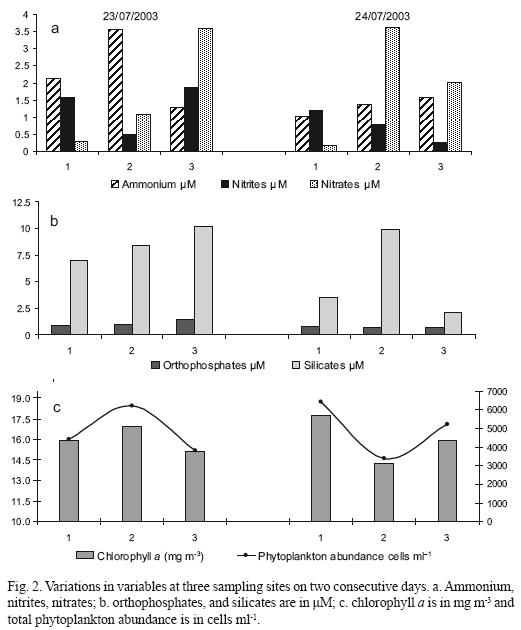
<body><![CDATA[<p align="center"><font face="verdana" size="2"><img src="/img/revistas/abm/n83/a4f3.jpg"></font></p>     <p align="justify"><font face="verdana" size="2">&nbsp;</font></p>     <p align="justify"><font face="verdana" size="2"><b>DISCUSSION</b></font></p>     <p align="justify"><font face="verdana" size="2"><i>Peridinium quinquecorne </i>is an armored dinoflagellate, characterized by four prominent antapical spines and a more&#150;or&#150;less angular shape (Ab&eacute;, 1981). Balech (1974) transferred the species to the genus <i>Protoperidinium, </i>making the new combination <i>Protoperidinium quinquecorne </i>(Ab&eacute;) Balech. Since this organism has 3 apical plates, 2 anterior intercalary plates, 7 precingular plates, 5 cingular plates, 5 postcingular plates, and 2 anteapical plates, we agree with Fukuyo et al. (1990) that it is not appropriate to place this species in the genus <i>Protoperidinium, </i>because this genus is characterized by possessing four cingular plates, including a transitional plate (Horiguchi &amp; Pienaar, 1991). However, taxonomically its generic position is still controversial, with the further possibility that this species may belong to the genus <i>Pentapharsodinium </i>(Steidinger &amp; Tangen, 1997). <i>Peridinium quinquecorne </i>has a wide geographical distribution, ocurring along the coasts of Belize, Brazil, China, India, Malaysia, Mexico, Japan, Russia, South Africa, Spain, Tunisia, and the USA (Ab&eacute;, 1981; Dodge, 1985; Konovalova et al., 1989; Horiguchi &amp; Pienaar, 1991; Shamsudin et al., 1996; Tomas, 1998: Trigueros &amp; Orive 2000; Turki &amp; El Abed, 2001; Faust et al., 2005; Bar&oacute;n&#150;Campis et al., 2005; G&aacute;rate&#150;Liz&aacute;rraga et al., 2006a; Proenca et al., 2006, Okolodkov et al., 2007).</font></p>     <p align="justify"><font face="verdana" size="2">Along the Pacific coast of Mexico, <i>P. quinquecorne </i>is distributed from Punta Baja, Baja California (29&deg;59' N, 115&deg; 49' W) to around Puerto Madero, Chiapas (14&deg; 41' N and 92&deg; 25' W) (Okolodkov &amp; G&aacute;rate&#150;Liz&aacute;rraga, 2006; G&aacute;rate&#150;Liz&aacute;rraga et al., 2007a; this study) (<a href="#f4">Fig. 4</a>). In the Gulf of California, Mart&iacute;nez&#150;L&oacute;pez &amp; G&aacute;rate&#150;Liz&aacute;rraga (1994) first reported this species in Bah&iacute;a Concepci&oacute;n. Recently, this species has been observed in Bah&iacute;a de Los Angeles on the northwestern coast of the Gulf of California (G&aacute;rate&#150;Liz&aacute;rraga, this study) and in several coastal lagoons of the Sinaloa state in low concentrations (Ibarguen&#150;Zamudio, 2006). Cort&eacute;s&#150;Altamirano et al. (2006) described <i>P. quinquecorne </i>as a recent introduction species in the Gulf of California, but this hypothesis is not well supported because dinoflagellates are a difficult group to identify. According to Alonso&#150;Rodr&iacute;guez &amp; Ochoa (2004) the first observation of this species was incorrectly identified as <i>Amylax triacantha.</i></font></p>     <p align="center"><font face="verdana" size="2"><a name="f4"></a></font></p>     <p align="center"><font face="verdana" size="2"><img src="/img/revistas/abm/n83/a4f4.jpg"></font></p>     <p align="justify"><font face="verdana" size="2">(J&oslash;rgensen) Sournia. It is possible that the small cells of <i>P. quinquecorne </i>(20 to 32 &micro;m) have been present in Mexican waters much earlier, but in low concentrations (Mart&iacute;nez&#150;L&oacute;pez &amp; G&aacute;rate&#150;Liz&aacute;rraga, 1994) and not identified correctly or simply ignored.</font></p>     <p align="justify"><font face="verdana" size="2">Concentrations of nutrients were higher than reported for the inlet part of the lagoon in a previous study (Cervantes&#150;Duarte et al., 2001). This may be a consequence of collecting samples near the beach (at 1&#150;3 m deep), where bottom sediments are agitated by wave action. Brownish patches of <i>P. quinquecorne </i>were directly observed when tide was rising, suggesting that the bloom observed near the shore is in part a result of an accumulation processes. Faust et al. (2005) identified <i>P. quinquecorne </i>in floating detritus at Douglas Cay and The Lair in Belize also forming red tides too (1.15 &times; 10<sup>4</sup> cells 1<sup>&#150;1</sup>). Okolodkov et al. (2007) found <i>P. quinquecorne </i>in some samples of macrophytes in a reef zone near Veracruz, Mexico. They postulated that this species is part of epiphytic assemblages and could be the organism involved in recurrent red tides observed in 2005 on 24 May, 4 and 12, August, 12 to 14, 18 and 25 October, and in 2006 on 20 June, 25 July to 5 August, and 15 August. Blooms of <i>P. quinquecorne </i>in Veracruz always occurred very close to the coastline. We suggest that blooms near the beach indicate that this species prefers nutrient&#150;rich environments. Shamsudin et al. (1996) reported a <i>P. quinquecorne </i>bloom in brackish fishponds at Terengganu, Malaysia on the South China Sea, where organic and inorganic nutrients were high during the dry season prior to the wet monsoon. They concluded that this seasonal condition favored proliferation of <i>P. quinquecorne. </i>Horstmann (1980) states that <i>P. quinquecorne </i>forms blooms in eutrophic and polluted brackish environments, tolerating temperatures up to 30 &deg;C. However, blooms tend to disappear when temperatures drop sharply. It appears to tolerate salinity from 31 to 38 ups. According to the available information we can draw the conclusion that <i>P. quinquecorne </i>is well&#150;adapted to benthic and planktonic shallow&#150;subtropical embayments.</font></p>     <p align="justify"><font face="verdana" size="2">G&aacute;rate&#150;Liz&aacute;rraga et al. (2006a) reported small, isolated blooms of <i>P. quinquecorne </i>in May 2003 (2.1 &times; 10<sup>6</sup> cells 1<sup>1</sup>) and July 2004 (2.97 &times; 10<sup>6</sup> cells 1<sup>1</sup>) in Bah&iacute;a de La Paz and suggested that these densities are typical occurrences. In contrast, Proenca et al. (2006) reported 45 &times; 10<sup>6</sup> cells 1<sup>&#150;1</sup> and pigment biomass of 356.2 mg m<sup>&#150;3 </sup>during a bloom of <i>P. quinquecorne </i>at Balne&aacute;rio Cambori&uacute;, Santa Catarina, Brazil. In our investigation, chlorophyll <i>a </i>varied from 15.84 to 16.91 mg m<sup>3</sup> on day 1 and 13.20 to 17.75 mg m<sup>&#150;3</sup> on day 2, which was similar to other events in this area involving diatoms, other dinoflagellates, and ciliates (G&aacute;rate&#150;Liz&aacute;rraga, et al., 2003; 2004a, 2006a). De Madariaga et al. (1989) found that <i>P. quinquecorne </i>was responsible for most of the primary production in the Gernika Estuary (Guernica, Urdaibai) during the blooms of the summer 1987.</font></p>     ]]></body>
<body><![CDATA[<p align="justify"><font face="verdana" size="2">Cervantes&#150;Duarte et al. (2001) reported seasonal variations in chlorophyll <i>a </i>for La Ensenada de La Paz ranging from 1.25 to 2.19 mg m<sup>&#150;3</sup>. This is an eight&#150;fold increase in phytoplankton biomass during the <i>P. quinquecorne </i>bloom here reported Blooms are also responsible for maintaining marine fertility in this lagoon (G&aacute;rate&#150;Liz&aacute;rraga et al., 2004a; L&oacute;pez&#150;Cort&eacute;s et al., 2006). Blooms of other phytoplankton species occur in the Bah&iacute;a de La Paz, where particular seasonal conditions have been determined to lead to proliferation of some species (G&aacute;rate&#150;Liz&aacute;rraga et al., 2001, 2006a, 2007b). Cort&eacute;s&#150;Altamirano (2002) was the first to report a bloom of <i>P. quinquecorne </i>in the Bah&iacute;a de Mazatl&aacute;n in Sinaloa, at the end of August 1990 (rainy season) however, cells counts were not made. In our study area, the first blooms of <i>P. quinquecorne </i>were observed in May 2003, the first week in July 2004 and the two days described in this study. Runoff seems to be a contributing factor to blooms of <i>P. quinquecorne, </i>occurring four days after a heavy rain event. De Madariaga et al. (1989) mentioned that the start of a <i>P. quinquecorne </i>bloom took place during neap tides after a period of rain that provided the estuary with a considerable amount of nutrients, mainly nitrogen compounds and silicate. This pattern supports the view that <i>P. quinquecorne </i>requires particular environmental conditions to develop into a dense bloom.</font></p>     <p align="justify"><font face="verdana" size="2">Blooms in Bah&iacute;a de La Paz between May and July are very common (G&aacute;rate&#150;Liz&aacute;rraga et al., 2006a; 2007b). L&oacute;pez&#150;Cort&eacute;s et al. (2006) suggested that steady winds from the south re&#150;suspend sediments from the shallow bottoms of the euphotic zone by creating upwelling of nutrient&#150;rich waters. This promotes massive increases of phytoplankton and formation of single species blooms. No harmful effects were observed during the bloom of <i>P. quinquecorne </i>we report here. Yan et al. (2002) estimated fish kills and economical losses from a 20&#150;km long bloom caused by <i>Scrippsiella trochoidea </i>and <i>P. quinquecorne </i>in Daya Bay, Guangdong, China. Additionally, blooms of <i>P. quinquecorne </i>can be associated with low dissolved oxygen levels in the water. Low concentrations usually occur in water bodies between 4 and 8 a.m. and can cause fish kills in confined areas because there is no oxygen left for the fish to use (<a href="http://research.myfwc.com/features/view_article.asp?id=24273" target="_blank">http://research.myfwc.com/features/view_article.asp?id=24273</a>).</font></p>     <p align="justify"><font face="verdana" size="2">Monitoring programs in Bah&iacute;a de La Paz provide monthly and seasonal data of bloom species, as well as environmental conditions near the bloom sites (G&aacute;rate&#150;Liz&aacute;rraga et al., 2003; 2004b; 2006a; 2007b). This monitoring program has allowed us to identify new blooming species such as <i>Gyrodinium instriatum </i>Freudenthal et Lee, <i>Akashiwo sanguinea </i>(Hirasaka) G. Hansen &amp; Moestrup, <i>Octactis pulchra </i>Schiller, <i>Thalassiosira </i>sp. and the toxic diatom species <i>Pseudonitzschia fraudulenta </i>(P.T. Cleve) Hasle, <i>P. pungens </i>(Grunow ex P.T. Cleve) Hasle, and <i>P. pseudodelicatissima </i>(P.T. Cleve) Heiden (G&aacute;rate&#150;Liz&aacute;rraga et al., 2006a; 2007b.) Seasonal variations of toxic species, such as <i>Gymnodinium catenatum </i>and the degree of toxicity have already been determined (G&aacute;rate&#150;Liz&aacute;rraga et al., 2004b; 2005) for blooms in this bay. Given the frequent occurrence of blooms, some of which are toxic, monitoring programs must be intensified. Acquiring more data on seasonal variations, duration of blooms, ecological succession of phytoplankton species, will improve our ability to understand the possible impact on human health. Alternative methods, including satellite images must be improved to detect microalgae blooms between one sampling and another. Additional areas must be studied, particularly areas where mollusks represent an important commercial fishery.</font></p>     <p align="justify"><font face="verdana" size="2">&nbsp;</font></p>     <p align="justify"><font face="verdana" size="2"><b>ACKNOWLEDGEMENTS</b></font></p>     <p align="justify"><font face="verdana" size="2">The Instituto Polit&eacute;cnico Nacional (projects SIP&#150;200603327; SIP&#150;20071252) financed this study. The first author received a fellowship from the Comisi&oacute;n de Cooperaci&oacute;n y Fomento de Actividades Acad&eacute;micas (COFAA) and from Est&iacute;mulos al Desempe&ntilde;o de los Investigadores (EDI). Thanks to Mar&iacute;a Clara Ram&iacute;rez&#150;J&aacute;uregui (Instituto de Ciencias del Mar y Limnolog&iacute;a, Universidad Nacional Aut&oacute;noma de M&eacute;xico), for the literature search. The group of benthic diatoms from Centro Interdisciplinario de Ciencias Marinas del Instituto Polit&eacute;cnico Nacional confirmed identification of some diatom species. Thanks to Guillermo Guti&eacute;rrez de Velasco (Centro de Investigaci&oacute;n Cient&iacute;fica y de Educaci&oacute;n Superior de Ensenada, Unidad La Paz) for tide data. We wish to dedicate this paper to the memory of Samuel G&oacute;mez&#150;Aguirre (1937&#150;2006) who made some important contributions to the study of dinoflagellate blooms in Mexico.</font></p>     <p align="justify"><font face="verdana" size="2">&nbsp;</font></p>     <p align="justify"><font face="verdana" size="2"><b>LITERATURE CITED</b></font></p>     <!-- ref --><p align="justify"><font face="verdana" size="2">Ab&eacute;, T. H. 1981. Studies on the family Peridinidae: an unfinished monograph of the armored dinoflagellata. Spec. Pub. Seto Mar. Biol. Lab. 6: 1&#150;409.    &nbsp;&nbsp;&nbsp;&nbsp;&nbsp;&nbsp;&nbsp;&nbsp;[&#160;<a href="javascript:void(0);" onclick="javascript: window.open('/scielo.php?script=sci_nlinks&ref=023277&pid=S0187-7151200800020000400001&lng=','','width=640,height=500,resizable=yes,scrollbars=1,menubar=yes,');">Links</a>&#160;]<!-- end-ref --></font></p>     ]]></body>
<body><![CDATA[<!-- ref --><p align="justify"><font face="verdana" size="2">Alonso&#150;Rodr&iacute;guez, R. &amp; J. L. Ochoa. 2004. Hydrology of winter&#150;spring "red&#150;tides" in Bah&iacute;a de Mazatl&aacute;n, Sinaloa, Mexico. Harmful Algae 3: 163&#150;171.    &nbsp;&nbsp;&nbsp;&nbsp;&nbsp;&nbsp;&nbsp;&nbsp;[&#160;<a href="javascript:void(0);" onclick="javascript: window.open('/scielo.php?script=sci_nlinks&ref=023279&pid=S0187-7151200800020000400002&lng=','','width=640,height=500,resizable=yes,scrollbars=1,menubar=yes,');">Links</a>&#160;]<!-- end-ref --></font></p>     <!-- ref --><p align="justify"><font face="verdana" size="2">Anonymous. 2005. Seventh session of the IOC Intergovernmental Panel on Harmful Algal Blooms. Intergovernmental Oceanographic Commision (of UNESCO). UNESCO Headquarters, Paris, 16&#150;18 March 2005. <a href="http://unesdoc.unesco.org/images/0013/001394/139451e.pdf" target="_blank">http://unesdoc.unesco.org/images/0013/001394/139451e.pdf</a>.    &nbsp;&nbsp;&nbsp;&nbsp;&nbsp;&nbsp;&nbsp;&nbsp;[&#160;<a href="javascript:void(0);" onclick="javascript: window.open('/scielo.php?script=sci_nlinks&ref=023281&pid=S0187-7151200800020000400003&lng=','','width=640,height=500,resizable=yes,scrollbars=1,menubar=yes,');">Links</a>&#160;]<!-- end-ref --></font></p>     <!-- ref --><p align="justify"><font face="verdana" size="2">Balech, E. 1974. El g&eacute;nero <i>Protoperidinium </i>Bergh, 1881 <i>(Peridinium </i>Ehrenberg, 1831, partim). Rev. Mus. Arg. Cienc. Nat. "B. Rivadavia" Hidrobiol. 4: 1&#150;78.    &nbsp;&nbsp;&nbsp;&nbsp;&nbsp;&nbsp;&nbsp;&nbsp;[&#160;<a href="javascript:void(0);" onclick="javascript: window.open('/scielo.php?script=sci_nlinks&ref=023283&pid=S0187-7151200800020000400004&lng=','','width=640,height=500,resizable=yes,scrollbars=1,menubar=yes,');">Links</a>&#160;]<!-- end-ref --></font></p>     <!-- ref --><p align="justify"><font face="verdana" size="2">Band&#150;Schmidt, C., A. Mart&iacute;nez&#150;L&oacute;pez &amp; I. G&aacute;rate&#150;Liz&aacute;rraga. 2005. First record of <i>Chattonella marina </i>in Bah&iacute;a de la Paz, Gulf of California. Harmful Algae News. An IOC Newsletter on toxic algae and algal blooms 28: 6&#150;7.    &nbsp;&nbsp;&nbsp;&nbsp;&nbsp;&nbsp;&nbsp;&nbsp;[&#160;<a href="javascript:void(0);" onclick="javascript: window.open('/scielo.php?script=sci_nlinks&ref=023285&pid=S0187-7151200800020000400005&lng=','','width=640,height=500,resizable=yes,scrollbars=1,menubar=yes,');">Links</a>&#160;]<!-- end-ref --></font></p>     <!-- ref --><p align="justify"><font face="verdana" size="2">Bar&oacute;n&#150;Campis, S. A., D. U. Hern&aacute;ndez&#150;Becerril, N. O. Ju&aacute;rez&#150;Ru&iacute;z &amp; C. Ram&iacute;rez&#150;Camarena. 2005. Marea roja producida por el dinoflagelado <i>Peridinium quinquecorne </i>en Veracruz, M&eacute;xico (Oct.&#150;Nov. 2002): morfolog&iacute;a del agente causal. Hidrobiol&oacute;gica 15: 73&#150;78.    &nbsp;&nbsp;&nbsp;&nbsp;&nbsp;&nbsp;&nbsp;&nbsp;[&#160;<a href="javascript:void(0);" onclick="javascript: window.open('/scielo.php?script=sci_nlinks&ref=023287&pid=S0187-7151200800020000400006&lng=','','width=640,height=500,resizable=yes,scrollbars=1,menubar=yes,');">Links</a>&#160;]<!-- end-ref --></font></p>     ]]></body>
<body><![CDATA[<!-- ref --><p align="justify"><font face="verdana" size="2">Cervantes&#150;Duarte, R., F. Aguirre&#150;Baena, A. Reyes&#150;Salinas &amp; J. E. Valdez&#150;Holgu&iacute;n. 2001. Caracterizaci&oacute;n hidrol&oacute;gica de una laguna costera de Baja California Sur, M&eacute;xico. Oce&aacute;nides 16: 1&#150;11.    &nbsp;&nbsp;&nbsp;&nbsp;&nbsp;&nbsp;&nbsp;&nbsp;[&#160;<a href="javascript:void(0);" onclick="javascript: window.open('/scielo.php?script=sci_nlinks&ref=023289&pid=S0187-7151200800020000400007&lng=','','width=640,height=500,resizable=yes,scrollbars=1,menubar=yes,');">Links</a>&#160;]<!-- end-ref --></font></p>     <!-- ref --><p align="justify"><font face="verdana" size="2">Cort&eacute;s&#150;Altamirano, R. 2002. Mareas rojas: biodiversidad de microbios que pintan el mar. In: Cifuentes, J. L. &amp; J. Gaxiola&#150;L&oacute;pez (eds.). Atlas de biodiversidad de Sinaloa. Colegio de Sinaloa. Guadalajara, Jalisco. pp. 29&#150;41.    &nbsp;&nbsp;&nbsp;&nbsp;&nbsp;&nbsp;&nbsp;&nbsp;[&#160;<a href="javascript:void(0);" onclick="javascript: window.open('/scielo.php?script=sci_nlinks&ref=023291&pid=S0187-7151200800020000400008&lng=','','width=640,height=500,resizable=yes,scrollbars=1,menubar=yes,');">Links</a>&#160;]<!-- end-ref --></font></p>     <!-- ref --><p align="justify"><font face="verdana" size="2">Cort&eacute;s&#150;Altamirano, R. &amp; R. Alonso&#150;Rodr&iacute;guez. 1997. Mareas rojas durante 1997 en la Bah&iacute;a de Mazatl&aacute;n, Sinaloa, M&eacute;xico. Rev. Cienc. del Mar, UAS 15: 31&#150;37.    &nbsp;&nbsp;&nbsp;&nbsp;&nbsp;&nbsp;&nbsp;&nbsp;[&#160;<a href="javascript:void(0);" onclick="javascript: window.open('/scielo.php?script=sci_nlinks&ref=023293&pid=S0187-7151200800020000400009&lng=','','width=640,height=500,resizable=yes,scrollbars=1,menubar=yes,');">Links</a>&#160;]<!-- end-ref --></font></p>     <!-- ref --><p align="justify"><font face="verdana" size="2">Cort&eacute;s&#150;Altamirano, R. &amp; S. Licea&#150;Dur&aacute;n. 2004. Decoloraci&oacute;n de proliferaciones de microalgas como par&aacute;metro bioindicador en la Bah&iacute;a de Mazatl&aacute;n, M&eacute;xico. Rev. Biol. Trop. 52(Suppl. 1): 27&#150;34.    &nbsp;&nbsp;&nbsp;&nbsp;&nbsp;&nbsp;&nbsp;&nbsp;[&#160;<a href="javascript:void(0);" onclick="javascript: window.open('/scielo.php?script=sci_nlinks&ref=023295&pid=S0187-7151200800020000400010&lng=','','width=640,height=500,resizable=yes,scrollbars=1,menubar=yes,');">Links</a>&#160;]<!-- end-ref --></font></p>     <!-- ref --><p align="justify"><font face="verdana" size="2">Cort&eacute;s&#150;Altamirano, R., M. F. Lav&iacute;n, A. Sierra&#150;Beltr&aacute;n &amp; M. C. Cort&eacute;s&#150;Lara. 2006. Hypothesis about transport of invader microalgae from East to the Gulf of California by marine currents. Rev. Cienc. del Mar, UAS 18: 19&#150;26.    &nbsp;&nbsp;&nbsp;&nbsp;&nbsp;&nbsp;&nbsp;&nbsp;[&#160;<a href="javascript:void(0);" onclick="javascript: window.open('/scielo.php?script=sci_nlinks&ref=023297&pid=S0187-7151200800020000400011&lng=','','width=640,height=500,resizable=yes,scrollbars=1,menubar=yes,');">Links</a>&#160;]<!-- end-ref --></font></p>     ]]></body>
<body><![CDATA[<!-- ref --><p align="justify"><font face="verdana" size="2">de Madariaga, I., E. Orive &amp; G. T. Boalch. 1989. Primary production in the Gernika Estuary during a summer bloom of a dinoflagellate <i>Peridinium quinquecorne </i>Ab&eacute;. Bot. Mar. 32: 159&#150;165.    &nbsp;&nbsp;&nbsp;&nbsp;&nbsp;&nbsp;&nbsp;&nbsp;[&#160;<a href="javascript:void(0);" onclick="javascript: window.open('/scielo.php?script=sci_nlinks&ref=023299&pid=S0187-7151200800020000400012&lng=','','width=640,height=500,resizable=yes,scrollbars=1,menubar=yes,');">Links</a>&#160;]<!-- end-ref --></font></p>     <!-- ref --><p align="justify"><font face="verdana" size="2">Dodge, J. D. 1985. Marine dinoflagellates of the British Isles. HM Stat. Office, London. 303 pp.    &nbsp;&nbsp;&nbsp;&nbsp;&nbsp;&nbsp;&nbsp;&nbsp;[&#160;<a href="javascript:void(0);" onclick="javascript: window.open('/scielo.php?script=sci_nlinks&ref=023301&pid=S0187-7151200800020000400013&lng=','','width=640,height=500,resizable=yes,scrollbars=1,menubar=yes,');">Links</a>&#160;]<!-- end-ref --></font></p>     <!-- ref --><p align="justify"><font face="verdana" size="2">Faust, M. A., R. W. Litaker, M. W. Vandersea, S. R. Kibler &amp; P. A. Tester. 2005. Dinoflagellate diversity and abundance in two Belizean coral reef&#150;mangrove lagoons: A test of Margalef's Mandala. Atoll Res. Bull. 534: 105&#150;131.    &nbsp;&nbsp;&nbsp;&nbsp;&nbsp;&nbsp;&nbsp;&nbsp;[&#160;<a href="javascript:void(0);" onclick="javascript: window.open('/scielo.php?script=sci_nlinks&ref=023303&pid=S0187-7151200800020000400014&lng=','','width=640,height=500,resizable=yes,scrollbars=1,menubar=yes,');">Links</a>&#160;]<!-- end-ref --></font></p>     <!-- ref --><p align="justify"><font face="verdana" size="2"> Fensome, R. A., F. J. R. Taylor, G. Norris, W. A. S. Sarjeant, D. I. Wharton &amp; G. L. Williams. 1993. A classification of living and fossil dinoflagellates. Micropaleontology Special Publication Number 7. 351 pp.    &nbsp;&nbsp;&nbsp;&nbsp;&nbsp;&nbsp;&nbsp;&nbsp;[&#160;<a href="javascript:void(0);" onclick="javascript: window.open('/scielo.php?script=sci_nlinks&ref=023305&pid=S0187-7151200800020000400015&lng=','','width=640,height=500,resizable=yes,scrollbars=1,menubar=yes,');">Links</a>&#160;]<!-- end-ref --></font></p>     <!-- ref --><p align="justify"><font face="verdana" size="2">Fukuyo, Y., H. Takano, M. Chihara &amp; K. Matsuoka. 1990. Red tide organisms in Japan. An illustrated taxonomic guide. Uchida Rokakuho. Tokyo. 407 pp.    &nbsp;&nbsp;&nbsp;&nbsp;&nbsp;&nbsp;&nbsp;&nbsp;[&#160;<a href="javascript:void(0);" onclick="javascript: window.open('/scielo.php?script=sci_nlinks&ref=023307&pid=S0187-7151200800020000400016&lng=','','width=640,height=500,resizable=yes,scrollbars=1,menubar=yes,');">Links</a>&#160;]<!-- end-ref --></font></p>     ]]></body>
<body><![CDATA[<!-- ref --><p align="justify"><font face="verdana" size="2">G&aacute;rate&#150;Liz&aacute;rraga, I., M. L. Hern&aacute;ndez&#150;Orozco, C. J. Band&#150;Schmidt &amp; G. Serrano&#150;Casillas. 2001. Red tides along the coasts of the Baja California Sur, Mexico (1984 to 2001). Oce&aacute;nides 16: 127&#150;134.    &nbsp;&nbsp;&nbsp;&nbsp;&nbsp;&nbsp;&nbsp;&nbsp;[&#160;<a href="javascript:void(0);" onclick="javascript: window.open('/scielo.php?script=sci_nlinks&ref=023309&pid=S0187-7151200800020000400017&lng=','','width=640,height=500,resizable=yes,scrollbars=1,menubar=yes,');">Links</a>&#160;]<!-- end-ref --></font></p>     <!-- ref --><p align="justify"><font face="verdana" size="2">G&aacute;rate&#150;Liz&aacute;rraga, I., D. A. Siqueiros&#150;Beltrones &amp; V. Maldonado&#150;L&oacute;pez. 2003. First record of a <i>Rhizosolenia debyana </i>bloom in the Gulf of California, Mexico. Pac. Sci. 57(2): 141&#150;145.    &nbsp;&nbsp;&nbsp;&nbsp;&nbsp;&nbsp;&nbsp;&nbsp;[&#160;<a href="javascript:void(0);" onclick="javascript: window.open('/scielo.php?script=sci_nlinks&ref=023311&pid=S0187-7151200800020000400018&lng=','','width=640,height=500,resizable=yes,scrollbars=1,menubar=yes,');">Links</a>&#160;]<!-- end-ref --></font></p>     <!-- ref --><p align="justify"><font face="verdana" size="2">G&aacute;rate&#150;Liz&aacute;rraga, I., D. J. L&oacute;pez&#150;Cort&eacute;s, J. J. Bustillos&#150;Guzm&aacute;n &amp; F. E. Hern&aacute;ndez&#150;Sandoval. 2004a. Blooms of <i>Cochlodinium polykrikoides </i>(Gymnodiniaceae) in the Gulf of California, Mexico. Rev. Biol. Trop. 52(Suppl. 1): 51&#150;58.    &nbsp;&nbsp;&nbsp;&nbsp;&nbsp;&nbsp;&nbsp;&nbsp;[&#160;<a href="javascript:void(0);" onclick="javascript: window.open('/scielo.php?script=sci_nlinks&ref=023313&pid=S0187-7151200800020000400019&lng=','','width=640,height=500,resizable=yes,scrollbars=1,menubar=yes,');">Links</a>&#160;]<!-- end-ref --></font></p>     <!-- ref --><p align="justify"><font face="verdana" size="2">G&aacute;rate&#150;Liz&aacute;rraga, I., J. J. Bustillos&#150;Guzm&aacute;n, K. Erler, M. S. Mu&ntilde;et&oacute;n&#150;G&oacute;mez, B. Luckas &amp; A. Tripp&#150;Quezada. 2004b. Paralytic shellfish toxins in the chocolata clam, <i>Megapitaria squalida </i>(Bivalvia: Veneridae), in Bah&iacute;a de La Paz, Gulf of California. Rev. Biol. Trop. 52(Suppl. 1): 133&#150;140.    &nbsp;&nbsp;&nbsp;&nbsp;&nbsp;&nbsp;&nbsp;&nbsp;[&#160;<a href="javascript:void(0);" onclick="javascript: window.open('/scielo.php?script=sci_nlinks&ref=023315&pid=S0187-7151200800020000400020&lng=','','width=640,height=500,resizable=yes,scrollbars=1,menubar=yes,');">Links</a>&#160;]<!-- end-ref --></font></p>     <!-- ref --><p align="justify"><font face="verdana" size="2">G&aacute;rate&#150;Liz&aacute;rraga, I., J. J. Bustillos&#150;Guzm&aacute;n, M. L. Morquecho&#150;Escamilla, C. J. Band&#150;Schmidt, R. Alonso&#150;Rodriguez, K. Erler, B. Luckas, A. Reyes&#150;Salinas &amp; D. T. G&oacute;ngora&#150;Gonz&aacute;lez. 2005. Comparative paralytic shellfish toxin profiles in the strains of <i>Gymnodinium catenatum </i>Graham from the Gulf of California, Mexico. Mar. Poll. Bull. 50: 208&#150;236.    &nbsp;&nbsp;&nbsp;&nbsp;&nbsp;&nbsp;&nbsp;&nbsp;[&#160;<a href="javascript:void(0);" onclick="javascript: window.open('/scielo.php?script=sci_nlinks&ref=023317&pid=S0187-7151200800020000400021&lng=','','width=640,height=500,resizable=yes,scrollbars=1,menubar=yes,');">Links</a>&#160;]<!-- end-ref --></font></p>     ]]></body>
<body><![CDATA[<!-- ref --><p align="justify"><font face="verdana" size="2">G&aacute;rate&#150;Liz&aacute;rraga, I., M. S. Mu&ntilde;et&oacute;n&#150;G&oacute;mez &amp; V. Maldonado&#150;L&oacute;pez. 2006a. Florecimiento del dinoflagelado <i>Gonyaulax polygramma </i>frente a la Isla Esp&iacute;ritu Santo, Golfo de California (Octubre 2004). Rev. Invest. Mar. 17: 31&#150;39.    &nbsp;&nbsp;&nbsp;&nbsp;&nbsp;&nbsp;&nbsp;&nbsp;[&#160;<a href="javascript:void(0);" onclick="javascript: window.open('/scielo.php?script=sci_nlinks&ref=023319&pid=S0187-7151200800020000400022&lng=','','width=640,height=500,resizable=yes,scrollbars=1,menubar=yes,');">Links</a>&#160;]<!-- end-ref --></font></p>     <!-- ref --><p align="justify"><font face="verdana" size="2">G&aacute;rate&#150;Liz&aacute;rraga, I., C. J. Band&#150;Schmidt, D. J. L&oacute;pez&#150;Cort&eacute;s, J. J. Bustillos&#150;Guzm&aacute;n &amp; M. S. Mu&ntilde;et&oacute;n&#150;G&oacute;mez. 2006b. Harmful algal blooms along the Mexican Pacific coast (1878&#150;2006). VII Reuni&oacute;n Internacional de Planctolog&iacute;a, del 30 de Mayo al 3 de Junio del 2006, Morelia, Michoac&aacute;n (Book of Abstracts).    &nbsp;&nbsp;&nbsp;&nbsp;&nbsp;&nbsp;&nbsp;&nbsp;[&#160;<a href="javascript:void(0);" onclick="javascript: window.open('/scielo.php?script=sci_nlinks&ref=023321&pid=S0187-7151200800020000400023&lng=','','width=640,height=500,resizable=yes,scrollbars=1,menubar=yes,');">Links</a>&#160;]<!-- end-ref --></font></p>     <!-- ref --><p align="justify"><font face="verdana" size="2">G&aacute;rate&#150;Liz&aacute;rraga, I., C. J. Band&#150;Schmidt, G. Verdugo&#150;D&iacute;az, M. S. Mu&ntilde;et&oacute;n&#150;G&oacute;mez &amp; E. F. F&eacute;lix&#150;Pico. 2007a. Dinoflagelados (Dinophyceae) del sistema lagunar Magdalena&#150;Almejas. In: Funes&#150;Rodr&iacute;guez, R., J. G&oacute;mez&#150;Guti&eacute;rrez, R. Palomares&#150;Garc&iacute;a (eds.). Estudios ecol&oacute;gicos en Bah&iacute;a Magdalena. Centro Interdisciplinario de Ciencias Marinas&#150;Instituto Polit&eacute;cnico Nacional. La Paz, Baja California Sur, M&eacute;xico. pp. 145&#150;174.    &nbsp;&nbsp;&nbsp;&nbsp;&nbsp;&nbsp;&nbsp;&nbsp;[&#160;<a href="javascript:void(0);" onclick="javascript: window.open('/scielo.php?script=sci_nlinks&ref=023323&pid=S0187-7151200800020000400024&lng=','','width=640,height=500,resizable=yes,scrollbars=1,menubar=yes,');">Links</a>&#160;]<!-- end-ref --></font></p>     <!-- ref --><p align="justify"><font face="verdana" size="2">G&aacute;rate&#150;Liz&aacute;rraga, I., C. J. Band&#150;Schmidt, J. J. Bustillos&#150;Guzm&aacute;n &amp; D. J. L&oacute;pez&#150;Cort&eacute;s. 2007b. Bloom of <i>Pseudonitzschiafraudulenta </i>in Bah&iacute;a de La Paz, Gulf of California (June&#150;July 2006). Harmful Algae News, an IOC Newsletter on toxic algae and algal blooms. Paris. 32: 6&#150;7.    &nbsp;&nbsp;&nbsp;&nbsp;&nbsp;&nbsp;&nbsp;&nbsp;[&#160;<a href="javascript:void(0);" onclick="javascript: window.open('/scielo.php?script=sci_nlinks&ref=023325&pid=S0187-7151200800020000400025&lng=','','width=640,height=500,resizable=yes,scrollbars=1,menubar=yes,');">Links</a>&#160;]<!-- end-ref --></font></p>     <!-- ref --><p align="justify"><font face="verdana" size="2">G&oacute;mez&#150;Aguirre, S. 1998. Red tide occurrences recorded in Mexico from 1980 to 1992. An. Inst. Biol. UNAM, Ser. Zool. 69(1): 13&#150;22.    &nbsp;&nbsp;&nbsp;&nbsp;&nbsp;&nbsp;&nbsp;&nbsp;[&#160;<a href="javascript:void(0);" onclick="javascript: window.open('/scielo.php?script=sci_nlinks&ref=023327&pid=S0187-7151200800020000400026&lng=','','width=640,height=500,resizable=yes,scrollbars=1,menubar=yes,');">Links</a>&#160;]<!-- end-ref --></font></p>     ]]></body>
<body><![CDATA[<!-- ref --><p align="justify"><font face="verdana" size="2">Hasle, G. R. 1978. Using the inverted microscope. In: Sournia, A. (ed.). Phytoplankton manual. UNESCO. Paris. pp. 191&#150;196.    &nbsp;&nbsp;&nbsp;&nbsp;&nbsp;&nbsp;&nbsp;&nbsp;[&#160;<a href="javascript:void(0);" onclick="javascript: window.open('/scielo.php?script=sci_nlinks&ref=023329&pid=S0187-7151200800020000400027&lng=','','width=640,height=500,resizable=yes,scrollbars=1,menubar=yes,');">Links</a>&#160;]<!-- end-ref --></font></p>     <!-- ref --><p align="justify"><font face="verdana" size="2">Horiguchi, T. &amp; R. N. Pienaar. 1991. Ultrastructure of a marine dinoflagellate, <i>Peridinium quinquecorne </i>Ab&eacute; (Peridiniales) from South Africa with particular reference to its chrysophyte endosymbiont. Bot. Mar. 34: 123&#150;131.    &nbsp;&nbsp;&nbsp;&nbsp;&nbsp;&nbsp;&nbsp;&nbsp;[&#160;<a href="javascript:void(0);" onclick="javascript: window.open('/scielo.php?script=sci_nlinks&ref=023331&pid=S0187-7151200800020000400028&lng=','','width=640,height=500,resizable=yes,scrollbars=1,menubar=yes,');">Links</a>&#160;]<!-- end-ref --></font></p>     <!-- ref --><p align="justify"><font face="verdana" size="2">Horstmann, U. 1980. Observations on the peculiar diurnal migration of a red tide Dinophyceae in tropical shallow waters. J. Phycol. 16: 481&#150;485.    &nbsp;&nbsp;&nbsp;&nbsp;&nbsp;&nbsp;&nbsp;&nbsp;[&#160;<a href="javascript:void(0);" onclick="javascript: window.open('/scielo.php?script=sci_nlinks&ref=023333&pid=S0187-7151200800020000400029&lng=','','width=640,height=500,resizable=yes,scrollbars=1,menubar=yes,');">Links</a>&#160;]<!-- end-ref --></font></p>     <!-- ref --><p align="justify"><font face="verdana" size="2">Ibarguen&#150;Zamudio, J. 2006. Composici&oacute;n, variaci&oacute;n y abundancia de las comunidades fitoplanct&oacute;nicas en tres lagunas costeras del estado de Sinaloa, M&eacute;xico, periodo 20042005. Tesis de licenciatura. Facultad de Ciencias del Mar, Universidad Aut&oacute;noma de Sinaloa. Mazatl&aacute;n. Sinaloa. 105 pp.    &nbsp;&nbsp;&nbsp;&nbsp;&nbsp;&nbsp;&nbsp;&nbsp;[&#160;<a href="javascript:void(0);" onclick="javascript: window.open('/scielo.php?script=sci_nlinks&ref=023335&pid=S0187-7151200800020000400030&lng=','','width=640,height=500,resizable=yes,scrollbars=1,menubar=yes,');">Links</a>&#160;]<!-- end-ref --></font></p>     <!-- ref --><p align="justify"><font face="verdana" size="2">Jeffrey, S. W. &amp; G. F. Humphrey. 1975. New spectrophotometric equations for determining chlorophylls a, b, c<sub>l</sub> and c<sub>2</sub> in higher plants, algae and natural phytoplankton. Biochem. Physiol. Pflanz 167: 191&#150;194.    &nbsp;&nbsp;&nbsp;&nbsp;&nbsp;&nbsp;&nbsp;&nbsp;[&#160;<a href="javascript:void(0);" onclick="javascript: window.open('/scielo.php?script=sci_nlinks&ref=023337&pid=S0187-7151200800020000400031&lng=','','width=640,height=500,resizable=yes,scrollbars=1,menubar=yes,');">Links</a>&#160;]<!-- end-ref --></font></p>     ]]></body>
<body><![CDATA[<!-- ref --><p align="justify"><font face="verdana" size="2">Konovalova, G. V., T. Y. Orlova &amp; L. A. Pautova. 1989. Atlas of the phytoplankton of the Japan Sea. Nauka, Leningrad, 185 pp.    &nbsp;&nbsp;&nbsp;&nbsp;&nbsp;&nbsp;&nbsp;&nbsp;[&#160;<a href="javascript:void(0);" onclick="javascript: window.open('/scielo.php?script=sci_nlinks&ref=023339&pid=S0187-7151200800020000400032&lng=','','width=640,height=500,resizable=yes,scrollbars=1,menubar=yes,');">Links</a>&#160;]<!-- end-ref --></font></p>     <!-- ref --><p align="justify"><font face="verdana" size="2">L&oacute;pez&#150;Cort&eacute;s, D. J., J. J. Bustillos&#150;Guzm&aacute;n &amp; I. G&aacute;rate&#150;Liz&aacute;rraga. 2006. Unusual mortality of krill in Bah&iacute;a de La Paz, Gulf of California. Pac. Sci. 60(2): 235&#150;242.    &nbsp;&nbsp;&nbsp;&nbsp;&nbsp;&nbsp;&nbsp;&nbsp;[&#160;<a href="javascript:void(0);" onclick="javascript: window.open('/scielo.php?script=sci_nlinks&ref=023341&pid=S0187-7151200800020000400033&lng=','','width=640,height=500,resizable=yes,scrollbars=1,menubar=yes,');">Links</a>&#160;]<!-- end-ref --></font></p>     <!-- ref --><p align="justify"><font face="verdana" size="2">Mart&iacute;nez&#150;L&oacute;pez, A. &amp; I. G&aacute;rate&#150;Liz&aacute;rraga. 1994. Quantity and quality of the particulate organic matter in Concepcion Bay during the spawning season of the scallop <i>Argopecten circularis </i>(Sowerby, 1835). Cien. Mar. 20: 301&#150;320.    &nbsp;&nbsp;&nbsp;&nbsp;&nbsp;&nbsp;&nbsp;&nbsp;[&#160;<a href="javascript:void(0);" onclick="javascript: window.open('/scielo.php?script=sci_nlinks&ref=023343&pid=S0187-7151200800020000400034&lng=','','width=640,height=500,resizable=yes,scrollbars=1,menubar=yes,');">Links</a>&#160;]<!-- end-ref --></font></p>     <!-- ref --><p align="justify"><font face="verdana" size="2">Obeso&#150;Niebla, M., A. Jim&eacute;nez&#150;Illescas &amp; S. Troyo&#150;Di&eacute;guez. 1993. Modelaci&oacute;n hidrodin&aacute;mica de la marea en la ensenada de La Paz. Invest. Mar. 4: 241&#150;256.    &nbsp;&nbsp;&nbsp;&nbsp;&nbsp;&nbsp;&nbsp;&nbsp;[&#160;<a href="javascript:void(0);" onclick="javascript: window.open('/scielo.php?script=sci_nlinks&ref=023345&pid=S0187-7151200800020000400035&lng=','','width=640,height=500,resizable=yes,scrollbars=1,menubar=yes,');">Links</a>&#160;]<!-- end-ref --></font></p>     <!-- ref --><p align="justify"><font face="verdana" size="2">Okolodkov, Y. B. &amp; I. G&aacute;rate&#150;Liz&aacute;rraga. 2006. An annotated checklist of dinoflagellates (Dinophyceae) from the Mexican Pacific. Acta Bot. Mex. 74: 1&#150;154.    &nbsp;&nbsp;&nbsp;&nbsp;&nbsp;&nbsp;&nbsp;&nbsp;[&#160;<a href="javascript:void(0);" onclick="javascript: window.open('/scielo.php?script=sci_nlinks&ref=023347&pid=S0187-7151200800020000400036&lng=','','width=640,height=500,resizable=yes,scrollbars=1,menubar=yes,');">Links</a>&#160;]<!-- end-ref --></font></p>     ]]></body>
<body><![CDATA[<!-- ref --><p align="justify"><font face="verdana" size="2">Okolodkov, Y. B., G. Campos&#150;Bautista, I. G&aacute;rate&#150;Liz&aacute;rraga, J. A. G. Gonz&aacute;lez&#150;Gonz&aacute;lez, M. Hoppenrath &amp; V. Arenas. 2007. Seasonal changes of benthic and epiphytic dinoflagellates in the Veracruz reef zone, Gulf of Mexico. Aquat. Microb. Ecol. 47(3): 223&#150;237.    &nbsp;&nbsp;&nbsp;&nbsp;&nbsp;&nbsp;&nbsp;&nbsp;[&#160;<a href="javascript:void(0);" onclick="javascript: window.open('/scielo.php?script=sci_nlinks&ref=023349&pid=S0187-7151200800020000400037&lng=','','width=640,height=500,resizable=yes,scrollbars=1,menubar=yes,');">Links</a>&#160;]<!-- end-ref --></font></p>     <!-- ref --><p align="justify"><font face="verdana" size="2">Pe&ntilde;a&#150;Manjarrez, J. L., J. Helenes&#150;Escamilla, G. Gaxiola&#150;Castro &amp; E. Orellana&#150;Cepeda. 2005. Dinoflagellate cysts and bloom events at Todos Santos Bay, Baja California, M&eacute;xico, 1999&#150;2000. Cont. Shelf Res. 25: 1375&#150;1393.    &nbsp;&nbsp;&nbsp;&nbsp;&nbsp;&nbsp;&nbsp;&nbsp;[&#160;<a href="javascript:void(0);" onclick="javascript: window.open('/scielo.php?script=sci_nlinks&ref=023351&pid=S0187-7151200800020000400038&lng=','','width=640,height=500,resizable=yes,scrollbars=1,menubar=yes,');">Links</a>&#160;]<!-- end-ref --></font></p>     <!-- ref --><p align="justify"><font face="verdana" size="2">Proen&ccedil;a, L. A., C. Odebrecht, L. L. Mafra&#150;Junior &amp; M. S. Tamanaha. 2006. Flora&ccedil;&atilde;o de <i>Peridinium quinquecorne </i>Ab&eacute; na Enseada de Balneario Camburi&uacute;, S.C. Simposio Latino&#150;americano sobre Algas Nocivas, 2006. Book of Abstracts. Itajai, Santa Catarina, Brasil. 244 pp.    &nbsp;&nbsp;&nbsp;&nbsp;&nbsp;&nbsp;&nbsp;&nbsp;[&#160;<a href="javascript:void(0);" onclick="javascript: window.open('/scielo.php?script=sci_nlinks&ref=023353&pid=S0187-7151200800020000400039&lng=','','width=640,height=500,resizable=yes,scrollbars=1,menubar=yes,');">Links</a>&#160;]<!-- end-ref --></font></p>     <!-- ref --><p align="justify"><font face="verdana" size="2">Shamsudin, L., A. Awang, A. Ambak &amp; S. Ibrahim. 1996. Dinoflagellate bloom in tropical fish ponds of coastal waters of the South China Sea. Environ. Monitor. Assess. 40(3): 303&#150;311.    &nbsp;&nbsp;&nbsp;&nbsp;&nbsp;&nbsp;&nbsp;&nbsp;[&#160;<a href="javascript:void(0);" onclick="javascript: window.open('/scielo.php?script=sci_nlinks&ref=023355&pid=S0187-7151200800020000400040&lng=','','width=640,height=500,resizable=yes,scrollbars=1,menubar=yes,');">Links</a>&#160;]<!-- end-ref --></font></p>     <!-- ref --><p align="justify"><font face="verdana" size="2">Steidinger, K. &amp; K. Tangen. 1997. Dinoflagellates. In: Tomas, C. R. (ed.). Identifying marine phytoplankton. Academic Press, Inc. San Diego, California. pp. 387&#150;589.    &nbsp;&nbsp;&nbsp;&nbsp;&nbsp;&nbsp;&nbsp;&nbsp;[&#160;<a href="javascript:void(0);" onclick="javascript: window.open('/scielo.php?script=sci_nlinks&ref=023357&pid=S0187-7151200800020000400041&lng=','','width=640,height=500,resizable=yes,scrollbars=1,menubar=yes,');">Links</a>&#160;]<!-- end-ref --></font></p>     ]]></body>
<body><![CDATA[<!-- ref --><p align="justify"><font face="verdana" size="2">Strickland, J. D. H. &amp; T. R. Parson. 1972. A practical handbook of seawater analysis. 2nd ed. Fisheries Research Board of Canada. Ottawa. 167. 310 pp.    &nbsp;&nbsp;&nbsp;&nbsp;&nbsp;&nbsp;&nbsp;&nbsp;[&#160;<a href="javascript:void(0);" onclick="javascript: window.open('/scielo.php?script=sci_nlinks&ref=023359&pid=S0187-7151200800020000400042&lng=','','width=640,height=500,resizable=yes,scrollbars=1,menubar=yes,');">Links</a>&#160;]<!-- end-ref --></font></p>     <!-- ref --><p align="justify"><font face="verdana" size="2">Tomas, C. 1998. Blooms of potentially harmful raphidophycean flagellates in Florida coastal waters. In: Reguera, B., J. Blanco, M. L. Fern&aacute;ndez &amp; T. Wyatt (eds.). Harmful Algae. Xunta de Galicia and IOC&#150;UNESCO. Santiago de Compostela. pp. 101&#150;103.    &nbsp;&nbsp;&nbsp;&nbsp;&nbsp;&nbsp;&nbsp;&nbsp;[&#160;<a href="javascript:void(0);" onclick="javascript: window.open('/scielo.php?script=sci_nlinks&ref=023361&pid=S0187-7151200800020000400043&lng=','','width=640,height=500,resizable=yes,scrollbars=1,menubar=yes,');">Links</a>&#160;]<!-- end-ref --></font></p>     <!-- ref --><p align="justify"><font face="verdana" size="2">Trigueros, J. M. &amp; E. Orive. 2000. Tidally driven distribution of phytoplankton blooms in a shallow, macrotidal estuary. J. Plankton Res. 22: 969&#150;986.    &nbsp;&nbsp;&nbsp;&nbsp;&nbsp;&nbsp;&nbsp;&nbsp;[&#160;<a href="javascript:void(0);" onclick="javascript: window.open('/scielo.php?script=sci_nlinks&ref=023363&pid=S0187-7151200800020000400044&lng=','','width=640,height=500,resizable=yes,scrollbars=1,menubar=yes,');">Links</a>&#160;]<!-- end-ref --></font></p>     <!-- ref --><p align="justify"><font face="verdana" size="2">Turki, S. &amp; A. El Abed. 2001. On the presence of potentially toxic algae in the lagoons of Tunisia. Harmful Algae News. An IOC Newsletter on toxic algae and algal blooms 22: 10.    &nbsp;&nbsp;&nbsp;&nbsp;&nbsp;&nbsp;&nbsp;&nbsp;[&#160;<a href="javascript:void(0);" onclick="javascript: window.open('/scielo.php?script=sci_nlinks&ref=023365&pid=S0187-7151200800020000400045&lng=','','width=640,height=500,resizable=yes,scrollbars=1,menubar=yes,');">Links</a>&#160;]<!-- end-ref --></font></p>     <!-- ref --><p align="justify"><font face="verdana" size="2">Yan, T., Z. Ming&#150;Jiang &amp; Z. Jing&#150;Zhong. 2002. A national report on harmful algal blooms in China. In: Taylor ''Max'', F. J. R. &amp; V. L. Trainer (eds.). Harmful algal blooms in the PICES region of the North Pacific. PICES Scientific Report No. 23. North Pacific Marine Science Organization, Sidney, BC, Canada. pp. 119&#150;128.    &nbsp;&nbsp;&nbsp;&nbsp;&nbsp;&nbsp;&nbsp;&nbsp;[&#160;<a href="javascript:void(0);" onclick="javascript: window.open('/scielo.php?script=sci_nlinks&ref=023367&pid=S0187-7151200800020000400046&lng=','','width=640,height=500,resizable=yes,scrollbars=1,menubar=yes,');">Links</a>&#160;]<!-- end-ref --></font></p>     ]]></body>
<body><![CDATA[ ]]></body><back>
<ref-list>
<ref id="B1">
<nlm-citation citation-type="journal">
<person-group person-group-type="author">
<name>
<surname><![CDATA[Abé]]></surname>
<given-names><![CDATA[T. H.]]></given-names>
</name>
</person-group>
<article-title xml:lang="en"><![CDATA[Studies on the family Peridinidae: an unfinished monograph of the armored dinoflagellata]]></article-title>
<source><![CDATA[Spec. Pub. Seto Mar. Biol. Lab.]]></source>
<year>1981</year>
<volume>6</volume>
<page-range>1-409</page-range></nlm-citation>
</ref>
<ref id="B2">
<nlm-citation citation-type="journal">
<person-group person-group-type="author">
<name>
<surname><![CDATA[Alonso-Rodríguez]]></surname>
<given-names><![CDATA[R.]]></given-names>
</name>
<name>
<surname><![CDATA[Ochoa]]></surname>
<given-names><![CDATA[J. L.]]></given-names>
</name>
</person-group>
<article-title xml:lang="en"><![CDATA[Hydrology of winter-spring "red-tides" in Bahía de Mazatlán, Sinaloa, Mexico]]></article-title>
<source><![CDATA[Harmful Algae]]></source>
<year>2004</year>
<volume>3</volume>
<page-range>163-171</page-range></nlm-citation>
</ref>
<ref id="B3">
<nlm-citation citation-type="book">
<person-group person-group-type="author">
<name>
</name>
<name>
</name>
</person-group>
<source><![CDATA[Seventh session of the IOC Intergovernmental Panel on Harmful Algal Blooms: Intergovernmental Oceanographic Commision (of UNESCO)]]></source>
<year>2005</year>
<publisher-loc><![CDATA[Paris ]]></publisher-loc>
<publisher-name><![CDATA[UNESCO Headquarters]]></publisher-name>
</nlm-citation>
</ref>
<ref id="B4">
<nlm-citation citation-type="journal">
<person-group person-group-type="author">
<name>
<surname><![CDATA[Balech]]></surname>
<given-names><![CDATA[E.]]></given-names>
</name>
</person-group>
<article-title xml:lang="en"><![CDATA[El género Protoperidinium Bergh, 1881 (Peridinium Ehrenberg, 1831, partim)]]></article-title>
<source><![CDATA[Rev. Mus. Arg. Cienc. Nat. "B. Rivadavia" Hidrobiol.]]></source>
<year>1974</year>
<volume>4</volume>
<page-range>1-78</page-range></nlm-citation>
</ref>
<ref id="B5">
<nlm-citation citation-type="">
<person-group person-group-type="author">
<name>
<surname><![CDATA[Band-Schmidt]]></surname>
<given-names><![CDATA[C.]]></given-names>
</name>
<name>
<surname><![CDATA[Martínez-López]]></surname>
<given-names><![CDATA[A.]]></given-names>
</name>
<name>
<surname><![CDATA[Gárate-Lizárraga]]></surname>
<given-names><![CDATA[I.]]></given-names>
</name>
</person-group>
<source><![CDATA[First record of Chattonella marina in Bahía de la Paz, Gulf of California: Harmful Algae News]]></source>
<year>2005</year>
<volume>28</volume>
<page-range>6-7</page-range></nlm-citation>
</ref>
<ref id="B6">
<nlm-citation citation-type="journal">
<person-group person-group-type="author">
<name>
<surname><![CDATA[Barón-Campis]]></surname>
<given-names><![CDATA[S. A.]]></given-names>
</name>
<name>
<surname><![CDATA[Hernández-Becerril]]></surname>
<given-names><![CDATA[D. U.]]></given-names>
</name>
<name>
<surname><![CDATA[Juárez-Ruíz]]></surname>
<given-names><![CDATA[N. O.]]></given-names>
</name>
<name>
<surname><![CDATA[Ramírez-Camarena]]></surname>
<given-names><![CDATA[C.]]></given-names>
</name>
</person-group>
<article-title xml:lang="es"><![CDATA[Marea roja producida por el dinoflagelado Peridinium quinquecorne en Veracruz, México (Oct.-Nov. 2002): morfología del agente causal]]></article-title>
<source><![CDATA[Hidrobiológica]]></source>
<year>2005</year>
<volume>15</volume>
<page-range>73-78</page-range></nlm-citation>
</ref>
<ref id="B7">
<nlm-citation citation-type="journal">
<person-group person-group-type="author">
<name>
<surname><![CDATA[Cervantes-Duarte]]></surname>
<given-names><![CDATA[R.]]></given-names>
</name>
<name>
<surname><![CDATA[Aguirre-Baena]]></surname>
<given-names><![CDATA[F.]]></given-names>
</name>
<name>
<surname><![CDATA[Reyes-Salinas]]></surname>
<given-names><![CDATA[A.]]></given-names>
</name>
<name>
<surname><![CDATA[Valdez-Holguín]]></surname>
<given-names><![CDATA[J. E.]]></given-names>
</name>
</person-group>
<article-title xml:lang="es"><![CDATA[Caracterización hidrológica de una laguna costera de Baja California Sur, México]]></article-title>
<source><![CDATA[Oceánides]]></source>
<year>2001</year>
<volume>16</volume>
<page-range>1-11</page-range></nlm-citation>
</ref>
<ref id="B8">
<nlm-citation citation-type="book">
<person-group person-group-type="author">
<name>
<surname><![CDATA[Cortés-Altamirano]]></surname>
<given-names><![CDATA[R.]]></given-names>
</name>
</person-group>
<article-title xml:lang="es"><![CDATA[Mareas rojas: biodiversidad de microbios que pintan el mar]]></article-title>
<person-group person-group-type="editor">
<name>
<surname><![CDATA[Cifuentes]]></surname>
<given-names><![CDATA[J. L.]]></given-names>
</name>
<name>
<surname><![CDATA[Gaxiola-López]]></surname>
<given-names><![CDATA[J.]]></given-names>
</name>
</person-group>
<source><![CDATA[Atlas de biodiversidad de Sinaloa]]></source>
<year>2002</year>
<page-range>29-41</page-range><publisher-loc><![CDATA[Guadalajara^eJalisco Jalisco]]></publisher-loc>
<publisher-name><![CDATA[Colegio de Sinaloa]]></publisher-name>
</nlm-citation>
</ref>
<ref id="B9">
<nlm-citation citation-type="journal">
<person-group person-group-type="author">
<name>
<surname><![CDATA[Cortés-Altamirano]]></surname>
<given-names><![CDATA[R.]]></given-names>
</name>
<name>
<surname><![CDATA[Alonso-Rodríguez]]></surname>
<given-names><![CDATA[R.]]></given-names>
</name>
</person-group>
<article-title xml:lang="es"><![CDATA[Mareas rojas durante 1997 en la Bahía de Mazatlán, Sinaloa, México]]></article-title>
<source><![CDATA[Rev. Cienc. del Mar, UAS]]></source>
<year>1997</year>
<volume>15</volume>
<page-range>31-37</page-range></nlm-citation>
</ref>
<ref id="B10">
<nlm-citation citation-type="journal">
<person-group person-group-type="author">
<name>
<surname><![CDATA[Cortés-Altamirano]]></surname>
<given-names><![CDATA[R.]]></given-names>
</name>
<name>
<surname><![CDATA[Licea-Durán]]></surname>
<given-names><![CDATA[S.]]></given-names>
</name>
</person-group>
<article-title xml:lang="es"><![CDATA[Decoloración de proliferaciones de microalgas como parámetro bioindicador en la Bahía de Mazatlán, México]]></article-title>
<source><![CDATA[Rev. Biol. Trop.]]></source>
<year>2004</year>
<volume>52</volume>
<numero>^sSuppl. 1</numero>
<issue>^sSuppl. 1</issue>
<supplement>Suppl. 1</supplement>
<page-range>27-34</page-range></nlm-citation>
</ref>
<ref id="B11">
<nlm-citation citation-type="journal">
<person-group person-group-type="author">
<name>
<surname><![CDATA[Cortés-Altamirano]]></surname>
<given-names><![CDATA[R.]]></given-names>
</name>
<name>
<surname><![CDATA[Lavín]]></surname>
<given-names><![CDATA[M. F.]]></given-names>
</name>
<name>
<surname><![CDATA[Sierra-Beltrán]]></surname>
<given-names><![CDATA[A.]]></given-names>
</name>
<name>
<surname><![CDATA[Cortés-Lara]]></surname>
<given-names><![CDATA[M. C.]]></given-names>
</name>
</person-group>
<article-title xml:lang="en"><![CDATA[Hypothesis about transport of invader microalgae from East to the Gulf of California by marine currents]]></article-title>
<source><![CDATA[Rev. Cienc. del Mar, UAS]]></source>
<year>2006</year>
<volume>18</volume>
<page-range>19-26</page-range></nlm-citation>
</ref>
<ref id="B12">
<nlm-citation citation-type="journal">
<person-group person-group-type="author">
<name>
<surname><![CDATA[de Madariaga]]></surname>
<given-names><![CDATA[I.]]></given-names>
</name>
<name>
<surname><![CDATA[Orive]]></surname>
<given-names><![CDATA[E.]]></given-names>
</name>
<name>
<surname><![CDATA[Boalch.]]></surname>
<given-names><![CDATA[G. T.]]></given-names>
</name>
</person-group>
<article-title xml:lang="en"><![CDATA[Primary production in the Gernika Estuary during a summer bloom of a dinoflagellate Peridinium quinquecorne Abé]]></article-title>
<source><![CDATA[Bot. Mar.]]></source>
<year>1989</year>
<volume>32</volume>
<page-range>159-165</page-range></nlm-citation>
</ref>
<ref id="B13">
<nlm-citation citation-type="book">
<person-group person-group-type="author">
<name>
<surname><![CDATA[Dodge]]></surname>
<given-names><![CDATA[J. D.]]></given-names>
</name>
</person-group>
<source><![CDATA[Marine dinoflagellates of the British Isles]]></source>
<year>1985</year>
<page-range>303</page-range><publisher-loc><![CDATA[London ]]></publisher-loc>
<publisher-name><![CDATA[HM Stat. Office]]></publisher-name>
</nlm-citation>
</ref>
<ref id="B14">
<nlm-citation citation-type="journal">
<person-group person-group-type="author">
<name>
<surname><![CDATA[Faust]]></surname>
<given-names><![CDATA[M. A.]]></given-names>
</name>
<name>
<surname><![CDATA[Litaker]]></surname>
<given-names><![CDATA[R. W.]]></given-names>
</name>
<name>
<surname><![CDATA[Vandersea]]></surname>
<given-names><![CDATA[M. W.]]></given-names>
</name>
<name>
<surname><![CDATA[Kibler]]></surname>
<given-names><![CDATA[S. R.]]></given-names>
</name>
<name>
<surname><![CDATA[Tester]]></surname>
<given-names><![CDATA[P. A.]]></given-names>
</name>
</person-group>
<article-title xml:lang="en"><![CDATA[Dinoflagellate diversity and abundance in two Belizean coral reef-mangrove lagoons: A test of Margalef's Mandala]]></article-title>
<source><![CDATA[Atoll Res. Bull.]]></source>
<year>2005</year>
<volume>534</volume>
<page-range>105-131</page-range></nlm-citation>
</ref>
<ref id="B15">
<nlm-citation citation-type="">
<person-group person-group-type="author">
<name>
<surname><![CDATA[Fensome]]></surname>
<given-names><![CDATA[R. A.]]></given-names>
</name>
<name>
<surname><![CDATA[Taylor]]></surname>
<given-names><![CDATA[F. J. R.]]></given-names>
</name>
<name>
<surname><![CDATA[Norris]]></surname>
<given-names><![CDATA[G.]]></given-names>
</name>
<name>
<surname><![CDATA[Sarjeant]]></surname>
<given-names><![CDATA[W. A. S.]]></given-names>
</name>
<name>
<surname><![CDATA[Wharton]]></surname>
<given-names><![CDATA[D. I.]]></given-names>
</name>
<name>
<surname><![CDATA[Williams]]></surname>
<given-names><![CDATA[G. L.]]></given-names>
</name>
</person-group>
<source><![CDATA[A classification of living and fossil dinoflagellates]]></source>
<year>1993</year>
<page-range>351</page-range></nlm-citation>
</ref>
<ref id="B16">
<nlm-citation citation-type="book">
<person-group person-group-type="author">
<name>
<surname><![CDATA[Fukuyo]]></surname>
<given-names><![CDATA[Y.]]></given-names>
</name>
<name>
<surname><![CDATA[Takano]]></surname>
<given-names><![CDATA[H.]]></given-names>
</name>
<name>
<surname><![CDATA[Chihara]]></surname>
<given-names><![CDATA[M.]]></given-names>
</name>
<name>
<surname><![CDATA[Matsuoka]]></surname>
<given-names><![CDATA[K.]]></given-names>
</name>
</person-group>
<source><![CDATA[Red tide organisms in Japan: An illustrated taxonomic guide]]></source>
<year>1990</year>
<page-range>407</page-range><publisher-loc><![CDATA[Tokyo ]]></publisher-loc>
<publisher-name><![CDATA[Uchida Rokakuho]]></publisher-name>
</nlm-citation>
</ref>
<ref id="B17">
<nlm-citation citation-type="journal">
<person-group person-group-type="author">
<name>
<surname><![CDATA[Gárate-Lizárraga]]></surname>
<given-names><![CDATA[I.]]></given-names>
</name>
<name>
<surname><![CDATA[Hernández-Orozco]]></surname>
<given-names><![CDATA[M. L.]]></given-names>
</name>
<name>
<surname><![CDATA[Band-Schmidt]]></surname>
<given-names><![CDATA[C. J.]]></given-names>
</name>
<name>
<surname><![CDATA[Serrano-Casillas]]></surname>
<given-names><![CDATA[G.]]></given-names>
</name>
</person-group>
<article-title xml:lang="en"><![CDATA[Red tides along the coasts of the Baja California Sur, Mexico (1984 to 2001)]]></article-title>
<source><![CDATA[Oceánides]]></source>
<year>2001</year>
<volume>16</volume>
<page-range>127-134</page-range></nlm-citation>
</ref>
<ref id="B18">
<nlm-citation citation-type="journal">
<person-group person-group-type="author">
<name>
<surname><![CDATA[Gárate-Lizárraga]]></surname>
<given-names><![CDATA[I.]]></given-names>
</name>
<name>
<surname><![CDATA[Siqueiros-Beltrones]]></surname>
<given-names><![CDATA[D. A.]]></given-names>
</name>
<name>
<surname><![CDATA[Maldonado-López]]></surname>
<given-names><![CDATA[V.]]></given-names>
</name>
</person-group>
<article-title xml:lang="en"><![CDATA[First record of a Rhizosolenia debyana bloom in the Gulf of California, Mexico]]></article-title>
<source><![CDATA[Pac. Sci.]]></source>
<year>2003</year>
<volume>57</volume>
<numero>2</numero>
<issue>2</issue>
<page-range>141-145</page-range></nlm-citation>
</ref>
<ref id="B19">
<nlm-citation citation-type="journal">
<person-group person-group-type="author">
<name>
<surname><![CDATA[Gárate-Lizárraga]]></surname>
<given-names><![CDATA[I.]]></given-names>
</name>
<name>
<surname><![CDATA[López-Cortés]]></surname>
<given-names><![CDATA[D. J.]]></given-names>
</name>
<name>
<surname><![CDATA[Bustillos-Guzmán]]></surname>
<given-names><![CDATA[J. J.]]></given-names>
</name>
<name>
<surname><![CDATA[Hernández-Sandoval]]></surname>
<given-names><![CDATA[F. E.]]></given-names>
</name>
</person-group>
<article-title xml:lang="en"><![CDATA[Blooms of Cochlodinium polykrikoides (Gymnodiniaceae) in the Gulf of California, Mexico]]></article-title>
<source><![CDATA[Rev. Biol. Trop.]]></source>
<year>2004</year>
<month>a</month>
<volume>52</volume>
<numero>^sSuppl. 1</numero>
<issue>^sSuppl. 1</issue>
<supplement>Suppl. 1</supplement>
<page-range>51-58</page-range></nlm-citation>
</ref>
<ref id="B20">
<nlm-citation citation-type="journal">
<person-group person-group-type="author">
<name>
<surname><![CDATA[Gárate-Lizárraga]]></surname>
<given-names><![CDATA[I.]]></given-names>
</name>
<name>
<surname><![CDATA[Bustillos-Guzmán]]></surname>
<given-names><![CDATA[J. J.]]></given-names>
</name>
<name>
<surname><![CDATA[Erler]]></surname>
<given-names><![CDATA[K.]]></given-names>
</name>
<name>
<surname><![CDATA[Muñetón-Gómez]]></surname>
<given-names><![CDATA[M. S.]]></given-names>
</name>
<name>
<surname><![CDATA[Luckas]]></surname>
<given-names><![CDATA[B.]]></given-names>
</name>
<name>
<surname><![CDATA[Tripp-Quezada]]></surname>
<given-names><![CDATA[A.]]></given-names>
</name>
</person-group>
<article-title xml:lang="en"><![CDATA[Paralytic shellfish toxins in the chocolata clam, Megapitaria squalida (Bivalvia: Veneridae), in Bahía de La Paz, Gulf of California]]></article-title>
<source><![CDATA[Rev. Biol. Trop.]]></source>
<year>2004</year>
<month>b</month>
<volume>52</volume>
<numero>^sSuppl. 1</numero>
<issue>^sSuppl. 1</issue>
<supplement>Suppl. 1</supplement>
<page-range>133-140</page-range></nlm-citation>
</ref>
<ref id="B21">
<nlm-citation citation-type="journal">
<person-group person-group-type="author">
<name>
<surname><![CDATA[Gárate-Lizárraga]]></surname>
<given-names><![CDATA[I.]]></given-names>
</name>
<name>
<surname><![CDATA[Bustillos-Guzmán]]></surname>
<given-names><![CDATA[J. J.]]></given-names>
</name>
<name>
<surname><![CDATA[Morquecho-Escamilla]]></surname>
<given-names><![CDATA[M. L.]]></given-names>
</name>
<name>
<surname><![CDATA[Band-Schmidt]]></surname>
<given-names><![CDATA[C. J.]]></given-names>
</name>
<name>
<surname><![CDATA[Alonso-Rodriguez]]></surname>
<given-names><![CDATA[R.]]></given-names>
</name>
<name>
<surname><![CDATA[Erler]]></surname>
<given-names><![CDATA[K.]]></given-names>
</name>
<name>
<surname><![CDATA[Luckas]]></surname>
<given-names><![CDATA[B.]]></given-names>
</name>
<name>
<surname><![CDATA[Reyes-Salinas]]></surname>
<given-names><![CDATA[A.]]></given-names>
</name>
<name>
<surname><![CDATA[Góngora-González]]></surname>
<given-names><![CDATA[D. T.]]></given-names>
</name>
</person-group>
<article-title xml:lang="en"><![CDATA[Comparative paralytic shellfish toxin profiles in the strains of Gymnodinium catenatum Graham from the Gulf of California, Mexico]]></article-title>
<source><![CDATA[Mar. Poll. Bull.]]></source>
<year>2005</year>
<volume>50</volume>
<page-range>208-236</page-range></nlm-citation>
</ref>
<ref id="B22">
<nlm-citation citation-type="journal">
<person-group person-group-type="author">
<name>
<surname><![CDATA[Gárate-Lizárraga]]></surname>
<given-names><![CDATA[I.]]></given-names>
</name>
<name>
<surname><![CDATA[Muñetón-Gómez]]></surname>
<given-names><![CDATA[M. S.]]></given-names>
</name>
<name>
<surname><![CDATA[Maldonado-López]]></surname>
<given-names><![CDATA[V.]]></given-names>
</name>
</person-group>
<article-title xml:lang="es"><![CDATA[Florecimiento del dinoflagelado Gonyaulax polygramma frente a la Isla Espíritu Santo, Golfo de California (Octubre 2004)]]></article-title>
<source><![CDATA[Rev. Invest. Mar.]]></source>
<year>2006</year>
<month>a</month>
<volume>17</volume>
<page-range>31-39</page-range></nlm-citation>
</ref>
<ref id="B23">
<nlm-citation citation-type="confpro">
<person-group person-group-type="author">
<name>
<surname><![CDATA[Gárate-Lizárraga]]></surname>
<given-names><![CDATA[I.]]></given-names>
</name>
<name>
<surname><![CDATA[Band-Schmidt]]></surname>
<given-names><![CDATA[C. J.]]></given-names>
</name>
<name>
<surname><![CDATA[López-Cortés]]></surname>
<given-names><![CDATA[D. J.]]></given-names>
</name>
<name>
<surname><![CDATA[Bustillos-Guzmán]]></surname>
<given-names><![CDATA[J. J.]]></given-names>
</name>
<name>
<surname><![CDATA[Muñetón-Gómez]]></surname>
<given-names><![CDATA[M. S.]]></given-names>
</name>
</person-group>
<source><![CDATA[Harmful algal blooms along the Mexican Pacific coast (1878-2006)]]></source>
<year>2006</year>
<month>b</month>
<conf-name><![CDATA[VII Reunión Internacional de Planctología]]></conf-name>
<conf-date>30 de Mayo al 3 de Junio del 2006</conf-date>
<conf-loc>Morelia Michoacán</conf-loc>
</nlm-citation>
</ref>
<ref id="B24">
<nlm-citation citation-type="book">
<person-group person-group-type="author">
<name>
<surname><![CDATA[Gárate-Lizárraga]]></surname>
<given-names><![CDATA[I.]]></given-names>
</name>
<name>
<surname><![CDATA[Band-Schmidt]]></surname>
<given-names><![CDATA[C. J.]]></given-names>
</name>
<name>
<surname><![CDATA[Verdugo-Díaz]]></surname>
<given-names><![CDATA[G.]]></given-names>
</name>
<name>
<surname><![CDATA[Muñetón-Gómez]]></surname>
<given-names><![CDATA[M. S.]]></given-names>
</name>
<name>
<surname><![CDATA[Félix-Pico]]></surname>
<given-names><![CDATA[E. F.]]></given-names>
</name>
</person-group>
<article-title xml:lang="es"><![CDATA[Dinoflagelados (Dinophyceae) del sistema lagunar Magdalena-Almejas]]></article-title>
<person-group person-group-type="editor">
<name>
<surname><![CDATA[Funes-Rodríguez]]></surname>
<given-names><![CDATA[R.]]></given-names>
</name>
<name>
<surname><![CDATA[Gómez-Gutiérrez]]></surname>
<given-names><![CDATA[J.]]></given-names>
</name>
<name>
<surname><![CDATA[Palomares-García]]></surname>
<given-names><![CDATA[R.]]></given-names>
</name>
</person-group>
<source><![CDATA[Estudios ecológicos en Bahía Magdalena]]></source>
<year>2007</year>
<month>a</month>
<page-range>145-174</page-range><publisher-loc><![CDATA[La Paz^eBaja California Sur Baja California Sur]]></publisher-loc>
<publisher-name><![CDATA[Centro Interdisciplinario de Ciencias Marinas-Instituto Politécnico Nacional]]></publisher-name>
</nlm-citation>
</ref>
<ref id="B25">
<nlm-citation citation-type="">
<person-group person-group-type="author">
<name>
<surname><![CDATA[Gárate-Lizárraga]]></surname>
<given-names><![CDATA[I.]]></given-names>
</name>
<name>
<surname><![CDATA[Band-Schmidt]]></surname>
<given-names><![CDATA[C. J.]]></given-names>
</name>
<name>
<surname><![CDATA[Bustillos-Guzmán]]></surname>
<given-names><![CDATA[J. J.]]></given-names>
</name>
<name>
<surname><![CDATA[López-Cortés]]></surname>
<given-names><![CDATA[D. J.]]></given-names>
</name>
</person-group>
<source><![CDATA[Bloom of Pseudonitzschiafraudulenta in Bahía de La Paz, Gulf of California (June-July 2006)]]></source>
<year>2007</year>
<month>b</month>
<volume>32</volume>
<page-range>6-7</page-range><publisher-loc><![CDATA[Paris ]]></publisher-loc>
</nlm-citation>
</ref>
<ref id="B26">
<nlm-citation citation-type="journal">
<person-group person-group-type="author">
<name>
<surname><![CDATA[Gómez-Aguirre]]></surname>
<given-names><![CDATA[S.]]></given-names>
</name>
</person-group>
<article-title xml:lang="en"><![CDATA[Red tide occurrences recorded in Mexico from 1980 to 1992]]></article-title>
<source><![CDATA[An. Inst. Biol. UNAM]]></source>
<year>1998</year>
<volume>69</volume>
<numero>1</numero>
<issue>1</issue>
<page-range>13-22</page-range></nlm-citation>
</ref>
<ref id="B27">
<nlm-citation citation-type="book">
<person-group person-group-type="author">
<name>
<surname><![CDATA[Hasle]]></surname>
<given-names><![CDATA[G. R.]]></given-names>
</name>
</person-group>
<article-title xml:lang="en"><![CDATA[Using the inverted microscope]]></article-title>
<person-group person-group-type="editor">
<name>
<surname><![CDATA[Sournia]]></surname>
<given-names><![CDATA[A.]]></given-names>
</name>
</person-group>
<source><![CDATA[Phytoplankton manual]]></source>
<year>1978</year>
<page-range>191-196</page-range><publisher-loc><![CDATA[Paris ]]></publisher-loc>
<publisher-name><![CDATA[UNESCO]]></publisher-name>
</nlm-citation>
</ref>
<ref id="B28">
<nlm-citation citation-type="journal">
<person-group person-group-type="author">
<name>
<surname><![CDATA[Horiguchi]]></surname>
<given-names><![CDATA[T.]]></given-names>
</name>
<name>
<surname><![CDATA[Pienaar]]></surname>
<given-names><![CDATA[R. N.]]></given-names>
</name>
</person-group>
<article-title xml:lang="en"><![CDATA[Ultrastructure of a marine dinoflagellate, Peridinium quinquecorne Abé (Peridiniales) from South Africa with particular reference to its chrysophyte endosymbiont]]></article-title>
<source><![CDATA[Bot. Mar.]]></source>
<year>1991</year>
<volume>34</volume>
<page-range>123-131</page-range></nlm-citation>
</ref>
<ref id="B29">
<nlm-citation citation-type="journal">
<person-group person-group-type="author">
<name>
<surname><![CDATA[Horstmann]]></surname>
<given-names><![CDATA[U.]]></given-names>
</name>
</person-group>
<article-title xml:lang="en"><![CDATA[Observations on the peculiar diurnal migration of a red tide Dinophyceae in tropical shallow waters]]></article-title>
<source><![CDATA[J. Phycol.]]></source>
<year>1980</year>
<volume>16</volume>
<page-range>481-485</page-range></nlm-citation>
</ref>
<ref id="B30">
<nlm-citation citation-type="">
<person-group person-group-type="author">
<name>
<surname><![CDATA[Ibarguen-Zamudio]]></surname>
<given-names><![CDATA[J.]]></given-names>
</name>
</person-group>
<source><![CDATA[Composición, variación y abundancia de las comunidades fitoplanctónicas en tres lagunas costeras del estado de Sinaloa, México, periodo 20042005]]></source>
<year>2006</year>
<page-range>105</page-range></nlm-citation>
</ref>
<ref id="B31">
<nlm-citation citation-type="journal">
<person-group person-group-type="author">
<name>
<surname><![CDATA[Jeffrey]]></surname>
<given-names><![CDATA[S. W.]]></given-names>
</name>
<name>
<surname><![CDATA[Humphrey]]></surname>
<given-names><![CDATA[G. F.]]></given-names>
</name>
</person-group>
<article-title xml:lang="en"><![CDATA[New spectrophotometric equations for determining chlorophylls a, b, c l and c2 in higher plants, algae and natural phytoplankton]]></article-title>
<source><![CDATA[Biochem. Physiol. Pflanz]]></source>
<year>1975</year>
<volume>167</volume>
<page-range>191-194</page-range></nlm-citation>
</ref>
<ref id="B32">
<nlm-citation citation-type="book">
<person-group person-group-type="author">
<name>
<surname><![CDATA[Konovalova]]></surname>
<given-names><![CDATA[G. V.]]></given-names>
</name>
<name>
<surname><![CDATA[Orlova]]></surname>
<given-names><![CDATA[T. Y.]]></given-names>
</name>
<name>
<surname><![CDATA[Pautova]]></surname>
<given-names><![CDATA[L. A.]]></given-names>
</name>
</person-group>
<source><![CDATA[Atlas of the phytoplankton of the Japan Sea]]></source>
<year>1989</year>
<page-range>185</page-range><publisher-loc><![CDATA[Leningrad ]]></publisher-loc>
<publisher-name><![CDATA[Nauka]]></publisher-name>
</nlm-citation>
</ref>
<ref id="B33">
<nlm-citation citation-type="journal">
<person-group person-group-type="author">
<name>
<surname><![CDATA[López-Cortés]]></surname>
<given-names><![CDATA[D. J.]]></given-names>
</name>
<name>
<surname><![CDATA[Bustillos-Guzmán]]></surname>
<given-names><![CDATA[J. J.]]></given-names>
</name>
<name>
<surname><![CDATA[Gárate-Lizárraga]]></surname>
<given-names><![CDATA[I.]]></given-names>
</name>
</person-group>
<article-title xml:lang="en"><![CDATA[Unusual mortality of krill in Bahía de La Paz, Gulf of California]]></article-title>
<source><![CDATA[Pac. Sci.]]></source>
<year>2006</year>
<volume>60</volume>
<numero>2</numero>
<issue>2</issue>
<page-range>235-242</page-range></nlm-citation>
</ref>
<ref id="B34">
<nlm-citation citation-type="journal">
<person-group person-group-type="author">
<name>
<surname><![CDATA[Martínez-López]]></surname>
<given-names><![CDATA[A.]]></given-names>
</name>
<name>
<surname><![CDATA[Gárate-Lizárraga]]></surname>
<given-names><![CDATA[I.]]></given-names>
</name>
</person-group>
<article-title xml:lang="en"><![CDATA[Quantity and quality of the particulate organic matter in Concepcion Bay during the spawning season of the scallop Argopecten circularis (Sowerby, 1835)]]></article-title>
<source><![CDATA[Cien. Mar.]]></source>
<year>1994</year>
<volume>20</volume>
<page-range>301-320</page-range></nlm-citation>
</ref>
<ref id="B35">
<nlm-citation citation-type="journal">
<person-group person-group-type="author">
<name>
<surname><![CDATA[Obeso-Niebla]]></surname>
<given-names><![CDATA[M.]]></given-names>
</name>
<name>
<surname><![CDATA[Jiménez-Illescas]]></surname>
<given-names><![CDATA[A.]]></given-names>
</name>
<name>
<surname><![CDATA[Troyo-Diéguez]]></surname>
<given-names><![CDATA[S.]]></given-names>
</name>
</person-group>
<article-title xml:lang="es"><![CDATA[Modelación hidrodinámica de la marea en la ensenada de La Paz]]></article-title>
<source><![CDATA[Invest. Mar.]]></source>
<year>1993</year>
<volume>4</volume>
<page-range>241-256</page-range></nlm-citation>
</ref>
<ref id="B36">
<nlm-citation citation-type="journal">
<person-group person-group-type="author">
<name>
<surname><![CDATA[Okolodkov]]></surname>
<given-names><![CDATA[Y. B.]]></given-names>
</name>
<name>
<surname><![CDATA[Gárate-Lizárraga]]></surname>
<given-names><![CDATA[I.]]></given-names>
</name>
</person-group>
<article-title xml:lang="en"><![CDATA[An annotated checklist of dinoflagellates (Dinophyceae) from the Mexican Pacific]]></article-title>
<source><![CDATA[Acta Bot. Mex.]]></source>
<year>2006</year>
<volume>74</volume>
<page-range>1-154</page-range></nlm-citation>
</ref>
<ref id="B37">
<nlm-citation citation-type="journal">
<person-group person-group-type="author">
<name>
<surname><![CDATA[Okolodkov]]></surname>
<given-names><![CDATA[Y. B.]]></given-names>
</name>
<name>
<surname><![CDATA[Campos-Bautista]]></surname>
<given-names><![CDATA[G.]]></given-names>
</name>
<name>
<surname><![CDATA[Gárate-Lizárraga]]></surname>
<given-names><![CDATA[I.]]></given-names>
</name>
<name>
<surname><![CDATA[González-González]]></surname>
<given-names><![CDATA[J. A. G.]]></given-names>
</name>
<name>
<surname><![CDATA[Hoppenrath]]></surname>
<given-names><![CDATA[M.]]></given-names>
</name>
<name>
<surname><![CDATA[Arenas]]></surname>
<given-names><![CDATA[V.]]></given-names>
</name>
</person-group>
<article-title xml:lang="en"><![CDATA[Seasonal changes of benthic and epiphytic dinoflagellates in the Veracruz reef zone, Gulf of Mexico]]></article-title>
<source><![CDATA[Aquat. Microb. Ecol.]]></source>
<year>2007</year>
<volume>47</volume>
<numero>3</numero>
<issue>3</issue>
<page-range>223-237</page-range></nlm-citation>
</ref>
<ref id="B38">
<nlm-citation citation-type="journal">
<person-group person-group-type="author">
<name>
<surname><![CDATA[Peña-Manjarrez]]></surname>
<given-names><![CDATA[J. L.]]></given-names>
</name>
<name>
<surname><![CDATA[Helenes-Escamilla]]></surname>
<given-names><![CDATA[J.]]></given-names>
</name>
<name>
<surname><![CDATA[Gaxiola-Castro]]></surname>
<given-names><![CDATA[G.]]></given-names>
</name>
<name>
<surname><![CDATA[Orellana-Cepeda]]></surname>
<given-names><![CDATA[E.]]></given-names>
</name>
</person-group>
<article-title xml:lang="en"><![CDATA[Dinoflagellate cysts and bloom events at Todos Santos Bay, Baja California, México, 1999-2000]]></article-title>
<source><![CDATA[Cont. Shelf Res.]]></source>
<year>2005</year>
<volume>25</volume>
<page-range>1375-1393</page-range></nlm-citation>
</ref>
<ref id="B39">
<nlm-citation citation-type="confpro">
<person-group person-group-type="author">
<name>
<surname><![CDATA[Proença]]></surname>
<given-names><![CDATA[L. A.]]></given-names>
</name>
<name>
<surname><![CDATA[Odebrecht]]></surname>
<given-names><![CDATA[C.]]></given-names>
</name>
<name>
<surname><![CDATA[Mafra-Junior]]></surname>
<given-names><![CDATA[L. L.]]></given-names>
</name>
<name>
<surname><![CDATA[Tamanaha]]></surname>
<given-names><![CDATA[M. S.]]></given-names>
</name>
</person-group>
<source><![CDATA[Floração de Peridinium quinquecorne Abé na Enseada de Balneario Camburiú, S.C.]]></source>
<year>2006</year>
<conf-name><![CDATA[ Simposio Latino-americano sobre Algas Nocivas]]></conf-name>
<conf-date>2006</conf-date>
<conf-loc>Itajai Santa Catarina</conf-loc>
<page-range>244</page-range></nlm-citation>
</ref>
<ref id="B40">
<nlm-citation citation-type="journal">
<person-group person-group-type="author">
<name>
<surname><![CDATA[Shamsudin]]></surname>
<given-names><![CDATA[L.]]></given-names>
</name>
<name>
<surname><![CDATA[Awang]]></surname>
<given-names><![CDATA[A.]]></given-names>
</name>
<name>
<surname><![CDATA[Ambak]]></surname>
<given-names><![CDATA[A.]]></given-names>
</name>
<name>
<surname><![CDATA[Ibrahim]]></surname>
<given-names><![CDATA[S.]]></given-names>
</name>
</person-group>
<article-title xml:lang="en"><![CDATA[Dinoflagellate bloom in tropical fish ponds of coastal waters of the South China Sea]]></article-title>
<source><![CDATA[Environ. Monitor. Assess.]]></source>
<year>1996</year>
<volume>40</volume>
<numero>3</numero>
<issue>3</issue>
<page-range>303-311</page-range></nlm-citation>
</ref>
<ref id="B41">
<nlm-citation citation-type="book">
<person-group person-group-type="author">
<name>
<surname><![CDATA[Steidinger]]></surname>
<given-names><![CDATA[K.]]></given-names>
</name>
<name>
<surname><![CDATA[Tangen]]></surname>
<given-names><![CDATA[K.]]></given-names>
</name>
</person-group>
<article-title xml:lang="en"><![CDATA[Dinoflagellates]]></article-title>
<person-group person-group-type="editor">
<name>
<surname><![CDATA[Tomas]]></surname>
<given-names><![CDATA[C. R.]]></given-names>
</name>
</person-group>
<source><![CDATA[Identifying marine phytoplankton]]></source>
<year>1997</year>
<page-range>387-589</page-range><publisher-loc><![CDATA[San Diego^eCalifornia California]]></publisher-loc>
<publisher-name><![CDATA[Academic Press, Inc.]]></publisher-name>
</nlm-citation>
</ref>
<ref id="B42">
<nlm-citation citation-type="book">
<person-group person-group-type="author">
<name>
<surname><![CDATA[Strickland]]></surname>
<given-names><![CDATA[J. D. H.]]></given-names>
</name>
<name>
<surname><![CDATA[Parson]]></surname>
<given-names><![CDATA[T. R.]]></given-names>
</name>
</person-group>
<source><![CDATA[A practical handbook of seawater analysis]]></source>
<year>1972</year>
<edition>2nd ed.</edition>
<page-range>310</page-range><publisher-loc><![CDATA[Ottawa ]]></publisher-loc>
<publisher-name><![CDATA[Fisheries Research Board of Canada]]></publisher-name>
</nlm-citation>
</ref>
<ref id="B43">
<nlm-citation citation-type="book">
<person-group person-group-type="author">
<name>
<surname><![CDATA[Tomas]]></surname>
<given-names><![CDATA[C.]]></given-names>
</name>
</person-group>
<article-title xml:lang="en"><![CDATA[Blooms of potentially harmful raphidophycean flagellates in Florida coastal waters]]></article-title>
<person-group person-group-type="editor">
<name>
<surname><![CDATA[Reguera]]></surname>
<given-names><![CDATA[B.]]></given-names>
</name>
<name>
<surname><![CDATA[Blanco]]></surname>
<given-names><![CDATA[J.]]></given-names>
</name>
<name>
<surname><![CDATA[Fernández]]></surname>
<given-names><![CDATA[M. L.]]></given-names>
</name>
<name>
<surname><![CDATA[Wyatt]]></surname>
<given-names><![CDATA[T.]]></given-names>
</name>
</person-group>
<source><![CDATA[Harmful Algae]]></source>
<year>1998</year>
<page-range>101-103</page-range><publisher-loc><![CDATA[Santiago de Compostela ]]></publisher-loc>
<publisher-name><![CDATA[Xunta de Galicia and IOC-UNESCO]]></publisher-name>
</nlm-citation>
</ref>
<ref id="B44">
<nlm-citation citation-type="journal">
<person-group person-group-type="author">
<name>
<surname><![CDATA[Trigueros]]></surname>
<given-names><![CDATA[J. M.]]></given-names>
</name>
<name>
<surname><![CDATA[Orive]]></surname>
<given-names><![CDATA[E.]]></given-names>
</name>
</person-group>
<article-title xml:lang="en"><![CDATA[Tidally driven distribution of phytoplankton blooms in a shallow, macrotidal estuary]]></article-title>
<source><![CDATA[J. Plankton Res.]]></source>
<year>2000</year>
<volume>22</volume>
<page-range>969-986</page-range></nlm-citation>
</ref>
<ref id="B45">
<nlm-citation citation-type="">
<person-group person-group-type="author">
<name>
<surname><![CDATA[Turki]]></surname>
<given-names><![CDATA[S.]]></given-names>
</name>
<name>
<surname><![CDATA[El Abed]]></surname>
<given-names><![CDATA[A.]]></given-names>
</name>
</person-group>
<source><![CDATA[On the presence of potentially toxic algae in the lagoons of Tunisia: Harmful Algae News]]></source>
<year>2001</year>
<volume>22</volume>
<page-range>10</page-range></nlm-citation>
</ref>
<ref id="B46">
<nlm-citation citation-type="book">
<person-group person-group-type="author">
<name>
<surname><![CDATA[Yan]]></surname>
<given-names><![CDATA[T.]]></given-names>
</name>
<name>
<surname><![CDATA[Ming-Jiang]]></surname>
<given-names><![CDATA[Z.]]></given-names>
</name>
<name>
<surname><![CDATA[Jing-Zhong]]></surname>
<given-names><![CDATA[Z.]]></given-names>
</name>
</person-group>
<article-title xml:lang="en"><![CDATA[A national report on harmful algal blooms in China]]></article-title>
<person-group person-group-type="editor">
<name>
<surname><![CDATA[Taylor]]></surname>
<given-names><![CDATA[F. J. R.]]></given-names>
</name>
<name>
<surname><![CDATA[Trainer]]></surname>
<given-names><![CDATA[V. L.]]></given-names>
</name>
</person-group>
<source><![CDATA[Harmful algal blooms in the PICES region of the North Pacific]]></source>
<year>2002</year>
<page-range>119-128</page-range><publisher-loc><![CDATA[Sidney^eBC BC]]></publisher-loc>
<publisher-name><![CDATA[North Pacific Marine Science Organization]]></publisher-name>
</nlm-citation>
</ref>
</ref-list>
</back>
</article>