<?xml version="1.0" encoding="ISO-8859-1"?><article xmlns:mml="http://www.w3.org/1998/Math/MathML" xmlns:xlink="http://www.w3.org/1999/xlink" xmlns:xsi="http://www.w3.org/2001/XMLSchema-instance">
<front>
<journal-meta>
<journal-id>0187-6236</journal-id>
<journal-title><![CDATA[Atmósfera]]></journal-title>
<abbrev-journal-title><![CDATA[Atmósfera]]></abbrev-journal-title>
<issn>0187-6236</issn>
<publisher>
<publisher-name><![CDATA[Universidad Nacional Autónoma de México, Instituto de Ciencias de la Atmósfera y Cambio Climático]]></publisher-name>
</publisher>
</journal-meta>
<article-meta>
<article-id>S0187-62362015000300005</article-id>
<title-group>
<article-title xml:lang="en"><![CDATA[The role of urban vegetation in temperature and heat island effects in Querétaro city, Mexico]]></article-title>
</title-group>
<contrib-group>
<contrib contrib-type="author">
<name>
<surname><![CDATA[Colunga]]></surname>
<given-names><![CDATA[María L.]]></given-names>
</name>
<xref ref-type="aff" rid="A01"/>
</contrib>
<contrib contrib-type="author">
<name>
<surname><![CDATA[Cabromón-Sandoval]]></surname>
<given-names><![CDATA[Víctor Hugo]]></given-names>
</name>
<xref ref-type="aff" rid="A01"/>
</contrib>
<contrib contrib-type="author">
<name>
<surname><![CDATA[Suzán-Azpiri]]></surname>
<given-names><![CDATA[Humberto]]></given-names>
</name>
<xref ref-type="aff" rid="A01"/>
</contrib>
<contrib contrib-type="author">
<name>
<surname><![CDATA[Guevara-Escobar]]></surname>
<given-names><![CDATA[Aurelio]]></given-names>
</name>
<xref ref-type="aff" rid="A01"/>
</contrib>
<contrib contrib-type="author">
<name>
<surname><![CDATA[Luna-Soria]]></surname>
<given-names><![CDATA[Hugo]]></given-names>
</name>
<xref ref-type="aff" rid="A01"/>
</contrib>
</contrib-group>
<aff id="A01">
<institution><![CDATA[,Universidad Autónoma de Querétaro Facultad de Ciencias Naturales ]]></institution>
<addr-line><![CDATA[Juriquilla Querétaro]]></addr-line>
<country>México</country>
</aff>
<pub-date pub-type="pub">
<day>00</day>
<month>00</month>
<year>2015</year>
</pub-date>
<pub-date pub-type="epub">
<day>00</day>
<month>00</month>
<year>2015</year>
</pub-date>
<volume>28</volume>
<numero>3</numero>
<fpage>205</fpage>
<lpage>218</lpage>
<copyright-statement/>
<copyright-year/>
<self-uri xlink:href="http://www.scielo.org.mx/scielo.php?script=sci_arttext&amp;pid=S0187-62362015000300005&amp;lng=en&amp;nrm=iso"></self-uri><self-uri xlink:href="http://www.scielo.org.mx/scielo.php?script=sci_abstract&amp;pid=S0187-62362015000300005&amp;lng=en&amp;nrm=iso"></self-uri><self-uri xlink:href="http://www.scielo.org.mx/scielo.php?script=sci_pdf&amp;pid=S0187-62362015000300005&amp;lng=en&amp;nrm=iso"></self-uri><abstract abstract-type="short" xml:lang="es"><p><![CDATA[La alteración de las condiciones climáticas y el efecto de isla urbana de calor (EIC) son resultado del incremento de la población y de sus actividades en las zonas urbanas. En ciudades medianas como Querétaro es importante determinar la magnitud del EIC y promover la planeación del crecimiento urbano. Conservar y aumentar las áreas con vegetación es una buena opción para mitigar el EIC. En este estudio se analizaron la intensidad del EIC y el efecto de la cobertura vegetal sobre la regularización de la temperatura del aire. Se definieron cuatro zonas climáticas locales para el estudio, tres urbanas y una rural. En cada zona se ubicó una parcela de medición en la cual se consideraron dos niveles de cobertura vegetal en función del índice de área foliar: bajo y alto (0.5 y 2.0, respectivamente). La temperatura del aire se midió con recolectores de datos a intervalos de 30 min entre junio de 2012 y mayo de 2013. También se analizaron datos climáticos de seis estaciones meteorológicas. La temperatura media diaria aumentó a razón de 0.75 °C por década (r² = 0.38, P < 0.0001); este aumento se relacionó con la dinámica poblacional (r² = 0.52, P < 0.0001). Los patrones estacionales de temperatura se describieron como temporada fría de julio a marzo y temporada cálida de abril a junio para la temperatura máxima, y temporada fría de noviembre a marzo y temporada cálida de abril a octubre para la temperatura mínima. La diferencia entre las temporadas cálida y fría fue del orden de 5 °C (P < 0.0001). No se identificaron diferencias en la temperatura mínima en función de los niveles de cobertura de la vegetación. Sin embargo, la humedad relativa fue mayor en el nivel alto de la cobertura vegetal. La relación entre la intensidad del EIC y la fracción de superficie impermeable fue inversamente proporcional. La intensidad del EIC fue similar para la temporada cálida y fría y varió de 0.1 a 5 °C. La vegetación con mayor cobertura presentó menor temperatura a las 17:00 horas y mayor de las 9:00 a las 10:00 horas durante la temporada cálida. Al aumentar 50% la cobertura vegetal en la zona urbana se lograría reducir la intensidad del EIC en 2.05 °C. En conclusión, una mayor cobertura de la vegetación mejora las condiciones ambientales en términos de humedad relativa y regularización de los extremos de temperatura durante la temporada cálida.]]></p></abstract>
<abstract abstract-type="short" xml:lang="en"><p><![CDATA[Alteration of climatic conditions and the urban heat island effect (UHI) are consequences of increased human population and activities in urban zones. Determining the magnitude of the UHI is important to improve urban planning in medium-size cities like Querétaro. Increase and conservation of vegetated areas is a mitigation option for UHI. Here we characterized both the UHI and the role of vegetation cover over temperature reg-ularization in urban zones. Four local climatic zones were defined: three urban and one rural, each with two plots with low and high canopy cover defined by their average leaf area index (0.5 and 2.0, respectively). Air temperature and relative humidity were measured with data loggers at a 30 min time step from June 2012 to May 2013. Climatic data from six weather stations was also analyzed. Daily mean temperature increased at a rate of 0.75 °C per decade (r² = 0.38, P < 0.0001), and this was related to population dynamics (r² = 0.52, P < 0.0001). Patterns of air temperature defined a cold and a warm season: July to March and April to June for maximum temperature, and November to March and April to October for minimum temperature. The difference between cold and warm seasons was 5 °C (P < 0.0001). The minimum temperature was similar between canopy cover levels. However, relative humidity was higher in high canopy cover plots. The relationship between UHI and the pervious surface fraction of the city was inversely proportional. The UHI ranged from 0.1 to 5 °C and this magnitude was similar between the warm and cold seasons. Vegetation with high canopy cover had lower temperature at 17:00 LT and higher at 9:00 to 10:00 LT during the warm season. Increasing the urban zone canopy cover by 50% would reduce the UHI by 2.05 °C. In conclusion, vegetation with higher canopy cover improved environmental conditions in terms of relative humidity and regularization of extreme temperatures during the warm season.]]></p></abstract>
<kwd-group>
<kwd lng="en"><![CDATA[Climate change]]></kwd>
<kwd lng="en"><![CDATA[urban heat island effect]]></kwd>
<kwd lng="en"><![CDATA[urban planning]]></kwd>
<kwd lng="en"><![CDATA[Querétaro]]></kwd>
<kwd lng="en"><![CDATA[vegetation]]></kwd>
</kwd-group>
</article-meta>
</front><body><![CDATA[  	    <p align="center"><font face="verdana" size="4"><b>The role of urban vegetation in temperature and heat island effects in</b></font> <font face="verdana" size="4"><b>Quer&eacute;taro city, Mexico</b></font></p>     <p align="center">&nbsp;</p>  	    <p align="center"><font face="verdana" size="2"><b>Mar&iacute;a L. Colunga, V&iacute;ctor Hugo Cabrom&oacute;n&#45;Sandoval, Humberto Suz&aacute;n&#45;Azpiri, Aurelio Guevara&#45;Escobar and Hugo Luna&#45;Soria</b></font></p>  	    <p align="center"><font face="verdana" size="2"><i>Facultad de Ciencias Naturales, Universidad Aut&oacute;noma de Quer&eacute;taro, Avenida de las Ciencias s/n, Juriquilla,</i></font> <i><font face="verdana" size="2">76230 Quer&eacute;taro, M&eacute;xico.</font></i><font face="verdana" size="2"> Corresponding autor: H. Suz&aacute;n&#45;Azpiri; e&#45;mail: <a href="mailto:hsuzan@uaq.mx" target="_blank">hsuzan@uaq.mx</a></font></p>     <p align="center">&nbsp;</p>  	    <p align="center"><font face="verdana" size="2">Received: November 13, 2013; accepted: June 24, 2015</font></p>     <p align="center">&nbsp;</p>  	    <p align="justify"><font face="verdana" size="2"><b>RESUMEN</b></font></p>  	    <p align="justify"><font face="verdana" size="2">La alteraci&oacute;n de las condiciones clim&aacute;ticas y el efecto de isla urbana de calor (EIC) son resultado del incremento de la poblaci&oacute;n y de sus actividades en las zonas urbanas. En ciudades medianas como Quer&eacute;taro es importante determinar la magnitud del EIC y promover la planeaci&oacute;n del crecimiento urbano. Conservar y aumentar las &aacute;reas con vegetaci&oacute;n es una buena opci&oacute;n para mitigar el EIC. En este estudio se analizaron la intensidad del EIC y el efecto de la cobertura vegetal sobre la regularizaci&oacute;n de la temperatura del aire. Se definieron cuatro zonas clim&aacute;ticas locales para el estudio, tres urbanas y una rural. En cada zona se ubic&oacute; una parcela de medici&oacute;n en la cual se consideraron dos niveles de cobertura vegetal en funci&oacute;n del &iacute;ndice de &aacute;rea foliar: bajo y alto (0.5 y 2.0, respectivamente). La temperatura del aire se midi&oacute; con recolectores de datos a intervalos de 30 min entre junio de 2012 y mayo de 2013. Tambi&eacute;n se analizaron datos clim&aacute;ticos de seis estaciones meteorol&oacute;gicas. La temperatura media diaria aument&oacute; a raz&oacute;n de 0.75 &deg;C por d&eacute;cada (<i>r</i><sup>2</sup> = 0.38, P &lt; 0.0001); este aumento se relacion&oacute; con la din&aacute;mica poblacional (<i>r</i><sup>2</sup> = 0.52, P &lt; 0.0001). Los patrones estacionales de temperatura se describieron como temporada fr&iacute;a de julio a marzo y temporada c&aacute;lida de abril a junio para la temperatura m&aacute;xima, y temporada fr&iacute;a de noviembre a marzo y temporada c&aacute;lida de abril a octubre para la temperatura m&iacute;nima. La diferencia entre las temporadas c&aacute;lida y fr&iacute;a fue del orden de 5 &deg;C (P &lt; 0.0001). No se identificaron diferencias en la temperatura m&iacute;nima en funci&oacute;n de los niveles de cobertura de la vegetaci&oacute;n. Sin embargo, la humedad relativa fue mayor en el nivel alto de la cobertura vegetal. La relaci&oacute;n entre la intensidad del EIC y la fracci&oacute;n de superficie impermeable fue inversamente proporcional. La intensidad del EIC fue similar para la temporada c&aacute;lida y fr&iacute;a y vari&oacute; de 0.1 a 5 &deg;C. La vegetaci&oacute;n con mayor cobertura present&oacute; menor temperatura a las 17:00 horas y mayor de las 9:00 a las 10:00 horas durante la temporada c&aacute;lida. Al aumentar 50% la cobertura vegetal en la zona urbana se lograr&iacute;a reducir la intensidad del EIC en 2.05 &deg;C. En conclusi&oacute;n, una mayor cobertura de la vegetaci&oacute;n mejora las condiciones ambientales en t&eacute;rminos de humedad relativa y regularizaci&oacute;n de los extremos de temperatura durante la temporada c&aacute;lida.</font></p>     ]]></body>
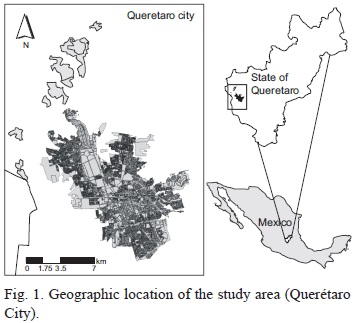
<body><![CDATA[<p align="justify">&nbsp;</p>  	    <p align="justify"><font face="verdana" size="2"><b>ABSTRACT</b></font></p>  	    <p align="justify"><font face="verdana" size="2">Alteration of climatic conditions and the urban heat island effect (UHI) are consequences of increased human population and activities in urban zones. Determining the magnitude of the UHI is important to improve urban planning in medium&#45;size cities like Quer&eacute;taro. Increase and conservation of vegetated areas is a mitigation option for UHI. Here we characterized both the UHI and the role of vegetation cover over temperature reg&#45;ularization in urban zones. Four local climatic zones were defined: three urban and one rural, each with two plots with low and high canopy cover defined by their average leaf area index (0.5 and 2.0, respectively). Air temperature and relative humidity were measured with data loggers at a 30 min time step from June 2012 to May 2013. Climatic data from six weather stations was also analyzed. Daily mean temperature increased at a rate of 0.75 &deg;C per decade (<i>r</i><sup>2</sup> = 0.38, P &lt; 0.0001), and this was related to population dynamics (<i>r</i><sup>2</sup> = 0.52, P &lt; 0.0001). Patterns of air temperature defined a cold and a warm season: July to March and April to June for maximum temperature, and November to March and April to October for minimum temperature. The difference between cold and warm seasons was 5 &deg;C (P &lt; 0.0001). The minimum temperature was similar</font> <font face="verdana" size="2">between canopy cover levels. However, relative humidity was higher in high canopy cover plots. The relationship between UHI and the pervious surface fraction of the city was inversely proportional. The UHI ranged from 0.1 to 5 &deg;C and this magnitude was similar between the warm and cold seasons. Vegetation with high canopy cover had lower temperature at 17:00 LT and higher at 9:00 to 10:00 LT during the warm season. Increasing the urban zone canopy cover by 50% would reduce the UHI by 2.05 &deg;C. In conclusion, vegetation with higher canopy cover improved environmental conditions in terms of relative humidity and regularization of extreme temperatures during the warm season.</font></p>  	    <p align="justify"><font face="verdana" size="2"><b>Keywords:</b> Climate change, urban heat island effect, urban planning, Quer&#233;taro, vegetation.</font></p>     <p align="justify">&nbsp;</p>  	    <p align="justify"><font face="verdana" size="2"><b>1. Introduction</b></font></p>  	    <p align="justify"><font face="verdana" size="2">According to the population report of the United Nations (2014), 54% of human population lives in urban areas and it is increasing at a rate of 1.8% per year. By year 2050 rural population would decrease to one third of its present size. Urban concentration ofhuman population causes deep modifications in the city and its surrounding landscapes, affecting environmental and climatic conditions (Yu and Hien, 2006; Um <i>et al,</i> 2007). The effect and dynamics of the urban heat island (UHI) are well&#45;known and deeply studied climatic processes (Garc&iacute;a&#45;Cueto <i>et al.,</i> 2007; Doick and Hutchings, 2013). The UHI effect is described as the difference in environmental temperature between the urban area and its rural periphery (Oke, 1973; Stewart, 2011; Li <i>et al.,</i> 2013). The variation of air temperature associated with the UHI intensity depends on factors such as infrastructure and building design and density, among many others (Garc&iacute;a&#45;Cueto <i>et al.,</i> 2009; Li <i>et al.,</i> 2013). Compared to the countryside, the low albedo and high heat absorption of city surfaces (Doick and Hutchings, 2013), coupled with the generation of greenhouse gases (GHG) and dust from industrial processes and anthropogenic activities (Wilby, 2003; Hunt <i>et al.,</i> 2007), contributes to the increase in air temperature, and modifies surface wind flow and air quality (Blake <i>et al.,</i> 2011; Doick and Hutchings,</font> <font face="verdana" size="2">2013).</font></p>  	    <p align="justify"><font face="verdana" size="2">The increase of vegetation areas is a main option explored to mitigate UHI (Anyanwu and Kanu, 2006; Li <i>et al.,</i> 2013). Urban vegetation regulates climate mainly by shading (Emmanuel, 2005), CO<sub>2</sub> sequestration (Lin et <i>al.,</i> 2011) and evapotranspiration (Yu and Hien, 2006). The mitigation potential of urban vegetation needs additional research because native vegetation and climate are strongly related, and this types of plants should be preferred as a robust mitigation option; nevertheless, exotic trees are common in the urban context.</font></p>  	    <p align="justify"><font face="verdana" size="2">In this paper, we analyzed the UHI for Quer&eacute;taro City, Mexico. This study is an effort of the Programa Estatal de Acci&oacute;n ante el Cambio Clim&aacute;tico&#45;Quer&eacute;taro (State of Quer&eacute;taro Action Program Addressing Climate Change, PEACC&#45;Q) (Suz&aacute;n&#45;Azpiri <i>et al.</i>, 2014). The aims of this study were to evaluate (1) the role of vegetation in urban temperature regularization, and (2) the role of vegetation cover in the adaptation to</font> <font face="verdana" size="2">UHI effects.</font></p>     <p align="justify">&nbsp;</p>  	    ]]></body>
<body><![CDATA[<p align="justify"><font face="verdana" size="2"><b>2. Methodology</b></font></p>  	    <p align="justify"><font face="verdana" size="2"><i>2.1 Study area</i></font></p>  	    <p align="justify"><font face="verdana" size="2">The study area is the city of Quer&eacute;taro (<a href="#f1">Fig. 1</a>), located in the southwestern portion of the State of Quer&eacute;taro, Mexico (20&deg; 35' 34.8'' N, 100&deg; 23' 31.6'' W). It covers an area of 759.9 km<sup>2</sup> with a population of 626 495 (INEGI, 2010). Its predominant climate is semiarid with summer rains, annual precipitation average of 549 mm and annual average temperature of 18 &deg;C. The landscape comprises plains and small</font> <font face="verdana" size="2">hills (Baltazar <i>et al.</i> , 2004).</font></p> 	    <p align="center"><a name="f1"></a></p> 	    <p align="center"><font face="verdana" size="2"><img src="/img/revistas/atm/v28n3/a5f1.jpg"></font></p> 	    <p align="justify"><font face="verdana" size="2">The city of Quer&eacute;taro can be classified as poly&#45;centric, with main urban cores associated to industrial and commercial areas (&Aacute;lvarez de la Torre, 2010). The historic downtown is mainly composed of baroque buildings less than six stories tall. Almost 90% of the streets in the center of the city and its surroundings are paved with cobblestone, and the rest have asphalt surfaces. Industrial plots are allotted within industrial parks located to the north, east and southwest of the city; they are main land use changes that contribute to urban growth (Icazuriaga and Osorio, 2007). Concrete and steel buildings, as well as asphalt roads, are representative of these areas. Finally, 70% of the households are less than three stories single&#45;family buildings; the rest are multi&#45;family complexes and two level houses of social interest located on the periphery. Concrete, metal, bricks, tiles and polystyrene are the main construction materials on households. The streets are mainly asphalt roads and in some cases they are covered with cobblestone (Arag&oacute;n and L&oacute;pez, 2013).</font></p>  	    <p align="justify"><font face="verdana" size="2">Using Landsat 8 imagery (Sensor OLI_TIRS_L1T, December 5, 2013, USGS Global Visualization Viewer) we created a supervised classification of the city using ENVI 5 (ITT Visual Information Solutions). Approximately 65% is constructed; 37% is paved; 28% is covered by vegetation or bare soil; and less than 1% is occupied by water (dams and artificial reservoirs).</font></p>  	    <p align="justify"><font face="verdana" size="2"><i>2.2 Study zones</i></font></p>  	    <p align="justify"><font face="verdana" size="2">To avoid the arbitrary designation of urban and rural zones (Stewart, 2007), we used the climate&#45;based</font> <font face="verdana" size="2">classification system developed by Stewart and Oke (2012). This system describes the local physical conditions around the measuring field sites, classifying them into local climate zones (LCZs). Four circular zones with a 500 m radius (78.5 ha) (WMO, 2008) were selected randomly within the range of 1 to 99% vegetation cover. We used satellite imagery to estimate the mean height of trees and buildings, the building surface fraction, and the impervious and pervious fractions (<a href="/img/revistas/atm/v28n3/a5t1.jpg" target="_blank">Table I</a>). The rest of the values were taken from literature (Oke, 2006; Stewart and Oke, 2012). The four zones were classified accordingly as scattered trees (LCZ B), open low&#45;rise (LCZ 6), compact low&#45;rise (LCZ 3), and compact mid&#45;rise (LCZ 2).</font></p>  	    <p align="justify"><font face="verdana" size="2"><i>2.3 Local climate zones</i></font></p>  	    ]]></body>
<body><![CDATA[<p align="justify"><font face="verdana" size="2"><i>2.3.1&nbsp;LCZ B (scattered trees)</i></font></p>  	    <p align="justify"><font face="verdana" size="2">Described as lightly dense vegetation comprised by shrubs, cacti <i>(Opuntia</i> sp. and<i>Myrtillocactus geome&#45;trizans),</i> tropical dry forests (TDF) and reforestation patches (i.e. <i>Jacaranda mimosifolia, Eucalyptus globulus).</i> It constitutes one of the best&#45;preserved climate zones in the municipality of Queretaro (Baltazar <i>et al.,</i> 2004), and is located in the southern periphery of the city (<a href="#f2">Fig. 2</a>).</font></p> 	    <p align="center"><a name="f2"></a></p> 	    <p align="center"><font face="verdana" size="2"><img src="/img/revistas/atm/v28n3/a5f2.jpg"></font></p>  	    <p align="justify"><font face="verdana" size="2"><i>2.3.2&nbsp;LCZ 6 (open low&#45;rise)</i></font></p>  	    <p align="justify"><font face="verdana" size="2">It is composed of one to three stories small buildings of diverse construction materials (concrete, stones, bricks, tiles and metal). Fifty percent of the surface is covered with scattered shrubs and TDF. It has medium traffic flow, and residential (row housing</font> <font face="verdana" size="2">and apartments) and commercial use (small shopping centers). These suburbs are located on the northern periphery of the city.</font></p>  	    <p align="justify"><font face="verdana" size="2"><i>2.3.3&nbsp;LCZ 3 (compact low&#45;rise)</i></font></p>  	    <p align="justify"><font face="verdana" size="2">A dense mix of low&#45;rise buildings with less than three stories and diverse construction materials (concrete, stone, tiles and bricks). Pavement and cobblestone cover most ofthe streets with a few scattered trees. It is located within the city core (medium density) and has residential use (single unit households).</font></p>  	    <p align="justify"><font face="verdana" size="2"><i>2.3.4&nbsp;LCZ 2 (compact mid&#45;rise)</i></font></p>  	    <p align="justify"><font face="verdana" size="2">Dense mix of mid&#45;rise buildings lower than nine stories of diverse construction materials (concrete, stone, tiles, bricks and metal). Most of the streets are covered with pavement and cobblestone, with a few scattered trees <i>(Eucalyptus</i> sp., <i>Ficus</i> sp. and <i>Jacaranda</i> sp.). It is adjacent to the city center and has residential use (scattered single unit households).</font></p>  	    ]]></body>
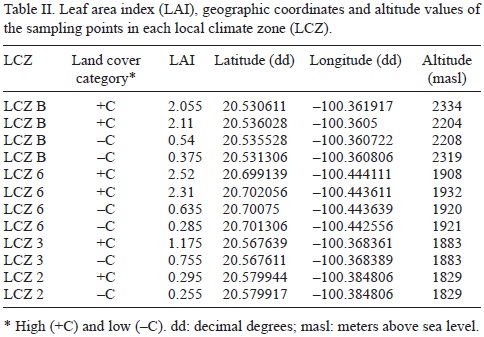
<body><![CDATA[<p align="justify"><font face="verdana" size="2"><i>2.4 Sampling</i></font></p>  	    <p align="justify"><font face="verdana" size="2">In each LCZ we established random sampling points according to two different vegetation cover categories: high (+C) and low (&#45;C) (<a href="#t2">Table II</a>).</font></p> 	    <p align="center"><a name="t2"></a></p> 	    <p align="center"><font face="verdana" size="2"><img src="/img/revistas/atm/v28n3/a5t2.jpg"></font></p>  	    <p align="justify"><font face="verdana" size="2">The characterization of each category was determined by the leaf area index (LAI), one&#45;sided green leaf area per unit ground surface (m<sup>2</sup>/m<sup>2</sup>). The LAI was measured using a LAI&#45;2000 Plant Canopy Analyzer (Li&#45;Cor Inc., USA) which evaluates the transmission of light through the canopy in terms of gap fraction. For each LAI data, the average of three measurements under the canopy (separated by one meter each in a north&#45;south direction), and one measurement above the canopy were obtained (Guevara <i>et al.,</i> 2012). For each sampling point (n = 12), air temperature and relative humidity were measured with a climatic data logger EL&#45;USB&#45;2 (Hobo Pro v.2, LASCAR, USA). The data loggers were programmed to record every 30 min from June 1, 2012 to May 31, 2013.</font></p>  	    <p align="justify"><font face="verdana" size="2"><i>2.5 Temperature corrections</i> </font></p> 	    <p align="justify"><font face="verdana" size="2">Heating and cooling of air is considered to be an adiabatic process responding to the variation in gas pressures (Lutgens and Tarbuck, 2012). In this context, air temperature is directly affected by altitude, and we standardized altitude and pressure by an adjustment with a Poisson function (Eq. 1). The resulting value, known as potential temperature (6), is defined</font> <font face="verdana" size="2">as "the temperature that a parcel of air would have if it were expanded or compressed adiabatically from its existing pressure and temperature to a standard pressure" (Wallace and Hobbs, 2006; Mohanakumar, 2008). Mathematically, it is expressed as:</font></p>  	    <p align="center"><font face="verdana" size="2"><img src="/img/revistas/atm/v28n3/a5e1.jpg"></font></p>  	    <p align="justify"><font face="verdana" size="2">where <i>&#952; =</i> potential temperature, <i>T =</i> original temperature, <i>p<sub>0</sub></i> = standard pressure of 1000 hPa, <i>p</i> = original pressure, <i>R</i> = universal gas constant (287 J K<sup>&#45;1</sup> kg<sup>&#45;1</sup>); and <i>c<sub>p</sub></i> = specific heat constant (1004 J K<sup>&#45;1</sup> kg<sup>&#45;1</sup>).</font></p>  	    <p align="justify"><font face="verdana" size="2">To calculate the pressure corresponding to temperature data we used the hypsometric or barometric equation (Eq. 2), which relates pressure and temperature at a certain atmospheric altitude (Adamson, 2012):</font></p>  	    ]]></body>
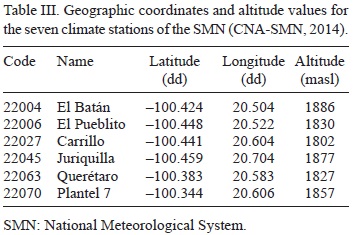
<body><![CDATA[<p align="center"><font face="verdana" size="2"><img src="/img/revistas/atm/v28n3/a5e2.jpg"></font></p>  	    <p align="justify"><font face="verdana" size="2">where: <i>p<sub>h</sub></i> = pressure at <i>h</i> height, <i>p<sub>0</sub></i> = pressure at ground level (1013.25 hPa), <i>M</i> = the mass or a mole of particles of air (0.029 kg mol<sup>&#45;1</sup>), <i>g</i> = gravitational acceleration (9.8 m s<sup>&#45;2</sup>), <i>h</i> = height in meters, <i>R</i> = universal gas constant (8.314472 J K<sup>&#45;1</sup> mol<sup>&#45;1</sup>), and <i>T</i> = average temperature at height (&deg;K).</font></p>  	    <p align="justify"><font face="verdana" size="2"><i>2.6 The role of vegetation in urban temperature dynamics</i></font></p>  	    <p align="justify"><font face="verdana" size="2">In a global scale, a rise in minimum temperature has a greater impact on average daily temperature than</font> <font face="verdana" size="2">maximum temperature (IPCC, 1997). Therefore, the effects of climate change are mainly detected in minimum daily temperatures (IPCC, 2007). In order to prove this hypothesis within the city of Queretaro we analyzed daily average minimum temperatures <i>(T<sub>min</sub>,</i> &deg;C) and maximum temperatures <i>(T<sub>max</sub>,</i> &deg;C) between 1982 and 2011 from six climate stations (<a href="#t3">Table III</a>). Data were obtained from the databases of the SMN (CNA&#45;SMN, 2014). In the case of Queretaro, all stations were previously verified with the RClimDex software (Zhang and Yang, 2004), developed within the PEACC project (Suzan&#45;Azpiri <i>etal.,</i> 2014). Moreover, the databases of the six stations were filtered to ensure temporal homogeneity throughout the 30 years. Additionally, we analyzed the relationship between variations in <i>T<sub>min</sub></i> and <i>T<sub>max</sub></i> as a function of population size, according to the demographic censuses conducted between 1990 and</font> <font face="verdana" size="2">2010 (INEGI, 1990, 2010). Finally, we studied the oscillation in a monthly scale to identify extreme periods in both <i>T<sub>min</sub></i> and <i>T<sub>max.</sub></i></font></p> 	    <p align="center"><a name="t3"></a></p> 	    <p align="center"><font face="verdana" size="2"><img src="/img/revistas/atm/v28n3/a5t3.jpg"></font></p>  	    <p align="justify"><font face="verdana" size="2">In order to evaluate the role of vegetation cover in urban temperature dynamics, we evaluated the changes in <i>T<sub>min</sub></i> and average relative humidity (RH %) in function of the different LCZs, canopy cover status (+C and &#45;C) and pervious surface fraction (PSF, %) &#45;defined as the percentage of vegetated surface&#45;, between June 1, 2012 and May 31, 2013.</font></p>  	    <p align="justify"><font face="verdana" size="2"><i>2.7&nbsp;Vegetation cover and effect of the UHI</i> </font></p> 	    <p align="justify"><font face="verdana" size="2">According to Stewart and Oke (2012), the UHI is represented as a function of the intensity difference <i>(AT)</i> between LCZs temperatures according to the degree of urbanization. Mathematically it is defined as:</font></p>  	    <p align="center"><font face="verdana" size="2"><img src="/img/revistas/atm/v28n3/a5e3.jpg"></font></p>  	    ]]></body>
<body><![CDATA[<p align="justify"><font face="verdana" size="2">where <i>UHI</i> is the intensity of the urban heat island effect, <i>&#916;T</i> is the temperature difference between LCZs, <i>LCZx</i> is the zone with more urban components (<a href="/img/revistas/atm/v28n3/a5t1.jpg" target="_blank">Table I</a>), and <i>LCZy</i> is the zone with less number of urban components (<a href="/img/revistas/atm/v28n3/a5t1.jpg" target="_blank">Table I</a>).</font></p>  	    <p align="justify"><font face="verdana" size="2">In this study, we quantified the differences between average minimum temperatures (<i>&#916;T<sub>min,</sub></i>&deg;C) between the four described climate zones in six possible arrangements: LCZ<i><sub>2</sub></i><sub>&#45;</sub><i><sub>3,</sub></i> LCZ<i><sub>2</sub></i><sub>&#45;</sub><i><sub>6,</sub></i> LCZ<i><sub>2</sub></i><sub>&#45;</sub><i><sub>B,</sub></i> LCZ<i><sub>3</sub></i><sub>&#45;</sub><i><sub>6,</sub></i> LCZ<i><sub>3</sub></i><sub>&#45;</sub><i><sub>B</sub></i> and LCZ<i><sub>6</sub></i><sub>&#45;</sub><i><sub>B</sub></i>. The role of vegetation in UHI dynamics was evaluated through the fluctuation in <i>&#916;Tmin</i> for the LCZx&#45;y arrangements according to the cover status (+C y &#45;C), and seasonality (cold and warm seasons). Additionally, a daily profile of UHI (24 h) changes was studied.</font></p>      <p align="justify"><font face="verdana" size="2"><i>2.8&nbsp;Statistical analysis</i></font></p>  	    <p align="justify"><font face="verdana" size="2">A linear regression (LR) analysis was applied to evaluate the annual increase in daily average minimum and maximum temperatures from six meteorological stations, with the function:</font></p>  	    <p align="center"><font face="verdana" size="2"><img src="/img/revistas/atm/v28n3/a5e4.jpg"></font></p>  	    <p align="justify"><font face="verdana" size="2">where <i>Y</i> is the dependent variable (<i>T<sub>min</sub></i> and <i>T<sub>max</sub></i>), <i>&#946;<sub>1</sub></i> is the intercept, <i>&#946;<sub>0</sub></i> is the slope, and <i>X</i> is the independent variable (year).</font></p>  	    <p align="justify"><font face="verdana" size="2">In order to estimate <i>T<sub>min</sub></i> and <i>RH<sub>ave</sub></i> differences among the LCZs zones, according to the status of</font> <font face="verdana" size="2">vegetation cover (+C and &#45;C), a full factorial analysis was performed with the model:</font></p>  	    <p align="center"><font face="verdana" size="2"><img src="/img/revistas/atm/v28n3/a5e5.jpg"></font></p>  	    <p align="justify"><font face="verdana" size="2">where <i>&#956;</i> is the general average value, <i>M<sub>i</sub></i> is the monthly effect, <i>L<sub>j</sub></i> is the zone, <i>S<sub>k</sub></i> is the effect for the <i>k</i>&#45;th status of vegetation, <i>M</i>*<i>L<sub>ij</sub></i> is the interaction month&#45;zone, <i>M</i>*<i>S<sub>ik</sub></i> is the interaction month&#45;status, <i>S</i>*<i>L<sub>kj</sub></i> is the interaction status&#45;zone, <i>M</i>*<i>L</i>*<i>S<sub>ijk</sub></i> is the interaction month&#45;zone&#45;status, and <i>e<sub>jk</sub></i> is the random error.</font></p>  	    <p align="justify"><font face="verdana" size="2">A simple linear regression analysis was applied to explore the relation between the <i>T<sub>min</sub></i> and the pervious surface fraction (PSF, %) (<a href="/img/revistas/atm/v28n3/a5t1.jpg" target="_blank">Table I</a>) of the four LCZs with the function:</font></p>  	    ]]></body>
<body><![CDATA[<p align="center"><font face="verdana" size="2"><img src="/img/revistas/atm/v28n3/a5e6.jpg"></font></p>  	    <p align="justify"><font face="verdana" size="2">where <i>Y</i> is the dependent variable <i>(T<sub>min</sub>),</i> <i>&#946;</i><sub>1</sub> is the intercept, <i>&#946;</i><sub>0</sub> is the slope, and <i>X</i> is the independent variable (PSF).</font></p>  	    <p align="justify"><font face="verdana" size="2">The monthly changes in the UHI associated to the status of the cover (+C and &#45;C) in each LCZ<sub>x&#45;y,</sub> were analyzed with the model:</font></p>  	    <p align="center"><font face="verdana" size="2"><img src="/img/revistas/atm/v28n3/a5e7.jpg"></font></p>  	    <p align="justify"><font face="verdana" size="2">where <i>&#956;</i> is the average value, <i>M<sub>i</sub></i> is the effect for the <i>i</i>&#45;th month, <i>C</i><i><sub>j</sub></i> is the effect for the <i>j</i>&#45;th LCZ<sub>x&#45;y,</sub> <i>S</i><i><sub>k</sub></i> is the effect for the <i>k</i>&#45;th status of vegetation, <i>M*C<sub>ij</sub> </i>is the interaction month&#45;LCZ<sub>x&#45;y</sub>, <i>M*S<sub>k</sub></i> is the interaction month&#45;status, <i>S*L<sub>kj</sub></i> is the interaction status&#45;zone, <i>M*L*S<sub>ijk</sub> </i>is the interaction month&#45;zone&#45;status, and <i>e</i><i>ijk</i> is the random error.</font></p>      <p align="justify"><font face="verdana" size="2">Linear regression analysis was applied to explore the relation between the UHI and the difference between the pervious surface fraction (APSF, %) in the six arrangements LCZ<sub>x&#45;y</sub>, with the function:</font></p>  	    <p align="center"><font face="verdana" size="2"><img src="/img/revistas/atm/v28n3/a5e8.jpg"></font></p>      <p align="justify"><font face="verdana" size="2">where <i>Y</i> is the dependent variable <i>(&#916;T<sub>miir</sub>), &#946;<sub>1</sub></i> is the intercept, <i>&#946;<sub>0</sub></i> is the slope, and <i>X</i> is the independent variable <i>(&#916;PSF).</i></font></p>  	    <p align="justify"><font face="verdana" size="2">The hourly behavior of the UHI at high and low temperature phases between the LCZ<sub>x&#45;y,</sub> was evaluated with the model:</font></p>  	    <p align="center"><font face="verdana" size="2"><img src="/img/revistas/atm/v28n3/a5e9.jpg"></font></p>  	    ]]></body>
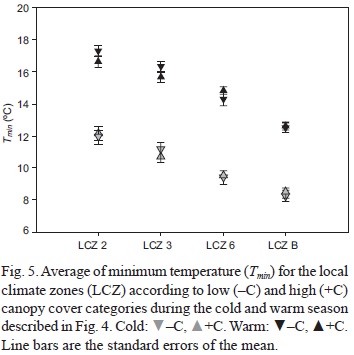
<body><![CDATA[<p align="justify"><font face="verdana" size="2">where &#956; is the general average, <i>F<sub>i</sub></i> is the effect of the de <i>i</i>&#45;th fase, <i>C<sub>j</sub></i> is the effect for the j&#45;th LCZ<sub>x&#45;y,</sub> <i>H<sub>k</sub></i> is the effect of the <i>j&#45;th</i> hour, <i>F*C<sub>ij</sub></i> is the interaction phase LCZ<sub>x&#45;y</sub>, <i>F*H<sub>ik</sub></i> is the interaction phase&#45;hour, <i>C*H<sub>jk</sub></i> is the interaction LCZ<sub>x&#45;y</sub>&#45;hour, <i>F*C*H <sub>ijk </sub></i>is the interaction phase&#45;LCZ<sub>x&#45;y</sub>&#45;hour, and<i> e<sub>ijk </sub></i>is the random error.</font></p>     <p align="justify">&nbsp;</p>  	    <p align="justify"><font face="verdana" size="2"><b>3. Results and discussion</b></font></p>  	    <p align="justify"><font face="verdana" size="2"><i>3.1 Historic and annual temperature oscillation</i> </font></p> 	    <p align="justify"><font face="verdana" size="2">The temperature comparison for the period 19822011 from six climate stations within the city of Queretaro showed significant differences between the daily <i>T<sub>max</sub> </i>(P &lt; 0.0001, F = 49.99, 29, 929) and <i>T<sub>min</sub></i> (P &lt; 0.0001, F = 122.53, 29, 900) among the 30 years. The LR exhibited a low significant linear trend for the increase in annual <i>T<sub>max</sub></i> (P &lt; 0.0001, <i>r</i><sup>2</sup> = 0.07) (<a href="/img/revistas/atm/v28n3/a5f3.jpg" target="_blank">Fig. 3a</a>). In contrast, <i>T<sub>min</sub></i> had a more significant trend (P &lt; 0.0001, <i>r</i><sup>2</sup>=0.38) of 0.751 &deg;C per decade (<a href="/img/revistas/atm/v28n3/a5f3.jpg" target="_blank">Fig. 3c</a>). This differential trend agreed with the global pattern, where minimum daily temperatures increase faster than maximums. However, the rate was higher than</font> <font face="verdana" size="2">the global decadal range (0.254 to 0.273 &deg;C) between 1979 and 2012 (IPCC, 2013).</font></p>  	    <p align="justify"><font face="verdana" size="2">This increase was higher than in other Mexican cities, where values of 0.57 &deg;C for large metropolis (bigger than one million inhabitants) and 0.37 &deg;C for medium size cities (smaller than one million) are found (Jauregui, 2005). Particularly the city of Queretaro, with less than one million inhabitants, has experienced a high rate of urban growth (Icazuriaga and Osorio, 2007) of about 33% between 1990 and 2010 (INEGI, 1990, 2010). This growth was significantly correlated with the daily annual average <i>T<sub>min</sub> </i>increase <i>(r<sup>2</sup></i> = 0.52, P &lt; 0.0001) (<a href="/img/revistas/atm/v28n3/a5f3.jpg" target="_blank">Fig. 3d</a>), but not with the <i>T<sub>max</sub> </i>(<i>r</i><sup>2</sup> = 0.0018, P &lt; 0.0001) (<a href="/img/revistas/atm/v28n3/a5f3.jpg" target="_blank">Fig. 3b</a>). Therefore, factors related to the urbanization process like the increase in building surface fraction and impervious surface fraction, the change in surface albedo and the rise of anthropogenic heat flux, could explain the <i>T<sub>min</sub></i> increase.</font></p>  	    <p align="justify"><font face="verdana" size="2">In a monthly scale we detected significant differences in <i>T<sub>max</sub> </i>(P &lt; 0.0001, F = 115.27, 11, 348) (<a href="/img/revistas/atm/v28n3/a5f4.jpg" target="_blank">Fig. 4a</a>) and in <i>T<sub>min</sub></i> (P &lt; 0.0001, F = 180.69, 11, 348) (<a href="/img/revistas/atm/v28n3/a5f4.jpg" target="_blank">Fig. 4b</a>). During the cold season for <i>T<sub>max</sub></i> (defined as July to March) the mean and standard deviation were</font> <font face="verdana" size="2">27.24 &plusmn; 1.58 &deg;C, while these values during the warm season for <i>T<sub>max</sub></i> (April to June) were 31.45 &plusmn; 0.85 &deg;C (<a href="/img/revistas/atm/v28n3/a5f4.jpg" target="_blank">Fig. 4</a>). In contrast, the cold season for <i>Tmin</i> (November to March) had a mean and standard deviation of 7.51 &plusmn; 1.40 &deg;C, while these values during the warm season (April to October) for the same variable were 13.13 &plusmn; 1.43 &deg;C. Both trends in temperature agree with the pattern detected for a larger region in Mexico (Morillon <i>et al.,</i> 2002).</font></p>  	    <p align="justify"><font face="verdana" size="2"><i>3.2 The role of vegetation in urban temperature</i> </font></p> 	    <p align="justify"><font face="verdana" size="2">For the studied period, average <i>T</i><i><sub>min</sub></i> was 13 &deg;C with a maximum of 14.89 &deg;C and a minimum of 10.79 &deg;C. Significant differences between the studied zones were detected (P &lt; 0.0001, F = 85.42, 3, 87). These differences oscillated from 1.6 &deg;C between LCZ 3</font> <font face="verdana" size="2">and LCZ 6, to 4 &deg;C between LCZ 2 and LCZ B. In</font> <font face="verdana" size="2">agreement with Alexander and Mills (2014), the areas with more urban elements such as high anthropogenic heat flux percentages, impervious surface and building surface fraction, had temperatures over the mean (LCZ 2 and LCZ 3), while the less urbanized areas had temperatures below the mean (LCZ 6 and LCZ B). Among the annual seasons, a 5 &deg;C difference between cold and warm seasons was detected (P &lt; 0.0001, F = 602.93, 1, 87). These results agree with the findings reported by Romero&#45;Davila <i>et al.</i> (2011) for the city of Toluca, Mexico.</font></p>     <p align="justify"><font face="verdana" size="2">No significant differences were found between &#45;C and +C for <i>T<sub>min</sub></i> (P = 0.80, F = 0.06, 1, 87) (<a href="#f5">Fig. 5</a>). However, Yu and Hien (2006) proved that foliar density (LAI) within a green area has an effect on air temperature; particularly in urban gardens, high</font> <font face="verdana" size="2">values in the LAI (&gt; 7) were associated with lower temperatures. Therefore, we deduced that the difference between +C and &#45;C for each climate zone was insufficient to detect an effect on <i>T<sub>min</sub></i>.</font></p> 	    ]]></body>
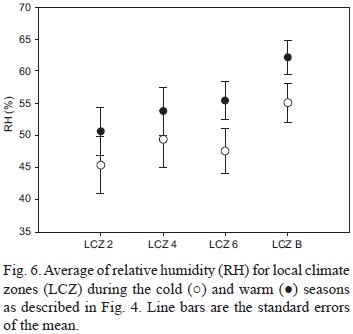
<body><![CDATA[<p align="center"><a name="f5"></a></p> 	    <p align="center"><font face="verdana" size="2"><img src="/img/revistas/atm/v28n3/a5f5.jpg"></font></p>  	    <p align="justify"><font face="verdana" size="2">Relative humidity was different between LCZ 2 and LCZ B (P = 0.0074, F = 4.25, 3, 89), but it was not related to seasonality (<a href="#f6">Fig. 6</a>). The lower RH in LCZ 2 results from fast evaporation as a consequence of high surface temperature and high runoff rates through water&#45;drainages (Um <i>et al.,</i> 2007). In contrast, the high canopy cover for LCZ B maintained high humidity values resulting from lower mixing ratios for evapotranspiration, possibly due to lower wind speeds. Liu <i>et al.</i> (2009) found a similar result.</font></p> 	    <p align="center"><a name="f6"></a></p> 	    <p align="center"><font size="2" face="verdana"><img src="/img/revistas/atm/v28n3/a5f6.jpg"></font> </p> 	    <p align="justify"><font face="verdana" size="2">The relationship between PSF and <i>T<sub>min</sub></i> was significant for the cold and warm seasons (<i>r</i><sup>2</sup> = 0.72, P &lt; 0.0001). According to the equation's model of linear regression (<a href="/img/revistas/atm/v28n3/a5f7.jpg" target="_blank">Fig. 7a</a> and <a href="/img/revistas/atm/v28n3/a5f7.jpg" target="_blank">7b</a>), a 50% increase in PSF produced a decrease of approximately 1.75 and 2.18 &deg;C in <i>T</i><i><sub>min</sub></i> for both seasons. Yan <i>et al.</i> (2014) demonstrated a similar relationship between canopy cover and temperature in urban parks; an increase of 50% in vegetation cover produced a decrease of 0.6 &deg;C in air temperature, reinforcing the idea that canopy cover is a regulator of environmental temperature (Yu and Hien, 2006; Li <i>et al.,</i> 2013).</font></p>      <p align="justify"><font face="verdana" size="2">According to Wilby (2003) and Lin <i>et al.</i> (2011), through evapotranspiration vegetation acts as an</font> <font face="verdana" size="2">evaporative cooling system, creating an albedo 15% higher than urban surface due to smaller heat absorption and higher reflected radiation (Doick and Hutch&#45;ings, 2013). Also, the shade effect decreases incident radiation and the micro greenhouse effect within buildings (Emmanuel, 2005; Anyanwu and Kanu, 2006), which promotes energy savings by decreasing the demand in cooling systems; it also reduces health risks by decreasing atmospheric pollutants while increasing CO<sub>2</sub> sequestration (Lin <i>et al.,</i> 2011).</font></p>  	    <p align="justify"><font face="verdana" size="2"><i>3.3 Effect of the urban heat island (UHI)</i> </font></p> 	    <p align="justify"><font face="verdana" size="2">Significant temperature differences were found between LCZ<sub>2&#45;B</sub> and LCZ<sub>3&#45;6</sub> (P &lt; 0.0001, F = 155.88, 5, 120; Tukey&#45;Kramer <i>a</i> = 0.05, Q = 2.89), with a 4.94 &deg;C maximum intensity and a 0.48 &deg;C minimum intensity (<a href="#f8">Fig. 8</a>). Alexander and Mills (2014) found similar results between LCZ<sub>2&#45;D</sub> (4.8 &deg;C). During the warm season an UHI of 2.64 &deg;C in average, with a 5 &deg;C maximum and a 0.82 &deg;C minimum, was detected. In the cold season, UHI values had a 2.46 &deg;C average, ranging from a 4.88 &deg;C maximum to a 0.14 &deg;C minimum. These values agreed with the maximum UHI reported for the city of Mexicali, Mexico; 5.4 &deg;C during the summer (Garc&iacute;a&#45;Cueto <i>et al.,</i> 2007) and 4.5 &deg;C during winter (Garc&iacute;a&#45;Cueto <i>et al.,</i> 2009); and also for Toluca, Mexico with values of 5 &deg;C for winter and summer (Romero&#45;D&aacute;vila <i>et al.,</i> 2011). There was no effect of the canopy cover (&#45;C and +C) over UHI intensities (P = 0.2073, F = 1.60, 1, 120).</font></p> 	    <p align="center"><a name="f8"></a></p> 	    ]]></body>
<body><![CDATA[<p align="center"><font face="verdana" size="2"><img src="/img/revistas/atm/v28n3/a5f8.jpg"></font></p>  	    <p align="justify"><font face="verdana" size="2">The relationship between the UHI and the difference in canopy cover (&#916;PSF) in the LCZ<sub>x&#45;y</sub> was</font> <font face="verdana" size="2">significant according to the proposed seasons (<i>r</i><sup>2</sup> = 0.67, P &lt; 0.0001). For the cold season (<a href="/img/revistas/atm/v28n3/a5f9.jpg" target="_blank">Fig. 9a</a>) 57% ofthe UHI values were explained by APSF (<i>r</i><sup>2</sup> = 0.58, P &lt; 0.0001), while during the warm season (<a href="/img/revistas/atm/v28n3/a5f9.jpg" target="_blank">Fig. 9b</a>) the explained variance was about 73% (<i>r</i><sup>2</sup> = 0.74, P &lt; 0.0001). According to the linear regression model, a difference of 50% in &#916;PSF between more and less urbanized zones (LCZ<sub>x&#45;y</sub>), will produce a difference of 1.9 and 2.05 &deg;C in the UHI for the cold and warm season, respectively. Steeneveld <i>et al.</i> (2011) found a similar relationship for a green cover increase of 50% which resulted in an average decrease of 2.9 &deg;C in air</font> <font face="verdana" size="2">temperature. The close relationship between increase in seasonal UHI and the &#916;PSF within each LCZ also was in agreement with the work of Shahmohamadi <i>et al.</i> (2010) which reported a smaller UHI, but similar values in canopy cover as the present study.</font></p>      <p align="justify"><font face="verdana" size="2">According to Stewart (2011), hourly observations are recommended for detection of the daily maximum and minimum UHI. When we examined the variability of the UHI on hourly intervals (<a href="/img/revistas/atm/v28n3/a5f10.jpg" target="_blank">Fig. 10</a>) we found no interaction between the season effect (<a href="/img/revistas/atm/v28n3/a5f10.jpg" target="_blank">Fig. 10a</a>) (P = 0.58, F = 0.30, 1, 235) and the canopy cover (<a href="/img/revistas/atm/v28n3/a5f10.jpg" target="_blank">Fig. 10b</a>) (P = 0.47, F = 0.50, 1, 235). However, significant differences through the hours were detected (P &lt; 0.0001, F = 5.05, 23, 235). The UHI was slightly more intense during warm nights and days according to Jauregui (1997) and Romero&#45;Davila <i>et al.</i> (2011), who state that during the summer (warm) more and less urbanized zones receive high amounts of radiation, although they have different albedos. Therefore, differences among <i>T</i><i>min</i> were not considerable. Nevertheless, during the night the response to the slow rate of heat dissipation was significant in more urbanized areas (Shahmohamadi <i>et al.,</i> 2010).</font></p>  	    <p align="justify"><font face="verdana" size="2">A pattern in UHI variation was detected independently of the season and status of the canopy cover. During the first hours of the day (0:00 to 11:00 LT) the intensity remains between 2 and 3 &deg;C. A substantial increase reaching a maximum of 5 &deg;C between 15:00 and 16:00 LT is achieved later. Between 17:00&#45;19:00 LT the UHI diminishes and remains between 2&#45;3 &deg;C (<a href="/img/revistas/atm/v28n3/a5f10.jpg" target="_blank">Fig. 10</a>) throughout the night. Two minor intensity peaks were detected associated with the sunrise and sunset, and the differential</font> <font face="verdana" size="2">between more and less urbanized zones was minimal (Landsberg, 1981). Maximum UHI peaks were observed through the afternoon during the hours of highest solar radiation. This energy is absorbed and stored by the most urbanized surfaces, whereas less urbanized zones with greater percentages of permeable surfaces (including vegetation) reflected more radiation and therefore maintained smaller superficial temperatures (Emmanuel, 2005; Blake <i>et al.,</i> 2011).</font></p>  	    <p align="justify"><font face="verdana" size="2"><i>3.4 General considerations</i></font></p>  	    <p align="justify"><font face="verdana" size="2">The vegetation cover examined in the present work had a seasonal effect on air temperature and reduced the UHI intensity, although LAI peaks were relatively low (2.05 to 2.52), and vegetation types and their phenological activity were reduced because many species are deciduous during the cold season, and also as a result of the predominant summer rainfall distribution. In other studies a decrease in the UHI effect is reported, but the LAI is typically higher due to the temperate nature of vegetation and higher and more uniform rainfall regimes (Potchter <i>et al.,</i> 2006; Leuzinger <i>et al.,</i> 2010). Although the watering costs may reduce the environmental benefits of urban vegetation (Doick and Hutchings, 2013), here we have shown that vegetation types adapted to low rainfall are useful for reducing climate change effects. The cooling effect of urban vegetation, with likely higher water availability, was similar in magnitude to that of native species present in suburban areas and located at hill slopes. A further work should examine the</font> <font face="verdana" size="2">performance of native species under water&#45;restricted regimes within the urban context.</font></p>  	    <p align="justify"><font face="verdana" size="2">The increase of green areas within the cities is an efficient strategy to buffer environmental temperatures (Anyanwu and Kanu, 2006; Yu and Hien, 2006; Li <i>et al.,</i> 2013). However, there are some drawbacks that should be considered when including trees in the urban landscape, such as litter production, infrastructure damage by roots, and emission of harmful volatile compounds (Anyanwu and Kanu, 2006; DEFRA, 2007; Doick and Hutchings, 2013). Therefore, careful selection of tree species and thorough planning are advised.</font></p>  	    <p align="justify"><font face="verdana" size="2">Urban parks are conspicuous and urban expansion is fast in Queretaro; therefore, a planned integration of adequate green areas is urgent. When increasing green land areas, sizeable areas should be considered because their thermal influence depends on size (Jauregui, 1990; Ca <i>et al,</i> 1998; Yan <i>et al,</i> 2014). Even though the studied urban sites are small patches or household gardens, they still have an ameliorating effect. Besides the planning of big urban parks, empty lots could be reclaimed, which is important because some residential developments still have over 25% of unconstructed area after decades of being inaugurated.</font></p>     <p align="justify">&nbsp;</p>  	    <p align="justify"><font face="verdana" size="2"><b>4. Conclusions</b></font></p>  	    ]]></body>
<body><![CDATA[<p align="justify"><font face="verdana" size="2">Within the city of Quer&#233;taro, minimum daily temperature increased at a rate of 0.751 &deg;C per decade during the period 1982&#45;2011, while population increased 33% during the last two decades.</font>	</p> 	    <p align="justify"><font face="verdana" size="2">More urbanized zones, higher temperature and a decreasing temperature gradient were associated to increasing vegetation cover. The effect of local climate zones could be associated to factors such as construction materials, infrastructure, extension of the impermeable surfaces, percentage of construction and fraction of permeable surface (vegetal cover and naked ground). Particularly, we demonstrated the importance of green areas, since a 50% increase in the permeable surface diminished <i>T<sub>min</sub></i> by 1.76 &deg;C during the cold season and 2.18 &deg;C during the warm season.</font></p>  	    <p align="justify"><font face="verdana" size="2">The UHI effect was similar regardless of the season (cold or warm), oscillating between 0.14 and 5 &deg;C. The UHI had a daily maximum of 4.2 &deg;C between 13:00&#45;16:00 LT, while a daily minima of the order of 1.5 &deg;C was nearly coincident with sunrise and sunset hours.</font></p>  	    <p align="justify"><font face="verdana" size="2">According to the relation showed by canopy cover and UHI intensity, a 50% increase in vegetation cover in urbanized zones could mitigate the UHI intensity up to 2.05 &deg;C during the warmest period.</font></p>  	    <p align="justify"><font face="verdana" size="2">Finally, it is important to emphasize that including green areas in urban planning is utterly important, since they have a potential for temperature mitigation. However, the design, extent and species composition of the canopy should take into account the existing urban climate and the species adaptation to climate variability.</font></p>     <p align="justify">&nbsp;</p>  	    <p align="justify"><font face="verdana" size="2"><b>Acknowledgments</b></font></p>  	    <p align="justify"><font face="verdana" size="2">This study was partially funded by Conacyt&#45;Semarnat (project 0108173), INE&#45;UAQ (project INE/PS&#45;051/2011), and Sedesu (Government of the State of Quer&eacute;taro).</font></p>     <p align="justify">&nbsp;</p>  	    <p align="justify"><font face="verdana" size="2"><b>References</b></font></p>  	    ]]></body>
<body><![CDATA[<!-- ref --><p align="justify"><font face="verdana" size="2">Adamson A., 2012. <i>A textbook of physical chemistry,</i> 2nd ed. Burlington Elsevier Science, 996 pp.    &nbsp;&nbsp;&nbsp;&nbsp;&nbsp;&nbsp;&nbsp;&nbsp;[&#160;<a href="javascript:void(0);" onclick="javascript: window.open('/scielo.php?script=sci_nlinks&ref=1307116&pid=S0187-6236201500030000500001&lng=','','width=640,height=500,resizable=yes,scrollbars=1,menubar=yes,');">Links</a>&#160;]<!-- end-ref --></font></p>  	    <!-- ref --><p align="justify"><font face="verdana" size="2">Alexander P. J. and G. Mills, 2014. Local climate classification and Dublin's urban heat island. <i>Atmosphere</i> <b>5,</b> 755&#45;774.    &nbsp;&nbsp;&nbsp;&nbsp;&nbsp;&nbsp;&nbsp;&nbsp;[&#160;<a href="javascript:void(0);" onclick="javascript: window.open('/scielo.php?script=sci_nlinks&ref=1307118&pid=S0187-6236201500030000500002&lng=','','width=640,height=500,resizable=yes,scrollbars=1,menubar=yes,');">Links</a>&#160;]<!-- end-ref --></font></p>  	    <!-- ref --><p align="justify"><font face="verdana" size="2">Alvarez de la Torre G. B., 2010. El crecimiento urbano y estructura urbana en las ciudades mexicanas. <i>Quivera</i> <b>12,</b> 94&#45;114.    &nbsp;&nbsp;&nbsp;&nbsp;&nbsp;&nbsp;&nbsp;&nbsp;[&#160;<a href="javascript:void(0);" onclick="javascript: window.open('/scielo.php?script=sci_nlinks&ref=1307120&pid=S0187-6236201500030000500003&lng=','','width=640,height=500,resizable=yes,scrollbars=1,menubar=yes,');">Links</a>&#160;]<!-- end-ref --></font></p>  	    <!-- ref --><p align="justify"><font face="verdana" size="2">Anyanwu E. C. and I. Kanu, 2006. The role of urban forest in the protection of human environmental health in geographically prone unpredictable hostile weather conditions. <i>Int. J. Environ. Sci. Te.</i> <b>3,</b> 197&#45;201.</font> <font face="verdana" size="2"><a href="http://www.sid.ir/en/VEWSSID/J_pdf/92220060213.pdf" target="_blank">http://www.sid.ir/en/VEWSSID/J_pdf/92220060213.pdf</a></font>&nbsp;&nbsp;&nbsp;&nbsp;&nbsp;&nbsp;&nbsp;&nbsp;[&#160;<a href="javascript:void(0);" onclick="javascript: window.open('/scielo.php?script=sci_nlinks&ref=1307122&pid=S0187-6236201500030000500004&lng=','','width=640,height=500,resizable=yes,scrollbars=1,menubar=yes,');">Links</a>&#160;]<!-- end-ref --><!-- ref --><p align="justify"><font face="verdana" size="2">Arag&oacute;n&#45;Dom&iacute;nguez M. E. and D. L&oacute;pez&#45;Carranza, 2013. La conformaci&oacute;n de la Zona Metropolitana de Quer&eacute;taro. Segundo Seminario Internacional Repensar la Metr&oacute;poli. Mexico, 7&#45;11 de octubre, 16 pp. Available at: <a href="http://geouam.xoc.uam.mx/Seminario/PDFS/M12P3.pdf" target="_blank">http://geouam.xoc.uam.mx/Seminario/PDFS/M12P3.pdf</a></font>&nbsp;&nbsp;&nbsp;&nbsp;&nbsp;&nbsp;&nbsp;&nbsp;[&#160;<a href="javascript:void(0);" onclick="javascript: window.open('/scielo.php?script=sci_nlinks&ref=1307123&pid=S0187-6236201500030000500005&lng=','','width=640,height=500,resizable=yes,scrollbars=1,menubar=yes,');">Links</a>&#160;]<!-- end-ref --><!-- ref --><p align="justify"><font face="verdana" size="2">Baltazar J. O., M. Mart&iacute;nez y L. Hern&aacute;ndez&#45;Sandoval, 2004. <i>Gu&iacute;a de plantas comunes del Parque Nacional "El Cimatario" y sus alrededores.</i> Universidad Aut&oacute;noma de Quer&eacute;taro, Mexico, 86 pp.    &nbsp;&nbsp;&nbsp;&nbsp;&nbsp;&nbsp;&nbsp;&nbsp;[&#160;<a href="javascript:void(0);" onclick="javascript: window.open('/scielo.php?script=sci_nlinks&ref=1307124&pid=S0187-6236201500030000500006&lng=','','width=640,height=500,resizable=yes,scrollbars=1,menubar=yes,');">Links</a>&#160;]<!-- end-ref --></font></p>  	    ]]></body>
<body><![CDATA[<!-- ref --><p align="justify"><font face="verdana" size="2">Blake R., A. Grimm, T. Ichinose, R. Horton, S. Gaffin, S. Jiong, D. A. Bader and L. D. Cecil, 2011. Urban climate: Processes, trends, and projections. In: <i>Climate change and cities: First assessment report of the Urban Climate Change Research Network</i> (C. Rosenzweig, W. D. Solecki, S. A. Hammer, and S. Mehrotra, Eds.). Cambridge University Press, pp. 43&#45;81.    &nbsp;&nbsp;&nbsp;&nbsp;&nbsp;&nbsp;&nbsp;&nbsp;[&#160;<a href="javascript:void(0);" onclick="javascript: window.open('/scielo.php?script=sci_nlinks&ref=1307126&pid=S0187-6236201500030000500007&lng=','','width=640,height=500,resizable=yes,scrollbars=1,menubar=yes,');">Links</a>&#160;]<!-- end-ref --></font></p>  	    <!-- ref --><p align="justify"><font face="verdana" size="2">Ca V. T., T. Asaeda and E. M. Abu, 1998. Reductions in air&#45;conditioning energy caused by a nearby park. <i>Energ. Buildings</i> <b>29,</b> 83&#45;92 pp.    &nbsp;&nbsp;&nbsp;&nbsp;&nbsp;&nbsp;&nbsp;&nbsp;[&#160;<a href="javascript:void(0);" onclick="javascript: window.open('/scielo.php?script=sci_nlinks&ref=1307128&pid=S0187-6236201500030000500008&lng=','','width=640,height=500,resizable=yes,scrollbars=1,menubar=yes,');">Links</a>&#160;]<!-- end-ref --></font></p>  	    <!-- ref --><p align="justify"><font face="verdana" size="2">CNA&#45;SMN, 2014. Normales climatol&oacute;gicas. Base de datos climatol&oacute;gica para el estado de Quer&eacute;taro a Julio de 2014. Available at: smn.conagua.gob.mx</font>&nbsp;&nbsp;&nbsp;&nbsp;&nbsp;&nbsp;&nbsp;&nbsp;[&#160;<a href="javascript:void(0);" onclick="javascript: window.open('/scielo.php?script=sci_nlinks&ref=1307130&pid=S0187-6236201500030000500009&lng=','','width=640,height=500,resizable=yes,scrollbars=1,menubar=yes,');">Links</a>&#160;]<!-- end-ref --><!-- ref --><p align="justify"><font face="verdana" size="2">DEFRA, 2007. <i>Air quality and climate change: A UK perspective.</i> Report of the Air Quality Expert Group to the UK Department of Environment, Food and Rural Affairs, 317 pp. Available at: <a href="http://uk&#45;air.defra.gov.uk/assets/documents/reports/aqeg/fullreport.pdf" target="_blank">http://uk&#151;air.defra.gov.uk/assets/documents/reports/aqeg/fullreport.pdf</a>.    &nbsp;&nbsp;&nbsp;&nbsp;&nbsp;&nbsp;&nbsp;&nbsp;[&#160;<a href="javascript:void(0);" onclick="javascript: window.open('/scielo.php?script=sci_nlinks&ref=1307131&pid=S0187-6236201500030000500010&lng=','','width=640,height=500,resizable=yes,scrollbars=1,menubar=yes,');">Links</a>&#160;]<!-- end-ref --></font></p>  	    <!-- ref --><p align="justify"><font face="verdana" size="2">Doick K. and T. Hutchings, 2013. Air temperature regulation by urban trees and green infrastructure. Forestry Research, Forestry Commission, UK, 10 pp. Available at: <a href="http://www.forestry.gov.uk/pdf/FCRN012.pdf/$file/FCRN012.pdf" target="_blank">http://www.forestry.gov.uk/pdf/FCRN012.pdf/$file/FCRN012.pdf</a>.    &nbsp;&nbsp;&nbsp;&nbsp;&nbsp;&nbsp;&nbsp;&nbsp;[&#160;<a href="javascript:void(0);" onclick="javascript: window.open('/scielo.php?script=sci_nlinks&ref=1307133&pid=S0187-6236201500030000500011&lng=','','width=640,height=500,resizable=yes,scrollbars=1,menubar=yes,');">Links</a>&#160;]<!-- end-ref --></font></p>  	    <!-- ref --><p align="justify"><font face="verdana" size="2">Emmanuel M. R., 2005. <i>An urban approach to climate&#45;sensitive design: Strategies for the tropics.</i> Spon Press, Oxfordshire, 208 pp.    &nbsp;&nbsp;&nbsp;&nbsp;&nbsp;&nbsp;&nbsp;&nbsp;[&#160;<a href="javascript:void(0);" onclick="javascript: window.open('/scielo.php?script=sci_nlinks&ref=1307135&pid=S0187-6236201500030000500012&lng=','','width=640,height=500,resizable=yes,scrollbars=1,menubar=yes,');">Links</a>&#160;]<!-- end-ref --></font></p>  	    <!-- ref --><p align="justify"><font face="verdana" size="2">Garc&iacute;a&#45;Cueto O. R., E. J&aacute;uregui O., D Toudert and A. Tejeda, 2007. Detection of the urban heat island in Mexicali, B. C., Mexico and its relationship whit land use. <i>Atm&oacute;sfera</i> <b>20,</b> 111&#45;131.    &nbsp;&nbsp;&nbsp;&nbsp;&nbsp;&nbsp;&nbsp;&nbsp;[&#160;<a href="javascript:void(0);" onclick="javascript: window.open('/scielo.php?script=sci_nlinks&ref=1307137&pid=S0187-6236201500030000500013&lng=','','width=640,height=500,resizable=yes,scrollbars=1,menubar=yes,');">Links</a>&#160;]<!-- end-ref --></font></p>  	    <!-- ref --><p align="justify"><font face="verdana" size="2">Garc&iacute;a&#45;Cueto O. R., A. Tejeda Mart&iacute;nez y G. Boj&oacute;rquez Morales, 2009. Urbanization effects upon the air temperature in Mexicali, B. C., M&eacute;xico. <i>Atm&oacute;sfera</i></font> <font face="verdana" size="2"><b>22,</b> 349&#45;365.    &nbsp;&nbsp;&nbsp;&nbsp;&nbsp;&nbsp;&nbsp;&nbsp;[&#160;<a href="javascript:void(0);" onclick="javascript: window.open('/scielo.php?script=sci_nlinks&ref=1307139&pid=S0187-6236201500030000500014&lng=','','width=640,height=500,resizable=yes,scrollbars=1,menubar=yes,');">Links</a>&#160;]<!-- end-ref --></font></p>  	    <!-- ref --><p align="justify"><font face="verdana" size="2">Guevara&#45;Escobar A., M. Cervantes&#45;Jim&eacute;nez, H. Suz&aacute;n&#45;Az&#45;piri, E. Gonz&aacute;lez&#45;Sosa and I. Saavedra, 2012. Rhodes grass production under a Eucalypt canopy. <i>Agrociencia</i> <b>46,</b> 175&#45;188.    &nbsp;&nbsp;&nbsp;&nbsp;&nbsp;&nbsp;&nbsp;&nbsp;[&#160;<a href="javascript:void(0);" onclick="javascript: window.open('/scielo.php?script=sci_nlinks&ref=1307141&pid=S0187-6236201500030000500015&lng=','','width=640,height=500,resizable=yes,scrollbars=1,menubar=yes,');">Links</a>&#160;]<!-- end-ref --></font></p>  	    <!-- ref --><p align="justify"><font face="verdana" size="2">Hunt J. C. R., M. Maslin, T. Killeen, P. Backlund and H. J. Schellnhuber, 2007. Introduction. Climate change and</font> <font face="verdana" size="2">urban areas: Research dialogue in a policy framework. <i>Philos. Trans. R. Soc. A.</i> <b>355,</b> 2615&#45;2629.    &nbsp;&nbsp;&nbsp;&nbsp;&nbsp;&nbsp;&nbsp;&nbsp;[&#160;<a href="javascript:void(0);" onclick="javascript: window.open('/scielo.php?script=sci_nlinks&ref=1307143&pid=S0187-6236201500030000500016&lng=','','width=640,height=500,resizable=yes,scrollbars=1,menubar=yes,');">Links</a>&#160;]<!-- end-ref --></font></p>  	    <!-- ref --><p align="justify"><font face="verdana" size="2">Icazuriaga&#45;Montes C. y L. E. Osorio&#45;Franco, 2007. La relaci&oacute;n periferia&#45;centro en la ciudad de Quer&eacute;taro mediante las pr&aacute;cticas de movilidad y consumo. <i>Alteridades</i> <b>17,</b> 21&#45;41.    &nbsp;&nbsp;&nbsp;&nbsp;&nbsp;&nbsp;&nbsp;&nbsp;[&#160;<a href="javascript:void(0);" onclick="javascript: window.open('/scielo.php?script=sci_nlinks&ref=1307145&pid=S0187-6236201500030000500017&lng=','','width=640,height=500,resizable=yes,scrollbars=1,menubar=yes,');">Links</a>&#160;]<!-- end-ref --></font></p>  	    <!-- ref --><p align="justify"><font face="verdana" size="2">INEGI, 1990. XI Censo General de Poblaci&oacute;n y Vivienda 1990. Perfil sociodemogr&aacute;fico de Quer&eacute;taro de Arteaga. Instituto Nacional de Estad&iacute;stica y Geograf&iacute;a, Mexico. Available at: <a href="http://www.inegi.org.mx/sistemas/olap/proyectos/bd/consulta.asp?p=16653&amp;c=11893&amp;s=est" target="_blank">http://www.inegi.org.mx/sistemas/olap/proyectos/bd/consulta.asp?p=16653&amp;c=11893&amp;s=est</a>.    &nbsp;&nbsp;&nbsp;&nbsp;&nbsp;&nbsp;&nbsp;&nbsp;[&#160;<a href="javascript:void(0);" onclick="javascript: window.open('/scielo.php?script=sci_nlinks&ref=1307147&pid=S0187-6236201500030000500018&lng=','','width=640,height=500,resizable=yes,scrollbars=1,menubar=yes,');">Links</a>&#160;]<!-- end-ref --></font></p>  	    <!-- ref --><p align="justify"><font face="verdana" size="2">INEGI, 2010. Principales resultados del Censo de Poblaci&oacute;n y Vivienda 2010: Quer&eacute;taro. Instituto Nacional de Estad&iacute;stica y Geograf&iacute;a, Mexico, 84 pp. Available at: <a href="http://www.inegi.org.mx/prod_serv/contenidos/espanol/bvinegi/productos/censos/poblacion/2010/princi_result/qro/22_principales_resultados_cpv2010.pdf" target="_blank">http://www.inegi.org.mx/prod_serv/contenidos/espanol/bvinegi/productos/censos/poblacion/2010/princi_result/qro/22_principales_resultados_cpv2010.pdf</a>.    &nbsp;&nbsp;&nbsp;&nbsp;&nbsp;&nbsp;&nbsp;&nbsp;[&#160;<a href="javascript:void(0);" onclick="javascript: window.open('/scielo.php?script=sci_nlinks&ref=1307149&pid=S0187-6236201500030000500019&lng=','','width=640,height=500,resizable=yes,scrollbars=1,menubar=yes,');">Links</a>&#160;]<!-- end-ref --></font></p>  	    <!-- ref --><p align="justify"><font face="verdana" size="2">IPCC, 1997. <i>The regional impacts of Climate Change: An assessment of vulnerability</i> (R. T. Watson, M. C. Zinyowera and R. H. Moss, Eds.). Intergovernmental Panel on Climate Change, Cambridge University Press, 517 pp. Available at: <a href="http://www.ipcc.ch/ipccreports/sres/regional/index.php?idp=0" target="_blank">http://www.ipcc.ch/ipccreports/sres/regional/index.php?idp=0</a></font>&nbsp;&nbsp;&nbsp;&nbsp;&nbsp;&nbsp;&nbsp;&nbsp;[&#160;<a href="javascript:void(0);" onclick="javascript: window.open('/scielo.php?script=sci_nlinks&ref=1307151&pid=S0187-6236201500030000500020&lng=','','width=640,height=500,resizable=yes,scrollbars=1,menubar=yes,');">Links</a>&#160;]<!-- end-ref --><!-- ref --><p align="justify"><font face="verdana" size="2">IPCC, 2007. Cambio clim&aacute;tico 2007. Informe de s&iacute;ntesis. Contribuci&oacute;n de los grupos de trabajo I, II y III al Cuarto Informe de Evaluaci&oacute;n del Grupo Intergubernamental de Expertos sobre el Cambio Clim&aacute;tico (R. K. Pachauri y A. Reisinger, Dirs.). Geneva, 104 pp. Available at: <a href="http://www.ipcc.ch/pdf/assessment&#45;report/ar4/syr/ar4_syr_sp.pdf" target="_blank">http://www.ipcc.ch/pdf/assessment&#151;report/ar4/syr/ar4_syr_sp.pdf</a></font>&nbsp;&nbsp;&nbsp;&nbsp;&nbsp;&nbsp;&nbsp;&nbsp;[&#160;<a href="javascript:void(0);" onclick="javascript: window.open('/scielo.php?script=sci_nlinks&ref=1307152&pid=S0187-6236201500030000500021&lng=','','width=640,height=500,resizable=yes,scrollbars=1,menubar=yes,');">Links</a>&#160;]<!-- end-ref --><!-- ref --><p align="justify"><font face="verdana" size="2">IPCC, 2013. <i>Climate change 2013: The physical science basis.</i> Contribution of Working Group I to the Fifth Assessment Report of the Intergovernmental Panel on Climate Change (T. F. Stocker, D. Qin, G.&#45;K. Plattner, M. Tignor, S. K. Allen, J. Boschung, A. Nauels, Y. Xia, V. Bex and P. M. Midgley, Eds.). Cambridge University Press, Cambridge, United Kingdom and New York, 1535 pp. Available at: <a href="http://www.ipcc.ch/report/ar5/wg1/" target="_blank">http://www.ipcc.ch/report/ar5/wg1/</a>.    &nbsp;&nbsp;&nbsp;&nbsp;&nbsp;&nbsp;&nbsp;&nbsp;[&#160;<a href="javascript:void(0);" onclick="javascript: window.open('/scielo.php?script=sci_nlinks&ref=1307153&pid=S0187-6236201500030000500022&lng=','','width=640,height=500,resizable=yes,scrollbars=1,menubar=yes,');">Links</a>&#160;]<!-- end-ref --></font></p>  	    <!-- ref --><p align="justify"><font face="verdana" size="2">J&aacute;uregui E., 1990. Influence of a large urban park on temperature and convective precipitation in a tropical city. <i>Energ. Buildings</i> <b>15,</b> 457&#45;463.    &nbsp;&nbsp;&nbsp;&nbsp;&nbsp;&nbsp;&nbsp;&nbsp;[&#160;<a href="javascript:void(0);" onclick="javascript: window.open('/scielo.php?script=sci_nlinks&ref=1307155&pid=S0187-6236201500030000500023&lng=','','width=640,height=500,resizable=yes,scrollbars=1,menubar=yes,');">Links</a>&#160;]<!-- end-ref --></font></p>  	    <!-- ref --><p align="justify"><font face="verdana" size="2">J&aacute;uregui E., 1997. Heat island development in Mexico City. <i>Atmos. Environ.</i> <b>31,</b> 3821&#45;3831.    &nbsp;&nbsp;&nbsp;&nbsp;&nbsp;&nbsp;&nbsp;&nbsp;[&#160;<a href="javascript:void(0);" onclick="javascript: window.open('/scielo.php?script=sci_nlinks&ref=1307157&pid=S0187-6236201500030000500024&lng=','','width=640,height=500,resizable=yes,scrollbars=1,menubar=yes,');">Links</a>&#160;]<!-- end-ref --></font></p>  	    <!-- ref --><p align="justify"><font face="verdana" size="2">J&aacute;uregui E., 2005. Possible impact of urbanization on the thermal climate of some large cities in M&eacute;xico. <i>Atm&oacute;sfera</i> <b>18,</b> 247&#45;248.    &nbsp;&nbsp;&nbsp;&nbsp;&nbsp;&nbsp;&nbsp;&nbsp;[&#160;<a href="javascript:void(0);" onclick="javascript: window.open('/scielo.php?script=sci_nlinks&ref=1307159&pid=S0187-6236201500030000500025&lng=','','width=640,height=500,resizable=yes,scrollbars=1,menubar=yes,');">Links</a>&#160;]<!-- end-ref --></font></p>  	    <!-- ref --><p align="justify"><font face="verdana" size="2">Landsberg H. E., 1981. <i>The urban climate.</i> Academic Press, New York, 275 pp.    &nbsp;&nbsp;&nbsp;&nbsp;&nbsp;&nbsp;&nbsp;&nbsp;[&#160;<a href="javascript:void(0);" onclick="javascript: window.open('/scielo.php?script=sci_nlinks&ref=1307161&pid=S0187-6236201500030000500026&lng=','','width=640,height=500,resizable=yes,scrollbars=1,menubar=yes,');">Links</a>&#160;]<!-- end-ref --></font></p>  	    <!-- ref --><p align="justify"><font face="verdana" size="2">Leuzinger S., R. Vogt and C. Korner, 2010. Tree surface temperature in an urban environment. <i>Agr. Forest Meteorol.</i> <b>150,</b> 56&#45;62.    &nbsp;&nbsp;&nbsp;&nbsp;&nbsp;&nbsp;&nbsp;&nbsp;[&#160;<a href="javascript:void(0);" onclick="javascript: window.open('/scielo.php?script=sci_nlinks&ref=1307163&pid=S0187-6236201500030000500027&lng=','','width=640,height=500,resizable=yes,scrollbars=1,menubar=yes,');">Links</a>&#160;]<!-- end-ref --></font></p>  	    <!-- ref --><p align="justify"><font face="verdana" size="2">Li H., J. T. Harvey, T. J. Holland and M. Kayhanian, 2013. Corrigendum: The use of reflective and permeable pavements as a potential practice for heat island mitigation and storm water management. <i>Environ. Res. Lett.</i> <b>8,</b> doi:10.1088/1748&#45;9326/8/1/01502314.    &nbsp;&nbsp;&nbsp;&nbsp;&nbsp;&nbsp;&nbsp;&nbsp;[&#160;<a href="javascript:void(0);" onclick="javascript: window.open('/scielo.php?script=sci_nlinks&ref=1307165&pid=S0187-6236201500030000500028&lng=','','width=640,height=500,resizable=yes,scrollbars=1,menubar=yes,');">Links</a>&#160;]<!-- end-ref --></font></p>  	    <!-- ref --><p align="justify"><font face="verdana" size="2">Lin W., T. Wu, C. Zhang and T. Yu, 2011. Carbon savings resulting from the cooling effect of green areas: a case study in Beijing. <i>Environ. Pollut.</i> <b>159,</b> 2148&#45;2154.    &nbsp;&nbsp;&nbsp;&nbsp;&nbsp;&nbsp;&nbsp;&nbsp;[&#160;<a href="javascript:void(0);" onclick="javascript: window.open('/scielo.php?script=sci_nlinks&ref=1307167&pid=S0187-6236201500030000500029&lng=','','width=640,height=500,resizable=yes,scrollbars=1,menubar=yes,');">Links</a>&#160;]<!-- end-ref --></font></p>  	    <!-- ref --><p align="justify"><font face="verdana" size="2">Liu W., H. You and J. Dou, 2009. Urban&#45;rural humidity and temperature differences in the Beijing area. <i>Theor.</i></font> <font face="verdana" size="2"><i>Appl. Climatol.</i> <b>96,</b> 201&#45;207.    &nbsp;&nbsp;&nbsp;&nbsp;&nbsp;&nbsp;&nbsp;&nbsp;[&#160;<a href="javascript:void(0);" onclick="javascript: window.open('/scielo.php?script=sci_nlinks&ref=1307169&pid=S0187-6236201500030000500030&lng=','','width=640,height=500,resizable=yes,scrollbars=1,menubar=yes,');">Links</a>&#160;]<!-- end-ref --></font></p>  	    <!-- ref --><p align="justify"><font face="verdana" size="2">Lutgens F. K. and E. J. Tarbuck, 2012. <i>The atmosphere: An introduction to meteorology,</i> 12th ed. Pearsons, 533 pp.    &nbsp;&nbsp;&nbsp;&nbsp;&nbsp;&nbsp;&nbsp;&nbsp;[&#160;<a href="javascript:void(0);" onclick="javascript: window.open('/scielo.php?script=sci_nlinks&ref=1307171&pid=S0187-6236201500030000500031&lng=','','width=640,height=500,resizable=yes,scrollbars=1,menubar=yes,');">Links</a>&#160;]<!-- end-ref --></font></p>  	    <!-- ref --><p align="justify"><font face="verdana" size="2">Mohanakumar K., 2008. <i>Stratosphere&#45;troposphere interactions: An introduction.</i> Springer, 416 pp.    &nbsp;&nbsp;&nbsp;&nbsp;&nbsp;&nbsp;&nbsp;&nbsp;[&#160;<a href="javascript:void(0);" onclick="javascript: window.open('/scielo.php?script=sci_nlinks&ref=1307173&pid=S0187-6236201500030000500032&lng=','','width=640,height=500,resizable=yes,scrollbars=1,menubar=yes,');">Links</a>&#160;]<!-- end-ref --></font></p>  	    <!-- ref --><p align="justify"><font face="verdana" size="2">Morill&oacute;n G. D., F. R. Salda&ntilde;a, T. I. Casta&ntilde;eda and M. U. Miranda, 2002. Atlas bioclim&aacute;tico de la Rep&uacute;blica Mexicana. <i>Energ&iacute;as Renovables y Medio Ambiente</i></font> <font face="verdana" size="2"><b>10,</b> 57&#45;62.    &nbsp;&nbsp;&nbsp;&nbsp;&nbsp;&nbsp;&nbsp;&nbsp;[&#160;<a href="javascript:void(0);" onclick="javascript: window.open('/scielo.php?script=sci_nlinks&ref=1307175&pid=S0187-6236201500030000500033&lng=','','width=640,height=500,resizable=yes,scrollbars=1,menubar=yes,');">Links</a>&#160;]<!-- end-ref --></font></p>  	    <!-- ref --><p align="justify"><font face="verdana" size="2">Oke T. R., 1973. City size and the urban heat island. <i>Atmos. Environ.</i> <b>7,</b> 769&#45;779.    &nbsp;&nbsp;&nbsp;&nbsp;&nbsp;&nbsp;&nbsp;&nbsp;[&#160;<a href="javascript:void(0);" onclick="javascript: window.open('/scielo.php?script=sci_nlinks&ref=1307177&pid=S0187-6236201500030000500034&lng=','','width=640,height=500,resizable=yes,scrollbars=1,menubar=yes,');">Links</a>&#160;]<!-- end-ref --></font></p>  	    <!-- ref --><p align="justify"><font face="verdana" size="2">Oke T. R., 2006. Initial guidance to obtain representative meteorological observations at urban sites. Instrument and Observing Methods Report No. 81, WMO/ TD No. 1250. World Meteorological Organization, Geneva. Available at: <a href="http://www.urban&#45;climate.org/documents/IOM&#45;81&#45;UrbanMetObs.pdf" target="_blank">http://www.urban&#151;climate.org/documents/IOM&#151;81&#151;UrbanMetObs.pdf</a>.    &nbsp;&nbsp;&nbsp;&nbsp;&nbsp;&nbsp;&nbsp;&nbsp;[&#160;<a href="javascript:void(0);" onclick="javascript: window.open('/scielo.php?script=sci_nlinks&ref=1307179&pid=S0187-6236201500030000500035&lng=','','width=640,height=500,resizable=yes,scrollbars=1,menubar=yes,');">Links</a>&#160;]<!-- end-ref --></font></p>  	    <!-- ref --><p align="justify"><font face="verdana" size="2">Potchter O., P. Cohen and A. Bitan, 2006. Climatic behaviour of various urban parks during hot and humid summer in the Mediterranean city of Tel Aviv, Israel. <i>Int. J. Climatol.</i> <b>26,</b> 695&#45;711.    &nbsp;&nbsp;&nbsp;&nbsp;&nbsp;&nbsp;&nbsp;&nbsp;[&#160;<a href="javascript:void(0);" onclick="javascript: window.open('/scielo.php?script=sci_nlinks&ref=1307181&pid=S0187-6236201500030000500036&lng=','','width=640,height=500,resizable=yes,scrollbars=1,menubar=yes,');">Links</a>&#160;]<!-- end-ref --></font></p>  	    <!-- ref --><p align="justify"><font face="verdana" size="2">Romero&#45;D&aacute;vila S., C. C. Morales&#45;M&eacute;ndez y X. A. N&eacute;miga, 2011. Identificaci&oacute;n de las islas de calor de verano e invierno en la ciudad de Toluca, M&eacute;xico. <i>Revista de Climatolog&iacute;a</i> <b>11,</b> 1&#45;10.    &nbsp;&nbsp;&nbsp;&nbsp;&nbsp;&nbsp;&nbsp;&nbsp;[&#160;<a href="javascript:void(0);" onclick="javascript: window.open('/scielo.php?script=sci_nlinks&ref=1307183&pid=S0187-6236201500030000500037&lng=','','width=640,height=500,resizable=yes,scrollbars=1,menubar=yes,');">Links</a>&#160;]<!-- end-ref --></font></p>  	    <!-- ref --><p align="justify"><font face="verdana" size="2">Shahmohamadi P., A. I. Che&#45;Anil, A. Ramly, K. N. A. Maulud and M. F. I. Mohd&#45;Nor, 2010. Reducing urban heat island effects: A systematic review to achieve energy consumption balance. <i>Int. J. Phys.</i></font> <font face="verdana" size="2"><i>Sci.</i> <b>5,</b> 626&#45;636.    &nbsp;&nbsp;&nbsp;&nbsp;&nbsp;&nbsp;&nbsp;&nbsp;[&#160;<a href="javascript:void(0);" onclick="javascript: window.open('/scielo.php?script=sci_nlinks&ref=1307185&pid=S0187-6236201500030000500038&lng=','','width=640,height=500,resizable=yes,scrollbars=1,menubar=yes,');">Links</a>&#160;]<!-- end-ref --></font></p>  	    <!-- ref --><p align="justify"><font face="verdana" size="2">Steeneveld G. J., S. Koopmans, B. G. Heusinkveld, L. W. A. van Hove and A. A. M. Holtslag, 2011. Quantifying urban heat island effects and human comfort for cities of variable size and urban morphology in the Netherlands. <i>J. Geophys. Res.</i> <b>116</b>, doi:10.1029/2011JD015988.    &nbsp;&nbsp;&nbsp;&nbsp;&nbsp;&nbsp;&nbsp;&nbsp;[&#160;<a href="javascript:void(0);" onclick="javascript: window.open('/scielo.php?script=sci_nlinks&ref=1307187&pid=S0187-6236201500030000500039&lng=','','width=640,height=500,resizable=yes,scrollbars=1,menubar=yes,');">Links</a>&#160;]<!-- end-ref --></font>	</p> 	    <!-- ref --><p align="justify"><font face="verdana" size="2">Stewart I. D., 2007. Landscape representation and the urban&#45;rural dichotomy in empirical urban heat island literature, 1950&#45;2006. <i>Acta Climatologica et Choro</i></font><font face="verdana" size="2"><i>logica</i> <b>40&#45;41,</b> 111&#45;121.    &nbsp;&nbsp;&nbsp;&nbsp;&nbsp;&nbsp;&nbsp;&nbsp;[&#160;<a href="javascript:void(0);" onclick="javascript: window.open('/scielo.php?script=sci_nlinks&ref=1307189&pid=S0187-6236201500030000500040&lng=','','width=640,height=500,resizable=yes,scrollbars=1,menubar=yes,');">Links</a>&#160;]<!-- end-ref --></font></p>  	    <!-- ref --><p align="justify"><font face="verdana" size="2">Stewart I. D., 2011. A systematic review and scientific critique of methodology in modern urban heat island literature. Int. J. Climatol. 31, 200&#45;217.    &nbsp;&nbsp;&nbsp;&nbsp;&nbsp;&nbsp;&nbsp;&nbsp;[&#160;<a href="javascript:void(0);" onclick="javascript: window.open('/scielo.php?script=sci_nlinks&ref=1307191&pid=S0187-6236201500030000500041&lng=','','width=640,height=500,resizable=yes,scrollbars=1,menubar=yes,');">Links</a>&#160;]<!-- end-ref --></font></p>  	    <!-- ref --><p align="justify"><font face="verdana" size="2">Stewart I. D. and T. R. Oke, 2012. Local climate zones for urban temperature studies. <i>Bull. Am. Meteorol. Soc.</i></font> <font face="verdana" size="2"><b>93,</b> 1897&#45;1900.    &nbsp;&nbsp;&nbsp;&nbsp;&nbsp;&nbsp;&nbsp;&nbsp;[&#160;<a href="javascript:void(0);" onclick="javascript: window.open('/scielo.php?script=sci_nlinks&ref=1307193&pid=S0187-6236201500030000500042&lng=','','width=640,height=500,resizable=yes,scrollbars=1,menubar=yes,');">Links</a>&#160;]<!-- end-ref --></font></p>  	    <!-- ref --><p align="justify"><font face="verdana" size="2">Suz&aacute;n&#45;Azpiri H., V. H. Cambr&oacute;n&#45;Sandoval, O. R. Garc&iacute;a&#45;Rubio, A. Guevara&#45;Escobar, H. Luna&#45;Soria y E. Gonz&aacute;lez&#45;Sosa, 2014. Elementos t&eacute;cnicos del Programa Estatal de Acci&oacute;n ante el Cambio Clim&aacute;tico&#45;Quer&eacute;taro. Universidad Aut&oacute;noma de Quer&eacute;taro, Mexico, 288 pp.    &nbsp;&nbsp;&nbsp;&nbsp;&nbsp;&nbsp;&nbsp;&nbsp;[&#160;<a href="javascript:void(0);" onclick="javascript: window.open('/scielo.php?script=sci_nlinks&ref=1307195&pid=S0187-6236201500030000500043&lng=','','width=640,height=500,resizable=yes,scrollbars=1,menubar=yes,');">Links</a>&#160;]<!-- end-ref --></font></p>  	    <!-- ref --><p align="justify"><font face="verdana" size="2">Um H.&#45;H., K.&#45;J. Ha and S.&#45;S. Lee, 2007. Evaluation of</font> <font face="verdana" size="2">the urban effect of long&#45;term relative humidity and the separation of temperature and water vapor effects. <i>Int.</i></font> <font face="verdana" size="2"><i>J. Climatol.</i> <b>27,</b> 1531&#45;1542.    &nbsp;&nbsp;&nbsp;&nbsp;&nbsp;&nbsp;&nbsp;&nbsp;[&#160;<a href="javascript:void(0);" onclick="javascript: window.open('/scielo.php?script=sci_nlinks&ref=1307197&pid=S0187-6236201500030000500044&lng=','','width=640,height=500,resizable=yes,scrollbars=1,menubar=yes,');">Links</a>&#160;]<!-- end-ref --></font></p>  	    <!-- ref --><p align="justify"><font face="verdana" size="2">United Nations, 2014. <i>World urbanization prospects: The 2014 revision, highlights.</i> ST/ESA/SER.A/352. United Nations, Department of Economic and Social Affairs, Population Division, New York, 32 pp.</font> <font face="verdana" size="2">Available at: <a href="http://esa.un.org/unpd/wup/Highlights/WUP2014&#45;Highlights.pdf" target="_blank">http://esa.un.org/unpd/wup/Highlights/WUP2014&#151;Highlights.pdf</a></font>&nbsp;&nbsp;&nbsp;&nbsp;&nbsp;&nbsp;&nbsp;&nbsp;[&#160;<a href="javascript:void(0);" onclick="javascript: window.open('/scielo.php?script=sci_nlinks&ref=1307199&pid=S0187-6236201500030000500045&lng=','','width=640,height=500,resizable=yes,scrollbars=1,menubar=yes,');">Links</a>&#160;]<!-- end-ref --><!-- ref --><p align="justify"><font face="verdana" size="2">Wallace J. M. and P. V. Hobbs, 2006. <i>Atmospheric science: An introductory survey,</i> 2nd ed. Academic Press, Elsevier, 576 pp.    &nbsp;&nbsp;&nbsp;&nbsp;&nbsp;&nbsp;&nbsp;&nbsp;[&#160;<a href="javascript:void(0);" onclick="javascript: window.open('/scielo.php?script=sci_nlinks&ref=1307200&pid=S0187-6236201500030000500046&lng=','','width=640,height=500,resizable=yes,scrollbars=1,menubar=yes,');">Links</a>&#160;]<!-- end-ref --></font></p>  	    <!-- ref --><p align="justify"><font face="verdana" size="2">Wilby R. L., 2003. Past and projected trends in London's urban heat island. <i>Weather</i> <b>58,</b> 251&#45;260.    &nbsp;&nbsp;&nbsp;&nbsp;&nbsp;&nbsp;&nbsp;&nbsp;[&#160;<a href="javascript:void(0);" onclick="javascript: window.open('/scielo.php?script=sci_nlinks&ref=1307202&pid=S0187-6236201500030000500047&lng=','','width=640,height=500,resizable=yes,scrollbars=1,menubar=yes,');">Links</a>&#160;]<!-- end-ref --></font></p>  	    <!-- ref --><p align="justify"><font face="verdana" size="2">WMO, 2008. Guide to meteorological instruments and methods of observation. Vol. I: Meteorology, 7th ed. WMO&#45;No. 8. World Meteorological Organization, Geneva. 681 pp. Available at: <a href="http://www.wmo.int/pages/prog/gcos/documents/gruanmanuals/CIMO/CIMO_Guide&#151;7th_Edition&#151;2008.pdf" target="_blank">http://www.wmo.int/pages/prog/gcos/documents/gruanmanuals/CIMO/</a></font><a href="http://www.wmo.int/pages/prog/gcos/documents/gruanmanuals/CIMO/CIMO_Guide&#151;7th_Edition&#151;2008.pdf"><font face="verdana" size="2">CIMO_Guide&#45;7th_Edition&#45;2008.pdf</font></a>&nbsp;&nbsp;&nbsp;&nbsp;&nbsp;&nbsp;&nbsp;&nbsp;[&#160;<a href="javascript:void(0);" onclick="javascript: window.open('/scielo.php?script=sci_nlinks&ref=1307204&pid=S0187-6236201500030000500048&lng=','','width=640,height=500,resizable=yes,scrollbars=1,menubar=yes,');">Links</a>&#160;]<!-- end-ref --><!-- ref --><p align="justify"><font face="verdana" size="2">Yan H., S. Fan, C. Guo, J. Hu and L. Dong, 2014. Quantifying the impact of land cover composition on intra&#45;urban air temperature variations at a mid&#45;latitude city. <i>PLoS ONE</i> <b>9,</b> doi:10.1371/journal.pone.0102124.    &nbsp;&nbsp;&nbsp;&nbsp;&nbsp;&nbsp;&nbsp;&nbsp;[&#160;<a href="javascript:void(0);" onclick="javascript: window.open('/scielo.php?script=sci_nlinks&ref=1307205&pid=S0187-6236201500030000500049&lng=','','width=640,height=500,resizable=yes,scrollbars=1,menubar=yes,');">Links</a>&#160;]<!-- end-ref --></font></p>  	    <!-- ref --><p align="justify"><font face="verdana" size="2">Yu C. and W. N. Hien, 2006. Thermal benefits of city parks. <i>Energ. Buildings Lausanne</i> <b>38,</b> 105&#45;120.    &nbsp;&nbsp;&nbsp;&nbsp;&nbsp;&nbsp;&nbsp;&nbsp;[&#160;<a href="javascript:void(0);" onclick="javascript: window.open('/scielo.php?script=sci_nlinks&ref=1307207&pid=S0187-6236201500030000500050&lng=','','width=640,height=500,resizable=yes,scrollbars=1,menubar=yes,');">Links</a>&#160;]<!-- end-ref --></font></p>  	    <!-- ref --><p align="justify"><font face="verdana" size="2">Zhang X. and F. Yang, 2004. RClimDex 1.0. User Manual. Climate Research Branch. Ontario, Canada, 23 pp. Available at: <a href="etccdi.pacificclimate.org/RClimDex/RClimDex_Manual_Usuario.doc" target="_blank">etccdi.pacificclimate.org/RClimDex/RClimDex_Manual_Usuario.doc</a>.    &nbsp;&nbsp;&nbsp;&nbsp;&nbsp;&nbsp;&nbsp;&nbsp;[&#160;<a href="javascript:void(0);" onclick="javascript: window.open('/scielo.php?script=sci_nlinks&ref=1307209&pid=S0187-6236201500030000500051&lng=','','width=640,height=500,resizable=yes,scrollbars=1,menubar=yes,');">Links</a>&#160;]<!-- end-ref --></font></p>      ]]></body><back>
<ref-list>
<ref id="B1">
<nlm-citation citation-type="book">
<person-group person-group-type="author">
<name>
<surname><![CDATA[Adamson]]></surname>
<given-names><![CDATA[A.]]></given-names>
</name>
</person-group>
<source><![CDATA[A textbook of physical chemistry]]></source>
<year>2012</year>
<edition>2nd</edition>
<page-range>996</page-range><publisher-name><![CDATA[Burlington Elsevier Science]]></publisher-name>
</nlm-citation>
</ref>
<ref id="B2">
<nlm-citation citation-type="journal">
<person-group person-group-type="author">
<name>
<surname><![CDATA[Alexander]]></surname>
<given-names><![CDATA[P. J.]]></given-names>
</name>
<name>
<surname><![CDATA[Mills]]></surname>
<given-names><![CDATA[G.]]></given-names>
</name>
</person-group>
<article-title xml:lang="en"><![CDATA[Local climate classification and Dublin's urban heat island]]></article-title>
<source><![CDATA[Atmosphere]]></source>
<year>2014</year>
<volume>5</volume>
<page-range>755-774</page-range></nlm-citation>
</ref>
<ref id="B3">
<nlm-citation citation-type="journal">
<person-group person-group-type="author">
<name>
<surname><![CDATA[Alvarez de la Torre]]></surname>
<given-names><![CDATA[G. B.]]></given-names>
</name>
</person-group>
<article-title xml:lang="es"><![CDATA[El crecimiento urbano y estructura urbana en las ciudades mexicanas]]></article-title>
<source><![CDATA[Quivera]]></source>
<year>2010</year>
<volume>12</volume>
<page-range>94-114</page-range></nlm-citation>
</ref>
<ref id="B4">
<nlm-citation citation-type="journal">
<person-group person-group-type="author">
<name>
<surname><![CDATA[Anyanwu]]></surname>
<given-names><![CDATA[E. C.]]></given-names>
</name>
<name>
<surname><![CDATA[Kanu]]></surname>
<given-names><![CDATA[I.]]></given-names>
</name>
</person-group>
<article-title xml:lang="en"><![CDATA[The role of urban forest in the protection of human environmental health in geographically prone unpredictable hostile weather conditions]]></article-title>
<source><![CDATA[Int. J. Environ. Sci. Te.]]></source>
<year>2006</year>
<volume>3</volume>
<page-range>197-201</page-range></nlm-citation>
</ref>
<ref id="B5">
<nlm-citation citation-type="">
<person-group person-group-type="author">
<name>
<surname><![CDATA[Aragón-Domínguez]]></surname>
<given-names><![CDATA[M. E.]]></given-names>
</name>
<name>
<surname><![CDATA[López-Carranza]]></surname>
<given-names><![CDATA[D.]]></given-names>
</name>
</person-group>
<article-title xml:lang="es"><![CDATA[La conformación de la Zona Metropolitana de Querétaro]]></article-title>
<source><![CDATA[Segundo Seminario Internacional Repensar la Metrópoli]]></source>
<year>2013</year>
<page-range>16</page-range><publisher-loc><![CDATA[Mexico ]]></publisher-loc>
</nlm-citation>
</ref>
<ref id="B6">
<nlm-citation citation-type="book">
<person-group person-group-type="author">
<name>
<surname><![CDATA[Baltazar]]></surname>
<given-names><![CDATA[J. O.]]></given-names>
</name>
<name>
<surname><![CDATA[Martínez]]></surname>
<given-names><![CDATA[M.]]></given-names>
</name>
<name>
<surname><![CDATA[Hernández-Sandoval]]></surname>
<given-names><![CDATA[L.]]></given-names>
</name>
</person-group>
<source><![CDATA[Guía de plantas comunes del Parque Nacional "El Cimatario" y sus alrededores]]></source>
<year>2004</year>
<page-range>86</page-range><publisher-loc><![CDATA[Mexico ]]></publisher-loc>
<publisher-name><![CDATA[Universidad Autónoma de Querétaro]]></publisher-name>
</nlm-citation>
</ref>
<ref id="B7">
<nlm-citation citation-type="book">
<person-group person-group-type="author">
<name>
<surname><![CDATA[Blake]]></surname>
<given-names><![CDATA[R.]]></given-names>
</name>
<name>
<surname><![CDATA[Grimm]]></surname>
<given-names><![CDATA[A.]]></given-names>
</name>
<name>
<surname><![CDATA[Ichinose]]></surname>
<given-names><![CDATA[T.]]></given-names>
</name>
<name>
<surname><![CDATA[Horton]]></surname>
<given-names><![CDATA[R.]]></given-names>
</name>
<name>
<surname><![CDATA[Gaffin]]></surname>
<given-names><![CDATA[S.]]></given-names>
</name>
<name>
<surname><![CDATA[Jiong]]></surname>
<given-names><![CDATA[S.]]></given-names>
</name>
<name>
<surname><![CDATA[Bader]]></surname>
<given-names><![CDATA[D. A.]]></given-names>
</name>
<name>
<surname><![CDATA[Cecil]]></surname>
<given-names><![CDATA[L. D.]]></given-names>
</name>
</person-group>
<article-title xml:lang="en"><![CDATA[Urban climate: Processes, trends, and projections]]></article-title>
<person-group person-group-type="editor">
<name>
<surname><![CDATA[Rosenzweig]]></surname>
<given-names><![CDATA[C.]]></given-names>
</name>
<name>
<surname><![CDATA[Solecki]]></surname>
<given-names><![CDATA[W. D.]]></given-names>
</name>
<name>
<surname><![CDATA[Hammer]]></surname>
<given-names><![CDATA[S. A.]]></given-names>
</name>
<name>
<surname><![CDATA[Mehrotra]]></surname>
<given-names><![CDATA[S.]]></given-names>
</name>
</person-group>
<source><![CDATA[Climate change and cities: First assessment report of the Urban Climate Change Research Network]]></source>
<year>2011</year>
<page-range>43-81</page-range><publisher-name><![CDATA[Cambridge University Press]]></publisher-name>
</nlm-citation>
</ref>
<ref id="B8">
<nlm-citation citation-type="journal">
<person-group person-group-type="author">
<name>
<surname><![CDATA[Ca]]></surname>
<given-names><![CDATA[V. T.]]></given-names>
</name>
<name>
<surname><![CDATA[Asaeda]]></surname>
<given-names><![CDATA[T.]]></given-names>
</name>
<name>
<surname><![CDATA[Abu]]></surname>
<given-names><![CDATA[E. M.]]></given-names>
</name>
</person-group>
<article-title xml:lang="en"><![CDATA[Reductions in air-conditioning energy caused by a nearby park]]></article-title>
<source><![CDATA[Energ. Buildings]]></source>
<year>1998</year>
<volume>29</volume>
<page-range>83-92</page-range></nlm-citation>
</ref>
<ref id="B9">
<nlm-citation citation-type="">
<collab>CNA</collab>
<collab>SMN</collab>
<source><![CDATA[Normales climatológicas. Base de datos climatológica para el estado de Querétaro a Julio de 2014]]></source>
<year>2014</year>
</nlm-citation>
</ref>
<ref id="B10">
<nlm-citation citation-type="">
<collab>DEFRA</collab>
<source><![CDATA[Air quality and climate change: A UK perspective. Report of the Air Quality Expert Group to the UK Department of Environment, Food and Rural Affairs]]></source>
<year>2007</year>
<page-range>317</page-range></nlm-citation>
</ref>
<ref id="B11">
<nlm-citation citation-type="book">
<person-group person-group-type="author">
<name>
<surname><![CDATA[Doick]]></surname>
<given-names><![CDATA[K.]]></given-names>
</name>
<name>
<surname><![CDATA[Hutchings]]></surname>
<given-names><![CDATA[T.]]></given-names>
</name>
</person-group>
<source><![CDATA[Air temperature regulation by urban trees and green infrastructure]]></source>
<year>2013</year>
<page-range>10</page-range><publisher-name><![CDATA[Forestry Research, Forestry Commission]]></publisher-name>
</nlm-citation>
</ref>
<ref id="B12">
<nlm-citation citation-type="book">
<person-group person-group-type="author">
<name>
<surname><![CDATA[Emmanuel]]></surname>
<given-names><![CDATA[M. R.]]></given-names>
</name>
</person-group>
<source><![CDATA[An urban approach to climate-sensitive design: Strategies for the tropics]]></source>
<year>2005</year>
<page-range>208</page-range><publisher-loc><![CDATA[^eOxfordshire Oxfordshire]]></publisher-loc>
<publisher-name><![CDATA[Spon Press]]></publisher-name>
</nlm-citation>
</ref>
<ref id="B13">
<nlm-citation citation-type="journal">
<person-group person-group-type="author">
<name>
<surname><![CDATA[García-Cueto]]></surname>
<given-names><![CDATA[O. R.]]></given-names>
</name>
<name>
<surname><![CDATA[E. Jáuregui]]></surname>
<given-names><![CDATA[O.]]></given-names>
</name>
<name>
<surname><![CDATA[Toudert]]></surname>
<given-names><![CDATA[D]]></given-names>
</name>
<name>
<surname><![CDATA[Tejeda]]></surname>
<given-names><![CDATA[A.]]></given-names>
</name>
</person-group>
<article-title xml:lang="en"><![CDATA[Detection of the urban heat island in Mexicali, B. C., Mexico and its relationship whit land use]]></article-title>
<source><![CDATA[Atmósfera]]></source>
<year>2007</year>
<volume>20</volume>
<page-range>111-131</page-range></nlm-citation>
</ref>
<ref id="B14">
<nlm-citation citation-type="journal">
<person-group person-group-type="author">
<name>
<surname><![CDATA[García-Cueto]]></surname>
<given-names><![CDATA[O. R.]]></given-names>
</name>
<name>
<surname><![CDATA[Tejeda Martínez]]></surname>
<given-names><![CDATA[A.]]></given-names>
</name>
<name>
<surname><![CDATA[Bojórquez Morales]]></surname>
<given-names><![CDATA[G.]]></given-names>
</name>
</person-group>
<article-title xml:lang="en"><![CDATA[Urbanization effects upon the air temperature in Mexicali, B. C., México]]></article-title>
<source><![CDATA[Atmósfera]]></source>
<year>2009</year>
<volume>22</volume>
<page-range>349-365</page-range></nlm-citation>
</ref>
<ref id="B15">
<nlm-citation citation-type="journal">
<person-group person-group-type="author">
<name>
<surname><![CDATA[Guevara-Escobar]]></surname>
<given-names><![CDATA[A.]]></given-names>
</name>
<name>
<surname><![CDATA[Cervantes-Jiménez]]></surname>
<given-names><![CDATA[M.]]></given-names>
</name>
<name>
<surname><![CDATA[Suzán-Az-piri]]></surname>
<given-names><![CDATA[H.]]></given-names>
</name>
<name>
<surname><![CDATA[González-Sosa]]></surname>
<given-names><![CDATA[E.]]></given-names>
</name>
<name>
<surname><![CDATA[Saavedra]]></surname>
<given-names><![CDATA[I.]]></given-names>
</name>
</person-group>
<article-title xml:lang="en"><![CDATA[Rhodes grass production under a Eucalypt canopy]]></article-title>
<source><![CDATA[Agrociencia]]></source>
<year>2012</year>
<volume>46</volume>
<page-range>175-188</page-range></nlm-citation>
</ref>
<ref id="B16">
<nlm-citation citation-type="journal">
<person-group person-group-type="author">
<name>
<surname><![CDATA[Hunt]]></surname>
<given-names><![CDATA[J. C. R.]]></given-names>
</name>
<name>
<surname><![CDATA[Maslin]]></surname>
<given-names><![CDATA[M.]]></given-names>
</name>
<name>
<surname><![CDATA[Killeen]]></surname>
<given-names><![CDATA[T.]]></given-names>
</name>
<name>
<surname><![CDATA[Backlund]]></surname>
<given-names><![CDATA[P.]]></given-names>
</name>
<name>
<surname><![CDATA[Schellnhuber]]></surname>
<given-names><![CDATA[H. J.]]></given-names>
</name>
</person-group>
<article-title xml:lang="en"><![CDATA[Introduction. Climate change and urban areas: Research dialogue in a policy framework]]></article-title>
<source><![CDATA[Philos. Trans. R. Soc. A.]]></source>
<year>2007</year>
<volume>355</volume>
<page-range>2615-2629</page-range></nlm-citation>
</ref>
<ref id="B17">
<nlm-citation citation-type="journal">
<person-group person-group-type="author">
<name>
<surname><![CDATA[Icazuriaga-Montes]]></surname>
<given-names><![CDATA[C.]]></given-names>
</name>
<name>
<surname><![CDATA[Osorio-Franco]]></surname>
<given-names><![CDATA[L. E.]]></given-names>
</name>
</person-group>
<article-title xml:lang="es"><![CDATA[La relación periferia-centro en la ciudad de Querétaro mediante las prácticas de movilidad y consumo]]></article-title>
<source><![CDATA[Alteridades]]></source>
<year>2007</year>
<volume>17</volume>
<page-range>21-41</page-range></nlm-citation>
</ref>
<ref id="B18">
<nlm-citation citation-type="book">
<collab>INEGI</collab>
<source><![CDATA[XI Censo General de Población y Vivienda 1990. Perfil sociodemográfico de Querétaro de Arteaga]]></source>
<year>1990</year>
<publisher-name><![CDATA[Instituto Nacional de Estadística y Geografía, Mexico]]></publisher-name>
</nlm-citation>
</ref>
<ref id="B19">
<nlm-citation citation-type="book">
<collab>INEGI</collab>
<source><![CDATA[Principales resultados del Censo de Población y Vivienda 2010: Querétaro]]></source>
<year>2010</year>
<page-range>84</page-range><publisher-name><![CDATA[Instituto Nacional de Estadística y Geografía, Mexico]]></publisher-name>
</nlm-citation>
</ref>
<ref id="B20">
<nlm-citation citation-type="book">
<person-group person-group-type="author">
<name>
<surname><![CDATA[Watson]]></surname>
<given-names><![CDATA[R. T.]]></given-names>
</name>
<name>
<surname><![CDATA[Zinyowera]]></surname>
<given-names><![CDATA[M. C.]]></given-names>
</name>
<name>
<surname><![CDATA[Moss]]></surname>
<given-names><![CDATA[R. H.]]></given-names>
</name>
</person-group>
<collab>IPCC</collab>
<source><![CDATA[The regional impacts of Climate Change: An assessment of vulnerability]]></source>
<year>1997</year>
<page-range>517</page-range><publisher-name><![CDATA[Intergovernmental Panel on Climate ChangeCambridge University Press]]></publisher-name>
</nlm-citation>
</ref>
<ref id="B21">
<nlm-citation citation-type="">
<person-group person-group-type="author">
<name>
<surname><![CDATA[Pachauri]]></surname>
<given-names><![CDATA[R. K.]]></given-names>
</name>
<name>
<surname><![CDATA[Reisinger]]></surname>
<given-names><![CDATA[A.]]></given-names>
</name>
</person-group>
<collab>IPCC</collab>
<source><![CDATA[Cambio climático 2007. Informe de síntesis. Contribución de los grupos de trabajo I, II y III al Cuarto Informe de Evaluación del Grupo Intergubernamental de Expertos sobre el Cambio Climático]]></source>
<year>2007</year>
<page-range>104</page-range><publisher-loc><![CDATA[Geneva ]]></publisher-loc>
</nlm-citation>
</ref>
<ref id="B22">
<nlm-citation citation-type="book">
<person-group person-group-type="author">
<name>
<surname><![CDATA[Stocker]]></surname>
<given-names><![CDATA[T. F.]]></given-names>
</name>
<name>
<surname><![CDATA[Qin]]></surname>
<given-names><![CDATA[D.]]></given-names>
</name>
<name>
<surname><![CDATA[Plattner]]></surname>
<given-names><![CDATA[G.-K.]]></given-names>
</name>
<name>
<surname><![CDATA[Tignor]]></surname>
<given-names><![CDATA[M.]]></given-names>
</name>
<name>
<surname><![CDATA[Allen]]></surname>
<given-names><![CDATA[S. K.]]></given-names>
</name>
<name>
<surname><![CDATA[Boschung]]></surname>
<given-names><![CDATA[J.]]></given-names>
</name>
<name>
<surname><![CDATA[Nauels]]></surname>
<given-names><![CDATA[A.]]></given-names>
</name>
<name>
<surname><![CDATA[Xia]]></surname>
<given-names><![CDATA[Y.]]></given-names>
</name>
<name>
<surname><![CDATA[Bex]]></surname>
<given-names><![CDATA[V.]]></given-names>
</name>
<name>
<surname><![CDATA[Midgley]]></surname>
<given-names><![CDATA[P. M.]]></given-names>
</name>
</person-group>
<collab>IPCC</collab>
<source><![CDATA[Climate change 2013: The physical science basis. Contribution of Working Group I to the Fifth Assessment Report of the Intergovernmental Panel on Climate Change]]></source>
<year>2013</year>
<page-range>1535</page-range><publisher-loc><![CDATA[CambridgeNew York ]]></publisher-loc>
<publisher-name><![CDATA[Cambridge University Press]]></publisher-name>
</nlm-citation>
</ref>
<ref id="B23">
<nlm-citation citation-type="journal">
<person-group person-group-type="author">
<name>
<surname><![CDATA[Jáuregui]]></surname>
<given-names><![CDATA[E.]]></given-names>
</name>
</person-group>
<article-title xml:lang="en"><![CDATA[Influence of a large urban park on temperature and convective precipitation in a tropical city]]></article-title>
<source><![CDATA[Energ. Buildings]]></source>
<year>1990</year>
<volume>15</volume>
<page-range>457-463</page-range></nlm-citation>
</ref>
<ref id="B24">
<nlm-citation citation-type="journal">
<person-group person-group-type="author">
<name>
<surname><![CDATA[Jáuregui]]></surname>
<given-names><![CDATA[E.]]></given-names>
</name>
</person-group>
<article-title xml:lang="en"><![CDATA[Heat island development in Mexico City]]></article-title>
<source><![CDATA[Atmos. Environ.]]></source>
<year>1997</year>
<volume>31</volume>
<page-range>3821-3831</page-range></nlm-citation>
</ref>
<ref id="B25">
<nlm-citation citation-type="journal">
<person-group person-group-type="author">
<name>
<surname><![CDATA[Jáuregui]]></surname>
<given-names><![CDATA[E.]]></given-names>
</name>
</person-group>
<article-title xml:lang="en"><![CDATA[Possible impact of urbanization on the thermal climate of some large cities in México]]></article-title>
<source><![CDATA[Atmósfera]]></source>
<year>2005</year>
<volume>18</volume>
<page-range>247-248</page-range></nlm-citation>
</ref>
<ref id="B26">
<nlm-citation citation-type="book">
<person-group person-group-type="author">
<name>
<surname><![CDATA[Landsberg]]></surname>
<given-names><![CDATA[H. E.]]></given-names>
</name>
</person-group>
<source><![CDATA[The urban climate]]></source>
<year>1981</year>
<page-range>275</page-range><publisher-loc><![CDATA[New York ]]></publisher-loc>
<publisher-name><![CDATA[Academic Press]]></publisher-name>
</nlm-citation>
</ref>
<ref id="B27">
<nlm-citation citation-type="journal">
<person-group person-group-type="author">
<name>
<surname><![CDATA[Leuzinger]]></surname>
<given-names><![CDATA[S.]]></given-names>
</name>
<name>
<surname><![CDATA[Vogt]]></surname>
<given-names><![CDATA[R.]]></given-names>
</name>
<name>
<surname><![CDATA[Korner]]></surname>
<given-names><![CDATA[C.]]></given-names>
</name>
</person-group>
<article-title xml:lang="en"><![CDATA[Tree surface temperature in an urban environment]]></article-title>
<source><![CDATA[Agr. Forest Meteorol.]]></source>
<year>2010</year>
<volume>150</volume>
<page-range>56-62</page-range></nlm-citation>
</ref>
<ref id="B28">
<nlm-citation citation-type="journal">
<person-group person-group-type="author">
<name>
<surname><![CDATA[Li]]></surname>
<given-names><![CDATA[H.]]></given-names>
</name>
<name>
<surname><![CDATA[Harvey]]></surname>
<given-names><![CDATA[J. T.]]></given-names>
</name>
<name>
<surname><![CDATA[Holland]]></surname>
<given-names><![CDATA[T. J.]]></given-names>
</name>
<name>
<surname><![CDATA[Kayhanian]]></surname>
<given-names><![CDATA[M.]]></given-names>
</name>
</person-group>
<article-title xml:lang="en"><![CDATA[Corrigendum: The use of reflective and permeable pavements as a potential practice for heat island mitigation and storm water management]]></article-title>
<source><![CDATA[Environ. Res. Lett.]]></source>
<year>2013</year>
<volume>8</volume>
</nlm-citation>
</ref>
<ref id="B29">
<nlm-citation citation-type="journal">
<person-group person-group-type="author">
<name>
<surname><![CDATA[Lin]]></surname>
<given-names><![CDATA[W.]]></given-names>
</name>
<name>
<surname><![CDATA[Wu]]></surname>
<given-names><![CDATA[T.]]></given-names>
</name>
<name>
<surname><![CDATA[Zhang]]></surname>
<given-names><![CDATA[C.]]></given-names>
</name>
<name>
<surname><![CDATA[Yu]]></surname>
<given-names><![CDATA[T.]]></given-names>
</name>
</person-group>
<article-title xml:lang="en"><![CDATA[Carbon savings resulting from the cooling effect of green areas: a case study in Beijing]]></article-title>
<source><![CDATA[Environ. Pollut.]]></source>
<year>2011</year>
<volume>159</volume>
<page-range>2148-2154</page-range></nlm-citation>
</ref>
<ref id="B30">
<nlm-citation citation-type="journal">
<person-group person-group-type="author">
<name>
<surname><![CDATA[Liu]]></surname>
<given-names><![CDATA[W.]]></given-names>
</name>
<name>
<surname><![CDATA[You]]></surname>
<given-names><![CDATA[H.]]></given-names>
</name>
<name>
<surname><![CDATA[Dou]]></surname>
<given-names><![CDATA[J.]]></given-names>
</name>
</person-group>
<article-title xml:lang="en"><![CDATA[Urban-rural humidity and temperature differences in the Beijing area]]></article-title>
<source><![CDATA[Theor. Appl. Climatol.]]></source>
<year>2009</year>
<volume>96</volume>
<page-range>201-207</page-range></nlm-citation>
</ref>
<ref id="B31">
<nlm-citation citation-type="book">
<person-group person-group-type="author">
<name>
<surname><![CDATA[Lutgens]]></surname>
<given-names><![CDATA[F. K.]]></given-names>
</name>
<name>
<surname><![CDATA[Tarbuck]]></surname>
<given-names><![CDATA[E. J.]]></given-names>
</name>
</person-group>
<source><![CDATA[The atmosphere: An introduction to meteorology]]></source>
<year>2012</year>
<edition>12th</edition>
<page-range>533</page-range><publisher-name><![CDATA[Pearsons]]></publisher-name>
</nlm-citation>
</ref>
<ref id="B32">
<nlm-citation citation-type="book">
<person-group person-group-type="author">
<name>
<surname><![CDATA[Mohanakumar]]></surname>
<given-names><![CDATA[K.]]></given-names>
</name>
</person-group>
<source><![CDATA[Stratosphere-troposphere interactions: An introduction]]></source>
<year>2008</year>
<page-range>416</page-range><publisher-name><![CDATA[Springer]]></publisher-name>
</nlm-citation>
</ref>
<ref id="B33">
<nlm-citation citation-type="journal">
<person-group person-group-type="author">
<name>
<surname><![CDATA[Morillón]]></surname>
<given-names><![CDATA[G. D.]]></given-names>
</name>
<name>
<surname><![CDATA[Saldaña]]></surname>
<given-names><![CDATA[F. R.]]></given-names>
</name>
<name>
<surname><![CDATA[Castañeda]]></surname>
<given-names><![CDATA[T. I.]]></given-names>
</name>
<name>
<surname><![CDATA[Miranda]]></surname>
<given-names><![CDATA[M. U.]]></given-names>
</name>
</person-group>
<article-title xml:lang="es"><![CDATA[Atlas bioclimático de la República Mexicana]]></article-title>
<source><![CDATA[Energías Renovables y Medio Ambiente]]></source>
<year>2002</year>
<volume>10</volume>
<page-range>57-62</page-range></nlm-citation>
</ref>
<ref id="B34">
<nlm-citation citation-type="journal">
<person-group person-group-type="author">
<name>
<surname><![CDATA[Oke]]></surname>
<given-names><![CDATA[T. R.]]></given-names>
</name>
</person-group>
<article-title xml:lang="en"><![CDATA[City size and the urban heat island]]></article-title>
<source><![CDATA[Atmos. Environ.]]></source>
<year>1973</year>
<volume>7</volume>
<page-range>769-779</page-range></nlm-citation>
</ref>
<ref id="B35">
<nlm-citation citation-type="book">
<person-group person-group-type="author">
<name>
<surname><![CDATA[Oke]]></surname>
<given-names><![CDATA[T. R.]]></given-names>
</name>
</person-group>
<source><![CDATA[Initial guidance to obtain representative meteorological observations at urban sites]]></source>
<year>2006</year>
<publisher-loc><![CDATA[Geneva ]]></publisher-loc>
<publisher-name><![CDATA[World Meteorological Organization]]></publisher-name>
</nlm-citation>
</ref>
<ref id="B36">
<nlm-citation citation-type="journal">
<person-group person-group-type="author">
<name>
<surname><![CDATA[Potchter]]></surname>
<given-names><![CDATA[O.]]></given-names>
</name>
<name>
<surname><![CDATA[Cohen]]></surname>
<given-names><![CDATA[P.]]></given-names>
</name>
<name>
<surname><![CDATA[Bitan]]></surname>
<given-names><![CDATA[A.]]></given-names>
</name>
</person-group>
<article-title xml:lang="en"><![CDATA[Climatic behaviour of various urban parks during hot and humid summer in the Mediterranean city of Tel Aviv, Israel]]></article-title>
<source><![CDATA[Int. J. Climatol.]]></source>
<year>2006</year>
<volume>26</volume>
<page-range>695-711</page-range></nlm-citation>
</ref>
<ref id="B37">
<nlm-citation citation-type="journal">
<person-group person-group-type="author">
<name>
<surname><![CDATA[Romero-Dávila]]></surname>
<given-names><![CDATA[S.]]></given-names>
</name>
<name>
<surname><![CDATA[Morales-Méndez]]></surname>
<given-names><![CDATA[C. C.]]></given-names>
</name>
<name>
<surname><![CDATA[Némiga]]></surname>
<given-names><![CDATA[X. A.]]></given-names>
</name>
</person-group>
<article-title xml:lang="es"><![CDATA[Identificación de las islas de calor de verano e invierno en la ciudad de Toluca, México]]></article-title>
<source><![CDATA[Revista de Climatología]]></source>
<year>2011</year>
<volume>11</volume>
<page-range>1-10</page-range></nlm-citation>
</ref>
<ref id="B38">
<nlm-citation citation-type="journal">
<person-group person-group-type="author">
<name>
<surname><![CDATA[Shahmohamadi]]></surname>
<given-names><![CDATA[P.]]></given-names>
</name>
<name>
<surname><![CDATA[Che-Anil]]></surname>
<given-names><![CDATA[A. I.]]></given-names>
</name>
<name>
<surname><![CDATA[Ramly]]></surname>
<given-names><![CDATA[A.]]></given-names>
</name>
<name>
<surname><![CDATA[Maulud]]></surname>
<given-names><![CDATA[K. N. A.]]></given-names>
</name>
<name>
<surname><![CDATA[Mohd-Nor]]></surname>
<given-names><![CDATA[M. F. I.]]></given-names>
</name>
</person-group>
<article-title xml:lang="en"><![CDATA[Reducing urban heat island effects: A systematic review to achieve energy consumption balance]]></article-title>
<source><![CDATA[Int. J. Phys. Sci.]]></source>
<year>2010</year>
<volume>5</volume>
<page-range>626-636</page-range></nlm-citation>
</ref>
<ref id="B39">
<nlm-citation citation-type="journal">
<person-group person-group-type="author">
<name>
<surname><![CDATA[Steeneveld]]></surname>
<given-names><![CDATA[G. J.]]></given-names>
</name>
<name>
<surname><![CDATA[Koopmans]]></surname>
<given-names><![CDATA[S.]]></given-names>
</name>
<name>
<surname><![CDATA[Heusinkveld]]></surname>
<given-names><![CDATA[B. G.]]></given-names>
</name>
<name>
<surname><![CDATA[van Hove]]></surname>
<given-names><![CDATA[L. W. A.]]></given-names>
</name>
<name>
<surname><![CDATA[Holtslag]]></surname>
<given-names><![CDATA[A. A. M.]]></given-names>
</name>
</person-group>
<article-title xml:lang="en"><![CDATA[Quantifying urban heat island effects and human comfort for cities of variable size and urban morphology in the Netherlands]]></article-title>
<source><![CDATA[J. Geophys. Res.]]></source>
<year>2011</year>
<volume>116</volume>
</nlm-citation>
</ref>
<ref id="B40">
<nlm-citation citation-type="journal">
<person-group person-group-type="author">
<name>
<surname><![CDATA[Stewart]]></surname>
<given-names><![CDATA[I. D.]]></given-names>
</name>
</person-group>
<article-title xml:lang="en"><![CDATA[Landscape representation and the urban-rural dichotomy in empirical urban heat island literature, 1950-2006]]></article-title>
<source><![CDATA[Acta Climatologica et Chorologica]]></source>
<year>2007</year>
<volume>40</volume>
<page-range>111-121</page-range></nlm-citation>
</ref>
<ref id="B41">
<nlm-citation citation-type="journal">
<person-group person-group-type="author">
<name>
<surname><![CDATA[Stewart]]></surname>
<given-names><![CDATA[I. D.]]></given-names>
</name>
</person-group>
<article-title xml:lang="en"><![CDATA[A systematic review and scientific critique of methodology in modern urban heat island literature]]></article-title>
<source><![CDATA[Int. J. Climatol.]]></source>
<year>2011</year>
<volume>31</volume>
<page-range>200-217</page-range></nlm-citation>
</ref>
<ref id="B42">
<nlm-citation citation-type="journal">
<person-group person-group-type="author">
<name>
<surname><![CDATA[Stewart]]></surname>
<given-names><![CDATA[I. D.]]></given-names>
</name>
<name>
<surname><![CDATA[Oke]]></surname>
<given-names><![CDATA[T. R.]]></given-names>
</name>
</person-group>
<article-title xml:lang="en"><![CDATA[Local climate zones for urban temperature studies]]></article-title>
<source><![CDATA[Bull. Am. Meteorol. Soc.]]></source>
<year>2012</year>
<volume>93</volume>
<page-range>1897-1900</page-range></nlm-citation>
</ref>
<ref id="B43">
<nlm-citation citation-type="book">
<person-group person-group-type="author">
<name>
<surname><![CDATA[Suzán-Azpiri]]></surname>
<given-names><![CDATA[H.]]></given-names>
</name>
<name>
<surname><![CDATA[Cambrón-Sandoval]]></surname>
<given-names><![CDATA[V. H.]]></given-names>
</name>
<name>
<surname><![CDATA[García-Rubio]]></surname>
<given-names><![CDATA[O. R.]]></given-names>
</name>
<name>
<surname><![CDATA[Guevara-Escobar]]></surname>
<given-names><![CDATA[A.]]></given-names>
</name>
<name>
<surname><![CDATA[Luna-Soria]]></surname>
<given-names><![CDATA[H.]]></given-names>
</name>
<name>
<surname><![CDATA[González-Sosa]]></surname>
<given-names><![CDATA[E.]]></given-names>
</name>
</person-group>
<source><![CDATA[Elementos técnicos del Programa Estatal de Acción ante el Cambio Climático-Querétaro]]></source>
<year>2014</year>
<page-range>288</page-range><publisher-name><![CDATA[Universidad Autónoma de Querétaro]]></publisher-name>
</nlm-citation>
</ref>
<ref id="B44">
<nlm-citation citation-type="journal">
<person-group person-group-type="author">
<name>
<surname><![CDATA[Um]]></surname>
<given-names><![CDATA[H.-H.]]></given-names>
</name>
<name>
<surname><![CDATA[K.-J.]]></surname>
<given-names><![CDATA[Ha]]></given-names>
</name>
<name>
<surname><![CDATA[Lee]]></surname>
<given-names><![CDATA[S.-S.]]></given-names>
</name>
</person-group>
<article-title xml:lang="en"><![CDATA[Evaluation of the urban effect of long-term relative humidity and the separation of temperature and water vapor effects]]></article-title>
<source><![CDATA[Int. J. Climatol.]]></source>
<year>2007</year>
<volume>27</volume>
<page-range>1531-1542</page-range></nlm-citation>
</ref>
<ref id="B45">
<nlm-citation citation-type="book">
<collab>United Nations</collab>
<source><![CDATA[World urbanization prospects: The 2014 revision, highlights]]></source>
<year>2014</year>
<page-range>32</page-range><publisher-loc><![CDATA[New York ]]></publisher-loc>
<publisher-name><![CDATA[United Nations, Department of Economic and Social Affairs, Population Division]]></publisher-name>
</nlm-citation>
</ref>
<ref id="B46">
<nlm-citation citation-type="book">
<person-group person-group-type="author">
<name>
<surname><![CDATA[Wallace]]></surname>
<given-names><![CDATA[J. M.]]></given-names>
</name>
<name>
<surname><![CDATA[Hobbs]]></surname>
<given-names><![CDATA[P. V.]]></given-names>
</name>
</person-group>
<source><![CDATA[Atmospheric science: An introductory survey]]></source>
<year>2006</year>
<edition>2nd</edition>
<page-range>576</page-range><publisher-name><![CDATA[Academic PressElsevier]]></publisher-name>
</nlm-citation>
</ref>
<ref id="B47">
<nlm-citation citation-type="journal">
<person-group person-group-type="author">
<name>
<surname><![CDATA[Wilby]]></surname>
<given-names><![CDATA[R. L.]]></given-names>
</name>
</person-group>
<article-title xml:lang="en"><![CDATA[Past and projected trends in London's urban heat island]]></article-title>
<source><![CDATA[Weather]]></source>
<year>2003</year>
<volume>58</volume>
<page-range>251-260</page-range></nlm-citation>
</ref>
<ref id="B48">
<nlm-citation citation-type="book">
<collab>WMO</collab>
<source><![CDATA[Guide to meteorological instruments and methods of observation]]></source>
<year>2008</year>
<volume>I</volume>
<edition>7th</edition>
<page-range>681</page-range><publisher-loc><![CDATA[Geneva ]]></publisher-loc>
<publisher-name><![CDATA[World Meteorological Organization]]></publisher-name>
</nlm-citation>
</ref>
<ref id="B49">
<nlm-citation citation-type="journal">
<person-group person-group-type="author">
<name>
<surname><![CDATA[Yan]]></surname>
<given-names><![CDATA[H.]]></given-names>
</name>
<name>
<surname><![CDATA[Fan]]></surname>
<given-names><![CDATA[S.]]></given-names>
</name>
<name>
<surname><![CDATA[Guo]]></surname>
<given-names><![CDATA[C.]]></given-names>
</name>
<name>
<surname><![CDATA[Hu]]></surname>
<given-names><![CDATA[J.]]></given-names>
</name>
<name>
<surname><![CDATA[Dong]]></surname>
<given-names><![CDATA[L.]]></given-names>
</name>
</person-group>
<article-title xml:lang="en"><![CDATA[Quantifying the impact of land cover composition on intra-urban air temperature variations at a mid-latitude city]]></article-title>
<source><![CDATA[PLoS ONE]]></source>
<year>2014</year>
<volume>9</volume>
</nlm-citation>
</ref>
<ref id="B50">
<nlm-citation citation-type="journal">
<person-group person-group-type="author">
<name>
<surname><![CDATA[Yu]]></surname>
<given-names><![CDATA[C.]]></given-names>
</name>
<name>
<surname><![CDATA[Hien]]></surname>
<given-names><![CDATA[W. N.]]></given-names>
</name>
</person-group>
<article-title xml:lang="en"><![CDATA[Thermal benefits of city parks]]></article-title>
<source><![CDATA[Energ. Buildings Lausanne]]></source>
<year>2006</year>
<volume>38</volume>
<page-range>105-120</page-range></nlm-citation>
</ref>
<ref id="B51">
<nlm-citation citation-type="">
<person-group person-group-type="author">
<name>
<surname><![CDATA[Zhang]]></surname>
<given-names><![CDATA[X.]]></given-names>
</name>
<name>
<surname><![CDATA[Yang]]></surname>
<given-names><![CDATA[F.]]></given-names>
</name>
</person-group>
<source><![CDATA[RClimDex 1.0. User Manual. Climate Research Branch]]></source>
<year>2004</year>
<page-range>23</page-range><publisher-loc><![CDATA[Ontario ]]></publisher-loc>
</nlm-citation>
</ref>
</ref-list>
</back>
</article>