<?xml version="1.0" encoding="ISO-8859-1"?><article xmlns:mml="http://www.w3.org/1998/Math/MathML" xmlns:xlink="http://www.w3.org/1999/xlink" xmlns:xsi="http://www.w3.org/2001/XMLSchema-instance">
<front>
<journal-meta>
<journal-id>0187-6236</journal-id>
<journal-title><![CDATA[Atmósfera]]></journal-title>
<abbrev-journal-title><![CDATA[Atmósfera]]></abbrev-journal-title>
<issn>0187-6236</issn>
<publisher>
<publisher-name><![CDATA[Universidad Nacional Autónoma de México, Instituto de Ciencias de la Atmósfera y Cambio Climático]]></publisher-name>
</publisher>
</journal-meta>
<article-meta>
<article-id>S0187-62362015000300003</article-id>
<title-group>
<article-title xml:lang="en"><![CDATA[Exact solutions of the vorticity equation on the sphere as a manifold]]></article-title>
</title-group>
<contrib-group>
<contrib contrib-type="author">
<name>
<surname><![CDATA[Pérez-García]]></surname>
<given-names><![CDATA[Ismael]]></given-names>
</name>
<xref ref-type="aff" rid="A01"/>
</contrib>
</contrib-group>
<aff id="A01">
<institution><![CDATA[,Universidad Nacional Autónoma de México Centro de Ciencias de la Atmósfera ]]></institution>
<addr-line><![CDATA[México Distrito Federal]]></addr-line>
<country>México</country>
</aff>
<pub-date pub-type="pub">
<day>00</day>
<month>00</month>
<year>2015</year>
</pub-date>
<pub-date pub-type="epub">
<day>00</day>
<month>00</month>
<year>2015</year>
</pub-date>
<volume>28</volume>
<numero>3</numero>
<fpage>179</fpage>
<lpage>190</lpage>
<copyright-statement/>
<copyright-year/>
<self-uri xlink:href="http://www.scielo.org.mx/scielo.php?script=sci_arttext&amp;pid=S0187-62362015000300003&amp;lng=en&amp;nrm=iso"></self-uri><self-uri xlink:href="http://www.scielo.org.mx/scielo.php?script=sci_abstract&amp;pid=S0187-62362015000300003&amp;lng=en&amp;nrm=iso"></self-uri><self-uri xlink:href="http://www.scielo.org.mx/scielo.php?script=sci_pdf&amp;pid=S0187-62362015000300003&amp;lng=en&amp;nrm=iso"></self-uri><abstract abstract-type="short" xml:lang="es"><p><![CDATA[El propósito de este trabajo es representar las soluciones exactas de la ecuación de vorticidad barotrópica sobre la esfera unitaria S² en rotación como una variedad, que son flujos zonales, ondas Rossby-Haurwitz y soluciones generalizadas llamadas modones. Se relacionan los métodos modernos de la teoría de funciones con la esfera definida como una variedad compacta y diferenciable. Cuando ésta se ha comprendido de forma correcta, se esclarece la noción abstracta de mapa local, cambio de mapa y atlas. Uno de los objetivos de este trabajo es entender mejor la solución de la ecuación de vorticidad barotrópica sobre la variedad S² y su utilidad para identificar las propiedades de las soluciones en la variedad Riemanniana (S², g). Por lo tanto, estará disponible un tipo más general de espacio que también puede contener información geométrica y analítica sustancial sobre las soluciones a la ecuación de vorticidad barotrópica.]]></p></abstract>
<abstract abstract-type="short" xml:lang="en"><p><![CDATA[The purpose of this paper is to represent the exact solutions of the barotropic vorticity equations (BVE) on the rotating unit sphere S² as a manifold, which are zonal flows, Rossby-Haurwitz waves and generalized solutions named modons. Modern methods of the function theory are connected to the sphere defined as a compact differentiable manifold. When the differentiable manifold S is well understood, the abstract notion of local chart, change of chart, and atlases becomes evident. One of the aims of this paper is to better understand the solution of the barotropic vorticity equation on the manifold S² and its usefulness to identify the properties of the solutions on the Riemannian manifold (S², g). Therefore, a more general type of space will be available, which can also contain substantial geometric and analytic information about solutions for the barotropic vorticity equation.]]></p></abstract>
<kwd-group>
<kwd lng="en"><![CDATA[Rossby-Haurwitz waves]]></kwd>
<kwd lng="en"><![CDATA[modons]]></kwd>
<kwd lng="en"><![CDATA[hydrodynamics equation on manifolds]]></kwd>
<kwd lng="en"><![CDATA[unit sphere]]></kwd>
<kwd lng="en"><![CDATA[mathematical analysis of barotropic model]]></kwd>
</kwd-group>
</article-meta>
</front><body><![CDATA[  	    <p align="center"><font face="verdana" size="4"><b>Exact solutions of the vorticity equation on the sphere as a manifold</b></font></p> 	    <p align="center">&nbsp;</p>  	    <p align="center"><font face="verdana" size="2"><b>Ismael P&eacute;rez&#45;Garc&iacute;a</b></font></p>  	    <p align="center"><font face="verdana" size="2"><i>Centro de Ciencias de la Atm&oacute;sfera, Universidad Nacional Aut&oacute;noma de M&eacute;xico, Circuito de la Investigaci&oacute;n Cient&iacute;fica s/n, Ciudad Universitaria, 04510 M&eacute;xico, D.F.</i> E&#45;mail: <a href="mailto:ismael@unam.mx" target="_blank">ismael@unam.mx</a></font></p>     <p align="center">&nbsp;</p>  	    <p align="center"><font face="verdana" size="2">Received November 7, 2014; accepted June 1, 2015</font></p> 	    <p align="center">&nbsp;</p>  	    <p align="justify"><font face="verdana" size="2"><b>RESUMEN</b></font></p>  	    <p align="justify"><font face="verdana" size="2">El prop&oacute;sito de este trabajo es representar las soluciones exactas de la ecuaci&oacute;n de vorticidad barotr&oacute;pica sobre la esfera unitaria <i>S<sup>2</sup></i> en rotaci&oacute;n como una variedad, que son flujos zonales, ondas Rossby&#45;Haurwitz y soluciones generalizadas llamadas modones. Se relacionan los m&eacute;todos modernos de la teor&iacute;a de funciones con la esfera definida como una variedad compacta y diferenciable. Cuando &eacute;sta se ha comprendido de forma correcta, se esclarece la noci&oacute;n abstracta de mapa local, cambio de mapa y atlas. Uno de los objetivos de este trabajo es entender mejor la soluci&oacute;n de la ecuaci&oacute;n de vorticidad barotr&oacute;pica sobre la variedad <i>S<sup>2</sup></i> y su utilidad para identificar las propiedades de las soluciones en la variedad Riemanniana (<i>S<sup>2</sup>, g</i>). Por lo tanto, estar&aacute; disponible un tipo m&aacute;s general de espacio que tambi&eacute;n puede contener informaci&oacute;n geom&eacute;trica y anal&iacute;tica sustancial sobre las soluciones a la ecuaci&oacute;n de vorticidad barotr&oacute;pica.</font></p> 	    ]]></body>
<body><![CDATA[<p align="justify">&nbsp;</p>  	    <p align="justify"><font face="verdana" size="2"><b>ABSTRACT</b></font></p>  	    <p align="justify"><font face="verdana" size="2">The purpose of this paper is to represent the exact solutions of the barotropic vorticity equations (BVE) on the rotating unit sphere S<i><sup>2</sup></i> as a manifold, which are zonal flows, Rossby&#45;Haurwitz waves and generalized solutions named modons. Modern methods of the function theory are connected to the sphere defined as a compact differentiable manifold. When the differentiable manifold S is well understood, the abstract notion of local chart, change of chart, and atlases becomes evident. One of the aims of this paper is to better understand the solution of the barotropic vorticity equation on the manifold <i>S<sup>2</sup></i> and its usefulness to identify the properties of the solutions on the Riemannian manifold (<i>S<sup>2</sup>, g</i>). Therefore, a more general type of space will be available, which can also contain substantial geometric and analytic information about solutions for the barotropic vorticity equation.</font></p>      <p align="justify"><font face="verdana" size="2"><b>Keywords:</b> Rossby&#45;Haurwitz waves, modons, hydrodynamics equation on manifolds, unit sphere, mathematical analysis of barotropic model.</font></p> 	    <p align="justify">&nbsp;</p>  	    <p align="justify"><font face="verdana" size="2"><b>1. Introduction</b></font></p>  	    <p align="justify"><font face="verdana" size="2">Let S<sup>2</sup> = {x &#8712; <i>R</i><sup>3</sup> :&#124; x &#124; = 1} denote the unit sphere in R<sup>3</sup>. The large&#45;scale dynamics of the atmosphere on the rotating sphere <i>S</i><sup>2</sup> can approximately be governed by the non&#45;linear barotropic vorticity equation (BVE), which can be written in the non&#45;dimensional form as:</font></p>  	    <p align="center"><font face="verdana" size="2"><img src="/img/revistas/atm/v28n3/a3e1.jpg"></font></p>  	    <p align="justify"><font face="verdana" size="2">where<img src="/img/revistas/atm/v28n3/a3e5.80.jpg"><img src="/img/revistas/atm/v28n3/a3e5.25.jpg">denotes the stream function, <i>&#956; =</i> sin<img src="/img/revistas/atm/v28n3/a3e1.1.jpg">the longitude, <i>&#248;</i> the latitude, and &#952; the colatitude. &#916; is the Laplace&#45;Beltrami operator on a sphere and <i>J(<img src="/img/revistas/atm/v28n3/a3e5.80.jpg">, h)</i> is the Jacobian.</font></p>  	    <p align="justify"><font face="verdana" size="2">The following is a solution for Eq. (1) on the sphere proposed by Thompson (1982):</font></p>  	    ]]></body>
<body><![CDATA[<p align="center"><font face="verdana" size="2"><img src="/img/revistas/atm/v28n3/a3e2.jpg"></font></p>  	    <p align="justify"><font face="verdana" size="2">where <img src="/img/revistas/atm/v28n3/a3e11.9.jpg"> are the spherical coordinates relative to a rotated pole <i>N</i> with coordinates (<i>&#955;</i><sub>0</sub>, <i>&#956;</i><sub>0</sub>) with respect to the original system, and <i>Y<sub>v</sub></i> is an eigenfunction of the operator Laplace&#45;Beltrami with eigenvalue <i>x</i><sub>v</sub>. Verkley(1984) generalized Thompson's solution and demonstrated that <i>Y<sub>v</sub></i> could be a set of eigenfunctions that contains more than only spherical harmonics. Then Eq. (2) describes a configuration in which the structure <i>Y<sub>v</sub></i> moves through the zonal flow &#45;<i>&#969;&#956;</i> with constant velocity <i>c<sub>v</sub></i> and without changing size and shape. The pole of the primed system <i>N</i> that moves along a latitude at a constant angular velocity <i>c<sub>v</sub></i> is given by</font></p>     <p align="center"><font face="verdana" size="2"><img src="/img/revistas/atm/v28n3/a3e3.jpg"></font></p> 	    <p align="justify"><font face="verdana" size="2">where <i>x<sub>v</sub></i> is an eigenvalue for the spectral problem <i>&#916;Y<sub>v</sub></i> = <i>&#151;x<sub>v</sub>Y<sub>v</sub>.</i> In particular, for spherical harmonics <i>Y </i><img src="/img/revistas/atm/v28n3/a3e11.25.jpg"> of degree <i>n</i> corresponding to the eigenvalue <i>X<sub>v</sub></i> = <i>X</i><i>n</i> = n(n + 1), Eq.(2) is a Rossby&#45;Haurwitz (RH) wave. RH waves have proven to be very useful to describe the large&#45;scale wave structure of atmospheric circulation in middle latitudes (Rossby, 1939; Haurwitz, 1940). The solution modon is constructed to divide the sphere <i>S<sup>2</sup></i> into two regions (Tribbia, 1984; Verkley, 1984, 1987, 1990; Neven, 1992): an inner region <i>S,</i> centered around the pole NV, and an outer region <i>S<sub>o</sub></i> separated from the inner region by a boundary circle in which <img src="/img/revistas/atm/v28n3/a3e5.80.jpg"><i>q</i> and its normal derivative <img src="/img/revistas/atm/v28n3/a3e5.80.jpg">' are continuous. Modons are considered appropriate to describe some types of atmospheric blocking events (Verkley, 1990).</font></p>      <p align="justify"><font face="verdana" size="2">Hydrodynamic equations on manifolds were studied by Ebin and Marsden (1970), Szeptycki (1973a, b), Avez and Bamberger (1978), Ghidaglia <i>et al.</i> (1988), Temam (1987) and Ilyin (1993). The existence, unicity and regularity of the solution for the evolution equation (Eq. (1)) on <i>S<sup>2</sup></i> were proven by Szeptycki (1973a, b), Avez and Bamberger (1978), Ilyin (1993) and Skiba (2012). Ebin and Marsden (1970) dealt with the motion of an incompressible fluid on manifolds under a differential geometric point of view. Problems from the transition map between the charts are transferred to those of finding geodesics on the group of all volume&#45;preserving diffeomorphisms, to which the methods of global analysis and infinite&#45;dimensional geometry can be applied.</font></p>  	    <p align="justify"><font face="verdana" size="2">In this paper we study the manifolds <i>S<sup>2</sup></i> in terms of the stream function <img src="/img/revistas/atm/v28n3/a3e5.80.jpg"> for an RH wave which is</font> <font face="verdana" size="2">sufficiently smooth and for Wu&#45;Verkley waves and modons which are weakly differentiable of higher orders. Section 2 deals with the compact differentia&#45;ble manifold <i>S<sup>2</sup></i> and the way in which functions are constructed on this manifold. Section 3 shows the types of solutions that will be considered. Another aim of this paper is to deepen the understanding of the BVE solution on the manifold <i>S<sup>2</sup></i> and its usage for deriving the properties of solutions to the manifold (<i>S<sup>2</sup>, g</i>). The paper concludes with a summary in section 4.</font></p>     <p align="justify">&nbsp;	</p> 	    <p align="justify"><font face="verdana" size="2"><b>2. Structure of functions on the manifold </b><b><i>S<sup>2</sup></i></b><i><sup></sup></i></font></p>  	    <p align="justify"><font face="verdana" size="2">In this section we review some basic facts concerning to the manifold <i>S<sup>2</sup>.</i> We should recall that the unit sphere <i>S<sup>2</sup></i> is a compact and connected differentiable manifold. Indeed, because <i>S</i><sup>2</sup> is compact it is not possible to cover it with only one chart. A chart of <i>S</i> is then a pair <img src="/img/revistas/atm/v28n3/a3.12.jpg"> where<b> &#937;</b> is an open subset of <i>S<sup>2</sup></i>, and <img src="/img/revistas/atm/v28n3/a3e3.1.jpg"> is a homeomorphism of <b>&#937;</b> onto some open subset of R<sup>2</sup>. Let us consider the two charts <img src="/img/revistas/atm/v28n3/a3e3.2.JPG"><img src="/img/revistas/atm/v28n3/a3e3.3.jpg"> of class <i>C<sup>p</sup></i> for <i>S<sup>2</sup></i> where every chart corresponds to a geographical coordinate group. It is possible to define a coordinate chart that covers most of <i>S<sup>2</sup></i> by using the standard spherical coordinate map. Let <img src="/img/revistas/atm/v28n3/a3e3.4.jpg"> denote the coordinate function, which maps from (x<sub>1</sub>, x<sub>2</sub>, x<sub>3</sub>) to angles (<i>&#955;</i>, <i>&#952;</i><i>)</i> or to <i>(&#955;,</i><i>&#956;</i>). The domain of <img src="/img/revistas/atm/v28n3/a3e3.4.jpg"><sub>K</sub><sup>&#151;1</sup> is the open set defined by <i>&#955;</i> <b>&#8712;</b> (<b>&#151;</b><i>&#960;</i>, <i>&#960;</i>) and <i>&#952; </i><b>&#8712;</b> (0,<i>&#960;</i>) (this excludes the poles). The inverse map<img src="/img/revistas/atm/v28n3/a3e3.4.jpg"><sup>&#151;1</sup> yields the parameterization x<sub>1</sub> = cos<i> &#955;</i> sin <i>&#952;</i><i>,</i> x<i><sub>2</sub></i> = sin <i>&#955;</i> sin <i>&#952;</i><i>,</i> x<sub>3</sub> = cos<i> &#952;</i><i> </i>and its variation<img src="/img/revistas/atm/v28n3/a3e3.5.jpg">yields the parameterization <img src="/img/revistas/atm/v28n3/a3e3.5.jpg">(<i>&#955;</i>', <i>&#952;</i>')=(cos <i>&#955;</i><i>'</i> sin <i>&#952;</i>', cos <i>&#952;', sin &#955;' sin &#952;').</i> The domain of <img src="/img/revistas/atm/v28n3/a3e3.5.jpg" alt="">in the open set defined by <i>&#955;' </i><b>&#8712;</b> (<b>&#151;</b><i>&#960;</i>, <i>&#960;</i>) and <i>&#952;</i><i>' </i><b>&#8712;</b> (0, <i>&#960;</i>). The charts <img src="/img/revistas/atm/v28n3/a3e3.7.jpg"> and <i><img src="/img/revistas/atm/v28n3/a3e5.6.jpg"></i> correspond to poles N and N' on the sphere <i>S<sup>2</sup></i>. N' might be taken as the point <img src="/img/revistas/atm/v28n3/a3e3.8.jpg"><img src="/img/revistas/atm/v28n3/a3e3.9.jpg"> in the old system and as the angle<i>&#955;</i><i>' </i>in this new north pole, so that the new international date line is the half circle<img src="/img/revistas/atm/v28n3/a3e3.10.jpg"> of the old equator in the x<sub>1</sub>x<sub>2</sub>&#45;plane, on the front where x<sub>1</sub> &ge; 0 (Richtmyer, 1981; Skiba, 1989; P&eacute;rez&#45;Garc&iacute;a, 2001). The international date line, for the chart <img src="/img/revistas/atm/v28n3/a3e3.7.jpg" alt=""> is the half circle <img src="/img/revistas/atm/v28n3/a3e3.11.jpg"><img src="/img/revistas/atm/v28n3/a3e3.12.jpg"> in the x<sub>1</sub> x<sub>3</sub> &#45;plane. The chart <img src="/img/revistas/atm/v28n3/a3e3.7.jpg">covers the sphere except for the set &#915;<sub>l</sub> , and the chart <img src="/img/revistas/atm/v28n3/a3e5.6.jpg">similarly covers the sphere with the exception of a set &#915;<sub>K</sub>. Hence the two charts <img src="/img/revistas/atm/v28n3/a3e3.2.JPG"><img src="/img/revistas/atm/v28n3/a3e3.3.jpg">  together cover<i> S<sup>2 </sup></i>and they constitute an atlas.</font></p>      <p align="justify"><font face="verdana" size="2">The local coordinates associated with the chart <img src="/img/revistas/atm/v28n3/a3e3.7.jpg">are functions <i><img src="/img/revistas/atm/v28n3/a3e3.13.jpg">,</i> such that for<img src="/img/revistas/atm/v28n3/a3e3.14.jpg"><i><img src="/img/revistas/atm/v28n3/a3e3.15.jpg">&#956;'(p))</i> are local coordinates with respect to the chart<img src="/img/revistas/atm/v28n3/a3e5.6.jpg">(Fig. 1).</font></p>  	    ]]></body>
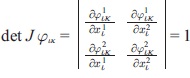
<body><![CDATA[<p align="justify"><font face="verdana" size="2">To construct the map <img src="/img/revistas/atm/v28n3/a3e3.16.jpg">a bijection with inverse <img src="/img/revistas/atm/v28n3/a3e3.17.jpg">defined as<img src="/img/revistas/atm/v28n3/a3e3.19.jpg"><img src="/img/revistas/atm/v28n3/a3e3.20.jpg"><img src="/img/revistas/atm/v28n3/a3e3.21.jpg"> it is seen that every <img src="/img/revistas/atm/v28n3/a3e3.36.jpg"> is</font> <font face="verdana" size="2">open. Hence each <img src="/img/revistas/atm/v28n3/a3e3.37.jpg"> is an open subset of <i>S<sup>2</sup></i> and <sub><img src="/img/revistas/atm/v28n3/a3e3.23.jpg"></sub> cover S<sup>2</sup>.</font></p>  	    <p align="justify"><font face="verdana" size="2">Given two charts of the atlas <img src="/img/revistas/atm/v28n3/a3e3.2.jpg"> <img src="/img/revistas/atm/v28n3/a3e3.3.jpg">with <img src="/img/revistas/atm/v28n3/a3e3.24.jpg">, the transition maps<i><sub> <img src="/img/revistas/atm/v28n3/a3e3.25.jpg"></sub></i> <img src="/img/revistas/atm/v28n3/a3e3.26.jpg">outline open sets of <i>R<sup>2</sup></i> into R<sup>2</sup>, where<img src="/img/revistas/atm/v28n3/a3e3.27.jpg"><img src="/img/revistas/atm/v28n3/a3e3.28.jpg"> This determines a differentiable structure for S<sup>2</sup>, and <img src="/img/revistas/atm/v28n3/a3e3.29.jpg"> is a diffeomorphism. It is then said that the atlas is of class <i>C<sup>k</sup></i> if the transition functions are of <i>C<sup>k</sup>.</i></font></p>  	    <p align="justify"><font face="verdana" size="2">Let <i>x</i> be any point of <img src="/img/revistas/atm/v28n3/a3e3.35.jpg"> and<img src="/img/revistas/atm/v28n3/a3e3.32.jpg"> the coordinate of <img src="/img/revistas/atm/v28n3/a3e3.33.jpg"> then  <img src="/img/revistas/atm/v28n3/a3e3.34.jpg">is a continuous function on two variables. Now, if<i><sub> <img src="/img/revistas/atm/v28n3/a3e3.38.jpg"></sub></i> such that <img src="/img/revistas/atm/v28n3/a3e3.39.jpg"><i>,</i> and since <img src="/img/revistas/atm/v28n3/a3e3.40.jpg"> we have the relations</font></p>  	    <p align="center"><font face="verdana" size="2"><img src="/img/revistas/atm/v28n3/a3e4.jpg"></font></p> 	    <p align="center"><font face="verdana" size="2"><img src="/img/revistas/atm/v28n3/a3e5.jpg"></font></p>  	    <p align="justify"><font face="verdana" size="2">This is the transformation formula betwen the two local coordinate systems <img src="/img/revistas/atm/v28n3/a3e5.1.jpg">  defined on <sub><img src="/img/revistas/atm/v28n3/a3e5.2.jpg"></sub> To obtain the relations between the unprimed and primed coordinate of any point <i>Q</i> on the sphere, Verkley (1984) examined the spherical triangle <i>NQN</i> and the application of the cosine rules to this triangle, deriving explicit expressions for the transformation between the two coordinate systems as given by (4) and (5).</font></p>  	    <p align="justify"><font face="verdana" size="2">Let <img src="/img/revistas/atm/v28n3/a3e5.92.jpg"> and set <img src="/img/revistas/atm/v28n3/a3e5.93.jpg"> as the Jacobian matrix of map <img src="/img/revistas/atm/v28n3/a3e5.94.jpg">so we can verify that</font></p>  	    <p align="center"><font face="verdana" size="2"><img src="/img/revistas/atm/v28n3/a3e5.3.jpg"></font></p>  	    <p align="justify"><font face="verdana" size="2">Then det<img src="/img/revistas/atm/v28n3/a3e5.3.1.jpg">. Hence, it is said that if manifold <i>S<sup>2</sup></i> is oriented for every pair <img src="/img/revistas/atm/v28n3/a3e5.3.2.jpg"> of intersecting local coordinate neighbourhoods, det<img src="/img/revistas/atm/v28n3/a3e5.3.1.jpg">.</font></p>  	    <p align="justify"><font face="verdana" size="2">Indeed we can regard the coordinate as a device to decide which of many functions <img src="/img/revistas/atm/v28n3/a3e11.7.jpg"> on <i>S</i> are to be differentiable. Since <img src="/img/revistas/atm/v28n3/a3e3.41.jpg"> is just a set, it makes no sense to ask that <img src="/img/revistas/atm/v28n3/a3e5.95.jpg"><i> </i>be differentiable (Matsushima, 1972; Loomis and Sterberg, 1990). However, we can consider the map <img src="/img/revistas/atm/v28n3/a3e5.4.jpg"> Then</font> <font face="verdana" size="2"><sup><img src="/img/revistas/atm/v28n3/a3e5.5.jpg"></sup> is a function defined on an open <img src="/img/revistas/atm/v28n3/a3e5.96.jpg"> <i>R<sup>2</sup>,</i> and we know what it means for such a function to be differentiable or smooth (see <a href="/img/revistas/atm/v28n3/a3f1.jpg" target="_blank">Fig. 1</a>). Consider now what happens when we change coordinates to some other chart, lets say<img src="/img/revistas/atm/v28n3/a3e5.6.jpg"> for convenience, assuming that <img src="/img/revistas/atm/v28n3/a3e5.7.jpg"> Then it is possible for<img src="/img/revistas/atm/v28n3/a3e5.5.jpg">to be differentiable but <img src="/img/revistas/atm/v28n3/a3e5.9.jpg">is not. To compare both, let <img src="/img/revistas/atm/v28n3/a3e5.10.jpg"> where the map <img src="/img/revistas/atm/v28n3/a3e5.11.jpg"><i> </i>is a bijection between open subsets of <i>R<sup>2</sup>.</i> Then a suficient condition for <img src="/img/revistas/atm/v28n3/a3e5.5.jpg"> to be differentiable if<sup> <img src="/img/revistas/atm/v28n3/a3e5.9.jpg"></sup> is, is that<sup><i> </i><img src="/img/revistas/atm/v28n3/a3e5.97.jpg"></sup> is also differentiable. We often write <img src="/img/revistas/atm/v28n3/a3e5.80.jpg"> for the composite function <sup><img src="/img/revistas/atm/v28n3/a3e5.90.jpg"></sup>.</font></p>  	    ]]></body>
<body><![CDATA[<p align="justify"><font face="verdana" size="2">Lets take a curve <img src="/img/revistas/atm/v28n3/a3e5.12.jpg">with <sub><img src="/img/revistas/atm/v28n3/a3e5.13.jpg"></sub>(0) = p. In a local chart r <img src="/img/revistas/atm/v28n3/a3e5.13.jpg">is given by<img src="/img/revistas/atm/v28n3/a3e5.14.jpg">. On the manifold S<sup>2</sup>, one can define a vector <b>U</b> tangent to the parametrized curve r at any point <i>p</i> on the curve. The tangent vector <b>U</b> is given by a column vector <b>u</b> whose components <i><img src="/img/revistas/atm/v28n3/a3e5.15.jpg"></i> are<img src="/img/revistas/atm/v28n3/a3e5.16.jpg"> (0), (i = 1, 2), with the initial condition <img src="/img/revistas/atm/v28n3/a3e5.13.jpg">(0) = p. If we use another coordinate system corresponding to the chart (<img src="/img/revistas/atm/v28n3/a3e5.6.jpg"> by<img src="/img/revistas/atm/v28n3/a3e5.17.jpg">then the tangent vector <b>U</b> is given by a column vector <b>v</b> with components <img src="/img/revistas/atm/v28n3/a3e5.30.1.jpg"><i> </i>According to the chain rule, the column vectors <b>u</b> and <b>v</b> are related by <img src="/img/revistas/atm/v28n3/a3e5.18.jpg">. The expression <img src="/img/revistas/atm/v28n3/a3e5.19.jpg"> is the partial differential operator in the direction of the tangent vector.</font></p>  	    <p align="justify"><font face="verdana" size="2">The space <i>T<sub>p</sub>S<sup>2</sup></i> is called the <i>tangent space of</i> S<sup>2</sup> <i>at p,</i> and <i>T<sub>p</sub>S<sup>2</sup></i> is a two&#45;dimensional vector space. For each <b>u</b> &#8712; <i>T<sub>p</sub>S<sup>2</sup></i> we shall write <img src="/img/revistas/atm/v28n3/a3e5.21.jpg"><img src="/img/revistas/atm/v28n3/a3e5.22.jpg"></font><font face="verdana" size="2"> where u<sup>i</sup><sub>l</sub> are the contravariant components of <b>u.</b> It is well known that on the manifold <i>S<sup>2</sup></i> an inner product is defined at each tangent space <i>T<sub>p</sub>S<sup>2</sup>.</i> Now lets present a basis in which we denote the coordinate system corresponding to the chart<img src="/img/revistas/atm/v28n3/a3e5.23.jpg">  by <img src="/img/revistas/atm/v28n3/a3e5.24.jpg"><img src="/img/revistas/atm/v28n3/a3e5.25.jpg"> and for any<img src="/img/revistas/atm/v28n3/a3e5.26.jpg"> define the vectors <img src="/img/revistas/atm/v28n3/a3e5.27.jpg"><i>by <img src="/img/revistas/atm/v28n3/a3e5.28.jpg"></i></font><font face="verdana" size="2"> so that they are indepen</font><font face="verdana" size="2">dent since <img src="/img/revistas/atm/v28n3/a3e5.29.jpg"></font><font face="verdana" size="2"> <img src="/img/revistas/atm/v28n3/a3e5.30.jpg">be the outward normal to S<sup>2</sup> in R<sup>3</sup>; without any loss of generality we may assume that the vectors <i><img src="/img/revistas/atm/v28n3/a3e5.31.jpg"></i> <i>T<sub>p</sub>S<sup>2</sup></i>.</font></p>  	    <p align="justify"><font face="verdana" size="2">We will denote the vector space of a vector field on <i>S</i> by <img src="/img/revistas/atm/v28n3/a3e5.33.jpg"> A tangent vector field on S<sup>2</sup> is a smooth map <b>u:</b> S<sup>2</sup> &#8594; <i>T</i> S<sup>2</sup> such that, for any<img src="/img/revistas/atm/v28n3/a3e5.34.jpg"><img src="/img/revistas/atm/v28n3/a3e5.35.jpg">. At the chart <img src="/img/revistas/atm/v28n3/a3e5.58.jpg">, for <img src="/img/revistas/atm/v28n3/a3e5.36.jpg">the vector functions <b>u</b> <i><img src="/img/revistas/atm/v28n3/a3e5.35.jpg"></i> and <b>v </b>&#8712; <i><img src="/img/revistas/atm/v28n3/a3e5.33.1.jpg"></i>  have components <b><img src="/img/revistas/atm/v28n3/a3e5.37.jpg"></b> respectively,</font> <font face="verdana" size="2">being these <img src="/img/revistas/atm/v28n3/a3e5.38.jpg">the components of <i>u<sub>p</sub></i> as the vectors of the unitary base indicated by <sub><img src="/img/revistas/atm/v28n3/a3e5.38.1.jpg"></sub> and <i><img src="/img/revistas/atm/v28n3/a3e5.38.2.jpg"></i> in the directions <i><img src="/img/revistas/atm/v28n3/a3e5.65.4.jpg"></i> and &#956;, respectively.</font></p>  	    <p align="justify"><font face="verdana" size="2">Let us recall that an oriented Riemannian manifold is a pair (<i>S<sup>2</sup>, g</i>) where <i>S<sup>2</sup></i> is the oriented compact manifold and g a Riemannian metric on <i>S<sup>2</sup></i>, which assigns a length &#124; <b>v</b> &#124; <i><sub>g(p)</sub> &#8712; R</i><sup>+</sup><i>.</i> The g on S<sup>2</sup> is a smooth (2, 0)&#45;tensor field on S<sup>2</sup> such that for any <i>p </i>&#8712; S<sup>2</sup>, <i>g<sub>p</sub>:</i> <i>T<sub>p</sub>(S</i><sup>2</sup><i>)</i> x <i>T<sub>p</sub>(S</i><sup>2</sup><i>)</i> &#8594; <i>R</i> is a scalar product on the tangent space <i>T<sub>p</sub></i>(<i>S<sup>2</sup></i>), and in any chart <img src="/img/revistas/atm/v28n3/a3e5.23.jpg"> of <i>S<sup>2</sup></i>, its components</font></p> 	    <p align="center"><font face="verdana" size="2"><img src="/img/revistas/atm/v28n3/a3e5.41.jpg"></font></p>  	    <p align="justify"><font face="verdana" size="2">form a symmetric matrix, with its inverse denoted by (<i>g<sup>ij</sup></i>) = (<i>g<sub>ij</sub></i>)<sup>&#45;1</sup>, and <i>g</i> = <i>det</i>(<i>g<sub>ij</sub></i><sub></sub>) = 1 &#45; &#956;<sup>2</sup>. The length of a tangent vector <b>v</b> &#8712; T<sub>p</sub><i>S<sup>2</sup></i> is defined as usual, &#124; <b>v</b> &#124;= <i>g</i><sub><i>p</i></sub> (<b>v</b>, v)<sup>1/2</sup> = (<b>v</b> <sup>.</sup> <b>v)</b><sup>1/2</sup><b>.</b> Moreover, the inner product on <i>T</i> <i>S<sup>2</sup></i> is given by <b>u</b> <sup>.</sup> <b>v</b> = <i>g<sub>ij</sub>u<sup>i</sup>v<sup>J</sup>,</i> for <b>u</b>,<b> v</b> &#8712; <i>TS</i><sup><i>2</i></sup>.</font></p>  	    <p align="justify"><font face="verdana" size="2">Let (<i>S<sup>2</sup>, g</i>) be the smooth Riemannian manifolds of <i>S<sup>2</sup>.</i> Let us now recall some operators arising in partial differential equations on the sphere as manifold. Given the scalar function p<img src="/img/revistas/atm/v28n3/a3e5.87.jpg">, the <i>gradient of</i> <img src="/img/revistas/atm/v28n3/a3e11.7.jpg">, is given by the vector field <i>grad </i><img src="/img/revistas/atm/v28n3/a3e11.7.jpg">: <i>S<sup>2</sup></i> &#8594; <i>T</i><sub>p</sub><i>S<sup>2</sup>,</i> for which</font></p> 	    <p align="center"><font size="2" face="verdana"><img src="/img/revistas/atm/v28n3/a3e5.46.jpg"></font> </p> 	    <p align="justify"><font face="verdana" size="2">If <b>u</b> &#8712; &#915;(S<sup>2</sup>), the divergence of <b>u</b> is the function on <i>S<sup>2</sup></i> which on the chart <img src="/img/revistas/atm/v28n3/a3e3.7.jpg"> is given by</font></p>  	    <p align="center"><font face="verdana" size="2"><img src="/img/revistas/atm/v28n3/a3e5.47.jpg"></font></p>  	    ]]></body>
<body><![CDATA[<p align="justify"><font face="verdana" size="2">A linear connection <i>D</i> on <i>S<sup>2</sup></i> is a map <i>D</i>: <i>T</i>(<i>S<sup>2</sup></i>) x <img src="/img/revistas/atm/v28n3/a3e5.47.1.jpg"> called the <i>covariant derivative</i> and the usual notation for <i>D(U, V)</i> is <i>D<sub>U</sub>V.</i> Let <img src="/img/revistas/atm/v28n3/a3e3.7.jpg"> be a chart and as one can observe, the vectors <img src="/img/revistas/atm/v28n3/a3e5.49.jpg"><img src="/img/revistas/atm/v28n3/a3e5.50.jpg">can be nonconstant. An easy notation is set <img src="/img/revistas/atm/v28n3/a3e5.51.jpg"><i><sup><img src="/img/revistas/atm/v28n3/a3e5.52.jpg"></sup></i> (e.g. Hebey, 2000). There are smooth functions <i><img src="/img/revistas/atm/v28n3/a3e5.53.jpg"></i> such that for any i, j, and any <i>p &#8712;</i> <img src="/img/revistas/atm/v28n3/a3e5.54.jpg"></font></p>  	    <p align="center"><font face="verdana" size="2"><img src="/img/revistas/atm/v28n3/a3e5.55.jpg"></font></p>  	    <p align="justify"><font face="verdana" size="2">where <i><img src="/img/revistas/atm/v28n3/a3e5.56.jpg"></i> are the Christoffel symbols, defined by <i><img src="/img/revistas/atm/v28n3/a3e5.56.jpg"></i> <img src="/img/revistas/atm/v28n3/a3e5.57.jpg"> On the chart <img src="/img/revistas/atm/v28n3/a3e5.58.jpg">, we</font> <font face="verdana" size="2">have</font><font face="verdana" size="2"><img src="/img/revistas/atm/v28n3/a3e5.59.jpg"> </font><font face="verdana" size="2"> <img src="/img/revistas/atm/v28n3/a3e5.60.jpg"></font></p>  	    <p align="justify"><font face="verdana" size="2">The fundamental operator which we study is the Laplacian &#916;, then for real or complex valued functions, &#916; is the Laplace&#45;Beltrami operator on <i>S<sup>2</sup></i> and it is given by</font></p>     <p align="center"><font face="verdana" size="2"><img src="/img/revistas/atm/v28n3/a3e5.61.jpg"></font></p> 	    <p align="justify"><font face="verdana" size="2">This operator satisfies some properties: &#916;<sub>g</sub>, is sel&#45;fadjoint, symmetric and non&#45;negative (Aubin, 1998). Thus, the operators <i>div, grad</i> and &#916;<sub>g</sub> on the manifold <i>S<sup>2</sup></i> have the conventional meaning.</font></p>  	    <p align="justify"><font face="verdana" size="2">Let (<i>S<sup>2</sup>, g</i>) be a compact <i>oriented Riemannian</i> manifold, with metric g. The metric and the orientation are combined to give a volume element <i>dv<sub>g</sub></i> on S<sup>2</sup>, which can be used to integrate functions on <i>(S<sup>2</sup>, g).</i> In order to apply the integral calculus on the oriented manifold S<sup>2</sup>, we define a volume element to be a two&#45;form <i>&#969;</i> = <i>dv</i> which is defined on all of <i>S<sup>2</sup></i>. For every chart <i>ip<sub>e</sub>)</i> which is consistently oriented with <i>S<sup>2</sup></i>, the coordinate expresion for <img src="/img/revistas/atm/v28n3/a3e5.62.jpg">, where &#934;<sub>l</sub> is a partition of unity subordinate to the covering <i><img src="/img/revistas/atm/v28n3/a3e5.63.jpg"></i></font></p>  	    <p align="justify"><font face="verdana" size="2">On the Riemannian manifold (<i>S<sup>2</sup>, g</i>), at the chart <i><img src="/img/revistas/atm/v28n3/a3e5.98.jpg"></i>; a volume form <i>n</i> = <i>dv<sub>g</sub></i> defines a Lebesgue measure on <i>S<sup>2</sup></i> by<i> </i><img src="/img/revistas/atm/v28n3/a3e5.64.jpg"> Then</font></p>  	    <p align="center"><font face="verdana" size="2"><img src="/img/revistas/atm/v28n3/a3e5.65.jpg"></font></p>  	    <p align="justify"><font face="verdana" size="2">where <img src="/img/revistas/atm/v28n3/a3e5.65.1.jpg"> defines a Lebesgue measure on <i>R<sup>2</sup></i>.</font></p>  	    ]]></body>
<body><![CDATA[<p align="justify"><font face="verdana" size="2">Let <img src="/img/revistas/atm/v28n3/a3e5.65.2.jpg"> denote the set of infinitely differentiable functions of compact support <i><img src="/img/revistas/atm/v28n3/a3e5.65.3.jpg"></i> the functions are smooth, together with the periodic boundary condition at <i><img src="/img/revistas/atm/v28n3/a3e5.65.4.jpg"></i> with period <img src="/img/revistas/atm/v28n3/a3e5.65.5.jpg">. If we define the usual Hilbert space <i>L<sup>2</sup>(S<sup>2</sup>)</i> to be the completion of <img src="/img/revistas/atm/v28n3/a3e5.65.2.jpg"> with respect to the inner product</font></p>  	    <p align="justify"><font face="verdana" size="2"><img src="/img/revistas/atm/v28n3/a3e5.66.jpg"></font></p>  	    <p align="justify"><font face="verdana" size="2">and norm <img src="/img/revistas/atm/v28n3/a3e5.67.jpg">, <i>g*</i> is the complex conjugate of function g. Let (<i>S<sup>2</sup>, g</i>) be the compact <i>Riemannian</i> manifold and <i>dv<sub>g</sub></i> the Riemannian volume element. Then functional spaces (Sobolev and the Holder spaces) can be deined on <i>S<sup>2</sup></i> as well</font> <font face="verdana" size="2">(Skiba, 2012). For each <i>p </i>&#8712; <b>R</b> with <img src="/img/revistas/atm/v28n3/a3e5.65.7.jpg"> we associate a Banach space</font></p>  	    <p align="justify"><font face="verdana" size="2"><i><img src="/img/revistas/atm/v28n3/a3e5.68.jpg"></i></font></p> 	    <p align="justify"><font face="verdana" size="2">with respect to the norm</font></p>  	    <p align="justify"><font face="verdana" size="2"><i><img src="/img/revistas/atm/v28n3/a3e5.69.jpg"></i></font></p> 	    <p align="justify"><font face="verdana" size="2">and <i>ess sup</i> <img src="/img/revistas/atm/v28n3/a3e5.65.8.jpg"> represent the Hilbert space of the vector fields <i>U</i> : S<sup>2</sup> &#8594; TS<sup>2</sup> endowed with the inner product in <i>L<sup>2</sup>(S<sup>2</sup>)</i> induced by g in <i>Tp</i>(<i>S<sup>2</sup></i>) (see Diaz and Tello, 1999; Hebey, 2000).</font></p>  	    <p align="justify"><font face="verdana" size="2">We now turn to the eigenvalue problems for &#916;<sub>g</sub>: We usually seek to find all eigenvalues <img src="/img/revistas/atm/v28n3/a3e5.71.jpg"> for which there is an eigenfunction <i>Y</i> such that <img src="/img/revistas/atm/v28n3/a3e5.72.jpg"> Then, which information about geometry of <i>(S<sup>2</sup>,</i> g) is encoded by the eigenvalues?. The structure of eigenfunctions: <i>L<sup>p</sup></i> norms and relations to RH waves or modons.</font></p>      <p align="justify"><font face="verdana" size="2">Global harmonic analysis is the study of the spectral theory of the Laplacian &#916;<sub>g</sub> on a compact Riemannian manifold <i>(S<sup>2</sup>,</i> <i>g</i>), and its relation to the global geometric structure. Since <i>(S<sup>2</sup>,</i> <i>g</i>) is compact, there exists an orthonormal basis {<i>Y<sub>j</sub></i>} of smooth eigenfunctions and the spectrum of  <img src="/img/revistas/atm/v28n3/a3e5.75.jpg"> is a discrete set <img src="/img/revistas/atm/v28n3/a3e5.74.jpg">. Recent developments show that the non&#45;zero eigenvalues also contain substantial geometric and analytic information. The solution modon constructed by Tribbia (1984), Verkley (1984, 1987, 1990) and Neven (1993) proposed the use of eigenfunctions <i>{Y</i><sub>j</sub><i>}</i> as basic geometric structures.</font></p>      <p align="justify"><font face="verdana" size="2">The space of spherical harmonics of degree <i>n</i> on <i>S<sup>2</sup></i>, which coincides with the eigenspace of operator &#45;<img src="/img/revistas/atm/v28n3/a3e5.75.jpg"> corresponding to the eigenvalue <img src="/img/revistas/atm/v28n3/a3e5.76.jpg">, is denoted by <b>H<sub>n</sub>.</b> Self&#45;adjoint operators have the property that its eigenfunctions with different eigenvalues are orthogonal, which implies that the eigenspaces <b>H<sub>n</sub></b> are orthogonal and have 2<i>n</i>+1dimensions. On the sphere, the homogeneous harmonic polynomials span the set of all polynomials, which in turn are dense in <i>L<sup>2</sup>.</i> Our spherical harmonics therefore span <i>L<sup>2</sup>.</i> If we take a basis within each eigenspace then this collection will give a basis for <i>L<sup>2</sup></i> of the sphere. The harmonics spherical term was introduced by Kelvin on potentials studies (Hobson, 1931) and is</font> <font face="verdana" size="2">understood as the development of a function in terms of this series of spherical harmonics.</font></p>  	    ]]></body>
<body><![CDATA[<p align="justify"><font face="verdana" size="2">The spaces <b>H<sub>n</sub></b> and <b>H<sub>k</sub></b> <i>(n</i> &#8800; <i>k)</i> are mutually orthogonal in <i>L<sup>2</sup>(S<sup>2</sup>).</i> Then there is the orthogonal projection <i>Y<sub>n</sub></i> : <i>L<sup>2</sup>(S<sup>2</sup>)</i> &#151; <b>H<sub>n</sub></b> , and so smooth functions <img src="/img/revistas/atm/v28n3/a3e5.80.jpg"> &#8712; L<sup>2</sup>(S<sup>2</sup>) on the sphere <i>S<sup>2</sup></i> have a development in spherical harmonics,</font></p>  	    <p align="justify"><font face="verdana" size="2"><img src="/img/revistas/atm/v28n3/a3e5.77.jpg"></font></p>  	    <p align="justify"><font face="verdana" size="2">where <i><img src="/img/revistas/atm/v28n3/a3e5.78.jpg"></i> is the homogeneous spherical polynomial of degree <i>n</i> from <b>H<sub>n</sub>,</b> and <img src="/img/revistas/atm/v28n3/a3e5.79.jpg"> is the Fourier coefficient of <img src="/img/revistas/atm/v28n3/a3e5.80.jpg">. The 2n + 1 spherical harmonics</font></p>  	    <p align="justify"><font face="verdana" size="2"><img src="/img/revistas/atm/v28n3/a3e5.81.jpg"></font></p>  	    <p align="justify"><font face="verdana" size="2">of degree <i>n</i> and zonal number <i><img src="/img/revistas/atm/v28n3/a3e5.82.jpg"></i> form an orthonormal basis in <b>H<sub>n</sub>.</b> Here the numbers <i>C<sub>nm</sub></i> are the normalizers in <i>L<sup>2</sup>(S<sup>2</sup>),</i> given by <i>C<sub>nm</sub></i> =</font> <img src="/img/revistas/atm/v28n3/a3e5.83.jpg"><font face="verdana" size="2"> and <img src="/img/revistas/atm/v28n3/a3e5.84.jpg"> are the associated Legendre</font> <font face="verdana" size="2">functions given by</font></p> 	    <p align="justify"><font face="verdana" size="2"><img src="/img/revistas/atm/v28n3/a3e5.85.jpg"></font></p>  	    <p align="justify"><font face="verdana" size="2">Considering that an oriented compact Riemannian manifold is a pair (S<sup>2</sup>, <i>g)</i> where <i>S<sup>2</sup></i> is the oriented compact manifold and <i>g</i> a Riemannian metric on S<sup>2</sup>, we can define in it covariant derivatives and various notions of curvature. When a manifold also has a group structure (so that multiplication and inversion are smooth), a very interesting structure called a Lie group (Bihlo, 2007; Bihlo and Popoych, 2012) arises. Even if a manifold <i>S<sup>2</sup></i> is not a Lie group, there may be an action &bull;; : G x <i>S<sup>2</sup></i> &#8594; <i>S<sup>2</sup></i> of a Lie group G on <i>S<sup>2</sup></i>, and under certain conditions <i>S</i><sup>2</sup> can be viewed as a "quotient" G/K, where K is a subgroup of G (Richtmyer, 1981). When <i>S<sup>2</sup></i><img src="/img/revistas/atm/v28n3/a3e11.68.jpg" width="19" height="18">G/K as above, certain notions on G can be transported to <i>S<sup>2</sup>,</i> then we say that <i>S<sup>2</sup></i> is a homogeneous space. As an example of the last point we could mention the theory of spherical harmonic expansion on the <i>S<sup>2</sup>,</i> which is a homogeneous space for the rotation group O(n+1). The surface spherical harmonics are eigenfunctions for the Laplace&#45;Beltrami operator, which is a rotation invariant (Helgason, 1984).</font></p>      <p align="justify"><font face="verdana" size="2">Harmonic analysis is concerned with the representation of functions as the superposition of basic waves, the study and generalization of the notions of Fourier series as well as the Fourier transforms.</font></p>  	    <p align="justify"><font face="verdana" size="2">Elements of harmonic analysis on the sphere can be found at Stein and Weiss (1971). After introducing the manifold <i>S<sup>2</sup></i> and the Riemannian manifolds (S<sup>2</sup>, <i>g),</i> a general type of spaces (Besov and Triebel&#45;Lizorkin spaces) on the sphere may also be introduced (Narcowich <i>et al.,</i> 2006). Using the power of a Laplace operator, the Sobolev space on Riemannian manifolds can also be incorporated as a field currently undergoing great development (Aubin, 1998; Hebey, 2000).</font></p>     <p align="justify">&nbsp;</p>  	    ]]></body>
<body><![CDATA[<p align="justify"><font face="verdana" size="2"><b>3. Exact solutions to the barotropic vorticity equation on the manifold</b> <b><i>S<sup>2</sup></i></b><i><sup></sup></i></font></p>  	    <p align="justify"><font face="verdana" size="2">Let <img src="/img/revistas/atm/v28n3/a3e5.86.jpg">be an atlas of S<sup>2</sup> and <img src="/img/revistas/atm/v28n3/a3e5.87.jpg">the streamfunction of class <i>C<sup>r</sup>.</i> We can consider that the map <img src="/img/revistas/atm/v28n3/a3e5.99.jpg">is the streamfunction defined on an open <img src="/img/revistas/atm/v28n3/a3e5.91.jpg">and that it is of class C<sup>r</sup>.</font></p>  	    <p align="justify"><font face="verdana" size="2">To simulate the time evolution of a two&#45;dimensional nondivergent and inviscid flow for a rotating sphere, <i>S<sup>2</sup></i> is governed by a non&#45;linear barotropic vorticity equation, which can be written in the non&#45;dimensional form as</font></p>  	    <p align="center"><font face="verdana" size="2"><img src="/img/revistas/atm/v28n3/a3e6.jpg"></font></p>  	    <p align="justify"><font face="verdana" size="2">where<i>J</i> (<i>c,q</i>)<img src="/img/revistas/atm/v28n3/a3e6.1.jpg"><i>q</i>is the jacobian, <img src="/img/revistas/atm/v28n3/a3e6.2.jpg"><b><img src="/img/revistas/atm/v28n3/a3e6.3.jpg"></b></font><font face="verdana" size="2">is a tangent velocity vector, <i>grad <img src="/img/revistas/atm/v28n3/a3e6.4.jpg"><img src="/img/revistas/atm/v28n3/a3e6.5.jpg">div grad <img src="/img/revistas/atm/v28n3/a3e5.80.jpg"></i></font><font face="verdana" size="2">, is the relative vorticity, <i>q</i> = &#916;<img src="/img/revistas/atm/v28n3/a3e5.80.jpg"> + 2<i>&#956;</i> is the absolute vorticity and <b>k</b> is a unit outward normal vector. The velocity vector field <b>u</b> having the components <img src="/img/revistas/atm/v28n3/a3e6.6.jpg"><i> </i>is solenoidal: &#8711; &bull; <b>u</b> = 0. Throughout decades the nonlinear barotropic vorticity equation has been successfully used to describe low frequencies and large&#45;scale barotropic processes of atmospheric dynamics. Despite the simplicity to this nonlinear equation, it contains the principal elements that describe the complexity of atmospheric behavior (Simmons <i>et al.,</i> 1983; Skiba, 1997). The four types of exact solutions to Eq. (1) known up to now are described below:</font>	</p> 	    <p align="justify"><font face="verdana" size="2">&bull; The zonal flows and Rossby&#45;Haurwitz (RH) waves (Haurwitz, 1949), called classical solutions, diferentiated from the generalized solutions which are not so smooth.</font></p>  	    <p align="justify"><font face="verdana" size="2">&bull; The first generalized solutions of Eq. (6), kown as modons, were originally constructed by Tribbia (1984) and Verkley (1984, 1987, 1990) by using two eigenfunctions for the Laplace operator of different degrees.</font></p>  	    <p align="justify"><font face="verdana" size="2">&bull; Later on, Neven (1992) gave generalized solutions in the form of a quadrupole modon.</font></p>  	    <p align="justify"><font face="verdana" size="2">&bull; Wu and Verkley (1993) constructed generalized global solutions composed of two RH waves (P&eacute;rez&#45;Garc&iacute;a and Skiba, 1999).</font></p>  	    <p align="justify"><font face="verdana" size="2">In the present work, zonal flows, homogeneous spherical polynomials flows, RH waves, and modons on the manifold <i>S<sup>2</sup></i> are considered.</font></p>  	    ]]></body>
<body><![CDATA[<p align="justify"><font face="verdana" size="2"><i>3.1 Classical solutions</i></font></p>  	    <p align="justify"><font face="verdana" size="2">Let us consider the zonal flows, homogeneous spherical polynomials flows and Rossby&#45;Haurwitz (RH)</font> <font face="verdana" size="2">waves.</font></p>  	    <p align="justify"><font face="verdana" size="2"><b>Proposition (zonal flow).</b> Let <img src="/img/revistas/atm/v28n3/a3e6.7.jpg"> be an atlas of <i>S<sup>2</sup></i> and the streamfunction  <i><sup><img src="/img/revistas/atm/v28n3/a3e5.87.jpg"></sup></i>of class C<sup>r</sup>. Then the zonal flow map  &#936;<sub>l</sub>= <img src="/img/revistas/atm/v28n3/a3e7.2.jpg"> of <i>C<sup>r</sup></i> defined as</font></p>  	    <p align="center"><font face="verdana" size="2"><img src="/img/revistas/atm/v28n3/a3e7.jpg"></font></p> 	    <p align="justify"><font face="verdana" size="2">is an exact solution of the vorticity Eq. (6) for any <i>b<sub>n</sub>.</i></font></p>         <p align="justify"><font face="verdana" size="2"><b>Proof.</b> The demonstration, obtained from Eq. (6), is quite trivial.</font></p>         <p align="justify"><font face="verdana" size="2"><b>Proposition (homogeneous polynomials).</b></font> <font face="verdana" size="2">Let <img src="/img/revistas/atm/v28n3/a3e7.1.jpg">be an atlas of S<sup>2</sup> and the streamfunction <i><sup><img src="/img/revistas/atm/v28n3/a3e5.87.jpg"></sup></i> of class <i>C<sup>r</sup>.</i> Then the homogeneous spherical polynomial map <img src="/img/revistas/atm/v28n3/a3e3.41.jpg" alt="" width="18" height="19"> = <img src="/img/revistas/atm/v28n3/a3e7.2.jpg"> of degree n &#8805; 2 defined as</font></p>         <p align="center"><font face="verdana" size="2"><img src="/img/revistas/atm/v28n3/a3e8.jpg"></font></p>         <p align="justify"><font face="verdana" size="2">is an exact solution to the vorticity Eq. (6), where <i>a<sub>m</sub></i> can be a complex factor and</font></p>         <p align="justify"><font face="verdana" size="2"><img src="/img/revistas/atm/v28n3/a3e8.1.jpg"></font></p>     ]]></body>
<body><![CDATA[<p align="justify"><font face="verdana" size="2">is the angular phase speed.</font></p>  	    <p align="justify"><font face="verdana" size="2"><b>Proof.</b> Given <img src="/img/revistas/atm/v28n3/a3e8.2.jpg"> we define <img src="/img/revistas/atm/v28n3/a3e8.3.jpg"><img src="/img/revistas/atm/v28n3/a3e8.4.jpg"><img src="/img/revistas/atm/v28n3/a3e8.5.jpg"></font><font face="verdana" size="2"> If, in addition, we have the following expression</font></p>  	    <p align="center"><font face="verdana" size="2"><img src="/img/revistas/atm/v28n3/a3e8.6.jpg"></font></p>  	    <p align="justify"><font face="verdana" size="2">we have</font></p>  	    <p align="center"><font face="verdana" size="2"><img src="/img/revistas/atm/v28n3/a3e8.7.jpg"></font></p>  	    <p align="justify"><font face="verdana" size="2">from BVE (Eq. (6)). It follows that <img src="/img/revistas/atm/v28n3/a3e8.1.jpg">.</font></p>  	    <p align="justify"><font face="verdana" size="2"><b>Proposition (Rossby&#45;Haurwitz waves).</b> Let </font><img src="/img/revistas/atm/v28n3/a3e6.7.jpg"> <font face="verdana" size="2">be an atlas of <i>S</i><sup>2</sup> and the stream&#45;function <i><sup><img src="/img/revistas/atm/v28n3/a3e5.87.jpg"></sup></i> of class <img src="/img/revistas/atm/v28n3/a3e8.8.jpg">. Then, the map <img src="/img/revistas/atm/v28n3/a3e3.41.jpg"> =</font> <font face="verdana" size="2"><img src="/img/revistas/atm/v28n3/a3e7.2.jpg"></font> of <img src="/img/revistas/atm/v28n3/a3e8.8.jpg"><font face="verdana" size="2">, defined as</font></p>  	    <p align="center"><font face="verdana" size="2"><img src="/img/revistas/atm/v28n3/a3e9.jpg"></font></p>  	    <p align="justify"><font face="verdana" size="2">with <i>n </i>&#8805; 1; is called Rossby&#45;Haurwitz (RH) waves. It is an exact solution of the vorticity Eq. (6) if the angular phase speed of the RH wave</font></p> 	    <p align="center"><font face="verdana" size="2"><img src="/img/revistas/atm/v28n3/a3e10.jpg"></font></p>  	    ]]></body>
<body><![CDATA[<p align="justify"><font face="verdana" size="2">Here <i>&#969;</i> is the super&#45;rotation velocity and each <b>H</b><sub>n</sub> corresponds to the eigenvalue <img src="/img/revistas/atm/v28n3/a3e10.1.jpg">. <b>Proof.</b> Here <img src="/img/revistas/atm/v28n3/a3e10.1.1.jpg">is expressed by</font></p> 	    <p align="left"><font face="verdana" size="2"><img src="/img/revistas/atm/v28n3/a3e10.2.jpg"></font></p> 	    <p align="justify"><font face="verdana" size="2">where<img src="/img/revistas/atm/v28n3/a3e10.3.jpg">. We can notice that</font></p> 	    <p align="justify"><font face="verdana" size="2"><img src="/img/revistas/atm/v28n3/a3e10.4.jpg"><i>.</i></font></p> 	    <p align="justify"><font face="verdana" size="2">y which implies that</font></p> 	    <p align="justify"><font face="verdana" size="2"><img src="/img/revistas/atm/v28n3/a3e10.5.jpg"></font></p>  	    <p align="justify"><font face="verdana" size="2">Furthermore:</font></p>  	    <p align="justify"><font face="verdana" size="2"><i><img src="/img/revistas/atm/v28n3/a3e10.6.jpg"></i></font></p>  	    <p align="justify"><font face="verdana" size="2">where <img src="/img/revistas/atm/v28n3/a3e10.7.jpg">; so that from</font> <font face="verdana" size="2">BVE (Eq. (6))</font></p>  	    <p align="justify"><font face="verdana" size="2"><img src="/img/revistas/atm/v28n3/a3e10.8.jpg"></font></p>  	    ]]></body>
<body><![CDATA[<p align="justify"><font face="verdana" size="2">Hence</font></p>  	    <p align="justify"><font face="verdana" size="2"><img src="/img/revistas/atm/v28n3/a3e10.9.jpg"></font></p>  	    <p align="justify"><font face="verdana" size="2">so that</font></p>  	    <p align="justify"><font face="verdana" size="2"><i><img src="/img/revistas/atm/v28n3/a3e10.10.jpg"></i></font></p>  	    <p align="justify"><font face="verdana" size="2">and thus the proposition is proved.</font></p>  	    <p align="justify"><font face="verdana" size="2">The streamfunction of the stationary RH(2,5)</font> <font face="verdana" size="2">wave</font></p>  	    <p align="center"><font face="verdana" size="2"><img src="/img/revistas/atm/v28n3/a3e11.jpg"></font></p>  	    <p align="justify"><font face="verdana" size="2">with the parameters defined by (m, n) = (2, 5),</font> <font face="verdana" size="2"><i>a</i> = .007 and <img src="/img/revistas/atm/v28n3/a3e11.1.jpg">is given in <a href="#f2">Figure 2</a>.</font></p> 	    <p align="center"><a name="f2"></a></p> 	    <p align="center"><img src="/img/revistas/atm/v28n3/a3f2.jpg"></p>      ]]></body>
<body><![CDATA[<p align="justify"><font face="verdana" size="2">P&eacute;rez and Skiba (2001) and Skiba and P&eacute;rez (2006) developed a numerical spectral method for the normal mode instability study of the arbitrary steady flow of an ideal nondivergent fluid on a rotating sphere, and Skiba and P&eacute;rez (2006) tested this method for the RH(2,5) wave. P&eacute;rez&#45;Garc&iacute;a (2014) constructed a basic flow regarded as a sum of a zon&#45;ally symmetric flow (Eq. 7) and a Rossby&#45;Haurwitz wave component (Eq. 9).</font></p>  	    <p align="justify"><font face="verdana" size="2"><i>3.2 Generalized solutions</i></font></p>  	    <p align="justify"><font face="verdana" size="2">Denote the spherical distance between two points of <i>S</i><sup>2</sup> by d(.,.). Let <i>N'</i> be the north pole of the chart coordinate <img src="/img/revistas/atm/v28n3/a3e11.1.1.jpg">. Then a disk or inner region <i>S,</i> on the sphere is defined as <i><img src="/img/revistas/atm/v28n3/a3e11.2.jpg"></i><img src="/img/revistas/atm/v28n3/a3e11.3.jpg">, such that <img src="/img/revistas/atm/v28n3/a3e11.4.jpg">. The solution modon is constructed (Tribbia, 1984; Verkley, 1984, 1987, 1990; Neven, 1993) to divide the sphere S<sup>2</sup> into two regions: an inner region <i>S<sub>i</sub></i> centered around the pole <i>N',</i> and an outer region <i>S<sub>o</sub></i> separated from the inner region by a boundary circle <i><img src="/img/revistas/atm/v28n3/a3e11.5.jpg"><img src="/img/revistas/atm/v28n3/a3e11.6.jpg"></i><i>,</i> on which <img src="/img/revistas/atm/v28n3/a3e11.7.jpg">, <i>q</i> and <img src="/img/revistas/atm/v28n3/a3e11.8.jpg">are continuous.</font></p>  	    <p align="justify"><font face="verdana" size="2">For S<i><sub>i</sub></i>, a solution of the Eq. (2) form is chosen with an eigenfunction <i>Y</i> <img src="/img/revistas/atm/v28n3/a3e11.9.jpg">, which has its singularity in the outer region. The same type of solution is chosen for the outer region, but such that <i>Y</i> <img src="/img/revistas/atm/v28n3/a3e11.9.jpg"><i> </i>has its singularity in the inner region. Then both solutions are combined as smoothly as possible on the boundary circle <i><img src="/img/revistas/atm/v28n3/a3e11.10.jpg"></i> (Tribbia, 1984; Verkley, 1984, 1987).</font></p>  	    <p align="justify"><font face="verdana" size="2">To construct the Verkley (1984) modon or the Neven (1992) cuadrupole modon on the manifold S<sup>2</sup>, it is interpreted as:</font></p>  	    <p align="justify"><font face="verdana" size="2"><b>Proposition.</b> Let <img src="/img/revistas/atm/v28n3/a3e11.10.1.jpg"> be an atlas of S<sup>2</sup>, and <img src="/img/revistas/atm/v28n3/a3e11.11.jpg"> the streamfunction of <i>C<sup>r</sup>.</i> Then</font></p>  	    <p align="justify"><font face="verdana" size="2"><img src="/img/revistas/atm/v28n3/a3e11.12.jpg"></font></p>  	    <p align="justify"><font face="verdana" size="2"><b>Proof.</b> Let <img src="/img/revistas/atm/v28n3/a3e11.13.jpg"> and <img src="/img/revistas/atm/v28n3/a3e11.14.jpg"> be two real&#45;value functions of class <i>C<sup>r</sup></i> defined on the differential manifolds S<sup>2</sup>. We define their sum by setting <img src="/img/revistas/atm/v28n3/a3e11.15.jpg"><img src="/img/revistas/atm/v28n3/a3e11.16.jpg"> for any chart <img src="/img/revistas/atm/v28n3/a3e11.17.jpg"> Since the sum of two functions of class <i>C<sup>r</sup></i> on S<sup>2</sup> are functions of class <i>C<sup>r</sup>,</i> the proof of this formula can be obtained by the expression</font></p>  	    <p align="justify"><font face="verdana" size="2"><img src="/img/revistas/atm/v28n3/a3e11.18.jpg"></font></p> 	    <p align="justify"><font size="2" face="verdana"><img src="/img/revistas/atm/v28n3/a3e11.19.jpg"></font></p> 	    ]]></body>
<body><![CDATA[<p align="justify"><font face="verdana" size="2">where<img src="/img/revistas/atm/v28n3/a3e11.20.jpg"><img src="/img/revistas/atm/v28n3/a3e11.21.jpg" width="75" height="24"></font></p>  	    <p align="justify"><font face="verdana" size="2">Decompose now the streamfunctions into an eigenfunction part <img src="/img/revistas/atm/v28n3/a3e11.22.jpg"> and a zonal part <img src="/img/revistas/atm/v28n3/a3e11.23.jpg"> where &#45;&#969;<i>&#956;</i> is a solid&#45;body rotation and <i>D</i> a constant. In chart <img src="/img/revistas/atm/v28n3/a3e11.24.jpg"> with coordinates <img src="/img/revistas/atm/v28n3/a3e11.25.jpg">,<i> </i>the north pole <i>N'</i> moves along a circle of constant latitude with constant angular velocity c<sub>v</sub>. In the primed coordinates, Verkley (1984, 1987) modons have the form</font></p>  	    <p align="justify"><font face="verdana" size="2"><img src="/img/revistas/atm/v28n3/a3e11.26.jpg"></font></p>  	    <p align="justify"><font face="verdana" size="2">which consists of a dipole and a monopole component:</font></p>  	    <p align="justify"><font face="verdana" size="2"><i><img src="/img/revistas/atm/v28n3/a3e11.27.jpg"></i></font></p> 	    <p align="justify"><font face="verdana" size="2">where <i>&#956;</i><sub>0</sub> = sen &#248;<sub>0</sub>, <i>&#956;</i><i><sub>a</sub></i> = sen <i>&#248;<sub>a</sub>.</i> The functions f<sup>d</sup>(<i>&#956;</i>) and f<sup>m</sup>(<i>&#956;</i>) are defined as</font></p>  	    <p align="justify"><font face="verdana" size="2"><img src="/img/revistas/atm/v28n3/a3e11.30.jpg"></font></p>  	    <p align="justify"><font face="verdana" size="2">and</font> </p>  	    <p align="justify"><font face="verdana" size="2"><img src="/img/revistas/atm/v28n3/a3e11.31.jpg"></font></p>  	    <p align="justify"><font face="verdana" size="2"><img src="/img/revistas/atm/v28n3/a3e11.32.jpg"></font></p>  	    ]]></body>
<body><![CDATA[<p align="justify"><font face="verdana" size="2"><img src="/img/revistas/atm/v28n3/a3e11.33.jpg"></font></p> 	    <p align="justify"><font face="verdana" size="2">The fact that</font></p>  	    <p align="justify"><font face="verdana" size="2"><img src="/img/revistas/atm/v28n3/a3e11.34.jpg"></font></p>  	    <p align="justify"><font face="verdana" size="2">is a solution to Eq. (6) is due to the work of Verkley (1984), which I will not reproduce in this paper. <i>Y</i><sub><i>v</i></sub> is an eigenfunction of the Laplace&#45;Beltrami operator and <i><img src="/img/revistas/atm/v28n3/a3e11.35.jpg"></i> is the eigenvalue of <i>Y</i><sub><i>v</i></sub>. The Legendre functions <img src="/img/revistas/atm/v28n3/a3e11.36.jpg">  are solutions to the Legendre differential equation of hypergeometric type, where <img src="/img/revistas/atm/v28n3/a3e11.37.jpg"> is a Legendre function of the first kind and <img src="/img/revistas/atm/v28n3/a3e11.39.jpg"> is a Legendre function of the second kind for order <i>m</i> such that <i>&#957;</i> is the complex degree. The explicit expresion for <img src="/img/revistas/atm/v28n3/a3e11.37.jpg">and <img src="/img/revistas/atm/v28n3/a3e11.39.jpg">with &#45;1 &lt; <i>&#956;</i> &lt; 1 can be found in Abramowitz and Stegun (1965) or Verkley (1984).</font></p>  	    <p align="justify"><font face="verdana" size="2">By using a grid of 5 x 5&deg; upon the local coordinate associated with the chart <img src="/img/revistas/atm/v28n3/a3e11.24.jpg">, the Verkley 1984 modon was numerically generated. Using Eqs. (4) and (5) a workable Gaussian mesh of (128, 64) points upon the geographical coordinate group <img src="/img/revistas/atm/v28n3/a3e3.2.JPG"> was also generated. This mesh was mapped onto the local coordinates system associated to the chart <img src="/img/revistas/atm/v28n3/a3e11.24.jpg">. The values of <img src="/img/revistas/atm/v28n3/a3e11.39.1.jpg"> were interpolated on the Gaussians points (128, 64) by implementing a nine&#45;point Lagrange interpolation scheme. The resulting function, i.e. the Verkley 1984 equatorial modon viewed on the geographical coordinate group <img src="/img/revistas/atm/v28n3/a3e3.2.JPG"> is shown in <a href="/img/revistas/atm/v28n3/a3f3.jpg" target="_blank">Figure 3a</a>. This small modon was defined by the following parameters:</font></p>  	    <p align="justify"><font face="verdana" size="2"><i>k</i> = 10, <i>a</i> = 10, <i>&#956;<sub>a</sub></i> = sin 66.14&deg;, &#956;<sub>0</sub> = 0, <i>&#955;</i><sub>0</sub> = 270&deg; and <i>D</i><sub>0</sub> = 0.</font></p>  	    <p align="justify"><font face="verdana" size="2">A numerical spectral model was used to simulate this small&#45;size modon in P&eacute;rez&#45;Garc&iacute;a and Skiba (1999), and in Skiba and P&eacute;rez&#45;Garc&iacute;a (2009) a numerical spectral method for normal mode stability study of ideal flows on a rotating sphere was tested f or this isolated steady modon constructed by Verkley</font> <font face="verdana" size="2">(1984).</font></p>  	    <p align="justify"><font face="verdana" size="2">Studies done by Illari (1984) and Crum and Stevens (1988) noted that the values of isentropic potential vorticity are relatively low and uniform in the blocking region. In our following argument we consider that Verkley's modon (1990) provides a better and more uniform description of atmospheric blocking. Our interest lays within the fields that build this phenomenon. These solutions are characterized by a region <i>S<sub>i</sub></i> in which <i>q</i> is constant, and an outer region <i>S<sub>o</sub></i> separated from the inner region by the boundary</font> <font face="verdana" size="2">circle <i><img src="/img/revistas/atm/v28n3/a3e11.41.jpg">,</i> on which <img src="/img/revistas/atm/v28n3/a3e5.80.jpg"> and <i>q</i> are both constant, i.e., <img src="/img/revistas/atm/v28n3/a3e5.80.jpg"> = <i>d</i> and <i>q</i> = b.</font></p>  	    <p align="justify"><font face="verdana" size="2">In the primed coordinates the Verkley (1990) modon has the form</font></p>  	    <p align="justify"><font face="verdana" size="2"><i><img src="/img/revistas/atm/v28n3/a3e11.43.jpg"></i></font>	</p> 	    ]]></body>
<body><![CDATA[<p align="justify"><font face="verdana" size="2">where solid&#45;body rotation terms <i>y</i> can be expressed in primed coordinates using Eqs. (4&#45;5), such that in chart <img src="/img/revistas/atm/v28n3/a3e3.2.JPG"> the eigenfuctions at the outer region and inner region are <img src="/img/revistas/atm/v28n3/a3e11.44.jpg"> being <img src="/img/revistas/atm/v28n3/a3e11.45.jpg"> and <i>e<sub>i</sub></i> constants. Certain requirements of continuity must be met to generate these functions over the circle <i><img src="/img/revistas/atm/v28n3/a3e11.41.jpg">.</i> We require continuity in <img src="/img/revistas/atm/v28n3/a3e11.46.jpg">and the first and second derivative in <sub><img src="/img/revistas/atm/v28n3/a3e11.47.jpg"></sub></font></p>  	    <p align="justify"><font face="verdana" size="2">To construct the Verkley 1990 uniform modon on the manifold <i>S<sup>2</sup>,</i> it is interpreted as:</font></p>  	    <p align="justify"><font face="verdana" size="2"><b>Proposition.</b> Consider an atlas&nbsp;<i><img src="/img/revistas/atm/v28n3/a3e11.47.1.jpg"><img src="/img/revistas/atm/v28n3/a3e11.47.2.jpg"> </i></font><font face="verdana" size="2"> be the stream&#45;function of <i>C<sup>r</sup>.</i> Then</font></p>  	    <p align="justify"><font face="verdana" size="2"><i><img src="/img/revistas/atm/v28n3/a3e11.49.jpg"></i></font></p>  	    <p align="justify"><font face="verdana" size="2"><b>Proof.</b> Let <sub><img src="/img/revistas/atm/v28n3/a3e11.13.jpg"></sub> and <img src="/img/revistas/atm/v28n3/a3e11.14.jpg"> be two real&#45;value functions of class <i>C<sup>r</sup></i> defined on the differential manifolds S<sup>2</sup>. We define their sum by setting <img src="/img/revistas/atm/v28n3/a3e11.50.jpg"> for any chart <img src="/img/revistas/atm/v28n3/a3e5.6.jpg">. Since the sum of two functions of class <i>C<sup>r</sup></i> on S<sup>2</sup> are functions of class C<sup>r</sup>, the proof of the proposition follows from:</font></p>  	    <p align="justify"><font face="verdana" size="2"><img src="/img/revistas/atm/v28n3/a3e11.52.jpg"></font></p>  	    <p align="justify"><font face="verdana" size="2"><img src="/img/revistas/atm/v28n3/a3e11.53.jpg"></font></p>  	    <p align="justify"><font face="verdana" size="2">because<img src="/img/revistas/atm/v28n3/a3e11.54.jpg"></font></p>  	    <p align="justify"><font face="verdana" size="2">According to Verkley (1990), to express the modon in a more explicit manner, the functional forms <i>Y<sub>o</sub></i> and Y<sub>i</sub> of the eigenfuntions are:</font></p>  	    <p align="justify"><font face="verdana" size="2"><i><img src="/img/revistas/atm/v28n3/a3e11.55.jpg"></i></font></p>  	    ]]></body>
<body><![CDATA[<p align="justify"><font face="verdana" size="2">where <i>A<sub>s</sub></i> and <i>B<sub>s</sub></i> are constant. The special functions <i><img src="/img/revistas/atm/v28n3/a3e11.56.jpg"></i> were given by Verkley (1990).</font></p>  	    <p align="justify"><font face="verdana" size="2">We have also reproduced numerically the uniform modon constructed by Verkley (1990) using the parameters <img src="/img/revistas/atm/v28n3/a3e11.57.jpg">, and when the modon center is in the point <i><img src="/img/revistas/atm/v28n3/a3e11.58.jpg"><img src="/img/revistas/atm/v28n3/a3e11.67.jpg"></i> (<a href="/img/revistas/atm/v28n3/a3f3.jpg" target="_blank">Fig 3b</a>).</font></p> 	    <p align="justify">&nbsp;</p>     <p align="justify"><font face="verdana" size="2"><b>4. Conclusions</b></font></p>  	    <p align="justify"><font face="verdana" size="2">The exact solutions of the barotropic vorticity equation on the rotating unit sphere as a compact differentiable manifold without boundary, which are zonal flows, homogeneous spherical polynomial flows, Rossby&#45;Haurwitz waves and generalized solutions named modons, were represented in this paper. A concrete notion of local chart, change of charts, and atlas for the manifolds <i>S<sup>2</sup></i> was developed. An atlas <img src="/img/revistas/atm/v28n3/a3e11.60.jpg"> was constructed for <i>S<sup>2</sup>,</i> where every chart corresponds to a geographical coordinate</font> <font face="verdana" size="2">group that covers most of <i>S<sup>2</sup>.</i> The transition maps <img src="/img/revistas/atm/v28n3/a3e11.61.jpg"> and <img src="/img/revistas/atm/v28n3/a3e11.62.jpg"> were also constructed, and the exact solutions of the barotropic vorticity equation in a manifold context were studied. This work also formulates on the manifolds <i>S<sup>2</sup></i> in terms of the stream function p<img src="/img/revistas/atm/v28n3/a3e11.7.jpg">: S<sup>2</sup> &#8594; R, for RH waves which are sufficiently smooth, and for Wu&#45;Verkley waves and modons which are differentiably weak. RH waves as solutions p <img src="/img/revistas/atm/v28n3/a3e5.90.jpg"> of the barotropic vorticity equation on the manifolds <i>S<sup>2</sup></i> are presented at the local coordinate associated with a chart <img src="/img/revistas/atm/v28n3/a3e5.23.jpg">, The way in which the modon solution <img src="/img/revistas/atm/v28n3/a3e5.9.jpg">can be constructed in the chart <img src="/img/revistas/atm/v28n3/a3e11.24.jpg">, where <img src="/img/revistas/atm/v28n3/a3e11.7.jpg"> is <i>C<sup>2</sup>,</i> is investigated too. In the chart coordinate <img src="/img/revistas/atm/v28n3/a3e11.24.jpg">, the Verkley (1984, 1987) modons have the form</font></p>  	    <p align="justify"><font face="verdana" size="2"><img src="/img/revistas/atm/v28n3/a3e11.63.jpg"></font></p>  	    <p align="justify"><font face="verdana" size="2">To construct the Verkley (1990) uniform modon on the manifold <i>S<sup>2</sup>,</i> it is interpreted as</font></p>  	    <p align="justify"><font face="verdana" size="2"><img src="/img/revistas/atm/v28n3/a3e11.64.jpg"></font></p>  	    <p align="justify"><font face="verdana" size="2">when the modon center is in the point <i><img src="/img/revistas/atm/v28n3/a3e11.65.jpg"></i> However, to contruct the verkley (1984, 1987, 1990) with <i>N'</i> a point arbitrary on the sphere S<sup>2</sup> a collection of pairs <img src="/img/revistas/atm/v28n3/a3e5.58.jpg">(i &gt; 2) is needed. Our viewpoint here was to understand the solution of the barotropic vorticity equation on the manifold <i>S<sup>2</sup></i> and its use to derive properties of the solutions to the Riemannian manifold (<i>S<sup>2</sup>, g</i>).</font></p> 	    <p align="justify">&nbsp;</p>  	    ]]></body>
<body><![CDATA[<p align="justify"><font face="verdana" size="2"><b>Acknowledgments</b></font></p>  	    <p align="justify"><font face="verdana" size="2">The author is grateful to A. Aguilar in the preparation of the figures. N. Aguilar, A. Alazraki, and C. Amescua gave valuable suggestions for improving the manuscript.</font></p> 	    <p align="justify">&nbsp;</p>  	    <p align="justify"><font face="verdana" size="2"><b>References</b></font></p>  	    <!-- ref --><p align="justify"><font face="verdana" size="2">Abramowitz M. and I. A. Stegun, 1965. <i>Handbook of mathematical functions.</i> Dover, 1046 pp.    &nbsp;&nbsp;&nbsp;&nbsp;&nbsp;&nbsp;&nbsp;&nbsp;[&#160;<a href="javascript:void(0);" onclick="javascript: window.open('/scielo.php?script=sci_nlinks&ref=1306614&pid=S0187-6236201500030000300001&lng=','','width=640,height=500,resizable=yes,scrollbars=1,menubar=yes,');">Links</a>&#160;]<!-- end-ref --></font></p>  	    <!-- ref --><p align="justify"><font face="verdana" size="2">Aubin T., 1982. <i>Nonlinear analysis on manifolds: Monge&#45;Ampere equations.</i> Springer, New York&#45;Berlin.    &nbsp;&nbsp;&nbsp;&nbsp;&nbsp;&nbsp;&nbsp;&nbsp;[&#160;<a href="javascript:void(0);" onclick="javascript: window.open('/scielo.php?script=sci_nlinks&ref=1306616&pid=S0187-6236201500030000300002&lng=','','width=640,height=500,resizable=yes,scrollbars=1,menubar=yes,');">Links</a>&#160;]<!-- end-ref --></font></p>  	    <!-- ref --><p align="justify"><font face="verdana" size="2">Aubin T., 2001. <i>A course in differential geometry.</i> Graduate Studies in Mathematics, vol. 27. American Mathematical Society, Providence, RI.    &nbsp;&nbsp;&nbsp;&nbsp;&nbsp;&nbsp;&nbsp;&nbsp;[&#160;<a href="javascript:void(0);" onclick="javascript: window.open('/scielo.php?script=sci_nlinks&ref=1306618&pid=S0187-6236201500030000300003&lng=','','width=640,height=500,resizable=yes,scrollbars=1,menubar=yes,');">Links</a>&#160;]<!-- end-ref --></font></p>  	    ]]></body>
<body><![CDATA[<!-- ref --><p align="justify"><font face="verdana" size="2">Avez A. and Y. Bamberger, 1978. Mouvements sph&eacute;riques de fluides visqueux incompressibles. <i>J. M&eacute;canique</i> <b>17,</b> 107&#45;145.    &nbsp;&nbsp;&nbsp;&nbsp;&nbsp;&nbsp;&nbsp;&nbsp;[&#160;<a href="javascript:void(0);" onclick="javascript: window.open('/scielo.php?script=sci_nlinks&ref=1306620&pid=S0187-6236201500030000300004&lng=','','width=640,height=500,resizable=yes,scrollbars=1,menubar=yes,');">Links</a>&#160;]<!-- end-ref --></font></p>  	    <!-- ref --><p align="justify"><font face="verdana" size="2">Bihlo A., 2010. <i>Symmetry methods in the atmosphere sciences.</i> Ph.D. thesis. Universitat Wien, 157 pp.    &nbsp;&nbsp;&nbsp;&nbsp;&nbsp;&nbsp;&nbsp;&nbsp;[&#160;<a href="javascript:void(0);" onclick="javascript: window.open('/scielo.php?script=sci_nlinks&ref=1306622&pid=S0187-6236201500030000300005&lng=','','width=640,height=500,resizable=yes,scrollbars=1,menubar=yes,');">Links</a>&#160;]<!-- end-ref --></font></p>  	    <!-- ref --><p align="justify"><font face="verdana" size="2">Bihlo A., and R. Popovych 2012. <i>Lie reduction and exact solutions of the vorticity equation on the sphere.</i> Physics Letters A 376(14), 1179&#45;1184.    &nbsp;&nbsp;&nbsp;&nbsp;&nbsp;&nbsp;&nbsp;&nbsp;[&#160;<a href="javascript:void(0);" onclick="javascript: window.open('/scielo.php?script=sci_nlinks&ref=1306624&pid=S0187-6236201500030000300006&lng=','','width=640,height=500,resizable=yes,scrollbars=1,menubar=yes,');">Links</a>&#160;]<!-- end-ref --></font></p>  	    <!-- ref --><p align="justify"><font face="verdana" size="2">Crum F. X. and D. E. Stevens, 1988. A case study of atmospheric blocking using isentropic analysis. <i>Mon. Wea. Rev.</i> <b>116</b>, 223&#45;241.    &nbsp;&nbsp;&nbsp;&nbsp;&nbsp;&nbsp;&nbsp;&nbsp;[&#160;<a href="javascript:void(0);" onclick="javascript: window.open('/scielo.php?script=sci_nlinks&ref=1306626&pid=S0187-6236201500030000300007&lng=','','width=640,height=500,resizable=yes,scrollbars=1,menubar=yes,');">Links</a>&#160;]<!-- end-ref --></font></p>  	    <!-- ref --><p align="justify"><font face="verdana" size="2">D&iacute;az J. I. and L. Tello, 1999. A nonlinear parabolic problem on a Riemannian manifold without boundary arising in climatology. <i>Collect. Math.</i> <b>50,</b> 19&#45;51.    &nbsp;&nbsp;&nbsp;&nbsp;&nbsp;&nbsp;&nbsp;&nbsp;[&#160;<a href="javascript:void(0);" onclick="javascript: window.open('/scielo.php?script=sci_nlinks&ref=1306628&pid=S0187-6236201500030000300008&lng=','','width=640,height=500,resizable=yes,scrollbars=1,menubar=yes,');">Links</a>&#160;]<!-- end-ref --></font></p>  	    ]]></body>
<body><![CDATA[<!-- ref --><p align="justify"><font face="verdana" size="2">Ebin D. and J. Marsden, 1970. Groups of diffeomorphisms and the motion of an incompressible fluid. <i>Ann. Math.</i> <b>92,</b> 102&#45;163.    &nbsp;&nbsp;&nbsp;&nbsp;&nbsp;&nbsp;&nbsp;&nbsp;[&#160;<a href="javascript:void(0);" onclick="javascript: window.open('/scielo.php?script=sci_nlinks&ref=1306630&pid=S0187-6236201500030000300009&lng=','','width=640,height=500,resizable=yes,scrollbars=1,menubar=yes,');">Links</a>&#160;]<!-- end-ref --></font></p>  	    <!-- ref --><p align="justify"><font face="verdana" size="2">Haurwitz B., 1940. The motion of atmospheric disturbances on a spherical Earth. <i>J. Marine Res.</i> <b>3,</b></font> <font face="verdana" size="2">254&#45;267.    &nbsp;&nbsp;&nbsp;&nbsp;&nbsp;&nbsp;&nbsp;&nbsp;[&#160;<a href="javascript:void(0);" onclick="javascript: window.open('/scielo.php?script=sci_nlinks&ref=1306632&pid=S0187-6236201500030000300010&lng=','','width=640,height=500,resizable=yes,scrollbars=1,menubar=yes,');">Links</a>&#160;]<!-- end-ref --></font></p>  	    <!-- ref --><p align="justify"><font face="verdana" size="2">Hebey E., 2000. <i>Nonlinear analysis on manifolds: Sobolev spaces and inequalities.</i> Courant Lecure Notes 5. American Mathematical Society, Providence, RI.    &nbsp;&nbsp;&nbsp;&nbsp;&nbsp;&nbsp;&nbsp;&nbsp;[&#160;<a href="javascript:void(0);" onclick="javascript: window.open('/scielo.php?script=sci_nlinks&ref=1306634&pid=S0187-6236201500030000300011&lng=','','width=640,height=500,resizable=yes,scrollbars=1,menubar=yes,');">Links</a>&#160;]<!-- end-ref --></font></p>  	    <!-- ref --><p align="justify"><font face="verdana" size="2">Helgason S., 1984. <i>Groups and geometric analysis. Integral geometry, invariant differential operators and spherical functions.</i> Academic Press, Orlando.    &nbsp;&nbsp;&nbsp;&nbsp;&nbsp;&nbsp;&nbsp;&nbsp;[&#160;<a href="javascript:void(0);" onclick="javascript: window.open('/scielo.php?script=sci_nlinks&ref=1306636&pid=S0187-6236201500030000300012&lng=','','width=640,height=500,resizable=yes,scrollbars=1,menubar=yes,');">Links</a>&#160;]<!-- end-ref --></font></p>  	    <!-- ref --><p align="justify"><font face="verdana" size="2">Hobson E. W., 1931. <i>The theory of spherical and ellipsoidal harmonics.</i> Chelsea Publishing Company.    &nbsp;&nbsp;&nbsp;&nbsp;&nbsp;&nbsp;&nbsp;&nbsp;[&#160;<a href="javascript:void(0);" onclick="javascript: window.open('/scielo.php?script=sci_nlinks&ref=1306638&pid=S0187-6236201500030000300013&lng=','','width=640,height=500,resizable=yes,scrollbars=1,menubar=yes,');">Links</a>&#160;]<!-- end-ref --></font></p>  	    ]]></body>
<body><![CDATA[<!-- ref --><p align="justify"><font face="verdana" size="2">Illari L., 1984. A diagnostic study of the potential vorticity in a warm blocking anticyclone. <i>JAtmos. Sci.</i> <b>41,</b></font> <font face="verdana" size="2">3518&#45;3526.    &nbsp;&nbsp;&nbsp;&nbsp;&nbsp;&nbsp;&nbsp;&nbsp;[&#160;<a href="javascript:void(0);" onclick="javascript: window.open('/scielo.php?script=sci_nlinks&ref=1306640&pid=S0187-6236201500030000300014&lng=','','width=640,height=500,resizable=yes,scrollbars=1,menubar=yes,');">Links</a>&#160;]<!-- end-ref --></font></p>  	    <!-- ref --><p align="justify"><font face="verdana" size="2">Ilyin A. A., 1991. The Navier&#45;Stokes and Euler equations</font> <font face="verdana" size="2">on two&#45;dimensional closed manifolds. <i>Math. USSR</i></font> <font face="verdana" size="2"><i>Sbornik</i> <b>69,</b> 559&#45;579.    &nbsp;&nbsp;&nbsp;&nbsp;&nbsp;&nbsp;&nbsp;&nbsp;[&#160;<a href="javascript:void(0);" onclick="javascript: window.open('/scielo.php?script=sci_nlinks&ref=1306642&pid=S0187-6236201500030000300015&lng=','','width=640,height=500,resizable=yes,scrollbars=1,menubar=yes,');">Links</a>&#160;]<!-- end-ref --> </font></p> 	    <!-- ref --><p align="justify"><font face="verdana" size="2">Loomis L. and S. Sterberg, 1990. <i>Advanced calculus.</i></font> <font face="verdana" size="2">Adisson Wesley, 580 pp.    &nbsp;&nbsp;&nbsp;&nbsp;&nbsp;&nbsp;&nbsp;&nbsp;[&#160;<a href="javascript:void(0);" onclick="javascript: window.open('/scielo.php?script=sci_nlinks&ref=1306644&pid=S0187-6236201500030000300016&lng=','','width=640,height=500,resizable=yes,scrollbars=1,menubar=yes,');">Links</a>&#160;]<!-- end-ref --> </font></p> 	    <!-- ref --><p align="justify"><font face="verdana" size="2">Matsushima Y., 1972. <i>Differentiable manifolds. Pure and</i></font> <font face="verdana" size="2"><i>applied mathematics.</i> Dekker, 303 pp.    &nbsp;&nbsp;&nbsp;&nbsp;&nbsp;&nbsp;&nbsp;&nbsp;[&#160;<a href="javascript:void(0);" onclick="javascript: window.open('/scielo.php?script=sci_nlinks&ref=1306646&pid=S0187-6236201500030000300017&lng=','','width=640,height=500,resizable=yes,scrollbars=1,menubar=yes,');">Links</a>&#160;]<!-- end-ref --> </font></p> 	    <!-- ref --><p align="justify"><font face="verdana" size="2">Narcowich F., P. Petrushev and J. Ward, 2006. <i>Decomposition of Besov and Triebel&#45;Lizorkin spaces on the</i></font> <font face="verdana" size="2"><i>sphere. J. Funct. Anal.</i> <b>238,</b> 530&#45;564.    &nbsp;&nbsp;&nbsp;&nbsp;&nbsp;&nbsp;&nbsp;&nbsp;[&#160;<a href="javascript:void(0);" onclick="javascript: window.open('/scielo.php?script=sci_nlinks&ref=1306648&pid=S0187-6236201500030000300018&lng=','','width=640,height=500,resizable=yes,scrollbars=1,menubar=yes,');">Links</a>&#160;]<!-- end-ref --> </font></p> 	    ]]></body>
<body><![CDATA[<!-- ref --><p align="justify"><font face="verdana" size="2">Neven E. C., 1992. Quadrupole modons on a sphere.</font> <font face="verdana" size="2"><i>Geophys. Astro. Fluid</i> <b>65,</b> 105&#45;126.    &nbsp;&nbsp;&nbsp;&nbsp;&nbsp;&nbsp;&nbsp;&nbsp;[&#160;<a href="javascript:void(0);" onclick="javascript: window.open('/scielo.php?script=sci_nlinks&ref=1306650&pid=S0187-6236201500030000300019&lng=','','width=640,height=500,resizable=yes,scrollbars=1,menubar=yes,');">Links</a>&#160;]<!-- end-ref --> </font></p> 	    <!-- ref --><p align="justify"><font face="verdana" size="2">P&eacute;rez&#45;Garc&iacute;a I. and Y. N. Skiba, 1999. Simulation of exact</font> <font face="verdana" size="2">barotropic vorticity equation solutions using a spectral</font> <font face="verdana" size="2">model. <i>Atm&oacute;sfera</i> <b>12,</b> 223&#45;243.    &nbsp;&nbsp;&nbsp;&nbsp;&nbsp;&nbsp;&nbsp;&nbsp;[&#160;<a href="javascript:void(0);" onclick="javascript: window.open('/scielo.php?script=sci_nlinks&ref=1306652&pid=S0187-6236201500030000300020&lng=','','width=640,height=500,resizable=yes,scrollbars=1,menubar=yes,');">Links</a>&#160;]<!-- end-ref --> </font></p> 	    <!-- ref --><p align="justify"><font face="verdana" size="2">P&eacute;rez&#45;Garc&iacute;a I. and Y. N. Skiba, 2001. Tests of a numerical</font> <font face="verdana" size="2">algorithm for the linear instability study of flows on a</font> <font face="verdana" size="2">sphere. <i>Atm&oacute;sfera</i> <b>14,</b> 95&#45;112.    &nbsp;&nbsp;&nbsp;&nbsp;&nbsp;&nbsp;&nbsp;&nbsp;[&#160;<a href="javascript:void(0);" onclick="javascript: window.open('/scielo.php?script=sci_nlinks&ref=1306654&pid=S0187-6236201500030000300021&lng=','','width=640,height=500,resizable=yes,scrollbars=1,menubar=yes,');">Links</a>&#160;]<!-- end-ref --></font></p>  	    <!-- ref --><p align="justify"><font face="verdana" size="2">P&eacute;rez&#45;Garc&iacute;a I., 2001. An&aacute;lisis de la ecuaci&oacute;n de vorticidad barotr&oacute;pica atmosf&eacute;rica por medio del m&eacute;todo espectral. Ph D thesis, UNAM, M&eacute;xico, 165 pp.    &nbsp;&nbsp;&nbsp;&nbsp;&nbsp;&nbsp;&nbsp;&nbsp;[&#160;<a href="javascript:void(0);" onclick="javascript: window.open('/scielo.php?script=sci_nlinks&ref=1306656&pid=S0187-6236201500030000300022&lng=','','width=640,height=500,resizable=yes,scrollbars=1,menubar=yes,');">Links</a>&#160;]<!-- end-ref --></font></p>  	    <!-- ref --><p align="justify"><font face="verdana" size="2">P&eacute;rez&#45;Garc&iacute;a I., 2014. Rossby&#45;Haurwitz wave perturbation under tropical forcing. <i>Atm&oacute;sfera</i> <b>27,</b> 239&#45;249.    &nbsp;&nbsp;&nbsp;&nbsp;&nbsp;&nbsp;&nbsp;&nbsp;[&#160;<a href="javascript:void(0);" onclick="javascript: window.open('/scielo.php?script=sci_nlinks&ref=1306658&pid=S0187-6236201500030000300023&lng=','','width=640,height=500,resizable=yes,scrollbars=1,menubar=yes,');">Links</a>&#160;]<!-- end-ref --></font></p>  	    ]]></body>
<body><![CDATA[<!-- ref --><p align="justify"><font face="verdana" size="2">Richtmyer R. D., 1981. <i>Principles of advanced mathematical physics,</i> vol. 2. Springer&#45;Verlag.    &nbsp;&nbsp;&nbsp;&nbsp;&nbsp;&nbsp;&nbsp;&nbsp;[&#160;<a href="javascript:void(0);" onclick="javascript: window.open('/scielo.php?script=sci_nlinks&ref=1306660&pid=S0187-6236201500030000300024&lng=','','width=640,height=500,resizable=yes,scrollbars=1,menubar=yes,');">Links</a>&#160;]<!-- end-ref --></font></p>  	    <!-- ref --><p align="justify"><font face="verdana" size="2">Rossby C.&#45;G. <i>et al.,</i> 1939. Relation between variations in the intensify of the zonal circulation of the atmosphere and the displacement of the semi&#45;permanent centers of action. <i>J. Mar. Res.</i> <b>2,</b> 38&#45;55.    &nbsp;&nbsp;&nbsp;&nbsp;&nbsp;&nbsp;&nbsp;&nbsp;[&#160;<a href="javascript:void(0);" onclick="javascript: window.open('/scielo.php?script=sci_nlinks&ref=1306662&pid=S0187-6236201500030000300025&lng=','','width=640,height=500,resizable=yes,scrollbars=1,menubar=yes,');">Links</a>&#160;]<!-- end-ref --></font></p>  	    <!-- ref --><p align="justify"><font face="verdana" size="2">Simmons A. J., J. M. Wallace and G. W. Branstator, 1983. Barotropic wave propagation and instability, and atmospheric teleconnection patterns. <i>J. Atmos. Sci.</i> <b>40,</b></font> <font face="verdana" size="2">1363&#45;1392.    &nbsp;&nbsp;&nbsp;&nbsp;&nbsp;&nbsp;&nbsp;&nbsp;[&#160;<a href="javascript:void(0);" onclick="javascript: window.open('/scielo.php?script=sci_nlinks&ref=1306664&pid=S0187-6236201500030000300026&lng=','','width=640,height=500,resizable=yes,scrollbars=1,menubar=yes,');">Links</a>&#160;]<!-- end-ref --></font></p>  	    <!-- ref --><p align="justify"><font face="verdana" size="2">Skiba Y. N., 1989. Mathematical problems of the dynamics of viscous barotropic fluid on a rotating sphere. Dept. Comput. Mathematics, The USSR Academy of Sciences, Moscow, 178 pp. (English transl.: Indian Institute of Tropical Meteorology, Pune, India, 1990, 211 pp).    &nbsp;&nbsp;&nbsp;&nbsp;&nbsp;&nbsp;&nbsp;&nbsp;[&#160;<a href="javascript:void(0);" onclick="javascript: window.open('/scielo.php?script=sci_nlinks&ref=1306666&pid=S0187-6236201500030000300027&lng=','','width=640,height=500,resizable=yes,scrollbars=1,menubar=yes,');">Links</a>&#160;]<!-- end-ref --></font></p>  	    <!-- ref --><p align="justify"><font face="verdana" size="2">Skiba Y. N., 1997. On dimensions of attractive sets of viscous fluids on a sphere under a sphere under qua&#45;periodic forcing. <i>Geophys. Astrophys. Fluid Dyn.</i> <b>85,</b> 233&#45;242.    &nbsp;&nbsp;&nbsp;&nbsp;&nbsp;&nbsp;&nbsp;&nbsp;[&#160;<a href="javascript:void(0);" onclick="javascript: window.open('/scielo.php?script=sci_nlinks&ref=1306668&pid=S0187-6236201500030000300028&lng=','','width=640,height=500,resizable=yes,scrollbars=1,menubar=yes,');">Links</a>&#160;]<!-- end-ref --></font></p>  	    ]]></body>
<body><![CDATA[<!-- ref --><p align="justify"><font face="verdana" size="2">Skiba Y. N. and I. P&eacute;rez&#45;Garc&iacute;a, 2006. Testing of a numerical instability study algorithm with the Rossby&#45;Haurwitz waves. <i>Int. Jour. of Appl. Math.</i> <b>19,</b> 433&#45;460.    &nbsp;&nbsp;&nbsp;&nbsp;&nbsp;&nbsp;&nbsp;&nbsp;[&#160;<a href="javascript:void(0);" onclick="javascript: window.open('/scielo.php?script=sci_nlinks&ref=1306670&pid=S0187-6236201500030000300029&lng=','','width=640,height=500,resizable=yes,scrollbars=1,menubar=yes,');">Links</a>&#160;]<!-- end-ref --></font></p>  	    <!-- ref --><p align="justify"><font face="verdana" size="2">Skiba Y. N., and I. P&eacute;rez&#45;Garc&iacute;a, 2009. Numerical spectral method for normal&#45;mode stability study of ideal flows on a rotating sphere. <i>Int. Jour. of Appl. Math.</i></font> <font face="verdana" size="2"><b>22,</b> 725&#45;758.    &nbsp;&nbsp;&nbsp;&nbsp;&nbsp;&nbsp;&nbsp;&nbsp;[&#160;<a href="javascript:void(0);" onclick="javascript: window.open('/scielo.php?script=sci_nlinks&ref=1306672&pid=S0187-6236201500030000300030&lng=','','width=640,height=500,resizable=yes,scrollbars=1,menubar=yes,');">Links</a>&#160;]<!-- end-ref --></font></p>  	    <!-- ref --><p align="justify"><font face="verdana" size="2">Skiba Y. N., 2012. On the existence and uniqueness of</font> <font face="verdana" size="2">solution to problems of fluid dynamics on a sphere. <i>J.</i></font> <font face="verdana" size="2"><i>Math. Anal. Appl.</i> <b>388,</b> 622.644.    &nbsp;&nbsp;&nbsp;&nbsp;&nbsp;&nbsp;&nbsp;&nbsp;[&#160;<a href="javascript:void(0);" onclick="javascript: window.open('/scielo.php?script=sci_nlinks&ref=1306674&pid=S0187-6236201500030000300031&lng=','','width=640,height=500,resizable=yes,scrollbars=1,menubar=yes,');">Links</a>&#160;]<!-- end-ref --> </font></p> 	    <!-- ref --><p align="justify"><font face="verdana" size="2">Stein E. M. and G. Weiss, 1971. <i>Introduction to Fourier</i></font> <font face="verdana" size="2"><i>analysis on euclidean spaces.</i> Princeton University</font> <font face="verdana" size="2">Press.    &nbsp;&nbsp;&nbsp;&nbsp;&nbsp;&nbsp;&nbsp;&nbsp;[&#160;<a href="javascript:void(0);" onclick="javascript: window.open('/scielo.php?script=sci_nlinks&ref=1306676&pid=S0187-6236201500030000300032&lng=','','width=640,height=500,resizable=yes,scrollbars=1,menubar=yes,');">Links</a>&#160;]<!-- end-ref --></font></p>  	    <!-- ref --><p align="justify"><font face="verdana" size="2">Szeptycki P., 1973a. Equations of hydrodynamics on</font> <font face="verdana" size="2">compact Rienmannian manifolds. <i>B. Acad. Pol. Sci.</i></font> <font face="verdana" size="2"><i>SMAP</i> <b>21,</b> 335&#45;339.    &nbsp;&nbsp;&nbsp;&nbsp;&nbsp;&nbsp;&nbsp;&nbsp;[&#160;<a href="javascript:void(0);" onclick="javascript: window.open('/scielo.php?script=sci_nlinks&ref=1306678&pid=S0187-6236201500030000300033&lng=','','width=640,height=500,resizable=yes,scrollbars=1,menubar=yes,');">Links</a>&#160;]<!-- end-ref --> </font></p> 	    ]]></body>
<body><![CDATA[<!-- ref --><p align="justify"><font face="verdana" size="2">Szeptycki P., 1973b. Equations of hydrodynamics on</font> <font face="verdana" size="2">manifold diffeomorfic to the sphere. <i>B. Acad. Pol. Sci.</i></font> <font face="verdana" size="2"><i>SMAP</i> <b>21,</b> 341&#45;344.    &nbsp;&nbsp;&nbsp;&nbsp;&nbsp;&nbsp;&nbsp;&nbsp;[&#160;<a href="javascript:void(0);" onclick="javascript: window.open('/scielo.php?script=sci_nlinks&ref=1306680&pid=S0187-6236201500030000300034&lng=','','width=640,height=500,resizable=yes,scrollbars=1,menubar=yes,');">Links</a>&#160;]<!-- end-ref --> </font></p> 	    <!-- ref --><p align="justify"><font face="verdana" size="2">Temam R., 1997. <i>Infinite&#45;dimensional dynamical systems</i></font> <font face="verdana" size="2"><i>in mechanics and physics.</i> Springer, New York.    &nbsp;&nbsp;&nbsp;&nbsp;&nbsp;&nbsp;&nbsp;&nbsp;[&#160;<a href="javascript:void(0);" onclick="javascript: window.open('/scielo.php?script=sci_nlinks&ref=1306682&pid=S0187-6236201500030000300035&lng=','','width=640,height=500,resizable=yes,scrollbars=1,menubar=yes,');">Links</a>&#160;]<!-- end-ref --> </font></p> 	    <!-- ref --><p align="justify"><font face="verdana" size="2">Thompson P. D., 1982. A generalized class of exact</font> <font face="verdana" size="2">time&#45;dependent solutions of the vorticity equation for</font> <font face="verdana" size="2">nondivergent barotropic flow. <i>Mon. Wea. Rev.</i> <b>110</b>,</font> <font face="verdana" size="2">1321&#45;1324.    &nbsp;&nbsp;&nbsp;&nbsp;&nbsp;&nbsp;&nbsp;&nbsp;[&#160;<a href="javascript:void(0);" onclick="javascript: window.open('/scielo.php?script=sci_nlinks&ref=1306684&pid=S0187-6236201500030000300036&lng=','','width=640,height=500,resizable=yes,scrollbars=1,menubar=yes,');">Links</a>&#160;]<!-- end-ref --></font></p>  	    <!-- ref --><p align="justify"><font face="verdana" size="2">Tribbia J. J., 1984. Modons in spherical geometry. <i>Geophys. Astro. Fluid</i> <b>30,</b> 131&#45;168.    &nbsp;&nbsp;&nbsp;&nbsp;&nbsp;&nbsp;&nbsp;&nbsp;[&#160;<a href="javascript:void(0);" onclick="javascript: window.open('/scielo.php?script=sci_nlinks&ref=1306686&pid=S0187-6236201500030000300037&lng=','','width=640,height=500,resizable=yes,scrollbars=1,menubar=yes,');">Links</a>&#160;]<!-- end-ref --></font> </p> 	    <!-- ref --><p align="justify"><font face="verdana" size="2">Verkley W. T. M., 1984. The construction of barotropic modons on a sphere. <i>J. Atmos. Sci.</i> <b>41,</b> 2492&#45;2504.    &nbsp;&nbsp;&nbsp;&nbsp;&nbsp;&nbsp;&nbsp;&nbsp;[&#160;<a href="javascript:void(0);" onclick="javascript: window.open('/scielo.php?script=sci_nlinks&ref=1306688&pid=S0187-6236201500030000300038&lng=','','width=640,height=500,resizable=yes,scrollbars=1,menubar=yes,');">Links</a>&#160;]<!-- end-ref --></font></p>  	    ]]></body>
<body><![CDATA[<!-- ref --><p align="justify"><font face="verdana" size="2">Verkley W. T. M., 1987. Stationary barotropic modons in westerly background flows. <i>J. Atmos. Sci.</i> <b>44,</b> 2383&#45;2398.    &nbsp;&nbsp;&nbsp;&nbsp;&nbsp;&nbsp;&nbsp;&nbsp;[&#160;<a href="javascript:void(0);" onclick="javascript: window.open('/scielo.php?script=sci_nlinks&ref=1306690&pid=S0187-6236201500030000300039&lng=','','width=640,height=500,resizable=yes,scrollbars=1,menubar=yes,');">Links</a>&#160;]<!-- end-ref --></font></p>      <!-- ref --><p align="justify"><font face="verdana" size="2">Verkley W. T. M., 1990. Modons with uniform absolute</font> <font face="verdana" size="2">vorticity. <i>J. Atmos. Sci.</i> <b>47,</b> 727&#45;745.    &nbsp;&nbsp;&nbsp;&nbsp;&nbsp;&nbsp;&nbsp;&nbsp;[&#160;<a href="javascript:void(0);" onclick="javascript: window.open('/scielo.php?script=sci_nlinks&ref=1306692&pid=S0187-6236201500030000300040&lng=','','width=640,height=500,resizable=yes,scrollbars=1,menubar=yes,');">Links</a>&#160;]<!-- end-ref --> </font></p> 	    <!-- ref --><p align="justify"><font face="verdana" size="2">Wu P. and W. T. M. Verkley, 1993. Non&#45;linear structures</font> <font face="verdana" size="2">with multivalued <i>(q,</i> relationships &#45; exact solutions</font> <font face="verdana" size="2">of the barotropic vorticity equation on a sphere. <i>Geo</i></font><font face="verdana" size="2"><i>phys. Astro. Fluid</i> <b>69,</b> 77&#45;94.    &nbsp;&nbsp;&nbsp;&nbsp;&nbsp;&nbsp;&nbsp;&nbsp;[&#160;<a href="javascript:void(0);" onclick="javascript: window.open('/scielo.php?script=sci_nlinks&ref=1306694&pid=S0187-6236201500030000300041&lng=','','width=640,height=500,resizable=yes,scrollbars=1,menubar=yes,');">Links</a>&#160;]<!-- end-ref --></font></p>      ]]></body><back>
<ref-list>
<ref id="B1">
<nlm-citation citation-type="book">
<person-group person-group-type="author">
<name>
<surname><![CDATA[Abramowitz]]></surname>
<given-names><![CDATA[M.]]></given-names>
</name>
<name>
<surname><![CDATA[Stegun]]></surname>
<given-names><![CDATA[I. A.]]></given-names>
</name>
</person-group>
<source><![CDATA[Handbook of mathematical functions]]></source>
<year>1965</year>
<page-range>1046</page-range><publisher-name><![CDATA[Dover]]></publisher-name>
</nlm-citation>
</ref>
<ref id="B2">
<nlm-citation citation-type="book">
<person-group person-group-type="author">
<name>
<surname><![CDATA[Aubin]]></surname>
<given-names><![CDATA[T.]]></given-names>
</name>
</person-group>
<source><![CDATA[Nonlinear analysis on manifolds: Monge-Ampere equations]]></source>
<year>1982</year>
<publisher-loc><![CDATA[New YorkBerlin ]]></publisher-loc>
<publisher-name><![CDATA[Springer]]></publisher-name>
</nlm-citation>
</ref>
<ref id="B3">
<nlm-citation citation-type="book">
<person-group person-group-type="author">
<name>
<surname><![CDATA[Aubin]]></surname>
<given-names><![CDATA[T.]]></given-names>
</name>
</person-group>
<source><![CDATA[A course in differential geometry. Graduate Studies in Mathematics]]></source>
<year>2001</year>
<volume>27</volume>
<publisher-loc><![CDATA[Providence^eRI RI]]></publisher-loc>
<publisher-name><![CDATA[American Mathematical Society]]></publisher-name>
</nlm-citation>
</ref>
<ref id="B4">
<nlm-citation citation-type="journal">
<person-group person-group-type="author">
<name>
<surname><![CDATA[Avez]]></surname>
<given-names><![CDATA[A.]]></given-names>
</name>
<name>
<surname><![CDATA[Bamberger]]></surname>
<given-names><![CDATA[Y.]]></given-names>
</name>
</person-group>
<article-title xml:lang="fr"><![CDATA[Mouvements sphériques de fluides visqueux incompressibles]]></article-title>
<source><![CDATA[J. Mécanique]]></source>
<year>1978</year>
<volume>17</volume>
<page-range>107-145</page-range></nlm-citation>
</ref>
<ref id="B5">
<nlm-citation citation-type="">
<person-group person-group-type="author">
<name>
<surname><![CDATA[Bihlo]]></surname>
<given-names><![CDATA[A.]]></given-names>
</name>
</person-group>
<source><![CDATA[Symmetry methods in the atmosphere sciences]]></source>
<year>2010</year>
<page-range>157</page-range></nlm-citation>
</ref>
<ref id="B6">
<nlm-citation citation-type="journal">
<person-group person-group-type="author">
<name>
<surname><![CDATA[Bihlo]]></surname>
<given-names><![CDATA[A.]]></given-names>
</name>
<name>
<surname><![CDATA[Popovych]]></surname>
<given-names><![CDATA[R.]]></given-names>
</name>
</person-group>
<article-title xml:lang="en"><![CDATA[Lie reduction and exact solutions of the vorticity equation on the sphere]]></article-title>
<source><![CDATA[Physics Letters]]></source>
<year>2012</year>
<volume>376</volume>
<numero>14</numero>
<issue>14</issue>
<page-range>1179-1184</page-range></nlm-citation>
</ref>
<ref id="B7">
<nlm-citation citation-type="journal">
<person-group person-group-type="author">
<name>
<surname><![CDATA[Crum]]></surname>
<given-names><![CDATA[F. X.]]></given-names>
</name>
<name>
<surname><![CDATA[Stevens]]></surname>
<given-names><![CDATA[D. E.]]></given-names>
</name>
</person-group>
<article-title xml:lang="en"><![CDATA[A case study of atmospheric blocking using isentropic analysis]]></article-title>
<source><![CDATA[Mon. Wea. Rev.]]></source>
<year>1988</year>
<volume>116</volume>
<page-range>223-241</page-range></nlm-citation>
</ref>
<ref id="B8">
<nlm-citation citation-type="journal">
<person-group person-group-type="author">
<name>
<surname><![CDATA[Díaz]]></surname>
<given-names><![CDATA[J. I.]]></given-names>
</name>
<name>
<surname><![CDATA[Tello]]></surname>
<given-names><![CDATA[L.]]></given-names>
</name>
</person-group>
<article-title xml:lang="en"><![CDATA[A nonlinear parabolic problem on a Riemannian manifold without boundary arising in climatology]]></article-title>
<source><![CDATA[Collect. Math.]]></source>
<year>1999</year>
<volume>50</volume>
<page-range>19-51</page-range></nlm-citation>
</ref>
<ref id="B9">
<nlm-citation citation-type="journal">
<person-group person-group-type="author">
<name>
<surname><![CDATA[Ebin]]></surname>
<given-names><![CDATA[D.]]></given-names>
</name>
<name>
<surname><![CDATA[Marsden]]></surname>
<given-names><![CDATA[J.]]></given-names>
</name>
</person-group>
<article-title xml:lang="en"><![CDATA[Groups of diffeomorphisms and the motion of an incompressible fluid]]></article-title>
<source><![CDATA[Ann. Math.]]></source>
<year>1970</year>
<volume>92</volume>
<page-range>102-163</page-range></nlm-citation>
</ref>
<ref id="B10">
<nlm-citation citation-type="journal">
<person-group person-group-type="author">
<name>
<surname><![CDATA[Haurwitz]]></surname>
<given-names><![CDATA[B.]]></given-names>
</name>
</person-group>
<article-title xml:lang="en"><![CDATA[The motion of atmospheric disturbances on a spherical Earth]]></article-title>
<source><![CDATA[J. Marine Res.]]></source>
<year>1940</year>
<volume>3</volume>
<page-range>254-267</page-range></nlm-citation>
</ref>
<ref id="B11">
<nlm-citation citation-type="book">
<person-group person-group-type="author">
<name>
<surname><![CDATA[Hebey]]></surname>
<given-names><![CDATA[E.]]></given-names>
</name>
</person-group>
<source><![CDATA[Nonlinear analysis on manifolds: Sobolev spaces and inequalities]]></source>
<year>2000</year>
<publisher-loc><![CDATA[Providence^eRI RI]]></publisher-loc>
<publisher-name><![CDATA[American Mathematical Society]]></publisher-name>
</nlm-citation>
</ref>
<ref id="B12">
<nlm-citation citation-type="book">
<person-group person-group-type="author">
<name>
<surname><![CDATA[Helgason]]></surname>
<given-names><![CDATA[S.]]></given-names>
</name>
</person-group>
<source><![CDATA[Groups and geometric analysis. Integral geometry, invariant differential operators and spherical functions]]></source>
<year>1984</year>
<publisher-loc><![CDATA[Orlando ]]></publisher-loc>
<publisher-name><![CDATA[Academic Press]]></publisher-name>
</nlm-citation>
</ref>
<ref id="B13">
<nlm-citation citation-type="book">
<person-group person-group-type="author">
<name>
<surname><![CDATA[Hobson]]></surname>
<given-names><![CDATA[E. W.]]></given-names>
</name>
</person-group>
<source><![CDATA[The theory of spherical and ellipsoidal harmonics]]></source>
<year>1931</year>
<publisher-name><![CDATA[Chelsea Publishing Company]]></publisher-name>
</nlm-citation>
</ref>
<ref id="B14">
<nlm-citation citation-type="journal">
<person-group person-group-type="author">
<name>
<surname><![CDATA[Illari]]></surname>
<given-names><![CDATA[L.]]></given-names>
</name>
</person-group>
<article-title xml:lang="en"><![CDATA[A diagnostic study of the potential vorticity in a warm blocking anticyclone]]></article-title>
<source><![CDATA[JAtmos. Sci.]]></source>
<year>1984</year>
<volume>41</volume>
<page-range>3518-3526</page-range></nlm-citation>
</ref>
<ref id="B15">
<nlm-citation citation-type="journal">
<person-group person-group-type="author">
<name>
<surname><![CDATA[Ilyin]]></surname>
<given-names><![CDATA[A. A.]]></given-names>
</name>
</person-group>
<article-title xml:lang="en"><![CDATA[The Navier-Stokes and Euler equations on two-dimensional closed manifolds]]></article-title>
<source><![CDATA[Math. USSR Sbornik]]></source>
<year>1991</year>
<volume>69</volume>
<page-range>559-579</page-range></nlm-citation>
</ref>
<ref id="B16">
<nlm-citation citation-type="book">
<person-group person-group-type="author">
<name>
<surname><![CDATA[Loomis]]></surname>
<given-names><![CDATA[L.]]></given-names>
</name>
<name>
<surname><![CDATA[Sterberg]]></surname>
<given-names><![CDATA[S.]]></given-names>
</name>
</person-group>
<source><![CDATA[Advanced calculus]]></source>
<year>1990</year>
<page-range>580</page-range><publisher-name><![CDATA[Adisson Wesley]]></publisher-name>
</nlm-citation>
</ref>
<ref id="B17">
<nlm-citation citation-type="book">
<person-group person-group-type="author">
<name>
<surname><![CDATA[Matsushima]]></surname>
<given-names><![CDATA[Y.]]></given-names>
</name>
</person-group>
<source><![CDATA[Differentiable manifolds. Pure and applied mathematics]]></source>
<year>1972</year>
<page-range>303</page-range><publisher-name><![CDATA[Dekker]]></publisher-name>
</nlm-citation>
</ref>
<ref id="B18">
<nlm-citation citation-type="journal">
<person-group person-group-type="author">
<name>
<surname><![CDATA[Narcowich]]></surname>
<given-names><![CDATA[F.]]></given-names>
</name>
<name>
<surname><![CDATA[Petrushev]]></surname>
<given-names><![CDATA[P.]]></given-names>
</name>
<name>
<surname><![CDATA[Ward]]></surname>
<given-names><![CDATA[J.]]></given-names>
</name>
</person-group>
<article-title xml:lang="en"><![CDATA[Decomposition of Besov and Triebel-Lizorkin spaces on the sphere]]></article-title>
<source><![CDATA[J. Funct. Anal.]]></source>
<year>2006</year>
<volume>238</volume>
<page-range>530-564</page-range></nlm-citation>
</ref>
<ref id="B19">
<nlm-citation citation-type="journal">
<person-group person-group-type="author">
<name>
<surname><![CDATA[Neven]]></surname>
<given-names><![CDATA[E. C.]]></given-names>
</name>
</person-group>
<article-title xml:lang="en"><![CDATA[Quadrupole modons on a sphere]]></article-title>
<source><![CDATA[Geophys. Astro. Fluid]]></source>
<year>1992</year>
<volume>65</volume>
<page-range>105-126</page-range></nlm-citation>
</ref>
<ref id="B20">
<nlm-citation citation-type="journal">
<person-group person-group-type="author">
<name>
<surname><![CDATA[Pérez-García]]></surname>
<given-names><![CDATA[I.]]></given-names>
</name>
<name>
<surname><![CDATA[Skiba]]></surname>
<given-names><![CDATA[Y. N.]]></given-names>
</name>
</person-group>
<article-title xml:lang="en"><![CDATA[Simulation of exact barotropic vorticity equation solutions using a spectral model]]></article-title>
<source><![CDATA[Atmósfera]]></source>
<year>1999</year>
<volume>12</volume>
<page-range>223-243</page-range></nlm-citation>
</ref>
<ref id="B21">
<nlm-citation citation-type="journal">
<person-group person-group-type="author">
<name>
<surname><![CDATA[Pérez-García]]></surname>
<given-names><![CDATA[I.]]></given-names>
</name>
<name>
<surname><![CDATA[Skiba]]></surname>
<given-names><![CDATA[Y. N.]]></given-names>
</name>
</person-group>
<article-title xml:lang="en"><![CDATA[Tests of a numerical algorithm for the linear instability study of flows on a sphere]]></article-title>
<source><![CDATA[Atmósfera]]></source>
<year>2001</year>
<volume>14</volume>
<page-range>95-112</page-range></nlm-citation>
</ref>
<ref id="B22">
<nlm-citation citation-type="">
<person-group person-group-type="author">
<name>
<surname><![CDATA[Pérez-García]]></surname>
<given-names><![CDATA[I.]]></given-names>
</name>
</person-group>
<source><![CDATA[Análisis de la ecuación de vorticidad barotrópica atmosférica por medio del método espectral]]></source>
<year>2001</year>
<page-range>165</page-range></nlm-citation>
</ref>
<ref id="B23">
<nlm-citation citation-type="journal">
<person-group person-group-type="author">
<name>
<surname><![CDATA[Pérez-García]]></surname>
<given-names><![CDATA[I.]]></given-names>
</name>
</person-group>
<article-title xml:lang="en"><![CDATA[Rossby-Haurwitz wave perturbation under tropical forcing]]></article-title>
<source><![CDATA[Atmósfera]]></source>
<year>2014</year>
<volume>27</volume>
<page-range>239-249</page-range></nlm-citation>
</ref>
<ref id="B24">
<nlm-citation citation-type="book">
<person-group person-group-type="author">
<name>
<surname><![CDATA[Richtmyer]]></surname>
<given-names><![CDATA[R. D.]]></given-names>
</name>
</person-group>
<source><![CDATA[Principles of advanced mathematical physics]]></source>
<year>1981</year>
<volume>2</volume>
<publisher-name><![CDATA[Springer]]></publisher-name>
</nlm-citation>
</ref>
<ref id="B25">
<nlm-citation citation-type="journal">
<person-group person-group-type="author">
<name>
<surname><![CDATA[Rossby]]></surname>
<given-names><![CDATA[C.-G.]]></given-names>
</name>
</person-group>
<article-title xml:lang="en"><![CDATA[Relation between variations in the intensify of the zonal circulation of the atmosphere and the displacement of the semi-permanent centers of action]]></article-title>
<source><![CDATA[J. Mar. Res.]]></source>
<year>1939</year>
<volume>2</volume>
<page-range>38-55</page-range></nlm-citation>
</ref>
<ref id="B26">
<nlm-citation citation-type="journal">
<person-group person-group-type="author">
<name>
<surname><![CDATA[Simmons]]></surname>
<given-names><![CDATA[A. J.]]></given-names>
</name>
<name>
<surname><![CDATA[Wallace]]></surname>
<given-names><![CDATA[J. M.]]></given-names>
</name>
<name>
<surname><![CDATA[Branstator]]></surname>
<given-names><![CDATA[G. W.]]></given-names>
</name>
</person-group>
<article-title xml:lang="en"><![CDATA[Barotropic wave propagation and instability, and atmospheric teleconnection patterns]]></article-title>
<source><![CDATA[J. Atmos. Sci.]]></source>
<year>1983</year>
<volume>40</volume>
<page-range>1363-1392</page-range></nlm-citation>
</ref>
<ref id="B27">
<nlm-citation citation-type="book">
<person-group person-group-type="author">
<name>
<surname><![CDATA[Skiba]]></surname>
<given-names><![CDATA[Y. N.]]></given-names>
</name>
</person-group>
<source><![CDATA[Mathematical problems of the dynamics of viscous barotropic fluid on a rotating sphere]]></source>
<year>1989</year>
<page-range>178</page-range><publisher-loc><![CDATA[Moscow ]]></publisher-loc>
<publisher-name><![CDATA[Dept. Comput. Mathematics, The USSR Academy of Sciences]]></publisher-name>
</nlm-citation>
</ref>
<ref id="B28">
<nlm-citation citation-type="journal">
<person-group person-group-type="author">
<name>
<surname><![CDATA[Skiba]]></surname>
<given-names><![CDATA[Y. N.]]></given-names>
</name>
</person-group>
<article-title xml:lang="en"><![CDATA[On dimensions of attractive sets of viscous fluids on a sphere under a sphere under qua-periodic forcing]]></article-title>
<source><![CDATA[Geophys. Astrophys. Fluid Dyn.]]></source>
<year>1997</year>
<volume>85</volume>
<page-range>233-242</page-range></nlm-citation>
</ref>
<ref id="B29">
<nlm-citation citation-type="journal">
<person-group person-group-type="author">
<name>
<surname><![CDATA[Skiba]]></surname>
<given-names><![CDATA[Y. N.]]></given-names>
</name>
<name>
<surname><![CDATA[Pérez-García]]></surname>
<given-names><![CDATA[I.]]></given-names>
</name>
</person-group>
<article-title xml:lang="en"><![CDATA[Testing of a numerical instability study algorithm with the Rossby-Haurwitz waves]]></article-title>
<source><![CDATA[Int. Jour. of Appl. Math.]]></source>
<year>2006</year>
<volume>19</volume>
<page-range>433-460</page-range></nlm-citation>
</ref>
<ref id="B30">
<nlm-citation citation-type="journal">
<person-group person-group-type="author">
<name>
<surname><![CDATA[Skiba]]></surname>
<given-names><![CDATA[Y. N.]]></given-names>
</name>
<name>
<surname><![CDATA[Pérez-García]]></surname>
<given-names><![CDATA[I.]]></given-names>
</name>
</person-group>
<article-title xml:lang="en"><![CDATA[Numerical spectral method for normal-mode stability study of ideal flows on a rotating sphere]]></article-title>
<source><![CDATA[Int. Jour. of Appl. Math.]]></source>
<year>2009</year>
<volume>22</volume>
<page-range>725-758</page-range></nlm-citation>
</ref>
<ref id="B31">
<nlm-citation citation-type="journal">
<person-group person-group-type="author">
<name>
<surname><![CDATA[Skiba]]></surname>
<given-names><![CDATA[Y. N.]]></given-names>
</name>
</person-group>
<article-title xml:lang="en"><![CDATA[On the existence and uniqueness of solution to problems of fluid dynamics on a sphere]]></article-title>
<source><![CDATA[J. Math. Anal. Appl.]]></source>
<year>2012</year>
<volume>388</volume>
<page-range>622.644</page-range></nlm-citation>
</ref>
<ref id="B32">
<nlm-citation citation-type="book">
<person-group person-group-type="author">
<name>
<surname><![CDATA[Stein]]></surname>
<given-names><![CDATA[E. M.]]></given-names>
</name>
<name>
<surname><![CDATA[Weiss]]></surname>
<given-names><![CDATA[G.]]></given-names>
</name>
</person-group>
<source><![CDATA[Introduction to Fourier analysis on euclidean spaces]]></source>
<year>1971</year>
<publisher-name><![CDATA[Princeton University Press]]></publisher-name>
</nlm-citation>
</ref>
<ref id="B33">
<nlm-citation citation-type="">
<person-group person-group-type="author">
<name>
<surname><![CDATA[Szeptycki]]></surname>
<given-names><![CDATA[P.]]></given-names>
</name>
</person-group>
<source><![CDATA[Equations of hydrodynamics on compact Rienmannian manifolds]]></source>
<year>1973</year>
<page-range>335-339</page-range></nlm-citation>
</ref>
<ref id="B34">
<nlm-citation citation-type="">
<person-group person-group-type="author">
<name>
<surname><![CDATA[Szeptycki]]></surname>
<given-names><![CDATA[P.]]></given-names>
</name>
</person-group>
<source><![CDATA[Equations of hydrodynamics on manifold diffeomorfic to the sphere]]></source>
<year>1973</year>
<page-range>341-344</page-range></nlm-citation>
</ref>
<ref id="B35">
<nlm-citation citation-type="book">
<person-group person-group-type="author">
<name>
<surname><![CDATA[Temam]]></surname>
<given-names><![CDATA[R.]]></given-names>
</name>
</person-group>
<source><![CDATA[Infinite-dimensional dynamical systems in mechanics and physics]]></source>
<year>1997</year>
<publisher-loc><![CDATA[New York ]]></publisher-loc>
<publisher-name><![CDATA[Springer]]></publisher-name>
</nlm-citation>
</ref>
<ref id="B36">
<nlm-citation citation-type="journal">
<person-group person-group-type="author">
<name>
<surname><![CDATA[Thompson]]></surname>
<given-names><![CDATA[P. D.]]></given-names>
</name>
</person-group>
<article-title xml:lang="en"><![CDATA[A generalized class of exact time-dependent solutions of the vorticity equation for nondivergent barotropic flow]]></article-title>
<source><![CDATA[Mon. Wea. Rev.]]></source>
<year>1982</year>
<volume>110</volume>
<page-range>1321-1324</page-range></nlm-citation>
</ref>
<ref id="B37">
<nlm-citation citation-type="journal">
<person-group person-group-type="author">
<name>
<surname><![CDATA[Tribbia]]></surname>
<given-names><![CDATA[J. J.]]></given-names>
</name>
</person-group>
<article-title xml:lang="en"><![CDATA[Modons in spherical geometry]]></article-title>
<source><![CDATA[Geophys. Astro. Fluid]]></source>
<year>1984</year>
<volume>30</volume>
<page-range>131-168</page-range></nlm-citation>
</ref>
<ref id="B38">
<nlm-citation citation-type="journal">
<person-group person-group-type="author">
<name>
<surname><![CDATA[Verkley]]></surname>
<given-names><![CDATA[W. T. M.]]></given-names>
</name>
</person-group>
<article-title xml:lang="en"><![CDATA[The construction of barotropic modons on a sphere]]></article-title>
<source><![CDATA[J. Atmos. Sci.]]></source>
<year>1984</year>
<volume>41</volume>
<page-range>2492-2504</page-range></nlm-citation>
</ref>
<ref id="B39">
<nlm-citation citation-type="journal">
<person-group person-group-type="author">
<name>
<surname><![CDATA[Verkley]]></surname>
<given-names><![CDATA[W. T. M.]]></given-names>
</name>
</person-group>
<article-title xml:lang="en"><![CDATA[Stationary barotropic modons in westerly background flows]]></article-title>
<source><![CDATA[J. Atmos. Sci.]]></source>
<year>1987</year>
<volume>44</volume>
<page-range>2383-2398</page-range></nlm-citation>
</ref>
<ref id="B40">
<nlm-citation citation-type="journal">
<person-group person-group-type="author">
<name>
<surname><![CDATA[Verkley]]></surname>
<given-names><![CDATA[W. T. M.]]></given-names>
</name>
</person-group>
<article-title xml:lang="en"><![CDATA[Modons with uniform absolute vorticity]]></article-title>
<source><![CDATA[J. Atmos. Sci.]]></source>
<year>1990</year>
<volume>47</volume>
<page-range>727-745</page-range></nlm-citation>
</ref>
<ref id="B41">
<nlm-citation citation-type="journal">
<person-group person-group-type="author">
<name>
<surname><![CDATA[Wu]]></surname>
<given-names><![CDATA[P.]]></given-names>
</name>
<name>
<surname><![CDATA[Verkley]]></surname>
<given-names><![CDATA[W. T. M.]]></given-names>
</name>
</person-group>
<article-title xml:lang="en"><![CDATA[Non-linear structures with multivalued (q, relationships - exact solutions of the barotropic vorticity equation on a sphere]]></article-title>
<source><![CDATA[Geophys. Astro. Fluid]]></source>
<year>1993</year>
<volume>69</volume>
<page-range>77-94</page-range></nlm-citation>
</ref>
</ref-list>
</back>
</article>