<?xml version="1.0" encoding="ISO-8859-1"?><article xmlns:mml="http://www.w3.org/1998/Math/MathML" xmlns:xlink="http://www.w3.org/1999/xlink" xmlns:xsi="http://www.w3.org/2001/XMLSchema-instance">
<front>
<journal-meta>
<journal-id>0187-6236</journal-id>
<journal-title><![CDATA[Atmósfera]]></journal-title>
<abbrev-journal-title><![CDATA[Atmósfera]]></abbrev-journal-title>
<issn>0187-6236</issn>
<publisher>
<publisher-name><![CDATA[Universidad Nacional Autónoma de México, Instituto de Ciencias de la Atmósfera y Cambio Climático]]></publisher-name>
</publisher>
</journal-meta>
<article-meta>
<article-id>S0187-62362015000100006</article-id>
<title-group>
<article-title xml:lang="en"><![CDATA[Winter frequency of western disturbances and precipitation indices over Himachal Pradesh, India: 1977-2007]]></article-title>
</title-group>
<contrib-group>
<contrib contrib-type="author">
<name>
<surname><![CDATA[Kumar]]></surname>
<given-names><![CDATA[Naresh]]></given-names>
</name>
<xref ref-type="aff" rid="A01"/>
</contrib>
<contrib contrib-type="author">
<name>
<surname><![CDATA[Yadav]]></surname>
<given-names><![CDATA[B. P.]]></given-names>
</name>
<xref ref-type="aff" rid="A01"/>
</contrib>
<contrib contrib-type="author">
<name>
<surname><![CDATA[Gahlot]]></surname>
<given-names><![CDATA[Shilpa]]></given-names>
</name>
<xref ref-type="aff" rid="A02"/>
</contrib>
<contrib contrib-type="author">
<name>
<surname><![CDATA[Singh]]></surname>
<given-names><![CDATA[Manmohan]]></given-names>
</name>
<xref ref-type="aff" rid="A03"/>
</contrib>
</contrib-group>
<aff id="A01">
<institution><![CDATA[,India Meteorological Department  ]]></institution>
<addr-line><![CDATA[ New Delhi]]></addr-line>
<country>India</country>
</aff>
<aff id="A02">
<institution><![CDATA[,Indian Institute of Tecnology  ]]></institution>
<addr-line><![CDATA[Hauz Khas New Delhi]]></addr-line>
<country>India</country>
</aff>
<aff id="A03">
<institution><![CDATA[,Meteorological Centre  ]]></institution>
<addr-line><![CDATA[ Himachal Predesh]]></addr-line>
<country>India</country>
</aff>
<pub-date pub-type="pub">
<day>00</day>
<month>00</month>
<year>2015</year>
</pub-date>
<pub-date pub-type="epub">
<day>00</day>
<month>00</month>
<year>2015</year>
</pub-date>
<volume>28</volume>
<numero>1</numero>
<fpage>63</fpage>
<lpage>70</lpage>
<copyright-statement/>
<copyright-year/>
<self-uri xlink:href="http://www.scielo.org.mx/scielo.php?script=sci_arttext&amp;pid=S0187-62362015000100006&amp;lng=en&amp;nrm=iso"></self-uri><self-uri xlink:href="http://www.scielo.org.mx/scielo.php?script=sci_abstract&amp;pid=S0187-62362015000100006&amp;lng=en&amp;nrm=iso"></self-uri><self-uri xlink:href="http://www.scielo.org.mx/scielo.php?script=sci_pdf&amp;pid=S0187-62362015000100006&amp;lng=en&amp;nrm=iso"></self-uri><abstract abstract-type="short" xml:lang="es"><p><![CDATA[Los Himalayas desempeñan un papel importante en el clima y el tiempo meteorológico de la India, y controlan tanto las perturbaciones del oeste (PO) durante el invierno como el monzón del suroeste durante el verano. En los meses de invierno (diciembre a marzo), los vientos del oeste asociados con PO causan precipitaciones, en ocasiones asociadas a fuertes nevadas y extensas avalanchas sobre Himachal Pradesh. Por tal motivo, el presente estudio analiza la variabilidad temporal de la frecuencia de PO y de diversos índices de precipitación (como número de días húmedos y lluviosos, días con precipitación fuerte y muy fuerte, e intensidad de la precipitación de 1977 a 2007) en Himachal Pradesh durante el invierno. También se analizan las características sinópticas asociadas con PO intensas que provocaron fuertes precipitaciones sobre la región durante el periodo señalado. El análisis de datos revela una tendencia decreciente estadísticamente significativa (con un nivel de confianza > 95%) de las PO en la región de estudio. Debido a que la precipitación invernal en Himachal Pradesh ocurre sobre todo como resultado de las PO, tanto la precipitación total como los días con precipitación fuerte y muy fuerte han disminuido en la región. El análisis también muestra una disminución de alrededor de 25% en los días de precipitación fuerte y de 13% en la precipitación invernal total sobre Himachal Pradesh respecto de su media respectiva (de 1977 a 2007).]]></p></abstract>
<abstract abstract-type="short" xml:lang="en"><p><![CDATA[The Himalayas have an important role in Indian weather and climate, since they control the western disturbances (WDs) during winter and the southwest monsoon during summer. During the winter months (December to March), westerly winds associated with WDs cause precipitation, sometimes along with heavy snowfall, extensive avalanches, etc., over Himachal Pradesh. Therefore, this study examined the temporal variability in the winter months frequency of WDs and various precipitation indices like wet days, rainy days, rather heavy and heavy precipitation days, and precipitation intensity during 1977 to 2007 over Himachal Pradesh. The study also examined synoptic features associated with intense WDs that caused heavy precipitation over the region during the same period. Analysis of data reveals a statistically significant (confidence level > 95%) decreasing trend in the frequency of WDs over this region. Since winter precipitation in Himachal Pradesh mainly occurs due to WDs, total winter precipitation and frequency of rather heavy and heavy precipitation days have decreased over the region. The analysis also shows a decrease of about 25% in heavy precipitation days and of 13% in total winter precipitation from their respective mean (from 1977 to 2007) over Himachal Pradesh.]]></p></abstract>
<kwd-group>
<kwd lng="en"><![CDATA[Himachal Pradesh]]></kwd>
<kwd lng="en"><![CDATA[precipitation]]></kwd>
<kwd lng="en"><![CDATA[western disturbances]]></kwd>
</kwd-group>
</article-meta>
</front><body><![CDATA[  	    <p align="center"><font face="verdana" size="4"><b>Winter frequency of western disturbances and precipitation indices over Himachal Pradesh, India: 1977&#45;2007</b></font></p> 	    <p align="center">&nbsp;</p>  	    <p align="center"><font face="verdana" size="2"><b>Naresh Kumar and B. P. Yadav</b></font></p> 	    <p align="center"><font face="verdana" size="2"><i>India Meteorological Department, Lodi Road, New Delhi&#45;110003, India.</i> Corresponding author: N. Kumar; e&#45;mail: <a href="mailto:naresh.nhac@gmail.com" target="_blank">naresh.nhac@gmail.com</a></font></p> 	    <p align="center">&nbsp;</p>  	    <p align="center"><font face="verdana" size="2"><b>Shilpa Gahlot</b></font></p>  	    <p align="center"><font face="verdana" size="2"><i>Indian Institute of Tecnology, Hauz Khas, New Delhi&#45;110 016, India</i></font></p> 	    <p align="center">&nbsp;</p>  	    <p align="center"><font face="verdana" size="2"><b>Manmohan Singh</b></font></p>  	    ]]></body>
<body><![CDATA[<p align="center"><font face="verdana" size="2"><i>Meteorological Centre, Bibra House, Cliffend Estate, Shimla, Himachal Predesh&#45;171001, India</i></font></p>     <p align="center">&nbsp;</p> 	    <p align="center"><font face="verdana" size="2">Received October 23, 2013; accepted November 3, 2014</font></p> 	    <p align="center">&nbsp;</p>  	    <p align="justify"><font face="verdana" size="2"><b>RESUMEN</b></font></p>  	    <p align="justify"><font face="verdana" size="2">Los Himalayas desempe&ntilde;an un papel importante en el clima y el tiempo meteorol&oacute;gico de la India, y controlan tanto las perturbaciones del oeste (PO) durante el invierno como el monz&oacute;n del suroeste durante el verano. En los meses de invierno (diciembre a marzo), los vientos del oeste asociados con PO causan precipitaciones, en ocasiones asociadas a fuertes nevadas y extensas avalanchas sobre Himachal Pradesh. Por tal motivo, el presente estudio analiza la variabilidad temporal de la frecuencia de PO y de diversos &iacute;ndices de precipitaci&oacute;n (como n&uacute;mero de d&iacute;as h&uacute;medos y lluviosos, d&iacute;as con precipitaci&oacute;n fuerte y muy fuerte, e intensidad de la precipitaci&oacute;n de 1977 a 2007) en Himachal Pradesh durante el invierno. Tambi&eacute;n se analizan las caracter&iacute;sticas sin&oacute;pticas asociadas con PO intensas que provocaron fuertes precipitaciones sobre la regi&oacute;n durante el periodo se&ntilde;alado. El an&aacute;lisis de datos revela una tendencia decreciente estad&iacute;sticamente significativa (con un nivel de confianza &gt; 95%) de las PO en la regi&oacute;n de estudio. Debido a que la precipitaci&oacute;n invernal en Himachal Pradesh ocurre sobre todo como resultado de las PO, tanto la precipitaci&oacute;n total como los d&iacute;as con precipitaci&oacute;n fuerte y muy fuerte han disminuido en la regi&oacute;n. El an&aacute;lisis tambi&eacute;n muestra una disminuci&oacute;n de alrededor de 25% en los d&iacute;as de precipitaci&oacute;n fuerte y de 13% en la precipitaci&oacute;n invernal total sobre Himachal Pradesh respecto de su media respectiva (de 1977 a 2007).</font></p> 	    <p align="justify">&nbsp;</p>  	    <p align="justify"><font face="verdana" size="2"><b>ABSTRACT</b></font></p>  	    <p align="justify"><font face="verdana" size="2">The Himalayas have an important role in Indian weather and climate, since they control the western disturbances (WDs) during winter and the southwest monsoon during summer. During the winter months (December to March), westerly winds associated with WDs cause precipitation, sometimes along with heavy snowfall, extensive avalanches, etc., over Himachal Pradesh. Therefore, this study examined the temporal variability in the winter months frequency of WDs and various precipitation indices like wet days, rainy days, rather heavy and heavy precipitation days, and precipitation intensity during 1977 to 2007 over Himachal Pradesh. The study also examined synoptic features associated with intense WDs that caused heavy precipitation over the region during the same period. Analysis of data reveals a statistically significant (confidence level &gt; 95%) decreasing trend in the frequency of WDs over this region. Since winter precipitation in Himachal Pradesh mainly occurs due to WDs, total winter precipitation and frequency of rather heavy and heavy precipitation days have decreased over the region. The analysis also shows a decrease of about 25% in heavy precipitation days and of 13% in total winter precipitation from their respective mean (from 1977 to 2007) over Himachal Pradesh.</font></p>  	    <p align="justify"><font face="verdana" size="2"><b>Keywords:</b> Himachal Pradesh, precipitation, western disturbances.</font></p>  	    ]]></body>
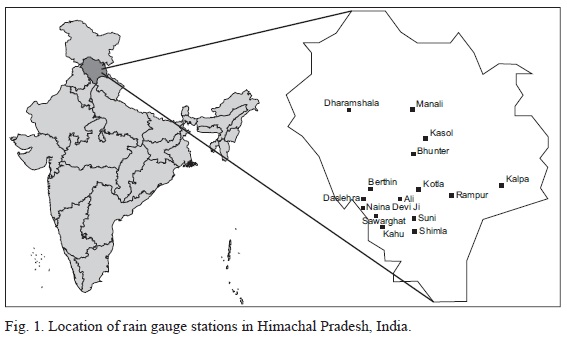
<body><![CDATA[<p align="justify">&nbsp;</p>  	    <p align="justify"><font face="verdana" size="2"><b>1. Introduction</b></font></p>  	    <p align="justify"><font face="verdana" size="2">Winter precipitation plays an important role over the Western Himalayan Region (WHR), particularly in Himachal Pradesh, for various sectors like agriculture, water resources, horticulture, hydroelectric power generation and regional economy. Winter precipitation in the WHR occurs under the influence of extratropical systems known as western disturbances (WDs) (Dimri and Dash, 2012; Yadav <i>et al.,</i> 2012). These are the extratropical upper air troughs or cyclonic circulations (CCs) in midlatitude westerlies that move west to east across the Himalayan region (Das <i>et al.,</i> 2002; Das 2002; Lang and Barros, 2004; Puranik and Karekar, 2009). Under its influence, CCs sometimes develop south of the system at lower levels, in which case they are known as induced CCs. Some WDs produce well&#45;distributed and large amounts of precipitation along with heavy snowfall/rainfall, landslides, cloudbursts etc. over the Himalayan region, while others pass across this area without causing precipitation (Malurkar, 1947). Hence, studies related to WDs and their associated weather are essential to the WHR.</font></p>  	    <p align="justify"><font face="verdana" size="2">There are many studies related to WDs and their associated weather over the WHR in literature. Pisharoty and Desai (1956) and Rao and Srinivasan (1969) studied the synoptic aspects of WDs and their associated weather over the WHR. They found that about 6&#45;7 WDs per month move across the region. Singh and Kumar (1977) found that WDs intensified over the WHR in association with a pre&#45;existing surface low over central Iran overtaken by a strong upper frontal layer. Rangachary and Bandyopadhyay (1987) and Hatwar <i>et al.</i> (2005) studied the synoptic features associated with extreme weather over the WHR. They found that widespread precipitation along with extensive avalanches over this region occur under the influence of WDs along with a high amount of moisture coming from the Arabian Sea, the Bay of Bengal or both. Das <i>et al.</i> (2002) studied the frequency of WDs in the premonsoon season, as well as its relation with monsoon rainfall and its advancement over northwest India. Their study found a significant decreasing trend in the frequency of WDs during May. Dimri (2005) studied the contrasting features associated with surplus and deficient precipitation years during the winter season to assess the wintertime synoptic weather system affecting the western Himalayas. He found higher heat flux convergence in excess years</font> <font face="verdana" size="2">and higher flux of convergence of kinetic energy with higher dissipation of kinetic energy during surplus years. Dimri (2007) studied the meridional transport of heat, momentum, potential energy and moisture associated with WDs over the Himalayan region due to mean and eddy motion. He observed that significant meridional transport due to mean motion takes place in the upper troposphere at 300 hPa and 200 hPa. Raju <i>et al.</i> (2011) studied kinetic energy associated with intense WDs that caused widespread precipitation over northwest India, finding that this phenomenon occurred due to strong flux convergence and adiabatic production of kinetic energy.</font></p>  	    <p align="justify"><font face="verdana" size="2">There are also studies related to temporal and spatial variability in precipitation over the Himalayan region. Shrestha <i>et al.</i> (2000) studied precipitation across Nepal and found significant variability at annual and decadal time scales. Bhutiyani <i>et al.</i> (2008) have done trend analyses of discharge data from rivers in the northwest Himalayas, finding out that the number of high&#45;magnitude flood events in this region have increased in the last three decades. Bhutiyani <i>et al.</i> (2010) also studied precipitation trends in the northwest Himalayas and did not found any trends in precipitation during the winter season or significant decreasing trends in precipitation during the monsoon season. Kumar and Jain (2010) studied the trends in seasonal annual rainfall and rainy days in the Kashmir Valley using data of five stations within this area. They found decreasing trends in monsoon and winter rainy days over all the stations and a decreasing trend in annual rainfall over three stations. However, there is hardly any study in literature related to frequency of WDs and variability of precipitation indices over the WHR with particular focus on Himachal Pradesh. Therefore, we have studied the frequency of winter WDs and several precipitation indices like total winter precipitation, wet days, rainy days, and rather heavy and heavy precipitation days by using daily precipitation data for the period 1977 to 2007 over Himachal Pradesh. We also examined the synoptic features associated with intense WDs that caused heavy precipitation (&ge; 64.5 mm) events over Himachal Pradesh during the same period.</font></p> 	    <p align="justify">&nbsp;</p>  	    <p align="justify"><font face="verdana" size="2"><b>2. Data and methodology</b></font></p>  	    <p align="justify"><font face="verdana" size="2">In the present study we used daily precipitation data of 15 rain gauge stations at Himachal Pradesh</font> <font face="verdana" size="2">for the period 1977 to 2007 during winter months (December to March). The sources of data are the Bhakra Beas Management Board and the India Meteorological Department. Locations of the rain gauge stations are given in <a href="#t1">Table I</a> and shown in <a href="#f1">Figure 1</a>.</font>	</p> 	    <p align="center"><a name="t1"></a></p> 	    <p align="center"><img src="/img/revistas/atm/v28n1/a6t1.jpg"></p> 	    ]]></body>
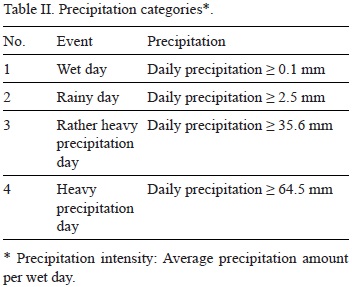
<body><![CDATA[<p align="center"><a name="f1"></a></p> 	    <p align="center"><img src="/img/revistas/atm/v28n1/a6f1.jpg"></p> 	    <p align="justify"><font face="verdana" size="2">If daily data of a particular month is lower than 80% in a station, the data of that month is discarded. To study the precipitation indices (Kumar <i>et al.</i>, 2012; Brunetti <i>et al.</i>, 2000), we divided daily precipitation into the categories shown in <a href="#t2">Table II</a>.</font></p> 	    <p align="center"><a name="t2"></a></p> 	    <p align="center"><font size="2" face="verdana"><img src="/img/revistas/atm/v28n1/a6t2.jpg"></font> </p> 	    <p align="justify"><font face="verdana" size="2">For calculating the frequency of WDs, we considered only those systems that caused precipitation (at least over two stations) over Himachal Pradesh, and we analyzed trough/circulation in midlatitude westerlies associated with WDs from geopotential height (GPH) at mid&#45;tropospheric levels (Zafar and Rasul, 2009) by using NCEP/NCAR reanalysis data (Kalnay <i>et al.,</i> 1996).</font></p>  	    <p align="justify"><font face="verdana" size="2">Finally, trend analysis of WDs and other precipitation indices were carried out by using a linear regression method (Pant and Rupa Kumar, 1997; Krishnakumar <i>et al.</i>, 2009) and the Mann Kendall non&#45;parametric test (Kendall, 1976; Kumar and Jain, 2010; Subash <i>et al.,</i> 2011). In this study, the trend is said to be statistically significant if the confidence</font> <font face="verdana" size="2">level is &ge; 95%. The anomaly percentage of any parameter is calculated as:</font></p>  	    <p align="justify"><font face="verdana" size="2">(series value/series mean) x 100</font></p> 	    <p align="justify">&nbsp;</p>  	    <p align="justify"><font face="verdana" size="2"><b>3. Results and discussions</b></font></p>  	    ]]></body>
<body><![CDATA[<p align="justify"><font face="verdana" size="2"><i>3.1 Characteristics of intense WDs</i> </font></p>     <p align="justify"><font face="verdana" size="2">To study the synoptic characteristics of intense WDs, we analyzed about 40 intense WDs that caused heavy precipitation over Himachal Pradesh by using NCEP/ NCAR reanalysis data for the period 1977 to 2007. In general, the following synoptic features are observed in intense WDs:</font></p>      <blockquote>           <p align="justify"><font face="verdana" size="2">a.&nbsp;A trough roughly located along 68&deg; E longitude and south of 24&deg; N latitude or a CC around 68&deg; E longitude and 31&deg; N latitude at 500 hPa GPH.</font></p>           <p align="justify"><font face="verdana" size="2">b.&nbsp;An induced CC located over Central Pakistan and the adjoining Rajasthan area or a trough that extends from north Pakistan and the adjoining Jammu and Kashmir to the Arabian Sea at 850</font> <font face="verdana" size="2">hPa GPH.</font></p>           <p align="justify"><font face="verdana" size="2">c.&nbsp;A large amount of moisture incursion from the Arabian Sea over the region.</font></p> </blockquote>      <p align="justify"><font face="verdana" size="2">A typical example of a trough and induced CC associated with intense WDs that have caused widespread (at more than 75% stations) precipitation with heavy rainfall in a few places (more than 25% of stations) is shown in <a href="/img/revistas/atm/v28n1/a6f2.jpg" target="_blank">Figure 2</a>. The trough in 500 hPa GPH is roughly along 67&deg; E longitude&#45;16&deg; N latitude</font> <font face="verdana" size="2">along with an induced CC over west Rajasthan and the adjoining Pakistan area at 850 hPa GPH.</font></p>  	    <p align="justify"><font face="verdana" size="2"><i>3.2&nbsp;Winter precipitation indices characteristics</i> </font></p> 	    <p align="justify"><font face="verdana" size="2">The average precipitation during winter months for the period 1977 to 2007 over the entire region is of 268 mm. However, this average is 344 mm over a high altitude region (&gt; 2.0 km) (by averaging the precipitation of all stations with altitude greater than 2.0 km), 260 mm over a middle altitude region (between 1.0 and 2.0 km) and 225 mm over a low altitude region (&lt; 1.0 km).</font></p>  	    <p align="justify"><font face="verdana" size="2">The average frequencies of wet and rainy days over the entire region within the study period are 23 and 17, respectively. The frequencies of rather heavy and heavy precipitation days are 1.5 and 0.3, respectively, but in a high altitude region the average frequencies of wet days, rainy days, rather heavy precipitation days and heavy precipitation days are 27, 21, 2.1 and 0.3, respectively. This indicates higher indices of precipitation amount and frequency at higher altitudes, as compared to lower altitudes.</font></p>  	    ]]></body>
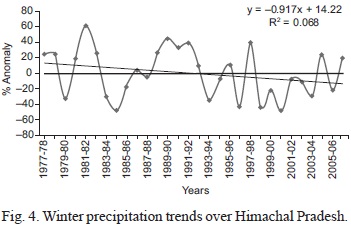
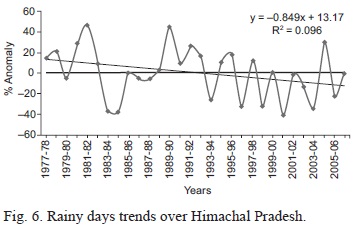
<body><![CDATA[<p align="justify"><font face="verdana" size="2"><i>3.3&nbsp;Winter disturbances</i></font></p>  	    <p align="justify"><font face="verdana" size="2">The total number of WDs during the study period for winter months is 369 and their annual frequency during the winter season is 12. Its frequencies during December, January, February and March are of 2, 3, 4, and 4, respectively, whereas earlier studies found that the average frequency of WDs is 6&#45;7 per month across the WHR (Pisharoty and Desai, 1956;</font> <font face="verdana" size="2">Rao and Srinivasan, 1969). However, our study is based only on central parts of the Himalayas. Further, analysis of data by the linear regression method and the Mann&#45;Kendall non&#45;parametric test indicates a significant decreasing trend in frequency of WDs (<a href="#f3">Fig. 3</a>) over the region for the period 1977 to 2007. Our study shows a decrease in the frequency of WDs of about 11% from their mean frequency from 1977 to 2007. Earlier, Das <i>et al.</i> (2002) observed a decreasing frequency of WDs in the pre&#45;monsoon season (March to May) with a significant decrease during May over northwest India. Shekhar <i>et al.</i> (2010) observed no trend in the annual frequency of WDs over higher altitudes in the Western Himalayas.</font>	</p> 	    <p align="center"><a name="f3"></a></p> 	    <p align="center"><img src="/img/revistas/atm/v28n1/a6f3.jpg"></p> 	    <p align="justify"><font face="verdana" size="2"><i>3.4 Total winter precipitation</i> </font></p> 	    <p align="justify"><font face="verdana" size="2">Total winter precipitation over Himachal Pradesh shows a decreasing trend (<a href="#f4">Fig. 4</a>) of about 13% in precipitation from its mean from 1977 to 2007. Earlier studies (Pant <i>et al.,</i> 1999; Kumar and Jain, 2010; Shekhar <i>et al.,</i> 2010; Dimri and Dash, 2012) also showed decreasing trends in winter precipitation over various parts of the WHR, which may be due to</font> <font face="verdana" size="2">the significant decreasing frequencies of WDs over the region.</font></p> 	    <p align="center"><a name="f4"></a></p> 	    <p align="center"><img src="/img/revistas/atm/v28n1/a6f4.jpg"></p>  	    <p align="justify"><font face="verdana" size="2"><i>3.5 Wet and rainy days</i></font></p>  	    <p align="justify"><font face="verdana" size="2">Time series of wet and rainy days are shown in <a href="#f5">Figures 5</a> and <a href="#f6">6</a>, respectively. Our study shows a decreasing trend both in wet and rainy days. A decrease of about 14% and 13% was found for wet and rainy days, respectively, from their respective means during</font> <font face="verdana" size="2">the 1977&#45;2007 period. Kumar and Jain (2010) also</font> <font face="verdana" size="2">observed a decreasing trend in winter rainy days over the Kashmir Valley in the Himalayas.</font>	</p> 	    ]]></body>
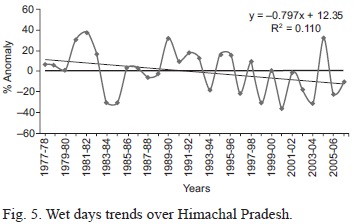
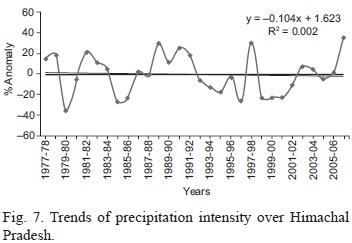
<body><![CDATA[<p align="center"><a name="f5"></a></p> 	    <p align="center"><img src="/img/revistas/atm/v28n1/a6f5.jpg"></p> 	    <p align="center"><a name="f6"></a></p> 	    <p align="center"><img src="/img/revistas/atm/v28n1/a6f6.jpg"></p> 	    <p align="justify"><font face="verdana" size="2"><i>3.5&nbsp;Precipitation intensity</i></font></p>  	    <p align="justify"><font face="verdana" size="2">The analysis of daily precipitation reveals no change in precipitation intensity over Himachal Pradesh during the study period (<a href="#f7">Fig. 7</a>).</font></p> 	    <p align="center"><a name="f7"></a></p> 	    <p align="center"><img src="/img/revistas/atm/v28n1/a6f7.jpg"></p>  	    <p align="justify"><font face="verdana" size="2"><i>3.6&nbsp;Rather heavy and heavy precipitation</i></font></p>  	    <p align="justify"><font face="verdana" size="2">Time series of rather heavy and heavy precipitation days are shown in <a href="#f8">Figures 8</a> and <a href="#f9">9</a>, respectively. Both series show decreasing trends over Himachal Pradesh during the study period. The analysis</font> <font face="verdana" size="2">indicates a decrease of about 12% and 25% in rather heavy and heavy precipitation days from their respective means during the 1977&#45;2007 period. However, long&#45;term changes in heavy precipitation events are not uniform over different parts of the India. Goswami <i>et al.</i> (2006) found significant increasing trends in extreme heavy precipitation over central parts of the country. Kishtawal <i>et al.</i> (2009) observed a significantly increasing trend in the frequency of</font> <font face="verdana" size="2">heavy rainfall over urban regions of India during the monsoon season. Guhathakurta <i>et al.</i> (2011) observed decreasing frequency of heavy rainfall events over major parts of central and north India and increasing frequency in peninsular, east and northeast India. Kumar <i>et al.</i> (2012) observed decreasing trends in heavy precipitation over the Andaman and Nicobar islands.</font></p> 	    ]]></body>
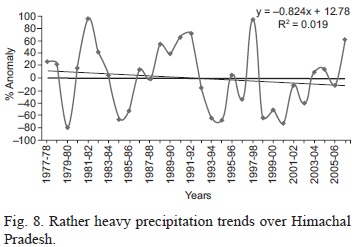
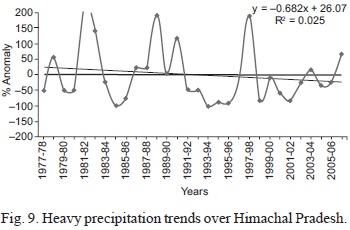
<body><![CDATA[<p align="center"><a name="f8"></a></p> 	    <p align="center"><img src="/img/revistas/atm/v28n1/a6f8.jpg"></p> 	    <p align="center"><a name="f9"></a></p> 	    <p align="center"><img src="/img/revistas/atm/v28n1/a6f9.jpg"></p> 	    <p align="justify">&nbsp;</p>  	    <p align="justify"><font face="verdana" size="2"><b>4. Conclusions</b></font></p>  	    <p align="justify"><font face="verdana" size="2">Based upon the analysis of daily precipitation data and NCEP/NCAR reanalysis data for the period 1977&#45;2007, the following conclusions are drawn:</font></p>  	    <p align="justify"><font face="verdana" size="2">Heavy precipitation over Himachal Pradesh generally occurs in association with a trough roughly situated along 68&deg; E longitude and south of 24&deg; N latitude or a CC located around 31&deg; N latitude and 68&deg; E longitude in mid&#45;tropospheric (500 hPa) westerlies; a CC located over Central Pakistan and the adjoining Rajasthan area, or a trough extended from north Pakistan and the adjoining Jammu and Kashmir to the Arabian Sea in a lower level (850 hPa). In addition, there should be a good amount of moisture incursion from the Arabian Sea over the region.</font></p>  	    <p align="justify"><font face="verdana" size="2">Total winter precipitation and precipitation indices are greater at higher altitudes as compared to lower altitudes. Tyagi <i>et al.</i> (2013) also observed an increase in winter precipitation with the increase in altitude over the WHR.</font></p>  	    <p align="justify"><font face="verdana" size="2">The mean frequency of winter WDs that caused precipitation over Himachal Pradesh is 12, with a highest monthly frequency (four) during February and March. This study shows a significant decreasing trend in the frequency of WDs over Himachal Pradesh.</font></p>  	    ]]></body>
<body><![CDATA[<p align="justify"><font face="verdana" size="2">All precipitation indices (i.e., total winter precipitation, wet days, rainy days, rather heavy and heavy precipitation days) show decreasing trends over the region during the study period. However, no trend is observed in precipitation intensity over the region. It can be broadly inferred from the study that the decreasing trend in precipitation indices is mainly due to significant decreases in the frequency of WDs affecting Himachal Pradesh.</font></p> 	    <p align="justify">&nbsp;</p>  	    <p align="justify"><font face="verdana" size="2"><b>References</b></font></p>  	    <!-- ref --><p align="justify"><font face="verdana" size="2">Bhutiyani M. R, V. S. Kale and N. J. Pawar, 2008. Changing stream flow patterns in the rivers of northwestern Himalaya: Implications of global warming in the 20th century. <i>Curr. Sci. India</i> <b>95,</b> 703&#45;708.    &nbsp;&nbsp;&nbsp;&nbsp;&nbsp;&nbsp;&nbsp;&nbsp;[&#160;<a href="javascript:void(0);" onclick="javascript: window.open('/scielo.php?script=sci_nlinks&ref=1310278&pid=S0187-6236201500010000600001&lng=','','width=640,height=500,resizable=yes,scrollbars=1,menubar=yes,');">Links</a>&#160;]<!-- end-ref --></font>	</p> 	    <!-- ref --><p align="justify"><font face="verdana" size="2">Bhutiyani M. R., V. S. Kale and N. S. Pawar, 2010. Climate change and the precipitation variations in the northwestern Himalaya: 1866&#45;2006. <i>Int. J. Climatol.</i> <b>30,</b> 535&#45;548.    &nbsp;&nbsp;&nbsp;&nbsp;&nbsp;&nbsp;&nbsp;&nbsp;[&#160;<a href="javascript:void(0);" onclick="javascript: window.open('/scielo.php?script=sci_nlinks&ref=1310280&pid=S0187-6236201500010000600002&lng=','','width=640,height=500,resizable=yes,scrollbars=1,menubar=yes,');">Links</a>&#160;]<!-- end-ref --></font></p>  	    <!-- ref --><p align="justify"><font face="verdana" size="2">Brunetti M., L. Buffoni, M. Maugeri and T. Nanni, 2000. Precipitation intensity trends in northern Italy. <i>Int. J. Climatol.</i> <b>20,</b> 1017&#45;1031.    &nbsp;&nbsp;&nbsp;&nbsp;&nbsp;&nbsp;&nbsp;&nbsp;[&#160;<a href="javascript:void(0);" onclick="javascript: window.open('/scielo.php?script=sci_nlinks&ref=1310282&pid=S0187-6236201500010000600003&lng=','','width=640,height=500,resizable=yes,scrollbars=1,menubar=yes,');">Links</a>&#160;]<!-- end-ref --></font></p>  	    <!-- ref --><p align="justify"><font face="verdana" size="2">Das S., 2002. Evaluation and verification of MM5 forecasts over Indian region. 12th PSU/NCAR Mesoscale Model Users Workshop, 24&#45;25 June, Boulder, Co., 77&#45;81.    &nbsp;&nbsp;&nbsp;&nbsp;&nbsp;&nbsp;&nbsp;&nbsp;[&#160;<a href="javascript:void(0);" onclick="javascript: window.open('/scielo.php?script=sci_nlinks&ref=1310284&pid=S0187-6236201500010000600004&lng=','','width=640,height=500,resizable=yes,scrollbars=1,menubar=yes,');">Links</a>&#160;]<!-- end-ref --></font></p>  	    <!-- ref --><p align="justify"><font face="verdana" size="2">Das M. R., R. K. Mukhopadhyay, M. M. Dandekar and S. R. Kshirsagar, 2002. Pre&#45;monsoon western disturbances in relation to monsoon rainfall, its advancement over NW India and their trends. <i>Curr. Sci. India</i> <b>82,</b></font> <font face="verdana" size="2">1320&#45;1321.    &nbsp;&nbsp;&nbsp;&nbsp;&nbsp;&nbsp;&nbsp;&nbsp;[&#160;<a href="javascript:void(0);" onclick="javascript: window.open('/scielo.php?script=sci_nlinks&ref=1310286&pid=S0187-6236201500010000600005&lng=','','width=640,height=500,resizable=yes,scrollbars=1,menubar=yes,');">Links</a>&#160;]<!-- end-ref --></font></p>  	    <!-- ref --><p align="justify"><font face="verdana" size="2">Dimri A. P., 2005. The contrasting features of winter circulation during surplus and deficient precipitation over Western Himalayas. <i>Pure Apple. Geophys.</i> <b>162,</b></font> <font face="verdana" size="2">2215&#45;2237</font>.    &nbsp;&nbsp;&nbsp;&nbsp;&nbsp;&nbsp;&nbsp;&nbsp;[&#160;<a href="javascript:void(0);" onclick="javascript: window.open('/scielo.php?script=sci_nlinks&ref=1310288&pid=S0187-6236201500010000600006&lng=','','width=640,height=500,resizable=yes,scrollbars=1,menubar=yes,');">Links</a>&#160;]<!-- end-ref --></p>  	    <!-- ref --><p align="justify"><font face="verdana" size="2">Dimri A. P., 2007. The transport of mass, heat and moisture over Western Himalayas during winter season. <i>Theor. Appl. Climatol.</i> <b>90,</b> 49&#45;63.    &nbsp;&nbsp;&nbsp;&nbsp;&nbsp;&nbsp;&nbsp;&nbsp;[&#160;<a href="javascript:void(0);" onclick="javascript: window.open('/scielo.php?script=sci_nlinks&ref=1310290&pid=S0187-6236201500010000600007&lng=','','width=640,height=500,resizable=yes,scrollbars=1,menubar=yes,');">Links</a>&#160;]<!-- end-ref --></font></p>  	    <!-- ref --><p align="justify"><font face="verdana" size="2">Dimri A. P. and S. K. Dash, 2012. Wintertime climate trends in the Western Himalayas. <i>Climatic Change</i></font> <font face="verdana" size="2"><b>111,</b> 775&#45;800.    &nbsp;&nbsp;&nbsp;&nbsp;&nbsp;&nbsp;&nbsp;&nbsp;[&#160;<a href="javascript:void(0);" onclick="javascript: window.open('/scielo.php?script=sci_nlinks&ref=1310292&pid=S0187-6236201500010000600008&lng=','','width=640,height=500,resizable=yes,scrollbars=1,menubar=yes,');">Links</a>&#160;]<!-- end-ref --></font></p>  	    <!-- ref --><p align="justify"><font face="verdana" size="2">Goswami B. N., V. Venugopal, D. Sengupta, M. S. Madhusoodanan and Prince K. Xavier, 2006. Increasing trend of extreme rain events over India in a warming environment. <i>Science</i> <b>314,</b> 1442&#45;1445.    &nbsp;&nbsp;&nbsp;&nbsp;&nbsp;&nbsp;&nbsp;&nbsp;[&#160;<a href="javascript:void(0);" onclick="javascript: window.open('/scielo.php?script=sci_nlinks&ref=1310294&pid=S0187-6236201500010000600009&lng=','','width=640,height=500,resizable=yes,scrollbars=1,menubar=yes,');">Links</a>&#160;]<!-- end-ref --></font></p>  	    <!-- ref --><p align="justify"><font face="verdana" size="2">Guhathakurta P., O. P. Sreejith and P. A. Menon, 2011. Impact of climate change on extreme rainfall events and flood risk in India. <i>J. Earth Syst. Sci.</i> <b>120,</b> 359-373.    &nbsp;&nbsp;&nbsp;&nbsp;&nbsp;&nbsp;&nbsp;&nbsp;[&#160;<a href="javascript:void(0);" onclick="javascript: window.open('/scielo.php?script=sci_nlinks&ref=1310296&pid=S0187-6236201500010000600010&lng=','','width=640,height=500,resizable=yes,scrollbars=1,menubar=yes,');">Links</a>&#160;]<!-- end-ref --></font></p>  	    <!-- ref --><p align="justify"><font face="verdana" size="2">Hatwar H. R., B. P. Yadav and Y. V. Rama Rao, 2005. Prediction of western disturbances and associated weather over Western Himalayas. <i>Curr. Sci. India</i></font> <font face="verdana" size="2"><b>88,</b> 913&#45;920.    &nbsp;&nbsp;&nbsp;&nbsp;&nbsp;&nbsp;&nbsp;&nbsp;[&#160;<a href="javascript:void(0);" onclick="javascript: window.open('/scielo.php?script=sci_nlinks&ref=1310298&pid=S0187-6236201500010000600011&lng=','','width=640,height=500,resizable=yes,scrollbars=1,menubar=yes,');">Links</a>&#160;]<!-- end-ref --></font></p>  	    <!-- ref --><p align="justify"><font face="verdana" size="2">Kalnay E., M. Kanamitsu, R. Kistler, W. Collins, D.</font> <font face="verdana" size="2">Deaven, L Gandin, M. Iredell, S. Sana, G. White, J.</font> <font face="verdana" size="2">Woollen, Y. Zhu, M. Chelliah, W. Ebisuzaki, W. Higgins, J. Janowiak, K. C. Mo, C. Ropelewski, J. Wang, A. Leetmaa, R. Reynolds, R. Jenne and D. Joseph, 1996. The NCEP/NCAR Reanalysis 40&#45;year Project. <i>Bull. Amer. Meteor. Soc.</i> <b>77,</b> 437&#45;471.    &nbsp;&nbsp;&nbsp;&nbsp;&nbsp;&nbsp;&nbsp;&nbsp;[&#160;<a href="javascript:void(0);" onclick="javascript: window.open('/scielo.php?script=sci_nlinks&ref=1310300&pid=S0187-6236201500010000600012&lng=','','width=640,height=500,resizable=yes,scrollbars=1,menubar=yes,');">Links</a>&#160;]<!-- end-ref --></font></p>  	    <!-- ref --><p align="justify"><font face="verdana" size="2">Kendall M., 1976. <i>Time series.</i> Griffin, London, 197 pp.    &nbsp;&nbsp;&nbsp;&nbsp;&nbsp;&nbsp;&nbsp;&nbsp;[&#160;<a href="javascript:void(0);" onclick="javascript: window.open('/scielo.php?script=sci_nlinks&ref=1310302&pid=S0187-6236201500010000600013&lng=','','width=640,height=500,resizable=yes,scrollbars=1,menubar=yes,');">Links</a>&#160;]<!-- end-ref --></font></p>  	    <!-- ref --><p align="justify"><font face="verdana" size="2">Kishtawal C. M., D. Niyogi, M. Tewari, R. A. Pielke Sr. and J. M. Shepherd, 2009. Urbanization signature in the observed heavy rainfall climatology over India. <i>Int. J. Climatol.</i> <b>30,</b> 1908&#45;1916.    &nbsp;&nbsp;&nbsp;&nbsp;&nbsp;&nbsp;&nbsp;&nbsp;[&#160;<a href="javascript:void(0);" onclick="javascript: window.open('/scielo.php?script=sci_nlinks&ref=1310304&pid=S0187-6236201500010000600014&lng=','','width=640,height=500,resizable=yes,scrollbars=1,menubar=yes,');">Links</a>&#160;]<!-- end-ref --></font></p>  	    <!-- ref --><p align="justify"><font face="verdana" size="2">Krishnakumar K. N., G. S. L. H. V. Prasada Rao and C. S. Gopakumar, 2009. Rainfall trends in twentieth century over Kerala, India. <i>Atmos. Environ.</i> <b>43,</b> 1940&#45;1944.    &nbsp;&nbsp;&nbsp;&nbsp;&nbsp;&nbsp;&nbsp;&nbsp;[&#160;<a href="javascript:void(0);" onclick="javascript: window.open('/scielo.php?script=sci_nlinks&ref=1310306&pid=S0187-6236201500010000600015&lng=','','width=640,height=500,resizable=yes,scrollbars=1,menubar=yes,');">Links</a>&#160;]<!-- end-ref --></font></p>  	    <!-- ref --><p align="justify"><font face="verdana" size="2">Kumar V. and S. K. Jain, 2010. Trends in seasonal and annual rainfall and rainy days in Kashmir Valley in the last century. <i>Quatern. Int.</i> <b>212,</b> 64&#45;69.    &nbsp;&nbsp;&nbsp;&nbsp;&nbsp;&nbsp;&nbsp;&nbsp;[&#160;<a href="javascript:void(0);" onclick="javascript: window.open('/scielo.php?script=sci_nlinks&ref=1310308&pid=S0187-6236201500010000600016&lng=','','width=640,height=500,resizable=yes,scrollbars=1,menubar=yes,');">Links</a>&#160;]<!-- end-ref --></font></p>  	    <!-- ref --><p align="justify"><font face="verdana" size="2">Kumar N., B. P. Yadav, A. Tyagi and A. K. Jaswal, 2012. Trend and spatial distribution of rainfall and rainy days over Andaman and Nicobar islands. <i>Nat. Hazards</i> <b>63,</b> 575&#45;587.    &nbsp;&nbsp;&nbsp;&nbsp;&nbsp;&nbsp;&nbsp;&nbsp;[&#160;<a href="javascript:void(0);" onclick="javascript: window.open('/scielo.php?script=sci_nlinks&ref=1310310&pid=S0187-6236201500010000600017&lng=','','width=640,height=500,resizable=yes,scrollbars=1,menubar=yes,');">Links</a>&#160;]<!-- end-ref --></font></p>  	    <!-- ref --><p align="justify"><font face="verdana" size="2">Lang J. T. and A. P. Barros, 2004. Winter storms in the central Himalayas. <i>J. Meteorol. Soc. Jpn.</i> <b>82,</b> 829&#45;844.    &nbsp;&nbsp;&nbsp;&nbsp;&nbsp;&nbsp;&nbsp;&nbsp;[&#160;<a href="javascript:void(0);" onclick="javascript: window.open('/scielo.php?script=sci_nlinks&ref=1310312&pid=S0187-6236201500010000600018&lng=','','width=640,height=500,resizable=yes,scrollbars=1,menubar=yes,');">Links</a>&#160;]<!-- end-ref --></font></p>  	    <!-- ref --><p align="justify"><font face="verdana" size="2">Malurkar S. L., 1947. Abnormally dry and wet western disturbances over north India. <i>Curr. Sci. India</i> <b>5,</b> 139&#45;140</font>.    &nbsp;&nbsp;&nbsp;&nbsp;&nbsp;&nbsp;&nbsp;&nbsp;[&#160;<a href="javascript:void(0);" onclick="javascript: window.open('/scielo.php?script=sci_nlinks&ref=1310314&pid=S0187-6236201500010000600019&lng=','','width=640,height=500,resizable=yes,scrollbars=1,menubar=yes,');">Links</a>&#160;]<!-- end-ref --></p>  	    <!-- ref --><p align="justify"><font face="verdana" size="2">Pant G. B. and K. Rupa Kumar, 1997. <i>Climates of South Asia.</i> John Wiley and Sons, West Sussex, England, 344 pp. (Belhaven Studies in Climatology).    &nbsp;&nbsp;&nbsp;&nbsp;&nbsp;&nbsp;&nbsp;&nbsp;[&#160;<a href="javascript:void(0);" onclick="javascript: window.open('/scielo.php?script=sci_nlinks&ref=1310316&pid=S0187-6236201500010000600020&lng=','','width=640,height=500,resizable=yes,scrollbars=1,menubar=yes,');">Links</a>&#160;]<!-- end-ref --></font></p>  	    <!-- ref --><p align="justify"><font face="verdana" size="2">Pant G. B., K. Rupa Kumar and H. P. Borgaonkar, 1999. Climate and its long&#45;term variability over the western Himalaya during the past two centuries, in: <i>The Himalayan environment</i> (S. K. Dash and L. Bahadur, Eds.). New Age International, New Delhi, 347 pp.    &nbsp;&nbsp;&nbsp;&nbsp;&nbsp;&nbsp;&nbsp;&nbsp;[&#160;<a href="javascript:void(0);" onclick="javascript: window.open('/scielo.php?script=sci_nlinks&ref=1310318&pid=S0187-6236201500010000600021&lng=','','width=640,height=500,resizable=yes,scrollbars=1,menubar=yes,');">Links</a>&#160;]<!-- end-ref --></font></p>  	    <!-- ref --><p align="justify"><font face="verdana" size="2">Pisharoty P. R. and B. N. Desai, 1956. Western disturbances and Indian weather. <i>Mausam</i> <b>7,</b> 333&#45;338.    &nbsp;&nbsp;&nbsp;&nbsp;&nbsp;&nbsp;&nbsp;&nbsp;[&#160;<a href="javascript:void(0);" onclick="javascript: window.open('/scielo.php?script=sci_nlinks&ref=1310320&pid=S0187-6236201500010000600022&lng=','','width=640,height=500,resizable=yes,scrollbars=1,menubar=yes,');">Links</a>&#160;]<!-- end-ref --></font></p>  	    <!-- ref --><p align="justify"><font face="verdana" size="2">Puranik D. M. and R. N. Karekar, 2009. Western disturbances seen with AMSU&#45;band infrared sensors. <i>J.</i></font> <font face="verdana" size="2"><i>Earth Syst. Sci.</i> <b>118,</b> 27&#45;39.    &nbsp;&nbsp;&nbsp;&nbsp;&nbsp;&nbsp;&nbsp;&nbsp;[&#160;<a href="javascript:void(0);" onclick="javascript: window.open('/scielo.php?script=sci_nlinks&ref=1310322&pid=S0187-6236201500010000600023&lng=','','width=640,height=500,resizable=yes,scrollbars=1,menubar=yes,');">Links</a>&#160;]<!-- end-ref --></font></p>  	    <!-- ref --><p align="justify"><font face="verdana" size="2">Raju P. V. S., R. Bhatla and U. C. Mohanty, 2011. A study on certain aspects of kinetic energy associated with western disturbances over northwest India. <i>Atm&oacute;sfera</i> <b>24,</b> 375&#45;384.    &nbsp;&nbsp;&nbsp;&nbsp;&nbsp;&nbsp;&nbsp;&nbsp;[&#160;<a href="javascript:void(0);" onclick="javascript: window.open('/scielo.php?script=sci_nlinks&ref=1310324&pid=S0187-6236201500010000600024&lng=','','width=640,height=500,resizable=yes,scrollbars=1,menubar=yes,');">Links</a>&#160;]<!-- end-ref --></font></p>  	    <!-- ref --><p align="justify"><font face="verdana" size="2">Rangachary N. and B. K. Bandyopadhyay, 1986. An analysis of the synoptic weather pattern associated with extensive avalanching in Western Himalaya. Proceedings of the Davos Symposium on Avalanche Formation, Movement and Effects. IAHS Publication No. 162, pp. 311&#45;316.    &nbsp;&nbsp;&nbsp;&nbsp;&nbsp;&nbsp;&nbsp;&nbsp;[&#160;<a href="javascript:void(0);" onclick="javascript: window.open('/scielo.php?script=sci_nlinks&ref=1310326&pid=S0187-6236201500010000600025&lng=','','width=640,height=500,resizable=yes,scrollbars=1,menubar=yes,');">Links</a>&#160;]<!-- end-ref --></font></p>  	    <!-- ref --><p align="justify"><font face="verdana" size="2">Rao. Y. P. and V Srinivasan, 1969. India Meteorological Department forecasting manual. Part III. Discussion of typical weather situations: Winter western disturbances and their associated features. Deputy Director General of Meteorology, Pune, India, 131 pp.    &nbsp;&nbsp;&nbsp;&nbsp;&nbsp;&nbsp;&nbsp;&nbsp;[&#160;<a href="javascript:void(0);" onclick="javascript: window.open('/scielo.php?script=sci_nlinks&ref=1310328&pid=S0187-6236201500010000600026&lng=','','width=640,height=500,resizable=yes,scrollbars=1,menubar=yes,');">Links</a>&#160;]<!-- end-ref --></font></p>  	    <!-- ref --><p align="justify"><font face="verdana" size="2">Shekhar M. S., H. Chand, S. Kumar, K. Srinivasan and A Ganju, 2010. Climate&#45;change studies in the western Himalaya. <i>Ann. Glaciol.</i> <b>51,</b> 105&#45;112.    &nbsp;&nbsp;&nbsp;&nbsp;&nbsp;&nbsp;&nbsp;&nbsp;[&#160;<a href="javascript:void(0);" onclick="javascript: window.open('/scielo.php?script=sci_nlinks&ref=1310330&pid=S0187-6236201500010000600027&lng=','','width=640,height=500,resizable=yes,scrollbars=1,menubar=yes,');">Links</a>&#160;]<!-- end-ref --></font></p>  	    <!-- ref --><p align="justify"><font face="verdana" size="2">Shrestha A. B., C. P. Wake, J. E. Dibb and P. A. Mayewski, 2000. Precipitation fluctuations in the Nepal Himalaya</font> <font face="verdana" size="2">and its vicinity and relationship with some large&#45;scale climatological parameters. <i>Int. J. Climatol.</i> <b>20,</b> 317&#45;327.    &nbsp;&nbsp;&nbsp;&nbsp;&nbsp;&nbsp;&nbsp;&nbsp;[&#160;<a href="javascript:void(0);" onclick="javascript: window.open('/scielo.php?script=sci_nlinks&ref=1310332&pid=S0187-6236201500010000600028&lng=','','width=640,height=500,resizable=yes,scrollbars=1,menubar=yes,');">Links</a>&#160;]<!-- end-ref --></font></p>  	    <!-- ref --><p align="justify"><font face="verdana" size="2">Singh M. S. and S. Kumar, 1977. Study of a western disturbance. <i>Mausam</i> <b>28,</b> 233&#45;242.    &nbsp;&nbsp;&nbsp;&nbsp;&nbsp;&nbsp;&nbsp;&nbsp;[&#160;<a href="javascript:void(0);" onclick="javascript: window.open('/scielo.php?script=sci_nlinks&ref=1310334&pid=S0187-6236201500010000600029&lng=','','width=640,height=500,resizable=yes,scrollbars=1,menubar=yes,');">Links</a>&#160;]<!-- end-ref --></font></p>  	    <!-- ref --><p align="justify"><font face="verdana" size="2">Subash N., A. K. Sikka and H. S. Ram Mohan, 2011. An investigation into observational characteristics of rainfall and temperature in central Northeast India &#45; a historical perspective 1889&#45;2008. <i>Theor. Appl. Climatol.</i> <b>103,</b> 305&#45;319.    &nbsp;&nbsp;&nbsp;&nbsp;&nbsp;&nbsp;&nbsp;&nbsp;[&#160;<a href="javascript:void(0);" onclick="javascript: window.open('/scielo.php?script=sci_nlinks&ref=1310336&pid=S0187-6236201500010000600030&lng=','','width=640,height=500,resizable=yes,scrollbars=1,menubar=yes,');">Links</a>&#160;]<!-- end-ref --></font></p>  	    <!-- ref --><p align="justify"><font face="verdana" size="2">Tyagi A., N. Kumar and B. P. Yadav, 2012. Climatology of precipitation over western and central Indian</font> <font face="verdana" size="2">Himalayas. <i>Proceeding of International Symposium on Cryosphere and Climate Change,</i> SASE, Manali, India, pp. 1&#45;9.    &nbsp;&nbsp;&nbsp;&nbsp;&nbsp;&nbsp;&nbsp;&nbsp;[&#160;<a href="javascript:void(0);" onclick="javascript: window.open('/scielo.php?script=sci_nlinks&ref=1310338&pid=S0187-6236201500010000600031&lng=','','width=640,height=500,resizable=yes,scrollbars=1,menubar=yes,');">Links</a>&#160;]<!-- end-ref --></font></p>  	    <!-- ref --><p align="justify"><font face="verdana" size="2">Yadav R. K., K. Rupa Kumar and M. Rajeevan, 2012. Characteristic features of winter precipitation and its variability over northwest India. <i>J. Earth Syst. Sci.</i> <b>121,</b> 611&#45;623.    &nbsp;&nbsp;&nbsp;&nbsp;&nbsp;&nbsp;&nbsp;&nbsp;[&#160;<a href="javascript:void(0);" onclick="javascript: window.open('/scielo.php?script=sci_nlinks&ref=1310340&pid=S0187-6236201500010000600032&lng=','','width=640,height=500,resizable=yes,scrollbars=1,menubar=yes,');">Links</a>&#160;]<!-- end-ref --></font></p>  	    <!-- ref --><p align="justify"><font face="verdana" size="2">Zafar Q. and G. Rasul, 2009. Diagnosis and numerical simulation of a heavy rainfall event in winter over upper parts of Pakistan. <i>Pakistan Journal of Meteorology</i> <b>5,</b> 81&#45;96.    &nbsp;&nbsp;&nbsp;&nbsp;&nbsp;&nbsp;&nbsp;&nbsp;[&#160;<a href="javascript:void(0);" onclick="javascript: window.open('/scielo.php?script=sci_nlinks&ref=1310342&pid=S0187-6236201500010000600033&lng=','','width=640,height=500,resizable=yes,scrollbars=1,menubar=yes,');">Links</a>&#160;]<!-- end-ref --></font></p>      ]]></body><back>
<ref-list>
<ref id="B1">
<nlm-citation citation-type="journal">
<person-group person-group-type="author">
<name>
<surname><![CDATA[Bhutiyani]]></surname>
<given-names><![CDATA[M. R]]></given-names>
</name>
<name>
<surname><![CDATA[Kale]]></surname>
<given-names><![CDATA[V. S.]]></given-names>
</name>
<name>
<surname><![CDATA[Pawar]]></surname>
<given-names><![CDATA[N. J.]]></given-names>
</name>
</person-group>
<article-title xml:lang="en"><![CDATA[Changing stream flow patterns in the rivers of northwestern Himalaya: Implications of global warming in the 20th century]]></article-title>
<source><![CDATA[Curr. Sci. India]]></source>
<year>2008</year>
<volume>95</volume>
<page-range>703-708</page-range></nlm-citation>
</ref>
<ref id="B2">
<nlm-citation citation-type="journal">
<person-group person-group-type="author">
<name>
<surname><![CDATA[Bhutiyani]]></surname>
<given-names><![CDATA[M. R.]]></given-names>
</name>
<name>
<surname><![CDATA[Kale]]></surname>
<given-names><![CDATA[V. S.]]></given-names>
</name>
<name>
<surname><![CDATA[Pawar]]></surname>
<given-names><![CDATA[N. S.]]></given-names>
</name>
</person-group>
<article-title xml:lang="en"><![CDATA[Climate change and the precipitation variations in the northwestern Himalaya: 1866-2006]]></article-title>
<source><![CDATA[Int. J. Climatol.]]></source>
<year>2010</year>
<volume>30</volume>
<page-range>535-548</page-range></nlm-citation>
</ref>
<ref id="B3">
<nlm-citation citation-type="journal">
<person-group person-group-type="author">
<name>
<surname><![CDATA[Brunetti]]></surname>
<given-names><![CDATA[M.]]></given-names>
</name>
<name>
<surname><![CDATA[Buffoni]]></surname>
<given-names><![CDATA[L.]]></given-names>
</name>
<name>
<surname><![CDATA[Maugeri]]></surname>
<given-names><![CDATA[M.]]></given-names>
</name>
<name>
<surname><![CDATA[Nanni]]></surname>
<given-names><![CDATA[T.]]></given-names>
</name>
</person-group>
<article-title xml:lang="en"><![CDATA[Precipitation intensity trends in northern Italy]]></article-title>
<source><![CDATA[Int. J. Climatol.]]></source>
<year>2000</year>
<volume>20</volume>
<page-range>1017-1031</page-range></nlm-citation>
</ref>
<ref id="B4">
<nlm-citation citation-type="">
<person-group person-group-type="author">
<name>
<surname><![CDATA[Das]]></surname>
<given-names><![CDATA[S.]]></given-names>
</name>
</person-group>
<article-title xml:lang="en"><![CDATA[Evaluation and verification of MM5 forecasts over Indian region]]></article-title>
<source><![CDATA[12th PSU/NCAR Mesoscale Model Users Workshop]]></source>
<year>2002</year>
<page-range>77-81</page-range><publisher-loc><![CDATA[Boulder^eCo. Co.]]></publisher-loc>
</nlm-citation>
</ref>
<ref id="B5">
<nlm-citation citation-type="journal">
<person-group person-group-type="author">
<name>
<surname><![CDATA[Das]]></surname>
<given-names><![CDATA[M. R.]]></given-names>
</name>
<name>
<surname><![CDATA[Mukhopadhyay]]></surname>
<given-names><![CDATA[R. K.]]></given-names>
</name>
<name>
<surname><![CDATA[Dandekar]]></surname>
<given-names><![CDATA[M. M.]]></given-names>
</name>
<name>
<surname><![CDATA[Kshirsagar]]></surname>
<given-names><![CDATA[S. R.]]></given-names>
</name>
</person-group>
<article-title xml:lang="en"><![CDATA[Pre-monsoon western disturbances in relation to monsoon rainfall, its advancement over NW India and their trends]]></article-title>
<source><![CDATA[Curr. Sci. India]]></source>
<year>2002</year>
<volume>82</volume>
<page-range>1320-1321</page-range></nlm-citation>
</ref>
<ref id="B6">
<nlm-citation citation-type="journal">
<person-group person-group-type="author">
<name>
<surname><![CDATA[Dimri]]></surname>
<given-names><![CDATA[A. P.]]></given-names>
</name>
</person-group>
<article-title xml:lang="en"><![CDATA[The contrasting features of winter circulation during surplus and deficient precipitation over Western Himalayas]]></article-title>
<source><![CDATA[Pure Apple. Geophys.]]></source>
<year>2005</year>
<volume>162</volume>
<page-range>2215-2237</page-range></nlm-citation>
</ref>
<ref id="B7">
<nlm-citation citation-type="journal">
<person-group person-group-type="author">
<name>
<surname><![CDATA[Dimri]]></surname>
<given-names><![CDATA[A. P.]]></given-names>
</name>
</person-group>
<article-title xml:lang="en"><![CDATA[The transport of mass, heat and moisture over Western Himalayas during winter season]]></article-title>
<source><![CDATA[Theor. Appl. Climatol.]]></source>
<year>2007</year>
<volume>90</volume>
<page-range>49-63</page-range></nlm-citation>
</ref>
<ref id="B8">
<nlm-citation citation-type="journal">
<person-group person-group-type="author">
<name>
<surname><![CDATA[Dimri]]></surname>
<given-names><![CDATA[A. P.]]></given-names>
</name>
<name>
<surname><![CDATA[Dash]]></surname>
<given-names><![CDATA[S. K.]]></given-names>
</name>
</person-group>
<article-title xml:lang="en"><![CDATA[Wintertime climate trends in the Western Himalayas]]></article-title>
<source><![CDATA[Climatic Change]]></source>
<year>2012</year>
<volume>111</volume>
<page-range>775-800</page-range></nlm-citation>
</ref>
<ref id="B9">
<nlm-citation citation-type="journal">
<person-group person-group-type="author">
<name>
<surname><![CDATA[Goswami]]></surname>
<given-names><![CDATA[B. N.]]></given-names>
</name>
<name>
<surname><![CDATA[Venugopal]]></surname>
<given-names><![CDATA[V.]]></given-names>
</name>
<name>
<surname><![CDATA[Sengupta]]></surname>
<given-names><![CDATA[D.]]></given-names>
</name>
<name>
<surname><![CDATA[Madhusoodanan]]></surname>
<given-names><![CDATA[M. S.]]></given-names>
</name>
<name>
<surname><![CDATA[Xavier]]></surname>
<given-names><![CDATA[Prince K.]]></given-names>
</name>
</person-group>
<article-title xml:lang="en"><![CDATA[Increasing trend of extreme rain events over India in a warming environment]]></article-title>
<source><![CDATA[Science]]></source>
<year>2006</year>
<volume>314</volume>
<page-range>1442-1445</page-range></nlm-citation>
</ref>
<ref id="B10">
<nlm-citation citation-type="journal">
<person-group person-group-type="author">
<name>
<surname><![CDATA[Guhathakurta]]></surname>
<given-names><![CDATA[P.]]></given-names>
</name>
<name>
<surname><![CDATA[Sreejith]]></surname>
<given-names><![CDATA[O. P.]]></given-names>
</name>
<name>
<surname><![CDATA[Menon]]></surname>
<given-names><![CDATA[P. A.]]></given-names>
</name>
</person-group>
<article-title xml:lang="en"><![CDATA[Impact of climate change on extreme rainfall events and flood risk in India]]></article-title>
<source><![CDATA[J. Earth Syst. Sci.]]></source>
<year>2011</year>
<volume>120</volume>
<page-range>359-373</page-range></nlm-citation>
</ref>
<ref id="B11">
<nlm-citation citation-type="journal">
<person-group person-group-type="author">
<name>
<surname><![CDATA[Hatwar]]></surname>
<given-names><![CDATA[H. R.]]></given-names>
</name>
<name>
<surname><![CDATA[Yadav]]></surname>
<given-names><![CDATA[B. P.]]></given-names>
</name>
<name>
<surname><![CDATA[Rama Rao]]></surname>
<given-names><![CDATA[Y. V.]]></given-names>
</name>
</person-group>
<article-title xml:lang="en"><![CDATA[Prediction of western disturbances and associated weather over Western Himalayas]]></article-title>
<source><![CDATA[Curr. Sci. India]]></source>
<year>2005</year>
<volume>88</volume>
<page-range>913-920</page-range></nlm-citation>
</ref>
<ref id="B12">
<nlm-citation citation-type="journal">
<person-group person-group-type="author">
<name>
<surname><![CDATA[Kalnay]]></surname>
<given-names><![CDATA[E.]]></given-names>
</name>
<name>
<surname><![CDATA[Kanamitsu]]></surname>
<given-names><![CDATA[M.]]></given-names>
</name>
<name>
<surname><![CDATA[Kistler]]></surname>
<given-names><![CDATA[R.]]></given-names>
</name>
<name>
<surname><![CDATA[Collins]]></surname>
<given-names><![CDATA[W.]]></given-names>
</name>
<name>
<surname><![CDATA[Deaven]]></surname>
<given-names><![CDATA[D.]]></given-names>
</name>
<name>
<surname><![CDATA[Gandin]]></surname>
<given-names><![CDATA[L]]></given-names>
</name>
<name>
<surname><![CDATA[Iredell]]></surname>
<given-names><![CDATA[M.]]></given-names>
</name>
<name>
<surname><![CDATA[Sana]]></surname>
<given-names><![CDATA[S.]]></given-names>
</name>
<name>
<surname><![CDATA[White]]></surname>
<given-names><![CDATA[G.]]></given-names>
</name>
<name>
<surname><![CDATA[Woollen]]></surname>
<given-names><![CDATA[J.]]></given-names>
</name>
<name>
<surname><![CDATA[Zhu]]></surname>
<given-names><![CDATA[Y.]]></given-names>
</name>
<name>
<surname><![CDATA[Chelliah]]></surname>
<given-names><![CDATA[M.]]></given-names>
</name>
<name>
<surname><![CDATA[Ebisuzaki]]></surname>
<given-names><![CDATA[W.]]></given-names>
</name>
<name>
<surname><![CDATA[Higgins]]></surname>
<given-names><![CDATA[W.]]></given-names>
</name>
<name>
<surname><![CDATA[Janowiak]]></surname>
<given-names><![CDATA[J.]]></given-names>
</name>
<name>
<surname><![CDATA[Mo]]></surname>
<given-names><![CDATA[K. C.]]></given-names>
</name>
<name>
<surname><![CDATA[Ropelewski]]></surname>
<given-names><![CDATA[C.]]></given-names>
</name>
<name>
<surname><![CDATA[Wang]]></surname>
<given-names><![CDATA[J.]]></given-names>
</name>
<name>
<surname><![CDATA[Leetmaa]]></surname>
<given-names><![CDATA[A.]]></given-names>
</name>
<name>
<surname><![CDATA[Reynolds]]></surname>
<given-names><![CDATA[R.]]></given-names>
</name>
<name>
<surname><![CDATA[Jenne]]></surname>
<given-names><![CDATA[R.]]></given-names>
</name>
<name>
<surname><![CDATA[Joseph]]></surname>
<given-names><![CDATA[D.]]></given-names>
</name>
</person-group>
<article-title xml:lang="en"><![CDATA[The NCEP/NCAR Reanalysis 40-year Project]]></article-title>
<source><![CDATA[Bull. Amer. Meteor. Soc.]]></source>
<year>1996</year>
<volume>77</volume>
<page-range>437-471</page-range></nlm-citation>
</ref>
<ref id="B13">
<nlm-citation citation-type="">
<person-group person-group-type="author">
<name>
<surname><![CDATA[Kendall]]></surname>
<given-names><![CDATA[M.]]></given-names>
</name>
</person-group>
<source><![CDATA[Time series]]></source>
<year>1976</year>
<page-range>197</page-range><publisher-loc><![CDATA[London ]]></publisher-loc>
</nlm-citation>
</ref>
<ref id="B14">
<nlm-citation citation-type="journal">
<person-group person-group-type="author">
<name>
<surname><![CDATA[Kishtawal]]></surname>
<given-names><![CDATA[C. M.]]></given-names>
</name>
<name>
<surname><![CDATA[Niyogi]]></surname>
<given-names><![CDATA[D.]]></given-names>
</name>
<name>
<surname><![CDATA[Tewari]]></surname>
<given-names><![CDATA[M.]]></given-names>
</name>
<name>
<surname><![CDATA[Pielke Sr.]]></surname>
<given-names><![CDATA[R. A.]]></given-names>
</name>
<name>
<surname><![CDATA[Shepherd]]></surname>
<given-names><![CDATA[J. M.]]></given-names>
</name>
</person-group>
<article-title xml:lang="en"><![CDATA[Urbanization signature in the observed heavy rainfall climatology over India]]></article-title>
<source><![CDATA[Int. J. Climatol.]]></source>
<year>2009</year>
<volume>30</volume>
<page-range>1908-1916</page-range></nlm-citation>
</ref>
<ref id="B15">
<nlm-citation citation-type="journal">
<person-group person-group-type="author">
<name>
<surname><![CDATA[Krishnakumar]]></surname>
<given-names><![CDATA[K. N.]]></given-names>
</name>
<name>
<surname><![CDATA[Prasada Rao]]></surname>
<given-names><![CDATA[G. S. L. H. V.]]></given-names>
</name>
<name>
<surname><![CDATA[Gopakumar]]></surname>
<given-names><![CDATA[C. S.]]></given-names>
</name>
</person-group>
<article-title xml:lang="en"><![CDATA[Rainfall trends in twentieth century over Kerala, India]]></article-title>
<source><![CDATA[Atmos. Environ.]]></source>
<year>2009</year>
<volume>43</volume>
<page-range>1940-1944</page-range></nlm-citation>
</ref>
<ref id="B16">
<nlm-citation citation-type="journal">
<person-group person-group-type="author">
<name>
<surname><![CDATA[Kumar]]></surname>
<given-names><![CDATA[V.]]></given-names>
</name>
<name>
<surname><![CDATA[Jain]]></surname>
<given-names><![CDATA[S. K.]]></given-names>
</name>
</person-group>
<article-title xml:lang="en"><![CDATA[Trends in seasonal and annual rainfall and rainy days in Kashmir Valley in the last century]]></article-title>
<source><![CDATA[Quatern. Int.]]></source>
<year>2010</year>
<volume>212</volume>
<page-range>64-69</page-range></nlm-citation>
</ref>
<ref id="B17">
<nlm-citation citation-type="journal">
<person-group person-group-type="author">
<name>
<surname><![CDATA[Kumar]]></surname>
<given-names><![CDATA[N.]]></given-names>
</name>
<name>
<surname><![CDATA[Yadav]]></surname>
<given-names><![CDATA[B. P.]]></given-names>
</name>
<name>
<surname><![CDATA[Tyagi]]></surname>
<given-names><![CDATA[A.]]></given-names>
</name>
<name>
<surname><![CDATA[Jaswal]]></surname>
<given-names><![CDATA[A. K.]]></given-names>
</name>
</person-group>
<article-title xml:lang="en"><![CDATA[Trend and spatial distribution of rainfall and rainy days over Andaman and Nicobar islands]]></article-title>
<source><![CDATA[Nat. Hazards]]></source>
<year>2012</year>
<volume>63</volume>
<page-range>575-587</page-range></nlm-citation>
</ref>
<ref id="B18">
<nlm-citation citation-type="journal">
<person-group person-group-type="author">
<name>
<surname><![CDATA[Lang]]></surname>
<given-names><![CDATA[J. T.]]></given-names>
</name>
<name>
<surname><![CDATA[Barros]]></surname>
<given-names><![CDATA[A. P.]]></given-names>
</name>
</person-group>
<article-title xml:lang="en"><![CDATA[Winter storms in the central Himalayas]]></article-title>
<source><![CDATA[J. Meteorol. Soc. Jpn.]]></source>
<year>2004</year>
<volume>82</volume>
<page-range>829-844</page-range></nlm-citation>
</ref>
<ref id="B19">
<nlm-citation citation-type="journal">
<person-group person-group-type="author">
<name>
<surname><![CDATA[Malurkar]]></surname>
<given-names><![CDATA[S. L.]]></given-names>
</name>
</person-group>
<article-title xml:lang="en"><![CDATA[Abnormally dry and wet western disturbances over north India]]></article-title>
<source><![CDATA[Curr. Sci. India]]></source>
<year>1947</year>
<volume>5</volume>
<page-range>139-140</page-range></nlm-citation>
</ref>
<ref id="B20">
<nlm-citation citation-type="book">
<person-group person-group-type="author">
<name>
<surname><![CDATA[Pant]]></surname>
<given-names><![CDATA[G. B.]]></given-names>
</name>
<name>
<surname><![CDATA[Rupa Kumar]]></surname>
<given-names><![CDATA[K.]]></given-names>
</name>
</person-group>
<source><![CDATA[Climates of South Asia]]></source>
<year>1997</year>
<page-range>344</page-range><publisher-name><![CDATA[John Wiley and Sons]]></publisher-name>
</nlm-citation>
</ref>
<ref id="B21">
<nlm-citation citation-type="book">
<person-group person-group-type="author">
<name>
<surname><![CDATA[Pant]]></surname>
<given-names><![CDATA[G. B.]]></given-names>
</name>
<name>
<surname><![CDATA[Rupa Kumar]]></surname>
<given-names><![CDATA[K]]></given-names>
</name>
<name>
<surname><![CDATA[Borgaonkar]]></surname>
<given-names><![CDATA[H. P.]]></given-names>
</name>
</person-group>
<article-title xml:lang="en"><![CDATA[Climate and its long-term variability over the western Himalaya during the past two centuries]]></article-title>
<person-group person-group-type="editor">
<name>
<surname><![CDATA[Dash]]></surname>
<given-names><![CDATA[S. K.]]></given-names>
</name>
<name>
<surname><![CDATA[Bahadur]]></surname>
<given-names><![CDATA[L.]]></given-names>
</name>
</person-group>
<source><![CDATA[The Himalayan environment]]></source>
<year>1999</year>
<page-range>347</page-range><publisher-loc><![CDATA[New Delhi ]]></publisher-loc>
<publisher-name><![CDATA[New Age International]]></publisher-name>
</nlm-citation>
</ref>
<ref id="B22">
<nlm-citation citation-type="journal">
<person-group person-group-type="author">
<name>
<surname><![CDATA[Pisharoty]]></surname>
<given-names><![CDATA[P. R.]]></given-names>
</name>
<name>
<surname><![CDATA[Desai]]></surname>
<given-names><![CDATA[B. N.]]></given-names>
</name>
</person-group>
<article-title xml:lang="en"><![CDATA[Western disturbances and Indian weather]]></article-title>
<source><![CDATA[Mausam]]></source>
<year>1956</year>
<volume>7</volume>
<page-range>333-338</page-range></nlm-citation>
</ref>
<ref id="B23">
<nlm-citation citation-type="journal">
<person-group person-group-type="author">
<name>
<surname><![CDATA[Puranik]]></surname>
<given-names><![CDATA[D. M.]]></given-names>
</name>
<name>
<surname><![CDATA[Karekar]]></surname>
<given-names><![CDATA[R. N.]]></given-names>
</name>
</person-group>
<article-title xml:lang="en"><![CDATA[Western disturbances seen with AMSU-band infrared sensors]]></article-title>
<source><![CDATA[J. Earth Syst. Sci.]]></source>
<year>2009</year>
<volume>118</volume>
<page-range>27-39</page-range></nlm-citation>
</ref>
<ref id="B24">
<nlm-citation citation-type="journal">
<person-group person-group-type="author">
<name>
<surname><![CDATA[Raju]]></surname>
<given-names><![CDATA[P. V. S.]]></given-names>
</name>
<name>
<surname><![CDATA[Bhatla]]></surname>
<given-names><![CDATA[R.]]></given-names>
</name>
<name>
<surname><![CDATA[Mohanty]]></surname>
<given-names><![CDATA[U. C.]]></given-names>
</name>
</person-group>
<article-title xml:lang="en"><![CDATA[A study on certain aspects of kinetic energy associated with western disturbances over northwest India]]></article-title>
<source><![CDATA[Atmósfera]]></source>
<year>2011</year>
<volume>24</volume>
<page-range>375-384</page-range></nlm-citation>
</ref>
<ref id="B25">
<nlm-citation citation-type="book">
<person-group person-group-type="author">
<name>
<surname><![CDATA[Rangachary]]></surname>
<given-names><![CDATA[N.]]></given-names>
</name>
<name>
<surname><![CDATA[Bandyopadhyay]]></surname>
<given-names><![CDATA[B. K.]]></given-names>
</name>
</person-group>
<article-title xml:lang="en"><![CDATA[An analysis of the synoptic weather pattern associated with extensive avalanching in Western Himalaya]]></article-title>
<source><![CDATA[Proceedings of the Davos Symposium on Avalanche Formation, Movement and Effects]]></source>
<year>1986</year>
<volume>162</volume>
<page-range>311-316</page-range><publisher-name><![CDATA[IAHS]]></publisher-name>
</nlm-citation>
</ref>
<ref id="B26">
<nlm-citation citation-type="book">
<person-group person-group-type="author">
<name>
<surname><![CDATA[Rao]]></surname>
<given-names><![CDATA[Y. P.]]></given-names>
</name>
<name>
<surname><![CDATA[Srinivasan]]></surname>
<given-names><![CDATA[V]]></given-names>
</name>
</person-group>
<source><![CDATA[India Meteorological Department forecasting manual. Part III. Discussion of typical weather situations: Winter western disturbances and their associated features]]></source>
<year>1969</year>
<page-range>131</page-range><publisher-loc><![CDATA[Pune ]]></publisher-loc>
<publisher-name><![CDATA[Deputy Director General of Meteorology]]></publisher-name>
</nlm-citation>
</ref>
<ref id="B27">
<nlm-citation citation-type="journal">
<person-group person-group-type="author">
<name>
<surname><![CDATA[Shekhar]]></surname>
<given-names><![CDATA[M. S.]]></given-names>
</name>
<name>
<surname><![CDATA[Chand]]></surname>
<given-names><![CDATA[H.]]></given-names>
</name>
<name>
<surname><![CDATA[Kumar]]></surname>
<given-names><![CDATA[S.]]></given-names>
</name>
<name>
<surname><![CDATA[Srinivasan]]></surname>
<given-names><![CDATA[K.]]></given-names>
</name>
<name>
<surname><![CDATA[Ganju]]></surname>
<given-names><![CDATA[A]]></given-names>
</name>
</person-group>
<article-title xml:lang="en"><![CDATA[Climate-change studies in the western Himalaya]]></article-title>
<source><![CDATA[Ann. Glaciol.]]></source>
<year>2010</year>
<volume>51</volume>
<page-range>105-112</page-range></nlm-citation>
</ref>
<ref id="B28">
<nlm-citation citation-type="journal">
<person-group person-group-type="author">
<name>
<surname><![CDATA[Shrestha]]></surname>
<given-names><![CDATA[A. B.]]></given-names>
</name>
<name>
<surname><![CDATA[Wake]]></surname>
<given-names><![CDATA[C. P.]]></given-names>
</name>
<name>
<surname><![CDATA[Dibb]]></surname>
<given-names><![CDATA[J. E.]]></given-names>
</name>
<name>
<surname><![CDATA[Mayewski]]></surname>
<given-names><![CDATA[P. A.]]></given-names>
</name>
</person-group>
<article-title xml:lang="en"><![CDATA[Precipitation fluctuations in the Nepal Himalaya and its vicinity and relationship with some large-scale climatological parameters]]></article-title>
<source><![CDATA[Int. J. Climatol.]]></source>
<year>2000</year>
<volume>20</volume>
<page-range>317-327</page-range></nlm-citation>
</ref>
<ref id="B29">
<nlm-citation citation-type="journal">
<person-group person-group-type="author">
<name>
<surname><![CDATA[Singh]]></surname>
<given-names><![CDATA[M. S.]]></given-names>
</name>
<name>
<surname><![CDATA[Kumar]]></surname>
<given-names><![CDATA[S.]]></given-names>
</name>
</person-group>
<article-title xml:lang="en"><![CDATA[Study of a western disturbance]]></article-title>
<source><![CDATA[Mausam]]></source>
<year>1977</year>
<numero>28</numero>
<issue>28</issue>
<page-range>233-242</page-range></nlm-citation>
</ref>
<ref id="B30">
<nlm-citation citation-type="journal">
<person-group person-group-type="author">
<name>
<surname><![CDATA[Subash]]></surname>
<given-names><![CDATA[N.]]></given-names>
</name>
<name>
<surname><![CDATA[Sikka]]></surname>
<given-names><![CDATA[A. K.]]></given-names>
</name>
<name>
<surname><![CDATA[Ram Mohan]]></surname>
<given-names><![CDATA[H. S.]]></given-names>
</name>
</person-group>
<article-title xml:lang="en"><![CDATA[An investigation into observational characteristics of rainfall and temperature in central Northeast India - a historical perspective 1889-2008]]></article-title>
<source><![CDATA[Theor. Appl. Climatol.]]></source>
<year>2011</year>
<volume>103</volume>
<page-range>305-319</page-range></nlm-citation>
</ref>
<ref id="B31">
<nlm-citation citation-type="book">
<person-group person-group-type="author">
<name>
<surname><![CDATA[Tyagi]]></surname>
<given-names><![CDATA[A.]]></given-names>
</name>
<name>
<surname><![CDATA[Kumar]]></surname>
<given-names><![CDATA[N.]]></given-names>
</name>
<name>
<surname><![CDATA[Yadav]]></surname>
<given-names><![CDATA[B. P.]]></given-names>
</name>
</person-group>
<article-title xml:lang="en"><![CDATA[Climatology of precipitation over western and central Indian Himalayas]]></article-title>
<source><![CDATA[Proceeding of International Symposium on Cryosphere and Climate Change]]></source>
<year>2012</year>
<page-range>1-9</page-range><publisher-loc><![CDATA[Manali ]]></publisher-loc>
<publisher-name><![CDATA[SASE]]></publisher-name>
</nlm-citation>
</ref>
<ref id="B32">
<nlm-citation citation-type="journal">
<person-group person-group-type="author">
<name>
<surname><![CDATA[Yadav]]></surname>
<given-names><![CDATA[R. K.]]></given-names>
</name>
<name>
<surname><![CDATA[Rupa Kumar]]></surname>
<given-names><![CDATA[K.]]></given-names>
</name>
<name>
<surname><![CDATA[Rajeevan]]></surname>
<given-names><![CDATA[M.]]></given-names>
</name>
</person-group>
<article-title xml:lang="en"><![CDATA[Characteristic features of winter precipitation and its variability over northwest India]]></article-title>
<source><![CDATA[J. Earth Syst. Sci.]]></source>
<year>2012</year>
<volume>121</volume>
<page-range>611-623</page-range></nlm-citation>
</ref>
<ref id="B33">
<nlm-citation citation-type="journal">
<person-group person-group-type="author">
<name>
<surname><![CDATA[Zafar]]></surname>
<given-names><![CDATA[Q.]]></given-names>
</name>
<name>
<surname><![CDATA[Rasul]]></surname>
<given-names><![CDATA[G.]]></given-names>
</name>
</person-group>
<article-title xml:lang="en"><![CDATA[Diagnosis and numerical simulation of a heavy rainfall event in winter over upper parts of Pakistan]]></article-title>
<source><![CDATA[Pakistan Journal of Meteorology]]></source>
<year>2009</year>
<volume>5</volume>
<page-range>81-96</page-range></nlm-citation>
</ref>
</ref-list>
</back>
</article>