<?xml version="1.0" encoding="ISO-8859-1"?><article xmlns:mml="http://www.w3.org/1998/Math/MathML" xmlns:xlink="http://www.w3.org/1999/xlink" xmlns:xsi="http://www.w3.org/2001/XMLSchema-instance">
<front>
<journal-meta>
<journal-id>0187-6236</journal-id>
<journal-title><![CDATA[Atmósfera]]></journal-title>
<abbrev-journal-title><![CDATA[Atmósfera]]></abbrev-journal-title>
<issn>0187-6236</issn>
<publisher>
<publisher-name><![CDATA[Universidad Nacional Autónoma de México, Instituto de Ciencias de la Atmósfera y Cambio Climático]]></publisher-name>
</publisher>
</journal-meta>
<article-meta>
<article-id>S0187-62362015000100003</article-id>
<title-group>
<article-title xml:lang="en"><![CDATA[Rapid deepening of tropical cyclones in the northeastern Tropical Pacific: The relationship with oceanic eddies]]></article-title>
</title-group>
<contrib-group>
<contrib contrib-type="author">
<name>
<surname><![CDATA[Oropeza]]></surname>
<given-names><![CDATA[Fernando]]></given-names>
</name>
<xref ref-type="aff" rid="A01"/>
</contrib>
<contrib contrib-type="author">
<name>
<surname><![CDATA[Raga]]></surname>
<given-names><![CDATA[Graciela B.]]></given-names>
</name>
<xref ref-type="aff" rid="A01"/>
</contrib>
</contrib-group>
<aff id="A01">
<institution><![CDATA[,Universidad Nacional Autónoma de México Centro de Ciencias de la Atmósfera ]]></institution>
<addr-line><![CDATA[México Distrito Federal]]></addr-line>
<country>México</country>
</aff>
<pub-date pub-type="pub">
<day>00</day>
<month>00</month>
<year>2015</year>
</pub-date>
<pub-date pub-type="epub">
<day>00</day>
<month>00</month>
<year>2015</year>
</pub-date>
<volume>28</volume>
<numero>1</numero>
<fpage>27</fpage>
<lpage>42</lpage>
<copyright-statement/>
<copyright-year/>
<self-uri xlink:href="http://www.scielo.org.mx/scielo.php?script=sci_arttext&amp;pid=S0187-62362015000100003&amp;lng=en&amp;nrm=iso"></self-uri><self-uri xlink:href="http://www.scielo.org.mx/scielo.php?script=sci_abstract&amp;pid=S0187-62362015000100003&amp;lng=en&amp;nrm=iso"></self-uri><self-uri xlink:href="http://www.scielo.org.mx/scielo.php?script=sci_pdf&amp;pid=S0187-62362015000100003&amp;lng=en&amp;nrm=iso"></self-uri><abstract abstract-type="short" xml:lang="es"><p><![CDATA[Los datos del archivo de trayectorias mejoradas (best track) del Centro Nacional de Huracanes de Miami para el Pacífico nororiental tropical incluyen ciclones tropicales (CT) que exhiben profundización rápida y/o explosiva durante el periodo 1993-2009. Al mismo tiempo, observaciones de altimetría satelital muestran al Pacífico nororiental tropical poblado por remolinos oceánicos ciclónicos y anticiclónicos. Estas dos fuentes de datos se utilizan para estudiar el papel de los remolinos oceánicos en la distribución espacial del calor oceánico y la profundización rápida y/o explosiva de los CT del Pacífico nororiental tropical. El análisis de los resultados demuestra que: 1) la interacción entre CT y remolinos oceánicos anticiclónicos ocurrió en ~ 73% de los CT del periodo analizado; 2) de los CT que alcanzaron la categoría de huracanes, 90% había interaccionado con los remolinos oceánicos anticiclónicos; 3) ~ 18% (3%) de los CT se caracterizaron por profundización rápida (explosiva), 74% de éstos alcanzaron el estado de profundización después de su interacción directa y/o indirecta con remolinos oceánicos anticiclónicos, y de ellos el 86% alcanzó la categoría de huracán mayor. El análisis de las condiciones atmosféricas demuestra que la intrusión de aire seco a lo largo del perfil vertical de la atmósfera inferior desempeñó un papel importante como inhibidor de la profundización.]]></p></abstract>
<abstract abstract-type="short" xml:lang="en"><p><![CDATA[The National Hurricane Center best track archive data for the northeastern Tropical Pacific includes tropical cyclones (TC) that exhibited rapid and/or explosive deepening during the period 1993-2009. Concurrently, satellite altimeter observations show the northeastern Tropical Pacific populated by cyclonic and anticyclonic oceanic eddies. These two sources of data are used to study the role of oceanic eddies in the spatial distribution of the oceanic heat content and the rapid and/or explosive deepening of TCs in the northeastern Tropical Pacific. Analysis of the results demonstrates that: (1) Interaction between TCs and anticyclonic eddies occurred in ~ 73% of the TCs within the analyzed period; (2) 90% of the TCs that reached major hurricane category had experienced an interaction with anticyclonic eddies; (3) ~ 18% (3%) of the TCs were characterized by rapid (explosive) deepening and 74% of these TCs reached the deepening status after direct and/or indirect interaction with anticyclonic eddies; moreover, 86% of them reached a major hurricane category. Analysis of the atmospheric conditions demonstrates the important role of dry air intrusion along the vertical profile of the lower atmosphere as an inhibitor of tropical cyclone deepening.]]></p></abstract>
<kwd-group>
<kwd lng="en"><![CDATA[Tropical cyclones]]></kwd>
<kwd lng="en"><![CDATA[oceanic eddies]]></kwd>
<kwd lng="en"><![CDATA[rapid deepening]]></kwd>
</kwd-group>
</article-meta>
</front><body><![CDATA[  	    <p align="center"><font face="verdana" size="4"><b>Rapid deepening of tropical cyclones in the northeastern Tropical Pacific:</b></font> <font face="verdana" size="4"><b>The relationship with oceanic eddies</b></font></p> 	    <p align="center">&nbsp;</p>  	    <p align="center"><font face="verdana" size="2"><b>Fernando Oropeza and Graciela B. Raga</b></font></p>  	    <p align="center"><font face="verdana" size="2"><i>Centro de Ciencias de la Atm&oacute;sfera, Universidad Nacional Aut&oacute;noma de M&eacute;xico, Circuito de la Investigaci&oacute;n Cient&iacute;fica s/n, Ciudad Universitaria, 04510 M&eacute;xico, D.F.</i> Corresponding author: F. Oropeza; e&#45;mail: <a href="mailto:foropeza@fugro.com" target="_blank">foropeza@fugro.com</a></font></p>     <p align="center">&nbsp;</p>  	    <p align="center"><font face="verdana" size="2">Received March 27, 2014; accepted October 13, 2014</font></p> 	    <p align="center">&nbsp;</p>  	    <p align="justify"><font face="verdana" size="2"><b>RESUMEN</b></font></p>  	    <p align="justify"><font face="verdana" size="2">Los datos del archivo de trayectorias mejoradas (best track) del Centro Nacional de Huracanes de Miami para el Pac&iacute;fico nororiental tropical incluyen ciclones tropicales (CT) que exhiben profundizaci&oacute;n r&aacute;pida y/o explosiva durante el periodo 1993&#45;2009. Al mismo tiempo, observaciones de altimetr&iacute;a satelital muestran al Pac&iacute;fico nororiental tropical poblado por remolinos oce&aacute;nicos cicl&oacute;nicos y anticicl&oacute;nicos. Estas dos fuentes de datos se utilizan para estudiar el papel de los remolinos oce&aacute;nicos en la distribuci&oacute;n espacial del calor oce&aacute;nico y la profundizaci&oacute;n r&aacute;pida y/o explosiva de los CT del Pac&iacute;fico nororiental tropical. El an&aacute;lisis de los resultados demuestra que: 1) la interacci&oacute;n entre CT y remolinos oce&aacute;nicos anticicl&oacute;nicos ocurri&oacute; en ~ 73% de los CT del periodo analizado; 2) de los CT que alcanzaron la categor&iacute;a de huracanes, 90% hab&iacute;a interaccionado con los remolinos oce&aacute;nicos anticicl&oacute;nicos; 3) ~ 18% (3%) de los CT se caracterizaron por profundizaci&oacute;n r&aacute;pida (explosiva), 74% de &eacute;stos alcanzaron el estado de profundizaci&oacute;n despu&eacute;s de su interacci&oacute;n directa y/o indirecta con remolinos oce&aacute;nicos anticicl&oacute;nicos, y de ellos el 86% alcanz&oacute; la categor&iacute;a de hurac&aacute;n mayor. El an&aacute;lisis de las condiciones atmosf&eacute;ricas demuestra que la intrusi&oacute;n de aire seco a lo largo del perfil vertical de la atm&oacute;sfera inferior desempe&ntilde;&oacute; un papel importante como inhibidor de la profundizaci&oacute;n.</font></p> 	    ]]></body>
<body><![CDATA[<p align="justify">&nbsp;</p>  	    <p align="justify"><font face="verdana" size="2"><b>ABSTRACT</b></font></p>  	    <p align="justify"><font face="verdana" size="2">The National Hurricane Center best track archive data for the northeastern Tropical Pacific includes tropical cyclones (TC) that exhibited rapid and/or explosive deepening during the period 1993&#45;2009. Concurrently, satellite altimeter observations show the northeastern Tropical Pacific populated by cyclonic and anticyclonic oceanic eddies. These two sources of data are used to study the role of oceanic eddies in the spatial distribution of the oceanic heat content and the rapid and/or explosive deepening of TCs in the northeastern Tropical Pacific. Analysis of the results demonstrates that: (1) Interaction between TCs and anticyclonic eddies occurred in ~ 73% of the TCs within the analyzed period; (2) 90% of the TCs that reached major hurricane category had experienced an interaction with anticyclonic eddies; (3) ~ 18% (3%) of the TCs were characterized by rapid (explosive) deepening and 74% of these TCs reached the deepening status after direct and/or indirect interaction with anticyclonic eddies; moreover, 86% of them reached a major hurricane category. Analysis of the atmospheric conditions demonstrates the important role of dry air intrusion along the vertical profile of the lower atmosphere as an inhibitor of tropical cyclone deepening.</font></p>  	    <p align="justify"><font face="verdana" size="2"><b>Keywords:</b> Tropical cyclones, oceanic eddies, rapid deepening.</font></p> 	    <p align="justify">&nbsp;</p>  	    <p align="justify"><font face="verdana" size="2"><b>1. Introduction</b></font></p>  	    <p align="justify"><font face="verdana" size="2">The glossary of the National Weather Service of the National Oceanic and Atmospheric Administration (NOAA) (<a href="http://forecast.weather.gov/glossary.php" target="_blank">http://forecast.weather.gov/glossary.php</a>) </font><font face="verdana" size="2">defines rapid deepening (RD) of a tropical cyclone (TC) as a decrease in its minimum sea&#45;level pressure of 1.75 hPa/h or 42 hPa during 24 hours. Explosive deepening (ED) occurs in a cyclone when the</font> <font face="verdana" size="2">central pressure decreases 2.5 hPa/h for at least 12 h or 5 hPa/h for at least 6 h. Such changes in the structure of a TC can be associated to large&#45;scale atmospheric forcing (e.g., advection of moisture that may protect individual convective towers and/or reduction in the vertical shear of the horizontal wind, among others) and as recent studies have suggested, to mesoscale oceanic features.</font></p>  	    <p align="justify"><font face="verdana" size="2">While the oceans have been recognized as the energy source for hurricanes for more than half a century (Palmen, 1948; Fisher, 1958; Leipper, 1967; Perlroth, 1967), subsequent studies indicate that the maximum hurricane intensity was constrained by thermodynamic effects principally related to the sea surface temperature (SST) (Miller, 1958; Emanuel, 1986). More recent studies for hurricanes Katrina and Rita (Jaimes and Shay, 2009) showed that decreases of the sea&#45;level pressure were better correlated with the large depth of the 26 &deg;C isotherm and the ocean heat content (OHC) than the SSTs, which were essentially uniform for those cases. The concept of OHC was originally defined by Leipper and Volgenau (1972).</font></p>  	    <p align="justify"><font face="verdana" size="2">Over the last decades, several studies have highlighted the interactions between ocean features and TC evolution in several cyclogenetic basins. During the 1995 North Atlantic tropical cyclone season, hurricane Opal (the most intense in that season) experienced a sudden and unpredicted intensification 24 h before its landfall. During the rapid deepening from 965 to 916 hPa over 14 h, Opal moved over an anticyclonic oceanic eddy that had been shed from the Loop Current in the Gulf of Mexico (Hong <i>et al.,</i> 2000). After the interaction with the eddy, the 1&#45;min surface winds increased from 35 to more than 60 ms<sup>&#45;1</sup> and the radius of maximum winds decreased from 40 to 25 km (Shay <i>et al.,</i> 2000).</font></p>  	    <p align="justify"><font face="verdana" size="2">In the western North Pacific, supertyphoon Maemi (the most intense of the 2003 season) intensified (in 1&#45;min sustained wind) from 41 to its peak of 77 ms<sup>&#45;1</sup> during its 36 h interaction with an anticyclonic oceanic eddy. Lin <i>et al.</i> (2005) demonstrated that the anticyclonic oceanic eddy acts as an effective insulator between the typhoon and the deeper ocean cold water, inhibiting the effect of the negative feedback (Chang and Anthes, 1978) between the ocean and the typhoon.</font></p>  	    ]]></body>
<body><![CDATA[<p align="justify"><font face="verdana" size="2">Hurricanes Katrina and Rita (the third and second most intense cyclones of the 2005 North Atlantic season) experienced rapid deepening during their</font> <font face="verdana" size="2">respective encounter with an anticyclonic oceanic eddy in the Gulf of Mexico. Jaimes and Shay (2009) have studied these cases using a variety of datasets to evaluate the rapid increase in intensity observed during their respective passages over mesoscale oceanic features such as an anticyclonic oceanic eddy and the Loop Current. The authors conclude that in each case the observed decrease in central pressure correlated better with the depth of the 26 &deg;C isotherm and the OHC relative to this isotherm than with the SST.</font></p>  	    <p align="justify"><font face="verdana" size="2">The presence of oceanic eddies has a direct impact in the vertical structure of the near&#45;surface oceanic layers, modifying the structure of the energy source for TCs. In the northern hemisphere, the anticyclonic horizontal flow of a geostrophically balanced eddy induces a secondary circulation directed towards the center of the gyre, producing a high pressure region in the surface, which also increases the depth of the thermocline. The result is a local pool with OHC higher than the surrounding waters. Such a local pool of high OHC could constitute a localized heat source to tropical cyclones. These warm features are characterized by isotherms displaced downward by several meters at the center of the eddy; in regions like the Gulf of Mexico, the depth of the 26 &deg;C isotherm can extend to more than 100 m, providing a continuous source of heat for tropical cyclones to intensify under favorable atmospheric conditions (Hong <i>et al.,</i> 2000; Shay <i>et al.,</i> 2000). Conversely, a geostrophically balanced eddy with cyclonic horizontal flow induces a secondary circulation directed towards the periphery of the gyre, producing a low&#45;pressure region at the center of the gyre in the surface, which reduces the depth of the thermocline and generates a local pool with OHC lower than the surrounding environment. TCs interaction with cyclonic oceanic eddies can also have an impact by weakening their intensity, as it has been discussed by Jaimes and Shay (2009), but in this study we will solely focus on interactions with anticyclonic oceanic eddies.</font></p>  	    <p align="justify"><font face="verdana" size="2">Chelton <i>et al.</i> (2011) analyzed 16 years of sea&#45;surface height (SSH) fields from satellite altimeters to investigate mesoscale variability in the global ocean, revealing that more than 50% of the variability is accounted for by westward&#45;propagating nonlinear mesoscale eddies. Such mesoscale variability is due to linear Rossby waves and nonlinear eddies (Chelton <i>et al.,</i> 2007). In contrast to linear waves,</font> <font face="verdana" size="2">nonlinear eddies can transport momentum, heat, mass and chemical constituents of seawater (Robinson, 1983). This study demonstrated that oceanic eddies are originated nearly everywhere in the world oceans. There is evidence that the relative vorticity is nearly constant within the interior of most eddies, i.e., the fluid motion is approximately in solid&#45;body rotation. The observed eddies propagate nearly due west with small opposing meridional deflections of cyclones and anticyclones (poleward and equator&#45;ward, respectively).</font></p>  	    <p align="justify"><font face="verdana" size="2">Palacios and Bograd (2005) perform a statistical study of the activity of anticyclonic oceanic eddies in the northeastern Tropical Pacific basin between 1993 and 2004 and conclude that it is dominated by wind&#45;generated eddies that originate in the gulfs of Tehuantepec and Papagayo. These eddies move westward away from the coast, within a band of latitude between 8&deg; and 15&deg; N, with horizontal dimensions ranging from 100 to over 400 km in diameter. These eddies maintain their intensity over several months (on average the eddy season begins in late October and ends in early July) and reach longitudes beyond 130&deg; W. Moreover, the total number of observed eddies presents a high inter&#45;annual variability, with a minimum of three and a maximum of 13 per year. The number, intensity (in terms of its dynamic height and geostrophic circulation) and lifetime of eddies increase during El Ni&ntilde;o years (e.g., El Ni&ntilde;o 19971998 and 2002&#45;2003).</font></p>  	    <p align="justify"><font face="verdana" size="2">Additional studies have analyzed and discussed the existence of anticyclonic oceanic eddies in different regions along the coast of the Mexican Pacific. Studies particularly relevant for interactions with tropical cyclones, have identified three other regions located further north than the Gulf of Tehuantepec: (1) the coast of Guerrero (Zamudio <i>et al.,</i> 2001); (2) the coasts of Jalisco and Nayarit in the area of Cabo Corrientes and Mar&iacute;as Islands (Zamudio <i>et al.,</i> 2007; Pantoja <i>et al.,</i> 2012); and (3) the southern part of the Gulf of California (Kurczyn <i>et al.,</i> 2012). These studies show the presence of anticyclonic oceanic eddies in those regions also during the hurricane season. Generation mechanisms proposed in those studies link the mesoscale eddies to the presence of equatorially&#45;originated downwelling coastally&#45;trapped waves that propagate poleward along the coast of the Mexican Pacific, its interaction with the pole</font><font face="verdana" size="2">ward Mexican Coastal Current, and also baroclinic instabilities of the near&#45;coastal currents.</font></p>  	    <p align="justify"><font face="verdana" size="2">To the best of our knowledge, no studies to date have explored the relationship between the presence of anticyclonic oceanic eddies in the northeastern Tropical Pacific and the evolution of tropical cyclones. In particular, we concentrate in this study on the contribution of those eddies to the spatial distribution of OHC and the rapid and/or explosive deepening of tropical cyclones in the region. Most of the scientific literature devoted to the analysis of hurricane&#45;oceanic eddy interaction does not include the analysis of the atmospheric environmental parameters; it merely assumes favorable atmospheric conditions. In this study we also use a high&#45;resolution regional reanalysis of atmospheric variables to study and understand the atmospheric context in which hurricane&#45;oceanic eddy interactions occur and the potential role of those atmospheric conditions as deepening inhibitors. We address specifically the following questions:</font></p>  	    <p align="justify"><font face="verdana" size="2">1.&nbsp;Does the interaction between TCs and anticyclonic oceanic eddies occur in the northeastern Tropical Pacific basin? And if so, how often it occurs?</font></p>  	    <p align="justify"><font face="verdana" size="2">2.&nbsp;Is such an interaction a necessary condition for rapid or explosive deepening to occur during the evolution of TCs in the region?</font></p>  	    <p align="justify"><font face="verdana" size="2">3.&nbsp;Is such an interaction an important factor in the development of major hurricanes (e.g., categories 3, 4 and 5) in the region?</font></p>  	    <p align="justify"><font face="verdana" size="2">4.&nbsp;Even in the presence of such an interaction, what is the relative role of atmospheric conditions in curtailing the deepening?</font></p>  	    ]]></body>
<body><![CDATA[<p align="justify"><font face="verdana" size="2">This paper has been organized in eight sections; section 2 is devoted to describe datasets used in this work, and section 3 describes the methodology to estimate OHC and evaluate the potential impact of anticyclonic oceanic eddies in its temporal and spatial distribution. A joint analysis of the best track dataset, OHC and satellite altimetry data is performed in section 4, while in section 5 we identify periods of rapid and explosive deepening in TCs evolution. In section 6 we analyze the atmospheric environmental parameters to then review the relationship between the deepening of TCs and anticyclonic oceanic eddies in section 7. Concluding remarks are presented in section 8.</font></p>  	    <p align="justify">&nbsp;</p>  	    <p align="justify"><font face="verdana" size="2"><b>2.&nbsp;Datasets</b></font></p>  	    <p align="justify"><font face="verdana" size="2">In order to address the scientific questions that motivate this work, we made use of a variety of datasets: (i) the best track information from the National Hurricane Center (NHC) (Davis <i>et al.,</i> 1984); (ii) satellite altimetry products (produced by Ssalto/DUACS and distributed by Aviso with support from the Centre National d'Etudes Spatiales &#91;<a href="http://www.aviso.oceanobs.com/duacs/" target="_blank">http://www.aviso.oceanobs.com/duacs/</a>&#93;); (iii) The North American Regional Reanalysis (NARR) (Mesinger <i>et al.,</i> 2005); <i>(iv)</i> the Generalized Digital Environmental Model (GDEM) from the U.S. Navy (Teague <i>et al.,</i> 1990); (v) NOAA Optimum Interpolation SST (Reynolds <i>et al.,</i> 2002); <i>(vi)</i> the SST from TRMM Microwave Imager (TMl) data (produced by Remote Sensing Systems and sponsored by the NASA Earth Science Measures Discover Project &#91;data are available at <a href="http://www.remss.com" target="_blank">http://www.remss.com</a>&#93;); and (vii) SST from the Advanced Microwave Scanning Radiometer&#45;EOS (AMSR&#45;E) data (produced by Remote Sensing Systems and sponsored by the NASA Earth Science Measures Discover Project and the AMSR&#45;E Science Team &#91;data are available at <a href="http://www.remss.com" target="_blank">http://www.remss.com</a>&#93;).</font></p> 	    <p align="justify">&nbsp;</p>  	    <p align="justify"><font face="verdana" size="2"><b>3.&nbsp;Estimating the ocean heat content</b></font></p>  	    <p align="justify"><font face="verdana" size="2">Since we want to understand the role of anticyclonic oceanic eddies on the spatial distribution of OHC useful for TCs in the region (also referred as tropical cyclone heat potential), we need to calculate the OHC relative to the 26 &deg;C isotherm as defined by Leipper and Volgenau (1972):</font></p>  	    <p align="center"><img src="/img/revistas/atm/v28n1/a3e1.jpg"></p>  	    <p align="justify"><font face="verdana" size="2">where <i>p<sub>w</sub></i> is the average density of the upper ocean water (1026 kg m<sup>&#45;3</sup>), <i>C<sub>w</sub></i> is the specific heat of seawater at constant pressure (4178 J kg<sup>&#45;1</sup> K<sup>&#45;1</sup>), T(z) is the upper ocean temperature structure and <i>dz</i> is the change in depth. Note that the reference temperature is 26 &deg;C, since it is the temperature assumed for tropical cy&#45;clogenesis (Palmen, 1948) and that the limits of the integral go from the depth of the 26 &deg;C isotherm (H<sub>26</sub>) to the elevation of the free surface (<em>n'</em>).</font></p>  	    <p align="justify"><font face="verdana" size="2">The calculation of the OHC requires the evaluation of the vertical temperature profile, and we use the approach proposed by Goni <i>et al.</i> (1996)</font> <font face="verdana" size="2">and Shay <i>et al.</i> (2000) where the OHC is estimated using satellite altimetry and SST data in a two&#45;layer reduced&#45;gravity ocean model. In this scheme the upper and lower layers are separated by the depth of the 20 &deg;C isotherm and the reduced gravity is given by:</font></p>  	    ]]></body>
<body><![CDATA[<p align="center"><img src="/img/revistas/atm/v28n1/a3e2.jpg"></p>  	    <p align="justify"><font face="verdana" size="2">where <i>g</i> is the acceleration of gravity, <i>&rho;<sub>1</sub></i> represents the density of the upper layer and <i>&rho;</i><sub>2</sub> represents the density of the lower layer (O'Brien and Reid, 1967; Kundu, 1990; Goni <i>et al.,</i> 1996). In this approach the total depth of the 20 &deg;C isotherm is given by:</font></p>      <p align="center"><img src="/img/revistas/atm/v28n1/a3e3.jpg" alt=""></p>  	    <p align="justify"><font face="verdana" size="2">where<img src="/img/revistas/atm/v28n1/a3e3.1.jpg">represents the average depth of the 20 &deg;C isotherm from climatology. Mainelli (2000) proposed that <img src="/img/revistas/atm/v28n1/a3e3.1.jpg">should be determined only for the tropical cyclone season in the region (May through November) instead of an annual climatology, originally used in the approach of Goni and Trinanes (2003). In Eq. (3), <i>n'</i> is the sea surface height anomaly (SSHA) from satellite altimetry measurements. The total depth of the 26 &deg;C isotherm is determined from the relationship:</font></p>  	    <p align="center"><img src="/img/revistas/atm/v28n1/a3e4.jpg"></p>  	    <p align="justify"><font face="verdana" size="2">where<img src="/img/revistas/atm/v28n1/a3e4.1.jpg">is the average depth of the 26 &deg;C isotherm from the climatology determined over the tropical cyclone season only. The OHC is calculated in two stages. The first stage is determined from the climatological ocean mixed layer depth (h), using the satellite&#45;derived SST as a proxy for the temperature in the mixed layer. The OHC in the mixed layer up to the depth <i>h</i> is proportional to <i>&#91;(SST</i> &#45; 26 &deg;C) x h&#93;. The second stage involves estimating the OHC in the layer underneath the mixed layer, from <i>h</i> to the depth of the 26 &deg;C isotherm, and it is approximated as 0.5&#91;H<sub>26</sub> &#45; h&#93;&#91;SST &#45; 26 &deg;C&#93;. The total OHC is then estimated as the sum of both contributions. Some underlying assumptions of this approach and detailed evaluation of satellite&#45;inferred values to observed profiles for the northeastern Tropical Pacific are discussed by Shay and Brewster (2010).</font></p>  	    <p align="justify"><font face="verdana" size="2">We used the Generalized Digital Environmental Model (GDEM, version 3.0) climatology (3&#45;D fields</font> <font face="verdana" size="2">of temperature and salinity) from the U.S. Navy, to calculate the climatological values of <i>&rho;</i><sub>1</sub> and <i>&rho;</i><sub>2</sub> during the tropical cyclone season (May through November). We also used the GDEM to calculate the depths of the 20 and 26 &deg;C isotherms and climatological depth of the ocean mixed layer. In order to cover the complete period included in this study (1993&#45;2009), three different sources of satellite&#45;derived SST data were used, summarized in <a href="#t1">Table I</a>. The sea surface height anomaly (&eta;') needed for the calculation of the OHC was obtained from the Ssalto/DUACS product that changed its periodicity from every seven days to daily in July 2006, with grid spacing of 20 arc minutes in a global coverage.</font></p>     <p align="center"><a name="t1"></a></p> 	    <p align="center"><img src="/img/revistas/atm/v28n1/a3t1.jpg"></p>  	    <p align="justify"><font face="verdana" size="2">Daily maps of OHC were generated objectively analyzing the climatological parameters and the instantaneous maps of SST and SSHA to a regular grid with 0.125&deg; spacing in latitude&#45;longitude, for the full period of our study. The resultant maps compare very well with those calculated by Shay and Brewster (2010). These regular grids were used to calculate:</font> <font face="verdana" size="2">(a) the monthly climatology (1993&#45;2009) of OHC</font> <font face="verdana" size="2">during the tropical cyclone season of the northeastern Tropical Pacific (<a href="/img/revistas/atm/v28n1/a3f1.jpg" target="_blank">Fig. 1</a>), and (b) the evolution of the 6&#45;hourly instantaneous OHC along the track and life&#45;time of each named TC in the best track database between 1993 and 2009 (this latter topic will be discussed in section 4).</font></p>  	    ]]></body>
<body><![CDATA[<p align="justify"><font face="verdana" size="2">Temporal and spatial variability of the OHC in the northeastern Tropical Pacific (<a href="/img/revistas/atm/v28n1/a3f1.jpg" target="_blank">Fig. 1</a>) during the months that comprise the tropical cyclone season for this basin appears to be closely linked to the presence of oceanic mesoscale structures. During May and June, maximum values of OHC are concentrated between 100&#45;110&deg; W and 8&#45;15&deg; N. This maximum is likely dominated by anticyclonic oceanic eddies that were windgenerated in the Gulf of Tehuantepec</font> <font face="verdana" size="2">and the Gulf of Papagayo (Palacios and Bograd, 2005) and have propagated westwards towards the central Pacific. This feature has been identified by Kessler (2006) as a thermocline depression and has been named as the "Tehuantepec Bowl". Kessler (2006) has also reported that it weakens and retreats offshore during boreal summer. This feature appears to be a direct result of anticyclonic oceanic eddies activity in the region, but it still remains an open question for the oceanographic community. Note that the maximum values of OHC (above 80 kJ cm<sup>&#45;2</sup>) are observed during May, at the beginning of the tropical cyclone season for this basin.</font></p>  	    <p align="justify"><font face="verdana" size="2">During mid&#45;season months (July and August), the OHC appears to be dominated by a combination of the remnants of the Tehuantepec and Papagayo eddies and the arrival to the area of the downwelling coastally&#45;trapped waves that originate at the equator. Zamudio <i>et al.</i> (2001, 2006) hypothesize that these waves can trigger anticyclonic oceanic eddies during its transit through different regions of the Pacific coast, from the Gulf of Papagayo to the Gulf of Tehuantepec and along the coast of the state of Guerrero.</font></p>  	    <p align="justify"><font face="verdana" size="2">The OHC values begin to decrease in September and October and the extension of high OHC areas starts to retract. The maximum values of OHC appear to be dominated almost completely by anticyclonic oceanic eddies generated along the coast of Guerrero, Jalisco and Nayarit in the area of the Marias Islands and Cabo Corrientes, likely triggered by equatorially&#45;originated downwelling coastally&#45;trapped waves that have already traveled more poleward (Zamudio <i>et al.,</i> 2007) or by baroclinic instabilities of the near&#45;coastal currents (Pantoja <i>et al.</i> , 2012). These values probably also include the presence of eddies in the southern part of the Gulf of California that have been reported by Zamudio</font> <font face="verdana" size="2"><i>et al.</i> (2008) and Kurkzyn <i>et al.</i> (2012). The OHC reaches the minimum of the season during November, when it appears to be influenced by the presence of anticyclonic oceanic eddies recently generated by high wind events in the gulfs of Tehuantepec and Papagayo.</font>	</p> 	    <p align="justify">&nbsp;</p> 	    <p align="justify"><font face="verdana" size="2"><b>4. Joint analysis of best track data, ocean heat content and satellite altimetry</b></font></p>      <p align="justify"><font face="verdana" size="2">For the purposes of this study, the presence of an anticyclonic oceanic eddy in the region results in an area with high OHC. In order to analyze if the interaction between TCs and anticyclonic oceanic eddies occurs in the northeastern Tropical Pacific, we used both OHC and SSHA daily maps in combination with best track trajectories of the tropical cyclones that occurred in the basin between 1993 and 2009, verifying if at some point in its trajectory and along its lifetime a TC passed over an area with equivalent OHC (OHC<sub>E</sub>) higher than 50 kJ cm<sup>&#45;2</sup> which also had positive SSHA. When these two conditions are fulfilled, this cyclone is considered as having an interaction with an anticyclonic oceanic eddy. It should be noted that the threshold value of 50 kJ cm<sup>2</sup> is almost three times the value of the 17 kJ cm<sup>2</sup> identified by Leipper and Volgenau (1972)</font> <font face="verdana" size="2">as the amount of heat needed to be removed from the ocean per day, for a hurricane to maintain its intensity. The concept of equivalent OHC was introduced by Shay and Brewster (2010) as a variable that incorporates the strength of the thermocline at the base of the oceanic mixed layer using a climatological stratification parameter that allows comparing OHC in different basins. OHC<sub>E</sub> is given by</font></p>  	    <p align="center"><img src="/img/revistas/atm/v28n1/a3e5.jpg"></p>  	    <p align="justify"><font face="verdana" size="2">where <i>OHC</i> is the previously defined vertically integrated thermal structure from the surface to the depth of the 26 &deg;C isotherm, <i>N<sub>max</sub></i> represents the maximum buoyancy frequency across the oceanic mixing layer base, and N<sub>0</sub> is the reference buoyancy frequency for a given reference density (i.e., temperature and salinity). The climatological stratification parameter was calculated based on climatology from GDEM.</font></p>  	    <p align="justify"><font face="verdana" size="2">For this analysis, the 6&#45;hourly maps of OHC<sub>E</sub> and SSHA were generated objectively analyzing the daily maps of OHC and SSHA to a regular grid with 0.125&deg; spacing in latitude&#45;longitude, along the lifetime of</font> <font face="verdana" size="2">each TC in the dataset from 1993 to 2009. A mean value calculated in a square area of 1 x 1&deg; centered in the TC position at each time step was determined from the OHC<sub>E</sub> and SSHA values extracted from the 6&#45;hourly maps. This square area of 1 x 1&deg; was determined to include the eyewall of most of the TCs in the dataset.</font></p>  	    <p align="justify"><font face="verdana" size="2"><a href="/img/revistas/atm/v28n1/a3f2.jpg" target="_blank">Figure 2</a> shows an example of the analysis using instantaneous maps of SSHA and OHC<sub>E</sub> and the extracted time series for each variable along the track of hurricane Hilary (1993). It shows a clear interaction with a region with high values of OHC<sub>E</sub> enhanced by the presence of two anticyclonic oceanic eddies. Those eddies were formed in the Gulf of Tehuantepec and off the coast of Guerrero in mid&#45;July and had propagated westward to its current position, confirmed by reviewing daily satellite&#45;derived SSHA data and its calculated surface geostrophic circulation (not shown).</font></p>      ]]></body>
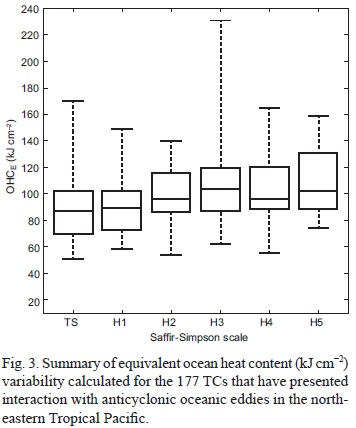
<body><![CDATA[<p align="justify"><font face="verdana" size="2">By applying the methodology described in this section to all named tropical cyclones that developed within the region between 90 and 145&deg; W (242 from 1993 to 2009) we found that 177 of those cyclones (73%) presented interaction with an area of OHCe enhanced by the presence of anticyclonic oceanic eddies. This kind of interaction was found in all of</font> <font face="verdana" size="2">the 17 analyzed seasons. Note that in 13 of those 17 seasons, the number of TCs that interacted with an anticyclonic oceanic eddy exceeds the number of TCs with no interaction.</font></p>  	    <p align="justify"><font face="verdana" size="2"><a href="#f3">Figure 3</a> presents a summary of the basic statistics of the maximum value of OHC<sub>E</sub> found by the 177 TCs that experienced an interaction with anticyclonic oceanic eddies, categorizing them by its Saffir&#45;Simpson intensity scale. As expected, we found that the larger intensities are related with larger values of OHC<sub>E</sub>. Cat&#45;3 hurricanes presented the larger outlier case in this subset of storms (231.29 kJ cm<sup>&#45;2</sup> ), related with hurricane Alma (May 24 to June 1, 2002).</font></p>     <p align="center"><a name="f3"></a></p> 	    <p align="center"><img src="/img/revistas/atm/v28n1/a3f3.jpg"></p>  	    <p align="justify"><font face="verdana" size="2">When considering only major hurricanes (categories 3, 4 and 5) we found that:</font></p>  	    <p align="justify"><font face="verdana" size="2">i.&nbsp;The total number of major hurricanes observed during the analyzed period was 61.</font></p>  	    <p align="justify"><font face="verdana" size="2">ii.&nbsp;Fifty five (90%) of them had experienced an interaction with an area of OHC<sub>E</sub> enhanced by the presence of anticyclonic oceanic eddies.</font></p>  	    <p align="justify">&nbsp;</p> 	    <p align="justify"><font face="verdana" size="2"><b>5. Rapid and explosive deepening tropical cyclones</b></font></p>      <p align="justify"><font face="verdana" size="2">The minimum sea level central pressure reported on the NHC best track dataset at a 6&#45;h interval was</font> <font face="verdana" size="2">used to identify tropical cyclones that experienced rapid deepening (RD) or explosive deepening (ED) in the northeastern Tropical Pacific between 1993 and 2009. The deepening rate <i>(dp/dt)</i> was calculated using forward differences for every time step, for each named tropical cyclone in the selected period. TCs with a deepening rate equal or lower than &#45;1.75 hPa/h (or &#45;42 hPa during 24 h) were classified as RD and TCs with deepening rates equal or lower than &#45;2.5 hPa/h for at least 12 h and/or equal or lower than &#45;5 hPa/h for at least 6 h were classified as ED. As an example, <a href="#f4">Figure 4</a> shows the evolution of the central pressure and the deepening rate calculated for hurricane Elida (<a href="#f4">Fig. 4a</a>) in 2002 and for hurricane Linda in 1997 (<a href="#f4">Fig. 4b</a>).</font></p> 	    ]]></body>
<body><![CDATA[<p align="center"><a name="f4"></a></p> 	    <p align="center"><img src="/img/revistas/atm/v28n1/a3f4.jpg"></p>  	    <p align="justify"><font face="verdana" size="2">Forty&#45;three of the 242 tropical cyclones analyzed in the period 1993&#45;2009 (17.7%), reached the RD criteria and eight (3.3%) the ED criteria (<a href="#f5">Fig. 5</a>). Sixteen out of the 17 seasons analyzed had at least one tropical cyclone that reached one of the deepening criteria. The only season that did not have any tropical cyclone experiencing RD or ED was 1999, which together with 1996 are the most inactive seasons in the analyzed record (when only nine cyclones developed for each season). <a href="#t2">Table II</a> shows a summary of the characteristics of tropical cyclones that underwent ED; note that all of them reached the category of major hurricanes.</font></p> 	    <p align="center"><a name="f5"></a></p> 	    <p align="center"><img src="/img/revistas/atm/v28n1/a3f5.jpg"></p> 	    <p align="center"><a name="t2"></a></p> 	    <p align="center"><img src="/img/revistas/atm/v28n1/a3t2.jpg"></p>  	    <p align="justify">&nbsp;</p> 	    <p align="justify"><font face="verdana" size="2"><b>6. Assessment of atmospheric environmental parameters</b></font></p>      <p align="justify"><font face="verdana" size="2">Inspired on the environmental parameters originally described by Gray (1975) as cyclogenesis precursors, we calculated the following parameters for analysis:</font></p>  	    ]]></body>
<body><![CDATA[<p align="justify"><font face="verdana" size="2">1.&nbsp;Vertical shear of the horizontal wind between the lower (850 hPa) and upper troposphere (200 hPa).</font></p>  	    <p align="justify"><font face="verdana" size="2">2.&nbsp;Middle troposphere relative humidity (550 hPa).</font></p>  	    <p align="justify"><font face="verdana" size="2">3.&nbsp;Vertically integrated relative humidity (from 550</font> <font face="verdana" size="2">to 1000 hPa).</font></p>  	    <p align="justify"><font face="verdana" size="2">These parameters were determined from the publicly&#45;available NARR dataset with a horizontal grid spacing of 32 km and a time spacing of 3 h, in 29 vertical levels (Mesinger <i>et al.</i>, 2005). The vertical profile of the relative humidity (from 550 to 1000 hPa) was compared with a reference value of 75% in order to estimate its anomaly. This value was selected</font> <font face="verdana" size="2">just below the value used by Emanuel <i>et al.</i> (1986) in their numerical experiments. As indicated in the example in <a href="#f6">Figure 6</a>, the positive values (humidity values larger than 75%) and negative values (humidity values smaller than 75%) were determined from the profiles every 6 h, during the lifetime of all RD/ ED hurricanes in the dataset. An example (Adolph, 2001) of this vertical profile and the integrated areas, representing relatively dry (light grey) and humid (dark grey) air in the environment surrounding the hurricane system is presented in <a href="#f6">Figure 6</a>. These two variables (dry and humid air) are reported in this study as percentage coverage of the indicated dry and humid areas in the figure.</font></p> 	    <p align="center"><a name="f6"></a></p> 	    <p align="center"><img src="/img/revistas/atm/v28n1/a3f6.jpg"></p>  	    <p align="justify"><font face="verdana" size="2">For all the described atmospheric environmental parameters, we calculated the time evolution of the mean value in a 4 by 4&deg; box (as in <i>Marin et al.,</i> 2009) centered at the current location of the cyclone, for all the RD/ED TC in the analyzed period.</font></p>  	    <p align="justify"><font face="verdana" size="2"><a href="#f7">Figure 7</a> shows the time series for all the environmental parameters described in this section for hurricane John (2006). It also shows the time series for central pressure (from the best track dataset) and for OHC<sub>E</sub> and SSHA derived as described in section 4. Note that all the atmospheric parameters were favorable in this case: wind shear in the order of 11 ms<sup>&#45;1</sup>; relative humidity at 550 hPa close to 84% during the entire lifetime of the hurricane; vertically integrated humid air values around 32% (near 32% of the humid area presented a vertical profile larger than 75% of relative humidity &#91;RH&#93;); and dry air values close to zero most of the time (no presence of air with RH smaller than 75% along the vertical profile). The OHC<sub>E</sub> values (<a href="#f7">Fig. 7f</a>) were around 120 kJ cm<sup>&#45;2</sup>. Each environmental parameter, both atmospheric and oceanic, was normalized to the highest value presented in all the analyzed RD and ED cyclones</font> <font face="verdana" size="2">of the dataset in order to compare different cases. A summary of those values is presented in <a href="/img/revistas/atm/v28n1/a3t3.jpg" target="_blank">Table III</a>.</font></p> 	    <p align="center"><a name="f7"></a></p> 	    <p align="center"><img src="/img/revistas/atm/v28n1/a3f7.jpg"></p>  	    ]]></body>
<body><![CDATA[<p align="justify">&nbsp;</p> 	    <p align="justify"><font face="verdana" size="2"><b>7. Relationship between the rapid deepening of tropical cyclones and anticyclonic oceanic eddies</b></font></p>      <p align="justify"><font face="verdana" size="2">So far we have separately analyzed the interaction of TCs with anticyclonic oceanic eddies in the northeastern Tropical Pacific (section 4) and the fraction</font> <font face="verdana" size="2">of TCs in the basin that underwent RD or ED during the same period (section 5). In this section we analyze the atmospheric and oceanographic environmental context in which the RD and/or ED occurred, in order to understand the role of anticyclonic oceanic eddies in the evolution.</font></p>  	    <p align="justify"><font face="verdana" size="2">As an example, we present here the detailed description of the atmospheric and oceanographic environmental conditions during the lifetime of hurricane Linda (1997), which experienced explosive deepening. Immediately following we generalize the discussion in terms of the statistics for all the</font> <font face="verdana" size="2">analyzed RD/ED TCs.</font></p>  	    <p align="justify"><font face="verdana" size="2"><i>7.1 Hurricane Linda (1997)</i></font></p>  	    <p align="justify"><font face="verdana" size="2">Hurricane Linda originated from an easterly wave observed in the radiosonde data from Dakar, Senegal, in the west coast of Africa on August 24, 1997 (Lawrence, 1999). The wave was tracked across the Atlantic and the Caribbean Sea in satellite imagery by</font> <font face="verdana" size="2">the NHC. Increased cloudiness and convection off the Pacific coast of Panama on September 6, 1997 was likely associated with that wave. Evidence of a poorly defined cloud system center within a broad tropical disturbance appeared in satellite imagery early on September 9. The region presented very high OHC<sub>E</sub> linked to the presence of several anticyclonic oceanic eddies that had formed along the coast and began to move westward. A banded cloud pattern emerged, and the NHC indicated that a tropical depression formed from the disturbance around 12:00 UTC on September 9, 1997 at about 740 km south of Manzanillo, Mexico. The tropical cyclone moved northwestward at 2.5 to 5 ms<sup>&#45;1</sup>, partly in response to a mid&#45; to upper&#45;level low in the vicinity of southern Baja California. Deep convective banding increased and the depression strengthened into tropical storm Linda at 00:00 UTC on September 10, 1997 with maximum winds of 18 ms<sup>&#45;1</sup> and minimum central pressure of 1005 hPa.</font>	</p>     <p align="justify"><font face="verdana" size="2">The complete path of Linda is shown in <a href="#f8">Figure 8a</a>, combined with the spatial distribution of OHC<sub>E</sub> for 12:00 UTC on September 11, 1997. Since 06:00 UTC on this same day, the deepening rate reached values close to the ED threshold (2.25 hPa/h) and was maintained for 12 h. Subsequently, at 18:00 UTC on September 11, 1997 Linda experienced an episode of ED (with an average deepening rate of 4.5 hPa/h for 12 h). During those 24 h (indicated in <a href="#f8">Fig. 8a</a> by the green circles along Linda's track and in <a href="#f8">Fig. 8b</a>, c between the black vertical lines) minimum central pressure decreased from 974 to 902 hPa and the wind speed increased from 41.1 to 82.3 ms<sup>&#45;1</sup> turning Linda into a category 5 hurricane on the Saffir&#45;Simpson scale and becoming the strongest hurricane ever recorded in the northeastern Tropical Pacific.</font></p> 	    <p align="center"><a name="f8"></a></p> 	    <p align="center"><img src="/img/revistas/atm/v28n1/a3f8.jpg"></p>  	    <p align="justify"><font face="verdana" size="2">As shown in <a href="#f8">Figure 8c</a>, the atmospheric conditions were very favorable for intensification, with weak vertical shear (around 9.8 ms<sup>&#45;1</sup>, during the first 72 h), very high values of relative humidity in the middle troposphere (around 83%), with humid air penetration along the entire column (around 40%) and almost without any dry air intrusion in the vertical profile (around 0.11%). Linda formed</font> <font face="verdana" size="2">in an area with high OHC<sub>E</sub> (around 50 kJ cm<sup>&#45;2</sup>) and its trajectory passed through an area with increasingly high OHC<sub>E</sub>, during the first 36 h (reaching the maximum value of 154.35 kJ cm<sup>&#45;2</sup>). Its effect is reflected in the near exponential growth of the wind speed time series, and the rapid decrease of the central pressure values, as shown in <a href="#f8">Figure 8b</a>. The ED occurs immediately after Linda's trajectory passed over the maximum values of OHC<sub>E</sub>, in an area influenced by the presence of anticyclonic oceanic eddies. It is important to note that the values of OHCE during the evolution of Linda are the highest encountered in the analyzed TCs that reached RD or ED in the dataset (1993&#45;2009). The weakening of Linda coincides with the decline of the OHCE and this factor is clearly decisive, since it never made landfall. Although atmospheric conditions were very favorable for the remainder of the lifetime of the hurricane, even slightly improving (since the RH at 550 hPa increased up to 90%, the humidity along the vertical column increased to 80% &#91;also the highest values on the RD/ED dataset&#93; and the shear dropped up to 5 ms<sup>&#45;1</sup>) the hurricane weakened until dissipating.</font>	</p> 	    ]]></body>
<body><![CDATA[<p align="justify"><font face="verdana" size="2"><i>7.2 Overall statistical analysis</i> </font></p> 	    <p align="justify"><font face="verdana" size="2">When analyzing the environmental parameters for the 51 TCs that experienced RD or ED, we found that in 38 cases (74%) the RD/ED was directly related with TC interaction with anticyclonic oceanic eddies; interactions had a mean duration of 30 h</font> <font face="verdana" size="2">and an OHC<sub>E</sub> mean value of 86 kJ cm<sup>&#45;2</sup>. The mean value of SSHA was 0.05 m and the mean values for atmospheric parameters were as follows: wind shear, 9.5 ms<sup>&#45;</sup><sup>1</sup>; relative humidity at 550 hPa, 80%; vertically integrated value of humid air, 30%; and vertically integrated value of dry air, 1.6%.</font>	</p> 	    <p align="justify"><font face="verdana" size="2">Those 38 TCs mentioned in the previous paragraph that had experienced RD/ED after their interaction with anticyclonic oceanic eddies, were further analyzed to determine the role of such an interaction in contributing towards reaching the category of major hurricane. The results indicate that in 86% of the cases (33 out of 38) the system intensified after the interaction to become a major hurricane (8 H&#45;5, 20 H&#45;4 and 5 H&#45;3).</font></p>  	    <p align="justify">&nbsp;</p> 	    <p align="justify"><font face="verdana" size="2"><b>8. Concluding remarks</b></font></p>      <p align="justify"><font face="verdana" size="2">Temporal and spatial variability of the oceanic heat content in the northeastern Tropical Pacific, during the months that comprise the tropical cyclone season for this basin, appears to be closely linked to the presence of anticyclonic oceanic eddies. While the oceanographic community has not yet reached a consensus on the topic, there are a couple of hypotheses for their generation in this basin. Such eddies can be generated in the Gulf of Tehuantepec and the Gulf of Papagayo by the effect of the wind, a forcing mechanism particularly important during the winter months but that can be present also during midsummer. Alternatively, such eddies can be formed by the arrival of downwelling Kelvin coastally&#45;trapped waves that can spawn anticyclonic oceanic eddies during their transit through different regions of the Pacific Coast, from the Gulf of Papagayo to the Gulf of Tehuantepec and northward along the coast of the state of Guerrero. Regardless of the particular generation mechanism, such eddies are often observed in the basin during the months when tropical cyclones form.</font></p>  	    <p align="justify"><font face="verdana" size="2">In this study we show that in the northeastern Tropical Pacific the interaction between tropical cyclones and anticyclonic oceanic eddies is very common, and we can expect to observe it in most of the tropical cyclones that are generated every single season. We also show that a large majority of the major hurricanes observed in the basin between 1993 and 2009 presented interactions with anticyclonic oceanic eddies.</font></p>  	    <p align="justify"><font face="verdana" size="2">However, such interaction is not a sufficient condition to induce rapid or explosive deepening of tropical cyclones in the basin, nor is it a sufficient condition to produce major hurricanes. Nevertheless, most of the hurricanes that reached some of the deepening criteria (86%), reached the category of major hurricane after interacting with areas with high values of OHC. Furthermore, some hurricanes that did not experience rapid deepening also intensified</font> <font face="verdana" size="2">to the category of major hurricane after interacting with areas with high OHC.</font></p>  	    <p align="justify"><font face="verdana" size="2">It is possible to generalize that anticyclonic oceanic eddies generated in the gulfs of Tehuantepec and Papagayo have a significant impact on the RD and overall intensification of tropical cyclones that develop during July and August in the basin. During September and October, dominant trajectories of tropical cyclones facilitate the interaction with areas of high OHC locally increased by the presence of anticyclonic oceanic eddies generated along the coasts of the northeastern Tropical Pacific by the presence of downwelling Kelvin coastally&#45;trapped waves or other documented physical processes.</font></p>  	    <p align="justify"><font face="verdana" size="2">Most of the analyzed cases that met the criteria of either RD or ED not only showed interaction with areas of high OHC, but they also showed favorable atmospheric conditions such as low values of wind shear, high values of relative humidity in the mid&#45;troposphere (550 hPa), and high values of vertically&#45;integrated humidity (from 550 to 1000 hPa).</font></p>  	    ]]></body>
<body><![CDATA[<p align="justify"><font face="verdana" size="2">The heat exchange between the ocean and the hurricane, as it moves through a region with high OHC, locally increased by the presence of anticyclonic oceanic eddies, is not only the most important process in the northeastern Tropical Pacific for a hurricane to reach the rapid or explosive deepening criteria, but also is a key factor for the intensification of tropical cyclones in the basin. Also note that the presence of dry air vertically integrated (with less than 75% relative humidity values) plays a very important role as an inhibitor for deepening of tropical cyclones in the region, confirming the results reported by Marin <i>et al.</i> (2009) for a few case studies.</font></p>  	    <p align="justify"><font face="verdana" size="2">The change of tropical cyclone intensity is a complex, nonlinear process that often involves several competing or synergistic factors. However, the results presented here strongly suggest that the variability of the OHC, partly associated with the presence of anticyclonic oceanic eddies and likely with downwelling Kelvin coastally&#45;trapped waves under a favorable atmospheric environment, significantly impact the physical processes controlling cyclogenesis, maintenance and intensity changes of tropical cyclones in the northeastern Tropical Pacific.</font></p> 	    <p align="justify">&nbsp;</p>  	    <p align="justify"><font face="verdana" size="2"><b>Acknowledgements</b></font></p>  	    <p align="justify"><font face="verdana" size="2">This work was carried out with the aid of the Inter&#45;American Institute for Global Change Research (IAI, Grant</font> <font face="verdana" size="2">CRN II&#45;048), which is supported by the U.S. National Science Foundation (Grant GEO&#45;0452325). This work was also supported by a scholarship from CONACyT for FO. The authors want to thank Benjamin Jaimes, Jorge Zavala and Luis Zamudio for valuable reviews and comments to previous versions of this paper.</font></p> 	    <p align="justify">&nbsp;</p>  	    <p align="justify"><font face="verdana" size="2"><b>References</b></font></p>  	    <!-- ref --><p align="justify"><font face="verdana" size="2">Chang S. and R. Anthes, 1978. Numerical simulations of the ocean's nonlinear baroclinic response to translating hurricanes. <i>J. Phys. Oceanogr.</i> <b>8,</b> 468&#45;480.    &nbsp;&nbsp;&nbsp;&nbsp;&nbsp;&nbsp;&nbsp;&nbsp;[&#160;<a href="javascript:void(0);" onclick="javascript: window.open('/scielo.php?script=sci_nlinks&ref=1309482&pid=S0187-6236201500010000300001&lng=','','width=640,height=500,resizable=yes,scrollbars=1,menubar=yes,');">Links</a>&#160;]<!-- end-ref --></font></p>  	    <!-- ref --><p align="justify"><font face="verdana" size="2">Chelton D. B., M. G. Schlax, R. M. Samelson and R. A. de Szoeke, 2007. Global observations of large oceanic eddies. <i>Geophys. Res. Lett.</i> <b>34,</b> L15606, doi:10.1029/2007GL030812.    &nbsp;&nbsp;&nbsp;&nbsp;&nbsp;&nbsp;&nbsp;&nbsp;[&#160;<a href="javascript:void(0);" onclick="javascript: window.open('/scielo.php?script=sci_nlinks&ref=1309484&pid=S0187-6236201500010000300002&lng=','','width=640,height=500,resizable=yes,scrollbars=1,menubar=yes,');">Links</a>&#160;]<!-- end-ref --></font></p>  	    <!-- ref --><p align="justify"><font face="verdana" size="2">Chelton, D. B., M. G. Schlax and R. M Samelson, 2011. Global observations of nonlinear mesoscale eddies. <i>Prog. Oceanogr.</i> <b>91,</b> 167&#45;216.    &nbsp;&nbsp;&nbsp;&nbsp;&nbsp;&nbsp;&nbsp;&nbsp;[&#160;<a href="javascript:void(0);" onclick="javascript: window.open('/scielo.php?script=sci_nlinks&ref=1309486&pid=S0187-6236201500010000300003&lng=','','width=640,height=500,resizable=yes,scrollbars=1,menubar=yes,');">Links</a>&#160;]<!-- end-ref --></font></p>  	    <!-- ref --><p align="justify"><font face="verdana" size="2">Davis M. A. S., G. M. Brown and P. Leftwich, 1984. A tropical cyclone data tape for the eastern and central North Pacific basins, 1949&#45;1983: Contents, limitations and uses. NOAA Technical Memorandum NWS NHC</font> <font face="verdana" size="2">25, Coral Gables, Florida.    &nbsp;&nbsp;&nbsp;&nbsp;&nbsp;&nbsp;&nbsp;&nbsp;[&#160;<a href="javascript:void(0);" onclick="javascript: window.open('/scielo.php?script=sci_nlinks&ref=1309488&pid=S0187-6236201500010000300004&lng=','','width=640,height=500,resizable=yes,scrollbars=1,menubar=yes,');">Links</a>&#160;]<!-- end-ref --></font></p>  	    <!-- ref --><p align="justify"><font face="verdana" size="2">Emanuel K. A., 1986. An air&#45;sea interaction theory for tropical cyclones. Part 1: Steady&#45;state maintenance. <i>J. Atmos. Sci.</i> <b>43,</b> 585&#45;605.    &nbsp;&nbsp;&nbsp;&nbsp;&nbsp;&nbsp;&nbsp;&nbsp;[&#160;<a href="javascript:void(0);" onclick="javascript: window.open('/scielo.php?script=sci_nlinks&ref=1309490&pid=S0187-6236201500010000300005&lng=','','width=640,height=500,resizable=yes,scrollbars=1,menubar=yes,');">Links</a>&#160;]<!-- end-ref --></font></p>  	    <!-- ref --><p align="justify"><font face="verdana" size="2">Fisher E. L., 1958. Hurricanes and the sea&#45;surface temperature field. <i>J. Meteor.</i> <b>15,</b> 328&#45;333.    &nbsp;&nbsp;&nbsp;&nbsp;&nbsp;&nbsp;&nbsp;&nbsp;[&#160;<a href="javascript:void(0);" onclick="javascript: window.open('/scielo.php?script=sci_nlinks&ref=1309492&pid=S0187-6236201500010000300006&lng=','','width=640,height=500,resizable=yes,scrollbars=1,menubar=yes,');">Links</a>&#160;]<!-- end-ref --></font></p>  	    <!-- ref --><p align="justify"><font face="verdana" size="2">Goni G. J., S. Kamholz, S. L. Garzoli and D. B. Olson, 1996. Dynamics of the Brazil/Malvinas confluence based on inverted echo sounders and altimetry. <i>J. Geophys. Res.</i> <b>95,</b> 22103&#45;22120.    &nbsp;&nbsp;&nbsp;&nbsp;&nbsp;&nbsp;&nbsp;&nbsp;[&#160;<a href="javascript:void(0);" onclick="javascript: window.open('/scielo.php?script=sci_nlinks&ref=1309494&pid=S0187-6236201500010000300007&lng=','','width=640,height=500,resizable=yes,scrollbars=1,menubar=yes,');">Links</a>&#160;]<!-- end-ref --></font></p>  	    <!-- ref --><p align="justify"><font face="verdana" size="2">Goni G. J. and J. Trinanes, 2003. Ocean thermal structure monitoring could aid in the intensity forecast of tropical cyclones. <i>EOS T. Am. Geophys. Un.</i> <b>85,</b> doi:10.1029/2003EO510001.    &nbsp;&nbsp;&nbsp;&nbsp;&nbsp;&nbsp;&nbsp;&nbsp;[&#160;<a href="javascript:void(0);" onclick="javascript: window.open('/scielo.php?script=sci_nlinks&ref=1309496&pid=S0187-6236201500010000300008&lng=','','width=640,height=500,resizable=yes,scrollbars=1,menubar=yes,');">Links</a>&#160;]<!-- end-ref --></font></p>  	    <!-- ref --><p align="justify"><font face="verdana" size="2">Gray W. M., 1975. Tropical cyclone genesis. Department of Atmospheric Science Paper No. 234, Colorado State University, Fort Collins, Co.    &nbsp;&nbsp;&nbsp;&nbsp;&nbsp;&nbsp;&nbsp;&nbsp;[&#160;<a href="javascript:void(0);" onclick="javascript: window.open('/scielo.php?script=sci_nlinks&ref=1309498&pid=S0187-6236201500010000300009&lng=','','width=640,height=500,resizable=yes,scrollbars=1,menubar=yes,');">Links</a>&#160;]<!-- end-ref --></font></p>  	    <!-- ref --><p align="justify"><font face="verdana" size="2">Hong X., S. W. Chang, S. Raman, L. K. Shay and R. Hodur, 2000. The interaction between hurricane Opal (1995) and a warm core ring in the Gulf of Mexico. <i>Mon. Wea. Rev.</i> <b>128,</b> 1347&#45;1365.    &nbsp;&nbsp;&nbsp;&nbsp;&nbsp;&nbsp;&nbsp;&nbsp;[&#160;<a href="javascript:void(0);" onclick="javascript: window.open('/scielo.php?script=sci_nlinks&ref=1309500&pid=S0187-6236201500010000300010&lng=','','width=640,height=500,resizable=yes,scrollbars=1,menubar=yes,');">Links</a>&#160;]<!-- end-ref --></font></p>  	    <!-- ref --><p align="justify"><font face="verdana" size="2">Jaimes B. and L. K. Shay, 2009. Mixed layer cooling in mesoscale oceanic eddies during hurricanes Katrina and Rita. <i>Mon. Wea. Rev.</i> <b>137,</b> 4188&#45;4207.    &nbsp;&nbsp;&nbsp;&nbsp;&nbsp;&nbsp;&nbsp;&nbsp;[&#160;<a href="javascript:void(0);" onclick="javascript: window.open('/scielo.php?script=sci_nlinks&ref=1309502&pid=S0187-6236201500010000300011&lng=','','width=640,height=500,resizable=yes,scrollbars=1,menubar=yes,');">Links</a>&#160;]<!-- end-ref --></font></p>  	    <!-- ref --><p align="justify"><font face="verdana" size="2">Kessler W. S., 2006. The circulation of the eastern Tropical Pacific: A review. <i>Prog. Oceanogr.</i> <b>69,</b> 181&#45;217, doi:10.1016/j.pocean.2006.03.009.    &nbsp;&nbsp;&nbsp;&nbsp;&nbsp;&nbsp;&nbsp;&nbsp;[&#160;<a href="javascript:void(0);" onclick="javascript: window.open('/scielo.php?script=sci_nlinks&ref=1309504&pid=S0187-6236201500010000300012&lng=','','width=640,height=500,resizable=yes,scrollbars=1,menubar=yes,');">Links</a>&#160;]<!-- end-ref --></font></p>  	    <!-- ref --><p align="justify"><font face="verdana" size="2">Kurczyn J. A., E. Beier, M. F. Lavin and A. Chaigneau, 2012. Mesoscale eddies in the northeastern Pacific tropical&#45;subtropical transition zone: Statistical characterization from satellite altimetry. <i>J. Geophys. Res.</i> <b>117,</b> C10021, doi:10.1029/2012JC007970.    &nbsp;&nbsp;&nbsp;&nbsp;&nbsp;&nbsp;&nbsp;&nbsp;[&#160;<a href="javascript:void(0);" onclick="javascript: window.open('/scielo.php?script=sci_nlinks&ref=1309506&pid=S0187-6236201500010000300013&lng=','','width=640,height=500,resizable=yes,scrollbars=1,menubar=yes,');">Links</a>&#160;]<!-- end-ref --></font></p>  	    <!-- ref --><p align="justify"><font face="verdana" size="2">Kundu P. K., 1990. <i>Fluid mechanics.</i> Academic Press International, 253 pp.    &nbsp;&nbsp;&nbsp;&nbsp;&nbsp;&nbsp;&nbsp;&nbsp;[&#160;<a href="javascript:void(0);" onclick="javascript: window.open('/scielo.php?script=sci_nlinks&ref=1309508&pid=S0187-6236201500010000300014&lng=','','width=640,height=500,resizable=yes,scrollbars=1,menubar=yes,');">Links</a>&#160;]<!-- end-ref --></font></p>  	    <!-- ref --><p align="justify"><font face="verdana" size="2">Lawrence M. B., 1999. Eastern North Pacific hurricane season of 1997. <i>Mon. Wea. Rev.</i> <b>127,</b> 2440&#45;2454.    &nbsp;&nbsp;&nbsp;&nbsp;&nbsp;&nbsp;&nbsp;&nbsp;[&#160;<a href="javascript:void(0);" onclick="javascript: window.open('/scielo.php?script=sci_nlinks&ref=1309510&pid=S0187-6236201500010000300015&lng=','','width=640,height=500,resizable=yes,scrollbars=1,menubar=yes,');">Links</a>&#160;]<!-- end-ref --></font></p>  	    <!-- ref --><p align="justify"><font face="verdana" size="2">Leipper D. F., 1967. Observed oceanic conditions and hurricane Hilda, 1964. <i>J. Atmos. Sci.</i> <b>24,</b> 182&#45;196.    &nbsp;&nbsp;&nbsp;&nbsp;&nbsp;&nbsp;&nbsp;&nbsp;[&#160;<a href="javascript:void(0);" onclick="javascript: window.open('/scielo.php?script=sci_nlinks&ref=1309512&pid=S0187-6236201500010000300016&lng=','','width=640,height=500,resizable=yes,scrollbars=1,menubar=yes,');">Links</a>&#160;]<!-- end-ref --></font></p>  	    <!-- ref --><p align="justify"><font face="verdana" size="2">Leipper D. and D. Volgenau, 1972. Hurricane heat potential of the Gulf of Mexico. <i>J. Phys. Oceanogr.</i> <b>2,</b></font> <font face="verdana" size="2">218&#45;224.    &nbsp;&nbsp;&nbsp;&nbsp;&nbsp;&nbsp;&nbsp;&nbsp;[&#160;<a href="javascript:void(0);" onclick="javascript: window.open('/scielo.php?script=sci_nlinks&ref=1309514&pid=S0187-6236201500010000300017&lng=','','width=640,height=500,resizable=yes,scrollbars=1,menubar=yes,');">Links</a>&#160;]<!-- end-ref --></font></p>  	    <!-- ref --><p align="justify"><font face="verdana" size="2">Lin I.&#45;I., C. C. Wu, K. A. Emanuel, I. H. Lee, C. R. Wu and I. F. Pun, 2005. The interaction of supertyphoon Maemi (2003) with a warm ocean eddy. <i>Mon. Wea. Rev.</i> <b>133,</b> 2635&#45;2649.    &nbsp;&nbsp;&nbsp;&nbsp;&nbsp;&nbsp;&nbsp;&nbsp;[&#160;<a href="javascript:void(0);" onclick="javascript: window.open('/scielo.php?script=sci_nlinks&ref=1309516&pid=S0187-6236201500010000300018&lng=','','width=640,height=500,resizable=yes,scrollbars=1,menubar=yes,');">Links</a>&#160;]<!-- end-ref --></font></p>  	    <!-- ref --><p align="justify"><font face="verdana" size="2">Mainelli M. M., 2000. On the role of the upper ocean in tropical cyclone intensity change. M.Sc. Thesis, University of Miami, 73 pp.    &nbsp;&nbsp;&nbsp;&nbsp;&nbsp;&nbsp;&nbsp;&nbsp;[&#160;<a href="javascript:void(0);" onclick="javascript: window.open('/scielo.php?script=sci_nlinks&ref=1309518&pid=S0187-6236201500010000300019&lng=','','width=640,height=500,resizable=yes,scrollbars=1,menubar=yes,');">Links</a>&#160;]<!-- end-ref --></font></p>  	    <!-- ref --><p align="justify"><font face="verdana" size="2">Mar&iacute;n J., D. Raymond and G. Raga, 2009. Intensification of tropical cyclones in the GFS model. <i>Atmos. Chem. Phys.</i> <b>9,</b> 1407&#45;1417.    &nbsp;&nbsp;&nbsp;&nbsp;&nbsp;&nbsp;&nbsp;&nbsp;[&#160;<a href="javascript:void(0);" onclick="javascript: window.open('/scielo.php?script=sci_nlinks&ref=1309520&pid=S0187-6236201500010000300020&lng=','','width=640,height=500,resizable=yes,scrollbars=1,menubar=yes,');">Links</a>&#160;]<!-- end-ref --></font></p>  	    <!-- ref --><p align="justify"><font face="verdana" size="2">Mesinger F., G. DiMego, E. Kalnay, K. Mitchell, P. C. Shafran, W. Ebisuzaky, D. Jovic, J. Woollen, E. Rogers, E. H. Berbery, M. B. Ek, Y. Fan, R. Grumbine, W. Higgins, H. Li, Y. Lin, G. Manikin, D. Parrish and W. Shei, 2005. North American Regional Reanalysis. <i>B. Am. Meteorol. Soc.</i> <b>87,</b> 343&#45;360.    &nbsp;&nbsp;&nbsp;&nbsp;&nbsp;&nbsp;&nbsp;&nbsp;[&#160;<a href="javascript:void(0);" onclick="javascript: window.open('/scielo.php?script=sci_nlinks&ref=1309522&pid=S0187-6236201500010000300021&lng=','','width=640,height=500,resizable=yes,scrollbars=1,menubar=yes,');">Links</a>&#160;]<!-- end-ref --></font></p>  	    <!-- ref --><p align="justify"><font face="verdana" size="2">Miller B. I., 1958. On the maximum intensity of hurricanes. <i>J. Meteor.</i> <b>15,</b> 184&#45;195.    &nbsp;&nbsp;&nbsp;&nbsp;&nbsp;&nbsp;&nbsp;&nbsp;[&#160;<a href="javascript:void(0);" onclick="javascript: window.open('/scielo.php?script=sci_nlinks&ref=1309524&pid=S0187-6236201500010000300022&lng=','','width=640,height=500,resizable=yes,scrollbars=1,menubar=yes,');">Links</a>&#160;]<!-- end-ref --></font></p>  	    <!-- ref --><p align="justify"><font face="verdana" size="2">O'Brien J. J. and R. O. Reid, 1967. The non&#45;linear response of a two&#45;layer ocean to a stationary axially symmetric hurricane: Part I. Upwelling induced by momentum transfer. <i>J. Atmos. Sci.</i> <b>24,</b> 205&#45;215</font>.    &nbsp;&nbsp;&nbsp;&nbsp;&nbsp;&nbsp;&nbsp;&nbsp;[&#160;<a href="javascript:void(0);" onclick="javascript: window.open('/scielo.php?script=sci_nlinks&ref=1309526&pid=S0187-6236201500010000300023&lng=','','width=640,height=500,resizable=yes,scrollbars=1,menubar=yes,');">Links</a>&#160;]<!-- end-ref --></p>  	    <!-- ref --><p align="justify"><font face="verdana" size="2">Palacios D. M. and S. J. Bograd, 2005. A census of Tehuantepec and Papagayo eddies in the northeastern Tropical Pacific. <i>Geophys. Res. Lett.</i> <b>32,</b> L23606, doi:10.1029/2005GL024324.    &nbsp;&nbsp;&nbsp;&nbsp;&nbsp;&nbsp;&nbsp;&nbsp;[&#160;<a href="javascript:void(0);" onclick="javascript: window.open('/scielo.php?script=sci_nlinks&ref=1309528&pid=S0187-6236201500010000300024&lng=','','width=640,height=500,resizable=yes,scrollbars=1,menubar=yes,');">Links</a>&#160;]<!-- end-ref --></font></p>  	    <!-- ref --><p align="justify"><font face="verdana" size="2">Palmen E., 1948. On the formation and structure of tropical cyclones. <i>Geophysica</i> <b>3,</b> 2638.    &nbsp;&nbsp;&nbsp;&nbsp;&nbsp;&nbsp;&nbsp;&nbsp;[&#160;<a href="javascript:void(0);" onclick="javascript: window.open('/scielo.php?script=sci_nlinks&ref=1309530&pid=S0187-6236201500010000300025&lng=','','width=640,height=500,resizable=yes,scrollbars=1,menubar=yes,');">Links</a>&#160;]<!-- end-ref --></font></p>  	    <!-- ref --><p align="justify"><font face="verdana" size="2">Pantoja D. A., S. G. Marinone, A. Par&eacute;s&#45;Sierra and F. G&oacute;mez&#45;Valdivia, 2012. Numerical modeling of seasonal and mesoscale hydrography and circulation in the Mexican Central Pacific. <i>Cienc. Mar.</i></font> <font face="verdana" size="2"><b>38,</b> 363&#45;379.    &nbsp;&nbsp;&nbsp;&nbsp;&nbsp;&nbsp;&nbsp;&nbsp;[&#160;<a href="javascript:void(0);" onclick="javascript: window.open('/scielo.php?script=sci_nlinks&ref=1309532&pid=S0187-6236201500010000300026&lng=','','width=640,height=500,resizable=yes,scrollbars=1,menubar=yes,');">Links</a>&#160;]<!-- end-ref --></font></p>  	    <!-- ref --><p align="justify"><font face="verdana" size="2">Perlroth I., 1967. Hurricane behavior as related to oceanographic environmental conditions. <i>Tellus</i> <b>19,</b> 258&#45;268.    &nbsp;&nbsp;&nbsp;&nbsp;&nbsp;&nbsp;&nbsp;&nbsp;[&#160;<a href="javascript:void(0);" onclick="javascript: window.open('/scielo.php?script=sci_nlinks&ref=1309534&pid=S0187-6236201500010000300027&lng=','','width=640,height=500,resizable=yes,scrollbars=1,menubar=yes,');">Links</a>&#160;]<!-- end-ref --></font>	</p> 	    <!-- ref --><p align="justify"><font face="verdana" size="2">Reynolds R. W., N. A. Rayner, T. M. Smith, D. C. Stokes and W. Wang, 2002. An improved in situ and satellite SST analysis for climate. <i>J. Climate</i> <b>15,</b> 1609&#45;1625.    &nbsp;&nbsp;&nbsp;&nbsp;&nbsp;&nbsp;&nbsp;&nbsp;[&#160;<a href="javascript:void(0);" onclick="javascript: window.open('/scielo.php?script=sci_nlinks&ref=1309536&pid=S0187-6236201500010000300028&lng=','','width=640,height=500,resizable=yes,scrollbars=1,menubar=yes,');">Links</a>&#160;]<!-- end-ref --></font></p>  	    <!-- ref --><p align="justify"><font face="verdana" size="2">Robinson A. R. (Ed.), 1983. <i>Eddies in marine sciences,</i> Springer, New York, 609 pp.    &nbsp;&nbsp;&nbsp;&nbsp;&nbsp;&nbsp;&nbsp;&nbsp;[&#160;<a href="javascript:void(0);" onclick="javascript: window.open('/scielo.php?script=sci_nlinks&ref=1309538&pid=S0187-6236201500010000300029&lng=','','width=640,height=500,resizable=yes,scrollbars=1,menubar=yes,');">Links</a>&#160;]<!-- end-ref --></font></p>  	    <!-- ref --><p align="justify"><font face="verdana" size="2">Shay L. K., G. J. Goni and P. G. Black, 2000. Effects of a warm oceanic feature on hurricane Opal. <i>Mon. Wea. Rev.</i> <b>128,</b> 1366&#45;1383.    &nbsp;&nbsp;&nbsp;&nbsp;&nbsp;&nbsp;&nbsp;&nbsp;[&#160;<a href="javascript:void(0);" onclick="javascript: window.open('/scielo.php?script=sci_nlinks&ref=1309540&pid=S0187-6236201500010000300030&lng=','','width=640,height=500,resizable=yes,scrollbars=1,menubar=yes,');">Links</a>&#160;]<!-- end-ref --></font></p>  	    <!-- ref --><p align="justify"><font face="verdana" size="2">Shay L. K. and J. K. Brewster, 2010. Oceanic heat content variability in the eastern Pacific Ocean for hurricane intensity forecasting. <i>Mon. Wea. Rev.</i> <b>138,</b> 2110&#45;2131.    &nbsp;&nbsp;&nbsp;&nbsp;&nbsp;&nbsp;&nbsp;&nbsp;[&#160;<a href="javascript:void(0);" onclick="javascript: window.open('/scielo.php?script=sci_nlinks&ref=1309542&pid=S0187-6236201500010000300031&lng=','','width=640,height=500,resizable=yes,scrollbars=1,menubar=yes,');">Links</a>&#160;]<!-- end-ref --></font></p>  	    <!-- ref --><p align="justify"><font face="verdana" size="2">Teague W. J., M. J. Carron and P. J. Hogan, 1990. A comparison between the Generalized Digital Environmental Model and Levitus climatologies. <i>J. Geophys. Res.</i> <b>95,</b> 71677183.    &nbsp;&nbsp;&nbsp;&nbsp;&nbsp;&nbsp;&nbsp;&nbsp;[&#160;<a href="javascript:void(0);" onclick="javascript: window.open('/scielo.php?script=sci_nlinks&ref=1309544&pid=S0187-6236201500010000300032&lng=','','width=640,height=500,resizable=yes,scrollbars=1,menubar=yes,');">Links</a>&#160;]<!-- end-ref --></font></p>  	    <!-- ref --><p align="justify"><font face="verdana" size="2">Zamudio L., A. P. Leonardi, S. D. Meyers and J. J. O'Brien, 2001. ENSO and eddies on the southwest coast of Mexico. <i>Geophys. Res. Lett.</i> <b>28,</b> 13&#45;16.    &nbsp;&nbsp;&nbsp;&nbsp;&nbsp;&nbsp;&nbsp;&nbsp;[&#160;<a href="javascript:void(0);" onclick="javascript: window.open('/scielo.php?script=sci_nlinks&ref=1309546&pid=S0187-6236201500010000300033&lng=','','width=640,height=500,resizable=yes,scrollbars=1,menubar=yes,');">Links</a>&#160;]<!-- end-ref --></font></p>  	    <!-- ref --><p align="justify"><font face="verdana" size="2">Zamudio L., H. E. Hurlburt, E. J. Metzger, S. L. Morey, J. J. O'Brien, C. E. Tilburg and J. Zavala&#45;Hidalgo, 2006. Interannual variability of Tehuantepec eddies. <i>J. Geophys. Res.</i> <b>111,</b> C05001, doi:10.1029/2005JC003182.    &nbsp;&nbsp;&nbsp;&nbsp;&nbsp;&nbsp;&nbsp;&nbsp;[&#160;<a href="javascript:void(0);" onclick="javascript: window.open('/scielo.php?script=sci_nlinks&ref=1309548&pid=S0187-6236201500010000300034&lng=','','width=640,height=500,resizable=yes,scrollbars=1,menubar=yes,');">Links</a>&#160;]<!-- end-ref --></font></p>  	    <!-- ref --><p align="justify"><font face="verdana" size="2">Zamudio L., H. E. Hurlburt, E. J. Metzger and C. E. Tilburg, 2007. Tropical wave&#45;induced oceanic eddies at Cabo Corrientes and the Mar&iacute;a Islands, Mexico. <i>J. Geophys. Res.</i> <b>112,</b> C05048, doi:10.1029/2006JC004018.    &nbsp;&nbsp;&nbsp;&nbsp;&nbsp;&nbsp;&nbsp;&nbsp;[&#160;<a href="javascript:void(0);" onclick="javascript: window.open('/scielo.php?script=sci_nlinks&ref=1309550&pid=S0187-6236201500010000300035&lng=','','width=640,height=500,resizable=yes,scrollbars=1,menubar=yes,');">Links</a>&#160;]<!-- end-ref --></font></p>  	    <!-- ref --><p align="justify"><font face="verdana" size="2">Zamudio L., P. Hogan and E. J. Metzger, 2008. Summer generation of the southern Gulf of California eddy train. <i>J. Geophys. Res.</i> <b>113,</b> C06020, doi:10.1029/</font><font face="verdana" size="2">2007JC004467.    &nbsp;&nbsp;&nbsp;&nbsp;&nbsp;&nbsp;&nbsp;&nbsp;[&#160;<a href="javascript:void(0);" onclick="javascript: window.open('/scielo.php?script=sci_nlinks&ref=1309552&pid=S0187-6236201500010000300036&lng=','','width=640,height=500,resizable=yes,scrollbars=1,menubar=yes,');">Links</a>&#160;]<!-- end-ref --></font></p>      ]]></body><back>
<ref-list>
<ref id="B1">
<nlm-citation citation-type="journal">
<person-group person-group-type="author">
<name>
<surname><![CDATA[Chang]]></surname>
<given-names><![CDATA[S.]]></given-names>
</name>
<name>
<surname><![CDATA[Anthes]]></surname>
<given-names><![CDATA[R.]]></given-names>
</name>
</person-group>
<article-title xml:lang="en"><![CDATA[Numerical simulations of the ocean's nonlinear baroclinic response to translating hurricanes]]></article-title>
<source><![CDATA[J. Phys. Oceanogr.]]></source>
<year>1978</year>
<volume>8</volume>
<page-range>468-480</page-range></nlm-citation>
</ref>
<ref id="B2">
<nlm-citation citation-type="journal">
<person-group person-group-type="author">
<name>
<surname><![CDATA[Chelton]]></surname>
<given-names><![CDATA[D. B.]]></given-names>
</name>
<name>
<surname><![CDATA[Schlax]]></surname>
<given-names><![CDATA[M. G.]]></given-names>
</name>
<name>
<surname><![CDATA[Samelson]]></surname>
<given-names><![CDATA[R. M.]]></given-names>
</name>
<name>
<surname><![CDATA[de Szoeke]]></surname>
<given-names><![CDATA[R. A.]]></given-names>
</name>
</person-group>
<article-title xml:lang="en"><![CDATA[Global observations of large oceanic eddies]]></article-title>
<source><![CDATA[Geophys. Res. Lett.]]></source>
<year>2007</year>
<volume>34</volume>
<numero>L15606</numero>
<issue>L15606</issue>
</nlm-citation>
</ref>
<ref id="B3">
<nlm-citation citation-type="journal">
<person-group person-group-type="author">
<name>
<surname><![CDATA[Chelton]]></surname>
<given-names><![CDATA[D. B.]]></given-names>
</name>
<name>
<surname><![CDATA[Schlax]]></surname>
<given-names><![CDATA[M. G.]]></given-names>
</name>
<name>
<surname><![CDATA[Samelson]]></surname>
<given-names><![CDATA[R. M]]></given-names>
</name>
</person-group>
<article-title xml:lang="en"><![CDATA[Global observations of nonlinear mesoscale eddies]]></article-title>
<source><![CDATA[Prog. Oceanogr.]]></source>
<year>2011</year>
<volume>91</volume>
<page-range>167-216</page-range></nlm-citation>
</ref>
<ref id="B4">
<nlm-citation citation-type="book">
<person-group person-group-type="author">
<name>
<surname><![CDATA[Davis]]></surname>
<given-names><![CDATA[M. A. S.]]></given-names>
</name>
<name>
<surname><![CDATA[Brown]]></surname>
<given-names><![CDATA[G. M.]]></given-names>
</name>
<name>
<surname><![CDATA[Leftwich]]></surname>
<given-names><![CDATA[P.]]></given-names>
</name>
</person-group>
<source><![CDATA[A tropical cyclone data tape for the eastern and central North Pacific basins, 1949-1983: Contents, limitations and uses]]></source>
<year>1984</year>
<publisher-loc><![CDATA[Florida ]]></publisher-loc>
<publisher-name><![CDATA[Coral Gables]]></publisher-name>
</nlm-citation>
</ref>
<ref id="B5">
<nlm-citation citation-type="journal">
<person-group person-group-type="author">
<name>
<surname><![CDATA[Emanuel]]></surname>
<given-names><![CDATA[K. A.]]></given-names>
</name>
</person-group>
<article-title xml:lang="en"><![CDATA[An air-sea interaction theory for tropical cyclones. Part 1: Steady-state maintenance]]></article-title>
<source><![CDATA[J. Atmos. Sci.]]></source>
<year>1986</year>
<volume>43</volume>
<page-range>585-605</page-range></nlm-citation>
</ref>
<ref id="B6">
<nlm-citation citation-type="journal">
<person-group person-group-type="author">
<name>
<surname><![CDATA[Fisher]]></surname>
<given-names><![CDATA[E. L.]]></given-names>
</name>
</person-group>
<article-title xml:lang="en"><![CDATA[Hurricanes and the sea-surface temperature field]]></article-title>
<source><![CDATA[J. Meteor.]]></source>
<year>1958</year>
<volume>15</volume>
<page-range>328-333</page-range></nlm-citation>
</ref>
<ref id="B7">
<nlm-citation citation-type="journal">
<person-group person-group-type="author">
<name>
<surname><![CDATA[Goni]]></surname>
<given-names><![CDATA[G. J.]]></given-names>
</name>
<name>
<surname><![CDATA[Kamholz]]></surname>
<given-names><![CDATA[S.]]></given-names>
</name>
<name>
<surname><![CDATA[Garzoli]]></surname>
<given-names><![CDATA[S. L.]]></given-names>
</name>
<name>
<surname><![CDATA[Olson]]></surname>
<given-names><![CDATA[D. B.]]></given-names>
</name>
</person-group>
<article-title xml:lang="en"><![CDATA[Dynamics of the Brazil/Malvinas confluence based on inverted echo sounders and altimetry]]></article-title>
<source><![CDATA[J. Geophys. Res.]]></source>
<year>1996</year>
<volume>95</volume>
<page-range>22103-22120</page-range></nlm-citation>
</ref>
<ref id="B8">
<nlm-citation citation-type="journal">
<person-group person-group-type="author">
<name>
<surname><![CDATA[Goni]]></surname>
<given-names><![CDATA[G. J.]]></given-names>
</name>
<name>
<surname><![CDATA[Trinanes]]></surname>
<given-names><![CDATA[J.]]></given-names>
</name>
</person-group>
<article-title xml:lang="en"><![CDATA[Ocean thermal structure monitoring could aid in the intensity forecast of tropical cyclones]]></article-title>
<source><![CDATA[EOS T. Am. Geophys. Un.]]></source>
<year>2003</year>
<volume>85</volume>
</nlm-citation>
</ref>
<ref id="B9">
<nlm-citation citation-type="book">
<person-group person-group-type="author">
<name>
<surname><![CDATA[Gray]]></surname>
<given-names><![CDATA[W. M.]]></given-names>
</name>
</person-group>
<source><![CDATA[Tropical cyclone genesis]]></source>
<year>1975</year>
<publisher-loc><![CDATA[Fort Collins^eCo Co]]></publisher-loc>
<publisher-name><![CDATA[Colorado State University]]></publisher-name>
</nlm-citation>
</ref>
<ref id="B10">
<nlm-citation citation-type="journal">
<person-group person-group-type="author">
<name>
<surname><![CDATA[Hong]]></surname>
<given-names><![CDATA[X.]]></given-names>
</name>
<name>
<surname><![CDATA[Chang]]></surname>
<given-names><![CDATA[S. W.]]></given-names>
</name>
<name>
<surname><![CDATA[Raman]]></surname>
<given-names><![CDATA[S.]]></given-names>
</name>
<name>
<surname><![CDATA[Shay]]></surname>
<given-names><![CDATA[L. K.]]></given-names>
</name>
<name>
<surname><![CDATA[Hodur]]></surname>
<given-names><![CDATA[R.]]></given-names>
</name>
</person-group>
<article-title xml:lang="en"><![CDATA[The interaction between hurricane Opal (1995) and a warm core ring in the Gulf of Mexico]]></article-title>
<source><![CDATA[Mon. Wea. Rev.]]></source>
<year>2000</year>
<volume>128</volume>
<page-range>1347-1365</page-range></nlm-citation>
</ref>
<ref id="B11">
<nlm-citation citation-type="journal">
<person-group person-group-type="author">
<name>
<surname><![CDATA[Jaimes]]></surname>
<given-names><![CDATA[B.]]></given-names>
</name>
<name>
<surname><![CDATA[Shay]]></surname>
<given-names><![CDATA[L. K.]]></given-names>
</name>
</person-group>
<article-title xml:lang="en"><![CDATA[Mixed layer cooling in mesoscale oceanic eddies during hurricanes Katrina and Rita]]></article-title>
<source><![CDATA[Mon. Wea. Rev.]]></source>
<year>2009</year>
<volume>137</volume>
<page-range>4188-4207</page-range></nlm-citation>
</ref>
<ref id="B12">
<nlm-citation citation-type="journal">
<person-group person-group-type="author">
<name>
<surname><![CDATA[Kessler]]></surname>
<given-names><![CDATA[W. S.]]></given-names>
</name>
</person-group>
<article-title xml:lang="en"><![CDATA[The circulation of the eastern Tropical Pacific: A review]]></article-title>
<source><![CDATA[Prog. Oceanogr.]]></source>
<year>2006</year>
<volume>69</volume>
<page-range>181-217</page-range></nlm-citation>
</ref>
<ref id="B13">
<nlm-citation citation-type="journal">
<person-group person-group-type="author">
<name>
<surname><![CDATA[Kurczyn]]></surname>
<given-names><![CDATA[J. A.]]></given-names>
</name>
<name>
<surname><![CDATA[Beier]]></surname>
<given-names><![CDATA[E.]]></given-names>
</name>
<name>
<surname><![CDATA[Lavin]]></surname>
<given-names><![CDATA[M. F.]]></given-names>
</name>
<name>
<surname><![CDATA[Chaigneau]]></surname>
<given-names><![CDATA[A.]]></given-names>
</name>
</person-group>
<article-title xml:lang="en"><![CDATA[Mesoscale eddies in the northeastern Pacific tropical-subtropical transition zone: Statistical characterization from satellite altimetry]]></article-title>
<source><![CDATA[J. Geophys. Res.]]></source>
<year>2012</year>
<volume>117</volume>
<numero>C10021</numero>
<issue>C10021</issue>
</nlm-citation>
</ref>
<ref id="B14">
<nlm-citation citation-type="book">
<person-group person-group-type="author">
<name>
<surname><![CDATA[Kundu]]></surname>
<given-names><![CDATA[P. K.]]></given-names>
</name>
</person-group>
<source><![CDATA[Fluid mechanics]]></source>
<year>1990</year>
<page-range>253</page-range><publisher-name><![CDATA[Academic Press International]]></publisher-name>
</nlm-citation>
</ref>
<ref id="B15">
<nlm-citation citation-type="journal">
<person-group person-group-type="author">
<name>
<surname><![CDATA[Lawrence]]></surname>
<given-names><![CDATA[M. B.]]></given-names>
</name>
</person-group>
<article-title xml:lang="en"><![CDATA[Eastern North Pacific hurricane season of 1997]]></article-title>
<source><![CDATA[Mon. Wea. Rev.]]></source>
<year>1999</year>
<volume>127</volume>
<page-range>2440-2454</page-range></nlm-citation>
</ref>
<ref id="B16">
<nlm-citation citation-type="journal">
<person-group person-group-type="author">
<name>
<surname><![CDATA[Leipper]]></surname>
<given-names><![CDATA[D. F.]]></given-names>
</name>
</person-group>
<article-title xml:lang="en"><![CDATA[Observed oceanic conditions and hurricane Hilda, 1964]]></article-title>
<source><![CDATA[J. Atmos. Sci.]]></source>
<year>1967</year>
<volume>24</volume>
<page-range>182-196</page-range></nlm-citation>
</ref>
<ref id="B17">
<nlm-citation citation-type="journal">
<person-group person-group-type="author">
<name>
<surname><![CDATA[Leipper]]></surname>
<given-names><![CDATA[D.]]></given-names>
</name>
<name>
<surname><![CDATA[Volgenau]]></surname>
<given-names><![CDATA[D.]]></given-names>
</name>
</person-group>
<article-title xml:lang="en"><![CDATA[Hurricane heat potential of the Gulf of Mexico]]></article-title>
<source><![CDATA[J. Phys. Oceanogr.]]></source>
<year>1972</year>
<volume>2</volume>
<page-range>218-224</page-range></nlm-citation>
</ref>
<ref id="B18">
<nlm-citation citation-type="journal">
<person-group person-group-type="author">
<name>
<surname><![CDATA[Lin]]></surname>
<given-names><![CDATA[I.-I.]]></given-names>
</name>
<name>
<surname><![CDATA[Wu]]></surname>
<given-names><![CDATA[C. C.]]></given-names>
</name>
<name>
<surname><![CDATA[Emanuel]]></surname>
<given-names><![CDATA[K. A.]]></given-names>
</name>
<name>
<surname><![CDATA[Lee]]></surname>
<given-names><![CDATA[I. H.]]></given-names>
</name>
<name>
<surname><![CDATA[Wu]]></surname>
<given-names><![CDATA[C. R.]]></given-names>
</name>
<name>
<surname><![CDATA[Pun]]></surname>
<given-names><![CDATA[I. F.]]></given-names>
</name>
</person-group>
<article-title xml:lang="en"><![CDATA[The interaction of supertyphoon Maemi (2003) with a warm ocean eddy]]></article-title>
<source><![CDATA[Mon. Wea. Rev.]]></source>
<year>2005</year>
<volume>133</volume>
<page-range>2635-2649</page-range></nlm-citation>
</ref>
<ref id="B19">
<nlm-citation citation-type="">
<person-group person-group-type="author">
<name>
<surname><![CDATA[Mainelli]]></surname>
<given-names><![CDATA[M. M.]]></given-names>
</name>
</person-group>
<source><![CDATA[On the role of the upper ocean in tropical cyclone intensity change]]></source>
<year>2000</year>
<page-range>73</page-range></nlm-citation>
</ref>
<ref id="B20">
<nlm-citation citation-type="journal">
<person-group person-group-type="author">
<name>
<surname><![CDATA[Marín]]></surname>
<given-names><![CDATA[J.]]></given-names>
</name>
<name>
<surname><![CDATA[Raymond]]></surname>
<given-names><![CDATA[D.]]></given-names>
</name>
<name>
<surname><![CDATA[Raga]]></surname>
<given-names><![CDATA[G.]]></given-names>
</name>
</person-group>
<article-title xml:lang="en"><![CDATA[Intensification of tropical cyclones in the GFS model]]></article-title>
<source><![CDATA[Atmos. Chem. Phys.]]></source>
<year>2009</year>
<volume>9</volume>
<page-range>1407-1417</page-range></nlm-citation>
</ref>
<ref id="B21">
<nlm-citation citation-type="journal">
<person-group person-group-type="author">
<name>
<surname><![CDATA[Mesinger]]></surname>
<given-names><![CDATA[F.]]></given-names>
</name>
<name>
<surname><![CDATA[DiMego]]></surname>
<given-names><![CDATA[G.]]></given-names>
</name>
<name>
<surname><![CDATA[Kalnay]]></surname>
<given-names><![CDATA[E.]]></given-names>
</name>
<name>
<surname><![CDATA[Mitchell]]></surname>
<given-names><![CDATA[K.]]></given-names>
</name>
<name>
<surname><![CDATA[Shafran]]></surname>
<given-names><![CDATA[P. C.]]></given-names>
</name>
<name>
<surname><![CDATA[Ebisuzaky]]></surname>
<given-names><![CDATA[W.]]></given-names>
</name>
<name>
<surname><![CDATA[Jovic]]></surname>
<given-names><![CDATA[D.]]></given-names>
</name>
<name>
<surname><![CDATA[Woollen]]></surname>
<given-names><![CDATA[J.]]></given-names>
</name>
<name>
<surname><![CDATA[Rogers]]></surname>
<given-names><![CDATA[E.]]></given-names>
</name>
<name>
<surname><![CDATA[Berbery]]></surname>
<given-names><![CDATA[E. H.]]></given-names>
</name>
<name>
<surname><![CDATA[Ek]]></surname>
<given-names><![CDATA[M. B.]]></given-names>
</name>
<name>
<surname><![CDATA[Fan]]></surname>
<given-names><![CDATA[Y.]]></given-names>
</name>
<name>
<surname><![CDATA[Grumbine]]></surname>
<given-names><![CDATA[R.]]></given-names>
</name>
<name>
<surname><![CDATA[Higgins]]></surname>
<given-names><![CDATA[W.]]></given-names>
</name>
<name>
<surname><![CDATA[Li]]></surname>
<given-names><![CDATA[H.]]></given-names>
</name>
<name>
<surname><![CDATA[Lin]]></surname>
<given-names><![CDATA[Y.]]></given-names>
</name>
<name>
<surname><![CDATA[Manikin]]></surname>
<given-names><![CDATA[G.]]></given-names>
</name>
<name>
<surname><![CDATA[Parrish]]></surname>
<given-names><![CDATA[D.]]></given-names>
</name>
<name>
<surname><![CDATA[Shei]]></surname>
<given-names><![CDATA[W.]]></given-names>
</name>
</person-group>
<article-title xml:lang="en"><![CDATA[North American Regional Reanalysis]]></article-title>
<source><![CDATA[B. Am. Meteorol. Soc.]]></source>
<year>2005</year>
<volume>87</volume>
<page-range>343-360</page-range></nlm-citation>
</ref>
<ref id="B22">
<nlm-citation citation-type="journal">
<person-group person-group-type="author">
<name>
<surname><![CDATA[Miller]]></surname>
<given-names><![CDATA[B. I.]]></given-names>
</name>
</person-group>
<article-title xml:lang="en"><![CDATA[On the maximum intensity of hurricanes]]></article-title>
<source><![CDATA[J. Meteor.]]></source>
<year>1958</year>
<volume>15</volume>
<page-range>184-195</page-range></nlm-citation>
</ref>
<ref id="B23">
<nlm-citation citation-type="journal">
<person-group person-group-type="author">
<name>
<surname><![CDATA[O'Brien]]></surname>
<given-names><![CDATA[J. J.]]></given-names>
</name>
<name>
<surname><![CDATA[Reid]]></surname>
<given-names><![CDATA[R. O.]]></given-names>
</name>
</person-group>
<article-title xml:lang="en"><![CDATA[The non-linear response of a two-layer ocean to a stationary axially symmetric hurricane: Part I. Upwelling induced by momentum transfer]]></article-title>
<source><![CDATA[J. Atmos. Sci.]]></source>
<year>1967</year>
<volume>24</volume>
<page-range>205-215</page-range></nlm-citation>
</ref>
<ref id="B24">
<nlm-citation citation-type="journal">
<person-group person-group-type="author">
<name>
<surname><![CDATA[Palacios]]></surname>
<given-names><![CDATA[D. M.]]></given-names>
</name>
<name>
<surname><![CDATA[Bograd]]></surname>
<given-names><![CDATA[S. J.]]></given-names>
</name>
</person-group>
<article-title xml:lang="en"><![CDATA[A census of Tehuantepec and Papagayo eddies in the northeastern Tropical Pacific]]></article-title>
<source><![CDATA[Geophys. Res. Lett.]]></source>
<year>2005</year>
<volume>32</volume>
<numero>L23606</numero>
<issue>L23606</issue>
</nlm-citation>
</ref>
<ref id="B25">
<nlm-citation citation-type="journal">
<person-group person-group-type="author">
<name>
<surname><![CDATA[Palmen]]></surname>
<given-names><![CDATA[E.]]></given-names>
</name>
</person-group>
<article-title xml:lang="en"><![CDATA[On the formation and structure of tropical cyclones]]></article-title>
<source><![CDATA[Geophysica]]></source>
<year>1948</year>
<volume>3</volume>
<page-range>2638</page-range></nlm-citation>
</ref>
<ref id="B26">
<nlm-citation citation-type="journal">
<person-group person-group-type="author">
<name>
<surname><![CDATA[Pantoja]]></surname>
<given-names><![CDATA[D. A.]]></given-names>
</name>
<name>
<surname><![CDATA[Marinone]]></surname>
<given-names><![CDATA[S. G.]]></given-names>
</name>
<name>
<surname><![CDATA[Parés-Sierra]]></surname>
<given-names><![CDATA[A.]]></given-names>
</name>
<name>
<surname><![CDATA[Gómez-Valdivia]]></surname>
<given-names><![CDATA[F.]]></given-names>
</name>
</person-group>
<article-title xml:lang="en"><![CDATA[Numerical modeling of seasonal and mesoscale hydrography and circulation in the Mexican Central Pacific]]></article-title>
<source><![CDATA[Cienc. Mar.]]></source>
<year>2012</year>
<volume>38</volume>
<page-range>363-379</page-range></nlm-citation>
</ref>
<ref id="B27">
<nlm-citation citation-type="journal">
<person-group person-group-type="author">
<name>
<surname><![CDATA[Perlroth]]></surname>
<given-names><![CDATA[I.]]></given-names>
</name>
</person-group>
<article-title xml:lang="en"><![CDATA[Hurricane behavior as related to oceanographic environmental conditions]]></article-title>
<source><![CDATA[Tellus]]></source>
<year>1967</year>
<volume>19</volume>
<page-range>258-268</page-range></nlm-citation>
</ref>
<ref id="B28">
<nlm-citation citation-type="journal">
<person-group person-group-type="author">
<name>
<surname><![CDATA[Reynolds]]></surname>
<given-names><![CDATA[R. W.]]></given-names>
</name>
<name>
<surname><![CDATA[Rayner]]></surname>
<given-names><![CDATA[N. A.]]></given-names>
</name>
<name>
<surname><![CDATA[Smith]]></surname>
<given-names><![CDATA[T. M.]]></given-names>
</name>
<name>
<surname><![CDATA[Stokes]]></surname>
<given-names><![CDATA[D. C.]]></given-names>
</name>
<name>
<surname><![CDATA[Wang]]></surname>
<given-names><![CDATA[W.]]></given-names>
</name>
</person-group>
<article-title xml:lang="en"><![CDATA[An improved in situ and satellite SST analysis for climate]]></article-title>
<source><![CDATA[J. Climate]]></source>
<year>2002</year>
<volume>15</volume>
<page-range>1609-1625</page-range></nlm-citation>
</ref>
<ref id="B29">
<nlm-citation citation-type="book">
<person-group person-group-type="author">
<name>
<surname><![CDATA[Robinson]]></surname>
<given-names><![CDATA[A. R.]]></given-names>
</name>
</person-group>
<source><![CDATA[Eddies in marine sciences]]></source>
<year>1983</year>
<page-range>609</page-range><publisher-loc><![CDATA[New York ]]></publisher-loc>
<publisher-name><![CDATA[Springer]]></publisher-name>
</nlm-citation>
</ref>
<ref id="B30">
<nlm-citation citation-type="journal">
<person-group person-group-type="author">
<name>
<surname><![CDATA[Shay]]></surname>
<given-names><![CDATA[L. K.]]></given-names>
</name>
<name>
<surname><![CDATA[Goni]]></surname>
<given-names><![CDATA[G. J.]]></given-names>
</name>
<name>
<surname><![CDATA[Black]]></surname>
<given-names><![CDATA[P. G.]]></given-names>
</name>
</person-group>
<article-title xml:lang="en"><![CDATA[Effects of a warm oceanic feature on hurricane Opal]]></article-title>
<source><![CDATA[Mon. Wea. Rev.]]></source>
<year>2000</year>
<volume>128</volume>
<page-range>1366-1383</page-range></nlm-citation>
</ref>
<ref id="B31">
<nlm-citation citation-type="journal">
<person-group person-group-type="author">
<name>
<surname><![CDATA[Shay]]></surname>
<given-names><![CDATA[L. K.]]></given-names>
</name>
<name>
<surname><![CDATA[Brewster]]></surname>
<given-names><![CDATA[J. K.]]></given-names>
</name>
</person-group>
<article-title xml:lang="en"><![CDATA[Oceanic heat content variability in the eastern Pacific Ocean for hurricane intensity forecasting]]></article-title>
<source><![CDATA[Mon. Wea. Rev.]]></source>
<year>2010</year>
<volume>138</volume>
<page-range>2110-2131</page-range></nlm-citation>
</ref>
<ref id="B32">
<nlm-citation citation-type="journal">
<person-group person-group-type="author">
<name>
<surname><![CDATA[Teague]]></surname>
<given-names><![CDATA[W. J.]]></given-names>
</name>
<name>
<surname><![CDATA[Carron]]></surname>
<given-names><![CDATA[M. J.]]></given-names>
</name>
<name>
<surname><![CDATA[Hogan]]></surname>
<given-names><![CDATA[P. J.]]></given-names>
</name>
</person-group>
<article-title xml:lang="en"><![CDATA[A comparison between the Generalized Digital Environmental Model and Levitus climatologies]]></article-title>
<source><![CDATA[J. Geophys. Res.]]></source>
<year>1990</year>
<numero>95</numero>
<issue>95</issue>
<page-range>71677183</page-range></nlm-citation>
</ref>
<ref id="B33">
<nlm-citation citation-type="journal">
<person-group person-group-type="author">
<name>
<surname><![CDATA[Zamudio]]></surname>
<given-names><![CDATA[L.]]></given-names>
</name>
<name>
<surname><![CDATA[Leonardi]]></surname>
<given-names><![CDATA[A. P.]]></given-names>
</name>
<name>
<surname><![CDATA[Meyers]]></surname>
<given-names><![CDATA[S. D.]]></given-names>
</name>
<name>
<surname><![CDATA[O'Brien]]></surname>
<given-names><![CDATA[J. J.]]></given-names>
</name>
</person-group>
<article-title xml:lang="en"><![CDATA[ENSO and eddies on the southwest coast of Mexico]]></article-title>
<source><![CDATA[Geophys. Res. Lett.]]></source>
<year>2001</year>
<volume>28</volume>
<page-range>13-16</page-range></nlm-citation>
</ref>
<ref id="B34">
<nlm-citation citation-type="journal">
<person-group person-group-type="author">
<name>
<surname><![CDATA[Zamudio]]></surname>
<given-names><![CDATA[L.]]></given-names>
</name>
<name>
<surname><![CDATA[Hurlburt]]></surname>
<given-names><![CDATA[H. E.]]></given-names>
</name>
<name>
<surname><![CDATA[Metzger]]></surname>
<given-names><![CDATA[E. J.]]></given-names>
</name>
<name>
<surname><![CDATA[Morey]]></surname>
<given-names><![CDATA[S. L.]]></given-names>
</name>
<name>
<surname><![CDATA[O'Brien]]></surname>
<given-names><![CDATA[J. J.]]></given-names>
</name>
<name>
<surname><![CDATA[Tilburg]]></surname>
<given-names><![CDATA[C. E.]]></given-names>
</name>
<name>
<surname><![CDATA[Zavala-Hidalgo]]></surname>
<given-names><![CDATA[J.]]></given-names>
</name>
</person-group>
<article-title xml:lang="en"><![CDATA[Interannual variability of Tehuantepec eddies]]></article-title>
<source><![CDATA[J. Geophys. Res.]]></source>
<year>2006</year>
<volume>111</volume>
<numero>C05001</numero>
<issue>C05001</issue>
</nlm-citation>
</ref>
<ref id="B35">
<nlm-citation citation-type="journal">
<person-group person-group-type="author">
<name>
<surname><![CDATA[Zamudio]]></surname>
<given-names><![CDATA[L.]]></given-names>
</name>
<name>
<surname><![CDATA[Hurlburt]]></surname>
<given-names><![CDATA[H. E.]]></given-names>
</name>
<name>
<surname><![CDATA[Metzger]]></surname>
<given-names><![CDATA[E. J.]]></given-names>
</name>
<name>
<surname><![CDATA[Tilburg]]></surname>
<given-names><![CDATA[C. E.]]></given-names>
</name>
</person-group>
<article-title xml:lang="en"><![CDATA[Tropical wave-induced oceanic eddies at Cabo Corrientes and the María Islands, Mexico]]></article-title>
<source><![CDATA[J. Geophys. Res.]]></source>
<year>2007</year>
<volume>112</volume>
<numero>C05048</numero>
<issue>C05048</issue>
</nlm-citation>
</ref>
<ref id="B36">
<nlm-citation citation-type="journal">
<person-group person-group-type="author">
<name>
<surname><![CDATA[Zamudio]]></surname>
<given-names><![CDATA[L.]]></given-names>
</name>
<name>
<surname><![CDATA[Hogan]]></surname>
<given-names><![CDATA[P.]]></given-names>
</name>
<name>
<surname><![CDATA[Metzger]]></surname>
<given-names><![CDATA[E. J.]]></given-names>
</name>
</person-group>
<article-title xml:lang="en"><![CDATA[Summer generation of the southern Gulf of California eddy train]]></article-title>
<source><![CDATA[J. Geophys. Res.]]></source>
<year>2008</year>
<volume>113</volume>
<numero>C06020</numero>
<issue>C06020</issue>
</nlm-citation>
</ref>
</ref-list>
</back>
</article>