<?xml version="1.0" encoding="ISO-8859-1"?><article xmlns:mml="http://www.w3.org/1998/Math/MathML" xmlns:xlink="http://www.w3.org/1999/xlink" xmlns:xsi="http://www.w3.org/2001/XMLSchema-instance">
<front>
<journal-meta>
<journal-id>0187-6236</journal-id>
<journal-title><![CDATA[Atmósfera]]></journal-title>
<abbrev-journal-title><![CDATA[Atmósfera]]></abbrev-journal-title>
<issn>0187-6236</issn>
<publisher>
<publisher-name><![CDATA[Universidad Nacional Autónoma de México, Instituto de Ciencias de la Atmósfera y Cambio Climático]]></publisher-name>
</publisher>
</journal-meta>
<article-meta>
<article-id>S0187-62362014000300006</article-id>
<title-group>
<article-title xml:lang="en"><![CDATA[Surface temperature forecast skill comparison for the west coast of Saudi Arabia]]></article-title>
</title-group>
<contrib-group>
<contrib contrib-type="author">
<name>
<surname><![CDATA[ATHAR]]></surname>
<given-names><![CDATA[HUSSAIN]]></given-names>
</name>
<xref ref-type="aff" rid="A01"/>
</contrib>
<contrib contrib-type="author">
<name>
<surname><![CDATA[SARA]]></surname>
<given-names><![CDATA[ATHAR]]></given-names>
</name>
</contrib>
</contrib-group>
<aff id="A01">
<institution><![CDATA[,King Abdulaziz University Center of Excellence for Climate Change Research Department of Meteorology]]></institution>
<addr-line><![CDATA[Jeddah ]]></addr-line>
<country>Saudi Arabia</country>
</aff>
<pub-date pub-type="pub">
<day>00</day>
<month>00</month>
<year>2014</year>
</pub-date>
<pub-date pub-type="epub">
<day>00</day>
<month>00</month>
<year>2014</year>
</pub-date>
<volume>27</volume>
<numero>3</numero>
<fpage>287</fpage>
<lpage>303</lpage>
<copyright-statement/>
<copyright-year/>
<self-uri xlink:href="http://www.scielo.org.mx/scielo.php?script=sci_arttext&amp;pid=S0187-62362014000300006&amp;lng=en&amp;nrm=iso"></self-uri><self-uri xlink:href="http://www.scielo.org.mx/scielo.php?script=sci_abstract&amp;pid=S0187-62362014000300006&amp;lng=en&amp;nrm=iso"></self-uri><self-uri xlink:href="http://www.scielo.org.mx/scielo.php?script=sci_pdf&amp;pid=S0187-62362014000300006&amp;lng=en&amp;nrm=iso"></self-uri><abstract abstract-type="short" xml:lang="es"><p><![CDATA[Debido al interés creciente del público general por acceder a servicios comerciales de pronóstico meteorológico a través de diversos medios de comunicación, y al impulso que ha cobrado la promoción del turismo en Arabia Saudita (AS), se hace un primer intento de comparar aptitudes para el pronóstico de la temperatura superficial en cuatro ciudades situadas en la costa oeste de AS (Wejh, Yenbo, Jeddah, y Giza), centrado en la fase de transición de 61 días (del 16 de enero al 16 de marzo) entre los periodos diciembre-enero-febrero y marzo-abril-mayo. Se utiliza un método sencillo de comparación de puntajes para evaluar los pronósticos de temperatura superficial de 24 h realizados por seis proveedores comerciales de pronósticos del tiempo basados en un modelo numérico. Todos los proveedores que utilizaron el modelo numérico de predicción del tiempo obtuvieron mejores resultados que la climatología diaria para la estación correspondiente. Dependiendo del proveedor y la estación, la diferencia absoluta en los promedios de temperatura máxima entre los pronósticos y las observaciones fue menor a 2 °C. Los pronósticos diarios de temperatura superficial obtenidos a partir de dos versiones de un modelo de circulación general océano-atmósfera también se comparan para evaluar su desempeño en estas localidades costeras.]]></p></abstract>
<abstract abstract-type="short" xml:lang="en"><p><![CDATA[Given the growing interest of the general public in accessing commercial weather forecasts through various media outlets and the available impetuses for promoting tourism in Saudi Arabia (SA), a first attempt is made to present a forecast skill comparison for surface temperature in four cities (Wejh, Yenbo, Jeddah, and Gizan) along the west coast of SA, for the 61-day transitional period (from January 16 to March 16) between the December-January-February (DJF) and the March-April-May (MAM) seasons. A simple skill score comparison method is used to assess the next-day city forecasts for surface temperature from six commercial weather forecast providers based on the operational numerical weather prediction (NWP) model outputs. All the NWP model forecast providers performed better than the respective daily climatology (Clm) for each station. Depending upon the station and the provider, the absolute average maximum daily surface temperature difference between the forecasts and the observations was less than 2 °C. Daily surface temperature forecasts from two versions of an atmospheric-ocean general circulation model are also compared to assess their performance for these coastal locations.]]></p></abstract>
<kwd-group>
<kwd lng="en"><![CDATA[Saudi Arabia]]></kwd>
<kwd lng="en"><![CDATA[surface temperature]]></kwd>
<kwd lng="en"><![CDATA[forecast skill comparison]]></kwd>
<kwd lng="en"><![CDATA[transitional season period]]></kwd>
</kwd-group>
</article-meta>
</front><body><![CDATA[  	    <p align="center"><font face="verdana" size="4"><b>Surface temperature forecast skill comparison for the west coast of Saudi Arabia</b></font></p> 	    <p align="center">&nbsp;</p>  	    <p align="center"><font face="verdana" size="2"><b>HUSSAIN ATHAR</b></font></p>  	    <p align="center"><font face="verdana" size="2"><i>Center of Excellence for Climate Change Research/Department of Meteorology, King Abdulaziz University, P. O. Box 80208, Jeddah 21589, Saudi Arabia; present address: Department of Meteorology, COMSATS Institute of Information Technology, Park Road, Chak Shahzad, Islamabad 44000, Pakistan.</i> Corresponding author; <a href="mailto:athar.hussain@comsats.edu.pk" target="_blank">athar.hussain@comsats.edu.pk</a></font></p> 	    <p align="center">&nbsp;</p>  	    <p align="center"><font face="verdana" size="2"><b>ATHAR SARA</b></font></p>  	    <p align="center"><font face="verdana" size="2"><i>Shara Al Ma'ajem, Hai&#45;ul&#45;Jamai, Jeddah 21511, Saudi Arabia</i> </font></p> 	    <p align="center">&nbsp;</p> 	    <p align="center"><font face="verdana" size="2">Received November 22, 2012; accepted June 4, 2014 </font></p> 	    ]]></body>
<body><![CDATA[<p align="center">&nbsp;</p> 	    <p align="left"><font face="verdana" size="2"><b>RESUMEN</b></font></p>  	    <p align="justify"><font face="verdana" size="2">Debido al inter&eacute;s creciente del p&uacute;blico general por acceder a servicios comerciales de pron&oacute;stico meteorol&oacute;gico a trav&eacute;s de diversos medios de comunicaci&oacute;n, y al impulso que ha cobrado la promoci&oacute;n del turismo en Arabia Saudita (AS), se hace un primer intento de comparar aptitudes para el pron&oacute;stico de la temperatura superficial en cuatro ciudades situadas en la costa oeste de AS (Wejh, Yenbo, Jeddah, y Giza), centrado en la fase de transici&oacute;n de 61 d&iacute;as (del 16 de enero al 16 de marzo) entre los periodos diciembre&#45;enero&#45;febrero y marzo&#45;abril&#45;mayo. Se utiliza un m&eacute;todo sencillo de comparaci&oacute;n de puntajes para evaluar los pron&oacute;sticos de temperatura superficial de 24 h realizados por seis proveedores comerciales de pron&oacute;sticos del tiempo basados en un modelo num&eacute;rico. Todos los proveedores que utilizaron el modelo num&eacute;rico de predicci&oacute;n del tiempo obtuvieron mejores resultados que la climatolog&iacute;a diaria para la estaci&oacute;n correspondiente. Dependiendo del proveedor y la estaci&oacute;n, la diferencia absoluta en los promedios de temperatura m&aacute;xima entre los pron&oacute;sticos y las observaciones fue menor a 2 &deg;C. Los pron&oacute;sticos diarios de temperatura superficial obtenidos a partir de dos versiones de un modelo de circulaci&oacute;n general oc&eacute;ano&#45;atm&oacute;sfera tambi&eacute;n se comparan para evaluar su desempe&ntilde;o en estas localidades costeras.</font></p> 	    <p align="justify">&nbsp;</p>  	    <p align="justify"><font face="verdana" size="2"><b>ABSTRACT</b></font></p>  	    <p align="justify"><font face="verdana" size="2">Given the growing interest of the general public in accessing commercial weather forecasts through various media outlets and the available impetuses for promoting tourism in Saudi Arabia (SA), a first attempt is made to present a forecast skill comparison for surface temperature in four cities (Wejh, Yenbo, Jeddah, and Gizan) along the west coast of SA, for the 61&#45;day transitional period (from January 16 to March 16) between the December&#45;January&#45;February (DJF) and the March&#45;April&#45;May (MAM) seasons. A simple skill score comparison method is used to assess the next&#45;day city forecasts for surface temperature from six commercial weather forecast providers based on the operational numerical weather prediction (NWP) model outputs. All the NWP model forecast providers performed better than the respective daily climatology (Clm) for each station. Depending upon the station and the provider, the absolute average maximum daily surface temperature difference between the forecasts and the observations was less than 2 &deg;C. Daily surface temperature forecasts from two versions of an atmospheric&#45;ocean general circulation model are also compared to assess their performance for these coastal locations.</font></p>  	    <p align="justify"><font face="verdana" size="2"><b>Keywords:</b> Saudi Arabia, surface temperature, forecast skill comparison, transitional season period.</font></p>  	    <p align="justify">&nbsp;</p>  	    <p align="justify"><font face="verdana" size="2"><b>1. Introduction</b></font></p>  	    <p align="justify"><font face="verdana" size="2">The uncertainty in temperature forecast is deep&#45;rooted theoretically; the temperature forecast is inherently related to the preciseness of the initial conditions (see, for instance, Palmer, 2000; Slingo and Palmer, 2011, and references therein). A possible way to address/reduce this uncertainty is to compare various temperature forecasts based on a skill comparison metric, preferably all under the same spatiotemporal conditions, and to attempt to identify and rectify the sources of impreciseness (Casati <i>et al.,</i> 2008). The temperature forecast verification analysis is beneficial not only from the research point of view but also from the socio&#45;economic point of view (for a recent review, see, for instance, Jolliffe and Stephenson, 2003, and references therein; Curtis <i>et al.,</i> 2011). Thus, a purpose for a forecast verification study is to provide information that may be relevant for the modelers, forecasters, and the general public, provided a well judged objective forecast comparison is performed. The continual temperature forecast verification comparisons could also indicate a trend in temperature forecast quality (Sanders, 1986; Maglaras, 1998, 1999). Furthermore, the range of issues associated with accurate forecasts is large enough: from improved communication to dissemination of information geared towards specific cultural values and user needs (see, for instance, Keller <i>et al.</i>, 2007; Pennesi, 2007; Morss <i>et al.,</i> 2008).</font></p>  	    ]]></body>
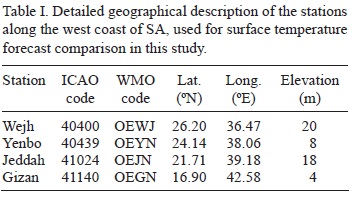
<body><![CDATA[<p align="justify"><font face="verdana" size="2">There is growing evidence of general public interest in Saudi Arabia (SA) to check for weather updates using the Internet (see, instance, Saudi Gazette, 2012). In particular, this includes personnel from the growing sector of tourism in SA (see, for instance, Arab News, 2012a, b). The successful verification of the weather forecast has thus direct implications for regional economics (Casati <i>et al.,</i> 2008). Surface temperature is a key weather variable affecting daily life in SA; it determines many regional socio&#45;economic factors including the energy and tourism sectors (see, for instance, Bigano <i>et al.,</i> 2006). In particular, transitional periods are considered as one of the best times of the year to visit the coastal SA for tourism, because of less extreme temperatures (Arab News, 2012c, d).</font></p>  	    <p align="justify"><font face="verdana" size="2">The regional stormy weather forecast comparisons have been reported extensively; these include short&#45;lived tornados, and/or rain/hail/snow bringing storms (see, for instance, Evans and Grumm, 2000; Czarnetzki, 2001). The analyses of relatively recent</font> <font face="verdana" size="2">long&#45;lived heat waves/cold spells are also presented (e.g., Karl and Knight, 1997; Thornes and Stephenson, 2001; Athar and Lupo, 2010; Lupo <i>et al.,</i> 2012). On the other hand, the non&#45;extreme events forecasts and their skill comparisons also have considerable socio&#45;economic implications (Casati <i>et al.,</i> 2008).</font></p>  	    <p align="justify"><font face="verdana" size="2">Numerous deterministic forecast skill comparison metrics exist and have been applied to compare the skill of forecasts (see, for instance, Mailier <i>et al.</i> , 2008). The selection of a particular metric is essentially an open question, mainly determined by the addressed implication (see, for instance, Roebber and Bosart, 1996). Although various aspects of temperature forecast verification geared towards assessing responses of widely varying interest sectors of general public are discussed for different locations (Brooks <i>et al.,</i> 1997), there is no such study available for SA. Also, unlike the customary tradition in North America, of having city forecast competition/game as a part of under graduate/graduate course work (see, for instance, Driscoll, 1988; Athar and Sara, 2013), there is no such established custom in SA universities. The present analysis may thus serve as a reference document to possibly initiate such a practice in university education in SA and/or at general public level (for the quality assessment of commercial weather forecast, see, for instance, Mailier <i>et al.,</i> 2008). In particular, as of now, King Abdulaziz University is the only educational institute in the region offering a formal education in meteorology.</font></p>  	    <p align="justify"><font face="verdana" size="2">A relevant question may be why such a study needs to be carried out when automated statistical analysis software packages and large weather information based dataset archives already exist. Since efforts for forecasting weather have essentially the single aim of informing the general public with the latest state of the lower atmosphere, so that they may prepare in advance for any weather change, one might wonder which commercial weather forecast provider is comparatively better. The commercial weather forecast providers do not provide an archive of the displayed daily weather information to the general public (which is the topic addressed in this paper). A short (and first) archived study is thus welcome, to initiate and to possibly promote intercultural response. Furthermore, with the rapid growth of the tourism sector in the region, the utility of such comparative studies is and will be enormous (Arab</font> <font face="verdana" size="2">News, 2012e, f).</font></p>  	    <p align="justify"><font face="verdana" size="2">In this paper, a relative forecast skill comparison analysis for the surface temperature of coastal SA is presented, which is considered as a continuous variable. Concentrating on a single weather variable helps to assess the relative robustness of a single variable forecast via several considered commercial weather forecast providers, based on numerical weather prediction (NWP) models. Given the perceived usefulness of temperature variables, all three daily temperature variables (maximum, minimum and mean temperature, abbreviated as <i>T<sub>max</sub>, T<sub>min</sub>,</i> and <i>T<sub>mean</sub>,</i> respectively) are analyzed separately. <i>T<sub>max</sub></i> and <i>T<sub>min</sub></i> are more apt for the study of temperature extremes (see, for instance, Athar, 2012).</font></p>  	    <p align="justify"><font face="verdana" size="2">The remainder of this paper is organized as follow: section 2 presents the details of the characteristics of temperature regimes along the west coast of SA. Section 3 provides the description of the datasets used, including the Atmospheric&#45;Ocean General Circulation Model (AOGCM) datasets, and the employed methodology. The points&#45;based subjective assignment method used to assess and compare surface temperature forecast skills for commercial weather forecast providers, is mentioned in section 3 only to possibly initiate a regional academic discussion, in line with one of the motivations presented in this section. Section 4 displays and discusses the results of surface temperature forecast skill comparisons</font> <font face="verdana" size="2">based on point assignments and linear correlations, as well as the computed biases. Section 5 summarizes our findings.</font></p> 	    <p align="justify">&nbsp;</p>  	    <p align="justify"><font face="verdana" size="2"><b>2. Temperature regimes of the west coast of Saudi Arabia</b></font></p>  	    <p align="justify"><font face="verdana" size="2"><i>2.1 The west coast of Saudi Arabia</i> </font></p>     <p align="justify"><font face="verdana" size="2">The geographic and topographic details of the four selected west coast stations (Wejh, Yenbo, Jeddah and Gizan) are displayed in <a href="#t1">Table I</a> and in <a href="#f1">Figure 1</a>, respectively. <a href="#t1">Table I</a> lists the details of the four selected stations including the International Civil Aviation Organization (ICAO) code, the World Meteorological Organization (WMO) code, latitude (&deg;N), longitude (&deg;E), and height (m) above the mean sea level. The selected stations exhibit similar climatic conditions but with different weather</font> <font face="verdana" size="2">features (Al&#45;Jerash, 1985; Ahmed, 1997). The distance between southernmost and northernmost stations in cities of Gizan and Wejh is approximately 1211 km. Wejh and Yenbo are in northern SA, whereas Jeddah and Gizan, are in southern SA, based on the rainfall occurrence patterns (Almazroui <i>et al.,</i> 2012a, b). The latitude separation between Gizan and Wejh, is approximately 10&deg;, with the north&#45;south oriented Asir mountain range to the east side of the stations, and the Red Sea on the west side (<a href="#f1">Fig. 1</a> ). The widely varied latitude between Wejh and Gizan allows to assess the relative robustness of the coastal temperature forecasts during the transitional period. The station at Gizan is more under the influence of tropical/monsoonal climate in the transitional period (Walters and Sjoberg, 1988).</font></p>     ]]></body>
<body><![CDATA[<p align="center"><a name="t1"></a></p>     <p align="center"><img src="/img/revistas/atm/v27n3/a6t1.jpg"></p>     <p align="center"><a name="f1"></a></p>     <p align="center"><img src="/img/revistas/atm/v27n3/a6f1.jpg"></p>  	    <p align="justify"><font face="verdana" size="2"><i>2.2 Temperature regimes</i></font></p>  	    <p align="justify"><font face="verdana" size="2">In SA, the four conventional seasons are: December&#45;January&#45;February (DJF), March&#45;April&#45;May (MAM), June&#45;July&#45;August (JJA), and September&#45;October&#45;November (SON). Though the analysis of climatic features in SA (such as long term seasonal and annual variability, and trends of surface temperatures, in addition to rainfall) have recently become available (see, for instance, Almazroui <i>et al.,</i> 2012a, b, and references therein), station&#45;based temperature forecast skill comparison has not yet been presented.</font></p>  	    <p align="justify"><font face="verdana" size="2">A characteristic feature of the west coast climate of SA is the change in surface temperature regimes, which occurs twice in a calendar year (Walters and Sjoberg, 1988; Fisher and Membery, 1998; Vincent, 2008). The two transitional periods of temperature changes are defined with respect to the conventional four seasons, namely: DJF, MAM, JJA, and SON. The first transitional period is from January 16 to March 16, between DJF and MAM (hereafter referred to as transitional period). The second transitional period is from September 16 to November 15 between JJA and SON. During the transitional periods, the Mediterranean depressions and Asian monsoon based weather systems simultaneously determine the temperature regimes along the west coast of SA (Athar, 2012).</font></p>  	    <p align="justify"><font face="verdana" size="2">Intense and erratic rainfall during the second transitional period, and prolonged heat spells during the summer season offer less possibilities for tourism in SA, as compared to the first transitional period (see, for instance, Bigano <i>et al.,</i> 2006; Almazroui <i>et al.,</i> 2012a, b). Furthermore, between the first transitional</font> <font face="verdana" size="2">period and the summer season, massive sand storms are common (for a recent discussion, see, for instance, Maghrabi <i>et al.,</i> 2011; Alharbi <i>et al.,</i> 2013, and references therein).</font></p>  	    <p align="justify"><font face="verdana" size="2">The ability of a meso/regional scale climate model to simulate mean daily temperatures and their variability during these months, in particular along the coastal regions, may thus provide a sensitive test bed to assess the performance of a given meso/regional&#45;scale climate model. In SA, surface temperatures in transitional periods are also affected (up to &plusmn; 1&#45;1.5 &deg;C) by the passage of mid&#45;latitude migratory anticyclones, more often in northern SA (Athar <i>et al.,</i> 2013). The west coast of SA is meteorologically active during the transitional period; concurrently and/or with the termination of short cold spells, series of secondary lows and highs occur along with sand/dust storms and blowing sand (Walters and Sjoberg, 1988).</font></p>  	    <p align="justify"><font face="verdana" size="2">One of the motivations for selecting four coastal stations (in SA) is to assess the relative temperature forecast skill of several meso/regional&#45;scale weather and climate forecasting models, since these models are known to have biases in forecasting surface temperatures in the planetary boundary layer due to land&#45;sea contrast in coastal areas (see, for instance, Cox <i>et al.,</i> 1998; Fildes and Kourentzes, 2011; Kerr, 2011; O'Brien <i>et al.,</i> 2012). To reduce and isolate the impacts of model simulations of the strong diurnal cycle present for stations in the inland SA, the selected four stations belong to the same climatic zone in the coastal areas, even though a strong north&#45;south temperature gradient exists (Al&#45;Jerash, 1985). Furthermore, a large fraction of SA population is located along the coastal areas, and a first temperature forecast skill comparison is thus more pertinent primarily for coastal cities (Vincent, 2008).</font></p>  	    ]]></body>
<body><![CDATA[<p align="justify"><font face="verdana" size="2"><i>2.3 Climatological considerations</i> The observed datasets for the daily <i>T<sub>min</sub></i> and <i>T<sub>max</sub></i> for a 31&#45;yr period (1978&#45;2008) were obtained from the Presidency of Meteorology and Environment of Jeddah, SA, for the four selected stations. Quality control of the obtained observed daily temperature datasets was performed before preparing the daily and monthly climatology (Clm), following Athar (2013). The daily Clm for the transitional period was obtained by averaging over 31 years for each calendar day. The monthly Clm was subsequently prepared using the daily Clm for the transitional period. <i>T<sub>mean</sub></i></font> <font face="verdana" size="2">is computed by averaging <i>T<sub>max</sub></i> and the <i>T<sub>min</sub></i> values over the corresponding day.</font></p>  	    <p align="justify"><font face="verdana" size="2"><a href="/img/revistas/atm/v27n3/a6t2.jpg" target="_blank">Table II</a> displays the three key statistics for a selected non&#45;transitional period during summer and during the second transitional period, for all the three temperature variables, based on the 31&#45;yr period Clm. The relatively larger difference in the range as well as in the observed one sigma standard deviation during the second transitional period is evident as compared to the non&#45;transitional period. During the second transitional period, <i>T<sub>max</sub></i> is in the upper 30s, except for the station at Wejh, where it is in the lower 30s.</font></p>  	    <p align="justify"><font face="verdana" size="2">For comparison, during the (first) transitional</font> <font face="verdana" size="2">period, the northernmost station at Wejh has a 31&#45;yr average <i>Tmax</i> of25 &deg;C, <i>T<sub>min</sub></i> of15 &deg;C, and a <i>Tmean</i> of 20 &deg;C. The southern most station at Gizan is influenced by the tropical climate, with a 31&#45;yr average <i>T<sub>max</sub></i> of 31 &deg;C, <i>T<sub>min</sub></i> of 23 &deg;C, and a <i>T<sub>mean</sub></i> of 27 &deg;C; whereas the remaining two stations (Yenbo and Jeddah) are more under the influence of arid climatic conditions. The three temperature variables have quite similar values for a 31&#45;yr average for Yenbo (Jeddah): <i>T<sub>max</sub></i> of 29 &deg;C (30 &deg;C),<i>T<sub>min</sub></i>of 15 &deg;C (18 &deg;C), and a <i>T<sub>mean</sub> </i>of 22 &deg;C (24 &deg;C), respectively.</font></p>      <p align="justify"><font face="verdana" size="2"><a href="/img/revistas/atm/v27n3/a6t3.jpg" target="_blank">Table III</a> displays the monthly one sigma standard deviation values for all four stations based on a</font> <font face="verdana" size="2">31&#45;yr period climatology. Relative variations in the standard deviation values can be noticed during the transitional periods. To further quantify the relative transitional nature of temperature in the two transitional periods, three statistics (mean, range, and standard deviation) during the transitional periods were compared with those during the non&#45;transitional periods. The Clm standard deviation values for a selected non&#45;transitional period (May 16 to July 15) displayed relatively lower spreads as compared to those during the two transitional periods, for all the three temperature variables at the four coastal stations; indicating more variability during the</font> <font face="verdana" size="2">transitional periods (not shown). The Clm range values were also compared for all the three temperature variables at the four locations, and relatively larger values were found during the two transitional periods as compared to the selected non&#45;transitional period, with comparatively larger values during the second transitional period (not shown).</font></p>  	    <p align="justify"><font face="verdana" size="2"><a href="/img/revistas/atm/v27n3/a6f2.jpg" target="_blank">Figure 2</a> displays the annual cycle of the three temperature variables for each of the stations based on the 31&#45;yr period Clm. It is clear from <a href="/img/revistas/atm/v27n3/a6f2.jpg" target="_blank">Figure 2</a> that during the transitional period under study (January&#45;March), the three temperature variables are at their relative minima. In particular, <i>T<sub>max</sub> </i>typically</font> <font face="verdana" size="2">ranges between lower to upper 30s during these months. In contrast, during the May to August period, temperature variables are at their relative maxima. Also, during the second transitional period, all three temperature variables are displaying relative higher values as compared to the (first) transitional period.</font></p>  	    <p align="justify"><font face="verdana" size="2"><a href="/img/revistas/atm/v27n3/a6f3.jpg" target="_blank">Figure 3</a> provides some further finer details of the relative comparison between the observed <i>Tmax</i> and <i>T<sub>min</sub></i> (during the study period) and the Clm based same&#45;temperature variables for all the four stations. On average, fluctuations in observed <i>T<sub>min</sub></i> are larger as compared to those in <i>T<sub>max</sub> </i>and these are smallest for the station at Gizan. This is in part indicative of</font> <font face="verdana" size="2">a more dominating influence of the Mediterranean based weather system for stations located in northern SA (Vincent, 2008).</font></p> 	    <p align="justify">&nbsp;</p>  	    <p align="justify"><font face="verdana" size="2"><b>3. Data collection and methodology</b></font></p>  	    <p align="justify"><font face="verdana" size="2"><i>3.1 NWP based commercial weather forecast data&#45;sets</i></font></p>  	    <p align="justify"><font face="verdana" size="2">The temperature forecast datasets were collected from eight different forecast providers: five international TV based weather information providers, one local provider and two Internet based weather information providers, all accessible locally. For the protection of all the concerned, the eight providers</font> <font face="verdana" size="2">have been assigned with numbers 1 to 8 randomly (P1 to P8). P2 and P7 are forecasting for all the four stations the same values for temperature <i>(T<sub>min </sub></i>and <i>T<sub>max</sub>),</i> whereas P3 and P8 are also forecasting for all the four stations the same values for temperature <i>(T<sub>min</sub></i> and <i>T<sub>max</sub>).</i> As a result, only P2 and P3 were selected for further considerations. P1, P2, P3, and P4 forecasted for all the four stations, whereas P5 (P6) forecasted for two (one) stations. Specifically, P5 forecasted for Jeddah and Gizan, whereas P6 forecasted for Jeddah only. Multiple city temperature forecast is best viewed with P1 and with P2, relative to the other forecast providers selected for this study. Thus, the <i>T<sub>min</sub></i> and <i>T<sub>max</sub></i> forecasts from a total of six commercial weather forecast providers (P1 to P6) were recorded on a daily basis (i.e. on a 24 h period basis).</font></p>  	    ]]></body>
<body><![CDATA[<p align="justify"><font face="verdana" size="2">The starting date for the record of the forecasted and observed daily temperatures at the four selected locations is January 16, 2012 and the ending date is March 16, 2012. The observed and forecasted temperature datasets for consecutive 61 days are analyzed for skill score comparison purposes.</font></p>  	    <p align="justify"><font face="verdana" size="2">Observed <i>T<sub>min </sub></i>and <i>T<sub>max</sub></i>(referred to as Obs) are obtained twice a day from the website maintained by the National Oceanic and Atmospheric Administration (NOAA) (<a href="http://weather.noaa.gov/weather/SA_cc.html" target="_blank">http://weather.noaa.gov/weather/SA_cc.html</a>) for all the stations. This NOAA website displays and maintains the hourly temperature record for current 24 hours only. Observed<i>T<sub>min</sub></i> was recorded at 07:00 UTC, whereas the observed <i>T<sub>max</sub></i> was recorded at 14:00 UTC. The observed <i>T<sub>min</sub></i> occurs at approximately 03:00 UTC, whereas observed <i>T<sub>max</sub></i> occurs at approximately 12:00 UTC during the considered transitional period. Local time in SA is + 3 h of UTC. The temperature forecast for the next&#45;day (tomorrow) was recorded at 10:00 UTC, since one provider (P1) updates its website for the next&#45;day forecast at this time.</font></p>      <p align="justify"><font face="verdana" size="2">An e&#45;mail letter was sent to all commercial weather forecast providers to inquire about the NWP model and the procedure used in the forecast displayed on the websites. One reply was received: P5 is using the UKMet model for temperature forecasts. P1 is using weather research and a forecasting (WRF) model for the temperature forecasts (personal communication).</font></p>  	    <p align="justify"><font face="verdana" size="2"><i>3.2 AOGCM&#45;based datasets</i></font></p>  	    <p align="justify"><font face="verdana" size="2">Datasets from two versions of the Geophysical Fluid</font> <font face="verdana" size="2">Dynamics Laboratory (GFDL) AOGCM are used for</font> <font face="verdana" size="2">comparison with the above Obs and NWP model&#45;based outputs. These two versions are CM2.0 and CM2.1 (Delworth <i>et al.</i>, 2006). The main differences between CM2.0 and CM2.1 include the use of different dynamical cores, ocean component's time&#45;stepping scheme and the lateral viscosity. The daily <i>T<sub>max</sub></i> and <i>T<sub>mn</sub></i> datasets were obtained from the GFDL data portal (<a href="http://data1.gfdl.noaa.gov/" target="_blank">http://data1.gfdl.noaa.gov/</a>). For each version of the AOGCM for the 21st century runs, datasets were available from one run under the IPCC Special Report on Emission Scenarios (SRES) A1B scenario (IPCC, 2007). Both versions of the AOGCM have a horizontal grid resolution of 2.5&deg; longitude x 2.0&deg; latitude, although there is a difference of starting latitude. Latitude values range between &#45;89&deg; and 89&deg; for CM 2.0, whereas for CM2.1 values range between &#45;89.49&deg; and 89.49&deg;. Both versions of the AOGCM have 24 vertical levels in the atmosphere. The Obs and the NWP model based datasets are then compared with the corresponding AOGCM&#45;based daily grid&#45;box datasets nearest to the stations, for the overlapping period.</font></p>  	    <p align="justify"><font face="verdana" size="2"><i>3.3 Subjective point based skill scores</i> Based on a subjective interpretation of the forecast, points are assigned to the Obs and NWP model&#45;based forecasts for <i>T<sub>min</sub></i> and <i>T<sub>max</sub>,</i> following Lupo and Market (2002), hereafter referred to as LM02. For instance, if the observed temperature is 20 &deg;C, two points are awarded if the forecasted temperature is in the range of &plusmn; 1 &deg;C (namely, between 19 &deg;C and 21 &deg;C), and one point is awarded if the forecasted temperature is in the range of &plusmn; 2 &deg;C (namely, between 18 &deg;C and 22 &deg;C). Outside the range of &plusmn; 2 &deg;C, a score of zero points is assigned. This procedure tends to progressively penalize for increased absolute bias in the forecasted surface temperature.</font></p>  	    <p align="justify"><font face="verdana" size="2">LM02 took a range of &plusmn; 2 &deg;F and &plusmn; 4 &deg;F, instead of &plusmn; 1 &deg;C and &plusmn; 2 &deg;C, respectively. The study upon which the LM02 formula is based (Thornes and Proctor, 1999), and the LM02 study itself are for higher latitude&#45;based stations (&gt; 38&deg; N), whereas the stations under study are situated in a relatively lower latitude sub&#45;tropical region (&lt; 27 &deg;N). The amplitudes of mid&#45;latitude based secondary lows and highs are thus weaker for SA stations, resulting in lesser surface temperature fluctuations (Walters and Sjoberg, 1988). This may provide some justification for the selection of a narrower point&#45;scoring range, resulting in more stringent skill comparison and being closer to Clm.</font> <font face="verdana" size="2">Also, given the (first) transitional period, the stations considered in SA are less affected by monsoonal weather systems.</font>	</p> 	    <p align="justify"><font face="verdana" size="2">The following modified formula was used to compute the average daily total forecast score <i>(F),</i></font> <font face="verdana" size="2">following LM02:</font></p>     <p align="center"><img src="/img/revistas/atm/v27n3/a6e1.jpg"></p> 	    <p align="justify"><font face="verdana" size="2"><i>F<sub>max</sub></i> stands for the assigned point score for <i>T<sub>max</sub> </i>and likewise. The formula given by Eq. (1) indicates that a perfect (missed) average daily total forecast score would have a value of 6 (0). The normalized percent average daily total forecast score (F%) is defined as</font></p>  	    ]]></body>
<body><![CDATA[<p align="center"><img src="/img/revistas/atm/v27n3/a6e2.jpg"></p>  	    <p align="justify"><font face="verdana" size="2">The forecast skill <i>(S),</i> expressed in percent, is defined using a linear error difference formula (see, for instance, Wilks, 2011):</font></p>  	    <p align="center"><img src="/img/revistas/atm/v27n3/a6e3.jpg"></p>  	    <p align="justify"><font face="verdana" size="2">In Eq. (3), <i>B</i> is the baseline score, and <i>P</i> represents the perfect forecast score, taken as Obs. The baseline is Clm. This formula permits negative <i>S</i> values. A value of <i>S</i> equal to 100% implies a perfect skill score. Commonly used statistics (such as mean and standard deviation) are employed to quantify the relative difference between the forecasted temperature and observations (Wilks, 2011).</font></p>  	    <p align="justify"><font face="verdana" size="2"><i>3.4 Correlation coefficient and bias computation</i> The linear correlation coefficient <i>(CC)</i> was computed using the following formula between the NWP model outputs, Clm, AOGCM, and the Obs datasets:</font></p>  	    <p align="center"><img src="/img/revistas/atm/v27n3/a6e4.jpg"></p>  	    <p align="justify"><font face="verdana" size="2">where the overbar stands for the mean of the variable (Wilks, 2011). The bias was computed by subtracting the daily model&#45;based forecasted temperatures from the observations.</font></p> 	    <p align="justify">&nbsp;</p>  	    <p align="justify"><font face="verdana" size="2"><b>4. Results and discussion</b></font></p>  	    <p align="justify"><font face="verdana" size="2"><i>4.1 Points based skill scores</i> </font></p> 	    ]]></body>
<body><![CDATA[<p align="justify"><font face="verdana" size="2">The forecast evaluation results for the period of consecutive 61 days and nights are displayed in <a href="#t4">Table IV</a>,</font> <font face="verdana" size="2">using Eq. (1) for all the four stations, from all the providers. The forecast score for each temperature variable is averaged over the entire forecasting period. For each station, all the NWP forecast providers performed better than Clm, except for P1 and P5 for Gizan (for all the temperature variables collectively). Overall, at <i>F</i> level comparison, the best temperature forecasts are by P4. The <i>F</i> scores for Gizan are relatively higher since temperature variations are relatively lower (see <a href="/img/revistas/atm/v27n3/a6t3.jpg" target="_blank">Table III</a>).</font></p> 	    <p align="center"><a name="t4"></a></p> 	    <p align="center"><img src="/img/revistas/atm/v27n3/a6t4.jpg"></p>  	    <p align="justify"><font face="verdana" size="2">The NWP model used by P5 has a known bias in forecasting temperature for the coastal areas, whereas among other commercial weather forecast providers, P3 has a more thorough check and balance system to initialize the forecasts. Furthermore, for Gizan, several other upper air weather features play a role in determining weather conditions, which is essentially absent for the other three stations. These features include, but are not limited to, the climatological Red Sea trough, the Sudan low, and the relative vicinity of the subtropical high (see, for instance, Walters and Sjoberg, 1988). Detailed simulation studies are required by various NWP models with varying complexity to further investigate these points, which is beyond the scope of this study.</font></p>  	    <p align="justify"><font face="verdana" size="2"><a href="/img/revistas/atm/v27n3/a6f4.jpg" target="_blank">Figure 4</a> displays the <i>T<sub>mean</sub> </i>time series for all the stations for the whole transitional period, based on forecasts by P1 to P6, including Clm and Obs. All stations displayed progressively rising fluctuations</font> <font face="verdana" size="2">in <i>T<sub>mean</sub>,</i> with station at Wejh (northmost) having absolute minimum values for <i>T<sub>mean</sub>,</i> which reflects the dominant continual passage of Mediterranean&#45;based migratory secondary lows (and highs). The amplitude of <i>T<sub>mean</sub></i> fluctuations is smallest for the station at Gizan. Similar conclusions were drawn from the analysis of the time series behavior of <i>T<sub>max</sub> </i>and <i>T<sub>mn</sub> </i>(not shown).</font></p>  	    <p align="justify"><font face="verdana" size="2"><a href="/img/revistas/atm/v27n3/a6f5.jpg" target="_blank">Figure 5</a> displays the normalized total <i>F</i> as percent <i>(F%)</i> using Eq. (2) for 61 days and nights for Wejh, Yenbo, Jeddah and Gizan, for all the NWP model forecast providers. All the NWP model forecast providers including Clm have either under&#45; or over&#45;estimated the observed temperature (since <i>F</i> &lt; 100%). For the city of Wejh (Gizan), P1 (P3) and P2 (P4), have performed almost similarly. Overall, the relative best performer is P3 for the city of Gizan, with a difference less than &#45;6.6% (the city of Gizan is in the southernmost region of SA, with an elevation of only 4 m).</font></p>  	    <p align="justify"><font face="verdana" size="2">The cumulative comparative skill score results for the study period are displayed in <a href="#t5">Table V (a)</a>, using Eq. (3). P3 and P4 have skill scores relatively closer to a perfect score (100%) for Gizan, over the period of forecast comparison. P1 and P5 have negative S values for Gizan indicating lower performance than Clm.</font></p> 	    <p align="center"><a name="t5"></a></p> 	    <p align="center"><img src="/img/revistas/atm/v27n3/a6t5.jpg"></p>  	    <p align="justify"><font face="verdana" size="2">The total forecast score <i>(Fs)</i> samples for Obs, Clm, and for all Ps were resampled randomly 1000 times with replacement and then Eq. (3) was used to compute the corresponding F% for each of the bootstrapped resamples. Lastly, the mean F% was computed and is displayed in <a href="#t5">Table V (b)</a>. No parameters are involved in obtaining the bootstrapped resamples. The same hierarchal differences among various commercial weather forecast providers (Ps) tend to survive, thus supporting our findings.</font></p>  	    ]]></body>
<body><![CDATA[<p align="justify"><font face="verdana" size="2"><i>4.2 Correlation coefficient&#45;based comparisons</i> </font></p>     <p align="justify"><font face="verdana" size="2">The <i>CC</i> value for the NWP model forecasted <i>T<sub>max</sub></i> and <i>T<sub>min</sub></i> with the corresponding observed <i>T<sub>max</sub></i> and <i>T<sub>min</sub></i> is better than Clm at the 95 % confidence level</font> <font face="verdana" size="2">(CL), except for the station at Gizan for P1, P2 and P5, where Clm performed better (<a href="#t6">Table VI</a>). In fact, <a href="/img/revistas/atm/v27n3/a6f4.jpg" target="_blank">Figure 4d</a> indicates that there is an almost out of phase relationship between the forecasted and observed <i>T<sub>mean</sub></i> for the city of Gizan for P5. In general, these observations are indicative of good agreement between two different measures to compare the NWP model&#45;based forecast skill, although caution needs to be exercised for such a comparison (Murphy, 1988). To some extent, this is indicative of the contemporary challenges faced by the NWP models to mimic the surface temperature for stations in mountainous terrains. As pointed out earlier, a relevant remark may be the climatological vicinity ofthe active Sudan low/ Red Sea trough during the spring season for Gizan (Almazroui <i>et al.</i> 2012c, and references therein).</font></p>     <p align="center"><a name="t6"></a></p>     <p align="center"><img src="/img/revistas/atm/v27n3/a6t6.jpg"></p>  	    <p align="justify"><font face="verdana" size="2">The two versions of the AOGCM have statistically significant CCs except for Wejh for CM2.0 <i>T<sub>min</sub>,</i> and for Gizan for CM2.1, for all temperature variables. Thus, despite having coarse spatial resolution, the two versions ofthe considered AOGCM have displayed overall good realism to mimic the daily variability in surface temperature for coastal stations during the transitional period. In general, the magnitude of the statistically significant <i>CC</i> is higher for the NWP model&#45;based forecasts as compared to those based on the AOGCM.</font>	</p> 	    <p align="justify"><font face="verdana" size="2"><i>4.3 Forecast bias comparisons</i> </font></p>     <p align="justify"><font face="verdana" size="2"><a href="#t7">Table VII</a> displays the average daily bias relative to Obs for all the NWP model output providers, including the two versions of the AOGCM. In general, mostly the NWP model&#45;based providers' temperature forecasts displayed a cold bias. The largest (smallest) absolute bias was displayed by P5 (P2) for Gizan for <i>T<sub>min</sub>,</i> amounting to 3.57 &deg;C (0.02 &deg;C). These findings may be of more relevance if applied to socio&#45;economic sectors, such as the tourism sector.</font></p>     <p align="center"><a name="t7"></a></p>     <p align="center"><img src="/img/revistas/atm/v27n3/a6t7.jpg"></p>  	    <p align="justify"><font face="verdana" size="2">From the model diagnostics point of view, the NWP model forecast providers displayed a cold or</font> <font face="verdana" size="2">warm bias. When averaged over three or more stations, the maximum (minimum) cold bias was shown by P3 (P4), amounting to &#45;0.95 &deg;C (&#45;0.19 &deg;C), respectively, for <i>T<sub>max</sub>.</i> Similarly, the maximum (minimum) warm bias was shown by P1 (P4), amounting to 0.79 &deg;C (0.30 &deg;C), respectively, for <i>T<sub>min</sub>.</i></font></p>  	    ]]></body>
<body><![CDATA[<p align="justify"><font face="verdana" size="2">The GFDL&#45;based coarse resolution CM2.0 and CM2.1 displayed relatively larger biases as compared to the NWP models used by providers P1 to P6. Except for the station at Gizan, the CM2.0 displayed a relatively smaller bias as compared to CM2.1 for <i>T<sub>max</sub>,</i> for which the biases are quite large for all temperature variables. Both versions of the AOGCM seem unable to resolve the land&#45;sea contrast in the diurnal cycle</font> <font face="verdana" size="2">of surface temperature in the transitional period, as compared to the fine resolution NWP models. A comparison of <a href="#t6">Table VI</a> and <a href="#t7">Table VII</a> reveals that the two versions of the AOGCM performed relatively better in mimicking the surface temperature variability than the mean, during the transitional period.</font></p>  	    <p align="justify"><font face="verdana" size="2">To provide a general relative forecast performance perspective during the entire transitional period of 61 days, three commonly used statistics (average, range, and one sigma standard deviation) are displayed in <a href="/img/revistas/atm/v27n3/a6t8.jpg" target="_blank">Table VIII</a>, for each station and for each considered forecast provider, for all the temperature variables. Clm has the lowest one sigma standard deviation values (in Celsius degrees) for all the stations, thus somewhat justifying its use as a standard of reference to compare with other forecasted temperature values.</font></p>  	    <p align="justify"><font face="verdana" size="2">Furthermore, when averaged over all the NWP model&#45;based Ps, the minimum (maximum) absolute bias for <i>T<sub>max</sub> </i>was found to be 1.20 <sup>o</sup>C (4.75 <sup>o</sup>C) for Gizan (Jeddah), whereas the corresponding values for the average AOGCM are 0.17 <sup>o</sup>C (10.94 <sup>o</sup>C) for Jeddah (Yenbo) during the entire studied 61 day period (not shown). For <i>T<sub>min</sub>,</i> the average Ps as well as the average AOGCMs minimum absolute biases were larger than for <i>T<sub>max</sub> </i>(not shown).</font></p> 	    <p align="justify">&nbsp;</p>  	    <p align="justify"><font face="verdana" size="2"><b>5. Conclusions</b></font></p>  	    <p align="justify"><font face="verdana" size="2">After an overview of the temperature regimes along the west coast of SA, the next&#45;day forecast performance for six commercial weather forecast providers based on the NWP model outputs for surface temperature, is assessed using a simple modified forecast skill comparison metric, for four cities (Wejh, Yenbo, Jeddah, and Gizan) along the west coast of SA, for a period of 61 consecutive days during the months of January, February, and March. The forecast comparison metric was based on a subjective point scoring. Station based climatology is used as a standard of reference. All three temperature variables <i>(T<sub>max</sub>,</i> <i>T<sub>min</sub></i> and <i>T<sub>mean</sub>)</i> are considered separately. Cumulatively, the best performer was provider 4, whereas the worst performer was provider 5, based on a skill score. Linear correlation coefficients and the biases of the forecasted temperatures relative to the observed surface temperatures were also computed, as an objective metric for assessing the surface temperature forecasting performance.</font></p>  	    <p align="justify"><font face="verdana" size="2">In general, the regional weather forecasting models have a lower bias (&lt; &plusmn; 2 &deg;C), relative to observations,</font> <font face="verdana" size="2">as compared to those by the AOGCM, due to better resolved topographic features over the Red Sea coastal land stations. A purpose of this bias comparison presentation is to assess the realism offered by contemporary weather and climate models in forecasting surface temperatures in coastal areas in an arid climate country.</font></p>  	    <p align="justify"><font face="verdana" size="2">At the same time, this analysis is intended to provide some clues towards the difficulties encountered by the NWP models and AOGCMs to forecast surface temperature during the transitional period (between</font> <font face="verdana" size="2">the DJF and MAM seasons) for the coastal locations in an arid country like SA. The simple methodology used in this comparison may provide some guidance and motivation for the general public, as well.</font></p> 	    <p align="justify">&nbsp;</p>  	    <p align="justify"><font face="verdana" size="2"><b>Acknowledgments</b></font></p>  	    ]]></body>
<body><![CDATA[<p align="justify"><font face="verdana" size="2">The authors thank the Presidency of Meteorology and Environment, Jeddah, Saudi Arabia, and Dr. Mansour Almazroui, for providing the datasets for the climatology. The observed dataset used in this</font> <font face="verdana" size="2">study was obtained from the Internet weather source website of the National Oceanic and Atmospheric Administration (NOAA) National Weather Service (NWS) (<a href="http://weather.noaa.gov/weather/SA_cc.html" target="_blank">http://weather.noaa.gov/weather/SA_cc.html</a>). The datasets from the commercial weather forecast providers were obtained from their respective websites. The GFDL based AOGCM datasets were obtained from the following website: <a href="http://data1.gfdl.noaa.gov/" target="_blank">http://data1.gfdl.noaa.gov/</a>.</font></p> 	    <p align="justify">&nbsp;</p>  	    <p align="justify"><font face="verdana" size="2"><b>References</b></font></p>  	    <!-- ref --><p align="justify"><font face="verdana" size="2">Ahmed B. Y. M., 1997. Climatic classification of Saudi Arabia: An application of factor&#45;cluster analysis. <i>Geo. J.</i> <b>41,</b> 69&#45;84.    &nbsp;&nbsp;&nbsp;&nbsp;&nbsp;&nbsp;&nbsp;&nbsp;[&#160;<a href="javascript:void(0);" onclick="javascript: window.open('/scielo.php?script=sci_nlinks&ref=1301123&pid=S0187-6236201400030000600001&lng=','','width=640,height=500,resizable=yes,scrollbars=1,menubar=yes,');">Links</a>&#160;]<!-- end-ref --></font></p>  	    <!-- ref --><p align="justify"><font face="verdana" size="2">Al&#45;Jerash M. A., 1985. Climate subdivisions in Saudi Arabia: An application of principal components analysis. <i>Int. J. Climatol.</i> <b>5,</b> 307&#45;323.    &nbsp;&nbsp;&nbsp;&nbsp;&nbsp;&nbsp;&nbsp;&nbsp;[&#160;<a href="javascript:void(0);" onclick="javascript: window.open('/scielo.php?script=sci_nlinks&ref=1301125&pid=S0187-6236201400030000600002&lng=','','width=640,height=500,resizable=yes,scrollbars=1,menubar=yes,');">Links</a>&#160;]<!-- end-ref --></font></p>  	    <!-- ref --><p align="justify"><font face="verdana" size="2">Alharbi B. H., A. Maghrabi and N. Tapper, 2013. The March 2009 dust event in Saudi Arabia: Precursor and supportive environment. <i>Bull. Amer. Meteor. Soc.</i> <b>94,</b> 515&#45;528, doi:10.1175/BAMS&#45;D&#45;11&#45;00118.1.    &nbsp;&nbsp;&nbsp;&nbsp;&nbsp;&nbsp;&nbsp;&nbsp;[&#160;<a href="javascript:void(0);" onclick="javascript: window.open('/scielo.php?script=sci_nlinks&ref=1301127&pid=S0187-6236201400030000600003&lng=','','width=640,height=500,resizable=yes,scrollbars=1,menubar=yes,');">Links</a>&#160;]<!-- end-ref --></font></p>  	    <!-- ref --><p align="justify"><font face="verdana" size="2">Almazroui M., M. N. Islam, H. Athar, P. D. Jones and M. A. Rahman, 2012a. Recent climate change in the Arabian Peninsula: Annual rainfall and temperature analysis of Saudi Arabia for 1978&#45;2009. <i>Int. J. Climatol.</i> <b>32,</b> 953&#45;966, doi:10.1002/joc.3446.    &nbsp;&nbsp;&nbsp;&nbsp;&nbsp;&nbsp;&nbsp;&nbsp;[&#160;<a href="javascript:void(0);" onclick="javascript: window.open('/scielo.php?script=sci_nlinks&ref=1301129&pid=S0187-6236201400030000600004&lng=','','width=640,height=500,resizable=yes,scrollbars=1,menubar=yes,');">Links</a>&#160;]<!-- end-ref --></font></p>  	    <!-- ref --><p align="justify"><font face="verdana" size="2">Almazroui M., M. N. Islam, P. D. Jones, H Athar and M. A. Rahman, 2012b. Recent climate change in the Arabian Peninsula: Seasonal rainfall and temperature climatology of Saudi Arabia for 1979&#45;2009. <i>Atmos. Res.</i> <b>111,</b> 26&#45;45.    &nbsp;&nbsp;&nbsp;&nbsp;&nbsp;&nbsp;&nbsp;&nbsp;[&#160;<a href="javascript:void(0);" onclick="javascript: window.open('/scielo.php?script=sci_nlinks&ref=1301131&pid=S0187-6236201400030000600005&lng=','','width=640,height=500,resizable=yes,scrollbars=1,menubar=yes,');">Links</a>&#160;]<!-- end-ref --></font></p>  	    <!-- ref --><p align="justify"><font face="verdana" size="2">Almazroui M., M. A. Abid, H. Athar, M. N. Islam and M. A. Ehsan, 2012c. Interannual variability of rainfall over the Arabian Peninsula using the IPCC AR4 Global Climate Models. <i>Int. J. Climatol.</i> <b>33,</b> 2328&#45;2340, doi:10.1002/joc.3600.    &nbsp;&nbsp;&nbsp;&nbsp;&nbsp;&nbsp;&nbsp;&nbsp;[&#160;<a href="javascript:void(0);" onclick="javascript: window.open('/scielo.php?script=sci_nlinks&ref=1301133&pid=S0187-6236201400030000600006&lng=','','width=640,height=500,resizable=yes,scrollbars=1,menubar=yes,');">Links</a>&#160;]<!-- end-ref --></font></p>  	    <!-- ref --><p align="justify"><font face="verdana" size="2">Arab News, 2012a. Tourism can create more jobs for Saudis: SCTA chief. Available at: <a href="http://www.arabnews.com/tourism-can-create-more-jobs-saudis-scta-chief" target="_blank">http://www.arabnews.com/tourism-can-create-more-jobs-saudis-scta-chief</a> (last accessed on May 30, 2014).    &nbsp;&nbsp;&nbsp;&nbsp;&nbsp;&nbsp;&nbsp;&nbsp;[&#160;<a href="javascript:void(0);" onclick="javascript: window.open('/scielo.php?script=sci_nlinks&ref=1301135&pid=S0187-6236201400030000600007&lng=','','width=640,height=500,resizable=yes,scrollbars=1,menubar=yes,');">Links</a>&#160;]<!-- end-ref --></font></p>  	    <!-- ref --><p align="justify"><font face="verdana" size="2">Arab News, 2012b. SEC approves of tourism development companies with government participation. Available at: <a href="http://www.arabnews.com/sec-approves-tourism-development-companies-government-participation " target="_blank">http://www.arabnews.com/sec-approves-tourism-development-companies-government-participation</a>(last accessed on May 30, 2014).    &nbsp;&nbsp;&nbsp;&nbsp;&nbsp;&nbsp;&nbsp;&nbsp;[&#160;<a href="javascript:void(0);" onclick="javascript: window.open('/scielo.php?script=sci_nlinks&ref=1301137&pid=S0187-6236201400030000600008&lng=','','width=640,height=500,resizable=yes,scrollbars=1,menubar=yes,');">Links</a>&#160;]<!-- end-ref --></font></p>  	    <!-- ref --><p align="justify"><font face="verdana" size="2">Arab News, 2012c. More efforts needed to promote tourism. Available at: <a href="http://www.arabnews.com/saudi-arabia/more-efforts-needed-promote-tourism" target="_blank">http://www.arabnews.com/saudi-arabia/more-efforts-needed-promote-tourism</a> (last accessed on May 30, 2014).    &nbsp;&nbsp;&nbsp;&nbsp;&nbsp;&nbsp;&nbsp;&nbsp;[&#160;<a href="javascript:void(0);" onclick="javascript: window.open('/scielo.php?script=sci_nlinks&ref=1301139&pid=S0187-6236201400030000600009&lng=','','width=640,height=500,resizable=yes,scrollbars=1,menubar=yes,');">Links</a>&#160;]<!-- end-ref --></font></p>  	    <!-- ref --><p align="justify"><font face="verdana" size="2">Arab News, 2012d. Kafala approves SR 66.9 million</font> <font face="verdana" size="2">in business guarantees. Available at: <a href="http://www.arabnews.com/kafala-approves-sr-669-million-business-guarantees" target="_blank">http://www.arabnews.com/kafala&#45;approves&#45;sr&#45;669&#45;million&#45;business&#45;guarantees</a> (last accessed on May 30, 2014).    &nbsp;&nbsp;&nbsp;&nbsp;&nbsp;&nbsp;&nbsp;&nbsp;[&#160;<a href="javascript:void(0);" onclick="javascript: window.open('/scielo.php?script=sci_nlinks&ref=1301141&pid=S0187-6236201400030000600010&lng=','','width=640,height=500,resizable=yes,scrollbars=1,menubar=yes,');">Links</a>&#160;]<!-- end-ref --> </font></p> 	    <!-- ref --><p align="justify"><font face="verdana" size="2">Arab News, 2012e. Tourism development programs</font> <font face="verdana" size="2">launched. Available at: <a href="http://www.arabnews.com/tourism-development-programs-launched" target="_blank">http://www.arabnews.com/tourism-development-programs-launched</a> (last accessed</font> <font face="verdana" size="2">on May 30, 2014).    &nbsp;&nbsp;&nbsp;&nbsp;&nbsp;&nbsp;&nbsp;&nbsp;[&#160;<a href="javascript:void(0);" onclick="javascript: window.open('/scielo.php?script=sci_nlinks&ref=1301143&pid=S0187-6236201400030000600011&lng=','','width=640,height=500,resizable=yes,scrollbars=1,menubar=yes,');">Links</a>&#160;]<!-- end-ref --> </font></p> 	    <!-- ref --><p align="justify"><font face="verdana" size="2">Arab News, 2012f. Over 31,000 Saudis get tourism</font> <font face="verdana" size="2">training. Available at: <a href="http://www.arabnews.com/over-31000-saudis-get-tourism-training" target="_blank">http://www.arabnews.com/over-31000-saudis-get-tourism-training</a> (last accessed</font> <font face="verdana" size="2">on May 30, 2014).    &nbsp;&nbsp;&nbsp;&nbsp;&nbsp;&nbsp;&nbsp;&nbsp;[&#160;<a href="javascript:void(0);" onclick="javascript: window.open('/scielo.php?script=sci_nlinks&ref=1301145&pid=S0187-6236201400030000600012&lng=','','width=640,height=500,resizable=yes,scrollbars=1,menubar=yes,');">Links</a>&#160;]<!-- end-ref --> </font></p> 	    <!-- ref --><p align="justify"><font face="verdana" size="2">Athar H. and A. R. Lupo, 2010. Scale analysis of blocking</font> <font face="verdana" size="2">events from 2002 to 2004: A case study of an unusually</font> <font face="verdana" size="2">persistent blocking event leading to a heat wave in the</font> <font face="verdana" size="2">Gulf of Alaska during August 2004. <i>Adv. Meteorol.</i></font> <font face="verdana" size="2"><b>2010,</b> 610263, doi:10.1155/2010/610263.    &nbsp;&nbsp;&nbsp;&nbsp;&nbsp;&nbsp;&nbsp;&nbsp;[&#160;<a href="javascript:void(0);" onclick="javascript: window.open('/scielo.php?script=sci_nlinks&ref=1301147&pid=S0187-6236201400030000600013&lng=','','width=640,height=500,resizable=yes,scrollbars=1,menubar=yes,');">Links</a>&#160;]<!-- end-ref --> </font></p> 	    <!-- ref --><p align="justify"><font face="verdana" size="2">Athar H., 2012. Decadal variability of the observed daily</font> <font face="verdana" size="2">temperature in Saudi Arabia during 1979&#45;2008. <i>Atmos.</i></font> <font face="verdana" size="2"><i>Sci. Lett.</i> <b>13,</b> 244&#45;249, doi:10.1002/asl.390.    &nbsp;&nbsp;&nbsp;&nbsp;&nbsp;&nbsp;&nbsp;&nbsp;[&#160;<a href="javascript:void(0);" onclick="javascript: window.open('/scielo.php?script=sci_nlinks&ref=1301149&pid=S0187-6236201400030000600014&lng=','','width=640,height=500,resizable=yes,scrollbars=1,menubar=yes,');">Links</a>&#160;]<!-- end-ref --> </font></p> 	    <!-- ref --><p align="justify"><font face="verdana" size="2">Athar H., 2013. Trends in observed extreme climate indices</font> <font face="verdana" size="2">in Saudi Arabia during 1979&#45;2008. <i>Int. J. Climatol.</i> <b>34,</b></font> <font face="verdana" size="2">1561&#45;1574, doi:10.1002/joc.3783.    &nbsp;&nbsp;&nbsp;&nbsp;&nbsp;&nbsp;&nbsp;&nbsp;[&#160;<a href="javascript:void(0);" onclick="javascript: window.open('/scielo.php?script=sci_nlinks&ref=1301151&pid=S0187-6236201400030000600015&lng=','','width=640,height=500,resizable=yes,scrollbars=1,menubar=yes,');">Links</a>&#160;]<!-- end-ref --> </font></p> 	    <!-- ref --><p align="justify"><font face="verdana" size="2">Athar H., M. Almazroui, M. N. Islam, M. A. Abid and</font> <font face="verdana" size="2">M. A. Ehsan, 2013. Effect of mid&#45;latitude blocking</font> <font face="verdana" size="2">anticyclones on the weather of the Arabian Peninsula.</font> <font face="verdana" size="2"><i>Int. J. Climatol.</i> <b>33,</b> 585&#45;598, doi:10.1002/joc.3450.    &nbsp;&nbsp;&nbsp;&nbsp;&nbsp;&nbsp;&nbsp;&nbsp;[&#160;<a href="javascript:void(0);" onclick="javascript: window.open('/scielo.php?script=sci_nlinks&ref=1301153&pid=S0187-6236201400030000600016&lng=','','width=640,height=500,resizable=yes,scrollbars=1,menubar=yes,');">Links</a>&#160;]<!-- end-ref --> </font></p> 	    <!-- ref --><p align="justify"><font face="verdana" size="2">Athar H. and A. Sara, 2013. Weather forecast skill comparison at a location in the Midwest United States.</font> <font face="verdana" size="2"><i>Meteorol. App.,</i> doi:10.1002/met.1436.    &nbsp;&nbsp;&nbsp;&nbsp;&nbsp;&nbsp;&nbsp;&nbsp;[&#160;<a href="javascript:void(0);" onclick="javascript: window.open('/scielo.php?script=sci_nlinks&ref=1301155&pid=S0187-6236201400030000600017&lng=','','width=640,height=500,resizable=yes,scrollbars=1,menubar=yes,');">Links</a>&#160;]<!-- end-ref --> </font></p> 	    <!-- ref --><p align="justify"><font face="verdana" size="2">Bigano A., J. M. Hamilton and R. S. J. Tol, 2006. The</font> <font face="verdana" size="2">impact of climate on holiday destination choice. <i>Clim.</i></font> <font face="verdana" size="2"><i>Change</i> <b>76,</b> 389&#45;406, doi:10.1007/s10584&#45;005&#45;9015&#45;0.    &nbsp;&nbsp;&nbsp;&nbsp;&nbsp;&nbsp;&nbsp;&nbsp;[&#160;<a href="javascript:void(0);" onclick="javascript: window.open('/scielo.php?script=sci_nlinks&ref=1301157&pid=S0187-6236201400030000600018&lng=','','width=640,height=500,resizable=yes,scrollbars=1,menubar=yes,');">Links</a>&#160;]<!-- end-ref --> </font></p> 	    <!-- ref --><p align="justify"><font face="verdana" size="2">Brooks H. E., A. Witt and M. D. Eilts, 1997. Verification of public weather forecasts available via the media.</font> <font face="verdana" size="2"><i>Bull. Am. Meteorol. Soc.</i> <b>78,</b> 2167&#45; 2177.    &nbsp;&nbsp;&nbsp;&nbsp;&nbsp;&nbsp;&nbsp;&nbsp;[&#160;<a href="javascript:void(0);" onclick="javascript: window.open('/scielo.php?script=sci_nlinks&ref=1301159&pid=S0187-6236201400030000600019&lng=','','width=640,height=500,resizable=yes,scrollbars=1,menubar=yes,');">Links</a>&#160;]<!-- end-ref --> </font></p> 	    <!-- ref --><p align="justify"><font face="verdana" size="2">Casati B., L. J. Wilson, D. B. Stephenson, P. Nurmi, A.</font> <font face="verdana" size="2">Ghelli, M. Pocernich, U. Damrath, E. E. Ebert, B. G.</font> <font face="verdana" size="2">Brown and S. Mason, 2008. Forecast verification:</font> <font face="verdana" size="2">Current status and future directions. <i>Meteorol. Appl.</i></font> <font face="verdana" size="2"><b>15,</b> 3&#45;18, doi:10.1002/met.52.    &nbsp;&nbsp;&nbsp;&nbsp;&nbsp;&nbsp;&nbsp;&nbsp;[&#160;<a href="javascript:void(0);" onclick="javascript: window.open('/scielo.php?script=sci_nlinks&ref=1301161&pid=S0187-6236201400030000600020&lng=','','width=640,height=500,resizable=yes,scrollbars=1,menubar=yes,');">Links</a>&#160;]<!-- end-ref --> </font></p> 	    <!-- ref --><p align="justify"><font face="verdana" size="2">Cox R., Bauer B. L. and T. Smith, 1998. A mesoscale model</font> <font face="verdana" size="2">intercomparison. <i>Bull. Am. Meteorol. Soc.</i> <b>79,</b> 265&#45;283.    &nbsp;&nbsp;&nbsp;&nbsp;&nbsp;&nbsp;&nbsp;&nbsp;[&#160;<a href="javascript:void(0);" onclick="javascript: window.open('/scielo.php?script=sci_nlinks&ref=1301163&pid=S0187-6236201400030000600021&lng=','','width=640,height=500,resizable=yes,scrollbars=1,menubar=yes,');">Links</a>&#160;]<!-- end-ref --> </font></p> 	    <!-- ref --><p align="justify"><font face="verdana" size="2">Curtis S., P. Long and J. Arrigo, 2011. Climate, weather and</font> <font face="verdana" size="2">tourism issues and opportunities. <i>Bull. Am. Meteorol.</i></font> <font face="verdana" size="2"><i>Soc.</i> <b>92,</b> 361&#45;363.    &nbsp;&nbsp;&nbsp;&nbsp;&nbsp;&nbsp;&nbsp;&nbsp;[&#160;<a href="javascript:void(0);" onclick="javascript: window.open('/scielo.php?script=sci_nlinks&ref=1301165&pid=S0187-6236201400030000600022&lng=','','width=640,height=500,resizable=yes,scrollbars=1,menubar=yes,');">Links</a>&#160;]<!-- end-ref --></font></p>  	    <!-- ref --><p align="justify"><font face="verdana" size="2">Czarnetzki A. C., 2001. Evaluation of a forecast strategy for nocturnal thunderstorms that produce heavy rain. <i>Natl. Weather Dig.</i> <b>25,</b> 25&#45;31.    &nbsp;&nbsp;&nbsp;&nbsp;&nbsp;&nbsp;&nbsp;&nbsp;[&#160;<a href="javascript:void(0);" onclick="javascript: window.open('/scielo.php?script=sci_nlinks&ref=1301167&pid=S0187-6236201400030000600023&lng=','','width=640,height=500,resizable=yes,scrollbars=1,menubar=yes,');">Links</a>&#160;]<!-- end-ref --></font>	</p> 	    <!-- ref --><p align="justify"><font face="verdana" size="2">Delworth T. L., A. J. Broccoli, A. Rosati, R. J. Stouffer, V. Balaji, J. A. Beesley, W. F. Cooke, K. W. Dixon, J. Dunne, K. A. Dunne, J. W. Durachta, K. L. Findell, P. Ginoux, A. Gnanadesikan, C. T. Gordon, S. M. Griffies, R. Gudgel, M. J. Harrison, I. M. Held,<sup>a</sup> R. S. Hemler, L. W. Horowitz, S. A. Klein, T. R. Knutson, P. J. Kushner, A. R. Langenhorst, H.&#45;C. Lee, S.&#45;J. Lin, J. Lu, S. L. Malyshev, P. C. D. Milly, V. Ramaswamy, J. Russell, M. D. Schwarzkopf, E. Shevliakova, J. J.</font> <font face="verdana" size="2">Sirutis, M. J. Spelman, W. F. Stern, M. Winton, A. T.</font> <font face="verdana" size="2">Wittenberg, B. Wyman, F. Zeng and R. Zhang, 2006. GFDL's CM2 global coupled climate models &#45; Part 1: Formulation and simulation characteristics. <i>J.</i></font> <font face="verdana" size="2"><i>Climate</i> <b>19,</b> 643674.    &nbsp;&nbsp;&nbsp;&nbsp;&nbsp;&nbsp;&nbsp;&nbsp;[&#160;<a href="javascript:void(0);" onclick="javascript: window.open('/scielo.php?script=sci_nlinks&ref=1301169&pid=S0187-6236201400030000600024&lng=','','width=640,height=500,resizable=yes,scrollbars=1,menubar=yes,');">Links</a>&#160;]<!-- end-ref --></font></p>  	    <!-- ref --><p align="justify"><font face="verdana" size="2">Driscoll D. M., 1988. A comparison of temperature and precipitation forecasts issued by telecasters and the National Weather Service. <i>Weather Forecast.</i> <b>3,</b> 285&#45;295.    &nbsp;&nbsp;&nbsp;&nbsp;&nbsp;&nbsp;&nbsp;&nbsp;[&#160;<a href="javascript:void(0);" onclick="javascript: window.open('/scielo.php?script=sci_nlinks&ref=1301171&pid=S0187-6236201400030000600025&lng=','','width=640,height=500,resizable=yes,scrollbars=1,menubar=yes,');">Links</a>&#160;]<!-- end-ref --></font></p>  	    <!-- ref --><p align="justify"><font face="verdana" size="2">Evans M. S. and R. H. Grumm, 2000. An examination of Eta model forecast soundings during mixed&#45;precipitation events. <i>Natl. Weather Dig.</i> <b>24,</b> 14&#45;36.    &nbsp;&nbsp;&nbsp;&nbsp;&nbsp;&nbsp;&nbsp;&nbsp;[&#160;<a href="javascript:void(0);" onclick="javascript: window.open('/scielo.php?script=sci_nlinks&ref=1301173&pid=S0187-6236201400030000600026&lng=','','width=640,height=500,resizable=yes,scrollbars=1,menubar=yes,');">Links</a>&#160;]<!-- end-ref --></font></p>  	    <!-- ref --><p align="justify"><font face="verdana" size="2">Fildes R. and N. Kourentzes, 2011. Validation and forecasting accuracy in models of climate change. <i>Int. J.</i></font> <font face="verdana" size="2"><i>Forecast.</i> <b>27,</b> 968&#45;995.    &nbsp;&nbsp;&nbsp;&nbsp;&nbsp;&nbsp;&nbsp;&nbsp;[&#160;<a href="javascript:void(0);" onclick="javascript: window.open('/scielo.php?script=sci_nlinks&ref=1301175&pid=S0187-6236201400030000600027&lng=','','width=640,height=500,resizable=yes,scrollbars=1,menubar=yes,');">Links</a>&#160;]<!-- end-ref --></font></p>  	    <!-- ref --><p align="justify"><font face="verdana" size="2">Fisher M. and D. A. Membery, 1998. Climate. In: <i>Vegetation of the Arabian Peninsula</i> (S. Ghazanfar and M. Fisher, Eds.), vol. 1. Kluwer Academic Publishers, Dordrecht, 5&#45;38.    &nbsp;&nbsp;&nbsp;&nbsp;&nbsp;&nbsp;&nbsp;&nbsp;[&#160;<a href="javascript:void(0);" onclick="javascript: window.open('/scielo.php?script=sci_nlinks&ref=1301177&pid=S0187-6236201400030000600028&lng=','','width=640,height=500,resizable=yes,scrollbars=1,menubar=yes,');">Links</a>&#160;]<!-- end-ref --></font></p>  	    <!-- ref --><p align="justify"><font face="verdana" size="2">IPCC, 2007. <i>Climate Change 2007: The physical science basis.</i> Contribution of Working Group I to the Fourth Assessment Report of the Intergovernmental Panel on Climate Change (S. Solomon, D. Qin, M. Manning, Z. Chen, M. Marquis, K. B. Averyt, M. Tignor and H. L. Miller, Eds.). Cambridge University Press, Cambridge and New York, 996 pp.    &nbsp;&nbsp;&nbsp;&nbsp;&nbsp;&nbsp;&nbsp;&nbsp;[&#160;<a href="javascript:void(0);" onclick="javascript: window.open('/scielo.php?script=sci_nlinks&ref=1301179&pid=S0187-6236201400030000600029&lng=','','width=640,height=500,resizable=yes,scrollbars=1,menubar=yes,');">Links</a>&#160;]<!-- end-ref --></font></p>  	    <!-- ref --><p align="justify"><font face="verdana" size="2">Jolliffe I. T. and D. B. Stephenson, 2003. <i>Forecast verification: A practitioner's guide in atmospheric science.</i> John Wiley &amp; Sons Ltd., Chichester, England, 254 pp.    &nbsp;&nbsp;&nbsp;&nbsp;&nbsp;&nbsp;&nbsp;&nbsp;[&#160;<a href="javascript:void(0);" onclick="javascript: window.open('/scielo.php?script=sci_nlinks&ref=1301181&pid=S0187-6236201400030000600030&lng=','','width=640,height=500,resizable=yes,scrollbars=1,menubar=yes,');">Links</a>&#160;]<!-- end-ref --></font></p>  	    <!-- ref --><p align="justify"><font face="verdana" size="2">Karl T. R. and R. W. Knight, 1997. The 1995 Chicago heat wave: How likely is a recurrence? <i>Bull. Am. Meteorol.</i></font> <font face="verdana" size="2"><i>Soc.</i> <b>78,</b> 1107&#45;1119.    &nbsp;&nbsp;&nbsp;&nbsp;&nbsp;&nbsp;&nbsp;&nbsp;[&#160;<a href="javascript:void(0);" onclick="javascript: window.open('/scielo.php?script=sci_nlinks&ref=1301183&pid=S0187-6236201400030000600031&lng=','','width=640,height=500,resizable=yes,scrollbars=1,menubar=yes,');">Links</a>&#160;]<!-- end-ref --></font></p>  	    <!-- ref --><p align="justify"><font face="verdana" size="2">Keller L. M., D. D. Houghton and M. C. Morgan, 2007. The future of medium&#45;extended&#45;range weather prediction: User perspectives. <i>Bull. Am. Meteorol. Soc.</i></font> <font face="verdana" size="2"><b>88,</b> 634&#45;638.    &nbsp;&nbsp;&nbsp;&nbsp;&nbsp;&nbsp;&nbsp;&nbsp;[&#160;<a href="javascript:void(0);" onclick="javascript: window.open('/scielo.php?script=sci_nlinks&ref=1301185&pid=S0187-6236201400030000600032&lng=','','width=640,height=500,resizable=yes,scrollbars=1,menubar=yes,');">Links</a>&#160;]<!-- end-ref --></font></p>  	    <!-- ref --><p align="justify"><font face="verdana" size="2">Kerr R. A., 2011. Vital details of global warming are eluding forecasters. <i>Science</i> <b>334,</b> 173&#45;174, doi:10.1126/</font> <font face="verdana" size="2">science.334.6053.173.    &nbsp;&nbsp;&nbsp;&nbsp;&nbsp;&nbsp;&nbsp;&nbsp;[&#160;<a href="javascript:void(0);" onclick="javascript: window.open('/scielo.php?script=sci_nlinks&ref=1301187&pid=S0187-6236201400030000600033&lng=','','width=640,height=500,resizable=yes,scrollbars=1,menubar=yes,');">Links</a>&#160;]<!-- end-ref --> </font></p> 	    <!-- ref --><p align="justify"><font face="verdana" size="2">Lupo A. R. and P. S. Market, 2002. The application of a simple method for the verification of weather forecasts</font> <font face="verdana" size="2">and seasonal variations in forecast accuracy. <i>Weather Forecast.</i> <b>17,</b> 891&#45;897.    &nbsp;&nbsp;&nbsp;&nbsp;&nbsp;&nbsp;&nbsp;&nbsp;[&#160;<a href="javascript:void(0);" onclick="javascript: window.open('/scielo.php?script=sci_nlinks&ref=1301189&pid=S0187-6236201400030000600034&lng=','','width=640,height=500,resizable=yes,scrollbars=1,menubar=yes,');">Links</a>&#160;]<!-- end-ref --> </font></p>     <!-- ref --><p align="justify"><font face="verdana" size="2">Lupo A. R., I. I. Mokhov, M. G. Akperov, A. V. Cher&#45;nokulsky and H. Athar, 2012. A dynamic analysis of the role of the planetary&#45; and synoptic&#45;scale in the summer of 2010 blocking episodes over the European part of Russia. <i>Adv. Meteorol.</i> <b>2012,</b> ID&#45;584257, doi:10.1155/2012/584257.    &nbsp;&nbsp;&nbsp;&nbsp;&nbsp;&nbsp;&nbsp;&nbsp;[&#160;<a href="javascript:void(0);" onclick="javascript: window.open('/scielo.php?script=sci_nlinks&ref=1301191&pid=S0187-6236201400030000600035&lng=','','width=640,height=500,resizable=yes,scrollbars=1,menubar=yes,');">Links</a>&#160;]<!-- end-ref --></font></p>  	    <!-- ref --><p align="justify"><font face="verdana" size="2">Mailier P. J., I. T. Jolliffe and D. B. Stephenson, 2008.</font> <font face="verdana" size="2">Assessing and reporting the quality of commercial weather forecasts. <i>Meteorol. Appl.</i> <b>15,</b> 423&#45;429.    &nbsp;&nbsp;&nbsp;&nbsp;&nbsp;&nbsp;&nbsp;&nbsp;[&#160;<a href="javascript:void(0);" onclick="javascript: window.open('/scielo.php?script=sci_nlinks&ref=1301193&pid=S0187-6236201400030000600036&lng=','','width=640,height=500,resizable=yes,scrollbars=1,menubar=yes,');">Links</a>&#160;]<!-- end-ref --></font></p>  	    <!-- ref --><p align="justify"><font face="verdana" size="2">Maghrabi A., B. Alharbi and N. Tapper, 2011. Impact of the March 2009 dust event in Saudi Arabia on aerosol optical properties, meteorological parameters, sky temperature and emissivity. <i>Atmos. Environ.</i> <b>45,</b> 2164-2173, doi: 10.1016/ j.atmosenv.2011.01.071.    &nbsp;&nbsp;&nbsp;&nbsp;&nbsp;&nbsp;&nbsp;&nbsp;[&#160;<a href="javascript:void(0);" onclick="javascript: window.open('/scielo.php?script=sci_nlinks&ref=1301195&pid=S0187-6236201400030000600037&lng=','','width=640,height=500,resizable=yes,scrollbars=1,menubar=yes,');">Links</a>&#160;]<!-- end-ref --></font></p>  	    <!-- ref --><p align="justify"><font face="verdana" size="2">Maglaras G. J., 1998. Verification trends at the Albany forecast office continue to show improvement on MOS guidance. <i>Natl. Weather Dig.</i> <b>22,</b> 9&#45;14.    &nbsp;&nbsp;&nbsp;&nbsp;&nbsp;&nbsp;&nbsp;&nbsp;[&#160;<a href="javascript:void(0);" onclick="javascript: window.open('/scielo.php?script=sci_nlinks&ref=1301197&pid=S0187-6236201400030000600038&lng=','','width=640,height=500,resizable=yes,scrollbars=1,menubar=yes,');">Links</a>&#160;]<!-- end-ref --></font></p>  	    <!-- ref --><p align="justify"><font face="verdana" size="2">Maglaras G. J., 1999. Temperature and precipitation forecast verification trends at the Albany forecast office: Forecasters continue to show improvement on MOS guidance &#45; Part II. <i>Natl. Weather Dig.</i> <b>23,</b> 3&#45;12.    &nbsp;&nbsp;&nbsp;&nbsp;&nbsp;&nbsp;&nbsp;&nbsp;[&#160;<a href="javascript:void(0);" onclick="javascript: window.open('/scielo.php?script=sci_nlinks&ref=1301199&pid=S0187-6236201400030000600039&lng=','','width=640,height=500,resizable=yes,scrollbars=1,menubar=yes,');">Links</a>&#160;]<!-- end-ref --></font></p>  	    <!-- ref --><p align="justify"><font face="verdana" size="2">Morss R. E., J. K. Lazo, B. G. Brown, H. E. Brooks, P.</font> <font face="verdana" size="2">T. Ganderton and B. N. Mills, 2008. Societal and economic research and applications for weather forecasts: Priorities for the North American THORPEX program. <i>Bull. Am. Meteorol. Soc.</i> <b>89,</b> 335&#45;346.    &nbsp;&nbsp;&nbsp;&nbsp;&nbsp;&nbsp;&nbsp;&nbsp;[&#160;<a href="javascript:void(0);" onclick="javascript: window.open('/scielo.php?script=sci_nlinks&ref=1301201&pid=S0187-6236201400030000600040&lng=','','width=640,height=500,resizable=yes,scrollbars=1,menubar=yes,');">Links</a>&#160;]<!-- end-ref --></font></p>  	    <!-- ref --><p align="justify"><font face="verdana" size="2">Murphy A. H., 1988. Skill scores based on the mean square error and their relationships to the correlation coefficient. <i>Mon. Weather Rev.</i> <b>116,</b> 2417&#45;2424.    &nbsp;&nbsp;&nbsp;&nbsp;&nbsp;&nbsp;&nbsp;&nbsp;[&#160;<a href="javascript:void(0);" onclick="javascript: window.open('/scielo.php?script=sci_nlinks&ref=1301203&pid=S0187-6236201400030000600041&lng=','','width=640,height=500,resizable=yes,scrollbars=1,menubar=yes,');">Links</a>&#160;]<!-- end-ref --></font></p>  	    <!-- ref --><p align="justify"><font face="verdana" size="2">O'Brien T. A., P. Y. Chuang, L. C. Sloan, I. C. Faloona and D. L. Rossiter, 2012. Coupling a new turbulence parameterization to RegCM adds realistic stratocumulus clouds. <i>Geosci. Model Dev.</i> <b>4,</b> 989&#45;1008, doi:10.5194/gmd&#45;5&#45;989&#45;2012.    &nbsp;&nbsp;&nbsp;&nbsp;&nbsp;&nbsp;&nbsp;&nbsp;[&#160;<a href="javascript:void(0);" onclick="javascript: window.open('/scielo.php?script=sci_nlinks&ref=1301205&pid=S0187-6236201400030000600042&lng=','','width=640,height=500,resizable=yes,scrollbars=1,menubar=yes,');">Links</a>&#160;]<!-- end-ref --></font></p>  	    <!-- ref --><p align="justify"><font face="verdana" size="2">Palmer T. N., 2000. Predicting uncertainty in forecasts of weather and climate. <i>Rep. Prog. Phys.</i> <b>63,</b> 71&#45;116, doi:10.1088/0034&#45;4885/63/2/201.    &nbsp;&nbsp;&nbsp;&nbsp;&nbsp;&nbsp;&nbsp;&nbsp;[&#160;<a href="javascript:void(0);" onclick="javascript: window.open('/scielo.php?script=sci_nlinks&ref=1301207&pid=S0187-6236201400030000600043&lng=','','width=640,height=500,resizable=yes,scrollbars=1,menubar=yes,');">Links</a>&#160;]<!-- end-ref --></font></p>  	    <!-- ref --><p align="justify"><font face="verdana" size="2">Pennesi K., 2007. Improving forecast communication.</font> <font face="verdana" size="2"><i>Bull. Am. Meteorol. Soc.</i> <b>88,</b> 1033 &#45;1044.    &nbsp;&nbsp;&nbsp;&nbsp;&nbsp;&nbsp;&nbsp;&nbsp;[&#160;<a href="javascript:void(0);" onclick="javascript: window.open('/scielo.php?script=sci_nlinks&ref=1301209&pid=S0187-6236201400030000600044&lng=','','width=640,height=500,resizable=yes,scrollbars=1,menubar=yes,');">Links</a>&#160;]<!-- end-ref --></font></p>  	    <!-- ref --><p align="justify"><font face="verdana" size="2">Roebber P. J. and L. F. Bosart, 1996. The complex relationship between forecast skill and forecast value: A real&#45;world analysis. <i>Weather Forecast.</i> <b>11,</b> 544&#45;559.    &nbsp;&nbsp;&nbsp;&nbsp;&nbsp;&nbsp;&nbsp;&nbsp;[&#160;<a href="javascript:void(0);" onclick="javascript: window.open('/scielo.php?script=sci_nlinks&ref=1301211&pid=S0187-6236201400030000600045&lng=','','width=640,height=500,resizable=yes,scrollbars=1,menubar=yes,');">Links</a>&#160;]<!-- end-ref --></font></p>  	    <!-- ref --><p align="justify"><font face="verdana" size="2">Sanders F., 1986. Trends in skill of Boston forecasts made at MIT, 1966&#45;84. <i>Bull. Am. Meteorol. Soc.</i> <b>67,</b> 170&#45;176.    &nbsp;&nbsp;&nbsp;&nbsp;&nbsp;&nbsp;&nbsp;&nbsp;[&#160;<a href="javascript:void(0);" onclick="javascript: window.open('/scielo.php?script=sci_nlinks&ref=1301213&pid=S0187-6236201400030000600046&lng=','','width=640,height=500,resizable=yes,scrollbars=1,menubar=yes,');">Links</a>&#160;]<!-- end-ref --></font></p>  	    <!-- ref --><p align="justify"><font face="verdana" size="2">Saudi Gazette, 2012. Freezing weather sees millions seek updates on Internet. Available at: <a href="http://www.saudigazette.com.sa/index.cfm?method=home.reg-con&contentID=20120204116894" target="_blank">http://www.saudigazette.com.sa/index.cfm?method=home.reg-con&contentID=20120204116894</a> (last accessed on</font> <font face="verdana" size="2">May 30, 2014).    &nbsp;&nbsp;&nbsp;&nbsp;&nbsp;&nbsp;&nbsp;&nbsp;[&#160;<a href="javascript:void(0);" onclick="javascript: window.open('/scielo.php?script=sci_nlinks&ref=1301215&pid=S0187-6236201400030000600047&lng=','','width=640,height=500,resizable=yes,scrollbars=1,menubar=yes,');">Links</a>&#160;]<!-- end-ref --></font></p>  	    <!-- ref --><p align="justify"><font face="verdana" size="2">Slingo J. and T. Palmer, 2011. Uncertainty in weather and climate prediction. <i>Phil. Trans. R. Soc.</i> A <b>369,</b> 4751-4767, doi:10.1098/rsta.2011.0161.    &nbsp;&nbsp;&nbsp;&nbsp;&nbsp;&nbsp;&nbsp;&nbsp;[&#160;<a href="javascript:void(0);" onclick="javascript: window.open('/scielo.php?script=sci_nlinks&ref=1301217&pid=S0187-6236201400030000600048&lng=','','width=640,height=500,resizable=yes,scrollbars=1,menubar=yes,');">Links</a>&#160;]<!-- end-ref --></font></p>  	    <!-- ref --><p align="justify"><font face="verdana" size="2">Thornes J. E. and E. A. J. Proctor, 1999. Persisting with persistence: the verification of Radio 4 weather forecasts. <i>Weather</i> <b>54,</b> 311&#45;320.    &nbsp;&nbsp;&nbsp;&nbsp;&nbsp;&nbsp;&nbsp;&nbsp;[&#160;<a href="javascript:void(0);" onclick="javascript: window.open('/scielo.php?script=sci_nlinks&ref=1301219&pid=S0187-6236201400030000600049&lng=','','width=640,height=500,resizable=yes,scrollbars=1,menubar=yes,');">Links</a>&#160;]<!-- end-ref --></font></p>  	    <!-- ref --><p align="justify"><font face="verdana" size="2">Thornes J. E. and D. B. Stephenson, 2001. How to judge the quality and value of weather forecast products.</font> <font face="verdana" size="2"><i>Meteorol. Appl.</i> <b>8,</b> 307&#45;314.    &nbsp;&nbsp;&nbsp;&nbsp;&nbsp;&nbsp;&nbsp;&nbsp;[&#160;<a href="javascript:void(0);" onclick="javascript: window.open('/scielo.php?script=sci_nlinks&ref=1301221&pid=S0187-6236201400030000600050&lng=','','width=640,height=500,resizable=yes,scrollbars=1,menubar=yes,');">Links</a>&#160;]<!-- end-ref --></font></p>  	    <!-- ref --><p align="justify"><font face="verdana" size="2">Vincent P., 2008. Saudi Arabia: <i>An environmental overview.</i> Taylor and Francis, London, 332 pp.    &nbsp;&nbsp;&nbsp;&nbsp;&nbsp;&nbsp;&nbsp;&nbsp;[&#160;<a href="javascript:void(0);" onclick="javascript: window.open('/scielo.php?script=sci_nlinks&ref=1301223&pid=S0187-6236201400030000600051&lng=','','width=640,height=500,resizable=yes,scrollbars=1,menubar=yes,');">Links</a>&#160;]<!-- end-ref --></font></p>  	    <!-- ref --><p align="justify"><font face="verdana" size="2">Walters K. R. Sr. and W. F. Sjoberg, 1988. The Persian Gulf region: A climatological study. Technical report No. USAFETAC/TN&#45;88/002 (AD&#45;A222 654). USAF Environmental Technical Applications Center, Scott Air Force Base, Illinois, 62225&#45;5438, USA.    &nbsp;&nbsp;&nbsp;&nbsp;&nbsp;&nbsp;&nbsp;&nbsp;[&#160;<a href="javascript:void(0);" onclick="javascript: window.open('/scielo.php?script=sci_nlinks&ref=1301225&pid=S0187-6236201400030000600052&lng=','','width=640,height=500,resizable=yes,scrollbars=1,menubar=yes,');">Links</a>&#160;]<!-- end-ref --></font></p>  	    <!-- ref --><p align="justify"><font face="verdana" size="2">Wilks D. S., 2011. <i>Statistical methods in the atmospheric sciences.</i> 3rd ed. Elsevier, New York, 676 pp.    &nbsp;&nbsp;&nbsp;&nbsp;&nbsp;&nbsp;&nbsp;&nbsp;[&#160;<a href="javascript:void(0);" onclick="javascript: window.open('/scielo.php?script=sci_nlinks&ref=1301227&pid=S0187-6236201400030000600053&lng=','','width=640,height=500,resizable=yes,scrollbars=1,menubar=yes,');">Links</a>&#160;]<!-- end-ref --></font></p>      ]]></body><back>
<ref-list>
<ref id="B1">
<nlm-citation citation-type="journal">
<person-group person-group-type="author">
<name>
<surname><![CDATA[Ahmed]]></surname>
<given-names><![CDATA[B. Y. M.]]></given-names>
</name>
</person-group>
<article-title xml:lang="en"><![CDATA[Climatic classification of Saudi Arabia: An application of factor-cluster analysis]]></article-title>
<source><![CDATA[Geo. J.]]></source>
<year>1997</year>
<volume>41</volume>
<page-range>69-84</page-range></nlm-citation>
</ref>
<ref id="B2">
<nlm-citation citation-type="journal">
<person-group person-group-type="author">
<name>
<surname><![CDATA[Al-Jerash]]></surname>
<given-names><![CDATA[M. A.]]></given-names>
</name>
</person-group>
<article-title xml:lang="en"><![CDATA[Climate subdivisions in Saudi Arabia: An application of principal components analysis]]></article-title>
<source><![CDATA[Int. J. Climatol.]]></source>
<year>1985</year>
<volume>5</volume>
<page-range>307-323</page-range></nlm-citation>
</ref>
<ref id="B3">
<nlm-citation citation-type="journal">
<person-group person-group-type="author">
<name>
<surname><![CDATA[Alharbi]]></surname>
<given-names><![CDATA[B. H.]]></given-names>
</name>
<name>
<surname><![CDATA[Maghrabi]]></surname>
<given-names><![CDATA[A.]]></given-names>
</name>
<name>
<surname><![CDATA[Tapper]]></surname>
<given-names><![CDATA[N.]]></given-names>
</name>
</person-group>
<article-title xml:lang="en"><![CDATA[The March 2009 dust event in Saudi Arabia: Precursor and supportive environment]]></article-title>
<source><![CDATA[Bull. Amer. Meteor. Soc.]]></source>
<year>2013</year>
<volume>94</volume>
<page-range>515-528</page-range></nlm-citation>
</ref>
<ref id="B4">
<nlm-citation citation-type="journal">
<person-group person-group-type="author">
<name>
<surname><![CDATA[Almazroui]]></surname>
<given-names><![CDATA[M.]]></given-names>
</name>
<name>
<surname><![CDATA[Islam]]></surname>
<given-names><![CDATA[M. N.]]></given-names>
</name>
<name>
<surname><![CDATA[Athar]]></surname>
<given-names><![CDATA[H.]]></given-names>
</name>
<name>
<surname><![CDATA[Jones]]></surname>
<given-names><![CDATA[P. D.]]></given-names>
</name>
<name>
<surname><![CDATA[Rahman]]></surname>
<given-names><![CDATA[M. A.]]></given-names>
</name>
</person-group>
<article-title xml:lang="en"><![CDATA[Recent climate change in the Arabian Peninsula: Annual rainfall and temperature analysis of Saudi Arabia for 1978-2009]]></article-title>
<source><![CDATA[Int. J. Climatol.]]></source>
<year>2012</year>
<volume>32</volume>
<page-range>953-966</page-range></nlm-citation>
</ref>
<ref id="B5">
<nlm-citation citation-type="journal">
<person-group person-group-type="author">
<name>
<surname><![CDATA[Almazroui]]></surname>
<given-names><![CDATA[M.]]></given-names>
</name>
<name>
<surname><![CDATA[Islam]]></surname>
<given-names><![CDATA[M. N.]]></given-names>
</name>
<name>
<surname><![CDATA[Jones]]></surname>
<given-names><![CDATA[P. D.]]></given-names>
</name>
<name>
<surname><![CDATA[Athar]]></surname>
<given-names><![CDATA[H]]></given-names>
</name>
<name>
<surname><![CDATA[Rahman]]></surname>
<given-names><![CDATA[M. A.]]></given-names>
</name>
</person-group>
<article-title xml:lang="en"><![CDATA[Recent climate change in the Arabian Peninsula: Seasonal rainfall and temperature climatology of Saudi Arabia for 1979-2009]]></article-title>
<source><![CDATA[Atmos. Res.]]></source>
<year>2012</year>
<volume>111</volume>
<page-range>26-45</page-range></nlm-citation>
</ref>
<ref id="B6">
<nlm-citation citation-type="journal">
<person-group person-group-type="author">
<name>
<surname><![CDATA[Almazroui]]></surname>
<given-names><![CDATA[M.]]></given-names>
</name>
<name>
<surname><![CDATA[Abid]]></surname>
<given-names><![CDATA[M. A.]]></given-names>
</name>
<name>
<surname><![CDATA[Athar]]></surname>
<given-names><![CDATA[H.]]></given-names>
</name>
<name>
<surname><![CDATA[Islam]]></surname>
<given-names><![CDATA[M. N.]]></given-names>
</name>
<name>
<surname><![CDATA[Ehsan]]></surname>
<given-names><![CDATA[M. A.]]></given-names>
</name>
</person-group>
<article-title xml:lang="en"><![CDATA[Interannual variability of rainfall over the Arabian Peninsula using the IPCC AR4 Global Climate Models]]></article-title>
<source><![CDATA[Int. J. Climatol.]]></source>
<year>2012</year>
<volume>33</volume>
<page-range>2328-2340</page-range></nlm-citation>
</ref>
<ref id="B7">
<nlm-citation citation-type="">
<collab>Arab News</collab>
<source><![CDATA[Tourism can create more jobs for Saudis: SCTA chief]]></source>
<year>2012</year>
</nlm-citation>
</ref>
<ref id="B8">
<nlm-citation citation-type="">
<collab>Arab News</collab>
<source><![CDATA[SEC approves of tourism development companies with government participation]]></source>
<year>2012</year>
</nlm-citation>
</ref>
<ref id="B9">
<nlm-citation citation-type="">
<collab>Arab News</collab>
<source><![CDATA[More efforts needed to promote tourism]]></source>
<year>2012</year>
</nlm-citation>
</ref>
<ref id="B10">
<nlm-citation citation-type="">
<collab>Arab News</collab>
<source><![CDATA[Kafala approves SR 66.9 million in business guarantees]]></source>
<year>2012</year>
</nlm-citation>
</ref>
<ref id="B11">
<nlm-citation citation-type="">
<collab>Arab News</collab>
<source><![CDATA[Tourism development programs launched]]></source>
<year>2012</year>
</nlm-citation>
</ref>
<ref id="B12">
<nlm-citation citation-type="">
<collab>Arab News</collab>
<source><![CDATA[Over 31,000 Saudis get tourism training]]></source>
<year>2012</year>
</nlm-citation>
</ref>
<ref id="B13">
<nlm-citation citation-type="journal">
<person-group person-group-type="author">
<name>
<surname><![CDATA[Athar]]></surname>
<given-names><![CDATA[H.]]></given-names>
</name>
<name>
<surname><![CDATA[Lupo]]></surname>
<given-names><![CDATA[A. R.]]></given-names>
</name>
</person-group>
<article-title xml:lang="en"><![CDATA[Scale analysis of blocking events from 2002 to 2004: A case study of an unusually persistent blocking event leading to a heat wave in the Gulf of Alaska during August 2004]]></article-title>
<source><![CDATA[Adv. Meteorol.]]></source>
<year>2010</year>
<month>20</month>
<day>10</day>
</nlm-citation>
</ref>
<ref id="B14">
<nlm-citation citation-type="journal">
<person-group person-group-type="author">
<name>
<surname><![CDATA[Athar]]></surname>
<given-names><![CDATA[H.]]></given-names>
</name>
</person-group>
<article-title xml:lang="en"><![CDATA[Decadal variability of the observed daily temperature in Saudi Arabia during 1979-2008]]></article-title>
<source><![CDATA[Atmos. Sci. Lett.]]></source>
<year>2012</year>
<volume>13</volume>
<page-range>244-249</page-range></nlm-citation>
</ref>
<ref id="B15">
<nlm-citation citation-type="journal">
<person-group person-group-type="author">
<name>
<surname><![CDATA[Athar]]></surname>
<given-names><![CDATA[H.]]></given-names>
</name>
</person-group>
<article-title xml:lang="en"><![CDATA[Trends in observed extreme climate indices in Saudi Arabia during 1979-2008]]></article-title>
<source><![CDATA[Int. J. Climatol.]]></source>
<year>2013</year>
<volume>34</volume>
<page-range>1561-1574</page-range></nlm-citation>
</ref>
<ref id="B16">
<nlm-citation citation-type="journal">
<person-group person-group-type="author">
<name>
<surname><![CDATA[Athar]]></surname>
<given-names><![CDATA[H.]]></given-names>
</name>
<name>
<surname><![CDATA[Almazroui]]></surname>
<given-names><![CDATA[M.]]></given-names>
</name>
<name>
<surname><![CDATA[Islam]]></surname>
<given-names><![CDATA[M. N.]]></given-names>
</name>
<name>
<surname><![CDATA[Abid]]></surname>
<given-names><![CDATA[M. A.]]></given-names>
</name>
<name>
<surname><![CDATA[Ehsan]]></surname>
<given-names><![CDATA[M. A.]]></given-names>
</name>
</person-group>
<article-title xml:lang="en"><![CDATA[Effect of mid-latitude blocking anticyclones on the weather of the Arabian Peninsula]]></article-title>
<source><![CDATA[Int. J. Climatol.]]></source>
<year>2013</year>
<volume>33</volume>
<page-range>585-598</page-range></nlm-citation>
</ref>
<ref id="B17">
<nlm-citation citation-type="journal">
<person-group person-group-type="author">
<name>
<surname><![CDATA[Athar]]></surname>
<given-names><![CDATA[H.]]></given-names>
</name>
<name>
<surname><![CDATA[Sara]]></surname>
<given-names><![CDATA[A.]]></given-names>
</name>
</person-group>
<article-title xml:lang="en"><![CDATA[Weather forecast skill comparison at a location in the Midwest United States]]></article-title>
<source><![CDATA[Meteorol. App.]]></source>
<year>2013</year>
</nlm-citation>
</ref>
<ref id="B18">
<nlm-citation citation-type="journal">
<person-group person-group-type="author">
<name>
<surname><![CDATA[Bigano]]></surname>
<given-names><![CDATA[A.]]></given-names>
</name>
<name>
<surname><![CDATA[Hamilton]]></surname>
<given-names><![CDATA[J. M.]]></given-names>
</name>
<name>
<surname><![CDATA[Tol]]></surname>
<given-names><![CDATA[R. S. J.]]></given-names>
</name>
</person-group>
<article-title xml:lang="en"><![CDATA[The impact of climate on holiday destination choice]]></article-title>
<source><![CDATA[Clim. Change]]></source>
<year>2006</year>
<volume>76</volume>
<page-range>389-406</page-range></nlm-citation>
</ref>
<ref id="B19">
<nlm-citation citation-type="journal">
<person-group person-group-type="author">
<name>
<surname><![CDATA[Brooks]]></surname>
<given-names><![CDATA[H. E.]]></given-names>
</name>
<name>
<surname><![CDATA[Witt]]></surname>
<given-names><![CDATA[A.]]></given-names>
</name>
<name>
<surname><![CDATA[Eilts]]></surname>
<given-names><![CDATA[M. D.]]></given-names>
</name>
</person-group>
<article-title xml:lang="en"><![CDATA[Verification of public weather forecasts available via the media]]></article-title>
<source><![CDATA[Bull. Am. Meteorol. Soc.]]></source>
<year>1997</year>
<volume>78</volume>
<page-range>2167- 2177</page-range></nlm-citation>
</ref>
<ref id="B20">
<nlm-citation citation-type="journal">
<person-group person-group-type="author">
<name>
<surname><![CDATA[Casati]]></surname>
<given-names><![CDATA[B.]]></given-names>
</name>
<name>
<surname><![CDATA[Wilson]]></surname>
<given-names><![CDATA[L. J.]]></given-names>
</name>
<name>
<surname><![CDATA[Stephenson]]></surname>
<given-names><![CDATA[D. B.]]></given-names>
</name>
<name>
<surname><![CDATA[Nurmi]]></surname>
<given-names><![CDATA[P.]]></given-names>
</name>
<name>
<surname><![CDATA[Ghelli]]></surname>
<given-names><![CDATA[A.]]></given-names>
</name>
<name>
<surname><![CDATA[Pocernich]]></surname>
<given-names><![CDATA[M.]]></given-names>
</name>
<name>
<surname><![CDATA[Damrath]]></surname>
<given-names><![CDATA[U.]]></given-names>
</name>
<name>
<surname><![CDATA[Ebert]]></surname>
<given-names><![CDATA[E. E.]]></given-names>
</name>
<name>
<surname><![CDATA[Brown]]></surname>
<given-names><![CDATA[B. G.]]></given-names>
</name>
<name>
<surname><![CDATA[Mason]]></surname>
<given-names><![CDATA[S.]]></given-names>
</name>
</person-group>
<article-title xml:lang="en"><![CDATA[Forecast verification: Current status and future directions]]></article-title>
<source><![CDATA[Meteorol. Appl.]]></source>
<year>2008</year>
<volume>15</volume>
<page-range>3-18</page-range></nlm-citation>
</ref>
<ref id="B21">
<nlm-citation citation-type="journal">
<person-group person-group-type="author">
<name>
<surname><![CDATA[Cox]]></surname>
<given-names><![CDATA[R.]]></given-names>
</name>
<name>
<surname><![CDATA[Bauer]]></surname>
<given-names><![CDATA[B. L.]]></given-names>
</name>
<name>
<surname><![CDATA[Smith]]></surname>
<given-names><![CDATA[T.]]></given-names>
</name>
</person-group>
<article-title xml:lang="en"><![CDATA[A mesoscale model intercomparison]]></article-title>
<source><![CDATA[Bull. Am. Meteorol. Soc.]]></source>
<year>1998</year>
<volume>79</volume>
<page-range>265-283</page-range></nlm-citation>
</ref>
<ref id="B22">
<nlm-citation citation-type="journal">
<person-group person-group-type="author">
<name>
<surname><![CDATA[Curtis]]></surname>
<given-names><![CDATA[S.]]></given-names>
</name>
<name>
<surname><![CDATA[Long]]></surname>
<given-names><![CDATA[P.]]></given-names>
</name>
<name>
<surname><![CDATA[Arrigo]]></surname>
<given-names><![CDATA[J.]]></given-names>
</name>
</person-group>
<article-title xml:lang="en"><![CDATA[Climate, weather and tourism issues and opportunities]]></article-title>
<source><![CDATA[Bull. Am. Meteorol. Soc.]]></source>
<year>2011</year>
<volume>92</volume>
<page-range>361-363</page-range></nlm-citation>
</ref>
<ref id="B23">
<nlm-citation citation-type="journal">
<person-group person-group-type="author">
<name>
<surname><![CDATA[Czarnetzki]]></surname>
<given-names><![CDATA[A. C.]]></given-names>
</name>
</person-group>
<article-title xml:lang="en"><![CDATA[Evaluation of a forecast strategy for nocturnal thunderstorms that produce heavy rain]]></article-title>
<source><![CDATA[Natl. Weather Dig.]]></source>
<year>2001</year>
<volume>25</volume>
<page-range>25-31</page-range></nlm-citation>
</ref>
<ref id="B24">
<nlm-citation citation-type="journal">
<person-group person-group-type="author">
<name>
<surname><![CDATA[Delworth]]></surname>
<given-names><![CDATA[T. L.]]></given-names>
</name>
<name>
<surname><![CDATA[Broccoli]]></surname>
<given-names><![CDATA[A. J.]]></given-names>
</name>
<name>
<surname><![CDATA[Rosati]]></surname>
<given-names><![CDATA[A.]]></given-names>
</name>
<name>
<surname><![CDATA[Stouffer]]></surname>
<given-names><![CDATA[R. J.]]></given-names>
</name>
<name>
<surname><![CDATA[Balaji]]></surname>
<given-names><![CDATA[V.]]></given-names>
</name>
<name>
<surname><![CDATA[Beesley]]></surname>
<given-names><![CDATA[J. A.]]></given-names>
</name>
<name>
<surname><![CDATA[Cooke]]></surname>
<given-names><![CDATA[W. F.]]></given-names>
</name>
<name>
<surname><![CDATA[Dixon]]></surname>
<given-names><![CDATA[K. W.]]></given-names>
</name>
<name>
<surname><![CDATA[Dunne]]></surname>
<given-names><![CDATA[J.]]></given-names>
</name>
<name>
<surname><![CDATA[Dunne]]></surname>
<given-names><![CDATA[K. A.]]></given-names>
</name>
<name>
<surname><![CDATA[Durachta]]></surname>
<given-names><![CDATA[J. W.]]></given-names>
</name>
<name>
<surname><![CDATA[Findell]]></surname>
<given-names><![CDATA[K. L.]]></given-names>
</name>
<name>
<surname><![CDATA[Ginoux]]></surname>
<given-names><![CDATA[P.]]></given-names>
</name>
<name>
<surname><![CDATA[Gnanadesikan]]></surname>
<given-names><![CDATA[A.]]></given-names>
</name>
<name>
<surname><![CDATA[Gordon]]></surname>
<given-names><![CDATA[C. T.]]></given-names>
</name>
<name>
<surname><![CDATA[Griffies]]></surname>
<given-names><![CDATA[S. M.]]></given-names>
</name>
<name>
<surname><![CDATA[Gudgel]]></surname>
<given-names><![CDATA[R.]]></given-names>
</name>
<name>
<surname><![CDATA[Harrison]]></surname>
<given-names><![CDATA[M. J.]]></given-names>
</name>
<name>
<surname><![CDATA[Held]]></surname>
<given-names><![CDATA[I. M.]]></given-names>
</name>
<name>
<surname><![CDATA[Hemler]]></surname>
<given-names><![CDATA[R. S.]]></given-names>
</name>
<name>
<surname><![CDATA[Horowitz]]></surname>
<given-names><![CDATA[L. W.]]></given-names>
</name>
<name>
<surname><![CDATA[Klein]]></surname>
<given-names><![CDATA[S. A.]]></given-names>
</name>
<name>
<surname><![CDATA[Knutson]]></surname>
<given-names><![CDATA[T. R.]]></given-names>
</name>
<name>
<surname><![CDATA[Kushner]]></surname>
<given-names><![CDATA[P. J.]]></given-names>
</name>
<name>
<surname><![CDATA[Langenhorst]]></surname>
<given-names><![CDATA[A. R.]]></given-names>
</name>
<name>
<surname><![CDATA[Lee]]></surname>
<given-names><![CDATA[H.-C.]]></given-names>
</name>
<name>
<surname><![CDATA[Lin]]></surname>
<given-names><![CDATA[S.-J.]]></given-names>
</name>
<name>
<surname><![CDATA[Lu]]></surname>
<given-names><![CDATA[J.]]></given-names>
</name>
<name>
<surname><![CDATA[Malyshev]]></surname>
<given-names><![CDATA[S. L.]]></given-names>
</name>
<name>
<surname><![CDATA[Milly]]></surname>
<given-names><![CDATA[P. C. D.]]></given-names>
</name>
<name>
<surname><![CDATA[Ramaswamy]]></surname>
<given-names><![CDATA[V.]]></given-names>
</name>
<name>
<surname><![CDATA[Russell]]></surname>
<given-names><![CDATA[J.]]></given-names>
</name>
<name>
<surname><![CDATA[Schwarzkopf]]></surname>
<given-names><![CDATA[M. D.]]></given-names>
</name>
<name>
<surname><![CDATA[Shevliakova]]></surname>
<given-names><![CDATA[E.]]></given-names>
</name>
<name>
<surname><![CDATA[Sirutis]]></surname>
<given-names><![CDATA[J. J.]]></given-names>
</name>
<name>
<surname><![CDATA[Spelman]]></surname>
<given-names><![CDATA[M. J.]]></given-names>
</name>
<name>
<surname><![CDATA[Stern]]></surname>
<given-names><![CDATA[W. F.]]></given-names>
</name>
<name>
<surname><![CDATA[Winton]]></surname>
<given-names><![CDATA[M.]]></given-names>
</name>
<name>
<surname><![CDATA[Wittenberg]]></surname>
<given-names><![CDATA[A. T.]]></given-names>
</name>
<name>
<surname><![CDATA[Wyman]]></surname>
<given-names><![CDATA[B.]]></given-names>
</name>
<name>
<surname><![CDATA[Zeng]]></surname>
<given-names><![CDATA[F.]]></given-names>
</name>
<name>
<surname><![CDATA[Zhang]]></surname>
<given-names><![CDATA[R.]]></given-names>
</name>
</person-group>
<article-title xml:lang="en"><![CDATA[GFDL's CM2 global coupled climate models - Part 1: Formulation and simulation characteristics]]></article-title>
<source><![CDATA[J. Climate]]></source>
<year>2006</year>
<volume>19</volume>
</nlm-citation>
</ref>
<ref id="B25">
<nlm-citation citation-type="journal">
<person-group person-group-type="author">
<name>
<surname><![CDATA[Driscoll]]></surname>
<given-names><![CDATA[D. M.]]></given-names>
</name>
</person-group>
<article-title xml:lang="en"><![CDATA[A comparison of temperature and precipitation forecasts issued by telecasters and the National Weather Service]]></article-title>
<source><![CDATA[Weather Forecast]]></source>
<year>1988</year>
<volume>3</volume>
<page-range>285-295</page-range></nlm-citation>
</ref>
<ref id="B26">
<nlm-citation citation-type="journal">
<person-group person-group-type="author">
<name>
<surname><![CDATA[Evans]]></surname>
<given-names><![CDATA[M. S.]]></given-names>
</name>
<name>
<surname><![CDATA[Grumm]]></surname>
<given-names><![CDATA[R. H.]]></given-names>
</name>
</person-group>
<article-title xml:lang="en"><![CDATA[An examination of Eta model forecast soundings during mixed-precipitation events]]></article-title>
<source><![CDATA[Natl. Weather Dig.]]></source>
<year>2000</year>
<volume>24</volume>
<page-range>14-36</page-range></nlm-citation>
</ref>
<ref id="B27">
<nlm-citation citation-type="journal">
<person-group person-group-type="author">
<name>
<surname><![CDATA[Fildes]]></surname>
<given-names><![CDATA[R.]]></given-names>
</name>
<name>
<surname><![CDATA[Kourentzes]]></surname>
<given-names><![CDATA[N.]]></given-names>
</name>
</person-group>
<article-title xml:lang="en"><![CDATA[Validation and forecasting accuracy in models of climate change]]></article-title>
<source><![CDATA[Int. J. Forecast.]]></source>
<year>2011</year>
<volume>27</volume>
<page-range>968-995</page-range></nlm-citation>
</ref>
<ref id="B28">
<nlm-citation citation-type="book">
<person-group person-group-type="author">
<name>
<surname><![CDATA[Fisher]]></surname>
<given-names><![CDATA[M.]]></given-names>
</name>
<name>
<surname><![CDATA[Membery]]></surname>
<given-names><![CDATA[D. A.]]></given-names>
</name>
</person-group>
<article-title xml:lang="en"><![CDATA[Climate]]></article-title>
<person-group person-group-type="editor">
<name>
<surname><![CDATA[Ghazanfar]]></surname>
<given-names><![CDATA[S.]]></given-names>
</name>
<name>
<surname><![CDATA[Fisher]]></surname>
<given-names><![CDATA[M.]]></given-names>
</name>
</person-group>
<source><![CDATA[Vegetation of the Arabian Peninsula]]></source>
<year>1998</year>
<volume>1</volume>
<page-range>5-38</page-range><publisher-loc><![CDATA[Dordrecht ]]></publisher-loc>
<publisher-name><![CDATA[Kluwer Academic Publishers]]></publisher-name>
</nlm-citation>
</ref>
<ref id="B29">
<nlm-citation citation-type="book">
<collab>IPCC</collab>
<article-title xml:lang="en"><![CDATA[Climate Change 2007: The physical science basis]]></article-title>
<person-group person-group-type="author">
<name>
<surname><![CDATA[Solomon]]></surname>
<given-names><![CDATA[S.]]></given-names>
</name>
<name>
<surname><![CDATA[Qin]]></surname>
<given-names><![CDATA[D.]]></given-names>
</name>
<name>
<surname><![CDATA[Manning]]></surname>
<given-names><![CDATA[M.]]></given-names>
</name>
<name>
<surname><![CDATA[Chen]]></surname>
<given-names><![CDATA[Z.]]></given-names>
</name>
<name>
<surname><![CDATA[Marquis]]></surname>
<given-names><![CDATA[M.]]></given-names>
</name>
<name>
<surname><![CDATA[Averyt]]></surname>
<given-names><![CDATA[K. B.]]></given-names>
</name>
<name>
<surname><![CDATA[Tignor]]></surname>
<given-names><![CDATA[M.]]></given-names>
</name>
<name>
<surname><![CDATA[Miller]]></surname>
<given-names><![CDATA[H. L.]]></given-names>
</name>
</person-group>
<source><![CDATA[Contribution of Working Group I to the Fourth Assessment Report of the Intergovernmental Panel on Climate Change]]></source>
<year>2007</year>
<page-range>996</page-range><publisher-loc><![CDATA[CambridgeNew York ]]></publisher-loc>
<publisher-name><![CDATA[Cambridge University Press]]></publisher-name>
</nlm-citation>
</ref>
<ref id="B30">
<nlm-citation citation-type="book">
<person-group person-group-type="author">
<name>
<surname><![CDATA[Jolliffe]]></surname>
<given-names><![CDATA[I. T.]]></given-names>
</name>
<name>
<surname><![CDATA[Stephenson]]></surname>
<given-names><![CDATA[D. B.]]></given-names>
</name>
</person-group>
<source><![CDATA[Forecast verification: A practitioner's guide in atmospheric science]]></source>
<year>2003</year>
<page-range>254</page-range><publisher-loc><![CDATA[Chichester ]]></publisher-loc>
<publisher-name><![CDATA[John Wiley & Sons Ltd.]]></publisher-name>
</nlm-citation>
</ref>
<ref id="B31">
<nlm-citation citation-type="journal">
<person-group person-group-type="author">
<name>
<surname><![CDATA[Karl]]></surname>
<given-names><![CDATA[T. R.]]></given-names>
</name>
<name>
<surname><![CDATA[Knight]]></surname>
<given-names><![CDATA[R. W.]]></given-names>
</name>
</person-group>
<article-title xml:lang="en"><![CDATA[The 1995 Chicago heat wave: How likely is a recurrence?]]></article-title>
<source><![CDATA[Bull Am. Meteorol. Soc.]]></source>
<year>1997</year>
<volume>78</volume>
<page-range>1107-1119</page-range></nlm-citation>
</ref>
<ref id="B32">
<nlm-citation citation-type="journal">
<person-group person-group-type="author">
<name>
<surname><![CDATA[Keller]]></surname>
<given-names><![CDATA[L. M.]]></given-names>
</name>
<name>
<surname><![CDATA[Houghton]]></surname>
<given-names><![CDATA[D. D.]]></given-names>
</name>
<name>
<surname><![CDATA[Morgan]]></surname>
<given-names><![CDATA[M. C.]]></given-names>
</name>
</person-group>
<article-title xml:lang="en"><![CDATA[The future of medium-extended-range weather prediction: User perspectives]]></article-title>
<source><![CDATA[Bull. Am. Meteorol. Soc.]]></source>
<year>2007</year>
<volume>88</volume>
<page-range>634-638</page-range></nlm-citation>
</ref>
<ref id="B33">
<nlm-citation citation-type="journal">
<person-group person-group-type="author">
<name>
<surname><![CDATA[Kerr]]></surname>
<given-names><![CDATA[R. A.]]></given-names>
</name>
</person-group>
<article-title xml:lang="en"><![CDATA[Vital details of global warming are eluding forecasters]]></article-title>
<source><![CDATA[Science]]></source>
<year>2011</year>
<volume>334</volume>
<page-range>173-174</page-range></nlm-citation>
</ref>
<ref id="B34">
<nlm-citation citation-type="journal">
<person-group person-group-type="author">
<name>
<surname><![CDATA[Lupo]]></surname>
<given-names><![CDATA[A. R.]]></given-names>
</name>
<name>
<surname><![CDATA[Market]]></surname>
<given-names><![CDATA[P. S.]]></given-names>
</name>
</person-group>
<article-title xml:lang="en"><![CDATA[The application of a simple method for the verification of weather forecasts and seasonal variations in forecast accuracy]]></article-title>
<source><![CDATA[Weather Forecast.]]></source>
<year>2002</year>
<volume>17</volume>
<page-range>891-897</page-range></nlm-citation>
</ref>
<ref id="B35">
<nlm-citation citation-type="journal">
<person-group person-group-type="author">
<name>
<surname><![CDATA[Lupo]]></surname>
<given-names><![CDATA[A. R.]]></given-names>
</name>
<name>
<surname><![CDATA[Mokhov]]></surname>
<given-names><![CDATA[I. I.]]></given-names>
</name>
<name>
<surname><![CDATA[Akperov]]></surname>
<given-names><![CDATA[M. G.]]></given-names>
</name>
<name>
<surname><![CDATA[Cher-nokulsky]]></surname>
<given-names><![CDATA[A. V.]]></given-names>
</name>
<name>
<surname><![CDATA[Athar]]></surname>
<given-names><![CDATA[H.]]></given-names>
</name>
</person-group>
<article-title xml:lang="en"><![CDATA[A dynamic analysis of the role of the planetary- and synoptic-scale in the summer of 2010 blocking episodes over the European part of Russia]]></article-title>
<source><![CDATA[Adv. Meteorol.]]></source>
<year>2012</year>
<month>20</month>
<day>12</day>
</nlm-citation>
</ref>
<ref id="B36">
<nlm-citation citation-type="journal">
<person-group person-group-type="author">
<name>
<surname><![CDATA[Mailier]]></surname>
<given-names><![CDATA[P. J.]]></given-names>
</name>
<name>
<surname><![CDATA[Jolliffe]]></surname>
<given-names><![CDATA[I. T.]]></given-names>
</name>
<name>
<surname><![CDATA[Stephenson]]></surname>
<given-names><![CDATA[D. B.]]></given-names>
</name>
</person-group>
<article-title xml:lang="en"><![CDATA[Assessing and reporting the quality of commercial weather forecasts]]></article-title>
<source><![CDATA[Meteorol. Appl.]]></source>
<year>2008</year>
<volume>15</volume>
<page-range>423-429</page-range></nlm-citation>
</ref>
<ref id="B37">
<nlm-citation citation-type="journal">
<person-group person-group-type="author">
<name>
<surname><![CDATA[Maghrabi]]></surname>
<given-names><![CDATA[A.]]></given-names>
</name>
<name>
<surname><![CDATA[Alharbi]]></surname>
<given-names><![CDATA[B.]]></given-names>
</name>
<name>
<surname><![CDATA[Tapper]]></surname>
<given-names><![CDATA[N.]]></given-names>
</name>
</person-group>
<article-title xml:lang="en"><![CDATA[Impact of the March 2009 dust event in Saudi Arabia on aerosol optical properties, meteorological parameters, sky temperature and emissivity]]></article-title>
<source><![CDATA[Atmos. Environ.]]></source>
<year>2011</year>
<volume>45</volume>
<page-range>2164-2173</page-range></nlm-citation>
</ref>
<ref id="B38">
<nlm-citation citation-type="journal">
<person-group person-group-type="author">
<name>
<surname><![CDATA[Maglaras]]></surname>
<given-names><![CDATA[G. J.]]></given-names>
</name>
</person-group>
<article-title xml:lang="en"><![CDATA[Verification trends at the Albany forecast office continue to show improvement on MOS guidance]]></article-title>
<source><![CDATA[Natl. Weather Dig.]]></source>
<year>1998</year>
<volume>22</volume>
<page-range>9-14</page-range></nlm-citation>
</ref>
<ref id="B39">
<nlm-citation citation-type="journal">
<person-group person-group-type="author">
<name>
<surname><![CDATA[Maglaras]]></surname>
<given-names><![CDATA[G. J.]]></given-names>
</name>
</person-group>
<article-title xml:lang="en"><![CDATA[Temperature and precipitation forecast verification trends at the Albany forecast office: Forecasters continue to show improvement on MOS guidance - Part II]]></article-title>
<source><![CDATA[Natl. Weather Dig.]]></source>
<year>1999</year>
<volume>23</volume>
<page-range>3-12</page-range></nlm-citation>
</ref>
<ref id="B40">
<nlm-citation citation-type="journal">
<person-group person-group-type="author">
<name>
<surname><![CDATA[Morss]]></surname>
<given-names><![CDATA[R. E.]]></given-names>
</name>
<name>
<surname><![CDATA[Lazo]]></surname>
<given-names><![CDATA[J. K.]]></given-names>
</name>
<name>
<surname><![CDATA[Brown]]></surname>
<given-names><![CDATA[B. G.]]></given-names>
</name>
<name>
<surname><![CDATA[Brooks]]></surname>
<given-names><![CDATA[H. E.]]></given-names>
</name>
<name>
<surname><![CDATA[Ganderton]]></surname>
<given-names><![CDATA[P. T.]]></given-names>
</name>
<name>
<surname><![CDATA[Mills]]></surname>
<given-names><![CDATA[B. N.]]></given-names>
</name>
</person-group>
<article-title xml:lang="en"><![CDATA[Societal and economic research and applications for weather forecasts: Priorities for the North American THORPEX program]]></article-title>
<source><![CDATA[Bull. Am. Meteorol. Soc.]]></source>
<year>2008</year>
<volume>89</volume>
<page-range>335-346</page-range></nlm-citation>
</ref>
<ref id="B41">
<nlm-citation citation-type="journal">
<person-group person-group-type="author">
<name>
<surname><![CDATA[Murphy]]></surname>
<given-names><![CDATA[A. H.]]></given-names>
</name>
</person-group>
<article-title xml:lang="en"><![CDATA[Skill scores based on the mean square error and their relationships to the correlation coefficient]]></article-title>
<source><![CDATA[Mon. Weather Rev.]]></source>
<year>1988</year>
<volume>116</volume>
<page-range>2417-2424</page-range></nlm-citation>
</ref>
<ref id="B42">
<nlm-citation citation-type="journal">
<person-group person-group-type="author">
<name>
<surname><![CDATA[O'Brien]]></surname>
<given-names><![CDATA[T. A.]]></given-names>
</name>
<name>
<surname><![CDATA[Chuang]]></surname>
<given-names><![CDATA[P. Y.]]></given-names>
</name>
<name>
<surname><![CDATA[Sloan]]></surname>
<given-names><![CDATA[L. C.]]></given-names>
</name>
<name>
<surname><![CDATA[Faloona]]></surname>
<given-names><![CDATA[I. C.]]></given-names>
</name>
<name>
<surname><![CDATA[Rossiter]]></surname>
<given-names><![CDATA[D. L.]]></given-names>
</name>
</person-group>
<article-title xml:lang="en"><![CDATA[Coupling a new turbulence parameterization to RegCM adds realistic stratocumulus clouds]]></article-title>
<source><![CDATA[Geosci. Model Dev.]]></source>
<year>2012</year>
<volume>4</volume>
<page-range>989-1008</page-range></nlm-citation>
</ref>
<ref id="B43">
<nlm-citation citation-type="journal">
<person-group person-group-type="author">
<name>
<surname><![CDATA[Palmer]]></surname>
<given-names><![CDATA[T. N.]]></given-names>
</name>
</person-group>
<article-title xml:lang="en"><![CDATA[Predicting uncertainty in forecasts of weather and climate]]></article-title>
<source><![CDATA[Rep. Prog. Phys.]]></source>
<year>2000</year>
<volume>63</volume>
<page-range>71-116</page-range></nlm-citation>
</ref>
<ref id="B44">
<nlm-citation citation-type="journal">
<person-group person-group-type="author">
<name>
<surname><![CDATA[Pennesi]]></surname>
<given-names><![CDATA[K.]]></given-names>
</name>
</person-group>
<article-title xml:lang="en"><![CDATA[Improving forecast communication]]></article-title>
<source><![CDATA[Bull. Am. Meteorol. Soc.]]></source>
<year>2007</year>
<volume>88</volume>
<page-range>1033 -1044</page-range></nlm-citation>
</ref>
<ref id="B45">
<nlm-citation citation-type="journal">
<person-group person-group-type="author">
<name>
<surname><![CDATA[Roebber]]></surname>
<given-names><![CDATA[P. J.]]></given-names>
</name>
<name>
<surname><![CDATA[Bosart]]></surname>
<given-names><![CDATA[L. F.]]></given-names>
</name>
</person-group>
<article-title xml:lang="en"><![CDATA[The complex relationship between forecast skill and forecast value: A real-world analysis]]></article-title>
<source><![CDATA[Weather Forecast.]]></source>
<year>1996</year>
<volume>11</volume>
<page-range>544-559</page-range></nlm-citation>
</ref>
<ref id="B46">
<nlm-citation citation-type="journal">
<person-group person-group-type="author">
<name>
<surname><![CDATA[Sanders]]></surname>
<given-names><![CDATA[F.]]></given-names>
</name>
</person-group>
<article-title xml:lang="en"><![CDATA[Trends in skill of Boston forecasts made at MIT, 1966-84]]></article-title>
<source><![CDATA[Bull. Am. Meteorol. Soc.]]></source>
<year>1986</year>
<volume>67</volume>
<page-range>170-176</page-range></nlm-citation>
</ref>
<ref id="B47">
<nlm-citation citation-type="">
<person-group person-group-type="author">
<name>
<surname><![CDATA[Saudi]]></surname>
<given-names><![CDATA[Gazette]]></given-names>
</name>
</person-group>
<source><![CDATA[Freezing weather sees millions seek updates on Internet]]></source>
<year>2012</year>
</nlm-citation>
</ref>
<ref id="B48">
<nlm-citation citation-type="journal">
<person-group person-group-type="author">
<name>
<surname><![CDATA[Slingo]]></surname>
<given-names><![CDATA[J.]]></given-names>
</name>
<name>
<surname><![CDATA[Palmer]]></surname>
<given-names><![CDATA[T.]]></given-names>
</name>
</person-group>
<article-title xml:lang="en"><![CDATA[Uncertainty in weather and climate prediction]]></article-title>
<source><![CDATA[Phil. Trans. R. Soc. A]]></source>
<year>2011</year>
<volume>369</volume>
<page-range>4751-4767</page-range></nlm-citation>
</ref>
<ref id="B49">
<nlm-citation citation-type="journal">
<person-group person-group-type="author">
<name>
<surname><![CDATA[Thornes]]></surname>
<given-names><![CDATA[J. E.]]></given-names>
</name>
<name>
<surname><![CDATA[Proctor]]></surname>
<given-names><![CDATA[E. A. J.]]></given-names>
</name>
</person-group>
<article-title xml:lang="en"><![CDATA[Persisting with persistence: the verification of Radio 4 weather forecasts]]></article-title>
<source><![CDATA[Weather]]></source>
<year>1999</year>
<volume>54</volume>
<page-range>311-320</page-range></nlm-citation>
</ref>
<ref id="B50">
<nlm-citation citation-type="journal">
<person-group person-group-type="author">
<name>
<surname><![CDATA[Thornes]]></surname>
<given-names><![CDATA[J. E.]]></given-names>
</name>
<name>
<surname><![CDATA[Stephenson]]></surname>
<given-names><![CDATA[D. B.]]></given-names>
</name>
</person-group>
<article-title xml:lang="en"><![CDATA[How to judge the quality and value of weather forecast products]]></article-title>
<source><![CDATA[Meteorol. Appl.]]></source>
<year>2001</year>
<volume>8</volume>
<page-range>307-314</page-range></nlm-citation>
</ref>
<ref id="B51">
<nlm-citation citation-type="book">
<person-group person-group-type="author">
<name>
<surname><![CDATA[Vincent]]></surname>
<given-names><![CDATA[P.]]></given-names>
</name>
</person-group>
<source><![CDATA[Saudi Arabia: An environmental overview]]></source>
<year>2008</year>
<page-range>332</page-range><publisher-loc><![CDATA[London ]]></publisher-loc>
<publisher-name><![CDATA[Taylor and Francis]]></publisher-name>
</nlm-citation>
</ref>
<ref id="B52">
<nlm-citation citation-type="book">
<person-group person-group-type="author">
<name>
<surname><![CDATA[Walters]]></surname>
<given-names><![CDATA[K. R.]]></given-names>
</name>
<name>
<surname><![CDATA[Sjoberg]]></surname>
<given-names><![CDATA[W. F.]]></given-names>
</name>
</person-group>
<source><![CDATA[The Persian Gulf region: A climatological study]]></source>
<year>1988</year>
<page-range>62225-5438</page-range><publisher-loc><![CDATA[^eIllinois Illinois]]></publisher-loc>
<publisher-name><![CDATA[USAF Environmental Technical Applications CenterScott Air Force Base]]></publisher-name>
</nlm-citation>
</ref>
<ref id="B53">
<nlm-citation citation-type="book">
<person-group person-group-type="author">
<name>
<surname><![CDATA[Wilks]]></surname>
<given-names><![CDATA[D. S.]]></given-names>
</name>
</person-group>
<source><![CDATA[Statistical methods in the atmospheric sciences]]></source>
<year>2011</year>
<edition>3rd</edition>
<page-range>676</page-range><publisher-loc><![CDATA[New York ]]></publisher-loc>
<publisher-name><![CDATA[Elsevier]]></publisher-name>
</nlm-citation>
</ref>
</ref-list>
</back>
</article>
