<?xml version="1.0" encoding="ISO-8859-1"?><article xmlns:mml="http://www.w3.org/1998/Math/MathML" xmlns:xlink="http://www.w3.org/1999/xlink" xmlns:xsi="http://www.w3.org/2001/XMLSchema-instance">
<front>
<journal-meta>
<journal-id>0187-6236</journal-id>
<journal-title><![CDATA[Atmósfera]]></journal-title>
<abbrev-journal-title><![CDATA[Atmósfera]]></abbrev-journal-title>
<issn>0187-6236</issn>
<publisher>
<publisher-name><![CDATA[Universidad Nacional Autónoma de México, Instituto de Ciencias de la Atmósfera y Cambio Climático]]></publisher-name>
</publisher>
</journal-meta>
<article-meta>
<article-id>S0187-62362014000200007</article-id>
<title-group>
<article-title xml:lang="en"><![CDATA[Inference of surface concentrations of nitrogen dioxide (NO2) in Colombia from tropospheric columns of the ozone measurement instrument (OMI)]]></article-title>
</title-group>
<contrib-group>
<contrib contrib-type="author">
<name>
<surname><![CDATA[GRAJALES]]></surname>
<given-names><![CDATA[JOHN FREDDY]]></given-names>
</name>
<xref ref-type="aff" rid="A01"/>
</contrib>
<contrib contrib-type="author">
<name>
<surname><![CDATA[BAQUERO-BERNAL]]></surname>
<given-names><![CDATA[ASTRID]]></given-names>
</name>
</contrib>
</contrib-group>
<aff id="A01">
<institution><![CDATA[,Universidad Nacional de Colombia Departamento de Física Grupo de Simulación del Sistema Climático Terrestre]]></institution>
<addr-line><![CDATA[Bogotá ]]></addr-line>
<country>Colombia</country>
</aff>
<pub-date pub-type="pub">
<day>00</day>
<month>04</month>
<year>2014</year>
</pub-date>
<pub-date pub-type="epub">
<day>00</day>
<month>04</month>
<year>2014</year>
</pub-date>
<volume>27</volume>
<numero>2</numero>
<fpage>193</fpage>
<lpage>214</lpage>
<copyright-statement/>
<copyright-year/>
<self-uri xlink:href="http://www.scielo.org.mx/scielo.php?script=sci_arttext&amp;pid=S0187-62362014000200007&amp;lng=en&amp;nrm=iso"></self-uri><self-uri xlink:href="http://www.scielo.org.mx/scielo.php?script=sci_abstract&amp;pid=S0187-62362014000200007&amp;lng=en&amp;nrm=iso"></self-uri><self-uri xlink:href="http://www.scielo.org.mx/scielo.php?script=sci_pdf&amp;pid=S0187-62362014000200007&amp;lng=en&amp;nrm=iso"></self-uri><abstract abstract-type="short" xml:lang="es"><p><![CDATA[Por primera vez se presentan mapas de concentración superficial de dióxido de nitrógeno (NO2) para el territorio colombiano. Se infirieron concentraciones superficiales de NO2 para 2007 a partir de dos fuentes de datos de densidad de columna troposférica: 1) una simulación que utiliza el modelo global tridimensional GEOS-Chem y 2) mediciones realizadas por el instrumento de monitoreo del ozono (OMI, por sus siglas en inglés) instalado a bordo del satélite Aura de la NASA. Los resultados muestran valores mensuales promedio de 0.1 a 6 ppbv. Se compararon las concentraciones superficiales de NO2 inferidas con mediciones in situ corregidas y se encontraron coeficientes de correlación de hasta 0.91. Una fuente importante de NO2 es la quema de biomasa, la cual puede ser diagnosticada a partir de los datos de potencia radiativa de los fuegos provenientes del reanálisis para el monitoreo de la composición atmosférica y el clima (MACC, por sus siglas en inglés). Se encontró una fuerte relación entre altas concentraciones de nO2 inferidas y quema de biomasa para un área extensa que comprende los departamentos de Caquetá, Meta, Guaviare, Vichada y Putumayo.]]></p></abstract>
<abstract abstract-type="short" xml:lang="en"><p><![CDATA[For the first time, maps of surface concentration of nitrogen dioxide (NO2) are presented for the Colombian territory. NO2 surface concentrations for the year 2007 are inferred based on two sources of tropospheric NO2 column data: (1) a simulation using a three-dimensional global model (GEOS-Chem) and (2) measurements made by the ozone monitoring instrument (OMI) onboard the NASA Aura satellite. Results show monthly averages between 0.1 and 6 ppbv. We compare these inferred values to corrected ground measurements of NO2. We find correlation coefficients of up to 0.91 between the inferred data and the corrected observational data. A significant source of NO2 is biomass burning, which can be diagnosed by data of fire radiative power (FRP) from the Monitoring of Atmospheric Composition and Climate (MACC) reanalysis. We find a close relationship between high values of inferred NO2 surface concentrations and biomass burning for a large area which encompasses the departments of Caquetá, Meta, Guaviare, Vichada, and Putumayo.]]></p></abstract>
<kwd-group>
<kwd lng="en"><![CDATA[Inference of nitrogen dioxide surface concentration]]></kwd>
<kwd lng="en"><![CDATA[density of tropospheric columns]]></kwd>
<kwd lng="en"><![CDATA[OMI]]></kwd>
<kwd lng="en"><![CDATA[GEOS-Chem]]></kwd>
<kwd lng="en"><![CDATA[fire radiative power]]></kwd>
<kwd lng="en"><![CDATA[chemiluminescence interference]]></kwd>
<kwd lng="en"><![CDATA[overestimation]]></kwd>
<kwd lng="en"><![CDATA[Colombia]]></kwd>
</kwd-group>
</article-meta>
</front><body><![CDATA[  	    <p align="center"><font face="verdana" size="4"><b>Inference of surface concentrations of nitrogen dioxide (NO<sub>2</sub>) in Colombia from tropospheric columns of the ozone measurement instrument (OMI)</b></font></p>  	    <p align="center"><font face="verdana" size="2">&nbsp;</font></p>  	    <p align="center"><font face="verdana" size="2"><b>JOHN FREDDY GRAJALES and ASTRID BAQUERO&#45;BERNAL</b></font></p>  	    <p align="center"><font face="verdana" size="2"><i>Grupo de Simulaci&oacute;n del Sistema Clim&aacute;tico Terrestre, Departamento de F&iacute;sica, Universidad Nacional de Colombia,</i> <i>Cra. 30 45&#45;03, Bogot&aacute;, Colombia</i>. Corresponding author: A. Baquero&#45;Bernal; e&#45;mail: <a href="mailto:abaquerobe@unal.edu.co" target="_blank">abaquerobe@unal.edu.co</a></font></p>  	    <p align="center"><font face="verdana" size="2">&nbsp;</font></p>  	    <p align="center"><font face="verdana" size="2">Received March 23, 2013; accepted March 8, 2014</font></p>  	    <p align="center"><font face="verdana" size="2">&nbsp;</font></p>  	    <p align="justify"><font face="verdana" size="2"><b>RESUMEN</b></font></p>  	    <p align="justify"><font face="verdana" size="2">Por primera vez se presentan mapas de concentraci&oacute;n superficial de di&oacute;xido de nitr&oacute;geno (NO<sub>2</sub>) para el territorio colombiano. Se infirieron concentraciones superficiales de NO<sub>2</sub> para 2007 a partir de dos fuentes de datos de densidad de columna troposf&eacute;rica: 1) una simulaci&oacute;n que utiliza el modelo global tridimensional GEOS&#45;Chem y 2) mediciones realizadas por el instrumento de monitoreo del ozono (OMI, por sus siglas en ingl&eacute;s) instalado a bordo del sat&eacute;lite Aura de la NASA. Los resultados muestran valores mensuales promedio de 0.1 a 6 ppbv. Se compararon las concentraciones superficiales de NO<sub>2</sub> inferidas con mediciones in situ corregidas y se encontraron coeficientes de correlaci&oacute;n de hasta 0.91. Una fuente importante de NO<sub>2</sub> es la quema de biomasa, la cual puede ser diagnosticada a partir de los datos de potencia radiativa de los fuegos provenientes del rean&aacute;lisis para el monitoreo de la composici&oacute;n atmosf&eacute;rica y el clima (MACC, por sus siglas en ingl&eacute;s). Se encontr&oacute; una fuerte relaci&oacute;n entre altas concentraciones de nO<sub>2</sub> inferidas y quema de biomasa para un &aacute;rea extensa que comprende los departamentos de Caquet&aacute;, Meta, Guaviare, Vichada y Putumayo.</font></p>  	    ]]></body>
<body><![CDATA[<p align="justify"><font face="verdana" size="2">&nbsp;</font></p>  	    <p align="justify"><font face="verdana" size="2"><b>ABSTRACT</b></font></p>  	    <p align="justify"><font face="verdana" size="2">For the first time, maps of surface concentration of nitrogen dioxide (NO<sub>2</sub>) are presented for the Colombian territory. NO<sub>2</sub> surface concentrations for the year 2007 are inferred based on two sources of tropospheric NO<sub>2</sub> column data: (1) a simulation using a three&#45;dimensional global model (GEOS&#45;Chem) and (2) measurements made by the ozone monitoring instrument (OMI) onboard the NASA Aura satellite. Results show monthly averages between 0.1 and 6 ppbv. We compare these inferred values to corrected ground measurements of NO<sub>2</sub>. We find correlation coefficients of up to 0.91 between the inferred data and the corrected observational data. A significant source of NO<sub>2</sub> is biomass burning, which can be diagnosed by data of fire radiative power (FRP) from the Monitoring of Atmospheric Composition and Climate (MACC) reanalysis. We find a close relationship between high values of inferred NO<sub>2</sub> surface concentrations and biomass burning for a large area which encompasses the departments of Caquet&aacute;, Meta, Guaviare, Vichada, and Putumayo.</font></p>  	    <p align="justify"><font face="verdana" size="2"><b>Keywords:</b> Inference of nitrogen dioxide surface concentration, density of tropospheric columns, OMI, GEOS&#45;Chem, fire radiative power, chemiluminescence interference, overestimation, Colombia.</font></p>  	    <p align="justify"><font face="verdana" size="2">&nbsp;</font></p>  	    <p align="justify"><font face="verdana" size="2"><b>1. Introduction</b></font></p>  	    <p align="justify"><font face="verdana" size="2">NO<sub>2</sub> is both an important contributor to ozone (O<sub>3</sub>) decomposition in the stratosphere and a major precursor in the chain of chemical reactions that produces O<sub>3</sub> in the troposphere. Both O<sub>3</sub> and NO<sub>2</sub> are toxic to biota. Long&#45;term exposure to NO<sub>2</sub> is significantly associated with decreased lung function and is a risk factor for respiratory diseases (Ackermann&#45;Liebrich, 1997; Schindler <i>et al.,</i> 1998; Gauderman, 2000, 2002; Panella <i>et al.,</i> 2000; Smith <i>et al.,</i> 2000). The measurement of pollutants not only allows the tracking of anthropogenic activity, but also improves our understanding of the relationships between pollution and natural phenomena. In this study, we focus on NO<sub>2</sub>. Nitrogen oxide (NO) and NO<sub>2</sub> species are produced from lightning, biomass burning, fossil fuel combustion, and soils (Sauvage <i>et al.,</i> 2007). The high temperatures of combustion break down molecular oxygen (O2) from the air, which subsequently enters an important chemical reaction that produces NO and NO<sub>2</sub> (Jacob, 1999). Their production in combustion makes NO<sub>x</sub> a marker of industrial activity (including fossil fuel&#45;based power generation, transportation, and concrete manufacture) as well as other human activities, such as agricultural biomass burning. Therefore, NO<sub>2</sub> serves as an indicator of air quality and anthropogenic activity. Researchers have made significant efforts to analyze pollutant emission and overall air quality in Colombia, but none were focused specifically on NO<sub>2</sub> (Lacouture, 1979; Bedoya, 1981; Ruiz, 2002; Benavides, 2003; Barreto, 2004; Jim&eacute;nez, 2004; Oviedo, 2009).</font></p>  	    <p align="justify"><font face="verdana" size="2">Our primary interest in this study is the inference of surface NO<sub>2</sub> concentrations in Colombia. To infer these concentrations, we use the GEOS&#45;Chem tropospheric chemistry model along with tropospheric column data from the ozone&#45;measuring instrument (OMI) onboard the NASA Aura satellite. The first step of the inference process was the acquisition of NO<sub>2</sub> tropospheric column data from the OMI. We use the OMNO2e product (Kempler, 2010). There are other OMI products that report NO<sub>2</sub> density of tropospheric columns, such as the different products of the Royal Netherlands Meteorological Institute (KNMI) (Boersma <i>et al.</i>, 2007, 2011). However, the analysis of these products and their intercomparison are beyond the scope of this study.</font></p>  	    <p align="justify"><font face="verdana" size="2">Aerial measurements reveal that the concentration of NO<sub>2</sub> in the tropospheric column is determined primarily by NO<sub>2</sub> in the mixed layer, as well as by that in the boundary layer (Martin <i>et al.</i>, 2004, 2006; Boersma <i>et al.,</i> 2008; Bucsela <i>et al.,</i> 2008). However, the proportion of NO2 in these two layers varies in space and time. Lamsal <i>et al.</i> (2008) proposed a method that uses the local NO<sub>2</sub> profiles obtained from the GEOS&#45;Chem model to capture this variation in space and time. The GEOS&#45;Chem model is a global three&#45;dimensional model oftropospheric chemistry driven by assimilated meteorological observations from the Goddard Earth Observing System (GEOS) of the NASA Data Assimilation Office (Bey <i>et al.,</i> 2001; Gass, 2012; Rienecker <i>et al.,</i> 2008). This model provides a comprehensive description of atmospheric composition and allows us to obtain tropospheric column densities and profiles up to 0.01 hPa. These profiles are used together with the tropospheric column data from OMI (see details in section 4.5) to infer quasi&#45;observed concentrations of NO<sub>2</sub> at the surface.</font></p>  	    <p align="justify"><font face="verdana" size="2">Celarier <i>et al.</i> (2008) validated the tropospheric, stratospheric and total NO<sub>2</sub> columns from the OMI with respect to surface measurements from multiple sources. This validation is difficult for many reasons, perhaps the most important of which is that each OMI column corresponds to the average over a large area (at least 340 km<sup>2</sup>), whereas surface measurements are site&#45;specific. In addition, surface measurement instruments are often placed at points of maximum emission and, therefore, do not measure background concentrations. Another difficulty is that the length of each time data series for validation is short, and the number of series is small, which makes statistical analysis difficult. Despite these and other difficulties, OMI measurements and surface measurements yield correlations in the data that are generally above 0.6. Another way to validate the tropospheric columns is through air campaigns or in situ experiments, which provide vertical profile data. Boersma <i>et al.</i> (2008) reported a high similarity between OMI data and in situ profile data.</font></p>  	    ]]></body>
<body><![CDATA[<p align="justify"><font face="verdana" size="2">For the first time, maps of surface concentration of NO<sub>2</sub> are presented for the Colombian territory for a whole year, 2007. Additionally, in order to assess the contribution of the biomass burning to the NO<sub>2</sub> concentrations in the country, the inferred surface NO<sub>2</sub> concentrations are compared with fire radiative power data, which is used to monitor biomass burning. A brief summary of all the datasets used is given in section 2. Section 3 describes the methods used to infer the surface concentrations of NO<sub>2</sub> and to calculate the correction factors to NO<sub>2</sub> concentrations measured at surface stations. The results and conclusions are presented in sections 4 and 5.</font></p>  	    <p align="justify"><font face="verdana" size="2">&nbsp;</font></p>  	    <p align="justify"><font face="verdana" size="2"><b>2. Data</b></font></p>  	    <p align="justify"><font face="verdana" size="2"><i>2.1 NO<sub>2</sub> tropospheric column from OMI</i></font></p>  	    <p align="justify"><font face="verdana" size="2">We used data from the OMNO2e product, which is a daily, global, gridded data product, where each file is produced from one day's worth of NO<sub>2</sub> measurements made by the ozone monitoring instrument onboard the EOS&#45;Aura spacecraft (OMI Team, 2009). The data are filled into a grid with horizontal resolution of 0.25 x 0.25&deg; in latitude and longitude. The data fields included in the product are two: (a) total column NO<sub>2</sub> in units of molecules/cm<sup>2</sup>, cloud&#45;screened at 30%; and (b) tropospheric column NO2, cloud&#45;screened at 30%. For each grid cell a field&#45;of&#45;view (FOV) weighted estimate was calculated for each field (Bucsela <i>et al.,</i> 2006; Kempler, 2010). The Aura satellite passes over Colombian territory at 17:00 and 18:00 UTC or 12:00 and 13:00 LT.</font></p>  	    <p align="justify"><font face="verdana" size="2">The reported NO<sub>2</sub> column corresponds to the visible range (between 405 and 465 nm), i.e., in the presence of clouds, the amount of NO<sub>2</sub> reported corresponds to the amount found above these. The maximum detection limit for a cloudy area is 30%, meaning that when cloud cover is below this value, there should be no bias in the data calculated using the standard algorithm (Torres <i>et al.,</i> 2002). For grid cells with cloud covers above 30%, both total and tropospheric NO<sub>2</sub> columns are set to missing values.</font></p>  	    <p align="justify"><font face="verdana" size="2"><i>2.2 GEOS&#45;Chem simulation</i></font></p>  	    <p align="justify"><font face="verdana" size="2">To infer the NO<sub>2</sub> concentrations at the surface, information about the NO<sub>2</sub> tropospheric profile is required. To obtain this profile, we used the GEOS&#45;Chem 3D global tropospheric chemistry model. The GEOS&#45;Chem simulation performed is of the type "NO<sub>x</sub>&#45;O<sub>x</sub>&#45;hy&#45;drocarbons" and has a spatial resolution of 2.5 x 2&deg;. GEOS&#45;Chem simulates tropospheric ozone&#45;nitrogen oxides&#45;hydrocarbon chemistry. We used version v8&#45;02&#45;01, in which there are 43 advected tracers. The simulation with GEOS&#45;Chem was performed for 47 vertical levels that ranged from the surface to 0.01 hPa, and covers the years 2006 and 2007. The year 2006 served as a model spin&#45;up. The simulation includes the reaction mechanisms SMVGEAR II and FAST&#45;J for photolysis (Evans <i>et al.,</i> 2003).</font></p>  	    <p align="justify"><font face="verdana" size="2">Although there are emissions inventories for some cities, there is no national emission inventory available for Colombia. For this reason, we used the default inventories suggested by the GEOS&#45;Chem team according to the region of the world (see <a href="/img/revistas/atm/v27n2/a7t2.jpg" target="_blank">Table 2</a> in <a href="http://acmg.seas.harvard.edu/geos/word_pdf_docs/emissions_v8_02_03.pdf" target="_blank">http://acmg.seas.harvard.edu/geos/word_pdf_docs/emissions_v8_02_03.pdf</a>). In particular for Central and South America, the NO<sub>x</sub>, SO<sub>x</sub> and CO emissions are from EDGAR 3.2 FT (Olivier and Berdowski, 2001); the VOC and NH<sub>3</sub> emissions are from GEIA (Wang <i>et al.,</i> 1998); and BC/OC emissions are from Bond <i>et al.</i> (2007). Emissions from open fires for individual years were taken from the monthly GFED2 inventory (van der Werf <i>et al.,</i> 2009). The emissions are available from 1997 to 2008 (see item 4.2.16 in <a href="http://acmg.seas.harvard.edu/geos/doc/man/chapter_4.html" target="_blank">http://acmg.seas.harvard.edu/geos/doc/man/chapter_4.html</a>), so the fires occurring in 2007 are included in the model on a monthly basis.</font></p>  	    <p align="justify"><font face="verdana" size="2"><i>2.3 Surface data from air quality stations</i></font></p>  	    ]]></body>
<body><![CDATA[<p align="justify"><font face="verdana" size="2">To validate the inferred surface concentrations, we used NO<sub>2</sub> data from stations of the air quality monitoring networks installed in Bogot&aacute; and Bucar&#45;amanga (<a href="/img/revistas/atm/v27n2/a7f1.jpg" target="_blank">Fig. 1</a>) by the Secretar&iacute;a Distrital de Ambiente (District Department of Environment) and the Corporaci&oacute;n Aut&oacute;noma Regional para la Defensa de la Meseta de Bucaramanga (Regional Autonomous Corporation for the Defense of the Bucaramanga Plateau), respectively. For Bogot&aacute;, we used data from seven stations: IDRD, MAVDT, Fontib&oacute;n, Las Ferias, Suba, Puente Aranda, and Carvajal. For Bucaramanga, we used data from the Centro station. These data represent measurements made using commercial chemiluminescence equipment.</font></p>  	    <p align="justify"><font face="verdana" size="2">All of the NO<sub>2</sub> data used in this study represent values measured between 17:00 and 19:00 UTC. The period of greatest coverage of the Colombian territory by the Aura satellite is between 17:00 and 19:00 UTC (12:00 and 14:00 LT). For this reason, the NO<sub>2</sub> data obtained from each source (in situ, OMI and GEOS&#45;Chem) were averaged for these two hours. Subsequently, monthly averages for each NO<sub>2</sub> data&#45;set were calculated using these values only at those days when OMI data are available. <a href="/img/revistas/atm/v27n2/a7t1.jpg" target="_blank">Table I</a> shows an overview of the data used in this work.</font></p>  	    <p align="justify"><font face="verdana" size="2">&nbsp;</font></p>  	    <p align="justify"><font face="verdana" size="2"><b>3. Methodology</b></font></p>  	    <p align="justify"><font face="verdana" size="2"><i>3.1 Inference of surface concentrations of NO<sub>2</sub></i> Lamsal <i>et al.</i> (2008) proposed a method that uses the local NO<sub>2</sub> profile obtained from the GEOS&#45;Chem model to capture the variation in space and time of the NO<sub>2</sub> concentration. Based on the GEOS&#45;Chem profiles, the OMI concentrations at the surface can be estimated as follows:</font></p>  	    <p align="center"><font face="verdana" size="2"><img src="/img/revistas/atm/v27n2/a7e1.jpg"></font></p>  	    <p align="justify"><font face="verdana" size="2">In this equation, <i>S</i> represents the superficial level concentration, and <i>Q</i> represents the NO<sub>2</sub> tropospheric column. The subindex <i>O</i> indicates OMI, and the sub&#45;index <i>G</i> indicates GEOS&#45;Chem. The OMI&#45;derived surface concentration <i>So</i> represents the mixing ratio in the lowest layer of the model, which is approximately 70 m (Le Sager <i>et al.,</i> 2008).</font></p>  	    <p align="justify"><font face="verdana" size="2">The spatial variation of the OMI observations (2.5 * 2&deg;) should reflect variation in NO<sub>2</sub> concentra&#45;(which have an original resolution of 0.25 x 0.25&deg;) tions within the boundary layer. Lamsal <i>et al.</i> (2008) within the resolution of the GEOS&#45;Chem simulation developed a scheme to combine both sources of information (vertical profile and horizontal variation) to infer concentrations of NO<sub>2</sub> at the OMI resolution, as follows:</font></p>  	    <p align="center"><font face="verdana" size="2"><img src="/img/revistas/atm/v27n2/a7e2.jpg"></font></p>  	    <p align="justify"><font face="verdana" size="2">In Eq. (2), <i>S'<sub>o</sub></i> is the surface level NO<sub>2</sub> concentration, v is a factor that describes the influence of the lower levels of the troposphere in the mixture of NO<sub>2</sub>, and <i>&#937;<sup>F</sup><sub>G</sub></i> corresponds to the free tropospheric column, which is taken as a horizontal constant on the GEOS&#45;Chem grid and reflects the longest NO<sub>2</sub> half&#45;life in the free troposphere. The calculation of<i> &#937;<sup>F</sup><sub>G</sub></i> determines the planetary boundary layer and calculates the existing column at and above this layer. <i>v</i> is given by:</font></p>      ]]></body>
<body><![CDATA[<p align="center"><font face="verdana" size="2"><img src="/img/revistas/atm/v27n2/a7e3.jpg"></font></p>  	    <p align="justify"><font face="verdana" size="2">In this equation, <i>&#937;<sub>0</sub></i> corresponds to the NO<sub>2</sub> tropospheric columns from the OMI (0.25 x 0.25&deg;), and <i>&#937;<sub>0</sub></i> corresponds to the OMI tropospheric columns averaged at the GEOS&#45;Chem grid resolution (2.5 x 2.0&deg;). Eq. (2) becomes Eq. (1) when v is equivalent to unity.</font></p>      <p align="justify"><font face="verdana" size="2"><i>3.2 Interference in the measurement of NO<sub>2</sub></i></font></p>  	    <p align="justify"><font face="verdana" size="2">Once the surface concentrations of NO<sub>2</sub> are inferred, it is necessary to validate these concentrations. The NO<sub>2</sub> measuring instrument most commonly used by air quality monitoring networks globally is the chemiluminescence analyzer, which contains a catalytic molybdenum converter (Ellis, 1975). This instrument is subject to significant interference from other oxidized substances, such as peroxyacytyl nitrate (PAN), nitric acid (HNO<sub>3</sub>), and organic nitrates (Grosjean and Harrison, 1985; Dunlea <i>et al.,</i> 2007; Steinbacher <i>et al.,</i> 2007). To correct this interference at the surface, correction factors (CF) were calculated using the GEOS&#45;Chem model. <a href="/img/revistas/atm/v27n2/a7f1.jpg" target="_blank">Fig. 1</a> shows the location of the stations, from which in situ measurements were available for this study.</font></p>  	    <p align="justify"><font face="verdana" size="2">Commercial chemiluminescence detectors are powered by the intensity of light produced by the chemical reaction between ozone (provided by the measuring instrument) and NO, as follows:</font></p>  	    <p align="center"><font face="verdana" size="2"><img src="/img/revistas/atm/v27n2/a7er1.jpg"></font></p>  	    <p align="center"><font face="verdana" size="2"><img src="/img/revistas/atm/v27n2/a7er2.jpg"></font></p>  	    <p align="justify"><font face="verdana" size="2">In this reaction, NO<sub>2</sub>* corresponds to an excited NO<sub>2</sub> molecule, which will subsequently lose a measurable amount of energy. This process involves the chemical reduction of NO and the use of a molybdenum catalytic converter heated to 300&#45;400 &deg;C to catalyze the chemiluminescence reaction described above. The instrument has two modes of measurement: NO and NOx. The concentration of NO<sub>2</sub> is determined by subtracting the two reading modes (NO<sub>x</sub>&#45;NO). The disadvantage of this approach is that not only NO<sub>2</sub> is chemically reduced; other species, such as HNO<sub>3</sub>, PAN, and alkyl nitrate (AN), can also contribute. We used the CF developed by Lamsal <i>et al.</i> (2008) to correct our estimate of the concentration of surface NO<sub>2</sub>:</font></p>  	    <p align="center"><font face="verdana" size="2"><img src="/img/revistas/atm/v27n2/a7e4.jpg"></font></p>  	    <p align="justify"><font face="verdana" size="2"><b>4. Results</b></font></p>  	    ]]></body>
<body><![CDATA[<p align="justify"><font face="verdana" size="2"><i>4.1&nbsp;NO<sub>2</sub> columns from the GEOS&#45;Chem model</i> <a href="/img/revistas/atm/v27n2/a7f2.jpg" target="_blank">Figure 2</a> shows the monthly mean density of tropospheric NO<sub>2</sub> columns obtained from the GEOS&#45;Chem model simulation for Colombia. To calculate the monthly means, the model data was sampled only at those times when OMI data is available. The density of the tropospheric columns is relatively low, with values not exceeding 1.0 x 10<sup>15</sup> molecules/cm<sup>2</sup>. The column density varies by region. Lower values (~ 0.2 x 10<sup>15</sup> molecules/cm<sup>2</sup>) are observed in southern and southeastern Colombia in departments that contain notable rainforest areas, including Amazonas, Caquet&aacute;, Putumayo, Vaup&eacute;s, Guaviare, and Guain&iacute;a. Slightly higher tropospheric column values (&gt; 0.4 x 10<sup>15</sup> molecules/cm<sup>2</sup>) are observed in northern Colombia in such departments as C&oacute;rdoba, Sucre, Bol&iacute;var, Atl&aacute;ntico, Magdalena, Cesar, and La Guajira (as well as in Venezuela). <a href="/img/revistas/atm/v27n2/a7f2.jpg" target="_blank">Figure 2</a> also shows that in some cases, consecutive months have similar tropospheric NO<sub>2</sub> column averages.</font></p>  	    <p align="justify"><font face="verdana" size="2"><i>4.2&nbsp;Surface NO</i><sub>2</sub><i>concentrations from the GEOS&#45;Chem model</i></font></p>  	    <p align="justify"><font face="verdana" size="2">The surface level NO<sub>2</sub> concentrations from the GEOS&#45;Chem model are presented in <a href="/img/revistas/atm/v27n2/a7f3.jpg" target="_blank">Figure 3</a>. Relatively low NO<sub>2</sub> surface concentration values were obtained over most of Colombia. Lower values were observed in the southern, southeastern and Pacific regions, where anthropogenic activity is low or nonexistent, and slightly higher values (up to 0.5 ppbv) were observed to the north along the Caribbean coast into Venezuela, where population density, agriculture, and industrial and mining activities are the greatest. This pattern is similar to that observed in the tropospheric column data from GEOS&#45;Chem, which reflects the expected distribution of pollutants, as in forested areas or areas with little population, the surfaceconcentration of NO<sub>2</sub> should be low compared to that observed in more populated areas or in areas of agricultural or industrial activities. This suggests a strong influence of the lower layers on the general properties of the tropospheric NO<sub>2</sub> column, probably because chemically formed NO<sub>2</sub> is generated mainly through land use and the burning of both fuels and biomass.</font></p>  	    <p align="justify"><font face="verdana" size="2"><i>4.3 NO<sub>2</sub> columns from OMI</i></font></p>  	    <p align="justify"><font face="verdana" size="2">The density values of the tropospheric NO<sub>2</sub> columns from the OMI are shown in <a href="/img/revistas/atm/v27n2/a7f4.jpg" target="_blank">Figure 4</a>. As was true for the GEOS&#45;Chem data, we can see that in general, for most months, lower values are found in the southern and southeastern areas comprising departments with rainforest areas, including Amazonas, Vaup&eacute;s, Guain&iacute;a, Putumayo, Caquet&aacute;, and Guaviare. Another area with low concentration values is the Pacific region to the west, which includes departments of Choc&oacute;, Valle del Cauca, Cauca, and Nari&ntilde;o. Higher values are found mainly to the north, in departments such as C&oacute;rdoba, Sucre, Bol&iacute;var, Magdalena, Atl&aacute;ntico, and Cesar, as well as in Venezuela. The month with the lowest density values for the whole country is June. On the other hand, high&#45;density values were reported by the OMI in February. In this month, a continuous strip of densities of 2 x 10<sup>15</sup> molecules/ cm<sup>2</sup> or greater is observed between western Venezuela and the departments of Vichada, Arauca, Casanare, Meta, and Caquet&aacute;, which are not densely populated. However, oil extraction is the main economic activity in the last four departments and in western Venezuela. The strip occurs in January (and also in December), covering western Venezuela and the departments of Vichada, Arauca, and Casanare, then reaches a maximum in February and declines approximately in April. At its peak, this continuous strip of high concentrations extends to the southwest and eastward to Caquet&aacute;, Putumayo, and Guaviare. These relatively high concentrations of NO<sub>2</sub> may be associated with such factors as biomass burning, improper agricultural soil management, burning associated with the oil industry or the transport of NO<sub>2</sub> from other regions.</font></p>  	    <p align="justify"><font face="verdana" size="2"><i>4.4 Comparison of GEOS&#45;Chem columns and OMI columns</i></font></p>  	    <p align="justify"><font face="verdana" size="2"><a href="/img/revistas/atm/v27n2/a7f5.jpg" target="_blank">Figure 5</a> shows the result of subtracting monthly OMI column densities from GEOS&#45;Chem column densities (<a href="/img/revistas/atm/v27n2/a7f4.jpg" target="_blank">Figs. 4</a> and <a href="/img/revistas/atm/v27n2/a7f2.jpg" target="_blank">2</a>, respectively). To perform this subtraction, each grid cell of the GEOS&#45;Chem data, available in a resolution of 2&deg; x 2.0&deg;, was divided into 80 grid cells of equal size (0.25 x 0.25&deg;). Additionally, the GEOS&#45;Chem data was sampled only at those times when OMI data is available. In general, tropospheric column densities from OMI are systematically higher than those from GEOS&#45;Chem. However, there are spots where column densities from OMI are lower than those from GEOS&#45;Chem. These spots are mountain areas located on the Cordillera Oriental, Cordillera Occidental, Ecuadorian Andes, and Venezuelan Andes. There are also some spots located to the north, in the departments Guajira, Cesar, and Magdalena.</font></p>  	    <p align="justify"><font face="verdana" size="2">In Colombian remote regions, industrial activity is very little and volcanic activity is scarce. When there is not biomass burning in these regions, NO<sub>2</sub> columns are determined by both lightning production and transport of pollutants from other regions. Therefore, density of tropospheric NO<sub>2</sub> columns over these regions should have values close to zero. That should occur in departments of Amazonas and Vaup&eacute;s and in parts of the departments of Guan&iacute;a, Vichada, Caquet&aacute;, and Guaviare. In these regions, OMI (GEOS&#45;Chem) columns have density values between 0.4 and 1.5 (0 and 0.8) x 10<sup>15</sup> molecules/cm<sup>2</sup> (see <a href="/img/revistas/atm/v27n2/a7f2.jpg" target="_blank">Figs. 2</a> and <a href="/img/revistas/atm/v27n2/a7f5.jpg" target="_blank">5</a>). Thus, there is overestimation of OMI columns in remote regions.</font></p>  	    <p align="justify"><font face="verdana" size="2">Validation of satellite observations of tropospheric NO<sub>2</sub> columns has been carried out in non&#45;remote regions by both using differential optical absorption spectroscopy (Celarier <i>et al.,</i> 2008) and by performing aircraft measurements over the US and Mexico (Boersma <i>et al.,</i> 2008). These authors reported that correlations between in situ NO<sub>2</sub> measurements and satellite observations in some remote areas are not greater than 0.6.</font></p>  	    <p align="justify"><font face="verdana" size="2">To quantify the overestimation of NO<sub>2</sub> column densities in remote regions by OMI, a bias correction value is calculated as the average of all the monthly differences between OMI and GEOS&#45;Chem column densities for year 2007 and for all the grid points comprised in two rectangular areas: 1.50&deg; N to 0.75&deg; S, 71.50 to 70.00&deg; W, and 0.75 to 2.25&deg; S, 73 to 69.5&deg; W. These two areas comprise the major part of the departments of Vaup&eacute;s and Amazonas. A bias correction value of 0.4 x 10<sup>15</sup> molecules/cm<sup>2</sup> was found. Therefore, we propose that on points where the density of OMI NO<sub>2</sub> columns is expected to be very low, this value should be subtracted.</font></p>  	    ]]></body>
<body><![CDATA[<p align="justify"><font face="verdana" size="2">From Eqs. (1) and (2) it can be inferred that if the tropospheric column density in a given area is overestimated (underestimated) by OMI&#45;derived measurements, our inferred surface concentration is thus also overestimated (underestimated). These biases can be caused by the derivation of the OMI tropospheric column, since the stratospheric contribution has to be estimated and subtracted.</font></p>  	    <p align="justify"><font face="verdana" size="2"><i>4.5 Inference of surface NO<sub>2</sub> concentrations</i></font></p>  	    <p align="justify"><font face="verdana" size="2">Surface concentrations of NO<sub>2</sub> were inferred by using Eqs. (1) and (2). These inferred concentrations are presented in <a href="/img/revistas/atm/v27n2/a7f6.jpg" target="_blank">Figures 6</a> and <a href="/img/revistas/atm/v27n2/a7f7.jpg" target="_blank">7</a>. <a href="/img/revistas/atm/v27n2/a7f6.jpg" target="_blank">Figure 6</a> shows the results based on Eq. (1), and <a href="/img/revistas/atm/v27n2/a7f7.jpg" target="_blank">Figure 7</a> shows those based on Eq. (2). For the construction of both figures, it was necessary to perform a conservative remapping (Jones, 1999) of the GEOS&#45;Chem tropospheric columns and the GEOS&#45;Chem surface concentrations to the 0.25 x 0.25&deg; OMI grid in order to carry out the numerical calculations involved in Eqs. (1) and (2). Eq. (2) generated higher surface concentration values than Eq. (1). This result is due to the greater influence of the lower layers of the troposphere implied in the method of calculation used by Eq. (2). This equation includes two fundamental aspects. The first is the influence in the horizontal plane of the factors <i>v</i> on the tropospheric columns <i>(Q<sub>G</sub></i> and <i>Q<sub>G</sub></i>) and the surface concentrations from the model <i>(S<sub>G</sub>),</i> which influence results in a larger NOx lifetime in the free troposphere. Factors <i>v</i> describe the influence of the lower parts of the troposphere on the values of NO<sub>2</sub> in the whole column. The 2.5 x 2&deg; grid is affected according to the OMI column values, which have a resolution of0.25 x 0.25&deg;. The second aspect is the influence in the vertical dimension of the free tropospheric <i>Q<sup>F</sup><sub>G</sub></i> columns, which differentiate the tropospheric column into a planetary boundary layer and the rest of the column (which is called the free tropospheric column). The effects ofthe planetary boundary layer and the even stronger effects of the mixed layer (given the generation of NO<sub>2</sub> on the surface) can be observed by comparing <a href="/img/revistas/atm/v27n2/a7f5.jpg" target="_blank">Figures 5</a> and <a href="/img/revistas/atm/v27n2/a7f6.jpg" target="_blank">6</a>, which show that higher surface concentrations of NO<sub>2</sub> are obtained using Eq. (2).</font></p>  	    <p align="justify"><font face="verdana" size="2"><a href="/img/revistas/atm/v27n2/a7f7.jpg" target="_blank">Figure 7</a> highlights the high concentrations of NO<sub>2</sub> inferred for the month of February at the boundaries between the departments of Caquet&aacute; and Meta and between the departments of Meta and Guaviare. At the boundary between Caquet&aacute; and Meta, values of more than 3 ppbv are observed. These values are comparable to those observed in densely populated cities in the United States (Lamsal <i>et al.,</i> 2008). Ichoku <i>et al.</i> (2008) found that across a region between 5&deg; N and 5&deg; S, and 75 and 50&deg; W (including parts of Colombia, Venezuela, Per&uacute;, Bolivia, Brazil, Guyana, Suriname, and French Guiana), the fire diurnal cycle has combustion rates peaking early in the afternoon (between 12:00 and 15:00 LT). OMI&#45;derived NO<sub>2</sub> concentrations are inferred for the period between 12:00 and 14:00 LT, and the high NO<sub>2</sub> concentrations in the departments of Caquet&aacute;, Meta and Guaviare in February are highly associated with biomass burning (as will be shown in section 4.7.2). Thus, a value of 3 ppbv in the departments of Caquet&aacute;, Meta and Guaviare in February would be close to the monthly mean of the daily maximum. For other months, from May to November, when little biomass burning is recorded (section 4.7.2), the inferred OMI NO<sub>2</sub> values should correspond to low values in the daily production cycle (due to the relatively high rate of photodissociation of NO<sub>2</sub> around noon, which is when the satellite Aura passes over the region &#91;Barreto, 2004&#93;). Thus, NO<sub>2</sub> concentrations almost certainly reach higher values in the afternoon and evening when the rate of photodissociation of NO<sub>2</sub> is reduced.</font></p>  	    <p align="justify"><font face="verdana" size="2"><i>4.6 Correction of NO<sub>2</sub> concentrations measured at surface stations</i></font></p>  	    <p align="justify"><font face="verdana" size="2">To compare the surface NO<sub>2</sub> concentrations inferred from OMI data with the in situ data collected at surface stations, it was necessary to correct the latter. As mentioned in section 3.2 above, NO<sub>2</sub> concentrations registered using commercial chemiluminescence gauges are higher than the true concentrations because in these measuring devices, NOy species other than NO<sub>2</sub> (including the alkyl nitrates, HNO<sub>3</sub> and PAN) are subject to chemical reduction.</font></p>  	    <p align="justify"><font face="verdana" size="2"><a href="#f8">Figure 8</a> shows the CF obtained through GEOS&#45;Chem simulation for February 2007 using Eq. (4). The values shown represent the monthly average for the period between 12:00 and 14:00 LT. We show CF only for one month because there is very little variability from month to month. Throughout most of Colombia, the CF values range from less than 0.2 to 0.4. This finding indicates an overestimation in the NO<sub>2</sub> reading by the molybdenum catalytic converter of between 60 and 80%, which implies that a large reservoir of NO<sub>2</sub> is present in NOy species, such as PAN, HNO<sub>3</sub>, and alkyl nitrates. Because Colombia is located in the equatorial zone, a high level of solar radiation is present during most of the year, and this result is comparable to that reported by Lamsal <i>et al.</i> (2008) for North America in the summer season. Lamsal <i>et al.</i> (2008) found lower CF values in summer, with values of approximately 0.2 being predominant in regions with low anthropogenic activity. This result is due primarily to the short lifetime of NO2 given the influence of solar radiation during the day, which favors the conversion of NO<sub>2</sub> to NO following the exhaustion reaction:</font></p>  	    <p align="center"><font face="verdana" size="2"><img src="/img/revistas/atm/v27n2/a7er3.jpg"></font></p>  	    <p align="center"><font face="verdana" size="2"><a name="f8"></a></font></p>  	    <p align="center"><font face="verdana" size="2"><img src="/img/revistas/atm/v27n2/a7f8.jpg"></font></p>  	    ]]></body>
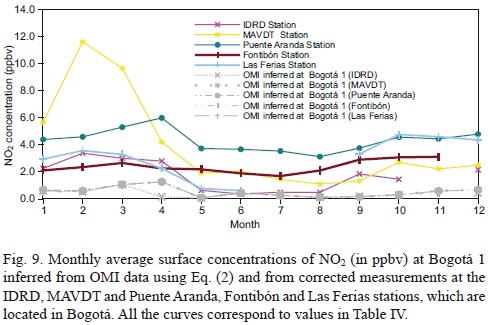
<body><![CDATA[<p align="justify"><font face="verdana" size="2">During the day, NO is present in higher levels than NO<sub>2</sub>, and during the night, the converse is true.</font></p>  	    <p align="justify"><font face="verdana" size="2">Another important factor that affects the value of CF is anthropogenic activity, which is related to the population density and the industrial characteristics of a region. In general, the higher the levels of anthropogenic activity, the higher the concentrations of NO<sub>x</sub> species. In remote regions, the levels of anthropogenic activity are lower and NOy compounds prevail. From the center of Colombia to the north (i.e., in the region with the highest anthropogenic activity), the CF values are slightly higher compared with the CF values in the southern and southeastern parts of the country (which include departments with smaller populations, such as Amazonas, Guain&iacute;a, Caquet&aacute;, Putumayo, and Guaviare). The highest values for all months (between 0.4 and 0.6) occur close to the Venezuelan coast, probably due to anthropogenic causes.</font></p>  	    <p align="justify"><font face="verdana" size="2"><i>4.7 OMI&#45;derived NO<sub>2</sub> concentrations versus in situ and biomass burning data</i></font></p>  	    <p align="justify"><font face="verdana" size="2"><i>4.7.1 Comparison of OMI&#45;derived NO<sub>2</sub> concentrations and in situ concentrations</i></font></p>  	    <p align="justify"><font face="verdana" size="2">Correlation coefficients were calculated for the comparison of the monthly mean surface NO<sub>2</sub> concentrations measured in situ with those inferred from OMI data. For each in situ data point, it was necessary to apply the correction factor in the GEOS&#45;Chem grid that was closest to the associated measuring station. Data were only available from seven ground stations in two cities: Bogot&aacute; (six stations) and Bucaramanga (one station). Several main cities such as Medell&iacute;n (Antioquia), Pereira (Risaralda), Manizales (Caldas), and Cali (Valle del Cauca) have air quality monitoring networks; however, we could only have access to the data for Bogot&aacute; and Bucaramanga. On the other hand, cities that have air quality monitoring networks are located west of the Cordillera Oriental, so that in much of the country, no surface stations exist from which air quality data can be obtained to study the sources and transport mechanisms of pollutants in Colombia.</font></p>  	    <p align="justify"><font face="verdana" size="2">The stations located and used in Bogot&aacute; are IDRD, MAVDT, Fontib&oacute;n, Las Ferias, Puente Aranda, and Suba. The station located and used in Bucaramanga is Centro. The number of data points used simultaneously for inferred monthly NO<sub>2</sub> concentrations and measuring stations in Bogot&aacute; and Bucaramanga is presented in <a href="/img/revistas/atm/v27n2/a7t2.jpg" target="_blank">Table II</a>. As can be observed in this table, certain averages were calculated using only one simultaneous data point, and in the best case, some averages were calculated using 20 simultaneous data points. Since Bogot&aacute; has an area of 1600 km<sup>2</sup>, two OMI grid cells at the resolution 0.5 x 0.5&deg; were used to compare with the station data. The location of the midpoint of each grid cell is shown in <a href="#t3">Table III</a>.</font></p>  	    <p align="center"><font face="verdana" size="2"><a name="t3"></a></font></p>  	    <p align="center"><font face="verdana" size="2"><img src="/img/revistas/atm/v27n2/a7t3.jpg"></font></p>  	    <p align="justify"><font face="verdana" size="2">Monthly averages and correlations for stations in Bucaramanga and Bogot&aacute; are presented in <a href="/img/revistas/atm/v27n2/a7t4.jpg" target="_blank">Table IV</a>. The in situ data that are most highly correlated with the OMI inferred data are those from the Puente Aranda, IDRD and MAVDT stations. Data from these three stations yield Pearson coefficients of 0.91, 0.56 and 0.55 and Spearman coefficients of 0.81, 0.55 and 0.78, respectively. The stations with the highest annual mean are Puente Aranda, MAVDT and Las Ferias, in that order. It is noted that the Puente Aranda station is located in the second&#45;biggest industrial zone in Colombia, which could mean that concentration of polluting agents, in particular NO<sub>2</sub>, could be homogeneous in the surrounding area represented by the corresponding OMI grid cell (Bogot&aacute; 1), so that Puente Aranda could have the best local background measurements relative to the other stations.</font></p>  	    <p align="justify"><font face="verdana" size="2"><a href="#f9">Figures 9</a>&#45;<a href="#f11">11</a> show the monthly means of NO<sub>2</sub> concentrations from the stations in Bogot&aacute; and Bucaramanga and the corresponding inferred OMI values. The NO<sub>2</sub> concentrations inferred from OMI data for Colombia are similar to those found by Lamsal <i>et al.</i> (2008) in the U.S. for the summer season. These authors reported NO<sub>2</sub> concentrations of 0.1 ppbv in rural regions and between 2 and 3 ppbv in urban areas. Since the measurements at the stations are at surface level, they do not reflect the influence of either the mixed layer or the horizontal atmospheric movements, both of which serve to mix atmospheric pollutants. Thus, inferred OMI NO<sub>2</sub> concentration tends to be lower than point measurements reported at the corresponding stations. Therefore, the values for the stations reported in <a href="#f9">Figures 9</a>&#45;<a href="#f11">11</a> could have overestimations even though they correspond to corrected data according to the CF obtained from GEOS&#45;Chem (section 4.6). Such CFs are influenced by the interferences caused mainly by NOy species such as PAN, alkyl nitrates and HNO<sub>3</sub> (see Eq. 4). Thus, it can be expected that, despite the correction, surface NO<sub>2</sub> concentrations from the stations are still overestimated. It is therefore desirable to determine the conversion rates of interfering NOy species. The conversion ofHNO<sub>3</sub> is not easy to resolve and depends on the measuring equipment, as noted by Lamsal <i>et al.</i> (2008), who reported a value of 35%. In the cases of PAN and alkyl nitrates, conversion to more stable compounds is expected (Steinbacher <i>et al.</i> , 2007). On the other hand, a main reason for the underestimation of satellite&#45;inferred concentrations is the limited sensitivity ofthe remote sensing instrument close to the surface.</font></p>  	    ]]></body>
<body><![CDATA[<p align="center"><font face="verdana" size="2"><a name="f9"></a></font></p>  	    <p align="center"><font face="verdana" size="2"><img src="/img/revistas/atm/v27n2/a7f9.jpg"></font></p> 	    <p align="center"><img src="/img/revistas/atm/v27n2/a7f10.jpg"></p>      <p align="center"><font face="verdana" size="2"><a name="f11"></a></font></p>  	    <p align="center"><font face="verdana" size="2"><img src="/img/revistas/atm/v27n2/a7f11.jpg"></font></p>  	    <p align="justify"><font face="verdana" size="2">It should also be noted that our data validation process was limited because a high layer of cloud cover is usually present over the mountainous regions. This cloud cover impedes the measurement of NO<sub>2</sub> columns in the visible spectrum (section 2.1) and as can be observed on the map in <a href="#f12">Figure 12</a>, the lack of data for the Andean region (departments of Nari&ntilde;o, Cauca, Valle del Cauca, Huila, Tolima, Risaralda, Quind&iacute;o, Cundinamarca, Antioquia, Boyac&aacute;, Santander and Norte de Santander) is considerable. The scarcity of data for the mountainous regions is not unique to 2007. Similar patterns are evident for the years 2008 and 2009 (not shown). Unfortunately, the surface measurement stations available to provide data useful for validation are located in a mountainous and cloudy area. Six of the seven stations are located in Bogot&aacute;, which is located in the Andean region and has an elevation of 2600 m. The seventh station is located in Bucaramanga, which is also located in the Andean region and has an elevation of 959 m. The extension of the network of surface measurement stations to both remote and new urban areas would enable more comprehensive measurement of background concentrations of NO<sub>2</sub> and would facilitate a more complete validation throughout Colombia.</font></p>  	    <p align="center"><font face="verdana" size="2"><a name="f12"></a></font></p>  	    <p align="center"><font face="verdana" size="2"><img src="/img/revistas/atm/v27n2/a7f12.jpg"></font></p>  	    <p align="justify"><font face="verdana" size="2"><i>4.7.2 Estimated NO<sub>2</sub> surface concentration vs. MACC Fire Radiative Power</i> Fire radiative power (FRP) determines the burning rate of biomass (living and dead vegetation). The Global Fire Assimilation System (GFASv1.0) calculates biomass&#45;burning emissions by assimilating FRP observations from the MODIS instrument onboard the Terra and Aqua satellites (Kaiser et al, 2012). We used the FRP data from the Daily Wildfire Emissions product provided by the Monitoring Atmospheric Composition &amp; Climate (MACC) project (available at <a href="http://macc.iek.fz&#45;juelich.de/data/compressed/orig/MACC_Daily_Wildfire_Emissions/" target="_blank">http://macc.iek.fz&#45;juelich.de/data/compressed/orig/MACC_Daily_Wildfire_Emissions/</a>). FRP daily data has a horizontal spatial resolution of 0.5 * 0.5&deg; (latitude x longitude), and has been produced since 2003 to the present.</font></p>  	    <p align="justify"><font face="verdana" size="2"><a href="/img/revistas/atm/v27n2/a7f13.jpg" target="_blank">Figure 13</a> shows monthly means of FRP for 2007. It can be noted that a high amount of biomass was burned in Colombia in February (and also in January and March &#91;not shown&#93;), while biomass burning was scarce in the months after. <a href="/img/revistas/atm/v27n2/a7f14.jpg" target="_blank">Figure 14</a> shows maps of correlation between FRP and OMI&#45;derived N0<sub>2</sub> surface concentration estimated in section 4.5. The biggest number of grid points with high correlation values (&gt; 0.5) is observed for February (and also in January and March &#91;not shown&#93;), especially in Vichada, Meta, Guaviare, Caquet&aacute;, and the western part of Venezuela, regions where the prevailing biome is humid tropical forest. This implies that the high N0<sub>2</sub> concentrations in <a href="/img/revistas/atm/v27n2/a7f7.jpg" target="_blank">Figure 7</a> in these regions are mostly attributable to biomass burning. The correlations are low in the months after. In Cesar, Magdalena, Bol&iacute;var, and La Guajira, where the prevailing biome is tropical dry forest, there are intermediate values of FRP (<a href="/img/revistas/atm/v27n2/a7f13.jpg" target="_blank">Fig. 13</a>). The correlation values between FRP and the estimated NO<sub>2</sub> surface concentration (<a href="/img/revistas/atm/v27n2/a7f14.jpg" target="_blank">Fig. 14</a>) in these regions suggest that the NO<sub>2</sub> concentrations are partially due to biomass burning and partially due to industrial NO<sub>2</sub> generating processes.</font></p>  	    ]]></body>
<body><![CDATA[<p align="justify"><font face="verdana" size="2">&nbsp;</font></p>  	    <p align="justify"><font face="verdana" size="2"><b>5. Conclusions</b></font></p>  	    <p align="justify"><font face="verdana" size="2">1. There is an overestimation of OMI columns in remote regions. We propose that on remote regions, where the density of OMI NO<sub>2</sub> columns is expected to be very low, the amount of 0.4 x 10<sup>15</sup> molecules/cm<sup>2</sup> should be subtracted.</font></p>  	    <p align="justify"><font face="verdana" size="2">2. The inferred NO<sub>2</sub> concentration values are relatively low (between 0.01 and 0.5 ppbv) throughout most of the country. However, relatively high concentrations (between 3 and 4 ppbv) occur in the departments of Caquet&aacute; and Meta in February. A main reason for the underestimation of satellite&#45;inferred concentrations is the limited sensitivity of the remote sensing instrument close to the surface.</font></p>  	    <p align="justify"><font face="verdana" size="2">3. The comparison of NO<sub>2</sub> concentrations inferred from OMI data and those based on ground station measurements from the stations Puente Aranda, IDRD and MAVDT in Bogot&aacute; yields Pearson correlation coefficients of 0.91, 0.56 and 0.55 and Spearman coefficients of 0.81, 0.55 and 0.78, respectively. 4. The comparison of the NO<sub>2</sub> concentrations inferred from OMI data and FRP yields high correlation coefficients in areas where the concentrations are high. These areas are tropical rainforests. This indicates that these high NO<sub>2</sub> concentrations are due to biomass burning, which includes the human&#45;initiated burning of vegetation for land clearing and land use change as well as natural, lightning&#45;induced</font></p>  	    <p align="justify"><font face="verdana" size="2">fires. In areas with correlations between 0.4 and 0.7 (located in western Venezuela and central and northern Colombia during February), NO<sub>2</sub> concentrations can be partially associated with biomass burning and partially with other processes such as transport of NO<sub>2</sub> or its precursors from other regions, burning of fossil fuels by the oil industry, and diverse industrial processes.</font></p>  	    <p align="justify"><font face="verdana" size="2">&nbsp;</font></p>  	    <p align="justify"><font face="verdana" size="2"><b>Acknowledgments</b></font></p>  	    <p align="justify"><font face="verdana" size="2">This work is supported by the Proyecto Piloto Nacional de Adaptaci&oacute;n al Cambio Clim&aacute;tico (INAP, National Pilot Project on Adaptation to Climate Change) and the Direcci&oacute;n de Investigaciones Sede Bogot&aacute; (DIB, Directorate of Research of Bogot&aacute;) of the Universidad Nacional de Colombia through the Convocatoria Nacional de Investigaci&oacute;n y Creaci&oacute;n Art&iacute;stica 2010&#45;2012 (National Call for Research and Artistic Creation 2010&#45;2012).</font></p>  	    <p align="justify"><font face="verdana" size="2">&nbsp;</font></p>  	    ]]></body>
<body><![CDATA[<p align="justify"><font face="verdana" size="2"><b>References</b></font></p>  	    <!-- ref --><p align="justify"><font face="verdana" size="2">Ackermann&#45;Liebrich U., 1997. Lung function and long&#45;term exposure to air pollutants in Switzerland: Study on air pollution and lung diseases in adults (SAPALDIA) team. <i>Am. J. Respir. Crit. Care Med.</i> <b>155,</b> 122&#45;129.    &nbsp;&nbsp;&nbsp;&nbsp;&nbsp;&nbsp;&nbsp;&nbsp;[&#160;<a href="javascript:void(0);" onclick="javascript: window.open('/scielo.php?script=sci_nlinks&ref=1305844&pid=S0187-6236201400020000700001&lng=','','width=640,height=500,resizable=yes,scrollbars=1,menubar=yes,');">Links</a>&#160;]<!-- end-ref --></font></p>  	    <!-- ref --><p align="justify"><font face="verdana" size="2">Barreto P. L. R., 2004. Estudio de la contaminaci&oacute;n por niebla fotoqu&iacute;mica con relaci&oacute;n a las emisiones y el comportamiento de la atm&oacute;sfera en la ciudad de Bogot&aacute;. Tesis de maestr&iacute;a en Meteorolog&iacute;a, Facultad de Ciencias, Universidad Nacional de Colombia.    &nbsp;&nbsp;&nbsp;&nbsp;&nbsp;&nbsp;&nbsp;&nbsp;[&#160;<a href="javascript:void(0);" onclick="javascript: window.open('/scielo.php?script=sci_nlinks&ref=1305846&pid=S0187-6236201400020000700002&lng=','','width=640,height=500,resizable=yes,scrollbars=1,menubar=yes,');">Links</a>&#160;]<!-- end-ref --></font></p>  	    <!-- ref --><p align="justify"><font face="verdana" size="2">Bedoya V J., 1981. Fuentes contaminantes del aire en el valle de Aburr&aacute;. <i>Revista AINSA</i> <b>1,</b> 66&#45;77.    &nbsp;&nbsp;&nbsp;&nbsp;&nbsp;&nbsp;&nbsp;&nbsp;[&#160;<a href="javascript:void(0);" onclick="javascript: window.open('/scielo.php?script=sci_nlinks&ref=1305848&pid=S0187-6236201400020000700003&lng=','','width=640,height=500,resizable=yes,scrollbars=1,menubar=yes,');">Links</a>&#160;]<!-- end-ref --></font></p>  	    <!-- ref --><p align="justify"><font face="verdana" size="2">Benavides B. H. O., 2003. Pron&oacute;stico de la concentraci&oacute;n de material particulado por chimeneas industriales en Bogot&aacute;. Tesis de maestr&iacute;a en Meteorolog&iacute;a, Facultad de Ciencias, Universidad Nacional de Colombia.    &nbsp;&nbsp;&nbsp;&nbsp;&nbsp;&nbsp;&nbsp;&nbsp;[&#160;<a href="javascript:void(0);" onclick="javascript: window.open('/scielo.php?script=sci_nlinks&ref=1305850&pid=S0187-6236201400020000700004&lng=','','width=640,height=500,resizable=yes,scrollbars=1,menubar=yes,');">Links</a>&#160;]<!-- end-ref --></font></p>  	    <!-- ref --><p align="justify"><font face="verdana" size="2">Bey I., D. Jacob, R. M. Yantosca, J. A. Logan, B. D. Field, A. M. Fiore, Q. Li, H. Y. Liu, L. J. Mickley and M. G. Schultz, 2001. Global modeling of tropospheric chemistry with assimilated meteorology: Model description and evaluation. <i>J. Geophys. Res.</i> <b>106,</b> 23073&#45;23096.    &nbsp;&nbsp;&nbsp;&nbsp;&nbsp;&nbsp;&nbsp;&nbsp;[&#160;<a href="javascript:void(0);" onclick="javascript: window.open('/scielo.php?script=sci_nlinks&ref=1305852&pid=S0187-6236201400020000700005&lng=','','width=640,height=500,resizable=yes,scrollbars=1,menubar=yes,');">Links</a>&#160;]<!-- end-ref --></font></p>  	    <!-- ref --><p align="justify"><font face="verdana" size="2">Boersma K. F., H. J. Eskes, J. P. Veefkind, E. J. Brinksma, R. J. Van Der A, M. Sneep, G. H. J. Van Den Oord, P. F. Levelt, P. Stammes, J. F. Gleason and E. J. Bucsela, 2007. Near&#45;real time retrieval of tropospheric NO<sub>2</sub> from OMI. <i>Atm. Chem. Phys.</i> <b>7,</b> 2103&#45;2118.    &nbsp;&nbsp;&nbsp;&nbsp;&nbsp;&nbsp;&nbsp;&nbsp;[&#160;<a href="javascript:void(0);" onclick="javascript: window.open('/scielo.php?script=sci_nlinks&ref=1305854&pid=S0187-6236201400020000700006&lng=','','width=640,height=500,resizable=yes,scrollbars=1,menubar=yes,');">Links</a>&#160;]<!-- end-ref --></font></p>  	    <!-- ref --><p align="justify"><font face="verdana" size="2">Boersma K. F., D. J. Jacob, E. J. Bucsela, A. E. Perring, R. Dirksen, R. J. van der A, R. M. Yantosca, R. J. Park, M. O. Wenig, T. H. Bertram and R. C. Cohen, 2008. Validation of OMI tropospheric NO<sub>2</sub> observations during INTEX&#45;B and application to constrain NO<sub>x</sub> emissions over the eastern United States and Mexico. <i>Atmos. Environ.</i> <b>42,</b> 4480&#45;4497, doi:10.1016/j. atmosenv.2008.02.004.    &nbsp;&nbsp;&nbsp;&nbsp;&nbsp;&nbsp;&nbsp;&nbsp;[&#160;<a href="javascript:void(0);" onclick="javascript: window.open('/scielo.php?script=sci_nlinks&ref=1305856&pid=S0187-6236201400020000700007&lng=','','width=640,height=500,resizable=yes,scrollbars=1,menubar=yes,');">Links</a>&#160;]<!-- end-ref --></font></p>  	    <!-- ref --><p align="justify"><font face="verdana" size="2">Boersma K. F., R. Braak and R. J. van der A, 2011. Dutch OMI NO<sub>2</sub> (DOMINO) data product v2.0 HE5 data file user manual.    &nbsp;&nbsp;&nbsp;&nbsp;&nbsp;&nbsp;&nbsp;&nbsp;[&#160;<a href="javascript:void(0);" onclick="javascript: window.open('/scielo.php?script=sci_nlinks&ref=1305858&pid=S0187-6236201400020000700008&lng=','','width=640,height=500,resizable=yes,scrollbars=1,menubar=yes,');">Links</a>&#160;]<!-- end-ref --></font></p>  	    <!-- ref --><p align="justify"><font face="verdana" size="2">Bond T. C., E. Bhardwaj, R. Dong, R. Jogani, S. Jung, C. Roden, D. G. Streets and N. M. Trautmann, 2007. Historical emissions of black and organic carbon aerosol from energy related combustion, 1850&#45;2000. <i>Global Biogeochem. Cy.</i> <b>21,</b> GB2018, doi:10.1029/2006GB002840.    &nbsp;&nbsp;&nbsp;&nbsp;&nbsp;&nbsp;&nbsp;&nbsp;[&#160;<a href="javascript:void(0);" onclick="javascript: window.open('/scielo.php?script=sci_nlinks&ref=1305860&pid=S0187-6236201400020000700009&lng=','','width=640,height=500,resizable=yes,scrollbars=1,menubar=yes,');">Links</a>&#160;]<!-- end-ref --></font></p>  	    <!-- ref --><p align="justify"><font face="verdana" size="2">Bucsela E. J., E. A. Celarier, M. O. Wenig, J. F. Gleason, J. P. Veefkind, K. F. Boersma and E. J. Brinksma, 2006. Algorithm for NO<sub>2</sub> vertical column retrieval from the ozone monitoring instrument. <i>IEEE T. on Geosci. Remote</i> <b>44,</b> doi:10.1109/TGRS.2005.863715.    &nbsp;&nbsp;&nbsp;&nbsp;&nbsp;&nbsp;&nbsp;&nbsp;[&#160;<a href="javascript:void(0);" onclick="javascript: window.open('/scielo.php?script=sci_nlinks&ref=1305862&pid=S0187-6236201400020000700010&lng=','','width=640,height=500,resizable=yes,scrollbars=1,menubar=yes,');">Links</a>&#160;]<!-- end-ref --></font></p>  	    <!-- ref --><p align="justify"><font face="verdana" size="2">Bucsela E. J., A. E. Perring, R. C. Cohen, K. F. Boers&#45;ma, E. A. Celarier, J. F. Gleason, M. O. Wenig, T. H. Bertram, P. J. Wooldridge, R. Dirksen and J. P. Veefkind, 2008. Comparison of tropospheric NO2 in situ aircraft measurements with near&#45;real&#45;time and standard product data from the Ozone Monitoring Instrument. <i>J. Geophys. Res.</i> <b>113,</b> D16S31. doi:10.1029/2007JD008838.    &nbsp;&nbsp;&nbsp;&nbsp;&nbsp;&nbsp;&nbsp;&nbsp;[&#160;<a href="javascript:void(0);" onclick="javascript: window.open('/scielo.php?script=sci_nlinks&ref=1305864&pid=S0187-6236201400020000700011&lng=','','width=640,height=500,resizable=yes,scrollbars=1,menubar=yes,');">Links</a>&#160;]<!-- end-ref --></font></p>  	    <!-- ref --><p align="justify"><font face="verdana" size="2">Celarier E. A., E. J. Brinksma, J. F. Gleason, J. P. Veef&#45;kind, A. Cede, J. R. Herman, D. Ionov, F. Goutail, J.&#45;P. Pommereau, J.&#45;C. Lambert, M. van Roozendael, G. Pinardi, F. Wittrock, A. Schonhardt, A. Richter, O. W. Ibrahim, T. Wagner, B. Bojkov, G. Mount, E. Spinei, C. M. Chen, T. J. Pongetti, S. P. Sander, E. J. Bucsela, M. O. Wenig, D. P. J. Swart, H. Volten, M. Kroon and P. F. Levelt, 2008. Validation of ozone monitoring instrument nitrogen dioxide columns. <i>J. Geophys. Res.</i> <b>113,</b> D15S15, doi:10.1029/2007JD008908.    &nbsp;&nbsp;&nbsp;&nbsp;&nbsp;&nbsp;&nbsp;&nbsp;[&#160;<a href="javascript:void(0);" onclick="javascript: window.open('/scielo.php?script=sci_nlinks&ref=1305866&pid=S0187-6236201400020000700012&lng=','','width=640,height=500,resizable=yes,scrollbars=1,menubar=yes,');">Links</a>&#160;]<!-- end-ref --></font></p>  	    <!-- ref --><p align="justify"><font face="verdana" size="2">Dunlea E. J., S. C. Herndon, D. D. Nelson, R. M. Volkamer, F. San Martini, P. M. Sheehy, M. S. Zahniser, J. H. Shorter, J. C. Wormhoudt, B. K. Lamb, E. J. Allwine, J. S. Gaffney, N. A. Marley, M. Grutter, C. M&aacute;rquez, S. Blanco, B. C&aacute;rdenas, A. Retama, C. R. Ramos Villegas, C. E. Kolb, L. T. Molina and M. J. Molina, 2007. Evaluation of nitrogen dioxide chemiluminescence monitors in a polluted urban environment. <i>Atmos.</i> <i>Chem. Phys.</i> <b>7,</b> 2691&#45;2704.    &nbsp;&nbsp;&nbsp;&nbsp;&nbsp;&nbsp;&nbsp;&nbsp;[&#160;<a href="javascript:void(0);" onclick="javascript: window.open('/scielo.php?script=sci_nlinks&ref=1305868&pid=S0187-6236201400020000700013&lng=','','width=640,height=500,resizable=yes,scrollbars=1,menubar=yes,');">Links</a>&#160;]<!-- end-ref --></font></p>  	    <!-- ref --><p align="justify"><font face="verdana" size="2">Ellis E. C., 1975. Technical assistance document for the chemiluminescence measurement of nitrogen dioxide. Technical report. Environmental Monitoring and Support Laboratory, U.S. Environmental Protection Agency. EPA&#45;600/4&#45;75&#45;003.    &nbsp;&nbsp;&nbsp;&nbsp;&nbsp;&nbsp;&nbsp;&nbsp;[&#160;<a href="javascript:void(0);" onclick="javascript: window.open('/scielo.php?script=sci_nlinks&ref=1305870&pid=S0187-6236201400020000700014&lng=','','width=640,height=500,resizable=yes,scrollbars=1,menubar=yes,');">Links</a>&#160;]<!-- end-ref --></font></p>  	    <!-- ref --><p align="justify"><font face="verdana" size="2">Evans M. J., A. Fiore and D. J. Jacob, 2003. The GEOS&#45;Chem chemical mechanism version 5&#45;07&#45;8. Harvard University, Cambridge. Available at: <a href="http://acmg.seas.harvard.edu/geos/wiki_docs/chemistry/geoschem_mech.pdf" target="_blank">http://acmg.seas.harvard.edu/geos/wiki_docs/chemistry/geoschem_mech.pdf</a> (last accessed on March 10, 2014.    &nbsp;&nbsp;&nbsp;&nbsp;&nbsp;&nbsp;&nbsp;&nbsp;[&#160;<a href="javascript:void(0);" onclick="javascript: window.open('/scielo.php?script=sci_nlinks&ref=1305872&pid=S0187-6236201400020000700015&lng=','','width=640,height=500,resizable=yes,scrollbars=1,menubar=yes,');">Links</a>&#160;]<!-- end-ref --></font></p>  	    <!-- ref --><p align="justify"><font face="verdana" size="2">Gass J., 2012. The GEOS&#45;5 System. NASA, Global Modeling and Assimilation Office. Available at: <a href="http://gmao.gsfc.nasa.gov/systems/geos5/" target="_blank">http://gmao.gsfc.nasa.gov/systems/geos5/</a> (last accessed on March 10, 2014).    &nbsp;&nbsp;&nbsp;&nbsp;&nbsp;&nbsp;&nbsp;&nbsp;[&#160;<a href="javascript:void(0);" onclick="javascript: window.open('/scielo.php?script=sci_nlinks&ref=1305874&pid=S0187-6236201400020000700016&lng=','','width=640,height=500,resizable=yes,scrollbars=1,menubar=yes,');">Links</a>&#160;]<!-- end-ref --></font></p>  	    <!-- ref --><p align="justify"><font face="verdana" size="2">Gauderman W. J., 2000. Association between air pollution and lung function growth in southern California children. <i>Am. J. Respir. Crit. Care Med.</i> <b>162,</b> 1383-1390.    &nbsp;&nbsp;&nbsp;&nbsp;&nbsp;&nbsp;&nbsp;&nbsp;[&#160;<a href="javascript:void(0);" onclick="javascript: window.open('/scielo.php?script=sci_nlinks&ref=1305876&pid=S0187-6236201400020000700017&lng=','','width=640,height=500,resizable=yes,scrollbars=1,menubar=yes,');">Links</a>&#160;]<!-- end-ref --></font></p>  	    <!-- ref --><p align="justify"><font face="verdana" size="2">Gauderman W. J., 2002. Association between air pollution and lung function growth in southern California children: Results from a second cohort. <i>Am. J. Respir.</i> <i>Crit. Care Med.</i> <b>166,</b> 76&#45;84.    &nbsp;&nbsp;&nbsp;&nbsp;&nbsp;&nbsp;&nbsp;&nbsp;[&#160;<a href="javascript:void(0);" onclick="javascript: window.open('/scielo.php?script=sci_nlinks&ref=1305878&pid=S0187-6236201400020000700018&lng=','','width=640,height=500,resizable=yes,scrollbars=1,menubar=yes,');">Links</a>&#160;]<!-- end-ref --></font></p>  	    <!-- ref --><p align="justify"><font face="verdana" size="2">Grosjean D. and J. Harrison, 1985. Response of chemi&#45;luminescence NOx analyzers and ultraviolet ozone analyzers to organic air pollutants. <i>Environ. Sci. and Technol.</i> <b>19,</b> 862&#45;865.    &nbsp;&nbsp;&nbsp;&nbsp;&nbsp;&nbsp;&nbsp;&nbsp;[&#160;<a href="javascript:void(0);" onclick="javascript: window.open('/scielo.php?script=sci_nlinks&ref=1305880&pid=S0187-6236201400020000700019&lng=','','width=640,height=500,resizable=yes,scrollbars=1,menubar=yes,');">Links</a>&#160;]<!-- end-ref --></font></p>  	    <!-- ref --><p align="justify"><font face="verdana" size="2">Ichoku C., L. Giglio, M. J. Wooster and L. A. Remer, 2008. Global characterization of biomass&#45;burning patterns using satellite measurements of fire radiative energy. <i>Remote Sens. Environ.</i> <b>112,</b> 2950&#45;2962.    &nbsp;&nbsp;&nbsp;&nbsp;&nbsp;&nbsp;&nbsp;&nbsp;[&#160;<a href="javascript:void(0);" onclick="javascript: window.open('/scielo.php?script=sci_nlinks&ref=1305882&pid=S0187-6236201400020000700020&lng=','','width=640,height=500,resizable=yes,scrollbars=1,menubar=yes,');">Links</a>&#160;]<!-- end-ref --></font></p>  	    <!-- ref --><p align="justify"><font face="verdana" size="2">Jacob D., 1999. <i>Introduction to atmospheric chemistry.</i> 11.4. Global budget of the nitrogen oxides. Princeton University Press, 211&#45;215.    &nbsp;&nbsp;&nbsp;&nbsp;&nbsp;&nbsp;&nbsp;&nbsp;[&#160;<a href="javascript:void(0);" onclick="javascript: window.open('/scielo.php?script=sci_nlinks&ref=1305884&pid=S0187-6236201400020000700021&lng=','','width=640,height=500,resizable=yes,scrollbars=1,menubar=yes,');">Links</a>&#160;]<!-- end-ref --></font></p>  	    <!-- ref --><p align="justify"><font face="verdana" size="2">Jim&eacute;nez P. R., 2004. Development and application of UV&#45;visible and mid&#45;IR differential absorption spectroscopy techniques for pollutant trace gas monitoring. Ph.D. thesis no. 2944. &Eacute;cole Polytechnique F&eacute;d&eacute;rale de Lausanne, France, 230 pp.    &nbsp;&nbsp;&nbsp;&nbsp;&nbsp;&nbsp;&nbsp;&nbsp;[&#160;<a href="javascript:void(0);" onclick="javascript: window.open('/scielo.php?script=sci_nlinks&ref=1305886&pid=S0187-6236201400020000700022&lng=','','width=640,height=500,resizable=yes,scrollbars=1,menubar=yes,');">Links</a>&#160;]<!-- end-ref --></font></p>  	    <!-- ref --><p align="justify"><font face="verdana" size="2">Jones P. W., 1999. First and second order conservative remapping schemes for grids in spherical coordinates. <i>Mon. Weather Rev.</i> <b>127,</b> 2204&#45;2210.    &nbsp;&nbsp;&nbsp;&nbsp;&nbsp;&nbsp;&nbsp;&nbsp;[&#160;<a href="javascript:void(0);" onclick="javascript: window.open('/scielo.php?script=sci_nlinks&ref=1305888&pid=S0187-6236201400020000700023&lng=','','width=640,height=500,resizable=yes,scrollbars=1,menubar=yes,');">Links</a>&#160;]<!-- end-ref --></font></p>  	    <!-- ref --><p align="justify"><font face="verdana" size="2">Kaiser J. W., A. Heil, M. O. Andreae, A. Benedetti, N. Chu&#45;barova, L. Jones, J.&#45;J. Morcrette, M. Razinger, M. G. Schultz, M. Suttie and G. R. van der Werf, 2012. Biomass burning emissions estimated with a global fire assimilation system based on observed fire radiative power. <i>Biogeosciences</i> <b>9,</b> 527&#45;554, doi:10.5194/bg&#45;9&#45;527&#45;2012.    &nbsp;&nbsp;&nbsp;&nbsp;&nbsp;&nbsp;&nbsp;&nbsp;[&#160;<a href="javascript:void(0);" onclick="javascript: window.open('/scielo.php?script=sci_nlinks&ref=1305890&pid=S0187-6236201400020000700024&lng=','','width=640,height=500,resizable=yes,scrollbars=1,menubar=yes,');">Links</a>&#160;]<!-- end-ref --></font></p>  	    <!-- ref --><p align="justify"><font face="verdana" size="2">Kempler S. J., 2010. OMI data products and data access. NASA, Godard Earth Sciences Sata and Information Services Center. Available at: <a href="http://disc.sci.gsfc.nasa.gov/Aura/overview/data&#45;holdings/OMI/index.shtml" target="_blank">http://disc.sci.gsfc.nasa.gov/Aura/overview/data&#45;holdings/OMI/index.shtml</a> (last accessed on November 20, 2012).    &nbsp;&nbsp;&nbsp;&nbsp;&nbsp;&nbsp;&nbsp;&nbsp;[&#160;<a href="javascript:void(0);" onclick="javascript: window.open('/scielo.php?script=sci_nlinks&ref=1305892&pid=S0187-6236201400020000700025&lng=','','width=640,height=500,resizable=yes,scrollbars=1,menubar=yes,');">Links</a>&#160;]<!-- end-ref --></font></p>  	    <!-- ref --><p align="justify"><font face="verdana" size="2">Lacouture C. J. A., 1979. Estudio de la contaminaci&oacute;n por ozono, di&oacute;xido de nitr&oacute;geno y formaldeh&iacute;do como agentes de contaminaci&oacute;n atmosf&eacute;rica. Tesis en Ingenier&iacute;a Civil, Facultad de Ingenier&iacute;a. Pontificia Universidad Javeriana, Bogot&aacute;, Colombia.    &nbsp;&nbsp;&nbsp;&nbsp;&nbsp;&nbsp;&nbsp;&nbsp;[&#160;<a href="javascript:void(0);" onclick="javascript: window.open('/scielo.php?script=sci_nlinks&ref=1305894&pid=S0187-6236201400020000700026&lng=','','width=640,height=500,resizable=yes,scrollbars=1,menubar=yes,');">Links</a>&#160;]<!-- end-ref --></font></p>  	    <!-- ref --><p align="justify"><font face="verdana" size="2">Lamsal L. N., R. V Martin, A. van Donkelaar, M. Stein&#45;bacher, E. A. Celarier, E. Bucsela, E. J. Dunlea and J. P. Pinto, 2008. Ground&#45;level nitrogen dioxide concentrations inferred from the satellite&#45;borne ozone monitoring instrument. <i>J. Geophys. Res.</i> <b>113,</b> D16308, doi:10.1029/2007JD009235.    &nbsp;&nbsp;&nbsp;&nbsp;&nbsp;&nbsp;&nbsp;&nbsp;[&#160;<a href="javascript:void(0);" onclick="javascript: window.open('/scielo.php?script=sci_nlinks&ref=1305896&pid=S0187-6236201400020000700027&lng=','','width=640,height=500,resizable=yes,scrollbars=1,menubar=yes,');">Links</a>&#160;]<!-- end-ref --></font></p>  	    <!-- ref --><p align="justify"><font face="verdana" size="2">Le Sager P., B. Yantosca and C. Carouge, 2008. GEOS&#45;Chem v8&#45;02&#45;01 online user's guide. Appendix 3: Vertical grids. Atmospheric Chemistry Modeling Group, School of Engineering and Applied Sciences, Harvard University. Available at: <a href="http://acmg.seas.harvard.edu/geos/doc/archive/man.v8&#45;02&#45;01/index.html" target="_blank">http://acmg.seas.harvard.edu/geos/doc/archive/man.v8&#45;02&#45;01/index.html</a> (last accessed on March 10, 2014).    &nbsp;&nbsp;&nbsp;&nbsp;&nbsp;&nbsp;&nbsp;&nbsp;[&#160;<a href="javascript:void(0);" onclick="javascript: window.open('/scielo.php?script=sci_nlinks&ref=1305898&pid=S0187-6236201400020000700028&lng=','','width=640,height=500,resizable=yes,scrollbars=1,menubar=yes,');">Links</a>&#160;]<!-- end-ref --></font></p>  	    <!-- ref --><p align="justify"><font face="verdana" size="2">Martin R. V., D. D. Parrish, T. B. Ryerson, D. K. Nicks Jr., K. Chance, T. P. Kurosu, D. J. Jacob, E. D. Sturges, A. Fried and B. P. Wert, 2004. Evaluation of GOME satellite measurements of tropospheric NO<sub>2</sub> and HCHO using regional data from aircraft campaigns in the southeastern United States. <i>J. Geophys. Res.</i> <b>109,</b> D24307, doi:10.1029/2004JD004869.    &nbsp;&nbsp;&nbsp;&nbsp;&nbsp;&nbsp;&nbsp;&nbsp;[&#160;<a href="javascript:void(0);" onclick="javascript: window.open('/scielo.php?script=sci_nlinks&ref=1305900&pid=S0187-6236201400020000700029&lng=','','width=640,height=500,resizable=yes,scrollbars=1,menubar=yes,');">Links</a>&#160;]<!-- end-ref --></font></p>  	    <!-- ref --><p align="justify"><font face="verdana" size="2">Martin R., C. E. Sioris, K. Chance, T. Ryerson, T. H. Bertram, P. J. Wooldridge, R. C. Cohen, J. A. Neuman, A. Swanson and F. Flocke, 2006. Evaluation of space&#45;based constraints on global nitrogen oxide emissions with regional aircraft measurements over and downwind of eastern North America. <i>J. Geophys. Res.</i> <b>111,</b> D15308. doi:10.1029/2005JD006680.    &nbsp;&nbsp;&nbsp;&nbsp;&nbsp;&nbsp;&nbsp;&nbsp;[&#160;<a href="javascript:void(0);" onclick="javascript: window.open('/scielo.php?script=sci_nlinks&ref=1305902&pid=S0187-6236201400020000700030&lng=','','width=640,height=500,resizable=yes,scrollbars=1,menubar=yes,');">Links</a>&#160;]<!-- end-ref --></font></p>  	    <!-- ref --><p align="justify"><font face="verdana" size="2">Olivier J. G. J. and J. J. M. Berdowski, 2001. Global emissions sources and sinks. In: <i>The climate system</i> (J. Berdowski, R. Guicherit and B. J. Heij, Eds.). A. A. Balkema Publishers/Swets &amp; Zeitlinger Publishers, Lisse, The Netherlands, 33&#45;50.    &nbsp;&nbsp;&nbsp;&nbsp;&nbsp;&nbsp;&nbsp;&nbsp;[&#160;<a href="javascript:void(0);" onclick="javascript: window.open('/scielo.php?script=sci_nlinks&ref=1305904&pid=S0187-6236201400020000700031&lng=','','width=640,height=500,resizable=yes,scrollbars=1,menubar=yes,');">Links</a>&#160;]<!-- end-ref --></font></p>  	    <!-- ref --><p align="justify"><font face="verdana" size="2">OMI Team, 2009. Ozone monitoring instrument (OMI) data user's guide. OMI&#45;DUG&#45;3.0. Available at: <a href="http://views.cira.colostate.edu/data/Documents/Guidelines/README.OMI_DUG.pdf" target="_blank">http://views.cira.colostate.edu/data/Documents/Guidelines/README.OMI_DUG.pdf</a> (last accessed on March 10, 2014).    &nbsp;&nbsp;&nbsp;&nbsp;&nbsp;&nbsp;&nbsp;&nbsp;[&#160;<a href="javascript:void(0);" onclick="javascript: window.open('/scielo.php?script=sci_nlinks&ref=1305906&pid=S0187-6236201400020000700032&lng=','','width=640,height=500,resizable=yes,scrollbars=1,menubar=yes,');">Links</a>&#160;]<!-- end-ref --></font></p>  	    <!-- ref --><p align="justify"><font face="verdana" size="2">Oviedo T. B. E., 2009. An&aacute;lisis del efecto del cambio clim&aacute;tico en la dispersi&oacute;n de ozono y material particulado en Bogot&aacute;. Tesis de maestr&iacute;a en Meteorolog&iacute;a. Facultad de Ciencias, Universidad Nacional de Colombia.    &nbsp;&nbsp;&nbsp;&nbsp;&nbsp;&nbsp;&nbsp;&nbsp;[&#160;<a href="javascript:void(0);" onclick="javascript: window.open('/scielo.php?script=sci_nlinks&ref=1305908&pid=S0187-6236201400020000700033&lng=','','width=640,height=500,resizable=yes,scrollbars=1,menubar=yes,');">Links</a>&#160;]<!-- end-ref --></font></p>  	    <!-- ref --><p align="justify"><font face="verdana" size="2">Panella M., V. Tommasini, M. Binotti, L. Palin and G. Bona, 2000. Monitoring nitrogen dioxide and its effects on asthmatic patients: Two different strategies compared. <i>Environ. Monitoring Assess.</i> <b>63,</b> 447&#45;458.    &nbsp;&nbsp;&nbsp;&nbsp;&nbsp;&nbsp;&nbsp;&nbsp;[&#160;<a href="javascript:void(0);" onclick="javascript: window.open('/scielo.php?script=sci_nlinks&ref=1305910&pid=S0187-6236201400020000700034&lng=','','width=640,height=500,resizable=yes,scrollbars=1,menubar=yes,');">Links</a>&#160;]<!-- end-ref --></font></p>  	    <!-- ref --><p align="justify"><font face="verdana" size="2">Rienecker M. M., M. J. Su&aacute;rez, R. Todling, J. Bacmeister, L. Takacs, H.&#45;C. Liu, W. Gu, M. Sienkiewicz, R. D. Koster, R. Gelaro, I. Stajner and E. Nielsen, 2008. The GEOS&#45;5 Data Assimilation System &#45; Documentation of Versions 5.0.1, 5.1.0, and 5.2.0. NASA technical report series on global modeling and data assimilation 104606, V27.    &nbsp;&nbsp;&nbsp;&nbsp;&nbsp;&nbsp;&nbsp;&nbsp;[&#160;<a href="javascript:void(0);" onclick="javascript: window.open('/scielo.php?script=sci_nlinks&ref=1305912&pid=S0187-6236201400020000700035&lng=','','width=640,height=500,resizable=yes,scrollbars=1,menubar=yes,');">Links</a>&#160;]<!-- end-ref --></font></p>  	    <!-- ref --><p align="justify"><font face="verdana" size="2">Ruiz M. J. F., 2002. Simulaci&oacute;n de la contaminaci&oacute;n atmosf&eacute;rica generada por fuentes m&oacute;viles en Bogot&aacute;. Tesis de maestr&iacute;a en Meteorolog&iacute;a, Facultad de Ciencias, Universidad Nacional de Colombia.    &nbsp;&nbsp;&nbsp;&nbsp;&nbsp;&nbsp;&nbsp;&nbsp;[&#160;<a href="javascript:void(0);" onclick="javascript: window.open('/scielo.php?script=sci_nlinks&ref=1305914&pid=S0187-6236201400020000700036&lng=','','width=640,height=500,resizable=yes,scrollbars=1,menubar=yes,');">Links</a>&#160;]<!-- end-ref --></font></p>  	    <!-- ref --><p align="justify"><font face="verdana" size="2">Sauvage, B., R. V. Martin, A. van Donkelaar and J. R. Ziemke, 2007. Quantification of the factors controlling tropical tropospheric ozone and the south Atlantic maximum. <i>J. Geophys. Res.</i> <b>112,</b> D11309, doi:10.1029/2006JD008008.    &nbsp;&nbsp;&nbsp;&nbsp;&nbsp;&nbsp;&nbsp;&nbsp;[&#160;<a href="javascript:void(0);" onclick="javascript: window.open('/scielo.php?script=sci_nlinks&ref=1305916&pid=S0187-6236201400020000700037&lng=','','width=640,height=500,resizable=yes,scrollbars=1,menubar=yes,');">Links</a>&#160;]<!-- end-ref --></font></p>  	    <!-- ref --><p align="justify"><font face="verdana" size="2">Schindler C., U. Ackermann&#45;Liebrich, P. Leuenberger, C. Monn, R. Rapp, G. Bolognini, J.&#45;P. Bongard, O. Brandli, G. Domenighetti, W. Karrer, R. Keller, T. G. Medici, A. P. Perruchoud, M. H. Schoni, J.&#45;M. Tschopp, B. Villiger, J.&#45;P. Zellweger and the SAPALDIA Team, 1998. Associations between lung function and estimated average exposure to NO<sub>2</sub> in eight areas of Switzerland. The SAPALDIA Team. Swiss study of air pollution and lung diseases in adults. <i>Epidemiology</i> <b>9,</b> 405&#45;411.    &nbsp;&nbsp;&nbsp;&nbsp;&nbsp;&nbsp;&nbsp;&nbsp;[&#160;<a href="javascript:void(0);" onclick="javascript: window.open('/scielo.php?script=sci_nlinks&ref=1305918&pid=S0187-6236201400020000700038&lng=','','width=640,height=500,resizable=yes,scrollbars=1,menubar=yes,');">Links</a>&#160;]<!-- end-ref --></font></p>  	    <!-- ref --><p align="justify"><font face="verdana" size="2">Smith B. J., M. Nitschke, L. S. Pilotto, R. E. Ruffin, D. L. Pisaniello and K. J. Willson, 2000. Health effects of daily indoor nitrogen dioxide exposure in people with asthma. <i>Eur. Respir. J.</i> <b>16,</b> 879&#45;885.    &nbsp;&nbsp;&nbsp;&nbsp;&nbsp;&nbsp;&nbsp;&nbsp;[&#160;<a href="javascript:void(0);" onclick="javascript: window.open('/scielo.php?script=sci_nlinks&ref=1305920&pid=S0187-6236201400020000700039&lng=','','width=640,height=500,resizable=yes,scrollbars=1,menubar=yes,');">Links</a>&#160;]<!-- end-ref --></font></p>  	    <!-- ref --><p align="justify"><font face="verdana" size="2">Steinbacher M., C. Zellweger, B. Schwarzenbach, S. Bugmann, B. Buchmann, C. Ordo&ntilde;ez, A. S. H. Prevot and C. Hueglin, 2007. Nitrogen oxides measurements at rural sites in Switzerland: Bias of conventional measurement techniques. <i>J. Geophys. Res.,</i> D11307, doi:10.1029/ 2006JD007971.    &nbsp;&nbsp;&nbsp;&nbsp;&nbsp;&nbsp;&nbsp;&nbsp;[&#160;<a href="javascript:void(0);" onclick="javascript: window.open('/scielo.php?script=sci_nlinks&ref=1305922&pid=S0187-6236201400020000700040&lng=','','width=640,height=500,resizable=yes,scrollbars=1,menubar=yes,');">Links</a>&#160;]<!-- end-ref --></font></p>  	    <!-- ref --><p align="justify"><font face="verdana" size="2">Torres O., R. Decae, J. P. Veefkind and G. de Leeuw, 2002. OMI aerosol retrieval algorithm. In: OMI <i>algorithm theoretical basis document: Clouds, aerosols, and surface UVirradiance</i> (P. Stammes, Ed.). OMI&#45;ATBD&#45;03, vol. 3, version 2. NASA Goddard Space Flight Center, Greenbelt, Maryland, 47&#45;71. Available at: <a href="http://ebookbrowsee.net/atbd&#45;omi&#45;03&#45;pdf&#45;d489054159" target="_blank">http://ebookbrowsee.net/atbd&#45;omi&#45;03&#45;pdf&#45;d489054159</a> (last accessed on March 10 2014).    &nbsp;&nbsp;&nbsp;&nbsp;&nbsp;&nbsp;&nbsp;&nbsp;[&#160;<a href="javascript:void(0);" onclick="javascript: window.open('/scielo.php?script=sci_nlinks&ref=1305924&pid=S0187-6236201400020000700041&lng=','','width=640,height=500,resizable=yes,scrollbars=1,menubar=yes,');">Links</a>&#160;]<!-- end-ref --></font></p>  	    <!-- ref --><p align="justify"><font face="verdana" size="2">Van der Werf G. R., D. C. Morton, R. S. DeFries, L. Giglio, J. T. Randerson, G. J. Collatz and P. S. Kasibhatla, 2009. Estimates of fire emissions from an active deforestation region in the southern Amazon based on satellite data and biogeochemical modelling. <i>Biogeosciences</i> <b>6,</b> 235&#45;249.    &nbsp;&nbsp;&nbsp;&nbsp;&nbsp;&nbsp;&nbsp;&nbsp;[&#160;<a href="javascript:void(0);" onclick="javascript: window.open('/scielo.php?script=sci_nlinks&ref=1305926&pid=S0187-6236201400020000700042&lng=','','width=640,height=500,resizable=yes,scrollbars=1,menubar=yes,');">Links</a>&#160;]<!-- end-ref --></font></p>  	    <!-- ref --><p align="justify"><font face="verdana" size="2">Wang Y., D. J. Jacob and J. A. Logan, 1998. Global simulation of tropospheric O<sub>3</sub>&#45;NOx&#45;hydrocarbon chemistry &#45; 1. Model formulation. <i>J. Geophys. Res.</i> <b>103,</b> 10713&#45;10726.    &nbsp;&nbsp;&nbsp;&nbsp;&nbsp;&nbsp;&nbsp;&nbsp;[&#160;<a href="javascript:void(0);" onclick="javascript: window.open('/scielo.php?script=sci_nlinks&ref=1305928&pid=S0187-6236201400020000700043&lng=','','width=640,height=500,resizable=yes,scrollbars=1,menubar=yes,');">Links</a>&#160;]<!-- end-ref --></font></p>      ]]></body><back>
<ref-list>
<ref id="B1">
<nlm-citation citation-type="journal">
<person-group person-group-type="author">
<name>
<surname><![CDATA[Ackermann-Liebrich]]></surname>
<given-names><![CDATA[U.]]></given-names>
</name>
</person-group>
<article-title xml:lang="en"><![CDATA[Lung function and long-term exposure to air pollutants in Switzerland: Study on air pollution and lung diseases in adults (SAPALDIA) team]]></article-title>
<source><![CDATA[Am. J. Respir. Crit. Care Med.]]></source>
<year>1997</year>
<volume>155</volume>
<page-range>122-129</page-range></nlm-citation>
</ref>
<ref id="B2">
<nlm-citation citation-type="">
<person-group person-group-type="author">
<name>
<surname><![CDATA[Barreto]]></surname>
<given-names><![CDATA[P. L. R.]]></given-names>
</name>
</person-group>
<source><![CDATA[Estudio de la contaminación por niebla fotoquímica con relación a las emisiones y el comportamiento de la atmósfera en la ciudad de Bogotá]]></source>
<year>2004</year>
</nlm-citation>
</ref>
<ref id="B3">
<nlm-citation citation-type="journal">
<person-group person-group-type="author">
<name>
<surname><![CDATA[Bedoya]]></surname>
<given-names><![CDATA[V J.]]></given-names>
</name>
</person-group>
<article-title xml:lang="es"><![CDATA[Fuentes contaminantes del aire en el valle de Aburrá]]></article-title>
<source><![CDATA[Revista AINSA]]></source>
<year>1981</year>
<volume>1</volume>
<page-range>66-77</page-range></nlm-citation>
</ref>
<ref id="B4">
<nlm-citation citation-type="">
<person-group person-group-type="author">
<name>
<surname><![CDATA[Benavides]]></surname>
<given-names><![CDATA[B. H. O.]]></given-names>
</name>
</person-group>
<source><![CDATA[Pronóstico de la concentración de material particulado por chimeneas industriales en Bogotá]]></source>
<year>2003</year>
</nlm-citation>
</ref>
<ref id="B5">
<nlm-citation citation-type="journal">
<person-group person-group-type="author">
<name>
<surname><![CDATA[Bey]]></surname>
<given-names><![CDATA[I.]]></given-names>
</name>
<name>
<surname><![CDATA[Jacob]]></surname>
<given-names><![CDATA[D.]]></given-names>
</name>
<name>
<surname><![CDATA[Yantosca]]></surname>
<given-names><![CDATA[R. M.]]></given-names>
</name>
<name>
<surname><![CDATA[Logan]]></surname>
<given-names><![CDATA[J. A.]]></given-names>
</name>
<name>
<surname><![CDATA[Field]]></surname>
<given-names><![CDATA[B. D.]]></given-names>
</name>
<name>
<surname><![CDATA[Fiore]]></surname>
<given-names><![CDATA[A. M.]]></given-names>
</name>
<name>
<surname><![CDATA[Li]]></surname>
<given-names><![CDATA[Q.]]></given-names>
</name>
<name>
<surname><![CDATA[Liu]]></surname>
<given-names><![CDATA[H. Y.]]></given-names>
</name>
<name>
<surname><![CDATA[Mickley]]></surname>
<given-names><![CDATA[L. J.]]></given-names>
</name>
<name>
<surname><![CDATA[Schultz]]></surname>
<given-names><![CDATA[M. G.]]></given-names>
</name>
</person-group>
<article-title xml:lang="en"><![CDATA[Global modeling of tropospheric chemistry with assimilated meteorology: Model description and evaluation]]></article-title>
<source><![CDATA[J. Geophys. Res.]]></source>
<year>2001</year>
<volume>106</volume>
<page-range>23073-23096</page-range></nlm-citation>
</ref>
<ref id="B6">
<nlm-citation citation-type="journal">
<person-group person-group-type="author">
<name>
<surname><![CDATA[Boersma]]></surname>
<given-names><![CDATA[K. F.]]></given-names>
</name>
<name>
<surname><![CDATA[Eskes]]></surname>
<given-names><![CDATA[H. J.]]></given-names>
</name>
<name>
<surname><![CDATA[Veefkind]]></surname>
<given-names><![CDATA[J. P.]]></given-names>
</name>
<name>
<surname><![CDATA[Brinksma]]></surname>
<given-names><![CDATA[E. J.]]></given-names>
</name>
<name>
<surname><![CDATA[Van Der A]]></surname>
<given-names><![CDATA[R. J.]]></given-names>
</name>
<name>
<surname><![CDATA[Sneep]]></surname>
<given-names><![CDATA[M.]]></given-names>
</name>
<name>
<surname><![CDATA[Van Den Oord]]></surname>
<given-names><![CDATA[G. H. J.]]></given-names>
</name>
<name>
<surname><![CDATA[Levelt]]></surname>
<given-names><![CDATA[P. F.]]></given-names>
</name>
<name>
<surname><![CDATA[Stammes]]></surname>
<given-names><![CDATA[P.]]></given-names>
</name>
<name>
<surname><![CDATA[Gleason]]></surname>
<given-names><![CDATA[J. F.]]></given-names>
</name>
<name>
<surname><![CDATA[Bucsela]]></surname>
<given-names><![CDATA[E. J.]]></given-names>
</name>
</person-group>
<article-title xml:lang="en"><![CDATA[Near-real time retrieval of tropospheric NO2 from OMI]]></article-title>
<source><![CDATA[Atm. Chem. Phys.]]></source>
<year>2007</year>
<volume>7</volume>
<page-range>2103-2118</page-range></nlm-citation>
</ref>
<ref id="B7">
<nlm-citation citation-type="journal">
<person-group person-group-type="author">
<name>
<surname><![CDATA[Boersma]]></surname>
<given-names><![CDATA[K. F.]]></given-names>
</name>
<name>
<surname><![CDATA[Jacob]]></surname>
<given-names><![CDATA[D. J.]]></given-names>
</name>
<name>
<surname><![CDATA[Bucsela]]></surname>
<given-names><![CDATA[E. J.]]></given-names>
</name>
<name>
<surname><![CDATA[Perring]]></surname>
<given-names><![CDATA[A. E.]]></given-names>
</name>
<name>
<surname><![CDATA[Dirksen]]></surname>
<given-names><![CDATA[R.]]></given-names>
</name>
<name>
<surname><![CDATA[van der A]]></surname>
<given-names><![CDATA[R. J.]]></given-names>
</name>
<name>
<surname><![CDATA[Yantosca]]></surname>
<given-names><![CDATA[R. M.]]></given-names>
</name>
<name>
<surname><![CDATA[Park]]></surname>
<given-names><![CDATA[R. J.]]></given-names>
</name>
<name>
<surname><![CDATA[Wenig]]></surname>
<given-names><![CDATA[M. O.]]></given-names>
</name>
<name>
<surname><![CDATA[Bertram]]></surname>
<given-names><![CDATA[T. H.]]></given-names>
</name>
<name>
<surname><![CDATA[Cohen]]></surname>
<given-names><![CDATA[R. C.]]></given-names>
</name>
</person-group>
<article-title xml:lang="en"><![CDATA[Validation of OMI tropospheric NO2 observations during INTEX-B and application to constrain NOx emissions over the eastern United States and Mexico]]></article-title>
<source><![CDATA[Atmos. Environ.]]></source>
<year>2008</year>
<volume>42</volume>
<page-range>4480-4497</page-range></nlm-citation>
</ref>
<ref id="B8">
<nlm-citation citation-type="">
<person-group person-group-type="author">
<name>
<surname><![CDATA[Boersma]]></surname>
<given-names><![CDATA[K. F.]]></given-names>
</name>
<name>
<surname><![CDATA[Braak]]></surname>
<given-names><![CDATA[R.]]></given-names>
</name>
<name>
<surname><![CDATA[van der A]]></surname>
<given-names><![CDATA[R. J.]]></given-names>
</name>
</person-group>
<source><![CDATA[Dutch OMI NO2 (DOMINO) data product v2.0 HE5 data file user manual]]></source>
<year>2011</year>
</nlm-citation>
</ref>
<ref id="B9">
<nlm-citation citation-type="journal">
<person-group person-group-type="author">
<name>
<surname><![CDATA[Bond]]></surname>
<given-names><![CDATA[T. C.]]></given-names>
</name>
<name>
<surname><![CDATA[Bhardwaj]]></surname>
<given-names><![CDATA[E.]]></given-names>
</name>
<name>
<surname><![CDATA[Dong]]></surname>
<given-names><![CDATA[R.]]></given-names>
</name>
<name>
<surname><![CDATA[Jogani]]></surname>
<given-names><![CDATA[R.]]></given-names>
</name>
<name>
<surname><![CDATA[Jung]]></surname>
<given-names><![CDATA[S.]]></given-names>
</name>
<name>
<surname><![CDATA[Roden]]></surname>
<given-names><![CDATA[C.]]></given-names>
</name>
<name>
<surname><![CDATA[Streets]]></surname>
<given-names><![CDATA[D. G.]]></given-names>
</name>
<name>
<surname><![CDATA[Trautmann]]></surname>
<given-names><![CDATA[N. M.]]></given-names>
</name>
</person-group>
<article-title xml:lang="en"><![CDATA[Historical emissions of black and organic carbon aerosol from energy related combustion, 1850-2000]]></article-title>
<source><![CDATA[Global Biogeochem. Cy.]]></source>
<year>2007</year>
<volume>21</volume>
<page-range>GB2018</page-range></nlm-citation>
</ref>
<ref id="B10">
<nlm-citation citation-type="journal">
<person-group person-group-type="author">
<name>
<surname><![CDATA[Bucsela]]></surname>
<given-names><![CDATA[E. J.]]></given-names>
</name>
<name>
<surname><![CDATA[Celarier]]></surname>
<given-names><![CDATA[E. A.]]></given-names>
</name>
<name>
<surname><![CDATA[Wenig]]></surname>
<given-names><![CDATA[M. O.]]></given-names>
</name>
<name>
<surname><![CDATA[Gleason]]></surname>
<given-names><![CDATA[J. F.]]></given-names>
</name>
<name>
<surname><![CDATA[Veefkind]]></surname>
<given-names><![CDATA[J. P.]]></given-names>
</name>
<name>
<surname><![CDATA[Boersma]]></surname>
<given-names><![CDATA[K. F.]]></given-names>
</name>
<name>
<surname><![CDATA[Brinksma]]></surname>
<given-names><![CDATA[E. J.]]></given-names>
</name>
</person-group>
<article-title xml:lang="en"><![CDATA[Algorithm for NO2 vertical column retrieval from the ozone monitoring instrument]]></article-title>
<source><![CDATA[IEEE T. on Geosci. Remote]]></source>
<year>2006</year>
<volume>44</volume>
</nlm-citation>
</ref>
<ref id="B11">
<nlm-citation citation-type="journal">
<person-group person-group-type="author">
<name>
<surname><![CDATA[Bucsela]]></surname>
<given-names><![CDATA[E. J.]]></given-names>
</name>
<name>
<surname><![CDATA[Perring]]></surname>
<given-names><![CDATA[A. E.]]></given-names>
</name>
<name>
<surname><![CDATA[Cohen]]></surname>
<given-names><![CDATA[R. C.]]></given-names>
</name>
<name>
<surname><![CDATA[Boers-ma]]></surname>
<given-names><![CDATA[K. F.]]></given-names>
</name>
<name>
<surname><![CDATA[Celarier]]></surname>
<given-names><![CDATA[E. A.]]></given-names>
</name>
<name>
<surname><![CDATA[Gleason]]></surname>
<given-names><![CDATA[J. F.]]></given-names>
</name>
<name>
<surname><![CDATA[Wenig]]></surname>
<given-names><![CDATA[M. O.]]></given-names>
</name>
<name>
<surname><![CDATA[Bertram]]></surname>
<given-names><![CDATA[T. H.]]></given-names>
</name>
<name>
<surname><![CDATA[Wooldridge]]></surname>
<given-names><![CDATA[P. J.]]></given-names>
</name>
<name>
<surname><![CDATA[Dirksen]]></surname>
<given-names><![CDATA[R.]]></given-names>
</name>
<name>
<surname><![CDATA[Veefkind]]></surname>
<given-names><![CDATA[J. P.]]></given-names>
</name>
</person-group>
<article-title xml:lang="en"><![CDATA[Comparison of tropospheric NO2 in situ aircraft measurements with near-real-time and standard product data from the Ozone Monitoring Instrument]]></article-title>
<source><![CDATA[J. Geophys. Res.]]></source>
<year>2008</year>
<volume>113</volume>
<page-range>D16S31</page-range></nlm-citation>
</ref>
<ref id="B12">
<nlm-citation citation-type="journal">
<person-group person-group-type="author">
<name>
<surname><![CDATA[Celarier]]></surname>
<given-names><![CDATA[E. A.]]></given-names>
</name>
<name>
<surname><![CDATA[Brinksma]]></surname>
<given-names><![CDATA[E. J.]]></given-names>
</name>
<name>
<surname><![CDATA[Gleason]]></surname>
<given-names><![CDATA[J. F.]]></given-names>
</name>
<name>
<surname><![CDATA[Veef-kind]]></surname>
<given-names><![CDATA[J. P.]]></given-names>
</name>
<name>
<surname><![CDATA[Cede]]></surname>
<given-names><![CDATA[A.]]></given-names>
</name>
<name>
<surname><![CDATA[Herman]]></surname>
<given-names><![CDATA[J. R.]]></given-names>
</name>
<name>
<surname><![CDATA[Ionov]]></surname>
<given-names><![CDATA[D.]]></given-names>
</name>
<name>
<surname><![CDATA[Goutail]]></surname>
<given-names><![CDATA[F.]]></given-names>
</name>
<name>
<surname><![CDATA[Pommereau]]></surname>
<given-names><![CDATA[J.-P.]]></given-names>
</name>
<name>
<surname><![CDATA[Lambert]]></surname>
<given-names><![CDATA[J.-C.]]></given-names>
</name>
<name>
<surname><![CDATA[van Roozendael]]></surname>
<given-names><![CDATA[M.]]></given-names>
</name>
<name>
<surname><![CDATA[Pinardi]]></surname>
<given-names><![CDATA[G.]]></given-names>
</name>
<name>
<surname><![CDATA[Wittrock]]></surname>
<given-names><![CDATA[F.]]></given-names>
</name>
<name>
<surname><![CDATA[Schonhardt]]></surname>
<given-names><![CDATA[A.]]></given-names>
</name>
<name>
<surname><![CDATA[Richter]]></surname>
<given-names><![CDATA[A.]]></given-names>
</name>
<name>
<surname><![CDATA[Ibrahim]]></surname>
<given-names><![CDATA[O. W.]]></given-names>
</name>
<name>
<surname><![CDATA[Wagner]]></surname>
<given-names><![CDATA[T.]]></given-names>
</name>
<name>
<surname><![CDATA[Bojkov]]></surname>
<given-names><![CDATA[B.]]></given-names>
</name>
<name>
<surname><![CDATA[Mount]]></surname>
<given-names><![CDATA[G.]]></given-names>
</name>
<name>
<surname><![CDATA[Spinei]]></surname>
<given-names><![CDATA[E.]]></given-names>
</name>
<name>
<surname><![CDATA[Chen]]></surname>
<given-names><![CDATA[C. M.]]></given-names>
</name>
<name>
<surname><![CDATA[Pongetti]]></surname>
<given-names><![CDATA[T. J.]]></given-names>
</name>
<name>
<surname><![CDATA[Sander]]></surname>
<given-names><![CDATA[S. P.]]></given-names>
</name>
<name>
<surname><![CDATA[Bucsela]]></surname>
<given-names><![CDATA[E. J.]]></given-names>
</name>
<name>
<surname><![CDATA[Wenig]]></surname>
<given-names><![CDATA[M. O.]]></given-names>
</name>
<name>
<surname><![CDATA[Swart]]></surname>
<given-names><![CDATA[D. P. J.]]></given-names>
</name>
<name>
<surname><![CDATA[Volten]]></surname>
<given-names><![CDATA[H.]]></given-names>
</name>
<name>
<surname><![CDATA[Kroon]]></surname>
<given-names><![CDATA[M.]]></given-names>
</name>
<name>
<surname><![CDATA[Levelt]]></surname>
<given-names><![CDATA[P. F.]]></given-names>
</name>
</person-group>
<article-title xml:lang="en"><![CDATA[Validation of ozone monitoring instrument nitrogen dioxide columns]]></article-title>
<source><![CDATA[J. Geophys. Res.]]></source>
<year>2008</year>
<volume>113</volume>
<page-range>D15S15</page-range></nlm-citation>
</ref>
<ref id="B13">
<nlm-citation citation-type="journal">
<person-group person-group-type="author">
<name>
<surname><![CDATA[Dunlea]]></surname>
<given-names><![CDATA[E. J.]]></given-names>
</name>
<name>
<surname><![CDATA[Herndon]]></surname>
<given-names><![CDATA[S. C.]]></given-names>
</name>
<name>
<surname><![CDATA[Nelson]]></surname>
<given-names><![CDATA[D. D.]]></given-names>
</name>
<name>
<surname><![CDATA[Volkamer]]></surname>
<given-names><![CDATA[R. M.]]></given-names>
</name>
<name>
<surname><![CDATA[San Martini]]></surname>
<given-names><![CDATA[F.]]></given-names>
</name>
<name>
<surname><![CDATA[Sheehy]]></surname>
<given-names><![CDATA[P. M.]]></given-names>
</name>
<name>
<surname><![CDATA[Zahniser]]></surname>
<given-names><![CDATA[M. S.]]></given-names>
</name>
<name>
<surname><![CDATA[Shorter]]></surname>
<given-names><![CDATA[J. H.]]></given-names>
</name>
<name>
<surname><![CDATA[Wormhoudt]]></surname>
<given-names><![CDATA[J. C.]]></given-names>
</name>
<name>
<surname><![CDATA[Lamb]]></surname>
<given-names><![CDATA[B. K.]]></given-names>
</name>
<name>
<surname><![CDATA[Allwine]]></surname>
<given-names><![CDATA[E. J.]]></given-names>
</name>
<name>
<surname><![CDATA[Gaffney]]></surname>
<given-names><![CDATA[J. S.]]></given-names>
</name>
<name>
<surname><![CDATA[Marley]]></surname>
<given-names><![CDATA[N. A.]]></given-names>
</name>
<name>
<surname><![CDATA[Grutter]]></surname>
<given-names><![CDATA[M.]]></given-names>
</name>
<name>
<surname><![CDATA[Márquez]]></surname>
<given-names><![CDATA[C.]]></given-names>
</name>
<name>
<surname><![CDATA[Blanco]]></surname>
<given-names><![CDATA[S.]]></given-names>
</name>
<name>
<surname><![CDATA[Cárdenas]]></surname>
<given-names><![CDATA[B.]]></given-names>
</name>
<name>
<surname><![CDATA[Retama]]></surname>
<given-names><![CDATA[A.]]></given-names>
</name>
<name>
<surname><![CDATA[Ramos Villegas]]></surname>
<given-names><![CDATA[C. R.]]></given-names>
</name>
<name>
<surname><![CDATA[Kolb]]></surname>
<given-names><![CDATA[C. E.]]></given-names>
</name>
<name>
<surname><![CDATA[Molina]]></surname>
<given-names><![CDATA[L. T.]]></given-names>
</name>
<name>
<surname><![CDATA[Molina]]></surname>
<given-names><![CDATA[M. J.]]></given-names>
</name>
</person-group>
<article-title xml:lang="en"><![CDATA[Evaluation of nitrogen dioxide chemiluminescence monitors in a polluted urban environment]]></article-title>
<source><![CDATA[Atmos. Chem. Phys.]]></source>
<year>2007</year>
<volume>7</volume>
<page-range>2691-2704</page-range></nlm-citation>
</ref>
<ref id="B14">
<nlm-citation citation-type="book">
<person-group person-group-type="author">
<name>
<surname><![CDATA[Ellis]]></surname>
<given-names><![CDATA[E. C.]]></given-names>
</name>
</person-group>
<source><![CDATA[Technical assistance document for the chemiluminescence measurement of nitrogen dioxide]]></source>
<year>1975</year>
<publisher-name><![CDATA[Environmental Monitoring and Support Laboratory, U.S. Environmental Protection Agency]]></publisher-name>
</nlm-citation>
</ref>
<ref id="B15">
<nlm-citation citation-type="book">
<person-group person-group-type="author">
<name>
<surname><![CDATA[Evans]]></surname>
<given-names><![CDATA[M. J.]]></given-names>
</name>
<name>
<surname><![CDATA[Fiore]]></surname>
<given-names><![CDATA[A.]]></given-names>
</name>
<name>
<surname><![CDATA[Jacob]]></surname>
<given-names><![CDATA[D. J.]]></given-names>
</name>
</person-group>
<source><![CDATA[The GEOS-Chem chemical mechanism version 5-07-8]]></source>
<year>2003</year>
<publisher-loc><![CDATA[Cambridge ]]></publisher-loc>
<publisher-name><![CDATA[Harvard University]]></publisher-name>
</nlm-citation>
</ref>
<ref id="B16">
<nlm-citation citation-type="">
<person-group person-group-type="author">
<name>
<surname><![CDATA[Gass]]></surname>
<given-names><![CDATA[J.]]></given-names>
</name>
</person-group>
<source><![CDATA[The GEOS-5 System. NASA, Global Modeling and Assimilation Office]]></source>
<year>2012</year>
</nlm-citation>
</ref>
<ref id="B17">
<nlm-citation citation-type="journal">
<person-group person-group-type="author">
<name>
<surname><![CDATA[Gauderman]]></surname>
<given-names><![CDATA[W. J.]]></given-names>
</name>
</person-group>
<article-title xml:lang="en"><![CDATA[Association between air pollution and lung function growth in southern California children]]></article-title>
<source><![CDATA[Am. J. Respir. Crit. Care Med.]]></source>
<year>2000</year>
<volume>162</volume>
<page-range>1383-1390</page-range></nlm-citation>
</ref>
<ref id="B18">
<nlm-citation citation-type="journal">
<person-group person-group-type="author">
<name>
<surname><![CDATA[Gauderman]]></surname>
<given-names><![CDATA[W. J.]]></given-names>
</name>
</person-group>
<article-title xml:lang="en"><![CDATA[Association between air pollution and lung function growth in southern California children: Results from a second cohort]]></article-title>
<source><![CDATA[Am. J. Respir. Crit. Care Med.]]></source>
<year>2002</year>
<volume>166</volume>
<page-range>76-84</page-range></nlm-citation>
</ref>
<ref id="B19">
<nlm-citation citation-type="journal">
<person-group person-group-type="author">
<name>
<surname><![CDATA[Grosjean]]></surname>
<given-names><![CDATA[D.]]></given-names>
</name>
<name>
<surname><![CDATA[Harrison]]></surname>
<given-names><![CDATA[J.]]></given-names>
</name>
</person-group>
<article-title xml:lang="en"><![CDATA[Response of chemi-luminescence NOx analyzers and ultraviolet ozone analyzers to organic air pollutants]]></article-title>
<source><![CDATA[Environ. Sci. and Technol.]]></source>
<year>1985</year>
<volume>19</volume>
<page-range>862-865</page-range></nlm-citation>
</ref>
<ref id="B20">
<nlm-citation citation-type="journal">
<person-group person-group-type="author">
<name>
<surname><![CDATA[Ichoku]]></surname>
<given-names><![CDATA[C.]]></given-names>
</name>
<name>
<surname><![CDATA[Giglio]]></surname>
<given-names><![CDATA[L.]]></given-names>
</name>
<name>
<surname><![CDATA[Wooster]]></surname>
<given-names><![CDATA[M. J.]]></given-names>
</name>
<name>
<surname><![CDATA[Remer]]></surname>
<given-names><![CDATA[L. A.]]></given-names>
</name>
</person-group>
<article-title xml:lang="en"><![CDATA[Global characterization of biomass-burning patterns using satellite measurements of fire radiative energy]]></article-title>
<source><![CDATA[Remote Sens. Environ.]]></source>
<year>2008</year>
<volume>112</volume>
<page-range>2950-2962</page-range></nlm-citation>
</ref>
<ref id="B21">
<nlm-citation citation-type="book">
<person-group person-group-type="author">
<name>
<surname><![CDATA[Jacob]]></surname>
<given-names><![CDATA[D.]]></given-names>
</name>
</person-group>
<source><![CDATA[Introduction to atmospheric chemistry. 11.4. Global budget of the nitrogen oxides]]></source>
<year>1999</year>
<page-range>211-215</page-range><publisher-name><![CDATA[Princeton University Press]]></publisher-name>
</nlm-citation>
</ref>
<ref id="B22">
<nlm-citation citation-type="">
<person-group person-group-type="author">
<name>
<surname><![CDATA[Jiménez]]></surname>
<given-names><![CDATA[P. R.]]></given-names>
</name>
</person-group>
<source><![CDATA[Development and application of UV-visible and mid-IR differential absorption spectroscopy techniques for pollutant trace gas monitoring]]></source>
<year>2004</year>
<page-range>230</page-range></nlm-citation>
</ref>
<ref id="B23">
<nlm-citation citation-type="journal">
<person-group person-group-type="author">
<name>
<surname><![CDATA[Jones]]></surname>
<given-names><![CDATA[P. W.]]></given-names>
</name>
</person-group>
<article-title xml:lang="en"><![CDATA[First and second order conservative remapping schemes for grids in spherical coordinates]]></article-title>
<source><![CDATA[Mon. Weather Rev.]]></source>
<year>1999</year>
<volume>127</volume>
<page-range>2204-2210</page-range></nlm-citation>
</ref>
<ref id="B24">
<nlm-citation citation-type="journal">
<person-group person-group-type="author">
<name>
<surname><![CDATA[Kaiser]]></surname>
<given-names><![CDATA[J. W.]]></given-names>
</name>
<name>
<surname><![CDATA[Heil]]></surname>
<given-names><![CDATA[A.]]></given-names>
</name>
<name>
<surname><![CDATA[Andreae]]></surname>
<given-names><![CDATA[M. O.]]></given-names>
</name>
<name>
<surname><![CDATA[Benedetti]]></surname>
<given-names><![CDATA[A.]]></given-names>
</name>
<name>
<surname><![CDATA[Chu-barova]]></surname>
<given-names><![CDATA[N.]]></given-names>
</name>
<name>
<surname><![CDATA[Jones]]></surname>
<given-names><![CDATA[L.]]></given-names>
</name>
<name>
<surname><![CDATA[Morcrette]]></surname>
<given-names><![CDATA[J.-J.]]></given-names>
</name>
<name>
<surname><![CDATA[Razinger]]></surname>
<given-names><![CDATA[M.]]></given-names>
</name>
<name>
<surname><![CDATA[Schultz]]></surname>
<given-names><![CDATA[M. G.]]></given-names>
</name>
<name>
<surname><![CDATA[Suttie]]></surname>
<given-names><![CDATA[M.]]></given-names>
</name>
<name>
<surname><![CDATA[van der Werf]]></surname>
<given-names><![CDATA[G. R.]]></given-names>
</name>
</person-group>
<article-title xml:lang="en"><![CDATA[Biomass burning emissions estimated with a global fire assimilation system based on observed fire radiative power]]></article-title>
<source><![CDATA[Biogeosciences]]></source>
<year>2012</year>
<volume>9</volume>
<page-range>527-554</page-range></nlm-citation>
</ref>
<ref id="B25">
<nlm-citation citation-type="">
<person-group person-group-type="author">
<name>
<surname><![CDATA[Kempler]]></surname>
<given-names><![CDATA[S. J.]]></given-names>
</name>
</person-group>
<source><![CDATA[OMI data products and data access. NASA, Godard Earth Sciences Sata and Information Services Center]]></source>
<year>2010</year>
</nlm-citation>
</ref>
<ref id="B26">
<nlm-citation citation-type="">
<person-group person-group-type="author">
<name>
<surname><![CDATA[Lacouture]]></surname>
<given-names><![CDATA[C. J. A.]]></given-names>
</name>
</person-group>
<source><![CDATA[Estudio de la contaminación por ozono, dióxido de nitrógeno y formaldehído como agentes de contaminación atmosférica]]></source>
<year>1979</year>
</nlm-citation>
</ref>
<ref id="B27">
<nlm-citation citation-type="journal">
<person-group person-group-type="author">
<name>
<surname><![CDATA[Lamsal]]></surname>
<given-names><![CDATA[L. N.]]></given-names>
</name>
<name>
<surname><![CDATA[Martin]]></surname>
<given-names><![CDATA[R. V]]></given-names>
</name>
<name>
<surname><![CDATA[van Donkelaar]]></surname>
<given-names><![CDATA[A.]]></given-names>
</name>
<name>
<surname><![CDATA[Stein-bacher]]></surname>
<given-names><![CDATA[M.]]></given-names>
</name>
<name>
<surname><![CDATA[Celarier]]></surname>
<given-names><![CDATA[E. A.]]></given-names>
</name>
<name>
<surname><![CDATA[Bucsela]]></surname>
<given-names><![CDATA[E.]]></given-names>
</name>
<name>
<surname><![CDATA[Dunlea]]></surname>
<given-names><![CDATA[E. J.]]></given-names>
</name>
<name>
<surname><![CDATA[Pinto]]></surname>
<given-names><![CDATA[J. P.]]></given-names>
</name>
</person-group>
<article-title xml:lang="en"><![CDATA[Ground-level nitrogen dioxide concentrations inferred from the satellite-borne ozone monitoring instrument]]></article-title>
<source><![CDATA[J. Geophys. Res.]]></source>
<year>2008</year>
<volume>113</volume>
<page-range>D16308</page-range></nlm-citation>
</ref>
<ref id="B28">
<nlm-citation citation-type="">
<person-group person-group-type="author">
<name>
<surname><![CDATA[Le Sager]]></surname>
<given-names><![CDATA[P.]]></given-names>
</name>
<name>
<surname><![CDATA[Yantosca]]></surname>
<given-names><![CDATA[B.]]></given-names>
</name>
<name>
<surname><![CDATA[Carouge]]></surname>
<given-names><![CDATA[C.]]></given-names>
</name>
</person-group>
<source><![CDATA[GEOS-Chem v8-02-01 online user's guide. Appendix 3: Vertical grids]]></source>
<year>2008</year>
</nlm-citation>
</ref>
<ref id="B29">
<nlm-citation citation-type="journal">
<person-group person-group-type="author">
<name>
<surname><![CDATA[Martin]]></surname>
<given-names><![CDATA[R. V.]]></given-names>
</name>
<name>
<surname><![CDATA[Parrish]]></surname>
<given-names><![CDATA[D. D.]]></given-names>
</name>
<name>
<surname><![CDATA[Ryerson]]></surname>
<given-names><![CDATA[T. B.]]></given-names>
</name>
<name>
<surname><![CDATA[Nicks Jr.]]></surname>
<given-names><![CDATA[D. K.]]></given-names>
</name>
<name>
<surname><![CDATA[Chance]]></surname>
<given-names><![CDATA[K.]]></given-names>
</name>
<name>
<surname><![CDATA[Kurosu]]></surname>
<given-names><![CDATA[T. P.]]></given-names>
</name>
<name>
<surname><![CDATA[Jacob]]></surname>
<given-names><![CDATA[D. J.]]></given-names>
</name>
<name>
<surname><![CDATA[Sturges]]></surname>
<given-names><![CDATA[E. D.]]></given-names>
</name>
<name>
<surname><![CDATA[Fried]]></surname>
<given-names><![CDATA[A.]]></given-names>
</name>
<name>
<surname><![CDATA[Wert]]></surname>
<given-names><![CDATA[B. P.]]></given-names>
</name>
</person-group>
<article-title xml:lang="en"><![CDATA[Evaluation of GOME satellite measurements of tropospheric NO2 and HCHO using regional data from aircraft campaigns in the southeastern United States]]></article-title>
<source><![CDATA[J. Geophys. Res.]]></source>
<year>2004</year>
<volume>109</volume>
<page-range>D24307</page-range></nlm-citation>
</ref>
<ref id="B30">
<nlm-citation citation-type="journal">
<person-group person-group-type="author">
<name>
<surname><![CDATA[Martin]]></surname>
<given-names><![CDATA[R.]]></given-names>
</name>
<name>
<surname><![CDATA[Sioris]]></surname>
<given-names><![CDATA[C. E.]]></given-names>
</name>
<name>
<surname><![CDATA[Chance]]></surname>
<given-names><![CDATA[K.]]></given-names>
</name>
<name>
<surname><![CDATA[Ryerson]]></surname>
<given-names><![CDATA[T.]]></given-names>
</name>
<name>
<surname><![CDATA[Bertram]]></surname>
<given-names><![CDATA[T. H.]]></given-names>
</name>
<name>
<surname><![CDATA[Wooldridge]]></surname>
<given-names><![CDATA[P. J.]]></given-names>
</name>
<name>
<surname><![CDATA[Cohen]]></surname>
<given-names><![CDATA[R. C.]]></given-names>
</name>
<name>
<surname><![CDATA[Neuman]]></surname>
<given-names><![CDATA[J. A.]]></given-names>
</name>
<name>
<surname><![CDATA[Swanson]]></surname>
<given-names><![CDATA[A.]]></given-names>
</name>
<name>
<surname><![CDATA[Flocke]]></surname>
<given-names><![CDATA[F.]]></given-names>
</name>
</person-group>
<article-title xml:lang="en"><![CDATA[Evaluation of space-based constraints on global nitrogen oxide emissions with regional aircraft measurements over and downwind of eastern North America]]></article-title>
<source><![CDATA[J. Geophys. Res.]]></source>
<year>2006</year>
<volume>111</volume>
<page-range>D15308</page-range></nlm-citation>
</ref>
<ref id="B31">
<nlm-citation citation-type="book">
<person-group person-group-type="author">
<name>
<surname><![CDATA[Olivier]]></surname>
<given-names><![CDATA[J. G. J.]]></given-names>
</name>
<name>
<surname><![CDATA[Berdowski]]></surname>
<given-names><![CDATA[J. J. M.]]></given-names>
</name>
</person-group>
<article-title xml:lang="en"><![CDATA[Global emissions sources and sinks]]></article-title>
<person-group person-group-type="editor">
<name>
<surname><![CDATA[Berdowski]]></surname>
<given-names><![CDATA[J.]]></given-names>
</name>
<name>
<surname><![CDATA[Guicherit]]></surname>
<given-names><![CDATA[R.]]></given-names>
</name>
<name>
<surname><![CDATA[Heij]]></surname>
<given-names><![CDATA[B. J.]]></given-names>
</name>
</person-group>
<source><![CDATA[The climate system]]></source>
<year>2001</year>
<page-range>33-50</page-range><publisher-loc><![CDATA[Lisse ]]></publisher-loc>
<publisher-name><![CDATA[A. A. Balkema PublishersSwets & Zeitlinger Publishers]]></publisher-name>
</nlm-citation>
</ref>
<ref id="B32">
<nlm-citation citation-type="">
<collab>OMI Team</collab>
<source><![CDATA[Ozone monitoring instrument (OMI) data user's guide. OMI-DUG-3.0]]></source>
<year>2009</year>
</nlm-citation>
</ref>
<ref id="B33">
<nlm-citation citation-type="">
<person-group person-group-type="author">
<name>
<surname><![CDATA[Oviedo]]></surname>
<given-names><![CDATA[T. B. E.]]></given-names>
</name>
</person-group>
<source><![CDATA[Análisis del efecto del cambio climático en la dispersión de ozono y material particulado en Bogotá]]></source>
<year>2009</year>
</nlm-citation>
</ref>
<ref id="B34">
<nlm-citation citation-type="journal">
<person-group person-group-type="author">
<name>
<surname><![CDATA[Panella]]></surname>
<given-names><![CDATA[M.]]></given-names>
</name>
<name>
<surname><![CDATA[Tommasini]]></surname>
<given-names><![CDATA[V.]]></given-names>
</name>
<name>
<surname><![CDATA[Binotti]]></surname>
<given-names><![CDATA[M.]]></given-names>
</name>
<name>
<surname><![CDATA[Palin]]></surname>
<given-names><![CDATA[L.]]></given-names>
</name>
<name>
<surname><![CDATA[Bona]]></surname>
<given-names><![CDATA[G.]]></given-names>
</name>
</person-group>
<article-title xml:lang="en"><![CDATA[Monitoring nitrogen dioxide and its effects on asthmatic patients: Two different strategies compared]]></article-title>
<source><![CDATA[Environ. Monitoring Assess.]]></source>
<year>2000</year>
<volume>63</volume>
<page-range>447-458</page-range></nlm-citation>
</ref>
<ref id="B35">
<nlm-citation citation-type="book">
<person-group person-group-type="author">
<name>
<surname><![CDATA[Rienecker]]></surname>
<given-names><![CDATA[M. M.]]></given-names>
</name>
<name>
<surname><![CDATA[Suárez]]></surname>
<given-names><![CDATA[M. J.]]></given-names>
</name>
<name>
<surname><![CDATA[Todling]]></surname>
<given-names><![CDATA[R.]]></given-names>
</name>
<name>
<surname><![CDATA[Bacmeister]]></surname>
<given-names><![CDATA[J.]]></given-names>
</name>
<name>
<surname><![CDATA[Takacs]]></surname>
<given-names><![CDATA[L.]]></given-names>
</name>
<name>
<surname><![CDATA[Liu]]></surname>
<given-names><![CDATA[H.-C.]]></given-names>
</name>
<name>
<surname><![CDATA[Gu]]></surname>
<given-names><![CDATA[W.]]></given-names>
</name>
<name>
<surname><![CDATA[Sienkiewicz]]></surname>
<given-names><![CDATA[M.]]></given-names>
</name>
<name>
<surname><![CDATA[Koster]]></surname>
<given-names><![CDATA[R. D.]]></given-names>
</name>
<name>
<surname><![CDATA[Gelaro]]></surname>
<given-names><![CDATA[R.]]></given-names>
</name>
<name>
<surname><![CDATA[Stajner]]></surname>
<given-names><![CDATA[I.]]></given-names>
</name>
<name>
<surname><![CDATA[Nielsen]]></surname>
<given-names><![CDATA[E.]]></given-names>
</name>
</person-group>
<source><![CDATA[The GEOS-5 Data Assimilation System - Documentation of Versions 5.0.1, 5.1.0, and 5.2.0.]]></source>
<year>2008</year>
<volume>27</volume>
<publisher-name><![CDATA[NASA]]></publisher-name>
</nlm-citation>
</ref>
<ref id="B36">
<nlm-citation citation-type="">
<person-group person-group-type="author">
<name>
<surname><![CDATA[Ruiz]]></surname>
<given-names><![CDATA[M. J. F.]]></given-names>
</name>
</person-group>
<source><![CDATA[Simulación de la contaminación atmosférica generada por fuentes móviles en Bogotá]]></source>
<year>2002</year>
</nlm-citation>
</ref>
<ref id="B37">
<nlm-citation citation-type="journal">
<person-group person-group-type="author">
<name>
<surname><![CDATA[Sauvage]]></surname>
<given-names><![CDATA[B.]]></given-names>
</name>
<name>
<surname><![CDATA[Martin]]></surname>
<given-names><![CDATA[R. V.]]></given-names>
</name>
<name>
<surname><![CDATA[van Donkelaar]]></surname>
<given-names><![CDATA[A.]]></given-names>
</name>
<name>
<surname><![CDATA[Ziemke]]></surname>
<given-names><![CDATA[J. R.]]></given-names>
</name>
</person-group>
<article-title xml:lang="en"><![CDATA[Quantification of the factors controlling tropical tropospheric ozone and the south Atlantic maximum]]></article-title>
<source><![CDATA[J. Geophys. Res.]]></source>
<year>2007</year>
<volume>112</volume>
<page-range>D11309</page-range></nlm-citation>
</ref>
<ref id="B38">
<nlm-citation citation-type="journal">
<person-group person-group-type="author">
<name>
<surname><![CDATA[Schindler]]></surname>
<given-names><![CDATA[C.]]></given-names>
</name>
<name>
<surname><![CDATA[Ackermann-Liebrich]]></surname>
<given-names><![CDATA[U.]]></given-names>
</name>
<name>
<surname><![CDATA[Leuenberger]]></surname>
<given-names><![CDATA[P.]]></given-names>
</name>
<name>
<surname><![CDATA[Monn]]></surname>
<given-names><![CDATA[C.]]></given-names>
</name>
<name>
<surname><![CDATA[Rapp]]></surname>
<given-names><![CDATA[R.]]></given-names>
</name>
<name>
<surname><![CDATA[Bolognini]]></surname>
<given-names><![CDATA[G.]]></given-names>
</name>
<name>
<surname><![CDATA[Bongard]]></surname>
<given-names><![CDATA[J.-P.]]></given-names>
</name>
<name>
<surname><![CDATA[Brandli]]></surname>
<given-names><![CDATA[O.]]></given-names>
</name>
<name>
<surname><![CDATA[Domenighetti]]></surname>
<given-names><![CDATA[G.]]></given-names>
</name>
<name>
<surname><![CDATA[Karrer]]></surname>
<given-names><![CDATA[W.]]></given-names>
</name>
<name>
<surname><![CDATA[Keller]]></surname>
<given-names><![CDATA[R.]]></given-names>
</name>
<name>
<surname><![CDATA[Medici]]></surname>
<given-names><![CDATA[T. G.]]></given-names>
</name>
<name>
<surname><![CDATA[Perruchoud]]></surname>
<given-names><![CDATA[A. P.]]></given-names>
</name>
<name>
<surname><![CDATA[Schoni]]></surname>
<given-names><![CDATA[M. H.]]></given-names>
</name>
<name>
<surname><![CDATA[Tschopp]]></surname>
<given-names><![CDATA[J.-M.]]></given-names>
</name>
<name>
<surname><![CDATA[Villiger]]></surname>
<given-names><![CDATA[B.]]></given-names>
</name>
<name>
<surname><![CDATA[Zellweger]]></surname>
<given-names><![CDATA[J.-P.]]></given-names>
</name>
</person-group>
<collab>SAPALDIA Team</collab>
<article-title xml:lang="en"><![CDATA[Associations between lung function and estimated average exposure to NO2 in eight areas of Switzerland. The SAPALDIA Team. Swiss study of air pollution and lung diseases in adults]]></article-title>
<source><![CDATA[Epidemiology]]></source>
<year>1998</year>
<volume>9</volume>
<page-range>405-411</page-range></nlm-citation>
</ref>
<ref id="B39">
<nlm-citation citation-type="journal">
<person-group person-group-type="author">
<name>
<surname><![CDATA[Smith]]></surname>
<given-names><![CDATA[B. J.]]></given-names>
</name>
<name>
<surname><![CDATA[Nitschke]]></surname>
<given-names><![CDATA[M.]]></given-names>
</name>
<name>
<surname><![CDATA[Pilotto]]></surname>
<given-names><![CDATA[L. S.]]></given-names>
</name>
<name>
<surname><![CDATA[Ruffin]]></surname>
<given-names><![CDATA[R. E.]]></given-names>
</name>
<name>
<surname><![CDATA[Pisaniello]]></surname>
<given-names><![CDATA[D. L.]]></given-names>
</name>
<name>
<surname><![CDATA[Willson]]></surname>
<given-names><![CDATA[K. J.]]></given-names>
</name>
</person-group>
<article-title xml:lang="en"><![CDATA[Health effects of daily indoor nitrogen dioxide exposure in people with asthma]]></article-title>
<source><![CDATA[Eur. Respir. J.]]></source>
<year>2000</year>
<volume>16</volume>
<page-range>879-885</page-range></nlm-citation>
</ref>
<ref id="B40">
<nlm-citation citation-type="journal">
<person-group person-group-type="author">
<name>
<surname><![CDATA[Steinbacher]]></surname>
<given-names><![CDATA[M.]]></given-names>
</name>
<name>
<surname><![CDATA[Zellweger]]></surname>
<given-names><![CDATA[C.]]></given-names>
</name>
<name>
<surname><![CDATA[Schwarzenbach]]></surname>
<given-names><![CDATA[B.]]></given-names>
</name>
<name>
<surname><![CDATA[Bugmann]]></surname>
<given-names><![CDATA[S.]]></given-names>
</name>
<name>
<surname><![CDATA[Buchmann]]></surname>
<given-names><![CDATA[B.]]></given-names>
</name>
<name>
<surname><![CDATA[Ordoñez]]></surname>
<given-names><![CDATA[C.]]></given-names>
</name>
<name>
<surname><![CDATA[Prevot]]></surname>
<given-names><![CDATA[A. S. H.]]></given-names>
</name>
<name>
<surname><![CDATA[Hueglin]]></surname>
<given-names><![CDATA[C.]]></given-names>
</name>
</person-group>
<article-title xml:lang="en"><![CDATA[Nitrogen oxides measurements at rural sites in Switzerland: Bias of conventional measurement techniques]]></article-title>
<source><![CDATA[J. Geophys. Res.]]></source>
<year>2007</year>
<page-range>D11307</page-range></nlm-citation>
</ref>
<ref id="B41">
<nlm-citation citation-type="book">
<person-group person-group-type="author">
<name>
<surname><![CDATA[Torres]]></surname>
<given-names><![CDATA[O.]]></given-names>
</name>
<name>
<surname><![CDATA[Decae]]></surname>
<given-names><![CDATA[R.]]></given-names>
</name>
<name>
<surname><![CDATA[Veefkind]]></surname>
<given-names><![CDATA[J. P.]]></given-names>
</name>
<name>
<surname><![CDATA[de Leeuw]]></surname>
<given-names><![CDATA[G.]]></given-names>
</name>
</person-group>
<article-title xml:lang="en"><![CDATA[OMI aerosol retrieval algorithm]]></article-title>
<person-group person-group-type="editor">
<name>
<surname><![CDATA[Stammes]]></surname>
<given-names><![CDATA[P.]]></given-names>
</name>
</person-group>
<collab>OMI</collab>
<source><![CDATA[algorithm theoretical basis document: Clouds, aerosols, and surface UVirradiance]]></source>
<year>2002</year>
<volume>3</volume>
<page-range>47-71</page-range><publisher-loc><![CDATA[Greenbelt^eMaryland Maryland]]></publisher-loc>
<publisher-name><![CDATA[NASA Goddard Space Flight Center]]></publisher-name>
</nlm-citation>
</ref>
<ref id="B42">
<nlm-citation citation-type="journal">
<person-group person-group-type="author">
<name>
<surname><![CDATA[Van der Werf]]></surname>
<given-names><![CDATA[G. R.]]></given-names>
</name>
<name>
<surname><![CDATA[Morton]]></surname>
<given-names><![CDATA[D. C.]]></given-names>
</name>
<name>
<surname><![CDATA[DeFries]]></surname>
<given-names><![CDATA[R. S.]]></given-names>
</name>
<name>
<surname><![CDATA[Giglio]]></surname>
<given-names><![CDATA[L.]]></given-names>
</name>
<name>
<surname><![CDATA[Randerson]]></surname>
<given-names><![CDATA[J. T.]]></given-names>
</name>
<name>
<surname><![CDATA[Collatz]]></surname>
<given-names><![CDATA[G. J.]]></given-names>
</name>
<name>
<surname><![CDATA[Kasibhatla]]></surname>
<given-names><![CDATA[P. S.]]></given-names>
</name>
</person-group>
<article-title xml:lang="en"><![CDATA[Estimates of fire emissions from an active deforestation region in the southern Amazon based on satellite data and biogeochemical modelling]]></article-title>
<source><![CDATA[Biogeosciences]]></source>
<year>2009</year>
<volume>6</volume>
<page-range>235-249</page-range></nlm-citation>
</ref>
<ref id="B43">
<nlm-citation citation-type="journal">
<person-group person-group-type="author">
<name>
<surname><![CDATA[Wang]]></surname>
<given-names><![CDATA[Y.]]></given-names>
</name>
<name>
<surname><![CDATA[Jacob]]></surname>
<given-names><![CDATA[D. J.]]></given-names>
</name>
<name>
<surname><![CDATA[Logan]]></surname>
<given-names><![CDATA[J. A.]]></given-names>
</name>
</person-group>
<article-title xml:lang="en"><![CDATA[Global simulation of tropospheric O3-NOx-hydrocarbon chemistry - 1. Model formulation]]></article-title>
<source><![CDATA[J. Geophys. Res.]]></source>
<year>1998</year>
<volume>103</volume>
<page-range>10713-10726</page-range></nlm-citation>
</ref>
</ref-list>
</back>
</article>