<?xml version="1.0" encoding="ISO-8859-1"?><article xmlns:mml="http://www.w3.org/1998/Math/MathML" xmlns:xlink="http://www.w3.org/1999/xlink" xmlns:xsi="http://www.w3.org/2001/XMLSchema-instance">
<front>
<journal-meta>
<journal-id>0187-6236</journal-id>
<journal-title><![CDATA[Atmósfera]]></journal-title>
<abbrev-journal-title><![CDATA[Atmósfera]]></abbrev-journal-title>
<issn>0187-6236</issn>
<publisher>
<publisher-name><![CDATA[Universidad Nacional Autónoma de México, Instituto de Ciencias de la Atmósfera y Cambio Climático]]></publisher-name>
</publisher>
</journal-meta>
<article-meta>
<article-id>S0187-62362013000300004</article-id>
<title-group>
<article-title xml:lang="en"><![CDATA[Sugar cane nutrient requirements and the role of atmospheric deposition supplying supplementary fertilization in a Venezuelan sugar cane plantation]]></article-title>
</title-group>
<contrib-group>
<contrib contrib-type="author">
<name>
<surname><![CDATA[LÓPEZ-HERNÁNDEZ]]></surname>
<given-names><![CDATA[D.]]></given-names>
</name>
<xref ref-type="aff" rid="A01"/>
</contrib>
<contrib contrib-type="author">
<name>
<surname><![CDATA[SEQUERA]]></surname>
<given-names><![CDATA[D.]]></given-names>
</name>
<xref ref-type="aff" rid="A01"/>
</contrib>
<contrib contrib-type="author">
<name>
<surname><![CDATA[VALLEJO]]></surname>
<given-names><![CDATA[O.]]></given-names>
</name>
<xref ref-type="aff" rid="A03"/>
</contrib>
<contrib contrib-type="author">
<name>
<surname><![CDATA[INFANTE]]></surname>
<given-names><![CDATA[C.]]></given-names>
</name>
<xref ref-type="aff" rid="A04"/>
</contrib>
</contrib-group>
<aff id="A01">
<institution><![CDATA[,Universidad Central de Venezuela Facultad de Ciencias Instituto de Zoología y Ecología Tropical]]></institution>
<addr-line><![CDATA[Caracas ]]></addr-line>
<country>Venezuela</country>
</aff>
<aff id="A03">
<institution><![CDATA[,Universidad Nacional Experimental de los Llanos Occidentales Decanato de Postgrado Instituto de Zoología y Ecología Tropical]]></institution>
<addr-line><![CDATA[Estado Portuguesa ]]></addr-line>
<country>Venezuela</country>
</aff>
<aff id="A04">
<institution><![CDATA[,Universidad Central de Venezuela Facultad de Ciencias Instituto de Zoología y Ecología Tropical]]></institution>
<addr-line><![CDATA[Caracas ]]></addr-line>
<country>Venezuela</country>
</aff>
<pub-date pub-type="pub">
<day>01</day>
<month>06</month>
<year>2013</year>
</pub-date>
<pub-date pub-type="epub">
<day>01</day>
<month>06</month>
<year>2013</year>
</pub-date>
<volume>26</volume>
<numero>3</numero>
<fpage>337</fpage>
<lpage>348</lpage>
<copyright-statement/>
<copyright-year/>
<self-uri xlink:href="http://www.scielo.org.mx/scielo.php?script=sci_arttext&amp;pid=S0187-62362013000300004&amp;lng=en&amp;nrm=iso"></self-uri><self-uri xlink:href="http://www.scielo.org.mx/scielo.php?script=sci_abstract&amp;pid=S0187-62362013000300004&amp;lng=en&amp;nrm=iso"></self-uri><self-uri xlink:href="http://www.scielo.org.mx/scielo.php?script=sci_pdf&amp;pid=S0187-62362013000300004&amp;lng=en&amp;nrm=iso"></self-uri><abstract abstract-type="short" xml:lang="es"><p><![CDATA[La región centro norte de Venezuela está caracterizada por lluvias de naturaleza ácida, cargadas de contaminantes que incluyen nutrientes, debido a la intensa actividad industrial y agrícola de la zona. Esta región presenta a su vez grandes extensiones de plantaciones de caña de azúcar. Una vez que la lluvia pasa por el dosel de bosques o de ecosistemas agrícolas, su composición química cambia, ya sea por absorción, lixiviación o lavado de iones depositados en el dosel. Este documento describe los cambios en la química de las aguas de lluvias después de pasar por el dosel de una plantación de caña de azúcar. En cuatro parcelas de 300 m² ubicadas en un área experimental de 4.5 ha, plantadas con Saccharum officinarum, se instalaron colectores de agua de lluvia y de escurrimiento foliar. El estudio corresponde al análisis de crecimiento de la tercera soca del cultivo. El pH del agua de lluvia se incrementa cuando pasa por el dosel. La magnitud de los cambios fue importante y se relacionó parcialmente con las cantidades significativas de cationes que se lavan del dosel. Las entradas de N en el agroecosistema fueron altas (25.25 kg ha¹ a-1) como consecuencia de la fertilización y quema local de la caña antes de su cosecha y la actividad industrial (petroquímica y fertilizantes) desarrollada en la zona. Las precipitaciones (húmeda y seca) representan una importante fuente de entradas de nutrientes a la plantación. En el caso de los macronutrientes (N, P y K) las entradas fueron altas y suplen una significativa fracción de los requerimientos del cultivo, lo mismo ocurre en el caso del zinc y del cobre.]]></p></abstract>
<abstract abstract-type="short" xml:lang="en"><p><![CDATA[As a consequence of high industrial and agricultural activities, acidic rains loaded with pollutants-including nutrients-are characteristic of northern central Venezuela, a region dominated by sugar cane plantations. Canopies of forest and agricultural crops can modify the chemistry of rainfall through uptake, leaching and outwash of deposited ions. This paper describes the change in the chemistry of acid rains after passing through a sugar cane canopy. Four plots of 300 m² within a 4.5 ha experimental area, planted with Saccharum officinarum had rain and throughfall collectors installed. The study corresponds to the analysis of the growing season of the third ratoon. The pH of the rain in the agroecosystem increased after passing through the canopy. The magnitudes of the changes were important and partially related to the significant amount of cations leached from the leaves or washed out from dry deposition to the leaves. N inputs for wet and dry deposition in the agroecosystem were high (25.25 kg ha-1 yr-1) as a consequence of the agricultural activity in the area, the local burning of sugar cane before cropping, and the location of the experimental area close to petrochemical and fertilizer industries. Rainfall constitutes an important source of nutrient inputs to the sugar cane system. In the case of macronutrients (N, P and K) the inputs were high and supply an important fraction of plant nutrient needs, as occurs for zinc and copper.]]></p></abstract>
<kwd-group>
<kwd lng="en"><![CDATA[N-deposition]]></kwd>
<kwd lng="en"><![CDATA[throughfall]]></kwd>
<kwd lng="en"><![CDATA[foliar leaching]]></kwd>
<kwd lng="en"><![CDATA[pollution]]></kwd>
<kwd lng="en"><![CDATA[foliar fertilization]]></kwd>
</kwd-group>
</article-meta>
</front><body><![CDATA[ <p align="justify"><font face="verdana" size="4">Articles</font></p>      <p align="justify"><font face="verdana" size="2">&nbsp;</font></p>  	    <p align="center"><font face="verdana" size="4"><b>Sugar cane nutrient requirements and the role of atmospheric deposition supplying supplementary fertilization in a Venezuelan sugar cane plantation</b></font></p>  	    <p align="center"><font face="verdana" size="2">&nbsp;</font></p>  	    <p align="center"><font face="verdana" size="2"><b>D. L&Oacute;PEZ&#45;HERN&Aacute;NDEZ and D. SEQUERA</b></font></p>  	    <p align="center"><font face="verdana" size="2"><i>Laboratorio de Estudios Ambientales, Instituto de Zoolog&iacute;a y Ecolog&iacute;a Tropical, Facultad de Ciencias, Universidad Central de Venezuela, Apartado 80249, Caracas, Venezuela</i>. <i>Corresponding author: D. L&oacute;pez&#45;Hern&aacute;ndez; e&#45;mail</i>: <a href="mailto:danilo.lopez@ciens.ucv.ve" target="_blank">danilo.lopez@ciens.ucv.ve</a></font></p>  	    <p align="center"><font face="verdana" size="2">&nbsp;</font></p>  	    <p align="center"><font face="verdana" size="2"><b>O. VALLEJO</b></font></p>  	    <p align="center"><font face="verdana" size="2"><i>Universidad Nacional Experimental de los Llanos Occidentales, Decanato de Postgrado, Guanare,</i> <i>Estado Portuguesa, Venezuela</i></font></p>  	    <p align="center"><font face="verdana" size="2">&nbsp;</font></p>  	    ]]></body>
<body><![CDATA[<p align="center"><font face="verdana" size="2"><b>C. INFANTE</b></font></p>  	    <p align="center"><font face="verdana" size="2"><i>Laboratorio de Estudios Ambientales, Instituto de Zoolog&iacute;a y Ecolog&iacute;a Tropical, Facultad de Ciencias, Universidad</i> <i>Central de Venezuela, Apartado 80249, Caracas, Venezuela</i></font></p>  	    <p align="center"><font face="verdana" size="2">&nbsp;</font></p>  	    <p align="center"><font face="verdana" size="2">Received February 3, 2012; accepted September 26, 2012</font></p>  	    <p align="center"><font face="verdana" size="2">&nbsp;</font></p>  	    <p align="justify"><font face="verdana" size="2"><b>RESUMEN</b></font></p>  	    <p align="justify"><font face="verdana" size="2">La regi&oacute;n centro norte de Venezuela est&aacute; caracterizada por lluvias de naturaleza &aacute;cida, cargadas de contaminantes que incluyen nutrientes, debido a la intensa actividad industrial y agr&iacute;cola de la zona. Esta regi&oacute;n presenta a su vez grandes extensiones de plantaciones de ca&ntilde;a de az&uacute;car. Una vez que la lluvia pasa por el dosel de bosques o de ecosistemas agr&iacute;colas, su composici&oacute;n qu&iacute;mica cambia, ya sea por absorci&oacute;n, lixiviaci&oacute;n o lavado de iones depositados en el dosel. Este documento describe los cambios en la qu&iacute;mica de las aguas de lluvias despu&eacute;s de pasar por el dosel de una plantaci&oacute;n de ca&ntilde;a de az&uacute;car. En cuatro parcelas de 300 m<sup>2</sup> ubicadas en un &aacute;rea experimental de 4.5 ha, plantadas con <i>Saccharum officinarum,</i> se instalaron colectores de agua de lluvia y de escurrimiento foliar. El estudio corresponde al an&aacute;lisis de crecimiento de la tercera soca del cultivo. El pH del agua de lluvia se incrementa cuando pasa por el dosel. La magnitud de los cambios fue importante y se relacion&oacute; parcialmente con las cantidades significativas de cationes que se lavan del dosel. Las entradas de N en el agroecosistema fueron altas (25.25 kg ha<sup>1</sup> a<sup>&#45;1</sup>) como consecuencia de la fertilizaci&oacute;n y quema local de la ca&ntilde;a antes de su cosecha y la actividad industrial (petroqu&iacute;mica y fertilizantes) desarrollada en la zona. Las precipitaciones (h&uacute;meda y seca) representan una importante fuente de entradas de nutrientes a la plantaci&oacute;n. En el caso de los macronutrientes (N, P y K) las entradas fueron altas y suplen una significativa fracci&oacute;n de los requerimientos del cultivo, lo mismo ocurre en el caso del zinc y del cobre.</font></p>  	    <p align="justify"><font face="verdana" size="2">&nbsp;</font></p>  	    <p align="justify"><font face="verdana" size="2"><b>ABSTRACT</b></font></p>  	    <p align="justify"><font face="verdana" size="2">As a consequence of high industrial and agricultural activities, acidic rains loaded with pollutants&#151;including nutrients&#151;are characteristic of northern central Venezuela, a region dominated by sugar cane plantations. Canopies of forest and agricultural crops can modify the chemistry of rainfall through uptake, leaching and outwash of deposited ions. This paper describes the change in the chemistry of acid rains after passing through a sugar cane canopy. Four plots of 300 m<sup>2</sup> within a 4.5 ha experimental area, planted with <i>Saccharum officinarum</i> had rain and throughfall collectors installed. The study corresponds to the analysis of the growing season of the third ratoon. The pH of the rain in the agroecosystem increased after passing through the canopy. The magnitudes of the changes were important and partially related to the significant amount of cations leached from the leaves or washed out from dry deposition to the leaves. N inputs for wet and dry deposition in the agroecosystem were high (25.25 kg ha<sup>&#45;1</sup> yr<sup>&#45;1</sup>) as a consequence of the agricultural activity in the area, the local burning of sugar cane before cropping, and the location of the experimental area close to petrochemical and fertilizer industries. Rainfall constitutes an important source of nutrient inputs to the sugar cane system. In the case of macronutrients (N, P and K) the inputs were high and supply an important fraction of plant nutrient needs, as occurs for zinc and copper.</font></p>  	    ]]></body>
<body><![CDATA[<p align="justify"><font face="verdana" size="2"><b>Keywords:</b> N&#45;deposition, throughfall, foliar leaching, pollution, foliar fertilization.</font></p>  	    <p align="justify"><font face="verdana" size="2">&nbsp;</font></p>  	    <p align="justify"><font face="verdana" size="2"><b>1. Introduction</b></font></p>  	    <p align="justify"><font face="verdana" size="2">Acidic rains enriched with ammonium (NH<sub>4</sub>), phosphorus (P) and sulphur (S) are characteristic of northern Venezuela (Morales <i>et al.,</i> 1998), a region currently supporting sugar cane plantations where significant agricultural and industrial activities take place generating significant revenue annually.</font></p>  	    <p align="justify"><font face="verdana" size="2">Nitrogen (N) inputs (NH<sub>4</sub>+ and nitrate NO<sub>3</sub><sup>&#45;</sup>) in precipitation are considered of great importance in the N economy of natural ecosystems (L&oacute;pez&#45;Hern&aacute;ndez <i>et al.,</i> 2012), but in agroecosystems, those inputs are of lesser importance when compared with the N requirements for crop production (Stevenson, 1982; Thorburn <i>et al.,</i> 2005). N and other nutrients present in precipitation and dry deposition can originate from a variety of natural and anthropogenic sources, including air pollution (Rodrigo <i>et al.,</i> 2003). Emissions from anthropogenic pollution are beneficial, as some deposited elements are nutrients for forests and crops (L&oacute;pez&#45;Hern&aacute;ndez <i>et al.,</i> 2012), but harmful as well under certain polluted environments, <i>e.g.</i> where trace metal deposition is important (Pritsch <i>et al.,</i> 2006).</font></p>  	    <p align="justify"><font face="verdana" size="2">Tree and agricultural crops canopies modify raindrop trajectories by partitioning the incident rainfall into throughfall and stemflow (Park and Cameron, 2008). A proportion ofthe incident rainfall is intercepted (I) by, and retained temporarily on leaf surface, branches and stems. Throughfall (TF) is the portion of rainfall (P) that reaches the soil by passing directly or by dripping from the canopies (forest or crop plantations). These components may be linked by the relationship:</font></p>  	    <p align="center"><font face="verdana" size="2"><i><b>I = P &#45; TF</b></i></font></p>  	    <p align="justify"><font face="verdana" size="2">Concerning precipitation chemistry, canopies of forests and agricultural crops can modify the chemistry of rainfall in different ways: (1) uptake and retention by the canopy, (2) removal and leaching of ions from leaves, or (3) changes in the rain waters when passing through the canopy (throughfall) by the wash out of dry deposition (Tukey, 1970; Rodrigo <i>et al.,</i> 2003; Perez&#45;Marin and Menezes, 2008). The magnitude of the foliar leaching depends on a variety of factors: plant age, physiological state, plant composition and canopy morphology (Malek and Astel, 2007), but also on frequency, duration, intensity and chemical composition of the rainwater; moreover, in polluted areas the actual composition of the throughfall depends on the pollution source (Rodrigo <i>et al.,</i> 2003).</font></p>  	    <p align="justify"><font face="verdana" size="2">The high primary production (ca. 60&#45;100 ton ha<sup>&#45;1</sup> yr<sup>&#45;1</sup>), and the particular plant architecture of the canopy of the sugar cane allow an important leaf interception of the income precipitation. Rainfall arriving sugar cane systems, in turn, might have a change in its chemical composition mainly due to throughfall processes, before it reaches the soil. However, few studies have tried to understand the changes in the chemistry of the atmospheric deposition through canopy interactions in a sugar cane agroecosystem during its development.</font></p>  	    <p align="justify"><font face="verdana" size="2">This paper describes the changes in the chemistry of acid tropical rainwater after passing through a sugar cane canopy along the development of their third ratoon. Particular emphasis is given to the quantification of the inputs of macronutrients (N, K, P) and micronutrients (Fe, Mn, Zn, and Cu) in the agroecosystem. Therefore, we studied whether the element deposition (particularly for the macro&#45;nutrients N, P, K) constituted a relevant proportion of the nutrients retained in the sugar cane canopy.</font></p>  	    ]]></body>
<body><![CDATA[<p align="justify"><font face="verdana" size="2">&nbsp;</font></p>  	    <p align="justify"><font face="verdana" size="2"><b>2. Material and methods</b></font></p>  	    <p align="justify"><font face="verdana" size="2"><i>2.1 Study site</i></font></p>  	    <p align="justify"><font face="verdana" size="2">The study was located in a sugar cane farm near San Felipe, Yaracuy state, central Venezuela (10&deg; 29'44'' N and 68&deg; 31' 44'' W). The experimental site corresponds to a tropical humid climate region (14001700 mm of precipitation) affected by marine aerosols.</font></p>  	    <p align="justify"><font face="verdana" size="2">Four plots of 300 m<sup>2</sup> within an experimental area of 4.5 ha planted with <i>Saccharum officinarum</i> were selected for the installation of rain and throughfall collectors. Study corresponds to the analysis of the growing period of two sugar cane varieties (Puerto Rico 1028 &#91;PR&#93; and Venezuela 58&#45;4 &#91;V&#93;). The soil is a Mollisols, Haplaquoll (fine loam, isohiperthermic, muscovite, montmorillonitic, kaolinitic) with a pH of 7.4, moderate to high effective cation exchange capacity (ECEC), moderate to high available and total P contents, and moderate N content.</font></p>  	    <p align="justify"><font face="verdana" size="2"><i>2.2&nbsp;Collection of rain and throughfall waters and analysis</i></font></p>  	    <p align="justify"><font face="verdana" size="2">Collection of rain and throughfall waters was weekly conducted during three consecutive years; however information here presented corresponds to the year of the third ratoon.</font></p>  	    <p align="justify"><font face="verdana" size="2">Bulk depositions <i>(i.e.</i>, wet plus dry) were collected with plastic funnels of18.5 cm internal diameter (PVC polyvinyl chloride) attached 4.5 m above soil surface and above the sugar cane canopies. The funnels were permanently open to the atmosphere; therefore, precipitation thus collected corresponds to bulk deposition as named by Eriksson (1953) and comprises the wet deposition flux and the dry deposition flux of gravitory sedimentation (Rodrigo <i>et al.,</i> 2003). The funnels were connected to 2 L polyethylene terephtalate (PET) bottles, which were first acid&#45;washed (HCl 50%) and then rinsed with demineralized water. Bulk deposition (BD) for chemical analysis was sampled during one year from five gauges located in the plots.</font></p>  	    <p align="justify"><font face="verdana" size="2">Throughfall waters were collected in PVC funnels attached 0.30 m above soil surface within the canopies connected to PET bottle collectors. In this study, due to the usual high variability of the throughfall measures, a total of twenty collectors were installed for regular sampling instead of the five installed for bulk collection. Nylon meshes were placed in the funnel necks, and at the end of tube and bottle connections to prevent insects or vegetal debris from falling inside the sampling collectors.</font></p>  	    <p align="justify"><font face="verdana" size="2">Net throughfall for a particular element <i>(NTFe)</i> corresponds to the modification of precipitation chemistry as water enters the system and is defined as <i>NTFe = TFe &#45; BDe,</i> where <i>TFe</i> and <i>BDe</i> correspond to the amount of the element in throughfall and bulk deposition, respectively. More details of the methodology are presented in Infante <i>et al.</i> (1993) and L&oacute;pez&#45;Hern&aacute;ndez <i>et al.</i> (2005).</font></p>  	    ]]></body>
<body><![CDATA[<p align="justify"><font face="verdana" size="2"><i>2.3&nbsp;Chemical analysis</i></font></p>  	    <p align="justify"><font face="verdana" size="2">After one day of collection, the samples were taken to the laboratory where pH was measured with a glass electrode. Water samples were then filtered through 0.45 (im pore size Millipore filters, and phenyl mercury acetate (1 ml L<sup>&#45;1</sup>) was added as preservative. Samples were rejected when contaminated by debris. Two aliquots of each sample (one acidified with 1 ml L<sup>&#45;1</sup> pure HNO3 bidistilled with a quartz distiller) were kept for further analysis.</font></p>  	    <p align="justify"><font face="verdana" size="2">In the non&#45;acidified samples, NO<sub>3</sub> and NH<sub>4</sub> in the waters were analyzed in a Technicon Auto Analyzer II (Technicon Industrial Systems, 1974) whereas P (PO<sub>4</sub><sup>&#45;3</sup>) was determined with the colorimetric method of Murphy and Riley (1962). Cations (Na, K, Ca and Mg) were analyzed by atomic absorption in a Varian Techtron AA6.</font></p>  	    <p align="justify"><font face="verdana" size="2">Aliquot samples acidified with HNO<sub>3</sub> (in order to avoid adsorption of micronutrients in the recipient walls) were kept at 4 &deg;C until the micronutrient analysis was performed. Micronutrients (Fe, Mn, Zn and Cu) in precipitation and throughfall waters were analyzed by flameless absorption spectroscopy, but without preconcentration; an HGA 2100 heated graphite atomizer (Perkin&#45;Elmer) was employed.</font></p>  	    <p align="justify"><font face="verdana" size="2">Bulk deposition and throughfall waters were analyzed individually from several samples collected during a given month and averaged for monthly inputs as the product of bulk deposition and throughfall volumes, and monthly weighted average concentration of the element. The annual inputs of elements in incident rainfall (BDe) and throughfall (TFe) to the sugar cane plantation were expressed per unit area (ha).</font></p>  	    <p align="justify"><font face="verdana" size="2"><i>2.4 Statistical analyses</i></font></p>  	    <p align="justify"><font face="verdana" size="2">Analyses were carried out with t&#45;tests (Student t&#45;test,<i> p</i> &lt; 0.05) for paired samples on the difference between monthly concentration of elements in precipitation and throughfall waters.</font></p>  	    <p align="justify"><font face="verdana" size="2">&nbsp;</font></p>  	    <p align="justify"><font face="verdana" size="2"><b>3. Results</b></font></p>  	    <p align="justify"><font face="verdana" size="2"><i>3.1 Developing of the sugar cane canopy and rain interception</i></font></p>  	    ]]></body>
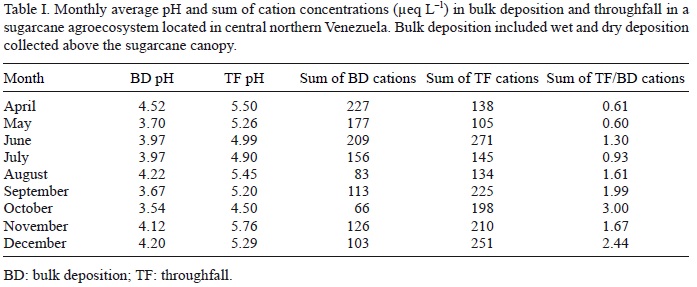
<body><![CDATA[<p align="justify"><font face="verdana" size="2">The monthly percentage of canopy interception increased sharply with the age of the plantation during the first five months (third ratoon, <a href="#f1">Fig. 1</a>) until a maximum of 60.3%, and then it fluctuated around that maximum (38.3&#45;59.9%). During the study period, the total precipitation measured was 1752 mm, whereas the water volume estimated from the throughfall was 1124 mm, which corresponds to 64% of the total precipitation.</font></p>  	    <p align="center"><font face="verdana" size="2"><a name="f1"></a></font></p>  	    <p align="center"><font face="verdana" size="2"><img src="/img/revistas/atm/v26n3//a4f1.jpg"></font></p>  	    <p align="justify"><font face="verdana" size="2"><i>3.2 The pH and base cation concentrations in rainwater</i></font></p>  	    <p align="justify"><font face="verdana" size="2">The pH of bulk deposition in the sugar cane agroecosystem increased by 0.93 to 1.64 pH units as it passed through the canopy (<a href="/img/revistas/atm/v26n3//a4t1.jpg" target="_blank">Table I</a>). Those results may reflect the significant amount of cations leached from the leaves or washed out from materials deposited on the leaves and cane stems (<a href="/img/revistas/atm/v26n3//a4t1.jpg" target="_blank">Table I</a>). Thus, throughfall waters were enriched in bases compared with bulk deposition, particularly after June (peak of the rainy season) when the sum of bases in the throughfall waters surpassed the values of the bulk deposition (<a href="/img/revistas/atm/v26n3//a4t1.jpg" target="_blank">Table I</a>, <a href="#f2">Fig. 2</a>).</font></p>  	    <p align="center"><font face="verdana" size="2"><a name="f2"></a></font></p>  	    <p align="center"><font face="verdana" size="2"><img src="/img/revistas/atm/v26n3//a4f2.jpg"></font></p>  	    <p align="justify"><font face="verdana" size="2">The average monthly values for cations (<a href="#f2">Fig. 2</a>) followed the order Na &gt; K &gt; Mg &gt; Ca. The dominance of Na in precipitation reflects the deposition of marine aerosols in the studied area. Na and K in the precipitation water at the sugar cane agroecosystem (<a href="#f2">Fig. 2</a>) showed an annual mean concentration of1.87 and 1.41 mg L<sup>&#45;1</sup>, respectively. Mg presented an intermediate concentration (0.24 mg L<sup>&#45;1</sup>) whereas the Ca average concentration was the lowest (0.12 mg L<sup>&#45;1</sup>).</font></p>  	    <p align="justify"><font face="verdana" size="2"><i>3.3&nbsp;Net throughfall of cations</i></font></p>  	    <p align="justify"><font face="verdana" size="2">There was a net positive throughfall of Mg from the canopy (more than twice the bulk deposition) and to a lesser extent for Ca. In contrast, the Na concentration showed a net negative throughfall that was significantly different (t&#45;test, <i>p</i> &lt; 0.05) between deposition and throughfall from April to October (<a href="#f2">Fig. 2</a>, <a href="#t2">Table II</a>), whereas for K there was a small net negative through&#45;fall (<a href="#t2">Table II</a>); however, the canopy losses were high in the months of August to October (<a href="#f2">Fig. 2</a>).</font></p>  	    ]]></body>
<body><![CDATA[<p align="center"><font face="verdana" size="2"><a name="t2"></a></font></p>  	    <p align="center"><font face="verdana" size="2"><img src="/img/revistas/atm/v26n3//a4t2.jpg"></font></p>  	    <p align="justify"><font face="verdana" size="2"><i>3.4&nbsp;Nitrogen and phosphorus concentrations in rain waters</i></font></p>  	    <p align="justify"><font face="verdana" size="2">NH<sub>4</sub> was the predominant N form in the precipitation water with a mean value of 1.29 mg L<sup>&#45;1</sup> (<a href="#f3">Fig. 3</a>), but nitrate&#45;N was not detectable in the majority of months (<a href="#f3">Fig. 3</a>). P (PO<sub>4</sub><sup>&#45;3</sup>) concentrations in rainwater ranged from 0.10 to 1.64 mg L<sup>&#45;1</sup> (<a href="#f3">Fig. 3</a>). After passing through the sugar cane canopy there was a strong enrichment in nitrates in the throughfall compared with the bulk deposition (28.67), whereas in the case of NH4 and orthophosphate the annual concentrations of the bulk deposition decreased in a significant form due to canopy absorption (<a href="#t3">Table III</a>).</font></p>  	    <p align="justify"><font face="verdana" size="2">&nbsp;</font></p>  	    <p align="center"><font face="verdana" size="2"><a name="t3"></a></font></p>  	    <p align="center"><font face="verdana" size="2"><img src="/img/revistas/atm/v26n3//a4t3.jpg"></font></p>  	    <p align="center"><font face="verdana" size="2"><a name="f3"></a></font></p>  	    <p align="center"><font face="verdana" size="2"><img src="/img/revistas/atm/v26n3//a4f3.jpg"></font></p>  	    <p align="justify"><font face="verdana" size="2"><i>3.5&nbsp;Net throughfall of nitrogen and phosphorus</i> There was an important N fertilization (net negative throughfall) of the canopy through NH<sub>4</sub> absorption. In contrast, the net positive throughfall of NO3 indicates that NO3 was leached from the canopy (leaves and stem) in throughfall waters (<a href="#t2">Table II</a>, <a href="#f3">Fig. 3</a>), particularly in the months when NO3 was not detectable in bulk deposition. The important amounts of P (PO<sub>4</sub><sup>&#45;3</sup>) entering the sugar cane system in the incident precipitation were retained in the canopy of the agroecosystem; therefore a negative annual throughfall of 9.87 kg P ha<sup>&#45;1</sup> yr<sup>&#45;1</sup> was found (<a href="#t2">Table II</a>).</font></p>  	    ]]></body>
<body><![CDATA[<p align="justify"><font face="verdana" size="2"><i>3.6 Trace metals concentrations in rainwater</i> Figure 4 presents the weighted average concentrations of the trace metals analyzed (Fe, Mn, Zn and</font></p>  	    <p align="justify"><font face="verdana" size="2">Cu) in the precipitation waters. Zn had the highest concentration followed by Fe, while Cu and Mn presented similar values (<a href="#f4">Fig. 4</a>). Throughfall waters were enriched in Cu and Fe compared with bulk deposition (<a href="#t3">Table III</a>); on the contrary, the annual concentrations of bulk deposition decreased significantly in the case of Zn and Mn due to active canopy absorption (<a href="#t3">Table III</a>).</font></p>  	    <p align="center"><font face="verdana" size="2"><a name="f4"></a></font></p>  	    <p align="center"><font face="verdana" size="2"><img src="/img/revistas/atm/v26n3//a4f4.jpg"></font></p>  	    <p align="justify"><font face="verdana" size="2"><i>3.7 Net throughfall of trace metals</i> Net throughfall deposition was negative for Zn, Mn and Fe (<a href="#f4">Fig. 4</a>, <a href="#t2">Table II</a>), whereas in the case of Cu, rain and throughfall depositions were almost similar. Net throughfall of Mn and Fe were moderately negative (62&#45;69 g ha<sup>&#45;1</sup> yr<sup>&#45;1</sup>), whereas for Zn it was strongly negative accounting for a significant foliar absorption (364 g ha<sup>&#45;1</sup> yr<sup>&#45;1</sup>).</font></p> 	    <p align="justify">&nbsp;</p>      <p align="justify"><font face="verdana" size="2"><b>4. Discussion</b></font></p>  	    <p align="justify"><font face="verdana" size="2"><i>4.1 Development of the sugar cane canopy and rain interception</i></font></p>  	    <p align="justify"><font face="verdana" size="2">Information corroborates the effect of crop development in rainwater interception. There is an initial increase of interception as the canopy develops, and then it stabilizes around 40% of interception when the canopy is fully developed (<a href="#f1">Fig. 1</a>). After the fifth month of crop development, when the maximum interception is achieved, a high variability in interception measures is found (38.3&#45;59.9%) that is related to plant senescence. Thus, the incremental accumulation of dead materials (leaves and stems) relative to the living parts strongly affected rainwater interception (Dunne and Leopold, 1978). Rutter (1963) and Grimm and Fassbender (1981) have pointed out that successive and copious rain events contribute to saturation or overflooding of the canopy surface, consequently decreasing its interception capacity.</font></p>  	    <p align="justify"><font face="verdana" size="2">Although the information for canopy interception is copious in temperate and tropical forests, fewer studies of rainfall interception in grasslands have been done (Friesen <i>et al.,</i> 2012). Leopoldo <i>et al.</i> (1981) reported 57% of precipitation interception in domestic sugar cane, a similar value to the one presented here, whereas in a recent publication Friesen <i>et al.</i> (2012), comparing rainfall interception in tropical hardwood trees and wild sugar cane <i>Saccharum venosum,</i> found interception values of 56.1% for the wild grass.</font></p>  	    ]]></body>
<body><![CDATA[<p align="justify"><font face="verdana" size="2">The interception value at maximum crop development reported here is lower than the values presented by Dezzeo and Chac&oacute;n (2006) for tropical forests (77&#45;80%) and Rodrigo <i>et al.,</i> (2003) in holm oak <i>(Quercus ilex</i> L.) Mediterranean forests (72&#45;85%); however, our value corresponds to the lower limit (62.1&#45;94.5%) of the range presented by Galoux <i>et al.,</i> (1981) for different tropical forests and was higher compared with other gramineous plants (Ward, 1967). The interception values of the sugar cane agroecosystem are related with the architecture of the sugar cane canopy at the end of the growing season, which is characterized by abundant foliage with a receptacle formed between the stem and the basis of the foliage that helps to hold and therefore intercept rainwater within the canopy.</font></p>  	    <p align="justify"><font face="verdana" size="2"><i>4.2&nbsp;The pH and base cation concentrations of rainwater</i></font></p>  	    <p align="justify"><font face="verdana" size="2">Precipitation pHs in the studied plantation ranged from 3.54 to 4.52 (<a href="/img/revistas/atm/v26n3//a4t1.jpg" target="_blank">Table I</a>), a common situation in northern central Venezuela as a consequence of high industrial (petrochemical and fertilizer production plants) and agricultural (crop fertilization and cattle raising) activities (Lewis and Weibezahn; 1981, Sequera <i>et al.,</i> 1991; L&oacute;pez&#45;Hern&aacute;ndez et al., 2012). In the rest of Venezuela, even in the absence of anthropogenic influence, precipitation is fairly acid (5.15.8) (Montes <i>et al.,</i> 1987, L&oacute;pez&#45;Hern&aacute;ndez 2008).</font></p>  	    <p align="justify"><font face="verdana" size="2">Concentrations of Na and K were higher than the values presented by Steinhardt and Fassbender (1979) in a cloud forest located in San Eusebio, Venezuela, and by L&oacute;pez&#45;Hern&aacute;ndez <i>et al.</i> (1994) in a flooded savanna ecosystem in Mantecal, Venezuela located far from the ocean and in a more pristine environment. On the contrary, Steinhardt and Fassbender (1979) in a forest site at San Eusebio, Venezuela and L&oacute;pez&#45;Hern&aacute;ndez <i>et al.</i> (1994) at Mantecal, Venezuela reported higher annual averages for Ca and Mg. In a pristine forest ecosystem at the Canaima National Park, located in Gran Sabana, southeastern Venezuela, Dezzeo and Chac&oacute;n (2006) reported very low mean concentration of cations (0.04 and 0.11 mg L<sup>&#45;1</sup> for Ca and K, respectively) in incident waters.</font></p>  	    <p align="justify"><font face="verdana" size="2"><i>4.3&nbsp;Changes in pH and bases in the throughfall waters</i></font></p>  	    <p align="justify"><font face="verdana" size="2">The pH of bulk deposition in the sugar cane agro&#45;ecosystem increased as it passed through the canopy</font></p>  	    <p align="justify"><font face="verdana" size="2">(<a href="/img/revistas/atm/v26n3//a4t1.jpg" target="_blank">Table I</a>). These results may reflect the significant amount of cations leached from the leaves or washed out from materials deposited on the leaves and cane stems from terrestrial dust (<a href="/img/revistas/atm/v26n3//a4t1.jpg" target="_blank">Table I</a>), though we cannot separate both effects based on the information obtained. Throughfall waters were enriched in bases compared with bulk deposition, particularly after June (peak of the rainy season) when the sum of bases in the throughfall waters surpassed the values of the bulk deposition (<a href="/img/revistas/atm/v26n3//a4t1.jpg">Table I</a>, <a href="#f2">Fig. 2</a>). Similar information is presented by Rodrigo <i>et al.</i> (2003) for Mediterranean forests that receive African red rains, which were responsible for most of the inputs of alkalinity and base cations inputs from bulk deposition. However, the precipitations in the Mediterranean environment were more enriched in Ca and Mg compared with this tropical site.</font></p>  	    <p align="justify"><font face="verdana" size="2"><i>4.4&nbsp;Net throughfall of cations</i></font></p>  	    <p align="justify"><font face="verdana" size="2">Net throughfall differs among cations, thus there was a net positive throughfall of Mg from the canopy and to a lesser extent for Ca. In contrast, Na concentration showed a net negative throughfall that was significantly different (t&#45;test, <i>p</i> &lt; 0.05) between deposition and throughfall from April to October (<a href="#f2">Fig. 2</a>, <a href="#t2">Table II</a>), whereas for K there was a small net negative throughfall (<a href="#t2">Table II</a>). However, canopy losses were high in the months of August to October (<a href="#f2">Fig. 2</a>).</font></p>  	    <p align="justify"><font face="verdana" size="2">In two polluted forest sites in the M&eacute;xico City air basin, P&eacute;rez&#45;Su&aacute;rez <i>et al.</i> (2008) reported a net positive throughfall deposition of Ca, Mg and K. P&eacute;rez&#45;Mar&iacute;n and Menezes (2008) reported important K inputs to the soil from the throughfall waters in an agroforestry system with <i>Gliricidia sepium</i> in the semi&#45;arid northeastern Brazil. Moreover, Dez&#45;zeo and Chac&oacute;n (2006) reported that the low mean concentration of cations in precipitation waters was significantly higher (positive throughfall) after the passage through the forest canopy in a pristine forest ecosystem in the Canaima National Park, Gran Sabana, southeastern Venezuela.</font></p>  	    ]]></body>
<body><![CDATA[<p align="justify"><font face="verdana" size="2"><i>4.5&nbsp;Nitrogen and phosphorus in rainwaters</i></font></p>  	    <p align="justify"><font face="verdana" size="2">NH<sub>4</sub> was the predominant N form (mean value 1.29 mg L<sup>&#45;1</sup>) in the precipitation water, but nitrate&#45;N was not detectable in the majority of months (<a href="#f3">Fig. 3</a>). Stein&#45;hardt and Fassbender (1979) in the cloud forest of San Eusebio, Venezuela, located about 300 km from the experimental site, and also affected by petrochemical activity, reported a lower N concentration (0.64 mg L<sup>&#45;1</sup>, mostly NH<sub>4</sub>). In Venezuelan more pristine environments at Gran Sabana, very much lower N concentration in incident waters (0.04 mg L<sup>&#45;1</sup>) has been reported (Dezzeo and Chac&oacute;n, 2006).</font></p>  	    <p align="justify"><font face="verdana" size="2">The P (PO<sub>4</sub><sup>&#45;3</sup>) concentrations in rainwater ranged from 0.10 to 1.64 mg L<sup>&#45;1</sup> (<a href="#f3">Fig. 3</a>). The values exceeded the information generally presented in the literature, which are about 0.05 mg L<sup>&#45;1</sup>. Concentrations of P (PO<sub>4</sub><sup>&#45;3</sup>) in rainfall are much affected by ash deposition, since the higher concentrations correspond to the period from November to March (<a href="#f3">Fig. 3</a>), when the sugar cane plantations are burned in the areas located in the neighborhood of the experimental plot (Sequera <i>et al.,</i> 1991).</font></p>  	    <p align="justify"><font face="verdana" size="2"><i>4.6&nbsp;Changes in nitrogen and phosphorus contents in the throughfall waters</i></font></p>  	    <p align="justify"><font face="verdana" size="2">There was an important N fertilization (net negative throughfall) of the canopy through NH<sub>4</sub> absorption. In contrast, the net positive throughfall ofNO<sub>3</sub> indicates that NO3 was leached from the canopy (leaves and stem) in throughfall waters (<a href="#t2">Table II</a>, <a href="#f3">Fig. 3</a>), particularly in the months when NO3 was no detectable in bulk deposition. In two polluted forest sites in the M&eacute;xico city air basin, P&eacute;rez&#45;Su&aacute;rez <i>et al.</i> (2008) reported also a negative throughfall deposition of NH<sub>4</sub> under fir and pine canopies, whereas Rodrigo <i>et al.</i> (2003) reported a relative low negative annual throughfall of 1.64 and 1.61 kg ha<sup>&#45;1</sup> yr<sup>&#45;1</sup> of NO<sub>3</sub> and NH4, respectively, for Mediterranean forests. The important amounts of P entering the sugar cane system in the incident precipitation were retained in the canopy of the sugar cane agroecosystem; therefore a negative annual throughfall of 9.87 kg P ha<sup>&#45;1</sup> yr<sup>&#45;1</sup> was found (<a href="#t2">Table II</a>).</font></p>  	    <p align="justify"><font face="verdana" size="2"><i>4.7&nbsp;Trace metals in rainwaters</i></font></p>  	    <p align="justify"><font face="verdana" size="2">The weighted average Zn concentration in precipitation (40.1 &#956;g L<sup>&#45;1</sup>) was higher in the sugar cane agroecosystem than the values presented in tropical environments by Steinhardt and Fassbender (1979) in a cloud forest (2.4 &#956;g L<sup>&#45;1</sup>), L&oacute;pez&#45;Hern&aacute;ndez (2008) in a seasonally flooded Venezuelan savanna (28.6 &#956;g L<sup>&#45;1</sup>), and McColl (1981) in a temperate eucalypt forest (16.1 &#956;g L<sup>&#45;1</sup>), but lower than Zn concentration reported by Golley <i>et al.</i> (1975) in a Panamanian rain tropical forest (44 &#956;g L<sup>&#45;1</sup>), and by Liu <i>et al.</i> (2005) in the southern Yellow sea, China (60&#45;150 &#956;g L<sup>&#45;1</sup>). In pristine environments, the weighted average Zn concentration in precipitation greatly surpasses the Cu concentrations (Driscoll <i>et al.,</i> 1994; Liu <i>et al.,</i> 2005; Muezzinoglu and Cukurluoglu, 2006).</font></p>  	    <p align="justify"><font face="verdana" size="2">The weighted average Cu concentration in rainwater (about 8.3 &#956;g L<sup>&#45;1</sup>) is higher than the values presented by Steinhardt and Fassbender (1979) in San Eusebio, Venezuela (2.79 &#956;g L<sup>&#45;1</sup>) and lower than the information given by Golley <i>et al.</i> (1975) for the Panamaniam forest ecosystem (24.0 &#956;g L<sup>&#45;1</sup>) and by Muezzinoglu and Cukurluoglu (2006) in Izmir, Turkey (19.7 &#956;g L<sup>&#45;1</sup>). Cu mean concentration is however about the values presented by L&oacute;pez&#45;Hern&aacute;ndez (2008) in a flooded savanna (12.1 &#956;g L<sup>&#45;1</sup>) and Liu <i>et al.</i> (2005) in a coastal region in the southern Yellow sea, China (3&#45;15 &#956;g L<sup>&#45;1</sup>). Fe and Mn concentrations were much lower than values reported by Steinhardt and Fassbender (1979) in San Eusebio, Venezuela.</font></p>  	    <p align="justify"><font face="verdana" size="2"><i>4.8 Element inputs at the sugar cane agroecosystem</i> The study site is near the sea; therefore, the cation concentrations in rainwater are affected by marine aerosols, although terrestrial dusts can also affect rainwater composition. Na and K inputs were high (24.92 and 22.54 kg ha<sup>&#45;1</sup> yr<sup>&#45;1</sup>, respectively, <a href="#t2">Table II</a>) when compared with other Venezuelan ecosystems, whereas in the cases of Mg and Ca the rain inputs (3.34 and 1.93 kg ha<sup>&#45;1</sup> yr<sup>&#45;1</sup>, respectively) were lower and not much different than other Venezuelan sites.</font></p>  	    <p align="justify"><font face="verdana" size="2">Although nitrates were leached in throughfall waters (<a href="#f3">Fig. 3</a>, <a href="#t2">Table II</a>), N balance revealed significant N fertilization of the leave canopy (leaves and stem) through NH<sub>4</sub>+ absorption (Table II). Nitrogen inputs (25.25 kg ha<sup>&#45;1</sup> yr<sup>&#45;1</sup>) for wet and dry deposition, mostly in the NH<sub>4</sub>+ form (25.19 kg NH<sub>4</sub>+ ha<sup>&#45;1</sup> yr<sup>&#45;1</sup>, Table II), were high compared with other ecosystems. This is, no doubt, due to the high agricultural (fertilization, cattle raising and burning before cropping of the plantation) and industrial (petrochemical and fertilizer production plants) activities near the experimental area. In Venezuelan savannas distant from urban activities, mineral nitrogen inputs by precipitation, on the contrary, ranged from 2.2 to 6.2 kg N ha<sup>&#45;1</sup> yr<sup>&#45;1</sup> (L&oacute;pez&#45;Hern&aacute;ndez <i>et al.,</i> 2012).</font></p>  	    ]]></body>
<body><![CDATA[<p align="justify"><font face="verdana" size="2">The high amounts of P entering the sugar cane system as bulk deposition (Table II) account for a high P input (14.71 kg ha<sup>&#45;1</sup> yr<sup>&#45;1</sup>), most of it (11.01 kg ha<sup>&#45;1</sup> yr<sup>&#45;1</sup>) in months when active burning of sugar cane plantations is taking place (November to April, <a href="#f3">Fig. 3</a>); therefore, dry deposition of phosphate salts might be occurring in the area.</font></p>  	    <p align="justify"><font face="verdana" size="2">Zn input at sugar cane agroecosystem (633 g ha<sup>&#45;1</sup> yr<sup>&#45;1</sup>) was similar to the value presented for Mante&#45;cal's savannas (595 g ha<sup>&#45;1</sup> yr<sup>&#45;1</sup>) by L&oacute;pez&#45;Hern&aacute;ndez (2008), much higher than the value (30 g ha<sup>&#45;1</sup> yr<sup>&#45;1</sup>) reported by Steinhardt and Fassbender (1979) for a cloud forest located at San Eusebio, Venezuela, and similar to the value presented by Liu <i>et al.</i> (2005) in a coastal region of the southern Yellow sea (428 g ha<sup>&#45;1</sup> yr<sup>&#45;1</sup>). However, Zn input at the agroecosystem was very much lower than the value presented by Heinrichs and Mayer (1977) in an industrialized Central European forest ecosystem (3900 g ha<sup>&#45;1</sup> yr<sup>&#45;1</sup>). Copper input in the sugar cane plantation (97.8 g ha<sup>&#45;1</sup> yr<sup>&#45;1</sup>) also exceeded the 45 g ha<sup>&#45;1</sup> yr<sup>&#45;1</sup> presented for San Eusebio, Venezuela (Steinhardt and Fass&#45;bender 1979) and was under the values presented by Heinrich and Mayer (1977) in a heavy industrialized European forest ecosystem (224 g ha<sup>&#45;1</sup> yr<sup>&#45;1</sup>) and by L&oacute;pez&#45;Hern&aacute;ndez (2008) in the savannas of Mante&#45;cal, Venezuela (227 g ha<sup>&#45;1</sup> yr<sup>&#45;1</sup>). Annual deposition of iron (263 g ha<sup>&#45;1</sup> yr<sup>&#45;1</sup>) is much lower than the reported Steinhardt and Fassbender (1979) at San Eusebio, Venezuela. Manganese (Mn) input in precipitation water (131 g ha<sup>&#45;1</sup> yr <sup>&#45;1</sup>) was lower than values reported in other tropical areas (Steinhardt and Fassbender, 1979).</font></p>  	    <p align="justify"><font face="verdana" size="2"><i>4.9 Nutrient inputs in relation to sugar cane nutrient requirements</i></font></p>  	    <p align="justify"><font face="verdana" size="2">Bulk deposition of polluted areas might be an important source of nutrient inputs to plants, which helps to cope with their nutrient needs. By using information already published concerning the macro&#45; and micro&#45;nutrient requirements (e.g., amount of the element contained in stems, green leaves and roots at the peak of maximum development) of the sugar cane varieties examined in this study (L&oacute;pez&#45;Hern&aacute;ndez <i>et al.,</i> 1993; Vallejo&#45;Torres, 1988) we have found that in the case of the micronutrients, all the Zn absorbed from bulk precipitation would be in excess (217%) of sugar cane requirements (<a href="#t4">Table IV</a>). Cu demand by the crop is also well covered (48.7%) by this mechanism; however, much less of the Mn, K and Fe (9.9, 5.0 and 1.7%, respectively) required by the sugar cane can be obtained by bulk precipitation.</font></p> 	    <p align="justify">&nbsp;</p>         <p align="center"><font face="verdana" size="2"><a name="t4" id="t4"></a></font></p>         <p align="center"><font face="verdana" size="2"><img src="/img/revistas/atm/v26n3//a4t4.jpg" alt=""></font></p>     <p align="justify"><font face="verdana" size="2">The N input of rain water (25.25 kg ha<sup>&#45;1</sup> yr<sup>&#45;1</sup>) represents around 11% of the N requirements (228 kg ha<sup>&#45;1</sup> yr<sup>&#45;1</sup>) for biomass production of the sugar cane plantation while in the case of P the input as bulk deposition (15 kg ha<sup>&#45;1</sup> yr<sup>&#45;1</sup>) represents 24% of the P requirements (62 kg ha<sup>&#45;1</sup> yr<sup>&#45;1</sup>) of the varieties studied.</font></p> 	    <p align="justify">&nbsp;</p>      <p align="justify"><font face="verdana" size="2"><b>5. Conclusions</b></font></p>  	    ]]></body>
<body><![CDATA[<p align="justify"><font face="verdana" size="2">Incident rainfall constitutes an important source of nutrient inputs to the sugar cane system studied. In the case of macronutrients (N and P) the inputs were considerable when compared with other tropical regions and supply an important fraction of plant nutrient requirements; a similar situation was recorded in the case of the micronutrients analyzed particularly for zinc and copper. Although the input of K was important, the high demand of the sugar cane for this element makes the contribution marginal. We did not register Na uptake, however a significant proportion of the Na coming with the bulk deposition was retained in the canopy (<a href="#t2">Table II</a>). About 10% of the Mn needs can be covered by rainfall input, whereas in the case of iron, the precipitation supply is negligible compared with the plant's needs. In the agroecosystem, Mg and K concentrations increased considerably during the passage of rainwater through the canopy, suggesting that these elements tend to be leached from plant tissues and were mobile, particularly at the end of the growing season.</font></p> 	    <p align="justify">&nbsp;</p>      <p align="justify"><font face="verdana" size="2"><b>Acknowledgements</b></font></p>  	    <p align="justify"><font face="verdana" size="2">The technical assistance of Lic. M. Ni&ntilde;o and Mr. F. Tovar are acknowledged. The research received financial support from CENAZUCA, Consejo de Desarrollo Cient&iacute;fico y Human&iacute;stico (CDCH) and Consejo Nacional de Ciencia y Tecnolog&iacute;a (Conicit). Thanks to Dr. Lucy Sheppard (CEH Edinburgh Bush Estate Penicuik) for the revision of a previous version of this manuscript. One anonymous reviewer provided useful comments on an earlier draft that allowed us to improve the quality of the final manuscript.</font></p> 	    <p align="justify">&nbsp;</p>      <p align="justify"><font face="verdana" size="2"><b>References</b></font></p>  	    <!-- ref --><p align="justify"><font face="verdana" size="2">Dezzeo N. and N. Chac&oacute;n, 2006. Nutrient fluxes in incident rainfall, throughfall and stemflow in adjacent primary and secondary forests of the Gran Sabana, southern Venezuela. <i>For. Ecol. Manag.</i> <b>234,</b> 218&#45;226.    &nbsp;&nbsp;&nbsp;&nbsp;&nbsp;&nbsp;&nbsp;&nbsp;[&#160;<a href="javascript:void(0);" onclick="javascript: window.open('/scielo.php?script=sci_nlinks&ref=1294170&pid=S0187-6236201300030000400001&lng=','','width=640,height=500,resizable=yes,scrollbars=1,menubar=yes,');">Links</a>&#160;]<!-- end-ref --></font></p>  	    <!-- ref --><p align="justify"><font face="verdana" size="2">Driscoll C., J. Otton and &Aacute;. Iverfeldt, 1994. Trace metals speciation and cycling. In: <i>Biogeochemistry of small catchments: A tool for environmental research</i> (B. Moldan and J. Cerny, Eds.). Chapter 13. John Wiley and Sons, Chichester, New York, Brisbane, Toronto, Singapore, pp. 343&#45;360 (SCOPE 51).    &nbsp;&nbsp;&nbsp;&nbsp;&nbsp;&nbsp;&nbsp;&nbsp;[&#160;<a href="javascript:void(0);" onclick="javascript: window.open('/scielo.php?script=sci_nlinks&ref=1294172&pid=S0187-6236201300030000400002&lng=','','width=640,height=500,resizable=yes,scrollbars=1,menubar=yes,');">Links</a>&#160;]<!-- end-ref --></font></p>  	    ]]></body>
<body><![CDATA[<!-- ref --><p align="justify"><font face="verdana" size="2">Dunne T. and L. B. Leopold, 1978. <i>Water in environmental planning.</i> W. H. Freeman, 818 pp.    &nbsp;&nbsp;&nbsp;&nbsp;&nbsp;&nbsp;&nbsp;&nbsp;[&#160;<a href="javascript:void(0);" onclick="javascript: window.open('/scielo.php?script=sci_nlinks&ref=1294174&pid=S0187-6236201300030000400003&lng=','','width=640,height=500,resizable=yes,scrollbars=1,menubar=yes,');">Links</a>&#160;]<!-- end-ref --></font></p>  	    <!-- ref --><p align="justify"><font face="verdana" size="2">Eriksson E, 1953. Composition of atmospheric precipitation. <i>Tellus</i> <b>4,</b> 215&#45;232.    &nbsp;&nbsp;&nbsp;&nbsp;&nbsp;&nbsp;&nbsp;&nbsp;[&#160;<a href="javascript:void(0);" onclick="javascript: window.open('/scielo.php?script=sci_nlinks&ref=1294176&pid=S0187-6236201300030000400004&lng=','','width=640,height=500,resizable=yes,scrollbars=1,menubar=yes,');">Links</a>&#160;]<!-- end-ref --></font></p>  	    <!-- ref --><p align="justify"><font face="verdana" size="2">Friesen P., A. Park and A. Sarmiento&#45;Serrud, 2012. Comparing rainfall interception in plantation trials of six tropical hardwood trees and wild sugar cane <i>Saccharum spontaneous</i> L. <i>Ecohydrology,</i> doi:10.1002/eco.1297.    &nbsp;&nbsp;&nbsp;&nbsp;&nbsp;&nbsp;&nbsp;&nbsp;[&#160;<a href="javascript:void(0);" onclick="javascript: window.open('/scielo.php?script=sci_nlinks&ref=1294178&pid=S0187-6236201300030000400005&lng=','','width=640,height=500,resizable=yes,scrollbars=1,menubar=yes,');">Links</a>&#160;]<!-- end-ref --></font></p>  	    <!-- ref --><p align="justify"><font face="verdana" size="2">Galoux A., P. Benecke, G. Gietl, H. Hager, C. Kayser, O. Kiese, K.R. Knoer and C.E. Murphy, 1981. Radiation, heat, water and carbon dioxide balances. In: <i>IBP 23</i> D (E. Reichle, Ed.). Cambridge University Press, New York, pp. 87&#45;204.    &nbsp;&nbsp;&nbsp;&nbsp;&nbsp;&nbsp;&nbsp;&nbsp;[&#160;<a href="javascript:void(0);" onclick="javascript: window.open('/scielo.php?script=sci_nlinks&ref=1294180&pid=S0187-6236201300030000400006&lng=','','width=640,height=500,resizable=yes,scrollbars=1,menubar=yes,');">Links</a>&#160;]<!-- end-ref --></font></p>  	    <!-- ref --><p align="justify"><font face="verdana" size="2">Golley F. B., J. T. McGinnis, R. G. Clements, G. I. Child and M. J. Duever, 1975. <i>Mineral cycling in a tropical rain forest ecosystem.</i> University of Georgia Press, Athens, 248 pp.    &nbsp;&nbsp;&nbsp;&nbsp;&nbsp;&nbsp;&nbsp;&nbsp;[&#160;<a href="javascript:void(0);" onclick="javascript: window.open('/scielo.php?script=sci_nlinks&ref=1294182&pid=S0187-6236201300030000400007&lng=','','width=640,height=500,resizable=yes,scrollbars=1,menubar=yes,');">Links</a>&#160;]<!-- end-ref --></font></p>  	    ]]></body>
<body><![CDATA[<!-- ref --><p align="justify"><font face="verdana" size="2">Grimm V. and H. W. Fassbender, 1981. Ciclos biogeoqu&iacute;micos de un ecosistema de los Andes Occidentales de Venezuela. III. Ciclo hidrol&oacute;gico y translocaci&oacute;n de elementos qu&iacute;micos con el agua. <i>Turrialba</i> <b>31,</b> 89&#45;99.    &nbsp;&nbsp;&nbsp;&nbsp;&nbsp;&nbsp;&nbsp;&nbsp;[&#160;<a href="javascript:void(0);" onclick="javascript: window.open('/scielo.php?script=sci_nlinks&ref=1294184&pid=S0187-6236201300030000400008&lng=','','width=640,height=500,resizable=yes,scrollbars=1,menubar=yes,');">Links</a>&#160;]<!-- end-ref --></font></p>  	    <!-- ref --><p align="justify"><font face="verdana" size="2">Heinrichs H. and R. Mayer, 1977. Distribution and cycling of major and trace elements in two Central European forest ecosystems. <i>J. Environ. Qual.</i> <b>6,</b> 402&#45; 407.    &nbsp;&nbsp;&nbsp;&nbsp;&nbsp;&nbsp;&nbsp;&nbsp;[&#160;<a href="javascript:void(0);" onclick="javascript: window.open('/scielo.php?script=sci_nlinks&ref=1294186&pid=S0187-6236201300030000400009&lng=','','width=640,height=500,resizable=yes,scrollbars=1,menubar=yes,');">Links</a>&#160;]<!-- end-ref --></font></p>  	    <!-- ref --><p align="justify"><font face="verdana" size="2">Infante C., D. L&oacute;pez&#45;Hern&aacute;ndez, E. Medina and G. Escalante, 1993. Distribuci&oacute;n de las formas inorg&aacute;nicas del nitr&oacute;geno en los flujos h&iacute;dricos de un agroecosistema tropical. <i>Ecotr&oacute;picos</i> <b>6,</b> 13&#45;23.    &nbsp;&nbsp;&nbsp;&nbsp;&nbsp;&nbsp;&nbsp;&nbsp;[&#160;<a href="javascript:void(0);" onclick="javascript: window.open('/scielo.php?script=sci_nlinks&ref=1294188&pid=S0187-6236201300030000400010&lng=','','width=640,height=500,resizable=yes,scrollbars=1,menubar=yes,');">Links</a>&#160;]<!-- end-ref --></font></p>  	    <!-- ref --><p align="justify"><font face="verdana" size="2">Leopoldo P. R., A. de P. Sousa and S. Tuacek Filho, 1981. Intercepta&ccedil;&atilde;o da &aacute;gua de chuva em cultura da cana&#45;de&#45;a&ccedil;&uacute;car <i>Brasil A&ccedil;ucareiro</i> <b>98,</b> 9&#45;16.    &nbsp;&nbsp;&nbsp;&nbsp;&nbsp;&nbsp;&nbsp;&nbsp;[&#160;<a href="javascript:void(0);" onclick="javascript: window.open('/scielo.php?script=sci_nlinks&ref=1294190&pid=S0187-6236201300030000400011&lng=','','width=640,height=500,resizable=yes,scrollbars=1,menubar=yes,');">Links</a>&#160;]<!-- end-ref --></font></p>  	    <!-- ref --><p align="justify"><font face="verdana" size="2">Lewis W. M. and F. H. Weibezahn, 1981. Acid rain and major seasonal variation of hydrogen ion loading in a tropical watershed. <i>Acta Cient. Venez.</i> <b>32,</b> 236&#45;238.    &nbsp;&nbsp;&nbsp;&nbsp;&nbsp;&nbsp;&nbsp;&nbsp;[&#160;<a href="javascript:void(0);" onclick="javascript: window.open('/scielo.php?script=sci_nlinks&ref=1294192&pid=S0187-6236201300030000400012&lng=','','width=640,height=500,resizable=yes,scrollbars=1,menubar=yes,');">Links</a>&#160;]<!-- end-ref --></font></p>  	    ]]></body>
<body><![CDATA[<!-- ref --><p align="justify"><font face="verdana" size="2">Liu C. H., G. Zhang, H. Ren and J. Zhang, 2005. Distribution of heavy metals and nutrients in rainwater in coastal regions between the southern Yellow Sea and East China Sea. <i>Ch. J. Oceanol. Limn.</i> <b>23,</b> 230&#45;237.    &nbsp;&nbsp;&nbsp;&nbsp;&nbsp;&nbsp;&nbsp;&nbsp;[&#160;<a href="javascript:void(0);" onclick="javascript: window.open('/scielo.php?script=sci_nlinks&ref=1294194&pid=S0187-6236201300030000400013&lng=','','width=640,height=500,resizable=yes,scrollbars=1,menubar=yes,');">Links</a>&#160;]<!-- end-ref --></font></p>  	    <!-- ref --><p align="justify"><font face="verdana" size="2">L&oacute;pez&#45;Hern&aacute;ndez D., E. Medina, C. Infante, D. Sequera, M. Ni&ntilde;o and O. Vallejo&#45;Torres, 1993. Nutrient cycles in a sugarcane agroecosystem. In: <i>Soil biota, nutrient cycling, and farming systems</i> (M. G. Paoletti, W. Foissner, D. Coleman, Eds.). Lewis Publishers, Florida, pp. 147&#45;156.    &nbsp;&nbsp;&nbsp;&nbsp;&nbsp;&nbsp;&nbsp;&nbsp;[&#160;<a href="javascript:void(0);" onclick="javascript: window.open('/scielo.php?script=sci_nlinks&ref=1294196&pid=S0187-6236201300030000400014&lng=','','width=640,height=500,resizable=yes,scrollbars=1,menubar=yes,');">Links</a>&#160;]<!-- end-ref --></font></p>  	    <!-- ref --><p align="justify"><font face="verdana" size="2">L&oacute;pez&#45;Hern&aacute;ndez D., M., Garc&iacute;a and M. Ni&ntilde;o, 1994. Input and output of nutrients in a diked flooded savanna. <i>J.</i> <i>App. Ecol.</i> <b>31,</b> 303&#45;312.    &nbsp;&nbsp;&nbsp;&nbsp;&nbsp;&nbsp;&nbsp;&nbsp;[&#160;<a href="javascript:void(0);" onclick="javascript: window.open('/scielo.php?script=sci_nlinks&ref=1294198&pid=S0187-6236201300030000400015&lng=','','width=640,height=500,resizable=yes,scrollbars=1,menubar=yes,');">Links</a>&#160;]<!-- end-ref --></font></p>  	    <!-- ref --><p align="justify"><font face="verdana" size="2">L&oacute;pez&#45;Hern&aacute;ndez D., C. Infante and E. Medina, 2005. Balance de elementos en un agroecosistema de ca&ntilde;a de az&uacute;car: I. Balance de nitr&oacute;geno. <i>Tropicultura</i> <b>23,</b> 212&#45;219.    &nbsp;&nbsp;&nbsp;&nbsp;&nbsp;&nbsp;&nbsp;&nbsp;[&#160;<a href="javascript:void(0);" onclick="javascript: window.open('/scielo.php?script=sci_nlinks&ref=1294200&pid=S0187-6236201300030000400016&lng=','','width=640,height=500,resizable=yes,scrollbars=1,menubar=yes,');">Links</a>&#160;]<!-- end-ref --></font></p>  	    <!-- ref --><p align="justify"><font face="verdana" size="2">L&oacute;pez&#45;Hern&aacute;ndez D., 2008. Biogeochemistry and cycling of zinc and copper in a dyked seasonally flooded savanna. <i>Chem. Ecol.</i> <b>24,</b> 387&#45;399.    &nbsp;&nbsp;&nbsp;&nbsp;&nbsp;&nbsp;&nbsp;&nbsp;[&#160;<a href="javascript:void(0);" onclick="javascript: window.open('/scielo.php?script=sci_nlinks&ref=1294202&pid=S0187-6236201300030000400017&lng=','','width=640,height=500,resizable=yes,scrollbars=1,menubar=yes,');">Links</a>&#160;]<!-- end-ref --></font></p>  	    ]]></body>
<body><![CDATA[<!-- ref --><p align="justify"><font face="verdana" size="2">L&oacute;pez&#45;Hern&aacute;ndez D., D. Sequera, O. Vallejo and C. Infante, 2012. Atmospheric nitrogen deposition can provide supplementary fertilization to sugar cane crops in Venezuela. Chapter 21. In: <i>Nitrogen deposition, critical loads and biodiversity</i> (M. A. Sutton, K. E. Mason, L. J. Sheppard, H. Sverdrup, R. Haeuber, W. K. Hicks, Eds.). Proceedings of the International Nitrogen Initiative Workshop, Edinburgh, U.K. (in press)</font>&nbsp;&nbsp;&nbsp;&nbsp;&nbsp;&nbsp;&nbsp;&nbsp;[&#160;<a href="javascript:void(0);" onclick="javascript: window.open('/scielo.php?script=sci_nlinks&ref=1294204&pid=S0187-6236201300030000400018&lng=','','width=640,height=500,resizable=yes,scrollbars=1,menubar=yes,');">Links</a>&#160;]<!-- end-ref --><!-- ref --><p align="justify"><font face="verdana" size="2">Malek S. and A. Astel, 2007. The effect of stand age on throughfall chemistry in spruce stands in the Potok Dupnia&#324;ski catchment in the Silesian Beskid mountains, southern Poland. Impacts of air pollution and climate change on forest ecosystems. <i>Scientific World</i> <i>Journal</i> <b>7,</b> 181&#45;191.    &nbsp;&nbsp;&nbsp;&nbsp;&nbsp;&nbsp;&nbsp;&nbsp;[&#160;<a href="javascript:void(0);" onclick="javascript: window.open('/scielo.php?script=sci_nlinks&ref=1294205&pid=S0187-6236201300030000400019&lng=','','width=640,height=500,resizable=yes,scrollbars=1,menubar=yes,');">Links</a>&#160;]<!-- end-ref --></font></p>  	    <!-- ref --><p align="justify"><font face="verdana" size="2">McColl G. C., 1981. Trace elements in the hydrologic cycle of a forest ecosystem. <i>Plant Soil</i> <b>62,</b> 337&#45;349.    &nbsp;&nbsp;&nbsp;&nbsp;&nbsp;&nbsp;&nbsp;&nbsp;[&#160;<a href="javascript:void(0);" onclick="javascript: window.open('/scielo.php?script=sci_nlinks&ref=1294207&pid=S0187-6236201300030000400020&lng=','','width=640,height=500,resizable=yes,scrollbars=1,menubar=yes,');">Links</a>&#160;]<!-- end-ref --> </font></p> 	    <!-- ref --><p align="justify"><font face="verdana" size="2">Montes R., J. J. San Jos&eacute; and J. Garc&iacute;a&#45;Miragaya, 1987. pH of bulk precipitation during three consecutive annual courses in the Trachypogon savannas of the Orinoco Llanos, Venezuela. <i>Tellus</i> <b>37B,</b> 304&#45;307.    &nbsp;&nbsp;&nbsp;&nbsp;&nbsp;&nbsp;&nbsp;&nbsp;[&#160;<a href="javascript:void(0);" onclick="javascript: window.open('/scielo.php?script=sci_nlinks&ref=1294209&pid=S0187-6236201300030000400021&lng=','','width=640,height=500,resizable=yes,scrollbars=1,menubar=yes,');">Links</a>&#160;]<!-- end-ref --></font></p>      <!-- ref --><p align="justify"><font face="verdana" size="2">Morales, J.A., C. Bifano and A. Escalona, 1998. Atmospheric deposition of SO4&#45;S and (NH4+NO3)&#45;N at two rural sites in the western Maracaibo Lake Basin, Venezuela. <i>Atmos. Environ.</i> <b>32,</b> 3051&#45;3058.    &nbsp;&nbsp;&nbsp;&nbsp;&nbsp;&nbsp;&nbsp;&nbsp;[&#160;<a href="javascript:void(0);" onclick="javascript: window.open('/scielo.php?script=sci_nlinks&ref=1294211&pid=S0187-6236201300030000400022&lng=','','width=640,height=500,resizable=yes,scrollbars=1,menubar=yes,');">Links</a>&#160;]<!-- end-ref --></font></p>  	    <!-- ref --><p align="justify"><font face="verdana" size="2">Muezzinnoglu A. and S. Cukurluoglu, 2006. Deposition of heavy metals in a Mediterranean climate area. <i>Atmos. Res.</i> <b>81,</b> 1&#45;16.    &nbsp;&nbsp;&nbsp;&nbsp;&nbsp;&nbsp;&nbsp;&nbsp;[&#160;<a href="javascript:void(0);" onclick="javascript: window.open('/scielo.php?script=sci_nlinks&ref=1294213&pid=S0187-6236201300030000400023&lng=','','width=640,height=500,resizable=yes,scrollbars=1,menubar=yes,');">Links</a>&#160;]<!-- end-ref --></font></p>  	    <!-- ref --><p align="justify"><font face="verdana" size="2">Murphy J. and J. Riley, 1962. A modified single solution method for the determination of phosphate in natural waters. <i>Anal. Chim. Acta</i> <b>27,</b> 31&#45;36.    &nbsp;&nbsp;&nbsp;&nbsp;&nbsp;&nbsp;&nbsp;&nbsp;[&#160;<a href="javascript:void(0);" onclick="javascript: window.open('/scielo.php?script=sci_nlinks&ref=1294215&pid=S0187-6236201300030000400024&lng=','','width=640,height=500,resizable=yes,scrollbars=1,menubar=yes,');">Links</a>&#160;]<!-- end-ref --></font></p>  	    <!-- ref --><p align="justify"><font face="verdana" size="2">Park A. and J. L. Cameron, 2008. The influence of forest traits on throughfall and stemflow in five tropical trees growing in a Panamaniam plantation. <i>Forest Ecol.</i> <i>Manag.</i> <b>255,</b> 1915&#45;1925.    &nbsp;&nbsp;&nbsp;&nbsp;&nbsp;&nbsp;&nbsp;&nbsp;[&#160;<a href="javascript:void(0);" onclick="javascript: window.open('/scielo.php?script=sci_nlinks&ref=1294217&pid=S0187-6236201300030000400025&lng=','','width=640,height=500,resizable=yes,scrollbars=1,menubar=yes,');">Links</a>&#160;]<!-- end-ref --></font></p>  	    <!-- ref --><p align="justify"><font face="verdana" size="2">Perez&#45;Marin A. M. and R. S. C. Menezes, 2008. Ciclagem de nutrientes via precipitacao pluvial total. interna e escoamento pelo tronco em sistema agroforestal com <i>Gliricidia sepium. Ver. Br&aacute;s. Ci&eacute;nc. Solo</i> <b>32,</b> 2573-2579.    &nbsp;&nbsp;&nbsp;&nbsp;&nbsp;&nbsp;&nbsp;&nbsp;[&#160;<a href="javascript:void(0);" onclick="javascript: window.open('/scielo.php?script=sci_nlinks&ref=1294219&pid=S0187-6236201300030000400026&lng=','','width=640,height=500,resizable=yes,scrollbars=1,menubar=yes,');">Links</a>&#160;]<!-- end-ref --></font></p>  	    <!-- ref --><p align="justify"><font face="verdana" size="2">P&eacute;rez&#45;Su&aacute;rez M., M. E. Fenn, V. M. Cetina&#45;Alcala and A. Aldrete, 2008. The effects of canopy cover on through&#45;fall and soil chemistry in two forest sites in the Mexico City air basin. <i>Atm&oacute;sfera</i> <b>21,</b> 83&#45;100.    &nbsp;&nbsp;&nbsp;&nbsp;&nbsp;&nbsp;&nbsp;&nbsp;[&#160;<a href="javascript:void(0);" onclick="javascript: window.open('/scielo.php?script=sci_nlinks&ref=1294221&pid=S0187-6236201300030000400027&lng=','','width=640,height=500,resizable=yes,scrollbars=1,menubar=yes,');">Links</a>&#160;]<!-- end-ref --></font></p>  	    <!-- ref --><p align="justify"><font face="verdana" size="2">Pritsch K., M. S. G&uuml;nthardt&#45;Goerg, J. C. Munch and M. Schloter, 2006. Influence of heavy metals and acid rain on enzymatic activities in the mycorrhizosphere of model forest ecosystems. <i>For. Snow Landsc. Res.</i> <b>80,</b> 289&#45;304.    &nbsp;&nbsp;&nbsp;&nbsp;&nbsp;&nbsp;&nbsp;&nbsp;[&#160;<a href="javascript:void(0);" onclick="javascript: window.open('/scielo.php?script=sci_nlinks&ref=1294223&pid=S0187-6236201300030000400028&lng=','','width=640,height=500,resizable=yes,scrollbars=1,menubar=yes,');">Links</a>&#160;]<!-- end-ref --></font></p>  	    <!-- ref --><p align="justify"><font face="verdana" size="2">Rodrigo A., A. Avila and F. Roda, 2003. The chemistry of precipitation. Throughfall and stemflow in two holm oak <i>(Quercus ilex</i> L.) forest under a contrasted pollution environment in NE Spain. <i>Sci. Total Environ.</i> <b>305,</b> 195&#45;205.    &nbsp;&nbsp;&nbsp;&nbsp;&nbsp;&nbsp;&nbsp;&nbsp;[&#160;<a href="javascript:void(0);" onclick="javascript: window.open('/scielo.php?script=sci_nlinks&ref=1294225&pid=S0187-6236201300030000400029&lng=','','width=640,height=500,resizable=yes,scrollbars=1,menubar=yes,');">Links</a>&#160;]<!-- end-ref --></font></p>  	    <!-- ref --><p align="justify"><font face="verdana" size="2">Rutter A. J, 1963. Studies in the water relations of <i>Pinus sylvestris</i> in plantations conditions. I. Measurements of rainfall and interception. <i>J. Ecol.</i> <b>51,</b> 191&#45;203.    &nbsp;&nbsp;&nbsp;&nbsp;&nbsp;&nbsp;&nbsp;&nbsp;[&#160;<a href="javascript:void(0);" onclick="javascript: window.open('/scielo.php?script=sci_nlinks&ref=1294227&pid=S0187-6236201300030000400030&lng=','','width=640,height=500,resizable=yes,scrollbars=1,menubar=yes,');">Links</a>&#160;]<!-- end-ref --></font></p>  	    <!-- ref --><p align="justify"><font face="verdana" size="2">Sequera D., D. L&oacute;pez&#45;Hern&aacute;ndez and E. Medina, 1991. Phosphorus dynamics in a sugar&#45;cane crop. In: <i>Phosphorus cycles in terrestrial and aquatic ecosystems</i> (H. Tiessen, D. L&oacute;pez&#45;Hern&aacute;ndez, I. Salcedo, Eds.). Proceedings of the Regional Workshop 3: South and Central America, organized by the Scientific Committee on Problems of the Environment (SCOPE) and the United Nations Environmental Programme (UNEP), Universidad Central de Venezuela, Maracay, pp. 243&#45;251.    &nbsp;&nbsp;&nbsp;&nbsp;&nbsp;&nbsp;&nbsp;&nbsp;[&#160;<a href="javascript:void(0);" onclick="javascript: window.open('/scielo.php?script=sci_nlinks&ref=1294229&pid=S0187-6236201300030000400031&lng=','','width=640,height=500,resizable=yes,scrollbars=1,menubar=yes,');">Links</a>&#160;]<!-- end-ref --></font></p>  	    <!-- ref --><p align="justify"><font face="verdana" size="2">Steinhardt U. and H. W. Fassbender, 1979. Caracter&iacute;sticas y composici&oacute;n qu&iacute;mica de las lluvias de los Andes occidentales de Venezuela. <i>Turrialba</i> <b>29,</b> 175 &#45;182.    &nbsp;&nbsp;&nbsp;&nbsp;&nbsp;&nbsp;&nbsp;&nbsp;[&#160;<a href="javascript:void(0);" onclick="javascript: window.open('/scielo.php?script=sci_nlinks&ref=1294231&pid=S0187-6236201300030000400032&lng=','','width=640,height=500,resizable=yes,scrollbars=1,menubar=yes,');">Links</a>&#160;]<!-- end-ref --></font></p>  	    <!-- ref --><p align="justify"><font face="verdana" size="2">Stevenson F. J, 1982. Origin and distribution of nitrogen in soil. In: <i>Nitrogen in agricultural soils</i> (F. J. Stevenson, Ed.). American Society of Agronomy, Wisconsin, pp. 1&#45;39 (Agronomy Series 22).    &nbsp;&nbsp;&nbsp;&nbsp;&nbsp;&nbsp;&nbsp;&nbsp;[&#160;<a href="javascript:void(0);" onclick="javascript: window.open('/scielo.php?script=sci_nlinks&ref=1294233&pid=S0187-6236201300030000400033&lng=','','width=640,height=500,resizable=yes,scrollbars=1,menubar=yes,');">Links</a>&#160;]<!-- end-ref --></font></p>  	    <!-- ref --><p align="justify"><font face="verdana" size="2">Technicon Industrial Systems, 1973. <i>Nitrate and nitrite in water.</i> Technicon Industrial Systems, Tarrytown, N.Y.    &nbsp;&nbsp;&nbsp;&nbsp;&nbsp;&nbsp;&nbsp;&nbsp;[&#160;<a href="javascript:void(0);" onclick="javascript: window.open('/scielo.php?script=sci_nlinks&ref=1294235&pid=S0187-6236201300030000400034&lng=','','width=640,height=500,resizable=yes,scrollbars=1,menubar=yes,');">Links</a>&#160;]<!-- end-ref --></font></p>  	    <!-- ref --><p align="justify"><font face="verdana" size="2">Thorburn P. J., E. A. M. Meier and M. E. Probert, 2005. Modeling nitrogen dynamics in sugarcane systems: Recent advances and applications. <i>Field Crop. Res.</i> <b>92,</b> 337&#45;351.    &nbsp;&nbsp;&nbsp;&nbsp;&nbsp;&nbsp;&nbsp;&nbsp;[&#160;<a href="javascript:void(0);" onclick="javascript: window.open('/scielo.php?script=sci_nlinks&ref=1294237&pid=S0187-6236201300030000400035&lng=','','width=640,height=500,resizable=yes,scrollbars=1,menubar=yes,');">Links</a>&#160;]<!-- end-ref --></font></p>  	    <!-- ref --><p align="justify"><font face="verdana" size="2">Tukey H. B, 1970. The leaching of substances from plants. <i>Ann. Rev. Plant Physio.</i> <b>21,</b> 305&#45;322.    &nbsp;&nbsp;&nbsp;&nbsp;&nbsp;&nbsp;&nbsp;&nbsp;[&#160;<a href="javascript:void(0);" onclick="javascript: window.open('/scielo.php?script=sci_nlinks&ref=1294239&pid=S0187-6236201300030000400036&lng=','','width=640,height=500,resizable=yes,scrollbars=1,menubar=yes,');">Links</a>&#160;]<!-- end-ref --></font></p>  	    <!-- ref --><p align="justify"><font face="verdana" size="2">Vallejo&#45;Torres O., 1988. Ciclaje de micronutrientes (Zn, Cu, Mn y Fe) en un agroecosistema de ca&ntilde;a de az&uacute;car. Ph.D. Thesis. Universidad Central de Venezuela, 258 pp.    &nbsp;&nbsp;&nbsp;&nbsp;&nbsp;&nbsp;&nbsp;&nbsp;[&#160;<a href="javascript:void(0);" onclick="javascript: window.open('/scielo.php?script=sci_nlinks&ref=1294241&pid=S0187-6236201300030000400037&lng=','','width=640,height=500,resizable=yes,scrollbars=1,menubar=yes,');">Links</a>&#160;]<!-- end-ref --></font></p>  	    <!-- ref --><p align="justify"><font face="verdana" size="2">Ward R. C., 1967. <i>Principles of hydrology.</i> McGraw&#45;Hill, New York.    &nbsp;&nbsp;&nbsp;&nbsp;&nbsp;&nbsp;&nbsp;&nbsp;[&#160;<a href="javascript:void(0);" onclick="javascript: window.open('/scielo.php?script=sci_nlinks&ref=1294243&pid=S0187-6236201300030000400038&lng=','','width=640,height=500,resizable=yes,scrollbars=1,menubar=yes,');">Links</a>&#160;]<!-- end-ref --></font></p>      ]]></body><back>
<ref-list>
<ref id="B1">
<nlm-citation citation-type="journal">
<person-group person-group-type="author">
<name>
<surname><![CDATA[Dezzeo]]></surname>
<given-names><![CDATA[N.]]></given-names>
</name>
<name>
<surname><![CDATA[Chacón]]></surname>
<given-names><![CDATA[N.]]></given-names>
</name>
</person-group>
<article-title xml:lang="en"><![CDATA[Nutrient fluxes in incident rainfall, throughfall and stemflow in adjacent primary and secondary forests of the Gran Sabana, southern Venezuela]]></article-title>
<source><![CDATA[For. Ecol. Manag.]]></source>
<year>2006</year>
<volume>234</volume>
<page-range>218-226</page-range></nlm-citation>
</ref>
<ref id="B2">
<nlm-citation citation-type="book">
<person-group person-group-type="author">
<name>
<surname><![CDATA[Driscoll]]></surname>
<given-names><![CDATA[C.]]></given-names>
</name>
<name>
<surname><![CDATA[Otton]]></surname>
<given-names><![CDATA[J.]]></given-names>
</name>
<name>
<surname><![CDATA[Iverfeldt]]></surname>
<given-names><![CDATA[Á.]]></given-names>
</name>
</person-group>
<article-title xml:lang="en"><![CDATA[Trace metals speciation and cycling]]></article-title>
<person-group person-group-type="editor">
<name>
<surname><![CDATA[Moldan]]></surname>
<given-names><![CDATA[B.]]></given-names>
</name>
<name>
<surname><![CDATA[Cerny]]></surname>
<given-names><![CDATA[J.]]></given-names>
</name>
</person-group>
<source><![CDATA[Biogeochemistry of small catchments: A tool for environmental research]]></source>
<year>1994</year>
<page-range>343-360</page-range><publisher-loc><![CDATA[New York ]]></publisher-loc>
<publisher-name><![CDATA[John Wiley and Sons, Chichester]]></publisher-name>
</nlm-citation>
</ref>
<ref id="B3">
<nlm-citation citation-type="book">
<person-group person-group-type="author">
<name>
<surname><![CDATA[Dunne]]></surname>
<given-names><![CDATA[T.]]></given-names>
</name>
<name>
<surname><![CDATA[Leopold]]></surname>
<given-names><![CDATA[L. B.]]></given-names>
</name>
</person-group>
<source><![CDATA[Water in environmental planning]]></source>
<year>1978</year>
<page-range>818</page-range><publisher-name><![CDATA[W. H. Freeman]]></publisher-name>
</nlm-citation>
</ref>
<ref id="B4">
<nlm-citation citation-type="journal">
<person-group person-group-type="author">
<name>
<surname><![CDATA[Eriksson]]></surname>
<given-names><![CDATA[E]]></given-names>
</name>
</person-group>
<article-title xml:lang="en"><![CDATA[Composition of atmospheric precipitation]]></article-title>
<source><![CDATA[Tellus]]></source>
<year>1953</year>
<volume>4</volume>
<page-range>215-232</page-range></nlm-citation>
</ref>
<ref id="B5">
<nlm-citation citation-type="journal">
<person-group person-group-type="author">
<name>
<surname><![CDATA[Friesen]]></surname>
<given-names><![CDATA[P.]]></given-names>
</name>
<name>
<surname><![CDATA[Park]]></surname>
<given-names><![CDATA[A.]]></given-names>
</name>
<name>
<surname><![CDATA[Sarmiento-Serrud]]></surname>
<given-names><![CDATA[A.]]></given-names>
</name>
</person-group>
<article-title xml:lang="en"><![CDATA[Comparing rainfall interception in plantation trials of six tropical hardwood trees and wild sugar cane Saccharum spontaneous L]]></article-title>
<source><![CDATA[Ecohydrology]]></source>
<year>2012</year>
</nlm-citation>
</ref>
<ref id="B6">
<nlm-citation citation-type="book">
<person-group person-group-type="author">
<name>
<surname><![CDATA[Galoux]]></surname>
<given-names><![CDATA[A.]]></given-names>
</name>
<name>
<surname><![CDATA[Benecke]]></surname>
<given-names><![CDATA[P.]]></given-names>
</name>
<name>
<surname><![CDATA[Gietl]]></surname>
<given-names><![CDATA[G.]]></given-names>
</name>
<name>
<surname><![CDATA[Hager]]></surname>
<given-names><![CDATA[H.]]></given-names>
</name>
<name>
<surname><![CDATA[Kayser]]></surname>
<given-names><![CDATA[C.]]></given-names>
</name>
<name>
<surname><![CDATA[Kiese]]></surname>
<given-names><![CDATA[O.]]></given-names>
</name>
<name>
<surname><![CDATA[Knoer]]></surname>
<given-names><![CDATA[K.R.]]></given-names>
</name>
<name>
<surname><![CDATA[Murphy]]></surname>
<given-names><![CDATA[C.E.]]></given-names>
</name>
</person-group>
<article-title xml:lang="en"><![CDATA[Radiation, heat, water and carbon dioxide balances]]></article-title>
<person-group person-group-type="editor">
<name>
<surname><![CDATA[Reichle]]></surname>
<given-names><![CDATA[E.]]></given-names>
</name>
</person-group>
<source><![CDATA[IBP 23 D]]></source>
<year>1981</year>
<page-range>87-204</page-range><publisher-loc><![CDATA[New York ]]></publisher-loc>
<publisher-name><![CDATA[Cambridge University Press]]></publisher-name>
</nlm-citation>
</ref>
<ref id="B7">
<nlm-citation citation-type="">
<person-group person-group-type="author">
<name>
<surname><![CDATA[Golley]]></surname>
<given-names><![CDATA[F. B.]]></given-names>
</name>
<name>
<surname><![CDATA[McGinnis]]></surname>
<given-names><![CDATA[J. T.]]></given-names>
</name>
<name>
<surname><![CDATA[Clements]]></surname>
<given-names><![CDATA[R. G.]]></given-names>
</name>
<name>
<surname><![CDATA[Child]]></surname>
<given-names><![CDATA[G. I.]]></given-names>
</name>
<name>
<surname><![CDATA[Duever]]></surname>
<given-names><![CDATA[M. J.]]></given-names>
</name>
</person-group>
<source><![CDATA[Mineral cycling in a tropical rain forest ecosystem]]></source>
<year>1975</year>
<page-range>248</page-range></nlm-citation>
</ref>
<ref id="B8">
<nlm-citation citation-type="journal">
<person-group person-group-type="author">
<name>
<surname><![CDATA[Grimm]]></surname>
<given-names><![CDATA[V.]]></given-names>
</name>
<name>
<surname><![CDATA[Fassbender]]></surname>
<given-names><![CDATA[H. W.]]></given-names>
</name>
</person-group>
<article-title xml:lang="es"><![CDATA[Ciclos biogeoquímicos de un ecosistema de los Andes Occidentales de Venezuela]]></article-title>
<source><![CDATA[III. Ciclo hidrológico y translocación de elementos químicos con el agua. Turrialba]]></source>
<year>1981</year>
<volume>31</volume>
<page-range>89-99</page-range></nlm-citation>
</ref>
<ref id="B9">
<nlm-citation citation-type="journal">
<person-group person-group-type="author">
<name>
<surname><![CDATA[Heinrichs]]></surname>
<given-names><![CDATA[H.]]></given-names>
</name>
<name>
<surname><![CDATA[Mayer]]></surname>
<given-names><![CDATA[R.]]></given-names>
</name>
</person-group>
<source><![CDATA[J. Environ. Qual.Distribution and cycling of major and trace elements in two Central European forest ecosystems]]></source>
<year>1977</year>
<volume>6</volume>
<page-range>402- 407</page-range></nlm-citation>
</ref>
<ref id="B10">
<nlm-citation citation-type="journal">
<person-group person-group-type="author">
<name>
<surname><![CDATA[Infante]]></surname>
<given-names><![CDATA[C.]]></given-names>
</name>
<name>
<surname><![CDATA[López-Hernández]]></surname>
<given-names><![CDATA[D.]]></given-names>
</name>
<name>
<surname><![CDATA[Medina]]></surname>
<given-names><![CDATA[E.]]></given-names>
</name>
<name>
<surname><![CDATA[Escalante]]></surname>
<given-names><![CDATA[G.]]></given-names>
</name>
</person-group>
<article-title xml:lang="es"><![CDATA[Distribución de las formas inorgánicas del nitrógeno en los flujos hídricos de un agroecosistema tropical]]></article-title>
<source><![CDATA[Ecotrópicos]]></source>
<year>1993</year>
<volume>6</volume>
<page-range>13-23</page-range></nlm-citation>
</ref>
<ref id="B11">
<nlm-citation citation-type="journal">
<person-group person-group-type="author">
<name>
<surname><![CDATA[Leopoldo]]></surname>
<given-names><![CDATA[P. R.]]></given-names>
</name>
<name>
<surname><![CDATA[de P. Sousa]]></surname>
<given-names><![CDATA[A.]]></given-names>
</name>
<name>
<surname><![CDATA[Tuacek Filho]]></surname>
<given-names><![CDATA[S.]]></given-names>
</name>
</person-group>
<article-title xml:lang="pt"><![CDATA[Interceptação da água de chuva em cultura da cana-de-açúcar]]></article-title>
<source><![CDATA[Brasil Açucareiro]]></source>
<year>1981</year>
<volume>98</volume>
<page-range>9-16</page-range></nlm-citation>
</ref>
<ref id="B12">
<nlm-citation citation-type="journal">
<person-group person-group-type="author">
<name>
<surname><![CDATA[Lewis]]></surname>
<given-names><![CDATA[W. M.]]></given-names>
</name>
<name>
<surname><![CDATA[Weibezahn]]></surname>
<given-names><![CDATA[F. H.]]></given-names>
</name>
</person-group>
<article-title xml:lang="en"><![CDATA[Acid rain and major seasonal variation of hydrogen ion loading in a tropical watershed]]></article-title>
<source><![CDATA[Acta Cient. Venez.]]></source>
<year>1981</year>
<volume>32</volume>
<page-range>236-238</page-range></nlm-citation>
</ref>
<ref id="B13">
<nlm-citation citation-type="journal">
<person-group person-group-type="author">
<name>
<surname><![CDATA[Liu]]></surname>
<given-names><![CDATA[C. H.]]></given-names>
</name>
<name>
<surname><![CDATA[Zhang]]></surname>
<given-names><![CDATA[G.]]></given-names>
</name>
<name>
<surname><![CDATA[Ren]]></surname>
<given-names><![CDATA[H.]]></given-names>
</name>
<name>
<surname><![CDATA[Zhang]]></surname>
<given-names><![CDATA[J.]]></given-names>
</name>
</person-group>
<article-title xml:lang="en"><![CDATA[Distribution of heavy metals and nutrients in rainwater in coastal regions between the southern Yellow Sea and East China Sea]]></article-title>
<source><![CDATA[Ch. J. Oceanol. Limn.]]></source>
<year>2005</year>
<volume>23</volume>
<page-range>230-237</page-range></nlm-citation>
</ref>
<ref id="B14">
<nlm-citation citation-type="book">
<person-group person-group-type="author">
<name>
<surname><![CDATA[López-Hernández]]></surname>
<given-names><![CDATA[D.]]></given-names>
</name>
<name>
<surname><![CDATA[Medina]]></surname>
<given-names><![CDATA[E.]]></given-names>
</name>
<name>
<surname><![CDATA[Infante]]></surname>
<given-names><![CDATA[C.]]></given-names>
</name>
<name>
<surname><![CDATA[Sequera]]></surname>
<given-names><![CDATA[D.]]></given-names>
</name>
<name>
<surname><![CDATA[Niño]]></surname>
<given-names><![CDATA[M.]]></given-names>
</name>
<name>
<surname><![CDATA[Vallejo-Torres]]></surname>
<given-names><![CDATA[O.]]></given-names>
</name>
</person-group>
<article-title xml:lang="en"><![CDATA[Nutrient cycles in a sugarcane agroecosystem]]></article-title>
<person-group person-group-type="editor">
<name>
<surname><![CDATA[Paoletti]]></surname>
<given-names><![CDATA[M. G.]]></given-names>
</name>
<name>
<surname><![CDATA[Foissner]]></surname>
<given-names><![CDATA[W.]]></given-names>
</name>
<name>
<surname><![CDATA[Coleman]]></surname>
<given-names><![CDATA[D.]]></given-names>
</name>
</person-group>
<source><![CDATA[Soil biota, nutrient cycling, and farming systems]]></source>
<year>1993</year>
<page-range>147-156</page-range><publisher-loc><![CDATA[Florida ]]></publisher-loc>
<publisher-name><![CDATA[Lewis Publishers]]></publisher-name>
</nlm-citation>
</ref>
<ref id="B15">
<nlm-citation citation-type="journal">
<person-group person-group-type="author">
<name>
<surname><![CDATA[López-Hernández]]></surname>
<given-names><![CDATA[D.]]></given-names>
</name>
<name>
<surname><![CDATA[García]]></surname>
<given-names><![CDATA[M.]]></given-names>
</name>
<name>
<surname><![CDATA[Niño]]></surname>
<given-names><![CDATA[M.]]></given-names>
</name>
</person-group>
<article-title xml:lang="en"><![CDATA[Input and output of nutrients in a diked flooded savanna]]></article-title>
<source><![CDATA[J. App. Ecol.]]></source>
<year>1994</year>
<volume>31</volume>
<page-range>303-312</page-range></nlm-citation>
</ref>
<ref id="B16">
<nlm-citation citation-type="journal">
<person-group person-group-type="author">
<name>
<surname><![CDATA[López-Hernández]]></surname>
<given-names><![CDATA[D.]]></given-names>
</name>
<name>
<surname><![CDATA[Infante]]></surname>
<given-names><![CDATA[C.]]></given-names>
</name>
<name>
<surname><![CDATA[Medina]]></surname>
<given-names><![CDATA[E.]]></given-names>
</name>
</person-group>
<article-title xml:lang="es"><![CDATA[Balance de elementos en un agroecosistema de caña de azúcar: I. Balance de nitrógeno.]]></article-title>
<source><![CDATA[Tropicultura]]></source>
<year>2005</year>
<volume>23</volume>
<page-range>212-219</page-range></nlm-citation>
</ref>
<ref id="B17">
<nlm-citation citation-type="journal">
<person-group person-group-type="author">
<name>
<surname><![CDATA[López-Hernández]]></surname>
<given-names><![CDATA[D.]]></given-names>
</name>
</person-group>
<article-title xml:lang="en"><![CDATA[Biogeochemistry and cycling of zinc and copper in a dyked seasonally flooded savanna]]></article-title>
<source><![CDATA[Chem. Ecol.]]></source>
<year>2008</year>
<volume>24</volume>
<page-range>387-399</page-range></nlm-citation>
</ref>
<ref id="B18">
<nlm-citation citation-type="">
<person-group person-group-type="author">
<name>
<surname><![CDATA[López-Hernández]]></surname>
<given-names><![CDATA[D.]]></given-names>
</name>
<name>
<surname><![CDATA[Sequera]]></surname>
<given-names><![CDATA[D.]]></given-names>
</name>
<name>
<surname><![CDATA[Vallejo]]></surname>
<given-names><![CDATA[O.]]></given-names>
</name>
<name>
<surname><![CDATA[Infante]]></surname>
<given-names><![CDATA[C.]]></given-names>
</name>
</person-group>
<article-title xml:lang="en"><![CDATA[Atmospheric nitrogen deposition can provide supplementary fertilization to sugar cane crops in Venezuela]]></article-title>
<person-group person-group-type="editor">
<name>
<surname><![CDATA[Sutton]]></surname>
<given-names><![CDATA[M. A.]]></given-names>
</name>
<name>
<surname><![CDATA[Mason]]></surname>
<given-names><![CDATA[K. E.]]></given-names>
</name>
<name>
<surname><![CDATA[Sheppard]]></surname>
<given-names><![CDATA[L. J.]]></given-names>
</name>
<name>
<surname><![CDATA[Sverdrup]]></surname>
<given-names><![CDATA[H.]]></given-names>
</name>
<name>
<surname><![CDATA[Haeuber]]></surname>
<given-names><![CDATA[R.]]></given-names>
</name>
<name>
<surname><![CDATA[Hicks]]></surname>
<given-names><![CDATA[W. K.]]></given-names>
</name>
</person-group>
<source><![CDATA[Nitrogen deposition, critical loads and biodiversity]]></source>
<year>2012</year>
<publisher-loc><![CDATA[Edinburgh ]]></publisher-loc>
</nlm-citation>
</ref>
<ref id="B19">
<nlm-citation citation-type="journal">
<person-group person-group-type="author">
<name>
<surname><![CDATA[Malek]]></surname>
<given-names><![CDATA[S.]]></given-names>
</name>
<name>
<surname><![CDATA[Astel]]></surname>
<given-names><![CDATA[A.]]></given-names>
</name>
</person-group>
<article-title xml:lang="en"><![CDATA[The effect of stand age on throughfall chemistry in spruce stands in the Potok Dupnia&#324;ski catchment in the Silesian Beskid mountains, southern Poland. Impacts of air pollution and climate change on forest ecosystems.]]></article-title>
<source><![CDATA[Scientific World Journal]]></source>
<year>2007</year>
<volume>7</volume>
<page-range>181-191</page-range></nlm-citation>
</ref>
<ref id="B20">
<nlm-citation citation-type="journal">
<person-group person-group-type="author">
<name>
<surname><![CDATA[McColl]]></surname>
<given-names><![CDATA[G. C.]]></given-names>
</name>
</person-group>
<article-title xml:lang="en"><![CDATA[Trace elements in the hydrologic cycle of a forest ecosystem]]></article-title>
<source><![CDATA[Plant Soil]]></source>
<year>1981</year>
<numero>62</numero>
<issue>62</issue>
<page-range>337-349</page-range></nlm-citation>
</ref>
<ref id="B21">
<nlm-citation citation-type="journal">
<person-group person-group-type="author">
<name>
<surname><![CDATA[Montes]]></surname>
<given-names><![CDATA[R.]]></given-names>
</name>
<name>
<surname><![CDATA[San José]]></surname>
<given-names><![CDATA[J. J.]]></given-names>
</name>
<name>
<surname><![CDATA[García-Miragaya]]></surname>
<given-names><![CDATA[J.]]></given-names>
</name>
</person-group>
<article-title xml:lang="en"><![CDATA[pH of bulk precipitation during three consecutive annual courses in the Trachypogon savannas of the Orinoco Llanos, Venezuela]]></article-title>
<source><![CDATA[Tellus]]></source>
<year>1987</year>
<volume>37B</volume>
<page-range>304-307</page-range></nlm-citation>
</ref>
<ref id="B22">
<nlm-citation citation-type="journal">
<person-group person-group-type="author">
<name>
<surname><![CDATA[Morales]]></surname>
<given-names><![CDATA[J.A.]]></given-names>
</name>
<name>
<surname><![CDATA[Bifano]]></surname>
<given-names><![CDATA[C.]]></given-names>
</name>
<name>
<surname><![CDATA[Escalona]]></surname>
<given-names><![CDATA[A.]]></given-names>
</name>
</person-group>
<article-title xml:lang="en"><![CDATA[Atmospheric deposition of SO4-S and (NH4+NO3)-N at two rural sites in the western Maracaibo Lake Basin, Venezuela]]></article-title>
<source><![CDATA[Atmos. Environ.]]></source>
<year>1998</year>
<volume>32</volume>
<page-range>3051-3058</page-range></nlm-citation>
</ref>
<ref id="B23">
<nlm-citation citation-type="journal">
<person-group person-group-type="author">
<name>
<surname><![CDATA[Muezzinnoglu]]></surname>
<given-names><![CDATA[A.]]></given-names>
</name>
<name>
<surname><![CDATA[Cukurluoglu]]></surname>
<given-names><![CDATA[S.]]></given-names>
</name>
</person-group>
<article-title xml:lang="en"><![CDATA[Deposition of heavy metals in a Mediterranean climate area]]></article-title>
<source><![CDATA[Atmos. Res.]]></source>
<year>2006</year>
<volume>81</volume>
<page-range>1-16</page-range></nlm-citation>
</ref>
<ref id="B24">
<nlm-citation citation-type="journal">
<person-group person-group-type="author">
<name>
<surname><![CDATA[Murphy]]></surname>
<given-names><![CDATA[J.]]></given-names>
</name>
<name>
<surname><![CDATA[Riley]]></surname>
<given-names><![CDATA[J.]]></given-names>
</name>
</person-group>
<article-title xml:lang="en"><![CDATA[A modified single solution method for the determination of phosphate in natural waters]]></article-title>
<source><![CDATA[Anal. Chim. Acta]]></source>
<year>1962</year>
<volume>27</volume>
<page-range>31-36</page-range></nlm-citation>
</ref>
<ref id="B25">
<nlm-citation citation-type="journal">
<person-group person-group-type="author">
<name>
<surname><![CDATA[Park]]></surname>
<given-names><![CDATA[A.]]></given-names>
</name>
<name>
<surname><![CDATA[Cameron]]></surname>
<given-names><![CDATA[J. L.]]></given-names>
</name>
</person-group>
<article-title xml:lang="en"><![CDATA[The influence of forest traits on throughfall and stemflow in five tropical trees growing in a Panamaniam plantation]]></article-title>
<source><![CDATA[Forest Ecol. Manag.]]></source>
<year>2008</year>
<volume>255</volume>
<page-range>1915-1925</page-range></nlm-citation>
</ref>
<ref id="B26">
<nlm-citation citation-type="journal">
<person-group person-group-type="author">
<name>
<surname><![CDATA[Perez-Marin]]></surname>
<given-names><![CDATA[A. M.]]></given-names>
</name>
<name>
<surname><![CDATA[Menezes]]></surname>
<given-names><![CDATA[R. S. C.]]></given-names>
</name>
</person-group>
<article-title xml:lang="en"><![CDATA[Ciclagem de nutrientes via precipitacao pluvial total. interna e escoamento pelo tronco em sistema agroforestal com Gliricidia sepium.]]></article-title>
<source><![CDATA[Ver. Brás. Ciénc. Solo]]></source>
<year>2008</year>
<volume>32</volume>
</nlm-citation>
</ref>
<ref id="B27">
<nlm-citation citation-type="journal">
<person-group person-group-type="author">
<name>
<surname><![CDATA[Pérez-Suárez]]></surname>
<given-names><![CDATA[M.]]></given-names>
</name>
<name>
<surname><![CDATA[Fenn]]></surname>
<given-names><![CDATA[M. E.]]></given-names>
</name>
<name>
<surname><![CDATA[Cetina-Alcala]]></surname>
<given-names><![CDATA[V. M.]]></given-names>
</name>
<name>
<surname><![CDATA[Aldrete]]></surname>
<given-names><![CDATA[A.]]></given-names>
</name>
</person-group>
<article-title xml:lang="en"><![CDATA[The effects of canopy cover on through-fall and soil chemistry in two forest sites in the Mexico City air basin]]></article-title>
<source><![CDATA[Atmósfera]]></source>
<year>2008</year>
<volume>21</volume>
<page-range>83-100</page-range></nlm-citation>
</ref>
<ref id="B28">
<nlm-citation citation-type="journal">
<person-group person-group-type="author">
<name>
<surname><![CDATA[Pritsch]]></surname>
<given-names><![CDATA[K.]]></given-names>
</name>
<name>
<surname><![CDATA[Günthardt-Goerg]]></surname>
<given-names><![CDATA[M. S.]]></given-names>
</name>
<name>
<surname><![CDATA[Munch]]></surname>
<given-names><![CDATA[J. C.]]></given-names>
</name>
<name>
<surname><![CDATA[Schloter]]></surname>
<given-names><![CDATA[M.]]></given-names>
</name>
</person-group>
<article-title xml:lang="en"><![CDATA[Influence of heavy metals and acid rain on enzymatic activities in the mycorrhizosphere of model forest ecosystems]]></article-title>
<source><![CDATA[For. Snow Landsc. Res.]]></source>
<year>2006</year>
<volume>80</volume>
<page-range>289-304</page-range></nlm-citation>
</ref>
<ref id="B29">
<nlm-citation citation-type="journal">
<person-group person-group-type="author">
<name>
<surname><![CDATA[Rodrigo]]></surname>
<given-names><![CDATA[A.]]></given-names>
</name>
<name>
<surname><![CDATA[Avila]]></surname>
<given-names><![CDATA[A.]]></given-names>
</name>
<name>
<surname><![CDATA[Roda]]></surname>
<given-names><![CDATA[F.]]></given-names>
</name>
</person-group>
<article-title xml:lang="en"><![CDATA[The chemistry of precipitation]]></article-title>
<source><![CDATA[Throughfall and stemflow in two holm oak (Quercus ilex L.) forest under a contrasted pollution environment in NE Spain. Sci. Total Environ.]]></source>
<year>2003</year>
<volume>305</volume>
<page-range>195-205</page-range></nlm-citation>
</ref>
<ref id="B30">
<nlm-citation citation-type="journal">
<person-group person-group-type="author">
<name>
<surname><![CDATA[Rutter]]></surname>
<given-names><![CDATA[A. J]]></given-names>
</name>
</person-group>
<article-title xml:lang="en"><![CDATA[Studies in the water relations of Pinus sylvestris in plantations conditions. I. Measurements of rainfall and interception.]]></article-title>
<source><![CDATA[J. Ecol.]]></source>
<year>1963</year>
<volume>51</volume>
<page-range>191-203</page-range></nlm-citation>
</ref>
<ref id="B31">
<nlm-citation citation-type="book">
<person-group person-group-type="author">
<name>
<surname><![CDATA[Sequera]]></surname>
<given-names><![CDATA[D.]]></given-names>
</name>
<name>
<surname><![CDATA[López-Hernández]]></surname>
<given-names><![CDATA[D.]]></given-names>
</name>
<name>
<surname><![CDATA[Medina]]></surname>
<given-names><![CDATA[E.]]></given-names>
</name>
</person-group>
<article-title xml:lang="en"><![CDATA[Phosphorus dynamics in a sugar-cane crop]]></article-title>
<person-group person-group-type="editor">
<name>
<surname><![CDATA[Tiessen]]></surname>
<given-names><![CDATA[H.]]></given-names>
</name>
<name>
<surname><![CDATA[López-Hernández]]></surname>
<given-names><![CDATA[D.]]></given-names>
</name>
<name>
<surname><![CDATA[Salcedo]]></surname>
<given-names><![CDATA[I.]]></given-names>
</name>
</person-group>
<source><![CDATA[Phosphorus cycles in terrestrial and aquatic ecosystemsProceedings of the Regional Workshop 3: South and Central America, organized by the Scientific Committee on Problems of the Environment (SCOPE) and the United Nations Environmental Programme (UNEP)]]></source>
<year>1991</year>
<page-range>243-251</page-range><publisher-loc><![CDATA[Maracay ]]></publisher-loc>
<publisher-name><![CDATA[Universidad Central de Venezuela]]></publisher-name>
</nlm-citation>
</ref>
<ref id="B32">
<nlm-citation citation-type="journal">
<person-group person-group-type="author">
<name>
<surname><![CDATA[Steinhardt]]></surname>
<given-names><![CDATA[U.]]></given-names>
</name>
<name>
<surname><![CDATA[Fassbender]]></surname>
<given-names><![CDATA[H. W.]]></given-names>
</name>
</person-group>
<article-title xml:lang="es"><![CDATA[Características y composición química de las lluvias de los Andes occidentales de Venezuela]]></article-title>
<source><![CDATA[Turrialba]]></source>
<year>1979</year>
<numero>29</numero>
<issue>29</issue>
<page-range>175 -182</page-range></nlm-citation>
</ref>
<ref id="B33">
<nlm-citation citation-type="">
<person-group person-group-type="author">
<name>
<surname><![CDATA[Stevenson]]></surname>
<given-names><![CDATA[F. J]]></given-names>
</name>
</person-group>
<article-title xml:lang="en"><![CDATA[Origin and distribution of nitrogen in soil]]></article-title>
<person-group person-group-type="editor">
<name>
<surname><![CDATA[Stevenson]]></surname>
<given-names><![CDATA[F. J.]]></given-names>
</name>
</person-group>
<source><![CDATA[Nitrogen in agricultural soilsAmerican Society of Agronomy]]></source>
<year>1982</year>
<page-range>1-39</page-range><publisher-loc><![CDATA[Wisconsin ]]></publisher-loc>
</nlm-citation>
</ref>
<ref id="B34">
<nlm-citation citation-type="">
<collab>Technicon Industrial Systems</collab>
<source><![CDATA[Nitrate and nitrite in water. Technicon Industrial Systems,]]></source>
<year>1973</year>
<publisher-loc><![CDATA[N.Y. ]]></publisher-loc>
</nlm-citation>
</ref>
<ref id="B35">
<nlm-citation citation-type="journal">
<person-group person-group-type="author">
<name>
<surname><![CDATA[Thorburn]]></surname>
<given-names><![CDATA[P. J.]]></given-names>
</name>
<name>
<surname><![CDATA[Meier]]></surname>
<given-names><![CDATA[E. A. M.]]></given-names>
</name>
<name>
<surname><![CDATA[Probert]]></surname>
<given-names><![CDATA[M. E.]]></given-names>
</name>
</person-group>
<article-title xml:lang="en"><![CDATA[Modeling nitrogen dynamics in sugarcane systems: Recent advances and applications]]></article-title>
<source><![CDATA[Field Crop. Res.]]></source>
<year>2005</year>
<volume>92</volume>
<page-range>337-351</page-range></nlm-citation>
</ref>
<ref id="B36">
<nlm-citation citation-type="journal">
<person-group person-group-type="author">
<name>
<surname><![CDATA[Tukey]]></surname>
<given-names><![CDATA[H. B]]></given-names>
</name>
</person-group>
<article-title xml:lang="en"><![CDATA[The leaching of substances from plants]]></article-title>
<source><![CDATA[Ann. Rev. Plant Physio.]]></source>
<year>1970</year>
<volume>21</volume>
<page-range>305-322</page-range></nlm-citation>
</ref>
<ref id="B37">
<nlm-citation citation-type="book">
<person-group person-group-type="author">
<name>
<surname><![CDATA[Vallejo-Torres]]></surname>
<given-names><![CDATA[O.]]></given-names>
</name>
</person-group>
<source><![CDATA[Ciclaje de micronutrientes (Zn, Cu, Mn y Fe) en un agroecosistema de caña de azúcar]]></source>
<year>1988</year>
<page-range>258</page-range><publisher-name><![CDATA[Universidad Central de Venezuela]]></publisher-name>
</nlm-citation>
</ref>
<ref id="B38">
<nlm-citation citation-type="book">
<person-group person-group-type="author">
<name>
<surname><![CDATA[Ward]]></surname>
<given-names><![CDATA[R. C.]]></given-names>
</name>
</person-group>
<source><![CDATA[Principles of hydrology]]></source>
<year>1967</year>
<publisher-loc><![CDATA[New York ]]></publisher-loc>
<publisher-name><![CDATA[McGraw-Hill]]></publisher-name>
</nlm-citation>
</ref>
</ref-list>
</back>
</article>