<?xml version="1.0" encoding="ISO-8859-1"?><article xmlns:mml="http://www.w3.org/1998/Math/MathML" xmlns:xlink="http://www.w3.org/1999/xlink" xmlns:xsi="http://www.w3.org/2001/XMLSchema-instance">
<front>
<journal-meta>
<journal-id>0187-6236</journal-id>
<journal-title><![CDATA[Atmósfera]]></journal-title>
<abbrev-journal-title><![CDATA[Atmósfera]]></abbrev-journal-title>
<issn>0187-6236</issn>
<publisher>
<publisher-name><![CDATA[Universidad Nacional Autónoma de México, Instituto de Ciencias de la Atmósfera y Cambio Climático]]></publisher-name>
</publisher>
</journal-meta>
<article-meta>
<article-id>S0187-62362013000300003</article-id>
<title-group>
<article-title xml:lang="en"><![CDATA[Progress and opportunities for monitoring greenhouse gases fluxes in Mexican ecosystems: the MexFlux network]]></article-title>
</title-group>
<contrib-group>
<contrib contrib-type="author">
<name>
<surname><![CDATA[VARGAS]]></surname>
<given-names><![CDATA[R.]]></given-names>
</name>
<xref ref-type="aff" rid="A01"/>
<xref ref-type="aff" rid="A02"/>
</contrib>
<contrib contrib-type="author">
<name>
<surname><![CDATA[YÉPEZ]]></surname>
<given-names><![CDATA[E. A.]]></given-names>
</name>
<xref ref-type="aff" rid="A03"/>
</contrib>
<contrib contrib-type="author">
<name>
<surname><![CDATA[ANDRADE]]></surname>
<given-names><![CDATA[J. L.]]></given-names>
</name>
<xref ref-type="aff" rid="A04"/>
</contrib>
<contrib contrib-type="author">
<name>
<surname><![CDATA[ÁNGELES]]></surname>
<given-names><![CDATA[G.]]></given-names>
</name>
<xref ref-type="aff" rid="A05"/>
</contrib>
<contrib contrib-type="author">
<name>
<surname><![CDATA[ARREDONDO]]></surname>
<given-names><![CDATA[T.]]></given-names>
</name>
<xref ref-type="aff" rid="A06"/>
</contrib>
<contrib contrib-type="author">
<name>
<surname><![CDATA[CASTELLANOS]]></surname>
<given-names><![CDATA[A. E.]]></given-names>
</name>
<xref ref-type="aff" rid="A07"/>
</contrib>
<contrib contrib-type="author">
<name>
<surname><![CDATA[DELGADO-BALBUENA]]></surname>
<given-names><![CDATA[J.]]></given-names>
</name>
<xref ref-type="aff" rid="A06"/>
</contrib>
<contrib contrib-type="author">
<name>
<surname><![CDATA[GARATUZA-PAYÁN]]></surname>
<given-names><![CDATA[J.]]></given-names>
</name>
<xref ref-type="aff" rid="A03"/>
</contrib>
<contrib contrib-type="author">
<name>
<surname><![CDATA[GONZÁLEZ DEL CASTILLO]]></surname>
<given-names><![CDATA[E.]]></given-names>
</name>
<xref ref-type="aff" rid="A08"/>
</contrib>
<contrib contrib-type="author">
<name>
<surname><![CDATA[OECHEL]]></surname>
<given-names><![CDATA[W.]]></given-names>
</name>
<xref ref-type="aff" rid="A09"/>
</contrib>
<contrib contrib-type="author">
<name>
<surname><![CDATA[RODRÍGUEZ]]></surname>
<given-names><![CDATA[J. C.]]></given-names>
</name>
<xref ref-type="aff" rid="A07"/>
</contrib>
<contrib contrib-type="author">
<name>
<surname><![CDATA[SÁNCHEZ-AZOFEIFA]]></surname>
<given-names><![CDATA[A.]]></given-names>
</name>
<xref ref-type="aff" rid="A10"/>
</contrib>
<contrib contrib-type="author">
<name>
<surname><![CDATA[VELASCO]]></surname>
<given-names><![CDATA[E.]]></given-names>
</name>
<xref ref-type="aff" rid="A11"/>
</contrib>
<contrib contrib-type="author">
<name>
<surname><![CDATA[VIVONI]]></surname>
<given-names><![CDATA[E. R.]]></given-names>
</name>
<xref ref-type="aff" rid="A12"/>
</contrib>
<contrib contrib-type="author">
<name>
<surname><![CDATA[WATTS]]></surname>
<given-names><![CDATA[C.]]></given-names>
</name>
<xref ref-type="aff" rid="A07"/>
</contrib>
</contrib-group>
<aff id="A01">
<institution><![CDATA[,Centro de Investigación Científica y de Educación Superior de Ensenada  ]]></institution>
<addr-line><![CDATA[Ensenada Baja California]]></addr-line>
<country>México</country>
</aff>
<aff id="A02">
<institution><![CDATA[,University of Delaware Delaware Environmental Institute Department of Plant and Soil Sciences]]></institution>
<addr-line><![CDATA[Newark DE]]></addr-line>
<country>USA</country>
</aff>
<aff id="A03">
<institution><![CDATA[,Instituto Tecnológico de Sonora  ]]></institution>
<addr-line><![CDATA[Ciudad Obregón ]]></addr-line>
<country>México</country>
</aff>
<aff id="A04">
<institution><![CDATA[,Centro de Investigación Científica de Yucatán  ]]></institution>
<addr-line><![CDATA[Mérida Yucatán]]></addr-line>
<country>México</country>
</aff>
<aff id="A05">
<institution><![CDATA[,Colegio de Postgraduados  ]]></institution>
<addr-line><![CDATA[Texcoco Estado de México]]></addr-line>
</aff>
<aff id="A06">
<institution><![CDATA[,Instituto Potosino de Investigación Científica y Tecnológica  ]]></institution>
<addr-line><![CDATA[ San Luis Potosí]]></addr-line>
<country>México</country>
</aff>
<aff id="A07">
<institution><![CDATA[,Universidad de Sonora  ]]></institution>
<addr-line><![CDATA[Hermosillo Sonora]]></addr-line>
<country>México</country>
</aff>
<aff id="A08">
<institution><![CDATA[,University of California-Davis  ]]></institution>
<addr-line><![CDATA[Davis CA]]></addr-line>
<country>USA</country>
</aff>
<aff id="A09">
<institution><![CDATA[,San Diego State University  ]]></institution>
<addr-line><![CDATA[San Diego CA]]></addr-line>
<country>USA</country>
</aff>
<aff id="A10">
<institution><![CDATA[,University of Alberta Department of Earth and Atmospheric Sciences ]]></institution>
<addr-line><![CDATA[Edmonton Alberta]]></addr-line>
<country>Canada</country>
</aff>
<aff id="A11">
<institution><![CDATA[,CENSAM Center for envioronmental sensing and modeling ]]></institution>
<addr-line><![CDATA[ ]]></addr-line>
<country>Singapore</country>
</aff>
<aff id="A12">
<institution><![CDATA[,School of Earth and Space Exploration  ]]></institution>
<addr-line><![CDATA[Tempe AZ]]></addr-line>
<country>USA</country>
</aff>
<pub-date pub-type="pub">
<day>01</day>
<month>06</month>
<year>2013</year>
</pub-date>
<pub-date pub-type="epub">
<day>01</day>
<month>06</month>
<year>2013</year>
</pub-date>
<volume>26</volume>
<numero>3</numero>
<fpage>326</fpage>
<lpage>336</lpage>
<copyright-statement/>
<copyright-year/>
<self-uri xlink:href="http://www.scielo.org.mx/scielo.php?script=sci_arttext&amp;pid=S0187-62362013000300003&amp;lng=en&amp;nrm=iso"></self-uri><self-uri xlink:href="http://www.scielo.org.mx/scielo.php?script=sci_abstract&amp;pid=S0187-62362013000300003&amp;lng=en&amp;nrm=iso"></self-uri><self-uri xlink:href="http://www.scielo.org.mx/scielo.php?script=sci_pdf&amp;pid=S0187-62362013000300003&amp;lng=en&amp;nrm=iso"></self-uri><abstract abstract-type="short" xml:lang="es"><p><![CDATA[Para entender los procesos de los ecosistemas desde un punto de vista funcional es fundamental entender las relaciones entre la variabilidad climática, los ciclos biogeoquímicos y las interacciones superficie-atmósfera. En las últimas décadas se ha aplicado de manera creciente el método de covarianza de flujos turbulentos (EC, por sus siglas en inglés) en ecosistemas terrestres, marinos y urbanos para medir los flujos de gases de invernadero (p. ej., CO2, H2O ) y energía (p. ej., calor sensible y latente). En diversas regiones se han establecido redes de sistemas EC que han aportado información científica para el diseño de políticas ambientales y de adaptación. En este contexto, el presente trabajo delimita el marco conceptual y técnico para el establecimiento de una red regional de medición de flujos de gases de efecto invernadero en México, denominada MexFlux, cuyo objetivo principal es mejorar nuestra comprensión de la forma en que la variabilidad climática y la transformación ambiental influye en la dinámica de los ecosistemas mexicanos ante los factores de cambio ambiental global. En este documento se analiza primero la importancia del intercambio de CO2 y vapor de agua entre los ecosistemas terrestres y la atmósfera. Después se describe brevemente la técnica de covarianza de flujos turbulentos para la medición de éstos, y se presentan ejemplos de mediciones en dos ecosistemas terrestres y uno urbano en México. Por último, se describen las bases conceptuales y operativas a corto, mediano y largo plazo para la continuidad de la red MexFlux.]]></p></abstract>
<abstract abstract-type="short" xml:lang="en"><p><![CDATA[Understanding ecosystem processes from a functional point of view is essential to study relationships among climate variability, biogeochemical cycles, and surface-atmosphere interactions. Increasingly during the last decades, the eddy covariance (EC) method has been applied in terrestrial, marine and urban ecosystems to quantify fluxes of greenhouse gases (e.g., CO2, H2O) and energy (e.g., sensible and latent heat). Networks of EC systems have been established in different regions and have provided scientific information that has been used for designing environmental and adaptation policies. In this context, this article outlines the conceptual and technical framework for the establishment of an EC regional network (i.e., MexFlux) to measure the surface-atmosphere exchange of heat and greenhouse gases in Mexico. The goal of the network is to improve our understanding of how climate variability and environmental change influence the dynamics of Mexican ecosystems. First, we discuss the relevance of CO2 and water vapor exchange between terrestrial ecosystems and the atmosphere. Second, we briefly describe the EC basis and present examples of measurements in terrestrial and urban ecosystems of Mexico. Finally, we describe the conceptual and operational goals at short-, medium-, and long-term scales for continuity of the MexFlux network.]]></p></abstract>
<kwd-group>
<kwd lng="en"><![CDATA[Environmental networks]]></kwd>
<kwd lng="en"><![CDATA[eddy covariance]]></kwd>
<kwd lng="en"><![CDATA[FLUXNET]]></kwd>
<kwd lng="en"><![CDATA[greenhouse gases]]></kwd>
<kwd lng="en"><![CDATA[long-term measurements]]></kwd>
<kwd lng="en"><![CDATA[surface-air exchange]]></kwd>
</kwd-group>
</article-meta>
</front><body><![CDATA[ <p align="justify"><font face="verdana" size="4">Articles</font></p>      <p align="justify"><font face="verdana" size="2">&nbsp;</font></p>  	    <p align="center"><font face="verdana" size="4"><b>Progress and opportunities for monitoring greenhouse gases fluxes in Mexican</b> <b>ecosystems: the MexFlux network</b></font></p>  	    <p align="center"><font face="verdana" size="2">&nbsp;</font></p>  	    <p align="center"><font face="verdana" size="2"><b>R. VARGAS,<sup>1,2</sup> E. A. Y&Eacute;PEZ,<sup>3</sup> J. L. ANDRADE,<sup>4</sup> G. &Aacute;NGELES,<sup>5</sup> T. ARREDONDO,<sup>6</sup> A. E. CASTELLANOS,<sup>7</sup> J. DELGADO&#45;BALBUENA,<sup>6</sup> J. GARATUZA&#45;PAY&Aacute;N,<sup>3</sup> E. GONZ&Aacute;LEZ DEL CASTILLO,<sup>8</sup> W. OECHEL,<sup>9</sup> J. C. RODR&Iacute;GUEZ,<sup>7</sup> A. S&Aacute;NCHEZ&#45;AZOFEIFA,<sup>10</sup> E. VELASCO,<sup>11</sup> E. R. VIVONI<sup>12</sup> and C. WATTS<sup>7</sup></b></font></p>  	    <p align="center"><font face="verdana" size="2">&nbsp;</font></p>  	    <p align="justify"><font face="verdana" size="2"><i><sup>1</sup>Centro de Investigaci&oacute;n Cient&iacute;fica y de Educaci&oacute;n Superior de Ensenada, Carretera Ensenada&#45;Tijuana 3918, Zona Playitas, 22860 Ensenada, Baja California, M&eacute;xico.</i> Corresponding author: R. Vargas; e&#45;mail: <a href="mailto:rvargas@udel.edu" target="_blank">rvargas@udel.edu</a></font></p>      <p align="justify"><font face="verdana" size="2"><i><sup>2</sup>Department of Plant and Soil Sciences, Delaware Environmental Institute, University of Delaware, 531 South College Ave., Newark, DE 19716, USA</i></font></p>  	    <p align="justify"><font face="verdana" size="2"><i><sup>3</sup>Instituto Tecnol&oacute;gico de Sonora, 5 de Febrero Sur 818, Centro, 85000 Ciudad Obreg&oacute;n, M&eacute;xico</i></font></p>  	    <p align="justify"><font face="verdana" size="2"><i><sup>4</sup>Centro de Investigaci&oacute;n Cient&iacute;fica de Yucat&aacute;n, Calle 43 n&uacute;m. 130, Col. Chuburn&aacute; de Hidalgo,</i> <i>97200 M&eacute;rida, Yucat&aacute;n, M&eacute;xico</i></font></p>  	    ]]></body>
<body><![CDATA[<p align="justify"><font face="verdana" size="2"><i><sup>5</sup>Colegio de Postgraduados, Carretera M&eacute;xico&#45;Texcoco Km. 36.5, Montecillo, 56230 Texcoco, Estado de M&eacute;xico</i></font></p>  	    <p align="justify"><font face="verdana" size="2"><i><sup>6</sup>Instituto Potosino de Investigaci&oacute;n Cient&iacute;fica y Tecnol&oacute;gica, Camino a la Presa de San Jos&eacute; 2055, Lomas 4a. Secci&oacute;n, 78216 San Luis Potos&iacute;, M&eacute;xico</i></font></p>  	    <p align="justify"><font face="verdana" size="2"><i><sup>7</sup> Universidad de Sonora, Blvd. Luis Encinas y Rosales s/n, Col. Centro, 83000 Hermosillo, Sonora, M&eacute;xico</i></font></p>  	    <p align="justify"><font face="verdana" size="2"><i><sup>8</sup>University of California&#45;Davis, 1 Shields Ave, Davis, CA 95616, USA</i></font></p>  	    <p align="justify"><font face="verdana" size="2"><i><sup>9</sup>San Diego State University, Campanile Dr. San Diego, CA 92182, USA</i></font></p>  	    <p align="justify"><font face="verdana" size="2"><i><sup>10</sup>Department of Earth and Atmospheric Sciences, University of Alberta, 1&#45;26 Earth Sciences Building,</i> <i>Edmonton, T6G 2E3 Alberta, Canada</i></font></p>  	    <p align="justify"><font face="verdana" size="2"><i>''CENSAM, Singapore&#45;MIT Alliance for Research and Technology, 1 CREATE Way #09&#45;03 CREATE Tower,</i> <i>Singapore 138602</i></font></p>  	    <p align="justify"><font face="verdana" size="2"><i><sup>12</sup>School of Earth and Space Exploration, Arizona State University, Tempe, AZ 85287, USA</i></font></p>  	    <p align="justify"><font face="verdana" size="2">&nbsp;</font></p>  	    <p align="center"><font face="verdana" size="2">Received March 15, 2012; accepted September 4, 2012</font></p>  	    ]]></body>
<body><![CDATA[<p align="center"><font face="verdana" size="2">&nbsp;</font></p>  	    <p align="justify"><font face="verdana" size="2"><b>RESUMEN</b></font></p>  	    <p align="justify"><font face="verdana" size="2">Para entender los procesos de los ecosistemas desde un punto de vista funcional es fundamental entender las relaciones entre la variabilidad clim&aacute;tica, los ciclos biogeoqu&iacute;micos y las interacciones superficie&#45;atm&oacute;sfera. En las &uacute;ltimas d&eacute;cadas se ha aplicado de manera creciente el m&eacute;todo de covarianza de flujos turbulentos (EC, por sus siglas en ingl&eacute;s) en ecosistemas terrestres, marinos y urbanos para medir los flujos de gases de invernadero (p. ej., CO<sub>2</sub>, H<sub>2</sub>O ) y energ&iacute;a (p. ej., calor sensible y latente). En diversas regiones se han establecido redes de sistemas EC que han aportado informaci&oacute;n cient&iacute;fica para el dise&ntilde;o de pol&iacute;ticas ambientales y de adaptaci&oacute;n. En este contexto, el presente trabajo delimita el marco conceptual y t&eacute;cnico para el establecimiento de una red regional de medici&oacute;n de flujos de gases de efecto invernadero en M&eacute;xico, denominada MexFlux, cuyo objetivo principal es mejorar nuestra comprensi&oacute;n de la forma en que la variabilidad clim&aacute;tica y la transformaci&oacute;n ambiental influye en la din&aacute;mica de los ecosistemas mexicanos ante los factores de cambio ambiental global. En este documento se analiza primero la importancia del intercambio de CO<sub>2</sub> y vapor de agua entre los ecosistemas terrestres y la atm&oacute;sfera. Despu&eacute;s se describe brevemente la t&eacute;cnica de covarianza de flujos turbulentos para la medici&oacute;n de &eacute;stos, y se presentan ejemplos de mediciones en dos ecosistemas terrestres y uno urbano en M&eacute;xico. Por &uacute;ltimo, se describen las bases conceptuales y operativas a corto, mediano y largo plazo para la continuidad de la red MexFlux.</font></p>  	    <p align="justify"><font face="verdana" size="2">&nbsp;</font></p>  	    <p align="justify"><font face="verdana" size="2"><b>ABSTRACT</b></font></p>  	    <p align="justify"><font face="verdana" size="2">Understanding ecosystem processes from a functional point of view is essential to study relationships among climate variability, biogeochemical cycles, and surface&#45;atmosphere interactions. Increasingly during the last decades, the eddy covariance (EC) method has been applied in terrestrial, marine and urban ecosystems to quantify fluxes of greenhouse gases (e.g., CO<sub>2</sub>, H<sub>2</sub>O) and energy (e.g., sensible and latent heat). Networks of EC systems have been established in different regions and have provided scientific information that has been used for designing environmental and adaptation policies. In this context, this article outlines the conceptual and technical framework for the establishment of an EC regional network (i.e., MexFlux) to measure the surface&#45;atmosphere exchange of heat and greenhouse gases in Mexico. The goal of the network is to improve our understanding of how climate variability and environmental change influence the dynamics of Mexican ecosystems. First, we discuss the relevance of CO<sub>2</sub> and water vapor exchange between terrestrial ecosystems and the atmosphere. Second, we briefly describe the EC basis and present examples of measurements in terrestrial and urban ecosystems of Mexico. Finally, we describe the conceptual and operational goals at short&#45;, medium&#45;, and long&#45;term scales for continuity of the MexFlux network.</font></p>  	    <p align="justify"><font face="verdana" size="2"><b>Keywords:</b> Environmental networks, eddy covariance, FLUXNET, greenhouse gases, long&#45;term measurements, surface&#45;air exchange.</font></p>  	    <p align="justify"><font face="verdana" size="2">&nbsp;</font></p>  	    <p align="justify"><font face="verdana" size="2"><b>1. Introduction</b></font></p>  	    <p align="justify"><font face="verdana" size="2">Humankind faces new challenges to develop policies for the reduction, adaptation and mitigation of global environmental change. The scientific community has the responsibility of providing information to enable the development of such policies and strategies. This includes the generation of knowledge about the components, processes and mechanisms by which ecosystems respond to: (1) climate variability, and (2) the interaction and effects of greenhouse gases (e.g., CO<sub>2</sub>, CH<sub>4</sub>, N<sub>2</sub>O) on global climate.</font></p>  	    ]]></body>
<body><![CDATA[<p align="justify"><font face="verdana" size="2">From a functional standpoint, the interaction between climate variability, vegetation dynamics <i>(e.g.,</i> land use change), and biogeochemical cycles are necessary to understand ecosystem processes within the context of global environmental change (Chapin <i>et al.,</i> 2002). From a socio&#45;ecological point of view, the water and carbon cycles are critical for the regulation and supporting of ecosystem services, and therefore represent part of our natural capital (Millennium Ecosystem Assessment, 2005). Thus, it is important to: (1) evaluate the influence of these processes on atmospheric dynamics, (2) estimate the potential ecosystem services provided to human populations, and (3) provide relevant information to define policies for management and conservation.</font></p>  	    <p align="justify"><font face="verdana" size="2">Through the processes of photosynthesis and respiration, ecosystems play a key role in the capture and emission of CO<sub>2</sub> <a href="/img/revistas/atm/v26n3//a3f1.jpg" target="_blank">(Fig. 1</a>). Furthermore, the characteristics of vegetation cover also affect water vapor fluxes into the atmosphere through evapotranspiration (<a href="/img/revistas/atm/v26n3//a3f1.jpg" target="_blank">Fig. 1</a>), and therefore the balance between sensible and latent heat fluxes that impact the atmosphere (Fisher <i>et al.,</i> 2011). Additionally, the type and extent of vegetation defines the physical properties, such as surface albedo, emissivity and aerodynamic roughness that can affect air temperature, precipitation, and wind speed (Burba and Verma, 2005). In turn, climate is the main factor determining the presence and distribution of ecosystems around the world, and establishes complex feedbacks between the biosphere and global biogeochemical cycles (Bonan, 2008; Heimann and Reichstein, 2008).</font></p>  	    <p align="justify"><font face="verdana" size="2">Current knowledge on the interactions between climate and carbon and water cycles is still limited. This has been identified by the Intergovernmental Panel on Climate Change (IPCC) as a "key uncertainty" in our understanding of present and future climate (IPCC, 2007). The experimental evaluation of the interaction between weather and these cycles has made significant progress with the development of new methodologies to measure the mass <i>(e.g.</i>, water vapor, CO<sub>2</sub>) and energy exchange (e.g., sensible heat, solar radiation) at multiple spatial and temporal scales (Canadell <i>et al.,</i> 2000). This development has required a multidisciplinary link between earth and atmospheric sciences, functional ecology, biogeochemistry, and mathematics, which has improved the application of model&#45;data fusion (Vargas <i>et al.</i>, 2011a). This scientific development, known as the third scientific paradigm, is complemented by the integration of knowledge from computer systems science, which is emerging as the fourth paradigm in scientific research (Hey <i>et al.,</i> 2009).</font></p>  	    <p align="justify"><font face="verdana" size="2">During the last decades, several networks for monitoring ecosystem processes and attributes have been established <i>(e.g.,</i> International Long Term Ecological Research Network, &#91;ILTER&#93;, and Human and Biophysical Dimensions of Tropical Dry Forests in the Americas &#91;Tropi&#45;Dry&#93;, among others). These networks have standardized experimental protocols, which have allowed collecting a large amount of information and created regional synthesis reports (Greenland <i>et al.,</i> 2003). Another example is FLUXNET&#151;the global network for flux measurements of water vapor, CO<sub>2</sub>, and energy in terrestrial ecosystems (Baldocchi <i>et al.,</i> 2001). This network incorporates more than 500 study sites around the world, which have been used for the analysis of ecosystem primary productivity, evapotranspiration, and the response of ecosystems to disturbances (Baldocchi, 2008). FLUXNET is considered a network of networks that consists of several regional networks (e.g., AmeriFlux in the United States of America, CarboEurope in Europe). Despite its broad coverage, FLUXNET sites are mainly located in temperate ecosystems, with annual temperatures between 5 and 17 &deg;C, annual rainfall between 600 and 1250 mm, and latitudes above 30 &deg;N.</font></p>  	    <p align="justify"><font face="verdana" size="2">Similarly, in recent years new sites for monitoring CO<sub>2</sub> and energy fluxes to the atmosphere have been established at various urban locations <i>(i.e.,</i> Urban Flux Network). The number of sites in this network is still much lower than those for FLUXNET with ~30 sites of which only 20 are active and only two correspond to sub&#45;tropical cities. Importantly, more than 70% of CO<sub>2</sub> emissions of anthropogenic origin occurs in cities, despite occupying only 2% of the total land area (Le Qu&eacute;r&eacute; <i>et al,</i> 2009).</font></p>  	    <p align="justify"><font face="verdana" size="2">The time is ripe for the establishment of a Mexican eddy covariance (EC) network for several reasons. First, long&#45;term impact of land use change and anthropogenic changes in biogeography have fragmented and fundamentally transformed Mexican landscapes. These transformations have created a highly heterogeneous vegetation cover forming complex landscape mosaics that differ in plant cover, age, plant species, and functional group composition over a wide range of spatial scales (Mittermeier and Goettsch, 1997). Second, arid/ semiarid and tropical ecosystems are underrepresented in FLUXNET (Baldocchi, 2008). This is of particular relevance for Mexico because over 60% of its territory is represented by arid and semiarid ecosystems located below the 30&deg; N latitude (Challenger and Sober&oacute;n, 2008). Furthermore, tropical ecosystems located in Mexico are highly productive and subject to natural disturbances (e.g., hurricanes) that substantially influence ecosystem fluxes magnitudes and variances (Vargas, 2012). Third, Mexico is experiencing large human migration from rural areas to urban centers, which will influence the long&#45;term dynamics of natural and urban ecosystems. Thus, the establishment of new flux measurement sites in Mexico will broaden the representativeness of worldwide flux networks, and will increase our knowledge of ecosystem dynamics under seasonal warm&#45;dry and warm&#45;wet conditions.</font></p>  	    <p align="justify"><font face="verdana" size="2">The objective of this work is to outline a conceptual framework for the establishment of a regional network for monitoring greenhouse gases fluxes in Mexico: the MexFlux network. The principal goal of this network is to generate scientific knowledge to understand the dynamics and role of Mexican ecosystems within the context of global environmental change (<a href="/img/revistas/atm/v26n3//a3t1.jpg" target="_blank">Tables I</a> and <a href="/img/revistas/atm/v26n3//a3t2.jpg" target="_blank">II</a>). This network will provide the scientific basis for public policy to reduce emissions, adaptation/mitigation to environmental change and early detection of environmental hazards (e.g., loss of habitat/biodiversity, extreme weather events). This manuscript addresses the following issues: (1) description of CO<sub>2</sub> and water vapor fluxes from terrestrial ecosystems, (2) the EC technique for measuring these fluxes, and (3) the conceptual and operational goals at short&#45;, medium&#45; and long&#45;term scales for permanent operation of the MexFlux network.</font></p> 	    <p align="justify">&nbsp;</p>      <p align="justify"><font face="verdana" size="2"><b>2. Main CO<sub>2</sub> and water vapor fluxes in terrestrial ecosystems</b></font></p>  	    <p align="justify"><font face="verdana" size="2">The main carbon fluxes consist essentially of gains and losses of CO<sub>2</sub> in ecosystems (Chapin <i>et al.,</i> 2002) (<a href="/img/revistas/atm/v26n3//a3f1.jpg" target="_blank">Fig. 1</a>). The total amount of carbon incorporated into the ecosystem through photosynthesis is known as gross primary production (GPP), and it is estimated that the global GPP average is about 123 PgCyr<sup>&#45;1</sup> (Beer <i>et al.,</i> 2010). A proportion of CO<sub>2</sub> captured by ecosystems returns to the atmosphere via ecosystem respiration (Reco). The balance between CO<sub>2</sub> captured via GPP and loss through Reco is the net ecosystem exchange (NEE), which ultimately determines if the ecosystem is a net carbon source or sink (<a href="/img/revistas/atm/v26n3//a3f1.jpg" target="_blank">Fig. 1</a>). The NEE represents the total CO<sub>2</sub> exchanged vertically between land&#45;surface and the atmosphere, and can be directly measured using the micrometeorological technique of EC (Aubinet <i>et al.,</i> 2000; Baldocchi, 2003).</font></p>  	    ]]></body>
<body><![CDATA[<p align="justify"><font face="verdana" size="2">Furthermore, Reco components include the emission of CO<sub>2</sub> from soils (Vargas <i>et al.,</i> 2011a) known as total soil respiration (RS), and to a lesser extent by autotrophic respiration of leaves and stems of plants (RAp, <a href="/img/revistas/atm/v26n3//a3f1.jpg" target="_blank">Fig. 1</a>). RS results from the production of CO<sub>2</sub> by heterotrophic organisms <i>(i.e.</i>, heterotrophic respiration, Rh) and autotrophic respiration (RAs, production of CO<sub>2</sub> by plant roots and organisms directly associated with the rhizosphere) (Hanson <i>et al.,</i> 2000). Although we can identify the components that contribute for the ecosystem carbon balance, methodological uncertainties still exist. For example, to date there is no theoretical model to represent the biophysical mechanisms that regulate the temporal and spatial variation of RS (Bond&#45;Lamberty and Thomson, 2010; Vargas <i>et al.,</i> 2011a). One complication arises from the uncertainty in the estimation of RS as it varies throughout the year (Mahecha <i>et al.,</i> 2010) due to the heterogeneity of the contributions by RAs and Rh under different soil and environmental conditions.</font></p>  	    <p align="justify"><font face="verdana" size="2">Evapotranspiration (ET) is the sum of water transferred from the Earth's surface to the atmosphere through evaporation (Ev) and plant transpiration (Tr, <a href="/img/revistas/atm/v26n3//a3f1.jpg" target="_blank">Fig. 1</a>) (Fisher <i>et al.,</i> 2011). Evaporation comprises the movement of water into the atmosphere from soil, plant surfaces and water bodies. The transport of water from the surface to the atmosphere through evaporation and transpiration constitutes up to 75% of the total energy transfer on the planet (Jung <i>et al.</i>, 2010). These processes are closely related to GPP, since the opening of stomata during photosynthesis is inevitably accompanied by water loss through transpiration, while the residence time of water in the soil largely controls the rate of decomposition of organic matter and consequently RS (Yepez and Williams, 2009). Therefore, it is critical to understand the coupling between the biophysical processes that regulate the magnitude of CO<sub>2</sub> and water vapor fluxes in time and space across ecosystems.</font></p> 	    <p align="justify">&nbsp;</p>      <p align="justify"><font face="verdana" size="2"><b>3. Eddy covariance (EC) technique</b></font></p>  	    <p align="justify"><font face="verdana" size="2">The energy and mass exchange between the biosphere and atmosphere can be studied through different methods depending on the characteristics of the ecosystem and the spatial and temporal scales of interest (Canadell <i>et al.,</i> 2000). At the scale of experimental plots (i.e., square meters), gas exchange chambers provide information on microbial and plant ecophysiological processes that control the exchange of water vapor and CO<sub>2</sub> (Vargas <i>et al.,</i> 2011a). However, the spatial sampling is limited, making it difficult to extrapolate results to larger spatial scales, and undesirable effects of confinement and manipulation may also be inherent to the methodology (Pumpanen <i>et al.,</i> 2004). For scales between 100 to 1000 m<sup>2</sup> (which are most representative of an ecosystem) micrometeorological techniques are a useful approach to monitor ecosystem exchange processes of water vapor, CO<sub>2</sub>, other biogenic gases, and aerosols. Among micrometeorological techniques, the EC has been the most widely used for estimating NEE by direct measurement of vertical fluxes of mass and energy across a horizontal plane above the canopy (Aubinet <i>et al.,</i> 2000; Baldocchi, 2003). This technique is <i>in situ</i> and non&#45;destructive, and can be applied to time scales ranging from fractions of an hour to years; it is therefore ideal to capture the flux dynamics across different weather conditions from diurnal cycles to long&#45;term environmental changes (Baldocchi, 2003). The technique is also suitable for understanding the response of ecosystems to disturbance, management history and comparative studies between ecosystem functional types, or for different successional stages (Baldocchi, 2008). However, its implementation is complex because the study site should be in a relatively flat terrain and be homogeneous in terms of vegetation and soil. The installation and operation of instruments, as well as processing and data analysis require special attention for correct results representing the ecosystem (Papale <i>et al.,</i> 2006).</font></p>  	    <p align="justify"><font face="verdana" size="2">Briefly, turbulent exchanges of momentum, heat, water vapor, CO<sub>2</sub>, and in general any scalar, can be mathematically defined as the covariance between the instantaneous deviations or fluctuations of the scalar in question (e.g., temperature, concentration of water vapor or CO<sub>2</sub> mixing ratio) and vertical wind velocity over a specific time interval (e.g., 30 min).</font></p>  	    <p align="justify"><font face="verdana" size="2">For example, the vertical turbulent flux of CO<sub>2</sub> is defined as the covariance between the fluctuations of vertical wind speed and CO<sub>2</sub> mass density (w' <i>c')</i> multiplied by the average air density <img src="/img/revistas/atm/v26n3//a3s1.jpg"> (Baldocchi, 2003). If the net flux is positive (i.e., towards the atmosphere) the ecosystem is a net source, but on the contrary if the flux is negative, then the ecosystem functions as a sink.</font></p>      <p align="justify"><font face="verdana" size="2">To monitor fluxes of greenhouse gases (GHGs) and energy using this technique, the installation of a micrometeorology tower with particular equipment located at a suitable height is required, to ensure the representativeness needed for the exchange surface in all directions. The height and position of the tower in turn depend on the height of the vegetation as well as the predominant wind direction and the average wind speed. A basic EC system to measure fluxes of CO<sub>2</sub> consists of a three&#45;dimensional sonic anemometer and a CO<sub>2</sub> analytical sensor. Fast&#45;response CO<sub>2</sub> analyzers are based on the principle of absorption of infrared radiation by trace gases, and often measure CO<sub>2</sub> and water vapor at the same time. Also an EC system includes basic equipment to measure hydrometeorological variables (e.g., precipitation, temperature, relative humidity, soil temperature and moisture), and the surface available energy (i.e., the net radiation, and ground heat flux). Several publications contain detailed descriptions of the EC method in terrestrial ecosystems (Goulden <i>et al.,</i> 1996; Aubinet <i>et al.,</i> 2000; Baldocchi, 2003) and cities (Velasco and Roth, 2010).</font></p>     <p align="justify">&nbsp;</p>      <p align="justify"><font face="verdana" size="2"><b>4. The conceptual framework and operational MexFlux</b></font></p>  	    ]]></body>
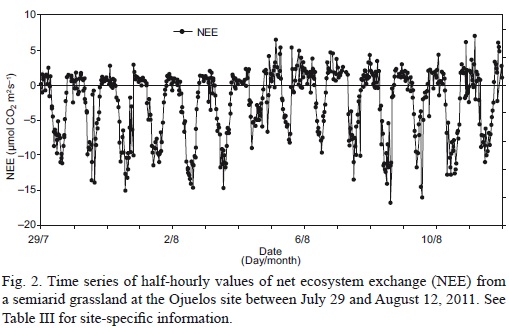
<body><![CDATA[<p align="justify"><font face="verdana" size="2">Current knowledge of the dynamics of carbon and water fluxes in Mexican ecosystems is very limited (Vargas <i>et al.</i> , 2012a). Among the research published in peer&#45;reviewed literature are RS measurements in tropical forests (Davidson <i>et al.,</i> 1993; Vargas and Allen, 2008; Vargas, 2012), NEE from subtropical and semiarid ecosystems (Hastings <i>et al.,</i> 2005; P&eacute;rez&#45;Ruiz <i>et al.</i>, 2010) and in urban areas of Mexico City (Velasco <i>et al.,</i> 2005, 2009, 2011), and ET in semiarid ecosystems (Watts <i>et al.,</i> 2007; Vivoni <i>et al.,</i> 2008). These measurements of energy, water vapor and CO<sub>2</sub> fluxes in Mexican ecosystems originated from individual efforts, and unfortunately there is a lack of a strategic governmental program to ensure long&#45;term funds for the establishment and continuity of these types of studies.</font></p>  	    <p align="justify"><font face="verdana" size="2">MexFlux is the network of flux measurements of GHGs and energy fluxes from terrestrial, urban, coastal and marine ecosystems in Mexico. Its main objective is to generate scientific knowledge about the role of the dynamics of Mexican ecosystems to global environmental change (<a href="/img/revistas/atm/v26n3//a3t1.jpg" target="_blank">Tables I</a> and <a href="/img/revistas/atm/v26n3//a3t2.jpg" target="_blank">II</a>). Mexico currently has 11 study sites using the EC technique and has over 30 site&#45;years of data of water vapor and CO<sub>2</sub> fluxes (Vargas <i>et al.,</i> 2012a). A number of sites are of recent installation <i>(i.e.,</i> established in 2011), while others have been operating between six and nine years (<a href="/img/revistas/atm/v26n3//a3t3.jpg" target="_blank">Table III</a>). The sites with the longest continuous measurements are located in semiarid ecosystems of Baja California Sur (established in 2002) and Sonora (established in 2004). With regard to distribution, the sites are located at: semiarid shru&#45;bland in Baja California; oak woodland, subtropical, tropical dry forest and grassland in Sonora; tropical dry forest in Jalisco and Yucat&aacute;n; shortgrass steppe in Jalisco; a managed pine forest in Hidalgo; and an urban residential/commercial site in Mexico City. Finally, a site was operated between 2008 and 2009 off the coast of Baja California measuring NEE over the ocean (Reimer <i>et al.,</i> in review).</font></p>  	    <p align="justify"><font face="verdana" size="2">MexFlux brings together scientists interested in using the EC technique in ecosystems across Mexico. Up to two principal investigators represent each study site within MexFlux. These researchers are required to verify that the site follows the guidelines for measurement standardization to maintain proper functioning of the network and allow sites inter&#45;comparisons. MexFlux members are working together towards standardization of data quality and a secure data management/analysis protocol. The network is intended to grow in coming years, as new sites will be established within strategic ecosystems to ensure the long&#45;term operation of the network. The new sites, in addition to consistency with the assumptions for EC technique, should ideally be located at sites that represent the variability of Mexican ecosystems and/or at ecosystems and regions most vulnerable to environmental or land use change.</font></p> 	    <p align="justify">&nbsp;</p>      <p align="justify"><font face="verdana" size="2"><b>5. Water vapor and CO<sub>2</sub> fluxes in terrestrial ecosystems of Mexico</b></font></p>  	    <p align="justify"><font face="verdana" size="2">Mexican ecosystems provide rich opportunities to validate previous observations across ecosystems. Some examples of relationships that could be tested and validated are those observed between phenology and CO<sub>2</sub> fluxes (Richardson <i>et al.,</i> 2010), control of GPP on RS (Vargas <i>et al.,</i> 2011b), or the role of drought and water pulses (Thomey <i>et al.,</i> 2011). What follows are examples from measurements at MexFlux sites to illustrate the diversity of patterns and magnitudes of CO<sub>2</sub> fluxes.</font></p>  	    <p align="justify"><font face="verdana" size="2">For example, the Ojuelos site located in a semi&#45;arid grassland (<a href="/img/revistas/atm/v26n3//a3t3.jpg" target="_blank">Table III</a>) is ideal for investigating the effect of precipitation pulses on NEE during the summer that result in higher CO<sub>2</sub> emissions. Data from this site show that before precipitation events, nocturnal NEE values (Reco by definition) were &lt; 2 &#956;mol CO<sub>2</sub> m<sup>2</sup> s<sup>&#45;1</sup> while after precipitation, pulses increased to values &gt; 5 umol CO<sub>2</sub> m<sup>2</sup> s<sup>&#45;1</sup> (<a href="#f2">Fig. 2</a>). The implications of these observations rely on climate change scenarios characterized by changes in frequency and intensity of precipitation and pulses.</font></p>  	    <p align="center"><font face="verdana" size="2"><a name="f2"></a></font></p>  	    <p align="center"><font face="verdana" size="2"><img src="/img/revistas/atm/v26n3//a3f2.jpg"></font></p>  	    <p align="justify"><font face="verdana" size="2">These changes in precipitation patterns can substantially affect carbon sequestration in semiarid rangelands by reducing or increasing water stress within the ecosystem (Thomey <i>et al.,</i> 2011, Vargas <i>et al.,</i> 2012b).</font></p>  	    ]]></body>
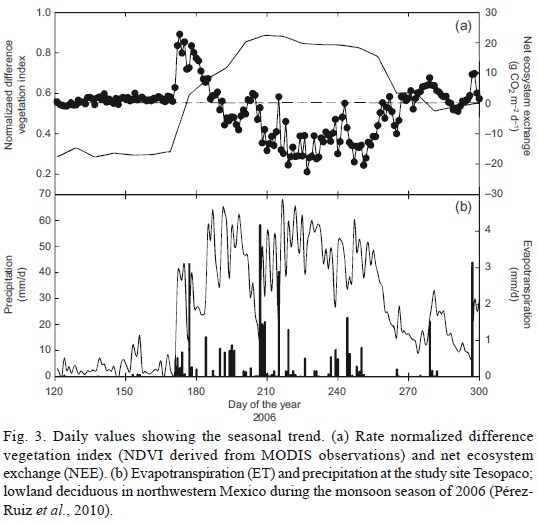
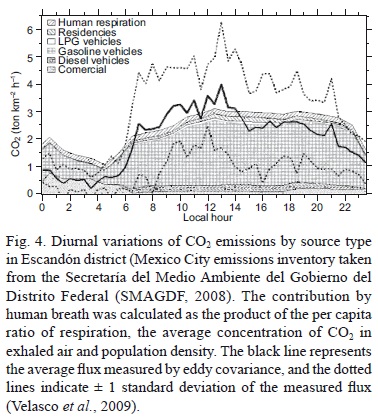
<body><![CDATA[<p align="justify"><font face="verdana" size="2">Another example comes from studying the North American Monsoon, which is a regional phenomenon that provides most of the annual rainfall over large areas of northern Mexico (Vivoni <i>et al.,</i> 2010). Data from the Tesopaco site, a tropical deciduous forest (<a href="/img/revistas/atm/v26n3//a3t3.jpg" target="_blank">Table III</a>) shows the influence of the monsoon over the seasonal trend of the normalized difference vegetation index (NDVI derived from MODIS observations), NEE and ET (<a href="#f3">Fig. 3</a>), as a marked variability in the direction and magnitude of fluxes across the growing season. It is estimated that this forest can sequester up to 374 g CO<sub>2</sub> m<sup>&#45;2</sup> during the monsoon season (P&eacute;rez&#45;Ruiz <i>et al.,</i> 2010).</font></p>  	    <p align="center"><font face="verdana" size="2"><a name="f3"></a></font></p>  	    <p align="center"><font face="verdana" size="2"><img src="/img/revistas/atm/v26n3//a3f3.jpg"></font></p>  	    <p align="justify"><font face="verdana" size="2">In urban sites, CO<sub>2</sub> flux measurements have been used to evaluate emission inventories and develop mitigation strategies, while energy fluxes can be useful for urbanization planning through a better understanding of urban climatology <i>(e.g.</i>, urban heat island). For example, Figure 4 compares the average diurnal CO<sub>2</sub> flux measured using eddy covariance during a short study over the Escand&oacute;n district in Mexico City with emission profiles extracted from the local emissions inventory (Velasco <i>et al.,</i> 2009, 2011). It is noteworthy that the CO<sub>2</sub> emission sources in urban ecosystems can be much more diverse than in natural ecosystems and their analysis requires a detailed interpretation of the measured fluxes (<a href="#f4">Fig. 4</a>).</font></p>  	    <p align="center"><font face="verdana" size="2"><a name="f4"></a></font></p>  	    <p align="center"><font face="verdana" size="2"><img src="/img/revistas/atm/v26n3//a3f4.jpg"></font></p>  	    <p align="justify"><font face="verdana" size="2"><b>6. MexFlux short&#45; and long&#45;term goals</b></font></p>  	    <p align="justify"><font face="verdana" size="2">It is essential to strengthen collaborations among research groups for a successful coordination and operation of MexFlux. The network will use a strategy based on the coordination and combination of micrometeorological techniques, meteorological, remote sensing, biophysical and ecosystems&#45;process modeling to obtain the best possible estimates of the GHG flux dynamics. In order to scale these measurements in time and space, it is essential to: (1) generate a standardized protocol for inter&#45;calibration of measuring instruments and measurement methods; and (2) develop quality assurance and control (QA/ QC) procedures of raw data and post&#45;processing of computed fluxes <i>(i.e.,</i> gap&#45;filling series, partition NEE into GPP and RS). This QA/QC must comply with international standards (Papale <i>et al.,</i> 2006) to generate useful and consistent datasets for regional and global synthesis studies.</font></p>  	    <p align="justify"><font face="verdana" size="2">To facilitate synthesis studies and maximize data use, the data storage and standardized post&#45;processing could be provided by existing cyberinfrastructure in different institutions of MexFlux members <i>(e.g.,</i> University of Alberta, Canada with its Enviro&#45;Net platform). Initially, a specific MexFlux database will contain the products of site&#45;level measurements (i.e., raw data) along with the processed data obtained following standardized protocols (Papale <i>et al.,</i> 2006). MexFlux has adopted a policy of submitting information from each study site to this database within a period of one year from its incorporation to the network. Only principal investigators will submit raw and processed data, and these will be freely available to the network members, under a fair use policy. Finally, MexFlux will promote training of human resources in the area of micrometeorological and biophysical measurements of energy and GHG fluxes.</font></p>  	    <p align="justify"><font face="verdana" size="2">The short&#45;term challenges facing MexFlux are: (1) developing protocols and standardization among sites for reducing uncertainties in the flux measurements; (2) establishing rules for archiving and processing data within the MexFlux database; (3) establishing clear and fair use data policies for all members according to the funding source for each project (i.e., domestic agencies and international funding); and (4) the study sites must invest in measuring a common set of biological and physical parameters to describe the ecosystem (e.g., vegetation structure, phenology, soil properties, management history) to better interpret observed fluxes (Law <i>et al.,</i> 2008).</font></p>  	    ]]></body>
<body><![CDATA[<p align="justify"><font face="verdana" size="2">In the long&#45;term, MexFlux needs a continuous interaction with institutions and networks at the national and international levels. Important collaborations have been identified with the scientific networks sponsored by the Consejo Nacional de Ciencia y Tecnolog&iacute;a (Conacyt) such as the Red Tem&aacute;tica del Agua (RETAC, water research network), Red Tem&aacute;tica de Ecosistemas (EcoRed, ecosystems research network), and Red Tem&aacute;tica de Medio Ambiente y Sustentabilidad (REMAS, environmental sustainability research network). Additionally, there is a strong link with the Programa Mexicano del Carbono (PMC, Mexican carbon program), the Red Mexicana de Investigaci&oacute;n Ecol&oacute;gica a Largo Plazo (Mex&#45;LTER, Mexican long&#45;term ecological research network), and international networks such as the North American Carbon Program (CarboNA), and Tropi&#45;Dry. MexFlux is expected to have a fundamental role within FLUXNET since Mexican ecosystems are underrepresented and this limits the production of synthesis studies across regions, which are important for scientific understanding and policy&#45;making across North America (Harmon <i>et al.</i>, 2011; Masek <i>et al.,</i> 2011; Vargas <i>et al.,</i> 2012a).</font></p>  	    <p align="justify"><font face="verdana" size="2">We also suggest that long&#45;term measurements within MexFlux should incorporate other GHGs, pollutants, aerosols and stable isotopes as technology becomes more accessible and more scientists join the network. This new information could be integrated into models of ecosystem processes to update and validate previous observations and parameters. MexFlux's long&#45;term challenge is to seek the integration of researchers in fields of climate modeling, mathematics, biogeochemistry, and social science related to policy making. Finally, we believe that it is essential to develop multi&#45;institutional training and financing mechanisms for the maintenance and operation of the study sites and secure the continuity of MexFlux. This will only be achieved if there is political will and evidence of the usefulness of value added products from the network for policy&#45;making and scientific advancement.</font></p> 	    <p align="justify">&nbsp;</p>      <p align="justify"><font face="verdana" size="2"><b>Acknowledgements</b></font></p>  	    <p align="justify"><font face="verdana" size="2">The authors acknowledge funding from Conacyt (EcoRed&#45;Conacyt) for meetings that have facilitated discussions between researchers and students. RV is grateful for funding from Conacyt (Ciencia B&aacute;sica&#45;152671). TA and CW thanks SEP&#45;Conacyt. ASA and EGC thank the Inter&#45;American Institute for Global Change Research, Tropi&#45;Dry, supported by the National Science Foundation. EGC also acknowledges funding from a Conacyt&#45;UC Mexus scholarship. CW gratefully acknowledges funding from Conacyt Ciencia B&aacute;sica. EV acknowledges support from INE, MCE2, SMA&#45;GDF and Singapore National Research Foundation trough SMART. GA and JLA acknowledge support from USAID and USFS.</font></p>  	    <p align="justify"><font face="verdana" size="2">&nbsp;</font></p>  	    <p align="justify"><font face="verdana" size="2"><b>References</b></font></p>  	    <!-- ref --><p align="justify"><font face="verdana" size="2">Aubinet M., A. Grelle, A. Ibrom, U. Rannik, J. Moncrieff, T. Foken, A. S. Kowalski, P. H. Martin, P. Berbigier, C. Bernhofer, R. Clement, J. Elbers, A. Granier, T. Grunwald, K. Morgenstern, K. Pilegaard, C. Rebmann, W. Snijders, R. Valentini and T. Vesala, 2000. Estimates of the annual net carbon and water exchange of forests: The EuroFlux methodology. <i>Adv. Ecol. Res.</i> <b>30,</b> 113&#45;175.    &nbsp;&nbsp;&nbsp;&nbsp;&nbsp;&nbsp;&nbsp;&nbsp;[&#160;<a href="javascript:void(0);" onclick="javascript: window.open('/scielo.php?script=sci_nlinks&ref=1308103&pid=S0187-6236201300030000300001&lng=','','width=640,height=500,resizable=yes,scrollbars=1,menubar=yes,');">Links</a>&#160;]<!-- end-ref --></font></p>  	    <!-- ref --><p align="justify"><font face="verdana" size="2">Baldocchi D., E. Falge, L. H. Gu, R. Olson, D. Hollinger, S. Running, P. Anthoni, C. Bernhofer, K. Davis, R. Evans, J. Fuentes, A. Goldstein, G. Katul, B. Law, X. H. Lee, Y. Malhi, T. Meyers, W. Munger, W. Oechel, K. T. Paw, K. Pilegaard, H. P. Schmid, R. Valentini, S. Verma, T. Vesala, K. Wilson, and S. Wofsy, 2001. FLUXNET: A new tool to study the temporal and spatial variability of ecosystem&#45;scale carbon dioxide, water vapor, and energy flux densities. <i>B. Am. Meteorol. Soc.</i> <b>82,</b> 2415&#45;2434.    &nbsp;&nbsp;&nbsp;&nbsp;&nbsp;&nbsp;&nbsp;&nbsp;[&#160;<a href="javascript:void(0);" onclick="javascript: window.open('/scielo.php?script=sci_nlinks&ref=1308105&pid=S0187-6236201300030000300002&lng=','','width=640,height=500,resizable=yes,scrollbars=1,menubar=yes,');">Links</a>&#160;]<!-- end-ref --></font></p>  	    <!-- ref --><p align="justify"><font face="verdana" size="2">Baldocchi D. D., 2003. Assessing the eddy covariance technique for evaluating carbon dioxide exchange rates of ecosystems: Past, present and future. <i>Glob. Change Biol.</i> <b>9,</b> 479&#45;492.    &nbsp;&nbsp;&nbsp;&nbsp;&nbsp;&nbsp;&nbsp;&nbsp;[&#160;<a href="javascript:void(0);" onclick="javascript: window.open('/scielo.php?script=sci_nlinks&ref=1308107&pid=S0187-6236201300030000300003&lng=','','width=640,height=500,resizable=yes,scrollbars=1,menubar=yes,');">Links</a>&#160;]<!-- end-ref --></font></p>  	    <!-- ref --><p align="justify"><font face="verdana" size="2">Baldocchi D., 2008. Breathing of the terrestrial biosphere: lessons learned from a global network of carbon dioxide flux measurement systems. <i>Aust. J. Bot.</i> 56, 1&#45;26.    &nbsp;&nbsp;&nbsp;&nbsp;&nbsp;&nbsp;&nbsp;&nbsp;[&#160;<a href="javascript:void(0);" onclick="javascript: window.open('/scielo.php?script=sci_nlinks&ref=1308109&pid=S0187-6236201300030000300004&lng=','','width=640,height=500,resizable=yes,scrollbars=1,menubar=yes,');">Links</a>&#160;]<!-- end-ref --></font></p>  	    <!-- ref --><p align="justify"><font face="verdana" size="2">Beer C., M. Reichstein, E. Tomelleri, P. Ciais, M. Jung, N. Carvalhais, C. Rodenbeck, M. A. Arain, D. Baldocchi, G. B. Bonan, A. Bondeau, A. Cescatti, G. Lasslop, A. Lindroth, M. Lomas, S. Luyssaert, H. Margolis, K. W. Oleson, O. Roupsard, E. Veenendaal, N. Viovy, C. Williams, F. I. Woodward and D. Papale, 2010. Terrestrial gross carbon dioxide uptake: Global distribution and covariation with climate. <i>Science</i> <b>329,</b> 834&#45;838.    &nbsp;&nbsp;&nbsp;&nbsp;&nbsp;&nbsp;&nbsp;&nbsp;[&#160;<a href="javascript:void(0);" onclick="javascript: window.open('/scielo.php?script=sci_nlinks&ref=1308111&pid=S0187-6236201300030000300005&lng=','','width=640,height=500,resizable=yes,scrollbars=1,menubar=yes,');">Links</a>&#160;]<!-- end-ref --></font></p>  	    <!-- ref --><p align="justify"><font face="verdana" size="2">Bonan G. B., 2008. Forests and climate change: Forcings, feedbacks, and the climate benefits of forests. <i>Science</i> <b>320,</b> 1444&#45;1449.    &nbsp;&nbsp;&nbsp;&nbsp;&nbsp;&nbsp;&nbsp;&nbsp;[&#160;<a href="javascript:void(0);" onclick="javascript: window.open('/scielo.php?script=sci_nlinks&ref=1308113&pid=S0187-6236201300030000300006&lng=','','width=640,height=500,resizable=yes,scrollbars=1,menubar=yes,');">Links</a>&#160;]<!-- end-ref --></font></p>  	    <!-- ref --><p align="justify"><font face="verdana" size="2">Bond&#45;Lamberty B. and A. Thomson, 2010. Temperature&#45;associated increases in the global soil respiration record. <i>Nature</i> <b>464,</b> 579&#45;582.    &nbsp;&nbsp;&nbsp;&nbsp;&nbsp;&nbsp;&nbsp;&nbsp;[&#160;<a href="javascript:void(0);" onclick="javascript: window.open('/scielo.php?script=sci_nlinks&ref=1308115&pid=S0187-6236201300030000300007&lng=','','width=640,height=500,resizable=yes,scrollbars=1,menubar=yes,');">Links</a>&#160;]<!-- end-ref --></font></p>  	    <!-- ref --><p align="justify"><font face="verdana" size="2">Burba G. G. and S. B. Verma, 2005. Seasonal and interannual variability in evapotranspiration of native tallgrass prairie and cultivated wheat ecosystems. <i>Agr. Forest. Meteorol.</i> <b>135,</b> 190&#45;201.    &nbsp;&nbsp;&nbsp;&nbsp;&nbsp;&nbsp;&nbsp;&nbsp;[&#160;<a href="javascript:void(0);" onclick="javascript: window.open('/scielo.php?script=sci_nlinks&ref=1308117&pid=S0187-6236201300030000300008&lng=','','width=640,height=500,resizable=yes,scrollbars=1,menubar=yes,');">Links</a>&#160;]<!-- end-ref --></font></p>  	    <!-- ref --><p align="justify"><font face="verdana" size="2">Canadell J. G., H. A. Mooney, D. D. Baldocchi, J. A. Berry, J. R. Ehleringer, C. B. Field, S. T. Gower, D. Y. Hollinger, J. E. Hunt, R. B. Jackson, S. W. Running, G. R. Shaver, W. Steffen, S. E. Trumbore, R. Valentini and B. Y. Bond, 2000. Carbon metabolism of the terrestrial biosphere: A multi&#45;technique approach for improved understanding. <i>Ecosystems</i> <b>3,</b> 115&#45;130.    &nbsp;&nbsp;&nbsp;&nbsp;&nbsp;&nbsp;&nbsp;&nbsp;[&#160;<a href="javascript:void(0);" onclick="javascript: window.open('/scielo.php?script=sci_nlinks&ref=1308119&pid=S0187-6236201300030000300009&lng=','','width=640,height=500,resizable=yes,scrollbars=1,menubar=yes,');">Links</a>&#160;]<!-- end-ref --></font></p>  	    <!-- ref --><p align="justify"><font face="verdana" size="2">Challenger A. and J. Sober&oacute;n, 2008. Los ecosistemas terrestres. In <i>Capital natural de M&eacute;xico</i> (Conabio, Ed.). Comisi&oacute;n Nacional para el Conocimiento y Uso de la Biodiversidad, M&eacute;xico, pp. 87&#45;108.    &nbsp;&nbsp;&nbsp;&nbsp;&nbsp;&nbsp;&nbsp;&nbsp;[&#160;<a href="javascript:void(0);" onclick="javascript: window.open('/scielo.php?script=sci_nlinks&ref=1308121&pid=S0187-6236201300030000300010&lng=','','width=640,height=500,resizable=yes,scrollbars=1,menubar=yes,');">Links</a>&#160;]<!-- end-ref --></font></p>  	    <!-- ref --><p align="justify"><font face="verdana" size="2">Chapin F. S., P. A. Matson and H. A. Mooney, 2002. <i>Principles of terrestrial ecosystem ecology.</i> Springer, New York, 392 pp.    &nbsp;&nbsp;&nbsp;&nbsp;&nbsp;&nbsp;&nbsp;&nbsp;[&#160;<a href="javascript:void(0);" onclick="javascript: window.open('/scielo.php?script=sci_nlinks&ref=1308123&pid=S0187-6236201300030000300011&lng=','','width=640,height=500,resizable=yes,scrollbars=1,menubar=yes,');">Links</a>&#160;]<!-- end-ref --></font></p>  	    <!-- ref --><p align="justify"><font face="verdana" size="2">Davidson E. A., P. A. Matson, P. M. Vitousek, R. Riley, K. Dunkin, G. Garc&iacute;a&#45;M&eacute;ndez and J. M. Maass, 1993. Processes regulating soil emissions of No and N<sub>2</sub>O in a seasonally dry tropical forest. <i>Ecology</i> <b>74,</b> 130&#45;139.    &nbsp;&nbsp;&nbsp;&nbsp;&nbsp;&nbsp;&nbsp;&nbsp;[&#160;<a href="javascript:void(0);" onclick="javascript: window.open('/scielo.php?script=sci_nlinks&ref=1308125&pid=S0187-6236201300030000300012&lng=','','width=640,height=500,resizable=yes,scrollbars=1,menubar=yes,');">Links</a>&#160;]<!-- end-ref --></font></p>  	    <!-- ref --><p align="justify"><font face="verdana" size="2">Fisher J. B., R. J. Whittaker and Y. Malhi, 2011. ET come home: potential evapotranspiration in geographical ecology. <i>Global Ecol. Biogeogr.</i> <b>20,</b> 1&#45;18.    &nbsp;&nbsp;&nbsp;&nbsp;&nbsp;&nbsp;&nbsp;&nbsp;[&#160;<a href="javascript:void(0);" onclick="javascript: window.open('/scielo.php?script=sci_nlinks&ref=1308127&pid=S0187-6236201300030000300013&lng=','','width=640,height=500,resizable=yes,scrollbars=1,menubar=yes,');">Links</a>&#160;]<!-- end-ref --></font></p>  	    <!-- ref --><p align="justify"><font face="verdana" size="2">Goulden M. L., J. W. Munger, S. M. Fan, B. C. Daube and S. C. Wofsy, 1996. Measurements of carbon sequestration by long&#45;term eddy covariance: Methods and a critical evaluation of accuracy. <i>Glob. Change</i> <i>Biol.</i> <b>2,</b> 169&#45;182.    &nbsp;&nbsp;&nbsp;&nbsp;&nbsp;&nbsp;&nbsp;&nbsp;[&#160;<a href="javascript:void(0);" onclick="javascript: window.open('/scielo.php?script=sci_nlinks&ref=1308129&pid=S0187-6236201300030000300014&lng=','','width=640,height=500,resizable=yes,scrollbars=1,menubar=yes,');">Links</a>&#160;]<!-- end-ref --></font></p>  	    <!-- ref --><p align="justify"><font face="verdana" size="2">Greenland D., D. G. Goodin and C. Smith (Eds.), 2003. <i>Climate variability and ecosystem response at long&#45;term ecological sites.</i> Oxford University Press, New York, 480 pp.    &nbsp;&nbsp;&nbsp;&nbsp;&nbsp;&nbsp;&nbsp;&nbsp;[&#160;<a href="javascript:void(0);" onclick="javascript: window.open('/scielo.php?script=sci_nlinks&ref=1308131&pid=S0187-6236201300030000300015&lng=','','width=640,height=500,resizable=yes,scrollbars=1,menubar=yes,');">Links</a>&#160;]<!-- end-ref --></font></p>  	    <!-- ref --><p align="justify"><font face="verdana" size="2">Hanson P. J., N. T. Edwards, C. T. Garten and J. A. Andrews, 2000. Separating root and soil microbial contributions to soil respiration: A review of methods and observations. <i>Biogeochemistry</i> <b>48,</b> 115&#45;146.    &nbsp;&nbsp;&nbsp;&nbsp;&nbsp;&nbsp;&nbsp;&nbsp;[&#160;<a href="javascript:void(0);" onclick="javascript: window.open('/scielo.php?script=sci_nlinks&ref=1308133&pid=S0187-6236201300030000300016&lng=','','width=640,height=500,resizable=yes,scrollbars=1,menubar=yes,');">Links</a>&#160;]<!-- end-ref --></font></p>  	    <!-- ref --><p align="justify"><font face="verdana" size="2">Harmon M. E., B. Bond&#45;Lamberty, J. W. Tang and R. Vargas, 2011. Heterotrophic respiration in disturbed forests: A review with examples from North America. <i>J. Geophys. Res.&#45;Biogeo.</i> <b>116,</b> doi:10.1029/2010JG001495.    &nbsp;&nbsp;&nbsp;&nbsp;&nbsp;&nbsp;&nbsp;&nbsp;[&#160;<a href="javascript:void(0);" onclick="javascript: window.open('/scielo.php?script=sci_nlinks&ref=1308135&pid=S0187-6236201300030000300017&lng=','','width=640,height=500,resizable=yes,scrollbars=1,menubar=yes,');">Links</a>&#160;]<!-- end-ref --></font></p>  	    <!-- ref --><p align="justify"><font face="verdana" size="2">Hastings S. J., W. C. Oechel and A. Muhlia&#45;Melo, 2005. Diurnal, seasonal and annual variation in the net ecosystem CO2 exchange of a desert shrub community (Sarcocaulescent) in Baja California, Mexico. <i>Glob.</i> <i>Change Biol.</i> <b>11,</b> 927&#45;939.    &nbsp;&nbsp;&nbsp;&nbsp;&nbsp;&nbsp;&nbsp;&nbsp;[&#160;<a href="javascript:void(0);" onclick="javascript: window.open('/scielo.php?script=sci_nlinks&ref=1308137&pid=S0187-6236201300030000300018&lng=','','width=640,height=500,resizable=yes,scrollbars=1,menubar=yes,');">Links</a>&#160;]<!-- end-ref --></font></p>  	    <!-- ref --><p align="justify"><font face="verdana" size="2">Heimann M. and M. Reichstein, 2008. Terrestrial ecosystem carbon dynamics and climate feedbacks. <i>Nature</i> <b>451,</b> 289&#45;292.    &nbsp;&nbsp;&nbsp;&nbsp;&nbsp;&nbsp;&nbsp;&nbsp;[&#160;<a href="javascript:void(0);" onclick="javascript: window.open('/scielo.php?script=sci_nlinks&ref=1308139&pid=S0187-6236201300030000300019&lng=','','width=640,height=500,resizable=yes,scrollbars=1,menubar=yes,');">Links</a>&#160;]<!-- end-ref --></font></p>  	    <!-- ref --><p align="justify"><font face="verdana" size="2">Hey T., S. Tansley and K. Tolle (Eds.), 2009. <i>The fourth paradigm: data&#45;intensive scientific discovery.</i> Microsoft Research, Redmond, WA, 284 pp.    &nbsp;&nbsp;&nbsp;&nbsp;&nbsp;&nbsp;&nbsp;&nbsp;[&#160;<a href="javascript:void(0);" onclick="javascript: window.open('/scielo.php?script=sci_nlinks&ref=1308141&pid=S0187-6236201300030000300020&lng=','','width=640,height=500,resizable=yes,scrollbars=1,menubar=yes,');">Links</a>&#160;]<!-- end-ref --></font></p>  	    <!-- ref --><p align="justify"><font face="verdana" size="2">IPCC, 2007. <i>Climate change 2007: The physical science basis. Contribution of Working Group I to the Fourth Assessment Report of the Intergovernmental Panel on Climate Change</i> (S. Solomon, D. Qin, M. Manning, Z. Chen, M. Marquis, K. B. Averyt, M. Tignor and H. L. Miller, Eds.). Cambridge University Press, Cambridge, United Kingdom and New York, 996 pp.    &nbsp;&nbsp;&nbsp;&nbsp;&nbsp;&nbsp;&nbsp;&nbsp;[&#160;<a href="javascript:void(0);" onclick="javascript: window.open('/scielo.php?script=sci_nlinks&ref=1308143&pid=S0187-6236201300030000300021&lng=','','width=640,height=500,resizable=yes,scrollbars=1,menubar=yes,');">Links</a>&#160;]<!-- end-ref --></font></p>  	    <!-- ref --><p align="justify"><font face="verdana" size="2">Jung M., M. Reichstein, P. Ciais, S. I. Seneviratne, J. Sheffield, M. L. Goulden, G. Bonan, A. Cescatti, J. Chen, R. de Jeu, A. J. Dolman, W. Eugster, D. Gerten, D. Gianelle, N. Gobron, J. Heinke, J. Kimball, B. E. Law, L. Montagnani, Q. Mu, B. Mueller, K. Oleson, D. Papale, A. D. Richardson, O. Roupsard, S. Running, E. Tomelleri, N. Viovy, U. Weber, C. Williams, E. Wood, S. Zaehle and K. Zhang, 2010. Recent decline in the global land evapotranspiration trend due to limited moisture supply. <i>Nature</i> <b>467,</b> 951&#45;954.    &nbsp;&nbsp;&nbsp;&nbsp;&nbsp;&nbsp;&nbsp;&nbsp;[&#160;<a href="javascript:void(0);" onclick="javascript: window.open('/scielo.php?script=sci_nlinks&ref=1308145&pid=S0187-6236201300030000300022&lng=','','width=640,height=500,resizable=yes,scrollbars=1,menubar=yes,');">Links</a>&#160;]<!-- end-ref --></font></p>  	    <!-- ref --><p align="justify"><font face="verdana" size="2">Law B. E., T. J. Arkebauer, J. L. Campbell, J. Chen, O. Sun, M. Schwartz, C. van Ingen and S. Verma, 2008. <i>Terrestrial carbon observations: Protocolsfor vegetation sampling and data submission.</i> Global Terrestrial Observing System, FAO, Rome, 88 pp.    &nbsp;&nbsp;&nbsp;&nbsp;&nbsp;&nbsp;&nbsp;&nbsp;[&#160;<a href="javascript:void(0);" onclick="javascript: window.open('/scielo.php?script=sci_nlinks&ref=1308147&pid=S0187-6236201300030000300023&lng=','','width=640,height=500,resizable=yes,scrollbars=1,menubar=yes,');">Links</a>&#160;]<!-- end-ref --></font></p>  	    <!-- ref --><p align="justify"><font face="verdana" size="2">Le Qu&eacute;r&eacute; C., M. R. Raupach, J. G. Canadell, G. Marland, L. Bopp, P. Ciais, T. J. Conway, S. C. Doney, R. Feely, P. Foster, P. Friedlingstein, K. Gurney, R. A. Houghton, J. I. House, C. Huntingford, P. Levy, M. R. Lomas, J. Majkut, N. Metzl, J. P. Ometto, G. P. Peters, I. C. Prentice, J. T. Randerson, S. W. Running, J. L. Sarmiento, U. Schuster, S. Sitch, T. Takahashi, N. Viovy, G. R. van der Werf and F. I. Woodward, 2009. Trends in the sources and sinks of carbon dioxide. <i>Nat.</i> <i>Geosci.</i> <b>2,</b> 831&#45;836.    &nbsp;&nbsp;&nbsp;&nbsp;&nbsp;&nbsp;&nbsp;&nbsp;[&#160;<a href="javascript:void(0);" onclick="javascript: window.open('/scielo.php?script=sci_nlinks&ref=1308149&pid=S0187-6236201300030000300024&lng=','','width=640,height=500,resizable=yes,scrollbars=1,menubar=yes,');">Links</a>&#160;]<!-- end-ref --></font></p>  	    <!-- ref --><p align="justify"><font face="verdana" size="2">Mahecha M. D., M. Reichstein, N. Carvalhais, G. Lasslop, H. Lange, S. I. Seneviratne, R. Vargas, C. Ammann, M. A. Arain, A. Cescatti, I. A. Janssens, M. Migliavacca, L. Montagnani and A. D. Richardson, 2010. Global convergence in the temperature sensitivity of respiration at ecosystem level. <i>Science</i> <b>329,</b> 838&#45;840.    &nbsp;&nbsp;&nbsp;&nbsp;&nbsp;&nbsp;&nbsp;&nbsp;[&#160;<a href="javascript:void(0);" onclick="javascript: window.open('/scielo.php?script=sci_nlinks&ref=1308151&pid=S0187-6236201300030000300025&lng=','','width=640,height=500,resizable=yes,scrollbars=1,menubar=yes,');">Links</a>&#160;]<!-- end-ref --></font></p>  	    <!-- ref --><p align="justify"><font face="verdana" size="2">Masek J. G., W. B. Cohen, D. Leckie, M. A. Wulder, R. Vargas, B. de Jong, S. Healey, B. Law, R. Birdsey, R. A. Houghton, D. Mildrexler, S. Goward and W. B. Smith, 2011. Recent rates of forest harvest and conversion in North America. <i>J. Geophys. Res.&#45;Biogeo.,</i> <b>116,</b> G00K03, doi:10.1029/2010JG001471.    &nbsp;&nbsp;&nbsp;&nbsp;&nbsp;&nbsp;&nbsp;&nbsp;[&#160;<a href="javascript:void(0);" onclick="javascript: window.open('/scielo.php?script=sci_nlinks&ref=1308153&pid=S0187-6236201300030000300026&lng=','','width=640,height=500,resizable=yes,scrollbars=1,menubar=yes,');">Links</a>&#160;]<!-- end-ref --></font></p>  	    <!-- ref --><p align="justify"><font face="verdana" size="2">Millennium Ecosystem Assessment, 2005. <i>Ecosystems and human well&#45;being: synthesis.</i> Island Press, Washington, D.C., 139 pp.    &nbsp;&nbsp;&nbsp;&nbsp;&nbsp;&nbsp;&nbsp;&nbsp;[&#160;<a href="javascript:void(0);" onclick="javascript: window.open('/scielo.php?script=sci_nlinks&ref=1308155&pid=S0187-6236201300030000300027&lng=','','width=640,height=500,resizable=yes,scrollbars=1,menubar=yes,');">Links</a>&#160;]<!-- end-ref --></font></p>  	    <!-- ref --><p align="justify"><font face="verdana" size="2">Mittermeier R. A. and M. C. Goettsch, 1997. <i>Megadiversity: Earth's biologically wealthiest nations.</i> 1st English ed. CEMEX, Mexico, 501 pp.    &nbsp;&nbsp;&nbsp;&nbsp;&nbsp;&nbsp;&nbsp;&nbsp;[&#160;<a href="javascript:void(0);" onclick="javascript: window.open('/scielo.php?script=sci_nlinks&ref=1308157&pid=S0187-6236201300030000300028&lng=','','width=640,height=500,resizable=yes,scrollbars=1,menubar=yes,');">Links</a>&#160;]<!-- end-ref --></font></p>  	    <!-- ref --><p align="justify"><font face="verdana" size="2">Papale D., M. Reichstein, M. Aubinet, E. Canfora, C. Bernhofer, W. Kutsch, B. Longdoz, S. Rambal, R. Valentini, T. Vesala and D. Yakir, 2006. Towards a standardized processing of Net Ecosystem Exchange measured with eddy covariance technique: algorithms and uncertainty estimation. <i>Biogeosciences</i> <b>3,</b> 571&#45;583.    &nbsp;&nbsp;&nbsp;&nbsp;&nbsp;&nbsp;&nbsp;&nbsp;[&#160;<a href="javascript:void(0);" onclick="javascript: window.open('/scielo.php?script=sci_nlinks&ref=1308159&pid=S0187-6236201300030000300029&lng=','','width=640,height=500,resizable=yes,scrollbars=1,menubar=yes,');">Links</a>&#160;]<!-- end-ref --></font></p>  	    <!-- ref --><p align="justify"><font face="verdana" size="2">P&eacute;rez&#45;Ruiz E. R., J. Garatuza&#45;Pay&aacute;n, C. J. Watts, J. C. Rodr&iacute;guez, E. A. Y&eacute;pez and R. L. Scott, 2010. Carbon dioxide and water vapour exchange in a tropical dry forest as influenced by the North American Monsoon System (NAMS). <i>J. Arid. Environ.</i> <b>74,</b> 556&#45;563.    &nbsp;&nbsp;&nbsp;&nbsp;&nbsp;&nbsp;&nbsp;&nbsp;[&#160;<a href="javascript:void(0);" onclick="javascript: window.open('/scielo.php?script=sci_nlinks&ref=1308161&pid=S0187-6236201300030000300030&lng=','','width=640,height=500,resizable=yes,scrollbars=1,menubar=yes,');">Links</a>&#160;]<!-- end-ref --></font></p>  	    <!-- ref --><p align="justify"><font face="verdana" size="2">Pumpanen J., P. Kolari, H. Ilvesniemi, K. Minkkinen, T. Vesala, S. Niinisto, A. Lohila, T. Larmola, M. Morero, M. Pihlatie, I. Janssens, J. C. Yuste, J. M. Grunzweig, S. Reth, J. A. Subke, K. Savage, W. Kutsch, G. Ostreng, W. Ziegler, P. Anthoni, A. Lindroth and P. Hari, 2004. Comparison of different chamber techniques for measuring soil CO<sub>2</sub> efflux. <i>Agr. Forest. Meteorol.</i> <b>123,</b> 159&#45;176.    &nbsp;&nbsp;&nbsp;&nbsp;&nbsp;&nbsp;&nbsp;&nbsp;[&#160;<a href="javascript:void(0);" onclick="javascript: window.open('/scielo.php?script=sci_nlinks&ref=1308163&pid=S0187-6236201300030000300031&lng=','','width=640,height=500,resizable=yes,scrollbars=1,menubar=yes,');">Links</a>&#160;]<!-- end-ref --></font></p>  	    <!-- ref --><p align="justify"><font face="verdana" size="2">Reimer J. J., R. Vargas, S. V. Smith, R. Lara&#45;Lara, G. Gaxiola&#45;Castro, M. Hern&aacute;ndez&#45;Ay&oacute;n, A. Castro, M. Escoto&#45;Rodr&iacute;guez and J. Mart&iacute;nez&#45;Osuna. Air&#45;sea CO<sub>2</sub> fluxes in the near&#45;shore and inter&#45;tidal zones influenced by the California current. <i>J. Geophys. Res.&#45;Oceans,</i> in review.    &nbsp;&nbsp;&nbsp;&nbsp;&nbsp;&nbsp;&nbsp;&nbsp;[&#160;<a href="javascript:void(0);" onclick="javascript: window.open('/scielo.php?script=sci_nlinks&ref=1308165&pid=S0187-6236201300030000300032&lng=','','width=640,height=500,resizable=yes,scrollbars=1,menubar=yes,');">Links</a>&#160;]<!-- end-ref --></font></p>  	    <!-- ref --><p align="justify"><font face="verdana" size="2">Richardson A. D., T. A. Black, P. Ciais, N. Delbart, M. A. Friedl, N. Gobron, D. Y. Hollinger, W. L. Kutsch, B. Longdoz, S. Luyssaert, M. Migliavacca, L. Montagnani, J. W. Munger, E. Moors, S. L. Piao, C. Rebmann, M. Reichstein, N. Saigusa, E. Tomelleri, R. Vargas and A. Varlagin, 2010. Influence of spring and autumn phenological transitions on forest ecosystem productivity. <i>Philos. T. Roy. Soc. B</i> <b>365,</b> 3227&#45;3246.    &nbsp;&nbsp;&nbsp;&nbsp;&nbsp;&nbsp;&nbsp;&nbsp;[&#160;<a href="javascript:void(0);" onclick="javascript: window.open('/scielo.php?script=sci_nlinks&ref=1308167&pid=S0187-6236201300030000300033&lng=','','width=640,height=500,resizable=yes,scrollbars=1,menubar=yes,');">Links</a>&#160;]<!-- end-ref --></font></p>  	    <!-- ref --><p align="justify"><font face="verdana" size="2">SMAGDF, 2008. <i>Inventario de emisiones de contaminantes criterio de la Zona Metropolitana del Valle de M&eacute;xico.</i> Secretaria del Medio Ambiente, Gobierno del Distrito Federal, Mexico, 160 pp.    &nbsp;&nbsp;&nbsp;&nbsp;&nbsp;&nbsp;&nbsp;&nbsp;[&#160;<a href="javascript:void(0);" onclick="javascript: window.open('/scielo.php?script=sci_nlinks&ref=1308169&pid=S0187-6236201300030000300034&lng=','','width=640,height=500,resizable=yes,scrollbars=1,menubar=yes,');">Links</a>&#160;]<!-- end-ref --></font></p>  	    <!-- ref --><p align="justify"><font face="verdana" size="2">Thomey M. L., S. L. Collins, R. Vargas, J. E. Johnson, R. F. Brown, D. O. Natvig and M. T. Friggens, 2011. Effect of precipitation variability on net primary production and soil respiration in a Chihuahuan desert grassland. <i>Glob. Change Biol.</i> <b>17,</b> 1505&#45;1515.    &nbsp;&nbsp;&nbsp;&nbsp;&nbsp;&nbsp;&nbsp;&nbsp;[&#160;<a href="javascript:void(0);" onclick="javascript: window.open('/scielo.php?script=sci_nlinks&ref=1308171&pid=S0187-6236201300030000300035&lng=','','width=640,height=500,resizable=yes,scrollbars=1,menubar=yes,');">Links</a>&#160;]<!-- end-ref --></font></p>  	    <!-- ref --><p align="justify"><font face="verdana" size="2">Vargas R. and M. F. Allen, 2008. Diel patterns of soil respiration in a tropical forest after hurricane Wilma. <i>J. Geophys. Res.&#45;Biogeo.</i> <b>113,</b> G03021, doi:10.1029/ 2007jg000620.    &nbsp;&nbsp;&nbsp;&nbsp;&nbsp;&nbsp;&nbsp;&nbsp;[&#160;<a href="javascript:void(0);" onclick="javascript: window.open('/scielo.php?script=sci_nlinks&ref=1308173&pid=S0187-6236201300030000300036&lng=','','width=640,height=500,resizable=yes,scrollbars=1,menubar=yes,');">Links</a>&#160;]<!-- end-ref --></font></p>  	    <!-- ref --><p align="justify"><font face="verdana" size="2">Vargas R., M. S. Carbone, M. Reichstein and D. D. Baldocchi, 2011a. Frontiers and challenges in soil respiration research: from measurements to model&#45;data integration. <i>Biogeochemistry</i> <b>102,</b> 1&#45;13.    &nbsp;&nbsp;&nbsp;&nbsp;&nbsp;&nbsp;&nbsp;&nbsp;[&#160;<a href="javascript:void(0);" onclick="javascript: window.open('/scielo.php?script=sci_nlinks&ref=1308175&pid=S0187-6236201300030000300037&lng=','','width=640,height=500,resizable=yes,scrollbars=1,menubar=yes,');">Links</a>&#160;]<!-- end-ref --></font></p>  	    <!-- ref --><p align="justify"><font face="verdana" size="2">Vargas R., D. D. Baldocchi, M. Bahn, P. J. Hanson, K. P. Hosman, L. Kulmala, J. Pumpanen and B. Yang, 2011b. On the multi&#45;temporal correlation between photosynthesis and soil CO<sub>2</sub> efflux: reconciling lags and observations. <i>New Phytol.</i> <b>191,</b> 1006&#45;1017.    &nbsp;&nbsp;&nbsp;&nbsp;&nbsp;&nbsp;&nbsp;&nbsp;[&#160;<a href="javascript:void(0);" onclick="javascript: window.open('/scielo.php?script=sci_nlinks&ref=1308177&pid=S0187-6236201300030000300038&lng=','','width=640,height=500,resizable=yes,scrollbars=1,menubar=yes,');">Links</a>&#160;]<!-- end-ref --></font></p>  	    <!-- ref --><p align="justify"><font face="verdana" size="2">Vargas R., 2012. How a hurricane disturbance influences extreme CO<sub>2</sub> fluxes and variance in a tropical forest. <i>Environ. Res. Lett.</i> <b>7,</b> 035704, doi:10.1088/17489326/7/3/035704.    &nbsp;&nbsp;&nbsp;&nbsp;&nbsp;&nbsp;&nbsp;&nbsp;[&#160;<a href="javascript:void(0);" onclick="javascript: window.open('/scielo.php?script=sci_nlinks&ref=1308179&pid=S0187-6236201300030000300039&lng=','','width=640,height=500,resizable=yes,scrollbars=1,menubar=yes,');">Links</a>&#160;]<!-- end-ref --></font></p>  	    <!-- ref --><p align="justify"><font face="verdana" size="2">Vargas R., H. W. Loescher, T. Arredondo, E. Huber&#45;Sannwald, R. Lara&#45;Lara and E. A. Yepez, 2012a. Opportunities for advancing carbon cycle science in Mexico: Toward a continental scale understanding. <i>Environ.</i> <i>Sci. Policy</i> <b>21,</b> 84&#45;93.    &nbsp;&nbsp;&nbsp;&nbsp;&nbsp;&nbsp;&nbsp;&nbsp;[&#160;<a href="javascript:void(0);" onclick="javascript: window.open('/scielo.php?script=sci_nlinks&ref=1308181&pid=S0187-6236201300030000300040&lng=','','width=640,height=500,resizable=yes,scrollbars=1,menubar=yes,');">Links</a>&#160;]<!-- end-ref --></font></p>  	    <!-- ref --><p align="justify"><font face="verdana" size="2">Vargas R., S. L. Collins, M. L. Thomey, J. E. Johnson, R. F. Brown, D. O. Natvig and M. T. Friggens, 2012b. Precipitation variability and fire influence the temporal dynamics of soil CO<sub>2</sub> efflux in an arid grassland. <i>Glob.</i> <i>Change Biol.</i> <b>18,</b> 1401&#45;1411.    &nbsp;&nbsp;&nbsp;&nbsp;&nbsp;&nbsp;&nbsp;&nbsp;[&#160;<a href="javascript:void(0);" onclick="javascript: window.open('/scielo.php?script=sci_nlinks&ref=1308183&pid=S0187-6236201300030000300041&lng=','','width=640,height=500,resizable=yes,scrollbars=1,menubar=yes,');">Links</a>&#160;]<!-- end-ref --></font></p>  	    <!-- ref --><p align="justify"><font face="verdana" size="2">Velasco E., S. Pressley, E. Allwine, H. Westberg and B. Lamb, 2005. Measurements of CO<sub>2</sub> fluxes from the Mexico City urban landscape. <i>Atmos. Environ.</i> <b>39,</b> 7433&#45;7446.    &nbsp;&nbsp;&nbsp;&nbsp;&nbsp;&nbsp;&nbsp;&nbsp;[&#160;<a href="javascript:void(0);" onclick="javascript: window.open('/scielo.php?script=sci_nlinks&ref=1308185&pid=S0187-6236201300030000300042&lng=','','width=640,height=500,resizable=yes,scrollbars=1,menubar=yes,');">Links</a>&#160;]<!-- end-ref --></font></p>  	    <!-- ref --><p align="justify"><font face="verdana" size="2">Velasco E., S. Pressley, R. Grivicke, E. Allwine, T. Coons, W. Foster, B. T. Jobson, H. Westberg, R. Ramos, F. Hernandez, L. T. Molina and B. Lamb, 2009. Eddy covariance flux measurements of pollutant gases in urban Mexico City. <i>Atmos. Chem. </i></font><font face="verdana" size="2"><i>Phys.</i> <b>9,</b> 7325&#45;7342.    &nbsp;&nbsp;&nbsp;&nbsp;&nbsp;&nbsp;&nbsp;&nbsp;[&#160;<a href="javascript:void(0);" onclick="javascript: window.open('/scielo.php?script=sci_nlinks&ref=1308187&pid=S0187-6236201300030000300043&lng=','','width=640,height=500,resizable=yes,scrollbars=1,menubar=yes,');">Links</a>&#160;]<!-- end-ref --></font></p>     <!-- ref --><p align="justify"><font face="verdana" size="2">Velasco E. and M. Roth, 2010. Cities as net sources of CO2: Review of atmospheric CO2 exchange in urban environments measured by eddy covariance technique. <i>Geog. Compass</i> <b>4,</b> 1238&#45;1259.    &nbsp;&nbsp;&nbsp;&nbsp;&nbsp;&nbsp;&nbsp;&nbsp;[&#160;<a href="javascript:void(0);" onclick="javascript: window.open('/scielo.php?script=sci_nlinks&ref=1308189&pid=S0187-6236201300030000300044&lng=','','width=640,height=500,resizable=yes,scrollbars=1,menubar=yes,');">Links</a>&#160;]<!-- end-ref --></font></p>  	    <!-- ref --><p align="justify"><font face="verdana" size="2">Velasco E., S. Pressley, R. Grivicke, E. Allwine, L. T. Molina and B. Lamb, 2011. Energy balance in urban Mexico City: observation and parameterization during the MILAGRO/MCMA&#45;2006 field campaign. <i>Theor.</i> <i>Appl. Climatol.</i> <b>103,</b> 501&#45;517.    &nbsp;&nbsp;&nbsp;&nbsp;&nbsp;&nbsp;&nbsp;&nbsp;[&#160;<a href="javascript:void(0);" onclick="javascript: window.open('/scielo.php?script=sci_nlinks&ref=1308191&pid=S0187-6236201300030000300045&lng=','','width=640,height=500,resizable=yes,scrollbars=1,menubar=yes,');">Links</a>&#160;]<!-- end-ref --></font></p>  	    <!-- ref --><p align="justify"><font face="verdana" size="2">Vivoni E. R., H. A. Moreno, G. Mascaro, J. C. Rodr&iacute;guez, C. J. Watts, J. Garatuza&#45;Pay&aacute;n and R. L. Scott, 2008. Observed relation between evapotrans&#45;piration and soil moisture in the North American monsoon region. <i>Geophys. Res. Lett.</i> <b>35,</b> L22403, doi:10.1029/2008GL036001.    &nbsp;&nbsp;&nbsp;&nbsp;&nbsp;&nbsp;&nbsp;&nbsp;[&#160;<a href="javascript:void(0);" onclick="javascript: window.open('/scielo.php?script=sci_nlinks&ref=1308193&pid=S0187-6236201300030000300046&lng=','','width=640,height=500,resizable=yes,scrollbars=1,menubar=yes,');">Links</a>&#160;]<!-- end-ref --></font></p>  	    <!-- ref --><p align="justify"><font face="verdana" size="2">Vivoni E. R., C. J. Watts and D. J. Gochis, 2010. Land surface ecohydrology of the North American monsoon system. Preface. <i>J. Arid Environ.</i> <b>74,</b> 529&#45;530.    &nbsp;&nbsp;&nbsp;&nbsp;&nbsp;&nbsp;&nbsp;&nbsp;[&#160;<a href="javascript:void(0);" onclick="javascript: window.open('/scielo.php?script=sci_nlinks&ref=1308195&pid=S0187-6236201300030000300047&lng=','','width=640,height=500,resizable=yes,scrollbars=1,menubar=yes,');">Links</a>&#160;]<!-- end-ref --></font></p>  	    <!-- ref --><p align="justify"><font face="verdana" size="2">Watts C. J., R. L. Scott, J. Garatuza&#45;Pay&aacute;n, J. C. Rodr&iacute;guez, J. H. Prueger, W. P. Kustas and M. Douglas, 2007. Changes in vegetation condition and surface fluxes during NAME 2004. <i>J. Climatol.</i> <b>20,</b> 1810&#45;1820.    &nbsp;&nbsp;&nbsp;&nbsp;&nbsp;&nbsp;&nbsp;&nbsp;[&#160;<a href="javascript:void(0);" onclick="javascript: window.open('/scielo.php?script=sci_nlinks&ref=1308197&pid=S0187-6236201300030000300048&lng=','','width=640,height=500,resizable=yes,scrollbars=1,menubar=yes,');">Links</a>&#160;]<!-- end-ref --></font></p>  	    <!-- ref --><p align="justify"><font face="verdana" size="2">Y&eacute;pez E. A. and D. G. Williams, 2009. Precipitation pulses and ecosystem carbon and water exchange in arid and semiarid environments. In <i>Biophysical plant ecophysiology: A tribute to Park S. Nobel</i> (E. de la Barrera and W. Smith, Eds.). Universidad Nacional Aut&oacute;noma de M&eacute;xico, 440 pp.    &nbsp;&nbsp;&nbsp;&nbsp;&nbsp;&nbsp;&nbsp;&nbsp;[&#160;<a href="javascript:void(0);" onclick="javascript: window.open('/scielo.php?script=sci_nlinks&ref=1308199&pid=S0187-6236201300030000300049&lng=','','width=640,height=500,resizable=yes,scrollbars=1,menubar=yes,');">Links</a>&#160;]<!-- end-ref --></font></p>      ]]></body><back>
<ref-list>
<ref id="B1">
<nlm-citation citation-type="journal">
<person-group person-group-type="author">
<name>
<surname><![CDATA[Aubinet]]></surname>
<given-names><![CDATA[M.]]></given-names>
</name>
<name>
<surname><![CDATA[Grelle]]></surname>
<given-names><![CDATA[A.]]></given-names>
</name>
<name>
<surname><![CDATA[Ibrom]]></surname>
<given-names><![CDATA[A.]]></given-names>
</name>
<name>
<surname><![CDATA[Rannik]]></surname>
<given-names><![CDATA[U.]]></given-names>
</name>
<name>
<surname><![CDATA[Moncrieff]]></surname>
<given-names><![CDATA[J.]]></given-names>
</name>
<name>
<surname><![CDATA[Foken]]></surname>
<given-names><![CDATA[T.]]></given-names>
</name>
<name>
<surname><![CDATA[Kowalski]]></surname>
<given-names><![CDATA[A. S.]]></given-names>
</name>
<name>
<surname><![CDATA[Martin]]></surname>
<given-names><![CDATA[P. H.]]></given-names>
</name>
<name>
<surname><![CDATA[Berbigier]]></surname>
<given-names><![CDATA[P.]]></given-names>
</name>
<name>
<surname><![CDATA[Bernhofer]]></surname>
<given-names><![CDATA[C.]]></given-names>
</name>
<name>
<surname><![CDATA[Clement]]></surname>
<given-names><![CDATA[R.]]></given-names>
</name>
<name>
<surname><![CDATA[Elbers]]></surname>
<given-names><![CDATA[J.]]></given-names>
</name>
<name>
<surname><![CDATA[Granier]]></surname>
<given-names><![CDATA[A.]]></given-names>
</name>
<name>
<surname><![CDATA[Grunwald]]></surname>
<given-names><![CDATA[T.]]></given-names>
</name>
<name>
<surname><![CDATA[Morgenstern]]></surname>
<given-names><![CDATA[K.]]></given-names>
</name>
<name>
<surname><![CDATA[Pilegaard]]></surname>
<given-names><![CDATA[K.]]></given-names>
</name>
<name>
<surname><![CDATA[Rebmann]]></surname>
<given-names><![CDATA[C.]]></given-names>
</name>
<name>
<surname><![CDATA[Snijders]]></surname>
<given-names><![CDATA[W.]]></given-names>
</name>
<name>
<surname><![CDATA[Valentini]]></surname>
<given-names><![CDATA[R.]]></given-names>
</name>
<name>
<surname><![CDATA[Vesala]]></surname>
<given-names><![CDATA[T.]]></given-names>
</name>
</person-group>
<article-title xml:lang="en"><![CDATA[Estimates of the annual net carbon and water exchange of forests: The EuroFlux methodology]]></article-title>
<source><![CDATA[Adv. Ecol. Res.]]></source>
<year>2000</year>
<volume>30</volume>
<page-range>113-175</page-range></nlm-citation>
</ref>
<ref id="B2">
<nlm-citation citation-type="journal">
<person-group person-group-type="author">
<name>
<surname><![CDATA[Baldocchi]]></surname>
<given-names><![CDATA[D.]]></given-names>
</name>
<name>
<surname><![CDATA[Falge]]></surname>
<given-names><![CDATA[E.]]></given-names>
</name>
<name>
<surname><![CDATA[Gu]]></surname>
<given-names><![CDATA[L. H.]]></given-names>
</name>
<name>
<surname><![CDATA[Olson]]></surname>
<given-names><![CDATA[R.]]></given-names>
</name>
<name>
<surname><![CDATA[Hollinger]]></surname>
<given-names><![CDATA[D.]]></given-names>
</name>
<name>
<surname><![CDATA[Running]]></surname>
<given-names><![CDATA[S.]]></given-names>
</name>
<name>
<surname><![CDATA[Anthoni]]></surname>
<given-names><![CDATA[P.]]></given-names>
</name>
<name>
<surname><![CDATA[Bernhofer]]></surname>
<given-names><![CDATA[C.]]></given-names>
</name>
<name>
<surname><![CDATA[Davis]]></surname>
<given-names><![CDATA[K.]]></given-names>
</name>
<name>
<surname><![CDATA[Evans]]></surname>
<given-names><![CDATA[R.]]></given-names>
</name>
<name>
<surname><![CDATA[Fuentes]]></surname>
<given-names><![CDATA[J.]]></given-names>
</name>
<name>
<surname><![CDATA[Goldstein]]></surname>
<given-names><![CDATA[A.]]></given-names>
</name>
<name>
<surname><![CDATA[Katul]]></surname>
<given-names><![CDATA[G.]]></given-names>
</name>
<name>
<surname><![CDATA[Law]]></surname>
<given-names><![CDATA[B.]]></given-names>
</name>
<name>
<surname><![CDATA[Lee]]></surname>
<given-names><![CDATA[X. H.]]></given-names>
</name>
<name>
<surname><![CDATA[Malhi]]></surname>
<given-names><![CDATA[Y.]]></given-names>
</name>
<name>
<surname><![CDATA[Meyers]]></surname>
<given-names><![CDATA[T.]]></given-names>
</name>
<name>
<surname><![CDATA[Munger]]></surname>
<given-names><![CDATA[W.]]></given-names>
</name>
<name>
<surname><![CDATA[Oechel]]></surname>
<given-names><![CDATA[W.]]></given-names>
</name>
<name>
<surname><![CDATA[Paw]]></surname>
<given-names><![CDATA[K. T.]]></given-names>
</name>
<name>
<surname><![CDATA[Pilegaard]]></surname>
<given-names><![CDATA[K.]]></given-names>
</name>
<name>
<surname><![CDATA[Schmid]]></surname>
<given-names><![CDATA[H. P.]]></given-names>
</name>
<name>
<surname><![CDATA[Valentini]]></surname>
<given-names><![CDATA[R.]]></given-names>
</name>
<name>
<surname><![CDATA[Verma]]></surname>
<given-names><![CDATA[S.]]></given-names>
</name>
<name>
<surname><![CDATA[Vesala]]></surname>
<given-names><![CDATA[T.]]></given-names>
</name>
<name>
<surname><![CDATA[Wilson]]></surname>
<given-names><![CDATA[K.]]></given-names>
</name>
<name>
<surname><![CDATA[Wofsy]]></surname>
<given-names><![CDATA[S.]]></given-names>
</name>
</person-group>
<article-title xml:lang="en"><![CDATA[FLUXNET: A new tool to study the temporal and spatial variability of ecosystem-scale carbon dioxide, water vapor, and energy flux densities]]></article-title>
<source><![CDATA[B. Am. Meteorol. Soc.]]></source>
<year>2001</year>
<volume>82</volume>
<page-range>2415-2434</page-range></nlm-citation>
</ref>
<ref id="B3">
<nlm-citation citation-type="journal">
<person-group person-group-type="author">
<name>
<surname><![CDATA[Baldocchi]]></surname>
<given-names><![CDATA[D. D.]]></given-names>
</name>
</person-group>
<article-title xml:lang="en"><![CDATA[Assessing the eddy covariance technique for evaluating carbon dioxide exchange rates of ecosystems: Past, present and future]]></article-title>
<source><![CDATA[Glob. Change Biol.]]></source>
<year>2003</year>
<volume>9</volume>
<page-range>479-492</page-range></nlm-citation>
</ref>
<ref id="B4">
<nlm-citation citation-type="journal">
<person-group person-group-type="author">
<name>
<surname><![CDATA[Baldocchi]]></surname>
<given-names><![CDATA[D.]]></given-names>
</name>
</person-group>
<article-title xml:lang="en"><![CDATA[Breathing of the terrestrial biosphere: lessons learned from a global network of carbon dioxide flux measurement systems]]></article-title>
<source><![CDATA[Aust. J. Bot.]]></source>
<year>2008</year>
<volume>56</volume>
<page-range>1-26</page-range></nlm-citation>
</ref>
<ref id="B5">
<nlm-citation citation-type="journal">
<person-group person-group-type="author">
<name>
<surname><![CDATA[Beer]]></surname>
<given-names><![CDATA[C.]]></given-names>
</name>
<name>
<surname><![CDATA[Reichstein]]></surname>
<given-names><![CDATA[M.]]></given-names>
</name>
<name>
<surname><![CDATA[Tomelleri]]></surname>
<given-names><![CDATA[E.]]></given-names>
</name>
<name>
<surname><![CDATA[Ciais]]></surname>
<given-names><![CDATA[P.]]></given-names>
</name>
<name>
<surname><![CDATA[Jung]]></surname>
<given-names><![CDATA[M.]]></given-names>
</name>
<name>
<surname><![CDATA[Carvalhais]]></surname>
<given-names><![CDATA[N.]]></given-names>
</name>
<name>
<surname><![CDATA[Rodenbeck]]></surname>
<given-names><![CDATA[C.]]></given-names>
</name>
<name>
<surname><![CDATA[Arain]]></surname>
<given-names><![CDATA[M. A.]]></given-names>
</name>
<name>
<surname><![CDATA[Baldocchi]]></surname>
<given-names><![CDATA[D.]]></given-names>
</name>
<name>
<surname><![CDATA[Bonan]]></surname>
<given-names><![CDATA[G. B.]]></given-names>
</name>
<name>
<surname><![CDATA[Bondeau]]></surname>
<given-names><![CDATA[A.]]></given-names>
</name>
<name>
<surname><![CDATA[Cescatti]]></surname>
<given-names><![CDATA[A.]]></given-names>
</name>
<name>
<surname><![CDATA[Lasslop]]></surname>
<given-names><![CDATA[G.]]></given-names>
</name>
<name>
<surname><![CDATA[Lindroth]]></surname>
<given-names><![CDATA[A.]]></given-names>
</name>
<name>
<surname><![CDATA[Lomas]]></surname>
<given-names><![CDATA[M.]]></given-names>
</name>
<name>
<surname><![CDATA[Luyssaert]]></surname>
<given-names><![CDATA[S.]]></given-names>
</name>
<name>
<surname><![CDATA[Margolis]]></surname>
<given-names><![CDATA[H.]]></given-names>
</name>
<name>
<surname><![CDATA[Oleson]]></surname>
<given-names><![CDATA[K. W.]]></given-names>
</name>
<name>
<surname><![CDATA[Roupsard]]></surname>
<given-names><![CDATA[O.]]></given-names>
</name>
<name>
<surname><![CDATA[Veenendaal]]></surname>
<given-names><![CDATA[E.]]></given-names>
</name>
<name>
<surname><![CDATA[Viovy]]></surname>
<given-names><![CDATA[N.]]></given-names>
</name>
<name>
<surname><![CDATA[Williams]]></surname>
<given-names><![CDATA[C.]]></given-names>
</name>
<name>
<surname><![CDATA[Woodward]]></surname>
<given-names><![CDATA[F. I.]]></given-names>
</name>
<name>
<surname><![CDATA[Papale]]></surname>
<given-names><![CDATA[D.]]></given-names>
</name>
</person-group>
<article-title xml:lang="en"><![CDATA[Terrestrial gross carbon dioxide uptake: Global distribution and covariation with climate]]></article-title>
<source><![CDATA[Science]]></source>
<year>2010</year>
<volume>329</volume>
<page-range>834-838</page-range></nlm-citation>
</ref>
<ref id="B6">
<nlm-citation citation-type="journal">
<person-group person-group-type="author">
<name>
<surname><![CDATA[Bonan]]></surname>
<given-names><![CDATA[G. B.]]></given-names>
</name>
</person-group>
<article-title xml:lang="en"><![CDATA[Forests and climate change: Forcings, feedbacks, and the climate benefits of forests]]></article-title>
<source><![CDATA[Science]]></source>
<year>2008</year>
<volume>320</volume>
<page-range>1444-1449</page-range></nlm-citation>
</ref>
<ref id="B7">
<nlm-citation citation-type="journal">
<person-group person-group-type="author">
<name>
<surname><![CDATA[Bond-Lamberty]]></surname>
<given-names><![CDATA[B.]]></given-names>
</name>
<name>
<surname><![CDATA[Thomson]]></surname>
<given-names><![CDATA[A.]]></given-names>
</name>
</person-group>
<article-title xml:lang="en"><![CDATA[Temperature-associated increases in the global soil respiration record]]></article-title>
<source><![CDATA[Nature]]></source>
<year>2010</year>
<volume>464</volume>
<page-range>579-582</page-range></nlm-citation>
</ref>
<ref id="B8">
<nlm-citation citation-type="journal">
<person-group person-group-type="author">
<name>
<surname><![CDATA[Burba]]></surname>
<given-names><![CDATA[G. G.]]></given-names>
</name>
<name>
<surname><![CDATA[Verma]]></surname>
<given-names><![CDATA[S. B.]]></given-names>
</name>
</person-group>
<article-title xml:lang="en"><![CDATA[Seasonal and interannual variability in evapotranspiration of native tallgrass prairie and cultivated wheat ecosystems]]></article-title>
<source><![CDATA[Agr. Forest. Meteorol.]]></source>
<year>2005</year>
<volume>135</volume>
<page-range>190-201</page-range></nlm-citation>
</ref>
<ref id="B9">
<nlm-citation citation-type="journal">
<person-group person-group-type="author">
<name>
<surname><![CDATA[Canadell]]></surname>
<given-names><![CDATA[J. G.]]></given-names>
</name>
<name>
<surname><![CDATA[Mooney]]></surname>
<given-names><![CDATA[H. A.]]></given-names>
</name>
<name>
<surname><![CDATA[Baldocchi]]></surname>
<given-names><![CDATA[D. D.]]></given-names>
</name>
<name>
<surname><![CDATA[Berry]]></surname>
<given-names><![CDATA[J. A.]]></given-names>
</name>
<name>
<surname><![CDATA[Ehleringer]]></surname>
<given-names><![CDATA[J. R.]]></given-names>
</name>
<name>
<surname><![CDATA[Field]]></surname>
<given-names><![CDATA[C. B.]]></given-names>
</name>
<name>
<surname><![CDATA[Gower]]></surname>
<given-names><![CDATA[S. T.]]></given-names>
</name>
<name>
<surname><![CDATA[Hollinger]]></surname>
<given-names><![CDATA[D. Y.]]></given-names>
</name>
<name>
<surname><![CDATA[Hunt]]></surname>
<given-names><![CDATA[J. E.]]></given-names>
</name>
<name>
<surname><![CDATA[Jackson]]></surname>
<given-names><![CDATA[R. B.]]></given-names>
</name>
<name>
<surname><![CDATA[Running]]></surname>
<given-names><![CDATA[S. W.]]></given-names>
</name>
<name>
<surname><![CDATA[Shaver]]></surname>
<given-names><![CDATA[G. R.]]></given-names>
</name>
<name>
<surname><![CDATA[Steffen]]></surname>
<given-names><![CDATA[W.]]></given-names>
</name>
<name>
<surname><![CDATA[Trumbore]]></surname>
<given-names><![CDATA[S. E.]]></given-names>
</name>
<name>
<surname><![CDATA[Valentini]]></surname>
<given-names><![CDATA[R.]]></given-names>
</name>
<name>
<surname><![CDATA[Bond]]></surname>
<given-names><![CDATA[B. Y.]]></given-names>
</name>
</person-group>
<article-title xml:lang="en"><![CDATA[Carbon metabolism of the terrestrial biosphere: A multi-technique approach for improved understanding]]></article-title>
<source><![CDATA[Ecosystems]]></source>
<year>2000</year>
<volume>3</volume>
<page-range>115-130</page-range></nlm-citation>
</ref>
<ref id="B10">
<nlm-citation citation-type="book">
<person-group person-group-type="author">
<name>
<surname><![CDATA[Challenger]]></surname>
<given-names><![CDATA[A.]]></given-names>
</name>
<name>
<surname><![CDATA[Soberón]]></surname>
<given-names><![CDATA[J.]]></given-names>
</name>
</person-group>
<article-title xml:lang="en"><![CDATA[Los ecosistemas terrestres]]></article-title>
<source><![CDATA[Capital natural de México]]></source>
<year>2008</year>
<edition>Conabio</edition>
<page-range>87-108</page-range><publisher-loc><![CDATA[México ]]></publisher-loc>
<publisher-name><![CDATA[Comisión Nacional para el Conocimiento y Uso de la Biodiversidad]]></publisher-name>
</nlm-citation>
</ref>
<ref id="B11">
<nlm-citation citation-type="book">
<person-group person-group-type="author">
<name>
<surname><![CDATA[Chapin]]></surname>
<given-names><![CDATA[F. S.]]></given-names>
</name>
<name>
<surname><![CDATA[Matson]]></surname>
<given-names><![CDATA[P. A.]]></given-names>
</name>
<name>
<surname><![CDATA[Mooney]]></surname>
<given-names><![CDATA[H. A.]]></given-names>
</name>
</person-group>
<source><![CDATA[Principles of terrestrial ecosystem ecology]]></source>
<year>2002</year>
<page-range>392</page-range><publisher-loc><![CDATA[New York ]]></publisher-loc>
<publisher-name><![CDATA[Springer]]></publisher-name>
</nlm-citation>
</ref>
<ref id="B12">
<nlm-citation citation-type="journal">
<person-group person-group-type="author">
<name>
<surname><![CDATA[Davidson]]></surname>
<given-names><![CDATA[E. A.]]></given-names>
</name>
<name>
<surname><![CDATA[Matson]]></surname>
<given-names><![CDATA[P. A.]]></given-names>
</name>
<name>
<surname><![CDATA[Vitousek]]></surname>
<given-names><![CDATA[P. M.]]></given-names>
</name>
<name>
<surname><![CDATA[Riley]]></surname>
<given-names><![CDATA[R.]]></given-names>
</name>
<name>
<surname><![CDATA[Dunkin]]></surname>
<given-names><![CDATA[K.]]></given-names>
</name>
<name>
<surname><![CDATA[García-Méndez]]></surname>
<given-names><![CDATA[G.]]></given-names>
</name>
<name>
<surname><![CDATA[Maass]]></surname>
<given-names><![CDATA[J. M.]]></given-names>
</name>
</person-group>
<article-title xml:lang="en"><![CDATA[Processes regulating soil emissions of No and N2O in a seasonally dry tropical forest]]></article-title>
<source><![CDATA[Ecology]]></source>
<year>1993</year>
<volume>74</volume>
<page-range>130-139</page-range></nlm-citation>
</ref>
<ref id="B13">
<nlm-citation citation-type="journal">
<person-group person-group-type="author">
<name>
<surname><![CDATA[Fisher]]></surname>
<given-names><![CDATA[J. B.]]></given-names>
</name>
<name>
<surname><![CDATA[Whittaker]]></surname>
<given-names><![CDATA[R. J.]]></given-names>
</name>
<name>
<surname><![CDATA[Malhi]]></surname>
<given-names><![CDATA[Y.]]></given-names>
</name>
</person-group>
<article-title xml:lang="en"><![CDATA[ET come home: potential evapotranspiration in geographical ecology]]></article-title>
<source><![CDATA[Global Ecol. Biogeogr.]]></source>
<year>2011</year>
<volume>20</volume>
<page-range>1-18</page-range></nlm-citation>
</ref>
<ref id="B14">
<nlm-citation citation-type="journal">
<person-group person-group-type="author">
<name>
<surname><![CDATA[Goulden]]></surname>
<given-names><![CDATA[M. L.]]></given-names>
</name>
<name>
<surname><![CDATA[Munger]]></surname>
<given-names><![CDATA[J. W.]]></given-names>
</name>
<name>
<surname><![CDATA[Fan]]></surname>
<given-names><![CDATA[S. M.]]></given-names>
</name>
<name>
<surname><![CDATA[Daube]]></surname>
<given-names><![CDATA[B. C.]]></given-names>
</name>
<name>
<surname><![CDATA[Wofsy]]></surname>
<given-names><![CDATA[S. C.]]></given-names>
</name>
</person-group>
<article-title xml:lang="en"><![CDATA[Measurements of carbon sequestration by long-term eddy covariance: Methods and a critical evaluation of accuracy]]></article-title>
<source><![CDATA[Glob. Change Biol.]]></source>
<year>1996</year>
<volume>2</volume>
<page-range>169-182</page-range></nlm-citation>
</ref>
<ref id="B15">
<nlm-citation citation-type="book">
<person-group person-group-type="author">
<name>
<surname><![CDATA[Greenland]]></surname>
<given-names><![CDATA[D.]]></given-names>
</name>
<name>
<surname><![CDATA[Goodin]]></surname>
<given-names><![CDATA[D. G.]]></given-names>
</name>
<name>
<surname><![CDATA[Smith]]></surname>
<given-names><![CDATA[C.]]></given-names>
</name>
</person-group>
<source><![CDATA[Climate variability and ecosystem response at long-term ecological sites]]></source>
<year>2003</year>
<page-range>480</page-range><publisher-loc><![CDATA[New York ]]></publisher-loc>
<publisher-name><![CDATA[Oxford University Press]]></publisher-name>
</nlm-citation>
</ref>
<ref id="B16">
<nlm-citation citation-type="journal">
<person-group person-group-type="author">
<name>
<surname><![CDATA[Hanson]]></surname>
<given-names><![CDATA[P. J.]]></given-names>
</name>
<name>
<surname><![CDATA[Edwards]]></surname>
<given-names><![CDATA[N. T.]]></given-names>
</name>
<name>
<surname><![CDATA[Garten]]></surname>
<given-names><![CDATA[C. T.]]></given-names>
</name>
<name>
<surname><![CDATA[Andrews]]></surname>
<given-names><![CDATA[J. A.]]></given-names>
</name>
</person-group>
<article-title xml:lang="en"><![CDATA[Separating root and soil microbial contributions to soil respiration: A review of methods and observations]]></article-title>
<source><![CDATA[Biogeochemistry]]></source>
<year>2000</year>
<volume>48</volume>
<page-range>115-146</page-range></nlm-citation>
</ref>
<ref id="B17">
<nlm-citation citation-type="journal">
<person-group person-group-type="author">
<name>
<surname><![CDATA[Harmon]]></surname>
<given-names><![CDATA[M. E.]]></given-names>
</name>
<name>
<surname><![CDATA[Bond-Lamberty]]></surname>
<given-names><![CDATA[B.]]></given-names>
</name>
<name>
<surname><![CDATA[Tang]]></surname>
<given-names><![CDATA[J. W.]]></given-names>
</name>
<name>
<surname><![CDATA[Vargas]]></surname>
<given-names><![CDATA[R.]]></given-names>
</name>
</person-group>
<article-title xml:lang="en"><![CDATA[Heterotrophic respiration in disturbed forests: A review with examples from North America]]></article-title>
<source><![CDATA[J. Geophys. Res.]]></source>
<year>2011</year>
<volume>116</volume>
</nlm-citation>
</ref>
<ref id="B18">
<nlm-citation citation-type="journal">
<person-group person-group-type="author">
<name>
<surname><![CDATA[Hastings]]></surname>
<given-names><![CDATA[S. J.]]></given-names>
</name>
<name>
<surname><![CDATA[Oechel]]></surname>
<given-names><![CDATA[W. C.]]></given-names>
</name>
<name>
<surname><![CDATA[Muhlia-Melo]]></surname>
<given-names><![CDATA[A.]]></given-names>
</name>
</person-group>
<article-title xml:lang="en"><![CDATA[Diurnal, seasonal and annual variation in the net ecosystem CO2 exchange of a desert shrub community (Sarcocaulescent) in Baja California, Mexico]]></article-title>
<source><![CDATA[Glob. Change Biol.]]></source>
<year>2005</year>
<volume>11</volume>
<page-range>927-939</page-range></nlm-citation>
</ref>
<ref id="B19">
<nlm-citation citation-type="journal">
<person-group person-group-type="author">
<name>
<surname><![CDATA[Heimann]]></surname>
<given-names><![CDATA[M.]]></given-names>
</name>
<name>
<surname><![CDATA[Reichstein]]></surname>
<given-names><![CDATA[M.]]></given-names>
</name>
</person-group>
<article-title xml:lang="en"><![CDATA[Terrestrial ecosystem carbon dynamics and climate feedbacks]]></article-title>
<source><![CDATA[Nature]]></source>
<year>2008</year>
<volume>451</volume>
<page-range>289-292</page-range></nlm-citation>
</ref>
<ref id="B20">
<nlm-citation citation-type="book">
<person-group person-group-type="author">
<name>
<surname><![CDATA[Hey]]></surname>
<given-names><![CDATA[T.]]></given-names>
</name>
<name>
<surname><![CDATA[Tansley]]></surname>
<given-names><![CDATA[S.]]></given-names>
</name>
<name>
<surname><![CDATA[Tolle]]></surname>
<given-names><![CDATA[K.]]></given-names>
</name>
</person-group>
<source><![CDATA[The fourth paradigm: data-intensive scientific discovery]]></source>
<year>2009</year>
<page-range>284</page-range><publisher-loc><![CDATA[Redmond ]]></publisher-loc>
<publisher-name><![CDATA[Microsoft Research]]></publisher-name>
</nlm-citation>
</ref>
<ref id="B21">
<nlm-citation citation-type="book">
<collab>IPCC</collab>
<article-title xml:lang="en"><![CDATA[Climate change 2007: The physical science basis]]></article-title>
<person-group person-group-type="author">
<name>
<surname><![CDATA[Solomon]]></surname>
<given-names><![CDATA[S.]]></given-names>
</name>
<name>
<surname><![CDATA[Qin]]></surname>
<given-names><![CDATA[D.]]></given-names>
</name>
<name>
<surname><![CDATA[Manning]]></surname>
<given-names><![CDATA[M.]]></given-names>
</name>
<name>
<surname><![CDATA[Chen]]></surname>
<given-names><![CDATA[Z.]]></given-names>
</name>
<name>
<surname><![CDATA[Marquis]]></surname>
<given-names><![CDATA[M.]]></given-names>
</name>
<name>
<surname><![CDATA[Averyt]]></surname>
<given-names><![CDATA[K. B.]]></given-names>
</name>
<name>
<surname><![CDATA[Tignor]]></surname>
<given-names><![CDATA[M.]]></given-names>
</name>
<name>
<surname><![CDATA[Miller]]></surname>
<given-names><![CDATA[H. L.]]></given-names>
</name>
</person-group>
<source><![CDATA[Contribution of Working Group I to the Fourth Assessment Report of the Intergovernmental Panel on Climate Change]]></source>
<year>2007</year>
<page-range>996</page-range><publisher-loc><![CDATA[CambridgeUnited Kingdom ]]></publisher-loc>
<publisher-name><![CDATA[Cambridge University Press]]></publisher-name>
</nlm-citation>
</ref>
<ref id="B22">
<nlm-citation citation-type="journal">
<person-group person-group-type="author">
<name>
<surname><![CDATA[Jung]]></surname>
<given-names><![CDATA[M.]]></given-names>
</name>
<name>
<surname><![CDATA[Reichstein]]></surname>
<given-names><![CDATA[M.]]></given-names>
</name>
<name>
<surname><![CDATA[Ciais]]></surname>
<given-names><![CDATA[P.]]></given-names>
</name>
<name>
<surname><![CDATA[Seneviratne]]></surname>
<given-names><![CDATA[S. I.]]></given-names>
</name>
<name>
<surname><![CDATA[Sheffield]]></surname>
<given-names><![CDATA[J.]]></given-names>
</name>
<name>
<surname><![CDATA[Goulden]]></surname>
<given-names><![CDATA[M. L.]]></given-names>
</name>
<name>
<surname><![CDATA[Bonan]]></surname>
<given-names><![CDATA[G.]]></given-names>
</name>
<name>
<surname><![CDATA[Cescatti]]></surname>
<given-names><![CDATA[A.]]></given-names>
</name>
<name>
<surname><![CDATA[Chen]]></surname>
<given-names><![CDATA[J.]]></given-names>
</name>
<name>
<surname><![CDATA[de Jeu]]></surname>
<given-names><![CDATA[R.]]></given-names>
</name>
<name>
<surname><![CDATA[Dolman]]></surname>
<given-names><![CDATA[A. J.]]></given-names>
</name>
<name>
<surname><![CDATA[Eugster]]></surname>
<given-names><![CDATA[W.]]></given-names>
</name>
<name>
<surname><![CDATA[Gerten]]></surname>
<given-names><![CDATA[D.]]></given-names>
</name>
<name>
<surname><![CDATA[Gianelle]]></surname>
<given-names><![CDATA[D.]]></given-names>
</name>
<name>
<surname><![CDATA[Gobron]]></surname>
<given-names><![CDATA[N.]]></given-names>
</name>
<name>
<surname><![CDATA[Heinke]]></surname>
<given-names><![CDATA[J.]]></given-names>
</name>
<name>
<surname><![CDATA[Kimball]]></surname>
<given-names><![CDATA[J.]]></given-names>
</name>
<name>
<surname><![CDATA[Law]]></surname>
<given-names><![CDATA[B. E.]]></given-names>
</name>
<name>
<surname><![CDATA[Montagnani]]></surname>
<given-names><![CDATA[L.]]></given-names>
</name>
<name>
<surname><![CDATA[Mu]]></surname>
<given-names><![CDATA[Q.]]></given-names>
</name>
<name>
<surname><![CDATA[Mueller]]></surname>
<given-names><![CDATA[B.]]></given-names>
</name>
<name>
<surname><![CDATA[Oleson]]></surname>
<given-names><![CDATA[K.]]></given-names>
</name>
<name>
<surname><![CDATA[Papale]]></surname>
<given-names><![CDATA[D.]]></given-names>
</name>
<name>
<surname><![CDATA[Richardson]]></surname>
<given-names><![CDATA[A. D.]]></given-names>
</name>
<name>
<surname><![CDATA[Roupsard]]></surname>
<given-names><![CDATA[O.]]></given-names>
</name>
<name>
<surname><![CDATA[Running]]></surname>
<given-names><![CDATA[S.]]></given-names>
</name>
<name>
<surname><![CDATA[Tomelleri]]></surname>
<given-names><![CDATA[E.]]></given-names>
</name>
<name>
<surname><![CDATA[Viovy]]></surname>
<given-names><![CDATA[N.]]></given-names>
</name>
<name>
<surname><![CDATA[Weber]]></surname>
<given-names><![CDATA[U.]]></given-names>
</name>
<name>
<surname><![CDATA[Williams]]></surname>
<given-names><![CDATA[C.]]></given-names>
</name>
<name>
<surname><![CDATA[Wood]]></surname>
<given-names><![CDATA[E.]]></given-names>
</name>
<name>
<surname><![CDATA[Zaehle]]></surname>
<given-names><![CDATA[S.]]></given-names>
</name>
<name>
<surname><![CDATA[Zhang]]></surname>
<given-names><![CDATA[K.]]></given-names>
</name>
</person-group>
<article-title xml:lang="en"><![CDATA[Recent decline in the global land evapotranspiration trend due to limited moisture supply]]></article-title>
<source><![CDATA[Nature]]></source>
<year>2010</year>
<volume>467</volume>
<page-range>951-954</page-range></nlm-citation>
</ref>
<ref id="B23">
<nlm-citation citation-type="book">
<person-group person-group-type="author">
<name>
<surname><![CDATA[Law]]></surname>
<given-names><![CDATA[B. E.]]></given-names>
</name>
<name>
<surname><![CDATA[Arkebauer]]></surname>
<given-names><![CDATA[T. J.]]></given-names>
</name>
<name>
<surname><![CDATA[Campbell]]></surname>
<given-names><![CDATA[J. L.]]></given-names>
</name>
<name>
<surname><![CDATA[Chen]]></surname>
<given-names><![CDATA[J.]]></given-names>
</name>
<name>
<surname><![CDATA[Sun]]></surname>
<given-names><![CDATA[O.]]></given-names>
</name>
<name>
<surname><![CDATA[Schwartz]]></surname>
<given-names><![CDATA[M.]]></given-names>
</name>
<name>
<surname><![CDATA[van Ingen]]></surname>
<given-names><![CDATA[C.]]></given-names>
</name>
<name>
<surname><![CDATA[Verma]]></surname>
<given-names><![CDATA[S.]]></given-names>
</name>
</person-group>
<source><![CDATA[Terrestrial carbon observations: Protocolsfor vegetation sampling and data submission]]></source>
<year>2008</year>
<page-range>88</page-range><publisher-loc><![CDATA[Rome ]]></publisher-loc>
<publisher-name><![CDATA[Global Terrestrial Observing System, FAO]]></publisher-name>
</nlm-citation>
</ref>
<ref id="B24">
<nlm-citation citation-type="journal">
<person-group person-group-type="author">
<name>
<surname><![CDATA[Le Quéré]]></surname>
<given-names><![CDATA[C.]]></given-names>
</name>
<name>
<surname><![CDATA[Raupach]]></surname>
<given-names><![CDATA[M. R.]]></given-names>
</name>
<name>
<surname><![CDATA[Canadell]]></surname>
<given-names><![CDATA[J. G.]]></given-names>
</name>
<name>
<surname><![CDATA[Marland]]></surname>
<given-names><![CDATA[G.]]></given-names>
</name>
<name>
<surname><![CDATA[Bopp]]></surname>
<given-names><![CDATA[L.]]></given-names>
</name>
<name>
<surname><![CDATA[Ciais]]></surname>
<given-names><![CDATA[P.]]></given-names>
</name>
<name>
<surname><![CDATA[Conway]]></surname>
<given-names><![CDATA[T. J.]]></given-names>
</name>
<name>
<surname><![CDATA[Doney]]></surname>
<given-names><![CDATA[S. C.]]></given-names>
</name>
<name>
<surname><![CDATA[Feely]]></surname>
<given-names><![CDATA[R.]]></given-names>
</name>
<name>
<surname><![CDATA[Foster]]></surname>
<given-names><![CDATA[P.]]></given-names>
</name>
<name>
<surname><![CDATA[Friedlingstein]]></surname>
<given-names><![CDATA[P.]]></given-names>
</name>
<name>
<surname><![CDATA[Gurney]]></surname>
<given-names><![CDATA[K.]]></given-names>
</name>
<name>
<surname><![CDATA[Houghton]]></surname>
<given-names><![CDATA[R. A.]]></given-names>
</name>
<name>
<surname><![CDATA[House]]></surname>
<given-names><![CDATA[J. I.]]></given-names>
</name>
<name>
<surname><![CDATA[Huntingford]]></surname>
<given-names><![CDATA[C.]]></given-names>
</name>
<name>
<surname><![CDATA[Levy]]></surname>
<given-names><![CDATA[P.]]></given-names>
</name>
<name>
<surname><![CDATA[Lomas]]></surname>
<given-names><![CDATA[M. R.]]></given-names>
</name>
<name>
<surname><![CDATA[Majkut]]></surname>
<given-names><![CDATA[J.]]></given-names>
</name>
<name>
<surname><![CDATA[Metzl]]></surname>
<given-names><![CDATA[N.]]></given-names>
</name>
<name>
<surname><![CDATA[Ometto]]></surname>
<given-names><![CDATA[J. P.]]></given-names>
</name>
<name>
<surname><![CDATA[Peters]]></surname>
<given-names><![CDATA[G. P.]]></given-names>
</name>
<name>
<surname><![CDATA[Prentice]]></surname>
<given-names><![CDATA[I. C.]]></given-names>
</name>
<name>
<surname><![CDATA[Randerson]]></surname>
<given-names><![CDATA[J. T.]]></given-names>
</name>
<name>
<surname><![CDATA[Running]]></surname>
<given-names><![CDATA[S. W.]]></given-names>
</name>
<name>
<surname><![CDATA[Sarmiento]]></surname>
<given-names><![CDATA[J. L.]]></given-names>
</name>
<name>
<surname><![CDATA[Schuster]]></surname>
<given-names><![CDATA[U.]]></given-names>
</name>
<name>
<surname><![CDATA[Sitch]]></surname>
<given-names><![CDATA[S.]]></given-names>
</name>
<name>
<surname><![CDATA[Takahashi]]></surname>
<given-names><![CDATA[T.]]></given-names>
</name>
<name>
<surname><![CDATA[Viovy]]></surname>
<given-names><![CDATA[N.]]></given-names>
</name>
<name>
<surname><![CDATA[van der Werf]]></surname>
<given-names><![CDATA[G. R.]]></given-names>
</name>
<name>
<surname><![CDATA[Woodward]]></surname>
<given-names><![CDATA[F. I.]]></given-names>
</name>
</person-group>
<article-title xml:lang="en"><![CDATA[Trends in the sources and sinks of carbon dioxide]]></article-title>
<source><![CDATA[Nat. Geosci.]]></source>
<year>2009</year>
<volume>2</volume>
<page-range>831-836</page-range></nlm-citation>
</ref>
<ref id="B25">
<nlm-citation citation-type="journal">
<person-group person-group-type="author">
<name>
<surname><![CDATA[Mahecha]]></surname>
<given-names><![CDATA[M. D.]]></given-names>
</name>
<name>
<surname><![CDATA[Reichstein]]></surname>
<given-names><![CDATA[M.]]></given-names>
</name>
<name>
<surname><![CDATA[Carvalhais]]></surname>
<given-names><![CDATA[N.]]></given-names>
</name>
<name>
<surname><![CDATA[Lasslop]]></surname>
<given-names><![CDATA[G.]]></given-names>
</name>
<name>
<surname><![CDATA[Lange]]></surname>
<given-names><![CDATA[H.]]></given-names>
</name>
<name>
<surname><![CDATA[Seneviratne]]></surname>
<given-names><![CDATA[S. I.]]></given-names>
</name>
<name>
<surname><![CDATA[Vargas]]></surname>
<given-names><![CDATA[R.]]></given-names>
</name>
<name>
<surname><![CDATA[Ammann]]></surname>
<given-names><![CDATA[C.]]></given-names>
</name>
<name>
<surname><![CDATA[Arain]]></surname>
<given-names><![CDATA[M. A.]]></given-names>
</name>
<name>
<surname><![CDATA[Cescatti]]></surname>
<given-names><![CDATA[A.]]></given-names>
</name>
<name>
<surname><![CDATA[Janssens]]></surname>
<given-names><![CDATA[I. A.]]></given-names>
</name>
<name>
<surname><![CDATA[Migliavacca]]></surname>
<given-names><![CDATA[M.]]></given-names>
</name>
<name>
<surname><![CDATA[Montagnani]]></surname>
<given-names><![CDATA[L.]]></given-names>
</name>
<name>
<surname><![CDATA[Richardson]]></surname>
<given-names><![CDATA[A. D.]]></given-names>
</name>
</person-group>
<article-title xml:lang="en"><![CDATA[Global convergence in the temperature sensitivity of respiration at ecosystem level]]></article-title>
<source><![CDATA[Science]]></source>
<year>2010</year>
<volume>329</volume>
<page-range>838-840</page-range></nlm-citation>
</ref>
<ref id="B26">
<nlm-citation citation-type="journal">
<person-group person-group-type="author">
<name>
<surname><![CDATA[Masek]]></surname>
<given-names><![CDATA[J. G.]]></given-names>
</name>
<name>
<surname><![CDATA[Cohen]]></surname>
<given-names><![CDATA[W. B.]]></given-names>
</name>
<name>
<surname><![CDATA[Leckie]]></surname>
<given-names><![CDATA[D.]]></given-names>
</name>
<name>
<surname><![CDATA[Wulder]]></surname>
<given-names><![CDATA[M. A.]]></given-names>
</name>
<name>
<surname><![CDATA[Vargas]]></surname>
<given-names><![CDATA[R.]]></given-names>
</name>
<name>
<surname><![CDATA[de Jong]]></surname>
<given-names><![CDATA[B.]]></given-names>
</name>
<name>
<surname><![CDATA[Healey]]></surname>
<given-names><![CDATA[S.]]></given-names>
</name>
<name>
<surname><![CDATA[Law]]></surname>
<given-names><![CDATA[B.]]></given-names>
</name>
<name>
<surname><![CDATA[Birdsey]]></surname>
<given-names><![CDATA[R.]]></given-names>
</name>
<name>
<surname><![CDATA[Houghton]]></surname>
<given-names><![CDATA[R. A.]]></given-names>
</name>
<name>
<surname><![CDATA[Mildrexler]]></surname>
<given-names><![CDATA[D.]]></given-names>
</name>
<name>
<surname><![CDATA[Goward]]></surname>
<given-names><![CDATA[S.]]></given-names>
</name>
<name>
<surname><![CDATA[Smith]]></surname>
<given-names><![CDATA[W. B.]]></given-names>
</name>
</person-group>
<article-title xml:lang="en"><![CDATA[Recent rates of forest harvest and conversion in North America]]></article-title>
<source><![CDATA[J. Geophys. Res.-Biogeo.]]></source>
<year>2011</year>
<numero>116</numero>
<issue>116</issue>
</nlm-citation>
</ref>
<ref id="B27">
<nlm-citation citation-type="book">
<collab>Millennium Ecosystem Assessment</collab>
<source><![CDATA[Ecosystems and human well-being: synthesis]]></source>
<year>2005</year>
<page-range>139</page-range><publisher-loc><![CDATA[Washington^eD.C. D.C.]]></publisher-loc>
<publisher-name><![CDATA[Island Press]]></publisher-name>
</nlm-citation>
</ref>
<ref id="B28">
<nlm-citation citation-type="book">
<person-group person-group-type="author">
<name>
<surname><![CDATA[Mittermeier]]></surname>
<given-names><![CDATA[R. A.]]></given-names>
</name>
<name>
<surname><![CDATA[Goettsch]]></surname>
<given-names><![CDATA[M. C.]]></given-names>
</name>
</person-group>
<source><![CDATA[Megadiversity: Earth's biologically wealthiest nations]]></source>
<year>1997</year>
<edition>1st</edition>
<page-range>501</page-range><publisher-loc><![CDATA[Mexico ]]></publisher-loc>
<publisher-name><![CDATA[CEMEX]]></publisher-name>
</nlm-citation>
</ref>
<ref id="B29">
<nlm-citation citation-type="journal">
<person-group person-group-type="author">
<name>
<surname><![CDATA[Papale]]></surname>
<given-names><![CDATA[D.]]></given-names>
</name>
<name>
<surname><![CDATA[Reichstein]]></surname>
<given-names><![CDATA[M.]]></given-names>
</name>
<name>
<surname><![CDATA[Aubinet]]></surname>
<given-names><![CDATA[M.]]></given-names>
</name>
<name>
<surname><![CDATA[Canfora]]></surname>
<given-names><![CDATA[E.]]></given-names>
</name>
<name>
<surname><![CDATA[Bernhofer]]></surname>
<given-names><![CDATA[C.]]></given-names>
</name>
<name>
<surname><![CDATA[Kutsch]]></surname>
<given-names><![CDATA[W.]]></given-names>
</name>
<name>
<surname><![CDATA[Longdoz]]></surname>
<given-names><![CDATA[B.]]></given-names>
</name>
<name>
<surname><![CDATA[Rambal]]></surname>
<given-names><![CDATA[S.]]></given-names>
</name>
<name>
<surname><![CDATA[Valentini]]></surname>
<given-names><![CDATA[R.]]></given-names>
</name>
<name>
<surname><![CDATA[Vesala]]></surname>
<given-names><![CDATA[T.]]></given-names>
</name>
<name>
<surname><![CDATA[Yakir]]></surname>
<given-names><![CDATA[D.]]></given-names>
</name>
</person-group>
<article-title xml:lang="en"><![CDATA[Towards a standardized processing of Net Ecosystem Exchange measured with eddy covariance technique: algorithms and uncertainty estimation]]></article-title>
<source><![CDATA[Biogeosciences]]></source>
<year>2006</year>
<volume>3</volume>
<page-range>571-583</page-range></nlm-citation>
</ref>
<ref id="B30">
<nlm-citation citation-type="journal">
<person-group person-group-type="author">
<name>
<surname><![CDATA[Pérez-Ruiz]]></surname>
<given-names><![CDATA[E. R.]]></given-names>
</name>
<name>
<surname><![CDATA[Garatuza-Payán]]></surname>
<given-names><![CDATA[J.]]></given-names>
</name>
<name>
<surname><![CDATA[Watts]]></surname>
<given-names><![CDATA[C. J.]]></given-names>
</name>
<name>
<surname><![CDATA[Rodríguez]]></surname>
<given-names><![CDATA[J. C.]]></given-names>
</name>
<name>
<surname><![CDATA[Yépez]]></surname>
<given-names><![CDATA[E. A.]]></given-names>
</name>
<name>
<surname><![CDATA[Scott]]></surname>
<given-names><![CDATA[R. L.]]></given-names>
</name>
</person-group>
<article-title xml:lang="en"><![CDATA[Carbon dioxide and water vapour exchange in a tropical dry forest as influenced by the North American Monsoon System (NAMS)]]></article-title>
<source><![CDATA[J. Arid. Environ.]]></source>
<year>2010</year>
<volume>74</volume>
<page-range>556-563</page-range></nlm-citation>
</ref>
<ref id="B31">
<nlm-citation citation-type="journal">
<person-group person-group-type="author">
<name>
<surname><![CDATA[Pumpanen]]></surname>
<given-names><![CDATA[J.]]></given-names>
</name>
<name>
<surname><![CDATA[Kolari]]></surname>
<given-names><![CDATA[P.]]></given-names>
</name>
<name>
<surname><![CDATA[Ilvesniemi]]></surname>
<given-names><![CDATA[H.]]></given-names>
</name>
<name>
<surname><![CDATA[Minkkinen]]></surname>
<given-names><![CDATA[K.]]></given-names>
</name>
<name>
<surname><![CDATA[Vesala]]></surname>
<given-names><![CDATA[T.]]></given-names>
</name>
<name>
<surname><![CDATA[Niinisto]]></surname>
<given-names><![CDATA[S.]]></given-names>
</name>
<name>
<surname><![CDATA[Lohila]]></surname>
<given-names><![CDATA[A.]]></given-names>
</name>
<name>
<surname><![CDATA[Larmola]]></surname>
<given-names><![CDATA[T.]]></given-names>
</name>
<name>
<surname><![CDATA[Morero]]></surname>
<given-names><![CDATA[M.]]></given-names>
</name>
<name>
<surname><![CDATA[Pihlatie]]></surname>
<given-names><![CDATA[M.]]></given-names>
</name>
<name>
<surname><![CDATA[Janssens]]></surname>
<given-names><![CDATA[I.]]></given-names>
</name>
<name>
<surname><![CDATA[Yuste]]></surname>
<given-names><![CDATA[J. C.]]></given-names>
</name>
<name>
<surname><![CDATA[Grunzweig]]></surname>
<given-names><![CDATA[J. M.]]></given-names>
</name>
<name>
<surname><![CDATA[Reth]]></surname>
<given-names><![CDATA[S.]]></given-names>
</name>
<name>
<surname><![CDATA[Subke]]></surname>
<given-names><![CDATA[J. A.]]></given-names>
</name>
<name>
<surname><![CDATA[Savage]]></surname>
<given-names><![CDATA[K.]]></given-names>
</name>
<name>
<surname><![CDATA[Kutsch]]></surname>
<given-names><![CDATA[W.]]></given-names>
</name>
<name>
<surname><![CDATA[Ostreng]]></surname>
<given-names><![CDATA[G.]]></given-names>
</name>
<name>
<surname><![CDATA[Ziegler]]></surname>
<given-names><![CDATA[W.]]></given-names>
</name>
<name>
<surname><![CDATA[Anthoni]]></surname>
<given-names><![CDATA[P.]]></given-names>
</name>
<name>
<surname><![CDATA[Lindroth]]></surname>
<given-names><![CDATA[A.]]></given-names>
</name>
<name>
<surname><![CDATA[Hari]]></surname>
<given-names><![CDATA[P.]]></given-names>
</name>
</person-group>
<article-title xml:lang="en"><![CDATA[Comparison of different chamber techniques for measuring soil CO2 efflux]]></article-title>
<source><![CDATA[Agr. Forest. Meteorol.]]></source>
<year>2004</year>
<volume>123</volume>
<page-range>159-176</page-range></nlm-citation>
</ref>
<ref id="B32">
<nlm-citation citation-type="journal">
<person-group person-group-type="author">
<name>
<surname><![CDATA[Reimer]]></surname>
<given-names><![CDATA[J. J.]]></given-names>
</name>
<name>
<surname><![CDATA[Vargas]]></surname>
<given-names><![CDATA[R.]]></given-names>
</name>
<name>
<surname><![CDATA[Smith]]></surname>
<given-names><![CDATA[S. V.]]></given-names>
</name>
<name>
<surname><![CDATA[Lara-Lara]]></surname>
<given-names><![CDATA[R.]]></given-names>
</name>
<name>
<surname><![CDATA[Gaxiola-Castro]]></surname>
<given-names><![CDATA[G.]]></given-names>
</name>
<name>
<surname><![CDATA[Hernández-Ayón]]></surname>
<given-names><![CDATA[M.]]></given-names>
</name>
<name>
<surname><![CDATA[Castro]]></surname>
<given-names><![CDATA[A.]]></given-names>
</name>
<name>
<surname><![CDATA[Escoto-Rodríguez]]></surname>
<given-names><![CDATA[M.]]></given-names>
</name>
<name>
<surname><![CDATA[Martínez-Osuna]]></surname>
<given-names><![CDATA[J.]]></given-names>
</name>
</person-group>
<article-title xml:lang="en"><![CDATA[Air-sea CO2 fluxes in the near-shore and inter-tidal zones influenced by the California current]]></article-title>
<source><![CDATA[J. Geophys. Res.]]></source>
<year></year>
</nlm-citation>
</ref>
<ref id="B33">
<nlm-citation citation-type="journal">
<person-group person-group-type="author">
<name>
<surname><![CDATA[Richardson]]></surname>
<given-names><![CDATA[A. D.]]></given-names>
</name>
<name>
<surname><![CDATA[Black]]></surname>
<given-names><![CDATA[T. A.]]></given-names>
</name>
<name>
<surname><![CDATA[Ciais]]></surname>
<given-names><![CDATA[P.]]></given-names>
</name>
<name>
<surname><![CDATA[Delbart]]></surname>
<given-names><![CDATA[N.]]></given-names>
</name>
<name>
<surname><![CDATA[Friedl]]></surname>
<given-names><![CDATA[M. A.]]></given-names>
</name>
<name>
<surname><![CDATA[Gobron]]></surname>
<given-names><![CDATA[N.]]></given-names>
</name>
<name>
<surname><![CDATA[Hollinger]]></surname>
<given-names><![CDATA[D. Y.]]></given-names>
</name>
<name>
<surname><![CDATA[Kutsch]]></surname>
<given-names><![CDATA[W. L.]]></given-names>
</name>
<name>
<surname><![CDATA[Longdoz]]></surname>
<given-names><![CDATA[B.]]></given-names>
</name>
<name>
<surname><![CDATA[Luyssaert]]></surname>
<given-names><![CDATA[S.]]></given-names>
</name>
<name>
<surname><![CDATA[Migliavacca]]></surname>
<given-names><![CDATA[M.]]></given-names>
</name>
<name>
<surname><![CDATA[Montagnani]]></surname>
<given-names><![CDATA[L.]]></given-names>
</name>
<name>
<surname><![CDATA[Munger]]></surname>
<given-names><![CDATA[J. W.]]></given-names>
</name>
<name>
<surname><![CDATA[Moors]]></surname>
<given-names><![CDATA[E.]]></given-names>
</name>
<name>
<surname><![CDATA[Piao]]></surname>
<given-names><![CDATA[S. L.]]></given-names>
</name>
<name>
<surname><![CDATA[Rebmann]]></surname>
<given-names><![CDATA[C.]]></given-names>
</name>
<name>
<surname><![CDATA[Reichstein]]></surname>
<given-names><![CDATA[M.]]></given-names>
</name>
<name>
<surname><![CDATA[Saigusa]]></surname>
<given-names><![CDATA[N.]]></given-names>
</name>
<name>
<surname><![CDATA[Tomelleri]]></surname>
<given-names><![CDATA[E.]]></given-names>
</name>
<name>
<surname><![CDATA[Vargas]]></surname>
<given-names><![CDATA[R.]]></given-names>
</name>
<name>
<surname><![CDATA[Varlagin]]></surname>
<given-names><![CDATA[A.]]></given-names>
</name>
</person-group>
<article-title xml:lang="en"><![CDATA[Influence of spring and autumn phenological transitions on forest ecosystem productivity]]></article-title>
<source><![CDATA[Philos. T. Roy. Soc. B]]></source>
<year>2010</year>
<volume>365</volume>
<page-range>3227-3246</page-range></nlm-citation>
</ref>
<ref id="B34">
<nlm-citation citation-type="book">
<collab>SMAGDF</collab>
<source><![CDATA[Inventario de emisiones de contaminantes criterio de la Zona Metropolitana del Valle de México]]></source>
<year>2008</year>
<page-range>160</page-range><publisher-loc><![CDATA[Mexico ]]></publisher-loc>
<publisher-name><![CDATA[Secretaria del Medio Ambiente, Gobierno del Distrito Federal]]></publisher-name>
</nlm-citation>
</ref>
<ref id="B35">
<nlm-citation citation-type="journal">
<person-group person-group-type="author">
<name>
<surname><![CDATA[Thomey]]></surname>
<given-names><![CDATA[M. L.]]></given-names>
</name>
<name>
<surname><![CDATA[Collins]]></surname>
<given-names><![CDATA[S. L.]]></given-names>
</name>
<name>
<surname><![CDATA[Vargas]]></surname>
<given-names><![CDATA[R.]]></given-names>
</name>
<name>
<surname><![CDATA[Johnson]]></surname>
<given-names><![CDATA[J. E.]]></given-names>
</name>
<name>
<surname><![CDATA[Brown]]></surname>
<given-names><![CDATA[R. F.]]></given-names>
</name>
<name>
<surname><![CDATA[Natvig]]></surname>
<given-names><![CDATA[D. O.]]></given-names>
</name>
<name>
<surname><![CDATA[Friggens]]></surname>
<given-names><![CDATA[M. T.]]></given-names>
</name>
</person-group>
<article-title xml:lang="en"><![CDATA[Effect of precipitation variability on net primary production and soil respiration in a Chihuahuan desert grassland]]></article-title>
<source><![CDATA[Glob. Change Biol.]]></source>
<year>2011</year>
<volume>17</volume>
<page-range>1505-1515</page-range></nlm-citation>
</ref>
<ref id="B36">
<nlm-citation citation-type="journal">
<person-group person-group-type="author">
<name>
<surname><![CDATA[Vargas]]></surname>
<given-names><![CDATA[R.]]></given-names>
</name>
<name>
<surname><![CDATA[Allen]]></surname>
<given-names><![CDATA[M. F.]]></given-names>
</name>
</person-group>
<article-title xml:lang="en"><![CDATA[Diel patterns of soil respiration in a tropical forest after hurricane Wilma]]></article-title>
<source><![CDATA[J. Geophys. Res.]]></source>
<year>2008</year>
<volume>113</volume>
</nlm-citation>
</ref>
<ref id="B37">
<nlm-citation citation-type="journal">
<person-group person-group-type="author">
<name>
<surname><![CDATA[Vargas]]></surname>
<given-names><![CDATA[R.]]></given-names>
</name>
<name>
<surname><![CDATA[Carbone]]></surname>
<given-names><![CDATA[M. S.]]></given-names>
</name>
<name>
<surname><![CDATA[Reichstein]]></surname>
<given-names><![CDATA[M.]]></given-names>
</name>
<name>
<surname><![CDATA[Baldocchi]]></surname>
<given-names><![CDATA[D. D.]]></given-names>
</name>
</person-group>
<article-title xml:lang="en"><![CDATA[Frontiers and challenges in soil respiration research: from measurements to model-data integration]]></article-title>
<source><![CDATA[Biogeochemistry]]></source>
<year>2011</year>
<volume>102</volume>
<page-range>1-13</page-range></nlm-citation>
</ref>
<ref id="B38">
<nlm-citation citation-type="journal">
<person-group person-group-type="author">
<name>
<surname><![CDATA[Vargas]]></surname>
<given-names><![CDATA[R.]]></given-names>
</name>
<name>
<surname><![CDATA[Baldocchi]]></surname>
<given-names><![CDATA[D. D.]]></given-names>
</name>
<name>
<surname><![CDATA[Bahn]]></surname>
<given-names><![CDATA[M.]]></given-names>
</name>
<name>
<surname><![CDATA[Hanson]]></surname>
<given-names><![CDATA[P. J.]]></given-names>
</name>
<name>
<surname><![CDATA[Hosman]]></surname>
<given-names><![CDATA[K. P.]]></given-names>
</name>
<name>
<surname><![CDATA[Kulmala]]></surname>
<given-names><![CDATA[L.]]></given-names>
</name>
<name>
<surname><![CDATA[Pumpanen]]></surname>
<given-names><![CDATA[J.]]></given-names>
</name>
<name>
<surname><![CDATA[Yang]]></surname>
<given-names><![CDATA[B.]]></given-names>
</name>
</person-group>
<article-title xml:lang="en"><![CDATA[On the multi-temporal correlation between photosynthesis and soil CO2 efflux: reconciling lags and observations]]></article-title>
<source><![CDATA[New Phytol.]]></source>
<year>2011</year>
<volume>191</volume>
<page-range>1006-1017</page-range></nlm-citation>
</ref>
<ref id="B39">
<nlm-citation citation-type="journal">
<person-group person-group-type="author">
<name>
<surname><![CDATA[Vargas]]></surname>
<given-names><![CDATA[R.]]></given-names>
</name>
</person-group>
<article-title xml:lang="en"><![CDATA[How a hurricane disturbance influences extreme CO2 fluxes and variance in a tropical forest]]></article-title>
<source><![CDATA[Environ. Res. Lett.]]></source>
<year>2012</year>
<volume>7</volume>
<page-range>035704</page-range></nlm-citation>
</ref>
<ref id="B40">
<nlm-citation citation-type="journal">
<person-group person-group-type="author">
<name>
<surname><![CDATA[Vargas]]></surname>
<given-names><![CDATA[R.]]></given-names>
</name>
<name>
<surname><![CDATA[Loescher]]></surname>
<given-names><![CDATA[H. W.]]></given-names>
</name>
<name>
<surname><![CDATA[Arredondo]]></surname>
<given-names><![CDATA[T.]]></given-names>
</name>
<name>
<surname><![CDATA[Huber-Sannwald]]></surname>
<given-names><![CDATA[E.]]></given-names>
</name>
<name>
<surname><![CDATA[Lara-Lara]]></surname>
<given-names><![CDATA[R.]]></given-names>
</name>
<name>
<surname><![CDATA[Yepez]]></surname>
<given-names><![CDATA[E. A.]]></given-names>
</name>
</person-group>
<article-title xml:lang="en"><![CDATA[Opportunities for advancing carbon cycle science in Mexico: Toward a continental scale understanding]]></article-title>
<source><![CDATA[Environ. Sci. Policy]]></source>
<year>2012</year>
<volume>21</volume>
<page-range>84-93</page-range></nlm-citation>
</ref>
<ref id="B41">
<nlm-citation citation-type="journal">
<person-group person-group-type="author">
<name>
<surname><![CDATA[Vargas]]></surname>
<given-names><![CDATA[R.]]></given-names>
</name>
<name>
<surname><![CDATA[Collins]]></surname>
<given-names><![CDATA[S. L.]]></given-names>
</name>
<name>
<surname><![CDATA[Thomey]]></surname>
<given-names><![CDATA[M. L.]]></given-names>
</name>
<name>
<surname><![CDATA[Johnson]]></surname>
<given-names><![CDATA[J. E.]]></given-names>
</name>
<name>
<surname><![CDATA[Brown]]></surname>
<given-names><![CDATA[R. F.]]></given-names>
</name>
<name>
<surname><![CDATA[Natvig]]></surname>
<given-names><![CDATA[D. O.]]></given-names>
</name>
<name>
<surname><![CDATA[Friggens]]></surname>
<given-names><![CDATA[M. T.]]></given-names>
</name>
</person-group>
<article-title xml:lang="en"><![CDATA[Precipitation variability and fire influence the temporal dynamics of soil CO2 efflux in an arid grassland]]></article-title>
<source><![CDATA[Glob. Change Biol.]]></source>
<year>2012</year>
<volume>18</volume>
<page-range>1401-1411</page-range></nlm-citation>
</ref>
<ref id="B42">
<nlm-citation citation-type="journal">
<person-group person-group-type="author">
<name>
<surname><![CDATA[Velasco]]></surname>
<given-names><![CDATA[E.]]></given-names>
</name>
<name>
<surname><![CDATA[Pressley]]></surname>
<given-names><![CDATA[S.]]></given-names>
</name>
<name>
<surname><![CDATA[Allwine]]></surname>
<given-names><![CDATA[E.]]></given-names>
</name>
<name>
<surname><![CDATA[Westberg]]></surname>
<given-names><![CDATA[H.]]></given-names>
</name>
<name>
<surname><![CDATA[Lamb]]></surname>
<given-names><![CDATA[B.]]></given-names>
</name>
</person-group>
<article-title xml:lang="en"><![CDATA[Measurements of CO2 fluxes from the Mexico City urban landscape]]></article-title>
<source><![CDATA[Atmos. Environ.]]></source>
<year>2005</year>
<volume>39</volume>
<page-range>7433-7446</page-range></nlm-citation>
</ref>
<ref id="B43">
<nlm-citation citation-type="journal">
<person-group person-group-type="author">
<name>
<surname><![CDATA[Velasco]]></surname>
<given-names><![CDATA[E.]]></given-names>
</name>
<name>
<surname><![CDATA[Pressley]]></surname>
<given-names><![CDATA[S.]]></given-names>
</name>
<name>
<surname><![CDATA[Grivicke]]></surname>
<given-names><![CDATA[R.]]></given-names>
</name>
<name>
<surname><![CDATA[Allwine]]></surname>
<given-names><![CDATA[E.]]></given-names>
</name>
<name>
<surname><![CDATA[Coons]]></surname>
<given-names><![CDATA[T.]]></given-names>
</name>
<name>
<surname><![CDATA[Foster]]></surname>
<given-names><![CDATA[W.]]></given-names>
</name>
<name>
<surname><![CDATA[Jobson]]></surname>
<given-names><![CDATA[B. T.]]></given-names>
</name>
<name>
<surname><![CDATA[Westberg]]></surname>
<given-names><![CDATA[H.]]></given-names>
</name>
<name>
<surname><![CDATA[Ramos]]></surname>
<given-names><![CDATA[R.]]></given-names>
</name>
<name>
<surname><![CDATA[Hernandez]]></surname>
<given-names><![CDATA[F.]]></given-names>
</name>
<name>
<surname><![CDATA[Molina]]></surname>
<given-names><![CDATA[L. T.]]></given-names>
</name>
<name>
<surname><![CDATA[Lamb]]></surname>
<given-names><![CDATA[B.]]></given-names>
</name>
</person-group>
<article-title xml:lang="en"><![CDATA[Eddy covariance flux measurements of pollutant gases in urban Mexico City]]></article-title>
<source><![CDATA[Atmos. Chem. Phys.]]></source>
<year>2009</year>
<volume>9</volume>
<page-range>7325-7342</page-range></nlm-citation>
</ref>
<ref id="B44">
<nlm-citation citation-type="journal">
<person-group person-group-type="author">
<name>
<surname><![CDATA[Velasco]]></surname>
<given-names><![CDATA[E.]]></given-names>
</name>
<name>
<surname><![CDATA[Roth]]></surname>
<given-names><![CDATA[M.]]></given-names>
</name>
</person-group>
<article-title xml:lang="en"><![CDATA[Cities as net sources of CO2: Review of atmospheric CO2 exchange in urban environments measured by eddy covariance technique]]></article-title>
<source><![CDATA[Geog. Compass]]></source>
<year>2010</year>
<volume>4</volume>
<page-range>1238-1259</page-range></nlm-citation>
</ref>
<ref id="B45">
<nlm-citation citation-type="journal">
<person-group person-group-type="author">
<name>
<surname><![CDATA[Velasco]]></surname>
<given-names><![CDATA[E.]]></given-names>
</name>
<name>
<surname><![CDATA[Pressley]]></surname>
<given-names><![CDATA[S.]]></given-names>
</name>
<name>
<surname><![CDATA[Grivicke]]></surname>
<given-names><![CDATA[R.]]></given-names>
</name>
<name>
<surname><![CDATA[Allwine]]></surname>
<given-names><![CDATA[E.]]></given-names>
</name>
<name>
<surname><![CDATA[Molina]]></surname>
<given-names><![CDATA[L. T.]]></given-names>
</name>
<name>
<surname><![CDATA[Lamb]]></surname>
<given-names><![CDATA[B.]]></given-names>
</name>
</person-group>
<article-title xml:lang="en"><![CDATA[Energy balance in urban Mexico City: observation and parameterization during the MILAGRO/MCMA-2006 field campaign]]></article-title>
<source><![CDATA[Theor. Appl. Climatol.]]></source>
<year>2011</year>
<volume>103</volume>
<page-range>501-517</page-range></nlm-citation>
</ref>
<ref id="B46">
<nlm-citation citation-type="journal">
<person-group person-group-type="author">
<name>
<surname><![CDATA[Vivoni]]></surname>
<given-names><![CDATA[E. R.]]></given-names>
</name>
<name>
<surname><![CDATA[Moreno]]></surname>
<given-names><![CDATA[H. A.]]></given-names>
</name>
<name>
<surname><![CDATA[Mascaro]]></surname>
<given-names><![CDATA[G.]]></given-names>
</name>
<name>
<surname><![CDATA[Rodríguez]]></surname>
<given-names><![CDATA[J. C.]]></given-names>
</name>
<name>
<surname><![CDATA[Watts]]></surname>
<given-names><![CDATA[C. J.]]></given-names>
</name>
<name>
<surname><![CDATA[Garatuza-Payán]]></surname>
<given-names><![CDATA[J.]]></given-names>
</name>
<name>
<surname><![CDATA[Scott]]></surname>
<given-names><![CDATA[R. L.]]></given-names>
</name>
</person-group>
<article-title xml:lang="en"><![CDATA[Observed relation between evapotrans-piration and soil moisture in the North American monsoon region]]></article-title>
<source><![CDATA[Geophys. Res. Lett.]]></source>
<year>2008</year>
<volume>35</volume>
</nlm-citation>
</ref>
<ref id="B47">
<nlm-citation citation-type="journal">
<person-group person-group-type="author">
<name>
<surname><![CDATA[Vivoni]]></surname>
<given-names><![CDATA[E. R.]]></given-names>
</name>
<name>
<surname><![CDATA[Watts]]></surname>
<given-names><![CDATA[C. J.]]></given-names>
</name>
<name>
<surname><![CDATA[Gochis]]></surname>
<given-names><![CDATA[D. J.]]></given-names>
</name>
</person-group>
<article-title xml:lang="en"><![CDATA[Land surface ecohydrology of the North American monsoon system]]></article-title>
<source><![CDATA[Preface. J. Arid Environ.]]></source>
<year>2010</year>
<volume>74</volume>
<page-range>529-530</page-range></nlm-citation>
</ref>
<ref id="B48">
<nlm-citation citation-type="journal">
<person-group person-group-type="author">
<name>
<surname><![CDATA[Watts]]></surname>
<given-names><![CDATA[C. J.]]></given-names>
</name>
<name>
<surname><![CDATA[Scott]]></surname>
<given-names><![CDATA[R. L.]]></given-names>
</name>
<name>
<surname><![CDATA[Garatuza-Payán]]></surname>
<given-names><![CDATA[J.]]></given-names>
</name>
<name>
<surname><![CDATA[Rodríguez]]></surname>
<given-names><![CDATA[J. C.]]></given-names>
</name>
<name>
<surname><![CDATA[Prueger]]></surname>
<given-names><![CDATA[J. H.]]></given-names>
</name>
<name>
<surname><![CDATA[Kustas]]></surname>
<given-names><![CDATA[W. P.]]></given-names>
</name>
<name>
<surname><![CDATA[Douglas]]></surname>
<given-names><![CDATA[M.]]></given-names>
</name>
</person-group>
<article-title xml:lang="en"><![CDATA[Changes in vegetation condition and surface fluxes during NAME 2004]]></article-title>
<source><![CDATA[J. Climatol.]]></source>
<year>2007</year>
<volume>20</volume>
<page-range>1810-1820</page-range></nlm-citation>
</ref>
<ref id="B49">
<nlm-citation citation-type="book">
<person-group person-group-type="author">
<name>
<surname><![CDATA[Yépez]]></surname>
<given-names><![CDATA[E. A.]]></given-names>
</name>
<name>
<surname><![CDATA[Williams]]></surname>
<given-names><![CDATA[D. G.]]></given-names>
</name>
</person-group>
<article-title xml:lang="en"><![CDATA[Precipitation pulses and ecosystem carbon and water exchange in arid and semiarid environments]]></article-title>
<person-group person-group-type="editor">
<name>
<surname><![CDATA[de la Barrera]]></surname>
<given-names><![CDATA[E.]]></given-names>
</name>
<name>
<surname><![CDATA[Smith]]></surname>
<given-names><![CDATA[W.]]></given-names>
</name>
</person-group>
<source><![CDATA[Biophysical plant ecophysiology: A tribute to Park S. Nobel]]></source>
<year>2009</year>
<page-range>440</page-range><publisher-name><![CDATA[Universidad Nacional Autónoma de México]]></publisher-name>
</nlm-citation>
</ref>
</ref-list>
</back>
</article>