<?xml version="1.0" encoding="ISO-8859-1"?><article xmlns:mml="http://www.w3.org/1998/Math/MathML" xmlns:xlink="http://www.w3.org/1999/xlink" xmlns:xsi="http://www.w3.org/2001/XMLSchema-instance">
<front>
<journal-meta>
<journal-id>0187-6236</journal-id>
<journal-title><![CDATA[Atmósfera]]></journal-title>
<abbrev-journal-title><![CDATA[Atmósfera]]></abbrev-journal-title>
<issn>0187-6236</issn>
<publisher>
<publisher-name><![CDATA[Universidad Nacional Autónoma de México, Instituto de Ciencias de la Atmósfera y Cambio Climático]]></publisher-name>
</publisher>
</journal-meta>
<article-meta>
<article-id>S0187-62362012000400005</article-id>
<title-group>
<article-title xml:lang="en"><![CDATA[Electrical parameters of red sprites]]></article-title>
</title-group>
<contrib-group>
<contrib contrib-type="author">
<name>
<surname><![CDATA[Paras]]></surname>
<given-names><![CDATA[Manoj Kumar]]></given-names>
</name>
<xref ref-type="aff" rid="A01"/>
</contrib>
<contrib contrib-type="author">
<name>
<surname><![CDATA[Rai]]></surname>
<given-names><![CDATA[Jagdish]]></given-names>
</name>
<xref ref-type="aff" rid="A01"/>
</contrib>
</contrib-group>
<aff id="A01">
<institution><![CDATA[,Indian Institute of Technology Roorkee Department of Physics ]]></institution>
<addr-line><![CDATA[ ]]></addr-line>
<country>India</country>
</aff>
<pub-date pub-type="pub">
<day>00</day>
<month>10</month>
<year>2012</year>
</pub-date>
<pub-date pub-type="epub">
<day>00</day>
<month>10</month>
<year>2012</year>
</pub-date>
<volume>25</volume>
<numero>4</numero>
<fpage>371</fpage>
<lpage>380</lpage>
<copyright-statement/>
<copyright-year/>
<self-uri xlink:href="http://www.scielo.org.mx/scielo.php?script=sci_arttext&amp;pid=S0187-62362012000400005&amp;lng=en&amp;nrm=iso"></self-uri><self-uri xlink:href="http://www.scielo.org.mx/scielo.php?script=sci_abstract&amp;pid=S0187-62362012000400005&amp;lng=en&amp;nrm=iso"></self-uri><self-uri xlink:href="http://www.scielo.org.mx/scielo.php?script=sci_pdf&amp;pid=S0187-62362012000400005&amp;lng=en&amp;nrm=iso"></self-uri><abstract abstract-type="short" xml:lang="es"><p><![CDATA[Los duendes rojos son una clase exótica de rayos que surgen por arriba de las tormentas eléctricas. Se han obtenido expresiones de la velocidad y la corriente de estos fenómenos. La primera expresión es gaussiana. La corriente que fluye en el cuerpo del duende rojo se comporta de manera similar a una corriente de retorno típica. Las variaciones en el tiempo del momento de corriente y del cambio en el momento de carga se han calculado con ayuda de las expresiones de velocidad y corriente. También se ha obtenido el campo de radiación eléctrica generado por el momento de corriente del duende. Este campo alcanza su máximo alrededor de los 40 Hz con una amplitud del orden de 10-5 V/m a 200 km del canal del duende. La energía total disipada en el cuerpo de los duendes rojos es del orden de 10(9) J.]]></p></abstract>
<abstract abstract-type="short" xml:lang="en"><p><![CDATA[Red sprites are the exotic kind of lightning above thunderstorms. Expressions for the velocity and current of sprites have been obtained. The velocity expression comes out to be Gaussian. The calculated current flowing in the sprite body behaves just like a typical lightning return stroke current. The variations of current moment and charge moment change with time have been calculated with the help of velocity and current expressions. The approximate radiation electric field generated from the current moment of sprite also has been obtained. The radiation electric field peaks at about 40 Hz with an amplitude of the order of 10-5 V/m at 200 km from the sprite channel. The total energy dissipated in the body of red sprites is of the order of 10(9) J.]]></p></abstract>
<kwd-group>
<kwd lng="en"><![CDATA[Sprites]]></kwd>
<kwd lng="en"><![CDATA[extremely low frequency]]></kwd>
<kwd lng="en"><![CDATA[current moment]]></kwd>
<kwd lng="en"><![CDATA[charge moment change]]></kwd>
</kwd-group>
</article-meta>
</front><body><![CDATA[  	    <p align="center"><font face="verdana" size="4"><b>Electrical parameters of red sprites</b></font></p>  	    <p align="center"><font face="verdana" size="2">&nbsp;</font></p>  	    <p align="center"><font face="verdana" size="2"><b>Manoj Kumar Paras and Jagdish Rai</b></font></p>  	    <p align="center"><font face="verdana" size="2"><i>Department of Physics, Indian Institute of Technology Roorkee, Roorkee, Uttarakhand, Pin&#45;247667, India</i>. Corresponding author: M. K. Paras; e&#45;mail: <a href="mailto:mkparas.iitr@gmail.com">mkparas.iitr@gmail.com</a></font></p>  	    <p align="center"><font face="verdana" size="2">&nbsp;</font></p>  	    <p align="center"><font face="verdana" size="2">Received July 29, 2011; accepted July 1, 2012</font></p>  	    <p align="justify"><font face="verdana" size="2">&nbsp;</font></p>  	    <p align="justify"><font face="verdana" size="2"><b>RESUMEN</b></font></p>  	    <p align="justify"><font face="verdana" size="2">Los duendes rojos son una clase ex&oacute;tica de rayos que surgen por arriba de las tormentas el&eacute;ctricas. Se han obtenido expresiones de la velocidad y la corriente de estos fen&oacute;menos. La primera expresi&oacute;n es gaussiana. La corriente que fluye en el cuerpo del duende rojo se comporta de manera similar a una corriente de retorno t&iacute;pica. Las variaciones en el tiempo del momento de corriente y del cambio en el momento de carga se han calculado con ayuda de las expresiones de velocidad y corriente. Tambi&eacute;n se ha obtenido el campo de radiaci&oacute;n el&eacute;ctrica generado por el momento de corriente del duende. Este campo alcanza su m&aacute;ximo alrededor de los 40 Hz con una amplitud del orden de 10<sup>&#150;5</sup> V/m a 200 km del canal del duende. La energ&iacute;a total disipada en el cuerpo de los duendes rojos es del orden de 10<sup>9</sup> J.</font></p>  	    ]]></body>
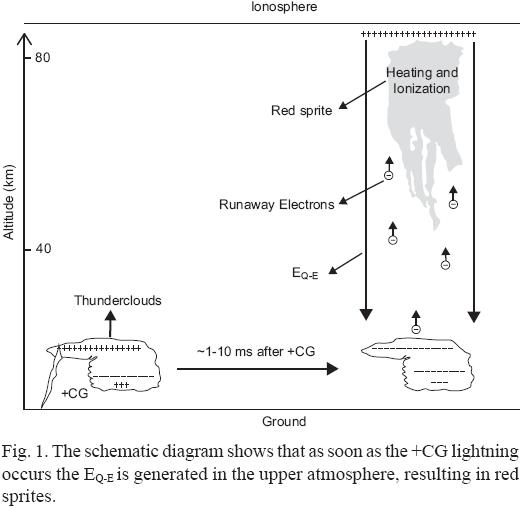
<body><![CDATA[<p align="justify"><font face="verdana" size="2">&nbsp;</font></p>  	    <p align="justify"><font face="verdana" size="2"><b>ABSTRACT</b></font></p>  	    <p align="justify"><font face="verdana" size="2">Red sprites are the exotic kind of lightning above thunderstorms. Expressions for the velocity and current of sprites have been obtained. The velocity expression comes out to be Gaussian. The calculated current flowing in the sprite body behaves just like a typical lightning return stroke current. The variations of current moment and charge moment change with time have been calculated with the help of velocity and current expressions. The approximate radiation electric field generated from the current moment of sprite also has been obtained. The radiation electric field peaks at about 40 Hz with an amplitude of the order of 10<sup>&#150;</sup><sup>5</sup> V/m at 200 km from the sprite channel. The total energy dissipated in the body of red sprites is of the order of 10<sup>9</sup> J.</font></p>  	    <p align="justify"><font face="verdana" size="2"><b>Keywords</b>: Sprites, extremely low frequency (ELF), current moment, charge moment change.</font></p>  	    <p align="justify"><font face="verdana" size="2">&nbsp;</font></p>  	    <p align="justify"><font face="verdana" size="2"><b>1. Introduction</b></font></p>  	    <p align="justify"><font face="verdana" size="2">Sprites are upper atmospheric lightning that occur above thunderstorms at altitudes ranging from clouds top to as high as 90 km. Probably Franz <i>et al.</i> (1990) were the first authors to detect sprites from ground based imaging systems. Sentman <i>et al.</i> (1995) gave the strong evidence of occurrence of sprites through an aircraft campaign. Sprites are initiated by the strong positive cloud&#45;to&#45;ground (CG) discharges (Boccippio <i>et al.,</i> 1995; Reising <i>et al.,</i> 1996; Huang <i>et al.,</i> 1999; Price <i>et al.,</i> 2002; Williams <i>et al.,</i> 2007). The proposed generation mechanisms include ambient electron heating by quasi&#45;electrostatic thundercloud fields, resulting in ionization and excitation of optical emissions (Pasko <i>et al.,</i> 1997), and the secondary cosmic ray electrons of energy ~1 MeV that become runaway electrons (Bell <i>et al</i>., 1995; Roussel&#45;Dupr&eacute; and Gurevich, 1996) in the presence of large quasi&#45;electrostatic fields which collide inelastically with the neutral O<sub>2</sub> and N<sub>2</sub> molecules, resulting in loss of energy and therefore in atomic and molecular excitations and subsequent optical emissions. Sprites can be generated by acoustic waves originated in the lower atmosphere due to natural cataclysms like hurricanes, thunderstorm lightning and tornados (Aramyan and Galechyan, 2009), and propagate upwards as well as downwards from their points of origin (Sentman <i>et al.,</i> 1995). They endure for several milliseconds, and are typically delayed in time ranging from ~3 ms (Winckler, 1995) to several tens of ms (Fukunishi <i>et al</i>., 1995) with respect to the onset of the causative CG lightning. Generally, sprites occur during the dying stage of thunderstorms, and may appear singly as well as in clusters of two or more. The brightest red region of a unit sprite lies between altitudes of 66 and 75 km, below which faint tendrils extend downward up to 40&#45;50 km (Pasko <i>et al.,</i> 1997). The lateral extent of unit sprites is typically 5&#45;10 km and sprite clusters may occupy a large volume greater than 10<sup>4</sup> km<sup>3</sup> (Sentman <i>et al.,</i> 1995). The energy dissipated in the sprite channels is of the order of 10<sup>10</sup> J (Dowden <i>et al.,</i> 1996). This energy excitates the various chemical constituents and scales the luminosity of sprites, which can have different shapes and sizes, depending upon the causative CG lightning. The most common types are columnar, carrot, angels, jellyfish, and A&#45;bomb sprites (Williams, 2001). The main reason for the development of lightning discharges between a thundercloud and the ionosphere is the exponential reduction of pressure with height (Petrov and Petrova, 1999).</font></p>  	    <p align="justify"><font face="verdana" size="2">The purpose of this paper is to calculate the electrical parameters of red sprites like current moment, charge moment change, radiated electric field from sprites and total energy dissipated in their body.</font></p>  	    <p align="justify"><font face="verdana" size="2"><i>1.1 Physical mechanism of red sprites</i></font></p>  	    <p align="justify"><font face="verdana" size="2">The breakdown ionization of upper atmosphere by thundercloud electric fields was first mentioned by Wilson (1925). He calculated that the thunder cloud electric field decreases with altitude <i>h</i> as ~<i>h</i><sup><i>&#45;3</i></sup> and the critical breakdown electric field <i>E</i><sub><i>k</i></sub> decreases exponentially, <i>i.e.</i> much faster than the thundercloud electric field, so that there would be a height where the thundercloud electric field exceeds <i>E</i><sub><i>k</i></sub> and the discharge takes place. The fundamental reasons behind the electro&#45;dynamical coupling between the cloud tops and the ionosphere are the heating of the ambient electrons by large quasi&#45;electrostatic fields <i>E</i><sub><i>Q&#45;E</i></sub> generated by the strong CG lightning (Pasko <i>et al</i>., 1995) and the runaway electron (Bell <i>et al.,</i> 1995; Roussel&#45;Dupr&eacute; and Gurevich, 1996; Taranenko and Roussel&#45;Dupr&eacute;, 1996). Raizer <i>et al</i>. (1998) calculated <i>E</i><sub><i>Q&#45;E</i></sub> using a simple dipole model with cloud charge <i>Q</i> left at altitude <i>z</i> above the earth. They assumed the earth and ionosphere as perfect conducting boundaries. The <i>E</i><sub><i>Q&#45;E</i></sub> generated in the upper atmosphere (<i>h</i> &gt;&gt; <i>z</i>) is given by</font></p>  	    ]]></body>
<body><![CDATA[<p align="center"><font face="verdana" size="2"><img src="/img/revistas/atm/v25n4/a5i1.jpg"></font></p>  	    <p align="justify"><font face="verdana" size="2">where <i>h</i><sub><i>i</i></sub> ~90 km is the height of ionosphere. It can be shown with the help of Eq. (1) that only the large charge moment change from conventional lightning discharge can generate the sufficient amount of electric field to produce a breakdown in the atmosphere (60&#45;90 km). However, it has been found experimentally that sprites can propagate up to the thundercloud tops (40 km), so another mechanism, the "runaway breakdown", is very effective to explain the breakdown of lower atmosphere (40&#45;50 km). Runaway breakdown involves the cosmic ray seed electrons with energy &#603;<sub>c</sub> ~ 0.1&#45;1 MeV, which accelerate in the presence of large <i>E</i><sub><i>Q&#45;E</i></sub> and bombard the atmosphere (Bell <i>et al.,</i> 1995). The electric field <i>E</i><sub><i>RB</i></sub> required to accelerate the cosmic seed electrons is one&#45;tenth of the conventional critical breakdown electric field <i>E</i><sub><i>k</i></sub>. The calculated value of <i>E</i><sub><i>RB</i></sub> (Gurevich and Zybin, 2001) is given by</font></p>  	    <p align="center"><font face="verdana" size="2"><img src="/img/revistas/atm/v25n4/a5i2.jpg"></font></p>  	    <p align="justify"><font face="verdana" size="2">where H = 7.2 km, the scale height of the atmosphere. <a href="#f1">Figure 1</a> shows the heating of the upper atmosphere and the runaway mechanism by the <i>E</i><sub><i>Q&#45;E</i></sub> generated in the upper atmosphere as an effect of the strong +ve CG lightning discharge, resulting in red sprites.</font></p>  	    <p align="center"><font face="verdana" size="2"><a name="f1"></a></font></p>  	    <p align="center"><font face="verdana" size="2"><img src="/img/revistas/atm/v25n4/a5f1.jpg"></font></p>  	    <p align="justify"><font face="verdana" size="2">&nbsp;</font></p>  	    <p align="justify"><font face="verdana" size="2"><b>2.</b> <b>Velocity of red sprites</b></font></p>  	    <p align="justify"><font face="verdana" size="2">Stanley <i>et al.</i> (1999) adopted a high speed imaging technique and measured initial sprite velocities in excess of 10<sup>7</sup> m/s. McHarg <i>et al</i>. (2002) reported the velocity of propagation of downward and upward luminosity of the order of 10<sup>7</sup>&#45;10<sup>8</sup> m/s. Moudry <i>et al.</i> (2002) reported the fast and slow expansion of sprites with an average velocity of 10<sup>7</sup> m/s in the bright region and 10<sup>6</sup> m/s in the bottom part of the dim sprite. Li and Cummer (2009) measured the downward sprite peak velocities in the range of 3&#45;10% of the speed of light. The sprites consist of streamers which propagate in the <i>E</i><sub><i>Q&#45;E</i></sub> produced by the strong causative positive CG lightning. Raizer <i>et al.</i> (1998) described the propagation of red sprites as the cluster of streamers originated from the plasma patches. Their calculations can be fitted by a Gaussian distribution of the form</font></p>  	    <p align="center"><font face="verdana" size="2"><img src="/img/revistas/atm/v25n4/a5i3.jpg"></font></p>  	    ]]></body>
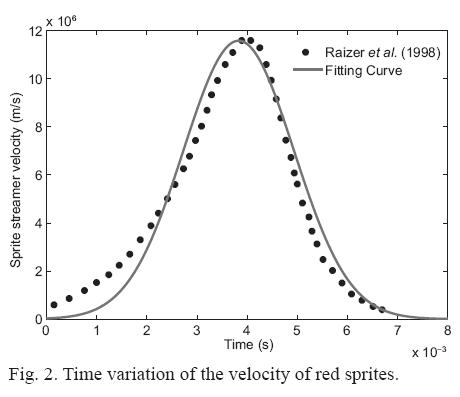
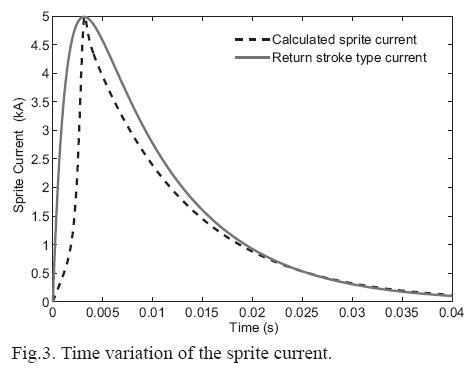
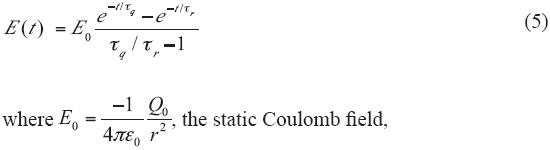
<body><![CDATA[<p align="justify"><font face="verdana" size="2">where <i>V</i><sub><i>0</i></sub>, <i>a</i>, and <i>b</i> are constants. From the knowledge of various measurements we estimated the values of these constants. We found that <i>V</i><sub><i>0</i></sub> is equal to 1.16 &times; 10<sup>7</sup> m/s to account for the peak value of sprite velocity. The other constants are <i>a</i> and <i>b</i>, whose values are 3.83 &times; 10<sup>&#150;3</sup> s and 4.13 &times; 10<sup>5</sup> s<sup>&#150;2</sup> respectively. Constant <i>a</i> determines the time at which the sprite velocity reaches its peak value and <i>b</i> is responsible for the total time period of occurrence of sprites. The simulated result of Raizer <i>et al.</i> (1998) and the plot of Eq. (3) are shown in <a href="#f2">Figure 2</a>. The sprites first accelerate and then decelerate at an almost constant rate close to 0.6 &times; 10<sup>10</sup> m/s. Deceleration rate of sprites from Eq. (3) is very close to the measured typical value of 1 &times; 10<sup>10</sup> m/s (Li and Cummer, 2009).</font></p>  	    <p align="center"><font face="verdana" size="2"><a name="f2"></a></font></p>  	    <p align="center"><font face="verdana" size="2"><img src="/img/revistas/atm/v25n4/a5f2.jpg"></font></p>  	    <p align="justify"><font face="verdana" size="2">&nbsp;</font></p>  	    <p align="justify"><font face="verdana" size="2"><b>3. Current moment and charge moment change of red sprites</b></font></p>  	    <p align="justify"><font face="verdana" size="2">Earlier studies of extremely low frequency (ELF) electric and magnetic field signals have shown some unusual pulses during sprite events (Cummer, 2003). It has been observed that these signals do not contain energy at frequencies higher than 1 kHz. Cummer (2003) suggested that these pulses were associated with high altitude electric current in the sprite itself and not with a lightning process. The first experimental evidence that electrical currents may be flowing in the body of sprites was given by Cummer <i>et al</i>. (1998). This current generates ELF electromagnetic energy at levels comparable to that produced by the parent CG lightning. Cummer <i>et al.</i> (1998) described that this vertical current flowing in a narrow region (about 10%) of the sprites is the main source of ELF radiation. Cummer <i>et al.</i> (2006) found that the sprite current pulses begin 2.5 ms after the onset of the return stroke. The peak vertical sprite current ranges from 1.6 to 3.3 kA (Cummer <i>et al</i>., 1998), and 5&#45;10 kA (Rycroft and Odzimek, 2010). It can be as high as 25 kA (Cummer, 2003) for typical sprites. According to Cummer <i>et al.</i> (1998), the measured values of the current moment during a sprite have a very large initial peak, which may be due to the continuing current from the causative CG positive discharge. The second peak is due to the sprite current. The current flowing through the body of the sprite at the beginning must be zero and it must have a later peak to account for the peak in current moment. The current flowing through the sprite channel is shown in <a href="#f3">Figure 3</a>. The sprite current <i>i(t)</i> can be given by</font></p>  	    <p align="center"><font face="verdana" size="2"><a name="f3"></a></font></p>  	    <p align="center"><font face="verdana" size="2"><img src="/img/revistas/atm/v25n4/a5f3.jpg"></font></p>  	    <p align="center"><font face="verdana" size="2"><img src="/img/revistas/atm/v25n4/a5i4.jpg"></font></p>  	    <p align="justify"><font face="verdana" size="2">where <i>A</i> &#8776; 400 km<sup>2</sup> is the average cross section area of the sprite in which current flows and it is assumed to be constant with time; <i>&#963; (t),</i> the ambient conductivity ahead of the propagating front of the sprite channel; and <i>E (t)</i> the electric field at the tip of the channel. Using the simple point charge model (Fullekrug, 2006), the sprite that generates the electric field <i>E(t)</i> is given by</font></p>  	    ]]></body>
<body><![CDATA[<p align="center"><font face="verdana" size="2"><img src="/img/revistas/atm/v25n4/a5i5.jpg"></font></p>  	    <p align="justify"><font face="verdana" size="2">where <i>Q</i><sub><i>0</i></sub> = 200 C, the charge removed by the +ve CG lightning; <i>r</i> = 10 km, the radial distance from the charge point; <i>&#964;</i><sub><i>q</i></sub> = 10 ms, the duration of lightning current; and <i>&#964;</i><sub><i>r</i></sub> = <i>&#603;</i><sub><i>0</i></sub><i>/&#963;(z),</i> the relaxation time of the electric field. The ambient conductivity ahead of the sprite front (Fullekrug, 2006) is given by</font></p>  	    <p align="center"><font face="verdana" size="2"><img src="/img/revistas/atm/v25n4/a5i6.jpg"></font></p>  	    <p align="justify"><font face="verdana" size="2">where <i>&#963;</i><sub><i>0</i></sub> = 6.4 &times; 10<sup>&#150;10</sup> S/m; <i>z</i><sub><i>0</i></sub> = 50 km; and <i>s</i> = 3.2 km describe the conductivity gradient in the earth's atmosphere. The altitude <i>z</i> of the propagating front of the sprite channel can be written as</font></p>  	    <p align="center"><font face="verdana" size="2"><img src="/img/revistas/atm/v25n4/a5i7.jpg"></font></p>  	    <p align="justify"><font face="verdana" size="2">where <i>z</i><sub><i>0</i></sub> is the altitude of sprite initiation. The approximate sprite current has been calculated from Eqs. (4), (5), (6), and (7). The calculated value of the current has been shown in <a href="#f3">Figure 3</a>, where a double exponential current expression similar to the return stroke has also been plotted. As the difference between them is very small, we take the sprite current to be</font></p>  	    <p align="center"><font face="verdana" size="2"><img src="/img/revistas/atm/v25n4/a5i8.jpg"></font></p>  	    <p align="justify"><font face="verdana" size="2">where <i>i</i><sub><i>0</i></sub>, &#947; and &#948; are constants. The estimated values of &#947; and &#948; are 1.10 &times; 10<sup>2</sup> s<sup>&#150;1</sup> and 7 &times; 10<sup>2</sup> s<sup>&#150;1</sup> respectively, and <i>i</i><sub><i>0</i></sub> is the constant which can be taken into account for the peak value of the sprite current. The value of <i>i</i><sub><i>0</i></sub> is taken to be 8.35 &times; 10<sup>3</sup> A for the peak current of 5 kA.</font></p>  	    <p align="justify"><font face="verdana" size="2">The current moment <i>M</i><sub><i>c</i></sub> is the multiplication of current and the channel length through which it has propagated. The mathematical expression is given by</font></p>  	    <p align="center"><font face="verdana" size="2"><img src="/img/revistas/atm/v25n4/a5i9.jpg"></font></p>  	    ]]></body>
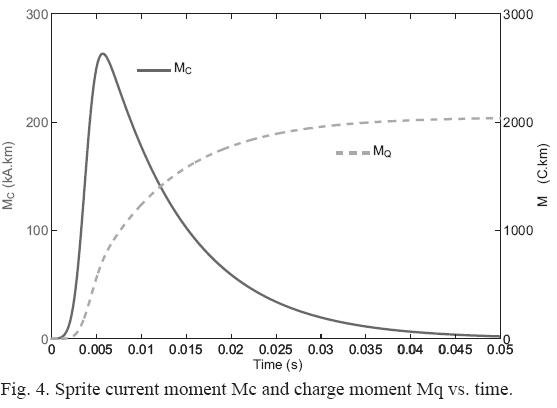
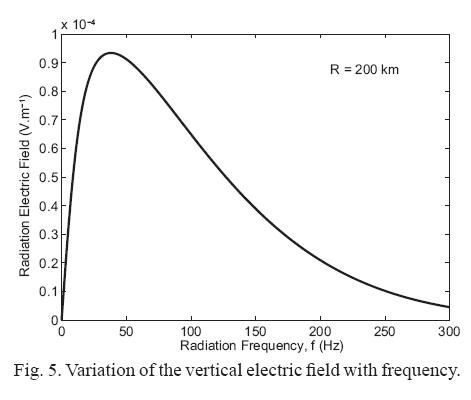
<body><![CDATA[<p align="justify"><font face="verdana" size="2">It has been assumed here that the sprite channel is perfectly conducting and the current generated on its tip is immediately connected to all parts of the channel. The calculated peak value of <i>M</i><sub><i>c</i></sub> from Eq. (9) is around 260 kA/km (<a href="#f4">Fig. 4</a>). Cummer <i>et al</i>. (1998) measured the <i>M</i><sub><i>c</i></sub> of a few sprites and obtained values ranging from 150 to 240 kA/km. The charge moment change <i>M</i><sub><i>q</i></sub> defined by <img src="/img/revistas/atm/v25n4/a5i10.jpg"> has also been calculated. The maximum value is around 2050 C/km and it is shown in <a href="#f4">Figure 4</a>.</font></p>  	    <p align="center"><font face="verdana" size="2"><a name="f4"></a></font></p>  	    <p align="center"><font face="verdana" size="2"><img src="/img/revistas/atm/v25n4/a5f4.jpg"></font></p>  	    <p align="justify"><font face="verdana" size="2">&nbsp;</font></p>  	    <p align="justify"><font face="verdana" size="2"><b>4.</b> <b>ELF emissions from red sprites</b></font></p>  	    <p align="justify"><font face="verdana" size="2">Cummer <i>et al.</i> (1998) observed that the lightning sprites produced ELF signals and very low frequency (VLF) signals were absent. Cummer (2003) observed that the lightning sprites radiate ELF pulses. The source of these ELF pulses is the vertical current flowing through the body of sprites. A vertical electric field is developed due to the current moment of the sprites. The peak radiation frequency of the vertical electric field can be obtained with the help of velocity and current expressions. Leise and Taylor (1977) and Rai (1978) showed that the Fourier component of the radiation field <i>E</i><sub><i>r</i></sub><i>(&#969;)</i> is related to the Fourier component of current <i>i(&#969;)</i> and velocity <i>V(&#969;)</i> by</font></p>  	    <p align="center"><font face="verdana" size="2"><img src="/img/revistas/atm/v25n4/a5i11.jpg"></font></p>  	    <p align="justify"><font face="verdana" size="2">where <img src="/img/revistas/atm/v25n4/a5i12.jpg">, <i>&#969;</i> is the angular frequency of radiation, and <i>R</i> is the distance of observation from the source.</font></p>  	    <p align="justify"><font face="verdana" size="2">The Fourier component <i>E</i><sub><i>r</i></sub><i>(&#969;)</i> of the vertical electric field must have a peak. <a href="#f5">Figure 5</a> shows the calculated electric field, which lies mainly in the ELF region (0&#45;300 Hz). Radiated electric field peaks at around 40 Hz with an amplitude of the order of 10<sup>&#150;5</sup> V/m at a distance of about 200 km from the sprite channel.</font></p>  	    <p align="center"><font face="verdana" size="2"><a name="f5"></a></font></p>  	    ]]></body>
<body><![CDATA[<p align="center"><font face="verdana" size="2"><img src="/img/revistas/atm/v25n4/a5f5.jpg"></font></p>  	    <p align="justify"><font face="verdana" size="2">&nbsp;</font></p>  	    <p align="justify"><font face="verdana" size="2"><b>5.</b> <b>Energy dissipated in the red sprites</b></font></p>  	    <p align="justify"><font face="verdana" size="2">As we know, the energy loss in the upper atmosphere due to the quasi&#45;electrostatic heating and inelastic collisions between runaway electrons and neutral N<sub>2</sub> and O<sub>2</sub> molecules comes in the form of sprites. The released energy dissociates into ionization, excitation, expansion, radiation and kinetic motion of the particles in the body of sprites. The total energy loss in sprites is given below:</font></p>  	    <p align="center"><font face="verdana" size="2"><img src="/img/revistas/atm/v25n4/a5i13.jpg"></font></p>  	    <p align="justify"><font face="verdana" size="2">where U<sub>k</sub> is the potential difference between 40 km and 90 km altitudes.</font></p>  	    <p align="justify"><font face="verdana" size="2">The value of <i>U</i><sub><i>k</i></sub> can be calculated with the help of conventional breakdown electric field <i>E</i><sub><i>k</i></sub>.</font></p>  	    <p align="center"><font face="verdana" size="2"><img src="/img/revistas/atm/v25n4/a5i14.jpg"></font></p>  	    <p align="justify"><font face="verdana" size="2">The calculated value of potential difference <i>U</i><sub><i>k</i></sub> for the propagation of sprites between 40 km and 90 km is around 60 MV. With the help of Eqs. (11) and (12), the value of total energy loss in the body of sprites comes out to be of the order of 10<sup>9</sup> J, which is one order of magnitude less than the previous estimated value of 10<sup>10</sup> J (Dowden <i>et al.,</i> 1996).</font></p>  	    <p align="justify"><font face="verdana" size="2">&nbsp;</font></p>  	    ]]></body>
<body><![CDATA[<p align="justify"><font face="verdana" size="2"><b>6. Results and discussions</b></font></p>  	    <p align="justify"><font face="verdana" size="2">The sprite electrical parameters, namely current moment, charge moment change and radiation electric field, have been calculated. The peak value of the current moment is 260 kA/km for a peak current of 5 kA. Cummer <i>et al</i>. (1998) measured the current moment of three sprites and reported values ranging from 150 to 240 kA/km. The total charge transferred from stratosphere to ionosphere by the sprites is around 63 C, corresponding to the peak current of 5 kA. Cummer <i>et al</i>. (1998) observed three sprites having peak currents ranging from 1.3 to 3.3 kA. If we take the peak current in the sprite channel to be 3.3 kA, the calculated value of total charge transfer comes to be around 41 C, which is consistent with the 42 C charge transfer for the largest of the three sprites reported by Cummer <i>et al</i>. (1998). The calculated maximum value obtained for the charge moment change is around 2050 C/km. The value of the radiated electric field in the frequency domain has also been calculated. The vertical electric field radiated by sprites lies within the ELF (0&#45;300 Hz) range. The vertical electric field peaks at around 40 Hz with an amplitude of 9.3 &times; 10<sup>&#150;5</sup> V/m at 200 km from the sprite channel (<a href="#f5">Fig. 5</a>), which is in conformity with the experimental values reported by different researchers (Cummer <i>et al.,</i> 1998; Cummer, 2003). These ELF waves generated from the sprite propagate in the earth&#45;ionosphere waveguide and may contribute to the Schumann resonances. It is suspected that the sprites play a crucial role in enhancing the ionospheric temperature reported by Sharma <i>et al.</i> (2003). Finally, we calculated the energy dissipated in the sprite body due to the quasi&#45;electrostatic heating and runaway mechanism, which was of the order of 10<sup>9</sup> J, one order of magnitude less than the previously reported value of 10<sup>10</sup> J (Dowden <i>et al</i>., 1996).</font></p>  	    <p align="justify"><font face="verdana" size="2">&nbsp;</font></p>  	    <p align="justify"><font face="verdana" size="2"><b>Acknowledgments</b></font></p>  	    <p align="justify"><font face="verdana" size="2">Author Manoj Kumar Paras is thankful to CSIR, New Delhi, India, for their financial support. Also, we are thankful to the reviewers for their valuable comments and suggestions.</font></p>  	    <p align="justify"><font face="verdana" size="2">&nbsp;</font></p>  	    <p align="justify"><font face="verdana" size="2"><b>References</b></font></p>  	    <!-- ref --><p align="justify"><font face="verdana" size="2">Aramyan A. R. and G. A. Galechyan, 2009. Formation of red sprites. <i>Laser Phys.</i> <b>19</b>, 1480&#45;1482.    &nbsp;&nbsp;&nbsp;&nbsp;&nbsp;&nbsp;&nbsp;&nbsp;[&#160;<a href="javascript:void(0);" onclick="javascript: window.open('/scielo.php?script=sci_nlinks&ref=1288157&pid=S0187-6236201200040000500001&lng=','','width=640,height=500,resizable=yes,scrollbars=1,menubar=yes,');">Links</a>&#160;]<!-- end-ref --></font></p>  	    <!-- ref --><p align="justify"><font face="verdana" size="2">Bell T. F., V. P. Pasko and U. S. Inan, 1995. Runaway electrons as a source of red sprites in the mesosphere. <i>Geophys. Res. Lett.</i> <b>22</b>, 2127&#45;2130.    &nbsp;&nbsp;&nbsp;&nbsp;&nbsp;&nbsp;&nbsp;&nbsp;[&#160;<a href="javascript:void(0);" onclick="javascript: window.open('/scielo.php?script=sci_nlinks&ref=1288159&pid=S0187-6236201200040000500002&lng=','','width=640,height=500,resizable=yes,scrollbars=1,menubar=yes,');">Links</a>&#160;]<!-- end-ref --></font></p>  	    <!-- ref --><p align="justify"><font face="verdana" size="2">Boccippio D. J., E. R. Williams, S. J. Heckman, W. A. Lyons, I. Baker and R. Boldi, 1995. Sprites, ELF transients and positive ground strokes. <i>Science</i> <b>269</b>, 1088&#45;1091.    &nbsp;&nbsp;&nbsp;&nbsp;&nbsp;&nbsp;&nbsp;&nbsp;[&#160;<a href="javascript:void(0);" onclick="javascript: window.open('/scielo.php?script=sci_nlinks&ref=1288161&pid=S0187-6236201200040000500003&lng=','','width=640,height=500,resizable=yes,scrollbars=1,menubar=yes,');">Links</a>&#160;]<!-- end-ref --></font></p>  	    <!-- ref --><p align="justify"><font face="verdana" size="2">Cummer S. A., U. S. Inan, T. F. Bell and C.P. Barrington&#45;Leigh, 1998. ELF radiation produced by electrical currents in sprites. <i>Geophys. Res. Lett.</i> <b>25</b><i>,</i> 1281&#45;1284.    &nbsp;&nbsp;&nbsp;&nbsp;&nbsp;&nbsp;&nbsp;&nbsp;[&#160;<a href="javascript:void(0);" onclick="javascript: window.open('/scielo.php?script=sci_nlinks&ref=1288163&pid=S0187-6236201200040000500004&lng=','','width=640,height=500,resizable=yes,scrollbars=1,menubar=yes,');">Links</a>&#160;]<!-- end-ref --></font></p>  	    <!-- ref --><p align="justify"><font face="verdana" size="2">Cummer S. A., 2003. Current moment in sprite&#45;producing lightning. <i>J. Atmos. Sol&#45;Terr. Phys</i>. <b>65</b>, 499&#45;508.    &nbsp;&nbsp;&nbsp;&nbsp;&nbsp;&nbsp;&nbsp;&nbsp;[&#160;<a href="javascript:void(0);" onclick="javascript: window.open('/scielo.php?script=sci_nlinks&ref=1288165&pid=S0187-6236201200040000500005&lng=','','width=640,height=500,resizable=yes,scrollbars=1,menubar=yes,');">Links</a>&#160;]<!-- end-ref --></font></p>  	    <!-- ref --><p align="justify"><font face="verdana" size="2">Cummer S. A., H. U. Frey, S. B. Mende; R. R. Hsu, H. T. Su, A. B. Chen, H. Fukunishi and Y. Takahashi, 2006. Simultaneous radio and satellite optical measurements of high&#45;altitude sprite current and lightning continuing current. <i>J. Geophy. Res.</i> <b>111</b><i>,</i> A10315. DOI:10.1029/2006JA011809.    &nbsp;&nbsp;&nbsp;&nbsp;&nbsp;&nbsp;&nbsp;&nbsp;[&#160;<a href="javascript:void(0);" onclick="javascript: window.open('/scielo.php?script=sci_nlinks&ref=1288167&pid=S0187-6236201200040000500006&lng=','','width=640,height=500,resizable=yes,scrollbars=1,menubar=yes,');">Links</a>&#160;]<!-- end-ref --></font></p>  	    <!-- ref --><p align="justify"><font face="verdana" size="2">Dowden R., J. Brundell, C. Rodger, O. Mochanov, W. Lyons and T. Nelson, 1996. The structure of red sprites determined by VLF scattering. <i>IEEE Antenn. Propag. M.</i> <b>38</b>, 7&#45;15.    &nbsp;&nbsp;&nbsp;&nbsp;&nbsp;&nbsp;&nbsp;&nbsp;[&#160;<a href="javascript:void(0);" onclick="javascript: window.open('/scielo.php?script=sci_nlinks&ref=1288169&pid=S0187-6236201200040000500007&lng=','','width=640,height=500,resizable=yes,scrollbars=1,menubar=yes,');">Links</a>&#160;]<!-- end-ref --></font></p>  	    <!-- ref --><p align="justify"><font face="verdana" size="2">Franz R. C., R. J. Nemzek and J. R. Winckler, 1990. Television image of a large upward electric discharge above a thunderstorm system. <i>Science</i> <b>249</b><i>,</i> 48&#45;51.    &nbsp;&nbsp;&nbsp;&nbsp;&nbsp;&nbsp;&nbsp;&nbsp;[&#160;<a href="javascript:void(0);" onclick="javascript: window.open('/scielo.php?script=sci_nlinks&ref=1288171&pid=S0187-6236201200040000500008&lng=','','width=640,height=500,resizable=yes,scrollbars=1,menubar=yes,');">Links</a>&#160;]<!-- end-ref --></font></p>  	    <!-- ref --><p align="justify"><font face="verdana" size="2">Fukunishi, H., Y. Takahashi, M. Kubota, K. Sakanoi, U. S. Inan and W. A. Lyons, 1995. Lower ionospheric flashes induced by lightning discharges. <i>EOS Suplemment</i> <b>46</b><i>,</i> F114, A41D&#45;7.    &nbsp;&nbsp;&nbsp;&nbsp;&nbsp;&nbsp;&nbsp;&nbsp;[&#160;<a href="javascript:void(0);" onclick="javascript: window.open('/scielo.php?script=sci_nlinks&ref=1288173&pid=S0187-6236201200040000500009&lng=','','width=640,height=500,resizable=yes,scrollbars=1,menubar=yes,');">Links</a>&#160;]<!-- end-ref --></font></p>  	    <!-- ref --><p align="justify"><font face="verdana" size="2">Fullekrug M., 2006. Elementary model of sprite igniting electric fields. <i>Am. J. Phys.</i> <b>74</b>, 804&#45;805.    &nbsp;&nbsp;&nbsp;&nbsp;&nbsp;&nbsp;&nbsp;&nbsp;[&#160;<a href="javascript:void(0);" onclick="javascript: window.open('/scielo.php?script=sci_nlinks&ref=1288175&pid=S0187-6236201200040000500010&lng=','','width=640,height=500,resizable=yes,scrollbars=1,menubar=yes,');">Links</a>&#160;]<!-- end-ref --></font></p>  	    <!-- ref --><p align="justify"><font face="verdana" size="2">Gurevich A.V. and K. P. Zybin, 2001. Runaway breakdown and electric discharges in thunderstorms. <i>Phys&#45;Usp</i>. <b>44</b><i>,</i> 1119&#45;1140.    &nbsp;&nbsp;&nbsp;&nbsp;&nbsp;&nbsp;&nbsp;&nbsp;[&#160;<a href="javascript:void(0);" onclick="javascript: window.open('/scielo.php?script=sci_nlinks&ref=1288177&pid=S0187-6236201200040000500011&lng=','','width=640,height=500,resizable=yes,scrollbars=1,menubar=yes,');">Links</a>&#160;]<!-- end-ref --></font></p>  	    <!-- ref --><p align="justify"><font face="verdana" size="2">Huang E., E. Williams, R. Boldy, S. Heckman, W. Lyons, M. Taylor, T. Nelson and C. Wong, 1999. Criteria for sprites and elves based on Schumann resonance observations. <i>J. Geophys.</i> <i>Res.</i> <b>104</b>, 16943&#45;16964.    &nbsp;&nbsp;&nbsp;&nbsp;&nbsp;&nbsp;&nbsp;&nbsp;[&#160;<a href="javascript:void(0);" onclick="javascript: window.open('/scielo.php?script=sci_nlinks&ref=1288179&pid=S0187-6236201200040000500012&lng=','','width=640,height=500,resizable=yes,scrollbars=1,menubar=yes,');">Links</a>&#160;]<!-- end-ref --></font></p>  	    <!-- ref --><p align="justify"><font face="verdana" size="2">Leise J. A. and W. L. Taylor, 1977. A transmission line model with general velocities for lightning. <i>J. Geophys. Res.</i> <b>82</b><i>,</i> 391&#45;396.    &nbsp;&nbsp;&nbsp;&nbsp;&nbsp;&nbsp;&nbsp;&nbsp;[&#160;<a href="javascript:void(0);" onclick="javascript: window.open('/scielo.php?script=sci_nlinks&ref=1288181&pid=S0187-6236201200040000500013&lng=','','width=640,height=500,resizable=yes,scrollbars=1,menubar=yes,');">Links</a>&#160;]<!-- end-ref --></font></p>  	    <!-- ref --><p align="justify"><font face="verdana" size="2">Li J. and S. A. Cummer, 2009. Measurement of sprite streamer acceleration and deceleration. <i>Geophys. Res. Lett.</i> <b>36</b>, L10812. DOI:10.1029/2009GL037581.    &nbsp;&nbsp;&nbsp;&nbsp;&nbsp;&nbsp;&nbsp;&nbsp;[&#160;<a href="javascript:void(0);" onclick="javascript: window.open('/scielo.php?script=sci_nlinks&ref=1288183&pid=S0187-6236201200040000500014&lng=','','width=640,height=500,resizable=yes,scrollbars=1,menubar=yes,');">Links</a>&#160;]<!-- end-ref --></font></p>  	    <!-- ref --><p align="justify"><font face="verdana" size="2">McHarg M. G., R. K. Halland, D. Moudry and H. C. Stenbaek&#45;Nielsen, 2002. Altitude&#45;time development of sprites. <i>J.Geophys. Res.</i> <b>107</b>(A11), 1364. DOI: 10.1029/2001JA000283.    &nbsp;&nbsp;&nbsp;&nbsp;&nbsp;&nbsp;&nbsp;&nbsp;[&#160;<a href="javascript:void(0);" onclick="javascript: window.open('/scielo.php?script=sci_nlinks&ref=1288185&pid=S0187-6236201200040000500015&lng=','','width=640,height=500,resizable=yes,scrollbars=1,menubar=yes,');">Links</a>&#160;]<!-- end-ref --></font></p>  	    <!-- ref --><p align="justify"><font face="verdana" size="2">Moudry, D. R., H. C. Stenbaek&#45;Nielsen, D. D. Sentman and E. M. Wescott, 2002. Velocities of sprite tendrils. <i>Geophys. Res. Lett.</i> <b>29</b>, 1992. DOI: 10.1029/2002GL015682.    &nbsp;&nbsp;&nbsp;&nbsp;&nbsp;&nbsp;&nbsp;&nbsp;[&#160;<a href="javascript:void(0);" onclick="javascript: window.open('/scielo.php?script=sci_nlinks&ref=1288187&pid=S0187-6236201200040000500016&lng=','','width=640,height=500,resizable=yes,scrollbars=1,menubar=yes,');">Links</a>&#160;]<!-- end-ref --></font></p>  	    <!-- ref --><p align="justify"><font face="verdana" size="2">Pasko V. P., U. S. Inan, Y. N. Taranenko and T. F. Bell, 1995. Heating, ionization and upward discharges in the mesosphere due to intense quasi&#45;electrostatic thunder&#45;cloud fields. <i>Geophys.</i> <i>Res. Lett.</i> <b>22</b>, 365&#45;368.    &nbsp;&nbsp;&nbsp;&nbsp;&nbsp;&nbsp;&nbsp;&nbsp;[&#160;<a href="javascript:void(0);" onclick="javascript: window.open('/scielo.php?script=sci_nlinks&ref=1288189&pid=S0187-6236201200040000500017&lng=','','width=640,height=500,resizable=yes,scrollbars=1,menubar=yes,');">Links</a>&#160;]<!-- end-ref --></font></p>  	    <!-- ref --><p align="justify"><font face="verdana" size="2">Pasko V. P., U. S. Inan, Y. N. Taranenko and T. F. Bell, 1997. Sprites produced by quasi&#45;electrostatic heating and ionization in the lower ionosphere. <i>J. Geophys. Res.</i> <b>102,</b> 4529&#45;4561.    &nbsp;&nbsp;&nbsp;&nbsp;&nbsp;&nbsp;&nbsp;&nbsp;[&#160;<a href="javascript:void(0);" onclick="javascript: window.open('/scielo.php?script=sci_nlinks&ref=1288191&pid=S0187-6236201200040000500018&lng=','','width=640,height=500,resizable=yes,scrollbars=1,menubar=yes,');">Links</a>&#160;]<!-- end-ref --></font></p>  	    <!-- ref --><p align="justify"><font face="verdana" size="2">Petrov N. I. and G. N. Petrova, 1999. Physical mechanisms for the development of lightning discharges between a thundercloud and the ionosphere. <i>Tech. Phys.</i> <b>44</b>, 472&#45;475.    &nbsp;&nbsp;&nbsp;&nbsp;&nbsp;&nbsp;&nbsp;&nbsp;[&#160;<a href="javascript:void(0);" onclick="javascript: window.open('/scielo.php?script=sci_nlinks&ref=1288193&pid=S0187-6236201200040000500019&lng=','','width=640,height=500,resizable=yes,scrollbars=1,menubar=yes,');">Links</a>&#160;]<!-- end-ref --></font></p>  	    <!-- ref --><p align="justify"><font face="verdana" size="2">Price C., M. Asfur, W. A. Lyons and T. Nelson, 2002. An improved ELF/VLF method for globally geolocating sprite&#45;producing lightning. <i>Geophys. Res. Lett.</i> <b>29</b>, 11&#45;14.    &nbsp;&nbsp;&nbsp;&nbsp;&nbsp;&nbsp;&nbsp;&nbsp;[&#160;<a href="javascript:void(0);" onclick="javascript: window.open('/scielo.php?script=sci_nlinks&ref=1288195&pid=S0187-6236201200040000500020&lng=','','width=640,height=500,resizable=yes,scrollbars=1,menubar=yes,');">Links</a>&#160;]<!-- end-ref --></font></p>  	    <!-- ref --><p align="justify"><font face="verdana" size="2">Rai J., 1978. Current and velocity of the return stroke lightning. <i>J. Atmos. Terr. Phys.</i> <b>40</b>, 1275&#45;1280.    &nbsp;&nbsp;&nbsp;&nbsp;&nbsp;&nbsp;&nbsp;&nbsp;[&#160;<a href="javascript:void(0);" onclick="javascript: window.open('/scielo.php?script=sci_nlinks&ref=1288197&pid=S0187-6236201200040000500021&lng=','','width=640,height=500,resizable=yes,scrollbars=1,menubar=yes,');">Links</a>&#160;]<!-- end-ref --></font></p>  	    <!-- ref --><p align="justify"><font face="verdana" size="2">Raizer Yu. P., G. M. Milikh, M. N. Shneider and S. V. Novakovski, 1998. Long streamers in the upper atmosphere above thundercloud. <i>J. Phys. D: Appl. Phys.</i> <b>31</b>, 3255&#45;3264.    &nbsp;&nbsp;&nbsp;&nbsp;&nbsp;&nbsp;&nbsp;&nbsp;[&#160;<a href="javascript:void(0);" onclick="javascript: window.open('/scielo.php?script=sci_nlinks&ref=1288199&pid=S0187-6236201200040000500022&lng=','','width=640,height=500,resizable=yes,scrollbars=1,menubar=yes,');">Links</a>&#160;]<!-- end-ref --></font></p>  	    <!-- ref --><p align="justify"><font face="verdana" size="2">Reising S. C., U. S. Inan, T. F. Bell and W. A. Lyons, 1996. Evidence for continuing current in sprite&#45;producing cloud&#45;to&#45;ground&#45;lightning. <i>Geophys. Res. Lett.</i> <b>23</b>, 3639&#45;3642.    &nbsp;&nbsp;&nbsp;&nbsp;&nbsp;&nbsp;&nbsp;&nbsp;[&#160;<a href="javascript:void(0);" onclick="javascript: window.open('/scielo.php?script=sci_nlinks&ref=1288201&pid=S0187-6236201200040000500023&lng=','','width=640,height=500,resizable=yes,scrollbars=1,menubar=yes,');">Links</a>&#160;]<!-- end-ref --></font></p>  	    <!-- ref --><p align="justify"><font face="verdana" size="2">Roussel&#45;Dupr&eacute; R. A. and A.V. Gurevich, 1996. On runaway breakdown and upward propagating discharges. <i>J. Geophys. Res.</i> <b>101</b>, 2297&#45;2311.    &nbsp;&nbsp;&nbsp;&nbsp;&nbsp;&nbsp;&nbsp;&nbsp;[&#160;<a href="javascript:void(0);" onclick="javascript: window.open('/scielo.php?script=sci_nlinks&ref=1288203&pid=S0187-6236201200040000500024&lng=','','width=640,height=500,resizable=yes,scrollbars=1,menubar=yes,');">Links</a>&#160;]<!-- end-ref --></font></p>  	    <!-- ref --><p align="justify"><font face="verdana" size="2">Rycroft M. J. and A. Odzimek, 2010. Effects of lightning and sprites on the ionospheric potential and threshold effects on sprite initiation, obtained using analog model of the global atmospheric electric circuit. <i>J. Geophys. Res.</i> <b>115</b> (A00E37). DOI:10.1029/2009JA014758.    &nbsp;&nbsp;&nbsp;&nbsp;&nbsp;&nbsp;&nbsp;&nbsp;[&#160;<a href="javascript:void(0);" onclick="javascript: window.open('/scielo.php?script=sci_nlinks&ref=1288205&pid=S0187-6236201200040000500025&lng=','','width=640,height=500,resizable=yes,scrollbars=1,menubar=yes,');">Links</a>&#160;]<!-- end-ref --></font></p>  	    <!-- ref --><p align="justify"><font face="verdana" size="2">Sentman D. D., E. M. Wescott, D. L. Osborne, D. L. Hampton and M. J. Heavner, 1995. Preliminary results from the Sprites94 Aircraft Campaign: Red sprites. <i>Geophys. Res. Lett.</i> <b>22</b><i>,</i> 1205. DOI:10.1029/95GL00583.    &nbsp;&nbsp;&nbsp;&nbsp;&nbsp;&nbsp;&nbsp;&nbsp;[&#160;<a href="javascript:void(0);" onclick="javascript: window.open('/scielo.php?script=sci_nlinks&ref=1288207&pid=S0187-6236201200040000500026&lng=','','width=640,height=500,resizable=yes,scrollbars=1,menubar=yes,');">Links</a>&#160;]<!-- end-ref --></font></p>  	    <!-- ref --><p align="justify"><font face="verdana" size="2">Sharma D. K., J. Rai, M. Israil, P. Subrahmanyam, P. Chopra and S. C. Garg, 2003. Enhancement in ionospheric temperatures during thunderstorms. <i>J. Atmos. Solar&#45;Terr. Phys.</i> <b>66</b>, 51&#45;56.    &nbsp;&nbsp;&nbsp;&nbsp;&nbsp;&nbsp;&nbsp;&nbsp;[&#160;<a href="javascript:void(0);" onclick="javascript: window.open('/scielo.php?script=sci_nlinks&ref=1288209&pid=S0187-6236201200040000500027&lng=','','width=640,height=500,resizable=yes,scrollbars=1,menubar=yes,');">Links</a>&#160;]<!-- end-ref --></font></p>  	    <!-- ref --><p align="justify"><font face="verdana" size="2">Stanely M., P. Krehbeil, M. Brook, C. Moore, W. Rison and B. Abrahams, 1999. High speed video of initial sprite development. <i>Geophys. Res. Lett.</i> <b>26</b>, 3201&#45;3204.    &nbsp;&nbsp;&nbsp;&nbsp;&nbsp;&nbsp;&nbsp;&nbsp;[&#160;<a href="javascript:void(0);" onclick="javascript: window.open('/scielo.php?script=sci_nlinks&ref=1288211&pid=S0187-6236201200040000500028&lng=','','width=640,height=500,resizable=yes,scrollbars=1,menubar=yes,');">Links</a>&#160;]<!-- end-ref --></font></p>  	    <!-- ref --><p align="justify"><font face="verdana" size="2">Taranenko Y. N. and R. A. Roussel&#45;Dupr&eacute;, 1996. High altitude discharges and gamma&#45;ray flashes: a manifestation of runaway air breakdown. <i>Geophys. Res. Lett.</i> <b>23</b>, 571. DOI:10.1029/95GL03502.    &nbsp;&nbsp;&nbsp;&nbsp;&nbsp;&nbsp;&nbsp;&nbsp;[&#160;<a href="javascript:void(0);" onclick="javascript: window.open('/scielo.php?script=sci_nlinks&ref=1288213&pid=S0187-6236201200040000500029&lng=','','width=640,height=500,resizable=yes,scrollbars=1,menubar=yes,');">Links</a>&#160;]<!-- end-ref --></font></p>  	    <!-- ref --><p align="justify"><font face="verdana" size="2">Williams E. R., 2001. Sprites, elves, and glow discharge tubes. <i>Phys. Today</i> <b>54</b>, 41&#45;47.    &nbsp;&nbsp;&nbsp;&nbsp;&nbsp;&nbsp;&nbsp;&nbsp;[&#160;<a href="javascript:void(0);" onclick="javascript: window.open('/scielo.php?script=sci_nlinks&ref=1288215&pid=S0187-6236201200040000500030&lng=','','width=640,height=500,resizable=yes,scrollbars=1,menubar=yes,');">Links</a>&#160;]<!-- end-ref --></font></p>  	    <!-- ref --><p align="justify"><font face="verdana" size="2">Williams E., E. Downes, R. Boldy, W. Lyons and S. Heckman, 2007. Polarity asymmetry of sprite&#45;producing lightning: a paradox? <i>Radio Sci.</i> <b>42</b><i>,</i> 15 pp. DOI:10.1029/2006RS003488.    &nbsp;&nbsp;&nbsp;&nbsp;&nbsp;&nbsp;&nbsp;&nbsp;[&#160;<a href="javascript:void(0);" onclick="javascript: window.open('/scielo.php?script=sci_nlinks&ref=1288217&pid=S0187-6236201200040000500031&lng=','','width=640,height=500,resizable=yes,scrollbars=1,menubar=yes,');">Links</a>&#160;]<!-- end-ref --></font></p>  	    <!-- ref --><p align="justify"><font face="verdana" size="2">Wilson C. T. R., 1925. The electric field of a thundercloud and some of its effects. <i>P. Phys. Soc.</i> <i>Lond.</i> <b>37</b>, 32D. DOI:10.1088/1478&#45;7814/37/1/314.    &nbsp;&nbsp;&nbsp;&nbsp;&nbsp;&nbsp;&nbsp;&nbsp;[&#160;<a href="javascript:void(0);" onclick="javascript: window.open('/scielo.php?script=sci_nlinks&ref=1288219&pid=S0187-6236201200040000500032&lng=','','width=640,height=500,resizable=yes,scrollbars=1,menubar=yes,');">Links</a>&#160;]<!-- end-ref --></font></p>  	    <!-- ref --><p align="justify"><font face="verdana" size="2">Winckler J. R., 1995. Further observations of cloud&#45;ionosphere electrical discharges above thunderstorms. <i>J. Geophys. Res.</i> <b>100,</b> 14335&#45;14345. DOI:10.1029/95JD00082.    &nbsp;&nbsp;&nbsp;&nbsp;&nbsp;&nbsp;&nbsp;&nbsp;[&#160;<a href="javascript:void(0);" onclick="javascript: window.open('/scielo.php?script=sci_nlinks&ref=1288221&pid=S0187-6236201200040000500033&lng=','','width=640,height=500,resizable=yes,scrollbars=1,menubar=yes,');">Links</a>&#160;]<!-- end-ref --></font></p>      ]]></body><back>
<ref-list>
<ref id="B1">
<nlm-citation citation-type="journal">
<person-group person-group-type="author">
<name>
<surname><![CDATA[Aramyan]]></surname>
<given-names><![CDATA[A. R.]]></given-names>
</name>
<name>
<surname><![CDATA[Galechyan]]></surname>
<given-names><![CDATA[G. A.]]></given-names>
</name>
</person-group>
<article-title xml:lang="en"><![CDATA[Formation of red sprites]]></article-title>
<source><![CDATA[Laser Phys.]]></source>
<year>2009</year>
<volume>19</volume>
<page-range>1480-1482</page-range></nlm-citation>
</ref>
<ref id="B2">
<nlm-citation citation-type="journal">
<person-group person-group-type="author">
<name>
<surname><![CDATA[Bell]]></surname>
<given-names><![CDATA[T. F.]]></given-names>
</name>
<name>
<surname><![CDATA[Pasko]]></surname>
<given-names><![CDATA[V. P.]]></given-names>
</name>
<name>
<surname><![CDATA[Inan]]></surname>
<given-names><![CDATA[U. S.]]></given-names>
</name>
</person-group>
<article-title xml:lang="en"><![CDATA[Runaway electrons as a source of red sprites in the mesosphere]]></article-title>
<source><![CDATA[Geophys. Res. Lett.]]></source>
<year>1995</year>
<volume>22</volume>
<page-range>2127-2130</page-range></nlm-citation>
</ref>
<ref id="B3">
<nlm-citation citation-type="journal">
<person-group person-group-type="author">
<name>
<surname><![CDATA[Boccippio]]></surname>
<given-names><![CDATA[D. J.]]></given-names>
</name>
<name>
<surname><![CDATA[Williams]]></surname>
<given-names><![CDATA[E. R.]]></given-names>
</name>
<name>
<surname><![CDATA[Heckman]]></surname>
<given-names><![CDATA[S. J.]]></given-names>
</name>
<name>
<surname><![CDATA[Lyons]]></surname>
<given-names><![CDATA[W. A.]]></given-names>
</name>
<name>
<surname><![CDATA[Baker]]></surname>
<given-names><![CDATA[I.]]></given-names>
</name>
<name>
<surname><![CDATA[Boldi]]></surname>
<given-names><![CDATA[R.]]></given-names>
</name>
</person-group>
<article-title xml:lang="en"><![CDATA[Sprites, ELF transients and positive ground strokes]]></article-title>
<source><![CDATA[Science]]></source>
<year>1995</year>
<volume>269</volume>
<page-range>1088-1091</page-range></nlm-citation>
</ref>
<ref id="B4">
<nlm-citation citation-type="journal">
<person-group person-group-type="author">
<name>
<surname><![CDATA[Cummer]]></surname>
<given-names><![CDATA[S. A.]]></given-names>
</name>
<name>
<surname><![CDATA[Inan]]></surname>
<given-names><![CDATA[U. S.]]></given-names>
</name>
<name>
<surname><![CDATA[Bell]]></surname>
<given-names><![CDATA[T. F.]]></given-names>
</name>
<name>
<surname><![CDATA[Barrington-Leigh]]></surname>
<given-names><![CDATA[C.P.]]></given-names>
</name>
</person-group>
<article-title xml:lang="en"><![CDATA[ELF radiation produced by electrical currents in sprites]]></article-title>
<source><![CDATA[Geophys. Res. Lett.]]></source>
<year>1998</year>
<volume>25</volume>
<page-range>1281-1284</page-range></nlm-citation>
</ref>
<ref id="B5">
<nlm-citation citation-type="journal">
<person-group person-group-type="author">
<name>
<surname><![CDATA[Cummer]]></surname>
<given-names><![CDATA[S. A.]]></given-names>
</name>
</person-group>
<article-title xml:lang="en"><![CDATA[Current moment in sprite-producing lightning]]></article-title>
<source><![CDATA[J. Atmos. Sol-Terr. Phys.]]></source>
<year>2003</year>
<volume>65</volume>
<page-range>499-508</page-range></nlm-citation>
</ref>
<ref id="B6">
<nlm-citation citation-type="journal">
<person-group person-group-type="author">
<name>
<surname><![CDATA[Cummer]]></surname>
<given-names><![CDATA[S. A.]]></given-names>
</name>
<name>
<surname><![CDATA[Frey]]></surname>
<given-names><![CDATA[H. U.]]></given-names>
</name>
<name>
<surname><![CDATA[Mende]]></surname>
<given-names><![CDATA[S. B.]]></given-names>
</name>
<name>
<surname><![CDATA[Hsu]]></surname>
<given-names><![CDATA[R. R.]]></given-names>
</name>
<name>
<surname><![CDATA[Su]]></surname>
<given-names><![CDATA[H. T.]]></given-names>
</name>
<name>
<surname><![CDATA[Chen]]></surname>
<given-names><![CDATA[A. B.]]></given-names>
</name>
<name>
<surname><![CDATA[Fukunishi]]></surname>
<given-names><![CDATA[H.]]></given-names>
</name>
<name>
<surname><![CDATA[Takahashi]]></surname>
<given-names><![CDATA[Y.]]></given-names>
</name>
</person-group>
<article-title xml:lang="en"><![CDATA[Simultaneous radio and satellite optical measurements of high-altitude sprite current and lightning continuing current]]></article-title>
<source><![CDATA[J. Geophy. Res.]]></source>
<year>2006</year>
<volume>111</volume>
</nlm-citation>
</ref>
<ref id="B7">
<nlm-citation citation-type="journal">
<person-group person-group-type="author">
<name>
<surname><![CDATA[Dowden]]></surname>
<given-names><![CDATA[R.]]></given-names>
</name>
<name>
<surname><![CDATA[Brundell]]></surname>
<given-names><![CDATA[J.]]></given-names>
</name>
<name>
<surname><![CDATA[Rodger]]></surname>
<given-names><![CDATA[C.]]></given-names>
</name>
<name>
<surname><![CDATA[Mochanov]]></surname>
<given-names><![CDATA[O.]]></given-names>
</name>
<name>
<surname><![CDATA[Lyons]]></surname>
<given-names><![CDATA[W.]]></given-names>
</name>
<name>
<surname><![CDATA[Nelson]]></surname>
<given-names><![CDATA[T.]]></given-names>
</name>
</person-group>
<article-title xml:lang="en"><![CDATA[The structure of red sprites determined by VLF scattering]]></article-title>
<source><![CDATA[IEEE Antenn. Propag. M.]]></source>
<year>1996</year>
<volume>38</volume>
<page-range>7-15</page-range></nlm-citation>
</ref>
<ref id="B8">
<nlm-citation citation-type="journal">
<person-group person-group-type="author">
<name>
<surname><![CDATA[Franz]]></surname>
<given-names><![CDATA[R. C.]]></given-names>
</name>
<name>
<surname><![CDATA[Nemzek]]></surname>
<given-names><![CDATA[R. J.]]></given-names>
</name>
<name>
<surname><![CDATA[Winckler]]></surname>
<given-names><![CDATA[J. R.]]></given-names>
</name>
</person-group>
<article-title xml:lang="en"><![CDATA[Television image of a large upward electric discharge above a thunderstorm system]]></article-title>
<source><![CDATA[Science]]></source>
<year>1990</year>
<volume>249</volume>
<page-range>48-51</page-range></nlm-citation>
</ref>
<ref id="B9">
<nlm-citation citation-type="journal">
<person-group person-group-type="author">
<name>
<surname><![CDATA[Fukunishi]]></surname>
<given-names><![CDATA[H.]]></given-names>
</name>
<name>
<surname><![CDATA[Takahashi]]></surname>
<given-names><![CDATA[Y.]]></given-names>
</name>
<name>
<surname><![CDATA[Kubota]]></surname>
<given-names><![CDATA[M.]]></given-names>
</name>
<name>
<surname><![CDATA[Sakanoi]]></surname>
<given-names><![CDATA[K.]]></given-names>
</name>
<name>
<surname><![CDATA[Inan]]></surname>
<given-names><![CDATA[U. S.]]></given-names>
</name>
<name>
<surname><![CDATA[Lyons]]></surname>
<given-names><![CDATA[W. A.]]></given-names>
</name>
</person-group>
<article-title xml:lang="en"><![CDATA[Lower ionospheric flashes induced by lightning discharges]]></article-title>
<source><![CDATA[EOS]]></source>
<year>1995</year>
<numero>^s46</numero>
<issue>^s46</issue>
<supplement>46</supplement>
</nlm-citation>
</ref>
<ref id="B10">
<nlm-citation citation-type="journal">
<person-group person-group-type="author">
<name>
<surname><![CDATA[Fullekrug]]></surname>
<given-names><![CDATA[M.]]></given-names>
</name>
</person-group>
<article-title xml:lang="en"><![CDATA[Elementary model of sprite igniting electric fields]]></article-title>
<source><![CDATA[Am. J. Phys.]]></source>
<year>2006</year>
<volume>74</volume>
<page-range>804-805</page-range></nlm-citation>
</ref>
<ref id="B11">
<nlm-citation citation-type="journal">
<person-group person-group-type="author">
<name>
<surname><![CDATA[Gurevich]]></surname>
<given-names><![CDATA[A.V.]]></given-names>
</name>
<name>
<surname><![CDATA[Zybin]]></surname>
<given-names><![CDATA[K. P.]]></given-names>
</name>
</person-group>
<article-title xml:lang="en"><![CDATA[Runaway breakdown and electric discharges in thunderstorms]]></article-title>
<source><![CDATA[Phys-Usp.]]></source>
<year>2001</year>
<volume>44</volume>
<page-range>1119-1140</page-range></nlm-citation>
</ref>
<ref id="B12">
<nlm-citation citation-type="journal">
<person-group person-group-type="author">
<name>
<surname><![CDATA[Huang]]></surname>
<given-names><![CDATA[E.]]></given-names>
</name>
<name>
<surname><![CDATA[Williams]]></surname>
<given-names><![CDATA[E.]]></given-names>
</name>
<name>
<surname><![CDATA[Boldy]]></surname>
<given-names><![CDATA[R.]]></given-names>
</name>
<name>
<surname><![CDATA[Heckman]]></surname>
<given-names><![CDATA[S.]]></given-names>
</name>
<name>
<surname><![CDATA[Lyons]]></surname>
<given-names><![CDATA[W.]]></given-names>
</name>
<name>
<surname><![CDATA[Taylor]]></surname>
<given-names><![CDATA[M.]]></given-names>
</name>
<name>
<surname><![CDATA[Nelson]]></surname>
<given-names><![CDATA[T.]]></given-names>
</name>
<name>
<surname><![CDATA[Wong]]></surname>
<given-names><![CDATA[C.]]></given-names>
</name>
</person-group>
<article-title xml:lang="en"><![CDATA[Criteria for sprites and elves based on Schumann resonance observations]]></article-title>
<source><![CDATA[J. Geophys. Res.]]></source>
<year>1999</year>
<volume>104</volume>
<page-range>16943-16964</page-range></nlm-citation>
</ref>
<ref id="B13">
<nlm-citation citation-type="journal">
<person-group person-group-type="author">
<name>
<surname><![CDATA[Leise]]></surname>
<given-names><![CDATA[J. A.]]></given-names>
</name>
<name>
<surname><![CDATA[Taylor]]></surname>
<given-names><![CDATA[W. L.]]></given-names>
</name>
</person-group>
<article-title xml:lang="en"><![CDATA[A transmission line model with general velocities for lightning]]></article-title>
<source><![CDATA[J. Geophys. Res.]]></source>
<year>1977</year>
<volume>82</volume>
<page-range>391-396</page-range></nlm-citation>
</ref>
<ref id="B14">
<nlm-citation citation-type="journal">
<person-group person-group-type="author">
<name>
<surname><![CDATA[Li]]></surname>
<given-names><![CDATA[J.]]></given-names>
</name>
<name>
<surname><![CDATA[Cummer]]></surname>
<given-names><![CDATA[S. A.]]></given-names>
</name>
</person-group>
<article-title xml:lang="en"><![CDATA[Measurement of sprite streamer acceleration and deceleration]]></article-title>
<source><![CDATA[Geophys. Res. Lett.]]></source>
<year>2009</year>
<volume>36</volume>
<page-range>L10812</page-range></nlm-citation>
</ref>
<ref id="B15">
<nlm-citation citation-type="journal">
<person-group person-group-type="author">
<name>
<surname><![CDATA[McHarg]]></surname>
<given-names><![CDATA[M. G.]]></given-names>
</name>
<name>
<surname><![CDATA[Halland]]></surname>
<given-names><![CDATA[R. K.]]></given-names>
</name>
<name>
<surname><![CDATA[Moudry]]></surname>
<given-names><![CDATA[D.]]></given-names>
</name>
<name>
<surname><![CDATA[Stenbaek-Nielsen]]></surname>
<given-names><![CDATA[H. C.]]></given-names>
</name>
</person-group>
<article-title xml:lang="en"><![CDATA[Altitude-time development of sprites]]></article-title>
<source><![CDATA[J.Geophys. Res.]]></source>
<year>2002</year>
<volume>107</volume>
<numero>A11</numero>
<issue>A11</issue>
<page-range>1364</page-range></nlm-citation>
</ref>
<ref id="B16">
<nlm-citation citation-type="journal">
<person-group person-group-type="author">
<name>
<surname><![CDATA[Moudry]]></surname>
<given-names><![CDATA[D. R.]]></given-names>
</name>
<name>
<surname><![CDATA[Stenbaek-Nielsen]]></surname>
<given-names><![CDATA[H. C.]]></given-names>
</name>
<name>
<surname><![CDATA[Sentman]]></surname>
<given-names><![CDATA[D. D.]]></given-names>
</name>
<name>
<surname><![CDATA[Wescott]]></surname>
<given-names><![CDATA[E. M.]]></given-names>
</name>
</person-group>
<article-title xml:lang="en"><![CDATA[Velocities of sprite tendrils]]></article-title>
<source><![CDATA[Geophys. Res. Lett.]]></source>
<year>2002</year>
<month>19</month>
<day>92</day>
<volume>29</volume>
</nlm-citation>
</ref>
<ref id="B17">
<nlm-citation citation-type="journal">
<person-group person-group-type="author">
<name>
<surname><![CDATA[Pasko]]></surname>
<given-names><![CDATA[V. P.]]></given-names>
</name>
<name>
<surname><![CDATA[Inan]]></surname>
<given-names><![CDATA[U. S.]]></given-names>
</name>
<name>
<surname><![CDATA[Taranenko]]></surname>
<given-names><![CDATA[Y. N.]]></given-names>
</name>
<name>
<surname><![CDATA[Bell]]></surname>
<given-names><![CDATA[T. F.]]></given-names>
</name>
</person-group>
<article-title xml:lang="en"><![CDATA[Heating, ionization and upward discharges in the mesosphere due to intense quasi-electrostatic thunder-cloud fields]]></article-title>
<source><![CDATA[Geophys. Res. Lett.]]></source>
<year>1995</year>
<volume>22</volume>
<page-range>365-368</page-range></nlm-citation>
</ref>
<ref id="B18">
<nlm-citation citation-type="journal">
<person-group person-group-type="author">
<name>
<surname><![CDATA[Pasko]]></surname>
<given-names><![CDATA[V. P.]]></given-names>
</name>
<name>
<surname><![CDATA[Inan]]></surname>
<given-names><![CDATA[U. S.]]></given-names>
</name>
<name>
<surname><![CDATA[Taranenko]]></surname>
<given-names><![CDATA[Y. N.]]></given-names>
</name>
<name>
<surname><![CDATA[Bell]]></surname>
<given-names><![CDATA[T. F.]]></given-names>
</name>
</person-group>
<article-title xml:lang="en"><![CDATA[Sprites produced by quasi-electrostatic heating and ionization in the lower ionosphere]]></article-title>
<source><![CDATA[J. Geophys. Res.]]></source>
<year>1997</year>
<volume>102</volume>
<page-range>4529-4561</page-range></nlm-citation>
</ref>
<ref id="B19">
<nlm-citation citation-type="journal">
<person-group person-group-type="author">
<name>
<surname><![CDATA[Petrov]]></surname>
<given-names><![CDATA[N. I.]]></given-names>
</name>
<name>
<surname><![CDATA[Petrova]]></surname>
<given-names><![CDATA[G. N.]]></given-names>
</name>
</person-group>
<article-title xml:lang="en"><![CDATA[Physical mechanisms for the development of lightning discharges between a thundercloud and the ionosphere]]></article-title>
<source><![CDATA[Tech. Phys.]]></source>
<year>1999</year>
<volume>44</volume>
<page-range>472-475</page-range></nlm-citation>
</ref>
<ref id="B20">
<nlm-citation citation-type="journal">
<person-group person-group-type="author">
<name>
<surname><![CDATA[Price]]></surname>
<given-names><![CDATA[C.]]></given-names>
</name>
<name>
<surname><![CDATA[Asfur]]></surname>
<given-names><![CDATA[M.]]></given-names>
</name>
<name>
<surname><![CDATA[Lyons]]></surname>
<given-names><![CDATA[W. A.]]></given-names>
</name>
<name>
<surname><![CDATA[Nelson]]></surname>
<given-names><![CDATA[T.]]></given-names>
</name>
</person-group>
<article-title xml:lang="en"><![CDATA[An improved ELF/VLF method for globally geolocating sprite-producing lightning]]></article-title>
<source><![CDATA[Geophys. Res. Lett.]]></source>
<year>2002</year>
<volume>29</volume>
<page-range>11-14</page-range></nlm-citation>
</ref>
<ref id="B21">
<nlm-citation citation-type="journal">
<person-group person-group-type="author">
<name>
<surname><![CDATA[Rai]]></surname>
<given-names><![CDATA[J.]]></given-names>
</name>
</person-group>
<article-title xml:lang="en"><![CDATA[Current and velocity of the return stroke lightning]]></article-title>
<source><![CDATA[J. Atmos. Terr. Phys.]]></source>
<year>1978</year>
<volume>40</volume>
<page-range>1275-1280</page-range></nlm-citation>
</ref>
<ref id="B22">
<nlm-citation citation-type="journal">
<person-group person-group-type="author">
<name>
<surname><![CDATA[Raizer Yu.]]></surname>
<given-names><![CDATA[P.]]></given-names>
</name>
<name>
<surname><![CDATA[Milikh]]></surname>
<given-names><![CDATA[G. M.]]></given-names>
</name>
<name>
<surname><![CDATA[Shneider]]></surname>
<given-names><![CDATA[M. N.]]></given-names>
</name>
<name>
<surname><![CDATA[Novakovski]]></surname>
<given-names><![CDATA[S. V.]]></given-names>
</name>
</person-group>
<article-title xml:lang="en"><![CDATA[Long streamers in the upper atmosphere above thundercloud]]></article-title>
<source><![CDATA[J. Phys. D: Appl. Phys.]]></source>
<year>1998</year>
<volume>31</volume>
<page-range>3255-3264</page-range></nlm-citation>
</ref>
<ref id="B23">
<nlm-citation citation-type="journal">
<person-group person-group-type="author">
<name>
<surname><![CDATA[Reising]]></surname>
<given-names><![CDATA[S. C.]]></given-names>
</name>
<name>
<surname><![CDATA[Inan]]></surname>
<given-names><![CDATA[U. S.]]></given-names>
</name>
<name>
<surname><![CDATA[Bell]]></surname>
<given-names><![CDATA[T. F.]]></given-names>
</name>
<name>
<surname><![CDATA[Lyons]]></surname>
<given-names><![CDATA[W. A.]]></given-names>
</name>
</person-group>
<article-title xml:lang="en"><![CDATA[Evidence for continuing current in sprite-producing cloud-to-ground-lightning]]></article-title>
<source><![CDATA[Geophys. Res. Lett.]]></source>
<year>1996</year>
<volume>23</volume>
<page-range>3639-3642</page-range></nlm-citation>
</ref>
<ref id="B24">
<nlm-citation citation-type="journal">
<person-group person-group-type="author">
<name>
<surname><![CDATA[Roussel-Dupré]]></surname>
<given-names><![CDATA[R. A.]]></given-names>
</name>
<name>
<surname><![CDATA[Gurevich]]></surname>
<given-names><![CDATA[A.V.]]></given-names>
</name>
</person-group>
<article-title xml:lang="en"><![CDATA[On runaway breakdown and upward propagating discharges]]></article-title>
<source><![CDATA[J. Geophys. Res.]]></source>
<year>1996</year>
<volume>101</volume>
<page-range>2297-2311</page-range></nlm-citation>
</ref>
<ref id="B25">
<nlm-citation citation-type="journal">
<person-group person-group-type="author">
<name>
<surname><![CDATA[Rycroft]]></surname>
<given-names><![CDATA[M. J.]]></given-names>
</name>
<name>
<surname><![CDATA[Odzimek]]></surname>
<given-names><![CDATA[A.]]></given-names>
</name>
</person-group>
<article-title xml:lang="en"><![CDATA[Effects of lightning and sprites on the ionospheric potential and threshold effects on sprite initiation, obtained using analog model of the global atmospheric electric circuit]]></article-title>
<source><![CDATA[J. Geophys. Res.]]></source>
<year>2010</year>
<volume>115</volume>
<numero>A00E37</numero>
<issue>A00E37</issue>
</nlm-citation>
</ref>
<ref id="B26">
<nlm-citation citation-type="journal">
<person-group person-group-type="author">
<name>
<surname><![CDATA[Sentman]]></surname>
<given-names><![CDATA[D. D.]]></given-names>
</name>
<name>
<surname><![CDATA[Wescott]]></surname>
<given-names><![CDATA[E. M.]]></given-names>
</name>
<name>
<surname><![CDATA[Osborne]]></surname>
<given-names><![CDATA[D. L.]]></given-names>
</name>
<name>
<surname><![CDATA[Hampton]]></surname>
<given-names><![CDATA[D. L.]]></given-names>
</name>
<name>
<surname><![CDATA[Heavner]]></surname>
<given-names><![CDATA[M. J.]]></given-names>
</name>
</person-group>
<article-title xml:lang="en"><![CDATA[Preliminary results from the Sprites94 Aircraft Campaign: Red sprites]]></article-title>
<source><![CDATA[Geophys. Res. Lett.]]></source>
<year>1995</year>
<volume>22</volume>
<numero>1205</numero>
<issue>1205</issue>
</nlm-citation>
</ref>
<ref id="B27">
<nlm-citation citation-type="journal">
<person-group person-group-type="author">
<name>
<surname><![CDATA[Sharma]]></surname>
<given-names><![CDATA[D. K.]]></given-names>
</name>
<name>
<surname><![CDATA[Rai]]></surname>
<given-names><![CDATA[J.]]></given-names>
</name>
<name>
<surname><![CDATA[Israil]]></surname>
<given-names><![CDATA[M.]]></given-names>
</name>
<name>
<surname><![CDATA[Subrahmanyam]]></surname>
<given-names><![CDATA[P.]]></given-names>
</name>
<name>
<surname><![CDATA[Chopra]]></surname>
<given-names><![CDATA[P.]]></given-names>
</name>
<name>
<surname><![CDATA[Garg]]></surname>
<given-names><![CDATA[S. C.]]></given-names>
</name>
</person-group>
<article-title xml:lang="en"><![CDATA[Enhancement in ionospheric temperatures during thunderstorms]]></article-title>
<source><![CDATA[J. Atmos. Solar-Terr. Phys.]]></source>
<year>2003</year>
<volume>66</volume>
<page-range>51-56</page-range></nlm-citation>
</ref>
<ref id="B28">
<nlm-citation citation-type="journal">
<person-group person-group-type="author">
<name>
<surname><![CDATA[Stanely]]></surname>
<given-names><![CDATA[M.]]></given-names>
</name>
<name>
<surname><![CDATA[Krehbeil]]></surname>
<given-names><![CDATA[P.]]></given-names>
</name>
<name>
<surname><![CDATA[Brook]]></surname>
<given-names><![CDATA[M.]]></given-names>
</name>
<name>
<surname><![CDATA[Moore]]></surname>
<given-names><![CDATA[C.]]></given-names>
</name>
<name>
<surname><![CDATA[Rison]]></surname>
<given-names><![CDATA[W.]]></given-names>
</name>
<name>
<surname><![CDATA[Abrahams]]></surname>
<given-names><![CDATA[B.]]></given-names>
</name>
</person-group>
<article-title xml:lang="en"><![CDATA[High speed video of initial sprite development]]></article-title>
<source><![CDATA[Geophys. Res. Lett.]]></source>
<year>1999</year>
<volume>26</volume>
<page-range>3201-3204</page-range></nlm-citation>
</ref>
<ref id="B29">
<nlm-citation citation-type="journal">
<person-group person-group-type="author">
<name>
<surname><![CDATA[Taranenko]]></surname>
<given-names><![CDATA[Y. N.]]></given-names>
</name>
<name>
<surname><![CDATA[Roussel-Dupré]]></surname>
<given-names><![CDATA[R. A.]]></given-names>
</name>
</person-group>
<article-title xml:lang="en"><![CDATA[High altitude discharges and gamma-ray flashes: a manifestation of runaway air breakdown]]></article-title>
<source><![CDATA[Geophys. Res. Lett.]]></source>
<year>1996</year>
<volume>23</volume>
<numero>571</numero>
<issue>571</issue>
</nlm-citation>
</ref>
<ref id="B30">
<nlm-citation citation-type="journal">
<person-group person-group-type="author">
<name>
<surname><![CDATA[Williams]]></surname>
<given-names><![CDATA[E. R.]]></given-names>
</name>
</person-group>
<article-title xml:lang="en"><![CDATA[Sprites, elves, and glow discharge tubes]]></article-title>
<source><![CDATA[Phys. Today]]></source>
<year>2001</year>
<volume>54</volume>
<page-range>41-47</page-range></nlm-citation>
</ref>
<ref id="B31">
<nlm-citation citation-type="journal">
<person-group person-group-type="author">
<name>
<surname><![CDATA[Williams]]></surname>
<given-names><![CDATA[E.]]></given-names>
</name>
<name>
<surname><![CDATA[Downes]]></surname>
<given-names><![CDATA[E.]]></given-names>
</name>
<name>
<surname><![CDATA[Boldy]]></surname>
<given-names><![CDATA[R.]]></given-names>
</name>
<name>
<surname><![CDATA[Lyons]]></surname>
<given-names><![CDATA[W.]]></given-names>
</name>
<name>
<surname><![CDATA[Heckman]]></surname>
<given-names><![CDATA[S.]]></given-names>
</name>
</person-group>
<article-title xml:lang="en"><![CDATA[Polarity asymmetry of sprite-producing lightning: a paradox?]]></article-title>
<source><![CDATA[Radio Sci]]></source>
<year>2007</year>
<volume>42</volume>
<page-range>15</page-range></nlm-citation>
</ref>
<ref id="B32">
<nlm-citation citation-type="journal">
<person-group person-group-type="author">
<name>
<surname><![CDATA[Wilson]]></surname>
<given-names><![CDATA[C. T. R.]]></given-names>
</name>
</person-group>
<article-title xml:lang="en"><![CDATA[The electric field of a thundercloud and some of its effects]]></article-title>
<source><![CDATA[P. Phys. Soc. Lond.]]></source>
<year>1925</year>
<volume>37</volume>
<numero>32D</numero>
<issue>32D</issue>
</nlm-citation>
</ref>
<ref id="B33">
<nlm-citation citation-type="journal">
<person-group person-group-type="author">
<name>
<surname><![CDATA[Winckler]]></surname>
<given-names><![CDATA[J. R.]]></given-names>
</name>
</person-group>
<article-title xml:lang="en"><![CDATA[Further observations of cloud-ionosphere electrical discharges above thunderstorms]]></article-title>
<source><![CDATA[J. Geophys. Res.]]></source>
<year>1995</year>
<volume>100</volume>
<page-range>14335-14345</page-range></nlm-citation>
</ref>
</ref-list>
</back>
</article>