<?xml version="1.0" encoding="ISO-8859-1"?><article xmlns:mml="http://www.w3.org/1998/Math/MathML" xmlns:xlink="http://www.w3.org/1999/xlink" xmlns:xsi="http://www.w3.org/2001/XMLSchema-instance">
<front>
<journal-meta>
<journal-id>0187-6236</journal-id>
<journal-title><![CDATA[Atmósfera]]></journal-title>
<abbrev-journal-title><![CDATA[Atmósfera]]></abbrev-journal-title>
<issn>0187-6236</issn>
<publisher>
<publisher-name><![CDATA[Universidad Nacional Autónoma de México, Instituto de Ciencias de la Atmósfera y Cambio Climático]]></publisher-name>
</publisher>
</journal-meta>
<article-meta>
<article-id>S0187-62362012000300006</article-id>
<title-group>
<article-title xml:lang="en"><![CDATA[Source apportionment of ambient PM10: A case study from a mining belt of Orissa]]></article-title>
</title-group>
<contrib-group>
<contrib contrib-type="author">
<name>
<surname><![CDATA[Roy]]></surname>
<given-names><![CDATA[P.]]></given-names>
</name>
<xref ref-type="aff" rid="A01"/>
</contrib>
<contrib contrib-type="author">
<name>
<surname><![CDATA[Kumar Sikdar]]></surname>
<given-names><![CDATA[P.]]></given-names>
</name>
<xref ref-type="aff" rid="A02"/>
</contrib>
<contrib contrib-type="author">
<name>
<surname><![CDATA[Singh]]></surname>
<given-names><![CDATA[G.]]></given-names>
</name>
<xref ref-type="aff" rid="A03"/>
</contrib>
<contrib contrib-type="author">
<name>
<surname><![CDATA[Kumar Pal]]></surname>
<given-names><![CDATA[A.]]></given-names>
</name>
<xref ref-type="aff" rid="A03"/>
</contrib>
</contrib-group>
<aff id="A01">
<institution><![CDATA[,Indian School of Mines Department of Environmental Science and Engineering ]]></institution>
<addr-line><![CDATA[Jharkhand ]]></addr-line>
<country>India</country>
</aff>
<aff id="A02">
<institution><![CDATA[,India Management House Institute of Social Welfare and Business Management Department of Environmental Management]]></institution>
<addr-line><![CDATA[ ]]></addr-line>
<country>India</country>
</aff>
<aff id="A03">
<institution><![CDATA[,Indian School of Mines Department of Environmental Science and Engineering ]]></institution>
<addr-line><![CDATA[Jharkhand ]]></addr-line>
<country>India</country>
</aff>
<pub-date pub-type="pub">
<day>01</day>
<month>07</month>
<year>2012</year>
</pub-date>
<pub-date pub-type="epub">
<day>01</day>
<month>07</month>
<year>2012</year>
</pub-date>
<volume>25</volume>
<numero>3</numero>
<fpage>311</fpage>
<lpage>324</lpage>
<copyright-statement/>
<copyright-year/>
<self-uri xlink:href="http://www.scielo.org.mx/scielo.php?script=sci_arttext&amp;pid=S0187-62362012000300006&amp;lng=en&amp;nrm=iso"></self-uri><self-uri xlink:href="http://www.scielo.org.mx/scielo.php?script=sci_abstract&amp;pid=S0187-62362012000300006&amp;lng=en&amp;nrm=iso"></self-uri><self-uri xlink:href="http://www.scielo.org.mx/scielo.php?script=sci_pdf&amp;pid=S0187-62362012000300006&amp;lng=en&amp;nrm=iso"></self-uri><abstract abstract-type="short" xml:lang="es"><p><![CDATA[Se colectaron muestras de material particulado de 10 micrómetros (PM10) en Talcher, Orissa (India) de seis diferentes sitios con diferentes usos del suelo. El muestreo se realizó de forma concurrente dos veces a la semana durante los meses de junio y noviembre de 2008 y enero de 2009. Se determinó la concentración de la masa ambiental y la composición elemental de las muestras de PM10. Las concentraciones anuales promedio de las muestras en cada sitio fueron 144 ± 29 &#956;g/m³, 191 ± 61 &#956;g/m³, 90 ± 28 &#956;g/m³, 60 ± 15 Hg/m³, 106 ± 35 &#956;g/m³ y 150 ± 36 &#956;g/m³, respectivamente, indicando niveles severos de contaminación del aire en Talcher. Se observó variación del material articulado con relación a parámetros meteorológicos como velocidad del viento, humedad relativa y temperatura. El estudio revela que la concentración del material particulado disminuye sustancialmente con el incremento de la velocidad del viento a más de 1 m/s. Las concentraciones elementales de las PM10 se analizaron utilizando un espectrofotómetro de absorción atómica. Se utilizaron técnicas de análisis multivariado, como el análisis de componentes principales, para identificar y conocer la distribución por posibles fuentes de PM10 y para la cuantificación de elementos traza. Se aislaron cuatro factores por análisis de componentes principales como posibles fuentes: polvo del suelo o polvo fugitivo de actividades asociadas a la minería, emisiones de automóviles, emisiones de la planta termoeléctrica y emisiones de la fundición sin fierro.]]></p></abstract>
<abstract abstract-type="short" xml:lang="en"><p><![CDATA[Samples of particulate matter of size 10 micron (PM10) were collected in Talcher, Orissa (India) from six sites with different land-uses. The sampling was done concurrently twice a week during the months of June 2008, November 2008 and January 2009. The ambient mass concentration and the elemental composition in these PM10 samples were determined. The annual average concentrations of PM10 samples at each site were 144 ± 29 &#956;g/m³, 191 ± 61 &#956;g/m³, 90 ± 28 &#956;g/m³, 60 ± 15 &#956;g/m³, 106 ± 35 &#956;g/m³, and 150 ± 36 &#956;g/m³ respectively, indicating severe air pollution levels in Talcher. Variation of particulate matter with meteorological parameters like wind speed, relative humidity and temperature was observed. The study reveals that the particulate matter concentration drops substantially with the rise of wind speed above 1m/s. Elemental concentrations of PM10 were analyzed using an atomic absorption spectrophotometer. Correlation and multivariate analysis techniques, such as principal components analysis, were used for source apportionment to identify the possible sources of PM10 and quantified trace elements. Four factors were isolated by principal components analysis: soil dust or fugitive dust from mining associated activities, emissions from automobiles, emissions from thermal power plant and non-ferrous smelter, and identified as possible sources.]]></p></abstract>
<kwd-group>
<kwd lng="en"><![CDATA[Particulate matter]]></kwd>
<kwd lng="en"><![CDATA[trace elements]]></kwd>
<kwd lng="en"><![CDATA[principal component analysis]]></kwd>
<kwd lng="en"><![CDATA[source characterization]]></kwd>
<kwd lng="en"><![CDATA[Talcher coalfield]]></kwd>
</kwd-group>
</article-meta>
</front><body><![CDATA[  	    <p align="center"><font face="verdana" size="4"><b>Source apportionment of ambient PM<sub>10</sub>. A case study from a mining belt of Orissa</b></font></p>  	    <p align="justify"><font face="verdana" size="2">&nbsp;</font></p>  	    <p align="center"><font face="verdana" size="2"><b>P. Roy</b></font></p>  	    <p align="center"><font face="verdana" size="2"><i>Department of Environmental Science and Engineering, Indian School of Mines, Dhanbad, Dhanbad 826004, Jharkhand, India.</i> Corresponding author; e&#45;mail: <a href="mailto:papiyaroy_ism@yahoo.co.in">papiyaroy_ism@yahoo.co.in</a></font></p>  	    <p align="center"><font face="verdana" size="2"><b>P. Kumar Sikdar</b></font></p>  	    <p align="center"><font face="verdana" size="2"><i>Department of Environmental Management, Indian Institute of Social Welfare and Business Management, India Management House, College Square West Kolkata&#45;700073 India</i></font></p>  	    <p align="center"><font face="verdana" size="2"><b>G. Singh and A. Kumar Pal</b></font></p>  	    <p align="center"><font face="verdana" size="2"><i>Department of Environmental Science and Engineering, Indian School of Mines Dhanbad 826004, Jharkhand, India</i></font></p>  	    <p align="center"><font face="verdana" size="2">&nbsp;</font></p>  	    ]]></body>
<body><![CDATA[<p align="center"><font face="verdana" size="2">Received January 3, 2011; accepted February 27, 2012</font></p>  	    <p align="justify"><font face="verdana" size="2"><b>RESUMEN</b></font></p>  	    <p align="justify"><font face="verdana" size="2">Se colectaron muestras de material particulado de 10 micr&oacute;metros (PM<sub>10</sub>) en Talcher, Orissa (India) de seis diferentes sitios con diferentes usos del suelo. El muestreo se realiz&oacute; de forma concurrente dos veces a la semana durante los meses de junio y noviembre de 2008 y enero de 2009. Se determin&oacute; la concentraci&oacute;n de la masa ambiental y la composici&oacute;n elemental de las muestras de PM<sub>10</sub>. Las concentraciones anuales promedio de las muestras en cada sitio fueron 144 &plusmn; 29 &#956;g/m<sup>3</sup>, 191 &plusmn; 61 &#956;g/m<sup>3</sup>, 90 &plusmn; 28 &#956;g/m<sup>3</sup>, 60 &plusmn; 15 Hg/m<sup>3</sup>, 106 &plusmn; 35 &#956;g/m<sup>3</sup> y 150 &plusmn; 36 &#956;g/m<sup>3</sup>, respectivamente, indicando niveles severos de contaminaci&oacute;n del aire en Talcher. Se observ&oacute; variaci&oacute;n del material articulado con relaci&oacute;n a par&aacute;metros meteorol&oacute;gicos como velocidad del viento, humedad relativa y temperatura. El estudio revela que la concentraci&oacute;n del material particulado disminuye sustancialmente con el incremento de la velocidad del viento a m&aacute;s de 1 m/s. Las concentraciones elementales de las PM<sub>10</sub> se analizaron utilizando un espectrofot&oacute;metro de absorci&oacute;n at&oacute;mica. Se utilizaron t&eacute;cnicas de an&aacute;lisis multivariado, como el an&aacute;lisis de componentes principales, para identificar y conocer la distribuci&oacute;n por posibles fuentes de PM<sub>10</sub> y para la cuantificaci&oacute;n de elementos traza. Se aislaron cuatro factores por an&aacute;lisis de componentes principales como posibles fuentes: polvo del suelo o polvo fugitivo de actividades asociadas a la miner&iacute;a, emisiones de autom&oacute;viles, emisiones de la planta termoel&eacute;ctrica y emisiones de la fundici&oacute;n sin fierro.</font></p>  	    <p align="justify"><font face="verdana" size="2">&nbsp;</font></p>  	    <p align="justify"><font face="verdana" size="2"><b>ABSTRACT</b></font></p>  	    <p align="justify"><font face="verdana" size="2">Samples of particulate matter of size 10 micron (PM<sub>10</sub>) were collected in Talcher, Orissa (India) from six sites with different land&#45;uses. The sampling was done concurrently twice a week during the months of June 2008, November 2008 and January 2009. The ambient mass concentration and the elemental composition in these PM<sub>10</sub> samples were determined. The annual average concentrations of PM<sub>10</sub> samples at each site were 144 &plusmn; 29 &#956;g/m<sup>3</sup>, 191 &plusmn; 61 &#956;g/m<sup>3</sup>, 90 &plusmn; 28 &#956;g/m<sup>3</sup>, 60 &plusmn; 15 &#956;g/m<sup>3</sup>, 106 &plusmn; 35 &#956;g/m<sup>3</sup>, and 150 &plusmn; 36 &#956;g/m<sup>3</sup> respectively, indicating severe air pollution levels in Talcher. Variation of particulate matter with meteorological parameters like wind speed, relative humidity and temperature was observed. The study reveals that the particulate matter concentration drops substantially with the rise of wind speed above 1m/s. Elemental concentrations of PM<sub>10</sub> were analyzed using an atomic absorption spectrophotometer. Correlation and multivariate analysis techniques, such as principal components analysis, were used for source apportionment to identify the possible sources of PM<sub>10</sub> and quantified trace elements. Four factors were isolated by principal components analysis: soil dust or fugitive dust from mining associated activities, emissions from automobiles, emissions from thermal power plant and non&#45;ferrous smelter, and identified as possible sources.</font></p>  	    <p align="justify"><font face="verdana" size="2"><b>Keywords:</b> Particulate matter; trace elements; principal component analysis; source characterization; Talcher coalfield.</font></p>  	    <p align="justify"><font face="verdana" size="2">&nbsp;</font></p>  	    <p align="justify"><font face="verdana" size="2"><b>1. Introduction</b></font></p>  	    <p align="justify"><font face="verdana" size="2">The urban atmosphere is subjected to large inputs of anthropogenic pollutants arising from various stationary and mobile sources (Melaku <i>etal,</i> 2008). Elevated concentration of various atmospheric pollutants can pose serious health risks to the exposed population. For this reason, many researchers have focused on the trace elemental composition of atmospheric particles instead of estimating only the quantity of the atmospheric dust particles (Fern&aacute;ndez Espinosa <i>et al.,</i> 2002).</font></p>  	    ]]></body>
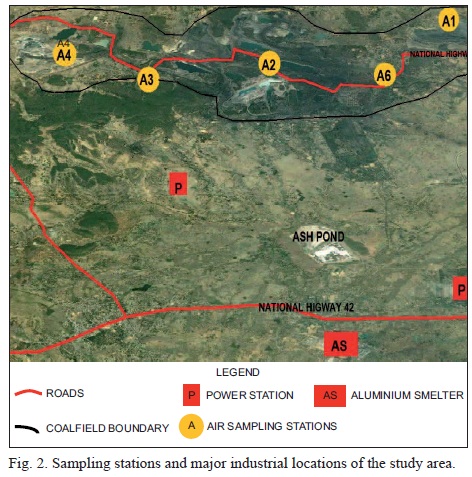
<body><![CDATA[<p align="justify"><font face="verdana" size="2">The composition of the air pollutants can be inorganic, organic, or a complex mixture of both. Environmental sources of pollutants include construction and demolition activities, mining and mineral processing, agricultural activities, sea spray, wind&#45;blown dust, automobiles and transportation related activities on the road. The environmental particles are complicated matter (Suzuki <i>et al.,</i> 2006) of various origin and size. Among all other pollutants, air borne trace elements is a major threat to the human health. Normally toxic trace elements are found to be associated with the finer particle size rather than coarser ones (Fang <i>et al,</i> 2000). There have been several recent indications of trace metal deposition in both urban and rural settings (Zhong <i>et al.,</i> 1994; Green and Morris, 2006; Michael and Christos, 2006; Seung&#45;Muk <i>et al.,</i> 2006). The distribution of atmospheric trace elements is highly dependable on local climate (Ragosta <i>et al.,</i> 2006). Finally, the concentrations of toxic elements get biologically magnified through the food chain and pose potential risks to health (Keller <i>et al,</i> 2002; McBride, 2003). In order to establish the combined effect of the heavy metals on air pollution, principal component analysis (PCA) is widely used for source apportionment studies (Fang <i>et al,</i> 2004).</font></p>  	    <p align="justify"><font face="verdana" size="2">Talcher is one of the industrial hubs of Orissa with a population of approximately 100 000 inhabitants (as per 2001 census). Located on the western bank of the Brahmni River (<a href="/img/revistas/atm/v25n3/a6f1.jpg" target="_blank">Fig. 1</a>), the city has many industrial units including the power grade coalfields, power plants and ancillary industries. In recent years, owing to rapid industrial and social developments, Talcher is facing a serious challenge of air pollution, of which, particulate matter has emerged as the key pollutant. The concern is due to various anthropogenic sources, such as coal&#45;based power plants and heavy road traffic. Not enough studies have been done on dust characterization and source apportionment, but those are needed since the region will see the development of more power and steel plants due to the abundance of natural resources. This study was undertaken as a part of Regional Environmental Management Plan of Angul&#45;Talcher&#45;Meramundali Area of Orissa, India by a team consisting of research scholars and faculty members from the Indian School of Mines University, India.</font></p>  	    <p align="justify"><font face="verdana" size="2">The objectives of the present study were to quantify particulate matter with size less than 10 (&#956;m (PM<sub>10</sub>), mass concentrations of its chemical composition and apportionment of their sources through multivariate statistics. A standardized monitoring network was set up to complement some previous findings; other than mobile sources, particular focus was placed on the role of stationary source emissions as well. Taking the predominant land&#45;use pattern as the selection criterion, PM<sub>10</sub> samples were simultaneously collected for three different seasons in a 1&#45;year period from six sites over Talcher coalfields and surrounding localities. The research was conducted concurrently during the months of June 2008, November 2008 and January 2009 at the Talcher coalfield area. The sampling was done on an 8 hourly basis for a period of 24 h in two consecutive days of a week for that specific month.</font></p>  	    <p align="justify"><font face="verdana" size="2">&nbsp;</font></p>  	    <p align="justify"><font face="verdana" size="2"><b>2. Methods</b></font></p>  	    <p align="justify"><font face="verdana" size="2"><i>2.1 Study area</i></font></p>  	    <p align="justify"><font face="verdana" size="2">Talcher coal field (20&deg;50'&#45;21&deg;15' N and 84&deg;09'&#45;85&deg;33' E) having the highest coal resources, is considered one of the potential coal basins of India. The coalfield constitutes the extreme southeastern portion of the Lower Gondwana Mahanadi Master Basin and occupies an area of over 1813 km<sup>2</sup>. This basin mainly occupies the Brahmani River Valley and covers parts of the Dhenkanal and Angul districts along with a small portion of the adjoining Sambalpur District. Intensive mining activity, rapid urbanization, heavy vehicular movement on the haul roads as well as heavy traffic density on roads, have increased the air pollution in study area. The area has a tropical climate with marked variations of four seasons, viz, summer, monsoon, post monsoon and winter. Maximum temperature is 49.8 &deg;C during summers while minimum temperature is 12 &deg;C during winters. The area receives an average rainfall of 1240 mm. Though there is no variation in total rainfall per annum, large monthly variability is present. May daily the relative humidity way reach 99 % whereas in January it is only 50 %.</font></p>  	    <p align="justify"><font face="verdana" size="2">For the study, six monitoring stations have been selected based on the predominance of residential, industrial and commercial activities existing in the local areas. Industrial activities consisting of an aluminium smelter plant, three coal fired power stations and some ancillary industries are dominant in the south and south&#45;east part of the study area (<a href="#f2">Fig. 2</a>). The raw materials used for these industries are mainly bauxite and coal, otherwise copper (Cu) and iron (Fe) are also used in different operational processes. Particulate matter is the most common pollutant generated from these industrial processes. Gaseous and particulate form of fluoride, gallium (Ga) and iron present in red mud, aluminum, calcium and sodium are found as pollutants from the aluminium smelter. The flue gas from combustion of the fossil fuels is discharged into the ambient air from coal fired power stations; this contains carbon dioxide, water vapour, nitrogen oxides, sulfur oxides and fly ash along with particulate matter.</font></p>  	    <p align="center"><font face="verdana" size="2"><a name="f2"></a></font></p>  	    <p align="center"><font face="verdana" size="2"><img src="/img/revistas/atm/v25n3/a6f2.jpg"></font></p>  	    ]]></body>
<body><![CDATA[<p align="justify"><font face="verdana" size="2">The study area comprises a number of small roads which finally connect to the national highways NH 200 and NH 23. The NH 200 cuts across the study area in the west&#45;east direction, while the NH 23 is aligned along south to north in the eastern part of the study area. Apart from industrial processes, major activities in the area include coal excavation, processing and its transportation.</font></p>  	    <p align="justify"><font face="verdana" size="2">Fugitive emission sources include the movement of coal in dumper, trucks and conveyor belts. Other air polluting sources are public transports (bus, taxi, trekker, automobiles) which use unleaded diesel and petrol.</font></p>  	    <p align="justify"><font face="verdana" size="2">The detailed description on the sampling locations selected for the study is described in <a href="/img/revistas/atm/v25n3/a6t1.jpg" target="_blank">Table I</a>. The locations of various stations and major industries along with roads in the study area are given in <a href="#f2">Figure 2</a>.</font></p>  	    <p align="justify"><font face="verdana" size="2">&nbsp;</font></p>  	    <p align="justify"><font face="verdana" size="2"><i>2.2 Monitoring protocol</i></font></p>  	    <p align="justify"><font face="verdana" size="2">The concentration of PM<sub>10</sub> and PM<sub>&gt;10</sub> were measured at six sites using respirable dust sampler (Envirotech). Ambient air laden with suspended particulates enters the respirable dust sampler through the inlet pipe. As the air enters the cyclone, coarse PM<sub>&gt;10</sub> is separated from the air by centrifugal forces acting on the solid particles. These coarse particulates fall through the cyclone and get collected in the sampling bottle fitted at its bottom. The air stream carrying the fine dust passing through the 0.5 &#956;g pore size filter paper was deposited as respirable fraction (PM<sub>10</sub>). The instrument was operated at a flow rate of 0.9&#45;1.2 m<sup>3</sup>/min. The monitoring of pollutants is carried out for 24 hours (8&#45;hourly sampling for particulate matter) twice a week. Special attention was paid while selecting sampling locations. Priority was given to guidelines prescribed by Central Pollution Control Board of India (2006) along with machine safety and availability of electricity. As per CPCB guidelines 104 observations are necessary in a year to analyze data over various seasons. But the guidelines also suggest in case of power shortage, machine safety or hostile weather conditions, to take a minimum of 40 observations for various seasons over the year. In the present study, 74 observations were made for various seasons through out the year.</font></p>  	    <p align="justify"><font face="verdana" size="2">&nbsp;</font></p>  	    <p align="justify"><font face="verdana" size="2"><i>2.3 Analytical techniques</i></font></p>  	    <p align="justify"><font face="verdana" size="2">It is assumed that the PM<sub>10</sub> deposited on quartz microfiber filter papers were uniformly distributed over the entire area, and the gravimetric weight of each filter paper was determined (A&amp;D) analytical balance, model GR200). Following the gravimetric analysis, a known portion of the exposed filter paper sample was extracted for trace elemental estimations (APHA, 1977). The quartz microfiber filters were digested in HNO<sub>3</sub> (nitric acid). The digested solutions were then analyzed with a GBC Avanta atomic absorption spectroscopy (AAS) coupled with graphite furnace and hollow cathode lamps were used for the estimation of heavy metals in ambient dust particles: zinc (Zn), lead (Pb), copper (Cu), nickel (Ni), manganese (Mn), aluminum (Al) and iron (Fe). An intensive quality control programme was implemented to maintain the accuracy and precision throughout the study.</font></p>  	    <p align="justify"><font face="verdana" size="2">&nbsp;</font></p>  	    ]]></body>
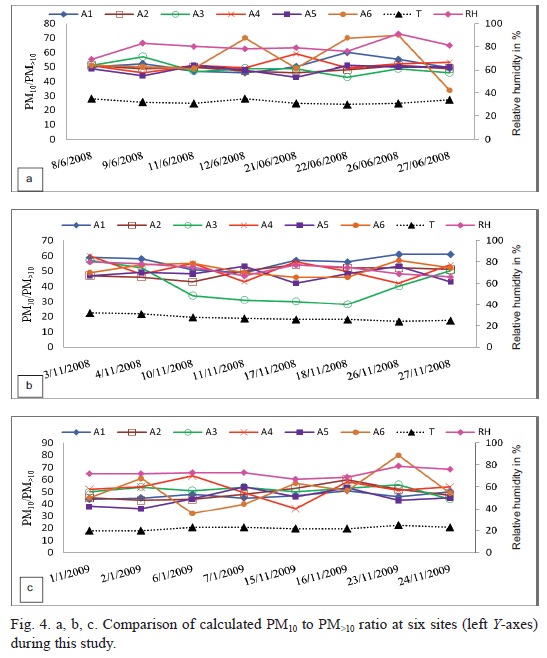
<body><![CDATA[<p align="justify"><font face="verdana" size="2"><b>3. Results and discussion</b></font></p>  	    <p align="justify"><font face="verdana" size="2">The sample&#45;to&#45;sample and site&#45;to&#45;site comparison of the PM<sub>10</sub> mass concentration is statistically presented in <a href="/img/revistas/atm/v25n3/a6f3.jpg" target="_blank">Figure 3 (a, b, c)</a>. The range of mass concentrations varied considerably over time from 82 to 188 &#956;g/m<sup>3</sup> at Lingraj site, from 65 to 288 &#956;g/m<sup>3</sup> at Jagannath site, from 48 to 135 &#956;g/m<sup>3</sup> at Kalinga, from 32 to 91 &#956;g/m<sup>3</sup> at Gopalprasad, from 53 to 158 &#956;g/m<sup>3</sup> at Jagannathpur and from 87 to 210 &#956;g/m<sup>3</sup> at Dera Chowk site. The annual average concentrations at each location were 145 &plusmn; 30, 192 &plusmn; 62, 91 &plusmn; 28, 63 &plusmn; 18, 114 &plusmn; 34, and 153 &plusmn; 37 &#956;g/m<sup>3</sup>, respectively. The annual average values obtained from Jagannath and Dera chowk were higher than the US EPA recommended annual PM<sub>10</sub> ambient air quality standard, i.e. 150 &#956;g/m<sup>3</sup> (USEPA, 1999). The value obtained at the Lingraj site (144 &#956;g/m<sup>3</sup>) is very close to the US EPA standard. However, the value at the control site (Gopalprasad) '63 &#956;g/m<sup>3</sup>' was much lower than the US EPA PM<sub>10</sub> standard. To appraise the general pollution levels at the study sites, the present mass concentration data were compared with previously reported data in other parts of India.</font></p>  	    <p align="justify"><font face="verdana" size="2">Ghosh (2002) measured mass concentration in seasonally collected PM<sub>10</sub> samples at five sites in the Jharia coalfield for a similar 1&#45;year period during 2000. The maximum value of 431ug/m<sup>3</sup> obtained during winter was 1.5 times higher than maximum value of 288 &#956;g/m<sup>3</sup> obtained in our study at the Jagannath site. Another study (Singh and Puri, 2004) assessed the ambient air quality status at the Korba coalfield which has similar land use pattern, mining and industrial activities to our study area. Maximum respirable particulate matter (RPM) concentration at the Korba area was 431 &#956;g/m<sup>3</sup>, also 1.5 times higher than our maximum value. These values were much higher than the current US EPA recommended annual PM<sub>10</sub> ambient air quality standard (USEPA, 1999). Overall, the mass concentration at the industrial site of Jagannath was generally the highest among the six sites and it was approximately five times higher than the concentration of the control site at Gopalprasad. The higher PM<sub>10</sub> concentrations at sites Lingraj, Jagannath, Kalinga, Jagannathpur and Dera Chowk may reflect a significant contribution of anthropogenic sources compared to the control site. Influence from occasional pollution episodes on the measurements of PM<sub>10</sub> concentrations were ignored since the simultaneous monitoring was executed at all six sites with relatively high sampling heights. High ambient PM10 mass concentration peaks occurred only at Jagannath, suggesting that the contribution of stationary industrial emissions was more important than the contribution of mobile sources even in areas with heavy traffic (Chen <i>et al,</i> 2008).</font></p>  	    <p align="justify"><font face="verdana" size="2">Ambient PM<sub>10</sub> mass concentration was associated not only with source processes but also with changes in environmental conditions, particularly with winds. An attempt was made to investigate the direct influence of wind speed on the concentration levels of PM<sub>10</sub>. Evaluation of the spatial variation of PM<sub>10</sub> with wind speed (<a href="/img/revistas/atm/v25n3/a6f3.jpg" target="_blank">Fig. 3 a, b, c</a>) found that the concentrations of PM<sub>10</sub> tended to fall into a relatively narrow range for all six sites when an increase in wind speed (&gt;1m/s) occurred. To explore more site&#45;specific information in Talcher, the PM<sub>10</sub>/PM<sub>&gt;10</sub> ratio and the averaged data of two meteorological parameters are shown in <a href="#f4">Figure 4 a, b, c</a>. Relative humidity (RH) and the temperature characterize well the tropical and humid climate of eastern India. The ranges of all samples for the PM<sub>10</sub>/PM<sub>&gt;10</sub> ratio were 0.44&#45;0.61 for Lingraj, 0.43&#45;0.60 for Jagannath, 0.28&#45;0.57 for Kalinga, 0.42&#45;0.63 for Gopalprasad, 0.36&#45;0.54 for Jagannathpur and 0.32&#45;0.72 for Dera chowk. Our values are consistent with the reported literature value of 0.59 for urban sites in China (Wei <i>et al.,</i> 1999). The highest ratio of PM<sub>10</sub>/PM<sub>&gt;10</sub> recorded in this work was at the traffic junction site of Dera Chowk. It has been reported that aerosol samples taken in urban areas showed that mobile source emissions usually constitute the most important source of PM10 in urban environments (USEPA). We can confirm the fact that mobile sources were the most important contributor of PM<sub>10</sub> in Talcher area. The wide range of variation of PM<sub>10</sub>/PM<sub>&gt;10</sub> ratio in Dera chowk sites indicates that there is a significant addition of fine mass concentrations from stationary industrial emissions, other than vehicular emission.</font></p>  	    <p align="center"><font face="verdana" size="2"><a name="f4"></a></font></p>  	    <p align="center"><font face="verdana" size="2"><img src="/img/revistas/atm/v25n3/a6f4.jpg"></font></p>  	    <p align="justify"><font face="verdana" size="2">&nbsp;</font></p>  	    <p align="justify"><font face="verdana" size="2"><i>3.1 Elemental concentrations in PM<sub>10</sub> samples</i></font></p>  	    <p align="justify"><font face="verdana" size="2">For the assessment of air quality, the concentrations of seven elements i.e. Pb, Cu, Ni, Fe, Zn, Mn and Al in the PM<sub>10</sub> samples were analyzed by AAS. <a href="/img/revistas/atm/v25n3/a6t2.jpg" target="_blank">Table II</a> compares their elemental concentrations (&#956;g/m<sup>3</sup>) in PM<sub>10</sub> samples collected from the six study sites.</font></p>  	    <p align="justify"><font face="verdana" size="2">An elevated level of Al concentration (0.32&#45;23.6 &#956;g/m<sup>3</sup>) was observed at all the study sites followed by Zn (1.0&#45;14.32 &#956;g/ m<sup>3</sup>) and Fe (0.005&#45;8.60 &#956;g/m<sup>3</sup>). The maximum Al concentration (23.60 &#956;g/m<sup>3</sup>) was found at the Jagannathpur site followed by Lingraj (13.20 &#956;g/m<sup>3</sup>). As shown in <a href="#f2">Figure 2</a>, in the southern part of the study area there is an aluminium smelter plant and three coal fired power stations. The general wind direction during the sampling periods was from south to north. More specifically, prevalent wind direction during June, November and January is <b>NW, NE</b> and <b>NE</b> respectively. General observation of wind direction pattern suggests that the fly ash contains traces of Al<sub>2</sub>O<sub>3</sub> (Mineral Perindustrian, 2003) and the stack emission from the aluminium smelter after being carried by the wind is deposited in the sampling locations. While mining, this element is deposited on the soil and then re&#45;suspended along with the fugitive dust. Maximum Zn concentration was observed at Dera chowk site (14.32 &#956;g/m<sup>3</sup>) followed by Jagannath (10.80 &#956;g/m<sup>3</sup>). The crustal element Fe (0.31&#45;8.66 &#956;g/m<sup>3</sup>) which is usually found in crustal rock and soil particles (Hu <i>et al.,</i> 2003; Kumar <i>et al.,</i> 2001) was the third most abundant element in this study. The highest concentration of Fe was observed at Kalinga (8.66 &#956;g/m<sup>3</sup>) followed by Jagannath (8.60 &#956;g/m<sup>3</sup>). The ranges of Ni and Mn varied from (0.005&#45;0.90 &#956;g/m<sup>3</sup>) and (0.01&#45;0.85 &#956;g/m<sup>3</sup>) respectively. The highest concentration of Ni (0.90 &#956;g/m<sup>3</sup>) and Mn (0.85 &#956;g/m<sup>3</sup>) was recorded at Dera chowk. Cu (0.02&#45;0.15 &#956;g/m<sup>3</sup>) and Pb (0.01&#45;0.66 &#956;g/m<sup>3</sup>) concentration were found lower than the other trace elements.</font></p>  	    ]]></body>
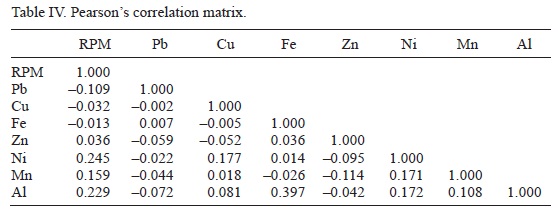
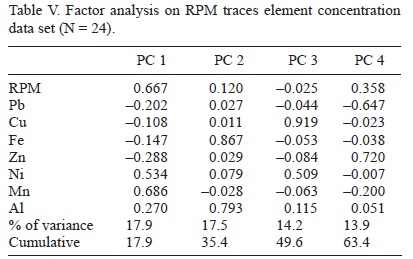
<body><![CDATA[<p align="justify"><font face="verdana" size="2"><a href="/img/revistas/atm/v25n3/a6t3.jpg" target="_blank">Table III</a> shows the comparison of metallic element concentrations (&#956;g/m<sup>3</sup>) for ambient air particles at several locations in the world. In most of the studies, Fe has been found to be the most abundant element. The highest concentration of Fe (38.90 &#956;g/m<sup>3</sup>, Parekh <i>et al.,</i> 1967) was found at industrial sites of Brazil. Higher Fe concentration (24.8 &#956;g/m<sup>3</sup>, Salam <i>et al.,</i> 2003) was also reported from urban areas of Bangladesh. In both the cases, the reported concentrations were about 4 and 6 times respectively higher than the maximum concentrations found (8.66 &#956;g/m<sup>3</sup>) by this study. Concentrations of Fe (9.93 &#956;g/m<sup>3</sup>, Smith <i>et al.,</i> 1996) at Lahore, Pakistan were quite similar to our findings. As for Cu the highest concentrations were noted in Gandhinagar, India (1.55 &#956;g/m<sup>3</sup>, Kumar <i>et al.,</i> 2001). In comparison, the maximum value obtained in our study was 0.15&#956;g/m<sup>3</sup> (Dera chowk) 10 times lower than in Gandhinagar, but notably higher than the value reported in Beijing, China (0.50 &#956;g/m<sup>3</sup>, Song <i>et al.,</i> 2006). The concentration ranged from 0.32 &#956;g/m<sup>3</sup> (Jagannathpur) to 23.60 &#956;g/m<sup>3</sup> (Jagannath).</font></p>  	    <p align="justify"><font face="verdana" size="2">The concentration of Zn obtained from Pakistan (Smith <i>et al.,</i> 1996), was ranked the highest (27.7 &#956;g/m<sup>3</sup>) compared with studies in other regions. Furthermore, the metallic concentrations of Zn in Rio de Janeiro, Brazil (2.12 &#956;g/m<sup>3</sup>, Quiterio <i>et al.,</i> 2004) were lower than the maximum value obtained in present study where it had a range between 1.0 to 14.32 &#956;g/m<sup>3</sup> (Dera chowk). The higher concentration of Pb was measured in Lahore, Pakistan (3.92 &#956;g/m<sup>3</sup>, Smith <i>et al.,</i> 1996). For the study at Talcher, the maximum concentration of Pb was found to be 0.66 &#956;g/m<sup>3</sup> at Gopalprasad. Sharma and Patil (1992) revealed high Ni concentration (0.040 &#956;g/m<sup>3</sup>) at Mumbai, India. Concentrations of Ni in our study were lower (0.005&#45;0.90 &#956;g/m<sup>3</sup>) than in Mumbai. The highest concentration of Mn was recorded at Rio de Janerio, Brazil (1.216 &#956;g/m<sup>3</sup>, Quiterio <i>et al.,</i> 2004), while in our study, the maximum Mn concentration was found to be 0.85 &#956;g/m<sup>3</sup> at Dera chowk.</font></p>  	    <p align="justify"><font face="verdana" size="2">&nbsp;</font></p>  	    <p align="justify"><font face="verdana" size="2"><i>3.2 Source apportionment of trace elements</i></font></p>  	    <p align="justify"><font face="verdana" size="2">Principal component analyzing (PCA) was applied to determine correlations between pollutants and to identify the source profiles of heavy metals in PM<sub>10</sub>. These multivariate techniques are based on the analysis of the association matrix and they are able to point out the correlation among the measured variables. <a href="#t4">Table IV</a> represents Pearson correlation coefficient values.</font></p>     <p align="center"><font face="verdana" size="2"><a name="t4"></a></font></p>      <p align="center"><font face="verdana" size="2"><img src="/img/revistas/atm/v25n3/a6t4.jpg"></font></p> 	    <p align="justify"><font face="verdana" size="2">Based on this matrix, four new sets of synthetic variables were obtained (principal components) and are presented in <a href="#t5">Table V</a>. These sets resulted in four rotated factors associated with eigen values &gt;1.0, synthesized after applying the Varimax rotation. The total variation explained by the four factors was 63.4 %.</font></p>     <p align="center"><font face="verdana" size="2"><a name="t5"></a></font></p>      <p align="center"><font face="verdana" size="2"><img src="/img/revistas/atm/v25n3/a6t5.jpg"></font></p> 	    ]]></body>
<body><![CDATA[<p align="justify"><font face="verdana" size="2">The first principal component (PC) explains 17.9 % of data variance and it is characterized by PM<sub>10</sub> (0.667), Ni (0.534), and Mn (0.686). These trace elements are mainly related to motor vehicle emissions and also dust in suspension (Ragosta <i>et al.,</i> 2008; Handt and Fern&aacute;ndez, 2008). Several studies have already identified Ni as a typical tracer for fossil fuel combustion (Pacyna, 1986; Artaxo <i>et al.,</i> 1999; Manoli <i>et al.,</i> 2002; Khillare <i>et al.,</i> 2004) whereas Mn is a well known additive (methylcyclopentadienyl manganese tricarbony) used in unleaded gasoline to boost octane rating and reduce engine knocking. A significant amount of road dust is present near the sampling locations and is also in regular suspension by vehicular movement. Hence, this factor for variance can be identified as the road dust component. The second PC explains 17.5 % of the total data variance and presented high loading for Fe and Al; it can be interpreted as crustal contribution (Almeida <i>et al.,</i> 2005; Guerzoni <i>et al.,</i> 2005; Song <i>et al.,</i> 2006; Ragosta <i>et al.,</i> 2008). The third PC accounts for 14.2 % of raw data variance, and is related to a mixture of industrial activities like coal fired power station and biomass burning with high levels for Cu and Ni. Such levels can be found in industrial emission (Dallarosa <i>et al.,</i> 2007) as well as emissions from combustion (Zheng <i>et al.,</i> 2005). Furthermore in <a href="#t4">Table IV</a> we may observe that Ni is characterized by similar loadings both in PC1 (0.534) and in PC3 (0.509). This result suggests that in the sampling area, the Ni level is determined by a mix of different anthropogenic and natural sources. The fourth PC explains 13.9 % of total the data variance. The high factor loadings on Pb (&#45;0.647) and Zn (0.720) and their inverse correlation (&#45;0.059) at 99.9 % significance level, may indicate that the source contributing Pb is totally different from that of Zn. It is believed that Pb originated from the power stations (Guerzoni <i>et al.,</i> 2005), while the source of Zn is the non&#45;ferrous smelter (Ho and Lee, 2002).</font></p>  	    <p align="justify"><font face="verdana" size="2">Overall site specific analysis of PM<sub>10</sub> data reveals Jagannath station to be the most polluted in terms of dust loading with a maximum concentration of 288 &#956;g/m<sup>3</sup>. Evaluation of the spatial variation of PM<sub>10</sub> with wind speed inferred that the concentrations of PM<sub>10</sub> tended to fall with an increase in wind speed (&gt;1m/s). The wide variation of PM<sub>10</sub>/PM<sub>&gt;10</sub> in the study area indicated that vehicular emission is the predominant polluting sources for finer particle in the study area. The concentrations of trace metals in PM<sub>10</sub> were observed in the following order: Al &gt;Zn &gt;Fe &gt;Mn &gt;Cu &gt;Pb &gt;Ni. Focusing our attention on metal source characterization, the multivariate techniques allowed us to identify four source components. The first component is characterized by PM<sub>10</sub> which represents soil dust, also Ni and Mn that are elements typical of traffic emission. The second source is associated with crustal elements, with Fe and Al as the constituents of soil dust from mining operation. The third component is identified as industrial source and vehicular traffic emission characterized by Cu and Ni, respectively. The fourth component is characterized by Pb and Zn, indicates two anthropogenic but distinct origins: power stations and non&#45;ferrous metallurgy. Furthermore, we note that this component includes Zn, very high levels confirming the presence of a specific industrial emission source, like a smelter. Hence we conclude that in the investigated area the levels of some trace elements are very high. In some cases PM<sub>10</sub> concentrations were also found to be higher than the standard specified by the USEPA. This suggests that future strategies for air quality control on a local scale have to take into account not only the amount of atmospheric particles, but their chemical composition as well.</font></p>  	    <p align="justify"><font face="verdana" size="2">&nbsp;</font></p>  	    <p align="justify"><font face="verdana" size="2"><b>Acknowledgements</b></font></p>  	    <p align="justify"><font face="verdana" size="2">The authors are grateful to Indian School of Mines University, Dhanbad and State Pollution Control Board (SPCB), Orissa who are the two financial supporters of the study. The authors are also thankful to the Director of Indian School of Mines University for providing necessary institutional support and permission to publish this paper. The necessary support and facilities for field survey provided by the Regional State Pollution Control Board (Angul) and SPCB (Orissa) are hereby acknowledged.</font></p>  	    <p align="justify"><font face="verdana" size="2">&nbsp;</font></p>  	    <p align="justify"><font face="verdana" size="2"><b>References</b></font></p>  	    <!-- ref --><p align="justify"><font face="verdana" size="2">Almeida S. M., C. A. Pio, M. C. Freitas, M. A. Reis and M. A. Trancoso, 2005. Source apportionment of fine and coarse particulate matter in a sub&#45;urban area at the Western European Coast. <i>Atmos. Environ.</i> <b>39,</b> 3127&#45;3138.    &nbsp;&nbsp;&nbsp;&nbsp;&nbsp;&nbsp;&nbsp;&nbsp;[&#160;<a href="javascript:void(0);" onclick="javascript: window.open('/scielo.php?script=sci_nlinks&ref=1287452&pid=S0187-6236201200030000600001&lng=','','width=640,height=500,resizable=yes,scrollbars=1,menubar=yes,');">Links</a>&#160;]<!-- end-ref --></font></p>  	    <!-- ref --><p align="justify"><font face="verdana" size="2">APHA, 1977. <i>Methods of air sampling and analysis.</i> 2nd ed. American Public Health Association. Washington DC, USA, 984 pp.    &nbsp;&nbsp;&nbsp;&nbsp;&nbsp;&nbsp;&nbsp;&nbsp;[&#160;<a href="javascript:void(0);" onclick="javascript: window.open('/scielo.php?script=sci_nlinks&ref=1287454&pid=S0187-6236201200030000600002&lng=','','width=640,height=500,resizable=yes,scrollbars=1,menubar=yes,');">Links</a>&#160;]<!-- end-ref --></font></p>  	    <!-- ref --><p align="justify"><font face="verdana" size="2">Artaxo P., P. Oyola and R. Mart&iacute;nez, 1999. Aerosol composition and source apportionment in Santiago de Chile. <i>Nucl. Instrum. Meth. B</i> <b>150,</b> 409&#45;416.    &nbsp;&nbsp;&nbsp;&nbsp;&nbsp;&nbsp;&nbsp;&nbsp;[&#160;<a href="javascript:void(0);" onclick="javascript: window.open('/scielo.php?script=sci_nlinks&ref=1287456&pid=S0187-6236201200030000600003&lng=','','width=640,height=500,resizable=yes,scrollbars=1,menubar=yes,');">Links</a>&#160;]<!-- end-ref --></font></p>  	    <!-- ref --><p align="justify"><font face="verdana" size="2">CPCB, 2006. Air Quality Trends and Action Plan for Control of Air Pollution from Seventeen Cities. National Ambient Air Quality Monitoring, Central Pollution Control Board, Ministry of Environment &amp; Forests, New Delhi, India. 202 pp.    &nbsp;&nbsp;&nbsp;&nbsp;&nbsp;&nbsp;&nbsp;&nbsp;[&#160;<a href="javascript:void(0);" onclick="javascript: window.open('/scielo.php?script=sci_nlinks&ref=1287458&pid=S0187-6236201200030000600004&lng=','','width=640,height=500,resizable=yes,scrollbars=1,menubar=yes,');">Links</a>&#160;]<!-- end-ref --></font></p>  	    <!-- ref --><p align="justify"><font face="verdana" size="2">Chen J., M. Tan, Y. Li, J. Zheng, Y. Zhang, Z. Shan, G. Zhang and Y. Li, 2008. Characteristics of trace elements and lead isotope ratios in PM<sub>25</sub> from four sites in Shanghai. <i>J. Hazard. Mat.</i> <b>156,</b> 36&#45;43.    &nbsp;&nbsp;&nbsp;&nbsp;&nbsp;&nbsp;&nbsp;&nbsp;[&#160;<a href="javascript:void(0);" onclick="javascript: window.open('/scielo.php?script=sci_nlinks&ref=1287460&pid=S0187-6236201200030000600005&lng=','','width=640,height=500,resizable=yes,scrollbars=1,menubar=yes,');">Links</a>&#160;]<!-- end-ref --></font></p>  	    <!-- ref --><p align="justify"><font face="verdana" size="2">Dallarosa J., E. C. Teixeira, L. Meira and F. Weigand, 2008. Study of the chemical elements and polycyclic aromatic hydrocarbons in atmospheric particles of PM<sub>10</sub> and PM<sub>25</sub> in the urban and rural areas of South Brazil. <i>Atmos. Res.</i> <b>89,</b> 76&#45;92.    &nbsp;&nbsp;&nbsp;&nbsp;&nbsp;&nbsp;&nbsp;&nbsp;[&#160;<a href="javascript:void(0);" onclick="javascript: window.open('/scielo.php?script=sci_nlinks&ref=1287462&pid=S0187-6236201200030000600006&lng=','','width=640,height=500,resizable=yes,scrollbars=1,menubar=yes,');">Links</a>&#160;]<!-- end-ref --></font></p>  	    <!-- ref --><p align="justify"><font face="verdana" size="2">Fang G. C., C. N. Chang, Y. S. Wu, V. Wang, P. P. C. Fu, D. G. Yang, S. C. Chen and C. C. Chu, 2000. The study of fine and coarse particles, and metallic elements for the daytime and nighttime in a suburban area of central Taiwan, Taichung. <i>Chemosphere</i> <b>41,</b> 639&#45;644.    &nbsp;&nbsp;&nbsp;&nbsp;&nbsp;&nbsp;&nbsp;&nbsp;[&#160;<a href="javascript:void(0);" onclick="javascript: window.open('/scielo.php?script=sci_nlinks&ref=1287464&pid=S0187-6236201200030000600007&lng=','','width=640,height=500,resizable=yes,scrollbars=1,menubar=yes,');">Links</a>&#160;]<!-- end-ref --></font></p>  	    <!-- ref --><p align="justify"><font face="verdana" size="2">Fang G. C., C. N. Chang, Y. S. Wu, M. H. Chen, T. T. Ho, S. H. Huang, 2004. A study of metallic elements at suburban and industrial regions in central Taiwan during 2002&#45;2003. <i>Atmos. Environ.</i> <b>70,</b> 131&#45;142.    &nbsp;&nbsp;&nbsp;&nbsp;&nbsp;&nbsp;&nbsp;&nbsp;[&#160;<a href="javascript:void(0);" onclick="javascript: window.open('/scielo.php?script=sci_nlinks&ref=1287466&pid=S0187-6236201200030000600008&lng=','','width=640,height=500,resizable=yes,scrollbars=1,menubar=yes,');">Links</a>&#160;]<!-- end-ref --></font></p>  	    <!-- ref --><p align="justify"><font face="verdana" size="2">Fern&aacute;ndez Espinosa A. J. F., M. Ternero Rodr&iacute;guez, F. J. B. de la Rosa and J. C. Jim&eacute;nez S&aacute;nchez, 2002. A chemical speciation of trace metals for fine urban particles. <i>Atmos. Environ.</i> <b>36,</b> 773&#45;780.    &nbsp;&nbsp;&nbsp;&nbsp;&nbsp;&nbsp;&nbsp;&nbsp;[&#160;<a href="javascript:void(0);" onclick="javascript: window.open('/scielo.php?script=sci_nlinks&ref=1287468&pid=S0187-6236201200030000600009&lng=','','width=640,height=500,resizable=yes,scrollbars=1,menubar=yes,');">Links</a>&#160;]<!-- end-ref --></font></p>  	    <!-- ref --><p align="justify"><font face="verdana" size="2">Ghosh M. K., 2002. Air pollution due to opencast coal mining and the characteristics of air&#45;borne dust &#45;an Indian scenario. Int. <i>J. Environ. Stud.</i> <b>59,</b> 211&#45;228.    &nbsp;&nbsp;&nbsp;&nbsp;&nbsp;&nbsp;&nbsp;&nbsp;[&#160;<a href="javascript:void(0);" onclick="javascript: window.open('/scielo.php?script=sci_nlinks&ref=1287470&pid=S0187-6236201200030000600010&lng=','','width=640,height=500,resizable=yes,scrollbars=1,menubar=yes,');">Links</a>&#160;]<!-- end-ref --></font></p>  	    <!-- ref --><p align="justify"><font face="verdana" size="2">Green N. A. and V. R. Morris, 2006. Assessment of public health risks associated with atmospheric exposure to PM2.5 in Washington, DC, USA. <i>Int. J. Environ. Res. Public Health</i> <b>3,</b> 86&#45;97.    &nbsp;&nbsp;&nbsp;&nbsp;&nbsp;&nbsp;&nbsp;&nbsp;[&#160;<a href="javascript:void(0);" onclick="javascript: window.open('/scielo.php?script=sci_nlinks&ref=1287472&pid=S0187-6236201200030000600011&lng=','','width=640,height=500,resizable=yes,scrollbars=1,menubar=yes,');">Links</a>&#160;]<!-- end-ref --></font></p>  	    <!-- ref --><p align="justify"><font face="verdana" size="2">Guerzoni S., G. Rampazzob, E. Molinarolib and P. Rossini, 2005. Atmospheric bulk deposition to the Lagoon of Venice Part II. Source apportionment analysis near the industrial zone of Porto Marghera, Italy. <i>Environ. Int.,</i> <b>31,</b> 975&#45;982.    &nbsp;&nbsp;&nbsp;&nbsp;&nbsp;&nbsp;&nbsp;&nbsp;[&#160;<a href="javascript:void(0);" onclick="javascript: window.open('/scielo.php?script=sci_nlinks&ref=1287474&pid=S0187-6236201200030000600012&lng=','','width=640,height=500,resizable=yes,scrollbars=1,menubar=yes,');">Links</a>&#160;]<!-- end-ref --></font></p>  	    <!-- ref --><p align="justify"><font face="verdana" size="2">Handt H. and R. Fern&aacute;ndez, 2008. Operational speciation of Cd, Cr, Cu, Mn, Ni, Pb, V and Zn in dust samples from schools in Caracas, Venezuela. <i>Atmosfera</i> <b>21,</b> 335&#45;345.    &nbsp;&nbsp;&nbsp;&nbsp;&nbsp;&nbsp;&nbsp;&nbsp;[&#160;<a href="javascript:void(0);" onclick="javascript: window.open('/scielo.php?script=sci_nlinks&ref=1287476&pid=S0187-6236201200030000600013&lng=','','width=640,height=500,resizable=yes,scrollbars=1,menubar=yes,');">Links</a>&#160;]<!-- end-ref --></font></p>  	    <!-- ref --><p align="justify"><font face="verdana" size="2">Hien P. D., N. T. Binh, Y. Truong, N. T. Ngo and L. N. Sieu, 2001. Comparative receptor modeling study of TSP, PM2 and PM2&#45;10 in Ho Chi Minh City. <i>Atmos. Environ.</i> <b>35,</b> 2669&#45;2678.    &nbsp;&nbsp;&nbsp;&nbsp;&nbsp;&nbsp;&nbsp;&nbsp;[&#160;<a href="javascript:void(0);" onclick="javascript: window.open('/scielo.php?script=sci_nlinks&ref=1287478&pid=S0187-6236201200030000600014&lng=','','width=640,height=500,resizable=yes,scrollbars=1,menubar=yes,');">Links</a>&#160;]<!-- end-ref --></font></p>  	    <!-- ref --><p align="justify"><font face="verdana" size="2">Ho K. F. and S. C. Lee, 2002. Identification of atmospheric volatile organic compounds (VOCs), polycyclic aromatic hydrocarbons (PAHs) and carbonyl compounds in Hong Kong. <i>Sci. Total Environ.</i> <b>289,</b> 145&#45;158.    &nbsp;&nbsp;&nbsp;&nbsp;&nbsp;&nbsp;&nbsp;&nbsp;[&#160;<a href="javascript:void(0);" onclick="javascript: window.open('/scielo.php?script=sci_nlinks&ref=1287480&pid=S0187-6236201200030000600015&lng=','','width=640,height=500,resizable=yes,scrollbars=1,menubar=yes,');">Links</a>&#160;]<!-- end-ref --></font></p>  	    <!-- ref --><p align="justify"><font face="verdana" size="2">Hu C. W., M. R. Chao, K. Y. Wu, G. P. Chang&#45;Chien, W. J. Lee, L. W. Chang and W. S. Lee, 2003. Characterization of multiple airborne particulate metals in the surroundings of a municipal waste incinerator in Taiwan. <i>Atmos. Environ.</i> <b>37,</b> 2845&#45;2852.    &nbsp;&nbsp;&nbsp;&nbsp;&nbsp;&nbsp;&nbsp;&nbsp;[&#160;<a href="javascript:void(0);" onclick="javascript: window.open('/scielo.php?script=sci_nlinks&ref=1287482&pid=S0187-6236201200030000600016&lng=','','width=640,height=500,resizable=yes,scrollbars=1,menubar=yes,');">Links</a>&#160;]<!-- end-ref --></font></p>  	    <!-- ref --><p align="justify"><font face="verdana" size="2">Keller C., S. P. McGrath and S. J. Dunham, 2002. Trace metal leaching through a soil grassland system after sewage sludge application. <i>J. Environ. Qual.</i> <b>31,</b> 1550&#45;1560.    &nbsp;&nbsp;&nbsp;&nbsp;&nbsp;&nbsp;&nbsp;&nbsp;[&#160;<a href="javascript:void(0);" onclick="javascript: window.open('/scielo.php?script=sci_nlinks&ref=1287484&pid=S0187-6236201200030000600017&lng=','','width=640,height=500,resizable=yes,scrollbars=1,menubar=yes,');">Links</a>&#160;]<!-- end-ref --></font></p>  	    <!-- ref --><p align="justify"><font face="verdana" size="2">Khillare P. S., S. Balachandran and B. R. Meena, 2004. Spatial and temporal variation of heavy metals in atmospheric aerosols of Delhi. <i>Environ. Monit. Assess.</i> <b>90,</b> 1&#45;21.    &nbsp;&nbsp;&nbsp;&nbsp;&nbsp;&nbsp;&nbsp;&nbsp;[&#160;<a href="javascript:void(0);" onclick="javascript: window.open('/scielo.php?script=sci_nlinks&ref=1287486&pid=S0187-6236201200030000600018&lng=','','width=640,height=500,resizable=yes,scrollbars=1,menubar=yes,');">Links</a>&#160;]<!-- end-ref --></font></p>  	    <!-- ref --><p align="justify"><font face="verdana" size="2">Kumar A. V., R. S. Patil and K. S. V. Nambi, 2001. Source apportionment of suspended particulate matter at two traffic junctions in Mumbai, India. <i>Atmos. Environ.</i> <b>35,</b> 3245&#45;4251.    &nbsp;&nbsp;&nbsp;&nbsp;&nbsp;&nbsp;&nbsp;&nbsp;[&#160;<a href="javascript:void(0);" onclick="javascript: window.open('/scielo.php?script=sci_nlinks&ref=1287488&pid=S0187-6236201200030000600019&lng=','','width=640,height=500,resizable=yes,scrollbars=1,menubar=yes,');">Links</a>&#160;]<!-- end-ref --></font></p>  	    <!-- ref --><p align="justify"><font face="verdana" size="2">Manoli E., D. Voutsa and C. Samara, 2002. Chemical characterization and source identification/ apportionment of fine and coarse air particles in Thessaloniki, Greece. <i>Atmos. Environ.</i> <b>36,</b> 949&#45;961.    &nbsp;&nbsp;&nbsp;&nbsp;&nbsp;&nbsp;&nbsp;&nbsp;[&#160;<a href="javascript:void(0);" onclick="javascript: window.open('/scielo.php?script=sci_nlinks&ref=1287490&pid=S0187-6236201200030000600020&lng=','','width=640,height=500,resizable=yes,scrollbars=1,menubar=yes,');">Links</a>&#160;]<!-- end-ref --></font></p>  	    <!-- ref --><p align="justify"><font face="verdana" size="2">McBride M. B., 2003. Toxic metals in sewage sludge&#45;amended soils: has promotion of beneficial use discounted the risks? <i>Adv. Environ. Res.</i> <b>8,</b> 5&#45;19.    &nbsp;&nbsp;&nbsp;&nbsp;&nbsp;&nbsp;&nbsp;&nbsp;[&#160;<a href="javascript:void(0);" onclick="javascript: window.open('/scielo.php?script=sci_nlinks&ref=1287492&pid=S0187-6236201200030000600021&lng=','','width=640,height=500,resizable=yes,scrollbars=1,menubar=yes,');">Links</a>&#160;]<!-- end-ref --></font></p>  	    <!-- ref --><p align="justify"><font face="verdana" size="2">Melaku S., V. Morris, D. Raghavan and C. Hosten, 2008. Seasonal variation of heavy metals in ambient air and precipitation in Washington, D. C. <i>Environ. Pollut.</i> <b>155,</b> 88&#45;98.    &nbsp;&nbsp;&nbsp;&nbsp;&nbsp;&nbsp;&nbsp;&nbsp;[&#160;<a href="javascript:void(0);" onclick="javascript: window.open('/scielo.php?script=sci_nlinks&ref=1287494&pid=S0187-6236201200030000600022&lng=','','width=640,height=500,resizable=yes,scrollbars=1,menubar=yes,');">Links</a>&#160;]<!-- end-ref --></font></p>  	    <!-- ref --><p align="justify"><font face="verdana" size="2">Michael R. G. and S. C. Christos, 2006. Particle size distribution and atmospheric metals measurements in a rural area in the South Eastern USA. <i>Sci. Total Environ.</i> <b>356,</b> 217&#45;227.    &nbsp;&nbsp;&nbsp;&nbsp;&nbsp;&nbsp;&nbsp;&nbsp;[&#160;<a href="javascript:void(0);" onclick="javascript: window.open('/scielo.php?script=sci_nlinks&ref=1287496&pid=S0187-6236201200030000600023&lng=','','width=640,height=500,resizable=yes,scrollbars=1,menubar=yes,');">Links</a>&#160;]<!-- end-ref --></font></p>  	    <!-- ref --><p align="justify"><font face="verdana" size="2">Mineral Perindustrian, 2003. <a href="http//mineral.eng.usn.my/wen%20halaman%20mineral/Components%20of20coal%20ash.pdf" target="_blank">http//mineral.eng.usn.my/wen%20halaman%20mineral/Components%20of20coal%20ash.pdf</a>. Acceded on September, 2011.    &nbsp;&nbsp;&nbsp;&nbsp;&nbsp;&nbsp;&nbsp;&nbsp;[&#160;<a href="javascript:void(0);" onclick="javascript: window.open('/scielo.php?script=sci_nlinks&ref=1287498&pid=S0187-6236201200030000600024&lng=','','width=640,height=500,resizable=yes,scrollbars=1,menubar=yes,');">Links</a>&#160;]<!-- end-ref --></font></p>  	    <!-- ref --><p align="justify"><font face="verdana" size="2">New PM<sub>25</sub> profiles for mobile source emissions, <a href="http://www.epa.gov/nerl/research/2000/html/g1-09.html" target="_blank">http://www.epa.gov/nerl/research/2000/html/g1&#45;09.html</a>. Acceded on September, 2011.    &nbsp;&nbsp;&nbsp;&nbsp;&nbsp;&nbsp;&nbsp;&nbsp;[&#160;<a href="javascript:void(0);" onclick="javascript: window.open('/scielo.php?script=sci_nlinks&ref=1287500&pid=S0187-6236201200030000600025&lng=','','width=640,height=500,resizable=yes,scrollbars=1,menubar=yes,');">Links</a>&#160;]<!-- end-ref --></font></p>  	    <!-- ref --><p align="justify"><font face="verdana" size="2">Pacyna J. M., 1986. Emission factors of atmospheric elements. In: <i>Toxic Metals in the Atmosphere</i> (Nriagu J. O., C. I. Davidson, Eds.). John Wiley and Sons. Inc., York, 1&#45;32.    &nbsp;&nbsp;&nbsp;&nbsp;&nbsp;&nbsp;&nbsp;&nbsp;[&#160;<a href="javascript:void(0);" onclick="javascript: window.open('/scielo.php?script=sci_nlinks&ref=1287502&pid=S0187-6236201200030000600026&lng=','','width=640,height=500,resizable=yes,scrollbars=1,menubar=yes,');">Links</a>&#160;]<!-- end-ref --></font></p>  	    <!-- ref --><p align="justify"><font face="verdana" size="2">Parekh P. P., B. Ghauri and L. Husain, 1967. The use of chemical and statistical methods to identify sources of selected elements in ambient aerosols in Karachi, Pakistan, <i>Atmos. Environ.</i> <b>21,</b> 1267&#45;1274.    &nbsp;&nbsp;&nbsp;&nbsp;&nbsp;&nbsp;&nbsp;&nbsp;[&#160;<a href="javascript:void(0);" onclick="javascript: window.open('/scielo.php?script=sci_nlinks&ref=1287504&pid=S0187-6236201200030000600027&lng=','','width=640,height=500,resizable=yes,scrollbars=1,menubar=yes,');">Links</a>&#160;]<!-- end-ref --></font></p>  	    <!-- ref --><p align="justify"><font face="verdana" size="2">Quiterio S. L., C. R. S. Sousa, G. Arbilla and V. Escaleira, 2004. Metals in airborne particulate matter in the industrial district of Santa Cruz, Rio de Janeiro, in an annual period. <i>Atmos. Environ.</i> <b>38,</b> 321&#45;331.    &nbsp;&nbsp;&nbsp;&nbsp;&nbsp;&nbsp;&nbsp;&nbsp;[&#160;<a href="javascript:void(0);" onclick="javascript: window.open('/scielo.php?script=sci_nlinks&ref=1287506&pid=S0187-6236201200030000600028&lng=','','width=640,height=500,resizable=yes,scrollbars=1,menubar=yes,');">Links</a>&#160;]<!-- end-ref --></font></p>  	    <!-- ref --><p align="justify"><font face="verdana" size="2">Ragosta M., R. Caggiano, M. D'Emilio M., S. Sabia, S. Trippetta and S. Macchiato, 2006. PM<sub>10</sub> and heavy metal measurements in an industrial area of Southern Italy. <i>Atmos. Res.</i> <b>81,</b> 304&#45;319.    &nbsp;&nbsp;&nbsp;&nbsp;&nbsp;&nbsp;&nbsp;&nbsp;[&#160;<a href="javascript:void(0);" onclick="javascript: window.open('/scielo.php?script=sci_nlinks&ref=1287508&pid=S0187-6236201200030000600029&lng=','','width=640,height=500,resizable=yes,scrollbars=1,menubar=yes,');">Links</a>&#160;]<!-- end-ref --></font></p>  	    <!-- ref --><p align="justify"><font face="verdana" size="2">Ragosta M., R. Caggiano M. Macchiato, S. Sabia and S. Trippetta, 2008. Trace elements in daily collected aerosol: Level characterization and source identification in a four&#45;year study. <i>Atmos. Res.</i> <b>89,</b> 206&#45;217.    &nbsp;&nbsp;&nbsp;&nbsp;&nbsp;&nbsp;&nbsp;&nbsp;[&#160;<a href="javascript:void(0);" onclick="javascript: window.open('/scielo.php?script=sci_nlinks&ref=1287510&pid=S0187-6236201200030000600030&lng=','','width=640,height=500,resizable=yes,scrollbars=1,menubar=yes,');">Links</a>&#160;]<!-- end-ref --></font></p>  	    <!-- ref --><p align="justify"><font face="verdana" size="2">Salam A., H. Bauer, K. Kassin, S. Mohammad Ullah and H. Puxbaum, 2003. Aerosol chemical characteristics of a mega&#45;city in Southeast Asia (Dhaka, Bangladesh), <i>Atmos. Environ.</i> <b>37,</b> 2517&#45;2528.    &nbsp;&nbsp;&nbsp;&nbsp;&nbsp;&nbsp;&nbsp;&nbsp;[&#160;<a href="javascript:void(0);" onclick="javascript: window.open('/scielo.php?script=sci_nlinks&ref=1287512&pid=S0187-6236201200030000600031&lng=','','width=640,height=500,resizable=yes,scrollbars=1,menubar=yes,');">Links</a>&#160;]<!-- end-ref --></font></p>  	    <!-- ref --><p align="justify"><font face="verdana" size="2">Seung&#45;Muk Y., A. L A. Totten, S. Thota, S. Yan, J. H. Offenberg, E. J. Eisenreich, J. Graney and M. T Holsen, 2006. Atmospheric dry deposition of trace elements measured around the urban and industrially impacted NY&#45;NJ harbor. <i>Atmos. Environ.</i> <b>40,</b> 6626&#45;6637.    &nbsp;&nbsp;&nbsp;&nbsp;&nbsp;&nbsp;&nbsp;&nbsp;[&#160;<a href="javascript:void(0);" onclick="javascript: window.open('/scielo.php?script=sci_nlinks&ref=1287514&pid=S0187-6236201200030000600032&lng=','','width=640,height=500,resizable=yes,scrollbars=1,menubar=yes,');">Links</a>&#160;]<!-- end-ref --></font></p>  	    <!-- ref --><p align="justify"><font face="verdana" size="2">Shah M. H. and N. Shaheen, 2007. Statistical analysis of atmospheric trace metals and particulate fractions in Islamabad, Pakistan. <i>J. Hazard. Mat.</i> <b>147,</b> 759&#45;767.    &nbsp;&nbsp;&nbsp;&nbsp;&nbsp;&nbsp;&nbsp;&nbsp;[&#160;<a href="javascript:void(0);" onclick="javascript: window.open('/scielo.php?script=sci_nlinks&ref=1287516&pid=S0187-6236201200030000600033&lng=','','width=640,height=500,resizable=yes,scrollbars=1,menubar=yes,');">Links</a>&#160;]<!-- end-ref --></font></p>  	    <!-- ref --><p align="justify"><font face="verdana" size="2">Sharma V. K. and R. S. Patil, 1992. Chemical composition and source identification of Bombay aerosol. <i>Environ. Technol.</i> <b>13,</b> 1043&#45;1052.    &nbsp;&nbsp;&nbsp;&nbsp;&nbsp;&nbsp;&nbsp;&nbsp;[&#160;<a href="javascript:void(0);" onclick="javascript: window.open('/scielo.php?script=sci_nlinks&ref=1287518&pid=S0187-6236201200030000600034&lng=','','width=640,height=500,resizable=yes,scrollbars=1,menubar=yes,');">Links</a>&#160;]<!-- end-ref --></font></p>  	    <!-- ref --><p align="justify"><font face="verdana" size="2">Singh G. and S. K. Puri, 2004. Air quality assessment in Korba Coalfield, <i>Indian Journal of Air Pollution Control</i> <b>IV,</b> 31&#45;41.    &nbsp;&nbsp;&nbsp;&nbsp;&nbsp;&nbsp;&nbsp;&nbsp;[&#160;<a href="javascript:void(0);" onclick="javascript: window.open('/scielo.php?script=sci_nlinks&ref=1287520&pid=S0187-6236201200030000600035&lng=','','width=640,height=500,resizable=yes,scrollbars=1,menubar=yes,');">Links</a>&#160;]<!-- end-ref --></font></p>  	    <!-- ref --><p align="justify"><font face="verdana" size="2">Smith D. J. T., R. M. Harrision, L. Luhana, A. P. Casimiro, L. M. Castro, M. N. Tariq, S. Hayat and T. Quraishi, 1996. Concentrations of particulate airborne polycyclic aromatic hydrocarbons and metals collected in Lahore, Pakistan. <i>Atmos. Environ.</i> <b>30,</b> 4031&#45;4040.    &nbsp;&nbsp;&nbsp;&nbsp;&nbsp;&nbsp;&nbsp;&nbsp;[&#160;<a href="javascript:void(0);" onclick="javascript: window.open('/scielo.php?script=sci_nlinks&ref=1287522&pid=S0187-6236201200030000600036&lng=','','width=640,height=500,resizable=yes,scrollbars=1,menubar=yes,');">Links</a>&#160;]<!-- end-ref --></font></p>  	    <!-- ref --><p align="justify"><font face="verdana" size="2">Song Y., S. Xie, Y. Zhang, L. Zeng, L. G. Salmon and M. Zheng, 2006. Source apportionment of PM<sub>25</sub> in Beijing using principal component analysis/absolute principal component scores and UNMIX. <i>Sci. Total Environ,</i> <b>372,</b> 278&#45;286.    &nbsp;&nbsp;&nbsp;&nbsp;&nbsp;&nbsp;&nbsp;&nbsp;[&#160;<a href="javascript:void(0);" onclick="javascript: window.open('/scielo.php?script=sci_nlinks&ref=1287524&pid=S0187-6236201200030000600037&lng=','','width=640,height=500,resizable=yes,scrollbars=1,menubar=yes,');">Links</a>&#160;]<!-- end-ref --></font></p>  	    <!-- ref --><p align="justify"><font face="verdana" size="2">Suzuki K., T. Takii, B. Tomiyasu and Y. Nihei, 2006. Characterization of individual complex particles in urban atmospheric environment. <i>Appl. Surf. Sc.,</i> <b>252,</b> 7022&#45;7025.    &nbsp;&nbsp;&nbsp;&nbsp;&nbsp;&nbsp;&nbsp;&nbsp;[&#160;<a href="javascript:void(0);" onclick="javascript: window.open('/scielo.php?script=sci_nlinks&ref=1287526&pid=S0187-6236201200030000600038&lng=','','width=640,height=500,resizable=yes,scrollbars=1,menubar=yes,');">Links</a>&#160;]<!-- end-ref --></font></p>  	    <!-- ref --><p align="justify"><font face="verdana" size="2">USEPA, 1999. Particulate matter (PM<sub>25</sub>) speciation guidance. US Environmental Protection Agency. Final draft. US Environmental Protection Agency, 1999. Ed. 1. Office of Air Quality Planning and Standards, Research Triangle Park, NC, 50 pp.    &nbsp;&nbsp;&nbsp;&nbsp;&nbsp;&nbsp;&nbsp;&nbsp;[&#160;<a href="javascript:void(0);" onclick="javascript: window.open('/scielo.php?script=sci_nlinks&ref=1287528&pid=S0187-6236201200030000600039&lng=','','width=640,height=500,resizable=yes,scrollbars=1,menubar=yes,');">Links</a>&#160;]<!-- end-ref --></font></p>  	    <!-- ref --><p align="justify"><font face="verdana" size="2">Wei F., E. Teng, G. Wu, W. Hu, W. E. Wilson, R. S. Chapman, J. C. Pau and J. Zhang, 1999. Ambient concentrations and elemental compositions of PM<sub>10</sub> and PM<sub>25</sub> in four Chinese cities. <i>Environ. Sci. Technol.</i> <b>33,</b> 4188&#45;4193.    &nbsp;&nbsp;&nbsp;&nbsp;&nbsp;&nbsp;&nbsp;&nbsp;[&#160;<a href="javascript:void(0);" onclick="javascript: window.open('/scielo.php?script=sci_nlinks&ref=1287530&pid=S0187-6236201200030000600040&lng=','','width=640,height=500,resizable=yes,scrollbars=1,menubar=yes,');">Links</a>&#160;]<!-- end-ref --></font></p>  	    <!-- ref --><p align="justify"><font face="verdana" size="2">Zheng M., L. G. Salmon, J. J. Schauer, L. Zeng, C. S. Kiang, Y. Zhang and G. R. Cass, 2005. Seasonal trends in PM<sub>25</sub> source contributions in Beijing, China. <i>Atmos. Environ.</i> <b>39,</b> 3967&#45;3976.    &nbsp;&nbsp;&nbsp;&nbsp;&nbsp;&nbsp;&nbsp;&nbsp;[&#160;<a href="javascript:void(0);" onclick="javascript: window.open('/scielo.php?script=sci_nlinks&ref=1287532&pid=S0187-6236201200030000600041&lng=','','width=640,height=500,resizable=yes,scrollbars=1,menubar=yes,');">Links</a>&#160;]<!-- end-ref --></font></p>      ]]></body><back>
<ref-list>
<ref id="B1">
<nlm-citation citation-type="journal">
<person-group person-group-type="author">
<name>
<surname><![CDATA[Almeida]]></surname>
<given-names><![CDATA[S. M.]]></given-names>
</name>
<name>
<surname><![CDATA[Pio]]></surname>
<given-names><![CDATA[C. A.]]></given-names>
</name>
<name>
<surname><![CDATA[Freitas]]></surname>
<given-names><![CDATA[M. C.]]></given-names>
</name>
<name>
<surname><![CDATA[Reis]]></surname>
<given-names><![CDATA[M. A.]]></given-names>
</name>
<name>
<surname><![CDATA[Trancoso]]></surname>
<given-names><![CDATA[M. A.]]></given-names>
</name>
</person-group>
<article-title xml:lang="en"><![CDATA[Source apportionment of fine and coarse particulate matter in a sub-urban area at the Western European Coast]]></article-title>
<source><![CDATA[Atmos. Environ.]]></source>
<year>2005</year>
<volume>39</volume>
<page-range>3127-3138</page-range></nlm-citation>
</ref>
<ref id="B2">
<nlm-citation citation-type="book">
<collab>APHA</collab>
<source><![CDATA[Methods of air sampling and analysis]]></source>
<year>1977</year>
<edition>2</edition><edition>DC</edition>
<page-range>984</page-range><publisher-loc><![CDATA[Washington ]]></publisher-loc>
<publisher-name><![CDATA[American Public Health Association]]></publisher-name>
</nlm-citation>
</ref>
<ref id="B3">
<nlm-citation citation-type="journal">
<person-group person-group-type="author">
<name>
<surname><![CDATA[Artaxo]]></surname>
<given-names><![CDATA[P.]]></given-names>
</name>
<name>
<surname><![CDATA[Oyola]]></surname>
<given-names><![CDATA[P.]]></given-names>
</name>
<name>
<surname><![CDATA[Martínez]]></surname>
<given-names><![CDATA[R.]]></given-names>
</name>
</person-group>
<article-title xml:lang="en"><![CDATA[Aerosol composition and source apportionment in Santiago de Chile]]></article-title>
<source><![CDATA[Nucl. Instrum. Meth. B]]></source>
<year>1999</year>
<volume>150</volume>
<page-range>409-416</page-range></nlm-citation>
</ref>
<ref id="B4">
<nlm-citation citation-type="book">
<collab>CPCB</collab>
<source><![CDATA[Air Quality Trends and Action Plan for Control of Air Pollution from Seventeen Cities]]></source>
<year>2006</year>
<page-range>202</page-range><publisher-loc><![CDATA[New Delhi ]]></publisher-loc>
<publisher-name><![CDATA[National Ambient Air Quality MonitoringCentral Pollution Control Board, Ministry of Environment & Forests]]></publisher-name>
</nlm-citation>
</ref>
<ref id="B5">
<nlm-citation citation-type="journal">
<person-group person-group-type="author">
<name>
<surname><![CDATA[Chen]]></surname>
<given-names><![CDATA[J.]]></given-names>
</name>
<name>
<surname><![CDATA[Tan]]></surname>
<given-names><![CDATA[M.]]></given-names>
</name>
<name>
<surname><![CDATA[Li]]></surname>
<given-names><![CDATA[Y.]]></given-names>
</name>
<name>
<surname><![CDATA[Zheng]]></surname>
<given-names><![CDATA[J.]]></given-names>
</name>
<name>
<surname><![CDATA[Zhang]]></surname>
<given-names><![CDATA[Y.]]></given-names>
</name>
<name>
<surname><![CDATA[Shan]]></surname>
<given-names><![CDATA[Z.]]></given-names>
</name>
<name>
<surname><![CDATA[Zhang]]></surname>
<given-names><![CDATA[G.]]></given-names>
</name>
<name>
<surname><![CDATA[Li]]></surname>
<given-names><![CDATA[Y.]]></given-names>
</name>
</person-group>
<article-title xml:lang="en"><![CDATA[Characteristics of trace elements and lead isotope ratios in PM25 from four sites in Shanghai]]></article-title>
<source><![CDATA[J. Hazard. Mat.]]></source>
<year>2008</year>
<volume>156</volume>
<page-range>36-43</page-range></nlm-citation>
</ref>
<ref id="B6">
<nlm-citation citation-type="journal">
<person-group person-group-type="author">
<name>
<surname><![CDATA[Dallarosa]]></surname>
<given-names><![CDATA[J.]]></given-names>
</name>
<name>
<surname><![CDATA[Teixeira]]></surname>
<given-names><![CDATA[E. C.]]></given-names>
</name>
<name>
<surname><![CDATA[Meira]]></surname>
<given-names><![CDATA[L.]]></given-names>
</name>
<name>
<surname><![CDATA[Weigand]]></surname>
<given-names><![CDATA[F.]]></given-names>
</name>
</person-group>
<article-title xml:lang="en"><![CDATA[Study of the chemical elements and polycyclic aromatic hydrocarbons in atmospheric particles of PM10 and PM25 in the urban and rural areas of South Brazil]]></article-title>
<source><![CDATA[Atmos. Res.]]></source>
<year>2008</year>
<volume>89</volume>
<page-range>76-92</page-range></nlm-citation>
</ref>
<ref id="B7">
<nlm-citation citation-type="journal">
<person-group person-group-type="author">
<name>
<surname><![CDATA[Fang]]></surname>
<given-names><![CDATA[G. C.]]></given-names>
</name>
<name>
<surname><![CDATA[Chang]]></surname>
<given-names><![CDATA[C. N.]]></given-names>
</name>
<name>
<surname><![CDATA[Wu]]></surname>
<given-names><![CDATA[Y. S.]]></given-names>
</name>
<name>
<surname><![CDATA[Wang]]></surname>
<given-names><![CDATA[V.]]></given-names>
</name>
<name>
<surname><![CDATA[Fu]]></surname>
<given-names><![CDATA[P. P. C.]]></given-names>
</name>
<name>
<surname><![CDATA[Yang]]></surname>
<given-names><![CDATA[D. G.]]></given-names>
</name>
<name>
<surname><![CDATA[Chen]]></surname>
<given-names><![CDATA[S. C.]]></given-names>
</name>
<name>
<surname><![CDATA[Chu]]></surname>
<given-names><![CDATA[C. C.]]></given-names>
</name>
</person-group>
<article-title xml:lang="en"><![CDATA[The study of fine and coarse particles, and metallic elements for the daytime and nighttime in a suburban area of central Taiwan, Taichung]]></article-title>
<source><![CDATA[Chemosphere]]></source>
<year>2000</year>
<volume>41</volume>
<page-range>639-644</page-range></nlm-citation>
</ref>
<ref id="B8">
<nlm-citation citation-type="journal">
<person-group person-group-type="author">
<name>
<surname><![CDATA[Fang]]></surname>
<given-names><![CDATA[G. C.]]></given-names>
</name>
<name>
<surname><![CDATA[Chang]]></surname>
<given-names><![CDATA[C. N.]]></given-names>
</name>
<name>
<surname><![CDATA[Wu]]></surname>
<given-names><![CDATA[Y. S.]]></given-names>
</name>
<name>
<surname><![CDATA[Chen]]></surname>
<given-names><![CDATA[M. H.]]></given-names>
</name>
<name>
<surname><![CDATA[Ho]]></surname>
<given-names><![CDATA[T. T.]]></given-names>
</name>
<name>
<surname><![CDATA[Huang]]></surname>
<given-names><![CDATA[S. H.]]></given-names>
</name>
</person-group>
<article-title xml:lang="en"><![CDATA[A study of metallic elements at suburban and industrial regions in central Taiwan during 2002-2003]]></article-title>
<source><![CDATA[Atmos. Environ.]]></source>
<year>2004</year>
<volume>70</volume>
<page-range>131-142</page-range></nlm-citation>
</ref>
<ref id="B9">
<nlm-citation citation-type="journal">
<person-group person-group-type="author">
<name>
<surname><![CDATA[Fernández Espinosa]]></surname>
<given-names><![CDATA[A. J. F.]]></given-names>
</name>
<name>
<surname><![CDATA[Ternero Rodríguez]]></surname>
<given-names><![CDATA[M.]]></given-names>
</name>
<name>
<surname><![CDATA[Rosa]]></surname>
<given-names><![CDATA[F. J. B. de la]]></given-names>
</name>
<name>
<surname><![CDATA[Jiménez Sánchez]]></surname>
<given-names><![CDATA[J. C.]]></given-names>
</name>
</person-group>
<article-title xml:lang="en"><![CDATA[A chemical speciation of trace metals for fine urban particles]]></article-title>
<source><![CDATA[Atmos. Environ.]]></source>
<year>2002</year>
<volume>36</volume>
<page-range>773-780</page-range></nlm-citation>
</ref>
<ref id="B10">
<nlm-citation citation-type="journal">
<person-group person-group-type="author">
<name>
<surname><![CDATA[Ghosh]]></surname>
<given-names><![CDATA[M. K.]]></given-names>
</name>
</person-group>
<article-title xml:lang="en"><![CDATA[Air pollution due to opencast coal mining and the characteristics of air-borne dust -an Indian scenario]]></article-title>
<source><![CDATA[Int. J. Environ. Stud.]]></source>
<year>2002</year>
<volume>59</volume>
<page-range>211-228</page-range></nlm-citation>
</ref>
<ref id="B11">
<nlm-citation citation-type="journal">
<person-group person-group-type="author">
<name>
<surname><![CDATA[Green]]></surname>
<given-names><![CDATA[N. A.]]></given-names>
</name>
<name>
<surname><![CDATA[Morris]]></surname>
<given-names><![CDATA[V. R.]]></given-names>
</name>
</person-group>
<article-title xml:lang="en"><![CDATA[Assessment of public health risks associated with atmospheric exposure to PM2.5 in Washington, DC, USA]]></article-title>
<source><![CDATA[Int. J. Environ. Res. Public Health]]></source>
<year>2006</year>
<volume>3</volume>
<page-range>86-97</page-range></nlm-citation>
</ref>
<ref id="B12">
<nlm-citation citation-type="journal">
<person-group person-group-type="author">
<name>
<surname><![CDATA[Guerzoni]]></surname>
<given-names><![CDATA[S.]]></given-names>
</name>
<name>
<surname><![CDATA[Rampazzob]]></surname>
<given-names><![CDATA[G.]]></given-names>
</name>
<name>
<surname><![CDATA[Molinarolib]]></surname>
<given-names><![CDATA[E.]]></given-names>
</name>
<name>
<surname><![CDATA[Rossini]]></surname>
<given-names><![CDATA[P.]]></given-names>
</name>
</person-group>
<article-title xml:lang="en"><![CDATA[Atmospheric bulk deposition to the Lagoon of Venice Part II. Source apportionment analysis near the industrial zone of Porto Marghera, Italy]]></article-title>
<source><![CDATA[Environ. Int.]]></source>
<year>2005</year>
<volume>31</volume>
<page-range>975-982</page-range></nlm-citation>
</ref>
<ref id="B13">
<nlm-citation citation-type="journal">
<person-group person-group-type="author">
<name>
<surname><![CDATA[Handt]]></surname>
<given-names><![CDATA[H.]]></given-names>
</name>
<name>
<surname><![CDATA[Fernández]]></surname>
<given-names><![CDATA[R.]]></given-names>
</name>
</person-group>
<article-title xml:lang="en"><![CDATA[Operational speciation of Cd, Cr, Cu, Mn, Ni, Pb, V and Zn in dust samples from schools in Caracas, Venezuela]]></article-title>
<source><![CDATA[Atmosfera]]></source>
<year>2008</year>
<volume>21</volume>
<page-range>335-345</page-range></nlm-citation>
</ref>
<ref id="B14">
<nlm-citation citation-type="journal">
<person-group person-group-type="author">
<name>
<surname><![CDATA[Hien]]></surname>
<given-names><![CDATA[P. D.]]></given-names>
</name>
<name>
<surname><![CDATA[Binh]]></surname>
<given-names><![CDATA[N. T.]]></given-names>
</name>
<name>
<surname><![CDATA[Truong]]></surname>
<given-names><![CDATA[Y.]]></given-names>
</name>
<name>
<surname><![CDATA[Ngo]]></surname>
<given-names><![CDATA[N. T.]]></given-names>
</name>
<name>
<surname><![CDATA[Sieu]]></surname>
<given-names><![CDATA[L. N.]]></given-names>
</name>
</person-group>
<article-title xml:lang="en"><![CDATA[Comparative receptor modeling study of TSP, PM2 and PM2-10 in Ho Chi Minh City]]></article-title>
<source><![CDATA[Atmos. Environ.]]></source>
<year>2001</year>
<volume>35</volume>
<page-range>2669-2678</page-range></nlm-citation>
</ref>
<ref id="B15">
<nlm-citation citation-type="journal">
<person-group person-group-type="author">
<name>
<surname><![CDATA[Ho]]></surname>
<given-names><![CDATA[K. F.]]></given-names>
</name>
<name>
<surname><![CDATA[Lee]]></surname>
<given-names><![CDATA[S. C.]]></given-names>
</name>
</person-group>
<article-title xml:lang="en"><![CDATA[Identification of atmospheric volatile organic compounds (VOCs), polycyclic aromatic hydrocarbons (PAHs) and carbonyl compounds in Hong Kong]]></article-title>
<source><![CDATA[Sci. Total Environ.]]></source>
<year>2002</year>
<volume>289</volume>
<page-range>145-158</page-range></nlm-citation>
</ref>
<ref id="B16">
<nlm-citation citation-type="journal">
<person-group person-group-type="author">
<name>
<surname><![CDATA[Hu]]></surname>
<given-names><![CDATA[C. W.]]></given-names>
</name>
<name>
<surname><![CDATA[Chao]]></surname>
<given-names><![CDATA[M. R.]]></given-names>
</name>
<name>
<surname><![CDATA[Wu]]></surname>
<given-names><![CDATA[K. Y.]]></given-names>
</name>
<name>
<surname><![CDATA[Chang-Chien]]></surname>
<given-names><![CDATA[G. P.]]></given-names>
</name>
<name>
<surname><![CDATA[Lee]]></surname>
<given-names><![CDATA[W. J.]]></given-names>
</name>
<name>
<surname><![CDATA[Chang]]></surname>
<given-names><![CDATA[L. W.]]></given-names>
</name>
<name>
<surname><![CDATA[Lee]]></surname>
<given-names><![CDATA[W. S.]]></given-names>
</name>
</person-group>
<article-title xml:lang="en"><![CDATA[Characterization of multiple airborne particulate metals in the surroundings of a municipal waste incinerator in Taiwan]]></article-title>
<source><![CDATA[Atmos. Environ.]]></source>
<year>2003</year>
<volume>37</volume>
<page-range>2845-2852</page-range></nlm-citation>
</ref>
<ref id="B17">
<nlm-citation citation-type="journal">
<person-group person-group-type="author">
<name>
<surname><![CDATA[Keller]]></surname>
<given-names><![CDATA[C.]]></given-names>
</name>
<name>
<surname><![CDATA[McGrath]]></surname>
<given-names><![CDATA[S. P.]]></given-names>
</name>
<name>
<surname><![CDATA[Dunham]]></surname>
<given-names><![CDATA[S. J.]]></given-names>
</name>
</person-group>
<article-title xml:lang="en"><![CDATA[Trace metal leaching through a soil grassland system after sewage sludge application]]></article-title>
<source><![CDATA[J. Environ. Qual.]]></source>
<year>2002</year>
<volume>31</volume>
<page-range>1550-1560</page-range></nlm-citation>
</ref>
<ref id="B18">
<nlm-citation citation-type="journal">
<person-group person-group-type="author">
<name>
<surname><![CDATA[Khillare]]></surname>
<given-names><![CDATA[P. S.]]></given-names>
</name>
<name>
<surname><![CDATA[Balachandran]]></surname>
<given-names><![CDATA[S.]]></given-names>
</name>
<name>
<surname><![CDATA[Meena]]></surname>
<given-names><![CDATA[B. R.]]></given-names>
</name>
</person-group>
<article-title xml:lang="en"><![CDATA[Spatial and temporal variation of heavy metals in atmospheric aerosols of Delhi]]></article-title>
<source><![CDATA[Environ. Monit. Assess.]]></source>
<year>2004</year>
<volume>90</volume>
<page-range>1-21</page-range></nlm-citation>
</ref>
<ref id="B19">
<nlm-citation citation-type="journal">
<person-group person-group-type="author">
<name>
<surname><![CDATA[Kumar]]></surname>
<given-names><![CDATA[A. V.]]></given-names>
</name>
<name>
<surname><![CDATA[Patil]]></surname>
<given-names><![CDATA[R. S.]]></given-names>
</name>
<name>
<surname><![CDATA[Nambi]]></surname>
<given-names><![CDATA[K. S. V.]]></given-names>
</name>
</person-group>
<article-title xml:lang="en"><![CDATA[Source apportionment of suspended particulate matter at two traffic junctions in Mumbai, India]]></article-title>
<source><![CDATA[Atmos. Environ.]]></source>
<year>2001</year>
<volume>35</volume>
<page-range>3245-4251</page-range></nlm-citation>
</ref>
<ref id="B20">
<nlm-citation citation-type="journal">
<person-group person-group-type="author">
<name>
<surname><![CDATA[Manoli]]></surname>
<given-names><![CDATA[E.]]></given-names>
</name>
<name>
<surname><![CDATA[Voutsa]]></surname>
<given-names><![CDATA[D.]]></given-names>
</name>
<name>
<surname><![CDATA[Samara]]></surname>
<given-names><![CDATA[C.]]></given-names>
</name>
</person-group>
<article-title xml:lang="en"><![CDATA[Chemical characterization and source identification/ apportionment of fine and coarse air particles in Thessaloniki, Greece]]></article-title>
<source><![CDATA[Atmos. Environ.]]></source>
<year>2002</year>
<volume>36</volume>
<page-range>949-961</page-range></nlm-citation>
</ref>
<ref id="B21">
<nlm-citation citation-type="journal">
<person-group person-group-type="author">
<name>
<surname><![CDATA[McBride]]></surname>
<given-names><![CDATA[M. B.]]></given-names>
</name>
</person-group>
<article-title xml:lang="en"><![CDATA[Toxic metals in sewage sludge-amended soils: has promotion of beneficial use discounted the risks? Adv]]></article-title>
<source><![CDATA[Environ. Res.]]></source>
<year>2003</year>
<volume>8</volume>
<page-range>5-19</page-range></nlm-citation>
</ref>
<ref id="B22">
<nlm-citation citation-type="journal">
<person-group person-group-type="author">
<name>
<surname><![CDATA[Melaku]]></surname>
<given-names><![CDATA[S.]]></given-names>
</name>
<name>
<surname><![CDATA[Morris]]></surname>
<given-names><![CDATA[V.]]></given-names>
</name>
<name>
<surname><![CDATA[Raghavan]]></surname>
<given-names><![CDATA[D.]]></given-names>
</name>
<name>
<surname><![CDATA[Hosten]]></surname>
<given-names><![CDATA[C.]]></given-names>
</name>
</person-group>
<article-title xml:lang="en"><![CDATA[Seasonal variation of heavy metals in ambient air and precipitation in Washington, D]]></article-title>
<source><![CDATA[C. Environ. Pollut.]]></source>
<year>2008</year>
<volume>155</volume>
<page-range>88-98</page-range></nlm-citation>
</ref>
<ref id="B23">
<nlm-citation citation-type="journal">
<person-group person-group-type="author">
<name>
<surname><![CDATA[Michael]]></surname>
<given-names><![CDATA[R. G.]]></given-names>
</name>
<name>
<surname><![CDATA[Christos]]></surname>
<given-names><![CDATA[S. C.]]></given-names>
</name>
</person-group>
<article-title xml:lang="en"><![CDATA[Particle size distribution and atmospheric metals measurements in a rural area in the South Eastern USA]]></article-title>
<source><![CDATA[Sci. Total Environ.]]></source>
<year>2006</year>
<volume>356</volume>
<page-range>217-227</page-range></nlm-citation>
</ref>
<ref id="B24">
<nlm-citation citation-type="">
<collab>Mineral Perindustrian</collab>
<source><![CDATA[]]></source>
<year>2003</year>
</nlm-citation>
</ref>
<ref id="B25">
<nlm-citation citation-type="">
<source><![CDATA[New PM25 profiles for mobile source emissions]]></source>
<year></year>
</nlm-citation>
</ref>
<ref id="B26">
<nlm-citation citation-type="book">
<person-group person-group-type="author">
<name>
<surname><![CDATA[Pacyna]]></surname>
<given-names><![CDATA[J. M.]]></given-names>
</name>
</person-group>
<article-title xml:lang="en"><![CDATA[Emission factors of atmospheric elements]]></article-title>
<person-group person-group-type="editor">
<name>
<surname><![CDATA[Nriagu]]></surname>
<given-names><![CDATA[J. O.]]></given-names>
</name>
<name>
<surname><![CDATA[Davidson]]></surname>
<given-names><![CDATA[C. I.]]></given-names>
</name>
</person-group>
<source><![CDATA[Toxic Metals in the Atmosphere]]></source>
<year>1986</year>
<page-range>1-32</page-range><publisher-loc><![CDATA[York ]]></publisher-loc>
<publisher-name><![CDATA[John Wiley and Sons. Inc.]]></publisher-name>
</nlm-citation>
</ref>
<ref id="B27">
<nlm-citation citation-type="journal">
<person-group person-group-type="author">
<name>
<surname><![CDATA[Parekh]]></surname>
<given-names><![CDATA[P. P.]]></given-names>
</name>
<name>
<surname><![CDATA[Ghauri]]></surname>
<given-names><![CDATA[B.]]></given-names>
</name>
<name>
<surname><![CDATA[Husain]]></surname>
<given-names><![CDATA[L.]]></given-names>
</name>
</person-group>
<article-title xml:lang="en"><![CDATA[The use of chemical and statistical methods to identify sources of selected elements in ambient aerosols in Karachi, Pakistan]]></article-title>
<source><![CDATA[Atmos. Environ.]]></source>
<year>1967</year>
<volume>21</volume>
<page-range>1267-1274</page-range></nlm-citation>
</ref>
<ref id="B28">
<nlm-citation citation-type="journal">
<person-group person-group-type="author">
<name>
<surname><![CDATA[Quiterio]]></surname>
<given-names><![CDATA[S. L.]]></given-names>
</name>
<name>
<surname><![CDATA[Sousa]]></surname>
<given-names><![CDATA[C. R. S.]]></given-names>
</name>
<name>
<surname><![CDATA[Arbilla]]></surname>
<given-names><![CDATA[G.]]></given-names>
</name>
<name>
<surname><![CDATA[Escaleira]]></surname>
<given-names><![CDATA[V.]]></given-names>
</name>
</person-group>
<article-title xml:lang="en"><![CDATA[Metals in airborne particulate matter in the industrial district of Santa Cruz, Rio de Janeiro, in an annual period]]></article-title>
<source><![CDATA[Atmos. Environ.]]></source>
<year>2004</year>
<volume>38</volume>
<page-range>321-331</page-range></nlm-citation>
</ref>
<ref id="B29">
<nlm-citation citation-type="journal">
<person-group person-group-type="author">
<name>
<surname><![CDATA[Ragosta]]></surname>
<given-names><![CDATA[M.]]></given-names>
</name>
<name>
<surname><![CDATA[Caggiano]]></surname>
<given-names><![CDATA[R.]]></given-names>
</name>
<name>
<surname><![CDATA[D'Emilio M.]]></surname>
<given-names><![CDATA[M.]]></given-names>
</name>
<name>
<surname><![CDATA[Sabia]]></surname>
<given-names><![CDATA[S.]]></given-names>
</name>
<name>
<surname><![CDATA[Trippetta]]></surname>
<given-names><![CDATA[S.]]></given-names>
</name>
<name>
<surname><![CDATA[Macchiato]]></surname>
<given-names><![CDATA[S.]]></given-names>
</name>
</person-group>
<article-title xml:lang="en"><![CDATA[PM10 and heavy metal measurements in an industrial area of Southern Italy]]></article-title>
<source><![CDATA[Atmos. Res.]]></source>
<year>2006</year>
<volume>81</volume>
<page-range>304-319</page-range></nlm-citation>
</ref>
<ref id="B30">
<nlm-citation citation-type="journal">
<person-group person-group-type="author">
<name>
<surname><![CDATA[Ragosta]]></surname>
<given-names><![CDATA[M.]]></given-names>
</name>
<name>
<surname><![CDATA[Caggiano]]></surname>
<given-names><![CDATA[R.]]></given-names>
</name>
<name>
<surname><![CDATA[Macchiato]]></surname>
<given-names><![CDATA[M.]]></given-names>
</name>
<name>
<surname><![CDATA[Sabia]]></surname>
<given-names><![CDATA[S.]]></given-names>
</name>
<name>
<surname><![CDATA[Trippetta]]></surname>
<given-names><![CDATA[S.]]></given-names>
</name>
</person-group>
<article-title xml:lang="en"><![CDATA[Trace elements in daily collected aerosol: Level characterization and source identification in a four-year study]]></article-title>
<source><![CDATA[Atmos. Res.]]></source>
<year>2008</year>
<volume>89</volume>
<page-range>206-217</page-range></nlm-citation>
</ref>
<ref id="B31">
<nlm-citation citation-type="journal">
<person-group person-group-type="author">
<name>
<surname><![CDATA[Salam]]></surname>
<given-names><![CDATA[A.]]></given-names>
</name>
<name>
<surname><![CDATA[Bauer]]></surname>
<given-names><![CDATA[H.]]></given-names>
</name>
<name>
<surname><![CDATA[Kassin]]></surname>
<given-names><![CDATA[K.]]></given-names>
</name>
<name>
<surname><![CDATA[Mohammad Ullah]]></surname>
<given-names><![CDATA[S.]]></given-names>
</name>
<name>
<surname><![CDATA[Puxbaum]]></surname>
<given-names><![CDATA[H.]]></given-names>
</name>
</person-group>
<article-title xml:lang="en"><![CDATA[Aerosol chemical characteristics of a mega-city in Southeast Asia (Dhaka, Bangladesh)]]></article-title>
<source><![CDATA[Atmos. Environ.]]></source>
<year>2003</year>
<volume>37</volume>
<page-range>2517-2528</page-range></nlm-citation>
</ref>
<ref id="B32">
<nlm-citation citation-type="journal">
<person-group person-group-type="author">
<name>
<surname><![CDATA[Seung-Muk]]></surname>
<given-names><![CDATA[Y.]]></given-names>
</name>
<name>
<surname><![CDATA[Totten]]></surname>
<given-names><![CDATA[A. L A.]]></given-names>
</name>
<name>
<surname><![CDATA[Thota]]></surname>
<given-names><![CDATA[S.]]></given-names>
</name>
<name>
<surname><![CDATA[Yan]]></surname>
<given-names><![CDATA[S.]]></given-names>
</name>
<name>
<surname><![CDATA[Offenberg]]></surname>
<given-names><![CDATA[J. H.]]></given-names>
</name>
<name>
<surname><![CDATA[Eisenreich]]></surname>
<given-names><![CDATA[E. J.]]></given-names>
</name>
<name>
<surname><![CDATA[Graney]]></surname>
<given-names><![CDATA[J.]]></given-names>
</name>
<name>
<surname><![CDATA[Holsen]]></surname>
<given-names><![CDATA[M. T]]></given-names>
</name>
</person-group>
<article-title xml:lang="en"><![CDATA[Atmospheric dry deposition of trace elements measured around the urban and industrially impacted NY-NJ harbor]]></article-title>
<source><![CDATA[Atmos. Environ.]]></source>
<year>2006</year>
<volume>40</volume>
<page-range>6626-6637</page-range></nlm-citation>
</ref>
<ref id="B33">
<nlm-citation citation-type="journal">
<person-group person-group-type="author">
<name>
<surname><![CDATA[Shah]]></surname>
<given-names><![CDATA[M. H.]]></given-names>
</name>
<name>
<surname><![CDATA[Shaheen]]></surname>
<given-names><![CDATA[N.]]></given-names>
</name>
</person-group>
<article-title xml:lang="en"><![CDATA[Statistical analysis of atmospheric trace metals and particulate fractions in Islamabad, Pakistan]]></article-title>
<source><![CDATA[J. Hazard. Mat.]]></source>
<year>2007</year>
<volume>147</volume>
<page-range>759-767</page-range></nlm-citation>
</ref>
<ref id="B34">
<nlm-citation citation-type="journal">
<person-group person-group-type="author">
<name>
<surname><![CDATA[Sharma]]></surname>
<given-names><![CDATA[V. K.]]></given-names>
</name>
<name>
<surname><![CDATA[Patil]]></surname>
<given-names><![CDATA[R. S.]]></given-names>
</name>
</person-group>
<article-title xml:lang="en"><![CDATA[Chemical composition and source identification of Bombay aerosol]]></article-title>
<source><![CDATA[Environ. Technol.]]></source>
<year>1992</year>
<volume>13</volume>
<page-range>1043-1052</page-range></nlm-citation>
</ref>
<ref id="B35">
<nlm-citation citation-type="journal">
<person-group person-group-type="author">
<name>
<surname><![CDATA[Singh]]></surname>
<given-names><![CDATA[G.]]></given-names>
</name>
<name>
<surname><![CDATA[Puri]]></surname>
<given-names><![CDATA[S. K.]]></given-names>
</name>
</person-group>
<article-title xml:lang="en"><![CDATA[Air quality assessment in Korba Coalfield]]></article-title>
<source><![CDATA[Indian Journal of Air Pollution Control]]></source>
<year>2004</year>
<volume>IV</volume>
<page-range>31-41</page-range></nlm-citation>
</ref>
<ref id="B36">
<nlm-citation citation-type="journal">
<person-group person-group-type="author">
<name>
<surname><![CDATA[Smith]]></surname>
<given-names><![CDATA[D. J. T.]]></given-names>
</name>
<name>
<surname><![CDATA[Harrision]]></surname>
<given-names><![CDATA[R. M.]]></given-names>
</name>
<name>
<surname><![CDATA[Luhana]]></surname>
<given-names><![CDATA[L.]]></given-names>
</name>
<name>
<surname><![CDATA[Casimiro]]></surname>
<given-names><![CDATA[A. P.]]></given-names>
</name>
<name>
<surname><![CDATA[Castro]]></surname>
<given-names><![CDATA[L. M.]]></given-names>
</name>
<name>
<surname><![CDATA[Tariq]]></surname>
<given-names><![CDATA[M. N.]]></given-names>
</name>
<name>
<surname><![CDATA[Hayat]]></surname>
<given-names><![CDATA[S.]]></given-names>
</name>
<name>
<surname><![CDATA[Quraishi]]></surname>
<given-names><![CDATA[T.]]></given-names>
</name>
</person-group>
<article-title xml:lang="en"><![CDATA[Concentrations of particulate airborne polycyclic aromatic hydrocarbons and metals collected in Lahore, Pakistan]]></article-title>
<source><![CDATA[Atmos. Environ.]]></source>
<year>1996</year>
<volume>30</volume>
<page-range>4031-4040</page-range></nlm-citation>
</ref>
<ref id="B37">
<nlm-citation citation-type="journal">
<person-group person-group-type="author">
<name>
<surname><![CDATA[Song]]></surname>
<given-names><![CDATA[Y.]]></given-names>
</name>
<name>
<surname><![CDATA[Xie]]></surname>
<given-names><![CDATA[S.]]></given-names>
</name>
<name>
<surname><![CDATA[Zhang]]></surname>
<given-names><![CDATA[Y.]]></given-names>
</name>
<name>
<surname><![CDATA[Zeng]]></surname>
<given-names><![CDATA[L.]]></given-names>
</name>
<name>
<surname><![CDATA[Salmon]]></surname>
<given-names><![CDATA[L. G.]]></given-names>
</name>
<name>
<surname><![CDATA[Zheng]]></surname>
<given-names><![CDATA[M.]]></given-names>
</name>
</person-group>
<article-title xml:lang="en"><![CDATA[Source apportionment of PM25 in Beijing using principal component analysis/absolute principal component scores and UNMIX]]></article-title>
<source><![CDATA[Sci. Total Environ]]></source>
<year>2006</year>
<volume>372</volume>
<page-range>278-286</page-range></nlm-citation>
</ref>
<ref id="B38">
<nlm-citation citation-type="journal">
<person-group person-group-type="author">
<name>
<surname><![CDATA[Suzuki]]></surname>
<given-names><![CDATA[K.]]></given-names>
</name>
<name>
<surname><![CDATA[Takii]]></surname>
<given-names><![CDATA[T.]]></given-names>
</name>
<name>
<surname><![CDATA[Tomiyasu]]></surname>
<given-names><![CDATA[B.]]></given-names>
</name>
<name>
<surname><![CDATA[Nihei]]></surname>
<given-names><![CDATA[Y.]]></given-names>
</name>
</person-group>
<article-title xml:lang="en"><![CDATA[Characterization of individual complex particles in urban atmospheric environment]]></article-title>
<source><![CDATA[Appl. Surf. Sc.]]></source>
<year>2006</year>
<volume>252</volume>
<page-range>7022-7025</page-range></nlm-citation>
</ref>
<ref id="B39">
<nlm-citation citation-type="book">
<collab>USEPA</collab>
<source><![CDATA[Particulate matter (PM25) speciation guidance. US Environmental Protection Agency. Final draft. US Environmental Protection Agency, 1999]]></source>
<year>1999</year>
<page-range>50</page-range><publisher-loc><![CDATA[^eNC NC]]></publisher-loc>
<publisher-name><![CDATA[Office of Air Quality Planning and Standards]]></publisher-name>
</nlm-citation>
</ref>
<ref id="B40">
<nlm-citation citation-type="journal">
<person-group person-group-type="author">
<name>
<surname><![CDATA[Wei]]></surname>
<given-names><![CDATA[F.]]></given-names>
</name>
<name>
<surname><![CDATA[Teng]]></surname>
<given-names><![CDATA[E.]]></given-names>
</name>
<name>
<surname><![CDATA[Wu]]></surname>
<given-names><![CDATA[G.]]></given-names>
</name>
<name>
<surname><![CDATA[Hu]]></surname>
<given-names><![CDATA[W.]]></given-names>
</name>
<name>
<surname><![CDATA[Wilson]]></surname>
<given-names><![CDATA[W. E.]]></given-names>
</name>
<name>
<surname><![CDATA[Chapman]]></surname>
<given-names><![CDATA[R. S.]]></given-names>
</name>
<name>
<surname><![CDATA[Pau]]></surname>
<given-names><![CDATA[J. C.]]></given-names>
</name>
<name>
<surname><![CDATA[Zhang]]></surname>
<given-names><![CDATA[J.]]></given-names>
</name>
</person-group>
<article-title xml:lang="en"><![CDATA[Ambient concentrations and elemental compositions of PM10 and PM25 in four Chinese cities]]></article-title>
<source><![CDATA[Environ. Sci. Technol.]]></source>
<year>1999</year>
<volume>33</volume>
<page-range>4188-4193</page-range></nlm-citation>
</ref>
<ref id="B41">
<nlm-citation citation-type="journal">
<person-group person-group-type="author">
<name>
<surname><![CDATA[Zheng]]></surname>
<given-names><![CDATA[M.]]></given-names>
</name>
<name>
<surname><![CDATA[Salmon]]></surname>
<given-names><![CDATA[L. G.]]></given-names>
</name>
<name>
<surname><![CDATA[Schauer]]></surname>
<given-names><![CDATA[J. J.]]></given-names>
</name>
<name>
<surname><![CDATA[Zeng]]></surname>
<given-names><![CDATA[L.]]></given-names>
</name>
<name>
<surname><![CDATA[Kiang]]></surname>
<given-names><![CDATA[C. S.]]></given-names>
</name>
<name>
<surname><![CDATA[Zhang]]></surname>
<given-names><![CDATA[Y.]]></given-names>
</name>
<name>
<surname><![CDATA[Cass]]></surname>
<given-names><![CDATA[G. R.]]></given-names>
</name>
</person-group>
<article-title xml:lang="en"><![CDATA[Seasonal trends in PM25 source contributions in Beijing, China]]></article-title>
<source><![CDATA[Atmos. Environ.]]></source>
<year>2005</year>
<volume>39</volume>
<page-range>3967-3976</page-range></nlm-citation>
</ref>
</ref-list>
</back>
</article>