<?xml version="1.0" encoding="ISO-8859-1"?><article xmlns:mml="http://www.w3.org/1998/Math/MathML" xmlns:xlink="http://www.w3.org/1999/xlink" xmlns:xsi="http://www.w3.org/2001/XMLSchema-instance">
<front>
<journal-meta>
<journal-id>0187-6236</journal-id>
<journal-title><![CDATA[Atmósfera]]></journal-title>
<abbrev-journal-title><![CDATA[Atmósfera]]></abbrev-journal-title>
<issn>0187-6236</issn>
<publisher>
<publisher-name><![CDATA[Universidad Nacional Autónoma de México, Instituto de Ciencias de la Atmósfera y Cambio Climático]]></publisher-name>
</publisher>
</journal-meta>
<article-meta>
<article-id>S0187-62362011000100003</article-id>
<title-group>
<article-title xml:lang="en"><![CDATA[Average conditions of thermal stress in Mexican cities with more than one million inhabitants in the face of climatic change]]></article-title>
</title-group>
<contrib-group>
<contrib contrib-type="author">
<name>
<surname><![CDATA[TEJEDA-MARTÍNEZ]]></surname>
<given-names><![CDATA[A.]]></given-names>
</name>
<xref ref-type="aff" rid="A01"/>
</contrib>
<contrib contrib-type="author">
<name>
<surname><![CDATA[LUYANDO]]></surname>
<given-names><![CDATA[E.]]></given-names>
</name>
<xref ref-type="aff" rid="A02"/>
</contrib>
<contrib contrib-type="author">
<name>
<surname><![CDATA[JÁUREGUI]]></surname>
<given-names><![CDATA[E.]]></given-names>
</name>
<xref ref-type="aff" rid="A02"/>
</contrib>
</contrib-group>
<aff id="A01">
<institution><![CDATA[,Universidad Veracruzana  ]]></institution>
<addr-line><![CDATA[Xalapa Veracruz]]></addr-line>
<country>México</country>
</aff>
<aff id="A02">
<institution><![CDATA[,Universidad Nacional Autónoma de México Centro de Ciencias de la Atmósfera ]]></institution>
<addr-line><![CDATA[México D. F]]></addr-line>
<country>México</country>
</aff>
<pub-date pub-type="pub">
<day>01</day>
<month>01</month>
<year>2011</year>
</pub-date>
<pub-date pub-type="epub">
<day>01</day>
<month>01</month>
<year>2011</year>
</pub-date>
<volume>24</volume>
<numero>1</numero>
<fpage>15</fpage>
<lpage>30</lpage>
<copyright-statement/>
<copyright-year/>
<self-uri xlink:href="http://www.scielo.org.mx/scielo.php?script=sci_arttext&amp;pid=S0187-62362011000100003&amp;lng=en&amp;nrm=iso"></self-uri><self-uri xlink:href="http://www.scielo.org.mx/scielo.php?script=sci_abstract&amp;pid=S0187-62362011000100003&amp;lng=en&amp;nrm=iso"></self-uri><self-uri xlink:href="http://www.scielo.org.mx/scielo.php?script=sci_pdf&amp;pid=S0187-62362011000100003&amp;lng=en&amp;nrm=iso"></self-uri><abstract abstract-type="short" xml:lang="es"><p><![CDATA[Se presentan escenarios de bioclima humano para ciudades mexicanas de más de un millón de habitantes, considerando el calentamiento urbano y el calentamiento global. El primero se infirió a partir de datos demográficos, y el segundo, de las salidas de los modelos de circulación general. Así, fue posible estimar incrementos en temperatura y modificaciones de las condiciones de humedad que se tradujeron en estimaciones del bioclima humano para el periodo 1981-2000 y las décadas de 2030 y 2050, y sus consecuentes consumos eléctricos domésticos por climatización de viviendas.]]></p></abstract>
<abstract abstract-type="short" xml:lang="en"><p><![CDATA[Human bioclimatic scenarios are presented for Mexican cities with more than a million inhabitants. For this, both urban and global warming were considered, the former having been inferred from demographic data, and the latter from the output of general circulation models. Thus, it was possible to estimate increases in temperature and modifications in hygrometric conditions, which were then used to estimate the human bioclimate for the period of 1981-2000 and the decades of 2030 and 2050, as well as the domestic electrical consumption for air-conditioning in housing resulting there from.]]></p></abstract>
<kwd-group>
<kwd lng="en"><![CDATA[bioclimatic scenarios]]></kwd>
<kwd lng="en"><![CDATA[global warming]]></kwd>
<kwd lng="en"><![CDATA[urban]]></kwd>
<kwd lng="en"><![CDATA[hygrometric conditions]]></kwd>
<kwd lng="en"><![CDATA[temperature]]></kwd>
</kwd-group>
</article-meta>
</front><body><![CDATA[ <p align="center"><font face="verdana" size="4"><b>Average conditions of thermal stress in Mexican cities with more than one million inhabitants in the face of climatic change</b></font></p>     <p align="center"><font face="verdana" size="2">&nbsp;</font></p>     <p align="center"><font face="verdana" size="2"><b>A. TEJEDA&#150;MART&Iacute;NEZ</b>    <br> <i>Licenciatura en Ciencias Atmosf&eacute;ricas, Universidad Veracruzana,    <br> Xalapa, Veracruz, M&eacute;xico. </i><a href="mailto:atejeda@uv.mx">atejeda@uv.mx</a></font></p>     <p align="center"><font face="verdana" size="2"><b>E. LUYANDO and E. J&Aacute;UREGUI    <br> </b><i>Centro de Ciencias de la Atm&oacute;sfera, Universidad Nacional Aut&oacute;noma de M&eacute;xico    <br> Circuito Exterior, Ciudad Universitaria, M&eacute;xico D. F. 04510, M&eacute;xico.    <br> Corresponding author: E. Luyando; e&#150;mail:</i> <a href="mailto:ellu@atmosfera.unam.mx">ellu@atmosfera.unam.mx</a>.</font></p>     <p align="center"><font face="verdana" size="2">&nbsp;</font></p>     ]]></body>
<body><![CDATA[<p align="center"><font face="verdana" size="2">Received August 15, 2009; accepted March 16, 2010</font></p>     <p align="justify"><font face="verdana" size="2">&nbsp;</font></p>     <p align="justify"><font face="verdana" size="2"><b>RESUMEN</b></font></p>     <p align="justify"><font face="verdana" size="2">Se presentan escenarios de bioclima humano para ciudades mexicanas de m&aacute;s de un mill&oacute;n de habitantes, considerando el calentamiento urbano y el calentamiento global. El primero se infiri&oacute; a partir de datos demogr&aacute;ficos, y el segundo, de las salidas de los modelos de circulaci&oacute;n general. As&iacute;, fue posible estimar incrementos en temperatura y modificaciones de las condiciones de humedad que se tradujeron en estimaciones del bioclima humano para el periodo 1981&#150;2000 y las d&eacute;cadas de 2030 y 2050, y sus consecuentes consumos el&eacute;ctricos dom&eacute;sticos por climatizaci&oacute;n de viviendas.</font></p>     <p align="justify"><font face="verdana" size="2">&nbsp;</font></p>     <p align="justify"><font face="verdana" size="2"><b>ABSTRACT</b></font></p>     <p align="justify"><font face="verdana" size="2">Human bioclimatic scenarios are presented for Mexican cities with more than a million inhabitants. For this, both urban and global warming were considered, the former having been inferred from demographic data, and the latter from the output of general circulation models. Thus, it was possible to estimate increases in temperature and modifications in hygrometric conditions, which were then used to estimate the human bioclimate for the period of 1981&#150;2000 and the decades of 2030 and 2050, as well as the domestic electrical consumption for air&#150;conditioning in housing resulting there from.</font></p>     <p align="justify"><font face="verdana" size="2"><B>Keywords</B>: bioclimatic scenarios, global warming, urban, hygrometric conditions, temperature.</font></p>     <p align="justify"><font face="verdana" size="2">&nbsp;</font></p>     <p align="justify"><font face="verdana" size="2"><b>1.	Introduction</b></font></p>     ]]></body>
<body><![CDATA[<p align="justify"><font face="verdana" size="2"></B>It is in urban centers where the global climatic change can exercise its greatest effect on the human population; this has been well documented by Bicknell <i>et al</i>. (2009) in their analysis of adaptation strategies for coastal and very populous cities in developing countries, particularly in the face of increased risk from eventual rainstorms, epidemics and deteriorated quality of the water supply.</font></p>     <p align="justify"><font face="verdana" size="2">From a more physical point of view, the natural soil covering previously existing in urban environments is drastically replaced by other forms of land use to satisfy the ever&#150;increasing demands of society for resources and space. On the other hand, the high density of population also increases the levels of vulnerability in the event of severe storms.</font></p>     <p align="justify"><font face="verdana" size="2">The urban climate differs from that of the surrounding rural areas because of the way in which the net energy trapped in the surface/atmosphere interface is dissipated, and this produces phenomena like the heat island. During the day, the materials in the cities warm up progressively and even more slowly than the ground in rural areas, either bare or covered with vegetation; during the night, however, the urban materials conserve the daytime heat for a longer time, while the countryside cools off rapidly. In other words, the denser and impervious materials covering the surface in the cities have a greater thermal capacity and conductivity than those of the natural surface.</font></p>     <p align="justify"><font face="verdana" size="2">In addition, the net energy retained by the surface/atmosphere interface is dissipated more as sensitive turbulent heat than as latent heat through evaporation. In the urban canyons resulting from the presence of buildings and streets, the accumulated surface heat dissipates with greater difficulty, since the air currents there are modified and their speed is reduced (Arnfield, 2003). Therefore, the heat island &#150;understood as the ambient temperature difference between a city and its surroundings&#150; appears in situations of calm air and clear skies, conditions which in Mexican cities generally occur around daybreak during the winter season, its intensity being proportional to the size of the urban area and the population it contains (J&aacute;uregui and Tejeda, 2004).</font></p>     <p align="justify"><font face="verdana" size="2">Since the nation's principal cities continue growing in extent and in population, the heat islands can be expected to become more intense in the coming decades, as long as demographic stability is not attained. If this situation is added to the effects of global warming, it becomes evident that future thermal conditions will differ noticeably from the present ones, and this constitutes the chief motivation of our work. The studied urban areas studied have more than a million inhabitants, excepting two heavily populated coastal sites, Veracruz and Acapulco, which do not quite reach one million (<a href="/img/revistas/atm/v24n1/a3t1.jpg" target="_blank">Table I</a>). The results that follow are part of a more extensive project reported by Luyando <i>et al</i>. (2009).</font></p>     <p align="justify"><font face="verdana" size="2">&nbsp;</font></p>     <p align="justify"><font face="verdana" size="2"><b>2.	Data and methods</b></font></p>     <p align="justify"><font face="verdana" size="2"><i>2.2 Tendencies combining climatic change and heat island</i></font></p>     <p align="justify"><font face="verdana" size="2">The urban heat island may signify a substantial increase in risk from heat waves for the population, especially in summer when the maximum temperature &#150;for cities in middle and subtropical latitudes&#150; can be about 2 &deg;C higher in the city center than in its surroundings (Zhou and Stepherd, 2009; Tan <i>et al</i>., 2009). Therefore it is necessary not only to characterize the behavior of this phenomenon, but also to generate plausible scenarios for estimating the future intensity of the heat island. Since there are very few experimental studies of this phenomenon for M&eacute;xico, we decided on a simple parameterization.</font></p>     <p align="justify"><font face="verdana" size="2">For each city or urbanized area, we estimated the maximum intensity of the heat island in &deg;C (HI), using the following equation (J&aacute;uregui and Tejeda, 2004):</font></p>     ]]></body>
<body><![CDATA[<p align="center"><font face="verdana" size="2"><img src="/img/revistas/atm/v24n1/a3s1.jpg"></font></p>     <p align="justify"><font face="verdana" size="2">where P is the number of inhabitants.</font></p>     <p align="justify"><font face="verdana" size="2">Through this method we obtained the maximum IC for each of the 11 cities in <a href="/img/revistas/atm/v24n1/a3t1.jpg" target="_blank">Table I</a>, with demographic information for the year 2030. Considering the value derived from Eq. (1) as the expected maximum, we first approached this work by dividing said value by four in order to estimate an average in space and time. In an extreme case, it should be considered that the phenomenon could affect half of the city during half of the time.</font></p>     <p align="justify"><font face="verdana" size="2">The average thermal increases per heat island thus estimated were kept invariable after the 2030 decade, under the assumption that demographic stability will prevail from then on (Rodr&iacute;guez <i>et al.</i>, 2004). This result was added to the average increases in temperature due to global warming, which were obtained by applying the general circulation models to the decade of 2030. (Conde <i>et al.</i>, 2008).</font></p>     <p align="justify"><font face="verdana" size="2">As expected, <a href="/img/revistas/atm/v24n1/a3t2.jpg" target="_blank">Table II</a> shows that the different models of general circulation produce similar results for all the cities, whereas the increases associated with the heat island present differences that are more noticeable.</font></p>     <p align="justify"><font face="verdana" size="2">In order to obtain the human bioclimatic scenarios presented here, temperature increases taken from the climatic change scenarios for the nation by Conde <i>et al</i>. (2008) starting from the ECHAM, GFDL and Hadley models, for the decades of 2030 and 2050, were used.</font></p>     <p align="justify"><font face="verdana" size="2"><i>2.2 Bioclimatic climatograms</i></font></p>     <p align="justify"><font face="verdana" size="2">Bioclimatic climatograms were designed for the eleven cities or urbanized areas in <a href="/img/revistas/atm/v24n1/a3t1.jpg" target="_blank">Table I</a>, although in the results only those corresponding to four climatically representative cities will be shown. The normal climatological scenarios for 1981&#150;2000 were taken as a basis. Each climatogram shows the hourly value of a classical bioclimatic index, the Effective Temperature (Missenard,1937), defined as equivalent to the temperature in calm air that a healthy sedentary subject, seated in the shade and dressed in working clothes, would perceive if the relative humidity were 100%. Its mathematical expression is:</font></p>     <p align="center"><font face="verdana" size="2"><img src="/img/revistas/atm/v24n1/a3s2.jpg"></font></p>     <p align="justify"><font face="verdana" size="2">Where <i>T<sub>&#945;</sub></i> s the air temperature in &deg;C and <i>RH </i>the percentage of relative humidity.</font></p>     ]]></body>
<body><![CDATA[<p align="justify"><font face="verdana" size="2">The choice of this method is based on the availability of the climatic information necessary for calculating future scenarios; for this, the temperature and humidity are accessible data which, combined in an index, come close to representing sufficiently clear bioclimatic sensations (Tejeda and Rivas, 2001). The purpose of the analysis is to compare the base scenario with future scenarios; therefore we decided to use a simple index from among the many procedures employed for estimating conditions of hygrothermic comfort (for a review, see Epstein and Mor&aacute;n, 2006), since the results from this simple index <i>&#150;</i>the effective temperature &#150; present a variability similar to other more complex ones, such as the Environmental Stress Index (Mor&aacute;n and Epstein, 2006).</font></p>     <p align="justify"><font face="verdana" size="2">In order to elaborate the <i>ET </i>climatograms, it is necessary to have the hourly mean monthly temperature data (<i>T <sub>hor</sub></i>), estimated from monthly means of extreme temperatures according to the procedure proposed by Tejeda (1991) and Tejeda and Rivas (2001):</font></p>     <p align="center"><font face="verdana" size="2"><img src="/img/revistas/atm/v24n1/a3s3.jpg"></font></p>     <p align="justify"><font face="verdana" size="2">where <i>RH<Sub>hor</Sub></i> is the hourly mean monthly relative humidity, <i>a = </i>0.096,<i> b = </i>2.422,<i> c = </i>0.339,<i> t </i>is the hour of day starting from dawn, <i>T<Sub>max</Sub>, T<Sub>min</Sub>, RH<Sub>max</Sub></i> and <i>RH<Sub>min</Sub></i> are the 1981&#150;2000 monthly means of maximum and minimum temperatures, and of maximum and minimum relative humidity.</font></p>     <p align="justify"><font face="verdana" size="2">The hourly mean monthly values from the base scenario 1981&#150;2000 were added to the increases in the output of the scenarios for the 2030s and 2050s from the GFDL, Hadley and ECHAM models (Conde <i>et al</i>., 2008), plus the maximum result from the heat island divided by four, based on the arguments previously mentioned. Those were the entry data used for estimating the effective temperature under climatic change conditions (global plus urban).</font></p>     <p align="justify"><font face="verdana" size="2">A neutral or comfortable temperature is preferred by the acclimated inhabitants of a specific site. A diversity of models exists in the relevant literature, but for this work we applied that of Auliciems and de Dear (1986):</font></p>     <p align="center"><font face="verdana" size="2"><img src="/img/revistas/atm/v24n1/a3s5.jpg"></font></p>     <p align="justify"><font face="verdana" size="2">where <i>Tn</i> is the neutral temperature and <i>Tem</i> is the mean monthly temperature.</font></p>     <p align="justify"><font face="verdana" size="2">Nicol (2004) states that the interval of comfort around the neutral temperature depends on the amount of time available to the people for adaptation to their environment. Thus, he proposes &plusmn; 2 &deg;C as an acceptable magnitude for an adaptation period of 24 h, but this could be expanded to as much as &plusmn; 5K, for example, if the period of analysis is longer than a week. Auliciems and Szokolay (1997) agree on the focus, but differ as to the magnitude, for they propose &plusmn;1.75 &deg;C for a monthly period and &plusmn;2 &deg;C for annual periods. It was decided to accept the latter value, so the upper and lower limits for the comfort interval of temperature are:</font></p>     <p align="center"><font face="verdana" size="2"><img src="/img/revistas/atm/v24n1/a3s6.jpg"></font></p>     ]]></body>
<body><![CDATA[<p align="justify"><font face="verdana" size="2">By substituting the value of the mean monthly temperature for the lower and upper neutral temperature in Eq. (2) and a value of 50% for the relative humidity, the effective temperature values for the comfort interval of each month are obtained for each city. This procedure is similar to the one that was applied for the standard effective temperature according to Norm ANSI/ASHRAE 55 (2004) or to Norm ISO 7243 (Parsons, 2006).</font></p>     <p align="center"><font face="verdana" size="2"><img src="/img/revistas/atm/v24n1/a3s8.jpg"></font></p>     <p align="justify"><font face="verdana" size="2">For the base scenario and for the projections to 2030 and 2050 (for the latter the increases attributed to the climatic change and the heat island were taken into account), we calculated the heat degree hours (<i>HDH</i>), that is, the "degrees of heat" needed to approach the comfort level when the values dropped below the lower limit of the <i>ET</i> index, and the cold degree hours (<i>CDH</i>) for those values above the upper limit of ET:</font></p>     <p align="center"><font face="verdana" size="2"><img src="/img/revistas/atm/v24n1/a3s10.jpg"></font></p>     <p align="center"><font face="verdana" size="2"><img src="/img/revistas/atm/v24n1/a3s11.jpg"></font></p>     <p align="justify"><font face="verdana" size="2">where <i>HDH</i> are the heat degree hours, <i>CDH</i> are the cold degree hours, <i>ET<Sub>inf </Sub></i>is the lower limit of the comfort interval for each ET, <i>ET<Sub>sup</Sub></i> is the upper limit of the comfort interval for each ET, <i>ET<Sub>HOR1i</Sub></i> are all the hourly mean values of the indices lower than <i>ET<Sub>inf</Sub>, ET<Sub>HOR2i</Sub></i> are all the hourly mean intervals of the &iacute;ndices higher than <i>ET<Sub>sup</Sub></i>.</font></p>     <p align="justify"><font face="verdana" size="2">The same as in the case of the climatograms, results were obtained for the base scenario and the decades of 2030 and 2050.</font></p>     <p align="justify"><font face="verdana" size="2"><i>2.3 Electrical consumption</i></font></p>     <p align="justify"><font face="verdana" size="2">The data and scenarios generated in the previous section were used to estimate the electrical consumption expected for the base scenario and the decades of 2030 and 2050. This information was completed with the data base from the INEGI (2005) population census for the eleven metropolitan areas listed in <a href="/img/revistas/atm/v24n1/a3t1.jpg" target="_blank">Table I</a>.</font></p>     <p align="justify"><font face="verdana" size="2">The heating and cooling needs described in the previous section were converted into electrical consumption by following the procedure of Garc&iacute;a (2008), which in turn is based on that of Rodr&iacute;guez <i>et al</i>. (2004). In general terms, it involves estimating the degree hours that require cooling during the warm semester of the year, and subtracting the degree hours of the cool semester. This difference is proportionately associated with the differences in domestic electrical consumption reported by the Comisi&oacute;n Federal de Electricidad.</font></p>     ]]></body>
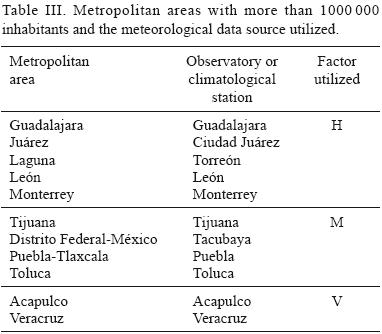
<body><![CDATA[<p align="justify"><font face="verdana" size="2">For the cities of Hermosillo and Veracruz, comfort polls were carried out with simultaneous measurements of the hygrothermic conditions in the environment of those polled. By comparing the results of effective temperature at the time of the poll and the receipts of electrical consumption, it was possible to adjust the previously estimated datum. Thus, the cities studied in this work were catalogued in three types: those with warm dry climates, approaching the behavior of Hermosillo (H); the hot and humid ones, similar to that of Veracruz (V), and the intermediate ones (M), as shown in <a href="#t3">Table III</a>.</font></p>     <p align="center"><font face="verdana" size="2"><a name="t3"></a></font></p>     <p align="center"><font face="verdana" size="2"><img src="/img/revistas/atm/v24n1/a3t3.jpg"></font></p>     <p align="justify"><font face="verdana" size="2"><a href="/img/revistas/atm/v24n1/a3t4.jpg" target="_blank">Table IV</a> shows the factors for converting the coold&#150;degree&#150;hours into electrical consumption for the three types indicated in <a href="#t3">Table III</a> (Garc&iacute;a, 2008).</font></p>     <p align="justify"><font face="verdana" size="2">In this way the increases in electrical consumption per domestic user were obtained.</font></p>     <p align="justify"><font face="verdana" size="2">A knowledge of demographic conditions is indispensable in order to speculate on future electrical consumption. Since each inhabitant requires a certain amount of vital space, it becomes evident that the nation's population cannot continue growing indefinitely in the future. Results obtained from various sources seem to indicate that, in the long term (after the year 2050), the national population will approach a state of zero growth, stabilizing between 175 and 250 million in habitants (Alonso <i>et al</i>., 1994).</font></p>     <p align="justify"><font face="verdana" size="2">By applying the procedure of Rodr&iacute;guez <i>et al.</i> (2004) to the increase per user, it was considered that each current tap (user) would provide service for four persons. In this way the future increases in electrical consumption can be estimated through Eqs. (11) and (12). The results are shown in <a href="/img/revistas/atm/v24n1/a3f2.jpg" target="_blank">Figure 2</a>.</font></p>     <p align="center"><font face="verdana" size="2"><img src="/img/revistas/atm/v24n1/a3s12.jpg"></font></p>     <p align="justify"><font face="verdana" size="2">where <i>ITC </i>is the increase in total consumption, &#916;<i>P/</i>4 is the increase in users, <i>C<Sub>present</Sub></i> is the average consumption at present and &#916;<i>C</i> is the increase in electrical consumption due to climatic change.</font></p>     <p align="justify"><font face="verdana" size="2">&nbsp;</font></p>     ]]></body>
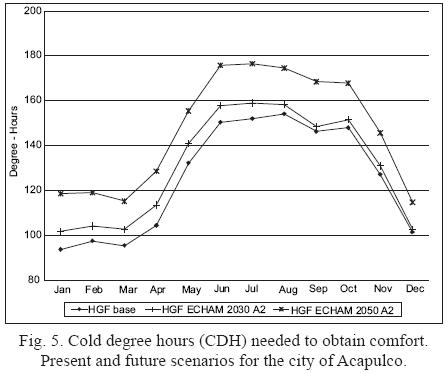
<body><![CDATA[<p align="justify"><font face="verdana" size="2"><b>3.	Results</b></font></p>     <p align="justify"><font face="verdana" size="2"><i>3.1 Climatograms</i></font></p>     <p align="justify"><font face="verdana" size="2">The comparative analysis of the climatograms shows differences regarding thermal sensations in the majority of cities for all of the models and scenarios utilized in respect to the base scenario. In some cases, the warming appears to be beneficial for those cities with a very cool climate (Toluca) or with very cold winters, in which the demand for heating energy might decrease. <a href="/img/revistas/atm/v24n1/a3f1.jpg" target="_blank">Figs. 1</a>, <a href="/img/revistas/atm/v24n1/a3f2.jpg" target="_blank">2</a>, <a href="/img/revistas/atm/v24n1/a3f3.jpg" target="_blank">3</a>, <a href="/img/revistas/atm/v24n1/a3f4.jpg" target="_blank">4</a> show the climatograms of four cities representing a hot humid climate (Acapulco), a hot dry one (Monterrey), a temperate one (M&eacute;xico City) and a cool one (Toluca).</font></p>     <p align="justify"><font face="verdana" size="2">Upon comparing the conditions of the base scenario with future projections, the four representative cities show the tendencies of thermal sensations under the effects of global climatic change, as well as local change due to the effect of urbanization. In the case of Acapulco (<a href="/img/revistas/atm/v24n1/a3f1.jpg" target="_blank">Fig. 1</a>), the thermal sensation corresponding to "hot," which extended over a large part of the nocturnal period during the summer months in the base scenario, disappears before an important expansion of "very hot." The sensation of comfort represented by "neutral" disappears entirely under the conditions of scenario 2050. The effects on the population resulting there from are evident, as will be seen later on from the increase in electrical consumption in an attempt to maintain a situation of comfort.</font></p>     <p align="justify"><font face="verdana" size="2">The conditions in the city of Monterrey (<a href="/img/revistas/atm/v24n1/a3f2.jpg" target="_blank">Fig. 2</a>) will vary from "oppressively hot" to "extremely hot " for only a couple of hours in one month of summer in the scenario for 2050; the importance of this change resides in a longer period of heat that may make the nighttime oppressive and highly uncomfortable. The winter months will be reduced and will probably become the most comfortable season of the year.</font></p>     <p align="justify"><font face="verdana" size="2">M&eacute;xico City (<a href="/img/revistas/atm/v24n1/a3f3.jpg" target="_blank">Fig. 3</a>) will lose its cool and comfortable status to become comfortable and warmer in the summers of future scenarios. Fewer hours of cold due to a thermal neutrality in winter are likely to make the city more comfortable; during summer and at earlier hours, however, the warmth of the present scenario will increase noticeably, but apparently without becoming oppressive or exhausting. This increase in the city's temperature may then lead to an ever greater use of cooling methods that will result in a higher consumption of energy.</font></p>     <p align="justify"><font face="verdana" size="2">Toluca will be the only city in M&eacute;xico having a population greater than a million inhabitants in which the effect of global warming will be beneficial regarding the amount of comfort that the climate can offer (<a href="/img/revistas/atm/v24n1/a3f4.jpg" target="_blank">Fig. 4</a>). The extremely cold mornings of winter will tend to disappear and the environment will become more comfortable; even the midday warmth of summer will probably be extended into October. It may be, then, that the consumption of energy for heating will be reduced.</font></p>     <p align="justify"><font face="verdana" size="2">These results give an idea of the possibilities of discomfort in a not&#150;too&#150;distant future. They also indicate the requirements and demands of a population that will experience a growing need of comfortable environments, which will lead to an increase in the consumption of electrical energy for cooling. After an analysis of the climatograms elaborated for the circulation models that were considered (not shown for the eleven cities), ECHAM perhaps shows the extreme values, but without any important differences from the rest.</font></p>     <p align="justify"><font face="verdana" size="2">The effects of the temperature increases associated with climatic change and the heat island on the level of comfort make it necessary to calculate the <i>HDH</i> and <i>CDH</i>. The following results are presented for the present conditions and the scenarios for 2030 and 2050, considering the model MPI ECHAM 5 for the cities of Acapulco, Monterrey and M&eacute;xico City as representing the hot&#150;humid, hot&#150;dry and temperate climates, respectively.</font></p>     <p align="justify"><font face="verdana" size="2"><a href="#f5">Figures 5</a>, <a href="/img/revistas/atm/v24n1/a3f6.jpg" target="_blank">6</a>, <a href="/img/revistas/atm/v24n1/a3f7.jpg" target="_blank">7</a> show the <i>HDH</i> and <i>CDH</i> required to attain levels of comfort in average monthly conditions. In <a href="#f5">Figure 5</a> we see that for the city of Acapulco the cooling needs are between 100 and 180 <i>CDH</i>, with no heating required at any time of the year.</font></p>     ]]></body>
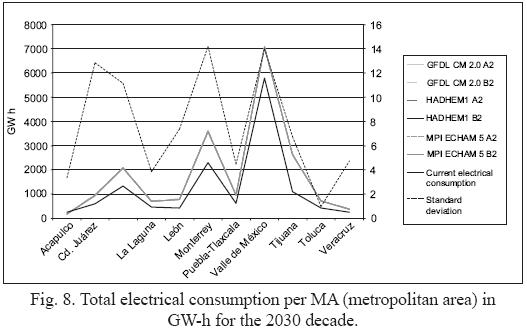
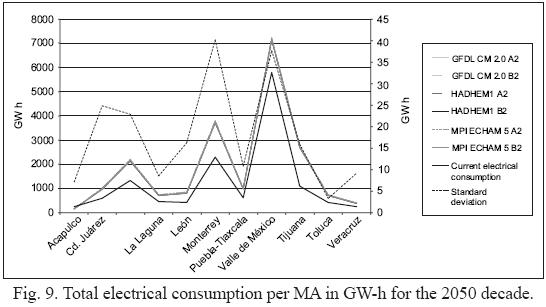
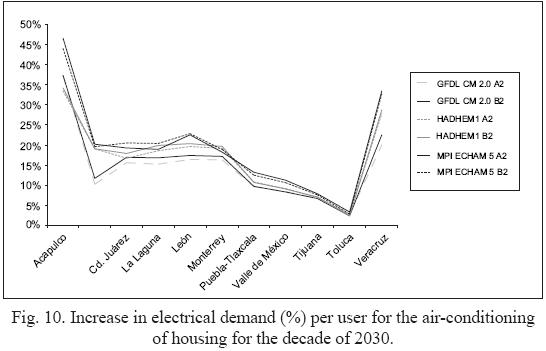
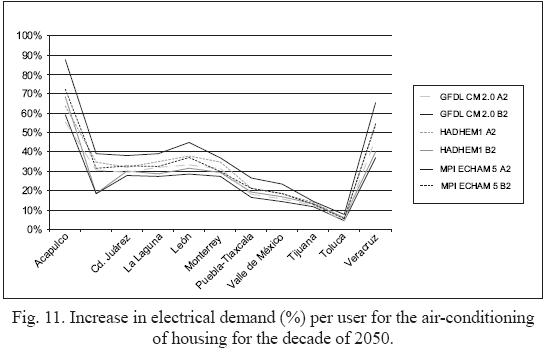
<body><![CDATA[<p align="center"><font face="verdana" size="2"><a name="f5"></a></font></p>     <p align="center"><font face="verdana" size="2"><img src="/img/revistas/atm/v24n1/a3f5.jpg"></font></p>     <p align="justify"><font face="verdana" size="2">In the city of Monterrey (<a href="/img/revistas/atm/v24n1/a3f6.jpg" target="_blank">Fig. 6</a>) we observe that, during the winter season, the two situations can occur, but at different hours of the day. It is then that the <i>HDH</i> reach their maximum value, only to disappear completely in the middle of spring and all of summer (<i>HDH</i> = 0). The <i>CDH</i>, on the other hand, increase drastically during summer.</font></p>     <p align="justify"><font face="verdana" size="2">In M&eacute;xico City (<a href="/img/revistas/atm/v24n1/a3f7.jpg" target="_blank">Fig. 7</a>) the heating requirements are, and will continue to be, greater than those of cooling in future scenarios, mainly during the cool months of the year (October to February), considered as winter.</font></p>     <p align="justify"><font face="verdana" size="2">These cities, along with many others, will be affected by the warming tendency illustrated by the ECHAM model, in this case, in the projections for 2030 and 2050. Acapulco is expected to increase its average conditions; Monterrey will reduce its needs of <i>HDH</i> and will increase those of <i>CDH</i>; finally, M&eacute;xico City will be able to reduce its heating needs, which will make it more comfortable as the cold of winter diminishes.</font></p>     <p align="justify"><font face="verdana" size="2"><i>3.2 Scenarios of electrical consumption</i></font></p>     <p align="justify"><font face="verdana" size="2"><a href="#f8">Figure 8</a> shows the scenarios of expected electrical consumption per metropolitan area obtained for 2030; from these it can be seen that Monterrey, Guadalajara and the Valley of M&eacute;xico are the greatest consumers, due mainly to the growing demand of their populations. In contrast, a decrease in population is expected for the metropolitan area (MA) of Acapulco, which would diminish the total demand. The lower line shows the present consumption for each MA and the electrical scenarios of the models; their emission scenarios can be observed superposed on the middle line, while the dotted line shows the standard deviation among the different scenarios of each model.</font></p>     <p align="center"><font face="verdana" size="2"><a name="f8"></a></font></p>     <p align="center"><font face="verdana" size="2"><img src="/img/revistas/atm/v24n1/a3f8.jpg"></font></p>     <p align="justify"><font face="verdana" size="2">Similarly, <a href="#f9">Figure 9</a> shows the electrical scenarios for the decade of 2050, but in these, the population is considered as being stabilized, so the only increase will be due to the expected global warming. Notwithstanding its similarity to <a href="#f8">Figure 8</a>, here we observe a slight increase and a greater variability among the results obtained from each model with their respective scenarios.</font></p>     ]]></body>
<body><![CDATA[<p align="center"><font face="verdana" size="2"><a name="f9"></a></font></p>     <p align="center"><font face="verdana" size="2"><img src="/img/revistas/atm/v24n1/a3f9.jpg"></font></p>     <p align="justify"><font face="verdana" size="2"><a href="#f10">Figure 10</a> shows the percentile increase per user for the 2030s in different MA; here, a higher electrical consumption is expected for coastal cities like Acapulco and Veracruz in comparison with other cities. On account of the methodology employed, no significant increase is expected for the MA of Toluca. It should be noted that the highest results were obtained from the ECHAM model and the lowest ones from the GFDL model.</font></p>     <p align="center"><font face="verdana" size="2"><a name="f10"></a></font></p>     <p align="center"><font face="verdana" size="2"><img src="/img/revistas/atm/v24n1/a3f10.jpg"></font></p>     <p align="justify"><font face="verdana" size="2">The percentile increase per user for the 2050 in the different MA shows that a greater tendency is expected for Acapulco and Veracruz, very similar to the previous one but with a slight increase in the results, as shown in <a href="#f11">Figure 11</a>.</font></p>     <p align="center"><font face="verdana" size="2"><a name="f11"></a></font></p>     <p align="center"><font face="verdana" size="2"><img src="/img/revistas/atm/v24n1/a3f11.jpg"></font></p>     <p align="justify"><font face="verdana" size="2">&nbsp;</font></p>     <p align="justify"><font face="verdana" size="2"><b>4.	Final comments</b></font></p>     ]]></body>
<body><![CDATA[<p align="justify"><font face="verdana" size="2">A practical methodology for generating bioclimatic urban scenarios in the face of changing climatic conditions has been demonstrated. The thermal increases expected from global warming and those induced by urbanization were considered. Calculating the conditions of neutrality for the base scenario and for future ones, made it possible to take human acclimatization into account. The urban warming estimated from the base scenario into the first quarter of the century runs from 1.0 to 1.6 &deg;C, depending on the size of the urban area, that is, it is comparable to global warming.</font></p>     <p align="justify"><font face="verdana" size="2">The final result can be seen from the expected electrical consumption. <a href="#f10">Figures 10</a> and <a href="#f11">11</a> show the increases per user in electrical demand in the studied metropolitan areas for the decades of 2030 and 2050. The total increase in consumption for these urban areas will be 20 000 GW&#150;h for 2030 and 20 540 GW&#150;h for 2050. It should be remembered that in estimating these increases, both global and urban warming as well as population growth were taken into account, but the effect of acclimatization was discounted. The most important increases will occur at the hottest sites, Acapulco and Veracruz.</font></p>     <p align="justify"><font face="verdana" size="2">Finally, it should be recognized that in this analysis an improvement in the technology for acclimating buildings, which could lower the estimates presented here for future scenarios, has not been considered.</font></p>     <p align="justify"><font face="verdana" size="2">&nbsp;</font></p>     <p align="justify"><font face="verdana" size="2"><b>Acknowledgments</b></font></p>     <p align="justify"><font face="verdana" size="2">This paper was supported by the project Generation of climatic change settings at a regional scale, for 2030 and 2050; <i>Evaluation of the vulnerability and the options of adaptation of human settlements, biodiversity, and the livestock, forestry and fishing sectors in the face of impacts from climatic variability and change; and training and technical assistance for state specialists who will elaborate state programs for climatic change</i>. This final report is part of the research carried out by the Fourth National Communication of M&eacute;xico before the United Nations Framework Convention on Climate Change. Guillermo Garc&iacute;a Grijalba and Mario Casasola helped in realizing the calculations. The translation from Spanish is of Mr. Warren Roger Haid Holzinger, from the Universidad Veracruzana (M&eacute;xico).</font></p>     <p align="justify"><font face="verdana" size="2">&nbsp;</font></p>     <p align="justify"><font face="verdana" size="2"><b>References</b></font></p>     <!-- ref --><p align="justify"><font face="verdana" size="2">Alonso A., R. Cruz and E. Fugarolas, 1994. Futuros de los recursos energ&eacute;ticos, In: <i>El sector el&eacute;ctrico de M&eacute;xico</i> (D. Res&eacute;ndiz N&uacute;&ntilde;ez coordinator), Comisi&oacute;n Federal de Electricidad and Fondo de Cultura Econ&oacute;mica, M&eacute;xico, 427&#150;475.    &nbsp;&nbsp;&nbsp;&nbsp;&nbsp;&nbsp;&nbsp;&nbsp;[&#160;<a href="javascript:void(0);" onclick="javascript: window.open('/scielo.php?script=sci_nlinks&ref=1284893&pid=S0187-6236201100010000300001&lng=','','width=640,height=500,resizable=yes,scrollbars=1,menubar=yes,');">Links</a>&#160;]<!-- end-ref --></font></p>     ]]></body>
<body><![CDATA[<!-- ref --><p align="justify"><font face="verdana" size="2">ANSI/ASHRAE 55, 2004. Thermal Environmental Conditions for Human Occupancy. American Society of Heating, Refrigerating, and Air&#150;Conditioning Engineers / 16&#150;Apr&#150;2004 / 30 pages.    &nbsp;&nbsp;&nbsp;&nbsp;&nbsp;&nbsp;&nbsp;&nbsp;[&#160;<a href="javascript:void(0);" onclick="javascript: window.open('/scielo.php?script=sci_nlinks&ref=1284895&pid=S0187-6236201100010000300002&lng=','','width=640,height=500,resizable=yes,scrollbars=1,menubar=yes,');">Links</a>&#160;]<!-- end-ref --></font></p>     <!-- ref --><p align="justify"><font face="verdana" size="2">Arnfield A. J., 2003. Two decades of urban climate research: a review of turbulence, exchanges of energy and water, and the urban heat island. <i>Int. J. Climatol. </i><B>23</B>, 1&#150;26.    &nbsp;&nbsp;&nbsp;&nbsp;&nbsp;&nbsp;&nbsp;&nbsp;[&#160;<a href="javascript:void(0);" onclick="javascript: window.open('/scielo.php?script=sci_nlinks&ref=1284897&pid=S0187-6236201100010000300003&lng=','','width=640,height=500,resizable=yes,scrollbars=1,menubar=yes,');">Links</a>&#160;]<!-- end-ref --></font></p>     <!-- ref --><p align="justify"><font face="verdana" size="2">Auliciems A. and R. de Dear, 1986. Air&#150; conditioning in Australia: Human thermal factors. <i>Architectural Science Review</i> <B>29</B>, 67&#150;75.    &nbsp;&nbsp;&nbsp;&nbsp;&nbsp;&nbsp;&nbsp;&nbsp;[&#160;<a href="javascript:void(0);" onclick="javascript: window.open('/scielo.php?script=sci_nlinks&ref=1284899&pid=S0187-6236201100010000300004&lng=','','width=640,height=500,resizable=yes,scrollbars=1,menubar=yes,');">Links</a>&#160;]<!-- end-ref --></font></p>     <!-- ref --><p align="justify"><font face="verdana" size="2">Auliciems A. and S. Szokolay, 1997. <i>Thermal Comfort</i>. Notes of Passive and Low Energy Architecture International. No. 3. Brisbane: PLEA &#150; University of Queensland.    &nbsp;&nbsp;&nbsp;&nbsp;&nbsp;&nbsp;&nbsp;&nbsp;[&#160;<a href="javascript:void(0);" onclick="javascript: window.open('/scielo.php?script=sci_nlinks&ref=1284901&pid=S0187-6236201100010000300005&lng=','','width=640,height=500,resizable=yes,scrollbars=1,menubar=yes,');">Links</a>&#160;]<!-- end-ref --></font></p>     <!-- ref --><p align="justify"><font face="verdana" size="2">Bicknell J., D. Dodman and D. Satterhwaite, 2009. <i>Adapting cities to climate change. Understanding and addressing the development challenges. </i>Earthscan, London, 397 pp.    &nbsp;&nbsp;&nbsp;&nbsp;&nbsp;&nbsp;&nbsp;&nbsp;[&#160;<a href="javascript:void(0);" onclick="javascript: window.open('/scielo.php?script=sci_nlinks&ref=1284903&pid=S0187-6236201100010000300006&lng=','','width=640,height=500,resizable=yes,scrollbars=1,menubar=yes,');">Links</a>&#160;]<!-- end-ref --></font></p>     ]]></body>
<body><![CDATA[<!-- ref --><p align="justify"><font face="verdana" size="2">CONAPO, 2009. Proyecciones de la poblaci&oacute;n de M&eacute;xico 2005&#150;2050. <a href="http://www.conapo.gob.mx/index.php?option=com_content&view=article&id=36&Itemid=234" target="_blank">http://www.conapo.gob.mx/index.php?option=com_content & view=article & id=36 & Itemid=234</a>. July 2009.    &nbsp;&nbsp;&nbsp;&nbsp;&nbsp;&nbsp;&nbsp;&nbsp;[&#160;<a href="javascript:void(0);" onclick="javascript: window.open('/scielo.php?script=sci_nlinks&ref=1284905&pid=S0187-6236201100010000300007&lng=','','width=640,height=500,resizable=yes,scrollbars=1,menubar=yes,');">Links</a>&#160;]<!-- end-ref --></font></p>     <!-- ref --><p align="justify"><font face="verdana" size="2">Conde C., B. Mart&iacute;nez, O. S&aacute;nchez, F. Estrada, A. Fern&aacute;ndez, J. Zavala and C. Gay, 2008. Escenarios de cambio clim&aacute;tico (2030 y 2050) para M&eacute;xico y Centro Am&eacute;rica. Temperatura y Precipitaci&oacute;n. &#91;On line document&#93;. <a href="http://www.atmosfera.unam.mx/gcclimatico/index.php?option=com_content&view=article&id=61&Itemid=74" target="_blank">http://www.atmosfera.unam.mx/gcclimatico/index.php?option=com_content & view=article & id=61 & Itemid=74</a>.    &nbsp;&nbsp;&nbsp;&nbsp;&nbsp;&nbsp;&nbsp;&nbsp;[&#160;<a href="javascript:void(0);" onclick="javascript: window.open('/scielo.php?script=sci_nlinks&ref=1284907&pid=S0187-6236201100010000300008&lng=','','width=640,height=500,resizable=yes,scrollbars=1,menubar=yes,');">Links</a>&#160;]<!-- end-ref --></font></p>     <!-- ref --><p align="justify"><font face="verdana" size="2">Epstein Y. and D. S. Moran, 2006. Thermal comfort and the heat stress indices. <i>Ind. Health</i>, <B>44</B>, 388&#150;398.    &nbsp;&nbsp;&nbsp;&nbsp;&nbsp;&nbsp;&nbsp;&nbsp;[&#160;<a href="javascript:void(0);" onclick="javascript: window.open('/scielo.php?script=sci_nlinks&ref=1284909&pid=S0187-6236201100010000300009&lng=','','width=640,height=500,resizable=yes,scrollbars=1,menubar=yes,');">Links</a>&#160;]<!-- end-ref --></font></p>     <!-- ref --><p align="justify"><font face="verdana" size="2">Garc&iacute;a&#150; Grijalva G., 2008. Equivalencias de consumos el&eacute;ctricos dom&eacute;sticos a &iacute;ndices de bioclima humano para siete ciudades c&aacute;lidas de M&eacute;xico. Bachetor thesis on Atmosferic Sciences. Universidad Veracruzana. 105 pp.    &nbsp;&nbsp;&nbsp;&nbsp;&nbsp;&nbsp;&nbsp;&nbsp;[&#160;<a href="javascript:void(0);" onclick="javascript: window.open('/scielo.php?script=sci_nlinks&ref=1284911&pid=S0187-6236201100010000300010&lng=','','width=640,height=500,resizable=yes,scrollbars=1,menubar=yes,');">Links</a>&#160;]<!-- end-ref --></font></p>     <!-- ref --><p align="justify"><font face="verdana" size="2">INEGI, 2005. II Conteo de poblaci&oacute;n y vivienda 2005. Instituto Nacional de Estad&iacute;stica y Geograf&iacute;a. M&eacute;xico.    &nbsp;&nbsp;&nbsp;&nbsp;&nbsp;&nbsp;&nbsp;&nbsp;[&#160;<a href="javascript:void(0);" onclick="javascript: window.open('/scielo.php?script=sci_nlinks&ref=1284913&pid=S0187-6236201100010000300011&lng=','','width=640,height=500,resizable=yes,scrollbars=1,menubar=yes,');">Links</a>&#160;]<!-- end-ref --></font></p>     ]]></body>
<body><![CDATA[<!-- ref --><p align="justify"><font face="verdana" size="2">J&aacute;uregui E. and A. Tejeda&#150;Mart&iacute;nez, 2004. Cuatro d&eacute;cadas de climatolog&iacute;a urbana en M&eacute;xico. <i>Estudios de Arquitectura Bioclim&aacute;tica,</i> VI, 163&#150;178. UAM Iztapalapa and Editorial Limusa, M&eacute;xico.    &nbsp;&nbsp;&nbsp;&nbsp;&nbsp;&nbsp;&nbsp;&nbsp;[&#160;<a href="javascript:void(0);" onclick="javascript: window.open('/scielo.php?script=sci_nlinks&ref=1284915&pid=S0187-6236201100010000300012&lng=','','width=640,height=500,resizable=yes,scrollbars=1,menubar=yes,');">Links</a>&#160;]<!-- end-ref --></font></p>     <!-- ref --><p align="justify"><font face="verdana" size="2">Luyando E., A. Tejeda, M. Casasola, G. Garc&iacute;a and E. Ja&uacute;regui, 2009. Asentamientos Humanos. Reporte Final del proyecto: Generaci&oacute;n de Escenarios de Cambio Clim&aacute;tico a Escala Regional, al 2030 y 2050; Evaluaci&oacute;n de la Vulnerabilidad y Opciones de Adaptaci&oacute;n de los Asentamientos Humanos, la Biodiversidad y los Sectores Ganadero, Forestal y Pesquero, ante los Impactos de la Variabilidad y el Cambio Clim&aacute;ticos; y Fomento de Capacidades y Asistencia T&eacute;cnica a Especialistas Estatales que Elaborar&aacute;n Programas Estatales de Cambio Clim&aacute;tico. INE/UNAM. M&eacute;xico, DF. 25 pp.    &nbsp;&nbsp;&nbsp;&nbsp;&nbsp;&nbsp;&nbsp;&nbsp;[&#160;<a href="javascript:void(0);" onclick="javascript: window.open('/scielo.php?script=sci_nlinks&ref=1284917&pid=S0187-6236201100010000300013&lng=','','width=640,height=500,resizable=yes,scrollbars=1,menubar=yes,');">Links</a>&#160;]<!-- end-ref --></font></p>     <!-- ref --><p align="justify"><font face="verdana" size="2">Mor&aacute;n D. S. and Y. Epstein, 2006. Evaluation of the Environmental Stress Index (ESI) for hot/dry and hot/web climates. <i>Ind. Health</i> <B>44</B>, 399&#150;403.    &nbsp;&nbsp;&nbsp;&nbsp;&nbsp;&nbsp;&nbsp;&nbsp;[&#160;<a href="javascript:void(0);" onclick="javascript: window.open('/scielo.php?script=sci_nlinks&ref=1284919&pid=S0187-6236201100010000300014&lng=','','width=640,height=500,resizable=yes,scrollbars=1,menubar=yes,');">Links</a>&#160;]<!-- end-ref --></font></p>     <!-- ref --><p align="justify"><font face="verdana" size="2">Missenard A. 1937. <i>L'Homme et le climat</i>, Eyrolles, Par&iacute;s.    &nbsp;&nbsp;&nbsp;&nbsp;&nbsp;&nbsp;&nbsp;&nbsp;[&#160;<a href="javascript:void(0);" onclick="javascript: window.open('/scielo.php?script=sci_nlinks&ref=1284921&pid=S0187-6236201100010000300015&lng=','','width=640,height=500,resizable=yes,scrollbars=1,menubar=yes,');">Links</a>&#160;]<!-- end-ref --></font></p>     <!-- ref --><p align="justify"><font face="verdana" size="2">Nicol J. F., 2004. Adaptive thermal comfort standards in the hot&#150;humid tropics. <i>Ener. Buildings</i> <B>36</B>, 628&#150;637.    &nbsp;&nbsp;&nbsp;&nbsp;&nbsp;&nbsp;&nbsp;&nbsp;[&#160;<a href="javascript:void(0);" onclick="javascript: window.open('/scielo.php?script=sci_nlinks&ref=1284923&pid=S0187-6236201100010000300016&lng=','','width=640,height=500,resizable=yes,scrollbars=1,menubar=yes,');">Links</a>&#160;]<!-- end-ref --></font></p>     ]]></body>
<body><![CDATA[<!-- ref --><p align="justify"><font face="verdana" size="2">Parsons K., 2006. Heat stress Standard ISO 7243 and its global application. <i>Ind. Health</i>, <B>44</B>, 368&#150;379.    &nbsp;&nbsp;&nbsp;&nbsp;&nbsp;&nbsp;&nbsp;&nbsp;[&#160;<a href="javascript:void(0);" onclick="javascript: window.open('/scielo.php?script=sci_nlinks&ref=1284925&pid=S0187-6236201100010000300017&lng=','','width=640,height=500,resizable=yes,scrollbars=1,menubar=yes,');">Links</a>&#160;]<!-- end-ref --></font></p>     <!-- ref --><p align="justify"><font face="verdana" size="2">Rodr&iacute;guez L., A. Tejeda&#150;Mart&iacute;nez and G. Utrera&#150;Z&aacute;rate, 2004. Demanda el&eacute;ctrica para enfriamiento residencial en el estado de Veracruz ante la duplicaci&oacute;n de CO<Sub>2 </Sub>atmosf&eacute;rico. <i>Estudios de Arquitectura Bioclim&aacute;tica,</i> VI, 325&#150;338.    &nbsp;&nbsp;&nbsp;&nbsp;&nbsp;&nbsp;&nbsp;&nbsp;[&#160;<a href="javascript:void(0);" onclick="javascript: window.open('/scielo.php?script=sci_nlinks&ref=1284927&pid=S0187-6236201100010000300018&lng=','','width=640,height=500,resizable=yes,scrollbars=1,menubar=yes,');">Links</a>&#160;]<!-- end-ref --></font></p>     <!-- ref --><p align="justify"><font face="verdana" size="2">Tan J., Y. Zheng, X. Tang, Ch. Guo, L. Li, G. Song, X. Zhen, D. Yuan, A. J. Kalkstein, F. Li and H. Chen, 2009. The urban heat island and its impact to heat wave and human health in Shanghai. <i>Int. J. Biometeorol. </i>DOI 10.1007/s00484&#150;009&#150;0256&#150;x.    &nbsp;&nbsp;&nbsp;&nbsp;&nbsp;&nbsp;&nbsp;&nbsp;[&#160;<a href="javascript:void(0);" onclick="javascript: window.open('/scielo.php?script=sci_nlinks&ref=1284929&pid=S0187-6236201100010000300019&lng=','','width=640,height=500,resizable=yes,scrollbars=1,menubar=yes,');">Links</a>&#160;]<!-- end-ref --></font></p>     <!-- ref --><p align="justify"><font face="verdana" size="2">Tejeda M. A., 1991. An exponential model of the curve of mean monthly hourly air temperature. <i>Atm&oacute;sfera</i> <B>4</B>, 139&#150;144.    &nbsp;&nbsp;&nbsp;&nbsp;&nbsp;&nbsp;&nbsp;&nbsp;[&#160;<a href="javascript:void(0);" onclick="javascript: window.open('/scielo.php?script=sci_nlinks&ref=1284931&pid=S0187-6236201100010000300020&lng=','','width=640,height=500,resizable=yes,scrollbars=1,menubar=yes,');">Links</a>&#160;]<!-- end-ref --></font></p>     <!-- ref --><p align="justify"><font face="verdana" size="2">Tejeda A. and D. Rivas, 2001. Un escenario de bioclima humano en ciudades del sur de M&eacute;xico, bajo condiciones de 2CO<Sub>2 </Sub>atmosf&eacute;rico. In: <i>El tiempo del clima</i> (A. J. P&eacute;rez&#150;Cueva, E. L&oacute;pez&#150;Baeza and J. Tamayo&#150;Carmona, Eds.). Asociaci&oacute;n Espa&ntilde;ola de Climatolog&iacute;a Serie A, No. 2, 574, 551&#150;562<i>.    &nbsp;&nbsp;&nbsp;&nbsp;&nbsp;&nbsp;&nbsp;&nbsp;[&#160;<a href="javascript:void(0);" onclick="javascript: window.open('/scielo.php?script=sci_nlinks&ref=1284933&pid=S0187-6236201100010000300021&lng=','','width=640,height=500,resizable=yes,scrollbars=1,menubar=yes,');">Links</a>&#160;]<!-- end-ref --></i></font></p>     ]]></body>
<body><![CDATA[<!-- ref --><p align="justify"><font face="verdana" size="2">Zhou Y. and J. M. Shepherd, 2009. Atlanta's urban heat island under extreme heat conditions and potential mitigation strategies. <i>Nat. Hazards</i>, DOI 10.1007/s11069&#150;009&#150;9406&#150;z.    &nbsp;&nbsp;&nbsp;&nbsp;&nbsp;&nbsp;&nbsp;&nbsp;[&#160;<a href="javascript:void(0);" onclick="javascript: window.open('/scielo.php?script=sci_nlinks&ref=1284935&pid=S0187-6236201100010000300022&lng=','','width=640,height=500,resizable=yes,scrollbars=1,menubar=yes,');">Links</a>&#160;]<!-- end-ref --></font></p>      ]]></body><back>
<ref-list>
<ref id="B1">
<nlm-citation citation-type="book">
<person-group person-group-type="author">
<name>
<surname><![CDATA[Alonso]]></surname>
<given-names><![CDATA[A]]></given-names>
</name>
<name>
<surname><![CDATA[Cruz]]></surname>
<given-names><![CDATA[R]]></given-names>
</name>
<name>
<surname><![CDATA[Fugarolas]]></surname>
<given-names><![CDATA[E]]></given-names>
</name>
</person-group>
<article-title xml:lang="es"><![CDATA[Futuros de los recursos energéticos]]></article-title>
<person-group person-group-type="editor">
<name>
<surname><![CDATA[Reséndiz Núñez]]></surname>
<given-names><![CDATA[D]]></given-names>
</name>
</person-group>
<source><![CDATA[El sector eléctrico de México]]></source>
<year>1994</year>
<page-range>427-475</page-range><publisher-name><![CDATA[Comisión Federal de ElectricidadFondo de Cultura Económica]]></publisher-name>
</nlm-citation>
</ref>
<ref id="B2">
<nlm-citation citation-type="book">
<collab>ANSI</collab>
<collab>ASHRAE 55</collab>
<source><![CDATA[Thermal Environmental Conditions for Human Occupancy]]></source>
<year>2004</year>
<page-range>30</page-range><publisher-name><![CDATA[American Society of Heating, Refrigerating, and Air-Conditioning Engineers]]></publisher-name>
</nlm-citation>
</ref>
<ref id="B3">
<nlm-citation citation-type="journal">
<person-group person-group-type="author">
<name>
<surname><![CDATA[Arnfield]]></surname>
<given-names><![CDATA[A. J]]></given-names>
</name>
</person-group>
<article-title xml:lang="en"><![CDATA[Two decades of urban climate research: a review of turbulence, exchanges of energy and water, and the urban heat island]]></article-title>
<source><![CDATA[Int. J. Climatol]]></source>
<year>2003</year>
<volume>23</volume>
<page-range>1-26</page-range></nlm-citation>
</ref>
<ref id="B4">
<nlm-citation citation-type="journal">
<person-group person-group-type="author">
<name>
<surname><![CDATA[Auliciems]]></surname>
<given-names><![CDATA[A]]></given-names>
</name>
<name>
<surname><![CDATA[de Dear]]></surname>
<given-names><![CDATA[R]]></given-names>
</name>
</person-group>
<article-title xml:lang="en"><![CDATA[Air- conditioning in Australia: Human thermal factors]]></article-title>
<source><![CDATA[Architectural Science Review]]></source>
<year>1986</year>
<volume>29</volume>
<page-range>67-75</page-range></nlm-citation>
</ref>
<ref id="B5">
<nlm-citation citation-type="book">
<person-group person-group-type="author">
<name>
<surname><![CDATA[Auliciems]]></surname>
<given-names><![CDATA[A]]></given-names>
</name>
<name>
<surname><![CDATA[Szokolay]]></surname>
<given-names><![CDATA[S]]></given-names>
</name>
</person-group>
<source><![CDATA[Thermal Comfort]]></source>
<year>1997</year>
<volume>3</volume>
<publisher-loc><![CDATA[Brisbane ]]></publisher-loc>
<publisher-name><![CDATA[PLEAUniversity of Queensland]]></publisher-name>
</nlm-citation>
</ref>
<ref id="B6">
<nlm-citation citation-type="book">
<person-group person-group-type="author">
<name>
<surname><![CDATA[Bicknell]]></surname>
<given-names><![CDATA[J]]></given-names>
</name>
<name>
<surname><![CDATA[Dodman]]></surname>
<given-names><![CDATA[D]]></given-names>
</name>
<name>
<surname><![CDATA[Satterhwaite]]></surname>
<given-names><![CDATA[D]]></given-names>
</name>
</person-group>
<source><![CDATA[Adapting cities to climate change: Understanding and addressing the development challenges]]></source>
<year>2009</year>
<page-range>397</page-range><publisher-loc><![CDATA[London ]]></publisher-loc>
<publisher-name><![CDATA[Earthscan]]></publisher-name>
</nlm-citation>
</ref>
<ref id="B7">
<nlm-citation citation-type="">
<collab>CONAPO</collab>
<source><![CDATA[Proyecciones de la población de México 2005-2050]]></source>
<year>2009</year>
</nlm-citation>
</ref>
<ref id="B8">
<nlm-citation citation-type="">
<person-group person-group-type="author">
<name>
<surname><![CDATA[Conde]]></surname>
<given-names><![CDATA[C]]></given-names>
</name>
<name>
<surname><![CDATA[Martínez]]></surname>
<given-names><![CDATA[B]]></given-names>
</name>
<name>
<surname><![CDATA[Sánchez]]></surname>
<given-names><![CDATA[O]]></given-names>
</name>
<name>
<surname><![CDATA[Estrada]]></surname>
<given-names><![CDATA[F]]></given-names>
</name>
<name>
<surname><![CDATA[Fernández]]></surname>
<given-names><![CDATA[A]]></given-names>
</name>
<name>
<surname><![CDATA[Zavala]]></surname>
<given-names><![CDATA[J]]></given-names>
</name>
<name>
<surname><![CDATA[Gay]]></surname>
<given-names><![CDATA[C]]></given-names>
</name>
</person-group>
<source><![CDATA[Escenarios de cambio climático (2030 y 2050) para México y Centro América. Temperatura y Precipitación]]></source>
<year>2008</year>
</nlm-citation>
</ref>
<ref id="B9">
<nlm-citation citation-type="journal">
<person-group person-group-type="author">
<name>
<surname><![CDATA[Epstein]]></surname>
<given-names><![CDATA[Y]]></given-names>
</name>
<name>
<surname><![CDATA[Moran]]></surname>
<given-names><![CDATA[D. S]]></given-names>
</name>
</person-group>
<article-title xml:lang="en"><![CDATA[Thermal comfort and the heat stress indices]]></article-title>
<source><![CDATA[Ind. Health]]></source>
<year>2006</year>
<volume>44</volume>
<page-range>388-398</page-range></nlm-citation>
</ref>
<ref id="B10">
<nlm-citation citation-type="">
<person-group person-group-type="author">
<name>
<surname><![CDATA[García- Grijalva]]></surname>
<given-names><![CDATA[G]]></given-names>
</name>
</person-group>
<source><![CDATA[Equivalencias de consumos eléctricos domésticos a índices de bioclima humano para siete ciudades cálidas de México]]></source>
<year>2008</year>
<page-range>105</page-range></nlm-citation>
</ref>
<ref id="B11">
<nlm-citation citation-type="book">
<collab>INEGI</collab>
<source><![CDATA[II Conteo de población y vivienda 2005]]></source>
<year>2005</year>
<publisher-name><![CDATA[Instituto Nacional de Estadística y Geografía]]></publisher-name>
</nlm-citation>
</ref>
<ref id="B12">
<nlm-citation citation-type="book">
<person-group person-group-type="author">
<name>
<surname><![CDATA[Jáuregui]]></surname>
<given-names><![CDATA[E]]></given-names>
</name>
<name>
<surname><![CDATA[Tejeda-Martínez]]></surname>
<given-names><![CDATA[A.]]></given-names>
</name>
</person-group>
<source><![CDATA[Cuatro décadas de climatología urbana en México]]></source>
<year>2004</year>
<volume>VI</volume>
<page-range>163-178</page-range><publisher-name><![CDATA[UAM IztapalapaEditorial Limusa]]></publisher-name>
</nlm-citation>
</ref>
<ref id="B13">
<nlm-citation citation-type="book">
<person-group person-group-type="author">
<name>
<surname><![CDATA[Luyando]]></surname>
<given-names><![CDATA[E]]></given-names>
</name>
<name>
<surname><![CDATA[Tejeda]]></surname>
<given-names><![CDATA[A]]></given-names>
</name>
<name>
<surname><![CDATA[Casasola]]></surname>
<given-names><![CDATA[M]]></given-names>
</name>
<name>
<surname><![CDATA[García]]></surname>
<given-names><![CDATA[G]]></given-names>
</name>
<name>
<surname><![CDATA[Jaúregui]]></surname>
<given-names><![CDATA[E]]></given-names>
</name>
</person-group>
<source><![CDATA[Asentamientos Humanos. Reporte Final del proyecto: Generación de Escenarios de Cambio Climático a Escala Regional, al 2030 y 2050; Evaluación de la Vulnerabilidad y Opciones de Adaptación de los Asentamientos Humanos, la Biodiversidad y los Sectores Ganadero, Forestal y Pesquero, ante los Impactos de la Variabilidad y el Cambio Climáticos; y Fomento de Capacidades y Asistencia Técnica a Especialistas Estatales que Elaborarán Programas Estatales de Cambio Climático]]></source>
<year>2009</year>
<page-range>25</page-range><publisher-loc><![CDATA[México^eDF DF]]></publisher-loc>
<publisher-name><![CDATA[INEUNAM]]></publisher-name>
</nlm-citation>
</ref>
<ref id="B14">
<nlm-citation citation-type="journal">
<person-group person-group-type="author">
<name>
<surname><![CDATA[Morán]]></surname>
<given-names><![CDATA[D. S]]></given-names>
</name>
<name>
<surname><![CDATA[Epstein]]></surname>
<given-names><![CDATA[Y]]></given-names>
</name>
</person-group>
<article-title xml:lang="en"><![CDATA[Evaluation of the Environmental Stress Index (ESI) for hot/dry and hot/web climates]]></article-title>
<source><![CDATA[Ind. Health]]></source>
<year>2006</year>
<volume>44</volume>
<page-range>399-403</page-range></nlm-citation>
</ref>
<ref id="B15">
<nlm-citation citation-type="book">
<person-group person-group-type="author">
<name>
<surname><![CDATA[Missenard]]></surname>
<given-names><![CDATA[A]]></given-names>
</name>
</person-group>
<source><![CDATA[L'Homme et le climat]]></source>
<year>1937</year>
<publisher-loc><![CDATA[París ]]></publisher-loc>
<publisher-name><![CDATA[Eyrolles]]></publisher-name>
</nlm-citation>
</ref>
<ref id="B16">
<nlm-citation citation-type="journal">
<person-group person-group-type="author">
<name>
<surname><![CDATA[Nicol]]></surname>
<given-names><![CDATA[J. F]]></given-names>
</name>
</person-group>
<article-title xml:lang="en"><![CDATA[Adaptive thermal comfort standards in the hot-humid tropics]]></article-title>
<source><![CDATA[Ener. Buildings]]></source>
<year>2004</year>
<volume>36</volume>
<page-range>628-637</page-range></nlm-citation>
</ref>
<ref id="B17">
<nlm-citation citation-type="journal">
<person-group person-group-type="author">
<name>
<surname><![CDATA[Parsons]]></surname>
<given-names><![CDATA[K]]></given-names>
</name>
</person-group>
<article-title xml:lang="en"><![CDATA[Heat stress Standard ISO 7243 and its global application]]></article-title>
<source><![CDATA[Ind. Health]]></source>
<year>2006</year>
<volume>44</volume>
<page-range>368-379</page-range></nlm-citation>
</ref>
<ref id="B18">
<nlm-citation citation-type="journal">
<person-group person-group-type="author">
<name>
<surname><![CDATA[Rodríguez]]></surname>
<given-names><![CDATA[L]]></given-names>
</name>
<name>
<surname><![CDATA[Tejeda-Martínez]]></surname>
<given-names><![CDATA[A]]></given-names>
</name>
<name>
<surname><![CDATA[Utrera-Zárate]]></surname>
<given-names><![CDATA[G]]></given-names>
</name>
</person-group>
<article-title xml:lang="es"><![CDATA[Demanda eléctrica para enfriamiento residencial en el estado de Veracruz ante la duplicación de CO2 atmosférico]]></article-title>
<source><![CDATA[Estudios de Arquitectura Bioclimática]]></source>
<year>2004</year>
<volume>VI</volume>
<page-range>325-338</page-range></nlm-citation>
</ref>
<ref id="B19">
<nlm-citation citation-type="journal">
<person-group person-group-type="author">
<name>
<surname><![CDATA[Tan]]></surname>
<given-names><![CDATA[J]]></given-names>
</name>
<name>
<surname><![CDATA[Zheng]]></surname>
<given-names><![CDATA[Y]]></given-names>
</name>
<name>
<surname><![CDATA[Tang]]></surname>
<given-names><![CDATA[X]]></given-names>
</name>
<name>
<surname><![CDATA[Guo]]></surname>
<given-names><![CDATA[Ch]]></given-names>
</name>
<name>
<surname><![CDATA[Li]]></surname>
<given-names><![CDATA[L.]]></given-names>
</name>
<name>
<surname><![CDATA[Song]]></surname>
<given-names><![CDATA[G]]></given-names>
</name>
<name>
<surname><![CDATA[Zhen]]></surname>
<given-names><![CDATA[X]]></given-names>
</name>
<name>
<surname><![CDATA[Yuan]]></surname>
<given-names><![CDATA[D]]></given-names>
</name>
<name>
<surname><![CDATA[Kalkstein]]></surname>
<given-names><![CDATA[A. J]]></given-names>
</name>
<name>
<surname><![CDATA[Li]]></surname>
<given-names><![CDATA[F]]></given-names>
</name>
<name>
<surname><![CDATA[Chen]]></surname>
<given-names><![CDATA[H]]></given-names>
</name>
</person-group>
<article-title xml:lang="en"><![CDATA[The urban heat island and its impact to heat wave and human health in Shanghai]]></article-title>
<source><![CDATA[Int. J. Biometeorol]]></source>
<year>2009</year>
</nlm-citation>
</ref>
<ref id="B20">
<nlm-citation citation-type="journal">
<person-group person-group-type="author">
<name>
<surname><![CDATA[Tejeda]]></surname>
<given-names><![CDATA[M. A]]></given-names>
</name>
</person-group>
<article-title xml:lang="en"><![CDATA[An exponential model of the curve of mean monthly hourly air temperature]]></article-title>
<source><![CDATA[Atmósfera]]></source>
<year>1991</year>
<volume>4</volume>
<page-range>139-144</page-range></nlm-citation>
</ref>
<ref id="B21">
<nlm-citation citation-type="">
<person-group person-group-type="author">
<name>
<surname><![CDATA[Tejeda]]></surname>
<given-names><![CDATA[A]]></given-names>
</name>
<name>
<surname><![CDATA[Rivas]]></surname>
<given-names><![CDATA[D]]></given-names>
</name>
</person-group>
<article-title xml:lang="es"><![CDATA[Un escenario de bioclima humano en ciudades del sur de México, bajo condiciones de 2CO2 atmosférico]]></article-title>
<person-group person-group-type="editor">
<name>
<surname><![CDATA[Pérez-Cueva]]></surname>
<given-names><![CDATA[A. J]]></given-names>
</name>
<name>
<surname><![CDATA[López-Baeza]]></surname>
<given-names><![CDATA[E]]></given-names>
</name>
<name>
<surname><![CDATA[Tamayo-Carmona]]></surname>
<given-names><![CDATA[J]]></given-names>
</name>
</person-group>
<source><![CDATA[El tiempo del clima]]></source>
<year>2001</year>
<volume>2</volume>
<page-range>551-562</page-range></nlm-citation>
</ref>
<ref id="B22">
<nlm-citation citation-type="journal">
<person-group person-group-type="author">
<name>
<surname><![CDATA[Zhou]]></surname>
<given-names><![CDATA[Y]]></given-names>
</name>
<name>
<surname><![CDATA[Shepherd]]></surname>
<given-names><![CDATA[J. M]]></given-names>
</name>
</person-group>
<article-title xml:lang="en"><![CDATA[Atlanta's urban heat island under extreme heat conditions and potential mitigation strategies]]></article-title>
<source><![CDATA[Nat. Hazards]]></source>
<year>2009</year>
</nlm-citation>
</ref>
</ref-list>
</back>
</article>