<?xml version="1.0" encoding="ISO-8859-1"?><article xmlns:mml="http://www.w3.org/1998/Math/MathML" xmlns:xlink="http://www.w3.org/1999/xlink" xmlns:xsi="http://www.w3.org/2001/XMLSchema-instance">
<front>
<journal-meta>
<journal-id>0187-6236</journal-id>
<journal-title><![CDATA[Atmósfera]]></journal-title>
<abbrev-journal-title><![CDATA[Atmósfera]]></abbrev-journal-title>
<issn>0187-6236</issn>
<publisher>
<publisher-name><![CDATA[Universidad Nacional Autónoma de México, Instituto de Ciencias de la Atmósfera y Cambio Climático]]></publisher-name>
</publisher>
</journal-meta>
<article-meta>
<article-id>S0187-62362010000400006</article-id>
<title-group>
<article-title xml:lang="en"><![CDATA[Evaluation of urban-rural bioclimatic comfort differences over a ten-year period in the sample of Erzincan city reconstructed after a heavy earthquake]]></article-title>
</title-group>
<contrib-group>
<contrib contrib-type="author">
<name>
<surname><![CDATA[TOY]]></surname>
<given-names><![CDATA[S.]]></given-names>
</name>
<xref ref-type="aff" rid="A01"/>
</contrib>
<contrib contrib-type="author">
<name>
<surname><![CDATA[YILMAZ]]></surname>
<given-names><![CDATA[S.]]></given-names>
</name>
<xref ref-type="aff" rid="A02"/>
</contrib>
</contrib-group>
<aff id="A01">
<institution><![CDATA[,Meteorological Institute of Erzurum  ]]></institution>
<addr-line><![CDATA[ ]]></addr-line>
<country>Turkey</country>
</aff>
<aff id="A02">
<institution><![CDATA[,Ataturk University Faculty of Agriculture Department of Landscape Architecture]]></institution>
<addr-line><![CDATA[Erzurum Turkey]]></addr-line>
</aff>
<pub-date pub-type="pub">
<day>01</day>
<month>10</month>
<year>2010</year>
</pub-date>
<pub-date pub-type="epub">
<day>01</day>
<month>10</month>
<year>2010</year>
</pub-date>
<volume>23</volume>
<numero>4</numero>
<fpage>387</fpage>
<lpage>402</lpage>
<copyright-statement/>
<copyright-year/>
<self-uri xlink:href="http://www.scielo.org.mx/scielo.php?script=sci_arttext&amp;pid=S0187-62362010000400006&amp;lng=en&amp;nrm=iso"></self-uri><self-uri xlink:href="http://www.scielo.org.mx/scielo.php?script=sci_abstract&amp;pid=S0187-62362010000400006&amp;lng=en&amp;nrm=iso"></self-uri><self-uri xlink:href="http://www.scielo.org.mx/scielo.php?script=sci_pdf&amp;pid=S0187-62362010000400006&amp;lng=en&amp;nrm=iso"></self-uri><abstract abstract-type="short" xml:lang="es"><p><![CDATA[En este trabajo se trató de determinar el grado de los efectos de una ciudad de tamaño mediano bien planeada, Erzican, en Turquía, sobre las condiciones de confort térmico humano. Para lo anterior se compararon los resultados de los cálculos de confort térmico por medio de datos meteorológicos (1999 a 2008) de zonas urbanas y rurales con el índice termohigrométrico (THI, por sus siglas en inglés) y el voto medio promedio (PMV, por sus siglas en inglés), siendo estos dos los índices más utilizados para determinar condiciones bioclimáticas. De acuerdo con los resultados, el efecto de la ciudad sobre el confort térmico humano no es estadísticamente significativo (p = 0.0001) y el valor del porcentaje de diferencia entre las áreas fue de 2.2 y 0.7 % (la ciudad es más confortable) para THI y PMV, respectivamente. Se evaluaron las características de la ciudad para el confort térmico humano y se ofrecen algunas sugerencias para mejorar la calidad ambiental de las áreas urbanas considerando los principios de la arquitectura del paisaje y la planeación del uso del suelo.]]></p></abstract>
<abstract abstract-type="short" xml:lang="en"><p><![CDATA[In this study, the extents of the effects of a medium-sized, unindustrialized and well planned city, Erzincan, in Turkey on human thermal comfort conditions tried to be determined comparing the results of thermal comfort calculations, by means of meteorological data (from 1999 to 2008) taken from rural and urban areas and thermohygrometric index (THI) and predicted mean vote (PMV), two of the most widely used bioclimatic condition calculation indices. According to the findings, the effect of the city on human thermal comfort was found to be statistically not significant (p = 0.0001) and percentage difference of index values between the areas were 2.2 and 0.7% (urban is more comfortable) for THI and PMV, respectively. Urban characteristics of the city were evaluated for human thermal comfort and some suggestions were offered to improve the environmental quality of urban areas considering the principles of landscape architecture and land use planning.]]></p></abstract>
<kwd-group>
<kwd lng="en"><![CDATA[Human thermal comfort]]></kwd>
<kwd lng="en"><![CDATA[urban area]]></kwd>
<kwd lng="en"><![CDATA[rural area]]></kwd>
<kwd lng="en"><![CDATA[thermo-hygrometric index (THI)]]></kwd>
<kwd lng="en"><![CDATA[predicted mean vote (PMV)]]></kwd>
</kwd-group>
</article-meta>
</front><body><![CDATA[ <p align="center"><font face="verdana" size="4"><b>Evaluation of urban&#150;rural bioclimatic comfort differences over a ten&#150;year period in the sample of Erzincan city reconstructed after  a heavy earthquake</b></font></p>     <p align="center"><font face="verdana" size="2">&nbsp;</font></p>     <p align="center"><font face="verdana" size="2"><b>S. TOY    <br> </b><I>Meteorological Institute of Erzurum, Turkey</I></font></p>     <p align="center"><font face="verdana" size="2"><b>S. YILMAZ    <br> </b><I>Ataturk University, Faculty of Agriculture, Department of Landscape Architecture,    <br> 25240, Erzurum, Turkey. Corresponding author: S. Yilmaz; email:</I> <a href="mailto:sevgiy@atauni.edu.tr">sevgiy@atauni.edu.tr</a>.</font></p>     <p align="center"><font face="verdana" size="2">&nbsp;</font></p>     <p align="center"><font face="verdana" size="2">Received November 2, 2009; Accepted September 7, 2010</font></p>     <p align="justify"><font face="verdana" size="2">&nbsp;</font></p>     ]]></body>
<body><![CDATA[<p align="justify"><font face="verdana" size="2"><b>RESUMEN</b></font></p>     <p align="justify"><font face="verdana" size="2">En este trabajo se trat&oacute; de determinar el grado de los efectos de una ciudad de tama&ntilde;o mediano bien planeada, Erzican, en Turqu&iacute;a, sobre las condiciones de confort t&eacute;rmico humano. Para lo anterior se compararon los resultados de los c&aacute;lculos de confort t&eacute;rmico por medio de datos meteorol&oacute;gicos (1999 a 2008) de zonas urbanas y rurales con el &iacute;ndice termohigrom&eacute;trico (THI, por sus siglas en ingl&eacute;s) y el voto medio promedio (PMV, por sus siglas en ingl&eacute;s), siendo estos dos los &iacute;ndices m&aacute;s utilizados para determinar condiciones bioclim&aacute;ticas. De acuerdo con los resultados, el efecto de la ciudad sobre el confort t&eacute;rmico humano no es estad&iacute;sticamente significativo (p = 0.0001) y el valor del porcentaje de diferencia entre las &aacute;reas fue de 2.2 y 0.7 % (la ciudad es m&aacute;s confortable) para THI y PMV, respectivamente. Se evaluaron las caracter&iacute;sticas de la ciudad para el confort t&eacute;rmico humano y se ofrecen algunas sugerencias para mejorar la calidad ambiental de las &aacute;reas urbanas considerando los principios de la arquitectura del paisaje y la planeaci&oacute;n del uso del suelo.</font></p>     <p align="justify"><font face="verdana" size="2">&nbsp;</font></p>     <p align="justify"><font face="verdana" size="2"><b>ABSTRACT</b></font></p>     <p align="justify"><font face="verdana" size="2">In this study, the extents of the effects of a medium&#150;sized, unindustrialized and well planned city, Erzincan, in Turkey on human thermal comfort conditions tried to be determined comparing the results of thermal comfort calculations, by means of meteorological data (from 1999 to 2008) taken from rural and urban areas and thermohygrometric index (THI) and predicted mean vote (PMV), two of the most widely used bioclimatic condition calculation indices. According to the findings, the effect of the city on human thermal comfort was found to be statistically not significant (p = 0.0001) and percentage difference of index values between the areas were 2.2 and 0.7% (urban is more comfortable)  for THI and PMV, respectively. Urban characteristics of the city were evaluated for human thermal comfort and some suggestions were offered to improve the environmental quality of urban areas considering the principles of landscape architecture and land use planning.</font></p>     <p align="justify"><font face="verdana" size="2"><B>Keywords</B>: Human thermal comfort, urban area, rural area, thermo&#150;hygrometric index (THI), predicted mean vote (PMV).</font></p>     <p align="justify"><font face="verdana" size="2">&nbsp;</font></p>     <p align="justify"><font face="verdana" size="2"><b>1.	Introduction</b></font></p>     <p align="justify"><font face="verdana" size="2"></B>If natural factors such as topography and elevation are considered to remain the same, differences in climatic features in urban areas can be said to result mainly from two interrelated factors: urban surface structures and anthropogenic activities. Transformation of natural surfaces into urbanized ones and anthropogenic activities in these areas mainly alter the radiation balance causing albedo differences and lowering air quality because of particles and gases released into atmosphere. As the result of these combined effects and additional heat emission of anthropogenic activities requiring combustion (e.g. industry and traffic), urban environments are generally found to be warmer than its natural/rural counterparts with a varying degree (Figuerola and Mazzeo, 1998; Sakakibara and Owa, 2005; Stone, 2007; Yilmaz <I>et al.,</I> 2007a; Bulut <I>et al.,</I> 2008; Toy and Yilmaz, 2010). Altered surfaces of urban areas can also cause windless environments where tall and densely constructed buildings may serve as obstacles to wind. Imbalances in the characteristics of urban atmosphere caused by the factors such as dense construction and land use variations, which turn natural surfaces into impervious ones, can generally cause drier urban atmosphere depending on time of the day and year (i.e. drier urban centres in the afternoon and early evening, but moister at night; J&aacute;uregui and Tejeda, 1997; Unkasevic <I>et al.,</I> 2001; Saffell and Ellis, 2002; Robaa, 2003; Sakakibara <I>et al.,</I> 2006; Liu <I>et al.,</I> 2009). Due to the modified climatic features of urban areas, where mostly increased temperature, reduced wind speed and water vapour conditions are prevalent, urban people have to live and perform their labour or leisure (recreational) activities in thermally stressful outdoor environments. Quality of urban outdoor spaces can determine also the quality of life led by urban people directly affecting public health and psychology and indirectly the economy of a country.</font></p>     <p align="justify"><font face="verdana" size="2">Total or partial effects of urban areas with their different aspects (e.g. street canyons or urban trees) on human thermal comfort are now under the consideration of many scientists from different parts of the world. For instance, effects of street geometry on human thermal comfort were investigated by Ali&#150;Toudert and Mayer (2007), effects of urban trees were researched in details by McPherson <I>et al.</I> (1994), effects of different surfaces were studied by Yilmaz <I>et al.</I> (2007b), total effect of urban area on bioclimatic comfort was investigated by Toy <I>et al.</I> (2007).</font></p>     ]]></body>
<body><![CDATA[<p align="justify"><font face="verdana" size="2">Scientists' interests on the determination of thermal comfort conditions began at the beginning of last century. According to Epstein and Moran (2006), since 1905, when Haldane made the first comments on wet&#150;bulb temperatures as a measure of thermal stress, nearly forty different human thermal comfort indices have been developed and used. Among them, Thom's (1959) Discomfort Index (DI), Givoni's (1963) Standard Equivalent Temperature (SET), Fanger's (1970) Predicted Mean Vote (PMV) and H&ouml;ppe's (1999) Physiological Equivalent Temperature (PET) are major and most used ones. Some of these indices, such as DI, use only the relative effects of a few meteorological parameters on human thermal comfort, whereas others (e.g. PET and PMV) consider not only the effects of almost all meteorological parameters but also combined effects of personal features and other factors such as performed activity and the effects of clothing.</font></p>     <p align="justify"><font face="verdana" size="2">In Turkey, urbanization, together with the changes in general global circulations, is taken responsible for the changes in long&#150;term temperature trends (T&uuml;rkes<I> et al., </I>2002; T&uuml;rkes and S&uuml;mer, 2004). Urbanization in Turkey gained momentum in the 1950s (Kongar, 1976) and by early 1980s urban population exceeded the rural population of Turkey.</font></p>     <p align="justify"><font face="verdana" size="2">Even though the eastern part of Turkey is less overpopulated than other parts, the cities in this part are developing distortedly without considering the principles of landscape architecture and urban planning. Therefore, people in this region have to live in bioclimatically uncomfortable urban environments even in small and unindustrialized cities. For instance, in a study by Toy <I>et al.</I> (2007) in Erzurum, a small and unindustrialized Turkish city in Eastern Anatolian region, it was determined that bio&#150;climatologically comfortable conditions are prevalent in only 10% of ten&#150;month study period. In the mentioned part of Turkey, outdoor recreation is very important because of hard climatic conditions causing short recreation period mainly in summer.</font></p>     <p align="justify"><font face="verdana" size="2">The objective of this study is to determine the effect of a medium&#150;sized, less populated, unindustrialized and well&#150;planned Turkish city, Erzincan, on human thermal comfort conditions by comparing the results of thermal comfort calculations, which were performed using meteorological data taken from rural and urban areas of the city simultaneously over a ten&#150;year period from 1999 to 2008. In general, urban thermal comfort studies are mainly on the effects of urban structures e.g. urban canyons or green areas, on thermal comfort conditions (e.g. Streiling and Matzarakis, 2003; Ali&#150;Toudert and Mayer, 2007; Thorsson <I>et al.,</I> 2007; Toy <I>et al., </I>2007; Mayer <I>et al.,</I> 2008; Ohashi <I>et al.,</I> 2008) or total effects of the properties of large or moderate cities on thermal comfort (e.g. Unger, 1999; Spagnolo and de Dear, 2003) in the world. When it comes to Turkey, the number of the studies on outdoor thermal comfort conditions is very limited, except for Cinar (2004), Toy <I>et al. </I>(2007) and Toy and Yilmaz (2010a) in spite of the importance of the topics for Turkish people. This study can also give some opinions about the effects of urban areas on human thermal comfort in a city which was designed very closely to the ideal. Therefore, the study looks into the topics from reverse angle by investigating the possible reduced effects of a well designed city on human thermal comfort and offers some suggestions to improve the environmental quality of urban areas considering the principles of landscape architecture. However, other studies have investigated the negative characteristics of urban areas and their unfavourable impacts on human thermal comfort. In this way, it can be determined which idealized urban design approaches are comfortable in both infrastructure and bioclimatic respects.</font></p>     <p align="justify"><font face="verdana" size="2">&nbsp;</font></p>     <p align="justify"><font face="verdana" size="2"><b>2.	Material</b></font></p>     <p align="justify"><font face="verdana" size="2">The city of Erzincan, which is at an average elevation of 1185 m in the Eastern Anatolia geographical region of Turkey, between 39&deg; 02' and 40&deg; 05' N, and 38&deg; 16' and 40&deg; 45' E (<a href="/img/revistas/atm/v23n4/a6f1.jpg" target="_blank">Fig.1</a>), was chosen as the study area because of being a well&#150;planned, medium&#150;sized, unindustrialized and less populated city, where green area rate per capita is relatively high, in convenience with the aim of the study.</font></p>     <p align="justify"><font face="verdana" size="2">The city has gained these positive urban characteristics not with deliberate designs but due to an obligation after two big earthquakes that happened in the near past. The city is located nearly on the North Anatolian Fault, which is known to have caused more than 30 quakes since 1268 A.D., and among them, one on 27 December 1939 caused the city to be moved in its present place. In the last earthquake, which happened on 13 March 1992, 653 people were killed and 3850 people were injured while 4427 residences and 972 workplaces were completely destroyed. Following this disaster, the city was re&#150;established at the second time and modern urban architecture techniques were applied in the city. Today, streets in the city are wide and convenient with the planning attempts in the future. The city shelters light industries, e.g. one sugar beet processing factory, one steel and iron products factory, a few flour and floury product factories, a few animal feed factories, a brick production facility, a dairy product factory and a plastic product factory. Surface area of the city center is 1622 km&sup2; and green area amount per capita is 11.1 m&sup2;, which is among the largest in Turkey (Anonymous, 2005).</font></p>     <p align="justify"><font face="verdana" size="2">The city has relatively mild continental climate compared to its surrounding cities which are founded at the height above 1500 m, because height of the plain where the city is located is lower than these cities. This plain is surrounded by very high (up to 3345 m) and steep mountains (Anonymous, 2005), because of which the city remains far from the marine effects, although it is close to the Blacksea Region, which is the wettest part of Turkey. According to the census conducted by Turkish State Statistics Institution based on addresses in 2007, population of the city center was found to be 86 779 (Anonymous, 2008). The city was categorized in the medium urban class in studies related to climate change (T&uuml;rkes <I>et al.,</I> 2002; T&uuml;rkes and S&uuml;mer, 2004) according to its population.</font></p>     <p align="justify"><font face="verdana" size="2">Consistent meteorological observations have been carried out since 1937 in the city. The first meteorological station began to be operated in the city center at an elevation of 1218 m and a location of 39&deg; 45' 30'' N and 39&deg; 29' 12''E. According to the mean meteorological values measured at this station between 1975 and 2007, mean yearly temperature is 10.8 &deg;C; the coldest month of the year is January with a mean temperature of &#150;2.9 &deg;C, while the warmest is July with a mean temperature of 24.0 &deg;C; mean yearly maximum temperature is 17.3 &deg;C; mean yearly minimum temperature is 4.9 &deg;C; maximum temperature ever recorded in the city is 40.6 &deg;C, while minimum is &#150;25.0 &deg;C. Annual rainfall is 381.3 mm; mean number of snow covered days is 43.6 days and mean annual relative humidity is 62.6%. Mean yearly wind speed is 1.5 m/s, first and second prevalent wind directions are ENE and WSW, respectively.</font></p>     ]]></body>
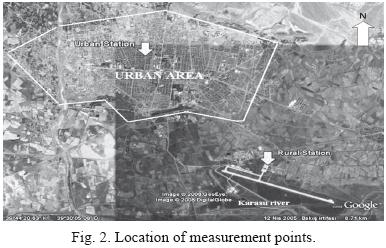
<body><![CDATA[<p align="justify"><font face="verdana" size="2">&nbsp;</font></p>     <p align="justify"><font face="verdana" size="2"><b>3.	Meteorological data</b></font></p>     <p align="justify"><font face="verdana" size="2">In addition to the first established meteorological station, which is considered to represent urban area, the second station, which is thought to be rural station, was established in the airport property at an elevation of 1154.4 m and a location of 39&deg; 42' N and 39 &deg; 31' E in 1997 and hourly meteorological data began to be obtained on 1 May 1998. Meteorological data used for the calculation of thermal comfort conditions in the study was obtained from both of these stations.</font></p>     <p align="justify"><font face="verdana" size="2">Urban station is in the ground of Meteorological Office and nearly in the middle of the city. It is surrounded by substreets, roads, and 3&#150;4&#150;storey buildings. Relatively tall buildings, densely populated areas around the station and traffic load, though not heavy, are thought to affect the measurement area. Pavements are covered with asphalt and concrete surface and there is no moisture supply around the area. Rural station at the city's airport is 5 km from the city in eye bird view. The airport is surrounded by the vast open area in all directions, but there is a small village about 1 km away from measurement point and a river, Karasu, flows in about 2 km distance. There are no anthropogenic effects around the station except for cultivation not needing irrigation (<a href="#f2">Fig. 2</a>).</font></p>     <p align="center"><font face="verdana" size="2"><a name="f2"></a></font></p>     <p align="center"><font face="verdana" size="2"><img src="/img/revistas/atm/v23n4/a6f2.jpg"></font></p>     <p align="justify"><font face="verdana" size="2">Such stations as mentioned above were considered to represent rural and urban areas in many studies, e.g. Unger (1999), Robaa (2003), Yilmaz <I>et al.</I> (2007a) and Bulut <I>et al.</I> (2008), and these stations are regularly controlled and measurement devices are calibrated by the Turkish State Meteorological Service.</font></p>     <p align="justify"><font face="verdana" size="2">From both stations, daily means of air temperature (Ta, &deg;C), relative humidity (RH, %) wind speed (Ws, ms<Sup>&#150;1</Sup>) and cloud amount (CA, octas) were taken to be used in thermal comfort indices, which are measured in a shelter with louvered screen (so&#150;called Stevenson Screen) at the height of 2 m, which is a standard means of measurement on the ground accepted all over the world (Anonymous, 2001). Because full&#150;year data is unavailable for rural station in 1998, meteorological values required for the calculations were taken from 1999 to 2008, totaling 10 years. Simultaneous daily means of data were derived from data measured in both stations over 24 hours.</font></p>     <p align="justify"><font face="verdana" size="2">&nbsp;</font></p>     <p align="justify"><font face="verdana" size="2"><b>4.	Method</b></font></p>     ]]></body>
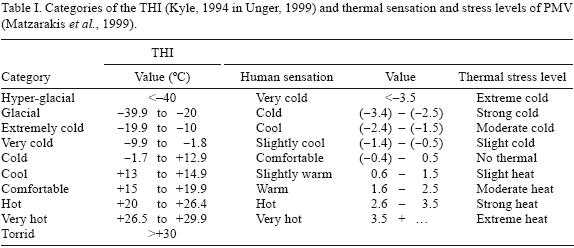
<body><![CDATA[<p align="justify"><font face="verdana" size="2">Even though today there are many complex and simple thermal comfort equations in use, "most of them share many common features and can be classified in two groups: empirical or rational" (Ali&#150;Toudert, 2005). While empirical indices take the combined effects of a few meteorological parameters (e.g. Ta and RH) and "ignore the decisive role of human physiology, activity, clothing and other personal data (height, weight, age, sex), rational indices are more recent, promoted by the lately development of computing techniques, and rely on the human energy balance" (Ali&#150;Toudert, 2005).</font></p>     <p align="justify"><font face="verdana" size="2">In the present study, thermohygrometric index (THI) or DI of Thom (1959), which are among the empirical and most used (e.g. Unger, 1999; Emmanuel, 2005; Toy <I>et al.,</I> 2007; Yilmaz <I>et al.,</I> 2007a; Antoniou <I>et al.,</I> 2008) thermal comfort indices, and PMV (Fanger, 1970), which can be defined as complex and is based on human energy balance, were used to calculate human thermal comfort conditions.</font></p>     <p align="justify"><font face="verdana" size="2">THI can calculate human thermal comfort conditions based solely on the relative effects of Ta and RH, especially under windless conditions and give the results in Celsius degree (Unger, 1999). It employs a simple linear equation:</font></p>     <p align="justify"><font face="verdana" size="2">THI (&deg;C) = <I>t </I>&#150; (0.55 &#150; 0.0055f) (<I>t </I>&#150; 14.5),</font></p>     <p align="justify"><font face="verdana" size="2">where <I>t</I> represents Ta (&deg;C) and <I>f</I>, RH (%) (Unger, 1999).</font></p>     <p align="justify"><font face="verdana" size="2">Results are evaluated considering the predetermined categories in a table (<a href="#t1">Table I</a>), which classifies the comfort conditions according to human sensation of temperature. Comfort categories of THI index were used as was in the several previous studies (Unger, 1999; Toy <I>et al.,</I> 2007; Yilmaz <I>et al.,</I> 2007a; Antoniou <I>et al.,</I> 2008) since the adaptation of these categories to a specific location is a difficult and time consuming work (as in the example of Lin and Matzarakis, 2008) and also this method can ease the comparison of the results from previous studies with the new ones in order to have an insight into thermal comfort conditions.</font></p>     <p align="center"><font face="verdana" size="2"><a name="t1"></a></font></p>     <p align="center"><font face="verdana" size="2"><img src="/img/revistas/atm/v23n4/a6t1.jpg"></font></p>     <p align="justify"><font face="verdana" size="2">This index was used in the study to compare thermal comfort conditions in urban and rural areas of the city since it can give simple and precise results by which some opinions about the conditions can be gained as in other studies (such as Unger 1999; Toy <I>et al.,</I> 2007; Yilmaz <I>et al., </I>2007a; Antoniou <I>et al.,</I> 2008).</font></p>     <p align="justify"><font face="verdana" size="2">Another index used in the study, PMV of Fanger (1970), is an energy&#150;balance&#150;based human thermal comfort index, which has been applied widely (Fanger, 1970; Fanger <I>et al.,</I> 1974; McGregor <I>et al.,</I> 2002). PMV represents the predicted mean vote on a thermal sensation scale of a large population exposed to a given set of ambient conditions. This index is derived by relating empirically the human heat balance to a vote of thermal sensation. The PMV equation is a steady&#150;state model. It establishes a thermal strain based on steady&#150;state heat transfer between the body and the environment. Once the strain has been calculated, a thermal comfort vote, which represents the thermal sensation, is assigned to the calculated level of strain (McGregor <I>et al.,</I> 2002). In really extreme weather situations PMV can be higher than 3.5, or lower than &#150;3.5 (H&ouml;ppe, 1993, 1999; Mayer and Matzarakis, 1997; Gulyas <I>et al.,</I> 2003). PMV predicts the mean assessment of the thermal environment for a large sample of human beings by value according to the seven&#150;step ASHRAE comfort scale (H&ouml;ppe, 1993, 1999; Mayer and Matzarakis, 1997). PMV is used in this study as it is one of the bioclimatic comfort assessment indices with THI. Thermal sensation and stress levels of both PMV and THI are given in <a href="#t1">Table I</a>.</font></p>     ]]></body>
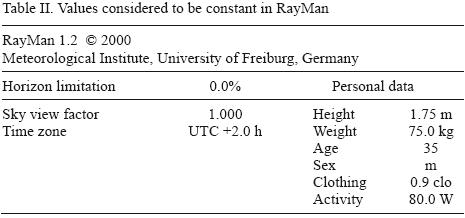
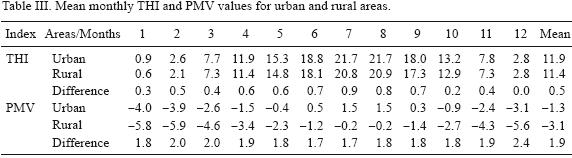
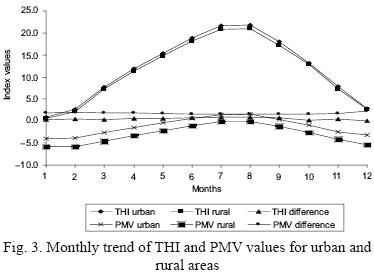
<body><![CDATA[<p align="justify"><font face="verdana" size="2">Human thermal comfort conditions were calculated according to PMV using one of the recently used radiation and bioclimate models, RayMan (Matzarakis <I>et al.,</I> 2000, 2007; Matzarakis and Rutz, 2005). RayMan is well&#150;suited to calculate radiation fluxes (Mayer and H&ouml;ppe, 1987), and thus, all calculations for PMV in the study were performed using this model. The RayMan model, developed according to the Guideline 3787 of the German Engineering Society (VDI, 1998), calculates the radiation flux in simple and complex environments on the basis of various parameters, such as air temperature, air humidity, degree of cloud cover, time of day and year, the albedo of the surrounding surfaces and their solid&#150;angle proportions. Besides the meteorological parameters, the model requires input data on the surface morphological conditions of the study area and on personal parameters (Gulyas and Matzarakis, 2007).</font></p>     <p align="justify"><font face="verdana" size="2">About thermo&#150;physiological features taking place in thermal comfort analysis, age, sex, height, weight, clothing insulation (in clo units), physical activity and position (sitting or standing) of a ''typical European male'' (35 years old, 1.75 m tall, weight 75 kg) were considered (as it was in Gulyas <I>et al.,</I> 2006) in RayMan. Values considered to be constant in the calculation of PMV for urban and rural areas are given in <a href="#t2">Table II</a>.</font></p>     <p align="center"><font face="verdana" size="2"><a name="t2"></a></font></p>     <p align="center"><font face="verdana" size="2"><img src="/img/revistas/atm/v23n4/a6t2.jpg"></font></p>     <p align="justify"><font face="verdana" size="2">Thermal comfort conditions were calculated on daily basis using daily mean air temperatures and relative humidity values obtained over 24 hours on 3653 days (10 years). Percentage distribution of comfort categories was determined for months. This method was adopted in the study since the calculation of daily mean thermal comfort conditions can give more detailed results than those with monthly mean values.</font></p>     <p align="justify"><font face="verdana" size="2">For the comparison of THI and PMV values between urban and rural areas 2&#150;tailed <I>t</I> test was used with the confidence interval of 0.05.</font></p>     <p align="justify"><font face="verdana" size="2">&nbsp;</font></p>     <p align="justify"><font face="verdana" size="2"><b>5.	Results</b></font></p>     <p align="justify"><font face="verdana" size="2">From the evaluation of the results, it was found that both THI and PMV values are higher in urban area than those in rural area nearly all year round, except for December for THI (<a href="#t3">Table III</a> and <a href="#f3">Fig. 3</a>).</font></p>     <p align="center"><font face="verdana" size="2"><a name="t3"></a></font></p>     ]]></body>
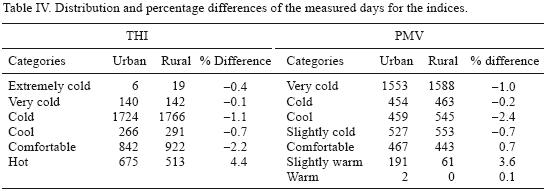
<body><![CDATA[<p align="center"><font face="verdana" size="2"><img src="/img/revistas/atm/v23n4/a6t3.jpg"></font></p>     <p align="center"><font face="verdana" size="2"><a name="f3"></a></font></p>     <p align="center"><font face="verdana" size="2"><img src="/img/revistas/atm/v23n4/a6f3.jpg"></font></p>     <p align="justify"><font face="verdana" size="2">Mean annual THI and PMV differences between the areas are 0.5 &deg;C and 1.9, respectively, while maximum differences were found to be 0.9 &deg;C and 0.8 &deg;C in July and August for THI and 2.4 in December for PMV, and minimum were 0.0 &deg;C in December for THI and 1.7 in June and July for PMV. Trends in THI and PMV values and differences of THI values between the areas are parallel to the seasonal temperature changes; however, differences of PMV values between the areas do not suit seasonal trends (<a href="#f3">Fig. 3</a>).</font></p>     <p align="justify"><font face="verdana" size="2">Mean yearly distributions of thermal comfort ranges according to the months over ten years are presented in <a href="/img/revistas/atm/v23n4/a6f4.jpg" target="_blank">Figures 4 a, b, c, d</a> for urban and rural areas, respectively. It can be seen from the figures that the number of THI categories prevalent in urban and rural areas is the same (six; extremely cold, very cold, cold cool, comfortable and hot), while those of PMV are different between the areas; in urban area seven categories (very cold, cold, cool, slightly cold, comfortable, slightly warm and warm) are seen and in rural area warm category is not seen.</font></p>     <p align="justify"><font face="verdana" size="2">From the mentioned figures, it can clearly be said that the same comfort categories are seen in the same months in both areas and indices except for warm category of PMV in July, even if the prevalence of the categories is different for months. In urban and rural areas, the most prevalent comfort range is cold for THI and very cold for PMV, while hot range in THI and slightly warmrange in PMV are seen more prevalently in urban area than in rural area. An additional range warm in PMV is seen in urban area. "Comfortable" range is seen in urban area less than in rural for both indices.</font></p>     <p align="justify"><font face="verdana" size="2"><a href="#t4">Table IV</a> presents the distribution and percentage differences by categories in the study period of ten years (3653 days) for urban and rural areas. According to the table, it can be seen that the number of comfortable days is larger in rural area than in urban for THI but not for PMV, while in rural area, the number of the days when cold stress prevails (i.e. extremely cold, very cold, cold and cool ranges) is larger than in urban area for both indices. However, the number of days heat stress is prevalent (i.e. slightly warm, warm and hot ranges) is larger in urban than in rural. When the percentage values and number of days in only comfortable range is considered, it can be seen that the city has affected human thermal comfort in the rate of 2.2%, which is the difference between the percentages of comfortable ranges in urban and rural areas for THI, but for PMV, urban is 0.7% more comfortable than the rural even though the differences between the number of days are not large and statistically significant (2&#150;tailed p = 0.0001).</font></p>     <p align="center"><font face="verdana" size="2"><a name="t4"></a></font></p>     <p align="center"><font face="verdana" size="2"><img src="/img/revistas/atm/v23n4/a6t4.jpg"></font></p>     <p align="justify"><font face="verdana" size="2">&nbsp;</font></p>     ]]></body>
<body><![CDATA[<p align="justify"><font face="verdana" size="2"><b>6.	Discussion and conclusion</b></font></p>     <p align="justify"><font face="verdana" size="2">Both thermal and human thermal comfort conditions in urban areas can widely be affected by the different features of urban areas, where very different climatic conditions are prevalent from their rural counterparts. Therefore, as the number of the features which have negative impacts on climate and thermal comfort conditions increases, liveability of urban areas decreases when the bioclimatic comfort conditions are considered.</font></p>     <p align="justify"><font face="verdana" size="2">In the present study, it may be thought that differences in thermal comfort conditions obtained from urban and rural stations might have resulted from the differences in elevation and measurement accuracy. In this respect, it can be said that even though elevation has some effects on climatic elements, in the present study difference in elevation is lower than 100 m (64 m) between the areas, which was accepted not to affect climatic elements as stated in previous studies such as Baker <I>et al.</I> (2002), Yilmaz <I>et al. </I>(2007a) and Bulut <I>et al. </I>(2008). When it comes to the measurement standards and accuracy, it can be stated that both the stations taken into consideration and its devices are regularly serviced and controlled by the Turkish State Meteorological Service considering the standards of World Meteorological Organisation. Therefore it can be said that differences are caused by the characteristics of urban and rural areas.</font></p>     <p align="justify"><font face="verdana" size="2">There is a true and close relationship between urban thermal environments and city size (Oke, 1973; Landsberg, 1981; Karl <I>et al., </I>1988; Arnfield, 2003; Zhou <I>et al.,</I> 2004; J&aacute;uregui, 2005; Hughes, 2006); presence of industrial areas and motor&#150; vehicle traffic (Ackerman, 1977; Oke, 1987; Kottmeier <I>et al.,</I> 2007); population (Landsberg, 1981; Karl <I>et al.,</I> 1988); urban density and presence of street canyons (Landsberg, 1981; Roth <I>et al., </I>1989; Oke <I>et al.,</I> 1991; Eliasson, 1996; Bonacquisti <I>et al., </I>2006; Ali&#150;Toudert, 2005; Ali&#150;Toudert and Mayer, 2007) and negative relationship with the amount of vegetation cover (Park, 1986; Cotton and Pielke, 1995; Taha, 1999; Wong and Yu, 2005; Eliasson and Svensson, 2003; Charalampopoulos and Chronopoulou, 2005; Kottmeier <I>et al.,</I> 2007; Jusuf <I>et al., </I>2007; Yilmaz <I>et al.,</I> 2007).</font></p>     <p align="justify"><font face="verdana" size="2">In the study, the city of Erzincan was evaluated in respect of thermal comfort conditions. The city is, in summary, a medium&#150;sized, unindustrialized, less populated and well&#150;planned and planted city. It can therefore be expected that the city has relatively less negative impacts on human comfort.</font></p>     <p align="justify"><font face="verdana" size="2">Because of socio&#150;economical reasons, in Turkey there is a consistent human population movement from the city of Erzincan to larger cities (Anonymous, 2005). For that reason, the city has less population than other cities in Turkey and as a result of this condition surface area of the city center is smaller.</font></p>     <p align="justify"><font face="verdana" size="2">Since the city was re&#150;established two times after violent earthquakes, architecture of the city was well&#150;established according to modern urban architecture techniques. Therefore, streets are wide and there is no building with more than four storeys and no street canyon effect can be mentioned in the city center.</font></p>     <p align="justify"><font face="verdana" size="2">In urban environments, open green spaces not only contribute to urban image and aesthetics, but also improve urban climate. These spaces may be considered as a favourable factor on decreasing the urban&#150;rural climatic differences. Vegetation cover causes heat reduction via two mechanisms: by shading surface and adding moisture to atmosphere through evapotranspiration. In respect of land use or rate of green and impervious areas, the city of Erzincan has a considerably large green area amount per capita. The reason for this is that in addition to enough spaces left for green areas in the new establishment process, the city has relatively mild climate for diverse plants to grow.</font></p>     <p align="justify"><font face="verdana" size="2">Green areas in cities have been considered as potential measure in mitigating the urban heat island (UHI) effect (Wong and Yu, 2005) and in order to reduce the effects of urban heat island and mitigate them and consequently to live in a better environment, future research should be focused on design and planning parameters (Jusuf <I>et al.,</I> 2007; Rizwan <I>et al.,</I> 2008). Land use planning and design are the work fields of landscape architects, where a well&#150;balanced urban structure must be aimed with appropriate plantation by leaving enough open green spaces. Consequently, in the study, it was found that urban&#150;rural temperature differences are lighter in Erzincan with larger green area amount, well&#150;planned streets, not tall buildings and less vehicle number than in Erzurum with lower open&#150;green space rate, distorted settlement and more vehicles.</font></p>     <p align="justify"><font face="verdana" size="2">As a result of the favourable characteristics of the city for human thermal comfort, differences between urban and rural thermal comfort conditions (in THI and PMV values) is lower and statistically not significant. Mean THI difference between the urban and rural areas of the city is only 0.5 &deg;C and all year differences for the months are regular and parallel to the seasonal temperature changes, which shows the urban effect is small. However, in another study (Toy, 2004), carried out in Erzurum, which is located in the same region and very closely to Erzincan, maximum THI difference was found to be in December due to air pollution. The mentioned city is more populated than Erzincan and exposed to air pollution more frequently in especially cold winter months because of heavy fuel combustion (i.e. low quality coal).</font></p>     ]]></body>
<body><![CDATA[<p align="justify"><font face="verdana" size="2">According to the percentage distribution of the THI categories, comfortable range is prevalent in the city center in the rate of 25.2% while in rural areas it is 23%, which is an insignificant difference. In a similar study (Unger, 1999), carried out in the middle size city of Szeged, Hungary, this rate was found to be 30% for urban and 20% for rural areas. Percentage difference in comfortable category in the mentioned study (10%) is larger than that found in the present study (2.2%) due to the larger size of Szeged and of its population.</font></p>     <p align="justify"><font face="verdana" size="2">In our study, PMV values are not consistent with THI values because the number of comfortable days in urban area is larger than rural. The reason for this may be PMV categories, since in the season when comfortable range is expected to be prevalent, slightly warm category is prevalent. This may be a problematic situation for PMV categories and these categories should be adapted to this part of the world. If the favorable characteristics of the bioclimatic comfort indices are considered, then it can be said that THI index has shown more favorable characteristics for the evaluation with suitable ranges to the study area, even though PMV is the more complex and comprehensive index.</font></p>     <p align="justify"><font face="verdana" size="2">This study has shown that if a city has favorable characteristics in both planning and size, its effects on human thermal comfort may be smaller. Therefore, in urban and land use plans and designs, great care should be taken to avoid the construction of the dense, overpopulated, deforested and thermally uncomfortable environments. Related professionals whose work fields are planning and designing, e.g. landscape architects and urban planners, should seek new ways of providing healthy environments for people considering the basic principles of their occupations, e.g. leaving enough vegetated spaces. Another approach for the construction of thermally comfortable environments may be the clustering of newly developing cities by placing large green areas between them and by reducing the size of population and surface areas of the settlements. Since the number of such studies in developing countries like Turkey is insufficient, their quality and quantity should be increased in order to provide local people with more liveable urban environments.</font></p>     <p align="justify"><font face="verdana" size="2">&nbsp;</font></p>     <p align="justify"><font face="verdana" size="2"><b>References</b></font></p>     <!-- ref --><p align="justify"><font face="verdana" size="2">Ackerman T. P., 1977. A model of the effect of aerosols on urban climate with particular attention to the Los Angeles Basin. <I>J. Atmos. Sci</I>., <B>34</B>, 531&#150;547.    &nbsp;&nbsp;&nbsp;&nbsp;&nbsp;&nbsp;&nbsp;&nbsp;[&#160;<a href="javascript:void(0);" onclick="javascript: window.open('/scielo.php?script=sci_nlinks&ref=1284035&pid=S0187-6236201000040000600001&lng=','','width=640,height=500,resizable=yes,scrollbars=1,menubar=yes,');">Links</a>&#160;]<!-- end-ref --></font></p>     <!-- ref --><p align="justify"><font face="verdana" size="2">Ali&#150;Toudert F. 2005. Dependence of outdoor thermal comfort on street design in hot and dry climate ber. Meteor. Inst. Univ. Freiburg Nr. 15. 224 p. Dissertation, angenommen von der Fakult&auml;t f&uuml;r Forst&#150; und Umweltwissenschaften der Albert&#150;Ludwigs&#150;Universit&auml;t Freiburg.    &nbsp;&nbsp;&nbsp;&nbsp;&nbsp;&nbsp;&nbsp;&nbsp;[&#160;<a href="javascript:void(0);" onclick="javascript: window.open('/scielo.php?script=sci_nlinks&ref=1284037&pid=S0187-6236201000040000600002&lng=','','width=640,height=500,resizable=yes,scrollbars=1,menubar=yes,');">Links</a>&#160;]<!-- end-ref --></font></p>     <!-- ref --><p align="justify"><font face="verdana" size="2">Ali&#150;Toudert F. and H. Mayer, 2007. Thermal comfort in an east&#150;west oriented street canyon in Freiburg (Germany) under hot summer conditions. <I>Theor. Appl. Climatol.</I> <B>87</B>, 223&#150;237.    &nbsp;&nbsp;&nbsp;&nbsp;&nbsp;&nbsp;&nbsp;&nbsp;[&#160;<a href="javascript:void(0);" onclick="javascript: window.open('/scielo.php?script=sci_nlinks&ref=1284039&pid=S0187-6236201000040000600003&lng=','','width=640,height=500,resizable=yes,scrollbars=1,menubar=yes,');">Links</a>&#160;]<!-- end-ref --></font></p>     <!-- ref --><p align="justify"><font face="verdana" size="2">Anonymous, 2001. Joint Aviation Authorities Airline Transport Pilot's Licence. <I>Theoretical Knowledge Manual. 050 Meteorology</I>. Oxford Aviation Service Limited. Published by Jeppesen GmbH, Frankfurt, Germany.    &nbsp;&nbsp;&nbsp;&nbsp;&nbsp;&nbsp;&nbsp;&nbsp;[&#160;<a href="javascript:void(0);" onclick="javascript: window.open('/scielo.php?script=sci_nlinks&ref=1284041&pid=S0187-6236201000040000600004&lng=','','width=640,height=500,resizable=yes,scrollbars=1,menubar=yes,');">Links</a>&#160;]<!-- end-ref --></font></p>     <!-- ref --><p align="justify"><font face="verdana" size="2">Anonymous, 2005. Environmental Condition Report of Erzincan City. Erzincan Governorship Environment and Forest Administration, Erzincan, 235 pp. (<a href="http://www.cedgm.gov.tr/icd_raporlari/erzincanicd2006.pdf" target="_blank">http://www.cedgm.gov.tr/icd_raporlari/erzincanicd2006.pdf</a>).    &nbsp;&nbsp;&nbsp;&nbsp;&nbsp;&nbsp;&nbsp;&nbsp;[&#160;<a href="javascript:void(0);" onclick="javascript: window.open('/scielo.php?script=sci_nlinks&ref=1284043&pid=S0187-6236201000040000600005&lng=','','width=640,height=500,resizable=yes,scrollbars=1,menubar=yes,');">Links</a>&#160;]<!-- end-ref --></font></p>     <!-- ref --><p align="justify"><font face="verdana" size="2">Anonymous, 2008. Database of census based on address system of Turkish State Prime&#150;ministry Turkish Statistic Institution cited from the official web site of Erzincan governorship. (<a href="http://www.erzincan.gov.tr/nufus.htm" target="_blank">http://www.erzincan.gov.tr/nufus.htm</a>).    &nbsp;&nbsp;&nbsp;&nbsp;&nbsp;&nbsp;&nbsp;&nbsp;[&#160;<a href="javascript:void(0);" onclick="javascript: window.open('/scielo.php?script=sci_nlinks&ref=1284045&pid=S0187-6236201000040000600006&lng=','','width=640,height=500,resizable=yes,scrollbars=1,menubar=yes,');">Links</a>&#160;]<!-- end-ref --></font></p>     <!-- ref --><p align="justify"><font face="verdana" size="2">Antoniou A., I. Larissi, A. Maitos, and A. G. Paliatsos, 2008. Case studies on discomfort levels in different regions in Athens, Greece. International Scientific Conference SynEnergy Forum (S.E.F.) The conference for International Synergy in Energy, Environment, Tourism and Information Technology. II. Energy/ Environment II Session 4. Spetses, Greece 28&#150;31 May 2008. 8 pp. <a href="http://synenergy.teipir.gr/papers/II_4.pdf" target="_blank">http://synenergy.teipir.gr/papers/II_4.pdf</a>.    &nbsp;&nbsp;&nbsp;&nbsp;&nbsp;&nbsp;&nbsp;&nbsp;[&#160;<a href="javascript:void(0);" onclick="javascript: window.open('/scielo.php?script=sci_nlinks&ref=1284047&pid=S0187-6236201000040000600007&lng=','','width=640,height=500,resizable=yes,scrollbars=1,menubar=yes,');">Links</a>&#160;]<!-- end-ref --></font></p>     <!-- ref --><p align="justify"><font face="verdana" size="2">Arnfield A. J., 2003. Two decades of urban climate research: a review of turbulence, exchanges of energy and water, and the urban heat island. <I>Int. J. Climatol. </I><B>23</B>, 1&#150;26.    &nbsp;&nbsp;&nbsp;&nbsp;&nbsp;&nbsp;&nbsp;&nbsp;[&#160;<a href="javascript:void(0);" onclick="javascript: window.open('/scielo.php?script=sci_nlinks&ref=1284049&pid=S0187-6236201000040000600008&lng=','','width=640,height=500,resizable=yes,scrollbars=1,menubar=yes,');">Links</a>&#160;]<!-- end-ref --></font></p>     <!-- ref --><p align="justify"><font face="verdana" size="2">Baker L. A., A. J. Brazel, N. Selover, C. Martin, N. McIntyre, F. R. Steiner, A. Nelson and L. Musacchio, 2002. Urbanization and warming of Phoenix (Arizona, USA): Impacts, feedbacks and mitigation. <I>Urban Ecosystems</I> <B>6</B>,183&#150;203.    &nbsp;&nbsp;&nbsp;&nbsp;&nbsp;&nbsp;&nbsp;&nbsp;[&#160;<a href="javascript:void(0);" onclick="javascript: window.open('/scielo.php?script=sci_nlinks&ref=1284051&pid=S0187-6236201000040000600009&lng=','','width=640,height=500,resizable=yes,scrollbars=1,menubar=yes,');">Links</a>&#160;]<!-- end-ref --></font></p>     <!-- ref --><p align="justify"><font face="verdana" size="2">Bonacquisti V., G. R. Casale, S. Palmieri and A. M. Siani, 2006. A canopy layer model and its application to Rome. <I>Sci. Tot. Environ</I>. <B>364</B>, 1&#150;13.    &nbsp;&nbsp;&nbsp;&nbsp;&nbsp;&nbsp;&nbsp;&nbsp;[&#160;<a href="javascript:void(0);" onclick="javascript: window.open('/scielo.php?script=sci_nlinks&ref=1284053&pid=S0187-6236201000040000600010&lng=','','width=640,height=500,resizable=yes,scrollbars=1,menubar=yes,');">Links</a>&#160;]<!-- end-ref --></font></p>     <!-- ref --><p align="justify"><font face="verdana" size="2">Bulut Y., S. Toy, M. A. Irmak, H. Yilmaz and S. Yilmaz, 2008. Urban&#150;rural climatic differences over a 2&#150;year period in the City of Erzurum, Turkey. <I>Atm&oacute;sfera</I> <B>21</B>, 121&#150;133.    &nbsp;&nbsp;&nbsp;&nbsp;&nbsp;&nbsp;&nbsp;&nbsp;[&#160;<a href="javascript:void(0);" onclick="javascript: window.open('/scielo.php?script=sci_nlinks&ref=1284055&pid=S0187-6236201000040000600011&lng=','','width=640,height=500,resizable=yes,scrollbars=1,menubar=yes,');">Links</a>&#160;]<!-- end-ref --></font></p>     <!-- ref --><p align="justify"><font face="verdana" size="2">Charalampopoulos I. and A. S. Chronopoulou, 2005. Mapping the urban green area influence on local climate under windless and light wind conditions. The case of western part of Athens, Greece. A<I>cta Climatologica et Chorologica</I> <B>38&#150;39</B>, 25&#150;31.    &nbsp;&nbsp;&nbsp;&nbsp;&nbsp;&nbsp;&nbsp;&nbsp;[&#160;<a href="javascript:void(0);" onclick="javascript: window.open('/scielo.php?script=sci_nlinks&ref=1284057&pid=S0187-6236201000040000600012&lng=','','width=640,height=500,resizable=yes,scrollbars=1,menubar=yes,');">Links</a>&#160;]<!-- end-ref --></font></p>     <!-- ref --><p align="justify"><font face="verdana" size="2">Cinar &#304;., 2004. Impact assesment of bioclimatic comfort criteria in landscape planning process: The case of Karabaglar plain in Mugla&#150;Turkey. PhD Thesis, Graduate School of Natural and Applied Sciences Landscape Architecture Dept. Aegean Univ.Izmir Turkey. 226 pp.    &nbsp;&nbsp;&nbsp;&nbsp;&nbsp;&nbsp;&nbsp;&nbsp;[&#160;<a href="javascript:void(0);" onclick="javascript: window.open('/scielo.php?script=sci_nlinks&ref=1284059&pid=S0187-6236201000040000600013&lng=','','width=640,height=500,resizable=yes,scrollbars=1,menubar=yes,');">Links</a>&#160;]<!-- end-ref --></font></p>     <!-- ref --><p align="justify"><font face="verdana" size="2">Cotton W. R. and R. A. Pielke, 1995. <I>Human Impacts on Weather and Climate</I>. Cambridge University Press, Cambridge.    &nbsp;&nbsp;&nbsp;&nbsp;&nbsp;&nbsp;&nbsp;&nbsp;[&#160;<a href="javascript:void(0);" onclick="javascript: window.open('/scielo.php?script=sci_nlinks&ref=1284061&pid=S0187-6236201000040000600014&lng=','','width=640,height=500,resizable=yes,scrollbars=1,menubar=yes,');">Links</a>&#160;]<!-- end-ref --></font></p>     <!-- ref --><p align="justify"><font face="verdana" size="2">Eliasson I. 1996. Intra&#150;urban nocturnal temperature differences: a multivariate approach. <I>Clim. Res.</I> <B>7</B>, 21&#150;30.    &nbsp;&nbsp;&nbsp;&nbsp;&nbsp;&nbsp;&nbsp;&nbsp;[&#160;<a href="javascript:void(0);" onclick="javascript: window.open('/scielo.php?script=sci_nlinks&ref=1284063&pid=S0187-6236201000040000600015&lng=','','width=640,height=500,resizable=yes,scrollbars=1,menubar=yes,');">Links</a>&#160;]<!-- end-ref --></font></p>     <!-- ref --><p align="justify"><font face="verdana" size="2">Eliasson I. and M. K. Svensson, 2003. Spatial air temperature variations and urban land use &#150; a statistical approach. <I>Meteorol. Appl.</I> <B>10</B>, 135&#150;149 Cambridge University Press.    &nbsp;&nbsp;&nbsp;&nbsp;&nbsp;&nbsp;&nbsp;&nbsp;[&#160;<a href="javascript:void(0);" onclick="javascript: window.open('/scielo.php?script=sci_nlinks&ref=1284065&pid=S0187-6236201000040000600016&lng=','','width=640,height=500,resizable=yes,scrollbars=1,menubar=yes,');">Links</a>&#160;]<!-- end-ref --></font></p>     <!-- ref --><p align="justify"><font face="verdana" size="2">Emmanuel R., 2005. Thermal comfort implications of urbanization in a warm&#150;humid city: the Colombo Metropolitan Region (CMR), Sri Lanka. <I>Build. Environ.</I> <B>40</B>, 1591&#150;1601.    &nbsp;&nbsp;&nbsp;&nbsp;&nbsp;&nbsp;&nbsp;&nbsp;[&#160;<a href="javascript:void(0);" onclick="javascript: window.open('/scielo.php?script=sci_nlinks&ref=1284067&pid=S0187-6236201000040000600017&lng=','','width=640,height=500,resizable=yes,scrollbars=1,menubar=yes,');">Links</a>&#160;]<!-- end-ref --></font></p>     <!-- ref --><p align="justify"><font face="verdana" size="2">Epstein Y. and D. S. Moran, 2006. Thermal comfort and the heat stress indices. <I>Industrial Health</I> <B>44</B>, 388&#150;398.    &nbsp;&nbsp;&nbsp;&nbsp;&nbsp;&nbsp;&nbsp;&nbsp;[&#160;<a href="javascript:void(0);" onclick="javascript: window.open('/scielo.php?script=sci_nlinks&ref=1284069&pid=S0187-6236201000040000600018&lng=','','width=640,height=500,resizable=yes,scrollbars=1,menubar=yes,');">Links</a>&#160;]<!-- end-ref --></font></p>     <!-- ref --><p align="justify"><font face="verdana" size="2">Fanger P. O., 1970. <I>Thermal comfort</I>. Copenhagen, Danish Technical Press, 244 pp.    &nbsp;&nbsp;&nbsp;&nbsp;&nbsp;&nbsp;&nbsp;&nbsp;[&#160;<a href="javascript:void(0);" onclick="javascript: window.open('/scielo.php?script=sci_nlinks&ref=1284071&pid=S0187-6236201000040000600019&lng=','','width=640,height=500,resizable=yes,scrollbars=1,menubar=yes,');">Links</a>&#160;]<!-- end-ref --></font></p>     <!-- ref --><p align="justify"><font face="verdana" size="2">Fanger P. O, J. Hojbjerre and J. O. B. Thomsen, 1974. Thermal comfort conditions in the morning and in the evening.<I> Int. J. Biometeor.</I> <B>18</B>, 16&#150;22.    &nbsp;&nbsp;&nbsp;&nbsp;&nbsp;&nbsp;&nbsp;&nbsp;[&#160;<a href="javascript:void(0);" onclick="javascript: window.open('/scielo.php?script=sci_nlinks&ref=1284073&pid=S0187-6236201000040000600020&lng=','','width=640,height=500,resizable=yes,scrollbars=1,menubar=yes,');">Links</a>&#160;]<!-- end-ref --></font></p>     <!-- ref --><p align="justify"><font face="verdana" size="2">Figuerola P. I. and N. A. Mazzeo, 1998. Urban&#150;rural temperature differences in Buenos Aires. <I>Int. J. Climatol.</I> <B>18</B>, 1709&#150;1723.    &nbsp;&nbsp;&nbsp;&nbsp;&nbsp;&nbsp;&nbsp;&nbsp;[&#160;<a href="javascript:void(0);" onclick="javascript: window.open('/scielo.php?script=sci_nlinks&ref=1284075&pid=S0187-6236201000040000600021&lng=','','width=640,height=500,resizable=yes,scrollbars=1,menubar=yes,');">Links</a>&#160;]<!-- end-ref --></font></p>     <!-- ref --><p align="justify"><font face="verdana" size="2">Givoni B. 1963. <I>Man climate and architecture</I>. Amsterdam: Elsevier Press, 247 pp.    &nbsp;&nbsp;&nbsp;&nbsp;&nbsp;&nbsp;&nbsp;&nbsp;[&#160;<a href="javascript:void(0);" onclick="javascript: window.open('/scielo.php?script=sci_nlinks&ref=1284077&pid=S0187-6236201000040000600022&lng=','','width=640,height=500,resizable=yes,scrollbars=1,menubar=yes,');">Links</a>&#160;]<!-- end-ref --></font></p>     <!-- ref --><p align="justify"><font face="verdana" size="2">Gulyas &Aacute;., J. Unger, B. Balazs and A. Matzarakis, 2003. Analysis of the bioclimatic conditions within different surface structures in a medium&#150;sized city (Szeged, Hungary) Acta Climatologica ET Chorologica Universitatis Szegediensis, Tom. <B>36&#150;37</B>, 37&#150;44.    &nbsp;&nbsp;&nbsp;&nbsp;&nbsp;&nbsp;&nbsp;&nbsp;[&#160;<a href="javascript:void(0);" onclick="javascript: window.open('/scielo.php?script=sci_nlinks&ref=1284079&pid=S0187-6236201000040000600023&lng=','','width=640,height=500,resizable=yes,scrollbars=1,menubar=yes,');">Links</a>&#160;]<!-- end-ref --></font></p>     <!-- ref --><p align="justify"><font face="verdana" size="2">Gulyas A., J. Unger and A. Matzarakis, 2006. Assessment of the microclimatic and human comfort conditions in a complex urban environment: Modelling and measurements. <I>Build. Environ. </I><B>41</B>, 1713&#150;1722.    &nbsp;&nbsp;&nbsp;&nbsp;&nbsp;&nbsp;&nbsp;&nbsp;[&#160;<a href="javascript:void(0);" onclick="javascript: window.open('/scielo.php?script=sci_nlinks&ref=1284081&pid=S0187-6236201000040000600024&lng=','','width=640,height=500,resizable=yes,scrollbars=1,menubar=yes,');">Links</a>&#160;]<!-- end-ref --></font></p>     <!-- ref --><p align="justify"><font face="verdana" size="2">Gulyas A. and A. Matzarakis, 2007. Selected examples of bioclimatic analysis applying The Physiologically Equivalent Temperature In Hungary. <I>Acta Climatologica Et Chorologica</I> <B>40&#150;41</B>, 37&#150;46.    &nbsp;&nbsp;&nbsp;&nbsp;&nbsp;&nbsp;&nbsp;&nbsp;[&#160;<a href="javascript:void(0);" onclick="javascript: window.open('/scielo.php?script=sci_nlinks&ref=1284083&pid=S0187-6236201000040000600025&lng=','','width=640,height=500,resizable=yes,scrollbars=1,menubar=yes,');">Links</a>&#160;]<!-- end-ref --></font></p>     <!-- ref --><p align="justify"><font face="verdana" size="2">H&ouml;ppe P.R., 1993. Heat balance modelling. <I>Experientia</I> <B>49</B>, 741&#150;745.    &nbsp;&nbsp;&nbsp;&nbsp;&nbsp;&nbsp;&nbsp;&nbsp;[&#160;<a href="javascript:void(0);" onclick="javascript: window.open('/scielo.php?script=sci_nlinks&ref=1284085&pid=S0187-6236201000040000600026&lng=','','width=640,height=500,resizable=yes,scrollbars=1,menubar=yes,');">Links</a>&#160;]<!-- end-ref --></font></p>     <!-- ref --><p align="justify"><font face="verdana" size="2">H&ouml;ppe P., 1999. The physiological equivalent temperature &#150; a universal index for the biometeorological assessment of the thermal environment. <I>Int. J. Biometeorol.</I> <B>43</B>, 71&#150;75.    &nbsp;&nbsp;&nbsp;&nbsp;&nbsp;&nbsp;&nbsp;&nbsp;[&#160;<a href="javascript:void(0);" onclick="javascript: window.open('/scielo.php?script=sci_nlinks&ref=1284087&pid=S0187-6236201000040000600027&lng=','','width=640,height=500,resizable=yes,scrollbars=1,menubar=yes,');">Links</a>&#160;]<!-- end-ref --></font></p>     <!-- ref --><p align="justify"><font face="verdana" size="2">Hughes K. 2006. The impact of urban areas on climate in the UK: a spatial and temporal analysis, with an emphasis on temperature and precipitation effects <I>Earth </I>E<I>nvironment </I><B>2</B>, 54&#150;83.    &nbsp;&nbsp;&nbsp;&nbsp;&nbsp;&nbsp;&nbsp;&nbsp;[&#160;<a href="javascript:void(0);" onclick="javascript: window.open('/scielo.php?script=sci_nlinks&ref=1284089&pid=S0187-6236201000040000600028&lng=','','width=640,height=500,resizable=yes,scrollbars=1,menubar=yes,');">Links</a>&#160;]<!-- end-ref --></font></p>     <!-- ref --><p align="justify"><font face="verdana" size="2">J&aacute;uregui E. and A. Tejeda, 1997. Urban &#150; rural humidity contrasts in Mexico City. <I>Int. J. Climatol. </I><B>17</B>, 187&#150;196.    &nbsp;&nbsp;&nbsp;&nbsp;&nbsp;&nbsp;&nbsp;&nbsp;[&#160;<a href="javascript:void(0);" onclick="javascript: window.open('/scielo.php?script=sci_nlinks&ref=1284091&pid=S0187-6236201000040000600029&lng=','','width=640,height=500,resizable=yes,scrollbars=1,menubar=yes,');">Links</a>&#160;]<!-- end-ref --></font></p>     <!-- ref --><p align="justify"><font face="verdana" size="2">J&aacute;uregui E. 2005. Possible impact of urbanization on the thermal climate of some large cities in M&eacute;xico.<I> Atm&oacute;sfera </I><B>18</B>, 249&#150;252.    &nbsp;&nbsp;&nbsp;&nbsp;&nbsp;&nbsp;&nbsp;&nbsp;[&#160;<a href="javascript:void(0);" onclick="javascript: window.open('/scielo.php?script=sci_nlinks&ref=1284093&pid=S0187-6236201000040000600030&lng=','','width=640,height=500,resizable=yes,scrollbars=1,menubar=yes,');">Links</a>&#160;]<!-- end-ref --></font></p>     <!-- ref --><p align="justify"><font face="verdana" size="2">Jusuf S. K., N. H. Wong, E. Hagen, R. Anggoro and Y. Hong, 2007. The influence of land use on the urban heat island in Singapore. <I>Habitat International</I> <B>31</B>, 232&#150;242.    &nbsp;&nbsp;&nbsp;&nbsp;&nbsp;&nbsp;&nbsp;&nbsp;[&#160;<a href="javascript:void(0);" onclick="javascript: window.open('/scielo.php?script=sci_nlinks&ref=1284095&pid=S0187-6236201000040000600031&lng=','','width=640,height=500,resizable=yes,scrollbars=1,menubar=yes,');">Links</a>&#160;]<!-- end-ref --></font></p>     <!-- ref --><p align="justify"><font face="verdana" size="2">Karl T. R., H.F. Diaz and G. Kukla, 1988. Urbanization: its detection and effect in the United States climate record, <I>J. Climate</I> <B>1</B>, 1099&#150;1123.    &nbsp;&nbsp;&nbsp;&nbsp;&nbsp;&nbsp;&nbsp;&nbsp;[&#160;<a href="javascript:void(0);" onclick="javascript: window.open('/scielo.php?script=sci_nlinks&ref=1284097&pid=S0187-6236201000040000600032&lng=','','width=640,height=500,resizable=yes,scrollbars=1,menubar=yes,');">Links</a>&#160;]<!-- end-ref --></font></p>     <!-- ref --><p align="justify"><font face="verdana" size="2">Kongar E. 1976. A survey of familial change in two Turkish gecekondu areas, in J. G. Peristiany, ed., <I>Mediterranean Family Structures</I>, Cambridge University Press, 205&#150;218.    &nbsp;&nbsp;&nbsp;&nbsp;&nbsp;&nbsp;&nbsp;&nbsp;[&#160;<a href="javascript:void(0);" onclick="javascript: window.open('/scielo.php?script=sci_nlinks&ref=1284099&pid=S0187-6236201000040000600033&lng=','','width=640,height=500,resizable=yes,scrollbars=1,menubar=yes,');">Links</a>&#160;]<!-- end-ref --></font></p>     <!-- ref --><p align="justify"><font face="verdana" size="2">Kottmeier C., C. Biegert and U. Corsmeier, 2007. Effects of urban land use on surface temperature in Berlin: Case Study. <I>J. Urban Plng. and Devel</I>. <B>133</B>, 128&#150;137.    &nbsp;&nbsp;&nbsp;&nbsp;&nbsp;&nbsp;&nbsp;&nbsp;[&#160;<a href="javascript:void(0);" onclick="javascript: window.open('/scielo.php?script=sci_nlinks&ref=1284101&pid=S0187-6236201000040000600034&lng=','','width=640,height=500,resizable=yes,scrollbars=1,menubar=yes,');">Links</a>&#160;]<!-- end-ref --></font></p>     <!-- ref --><p align="justify"><font face="verdana" size="2">Kyle WJ. 1994. The human bioclimate of Hong Kong. Proceedings of the contemporary climatology conference; 345&#150;350. Brno, Szech Republic, 15&#150;20 August.    &nbsp;&nbsp;&nbsp;&nbsp;&nbsp;&nbsp;&nbsp;&nbsp;[&#160;<a href="javascript:void(0);" onclick="javascript: window.open('/scielo.php?script=sci_nlinks&ref=1284103&pid=S0187-6236201000040000600035&lng=','','width=640,height=500,resizable=yes,scrollbars=1,menubar=yes,');">Links</a>&#160;]<!-- end-ref --></font></p>     <!-- ref --><p align="justify"><font face="verdana" size="2">Landsberg H. E. 1981. <I>The Urban Climate</I>. Academic Press, New York, 275 pp.    &nbsp;&nbsp;&nbsp;&nbsp;&nbsp;&nbsp;&nbsp;&nbsp;[&#160;<a href="javascript:void(0);" onclick="javascript: window.open('/scielo.php?script=sci_nlinks&ref=1284105&pid=S0187-6236201000040000600036&lng=','','width=640,height=500,resizable=yes,scrollbars=1,menubar=yes,');">Links</a>&#160;]<!-- end-ref --></font></p>     <!-- ref --><p align="justify"><font face="verdana" size="2">Lin T. P. and A. Matzarakis, 2008. Tourism climate and thermal comfort in Sun Moon Lake, Taiwan. <I>Int. J. Biometeorol.</I> <B>52</B>, 281&#150;290.    &nbsp;&nbsp;&nbsp;&nbsp;&nbsp;&nbsp;&nbsp;&nbsp;[&#160;<a href="javascript:void(0);" onclick="javascript: window.open('/scielo.php?script=sci_nlinks&ref=1284107&pid=S0187-6236201000040000600037&lng=','','width=640,height=500,resizable=yes,scrollbars=1,menubar=yes,');">Links</a>&#160;]<!-- end-ref --></font></p>     <!-- ref --><p align="justify"><font face="verdana" size="2">Liu W., H. You and J. Dou, 2009. Urban&#150;rural humidity and temperature differences in the Beijing area. <I>Theor. Appl. Climatol. </I><B>96</B>, 201&#150;207.    &nbsp;&nbsp;&nbsp;&nbsp;&nbsp;&nbsp;&nbsp;&nbsp;[&#160;<a href="javascript:void(0);" onclick="javascript: window.open('/scielo.php?script=sci_nlinks&ref=1284109&pid=S0187-6236201000040000600038&lng=','','width=640,height=500,resizable=yes,scrollbars=1,menubar=yes,');">Links</a>&#160;]<!-- end-ref --></font></p>     <!-- ref --><p align="justify"><font face="verdana" size="2">Matzarakis A., H. Mayer and M. G Iziomon, 1999. Applications of a universal thermal index: physiological equivalent temperature. <I>Int. J. Biometeorol.</I> <B>43</B>, 76&#150;84.    &nbsp;&nbsp;&nbsp;&nbsp;&nbsp;&nbsp;&nbsp;&nbsp;[&#160;<a href="javascript:void(0);" onclick="javascript: window.open('/scielo.php?script=sci_nlinks&ref=1284111&pid=S0187-6236201000040000600039&lng=','','width=640,height=500,resizable=yes,scrollbars=1,menubar=yes,');">Links</a>&#160;]<!-- end-ref --></font></p>     <!-- ref --><p align="justify"><font face="verdana" size="2">Matzarakis A., F. Rutz and H. Mayer, 2000. Estimation and calculation of the mean radiant temperature within urban structures. In: <I>Biometeorology and urban climatology at the turn of the millenium</I> (R. J. de Dear, J. D. Kalma, T. R. Oke and A. Auliciems Eds.). Selected Papers from the Conference ICB&#150;ICUC'99, Sydney, WCASP&#150;50, WMO/TD No. 1026, 273&#150;278.    &nbsp;&nbsp;&nbsp;&nbsp;&nbsp;&nbsp;&nbsp;&nbsp;[&#160;<a href="javascript:void(0);" onclick="javascript: window.open('/scielo.php?script=sci_nlinks&ref=1284113&pid=S0187-6236201000040000600040&lng=','','width=640,height=500,resizable=yes,scrollbars=1,menubar=yes,');">Links</a>&#160;]<!-- end-ref --></font></p>     <!-- ref --><p align="justify"><font face="verdana" size="2">Matzarakis A. and F. Rutz, 2005. Application of RayMan for tourism and climate investigations. <I>Annalen der Meteorologie</I> <B>41</B>, 631&#150;636.    &nbsp;&nbsp;&nbsp;&nbsp;&nbsp;&nbsp;&nbsp;&nbsp;[&#160;<a href="javascript:void(0);" onclick="javascript: window.open('/scielo.php?script=sci_nlinks&ref=1284115&pid=S0187-6236201000040000600041&lng=','','width=640,height=500,resizable=yes,scrollbars=1,menubar=yes,');">Links</a>&#160;]<!-- end-ref --></font></p>     <!-- ref --><p align="justify"><font face="verdana" size="2">Matzarakis A., F. Rutz and H. Mayer, 2007. Modelling Radiation fluxes in simple and complex environments &#150; Application of the RayMan model. <I>Int. J. Biometeorol.</I> <B>51</B>, 323&#150;334.    &nbsp;&nbsp;&nbsp;&nbsp;&nbsp;&nbsp;&nbsp;&nbsp;[&#160;<a href="javascript:void(0);" onclick="javascript: window.open('/scielo.php?script=sci_nlinks&ref=1284117&pid=S0187-6236201000040000600042&lng=','','width=640,height=500,resizable=yes,scrollbars=1,menubar=yes,');">Links</a>&#160;]<!-- end-ref --></font></p>     <!-- ref --><p align="justify"><font face="verdana" size="2">Mayer H. and P. H&ouml;ppe, 1987. Thermal comfort of man in different urban environments. <I>Theor. Appl. Climatol.</I> <B>38</B>, 43&#150;49.    &nbsp;&nbsp;&nbsp;&nbsp;&nbsp;&nbsp;&nbsp;&nbsp;[&#160;<a href="javascript:void(0);" onclick="javascript: window.open('/scielo.php?script=sci_nlinks&ref=1284119&pid=S0187-6236201000040000600043&lng=','','width=640,height=500,resizable=yes,scrollbars=1,menubar=yes,');">Links</a>&#160;]<!-- end-ref --></font></p>     <!-- ref --><p align="justify"><font face="verdana" size="2">Mayer H. and A. Matzarakis, 1997: Human&#150;biometeorological assessment of urban microclimates' thermal component. Proceedings of the Int. Symposium on Monitoring and Management of Urban Heat Island, Fujisawa&#150;Japan, 155&#150;168.    &nbsp;&nbsp;&nbsp;&nbsp;&nbsp;&nbsp;&nbsp;&nbsp;[&#160;<a href="javascript:void(0);" onclick="javascript: window.open('/scielo.php?script=sci_nlinks&ref=1284121&pid=S0187-6236201000040000600044&lng=','','width=640,height=500,resizable=yes,scrollbars=1,menubar=yes,');">Links</a>&#160;]<!-- end-ref --></font></p>     <!-- ref --><p align="justify"><font face="verdana" size="2">Mayer H., J. Holst, P. Dostal, F. Imbery and D. Schindler, 2008. Human thermal comfort in summer within an urban street canyon in Central Europe. <I>Meteorologische Zeitschrift</I> <B>17</B>, 241&#150;250.    &nbsp;&nbsp;&nbsp;&nbsp;&nbsp;&nbsp;&nbsp;&nbsp;[&#160;<a href="javascript:void(0);" onclick="javascript: window.open('/scielo.php?script=sci_nlinks&ref=1284123&pid=S0187-6236201000040000600045&lng=','','width=640,height=500,resizable=yes,scrollbars=1,menubar=yes,');">Links</a>&#160;]<!-- end-ref --></font></p>     <!-- ref --><p align="justify"><font face="verdana" size="2">McGregor G. R., M. T. Markou, A. Bartzokas and B. D. Katsoulis, 2002. An evaluation of the nature and timing of summer human thermal discomfort in Athens. <I>Greece Clim. Res.</I> <B>20</B>, 83&#150;94.    &nbsp;&nbsp;&nbsp;&nbsp;&nbsp;&nbsp;&nbsp;&nbsp;[&#160;<a href="javascript:void(0);" onclick="javascript: window.open('/scielo.php?script=sci_nlinks&ref=1284125&pid=S0187-6236201000040000600046&lng=','','width=640,height=500,resizable=yes,scrollbars=1,menubar=yes,');">Links</a>&#160;]<!-- end-ref --></font></p>     <!-- ref --><p align="justify"><font face="verdana" size="2">McPherson E. G., D. J. Nowak and A. R. Rowntree, 1994. Chicago's urban forest ecosystem: results of the Chicago Urban Forest Climate Project. Gen. Tech. Rep. NE&#150;186. Radnor, PA: U.S. Department of Agriculture, Forest Service, Northeastern Forest Experiment Station: 201 p.Mills, G., 2007. Cities as agents of global change. <I>Int. J. Climatol.</I> <B>27</B>, 1849&#150;1857.    &nbsp;&nbsp;&nbsp;&nbsp;&nbsp;&nbsp;&nbsp;&nbsp;[&#160;<a href="javascript:void(0);" onclick="javascript: window.open('/scielo.php?script=sci_nlinks&ref=1284127&pid=S0187-6236201000040000600047&lng=','','width=640,height=500,resizable=yes,scrollbars=1,menubar=yes,');">Links</a>&#160;]<!-- end-ref --></font></p>     <!-- ref --><p align="justify"><font face="verdana" size="2">Ohashi Y., T. Kawabe, Y. Shigeta, Y. Hirano, H. Kusaka, H. Fudeyasu and K. Fukao, 2008. Evaluation of urban thermal environments in commercial and residential spaces in Okayama City, Japan, using the wet&#150;bulb globe temperature index. <I>Theoretical and Applied Climatology</I>. DOI &#150; 10.1007/s00704&#150;008&#150;0006&#150;8.    &nbsp;&nbsp;&nbsp;&nbsp;&nbsp;&nbsp;&nbsp;&nbsp;[&#160;<a href="javascript:void(0);" onclick="javascript: window.open('/scielo.php?script=sci_nlinks&ref=1284129&pid=S0187-6236201000040000600048&lng=','','width=640,height=500,resizable=yes,scrollbars=1,menubar=yes,');">Links</a>&#160;]<!-- end-ref --></font></p>     <!-- ref --><p align="justify"><font face="verdana" size="2">Oke T. R., 1973. City size and the urban heat island. <I>Atmos. Environ. </I><B>7</B>, 769&#150;779.    &nbsp;&nbsp;&nbsp;&nbsp;&nbsp;&nbsp;&nbsp;&nbsp;[&#160;<a href="javascript:void(0);" onclick="javascript: window.open('/scielo.php?script=sci_nlinks&ref=1284131&pid=S0187-6236201000040000600049&lng=','','width=640,height=500,resizable=yes,scrollbars=1,menubar=yes,');">Links</a>&#160;]<!-- end-ref --></font></p>     <!-- ref --><p align="justify"><font face="verdana" size="2">Oke T. R., 1987. <I>Boundary Layer Climates.</I> 2nd Edition, Routledge, London.    &nbsp;&nbsp;&nbsp;&nbsp;&nbsp;&nbsp;&nbsp;&nbsp;[&#160;<a href="javascript:void(0);" onclick="javascript: window.open('/scielo.php?script=sci_nlinks&ref=1284133&pid=S0187-6236201000040000600050&lng=','','width=640,height=500,resizable=yes,scrollbars=1,menubar=yes,');">Links</a>&#160;]<!-- end-ref --></font></p>     <!-- ref --><p align="justify"><font face="verdana" size="2">Oke T. R., G. Johnson, D. Steyn and I. Watson, 1991. Simulation of surface urban heat islands under "ideal" conditions at night, Part 2: Diagnosis of causation <I>Bound.&#150;Layer Meteor</I>. <B>56</B>, 339&#150;358.    &nbsp;&nbsp;&nbsp;&nbsp;&nbsp;&nbsp;&nbsp;&nbsp;[&#160;<a href="javascript:void(0);" onclick="javascript: window.open('/scielo.php?script=sci_nlinks&ref=1284135&pid=S0187-6236201000040000600051&lng=','','width=640,height=500,resizable=yes,scrollbars=1,menubar=yes,');">Links</a>&#160;]<!-- end-ref --></font></p>     <!-- ref --><p align="justify"><font face="verdana" size="2">Park H. S. 1986. Features of the heat island in Seoul and its surrounding cities. <I>Atmos. Environ</I>. <B>20</B>, 1859&#150;1866.    &nbsp;&nbsp;&nbsp;&nbsp;&nbsp;&nbsp;&nbsp;&nbsp;[&#160;<a href="javascript:void(0);" onclick="javascript: window.open('/scielo.php?script=sci_nlinks&ref=1284137&pid=S0187-6236201000040000600052&lng=','','width=640,height=500,resizable=yes,scrollbars=1,menubar=yes,');">Links</a>&#160;]<!-- end-ref --></font></p>     <!-- ref --><p align="justify"><font face="verdana" size="2">Rizwan A. M., L. Y. C. Dennis and C. Liu, 2008. A review on the generation, determination, and mitigation of urban heat island. <I>J. Environ. Sci.</I> <B>20</B>, 120&#150;128.    &nbsp;&nbsp;&nbsp;&nbsp;&nbsp;&nbsp;&nbsp;&nbsp;[&#160;<a href="javascript:void(0);" onclick="javascript: window.open('/scielo.php?script=sci_nlinks&ref=1284139&pid=S0187-6236201000040000600053&lng=','','width=640,height=500,resizable=yes,scrollbars=1,menubar=yes,');">Links</a>&#160;]<!-- end-ref --></font></p>     <!-- ref --><p align="justify"><font face="verdana" size="2">Robaa S. M., 2003. Urban&#150;suburban/rural differences over Greater Cairo, Egypt. <I>Atm&oacute;sfera </I><B>16</B>, 157&#150;171.    &nbsp;&nbsp;&nbsp;&nbsp;&nbsp;&nbsp;&nbsp;&nbsp;[&#160;<a href="javascript:void(0);" onclick="javascript: window.open('/scielo.php?script=sci_nlinks&ref=1284141&pid=S0187-6236201000040000600054&lng=','','width=640,height=500,resizable=yes,scrollbars=1,menubar=yes,');">Links</a>&#160;]<!-- end-ref --></font></p>     <!-- ref --><p align="justify"><font face="verdana" size="2">Roth M., T. R. Oke and W. J. Emery, 1989. Satellite&#150;derived urban heat islands from Three Coastal Cities and the Utilization of such Data in Urban Climatology. <I>Int. J. Remote Sensing </I><B>10</B>, 1699&#150;1720.    &nbsp;&nbsp;&nbsp;&nbsp;&nbsp;&nbsp;&nbsp;&nbsp;[&#160;<a href="javascript:void(0);" onclick="javascript: window.open('/scielo.php?script=sci_nlinks&ref=1284143&pid=S0187-6236201000040000600055&lng=','','width=640,height=500,resizable=yes,scrollbars=1,menubar=yes,');">Links</a>&#160;]<!-- end-ref --></font></p>     <!-- ref --><p align="justify"><font face="verdana" size="2">Saffell E. M. and A. W. Ellis, 2002. Urban &#150; rural humidity variations in Phoenix, Arizona. <I>Journal of the Arizona&#150;Nevada Academy of Science</I> <B>34</B>, 53&#150;62.    &nbsp;&nbsp;&nbsp;&nbsp;&nbsp;&nbsp;&nbsp;&nbsp;[&#160;<a href="javascript:void(0);" onclick="javascript: window.open('/scielo.php?script=sci_nlinks&ref=1284145&pid=S0187-6236201000040000600056&lng=','','width=640,height=500,resizable=yes,scrollbars=1,menubar=yes,');">Links</a>&#160;]<!-- end-ref --></font></p>     <!-- ref --><p align="justify"><font face="verdana" size="2">Sakakibara Y. and K. Owa, 2005. Urban&#150;rural temperature differences in coastal cities: influence of rural sites. <I>Int. J. Climatol.</I> <B>25</B>, 811.    &nbsp;&nbsp;&nbsp;&nbsp;&nbsp;&nbsp;&nbsp;&nbsp;[&#160;<a href="javascript:void(0);" onclick="javascript: window.open('/scielo.php?script=sci_nlinks&ref=1284147&pid=S0187-6236201000040000600057&lng=','','width=640,height=500,resizable=yes,scrollbars=1,menubar=yes,');">Links</a>&#160;]<!-- end-ref --></font></p>     <!-- ref --><p align="justify"><font face="verdana" size="2">Sakakibara Y., Y. Kitahara and Kiyotaka Nakagawa, 2006. The relationship between urban&#150;rural water vapor pressure differences and the population sizes of settlements in Saku, Nagano, Japan. <I>J. Agricultural Meteorology</I> <B>62</B>, 1&#150;8.    &nbsp;&nbsp;&nbsp;&nbsp;&nbsp;&nbsp;&nbsp;&nbsp;[&#160;<a href="javascript:void(0);" onclick="javascript: window.open('/scielo.php?script=sci_nlinks&ref=1284149&pid=S0187-6236201000040000600058&lng=','','width=640,height=500,resizable=yes,scrollbars=1,menubar=yes,');">Links</a>&#160;]<!-- end-ref --></font></p>     <!-- ref --><p align="justify"><font face="verdana" size="2">Spagnolo J. and R. J. de Dear, 2003. A field study of thermal comfort in outdoor and semi&#150;outdoor environments in subtropical, Sydney Australia. <I>Build. Environ</I>. <B>38</B>, 721&#150;738.    &nbsp;&nbsp;&nbsp;&nbsp;&nbsp;&nbsp;&nbsp;&nbsp;[&#160;<a href="javascript:void(0);" onclick="javascript: window.open('/scielo.php?script=sci_nlinks&ref=1284151&pid=S0187-6236201000040000600059&lng=','','width=640,height=500,resizable=yes,scrollbars=1,menubar=yes,');">Links</a>&#160;]<!-- end-ref --></font></p>     <!-- ref --><p align="justify"><font face="verdana" size="2">Stone, B., 2007. Urban and rural temperature trends in proximity to large US cities: 1951&#150;2000. <I>Int. J. Climatol. </I><B>27</B>, 1801&#150;1807.    &nbsp;&nbsp;&nbsp;&nbsp;&nbsp;&nbsp;&nbsp;&nbsp;[&#160;<a href="javascript:void(0);" onclick="javascript: window.open('/scielo.php?script=sci_nlinks&ref=1284153&pid=S0187-6236201000040000600060&lng=','','width=640,height=500,resizable=yes,scrollbars=1,menubar=yes,');">Links</a>&#160;]<!-- end-ref --></font></p>     <!-- ref --><p align="justify"><font face="verdana" size="2">Streiling S. and A. Matzarakis, 2003. Influence of single and small clusters of trees on the bioclimate of a city: a case study. <I>J. Arboriculture</I> <B>29</B>, 309&#150;316.    &nbsp;&nbsp;&nbsp;&nbsp;&nbsp;&nbsp;&nbsp;&nbsp;[&#160;<a href="javascript:void(0);" onclick="javascript: window.open('/scielo.php?script=sci_nlinks&ref=1284155&pid=S0187-6236201000040000600061&lng=','','width=640,height=500,resizable=yes,scrollbars=1,menubar=yes,');">Links</a>&#160;]<!-- end-ref --></font></p>     <!-- ref --><p align="justify"><font face="verdana" size="2">Taha H. 1999. Modifying a mesoscale meteorological model to better incorporate urban heat storage: bulk parameterization approach <I>J. Appl. Meteor</I>. <B>38</B>, 466&#150;473.    &nbsp;&nbsp;&nbsp;&nbsp;&nbsp;&nbsp;&nbsp;&nbsp;[&#160;<a href="javascript:void(0);" onclick="javascript: window.open('/scielo.php?script=sci_nlinks&ref=1284157&pid=S0187-6236201000040000600062&lng=','','width=640,height=500,resizable=yes,scrollbars=1,menubar=yes,');">Links</a>&#160;]<!-- end-ref --></font></p>     <!-- ref --><p align="justify"><font face="verdana" size="2">Thom E. C., 1959. The discomfort index. <I>Weatherwise</I> <B>12</B>, 57&#150;60.    &nbsp;&nbsp;&nbsp;&nbsp;&nbsp;&nbsp;&nbsp;&nbsp;[&#160;<a href="javascript:void(0);" onclick="javascript: window.open('/scielo.php?script=sci_nlinks&ref=1284159&pid=S0187-6236201000040000600063&lng=','','width=640,height=500,resizable=yes,scrollbars=1,menubar=yes,');">Links</a>&#160;]<!-- end-ref --></font></p>     <!-- ref --><p align="justify"><font face="verdana" size="2">Thorsson S., T. Honjo, F. Lindberg, I. Eliasson and E. M. Lim, 2007. Thermal Comfort and Outdoor Activity in Japanese Urban Public Places. <I>Environ. Behav.</I> <B>39</B>, 660&#150;684.    &nbsp;&nbsp;&nbsp;&nbsp;&nbsp;&nbsp;&nbsp;&nbsp;[&#160;<a href="javascript:void(0);" onclick="javascript: window.open('/scielo.php?script=sci_nlinks&ref=1284161&pid=S0187-6236201000040000600064&lng=','','width=640,height=500,resizable=yes,scrollbars=1,menubar=yes,');">Links</a>&#160;]<!-- end-ref --></font></p>     <!-- ref --><p align="justify"><font face="verdana" size="2">Toy S., 2004. Determination of bioclimatic effect in the open green spaces of Erzurum. Ms Thesis, Graduate School of Natural and Applied Sciences Landscape Architecture Dept. Atat&uuml;rk Univ.Erzurum Turkey. p 101.    &nbsp;&nbsp;&nbsp;&nbsp;&nbsp;&nbsp;&nbsp;&nbsp;[&#160;<a href="javascript:void(0);" onclick="javascript: window.open('/scielo.php?script=sci_nlinks&ref=1284163&pid=S0187-6236201000040000600065&lng=','','width=640,height=500,resizable=yes,scrollbars=1,menubar=yes,');">Links</a>&#160;]<!-- end-ref --></font></p>     <!-- ref --><p align="justify"><font face="verdana" size="2">Toy S., S. Yilmaz and H. Yilmaz, 2007. Determination of bioclimatic comfort in three different land uses in the city of Erzurum, Turkey. <I>Build. Environ. </I><B>42</B>, 1315&#150;1318.    &nbsp;&nbsp;&nbsp;&nbsp;&nbsp;&nbsp;&nbsp;&nbsp;[&#160;<a href="javascript:void(0);" onclick="javascript: window.open('/scielo.php?script=sci_nlinks&ref=1284165&pid=S0187-6236201000040000600066&lng=','','width=640,height=500,resizable=yes,scrollbars=1,menubar=yes,');">Links</a>&#160;]<!-- end-ref --></font></p>     <!-- ref --><p align="justify"><font face="verdana" size="2">Toy S. and S. Yilmaz, 2010. Evaluation of 10&#150;year temperature differences between urban and rural areas of a well&#150;planned, unindustrialised and medium &#150; size Turkish town, Erzincan. J. Urban Plng. and Devel (in Press).    &nbsp;&nbsp;&nbsp;&nbsp;&nbsp;&nbsp;&nbsp;&nbsp;[&#160;<a href="javascript:void(0);" onclick="javascript: window.open('/scielo.php?script=sci_nlinks&ref=1284167&pid=S0187-6236201000040000600067&lng=','','width=640,height=500,resizable=yes,scrollbars=1,menubar=yes,');">Links</a>&#160;]<!-- end-ref --></font></p>     <!-- ref --><p align="justify"><font face="verdana" size="2">Toy S. and S. Yilmaz, 2010a. Thermal sensation of people performing recreational activities in shadowy environment: a case study from Turkey. <I>Theor. Appl. Climatol</I>. <B>101</B>, 329&#150;343.    &nbsp;&nbsp;&nbsp;&nbsp;&nbsp;&nbsp;&nbsp;&nbsp;[&#160;<a href="javascript:void(0);" onclick="javascript: window.open('/scielo.php?script=sci_nlinks&ref=1284169&pid=S0187-6236201000040000600068&lng=','','width=640,height=500,resizable=yes,scrollbars=1,menubar=yes,');">Links</a>&#160;]<!-- end-ref --></font></p>     <!-- ref --><p align="justify"><font face="verdana" size="2">T&uuml;rkes M., U. M. S&uuml;mer and I. Demir, 2002. Re&#150;evaluation of trends and changes in mean, maximum and minimum temperatures of Turkey for the period 1929&#150;1999. <I>Int. J. Climatol.</I> <B>22</B>, 947&#150;977.    &nbsp;&nbsp;&nbsp;&nbsp;&nbsp;&nbsp;&nbsp;&nbsp;[&#160;<a href="javascript:void(0);" onclick="javascript: window.open('/scielo.php?script=sci_nlinks&ref=1284171&pid=S0187-6236201000040000600069&lng=','','width=640,height=500,resizable=yes,scrollbars=1,menubar=yes,');">Links</a>&#160;]<!-- end-ref --></font></p>     <!-- ref --><p align="justify"><font face="verdana" size="2">T&uuml;rkes M. and U. M. S&uuml;mer, 2004. Spatial and temporal patterns of trends and variability in diurnal temperature ranges of Turkey. <I>Theor. Appl. Climatol</I>. <B>77</B>, 195&#150;227.    &nbsp;&nbsp;&nbsp;&nbsp;&nbsp;&nbsp;&nbsp;&nbsp;[&#160;<a href="javascript:void(0);" onclick="javascript: window.open('/scielo.php?script=sci_nlinks&ref=1284173&pid=S0187-6236201000040000600070&lng=','','width=640,height=500,resizable=yes,scrollbars=1,menubar=yes,');">Links</a>&#160;]<!-- end-ref --></font></p>     <!-- ref --><p align="justify"><font face="verdana" size="2">Unger J., 1999. Urban &#150; rural air humidity differences in Szeged, Hungary. <I>Int. J. Climatol</I>. <B>19</B>, 1509&#150;1515.    &nbsp;&nbsp;&nbsp;&nbsp;&nbsp;&nbsp;&nbsp;&nbsp;[&#160;<a href="javascript:void(0);" onclick="javascript: window.open('/scielo.php?script=sci_nlinks&ref=1284175&pid=S0187-6236201000040000600071&lng=','','width=640,height=500,resizable=yes,scrollbars=1,menubar=yes,');">Links</a>&#160;]<!-- end-ref --></font></p>     <!-- ref --><p align="justify"><font face="verdana" size="2">Unkasevic M., O. Jovanovic and T. Popovic, 2001. Urban&#150;suburban/rural vapour pressure and relative humidity differences at fixed hours over the area of Belgrade city. <I>Theor. Appl. Climatol.</I> <B>68</B>, 67&#150;73.    &nbsp;&nbsp;&nbsp;&nbsp;&nbsp;&nbsp;&nbsp;&nbsp;[&#160;<a href="javascript:void(0);" onclick="javascript: window.open('/scielo.php?script=sci_nlinks&ref=1284177&pid=S0187-6236201000040000600072&lng=','','width=640,height=500,resizable=yes,scrollbars=1,menubar=yes,');">Links</a>&#160;]<!-- end-ref --></font></p>     <!-- ref --><p align="justify"><font face="verdana" size="2">VDI, 1998. VDI 3787, Part I: Environmental meteorology, methods for the human biometeorological evaluation of climate and air quality for the urban and regional planning at regional level. Part I: Climate. Beuth, Berlin, 29 pp.    &nbsp;&nbsp;&nbsp;&nbsp;&nbsp;&nbsp;&nbsp;&nbsp;[&#160;<a href="javascript:void(0);" onclick="javascript: window.open('/scielo.php?script=sci_nlinks&ref=1284179&pid=S0187-6236201000040000600073&lng=','','width=640,height=500,resizable=yes,scrollbars=1,menubar=yes,');">Links</a>&#160;]<!-- end-ref --></font></p>     <!-- ref --><p align="justify"><font face="verdana" size="2">Wong N. H. and C. Yu, 2005. Study of green areas and urban heat island in a tropical city. <I>Habitat Int.</I> <B>29</B>, 547&#150;558.    &nbsp;&nbsp;&nbsp;&nbsp;&nbsp;&nbsp;&nbsp;&nbsp;[&#160;<a href="javascript:void(0);" onclick="javascript: window.open('/scielo.php?script=sci_nlinks&ref=1284181&pid=S0187-6236201000040000600074&lng=','','width=640,height=500,resizable=yes,scrollbars=1,menubar=yes,');">Links</a>&#160;]<!-- end-ref --></font></p>     <!-- ref --><p align="justify"><font face="verdana" size="2">Yilmaz S., S. Toy, M. A. Irmak and H. Yilmaz, 2007a. Determination of climatic differences in three different land uses of the city of Erzurum, Turkey. <I>Build. Environ</I>. <B>42</B>, 1604&#150;1612.    &nbsp;&nbsp;&nbsp;&nbsp;&nbsp;&nbsp;&nbsp;&nbsp;[&#160;<a href="javascript:void(0);" onclick="javascript: window.open('/scielo.php?script=sci_nlinks&ref=1284183&pid=S0187-6236201000040000600075&lng=','','width=640,height=500,resizable=yes,scrollbars=1,menubar=yes,');">Links</a>&#160;]<!-- end-ref --></font></p>     <!-- ref --><p align="justify"><font face="verdana" size="2">Yilmaz S., S. Toy and H. Yilmaz, 2007b. Human thermal comfort over three different land surfaces during summer in the city of Erzurum, Turkey. <I>Atm&oacute;sfera</I> <B>20</B>, 289&#150;297.    &nbsp;&nbsp;&nbsp;&nbsp;&nbsp;&nbsp;&nbsp;&nbsp;[&#160;<a href="javascript:void(0);" onclick="javascript: window.open('/scielo.php?script=sci_nlinks&ref=1284185&pid=S0187-6236201000040000600076&lng=','','width=640,height=500,resizable=yes,scrollbars=1,menubar=yes,');">Links</a>&#160;]<!-- end-ref --></font></p>     <!-- ref --><p align="justify"><font face="verdana" size="2">Zhou L., R. E. Dickinson, Y. Tian, J. Fang, Q. Li, R. K. Kaufmann, C. J. Tucker, and R. B. Myneni, 2004. Evidence for a Significant Urbanization Effect on Climate in China <I>P. Nat. Acad, Sci. USA. </I><B>101</B>, 9540&#150;9544.    &nbsp;&nbsp;&nbsp;&nbsp;&nbsp;&nbsp;&nbsp;&nbsp;[&#160;<a href="javascript:void(0);" onclick="javascript: window.open('/scielo.php?script=sci_nlinks&ref=1284187&pid=S0187-6236201000040000600077&lng=','','width=640,height=500,resizable=yes,scrollbars=1,menubar=yes,');">Links</a>&#160;]<!-- end-ref --></font></p>      ]]></body><back>
<ref-list>
<ref id="B1">
<nlm-citation citation-type="journal">
<person-group person-group-type="author">
<name>
<surname><![CDATA[Ackerman]]></surname>
<given-names><![CDATA[T. P]]></given-names>
</name>
</person-group>
<article-title xml:lang="en"><![CDATA[A model of the effect of aerosols on urban climate with particular attention to the Los Angeles Basin]]></article-title>
<source><![CDATA[J. Atmos. Sci]]></source>
<year>1977</year>
<volume>34</volume>
<page-range>531-547</page-range></nlm-citation>
</ref>
<ref id="B2">
<nlm-citation citation-type="">
<person-group person-group-type="author">
<name>
<surname><![CDATA[Ali-Toudert]]></surname>
<given-names><![CDATA[F]]></given-names>
</name>
</person-group>
<source><![CDATA[Dependence of outdoor thermal comfort on street design in hot and dry climate ber. Meteor. Inst. Univ. Freiburg Nr. 15]]></source>
<year>2005</year>
</nlm-citation>
</ref>
<ref id="B3">
<nlm-citation citation-type="journal">
<person-group person-group-type="author">
<name>
<surname><![CDATA[Ali-Toudert]]></surname>
<given-names><![CDATA[F]]></given-names>
</name>
<name>
<surname><![CDATA[Mayer]]></surname>
<given-names><![CDATA[H]]></given-names>
</name>
</person-group>
<article-title xml:lang="en"><![CDATA[Thermal comfort in an east-west oriented street canyon in Freiburg (Germany) under hot summer conditions]]></article-title>
<source><![CDATA[Theor. Appl. Climatol]]></source>
<year>2007</year>
<volume>87</volume>
<page-range>223-237</page-range></nlm-citation>
</ref>
<ref id="B4">
<nlm-citation citation-type="book">
<person-group person-group-type="author">
<name>
</name>
<name>
</name>
</person-group>
<source><![CDATA[Joint Aviation Authorities Airline Transport Pilot's Licence: Theoretical Knowledge Manual. 050 Meteorology]]></source>
<year>2001</year>
<publisher-loc><![CDATA[Frankfurt ]]></publisher-loc>
<publisher-name><![CDATA[Oxford Aviation Service LimitedJeppesen GmbH]]></publisher-name>
</nlm-citation>
</ref>
<ref id="B5">
<nlm-citation citation-type="book">
<person-group person-group-type="author">
<name>
</name>
<name>
</name>
</person-group>
<source><![CDATA[Environmental Condition Report of Erzincan City]]></source>
<year>2005</year>
<page-range>235</page-range><publisher-loc><![CDATA[Erzincan ]]></publisher-loc>
<publisher-name><![CDATA[Erzincan Governorship Environment and Forest Administration]]></publisher-name>
</nlm-citation>
</ref>
<ref id="B6">
<nlm-citation citation-type="">
<person-group person-group-type="author">
<name>
</name>
<name>
</name>
</person-group>
<source><![CDATA[Database of census based on address system of Turkish State Prime-ministry Turkish Statistic Institution cited from the official web site of Erzincan governorship]]></source>
<year>2008</year>
</nlm-citation>
</ref>
<ref id="B7">
<nlm-citation citation-type="confpro">
<person-group person-group-type="author">
<name>
<surname><![CDATA[Antoniou]]></surname>
<given-names><![CDATA[A]]></given-names>
</name>
<name>
<surname><![CDATA[Larissi]]></surname>
<given-names><![CDATA[I]]></given-names>
</name>
<name>
<surname><![CDATA[Maitos]]></surname>
<given-names><![CDATA[A]]></given-names>
</name>
<name>
<surname><![CDATA[Paliatsos]]></surname>
<given-names><![CDATA[A. G]]></given-names>
</name>
</person-group>
<source><![CDATA[Case studies on discomfort levels in different regions in Athens, Greece]]></source>
<year>2008</year>
<conf-name><![CDATA[ The conference for International Synergy in Energy, Environment, Tourism and Information Technology]]></conf-name>
<conf-date>28-31 May 2008</conf-date>
<conf-loc> </conf-loc>
<page-range>8</page-range></nlm-citation>
</ref>
<ref id="B8">
<nlm-citation citation-type="journal">
<person-group person-group-type="author">
<name>
<surname><![CDATA[Arnfield]]></surname>
<given-names><![CDATA[A. J]]></given-names>
</name>
</person-group>
<article-title xml:lang="en"><![CDATA[Two decades of urban climate research: a review of turbulence, exchanges of energy and water, and the urban heat island]]></article-title>
<source><![CDATA[Int. J. Climatol]]></source>
<year>2003</year>
<volume>23</volume>
<page-range>1-26</page-range></nlm-citation>
</ref>
<ref id="B9">
<nlm-citation citation-type="journal">
<person-group person-group-type="author">
<name>
<surname><![CDATA[Baker]]></surname>
<given-names><![CDATA[L. A]]></given-names>
</name>
<name>
<surname><![CDATA[Brazel]]></surname>
<given-names><![CDATA[A. J]]></given-names>
</name>
<name>
<surname><![CDATA[Selover]]></surname>
<given-names><![CDATA[N]]></given-names>
</name>
<name>
<surname><![CDATA[Martin]]></surname>
<given-names><![CDATA[C]]></given-names>
</name>
<name>
<surname><![CDATA[McIntyre]]></surname>
<given-names><![CDATA[N]]></given-names>
</name>
<name>
<surname><![CDATA[Steiner]]></surname>
<given-names><![CDATA[F. R]]></given-names>
</name>
<name>
<surname><![CDATA[Nelson]]></surname>
<given-names><![CDATA[A]]></given-names>
</name>
<name>
<surname><![CDATA[Musacchio]]></surname>
<given-names><![CDATA[L]]></given-names>
</name>
</person-group>
<article-title xml:lang="en"><![CDATA[Urbanization and warming of Phoenix (Arizona, USA): Impacts, feedbacks and mitigation]]></article-title>
<source><![CDATA[Urban Ecosystems]]></source>
<year>2002</year>
<volume>6</volume>
<page-range>183-203</page-range></nlm-citation>
</ref>
<ref id="B10">
<nlm-citation citation-type="journal">
<person-group person-group-type="author">
<name>
<surname><![CDATA[Bonacquisti]]></surname>
<given-names><![CDATA[V]]></given-names>
</name>
<name>
<surname><![CDATA[Casale]]></surname>
<given-names><![CDATA[G. R]]></given-names>
</name>
<name>
<surname><![CDATA[Palmieri]]></surname>
<given-names><![CDATA[S]]></given-names>
</name>
<name>
<surname><![CDATA[Siani]]></surname>
<given-names><![CDATA[A. M]]></given-names>
</name>
</person-group>
<article-title xml:lang="en"><![CDATA[A canopy layer model and its application to Rome]]></article-title>
<source><![CDATA[Sci. Tot. Environ]]></source>
<year>2006</year>
<volume>364</volume>
<page-range>1-13</page-range></nlm-citation>
</ref>
<ref id="B11">
<nlm-citation citation-type="journal">
<person-group person-group-type="author">
<name>
<surname><![CDATA[Bulut]]></surname>
<given-names><![CDATA[Y]]></given-names>
</name>
<name>
<surname><![CDATA[Toy]]></surname>
<given-names><![CDATA[S]]></given-names>
</name>
<name>
<surname><![CDATA[Irmak]]></surname>
<given-names><![CDATA[M. A]]></given-names>
</name>
<name>
<surname><![CDATA[Yilmaz]]></surname>
<given-names><![CDATA[H]]></given-names>
</name>
<name>
<surname><![CDATA[Yilmaz]]></surname>
<given-names><![CDATA[S]]></given-names>
</name>
</person-group>
<article-title xml:lang="en"><![CDATA[Urban-rural climatic differences over a 2-year period in the City of Erzurum, Turkey]]></article-title>
<source><![CDATA[Atmósfera]]></source>
<year>2008</year>
<volume>21</volume>
<page-range>121-133</page-range></nlm-citation>
</ref>
<ref id="B12">
<nlm-citation citation-type="journal">
<person-group person-group-type="author">
<name>
<surname><![CDATA[Charalampopoulos]]></surname>
<given-names><![CDATA[I]]></given-names>
</name>
<name>
<surname><![CDATA[Chronopoulou]]></surname>
<given-names><![CDATA[A. S]]></given-names>
</name>
</person-group>
<article-title xml:lang="en"><![CDATA[Mapping the urban green area influence on local climate under windless and light wind conditions: The case of western part of Athens, Greece]]></article-title>
<source><![CDATA[Acta Climatologica et Chorologica]]></source>
<year>2005</year>
<volume>38-39</volume>
<page-range>25-31</page-range></nlm-citation>
</ref>
<ref id="B13">
<nlm-citation citation-type="">
<person-group person-group-type="author">
<name>
<surname><![CDATA[Cinar]]></surname>
<given-names><![CDATA[&#304;]]></given-names>
</name>
</person-group>
<source><![CDATA[Impact assesment of bioclimatic comfort criteria in landscape planning process: The case of Karabaglar plain in Mugla-Turkey]]></source>
<year>2004</year>
<page-range>226</page-range></nlm-citation>
</ref>
<ref id="B14">
<nlm-citation citation-type="book">
<person-group person-group-type="author">
<name>
<surname><![CDATA[Cotton]]></surname>
<given-names><![CDATA[W. R]]></given-names>
</name>
<name>
<surname><![CDATA[Pielke]]></surname>
<given-names><![CDATA[R. A]]></given-names>
</name>
</person-group>
<source><![CDATA[Human Impacts on Weather and Climate]]></source>
<year>1995</year>
<publisher-loc><![CDATA[Cambridge ]]></publisher-loc>
<publisher-name><![CDATA[Cambridge University Press]]></publisher-name>
</nlm-citation>
</ref>
<ref id="B15">
<nlm-citation citation-type="journal">
<person-group person-group-type="author">
<name>
<surname><![CDATA[Eliasson]]></surname>
<given-names><![CDATA[I]]></given-names>
</name>
</person-group>
<article-title xml:lang="en"><![CDATA[Intra-urban nocturnal temperature differences: a multivariate approach]]></article-title>
<source><![CDATA[Clim. Res]]></source>
<year>1996</year>
<volume>7</volume>
<page-range>21-30</page-range></nlm-citation>
</ref>
<ref id="B16">
<nlm-citation citation-type="journal">
<person-group person-group-type="author">
<name>
<surname><![CDATA[Eliasson]]></surname>
<given-names><![CDATA[I]]></given-names>
</name>
<name>
<surname><![CDATA[Svensson]]></surname>
<given-names><![CDATA[M. K]]></given-names>
</name>
</person-group>
<article-title xml:lang="en"><![CDATA[Spatial air temperature variations and urban land use - a statistical approach]]></article-title>
<source><![CDATA[Meteorol. Appl]]></source>
<year>2003</year>
<volume>10</volume>
<page-range>135-149</page-range><publisher-name><![CDATA[Cambridge University Press]]></publisher-name>
</nlm-citation>
</ref>
<ref id="B17">
<nlm-citation citation-type="journal">
<person-group person-group-type="author">
<name>
<surname><![CDATA[Emmanuel]]></surname>
<given-names><![CDATA[R]]></given-names>
</name>
</person-group>
<article-title xml:lang="en"><![CDATA[Thermal comfort implications of urbanization in a warm-humid city: the Colombo Metropolitan Region (CMR), Sri Lanka]]></article-title>
<source><![CDATA[Build. Environ]]></source>
<year>2005</year>
<volume>40</volume>
<page-range>1591-1601</page-range></nlm-citation>
</ref>
<ref id="B18">
<nlm-citation citation-type="journal">
<person-group person-group-type="author">
<name>
<surname><![CDATA[Epstein]]></surname>
<given-names><![CDATA[Y]]></given-names>
</name>
<name>
<surname><![CDATA[Moran]]></surname>
<given-names><![CDATA[D. S]]></given-names>
</name>
</person-group>
<article-title xml:lang="en"><![CDATA[Thermal comfort and the heat stress indices]]></article-title>
<source><![CDATA[Industrial Health]]></source>
<year>2006</year>
<volume>44</volume>
<page-range>388-398</page-range></nlm-citation>
</ref>
<ref id="B19">
<nlm-citation citation-type="book">
<person-group person-group-type="author">
<name>
<surname><![CDATA[Fanger]]></surname>
<given-names><![CDATA[P. O]]></given-names>
</name>
</person-group>
<source><![CDATA[Thermal comfort]]></source>
<year>1970</year>
<page-range>244</page-range><publisher-loc><![CDATA[Copenhagen ]]></publisher-loc>
<publisher-name><![CDATA[Danish Technical Press]]></publisher-name>
</nlm-citation>
</ref>
<ref id="B20">
<nlm-citation citation-type="journal">
<person-group person-group-type="author">
<name>
<surname><![CDATA[Fanger]]></surname>
<given-names><![CDATA[P. O]]></given-names>
</name>
<name>
<surname><![CDATA[Hojbjerre]]></surname>
<given-names><![CDATA[J]]></given-names>
</name>
<name>
<surname><![CDATA[Thomsen]]></surname>
<given-names><![CDATA[J. O. B]]></given-names>
</name>
</person-group>
<article-title xml:lang="en"><![CDATA[Thermal comfort conditions in the morning and in the evening]]></article-title>
<source><![CDATA[Int. J. Biometeor]]></source>
<year>1974</year>
<volume>18</volume>
<page-range>16-22</page-range></nlm-citation>
</ref>
<ref id="B21">
<nlm-citation citation-type="journal">
<person-group person-group-type="author">
<name>
<surname><![CDATA[Figuerola]]></surname>
<given-names><![CDATA[P. I]]></given-names>
</name>
<name>
<surname><![CDATA[Mazzeo]]></surname>
<given-names><![CDATA[N. A]]></given-names>
</name>
</person-group>
<article-title xml:lang="en"><![CDATA[Urban-rural temperature differences in Buenos Aires]]></article-title>
<source><![CDATA[Int. J. Climatol]]></source>
<year>1998</year>
<volume>18</volume>
<page-range>1709-1723</page-range></nlm-citation>
</ref>
<ref id="B22">
<nlm-citation citation-type="book">
<person-group person-group-type="author">
<name>
<surname><![CDATA[Givoni]]></surname>
<given-names><![CDATA[B]]></given-names>
</name>
</person-group>
<source><![CDATA[Man climate and architecture]]></source>
<year>1963</year>
<page-range>247</page-range><publisher-loc><![CDATA[Amsterdam ]]></publisher-loc>
<publisher-name><![CDATA[Elsevier Press]]></publisher-name>
</nlm-citation>
</ref>
<ref id="B23">
<nlm-citation citation-type="book">
<person-group person-group-type="author">
<name>
<surname><![CDATA[Gulyas]]></surname>
<given-names><![CDATA[Á]]></given-names>
</name>
<name>
<surname><![CDATA[Unger]]></surname>
<given-names><![CDATA[J]]></given-names>
</name>
<name>
<surname><![CDATA[Balazs]]></surname>
<given-names><![CDATA[B]]></given-names>
</name>
<name>
<surname><![CDATA[Matzarakis]]></surname>
<given-names><![CDATA[A]]></given-names>
</name>
</person-group>
<source><![CDATA[Analysis of the bioclimatic conditions within different surface structures in a medium-sized city (Szeged, Hungary)]]></source>
<year>2003</year>
<volume>36-37</volume>
<page-range>37-44</page-range><publisher-name><![CDATA[Universitatis Szegediensis]]></publisher-name>
</nlm-citation>
</ref>
<ref id="B24">
<nlm-citation citation-type="journal">
<person-group person-group-type="author">
<name>
<surname><![CDATA[Gulyas]]></surname>
<given-names><![CDATA[A]]></given-names>
</name>
<name>
<surname><![CDATA[Unger]]></surname>
<given-names><![CDATA[J]]></given-names>
</name>
<name>
<surname><![CDATA[Matzarakis]]></surname>
<given-names><![CDATA[A]]></given-names>
</name>
</person-group>
<article-title xml:lang="en"><![CDATA[Assessment of the microclimatic and human comfort conditions in a complex urban environment: Modelling and measurements]]></article-title>
<source><![CDATA[Build. Environ]]></source>
<year>2006</year>
<volume>41</volume>
<page-range>1713-1722</page-range></nlm-citation>
</ref>
<ref id="B25">
<nlm-citation citation-type="journal">
<person-group person-group-type="author">
<name>
<surname><![CDATA[Gulyas]]></surname>
<given-names><![CDATA[A]]></given-names>
</name>
<name>
<surname><![CDATA[Matzarakis]]></surname>
<given-names><![CDATA[A]]></given-names>
</name>
</person-group>
<article-title xml:lang="en"><![CDATA[Selected examples of bioclimatic analysis applying The Physiologically Equivalent Temperature In Hungary]]></article-title>
<source><![CDATA[Acta Climatologica Et Chorologica]]></source>
<year>2007</year>
<volume>40-41</volume>
<page-range>37-46</page-range></nlm-citation>
</ref>
<ref id="B26">
<nlm-citation citation-type="journal">
<person-group person-group-type="author">
<name>
<surname><![CDATA[Höppe]]></surname>
<given-names><![CDATA[P.R]]></given-names>
</name>
</person-group>
<article-title xml:lang="en"><![CDATA[Heat balance modelling]]></article-title>
<source><![CDATA[Experientia]]></source>
<year>1993</year>
<volume>49</volume>
<page-range>741-745</page-range></nlm-citation>
</ref>
<ref id="B27">
<nlm-citation citation-type="journal">
<person-group person-group-type="author">
<name>
<surname><![CDATA[Höppe]]></surname>
<given-names><![CDATA[P]]></given-names>
</name>
</person-group>
<article-title xml:lang="en"><![CDATA[The physiological equivalent temperature - a universal index for the biometeorological assessment of the thermal environment]]></article-title>
<source><![CDATA[Int. J. Biometeorol]]></source>
<year>1999</year>
<volume>43</volume>
<page-range>71-75</page-range></nlm-citation>
</ref>
<ref id="B28">
<nlm-citation citation-type="journal">
<person-group person-group-type="author">
<name>
<surname><![CDATA[Hughes]]></surname>
<given-names><![CDATA[K]]></given-names>
</name>
</person-group>
<article-title xml:lang="en"><![CDATA[The impact of urban areas on climate in the UK: a spatial and temporal analysis, with an emphasis on temperature and precipitation effects]]></article-title>
<source><![CDATA[Earth Environment]]></source>
<year>2006</year>
<volume>2</volume>
<page-range>54-83</page-range></nlm-citation>
</ref>
<ref id="B29">
<nlm-citation citation-type="journal">
<person-group person-group-type="author">
<name>
<surname><![CDATA[Jáuregui]]></surname>
<given-names><![CDATA[E]]></given-names>
</name>
<name>
<surname><![CDATA[Tejeda]]></surname>
<given-names><![CDATA[A]]></given-names>
</name>
</person-group>
<article-title xml:lang="en"><![CDATA[Urban - rural humidity contrasts in Mexico City]]></article-title>
<source><![CDATA[Int. J. Climatol]]></source>
<year>1997</year>
<volume>17</volume>
<page-range>187-196</page-range></nlm-citation>
</ref>
<ref id="B30">
<nlm-citation citation-type="journal">
<person-group person-group-type="author">
<name>
<surname><![CDATA[Jáuregui]]></surname>
<given-names><![CDATA[E]]></given-names>
</name>
</person-group>
<article-title xml:lang="en"><![CDATA[Possible impact of urbanization on the thermal climate of some large cities in México]]></article-title>
<source><![CDATA[Atmósfera]]></source>
<year>2005</year>
<volume>18</volume>
<page-range>249-252</page-range></nlm-citation>
</ref>
<ref id="B31">
<nlm-citation citation-type="journal">
<person-group person-group-type="author">
<name>
<surname><![CDATA[Jusuf]]></surname>
<given-names><![CDATA[S. K]]></given-names>
</name>
<name>
<surname><![CDATA[Wong]]></surname>
<given-names><![CDATA[N. H]]></given-names>
</name>
<name>
<surname><![CDATA[Hagen]]></surname>
<given-names><![CDATA[E]]></given-names>
</name>
<name>
<surname><![CDATA[Anggoro]]></surname>
<given-names><![CDATA[R]]></given-names>
</name>
<name>
<surname><![CDATA[Hong]]></surname>
<given-names><![CDATA[Y]]></given-names>
</name>
</person-group>
<article-title xml:lang="en"><![CDATA[The influence of land use on the urban heat island in Singapore]]></article-title>
<source><![CDATA[Habitat International]]></source>
<year>2007</year>
<volume>31</volume>
<page-range>232-242</page-range></nlm-citation>
</ref>
<ref id="B32">
<nlm-citation citation-type="journal">
<person-group person-group-type="author">
<name>
<surname><![CDATA[Karl]]></surname>
<given-names><![CDATA[T. R]]></given-names>
</name>
<name>
<surname><![CDATA[Diaz]]></surname>
<given-names><![CDATA[H.F]]></given-names>
</name>
<name>
<surname><![CDATA[Kukla]]></surname>
<given-names><![CDATA[G]]></given-names>
</name>
</person-group>
<article-title xml:lang="en"><![CDATA[Urbanization: its detection and effect in the United States climate record]]></article-title>
<source><![CDATA[J. Climate]]></source>
<year>1988</year>
<volume>1</volume>
<page-range>1099-1123</page-range></nlm-citation>
</ref>
<ref id="B33">
<nlm-citation citation-type="book">
<person-group person-group-type="author">
<name>
<surname><![CDATA[Kongar]]></surname>
<given-names><![CDATA[E]]></given-names>
</name>
</person-group>
<article-title xml:lang="en"><![CDATA[A survey of familial change in two Turkish gecekondu areas]]></article-title>
<person-group person-group-type="editor">
<name>
<surname><![CDATA[Peristiany]]></surname>
<given-names><![CDATA[J. G]]></given-names>
</name>
</person-group>
<source><![CDATA[Mediterranean Family Structures]]></source>
<year>1976</year>
<page-range>205-218</page-range><publisher-name><![CDATA[Cambridge University Press]]></publisher-name>
</nlm-citation>
</ref>
<ref id="B34">
<nlm-citation citation-type="journal">
<person-group person-group-type="author">
<name>
<surname><![CDATA[Kottmeier]]></surname>
<given-names><![CDATA[C]]></given-names>
</name>
<name>
<surname><![CDATA[Biegert]]></surname>
<given-names><![CDATA[C]]></given-names>
</name>
<name>
<surname><![CDATA[Corsmeier]]></surname>
<given-names><![CDATA[U]]></given-names>
</name>
</person-group>
<article-title xml:lang="en"><![CDATA[Effects of urban land use on surface temperature in Berlin: Case Study]]></article-title>
<source><![CDATA[J. Urban Plng. and Devel]]></source>
<year>2007</year>
<volume>133</volume>
<page-range>128-137</page-range></nlm-citation>
</ref>
<ref id="B35">
<nlm-citation citation-type="confpro">
<person-group person-group-type="author">
<name>
<surname><![CDATA[Kyle]]></surname>
<given-names><![CDATA[WJ]]></given-names>
</name>
</person-group>
<source><![CDATA[The human bioclimate of Hong Kong]]></source>
<year>1994</year>
<conf-name><![CDATA[ contemporary climatology conference]]></conf-name>
<conf-loc>Brno </conf-loc>
</nlm-citation>
</ref>
<ref id="B36">
<nlm-citation citation-type="book">
<person-group person-group-type="author">
<name>
<surname><![CDATA[Landsberg]]></surname>
<given-names><![CDATA[H. E]]></given-names>
</name>
</person-group>
<source><![CDATA[The Urban Climate]]></source>
<year>1981</year>
<page-range>275</page-range><publisher-loc><![CDATA[New York ]]></publisher-loc>
<publisher-name><![CDATA[Academic Press]]></publisher-name>
</nlm-citation>
</ref>
<ref id="B37">
<nlm-citation citation-type="journal">
<person-group person-group-type="author">
<name>
<surname><![CDATA[Lin]]></surname>
<given-names><![CDATA[T. P]]></given-names>
</name>
<name>
<surname><![CDATA[Matzarakis]]></surname>
<given-names><![CDATA[A]]></given-names>
</name>
</person-group>
<article-title xml:lang="en"><![CDATA[Tourism climate and thermal comfort in Sun Moon Lake, Taiwan]]></article-title>
<source><![CDATA[Int. J. Biometeorol]]></source>
<year>2008</year>
<volume>52</volume>
<page-range>281-290</page-range></nlm-citation>
</ref>
<ref id="B38">
<nlm-citation citation-type="journal">
<person-group person-group-type="author">
<name>
<surname><![CDATA[Liu]]></surname>
<given-names><![CDATA[W]]></given-names>
</name>
<name>
<surname><![CDATA[You]]></surname>
<given-names><![CDATA[H]]></given-names>
</name>
<name>
<surname><![CDATA[Dou]]></surname>
<given-names><![CDATA[J]]></given-names>
</name>
</person-group>
<article-title xml:lang="en"><![CDATA[Urban-rural humidity and temperature differences in the Beijing area]]></article-title>
<source><![CDATA[Theor. Appl. Climatol]]></source>
<year>2009</year>
<volume>96</volume>
<page-range>201-207</page-range></nlm-citation>
</ref>
<ref id="B39">
<nlm-citation citation-type="journal">
<person-group person-group-type="author">
<name>
<surname><![CDATA[Matzarakis]]></surname>
<given-names><![CDATA[A]]></given-names>
</name>
<name>
<surname><![CDATA[Mayer]]></surname>
<given-names><![CDATA[H]]></given-names>
</name>
<name>
<surname><![CDATA[Iziomon]]></surname>
<given-names><![CDATA[M. G]]></given-names>
</name>
</person-group>
<article-title xml:lang="en"><![CDATA[Applications of a universal thermal index: physiological equivalent temperature]]></article-title>
<source><![CDATA[Int. J. Biometeorol]]></source>
<year>1999</year>
<volume>43</volume>
<page-range>76-84</page-range></nlm-citation>
</ref>
<ref id="B40">
<nlm-citation citation-type="confpro">
<person-group person-group-type="author">
<name>
<surname><![CDATA[Matzarakis]]></surname>
<given-names><![CDATA[A]]></given-names>
</name>
<name>
<surname><![CDATA[Rutz]]></surname>
<given-names><![CDATA[F]]></given-names>
</name>
<name>
<surname><![CDATA[Mayer]]></surname>
<given-names><![CDATA[H]]></given-names>
</name>
</person-group>
<article-title xml:lang="en"><![CDATA[Estimation and calculation of the mean radiant temperature within urban structures]]></article-title>
<person-group person-group-type="editor">
<name>
<surname><![CDATA[de Dear]]></surname>
<given-names><![CDATA[R. J]]></given-names>
</name>
<name>
<surname><![CDATA[Kalma]]></surname>
<given-names><![CDATA[J. D]]></given-names>
</name>
<name>
<surname><![CDATA[Oke]]></surname>
<given-names><![CDATA[T. R]]></given-names>
</name>
<name>
<surname><![CDATA[Auliciems]]></surname>
<given-names><![CDATA[A]]></given-names>
</name>
</person-group>
<source><![CDATA[Biometeorology and urban climatology at the turn of the millenium]]></source>
<year>2000</year>
<conf-name><![CDATA[ Conference]]></conf-name>
<conf-loc>Sydney </conf-loc>
<page-range>278</page-range></nlm-citation>
</ref>
<ref id="B41">
<nlm-citation citation-type="journal">
<person-group person-group-type="author">
<name>
<surname><![CDATA[Matzarakis]]></surname>
<given-names><![CDATA[A]]></given-names>
</name>
<name>
<surname><![CDATA[Rutz]]></surname>
<given-names><![CDATA[F]]></given-names>
</name>
</person-group>
<article-title xml:lang="en"><![CDATA[Application of RayMan for tourism and climate investigations]]></article-title>
<source><![CDATA[Annalen der Meteorologie]]></source>
<year>2005</year>
<volume>41</volume>
<page-range>631-636</page-range></nlm-citation>
</ref>
<ref id="B42">
<nlm-citation citation-type="journal">
<person-group person-group-type="author">
<name>
<surname><![CDATA[Matzarakis]]></surname>
<given-names><![CDATA[A]]></given-names>
</name>
<name>
<surname><![CDATA[Rutz]]></surname>
<given-names><![CDATA[F]]></given-names>
</name>
<name>
<surname><![CDATA[Mayer]]></surname>
<given-names><![CDATA[H]]></given-names>
</name>
</person-group>
<article-title xml:lang="en"><![CDATA[Modelling Radiation fluxes in simple and complex environments - Application of the RayMan model]]></article-title>
<source><![CDATA[Int. J. Biometeorol]]></source>
<year>2007</year>
<volume>51</volume>
<page-range>323-334</page-range></nlm-citation>
</ref>
<ref id="B43">
<nlm-citation citation-type="journal">
<person-group person-group-type="author">
<name>
<surname><![CDATA[Mayer]]></surname>
<given-names><![CDATA[H]]></given-names>
</name>
<name>
<surname><![CDATA[Höppe]]></surname>
<given-names><![CDATA[P]]></given-names>
</name>
</person-group>
<article-title xml:lang="en"><![CDATA[Thermal comfort of man in different urban environments]]></article-title>
<source><![CDATA[Theor. Appl. Climatol]]></source>
<year>1987</year>
<volume>38</volume>
<page-range>43-49</page-range></nlm-citation>
</ref>
<ref id="B44">
<nlm-citation citation-type="confpro">
<person-group person-group-type="author">
<name>
<surname><![CDATA[Mayer]]></surname>
<given-names><![CDATA[H]]></given-names>
</name>
<name>
<surname><![CDATA[Matzarakis]]></surname>
<given-names><![CDATA[A]]></given-names>
</name>
</person-group>
<source><![CDATA[Human-biometeorological assessment of urban microclimates' thermal component]]></source>
<year>1997</year>
<conf-name><![CDATA[ Int. Symposium on Monitoring and Management of Urban Heat Island]]></conf-name>
<conf-loc>Fujisawa </conf-loc>
<page-range>155-168</page-range></nlm-citation>
</ref>
<ref id="B45">
<nlm-citation citation-type="journal">
<person-group person-group-type="author">
<name>
<surname><![CDATA[Mayer]]></surname>
<given-names><![CDATA[H]]></given-names>
</name>
<name>
<surname><![CDATA[Holst]]></surname>
<given-names><![CDATA[J]]></given-names>
</name>
<name>
<surname><![CDATA[Dostal]]></surname>
<given-names><![CDATA[P]]></given-names>
</name>
<name>
<surname><![CDATA[Imbery]]></surname>
<given-names><![CDATA[F]]></given-names>
</name>
<name>
<surname><![CDATA[Schindler]]></surname>
<given-names><![CDATA[D]]></given-names>
</name>
</person-group>
<article-title xml:lang="en"><![CDATA[Human thermal comfort in summer within an urban street canyon in Central Europe]]></article-title>
<source><![CDATA[Meteorologische Zeitschrift]]></source>
<year>2008</year>
<volume>17</volume>
<page-range>241-250</page-range></nlm-citation>
</ref>
<ref id="B46">
<nlm-citation citation-type="journal">
<person-group person-group-type="author">
<name>
<surname><![CDATA[McGregor]]></surname>
<given-names><![CDATA[G. R]]></given-names>
</name>
<name>
<surname><![CDATA[Markou]]></surname>
<given-names><![CDATA[M. T]]></given-names>
</name>
<name>
<surname><![CDATA[Bartzokas]]></surname>
<given-names><![CDATA[A]]></given-names>
</name>
<name>
<surname><![CDATA[Katsoulis]]></surname>
<given-names><![CDATA[B. D]]></given-names>
</name>
</person-group>
<article-title xml:lang="en"><![CDATA[An evaluation of the nature and timing of summer human thermal discomfort in Athens]]></article-title>
<source><![CDATA[Greece Clim. Res]]></source>
<year>2002</year>
<volume>20</volume>
<page-range>83-94</page-range></nlm-citation>
</ref>
<ref id="B47">
<nlm-citation citation-type="journal">
<person-group person-group-type="author">
<name>
<surname><![CDATA[McPherson]]></surname>
<given-names><![CDATA[E. G]]></given-names>
</name>
<name>
<surname><![CDATA[Nowak]]></surname>
<given-names><![CDATA[D. J]]></given-names>
</name>
<name>
<surname><![CDATA[Rowntree]]></surname>
<given-names><![CDATA[A. R]]></given-names>
</name>
</person-group>
<article-title xml:lang="en"><![CDATA[Chicago's urban forest ecosystem: results of the Chicago Urban Forest Climate Project. Gen. Tech. Rep. NE-186. Radnor, PA: U.S. Department of Agriculture, Forest Service, Northeastern Forest Experiment Station]]></article-title>
<source><![CDATA[Int. J. Climatol]]></source>
<year>1994</year>
<volume>27</volume>
<page-range>1849-1857</page-range></nlm-citation>
</ref>
<ref id="B48">
<nlm-citation citation-type="journal">
<person-group person-group-type="author">
<name>
<surname><![CDATA[Ohashi]]></surname>
<given-names><![CDATA[Y]]></given-names>
</name>
<name>
<surname><![CDATA[Kawabe]]></surname>
<given-names><![CDATA[T]]></given-names>
</name>
<name>
<surname><![CDATA[Shigeta]]></surname>
<given-names><![CDATA[Y]]></given-names>
</name>
<name>
<surname><![CDATA[Hirano]]></surname>
<given-names><![CDATA[Y]]></given-names>
</name>
<name>
<surname><![CDATA[Kusaka]]></surname>
<given-names><![CDATA[H]]></given-names>
</name>
<name>
<surname><![CDATA[Fudeyasu]]></surname>
<given-names><![CDATA[H]]></given-names>
</name>
<name>
<surname><![CDATA[Fukao]]></surname>
<given-names><![CDATA[K]]></given-names>
</name>
</person-group>
<article-title xml:lang="en"><![CDATA[Evaluation of urban thermal environments in commercial and residential spaces in Okayama City, Japan, using the wet-bulb globe temperature index]]></article-title>
<source><![CDATA[Theoretical and Applied Climatology]]></source>
<year>2008</year>
</nlm-citation>
</ref>
<ref id="B49">
<nlm-citation citation-type="journal">
<person-group person-group-type="author">
<name>
<surname><![CDATA[Oke]]></surname>
<given-names><![CDATA[T. R]]></given-names>
</name>
</person-group>
<article-title xml:lang="en"><![CDATA[City size and the urban heat island]]></article-title>
<source><![CDATA[Atmos. Environ]]></source>
<year>1973</year>
<volume>7</volume>
<page-range>769-779</page-range></nlm-citation>
</ref>
<ref id="B50">
<nlm-citation citation-type="book">
<person-group person-group-type="author">
<name>
<surname><![CDATA[Oke]]></surname>
<given-names><![CDATA[T. R]]></given-names>
</name>
</person-group>
<source><![CDATA[Boundary Layer Climates]]></source>
<year>1987</year>
<edition>2nd</edition>
<publisher-loc><![CDATA[London ]]></publisher-loc>
<publisher-name><![CDATA[Routledge]]></publisher-name>
</nlm-citation>
</ref>
<ref id="B51">
<nlm-citation citation-type="journal">
<person-group person-group-type="author">
<name>
<surname><![CDATA[Oke]]></surname>
<given-names><![CDATA[T. R]]></given-names>
</name>
<name>
<surname><![CDATA[Johnson]]></surname>
<given-names><![CDATA[G]]></given-names>
</name>
<name>
<surname><![CDATA[Steyn]]></surname>
<given-names><![CDATA[D]]></given-names>
</name>
<name>
<surname><![CDATA[Watson]]></surname>
<given-names><![CDATA[I]]></given-names>
</name>
</person-group>
<article-title xml:lang="en"><![CDATA[Simulation of surface urban heat islands under "ideal" conditions at night, Part 2: Diagnosis of causation]]></article-title>
<source><![CDATA[Bound.- Layer Meteor]]></source>
<year>1991</year>
<volume>56</volume>
<page-range>339-358</page-range></nlm-citation>
</ref>
<ref id="B52">
<nlm-citation citation-type="journal">
<person-group person-group-type="author">
<name>
<surname><![CDATA[Park]]></surname>
<given-names><![CDATA[H. S]]></given-names>
</name>
</person-group>
<article-title xml:lang="en"><![CDATA[Features of the heat island in Seoul and its surrounding cities]]></article-title>
<source><![CDATA[Atmos. Environ]]></source>
<year>1986</year>
<volume>20</volume>
<page-range>1859-1866</page-range></nlm-citation>
</ref>
<ref id="B53">
<nlm-citation citation-type="journal">
<person-group person-group-type="author">
<name>
<surname><![CDATA[Rizwan]]></surname>
<given-names><![CDATA[A. M]]></given-names>
</name>
<name>
<surname><![CDATA[Dennis]]></surname>
<given-names><![CDATA[L. Y. C]]></given-names>
</name>
<name>
<surname><![CDATA[Liu]]></surname>
<given-names><![CDATA[C]]></given-names>
</name>
</person-group>
<article-title xml:lang="en"><![CDATA[A review on the generation, determination, and mitigation of urban heat island]]></article-title>
<source><![CDATA[J. Environ. Sci]]></source>
<year>2008</year>
<volume>20</volume>
<page-range>120-128</page-range></nlm-citation>
</ref>
<ref id="B54">
<nlm-citation citation-type="journal">
<person-group person-group-type="author">
<name>
<surname><![CDATA[Robaa]]></surname>
<given-names><![CDATA[S. M]]></given-names>
</name>
</person-group>
<article-title xml:lang="en"><![CDATA[Urban-suburban/rural differences over Greater Cairo, Egypt]]></article-title>
<source><![CDATA[Atmósfera]]></source>
<year>2003</year>
<volume>16</volume>
<page-range>157-171</page-range></nlm-citation>
</ref>
<ref id="B55">
<nlm-citation citation-type="journal">
<person-group person-group-type="author">
<name>
<surname><![CDATA[Roth]]></surname>
<given-names><![CDATA[M]]></given-names>
</name>
<name>
<surname><![CDATA[Oke]]></surname>
<given-names><![CDATA[T. R]]></given-names>
</name>
<name>
<surname><![CDATA[Emery]]></surname>
<given-names><![CDATA[W. J]]></given-names>
</name>
</person-group>
<article-title xml:lang="en"><![CDATA[Satellite-derived urban heat islands from Three Coastal Cities and the Utilization of such Data in Urban Climatology]]></article-title>
<source><![CDATA[Int. J. Remote Sensing]]></source>
<year>1989</year>
<volume>10</volume>
<page-range>1699-1720</page-range></nlm-citation>
</ref>
<ref id="B56">
<nlm-citation citation-type="journal">
<person-group person-group-type="author">
<name>
<surname><![CDATA[Saffell]]></surname>
<given-names><![CDATA[E. M]]></given-names>
</name>
<name>
<surname><![CDATA[Ellis]]></surname>
<given-names><![CDATA[A. W]]></given-names>
</name>
</person-group>
<article-title xml:lang="en"><![CDATA[Urban - rural humidity variations in Phoenix, Arizona]]></article-title>
<source><![CDATA[Journal of the Arizona]]></source>
<year>2002</year>
<volume>34</volume>
<page-range>53-62</page-range><publisher-name><![CDATA[Nevada Academy of Science]]></publisher-name>
</nlm-citation>
</ref>
<ref id="B57">
<nlm-citation citation-type="journal">
<person-group person-group-type="author">
<name>
<surname><![CDATA[Sakakibara]]></surname>
<given-names><![CDATA[Y]]></given-names>
</name>
<name>
<surname><![CDATA[Owa]]></surname>
<given-names><![CDATA[K]]></given-names>
</name>
</person-group>
<article-title xml:lang="en"><![CDATA[Urban-rural temperature differences in coastal cities: influence of rural sites]]></article-title>
<source><![CDATA[Int. J. Climatol]]></source>
<year>2005</year>
<volume>25</volume>
<page-range>811</page-range></nlm-citation>
</ref>
<ref id="B58">
<nlm-citation citation-type="journal">
<person-group person-group-type="author">
<name>
<surname><![CDATA[Sakakibara]]></surname>
<given-names><![CDATA[Y]]></given-names>
</name>
<name>
<surname><![CDATA[Kitahara]]></surname>
<given-names><![CDATA[Y]]></given-names>
</name>
<name>
<surname><![CDATA[Nakagawa]]></surname>
<given-names><![CDATA[Kiyotaka]]></given-names>
</name>
</person-group>
<article-title xml:lang="en"><![CDATA[The relationship between urban-rural water vapor pressure differences and the population sizes of settlements in Saku, Nagano, Japan]]></article-title>
<source><![CDATA[J. Agricultural Meteorology]]></source>
<year>2006</year>
<volume>62</volume>
<page-range>1-8</page-range></nlm-citation>
</ref>
<ref id="B59">
<nlm-citation citation-type="journal">
<person-group person-group-type="author">
<name>
<surname><![CDATA[Spagnolo]]></surname>
<given-names><![CDATA[J]]></given-names>
</name>
<name>
<surname><![CDATA[de Dear]]></surname>
<given-names><![CDATA[R. J]]></given-names>
</name>
</person-group>
<article-title xml:lang="en"><![CDATA[A field study of thermal comfort in outdoor and semi-outdoor environments in subtropical, Sydney Australia]]></article-title>
<source><![CDATA[Build. Environ]]></source>
<year>2003</year>
<volume>38</volume>
<page-range>721-738</page-range></nlm-citation>
</ref>
<ref id="B60">
<nlm-citation citation-type="journal">
<person-group person-group-type="author">
<name>
<surname><![CDATA[Stone]]></surname>
<given-names><![CDATA[B]]></given-names>
</name>
</person-group>
<article-title xml:lang="en"><![CDATA[Urban and rural temperature trends in proximity to large US cities: 1951-2000]]></article-title>
<source><![CDATA[Int. J. Climatol]]></source>
<year>2007</year>
<volume>27</volume>
<page-range>1801-1807</page-range></nlm-citation>
</ref>
<ref id="B61">
<nlm-citation citation-type="journal">
<person-group person-group-type="author">
<name>
<surname><![CDATA[Streiling]]></surname>
<given-names><![CDATA[S]]></given-names>
</name>
<name>
<surname><![CDATA[Matzarakis]]></surname>
<given-names><![CDATA[A]]></given-names>
</name>
</person-group>
<article-title xml:lang="en"><![CDATA[Influence of single and small clusters of trees on the bioclimate of a city: a case study]]></article-title>
<source><![CDATA[J. Arboriculture]]></source>
<year>2003</year>
<volume>29</volume>
<page-range>309-316</page-range></nlm-citation>
</ref>
<ref id="B62">
<nlm-citation citation-type="journal">
<person-group person-group-type="author">
<name>
<surname><![CDATA[Taha]]></surname>
<given-names><![CDATA[H]]></given-names>
</name>
</person-group>
<article-title xml:lang="en"><![CDATA[Modifying a mesoscale meteorological model to better incorporate urban heat storage: bulk parameterization approach]]></article-title>
<source><![CDATA[J. Appl. Meteor]]></source>
<year>1999</year>
<volume>38</volume>
<page-range>466-473</page-range></nlm-citation>
</ref>
<ref id="B63">
<nlm-citation citation-type="journal">
<person-group person-group-type="author">
<name>
<surname><![CDATA[Thom]]></surname>
<given-names><![CDATA[E. C]]></given-names>
</name>
</person-group>
<article-title xml:lang="en"><![CDATA[The discomfort index]]></article-title>
<source><![CDATA[Weatherwise]]></source>
<year>1959</year>
<volume>12</volume>
<page-range>57-60</page-range></nlm-citation>
</ref>
<ref id="B64">
<nlm-citation citation-type="journal">
<person-group person-group-type="author">
<name>
<surname><![CDATA[Thorsson]]></surname>
<given-names><![CDATA[S]]></given-names>
</name>
<name>
<surname><![CDATA[Honjo]]></surname>
<given-names><![CDATA[T]]></given-names>
</name>
<name>
<surname><![CDATA[Lindberg]]></surname>
<given-names><![CDATA[F]]></given-names>
</name>
<name>
<surname><![CDATA[Eliasson]]></surname>
<given-names><![CDATA[I]]></given-names>
</name>
<name>
<surname><![CDATA[Lim]]></surname>
<given-names><![CDATA[E. M]]></given-names>
</name>
</person-group>
<article-title xml:lang="en"><![CDATA[Thermal Comfort and Outdoor Activity in Japanese Urban Public Places]]></article-title>
<source><![CDATA[Environ. Behav]]></source>
<year>2007</year>
<volume>39</volume>
<page-range>660-684</page-range></nlm-citation>
</ref>
<ref id="B65">
<nlm-citation citation-type="">
<person-group person-group-type="author">
<name>
<surname><![CDATA[Toy]]></surname>
<given-names><![CDATA[S]]></given-names>
</name>
</person-group>
<source><![CDATA[Determination of bioclimatic effect in the open green spaces of Erzurum]]></source>
<year>2004</year>
<page-range>101</page-range></nlm-citation>
</ref>
<ref id="B66">
<nlm-citation citation-type="journal">
<person-group person-group-type="author">
<name>
<surname><![CDATA[Toy]]></surname>
<given-names><![CDATA[S]]></given-names>
</name>
<name>
<surname><![CDATA[Yilmaz]]></surname>
<given-names><![CDATA[S]]></given-names>
</name>
<name>
<surname><![CDATA[Yilmaz]]></surname>
<given-names><![CDATA[H]]></given-names>
</name>
</person-group>
<article-title xml:lang="en"><![CDATA[Determination of bioclimatic comfort in three different land uses in the city of Erzurum, Turkey]]></article-title>
<source><![CDATA[Build. Environ]]></source>
<year>2007</year>
<volume>42</volume>
<page-range>1315-1318</page-range></nlm-citation>
</ref>
<ref id="B67">
<nlm-citation citation-type="journal">
<person-group person-group-type="author">
<name>
<surname><![CDATA[Toy]]></surname>
<given-names><![CDATA[S]]></given-names>
</name>
<name>
<surname><![CDATA[Yilmaz]]></surname>
<given-names><![CDATA[S]]></given-names>
</name>
</person-group>
<article-title xml:lang="en"><![CDATA[Evaluation of 10-year temperature differences between urban and rural areas of a well-planned, unindustrialised and medium - size Turkish town, Erzincan]]></article-title>
<source><![CDATA[J. Urban Plng. and Devel]]></source>
<year>2010</year>
</nlm-citation>
</ref>
<ref id="B68">
<nlm-citation citation-type="journal">
<person-group person-group-type="author">
<name>
<surname><![CDATA[Toy]]></surname>
<given-names><![CDATA[S]]></given-names>
</name>
<name>
<surname><![CDATA[Yilmaz]]></surname>
<given-names><![CDATA[S]]></given-names>
</name>
</person-group>
<article-title xml:lang="en"><![CDATA[Thermal sensation of people performing recreational activities in shadowy environment: a case study from Turkey]]></article-title>
<source><![CDATA[Theor. Appl. Climatol.]]></source>
<year>2010</year>
<volume>101</volume>
<page-range>329-343</page-range></nlm-citation>
</ref>
<ref id="B69">
<nlm-citation citation-type="journal">
<person-group person-group-type="author">
<name>
<surname><![CDATA[Türkes]]></surname>
<given-names><![CDATA[M]]></given-names>
</name>
<name>
<surname><![CDATA[Sümer]]></surname>
<given-names><![CDATA[U. M]]></given-names>
</name>
<name>
<surname><![CDATA[Demir]]></surname>
<given-names><![CDATA[I]]></given-names>
</name>
</person-group>
<article-title xml:lang="en"><![CDATA[Re-evaluation of trends and changes in mean, maximum and minimum temperatures of Turkey for the period 1929-1999]]></article-title>
<source><![CDATA[Int. J. Climatol]]></source>
<year>2002</year>
<volume>22</volume>
<page-range>947-977</page-range></nlm-citation>
</ref>
<ref id="B70">
<nlm-citation citation-type="journal">
<person-group person-group-type="author">
<name>
<surname><![CDATA[Türkes]]></surname>
<given-names><![CDATA[M]]></given-names>
</name>
<name>
<surname><![CDATA[Sümer]]></surname>
<given-names><![CDATA[U. M]]></given-names>
</name>
</person-group>
<article-title xml:lang="en"><![CDATA[Spatial and temporal patterns of trends and variability in diurnal temperature ranges of Turkey]]></article-title>
<source><![CDATA[Theor. Appl. Climatol]]></source>
<year>2004</year>
<volume>77</volume>
<page-range>195-227</page-range></nlm-citation>
</ref>
<ref id="B71">
<nlm-citation citation-type="journal">
<person-group person-group-type="author">
<name>
<surname><![CDATA[Unger]]></surname>
<given-names><![CDATA[J]]></given-names>
</name>
</person-group>
<article-title xml:lang="en"><![CDATA[Urban - rural air humidity differences in Szeged, Hungary]]></article-title>
<source><![CDATA[Int. J. Climatol]]></source>
<year>1999</year>
<volume>19</volume>
<page-range>1509-1515</page-range></nlm-citation>
</ref>
<ref id="B72">
<nlm-citation citation-type="journal">
<person-group person-group-type="author">
<name>
<surname><![CDATA[Unkasevic]]></surname>
<given-names><![CDATA[M]]></given-names>
</name>
<name>
<surname><![CDATA[Jovanovic]]></surname>
<given-names><![CDATA[O]]></given-names>
</name>
<name>
<surname><![CDATA[Popovic]]></surname>
<given-names><![CDATA[T]]></given-names>
</name>
</person-group>
<article-title xml:lang="en"><![CDATA[Urban-suburban/rural vapour pressure and relative humidity differences at fixed hours over the area of Belgrade city]]></article-title>
<source><![CDATA[Theor. Appl. Climatol]]></source>
<year>2001</year>
<volume>68</volume>
<page-range>67-73</page-range></nlm-citation>
</ref>
<ref id="B73">
<nlm-citation citation-type="">
<collab>VDI</collab>
<source><![CDATA[VDI 3787, Part I: Environmental meteorology, methods for the human biometeorological evaluation of climate and air quality for the urban and regional planning at regional level]]></source>
<year>1998</year>
<page-range>29</page-range><publisher-loc><![CDATA[Berlin ]]></publisher-loc>
</nlm-citation>
</ref>
<ref id="B74">
<nlm-citation citation-type="journal">
<person-group person-group-type="author">
<name>
<surname><![CDATA[Wong]]></surname>
<given-names><![CDATA[N. H]]></given-names>
</name>
<name>
<surname><![CDATA[Yu]]></surname>
<given-names><![CDATA[C]]></given-names>
</name>
</person-group>
<article-title xml:lang="en"><![CDATA[Study of green areas and urban heat island in a tropical city]]></article-title>
<source><![CDATA[Habitat Int]]></source>
<year>2005</year>
<volume>29</volume>
<page-range>547-558</page-range></nlm-citation>
</ref>
<ref id="B75">
<nlm-citation citation-type="journal">
<person-group person-group-type="author">
<name>
<surname><![CDATA[Yilmaz]]></surname>
<given-names><![CDATA[S]]></given-names>
</name>
<name>
<surname><![CDATA[Toy]]></surname>
<given-names><![CDATA[S]]></given-names>
</name>
<name>
<surname><![CDATA[Irmak]]></surname>
<given-names><![CDATA[M. A]]></given-names>
</name>
<name>
<surname><![CDATA[Yilmaz]]></surname>
<given-names><![CDATA[H]]></given-names>
</name>
</person-group>
<article-title xml:lang="en"><![CDATA[Determination of climatic differences in three different land uses of the city of Erzurum, Turkey]]></article-title>
<source><![CDATA[Build. Environ]]></source>
<year>2007</year>
<volume>42</volume>
<page-range>1604-1612</page-range></nlm-citation>
</ref>
<ref id="B76">
<nlm-citation citation-type="journal">
<person-group person-group-type="author">
<name>
<surname><![CDATA[Yilmaz]]></surname>
<given-names><![CDATA[S]]></given-names>
</name>
<name>
<surname><![CDATA[Toy]]></surname>
<given-names><![CDATA[S]]></given-names>
</name>
<name>
<surname><![CDATA[Yilmaz]]></surname>
<given-names><![CDATA[H]]></given-names>
</name>
</person-group>
<article-title xml:lang="en"><![CDATA[Human thermal comfort over three different land surfaces during summer in the city of Erzurum, Turkey]]></article-title>
<source><![CDATA[Atmósfera]]></source>
<year>2007</year>
<volume>20</volume>
<page-range>289-297</page-range></nlm-citation>
</ref>
<ref id="B77">
<nlm-citation citation-type="journal">
<person-group person-group-type="author">
<name>
<surname><![CDATA[Zhou]]></surname>
<given-names><![CDATA[L]]></given-names>
</name>
<name>
<surname><![CDATA[Dickinson]]></surname>
<given-names><![CDATA[R. E]]></given-names>
</name>
<name>
<surname><![CDATA[Tian]]></surname>
<given-names><![CDATA[Y]]></given-names>
</name>
<name>
<surname><![CDATA[Fang]]></surname>
<given-names><![CDATA[J]]></given-names>
</name>
<name>
<surname><![CDATA[Li]]></surname>
<given-names><![CDATA[Q]]></given-names>
</name>
<name>
<surname><![CDATA[Kaufmann]]></surname>
<given-names><![CDATA[R. K]]></given-names>
</name>
<name>
<surname><![CDATA[Tucker]]></surname>
<given-names><![CDATA[C. J]]></given-names>
</name>
<name>
<surname><![CDATA[Myneni]]></surname>
<given-names><![CDATA[R. B]]></given-names>
</name>
</person-group>
<article-title xml:lang="en"><![CDATA[Evidence for a Significant Urbanization Effect on Climate in China]]></article-title>
<source><![CDATA[P. Nat. Acad, Sci. USA]]></source>
<year>2004</year>
<volume>101</volume>
<page-range>9540-9544</page-range></nlm-citation>
</ref>
</ref-list>
</back>
</article>