<?xml version="1.0" encoding="ISO-8859-1"?><article xmlns:mml="http://www.w3.org/1998/Math/MathML" xmlns:xlink="http://www.w3.org/1999/xlink" xmlns:xsi="http://www.w3.org/2001/XMLSchema-instance">
<front>
<journal-meta>
<journal-id>0187-6236</journal-id>
<journal-title><![CDATA[Atmósfera]]></journal-title>
<abbrev-journal-title><![CDATA[Atmósfera]]></abbrev-journal-title>
<issn>0187-6236</issn>
<publisher>
<publisher-name><![CDATA[Universidad Nacional Autónoma de México, Instituto de Ciencias de la Atmósfera y Cambio Climático]]></publisher-name>
</publisher>
</journal-meta>
<article-meta>
<article-id>S0187-62362010000300001</article-id>
<title-group>
<article-title xml:lang="en"><![CDATA[Chemical composition of rainwater in northeastern México]]></article-title>
</title-group>
<contrib-group>
<contrib contrib-type="author">
<name>
<surname><![CDATA[RAMÍREZ LARA]]></surname>
<given-names><![CDATA[E.]]></given-names>
</name>
<xref ref-type="aff" rid="A01"/>
</contrib>
<contrib contrib-type="author">
<name>
<surname><![CDATA[MIRANDA GUARDIOLA]]></surname>
<given-names><![CDATA[R.]]></given-names>
</name>
<xref ref-type="aff" rid="A01"/>
</contrib>
<contrib contrib-type="author">
<name>
<surname><![CDATA[GRACIA VÁSQUEZ]]></surname>
<given-names><![CDATA[Y.]]></given-names>
</name>
<xref ref-type="aff" rid="A01"/>
</contrib>
<contrib contrib-type="author">
<name>
<surname><![CDATA[BALDERAS RENTERÍA]]></surname>
<given-names><![CDATA[I.]]></given-names>
</name>
<xref ref-type="aff" rid="A01"/>
</contrib>
<contrib contrib-type="author">
<name>
<surname><![CDATA[BRAVO ÁLVAREZ]]></surname>
<given-names><![CDATA[H.]]></given-names>
</name>
<xref ref-type="aff" rid="A02"/>
</contrib>
<contrib contrib-type="author">
<name>
<surname><![CDATA[SOSA ECHEVERRÍA]]></surname>
<given-names><![CDATA[R.]]></given-names>
</name>
<xref ref-type="aff" rid="A02"/>
</contrib>
<contrib contrib-type="author">
<name>
<surname><![CDATA[SÁNCHEZ ÁLVAREZ]]></surname>
<given-names><![CDATA[P.]]></given-names>
</name>
<xref ref-type="aff" rid="A02"/>
</contrib>
<contrib contrib-type="author">
<name>
<surname><![CDATA[ALARCÓN JIMÉNEZ]]></surname>
<given-names><![CDATA[A.]]></given-names>
</name>
<xref ref-type="aff" rid="A02"/>
</contrib>
<contrib contrib-type="author">
<name>
<surname><![CDATA[TORRES]]></surname>
<given-names><![CDATA[M. C.]]></given-names>
</name>
<xref ref-type="aff" rid="A02"/>
</contrib>
<contrib contrib-type="author">
<name>
<surname><![CDATA[KAHL]]></surname>
<given-names><![CDATA[J.]]></given-names>
</name>
<xref ref-type="aff" rid="A03"/>
</contrib>
</contrib-group>
<aff id="A01">
<institution><![CDATA[,Universidad Autónoma de Nuevo León Facultad de Ciencias Químicas ]]></institution>
<addr-line><![CDATA[San Nicolás de los Garza NL]]></addr-line>
<country>México</country>
</aff>
<aff id="A02">
<institution><![CDATA[,Universidad Nacional Autónoma de México Centro de Ciencias de la Atmósfera ]]></institution>
<addr-line><![CDATA[México D. F.]]></addr-line>
<country>México</country>
</aff>
<aff id="A03">
<institution><![CDATA[,University of Wisconsin Milwaukee Department of Mathematical Science ]]></institution>
<addr-line><![CDATA[Milwuakee WI]]></addr-line>
<country>USA</country>
</aff>
<pub-date pub-type="pub">
<day>07</day>
<month>01</month>
<year>2010</year>
</pub-date>
<pub-date pub-type="epub">
<day>07</day>
<month>01</month>
<year>2010</year>
</pub-date>
<volume>23</volume>
<numero>3</numero>
<fpage>213</fpage>
<lpage>224</lpage>
<copyright-statement/>
<copyright-year/>
<self-uri xlink:href="http://www.scielo.org.mx/scielo.php?script=sci_arttext&amp;pid=S0187-62362010000300001&amp;lng=en&amp;nrm=iso"></self-uri><self-uri xlink:href="http://www.scielo.org.mx/scielo.php?script=sci_abstract&amp;pid=S0187-62362010000300001&amp;lng=en&amp;nrm=iso"></self-uri><self-uri xlink:href="http://www.scielo.org.mx/scielo.php?script=sci_pdf&amp;pid=S0187-62362010000300001&amp;lng=en&amp;nrm=iso"></self-uri><abstract abstract-type="short" xml:lang="es"><p><![CDATA[En el presente trabajo se investigó la composición química del depósito atmosférico húmedo en Monterrey capital del Estado de Nuevo León la ciudad industrial más importante del noreste de México, y donde la calidad del aire presenta serios problemas debido a las partículas suspendidas. El período de muestreo fue de enero a diciembre de 2007. La estación se localiza en la azotea de la Facultad de Ciencias Químicas de la Universidad Autónoma de Nuevo León la cual está localizada al norte del Área Metropolitana de Monterrey. Treinta y dos muestras de depósito húmedo fueron recolectadas utilizando un muestreador automático analizando concentración de iones (SO4-2,NO3-,Cl-,Ca2+, Na+,K+,NH4+) y conductividad. Los resultados muestran que el valor de pH promedio ponderado fue de 6.58 debido a la neutralización. La química del agua de lluvia muestra una alta concentración de Ca+2 y Mg+2 como especies catiónicas y de SO4-2 y Cl- como especies aniónicas. La baja concentración de H+ encontrada en las muestras de agua de lluvia de Monterrey N.L. sugiere que una parte importante de H2SO4 y de HNO3 fue neutralizada por partículas alcalinas presentes en la atmósfera. Para analizar la posible asociación entre los iones en las muestras de lluvia y consecuentemente la correlación con fuentes de emisión se aplicó el programa estadístico SPSS v.12. Se encontró una baja correlación entre los iones H+, SO4-2 y NO3- posiblemente debido a la neutralización. Las pedreras ubicadas en la localidad y la composición propia de las montañas pueden estar contribuyendo a las altas concentraciones de Ca+2 y Mg+2. Los resultados de esta investigación serán utilizados para evaluar la composición de la depositación atmosférica, la calidad del aire y para desarrollar estrategias para implementar medidas de control de las emisiones atmosféricas en el Estado. El presente trabajo representa la primera contribución de la química del agua de lluvia en el noreste de México.]]></p></abstract>
<abstract abstract-type="short" xml:lang="en"><p><![CDATA[The present study reports the chemical composition of atmospheric wet deposition in Monterrey, capital of the state of Nuevo León and the most important industrial city in northeastern México, where air quality presents a serious problem due to dust particles emitted. The sampling period was from January to December 2007. The station was mounted on the roof of the College of Chemical Sciences at the University of Nuevo León which is located in the north of the Metropolitan Area. Thirty-two samples of rain were collected with an automatic sampler and analyzed for pH, ion concentrations (SO4-2, NO3-, Cl-, Ca2+, Na+, K+, NH4+) and conductivity. The results show that the average weighted pH value of the rainwater was 6.58 due to neutralization. Rainwater chemistry showed high contribution of Ca+2 and Mg+2 in cations and SO4-2 and Cl- in anionic species. Low concentration of H+ found in rainwater samples from Monterrey N.L. suggests that an important portion of H2SO4 and HNO3 have been neutralized by alkaline particles in the atmosphere. In order to find possible association between ions in precipitation, and consequently, the possible sources of pollutants correlation study was applied using the program SPSS v.12. Weak correlations were found between the H+ ions and SO4-2 or NO3-1 because of neutralization. The local dust cement factories and surrounding limestone environment might be causing high concentration of Ca+2 and Mg+2. The results of this research will be used to evaluate the composition of atmospheric deposition, to evaluate air quality and to develop strategies to implement preventive measures and control of the atmospheric emissions in Nuevo Leon. This work represents the first study of rainwater chemical composition in the northeast of México.]]></p></abstract>
<kwd-group>
<kwd lng="en"><![CDATA[Wet deposition]]></kwd>
<kwd lng="en"><![CDATA[acid rain]]></kwd>
<kwd lng="en"><![CDATA[ionic species]]></kwd>
<kwd lng="en"><![CDATA[conductivity]]></kwd>
<kwd lng="en"><![CDATA[pH]]></kwd>
<kwd lng="en"><![CDATA[chemical composition]]></kwd>
<kwd lng="en"><![CDATA[precipitation chemistry]]></kwd>
</kwd-group>
</article-meta>
</front><body><![CDATA[ <p align="center"><font face="verdana" size="4"><b>Chemical composition of rainwater in northeastern M&eacute;xico</b></font></p>     <p align="center"><font face="verdana" size="2">&nbsp;</font></p>     <p align="center"><font face="verdana" size="2"><b>E. RAM&Iacute;REZ LARA, R. MIRANDA GUARDIOLA, Y. GRACIA V&Aacute;SQUEZ, I. BALDERAS RENTER&Iacute;A    <br> </b><i>Facultad de Ciencias Qu&iacute;micas, Universidad Aut&oacute;noma de Nuevo Le&oacute;n, Av. Pedro de Alba s/n Ciudad Universitaria, San Nicol&aacute;s de los Garza NL, C.P. 66451, M&eacute;xico. Corresponding author; E. Ram&iacute;rez Lara; e&#150;mail:</i> <a href="mailto:evangelina.ramirezlr@uanl.edu.mx">evangelina.ramirezlr@uanl.edu.mx</a></font></p>     <p align="center"><font face="verdana" size="2">&nbsp;</font></p>     <p align="center"><font face="verdana" size="2"><b>H. BRAVO &Aacute;LVAREZ, R. SOSA ECHEVERR&Iacute;A, P. S&Aacute;NCHEZ &Aacute;LVAREZ, A. ALARC&Oacute;N JIM&Eacute;NEZ, M. C. TORRES    <br> </b><i>Centro de Ciencias de la Atm&oacute;sfera, Universidad Nacional Aut&oacute;noma de M&eacute;xico, Circuito Exterior, Ciudad Universitaria, M&eacute;xico, D. F. 04510 M&eacute;xico</i></font></p>     <p align="center"><font face="verdana" size="2">&nbsp;</font></p>     <p align="center"><font face="verdana" size="2"><b>J. KAHL    <br> </b><i>Department of Mathematical Science, University of Wisconsin Milwaukee, EMS Building Rm W 435, P.O. Box 413, Milwuakee, WI 53201, USA</i></font></p>     ]]></body>
<body><![CDATA[<p align="center"><font face="verdana" size="2">&nbsp;</font></p>     <p align="center"><font face="verdana" size="2">Received September 9, 2009; Accepted February 15, 2010</font></p>     <p align="justify"><font face="verdana" size="2">&nbsp;</font></p>     <p align="justify"><font face="verdana" size="2"><b>RESUMEN</b></font></p>     <p align="justify"><font face="verdana" size="2">En el presente trabajo se investig&oacute; la composici&oacute;n qu&iacute;mica del dep&oacute;sito atmosf&eacute;rico h&uacute;medo en Monterrey capital del Estado de Nuevo Le&oacute;n la ciudad industrial m&aacute;s importante del noreste de M&eacute;xico, y donde la calidad del aire presenta serios problemas debido a las part&iacute;culas suspendidas. El per&iacute;odo de muestreo fue de enero a diciembre de 2007. La estaci&oacute;n se localiza en la azotea de la Facultad de Ciencias Qu&iacute;micas de la Universidad Aut&oacute;noma de Nuevo Le&oacute;n la cual est&aacute; localizada al norte del &Aacute;rea Metropolitana de Monterrey. Treinta y dos muestras de dep&oacute;sito h&uacute;medo fueron recolectadas utilizando un muestreador autom&aacute;tico analizando concentraci&oacute;n de iones (SO<sub>4</sub><sup>&#150;</sup><sup>2</sup>,NO<sub>3</sub><sup>&#150;</sup>,Cl<sup>&#150;</sup>,Ca<sup>2+</sup>, Na<sup>+</sup>,K<sup>+</sup>,NH<sub>4</sub><sup>+</sup>) y conductividad. Los resultados muestran que el valor de pH promedio ponderado fue de 6.58 debido a la neutralizaci&oacute;n. La qu&iacute;mica del agua de lluvia muestra una alta concentraci&oacute;n de Ca<sup>+2</sup> y Mg<sup>+2</sup> como especies cati&oacute;nicas y de SO<sub>4</sub><sup>&#150;</sup><sup>2</sup> y Cl<sup>&#150;</sup> como especies ani&oacute;nicas. La baja concentraci&oacute;n de H<sup>+</sup> encontrada en las muestras de agua de lluvia de Monterrey N.L. sugiere que una parte importante de H<sub>2</sub>SO<sub>4</sub> y de HNO<sub>3</sub> fue neutralizada por part&iacute;culas alcalinas presentes en la atm&oacute;sfera. Para analizar la posible asociaci&oacute;n entre los iones en las muestras de lluvia y consecuentemente la correlaci&oacute;n con fuentes de emisi&oacute;n se aplic&oacute; el programa estad&iacute;stico SPSS v.12. Se encontr&oacute; una baja correlaci&oacute;n entre los iones H<sup>+</sup>, SO<sub>4</sub><sup>&#150;</sup><sup>2</sup> y NO<sub>3</sub><sup>&#150;</sup> posiblemente debido a la neutralizaci&oacute;n. Las pedreras ubicadas en la localidad y la composici&oacute;n propia de las monta&ntilde;as pueden estar contribuyendo a las altas concentraciones de Ca<sup>+2</sup> y Mg<sup>+2</sup>. Los resultados de esta investigaci&oacute;n ser&aacute;n utilizados para evaluar la composici&oacute;n de la depositaci&oacute;n atmosf&eacute;rica, la calidad del aire y para desarrollar estrategias para implementar medidas de control de las emisiones atmosf&eacute;ricas en el Estado. El presente trabajo representa la primera contribuci&oacute;n de la qu&iacute;mica del agua de lluvia en el noreste de M&eacute;xico.</font></p>     <p align="justify"><font face="verdana" size="2">&nbsp;</font></p>     <p align="justify"><font face="verdana" size="2"><b>ABSTRACT</b></font></p>     <p align="justify"><font face="verdana" size="2">The present study reports the chemical composition of atmospheric wet deposition in Monterrey, capital of the state of Nuevo Le&oacute;n and the most important industrial city in northeastern M&eacute;xico, where air quality presents a serious problem due to dust particles emitted. The sampling period was from January to December 2007. The station was mounted on the roof of the College of Chemical Sciences at the University of Nuevo Le&oacute;n which is located in the north of the Metropolitan Area. Thirty&#150;two samples of rain were collected with an automatic sampler and analyzed for pH, ion concentrations (SO<sub>4</sub><sup>&#150;</sup><sup>2</sup>, NO<sub>3</sub><sup>&#150;</sup>, Cl<sup>&#150;</sup>, Ca<sup>2+</sup>, Na<sup>+</sup>, K<sup>+</sup>, NH<sub>4</sub><sup>+</sup>) and conductivity. The results show that the average weighted pH value of the rainwater was 6.58 due to neutralization. Rainwater chemistry showed high contribution of Ca<sup>+2</sup> and Mg<sup>+2</sup> in cations and SO<sub>4</sub><sup>&#150;</sup><sup>2</sup> and Cl<sup>&#150;</sup> in anionic species. Low concentration of H<sup>+</sup> found in rainwater samples from Monterrey N.L. suggests that an important portion of H<sub>2</sub>SO<sub>4</sub> and HNO<sub>3</sub> have been neutralized by alkaline particles in the atmosphere. In order to find possible association between ions in precipitation, and consequently, the possible sources of pollutants correlation study was applied using the program SPSS v.12. Weak correlations were found between the H<sup>+</sup> ions and SO<sub>4</sub><sup>&#150;</sup><sup>2</sup> or NO<sub>3</sub><sup>&#150;</sup><sup>1</sup> because of neutralization. The local dust cement factories and surrounding limestone environment might be causing high concentration of Ca<sup>+2</sup> and Mg<sup>+2</sup>. The results of this research will be used to evaluate the composition of atmospheric deposition, to evaluate air quality and to develop strategies to implement preventive measures and control of the atmospheric emissions in Nuevo Leon. This work represents the first study of rainwater chemical composition in the northeast of M&eacute;xico.</font></p>     <p align="justify"><font face="verdana" size="2"><B>Keywords:	</b>Wet deposition, acid rain, ionic species, conductivity, pH, chemical composition, precipitation chemistry.</font></p>     <p align="justify"><font face="verdana" size="2">&nbsp;</font></p>     ]]></body>
<body><![CDATA[<p align="justify"><font face="verdana" size="2"><b>1. Introduction</b></font></p>     <p align="justify"><font face="verdana" size="2">The issue of acid precipitation has received much attention in the international community for the last several decades because of its notable direct<B> </b>adverse effects on ecosystems and indirect effects on human health (Hu <i>et al</i>., 2003).</font></p>     <p align="justify"><font face="verdana" size="2">Recently innumerable efforts have been made to understand the physical and chemical processes responsible for the formation of acid species and their removal from the atmosphere. The chemistry of the rainwater has been subjected to numerous investigations during the last two decades due to the increase of environmental problems caused by acid rain. The composition of rainwater is important in understanding the role of transport of the soluble components of the atmosphere and the contribution of different sources of atmospheric pollutants.</font></p>     <p align="justify"><font face="verdana" size="2">The chemical composition of rainwater varies from site to site and from region to region, due to the influence of local sources. The processes controlling the composition of rain are complex and influenced by both natural and anthropogenic sources. If the source is influenced by increasing made man activities, the rainwater will become acid because the anthropogenic activities contribute acidic gases like SO<sub>2</sub> and NO<sub>x</sub> and basic gases like NH<sub>3</sub> (Kulshrestha <i>et al</i>., 2003). Acidity is mainly due to sulfur and nitrogen oxides emissions from fossil fuel combustion, which after being dispersed and being transported react chemically in the atmosphere before becoming wet or dry deposited as sulfuric and nitric acid or neutralized ammonium salts (Possanzini <i>et al</i>., 1988). </font></p>     <p align="justify"><font face="verdana" size="2">Several studies have reported potential ecological deterioration caused by acid rain, such as deterioration of forests, acidification of lakes and grounds, decay of marble, and degradation of buildings and ancient monuments (Samara <i>et al.,</i> 1992; Galloway, 2001). The phenomenon known as acid rain, along with its effects on the deterioration of buildings and monuments, have reached the level of public awareness. </font></p>     <p align="justify"><font face="verdana" size="2">Special attention has been drawn to deterioration of buildings and ancient monuments (Dikaiakos <i>et al</i>., 1990; Samara <i>et al</i>., 1992; Cobourn <i>et al.</i>, 1993; Bravo <i>et al</i>., 2006). </font></p>     <p align="justify"><font face="verdana" size="2">Considering the importance of acid rain and the relation that exists with the population growth of large cities, the aim of this paper is to gain an initial understanding of rainwater chemistry, including its composition and possible sources, at an urban locality in northeast M&eacute;xico, where these kind of data have not previously been available.</font></p>     <p align="justify"><font face="verdana" size="2">&nbsp;</font></p>     <p align="justify"><font face="verdana" size="2"><b>2.	Experimental</b></font></p>     <p align="justify"><font face="verdana" size="2"><i>2.1 Demographic details of the study area</i></font></p>     ]]></body>
<body><![CDATA[<p align="justify"><font face="verdana" size="2">Monterrey, the third largest city in M&eacute;xico, is located in Nuevo Le&oacute;n State (Lat. 25&deg;40'N; Long 100&deg;18'W). Its average altitude is 537 m above sea level, and has an area of 580.5 km<sup>2</sup> (<a href="/img/revistas/atm/v23n3/a1f1.jpg" target="_blank">Fig. 1</a>). </font></p>     <p align="justify"><font face="verdana" size="2">The Monterrey Metropolitan Area is the third most populous city in M&eacute;xico and is considered a high profile center of education, tourism and business, with a population of 4 000 000 inhabitants with 85% in urban areas. </font></p>     <p align="justify"><font face="verdana" size="2">The regional climate is classified as semi&#150;arid, with tropical conditions interspersed with cold air incursions associated with North American frontal systems. Its weather, though reasonably pleasant in spring and autumn, is hot in the summer; the temperature average high reaches 35 &deg;C (95 &deg;F) in August, with an average low of 23 &deg;C (74 &deg;F). Winters are cool with an average January high of 19 &deg;C (67 &deg;F) and low of 8 &deg;C (48 &deg;F) The average annual precipitation is 615 mm, and is more prominent during May through September. Humidity in winter can be high, although snowfall is a very rare event.</font></p>     <p align="justify"><font face="verdana" size="2">Industrial activities and vehicular emissions are common potential pollution sources. More than 60% of the total emissions of NOx, CO, HC and Pb are due to vehicles, and 92% of SO<sub>2</sub> emissions are to due industrial activities (INEGI, 2002).</font></p>     <p align="justify"><font face="verdana" size="2"><i>2.2 Sample collection</i></font></p>     <p align="justify"><font face="verdana" size="2">Rainwater samples were collected continuously by event from January to December 2007. An automated wet&#150;dry sampler was used (Anchor International, model TE&#150;78&#150;100), with high&#150;density polyethylene buckets. The sampler was located on the roof of the Ciencias Qu&iacute;micas Building (12.3 m above ground level) of the Universidad Aut&oacute;noma de Nuevo Le&oacute;n, located in the urban municipality of San Nicol&aacute;s de los Garza. Following rainfall events, the bucket was tightly sealed with a clean plastic lid to avoid contamination during transport to the laboratory (ASTM, 2004).</font></p>     <p align="justify"><font face="verdana" size="2">Upon arrival at the laboratory, samples were immediately measured weight, volume, pH and conductivity (Hanna HI model 255 pH/conductivity/temperatures).</font></p>     <p align="justify"><font face="verdana" size="2">Each sample was later filtered through 0.25 mm, 0.22 &micro;m pore diameter cellulose membranes (Millipore) in order to remove particulate matter. All the filtered samples were stored in precleaned polyethylene bottles and refrigerated to 4 &deg;C while awaiting major inorganic ion analysis by ion chromatography.</font></p>     <p align="justify"><font face="verdana" size="2"><i>2.3 Chemical analysis</i></font></p>     <p align="justify"><font face="verdana" size="2">After collection and weighing, an unfiltered aliquot of each sample was used for pH and conductivity determination. The pH meter was calibrated before every measurement using standard buffer solutions of pH 4.00 and 7.00 (SCFI, 2000a). For conductivity measurements (25 &deg;C), a conductivity meter was used after calibration with KCl standard solutions (SCFI, 2000b). Concentrations of H<sup>+</sup> were calculated from the pH values. </font></p>     ]]></body>
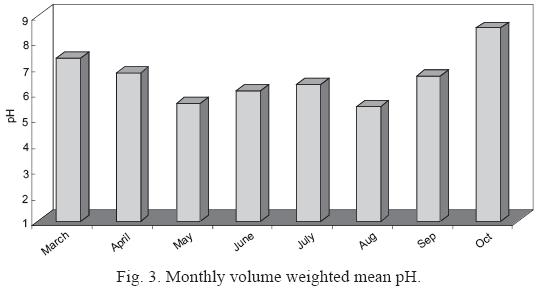
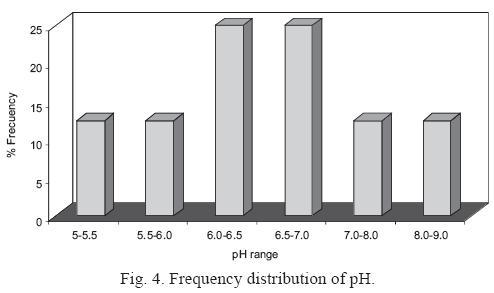
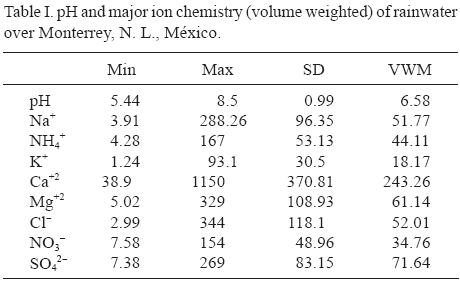
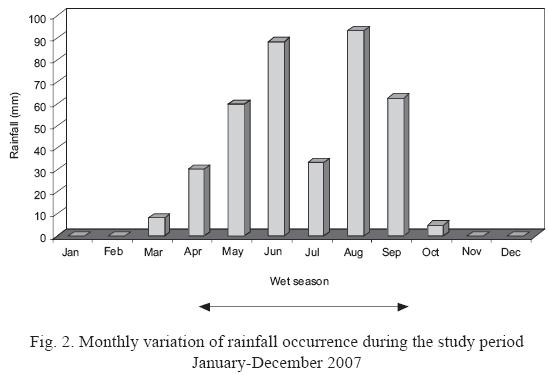
<body><![CDATA[<p align="justify"><font face="verdana" size="2">A second aliquot of each sample, retrieved from the refrigerated polyethylene bottle, was used for the determination of major ion concentrations. The cations Na<sup>+</sup>, K<sup>+</sup>, Ca<sup>+2</sup> and NH<sub>4</sub><sup>+</sup> were determined by ion chromatography using a Hewlett Packard 1090 with Hamilton PRP &#150;x100 (150 x 4.1 mm) separation column and an Alltech 550 conductivity detector and for the anions Cl<sup>&#150;</sup>, NO<sub>3</sub><sup>&#150;</sup> and SO<sub>4</sub><sup>&#150;</sup><sup>2</sup>. All solutions were prepared with deionized water supplied by a Milli&#150;Q&#150;Millipore system, and with standards solutions prepared by dissolution of 99% purity analytical grade salts. In order to check the instrumental errors a quality standard solution of the anions and cations, as well as blank samples, were prepared with different concentrations and given random numbers among real samples. The quality assurance procedures included the routine running of blanks and control samples as well as replicate samples. The column and the other operating conditions employed for analysis of both the ions are reported by Bravo <i>et al. </i>(2006).</font></p>     <p align="justify"><font face="verdana" size="2">&nbsp;</font></p>     <p align="justify"><font face="verdana" size="2"><b>3.	Results and discussion</b></font></p>     <p align="justify"><font face="verdana" size="2"><i>3.1 Rain quantity</i></font></p>     <p align="justify"><font face="verdana" size="2">A total of 32 rainwater samples were collected. The largest number of monthly events occurred in August (7) followed by May (6), June (5) and July (5); no rain events were observed on January, November and December. Monthly rainfall during the study period is presented in <a href="#figura2">Fig. 2</a>. The highest rainfall was during August (93.5 mm), followed by June (88.5 mm) and September (62.8 mm). The months of January, February, March, October, November and December are considered the dry season.</font></p>     <p align="center"><font face="verdana" size="2"><a name="figura2"></a></font></p>     <p align="center"><font face="verdana" size="2"><img src="/img/revistas/atm/v23n3/a1f2.jpg"></font></p>     <p align="justify"><font face="verdana" size="2"><i>3.2 Variation of pH</i></font></p>     <p align="justify"><font face="verdana" size="2">The pH of individual precipitation events ranged from 5.44 to 8.5, with both acidic and alkaline values. In this study the volume&#150;weighted mean pH (VWM) value was 6.58, higher value than the widely accepted background rain pH of 5.6 (Charlson and Rhode, 1982). In comparison with other results (pH = 5.6) reported in M&eacute;xico by Bravo <i>et al</i>. (2006), the results are quite similar. The pH of natural precipitation is controlled by dissolved CO<sub>2, </sub>due the interaction between water droplets and carbon dioxide. Precipitation pH is modified by the addition of both acidic and alkaline components (Top&ccedil;u <i>et al</i>., 2002; Singh and Mondal, 2008).</font></p>     <p align="justify"><font face="verdana" size="2"><a href="#figura3">Fig. 3</a> shows the temporal variation of volume weighted pH. The highest precipitation acidity (5.44) was associated with summer samples, especially in the period May to August 2007.</font></p>     ]]></body>
<body><![CDATA[<p align="center"><font face="verdana" size="2"><a name="figura3"></a></font></p>     <p align="center"><font face="verdana" size="2"><img src="/img/revistas/atm/v23n3/a1f3.jpg"></font></p>     <p align="justify"><font face="verdana" size="2">The frequency distribution of pH is shown in <a href="#figura4">Fig. 4</a>. Only 25% of the 32 rain samples showed a pH below 5.6, indicating that rainfall with above&#150;background acidity is not common in Monterrey. Instead, the abundance of pH values above 5.6 indicate the presence of alkaline substance in the rainwater (Hu <i>et al.</i>, 2006).</font></p>     <p align="center"><font face="verdana" size="2"><a name="figura4"></a></font></p>     <p align="center"><font face="verdana" size="2"><img src="/img/revistas/atm/v23n3/a1f4.jpg"></font></p>     <p align="justify"><font face="verdana" size="2">Alkaline precipitation has been reported in different parts of the world. In India, previous studies have recorded pH values ranging from 6.0 to 7.5 (Kemani <i>et al</i>.,1985; Saxena <i>et al</i>.,1996). Chandra Mouli <i>et al</i>. (2005) reported an alkaline VWM of 6.78. Another study, in the urban area of Ankara, Turkey, reported alkaline pH values due to high calcium (CaCO<sub>3</sub>) loading from alkaline soil (Top&ccedil;u <i>et al</i>., 2002). Thus, the VWM pH of 6.58 for our Monterrey samples likely reflects a strong impact of alkaline soil dust on rainwater composition.</font></p>     <p align="justify"><font face="verdana" size="2"><i>3.3 Chemical composition </i></font></p>     <p align="justify"><font face="verdana" size="2">The variation of monthly mean concentration of major inorganic ions in rain water is illustrated in <a href="#tabla1">Table I</a>. Volume weighted mean concentrations of cations can be ordered in descending order as Ca<sup>2+ </sup>&gt; Mg<sup>2+ </sup>&gt; Na<sup>+ </sup>&gt; NH<sub>4</sub><sup>+ </sup>&gt;<sup> </sup>K<sup>+</sup>, with values ranging from 1150 to 93.1 &micro;eq/L. The corresponding order of anions volume VWM concentration was Cl<sup>&#150;</sup>, SO<sub>4</sub><sup>&#150;</sup><sup>2</sup>, and NO<sub>3</sub><sup>&#150;</sup>, with values ranging from 344 to 154 &micro;eq/L. </font></p>     <p align="center"><font face="verdana" size="2"><a name="tabla1"></a></font></p>     <p align="center"><font face="verdana" size="2"><img src="/img/revistas/atm/v23n3/a1t1.jpg"></font></p>     ]]></body>
<body><![CDATA[<p align="justify"><font face="verdana" size="2">The variation of monthly mean concentration of major ions in rain water is illustrated in <a href="/img/revistas/atm/v23n3/a1f5.jpg" target="_blank">Fig 5</a>.</font></p>     <p align="justify"><font face="verdana" size="2">Ca<sup>+2</sup> and SO<sub>4</sub><sup>&#150;</sup><sup>2</sup>concentrations are large because the Monterrey Metropolitan Area is surrounded by several mountains with numerous quarries and associated factories. The rock is composed basically of calcium carbonate. Aggregation operations are installed around those hills and represent a significant source of airborne particulate matter. </font></p>     <p align="justify"><font face="verdana" size="2">The high concentration of cations observed in March may be due to the small volume of rainfall. (Recall, from <a href="#figura2">Fig. 2</a>, March rainfall was only 8.2 mm compared with 93.5 mm in August.) Only one rain event was present in this month.</font></p>     <p align="justify"><font face="verdana" size="2">The smaller amount of rainwater is expected to produce higher concentrations of chemical species in rainwater due to reduced removal of suspended particles by wet deposition (Chandra <i>et al</i>., 2005).</font></p>     <p align="justify"><font face="verdana" size="2">During January, February, November and December no rain events were present in Monterrey's Metropolitan Area.</font></p>     <p align="justify"><font face="verdana" size="2">On the other hand, the increased anion concentrations during October may be due to the prevailing meteorological conditions in Monterrey that do not allow complete dispersion of NO<sub>2</sub> and SO<sub>2</sub> (INEGI, 2002).</font></p>     <p align="justify"><font face="verdana" size="2"><i>3.4 Comparison with other selected sites</i></font></p>     <p align="justify"><font face="verdana" size="2"><a href="/img/revistas/atm/v23n3/a1t2.jpg" target="_blank">Table II</a> shows volume&#150;weighted mean concentrations in rainwater for this study and other results reported for different regions of M&eacute;xico and selected sites worldwide. The pH of the present study (6.58) is higher than the other Mexican regions like El Taj&iacute;n, Veracruz (4.58) (Bravo <i>et al</i>., 2006) and Estado de M&eacute;xico (4.54) (Garc&iacute;a <i>et al</i>., 2006), but is similar to Tirupati, India (6.78) (Chandra <i>et al</i>., 2005). This may be due to the latter region having a high load of suspended alkaline atmospheric particles.</font></p>     <p align="justify"><font face="verdana" size="2">In this study Ca<sup>+2</sup> is the most abundant cation. The relative high concentration of this ion suggests the effect of local anthropogenic emissions. The Monterrey Metropolitan Area is a major industrial city which has a serious atmospheric pollution problem due principally to the surrounding mountains, quarry hills and factories. These are composed basically of calcium carbonate and the excess calcium is believed to be due to particles originating from these sources (INEGI, 2002). India soils have also been considered to be a major contributor of particulate matter in the atmosphere and to alkalinity in the rainwater (Chandra <i>et al</i>., 2005) </font></p>     <p align="justify"><font face="verdana" size="2">The Ca<sup>+2</sup> and Mg<sup>+2</sup> concentrations in Monterrey are higher than concentrations reported by Bravo <i>et al.</i> (2006) for the El Taj&iacute;n archeological zone in Veracruz, M&eacute;xico and by Garc&iacute;a (2006) for Rancho Viejo, a rural zone close to M&eacute;xico City, but lower than the concentrations reported by Nastos (2007) for Athens, Greece.</font></p>     ]]></body>
<body><![CDATA[<p align="justify"><font face="verdana" size="2"><i>3.5 Source contribution</i></font></p>     <p align="justify"><font face="verdana" size="2">In order to find association between ions in precipitation, and consequently, the possible sources of pollutants and the gaseous reaction occurring in the atmosphere, the correlation between ions was calculated for all samples and presented in <a href="/img/revistas/atm/v23n3/a1t3.jpg" target="_blank">Table III</a>. The acidic ions SO<sub>4</sub><sup>2&#150;</sup> and NO<sub>3</sub><sup>&#150;</sup> present high correlation (r = 0.817) indicating their origin from similar sources, because of the similarity in their behavior in rain water and the co&#150;emissions of their precursors SO<sub>2</sub> and NOx (Chandra <i>et al</i>., 2005; Singh and Mondal, 2008). A significant correlation was observed between NO<sub>3</sub><sup>&#150;</sup> and Cl<sup>&#150;</sup> (r = 0.648). On the other hand a strong correlation was observed between Ca<sup>2+</sup> and Mg <sup>2+</sup> (r &gt; 0.9), Ca<sup>2+</sup> and NH<sub>4</sub><sup>+ </sup>(r = 0.895) and Ca<sup>2+</sup> and K<sup>+ </sup>(r = 0.984), suggesting the common origin of these ions from natural sources associated with crustal rather than anthropogenic or marine origin (Singh and Mondal, 2008). The high loading of Ca<sup>2+</sup> and Mg<sup>2+</sup> and the negative correlation between NH<sub>4</sub><sup>+</sup>and NO<sub>3</sub><sup>&#150;</sup> (r = &#150;0.439) and NH<sub>4</sub><sup>+</sup> and SO<sub>4</sub><sup>2</sup><sup>&#150;</sup> (r = &#150;0.405) suggests a buffering factor for the acidity of the rainwater.</font></p>     <p align="justify"><font face="verdana" size="2">There is also a significant correlation between ion components and conductivity, except for the H<sup>+</sup>, NO<sub>3</sub><sup>&#150;</sup><sup> </sup>and SO<sub>4</sub><sup>2</sup><sup>&#150;</sup> ions. Because of the significant neutralizing effect of calcium ions, H<sup>+</sup> was not expected to have a good correlation with SO<sub>4</sub><sup>2</sup><sup>&#150;</sup> and NO<sub>3</sub><sup>&#150;</sup>.</font></p>     <p align="justify"><font face="verdana" size="2">Hydrogen<sup> </sup>ions are weakly correlated with SO<sub>4</sub><sup>2</sup><sup>&#150;</sup> and NO<sub>3</sub><sup>&#150;</sup>. Top&ccedil;u <i>et al</i>. (2002) found similar results in Ankara, Turkey.</font></p>     <p align="justify"><font face="verdana" size="2">As can be seen in <a href="/img/revistas/atm/v23n3/a1t3.jpg" target="_blank">Table III</a>, all ionic species except sulfate correlate negatively with rainfall amount (P), indicating an atmospheric washout process.</font></p>     <p align="justify"><font face="verdana" size="2">&nbsp;</font></p>     <p align="justify"><font face="verdana" size="2"><b>4.	Conclusions</b></font></p>     <p align="justify"><font face="verdana" size="2">A study of the chemical composition of rainwater was carried out over a one&#150;year period at Monterrey, Nuevo Le&oacute;n, M&eacute;xico the most important industrial state in northeastern M&eacute;xico. This represents the first contribution to the literature of rainwater chemistry in the region.</font></p>     <p align="justify"><font face="verdana" size="2">The study reveals the following principal conclusions:</font></p>     <blockquote>       ]]></body>
<body><![CDATA[<p align="justify"><font face="verdana" size="2">1. The rainwater is typically alkaline, with strong correlations between Ca<sup>+2</sup> and other ionic species, revealing that the acidity is being neutralized.</font></p>       <p align="justify"><font face="verdana" size="2">2. The average pH of the rainwater was 6.58, perhaps due to neutralization. Only 25% of the rain samples had a pH below 5.6. This shows strong inputs of alkaline species to rainwater samples in this region. The average pH of samples higher than 5.6 is due to high loadings of calcium ions in the form of CaCO<sub>3.</sub> This may be due to a high load of alkaline dust particle by numerous quarry hills and factories. These are composed basically of calcium carbonate.</font></p>       <p align="justify"><font face="verdana" size="2">3. The rainwater chemistry is dominated by Ca<sup>2+</sup>, Mg<sup>2+</sup> and SO<sub>4</sub><sup>2</sup><sup>&#150;</sup>. The principal cations and anions, in decreasing order, are Ca<sup>2+</sup>&gt; Mg<sup>2+</sup>&gt; Na<sup>+</sup>&gt; NH<sub>4</sub><sup>+</sup>&gt; K<sup>+</sup> and Cl<sup>&#150;</sup>&gt; S0<sub>4</sub><sup>&#150;</sup><sup>2</sup>&gt; NO<sub>3</sub><sup>&#150;</sup>.</font></p>       <p align="justify"><font face="verdana" size="2">4. The cations Mg<sup>2+</sup>, NH<sub>4</sub><sup>+</sup>, Na<sup>+ </sup>and K<sup>+</sup> correlated strongly with Ca<sup>2+</sup>, suggesting a common natural source of crustal origin.</font></p>       <p align="justify"><font face="verdana" size="2">5. The low concentrations of H<sup>+</sup> found in Monterrey rainwater samples suggest that an important portion of H<sub>2</sub>SO<sub>4</sub> and HNO<sub>3</sub> has been neutralized by alkaline particles in the atmosphere.</font></p>       <p align="justify"><font face="verdana" size="2">6. Due to neutralization by alkaline particles, the anions SO<sub>4</sub><sup>2</sup><sup>&#150;</sup> or NO<sub>3</sub><sup>&#150;</sup> are only weakly correlated with H<sup>+</sup>. </font></p>       <p align="justify"><font face="verdana" size="2">7. The monthly variation in ionic deposition is influenced by rainfall rate and ionic species concentration. </font></p>       <p align="justify"><font face="verdana" size="2">8. The correlation study and the comparison of major ion composition with other sites revealed that rainwater ion composition is strongly influenced by anthropogenic sources rather than terrestrial and marine sources.</font></p>       <p align="justify"><font face="verdana" size="2">&nbsp;</font></p> </blockquote>     <p align="justify"><font face="verdana" size="2"><b>Acknowledgements</b></font></p>     ]]></body>
<body><![CDATA[<p align="justify"><font face="verdana" size="2">The authors thank Universidad Aut&oacute;noma de Nuevo Le&oacute;n for financial support of this work.</font></p>     <p align="justify"><font face="verdana" size="2">&nbsp;</font></p>     <p align="justify"><font face="verdana" size="2"><b>References</b></font></p>     <!-- ref --><p align="justify"><font face="verdana" size="2">ASTM, 2004a. Standard guide for choosing locations and sampling methods to monitor atmospheric deposition at non urban locations. American Society for Testing and Materials. D 5111&#150;95. USA, 1&#150;9. </font>&nbsp;&nbsp;&nbsp;&nbsp;&nbsp;&nbsp;&nbsp;&nbsp;[&#160;<a href="javascript:void(0);" onclick="javascript: window.open('/scielo.php?script=sci_nlinks&ref=1276538&pid=S0187-6236201000030000100001&lng=','','width=640,height=500,resizable=yes,scrollbars=1,menubar=yes,');">Links</a>&#160;]<!-- end-ref --><!-- ref --><p align="justify"><font face="verdana" size="2">ASTM, 2004b. Standard guide of materials used for preparation of materials used for the collection and preservation of atmospheric wet deposition. American Society for Testing and Materials. D 5012&#150;89, USA, 1&#150;5.</font>&nbsp;&nbsp;&nbsp;&nbsp;&nbsp;&nbsp;&nbsp;&nbsp;[&#160;<a href="javascript:void(0);" onclick="javascript: window.open('/scielo.php?script=sci_nlinks&ref=1276539&pid=S0187-6236201000030000100002&lng=','','width=640,height=500,resizable=yes,scrollbars=1,menubar=yes,');">Links</a>&#160;]<!-- end-ref --><!-- ref --><p align="justify"><font face="verdana" size="2">Bravo &Aacute;lvarez H., R. Sosa Echeverr&iacute;a, P. S&aacute;nchez &Aacute;lvarez, R. Soto Ayala and A. Alarc&oacute;n Jim&eacute;nez, 2005. Precipitaci&oacute;n &aacute;cida en la costa del Golfo de M&eacute;xico. In: <i>Contaminaci&oacute;n e impacto ambiental: diagn&oacute;stico y tendencias </i>(A. V. Botello, J. Rend&oacute;n&#150;von Osten, G. Gold&#150;Bouchot and C. Agraz&#150;Hern&aacute;ndez, Eds.) Universidad Aut&oacute;noma de Campeche, Universidad Nacional Aut&oacute;noma de M&eacute;xico, Instituto Nacional de Ecolog&iacute;a, M&eacute;xico, 535&#150;552 pp.</font>&nbsp;&nbsp;&nbsp;&nbsp;&nbsp;&nbsp;&nbsp;&nbsp;[&#160;<a href="javascript:void(0);" onclick="javascript: window.open('/scielo.php?script=sci_nlinks&ref=1276540&pid=S0187-6236201000030000100003&lng=','','width=640,height=500,resizable=yes,scrollbars=1,menubar=yes,');">Links</a>&#160;]<!-- end-ref --><!-- ref --><p align="justify"><font face="verdana" size="2">Bravo H., R. Soto, R. Sosa, P. S&aacute;nchez, A. Alarc&oacute;n and J. Kahl, 2006. Effect of acid rain on building material of the El Taj&iacute;n archeological zone in Veracruz, M&eacute;xico. <i>Env. Poll. </i><b>144</b>, 655&#150;660.</font>&nbsp;&nbsp;&nbsp;&nbsp;&nbsp;&nbsp;&nbsp;&nbsp;[&#160;<a href="javascript:void(0);" onclick="javascript: window.open('/scielo.php?script=sci_nlinks&ref=1276541&pid=S0187-6236201000030000100004&lng=','','width=640,height=500,resizable=yes,scrollbars=1,menubar=yes,');">Links</a>&#160;]<!-- end-ref --><!-- ref --><p align="justify"><font face="verdana" size="2">Chandra Mouli P., S. Venkata Mohan, S. Jayarama Reddy, 2005. Rainwater chemistry at a regional representative urban site: influence of a terrestrial source on ionic composition. <i>Atmos. Environ</i>. <b>39</b>, 999&#150;1008.</font>&nbsp;&nbsp;&nbsp;&nbsp;&nbsp;&nbsp;&nbsp;&nbsp;[&#160;<a href="javascript:void(0);" onclick="javascript: window.open('/scielo.php?script=sci_nlinks&ref=1276542&pid=S0187-6236201000030000100005&lng=','','width=640,height=500,resizable=yes,scrollbars=1,menubar=yes,');">Links</a>&#160;]<!-- end-ref --><!-- ref --><p align="justify"><font face="verdana" size="2">Charlson R. J. and H. Rodhe, 1982. Factors controlling the acidity of natural rain water. <i>Nature </i><b>295</b>, 683&#150;685.</font>&nbsp;&nbsp;&nbsp;&nbsp;&nbsp;&nbsp;&nbsp;&nbsp;[&#160;<a href="javascript:void(0);" onclick="javascript: window.open('/scielo.php?script=sci_nlinks&ref=1276543&pid=S0187-6236201000030000100006&lng=','','width=640,height=500,resizable=yes,scrollbars=1,menubar=yes,');">Links</a>&#160;]<!-- end-ref --><!-- ref --><p align="justify"><font face="verdana" size="2">Cobourn W. C., K. Lal Gauri, S. Tambe, S. Li and E. Saltik, 1993. Laboratory measurements of sulfur dioxide deposition velocity on marble and dolomite stone surfaces. <i>Atmos. Environ.</i> <b>27</b>, 193&#150;201.</font>&nbsp;&nbsp;&nbsp;&nbsp;&nbsp;&nbsp;&nbsp;&nbsp;[&#160;<a href="javascript:void(0);" onclick="javascript: window.open('/scielo.php?script=sci_nlinks&ref=1276544&pid=S0187-6236201000030000100007&lng=','','width=640,height=500,resizable=yes,scrollbars=1,menubar=yes,');">Links</a>&#160;]<!-- end-ref --><!-- ref --><p align="justify"><font face="verdana" size="2">Dikaiakos J. G., C. G. Tsitouris, P. A. Siskos, D. A. Melissos, P. Nastos, 1990. Rainwater composition in Athens, Greece. <i>Atmos. Environ. </i><b>24</b>, 171&#150;176.</font>&nbsp;&nbsp;&nbsp;&nbsp;&nbsp;&nbsp;&nbsp;&nbsp;[&#160;<a href="javascript:void(0);" onclick="javascript: window.open('/scielo.php?script=sci_nlinks&ref=1276545&pid=S0187-6236201000030000100008&lng=','','width=640,height=500,resizable=yes,scrollbars=1,menubar=yes,');">Links</a>&#160;]<!-- end-ref --><!-- ref --><p align="justify"><font face="verdana" size="2">Galloway J. N., 2001. Acidification of the world: natural and anthropogenic, <i>Water Air Soil Poll</i>. <b>130</b>, 17&#150;24.</font>&nbsp;&nbsp;&nbsp;&nbsp;&nbsp;&nbsp;&nbsp;&nbsp;[&#160;<a href="javascript:void(0);" onclick="javascript: window.open('/scielo.php?script=sci_nlinks&ref=1276546&pid=S0187-6236201000030000100009&lng=','','width=640,height=500,resizable=yes,scrollbars=1,menubar=yes,');">Links</a>&#160;]<!-- end-ref --><!-- ref --><p align="justify"><font face="verdana" size="2">Garc&iacute;a R., M. C. Torres, H. Padilla, H. Belmont, E. Azpra, F. Arcega&#150;Cabrera, A. B&aacute;ez, 2006. Measurement of chemical elements in rain from Rancho Viejo, a rural wooded area in the State of M&eacute;xico, M&eacute;xico. <i>Atmos. Environ</i>. <b>40</b>, 6088&#150;6100.</font>&nbsp;&nbsp;&nbsp;&nbsp;&nbsp;&nbsp;&nbsp;&nbsp;[&#160;<a href="javascript:void(0);" onclick="javascript: window.open('/scielo.php?script=sci_nlinks&ref=1276547&pid=S0187-6236201000030000100010&lng=','','width=640,height=500,resizable=yes,scrollbars=1,menubar=yes,');">Links</a>&#160;]<!-- end-ref --><!-- ref --><p align="justify"><font face="verdana" size="2">Hu G.P., R. Balasubramanian, C.D. Wu, 2003. Chemical characterization of rainwater at Singapore. <i>Chemosphere</i> <b>51</b>, 747&#150;755.</font>&nbsp;&nbsp;&nbsp;&nbsp;&nbsp;&nbsp;&nbsp;&nbsp;[&#160;<a href="javascript:void(0);" onclick="javascript: window.open('/scielo.php?script=sci_nlinks&ref=1276548&pid=S0187-6236201000030000100011&lng=','','width=640,height=500,resizable=yes,scrollbars=1,menubar=yes,');">Links</a>&#160;]<!-- end-ref --><!-- ref --><p align="justify"><font face="verdana" size="2">INEGI, 2001. Estad&iacute;sticas de medio ambiente de la Zona Metropolitana de Monterrey. 2002. Instituto Nacional de Estad&iacute;stica, Geograf&iacute;a e Inform&aacute;tica, M&eacute;xico.</font>&nbsp;&nbsp;&nbsp;&nbsp;&nbsp;&nbsp;&nbsp;&nbsp;[&#160;<a href="javascript:void(0);" onclick="javascript: window.open('/scielo.php?script=sci_nlinks&ref=1276549&pid=S0187-6236201000030000100012&lng=','','width=640,height=500,resizable=yes,scrollbars=1,menubar=yes,');">Links</a>&#160;]<!-- end-ref --><!-- ref --><p align="justify"><font face="verdana" size="2">Khemani L. T., G. A. Momin, M. S. Naik, R. Prakasa, R. Kumar and M. Ramana, 1985. Impact of alkaline particulates on pH of rainwater in India. <i>Water Air Soil Poll.</i> <b>24</b>, 365&#150;376.</font>&nbsp;&nbsp;&nbsp;&nbsp;&nbsp;&nbsp;&nbsp;&nbsp;[&#160;<a href="javascript:void(0);" onclick="javascript: window.open('/scielo.php?script=sci_nlinks&ref=1276550&pid=S0187-6236201000030000100013&lng=','','width=640,height=500,resizable=yes,scrollbars=1,menubar=yes,');">Links</a>&#160;]<!-- end-ref --><!-- ref --><p align="justify"><font face="verdana" size="2">Kulshrestha U. C., M. J. Kulshrestha, R. Sekar, M. Vairamani, A. K. Sarkar and D. C. Parashar, 2001. Investigation of alkaline nature of rain water in India. <i>Water Air Soil Poll.</i> <b>130</b>, 1685&#150;1690.</font>&nbsp;&nbsp;&nbsp;&nbsp;&nbsp;&nbsp;&nbsp;&nbsp;[&#160;<a href="javascript:void(0);" onclick="javascript: window.open('/scielo.php?script=sci_nlinks&ref=1276551&pid=S0187-6236201000030000100014&lng=','','width=640,height=500,resizable=yes,scrollbars=1,menubar=yes,');">Links</a>&#160;]<!-- end-ref --><!-- ref --><p align="justify"><font face="verdana" size="2">Nastos P. T., D. Alexakis, H. A. Kanellopoulou and A. E. Kelepertsis, 2007. Chemical composition of wet deposition in a Mediterranean site Athens, Greece related to the origin of air mass. <i>J.Atmos. Chem</i>. <b>58</b>,167&#150;179.</font>&nbsp;&nbsp;&nbsp;&nbsp;&nbsp;&nbsp;&nbsp;&nbsp;[&#160;<a href="javascript:void(0);" onclick="javascript: window.open('/scielo.php?script=sci_nlinks&ref=1276552&pid=S0187-6236201000030000100015&lng=','','width=640,height=500,resizable=yes,scrollbars=1,menubar=yes,');">Links</a>&#160;]<!-- end-ref --><!-- ref --><p align="justify"><font face="verdana" size="2">SCFI, 2000a. An&aacute;lisis de Agua&#150;Determinaci&oacute;n de pH&#150;M&eacute;todo de Prueba. Secretar&iacute;a de Comercio y Fomento Industrial, M&eacute;xico.</font>&nbsp;&nbsp;&nbsp;&nbsp;&nbsp;&nbsp;&nbsp;&nbsp;[&#160;<a href="javascript:void(0);" onclick="javascript: window.open('/scielo.php?script=sci_nlinks&ref=1276553&pid=S0187-6236201000030000100016&lng=','','width=640,height=500,resizable=yes,scrollbars=1,menubar=yes,');">Links</a>&#160;]<!-- end-ref --><!-- ref --><p align="justify"><font face="verdana" size="2">SCFI, 2000b. An&aacute;lisis de Agua&#150;Determinaci&oacute;n de la Conductividad Electrol&iacute;tica&#150;M&eacute;todo de Prueba. Secretar&iacute;a de Comercio y Fomento Industrial, M&eacute;xico.</font>&nbsp;&nbsp;&nbsp;&nbsp;&nbsp;&nbsp;&nbsp;&nbsp;[&#160;<a href="javascript:void(0);" onclick="javascript: window.open('/scielo.php?script=sci_nlinks&ref=1276554&pid=S0187-6236201000030000100017&lng=','','width=640,height=500,resizable=yes,scrollbars=1,menubar=yes,');">Links</a>&#160;]<!-- end-ref --><!-- ref --><p align="justify"><font face="verdana" size="2">Possanzini M., P. Buttini and V. Di Palo, 1988. Characterization of a rural area in terms of dry and wet deposition. <i>Sci. Tot. Environ.</i> <b>74</b>, 111&#150;120.</font>&nbsp;&nbsp;&nbsp;&nbsp;&nbsp;&nbsp;&nbsp;&nbsp;[&#160;<a href="javascript:void(0);" onclick="javascript: window.open('/scielo.php?script=sci_nlinks&ref=1276555&pid=S0187-6236201000030000100018&lng=','','width=640,height=500,resizable=yes,scrollbars=1,menubar=yes,');">Links</a>&#160;]<!-- end-ref --><!-- ref --><p align="justify"><font face="verdana" size="2">Samara C., R. Tsitouridou, Ch. Balafoutis, 1992. Chemical composition of rain in Thessaloniki, Greece, in relation to meteorological conditions. <i>Atmos. Environ. </i><b>26</b>, 359&#150;367.</font>&nbsp;&nbsp;&nbsp;&nbsp;&nbsp;&nbsp;&nbsp;&nbsp;[&#160;<a href="javascript:void(0);" onclick="javascript: window.open('/scielo.php?script=sci_nlinks&ref=1276556&pid=S0187-6236201000030000100019&lng=','','width=640,height=500,resizable=yes,scrollbars=1,menubar=yes,');">Links</a>&#160;]<!-- end-ref --><!-- ref --><p align="justify"><font face="verdana" size="2">Saxena A., U. C. Kulshrestha, N. Kumar, K. M. Kumari and S. S. Srivastava, 1996. Characterization of precipitation at Agra. <i>Atmos. Environ</i>. <b>30</b>, 3405&#150;3412.</font>&nbsp;&nbsp;&nbsp;&nbsp;&nbsp;&nbsp;&nbsp;&nbsp;[&#160;<a href="javascript:void(0);" onclick="javascript: window.open('/scielo.php?script=sci_nlinks&ref=1276557&pid=S0187-6236201000030000100020&lng=','','width=640,height=500,resizable=yes,scrollbars=1,menubar=yes,');">Links</a>&#160;]<!-- end-ref --><!-- ref --><p align="justify"><font face="verdana" size="2">Singh A. S. and G. C. Mondal, 2008. Chemical characterization of wet precipitation events and deposition of pollutants in coal mining region, India. <i>J. Atmos. Chem</i>. <b>59</b>, 1&#150;23.</font>&nbsp;&nbsp;&nbsp;&nbsp;&nbsp;&nbsp;&nbsp;&nbsp;[&#160;<a href="javascript:void(0);" onclick="javascript: window.open('/scielo.php?script=sci_nlinks&ref=1276558&pid=S0187-6236201000030000100021&lng=','','width=640,height=500,resizable=yes,scrollbars=1,menubar=yes,');">Links</a>&#160;]<!-- end-ref --><!-- ref --><p align="justify"><font face="verdana" size="2">Top&ccedil;u S., S. Incecik and A.T. Atimtay, 2002. Chemical composition of rainwater at EMEP station in Ankara, Turkey. <i>Atmos. Res</i>. <b>65</b>, 77&#150;92.</font>&nbsp;&nbsp;&nbsp;&nbsp;&nbsp;&nbsp;&nbsp;&nbsp;[&#160;<a href="javascript:void(0);" onclick="javascript: window.open('/scielo.php?script=sci_nlinks&ref=1276559&pid=S0187-6236201000030000100022&lng=','','width=640,height=500,resizable=yes,scrollbars=1,menubar=yes,');">Links</a>&#160;]<!-- end-ref --> ]]></body><back>
<ref-list>
<ref id="B1">
<nlm-citation citation-type="book">
<collab>ASTM</collab>
<source><![CDATA[Standard guide for choosing locations and sampling methods to monitor atmospheric deposition at non urban locations]]></source>
<year>2004</year>
<page-range>1-9</page-range><publisher-name><![CDATA[American Society for Testing and Materials]]></publisher-name>
</nlm-citation>
</ref>
<ref id="B2">
<nlm-citation citation-type="book">
<collab>ASTM</collab>
<source><![CDATA[Standard guide of materials used for preparation of materials used for the collection and preservation of atmospheric wet deposition]]></source>
<year>2004</year>
<page-range>1-5</page-range><publisher-name><![CDATA[American Society for Testing and Materials]]></publisher-name>
</nlm-citation>
</ref>
<ref id="B3">
<nlm-citation citation-type="book">
<person-group person-group-type="author">
<name>
<surname><![CDATA[Bravo Álvarez]]></surname>
<given-names><![CDATA[H.]]></given-names>
</name>
<name>
<surname><![CDATA[Sosa Echeverría]]></surname>
<given-names><![CDATA[R.]]></given-names>
</name>
<name>
<surname><![CDATA[Sánchez Álvarez]]></surname>
<given-names><![CDATA[P.]]></given-names>
</name>
<name>
<surname><![CDATA[Soto Ayala]]></surname>
<given-names><![CDATA[R.]]></given-names>
</name>
<name>
<surname><![CDATA[Alarcón Jiménez]]></surname>
<given-names><![CDATA[A.]]></given-names>
</name>
</person-group>
<article-title xml:lang="es"><![CDATA[Precipitación ácida en la costa del Golfo de México]]></article-title>
<person-group person-group-type="editor">
<name>
<surname><![CDATA[Botello]]></surname>
<given-names><![CDATA[A. V.]]></given-names>
</name>
<name>
<surname><![CDATA[Rendón-von Osten]]></surname>
<given-names><![CDATA[J.]]></given-names>
</name>
<name>
<surname><![CDATA[Gold-Bouchot]]></surname>
<given-names><![CDATA[G.]]></given-names>
</name>
<name>
<surname><![CDATA[Agraz-Hernández]]></surname>
<given-names><![CDATA[C.]]></given-names>
</name>
</person-group>
<source><![CDATA[Contaminación e impacto ambiental: diagnóstico y tendencias]]></source>
<year>2005</year>
<page-range>535-552</page-range><publisher-name><![CDATA[Universidad Autónoma de CampecheUniversidad Nacional Autónoma de MéxicoInstituto Nacional de Ecología]]></publisher-name>
</nlm-citation>
</ref>
<ref id="B4">
<nlm-citation citation-type="journal">
<person-group person-group-type="author">
<name>
<surname><![CDATA[Bravo]]></surname>
<given-names><![CDATA[H.]]></given-names>
</name>
<name>
<surname><![CDATA[Soto]]></surname>
<given-names><![CDATA[R.]]></given-names>
</name>
<name>
<surname><![CDATA[Sosa]]></surname>
<given-names><![CDATA[R.]]></given-names>
</name>
<name>
<surname><![CDATA[Sánchez]]></surname>
<given-names><![CDATA[P.]]></given-names>
</name>
<name>
<surname><![CDATA[Alarcón]]></surname>
<given-names><![CDATA[A.]]></given-names>
</name>
<name>
<surname><![CDATA[Kahl]]></surname>
<given-names><![CDATA[J.]]></given-names>
</name>
</person-group>
<article-title xml:lang="en"><![CDATA[Effect of acid rain on building material of the El Tajín archeological zone in Veracruz, México]]></article-title>
<source><![CDATA[Env. Poll.]]></source>
<year>2006</year>
<volume>144</volume>
<page-range>655-660</page-range></nlm-citation>
</ref>
<ref id="B5">
<nlm-citation citation-type="journal">
<person-group person-group-type="author">
<name>
<surname><![CDATA[Chandra Mouli]]></surname>
<given-names><![CDATA[P.]]></given-names>
</name>
<name>
<surname><![CDATA[Venkata Mohan]]></surname>
<given-names><![CDATA[S.]]></given-names>
</name>
<name>
<surname><![CDATA[Jayarama Reddy]]></surname>
<given-names><![CDATA[S.]]></given-names>
</name>
</person-group>
<article-title xml:lang="en"><![CDATA[Rainwater chemistry at a regional representative urban site: influence of a terrestrial source on ionic composition]]></article-title>
<source><![CDATA[Atmos. Environ.]]></source>
<year>2005</year>
<volume>39</volume>
<page-range>999-1008</page-range></nlm-citation>
</ref>
<ref id="B6">
<nlm-citation citation-type="journal">
<person-group person-group-type="author">
<name>
<surname><![CDATA[Charlson]]></surname>
<given-names><![CDATA[R. J.]]></given-names>
</name>
<name>
<surname><![CDATA[Rodhe]]></surname>
<given-names><![CDATA[H.]]></given-names>
</name>
</person-group>
<article-title xml:lang="en"><![CDATA[Factors controlling the acidity of natural rain water]]></article-title>
<source><![CDATA[Nature]]></source>
<year>1982</year>
<volume>295</volume>
<page-range>683-685</page-range></nlm-citation>
</ref>
<ref id="B7">
<nlm-citation citation-type="journal">
<person-group person-group-type="author">
<name>
<surname><![CDATA[Cobourn]]></surname>
<given-names><![CDATA[W. C.]]></given-names>
</name>
<name>
<surname><![CDATA[Lal Gauri]]></surname>
<given-names><![CDATA[K.]]></given-names>
</name>
<name>
<surname><![CDATA[Tambe]]></surname>
<given-names><![CDATA[S.]]></given-names>
</name>
<name>
<surname><![CDATA[Li]]></surname>
<given-names><![CDATA[S.]]></given-names>
</name>
<name>
<surname><![CDATA[Saltik]]></surname>
<given-names><![CDATA[E.]]></given-names>
</name>
</person-group>
<article-title xml:lang="en"><![CDATA[Laboratory measurements of sulfur dioxide deposition velocity on marble and dolomite stone surfaces]]></article-title>
<source><![CDATA[Atmos. Environ.]]></source>
<year>1993</year>
<volume>27</volume>
<page-range>193-201</page-range></nlm-citation>
</ref>
<ref id="B8">
<nlm-citation citation-type="journal">
<person-group person-group-type="author">
<name>
<surname><![CDATA[Dikaiakos]]></surname>
<given-names><![CDATA[J. G.]]></given-names>
</name>
<name>
<surname><![CDATA[Tsitouris]]></surname>
<given-names><![CDATA[C. G.]]></given-names>
</name>
<name>
<surname><![CDATA[Siskos]]></surname>
<given-names><![CDATA[P. A.]]></given-names>
</name>
<name>
<surname><![CDATA[Melissos]]></surname>
<given-names><![CDATA[D. A.]]></given-names>
</name>
<name>
<surname><![CDATA[Nastos]]></surname>
<given-names><![CDATA[P.]]></given-names>
</name>
</person-group>
<article-title xml:lang="en"><![CDATA[Rainwater composition in Athens, Greece]]></article-title>
<source><![CDATA[Atmos. Environ.]]></source>
<year>1990</year>
<volume>24</volume>
<page-range>171-176</page-range></nlm-citation>
</ref>
<ref id="B9">
<nlm-citation citation-type="journal">
<person-group person-group-type="author">
<name>
<surname><![CDATA[Galloway]]></surname>
<given-names><![CDATA[J. N.]]></given-names>
</name>
</person-group>
<article-title xml:lang="en"><![CDATA[Acidification of the world: natural and anthropogenic]]></article-title>
<source><![CDATA[Water Air Soil Poll.]]></source>
<year>2001</year>
<volume>130</volume>
<page-range>17-24</page-range></nlm-citation>
</ref>
<ref id="B10">
<nlm-citation citation-type="journal">
<person-group person-group-type="author">
<name>
<surname><![CDATA[García]]></surname>
<given-names><![CDATA[R.]]></given-names>
</name>
<name>
<surname><![CDATA[Torres]]></surname>
<given-names><![CDATA[M. C.]]></given-names>
</name>
<name>
<surname><![CDATA[Padilla]]></surname>
<given-names><![CDATA[H.]]></given-names>
</name>
<name>
<surname><![CDATA[Belmont]]></surname>
<given-names><![CDATA[H.]]></given-names>
</name>
<name>
<surname><![CDATA[Azpra]]></surname>
<given-names><![CDATA[E.]]></given-names>
</name>
<name>
<surname><![CDATA[Arcega-Cabrera]]></surname>
<given-names><![CDATA[F.]]></given-names>
</name>
<name>
<surname><![CDATA[Báez]]></surname>
<given-names><![CDATA[A.]]></given-names>
</name>
</person-group>
<article-title xml:lang="en"><![CDATA[Measurement of chemical elements in rain from Rancho Viejo, a rural wooded area in the State of México, México]]></article-title>
<source><![CDATA[Atmos. Environ.]]></source>
<year>2006</year>
<volume>40</volume>
<page-range>6088-6100</page-range></nlm-citation>
</ref>
<ref id="B11">
<nlm-citation citation-type="journal">
<person-group person-group-type="author">
<name>
<surname><![CDATA[Hu]]></surname>
<given-names><![CDATA[G.P.]]></given-names>
</name>
<name>
<surname><![CDATA[Balasubramanian]]></surname>
<given-names><![CDATA[R.]]></given-names>
</name>
<name>
<surname><![CDATA[Wu]]></surname>
<given-names><![CDATA[C.D.]]></given-names>
</name>
</person-group>
<article-title xml:lang="en"><![CDATA[Chemical characterization of rainwater at Singapore]]></article-title>
<source><![CDATA[Chemosphere]]></source>
<year>2003</year>
<volume>51</volume>
<page-range>747-755</page-range></nlm-citation>
</ref>
<ref id="B12">
<nlm-citation citation-type="book">
<collab>INEGI</collab>
<source><![CDATA[Estadísticas de medio ambiente de la Zona Metropolitana de Monterrey: 2002]]></source>
<year>2001</year>
<publisher-name><![CDATA[Instituto Nacional de Estadística, Geografía e Informática]]></publisher-name>
</nlm-citation>
</ref>
<ref id="B13">
<nlm-citation citation-type="journal">
<person-group person-group-type="author">
<name>
<surname><![CDATA[Khemani]]></surname>
<given-names><![CDATA[L. T.]]></given-names>
</name>
<name>
<surname><![CDATA[Momin]]></surname>
<given-names><![CDATA[G. A.]]></given-names>
</name>
<name>
<surname><![CDATA[Naik]]></surname>
<given-names><![CDATA[M. S.]]></given-names>
</name>
<name>
<surname><![CDATA[Prakasa]]></surname>
<given-names><![CDATA[R.]]></given-names>
</name>
<name>
<surname><![CDATA[Kumar]]></surname>
<given-names><![CDATA[R.]]></given-names>
</name>
<name>
<surname><![CDATA[Ramana]]></surname>
<given-names><![CDATA[M.]]></given-names>
</name>
</person-group>
<article-title xml:lang="en"><![CDATA[Impact of alkaline particulates on pH of rainwater in India]]></article-title>
<source><![CDATA[Water Air Soil Poll.]]></source>
<year>1985</year>
<volume>24</volume>
<page-range>365-376</page-range></nlm-citation>
</ref>
<ref id="B14">
<nlm-citation citation-type="journal">
<person-group person-group-type="author">
<name>
<surname><![CDATA[Kulshrestha]]></surname>
<given-names><![CDATA[U. C.]]></given-names>
</name>
<name>
<surname><![CDATA[Kulshrestha]]></surname>
<given-names><![CDATA[M. J.]]></given-names>
</name>
<name>
<surname><![CDATA[Sekar]]></surname>
<given-names><![CDATA[R.]]></given-names>
</name>
<name>
<surname><![CDATA[Vairamani]]></surname>
<given-names><![CDATA[M.]]></given-names>
</name>
<name>
<surname><![CDATA[Sarkar]]></surname>
<given-names><![CDATA[A. K.]]></given-names>
</name>
<name>
<surname><![CDATA[Parashar]]></surname>
<given-names><![CDATA[D. C.]]></given-names>
</name>
</person-group>
<article-title xml:lang="en"><![CDATA[Investigation of alkaline nature of rain water in India]]></article-title>
<source><![CDATA[Water Air Soil Poll.]]></source>
<year>2001</year>
<volume>130</volume>
<page-range>1685-1690</page-range></nlm-citation>
</ref>
<ref id="B15">
<nlm-citation citation-type="journal">
<person-group person-group-type="author">
<name>
<surname><![CDATA[Nastos]]></surname>
<given-names><![CDATA[P. T.]]></given-names>
</name>
<name>
<surname><![CDATA[Alexakis]]></surname>
<given-names><![CDATA[D.]]></given-names>
</name>
<name>
<surname><![CDATA[Kanellopoulou]]></surname>
<given-names><![CDATA[H. A.]]></given-names>
</name>
<name>
<surname><![CDATA[Kelepertsis]]></surname>
<given-names><![CDATA[A. E.]]></given-names>
</name>
</person-group>
<article-title xml:lang="en"><![CDATA[Chemical composition of wet deposition in a Mediterranean site Athens, Greece related to the origin of air mass]]></article-title>
<source><![CDATA[J.Atmos. Chem.]]></source>
<year>2007</year>
<volume>58</volume>
<page-range>167-179</page-range></nlm-citation>
</ref>
<ref id="B16">
<nlm-citation citation-type="book">
<collab>SCFI</collab>
<source><![CDATA[Análisis de Agua-Determinación de pH-Método de Prueba]]></source>
<year>2000</year>
<publisher-name><![CDATA[Secretaría de Comercio y Fomento Industrial]]></publisher-name>
</nlm-citation>
</ref>
<ref id="B17">
<nlm-citation citation-type="book">
<collab>SCFI</collab>
<source><![CDATA[Análisis de Agua-Determinación de la Conductividad Electrolítica-Método de Prueba]]></source>
<year>2000</year>
<publisher-name><![CDATA[Secretaría de Comercio y Fomento Industrial]]></publisher-name>
</nlm-citation>
</ref>
<ref id="B18">
<nlm-citation citation-type="journal">
<person-group person-group-type="author">
<name>
<surname><![CDATA[Possanzini]]></surname>
<given-names><![CDATA[M.]]></given-names>
</name>
<name>
<surname><![CDATA[Buttini]]></surname>
<given-names><![CDATA[P.]]></given-names>
</name>
<name>
<surname><![CDATA[Di Palo]]></surname>
<given-names><![CDATA[V.]]></given-names>
</name>
</person-group>
<article-title xml:lang="en"><![CDATA[Characterization of a rural area in terms of dry and wet deposition]]></article-title>
<source><![CDATA[Sci. Tot. Environ.]]></source>
<year>1988</year>
<volume>74</volume>
<page-range>111-120</page-range></nlm-citation>
</ref>
<ref id="B19">
<nlm-citation citation-type="journal">
<person-group person-group-type="author">
<name>
<surname><![CDATA[Samara]]></surname>
<given-names><![CDATA[C.]]></given-names>
</name>
<name>
<surname><![CDATA[Tsitouridou]]></surname>
<given-names><![CDATA[R.]]></given-names>
</name>
<name>
<surname><![CDATA[Balafoutis]]></surname>
<given-names><![CDATA[Ch.]]></given-names>
</name>
</person-group>
<article-title xml:lang="en"><![CDATA[Chemical composition of rain in Thessaloniki , Greece, in relation to meteorological conditions]]></article-title>
<source><![CDATA[Atmos. Environ.]]></source>
<year>1992</year>
<volume>26</volume>
<page-range>359-367</page-range></nlm-citation>
</ref>
<ref id="B20">
<nlm-citation citation-type="journal">
<person-group person-group-type="author">
<name>
<surname><![CDATA[Saxena]]></surname>
<given-names><![CDATA[A.]]></given-names>
</name>
<name>
<surname><![CDATA[Kulshrestha]]></surname>
<given-names><![CDATA[U. C.]]></given-names>
</name>
<name>
<surname><![CDATA[Kumar]]></surname>
<given-names><![CDATA[N.]]></given-names>
</name>
<name>
<surname><![CDATA[Kumari]]></surname>
<given-names><![CDATA[K. M.]]></given-names>
</name>
<name>
<surname><![CDATA[Srivastava]]></surname>
<given-names><![CDATA[S. S.]]></given-names>
</name>
</person-group>
<article-title xml:lang="en"><![CDATA[Characterization of precipitation at Agra]]></article-title>
<source><![CDATA[Atmos. Environ.]]></source>
<year>1996</year>
<volume>30</volume>
<page-range>3405-3412</page-range></nlm-citation>
</ref>
<ref id="B21">
<nlm-citation citation-type="journal">
<person-group person-group-type="author">
<name>
<surname><![CDATA[Singh]]></surname>
<given-names><![CDATA[A. S.]]></given-names>
</name>
<name>
<surname><![CDATA[Mondal]]></surname>
<given-names><![CDATA[G. C.]]></given-names>
</name>
</person-group>
<article-title xml:lang="en"><![CDATA[Chemical characterization of wet precipitation events and deposition of pollutants in coal mining region, India]]></article-title>
<source><![CDATA[J. Atmos. Chem.]]></source>
<year>2008</year>
<volume>59</volume>
<page-range>1-23</page-range></nlm-citation>
</ref>
<ref id="B22">
<nlm-citation citation-type="journal">
<person-group person-group-type="author">
<name>
<surname><![CDATA[Topçu]]></surname>
<given-names><![CDATA[S.]]></given-names>
</name>
<name>
<surname><![CDATA[Incecik]]></surname>
<given-names><![CDATA[S.]]></given-names>
</name>
<name>
<surname><![CDATA[Atimtay]]></surname>
<given-names><![CDATA[A.T.]]></given-names>
</name>
</person-group>
<article-title xml:lang="en"><![CDATA[Chemical composition of rainwater at EMEP station in Ankara, Turkey]]></article-title>
<source><![CDATA[Atmos. Res.]]></source>
<year>2002</year>
<volume>65</volume>
<page-range>77-92</page-range></nlm-citation>
</ref>
</ref-list>
</back>
</article>