<?xml version="1.0" encoding="ISO-8859-1"?><article xmlns:mml="http://www.w3.org/1998/Math/MathML" xmlns:xlink="http://www.w3.org/1999/xlink" xmlns:xsi="http://www.w3.org/2001/XMLSchema-instance">
<front>
<journal-meta>
<journal-id>0187-6236</journal-id>
<journal-title><![CDATA[Atmósfera]]></journal-title>
<abbrev-journal-title><![CDATA[Atmósfera]]></abbrev-journal-title>
<issn>0187-6236</issn>
<publisher>
<publisher-name><![CDATA[Universidad Nacional Autónoma de México, Instituto de Ciencias de la Atmósfera y Cambio Climático]]></publisher-name>
</publisher>
</journal-meta>
<article-meta>
<article-id>S0187-62362010000100001</article-id>
<title-group>
<article-title xml:lang="en"><![CDATA[The role of convective parameterization in the simulation of a cyclone over the South Atlantic]]></article-title>
</title-group>
<contrib-group>
<contrib contrib-type="author">
<name>
<surname><![CDATA[ROCHA]]></surname>
<given-names><![CDATA[R. P. DA]]></given-names>
</name>
<xref ref-type="aff" rid="A01"/>
</contrib>
<contrib contrib-type="author">
<name>
<surname><![CDATA[CAETANO]]></surname>
<given-names><![CDATA[E.]]></given-names>
</name>
<xref ref-type="aff" rid="A02"/>
</contrib>
</contrib-group>
<aff id="A01">
<institution><![CDATA[,Universidade de São Paulo, Brasil Departamento de Ciências Atmosféricas, Instituto de Astronomia, Geofísica e Ciências Atmosféricas ]]></institution>
<addr-line><![CDATA[ ]]></addr-line>
</aff>
<aff id="A02">
<institution><![CDATA[,Universidad Nacional Autónoma de México Centro de Ciencias de la Atmósfera ]]></institution>
<addr-line><![CDATA[México D. F.]]></addr-line>
<country>Mexico</country>
</aff>
<pub-date pub-type="pub">
<day>01</day>
<month>01</month>
<year>2010</year>
</pub-date>
<pub-date pub-type="epub">
<day>01</day>
<month>01</month>
<year>2010</year>
</pub-date>
<volume>23</volume>
<numero>1</numero>
<fpage>1</fpage>
<lpage>23</lpage>
<copyright-statement/>
<copyright-year/>
<self-uri xlink:href="http://www.scielo.org.mx/scielo.php?script=sci_arttext&amp;pid=S0187-62362010000100001&amp;lng=en&amp;nrm=iso"></self-uri><self-uri xlink:href="http://www.scielo.org.mx/scielo.php?script=sci_abstract&amp;pid=S0187-62362010000100001&amp;lng=en&amp;nrm=iso"></self-uri><self-uri xlink:href="http://www.scielo.org.mx/scielo.php?script=sci_pdf&amp;pid=S0187-62362010000100001&amp;lng=en&amp;nrm=iso"></self-uri><abstract abstract-type="short" xml:lang="es"><p><![CDATA[Se realizaron simulaciones numéricas para examinar el papel de las parametrizaciones de cúmulos de Kuo y Kain-Fritsch (KF) y la dinámica seca en el desarrollo de un ciclón bajo una atmósfera baroclínica débil en aguas subtropicales del Océano Atlántico sur. La fase inicial del desarrollo del ciclón es investigada con una malla horizontal gruesa (75 km) y cuando el ciclón llega a la etapa de madurez, se utilizan dos resoluciones horizontales diferentes (75 y 25 km). La mejor simulación para la fase inicial del ciclón se produce cuando se aplica el esquema de convección Kuo, y esto puede ser atribuido a un mayor calentamiento diabático en la troposfera. Por otro lado, la simulación seca no es capaz de proporcionar la ubicación correcta y la intensidad del ciclón en su fase inicial. Durante la fase de madurez del ciclón la profundización es más intensa para el experimento del esquema de Kuo, asociada con la mayor liberación de calor latente en la columna vertical. La presencia de corrientes descendentes en el esquema KF, que actúan para enfriar y secar los niveles inferiores, es esencial para estabilizar la atmósfera y para reproducir el ciclón más cercano a la tasa de profundización observada. La mayor profundización del ciclón se encuentra en el esquema Kuo para el experimento de alta resolución. Esto sugiere que el sistema de convección KF es menos sensible a la resolución de la malla horizontal. También se muestra que los procesos diabáticos son cruciales para simular las características observadas de este ciclón marino en la región subtropical.]]></p></abstract>
<abstract abstract-type="short" xml:lang="en"><p><![CDATA[Numerical simulations are carried out to examine the role of the Kuo and Kain-Fritsch (KF) cumulus parameterization schemes and dry dynamics on a cyclone development, in a weak baroclinic atmosphere, over subtropical South Atlantic Ocean. The initial phase of the cyclone development is investigated with a coarse horizontal mesh (75 km) and when the cyclone reaches the mature stage two different horizontal resolutions are used (75 and 25 km). The best performance simulation for the cyclone initial phase occurs when the Kuo convective scheme is applied, and this may be attributed to a greater diabatic warming in the troposphere. On the other hand, the dry simulation is not capable of simulating the correct location and intensity of the cyclone in its initial phase. During the mature phase, a cyclone over deepening occurs in the Kuo scheme experiment associated with larger latent heat release in a deep vertical column. The presence of downdraft currents in the KF scheme, which acts to cool and dry the lower levels, is essential to stabilize the atmosphere and to reproduce the nearest observation cyclone deepening rate. The largest cyclone deepening is found in the Kuo scheme high resolution experiment. This suggests that the KF convective scheme is less sensitive to the horizontal grid resolution. It was also revealed that the diabatic processes are crucial to simulate the observed features of this marine cyclone over subtropical region.]]></p></abstract>
<kwd-group>
<kwd lng="en"><![CDATA[Subtropical cyclone]]></kwd>
<kwd lng="en"><![CDATA[Kuo, Kain-Fritsch]]></kwd>
<kwd lng="en"><![CDATA[marine cyclone]]></kwd>
</kwd-group>
</article-meta>
</front><body><![CDATA[ <p align="center"><font face="verdana" size="4"><b>The role of convective parameterization in the simulation of a cyclone over the South Atlantic</b></font></p>     <p align="justify"><font face="verdana" size="2">&nbsp;</font></p>     <p align="center"><font face="verdana" size="2"><b>R. P. DA ROCHA</b>    <br> <i>Departamento de Ci&ecirc;ncias Atmosf&eacute;ricas, Instituto de Astronomia, Geof&iacute;sica e     <br> Ci&ecirc;ncias Atmosf&eacute;ricas, Universidade de S&atilde;o Paulo, Brasil</i></font></p>     <p align="center"><font face="verdana" size="2"><b>E. CAETANO</b>    <br>   <i>Centro de Ciencias de la Atm&oacute;sfera, Universidad Nacional Aut&oacute;noma de M&eacute;xico,    <br> Circuito Exterior de Ciudad Universitaria, M&eacute;xico, D. F., 04510, Mexico    <br>   </i>Corresponding author; e&#150;mail: <a href="mailto:caetano@servidor.unam.mx">caetano@servidor.unam.mx</a></font></p>     <p align="justify"><font face="verdana" size="2">&nbsp;</font></p>     ]]></body>
<body><![CDATA[<p align="center"><font face="verdana" size="2">Received November 17, 2008; Accepted October 1, 2009</font></p>     <p align="justify"><font face="verdana" size="2">&nbsp;</font></p>     <p align="justify"><font face="verdana" size="2"><b>RESUMEN</b></font></p>     <p align="justify"><font face="verdana" size="2">Se realizaron simulaciones num&eacute;ricas para examinar el papel de las parametrizaciones de c&uacute;mulos de Kuo y Kain&#150;Fritsch (KF) y la din&aacute;mica seca en el desarrollo de un cicl&oacute;n bajo una atm&oacute;sfera barocl&iacute;nica d&eacute;bil en aguas subtropicales del Oc&eacute;ano Atl&aacute;ntico sur. La fase inicial del desarrollo del cicl&oacute;n es investigada con una malla horizontal gruesa (75 km) y cuando el cicl&oacute;n llega a la etapa de madurez, se utilizan dos resoluciones horizontales diferentes (75 y 25 km). La mejor simulaci&oacute;n para la fase inicial del cicl&oacute;n se produce cuando se aplica el esquema de convecci&oacute;n Kuo, y esto puede ser atribuido a un mayor calentamiento diab&aacute;tico en la troposfera. Por otro lado, la simulaci&oacute;n seca no es capaz de proporcionar la ubicaci&oacute;n correcta y la intensidad del cicl&oacute;n en su fase inicial. Durante la fase de madurez del cicl&oacute;n la profundizaci&oacute;n es m&aacute;s intensa para el experimento del esquema de Kuo, asociada con la mayor liberaci&oacute;n de calor latente en la columna vertical. La presencia de corrientes descendentes en el esquema KF, que act&uacute;an para enfriar y secar los niveles inferiores, es esencial para estabilizar la atm&oacute;sfera y para reproducir el cicl&oacute;n m&aacute;s cercano a la tasa de profundizaci&oacute;n observada. La mayor profundizaci&oacute;n del cicl&oacute;n se encuentra en el esquema Kuo para el experimento de alta resoluci&oacute;n. Esto sugiere que el sistema de convecci&oacute;n KF es menos sensible a la resoluci&oacute;n de la malla horizontal. Tambi&eacute;n se muestra que los procesos diab&aacute;ticos son cruciales para simular las caracter&iacute;sticas observadas de este cicl&oacute;n marino en la regi&oacute;n subtropical.</font></p>     <p align="justify"><font face="verdana" size="2">&nbsp;</font></p>     <p align="justify"><font face="verdana" size="2"><b>ABSTRACT</b></font></p>     <p align="justify"><font face="verdana" size="2">Numerical simulations are carried out to examine the role of the Kuo and Kain&#150;Fritsch (KF) cumulus parameterization schemes and dry dynamics on a cyclone development, in a weak baroclinic atmosphere, over subtropical South Atlantic Ocean. The initial phase of the cyclone development is investigated with a coarse horizontal mesh (75 km) and when the cyclone reaches the mature stage two different horizontal resolutions are used (75 and 25 km). The best performance simulation for the cyclone initial phase occurs when the Kuo convective scheme is applied, and this may be attributed to a greater diabatic warming in the troposphere. On the other hand, the dry simulation is not capable of simulating the correct location and intensity of the cyclone in its initial phase. During the mature phase, a cyclone over deepening occurs in the Kuo scheme experiment associated with larger latent heat release in a deep vertical column. The presence of downdraft currents in the KF scheme, which acts to cool and dry the lower levels, is essential to stabilize the atmosphere and to reproduce the nearest observation cyclone deepening rate. The largest cyclone deepening is found in the Kuo scheme high resolution experiment. This suggests that the KF convective scheme is less sensitive to the horizontal grid resolution. It was also revealed that the diabatic processes are crucial to simulate the observed features of this marine cyclone over subtropical region.</font></p>     <p align="justify"><font face="verdana" size="2"><b>Keywords: </b>Subtropical cyclone, Kuo, Kain&#150;Fritsch, marine cyclone.</font></p>     <p align="justify"><font face="verdana" size="2">&nbsp;</font></p>     <p align="justify"><font face="verdana" size="2"><b>1. Introduction</b></font></p>     ]]></body>
<body><![CDATA[<p align="justify"><font face="verdana" size="2">During the period April to September, the cyclones activity drives the day&#150;by&#150;day weather changes and the climate in the South America (SA) region. Sinclair (1995), Hoskins and Hodge (2005) and Reboita (2008) have found a preferable subtropical cyclogenesis area around 25&#150;30&deg; S. Using extended empirical orthogonal functions, Vera <i>et al. </i>(2002) analyzed the climatological characteristics of these subtropical cyclones in winter conditions. They showed that when these systems are at lee side of the Andes Mountains, acquire atypical baroclinic wave structure at low levels, and that its intensification depends on diabatic processes. Previous observational studies also indicated that the baroclinic instability and the release of latent heat contribute to the development of these cyclones (Sinclair, 1995; Gan and Rao, 1991).</font></p>     <p align="justify"><font face="verdana" size="2">Numerical simulations of the cyclogenesis processes over the ocean have been concentrated on the rapidly deepening systems, due to the low skill of operational models to forecast those systems (Liou and Elsberry, 1987; Reed <i>et al., </i>1988, 1993; Huo <i>et al., </i>1996). Kuo and Low&#150;Nam (1990), for instance, performed several numerical experiments for nine intense extratropical cyclones over North Atlantic Ocean. They found that the moist processes play an important role on the rapid cyclone deepening and the associated diabatic heating is dependent of the cumulus scheme utilized. For all nine cases, the Grell (1993) scheme has presented better results. Seeking for the more adequate cumulus scheme to represent the mesoscale structures embedded in intense marine cyclone over North Atlantic, Kuo <i>et al. </i>(1996) compared six cumulus schemes for two horizontal grid resolution (60 and 20 km). They showed that the Kain and Fritsch (1990), hereafter KF, convective scheme produced the best simulation for both grid resolutions. This result was attributed to the fact that the KF scheme is specially designed for mesoscale models. Wang and Seaman (1997) compared the performance of four convective parameterization schemes for three cold and one warm seasons precipitation event over continental North America. They found that the precipitation forecast skill is generally higher for cold&#150;season events and according to authors <i>none of the convective schemes consistently out performs the others by a wide margin or in all measures of skill. </i>In general the precipitation volume is better predicted than the maximum rainfall, indicating that the model tends to underestimate (overestimate) the intense (light) precipitation.</font></p>     <p align="justify"><font face="verdana" size="2">There are very few numerical studies over South Atlantic Ocean (SAO). Seluchi and Saulo (1998) have investigated the role of moist processes and the Andes topographic effect over an explosive coastal cyclone developing over the northeastern Argentina and Uruguay. Their results suggested that diabatic heating due to the condensation is an important mechanism for the rapidly cyclone deepening. Examining the sea wave activity near Brazilian coast, Innocentini and Caetano Neto (1996) simulated a marine cyclone with a slow deepening rate (about 6 hPa in 24 hours) and traveling eastwards. Normally, many of those systems developed over southeastern Brazilian coast (around the latitude of 30&deg; S; Reboita, 2008) displacing slowly eastwards (Campos, 1999; Iwabe, 2008; Reboita, 2008). This kind of cyclogenesis represents a challenge for numerical weather forecast over the region. Recently the cyclone Catarina made a transition from extratropical to tropical cyclone and it became known as the first SAO hurricane (McTaggart&#150;Cowan <i>et al., </i>2006). All the operational forecast models of Brazil failed to forecast the Catarina hurricane (Bonatti <i>et al., </i>2004).</font></p>     <p align="justify"><font face="verdana" size="2">A typical system with the characteristics described before (Campos, 1999; Iwabe <i>et al., </i>Reboita; 2008) was initiated at 28 May 1997 on the southeastern Brazilian coast, persisting up to 7 June 1997 over subtropical SAO. During the first four days, strong surface winds generated high sea waves as reported by the newspapers and documented by Campos (1999). This event caused four shipwrecks and nine boats sinking, socioeconomic damages and few casualties were also reported. The Brazilian Center for Weather Prediction and Climate Studies (CPTEC) global model (Satyamurty and Bittencourt, 1999) forecast was again unable to predict this system.</font></p>     <p align="justify"><font face="verdana" size="2">In order to improve the forecast skill of subtropical cyclones over SAO a better understanding of the role of the convective parameterization in the numerical weather prediction models is needed. Numerical experiments identified KF convective scheme as the best performance to simulate intense extratropical cyclones over North Atlantic Ocean (Kuo <i>et al., </i>1996). Over subtropical areas, however, very little is known about the performance of the convective parameterization schemes.</font></p>     <p align="justify"><font face="verdana" size="2">This paper investigates the role of Kuo and KF convective schemes on subtropical cyclone development on the southeastern Brazilian coast on 28 May 1997. The numerical experiments used the Japan Meteorological Agency (JMA) limited area atmospheric model (Ninomiya <i>et al., </i>1984) with initial and boundary conditions provided by the CPTEC global model forecasting system (Satyamurty and Bittencourt, 1999). The impact of horizontal resolution in the cyclone mature phase is also examined.</font></p>     <p align="justify"><font face="verdana" size="2">This paper is organized as follow. Section 2 describes the numerical atmospheric model, data set used and numerical experimental designs. The cyclone synoptic overview is in section 3. The numerical simulation results are discussed in sections 4 and 5. The impact of horizontal resolution is discussed in section 6 and the conclusions are presented in section 7.</font></p>     <p align="justify"><font face="verdana" size="2">&nbsp;</font></p>     <p align="justify"><font face="verdana" size="2"><b>2. Numerical simulations and data</b></font></p>     <p align="justify"><font face="verdana" size="2"><i>a) Model</i></font></p>     ]]></body>
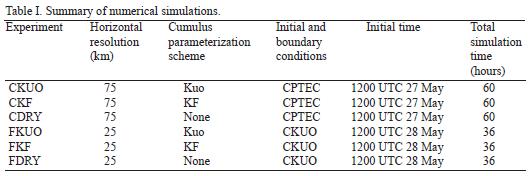
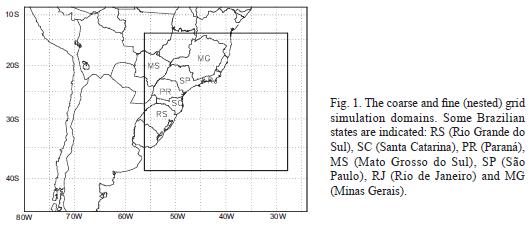
<body><![CDATA[<p align="justify"><font face="verdana" size="2">The limited area model (LAM) used in this study was developed by JMA (Ninomiya <i>et al., </i>1984). The governing equations are written in flux form and sigma&#150;pressure vertical coordinate. The model uses a numerical integration scheme developed by Tatsumi (1983) designated to damp the high frequency oscillations at the beginning of the simulation period.</font></p>     <p align="justify"><font face="verdana" size="2">The surface layer parameterization follows the universal functions proposed by Businger <i>et al. </i>(1971) and in the planetary boundary layer the vertical fluxes of heat, moisture and momentum are resolved by the second&#150;order level two Mellor and Yamada (1974) scheme. The radiative processes are parameterized according to Kondo (1976), and the Bhumralkar (1975) ground temperature prognostic equation is used over land areas. A fourth order numerical diffusion is applied to the prognostic variables in order to filter the numerical waves induced by the numerical scheme. The horizontal diffusion coefficients (K<sub>H</sub>) are function of the horizontal grid size and model time step (Anthes <i>et al., </i>1987).</font></p>     <p align="justify"><font face="verdana" size="2">For the grid scale precipitation a simple large&#150;scale condensation scheme, which removes the moisture excess when the relative humidity reaches saturation, is used. This scheme also considers explicitly the evaporative effect of the precipitation falling through sub&#150;saturated layers following the Nagata and Ogura (1991) scheme.</font></p>     <p align="justify"><font face="verdana" size="2">Two different cumulus parameterization schemes are assessed: the Kuo (1974) scheme with modifications proposed by Geleyn (1985), and the KF scheme (Kain and Fritsch, 1990). The KF was implemented in JMA model by da Rocha (1999). In the Kuo scheme the convective precipitation is proportional to large&#150;scale moisture convergence and it is triggered when the lower troposphere is convectively unstable. In the Geleyn formulation for the Kuo scheme, the partition of atmospheric moistening and precipitation is determined level&#150;by&#150;level considering only the environment moisture availability, i.e., it is not necessary to compute the "b" parameter (Kuo, 1974). To represent implicitly the cooling associated with downdraft current, the Kuo scheme initiates the moist adiabatic ascension from the surface level. In the KF convective parameterization the heating/moistening of the atmosphere and the convective precipitation rate are functions of the convective available potential energy (CAPE). This scheme considers that all CAPE on the model grid element is removed during a convective time period (usually between 30 and 60 minutes). The KF scheme also includes the mass detrainment at middle levels, the downdraft currents and the cloud overshooting above of the equilibrium level. Finally, a relationship between updraft and downdraft currents and the height of cloud base defines the precipitation efficiency in the KF scheme.</font></p>     <p align="justify"><font face="verdana" size="2"><i>b. Experimental design and data</i></font></p>     <p align="justify"><font face="verdana" size="2">The numerical experiments are focused on the cyclogenesis and cyclone mature phase periods. As summarized in <a href="#t1">Table I</a>, two domains &#150;main and nested&#150; (<a href="#f1">Fig. 1</a>) are used with horizontal resolutions of 75 km (coarse) and 25 km (fine) and two convective parameterization schemes (Kuo and KF) and with no moist process (DRY). The initial conditions for coarse resolution experiments (CKUO, CKF and CDRY) were set up to begin at 1200 UTC 27 May 1997 for 60 hours of simulation. The fine resolution (FKUO, FKF and FDRY) experiments start at 1200 UTC 28 May for 36 hours of simulation. These experiments used initial and boundary conditions (every 3 hours) from the CKUO experiment (<a href="#t1">Table I</a>).</font></p>     <p align="center"><font face="verdana" size="2"><a name="f1"></a></font></p>     <p align="center"><font face="verdana" size="2"><img src="/img/revistas/atm/v23n1/a1f1.jpg"></font></p>     <p align="center"><font face="verdana" size="2"><a name="t1"></a></font></p>     <p align="center"><font face="verdana" size="2"><img src="/img/revistas/atm/v23n1/a1t1.jpg"></font></p>     ]]></body>
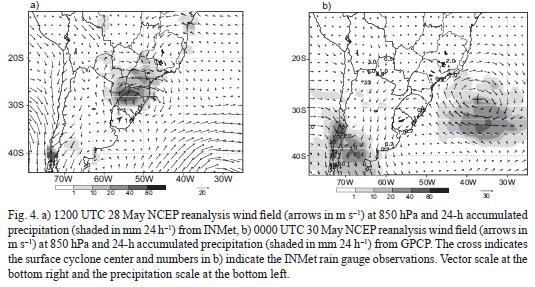
<body><![CDATA[<p align="justify"><font face="verdana" size="2">The analysis and the CPTEC global model forecasting (Satyamurty and Bittencourt, 1999) were used as initial and boundary conditions for the coarse grid simulations. This data set has 1.875&deg; x 1.875&deg; latitude and longitude horizontal resolution for 0000, 0600, 1200 and 1800 UTC, and ten pressure levels (from 1000 to 30 hPa) for the variables: temperature, zonal and meridional wind, geopotential, and relative humidity (from 1000 to 300 hPa). The sea surface temperature (1&deg; x 1&deg; of horizontal resolution) was specified from the climatological data set provided by the JMA analysis. Over the continent, the topography was obtained from the global topography of the US Navy archive (10' x 10' horizontal resolution).</font></p>     <p align="justify"><font face="verdana" size="2">To compare with the numerical experiment results, the NCEP (National Centers for Environmental Prediction) reanalysis (Kalnay <i>et al., </i>1996) and the daily rainfall from INMet (Meteorology National Institute of Brazil) surface network over Brazil were used. This data set was interpolated to the LAM grid using Cressman (1959) objective analysis scheme. Additionally, the simulated rainfall was compared with GPCP (Global Precipitation Climatology Project; <a href="http://www1.ncdc.noaa.gov/pub/data/" target="_blank">ftp.ncdc.noaa.guv/pub/data/</a>) daily precipitation dataset that has 1&deg; x 1&deg; horizontal resolution. As described in Huffman <i>et al. </i>(1997) the GPCP rainfall analysis includes rainfall estimate from geostationary and polar&#150;orbiting satellites plus rain gauge observations.</font></p>     <p align="justify"><font face="verdana" size="2">&nbsp;</font></p>     <p align="justify"><font face="verdana" size="2"><b>3. Synoptic overview</b></font></p>     <p align="justify"><font face="verdana" size="2">The NCEP reanalysis of the mean sea level pressure (MSLP) for 1200 UTC 27 May 1997 shows a broad low&#150;pressure area located over Paraguay, extending to southern Brazil as an inverted surface trough (<a href="/img/revistas/atm/v23n1/a1f2.jpg" target="_blank">Fig. 2a</a>). A weak baroclinic zone at 920 hPa is identified by the weak meridional temperature gradient over southern sector of the low&#150;pressure center (<a href="/img/revistas/atm/v23n1/a1f2.jpg" target="_blank">Fig. 2a</a>). The convective activity (<a href="/img/revistas/atm/v23n1/a1f2.jpg" target="_blank">Fig. 2c</a>) has been trigged at the same area where there is the inverted surface trough in the MSLP field (<a href="/img/revistas/atm/v23n1/a1f2.jpg" target="_blank">Fig. 2a</a>). At mid&#150;level a minimum cyclonic vorticity center (&#150;4 x 10<sup>&#150;5</sup> s<sup>&#150;1</sup>, indicated by a full circle in <a href="/img/revistas/atm/v23n1/a1f2.jpg" target="_blank">Fig. 2a</a>) is situated in the western sector of the surface low pressure. <a href="/img/revistas/atm/v23n1/a1f2.jpg" target="_blank">Figure 2b</a> shows that downstream of the 500 hPa small amplitude trough, there is a widespread area of warm advection (maximum of the 5 &deg;C day<sup>&#150;1</sup>) at 850 hPa level. Although the warm advection is not intense it contributes to the upward motion generating favorable conditions to the cyclone development (Carlson, 1991; Holton, 1992).</font></p>     <p align="justify"><font face="verdana" size="2">The NCEP reanalysis of MSLP field at 1200 UTC 28 May (<a href="/img/revistas/atm/v23n1/a1f3.jpg" target="_blank">Fig. 3a</a>) shows that an incipient cyclonic circulation, represented by 1012 hPa closed isobar, has been formed at southern Brazilian coast (around 28.5&deg; S, 48&deg; W). Near the cyclone center, at 920 hPa, the meridional temperature gradient has intensified. At mid levels the trough has moved eastward and amplified, and it is located about &#126;550 km westward of the surface cyclone (<a href="/img/revistas/atm/v23n1/a1f3.jpg" target="_blank">Fig. 3a</a>), while the 850 hPa warm (cold) at east (at west) of the system also has intensified in the last 24 hours (<a href="/img/revistas/atm/v23n1/a1f3.jpg" target="_blank">Fig. 3b</a>). In this more favorable baroclinic environment, the convective activity is widespread and intense over the east and north sides of surface cyclone (<a href="/img/revistas/atm/v23n1/a1f3.jpg" target="_blank">Fig. 3c</a>), contributing to intensify the low levels winds (<a href="#f4">Fig. 4a</a>). From 1200 UTC 27 to 28 May, the system has produced light to moderated precipitation over the southern and southeastern Brazil (<a href="#f4">Fig. 4a</a>). The intensification of 500 hPa cyclonic vorticity (minimm of &#126; &#150;7 x 10<sup>&#150;5</sup> s<sup>&#150;1</sup>) and the 850 hPa thermal advection pattern contributes to the cyclone deepening later on.</font></p>     <p align="center"><font face="verdana" size="2"><a name="f4"></a></font></p>     <p align="center"><font face="verdana" size="2"><img src="/img/revistas/atm/v23n1/a1f4.jpg"></font></p>     <p align="justify"><font face="verdana" size="2">From CPTEC global model 24 hours forecast, valid for 1200 UTC 28 May (<a href="/img/revistas/atm/v23n1/a1f5.jpg" target="_blank">Fig. 5a</a>), it is clear that this model does not simulate the cyclone initial phase as shown in the NCEP reanalysis (<a href="/img/revistas/atm/v23n1/a1f3.jpg" target="_blank">Fig. 3a</a>).</font></p>     <p align="justify"><font face="verdana" size="2">After 1200 UTC 28 May, the subtropical cyclone has displaced slowly eastward over the SAO with a weak deepening rate of 11 hPa in 36 hours, reaching 1001 hPa of central pressure at 0000 UTC 30 May. At this time, the surface cyclone is centered over the SAO (&#126;28&deg; S, 38&deg; W) and amore intense meridional temperature gradient is observed (<a href="/img/revistas/atm/v23n1/a1f6.jpg" target="_blank">Fig. 6a</a>). Although the pressure&#150;deepening rate is not strong, the pressure gradients have strengthened in the southwestern cyclone sector (<a href="/img/revistas/atm/v23n1/a1f6.jpg" target="_blank">Fig. 6a</a>), associated with both the eastward displacement of the polar anticyclone and cyclone intensification. At this time the convective activity is more intense in the southeastern flank of surface cyclone and a dry air intrusion in the cloud free area over northwestern of the cyclone sector (<a href="/img/revistas/atm/v23n1/a1f6.jpg" target="_blank">Fig. 6c</a>) is observed. The cyclonic circulation at 850 hPa level (<a href="#f4">Fig. 4b</a>) occupies a large area over the SAO, and the last 24 hours accumulated precipitation has occurred over the center&#150;south area of the surface cyclone. Comparing the MSLP and temperature from NCEP reanalysis (<a href="/img/revistas/atm/v23n1/a1f6.jpg" target="_blank">Fig. 6a</a>) with CPTEC 60 hours forecast (<a href="/img/revistas/atm/v23n1/a1f5.jpg" target="_blank">Fig. 5b</a>) it is clear that the CPTEC model fails to reproduce the cyclone intensity and localization and also the meridional temperature gradient.</font></p>     ]]></body>
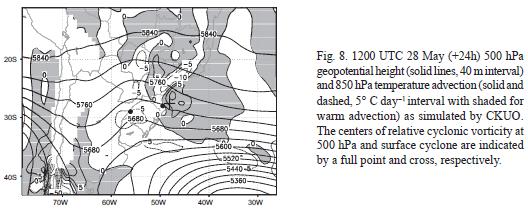
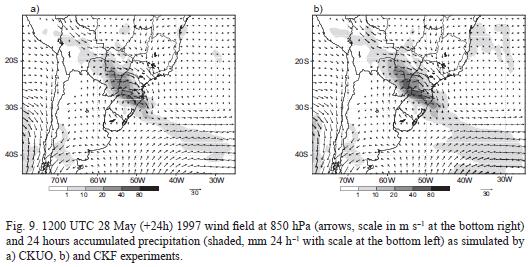
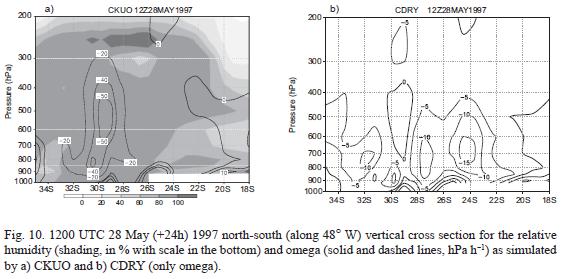
<body><![CDATA[<p align="justify"><font face="verdana" size="2">&nbsp;</font></p>     <p align="justify"><font face="verdana" size="2"><b>4. Simulation of the initial cyclone development</b></font></p>     <p align="justify"><font face="verdana" size="2"><i>a. Analysis</i></font></p>     <p align="justify"><font face="verdana" size="2">The CKUO, CKF and CDRY simulated MSLP valid for 1200 UTC 28 May (<a href="/img/revistas/atm/v23n1/a1f7.jpg" target="_blank">Fig. 7</a>) show a similar broad low&#150;pressure area over Paraguay and southern Brazil, however the CKUO experiment shows a better agreement with the NCEP reanalysis (<a href="/img/revistas/atm/v23n1/a1f3.jpg" target="_blank">Fig. 3a</a>). Note that the 1012 hPa closed isobar over southern Brazil coast in CKUO coincides with the NCEP reanalysis (<a href="/img/revistas/atm/v23n1/a1f3.jpg" target="_blank">Fig. 3a</a>). The CKF experiment will only reproduce this closed isobar in the next 3 hours. This delay in the cyclone initial development could be associated with the differences in the diabatic heating profiles at this phase (<a href="/img/revistas/atm/v23n1/a1f12.jpg" target="_blank">Fig. 12b</a>). In the CDRY experiment (<a href="/img/revistas/atm/v23n1/a1f7.jpg" target="_blank">Fig. 7c</a>) the central pressure is about 2 hPa higher compared to the moist experiments. This difference among the dry and moist experiments indicates that the moist processes are essential for the cyclogenesis process over subtropical latitudes and under weak baroclinic forcing.</font></p>     <p align="justify"><font face="verdana" size="2">At 500 hPa, the simulated trough position and intensity is very similar among the experiments (<a href="#f8">Fig. 8</a>, only CKUO fields shown). However, CKUO and CKF simulated two cyclonic vorticity centers (&#126; &#150;4 x 10&#150;5 s<sup>&#150;1</sup>) at 500 hPa (<a href="#f8">Fig. 8</a>): one near the trough axis and another one more intense (&#150;12 x 10<sup>&#150;5</sup> s<sup>&#150;1</sup>) closer to the surface cyclone center. This last cyclonic core is due to the tilting term in the vorticity equation. The CDRY experiment is not able to simulate this feature. As the NCEP reanalysis (<a href="/img/revistas/atm/v23n1/a1f3.jpg" target="_blank">Fig. 3b</a>) the simulated 500 hPa trough has small amplitude and a north&#150;south axis orientated (<a href="#f8">Fig. 8</a>). In the CKUO (<a href="#f8">Fig. 8</a>) and CKF (figure not shown) experiments the 850 hPa thermal advection intensity and spatial pattern have a good agreement with the NCEP reanalysis (<a href="/img/revistas/atm/v23n1/a1f3.jpg" target="_blank">Fig. 3b</a>).</font></p>     <p align="center"><font face="verdana" size="2"><a name="f8"></a></font></p>     <p align="center"><font face="verdana" size="2"><img src="/img/revistas/atm/v23n1/a1f8.jpg"></font></p>     <p align="justify"><font face="verdana" size="2">At 1200 UTC 28 May the 850 hPa wind field for CKUO and CKF experiments show a more intense winds over northern sector of the cyclone (<a href="#f9">Figs. 9a, b</a>). The center of the cyclonic circulation is further north from that shown by the NCEP reanalysis (<a href="#f4">Fig. 4a</a>). Over the continent, the 24&#150;h accumulated precipitation simulated by CKUO and CKF (<a href="#f9">Figs. 9a&#150;b</a>) seems to reproduce fairly well the observed pattern (<a href="#f4">Fig. 4a</a>) over the south Brazilian states (SC, PR, RS; see <a href="#f1">Fig. 1</a>). Both simulations produce, however, less precipitation than observed over SP State. The CKUO generates an intense core of heavy precipitation (up 40 mm 24 h<sup>&#150;1</sup>) around 28&deg; S&#150;5 1&deg; W, while in the CKF this core is widespread and displaced westward. The mean precipitation in the area of cyclone (60, 48&deg; W and 32, 20&deg; S) reaches 13.8, 9.5 and 12.5 mm 24 h<sup>&#150;1</sup> for the observation, CKUO and CKF forecasting, respectively. This means that in terms of mean rainfall amount in the cyclone area the CKF is closer to observation (as will be discussed late on, this does not imply a larger diabatic heating).</font></p>     <p align="center"><font face="verdana" size="2"><a name="f9"></a></font></p>     <p align="center"><font face="verdana" size="2"><img src="/img/revistas/atm/v23n1/a1f9.jpg"></font></p>     ]]></body>
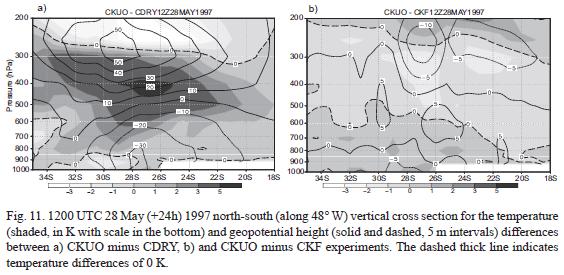
<body><![CDATA[<p align="justify"><font face="verdana" size="2"><i>b. Diabatic heating</i></font></p>     <p align="justify"><font face="verdana" size="2">The upward motion, at 1200 UTC 28 May, simulated by CDRY (&#150;15 hPa h<sup>&#150;1</sup> maximum) is weaker and restricted to lower troposphere (<a href="#f10">Fig. 10b</a>), meanwhile in the CKUO the maximum reaches &#150;50 hPa/h at the mid&#150;levels (<a href="#f10">Fig. 10a</a>), that is similar to CKF (figure not shown). Moist experiments show that the intense upward motion area is embedded in a deep layer of high relative humidity (greater than 90%; <a href="#f10">Fig. 10a</a>). This deep moist environment determines the vertical profile of diabatic moistening and heating in the Kuo and KF cumulus parameterization schemes.</font></p>     <p align="center"><font face="verdana" size="2"><a name="f10"></a></font></p>     <p align="center"><font face="verdana" size="2"><img src="/img/revistas/atm/v23n1/a1f10.jpg"></font></p>     <p align="justify"><font face="verdana" size="2">Taking the CKUO minus CDRY vertical cross section along 48&deg; W for the potential temperature (<a href="#f11">Fig. 11a</a>) results that the CKUO is colder in low and high troposphere and warmer in the middle troposphere (associated with latent heating in the Kuo scheme). The low levels colder air in the CKUO is explained by the moist adiabatic ascension from surface level in the Kuo parameterization modified by Geleyn (1985). In the CKUO the diabatic heating at mid levels overcomes the adiabatic cooling associated with the upward motions (<a href="#f10">Fig. 10a</a>) and the air column warms and expands. The CKUO minus CDRY geopotential cross section presents a vertical structure with a negative geopotential height from low to mid levels and positive at upper troposphere (<a href="#f11">Fig. 11a</a>). This configuration contributes to increase the mass convergence (divergence) in the low (upper) troposphere, favoring the cyclone deepening in the CKUO experiment.</font></p>     <p align="center"><font face="verdana" size="2"><a name="f11"></a></font></p>     <p align="center"><font face="verdana" size="2"><img src="/img/revistas/atm/v23n1/a1f11.jpg"></font></p>     <p align="justify"><font face="verdana" size="2">The CKUO minus CKF temperature vertical cross section (<a href="#f11">Fig. 11b</a>) reflects the distinct physical approaches considered in each convective parameterization. For the first 24 hours simulation, the accumulated latent heating release vertical profiles (convective, large&#150;scale and total) calculated over the cyclone area (60, 48&deg; W and 33, 20&deg; S) are shown in <a href="/img/revistas/atm/v23n1/a1f12.jpg" target="_blank">Figure 12</a>. As the convection is triggered in a moist environment, the mass in the updraft current increases with the height in the KF scheme (i.e., the updraft is undiluted). Therefore, the convective heating is maximized in the upper troposphere (near 400 hPa) decreasing quickly above this level (<a href="/img/revistas/atm/v23n1/a1f12.jpg" target="_blank">Fig. 12a</a>). Two cooling layers are evident in the CKF profile: below 800 and above 300 hPa, associated, respectively, with the explicitly parameterized downdraft current and the updraft overshooting above of the equilibrium level (Kain and Fritch, 1990). The Kuo scheme presents a simpler convective latent heating vertical structure (<a href="/img/revistas/atm/v23n1/a1f12.jpg" target="_blank">Fig. 12a</a>), with a maximum near 600 hPaand a very narrow cooling layer near the surface due to the moist adiabatic ascent from the surface (Geleyn, 1985).</font></p>     <p align="justify"><font face="verdana" size="2">Vertical profiles of large&#150;scale latent heating show a maximum at 500 hPa that is greater than convective heating (<a href="/img/revistas/atm/v23n1/a1f12.jpg" target="_blank">Fig. 12a</a>). Note that in the CKF experiment, the large&#150;scale condensation produces greater heating in the layers where the KF convective heating is small. As result, in those cooled layers due the downdraft and cloud top overshooting, the total heating (convective plus large scale) at low (below 700 hPa) and upper (above 280 hPa) levels is larger in the CKUO (<a href="/img/revistas/atm/v23n1/a1f12.jpg" target="_blank">Fig. 12b</a>). The vertical structure of the total diabatic heating differences between CKUO and CKF experiments (<a href="/img/revistas/atm/v23n1/a1f12.jpg" target="_blank">Fig. 12b</a>) is very similar to the potential temperature differences presented in <a href="#f11">Figure 11b</a>. The stronger diabatic heating in the CKUO experiment might explain a better&#150;defined initial cyclone development compared with CKF.</font></p>     <p align="justify"><font face="verdana" size="2">&nbsp;</font></p>     ]]></body>
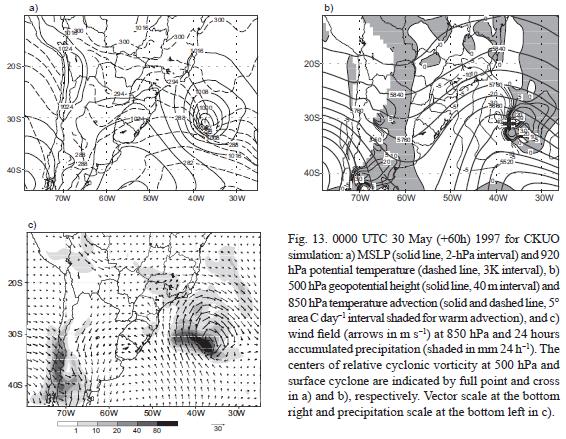
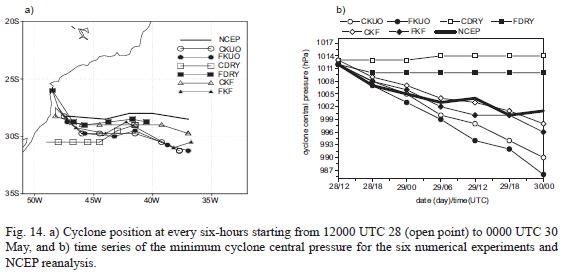
<body><![CDATA[<p align="justify"><font face="verdana" size="2"><b>5. The cyclone mature phase</b></font></p>     <p align="justify"><font face="verdana" size="2"><i>a. CKUO experiment</i></font></p>     <p align="justify"><font face="verdana" size="2">The MSLP and 920 hPa potential temperature fields simulated by CKUO experiment at 0000 UTC 30 May (<a href="#f13">Fig. 13a</a>) show a stronger pressure gradient than the NCEP reanalysis (<a href="/img/revistas/atm/v23n1/a1f6.jpg" target="_blank">Fig. 6a</a>) at the southwestern sector of the cyclone center. Near the cyclone center the warm (cold) air has shifted southward (northward) and there was an enhanced temperature gradient compared to the initial phase (<a href="/img/revistas/atm/v23n1/a1f7.jpg" target="_blank">Fig. 7a</a>). <i>The 850&#150;hPa warm (cold) advection at the east (west) of the 500 hPa trough (<a href="#f13">Fig. 13b</a>) is stronger than in the initial phase (<a href="/img/revistas/atm/v23n1/a1f7.jpg" target="_blank">Fig. 7a</a>) and than in NCEP (<a href="/img/revistas/atm/v23n1/a1f6.jpg" target="_blank">Fig. 6b</a>). </i>The 850 hPa winds reach 30 m s<sup>&#150;1</sup> (<a href="#f13">Fig. 13c</a>) and similar intense and broad cyclonic circulation is also present in the NCEP reanalysis (<a href="#f4">Fig. 4b</a>). High precipitation rates are simulated in the center&#150;south of cyclone (<a href="#f13">Fig. 13c</a>), which is similar to the GPCP precipitation analysis (<a href="#f4">Fig. 4b</a>). The CKUO mean precipitation rate overthe cyclone area is 8.3 mm 24 h<sup>&#150;1</sup> that agrees reasonable well with the GPCP analysis, which is 9.0 mm 24 h<sup>&#150;1</sup>. The CKUO shows some areas of rainfall over the continent that is not present in the GPCP analysis. However some of these precipitation areas are partially supported by surface data (point values in <a href="#f4">Fig. 4b</a>) and GOES infrared images (<a href="/img/revistas/atm/v23n1/a1f6.jpg" target="_blank">Fig. 6c</a>).</font></p>     <p align="center"><font size="2" face="verdana"><a name="f13"></a></font></p>     <p align="center"><font face="verdana" size="2"><img src="/img/revistas/atm/v23n1/a1f13.jpg"></font></p>     <p align="justify"><font face="verdana" size="2"><i>b. Cyclone evolution</i></font></p>     <p align="justify"><font face="verdana" size="2">The NCEP reanalysis shows a zonal displacement of the cyclone that is well reproduced by the CKF experiment (<a href="#f14">Fig. 14a</a>). At final simulation time (0000 UTC 30 May) the CKF cyclone center is about 140 km apart from the NCEP reanalysis position. The CKUO, FKF and FKUO tend to displace the cyclone southward compared to NCEP reanalysis, reflecting in a larger position error at final simulation time (about 370 km in the CKUO experiment). Comparing the CKF and FKF experiments one might infer that the use of CKUO as initial and boundary conditions has an important impact in the cyclone displacement, since the FKF cyclone positions are closer to CKUO than CKF positions until 1800 UTC 29 May.</font></p>     <p align="center"><font face="verdana" size="2"><a name="f14"></a></font></p>     <p align="center"><font face="verdana" size="2"><img src="/img/revistas/atm/v23n1/a1f14.jpg"></font></p>     <p align="justify"><font face="verdana" size="2">The CKUO and FKUO simulations show the cyclone moving southeastward with no notable differences between them. Similar results were found by McInnes <i>et al. </i>(1994) over southeast Australia, where the increase of horizontal resolution from 150 to 50 km does not lead to an improvement of the frontal position. Gyakum <i>et al. </i>(1996) comparing an ensemble of numerical models found out also little improvement in the position of one extratropical cyclone with the horizontal resolution increase from 50 to 25 km. In dry experiments (<a href="#f14">Fig. 14a</a>), the cyclone displacement is lagged behind moist experiments and NCEP reanalysis about 12 hours, leading an error position of about 450 and 340 km in the CDRY and FDRY, respectively, at 0000 UTC 30 May. The resulting shallow and weaker circulation produce probably a slower cyclone displacement in dry experiments.</font></p>     ]]></body>
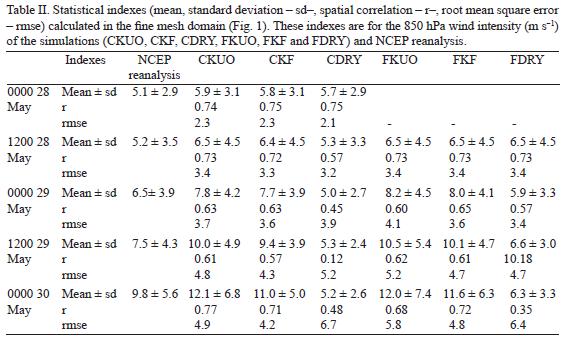
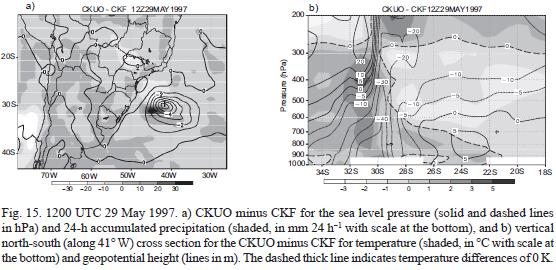
<body><![CDATA[<p align="justify"><font face="verdana" size="2">The time evolution of central pressure shows similar cyclone deepening rate in the moist experiments and NCEP reanalysis until 0000 UTC 29 May (<a href="#f14">Fig. 14b</a>). After this time, the CKUO and FKUO simulate greater cyclone deepening, while in the CKF and FKF experiments the deepening rate is smaller and similar to the NCEP reanalysis. This implied that at final simulation time (0000 UTC 30 May) the cyclone intensity simulated by CKF is closest of NCEP reanalysis (<a href="#f14">Fig. 14b</a>).</font></p>     <p align="justify"><font face="verdana" size="2">On the other hand in the CDRY and FDRY experiments no cyclone deepening is simulated and the central pressure keeps around of 1014 and 1010 hPa, respectively, that are higher than NCEP reanalysis (<a href="#f14">Fig. 14b</a>). The lower central pressure in the FDRY is mainly attributed to the use of CKUO as initial and boundary conditions. Therefore one may conclude that diabatic processes are essential to simulate the development and evolution of this subtropical cyclone over SAO.</font></p>     <p align="justify"><font face="verdana" size="2">To summarize, <a href="#t2">Table II</a> presents the mean and standard deviation (sd), spatial correlation (r), and the root mean square error (rmse) for the 850 hPa wind intensity obtained comparing the NCEP reanalysis and the numerical experiments. These indexes were calculated considering the grid points inside the fine mesh domain (see inner box in <a href="#f1">Fig. 1</a>). The NCEP reanalysis shows the increase of both wind intensity and variability (as measured by standard deviation) between 1200 UTC 27 and 0000 UTC 30 May. These characteristics are simulated by the moist experiments (CKUO, CKF, FKUO and FKF, but not by the dry experiments (CDRY and FDRY). Wind intensity in the moist experiments present larger spatial correlation with NCEP reanalysis than dry experiments. This high correlation indicates similar spatial distribution of wind intensity among NCEP and moist experiments that can be attributed to the better simulations of cyclone trajectories in the moist experiments. For all times, the statistical (mean, sd, r and rmse) indexes (<a href="#t2">Table II</a>) indicate that the CKF simulates the 850 hPa wind field closer of the NCEP reanalysis, while the CDRY presents the worst results.</font></p>     <p align="center"><font face="verdana" size="2"><a name="t2"></a></font></p>     <p align="center"><font face="verdana" size="2"><img src="/img/revistas/atm/v23n1/a1t2.jpg"></font></p>     <p align="justify"><font face="verdana" size="2"><i>c. CKUO and CKF differences</i></font></p>     <p align="justify"><font face="verdana" size="2">At 1200 UTC May 29, the resulting distribution of CKUO minus CKF (CKUO&#150;CKF) for the precipitation and MSLP fields, show a more intense cyclone and larger accumulated precipitation in the central&#150;south part of the cyclone in the CKUO experiment (<a href="#f15">Fig. 15a</a>). However, throughout the 24 hours period, the area&#150;average accumulated precipitation over cyclone area is 9.8 mm 24 h<sup>&#150;1</sup> and 8.3 mm 24 h<sup>&#150;1</sup> for CKF and CKUO, respectively.</font></p>     <p align="center"><font face="verdana" size="2"><a name="f15"></a></font></p>     <p align="center"><font face="verdana" size="2"><img src="/img/revistas/atm/v23n1/a1f15.jpg"></font></p>     <p align="justify"><font face="verdana" size="2">Vertical cross section along 41&deg; W of CKUO and CKF experiments of temperature difference shows at the polar side of the surface cyclone (southern of 30&deg; S) that CKUO is warmer than CKF below 300 hPa level and colder above. In response to greater low&#150;mid levels warming there is a decrease of geopotential high below 500 hPa, which explain the larger cyclone intensity in the CKUO (<a href="#f15">Fig. 15a</a>). To the north, between 30&#150;26&deg; S, the geopotential height falls in the CKUO experiment from surface up to high levels. At north of 26&deg; S, in the cyclone warm sector, the CKUO experiment is relatively warmer, colder and warmer at low, medium and high troposphere, respectively, and shows a geopotential height decrease above 600 hPa.</font></p>     ]]></body>
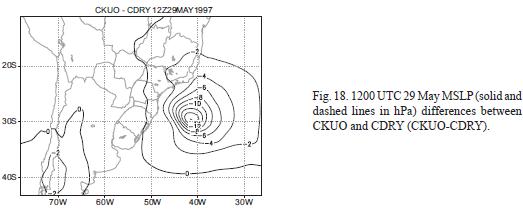
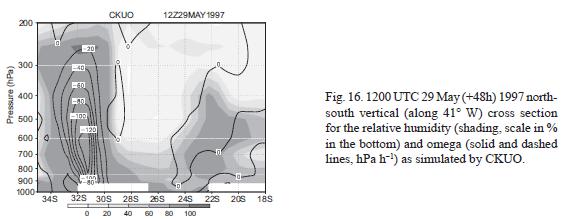
<body><![CDATA[<p align="justify"><font face="verdana" size="2">At the cold side of cyclone center (southern of 30&deg; S) the upward motion extending from surface to upper levels is embedded in a very moist environment and it is more intense in the CKUO (<a href="#f16">Fig. 16</a>) than in CKF (figure not shown). To the north of 30&deg; S, the upward motion is weaker and the moist air is restricted to low levels (below 700 hPa), and above there is a deep layer of dry air layer, associated with the large scale subsidence at the cyclone western sector.</font></p>     <p align="center"><font face="verdana" size="2"><a name="f16"></a></font></p>     <p align="center"><font face="verdana" size="2"><img src="/img/revistas/atm/v23n1/a1f16.jpg"></font></p>     <p align="justify"><font face="verdana" size="2">The differences in the vertical profile of Figure 15b are controlled by the differences in the vertical distribution of diabatic heating in the last 24 hours. The cyclone area&#150;average (35, 23&deg; S and 49.5, 34&deg; W) of the latent heating profiles are ahown in the <a href="/img/revistas/atm/v23n1/a1f17.jpg" target="_blank">Figure 17</a>. In the CKUO experiment the maximum convective heating is near 750 hPa (<a href="/img/revistas/atm/v23n1/a1f17.jpg" target="_blank">Fig. 17a</a>), that is lower than 24 h before (<a href="/img/revistas/atm/v23n1/a1f12.jpg" target="_blank">Fig. 12a</a>). This lowering occurs because the convection is triggering mainly in the center&#150;north sector of the cyclone, where moist air is confined in the low troposphere (<a href="#f16">Fig. 16</a>). According to Geleyn (1985) formulation of the Kuo scheme, the convective heating has a maximum where the moisture availability is larger. The CKF convective heating presents a more complex vertical structure (<a href="/img/revistas/atm/v23n1/a1f17.jpg" target="_blank">Fig. 17a</a>), with two maximum: at 750 and 450 hPa. The 750 hPa maximum is associated with convection over the center&#150;north of the cyclone, where the moist updraft currents penetrate into the middle troposphere dry environment. The 450 hPa maximum is attributed to the convective activity occurring in the moister environment in southern sector of cyclone, implying an updraft mass flux increase with height and convective heating maximization at upper levels. As the mass processed in the updraft decreased (<a href="/img/revistas/atm/v23n1/a1f17.jpg" target="_blank">Fig. 17a</a>) compared with 24 hours before (<a href="/img/revistas/atm/v23n1/a1f12.jpg" target="_blank">Fig. 12a</a>) there is a reduction of the upper troposphere cooling due to the cloud overshooting. At this time, the CKF shows strong cooling (&#150;8 &deg;C 24 h<sup>&#150;1</sup>) due to the downdraft currents occupying a shallow layer near to the surface (<a href="/img/revistas/atm/v23n1/a1f17.jpg" target="_blank">Fig. 17a</a>).</font></p>     <p align="justify"><font face="verdana" size="2">In both CKUO and CKF experiments, the large&#150;scale latent heating has a maximum in the middle troposphere (<a href="/img/revistas/atm/v23n1/a1f17.jpg" target="_blank">Fig. 17a</a>) and an increase compared to 24 hours before (<a href="/img/revistas/atm/v23n1/a1f12.jpg" target="_blank">Fig. 12a</a>). The CKUO experiment total heating is larger along the vertical column (<a href="/img/revistas/atm/v23n1/a1f17.jpg" target="_blank">Fig. 17b</a>), reaching 8 &deg;C 24 h<sup>&#150;1</sup> near the surface. The downdraft effect considered in the KF scheme reduces the diabatic heating (Fig. 17b) and prevent the over deepening of cyclone (<a href="#f14">Fig. 14b</a>). Other factor that contributes to less intense diabatic heating in CKF is the detrainment of updraft when penetrates in a dry environment with consequent reduction of the latent heating release (<a href="/img/revistas/atm/v23n1/a1f17.jpg" target="_blank">Fig. 17a, b</a>). Both processes imply a more stable troposphere which inhibits the excessive diabatic heating and consequently the cyclone over deepening.</font></p>     <p align="justify"><font face="verdana" size="2"><i>d. CKUO and CDRY differences</i></font></p>     <p align="justify"><font face="verdana" size="2">At cyclone mature phase, 1200 UTC 29 May, the MSLP field differences between CKUO and CDRY (CKUO &#150; CDRY) show a large area around cyclone center of negative difference indicating a more intense cyclone in the CKUO (<a href="#f18">Fig. 18</a>). As in the initial phase, the cross sections show weaker and widespread vertical motion in CDRY (figure not shown) compared to the moist experiments (<a href="/img/revistas/atm/v23n1/a1f16.jpg" target="_blank">Fig. 16</a> for CKUO). In the CDRY it is not possible to distinguish the narrow upward cell at south sector, as well as the large subsidence area at north of the cyclone simulated in the moist experiments (<a href="#f16">Fig. 16</a>). In the absence of latent heating release the CDRY experiment is also unable to generate a reduction of horizontal scale of the upward motion area.</font></p>     <p align="center"><font face="verdana" size="2"><a name="f18"></a></font></p>     <p align="center"><font face="verdana" size="2"><img src="/img/revistas/atm/v23n1/a1f18.jpg"></font></p>     <p align="justify"><font face="verdana" size="2">The present results show the importance of the diabatic heating on the development of subtropical cyclones. In dry case, the cyclone does not show the intense upward cell at cyclone cold sector, there is no deepening and the cyclone displacement is lagged behind compared with the moist experiments and NCEP reanalysis.</font></p>     ]]></body>
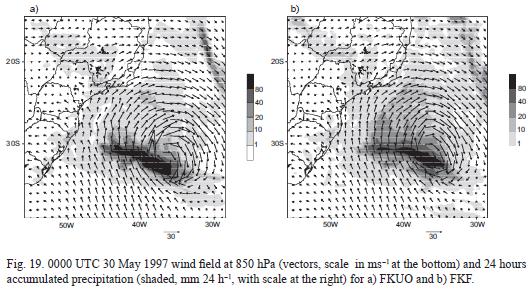
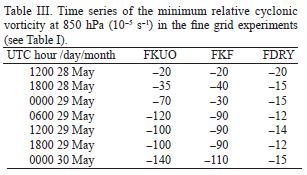
<body><![CDATA[<p align="justify"><font face="verdana" size="2">&nbsp;</font></p>     <p align="justify"><font face="verdana" size="2"><b>6. Mesoscale structures</b></font></p>     <p align="justify"><font face="verdana" size="2">The fine grid simulations, FKUO and FKF (<a href="#f19">Fig. 19</a>) present mesoscale structures in the precipitation field that are not observed in the coarse grid simulations (<a href="#f13">Fig. 13c</a>). The 24 hours accumulated precipitation (valid for 0000 UTC 30 May) in the FKUO and FKF experiments (<a href="#f19">Figs. 19a, b</a>) is more intense at center&#150;southern sector of the cyclone as well as in the coarse grid experiments. However, it can be noted that in the FKF experiment (<a href="#f19">Fig. 19b</a>) the rainfall over the north sector of cyclone is more intense and widespread, while FKUO simulates more intense rainfall concentrated in a small area over the center&#150;south of cyclone (<a href="#f19">Fig. 19a</a>). Considering the same size area around the cyclone center, this implies an average precipitation of 12.8 mm 24 h<sup>&#150;1</sup> and 10.9 mm 24 h<sup>&#150;1</sup> for FKF and FKUO experiments, respectively, while the GPCP estimation shows 11.6 mm 24 h<sup>&#150;1</sup>, i.e., both simulations are close to the value reported by GCPC.</font></p>     <p align="center"><font size="2" face="verdana"><a name="f19"></a></font></p>     <p align="center"><font size="2" face="verdana"><img src="/img/revistas/atm/v23n1/a1f19.jpg"></font></p>     <p align="justify"><font face="verdana" size="2"><a href="#f19">Figures 19a, b</a> show that in the fine grid moist experiments the 850 hPa wind is intense around cyclone center and stronger than in the FDRY experiment (figure not shown). This implies that cyclonic relative vorticity attain values of the order of 10<sup>&#150;4</sup> &#150; 10&#150;<sup>3</sup> s<sup>&#150;1</sup> at the cyclone mature phase in the FKUO and FKF experiments, meanwhile it is one order of magnitude smaller in the FDRY (<a href="#t3">Table III</a>). The mature cyclone in the fine grid moist experiments show an intense and narrow upward cell lining to cold air side (figure not shown), which is not observed in the coarse grid and dry experiments. Another important mesoscale structure is the intensification of the descendent cell between middle levels and the surface around 32&deg; S (figure not shown), which is due to the rainfall evaporation in the cold air cyclone sector. The FDRY experiment does not organize the upward cell at the center&#150;south of cyclone center. As in the CDRY, in the FDRY the upward motion is weak and widespread around cyclone area.</font></p>     <p align="center"><font face="verdana" size="2"><a name="t3"></a></font></p>     <p align="center"><font face="verdana" size="2"><img src="/img/revistas/atm/v23n1/a1t3.jpg"></font></p>     <p align="justify"><font face="verdana" size="2">&nbsp;</font></p>     <p align="justify"><font face="verdana" size="2"><b>7. Summary and conclusions</b></font></p>     ]]></body>
<body><![CDATA[<p align="justify"><font face="verdana" size="2">The Japan Meteorological Agency LAM was applied to examine the impact of convective (Kuo and KF) schemes and dry dynamics at different grid horizontal resolution on the simulation of a subtropical cyclone that developed over SAO during 27&#150;30 May 1997.</font></p>     <p align="justify"><font face="verdana" size="2">The combination of Kuo scheme and a coarse grid size (75 km) has resulted in a better simulation of the cyclone initial development. This result can be attributed to the strong latent heating release that contributes to upward motion intensification and to decreases of surface pressure. If KF scheme is used, the cooling mechanisms due to the downdraft current and cloud overshooting reduce the total latent heating in the vertical column delaying in 3 hours the cyclone formation. The dry simulation fails to simulate the correct localization and intensity of the initial cyclone. Therefore, in contrast to intense extratropical cyclones, where the latent heating acts to reduce the system horizontal scale initiated by the baroclinic structure disturbance (Nuss and Anthes, 1987; Reed <i>et al., </i>1988; Kuo <i>et al., </i>1991; Balasubramanian and Yau, 1994, 1996), in the case examined here, the diabatic processes are essential to reproduce correctly the initial development phase of the system.</font></p>     <p align="justify"><font face="verdana" size="2">At mature phase the use of Kuo parameterization shows an over deepening of cyclone, while the KF simulates a cyclone intensity and displacement closest to NCEP reanalysis. This is attributed to the downdraft currents acting to cool the low levels and also to the development of convection in a dryer atmosphere. Both features act to stabilize the environment reducing the latent heating release to the atmosphere with KF scheme and simulating a weaker cyclone than in Kuo parameterization.</font></p>     <p align="justify"><font face="verdana" size="2">In the high horizontal resolution experiments (25 km) the Kuo parameterization simulates a more intense cyclone than obtained in coarse grid (75 km) and also in the NCEP reanalysis. No such impact occur using KF scheme, where there is small change of cyclone intensity with the increase of the horizontal resolution. This suggested that KF convective scheme is less sensitive to grid size resolution.</font></p>     <p align="justify"><font face="verdana" size="2">An important result which comes out from this study is that the latent heating release is an essential mechanism to this subtropical cyclone development. This characteristic differs from the classical cyclone development (Nuss and Anthes, 1987; Kuo <i>et al., </i>1991), where diabatic heating only enhances the dry baroclinic development. Furthermore, for longer simulations (&gt;24 hours) the KF parameterization scheme seems to be more appropriate since it provides a cyclone intensity and trajectory closer to the NCEP reanalysis. This result is also obtained through wind statistical analysis over the cyclone area.</font></p>     <p align="justify"><font face="verdana" size="2">A very different outcome regarding to previous studies (Kuo and Low&#150;Nam, 1990; Kuo <i>et al., </i>1996) is the excessive cyclone deepening with the Kuo parameterization, independent of the grid size used. The reason is that in the Kuo parameterization modified by Geleyn (1985), the level of maximum convective heating is function of the moisture availability in the vertical column. This can produce maximum latent heating at different levels that differs from previous studies using Kuo, where maximum heating occurs at upper levels (&#126; 300 hPa; Anthes, 1977; Kuo and Low&#150;Nam, 1990; Kuo <i>et al., </i>1996). In this case, the vertical motion at lower troposphere is relatively weak affecting the development of grid scale precipitation (Kuo and Reed, 1988; Kuo and Low&#150;Nam, 1990; Kuo <i>et al., </i>1996) and reducing the cyclone deepening.</font></p>     <p align="justify"><font face="verdana" size="2">&nbsp;</font></p>     <p align="justify"><font face="verdana" size="2"><b>Acknowledgements</b></font></p>     <p align="justify"><font face="verdana" size="2">This research was supported by the State of S&atilde;o Paulo Research Foundation (FAPESP) grants, under contract 95/04573&#150;5R. One of the authors, RPR, wishes to thank the National Council for Scientific and Technological Development of Brazil (CNPq) for the financial support, under contract 476361/2006&#150;0 and 307519/2008&#150;2. Thanks also to the Japan Meteorological Agency for gently provide us the original model code used in this study.</font></p>     <p align="justify"><font face="verdana" size="2">&nbsp;</font></p>     ]]></body>
<body><![CDATA[<p align="justify"><font face="verdana" size="2"><b>References</b></font></p>     <!-- ref --><p align="justify"><font face="verdana" size="2">Anthes R. A, 1977. A cumulus parameterization scheme utilizing a one&#150;dimensional cloud model. <i>Mon. Wea. Rev. </i><b>105</b>, 270&#150;286.</font>&nbsp;&nbsp;&nbsp;&nbsp;&nbsp;&nbsp;&nbsp;&nbsp;[&#160;<a href="javascript:void(0);" onclick="javascript: window.open('/scielo.php?script=sci_nlinks&ref=1274587&pid=S0187-6236201000010000100001&lng=','','width=640,height=500,resizable=yes,scrollbars=1,menubar=yes,');">Links</a>&#160;]<!-- end-ref --><!-- ref --><p align="justify"><font face="verdana" size="2">Anthes R. A., E.&#150;Y. Hsie and Y.&#150;H. Kuo, 1987. Description of the Penn State/NCAR mesoscale model version 4 (MM4). NCAR/TN&#150;282+STR, National Center for Atmospheric Research, USA, 66 pp.</font>&nbsp;&nbsp;&nbsp;&nbsp;&nbsp;&nbsp;&nbsp;&nbsp;[&#160;<a href="javascript:void(0);" onclick="javascript: window.open('/scielo.php?script=sci_nlinks&ref=1274588&pid=S0187-6236201000010000100002&lng=','','width=640,height=500,resizable=yes,scrollbars=1,menubar=yes,');">Links</a>&#160;]<!-- end-ref --><!-- ref --><p align="justify"><font face="verdana" size="2">Balasubramanian G. and M. K. Yau, 1994. The effects of convection on a simulated marine cyclone. <i>J. Atmos. Sci. </i><b>51</b>, 2397&#150;2417.</font>&nbsp;&nbsp;&nbsp;&nbsp;&nbsp;&nbsp;&nbsp;&nbsp;[&#160;<a href="javascript:void(0);" onclick="javascript: window.open('/scielo.php?script=sci_nlinks&ref=1274589&pid=S0187-6236201000010000100003&lng=','','width=640,height=500,resizable=yes,scrollbars=1,menubar=yes,');">Links</a>&#160;]<!-- end-ref --><!-- ref --><p align="justify"><font face="verdana" size="2">Balasubramanian G. and M. K. Yau, 1996. The life cycle of a simulated marine cyclone: energetics and PV diagnostics. <i>J. Atmos. Sci. </i><b>53</b>, 639&#150;653.</font>&nbsp;&nbsp;&nbsp;&nbsp;&nbsp;&nbsp;&nbsp;&nbsp;[&#160;<a href="javascript:void(0);" onclick="javascript: window.open('/scielo.php?script=sci_nlinks&ref=1274590&pid=S0187-6236201000010000100004&lng=','','width=640,height=500,resizable=yes,scrollbars=1,menubar=yes,');">Links</a>&#160;]<!-- end-ref --><!-- ref --><p align="justify"><font face="verdana" size="2">Bhumralkar C. M., 1975. Numerical experiments on the computation of ground surface temperature in atmospheric general circulation models. <i>J. Appl. Meteor. </i>14, 1246&#150;1258.</font>&nbsp;&nbsp;&nbsp;&nbsp;&nbsp;&nbsp;&nbsp;&nbsp;[&#160;<a href="javascript:void(0);" onclick="javascript: window.open('/scielo.php?script=sci_nlinks&ref=1274591&pid=S0187-6236201000010000100005&lng=','','width=640,height=500,resizable=yes,scrollbars=1,menubar=yes,');">Links</a>&#160;]<!-- end-ref --><!-- ref --><p align="justify"><font face="verdana" size="2">Bonatti J. P., V. B. Rao and P. L. S. Dias, 2004. Estudo observacional da propaga&ccedil;&atilde;o para leste do fen&ocirc;meno Catarina e sua simula&ccedil;&atilde;o com modelo global de alta resolu&ccedil;&atilde;o. Annals of XIII Congresso Brasileiro de Meteorologia, Fortaleza, Cear&aacute;, Brazil.</font>&nbsp;&nbsp;&nbsp;&nbsp;&nbsp;&nbsp;&nbsp;&nbsp;[&#160;<a href="javascript:void(0);" onclick="javascript: window.open('/scielo.php?script=sci_nlinks&ref=1274592&pid=S0187-6236201000010000100006&lng=','','width=640,height=500,resizable=yes,scrollbars=1,menubar=yes,');">Links</a>&#160;]<!-- end-ref --><!-- ref --><p align="justify"><font face="verdana" size="2">Businger J. A., J. C. Wyngaard, Y. Izumi and E. F. Bradley, 1971. Flux&#150;profile relationships in the atmospheric surface layer. J. <i>Atmos. Sci. </i><b>28</b>, 181&#150;189.</font>&nbsp;&nbsp;&nbsp;&nbsp;&nbsp;&nbsp;&nbsp;&nbsp;[&#160;<a href="javascript:void(0);" onclick="javascript: window.open('/scielo.php?script=sci_nlinks&ref=1274593&pid=S0187-6236201000010000100007&lng=','','width=640,height=500,resizable=yes,scrollbars=1,menubar=yes,');">Links</a>&#160;]<!-- end-ref --><!-- ref --><p align="justify"><font face="verdana" size="2">Campos C. N., 1999. <i>Estudo dafrontog&ecirc;nese em um ciclone do tipo Shapiro&#150;Keyser. </i>MSc Dissertation, Instituto Nacional de Pesquisas Espaciais, Brazil, 88 pp.</font>&nbsp;&nbsp;&nbsp;&nbsp;&nbsp;&nbsp;&nbsp;&nbsp;[&#160;<a href="javascript:void(0);" onclick="javascript: window.open('/scielo.php?script=sci_nlinks&ref=1274594&pid=S0187-6236201000010000100008&lng=','','width=640,height=500,resizable=yes,scrollbars=1,menubar=yes,');">Links</a>&#160;]<!-- end-ref --><!-- ref --><p align="justify"><font face="verdana" size="2">Carlson T. N., 1991. <i>Mid&#150;latitude weather systems. </i>London, Harper Collins Academic, 507 pp. </font>&nbsp;&nbsp;&nbsp;&nbsp;&nbsp;&nbsp;&nbsp;&nbsp;[&#160;<a href="javascript:void(0);" onclick="javascript: window.open('/scielo.php?script=sci_nlinks&ref=1274595&pid=S0187-6236201000010000100009&lng=','','width=640,height=500,resizable=yes,scrollbars=1,menubar=yes,');">Links</a>&#160;]<!-- end-ref --><!-- ref --><p align="justify"><font face="verdana" size="2">Cresmann G. P., 1959. An operative objective analysis scheme. <i>Mon. Wea. Rev. </i>86, 293&#150;297.</font>&nbsp;&nbsp;&nbsp;&nbsp;&nbsp;&nbsp;&nbsp;&nbsp;[&#160;<a href="javascript:void(0);" onclick="javascript: window.open('/scielo.php?script=sci_nlinks&ref=1274596&pid=S0187-6236201000010000100010&lng=','','width=640,height=500,resizable=yes,scrollbars=1,menubar=yes,');">Links</a>&#160;]<!-- end-ref --><!-- ref --><p align="justify"><font face="verdana" size="2">da Rocha R. P., 1999. Impacto de Parametriza&ccedil;&otilde;es de Convec&ccedil;&atilde;o em Ciclog&ecirc;nese Sobre o Oceano. Ph. D. Thesis. Instituto Nacional de Pesquisas Espaciais&#150;INPE, 201 pp.</font>&nbsp;&nbsp;&nbsp;&nbsp;&nbsp;&nbsp;&nbsp;&nbsp;[&#160;<a href="javascript:void(0);" onclick="javascript: window.open('/scielo.php?script=sci_nlinks&ref=1274597&pid=S0187-6236201000010000100011&lng=','','width=640,height=500,resizable=yes,scrollbars=1,menubar=yes,');">Links</a>&#160;]<!-- end-ref --><!-- ref --><p align="justify"><font face="verdana" size="2">Gan M. A. and V. B. Rao, 1991. Surface cyclogenesis over South America. <i>Mon. Wea. Rev., </i>119 1293&#150;1302.</font>&nbsp;&nbsp;&nbsp;&nbsp;&nbsp;&nbsp;&nbsp;&nbsp;[&#160;<a href="javascript:void(0);" onclick="javascript: window.open('/scielo.php?script=sci_nlinks&ref=1274598&pid=S0187-6236201000010000100012&lng=','','width=640,height=500,resizable=yes,scrollbars=1,menubar=yes,');">Links</a>&#160;]<!-- end-ref --><!-- ref --><p align="justify"><font face="verdana" size="2">Geleyn J. F., 1985. On a simple, parameter&#150;free partition between moistening and precipitation in the Kuo scheme. <i>Mon. Wea. Rev. </i><b>113</b>, 405&#150;407.</font>&nbsp;&nbsp;&nbsp;&nbsp;&nbsp;&nbsp;&nbsp;&nbsp;[&#160;<a href="javascript:void(0);" onclick="javascript: window.open('/scielo.php?script=sci_nlinks&ref=1274599&pid=S0187-6236201000010000100013&lng=','','width=640,height=500,resizable=yes,scrollbars=1,menubar=yes,');">Links</a>&#160;]<!-- end-ref --><!-- ref --><p align="justify"><font face="verdana" size="2">Grell G. A., 1993. Prognostic evaluation of assumptions used by cumulus parameterizations. <i>Mon Wea. Rev. </i><b>121</b>, 764&#150;787.</font>&nbsp;&nbsp;&nbsp;&nbsp;&nbsp;&nbsp;&nbsp;&nbsp;[&#160;<a href="javascript:void(0);" onclick="javascript: window.open('/scielo.php?script=sci_nlinks&ref=1274600&pid=S0187-6236201000010000100014&lng=','','width=640,height=500,resizable=yes,scrollbars=1,menubar=yes,');">Links</a>&#160;]<!-- end-ref --><!-- ref --><p align="justify"><font face="verdana" size="2">Gyakum J. R., M. Carrera, D.&#150;L. Zhang, S. Miller, J. Caveen, R. Benoit, T. Black, A. Buzzi, C. Chouinard, M. Fantini, C. Folloni, J. J. Katzfey, Y.&#150;H. Kuo, F. Lalaurette, S. Low&#150;Nam, J. Mailhot, P. Malguzzi, J. L. McGregor, M. Nakamura, G. Tripoli and C. Wilson, 1996. A regional model intercomparison using a case of explosive oceanic cyclogenesis. <i>Weather Forecast. </i><b>11</b>, 521&#150;543.</font>&nbsp;&nbsp;&nbsp;&nbsp;&nbsp;&nbsp;&nbsp;&nbsp;[&#160;<a href="javascript:void(0);" onclick="javascript: window.open('/scielo.php?script=sci_nlinks&ref=1274601&pid=S0187-6236201000010000100015&lng=','','width=640,height=500,resizable=yes,scrollbars=1,menubar=yes,');">Links</a>&#160;]<!-- end-ref --><!-- ref --><p align="justify"><font face="verdana" size="2">Hoskins B. J. and K. I. Hodges, 2005. A new on Southern Hemisphere storm tracks. <i>J. Climate </i><b>18</b>, 4108&#150;4129.</font>&nbsp;&nbsp;&nbsp;&nbsp;&nbsp;&nbsp;&nbsp;&nbsp;[&#160;<a href="javascript:void(0);" onclick="javascript: window.open('/scielo.php?script=sci_nlinks&ref=1274602&pid=S0187-6236201000010000100016&lng=','','width=640,height=500,resizable=yes,scrollbars=1,menubar=yes,');">Links</a>&#160;]<!-- end-ref --><!-- ref --><p align="justify"><font face="verdana" size="2">Huffman G. J., R. F. Adler, P. A. Arkin, A. Chang, R. Ferraro, A. Gruber, J. J. Janowiak, R. J. Joyce, A. McNab, B. Rudolf, U. Schneider and P. Xie, 1997. The global precipitation climatology project (GPCP) combined precipitation data set. <i>Bull. Amer. Meteor. Soc. </i><b>78</b>, 5&#150;20.</font>&nbsp;&nbsp;&nbsp;&nbsp;&nbsp;&nbsp;&nbsp;&nbsp;[&#160;<a href="javascript:void(0);" onclick="javascript: window.open('/scielo.php?script=sci_nlinks&ref=1274603&pid=S0187-6236201000010000100017&lng=','','width=640,height=500,resizable=yes,scrollbars=1,menubar=yes,');">Links</a>&#160;]<!-- end-ref --><!-- ref --><p align="justify"><font face="verdana" size="2">Huo Z., D. &#150;L. Zhang and J. Gyakum, 1996. The cycle of intense IOP&#150;14 storm during CASP II. Part II: sensitivity experiments. <i>Atmosphere&#150;Ocean </i><b>34</b>, 81&#150;102.</font>&nbsp;&nbsp;&nbsp;&nbsp;&nbsp;&nbsp;&nbsp;&nbsp;[&#160;<a href="javascript:void(0);" onclick="javascript: window.open('/scielo.php?script=sci_nlinks&ref=1274604&pid=S0187-6236201000010000100018&lng=','','width=640,height=500,resizable=yes,scrollbars=1,menubar=yes,');">Links</a>&#160;]<!-- end-ref --><!-- ref --><p align="justify"><font face="verdana" size="2">Innocentini V. and E. S. Caetano Neto, 1996. A case study of the 9 August 1998 South Atlantic storm: Numerical simulations of the wave activity. <i>Weather Forecast. </i><b>11</b>, 78&#150;88.</font>&nbsp;&nbsp;&nbsp;&nbsp;&nbsp;&nbsp;&nbsp;&nbsp;[&#160;<a href="javascript:void(0);" onclick="javascript: window.open('/scielo.php?script=sci_nlinks&ref=1274605&pid=S0187-6236201000010000100019&lng=','','width=640,height=500,resizable=yes,scrollbars=1,menubar=yes,');">Links</a>&#160;]<!-- end-ref --><!-- ref --><p align="justify"><font face="verdana" size="2">Iwabe C. M. N., 2008. Intrus&atilde;o estratosf&eacute;rica associada com ciclog&ecirc;nesesna costa do sul do Brasil: uma an&aacute;lise utilizando o conceito de vorticidade potencial. MSc. Dissertation. Depatmento de Ci&ecirc;ncias Atmosf&eacute;ricas. IAG/USP, Brazil, 106 pp.</font>&nbsp;&nbsp;&nbsp;&nbsp;&nbsp;&nbsp;&nbsp;&nbsp;[&#160;<a href="javascript:void(0);" onclick="javascript: window.open('/scielo.php?script=sci_nlinks&ref=1274606&pid=S0187-6236201000010000100020&lng=','','width=640,height=500,resizable=yes,scrollbars=1,menubar=yes,');">Links</a>&#160;]<!-- end-ref --><!-- ref --><p align="justify"><font face="verdana" size="2">Kain J. S. and J. M. Fritsch, 1990. A one&#150;dimensional entraining/detraining plume model and its application in convective parameterization. <i>J. Atmos. Sci. </i><b>47</b>, 2784&#150;2802.</font>&nbsp;&nbsp;&nbsp;&nbsp;&nbsp;&nbsp;&nbsp;&nbsp;[&#160;<a href="javascript:void(0);" onclick="javascript: window.open('/scielo.php?script=sci_nlinks&ref=1274607&pid=S0187-6236201000010000100021&lng=','','width=640,height=500,resizable=yes,scrollbars=1,menubar=yes,');">Links</a>&#160;]<!-- end-ref --><!-- ref --><p align="justify"><font face="verdana" size="2">Kalnay E., M. Kanamitsu, R. Kistler, W. Collins, D. Deaven, L. Gandin, M. Iredell, S. Saha, G. White, J. Woollen, Y. Zhu, M. Chelliah, W. Ebisuzaki, W. Higgins, J. Janowiak, K. C. Mo, C. Ropelewski, J. Wang, A. Leetmaa, R. Reynolds, R. J. Roy and J. Dennis, 1996. NCEP/NCAR 40&#150;year reanalysis project. <i>Bull. Amer. Meteor. Soc. </i><b>77</b>, 437&#150;471.</font>&nbsp;&nbsp;&nbsp;&nbsp;&nbsp;&nbsp;&nbsp;&nbsp;[&#160;<a href="javascript:void(0);" onclick="javascript: window.open('/scielo.php?script=sci_nlinks&ref=1274608&pid=S0187-6236201000010000100022&lng=','','width=640,height=500,resizable=yes,scrollbars=1,menubar=yes,');">Links</a>&#160;]<!-- end-ref --><!-- ref --><p align="justify"><font face="verdana" size="2">Kondo J., 1976. Heat balance of the East China Sea during the air mass transformation experiment. <i>J. Meteor. Soc. Japan </i><b>34</b>, 382&#150;398.</font>&nbsp;&nbsp;&nbsp;&nbsp;&nbsp;&nbsp;&nbsp;&nbsp;[&#160;<a href="javascript:void(0);" onclick="javascript: window.open('/scielo.php?script=sci_nlinks&ref=1274609&pid=S0187-6236201000010000100023&lng=','','width=640,height=500,resizable=yes,scrollbars=1,menubar=yes,');">Links</a>&#160;]<!-- end-ref --><!-- ref --><p align="justify"><font face="verdana" size="2">Kuo H. L., 1974. Further studies of the parameterization of the influence of cumulus convection on large&#150;scale flow. <i>J. Atmos. Sci. </i><b>31</b>, 1232&#150;1240.</font>&nbsp;&nbsp;&nbsp;&nbsp;&nbsp;&nbsp;&nbsp;&nbsp;[&#160;<a href="javascript:void(0);" onclick="javascript: window.open('/scielo.php?script=sci_nlinks&ref=1274610&pid=S0187-6236201000010000100024&lng=','','width=640,height=500,resizable=yes,scrollbars=1,menubar=yes,');">Links</a>&#160;]<!-- end-ref --><!-- ref --><p align="justify"><font face="verdana" size="2">Kuo Y.&#150;H. and R. J. Reed, 1988. Numerical simulation of an explosively deepening cyclone in the Eastern Pacific. <i>Mon Wea. Rev. </i><b>116</b>, 2081&#150;2105.</font>&nbsp;&nbsp;&nbsp;&nbsp;&nbsp;&nbsp;&nbsp;&nbsp;[&#160;<a href="javascript:void(0);" onclick="javascript: window.open('/scielo.php?script=sci_nlinks&ref=1274611&pid=S0187-6236201000010000100025&lng=','','width=640,height=500,resizable=yes,scrollbars=1,menubar=yes,');">Links</a>&#160;]<!-- end-ref --><!-- ref --><p align="justify"><font face="verdana" size="2">Kuo Y.&#150;H. and S. Low&#150;Nam, 1990. Prediction of nine explosive cyclones over the western Atlantic Ocean with a regional model. <i>Mon. Wea. Rev. </i><b>118</b>, 3&#150;25.</font>&nbsp;&nbsp;&nbsp;&nbsp;&nbsp;&nbsp;&nbsp;&nbsp;[&#160;<a href="javascript:void(0);" onclick="javascript: window.open('/scielo.php?script=sci_nlinks&ref=1274612&pid=S0187-6236201000010000100026&lng=','','width=640,height=500,resizable=yes,scrollbars=1,menubar=yes,');">Links</a>&#160;]<!-- end-ref --><!-- ref --><p align="justify"><font face="verdana" size="2">Kuo Y.&#150;H., M. A. Shapiro and E. G. Donall, 1991. The interaction between baroclinic and diabatic processes in a numerical simulation of rapidly intensifying extratropical marine cyclone. <i>Mon. Wea. Rev. </i><b>119</b>, 368&#150;384.</font>&nbsp;&nbsp;&nbsp;&nbsp;&nbsp;&nbsp;&nbsp;&nbsp;[&#160;<a href="javascript:void(0);" onclick="javascript: window.open('/scielo.php?script=sci_nlinks&ref=1274613&pid=S0187-6236201000010000100027&lng=','','width=640,height=500,resizable=yes,scrollbars=1,menubar=yes,');">Links</a>&#160;]<!-- end-ref --><!-- ref --><p align="justify"><font face="verdana" size="2">Kuo Y.&#150;H., R. J. Reed and Y. Liu, 1996. The ERICA IOP 5 storm. Part III: Mesoscale cyclogenesis and precipitation parameterization. <i>Mon. Wea. Rev. </i><b>124</b>, 1409&#150;1434.</font>&nbsp;&nbsp;&nbsp;&nbsp;&nbsp;&nbsp;&nbsp;&nbsp;[&#160;<a href="javascript:void(0);" onclick="javascript: window.open('/scielo.php?script=sci_nlinks&ref=1274614&pid=S0187-6236201000010000100028&lng=','','width=640,height=500,resizable=yes,scrollbars=1,menubar=yes,');">Links</a>&#160;]<!-- end-ref --><!-- ref --><p align="justify"><font face="verdana" size="2">Liou C.&#150;S. and R. L. Elsberry, 1987. Heat budgets of analyses and forecasts of an explosively deepening maritime cyclone. <i>Mon. Wea. Rev. </i><b>115</b>, 1809&#150;1824.</font>&nbsp;&nbsp;&nbsp;&nbsp;&nbsp;&nbsp;&nbsp;&nbsp;[&#160;<a href="javascript:void(0);" onclick="javascript: window.open('/scielo.php?script=sci_nlinks&ref=1274615&pid=S0187-6236201000010000100029&lng=','','width=640,height=500,resizable=yes,scrollbars=1,menubar=yes,');">Links</a>&#160;]<!-- end-ref --><!-- ref --><p align="justify"><font face="verdana" size="2">McInnes K., J. L McBride and L. M. Leslie, 1994. Cold fronts over Southeastern Australia: Their representation in an operational numerical weather prediction model. <i>Weather Forecast. </i><b>9</b>, 384&#150;409.</font>&nbsp;&nbsp;&nbsp;&nbsp;&nbsp;&nbsp;&nbsp;&nbsp;[&#160;<a href="javascript:void(0);" onclick="javascript: window.open('/scielo.php?script=sci_nlinks&ref=1274616&pid=S0187-6236201000010000100030&lng=','','width=640,height=500,resizable=yes,scrollbars=1,menubar=yes,');">Links</a>&#160;]<!-- end-ref --><!-- ref --><p align="justify"><font face="verdana" size="2">McTaggart&#150;Cowan R., L. Bosart, C. A. Davis, E. H. Atallah, J. R. Gyakum and K. A. Emanuel, 2006. Analysis of hurricane Catarina (2004), <i>Mon. Wea. Rev. </i><b>134</b>, 3029&#150;3053.</font>&nbsp;&nbsp;&nbsp;&nbsp;&nbsp;&nbsp;&nbsp;&nbsp;[&#160;<a href="javascript:void(0);" onclick="javascript: window.open('/scielo.php?script=sci_nlinks&ref=1274617&pid=S0187-6236201000010000100031&lng=','','width=640,height=500,resizable=yes,scrollbars=1,menubar=yes,');">Links</a>&#160;]<!-- end-ref --><!-- ref --><p align="justify"><font face="verdana" size="2">Mellor G. L. and T. Yamada, 1974. A hierarchy of turbulence closure models for planetary boundary layers. <i>J. Atmos. Sci. </i><b>31</b>, 1791&#150;1806.</font>&nbsp;&nbsp;&nbsp;&nbsp;&nbsp;&nbsp;&nbsp;&nbsp;[&#160;<a href="javascript:void(0);" onclick="javascript: window.open('/scielo.php?script=sci_nlinks&ref=1274618&pid=S0187-6236201000010000100032&lng=','','width=640,height=500,resizable=yes,scrollbars=1,menubar=yes,');">Links</a>&#160;]<!-- end-ref --><!-- ref --><p align="justify"><font face="verdana" size="2">Nagata M. and Y. Ogura, 1991. A modelling case study of interaction between heavy precipitation and low&#150;level jet over Japan in the Baiu season. <i>Mon. Wea. Rev., </i><b>119</b>, 1309&#150;1336.</font>&nbsp;&nbsp;&nbsp;&nbsp;&nbsp;&nbsp;&nbsp;&nbsp;[&#160;<a href="javascript:void(0);" onclick="javascript: window.open('/scielo.php?script=sci_nlinks&ref=1274619&pid=S0187-6236201000010000100033&lng=','','width=640,height=500,resizable=yes,scrollbars=1,menubar=yes,');">Links</a>&#160;]<!-- end-ref --><!-- ref --><p align="justify"><font face="verdana" size="2">Ninomiya K., H. Koga, Y. Yamagishi and Y. Tatsumi, 1984. Prediction experiment of extremely intense rainstorm by a very&#150;fine mesh primitive equations model. <i>J. Meteor. Soc. Japan </i><b>62</b>, 273&#150;295.</font>&nbsp;&nbsp;&nbsp;&nbsp;&nbsp;&nbsp;&nbsp;&nbsp;[&#160;<a href="javascript:void(0);" onclick="javascript: window.open('/scielo.php?script=sci_nlinks&ref=1274620&pid=S0187-6236201000010000100034&lng=','','width=640,height=500,resizable=yes,scrollbars=1,menubar=yes,');">Links</a>&#160;]<!-- end-ref --><!-- ref --><p align="justify"><font face="verdana" size="2">Nuss W. A. and R. A. Anthes, 1987. A numerical investigation of low&#150;level processes in rapid cyclogenesis. <i>Mon. Wea. Rev. </i><b>115</b>, 2728&#150;2743.</font>&nbsp;&nbsp;&nbsp;&nbsp;&nbsp;&nbsp;&nbsp;&nbsp;[&#160;<a href="javascript:void(0);" onclick="javascript: window.open('/scielo.php?script=sci_nlinks&ref=1274621&pid=S0187-6236201000010000100035&lng=','','width=640,height=500,resizable=yes,scrollbars=1,menubar=yes,');">Links</a>&#160;]<!-- end-ref --><!-- ref --><p align="justify"><font face="verdana" size="2">Reboita M. S., 2008. Ciclones extratropicais sobre o Atl&acirc;ntico Sul: Simula&ccedil;&atilde;o clim&aacute;tica e experimentos de sensibilidade. Ph. D. Departamento de Ci&ecirc;ncias Atmosf&eacute;rcias, IAG&#150;USP, Brasil, 316 pp.</font>&nbsp;&nbsp;&nbsp;&nbsp;&nbsp;&nbsp;&nbsp;&nbsp;[&#160;<a href="javascript:void(0);" onclick="javascript: window.open('/scielo.php?script=sci_nlinks&ref=1274622&pid=S0187-6236201000010000100036&lng=','','width=640,height=500,resizable=yes,scrollbars=1,menubar=yes,');">Links</a>&#160;]<!-- end-ref --><!-- ref --><p align="justify"><font face="verdana" size="2">Reed R. J., A. J. Simmons, M. D. Albright and P. Und&eacute;n, 1988. The role of latent heat release on explosive cyclogenesis: three examples based on ECMWF operational forecasts. <i>Weather Forecast. </i><b>3</b>, 217&#150;229.</font>&nbsp;&nbsp;&nbsp;&nbsp;&nbsp;&nbsp;&nbsp;&nbsp;[&#160;<a href="javascript:void(0);" onclick="javascript: window.open('/scielo.php?script=sci_nlinks&ref=1274623&pid=S0187-6236201000010000100037&lng=','','width=640,height=500,resizable=yes,scrollbars=1,menubar=yes,');">Links</a>&#160;]<!-- end-ref --><!-- ref --><p align="justify"><font face="verdana" size="2">Reed R. J., G. A. Grell, and Y. H. Kuo, 1993. The ERICA IOP 5 storm. Part I: Analysis and simulation. <i>Mon. Wea. Rev. </i><b>121</b>, 1577&#150;1594.</font>&nbsp;&nbsp;&nbsp;&nbsp;&nbsp;&nbsp;&nbsp;&nbsp;[&#160;<a href="javascript:void(0);" onclick="javascript: window.open('/scielo.php?script=sci_nlinks&ref=1274624&pid=S0187-6236201000010000100038&lng=','','width=640,height=500,resizable=yes,scrollbars=1,menubar=yes,');">Links</a>&#160;]<!-- end-ref --><!-- ref --><p align="justify"><font face="verdana" size="2">Satyamurty P. and D. P. Bittencourt, 1999. Performance evaluation statistics applied to derived fields of NWP model forecasts. <i>Weather Forecast. </i><b>14</b>, 726&#150;740.</font>&nbsp;&nbsp;&nbsp;&nbsp;&nbsp;&nbsp;&nbsp;&nbsp;[&#160;<a href="javascript:void(0);" onclick="javascript: window.open('/scielo.php?script=sci_nlinks&ref=1274625&pid=S0187-6236201000010000100039&lng=','','width=640,height=500,resizable=yes,scrollbars=1,menubar=yes,');">Links</a>&#160;]<!-- end-ref --><!-- ref --><p align="justify"><font face="verdana" size="2">Seluchi M. E. and A. C. Saulo, 1998. Possible mechanisms yielding an explosive coastal cyclogenesis over South America: experiments using a limited area model. <i>Aust. Met. Mag. </i><b>47</b>, 309&#150;320.</font>&nbsp;&nbsp;&nbsp;&nbsp;&nbsp;&nbsp;&nbsp;&nbsp;[&#160;<a href="javascript:void(0);" onclick="javascript: window.open('/scielo.php?script=sci_nlinks&ref=1274626&pid=S0187-6236201000010000100040&lng=','','width=640,height=500,resizable=yes,scrollbars=1,menubar=yes,');">Links</a>&#160;]<!-- end-ref --><!-- ref --><p align="justify"><font face="verdana" size="2">Sinclair M. R., 1995. Climatology of cyclogenesis for the Southern Hemisphere. <i>Mon. Wea. Rev. </i><b>123</b>, 1601&#150;1619.</font>&nbsp;&nbsp;&nbsp;&nbsp;&nbsp;&nbsp;&nbsp;&nbsp;[&#160;<a href="javascript:void(0);" onclick="javascript: window.open('/scielo.php?script=sci_nlinks&ref=1274627&pid=S0187-6236201000010000100041&lng=','','width=640,height=500,resizable=yes,scrollbars=1,menubar=yes,');">Links</a>&#160;]<!-- end-ref --><!-- ref --><p align="justify"><font face="verdana" size="2">Tatsumi Y., 1983. An economical explicit time integration scheme for a primitive model. J. <i>Meteor. Soc. Japan </i><b>61</b>, 269&#150;288.</font>&nbsp;&nbsp;&nbsp;&nbsp;&nbsp;&nbsp;&nbsp;&nbsp;[&#160;<a href="javascript:void(0);" onclick="javascript: window.open('/scielo.php?script=sci_nlinks&ref=1274628&pid=S0187-6236201000010000100042&lng=','','width=640,height=500,resizable=yes,scrollbars=1,menubar=yes,');">Links</a>&#160;]<!-- end-ref --><!-- ref --><p align="justify"><font face="verdana" size="2">Vera C., P. K. Vigliarolo and E. H. Berbery, 2002. Cold season synoptic&#150;scale waves over subtropical South America. <i>Mon Wea. Rev. </i><b>130</b>, 684&#150;699.</font>&nbsp;&nbsp;&nbsp;&nbsp;&nbsp;&nbsp;&nbsp;&nbsp;[&#160;<a href="javascript:void(0);" onclick="javascript: window.open('/scielo.php?script=sci_nlinks&ref=1274629&pid=S0187-6236201000010000100043&lng=','','width=640,height=500,resizable=yes,scrollbars=1,menubar=yes,');">Links</a>&#160;]<!-- end-ref --><!-- ref --><p align="justify"><font face="verdana" size="2">Wang W. and N. L. Seaman, 1997. A comparison study of convective parameterization schemes in a mesoscale model. <i>Mon. Wea. Rev. </i><b>125</b>, 252&#150;278.</font>&nbsp;&nbsp;&nbsp;&nbsp;&nbsp;&nbsp;&nbsp;&nbsp;[&#160;<a href="javascript:void(0);" onclick="javascript: window.open('/scielo.php?script=sci_nlinks&ref=1274630&pid=S0187-6236201000010000100044&lng=','','width=640,height=500,resizable=yes,scrollbars=1,menubar=yes,');">Links</a>&#160;]<!-- end-ref --> ]]></body><back>
<ref-list>
<ref id="B1">
<nlm-citation citation-type="journal">
<person-group person-group-type="author">
<name>
<surname><![CDATA[Anthes]]></surname>
<given-names><![CDATA[R. A,]]></given-names>
</name>
</person-group>
<article-title xml:lang="en"><![CDATA[A cumulus parameterization scheme utilizing a one-dimensional cloud model]]></article-title>
<source><![CDATA[Mon. Wea. Rev.]]></source>
<year>1977</year>
<volume>105</volume>
<page-range>270-286</page-range></nlm-citation>
</ref>
<ref id="B2">
<nlm-citation citation-type="book">
<person-group person-group-type="author">
<name>
<surname><![CDATA[Anthes]]></surname>
<given-names><![CDATA[R. A.]]></given-names>
</name>
<name>
<surname><![CDATA[Hsie]]></surname>
<given-names><![CDATA[E.-Y.]]></given-names>
</name>
<name>
<surname><![CDATA[Kuo]]></surname>
<given-names><![CDATA[Y.-H.]]></given-names>
</name>
</person-group>
<source><![CDATA[Description of the Penn State/NCAR mesoscale model version 4 (MM4): NCAR/TN-282+STR]]></source>
<year>1987</year>
<page-range>66</page-range><publisher-name><![CDATA[National Center for Atmospheric Research]]></publisher-name>
</nlm-citation>
</ref>
<ref id="B3">
<nlm-citation citation-type="journal">
<person-group person-group-type="author">
<name>
<surname><![CDATA[Balasubramanian]]></surname>
<given-names><![CDATA[G.]]></given-names>
</name>
<name>
<surname><![CDATA[Yau]]></surname>
<given-names><![CDATA[M. K.]]></given-names>
</name>
</person-group>
<article-title xml:lang="en"><![CDATA[The effects of convection on a simulated marine cyclone]]></article-title>
<source><![CDATA[J. Atmos. Sci.]]></source>
<year>1994</year>
<volume>51</volume>
<page-range>2397-2417</page-range></nlm-citation>
</ref>
<ref id="B4">
<nlm-citation citation-type="journal">
<person-group person-group-type="author">
<name>
<surname><![CDATA[Balasubramanian]]></surname>
<given-names><![CDATA[G.]]></given-names>
</name>
<name>
<surname><![CDATA[Yau]]></surname>
<given-names><![CDATA[M. K.]]></given-names>
</name>
</person-group>
<article-title xml:lang="en"><![CDATA[The life cycle of a simulated marine cyclone: energetics and PV diagnostics]]></article-title>
<source><![CDATA[J. Atmos. Sci.]]></source>
<year>1996</year>
<volume>53</volume>
<page-range>639-653</page-range></nlm-citation>
</ref>
<ref id="B5">
<nlm-citation citation-type="journal">
<person-group person-group-type="author">
<name>
<surname><![CDATA[Bhumralkar]]></surname>
<given-names><![CDATA[C. M.]]></given-names>
</name>
</person-group>
<article-title xml:lang="en"><![CDATA[Numerical experiments on the computation of ground surface temperature in atmospheric general circulation models]]></article-title>
<source><![CDATA[J. Appl. Meteor.]]></source>
<year>1975</year>
<volume>14</volume>
<page-range>1246-1258</page-range></nlm-citation>
</ref>
<ref id="B6">
<nlm-citation citation-type="confpro">
<person-group person-group-type="author">
<name>
<surname><![CDATA[Bonatti]]></surname>
<given-names><![CDATA[J. P.]]></given-names>
</name>
<name>
<surname><![CDATA[Rao]]></surname>
<given-names><![CDATA[V. B.]]></given-names>
</name>
<name>
<surname><![CDATA[Dias]]></surname>
<given-names><![CDATA[P. L. S.]]></given-names>
</name>
</person-group>
<source><![CDATA[Estudo observacional da propagação para leste do fenômeno Catarina e sua simulação com modelo global de alta resolução]]></source>
<year>2004</year>
<conf-name><![CDATA[XIII Congresso Brasileiro de Meteorologia]]></conf-name>
<conf-loc>Fortaleza Ceará</conf-loc>
</nlm-citation>
</ref>
<ref id="B7">
<nlm-citation citation-type="journal">
<person-group person-group-type="author">
<name>
<surname><![CDATA[Businger]]></surname>
<given-names><![CDATA[J. A.]]></given-names>
</name>
<name>
<surname><![CDATA[Wyngaard]]></surname>
<given-names><![CDATA[J. C.]]></given-names>
</name>
<name>
<surname><![CDATA[Izumi]]></surname>
<given-names><![CDATA[Y.]]></given-names>
</name>
<name>
<surname><![CDATA[Bradley]]></surname>
<given-names><![CDATA[E. F.]]></given-names>
</name>
</person-group>
<article-title xml:lang="en"><![CDATA[Flux-profile relationships in the atmospheric surface layer]]></article-title>
<source><![CDATA[J. Atmos. Sci.]]></source>
<year>1971</year>
<volume>28</volume>
<page-range>181-189</page-range></nlm-citation>
</ref>
<ref id="B8">
<nlm-citation citation-type="">
<person-group person-group-type="author">
<name>
<surname><![CDATA[Campos]]></surname>
<given-names><![CDATA[C. N.]]></given-names>
</name>
</person-group>
<source><![CDATA[Estudo dafrontogênese em um ciclone do tipo Shapiro-Keyser]]></source>
<year>1999</year>
<page-range>88</page-range></nlm-citation>
</ref>
<ref id="B9">
<nlm-citation citation-type="book">
<person-group person-group-type="author">
<name>
<surname><![CDATA[Carlson]]></surname>
<given-names><![CDATA[T. N.]]></given-names>
</name>
</person-group>
<source><![CDATA[Mid-latitude weather systems]]></source>
<year>1991</year>
<page-range>507</page-range><publisher-loc><![CDATA[London ]]></publisher-loc>
<publisher-name><![CDATA[Harper Collins Academic]]></publisher-name>
</nlm-citation>
</ref>
<ref id="B10">
<nlm-citation citation-type="journal">
<person-group person-group-type="author">
<name>
<surname><![CDATA[Cresmann]]></surname>
<given-names><![CDATA[G. P.]]></given-names>
</name>
</person-group>
<article-title xml:lang="en"><![CDATA[An operative objective analysis scheme]]></article-title>
<source><![CDATA[Mon. Wea. Rev.]]></source>
<year>1959</year>
<volume>86</volume>
<page-range>293-297</page-range></nlm-citation>
</ref>
<ref id="B11">
<nlm-citation citation-type="">
<person-group person-group-type="author">
<name>
<surname><![CDATA[da Rocha]]></surname>
<given-names><![CDATA[R. P.]]></given-names>
</name>
</person-group>
<source><![CDATA[Impacto de Parametrizações de Convecção em Ciclogênese Sobre o Oceano]]></source>
<year>1999</year>
<page-range>201</page-range></nlm-citation>
</ref>
<ref id="B12">
<nlm-citation citation-type="journal">
<person-group person-group-type="author">
<name>
<surname><![CDATA[Gan]]></surname>
<given-names><![CDATA[M. A.]]></given-names>
</name>
<name>
<surname><![CDATA[Rao]]></surname>
<given-names><![CDATA[V. B.]]></given-names>
</name>
</person-group>
<article-title xml:lang="en"><![CDATA[Surface cyclogenesis over South America]]></article-title>
<source><![CDATA[Mon. Wea. Rev.]]></source>
<year>1991</year>
<volume>119</volume>
<page-range>1293-1302</page-range></nlm-citation>
</ref>
<ref id="B13">
<nlm-citation citation-type="journal">
<person-group person-group-type="author">
<name>
<surname><![CDATA[Geleyn]]></surname>
<given-names><![CDATA[J. F.]]></given-names>
</name>
</person-group>
<article-title xml:lang="en"><![CDATA[On a simple, parameter-free partition between moistening and precipitation in the Kuo scheme]]></article-title>
<source><![CDATA[Mon. Wea. Rev.]]></source>
<year>1985</year>
<volume>113</volume>
<page-range>405-407</page-range></nlm-citation>
</ref>
<ref id="B14">
<nlm-citation citation-type="journal">
<person-group person-group-type="author">
<name>
<surname><![CDATA[Grell]]></surname>
<given-names><![CDATA[G. A.]]></given-names>
</name>
</person-group>
<article-title xml:lang="en"><![CDATA[Prognostic evaluation of assumptions used by cumulus parameterizations]]></article-title>
<source><![CDATA[Mon Wea. Rev.]]></source>
<year>1993</year>
<volume>121</volume>
<page-range>764-787</page-range></nlm-citation>
</ref>
<ref id="B15">
<nlm-citation citation-type="journal">
<person-group person-group-type="author">
<name>
<surname><![CDATA[Gyakum]]></surname>
<given-names><![CDATA[J. R.]]></given-names>
</name>
<name>
<surname><![CDATA[Carrera]]></surname>
<given-names><![CDATA[M.]]></given-names>
</name>
<name>
<surname><![CDATA[Zhang]]></surname>
<given-names><![CDATA[D.-L.]]></given-names>
</name>
<name>
<surname><![CDATA[Miller]]></surname>
<given-names><![CDATA[S.]]></given-names>
</name>
<name>
<surname><![CDATA[Caveen]]></surname>
<given-names><![CDATA[J.]]></given-names>
</name>
<name>
<surname><![CDATA[Benoit]]></surname>
<given-names><![CDATA[R.]]></given-names>
</name>
<name>
<surname><![CDATA[Black]]></surname>
<given-names><![CDATA[T.]]></given-names>
</name>
<name>
<surname><![CDATA[Buzzi]]></surname>
<given-names><![CDATA[A.]]></given-names>
</name>
<name>
<surname><![CDATA[Chouinard]]></surname>
<given-names><![CDATA[C.]]></given-names>
</name>
<name>
<surname><![CDATA[Fantini]]></surname>
<given-names><![CDATA[M.]]></given-names>
</name>
<name>
<surname><![CDATA[Folloni]]></surname>
<given-names><![CDATA[C.]]></given-names>
</name>
<name>
<surname><![CDATA[Katzfey]]></surname>
<given-names><![CDATA[J. J.]]></given-names>
</name>
<name>
<surname><![CDATA[Kuo]]></surname>
<given-names><![CDATA[Y.-H.]]></given-names>
</name>
<name>
<surname><![CDATA[Lalaurette]]></surname>
<given-names><![CDATA[F.]]></given-names>
</name>
<name>
<surname><![CDATA[Low-Nam]]></surname>
<given-names><![CDATA[S.]]></given-names>
</name>
<name>
<surname><![CDATA[Mailhot]]></surname>
<given-names><![CDATA[J.]]></given-names>
</name>
<name>
<surname><![CDATA[Malguzzi]]></surname>
<given-names><![CDATA[P.]]></given-names>
</name>
<name>
<surname><![CDATA[McGregor]]></surname>
<given-names><![CDATA[J. L.]]></given-names>
</name>
<name>
<surname><![CDATA[Nakamura]]></surname>
<given-names><![CDATA[M.]]></given-names>
</name>
<name>
<surname><![CDATA[Tripoli]]></surname>
<given-names><![CDATA[G.]]></given-names>
</name>
<name>
<surname><![CDATA[Wilson]]></surname>
<given-names><![CDATA[C.]]></given-names>
</name>
</person-group>
<article-title xml:lang="en"><![CDATA[A regional model intercomparison using a case of explosive oceanic cyclogenesis]]></article-title>
<source><![CDATA[Weather Forecast]]></source>
<year>1996</year>
<volume>11</volume>
<page-range>521-543</page-range></nlm-citation>
</ref>
<ref id="B16">
<nlm-citation citation-type="journal">
<person-group person-group-type="author">
<name>
<surname><![CDATA[Hoskins]]></surname>
<given-names><![CDATA[B. J.]]></given-names>
</name>
<name>
<surname><![CDATA[Hodges]]></surname>
<given-names><![CDATA[K. I.]]></given-names>
</name>
</person-group>
<article-title xml:lang="en"><![CDATA[A new on Southern Hemisphere storm tracks]]></article-title>
<source><![CDATA[J. Climate]]></source>
<year>2005</year>
<volume>18</volume>
<page-range>4108-4129</page-range></nlm-citation>
</ref>
<ref id="B17">
<nlm-citation citation-type="journal">
<person-group person-group-type="author">
<name>
<surname><![CDATA[Huffman]]></surname>
<given-names><![CDATA[G. J.]]></given-names>
</name>
<name>
<surname><![CDATA[Adler]]></surname>
<given-names><![CDATA[R. F.]]></given-names>
</name>
<name>
<surname><![CDATA[Arkin]]></surname>
<given-names><![CDATA[P. A.]]></given-names>
</name>
<name>
<surname><![CDATA[Chang]]></surname>
<given-names><![CDATA[A.]]></given-names>
</name>
<name>
<surname><![CDATA[Ferraro]]></surname>
<given-names><![CDATA[R.]]></given-names>
</name>
<name>
<surname><![CDATA[Gruber]]></surname>
<given-names><![CDATA[A.]]></given-names>
</name>
<name>
<surname><![CDATA[Janowiak]]></surname>
<given-names><![CDATA[J. J.]]></given-names>
</name>
<name>
<surname><![CDATA[Joyce]]></surname>
<given-names><![CDATA[R. J.]]></given-names>
</name>
<name>
<surname><![CDATA[McNab]]></surname>
<given-names><![CDATA[A.]]></given-names>
</name>
<name>
<surname><![CDATA[Rudolf]]></surname>
<given-names><![CDATA[B.]]></given-names>
</name>
<name>
<surname><![CDATA[Schneider]]></surname>
<given-names><![CDATA[U.]]></given-names>
</name>
<name>
<surname><![CDATA[Xie]]></surname>
<given-names><![CDATA[P.]]></given-names>
</name>
</person-group>
<article-title xml:lang="en"><![CDATA[The global precipitation climatology project (GPCP) combined precipitation data set]]></article-title>
<source><![CDATA[Bull. Amer. Meteor. Soc.]]></source>
<year>1997</year>
<volume>78</volume>
<page-range>5-20</page-range></nlm-citation>
</ref>
<ref id="B18">
<nlm-citation citation-type="journal">
<person-group person-group-type="author">
<name>
<surname><![CDATA[Huo]]></surname>
<given-names><![CDATA[Z.]]></given-names>
</name>
<name>
<surname><![CDATA[Zhang]]></surname>
<given-names><![CDATA[D. -L.]]></given-names>
</name>
<name>
<surname><![CDATA[Gyakum]]></surname>
<given-names><![CDATA[J.]]></given-names>
</name>
</person-group>
<article-title xml:lang="en"><![CDATA[The cycle of intense IOP-14 storm during CASP II: Part II: sensitivity experiments]]></article-title>
<source><![CDATA[Atmosphere-Ocean]]></source>
<year>1996</year>
<volume>34</volume>
<page-range>81-102</page-range></nlm-citation>
</ref>
<ref id="B19">
<nlm-citation citation-type="journal">
<person-group person-group-type="author">
<name>
<surname><![CDATA[Innocentini]]></surname>
<given-names><![CDATA[V.]]></given-names>
</name>
<name>
<surname><![CDATA[Caetano Neto]]></surname>
<given-names><![CDATA[E. S.]]></given-names>
</name>
</person-group>
<article-title xml:lang="en"><![CDATA[A case study of the 9 August 1998 South Atlantic storm: Numerical simulations of the wave activity]]></article-title>
<source><![CDATA[Weather Forecast]]></source>
<year>1996</year>
<volume>11</volume>
<page-range>78-88</page-range></nlm-citation>
</ref>
<ref id="B20">
<nlm-citation citation-type="">
<person-group person-group-type="author">
<name>
<surname><![CDATA[Iwabe]]></surname>
<given-names><![CDATA[C. M. N.]]></given-names>
</name>
</person-group>
<source><![CDATA[Intrusão estratosférica associada com ciclogênesesna costa do sul do Brasil: uma análise utilizando o conceito de vorticidade potencial]]></source>
<year>2008</year>
<page-range>106</page-range></nlm-citation>
</ref>
<ref id="B21">
<nlm-citation citation-type="journal">
<person-group person-group-type="author">
<name>
<surname><![CDATA[Kain]]></surname>
<given-names><![CDATA[J. S.]]></given-names>
</name>
<name>
<surname><![CDATA[Fritsch]]></surname>
<given-names><![CDATA[J. M.]]></given-names>
</name>
</person-group>
<article-title xml:lang="en"><![CDATA[A one-dimensional entraining/detraining plume model and its application in convective parameterization]]></article-title>
<source><![CDATA[J. Atmos. Sci.]]></source>
<year>1990</year>
<volume>47</volume>
<page-range>2784-2802</page-range></nlm-citation>
</ref>
<ref id="B22">
<nlm-citation citation-type="journal">
<person-group person-group-type="author">
<name>
<surname><![CDATA[Kalnay]]></surname>
<given-names><![CDATA[E.]]></given-names>
</name>
<name>
<surname><![CDATA[Kanamitsu]]></surname>
<given-names><![CDATA[M.]]></given-names>
</name>
<name>
<surname><![CDATA[Kistler]]></surname>
<given-names><![CDATA[R.]]></given-names>
</name>
<name>
<surname><![CDATA[Collins]]></surname>
<given-names><![CDATA[W.]]></given-names>
</name>
<name>
<surname><![CDATA[Deaven]]></surname>
<given-names><![CDATA[D.]]></given-names>
</name>
<name>
<surname><![CDATA[Gandin]]></surname>
<given-names><![CDATA[L.]]></given-names>
</name>
<name>
<surname><![CDATA[Iredell]]></surname>
<given-names><![CDATA[M.]]></given-names>
</name>
<name>
<surname><![CDATA[Saha]]></surname>
<given-names><![CDATA[S.]]></given-names>
</name>
<name>
<surname><![CDATA[White]]></surname>
<given-names><![CDATA[G.]]></given-names>
</name>
<name>
<surname><![CDATA[Woollen]]></surname>
<given-names><![CDATA[J.]]></given-names>
</name>
<name>
<surname><![CDATA[Zhu]]></surname>
<given-names><![CDATA[Y.]]></given-names>
</name>
<name>
<surname><![CDATA[Chelliah]]></surname>
<given-names><![CDATA[M.]]></given-names>
</name>
<name>
<surname><![CDATA[Ebisuzaki]]></surname>
<given-names><![CDATA[W.]]></given-names>
</name>
<name>
<surname><![CDATA[Higgins]]></surname>
<given-names><![CDATA[W.]]></given-names>
</name>
<name>
<surname><![CDATA[Janowiak]]></surname>
<given-names><![CDATA[J.]]></given-names>
</name>
<name>
<surname><![CDATA[Mo]]></surname>
<given-names><![CDATA[K. C.]]></given-names>
</name>
<name>
<surname><![CDATA[Ropelewski]]></surname>
<given-names><![CDATA[C.]]></given-names>
</name>
<name>
<surname><![CDATA[Wang]]></surname>
<given-names><![CDATA[J.]]></given-names>
</name>
<name>
<surname><![CDATA[Leetmaa]]></surname>
<given-names><![CDATA[A.]]></given-names>
</name>
<name>
<surname><![CDATA[Reynolds]]></surname>
<given-names><![CDATA[R.]]></given-names>
</name>
<name>
<surname><![CDATA[Roy]]></surname>
<given-names><![CDATA[R. J.]]></given-names>
</name>
<name>
<surname><![CDATA[Dennis]]></surname>
<given-names><![CDATA[J.]]></given-names>
</name>
</person-group>
<article-title xml:lang="en"><![CDATA[NCEP/NCAR 40-year reanalysis project]]></article-title>
<source><![CDATA[Bull. Amer. Meteor. Soc.]]></source>
<year>1996</year>
<volume>77</volume>
<page-range>437-471</page-range></nlm-citation>
</ref>
<ref id="B23">
<nlm-citation citation-type="journal">
<person-group person-group-type="author">
<name>
<surname><![CDATA[Kondo]]></surname>
<given-names><![CDATA[J.]]></given-names>
</name>
</person-group>
<article-title xml:lang="en"><![CDATA[Heat balance of the East China Sea during the air mass transformation experiment]]></article-title>
<source><![CDATA[J. Meteor. Soc. Japan]]></source>
<year>1976</year>
<volume>34</volume>
<page-range>382-398</page-range></nlm-citation>
</ref>
<ref id="B24">
<nlm-citation citation-type="journal">
<person-group person-group-type="author">
<name>
<surname><![CDATA[Kuo]]></surname>
<given-names><![CDATA[H. L.]]></given-names>
</name>
</person-group>
<article-title xml:lang="en"><![CDATA[Further studies of the parameterization of the influence of cumulus convection on large-scale flow]]></article-title>
<source><![CDATA[J. Atmos. Sci.]]></source>
<year>1974</year>
<volume>31</volume>
<page-range>1232-1240</page-range></nlm-citation>
</ref>
<ref id="B25">
<nlm-citation citation-type="journal">
<person-group person-group-type="author">
<name>
<surname><![CDATA[Kuo]]></surname>
<given-names><![CDATA[Y.-H.]]></given-names>
</name>
<name>
<surname><![CDATA[Reed]]></surname>
<given-names><![CDATA[R. J.]]></given-names>
</name>
</person-group>
<article-title xml:lang="en"><![CDATA[Numerical simulation of an explosively deepening cyclone in the Eastern Pacific]]></article-title>
<source><![CDATA[Mon Wea. Rev.]]></source>
<year>1988</year>
<volume>116</volume>
<page-range>2081-2105</page-range></nlm-citation>
</ref>
<ref id="B26">
<nlm-citation citation-type="journal">
<person-group person-group-type="author">
<name>
<surname><![CDATA[Kuo]]></surname>
<given-names><![CDATA[Y.-H.]]></given-names>
</name>
<name>
<surname><![CDATA[Low-Nam]]></surname>
<given-names><![CDATA[S.]]></given-names>
</name>
</person-group>
<article-title xml:lang="en"><![CDATA[Prediction of nine explosive cyclones over the western Atlantic Ocean with a regional model]]></article-title>
<source><![CDATA[Mon. Wea. Rev.]]></source>
<year>1990</year>
<volume>118</volume>
<page-range>3-25</page-range></nlm-citation>
</ref>
<ref id="B27">
<nlm-citation citation-type="journal">
<person-group person-group-type="author">
<name>
<surname><![CDATA[Kuo]]></surname>
<given-names><![CDATA[Y.-H.]]></given-names>
</name>
<name>
<surname><![CDATA[Shapiro]]></surname>
<given-names><![CDATA[M. A.]]></given-names>
</name>
<name>
<surname><![CDATA[Donall]]></surname>
<given-names><![CDATA[E. G.]]></given-names>
</name>
</person-group>
<article-title xml:lang="en"><![CDATA[The interaction between baroclinic and diabatic processes in a numerical simulation of rapidly intensifying extratropical marine cyclone]]></article-title>
<source><![CDATA[Mon. Wea. Rev.]]></source>
<year>1991</year>
<volume>119</volume>
<page-range>368-384</page-range></nlm-citation>
</ref>
<ref id="B28">
<nlm-citation citation-type="journal">
<person-group person-group-type="author">
<name>
<surname><![CDATA[Kuo]]></surname>
<given-names><![CDATA[Y.-H.]]></given-names>
</name>
<name>
<surname><![CDATA[Reed]]></surname>
<given-names><![CDATA[R. J.]]></given-names>
</name>
<name>
<surname><![CDATA[Liu]]></surname>
<given-names><![CDATA[Y.]]></given-names>
</name>
</person-group>
<article-title xml:lang="en"><![CDATA[The ERICA IOP 5 storm: Part III: Mesoscale cyclogenesis and precipitation parameterization]]></article-title>
<source><![CDATA[Mon. Wea. Rev.]]></source>
<year>1996</year>
<volume>124</volume>
<page-range>1409-1434</page-range></nlm-citation>
</ref>
<ref id="B29">
<nlm-citation citation-type="journal">
<person-group person-group-type="author">
<name>
<surname><![CDATA[Liou]]></surname>
<given-names><![CDATA[C.-S.]]></given-names>
</name>
<name>
<surname><![CDATA[Elsberry]]></surname>
<given-names><![CDATA[R. L.]]></given-names>
</name>
</person-group>
<article-title xml:lang="en"><![CDATA[Heat budgets of analyses and forecasts of an explosively deepening maritime cyclone]]></article-title>
<source><![CDATA[Mon. Wea. Rev.]]></source>
<year>1987</year>
<volume>115</volume>
<page-range>1809-1824</page-range></nlm-citation>
</ref>
<ref id="B30">
<nlm-citation citation-type="journal">
<person-group person-group-type="author">
<name>
<surname><![CDATA[McInnes]]></surname>
<given-names><![CDATA[K.]]></given-names>
</name>
<name>
<surname><![CDATA[McBride]]></surname>
<given-names><![CDATA[J. L]]></given-names>
</name>
<name>
<surname><![CDATA[Leslie]]></surname>
<given-names><![CDATA[L. M.]]></given-names>
</name>
</person-group>
<article-title xml:lang="en"><![CDATA[Cold fronts over Southeastern Australia: Their representation in an operational numerical weather prediction model]]></article-title>
<source><![CDATA[Weather Forecast]]></source>
<year>1994</year>
<volume>9</volume>
<page-range>384-409</page-range></nlm-citation>
</ref>
<ref id="B31">
<nlm-citation citation-type="journal">
<person-group person-group-type="author">
<name>
<surname><![CDATA[McTaggart-Cowan]]></surname>
<given-names><![CDATA[R.]]></given-names>
</name>
<name>
<surname><![CDATA[Bosart]]></surname>
<given-names><![CDATA[L.]]></given-names>
</name>
<name>
<surname><![CDATA[Davis]]></surname>
<given-names><![CDATA[C. A.]]></given-names>
</name>
<name>
<surname><![CDATA[Atallah]]></surname>
<given-names><![CDATA[E. H.]]></given-names>
</name>
<name>
<surname><![CDATA[Gyakum]]></surname>
<given-names><![CDATA[J. R.]]></given-names>
</name>
<name>
<surname><![CDATA[Emanuel]]></surname>
<given-names><![CDATA[K. A.]]></given-names>
</name>
</person-group>
<article-title xml:lang="en"><![CDATA[Analysis of hurricane Catarina (2004)]]></article-title>
<source><![CDATA[Mon. Wea. Rev.]]></source>
<year>2006</year>
<volume>134</volume>
<page-range>3029-3053</page-range></nlm-citation>
</ref>
<ref id="B32">
<nlm-citation citation-type="journal">
<person-group person-group-type="author">
<name>
<surname><![CDATA[Mellor]]></surname>
<given-names><![CDATA[G. L.]]></given-names>
</name>
<name>
<surname><![CDATA[Yamada]]></surname>
<given-names><![CDATA[T.]]></given-names>
</name>
</person-group>
<article-title xml:lang="en"><![CDATA[A hierarchy of turbulence closure models for planetary boundary layers]]></article-title>
<source><![CDATA[J. Atmos. Sci.]]></source>
<year>1974</year>
<volume>31</volume>
<page-range>1791-1806</page-range></nlm-citation>
</ref>
<ref id="B33">
<nlm-citation citation-type="journal">
<person-group person-group-type="author">
<name>
<surname><![CDATA[Nagata]]></surname>
<given-names><![CDATA[M.]]></given-names>
</name>
<name>
<surname><![CDATA[Ogura]]></surname>
<given-names><![CDATA[Y.]]></given-names>
</name>
</person-group>
<article-title xml:lang="en"><![CDATA[A modelling case study of interaction between heavy precipitation and low-level jet over Japan in the Baiu season]]></article-title>
<source><![CDATA[Mon. Wea. Rev.]]></source>
<year>1991</year>
<volume>119</volume>
<page-range>1309-1336</page-range></nlm-citation>
</ref>
<ref id="B34">
<nlm-citation citation-type="journal">
<person-group person-group-type="author">
<name>
<surname><![CDATA[Ninomiya]]></surname>
<given-names><![CDATA[K.]]></given-names>
</name>
<name>
<surname><![CDATA[Koga]]></surname>
<given-names><![CDATA[H.]]></given-names>
</name>
<name>
<surname><![CDATA[Yamagishi]]></surname>
<given-names><![CDATA[Y.]]></given-names>
</name>
<name>
<surname><![CDATA[Tatsumi]]></surname>
<given-names><![CDATA[Y.]]></given-names>
</name>
</person-group>
<article-title xml:lang="en"><![CDATA[Prediction experiment of extremely intense rainstorm by a very-fine mesh primitive equations model]]></article-title>
<source><![CDATA[J. Meteor. Soc. Japan]]></source>
<year>1984</year>
<volume>62</volume>
<page-range>273-295</page-range></nlm-citation>
</ref>
<ref id="B35">
<nlm-citation citation-type="journal">
<person-group person-group-type="author">
<name>
<surname><![CDATA[Nuss]]></surname>
<given-names><![CDATA[W. A.]]></given-names>
</name>
<name>
<surname><![CDATA[Anthes]]></surname>
<given-names><![CDATA[R. A.]]></given-names>
</name>
</person-group>
<article-title xml:lang="en"><![CDATA[A numerical investigation of low-level processes in rapid cyclogenesis]]></article-title>
<source><![CDATA[Mon. Wea. Rev.]]></source>
<year>1987</year>
<volume>115</volume>
<page-range>2728-2743</page-range></nlm-citation>
</ref>
<ref id="B36">
<nlm-citation citation-type="">
<person-group person-group-type="author">
<name>
<surname><![CDATA[Reboita]]></surname>
<given-names><![CDATA[M. S.]]></given-names>
</name>
</person-group>
<source><![CDATA[Ciclones extratropicais sobre o Atlântico Sul: Simulação climática e experimentos de sensibilidade]]></source>
<year>2008</year>
<page-range>316</page-range></nlm-citation>
</ref>
<ref id="B37">
<nlm-citation citation-type="journal">
<person-group person-group-type="author">
<name>
<surname><![CDATA[Reed]]></surname>
<given-names><![CDATA[R. J.]]></given-names>
</name>
<name>
<surname><![CDATA[Simmons]]></surname>
<given-names><![CDATA[A. J.]]></given-names>
</name>
<name>
<surname><![CDATA[Albright]]></surname>
<given-names><![CDATA[M. D.]]></given-names>
</name>
<name>
<surname><![CDATA[Undén]]></surname>
<given-names><![CDATA[P.]]></given-names>
</name>
</person-group>
<article-title xml:lang="en"><![CDATA[The role of latent heat release on explosive cyclogenesis: three examples based on ECMWF operational forecasts]]></article-title>
<source><![CDATA[Weather Forecast]]></source>
<year>1988</year>
<volume>3</volume>
<page-range>217-229</page-range></nlm-citation>
</ref>
<ref id="B38">
<nlm-citation citation-type="journal">
<person-group person-group-type="author">
<name>
<surname><![CDATA[Reed]]></surname>
<given-names><![CDATA[R. J.]]></given-names>
</name>
<name>
<surname><![CDATA[Grell]]></surname>
<given-names><![CDATA[G. A.]]></given-names>
</name>
<name>
<surname><![CDATA[Kuo]]></surname>
<given-names><![CDATA[Y. H.]]></given-names>
</name>
</person-group>
<article-title xml:lang="en"><![CDATA[The ERICA IOP 5 storm: Part I: Analysis and simulation]]></article-title>
<source><![CDATA[Mon. Wea. Rev.]]></source>
<year>1993</year>
<volume>121</volume>
<page-range>1577-1594</page-range></nlm-citation>
</ref>
<ref id="B39">
<nlm-citation citation-type="journal">
<person-group person-group-type="author">
<name>
<surname><![CDATA[Satyamurty]]></surname>
<given-names><![CDATA[P.]]></given-names>
</name>
<name>
<surname><![CDATA[Bittencourt]]></surname>
<given-names><![CDATA[D. P.]]></given-names>
</name>
</person-group>
<article-title xml:lang="en"><![CDATA[Performance evaluation statistics applied to derived fields of NWP model forecasts]]></article-title>
<source><![CDATA[Weather Forecast]]></source>
<year>1999</year>
<volume>14</volume>
<page-range>726-740</page-range></nlm-citation>
</ref>
<ref id="B40">
<nlm-citation citation-type="journal">
<person-group person-group-type="author">
<name>
<surname><![CDATA[Seluchi]]></surname>
<given-names><![CDATA[M. E.]]></given-names>
</name>
<name>
<surname><![CDATA[Saulo]]></surname>
<given-names><![CDATA[A. C.]]></given-names>
</name>
</person-group>
<article-title xml:lang="en"><![CDATA[Possible mechanisms yielding an explosive coastal cyclogenesis over South America: experiments using a limited area model]]></article-title>
<source><![CDATA[Aust. Met. Mag.]]></source>
<year>1998</year>
<volume>47</volume>
<page-range>309-320</page-range></nlm-citation>
</ref>
<ref id="B41">
<nlm-citation citation-type="journal">
<person-group person-group-type="author">
<name>
<surname><![CDATA[Sinclair]]></surname>
<given-names><![CDATA[M. R.]]></given-names>
</name>
</person-group>
<article-title xml:lang="en"><![CDATA[Climatology of cyclogenesis for the Southern Hemisphere]]></article-title>
<source><![CDATA[Mon. Wea. Rev.]]></source>
<year>1995</year>
<volume>123</volume>
<page-range>1601-1619</page-range></nlm-citation>
</ref>
<ref id="B42">
<nlm-citation citation-type="journal">
<person-group person-group-type="author">
<name>
<surname><![CDATA[Tatsumi]]></surname>
<given-names><![CDATA[Y.]]></given-names>
</name>
</person-group>
<article-title xml:lang="en"><![CDATA[An economical explicit time integration scheme for a primitive model]]></article-title>
<source><![CDATA[J. Meteor. Soc. Japan]]></source>
<year>1983</year>
<volume>61</volume>
<page-range>269-288</page-range></nlm-citation>
</ref>
<ref id="B43">
<nlm-citation citation-type="journal">
<person-group person-group-type="author">
<name>
<surname><![CDATA[Vera]]></surname>
<given-names><![CDATA[C.]]></given-names>
</name>
<name>
<surname><![CDATA[Vigliarolo]]></surname>
<given-names><![CDATA[P. K.]]></given-names>
</name>
<name>
<surname><![CDATA[Berbery]]></surname>
<given-names><![CDATA[E. H.]]></given-names>
</name>
</person-group>
<article-title xml:lang="en"><![CDATA[Cold season synoptic-scale waves over subtropical South America]]></article-title>
<source><![CDATA[Mon Wea. Rev.]]></source>
<year>2002</year>
<volume>130</volume>
<page-range>684-699</page-range></nlm-citation>
</ref>
<ref id="B44">
<nlm-citation citation-type="journal">
<person-group person-group-type="author">
<name>
<surname><![CDATA[Wang]]></surname>
<given-names><![CDATA[W.]]></given-names>
</name>
<name>
<surname><![CDATA[Seaman]]></surname>
<given-names><![CDATA[N. L.]]></given-names>
</name>
</person-group>
<article-title xml:lang="en"><![CDATA[A comparison study of convective parameterization schemes in a mesoscale model]]></article-title>
<source><![CDATA[Mon. Wea. Rev.]]></source>
<year>1997</year>
<volume>125</volume>
<page-range>252-278</page-range></nlm-citation>
</ref>
</ref-list>
</back>
</article>