<?xml version="1.0" encoding="ISO-8859-1"?><article xmlns:mml="http://www.w3.org/1998/Math/MathML" xmlns:xlink="http://www.w3.org/1999/xlink" xmlns:xsi="http://www.w3.org/2001/XMLSchema-instance">
<front>
<journal-meta>
<journal-id>0187-6236</journal-id>
<journal-title><![CDATA[Atmósfera]]></journal-title>
<abbrev-journal-title><![CDATA[Atmósfera]]></abbrev-journal-title>
<issn>0187-6236</issn>
<publisher>
<publisher-name><![CDATA[Universidad Nacional Autónoma de México, Instituto de Ciencias de la Atmósfera y Cambio Climático]]></publisher-name>
</publisher>
</journal-meta>
<article-meta>
<article-id>S0187-62362009000200002</article-id>
<title-group>
<article-title xml:lang="en"><![CDATA[Quantification of eutrophic aerial compounds in Galicia (NW Spain): Part 1 - NH3 inventory]]></article-title>
</title-group>
<contrib-group>
<contrib contrib-type="author">
<name>
<surname><![CDATA[GALLEGO]]></surname>
<given-names><![CDATA[A.]]></given-names>
</name>
<xref ref-type="aff" rid="A01"/>
</contrib>
<contrib contrib-type="author">
<name>
<surname><![CDATA[HOSPIDO]]></surname>
<given-names><![CDATA[A.]]></given-names>
</name>
</contrib>
<contrib contrib-type="author">
<name>
<surname><![CDATA[MOREIRA]]></surname>
<given-names><![CDATA[M. T.]]></given-names>
</name>
</contrib>
<contrib contrib-type="author">
<name>
<surname><![CDATA[FEIJOO]]></surname>
<given-names><![CDATA[G.]]></given-names>
</name>
</contrib>
</contrib-group>
<aff id="A01">
<institution><![CDATA[,Universidad de Santiago de Compostela Escuela Técnica Superior de Ingeniería Departamento de Ingeniería Química]]></institution>
<addr-line><![CDATA[Santiago de Compostela ]]></addr-line>
<country>España</country>
</aff>
<pub-date pub-type="pub">
<day>00</day>
<month>04</month>
<year>2009</year>
</pub-date>
<pub-date pub-type="epub">
<day>00</day>
<month>04</month>
<year>2009</year>
</pub-date>
<volume>22</volume>
<numero>2</numero>
<fpage>141</fpage>
<lpage>160</lpage>
<copyright-statement/>
<copyright-year/>
<self-uri xlink:href="http://www.scielo.org.mx/scielo.php?script=sci_arttext&amp;pid=S0187-62362009000200002&amp;lng=en&amp;nrm=iso"></self-uri><self-uri xlink:href="http://www.scielo.org.mx/scielo.php?script=sci_abstract&amp;pid=S0187-62362009000200002&amp;lng=en&amp;nrm=iso"></self-uri><self-uri xlink:href="http://www.scielo.org.mx/scielo.php?script=sci_pdf&amp;pid=S0187-62362009000200002&amp;lng=en&amp;nrm=iso"></self-uri><abstract abstract-type="short" xml:lang="es"><p><![CDATA[En esta serie de artículos se han calculado por primera vez los inventarios de emisiones completos de NH3 y NOx en Galicia (NW España), una región seriamente amenazada por la eutrofización provocada por estas emisiones. En este primera parte se han estimado las emisiones de NH3 de las principales fuentes (tanto agrícolas como no agrícolas) y se han cuantificado sus incertidumbres asociadas. Los resultados han demostrado que las emisiones asociadas al ganado (sobre todo por pollos broiler y ganado bovino) son especialmente relevantes en esta región representando prácticamente el 90% del total, siendo el uso de fertilizantes el segundo foco de emisión en importancia, mientras que el conjunto de fuentes no agrícolas representan menos de un 4%. El análisis de los valores de la incertidumbre ha demostrado que las investigaciones futuras en la región se deben centrar en establecer factores más específicos de emisión para las fuentes agrícolas (especialmente para ganado bovino, broilers y urea) para reducir dicha incertidumbre.]]></p></abstract>
<abstract abstract-type="short" xml:lang="en"><p><![CDATA[In this series of articles, complete NH3 and NOx emission inventories have been calculated for the first time for Galicia (NW Spain), a region in serious danger due to the eutrophication produced by these emissions. In this first part, NH3 emissions corresponding to main sources (from agricultural and non-agricultural activities) have been estimated and the associated uncertainties have been quantified. The results have shown that livestock emissions (particularly by broilers and cattle) are especially relevant in this region, representing almost 90% of the total, the use of fertilizers being the second source in importance, while all the non-agricultural sources as a whole contribute less than 4%. The study of uncertainties has shown that future research in the region has to focus on the development of more specific emission factors for agricultural sources (especially for cattle, broilers and urea) to reduce this uncertainty.]]></p></abstract>
<kwd-group>
<kwd lng="en"><![CDATA[Eutrophication]]></kwd>
<kwd lng="en"><![CDATA[inventory]]></kwd>
<kwd lng="en"><![CDATA[NH3]]></kwd>
<kwd lng="en"><![CDATA[Galicia]]></kwd>
<kwd lng="en"><![CDATA[uncertainty]]></kwd>
<kwd lng="en"><![CDATA[air emissions]]></kwd>
</kwd-group>
</article-meta>
</front><body><![CDATA[ <p align="center"><font face="verdana" size="4"><b>Quantification of eutrophic aerial compounds in Galicia (NW Spain): Part 1 &#150; NH<sub>3</sub> inventory</b></font></p>     <p align="justify"><font face="verdana" size="2">&nbsp;</font></p>     <p align="center"><font face="verdana" size="2"><b>A. GALLEGO, A. HOSPIDO, M. T. MOREIRA and G. FEIJOO</b>    <br>   <i>Departamento de Ingenier&iacute;a Qu&iacute;mica, Escuela T&eacute;cnica Superior de Ingenier&iacute;a     <br>   Universidad de Santiago de Compostela,     <br>   R&uacute;a Lope G&oacute;mez de Marzoa, Campus Universitario Sur, 15782 &#150; Santiago de Compostela, Espa&ntilde;a.</i>    <br> Corresponding author: A. Gallego; e&#150;mail: <a href="mailto:alejandro.gallego@usc.es">alejandro.gallego@usc.es</a></font></p>     <p align="justify"><font face="verdana" size="2">&nbsp;</font></p>     <p align="center"><font face="verdana" size="2">Received July 23, 2007;   Accepted November 27, 2008</font></p>     <p align="justify"><font face="verdana" size="2">&nbsp;</font></p>     ]]></body>
<body><![CDATA[<p align="justify"><font face="verdana" size="2"><b>RESUMEN</b></font></p>     <p align="justify"><font face="verdana" size="2">En esta serie de art&iacute;culos se han calculado por primera vez los inventarios de emisiones completos de NH<sub>3</sub> y NO<sub>x</sub> en Galicia (NW Espa&ntilde;a), una regi&oacute;n seriamente amenazada por la eutrofizaci&oacute;n provocada por estas emisiones. En este primera parte se han estimado las emisiones de NH<sub>3</sub> de las principales fuentes (tanto agr&iacute;colas como no agr&iacute;colas) y se han cuantificado sus incertidumbres asociadas. Los resultados han demostrado que las emisiones asociadas al ganado (sobre todo por pollos broiler y ganado bovino) son especialmente relevantes en esta regi&oacute;n representando pr&aacute;cticamente el 90% del total, siendo el uso de fertilizantes el segundo foco de emisi&oacute;n en importancia, mientras que el conjunto de fuentes no agr&iacute;colas representan menos de un 4%. El an&aacute;lisis de los valores de la incertidumbre ha demostrado que las investigaciones futuras en la regi&oacute;n se deben centrar en establecer factores m&aacute;s espec&iacute;ficos de emisi&oacute;n para las fuentes agr&iacute;colas (especialmente para ganado bovino, broilers y urea) para reducir dicha incertidumbre.</font></p>     <p align="justify"><font face="verdana" size="2">&nbsp;</font></p>     <p align="justify"><font face="verdana" size="2"><b>ABSTRACT</b></font></p>     <p align="justify"><font face="verdana" size="2">In this series of articles, complete NH<sub>3</sub> and NO<sub>x</sub> emission inventories have been calculated for the first time for Galicia (NW Spain), a region in serious danger due to the eutrophication produced by these emissions. In this first part, NH<sub>3</sub> emissions corresponding to main sources (from agricultural and non&#150;agricultural activities) have been estimated and the associated uncertainties have been quantified. The results have shown that livestock emissions (particularly by broilers and cattle) are especially relevant in this region, representing almost 90% of the total, the use of fertilizers being the second source in importance, while all the non&#150;agricultural sources as a whole contribute less than 4%. The study of uncertainties has shown that future research in the region has to focus on the development of more specific emission factors for agricultural sources (especially for cattle, broilers and urea) to reduce this uncertainty.</font></p>     <p align="justify"><font face="verdana" size="2"><b>Keywords: </b>Eutrophication, inventory, NH<sub>3</sub>, Galicia, uncertainty, air emissions.</font></p>     <p align="justify"><font face="verdana" size="2">&nbsp;</font></p>     <p align="justify"><font face="verdana" size="2"><b>1. Introduction</b></font></p>     <p align="justify"><font face="verdana" size="2">Quantification of the emissions of atmospheric ammonia (NH<sub>3</sub>) and nitrogen oxides (NO<sub>x</sub>) is essential to guide strategies for emission control. Emission estimation is also important as input to atmospheric transport models used to estimate regional transport and deposition of pollutants. Data quality, together with associated uncertainty, will determine the value of the outputs of these models and the estimations derived.</font></p>     <p align="justify"><font face="verdana" size="2">Several inventories for NH<sub>3</sub> and NO<sub>x</sub> emissions have been published in different spatial scales including regional scales (e.g. Bouwman <i>et al</i>., 1997; Koch <i>et al</i>., 2001; Friedrich <i>et al</i>., 2002; Hellsten <i>et al</i>., 2008). In Spain, national emission inventories, including NH<sub>3</sub> and NO<sub>x</sub>, have been calculated for the whole country as well as for several regions (Moreno and Lozano, 2006). In Galicia (NW Spain), Casares <i>et al</i>. (2005) only reported industrial emissions of NH<sub>3</sub> and NO<sub>x</sub>; however, complete regional inventories of both pollutants are still lacking.</font></p>     ]]></body>
<body><![CDATA[<p align="justify"><font face="verdana" size="2">Emission of NH<sub>3</sub> and NO<sub>x</sub> and subsequent deposition represent nitrogen input with eutrophicating effects on sensitive ecosystems, causing terrestrial and aquatic eutrophication (Bobbink <i>et al</i>., 1992). Regional conditions (e.g. relative importance of agricultural activities) can highly affect this type of impacts (Finnveden and Potting, 1999). In this sense, Galicia is one of the regions in Europe with high soil and water eutrophication risk (EEA, 2001). The European Environment Agency reported that Galicia is one of the few European regions that present high values of N inputs from livestock activities (<u>&gt;</u> 100 kg N/ha) and, at the same time, medium values of nitrogen fertilizer use (50&#150;100 kg N/ha) (EEA, 2000). In fact, an increase of nitrate concentration has been detected in many rural areas, rising in less than 10 years from values of &lt;2&#150;3 mg/L to values of 10&#150;20 mg/L (Mac&iacute;as <i>et al</i>., 2003). Even though the European Directive 91/270 establishes the limit of nitrate concentrations for human consumption at 50 mg/L, the high increase in a relatively short period of time is causing concern. In the specific case of aerial compounds, terrestrial eutrophication caused by atmospheric deposition of nitrogen compounds has been reported as a main threat to sustainability of terrestrial ecosystems in Galicia (Rodr&iacute;guez and Mac&iacute;as, 2006), where the threshold for nitrogen deposition ensuring protection of forest ecosystems reportedly had been exceeded in 40% of the region. Rodr&iacute;guez and Mac&iacute;as, 2006) have also identified the Atlantic heathlands, which are protected natural areas, as the Galician ecosystems most sensitive to the effects of eutrophication.</font></p>     <p align="justify"><font face="verdana" size="2">The above&#150;mentioned facts justify carrying out regional inventories of eutrophying N emissions in Galicia. Therefore, the main objectives of these series are to update, or if not available, to calculate the emissions of these substances in Galicia. Furthermore, a quantitative estimation of uncertainties associated with these emissions is included. Part 1 presents the calculations done for NH<sub>3</sub>. In a parallel study, Part 2 (pages 163&#150;176, this issue) focuses on NO<sub>x</sub> emissions.</font></p>     <p align="justify"><font face="verdana" size="2">&nbsp;</font></p>     <p align="justify"><font face="verdana" size="2"><b>2. Methods</b></font></p>     <p align="justify"><font face="verdana" size="2"><i>2.1 Source selection</i></font></p>     <p align="justify"><font face="verdana" size="2">The 30 major emission sources obtained by CORINAIR from 28 European countries in September 1995 (EEA, 2007) were taken as basis for emission estimations. However, some considerations need to be made:</font></p>     <blockquote>       <p align="justify"><font face="verdana" size="2">&bull; No production of NPK fertilizers, ammonium, urea and ammonium nitrate takes place in Galicia, and therefore these sources were excluded.</font></p>       <p align="justify"><font face="verdana" size="2">&bull; Use of latrines is insignificant, so this source was disregarded.</font></p>       <p align="justify"><font face="verdana" size="2">&bull; Emissions from wastewater treatment, enteric fermentation from dairy cows and from other cattle contributed less than 1% to the NH<sub>3</sub> emissions of the CORINAIR inventory (EEA, 2007) and, therefore, there is no methodology for calculation included in the EMEP/CORINAIR guidebook. Therefore, these sources were not estimated.</font></p>       ]]></body>
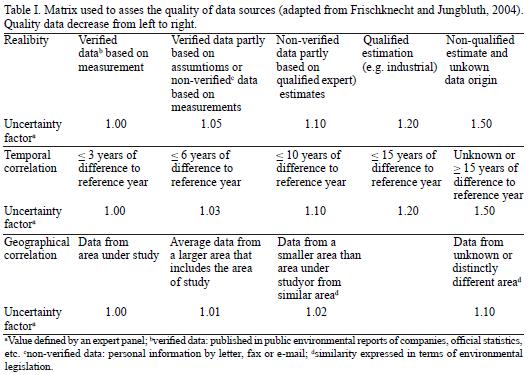
<body><![CDATA[<p align="justify"><font face="verdana" size="2">&bull; Although excluded in the CORINAIR inventory, industrial and mobile sources have been considered here as they were regarded of importance by other authors (Sutton <i>et al</i>., 2000; Klimont and Brink, 2004).</font></p>       <p align="justify"><font face="verdana" size="2">&bull; Emissions produced by residential consumption of biomass and carbon as well as use of sludge and diverse domestic products were taken into account because they were found of importance in the non&#150;agricultural emission inventory of the UK (Sutton <i>et al</i>., 2000) and they are also considered important in Galicia.</font></p>       <p align="justify"><font face="verdana" size="2">&bull; Finally, emissions associated with fires were estimated, as they are believed to be significant sources in Galicia.</font></p> </blockquote>     <p align="justify"><font face="verdana" size="2">&nbsp;</font></p>     <p align="justify"><font face="verdana" size="2"><i>2.2 Methodologies for the calculation of emissions</i></font></p>     <p align="justify"><font face="verdana" size="2">The methodologies proposed by the EMEP/CORINAIR Guidebook were followed to calculate most of the emissions (EEA, 2007). This approach is international and fully recognized, as the parties of The Convention on Long Range Transboundary Air Pollution (including Spain) use this guidance as a reference to report annual emissions to the United Nations Economic Commission for Europe (UNECE). The reference year for the inventory is 2001. When data used is referred to a different period, it will be appropriately specified in the text. NH<sub>3</sub> emissions are always reported in tonnes (t).</font></p>     <p align="justify"><font face="verdana" size="2">&nbsp;</font></p>     <p align="justify"><font face="verdana" size="2"><i>2.3 Uncertainties</i></font></p>     <p align="justify"><font face="verdana" size="2">Uncertainty values were determined in each case. When available, the values estimated by the methodologies were considered and, if expressed in a range, the less favorable case was adopted. However, in most cases, uncertainty needed to be estimated, so the matrix described in <a href="#t1">Table I</a>, adapted from Frischknecht and Jungbluth (2004), was followed.</font></p>     <p align="center"><font face="verdana" size="2"><a name="t1"></a></font></p>     ]]></body>
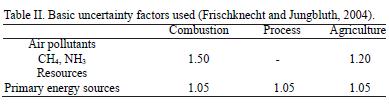
<body><![CDATA[<p align="center"><font face="verdana" size="2"><img src="/img/revistas/atm/v22n2/a2t1.jpg"></font></p>     <p align="justify"><font face="verdana" size="2">In addition, Frischknecht and Jungbluth (2004) established basic uncertainty factors (<a href="#t2">Table II</a>) associated with energy and resources demand, infrastructures, transport and emissions of pollutants to water, air and soil. The obtained values will vary if emission, demand or consumption is produced by combustion, during a process or in agriculture. In all these cases it is considered that the calculation has an intrinsic or basic uncertainty value, independent of reliability, temporal or geographical correlation. The value of this factor will increase accordingly with the complexity of the calculation. For example, NH<sub>3</sub> emissions from fertilizers are directly related with the type of fertilizer and the spring temperature of the region while NO<sub>x</sub> release in the same case depends on nitrification and denitrification processes, which are influenced by factors that are much more complicated to estimate (presence of aerobic&#150;anaerobic zones, etc.); therefore, the basic factor will be lower in this case for NH<sub>3</sub> than for NO<sub>x</sub>.</font></p>     <p align="center"><font face="verdana" size="2"><a name="t2"></a></font></p>     <p align="center"><font face="verdana" size="2"><img src="/img/revistas/atm/v22n2/a2t2.jpg"></font></p>     <p align="justify"><font face="verdana" size="2">A summary of the uncertainty factors used in the inventory is included in the Annex. Taking into account the four elements of uncertainty defined, geometric standard deviation (interval of 95%) is calculated as follows (Frischknecht and Jungbluth, 2004):</font></p>     <p align="justify"><font face="verdana" size="2"><img src="/img/revistas/atm/v22n2/a2s1.jpg"></font></p>     <p align="justify"><font face="verdana" size="2">where <i>U<sub>1</sub></i> is the reliability uncertainty factor, <i>U<sub>2</sub></i> the temporal correlation uncertainty factor, <i>U<sub>3</sub></i> the geographic correlation uncertainty factor and <i>U<sub>b</sub></i> the basic uncertainty factor.</font></p>     <p align="justify"><font face="verdana" size="2">&nbsp;</font></p>     <p align="justify"><font face="verdana" size="2"><b>3. Emission calculation</b></font></p>     <p align="justify"><font face="verdana" size="2"><i>3.1 Livestock</i></font></p>     ]]></body>
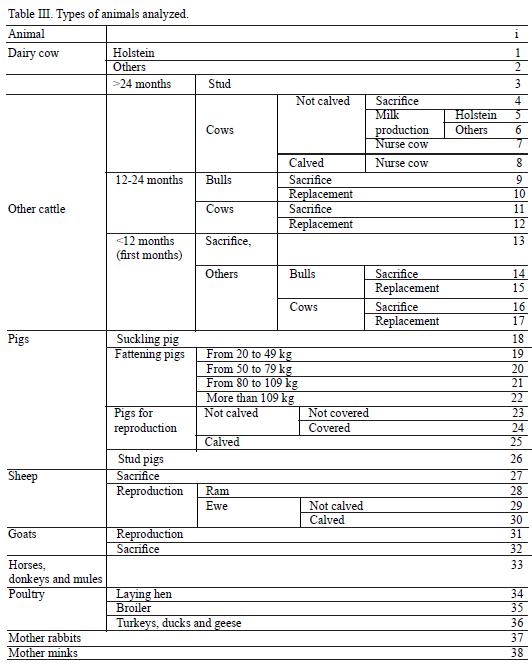
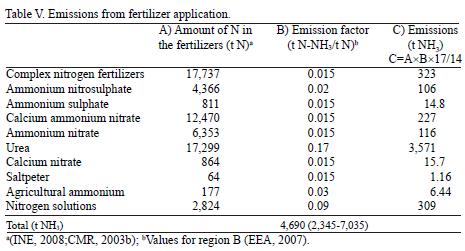
<body><![CDATA[<p align="justify"><font face="verdana" size="2">Usually, livestock management is the major source of NH<sub>3</sub> emissions (Klimont and Brink, 2004). In Spain, it is responsible for 78% of the total agricultural emissions (MAPA, 2001). This data does not have to match the results in Galicia because these can vary locally due to differences in animal type distribution (cattle, sheeps, pigs, poultry, etc.) and their respective nitrogen excretion and emission factors, which depend on agricultural practices, housing systems and climate (EEA, 2007).</font></p>     <p align="justify"><font face="verdana" size="2">Following the detailed method included in the EMEP/CORINAIR guidelines, and due to the importance of the emissions, 38 types of animals have been considered (<a href="#t3">Table III</a>). The amount of these animals in Galicia was obtained from different sources (Bello <i>et al</i>., 2004; CMR 2003a; MAPA, 2003; CMR, 2000)</font></p>     <p align="center"><font face="verdana" size="2"><a name="t3"></a></font></p>     <p align="center"><font face="verdana" size="2"><img src="/img/revistas/atm/v22n2/a2t3.jpg"></font></p>     <p align="justify"><font face="verdana" size="2">Once the number of animals was known, the emission during grazing, in the stables (including storage of manure) and due to application of manure has been estimated (<a href="/img/revistas/atm/v22n2/a2t4.jpg" target="_blank">Table IV</a>). As a first step, the amount of N produced per type of animal in Spain (considering the kind of feeding in this country) was obtained from different sources (Babot <i>et al</i>., 2002; MAPA, 2001; Camale&ntilde;o, 2008) except in the case of minks where, due to the lack of Spanish data, a generic value was used (EEA, 2007). The next step is to calculate the ratio of N excreted in and outside the stables. For this calculation it must be taken into account that the amount of N excreted per type of animal is different in summer and winter due to feeding changes during these seasons. Therefore, ECOTEC (1994) takes into consideration the ratio summer/winter of N excretion and the time each type of animal stays inside the stable in winter and summer, in order to calculate the amount of N excreted in and outside the stables per type of animal in Spain. Finally, knowing the N excreted outside the stable and the NH<sub>3</sub> emission factor during grazing per type of animal (ECOTEC, 1994; Bartrol&iacute;, 2003; EEA, 2007), we are able to calculate the total emissions during this stage. In order to calculate the emissions in the stables (including production and storage) the number of each type of animal has been multiplied by the animal&#150;specific emission factors (kg N&#150;NH<sub>3</sub> emitted in the stables/head and year) developed for Spain by Bartrol&iacute; (2003).</font></p>     <p align="justify"><font face="verdana" size="2">It has been assumed that N losses in stables in Spain are produced principally in form of N&#150;NH<sub>3</sub>, therefore emissions in other forms are neglected (personal communication by Dr. Jordi Bartrol&iacute;, Universidad de Gerona, February 26, 2007, <a href="mailto:jordi_bartroli@yahoo.es">jordi_bartroli@yahoo.es</a>). Having this in mind, N present in manure is the result of subtracting N excreted outside the stables and N&#150;NH<sub>3</sub> emitted in the stables from total N excretion. Similar to other cases, NH<sub>3</sub> specific emission factors (ECOTEC, 1994; EEA, 2007) have been applied in order to obtain NH<sub>3</sub> emissions due to the application of manure.</font></p>     <p align="justify"><font face="verdana" size="2">&nbsp;</font></p>     <p align="justify"><font face="verdana" size="2"><i>3.2 Nitrogen fertilizer application</i></font></p>     <p align="justify"><font face="verdana" size="2">Volatilization of N&#150;fertilizers has been estimated to contribute between 10 and 20% of agricultural NH<sub>3</sub> emissions in Europe (ECOTEC, 1994). In Spain, this source is responsible for 22% of the total agricultural emissions (MAPA, 2001). Again, the detailed methodology of the EMEP/CORINAIR guidance was applied (EEA, 2007). In this methodology, different emission factors are established for three types of regions, defined as a function of spring temperature (ts): region A (ts &gt; 13&deg;C), region B (6 &lt; ts &lt; 13&deg;C) and region C (ts &lt; 6&deg;C). In 2001, 90% of the Galician meteorological stations measured values within the range of region B (CMA, 2002), hence that set of factors was used (<a href="#t5">Table V</a>). NH<sub>3</sub> losses from ammonium sulphate, ammonium nitrate and anhydrous nitrate have been found to increase markedly with increasing pH (Whitehead and Raistrick, 1990) and therefore a multiplication factor is needed if the soil is basic (EEA, 2007). Galician soils are predominantly acid and therefore this multiplication factor has been not applied (&Aacute;lvarez <i>et al</i>., 2005).</font></p>     <p align="center"><font face="verdana" size="2"><a name="t5"></a></font></p>     ]]></body>
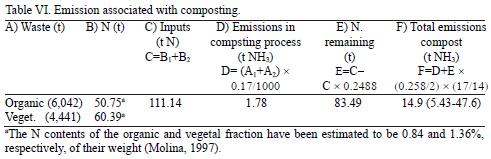
<body><![CDATA[<p align="center"><font face="verdana" size="2"><img src="/img/revistas/atm/v22n2/a2t5.jpg"></font></p>     <p align="justify"><font face="verdana" size="2">For quantification of the amount of each type of fertilizer used (<a href="#t5">Table V</a>), national distribution of fertilizer types was applied to the total amount of fertilizers consumed in Galicia (CMR, 2003b; INE, 2008).</font></p>     <p align="justify"><font face="verdana" size="2">&nbsp;</font></p>     <p align="justify"><font face="verdana" size="2"><i>3.3 Waste treatment</i></font></p>     <p align="justify"><font face="verdana" size="2">Munday (1990) estimated that 0.073 t N (10% as N&#150;NH<sub>3</sub>) are emitted for each ton of methane produced in a landfill. Taking into account this data and methane emissions from controlled and uncontrolled landfills in Galicia of 9,514 t N, NH<sub>3</sub> emissions were estimated as 84.3 t, within a range from 26.7 to 181 t (Bello <i>et al</i>., 2004).</font></p>     <p align="justify"><font face="verdana" size="2">In 2003, 6,042 t of organic fraction waste was assigned to composting in Galicia (CMA, 2004), adding vegetation remains (1 part for each 2.5 parts of organic fraction, with an organic fraction density of 0.6 and a vegetation density of 0.3 (Bartrol&iacute;, 2003)) to improve the final quality of the compost. N contents of the organic and vegetal fraction have been estimated to be 0.84% and 1.36%, respectively, of their weight (Molina, 1997). During the composting process, 24.88% of this initial nitrogen content is lost (Soliva, 2001) and, in specific terms, an emission of 0.17 kg NH<sub>3</sub>/t waste is produced, considering as waste the sum of organic and vegetal fractions (Pagans <i>et al</i>., 2006). In compost application to soil, the NH<sub>3</sub> volatilization factor is assumed to be half of the factor used when sewage sludge is applied (0.258 t N&#150;NH<sub>3</sub>/ t N in sludge (Doka, 2003)), because the remaining nitrogen compounds are poorly volatile (Bartrol&iacute;, 2003). Calculations of NH<sub>3</sub> emissions associated with composting are summarized in <a href="#t6">Table VI</a>.</font></p>     <p align="center"><font face="verdana" size="2"><a name="t6"></a></font></p>     <p align="center"><font face="verdana" size="2"><img src="/img/revistas/atm/v22n2/a2t6.jpg"></font></p>     <p align="justify"><font face="verdana" size="2">Only emissions from sludge applied to agricultural land are included here (<a href="#t7">Table VII</a>), because NH<sub>3</sub> emitted due to landfill disposal was already quantified (see above) and emission associated with sludge incineration will be included in subsection 3.5.</font></p>     <p align="center"><font face="verdana" size="2"><a name="t7"></a></font></p>     ]]></body>
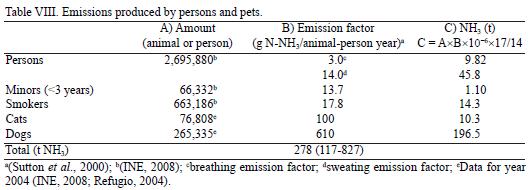
<body><![CDATA[<p align="center"><font face="verdana" size="2"><img src="/img/revistas/atm/v22n2/a2t7.jpg"></font></p>     <p align="justify"><font face="verdana" size="2">Emissions associated with urban waste and dangerous waste management are also included in subsection 3.5.</font></p>     <p align="justify"><font face="verdana" size="2">&nbsp;</font></p>     <p align="justify"><font face="verdana" size="2"><i>3.4 Humans and pets</i></font></p>     <p align="justify"><font face="verdana" size="2">Direct human emission of NH<sub>3</sub> originates from breath, sweat, cigarette smoking and infant excretion (under 3 years of age) (Sutton <i>et al</i>., 2000) (<a href="#t8">Table VIII</a>). In case of perspiration, emissions are produced due to hydrolysis and volatilization of urea from sweat (Lee and Dollar, 1994). Several studies have demonstrated NH<sub>3</sub> emissions among the substances emitted by breathing and smoking (Lee and Dollar, 1994; Davies <i>et al</i>., 1997). In the case of infant excretion, urea in diapers does not enter the sewage system and may hydrolyze producing NH<sub>3</sub> emissions (Lee and Dollar, 1994; Sutton <i>et al</i>., 2000). In the same way, emissions from pets (dogs and cats) are mainly associated with excretion (Sutton <i>et al</i>., 2000).</font></p>     <p align="center"><font face="verdana" size="2"><a name="t8"></a></font></p>     <p align="center"><font face="verdana" size="2"><img src="/img/revistas/atm/v22n2/a2t8.jpg"></font></p>     <p align="justify"><font face="verdana" size="2">&nbsp;</font></p>     <p align="justify"><font face="verdana" size="2"><i>3.5. Industrial sources</i></font></p>     <p align="justify"><font face="verdana" size="2">Casares <i>et al</i>. (2005) calculated NH<sub>3</sub> emissions in 2001 performing surveys in the 370 main enterprises responsible for air pollution in Galicia. Total emission was 525 t NH<sub>3</sub> (within a range of 437.5 to 630 t), power and cogeneration plants being the main sources with contributions of 58 and 15%, respectively.</font></p>     ]]></body>
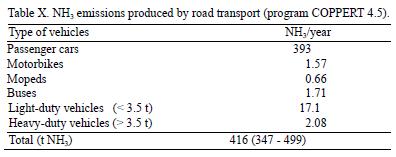
<body><![CDATA[<p align="justify"><font face="verdana" size="2">&nbsp;</font></p>     <p align="justify"><font face="verdana" size="2"><i>3.6 Mobile sources</i></font></p>     <p align="justify"><font face="verdana" size="2"><i>3.6.1 Road transport</i></font></p>     <p align="justify"><font face="verdana" size="2">The EMEP/CORINAIR methodology for the calculation of emissions produced by road transport has been computerized by the European Environment Agency in a program called COPERT (Computer Programme to Calculate Emissions from Road Transport). It was developed by Ntziachristos and Samaras (1999) and has suffered successive updates (EEA, 2007). The present paper uses the last released version 4.5 (<a href="http://lat.eng.auth.gr/copert/" target="_blank">http://lat.eng.auth.gr/copert/</a>).</font></p>     <p align="justify"><font face="verdana" size="2">NH<sub>3</sub> emissions in road transport are calculated by adding emissions from two different sources, namely the thermally stabilized engine operation ("hot emissions") and the warming&#150;up phase ("cold emissions"). In the first case, the emissions here calculated are based on the application of specific hot emission factors developed for 96 types of vehicles (passenger cars, buses, light and heavy&#150;duty vehicles &#150;&lt; 3.5 t and &gt;3.5 t&#150;, motorbikes and mopeds classified by registration year, cubic capacity and fuel type), taking also into account mileage and driving mode (urban, rural or highway). Emissions in the warming&#150;up phase further depend on ambient temperature and average trip distance. The majority of these cold emissions are produced in urban driving by passenger cars and light&#150;duty vehicles and therefore, COPERT only considers these sources for these specific emissions. For buses and heavy&#150;duty vehicles a load factor is included, because the fact of being more or less loaded influences the amount of emissions. <a href="#t9">Table IX</a> shows the used data and references.</font></p>     <p align="center"><font face="verdana" size="2"><a name="t9"></a></font></p>     <p align="center"><font face="verdana" size="2"><img src="/img/revistas/atm/v22n2/a2t9.jpg"></font></p>     <p align="justify"><font face="verdana" size="2">The number of vehicles of each class is multiplied by the corresponding factor in order to estimate NH<sub>3</sub> emissions and this data is added to obtain the global values. <a href="#t10">Table X</a> presents the global values of NH<sub>3</sub> emissions for the different types of vehicles in Galicia.</font></p>     <p align="center"><font face="verdana" size="2"><a name="t10"></a></font></p>     <p align="center"><font face="verdana" size="2"><img src="/img/revistas/atm/v22n2/a2t10.jpg"></font></p>     ]]></body>
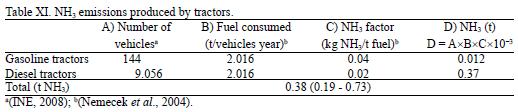
<body><![CDATA[<p align="justify"><font face="verdana" size="2">The program COPERT 4.5 does not allow to calculate emissions associated with tractors. In this particular case, the number of tractors, the amount of annually consumed fuel and the NH<sub>3</sub> emission factor (taking into account if the tractor is gasoline or diesel&#150;driven) have been considered (<a href="#t11">Table XI</a>). Data refers to a standard 80 CV tractor that consumes 3.36 kg fuel/h and is used 600 h/year (Nemecek <i>et al</i>., 2004).</font></p>     <p align="center"><font face="verdana" size="2"><a name="t11"></a></font></p>     <p align="center"><font face="verdana" size="2"><img src="/img/revistas/atm/v22n2/a2t11.jpg"></font></p>     <p align="justify"><font face="verdana" size="2">&nbsp;</font></p>     <p align="justify"><font face="verdana" size="2"><i>3.6.2 Other mobile sources and machinery</i></font></p>     <p align="justify"><font face="verdana" size="2">Diesel B (i.e. diesel subsidized by the Spanish Government) is used for railway transport, cogeneration, agricultural consumption (tractors and other machinery), fishery and forest machines. In 2001, a total of 456,214 t of Diesel B was consumed in Galicia (personal communication by Carmen Togores, Instituto Energ&eacute;tico de Galicia, February 27, 2007; <a href="mailto:carmentogores@inega.es">carmentogores@inega.es</a>), without taking into account the amount consumed by either cogeneration or diesel tractors. Both emissions are specifically considered in subsections 3.5 and 3.6.1, respectively. The emission factor for diesel consumption by other mobile sources is 0.007 g NH<sub>3</sub>/kg diesel (EEA, 2007) and, as a result, the annual emission is 2.95 t NH<sub>3</sub>, within a value range of 1.71 &#150; 5.98.</font></p>     <p align="justify"><font face="verdana" size="2">&nbsp;</font></p>     <p align="justify"><font face="verdana" size="2"><i>3.7 Residential combustion of coal and biomass</i></font></p>     <p align="justify"><font face="verdana" size="2">In Spain, the energy produced from coal in 2001 for domestic purposes was 2,721,550 GJ (L&oacute;pez <i>et al</i>., 2005). Allocation of consumptions on a population basis (data of Spanish and Galician population in 2001 from INE, 2008) allows estimating energy production from this source in Galicia (180,894 GJ). According to EEA (2007), the emission factor is 0.3 g NH<sub>3</sub>/GJ and therefore Galician emission amounts to 0.054 (0&#150;0.181) t of NH<sub>3</sub>.</font></p>     <p align="justify"><font face="verdana" size="2">Residential consumption of biomass is difficult to estimate, because it is mainly consumed in rural areas, where consumption is difficult to register. Data from Bello <i>et al</i>. (2004) considered an amount of 3,138,000 GJ/year. An emission factor of 3.8 g NH<sub>3</sub>/GJ was used (EEA, 2007), thus obtaining an emission in Galicia of 11.9 (0&#150;36.1) t of NH<sub>3</sub>.</font></p>     ]]></body>
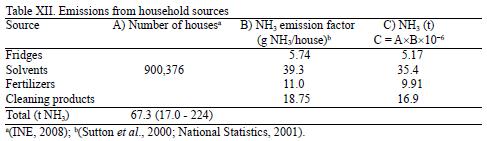
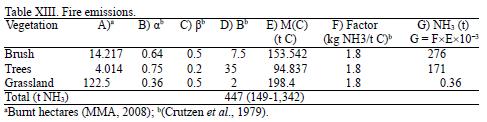
<body><![CDATA[<p align="justify"><font face="verdana" size="2">&nbsp;</font></p>     <p align="justify"><font face="verdana" size="2"><i>3.8 Household sources</i></font></p>     <p align="justify"><font face="verdana" size="2">NH<sub>3</sub> is a known component of many domestic products but generally estimations of emissions from these sources are not elaborated (Sutton <i>et al</i>., 2000). Some of these sources are house&#150;cleaning products, nitrogen fertilizers for domestic use, ammonia refrigerators, and solvents used in building construction. Emissions per house were calculated combining the emissions reported by Sutton <i>et al</i>. (2000) for the UK and the UK census of houses (National Statistics, 2001), and these factors were then applied to the number of houses in Galicia (INE, 2008) (<a href="#t12">Table XII</a>).</font></p>     <p align="center"><font face="verdana" size="2"><a name="t12"></a></font></p>     <p align="center"><font face="verdana" size="2"><img src="/img/revistas/atm/v22n2/a2t12.jpg"></font></p>     <p align="justify"><font face="verdana" size="2">&nbsp;</font></p>     <p align="justify"><font face="verdana" size="2"><i>3.9 Fires</i></font></p>     <p align="justify"><font face="verdana" size="2">Nitrogen containing compounds have been measured in biomass burning emissions in several studies (e.g. Lee and Dollar, 1994; Ward and Hardy, 1991). The dominant nitrogenous species are NO<sub>x</sub> in the flaming phase and NH<sub>3</sub> in the smoldering phase of combustion (Dennis <i>et al</i>., 2002). To compute these emissions (<a href="#t13">Table XIII</a>), the detailed EMEP/CORINAIR methodology was applied (EEA, 2007) and the emitted carbon mass (M(C)) was calculated by equation (2) (Crutzen <i>et al</i>., 1979):</font></p>     <p align="justify"><font face="verdana" size="2"><img src="/img/revistas/atm/v22n2/a2s2.jpg"></font></p>     <p align="center"><font face="verdana" size="2"><a name="t13"></a></font></p>     ]]></body>
<body><![CDATA[<p align="center"><font face="verdana" size="2"><img src="/img/revistas/atm/v22n2/a2t13.jpg"></font></p>     <p align="justify"><font face="verdana" size="2">&nbsp;</font></p>     <p align="justify"><font face="verdana" size="2">where M(C) is the carbon mass emitted (kg C), 0.45 is the average fraction of carbon in wood, A the burnt area (m<sup>2</sup>), B the average biomass which acts as combustible per unit of area (kg C/m<sup>2</sup>), &alpha; the fraction of biomass in the surface with respect to total biomass of B and &beta; the efficiency of burnt biomass in the surface.</font></p>     <p align="justify"><font face="verdana" size="2">Once M(C) is obtained, the emitted NH<sub>3</sub> can be calculated using the factor 1.8 g NH<sub>3</sub>/kg of emitted C (Andreae, 1991).</font></p>     <p align="justify"><font face="verdana" size="2">&nbsp;</font></p>     <p align="justify"><font face="verdana" size="2"><i>3.10 Wild animals, forests and natural grassland</i></font></p>     <p align="justify"><font face="verdana" size="2">Although data availability is very limited for these emissions, they were calculated due to their importance within natural emissions. According to the CORINAIR inventory for 28 European countries (EEA, 2007), contribution of forests and natural grassland was, on average, 0.8 and 0.3%, respectively. By applying these percentages to the total NH<sub>3</sub> emissions inventoried in Galicia, emissions of 561 (range 317&#150;993) t from forests and 210 (range 119&#150;372) t from natural grassland were obtained.</font></p>     <p align="justify"><font face="verdana" size="2">Other inventories reported a contribution of 0.2% due to wild animals (Sutton <i>et al</i>., 2000; Bouwman <i>et al</i>., 1997). Assuming here the same share, an emission of 140 (range 89.9&#150;219) t of NH<sub>3</sub> could be derived.</font></p>     <p align="justify"><font face="verdana" size="2">&nbsp;</font></p>     <p align="justify"><font face="verdana" size="2"><b>4. Summary of results and discussion</b></font></p>     ]]></body>
<body><![CDATA[<p align="justify"><font face="verdana" size="2"><i>4.1 Inventory of NH</i><sub>3</sub><i> emissions</i></font></p>     <p align="justify"><font face="verdana" size="2">The main result of this study is the inventory of NH<sub>3</sub> emissions for the region of Galicia (<a href="#t14">Table XIV</a>). To the best of our knowledge, this is the first complete inventory for this specific region and therefore no comparison is possible with previous reports. The comparison with other inventories is also difficult as they are usually focused only on emissions produced by livestock and use of fertilizers. However, some inventories have been calculated for the UK with a set of sources very similar to those of our study, which allows a certain level of global comparison (Misselbrook <i>et al</i>., 2000; Sutton <i>et al</i>., 2000). Therefore, comparison is only viable by tendency analysis rather than by exhaustive comparative studies of specific results. The latter would have no sense due to the high level of uncertainty associated with some emission sources.</font></p>     <p align="center"><font face="verdana" size="2"><a name="t14"></a></font></p>     <p align="center"><font face="verdana" size="2"><img src="/img/revistas/atm/v22n2/a2t14.jpg"></font></p>     <p align="justify"><font face="verdana" size="2">As expected, livestock management was found to be the major source of NH<sub>3</sub> with a contribution of 89.4%, a value near the top limit of the range of 70&#150;90% reported by Klimont and Brink (2004) for Europe. In UK, a country with an important livestock production, the contribution of livestock management accounts for 75% of the emissions (Sutton <i>et al</i>., 2004), value comparatively lower than that for Galicia. If only the main sources (livestock management and fertilizers use) are considered, livestock management accounts for 96.1% of emissions in Galicia, similar to the figure of 92% reported for a high livestock production country such as the Netherlands (Koch <i>et al</i>., 2001). Nevertheless, for Spain or Germany, this value is lower, namely 78 and 84%, respectively (MAPA, 2001; D&ouml;hler <i>et al</i>., 2002). Taking into account all these facts, it can be concluded that livestock contribution to the NH<sub>3</sub> emissions has a great relevance in Galicia, especially compared with the rest of Spain.</font></p>     <p align="justify"><font face="verdana" size="2">Going a bit further and analyzing the activities included within livestock management, emissions from stables and from manure after application are the main sources, accounting for 49 and 48% of the total livestock emissions, respectively, while emissions during grazing are insignificant (3%). Looking at the contributions by animal types, broilers stand for almost half of the amount (46%) of livestock emission, followed by cattle (43%) and pigs (8%). This important role of broilers has not been reported by other national inventories (contributions of 6&#150;15% according to D&ouml;hler <i>et al</i>., 2002; MMA, 2002; Sutton <i>et al</i>., 2004), but this is understandable in view of their large number in Galicia, namely 101,196,000 animals.</font></p>     <p align="justify"><font face="verdana" size="2">The second major source is the use of agricultural fertilizers that represents 6.7% of the total emissions, being urea the responsible for three quarters of these emissions. The emissions for the UK are very similar in importance accounting for 8% of the total (Sutton <i>et al</i>., 2004).</font></p>     <p align="justify"><font face="verdana" size="2">The non&#150;agricultural sources, a heterogeneous group, account for 3.9% of emissions, the principal items here are comprised of mobile sources, forestry, industry and fires. Other emissions which are closely related to agricultural activity such as use of tractors, use of sludge for agricultural purposes, production and use of compost, and use of other mobile sources and machinery (it has been estimated that 25% of the use is for agricultural purposes), not usually considered in other inventories as agricultural sources, are negligible, representing only 0.03% of the emissions.</font></p>     <p align="justify"><font face="verdana" size="2">&nbsp;</font></p>     <p align="justify"><font face="verdana" size="2"><i>4.2. Analysis of uncertainties</i></font></p>     ]]></body>
<body><![CDATA[<p align="justify"><font face="verdana" size="2">The objective of this work was dual, the second goal being the inclusion of uncertainties associated with each emission. For this purpose a semi&#150;quantitative method has been used. As can be observed in <a href="#a1">Table AI</a>, the uncertainty due to geographical and temporal correlation of the data used is low because most of the data are obtained for Galicia and reported for the reference year (2001). Regarding reliability, only in the case of emissions associated with forests and natural grassland the worst value (level 5) has been adopted because the approximate estimation established lacks precision. In most of the remaining cases, the figures used are based on verified data (published in public environmental reports of companies, official statistics, etc.) partly relying on assumptions (level 2) or on qualified estimation according to expert criteria (level 4). As an example, the number of smokers in Galicia has been obtained from verified data (official statistics) partly based on assumptions (among others, the estimated percentage of smokers only takes into account people older than 16 years) and is therefore considered as level 2. Finally, the basic factor has been established in accordance with the values proposed by Frischknecht and Jungbluth (2004) (<a href="#t2">Table II</a>), adopting in the remaining cases a value of 1. For the emissions of road transport, this basic factor has also been considered 1 (instead of 1.5 proposed by Frischknecht and Jungbluth, 2004) due to the high precision of the calculated emissions. On the contrary, in the case of emissions associated with wild animals, forests and natural grassland, the maximum value has been adopted for the basic factor (1.5) due to the high intrinsic uncertainty of these results. As mentioned in section 2.3, when the methodologies establish an uncertainty value, the latter has been selected by default, those values being collected in <a href="#a2">Table AII of the Annex</a>.</font></p>     <p align="center"><font face="verdana" size="2"><a name="a1"></a></font></p>     <p align="center"><font face="verdana" size="2"><img src="/img/revistas/atm/v22n2/a2a1.jpg"></font></p>     <p align="center"><font face="verdana" size="2"><a name="a2"></a></font></p>     <p align="center"><font face="verdana" size="2"><img src="/img/revistas/atm/v22n2/a2a2.jpg"></font></p>     <p align="justify"><font face="verdana" size="2">In the case of the two major sources, livestock and agricultural fertilizers, reduction of the uncertainties is difficult because the most detailed methodology and the best local emission factors available (on Spanish level for livestock and Region B level for fertilizers) were used. Even so, the EEA methodology proposes an uncertainty factor of &plusmn; 30% for livestock and &plusmn; 50% for fertilizers. To reduce these uncertainties, efforts have to focus on the definition of more specific emission factors (especially for cattle, broilers and urea) that provide a better description of the activities at least at Spanish, and when available, at Galician level. For example, with regard to livestock emissions it would be very interesting to obtain, in the first place, two new emission factors, on the one hand, for the production of manure in the stables and on the other hand, for the storage of this manure. In the course of time, these factors should become more and more sophisticated, considering facts like the type of manure (liquid, solid or mixed), the way the manure is stored (e.g. utilization of covered or uncovered tanks, storage time) or applied (use of special equipment to reduce emissions, e.g., shallow injection). In order to obtain these specific factors, intensive field measurement campaigns must be made, as performed for industrial emissions in Galicia. These are expensive and time&#150;consuming campaigns but they can be justified by the fact that the sources in question represent 96.1% of NH<sub>3</sub> emissions. In the case of non&#150;agricultural sources, research has to concentrate on the development of more specific factors for fires, forest, wild animals, grassland, pets (primarily, emissions from dogs) and humans (primarily, emissions from sweat and smokers).</font></p>     <p align="justify"><font face="verdana" size="2">&nbsp;</font></p>     <p align="justify"><font face="verdana" size="2"><b>5. Conclusions</b></font></p>     <p align="justify"><font face="verdana" size="2">The results of this study allowed raising a complete NH<sub>3</sub> inventory and its uncertainties for Galicia (NW Spain). Although it has been applied to a specific region, this work can become a useful basis for the estimation of NH<sub>3</sub> inventories and its uncertainties in other parts of the world.</font></p>     <blockquote>       ]]></body>
<body><![CDATA[<p align="justify"><font face="verdana" size="2">&bull; Regarding the quantified emissions, the main conclusions are:</font></p>       <p align="justify"><font face="verdana" size="2">&bull; Livestock is the major source of NH<sub>3</sub> emissions, representing 89.4% of these emissions, mainly produced by cattle and broilers.</font></p>       <p align="justify"><font face="verdana" size="2">&bull; Application of N&#150;fertilizers, principally urea, also plays an important role in the generation of NH<sub>3</sub> emission.</font></p>       <p align="justify"><font face="verdana" size="2">&bull; Non&#150;agricultural sources are of less importance, although attention should be paid to mobile sources, forestry, industry and fires.</font></p> </blockquote>     <p align="justify"><font face="verdana" size="2">Based on the uncertainties calculated, future research should be focused, in the first place, on the computation of precise emission factors better adapted to local conditions for livestock (cattle and broilers) as well as fertilizer application, and secondly, on the development of a more specific emission factor for fires, forest, pets (primarily, emissions from dogs) and humans (principally emissions from sweat and smokers).</font></p>     <p align="justify"><font face="verdana" size="2">&nbsp;</font></p>     <p align="justify"><font face="verdana" size="2"><b>Acknowledgments</b></font></p>     <p align="justify"><font face="verdana" size="2">The authors want to thank the Xunta Galicia (PGIDIT04TAL269003PR) for the financial support of this research work. Dr. Hospido is funded by the Isidro Parga Pondal Program (Xunta de Galicia).</font></p>     <p align="justify"><font face="verdana" size="2">&nbsp;</font></p>     <p align="justify"><font face="verdana" size="2"><b>References</b></font></p>     ]]></body>
<body><![CDATA[<!-- ref --><p align="justify"><font face="verdana" size="2">&Aacute;lvarez E., M. L. Fern&aacute;ndez&#150;Marcos, C. Monterroso and M. J. Fern&aacute;ndez&#150;Sanjurjo, 2005. Application of aluminium toxicity indices to soils under various forest species. <i>Forest Ecol. Manag.</i> <b>211</b>, 227&#150;239.</font>&nbsp;&nbsp;&nbsp;&nbsp;&nbsp;&nbsp;&nbsp;&nbsp;[&#160;<a href="javascript:void(0);" onclick="javascript: window.open('/scielo.php?script=sci_nlinks&ref=1286049&pid=S0187-6236200900020000200001&lng=','','width=640,height=500,resizable=yes,scrollbars=1,menubar=yes,');">Links</a>&#160;]<!-- end-ref --><!-- ref --><p align="justify"><font face="verdana" size="2">Andr&eacute; M., U. Hammarstr&ouml;m and I. Reynaud. (1999). Driving statistics for the assessment of pollutant emission from road transport. INRETS Report LTE 9906. Paris, France, 194 pp.</font>&nbsp;&nbsp;&nbsp;&nbsp;&nbsp;&nbsp;&nbsp;&nbsp;[&#160;<a href="javascript:void(0);" onclick="javascript: window.open('/scielo.php?script=sci_nlinks&ref=1286050&pid=S0187-6236200900020000200002&lng=','','width=640,height=500,resizable=yes,scrollbars=1,menubar=yes,');">Links</a>&#160;]<!-- end-ref --><!-- ref --><p align="justify"><font face="verdana" size="2">Andreae M. O., 1991. Biomass burning. Its history, use, and distribution and its impact on environmental quality and global climate. In: <i>Global Biomass Burning: Atmospheric, Climatic, and Biospheric Implications</i> (J.S. Levine, Ed.). MIT Press, Massachusetts, USA, 3&#150;21.</font>&nbsp;&nbsp;&nbsp;&nbsp;&nbsp;&nbsp;&nbsp;&nbsp;[&#160;<a href="javascript:void(0);" onclick="javascript: window.open('/scielo.php?script=sci_nlinks&ref=1286051&pid=S0187-6236200900020000200003&lng=','','width=640,height=500,resizable=yes,scrollbars=1,menubar=yes,');">Links</a>&#160;]<!-- end-ref --><!-- ref --><p align="justify"><font face="verdana" size="2">Babot D., P. Parera and G. Blanco, 2002. Estudi per actuaci&oacute; en els camps de l'aprofitament energ&egrave;tic de la biomasa en el sector agr&iacute;cola i ramader de Catalunya (In Catalan). Internal document. Departament de Producci&oacute; Animal. Universitat de Lleida. Lleida, Spain, 76 pp.</font>&nbsp;&nbsp;&nbsp;&nbsp;&nbsp;&nbsp;&nbsp;&nbsp;[&#160;<a href="javascript:void(0);" onclick="javascript: window.open('/scielo.php?script=sci_nlinks&ref=1286052&pid=S0187-6236200900020000200004&lng=','','width=640,height=500,resizable=yes,scrollbars=1,menubar=yes,');">Links</a>&#160;]<!-- end-ref --><!-- ref --><p align="justify"><font face="verdana" size="2">Bartrol&iacute; J., 2003. Avaluaci&oacute; ambiental del cicle del nitrogen a Catalunya: aplicaci&oacute; de l'an&agrave;lisi del flux de subst&agrave;ncies (In Catalan). Doctoral Thesis. Universitat de Girona. Girona, Spain, 306 pp.</font>&nbsp;&nbsp;&nbsp;&nbsp;&nbsp;&nbsp;&nbsp;&nbsp;[&#160;<a href="javascript:void(0);" onclick="javascript: window.open('/scielo.php?script=sci_nlinks&ref=1286053&pid=S0187-6236200900020000200005&lng=','','width=640,height=500,resizable=yes,scrollbars=1,menubar=yes,');">Links</a>&#160;]<!-- end-ref --><!-- ref --><p align="justify"><font face="verdana" size="2">Bello P., G. Grueiro, F. Mac&iacute;as, D. Rodr&iacute;guez, R. Rodr&iacute;guez, L. Rodr&iacute;guez and Y. Romero, 2004. Inventario de emisi&oacute;ns de gases de efecto invernadoiro en Galicia (In Galician). Colecci&oacute;n T&eacute;cnica de Medio Ambiente. Conseller&iacute;a de Medio Ambiente. Santiago de Compostela, Spain, 168 pp.</font>&nbsp;&nbsp;&nbsp;&nbsp;&nbsp;&nbsp;&nbsp;&nbsp;[&#160;<a href="javascript:void(0);" onclick="javascript: window.open('/scielo.php?script=sci_nlinks&ref=1286054&pid=S0187-6236200900020000200006&lng=','','width=640,height=500,resizable=yes,scrollbars=1,menubar=yes,');">Links</a>&#160;]<!-- end-ref --><!-- ref --><p align="justify"><font face="verdana" size="2">Bobbink R., D. Boxman, E. Fremstad, G. Heil, A. Houdijk and J. Roelofs, 1992. Critical loads for nitrogen eutrophication of terrestrial and wetland ecosystems based upon changes in vegetation and fauna. In: <i>Critical loads for nitrogen</i>. (P. Grennfelt and E. Th&ouml;rnel&ouml;f, Eds.). Nordic Council of Ministers, Copenhagen, Denmark, 111&#150;159.</font>&nbsp;&nbsp;&nbsp;&nbsp;&nbsp;&nbsp;&nbsp;&nbsp;[&#160;<a href="javascript:void(0);" onclick="javascript: window.open('/scielo.php?script=sci_nlinks&ref=1286055&pid=S0187-6236200900020000200007&lng=','','width=640,height=500,resizable=yes,scrollbars=1,menubar=yes,');">Links</a>&#160;]<!-- end-ref --><!-- ref --><p align="justify"><font face="verdana" size="2">Bouwman A. F., D. S. Lee, W. A. H. Asman, F. Dentener, K. W. V. D. Hoek and J. G. J. Olivier, 1997. A global high resolution emission inventory for ammonia. <i>Global. Biogeochem. Cy.</i> <b>11</b>, 561.</font>&nbsp;&nbsp;&nbsp;&nbsp;&nbsp;&nbsp;&nbsp;&nbsp;[&#160;<a href="javascript:void(0);" onclick="javascript: window.open('/scielo.php?script=sci_nlinks&ref=1286056&pid=S0187-6236200900020000200008&lng=','','width=640,height=500,resizable=yes,scrollbars=1,menubar=yes,');">Links</a>&#160;]<!-- end-ref --><!-- ref --><p align="justify"><font face="verdana" size="2">Camale&ntilde;o, M. (2008). Inventario de emisiones procedentes de los sectores primario y terciario en Castilla y Le&oacute;n, 2002&#150;2005. Propuestas de mejora de la calidad ambiental. Doctoral Thesis. Universidad de Valladolid. Valladolid, Spain, 1074 p&aacute;ginas.</font>&nbsp;&nbsp;&nbsp;&nbsp;&nbsp;&nbsp;&nbsp;&nbsp;[&#160;<a href="javascript:void(0);" onclick="javascript: window.open('/scielo.php?script=sci_nlinks&ref=1286057&pid=S0187-6236200900020000200009&lng=','','width=640,height=500,resizable=yes,scrollbars=1,menubar=yes,');">Links</a>&#160;]<!-- end-ref --><!-- ref --><p align="justify"><font face="verdana" size="2">Casares J. J., R. Rodr&iacute;guez, P. Maceira, J. A. Souto, S. Ramos, M. A. Costoya, A. S&aacute;ez and J. M. Vell&oacute;n, 2005. Inventario, an&aacute;lisis y proyecci&oacute;n de las emisiones atmosf&eacute;ricas industriales en Galicia. Universidade de Santiago de Compostela. Servizo de Publicaciones e Intercambio Cient&iacute;fico, Santiago de Compostela, Spain, 281 pp.</font>&nbsp;&nbsp;&nbsp;&nbsp;&nbsp;&nbsp;&nbsp;&nbsp;[&#160;<a href="javascript:void(0);" onclick="javascript: window.open('/scielo.php?script=sci_nlinks&ref=1286058&pid=S0187-6236200900020000200010&lng=','','width=640,height=500,resizable=yes,scrollbars=1,menubar=yes,');">Links</a>&#160;]<!-- end-ref --><!-- ref --><p align="justify"><font face="verdana" size="2">CMA, 2002. Anuario climatol&oacute;xico de Galicia. Centro de Desenvolvemento Sostible. Conseller&iacute;a de Medio Ambiente, Santiago de Compostela, Spain, 108 pp.</font>&nbsp;&nbsp;&nbsp;&nbsp;&nbsp;&nbsp;&nbsp;&nbsp;[&#160;<a href="javascript:void(0);" onclick="javascript: window.open('/scielo.php?script=sci_nlinks&ref=1286059&pid=S0187-6236200900020000200011&lng=','','width=640,height=500,resizable=yes,scrollbars=1,menubar=yes,');">Links</a>&#160;]<!-- end-ref --><!-- ref --><p align="justify"><font face="verdana" size="2">CMA, 2004. Plan de xesti&oacute;n de residuos urbanos de Galicia 2004&#150;2010. Conseller&iacute;a de Medio Ambiente, Santiago de Compostela, Spain, 100 pp.</font>&nbsp;&nbsp;&nbsp;&nbsp;&nbsp;&nbsp;&nbsp;&nbsp;[&#160;<a href="javascript:void(0);" onclick="javascript: window.open('/scielo.php?script=sci_nlinks&ref=1286060&pid=S0187-6236200900020000200012&lng=','','width=640,height=500,resizable=yes,scrollbars=1,menubar=yes,');">Links</a>&#160;]<!-- end-ref --><!-- ref --><p align="justify"><font face="verdana" size="2">CMR, 2000. Anuario de estat&iacute;stica agraria 1998. Conseller&iacute;a do Medio Rural, Santiago de Compostela, Spain, 257 pp.</font>&nbsp;&nbsp;&nbsp;&nbsp;&nbsp;&nbsp;&nbsp;&nbsp;[&#160;<a href="javascript:void(0);" onclick="javascript: window.open('/scielo.php?script=sci_nlinks&ref=1286061&pid=S0187-6236200900020000200013&lng=','','width=640,height=500,resizable=yes,scrollbars=1,menubar=yes,');">Links</a>&#160;]<!-- end-ref --><!-- ref --><p align="justify"><font face="verdana" size="2">CMR, 2003a. Anuario de estat&iacute;stica agraria 2001. Conseller&iacute;a do Medio Rural, Santiago de Compostela, Spain, 260 pp.</font>&nbsp;&nbsp;&nbsp;&nbsp;&nbsp;&nbsp;&nbsp;&nbsp;[&#160;<a href="javascript:void(0);" onclick="javascript: window.open('/scielo.php?script=sci_nlinks&ref=1286062&pid=S0187-6236200900020000200014&lng=','','width=640,height=500,resizable=yes,scrollbars=1,menubar=yes,');">Links</a>&#160;]<!-- end-ref --><!-- ref --><p align="justify"><font face="verdana" size="2">CMR, 2003b. Macromagnitudes agrarias 2001. Conseller&iacute;a do Medio Rural, Santiago de Compostela, Spain, 153 pp.</font>&nbsp;&nbsp;&nbsp;&nbsp;&nbsp;&nbsp;&nbsp;&nbsp;[&#160;<a href="javascript:void(0);" onclick="javascript: window.open('/scielo.php?script=sci_nlinks&ref=1286063&pid=S0187-6236200900020000200015&lng=','','width=640,height=500,resizable=yes,scrollbars=1,menubar=yes,');">Links</a>&#160;]<!-- end-ref --><!-- ref --><p align="justify"><font face="verdana" size="2">Crutzen P. J., L. E. Heidt, J. P. Krasnec, W. H. Pollock and W. Seiler, 1979. Biomass burning as a source of atmospheric gases CO, H2, N2O, NO, CH3C and COS. <i>Nature</i> <b>282</b>, 253&#150;256.</font>&nbsp;&nbsp;&nbsp;&nbsp;&nbsp;&nbsp;&nbsp;&nbsp;[&#160;<a href="javascript:void(0);" onclick="javascript: window.open('/scielo.php?script=sci_nlinks&ref=1286064&pid=S0187-6236200900020000200016&lng=','','width=640,height=500,resizable=yes,scrollbars=1,menubar=yes,');">Links</a>&#160;]<!-- end-ref --><!-- ref --><p align="justify"><font face="verdana" size="2">Davies S., P. Spanel and D. Smith, 1997. Quantitative analysis of ammonia on the breath of patients in end&#150;stage renal failure. <i>Kidney Int.</i> <b>52</b>, 223&#150;228.</font>&nbsp;&nbsp;&nbsp;&nbsp;&nbsp;&nbsp;&nbsp;&nbsp;[&#160;<a href="javascript:void(0);" onclick="javascript: window.open('/scielo.php?script=sci_nlinks&ref=1286065&pid=S0187-6236200900020000200017&lng=','','width=640,height=500,resizable=yes,scrollbars=1,menubar=yes,');">Links</a>&#160;]<!-- end-ref --><!-- ref --><p align="justify"><font face="verdana" size="2">Dennis A., M. Fraser, S. Anderson and D. Allen, 2002. Air pollutant emissions associated with forest, grassland, and agricultural burning in Texas. <i>Atmos. Environ.</i> <b>36</b>, 3779&#150;3792.</font>&nbsp;&nbsp;&nbsp;&nbsp;&nbsp;&nbsp;&nbsp;&nbsp;[&#160;<a href="javascript:void(0);" onclick="javascript: window.open('/scielo.php?script=sci_nlinks&ref=1286066&pid=S0187-6236200900020000200018&lng=','','width=640,height=500,resizable=yes,scrollbars=1,menubar=yes,');">Links</a>&#160;]<!-- end-ref --><!-- ref --><p align="justify"><font face="verdana" size="2">DGT, 2002. Anuario general estad&iacute;stico 2001. Direcci&oacute;n General de Tr&aacute;fico, Madrid, Spain, 48 pp.</font>&nbsp;&nbsp;&nbsp;&nbsp;&nbsp;&nbsp;&nbsp;&nbsp;[&#160;<a href="javascript:void(0);" onclick="javascript: window.open('/scielo.php?script=sci_nlinks&ref=1286067&pid=S0187-6236200900020000200019&lng=','','width=640,height=500,resizable=yes,scrollbars=1,menubar=yes,');">Links</a>&#160;]<!-- end-ref --><!-- ref --><p align="justify"><font face="verdana" size="2">D&ouml;hler H., B. Eurich&#150;Menden, U. D&auml;mmgen, B. Osterburg, M. L&uuml;ttich, A. Bergschmidt, W. Berg and R. Brunsch, 2002. BMVEL/UBA&#150;Ammoniak&#150;Emissionsinventar der deutschen Landwirtschaft und Minderungsszenarien bis zum Jahre 2010. Texte 05/02. Umweltbundesamt, Berlin, Germany, 307 pp.</font>&nbsp;&nbsp;&nbsp;&nbsp;&nbsp;&nbsp;&nbsp;&nbsp;[&#160;<a href="javascript:void(0);" onclick="javascript: window.open('/scielo.php?script=sci_nlinks&ref=1286068&pid=S0187-6236200900020000200020&lng=','','width=640,height=500,resizable=yes,scrollbars=1,menubar=yes,');">Links</a>&#160;]<!-- end-ref --><!-- ref --><p align="justify"><font face="verdana" size="2">Doka G., 2003. Report N&deg;13: Life cycle inventories of waste treatment services. Ecoinvent Database v 1.1. Swiss Centre for Life Cycle Inventories, D&uuml;bendorf, Switzerland, 59 pp.</font>&nbsp;&nbsp;&nbsp;&nbsp;&nbsp;&nbsp;&nbsp;&nbsp;[&#160;<a href="javascript:void(0);" onclick="javascript: window.open('/scielo.php?script=sci_nlinks&ref=1286069&pid=S0187-6236200900020000200021&lng=','','width=640,height=500,resizable=yes,scrollbars=1,menubar=yes,');">Links</a>&#160;]<!-- end-ref --><!-- ref --><p align="justify"><font face="verdana" size="2">ECOTEC, 1994. Ammonia emissions to air in western Europe. Technical Report No. 62. European Centre for Ecotoxicology and Toxicology of Chemicals, Brussels, Belgium, 196 pp.</font>&nbsp;&nbsp;&nbsp;&nbsp;&nbsp;&nbsp;&nbsp;&nbsp;[&#160;<a href="javascript:void(0);" onclick="javascript: window.open('/scielo.php?script=sci_nlinks&ref=1286070&pid=S0187-6236200900020000200022&lng=','','width=640,height=500,resizable=yes,scrollbars=1,menubar=yes,');">Links</a>&#160;]<!-- end-ref --><!-- ref --><p align="justify"><font face="verdana" size="2">EEA, 2000. Down to earth: Soil degradation and sustainable development in Europe. A challenge for the 21st century. Environmental issue series N&deg; 16. Environmental European Agency, Copenhagen, Denmark, 32 pp.</font>&nbsp;&nbsp;&nbsp;&nbsp;&nbsp;&nbsp;&nbsp;&nbsp;[&#160;<a href="javascript:void(0);" onclick="javascript: window.open('/scielo.php?script=sci_nlinks&ref=1286071&pid=S0187-6236200900020000200023&lng=','','width=640,height=500,resizable=yes,scrollbars=1,menubar=yes,');">Links</a>&#160;]<!-- end-ref --><!-- ref --><p align="justify"><font face="verdana" size="2">EEA, 2001. Analysis and mapping of soil problem areas (hot spots). Final Report. Environmental European Agency, Copenhagen, Denmark, 62 pp.</font>&nbsp;&nbsp;&nbsp;&nbsp;&nbsp;&nbsp;&nbsp;&nbsp;[&#160;<a href="javascript:void(0);" onclick="javascript: window.open('/scielo.php?script=sci_nlinks&ref=1286072&pid=S0187-6236200900020000200024&lng=','','width=640,height=500,resizable=yes,scrollbars=1,menubar=yes,');">Links</a>&#160;]<!-- end-ref --><!-- ref --><p align="justify"><font face="verdana" size="2">EEA, 2007. EMEP/CORINAIR Emission Inventory Guidebook &#150; 3rd edition. 2007 Update. Technical report No. 30. Environmental European Agency, Copenhague, Denmark, 2734 pp.</font>&nbsp;&nbsp;&nbsp;&nbsp;&nbsp;&nbsp;&nbsp;&nbsp;[&#160;<a href="javascript:void(0);" onclick="javascript: window.open('/scielo.php?script=sci_nlinks&ref=1286073&pid=S0187-6236200900020000200025&lng=','','width=640,height=500,resizable=yes,scrollbars=1,menubar=yes,');">Links</a>&#160;]<!-- end-ref --><!-- ref --><p align="justify"><font face="verdana" size="2">Finnveden G. and J. Potting, 1999. Eutrophication as an impact category. <i>Int. J. Life Cycle Ass.</i> <b>4</b>, 311&#150;314.</font>&nbsp;&nbsp;&nbsp;&nbsp;&nbsp;&nbsp;&nbsp;&nbsp;[&#160;<a href="javascript:void(0);" onclick="javascript: window.open('/scielo.php?script=sci_nlinks&ref=1286074&pid=S0187-6236200900020000200026&lng=','','width=640,height=500,resizable=yes,scrollbars=1,menubar=yes,');">Links</a>&#160;]<!-- end-ref --><!-- ref --><p align="justify"><font face="verdana" size="2">Friedrich R., B. Wickert, P. Blank, S. Emeis, W. Engewald, D. Hassel, H. Hoffmann, H. Michael, A. Obermeier, K. Sch&auml;fer, T. Schmitz, A. Sedlmaier, M. Stockhause, J. Theloke and F.J. Weber, 2002. Development of emission models and improvement of emission data for Germany. J. Atmos. Chem. 42, 179&#150;206.</font>&nbsp;&nbsp;&nbsp;&nbsp;&nbsp;&nbsp;&nbsp;&nbsp;[&#160;<a href="javascript:void(0);" onclick="javascript: window.open('/scielo.php?script=sci_nlinks&ref=1286075&pid=S0187-6236200900020000200027&lng=','','width=640,height=500,resizable=yes,scrollbars=1,menubar=yes,');">Links</a>&#160;]<!-- end-ref --><!-- ref --><p align="justify"><font face="verdana" size="2">Frischknecht R. and N. Jungbluth, 2004. Overview and methodology. Ecoinvent Database v1.1. Swiss Centre for Life Cycle Inventories, D&uuml;bendorf, Switzerland, 75 pp.</font>&nbsp;&nbsp;&nbsp;&nbsp;&nbsp;&nbsp;&nbsp;&nbsp;[&#160;<a href="javascript:void(0);" onclick="javascript: window.open('/scielo.php?script=sci_nlinks&ref=1286076&pid=S0187-6236200900020000200028&lng=','','width=640,height=500,resizable=yes,scrollbars=1,menubar=yes,');">Links</a>&#160;]<!-- end-ref --><!-- ref --><p align="justify"><font face="verdana" size="2">Hellsten S., U. Dragosits, C. J. Place, M. Vieno, A. J. Dore, T. H. Misselbrook, Y. S. Tang and M. A. Sutton, 2008. Modelling the spatial distribution of ammonia emissions in the UK. <i>Environ. Pollut.</i> <b>154</b>, 370&#150;379.</font>&nbsp;&nbsp;&nbsp;&nbsp;&nbsp;&nbsp;&nbsp;&nbsp;[&#160;<a href="javascript:void(0);" onclick="javascript: window.open('/scielo.php?script=sci_nlinks&ref=1286077&pid=S0187-6236200900020000200029&lng=','','width=640,height=500,resizable=yes,scrollbars=1,menubar=yes,');">Links</a>&#160;]<!-- end-ref --><!-- ref --><p align="justify"><font face="verdana" size="2">INE, 2008. <a href="http://www.ine.es/" target="_blank">www.ine.es</a>. Instituto Nacional de Estad&iacute;stica. July 2008.</font>&nbsp;&nbsp;&nbsp;&nbsp;&nbsp;&nbsp;&nbsp;&nbsp;[&#160;<a href="javascript:void(0);" onclick="javascript: window.open('/scielo.php?script=sci_nlinks&ref=1286078&pid=S0187-6236200900020000200030&lng=','','width=640,height=500,resizable=yes,scrollbars=1,menubar=yes,');">Links</a>&#160;]<!-- end-ref --><!-- ref --><p align="justify"><font face="verdana" size="2">Klimont Z., and C. Brink, 2004. Modelling of emissions of air pollutants and greenhouse gases from agricultural sources in Europe. Internal Review. International Institute for Applied Systems Analysis, Laxemburg, Austria, 75 pp.</font>&nbsp;&nbsp;&nbsp;&nbsp;&nbsp;&nbsp;&nbsp;&nbsp;[&#160;<a href="javascript:void(0);" onclick="javascript: window.open('/scielo.php?script=sci_nlinks&ref=1286079&pid=S0187-6236200900020000200031&lng=','','width=640,height=500,resizable=yes,scrollbars=1,menubar=yes,');">Links</a>&#160;]<!-- end-ref --><!-- ref --><p align="justify"><font face="verdana" size="2">Koch W., W. R., A. K. van Harmelen, G. P. J. Draaijers and G. van Grootfeld, 2001. Emission data for The Netherlands 1998 and estimates for 1999. Department for Monitoring and Information Management's. Inspectorate for Environmental Protection, Gravenhage, The Netherlands, 182 pp.</font>&nbsp;&nbsp;&nbsp;&nbsp;&nbsp;&nbsp;&nbsp;&nbsp;[&#160;<a href="javascript:void(0);" onclick="javascript: window.open('/scielo.php?script=sci_nlinks&ref=1286080&pid=S0187-6236200900020000200032&lng=','','width=640,height=500,resizable=yes,scrollbars=1,menubar=yes,');">Links</a>&#160;]<!-- end-ref --><!-- ref --><p align="justify"><font face="verdana" size="2">Lee D. S. and G. J. Dollar, 1994. Uncertainties in current estimates of emissions of ammonia in the United Kingdom. <i>Environ. Pollut.</i> <b>86</b>, 267&#150;277.</font>&nbsp;&nbsp;&nbsp;&nbsp;&nbsp;&nbsp;&nbsp;&nbsp;[&#160;<a href="javascript:void(0);" onclick="javascript: window.open('/scielo.php?script=sci_nlinks&ref=1286081&pid=S0187-6236200900020000200033&lng=','','width=640,height=500,resizable=yes,scrollbars=1,menubar=yes,');">Links</a>&#160;]<!-- end-ref --><!-- ref --><p align="justify"><font face="verdana" size="2">L&oacute;pez J. M., L. J. S&aacute;nchez and V. Meneu, 2005. Impactos sobre el sector energ&eacute;tico. In: <i>Evaluaci&oacute;n preliminar de los impactos en Espa&ntilde;a por efecto del cambio clim&aacute;tico</i> (J. M. Moreno, Ed.). Madrid, Espa&ntilde;a, 617&#150;653 pp.</font>&nbsp;&nbsp;&nbsp;&nbsp;&nbsp;&nbsp;&nbsp;&nbsp;[&#160;<a href="javascript:void(0);" onclick="javascript: window.open('/scielo.php?script=sci_nlinks&ref=1286082&pid=S0187-6236200900020000200034&lng=','','width=640,height=500,resizable=yes,scrollbars=1,menubar=yes,');">Links</a>&#160;]<!-- end-ref --><!-- ref --><p align="justify"><font face="verdana" size="2">Mac&iacute;as F., J. L. Otero, E. Romero, R. Verde, E. Parga, L. Rodr&iacute;guez, F. Mac&iacute;as Garc&iacute;a and M. Taboada, 2003. <i>Seguimiento de la contaminaci&oacute;n de suelos y aguas de Galicia por residuos agrarios eutrofizantes</i>. Conseller&iacute;a de Medio Ambiente, Santiago de Compostela, Espa&ntilde;a, 207 pp.</font>&nbsp;&nbsp;&nbsp;&nbsp;&nbsp;&nbsp;&nbsp;&nbsp;[&#160;<a href="javascript:void(0);" onclick="javascript: window.open('/scielo.php?script=sci_nlinks&ref=1286083&pid=S0187-6236200900020000200035&lng=','','width=640,height=500,resizable=yes,scrollbars=1,menubar=yes,');">Links</a>&#160;]<!-- end-ref --><!-- ref --><p align="justify"><font face="verdana" size="2">MAPA, 2001. Agricultural GHG emissions estimation methodology. Ministerio de Agricultura, Pesca y Alimentaci&oacute;n, Madrid, Spain, 57 pp.</font>&nbsp;&nbsp;&nbsp;&nbsp;&nbsp;&nbsp;&nbsp;&nbsp;[&#160;<a href="javascript:void(0);" onclick="javascript: window.open('/scielo.php?script=sci_nlinks&ref=1286084&pid=S0187-6236200900020000200036&lng=','','width=640,height=500,resizable=yes,scrollbars=1,menubar=yes,');">Links</a>&#160;]<!-- end-ref --><!-- ref --><p align="justify"><font face="verdana" size="2">MAPA, 2003. Anuario de estad&iacute;stica agroalimentaria 2002. Ministerio de Agricultura, Pesca y Alimentaci&oacute;n, Madrid, Spain, 700 pp.</font>&nbsp;&nbsp;&nbsp;&nbsp;&nbsp;&nbsp;&nbsp;&nbsp;[&#160;<a href="javascript:void(0);" onclick="javascript: window.open('/scielo.php?script=sci_nlinks&ref=1286085&pid=S0187-6236200900020000200037&lng=','','width=640,height=500,resizable=yes,scrollbars=1,menubar=yes,');">Links</a>&#160;]<!-- end-ref --><!-- ref --><p align="justify"><font face="verdana" size="2">Misselbrook T. H., T. J. Van der Weerdeb, B. F. Pain, S. C. Jarvis, B. J. Chambers, K. A. Smith, V. R. Phillips and T. G. M. Demmers, 2000. Ammonia emission factor for UK agriculture. <i>Atmos. Environ.</i> <b>34</b>, 871&#150;880.</font>&nbsp;&nbsp;&nbsp;&nbsp;&nbsp;&nbsp;&nbsp;&nbsp;[&#160;<a href="javascript:void(0);" onclick="javascript: window.open('/scielo.php?script=sci_nlinks&ref=1286086&pid=S0187-6236200900020000200038&lng=','','width=640,height=500,resizable=yes,scrollbars=1,menubar=yes,');">Links</a>&#160;]<!-- end-ref --><!-- ref --><p align="justify"><font face="verdana" size="2">MMA, 2002. Greenhouse gas emissions inventories report from Spain (1990&#150;2000). Communication to the European Commission (Decision 1999/296/CE). Ministerio de Medio Ambiente, Madrid, Spain, 53 pp.</font>&nbsp;&nbsp;&nbsp;&nbsp;&nbsp;&nbsp;&nbsp;&nbsp;[&#160;<a href="javascript:void(0);" onclick="javascript: window.open('/scielo.php?script=sci_nlinks&ref=1286087&pid=S0187-6236200900020000200039&lng=','','width=640,height=500,resizable=yes,scrollbars=1,menubar=yes,');">Links</a>&#160;]<!-- end-ref --><!-- ref --><p align="justify"><font face="verdana" size="2">MMA, 2007. Inventario de emisiones de gases de efecto invernadero de Espa&ntilde;a. A&ntilde;os 1990&#150;2005. Ministerio de Medio Ambiente, Madrid, Spain, 396 pp.</font>&nbsp;&nbsp;&nbsp;&nbsp;&nbsp;&nbsp;&nbsp;&nbsp;[&#160;<a href="javascript:void(0);" onclick="javascript: window.open('/scielo.php?script=sci_nlinks&ref=1286088&pid=S0187-6236200900020000200040&lng=','','width=640,height=500,resizable=yes,scrollbars=1,menubar=yes,');">Links</a>&#160;]<!-- end-ref --><!-- ref --><p align="justify"><font face="verdana" size="2">MMA, 2008. <a href="http://www.mma.es/secciones/biodiversidad/defensa_incendios/estadisticas_incendios/index.htm" target="_blank">http://www.incendiosforestales.org/estadisticas.asp</a>. Ministerio de Medio Ambiente. July 2008.</font>&nbsp;&nbsp;&nbsp;&nbsp;&nbsp;&nbsp;&nbsp;&nbsp;[&#160;<a href="javascript:void(0);" onclick="javascript: window.open('/scielo.php?script=sci_nlinks&ref=1286089&pid=S0187-6236200900020000200041&lng=','','width=640,height=500,resizable=yes,scrollbars=1,menubar=yes,');">Links</a>&#160;]<!-- end-ref --><!-- ref --><p align="justify"><font face="verdana" size="2">Molina N., 1997. Informe preliminar dels resultats anal&iacute;tics de la planta de Torrelles de Llobregat. Escola Superior d'Agricultura, Barcelona, Spain, 34 pp.</font>&nbsp;&nbsp;&nbsp;&nbsp;&nbsp;&nbsp;&nbsp;&nbsp;[&#160;<a href="javascript:void(0);" onclick="javascript: window.open('/scielo.php?script=sci_nlinks&ref=1286090&pid=S0187-6236200900020000200042&lng=','','width=640,height=500,resizable=yes,scrollbars=1,menubar=yes,');">Links</a>&#160;]<!-- end-ref --><!-- ref --><p align="justify"><font face="verdana" size="2">Moreno L. M. and A. Lozano, 2006. Situaci&oacute;n actual de los inventarios de emisiones a la atm&oacute;s&#150;fera en Espa&ntilde;a. Grupo 4: Inventario de emisiones. V Seminario de Calidad del aire en Espa&ntilde;a, Santander, Spain, October, 2006.</font>&nbsp;&nbsp;&nbsp;&nbsp;&nbsp;&nbsp;&nbsp;&nbsp;[&#160;<a href="javascript:void(0);" onclick="javascript: window.open('/scielo.php?script=sci_nlinks&ref=1286091&pid=S0187-6236200900020000200043&lng=','','width=640,height=500,resizable=yes,scrollbars=1,menubar=yes,');">Links</a>&#160;]<!-- end-ref --><!-- ref --><p align="justify"><font face="verdana" size="2">Munday P. K., 1990. UK emissions of air pollutants 1970&#150;1988. Report LR 764. Warren Spring Laboratory, T. Stevenage, United Kingdom, 137 pp.</font>&nbsp;&nbsp;&nbsp;&nbsp;&nbsp;&nbsp;&nbsp;&nbsp;[&#160;<a href="javascript:void(0);" onclick="javascript: window.open('/scielo.php?script=sci_nlinks&ref=1286092&pid=S0187-6236200900020000200044&lng=','','width=640,height=500,resizable=yes,scrollbars=1,menubar=yes,');">Links</a>&#160;]<!-- end-ref --><!-- ref --><p align="justify"><font face="verdana" size="2">National Statistics, 2001. Census 2001. Available at: <a href="http://www.statistics.gov.uk/census2001/profiles/commentaries/housing.asp" target="_blank">http://www.statistics.gov.uk/census2001/profiles/commentaries/housing.asp</a></font>&nbsp;&nbsp;&nbsp;&nbsp;&nbsp;&nbsp;&nbsp;&nbsp;[&#160;<a href="javascript:void(0);" onclick="javascript: window.open('/scielo.php?script=sci_nlinks&ref=1286093&pid=S0187-6236200900020000200045&lng=','','width=640,height=500,resizable=yes,scrollbars=1,menubar=yes,');">Links</a>&#160;]<!-- end-ref --><!-- ref --><p align="justify"><font face="verdana" size="2">Nemecek T., A. Heil, O. Huguenin, S. Meier, S. Erzinger, S. Blaser, D. Dux and A. Zimmermann, 2004. Life cycle inventories of agricultural production systems. Ecoinvent Database v.1.1. Report No. 15. The Swiss Centre for Life Cycle Inventories, Zurich, Switzerland, 289 pp.</font>&nbsp;&nbsp;&nbsp;&nbsp;&nbsp;&nbsp;&nbsp;&nbsp;[&#160;<a href="javascript:void(0);" onclick="javascript: window.open('/scielo.php?script=sci_nlinks&ref=1286094&pid=S0187-6236200900020000200046&lng=','','width=640,height=500,resizable=yes,scrollbars=1,menubar=yes,');">Links</a>&#160;]<!-- end-ref --><!-- ref --><p align="justify"><font face="verdana" size="2">Ntziachristos L. and Z. Samaras, 1999. COPERT&#150;Computer programme to calculate emissions from road transport. Methodology and emission factors. European Environment Agency, Copenhague, Denmark, 109 pp.</font>&nbsp;&nbsp;&nbsp;&nbsp;&nbsp;&nbsp;&nbsp;&nbsp;[&#160;<a href="javascript:void(0);" onclick="javascript: window.open('/scielo.php?script=sci_nlinks&ref=1286095&pid=S0187-6236200900020000200047&lng=','','width=640,height=500,resizable=yes,scrollbars=1,menubar=yes,');">Links</a>&#160;]<!-- end-ref --><!-- ref --><p align="justify"><font face="verdana" size="2">Pagans E., R. Barrena, X. Font, and A. S&aacute;nchez, 2006. Ammonia emissions from the composting of different organic wastes. Dependency on process temperature. <i>Chemosphere</i> <b>62</b>, 1534&#150;1542.</font>&nbsp;&nbsp;&nbsp;&nbsp;&nbsp;&nbsp;&nbsp;&nbsp;[&#160;<a href="javascript:void(0);" onclick="javascript: window.open('/scielo.php?script=sci_nlinks&ref=1286096&pid=S0187-6236200900020000200048&lng=','','width=640,height=500,resizable=yes,scrollbars=1,menubar=yes,');">Links</a>&#160;]<!-- end-ref --><!-- ref --><p align="justify"><font face="verdana" size="2">Refugio, 2004. Estudio de las actitudes de los espa&ntilde;oles en relaci&oacute;n con los animales dom&eacute;sticos. Available at: <a href="http://www.elrefugio.org/pagina.aspx?FrameWorkIdPagina=90" target="_blank">http://www.elrefugio.org/pagina.aspx?FrameWorkCodigoPagina=Pagina_Hemeroteca_Noticias</a>.</font>&nbsp;&nbsp;&nbsp;&nbsp;&nbsp;&nbsp;&nbsp;&nbsp;[&#160;<a href="javascript:void(0);" onclick="javascript: window.open('/scielo.php?script=sci_nlinks&ref=1286097&pid=S0187-6236200900020000200049&lng=','','width=640,height=500,resizable=yes,scrollbars=1,menubar=yes,');">Links</a>&#160;]<!-- end-ref --><!-- ref --><p align="justify"><font face="verdana" size="2">Rodr&iacute;guez L. and F. Mac&iacute;as, 2006. Eutrophication trends in forest soils in Galicia (NW Spain) caused by the atmospheric deposition of nitrogen compounds. Chemosphere 63, 1598&#150;1609.</font>&nbsp;&nbsp;&nbsp;&nbsp;&nbsp;&nbsp;&nbsp;&nbsp;[&#160;<a href="javascript:void(0);" onclick="javascript: window.open('/scielo.php?script=sci_nlinks&ref=1286098&pid=S0187-6236200900020000200050&lng=','','width=640,height=500,resizable=yes,scrollbars=1,menubar=yes,');">Links</a>&#160;]<!-- end-ref --><!-- ref --><p align="justify"><font face="verdana" size="2">Soliva M., 2001. Compostatge i gesti&oacute; de residus org&agrave;nics. Estudis i Monografies 21. Diputaci&oacute; de Barcelona, Barcelona, Spain, 53 pp.</font>&nbsp;&nbsp;&nbsp;&nbsp;&nbsp;&nbsp;&nbsp;&nbsp;[&#160;<a href="javascript:void(0);" onclick="javascript: window.open('/scielo.php?script=sci_nlinks&ref=1286099&pid=S0187-6236200900020000200051&lng=','','width=640,height=500,resizable=yes,scrollbars=1,menubar=yes,');">Links</a>&#160;]<!-- end-ref --><!-- ref --><p align="justify"><font face="verdana" size="2">Sutton M., U. Dragosits, Y. S. Tang and D. Fowler, 2000. Ammonia emissions from non&#150;agricultural sources in the UK. <i>Atmos. Environ.</i> <b>34</b>, 855&#150;869.</font>&nbsp;&nbsp;&nbsp;&nbsp;&nbsp;&nbsp;&nbsp;&nbsp;[&#160;<a href="javascript:void(0);" onclick="javascript: window.open('/scielo.php?script=sci_nlinks&ref=1286100&pid=S0187-6236200900020000200052&lng=','','width=640,height=500,resizable=yes,scrollbars=1,menubar=yes,');">Links</a>&#160;]<!-- end-ref --><!-- ref --><p align="justify"><font face="verdana" size="2">Sutton M., U. Dragosits, S. Hellsten, C. J. Place, A. J. Dore, Y. S. Tang, N. van Dijk, L. Love, N. Fournier, M. Vieno, K. J. Weston, R. I. Smith, M. Coyle, D. Roy, J. Hall and D. Fowler, 2004. Ammonia emission and deposition in Scotland and its potential environmental impacts. <i>Sci. World J.</i> <b>4</b>, 795&#150;810.</font>&nbsp;&nbsp;&nbsp;&nbsp;&nbsp;&nbsp;&nbsp;&nbsp;[&#160;<a href="javascript:void(0);" onclick="javascript: window.open('/scielo.php?script=sci_nlinks&ref=1286101&pid=S0187-6236200900020000200053&lng=','','width=640,height=500,resizable=yes,scrollbars=1,menubar=yes,');">Links</a>&#160;]<!-- end-ref --><!-- ref --><p align="justify"><font face="verdana" size="2">Ward D. E. and C. C. Hardy, 1991. Smoke emissions from wildland fires. <i>Environ. Int.</i> <b>17</b>, 117&#150;134.</font>&nbsp;&nbsp;&nbsp;&nbsp;&nbsp;&nbsp;&nbsp;&nbsp;[&#160;<a href="javascript:void(0);" onclick="javascript: window.open('/scielo.php?script=sci_nlinks&ref=1286102&pid=S0187-6236200900020000200054&lng=','','width=640,height=500,resizable=yes,scrollbars=1,menubar=yes,');">Links</a>&#160;]<!-- end-ref --><!-- ref --><p align="justify"><font face="verdana" size="2">Whitehead D. C. and N. Raistrick, 1990. Ammonia volatilization from five nitrogen compounds used as fertilizers following surface application to soils of differing characteristics. <i>J. Soil. Sci.</i> <b>41</b>, 387&#150;394.</font>&nbsp;&nbsp;&nbsp;&nbsp;&nbsp;&nbsp;&nbsp;&nbsp;[&#160;<a href="javascript:void(0);" onclick="javascript: window.open('/scielo.php?script=sci_nlinks&ref=1286103&pid=S0187-6236200900020000200055&lng=','','width=640,height=500,resizable=yes,scrollbars=1,menubar=yes,');">Links</a>&#160;]<!-- end-ref --> ]]></body><back>
<ref-list>
<ref id="B1">
<nlm-citation citation-type="journal">
<person-group person-group-type="author">
<name>
<surname><![CDATA[Álvarez]]></surname>
<given-names><![CDATA[E.]]></given-names>
</name>
<name>
<surname><![CDATA[Fernández-Marcos]]></surname>
<given-names><![CDATA[M. L.]]></given-names>
</name>
<name>
<surname><![CDATA[Monterroso]]></surname>
<given-names><![CDATA[C.]]></given-names>
</name>
<name>
<surname><![CDATA[Fernández-Sanjurjo]]></surname>
<given-names><![CDATA[M. J.]]></given-names>
</name>
</person-group>
<article-title xml:lang="en"><![CDATA[Application of aluminium toxicity indices to soils under various forest species]]></article-title>
<source><![CDATA[Forest Ecol. Manag.]]></source>
<year>2005</year>
<numero>211</numero>
<issue>211</issue>
<page-range>227-239</page-range></nlm-citation>
</ref>
<ref id="B2">
<nlm-citation citation-type="">
<person-group person-group-type="author">
<name>
<surname><![CDATA[André]]></surname>
<given-names><![CDATA[M.]]></given-names>
</name>
<name>
<surname><![CDATA[Hammarström]]></surname>
<given-names><![CDATA[U.]]></given-names>
</name>
<name>
<surname><![CDATA[Reynaud]]></surname>
<given-names><![CDATA[I.]]></given-names>
</name>
</person-group>
<source><![CDATA[Driving statistics for the assessment of pollutant emission from road transport]]></source>
<year>1999</year>
<volume>9906</volume>
<page-range>194</page-range><publisher-loc><![CDATA[Paris ]]></publisher-loc>
</nlm-citation>
</ref>
<ref id="B3">
<nlm-citation citation-type="book">
<person-group person-group-type="author">
<name>
<surname><![CDATA[Andreae]]></surname>
<given-names><![CDATA[M. O.]]></given-names>
</name>
</person-group>
<article-title xml:lang="en"><![CDATA[Biomass burning: Its history, use, and distribution and its impact on environmental quality and global climate]]></article-title>
<person-group person-group-type="editor">
<name>
<surname><![CDATA[Levine]]></surname>
<given-names><![CDATA[J.S.]]></given-names>
</name>
</person-group>
<source><![CDATA[Global Biomass Burning: Atmospheric, Climatic, and Biospheric Implications]]></source>
<year>1991</year>
<page-range>3-21</page-range><publisher-loc><![CDATA[Massachusetts ]]></publisher-loc>
<publisher-name><![CDATA[MIT Press]]></publisher-name>
</nlm-citation>
</ref>
<ref id="B4">
<nlm-citation citation-type="book">
<person-group person-group-type="author">
<name>
<surname><![CDATA[Babot]]></surname>
<given-names><![CDATA[D.]]></given-names>
</name>
<name>
<surname><![CDATA[Parera]]></surname>
<given-names><![CDATA[P.]]></given-names>
</name>
<name>
<surname><![CDATA[Blanco]]></surname>
<given-names><![CDATA[G.]]></given-names>
</name>
</person-group>
<source><![CDATA[Estudi per actuació en els camps de l'aprofitament energètic de la biomasa en el sector agrícola i ramader de Catalunya]]></source>
<year>2002</year>
<page-range>76</page-range><publisher-loc><![CDATA[Lleida ]]></publisher-loc>
<publisher-name><![CDATA[Departament de Producció Animal. Universitat de Lleida]]></publisher-name>
</nlm-citation>
</ref>
<ref id="B5">
<nlm-citation citation-type="">
<person-group person-group-type="author">
<name>
<surname><![CDATA[Bartrolí]]></surname>
<given-names><![CDATA[J.]]></given-names>
</name>
</person-group>
<source><![CDATA[Avaluació ambiental del cicle del nitrogen a Catalunya: aplicació de l'anàlisi del flux de substàncies]]></source>
<year>2003</year>
<page-range>306</page-range></nlm-citation>
</ref>
<ref id="B6">
<nlm-citation citation-type="book">
<person-group person-group-type="author">
<name>
<surname><![CDATA[Bello]]></surname>
<given-names><![CDATA[P.]]></given-names>
</name>
<name>
<surname><![CDATA[Grueiro]]></surname>
<given-names><![CDATA[G.]]></given-names>
</name>
<name>
<surname><![CDATA[Macías]]></surname>
<given-names><![CDATA[F.]]></given-names>
</name>
<name>
<surname><![CDATA[Rodríguez]]></surname>
<given-names><![CDATA[D.]]></given-names>
</name>
<name>
<surname><![CDATA[Rodríguez]]></surname>
<given-names><![CDATA[R.]]></given-names>
</name>
<name>
<surname><![CDATA[Rodríguez]]></surname>
<given-names><![CDATA[L.]]></given-names>
</name>
<name>
<surname><![CDATA[Romero]]></surname>
<given-names><![CDATA[Y.]]></given-names>
</name>
</person-group>
<source><![CDATA[Inventario de emisións de gases de efecto invernadoiro en Galicia]]></source>
<year>2004</year>
<page-range>168</page-range><publisher-loc><![CDATA[Santiago de Compostela ]]></publisher-loc>
<publisher-name><![CDATA[Consellería de Medio Ambiente]]></publisher-name>
</nlm-citation>
</ref>
<ref id="B7">
<nlm-citation citation-type="book">
<person-group person-group-type="author">
<name>
<surname><![CDATA[Bobbink]]></surname>
<given-names><![CDATA[R.]]></given-names>
</name>
<name>
<surname><![CDATA[Boxman]]></surname>
<given-names><![CDATA[D.]]></given-names>
</name>
<name>
<surname><![CDATA[Fremstad]]></surname>
<given-names><![CDATA[E.]]></given-names>
</name>
<name>
<surname><![CDATA[Heil]]></surname>
<given-names><![CDATA[G.]]></given-names>
</name>
<name>
<surname><![CDATA[Houdijk]]></surname>
<given-names><![CDATA[A.]]></given-names>
</name>
<name>
<surname><![CDATA[Roelofs]]></surname>
<given-names><![CDATA[J.]]></given-names>
</name>
</person-group>
<article-title xml:lang="en"><![CDATA[Critical loads for nitrogen eutrophication of terrestrial and wetland ecosystems based upon changes in vegetation and fauna]]></article-title>
<person-group person-group-type="editor">
<name>
<surname><![CDATA[Grennfelt]]></surname>
<given-names><![CDATA[P.]]></given-names>
</name>
<name>
<surname><![CDATA[Thörnelöf]]></surname>
<given-names><![CDATA[E.]]></given-names>
</name>
</person-group>
<source><![CDATA[Critical loads for nitrogen]]></source>
<year>1992</year>
<page-range>111-159</page-range><publisher-loc><![CDATA[Copenhagen ]]></publisher-loc>
<publisher-name><![CDATA[Nordic Council of Ministers]]></publisher-name>
</nlm-citation>
</ref>
<ref id="B8">
<nlm-citation citation-type="journal">
<person-group person-group-type="author">
<name>
<surname><![CDATA[Bouwman]]></surname>
<given-names><![CDATA[A. F.]]></given-names>
</name>
<name>
<surname><![CDATA[Lee]]></surname>
<given-names><![CDATA[D. S.]]></given-names>
</name>
<name>
<surname><![CDATA[Asman]]></surname>
<given-names><![CDATA[W. A. H.]]></given-names>
</name>
<name>
<surname><![CDATA[Dentener]]></surname>
<given-names><![CDATA[F.]]></given-names>
</name>
<name>
<surname><![CDATA[Hoek]]></surname>
<given-names><![CDATA[K. W. V. D.]]></given-names>
</name>
<name>
<surname><![CDATA[Olivier]]></surname>
<given-names><![CDATA[J. G. J.]]></given-names>
</name>
</person-group>
<article-title xml:lang="en"><![CDATA[A global high resolution emission inventory for ammonia]]></article-title>
<source><![CDATA[Global. Biogeochem. Cy.]]></source>
<year>1997</year>
<numero>11</numero>
<issue>11</issue>
<page-range>561</page-range></nlm-citation>
</ref>
<ref id="B9">
<nlm-citation citation-type="">
<person-group person-group-type="author">
<name>
<surname><![CDATA[Camaleño]]></surname>
<given-names><![CDATA[M.]]></given-names>
</name>
</person-group>
<source><![CDATA[Inventario de emisiones procedentes de los sectores primario y terciario en Castilla y León, 2002-2005: Propuestas de mejora de la calidad ambiental]]></source>
<year>2008</year>
<page-range>1074</page-range></nlm-citation>
</ref>
<ref id="B10">
<nlm-citation citation-type="book">
<person-group person-group-type="author">
<name>
<surname><![CDATA[Casares]]></surname>
<given-names><![CDATA[J. J.]]></given-names>
</name>
<name>
<surname><![CDATA[Rodríguez]]></surname>
<given-names><![CDATA[R.]]></given-names>
</name>
<name>
<surname><![CDATA[Maceira]]></surname>
<given-names><![CDATA[P.]]></given-names>
</name>
<name>
<surname><![CDATA[Souto]]></surname>
<given-names><![CDATA[J. A.]]></given-names>
</name>
<name>
<surname><![CDATA[Ramos]]></surname>
<given-names><![CDATA[S.]]></given-names>
</name>
<name>
<surname><![CDATA[Costoya]]></surname>
<given-names><![CDATA[M. A.]]></given-names>
</name>
<name>
<surname><![CDATA[Sáez]]></surname>
<given-names><![CDATA[A.]]></given-names>
</name>
<name>
<surname><![CDATA[Vellón]]></surname>
<given-names><![CDATA[J. M.]]></given-names>
</name>
</person-group>
<source><![CDATA[Inventario, análisis y proyección de las emisiones atmosféricas industriales en Galicia]]></source>
<year>2005</year>
<page-range>281</page-range><publisher-loc><![CDATA[Santiago de Compostela ]]></publisher-loc>
<publisher-name><![CDATA[Universidade de Santiago de Compostela. Servizo de Publicaciones e Intercambio Científico]]></publisher-name>
</nlm-citation>
</ref>
<ref id="B11">
<nlm-citation citation-type="book">
<collab>CMA</collab>
<source><![CDATA[Anuario climatolóxico de Galicia]]></source>
<year>2002</year>
<page-range>108</page-range><publisher-loc><![CDATA[Santiago de Compostela ]]></publisher-loc>
<publisher-name><![CDATA[Centro de Desenvolvemento Sostible. Consellería de Medio Ambiente]]></publisher-name>
</nlm-citation>
</ref>
<ref id="B12">
<nlm-citation citation-type="book">
<collab>CMA</collab>
<source><![CDATA[Plan de xestión de residuos urbanos de Galicia 2004-2010]]></source>
<year>2004</year>
<page-range>100</page-range><publisher-loc><![CDATA[Santiago de Compostela ]]></publisher-loc>
<publisher-name><![CDATA[Consellería de Medio Ambiente]]></publisher-name>
</nlm-citation>
</ref>
<ref id="B13">
<nlm-citation citation-type="book">
<collab>CMR</collab>
<source><![CDATA[Anuario de estatística agraria 1998]]></source>
<year>2000</year>
<page-range>257</page-range><publisher-loc><![CDATA[Santiago de Compostela ]]></publisher-loc>
<publisher-name><![CDATA[Consellería do Medio Rural]]></publisher-name>
</nlm-citation>
</ref>
<ref id="B14">
<nlm-citation citation-type="book">
<collab>CMR</collab>
<source><![CDATA[Anuario de estatística agraria 2001]]></source>
<year>2003</year>
<page-range>260</page-range><publisher-loc><![CDATA[Santiago de Compostela ]]></publisher-loc>
<publisher-name><![CDATA[Consellería do Medio Rural]]></publisher-name>
</nlm-citation>
</ref>
<ref id="B15">
<nlm-citation citation-type="book">
<collab>CMR</collab>
<source><![CDATA[Macromagnitudes agrarias 2001]]></source>
<year>2003</year>
<page-range>153</page-range><publisher-loc><![CDATA[Santiago de Compostela ]]></publisher-loc>
<publisher-name><![CDATA[Consellería do Medio Rural]]></publisher-name>
</nlm-citation>
</ref>
<ref id="B16">
<nlm-citation citation-type="journal">
<person-group person-group-type="author">
<name>
<surname><![CDATA[Crutzen]]></surname>
<given-names><![CDATA[P. J.]]></given-names>
</name>
<name>
<surname><![CDATA[Heidt]]></surname>
<given-names><![CDATA[L. E.]]></given-names>
</name>
<name>
<surname><![CDATA[Krasnec]]></surname>
<given-names><![CDATA[J. P.]]></given-names>
</name>
<name>
<surname><![CDATA[Pollock]]></surname>
<given-names><![CDATA[W. H.]]></given-names>
</name>
<name>
<surname><![CDATA[Seiler]]></surname>
<given-names><![CDATA[W.]]></given-names>
</name>
</person-group>
<article-title xml:lang="en"><![CDATA[Biomass burning as a source of atmospheric gases CO, H2, N2O, NO, CH3C and COS]]></article-title>
<source><![CDATA[Nature]]></source>
<year>1979</year>
<numero>282</numero>
<issue>282</issue>
<page-range>253-256</page-range></nlm-citation>
</ref>
<ref id="B17">
<nlm-citation citation-type="journal">
<person-group person-group-type="author">
<name>
<surname><![CDATA[Davies]]></surname>
<given-names><![CDATA[S.]]></given-names>
</name>
<name>
<surname><![CDATA[Spanel]]></surname>
<given-names><![CDATA[P.]]></given-names>
</name>
<name>
<surname><![CDATA[Smith]]></surname>
<given-names><![CDATA[D.]]></given-names>
</name>
</person-group>
<article-title xml:lang="en"><![CDATA[Quantitative analysis of ammonia on the breath of patients in end-stage renal failure]]></article-title>
<source><![CDATA[Kidney Int.]]></source>
<year>1997</year>
<numero>52</numero>
<issue>52</issue>
<page-range>223-228</page-range></nlm-citation>
</ref>
<ref id="B18">
<nlm-citation citation-type="journal">
<person-group person-group-type="author">
<name>
<surname><![CDATA[Dennis]]></surname>
<given-names><![CDATA[A.]]></given-names>
</name>
<name>
<surname><![CDATA[Fraser]]></surname>
<given-names><![CDATA[M.]]></given-names>
</name>
<name>
<surname><![CDATA[Anderson]]></surname>
<given-names><![CDATA[S.]]></given-names>
</name>
<name>
<surname><![CDATA[Allen]]></surname>
<given-names><![CDATA[D.]]></given-names>
</name>
</person-group>
<article-title xml:lang="en"><![CDATA[Air pollutant emissions associated with forest, grassland, and agricultural burning in Texas]]></article-title>
<source><![CDATA[Atmos. Environ.]]></source>
<year>2002</year>
<numero>36</numero>
<issue>36</issue>
<page-range>3779-3792</page-range></nlm-citation>
</ref>
<ref id="B19">
<nlm-citation citation-type="book">
<collab>DGT</collab>
<source><![CDATA[Anuario general estadístico 2001]]></source>
<year>2002</year>
<page-range>48</page-range><publisher-loc><![CDATA[Madrid ]]></publisher-loc>
<publisher-name><![CDATA[Dirección General de Tráfico]]></publisher-name>
</nlm-citation>
</ref>
<ref id="B20">
<nlm-citation citation-type="book">
<person-group person-group-type="author">
<name>
<surname><![CDATA[Döhler]]></surname>
<given-names><![CDATA[H.]]></given-names>
</name>
<name>
<surname><![CDATA[Eurich-Menden]]></surname>
<given-names><![CDATA[B.]]></given-names>
</name>
<name>
<surname><![CDATA[Dämmgen]]></surname>
<given-names><![CDATA[U.]]></given-names>
</name>
<name>
<surname><![CDATA[Osterburg]]></surname>
<given-names><![CDATA[B.]]></given-names>
</name>
<name>
<surname><![CDATA[Lüttich]]></surname>
<given-names><![CDATA[M.]]></given-names>
</name>
<name>
<surname><![CDATA[Bergschmidt]]></surname>
<given-names><![CDATA[A.]]></given-names>
</name>
<name>
<surname><![CDATA[Berg]]></surname>
<given-names><![CDATA[W.]]></given-names>
</name>
<name>
<surname><![CDATA[Brunsch]]></surname>
<given-names><![CDATA[R.]]></given-names>
</name>
</person-group>
<source><![CDATA[BMVEL/UBA-Ammoniak-Emissionsinventar der deutschen Landwirtschaft und Minderungsszenarien bis zum Jahre 2010]]></source>
<year>2002</year>
<volume>Texte 05/02</volume>
<page-range>307</page-range><publisher-loc><![CDATA[Berlin ]]></publisher-loc>
<publisher-name><![CDATA[Umweltbundesamt]]></publisher-name>
</nlm-citation>
</ref>
<ref id="B21">
<nlm-citation citation-type="">
<person-group person-group-type="author">
<name>
<surname><![CDATA[Doka]]></surname>
<given-names><![CDATA[G.]]></given-names>
</name>
</person-group>
<source><![CDATA[Report N°13: Life cycle inventories of waste treatment services: Ecoinvent Database v 1.1. Swiss Centre for Life Cycle Inventories]]></source>
<year>2003</year>
<page-range>59</page-range><publisher-loc><![CDATA[Dübendorf ]]></publisher-loc>
</nlm-citation>
</ref>
<ref id="B22">
<nlm-citation citation-type="book">
<collab>ECOTEC</collab>
<source><![CDATA[Ammonia emissions to air in western Europe]]></source>
<year>1994</year>
<volume>62</volume>
<page-range>196</page-range><publisher-loc><![CDATA[Brussels ]]></publisher-loc>
<publisher-name><![CDATA[European Centre for Ecotoxicology and Toxicology of Chemicals]]></publisher-name>
</nlm-citation>
</ref>
<ref id="B23">
<nlm-citation citation-type="book">
<collab>EEA</collab>
<source><![CDATA[Down to earth: Soil degradation and sustainable development in Europe. A challenge for the 21st century]]></source>
<year>2000</year>
<volume>16</volume>
<page-range>32</page-range><publisher-loc><![CDATA[Copenhagen ]]></publisher-loc>
<publisher-name><![CDATA[Environmental European Agency]]></publisher-name>
</nlm-citation>
</ref>
<ref id="B24">
<nlm-citation citation-type="book">
<collab>EEA</collab>
<source><![CDATA[Analysis and mapping of soil problem areas (hot spots): Final Report]]></source>
<year>2001</year>
<page-range>62</page-range><publisher-loc><![CDATA[Copenhagen ]]></publisher-loc>
<publisher-name><![CDATA[Environmental European Agency]]></publisher-name>
</nlm-citation>
</ref>
<ref id="B25">
<nlm-citation citation-type="book">
<collab>EEA</collab>
<source><![CDATA[EMEP/CORINAIR Emission Inventory Guidebook]]></source>
<year>2007</year>
<volume>30</volume>
<edition>3rd</edition>
<page-range>2734</page-range><publisher-loc><![CDATA[Copenhague ]]></publisher-loc>
<publisher-name><![CDATA[Environmental European Agency]]></publisher-name>
</nlm-citation>
</ref>
<ref id="B26">
<nlm-citation citation-type="journal">
<person-group person-group-type="author">
<name>
<surname><![CDATA[Finnveden]]></surname>
<given-names><![CDATA[G.]]></given-names>
</name>
<name>
<surname><![CDATA[Potting]]></surname>
<given-names><![CDATA[J.]]></given-names>
</name>
</person-group>
<article-title xml:lang="en"><![CDATA[Eutrophication as an impact category]]></article-title>
<source><![CDATA[Int. J. Life Cycle Ass.]]></source>
<year>1999</year>
<numero>4</numero>
<issue>4</issue>
<page-range>311-314</page-range></nlm-citation>
</ref>
<ref id="B27">
<nlm-citation citation-type="journal">
<person-group person-group-type="author">
<name>
<surname><![CDATA[Friedrich]]></surname>
<given-names><![CDATA[R.]]></given-names>
</name>
<name>
<surname><![CDATA[Wickert]]></surname>
<given-names><![CDATA[B.]]></given-names>
</name>
<name>
<surname><![CDATA[Blank]]></surname>
<given-names><![CDATA[P.]]></given-names>
</name>
<name>
<surname><![CDATA[Emeis]]></surname>
<given-names><![CDATA[S.]]></given-names>
</name>
<name>
<surname><![CDATA[Engewald]]></surname>
<given-names><![CDATA[W.]]></given-names>
</name>
<name>
<surname><![CDATA[Hassel]]></surname>
<given-names><![CDATA[D.]]></given-names>
</name>
<name>
<surname><![CDATA[Hoffmann]]></surname>
<given-names><![CDATA[H.]]></given-names>
</name>
<name>
<surname><![CDATA[Michael]]></surname>
<given-names><![CDATA[H.]]></given-names>
</name>
<name>
<surname><![CDATA[Obermeier]]></surname>
<given-names><![CDATA[A.]]></given-names>
</name>
<name>
<surname><![CDATA[Schäfer]]></surname>
<given-names><![CDATA[K.]]></given-names>
</name>
<name>
<surname><![CDATA[Schmitz]]></surname>
<given-names><![CDATA[T.]]></given-names>
</name>
<name>
<surname><![CDATA[Sedlmaier]]></surname>
<given-names><![CDATA[A.]]></given-names>
</name>
<name>
<surname><![CDATA[Stockhause]]></surname>
<given-names><![CDATA[M.]]></given-names>
</name>
<name>
<surname><![CDATA[Theloke]]></surname>
<given-names><![CDATA[J.]]></given-names>
</name>
<name>
<surname><![CDATA[Weber]]></surname>
<given-names><![CDATA[F.J.]]></given-names>
</name>
</person-group>
<article-title xml:lang="en"><![CDATA[Development of emission models and improvement of emission data for Germany]]></article-title>
<source><![CDATA[J. Atmos. Chem.]]></source>
<year>2002</year>
<numero>42</numero>
<issue>42</issue>
<page-range>179-206</page-range></nlm-citation>
</ref>
<ref id="B28">
<nlm-citation citation-type="">
<person-group person-group-type="author">
<name>
<surname><![CDATA[Frischknecht]]></surname>
<given-names><![CDATA[R.]]></given-names>
</name>
<name>
<surname><![CDATA[Jungbluth]]></surname>
<given-names><![CDATA[N.]]></given-names>
</name>
</person-group>
<source><![CDATA[Overview and methodology: Ecoinvent Database v1.1. Swiss Centre for Life Cycle Inventories]]></source>
<year>2004</year>
<page-range>75</page-range><publisher-loc><![CDATA[Dübendorf ]]></publisher-loc>
</nlm-citation>
</ref>
<ref id="B29">
<nlm-citation citation-type="journal">
<person-group person-group-type="author">
<name>
<surname><![CDATA[Hellsten]]></surname>
<given-names><![CDATA[S.]]></given-names>
</name>
<name>
<surname><![CDATA[Dragosits]]></surname>
<given-names><![CDATA[U.]]></given-names>
</name>
<name>
<surname><![CDATA[Place]]></surname>
<given-names><![CDATA[C. J.]]></given-names>
</name>
<name>
<surname><![CDATA[Vieno]]></surname>
<given-names><![CDATA[M.]]></given-names>
</name>
<name>
<surname><![CDATA[Dore]]></surname>
<given-names><![CDATA[A. J.]]></given-names>
</name>
<name>
<surname><![CDATA[Misselbrook]]></surname>
<given-names><![CDATA[T. H.]]></given-names>
</name>
<name>
<surname><![CDATA[Tang]]></surname>
<given-names><![CDATA[Y. S.]]></given-names>
</name>
<name>
<surname><![CDATA[Sutton]]></surname>
<given-names><![CDATA[M. A.]]></given-names>
</name>
</person-group>
<article-title xml:lang="en"><![CDATA[Modelling the spatial distribution of ammonia emissions in the UK]]></article-title>
<source><![CDATA[Environ. Pollut.]]></source>
<year>2008</year>
<numero>154</numero>
<issue>154</issue>
<page-range>370-379</page-range></nlm-citation>
</ref>
<ref id="B30">
<nlm-citation citation-type="book">
<collab>INE</collab>
<source><![CDATA[]]></source>
<year>2008</year>
<month>20</month>
<day>08</day>
<publisher-name><![CDATA[Instituto Nacional de Estadística]]></publisher-name>
</nlm-citation>
</ref>
<ref id="B31">
<nlm-citation citation-type="book">
<person-group person-group-type="author">
<name>
<surname><![CDATA[Klimont]]></surname>
<given-names><![CDATA[Z.]]></given-names>
</name>
<name>
<surname><![CDATA[Brink]]></surname>
<given-names><![CDATA[C.]]></given-names>
</name>
</person-group>
<source><![CDATA[of emissions of air pollutants and greenhouse gases from agricultural sources in Europe: Internal Review]]></source>
<year>2004</year>
<page-range>75</page-range><publisher-loc><![CDATA[Laxemburg ]]></publisher-loc>
<publisher-name><![CDATA[International Institute for Applied Systems Analysis]]></publisher-name>
</nlm-citation>
</ref>
<ref id="B32">
<nlm-citation citation-type="book">
<person-group person-group-type="author">
<name>
<surname><![CDATA[Koch W.]]></surname>
<given-names><![CDATA[W. R.]]></given-names>
</name>
<name>
<surname><![CDATA[van Harmelen]]></surname>
<given-names><![CDATA[A. K.]]></given-names>
</name>
<name>
<surname><![CDATA[Draaijers]]></surname>
<given-names><![CDATA[G. P. J.]]></given-names>
</name>
<name>
<surname><![CDATA[van Grootfeld]]></surname>
<given-names><![CDATA[G.]]></given-names>
</name>
</person-group>
<source><![CDATA[Emission data for The Netherlands 1998 and estimates for 1999]]></source>
<year>2001</year>
<page-range>182</page-range><publisher-loc><![CDATA[Gravenhage ]]></publisher-loc>
<publisher-name><![CDATA[Department for Monitoring and Information Management's. Inspectorate for Environmental Protection]]></publisher-name>
</nlm-citation>
</ref>
<ref id="B33">
<nlm-citation citation-type="journal">
<person-group person-group-type="author">
<name>
<surname><![CDATA[Lee]]></surname>
<given-names><![CDATA[D. S.]]></given-names>
</name>
<name>
<surname><![CDATA[Dollar]]></surname>
<given-names><![CDATA[G. J.]]></given-names>
</name>
</person-group>
<article-title xml:lang="en"><![CDATA[Uncertainties in current estimates of emissions of ammonia in the United Kingdom]]></article-title>
<source><![CDATA[Environ. Pollut.]]></source>
<year>1994</year>
<numero>86</numero>
<issue>86</issue>
<page-range>267-277</page-range></nlm-citation>
</ref>
<ref id="B34">
<nlm-citation citation-type="">
<person-group person-group-type="author">
<name>
<surname><![CDATA[López]]></surname>
<given-names><![CDATA[J. M.]]></given-names>
</name>
<name>
<surname><![CDATA[Sánchez]]></surname>
<given-names><![CDATA[L. J.]]></given-names>
</name>
<name>
<surname><![CDATA[Mene]]></surname>
<given-names><![CDATA[V.]]></given-names>
</name>
</person-group>
<article-title xml:lang="es"><![CDATA[Impactos sobre el sector energético]]></article-title>
<person-group person-group-type="editor">
<name>
<surname><![CDATA[Moreno]]></surname>
<given-names><![CDATA[J. M.]]></given-names>
</name>
</person-group>
<source><![CDATA[Evaluación preliminar de los impactos en España por efecto del cambio climático]]></source>
<year>2005</year>
<page-range>617-653</page-range><publisher-loc><![CDATA[Madrid ]]></publisher-loc>
</nlm-citation>
</ref>
<ref id="B35">
<nlm-citation citation-type="book">
<person-group person-group-type="author">
<name>
<surname><![CDATA[Macías]]></surname>
<given-names><![CDATA[F.]]></given-names>
</name>
<name>
<surname><![CDATA[Otero]]></surname>
<given-names><![CDATA[J. L.]]></given-names>
</name>
<name>
<surname><![CDATA[Romero]]></surname>
<given-names><![CDATA[E.]]></given-names>
</name>
<name>
<surname><![CDATA[Verde]]></surname>
<given-names><![CDATA[R.]]></given-names>
</name>
<name>
<surname><![CDATA[Parga]]></surname>
<given-names><![CDATA[E.]]></given-names>
</name>
<name>
<surname><![CDATA[Rodríguez]]></surname>
<given-names><![CDATA[L.]]></given-names>
</name>
<name>
<surname><![CDATA[Macías García]]></surname>
<given-names><![CDATA[F.]]></given-names>
</name>
<name>
<surname><![CDATA[Taboada]]></surname>
<given-names><![CDATA[M.]]></given-names>
</name>
</person-group>
<source><![CDATA[Seguimiento de la contaminación de suelos y aguas de Galicia por residuos agrarios eutrofizantes]]></source>
<year></year>
<page-range>207</page-range><publisher-loc><![CDATA[Santiago de Compostela ]]></publisher-loc>
<publisher-name><![CDATA[Consellería de Medio Ambiente]]></publisher-name>
</nlm-citation>
</ref>
<ref id="B36">
<nlm-citation citation-type="book">
<collab>MAPA</collab>
<source><![CDATA[Agricultural GHG emissions estimation methodology]]></source>
<year>2001</year>
<page-range>57</page-range><publisher-loc><![CDATA[Madrid ]]></publisher-loc>
<publisher-name><![CDATA[Ministerio de Agricultura, Pesca y Alimentación]]></publisher-name>
</nlm-citation>
</ref>
<ref id="B37">
<nlm-citation citation-type="book">
<collab>MAPA</collab>
<source><![CDATA[Anuario de estadística agroalimentaria 2002]]></source>
<year>2003</year>
<page-range>700</page-range><publisher-loc><![CDATA[Madrid ]]></publisher-loc>
<publisher-name><![CDATA[Ministerio de Agricultura, Pesca y Alimentación]]></publisher-name>
</nlm-citation>
</ref>
<ref id="B38">
<nlm-citation citation-type="journal">
<person-group person-group-type="author">
<name>
<surname><![CDATA[Misselbrook]]></surname>
<given-names><![CDATA[T. H.]]></given-names>
</name>
<name>
<surname><![CDATA[Van der Weerdeb]]></surname>
<given-names><![CDATA[T. J.]]></given-names>
</name>
<name>
<surname><![CDATA[Pain]]></surname>
<given-names><![CDATA[B. F.]]></given-names>
</name>
<name>
<surname><![CDATA[Jarvis]]></surname>
<given-names><![CDATA[S. C.]]></given-names>
</name>
<name>
<surname><![CDATA[Chambers]]></surname>
<given-names><![CDATA[B. J.]]></given-names>
</name>
<name>
<surname><![CDATA[Smith]]></surname>
<given-names><![CDATA[K. A.]]></given-names>
</name>
<name>
<surname><![CDATA[Phillips]]></surname>
<given-names><![CDATA[V. R.]]></given-names>
</name>
<name>
<surname><![CDATA[Demmers]]></surname>
<given-names><![CDATA[T. G. M.]]></given-names>
</name>
</person-group>
<article-title xml:lang="en"><![CDATA[Ammonia emission factor for UK agriculture]]></article-title>
<source><![CDATA[Atmos. Environ.]]></source>
<year>2000</year>
<numero>34</numero>
<issue>34</issue>
<page-range>871-880</page-range></nlm-citation>
</ref>
<ref id="B39">
<nlm-citation citation-type="book">
<collab>MMA</collab>
<source><![CDATA[Greenhouse gas emissions inventories report from Spain (1990-2000)]]></source>
<year>2002</year>
<volume>Decision 1999/296/CE</volume>
<page-range>53</page-range><publisher-loc><![CDATA[Madrid ]]></publisher-loc>
<publisher-name><![CDATA[Ministerio de Medio Ambiente]]></publisher-name>
</nlm-citation>
</ref>
<ref id="B40">
<nlm-citation citation-type="book">
<collab>MMA</collab>
<source><![CDATA[Inventario de emisiones de gases de efecto invernadero de España: Años 1990-2005]]></source>
<year>2007</year>
<page-range>396</page-range><publisher-loc><![CDATA[Madrid ]]></publisher-loc>
<publisher-name><![CDATA[Ministerio de Medio Ambiente]]></publisher-name>
</nlm-citation>
</ref>
<ref id="B41">
<nlm-citation citation-type="book">
<collab>MMA</collab>
<source><![CDATA[]]></source>
<year>2008</year>
<publisher-name><![CDATA[Ministerio de Medio Ambiente]]></publisher-name>
</nlm-citation>
</ref>
<ref id="B42">
<nlm-citation citation-type="book">
<person-group person-group-type="author">
<name>
<surname><![CDATA[Molina]]></surname>
<given-names><![CDATA[N.]]></given-names>
</name>
</person-group>
<source><![CDATA[Informe preliminar dels resultats analítics de la planta de Torrelles de Llobregat]]></source>
<year>1997</year>
<page-range>34</page-range><publisher-loc><![CDATA[Barcelona ]]></publisher-loc>
<publisher-name><![CDATA[Escola Superior d'Agricultura]]></publisher-name>
</nlm-citation>
</ref>
<ref id="B43">
<nlm-citation citation-type="confpro">
<person-group person-group-type="author">
<name>
<surname><![CDATA[Moreno]]></surname>
<given-names><![CDATA[L. M.]]></given-names>
</name>
<name>
<surname><![CDATA[Lozano]]></surname>
<given-names><![CDATA[A.]]></given-names>
</name>
</person-group>
<source><![CDATA[Situación actual de los inventarios de emisiones a la atmós-fera en España. Grupo 4: Inventario de emisiones]]></source>
<year>2006</year>
<conf-name><![CDATA[ V Seminario de Calidad del aire en España]]></conf-name>
<conf-date>October, 2006</conf-date>
<conf-loc>Santander </conf-loc>
</nlm-citation>
</ref>
<ref id="B44">
<nlm-citation citation-type="book">
<person-group person-group-type="author">
<name>
<surname><![CDATA[Munday]]></surname>
<given-names><![CDATA[P. K.]]></given-names>
</name>
</person-group>
<source><![CDATA[UK emissions of air pollutants 1970-1988]]></source>
<year>1990</year>
<volume>Report LR 764</volume>
<page-range>137</page-range><publisher-loc><![CDATA[T. Stevenage ]]></publisher-loc>
<publisher-name><![CDATA[Warren Spring Laboratory]]></publisher-name>
</nlm-citation>
</ref>
<ref id="B45">
<nlm-citation citation-type="">
<collab>National Statistics</collab>
<source><![CDATA[Census 2001]]></source>
<year>2001</year>
</nlm-citation>
</ref>
<ref id="B46">
<nlm-citation citation-type="book">
<person-group person-group-type="author">
<name>
<surname><![CDATA[Nemecek]]></surname>
<given-names><![CDATA[T.]]></given-names>
</name>
<name>
<surname><![CDATA[Heil]]></surname>
<given-names><![CDATA[A.]]></given-names>
</name>
<name>
<surname><![CDATA[Huguenin]]></surname>
<given-names><![CDATA[O.]]></given-names>
</name>
<name>
<surname><![CDATA[Meier]]></surname>
<given-names><![CDATA[S.]]></given-names>
</name>
<name>
<surname><![CDATA[Erzinger]]></surname>
<given-names><![CDATA[S.]]></given-names>
</name>
<name>
<surname><![CDATA[Blaser]]></surname>
<given-names><![CDATA[S.]]></given-names>
</name>
<name>
<surname><![CDATA[Dux]]></surname>
<given-names><![CDATA[D.]]></given-names>
</name>
<name>
<surname><![CDATA[Zimmermann]]></surname>
<given-names><![CDATA[A.]]></given-names>
</name>
</person-group>
<source><![CDATA[Life cycle inventories of agricultural production systems]]></source>
<year>2004</year>
<volume>15</volume>
<page-range>289</page-range><publisher-loc><![CDATA[Zurich ]]></publisher-loc>
<publisher-name><![CDATA[The Swiss Centre for Life Cycle Inventories]]></publisher-name>
</nlm-citation>
</ref>
<ref id="B47">
<nlm-citation citation-type="book">
<person-group person-group-type="author">
<name>
<surname><![CDATA[Ntziachristos]]></surname>
<given-names><![CDATA[L.]]></given-names>
</name>
<name>
<surname><![CDATA[Samaras]]></surname>
<given-names><![CDATA[Z.]]></given-names>
</name>
</person-group>
<source><![CDATA[COPERT-Computer programme to calculate emissions from road transport: Methodology and emission factors]]></source>
<year>1999</year>
<page-range>109</page-range><publisher-loc><![CDATA[Copenhague ]]></publisher-loc>
<publisher-name><![CDATA[European Environment Agency]]></publisher-name>
</nlm-citation>
</ref>
<ref id="B48">
<nlm-citation citation-type="journal">
<person-group person-group-type="author">
<name>
<surname><![CDATA[Pagans]]></surname>
<given-names><![CDATA[E.]]></given-names>
</name>
<name>
<surname><![CDATA[Barrena]]></surname>
<given-names><![CDATA[R.]]></given-names>
</name>
<name>
<surname><![CDATA[Font]]></surname>
<given-names><![CDATA[X.]]></given-names>
</name>
<name>
<surname><![CDATA[Sánchez]]></surname>
<given-names><![CDATA[A.]]></given-names>
</name>
</person-group>
<article-title xml:lang="en"><![CDATA[Ammonia emissions from the composting of different organic wastes: Dependency on process temperature]]></article-title>
<source><![CDATA[Chemosphere]]></source>
<year>2006</year>
<numero>62</numero>
<issue>62</issue>
<page-range>1534-1542</page-range></nlm-citation>
</ref>
<ref id="B49">
<nlm-citation citation-type="">
<collab>Refugio</collab>
<source><![CDATA[Estudio de las actitudes de los españoles en relación con los animales domésticos]]></source>
<year>2004</year>
</nlm-citation>
</ref>
<ref id="B50">
<nlm-citation citation-type="journal">
<person-group person-group-type="author">
<name>
<surname><![CDATA[Rodríguez]]></surname>
<given-names><![CDATA[L.]]></given-names>
</name>
<name>
<surname><![CDATA[Macías]]></surname>
<given-names><![CDATA[F.]]></given-names>
</name>
</person-group>
<article-title xml:lang="en"><![CDATA[Eutrophication trends in forest soils in Galicia (NW Spain) caused by the atmospheric deposition of nitrogen compounds]]></article-title>
<source><![CDATA[Chemosphere]]></source>
<year>2006</year>
<numero>63</numero>
<issue>63</issue>
<page-range>1598-1609</page-range></nlm-citation>
</ref>
<ref id="B51">
<nlm-citation citation-type="">
<person-group person-group-type="author">
<name>
<surname><![CDATA[Soliva]]></surname>
<given-names><![CDATA[M.]]></given-names>
</name>
</person-group>
<source><![CDATA[Compostatge i gestió de residus orgànics. Estudis i Monografies 21. Diputació de Barcelona]]></source>
<year>2001</year>
<page-range>53</page-range><publisher-loc><![CDATA[Barcelona ]]></publisher-loc>
</nlm-citation>
</ref>
<ref id="B52">
<nlm-citation citation-type="journal">
<person-group person-group-type="author">
<name>
<surname><![CDATA[Sutton]]></surname>
<given-names><![CDATA[M.]]></given-names>
</name>
<name>
<surname><![CDATA[Dragosits]]></surname>
<given-names><![CDATA[U.]]></given-names>
</name>
<name>
<surname><![CDATA[Tang]]></surname>
<given-names><![CDATA[Y. S.]]></given-names>
</name>
<name>
<surname><![CDATA[Fowler]]></surname>
<given-names><![CDATA[D.]]></given-names>
</name>
</person-group>
<article-title xml:lang="en"><![CDATA[Ammonia emissions from non-agricultural sources in the UK]]></article-title>
<source><![CDATA[Atmos. Environ.]]></source>
<year>2000</year>
<numero>34</numero>
<issue>34</issue>
<page-range>855-869</page-range></nlm-citation>
</ref>
<ref id="B53">
<nlm-citation citation-type="journal">
<person-group person-group-type="author">
<name>
<surname><![CDATA[Sutton]]></surname>
<given-names><![CDATA[M.]]></given-names>
</name>
<name>
<surname><![CDATA[Dragosits]]></surname>
<given-names><![CDATA[U.]]></given-names>
</name>
<name>
<surname><![CDATA[Hellsten]]></surname>
<given-names><![CDATA[S.]]></given-names>
</name>
<name>
<surname><![CDATA[Place]]></surname>
<given-names><![CDATA[C. J.]]></given-names>
</name>
<name>
<surname><![CDATA[Dore]]></surname>
<given-names><![CDATA[A. J.]]></given-names>
</name>
<name>
<surname><![CDATA[Tang]]></surname>
<given-names><![CDATA[Y. S.]]></given-names>
</name>
<name>
<surname><![CDATA[van Dijk]]></surname>
<given-names><![CDATA[N.]]></given-names>
</name>
<name>
<surname><![CDATA[Love]]></surname>
<given-names><![CDATA[L.]]></given-names>
</name>
<name>
<surname><![CDATA[Fournier]]></surname>
<given-names><![CDATA[N.]]></given-names>
</name>
<name>
<surname><![CDATA[Vieno]]></surname>
<given-names><![CDATA[M.]]></given-names>
</name>
<name>
<surname><![CDATA[Weston]]></surname>
<given-names><![CDATA[K. J.]]></given-names>
</name>
<name>
<surname><![CDATA[Smith]]></surname>
<given-names><![CDATA[R. I.]]></given-names>
</name>
<name>
<surname><![CDATA[Coyle]]></surname>
<given-names><![CDATA[M.]]></given-names>
</name>
<name>
<surname><![CDATA[Roy]]></surname>
<given-names><![CDATA[D.]]></given-names>
</name>
<name>
<surname><![CDATA[Hall]]></surname>
<given-names><![CDATA[J.]]></given-names>
</name>
<name>
<surname><![CDATA[Fowler]]></surname>
<given-names><![CDATA[D.]]></given-names>
</name>
</person-group>
<article-title xml:lang="en"><![CDATA[Ammonia emission and deposition in Scotland and its potential environmental impacts]]></article-title>
<source><![CDATA[Sci. World J.]]></source>
<year>2004</year>
<numero>4</numero>
<issue>4</issue>
<page-range>795-810</page-range></nlm-citation>
</ref>
<ref id="B54">
<nlm-citation citation-type="journal">
<person-group person-group-type="author">
<name>
<surname><![CDATA[Ward]]></surname>
<given-names><![CDATA[D. E.]]></given-names>
</name>
<name>
<surname><![CDATA[Hardy]]></surname>
<given-names><![CDATA[C. C.]]></given-names>
</name>
</person-group>
<article-title xml:lang="en"><![CDATA[Smoke emissions from wildland fires]]></article-title>
<source><![CDATA[Environ. Int.]]></source>
<year>1991</year>
<numero>17</numero>
<issue>17</issue>
<page-range>117-134</page-range></nlm-citation>
</ref>
<ref id="B55">
<nlm-citation citation-type="journal">
<person-group person-group-type="author">
<name>
<surname><![CDATA[Whitehead]]></surname>
<given-names><![CDATA[D. C.]]></given-names>
</name>
<name>
<surname><![CDATA[Raistrick]]></surname>
<given-names><![CDATA[N.]]></given-names>
</name>
</person-group>
<article-title xml:lang="en"><![CDATA[Ammonia volatilization from five nitrogen compounds used as fertilizers following surface application to soils of differing characteristics]]></article-title>
<source><![CDATA[J. Soil. Sci.]]></source>
<year>1990</year>
<numero>41</numero>
<issue>41</issue>
<page-range>387-394</page-range></nlm-citation>
</ref>
</ref-list>
</back>
</article>