<?xml version="1.0" encoding="ISO-8859-1"?><article xmlns:mml="http://www.w3.org/1998/Math/MathML" xmlns:xlink="http://www.w3.org/1999/xlink" xmlns:xsi="http://www.w3.org/2001/XMLSchema-instance">
<front>
<journal-meta>
<journal-id>0187-6236</journal-id>
<journal-title><![CDATA[Atmósfera]]></journal-title>
<abbrev-journal-title><![CDATA[Atmósfera]]></abbrev-journal-title>
<issn>0187-6236</issn>
<publisher>
<publisher-name><![CDATA[Universidad Nacional Autónoma de México, Instituto de Ciencias de la Atmósfera y Cambio Climático]]></publisher-name>
</publisher>
</journal-meta>
<article-meta>
<article-id>S0187-62362008000400004</article-id>
<title-group>
<article-title xml:lang="en"><![CDATA[Climate change scenarios of extreme temperatures and atmospheric humidity for México]]></article-title>
</title-group>
<contrib-group>
<contrib contrib-type="author">
<name>
<surname><![CDATA[TEJEDA-MARTÍNEZ]]></surname>
<given-names><![CDATA[A]]></given-names>
</name>
<xref ref-type="aff" rid="A01"/>
</contrib>
<contrib contrib-type="author">
<name>
<surname><![CDATA[CONDE-ÁLVAREZ]]></surname>
<given-names><![CDATA[C]]></given-names>
</name>
<xref ref-type="aff" rid="A02"/>
</contrib>
<contrib contrib-type="author">
<name>
<surname><![CDATA[VALENCIA-TREVISO]]></surname>
<given-names><![CDATA[L. E]]></given-names>
</name>
<xref ref-type="aff" rid="A01"/>
</contrib>
</contrib-group>
<aff id="A01">
<institution><![CDATA[,Universidad Veracruzana Departamento de Ciencias Atmósféricas Grupo de Climatología Aplicada]]></institution>
<addr-line><![CDATA[Xalapa Veracruz]]></addr-line>
<country>México</country>
</aff>
<aff id="A02">
<institution><![CDATA[,Universidad Nacional Autónoma de México Centro de Ciencias de la Atmósfera ]]></institution>
<addr-line><![CDATA[México D. F.]]></addr-line>
<country>México</country>
</aff>
<pub-date pub-type="pub">
<day>00</day>
<month>10</month>
<year>2008</year>
</pub-date>
<pub-date pub-type="epub">
<day>00</day>
<month>10</month>
<year>2008</year>
</pub-date>
<volume>21</volume>
<numero>4</numero>
<fpage>357</fpage>
<lpage>372</lpage>
<copyright-statement/>
<copyright-year/>
<self-uri xlink:href="http://www.scielo.org.mx/scielo.php?script=sci_arttext&amp;pid=S0187-62362008000400004&amp;lng=en&amp;nrm=iso"></self-uri><self-uri xlink:href="http://www.scielo.org.mx/scielo.php?script=sci_abstract&amp;pid=S0187-62362008000400004&amp;lng=en&amp;nrm=iso"></self-uri><self-uri xlink:href="http://www.scielo.org.mx/scielo.php?script=sci_pdf&amp;pid=S0187-62362008000400004&amp;lng=en&amp;nrm=iso"></self-uri><abstract abstract-type="short" xml:lang="es"><p><![CDATA[En este artículo se presentan escenarios de cambio climático referidos a temperaturas extremas y humedad atmosférica para las décadas de 2020 y 2050. Fueron generados para México a partir de los modelos de circulación general GFDLR30, ECHAM4 y HADCM2. El escenario base corresponde a las normales climatológicas del periodo 1961-1990 para 50 observatorios de superficie. Para la mitad de ellos fue necesario estimar empíricamente la presión atmosférica a partir de la altitud y para la totalidad se obtuvieron modelos estadísticos de los promedios mensuales de temperaturas máxima y mínima así como de humedad atmosférica (relativa y específica). Esos modelos estadísticos, combinados con las salidas de los modelos de circulación general mencionados, produjeron escenarios futuros de medias mensuales de temperaturas extremas y de humedad bajo condiciones de cambio climático. Se mostrarán los resultados para un mes representativo del invierno (enero) y otro del verano (julio).]]></p></abstract>
<abstract abstract-type="short" xml:lang="en"><p><![CDATA[The following study explores climatic change scenarios of extreme temperature and atmospheric humidity for the 2020 and 2050 decades. They were created for México through the GFDLR30, ECHAM4 and HadCM2 general circulation models. Base scenario conditions were associated with the normal climatological conditions for the period 1961-1990, with a database of 50 surface observatories. It was necessary to empirically estimate the missing data in approximately half of the pressure measurements. For the period 1961-1990, statistical models of the monthly means of maximum and minimum temperatures and atmospheric humidity (relative and specific) were obtained from the observed data of temperature, solar radiation and precipitation. Based on the simulations of the GFDLR30, ECHAM4 and HADCM2 models, a future scenario of monthly means of maximum and minimum temperatures and humidity in climatic change conditions was created. The results shown are for the representative months of winter (January) and summer (July).]]></p></abstract>
<kwd-group>
<kwd lng="en"><![CDATA[Extreme temperatures]]></kwd>
<kwd lng="en"><![CDATA[atmospheric humidity]]></kwd>
<kwd lng="en"><![CDATA[climatic change]]></kwd>
<kwd lng="en"><![CDATA[México]]></kwd>
</kwd-group>
</article-meta>
</front><body><![CDATA[ <p align="center"><font face="verdana" size="4"><b>Climate change scenarios of extreme temperatures and atmospheric humidity for M&eacute;xico</b></font></p>     <p align="center"><font face="verdana" size="2">&nbsp;</font></p>     <p align="center"><font face="verdana" size="2"><b>A. TEJEDA&#150;MART&Iacute;NEZ</b>    <br> <i>Grupo de Climatolog&iacute;a Aplicada, Departamento de Ciencias Atm&oacute;sf&eacute;ricas</i>    <br> <i>Universidad Veracruzana, Xalapa, Veracruz, M&eacute;xico</i>    <br> Corresponding author; e&#150;mail: <a href="mailto:atejeda@uv.mx" target="_blank">atejeda@uv.mx</a></font></p>     <p align="center"><font face="verdana" size="2"><b>C. CONDE&#150;&Aacute;LVAREZ</b>    <br> <i>Centro de Ciencias de la Atm&oacute;sfera, Universidad Nacional Aut&oacute;noma de M&eacute;xico    <br>  Circuito Exterior, Ciudad Universitaria, M&eacute;xico, D. F., 04510 M&eacute;xico</i></font></p>     <p align="center"><font face="verdana" size="2"><b>L. E. VALENCIA&#150;TREVISO</b>    ]]></body>
<body><![CDATA[<br> <i>Grupo de Climatolog&iacute;a Aplicada, Departamento de Ciencias Atmosf&eacute;ricas     <br> Universidad Veracruzana, Xalapa, Veracruz, M&eacute;xico</i></font></p>     <p align="center"><font face="verdana" size="2">&nbsp;</font></p>     <p align="center"><font face="verdana" size="2">Received November 13, 2007; accepted June 3, 2008</font></p>     <p align="justify"><font face="verdana" size="2">&nbsp;</font></p>     <p align="justify"><font face="verdana" size="2"><b>RESUMEN</b></font></p>     <p align="justify"><font face="verdana" size="2">En este art&iacute;culo se presentan escenarios de cambio clim&aacute;tico referidos a temperaturas extremas y humedad atmosf&eacute;rica para las d&eacute;cadas de 2020 y 2050. Fueron generados para M&eacute;xico a partir de los modelos de circulaci&oacute;n general GFDLR30, ECHAM4 y HADCM2. El escenario base corresponde a las normales climatol&oacute;gicas del periodo 1961&#150;1990 para 50 observatorios de superficie. Para la mitad de ellos fue necesario estimar emp&iacute;ricamente la presi&oacute;n atmosf&eacute;rica a partir de la altitud y para la totalidad se obtuvieron modelos estad&iacute;sticos de los promedios mensuales de temperaturas m&aacute;xima y m&iacute;nima as&iacute; como de humedad atmosf&eacute;rica (relativa y espec&iacute;fica). Esos modelos estad&iacute;sticos, combinados con las salidas de los modelos de circulaci&oacute;n general mencionados, produjeron escenarios futuros de medias mensuales de temperaturas extremas y de humedad bajo condiciones de cambio clim&aacute;tico. Se mostrar&aacute;n los resultados para un mes representativo del invierno (enero) y otro del verano (julio).</font></p>     <p align="justify"><font face="verdana" size="2">&nbsp;</font></p>     <p align="justify"><font face="verdana" size="2"><b>ABSTRACT</b></font></p>     <p align="justify"><font face="verdana" size="2">The following study explores climatic change scenarios of extreme temperature and atmospheric humidity for the 2020 and 2050 decades. They were created for M&eacute;xico through the GFDLR30, ECHAM4 and HadCM2 general circulation models. Base scenario conditions were associated with the normal climatological conditions for the period 1961&#150;1990, with a database of 50 surface observatories. It was necessary to empirically estimate the missing data in approximately half of the pressure measurements. For the period 1961&#150;1990, statistical models of the monthly means of maximum and minimum temperatures and atmospheric humidity (relative and specific) were obtained from the observed data of temperature, solar radiation and precipitation. Based on the simulations of the GFDLR30, ECHAM4 and HADCM2 models, a future scenario of monthly means of maximum and minimum temperatures and humidity in climatic change conditions was created. The results shown are for the representative months of winter (January) and summer (July).</font></p>     ]]></body>
<body><![CDATA[<p align="justify"><font face="verdana" size="2"><b>Keywords: </b>Extreme temperatures, atmospheric humidity, climatic change, M&eacute;xico.</font></p>     <p align="justify"><font face="verdana" size="2">&nbsp;</font></p>     <p align="justify"><font face="verdana" size="2"><b>1. Background</b></font></p>     <p align="justify"><font face="verdana" size="2">Usually, models used to create scenarios of climatic change in M&eacute;xico provided only means of solar radiation, precipitation and temperature, and not means of extreme temperatures or atmospheric humidity (Conde <i>et al., </i>1995), which are the variables that are estimated for M&eacute;xico in this study. For that purpose, general circulation models (GCM) are used, which produce more reliable simulations of the present climate than the simple climatic models and are, in some cases, a tool for projecting the climate in the future.</font></p>     <p align="justify"><font face="verdana" size="2">Extreme temperatures and atmospheric humidity are key variables for studies related to biodiversity, human thermal comfort, and in the assessments of impacts of climate variability and change on important sectors, such as agriculture and energy demand.</font></p>     <p align="justify"><font face="verdana" size="2">In the mid 1990's the first regional scenarios of climatic change were produced for the country (Conde <i>et al., </i>2000; Gay, 2000; Conde <i>et al., </i>1994). In those studies, scenarios of temperature, precipitation and solar radiation were created for 2 &times; CO<sub>2</sub> conditions, based on the scenario obtained from the means of the period 1941&#150;1970 for 23 sites in M&eacute;xico. Afterwards, Conde <i>et al. </i>(1995) and Maga&ntilde;a <i>et al. </i>(1997) created base scenarios of temperature and precipitation from monthly means of temperature and precipitation during the 1951&#150;1980 period. The Canadian Climate Center (CCC) and Geophysical Fluid Dynamical Laboratory (GFDLR30) models allowed the generation of climate change scenarios using the possible changes in temperature and precipitation for M&eacute;xico obtained for 2 &times; CO<sub>2</sub> atmospheric conditions from the outputs of those models. The results show that the temperature could increase between 1 and 2 &deg;C for the CCC model, whereas for the GFDL&#150;R30 model the changes oscillated between 2 and 3 &deg;C. In general, precipitation slightly decreased for the CCC model, while the GFDLR30 model presented an increase of up to 52% (Conde, 2003).</font></p>     <p align="justify"><font face="verdana" size="2">In this paper the HADCM2 (Mitchell <i>et al., </i>1999), ECHAM4 (Roeckner <i>et al., </i>1992) and GFDL30 (Manabe <i>et al., </i>1991, Delworth <i>et al., </i>2002) models were applied and a base scenario was generated using 1961&#150;1990 period (SMN, SA).</font></p>     <p align="justify"><font face="verdana" size="2">The typical resolution of the HADCM2 model is approximately 50 km horizontally. It is an atmospheric&#150;terrestrial climatic model of limited area and high resolution. It describes the dynamic flow, the cycle of atmospheric sulfide, clouds and precipitation, radiative processes, terrestrial surface and soil thickness. The HADCM2 model considers the atmospheric conditions under hydrostatic balance; including a complete representation of the Coriolis force. It uses a regular latitude&#150;length grid in the horizontal and hybrid vertical coordinates. It has 19 vertical levels; the lowest at 50 m and the highest at 0.5 hPa employing o coordinates (&sigma; = pressure/surface pressure) for the four lowest levels and pure pressure coordinates for three highest levels. The equations are solved in spherical polar coordinates. The horizontal resolution is 0.44 by 0.44&deg; which provides approximately a minimum resolution of 50 km at the equator. It contains the following physical parameters: cloud cover layer, water content in clouds (liquid and solid phase), convection, radiation scheme that includes the seasonal and diurnal cycles of sunshine, calculating flows of short wave and releases which depend on the temperature, of water vapor, O<sub>3</sub>, CO<sub>2</sub>, clouds and gases. It calculates the boundary layer and flows in surface, as well as gravity waves in the land&#150;atmosphere interface (Palma <i>et al., </i>2007).</font></p>     <p align="justify"><font face="verdana" size="2">The ECHAM4 climatic model has been developed by the European Center for Medium Range Weather Forecasting (ECMWF), which is the reason why the first letters of the acronym are EC. The ECHAM4 model is made from a set of physical parameters developed at the University of Hamburg (abbreviation HAM). The parameters allow the model to conduct climatic simulations. In addition, the model is considered to be transformed spectrally with 19 atmospheric levels, a T42 type of special resolution (resolution of approximately 2.8&deg; of latitude/longitude). The ECHAM4 model is capable of reducing radiation errors, however it maintains the temperature and precipitation errors (Palma <i>et al., </i>2007).</font></p>     <p align="justify"><font face="verdana" size="2">The GFDLR30 model was constructed in 1986 in the United States at the Geophysical Fluid Dynamics Laboratory of Princeton, New Jersey. The R30 designation is because it has a rhomboid type of spectral resolution truncated on the 30 wave number. This model has an R30 horizontal resolution (2.25&deg; latitude by 3.75&deg; longitude), 14 vertical levels and realistic topography, a sensorial sunshine variation, a cloud forecast and a "drained" gravitational wave (Delworth <i>et al., </i>2002).</font></p>     ]]></body>
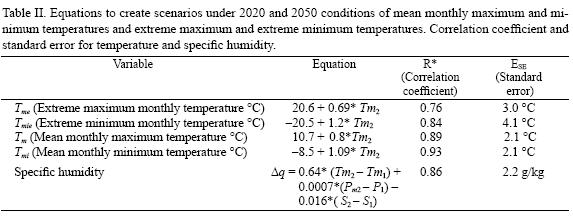
<body><![CDATA[<p align="justify"><font face="verdana" size="2">&nbsp;</font></p>     <p align="justify"><font face="verdana" size="2"><b>2. Base scenario data</b></font></p>     <p align="justify"><font face="verdana" size="2">The base scenario is the 1961&#150;1990 meteorological data of 50 meteorological observatories. Their location is shown in the <a href="#apendice">Appendix</a>. In view that specific humidity is not explicitly available, it was necessary to calculate it based on atmospheric thermodynamics. The mean atmospheric pressure of the station was included only on 16 of the 50 surface meteorological observatories used in this paper. Sunshine data is also incomplete in 10 of the observatories. The details of how the database was completed are explained in the following section.</font></p>     <p align="justify"><font face="verdana" size="2">To obtain the specific humidity, the saturation vapor pressure was calculated with the polynomial expression of Adem (1967). This polynomial is in the fourth degree and can be applied to an interval of temperatures from &#150;10 to 50 &deg;C.</font></p>     <p align="justify"><font face="verdana" size="2">The hypsometric equation (Stull, 2000) could not be used in the 34 observatories without data related to the mean annual atmospheric pressure and to the vertical profiles of virtual temperature. To estimate then the mean annual atmospheric pressure for those observatories, an equation of linear regression was generated from the observatories that did provide the pressure data, and thus Eq. (1) was obtained:</font></p>     <p align="center"><font face="verdana" size="2"><img src="/img/revistas/atm/v21n4/a4s1.jpg" alt=""></font></p>     <p align="justify"><font face="verdana" size="2">where <i>P </i>is the mean atmospheric pressure (in hPa) and Z is the altitude corresponding to the observatory (in meters). The correlation coefficient between pressure and altitude is 0.99 and the mean standard estimation error of Eq. (1) is 20 hPa.</font></p>     <p align="justify"><font face="verdana" size="2">Sunshine hours were estimated in order to calculate relative and specific humidity by means of empirical (statistical) models (see Section 3, <a href="#t2">Table II</a>). The equation for daily sunshine potential in hours for each site for the 15th day of each month, <i>N</i><sub>15</sub> (Hern&aacute;ndez <i>et al., </i>1991) is calculated with:</font></p>     <p align="center"><font face="verdana" size="2"><img src="/img/revistas/atm/v21n4/a4s2.jpg" alt=""></font></p>     <p align="justify"><font face="verdana" size="2">with &Phi; as the latitude and &delta;<sub>15</sub> the solar declination for the 15th day of each month in degrees.</font></p>     ]]></body>
<body><![CDATA[<p align="center"><a name="t2"></a></p>     <p align="center"><font face="verdana" size="2"><img src="/img/revistas/atm/v21n4/a4t2.jpg" alt=""></font></p>     <p align="justify"><font face="verdana" size="2">The daily hours of mean monthly sunshine (<i>n</i>) can be obtained from the registers of Campbell&#150;Stokes heliographs, but for sites that do not have heliographic evaluations, Tejeda and Vargas (1996) estimated the monthly mean of cloudiness for each month through the following equation:</font></p>     <p align="center"><font face="verdana" size="2"><img src="/img/revistas/atm/v21n4/a4s3.jpg" alt=""></font></p>     <p align="justify"><font face="verdana" size="2">Where <i>X</i><sub>1</sub> is the frequency of cloudy days, when the average of visual observations of the cloud covering is between 6/8 and 8/8; <i>X</i><sub>2</sub> is the frequency of partially cloudy days (3/8 to 5/8), and <i>X</i><sub>3 </sub>is the frequency of clear days (0 to 2/8).</font></p>     <p align="justify"><font face="verdana" size="2">To calculate the specific humidity, <a href="#t2">Table II</a>, Tejeda and Vargas (1996) used (29) and (3) to estimate the mean monthly sunshine <img src="/img/revistas/atm/v21n4/a4sa.jpg" alt=""></font></p>     <p align="center"><font face="verdana" size="2"><img src="/img/revistas/atm/v21n4/a4s4.jpg" alt=""></font></p>     <p align="justify"><font face="verdana" size="2">&nbsp;</font></p>     <p align="justify"><font face="verdana" size="2"><b>3. Methods for climatic change scenarios</b></font></p>     <p align="justify"><font face="verdana" size="2"><i>3.1 Humidity and temperature scenarios</i></font></p>     ]]></body>
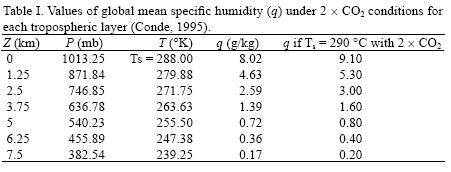
<body><![CDATA[<p align="justify"><font face="verdana" size="2">Conde (1995) presented a method for evaluating humidity in the different tropospheric levels on a global scale, via a convective radiative model which considers homogeneous distributions of carbon dioxide at various heights, and obtained the results shown in <a href="#t1">Table I</a>. However, this information contains, among other forecasts, the generation of atmospheric humidity scenarios at the surface.</font></p>     <p align="center"><font face="verdana" size="2"><a name="t1"></a></font></p>     <p align="center"><font face="verdana" size="2"><img src="/img/revistas/atm/v21n4/a4t1.jpg" alt=""></font></p>     <p align="justify"><font face="verdana" size="2">For this paper, a direct procedure was applied. For the generation of humidity scenarios for 2020 and 2050 decades surface conditions in M&eacute;xico, the mean monthly vapor pressure (<i>e</i>) is estimated according to the monthly mean of minimum temperature (<i>T<sub>mi</sub></i>)<i>.</i></font></p>     <p align="center"><font face="verdana" size="2"><img src="/img/revistas/atm/v21n4/a4s5.jpg" alt=""></font></p>     <p align="justify"><font face="verdana" size="2">With <i>a</i><sub>0</sub><i> = </i>7.5, <i>a</i><sub>1</sub> = 8.5 &times; 10<sup>&#150;2</sup>, <i>a</i><sub>2</sub> = 3.7 &times; 10<sup>&#150;2</sup>, <i>a</i><sub>3</sub> = &#150;1.7 &times; 10<sup>&#150;3</sup>, <i>a</i><sub>4</sub> =1.9 &times; 10<sup>&#150;4</sup>, <i>a</i><sub>5</sub> = &#150;5.0 &times; 10<sup>&#150;6</sup>. The mean standard error is 3.1 hPa and the linear correlation coefficient is 0.91. The relative humidity (<i>RH </i>in decimals) is (Hess, 1959):</font></p>     <p align="center"><font face="verdana" size="2"><img src="/img/revistas/atm/v21n4/a4s6.jpg" alt=""></font></p>     <p align="justify"><font face="verdana" size="2">Where saturation vapor pressures (in HPa) was calculated through the polynomial of the fourth degree proposed by Adem (1967):</font></p>     <p align="center"><font face="verdana" size="2"><img src="/img/revistas/atm/v21n4/a4s7.jpg" alt=""></font></p>     <p align="justify"><font face="verdana" size="2">With <i>T </i>(surface mean temperature) in &deg;C and parameter values <i>b</i><sub>0</sub><i> = </i>6.115, <i>b</i><sub>1</sub><i> = </i>0.42915, <i>b</i><sub>2</sub><i> = </i>0.014206, <i>b</i><sub>3</sub> = 3.046 &times; 10<sup>&#150;4</sup>, <i>b</i><sub>4</sub> = 3.2 &times; 10<sup>&#150;6</sup>.</font></p>     ]]></body>
<body><![CDATA[<p align="justify"><font face="verdana" size="2">From the mean monthly relative humidity, it was estimated the mean monthly values of maximum (<i>RH<sub>m</sub></i>) and minimum (<i>RH<sub>mi</sub></i>) relative humidity. Considering that in the absence of advection, the vapor pressure does not vary between 10 am and 2 pm local time as Geiger (1957) found, the mean minimum relative humidity (representative for 2 pm or 3 pm local time), was calculated through the following equation:</font></p>     <p align="center"><font face="verdana" size="2"><img src="/img/revistas/atm/v21n4/a4s8.jpg" alt=""></font></p>     <p align="justify"><font face="verdana" size="2">Where <i>RH<sub>mi</sub> </i>is the minimum relative humidity, <i>e </i>is the mean monthly vapor pressure and <i>e<sub>sm</sub> </i>is the vapor pressure of maximum saturation. The vapor pressure of maximum saturation <i>e<sub>sm</sub> </i>was calculated according to the polynomial of Adem (1967) applied to the mean maximum monthly temperature.</font></p>     <p align="justify"><font face="verdana" size="2">The maximum mean monthly relative humidity (<i>RHm</i>) was calculated from the mean monthly relative humidity (<i>RH</i>) as follows:</font></p>     <p align="center"><font face="verdana" size="2"><img src="/img/revistas/atm/v21n4/a4s9.jpg" alt=""></font></p>     <p align="justify"><font face="verdana" size="2">The increase in the monthly means of minimum and maximum temperatures for the future (2020 and 2050 decades) were obtained from the regional scenarios for M&eacute;xico derived from the outputs of the GFDL&#150;R30, ECHAM4 and HADCM2 models applied to M&eacute;xico:</font></p>     <p align="center"><font face="verdana" size="2"><img src="/img/revistas/atm/v21n4/a4s10y11.jpg" alt=""></font></p>     <p align="justify"><font face="verdana" size="2">where &Delta;T is an increase in temperature according to the applied models (Maga&ntilde;a <i>et al., </i>2000), <i>T<sub>mi </sub></i>is the minimum temperature and <i>T<sub>max</sub> </i>is the maximum temperature for the projected scenarios for 2020 and 2050.</font></p>     <p align="justify"><font face="verdana" size="2">Finally, for the estimation of extreme temperatures, Bell <i>et al. </i>(2004) and Phillips and Skindlov (1990) formulas were reviewed. However, to construct the scenarios proposed in this study, a statistical relation was obtained for observed data concerning temperature, radiation and precipitation, with the mean monthly minimum and maximum temperatures and atmospheric humidity (relative and specific). As a result, based on the simulations of the GFDL&#150;R30, ECHAM4 and HADCM2 models, a future scenario was created of mean monthly maximum and minimum temperatures and humidity for 2020 and 2050 scenarios.</font></p>     <p align="justify"><font face="verdana" size="2">For this study, the emission scenarios used were A2 and B2 (Nakicenovic <i>et al., </i>2000). A2 describes a very heterogeneous world. The underlying theme is self reliance and preservation of local identities. Population growth across regions converge very slowly, which results in continuously increasing population. Economic development is primarily regionally oriented and per capita economic growth and technological change more fragmented and slower than other scenarios. B2 describes a world in which the emphasis is on local solutions to economic, social and environmental sustainability. It is a world with continuously increasing global population, at a rate lower than A2. While the scenario is also oriented towards environmental protection and social equity, it focuses on local and regional levels (IPCC, 2007).</font></p>     ]]></body>
<body><![CDATA[<p align="justify"><font face="verdana" size="2">Based on the different statistical relationships previously mentioned, it was possible to create scenarios of extreme temperatures and atmospheric humidity under increased conditions of atmospheric CO<sub>2</sub> for M&eacute;xico.</font></p>     <p align="justify"><font face="verdana" size="2">In order to estimate the monthly temperature range (often referred as monthly thermal oscillation), the mean monthly maximum temperature and mean minimum temperature were calculated. The statistical relationships used for every scenario in each variable, and the correlation coefficient and standard error, are shown in <a href="#t2">Table II</a>. Where <i>Tm</i><sub>2</sub> is the mean temperature observed in the base scenario (1961&#150;1990 period).</font></p>     <p align="justify"><font face="verdana" size="2">The scenarios presented in the following figures were generated with Eqs. (12) to (15) for temperature and precipitation variables where <i>E </i>are the scenarios created from climatic change, <i>E</i><sub>i</sub> is the base scenario (1961&#150;1990) for minimum and maximum temperature, extreme minimum and extreme maximum temperature and precipitation, &Delta;<i>T </i>means the mean temperature increase created by the GFDLR30, ECHAM4 and HADCM2 models (Conde, 1995).</font></p>     <p align="center"><font face="verdana" size="2"><img src="/img/revistas/atm/v21n4/a4s13a16.jpg" alt=""></font></p>     <p align="justify"><font face="verdana" size="2">Finally, from the increase of specific humidity, the increase in vapor pressure and relative humidity was obtained.</font></p>     <p align="justify"><font face="verdana" size="2">&nbsp;</font></p>     <p align="justify"><font face="verdana" size="2"><b>4. Results and conclusions</b></font></p>     <p align="justify"><font face="verdana" size="2">Based on the correlation matrix created from the observed variables, it was determined that there is a statistical relationship among the monthly averages of maximum temperature, minimum temperature and atmospheric humidity based on the monthly averages of temperature, precipitation and sunshine.</font></p>     <p align="justify"><font face="verdana" size="2">There are several basic criteria (IPCC&#150;TGCIA, 2007) to select GCM outputs: vintage (i.e. the most recent results from the GCM); resolution (i.e, some models now have a spatial resolution of 250 km, while their earlier version had 1,000 km); validity (some models simulate the present&#150;day regional climate better than others); and representativeness of results (the chosen models should include a range of values under climate change conditions, i.e. different signs for precipitation). The authors decided that the selected models in this paper covered all the stated criteria.</font></p>     <p align="justify"><font face="verdana" size="2">For the purpose of demonstrating the change in monthly averages of the variables estimated in this study for atmospheric CO<sub>2</sub> duplication, conditions based on the results of the GFDL&#150;R30, ECHAM4 and HADCM2 models, the data obtained from the 50 observatories was divided into 6 zone groups (see <a href="#apendice">Appendix</a>) according to Koppen's climate classification (Garcia, 1988).</font></p>     ]]></body>
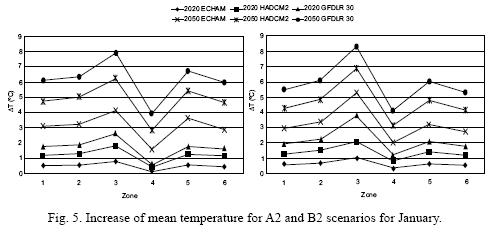
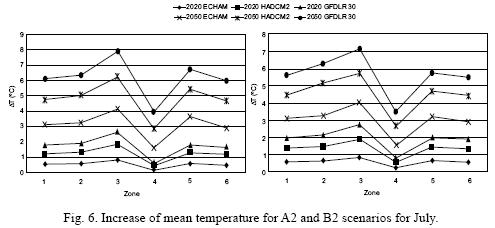
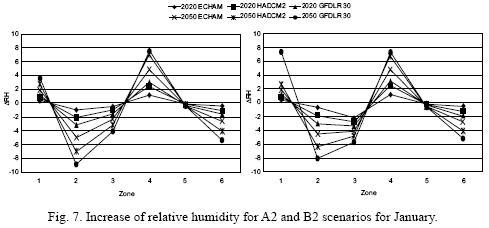
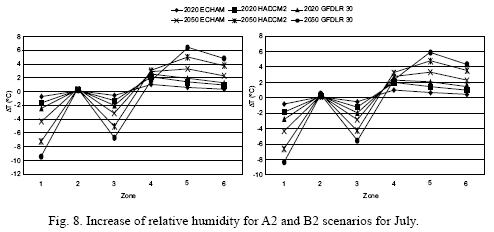
<body><![CDATA[<p align="justify"><font face="verdana" size="2">Figures 1 &#150;8 &#91;<a href="#f1">1</a>, <a href="#f2">2</a>, <a href="#f3">3</a>, <a href="#f4">4</a>, <a href="#f5">5</a>, <a href="#f6">6</a>, <a href="#f7">7</a> and <a href="#f8">8</a>&#93; illustrate the scenarios for January (representative for winter) and July (representative for summer) based on the following variables: mean maximum monthly temperature, mean minimum monthly temperature, extreme maximum monthly temperature, extreme minimum monthly temperature, mean monthly temperature and specific humidity.</font></p>     <p align="center"><font face="verdana" size="2"><a name="f1"></a></font></p>     <p align="center"><font face="verdana" size="2"><img src="/img/revistas/atm/v21n4/a4f1.jpg" alt=""></font></p>     <p align="center"><font face="verdana" size="2"><a name="f2"></a></font></p>     <p align="center"><font face="verdana" size="2"><img src="/img/revistas/atm/v21n4/a4f2.jpg" alt=""></font></p>     <p align="center"><font face="verdana" size="2"><a name="f3"></a></font></p>     <p align="center"><font face="verdana" size="2"><img src="/img/revistas/atm/v21n4/a4f3.jpg" alt=""></font></p>     <p align="center"><font face="verdana" size="2"><a name="f4"></a></font></p>     <p align="center"><font face="verdana" size="2"><img src="/img/revistas/atm/v21n4/a4f4.jpg" alt=""></font></p>     <p align="center"><font face="verdana" size="2"><a name="f5"></a></font></p>     ]]></body>
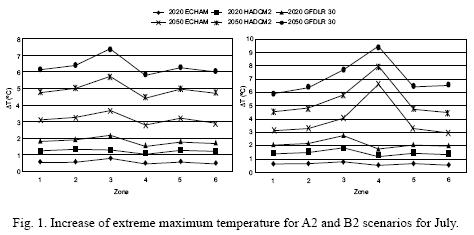
<body><![CDATA[<p align="center"><font face="verdana" size="2"><img src="/img/revistas/atm/v21n4/a4f5.jpg" alt=""></font></p>     <p align="center"><font face="verdana" size="2"><a name="f6"></a></font></p>     <p align="center"><font face="verdana" size="2"><img src="/img/revistas/atm/v21n4/a4f6.jpg" alt=""></font></p>     <p align="center"><font face="verdana" size="2"><a name="f7"></a></font></p>     <p align="center"><font face="verdana" size="2"><img src="/img/revistas/atm/v21n4/a4f7.jpg" alt=""></font></p>     <p align="center"><font face="verdana" size="2"><a name="f8"></a></font></p>     <p align="center"><font face="verdana" size="2"><img src="/img/revistas/atm/v21n4/a4f8.jpg" alt=""></font></p>     <p align="justify"><font face="verdana" size="2">For extreme maximum temperature in July for A2 scenario, all models present a high increase in zone 3, for both horizons of study. For B2 scenario in 2020 zone 3 also has the highest increase in all three models while for 2050 zone 4 was the highest.</font></p>     <p align="justify"><font face="verdana" size="2">For extreme minimum temperature in July, A2 scenario in 2020, it is observed that the temperature difference is around 2 &deg;C in all models. For the 2050 decade there is a bigger difference between 2 and 6 &deg;C in all models. The situation is similar for B2 scenario in 2020, where the difference does not exceed 2 &deg;C for all models, while for 2050 the difference is between 2 and 6 &deg;C approximately. Nevertheless, for both scenarios (A2 and B2), and in both periods of time (2020 and 2050) the highest increase is for zone 3.</font></p>     <p align="justify"><font face="verdana" size="2">For maximum temperature in January, A2 scenario, 2020, the temperature difference does not exceed 2 &deg;C in all models, whereas for B2 the models present a maximum in zone 3. For 2050 in both models (A2 and B2) the behavior is similar, although for A2 the temperature difference for zone 3 presents a increase of 8 &deg;C, while for B2 it is of approximately 7 &deg;C.</font></p>     ]]></body>
<body><![CDATA[<p align="justify"><font face="verdana" size="2">For minimum temperature in January for both scenarios A2 and B2, 2020, the GFDLR3 0 model zone 4 has the highest point with 4 &deg;C. While for 2050, both scenario's tendency is the same, and the GFDL model has an increase of 10 &deg;C in zone 4.</font></p>     <p align="justify"><font face="verdana" size="2">Regarding mean temperature in both scenarios for 2020, for January the maximum point in temperature difference was in zone 3, although for scenario A2 the increase was around 2 &deg;C and for B2 4&deg;C. For the B2 case, there is a strong decay between zones for 3 and 4. For 2050, the temperature difference is of approximately 8 &deg;C in zone 3 for both scenarios, decaying in zone 4 until finding a 4 &deg;C difference.</font></p>     <p align="justify"><font face="verdana" size="2">For July, the mean temperature in both scenarios have a similar tendency in all three models for both time periods, although 2020 in A2 has a large temperature difference between zones 3 and 4. For 2050, the maximum point of temperature difference for A2 is 8 &deg;C, while for B2 it is almost the same value, both for zone 3.</font></p>     <p align="justify"><font face="verdana" size="2">Relative humidity in January in both scenarios for the 2020 period, shows a similar tendency, having its minimum point in zone 2 in all models. For 2050, there is a large difference for the GFDLR30 model in zone 1, being for A2 a difference of 5% and for B2 9%.</font></p>     <p align="justify"><font face="verdana" size="2">Relative humidity in July, both scenarios, also have a similar tendency, being that for the GFDLR30 model zone 1 has the lowest value in both time periods. A strong contrast is found in zone 5 with an approximate 5% value for the GFDLR30 model.</font></p>     <p align="justify"><font face="verdana" size="2">To sum up, it is recommended to carry out additional studies for M&eacute;xico with regional models. The problem arising from the use of general circulation models is that many important mountain zones cannot be taken into account given the resolution of the models.</font></p>     <p align="justify"><font face="verdana" size="2">When calculating the means of the possible scenarios for 2020 and 2050 conditions of extreme, and maximum and minimum mean temperatures, we recommend that specific humidity, relative humidity and vulnerability studies of the country should be carried out with respect to its productive activities (i.e. in agricultural and energetic sectors), and also for studies on human thermal comfort for the purpose of developing options for mitigating and adapting to the consequences of climatic change.</font></p>     <p align="justify"><font face="verdana" size="2">&nbsp;</font></p>     <p align="justify"><font face="verdana" size="2"><b>Acknowledgements</b></font></p>     <p align="justify"><font face="verdana" size="2">The authors thank Ana Mar&iacute;a D&iacute;az D&iacute;az and Nury Pav&oacute;n Gonz&aacute;lez for their support to the edition of this text.</font></p>     ]]></body>
<body><![CDATA[<p align="justify"><font face="verdana" size="2">&nbsp;</font></p>     <p align="center"><font face="verdana" size="2"><b><a name="apendice"></a>Appendix</b></font></p>     <p align="center"><font face="verdana" size="2"><b>1. Meteorological stations used in this paper and their clustering according to Garc&iacute;a (1988).</b></font></p>     <p align="center"><font face="verdana" size="2"><img src="/img/revistas/atm/v21n4/a4a1.jpg" alt=""></font></p>     <p align="center"><font face="verdana" size="2">&nbsp;</font></p>     <p align="justify"><font face="verdana" size="2"><b>References</b></font></p>     <!-- ref --><p align="justify"><font face="verdana" size="2">Adem J., 1967. Parametrization of atmospheric humidity using cloudiness and temperature. <i>Mon. Wea. Rev. </i><b>95</b>, 83&#150;88.</font>&nbsp;&nbsp;&nbsp;&nbsp;&nbsp;&nbsp;&nbsp;&nbsp;[&#160;<a href="javascript:void(0);" onclick="javascript: window.open('/scielo.php?script=sci_nlinks&ref=1269819&pid=S0187-6236200800040000400001&lng=','','width=640,height=500,resizable=yes,scrollbars=1,menubar=yes,');">Links</a>&#160;]<!-- end-ref --><!-- ref --><p align="justify"><font face="verdana" size="2">Bell J., L. Sloan and M. Snyder, 2004. Regional changes in extreme climatic events: A future climate scenario. J. <i>Climate </i><b>17</b>, 81&#150;87.</font>&nbsp;&nbsp;&nbsp;&nbsp;&nbsp;&nbsp;&nbsp;&nbsp;[&#160;<a href="javascript:void(0);" onclick="javascript: window.open('/scielo.php?script=sci_nlinks&ref=1269820&pid=S0187-6236200800040000400002&lng=','','width=640,height=500,resizable=yes,scrollbars=1,menubar=yes,');">Links</a>&#160;]<!-- end-ref --><!-- ref --><p align="justify"><font face="verdana" size="2">Conde C., 1995. Modelo radiativo&#150;convectivo en la atm&oacute;sfera. Tesis para obtener el grado de Maestr&iacute;a en Ciencias (Geof&iacute;sica). Facultad de Ciencias, UNAM, 105 pp.</font>&nbsp;&nbsp;&nbsp;&nbsp;&nbsp;&nbsp;&nbsp;&nbsp;[&#160;<a href="javascript:void(0);" onclick="javascript: window.open('/scielo.php?script=sci_nlinks&ref=1269821&pid=S0187-6236200800040000400003&lng=','','width=640,height=500,resizable=yes,scrollbars=1,menubar=yes,');">Links</a>&#160;]<!-- end-ref --><!-- ref --><p align="justify"><font face="verdana" size="2">Conde C., O. S&aacute;nchez and C. Gay, 1994. Escenarios b&aacute;sicos y regionales. In: <i>Estudio de Pa&iacute;s: M&eacute;xico. Primer Taller de Estudio de Pa&iacute;s: M&eacute;xico. M&eacute;xico ante el cambio clim&aacute;tico. </i>Memorias, Cuernavaca, M&eacute;xico, 18 a 22 de abril, 39&#150;43.</font>&nbsp;&nbsp;&nbsp;&nbsp;&nbsp;&nbsp;&nbsp;&nbsp;[&#160;<a href="javascript:void(0);" onclick="javascript: window.open('/scielo.php?script=sci_nlinks&ref=1269822&pid=S0187-6236200800040000400004&lng=','','width=640,height=500,resizable=yes,scrollbars=1,menubar=yes,');">Links</a>&#160;]<!-- end-ref --><!-- ref --><p align="justify"><font face="verdana" size="2">Conde C., O. S&aacute;nchez, V. Maga&ntilde;a and C. Gay, 1995. Escenarios clim&aacute;ticos b&aacute;sicos y regionales. In: <i>Estudio de Pa&iacute;s: M&eacute;xico. Segundo Taller de Estudio de Pa&iacute;s: M&eacute;xico. M&eacute;xico ante el cambio clim&aacute;tico. </i>Memorias, Cuernavaca, M&eacute;xico, 8 a 11 de mayo, 101&#150;111.</font>&nbsp;&nbsp;&nbsp;&nbsp;&nbsp;&nbsp;&nbsp;&nbsp;[&#160;<a href="javascript:void(0);" onclick="javascript: window.open('/scielo.php?script=sci_nlinks&ref=1269823&pid=S0187-6236200800040000400005&lng=','','width=640,height=500,resizable=yes,scrollbars=1,menubar=yes,');">Links</a>&#160;]<!-- end-ref --><!-- ref --><p align="justify"><font face="verdana" size="2">Conde C., O. S&aacute;nchez and C. Gay, 2000. Escenarios f&iacute;sicos regionales; In: <i>M&eacute;xico: Una visi&oacute;n hacia el siglo XXI. El Cambio Clim&aacute;tico en M&eacute;xico, </i>(V. Maga&ntilde;a Ed.). SEMARNAP, UNAM, USCSP, 1&#150;24.</font>&nbsp;&nbsp;&nbsp;&nbsp;&nbsp;&nbsp;&nbsp;&nbsp;[&#160;<a href="javascript:void(0);" onclick="javascript: window.open('/scielo.php?script=sci_nlinks&ref=1269824&pid=S0187-6236200800040000400006&lng=','','width=640,height=500,resizable=yes,scrollbars=1,menubar=yes,');">Links</a>&#160;]<!-- end-ref --><!-- ref --><p align="justify"><font face="verdana" size="2">Conde C., 2003. Cambio y variabilidad clim&aacute;ticos. Dos estudios de caso en M&eacute;xico. Tesis de Doctorado (Ciencias Atmosf&eacute;ricas), Programa del Posgrado en Ciencias de la Tierra, UNAM, 300 pp.</font>&nbsp;&nbsp;&nbsp;&nbsp;&nbsp;&nbsp;&nbsp;&nbsp;[&#160;<a href="javascript:void(0);" onclick="javascript: window.open('/scielo.php?script=sci_nlinks&ref=1269825&pid=S0187-6236200800040000400007&lng=','','width=640,height=500,resizable=yes,scrollbars=1,menubar=yes,');">Links</a>&#160;]<!-- end-ref --><!-- ref --><p align="justify"><font face="verdana" size="2">Delworth T. L., R. J. Stouffer, K. W. Dixon, M. J. Spelman, T. R. Knutson, A. J. Broccoli, P. J. Kushner and R. T. Wetherald, 2002. Review of simulations of climate variability and change with the GFDL R30 coupled climate model. <i>Clim. Dyn. </i><b>19</b>, 555&#150;574.</font>&nbsp;&nbsp;&nbsp;&nbsp;&nbsp;&nbsp;&nbsp;&nbsp;[&#160;<a href="javascript:void(0);" onclick="javascript: window.open('/scielo.php?script=sci_nlinks&ref=1269826&pid=S0187-6236200800040000400008&lng=','','width=640,height=500,resizable=yes,scrollbars=1,menubar=yes,');">Links</a>&#160;]<!-- end-ref --><!-- ref --><p align="justify"><font face="verdana" size="2">Fern&aacute;ndez A., J. Mart&iacute;nez and P. Hosannilla, 2003. <i>Avances de M&eacute;xico en materia de cambio clim&aacute;tico 2001&#150;2002, </i>SEMARNAP, INE., M&eacute;xico, D. F., 112 pp.</font>&nbsp;&nbsp;&nbsp;&nbsp;&nbsp;&nbsp;&nbsp;&nbsp;[&#160;<a href="javascript:void(0);" onclick="javascript: window.open('/scielo.php?script=sci_nlinks&ref=1269827&pid=S0187-6236200800040000400009&lng=','','width=640,height=500,resizable=yes,scrollbars=1,menubar=yes,');">Links</a>&#160;]<!-- end-ref --><!-- ref --><p align="justify"><font face="verdana" size="2">Garc&iacute;a E., 1988. <i>Modificaciones al sistema de clasificaci&oacute;n clim&aacute;tica de K&oacute;ppen. </i>Autor Edition. M&eacute;xico, D. F., 218 p.</font>&nbsp;&nbsp;&nbsp;&nbsp;&nbsp;&nbsp;&nbsp;&nbsp;[&#160;<a href="javascript:void(0);" onclick="javascript: window.open('/scielo.php?script=sci_nlinks&ref=1269828&pid=S0187-6236200800040000400010&lng=','','width=640,height=500,resizable=yes,scrollbars=1,menubar=yes,');">Links</a>&#160;]<!-- end-ref --><!-- ref --><p align="justify"><font face="verdana" size="2">Gay C. (compilator), (2000). <i>M&eacute;xico: Una visi&oacute;n hacia el siglo XXI. El Cambio Clim&aacute;tico en M&eacute;xico. </i>SEMARNAP, UNAM, USCSP. M&eacute;xico, D. F., 220 pp.</font>&nbsp;&nbsp;&nbsp;&nbsp;&nbsp;&nbsp;&nbsp;&nbsp;[&#160;<a href="javascript:void(0);" onclick="javascript: window.open('/scielo.php?script=sci_nlinks&ref=1269829&pid=S0187-6236200800040000400011&lng=','','width=640,height=500,resizable=yes,scrollbars=1,menubar=yes,');">Links</a>&#160;]<!-- end-ref --><!-- ref --><p align="justify"><font face="verdana" size="2">Geiger R., 1957. <i>The climate near the ground. </i>Harvard University Press. Cambridge, UK. 493 pp.</font>&nbsp;&nbsp;&nbsp;&nbsp;&nbsp;&nbsp;&nbsp;&nbsp;[&#160;<a href="javascript:void(0);" onclick="javascript: window.open('/scielo.php?script=sci_nlinks&ref=1269830&pid=S0187-6236200800040000400012&lng=','','width=640,height=500,resizable=yes,scrollbars=1,menubar=yes,');">Links</a>&#160;]<!-- end-ref --><!-- ref --><p align="justify"><font face="verdana" size="2">Hern&aacute;ndez, E., A. Tejeda and S. Reyes, 1991. <i>Atlas solar de la Rep&uacute;blica Mexicana. </i>Universidad </font><font face="verdana" size="2">Veracruzana y Universidad de Colima. M&eacute;xico, 155 pp. </font>&nbsp;&nbsp;&nbsp;&nbsp;&nbsp;&nbsp;&nbsp;&nbsp;[&#160;<a href="javascript:void(0);" onclick="javascript: window.open('/scielo.php?script=sci_nlinks&ref=1269831&pid=S0187-6236200800040000400013&lng=','','width=640,height=500,resizable=yes,scrollbars=1,menubar=yes,');">Links</a>&#160;]<!-- end-ref --><!-- ref --><p align="justify"><font face="verdana" size="2">Hess L., 1959. <i>Introduction to Theorical Meteorology. </i>Henry Holt and Co. New York. 39&#150;64 pp.</font>&nbsp;&nbsp;&nbsp;&nbsp;&nbsp;&nbsp;&nbsp;&nbsp;[&#160;<a href="javascript:void(0);" onclick="javascript: window.open('/scielo.php?script=sci_nlinks&ref=1269832&pid=S0187-6236200800040000400014&lng=','','width=640,height=500,resizable=yes,scrollbars=1,menubar=yes,');">Links</a>&#160;]<!-- end-ref --><!-- ref --><p align="justify"><font face="verdana" size="2">IPCC, 2007. Summary for Policymakers. In: <i>Climate change 2007: The physical science basis. Summary for policymakers. Intergovermental Panel on Climate Change. </i>(S. Solomon, D. Qin, M. Manning, Z. Enhen, M. Marquis, K. B. Averyt, M. Tignor and H. L. Miller Eds.). Cambidge University Press, Cambridge, United Kingdom and New York, USA, 18 pp.</font>&nbsp;&nbsp;&nbsp;&nbsp;&nbsp;&nbsp;&nbsp;&nbsp;[&#160;<a href="javascript:void(0);" onclick="javascript: window.open('/scielo.php?script=sci_nlinks&ref=1269833&pid=S0187-6236200800040000400015&lng=','','width=640,height=500,resizable=yes,scrollbars=1,menubar=yes,');">Links</a>&#160;]<!-- end-ref --><!-- ref --><p align="justify"><font face="verdana" size="2">IPCC&#150;TGICA, 2007. General Guidelines on the Use of Scenario Data for Climate Impact and Adaptation Assessment. Version 2. Prepared by T. R. Carter on behalf of the Intergovernmental Panel on Climate Change, Task Group on Data and Scenario Support for Impact and Climate Assessment, 66 pp. <A href=http://www.ipcc-data.org/guidelines/TGICA_guidance_sdciaa_v2_final.pdf target="_blank">http://www.ipcc&#150;data.org/guidelines/TGICA_guidance_sdciaa_v2_final.pdf</A></font>&nbsp;&nbsp;&nbsp;&nbsp;&nbsp;&nbsp;&nbsp;&nbsp;[&#160;<a href="javascript:void(0);" onclick="javascript: window.open('/scielo.php?script=sci_nlinks&ref=1269834&pid=S0187-6236200800040000400016&lng=','','width=640,height=500,resizable=yes,scrollbars=1,menubar=yes,');">Links</a>&#160;]<!-- end-ref --><!-- ref --><p align="justify"><font face="verdana" size="2">J&aacute;uregui E., A. Ruiz, C. Gay and A. Tejeda, 1995. Una estimaci&oacute;n del impacto de la duplicaci&oacute;n del CO<sub>2</sub> atmosf&eacute;rico en el bioclima humano de M&eacute;xico. In: Estudio de Pa&iacute;s: M&eacute;xico. Segundo Taller de Estudio de Pa&iacute;s: M&eacute;xico. M&eacute;xico ante el cambio clim&aacute;tico, Memorias, Cuernavaca, M&eacute;xico, 8 a 11 de mayo, 219&#150;225.</font>&nbsp;&nbsp;&nbsp;&nbsp;&nbsp;&nbsp;&nbsp;&nbsp;[&#160;<a href="javascript:void(0);" onclick="javascript: window.open('/scielo.php?script=sci_nlinks&ref=1269835&pid=S0187-6236200800040000400017&lng=','','width=640,height=500,resizable=yes,scrollbars=1,menubar=yes,');">Links</a>&#160;]<!-- end-ref --><!-- ref --><p align="justify"><font face="verdana" size="2">Maga&ntilde;a V., 1995. Escenarios F&iacute;sicos de Cambio Clim&aacute;tico. In: Estudio de Pa&iacute;s: M&eacute;xico. Segundo Taller de Estudio de Pa&iacute;s: M&eacute;xico. M&eacute;xico ante el cambio clim&aacute;tico, Memorias, Cuernavaca, M&eacute;xico, 8 a 11 de mayo, 219&#150;225.</font>&nbsp;&nbsp;&nbsp;&nbsp;&nbsp;&nbsp;&nbsp;&nbsp;[&#160;<a href="javascript:void(0);" onclick="javascript: window.open('/scielo.php?script=sci_nlinks&ref=1269836&pid=S0187-6236200800040000400018&lng=','','width=640,height=500,resizable=yes,scrollbars=1,menubar=yes,');">Links</a>&#160;]<!-- end-ref --><!-- ref --><p align="justify"><font face="verdana" size="2">Maga&ntilde;a V., C. Conde, O. S&aacute;nchez and C. Gay, 2000. Assessment of current and future regional climate scenarios for M&eacute;xico. <i>Clim. Res. </i><b>9</b>, 107&#150;114.</font>&nbsp;&nbsp;&nbsp;&nbsp;&nbsp;&nbsp;&nbsp;&nbsp;[&#160;<a href="javascript:void(0);" onclick="javascript: window.open('/scielo.php?script=sci_nlinks&ref=1269837&pid=S0187-6236200800040000400019&lng=','','width=640,height=500,resizable=yes,scrollbars=1,menubar=yes,');">Links</a>&#160;]<!-- end-ref --><!-- ref --><p align="justify"><font face="verdana" size="2">Maga&ntilde;a V., C. Conde, O. S&aacute;nchez and C. Gay, 2000. Evaluaci&oacute;n de escenarios regionales de clima actual y de cambio clim&aacute;tico futuro para M&eacute;xico. In: M&eacute;xico: Una visi&oacute;n hacia el siglo XXI. El Cambio Clim&aacute;tico en M&eacute;xico, (V. Maga&ntilde;a Ed.). SEMARNAP, UNAM, USCSP, (C. Gay, Compilador), M&eacute;xico, D. F., 15&#150;21.</font>&nbsp;&nbsp;&nbsp;&nbsp;&nbsp;&nbsp;&nbsp;&nbsp;[&#160;<a href="javascript:void(0);" onclick="javascript: window.open('/scielo.php?script=sci_nlinks&ref=1269838&pid=S0187-6236200800040000400020&lng=','','width=640,height=500,resizable=yes,scrollbars=1,menubar=yes,');">Links</a>&#160;]<!-- end-ref --><!-- ref --><p align="justify"><font face="verdana" size="2">Manabe S., R. J. Stouffer, M. J. Spelman and K. Bryan, 1991. Transient response of a coupled ocean&#150;atmosphere model to gradual changes of atmospheric CO<sub>2</sub>. Part I: annual&#150; annual&#150;mean response. <i>J. Climate </i><b>4</b>, 785&#150;818.</font>&nbsp;&nbsp;&nbsp;&nbsp;&nbsp;&nbsp;&nbsp;&nbsp;[&#160;<a href="javascript:void(0);" onclick="javascript: window.open('/scielo.php?script=sci_nlinks&ref=1269839&pid=S0187-6236200800040000400021&lng=','','width=640,height=500,resizable=yes,scrollbars=1,menubar=yes,');">Links</a>&#160;]<!-- end-ref --><!-- ref --><p align="justify"><font face="verdana" size="2">Manabe, S. and R. Wetherald, 1967. Thermal equilibrium of the atmosphere with a given distribution of relative humidity. Geophysical Fluid Dynamics Laboratory, ESSA, Washington, D. <i>C., J. Atmos. Sci. </i><b>24</b>, 241&#150;243.</font>&nbsp;&nbsp;&nbsp;&nbsp;&nbsp;&nbsp;&nbsp;&nbsp;[&#160;<a href="javascript:void(0);" onclick="javascript: window.open('/scielo.php?script=sci_nlinks&ref=1269840&pid=S0187-6236200800040000400022&lng=','','width=640,height=500,resizable=yes,scrollbars=1,menubar=yes,');">Links</a>&#160;]<!-- end-ref --><!-- ref --><p align="justify"><font face="verdana" size="2">Mitchell J. F. B., T. C. Johns, M. Eagles, W. J. Ingram and R. A. Davis, 1999. Towards the construction of climate change scenarios. <i>Clim. Change </i><b>41</b>, 547&#150;581.</font>&nbsp;&nbsp;&nbsp;&nbsp;&nbsp;&nbsp;&nbsp;&nbsp;[&#160;<a href="javascript:void(0);" onclick="javascript: window.open('/scielo.php?script=sci_nlinks&ref=1269841&pid=S0187-6236200800040000400023&lng=','','width=640,height=500,resizable=yes,scrollbars=1,menubar=yes,');">Links</a>&#160;]<!-- end-ref --><!-- ref --><p align="justify"><font face="verdana" size="2">IPCC, 2000. Nakicenovic N., J. Alcamo, G. Davis, B. de Vries, J. Fenhann, S. Gaffin, K. Gregory, A. Gr&uuml;bler, T. Y. Jung, T. Kram, E. L. La Rovere, L. Michaelis, S. Mori, T. Morita, W. Pepper, H. Pitcher, L. Price, K. Riahi, A. Roehrl, H.&#150;H. Rogner, A. Sankovski, M. Schlesinger, P. Shukla, S. Smith, R. Swart, S. van Rooijen, N. Victor, Z. Dadi. Special report on emissions scenarios: A special report of working Group III of the Intergovernmental Panel on Climate Change. Cambridge University Press. Cambridge, UK, 599 pp.</font>&nbsp;&nbsp;&nbsp;&nbsp;&nbsp;&nbsp;&nbsp;&nbsp;[&#160;<a href="javascript:void(0);" onclick="javascript: window.open('/scielo.php?script=sci_nlinks&ref=1269842&pid=S0187-6236200800040000400024&lng=','','width=640,height=500,resizable=yes,scrollbars=1,menubar=yes,');">Links</a>&#160;]<!-- end-ref --><!-- ref --><p align="justify"><font face="verdana" size="2">Palma B., C. Conde, R. Morales and G. Colorado, 2007. Escenarios de cambio clim&aacute;tico para Veracruz. En: <i>Plan Estatal de Acci&oacute;n Clim&aacute;tica del Estado de Veracruz </i>(A. Tejeda&#150;Mart&iacute;nez, coordinador).</font>&nbsp;&nbsp;&nbsp;&nbsp;&nbsp;&nbsp;&nbsp;&nbsp;[&#160;<a href="javascript:void(0);" onclick="javascript: window.open('/scielo.php?script=sci_nlinks&ref=1269843&pid=S0187-6236200800040000400025&lng=','','width=640,height=500,resizable=yes,scrollbars=1,menubar=yes,');">Links</a>&#160;]<!-- end-ref --><!-- ref --><p align="justify"><font face="verdana" size="2">Phillips D. and J. Skindlov, 1990. The Impact of increasing summer mean temperatures on extreme maximum and minimum temperatures in Phoenix, Arizona. <i>J. Climate </i><b>3</b>, 1491&#150;1494.</font>&nbsp;&nbsp;&nbsp;&nbsp;&nbsp;&nbsp;&nbsp;&nbsp;[&#160;<a href="javascript:void(0);" onclick="javascript: window.open('/scielo.php?script=sci_nlinks&ref=1269844&pid=S0187-6236200800040000400026&lng=','','width=640,height=500,resizable=yes,scrollbars=1,menubar=yes,');">Links</a>&#160;]<!-- end-ref --><!-- ref --><p align="justify"><font face="verdana" size="2">Roeckner E., K. Arpe, L. Bengtsson, S. Brinkop, L. D&uuml;menil, M. Esch, E. Kirk, F. Lunkeit, M. Ponater, B. Rockel, R. Suasen, U. Schlese, S. Schubert and M. Windelband, 1992. Simulation of the present&#150;day climate with the ECHAM4 model: impact of model physics and resolution Max&#150;Planck Institute for Meteorology, Report No.93, Hamburg, Germany, 171 pp.</font>&nbsp;&nbsp;&nbsp;&nbsp;&nbsp;&nbsp;&nbsp;&nbsp;[&#160;<a href="javascript:void(0);" onclick="javascript: window.open('/scielo.php?script=sci_nlinks&ref=1269845&pid=S0187-6236200800040000400027&lng=','','width=640,height=500,resizable=yes,scrollbars=1,menubar=yes,');">Links</a>&#160;]<!-- end-ref --><!-- ref --><p align="justify"><font face="verdana" size="2">Servicio Meteorol&oacute;gico Nacional s/f. Normales climatol&oacute;gicas periodo 1961&#150;1990.</font>&nbsp;&nbsp;&nbsp;&nbsp;&nbsp;&nbsp;&nbsp;&nbsp;[&#160;<a href="javascript:void(0);" onclick="javascript: window.open('/scielo.php?script=sci_nlinks&ref=1269846&pid=S0187-6236200800040000400028&lng=','','width=640,height=500,resizable=yes,scrollbars=1,menubar=yes,');">Links</a>&#160;]<!-- end-ref --><!-- ref --><p align="justify"><font face="verdana" size="2">Stull R. B., 2000. Meteorology for scientists and engineers. Brooks/Cole Thompson Learning. Pacific Grove, California, USA, 502 pp.</font>&nbsp;&nbsp;&nbsp;&nbsp;&nbsp;&nbsp;&nbsp;&nbsp;[&#160;<a href="javascript:void(0);" onclick="javascript: window.open('/scielo.php?script=sci_nlinks&ref=1269847&pid=S0187-6236200800040000400029&lng=','','width=640,height=500,resizable=yes,scrollbars=1,menubar=yes,');">Links</a>&#160;]<!-- end-ref --><!-- ref --><p align="justify"><font face="verdana" size="2">Tejeda A., 1991. An exponential model of the curve of mean monthly air temperatura, <i>Atm&oacute;sfera, </i><b>4</b>, 139&#150;144.</font>&nbsp;&nbsp;&nbsp;&nbsp;&nbsp;&nbsp;&nbsp;&nbsp;[&#160;<a href="javascript:void(0);" onclick="javascript: window.open('/scielo.php?script=sci_nlinks&ref=1269848&pid=S0187-6236200800040000400030&lng=','','width=640,height=500,resizable=yes,scrollbars=1,menubar=yes,');">Links</a>&#160;]<!-- end-ref --><!-- ref --><p align="justify"><font face="verdana" size="2">Tejeda A. and A. Vargas, 1996. A correlation between visual observations and instrumental records of cloudiness in M&eacute;xico, <i>Geof&iacute;s. Int. </i><b>35</b>, 421&#150;424.</font>&nbsp;&nbsp;&nbsp;&nbsp;&nbsp;&nbsp;&nbsp;&nbsp;[&#160;<a href="javascript:void(0);" onclick="javascript: window.open('/scielo.php?script=sci_nlinks&ref=1269849&pid=S0187-6236200800040000400031&lng=','','width=640,height=500,resizable=yes,scrollbars=1,menubar=yes,');">Links</a>&#160;]<!-- end-ref --><!-- ref --><p align="justify"><font face="verdana" size="2">Tejeda A. and D. Rivas, 2001. Un escenario de bioclima humano en ciudades del sur de M&eacute;xico, bajo condiciones de 2 &times; CO<sub>2</sub> atmosf&eacute;rico. El tiempo del clima. Publicaciones de la Asociaci&oacute;n Espa&ntilde;ola de Climatolog&iacute;a (AEC) Serie A, no. 2., Espa&ntilde;a, 551&#150;562.</font>&nbsp;&nbsp;&nbsp;&nbsp;&nbsp;&nbsp;&nbsp;&nbsp;[&#160;<a href="javascript:void(0);" onclick="javascript: window.open('/scielo.php?script=sci_nlinks&ref=1269850&pid=S0187-6236200800040000400032&lng=','','width=640,height=500,resizable=yes,scrollbars=1,menubar=yes,');">Links</a>&#160;]<!-- end-ref --><!-- ref --><p align="justify"><font face="verdana" size="2">Valencia&#150;Trevizo L. E., 2005. Oscilaci&oacute;n t&eacute;rmica y humedad atmosf&eacute;rica en M&eacute;xico ante condiciones de duplicaci&oacute;n de CO<sub>2</sub> atmosf&eacute;rico. Tesis de Licenciatura en Ciencias Atmosf&eacute;ricas, Universidad Veracruzana, M&eacute;xico, 127 pp.</font>&nbsp;&nbsp;&nbsp;&nbsp;&nbsp;&nbsp;&nbsp;&nbsp;[&#160;<a href="javascript:void(0);" onclick="javascript: window.open('/scielo.php?script=sci_nlinks&ref=1269851&pid=S0187-6236200800040000400033&lng=','','width=640,height=500,resizable=yes,scrollbars=1,menubar=yes,');">Links</a>&#160;]<!-- end-ref --> ]]></body><back>
<ref-list>
<ref id="B1">
<nlm-citation citation-type="journal">
<person-group person-group-type="author">
<name>
<surname><![CDATA[Adem]]></surname>
<given-names><![CDATA[J]]></given-names>
</name>
</person-group>
<article-title xml:lang="en"><![CDATA[Parametrization of atmospheric humidity using cloudiness and temperature]]></article-title>
<source><![CDATA[Mon. Wea. Rev]]></source>
<year>1967</year>
<volume>95</volume>
<page-range>83-88</page-range></nlm-citation>
</ref>
<ref id="B2">
<nlm-citation citation-type="journal">
<person-group person-group-type="author">
<name>
<surname><![CDATA[Bell]]></surname>
<given-names><![CDATA[J]]></given-names>
</name>
<name>
<surname><![CDATA[Sloan]]></surname>
<given-names><![CDATA[L]]></given-names>
</name>
<name>
<surname><![CDATA[Snyder]]></surname>
<given-names><![CDATA[M]]></given-names>
</name>
</person-group>
<article-title xml:lang="en"><![CDATA[Regional changes in extreme climatic events: A future climate scenario]]></article-title>
<source><![CDATA[J. Climate]]></source>
<year>2004</year>
<volume>17</volume>
<page-range>81-87</page-range></nlm-citation>
</ref>
<ref id="B3">
<nlm-citation citation-type="">
<person-group person-group-type="author">
<name>
<surname><![CDATA[Conde]]></surname>
<given-names><![CDATA[C]]></given-names>
</name>
</person-group>
<source><![CDATA[Modelo radiativo-convectivo en la atmósfera]]></source>
<year>1995</year>
<page-range>105</page-range></nlm-citation>
</ref>
<ref id="B4">
<nlm-citation citation-type="">
<person-group person-group-type="author">
<name>
<surname><![CDATA[Conde]]></surname>
<given-names><![CDATA[C]]></given-names>
</name>
<name>
<surname><![CDATA[Sánchez]]></surname>
<given-names><![CDATA[O]]></given-names>
</name>
<name>
<surname><![CDATA[Gay]]></surname>
<given-names><![CDATA[C]]></given-names>
</name>
</person-group>
<article-title xml:lang="es"><![CDATA[Escenarios básicos y regionales]]></article-title>
<source><![CDATA[Estudio de País: México. Primer Taller de Estudio de País: México]]></source>
<year>1994</year>
<page-range>39-43</page-range><publisher-loc><![CDATA[Cuernavaca ]]></publisher-loc>
</nlm-citation>
</ref>
<ref id="B5">
<nlm-citation citation-type="">
<person-group person-group-type="author">
<name>
<surname><![CDATA[Conde]]></surname>
<given-names><![CDATA[C]]></given-names>
</name>
<name>
<surname><![CDATA[Sánchez]]></surname>
<given-names><![CDATA[O]]></given-names>
</name>
<name>
<surname><![CDATA[Magaña]]></surname>
<given-names><![CDATA[V]]></given-names>
</name>
<name>
<surname><![CDATA[Gay]]></surname>
<given-names><![CDATA[C]]></given-names>
</name>
</person-group>
<article-title xml:lang="es"><![CDATA[Escenarios climáticos básicos y regionales]]></article-title>
<source><![CDATA[Estudio de País: México. Segundo Taller de Estudio de País: México]]></source>
<year>1995</year>
<page-range>101-111</page-range><publisher-loc><![CDATA[Cuernavaca ]]></publisher-loc>
</nlm-citation>
</ref>
<ref id="B6">
<nlm-citation citation-type="book">
<person-group person-group-type="author">
<name>
<surname><![CDATA[Conde]]></surname>
<given-names><![CDATA[C]]></given-names>
</name>
<name>
<surname><![CDATA[Sánchez]]></surname>
<given-names><![CDATA[O]]></given-names>
</name>
<name>
<surname><![CDATA[Gay]]></surname>
<given-names><![CDATA[C]]></given-names>
</name>
</person-group>
<article-title xml:lang="es"><![CDATA[Escenarios físicos regionales]]></article-title>
<person-group person-group-type="editor">
<name>
<surname><![CDATA[Magaña]]></surname>
<given-names><![CDATA[V]]></given-names>
</name>
</person-group>
<source><![CDATA[México: Una visión hacia el siglo XXI]]></source>
<year>2000</year>
<page-range>1-24</page-range><publisher-name><![CDATA[SEMARNAP, UNAM, USCSP]]></publisher-name>
</nlm-citation>
</ref>
<ref id="B7">
<nlm-citation citation-type="">
<person-group person-group-type="author">
<name>
<surname><![CDATA[Conde]]></surname>
<given-names><![CDATA[C]]></given-names>
</name>
</person-group>
<source><![CDATA[Cambio y variabilidad climáticos: Dos estudios de caso en México]]></source>
<year>2003</year>
<page-range>300</page-range></nlm-citation>
</ref>
<ref id="B8">
<nlm-citation citation-type="journal">
<person-group person-group-type="author">
<name>
<surname><![CDATA[Delworth]]></surname>
<given-names><![CDATA[T. L]]></given-names>
</name>
<name>
<surname><![CDATA[Stouffer]]></surname>
<given-names><![CDATA[R. J]]></given-names>
</name>
<name>
<surname><![CDATA[Dixon]]></surname>
<given-names><![CDATA[K. W]]></given-names>
</name>
<name>
<surname><![CDATA[Spelman]]></surname>
<given-names><![CDATA[M. J]]></given-names>
</name>
<name>
<surname><![CDATA[Knutson]]></surname>
<given-names><![CDATA[T. R]]></given-names>
</name>
<name>
<surname><![CDATA[Broccoli]]></surname>
<given-names><![CDATA[A. J]]></given-names>
</name>
<name>
<surname><![CDATA[Kushner]]></surname>
<given-names><![CDATA[P. J]]></given-names>
</name>
<name>
<surname><![CDATA[Wetherald]]></surname>
<given-names><![CDATA[R. T]]></given-names>
</name>
</person-group>
<article-title xml:lang="en"><![CDATA[Review of simulations of climate variability and change with the GFDL R30 coupled climate model]]></article-title>
<source><![CDATA[Clim. Dyn]]></source>
<year>2002</year>
<volume>19</volume>
<page-range>555-574</page-range></nlm-citation>
</ref>
<ref id="B9">
<nlm-citation citation-type="book">
<person-group person-group-type="author">
<name>
<surname><![CDATA[Fernández]]></surname>
<given-names><![CDATA[A]]></given-names>
</name>
<name>
<surname><![CDATA[Martínez]]></surname>
<given-names><![CDATA[J]]></given-names>
</name>
<name>
<surname><![CDATA[Hosannilla]]></surname>
<given-names><![CDATA[P]]></given-names>
</name>
</person-group>
<source><![CDATA[Avances de México en materia de cambio climático 2001-2002]]></source>
<year>2003</year>
<page-range>112</page-range><publisher-loc><![CDATA[México^eD. F. D. F.]]></publisher-loc>
<publisher-name><![CDATA[SEMARNAP, INE.]]></publisher-name>
</nlm-citation>
</ref>
<ref id="B10">
<nlm-citation citation-type="book">
<person-group person-group-type="author">
<name>
<surname><![CDATA[García]]></surname>
<given-names><![CDATA[E]]></given-names>
</name>
</person-group>
<source><![CDATA[Modificaciones al sistema de clasificación climática de Kóppen]]></source>
<year>1988</year>
<page-range>218</page-range><publisher-loc><![CDATA[México^eD. F. D. F.]]></publisher-loc>
<publisher-name><![CDATA[Autor Edition]]></publisher-name>
</nlm-citation>
</ref>
<ref id="B11">
<nlm-citation citation-type="book">
<person-group person-group-type="author">
<name>
<surname><![CDATA[Gay]]></surname>
<given-names><![CDATA[C]]></given-names>
</name>
</person-group>
<source><![CDATA[México: Una visión hacia el siglo XXI]]></source>
<year>2000</year>
<page-range>220</page-range><publisher-loc><![CDATA[México^eD. F. D. F.]]></publisher-loc>
<publisher-name><![CDATA[SEMARNAP, UNAM, USCSP]]></publisher-name>
</nlm-citation>
</ref>
<ref id="B12">
<nlm-citation citation-type="book">
<person-group person-group-type="author">
<name>
<surname><![CDATA[Geiger]]></surname>
<given-names><![CDATA[R]]></given-names>
</name>
</person-group>
<source><![CDATA[The climate near the ground]]></source>
<year>1957</year>
<page-range>493</page-range><publisher-loc><![CDATA[Cambridge^eUK UK]]></publisher-loc>
<publisher-name><![CDATA[Harvard University Press]]></publisher-name>
</nlm-citation>
</ref>
<ref id="B13">
<nlm-citation citation-type="book">
<person-group person-group-type="author">
<name>
<surname><![CDATA[Hernández]]></surname>
<given-names><![CDATA[E]]></given-names>
</name>
<name>
<surname><![CDATA[Tejeda]]></surname>
<given-names><![CDATA[A]]></given-names>
</name>
<name>
<surname><![CDATA[Reyes]]></surname>
<given-names><![CDATA[S]]></given-names>
</name>
</person-group>
<source><![CDATA[Atlas solar de la República Mexicana]]></source>
<year>1991</year>
<page-range>155</page-range><publisher-name><![CDATA[Universidad VeracruzanaUniversidad de Colima]]></publisher-name>
</nlm-citation>
</ref>
<ref id="B14">
<nlm-citation citation-type="book">
<person-group person-group-type="author">
<name>
<surname><![CDATA[Hess]]></surname>
<given-names><![CDATA[L]]></given-names>
</name>
</person-group>
<source><![CDATA[Introduction to Theorical Meteorology]]></source>
<year>1959</year>
<page-range>39-64</page-range><publisher-loc><![CDATA[New York ]]></publisher-loc>
<publisher-name><![CDATA[Henry Holt and Co.]]></publisher-name>
</nlm-citation>
</ref>
<ref id="B15">
<nlm-citation citation-type="book">
<collab>IPCC</collab>
<article-title xml:lang="en"><![CDATA[Summary for Policymakers]]></article-title>
<person-group person-group-type="author">
<name>
<surname><![CDATA[Solomon]]></surname>
<given-names><![CDATA[S]]></given-names>
</name>
<name>
<surname><![CDATA[Qin]]></surname>
<given-names><![CDATA[D]]></given-names>
</name>
<name>
<surname><![CDATA[Manning]]></surname>
<given-names><![CDATA[M]]></given-names>
</name>
<name>
<surname><![CDATA[Enhen]]></surname>
<given-names><![CDATA[Z]]></given-names>
</name>
<name>
<surname><![CDATA[Marquis]]></surname>
<given-names><![CDATA[M]]></given-names>
</name>
<name>
<surname><![CDATA[Averyt]]></surname>
<given-names><![CDATA[K. B]]></given-names>
</name>
<name>
<surname><![CDATA[Tignor]]></surname>
<given-names><![CDATA[M]]></given-names>
</name>
<name>
<surname><![CDATA[Miller]]></surname>
<given-names><![CDATA[H. L]]></given-names>
</name>
</person-group>
<source><![CDATA[Climate change 2007: The physical science basis. Summary for policymakers. Intergovermental Panel on Climate Change]]></source>
<year>2007</year>
<page-range>18</page-range><publisher-loc><![CDATA[CambridgeNew York ]]></publisher-loc>
<publisher-name><![CDATA[Cambidge University Press]]></publisher-name>
</nlm-citation>
</ref>
<ref id="B16">
<nlm-citation citation-type="">
<collab>IPCC-TGICA</collab>
<source><![CDATA[General Guidelines on the Use of Scenario Data for Climate Impact and Adaptation Assessment: Version 2. Prepared by T. R. Carter on behalf of the Intergovernmental Panel on Climate Change, Task Group on Data and Scenario Support for Impact and Climate Assessment]]></source>
<year>2007</year>
<page-range>66</page-range></nlm-citation>
</ref>
<ref id="B17">
<nlm-citation citation-type="">
<person-group person-group-type="author">
<name>
<surname><![CDATA[Jáuregui]]></surname>
<given-names><![CDATA[E]]></given-names>
</name>
<name>
<surname><![CDATA[Ruiz]]></surname>
<given-names><![CDATA[A]]></given-names>
</name>
<name>
<surname><![CDATA[Gay]]></surname>
<given-names><![CDATA[C]]></given-names>
</name>
<name>
<surname><![CDATA[Tejeda]]></surname>
<given-names><![CDATA[A]]></given-names>
</name>
</person-group>
<article-title xml:lang="es"><![CDATA[Una estimación del impacto de la duplicación del CO2 atmosférico en el bioclima humano de México]]></article-title>
<source><![CDATA[Estudio de País: México. Segundo Taller de Estudio de País: México]]></source>
<year>1995</year>
<page-range>219-225</page-range><publisher-loc><![CDATA[Cuernavaca ]]></publisher-loc>
</nlm-citation>
</ref>
<ref id="B18">
<nlm-citation citation-type="">
<person-group person-group-type="author">
<name>
<surname><![CDATA[Magaña]]></surname>
<given-names><![CDATA[V]]></given-names>
</name>
</person-group>
<article-title xml:lang="es"><![CDATA[Escenarios Físicos de Cambio Climático]]></article-title>
<source><![CDATA[Estudio de País: México. Segundo Taller de Estudio de País: México]]></source>
<year>1995</year>
<page-range>219-225</page-range><publisher-loc><![CDATA[Cuernavaca ]]></publisher-loc>
</nlm-citation>
</ref>
<ref id="B19">
<nlm-citation citation-type="journal">
<person-group person-group-type="author">
<name>
<surname><![CDATA[Magaña]]></surname>
<given-names><![CDATA[V]]></given-names>
</name>
<name>
<surname><![CDATA[Conde]]></surname>
<given-names><![CDATA[C]]></given-names>
</name>
<name>
<surname><![CDATA[Sánchez]]></surname>
<given-names><![CDATA[O]]></given-names>
</name>
<name>
<surname><![CDATA[Gay]]></surname>
<given-names><![CDATA[C]]></given-names>
</name>
</person-group>
<article-title xml:lang="en"><![CDATA[Assessment of current and future regional climate scenarios for México]]></article-title>
<source><![CDATA[Clim. Res]]></source>
<year>2000</year>
<volume>9</volume>
<page-range>107-114</page-range></nlm-citation>
</ref>
<ref id="B20">
<nlm-citation citation-type="book">
<person-group person-group-type="author">
<name>
<surname><![CDATA[Magaña]]></surname>
<given-names><![CDATA[V]]></given-names>
</name>
<name>
<surname><![CDATA[Conde]]></surname>
<given-names><![CDATA[C]]></given-names>
</name>
<name>
<surname><![CDATA[Sánchez]]></surname>
<given-names><![CDATA[O]]></given-names>
</name>
<name>
<surname><![CDATA[Gay]]></surname>
<given-names><![CDATA[C]]></given-names>
</name>
</person-group>
<article-title xml:lang="es"><![CDATA[Evaluación de escenarios regionales de clima actual y de cambio climático futuro para México]]></article-title>
<person-group person-group-type="editor">
<name>
<surname><![CDATA[Magaña]]></surname>
<given-names><![CDATA[V]]></given-names>
</name>
<name>
<surname><![CDATA[Gay]]></surname>
<given-names><![CDATA[C]]></given-names>
</name>
</person-group>
<source><![CDATA[México: Una visión hacia el siglo XXI]]></source>
<year>2000</year>
<page-range>15-21</page-range><publisher-loc><![CDATA[México^eD. F. D. F.]]></publisher-loc>
<publisher-name><![CDATA[SEMARNAP, UNAM, USCSP]]></publisher-name>
</nlm-citation>
</ref>
<ref id="B21">
<nlm-citation citation-type="journal">
<person-group person-group-type="author">
<name>
<surname><![CDATA[Manabe]]></surname>
<given-names><![CDATA[S]]></given-names>
</name>
<name>
<surname><![CDATA[Stouffer]]></surname>
<given-names><![CDATA[R. J]]></given-names>
</name>
<name>
<surname><![CDATA[Spelman]]></surname>
<given-names><![CDATA[M. J]]></given-names>
</name>
<name>
<surname><![CDATA[Bryan]]></surname>
<given-names><![CDATA[K]]></given-names>
</name>
</person-group>
<article-title xml:lang="en"><![CDATA[Transient response of a coupled ocean-atmosphere model to gradual changes of atmospheric CO2: Part I: annual- annual-mean response]]></article-title>
<source><![CDATA[J. Climate]]></source>
<year>1991</year>
<volume>4</volume>
<page-range>785-818</page-range></nlm-citation>
</ref>
<ref id="B22">
<nlm-citation citation-type="journal">
<person-group person-group-type="author">
<name>
<surname><![CDATA[Manabe]]></surname>
<given-names><![CDATA[S]]></given-names>
</name>
<name>
<surname><![CDATA[Wetherald]]></surname>
<given-names><![CDATA[R]]></given-names>
</name>
</person-group>
<article-title xml:lang="en"><![CDATA[Thermal equilibrium of the atmosphere with a given distribution of relative humidity: Geophysical Fluid Dynamics Laboratory, ESSA, Washington, D. C.]]></article-title>
<source><![CDATA[J. Atmos. Sci.]]></source>
<year>1967</year>
<volume>24</volume>
<page-range>241-243</page-range></nlm-citation>
</ref>
<ref id="B23">
<nlm-citation citation-type="journal">
<person-group person-group-type="author">
<name>
<surname><![CDATA[Mitchell]]></surname>
<given-names><![CDATA[J. F. B]]></given-names>
</name>
<name>
<surname><![CDATA[Johns]]></surname>
<given-names><![CDATA[T. C]]></given-names>
</name>
<name>
<surname><![CDATA[Eagles]]></surname>
<given-names><![CDATA[M]]></given-names>
</name>
<name>
<surname><![CDATA[Ingram]]></surname>
<given-names><![CDATA[W. J]]></given-names>
</name>
<name>
<surname><![CDATA[Davis]]></surname>
<given-names><![CDATA[R. A]]></given-names>
</name>
</person-group>
<article-title xml:lang="en"><![CDATA[Towards the construction of climate change scenarios]]></article-title>
<source><![CDATA[Clim. Change]]></source>
<year>1999</year>
<volume>41</volume>
<page-range>547-581</page-range></nlm-citation>
</ref>
<ref id="B24">
<nlm-citation citation-type="book">
<person-group person-group-type="author">
<name>
<surname><![CDATA[Nakicenovic]]></surname>
<given-names><![CDATA[N]]></given-names>
</name>
<name>
<surname><![CDATA[Alcamo]]></surname>
<given-names><![CDATA[J]]></given-names>
</name>
<name>
<surname><![CDATA[Davis]]></surname>
<given-names><![CDATA[G]]></given-names>
</name>
<name>
<surname><![CDATA[de Vries]]></surname>
<given-names><![CDATA[B]]></given-names>
</name>
<name>
<surname><![CDATA[Fenhann]]></surname>
<given-names><![CDATA[J]]></given-names>
</name>
<name>
<surname><![CDATA[Gaffin]]></surname>
<given-names><![CDATA[S]]></given-names>
</name>
<name>
<surname><![CDATA[Gregory]]></surname>
<given-names><![CDATA[K]]></given-names>
</name>
<name>
<surname><![CDATA[Grübler]]></surname>
<given-names><![CDATA[A]]></given-names>
</name>
<name>
<surname><![CDATA[Jung]]></surname>
<given-names><![CDATA[T. Y]]></given-names>
</name>
<name>
<surname><![CDATA[Kram]]></surname>
<given-names><![CDATA[T]]></given-names>
</name>
<name>
<surname><![CDATA[La Rovere]]></surname>
<given-names><![CDATA[E. L]]></given-names>
</name>
<name>
<surname><![CDATA[Michaelis]]></surname>
<given-names><![CDATA[L]]></given-names>
</name>
<name>
<surname><![CDATA[Mori]]></surname>
<given-names><![CDATA[S]]></given-names>
</name>
<name>
<surname><![CDATA[Morita]]></surname>
<given-names><![CDATA[T]]></given-names>
</name>
<name>
<surname><![CDATA[Pepper]]></surname>
<given-names><![CDATA[W]]></given-names>
</name>
<name>
<surname><![CDATA[Pitcher]]></surname>
<given-names><![CDATA[H]]></given-names>
</name>
<name>
<surname><![CDATA[Price]]></surname>
<given-names><![CDATA[L]]></given-names>
</name>
<name>
<surname><![CDATA[Riahi]]></surname>
<given-names><![CDATA[K]]></given-names>
</name>
<name>
<surname><![CDATA[Roehrl]]></surname>
<given-names><![CDATA[A]]></given-names>
</name>
<name>
<surname><![CDATA[Rogner]]></surname>
<given-names><![CDATA[H.-H]]></given-names>
</name>
<name>
<surname><![CDATA[Sankovski]]></surname>
<given-names><![CDATA[A]]></given-names>
</name>
<name>
<surname><![CDATA[Schlesinger]]></surname>
<given-names><![CDATA[M]]></given-names>
</name>
<name>
<surname><![CDATA[Shukla]]></surname>
<given-names><![CDATA[P]]></given-names>
</name>
<name>
<surname><![CDATA[Smith]]></surname>
<given-names><![CDATA[S]]></given-names>
</name>
<name>
<surname><![CDATA[Swart]]></surname>
<given-names><![CDATA[R]]></given-names>
</name>
<name>
<surname><![CDATA[van Rooijen]]></surname>
<given-names><![CDATA[S]]></given-names>
</name>
<name>
<surname><![CDATA[Victor]]></surname>
<given-names><![CDATA[N]]></given-names>
</name>
<name>
<surname><![CDATA[Dadi]]></surname>
<given-names><![CDATA[Z]]></given-names>
</name>
</person-group>
<collab>IPCC</collab>
<source><![CDATA[Special report on emissions scenarios: A special report of working Group III of the Intergovernmental Panel on Climate Change]]></source>
<year>2000</year>
<page-range>599</page-range><publisher-loc><![CDATA[Cambridge^eUK UK]]></publisher-loc>
<publisher-name><![CDATA[Cambridge University Press]]></publisher-name>
</nlm-citation>
</ref>
<ref id="B25">
<nlm-citation citation-type="">
<person-group person-group-type="author">
<name>
<surname><![CDATA[Palma]]></surname>
<given-names><![CDATA[B]]></given-names>
</name>
<name>
<surname><![CDATA[Conde]]></surname>
<given-names><![CDATA[C]]></given-names>
</name>
<name>
<surname><![CDATA[Morales]]></surname>
<given-names><![CDATA[R]]></given-names>
</name>
<name>
<surname><![CDATA[Colorado]]></surname>
<given-names><![CDATA[G]]></given-names>
</name>
</person-group>
<article-title xml:lang="es"><![CDATA[Escenarios de cambio climático para Veracruz]]></article-title>
<person-group person-group-type="editor">
<name>
<surname><![CDATA[Tejeda-Martínez]]></surname>
<given-names><![CDATA[A]]></given-names>
</name>
</person-group>
<source><![CDATA[Plan Estatal de Acción Climática del Estado de Veracruz]]></source>
<year>2007</year>
</nlm-citation>
</ref>
<ref id="B26">
<nlm-citation citation-type="journal">
<person-group person-group-type="author">
<name>
<surname><![CDATA[Phillips]]></surname>
<given-names><![CDATA[D]]></given-names>
</name>
<name>
<surname><![CDATA[Skindlov]]></surname>
<given-names><![CDATA[J]]></given-names>
</name>
</person-group>
<article-title xml:lang="en"><![CDATA[The Impact of increasing summer mean temperatures on extreme maximum and minimum temperatures in Phoenix, Arizona]]></article-title>
<source><![CDATA[J. Climate]]></source>
<year>1990</year>
<volume>3</volume>
<page-range>1491-1494</page-range></nlm-citation>
</ref>
<ref id="B27">
<nlm-citation citation-type="">
<person-group person-group-type="author">
<name>
<surname><![CDATA[Roeckner]]></surname>
<given-names><![CDATA[E]]></given-names>
</name>
<name>
<surname><![CDATA[Arpe]]></surname>
<given-names><![CDATA[K]]></given-names>
</name>
<name>
<surname><![CDATA[Bengtsson]]></surname>
<given-names><![CDATA[L]]></given-names>
</name>
<name>
<surname><![CDATA[Brinkop]]></surname>
<given-names><![CDATA[S]]></given-names>
</name>
<name>
<surname><![CDATA[Dümenil]]></surname>
<given-names><![CDATA[L]]></given-names>
</name>
<name>
<surname><![CDATA[Esch]]></surname>
<given-names><![CDATA[M]]></given-names>
</name>
<name>
<surname><![CDATA[Kirk]]></surname>
<given-names><![CDATA[E]]></given-names>
</name>
<name>
<surname><![CDATA[Lunkeit]]></surname>
<given-names><![CDATA[F]]></given-names>
</name>
<name>
<surname><![CDATA[Ponater]]></surname>
<given-names><![CDATA[M]]></given-names>
</name>
<name>
<surname><![CDATA[Rockel]]></surname>
<given-names><![CDATA[B]]></given-names>
</name>
<name>
<surname><![CDATA[Suasen]]></surname>
<given-names><![CDATA[R]]></given-names>
</name>
<name>
<surname><![CDATA[Schlese]]></surname>
<given-names><![CDATA[U]]></given-names>
</name>
<name>
<surname><![CDATA[Schubert]]></surname>
<given-names><![CDATA[S]]></given-names>
</name>
<name>
<surname><![CDATA[Windelband]]></surname>
<given-names><![CDATA[M]]></given-names>
</name>
</person-group>
<source><![CDATA[Simulation of the present-day climate with the ECHAM4 model: impact of model physics and resolution Max-Planck Institute for Meteorology]]></source>
<year>1992</year>
<page-range>171</page-range><publisher-loc><![CDATA[Hamburg ]]></publisher-loc>
</nlm-citation>
</ref>
<ref id="B28">
<nlm-citation citation-type="">
<collab>Servicio Meteorológico Nacional</collab>
<source><![CDATA[Normales climatológicas periodo 1961-1990]]></source>
<year></year>
</nlm-citation>
</ref>
<ref id="B29">
<nlm-citation citation-type="book">
<person-group person-group-type="author">
<name>
<surname><![CDATA[Stull]]></surname>
<given-names><![CDATA[R. B]]></given-names>
</name>
</person-group>
<source><![CDATA[Meteorology for scientists and engineers]]></source>
<year>2000</year>
<page-range>502</page-range><publisher-loc><![CDATA[Pacific Grove^eCalifornia California]]></publisher-loc>
<publisher-name><![CDATA[Brooks/Cole Thompson Learning]]></publisher-name>
</nlm-citation>
</ref>
<ref id="B30">
<nlm-citation citation-type="journal">
<person-group person-group-type="author">
<name>
<surname><![CDATA[Tejeda]]></surname>
<given-names><![CDATA[A]]></given-names>
</name>
</person-group>
<article-title xml:lang="en"><![CDATA[An exponential model of the curve of mean monthly air temperatura]]></article-title>
<source><![CDATA[Atmósfera]]></source>
<year>1991</year>
<volume>4</volume>
<page-range>139-144</page-range></nlm-citation>
</ref>
<ref id="B31">
<nlm-citation citation-type="journal">
<person-group person-group-type="author">
<name>
<surname><![CDATA[Tejeda]]></surname>
<given-names><![CDATA[A]]></given-names>
</name>
<name>
<surname><![CDATA[Vargas]]></surname>
<given-names><![CDATA[A]]></given-names>
</name>
</person-group>
<article-title xml:lang="en"><![CDATA[A correlation between visual observations and instrumental records of cloudiness in México]]></article-title>
<source><![CDATA[Geofís. Int.]]></source>
<year>1996</year>
<volume>35</volume>
<page-range>421-424</page-range></nlm-citation>
</ref>
<ref id="B32">
<nlm-citation citation-type="">
<person-group person-group-type="author">
<name>
<surname><![CDATA[Tejeda]]></surname>
<given-names><![CDATA[A]]></given-names>
</name>
<name>
<surname><![CDATA[Rivas]]></surname>
<given-names><![CDATA[D]]></given-names>
</name>
</person-group>
<source><![CDATA[Un escenario de bioclima humano en ciudades del sur de México, bajo condiciones de 2 × CO2 atmosférico: El tiempo del clima]]></source>
<year>2001</year>
<page-range>551-562</page-range></nlm-citation>
</ref>
<ref id="B33">
<nlm-citation citation-type="">
<person-group person-group-type="author">
<name>
<surname><![CDATA[Valencia-Trevizo]]></surname>
<given-names><![CDATA[L. E]]></given-names>
</name>
</person-group>
<source><![CDATA[Oscilación térmica y humedad atmosférica en México ante condiciones de duplicación de CO2 atmosférico]]></source>
<year>2005</year>
<page-range>127</page-range></nlm-citation>
</ref>
</ref-list>
</back>
</article>