
D. SINGH
Department of Science and Technology, Technology Bhawan, New Mehrauli Road, New Delhi–110016, India
S. SANDEEP, A. CHANDRASEKAR
Department of Physics and Meteorology, Indian Institute of Technology, Kharagpur, India
Corresponding author: A. Chandrasekar; e–mail: chand@phy.iitkgp.ernet.in
Received December 2, 2006; accepted October 11, 2007
]]> RESUMEN
Las mediciones de radiación desde satélite ofrecen la oportunidad de recuperar variables atmosféricas a una resolución horizontal mucho mayor que la que se alcanza con mediciones in situ (p. ej. con radiosondas). Sin embargo la exactitud de esos datos es crucial para su utilización y la naturaleza problemática del caso impide una solución directa. Se han investigado varias aproximaciones de recuperación, incluyendo técnicas empíricas, acopladas a modelos numéricos de predicción climática, y técnicas de análisis de datos como la regresión. En este trabajo se utiliza el esquema de la inversión acoplada con imagen (ICI, inversion coupled imager, en inglés) para obtener información de los perfiles verticales de temperatura y humedad por medio de la luminosidad de las temperaturas infrarroja y de micro ondas obtenidas desde un satélite de órbita polar. Las desviaciones del sesgo y de la raíz cuadrada de la media (RMS, por sus siglas en inglés) se determinaron, por separado, para las condiciones de invierno y verano, sobre la tierra y el mar, utilizando datos del reanálisis del Nacional Center for Environmental Prediction (NCEP). Los resultados muestran que el error RMS de temperatura en la troposfera baja es de unos 2 K. Por otro lado se encontró que los errores RMS de los perfiles de humedad están alrededor de 1 g kg–1. Sin embargo, debajo de 850 hPa los errores para los perfiles de temperatura y humedad fueron, sobre tierra, de 3.5 K y 3 g kg–1 y sobre el mar de 2.5 K y 2.0 g kg–1. Para la predicción de dos ciclones tropicales que se formaron sobre la Bahía de Bengala del 24 al 27 de noviembre de 2002 y del 16 al 18 de mayo de 2004, se diseñaron dos experimentos numéricos, una simulación de control sin asimilación de las observaciones y otro en el que los perfiles de temperatura y humedad fueron recuperados de la unidad avanzada de sondeo de micro ondas (AMSU, por sus siglas en inglés) y de la sonda de alta resolución de radiación infrarroja (HIRS, por sus siglas en inglés). La corrida del modelo con las asimilaciones de AMSU y HIRS pudo simular mejor el viento y las estructuras termodinámicas asociadas a un ciclón tropical que la corrida de control. El patrón espacial de precipitación simulado con el modelo con asimilación concuerda bien con las observaciones de la Tropical Rainfall Measuring Mission (TRMM) para el caso del ciclón de noviembre de 2004. Las series de tiempo de la presión del nivel mínimo del mar y de la velocidad máxima del viento, simuladas con el modelo con asimilación, son más cercanas a las observaciones correspondientes que las de la simulación de control.
ABSTRACT
Radiance measurements from satellites offer the opportunity to retrieve atmospheric variables at much higher horizontal resolution than is presently afforded by in–situ measurements (e.g., radiosondes). However, the accuracy of these retrievals is crucial to their usefulness, and the ill–posed nature of the problem precludes a straightforward solution. A number of retrieval approaches have been investigated, including empirical techniques, coupling with numerical weather prediction models, and data analysis techniques such as regression. In this paper, the inversion coupled with imager (ICI) scheme is used to retrieve vertical temperature and moisture profiles from infrared and microwave brightness temperatures from a polar–orbiting satellite. The bias and root mean square (RMS) deviations were assessed for the winter and summer conditions over land and sea, separately, using the National Center for Environmental Prediction (NCEP) reanalysis data. The results showed the RMS error of temperature in the lower troposphere to be about 2 K. On the other hand, the RMS errors of the moisture profiles are found to be about 1 g kg–1. However, below 850 hPa the errors were of the order of about 3.5 K and 3 g kg–1 for the temperature and moisture profiles over the land and about 2.5 K and 2.0 g kg–1 over the sea. Two numerical experiments are designed, one control simulation without assimilation of observations, and another in which the advanced microwave sounding unit (AMSU) together with high–resolution infrared radiación sounder (HIRS) retrieved temperature and moisture profiles are assimilated for the prediction of two tropical cyclones, which formed over the Bay of Bengal during 24 to 27 November 2002 and during 16 to 18 May 2004. The model run with assimilation of AMSU and HIRS could simulate the wind and thermodynamic structures associated with a tropical cyclone better than the control run. The spatial pattern of the precipitation simulated by the model with assimilation is in good agreement with the Tropical Rainfall Measuring Mission (TRMM) rainfall observations for the November 2002 cyclone case. The time series of minimum sea level pressure and maximum wind speed simulated by the model run with assimilation are closer to the corresponding observations when compared with the control simulation.
Keywords: Satellite data retrieval, assimilaton, MM5.
1. Introduction
1.1 Satellite data retrieval
A proper depiction of the state of the atmosphere is crucial for accurately predicting future conditions, especially in the case of such highly variable parameters as precipitation amount (Wu et al., 1995). For precipitation processes, two of the most important variables are moisture availability (in both vapor and liquid/solid form) and temperature; both of them together determine the maximum availability of water vapor in the atmosphere. However, the observation of these values has historically relied largely on a radiosonde network with a spatial resolution that is too coarse to capture adequately the spatial distribution of moisture. This problem is most notably true in the tropics (e.g., Krishnamurti et al., 1991), but is the case in the temperate zones as well. Additional difficulties are presented by radiosonde instrument errors and by the horizontal drift of the balloon as it ascends, which can result in significant geo–location errors.
]]> Sensors mounted on satellite platforms provide global coverage that is relatively homogeneous in space and is of much higher resolution than the current radiosonde network. However, these instruments only provide a vertically integrated measure of the amount of outgoing radiation (radiance) at the top of the earth's atmosphere. Because these radiances are a function of the vertical distribution of water vapor and temperature in the atmosphere and not simply of their average values, the retrieval of these vertical profiles from the radiances is an ill–posed problem that cannot be solved directly (Isaacs et al., 1986). As a result, numerous approaches have been taken for retrieving geophysical parameters from satellite radiances. The simplest approach is to develop semi empirical relationships between satellite radiances and the parameters of interest (Wu et al., 1995). Variables that are more readily estimated from satellite data (such as precipitation amount) can also be used in conjunction with a model initialization scheme to retrieve values that are less readily estimated, such as diabatic heating and vertical motion fields. This approach is referred to as physical initialization (Krishnamurti et al., 1991). Retrievals can also be performed in conjunction with a numerical weather prediction (NWP) model by using the model forecasts as a first–guess field for satellite retrievals and the satellite retrievals, in turn, will influence the NWP model solution (Lipton and Vonder Haar, 1990). A fourth approach is to use a data analysis technique such as linear regression (Smith et al., 1970) to determine the relationships between satellite radiances and geophysical parameters from a sample set of data.1.2 Data assimilation
The performance of the numerical weather prediction (NWP) models depends on the accuracy of initial conditions. The mesoscale models use the forecast of a global model as the initial and lateral boundary conditions. The lack of conventional meteorological observations over the oceanic region often results in an inadequate initial analysis for the model forecast. This problem can be resolved to a great extent by using satellite observations to improve the model initial conditions. However, in the case of tropical cyclones the infrared (IR) satellite sensors are found to be less useful as the cyclones are associated with thick clouds through which IR radiation is not able to penetrate. In this context, the microwave sensors are very helpful as the microwaves can penetrate through non–precipitating clouds. The advanced microwave sounding unit (AMSU) (Kidder et al., 2000), being a microwave sensor, can retrieve the data through non–precipitating clouds associated with tropical cyclones and can provide vital information. English et al. (2000) found that the assimilation of the AMSU temperature radiance observations reduced forecast errors in the southern hemisphere by 20% and in the northern hemisphere by 5%. Sandeep et al. (2006) studied the impact of assimilation of AMSU temperature and moisture profiles for the prediction of a tropical cyclone over the Arabian Sea using the fifth generation mesoscale model (MM5). They found that the model simulation with the assimilation of AMSU data were in general agreement with the observations when compared to the model simulation without the AMSU data. In the present study, the AMSU retrieved temperature and moisture profiles are used to improve the initial conditions for the forecast of two tropical cyclones formed over the Bay of Bengal using the MM5 model. Four dimensional data assimilation (FDDA) (Stauffer and Seaman, 1990) using analysis nudging technique is employed to ingest and assimilate the AMSU data.
2. Data sets and model
In this study, National Oceanographic and Atmospheric Administration (NOAA)–16 satellite data over India and its surrounding regions were used for reconstructing the temperature profiles for the winter (January) and the summer (July) conditions of the year 2004. The meteorological data used in the initialization were taken from the limited area model (LAM) (Roy Bhowmik, 2003) operationally run by the India Meteorological Department (IMD) at New Delhi, India. The LAM model assimilates these profiles on an operational basis. Since the satellite raw data is received in the high resolution picture transmission (HRPT) format, it is necessary to process it before the retrieval process. The advanced television and infrared observation satellite (TIROS) operational vertical sounder (ATOVS) and advanced very high resolution radiometer (AVHRR) processing package (AAPP) model was used to perform the ingestion and pre–processing of the HRPT data. AAPP stands for ATOVS and AVHRR processing package. This procedure supplies calibrated data of brightness temperature for all ATOVS and high–resolution infra–red sounder (HIRS) channels, located in the terrestrial coordinates (latitude and longitude) and mapped in a common grid resolution.
The inversion coupled with imager (ICI) system was developed at the Centre de Météorologie Spatiale (CMS), of France where it has been operational since 1996. Its structure is based on independent modules, which work separately and could be easily replaced. The key components are: initial profiles library, inversion module and the tuning module, which is responsible for the periodic ICI calibration (Lavanant et al., 1999a). The ICI version used in the current study uses the rapid transmittance TOVS (RTTOV)–6 model, a fast radiative transference code (Eyre 1991; Sanders et al., 1998) to simulate the brightness temperature during the retrieval process.
A cloud cover classification is performed from the MAIA (Mask AVHRR for Inversion ATOVS) algorithm (Lavanant et al., 1999b) and applied in the last step of the AAPP model. A mean clear percentage of cloud cover on HIRS field of view is calculated from AVHRR channels with the aid of ancillary data (surface temperature and total precipitable water content (TPWC)). In the AMSU microwave spectral channels, especially for AMSU–B, the presence of rain and ice hydrometeors particles becomes important due to scattering and absorption processes. Thus, a technique based on the 21, 23 and 89 GHz AMSU–A channels brightness temperature differences (Grody et al., 1998) was used for precipitation and scattering identification over sea and land locations.
2.1 The forward model
The radiative transfer equation (RTE) describes the interaction between the radiation that arrives in the satellite sensor and the atmosphere. For a non–scattering atmosphere in local thermodynamic equilibrium, the RTE is written as:
]]>
where R is the spectral radiance; v is the channel frequency; B is the Planck function which is a function of the temperature T and frequency v; ε the surface emissivity; τ the layer to space atmospheric transmittance function and the subscript s denotes surface; q is the water vapor mixing ratio profile.
During the retrieval process, the atmospheric radiative transfer model is used many times; thus, the forward model needs to be fast enough to work in an operational inversion scheme, but sufficiently accurate to maintain the retrieval quality.
If the satellite observed brightness temperature R of each channel is known, then R can be considered a nonlinear function of the atmospheric temperature profile (7), water vapor mixing ratio profile (q), surface skin temperature (Ts), surface emissivity (εs), ozone profile, uniformly mixed gases profiles, etc. That is, R = R (T, q, Ts, qs...). The uniformly mixed gases are supplied by internal coefficients and a standard ozone profile is utilized (US standard atmosphere 1976). Thus, in general we have:
where n is the number of brightness temperatures and the vector x contains the 57 parameters to be estimated: 40 atmospheric temperatures (that correspond to 40 pressure levels in the atmosphere, from 1000 to 0.1 hPa), 15 atmospheric water vapor mixing ratio levels (from 1000 to 300 hPa), one surface skin temperature and one surface water vapor mixing ratio.
2.2 Inversion scheme of the ICI model
One can separate the ICI retrieval process in two different steps; the first step is related to the guess selection using a least square optimization in the brightness temperature space, and in the second step the inversion process uses a Bayesian approach to retrieve the temperature and moisture vector. The selection of the guess profile is performed through a search in the library of temperature and moisture profiles. For each profile i, a distance di is computed as:

where rm and r(x) represent the vector of brightness temperature of the observed profile and the vector of brightness computed from the candidate to guess profile, respectively; and B is the brightness temperature covariance matrix that is calculated in agreement with the type of prevailing cloud coverage (clear, partially clear and cloudy) and air mass class (polar, middle latitude, tropical). The guess profile is defined as the average of the 10 profiles that minimize the computed distances di. The library of the guess profile is built sampling the radiosonde and analyses profiles from the 15 previous days provided in the local acquisition zone. The library contains approximately 2000 profiles (temperature and moisture).
]]> The ICI inversion process consists of finding the most probable atmospheric profile x given the measurements rm, i.e. of maximizing the conditional probability of x given rm: Max According to the Bayes theorem, in the case of Gaussian error distributions, the most probable solution is that which minimizes the objective function:
where xb is the background profile; C is the error covariance matrix of the background; r(x) is the radiative transfer model or forward model; E is error covariance matrix of the combined measurement and forward model errors. An approach to obtain a minimum for Equation (4) is to use the Newtonian iteration method, which employs the following updating rule:

where J'(x) the gradient of J(x) with respect to x and J"(x) is their second derivative of the Equation (4). By matrix manipulation, one can find the following estimation scheme for this problem:

where K (x) contains the partial first–derivatives of r (x) with respect to the elements of x (Eyre, 1989). Iteration in Equation (6) ends when the increment (Xn + 1 – Xn) is small enough and when (rm – r (xn+1)) is of the order of the measurement error in all channels.
2. 3 The MM5 model description and numerical experiment
The MM5 model (Grell et al., 1994) utilized a single domain with 30 km (130 X 118 grid cells in east–west and in north–south directions) horizontal resolution and 23 sigma levels in the vertical direction. Figure 1a depicts the model domain for the November 2002 cyclone while Figure 1b shows the model domain for May 2004 cyclone. The model physics options used for this study are mixed phase Reisner scheme for explicit moisture, Grell scheme for cumulus parameterization and medium range forecast (MRF) scheme for planetary boundary layer. The model utilized a cloud radiation scheme and a multi level soil model. The MM5 model utilized the NCEP–final (FNL) analysis data available at a horizontal resolution of 1° x 1° latitude and longitude and a time interval of 6 hours for the initial and lateral boundary conditions. Two numerical experiments were designed to bring out the impact of ingesting and assimilating AMSU and HIRS temperature and moisture profiles data on the forecasting of a tropical cyclone formed over the Bay of Bengal from 24 to 27 November 2002. In the control (CTRL) experiment the model is integrated from 24 November 06UTC to 26 November 00UTC in a free forecast mode. In the four–dimensional data assimilation (FDDA) experiment the model is integrated from 24 November 00UTC to 24 November 18UTC with improved initial conditions by the assimilation of AMSU temperature and moisture profiles. The model has been nudged throughout this period. From 24 November 18UTC to 26 November 00UTC the model is integrated in free forecast mode. Similarly, another two experiments were designed for the prediction of the tropical cyclone formed over the Bay of Bengal during 15–18 May 2004. In the CTRL run the model is integrated from 15 May 06UTC to 17 May 2004 00UTC. The FDDA experiment was designed such that the AMSU and HIRS temperature and moisture profiles are ingested and assimilated at 15 May 06UTC and 15 May18UTC. From 15 May 18UTC to 17 May 00UTC the model is integrated in free forecast mode.
]]>
3. Results and discussion
In this paper, a physical iterative has been demonstrated to retrieve vertical profiles of temperature and humidity from satellite brightness temperatures. Infrared and microwave data were used together to combine their relative strengths: finer horizontal resolution of the infrared instrument and relative transparency to (water) clouds for the microwave. The combination of microwave and IR channels (20 channels of ATOVS + 20 channels of HIRS) is used in the present study to retrieve profiles at 40 different pressure levels. The advantage of this combination is to retrieve the profiles even under the partially cloudy conditions. The validation is carried out using NCEP reanalysis data at spatial resolution of 1° x 1° latitude and longitude over the domain area, which covers EQ–35 °N and 65 °E–105 °E.
Figure 2 shows the error statistics concerning the mean (bias) and the standard deviation of the difference between the simulated and the measured brightness temperature. In practice, these errors are caused by various sources such as forward models approximations and measurement errors, among others (Uddstrom and Mcmillin, 1993). As expected, the error levels vary considerably from channel to channel. The accuracy also depends on the surface type (sea and land). In general, surface channels yield the worst result due to their high sensitivity to surface parameters such as the emissivity and the surface temperature. The channels associated with the water vapor absorption band (moisture channels) also show a larger error (stdanderd deviation). We can also see that the values of standard deviation are higher over land, especially in the AMSU channels. This occurs because the surface parameters have lower variability and are easier to be estimated over the sea. However, one can notice that the forward model underestimates the brightness temperature, although a bias correction scheme was applied in the measured brightness temperature prior to its use in the inversion process.

3.1 Accuracy of temperature profiles
The vertical accuracy statistics based on satellite and NCEP reanalysis were computed from the collocations for NOAA–16 satellite data for the period of January and July 2004. The statistics were made from total collocations, which include the types of land and sea, and clear and cloudy conditions. The atmospheric profiles retrieved by ICI are within the sensor specifications, which foresee over all errors of up to 1.5 K for the temperature profiles and 1.5 g kg–1 for the moisture (Lavanant et al., 1999b). The results illustrated in Figure 3 show the bias and RMS error of temperature profiles retrieved using ICI over land and sea for January and July 2004. All of them had similar RMS error in the lower troposphere (below 850 hPa) in clear and cloudy conditions with values about 3.2 K over land and about 2.0 K over sea. The bias and RMS errors are small over the sea compared to that of the land in both situations and for both months. This is because of constant emissivity over the sea compared to highly variable emissivity over land.
In practice an important factor that contributes to the retrieval accuracy is the correct selection of the spectral channels used in the inversion process. Channels with large noise, and those which cannot be properly simulated by the forward model, generally downgrade the quality of the solutions. However, the mere exclusion of these channels may also eliminate useful information. In practice, these errors are caused by various sources such as forward models approximations and measurement errors, among others (Uddstrom and Mcmillin, 1993). As expected, the error levels vary considerably from channel to channel. The accuracy also depends on the surface type (sea and land). In general, surface channels yield the worst result due to their high sensitivity to surface parameters such as the emissivity and the surface temperature. The channels associated with the water vapor absorption band (moisture channels) also show a larger error (std. dev). We can also see that the values of standard deviation are higher over land, especially in the AMSU channels. This occurs because the surface parameters have lower variability and are easier to be handled in the inversion process.
]]> 3.2 Accuracy of moisture profilesFigure 4 depicts the bias and RMS error for specific humidity retrievals over land and sea for January and July 2004. As in the case of temperature retrieval, we found that at the lower surface levels (up to 850 hPa), the temperature estimates are less accurate over land than over sea. Also, the error levels found for different cloud coverage were similar. Overall, the best results were obtained over sea compared to land in all situations. Differently from the temperature retrieval cases, the impact caused by the moisture inversion process in the mean error level decrease is small for almost all situations. However, a qualitative analysis of individual horizontal fields shows that the ICI inversion system identifies properly the structure of the moisture field. The areas with higher and lower water vapor contents are correctly represented, mainly over the sea. On the other hand, there are some regions where the error became significant, especially in soundings over land. In addition to the problems already mentioned for retrieving the temperature profiles, the moisture inversion process involves additional difficulties. The moisture fields usually are subject to a large spatial and temporal variability, especially in tropical regions, which makes it difficult for the comparison with observed data, necessary for validation purposes. Moreover the water vapor channels present a larger noise level.
A number of retrieval approaches have been investigated, including empirical techniques, coupling with numerical weather prediction models, and data analysis techniques such as regression. In a direct comparison of this technique with results from the operational advanced television and infrared observation satellite operational vertical sounder (ATOVS) retrievals, it was found that the ICI scheme retrievals had smaller errors than the ATOVS retrievals using statistical regression scheme.
3.3 Model simulation
The objective of this simulation study is to incorporate AMSU and HIRS temperature and moisture profiles in the initial analysis for the MM5 forecast so that the inadequacies in the initial analysis due to the lack of conventional observations over the oceanic area could be alleviated. As the tropical cyclones form over the oceanic region, the lack of conventional meteorological data would result in insufficient initial analysis for the numerical prediction, which in turn would result in an inadequate forecast. An earlier study (Sandeep et al., 2006) showed that the modification of the initial condition by the assimilation of AMSU temperature and moisture profiles resulted in the simulation of a better thermodynamic structure, minimum sea level pressure (SLP) and maximum wind speed (MWS) patterns. In the present study the AMSU and HIRS data obtained from the ICI retrieval method is assimilated in the MM5 model and the model forecast is compared with observation wherever available.
Figure 5 shows the time series variation in minimum SLP and MWS of model simulation and observation from 24 November 18UTC to 26 November 00UTC. The observed minimum SLP and MWS remained constant during this period. The observed values of minimum SLP and MWS are estimations based on satellite observations (Mishra and Gupta, 1976). However the model forecasted minimum SLP and MWS varied with time. From this figure, it is very clear that the minimum SLP simulated by the FDDA experiment remained closer to the observations throughout the forecasting period. It can be noted from this figure that the minimum SLP simulated by the FDDA experiment is lower by 1 to 2.5 hPa when compared to the minimum SLP simulated by the CTRL experiment. Further, the lowest SLP value attained in the FDDA experiment is 1002.5 hPa, which is closer to the observed 999.0 when compared with the lowest SLP of 1004.5 attained in the CTRL experiment. The observed MWS remained constant at 17 m s–1 during 24 November 18UTC to 26 November 00UTC. The MWS simulated by the FDDA experiment varies between a minimum value of 14 and a maximum value of 21 m s–1 while that of CTRL varies between 12 and 18 m s–1.

Figure 6 depicts the longitude–height structure of the horizontal wind speed across the center of the cyclone at 24 November 2002 18UTC and at 12 and 24 hours of forecast (FCST). It can be observed from this figure that though the simulated system was weaker at the initial time, it became stronger at later times. It can be observed that at 12 hours of FCST, the asymmetric structure of the cyclone is very well produced in the FDDA experiment, which is also very strong in terms of wind speed when compared with the corresponding FCST of CTRL experiment. At 24 hours of FCST, both CTRL and FDDA simulations produced the asymmetric structure of the system. However the FDDA is stronger in teRMS of wind speed. Figure 7 illustrates the longitude–height structure of vertical velocity and potential temperature close to the cyclone center. It is expected that the assimilation of AMSU temperature and moisture profiles will improve the simulation of thermodynamic structure of the cyclone. This is supported by the fact that the thermodynamic structure of the system as simulated in the FDDA experiment is stronger than that simulated by the CTRL experiment throughout the FCST period. From this figure, it is very clear that the middle to upper tropospheric warming as manifested by the presence of the warm core is stronger in the FDDA simulations. Furthermore, the vertical velocity is also stronger in the FDDA simulations for the entire FCST period. The above results are in general agreement with the previous study of Sandeep et al. (2006).
]]>

Figure 8 depicts the SLP patterns at 24 November 18UTC and 25 November 2002 06UTC and 18UTC, respectively. It is very clear from this figure that the FDDA simulation produced a stronger cyclonic system in teRMS of SLP except for the initial time. At 12 and 24 hours of FCST the FDDA simulated a minimum SLP of 1003 hPa while that of CTRL is 1006 hPa for the corresponding FCST period. Figure 9 depicts the lower tropospheric (o = 0.995) winds at 24 November 18UTC and 25 November 2002 06UTC and 18UTC, respectively. This figure show that both CTRL and FDDA simulations could produce cyclonic type of circulation throughout the model integration period. However the wind produced by FDDA simulation is stronger.


Figure 10 shows the 24 hour accumulated precipitation produced by CTRL and FDDA simulations and the Tropical Rainfall Measuring Mission (TRMM) estimated 24 hour accumulated precipitation at 25 November 2002 18UTC. Both CTRL and FDDA runs overestimated the amount of rainfall. The maximum accumulated rainfall amount for the 24 hour period from 24 November 18UTC to 25 November 18UTC estimated from TRMM satellite observations is 15 cm, while the CTRL and FDDA simulations produced greater than 30 cm of rainfall for the corresponding period. However, it can be observed that the pattern of the rainfall produced by the FDDA run has a close resemblance with the TRMM observed rainfall pattern. Table I shows the average track error in km of CTRL and FDDA simulations with respect to observed track for the November 2002 cyclone. It can be noted that in the FDDA simulation, the track error is reduced by 37 and 137.5 km at 12 and 18 hours of forecast. However, the track error of FDDA simulation has increased at 24 and 30 hours of forecast.
]]>
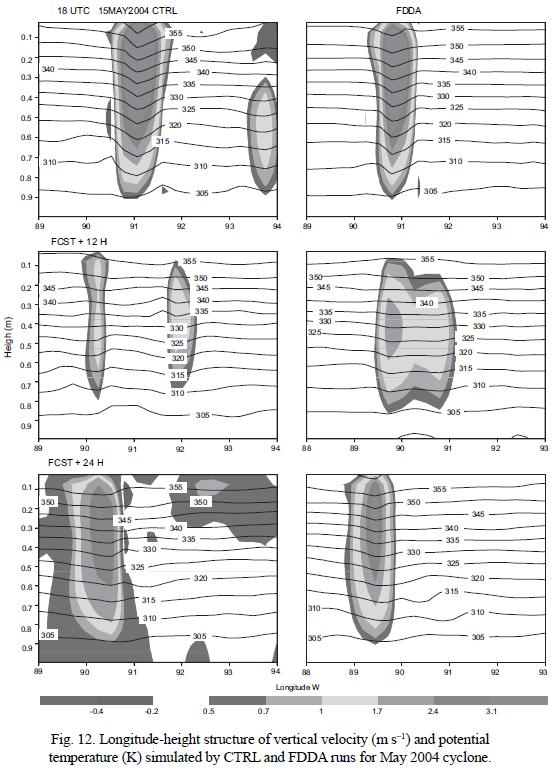
In order to draw useful and broad conclusions, it would be better to obtain results of the impacts of assimilation of AMSU observations for more than one case. Towards this end, this study has extended its investigations to include an additional tropical cyclone case over the Bay of Bengal region and the results of the second cyclone are being presented below briefly. Figure 11a and b depicts the time series of minimum SLP and MWS for the May 2004 cyclone. It can be observed that both the CTRL and FDDA simulations could produce the observed pattern of intensity variation of the cyclone with time. It should be noted that FDDA simulation is not showing consistent improvement as compared to the CTRL simulation throughout the integration period. Figure 12 shows the longitude–height cross section of vertical velocity and potential temperature for May 2004 cyclone. Consistent with the previous case, the FDDA simulation produced a stronger thermodynamic structure associated with the tropical cyclone. Figure 13a, b and c shows the 24 hour accumulated precipitation produced by CTRL and FDDA simulations and the TRMM estimated 24 hour precipitation at 16 May 2004 18UTC. In this case also, both the CTRL and the FDDA runs overestimated the rainfall amount. The rainfall pattern produced by both CTRL and FDDA runs are also similar to one another and are not in very good agreement with the TRMM observed precipitation pattern. Table II shows the average track error in km of CTRL and FDDA simulations with respect to observed track for the May 2004 cyclone. It is to be noted that the FDDA simulation could not improve the track forecast in this case.

4. Conclusions
In this paper we investigated the problem of retrieving atmospheric temperature and moisture profiles from satellite data. Emphasis was given in the analysis for different surface type (sea and land) and atmospheric conditions (clear and cloud sky) for summer and winter conditions. The results showed that it is easier to retrieve temperature and moisture profiles over the sea than over land. This occurs because over the land, the forward model is less accurate due to the difficulty of estimating surface parameters such as the emissivity and the surface temperature. Surprisingly, we found the atmospheric conditions do not affect significantly the accuracy of the inversion process. Also, even without most of the infrared channels (cloudy sky situations) it is possible to obtain accurate retrievals. The numerical simulation with AMSU temperature and moisture profile data is in close agreement with observations. Though the simulated wind speed was higher than the observed, the trend shown by simulated wind speed is similar to that of observed. The MM5 simulation with AMSU data could produce strong vertical velocity as well as simulate a warm core in the middle and upper troposphere. The overall thermodynamic structure simulated by the model with AMSU data resembles observed thermodynamic structure of tropical cyclones as revealed by a previous study (Kidder et al., 2000). The improvement in the thermodynamic structure is prominent and consistent in both November 2002 and May 2004 cyclone cases. Though the amount of the accumulated precipitation simulated by the model for the 24 hours of forecast is not in good agreement with TRMM estimated precipitation, the spatial pattern of the precipitation was in good agreement with the observed pattern of TRMM rainfall for the November 2002 cyclone case. There was no marked improvement in the track forecast except for the 12 and 18 hours of forecast in the November 2002 cyclone case. The comparisons of FDDA and CTRL simulations with each other as well as with observations brought out the positive impact of ingestion and assimilation of AMSU and HIRS temperature and moisture for the prediction of a tropical cyclone using the MM5 model.
]]> Acknowledgements
Thanks are due to EUMETSAT for providing the AAPP4.0 and ICI3.0 software. We are very much thankful to Dr. Lydie Lavanant, Meteo–France, for helping in the installation of ICI software and useful suggestion from time to time. MM5 model is obtained from NCAR. NCEP–FNL analysis is obtained from NCEP. The authors acknowledge IMD, NOAA and NASA for radiosonde/rawinsonde and surface observations, AMSU data and TRMM data. One of the authors (A. C.) thanks SAC, ISRO, India and DST, India for project support. S. Sandeep thanks the Council of Scientific and Industrial Research (CSIR), India for a research fellowship. The authors thank the anonymous reviewers for their comments and suggestions, which have greatly improved the paper.
References
English S. J., R. J. Renshaw, P. C. Dibben, A. J. Smith, P. J. Rayer, C. Poulsen, F. W. Saunders and J. R. Eyre, 2000. A comparison of the impact of TOVS and ATOVS satellite sounding data on the accuracy of numerical weather forecast. Quart. Jour. R. Met. Soc. 126, 2911–2931. [ Links ]
Eyre J. R., 1991. A fast radiative transfer model for satellite soundings system. ECMWF Tech. Memorandum, N. 176. [ Links ]
Grell G. A., J. Dudhia and D. R. Stauffer, 1994. A description of the fifth–generation Penn State/ NCAR mesoscale model (MM5), NCAR Technical Note TN–398+STR NCAR, Boulder CO., 122 pp. [ Links ]
Grody N., F. Weng and R. Ferraro, 1999. Application of AMSU for obtaining water vapor, cloud liquid water, precipitation, snow cover and sea ice concentration. Tech. Proc. of the Tenth International TOVS Study Conference. [ Links ]
Isaacs R. G., R. N. Hoffman and L. D. Kaplan, 1986. Satellite remote sensing of meteorological parameters for global numerical weather prediction. Rev. Geophys. 24, 701–743. [ Links ]
Kidder S. Q., M. D. Goldberg, R. M. Zehr, M. Demaria, J. F. W. Purdom, C. S. Velden, N. C. Grody and S. J. Kusselson, 2000. Satellite analysis of tropical cyclones using the Advanced Microwave Sounding Unit (AMSU), B. Am. Meteorol. Soc. 81, 1241–1259. [ Links ]
Krishnamurti T. N., J. Xue, H. S. Bedi, K. Ingles and D. Oosterhof, 1991. Physical initialization for numerical weather prediction over the tropics, Tellus B, 43, 53–81. [ Links ]
Lavanant L., H. Legleau, M. Derrien, S. Levasseur, G. Monnier, L. Ardouin, P. Brunel and B. Bellec, 1999b. AVHRR cloud mask for sounding applications. Tech. Proc. of the Tenth International TOVS Study Conference. [ Links ]
Lipton A. E. and T. H. Vonder Haar, 1990. Mesoscale analysis by numerical modeling coupled with sounding retrieval from satellites. Mon. Wea. Rev. 118, 1308–1329. [ Links ]
Mishra D. K. and G. R. Gupta, 1976. Estimation of maximum wind speeds in tropical cyclones occurring in Indian seas. Indian J. Met. Hydrol. Geophys. 27, 285–290. [ Links ]
Roy Bhowmik S. K., 2003. Prediction of monsoon rainfall with a nested grid limited area model. Proc. Indian Acad. Sci. 112, 499–519. [ Links ]
Sandeep S., A. Chandrasekar and D. Singh, 2006. The impact of assimilation of AMSU data for the prediction of a tropical cyclone over India using a mesoscale model, Int. Jour. Rem. Sensing (in press). [ Links ]
Sanders R., M. Matricardi and P. Brunel, 1998. An improved fast radiative transfer model for assimilation of radiance observations. Quart. Jour. R. Met. Soc. 102, 1407–1425. [ Links ]
Smith W. L., H. M. Woolf and W. J. Jacob, 1970. A regression method for obtaining real–time temperature and geopotential height profiles from satellite spectrometer measurements and its application to Nimbus 3 "SIRS" observations. Mon. Wea. Rev. 98, 582–603. [ Links ]
Stauffer D. R. and N. L. Seaman, 1990. Use of four dimensional data assimilation in a limited area mesoscale model. Part 1: Experiments with synoptic scale data. Mon. Wea. Rev. 118, 1250–1277. [ Links ]
Turpeinen O. M., L. Garand, R. Benoit and M. Roch, 1990. Diabatic initialization of the Canadian Regional Finite–Element (RFE) model using satellite data. Part I: Methodology and application to a winter storm. Mon. Wea. Rev. 118, 1381–1395. [ Links ]
Uddstrom M. J. and L. M. Mcmillin, 1993. Extraction of atmospheric signals from radiance measurements: Some limitations. Proceedings of NATO workshop on High Spectral Resolution Infrared Remote Sensing for Earth's Weather and Climate Studies, Paris, Springer–Verlag, 504 pp. [ Links ]
Wu X., G. R. Diak, C. M. Hayden and J. A. Young, 1995. Short range precipitation forecasts using assimilation of simulated satellite water vapor profiles and column cloud liquid water amounts. Mon. Wea. Rev. 123, 347–365. [ Links ] ]]>