<?xml version="1.0" encoding="ISO-8859-1"?><article xmlns:mml="http://www.w3.org/1998/Math/MathML" xmlns:xlink="http://www.w3.org/1999/xlink" xmlns:xsi="http://www.w3.org/2001/XMLSchema-instance">
<front>
<journal-meta>
<journal-id>0187-6236</journal-id>
<journal-title><![CDATA[Atmósfera]]></journal-title>
<abbrev-journal-title><![CDATA[Atmósfera]]></abbrev-journal-title>
<issn>0187-6236</issn>
<publisher>
<publisher-name><![CDATA[Universidad Nacional Autónoma de México, Instituto de Ciencias de la Atmósfera y Cambio Climático]]></publisher-name>
</publisher>
</journal-meta>
<article-meta>
<article-id>S0187-62362008000200003</article-id>
<title-group>
<article-title xml:lang="en"><![CDATA[Simple air quality model for a plane source]]></article-title>
</title-group>
<contrib-group>
<contrib contrib-type="author">
<name>
<surname><![CDATA[MONTECINOS]]></surname>
<given-names><![CDATA[S]]></given-names>
</name>
<xref ref-type="aff" rid="A01"/>
</contrib>
</contrib-group>
<aff id="A01">
<institution><![CDATA[,Universidad de La Serena Centro de Estudios Avanzados en Zonas Áridas ]]></institution>
<addr-line><![CDATA[ ]]></addr-line>
<country>Chile</country>
</aff>
<pub-date pub-type="pub">
<day>00</day>
<month>04</month>
<year>2008</year>
</pub-date>
<pub-date pub-type="epub">
<day>00</day>
<month>04</month>
<year>2008</year>
</pub-date>
<volume>21</volume>
<numero>2</numero>
<fpage>147</fpage>
<lpage>170</lpage>
<copyright-statement/>
<copyright-year/>
<self-uri xlink:href="http://www.scielo.org.mx/scielo.php?script=sci_arttext&amp;pid=S0187-62362008000200003&amp;lng=en&amp;nrm=iso"></self-uri><self-uri xlink:href="http://www.scielo.org.mx/scielo.php?script=sci_abstract&amp;pid=S0187-62362008000200003&amp;lng=en&amp;nrm=iso"></self-uri><self-uri xlink:href="http://www.scielo.org.mx/scielo.php?script=sci_pdf&amp;pid=S0187-62362008000200003&amp;lng=en&amp;nrm=iso"></self-uri><abstract abstract-type="short" xml:lang="es"><p><![CDATA[El objetivo de este artículo es mostrar soluciones analíticas simples de la ecuación general de dispersión para una fuente plana homogénea, paralela a la superficie de la tierra. Construimos primero un modelo unidimensional en el cual se supone una mezcla vertical perfecta (PVMM, por sus siglas en inglés). En una segunda etapa, se agrega la difusión vertical al modelo (GM). Ambos modelos predicen que la concentración crece viento abajo y que, debido al flujo de deposición, permanece acotada. Con el objeto de comprobar la validez de los modelos se analiza la distribución espacial de material particulado PMi0 en la región saturada Temuco-Padre Las Casas, Chile (38.77° S, 72.63° W) y se compara con lo que predicen los modelos.]]></p></abstract>
<abstract abstract-type="short" xml:lang="en"><p><![CDATA[The goal of this article is to show simple, analytical solutions of the general dispersion equation for an homogeneous plane source, parallel to the surface of the earth. At a first step, we construct a one-dimensional model, where a perfect vertical mixture is assumed (PVMM). At a second step, vertical diffusion is added to the problem (GM). Both models predict that the concentration increases downwind and, due to deposition, it remains bounded. In order to analyze the validity of the models, the space distribution of paniculate matter PM10 in the saturated zone Temuco-Padre Las Casas, Chile (38.77° S, 72.63° W) is analyzed and compared with the prediction of the models.]]></p></abstract>
<kwd-group>
<kwd lng="en"><![CDATA[Air pollution]]></kwd>
<kwd lng="en"><![CDATA[air quality models]]></kwd>
<kwd lng="en"><![CDATA[dispersion models]]></kwd>
<kwd lng="en"><![CDATA[gaussian models]]></kwd>
</kwd-group>
</article-meta>
</front><body><![CDATA[ <p align="center"><font face="verdana" size="4"><b>Simple air quality model for a plane source</b></font></p>     <p align="justify"><font face="verdana" size="2">&nbsp;</font></p>     <p align="center"><font face="verdana" size="2"><b>S. MONTECINOS</b>    <br> <i>Centro de Estudios Avanzados en Zonas &Aacute;ridas, Universidad de La Serena, Benavente 980, La Serena, Chile </i>E&#150;mail: <a href="mailto:sonia.montecinos@ceaza.cl">sonia.montecinos@ceaza.cl</a></font></p>     <p align="justify"><font face="verdana" size="2">&nbsp;</font></p>     <p align="center"><font face="verdana" size="2">Received July 11, 2006; accepted September 5, 2007</font></p>     <p align="justify"><font face="verdana" size="2">&nbsp;</font></p>     <p align="justify"><font face="verdana" size="2"><b>RESUMEN</b></font></p>     <p align="justify"><font face="verdana" size="2">El objetivo de este art&iacute;culo es mostrar soluciones anal&iacute;ticas simples de la ecuaci&oacute;n general de dispersi&oacute;n para una fuente plana homog&eacute;nea, paralela a la superficie de la tierra. Construimos primero un modelo unidimensional en el cual se supone una mezcla vertical perfecta (PVMM, por sus siglas en ingl&eacute;s). En una segunda etapa, se agrega la difusi&oacute;n vertical al modelo (GM). Ambos modelos predicen que la concentraci&oacute;n crece viento abajo y que, debido al flujo de deposici&oacute;n, permanece acotada. Con el objeto de comprobar la validez de los modelos se analiza la distribuci&oacute;n espacial de material particulado PMi<sub>0</sub> en la regi&oacute;n saturada Temuco&#150;Padre Las Casas, Chile (38.77&deg; S, 72.63&deg; W) y se compara con lo que predicen los modelos.</font></p>     <p align="justify"><font face="verdana" size="2">&nbsp;</font></p>     ]]></body>
<body><![CDATA[<p align="justify"><font face="verdana" size="2"><b>ABSTRACT</b></font></p>     <p align="justify"><font face="verdana" size="2">The goal of this article is to show simple, analytical solutions of the general dispersion equation for an homogeneous plane source, parallel to the surface of the earth. At a first step, we construct a one&#150;dimensional model, where a perfect vertical mixture is assumed (PVMM). At a second step, vertical diffusion is added to the problem (GM). Both models predict that the concentration increases downwind and, due to deposition, it remains bounded. In order to analyze the validity of the models, the space distribution of paniculate matter PM<sub>10</sub> in the saturated zone Temuco&#150;Padre Las Casas, Chile (38.77&deg; S, 72.63&deg; W) is analyzed and compared with the prediction of the models.</font></p>     <p align="justify"><font face="verdana" size="2"><b>Keywords:</b> Air pollution, air quality models, dispersion models, gaussian models.</font></p>     <p align="justify"><font face="verdana" size="2">&nbsp;</font></p>     <p align="justify"><font face="verdana" size="2"><b>1. Introduction</b></font></p>     <p align="justify"><font face="verdana" size="2">A dispersion model solves the mass conservation equations of N chemical constituents, given by the following system of differential equations (Seinfeld and Pandis, 1998; Wayne, 1994; Turner, 1994):</font></p>     <p align="justify"><font face="verdana" size="2"><img src="/img/revistas/atm/v21n2/a3s1.jpg"></font></p>     <p align="justify"><font face="verdana" size="2">with &rho;<sub>i</sub> (&micro;g m <sup>&#150;3</sup>) the concentration of the <i>i<sub>th</sub> </i>component, <img src="/img/revistas/atm/v21n2/a3s2.jpg"> (&micro;gm<sup>-2</sup>s<sup>-1) </sup>the fluxes of advection, diffusion and deposition, respectively. All these variables depend on the space coordinates x, <i>y, z </i>and the time <i>t. </i>The symbol <img src="/img/revistas/atm/v21n2/a3s94.jpg"> represents the gradient operator defined by:</font></p>     <p align="justify"><font face="verdana" size="2"><img src="/img/revistas/atm/v21n2/a3s3.jpg"></font></p>     <p align="justify"><font face="verdana" size="2">The advection flux (in the following, we omit sub&#150;index <i>i)</i></font></p>     ]]></body>
<body><![CDATA[<p align="justify"><font face="verdana" size="2"><img src="/img/revistas/atm/v21n2/a3s4.jpg"></font></p>     <p align="justify"><font face="verdana" size="2">represents the transport of mass by the wind <i><img src="/img/revistas/atm/v21n2/a3s6.jpg">.</i></font></p>     <p align="justify"><font face="verdana" size="2">The diffusion or turbulent flux is opposite to the gradient of the concentration p, and is given by:</font></p>     <p align="justify"><font face="verdana" size="2"><img src="/img/revistas/atm/v21n2/a3s5.jpg"></font></p>     <p align="justify"><font face="verdana" size="2">with <i>K<sub>&alpha;</sub> = &alpha; x, y, z </i>the eddy&#150;diffusion coefficient in <i>&alpha;</i>&#150;direction.</font></p>     <p align="justify"><font face="verdana" size="2">The deposition flux can be a very important mechanism to remove pollutants from the atmosphere. Both, particles and gases can be deposited at the earth surface in two ways: dry and wet deposition. The dry deposition can be written as (Finlayson&#150;Pitts and Pitts, 2000)</font></p>     <p align="justify"><font face="verdana" size="2"><img src="/img/revistas/atm/v21n2/a3s7.jpg"></font></p>     <p align="justify"><font face="verdana" size="2">with <img src="/img/revistas/atm/v21n2/a3s96.jpg"> the deposition velocity and <img src="/img/revistas/atm/v21n2/a3s95.jpg">: the unitary vector perpendicular to the earth's surface, in up direction. Wet deposition is not considered in this work.</font></p>     <p align="justify"><font face="verdana" size="2">Finally, S (&micro;gm<sup>&#150;3</sup>s<sup>&#150;1</sup>) is the source, including chemical and photochemical reactions. In the following, we assume that the element in study is inert, and therefore the system (1) is reduced to one equation.</font></p>     <p align="justify"><font face="verdana" size="2">To find a solution of equation (1) is in general a complex problem which requires the knowledge of space and time dependence of the wind fields, eddy coefficients, and the characterization of the source. The meteorological variables must be calculated with another meteorological model. Both, dispersion and meteorological models solve the associated equations using numerical methods, which require the appropriated computational infrastructure. Examples of dispersion models are KAMM&#150;DRAIS model (Vogel <i>et al, </i>1995; Nester and Panitz, 2004) which solves the dynamical equations parallel to the dispersion equation, and the MATCH model, which requires the meteorological fields of an external mesoscale model (Robertson and Langer, 1999).</font></p>     ]]></body>
<body><![CDATA[<p align="justify"><font face="verdana" size="2">The formulation of hypothesis makes it possible to find simple analytical or semi&#150;analytical solutions of the original Equation (1). As an example of semi&#150;analytical solution, we mention the works of Moreira <i>et al. </i>(2005, 2006), and Wortmann <i>et al. </i>(2005), which solve the dispersion equation using the generalized integral transform technique (GITT approach). Although the applicability of these solutions is limited, they greatly simplify the analysis of air pollution problems. This kind of air quality models (AQM) in general take the meteorological parameters, which are needed to solve the equations, directly from the observations.</font></p>     <p align="justify"><font face="verdana" size="2">The goal of this article is to develop simple AQM for an homogeneous source, located at a plane parallel to the surface of the earth.</font></p>     <p align="justify"><font face="verdana" size="2">This article is organized as follows: in section 2 we review some AQM found in the literature. We make a brief description of gaussian models for point and linear sources and we make a description of the box model (BM), which corresponds to the most simple solution of equation (6) for a plane source.</font></p>     <p align="justify"><font face="verdana" size="2">In section 3, we construct two solutions of the general equation (6) for aplane source. In section 3.1, we show the model PVMM, where a perfect vertical mixing of the air is assumed. The model describes the downwind evolution of the concentration of an inert pollutant. We use this model to calculate the horizontal scale of influence of the pollutant after it leaves the emission region. In section 3.2, vertical diffusion is added to the problem (model GM). Due to deposition, both models predict a bounded value for the concentration of the pollutant. The bound predicted with PVMM coincides with those calculated with GM at the emission height.</font></p>     <p align="justify"><font face="verdana" size="2">In order to test the validity of the models, the space distribution of particular matter PM<sub>10</sub> in the saturated region Temuco&#150;Padre Las Casas, Chile (38.77&deg; S, 72.63&deg; W) is analyzed in section 5. Because the available information is poor, only a qualitative validation is shown. We find that experimental results are in agreement with the prediction of the models.</font></p>     <p align="justify"><font face="verdana" size="2">&nbsp;</font></p>     <p align="justify"><font face="verdana" size="2"><b>2. Air quality models</b></font></p>     <p align="justify"><font face="verdana" size="2">In this section we describe known AQM solutions of the general equation (1), which are often used to analyze air pollution problems for simple meteorological conditions. The models assume that the following conditions are satisfied:</font></p>     <p align="justify"><font face="verdana" size="2">&bull; the pollutant is inert,</font></p>     <p align="justify"><font face="verdana" size="2">&bull; both, wind vector u and eddy diffusion coefficients <i>K<sub>&alpha;</sub>, <i>&alpha;</i>= x,y, z, </i>are constant with the space coordinates.</font></p>     ]]></body>
<body><![CDATA[<p align="justify"><font face="verdana" size="2">&bull; the system is in quasi&#150;stationary state <img src="/img/revistas/atm/v21n2/a3s8.jpg"></font></p>     <p align="justify"><font face="verdana" size="2">&bull; the fluid is incompressible <img src="/img/revistas/atm/v21n2/a3s9.jpg"></font></p>     <p align="justify"><font face="verdana" size="2">&bull; the soil is smooth enough to be considered flat. Under these assumptions, equation (1) takes the form:</font></p>     <p align="justify"><font face="verdana" size="2"><img src="/img/revistas/atm/v21n2/a3s10.jpg"></font></p>     <p align="justify"><font face="verdana" size="2">where the coordinate system is chosen in a way that the wind <i><img src="/img/revistas/atm/v21n2/a3s97.jpg">. </i>In the following, we present particular solutions of the above equation, for homogeneous point, linear and plane sources.</font></p>     <p align="justify"><font face="verdana" size="2"><i>2.1 Gaussian models</i></font></p>     <p align="justify"><font face="verdana" size="2">We consider the case that the emission is continuous, coming from a point source,</font></p>     <p align="justify"><font face="verdana" size="2"><img src="/img/revistas/atm/v21n2/a3s11.jpg"></font></p>     <p align="justify"><font face="verdana" size="2">where the source is located at the point (0, 0, <i>h), </i>with <i>h </i>the effective height of the source (Hanna <i>et al., </i>1982). In (7) <i>q </i>(&micro;gs<sup>&#150;1</sup>) is the net emission flux, and &delta;(x) the Dirac distribution (Dirac, 1958; Arfken and Weber, 1971).</font></p>     <p align="justify"><font face="verdana" size="2">If the x&#150;component of the diffusion flux can be neglected in opposite to the advection flux, equation (6)&#150;(7) reduces to:</font></p>     ]]></body>
<body><![CDATA[<p align="justify"><font face="verdana" size="2"><img src="/img/revistas/atm/v21n2/a3s12.jpg"></font></p>     <p align="justify"><font face="verdana" size="2">restricted to the border condition (Etling, 2002)</font></p>     <p align="justify"><font face="verdana" size="2"><img src="/img/revistas/atm/v21n2/a3s13.jpg"></font></p>     <p align="justify"><font face="verdana" size="2">Equation (8)&#150;(9) is known as the Fokker&#150;Planck equation (Gardiner, 2004).</font></p>     <p align="justify"><font face="verdana" size="2">If the deposition flux <img src="/img/revistas/atm/v21n2/a3s98.jpg"> the solution of (8) is given by (Etling, 2002; Seinfeld and Pandis, 1998; Turner, 1994; Wark <i>et al, </i>1998)</font></p>     <p align="justify"><font face="verdana" size="2"><img src="/img/revistas/atm/v21n2/a3s14.jpg"></font></p>     <p align="justify"><font face="verdana" size="2">whose profile corresponds to a gaussian curve, with standard deviation</font></p>     <p align="justify"><font face="verdana" size="2"><img src="/img/revistas/atm/v21n2/a3s15.jpg"></font></p>     <p align="justify"><font face="verdana" size="2">in the <i>y, z </i>direction, respectively. The solution (10)&#150;(l 1) shows, that due to the turbulent fluxes, the plume is widened in the directions perpendicular to the wind, as it moves away from the source.</font></p>     <p align="justify"><font face="verdana" size="2">The effect of deposition is to drop the center of the plume to the earth's surface. In fact, it can be shown that, if <img src="/img/revistas/atm/v21n2/a3s99.jpg"> the solution of (6) is given by:</font></p>     ]]></body>
<body><![CDATA[<p align="justify"><font face="verdana" size="2"><img src="/img/revistas/atm/v21n2/a3s16.jpg"></font></p>     <p align="justify"><font face="verdana" size="2">with the center of the plume (Hanna <i>et al., </i>1982): </font></p>     <p align="justify"><font face="verdana" size="2"><img src="/img/revistas/atm/v21n2/a3s17.jpg"></font></p>     <p align="justify"><font face="verdana" size="2">This solution reduced to (10) if <img src="/img/revistas/atm/v21n2/a3s100.jpg"></font></p>     <p align="justify"><font face="verdana" size="2">The equation (10), or (12), does not consider the effect of the soil on the plume. If the soil completely reflects the plume, we have to impose the following boundary condition (Etling, 2002):</font></p>     <p align="justify"><font face="verdana" size="2"><img src="/img/revistas/atm/v21n2/a3s18.jpg"></font></p>     <p align="justify"><font face="verdana" size="2">and the solution becomes (Etling, 2002; Turner, 1994; Wark <i>et al, </i>1998):</font></p>     <p align="justify"><font face="verdana" size="2"><img src="/img/revistas/atm/v21n2/a3s19.jpg"></font></p>     <p align="justify"><font face="verdana" size="2">where the second term at the right side is the image flag, which represents the plume produced by a point source located at (0, 0, <i>h</i>).</font></p>     <p align="justify"><font face="verdana" size="2">Now, let us consider the case that the pollutant is produced by a line parallel to the earth's surface. If we choose the <i>y </i>axes parallel to the source, it can be written as:</font></p>     ]]></body>
<body><![CDATA[<p align="justify"><font face="verdana" size="2"><img src="/img/revistas/atm/v21n2/a3s20.jpg"></font></p>     <p align="justify"><font face="verdana" size="2">with Q(&micro;gs<sup>&#150;1</sup>) the linear density of emission and <i>h </i>the height of the source.</font></p>     <p align="justify"><font face="verdana" size="2">Due to the linearity of the dispersion equation (8), the concentration at any point (x, <i>y, z) </i>can be written as a superposition of plumes coming from point sources located at (0, <i>y', h) </i>which emits a flux <i>q = Qdy', </i>with<i> y' </i>covering the total emission line.</font></p>     <p align="justify"><font face="verdana" size="2">If the wind is perpendicular to the emission line,  and the line <img src="/img/revistas/atm/v21n2/a3s101.jpg">is infinite, the solution becomes (Hanna <i>et al., </i>1982):</font></p>     <p align="justify"><font face="verdana" size="2"><img src="/img/revistas/atm/v21n2/a3s21.jpg"></font></p>     <p align="justify"><font face="verdana" size="2">with &sigma;<sub>z</sub> given in (11).</font></p>     <p align="justify"><font face="verdana" size="2">It can be shown that (17) satisfies the differential equation (6), for <i><sub><img src="/img/revistas/atm/v21n2/a3s102.jpg"></sub> = K<sub>x</sub>=K<sub>y</sub> </i>= S = 0, restricted to the boundary condition:</font></p>     <p align="justify"><font face="verdana" size="2"><img src="/img/revistas/atm/v21n2/a3s22.jpg"></font></p>     <p align="justify"><font face="verdana" size="2">Deposition <img src="/img/revistas/atm/v21n2/a3s24.jpg"> can be taken in to account in a similar way as described above: in (17) replacing <i><img src="/img/revistas/atm/v21n2/a3s25.jpg"></i> with <i>z<sub>c</sub> </i>defined in (13). Moreover, if the soil reflects the plume, a plume coming from a line located <i>atz = &#150;h </i>must be added to the solution (17).</font></p>     <p align="justify"><font face="verdana" size="2"><i>2.2 Box model</i></font></p>     ]]></body>
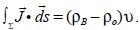
<body><![CDATA[<p align="justify"><font face="verdana" size="2">Now we consider the case that the emissions come from a horizontal plane, of the area<i> A =LD. </i>In an appropriate coordinate system, the source can be written as:</font></p>     <p align="justify"><font face="verdana" size="2"><img src="/img/revistas/atm/v21n2/a3s26.jpg"></font></p>     <p align="justify"><font face="verdana" size="2">with <i>Q </i>(&micro;gm<sup>&#150;2</sup> s<sup>&#150;1</sup>) the emission flux. The most simple solution of the general equation (1)&#150;(19), is known as box model (BM) (De Nevers, 1995).</font></p>     <p align="justify"><font face="verdana" size="2">The BM assumes a constant concentration of the pollutant in the box of volume <i>V = LDH. </i>So we have that the diffusion flux  <img src="/img/revistas/atm/v21n2/a3s27.jpg">and equation (1)&#150;(19) becomes:</font></p>     <p align="justify"><font face="verdana" size="2"><img src="/img/revistas/atm/v21n2/a3s28.jpg"></font></p>     <p align="justify"><font face="verdana" size="2">with the flux mass <img src="/img/revistas/atm/v21n2/a3s30.jpg"> and the deposition flux <img src="/img/revistas/atm/v21n2/a3s29.jpg"> defined in (3) and (5), respectively.</font></p>     <p align="justify"><font face="verdana" size="2">A solution of (20) can be found integrating (20) in the volume <i>V. </i>Using the Stokes theorem (Grant and Phillips, 1991), the integrals can be transformed in surface integrals and equation (20) becomes:</font></p>     <p align="justify"><font face="verdana" size="2"><img src="/img/revistas/atm/v21n2/a3s31.jpg"></font></p>     <p align="justify"><font face="verdana" size="2">with &Sigma; the surface that evolves the volume <i>V. </i>The above equation corresponds to a mass balance in steady state: the mass that leaves the volume Fby time unit due to advection and deposition, is equal to the mass injected by the source to it.</font></p>     <p align="justify"><font face="verdana" size="2">According to the hypothesis of the model, there exists advection flux only in the lateral sides perpendicular to the wind, and so <img src="/img/revistas/atm/v21n2/a3s32.jpg">with &rho;<i><sub>B</sub></i> the concentration in the volume Fand &rho;<sub>o</sub> = &rho; (x = 0) the background concentration; also the concentration at the beginning of the emission region.</font></p>     ]]></body>

<body><![CDATA[<p align="justify"><font face="verdana" size="2">On the other hand, deposition flux exists only at the underlying surface of the cube and so  <img src="/img/revistas/atm/v21n2/a3s33.jpg">= &rho;<i><sub>B</sub></i> <img src="/img/revistas/atm/v21n2/a3s102.jpg">LD. Equation (21) becomes:</font></p>     <p align="justify"><font face="verdana" size="2"><img src="/img/revistas/atm/v21n2/a3s34.jpg"></font></p>     <p align="justify"><font face="verdana" size="2">If the background concentration &rho;<sub>o</sub> = 0, we have:</font></p>     <p align="justify"><font face="verdana" size="2"><img src="/img/revistas/atm/v21n2/a3s35.jpg"></font></p>     <p align="justify"><font face="verdana" size="2">where the term at the right side corresponds to the case:</font></p>     <p align="justify"><font face="verdana" size="2"><img src="/img/revistas/atm/v21n2/a3s36.jpg"></font></p>     <p align="justify"><font face="verdana" size="2">which is equivalent to neglect deposition flux.</font></p>     <p align="justify"><font face="verdana" size="2">Equation (23) can be used for a first estimation of the concentration of a pollutant, for example, in an urban zone.</font></p>     <p align="justify"><font face="verdana" size="2">We recall that the concentration given in (23) corresponds to a mass balance and so it includes not only the plane source, but also all the sources within the box <i>V.</i></font></p>     <p align="justify"><font face="verdana" size="2">In the next section, we show that (23) corresponds to the maximum value of the concentration within the box <i>V.</i></font></p>     ]]></body>
<body><![CDATA[<p align="justify"><font face="verdana" size="2">&nbsp;</font></p>     <p align="justify"><font face="verdana" size="2"><b>3. Air quality model for a plane source</b></font></p>     <p align="justify"><font face="verdana" size="2">In this section we construct two models to avoid estimating the space distribution of the concentration of a pollutant coming from an homogeneous plane source such as (19). In subsection 3.1, we show the 1&#150;dimensional model PVMM, where a perfect vertical mixture is assumed, and which corresponds to a generalization of the BM. As a particular case, the horizontal scale influence of the pollutant after it leaves the emission region is calculated.</font></p>     <p align="justify"><font face="verdana" size="2">In subsection 3.2, the gaussian model (GM) is constructed. This model corresponds to add vertical diffusion to the problem. As common gaussian models, diffusion parallel to the wind is neglected compared to advection flux.</font></p>     <p align="justify"><font face="verdana" size="2">In both models, PVMM and GM, we assume that the solution does not depend on the horizontal coordinate perpendicular to the wind <i>y.</i></font></p>     <p align="justify"><font face="verdana" size="2"><i>3.1 One&#150;dimensional model: Perfect vertical mixture (PVMM)</i></font></p>     <p align="justify"><font face="verdana" size="2">In this section we develop a 1&#150;dimensional model which avoids us to analyze the variation of the concentration in the wind direction x, within the simulation region <i>V=LDH. </i>For the construction of this model, a perfect vertical mixture from the surface of the earth up to the mixing height <i>H </i>is assumed (for definition of mixing height, Holton, 1992).</font></p>     <p align="justify"><font face="verdana" size="2">At a first step, we analyzed the case where diffusion flux is neglected compared to advection flux, and after that, horizontal diffusion is incorporated to the system.</font></p>     <p align="justify"><font face="verdana" size="2"><i>3.1.1 Model without diffusion</i></font></p>     <p align="justify"><font face="verdana" size="2">We start considering the case <i>K<sub>x</sub> = </i>0, i.e. we suppose that diffusion flux is much smaller than advection flux. The dispersion equation associated to the model is equation (20).</font></p>     ]]></body>
<body><![CDATA[<p align="justify"><font face="verdana" size="2">We assume that the concentration p is not constant, but varies downwind. In order to find a solution of equation (20), we divide the total volume <i>V = LDH </i>along x&#150;axis in TVboxes of volume <i><img src="/img/revistas/atm/v21n2/a3s37.jpg"></i> Each box is located at the point <i>x = n</i>&Delta;<i>x.</i></font></p>     <p align="justify"><font face="verdana" size="2">Now, if &Delta;<i>x </i>is small enough or, equivalent, if TV is large enough, each cube <i>V<sub>n</sub> </i>can be consider as a box, where the concentration is constant. So, the results shown in section 2.2 can be applied, if we replace <i><img src="/img/revistas/atm/v21n2/a3s38.jpg">, </i>the size of the volume <i>V<sub>n</sub></i>, and <img src="/img/revistas/atm/v21n2/a3s39.jpg"> the concentration in volume <i>V<sub>n</sub>. </i> Hence, equation (22) is equal to 0:</font></p>     <p align="justify"><font face="verdana" size="2"><img src="/img/revistas/atm/v21n2/a3s40.jpg"></font></p>     <p align="justify"><font face="verdana" size="2">with &rho;<sub>0</sub> = 0</font></p>     <p align="justify"><font face="verdana" size="2">If we divide by &Delta;<i>x </i>and take the limit <img src="/img/revistas/atm/v21n2/a3s41.jpg">, the above equation is transformed in the first order, non homogeneous, linear differential equation:</font></p>     <p align="justify"><font face="verdana" size="2"><img src="/img/revistas/atm/v21n2/a3s42.jpg"></font></p>     <p align="justify"><font face="verdana" size="2">with solution (Amann, 1990):</font></p>     <p align="justify"><font face="verdana" size="2"><img src="/img/revistas/atm/v21n2/a3s43.jpg"></font></p>     <p align="justify"><font face="verdana" size="2">where we have taken the boundary condition &rho;(0) = 0.</font></p>     <p align="justify"><font face="verdana" size="2">Equation (26) means that within the emission region the concentration of the pollutant increases downwind, but it remains bounded. We have:</font></p>     ]]></body>
<body><![CDATA[<p align="justify"><font face="verdana" size="2"><img src="/img/revistas/atm/v21n2/a3s44.jpg"></font></p>     <p align="justify"><font face="verdana" size="2">The solution, evaluated for <i><img src="/img/revistas/atm/v21n2/a3s103.jpg"> = </i>5 ms<sup>&#150;1</sup>, <i>H</i>=200m, <i>Q = </i>1&micro;g m<sup>&#150;2</sup>s and <i><img src="/img/revistas/atm/v21n2/a3s102.jpg">= </i>2 cm s<sup>&#150;1</sup>, is displayed in <a href="/img/revistas/atm/v21n2/a3f1.jpg" target="_blank">Figure 1</a>, curve 1.</font></p>     <p align="justify"><font face="verdana" size="2">We recall that the bound &rho;<sub>s</sub> does not depend on the meteorological conditions but only on the emission flux <i>Q </i>and the deposition velocity of the pollutant.</font></p>     <p align="justify"><font face="verdana" size="2">The saturation value <i>Q / <i><img src="/img/revistas/atm/v21n2/a3s102.jpg"></i></i> will be achieved only if the size of the emission plane measured in wind direction<img src="/img/revistas/atm/v21n2/a3s45.jpg"> Moreover, if <img src="/img/revistas/atm/v21n2/a3s46.jpg">, the exponential function can be expanded in Taylor series <img src="/img/revistas/atm/v21n2/a3s49.jpg">and we find that the concentration increases linearly downwind:</font></p>     <p align="justify"><font face="verdana" size="2"><img src="/img/revistas/atm/v21n2/a3s50.jpg"></font></p>     <p align="justify"><font face="verdana" size="2">This equation corresponds to neglecting deposition in (25).</font></p>     <p align="justify"><font face="verdana" size="2">The solution (28) is easy to analyze and shows the expected behavior: if the wind intensity increases the concentration of the pollutant decreases, and also decreases if the mixing height goes down.</font></p>     <p align="justify"><font face="verdana" size="2">Now, if we compare the linear solution (28) with the concentration calculated with BM, equation (23), for <i><img src="/img/revistas/atm/v21n2/a3s102.jpg"> = </i>0, we find that:</font></p>     <p align="justify"><font face="verdana" size="2"><img src="/img/revistas/atm/v21n2/a3s51.jpg"></font></p>     <p align="justify"><font face="verdana" size="2">This result means that BM corresponds to an estimation of the concentration at the end of the emission region, also, to the maximum value of the concentration of the pollutant within the emission region.</font></p>     ]]></body>
<body><![CDATA[<p align="justify"><font face="verdana" size="2"><i>3.1.2 Model with diffusion</i></font></p>     <p align="justify"><font face="verdana" size="2">Equation (26) does not consider the effect of horizontal diffusion on the concentration of the pollutant and so, its validity is subject to the condition:</font></p>     <p align="justify"><font face="verdana" size="2"><img src="/img/revistas/atm/v21n2/a3s52.jpg"></font></p>     <p align="justify"><font face="verdana" size="2">Now, as we can see in <a href="/img/revistas/atm/v21n2/a3f1.jpg" target="_blank">Figure 1</a>, curve 1, the concentration increases very fast near the origin, and so we can expect that diffusion could be important at the beginning of the emission region.</font></p>     <p align="justify"><font face="verdana" size="2">&nbsp;</font></p>     <p align="justify"><font face="verdana" size="2">Let us consider the differential equation:</font></p>     <p align="justify"><font face="verdana" size="2"><img src="/img/revistas/atm/v21n2/a3s53.jpg"></font></p>     <p align="justify"><font face="verdana" size="2">with <img src="/img/revistas/atm/v21n2/a3s54.jpg"> the turbulent diffusion flux (4), in this case given by</font></p>     <p align="justify"><font face="verdana" size="2"><img src="/img/revistas/atm/v21n2/a3s55.jpg"></font></p>     <p align="justify"><font face="verdana" size="2">In order to solve equation (31)&#150;(32), we proceed in a similar way as in section 3.1.1: we integrate this equation in the volume <i><img src="/img/revistas/atm/v21n2/a3s56.jpg"> </i> and use the Stokes theorem. We obtain</font></p>     ]]></body>

<body><![CDATA[<p align="justify"><font face="verdana" size="2"><img src="/img/revistas/atm/v21n2/a3s57.jpg"></font></p>     <p align="justify"><font face="verdana" size="2">with <img src="/img/revistas/atm/v21n2/a3s104.jpg"> the concentration and diffusion flux in the cube <i>V<sub>m</sub> </i>respectively. Now, we replace (32) in (33), divide by &Delta;x and take the limit  <img src="/img/revistas/atm/v21n2/a3s58.jpg"> So, the equation (33) transforms in the second order, linear, non&#150;homogeneous differential equation:</font></p>     <p align="justify"><font face="verdana" size="2"><img src="/img/revistas/atm/v21n2/a3s59.jpg"></font></p>     <p align="justify"><font face="verdana" size="2">The general solution of the above equation is:</font></p>     <p align="justify"><font face="verdana" size="2"><img src="/img/revistas/atm/v21n2/a3s60.jpg"></font></p>     <p align="justify"><font face="verdana" size="2">where <i>A </i>and <i>B </i>are arbitrary constants and &rho;<i><sub>s </sub>, </i>defined in (26), corresponds to a particular solution of equation (34). We note that the first term at the right side of the above equation diverges if <img src="/img/revistas/atm/v21n2/a3s61.jpg">, independent of the value of the diffusion coefficient <i>K<sub>x</sub></i>. So, if we impose that equation (35) must reduce to (26) in the limit <i><img src="/img/revistas/atm/v21n2/a3s62.jpg"></i> it is necessary that the solution remain bounded, and so we have to set <i>A = </i>0.</font></p>     <p align="justify"><font face="verdana" size="2">If we impose the boundary condition &rho;(0) = 0, we obtain:</font></p>     <p align="justify"><font face="verdana" size="2"><img src="/img/revistas/atm/v21n2/a3s63.jpg"></font></p>     <p align="justify"><font face="verdana" size="2">The behavior of the solution is similar to the case <i>K<sub>x</sub> = </i>0: within the emission region the concentration increases downwind until to reach the saturation value <i>Q/v<sub>d </sub>. </i>However, due to diffusion, the saturation value is achieved faster. As we can see in <a href="/img/revistas/atm/v21n2/a3f1.jpg" target="_blank">Figure 1</a>, curve 1 displays the solution (36) for <i>K<sub>x</sub> = </i>0, also, without diffusion, and curves 2 and 3, the solution for <i>K<sub>x</sub> = </i>3 m<sup>2</sup> s<sup>&#150;1</sup> and <i>K<sub>x</sub> = </i>3 m<sup>2</sup> s<sup>&#150;1</sup>, respectively.</font></p>     <p align="justify"><font face="verdana" size="2">Comparing both equations (36) and (26), we can conclude that horizontal diffusion can be neglected if:</font></p>     ]]></body>
<body><![CDATA[<p align="justify"><font face="verdana" size="2"><img src="/img/revistas/atm/v21n2/a3s64.jpg"></font></p>     <p align="justify"><font face="verdana" size="2">As an example, if <i><img src="/img/revistas/atm/v21n2/a3s65.jpg"> </i>= 5 m s<sup>&#150;1</sup>, <i>H = </i>500 m, <i>K<sub>x</sub> = </i>10 m<sup>2</sup> s<sup>&#150;1</sup> and if we take <i><i><img src="/img/revistas/atm/v21n2/a3s102.jpg"></i> = </i>0.5 cm s<sup>-1</sup>, which corresponds to the deposition velocity for fine particles, (Finlayson&#150;Pitts and Pitts, 2000), we find:</font></p>     <p align="justify"><font face="verdana" size="2"><img src="/img/revistas/atm/v21n2/a3s66.jpg"></font></p>     <p align="justify"><font face="verdana" size="2">In this particular case, horizontal diffusion can be neglected.</font></p>     <p align="justify"><font face="verdana" size="2">We remark that there is a second solution of equation (31) that increases exponentially downwind. Because this solution does not reduce to (26) in the limit <i><img src="/img/revistas/atm/v21n2/a3s62.jpg"></i> we have ignored it. However, if the size of the emission region <i>L </i>is finite, this solution must be, in principle, taken in to account.</font></p>     <p align="justify"><font face="verdana" size="2">&nbsp;</font></p>     <p align="justify"><font face="verdana" size="2"><i>3.1.3 Scale of influence of the pollutant</i></font></p>     <p align="justify"><font face="verdana" size="2">In this section we analyze the downwind evolution of the pollutant, once it leaves the emission region. In our analysis we take <i>K<sub>x</sub>= </i>0.</font></p>     <p align="justify"><font face="verdana" size="2">Outside the emission region, the concentration p satisfies the homogeneous differential equation (25), with <i>Q = 0. </i>If we translate the origin of coordinates to the end of the emission region, also, to <i>x = L, </i>the solution is</font></p>     <p align="justify"><font face="verdana" size="2"><img src="/img/revistas/atm/v21n2/a3s67.jpg"></font></p>     ]]></body>
<body><![CDATA[<p align="justify"><font face="verdana" size="2">Equation (37) shows that the concentration decreases exponentially downwind. The parameter A represents the horizontal scale factor, which determines the scale of influence of the pollutant. It depends on the meteorological conditions: it increases in conditions of good ventilation and decreases if the mixing height goes down. On the other hand, under similar meteorological conditions, pollutants with a low deposition velocity move farther than those with high ones.</font></p>     <p align="justify"><font face="verdana" size="2">As an example, for <img src="/img/revistas/atm/v21n2/a3s103.jpg"><img src="/img/revistas/atm/v21n2/a3s68.jpg">5m s<sup>&#150;1</sup>, mixing height H  <img src="/img/revistas/atm/v21n2/a3s68.jpg">500 m, deposition velocity <i><img src="/img/revistas/atm/v21n2/a3s103.jpg"><sub>d</sub> = </i>0.5 cm s<sup>&#150;1 </sup>(fine particles, size &lt; 2&micro;m, <img src="/img/revistas/atm/v21n2/a3s105.jpg">500 km. Although this value is too large and escapes the validity of the model, this result indicates that particular matter can be transported over long distances, before it deposits. This result is in correspondence to the literature (Gradel and Crutzen, 1992).</font></p>     <p align="justify"><font face="verdana" size="2">It is important to recall, that the model PVMM corresponds to a mass balance in each volume <i>V<sub>n</sub> = </i>&Delta;<i>xLD, </i>and does not satisfy the original equation (6). In fact, if we put <img src="/img/revistas/atm/v21n2/a3s69.jpg"> and write equation (31) in cartesian coordinates, and compare the resulting equation with (25), we can conclude that PVMM has implicit the following approximations:</font></p>     <p align="justify"><font face="verdana" size="2"><img src="/img/revistas/atm/v21n2/a3s70.jpg"></font></p>     <p align="justify"><font face="verdana" size="2">In other words, the source is considered as homogeneous in the volume <i>V = DLH, </i>and the vertical partial derivative of the concentration is approximated by the difference between its value at the earth's surface (z = 0) and at the mixing height <i>z =H, </i>with p (0) = p and p <i>(H) = </i>0.</font></p>     <p align="justify"><font face="verdana" size="2"><i>3.2 Two&#150;dimensional model: Gaussian model (GM)</i></font></p>     <p align="justify"><font face="verdana" size="2">In this section we find a solution of the general dispersion equation (6)&#150;(19) which describes the dependence of the concentration in the direction of the wind and the height <i>z. </i>As in the above sections, we assume that the horizontal size of the emission region in the direction perpendicular to the wind is large enough, so that the concentration &rho; = &rho; (x, <i>z).</i></font></p>     <p align="justify"><font face="verdana" size="2">In the following, we assume that advection is the predominant flux in x&#150;direction, and that there exists diffusion only in the vertical direction.</font></p>     <p align="justify"><font face="verdana" size="2"><i>3.2.1 Model without deposition</i></font></p>     <p align="justify"><font face="verdana" size="2">If <i>  <i><img src="/img/revistas/atm/v21n2/a3s103.jpg"></i><i><sub>d</sub></i> = </i>0, the (6)&#150;(19) continuity equation becomes:</font></p>     ]]></body>
<body><![CDATA[<p align="justify"><font face="verdana" size="2"><img src="/img/revistas/atm/v21n2/a3s71.jpg"></font></p>     <p align="justify"><font face="verdana" size="2">In order to solve this equation, we apply Fourier transform. We define the function <i>R(x, y), </i>the Fourier transform of the concentration &rho; (x, <i>z), </i>as follows (Arfken and Weber, 1971):</font></p>     <p align="justify"><font face="verdana" size="2"><img src="/img/revistas/atm/v21n2/a3s72.jpg"></font></p>     <p align="justify"><font face="verdana" size="2">where the expression at the right side is the anti&#150;Fourier transform. We proceed as usual: we multiply equation (39) by e<sup>i&gamma;z</sup> and integrate in <i>z. </i>Hence, we find the following differential equation for<i>R </i>(<i>x,&gamma;</i>):</font></p>     <p align="justify"><font face="verdana" size="2"><img src="/img/revistas/atm/v21n2/a3s73.jpg"></font></p>     <p align="justify"><font face="verdana" size="2">which corresponds to a linear, non&#150;homogeneous, first order ordinary differential equation in the variable <i>x.</i></font></p>     <p align="justify"><font face="verdana" size="2">The boundary condition needed to solve it, can be obtained from the boundary condition of the original variable p. We have (Arfken and Weber, 1971):</font></p>     <p align="justify"><font face="verdana" size="2"><img src="/img/revistas/atm/v21n2/a3s74.jpg"></font></p>     <p align="justify"><font face="verdana" size="2">where we have imposed p (0, <i>z) </i>= 0, in a similar way as in PVMM (section 3.1). </font></p>     <p align="justify"><font face="verdana" size="2">It can be directly seen that the solution of (41)&#150;(42) is:</font></p>     ]]></body>
<body><![CDATA[<p align="justify"><font face="verdana" size="2"><img src="/img/revistas/atm/v21n2/a3s75.jpg"></font></p>     <p align="justify"><font face="verdana" size="2">The solution of the original equation (39) can be obtained using (40). We have</font></p>     <p align="justify"><font face="verdana" size="2"><img src="/img/revistas/atm/v21n2/a3s76.jpg"></font></p>     <p align="justify"><font face="verdana" size="2">The above solution is symmetric with respect to the emission plane <i>z = h, </i>where it achieves the maximum value. We have:</font></p>     <p align="justify"><font face="verdana" size="2"><img src="/img/revistas/atm/v21n2/a3s77.jpg"></font></p>     <p align="justify"><font face="verdana" size="2">The integral at the right side can be evaluated directly. We obtain:</font></p>     <p align="justify"><font face="verdana" size="2"><img src="/img/revistas/atm/v21n2/a3s78.jpg"></font></p>     <p align="justify"><font face="verdana" size="2">also, at the emission plane the concentration increases downwind proportional to <img src="/img/revistas/atm/v21n2/a3s79.jpg"></font></p>     <p align="justify"><font face="verdana" size="2">Now, if <img src="/img/revistas/atm/v21n2/a3s106.jpg">the integral in (44) does not have an exact primitive. However, a simple algebraic exercise avoids us to transform it in a most simple form.</font></p>     <p align="justify"><font face="verdana" size="2">Let us define the function <i>I</i>(&beta;) as follows</font></p>     ]]></body>
<body><![CDATA[<p align="justify"><font face="verdana" size="2"><img src="/img/revistas/atm/v21n2/a3s80.jpg"></font></p>     <p align="justify"><font face="verdana" size="2">This function satisfies the first order differential equation:</font></p>     <p align="justify"><font face="verdana" size="2"><img src="/img/revistas/atm/v21n2/a3s81.jpg"></font></p>     <p align="justify"><font face="verdana" size="2">If we integrate this equation, we obtain:</font></p>     <p align="justify"><font face="verdana" size="2"><img src="/img/revistas/atm/v21n2/a3s82.jpg"></font></p>     <p align="justify"><font face="verdana" size="2">The concentration (44), can be obtained evaluating the above equation in:</font></p>     <p align="justify"><font face="verdana" size="2"><img src="/img/revistas/atm/v21n2/a3s83.jpg"></font></p>     <p align="justify"><font face="verdana" size="2">We obtain:</font></p>     <p align="justify"><font face="verdana" size="2"><img src="/img/revistas/atm/v21n2/a3s84.jpg"></font></p>     <p align="justify"><font face="verdana" size="2">which reduces to (46) if <i>z = h.</i></font></p>     ]]></body>
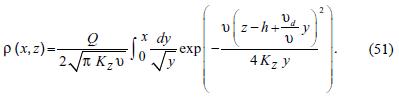
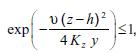
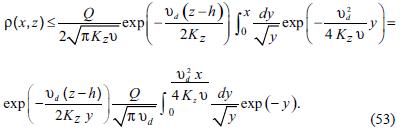
<body><![CDATA[<p align="justify"><font face="verdana" size="2">It is interesting to compare the solution of the GM, equation (50), with the concentration corresponding to an infinite emission line, equation (17)&#150;(11). We can conclude that (50) corresponds to the superposition of flags coming from emission lines perpendicular to the wind, located between the points <i>&zeta;</i>,<i> = </i>0 and <i>&zeta;</sub> = x.</i></font></p>     <p align="justify"><font face="verdana" size="2">Although the integral in (50) has not an exact primitive, it can be solved using simple numerical methods. <a href="/img/revistas/atm/v21n2/a3f2.jpg" target="_blank">Figure 2</a> displays the solution of GM, evaluated for <i><img src="/img/revistas/atm/v21n2/a3s103.jpg"> = </i>5 m s<sup>&#150;1</sup>, <i>K<sub>z</sub> = </i>10 m<sup>2</sup> s<sup>-1</sup>,<i> h = </i>10 m and <i>Q = </i>1 (&micro;gm<sup>2</sup> s<sup>-1</sup>. For <img src="/img/revistas/atm/v21n2/a3s106.jpg"> the solution is calculated using the Simpson rule, with the procedure adapted from Numerical Recipes in C (Press <i>et al., </i>1993). At the left side of the figure, the evolution of the concentration downwind at three different heights is shown: at the emission height <i>z = h, </i>at <i>z = h/2 </i>and at the earth's surface <i>z = </i>0. At the right side of the figure, the vertical profile of the concentration at <i>x = </i>10(m) and <i>x = </i>100(m) is shown. As we have said early, the concentration is symmetric with respect to the emission plane but, opposite to the Gaussian plume, it is not derivable at it.</font></p>     <p align="justify"><font face="verdana" size="2"><i>3.2.2 Model with deposition flux</i></font></p>     <p align="justify"><font face="verdana" size="2">In order to include deposition in the model, we use equations (50), (12), (13) combined with the superposition principle. So, the solution can be written as the superposition of gaussian plumes coming from infinite emission lines, each one subject to deposition flux  <img src="/img/revistas/atm/v21n2/a3s107.jpg">We have:</font></p>     <p align="justify"><font face="verdana" size="2"><img src="/img/revistas/atm/v21n2/a3s85.jpg"></font></p>     <p align="justify"><font face="verdana" size="2">According to the above equation, the solution (51) increases downwind. For z fixed, the concentration remains bounded, as we show in the following.</font></p>     <p align="justify"><font face="verdana" size="2">Let us write (51) in the form:</font></p>     <p align="justify"><font face="verdana" size="2"><img src="/img/revistas/atm/v21n2/a3s86.jpg"></font></p>     <p align="justify"><font face="verdana" size="2">Because:</font></p>     <p align="justify"><font face="verdana" size="2"><img src="/img/revistas/atm/v21n2/a3s87.jpg"></font></p>     ]]></body>
<body><![CDATA[<p align="justify"><font face="verdana" size="2">we have:</font></p>     <p align="justify"><font face="verdana" size="2"><img src="/img/revistas/atm/v21n2/a3s88.jpg"></font></p>     <p align="justify"><font face="verdana" size="2">If  <img src="/img/revistas/atm/v21n2/a3s89.jpg">the integral at the right side converge to:</font></p>     <p align="justify"><font face="verdana" size="2"><img src="/img/revistas/atm/v21n2/a3s108.jpg"></font></p>     <p align="justify"><font face="verdana" size="2">with the &Gamma;&#150;function defined by Arfken and Weber (1971):</font></p>     <p align="justify"><font face="verdana" size="2"><img src="/img/revistas/atm/v21n2/a3s90.jpg"></font></p>     <p align="justify"><font face="verdana" size="2">So, we find:</font></p>     <p align="justify"><font face="verdana" size="2"><img src="/img/revistas/atm/v21n2/a3s91.jpg"></font></p>     <p align="justify"><font face="verdana" size="2">where the equality is valid only at the emission plane, <i>z = h. </i>We have:</font></p>     <p align="justify"><font face="verdana" size="2"><img src="/img/revistas/atm/v21n2/a3s92.jpg"></font></p>     ]]></body>
<body><![CDATA[<p align="justify"><font face="verdana" size="2">We note that the bound at the emission plane coincides with the one obtained with PVMM (see section 3.1, equation (27).</font></p>     <p align="justify"><font face="verdana" size="2"><i>3.2.3 Effect of the earth surface</i></font></p>     <p align="justify"><font face="verdana" size="2">In a similar way as for a point and a linear sources, described in section 2.1, the effect of the soil can be taken in to account, by adding to the solution (50) a plume coming from an image plane at<i> z=  &#150;h.</i></font></p>     <p align="justify"><font face="verdana" size="2">In the particular case that the emission plane is located at the earth surface <i>z = 0, </i>original and image plumes coincide and the solution is given by:</font></p>     <p align="justify"><font face="verdana" size="2"><img src="/img/revistas/atm/v21n2/a3s93.jpg"></font></p>     <p align="justify"><font face="verdana" size="2">&nbsp;</font></p>     <p align="justify"><font face="verdana" size="2"><b>4. Comparison between PVMM and GM</b></font></p>     <p align="justify"><font face="verdana" size="2">In the above section, we have shown that the asymptotic behavior of models PVMM and GM is similar: both models predict that the concentration of the pollutant increases downwind. Due to deposition, the concentration does not increase indefinitely, but it remains bounded. We found that the upper value of the concentration calculated with PVMM coincides with those calculated with GM at the emission height <i>z = h.</i></font></p>     <p align="justify"><font face="verdana" size="2">This result is interesting due to the following: in the construction of the models, different hypothesis are assumed and so, both models include different parameters. Besides the common parameter <i><img src="/img/revistas/atm/v21n2/a3s103.jpg">, <img src="/img/revistas/atm/v21n2/a3s96.jpg">Q, </i>PVMM depends on the mixing height <i>H </i>and GM on the vertical turbulent coefficient <i>K<sub>z</sub>.</i></font></p>     <p align="justify"><font face="verdana" size="2"><a href="/img/revistas/atm/v21n2/a3f3.jpg" target="_blank">Figure 3</a> displays the downwind behavior of the concentration calculated with PVMM (curve 1), and the one calculated with GM at the emission height <i>z = h, </i>for two different values of the vertical diffusion coefficients, <i>K<sub>z</sub> = </i>5 m<sup>2</sup> s<sup>&#150;1</sup> (curve 2) and <i>K<sub>z</sub>= </i>10 m<sup>2</sup> s<sup>&#150;1</sup> (curve 3). The solutions are evaluated for <i><i><img src="/img/revistas/atm/v21n2/a3s103.jpg"></i>= </i>5 m s<sup>&#150;1</sup>,<i><img src="/img/revistas/atm/v21n2/a3s102.jpg">= </i>0.05 m s<sup>&#150;1</sup> and <i>Q = </i>1 &micro;g m<sup>-2 </sup>s. For PVMM, the mixing height <i>H</i>=500 m.</font></p>     ]]></body>
<body><![CDATA[<p align="justify"><font face="verdana" size="2">According to the early results, the three solutions converge to the saturation value &rho;<sub>s</sub> = <i>Q l<img src="/img/revistas/atm/v21n2/a3s102.jpg"> = </i>20 &micro;gm<sup>&#150;3</sup> in the limit x <img src="/img/revistas/atm/v21n2/a3s89.jpg"> On the other hand, if <i>K<sub>z</sub> = </i>10 m<sup>2</sup> s<sup>&#150;1</sup>, GM is closer to PVMM than if<i> K<sub>z</sub>= </i>5 m<sup>2</sup> s<sup>&#150;1</sup>.</font></p>     <p align="justify"><font face="verdana" size="2">To find a general relation between <i>H </i>and <i>K<sub>z</sub> </i>that minimizes the distance between PVMM and GM at <i>z = h, </i>is a problem that could be studied in a future investigation.</font></p>     <p align="justify"><font face="verdana" size="2">&nbsp;</font></p>     <p align="justify"><font face="verdana" size="2"><b>5. Validation of the models</b></font></p>     <p align="justify"><font face="verdana" size="2">The validity of the models presented in this article is restricted to the cases in which the hypothesis of the models are satisfied. So, the PVMM model is valid if the atmospheric conditions imply that a perfect vertical mixture of the pollutant is given. The results of this model could be used in a similar form as the usual BM, we could then omit an estimate of the downwind variation of the concentration of the pollutant.</font></p>     <p align="justify"><font face="verdana" size="2">In this section we analyze the space distribution of particulate matter PM<sub>10</sub>, also particles &lt; 10 &micro;m in size, measured in two ground stations in Temuco&#150;Padre Las Casas, Chile (38.77&deg; S, 72.63&deg; W, 210,000 inhabitants). Since the available information is not enough to know what model, PVMM or GM, must be applied in this case &#150;the vertical structure of the atmosphere is unknown&#150; and the experimental data measured in two stations are insufficient to analyze the quantitative downwind behavior of the concentration of PM<sub>10</sub>, the validation shown here is only qualitative. Because both models, PVMM and GM, predicted that the concentration of the pollutant increases downwind, we analyze if this condition is in agreement with the experimental results.</font></p>     <p align="justify"><font face="verdana" size="2">The city of Temuco and neighboring town Padre Las Casas, is threatened by high concentrations of particulate matter PM<sub>10</sub> and PM<sub>25</sub>, especially in autumn and wintertime (from May to October) (Tsapakis <i>et al., </i>2002). Several studies indicate that wood burning used for house heating, contributes to more than 90% of the emissions of particles. This phenomena has been observed just in 1996 by the Department of Biochemistry and Environment Toxicology of the University of Chile (in Technical Report, CONAMA, 1999). Since November 1998, the Chilean Commission of Environment (CONAMA) has measured the concentration of particles PM<sub>10</sub> and the small particles PM<sub>25</sub>, using Harvard Impactor, with a frequency of 4 days in 6 stations distributed in the city.</font></p>     <p align="justify"><font face="verdana" size="2">Only after June 2000, the Chilean Center of Environment CENMA in cooperation with CONAMA (CENMA&#150;CONAMA, 2001) performs systematic, continuous measurements of PM<sub>10 </sub>with TEOM equipment (Tapered Element Oscillating Microbalance), in the station Las Encinas (LE). Later, in 2003, a second station of PM<sub>10</sub> was installed in the sector of Padre Las Casas (PLC). In both stations, PM<sub>10</sub> concentrations and meteorological variables are measured at 10 m height. The location of the two stations is shown in <a href="/img/revistas/atm/v21n2/a3f4.jpg" target="_blank">Figure 4</a>.</font></p>     <p align="justify"><font face="verdana" size="2">The results of this campaign are dramatic. In several occasions, concentrations over 800 (&micro;g m<sup>&#150;3</sup>) were registered. Only in the period between March and July 2001,17 events in which the concentrations of PM<sub>10</sub> exceed the Chilean norm (150 &micro;g m<sup>&#150;3</sup>, 24 hours mean value) were detected (CONAMA, 2004). Since these high concentrations have been observed thereafter, in April 2005 CONAMA declared Temuco&#150;Padre Las Casas, as a region over saturated on particulate matter PM<sub>10</sub>.</font></p>     <p align="justify"><font face="verdana" size="2">Because the principal source of PM<sub>10</sub> is the smoke coming from particular houses, the source can, in a first approximation, be considered as an homogeneous plane, and can be written as equation (19). The parameter <i>h </i>represents the mean height of the chimneys.</font></p>     ]]></body>
<body><![CDATA[<p align="justify"><font face="verdana" size="2">The analysis shown in this section is based in the CENMA&#150;CONAMA report (CENMA&#150;CONAMA, 2003). We proceed as follows: from the available data (June&#150;September 2003) we choose the data which satisfy, in some approximation, the hypothesis of the models:</font></p>     <p align="justify"><font face="verdana" size="2">&bull; Steady state: we choose episodes where both, PM<sub>10</sub> concentration and wind vector, do not present important variations in a period of at least one hour.</font></p>     <blockquote>       <p align="justify"><font face="verdana" size="2">&bull; The wind direction &theta; in both stations is similar. We impose that the maximum deviation &Delta;&theta;, with respect to the mean value &lt; &theta;&gt; must be smaller than 15&deg;. This condition is very important because, due to the irregular geometry of the city, small variations in wind direction 0 can introduce important variations in the parameter x, as we can see in <a href="/img/revistas/atm/v21n2/a3f4.jpg" target="_blank">Figure 4</a>.</font></p>       <p align="justify"><font face="verdana" size="2">&bull; The chosen episodes have a duration of 2 to 3 hours. In this time interval, we calculate the relevant variables: mean value of wind direction &lt; &theta; &gt;, mean value of the concentration of particular matter &lt; &rho; &gt;, and the distance from the beginning of the city to the station x, measured downwind.</font></p>       <p align="justify"><font face="verdana" size="2">&bull; In order to test the validity of the hypothesis of the model, the maximum deviation of wind direction &Delta;&theta;, and the mean value of wind &lt; <i><img src="/img/revistas/atm/v21n2/a3s103.jpg"> &gt; </i>is evaluated. This last parameter is not used in the analysis.</font></p> </blockquote>     <p align="justify"><font face="verdana" size="2">We recall that in the analyzed cases, the magnitude of the wind in both stations is, in general different. However, this fact is not important: the models shown in section 2 can be generalized for a non&#150;homogeneous wind. The result is similar: the concentration increases downwind.</font></p>     <p align="justify"><font face="verdana" size="2">A description of the analyzed episodes is shown in <a href="/img/revistas/atm/v21n2/a3t1.jpg" target="_blank">Table I</a>. The subindex <i>PLC </i>and<i> LE </i>represent the values of the corresponding variables measured in the stations Padre Las Casas and Las Encinas, respectively.</font></p>     <p align="justify"><font face="verdana" size="2">The four episodes shown in <a href="/img/revistas/atm/v21n2/a3t1.jpg" target="_blank">Table I</a> are represented in <a href="/img/revistas/atm/v21n2/a3f5.jpg" target="_blank">Figure 5</a>. The arrow at the middle of the figure represents the direction of the wind; at the left side, the distance between the monitoring station and the origin of the city x, in arbitrary units, is shown. At the right side of the figure, the variation of the PM<sub>10</sub> concentration as function of the distance x is represented. The figure shows that the experimental data are in qualitative good agreement with the models: the concentration increases downwind.</font></p>     <p align="justify"><font face="verdana" size="2">We note that the validation presented in this section is not enough to show the validity of the models presented in this article. Nevertheless, the models correspond to generalization of known analytical, steady state solutions of the general pollutant dispersion equation, and so we can expect that they are valid if the postulated hypotheses are satisfied.</font></p>     ]]></body>
<body><![CDATA[<p align="justify"><font face="verdana" size="2">&nbsp;</font></p>     <p align="justify"><font face="verdana" size="2"><b>6. Summary and conclusions</b></font></p>     <p align="justify"><font face="verdana" size="2">In this article we show two simple air quality models, also solutions of the general dispersion equation of the concentration of an inert pollutant, for an homogeneous plane source, parallel to the earth's surface. The models could be used to a first analysis of a pollution problem, for example, in a city.</font></p>     <p align="justify"><font face="verdana" size="2">At first we construct the 1&#150;dimensional model PVMM, which assumes a perfect vertical mixture from the surface of the earth aloft to the mixing height. The model corresponds to a generalization of box model and describes the downwind evolution of the concentration of the pollutant.</font></p>     <p align="justify"><font face="verdana" size="2">After that, we show the 2&#150;dimensional model GM, which introduces vertical diffusion to the system. This model generalizes gaussian models to a plane source.</font></p>     <p align="justify"><font face="verdana" size="2">We recall that there exist models in the literature that correspond to numerical solutions of the equation associated to GM, as for example the Airviro system (<a href="http://www.indic-airviro.smhi.se/" target="_blank">http://www.indic&#150;airviro.smhi.se</a>), and the ISCST model (<A href=http://www.epa.gov/ target="_blank">http://www.epa.gov/)</A>. Opposite to these models, PVMM and GM are essentially analytic and simple to use.</font></p>     <p align="justify"><font face="verdana" size="2">Both models predict that the concentration increases downwind and, due to deposition, it remains bounded. The upper bound of the concentration calculated with PVMM &rho;<sub>s</sub><i> = Q /<img src="/img/revistas/atm/v21n2/a3s96.jpg"></i>is independent of the meteorological conditions, and coincides with those calculated with GM at the emission height.</font></p>     <p align="justify"><font face="verdana" size="2">The solution calculated with GM shows that the concentration of the pollutant achieves the maximum value at the emission height <i>h.</i></font></p>     <p align="justify"><font face="verdana" size="2">In order to test the validity of the models, we analyze the downwind variation of the concentration of particular matter PM<sub>10</sub> in Temuco&#150;Padre Las Casas (Chile), measured in two ground stations. As predicted by both models, PVMM and GM, we found that the PM<sub>10</sub> concentration increases windward.</font></p>     <p align="justify"><font face="verdana" size="2">&nbsp;</font></p>     ]]></body>
<body><![CDATA[<p align="justify"><font face="verdana" size="2"><b>Acknowledgements</b></font></p>     <p align="justify"><font face="verdana" size="2">This work was supported by project EP120428, Universidad de La Frontera. We thank CONAMA, IX Regi&oacute;n, for given experimental data of PM<sub>10</sub> concentrations.</font></p>     <p align="justify"><font face="verdana" size="2">&nbsp;</font></p>     <p align="justify"><font face="verdana" size="2"><b>References</b></font></p>     <!-- ref --><p align="justify"><font face="verdana" size="2">Amann H., 1990. <i>Ordinary differential equations: an introduction to nonlinear equations. </i>Walter de Gruyter, Hawthorne, N. Y, 458 pp.</font>&nbsp;&nbsp;&nbsp;&nbsp;&nbsp;&nbsp;&nbsp;&nbsp;[&#160;<a href="javascript:void(0);" onclick="javascript: window.open('/scielo.php?script=sci_nlinks&ref=1267724&pid=S0187-6236200800020000300001&lng=','','width=640,height=500,resizable=yes,scrollbars=1,menubar=yes,');">Links</a>&#160;]<!-- end-ref --><!-- ref --><p align="justify"><font face="verdana" size="2">Arfken G. B. and H. J. Weber, <i>1911. Mathematical methods for physicists. </i>Academic Press, Cambridge, University Press, 1200 pp.</font>&nbsp;&nbsp;&nbsp;&nbsp;&nbsp;&nbsp;&nbsp;&nbsp;[&#160;<a href="javascript:void(0);" onclick="javascript: window.open('/scielo.php?script=sci_nlinks&ref=1267725&pid=S0187-6236200800020000300002&lng=','','width=640,height=500,resizable=yes,scrollbars=1,menubar=yes,');">Links</a>&#160;]<!-- end-ref --><!-- ref --><p align="justify"><font face="verdana" size="2">CENMA&#150;CONAMA, 2001. Technical report. A study of the air quality in Chile, Temuco&#150;Padre Las Casas, in order to elaborate a plan of decontamination. Centro Nacional del Medio Ambiente, Comisi&oacute;n Nacional del Medio Ambiente, Chile.</font>&nbsp;&nbsp;&nbsp;&nbsp;&nbsp;&nbsp;&nbsp;&nbsp;[&#160;<a href="javascript:void(0);" onclick="javascript: window.open('/scielo.php?script=sci_nlinks&ref=1267726&pid=S0187-6236200800020000300003&lng=','','width=640,height=500,resizable=yes,scrollbars=1,menubar=yes,');">Links</a>&#160;]<!-- end-ref --><!-- ref --><p align="justify"><font face="verdana" size="2">CENMA&#150;CONAMA, 2003. Technical Report. A Study to the elaboration of an air quality control Programm in Temuco&#150;Padre Las Casas. Centro Nacional del Medio Ambiente, Comisi&oacute;n Nacional del Medio Ambiente, Chile.</font>&nbsp;&nbsp;&nbsp;&nbsp;&nbsp;&nbsp;&nbsp;&nbsp;[&#160;<a href="javascript:void(0);" onclick="javascript: window.open('/scielo.php?script=sci_nlinks&ref=1267727&pid=S0187-6236200800020000300004&lng=','','width=640,height=500,resizable=yes,scrollbars=1,menubar=yes,');">Links</a>&#160;]<!-- end-ref --><!-- ref --><p align="justify"><font face="verdana" size="2">CONAMA, 1999. Technical Report. A study of the Air Quality in Chile, Temuco&#150;Padre Las Casas. Centro Nacional del Medio Ambiente, Comisi&oacute;n Nacional del Medio Ambiente, Chile.</font>&nbsp;&nbsp;&nbsp;&nbsp;&nbsp;&nbsp;&nbsp;&nbsp;[&#160;<a href="javascript:void(0);" onclick="javascript: window.open('/scielo.php?script=sci_nlinks&ref=1267728&pid=S0187-6236200800020000300005&lng=','','width=640,height=500,resizable=yes,scrollbars=1,menubar=yes,');">Links</a>&#160;]<!-- end-ref --><!-- ref --><p align="justify"><font face="verdana" size="2">CONAMA, 2004. Technical Report. Antecedents to declare Temuco&#150;Padre Las Casas as a PM<sub>10 </sub>saturated zone. Centro Nacional del Medio Ambiente, Comisi&oacute;n Nacional del Medio Ambiente, Chile.</font>&nbsp;&nbsp;&nbsp;&nbsp;&nbsp;&nbsp;&nbsp;&nbsp;[&#160;<a href="javascript:void(0);" onclick="javascript: window.open('/scielo.php?script=sci_nlinks&ref=1267729&pid=S0187-6236200800020000300006&lng=','','width=640,height=500,resizable=yes,scrollbars=1,menubar=yes,');">Links</a>&#160;]<!-- end-ref --><!-- ref --><p align="justify"><font face="verdana" size="2">De Nevers N., 1995. <i>Air pollution control engineering, </i>Mc Graw Hill, New York, 608 pp.</font>&nbsp;&nbsp;&nbsp;&nbsp;&nbsp;&nbsp;&nbsp;&nbsp;[&#160;<a href="javascript:void(0);" onclick="javascript: window.open('/scielo.php?script=sci_nlinks&ref=1267730&pid=S0187-6236200800020000300007&lng=','','width=640,height=500,resizable=yes,scrollbars=1,menubar=yes,');">Links</a>&#160;]<!-- end-ref --><!-- ref --><p align="justify"><font face="verdana" size="2">Dirac P. A. M., 1958. <i>The principles of quantum mechanics, </i>4th ed. Oxford Sciences Publication, 314 pp.</font>&nbsp;&nbsp;&nbsp;&nbsp;&nbsp;&nbsp;&nbsp;&nbsp;[&#160;<a href="javascript:void(0);" onclick="javascript: window.open('/scielo.php?script=sci_nlinks&ref=1267731&pid=S0187-6236200800020000300008&lng=','','width=640,height=500,resizable=yes,scrollbars=1,menubar=yes,');">Links</a>&#160;]<!-- end-ref --><!-- ref --><p align="justify"><font face="verdana" size="2">Etling D., 2002. <i>Theoretische meteorologie. Eine einfilhrung. </i>2nd. ed., Springer Verlag, 354 pp. </font>&nbsp;&nbsp;&nbsp;&nbsp;&nbsp;&nbsp;&nbsp;&nbsp;[&#160;<a href="javascript:void(0);" onclick="javascript: window.open('/scielo.php?script=sci_nlinks&ref=1267732&pid=S0187-6236200800020000300009&lng=','','width=640,height=500,resizable=yes,scrollbars=1,menubar=yes,');">Links</a>&#160;]<!-- end-ref --><!-- ref --><p align="justify"><font face="verdana" size="2">Finlayson&#150;Pitts B. and J. Pitts, 2000. <i>Upper and lower atmosphere. </i>London, Academic Press, 969 pp.</font>&nbsp;&nbsp;&nbsp;&nbsp;&nbsp;&nbsp;&nbsp;&nbsp;[&#160;<a href="javascript:void(0);" onclick="javascript: window.open('/scielo.php?script=sci_nlinks&ref=1267733&pid=S0187-6236200800020000300010&lng=','','width=640,height=500,resizable=yes,scrollbars=1,menubar=yes,');">Links</a>&#160;]<!-- end-ref --><!-- ref --><p align="justify"><font face="verdana" size="2">Gardiner C. W., 2004. <i>Handbook for stochastic methods for physics, chemistry antinatural sciences, </i>3rd ed., Springer Verlag, 415 pp. </font>&nbsp;&nbsp;&nbsp;&nbsp;&nbsp;&nbsp;&nbsp;&nbsp;[&#160;<a href="javascript:void(0);" onclick="javascript: window.open('/scielo.php?script=sci_nlinks&ref=1267734&pid=S0187-6236200800020000300011&lng=','','width=640,height=500,resizable=yes,scrollbars=1,menubar=yes,');">Links</a>&#160;]<!-- end-ref --><!-- ref --><p align="justify"><font face="verdana" size="2">Gradel T. E. and P. J. Crutzen, 1992. <i>Atmospheric change: an earth system perspective. </i>W. H. Freeman, New York, 446 pp.</font>&nbsp;&nbsp;&nbsp;&nbsp;&nbsp;&nbsp;&nbsp;&nbsp;[&#160;<a href="javascript:void(0);" onclick="javascript: window.open('/scielo.php?script=sci_nlinks&ref=1267735&pid=S0187-6236200800020000300012&lng=','','width=640,height=500,resizable=yes,scrollbars=1,menubar=yes,');">Links</a>&#160;]<!-- end-ref --><!-- ref --><p align="justify"><font face="verdana" size="2">Grant I. S. and W. R. Phillips, 1991. <i>Electromagnetism. </i>2nd. Ed., John Wiley and Sons, 542 pp.</font>&nbsp;&nbsp;&nbsp;&nbsp;&nbsp;&nbsp;&nbsp;&nbsp;[&#160;<a href="javascript:void(0);" onclick="javascript: window.open('/scielo.php?script=sci_nlinks&ref=1267736&pid=S0187-6236200800020000300013&lng=','','width=640,height=500,resizable=yes,scrollbars=1,menubar=yes,');">Links</a>&#160;]<!-- end-ref --><!-- ref --><p align="justify"><font face="verdana" size="2">Hanna S. R., G. A. Briggs and R. P. Hosker, 1982. <i>Handbook on atmospheric diffusion. </i>Technical Information Center, U.S. Departament of Energy, Springfield, VA 22161, 102 pp.</font>&nbsp;&nbsp;&nbsp;&nbsp;&nbsp;&nbsp;&nbsp;&nbsp;[&#160;<a href="javascript:void(0);" onclick="javascript: window.open('/scielo.php?script=sci_nlinks&ref=1267737&pid=S0187-6236200800020000300014&lng=','','width=640,height=500,resizable=yes,scrollbars=1,menubar=yes,');">Links</a>&#160;]<!-- end-ref --><!-- ref --><p align="justify"><font face="verdana" size="2">Holton J. R., 1992. <i>An introduction to dynamic meteorology. </i>3rd ed., Academic Press, 511 pp.</font>&nbsp;&nbsp;&nbsp;&nbsp;&nbsp;&nbsp;&nbsp;&nbsp;[&#160;<a href="javascript:void(0);" onclick="javascript: window.open('/scielo.php?script=sci_nlinks&ref=1267738&pid=S0187-6236200800020000300015&lng=','','width=640,height=500,resizable=yes,scrollbars=1,menubar=yes,');">Links</a>&#160;]<!-- end-ref --><!-- ref --><p align="justify"><font face="verdana" size="2">Moreira D. M., M. T Vilhena, D. Buske and T Tirabassi, 2006. The GILTT solution of the advection&#150;diffusiom equation for an inhomogeneous and nonstationary PBL. <i>Atmos. Environ. </i><b>40</b>, 3186&#150;3194.</font>&nbsp;&nbsp;&nbsp;&nbsp;&nbsp;&nbsp;&nbsp;&nbsp;[&#160;<a href="javascript:void(0);" onclick="javascript: window.open('/scielo.php?script=sci_nlinks&ref=1267739&pid=S0187-6236200800020000300016&lng=','','width=640,height=500,resizable=yes,scrollbars=1,menubar=yes,');">Links</a>&#160;]<!-- end-ref --><!-- ref --><p align="justify"><font face="verdana" size="2">Moreira D. M., M. T. Vilhena, T. Tirabassi, D. Buske and R. Corta, 2005. Near&#150;source atmospheric pollutant dispersion using the new GILTT method. <i>Atmos. Environ. </i><b>39</b>, 6289&#150;6294.</font>&nbsp;&nbsp;&nbsp;&nbsp;&nbsp;&nbsp;&nbsp;&nbsp;[&#160;<a href="javascript:void(0);" onclick="javascript: window.open('/scielo.php?script=sci_nlinks&ref=1267740&pid=S0187-6236200800020000300017&lng=','','width=640,height=500,resizable=yes,scrollbars=1,menubar=yes,');">Links</a>&#160;]<!-- end-ref --><!-- ref --><p align="justify"><font face="verdana" size="2">Nester K. and H. J. Panitz, 2004, Evaluation of the chemistry transport model system KAMM/ DRAIS, based on daytime ground&#150;level ozone data. <i>Int. J. Environ. Poll. </i><b>22</b>, 87&#150;107.</font>&nbsp;&nbsp;&nbsp;&nbsp;&nbsp;&nbsp;&nbsp;&nbsp;[&#160;<a href="javascript:void(0);" onclick="javascript: window.open('/scielo.php?script=sci_nlinks&ref=1267741&pid=S0187-6236200800020000300018&lng=','','width=640,height=500,resizable=yes,scrollbars=1,menubar=yes,');">Links</a>&#160;]<!-- end-ref --><!-- ref --><p align="justify"><font face="verdana" size="2">Press W. H., S. A. Teukoksky, W. T. Vetterling and B. P. Flannery, 1993. <i>Numerical recipes in C: The art of scientific computing. </i>2nd., Cambridge University Press, 735 pp.</font>&nbsp;&nbsp;&nbsp;&nbsp;&nbsp;&nbsp;&nbsp;&nbsp;[&#160;<a href="javascript:void(0);" onclick="javascript: window.open('/scielo.php?script=sci_nlinks&ref=1267742&pid=S0187-6236200800020000300019&lng=','','width=640,height=500,resizable=yes,scrollbars=1,menubar=yes,');">Links</a>&#160;]<!-- end-ref --><!-- ref --><p align="justify"><font face="verdana" size="2">Robertson L. and J. Langer, 1999. An eulerian limited area atmospheric transport model, <i>J. App. Meteorol. </i><b>38</b>, 190&#150;209.</font>&nbsp;&nbsp;&nbsp;&nbsp;&nbsp;&nbsp;&nbsp;&nbsp;[&#160;<a href="javascript:void(0);" onclick="javascript: window.open('/scielo.php?script=sci_nlinks&ref=1267743&pid=S0187-6236200800020000300020&lng=','','width=640,height=500,resizable=yes,scrollbars=1,menubar=yes,');">Links</a>&#160;]<!-- end-ref --><!-- ref --><p align="justify"><font face="verdana" size="2">Seinfeld J. H. and S. N. Pandis, 1998. <i>Atmospheric chemistry and physics: from air pollution to climate change. </i>John Wiley and Sons, 1145 pp.</font>&nbsp;&nbsp;&nbsp;&nbsp;&nbsp;&nbsp;&nbsp;&nbsp;[&#160;<a href="javascript:void(0);" onclick="javascript: window.open('/scielo.php?script=sci_nlinks&ref=1267744&pid=S0187-6236200800020000300021&lng=','','width=640,height=500,resizable=yes,scrollbars=1,menubar=yes,');">Links</a>&#160;]<!-- end-ref --><!-- ref --><p align="justify"><font face="verdana" size="2">Tsapakis M., E. Lagoudaki, E. G. Stephanou, I. G. Kavouras, P. Koutrakis, P. Oyola P. and P. von Baer, 2002. The composition and sources of PM<sub>25</sub> organic aerosol in two urban areas of Chile. <i>Atmos. Environ. </i><b>36</b>, 3851&#150;3863.</font>&nbsp;&nbsp;&nbsp;&nbsp;&nbsp;&nbsp;&nbsp;&nbsp;[&#160;<a href="javascript:void(0);" onclick="javascript: window.open('/scielo.php?script=sci_nlinks&ref=1267745&pid=S0187-6236200800020000300022&lng=','','width=640,height=500,resizable=yes,scrollbars=1,menubar=yes,');">Links</a>&#160;]<!-- end-ref --><!-- ref --><p align="justify"><font face="verdana" size="2">Turner D. B., 1994. <i>Workbook of atmospheric dispersion estimates: an introduction to dispersion modeling. </i>Lewis Publishers, 2nd Edition, 635 pp.</font>&nbsp;&nbsp;&nbsp;&nbsp;&nbsp;&nbsp;&nbsp;&nbsp;[&#160;<a href="javascript:void(0);" onclick="javascript: window.open('/scielo.php?script=sci_nlinks&ref=1267746&pid=S0187-6236200800020000300023&lng=','','width=640,height=500,resizable=yes,scrollbars=1,menubar=yes,');">Links</a>&#160;]<!-- end-ref --><!-- ref --><p align="justify"><font face="verdana" size="2">Vogel B., F. Fiedler and H. Vogel, 1995. Influence of topography and biogenic volatile organic compounds emission in the state of Baden&#150;W&uuml;rtenberg on ozone concentrations during episodes of high temperatures, J <i>Geoph. Res. </i><b>11</b>, 22907&#150;22928.</font>&nbsp;&nbsp;&nbsp;&nbsp;&nbsp;&nbsp;&nbsp;&nbsp;[&#160;<a href="javascript:void(0);" onclick="javascript: window.open('/scielo.php?script=sci_nlinks&ref=1267747&pid=S0187-6236200800020000300024&lng=','','width=640,height=500,resizable=yes,scrollbars=1,menubar=yes,');">Links</a>&#160;]<!-- end-ref --><!-- ref --><p align="justify"><font face="verdana" size="2">Wayne R. P., 1994. <i>Chemistry of the atmosphere. </i>University Press, New York, 447 pp.</font>&nbsp;&nbsp;&nbsp;&nbsp;&nbsp;&nbsp;&nbsp;&nbsp;[&#160;<a href="javascript:void(0);" onclick="javascript: window.open('/scielo.php?script=sci_nlinks&ref=1267748&pid=S0187-6236200800020000300025&lng=','','width=640,height=500,resizable=yes,scrollbars=1,menubar=yes,');">Links</a>&#160;]<!-- end-ref --><!-- ref --><p align="justify"><font face="verdana" size="2">Wark K., C. F. Warmer and W. T. Davis, 1998. <i>Air pollution: its origin and control. </i>Harper and Row Publishers, 578 pp.</font>&nbsp;&nbsp;&nbsp;&nbsp;&nbsp;&nbsp;&nbsp;&nbsp;[&#160;<a href="javascript:void(0);" onclick="javascript: window.open('/scielo.php?script=sci_nlinks&ref=1267749&pid=S0187-6236200800020000300026&lng=','','width=640,height=500,resizable=yes,scrollbars=1,menubar=yes,');">Links</a>&#160;]<!-- end-ref --><!-- ref --><p align="justify"><font face="verdana" size="2">Wortmann S., M. T. Vilhena, D. M. Moreira and D. Buske, 2005. A new analytical approach to simulate the pollutant dispersion in the PBL. <i>Atmos. Environ. </i><b>39</b>, 2171&#150;2178.</font>&nbsp;&nbsp;&nbsp;&nbsp;&nbsp;&nbsp;&nbsp;&nbsp;[&#160;<a href="javascript:void(0);" onclick="javascript: window.open('/scielo.php?script=sci_nlinks&ref=1267750&pid=S0187-6236200800020000300027&lng=','','width=640,height=500,resizable=yes,scrollbars=1,menubar=yes,');">Links</a>&#160;]<!-- end-ref --> ]]></body><back>
<ref-list>
<ref id="B1">
<nlm-citation citation-type="book">
<person-group person-group-type="author">
<name>
<surname><![CDATA[Amann]]></surname>
<given-names><![CDATA[H]]></given-names>
</name>
</person-group>
<source><![CDATA[Ordinary differential equations: an introduction to nonlinear equations]]></source>
<year>1990</year>
<page-range>458</page-range><publisher-loc><![CDATA[Hawthorne^eN. Y N. Y]]></publisher-loc>
<publisher-name><![CDATA[Walter de Gruyter]]></publisher-name>
</nlm-citation>
</ref>
<ref id="B2">
<nlm-citation citation-type="book">
<person-group person-group-type="author">
<name>
<surname><![CDATA[Arfken]]></surname>
<given-names><![CDATA[G. B]]></given-names>
</name>
<name>
<surname><![CDATA[Weber]]></surname>
<given-names><![CDATA[H. J]]></given-names>
</name>
</person-group>
<source><![CDATA[Mathematical methods for physicists]]></source>
<year>1911</year>
<page-range>1200</page-range><publisher-loc><![CDATA[Cambridge ]]></publisher-loc>
<publisher-name><![CDATA[Academic PressUniversity Press]]></publisher-name>
</nlm-citation>
</ref>
<ref id="B3">
<nlm-citation citation-type="book">
<collab>CENMA-CONAMA</collab>
<source><![CDATA[Technical report: A study of the air quality in Chile, Temuco-Padre Las Casas, in order to elaborate a plan of decontamination]]></source>
<year>2001</year>
<publisher-name><![CDATA[Centro Nacional del Medio Ambiente, Comisión Nacional del Medio Ambiente]]></publisher-name>
</nlm-citation>
</ref>
<ref id="B4">
<nlm-citation citation-type="book">
<collab>CENMA-CONAMA</collab>
<source><![CDATA[Technical Report: A Study to the elaboration of an air quality control Programm in Temuco-Padre Las Casas]]></source>
<year>2003</year>
<publisher-name><![CDATA[Centro Nacional del Medio Ambiente, Comisión Nacional del Medio Ambiente]]></publisher-name>
</nlm-citation>
</ref>
<ref id="B5">
<nlm-citation citation-type="book">
<collab>CONAMA</collab>
<source><![CDATA[Technical Report: A study of the Air Quality in Chile, Temuco-Padre Las Casas]]></source>
<year>1999</year>
<publisher-name><![CDATA[Centro Nacional del Medio Ambiente, Comisión Nacional del Medio Ambiente]]></publisher-name>
</nlm-citation>
</ref>
<ref id="B6">
<nlm-citation citation-type="book">
<collab>CONAMA</collab>
<source><![CDATA[Technical Report: Antecedents to declare Temuco-Padre Las Casas as a PM10 saturated zone]]></source>
<year>2004</year>
<publisher-name><![CDATA[Centro Nacional del Medio Ambiente, Comisión Nacional del Medio Ambiente]]></publisher-name>
</nlm-citation>
</ref>
<ref id="B7">
<nlm-citation citation-type="book">
<person-group person-group-type="author">
<name>
<surname><![CDATA[De Nevers]]></surname>
<given-names><![CDATA[N]]></given-names>
</name>
</person-group>
<source><![CDATA[Air pollution control engineering]]></source>
<year>1995</year>
<page-range>608</page-range><publisher-loc><![CDATA[New York ]]></publisher-loc>
<publisher-name><![CDATA[Mc Graw Hill]]></publisher-name>
</nlm-citation>
</ref>
<ref id="B8">
<nlm-citation citation-type="book">
<person-group person-group-type="author">
<name>
<surname><![CDATA[Dirac]]></surname>
<given-names><![CDATA[P. A. M]]></given-names>
</name>
</person-group>
<source><![CDATA[The principles of quantum mechanics]]></source>
<year>1958</year>
<edition>4</edition>
<page-range>314</page-range><publisher-name><![CDATA[Oxford Sciences Publication]]></publisher-name>
</nlm-citation>
</ref>
<ref id="B9">
<nlm-citation citation-type="book">
<person-group person-group-type="author">
<name>
<surname><![CDATA[Etling]]></surname>
<given-names><![CDATA[D]]></given-names>
</name>
</person-group>
<source><![CDATA[Theoretische meteorologie: Eine einfilhrung]]></source>
<year>2002</year>
<edition>2</edition>
<page-range>354</page-range><publisher-name><![CDATA[Springer Verlag]]></publisher-name>
</nlm-citation>
</ref>
<ref id="B10">
<nlm-citation citation-type="book">
<person-group person-group-type="author">
<name>
<surname><![CDATA[Finlayson-Pitts]]></surname>
<given-names><![CDATA[B]]></given-names>
</name>
<name>
<surname><![CDATA[Pitts]]></surname>
<given-names><![CDATA[J]]></given-names>
</name>
</person-group>
<source><![CDATA[Upper and lower atmosphere]]></source>
<year>2000</year>
<page-range>969</page-range><publisher-loc><![CDATA[London ]]></publisher-loc>
<publisher-name><![CDATA[Academic Press]]></publisher-name>
</nlm-citation>
</ref>
<ref id="B11">
<nlm-citation citation-type="book">
<person-group person-group-type="author">
<name>
<surname><![CDATA[Gardiner]]></surname>
<given-names><![CDATA[C. W]]></given-names>
</name>
</person-group>
<source><![CDATA[Handbook for stochastic methods for physics, chemistry antinatural sciences]]></source>
<year>2004</year>
<edition>3</edition>
<page-range>415</page-range><publisher-name><![CDATA[Springer Verlag]]></publisher-name>
</nlm-citation>
</ref>
<ref id="B12">
<nlm-citation citation-type="book">
<person-group person-group-type="author">
<name>
<surname><![CDATA[Gradel]]></surname>
<given-names><![CDATA[T. E]]></given-names>
</name>
<name>
<surname><![CDATA[Crutzen]]></surname>
<given-names><![CDATA[P. J.]]></given-names>
</name>
</person-group>
<source><![CDATA[Atmospheric change: an earth system perspective]]></source>
<year>1992</year>
<page-range>446</page-range><publisher-loc><![CDATA[New York ]]></publisher-loc>
<publisher-name><![CDATA[W. H. Freeman]]></publisher-name>
</nlm-citation>
</ref>
<ref id="B13">
<nlm-citation citation-type="book">
<person-group person-group-type="author">
<name>
<surname><![CDATA[Grant]]></surname>
<given-names><![CDATA[I. S]]></given-names>
</name>
<name>
<surname><![CDATA[Phillips]]></surname>
<given-names><![CDATA[W. R]]></given-names>
</name>
</person-group>
<source><![CDATA[Electromagnetism]]></source>
<year>1991</year>
<edition>2</edition>
<page-range>542</page-range><publisher-name><![CDATA[John Wiley and Sons]]></publisher-name>
</nlm-citation>
</ref>
<ref id="B14">
<nlm-citation citation-type="book">
<person-group person-group-type="author">
<name>
<surname><![CDATA[Hanna]]></surname>
<given-names><![CDATA[S. R]]></given-names>
</name>
<name>
<surname><![CDATA[Briggs]]></surname>
<given-names><![CDATA[G. A]]></given-names>
</name>
<name>
<surname><![CDATA[Hosker]]></surname>
<given-names><![CDATA[R. P]]></given-names>
</name>
</person-group>
<source><![CDATA[Handbook on atmospheric diffusion]]></source>
<year>1982</year>
<volume>22161</volume>
<page-range>102</page-range><publisher-loc><![CDATA[Springfield^eVA VA]]></publisher-loc>
<publisher-name><![CDATA[Technical Information Center, U.S. Departament of Energy]]></publisher-name>
</nlm-citation>
</ref>
<ref id="B15">
<nlm-citation citation-type="book">
<person-group person-group-type="author">
<name>
<surname><![CDATA[Holton]]></surname>
<given-names><![CDATA[J. R]]></given-names>
</name>
</person-group>
<source><![CDATA[An introduction to dynamic meteorology]]></source>
<year>1992</year>
<edition>3</edition>
<page-range>511</page-range><publisher-name><![CDATA[Academic Press]]></publisher-name>
</nlm-citation>
</ref>
<ref id="B16">
<nlm-citation citation-type="journal">
<person-group person-group-type="author">
<name>
<surname><![CDATA[Moreira]]></surname>
<given-names><![CDATA[D. M]]></given-names>
</name>
<name>
<surname><![CDATA[Vilhena]]></surname>
<given-names><![CDATA[M. T]]></given-names>
</name>
<name>
<surname><![CDATA[Buske]]></surname>
<given-names><![CDATA[D]]></given-names>
</name>
<name>
<surname><![CDATA[Tirabassi]]></surname>
<given-names><![CDATA[T]]></given-names>
</name>
</person-group>
<article-title xml:lang="en"><![CDATA[The GILTT solution of the advection-diffusiom equation for an inhomogeneous and nonstationary PBL]]></article-title>
<source><![CDATA[Atmos. Environ]]></source>
<year>2006</year>
<numero>40</numero>
<issue>40</issue>
<page-range>3186-3194</page-range></nlm-citation>
</ref>
<ref id="B17">
<nlm-citation citation-type="journal">
<person-group person-group-type="author">
<name>
<surname><![CDATA[Moreira]]></surname>
<given-names><![CDATA[D. M]]></given-names>
</name>
<name>
<surname><![CDATA[Vilhena]]></surname>
<given-names><![CDATA[M. T]]></given-names>
</name>
<name>
<surname><![CDATA[Tirabassi]]></surname>
<given-names><![CDATA[T]]></given-names>
</name>
<name>
<surname><![CDATA[Buske]]></surname>
<given-names><![CDATA[D]]></given-names>
</name>
<name>
<surname><![CDATA[Corta]]></surname>
<given-names><![CDATA[R]]></given-names>
</name>
</person-group>
<article-title xml:lang="en"><![CDATA[Near-source atmospheric pollutant dispersion using the new GILTT method]]></article-title>
<source><![CDATA[Atmos. Environ]]></source>
<year>2005</year>
<numero>39</numero>
<issue>39</issue>
<page-range>6289-6294</page-range></nlm-citation>
</ref>
<ref id="B18">
<nlm-citation citation-type="journal">
<person-group person-group-type="author">
<name>
<surname><![CDATA[Nester]]></surname>
<given-names><![CDATA[K]]></given-names>
</name>
<name>
<surname><![CDATA[Panitz]]></surname>
<given-names><![CDATA[H. J]]></given-names>
</name>
</person-group>
<article-title xml:lang="en"><![CDATA[Evaluation of the chemistry transport model system KAMM/ DRAIS, based on daytime ground-level ozone data]]></article-title>
<source><![CDATA[Int. J. Environ. Poll]]></source>
<year>2004</year>
<numero>22</numero>
<issue>22</issue>
<page-range>87-107</page-range></nlm-citation>
</ref>
<ref id="B19">
<nlm-citation citation-type="book">
<person-group person-group-type="author">
<name>
<surname><![CDATA[Press]]></surname>
<given-names><![CDATA[W. H]]></given-names>
</name>
<name>
<surname><![CDATA[Teukoksky]]></surname>
<given-names><![CDATA[S. A]]></given-names>
</name>
<name>
<surname><![CDATA[Vetterling]]></surname>
<given-names><![CDATA[W. T]]></given-names>
</name>
<name>
<surname><![CDATA[Flannery]]></surname>
<given-names><![CDATA[B. P]]></given-names>
</name>
</person-group>
<source><![CDATA[Numerical recipes in C: The art of scientific computing]]></source>
<year>1993</year>
<edition>2</edition>
<page-range>735</page-range><publisher-name><![CDATA[Cambridge University Press]]></publisher-name>
</nlm-citation>
</ref>
<ref id="B20">
<nlm-citation citation-type="journal">
<person-group person-group-type="author">
<name>
<surname><![CDATA[Robertson]]></surname>
<given-names><![CDATA[L]]></given-names>
</name>
<name>
<surname><![CDATA[Langer]]></surname>
<given-names><![CDATA[J]]></given-names>
</name>
</person-group>
<article-title xml:lang="en"><![CDATA[An eulerian limited area atmospheric transport model]]></article-title>
<source><![CDATA[J. App. Meteorol]]></source>
<year>1999</year>
<numero>38</numero>
<issue>38</issue>
<page-range>190-209</page-range></nlm-citation>
</ref>
<ref id="B21">
<nlm-citation citation-type="book">
<person-group person-group-type="author">
<name>
<surname><![CDATA[Seinfeld]]></surname>
<given-names><![CDATA[J. H]]></given-names>
</name>
<name>
<surname><![CDATA[Pandis]]></surname>
<given-names><![CDATA[S. N]]></given-names>
</name>
</person-group>
<source><![CDATA[Atmospheric chemistry and physics: from air pollution to climate change]]></source>
<year>1998</year>
<page-range>1145</page-range><publisher-name><![CDATA[John Wiley and Sons]]></publisher-name>
</nlm-citation>
</ref>
<ref id="B22">
<nlm-citation citation-type="journal">
<person-group person-group-type="author">
<name>
<surname><![CDATA[Tsapakis]]></surname>
<given-names><![CDATA[M]]></given-names>
</name>
<name>
<surname><![CDATA[Lagoudaki]]></surname>
<given-names><![CDATA[E]]></given-names>
</name>
<name>
<surname><![CDATA[Stephanou]]></surname>
<given-names><![CDATA[E. G]]></given-names>
</name>
<name>
<surname><![CDATA[Kavouras]]></surname>
<given-names><![CDATA[I. G]]></given-names>
</name>
<name>
<surname><![CDATA[Koutrakis]]></surname>
<given-names><![CDATA[P]]></given-names>
</name>
<name>
<surname><![CDATA[Oyola P]]></surname>
<given-names><![CDATA[P]]></given-names>
</name>
<name>
<surname><![CDATA[von Baer]]></surname>
<given-names><![CDATA[P]]></given-names>
</name>
</person-group>
<article-title xml:lang="en"><![CDATA[The composition and sources of PM25 organic aerosol in two urban areas of Chile]]></article-title>
<source><![CDATA[Atmos. Environ]]></source>
<year>2002</year>
<numero>36</numero>
<issue>36</issue>
<page-range>3851-3863</page-range></nlm-citation>
</ref>
<ref id="B23">
<nlm-citation citation-type="book">
<person-group person-group-type="author">
<name>
<surname><![CDATA[Turner]]></surname>
<given-names><![CDATA[D. B]]></given-names>
</name>
</person-group>
<source><![CDATA[Workbook of atmospheric dispersion estimates: an introduction to dispersion modeling]]></source>
<year>1994</year>
<edition>2</edition>
<page-range>635</page-range><publisher-name><![CDATA[Lewis Publishers]]></publisher-name>
</nlm-citation>
</ref>
<ref id="B24">
<nlm-citation citation-type="journal">
<person-group person-group-type="author">
<name>
<surname><![CDATA[Vogel]]></surname>
<given-names><![CDATA[B]]></given-names>
</name>
<name>
<surname><![CDATA[Fiedler]]></surname>
<given-names><![CDATA[F]]></given-names>
</name>
<name>
<surname><![CDATA[Vogel]]></surname>
<given-names><![CDATA[H]]></given-names>
</name>
</person-group>
<article-title xml:lang="en"><![CDATA[Influence of topography and biogenic volatile organic compounds emission in the state of Baden-Würtenberg on ozone concentrations during episodes of high temperatures]]></article-title>
<source><![CDATA[J Geoph. Res]]></source>
<year>1995</year>
<numero>11</numero>
<issue>11</issue>
<page-range>22907-22928</page-range></nlm-citation>
</ref>
<ref id="B25">
<nlm-citation citation-type="book">
<person-group person-group-type="author">
<name>
<surname><![CDATA[Wayne]]></surname>
<given-names><![CDATA[R. P]]></given-names>
</name>
</person-group>
<source><![CDATA[Chemistry of the atmosphere]]></source>
<year>1994</year>
<page-range>447</page-range><publisher-loc><![CDATA[New York ]]></publisher-loc>
<publisher-name><![CDATA[University Press]]></publisher-name>
</nlm-citation>
</ref>
<ref id="B26">
<nlm-citation citation-type="book">
<person-group person-group-type="author">
<name>
<surname><![CDATA[Wark]]></surname>
<given-names><![CDATA[K]]></given-names>
</name>
<name>
<surname><![CDATA[Warmer]]></surname>
<given-names><![CDATA[C. F]]></given-names>
</name>
<name>
<surname><![CDATA[Davis]]></surname>
<given-names><![CDATA[W. T]]></given-names>
</name>
</person-group>
<source><![CDATA[Air pollution: its origin and control]]></source>
<year>1998</year>
<page-range>578</page-range><publisher-name><![CDATA[Harper and Row Publishers]]></publisher-name>
</nlm-citation>
</ref>
<ref id="B27">
<nlm-citation citation-type="journal">
<person-group person-group-type="author">
<name>
<surname><![CDATA[Wortmann]]></surname>
<given-names><![CDATA[S]]></given-names>
</name>
<name>
<surname><![CDATA[Vilhena]]></surname>
<given-names><![CDATA[M. T]]></given-names>
</name>
<name>
<surname><![CDATA[Moreira]]></surname>
<given-names><![CDATA[D. M]]></given-names>
</name>
<name>
<surname><![CDATA[Buske]]></surname>
<given-names><![CDATA[D]]></given-names>
</name>
</person-group>
<article-title xml:lang="en"><![CDATA[A new analytical approach to simulate the pollutant dispersion in the PBL]]></article-title>
<source><![CDATA[Atmos. Environ]]></source>
<year>2005</year>
<numero>39</numero>
<issue>39</issue>
<page-range>2171-2178</page-range></nlm-citation>
</ref>
</ref-list>
</back>
</article>