<?xml version="1.0" encoding="ISO-8859-1"?><article xmlns:mml="http://www.w3.org/1998/Math/MathML" xmlns:xlink="http://www.w3.org/1999/xlink" xmlns:xsi="http://www.w3.org/2001/XMLSchema-instance">
<front>
<journal-meta>
<journal-id>0187-6236</journal-id>
<journal-title><![CDATA[Atmósfera]]></journal-title>
<abbrev-journal-title><![CDATA[Atmósfera]]></abbrev-journal-title>
<issn>0187-6236</issn>
<publisher>
<publisher-name><![CDATA[Universidad Nacional Autónoma de México, Instituto de Ciencias de la Atmósfera y Cambio Climático]]></publisher-name>
</publisher>
</journal-meta>
<article-meta>
<article-id>S0187-62362008000200002</article-id>
<title-group>
<article-title xml:lang="en"><![CDATA[Determination of temperature differences between asphalt concrete, soil and grass surfaces of the City of Erzurum, Turkey]]></article-title>
</title-group>
<contrib-group>
<contrib contrib-type="author">
<name>
<surname><![CDATA[YILMAZ]]></surname>
<given-names><![CDATA[H]]></given-names>
</name>
<xref ref-type="aff" rid="A01"/>
</contrib>
<contrib contrib-type="author">
<name>
<surname><![CDATA[TOY]]></surname>
<given-names><![CDATA[S]]></given-names>
</name>
<xref ref-type="aff" rid="A02"/>
</contrib>
<contrib contrib-type="author">
<name>
<surname><![CDATA[IRMAK]]></surname>
<given-names><![CDATA[M. A]]></given-names>
</name>
<xref ref-type="aff" rid="A03"/>
</contrib>
<contrib contrib-type="author">
<name>
<surname><![CDATA[YILMAZ]]></surname>
<given-names><![CDATA[S]]></given-names>
</name>
<xref ref-type="aff" rid="A03"/>
</contrib>
<contrib contrib-type="author">
<name>
<surname><![CDATA[BULUT]]></surname>
<given-names><![CDATA[Y]]></given-names>
</name>
<xref ref-type="aff" rid="A03"/>
</contrib>
</contrib-group>
<aff id="A01">
<institution><![CDATA[,Ataturk University Faculty of Agriculture Department of Landscape Architecture]]></institution>
<addr-line><![CDATA[ ]]></addr-line>
<country>Turkey</country>
</aff>
<aff id="A02">
<institution><![CDATA[,Meteorological Institute of Erzurum  ]]></institution>
<addr-line><![CDATA[ ]]></addr-line>
</aff>
<aff id="A03">
<institution><![CDATA[,Ataturk University Faculty of Agriculture Department of Landscape Architecture]]></institution>
<addr-line><![CDATA[ ]]></addr-line>
<country>Turkey</country>
</aff>
<pub-date pub-type="pub">
<day>00</day>
<month>04</month>
<year>2008</year>
</pub-date>
<pub-date pub-type="epub">
<day>00</day>
<month>04</month>
<year>2008</year>
</pub-date>
<volume>21</volume>
<numero>2</numero>
<fpage>135</fpage>
<lpage>146</lpage>
<copyright-statement/>
<copyright-year/>
<self-uri xlink:href="http://www.scielo.org.mx/scielo.php?script=sci_arttext&amp;pid=S0187-62362008000200002&amp;lng=en&amp;nrm=iso"></self-uri><self-uri xlink:href="http://www.scielo.org.mx/scielo.php?script=sci_abstract&amp;pid=S0187-62362008000200002&amp;lng=en&amp;nrm=iso"></self-uri><self-uri xlink:href="http://www.scielo.org.mx/scielo.php?script=sci_pdf&amp;pid=S0187-62362008000200002&amp;lng=en&amp;nrm=iso"></self-uri><abstract abstract-type="short" xml:lang="es"><p><![CDATA[Se sabe que las ciudades son más calientes y secas que sus áreas verdes circundantes. Además de sus aspectos estéticos, las plantas juegan importantes papeles en el funcionamiento de los ecosistemas urbanos al ofrecer distintos efectos favorables. La ciudad de Erzurum presenta características climáticas continentales extremas y es sumamente caliente en verano, es decir, durante el periodo comprendido entre junio y septiembre. Hay pocas especies de árboles capaces de crecer en la ciudad por lo que se piensa que en tales ciudades, el pasto puede tener efectos superiores sobre los árboles. El presente estudio se llevó a cabo a fin de determinar las diferencias de temperatura entre superficies de concreto asfáltico, tierra y pasto y a 2 m sobre ellas y para mostrar las ventajas del uso de superficies de pasto en este tipo de ciudades nuevas en desarrollo. Tras el estudio, se observó una diferencia de la temperatura media de 6.5 °C entre el concreto asfáltico (CA) y la tierra, 5.3 °C entre tierra y pasto y 11.79 °C entre superficies de CA y pasto, mientras las diferencias de temperatura a 2 m de altura de las superficies fue de 5.22 °C entre CA y tierra, 2.32 °C entre tierra y pasto y 7.54 °C entre superficies de CA y pasto. Se ha sugerido al final del estudio que en ciudades nuevas en desarrollo con características similares a Erzurum, los espacios abiertos entre las estructuras y áreas a lo largo de los caminos deben ser cubiertos con superficies de pasto y los espacios recreativos y estéticos deben permanecer.]]></p></abstract>
<abstract abstract-type="short" xml:lang="en"><p><![CDATA[It is known that cities are warmer and drier that the surrounding, vegetated areas. In addition to their aesthetic aspects, plants play important roles in urban ecosystems function by providing various favourable effects. The City or Erzurum has extreme continental climatic features and is very hot in summertime, i.e., the period between June and September. There are few tree species capable of growing in the city; it is thought that in such cities, grass may have superior effects to the trees. The present study was carried out to determine temperature differences between asphalt concrete (AC), soil and grass surfaces on and 2m above them and to show the advantages of the use of grass surfaces in this kind of new developing cities. After the study, it was seen a mean temperature difference of 6.5 °C between AC and soil, 5.3 °C between soil and grass, and 11.79 °C between AC and grass surfaces respectively, while temperature differences 2m above the surfaces were 5.22 °C between AC and soil, 2.32 °C between soil and grass, and 7.54 °C between AC and grass surfaces. It was suggested at the end of the study that in the new developing cities having the same features as Erzurum, open spaces between the structures and areas along the roads must be covered with grass surfaces and recreational and aesthetical spaces must be left.]]></p></abstract>
<kwd-group>
<kwd lng="en"><![CDATA[Asphalt concrete surfaces (AC)]]></kwd>
<kwd lng="en"><![CDATA[soil surfaces]]></kwd>
<kwd lng="en"><![CDATA[grass surfaces]]></kwd>
<kwd lng="en"><![CDATA[temperature differences]]></kwd>
</kwd-group>
</article-meta>
</front><body><![CDATA[ <p align="center"><font face="verdana" size="4"><b>Determination of temperature differences between asphalt concrete, soil and grass surfaces of the City of Erzurum, Turkey</b></font></p>     <p align="center"><font face="verdana" size="2">&nbsp;</font></p>     <p align="center"><font face="verdana" size="2"><b>H. YILMAZ </b><i>    <br>   Department of Landscape Architecture, Faculty of Agriculture, Ataturk University, 25240, Erzurum, Turkey </i>Corresponding author; e&#150;mails: <a href="mailto:hyilmaz@atauni.edu.tr">hyilmaz@atauni.edu.tr</a>, <a href="mailto:yilmazhsn@hotmail.com">yilmazhsn@hotmail.com</a></font></p>     <p align="center"><font face="verdana" size="2"><b>S. TOY</b>    <br> <i>Meteorological Institute of Erzurum, Turkey</i></font></p>     <p align="center"><font face="verdana" size="2"><b>M. A. IRMAK, S. YILMAZ, Y BULUT</b>    <br> <i>Department of Landscape Architecture, Faculty of Agriculture, </i><i>Ataturk University, 25240, Erzurum, Turkey</i></font></p>     <p align="justify"><font face="verdana" size="2">&nbsp;</font></p>     <p align="center"><font face="verdana" size="2">Received April 6, 2007; accepted August 16, 2007</font></p>     ]]></body>
<body><![CDATA[<p align="justify"><font face="verdana" size="2">&nbsp;</font></p>     <p align="justify"><font face="verdana" size="2"><b>RESUMEN</b></font></p>     <p align="justify"><font face="verdana" size="2">Se sabe que las ciudades son m&aacute;s calientes y secas que sus &aacute;reas verdes circundantes. Adem&aacute;s de sus aspectos est&eacute;ticos, las plantas juegan importantes papeles en el funcionamiento de los ecosistemas urbanos al ofrecer distintos efectos favorables. La ciudad de Erzurum presenta caracter&iacute;sticas clim&aacute;ticas continentales extremas y es sumamente caliente en verano, es decir, durante el periodo comprendido entre junio y septiembre. Hay pocas especies de &aacute;rboles capaces de crecer en la ciudad por lo que se piensa que en tales ciudades, el pasto puede tener efectos superiores sobre los &aacute;rboles. El presente estudio se llev&oacute; a cabo a fin de determinar las diferencias de temperatura entre superficies de concreto asf&aacute;ltico, tierra y pasto y a 2 m sobre ellas y para mostrar las ventajas del uso de superficies de pasto en este tipo de ciudades nuevas en desarrollo. Tras el estudio, se observ&oacute; una diferencia de la temperatura media de 6.5 &deg;C entre el concreto asf&aacute;ltico (CA) y la tierra, 5.3 &deg;C entre tierra y pasto y 11.79 &deg;C entre superficies de CA y pasto, mientras las diferencias de temperatura a 2 m de altura de las superficies fue de 5.22 &deg;C entre CA y tierra, 2.32 &deg;C entre tierra y pasto y 7.54 &deg;C entre superficies de CA y pasto. Se ha sugerido al final del estudio que en ciudades nuevas en desarrollo con caracter&iacute;sticas similares a Erzurum, los espacios abiertos entre las estructuras y &aacute;reas a lo largo de los caminos deben ser cubiertos con superficies de pasto y los espacios recreativos y est&eacute;ticos deben permanecer.</font></p>     <p align="justify"><font face="verdana" size="2">&nbsp;</font></p>     <p align="justify"><font face="verdana" size="2"><b>ABSTRACT</b></font></p>     <p align="justify"><font face="verdana" size="2">It is known that cities are warmer and drier that the surrounding, vegetated areas. In addition to their aesthetic aspects, plants play important roles in urban ecosystems function by providing various favourable effects. The City or Erzurum has extreme continental climatic features and is very hot in summertime, i.e., the period between June and September. There are few tree species capable of growing in the city; it is thought that in such cities, grass may have superior effects to the trees. The present study was carried out to determine temperature differences between asphalt concrete (AC), soil and grass surfaces on and 2m above them and to show the advantages of the use of grass surfaces in this kind of new developing cities. After the study, it was seen a mean temperature difference of 6.5 &deg;C between AC and soil, 5.3 &deg;C between soil and grass, and 11.79 &deg;C between AC and grass surfaces respectively, while temperature differences 2m above the surfaces were 5.22 &deg;C between AC and soil, 2.32 &deg;C between soil and grass, and 7.54 &deg;C between AC and grass surfaces. It was suggested at the end of the study that in the new developing cities having the same features as Erzurum, open spaces between the structures and areas along the roads must be covered with grass surfaces and recreational and aesthetical spaces must be left.</font></p>     <p align="justify"><font face="verdana" size="2"><b>Keywords: </b>Asphalt concrete surfaces (AC), soil surfaces, grass surfaces, temperature differences.</font></p>     <p align="justify"><font face="verdana" size="2">&nbsp;</font></p>     <p align="justify"><font face="verdana" size="2"><b>1. Introduction</b></font></p>     <p align="justify"><font face="verdana" size="2">That the cities have modified climate conditions and for this are warmer and drier than the surrounding and vegetated areas has been known since the study of Howard (1820). The reasons and size of this modification have been studied by many authors (e.g. Oke, 1978;Landsberg, 1981; Huang <i>et al., </i>1987; Myrup <i>et al., </i>1993; Grimmond <i>et al., </i>1993; Souch and Souch 1993; Heisler <i>et al., </i>1995; Unger, 1997; Robaa, 2003; Yilmaz <i>et al., </i>2007).</font></p>     ]]></body>
<body><![CDATA[<p align="justify"><font face="verdana" size="2">One of the primary causes of this modification is that in the process of urbanization, vegetated land surfaces are converted into concrete and asphalt surfaces (Akbari <i>et al., </i>1992; Asaeda <i>et al., </i>1996; Roth, 2002). The temperature difference between air above concrete runways and adjacent grass can be as much as 4 &deg;C (Anonymous, 2001). This is due to the reflectivity (albedo) differences between the surfaces (Pomerantz <i>et al., </i>2000). Dark pavement materials can store more heat than natural surfaces and lighter&#150;colored materials (Yang, 1972; Davis <i>et al., </i>1992; Asaeda <i>et al., </i>1996; Taha <i>et al., </i>1997; Doulos <i>et al., </i>2004; Synnefaeia/., 2006). Lawrence Berkeley Laboratory produced two major design concepts for mid&#150;latitude cities with hot and relatively dry summers (Garbesi <i>et al., </i>1989; Akbari <i>et al., </i>1992): 1) The use of light&#150;coloured surfaces to enhance the reflection of incoming solar radiation to reduce solar heating during daytime and hence decrease the need for cooling. 2) Planting of trees to reduce temperature through shading and evaporative cooling. Berg and Quinn (1978), reported that in mid&#150;summer, white painted roads with an albedo close to 0.55 have almost the same temperature as the ambient, while unpainted roads with albedo close to 0.15 were approximately 11 &deg;C warmer than the air. Santamouris <i>et al. </i>(2001) report asphalt temperatures close to 63 &deg;C and white pavements close to 45 &deg;C.</font></p>     <p align="justify"><font face="verdana" size="2">Plants improve the urban aesthetics (US Forest Service, 1991; Thompson <i>et al., </i>1999). In addition to their aesthetic aspects, plants play important roles in urban ecosystem function by providing canopy effect (Lee, 1978; Oke, 1978; Souch and Souch, 1993; McPherson <i>et al.,1994; </i>Simpson, 1998), water vapour to the environment through the evapotranspiration process (Heisler, 1986; Ackerman, 1987), air pollutant reduction (Smith, 1990;Nowak 1994a; Scott <i>et al., </i>1998; Scott <i>et al., </i>1999), carbon emission reduction, storage and sequestration (Nowak, 1994b; McPherson, 1998), structural heating and cooling cost reduction (Akbari <i>et al., </i>1992; McPherson, 1994; Simpson and McPherson, 1996; Simpson, 1998).</font></p>     <p align="justify"><font face="verdana" size="2">Air temperature differences of approximately 2 to 4 &deg;C have been observed for urban neighbourhoods of contrasting tree cover, averaging approximately 1 &deg;C per 10% of canopy cover (Huang <i>et al., </i>1987; Myrup <i>et al., </i>1993). In Sacramento, temperature differences of 5 to 7 &deg;C have been observed between tree&#150;shaded suburban and unirrigated grassland rural surroundings (Grimmond <i>et al., </i>1993). In another study, in the city of Erzurum, Turkey, the temperature difference between urban open area and urban forest was found as 0.7 &deg;C, between urban forest and natural vegetated rural area this was 1.0 &deg;C and between rural and urban area this was 1.7 &deg;C (Yilmaz <i>et al., </i>2007). The effects of evapotranspiration were found to be most noticeable in arid climates in Davis, California, where temperatures in neighbourhoods with mature trees can be 14 to 16 &deg;C cooler than neighbourhoods with young or no trees (Huang <i>et al., </i>1992).</font></p>     <p align="justify"><font face="verdana" size="2">The city of Erzurum has extreme continental climatic features and is very hot in summer time, i.e. the period between June and September (Toy <i>et al., </i>2007). In this period, in the city center, temperatures are at disturbing levels. Although the city is relatively small, it experiences all unfavorable effects of urban environment because of distorted urbanization and for not leaving adequate spaces for plants. Traditional pavement materials (e.g. asphalt and concrete) are predominant and the city faces with the great deterioration of natural vegetation.</font></p>     <p align="justify"><font face="verdana" size="2">There are few tree species capable of growing in the city; however, their growth is time consuming. For this, it is thought that in the city, grass may have superior effects over trees because trees grow more gradually and it is difficult to find the species that can grow under this relatively high altitude and cold environment.</font></p>     <p align="justify"><font face="verdana" size="2">The present study was carried out to determine temperature differences between AC, soil and grass surfaces on and 2 m above them and to show the advantages of the use of grass surfaces in this kind of new developing cities.</font></p>     <p align="justify"><font face="verdana" size="2">&nbsp;</font></p>     <p align="justify"><font face="verdana" size="2"><b>2. Material and methods</b></font></p>     <p align="justify"><font face="verdana" size="2">This study was conducted in the airbase area of the city of Erzurum, Turkey (<a href="/img/revistas/atm/v21n2/a2f1.jpg" target="_blank">Fig. 1</a>). Data were obtained from the station at an elevation of 1754 m and a location of 39&deg;.57N and 41&deg;.10E, in the airbase area lying about 7 km from the city (<a href="/img/revistas/atm/v21n2/a2f2.jpg" target="_blank">Fig. 2</a>). The airbase is surrounded by a vast open area in all directions. There are no buildings or human activities around the station except for the cultivated area which is 4 km from the station and where plants that do not need watering are grown (Yilmaz <i>et al., </i>2007).</font></p>     <p align="justify"><font face="verdana" size="2">According to the climatic values measured at the station in the airbase area between 1988 and 2003, the mean daily temperature is 5.2 &deg;C, diurnal temperature range is 15.1 &deg;C, the maximum temperature measured so far is 35.6 &deg;C and the minimum is &#150;37.2 &deg;C. Mean yearly solar radiation amount is 357.67 cal/cm<sup>2</sup> day. Annual rainfall is 401.6 mm and average relative humidity is 63.3%. Mean vapour pressure is 6.0 mb. Mean daily wind speed is 2.7 m/s and prevalent wind direction is ENE in summer and WSW in winter due to frontal systems (Toy <i>et al., </i>2007). The hottest month of the year in the study area is August with monthly average temperature of 19.2 &deg;C and solar radiation amount of 478.48 cal/cm<sup>2</sup> day.</font></p>     ]]></body>
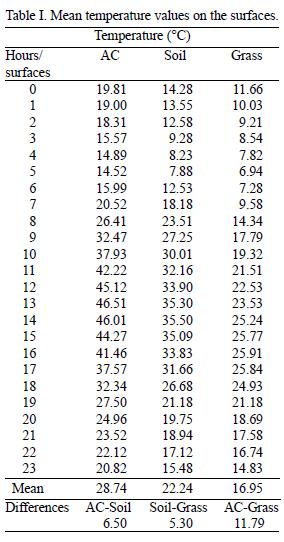
<body><![CDATA[<p align="justify"><font face="verdana" size="2">The data used were obtained from the Meteorological Observation Station in the airbase area where an automated weather observation system (AWOS) has been running. The measurement system in the study area, with a measurement range from &#150;52 to +60 &deg;C and an accuracy of +20 &deg;C of &plusmn; 0.3&deg;C, is an automatic observation system capable of getting data every two minutes. The heat sensors were placed directly on and 2 m above three different surfaces: AC (runway), grass surface and bare soil surface (<a href="/img/revistas/atm/v21n2/a2f3.jpg" target="_blank">Fig. 3</a>). The temperature values from the sensors were transmitted to the data logger, stored and processed as in previous studies such as those of Anandakumar (1999) and Bartha (2002). Because the data were adjusted to climatic measurements, the hours mentioned in the study are at local time.</font></p>     <p align="justify"><font face="verdana" size="2">Because the aim of this study is to determine, if present, the pure effects of the surfaces on temperature values, calm (windless or less than 2 m/s daily) and clear (cloudless) days were sought due to the temperature reducing effects of cloudiness and wind. Although observations have been carried out for nearly three years, only the temperature values in August 2005 (because of being the hottest month of the year on the average) were taken, and for the purpose of this study all other observational days in the month except for the days 1, 6, 8, 9, 12, 13, 15, 16, 17, 18, 20, 22, 24, 25 and 26 were rejected because of the variable weather (as in the studies of Ca and Asaeda, 1998; Anandakumar,1999). During the days except for those mentioned above, the weather was partly or wholly cloudy or rainy, which is not representative of hot summer days in this area of Turkey.</font></p>     <p align="justify"><font face="verdana" size="2">&nbsp;</font></p>     <p align="justify"><font face="verdana" size="2"><b>3. Results and discussion</b></font></p>     <p align="justify"><font face="verdana" size="2">From the temperature values obtained on and 2 m above the surfaces on 15 dry, calm and cloudless days, following results were found.</font></p>     <p align="justify"><font face="verdana" size="2"><i>3.1. Temperature differences on the surfaces</i></font></p>     <p align="justify"><font face="verdana" size="2">From <a href="#f4">Figure 4</a>, an evident difference between the surface temperatures can be seen. While AC is the hottest surface with an average value of 28.74 &deg;C for the whole period, soil surface is warmer with an average of 22.24 &deg;C than the grass surface with an average of 16.95 &deg;C (<a href="#f4">Fig. 4</a>; <a href="#t1">Table I</a>).</font></p>     <p align="center"><font face="verdana" size="2"><a name="f4"></a></font></p>     <p align="center"><font face="verdana" size="2"><img src="/img/revistas/atm/v21n2/a2f4.jpg"></font></p>     <p align="center"><font face="verdana" size="2"><a name="t1"></a></font></p>     ]]></body>
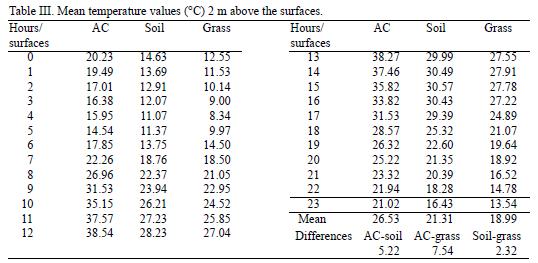
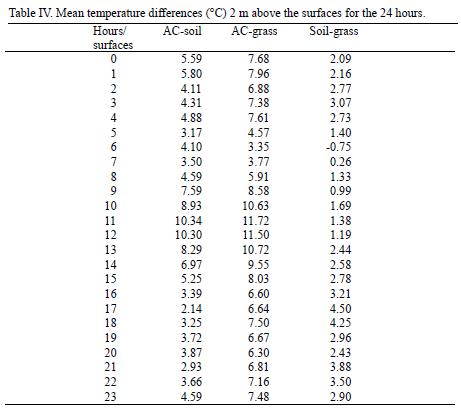
<body><![CDATA[<p align="center"><font face="verdana" size="2"><img src="/img/revistas/atm/v21n2/a2t1.jpg"></font></p>     <p align="justify"><font face="verdana" size="2">There is a mean temperature difference of 6.50 &deg;C between AC and soil. While it was maximum at 13:00 h with 11.22 &deg;C, which is followed by 12:00 with 11.22 &deg;C, 14:00 with 10.52 &deg;C and 11:00 with 10.07 &deg;C, the minimum difference was at 07:00 with 2.33 &deg;C. Soil surface is warmer than grass in terms of averages. The difference in the mean temperature between soil and grass was 5.30 &deg;C. This difference is the highest at 13:00 with 11.77 &deg;C, while it was minimum at 19:00 with 0.01 &deg;C. AC is the warmest surface throughout the day. A mean temperature difference of 11.79 &deg;C was detected between AC and grass surfaces. The difference is maximum at 13:00 again with 22.96 &deg;C and minimum at 22:00 with 5.38 &deg;C (<a href="#t1">Tables I</a>, <a href="#t2">II</a>).</font></p>     <p align="center"><font face="verdana" size="2"><a name="t2"></a></font></p>     <p align="center"><font face="verdana" size="2"><img src="/img/revistas/atm/v21n2/a2t2.jpg"></font></p>     <p align="justify"><font face="verdana" size="2">&nbsp;</font></p>     <p align="justify"><font face="verdana" size="2"><i>3.2. Temperature differences 2 m above the surfaces</i></font></p>     <p align="justify"><font face="verdana" size="2">Temperature 2 m above the surfaces is important because it represents the layer that affects the human activity more than other levels of the atmosphere. As can be seen from <a href="/img/revistas/atm/v21n2/a2f5.jpg" target="_blank">Figure 5</a>, there is an evident difference between the surface temperatures at this level as it is on the surfaces. While the level above AC is the hottest one with an average value of 26.53 &deg;C for the whole period, temperatures above soil surface are higher than in the grass surface with averages of 21.31 and 18.99 &deg;C, respectively (<a href="#t3">Table III</a>).</font></p>     <p align="center"><font face="verdana" size="2"><a name="t3"></a></font></p>     <p align="center"><font face="verdana" size="2"><img src="/img/revistas/atm/v21n2/a2t3.jpg"></font></p>     <p align="justify"><font face="verdana" size="2">The mean temperature difference between AC and soil is 5.22. It is maximum at 11:00 with 10.34 &deg;C and minimum at 17:00 with 2.14 &deg;C. Soil surface is always warmer than grass in terms of averages except for 06:00 when a slight difference is seen. The difference in the mean temperature between soil and grass is 2.32 &deg;C. This difference is the highest at 17:00 with 4.50 &deg;C, while it is minimum at 07:00 with 0.26 &deg;C. AC is the warmest surface throughout the day. A mean temperature difference of 7.54 &deg;C was detected between AC and grass surfaces. The difference is maximum at 11:00 again with 11.72 &deg;C and minimum at 06:00 with 3.35 &deg;C (<a href="#t3">Tables III</a>, <a href="#t4">IV</a>).</font></p>     ]]></body>
<body><![CDATA[<p align="center"><font face="verdana" size="2"><a name="t4"></a></font></p>     <p align="center"><font face="verdana" size="2"><img src="/img/revistas/atm/v21n2/a2t4.jpg"></font></p>     <p align="justify"><font face="verdana" size="2">Measurements of Asaeda <i>et al. </i>(1996) and Pomerantz <i>et al. </i>(2000) have shown that the pavement surface temperature peaks from one to two hours after the solar noon and then gradually falls, which is consistent with the present study where maximum AC surface temperature was seen at 13:00. But this is not valid for the 2 m&#150;level, where maximum temperature was seen at 12:00.</font></p>     <p align="justify"><font face="verdana" size="2">In a study by Scott <i>et al. </i>(1999) in Davis, California on the hottest days of August 1995, temperatures above shaded and unshaded parking lots and grass surfaces were compared. It was found that at a height of 1.5 m shaded parking lot site was warmer than the irrigated turf grass site for late afternoon through the early morning hours, and cooler than the grass site for only a few hours, from late morning to early afternoon. During the August 5&#150;7 warm period, the shaded site was approximately 0.5 &deg;C cooler than grass from the hour ending at 08:00 to afternoon (15:00).</font></p>     <p align="justify"><font face="verdana" size="2">Temperatures at the shaded site began to exceed grass during the hours from approximately 15:00 to 19:00, increasing to over 2 &deg;C warmer than grass during night time and predawn hours. The unshaded parking lot site was warmer than the grass site for almost all hours of the day, for the whole period of August 5&#150;10. In the present study, shading is not a factor to be compared and all measurements were taken in the shaded box as the standards of Turkish Meteorological Service states. For this, temperatures both on and 2 m above the AC surface are always warmer than the grass, which is coherent with the differences between unshaded parking lots and grass surfaces in their study.</font></p>     <p align="justify"><font face="verdana" size="2">A variety of pavements were measured in the East Bay Area of San Francisco (Pomerantz <i>et al, </i>2000) and it was found that afternoon temperatures in the summer ranged upward from 49 to 65 &deg;C and 54 &deg;C was about the average peak. In the present study, temperatures of AC surface were not so high and average peak value was 46.51 &deg;C, which might be the result of the location of the study area: roads in sunny, southerly latitudes get higher than 50 &deg;C regularly (Pomerantz <i>et al., </i>2000), but the area of present study is on relatively northerly altitudes. The theory of Solaimanian and Kennedy (1993) predicts that the maximum pavement temperature at lower latitudes will exceed the maximum air temperatures by about 25 &deg;C. For the standards of Turkish Meteorological Service, normal air temperature is accepted as that 2 m above the soil surface. From this point of view, in the present study, maximum pavement (AC) temperature is 46.51 &deg;C and maximum air temperature (2 m above the soil) is 30.57 &deg;C, which shows that this theory might not be valid for the cities on high latitudes. However this theory was confirmed by some data such as Dempsey <i>et al. </i>(1995) in Reno, NV which shows a difference of 22.5 &deg;C between maximum pavement surface temperatures and maximum air temperatures on sunny days during the summer of 1991, but in the present study this difference is 15.94 &deg;C. Yang (1972) reported that at Newark (NJ) Airport the highest pavement temperature reached in August was about 38 &deg;C while other authors (Pomerantz <i>et al., </i>2000) reported this value as about 49 &deg;C in Berkeley in September. In the present study this value was between them with about 46 &deg;C.</font></p>     <p align="justify"><font face="verdana" size="2">&nbsp;</font></p>     <p align="justify"><font face="verdana" size="2"><b>4. Conclusions</b></font></p>     <p align="justify"><font face="verdana" size="2">In an urban environment plants not only have aesthetical values, but also they play a functional role on the climate by moderating the extreme climatic values such as excessive temperatures seen above artificial surfaces.</font></p>     <p align="justify"><font face="verdana" size="2">In the city of Erzurum, the month of August is one of the periods when the most intense solar radiation is experienced with a mean value of 478.48 cal/cm<sup>2</sup>, but as the study was under clear sky conditions, this value is expected to be higher. Although all the studied surfaces are exposed to the same sunlight conditons, it is an expected fact that darker surfaces can absorb more sunlight and convert it into heat than lighter ones. From this point of view, the grass surface is the most advantageous one for temperature lowering because of its high reflectivity.</font></p>     ]]></body>
<body><![CDATA[<p align="justify"><font face="verdana" size="2">From the outcomes of the present study, perhaps the most important finding is that although the measurements were carried out in the driest period of the year in the region (for both rainfall and humidity) and moisture content of the soil and grass areas is approximately the same, grass surface has the most favorable features for temperature lowering.</font></p>     <p align="justify"><font face="verdana" size="2">In the relatively high latitude and altitude cities, like Erzurum, where extremely hard continental climatic features are prevalent, summers are short but very hot. These unfavorable features affect both humans and plants and there are only a few tree species that can easily and rapidly grow in these cities. In this respect, trees can not modify the climate in a favorable way for humans and grass surfaces are thought to be an alternative plant mass for this aim. It is suggested that in the new developing cities having the same features, open spaces between structures and between areas along the roads must be filled with grass surfaces and recreational and aesthetical spaces must be considered.</font></p>     <p align="justify"><font face="verdana" size="2">The study was carried out in a period of 15 clear and windless days. The results would be different if it were conducted in a whole year period because of the effects of the various values of wind, humidity, soil moisture and evapotranspiration.</font></p>     <p align="justify"><font face="verdana" size="2">Since this study was carried out in an area away from the urban effects, the results found may be evaluated as the pure effect of the surfaces on the temperature. Finally, studies about the climatic elements influenced by the surfaces must be increased in Turkey.</font></p>     <p align="justify"><font face="verdana" size="2">&nbsp;</font></p>     <p align="justify"><font face="verdana" size="2"><b>References</b></font></p>     <!-- ref --><p align="justify"><font face="verdana" size="2">Ackerman B., 1987. Climatology of Chicago area urban&#150;rural differences in humidity. <i>J. Climate Appl. Meteorol. </i><b>26</b>, 427&#150;430.</font>&nbsp;&nbsp;&nbsp;&nbsp;&nbsp;&nbsp;&nbsp;&nbsp;[&#160;<a href="javascript:void(0);" onclick="javascript: window.open('/scielo.php?script=sci_nlinks&ref=1271099&pid=S0187-6236200800020000200001&lng=','','width=640,height=500,resizable=yes,scrollbars=1,menubar=yes,');">Links</a>&#160;]<!-- end-ref --><!-- ref --><p align="justify"><font face="verdana" size="2">Akbari H., H. Taha and D. Sailor, 1992. Measured savings in air conditioning from shade trees and white surfaces. Proceedings of the 1992 ACEEE summer study on energy efficiency in buildings, 9, p. 1, American Council for an Energy Efficient Economy, Washington D.C.</font>&nbsp;&nbsp;&nbsp;&nbsp;&nbsp;&nbsp;&nbsp;&nbsp;[&#160;<a href="javascript:void(0);" onclick="javascript: window.open('/scielo.php?script=sci_nlinks&ref=1271100&pid=S0187-6236200800020000200002&lng=','','width=640,height=500,resizable=yes,scrollbars=1,menubar=yes,');">Links</a>&#160;]<!-- end-ref --><!-- ref --><p align="justify"><font face="verdana" size="2">Anandakumar K., 1999. A study on the partition of net radiation into heat fluxes on a dry asphalt surface. <i>Atmosph. Environ. </i><b>33</b>, 3911&#150;3918.</font>&nbsp;&nbsp;&nbsp;&nbsp;&nbsp;&nbsp;&nbsp;&nbsp;[&#160;<a href="javascript:void(0);" onclick="javascript: window.open('/scielo.php?script=sci_nlinks&ref=1271101&pid=S0187-6236200800020000200003&lng=','','width=640,height=500,resizable=yes,scrollbars=1,menubar=yes,');">Links</a>&#160;]<!-- end-ref --><!-- ref --><p align="justify"><font face="verdana" size="2">Anonymous, 2001. Joint aviation authorities airline transport pilot's licence. Theoretical Knowledge Manual, 050 Meteorology, published by Jeppesen GmbH, Frankfurt.</font>&nbsp;&nbsp;&nbsp;&nbsp;&nbsp;&nbsp;&nbsp;&nbsp;[&#160;<a href="javascript:void(0);" onclick="javascript: window.open('/scielo.php?script=sci_nlinks&ref=1271102&pid=S0187-6236200800020000200004&lng=','','width=640,height=500,resizable=yes,scrollbars=1,menubar=yes,');">Links</a>&#160;]<!-- end-ref --><!-- ref --><p align="justify"><font face="verdana" size="2">Asaeda T, V. T. Ca and A. Wake, 1996. Heat storage of pavement and its effect on the lower atmosphere. <i>Atmosph. Environ. </i><b>30</b>, 413&#150;427.</font>&nbsp;&nbsp;&nbsp;&nbsp;&nbsp;&nbsp;&nbsp;&nbsp;[&#160;<a href="javascript:void(0);" onclick="javascript: window.open('/scielo.php?script=sci_nlinks&ref=1271103&pid=S0187-6236200800020000200005&lng=','','width=640,height=500,resizable=yes,scrollbars=1,menubar=yes,');">Links</a>&#160;]<!-- end-ref --><!-- ref --><p align="justify"><font face="verdana" size="2">Bartha G., 2002. Temperature changes in asphalt pavements in summer. <i>Peri&oacute;dica Polytechnica Ser. Civ. Eng. </i><b>46</b>, 43&#150;52</font>&nbsp;&nbsp;&nbsp;&nbsp;&nbsp;&nbsp;&nbsp;&nbsp;[&#160;<a href="javascript:void(0);" onclick="javascript: window.open('/scielo.php?script=sci_nlinks&ref=1271104&pid=S0187-6236200800020000200006&lng=','','width=640,height=500,resizable=yes,scrollbars=1,menubar=yes,');">Links</a>&#160;]<!-- end-ref --><!-- ref --><p align="justify"><font face="verdana" size="2">Berg R. and W. Quinn, 1978. Use of light colored surface to reduce seasonal thaw penetration beneath embankments on permafrost. In: Proceedings of the Second International Symposium on Cold Regions Engineering. University of Alaska, 86&#150;99.</font>&nbsp;&nbsp;&nbsp;&nbsp;&nbsp;&nbsp;&nbsp;&nbsp;[&#160;<a href="javascript:void(0);" onclick="javascript: window.open('/scielo.php?script=sci_nlinks&ref=1271105&pid=S0187-6236200800020000200007&lng=','','width=640,height=500,resizable=yes,scrollbars=1,menubar=yes,');">Links</a>&#160;]<!-- end-ref --><!-- ref --><p align="justify"><font face="verdana" size="2">Ca V. T. and E. M. Asaeda Abu, 1998. Reduction in air conditioning energy caused by a nearby park. <i>J. Energy Building </i><b>29</b>, 83&#150;92.</font>&nbsp;&nbsp;&nbsp;&nbsp;&nbsp;&nbsp;&nbsp;&nbsp;[&#160;<a href="javascript:void(0);" onclick="javascript: window.open('/scielo.php?script=sci_nlinks&ref=1271106&pid=S0187-6236200800020000200008&lng=','','width=640,height=500,resizable=yes,scrollbars=1,menubar=yes,');">Links</a>&#160;]<!-- end-ref --><!-- ref --><p align="justify"><font face="verdana" size="2">Dempsey B. J. and collaborators 1995. Modification, validation, and calibration of climatic materials&#150;structural pavement analysis program. University of Illinois. Unpublished (as cited in <a href="http://www.osti.gov/bridge/purl.cover.jsp;jsessionid=E2E90D7123820F3459FD5CD0306C03DB?purl=/789110&#150;hfzCDE/native/" target="_blank">http://www.osti.gov/bridge/servlets/purl/789110&#150;hfzCDE/native/789110.pdf</a>).</font>&nbsp;&nbsp;&nbsp;&nbsp;&nbsp;&nbsp;&nbsp;&nbsp;[&#160;<a href="javascript:void(0);" onclick="javascript: window.open('/scielo.php?script=sci_nlinks&ref=1271107&pid=S0187-6236200800020000200009&lng=','','width=640,height=500,resizable=yes,scrollbars=1,menubar=yes,');">Links</a>&#160;]<!-- end-ref --><!-- ref --><p align="justify"><font face="verdana" size="2">Davis S. D., J. Huang and S. Winnett, 1992. Cooling our communities: A guidebook on tree planting and light&#150;colored surfacing (LBL&#150;31587) (5&#150;26). United States Environmental Protection Agency and Lawrence Berkeley Laboratory.</font>&nbsp;&nbsp;&nbsp;&nbsp;&nbsp;&nbsp;&nbsp;&nbsp;[&#160;<a href="javascript:void(0);" onclick="javascript: window.open('/scielo.php?script=sci_nlinks&ref=1271108&pid=S0187-6236200800020000200010&lng=','','width=640,height=500,resizable=yes,scrollbars=1,menubar=yes,');">Links</a>&#160;]<!-- end-ref --><!-- ref --><p align="justify"><font face="verdana" size="2">Doulos L., M. Santamouris and I. Livada, 2004. Passive cooling of outdoor urban spaces. The role of materials. <i>Sol. Energy </i><b>11</b><i>, </i>231&#150;249.</font>&nbsp;&nbsp;&nbsp;&nbsp;&nbsp;&nbsp;&nbsp;&nbsp;[&#160;<a href="javascript:void(0);" onclick="javascript: window.open('/scielo.php?script=sci_nlinks&ref=1271109&pid=S0187-6236200800020000200011&lng=','','width=640,height=500,resizable=yes,scrollbars=1,menubar=yes,');">Links</a>&#160;]<!-- end-ref --><!-- ref --><p align="justify"><font face="verdana" size="2">Garbesi E., H. Akbari and P. Martien, 1989. Controlling summer heat islands. Lawrence Berkeley Laboratory, Energy Analysis Program, Berkeley, CA.</font>&nbsp;&nbsp;&nbsp;&nbsp;&nbsp;&nbsp;&nbsp;&nbsp;[&#160;<a href="javascript:void(0);" onclick="javascript: window.open('/scielo.php?script=sci_nlinks&ref=1271110&pid=S0187-6236200800020000200012&lng=','','width=640,height=500,resizable=yes,scrollbars=1,menubar=yes,');">Links</a>&#160;]<!-- end-ref --><!-- ref --><p align="justify"><font face="verdana" size="2">Grimmond C. S. B.,T. R. Okeand H.A. Cleugh, 1993. The role of rural in comparisons of observed suburban rural flux differences. In: Exchange processes at the land surface for a range of space and time scales. Proceedings of the Yokohama Symposium, July 1993.</font>&nbsp;&nbsp;&nbsp;&nbsp;&nbsp;&nbsp;&nbsp;&nbsp;[&#160;<a href="javascript:void(0);" onclick="javascript: window.open('/scielo.php?script=sci_nlinks&ref=1271111&pid=S0187-6236200800020000200013&lng=','','width=640,height=500,resizable=yes,scrollbars=1,menubar=yes,');">Links</a>&#160;]<!-- end-ref --><!-- ref --><p align="justify"><font face="verdana" size="2">Heisler G. M., 1986. Effects of individual trees on the solar radiation climate of small buildings. <i>Urban Ecol. </i><b>9</b>, 337&#150;359.</font>&nbsp;&nbsp;&nbsp;&nbsp;&nbsp;&nbsp;&nbsp;&nbsp;[&#160;<a href="javascript:void(0);" onclick="javascript: window.open('/scielo.php?script=sci_nlinks&ref=1271112&pid=S0187-6236200800020000200014&lng=','','width=640,height=500,resizable=yes,scrollbars=1,menubar=yes,');">Links</a>&#160;]<!-- end-ref --><!-- ref --><p align="justify"><font face="verdana" size="2">Heisler G. M., R. H. Grant, S. Grimmond and C. Souch, 1995. Urban forests&#150;cooling our communities? In: Inside urban ecosystems, Proceedings of the 7th National Urban Forest Conference, New York, Sept. 12&#150;16, 1996, 31&#150;34.</font>&nbsp;&nbsp;&nbsp;&nbsp;&nbsp;&nbsp;&nbsp;&nbsp;[&#160;<a href="javascript:void(0);" onclick="javascript: window.open('/scielo.php?script=sci_nlinks&ref=1271113&pid=S0187-6236200800020000200015&lng=','','width=640,height=500,resizable=yes,scrollbars=1,menubar=yes,');">Links</a>&#160;]<!-- end-ref --><!-- ref --><p align="justify"><font face="verdana" size="2">Howard L., 1820. <i>Climate of London deduced from meteorological observations. </i>Harvey and Darton, London, 163 pp.</font>&nbsp;&nbsp;&nbsp;&nbsp;&nbsp;&nbsp;&nbsp;&nbsp;[&#160;<a href="javascript:void(0);" onclick="javascript: window.open('/scielo.php?script=sci_nlinks&ref=1271114&pid=S0187-6236200800020000200016&lng=','','width=640,height=500,resizable=yes,scrollbars=1,menubar=yes,');">Links</a>&#160;]<!-- end-ref --><!-- ref --><p align="justify"><font face="verdana" size="2">Huang J., H. Akbari, H. Taha and A. Rosenfeld, 1987. The potential of vegetation in reducing summer cooling loads in residential buildings. <i>J. Clim. Apl. Meteorol. </i><b>26</b>, 1103&#150;1106.</font>&nbsp;&nbsp;&nbsp;&nbsp;&nbsp;&nbsp;&nbsp;&nbsp;[&#160;<a href="javascript:void(0);" onclick="javascript: window.open('/scielo.php?script=sci_nlinks&ref=1271115&pid=S0187-6236200800020000200017&lng=','','width=640,height=500,resizable=yes,scrollbars=1,menubar=yes,');">Links</a>&#160;]<!-- end-ref --><!-- ref --><p align="justify"><font face="verdana" size="2">Landsberg H. E., 1981. <i>The urban climate. </i>Academic Press, New York, 275 pp.</font>&nbsp;&nbsp;&nbsp;&nbsp;&nbsp;&nbsp;&nbsp;&nbsp;[&#160;<a href="javascript:void(0);" onclick="javascript: window.open('/scielo.php?script=sci_nlinks&ref=1271116&pid=S0187-6236200800020000200018&lng=','','width=640,height=500,resizable=yes,scrollbars=1,menubar=yes,');">Links</a>&#160;]<!-- end-ref --><!-- ref --><p align="justify"><font face="verdana" size="2">Lee R., 1978. <i>Forest microclimatology. </i>Columbia University Press, New York, NY, 276 pp.</font>&nbsp;&nbsp;&nbsp;&nbsp;&nbsp;&nbsp;&nbsp;&nbsp;[&#160;<a href="javascript:void(0);" onclick="javascript: window.open('/scielo.php?script=sci_nlinks&ref=1271117&pid=S0187-6236200800020000200019&lng=','','width=640,height=500,resizable=yes,scrollbars=1,menubar=yes,');">Links</a>&#160;]<!-- end-ref --><!-- ref --><p align="justify"><font face="verdana" size="2">McPherson E. G., D. J. Nowak and R. A. Rowntree, 1994. Chicago's urban forest ecosystem: results of the Chicago Urban Forest Climate Project. USDA Forest Service, Northeastern Forest Experiment Station. General Technical Report NE&#150;GTR&#150;186 pp, Radnor, PA.</font>&nbsp;&nbsp;&nbsp;&nbsp;&nbsp;&nbsp;&nbsp;&nbsp;[&#160;<a href="javascript:void(0);" onclick="javascript: window.open('/scielo.php?script=sci_nlinks&ref=1271118&pid=S0187-6236200800020000200020&lng=','','width=640,height=500,resizable=yes,scrollbars=1,menubar=yes,');">Links</a>&#160;]<!-- end-ref --><!-- ref --><p align="justify"><font face="verdana" size="2">McPherson E. G., 1998. Atmospheric carbon dioxide reduction by Sacramento's urban forest. <i>J. Arboriculture </i><b>24</b>, 215&#150;223.</font>&nbsp;&nbsp;&nbsp;&nbsp;&nbsp;&nbsp;&nbsp;&nbsp;[&#160;<a href="javascript:void(0);" onclick="javascript: window.open('/scielo.php?script=sci_nlinks&ref=1271119&pid=S0187-6236200800020000200021&lng=','','width=640,height=500,resizable=yes,scrollbars=1,menubar=yes,');">Links</a>&#160;]<!-- end-ref --><!-- ref --><p align="justify"><font face="verdana" size="2">Myrup L. O., C. E. McGinn and R. G. Flocchini, 1993. An analysis of microclimatic variation in a suburban environment. <i>Atmos. Environ. </i><b>27</b>, 129&#150;156.</font>&nbsp;&nbsp;&nbsp;&nbsp;&nbsp;&nbsp;&nbsp;&nbsp;[&#160;<a href="javascript:void(0);" onclick="javascript: window.open('/scielo.php?script=sci_nlinks&ref=1271120&pid=S0187-6236200800020000200022&lng=','','width=640,height=500,resizable=yes,scrollbars=1,menubar=yes,');">Links</a>&#160;]<!-- end-ref --><!-- ref --><p align="justify"><font face="verdana" size="2">Nowak D. J., 1994a. Air pollution removal by Chicago's urban forest. In: Chicago's Urban Forest Ecosystem: Results of the Chicago Urban Forest Climate Project. ( E. G. McPherson, D. J. Nowak, and R. A. Rowntree Eds.) USDA Forest Service, Northeastern Forest Experiment Station. General Technical Report NE&#150;GTR&#150;186 pp, 63&#150;82, Radnor, PA.</font>&nbsp;&nbsp;&nbsp;&nbsp;&nbsp;&nbsp;&nbsp;&nbsp;[&#160;<a href="javascript:void(0);" onclick="javascript: window.open('/scielo.php?script=sci_nlinks&ref=1271121&pid=S0187-6236200800020000200023&lng=','','width=640,height=500,resizable=yes,scrollbars=1,menubar=yes,');">Links</a>&#160;]<!-- end-ref --><!-- ref --><p align="justify"><font face="verdana" size="2">Nowak D. J., 1994b. Atmospheric carbon dioxide reduction by Chicago's urban forest. In: Chicago's urban forest ecosystem: Results of the Chicago Urban Forest Climate Project. (E. G. McPherson, D. J. Nowak, and R. A. Rowntree, Eds.) Gen. Tech. Rep. NE&#150;186, USDA Forest Service, Northeastern Forest Experiment Station, General Technical Report NE&#150;GTR&#150;186 pp., Radnor, PA, 83&#150;94.</font>&nbsp;&nbsp;&nbsp;&nbsp;&nbsp;&nbsp;&nbsp;&nbsp;[&#160;<a href="javascript:void(0);" onclick="javascript: window.open('/scielo.php?script=sci_nlinks&ref=1271122&pid=S0187-6236200800020000200024&lng=','','width=640,height=500,resizable=yes,scrollbars=1,menubar=yes,');">Links</a>&#160;]<!-- end-ref --><!-- ref --><p align="justify"><font face="verdana" size="2">Oke T. R., 1978. <i>Boundary layer climates, </i>William Clowes and Sons Limited, London, 372 pp.</font>&nbsp;&nbsp;&nbsp;&nbsp;&nbsp;&nbsp;&nbsp;&nbsp;[&#160;<a href="javascript:void(0);" onclick="javascript: window.open('/scielo.php?script=sci_nlinks&ref=1271123&pid=S0187-6236200800020000200025&lng=','','width=640,height=500,resizable=yes,scrollbars=1,menubar=yes,');">Links</a>&#160;]<!-- end-ref --><!-- ref --><p align="justify"><font face="verdana" size="2">Pomerantz M., B. Pon, H. Akbari and S. C. Chang, 2000. The effect of pavements' temperatures on air temperatures in large cities (LBNL&#150;43442). Lawrence Berkeley National Laboratory, Berkeley, CA.</font>&nbsp;&nbsp;&nbsp;&nbsp;&nbsp;&nbsp;&nbsp;&nbsp;[&#160;<a href="javascript:void(0);" onclick="javascript: window.open('/scielo.php?script=sci_nlinks&ref=1271124&pid=S0187-6236200800020000200026&lng=','','width=640,height=500,resizable=yes,scrollbars=1,menubar=yes,');">Links</a>&#160;]<!-- end-ref --><!-- ref --><p align="justify"><font face="verdana" size="2">Robaa S. M., 2003. Urban&#150;suburban/rural differences over Greater Cairo, Egypt. <i>Atm&oacute;sfera </i><b>16</b>, 157&#150;171.</font>&nbsp;&nbsp;&nbsp;&nbsp;&nbsp;&nbsp;&nbsp;&nbsp;[&#160;<a href="javascript:void(0);" onclick="javascript: window.open('/scielo.php?script=sci_nlinks&ref=1271125&pid=S0187-6236200800020000200027&lng=','','width=640,height=500,resizable=yes,scrollbars=1,menubar=yes,');">Links</a>&#160;]<!-- end-ref --><!-- ref --><p align="justify"><font face="verdana" size="2">Roth M., 2002. Effects of cities on local climates. Proceedings of Workshop of IGES/APN Mega&#150;City Project 23&#150;25 January 2002 (Kitakyushu Japan). Institute for Global Environmental Strategies.</font>&nbsp;&nbsp;&nbsp;&nbsp;&nbsp;&nbsp;&nbsp;&nbsp;[&#160;<a href="javascript:void(0);" onclick="javascript: window.open('/scielo.php?script=sci_nlinks&ref=1271126&pid=S0187-6236200800020000200028&lng=','','width=640,height=500,resizable=yes,scrollbars=1,menubar=yes,');">Links</a>&#160;]<!-- end-ref --><!-- ref --><p align="justify"><font face="verdana" size="2">Santamouris M., N. Papanikolaou, I. Livada, I. Koronakis, C. Georgakis, A. Argiriou and D. N. Assimakopoulos, 2001. On the impact of urban climate on the energy consumption of buildings. <i>Energ. Buildings </i><b>70</b>, 201&#150;216.</font>&nbsp;&nbsp;&nbsp;&nbsp;&nbsp;&nbsp;&nbsp;&nbsp;[&#160;<a href="javascript:void(0);" onclick="javascript: window.open('/scielo.php?script=sci_nlinks&ref=1271127&pid=S0187-6236200800020000200029&lng=','','width=640,height=500,resizable=yes,scrollbars=1,menubar=yes,');">Links</a>&#160;]<!-- end-ref --><!-- ref --><p align="justify"><font face="verdana" size="2">Scott K. I., E. G. McPherson and J. R. Simpson, 1998. Air pollutant uptake by Sacramento's urban forest. <i>J. Arboriculture </i><b>24</b>, 224&#150;234.</font>&nbsp;&nbsp;&nbsp;&nbsp;&nbsp;&nbsp;&nbsp;&nbsp;[&#160;<a href="javascript:void(0);" onclick="javascript: window.open('/scielo.php?script=sci_nlinks&ref=1271128&pid=S0187-6236200800020000200030&lng=','','width=640,height=500,resizable=yes,scrollbars=1,menubar=yes,');">Links</a>&#160;]<!-- end-ref --><!-- ref --><p align="justify"><font face="verdana" size="2">Scott K. I., J. R. Simpson and E. G. McPherson, 1999. Effects of tree cover on parking lot microclimate and vehicle emissions. <i>J. Arboriculture </i>25, 129&#150;142.</font>&nbsp;&nbsp;&nbsp;&nbsp;&nbsp;&nbsp;&nbsp;&nbsp;[&#160;<a href="javascript:void(0);" onclick="javascript: window.open('/scielo.php?script=sci_nlinks&ref=1271129&pid=S0187-6236200800020000200031&lng=','','width=640,height=500,resizable=yes,scrollbars=1,menubar=yes,');">Links</a>&#160;]<!-- end-ref --><!-- ref --><p align="justify"><font face="verdana" size="2">Simpson J. R., 1998. Urban forest impacts on regional cooling and heating energy use: Sacramento County case study. <i>J. Arboriculture </i><b>24</b>, 201&#150;214.</font>&nbsp;&nbsp;&nbsp;&nbsp;&nbsp;&nbsp;&nbsp;&nbsp;[&#160;<a href="javascript:void(0);" onclick="javascript: window.open('/scielo.php?script=sci_nlinks&ref=1271130&pid=S0187-6236200800020000200032&lng=','','width=640,height=500,resizable=yes,scrollbars=1,menubar=yes,');">Links</a>&#160;]<!-- end-ref --><!-- ref --><p align="justify"><font face="verdana" size="2">Simpson J. R. and E. G. McPherson, 1996. Potential of tree shade for reducing residential energy use in California. <i>J. Arboriculture </i><b>22</b>, 10&#150;18.</font>&nbsp;&nbsp;&nbsp;&nbsp;&nbsp;&nbsp;&nbsp;&nbsp;[&#160;<a href="javascript:void(0);" onclick="javascript: window.open('/scielo.php?script=sci_nlinks&ref=1271131&pid=S0187-6236200800020000200033&lng=','','width=640,height=500,resizable=yes,scrollbars=1,menubar=yes,');">Links</a>&#160;]<!-- end-ref --><!-- ref --><p align="justify"><font face="verdana" size="2">Smith W. H., 1990. <i>Air pollution and forests. </i>Springer&#150;Verlag, New York, 618 pp.</font>&nbsp;&nbsp;&nbsp;&nbsp;&nbsp;&nbsp;&nbsp;&nbsp;[&#160;<a href="javascript:void(0);" onclick="javascript: window.open('/scielo.php?script=sci_nlinks&ref=1271132&pid=S0187-6236200800020000200034&lng=','','width=640,height=500,resizable=yes,scrollbars=1,menubar=yes,');">Links</a>&#160;]<!-- end-ref --><!-- ref --><p align="justify"><font face="verdana" size="2">Solaimanian M. and T. W. Kennedy, 1993. Predicting maximum pavement surface temperature using maximum air temperature and hourly solar radiation. <i>Transport. Res. Rec. </i><b>1417, </b>1&#150;11.</font>&nbsp;&nbsp;&nbsp;&nbsp;&nbsp;&nbsp;&nbsp;&nbsp;[&#160;<a href="javascript:void(0);" onclick="javascript: window.open('/scielo.php?script=sci_nlinks&ref=1271133&pid=S0187-6236200800020000200035&lng=','','width=640,height=500,resizable=yes,scrollbars=1,menubar=yes,');">Links</a>&#160;]<!-- end-ref --><!-- ref --><p align="justify"><font face="verdana" size="2">Souch C. A. and C. Souch, 1993. The effect of trees on summertime below canopy urban climates: a case study. <i>J. Arboriculture </i><b>19</b>, 303&#150;312.</font>&nbsp;&nbsp;&nbsp;&nbsp;&nbsp;&nbsp;&nbsp;&nbsp;[&#160;<a href="javascript:void(0);" onclick="javascript: window.open('/scielo.php?script=sci_nlinks&ref=1271134&pid=S0187-6236200800020000200036&lng=','','width=640,height=500,resizable=yes,scrollbars=1,menubar=yes,');">Links</a>&#160;]<!-- end-ref --><!-- ref --><p align="justify"><font face="verdana" size="2">Synnefa A., M. Santamouris and I. Livada, 2006. A study of the thermal performance of reflective coatings for the urban environment. <i>Sol. Energy </i><b>80</b>, 968&#150;981.</font>&nbsp;&nbsp;&nbsp;&nbsp;&nbsp;&nbsp;&nbsp;&nbsp;[&#160;<a href="javascript:void(0);" onclick="javascript: window.open('/scielo.php?script=sci_nlinks&ref=1271135&pid=S0187-6236200800020000200037&lng=','','width=640,height=500,resizable=yes,scrollbars=1,menubar=yes,');">Links</a>&#160;]<!-- end-ref --><!-- ref --><p align="justify"><font face="verdana" size="2">Taha H. 1997. Modeling the impacts of large&#150;scale albedo changes on ozone air quality in the South Coast Air Basin. <i>Atmos. Environ. </i><b>31</b>, 1667&#150;1676.</font>&nbsp;&nbsp;&nbsp;&nbsp;&nbsp;&nbsp;&nbsp;&nbsp;[&#160;<a href="javascript:void(0);" onclick="javascript: window.open('/scielo.php?script=sci_nlinks&ref=1271136&pid=S0187-6236200800020000200038&lng=','','width=640,height=500,resizable=yes,scrollbars=1,menubar=yes,');">Links</a>&#160;]<!-- end-ref --><!-- ref --><p align="justify"><font face="verdana" size="2">Thompson R., R. Hanna, J. Noel and D. Piirto, 1999. Valuation of tree aesthetics on small urban interface properties. <i>J. Arboriculture </i><b>25</b>, 225&#150;234.</font>&nbsp;&nbsp;&nbsp;&nbsp;&nbsp;&nbsp;&nbsp;&nbsp;[&#160;<a href="javascript:void(0);" onclick="javascript: window.open('/scielo.php?script=sci_nlinks&ref=1271137&pid=S0187-6236200800020000200039&lng=','','width=640,height=500,resizable=yes,scrollbars=1,menubar=yes,');">Links</a>&#160;]<!-- end-ref --><!-- ref --><p align="justify"><font face="verdana" size="2">Toy S., S. Yilmaz and H. Yilmaz, 2007. Determination of climatic differences in three different land uses in the city of Erzurum, Turkey. <i>Build. Environ. </i><b>42</b>, 1315&#150;1318.</font>&nbsp;&nbsp;&nbsp;&nbsp;&nbsp;&nbsp;&nbsp;&nbsp;[&#160;<a href="javascript:void(0);" onclick="javascript: window.open('/scielo.php?script=sci_nlinks&ref=1271138&pid=S0187-6236200800020000200040&lng=','','width=640,height=500,resizable=yes,scrollbars=1,menubar=yes,');">Links</a>&#160;]<!-- end-ref --><!-- ref --><p align="justify"><font face="verdana" size="2">Unger J., 1997, Urban climatology of Szeged (in Hungarian). Acta Climatol&oacute;gica Univ. Szegediensis 30B (Urban climate special issue).</font>&nbsp;&nbsp;&nbsp;&nbsp;&nbsp;&nbsp;&nbsp;&nbsp;[&#160;<a href="javascript:void(0);" onclick="javascript: window.open('/scielo.php?script=sci_nlinks&ref=1271139&pid=S0187-6236200800020000200041&lng=','','width=640,height=500,resizable=yes,scrollbars=1,menubar=yes,');">Links</a>&#160;]<!-- end-ref --><!-- ref --><p align="justify"><font face="verdana" size="2">US Forest Service. 1991. Urban and community forestry: A guide for the Northeast and Midwest United States. Benefits and values factsheet. USDA Forest Service, Washington, D. C. 19 pp.</font>&nbsp;&nbsp;&nbsp;&nbsp;&nbsp;&nbsp;&nbsp;&nbsp;[&#160;<a href="javascript:void(0);" onclick="javascript: window.open('/scielo.php?script=sci_nlinks&ref=1271140&pid=S0187-6236200800020000200042&lng=','','width=640,height=500,resizable=yes,scrollbars=1,menubar=yes,');">Links</a>&#160;]<!-- end-ref --><!-- ref --><p align="justify"><font face="verdana" size="2">Yang N. C, 1972. <i>Design of functional pavements. </i>McGraw Hill Book Company, New York, 465 pp.</font>&nbsp;&nbsp;&nbsp;&nbsp;&nbsp;&nbsp;&nbsp;&nbsp;[&#160;<a href="javascript:void(0);" onclick="javascript: window.open('/scielo.php?script=sci_nlinks&ref=1271141&pid=S0187-6236200800020000200043&lng=','','width=640,height=500,resizable=yes,scrollbars=1,menubar=yes,');">Links</a>&#160;]<!-- end-ref --><!-- ref --><p align="justify"><font face="verdana" size="2">Yilmaz S., S. Toy, M.A. Irmak and H. Yilmaz, 2007. Determination of climatic differences in three different land uses of the city of Erzurum, Turkey. <i>Build. Environ. </i><b>42</b>, 1604&#150;1612</font>&nbsp;&nbsp;&nbsp;&nbsp;&nbsp;&nbsp;&nbsp;&nbsp;[&#160;<a href="javascript:void(0);" onclick="javascript: window.open('/scielo.php?script=sci_nlinks&ref=1271142&pid=S0187-6236200800020000200044&lng=','','width=640,height=500,resizable=yes,scrollbars=1,menubar=yes,');">Links</a>&#160;]<!-- end-ref --> ]]></body><back>
<ref-list>
<ref id="B1">
<nlm-citation citation-type="journal">
<person-group person-group-type="author">
<name>
<surname><![CDATA[Ackerman]]></surname>
<given-names><![CDATA[B]]></given-names>
</name>
</person-group>
<article-title xml:lang="en"><![CDATA[Climatology of Chicago area urban-rural differences in humidity]]></article-title>
<source><![CDATA[J. Climate Appl. Meteorol.]]></source>
<year>1987</year>
<numero>26</numero>
<issue>26</issue>
<page-range>427-430</page-range></nlm-citation>
</ref>
<ref id="B2">
<nlm-citation citation-type="confpro">
<person-group person-group-type="author">
<name>
<surname><![CDATA[Akbari]]></surname>
<given-names><![CDATA[H]]></given-names>
</name>
<name>
<surname><![CDATA[Taha]]></surname>
<given-names><![CDATA[H]]></given-names>
</name>
<name>
<surname><![CDATA[Sailor]]></surname>
<given-names><![CDATA[D]]></given-names>
</name>
</person-group>
<source><![CDATA[Measured savings in air conditioning from shade trees and white surfaces]]></source>
<year>1992</year>
<conf-name><![CDATA[9 Proceedings of the 1992 ACEEE summer study on energy efficiency in buildings]]></conf-name>
<conf-loc> </conf-loc>
<page-range>1</page-range><publisher-loc><![CDATA[Washington^eD.C D.C]]></publisher-loc>
<publisher-name><![CDATA[American Council for an Energy Efficient Economy]]></publisher-name>
</nlm-citation>
</ref>
<ref id="B3">
<nlm-citation citation-type="journal">
<person-group person-group-type="author">
<name>
<surname><![CDATA[Anandakumar]]></surname>
<given-names><![CDATA[K]]></given-names>
</name>
</person-group>
<article-title xml:lang="en"><![CDATA[A study on the partition of net radiation into heat fluxes on a dry asphalt surface]]></article-title>
<source><![CDATA[Atmosph. Environ]]></source>
<year>1999</year>
<numero>33</numero>
<issue>33</issue>
<page-range>3911-3918</page-range></nlm-citation>
</ref>
<ref id="B4">
<nlm-citation citation-type="">
<person-group person-group-type="author">
<name>
</name>
<name>
</name>
<name>
<surname><![CDATA[Jeppesen]]></surname>
<given-names><![CDATA[GmbH]]></given-names>
</name>
</person-group>
<source><![CDATA[Joint aviation authorities airline transport pilot's licence: Theoretical Knowledge Manual]]></source>
<year>2001</year>
<publisher-loc><![CDATA[Frankfurt ]]></publisher-loc>
</nlm-citation>
</ref>
<ref id="B5">
<nlm-citation citation-type="journal">
<person-group person-group-type="author">
<name>
<surname><![CDATA[Asaeda]]></surname>
<given-names><![CDATA[T]]></given-names>
</name>
<name>
<surname><![CDATA[Ca]]></surname>
<given-names><![CDATA[V. T]]></given-names>
</name>
<name>
<surname><![CDATA[Wake]]></surname>
<given-names><![CDATA[A]]></given-names>
</name>
</person-group>
<article-title xml:lang="en"><![CDATA[Heat storage of pavement and its effect on the lower atmosphere]]></article-title>
<source><![CDATA[Atmosph. Environ]]></source>
<year>1996</year>
<numero>30</numero>
<issue>30</issue>
<page-range>413-427</page-range></nlm-citation>
</ref>
<ref id="B6">
<nlm-citation citation-type="journal">
<person-group person-group-type="author">
<name>
<surname><![CDATA[Bartha]]></surname>
<given-names><![CDATA[G]]></given-names>
</name>
</person-group>
<article-title xml:lang="en"><![CDATA[Temperature changes in asphalt pavements in summer]]></article-title>
<source><![CDATA[Periódica Polytechnica Ser. Civ. Eng]]></source>
<year>2002</year>
<numero>46</numero>
<issue>46</issue>
<page-range>43-52</page-range></nlm-citation>
</ref>
<ref id="B7">
<nlm-citation citation-type="confpro">
<person-group person-group-type="author">
<name>
<surname><![CDATA[Berg]]></surname>
<given-names><![CDATA[R]]></given-names>
</name>
<name>
<surname><![CDATA[Quinn]]></surname>
<given-names><![CDATA[W]]></given-names>
</name>
</person-group>
<article-title xml:lang="en"><![CDATA[Use of light colored surface to reduce seasonal thaw penetration beneath embankments on permafrost]]></article-title>
<source><![CDATA[]]></source>
<year>1978</year>
<conf-name><![CDATA[ Proceedings of the Second International Symposium on Cold Regions Engineering]]></conf-name>
<conf-loc> </conf-loc>
<page-range>86-99</page-range><publisher-name><![CDATA[University of Alaska]]></publisher-name>
</nlm-citation>
</ref>
<ref id="B8">
<nlm-citation citation-type="journal">
<person-group person-group-type="author">
<name>
<surname><![CDATA[Ca]]></surname>
<given-names><![CDATA[V. T]]></given-names>
</name>
<name>
<surname><![CDATA[Asaeda Abu]]></surname>
<given-names><![CDATA[E. M]]></given-names>
</name>
</person-group>
<article-title xml:lang="en"><![CDATA[Reduction in air conditioning energy caused by a nearby park]]></article-title>
<source><![CDATA[J. Energy Building]]></source>
<year>1998</year>
<numero>29</numero>
<issue>29</issue>
<page-range>83-92</page-range></nlm-citation>
</ref>
<ref id="B9">
<nlm-citation citation-type="book">
<person-group person-group-type="author">
<name>
<surname><![CDATA[Dempsey]]></surname>
<given-names><![CDATA[B. J]]></given-names>
</name>
</person-group>
<source><![CDATA[Modification, validation, and calibration of climatic materials-structural pavement analysis program]]></source>
<year>1995</year>
<publisher-name><![CDATA[University of Illinois]]></publisher-name>
</nlm-citation>
</ref>
<ref id="B10">
<nlm-citation citation-type="book">
<person-group person-group-type="author">
<name>
<surname><![CDATA[Davis]]></surname>
<given-names><![CDATA[S. D]]></given-names>
</name>
<name>
<surname><![CDATA[Huang]]></surname>
<given-names><![CDATA[J]]></given-names>
</name>
<name>
<surname><![CDATA[Winnett]]></surname>
<given-names><![CDATA[S]]></given-names>
</name>
</person-group>
<source><![CDATA[Cooling our communities: A guidebook on tree planting and light-colored surfacing (LBL-31587) (5-26)]]></source>
<year>1992</year>
<publisher-name><![CDATA[United States Environmental Protection Agency and Lawrence Berkeley Laboratory]]></publisher-name>
</nlm-citation>
</ref>
<ref id="B11">
<nlm-citation citation-type="journal">
<person-group person-group-type="author">
<name>
<surname><![CDATA[Doulos]]></surname>
<given-names><![CDATA[L]]></given-names>
</name>
<name>
<surname><![CDATA[Santamouris]]></surname>
<given-names><![CDATA[M]]></given-names>
</name>
<name>
<surname><![CDATA[Livada]]></surname>
<given-names><![CDATA[I]]></given-names>
</name>
</person-group>
<article-title xml:lang="en"><![CDATA[Passive cooling of outdoor urban spaces: The role of materials]]></article-title>
<source><![CDATA[Sol. Energy]]></source>
<year>2004</year>
<numero>11</numero>
<issue>11</issue>
<page-range>231-249</page-range></nlm-citation>
</ref>
<ref id="B12">
<nlm-citation citation-type="book">
<person-group person-group-type="author">
<name>
<surname><![CDATA[Garbesi]]></surname>
<given-names><![CDATA[E]]></given-names>
</name>
<name>
<surname><![CDATA[Akbari]]></surname>
<given-names><![CDATA[H]]></given-names>
</name>
<name>
<surname><![CDATA[Martien]]></surname>
<given-names><![CDATA[P]]></given-names>
</name>
</person-group>
<source><![CDATA[Controlling summer heat islands]]></source>
<year>1989</year>
<publisher-loc><![CDATA[Berkeley^eCA CA]]></publisher-loc>
<publisher-name><![CDATA[Lawrence Berkeley Laboratory]]></publisher-name>
</nlm-citation>
</ref>
<ref id="B13">
<nlm-citation citation-type="confpro">
<person-group person-group-type="author">
<name>
<surname><![CDATA[Grimmond]]></surname>
<given-names><![CDATA[C. S. B]]></given-names>
</name>
<name>
<surname><![CDATA[Okeand]]></surname>
<given-names><![CDATA[T. R]]></given-names>
</name>
<name>
<surname><![CDATA[Cleugh]]></surname>
<given-names><![CDATA[H.A]]></given-names>
</name>
</person-group>
<article-title xml:lang="en"><![CDATA[The role of rural in comparisons of observed suburban rural flux differences]]></article-title>
<source><![CDATA[Exchange processes at the land surface for a range of space and time scales]]></source>
<year>1993</year>
<conf-name><![CDATA[ Proceedings of the Yokohama Symposium]]></conf-name>
<conf-date>1993</conf-date>
<conf-loc> </conf-loc>
</nlm-citation>
</ref>
<ref id="B14">
<nlm-citation citation-type="journal">
<person-group person-group-type="author">
<name>
<surname><![CDATA[Heisler]]></surname>
<given-names><![CDATA[G. M]]></given-names>
</name>
</person-group>
<article-title xml:lang="en"><![CDATA[Effects of individual trees on the solar radiation climate of small buildings]]></article-title>
<source><![CDATA[Urban Ecol]]></source>
<year>1986</year>
<numero>9</numero>
<issue>9</issue>
<page-range>337-359</page-range></nlm-citation>
</ref>
<ref id="B15">
<nlm-citation citation-type="confpro">
<person-group person-group-type="author">
<name>
<surname><![CDATA[Heisler]]></surname>
<given-names><![CDATA[G. M]]></given-names>
</name>
<name>
<surname><![CDATA[Grant]]></surname>
<given-names><![CDATA[R. H.]]></given-names>
</name>
<name>
<surname><![CDATA[Grimmond]]></surname>
<given-names><![CDATA[S]]></given-names>
</name>
<name>
<surname><![CDATA[Souch]]></surname>
<given-names><![CDATA[C]]></given-names>
</name>
</person-group>
<article-title xml:lang="en"><![CDATA[Urban forests-cooling our communities?]]></article-title>
<source><![CDATA[Inside urban ecosystems]]></source>
<year>1995</year>
<conf-name><![CDATA[ Proceedings of the 7th National Urban Forest Conference]]></conf-name>
<conf-date>1996</conf-date>
<conf-loc>New York </conf-loc>
<page-range>31-34</page-range></nlm-citation>
</ref>
<ref id="B16">
<nlm-citation citation-type="book">
<person-group person-group-type="author">
<name>
<surname><![CDATA[Howard]]></surname>
<given-names><![CDATA[L]]></given-names>
</name>
</person-group>
<source><![CDATA[Climate of London deduced from meteorological observations]]></source>
<year>1820</year>
<page-range>163</page-range><publisher-loc><![CDATA[London ]]></publisher-loc>
<publisher-name><![CDATA[Harvey and Darton]]></publisher-name>
</nlm-citation>
</ref>
<ref id="B17">
<nlm-citation citation-type="journal">
<person-group person-group-type="author">
<name>
<surname><![CDATA[Huang]]></surname>
<given-names><![CDATA[J]]></given-names>
</name>
<name>
<surname><![CDATA[Akbari]]></surname>
<given-names><![CDATA[H]]></given-names>
</name>
<name>
<surname><![CDATA[Taha]]></surname>
<given-names><![CDATA[H]]></given-names>
</name>
<name>
<surname><![CDATA[Rosenfeld]]></surname>
<given-names><![CDATA[A]]></given-names>
</name>
</person-group>
<article-title xml:lang="en"><![CDATA[The potential of vegetation in reducing summer cooling loads in residential buildings]]></article-title>
<source><![CDATA[J. Clim. Apl. Meteorol.]]></source>
<year>1987</year>
<numero>26</numero>
<issue>26</issue>
<page-range>1103-1106</page-range></nlm-citation>
</ref>
<ref id="B18">
<nlm-citation citation-type="book">
<person-group person-group-type="author">
<name>
<surname><![CDATA[Landsberg]]></surname>
<given-names><![CDATA[H. E]]></given-names>
</name>
</person-group>
<source><![CDATA[The urban climate]]></source>
<year>1981</year>
<page-range>275</page-range><publisher-loc><![CDATA[New York ]]></publisher-loc>
<publisher-name><![CDATA[Academic Press]]></publisher-name>
</nlm-citation>
</ref>
<ref id="B19">
<nlm-citation citation-type="book">
<person-group person-group-type="author">
<name>
<surname><![CDATA[Lee]]></surname>
<given-names><![CDATA[R]]></given-names>
</name>
</person-group>
<source><![CDATA[Forest microclimatology]]></source>
<year>1978</year>
<page-range>276</page-range><publisher-loc><![CDATA[New York^eNY NY]]></publisher-loc>
<publisher-name><![CDATA[Columbia University Press]]></publisher-name>
</nlm-citation>
</ref>
<ref id="B20">
<nlm-citation citation-type="book">
<person-group person-group-type="author">
<name>
<surname><![CDATA[McPherson]]></surname>
<given-names><![CDATA[E. G]]></given-names>
</name>
<name>
<surname><![CDATA[Nowak]]></surname>
<given-names><![CDATA[D. J.]]></given-names>
</name>
<name>
<surname><![CDATA[Rowntree]]></surname>
<given-names><![CDATA[R. A]]></given-names>
</name>
</person-group>
<source><![CDATA[Chicago's urban forest ecosystem: results of the Chicago Urban Forest Climate Project]]></source>
<year>1994</year>
<publisher-loc><![CDATA[Radnor^ePA PA]]></publisher-loc>
<publisher-name><![CDATA[USDA Forest ServiceNortheastern Forest Experiment Station]]></publisher-name>
</nlm-citation>
</ref>
<ref id="B21">
<nlm-citation citation-type="journal">
<person-group person-group-type="author">
<name>
<surname><![CDATA[McPherson]]></surname>
<given-names><![CDATA[E. G]]></given-names>
</name>
</person-group>
<article-title xml:lang="en"><![CDATA[Atmospheric carbon dioxide reduction by Sacramento's urban forest]]></article-title>
<source><![CDATA[J. Arboriculture]]></source>
<year>1998</year>
<numero>24</numero>
<issue>24</issue>
<page-range>215-223</page-range></nlm-citation>
</ref>
<ref id="B22">
<nlm-citation citation-type="journal">
<person-group person-group-type="author">
<name>
<surname><![CDATA[Myrup]]></surname>
<given-names><![CDATA[L. O]]></given-names>
</name>
<name>
<surname><![CDATA[McGinn]]></surname>
<given-names><![CDATA[C. E]]></given-names>
</name>
<name>
<surname><![CDATA[Flocchini]]></surname>
<given-names><![CDATA[R. G]]></given-names>
</name>
</person-group>
<article-title xml:lang="en"><![CDATA[An analysis of microclimatic variation in a suburban environment]]></article-title>
<source><![CDATA[Atmos. Environ]]></source>
<year>1993</year>
<numero>27</numero>
<issue>27</issue>
<page-range>129-156</page-range></nlm-citation>
</ref>
<ref id="B23">
<nlm-citation citation-type="book">
<person-group person-group-type="author">
<name>
<surname><![CDATA[Nowak]]></surname>
<given-names><![CDATA[D. J]]></given-names>
</name>
</person-group>
<article-title xml:lang="en"><![CDATA[Air pollution removal by Chicago's urban forest]]></article-title>
<person-group person-group-type="editor">
<name>
<surname><![CDATA[McPherson]]></surname>
<given-names><![CDATA[E. G]]></given-names>
</name>
<name>
<surname><![CDATA[Nowak]]></surname>
<given-names><![CDATA[D. J]]></given-names>
</name>
<name>
<surname><![CDATA[Rowntree]]></surname>
<given-names><![CDATA[R. A]]></given-names>
</name>
</person-group>
<source><![CDATA[Chicago's Urban Forest Ecosystem: Results of the Chicago Urban Forest Climate Project]]></source>
<year>1994</year>
<month>a</month>
<page-range>63-82</page-range><publisher-loc><![CDATA[Radnor^ePA PA]]></publisher-loc>
<publisher-name><![CDATA[USDA Forest ServiceNortheastern Forest Experiment Station]]></publisher-name>
</nlm-citation>
</ref>
<ref id="B24">
<nlm-citation citation-type="book">
<person-group person-group-type="author">
<name>
<surname><![CDATA[Nowak]]></surname>
<given-names><![CDATA[D. J]]></given-names>
</name>
</person-group>
<article-title xml:lang="en"><![CDATA[Atmospheric carbon dioxide reduction by Chicago's urban forest]]></article-title>
<person-group person-group-type="editor">
<name>
<surname><![CDATA[McPherson]]></surname>
<given-names><![CDATA[E. G]]></given-names>
</name>
<name>
<surname><![CDATA[Nowak]]></surname>
<given-names><![CDATA[D. J]]></given-names>
</name>
<name>
<surname><![CDATA[Rowntree]]></surname>
<given-names><![CDATA[R. A]]></given-names>
</name>
</person-group>
<source><![CDATA[Chicago's urban forest ecosystem: Results of the Chicago Urban Forest Climate Project]]></source>
<year>1994</year>
<month>b</month>
<page-range>83-94</page-range><publisher-loc><![CDATA[Radnor^ePA PA]]></publisher-loc>
<publisher-name><![CDATA[USDA Forest ServiceNortheastern Forest Experiment Station]]></publisher-name>
</nlm-citation>
</ref>
<ref id="B25">
<nlm-citation citation-type="book">
<person-group person-group-type="author">
<name>
<surname><![CDATA[Oke]]></surname>
<given-names><![CDATA[T. R]]></given-names>
</name>
</person-group>
<source><![CDATA[Boundary layer climates]]></source>
<year>1978</year>
<page-range>372</page-range><publisher-loc><![CDATA[London ]]></publisher-loc>
<publisher-name><![CDATA[William Clowes and Sons Limited]]></publisher-name>
</nlm-citation>
</ref>
<ref id="B26">
<nlm-citation citation-type="book">
<person-group person-group-type="author">
<name>
<surname><![CDATA[Pomerantz]]></surname>
<given-names><![CDATA[M]]></given-names>
</name>
<name>
<surname><![CDATA[Pon]]></surname>
<given-names><![CDATA[B]]></given-names>
</name>
<name>
<surname><![CDATA[Akbari]]></surname>
<given-names><![CDATA[H]]></given-names>
</name>
<name>
<surname><![CDATA[Chang]]></surname>
<given-names><![CDATA[S. C]]></given-names>
</name>
</person-group>
<source><![CDATA[The effect of pavements' temperatures on air temperatures in large cities (LBNL-43442)]]></source>
<year>2000</year>
<publisher-loc><![CDATA[Berkeley^eCA CA]]></publisher-loc>
<publisher-name><![CDATA[Lawrence Berkeley National Laboratory]]></publisher-name>
</nlm-citation>
</ref>
<ref id="B27">
<nlm-citation citation-type="journal">
<person-group person-group-type="author">
<name>
<surname><![CDATA[Robaa]]></surname>
<given-names><![CDATA[S. M]]></given-names>
</name>
</person-group>
<article-title xml:lang="en"><![CDATA[Urban-suburban/rural differences over Greater Cairo, Egypt]]></article-title>
<source><![CDATA[Atmósfera]]></source>
<year>2003</year>
<numero>16</numero>
<issue>16</issue>
<page-range>157-171</page-range></nlm-citation>
</ref>
<ref id="B28">
<nlm-citation citation-type="confpro">
<person-group person-group-type="author">
<name>
<surname><![CDATA[Roth]]></surname>
<given-names><![CDATA[M]]></given-names>
</name>
</person-group>
<source><![CDATA[Effects of cities on local climates]]></source>
<year></year>
<conf-name><![CDATA[ Proceedings of Workshop of IGES/APN Mega-City Project]]></conf-name>
<conf-date>2002</conf-date>
<conf-loc> </conf-loc>
<publisher-name><![CDATA[Institute for Global Environmental Strategies]]></publisher-name>
</nlm-citation>
</ref>
<ref id="B29">
<nlm-citation citation-type="journal">
<person-group person-group-type="author">
<name>
<surname><![CDATA[Santamouris]]></surname>
<given-names><![CDATA[M]]></given-names>
</name>
<name>
<surname><![CDATA[Papanikolaou]]></surname>
<given-names><![CDATA[N]]></given-names>
</name>
<name>
<surname><![CDATA[Livada]]></surname>
<given-names><![CDATA[I]]></given-names>
</name>
<name>
<surname><![CDATA[Koronakis]]></surname>
<given-names><![CDATA[I]]></given-names>
</name>
<name>
<surname><![CDATA[Georgakis]]></surname>
<given-names><![CDATA[C]]></given-names>
</name>
<name>
<surname><![CDATA[Argiriou]]></surname>
<given-names><![CDATA[A]]></given-names>
</name>
<name>
<surname><![CDATA[Assimakopoulos]]></surname>
<given-names><![CDATA[D. N]]></given-names>
</name>
</person-group>
<article-title xml:lang="en"><![CDATA[On the impact of urban climate on the energy consumption of buildings]]></article-title>
<source><![CDATA[Energ. Buildings]]></source>
<year>2001</year>
<numero>70</numero>
<issue>70</issue>
<page-range>201-216</page-range></nlm-citation>
</ref>
<ref id="B30">
<nlm-citation citation-type="journal">
<person-group person-group-type="author">
<name>
<surname><![CDATA[Scott]]></surname>
<given-names><![CDATA[K. I]]></given-names>
</name>
<name>
<surname><![CDATA[McPherson]]></surname>
<given-names><![CDATA[E. G]]></given-names>
</name>
<name>
<surname><![CDATA[Simpson]]></surname>
<given-names><![CDATA[J. R]]></given-names>
</name>
</person-group>
<article-title xml:lang="en"><![CDATA[Air pollutant uptake by Sacramento's urban forest]]></article-title>
<source><![CDATA[J. Arboriculture]]></source>
<year>1998</year>
<numero>24</numero>
<issue>24</issue>
<page-range>224-234</page-range></nlm-citation>
</ref>
<ref id="B31">
<nlm-citation citation-type="journal">
<person-group person-group-type="author">
<name>
<surname><![CDATA[Scott]]></surname>
<given-names><![CDATA[K. I.]]></given-names>
</name>
<name>
<surname><![CDATA[Simpson]]></surname>
<given-names><![CDATA[J. R]]></given-names>
</name>
<name>
<surname><![CDATA[McPherson]]></surname>
<given-names><![CDATA[E. G]]></given-names>
</name>
</person-group>
<article-title xml:lang="en"><![CDATA[Effects of tree cover on parking lot microclimate and vehicle emissions]]></article-title>
<source><![CDATA[J. Arboriculture]]></source>
<year>1999</year>
<numero>25</numero>
<issue>25</issue>
<page-range>129-142</page-range></nlm-citation>
</ref>
<ref id="B32">
<nlm-citation citation-type="journal">
<person-group person-group-type="author">
<name>
<surname><![CDATA[Simpson]]></surname>
<given-names><![CDATA[J. R]]></given-names>
</name>
</person-group>
<article-title xml:lang="en"><![CDATA[Urban forest impacts on regional cooling and heating energy use: Sacramento County case study]]></article-title>
<source><![CDATA[J. Arboriculture]]></source>
<year>1998</year>
<numero>24</numero>
<issue>24</issue>
<page-range>201-214</page-range></nlm-citation>
</ref>
<ref id="B33">
<nlm-citation citation-type="journal">
<person-group person-group-type="author">
<name>
<surname><![CDATA[Simpson]]></surname>
<given-names><![CDATA[J. R]]></given-names>
</name>
<name>
<surname><![CDATA[McPherson]]></surname>
<given-names><![CDATA[E. G]]></given-names>
</name>
</person-group>
<article-title xml:lang="en"><![CDATA[Potential of tree shade for reducing residential energy use in California]]></article-title>
<source><![CDATA[J. Arboriculture]]></source>
<year>1996</year>
<numero>22</numero>
<issue>22</issue>
<page-range>10-18</page-range></nlm-citation>
</ref>
<ref id="B34">
<nlm-citation citation-type="book">
<person-group person-group-type="author">
<name>
<surname><![CDATA[Smith]]></surname>
<given-names><![CDATA[W. H]]></given-names>
</name>
</person-group>
<source><![CDATA[Air pollution and forests]]></source>
<year>1990</year>
<page-range>618</page-range><publisher-loc><![CDATA[New York ]]></publisher-loc>
<publisher-name><![CDATA[Springer-Verlag]]></publisher-name>
</nlm-citation>
</ref>
<ref id="B35">
<nlm-citation citation-type="journal">
<person-group person-group-type="author">
<name>
<surname><![CDATA[Solaimanian]]></surname>
<given-names><![CDATA[M]]></given-names>
</name>
<name>
<surname><![CDATA[Kennedy]]></surname>
<given-names><![CDATA[T. W]]></given-names>
</name>
</person-group>
<article-title xml:lang="en"><![CDATA[Predicting maximum pavement surface temperature using maximum air temperature and hourly solar radiation]]></article-title>
<source><![CDATA[Transport. Res. Rec]]></source>
<year>1993</year>
<numero>1417</numero>
<issue>1417</issue>
<page-range>1-11</page-range></nlm-citation>
</ref>
<ref id="B36">
<nlm-citation citation-type="journal">
<person-group person-group-type="author">
<name>
<surname><![CDATA[Souch]]></surname>
<given-names><![CDATA[C. A]]></given-names>
</name>
<name>
<surname><![CDATA[Souch]]></surname>
<given-names><![CDATA[C]]></given-names>
</name>
</person-group>
<article-title xml:lang="en"><![CDATA[The effect of trees on summertime below canopy urban climates: a case study]]></article-title>
<source><![CDATA[J. Arboriculture]]></source>
<year>1993</year>
<numero>19</numero>
<issue>19</issue>
<page-range>303-312</page-range></nlm-citation>
</ref>
<ref id="B37">
<nlm-citation citation-type="journal">
<person-group person-group-type="author">
<name>
<surname><![CDATA[Synnefa]]></surname>
<given-names><![CDATA[A]]></given-names>
</name>
<name>
<surname><![CDATA[Santamouris]]></surname>
<given-names><![CDATA[M]]></given-names>
</name>
<name>
<surname><![CDATA[Livada]]></surname>
<given-names><![CDATA[I]]></given-names>
</name>
</person-group>
<article-title xml:lang="en"><![CDATA[A study of the thermal performance of reflective coatings for the urban environment]]></article-title>
<source><![CDATA[Sol. Energy]]></source>
<year>2006</year>
<numero>80</numero>
<issue>80</issue>
<page-range>968-981</page-range></nlm-citation>
</ref>
<ref id="B38">
<nlm-citation citation-type="journal">
<person-group person-group-type="author">
<name>
<surname><![CDATA[Taha]]></surname>
<given-names><![CDATA[H]]></given-names>
</name>
</person-group>
<article-title xml:lang="en"><![CDATA[Modeling the impacts of large-scale albedo changes on ozone air quality in the South Coast Air Basin]]></article-title>
<source><![CDATA[Atmos. Environ]]></source>
<year>1997</year>
<numero>31</numero>
<issue>31</issue>
<page-range>1667-1676</page-range></nlm-citation>
</ref>
<ref id="B39">
<nlm-citation citation-type="journal">
<person-group person-group-type="author">
<name>
<surname><![CDATA[Thompson]]></surname>
<given-names><![CDATA[R]]></given-names>
</name>
<name>
<surname><![CDATA[Hanna]]></surname>
<given-names><![CDATA[R]]></given-names>
</name>
<name>
<surname><![CDATA[Noel]]></surname>
<given-names><![CDATA[J]]></given-names>
</name>
<name>
<surname><![CDATA[Piirto]]></surname>
<given-names><![CDATA[D]]></given-names>
</name>
</person-group>
<article-title xml:lang="en"><![CDATA[Valuation of tree aesthetics on small urban interface properties]]></article-title>
<source><![CDATA[J. Arboriculture]]></source>
<year>1999</year>
<numero>25</numero>
<issue>25</issue>
<page-range>225-234</page-range></nlm-citation>
</ref>
<ref id="B40">
<nlm-citation citation-type="journal">
<person-group person-group-type="author">
<name>
<surname><![CDATA[Toy]]></surname>
<given-names><![CDATA[S]]></given-names>
</name>
<name>
<surname><![CDATA[Yilmaz]]></surname>
<given-names><![CDATA[S]]></given-names>
</name>
<name>
<surname><![CDATA[Yilmaz]]></surname>
<given-names><![CDATA[H]]></given-names>
</name>
</person-group>
<article-title xml:lang="en"><![CDATA[Determination of climatic differences in three different land uses in the city of Erzurum, Turkey]]></article-title>
<source><![CDATA[Build. Environ]]></source>
<year>2007</year>
<numero>42</numero>
<issue>42</issue>
<page-range>1315-1318</page-range></nlm-citation>
</ref>
<ref id="B41">
<nlm-citation citation-type="journal">
<person-group person-group-type="author">
<name>
<surname><![CDATA[Unger]]></surname>
<given-names><![CDATA[J]]></given-names>
</name>
</person-group>
<article-title xml:lang="en"><![CDATA[Urban climatology of Szeged (in Hungarian)]]></article-title>
<source><![CDATA[Acta Climatológica]]></source>
<year>1997</year>
<numero>30B</numero>
<issue>30B</issue>
<publisher-name><![CDATA[Univ. Szegediensis]]></publisher-name>
</nlm-citation>
</ref>
<ref id="B42">
<nlm-citation citation-type="book">
<collab>US Forest Service</collab>
<source><![CDATA[Urban and community forestry: A guide for the Northeast and Midwest United States. Benefits and values factsheet]]></source>
<year>1991</year>
<page-range>19</page-range><publisher-loc><![CDATA[Washington^eD. C. D. C.]]></publisher-loc>
<publisher-name><![CDATA[USDA Forest Service]]></publisher-name>
</nlm-citation>
</ref>
<ref id="B43">
<nlm-citation citation-type="book">
<person-group person-group-type="author">
<name>
<surname><![CDATA[Yang]]></surname>
<given-names><![CDATA[N. C]]></given-names>
</name>
</person-group>
<source><![CDATA[Design of functional pavements]]></source>
<year>1972</year>
<page-range>465</page-range><publisher-loc><![CDATA[New York ]]></publisher-loc>
<publisher-name><![CDATA[McGraw Hill Book Company]]></publisher-name>
</nlm-citation>
</ref>
<ref id="B44">
<nlm-citation citation-type="journal">
<person-group person-group-type="author">
<name>
<surname><![CDATA[Yilmaz]]></surname>
<given-names><![CDATA[S]]></given-names>
</name>
<name>
<surname><![CDATA[Toy]]></surname>
<given-names><![CDATA[S]]></given-names>
</name>
<name>
<surname><![CDATA[Irmak]]></surname>
<given-names><![CDATA[M.A]]></given-names>
</name>
<name>
<surname><![CDATA[Yilmaz]]></surname>
<given-names><![CDATA[H]]></given-names>
</name>
</person-group>
<article-title xml:lang="en"><![CDATA[Determination of climatic differences in three different land uses of the city of Erzurum, Turkey]]></article-title>
<source><![CDATA[Build. Environ]]></source>
<year>2007</year>
<numero>42</numero>
<issue>42</issue>
<page-range>1604-1612</page-range></nlm-citation>
</ref>
</ref-list>
</back>
</article>