<?xml version="1.0" encoding="ISO-8859-1"?><article xmlns:mml="http://www.w3.org/1998/Math/MathML" xmlns:xlink="http://www.w3.org/1999/xlink" xmlns:xsi="http://www.w3.org/2001/XMLSchema-instance">
<front>
<journal-meta>
<journal-id>0187-6236</journal-id>
<journal-title><![CDATA[Atmósfera]]></journal-title>
<abbrev-journal-title><![CDATA[Atmósfera]]></abbrev-journal-title>
<issn>0187-6236</issn>
<publisher>
<publisher-name><![CDATA[Universidad Nacional Autónoma de México, Instituto de Ciencias de la Atmósfera y Cambio Climático]]></publisher-name>
</publisher>
</journal-meta>
<article-meta>
<article-id>S0187-62362008000100005</article-id>
<title-group>
<article-title xml:lang="en"><![CDATA[The effects of canopy cover on throughfall and soil chemistry in two forest sites in the México City air basin]]></article-title>
</title-group>
<contrib-group>
<contrib contrib-type="author">
<name>
<surname><![CDATA[PÉREZ-SUÁREZ]]></surname>
<given-names><![CDATA[M]]></given-names>
</name>
<xref ref-type="aff" rid="A01"/>
</contrib>
<contrib contrib-type="author">
<name>
<surname><![CDATA[FENN]]></surname>
<given-names><![CDATA[M. E]]></given-names>
</name>
<xref ref-type="aff" rid="A02"/>
</contrib>
<contrib contrib-type="author">
<name>
<surname><![CDATA[CETINA-ALCALÁ]]></surname>
<given-names><![CDATA[V. M]]></given-names>
</name>
<xref ref-type="aff" rid="A03"/>
</contrib>
<contrib contrib-type="author">
<name>
<surname><![CDATA[ALDRETE]]></surname>
<given-names><![CDATA[A]]></given-names>
</name>
<xref ref-type="aff" rid="A03"/>
</contrib>
</contrib-group>
<aff id="A01">
<institution><![CDATA[,Instituto Potosino de Investigación Científica y Tecnológica  ]]></institution>
<addr-line><![CDATA[San Luis Potosí S.L.P]]></addr-line>
</aff>
<aff id="A02">
<institution><![CDATA[,United States Department of Agriculture Forest Service Pacific Southwest Research Station Forest Fire Laboratory ]]></institution>
<addr-line><![CDATA[Riverside CA]]></addr-line>
<country>USA</country>
</aff>
<aff id="A03">
<institution><![CDATA[,Instituto de Recursos Naturales Colegio de Postgraduados ]]></institution>
<addr-line><![CDATA[Montecillo ]]></addr-line>
<country>México</country>
</aff>
<pub-date pub-type="pub">
<day>00</day>
<month>01</month>
<year>2008</year>
</pub-date>
<pub-date pub-type="epub">
<day>00</day>
<month>01</month>
<year>2008</year>
</pub-date>
<volume>21</volume>
<numero>1</numero>
<fpage>83</fpage>
<lpage>100</lpage>
<copyright-statement/>
<copyright-year/>
<self-uri xlink:href="http://www.scielo.org.mx/scielo.php?script=sci_arttext&amp;pid=S0187-62362008000100005&amp;lng=en&amp;nrm=iso"></self-uri><self-uri xlink:href="http://www.scielo.org.mx/scielo.php?script=sci_abstract&amp;pid=S0187-62362008000100005&amp;lng=en&amp;nrm=iso"></self-uri><self-uri xlink:href="http://www.scielo.org.mx/scielo.php?script=sci_pdf&amp;pid=S0187-62362008000100005&amp;lng=en&amp;nrm=iso"></self-uri><abstract abstract-type="short" xml:lang="es"><p><![CDATA[El escurrimiento foliar y la química del suelo fueron comparados en dos sitios con diferente depósito atmosférico: el Parque Nacional Desierto de los Leones (alto depósito atmosférico) y el Parque Nacional Zoquiapan (bajo depósito atmosférico). Se compararon los flujos de NO3-, SO4(2-), Ca, Mg y K en el escurrimiento foliar bajo el dosel de dos especies de árboles: Abies religiosa Schl. (oyamel) y Pinus hartwegii Lindl. (pino), en comparación con sitios sin cobertura, es decir en claros del bosque. Los flujos disminuyeron en el siguiente orden: oyamel >pino >claros. El consumo de N del dosel resultó en valores negativos para el escurrimiento foliar neto de NH4+ en ambos sitios, mientras el NO3-, sólo en el sitio de bajo depósito atmosférico. Con pocas excepciones, la concentración de C, N y S totales, SO4(2-) soluble y Ca2+ fueron mayores en los suelos bajo las copas de oyamel que bajo pino o en los claros del bosque. En el sitio contaminado, la densidad del follaje en las copas de oyamel resultó en mayores flujos de escurrimiento foliar y acumulación en el suelo de N, S, y Mg comparado con doseles de pino o áreas abiertas. El elevado depósito atmosférico altera los procesos funcionales del ecosistema, particularmente el escurrimiento foliar y el ciclo interno de nutrientes, y este efecto depende de la cobertura y especie arbórea.]]></p></abstract>
<abstract abstract-type="short" xml:lang="en"><p><![CDATA[Throughfall and soil chemistry were compared in two sites with differing atmospheric deposition: Desierto de los Leones National Park (high atmospheric deposition) and Zoquiapan National Park (low atmospheric deposition). Throughfall fluxes of NO3-, SO4(2-), Ca, Mg and K were compared under two canopy cover types: Abies religiosa Schl. (fir) and Pinus hartwegii Lindl. (pine), in comparison with sites without cover canopy, e.g. forests clearings. Throughfall fluxes decreased in the following order: fir > pine > forest clearing. Nitrogen balance under canopy of fir and pine resulted in negative values for net throughfall of NH4+ at Desierto de los Leones and Zoquiapan, while NO3-, only resulted in negative values under canopy cover at the low deposition site. With few exceptions, concentrations of total C, N and S, soluble SO4(2-), and Ca2+ were higher in soil under fir canopies than under pine or in forest clearings. In polluted sites, the densely foliated fir canopies generally resulted in higher throughfall fluxes and soil accumulation of N, S and Mg compared to pine canopies or open areas. The elevated atmospheric depositions affect the functional process of forest ecosystem, particularly the throughfall and nutrients intern cycle, and these effects depend of the cover and present tree species.]]></p></abstract>
<kwd-group>
<kwd lng="en"><![CDATA[Throughfall]]></kwd>
<kwd lng="en"><![CDATA[canopy leaf area]]></kwd>
<kwd lng="en"><![CDATA[soil enrichment]]></kwd>
<kwd lng="en"><![CDATA[México City air basin]]></kwd>
<kwd lng="en"><![CDATA[atmospheric deposition]]></kwd>
</kwd-group>
</article-meta>
</front><body><![CDATA[ <p align="center"><font face="verdana" size="4"><b>The effects of canopy cover on throughfall and soil chemistry in two forest sites in the M&eacute;xico City air basin</b></font></p>     <p align="justify"><font face="verdana" size="2">&nbsp;</font></p>     <p align="center"><font face="verdana" size="2">M. P&Eacute;REZ&#150;SU&Aacute;REZ    <br> <i>Instituto Potosino de Investigaci&oacute;n Cient&iacute;fica y Tecnol&oacute;gica, IPICYT    <br> Camino a la presa San Jos&eacute; 2055, San Luis Potos&iacute;, S.L.P.    <br> </i>Corresponding author; e&#150;mail: <a href="mailto:marlin@ipicyt.edu.mx">marlin@ipicyt.edu.mx</a></font></p>     <p align="justify"><font face="verdana" size="2">&nbsp;</font></p>     <p align="center"><font face="verdana" size="2">M. E. FENN    <br> <i>United States Department of Agriculture Forest Service    <br> </i><i>Pacific Southwest Research Station, Forest Fire Laboratory,    ]]></body>
<body><![CDATA[<br> </i><i>4955 Canyon Crest Dr., Riverside, CA 92507. USA</i></font></p>     <p align="justify"><font face="verdana" size="2">&nbsp;</font></p>     <p align="center"><font face="verdana" size="2">V. M. CETINA&#150;ALCAL&Aacute;, A. ALDRETE    <br> <i>Instituto de Recursos Naturales, Colegio de Postgraduados,     <br> 56230 Montecillo, M&eacute;xico    <br> </i></font></p>     <p align="center"><font face="verdana" size="2">&nbsp;</font></p>     <p align="center"><font face="verdana" size="2">Received March 5, 2007; accepted August 15, 2007</font></p>     <p align="center"><font face="verdana" size="2">&nbsp;</font></p>     <p align="justify"><font face="verdana" size="2"><b>RESUMEN</b></font></p>     ]]></body>
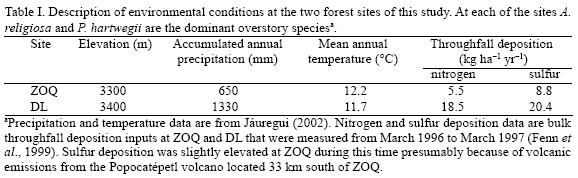
<body><![CDATA[<p align="justify"><font face="verdana" size="2">El escurrimiento foliar y la qu&iacute;mica del suelo fueron comparados en dos sitios con diferente dep&oacute;sito atmosf&eacute;rico: el Parque Nacional Desierto de los Leones (alto dep&oacute;sito atmosf&eacute;rico) y el Parque Nacional Zoquiapan (bajo dep&oacute;sito atmosf&eacute;rico). Se compararon los flujos de NO<sub>3</sub>&#150;, SO<sub>4</sub><sup>2&#150;</sup>, Ca, Mg y K en el escurrimiento foliar bajo el dosel de dos especies de &aacute;rboles: <i>Abies religiosa </i>Schl. (oyamel) y <i>Pinus hartwegii </i>Lindl. (pino), en comparaci&oacute;n con sitios sin cobertura, es decir en claros del bosque. Los flujos disminuyeron en el siguiente orden: oyamel &gt;pino &gt;claros. El consumo de N del dosel result&oacute; en valores negativos para el escurrimiento foliar neto de NH<sub>4</sub><sup>+</sup> en ambos sitios, mientras el NO<sub>3</sub>&#150;, s&oacute;lo en el sitio de bajo dep&oacute;sito atmosf&eacute;rico. Con pocas excepciones, la concentraci&oacute;n de C, N y S totales, SO<sub>4</sub><sup>2&#150;</sup> soluble y Ca<sup>2+</sup> fueron mayores en los suelos bajo las copas de oyamel que bajo pino o en los claros del bosque. En el sitio contaminado, la densidad del follaje en las copas de oyamel result&oacute; en mayores flujos de escurrimiento foliar y acumulaci&oacute;n en el suelo de N, S, y Mg comparado con doseles de pino o &aacute;reas abiertas. El elevado dep&oacute;sito atmosf&eacute;rico altera los procesos funcionales del ecosistema, particularmente el escurrimiento foliar y el ciclo interno de nutrientes, y este efecto depende de la cobertura y especie arb&oacute;rea.</font></p>     <p align="justify"><font face="verdana" size="2">&nbsp;</font></p>     <p align="justify"><font face="verdana" size="2"><b>ABSTRACT</b></font></p>     <p align="justify"><font face="verdana" size="2">Throughfall and soil chemistry were compared in two sites with differing atmospheric deposition: Desierto de los Leones National Park (high atmospheric deposition) and Zoquiapan National Park (low atmospheric deposition). Throughfall fluxes of NO<sub>3</sub>&#150;, SO<sub>4</sub><sup>2&#150;</sup>, Ca, Mg and K were compared under two canopy cover types: <i>Abies religiosa </i>Schl. (fir) and <i>Pinus hartwegii </i>Lindl. (pine), in comparison with sites without cover canopy, e.g. forests clearings. Throughfall fluxes decreased in the following order: fir &gt; pine &gt; forest clearing. Nitrogen balance under canopy of fir and pine resulted in negative values for net throughfall of NH<sub>4</sub><sup>+ </sup>at Desierto de los Leones and Zoquiapan, while NO<sub>3</sub>&#150;, only resulted in negative values under canopy cover at the low deposition site. With few exceptions, concentrations of total C, N and S, soluble SO<sub>4</sub><sup>2&#150;</sup>, and Ca<sup>2+ </sup>were higher in soil under fir canopies than under pine or in forest clearings. In polluted sites, the densely foliated fir canopies generally resulted in higher throughfall fluxes and soil accumulation of N, S and Mg compared to pine canopies or open areas. The elevated atmospheric depositions affect the functional process of forest ecosystem, particularly the throughfall and nutrients intern cycle, and these effects depend of the cover and present tree species.</font></p>     <p align="justify"><font face="verdana" size="2"><b>Keywords:</b> Throughfall, canopy leaf area, soil enrichment, M&eacute;xico City air basin, atmospheric deposition.</font></p>     <p align="justify"><font face="verdana" size="2">&nbsp;</font></p>     <p align="justify"><font face="verdana" size="2"><b>1. Introduction</b></font></p>     <p align="justify"><font face="verdana" size="2">Forests downwind of M&eacute;xico City are exposed to nitrogen (N) and sulfur (S) deposit (Fenn <i>et al., </i>2002c) as well as high levels of ozone (Miller <i>et al., </i>2002). Heavy metal concentrations in soil are also higher than upwind forest sites (Fenn <i>et al., </i>2002b; Watmough and Hutchinson, 1999). Considerable evidence indicates that <i>Pinus hartwegii </i>Lindl. and <i>Abies religiosa </i>Schl. (sacred fir), the dominant coniferous species in the Desierto de los Leones National Park, are highly affected by air pollution (Alvarado <i>et al., </i>1993; Rodr&iacute;guez&#150;Franco, 2002). <i>P. hartwegii </i>exhibits the classic symptoms of ozone injury, including chlorotic mottle, premature needle senescence and abscission, and canopy dieback. Sacred fir stands, in areas of the park called cemeteries, have suffered severe decline and mortality, beginning in the late 1970s (Alvarado&#150;Rosales and Hern&aacute;ndez&#150;Tejeda, 2002). Experimental and circumstantial evidence suggests a role of air pollution in the decline of sacred fir. Manipulative field studies indicate that gaseous air pollutants, presumably photochemical oxidants such as ozone, cause visual foliar injury in sacred fir (Alvarado <i>et al., </i>1993; Alvarado&#150;Rosales and Hern&aacute;ndez&#150;Tejeda, 2002). Some have suggested that atmospheric deposition contributes to nutritional disorders of sacred fir (L&oacute;pez&#150;L&oacute;pez <i>et al., </i>1998), which may have a causal role in the forest decline.</font></p>     <p align="justify"><font face="verdana" size="2">Little data on deposition inputs of N and S in these forests have been published. Throughfall deposition of N and S was 18.5 and 20.4 kg ha<sup>&#150;1</sup> yr<sup>&#150;1</sup>, respectively in an open stand of <i>P. hartwegii </i>in the Desierto de los Leones National Park, located southwest and downwind of M&eacute;xico City (Fenn <i>et al., </i>1999). By comparison, N and S deposition were considerably less (5.5 and 8.8 kg ha<sup>&#150;1</sup> yr<sup>&#150;1</sup>, respectively) in a pine forest at Zoquiapan, an experimental forest to the east and upwind of M&eacute;xico City. Sulfur deposition at Zoquiapan was slightly elevated because of volcanic SO<sub>2 </sub>emissions from the Popocatepetl volcano (28 km south of Zoquiapan) that became active during the throughfall sampling period (Fenn <i>et al., </i>1999). Thus, the effect of air pollution depends of species of tree and site condition. Deposition inputs have not been measured in sacred fir stands in the M&eacute;xico City air basin, but deposition is expected to be higher to fir canopies than pine because of the much higher leaf area and stand density of <i>A. religiosa </i>compared to <i>P. hartwegii.</i></font></p>     <p align="justify"><font face="verdana" size="2">The primary objective of this study was to determine the effect of canopy cover on ionic fluxes in throughfall, and on elemental and ionic concentrations in soil at high and low deposition sites within the M&eacute;xico City air basin. We hypothesized that deposition fluxes in throughfall and nutrient and pollution enrichment in soil will vary in the order of decreasing canopy leaf area as follows: fir &gt; pine &gt; forest clearings. We also hypothesized that the nutrient and pollution enrichment effect of fir canopies on throughfall solutions and soil would be greater in the site with higher atmospheric deposition.</font></p>     ]]></body>
<body><![CDATA[<p align="justify"><font face="verdana" size="2">&nbsp;</font></p>     <p align="justify"><font face="verdana" size="2"><b>2. Materials and methods</b></font></p>     <p align="justify"><font face="verdana" size="2"><i>2.1 Study locations and site description</i></font></p>     <p align="justify"><font face="verdana" size="2">Two sites in the Basin of M&eacute;xico with differing levels of N and S deposition were included in this study (<a href="/img/revistas/atm/v21n1/a5f1.jpg" target="_blank">Fig. 1</a>; <a href="#t1">Table I</a>). The Desierto de los Leones National Park site (DL) is a highly&#150;polluted site located in the direction of the prevailing winds from M&eacute;xico City (Fenn <i>et al., </i>2002a). Zoquiapan (ZOQ) is relatively low pollution site located upwind of M&eacute;xico City and further away from the major urban areas than DL (<a href="/img/revistas/atm/v21n1/a5f1.jpg" target="_blank">Fig. 1</a>). Soils at the study sites are classified as Andisols (Mar&iacute;n <i>et al., </i>2002). The climate of the study sites is temperate sub&#150;humid with a summer rain season and winter dry season. The moist easterly trade wind current brings convective rains into the Basin of M&eacute;xico from May to October (J&aacute;uregui, 2002).</font></p>     <p align="center"><font face="verdana" size="2"><a name="t1" id="t1"></a></font></p>     <p align="center"><font face="verdana" size="2"><img src="/img/revistas/atm/v21n1/a5t1.jpg"></font></p>     <p align="justify"><font face="verdana" size="2">&nbsp;</font></p>     <p align="justify"><font face="verdana" size="2"><i>2.2 Soil sampling and analysis</i></font></p>     <p align="justify"><font face="verdana" size="2">Soil samples were collected for nutrient and trace metal analyses from two study sites, also were analyzed for heavy metals (data reported previously in Fenn <i>et al., </i>2006b). The soils at the study sites do not have a significant organic layer (approximately 1.5 cm), and it was removed, so only the mineral soil was sampled. At each site, composite soil samples of approximately 1 kg were collected at a depth of 0&#150;5 cm and 5&#150;15 cm from under the canopies of each of five <i>A. religiosa </i>and five <i>P. hartwegii </i>trees, and three samples from three adjacent clearings. All soils were sieved to 2 mm and the replicate soil samples from each site were then composited. Total C, N and S were determined by combustion analysis (Carlo Erba Instruments, Milan, Italy; Model NA 1500, Series 2). Trace metal concentrations (Ba, Li, Sr, Si, Fe, Ca, Mg, K and Na) and heavy metals (Pb, Ni, Co, Cr, Cu, Zn, Mn and Al) in the soils were determined by the microwave digestion technique described by Fenn <i>et al. </i>(2002b, c) as modified from Millward and Kluckner (1989). A single composite soil sample from the 0&#150;5 and the 5&#150;15 cm depth from each site was microwave digested using concentrated HNO<sub>3</sub> and HF according to USEPA method 3052 (USEPA, 1995). Total metal concentrations in the digests were determined by atomic absorption spectrophotometry (Fenn <i>et al., </i>2002a).</font></p>     <p align="justify"><font face="verdana" size="2">Soils were also analyzed for NO<sub>3</sub>&#150;, NH<sub>4</sub><sup>+</sup>, and SO<sub>4</sub><sup>2&#150;</sup> . The soluble SO<sub>4</sub><sup>2&#150;</sup> fraction was extracted with water followed by two sequential extractions of the adsorbed fraction with 0.02 M KH<sub>2</sub>PO<sub>4 </sub>as described by Autry <i>et al. </i>(1990). The two phosphate extractions were combined to determine total adsorbed sulfate. Sulfate concentrations in the extracts were measured by ion chromatography (Dionex model DX&#150;600, Sunnyvale, CA). Extractable NO<sub>3</sub>&#150; was determined in both aqueous and 2N KCl extracts. Ammonium was also determined from 2N KCl soil extracts. Nitrate and ammonium extracted with KCl were analyzed colorimetrically with a Technicon TRAACS 800 Autoanalyzer (Tarrytown, NY) and NO<sub>3</sub>&#150; in aqueous extracts was analyzed by ion chromatography.</font></p>     ]]></body>
<body><![CDATA[<p align="justify"><font face="verdana" size="2">&nbsp;</font></p>     <p align="justify"><font face="verdana" size="2"><i>2. 3 Bulk deposition and throughfall sampling</i></font></p>     <p align="justify"><font face="verdana" size="2">Throughfall and bulk deposition (deposition wet and dry, total in open areas) were collected in the DL and ZOQ sites over a 12&#150;week period from August 1 until October 26, 2003, by which time the rainy season had ended. At each site, twenty <i>P. hartwegii </i>trees and twenty <i>A. religiosa </i>trees were randomly selected for throughfall sampling. As much as possible, trees were chosen so that the canopies of selected trees did not overlap. Under each tree a throughfall collector was placed midway between the main bole and the edge of the canopy drip line. The throughfall collectors consisted of a polyethylene funnel, 14 cm in diameter that was connected to a 4&#150;L collection bottle covered with a dark plastic bag. The height placement of the funnel was 2.1 m above ground level. Six collectors were also placed in an adjacent open area for bulk deposition sampling. On a weekly basis the samples were collected and the volume of the solutions from each collector was measured. Sub samples of composite solutions from four throughfall collectors were combined to create five replicate samples per weekly sampling. Sub samples from pairs of bulk deposition samples were combined to obtain three replicate samples per weekly sampling. The composite samples were filtered with 0.45 &micro;m pore size nitrocellulose membrane filters and stored under refrigeration until shipment to the USDA Forest Service, Forest Fire Laboratory in Riverside, California for analysis. Throughfall and bulk deposition solutions were analyzed for NO<sub>3</sub>&#150;, NH<sub>4</sub><sup>+</sup>, and nutrient cations (Ca, Mg and K) by ion chromatography using a Dionex DX&#150;600 instrument. Ammonium concentrations were measured with a Technicon TRAACS 800 Autoanalyzer.</font></p>     <p align="justify"><font face="verdana" size="2">Because leaf area index (LAI) is an important parameter affecting atmospheric deposition fluxes to forest canopies, we estimated projected (one&#150;sided) LAI under the pine and fir trees used to sample throughfall at DL and ZOQ. LAI was estimated with an indirect optical method (Pierce and Running, 1988). Canopy transmittance was measured with an integrating radiometer (Ceptometer, model SF&#150;80, Decagon Devices, Inc., Pullman, Washington). Radiation measurements were taken in circular "sweeps" consisting of 16 measurements at each point where a throughfall collector was placed. Because the radiometer consists of 80 sensors, this resulted in 1280 point measurements of photosynthetically active radiation per throughfall collector location. From these data LAI values were calculated for each sampling point (Pierce and Running, 1988).</font></p>     <p align="justify"><font face="verdana" size="2">&nbsp;</font></p>     <p align="justify"><font face="verdana" size="2"><i>2.4 Statistical analyses</i></font></p>     <p align="justify"><font face="verdana" size="2">Statistical analyses were performed using SigmaStat statistical software, version 2.03 for Windows 95 (Jandel Scientific Software, San Rafael, California). Comparisons of throughfall deposition fluxes, pH and volumes between canopy cover types (fir, pine and open) were analyzed with one&#150;way ANOVA followed by Tukey's all pairwise multiple comparisons procedures (p <u>&lt;</u> 0.1). When the data failed normality tests, the one&#150;way ANOVA on ranks followed by Dunn's multiple comparisons test was utilized. Comparison of net throughfall fluxes (the enrichment of element flux under canopy, throughfall&#150;precipitation deposition) between fir and pine canopies (<a href="/img/revistas/atm/v21n1/a5f3.jpg" target="_blank">Fig. 3</a>) were analyzed with paired t&#150;tests.</font></p>     <p align="justify"><font face="verdana" size="2">&nbsp;</font></p>     <p align="justify"><font face="verdana" size="2"><b>3. Results</b></font></p>     <p align="justify"><font face="verdana" size="2"><i>3.1 Bulk deposition and throughfall</i></font></p>     ]]></body>
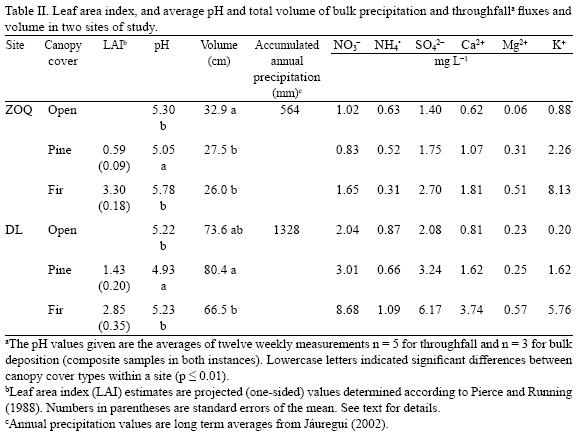
<body><![CDATA[<p align="justify"><font face="verdana" size="2">Precipitation volumes collected in forest clearings were equivalent to 55 and 51% of the long term average precipitation volumes for DL and ZOQ, respectively (J&aacute;uregui, 2002; <a href="#t2">Table II</a>). Volumes of throughfall and bulk precipitation collected at DL were more than double those at ZOQ. The effects of canopy cover on the volume of precipitation or throughfall collected were minimal at ZOQ, with slightly higher volume collected in open areas than under pine or fir canopies. At DL precipitation collected under pine canopies was significantly greater than under fir canopies (<a href="#t2">Table II</a>). At DL deposition was greater under fir canopies than under pine. Ionic deposition at DL was greater under fir and pine canopies than in open areas for all ions except NH<sub>4</sub><sup>+</sup> (<a href="/img/revistas/atm/v21n1/a5f2.jpg" target="_blank">Fig. 2</a>).</font></p>     <p align="center"><font face="verdana" size="2"><a name="t2"></a></font></p>     <p align="center"><font face="verdana" size="2"><img src="/img/revistas/atm/v21n1/a5t2.jpg"></font></p>     <p align="justify"><font face="verdana" size="2">Deposition in throughfall was higher at DL than ZOQ for NO<sub>3</sub>&#150;, NH<sub>4</sub><sup>+</sup>, SO<sub>4</sub><sup>2&#150;</sup>, Ca, Mg and K. Net throughfall deposition was negative at ZOQ for NO<sub>3</sub> collected under pine and fir, and even more for NH<sub>4</sub><sup>+</sup>. Sulfate collected under pine at ZOQ was marginally negative. At DL, net throughfall fluxes of NH<sub>4</sub>4<sup>+</sup> were strongly negative under both pine and fir canopies (<a href="/img/revistas/atm/v21n1/a5f3.jpg" target="_blank">Fig. 3</a>). Net throughfall deposition of NO<sub>3</sub> under fir and pine canopies were 5.56 and 1.11 kg ha"<sup>1</sup> at DL compared to &#150;0.16 and &#150;0.29 kg haNO<sup>&#150;1</sup>3 at ZOQ. Similarly, net throughfall deposition of SO<sub>4</sub><sup>2</sup> under fir and pine canopies were 4.98 and 2.36 kg ha&#150;<sup>1</sup> at DL compared to 0.35 and &#150;0.05 kg ha&#150;<sup>1</sup> at ZOQ (<a href="/img/revistas/atm/v21n1/a5f3.jpg" target="_blank">Fig. 3</a>).</font></p>     <p align="justify"><font face="verdana" size="2">Average pH values for throughfall under pine (p = 0.07) and fir (p = 0.001) were more acidic at DL (pH 5.23 for fir) than at ZOQ (pH 5.78 for fir). At both sites the pH of throughfall collected under pine trees was more acidic than solutions collected under fir trees or in forest clearings (<a href="#t2">Table II</a>).</font></p>     <p align="justify"><font face="verdana" size="2">&nbsp;</font></p>     <p align="justify"><font face="verdana" size="2"><b>3.2 Effects of canopy cover and soil depth on soil chemistry</b></font></p>     <p align="justify"><font face="verdana" size="2">At DL total C, N and S concentrations in 0&#150;5 cm soil were greatest under fir canopies and lowest under pine (<a href="/img/revistas/atm/v21n1/a5t3.jpg" target="_blank">Table III</a>). However, in 5&#150;15 cm soil from DL total C, N and S concentrations were higher, and C:N was lower in open areas than under pine or fir canopies. Unlike DL, ZOQ had the highest concentrations of total C, N and S in 0&#150;5 soils under pine canopies, although differences among cover types were small.</font></p>     <p align="justify"><font face="verdana" size="2">Soil C: N ratios were lowest at DL, and were generally the highest at ZOQ (<a href="/img/revistas/atm/v21n1/a5t3.jpg" target="_blank">Table III</a>). Surface soil from ZOQ had the lowest total S concentrations. The highest S concentrations were in 0&#150;5 cm soils from DL, especially soil collected under fir canopies (1.12 and 0.36 g kg<sup>&#150;1</sup> at DL and ZOQ, respectively). Concentrations of S in 5&#150;15 cm soils were lowest at ZOQ and highest at DL (<a href="/img/revistas/atm/v21n1/a5t3.jpg" target="_blank">Table III</a>). At both soil depths total N concentrations were lowest at ZOQ and highest at DL.</font></p>     <p align="justify"><font face="verdana" size="2">Adsorbed and soluble SO<sub>4</sub><sup>2&#150;</sup> concentrations in soil from open areas and soluble SO<sub>4</sub><sup>2&#150;</sup> in pine soils were similar at two sites (<a href="/img/revistas/atm/v21n1/a5t4.jpg" target="_blank">Table IV</a>). Soluble SO<sub>4</sub><sup>2&#150;</sup> in soils under fir canopies was lowest both depths and in the 5&#150;15 cm soils from DL. In 5&#150;15 cm fir soil adsorbed SO<sub>4</sub><sup>2&#150;</sup> concentrations at ZOQ (57.88 mg kg<sup>&#150;1</sup>) were 1.6&#150;2.3 times higher than at DL.</font></p>     ]]></body>
<body><![CDATA[<p align="justify"><font face="verdana" size="2">Soluble SO<sub>4</sub><sup>2&#150;</sup> was higher under fir than under pine and in open field soils. Soluble and adsorbed SO<sub>4</sub><sup>2&#150;</sup> concentrations under fir canopies tended to be greater in 5&#150;15 cm soils than in surface soils at ZOQ. Soluble SO<sub>4</sub><sup>2&#150;</sup> concentrations in fir soil at DL were more than twice as high in 0&#150;5 cm soil than in 5&#150;15 cm soil (<a href="/img/revistas/atm/v21n1/a5t4.jpg" target="_blank">Table IV</a>). Ammonium levels in 0&#150;5 cm soils were usually higher in soils collected under pine and fir trees than in open areas, but no clear differences among cover types were seen in the 5&#150;15 cm soils. No consistent trends were observed for canopy cover effects on NO<sub>3</sub>&#150; concentrations across sites at either soil depth. In two sites NO<sub>3</sub>&#150; concentration was less than 3.5 mg k<sup>&#150;1</sup> in all treatments, except in open areas at DL, where NO<sub>3</sub>&#150; ranged from 10.66 to 13.30 mg kg<sup>&#150;1</sup>.</font></p>     <p align="justify"><font face="verdana" size="2">At both sites concentrations of Ca, and soluble SO<sub>4</sub><sup>2&#150;</sup> were higher in soil collected under fir canopies than soil from pine or open areas, except in 5&#150;15 cm soils at DL where concentrations of Fe and K were highest in open area soils (<a href="/img/revistas/atm/v21n1/a5t4.jpg" target="_blank">Tables IV</a> and <a href="/img/revistas/atm/v21n1/a5t5.jpg" target="_blank">V</a>). Magnesium concentrations in soil differed little among cover types (<a href="/img/revistas/atm/v21n1/a5t5.jpg" target="_blank">Table V</a>).</font></p>     <p align="justify"><font face="verdana" size="2">Concentrations of NH<sub>4</sub><sup>+</sup> in fir soils were higher at both depths at DL than at ZOQ (<a href="/img/revistas/atm/v21n1/a5t4.jpg" target="_blank">Table IV</a>). Potassium concentrations were similar (0.03&#150;0.07%) at ZOQ and DL. Magnesium was the nutrient that was most enriched in soil at DL compared to the low deposition site, ZOQ. Magnesium concentrations were two to six times higher in soil from both soil depths at DL compared to ZOQ. Sodium concentrations in soil were 0.02&#150;0.03% at both sites.</font></p>     <p align="justify"><font face="verdana" size="2">&nbsp;</font></p>     <p align="justify"><font face="verdana" size="2"><b>4. Discussion</b></font></p>     <p align="justify"><font face="verdana" size="2"><i>4.1 Atmospheric deposition</i></font></p>     <p align="justify"><font face="verdana" size="2">Greater leaf area increased precipitation interception rates and low throughfall. However, in forests with high fog, the canopy increased fog interception rates and this fog is condensed and drips to soil. Thus, it can explain why measured rainfall volume at forest clearings is lower than under pine canopy at DL (<a href="#t2">Table II</a>).</font></p>     <p align="justify"><font face="verdana" size="2">Greater deposition under fir canopies is presumably a result of the greater surface area of the fir canopies compared to pine canopies for capturing air pollutants. At DL and ZOQ, values for LAI of fir were 2.0 and 5.6 times greater than for pine (<a href="#t2">Table II</a>). Others have reported that throughfall deposition of N and S decreases in the order of fir &gt; pine &gt; oak (Houdijk and Roelofs, 1991; van Ek and Draaijers, 1994). However, at both DL and ZOQ, deposition of NH<sub>4</sub><sup>+</sup> was greatest in open areas, indicating high levels of NH<sub>4</sub><sup>+</sup> consumption within fir and pine canopies. As a result, net throughfall fluxes of NH<sub>4</sub><sup>+</sup> were negative for both tree species at both sites. Nitrate was also consumed by the canopy as evidenced by negative net throughfall values at ZOQ. At DL atmospheric deposition fluxes of NO<sub>X</sub> to the canopy was much greater than canopy consumption rates, resulting in a positive net throughfall flux of NO<sub>3</sub>&#150;. Tree canopies appear to have also consumed SO<sub>4</sub><sup>2&#150;</sup>, as evidenced by a slightly negative value for net throughfall SO<sub>4</sub><sup>2</sup> flux under pine at ZOQ. This suggests that at least under pine canopies, throughfall flux of SO<sub>4</sub><sup>2&#150;</sup> is an underestimate of total SO<sub>4</sub><sup>2&#150; </sup>deposition, even during the wet season. It is generally accepted that throughfall deposition of SO<sub>4</sub><sup>2&#150;</sup> is a reasonable estimate of total S deposition, with minimal canopy retention of atmospheric S (Butler and Likens, 1995; Kovacs and Horvath, 2004; Lindberg and Lovett, 1992). Exceptions to this generalization would be forests exposed to elevated SO<sub>2</sub> concentrations resulting in canopy uptake and assimilation of SO<sub>2</sub> (Gay and Murphy, 1989; Granat and Richter, 1995; Manninen and Huttunen, 2000), and possibly areas with prolonged dry periods such as occur in the Basin of M&eacute;xico (Fenn <i>et al., </i>1999).</font></p>     <p align="justify"><font face="verdana" size="2">Deposition in throughfall of Ca, Mg and K was greatest under fir, intermediate under pine and lowest in open areas at DL and ZOQ. This is as expected because of the larger foliar surface area of the fir canopies. The largest source of these ions was likely leaching losses from foliage, in addition to washoff of deposition from canopy surfaces and wetfall deposition. In the San Bernardino Mountains of southern California concentrations of NO<sub>3</sub>&#150;, SO<sub>4</sub><sup>2&#150;</sup>, Cl<sup>&#150;</sup>, Ca, Mg, Na and K in throughfall and bulk deposition were greatest under white fir <i>(Abies concolor </i>Gord. and Glend.), intermediate under Jeffrey pine <i>(Pinus jeffreyi </i>Grev. and Balf.), and lowest in open areas (Fenn and Bytnerowicz, 1997). Throughfall fluxes of Ca, Mg and K were greater at DL than at ZOQ. The source of the greater cation fluxes at DL may be a result of the much greater throughfall fluxes of NO<sub>3</sub> and SO<sub>4</sub><sup>2&#150;</sup> at DL, with the basic cations functioning as counter balancing ions in the throughfall solutions. Higher fluxes of N and S at DL are a result of high atmospheric pollutant concentrations and greater precipitation volumes at DL. Calcium and Mg inputs were also higher in bulk deposition at DL than at ZOQ, at least partially because precipitation volumes were greater at DL. It may be that Ca and Mg salts of NO<sub>3</sub>&#150; and SO<sub>4</sub><sup>2&#150;</sup> are important sources of atmospheric deposition of N and S at DL.</font></p>     <p align="justify"><font face="verdana" size="2">At DL and ZOQ fluxes of NH<sub>4</sub><sup>+</sup> in bulk deposition were similar to those of SO<sub>4</sub><sup>2&#150;</sup> but greater than bulk deposition fluxes of NO<sub>3</sub>&#150;. This begs the question as to whether total deposition of NH<sub>4</sub><sup>+ </sup>to the forest canopy may be greater than deposition of NO<sub>3</sub>&#150; and possibly similar to total deposition of SO<sub>4</sub><sup>2&#150;</sup> . This can not be determined from the throughfall data, because it is not known how much NH<sub>4</sub><sup>+</sup> is consumed by the canopy. Total deposition of NH<sub>4</sub><sup>+</sup> to the fir canopies at DL and ZOQ was likely greater than to pine canopies, even though throughfall fluxes under pine and fir were equivalent. Similarly, ionic concentrations of NH<sub>4</sub><sup>+</sup> in throughfall were not significantly different under white fir and Jeffrey pine trees in the San Bernardino Mountains (Fenn and Bytnerowicz, 1997). In the present study, deposition of NO<sub>3</sub> in throughfall under fir canopies was double that under pine at DL, further suggesting that NH<sub>4</sub><sup>+</sup> deposition to fir canopies was also much greater than to pine. Even though a large amount of atmospheric NH<sub>4</sub><sup>+</sup> was retained by the forest canopy, atmospheric NH<sub>4</sub><sup>+</sup> consumed by the canopy would still contribute to greater soil N enrichment under fir compared to pine (or under fir and pine compared to open areas) because the NH<sub>4</sub><sup>+</sup> adsorbed or taken up by the canopy will eventually enter the soil N pool as litter fall or as soil organic matter derived from root turnover.</font></p>     ]]></body>
<body><![CDATA[<p align="justify"><font face="verdana" size="2">The relatively high NH<sub>4</sub><sup>+</sup> inputs in bulk deposition and presumed high total (dry + wet) deposition of NH<sub>4</sub><sup>+</sup> at DL was unexpected based on previous throughfall data. Fenn et al. (1999) reported that the ratio of nitrate and ammonium in throughfall was 1.4 at ZOQ and 1.6 at DL. However, throughfall collectors in that study were placed along transects in the forest and deposition data integrated over the stand. Bulk deposition in open areas was not reported; thus net throughfall or the high degree of canopy NH<sub>4</sub><sup>+</sup> consumption could not be calculated. However, data on atmospheric concentrations of NH<sub>4</sub><sup>+</sup> (Fenn <i>et al., </i>2002c), deposition of NH<sub>4</sub><sup>+</sup> to surrogate surfaces (Fenn <i>et al., </i>1999, 2002b) and wet&#150;only deposition fluxes in M&eacute;xico City (Bravo&#150;Alvarez and Torres&#150;Jard&oacute;n, 2002) are in agreement with our bulk deposition data in this study, suggesting that NH<sub>4</sub><sup>+</sup> deposition levels are relatively high in the Basin of M&eacute;xico. Volume&#150;weighted annual mean concentrations of NH<sub>4</sub><sup>+</sup> in wet&#150;only deposition in M&eacute;xico City from 1993 to 1998 were almost twice as high as the highest concentrations reported from the United States (Bravo&#150;&Aacute;lvarez and Torres&#150;Jard&oacute;n, 2002; NADP, 2000). Atmospheric concentrations of NH<sub>4</sub><sup>+</sup> at DL in 1994 and 1995 were generally similar to those of NO<sub>3</sub>&#150; and HN0<sub>3</sub>, and deposition fluxes of NO<sub>3</sub> and NH<sub>4</sub><sup>+</sup> to paper filters at DL were not significantly different (Fenn <i>et al., </i>2002c). Deposition of NH<sub>4</sub><sup>+</sup> to paper filters at ZOQ was more than double that of NO<sub>3</sub>&#150;. In summary, these data suggest that NH<sub>4</sub><sup>+</sup> deposition to forests in the Basin of M&eacute;xico may be of similar magnitude to that of NO<sub>3</sub>&#150; and SO<sub>4</sub><sup>2</sup>&#150;, but this isn't evident from throughfall data because of the high canopy consumption of NH<sub>4</sub><sup>+</sup>. Previous studies have reported that typically 25 to 40% or more of atmospherically&#150;deposited NH<sub>x</sub> is retained by the canopy (Lovett and Lindberg, 1993; Fenn and Bytnerowicz, 1997).</font></p>     <p align="justify"><font face="verdana" size="2">Precipitation and throughfall are major pathways in nutrient recycling, and they are an important source of nutrient input to forested ecosystems, two important processes functional for the ecosystem. Throughfall may be important in plant nutrition and soil fertility (Chapin <i>et al., </i>2002). These effects, combined with the altered nutrient cycling regimes and the rates of soil processes resulting from forest growth, can affect site fertility and drainage water quality; aside from the magnitude and nature of the impacts have been shown to differ depending on the cover and species of tree.</font></p>     <p align="justify"><font face="verdana" size="2">&nbsp;</font></p>     <p align="justify"><font face="verdana" size="2"><i>4.2 Soil chemistry</i></font></p>     <p align="justify"><font face="verdana" size="2"><i>4.2.1&nbsp; Canopy covers effects on soil chemistry</i></font></p>     <p align="justify"><font face="verdana" size="2">In the current study, both soil NH<sub>4</sub><sup>+</sup> and C concentrations were generally higher in pine and fir 0&#150;5 cm soils than in open areas (except at ZOQ), probably a result of greater litter input compared to open areas. Likewise, at DL C concentrations in 0&#150;5 cm soil were higher under fir canopies than under pine. Thus nutrient enrichment under fir was particularly pronounced in 0&#150;5 cm soil at DL, the polluted site (Fenn <i>et al., </i>2002a). Concentrations of C, N, S, soluble SO<sub>4</sub><sup>2&#150;</sup>, NH<sub>4</sub><sup>+</sup>, Li, Ca and K in 0&#150;5 cm soil at DL were greater in soil under fir canopies than soil in open areas or under pine canopies. However, nitrate concentrations were an exception, as NO<sub>3</sub>&#150; concentrations in 0&#150;5 cm soil were about five times greater in open soils than soils under pine or fir at DL (<a href="/img/revistas/atm/v21n1/a5t4.jpg" target="_blank">Table IV</a>). Concentrations of total S and N in 0&#150;5 cm soil at DL were 16 to 49% percent higher in fir soil than soil from under pine or in open areas. These results support the hypothesis that soil enrichment of N, S, Ca and K (and possibly other elements not measured in throughfall) under fir trees is greater than under pine or in open areas as a result of enhanced atmospheric deposition to fir canopies. On the other hand, for some constituents (i.e., soluble SO<sub>4</sub><sup>2&#150;</sup> and Ca), fir soils are more nutrient enriched than soils from under pine or in forest clearings, irrespective of atmospheric pollution levels. However, even for these constituents, the higher concentrations in fir soils could still be a function of the higher LAI of the fir trees.</font></p>     <p align="justify"><font face="verdana" size="2">A contrasting pattern of canopy cover effect was observed in the 5&#150;15 cm soil from DL. Nitrate concentrations were 4 and 13 times higher in open soils than fir or pine soils in both sites ZOQ and DL (<a href="/img/revistas/atm/v21n1/a5t4.jpg" target="_blank">Table IV</a>), it could be due to forests clearing often induce a higher microbiologic activity and mineralization rates. Higher nutrient concentrations in 5&#150;15 cm open soils at DL could be due to lower nutrient depletion in the 5&#150;15 cm zone from tree roots in the open areas, but we have no data to test this hypothesis, nor it is clear why this phenomenon was only observed at DL, the site most polluted (Fenn <i>et al., </i>2002a), and with the highest annual precipitation and lowest annual average temperature (J&aacute;uregui, 2002).</font></p>     <p align="justify"><font face="verdana" size="2">Concentrations of C, N, S, NO<sub>3</sub>&#150;, Fe and K were similar in the pine and fir soils, but they were consistently lower than in soils from open areas. The major nutrients C, N and S were 23&#150;29% higher in open soils than fir or pine soils. K was 67% higher in open soil compared to fir or pine soils.</font></p>     <p align="justify"><font face="verdana" size="2">&nbsp;</font></p>     <p align="justify"><font face="verdana" size="2"><i>4.2.2&nbsp;Site comparisons</i></font></p>     ]]></body>
<body><![CDATA[<p align="justify"><font face="verdana" size="2">Concentrations of total N and S in soil were higher at DL than at ZOQ low pollution site. Magnesium concentrations in soil were two to six times higher at the high deposition site compared to the low deposition site. Thus, it appears that elevated atmospheric deposition of N, S and Mg at DL, results in corresponding increases of the accumulation a long term these compounds in soil. Calcium deposition was also several folds greater at DL than ZOQ, but Ca concentrations in soil were not elevated at the polluted site. However, we must consider that we are reporting on a single composite sample, and that no statistics are possible. This is likely a result of increased leaching of Ca from soil as counterbalancing ions for NO<sub>3</sub>&#150; and SO<sub>4</sub><sup>2&#150;</sup> , although it is not known why Mg accumulated in soil at DL. Others have reported increased levels in soil of Ca and Mg (MacDonald <i>et al., </i>1993) and total S (David <i>et al., </i>1988) in sites with higher levels of atmospheric deposition of these same compounds. MacDonald <i>et al. </i>(1993) also reported correspondence between concentrations of soluble and adsorbed SO<sub>4</sub><sup>2&#150;</sup> in soil and levels of atmospheric SO<sub>4</sub><sup>2&#150;</sup> deposition.</font></p>     <p align="justify"><font face="verdana" size="2">Of the two study sites, soils at ZOQ reflect the least influence of atmospheric deposition on soil chemistry. However, concentrations of adsorbed SO<sub>4</sub><sup>2&#150;</sup> in soil were an exception. The highest absolute values for adsorbed SO<sub>4</sub><sup>2&#150;</sup> in pine soil at both depths were at ZOQ, and adsorbed SO<sub>4</sub><sup>2&#150;</sup> in 5&#150;15 cm fir soils at ZOQ were two to three times greater than at the other three sites. In contrast, total S concentrations in soil at ZOQ were lower than at DL. The contrasting results for total S and adsorbed SO<sub>4</sub><sup>2&#150;</sup> at ZOQ may be explained by intermittent emissions of SO<sub>2</sub> from the Popocat&eacute;petl volcano which reawakened in 1993 after 70 years of quiescence. Volcanic activity increased in late 1994 and in the following three years Popocat&eacute;petl was one of the largest SO<sub>2</sub> sources in the world (De la Cruz&#150;Reyna and Siebe, 1997). Sulfur deposition in throughfall (8.8 kg S ha<sup>&#150;1</sup> yr<sup>&#150;1</sup>) in an open pine forest at ZOQ from March 1996 to March 1997 was higher than expected based on the dominant wind patterns in the M&eacute;xico City air basin (Fenn <i>et al., </i>1999). Throughfall fluxes probably underestimate total S deposition at ZOQ considering that little precipitation occurs for six months during the fall and winter and because ZOQ is a relatively low precipitation site compared to sites located south or west of M&eacute;xico City. In summary, it may be that total S concentrations in soil at ZOQ have not increased, while adsorbed SO<sub>4</sub><sup>2&#150;</sup> has increased, because elevated S deposition at ZOQ is of recent and intermittent occurrence. It would likely take years of chronic S deposition to cause a clear signal of increased total S accumulation in soil; thus at DL, the most polluted site, both adsorbed SO<sub>4</sub><sup>2&#150;</sup> and total S in soil are elevated, as a result of chronic S deposition from fossil fuel emissions (Bravo&#150;&Aacute;lvarez and Torres&#150;Jard&oacute;n, 2002).</font></p>     <p align="justify"><font face="verdana" size="2">As observed in previous studies, soil C:N ratios are inherently low in the N&#150;rich forest soils in the Basin of M&eacute;xico (Fenn <i>et al., </i>2002c, 2006a). As a result, differences in C:N ratios between high and low deposition sites are not large and are not always lower at more polluted sites. In this study, the highest C:N values (16.7&#150;18.5) were at ZOQ a low deposition site. However, total N concentrations in soil were highest at the most polluted site (DL) and lowest at ZOQ.</font></p>     <p align="justify"><font face="verdana" size="2">&nbsp;</font></p>     <p align="justify"><font face="verdana" size="2"><i>4.2.3 Deposition effects on soil chemistry in relation to forest health</i></font></p>     <p align="justify"><font face="verdana" size="2">Soil pH was generally higher in soil under fir than under pine or in open areas (Fenn <i>et al., </i>2006b), possibly because of the high base cation leaching rates from fir canopies. There was also a trend of lower soil pH at DL, the two high deposition sites, compared to the low deposition site (ZOQ), but differences were relatively minor (Fenn <i>et al., </i>2006b). Likewise, the pH of throughfall and bulk deposition solutions was lower at DL than at ZOQ. High N and S deposition, which is usually associated with soil acidification, did not cause a significant effect on soil pH, presumably because of equally high levels of base cation deposition. As a result, soil acidification or base cation depletion does not appear to be a major factor in fir decline. The soils are sufficiently buffered and the high throughfall deposition of cations, N and S provides a relatively constant replenishment of these nutrients. Dendrochemical studies found elevated Pb and Cd levels in sacred fir tree rings since the 1960s at DL, but dendrochemical evidence (trends in wood Mn and base cation concentrations) indicate that soils under sacred fir at DL have not acidified, nor have base cation supplies diminished or available aluminum in soil increased during the past several decades when the fir decline problem became severe (Watmough and Hutchinson, 1999). These trends in soil chemistry and dendrochemistry are in contrast with declining fir and spruce stands in Europe and North America where base cation leaching from surface soil, soil acidification and Al mobilization are reported (Bondietti <i>et al., </i>1990; Fenn <i>et al., </i>2006a; Shortle <i>et al., </i>1995).</font></p>     <p align="justify"><font face="verdana" size="2">Heavy metal concentrations in the same soils used in this study did not suggest a clear enrichment of heavy metals in soil under fir canopies as was found for N and S. Concentrations of Pb, Cu, Mn and Zn (<a href="/img/revistas/atm/v21n1/a5t6.jpg" target="_blank">Table VI</a>) were, in general, slightly higher in fir soil than pine or open 0&#150;5 cm soil, but concentrations of these same metals in 5&#150;15 cm soil were higher in open areas than in fir or pine soils (Fenn <i>et al., </i>2006b). From this it is not clear what effect pine or fir canopies have on levels of heavy metals in soil of the polluted study sites. Lack of an obvious fir enrichment effect on heavy metals, particularly in the deeper mineral soil, may be partially due to the low mobility of these metals that are likely immobilized by high organic matter concentrations in the upper soil horizon.</font></p>     <p align="justify"><font face="verdana" size="2">Heavy metal concentrations in soil at DL do not appear to be at phytotoxic levels for most plant species, although sensitive species, microbes or biological processes could be affected by the accumulated metals (Fenn <i>et al., </i>2002b). In a recent study, the growth of eucalyptus seedlings planted into pine soil from Cumbres del Ajusco (AJ) National park (highly affected by air pollution) was extremely retarded (Fenn <i>et al., </i>2006b; Perea&#150;Estrada, 2003), but fertilization with N and P alleviated the growth reduction. The percentage of roots that were ectomycorrhizal, endomycorrizal and colonized by putative symbiotic endophytic fungi with abundant external mycelium was significantly lower for seedlings growing in soil from AJ and DL compared to ZOQ (Fenn <i>et al.</i>, 2006b; Perea&#150;Estrada <i>et al., </i>2005). Thus, heavy metals or some other toxic factor in soil from AJ and DL may cause detrimental effects on mycorrhizae and possibly other symbiotic fungal/root associations (Perea&#150;Estrada <i>et al., </i>2005). These findings were based on soils collected under <i>P. hartwegii, </i>but soils under <i>A. religiosa </i>in the Basin of M&eacute;xico may have the same characteristics, and potentially to a greater degree if the root cause is proportional to levels of atmospheric deposition. Clearly, further studies are warranted on the role of heavy metals or other possible unknown toxic factors in soil on mycorrhizal root development, and on possible relationships with the development of sacred fir decline. We are unaware of studies on the possibility of impaired mycorrhizal formation as a factor in fir decline.</font></p>     <p align="justify"><font face="verdana" size="2">&nbsp;</font></p>     <p align="justify"><font face="verdana" size="2"><b>5. Conclusions</b></font></p>     ]]></body>
<body><![CDATA[<p align="justify"><font face="verdana" size="2">Nothwithstanding the high levels of NO<sub>3</sub>&#150; and SO<sub>4</sub><sup>2&#150;</sup> in throughfall solutions collected under fir canopies at the high deposition site (DL), throughfall acidity was only slightly increased, apparently because of high levels of base cation leaching, particularly from fir canopies. As a result, soil pH is also only marginally affected by atmospheric deposition in the M&eacute;xico City air basin (Fenn <i>et al., </i>2006a). Bulk deposition fluxes of NH<sub>4</sub><sup>+</sup>, and published data on wet deposition and atmospheric concentrations of NH<sub>4</sub><sup>+</sup> suggest that atmospheric deposition of this cation to forests in the M&eacute;xico City air basin may be similar to deposition fluxes of NO<sub>3</sub> and SO<sub>4</sub><sup>2&#150;</sup>. However, high canopy consumption of atmospheric NH<sub>4</sub><sup>+</sup> resulted in negative net throughfall NH<sub>4</sub><sup>+</sup> fluxes for pine and fir at both the high and low pollution study sites. The higher nutrient deposition in throughfall under fir canopies appears to be an important contributor to higher levels of C, N, S, soluble SO<sub>4</sub><sup>2&#150;</sup> and Ca in soil under fir canopies compared to pine or in forest openings. No obvious detrimental nutritional effects of this deposition and soil enrichment have been observed, but high S levels in foliage of <i>A. religiosa </i>at DL have been reported (L&oacute;pez&#150;L&oacute;pez <i>et al., </i>1998).</font></p>     <p align="justify"><font face="verdana" size="2">&nbsp;</font></p>     <p align="justify"><font face="verdana" size="2"><b>Acknowledgements</b></font></p>     <p align="justify"><font face="verdana" size="2">The authors wish to thank Susan Schilling for producing <a href="/img/revistas/atm/v21n1/a5f1.jpg" target="_blank">Figure 1</a> and V&iacute;ctor Perea, Timothy Blubaugh, Diane Alexander and Dave Jones for sample processing and chemical analyses.</font></p>     <p align="justify"><font face="verdana" size="2">&nbsp;</font></p>     <p align="justify"><font face="verdana" size="2"><b>References</b></font></p>     <!-- ref --><p align="justify"><font face="verdana" size="2">Alvarado R. D., L. I. de Bauer and J. Galindo, 1993. Decline of sacred fir <i>(Abies religiosa) </i>in a forest park South of M&eacute;xico City. <i>Environ. Pollut. </i><b>80</b>, 115&#150;121.</font>&nbsp;&nbsp;&nbsp;&nbsp;&nbsp;&nbsp;&nbsp;&nbsp;[&#160;<a href="javascript:void(0);" onclick="javascript: window.open('/scielo.php?script=sci_nlinks&ref=1271311&pid=S0187-6236200800010000500001&lng=','','width=640,height=500,resizable=yes,scrollbars=1,menubar=yes,');">Links</a>&#160;]<!-- end-ref --><!-- ref --><p align="justify"><font face="verdana" size="2">Alvarado&#150;Rosales D. and T. Hern&aacute;ndez&#150;Tejeda, 2002. Decline of sacred fir in the Desierto de los Leones National Park. In: <i>Urban Air Pollution and Forests: Resources at Risk in the Mexico City Air Basin. </i>(M. E. Fenn, L. I. de Bauer and T. Hern&aacute;ndez&#150;Tejeda, Eds.). Ecological Studies Series, Volume 156. Springer&#150;Verlag, New York, pp. 243&#150;260.</font>&nbsp;&nbsp;&nbsp;&nbsp;&nbsp;&nbsp;&nbsp;&nbsp;[&#160;<a href="javascript:void(0);" onclick="javascript: window.open('/scielo.php?script=sci_nlinks&ref=1271312&pid=S0187-6236200800010000500002&lng=','','width=640,height=500,resizable=yes,scrollbars=1,menubar=yes,');">Links</a>&#160;]<!-- end-ref --><!-- ref --><p align="justify"><font face="verdana" size="2">Autry A. R., J. W. Fitzgerald and P. R. Caldwell, 1990. Sulfur fractions and retention mechanisms in forest soils. <i>Can. J. For. Res. </i><b>20</b>, 337&#150;342.</font>&nbsp;&nbsp;&nbsp;&nbsp;&nbsp;&nbsp;&nbsp;&nbsp;[&#160;<a href="javascript:void(0);" onclick="javascript: window.open('/scielo.php?script=sci_nlinks&ref=1271313&pid=S0187-6236200800010000500003&lng=','','width=640,height=500,resizable=yes,scrollbars=1,menubar=yes,');">Links</a>&#160;]<!-- end-ref --><!-- ref --><p align="justify"><font face="verdana" size="2">Bondietti E. A., N. Momoshima, W. C. Shortle and K. T. Smith, 1990. A historical perspective on divalent cation trends in red spruce stemwood and the hypothetical relationship to acidic deposition. <i>Can. J. For. Res. </i><b>20</b>, 1850&#150;1858.</font>&nbsp;&nbsp;&nbsp;&nbsp;&nbsp;&nbsp;&nbsp;&nbsp;[&#160;<a href="javascript:void(0);" onclick="javascript: window.open('/scielo.php?script=sci_nlinks&ref=1271314&pid=S0187-6236200800010000500004&lng=','','width=640,height=500,resizable=yes,scrollbars=1,menubar=yes,');">Links</a>&#160;]<!-- end-ref --><!-- ref --><p align="justify"><font face="verdana" size="2">Bravo&#150;&Aacute;lvarez H. and R. Torres&#150;Jard&oacute;n, 2002. Air pollution levels and trends in the Mexico City metropolitan area. In: <i>Urban Air Pollution and Forests: Resources at Riskin the Mexico City Air Basin. </i>(M. E. Fenn, L. I. de Bauer and T. Hern&aacute;ndez&#150;Tejeda, Eds.). Ecological Studies Series, Volume 156. Springer&#150;Verlag, New York, pp. 121&#150;159.</font>&nbsp;&nbsp;&nbsp;&nbsp;&nbsp;&nbsp;&nbsp;&nbsp;[&#160;<a href="javascript:void(0);" onclick="javascript: window.open('/scielo.php?script=sci_nlinks&ref=1271315&pid=S0187-6236200800010000500005&lng=','','width=640,height=500,resizable=yes,scrollbars=1,menubar=yes,');">Links</a>&#160;]<!-- end-ref --><!-- ref --><p align="justify"><font face="verdana" size="2">Butler T. J. and G. E. Likens, 1995. A direct comparison of throughfall plus stemflow to estimates of dry and total deposition for sulfur and nitrogen. <i>Atmos. Environ. </i><b>29</b>, 1253&#150;1265.</font>&nbsp;&nbsp;&nbsp;&nbsp;&nbsp;&nbsp;&nbsp;&nbsp;[&#160;<a href="javascript:void(0);" onclick="javascript: window.open('/scielo.php?script=sci_nlinks&ref=1271316&pid=S0187-6236200800010000500006&lng=','','width=640,height=500,resizable=yes,scrollbars=1,menubar=yes,');">Links</a>&#160;]<!-- end-ref --><!-- ref --><p align="justify"><font face="verdana" size="2">Chapin III F. S., P. A. Matson and H. A. Mooney, 2002. Principles of terrestrial ecosystem ecology. Springer&#150;Verlag, New York, pp 78&#150;80. </font>&nbsp;&nbsp;&nbsp;&nbsp;&nbsp;&nbsp;&nbsp;&nbsp;[&#160;<a href="javascript:void(0);" onclick="javascript: window.open('/scielo.php?script=sci_nlinks&ref=1271317&pid=S0187-6236200800010000500007&lng=','','width=640,height=500,resizable=yes,scrollbars=1,menubar=yes,');">Links</a>&#160;]<!-- end-ref --><!-- ref --><p align="justify"><font face="verdana" size="2">David M. B., D. F. Grigal, L. F. Ohmann and G. Z. Gertner, 1988. Sulfur, carbon, and nitrogen relationships in forest soils across the northern Great Lakes states as affected by atmospheric deposition and vegetation. <i>Can. J. For. Res. </i><b>18</b>, 1386&#150;1391.</font>&nbsp;&nbsp;&nbsp;&nbsp;&nbsp;&nbsp;&nbsp;&nbsp;[&#160;<a href="javascript:void(0);" onclick="javascript: window.open('/scielo.php?script=sci_nlinks&ref=1271318&pid=S0187-6236200800010000500008&lng=','','width=640,height=500,resizable=yes,scrollbars=1,menubar=yes,');">Links</a>&#160;]<!-- end-ref --><!-- ref --><p align="justify"><font face="verdana" size="2">De la Cruz&#150;Reyna S. and C. Siebe, 1997. The giant Popocat&eacute;petl stirs. <i>Nature </i><b>388</b>, 227.</font>&nbsp;&nbsp;&nbsp;&nbsp;&nbsp;&nbsp;&nbsp;&nbsp;[&#160;<a href="javascript:void(0);" onclick="javascript: window.open('/scielo.php?script=sci_nlinks&ref=1271319&pid=S0187-6236200800010000500009&lng=','','width=640,height=500,resizable=yes,scrollbars=1,menubar=yes,');">Links</a>&#160;]<!-- end-ref --><!-- ref --><p align="justify"><font face="verdana" size="2">Fenn M. E. and A. Bytnerowicz, 1997. Summer throughfall and winter deposition in the San Bernardino mountains in southern California. <i>Atmos. Environ. </i><b>31</b>, 673&#150;683.</font>&nbsp;&nbsp;&nbsp;&nbsp;&nbsp;&nbsp;&nbsp;&nbsp;[&#160;<a href="javascript:void(0);" onclick="javascript: window.open('/scielo.php?script=sci_nlinks&ref=1271320&pid=S0187-6236200800010000500010&lng=','','width=640,height=500,resizable=yes,scrollbars=1,menubar=yes,');">Links</a>&#160;]<!-- end-ref --><!-- ref --><p align="justify"><font face="verdana" size="2">Fenn M. E., L. I. de Bauer, A. Quevedo&#150;Nolasco and C. Rodriguez&#150;Frausto, 1999. Nitrogen and sulfur deposition and forest nutrient status in the Valley of M&eacute;xico. <i>Water, Air, Soil Poll. </i><b>113</b>, 155&#150;174.</font>&nbsp;&nbsp;&nbsp;&nbsp;&nbsp;&nbsp;&nbsp;&nbsp;[&#160;<a href="javascript:void(0);" onclick="javascript: window.open('/scielo.php?script=sci_nlinks&ref=1271321&pid=S0187-6236200800010000500011&lng=','','width=640,height=500,resizable=yes,scrollbars=1,menubar=yes,');">Links</a>&#160;]<!-- end-ref --><!-- ref --><p align="justify"><font face="verdana" size="2">Fenn M. E., L. I. de Bauer and T. Hern&aacute;ndez&#150;Tejeda, 2002a. Summary of air pollution impacts on forests in the M&eacute;xico City Air Basin. In: <i>Urban Air Pollution and Forests: Resources at Risk in the M&eacute;xico City Air Basin. </i>(M. E. Fenn, L. I. de Bauer and T. Hern&aacute;ndez&#150;Tejeda. Eds.), Ecological Studies Series, Volume 156. Springer&#150;Verlag, New York, 337&#150;355.</font>&nbsp;&nbsp;&nbsp;&nbsp;&nbsp;&nbsp;&nbsp;&nbsp;[&#160;<a href="javascript:void(0);" onclick="javascript: window.open('/scielo.php?script=sci_nlinks&ref=1271322&pid=S0187-6236200800010000500012&lng=','','width=640,height=500,resizable=yes,scrollbars=1,menubar=yes,');">Links</a>&#160;]<!-- end-ref --><!-- ref --><p align="justify"><font face="verdana" size="2">Fenn M. E., J. M. Castro&#150;Serv&iacute;n, T. Hern&aacute;ndez&#150;Tejeda, N. Krage, C. Goodson C. and T. Meixner, 2002b. Heavy metals in forest soils, vegetation and drainage waters in the Basin of Mexico. In: <i>Urban Air Pollution and Forests: Resources at Risk in the Mexico City Air Basin. </i>(M. E. Fenn, L. I. de Bauer and T. Hern&aacute;ndez&#150;Tejeda, Eds.) Ecological Studies Series, Volume 156. Springer&#150;Verlag, New York, 194&#150;221.</font>&nbsp;&nbsp;&nbsp;&nbsp;&nbsp;&nbsp;&nbsp;&nbsp;[&#160;<a href="javascript:void(0);" onclick="javascript: window.open('/scielo.php?script=sci_nlinks&ref=1271323&pid=S0187-6236200800010000500013&lng=','','width=640,height=500,resizable=yes,scrollbars=1,menubar=yes,');">Links</a>&#160;]<!-- end-ref --><!-- ref --><p align="justify"><font face="verdana" size="2">Fenn M.E., L. I. de Bauer, K. Zeller, A. Quevedo, C. Rodr&iacute;guez, and T. Hern&aacute;ndez&#150;Tejeda, 2002c. Nitrogen and sulfur deposition in the Mexico City Air Basin: Impacts on forest nutrient status and nitrate levels in drainage waters. In: <i>Urban Air Pollution and Forests: Resources at Risk in the Mexico City Air Basin.. </i>(M. E. Fenn, L. I. de Bauer and T. Hern&aacute;ndez&#150;Tejeda, Eds.) Ecological Studies Series, Volume 156. Springer&#150;Verlag, New York, 298&#150;319.</font>&nbsp;&nbsp;&nbsp;&nbsp;&nbsp;&nbsp;&nbsp;&nbsp;[&#160;<a href="javascript:void(0);" onclick="javascript: window.open('/scielo.php?script=sci_nlinks&ref=1271324&pid=S0187-6236200800010000500014&lng=','','width=640,height=500,resizable=yes,scrollbars=1,menubar=yes,');">Links</a>&#160;]<!-- end-ref --><!-- ref --><p align="justify"><font face="verdana" size="2">Fenn M. E., T. G. Huntington, S. B. McLaughlin, C. Eagar, A. G&oacute;mez and R. B. Cook, 2006a. Status of soil acidification in North America. <i>J. For. Sci. </i>(Prague) <b>52</b>, 3&#150;13. </font>&nbsp;&nbsp;&nbsp;&nbsp;&nbsp;&nbsp;&nbsp;&nbsp;[&#160;<a href="javascript:void(0);" onclick="javascript: window.open('/scielo.php?script=sci_nlinks&ref=1271325&pid=S0187-6236200800010000500015&lng=','','width=640,height=500,resizable=yes,scrollbars=1,menubar=yes,');">Links</a>&#160;]<!-- end-ref --><!-- ref --><p align="justify"><font face="verdana" size="2">Fenn M. E., V. M. Perea&#150;Estrada, L. I. de Bauer, M. P&eacute;rez&#150;Su&aacute;rez, D. R. Parker and V. M. Cetina&#150;Alcal&aacute;, 2006b. Nutrient status and plant growth effects of forest soils in the Basin of M&eacute;xico. <i>Environ. Pollut </i><b>140</b>, 187&#150;199.</font>&nbsp;&nbsp;&nbsp;&nbsp;&nbsp;&nbsp;&nbsp;&nbsp;[&#160;<a href="javascript:void(0);" onclick="javascript: window.open('/scielo.php?script=sci_nlinks&ref=1271326&pid=S0187-6236200800010000500016&lng=','','width=640,height=500,resizable=yes,scrollbars=1,menubar=yes,');">Links</a>&#160;]<!-- end-ref --><!-- ref --><p align="justify"><font face="verdana" size="2">Gay D. W. and C. E. Murphy Jr., 1989. Measurement of the deposition and fate of sulfur&#150;dioxide&#150;35 in a pine plantation. <i>J. Environ. Qual. </i><b>18</b>, 337&#150;344.</font>&nbsp;&nbsp;&nbsp;&nbsp;&nbsp;&nbsp;&nbsp;&nbsp;[&#160;<a href="javascript:void(0);" onclick="javascript: window.open('/scielo.php?script=sci_nlinks&ref=1271327&pid=S0187-6236200800010000500017&lng=','','width=640,height=500,resizable=yes,scrollbars=1,menubar=yes,');">Links</a>&#160;]<!-- end-ref --><!-- ref --><p align="justify"><font face="verdana" size="2">Granat L. and A. Richter, 1995. Dry deposition to pine of sulphur dioxide and ozone at low concentration. <i>Atmos. Environ. </i><b>29</b>, 1677&#150;1683.</font>&nbsp;&nbsp;&nbsp;&nbsp;&nbsp;&nbsp;&nbsp;&nbsp;[&#160;<a href="javascript:void(0);" onclick="javascript: window.open('/scielo.php?script=sci_nlinks&ref=1271328&pid=S0187-6236200800010000500018&lng=','','width=640,height=500,resizable=yes,scrollbars=1,menubar=yes,');">Links</a>&#160;]<!-- end-ref --><!-- ref --><p align="justify"><font face="verdana" size="2">Houdijk A. L. F. M. and J. G. M. Roelofs, 1991. Deposition of acidifying and eutrophicating substances in Dutch forests. <i>Acta Bot. Neerl. </i><b>40</b>, 245&#150;255.</font>&nbsp;&nbsp;&nbsp;&nbsp;&nbsp;&nbsp;&nbsp;&nbsp;[&#160;<a href="javascript:void(0);" onclick="javascript: window.open('/scielo.php?script=sci_nlinks&ref=1271329&pid=S0187-6236200800010000500019&lng=','','width=640,height=500,resizable=yes,scrollbars=1,menubar=yes,');">Links</a>&#160;]<!-- end-ref --><!-- ref --><p align="justify"><font face="verdana" size="2">J&aacute;uregui E., 2002. The climate of the Mexico City Air Basin: Its effects on the formation and transport of pollutants. In: <i>Urban Air Pollution and Forests: Resources at Risk in the Mexico City Air Basin. </i>(M. E. Fenn, L. I. de Bauer and T. Hern&aacute;ndez&#150;Tejeda, Eds.) Ecological Studies Series, Volume 156. Springer&#150;Verlag, New York, pp. 86&#150;117.</font>&nbsp;&nbsp;&nbsp;&nbsp;&nbsp;&nbsp;&nbsp;&nbsp;[&#160;<a href="javascript:void(0);" onclick="javascript: window.open('/scielo.php?script=sci_nlinks&ref=1271330&pid=S0187-6236200800010000500020&lng=','','width=640,height=500,resizable=yes,scrollbars=1,menubar=yes,');">Links</a>&#160;]<!-- end-ref --><!-- ref --><p align="justify"><font face="verdana" size="2">Kovacs E. A. and L. Horvath, 2004. Determination of sulfur balance between the atmosphere and a Norway spruce forest ecosystem: Comparison of gradient dry plus wet and throughfall deposition measurements. <i>J. Atmos. Chem. </i><b>48</b>, 235&#150;240.</font>&nbsp;&nbsp;&nbsp;&nbsp;&nbsp;&nbsp;&nbsp;&nbsp;[&#160;<a href="javascript:void(0);" onclick="javascript: window.open('/scielo.php?script=sci_nlinks&ref=1271331&pid=S0187-6236200800010000500021&lng=','','width=640,height=500,resizable=yes,scrollbars=1,menubar=yes,');">Links</a>&#160;]<!-- end-ref --><!-- ref --><p align="justify"><font face="verdana" size="2">Lindberg S. E. and G. M. Lovett, 1992. Deposition and forest canopy interactions of airborne sulfur &#150; Results from the Integrated Forest Study. <i>Atmos. Environ. </i><b>26</b>, 1477&#150;1492.</font>&nbsp;&nbsp;&nbsp;&nbsp;&nbsp;&nbsp;&nbsp;&nbsp;[&#160;<a href="javascript:void(0);" onclick="javascript: window.open('/scielo.php?script=sci_nlinks&ref=1271332&pid=S0187-6236200800010000500022&lng=','','width=640,height=500,resizable=yes,scrollbars=1,menubar=yes,');">Links</a>&#160;]<!-- end-ref --><!-- ref --><p align="justify"><font face="verdana" size="2">L&oacute;pez&#150;L&oacute;pez M. A., J. Vel&aacute;zquez&#150;Mendoza, A. Vel&aacute;zquez&#150;Mart&iacute;nez, V. Gonz&aacute;lez&#150;Romero and V. M. Cetina&#150;Alcal&aacute;, 1998. Estado nutrimental de <i>Abies religiosa </i>en una &aacute;rea con problemas de contaminaci&oacute;n ambiental. <i>Agrociencia </i><b>32</b>, 53&#150;59.</font>&nbsp;&nbsp;&nbsp;&nbsp;&nbsp;&nbsp;&nbsp;&nbsp;[&#160;<a href="javascript:void(0);" onclick="javascript: window.open('/scielo.php?script=sci_nlinks&ref=1271333&pid=S0187-6236200800010000500023&lng=','','width=640,height=500,resizable=yes,scrollbars=1,menubar=yes,');">Links</a>&#160;]<!-- end-ref --><!-- ref --><p align="justify"><font face="verdana" size="2">Lovett G. M. and S. E. Lindberg, 1993. Atmospheric deposition and canopy interactions of nitrogen in forests. <i>Can. J. For. Res. </i><b>23</b>, 1603&#150;1616.</font>&nbsp;&nbsp;&nbsp;&nbsp;&nbsp;&nbsp;&nbsp;&nbsp;[&#160;<a href="javascript:void(0);" onclick="javascript: window.open('/scielo.php?script=sci_nlinks&ref=1271334&pid=S0187-6236200800010000500024&lng=','','width=640,height=500,resizable=yes,scrollbars=1,menubar=yes,');">Links</a>&#160;]<!-- end-ref --><!-- ref --><p align="justify"><font face="verdana" size="2">MacDonald N. W., J. A. Witter, A. J. Burton, K. S. Pregitzerand D. D. Richter, 1993. Relationships among atmospheric deposition, throughfall, and soil properties in oak forest ecosystems. <i>Can. J. For. Res. </i><b>23</b>, 2348&#150;2357.</font>&nbsp;&nbsp;&nbsp;&nbsp;&nbsp;&nbsp;&nbsp;&nbsp;[&#160;<a href="javascript:void(0);" onclick="javascript: window.open('/scielo.php?script=sci_nlinks&ref=1271335&pid=S0187-6236200800010000500025&lng=','','width=640,height=500,resizable=yes,scrollbars=1,menubar=yes,');">Links</a>&#160;]<!-- end-ref --><!-- ref --><p align="justify"><font face="verdana" size="2">Manninen S. and S. Huttunen, 2000. Response of needle sulphur and nitrogen concentrations of Scots pine versus Norway spruce to SO<sub>2</sub> and NO<sub>2</sub>. <i>Environ. Pollut. </i><b>107</b>, 421&#150;436.</font>&nbsp;&nbsp;&nbsp;&nbsp;&nbsp;&nbsp;&nbsp;&nbsp;[&#160;<a href="javascript:void(0);" onclick="javascript: window.open('/scielo.php?script=sci_nlinks&ref=1271336&pid=S0187-6236200800010000500026&lng=','','width=640,height=500,resizable=yes,scrollbars=1,menubar=yes,');">Links</a>&#160;]<!-- end-ref --><!-- ref --><p align="justify"><font face="verdana" size="2">Mar&iacute;n L. E., O. Escolero&#150;Fuentes and A. Trinidad&#150;Santos, 2002. Physical geography, hydrogeology, and forest soils of the Basin of M&eacute;xico. In: <i>Urban Air Pollution and Forests: Resources at Risk in the Mexico City Air Basin. </i>Ecological Studies Series, Volume 156. (M. E. Fenn, L. I. de Bauer, T. Hern&aacute;ndez&#150;Tejeda, Eds.). Springer&#150;Verlag, New York, pp. 44&#150;67.</font>&nbsp;&nbsp;&nbsp;&nbsp;&nbsp;&nbsp;&nbsp;&nbsp;[&#160;<a href="javascript:void(0);" onclick="javascript: window.open('/scielo.php?script=sci_nlinks&ref=1271337&pid=S0187-6236200800010000500027&lng=','','width=640,height=500,resizable=yes,scrollbars=1,menubar=yes,');">Links</a>&#160;]<!-- end-ref --><!-- ref --><p align="justify"><font face="verdana" size="2">Miller P. R., L. I. de Bauer and T. Hern&aacute;ndez&#150;Tejeda, 2002. Oxidant exposure and effects on pines in forests in the M&eacute;xico City and Los Angeles, California, Air Basins. In: <i>Urban Air Pollution and Forests: Resources at Risk in the M&eacute;xico City Air Basin. </i>Ecological Studies Series, Volume 156. (M. E. Fenn, L. I. de Bauer, T. Hern&aacute;ndez&#150;Tejeda, Eds.). Springer&#150;Verlag, New York, 225&#150;242.</font>&nbsp;&nbsp;&nbsp;&nbsp;&nbsp;&nbsp;&nbsp;&nbsp;[&#160;<a href="javascript:void(0);" onclick="javascript: window.open('/scielo.php?script=sci_nlinks&ref=1271338&pid=S0187-6236200800010000500028&lng=','','width=640,height=500,resizable=yes,scrollbars=1,menubar=yes,');">Links</a>&#160;]<!-- end-ref --><!-- ref --><p align="justify"><font face="verdana" size="2">Millward C. G. and P. D. Kluckner, 1989. Microwave digestion technique for the extraction of minerals from environmental marine sediments for analysis by indictively coupled plasma atomic emission spectrometry and atomic absorption spectrometry. <i>J. Anal. Atomic Spectrom. </i><b>4</b>, 709&#150;713.</font>&nbsp;&nbsp;&nbsp;&nbsp;&nbsp;&nbsp;&nbsp;&nbsp;[&#160;<a href="javascript:void(0);" onclick="javascript: window.open('/scielo.php?script=sci_nlinks&ref=1271339&pid=S0187-6236200800010000500029&lng=','','width=640,height=500,resizable=yes,scrollbars=1,menubar=yes,');">Links</a>&#160;]<!-- end-ref --><!-- ref --><p align="justify"><font face="verdana" size="2">NADP, 2000. National Atmospheric Deposition Program (NRSP&#150;3)/National Trends Network. Champaign, Illinois, DSA. NADP Program Office, Illinois State Water Survey.</font>&nbsp;&nbsp;&nbsp;&nbsp;&nbsp;&nbsp;&nbsp;&nbsp;[&#160;<a href="javascript:void(0);" onclick="javascript: window.open('/scielo.php?script=sci_nlinks&ref=1271340&pid=S0187-6236200800010000500030&lng=','','width=640,height=500,resizable=yes,scrollbars=1,menubar=yes,');">Links</a>&#160;]<!-- end-ref --><!-- ref --><p align="justify"><font face="verdana" size="2">Parker G. G., 1983. Throughfall and steamflow in the forest nutrient cycle. <i>Adv. Ecol. Res. </i><b>13</b>, 57&#150;133.</font>&nbsp;&nbsp;&nbsp;&nbsp;&nbsp;&nbsp;&nbsp;&nbsp;[&#160;<a href="javascript:void(0);" onclick="javascript: window.open('/scielo.php?script=sci_nlinks&ref=1271341&pid=S0187-6236200800010000500031&lng=','','width=640,height=500,resizable=yes,scrollbars=1,menubar=yes,');">Links</a>&#160;]<!-- end-ref --><!-- ref --><p align="justify"><font face="verdana" size="2">Perea&#150;Estrada V. M., 2003. Fertilizaci&oacute;n atmosf&eacute;rica y edifica en <i>Pinus hartwegii </i>y <i>Eucalyptus camaldulensis </i>y su interrelaci&oacute;n con hongos simbiontes. Masters Thesis. Colegio de Postgraduados, Instituto de Recursos Naturales, Programa Forestal. Montecillo, Texcoco, Edo. de M&eacute;xico.</font>&nbsp;&nbsp;&nbsp;&nbsp;&nbsp;&nbsp;&nbsp;&nbsp;[&#160;<a href="javascript:void(0);" onclick="javascript: window.open('/scielo.php?script=sci_nlinks&ref=1271342&pid=S0187-6236200800010000500032&lng=','','width=640,height=500,resizable=yes,scrollbars=1,menubar=yes,');">Links</a>&#160;]<!-- end-ref --><!-- ref --><p align="justify"><font face="verdana" size="2">Perea&#150;Estrada V. M., J. P&eacute;rez&#150;Moreno, M. L. I. de Bauer, M. Fenn, A. Trinidad&#150;Santos and T. Hern&aacute;ndez&#150;Tejeda, 2005. Fertilizaci&oacute;n, tipos de suelos y hongos micorr&iacute;zicos y end&oacute;fitos radicales asociados al eucalipto <i>(Eucalyptus camaldulensis). Terra Latinoamericana </i><b>23</b>, 201&#150;212.</font>&nbsp;&nbsp;&nbsp;&nbsp;&nbsp;&nbsp;&nbsp;&nbsp;[&#160;<a href="javascript:void(0);" onclick="javascript: window.open('/scielo.php?script=sci_nlinks&ref=1271343&pid=S0187-6236200800010000500033&lng=','','width=640,height=500,resizable=yes,scrollbars=1,menubar=yes,');">Links</a>&#160;]<!-- end-ref --><!-- ref --><p align="justify"><font face="verdana" size="2">Pierce L. L. and S. W. Running, 1988. Rapid estimation of coniferous forest leaf areas index using a portable integrating radiometer. <i>Ecology </i><b>69</b>, 1762&#150;1767.</font>&nbsp;&nbsp;&nbsp;&nbsp;&nbsp;&nbsp;&nbsp;&nbsp;[&#160;<a href="javascript:void(0);" onclick="javascript: window.open('/scielo.php?script=sci_nlinks&ref=1271344&pid=S0187-6236200800010000500034&lng=','','width=640,height=500,resizable=yes,scrollbars=1,menubar=yes,');">Links</a>&#160;]<!-- end-ref --><!-- ref --><p align="justify"><font face="verdana" size="2">Rodr&iacute;guez&#150;Franco C., 2002. Forests in the Basin of Mexico: Types, geographic distribution, and condition, In: <i>Urban Air Pollution and Forests: Resources at Risk in the Mexico City Air Basin. </i>(M. E. Fenn, L. I. de Bauer and T. Hern&aacute;ndez&#150;Tejeda, Eds.) Ecological Studies Series, Volume 156. Springer&#150;Verlag, New York, pp. 68&#150;85.</font>&nbsp;&nbsp;&nbsp;&nbsp;&nbsp;&nbsp;&nbsp;&nbsp;[&#160;<a href="javascript:void(0);" onclick="javascript: window.open('/scielo.php?script=sci_nlinks&ref=1271345&pid=S0187-6236200800010000500035&lng=','','width=640,height=500,resizable=yes,scrollbars=1,menubar=yes,');">Links</a>&#160;]<!-- end-ref --><!-- ref --><p align="justify"><font face="verdana" size="2">Shortle W. C., K. T. Smith, R. Minocha and V. A. Alexeyev, 1995. Similar patterns of change in stemwood calcium concentration in red spruce and Siberian fir. <i>J. Biogeogr. </i><b>22</b>, 467&#150;473.</font>&nbsp;&nbsp;&nbsp;&nbsp;&nbsp;&nbsp;&nbsp;&nbsp;[&#160;<a href="javascript:void(0);" onclick="javascript: window.open('/scielo.php?script=sci_nlinks&ref=1271346&pid=S0187-6236200800010000500036&lng=','','width=640,height=500,resizable=yes,scrollbars=1,menubar=yes,');">Links</a>&#160;]<!-- end-ref --><!-- ref --><p align="justify"><font face="verdana" size="2">USEPA, 1995, Ambient water quality survey of control technologies for low concentration organic vapor gas streams. EPA&#150;456/R&#150;95&#150;003.</font>&nbsp;&nbsp;&nbsp;&nbsp;&nbsp;&nbsp;&nbsp;&nbsp;[&#160;<a href="javascript:void(0);" onclick="javascript: window.open('/scielo.php?script=sci_nlinks&ref=1271347&pid=S0187-6236200800010000500037&lng=','','width=640,height=500,resizable=yes,scrollbars=1,menubar=yes,');">Links</a>&#160;]<!-- end-ref --><!-- ref --><p align="justify"><font face="verdana" size="2">Van Ek R. and G. P. J. Draaijers, 1994. Estimates of atmospheric deposition and canopy exchange for three common tree species in the Netherlands. <i>Water, Air Soil Poll. </i><b>73</b>, 61&#150;82.</font>&nbsp;&nbsp;&nbsp;&nbsp;&nbsp;&nbsp;&nbsp;&nbsp;[&#160;<a href="javascript:void(0);" onclick="javascript: window.open('/scielo.php?script=sci_nlinks&ref=1271348&pid=S0187-6236200800010000500038&lng=','','width=640,height=500,resizable=yes,scrollbars=1,menubar=yes,');">Links</a>&#160;]<!-- end-ref --><!-- ref --><p align="justify"><font face="verdana" size="2">Watmough S. A. and T. C. Hutchinson, 1999. Change in the dendrochemistry of sacred fir close to M&eacute;xico City over the past 100 years. <i>Environ. Pollut. </i><b>104</b>, 79&#150;88.</font>&nbsp;&nbsp;&nbsp;&nbsp;&nbsp;&nbsp;&nbsp;&nbsp;[&#160;<a href="javascript:void(0);" onclick="javascript: window.open('/scielo.php?script=sci_nlinks&ref=1271349&pid=S0187-6236200800010000500039&lng=','','width=640,height=500,resizable=yes,scrollbars=1,menubar=yes,');">Links</a>&#160;]<!-- end-ref --> ]]></body><back>
<ref-list>
<ref id="B1">
<nlm-citation citation-type="journal">
<person-group person-group-type="author">
<name>
<surname><![CDATA[Alvarado R]]></surname>
<given-names><![CDATA[D]]></given-names>
</name>
<name>
<surname><![CDATA[I. de Bauer]]></surname>
<given-names><![CDATA[L]]></given-names>
</name>
<name>
<surname><![CDATA[Galindo]]></surname>
<given-names><![CDATA[J]]></given-names>
</name>
</person-group>
<article-title xml:lang="en"><![CDATA[Decline of sacred fir (Abies religiosa) in a forest park South of México City]]></article-title>
<source><![CDATA[Environ. Pollut]]></source>
<year>1993</year>
<numero>80</numero>
<issue>80</issue>
<page-range>115-121</page-range></nlm-citation>
</ref>
<ref id="B2">
<nlm-citation citation-type="book">
<person-group person-group-type="author">
<name>
<surname><![CDATA[Alvarado-Rosales]]></surname>
<given-names><![CDATA[D]]></given-names>
</name>
<name>
<surname><![CDATA[Hernández-Tejeda]]></surname>
<given-names><![CDATA[T]]></given-names>
</name>
</person-group>
<article-title xml:lang="en"><![CDATA[Decline of sacred fir in the Desierto de los Leones National Park]]></article-title>
<person-group person-group-type="editor">
<name>
<surname><![CDATA[E. Fenn]]></surname>
<given-names><![CDATA[M]]></given-names>
</name>
<name>
<surname><![CDATA[I. de Bauer]]></surname>
<given-names><![CDATA[L]]></given-names>
</name>
<name>
<surname><![CDATA[Hernández-Tejeda]]></surname>
<given-names><![CDATA[T]]></given-names>
</name>
</person-group>
<source><![CDATA[Urban Air Pollution and Forests: Resources at Risk in the Mexico City Air Basin]]></source>
<year>2002</year>
<volume>156</volume>
<page-range>243-260</page-range><publisher-loc><![CDATA[New York ]]></publisher-loc>
<publisher-name><![CDATA[Springer-Verlag]]></publisher-name>
</nlm-citation>
</ref>
<ref id="B3">
<nlm-citation citation-type="journal">
<person-group person-group-type="author">
<name>
<surname><![CDATA[Autry A]]></surname>
<given-names><![CDATA[R]]></given-names>
</name>
<name>
<surname><![CDATA[W. Fitzgerald]]></surname>
<given-names><![CDATA[J]]></given-names>
</name>
<name>
<surname><![CDATA[R. Caldwell]]></surname>
<given-names><![CDATA[P]]></given-names>
</name>
</person-group>
<article-title xml:lang="en"><![CDATA[Sulfur fractions and retention mechanisms in forest soils]]></article-title>
<source><![CDATA[Can. J. For. Res]]></source>
<year>1990</year>
<numero>20</numero>
<issue>20</issue>
<page-range>337-342</page-range></nlm-citation>
</ref>
<ref id="B4">
<nlm-citation citation-type="journal">
<person-group person-group-type="author">
<name>
<surname><![CDATA[Bondietti E]]></surname>
<given-names><![CDATA[A]]></given-names>
</name>
<name>
<surname><![CDATA[Momoshima]]></surname>
<given-names><![CDATA[N]]></given-names>
</name>
<name>
<surname><![CDATA[C. Shortle]]></surname>
<given-names><![CDATA[W]]></given-names>
</name>
<name>
<surname><![CDATA[T. Smith]]></surname>
<given-names><![CDATA[K]]></given-names>
</name>
</person-group>
<article-title xml:lang="en"><![CDATA[A historical perspective on divalent cation trends in red spruce stemwood and the hypothetical relationship to acidic deposition.]]></article-title>
<source><![CDATA[Can. J. For. Res]]></source>
<year>1990</year>
<numero>20</numero>
<issue>20</issue>
<page-range>1850-1858.</page-range></nlm-citation>
</ref>
<ref id="B5">
<nlm-citation citation-type="book">
<person-group person-group-type="author">
<name>
<surname><![CDATA[Bravo-Álvarez]]></surname>
<given-names><![CDATA[H]]></given-names>
</name>
<name>
<surname><![CDATA[Torres-Jardón]]></surname>
<given-names><![CDATA[R]]></given-names>
</name>
</person-group>
<article-title xml:lang="en"><![CDATA[Air pollution levels and trends in the Mexico City metropolitan area]]></article-title>
<person-group person-group-type="editor">
<name>
<surname><![CDATA[E. Fenn]]></surname>
<given-names><![CDATA[M]]></given-names>
</name>
<name>
<surname><![CDATA[I. de Bauer]]></surname>
<given-names><![CDATA[L]]></given-names>
</name>
<name>
<surname><![CDATA[Hernández-Tejeda]]></surname>
<given-names><![CDATA[T]]></given-names>
</name>
</person-group>
<source><![CDATA[Urban Air Pollution and Forests: Resources at Riskin the Mexico City Air Basin]]></source>
<year>2002</year>
<volume>156</volume>
<page-range>121-159</page-range><publisher-loc><![CDATA[New York ]]></publisher-loc>
<publisher-name><![CDATA[Springer-Verlag]]></publisher-name>
</nlm-citation>
</ref>
<ref id="B6">
<nlm-citation citation-type="journal">
<person-group person-group-type="author">
<name>
<surname><![CDATA[Butler T]]></surname>
<given-names><![CDATA[J]]></given-names>
</name>
<name>
<surname><![CDATA[E. Likens]]></surname>
<given-names><![CDATA[G]]></given-names>
</name>
</person-group>
<article-title xml:lang="en"><![CDATA[A direct comparison of throughfall plus stemflow to estimates of dry and total deposition for sulfur and nitrogen]]></article-title>
<source><![CDATA[Atmos. Environ]]></source>
<year>1995</year>
<numero>29</numero>
<issue>29</issue>
<page-range>1253-1265</page-range></nlm-citation>
</ref>
<ref id="B7">
<nlm-citation citation-type="book">
<person-group person-group-type="author">
<name>
<surname><![CDATA[Chapin III F]]></surname>
<given-names><![CDATA[S]]></given-names>
</name>
<name>
<surname><![CDATA[A. Matson]]></surname>
<given-names><![CDATA[P]]></given-names>
</name>
<name>
<surname><![CDATA[A. Mooney]]></surname>
<given-names><![CDATA[H]]></given-names>
</name>
</person-group>
<source><![CDATA[Principles of terrestrial ecosystem ecology]]></source>
<year>2002</year>
<page-range>78-80</page-range><publisher-loc><![CDATA[New York ]]></publisher-loc>
<publisher-name><![CDATA[Springer-Verlag]]></publisher-name>
</nlm-citation>
</ref>
<ref id="B8">
<nlm-citation citation-type="journal">
<person-group person-group-type="author">
<name>
<surname><![CDATA[David M]]></surname>
<given-names><![CDATA[B]]></given-names>
</name>
<name>
<surname><![CDATA[F. Grigal]]></surname>
<given-names><![CDATA[D]]></given-names>
</name>
<name>
<surname><![CDATA[F. Ohmann]]></surname>
<given-names><![CDATA[L]]></given-names>
</name>
<name>
<surname><![CDATA[Z. Gertner]]></surname>
<given-names><![CDATA[G]]></given-names>
</name>
</person-group>
<article-title xml:lang="en"><![CDATA[Sulfur, carbon, and nitrogen relationships in forest soils across the northern Great Lakes states as affected by atmospheric deposition and vegetation]]></article-title>
<source><![CDATA[Can. J. For. Res.]]></source>
<year>1988</year>
<numero>18</numero>
<issue>18</issue>
<page-range>1386-1391</page-range></nlm-citation>
</ref>
<ref id="B9">
<nlm-citation citation-type="journal">
<person-group person-group-type="author">
<name>
<surname><![CDATA[De la Cruz-Reyna]]></surname>
<given-names><![CDATA[S]]></given-names>
</name>
<name>
<surname><![CDATA[Siebe]]></surname>
<given-names><![CDATA[C]]></given-names>
</name>
</person-group>
<article-title xml:lang="en"><![CDATA[The giant Popocatépetl stirs]]></article-title>
<source><![CDATA[Nature]]></source>
<year>1997</year>
<numero>388</numero>
<issue>388</issue>
<page-range>227</page-range></nlm-citation>
</ref>
<ref id="B10">
<nlm-citation citation-type="journal">
<person-group person-group-type="author">
<name>
<surname><![CDATA[Fenn M]]></surname>
<given-names><![CDATA[E]]></given-names>
</name>
<name>
<surname><![CDATA[Bytnerowicz]]></surname>
<given-names><![CDATA[A]]></given-names>
</name>
</person-group>
<article-title xml:lang="en"><![CDATA[Summer throughfall and winter deposition in the San Bernardino mountains in southern California]]></article-title>
<source><![CDATA[Atmos. Environ]]></source>
<year>1997</year>
<numero>31</numero>
<issue>31</issue>
<page-range>673-683</page-range></nlm-citation>
</ref>
<ref id="B11">
<nlm-citation citation-type="journal">
<person-group person-group-type="author">
<name>
<surname><![CDATA[Fenn M]]></surname>
<given-names><![CDATA[E]]></given-names>
</name>
<name>
<surname><![CDATA[I. de Bauer]]></surname>
<given-names><![CDATA[L]]></given-names>
</name>
<name>
<surname><![CDATA[Quevedo-Nolasco]]></surname>
<given-names><![CDATA[A]]></given-names>
</name>
<name>
<surname><![CDATA[Rodriguez-Frausto]]></surname>
<given-names><![CDATA[C]]></given-names>
</name>
</person-group>
<article-title xml:lang="en"><![CDATA[Nitrogen and sulfur deposition and forest nutrient status in the Valley of México]]></article-title>
<source><![CDATA[Water, Air, Soil Poll]]></source>
<year>1999</year>
<numero>113</numero>
<issue>113</issue>
<page-range>155-174</page-range></nlm-citation>
</ref>
<ref id="B12">
<nlm-citation citation-type="book">
<person-group person-group-type="author">
<name>
<surname><![CDATA[Fenn M]]></surname>
<given-names><![CDATA[E]]></given-names>
</name>
<name>
<surname><![CDATA[I. de Bauer]]></surname>
<given-names><![CDATA[L]]></given-names>
</name>
<name>
<surname><![CDATA[Hernández-Tejeda]]></surname>
<given-names><![CDATA[T]]></given-names>
</name>
</person-group>
<article-title xml:lang="en"><![CDATA[Summary of air pollution impacts on forests in the México City Air Basin]]></article-title>
<person-group person-group-type="editor">
<name>
<surname><![CDATA[E. Fenn]]></surname>
<given-names><![CDATA[M]]></given-names>
</name>
<name>
<surname><![CDATA[I. de Bauer]]></surname>
<given-names><![CDATA[L]]></given-names>
</name>
<name>
<surname><![CDATA[Hernández-Tejeda]]></surname>
<given-names><![CDATA[T]]></given-names>
</name>
</person-group>
<source><![CDATA[Urban Air Pollution and Forests: Resources at Risk in the México City Air Basin]]></source>
<year>2002</year>
<month>a</month>
<volume>156</volume>
<page-range>337-355</page-range><publisher-loc><![CDATA[New York ]]></publisher-loc>
<publisher-name><![CDATA[Springer-Verlag]]></publisher-name>
</nlm-citation>
</ref>
<ref id="B13">
<nlm-citation citation-type="book">
<person-group person-group-type="author">
<name>
<surname><![CDATA[Fenn M]]></surname>
<given-names><![CDATA[E]]></given-names>
</name>
<name>
<surname><![CDATA[Castro-Servín]]></surname>
<given-names><![CDATA[J. M]]></given-names>
</name>
<name>
<surname><![CDATA[Hernández-Tejeda]]></surname>
<given-names><![CDATA[T]]></given-names>
</name>
<name>
<surname><![CDATA[Krage]]></surname>
<given-names><![CDATA[N]]></given-names>
</name>
<name>
<surname><![CDATA[C. Goodson]]></surname>
<given-names><![CDATA[C]]></given-names>
</name>
<name>
<surname><![CDATA[Meixner]]></surname>
<given-names><![CDATA[T]]></given-names>
</name>
</person-group>
<article-title xml:lang="en"><![CDATA[Heavy metals in forest soils, vegetation and drainage waters in the Basin of Mexico]]></article-title>
<person-group person-group-type="editor">
<name>
<surname><![CDATA[E. Fenn]]></surname>
<given-names><![CDATA[M]]></given-names>
</name>
<name>
<surname><![CDATA[I. de Bauer]]></surname>
<given-names><![CDATA[L]]></given-names>
</name>
<name>
<surname><![CDATA[Hernández-Tejeda]]></surname>
<given-names><![CDATA[T]]></given-names>
</name>
</person-group>
<source><![CDATA[Urban Air Pollution and Forests: Resources at Risk in the Mexico City Air Basin]]></source>
<year>2002</year>
<month>b</month>
<volume>156</volume>
<page-range>194-221</page-range><publisher-loc><![CDATA[New York ]]></publisher-loc>
<publisher-name><![CDATA[Springer-Verlag]]></publisher-name>
</nlm-citation>
</ref>
<ref id="B14">
<nlm-citation citation-type="book">
<person-group person-group-type="author">
<name>
<surname><![CDATA[Fenn M]]></surname>
<given-names><![CDATA[E]]></given-names>
</name>
<name>
<surname><![CDATA[I. de Bauer]]></surname>
<given-names><![CDATA[L]]></given-names>
</name>
<name>
<surname><![CDATA[Zeller]]></surname>
<given-names><![CDATA[K]]></given-names>
</name>
<name>
<surname><![CDATA[Quevedo]]></surname>
<given-names><![CDATA[A]]></given-names>
</name>
<name>
<surname><![CDATA[Rodríguez]]></surname>
<given-names><![CDATA[C]]></given-names>
</name>
<name>
<surname><![CDATA[Hernández-Tejeda]]></surname>
<given-names><![CDATA[T]]></given-names>
</name>
</person-group>
<article-title xml:lang="en"><![CDATA[Nitrogen and sulfur deposition in the Mexico City Air Basin: Impacts on forest nutrient status and nitrate levels in drainage waters]]></article-title>
<person-group person-group-type="editor">
<name>
<surname><![CDATA[E. Fenn]]></surname>
<given-names><![CDATA[M]]></given-names>
</name>
<name>
<surname><![CDATA[I. de Bauer]]></surname>
<given-names><![CDATA[L]]></given-names>
</name>
<name>
<surname><![CDATA[Hernández-Tejeda]]></surname>
<given-names><![CDATA[T]]></given-names>
</name>
</person-group>
<source><![CDATA[Urban Air Pollution and Forests: Resources at Risk in the Mexico City Air Basin]]></source>
<year>2002</year>
<month>c</month>
<volume>156</volume>
<page-range>298-319</page-range><publisher-loc><![CDATA[New York ]]></publisher-loc>
<publisher-name><![CDATA[Springer-Verlag]]></publisher-name>
</nlm-citation>
</ref>
<ref id="B15">
<nlm-citation citation-type="journal">
<person-group person-group-type="author">
<name>
<surname><![CDATA[Fenn M]]></surname>
<given-names><![CDATA[E]]></given-names>
</name>
<name>
<surname><![CDATA[G. Huntington]]></surname>
<given-names><![CDATA[T]]></given-names>
</name>
<name>
<surname><![CDATA[B. McLaughlin]]></surname>
<given-names><![CDATA[S]]></given-names>
</name>
<name>
<surname><![CDATA[Eagar]]></surname>
<given-names><![CDATA[C]]></given-names>
</name>
<name>
<surname><![CDATA[Gómez]]></surname>
<given-names><![CDATA[A]]></given-names>
</name>
<name>
<surname><![CDATA[B. Cook]]></surname>
<given-names><![CDATA[R]]></given-names>
</name>
</person-group>
<article-title xml:lang="en"><![CDATA[Status of soil acidification in North America]]></article-title>
<source><![CDATA[J. For. Sci.]]></source>
<year>2006</year>
<month>a</month>
<numero>52</numero>
<issue>52</issue>
<page-range>3-13</page-range></nlm-citation>
</ref>
<ref id="B16">
<nlm-citation citation-type="journal">
<person-group person-group-type="author">
<name>
<surname><![CDATA[Fenn M]]></surname>
<given-names><![CDATA[E]]></given-names>
</name>
<name>
<surname><![CDATA[Perea-Estrada]]></surname>
<given-names><![CDATA[V. M]]></given-names>
</name>
<name>
<surname><![CDATA[I. de Bauer]]></surname>
<given-names><![CDATA[L]]></given-names>
</name>
<name>
<surname><![CDATA[Pérez-Suárez]]></surname>
<given-names><![CDATA[M]]></given-names>
</name>
<name>
<surname><![CDATA[R. Parker]]></surname>
<given-names><![CDATA[D]]></given-names>
</name>
<name>
<surname><![CDATA[Cetina-Alcalá]]></surname>
<given-names><![CDATA[V. M]]></given-names>
</name>
</person-group>
<article-title xml:lang="en"><![CDATA[Nutrient status and plant growth effects of forest soils in the Basin of México]]></article-title>
<source><![CDATA[Environ. Pollut]]></source>
<year>2006</year>
<month>b</month>
<numero>140</numero>
<issue>140</issue>
<page-range>187-199</page-range></nlm-citation>
</ref>
<ref id="B17">
<nlm-citation citation-type="journal">
<person-group person-group-type="author">
<name>
<surname><![CDATA[Gay D]]></surname>
<given-names><![CDATA[W]]></given-names>
</name>
<name>
<surname><![CDATA[E. Murphy]]></surname>
<given-names><![CDATA[C]]></given-names>
</name>
</person-group>
<article-title xml:lang="en"><![CDATA[Measurement of the deposition and fate of sulfur-dioxide-35 in a pine plantation]]></article-title>
<source><![CDATA[J. Environ. Qual]]></source>
<year>1989</year>
<numero>18</numero>
<issue>18</issue>
<page-range>337-344</page-range></nlm-citation>
</ref>
<ref id="B18">
<nlm-citation citation-type="journal">
<person-group person-group-type="author">
<name>
<surname><![CDATA[Granat]]></surname>
<given-names><![CDATA[L]]></given-names>
</name>
<name>
<surname><![CDATA[Richter]]></surname>
<given-names><![CDATA[A]]></given-names>
</name>
</person-group>
<article-title xml:lang="en"><![CDATA[Dry deposition to pine of sulphur dioxide and ozone at low concentration]]></article-title>
<source><![CDATA[Atmos. Environ]]></source>
<year>1995</year>
<numero>29</numero>
<issue>29</issue>
<page-range>1677-1683</page-range></nlm-citation>
</ref>
<ref id="B19">
<nlm-citation citation-type="journal">
<person-group person-group-type="author">
<name>
<surname><![CDATA[Houdijk A.]]></surname>
<given-names><![CDATA[L. F. M]]></given-names>
</name>
<name>
<surname><![CDATA[M. Roelofs]]></surname>
<given-names><![CDATA[J. G]]></given-names>
</name>
</person-group>
<article-title xml:lang="en"><![CDATA[Deposition of acidifying and eutrophicating substances in Dutch forests]]></article-title>
<source><![CDATA[Acta Bot. Neerl]]></source>
<year>1991</year>
<numero>40</numero>
<issue>40</issue>
<page-range>245-255</page-range></nlm-citation>
</ref>
<ref id="B20">
<nlm-citation citation-type="book">
<person-group person-group-type="author">
<name>
<surname><![CDATA[Jáuregui]]></surname>
<given-names><![CDATA[E]]></given-names>
</name>
</person-group>
<article-title xml:lang="en"><![CDATA[The climate of the Mexico City Air Basin: Its effects on the formation and transport of pollutants]]></article-title>
<person-group person-group-type="editor">
<name>
<surname><![CDATA[E. Fenn]]></surname>
<given-names><![CDATA[M]]></given-names>
</name>
<name>
<surname><![CDATA[I. de Bauer]]></surname>
<given-names><![CDATA[L]]></given-names>
</name>
<name>
<surname><![CDATA[Hernández-Tejeda]]></surname>
<given-names><![CDATA[T]]></given-names>
</name>
</person-group>
<source><![CDATA[Urban Air Pollution and Forests: Resources at Risk in the Mexico City Air Basin]]></source>
<year>2002</year>
<volume>156</volume>
<page-range>86-117</page-range><publisher-loc><![CDATA[New York ]]></publisher-loc>
<publisher-name><![CDATA[Springer-Verlag]]></publisher-name>
</nlm-citation>
</ref>
<ref id="B21">
<nlm-citation citation-type="journal">
<person-group person-group-type="author">
<name>
<surname><![CDATA[Kovacs E]]></surname>
<given-names><![CDATA[A]]></given-names>
</name>
<name>
<surname><![CDATA[Horvath]]></surname>
<given-names><![CDATA[L]]></given-names>
</name>
</person-group>
<article-title xml:lang="en"><![CDATA[Determination of sulfur balance between the atmosphere and a Norway spruce forest ecosystem: Comparison of gradient dry plus wet and throughfall deposition measurements]]></article-title>
<source><![CDATA[J. Atmos. Chem]]></source>
<year>2004</year>
<numero>48</numero>
<issue>48</issue>
<page-range>235-240</page-range></nlm-citation>
</ref>
<ref id="B22">
<nlm-citation citation-type="journal">
<person-group person-group-type="author">
<name>
<surname><![CDATA[Lindberg S]]></surname>
<given-names><![CDATA[E]]></given-names>
</name>
<name>
<surname><![CDATA[M. Lovett]]></surname>
<given-names><![CDATA[G]]></given-names>
</name>
</person-group>
<article-title xml:lang="en"><![CDATA[Deposition and forest canopy interactions of airborne sulfur - Results from the Integrated Forest Study]]></article-title>
<source><![CDATA[Atmos. Environ]]></source>
<year>1992</year>
<numero>26</numero>
<issue>26</issue>
<page-range>1477-1492</page-range></nlm-citation>
</ref>
<ref id="B23">
<nlm-citation citation-type="journal">
<person-group person-group-type="author">
<name>
<surname><![CDATA[López-López]]></surname>
<given-names><![CDATA[M. A]]></given-names>
</name>
<name>
<surname><![CDATA[Velázquez-Mendoza]]></surname>
<given-names><![CDATA[J]]></given-names>
</name>
<name>
<surname><![CDATA[Velázquez-Martínez]]></surname>
<given-names><![CDATA[A]]></given-names>
</name>
<name>
<surname><![CDATA[González-Romero]]></surname>
<given-names><![CDATA[V]]></given-names>
</name>
<name>
<surname><![CDATA[M. Cetina-Alcalá]]></surname>
<given-names><![CDATA[V]]></given-names>
</name>
</person-group>
<article-title xml:lang="es"><![CDATA[Estado nutrimental de Abies religiosa en una área con problemas de contaminación ambiental]]></article-title>
<source><![CDATA[Agrociencia]]></source>
<year>1998</year>
<numero>32</numero>
<issue>32</issue>
<page-range>53-59</page-range></nlm-citation>
</ref>
<ref id="B24">
<nlm-citation citation-type="journal">
<person-group person-group-type="author">
<name>
<surname><![CDATA[Lovett G]]></surname>
<given-names><![CDATA[M]]></given-names>
</name>
<name>
<surname><![CDATA[E. Lindberg]]></surname>
<given-names><![CDATA[S]]></given-names>
</name>
</person-group>
<article-title xml:lang="en"><![CDATA[Atmospheric deposition and canopy interactions of nitrogen in forests]]></article-title>
<source><![CDATA[Can. J. For. Res]]></source>
<year>1993</year>
<numero>23</numero>
<issue>23</issue>
<page-range>1603-1616</page-range></nlm-citation>
</ref>
<ref id="B25">
<nlm-citation citation-type="journal">
<person-group person-group-type="author">
<name>
<surname><![CDATA[MacDonald N]]></surname>
<given-names><![CDATA[W]]></given-names>
</name>
<name>
<surname><![CDATA[A. Witter]]></surname>
<given-names><![CDATA[J]]></given-names>
</name>
<name>
<surname><![CDATA[J. Burton]]></surname>
<given-names><![CDATA[A]]></given-names>
</name>
<name>
<surname><![CDATA[S. Pregitzerand]]></surname>
<given-names><![CDATA[K]]></given-names>
</name>
<name>
<surname><![CDATA[D. Richter]]></surname>
<given-names><![CDATA[D]]></given-names>
</name>
</person-group>
<article-title xml:lang="en"><![CDATA[Relationships among atmospheric deposition, throughfall, and soil properties in oak forest ecosystems]]></article-title>
<source><![CDATA[Can. J. For. Res]]></source>
<year>1993</year>
<numero>23</numero>
<issue>23</issue>
<page-range>2348-2357</page-range></nlm-citation>
</ref>
<ref id="B26">
<nlm-citation citation-type="journal">
<person-group person-group-type="author">
<name>
<surname><![CDATA[Manninen]]></surname>
<given-names><![CDATA[S]]></given-names>
</name>
<name>
<surname><![CDATA[Huttunen]]></surname>
<given-names><![CDATA[S]]></given-names>
</name>
</person-group>
<article-title xml:lang="en"><![CDATA[Response of needle sulphur and nitrogen concentrations of Scots pine versus Norway spruce to SO2 and NO2]]></article-title>
<source><![CDATA[Environ. Pollut]]></source>
<year>2000</year>
<numero>107</numero>
<issue>107</issue>
<page-range>421-436</page-range></nlm-citation>
</ref>
<ref id="B27">
<nlm-citation citation-type="book">
<person-group person-group-type="author">
<name>
<surname><![CDATA[Marín L]]></surname>
<given-names><![CDATA[E]]></given-names>
</name>
<name>
<surname><![CDATA[Escolero-Fuentes]]></surname>
<given-names><![CDATA[O]]></given-names>
</name>
<name>
<surname><![CDATA[Trinidad-Santos]]></surname>
<given-names><![CDATA[A]]></given-names>
</name>
</person-group>
<article-title xml:lang="en"><![CDATA[Physical geography, hydrogeology, and forest soils of the Basin of México]]></article-title>
<person-group person-group-type="editor">
<name>
<surname><![CDATA[E. Fenn]]></surname>
<given-names><![CDATA[M]]></given-names>
</name>
<name>
<surname><![CDATA[I. de Bauer]]></surname>
<given-names><![CDATA[L]]></given-names>
</name>
<name>
<surname><![CDATA[Hernández-Tejeda]]></surname>
<given-names><![CDATA[T]]></given-names>
</name>
</person-group>
<source><![CDATA[]]></source>
<year>2002</year>
<page-range>156</page-range><page-range>44-67</page-range><publisher-loc><![CDATA[New York ]]></publisher-loc>
<publisher-name><![CDATA[Springer-Verlag]]></publisher-name>
</nlm-citation>
</ref>
<ref id="B28">
<nlm-citation citation-type="book">
<person-group person-group-type="author">
<name>
<surname><![CDATA[Miller P]]></surname>
<given-names><![CDATA[R]]></given-names>
</name>
<name>
<surname><![CDATA[I. de Bauer]]></surname>
<given-names><![CDATA[L]]></given-names>
</name>
<name>
<surname><![CDATA[Hernández-Tejeda]]></surname>
<given-names><![CDATA[T]]></given-names>
</name>
</person-group>
<article-title xml:lang="en"><![CDATA[Oxidant exposure and effects on pines in forests in the México City and Los Angeles, California, Air Basins]]></article-title>
<person-group person-group-type="editor">
<name>
<surname><![CDATA[E. Fenn]]></surname>
<given-names><![CDATA[M]]></given-names>
</name>
<name>
<surname><![CDATA[I. de Bauer]]></surname>
<given-names><![CDATA[L]]></given-names>
</name>
<name>
<surname><![CDATA[Hernández-Tejeda]]></surname>
<given-names><![CDATA[T]]></given-names>
</name>
</person-group>
<source><![CDATA[Urban Air Pollution and Forests: Resources at Risk in the México City Air Basin]]></source>
<year>2002</year>
<volume>156</volume>
<page-range>225-242</page-range><publisher-loc><![CDATA[New York ]]></publisher-loc>
<publisher-name><![CDATA[Springer-Verlag]]></publisher-name>
</nlm-citation>
</ref>
<ref id="B29">
<nlm-citation citation-type="journal">
<person-group person-group-type="author">
<name>
<surname><![CDATA[Millward C]]></surname>
<given-names><![CDATA[G]]></given-names>
</name>
<name>
<surname><![CDATA[D. Kluckner]]></surname>
<given-names><![CDATA[P]]></given-names>
</name>
</person-group>
<article-title xml:lang="en"><![CDATA[Microwave digestion technique for the extraction of minerals from environmental marine sediments for analysis by indictively coupled plasma atomic emission spectrometry and atomic absorption spectrometry]]></article-title>
<source><![CDATA[J. Anal. Atomic Spectrom]]></source>
<year>1989</year>
<numero>4</numero>
<issue>4</issue>
<page-range>709-713</page-range></nlm-citation>
</ref>
<ref id="B30">
<nlm-citation citation-type="book">
<collab>NADP</collab>
<source><![CDATA[National Atmospheric Deposition Program (NRSP-3)/National Trends Network]]></source>
<year>2000</year>
<publisher-loc><![CDATA[Champaign^eIllinois Illinois]]></publisher-loc>
<publisher-name><![CDATA[DSA. NADP Program Office, Illinois State Water Survey.]]></publisher-name>
</nlm-citation>
</ref>
<ref id="B31">
<nlm-citation citation-type="journal">
<person-group person-group-type="author">
<name>
<surname><![CDATA[Parker G]]></surname>
<given-names><![CDATA[G]]></given-names>
</name>
</person-group>
<article-title xml:lang="en"><![CDATA[Throughfall and steamflow in the forest nutrient cycle]]></article-title>
<source><![CDATA[Adv. Ecol. Res.]]></source>
<year>1983</year>
<numero>13</numero>
<issue>13</issue>
<page-range>57-133</page-range></nlm-citation>
</ref>
<ref id="B32">
<nlm-citation citation-type="book">
<person-group person-group-type="author">
<name>
<surname><![CDATA[Perea-Estrada]]></surname>
<given-names><![CDATA[V. M]]></given-names>
</name>
</person-group>
<source><![CDATA[Fertilización atmosférica y edifica en Pinus hartwegii y Eucalyptus camaldulensis y su interrelación con hongos simbiontes]]></source>
<year>2003</year>
<publisher-loc><![CDATA[Texcoco^eEdo. de México Edo. de México]]></publisher-loc>
<publisher-name><![CDATA[Instituto de Recursos Naturales]]></publisher-name>
</nlm-citation>
</ref>
<ref id="B33">
<nlm-citation citation-type="journal">
<person-group person-group-type="author">
<name>
<surname><![CDATA[Perea-Estrada]]></surname>
<given-names><![CDATA[V. M]]></given-names>
</name>
<name>
<surname><![CDATA[Pérez-Moreno]]></surname>
<given-names><![CDATA[J]]></given-names>
</name>
<name>
<surname><![CDATA[I. de Bauer]]></surname>
<given-names><![CDATA[M. L]]></given-names>
</name>
<name>
<surname><![CDATA[Fenn]]></surname>
<given-names><![CDATA[M]]></given-names>
</name>
<name>
<surname><![CDATA[Trinidad-Santos]]></surname>
<given-names><![CDATA[A]]></given-names>
</name>
<name>
<surname><![CDATA[Hernández-Tejeda]]></surname>
<given-names><![CDATA[T]]></given-names>
</name>
</person-group>
<article-title xml:lang="es"><![CDATA[Fertilización, tipos de suelos y hongos micorrízicos y endófitos radicales asociados al eucalipto (Eucalyptus camaldulensis)]]></article-title>
<source><![CDATA[Terra Latinoamericana]]></source>
<year>2005</year>
<numero>23</numero>
<issue>23</issue>
<page-range>201-212</page-range></nlm-citation>
</ref>
<ref id="B34">
<nlm-citation citation-type="journal">
<person-group person-group-type="author">
<name>
<surname><![CDATA[Pierce L]]></surname>
<given-names><![CDATA[L]]></given-names>
</name>
<name>
<surname><![CDATA[W. Running]]></surname>
<given-names><![CDATA[S]]></given-names>
</name>
</person-group>
<article-title xml:lang="en"><![CDATA[Rapid estimation of coniferous forest leaf areas index using a portable integrating radiometer]]></article-title>
<source><![CDATA[Ecology]]></source>
<year>1988</year>
<numero>69</numero>
<issue>69</issue>
<page-range>1762-1767</page-range></nlm-citation>
</ref>
<ref id="B35">
<nlm-citation citation-type="book">
<person-group person-group-type="author">
<name>
<surname><![CDATA[Rodríguez-Franco]]></surname>
<given-names><![CDATA[C]]></given-names>
</name>
</person-group>
<article-title xml:lang="en"><![CDATA[Forests in the Basin of Mexico: Types, geographic distribution, and condition]]></article-title>
<person-group person-group-type="editor">
<name>
<surname><![CDATA[E. Fenn]]></surname>
<given-names><![CDATA[M]]></given-names>
</name>
<name>
<surname><![CDATA[I. de Bauer]]></surname>
<given-names><![CDATA[L]]></given-names>
</name>
<name>
<surname><![CDATA[Hernández-Tejeda]]></surname>
<given-names><![CDATA[T]]></given-names>
</name>
</person-group>
<source><![CDATA[Urban Air Pollution and Forests: Resources at Risk in the Mexico City Air Basin]]></source>
<year>2002</year>
<volume>156</volume>
<page-range>68-85</page-range><publisher-loc><![CDATA[New York ]]></publisher-loc>
<publisher-name><![CDATA[Springer-Verlag]]></publisher-name>
</nlm-citation>
</ref>
<ref id="B36">
<nlm-citation citation-type="journal">
<person-group person-group-type="author">
<name>
<surname><![CDATA[Shortle W]]></surname>
<given-names><![CDATA[C]]></given-names>
</name>
<name>
<surname><![CDATA[T. Smith]]></surname>
<given-names><![CDATA[K]]></given-names>
</name>
<name>
<surname><![CDATA[Minocha]]></surname>
<given-names><![CDATA[R]]></given-names>
</name>
<name>
<surname><![CDATA[A. Alexeyev]]></surname>
<given-names><![CDATA[V]]></given-names>
</name>
</person-group>
<article-title xml:lang="en"><![CDATA[Similar patterns of change in stemwood calcium concentration in red spruce and Siberian fir]]></article-title>
<source><![CDATA[J. Biogeogr]]></source>
<year>1995</year>
<numero>22</numero>
<issue>22</issue>
<page-range>467-473</page-range></nlm-citation>
</ref>
<ref id="B37">
<nlm-citation citation-type="">
<collab>USEPA</collab>
<source><![CDATA[Ambient water quality survey of control technologies for low concentration organic vapor gas streams]]></source>
<year>1995</year>
</nlm-citation>
</ref>
<ref id="B38">
<nlm-citation citation-type="journal">
<person-group person-group-type="author">
<name>
<surname><![CDATA[Van Ek]]></surname>
<given-names><![CDATA[R]]></given-names>
</name>
<name>
<surname><![CDATA[J. Draaijers]]></surname>
<given-names><![CDATA[G. P]]></given-names>
</name>
</person-group>
<article-title xml:lang="en"><![CDATA[Estimates of atmospheric deposition and canopy exchange for three common tree species in the Netherlands]]></article-title>
<source><![CDATA[Water, Air Soil Poll]]></source>
<year>1994</year>
<numero>73</numero>
<issue>73</issue>
<page-range>61-82</page-range></nlm-citation>
</ref>
<ref id="B39">
<nlm-citation citation-type="journal">
<person-group person-group-type="author">
<name>
<surname><![CDATA[Watmough S]]></surname>
<given-names><![CDATA[A]]></given-names>
</name>
<name>
<surname><![CDATA[C. Hutchinson]]></surname>
<given-names><![CDATA[T]]></given-names>
</name>
</person-group>
<article-title xml:lang="en"><![CDATA[Change in the dendrochemistry of sacred fir close to México City over the past 100 years]]></article-title>
<source><![CDATA[Environ. Pollut]]></source>
<year>1999</year>
<numero>104</numero>
<issue>104</issue>
<page-range>79-88</page-range></nlm-citation>
</ref>
</ref-list>
</back>
</article>