<?xml version="1.0" encoding="ISO-8859-1"?><article xmlns:mml="http://www.w3.org/1998/Math/MathML" xmlns:xlink="http://www.w3.org/1999/xlink" xmlns:xsi="http://www.w3.org/2001/XMLSchema-instance">
<front>
<journal-meta>
<journal-id>0187-6236</journal-id>
<journal-title><![CDATA[Atmósfera]]></journal-title>
<abbrev-journal-title><![CDATA[Atmósfera]]></abbrev-journal-title>
<issn>0187-6236</issn>
<publisher>
<publisher-name><![CDATA[Universidad Nacional Autónoma de México, Instituto de Ciencias de la Atmósfera y Cambio Climático]]></publisher-name>
</publisher>
</journal-meta>
<article-meta>
<article-id>S0187-62362008000100001</article-id>
<title-group>
<article-title xml:lang="en"><![CDATA[Erythemal irradiance at the Magellan's region and Antarctic ozone hole 1999-2005]]></article-title>
</title-group>
<contrib-group>
<contrib contrib-type="author">
<name>
<surname><![CDATA[CASICCIA]]></surname>
<given-names><![CDATA[C]]></given-names>
</name>
<xref ref-type="aff" rid="A01"/>
</contrib>
<contrib contrib-type="author">
<name>
<surname><![CDATA[ZAMORANO]]></surname>
<given-names><![CDATA[F]]></given-names>
</name>
<xref ref-type="aff" rid="A01"/>
</contrib>
<contrib contrib-type="author">
<name>
<surname><![CDATA[HERNÁNDEZ]]></surname>
<given-names><![CDATA[A]]></given-names>
</name>
<xref ref-type="aff" rid="A02"/>
</contrib>
</contrib-group>
<aff id="A01">
<institution><![CDATA[,Universidad de Magallanes Laboratorio de Ozono y Radiación Ultravioleta ]]></institution>
<addr-line><![CDATA[Punta Arenas ]]></addr-line>
<country>Chile</country>
</aff>
<aff id="A02">
<institution><![CDATA[,Centro de Estudios del Cuaternario Fuego-Patagonia y Antártica  ]]></institution>
<addr-line><![CDATA[Punta Arenas ]]></addr-line>
<country>Chile</country>
</aff>
<pub-date pub-type="pub">
<day>00</day>
<month>01</month>
<year>2008</year>
</pub-date>
<pub-date pub-type="epub">
<day>00</day>
<month>01</month>
<year>2008</year>
</pub-date>
<volume>21</volume>
<numero>1</numero>
<fpage>1</fpage>
<lpage>12</lpage>
<copyright-statement/>
<copyright-year/>
<self-uri xlink:href="http://www.scielo.org.mx/scielo.php?script=sci_arttext&amp;pid=S0187-62362008000100001&amp;lng=en&amp;nrm=iso"></self-uri><self-uri xlink:href="http://www.scielo.org.mx/scielo.php?script=sci_abstract&amp;pid=S0187-62362008000100001&amp;lng=en&amp;nrm=iso"></self-uri><self-uri xlink:href="http://www.scielo.org.mx/scielo.php?script=sci_pdf&amp;pid=S0187-62362008000100001&amp;lng=en&amp;nrm=iso"></self-uri><abstract abstract-type="short" xml:lang="es"><p><![CDATA[La parte más austral del cono sur de Sudamérica, que algunas veces se encuentra bajo la influencia del agujero de ozono antártico (AOA), ocasionalmente recibe altos niveles de radiación ultravioleta B (UV-B: 280-320 nm). La Universidad de Magallanes en Punta Arenas, Chile (Lat. 53° S; Long. 70.9° W), ha realizado mediciones de radiación ultravioleta eritémica desde 1999, las cuales se iniciaron con la instalación de cuatro instrumentos en diferentes localidades de la región de Magallanes, la región más austral de Chile y próxima al continente Antártico. En este estudio se muestran los datos obtenidos con instrumentos Solar Light en diferentes puntos de la región de Magallanes desde 1999 hasta 2005, como también datos de la columna total de ozono medida en Punta Arenas con el instrumento Brewer (Serie 180) además de datos del Total Ozone Mapping Spectrometer (TOMS). Estos datos muestran un número significativo de días en 2004 con baja concentración de ozono, señalando que la recuperación de la columna de ozono en estas latitudes es todavía incierta. Se han analizado datos de mediciones de radiación eritémica obtenidos de las estaciones de la red de medidores instalada en la región de Magallanes, con especial atención al periodo primavera verano, en el que la actividad del AOA es más intensa. En algunas ocasiones se observaron disminuciones entre 20 y 53% en la columna total de ozono. Durante estos periodos también se observaron aumentos de la radiación UV-B. Al comparar éstos, con los valores de radiación para aquellos días considerados normales, los niveles de radiación UV-B son mayores aproximadamente entre 50 y 200% en las diferentes estaciones.]]></p></abstract>
<abstract abstract-type="short" xml:lang="en"><p><![CDATA[The most austral zone of the Southern Cone of South America, which is sometimes under the influence of the Antarctic Ozone Hole (AOH), occasionally receives enhanced levels of ultraviolet B radiation (UV-B: 280-320 nm). Ultraviolet erythemal irradiance measurements began in 1999 by the University of Magallanes in Punta Arenas (Lat. 53.0° S; Lon. 70.9° W), Chile, with the installation of four instruments in different locations in the Magallanes region, which is the southernmost region in Chile and the nearest to the Antarctic Continent. Data from Solar Light instruments, the Brewer spectrophotometer (Serial 180) and the Total Ozone Mapping Spectrometer (TOMS) from 1999 to 2005 for the Magellan's Region is presented in this paper. These data show a significant number of days in 2004 with low ozone concentrations, specifying that recovery of the ozone column at these latitudes is still uncertain. Data of erythemal measurements from the stations that are part of the Magallanes network were analyzed, with extra attention given to the spring-summer period when the activity of the AOH is more intense. On several occasions important decreases down to 20-53% in the total ozone column were observed. Along with these decreases, increased levels of UV-B radiation were observed. When compared to normal daily concentration values of the total ozone, the days with increased UV-B levels reached values between <img border=0 src="../../../../../img/revistas/atm/v21n1/a1s1.jpg">50 and <img border=0 src="../../../../../img/revistas/atm/v21n1/a1s1.jpg">200% above normal at the different stations.]]></p></abstract>
<kwd-group>
<kwd lng="en"><![CDATA[Ozone]]></kwd>
<kwd lng="en"><![CDATA[ozone hole]]></kwd>
<kwd lng="en"><![CDATA[UV-B radiation]]></kwd>
<kwd lng="en"><![CDATA[Antarctic ozone hole]]></kwd>
</kwd-group>
</article-meta>
</front><body><![CDATA[ <p align="center"><font face="verdana" size="4"><b>Erythemal irradiance at the Magellan's region and Antarctic ozone hole 1999&#150;2005</b></font></p>     <p align="justify"><font face="verdana" size="2">&nbsp;</font></p>     <p align="center"><font face="verdana" size="2">C. CASICCIA, F. ZAMORANO    <br> <i>Laboratorio de Ozono y Radiaci&oacute;n Ultravioleta, Universidad de Magallanes, UMAG    <br>   </i><i>Avda. Bulnes 01855, Casilla 113&#150;D, Punta Arenas, Chile, </i>and <i>    <br>   Centro de Estudios del Cuaternario Fuego&#150;Patagonia y Ant&aacute;rtica    <br>   </i><i>Avda. Bulnes 01890, Punta Arenas, Chile </i>    <br> Corresponding author: C. Casiccia; e&#150;mail: <a href="mailto:claudio.casiccia@umag.cl">claudio.casiccia@umag.cl</a></font></p>     <p align="justify"><font face="verdana" size="2">&nbsp;</font></p>     <p align="center"><font face="verdana" size="2">A. HERN&Aacute;NDEZ    ]]></body>
<body><![CDATA[<br>   <i>Centro de Estudios del Cuaternario Fuego&#150;Patagonia y Ant&aacute;rtica     <br>   Avda. Bulnes 01890, Punta Arenas, Chile</i></font></p>     <p align="justify"><font face="verdana" size="2">&nbsp;</font></p>     <p align="center"><font face="verdana" size="2">Received August 17, 2006; accepted April 12, 2007</font></p>     <p align="justify"><font face="verdana" size="2">&nbsp;</font></p>     <p align="justify"><font face="verdana" size="2"><b>RESUMEN</b></font></p>     <p align="justify"><font face="verdana" size="2">La parte m&aacute;s austral del cono sur de Sudam&eacute;rica, que algunas veces se encuentra bajo la influencia del agujero de ozono ant&aacute;rtico (AOA), ocasionalmente recibe altos niveles de radiaci&oacute;n ultravioleta B (UV&#150;B: 280&#150;320 nm). La Universidad de Magallanes en Punta Arenas, Chile (Lat. 53&deg; S; Long. 70.9&deg; W), ha realizado mediciones de radiaci&oacute;n ultravioleta erit&eacute;mica desde 1999, las cuales se iniciaron con la instalaci&oacute;n de cuatro instrumentos en diferentes localidades de la regi&oacute;n de Magallanes, la regi&oacute;n m&aacute;s austral de Chile y pr&oacute;xima al continente Ant&aacute;rtico. En este estudio se muestran los datos obtenidos con instrumentos Solar Light en diferentes puntos de la regi&oacute;n de Magallanes desde 1999 hasta 2005, como tambi&eacute;n datos de la columna total de ozono medida en Punta Arenas con el instrumento Brewer (Serie 180) adem&aacute;s de datos del Total Ozone Mapping Spectrometer (TOMS). Estos datos muestran un n&uacute;mero significativo de d&iacute;as en 2004 con baja concentraci&oacute;n de ozono, se&ntilde;alando que la recuperaci&oacute;n de la columna de ozono en estas latitudes es todav&iacute;a incierta. Se han analizado datos de mediciones de radiaci&oacute;n erit&eacute;mica obtenidos de las estaciones de la red de medidores instalada en la regi&oacute;n de Magallanes, con especial atenci&oacute;n al periodo primavera verano, en el que la actividad del AOA es m&aacute;s intensa. En algunas ocasiones se observaron disminuciones entre 20 y 53% en la columna total de ozono. Durante estos periodos tambi&eacute;n se observaron aumentos de la radiaci&oacute;n UV&#150;B. Al comparar &eacute;stos, con los valores de radiaci&oacute;n para aquellos d&iacute;as considerados normales, los niveles de radiaci&oacute;n UV&#150;B son mayores aproximadamente entre 50 y 200% en las diferentes estaciones.</font></p>     <p align="justify"><font face="verdana" size="2">&nbsp;</font></p>     <p align="justify"><font face="verdana" size="2"><b>ABSTRACT</b></font></p>     <p align="justify"><font face="verdana" size="2">The most austral zone of the Southern Cone of South America, which is sometimes under the influence of the Antarctic Ozone Hole (AOH), occasionally receives enhanced levels of ultraviolet B radiation (UV&#150;B: 280&#150;320 nm). Ultraviolet erythemal irradiance measurements began in 1999 by the University of Magallanes in Punta Arenas (Lat. 53.0&deg; S; Lon. 70.9&deg; W), Chile, with the installation of four instruments in different locations in the Magallanes region, which is the southernmost region in Chile and the nearest to the Antarctic Continent. Data from Solar Light instruments, the Brewer spectrophotometer (Serial 180) and the Total Ozone Mapping Spectrometer (TOMS) from 1999 to 2005 for the Magellan's Region is presented in this paper. These data show a significant number of days in 2004 with low ozone concentrations, specifying that recovery of the ozone column at these latitudes is still uncertain. Data of erythemal measurements from the stations that are part of the Magallanes network were analyzed, with extra attention given to the spring&#150;summer period when the activity of the AOH is more intense. On several occasions important decreases down to 20&#150;53% in the total ozone column were observed. Along with these decreases, increased levels of UV&#150;B radiation were observed. When compared to normal daily concentration values of the total ozone, the days with increased UV&#150;B levels reached values between <img src="/img/revistas/atm/v21n1/a1s1.jpg">50 and <img src="/img/revistas/atm/v21n1/a1s1.jpg">200% above normal at the different stations.</font></p>     ]]></body>
<body><![CDATA[<p align="justify"><font face="verdana" size="2"><b>Keywords:</b> Ozone, ozone hole, UV&#150;B radiation, Antarctic ozone hole.</font></p>     <p align="justify"><font face="verdana" size="2">&nbsp;</font></p>     <p align="justify"><font face="verdana" size="2"><b>1. Introduction</b></font></p>     <p align="justify"><font face="verdana" size="2">Antarctic stratospheric ozone loss has been regularly measured since the mid 1970s. During springtime this dramatic reduction in the Antarctic stratosphere has been named the Antarctic Ozone Hole (AOH) (Chubachi, 1984; Farman <i>et al., </i>1985; Stolarski <i>et al., </i>1986). The AOH has grown in intensity (minimum average measurements) and in the amount of area covered (WMO, 2003). Record ozone hole sizes close to 29 and 28 million km<sup>2</sup> during 2000 and 2003 were observed, respectively; the size during 2004 was almost 20 million km<sup>2</sup> and in 2005 was 25 million km<sup>2</sup>. These values show a high inter&#150;annual variability of the AOH size during the period 2000&#150;2005. In terms of intensity of the AOH, considering the minimum measured at the Antarctic region in September&#150;December period, it has been maintained under 100 Dobson units (1 Du = 0.001 atm cm) values (<A href=http://toms.gsfc.nasa.gov/ target="_blank">http://toms.gsfc.nasa.gov)</A>. This pronounced seasonal ozone loss results from heterogeneous chemical reactions (Stolarski <i>et al., </i>1986; Solomon and Garc&iacute;a, 1986) and dynamical processes (Prather <i>et al., </i>1990), which enhance ozone loss by reactions with chlorine and bromine (WMO, 2003).</font></p>     <p align="justify"><font face="verdana" size="2">Due to the dynamic conditions of the behavior of the Antarctic polar vortex, the AOH is not restricted to the Antarctic region. It also periodically affects lower latitudes during each spring, and the depletion of the total ozone produces abrupt increases of the ultraviolet radiation B (UV&#150;B) (Casiccia <i>et al., </i>1996, 2003; Kirchhoff <i>et al., </i>1997a). This increase of the UV&#150;B radiation is considered harmful to living beings of those lower latitudes (Diffey, 1991).</font></p>     <p align="justify"><font face="verdana" size="2">Regions near the South Pole, such as Chilean and Argentinean Patagonia and Tierra del Fuego island are locations that are affected by the AOH phenomenon (e.g. Pazmi&ntilde;o <i>et al., </i>2005; Casiccia <i>et al., </i>1996, 2003; Kirchhoff <i>et al., </i>1997b, 1997c; Cede <i>et al., </i>2002). Due to the geographic proximity of the AOH and its characteristic distortion, rotation and displacement, the population in this area may be the first human group to show health problems resulting from environmental effects of severe ozone depletion (Abarca and Casiccia, 2002; Abarca <i>et al., </i>2002).</font></p>     <p align="justify"><font face="verdana" size="2">In order to study the influence of the AOH over the austral zone of the South Cone of South America, the Laboratory of Ozone and Ultraviolet Radiation of the University of Magallanes has installed a network of four radiometers that have been distributed throughout the Magallanes region: these stations are located in the following places: Puerto Natales (Lat. 51.9S; Lon. 70.9W), Punta Arenas (Lat. 53S; Lon. 70.9W), Puerto Porvenir (Lat. 53S; Lon. 70W) and Puerto Williams (Lat. 54S; Lon. 68W). Here we present the UV&#150;B measurements and a detailed analysis of the erythemal irradiance (UV&#150;Index) at each station during the period 1999&#150;2005. Erythemal irradiance is defined as the wavelength&#150;integrated spectral ultraviolet irradiance weighted with the CIE (Comission Internacionale de I' &Eacute;clairage&#150;International Comission on Illumination) action spectrum for erythema normalized to 1 at 298 nm (McKinlay and Diffey, 1987). Here we used the UV&#150;Index defined as 1 UV &#150; Index = 25 m W/m<sup>2</sup> (for details visit: <A href=http://www.epa.gov/sunwise/uvilaunch.html target="_blank">http://www.epa.gov/sunwise/uvilaunch.html</A>). The present paper also shows the relationship between the ozone and the UV&#150;Index measured at Magallanes region especially during the Antarctic ozone hole events.</font></p>     <p align="justify"><font face="verdana" size="2">&nbsp;</font></p>     <p align="justify"><font face="verdana" size="2"><b>2. Instruments and location</b></font></p>     <p align="justify"><font face="verdana" size="2">Each radiometer station is equipped with biometers Model 501 UV of the Solar Light Co. (SL501) and they are distributed in the Magallanes region. The interval of measurements is 15 minutes for each instrument (<a href="/img/revistas/atm/v21n1/a1f1.jpg" target="_blank">Fig. 1</a> and <a href="/img/revistas/atm/v21n1/a1t1.jpg" target="_blank">Table I</a>). The Puerto Porvenir station data were not included in the analysis because the UV&#150;Index variations are similar to those of the Punta Arenas station (station 2). These UV&#150;B instruments use an action spectrum for erythema (McKinlay and Diffey, 1987). Once a year during winter time all instruments are located together with Brewer in Punta Arenas to determine the stability of the UV&#150;Index measurements and very small corrections are applied to the biometers. <a href="#f2">Figure 2</a> shows results of inter&#150;comparison campaigns during January&#150;March 2002; the values considered for UV&#150;Index in both instruments were those around the minimum solar angle and during selected clear sky days. The SL501 measurements correlate well with Brewer, with all correlation coefficients around 0.98. The total ozone column in Punta Arenas was measured with a Brewer MK&#150;IV spectrophotometer, serial 068 (1999&#150;2000) and a Brewer MK&#150;III double monochromator serial 180 (2002&#150;2005 with gap during 2004). The Brewer instrument includes automatic wavelength calibration using an internal mercury discharge lamp as well as a relative spectral intensity source from a quartz&#150;halogen lamp (Brewer, 1973; Brewer and Kerr, 1973). For Puerto Natales and Puerto Williams stations the total ozone column used was TOMS data because in these locations we do not have surface measurements.</font></p>     ]]></body>
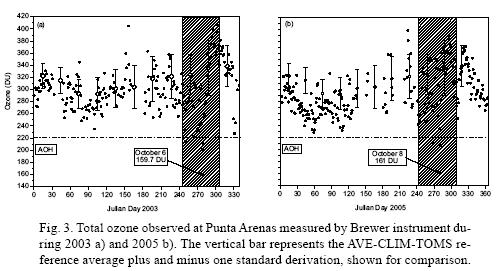
<body><![CDATA[<p align="center"><font face="verdana" size="2"><a name="f2"></a></font></p>     <p align="center"><font face="verdana" size="2"><img src="/img/revistas/atm/v21n1/a1f2.jpg"></font></p>     <p align="justify"><font face="verdana" size="2">&nbsp;</font></p>     <p align="justify"><font face="verdana" size="2"><b>3. Measurements</b></font></p>     <p align="justify"><font face="verdana" size="2">In <a href="#f3">Figure 3</a> the total ozone column for 2003 and 2005 for Punta Arenas is shown. Each point represents the mean for each day of the total ozone column obtained from the Brewer spectrophotometer, the 220 DU dashed line is shown for reference to the AOH condition. Conventionally, it is considered that there is an ozone hole when the ozone abundance is <u>&lt;</u> 220 DU in a specific geographic place. The hatched area indicates the high activity period of the AOH over Punta Arenas (and Magallanes region) from late August until end of October, and occasionally some activity of the AOH is observed over the Chilean&#150;Argentine Patagonian region during November and December. Using TOMS overpass data for Punta Arenas, monthly means were constructed from 1978 to 1987, a period which may be considered as not influenced by the AOH. For reference, the vertical bars in this figure show the mean values and their respective deviations; these values are called AVE&#150;CLI&#150;TOMS in this work (<a href="/img/revistas/atm/v21n1/a1t1.jpg" target="_blank">Table I</a> in Casiccia <i>et al., </i>2003). On October 6, 2003, the ozone column measured was 159.7 DU, which is the lowest value in the last four years, and considering the monthly mean of AVE&#150;CLI&#150;TOMS it corresponds to 52% of ozone depletion. At the end of November 2003 (Julian days 330 to 333) there was another depletion event which technically was not an AOH event because the lowest ozone concentration measured was 227.7 DU, however, it was a 33% decrease compared to the AVE&#150;CLI&#150;TOMS for this month. Two years later, on October 8, 2005 the total ozone column measured was 161 DU, 52% lower than the AVE&#150;CLI&#150;TOMS. The behavior of the total ozone during September&#150;October period was similar to that of 2003. In <a href="#f3">Figure 3b</a> we find low values of ozone during February&#150;April period in comparison with the AVE&#150;CLI&#150;TOMS. Several studies (e.g., Fioletov and Shepherd, 2003, 2005; Ajtic <i>et al., </i>2004) have demonstrated that these low values in the total ozone column can be explained by transport of ozone&#150;depleted from Antarctic latitudes. The occurrence of low ozone concentrations events in the Magallanes region depends on the AOH behavior in terms of dynamical conditions of the polar vortex. The number of days in which the AOH has been over the Magallanes region varies from year to year. <a href="/img/revistas/atm/v21n1/a1f4.jpg" target="_blank">Figure 4</a> shows the number of events of low ozone in Punta Arenas. Because the Brewer 068 was returned to Brazil in 2001 and due to technical problems with the spectrophotometer Brewer 180 during 2004, we used TOMS data for these two years. Typically, results of comparisons of total ozone between ground stations and TOMS show a good agreement, with some exceptions especially in high latitudes. Labow <i>et al. </i>(2004) pointed out that the agreement of data of total ozone from TOMS and ground stations are very good, but should not be used for trends studies. The criterion for defining an event of low ozone is that the ozone column (daily average) must be lower than the reference AVE&#150;CLI&#150;TOMS minus twice the standard deviation of the mean (mean monthly&#150;2&sigma;). The number of days per year is shown in <a href="/img/revistas/atm/v21n1/a1f4.jpg" target="_blank">Figure 4a</a>. During the period 1994&#150;1999 a significant number of low ozone days were observed each year. Between 2001 and 2003 there were fewer significant days with low ozone events. However, during 2004 the number of days began to increase again recording 86 days and during 2005, 47 days were measured with low ozone events. <a href="/img/revistas/atm/v21n1/a1f4.jpg" target="_blank">Figure 4b</a> shows the significant number of days per month, clearly showing the high variability during spring time. After 1995 the higher frequency occurred in February of 1998 with 27 days. <a href="/img/revistas/atm/v21n1/a1t2.jpg" target="_blank">Table II</a> shows the number of days with events of low ozone in September&#150;January period for each year (1992&#150;2005). It is also important to take into consideration the number of days during the summer time, especially during January, because of the influence of the solar angle on the ultraviolet radiation during this period as well.</font></p>     <p align="center"><font face="verdana" size="2"><a name="f3"></a></font></p>     <p align="center"><font face="verdana" size="2"><img src="/img/revistas/atm/v21n1/a1f3.jpg"></font></p>     <p align="justify"><font face="verdana" size="2"><a href="/img/revistas/atm/v21n1/a1f5.jpg" target="_blank">Figure 5 </a>presents the UV&#150;Index for the minimum solar angle measured each day for the stations. Communication problems caused some gaps initially, which in turn caused the loss of some data. <a href="/img/revistas/atm/v21n1/a1f5.jpg" target="_blank">Figure 5</a> shows the typical annual variation of the UV&#150;Index radiation with the minimum in winter and a gradual increase in the spring&#150;summer period. During the austral spring time peak values were comparable to those in summer due to the influence of the AOH. The influence of the AOH and the sudden changes that occurred will be analyzed with events of extremely low ozone column during some days.</font></p>     <p align="justify"><font face="verdana" size="2"><a href="#f6">Figure 6</a> shows the UV&#150;Index and total ozone from September to October for the period 2000 to 2005 for each station; in the construction of this figure, months of the AOH activity, which vary from year to year, have been considered. The first plot of each of them shows the total ozone column for Punta Arenas measured with the Brewer instrument, and it also shows the events of the AOH over the stations of the network. For the year 2001 and 2004 data obtained from the TOMS instrument were used. On October 12, 2000 the ozone column in Punta Arenas was measured to be 162 DU, which represents 46% taking as a reference October 10 with 324 DU. On October 21, 2001 the ozone column was 219 DU in Punta Arenas showing UV&#150;Index peaks in the stations of Puerto Natales and Puerto Williams. Punta Arenas was cloudy during this day and did not show a significant increase in the UV&#150;Index. The year 2002 was the year that the AOH broke up early and did not have significant days with low ozone levels. October 6, 2003 was a day of low ozone in which the ozone column was 159.6 DU, which represents an ozone reduction of 52.5%. In reference to the AVE&#150;CLI&#150;TOMS this percentage is similar considering the ozone column of October 13, 2003 when it was 323 DU, which signifies 51% decrease. It occurred in three days. On October 12, 2004 (<a href="/img/revistas/atm/v21n1/a1t3.jpg" target="_blank">Table III</a>), 195 DU was measured in Punta Arenas (TOMS data), &#150;44% of depletion in comparison with October 19 with 350 DU. In 2005, specifically on October 8, there was a new and significant event that was similar to that in 2003. On that day the ozone column measured was 160 UD (<a href="/img/revistas/atm/v21n1/a1t3.jpg" target="_blank">Table III</a>), what represented a decrease of 52% compared to October 10. In Puerto Natales station, on October 8 when the total ozone column was 165 DU, a decrease in the erythemal radiation was observed due to the cloudy sky conditions. During 2005 the station in Puerto Williams was not operative.</font></p>     <p align="center"><font face="verdana" size="2"><a name="f6"></a></font></p>     ]]></body>
<body><![CDATA[<p align="center"><font face="verdana" size="2"><img src="/img/revistas/atm/v21n1/a1f6.jpg"></font></p>     <p align="justify"><font face="verdana" size="2"><a href="/img/revistas/atm/v21n1/a1f7.jpg" target="_blank">Figure 7 </a>shows a comparison between two days, one with normal ozone and the other under the AOH during the events of 2003. On October 6, 2003 the measurements of the ultraviolet radiation at the different stations indicated the increase of the UV&#150;Index as follows: Puerto Natales 7.3, Punta Arenas 7.7 and Puerto Williams 8.6. This sequence shows the different conditions of the ozone column over the region. The Puerto Williams station is closer to the Antarctic continent. From TOMS observations to this point the ozone column on October 6, 2003 was 135 DU (<a href="/img/revistas/atm/v21n1/a1t3.jpg" target="_blank">Table III</a>), which is lower than in Punta Arenas, where it was 159 DU. In Puerto Williams the UV&#150;Index increased 196.6% on October 13, 2003. <a href="/img/revistas/atm/v21n1/a1t3.jpg" target="_blank">Table III</a> summarizes the percentage of depletion of ozone considering for each event a day with normal ozone column (for example October 10, 2000) in comparison with the day of low ozone (October 12, 2000); this table shows the increase of the UV&#150;Index in all stations when the solar angle was at minimum angle during these days.</font></p>     <p align="justify"><font face="verdana" size="2"><a href="/img/revistas/atm/v21n1/a1f8.jpg" target="_blank">Figure 8a</a> shows the time evolution for ozone over Punta Arenas and 8b the cross section of the UV&#150;Index between 08:00 and 18:00 h (local time) in the period September 1, 2004&#150;October 31, 2004, (Julian day from 245 to 305). The measurements of the UV&#150;Index correspond to the UV&#150;Biometer 3738, and the total ozone data to Brewer 180, both at Punta Arenas station. This figure shows two significant events of ozone depletion on September 21 (JD 265) and October 12 (JD 286) with 179 DU and 195 DU respectively. The measurements of the alteration of the normal UV&#150;Index behavior indicated peaks in the UV&#150;Index of 5.4 on September 21 and 6.9 on October 12. These values are similar to those observed during the summer period, but they show increases on a few days and we need to consider that during this time the organisms of this region had just received values relatively low.</font></p>     <p align="justify"><font face="verdana" size="2">&nbsp;</font></p>     <p align="justify"><font face="verdana" size="2"><b>4. Conclusions</b></font></p>     <p align="justify"><font face="verdana" size="2">UV Index measurements were taken over the Magallanes region with Solar Light biometers for latitudes from 51 to 54 South. The data indicate that this region is regularly subject to the influence of the AOH during the spring time. From Brewer ozone and TOMS data measurements during 2004&#150;2005 period, a significant number of days that were under the climatological average were detected, this was the largest number observed so far considering the period of AOH activity during the last decade. During the period from August to October 1999&#150;2005 pronounced increases in UV&#150;B radiation were measured during days of low ozone. An example is October 12, which had an UV&#150;Index of 9 and October 15, which had an UV&#150;Index of 5. These numbers represent an increase of 100% in the integrated weighted values for erythema. These sudden changes in the incident radiation are very important for the particular study of UV radiation effects in the ecosystems at middle latitudes.</font></p>     <p align="justify"><font face="verdana" size="2">&nbsp;</font></p>     <p align="justify"><font face="verdana" size="2"><b>Acknowledgments</b></font></p>     <p align="justify"><font face="verdana" size="2">This work was supported in part by the Project "Centro de Estudios del Cuaternario Fuego&#150;Patagonia y Ant&aacute;rtica&#150;CEQUA", it is financed by the Comisi&oacute;n Nacional de Investigaci&oacute;n Cient&iacute;fica y Tecnol&oacute;gica (CONICYT&#150;Chile) and the Government of the Magallanes Region. The spectrophotometer Brewer 068 was installed in Punta Arenas in 1992 thanks to an agreement between the Instituto Nacional de Pesquisas Espaciais (INPE&#150;Brazil) and the Magallanes University (Chile). We are grateful for the provision of the TOMS data (via NASA/GSFC Code 613.3). In memory of Jim Scamlon.</font></p>     <p align="justify"><font face="verdana" size="2">&nbsp;</font></p>     ]]></body>
<body><![CDATA[<p align="justify"><font face="verdana" size="2"><b>References</b></font></p>     <!-- ref --><p align="justify"><font face="verdana" size="2">Abarca J. F. and C. Casiccia, 2002. Skin cancer and ultraviolet&#150;B radiation under the Antarctic ozone hole: southern Chile, 1987&#150;2000. <i>Photodermatol. Photo. </i><b>18</b>, 294&#150;302.</font>&nbsp;&nbsp;&nbsp;&nbsp;&nbsp;&nbsp;&nbsp;&nbsp;[&#160;<a href="javascript:void(0);" onclick="javascript: window.open('/scielo.php?script=sci_nlinks&ref=1266133&pid=S0187-6236200800010000100001&lng=','','width=640,height=500,resizable=yes,scrollbars=1,menubar=yes,');">Links</a>&#160;]<!-- end-ref --><!-- ref --><p align="justify"><font face="verdana" size="2">Abarca J. F., C. Casiccia and F. Zamorano, 2002. Increase in sunburns and photosensitivity disorders at the edge of the Antarctic ozone hole, Southern Chile, 1986&#150;2000. <i>J. Amer. Acad. Dermatol. </i><b>46</b>,193&#150;199.</font>&nbsp;&nbsp;&nbsp;&nbsp;&nbsp;&nbsp;&nbsp;&nbsp;[&#160;<a href="javascript:void(0);" onclick="javascript: window.open('/scielo.php?script=sci_nlinks&ref=1266134&pid=S0187-6236200800010000100002&lng=','','width=640,height=500,resizable=yes,scrollbars=1,menubar=yes,');">Links</a>&#160;]<!-- end-ref --><!-- ref --><p align="justify"><font face="verdana" size="2">Ajtic J., B. J. Connor, B. N. Lawrence, G. E. Bodeker, K. W. Hoppel, J. E. Rosenfield and D. N. Heuff, 2004. Dilution of the Antarctic ozone hole into southern midlatitudes, 1998&#150;2000. <i>J. Geophys. Res. </i><b>109</b>, D17107, doi:10.129/2003JD004500.</font>&nbsp;&nbsp;&nbsp;&nbsp;&nbsp;&nbsp;&nbsp;&nbsp;[&#160;<a href="javascript:void(0);" onclick="javascript: window.open('/scielo.php?script=sci_nlinks&ref=1266135&pid=S0187-6236200800010000100003&lng=','','width=640,height=500,resizable=yes,scrollbars=1,menubar=yes,');">Links</a>&#160;]<!-- end-ref --><!-- ref --><p align="justify"><font face="verdana" size="2">Brewer A. W., 1973. A replacement for the Dobson spectrophotometer? Pure Appl. <i>Geophys. </i><b>106&#150;108</b>, 919&#150;927.</font>&nbsp;&nbsp;&nbsp;&nbsp;&nbsp;&nbsp;&nbsp;&nbsp;[&#160;<a href="javascript:void(0);" onclick="javascript: window.open('/scielo.php?script=sci_nlinks&ref=1266136&pid=S0187-6236200800010000100004&lng=','','width=640,height=500,resizable=yes,scrollbars=1,menubar=yes,');">Links</a>&#160;]<!-- end-ref --><!-- ref --><p align="justify"><font face="verdana" size="2">Brewer A. W. and J. B. Kerr, 1973. Total ozone measurements in cloudy weather. <i>Pure Appl. Geophys. </i><b>106&#150;108</b>, 928&#150;937.</font>&nbsp;&nbsp;&nbsp;&nbsp;&nbsp;&nbsp;&nbsp;&nbsp;[&#160;<a href="javascript:void(0);" onclick="javascript: window.open('/scielo.php?script=sci_nlinks&ref=1266137&pid=S0187-6236200800010000100005&lng=','','width=640,height=500,resizable=yes,scrollbars=1,menubar=yes,');">Links</a>&#160;]<!-- end-ref --><!-- ref --><p align="justify"><font face="verdana" size="2">Casiccia C., V. W. J. H. Kirchhoff, V. Valderrama, F. Zamorano and Y. Sahai, 1996. Ozone hole observations over Punta Arenas, Chile. In: Proceedings of the XVIII Quadrennial Ozone Symposium L'Aquila, 12&#150;21 September 1994&#150;Italia, Atmospheric Ozone. Vol. 1, (R. D. Bojkov and G. Visconti, Eds.) 17&#150;21.</font>&nbsp;&nbsp;&nbsp;&nbsp;&nbsp;&nbsp;&nbsp;&nbsp;[&#160;<a href="javascript:void(0);" onclick="javascript: window.open('/scielo.php?script=sci_nlinks&ref=1266138&pid=S0187-6236200800010000100006&lng=','','width=640,height=500,resizable=yes,scrollbars=1,menubar=yes,');">Links</a>&#160;]<!-- end-ref --><!-- ref --><p align="justify"><font face="verdana" size="2">Casiccia C., V. W. J. H. Kirchhoff and A. C. Torres, 2003. Simultaneous measurements of ozone and ultraviolet radiation: spring 2000, Punta Arenas, Chile. <i>J. Atmos. Env. </i><b>37</b>, 383&#150;389.</font>&nbsp;&nbsp;&nbsp;&nbsp;&nbsp;&nbsp;&nbsp;&nbsp;[&#160;<a href="javascript:void(0);" onclick="javascript: window.open('/scielo.php?script=sci_nlinks&ref=1266139&pid=S0187-6236200800010000100007&lng=','','width=640,height=500,resizable=yes,scrollbars=1,menubar=yes,');">Links</a>&#160;]<!-- end-ref --><!-- ref --><p align="justify"><font face="verdana" size="2">Cede A., E. Luccini, L. N&uacute;&ntilde;ez, R. Piacentini and M. Blumthaler, 2002. Monitoring of erythemal irradiance in the Argentine ultraviolet network. <i>J. Geophys. Res. </i><b>107</b>, 4165, doi:10.1029/ 2001JD001206.</font>&nbsp;&nbsp;&nbsp;&nbsp;&nbsp;&nbsp;&nbsp;&nbsp;[&#160;<a href="javascript:void(0);" onclick="javascript: window.open('/scielo.php?script=sci_nlinks&ref=1266140&pid=S0187-6236200800010000100008&lng=','','width=640,height=500,resizable=yes,scrollbars=1,menubar=yes,');">Links</a>&#160;]<!-- end-ref --><!-- ref --><p align="justify"><font face="verdana" size="2">Chubachi S., 1984. Preliminary result of ozone observations at Syowa Station from February 1982 to January 1983. Mem. <i>Natl. Inst. Polar Res. Jap. Spec. </i><b>34</b>, 13&#150;19.</font>&nbsp;&nbsp;&nbsp;&nbsp;&nbsp;&nbsp;&nbsp;&nbsp;[&#160;<a href="javascript:void(0);" onclick="javascript: window.open('/scielo.php?script=sci_nlinks&ref=1266141&pid=S0187-6236200800010000100009&lng=','','width=640,height=500,resizable=yes,scrollbars=1,menubar=yes,');">Links</a>&#160;]<!-- end-ref --><!-- ref --><p align="justify"><font face="verdana" size="2">Diffey B. L., 1991. Solar ultraviolet radiation effects on biological systems. <i>Phys. Med. Biol. </i><b>36</b>, 299&#150;328.</font>&nbsp;&nbsp;&nbsp;&nbsp;&nbsp;&nbsp;&nbsp;&nbsp;[&#160;<a href="javascript:void(0);" onclick="javascript: window.open('/scielo.php?script=sci_nlinks&ref=1266142&pid=S0187-6236200800010000100010&lng=','','width=640,height=500,resizable=yes,scrollbars=1,menubar=yes,');">Links</a>&#160;]<!-- end-ref --><!-- ref --><p align="justify"><font face="verdana" size="2">Farman J. C., B. G. Gardiner and J. D. Shanklin, 1985. Large losses of total ozone in Antarctica reveal seasonal ClOx/NOx interaction. <i>Nature </i><b>315</b>, 207&#150;210.</font>&nbsp;&nbsp;&nbsp;&nbsp;&nbsp;&nbsp;&nbsp;&nbsp;[&#160;<a href="javascript:void(0);" onclick="javascript: window.open('/scielo.php?script=sci_nlinks&ref=1266143&pid=S0187-6236200800010000100011&lng=','','width=640,height=500,resizable=yes,scrollbars=1,menubar=yes,');">Links</a>&#160;]<!-- end-ref --><!-- ref --><p align="justify"><font face="verdana" size="2">Fioletov V. E. and T. G. Shepherd, 2003. Seasonal persistence of mid latitude total ozone anomalies. <i>Geophys. Res. Lett., </i><b>30</b>, 1417, doi:10.129/2002GL016739.</font>&nbsp;&nbsp;&nbsp;&nbsp;&nbsp;&nbsp;&nbsp;&nbsp;[&#160;<a href="javascript:void(0);" onclick="javascript: window.open('/scielo.php?script=sci_nlinks&ref=1266144&pid=S0187-6236200800010000100012&lng=','','width=640,height=500,resizable=yes,scrollbars=1,menubar=yes,');">Links</a>&#160;]<!-- end-ref --><!-- ref --><p align="justify"><font face="verdana" size="2">Fioletov V. E. and T. G. Shepherd, 2005. Summertime total ozone variations over middle and polar latitudes. <i>Geophys. Res. Lett. </i><b>32</b>, doi:10.129/2004GL022080.</font>&nbsp;&nbsp;&nbsp;&nbsp;&nbsp;&nbsp;&nbsp;&nbsp;[&#160;<a href="javascript:void(0);" onclick="javascript: window.open('/scielo.php?script=sci_nlinks&ref=1266145&pid=S0187-6236200800010000100013&lng=','','width=640,height=500,resizable=yes,scrollbars=1,menubar=yes,');">Links</a>&#160;]<!-- end-ref --><!-- ref --><p align="justify"><font face="verdana" size="2">Kirchhoff V. W. J. H., F. Zamorano and C. Casiccia, 1997a. UV&#150;B Enhancements at Punta Arenas, Chile. <i>J. Photochem. Photobiol. </i>38, 174&#150;177.</font>&nbsp;&nbsp;&nbsp;&nbsp;&nbsp;&nbsp;&nbsp;&nbsp;[&#160;<a href="javascript:void(0);" onclick="javascript: window.open('/scielo.php?script=sci_nlinks&ref=1266146&pid=S0187-6236200800010000100014&lng=','','width=640,height=500,resizable=yes,scrollbars=1,menubar=yes,');">Links</a>&#160;]<!-- end-ref --><!-- ref --><p align="justify"><font face="verdana" size="2">Kirchhoff V. W. J. H., C. Casiccia and F. Zamorano, 1997b. The ozone hole over Punta Arenas, Chile. J. <i>Geophys. Res. </i><b>102</b>, 8945&#150;8953.</font>&nbsp;&nbsp;&nbsp;&nbsp;&nbsp;&nbsp;&nbsp;&nbsp;[&#160;<a href="javascript:void(0);" onclick="javascript: window.open('/scielo.php?script=sci_nlinks&ref=1266147&pid=S0187-6236200800010000100015&lng=','','width=640,height=500,resizable=yes,scrollbars=1,menubar=yes,');">Links</a>&#160;]<!-- end-ref --><!-- ref --><p align="justify"><font face="verdana" size="2">Kirchhoff V. W. J. H., C. Casiccia, Y. Sahai, F. Zamorano and V. Valderrama, 1997c. Observations of the 1995 ozone hole over Punta Arenas, Chile. <i>J. Geophys. Res. </i><b>102</b>, 16109&#150;16120.</font>&nbsp;&nbsp;&nbsp;&nbsp;&nbsp;&nbsp;&nbsp;&nbsp;[&#160;<a href="javascript:void(0);" onclick="javascript: window.open('/scielo.php?script=sci_nlinks&ref=1266148&pid=S0187-6236200800010000100016&lng=','','width=640,height=500,resizable=yes,scrollbars=1,menubar=yes,');">Links</a>&#160;]<!-- end-ref --><!-- ref --><p align="justify"><font face="verdana" size="2">Labow G. J., D. P. Haffner, R. D. McPeters and P. Bhartia, 2004. A Comparison of TOMS &amp; SBUV Version 8 Total Column Ozone Data With Data From Groundstations, <i>Eos </i>Trans. AGU, 85(47), Fall Meet. Suppl., Abstract A33D&#150;0092.</font>&nbsp;&nbsp;&nbsp;&nbsp;&nbsp;&nbsp;&nbsp;&nbsp;[&#160;<a href="javascript:void(0);" onclick="javascript: window.open('/scielo.php?script=sci_nlinks&ref=1266149&pid=S0187-6236200800010000100017&lng=','','width=640,height=500,resizable=yes,scrollbars=1,menubar=yes,');">Links</a>&#160;]<!-- end-ref --><!-- ref --><p align="justify"><font face="verdana" size="2">McKinlay A. F. and B. L. Diffey, 1987. A reference action spectra for ultraviolet introduced erythema in human skin. In: <i>Human exposure to ultraviolet radiation: Risk and regulations. </i>(W. R. Passchier and B. M. F. Bosnajakovich, Eds.), Elsevier, New York 83&#150;87.</font>&nbsp;&nbsp;&nbsp;&nbsp;&nbsp;&nbsp;&nbsp;&nbsp;[&#160;<a href="javascript:void(0);" onclick="javascript: window.open('/scielo.php?script=sci_nlinks&ref=1266150&pid=S0187-6236200800010000100018&lng=','','width=640,height=500,resizable=yes,scrollbars=1,menubar=yes,');">Links</a>&#160;]<!-- end-ref --><!-- ref --><p align="justify"><font face="verdana" size="2">Prather M., M. M. Garc&iacute;a, R. Louzo and D. Rinal, 1990. Global impact of the antarctic ozone Hole? Dynamical dilution with a three&#150;dimensional chemical transport model. <i>J. Geophys. Res. </i><b>95</b>, 3449&#150;3471.</font>&nbsp;&nbsp;&nbsp;&nbsp;&nbsp;&nbsp;&nbsp;&nbsp;[&#160;<a href="javascript:void(0);" onclick="javascript: window.open('/scielo.php?script=sci_nlinks&ref=1266151&pid=S0187-6236200800010000100019&lng=','','width=640,height=500,resizable=yes,scrollbars=1,menubar=yes,');">Links</a>&#160;]<!-- end-ref --><!-- ref --><p align="justify"><font face="verdana" size="2">Pazmi&ntilde;o A. F., M. Godin&#150;Beekmann, S. Ginzburg, S. Bekki, A. Hauchecorne, R. D. Piacentini and E. J. Quel, 2005. Impact of Antarctic polar vortex occurrences on total ozone and UVB radiation at southern Argentinean and Antarctic stations during 1997&#150;2003 period. <i>J. Geophys. Res. </i><b>110</b>, doi:10.129/2004JD005018.</font>&nbsp;&nbsp;&nbsp;&nbsp;&nbsp;&nbsp;&nbsp;&nbsp;[&#160;<a href="javascript:void(0);" onclick="javascript: window.open('/scielo.php?script=sci_nlinks&ref=1266152&pid=S0187-6236200800010000100020&lng=','','width=640,height=500,resizable=yes,scrollbars=1,menubar=yes,');">Links</a>&#160;]<!-- end-ref --><!-- ref --><p align="justify"><font face="verdana" size="2">Solomon S. and R. Garc&iacute;a, 1986. On the depletion of Antarctic ozone, <i>Nature </i><b>321</b>, 755&#150;758.</font>&nbsp;&nbsp;&nbsp;&nbsp;&nbsp;&nbsp;&nbsp;&nbsp;[&#160;<a href="javascript:void(0);" onclick="javascript: window.open('/scielo.php?script=sci_nlinks&ref=1266153&pid=S0187-6236200800010000100021&lng=','','width=640,height=500,resizable=yes,scrollbars=1,menubar=yes,');">Links</a>&#160;]<!-- end-ref --><!-- ref --><p align="justify"><font face="verdana" size="2">Stolarski R. S., A. J. Krueger, M. R. Schoeberl, R. D. Mc Peters, P. A. Newman and J. C. Alpert, 1986. Nimbus 7 satellite measurements of the springtime Antarctic ozone decrease. <i>Nature </i><b>322</b>, 808&#150;811.</font>&nbsp;&nbsp;&nbsp;&nbsp;&nbsp;&nbsp;&nbsp;&nbsp;[&#160;<a href="javascript:void(0);" onclick="javascript: window.open('/scielo.php?script=sci_nlinks&ref=1266154&pid=S0187-6236200800010000100022&lng=','','width=640,height=500,resizable=yes,scrollbars=1,menubar=yes,');">Links</a>&#160;]<!-- end-ref --><!-- ref --><p align="justify"><font face="verdana" size="2">WMO, 2003. Scientific assessment of ozone depletion, 2002. World Meteorological Organization, Report No. 47. Geneva.</font>&nbsp;&nbsp;&nbsp;&nbsp;&nbsp;&nbsp;&nbsp;&nbsp;[&#160;<a href="javascript:void(0);" onclick="javascript: window.open('/scielo.php?script=sci_nlinks&ref=1266155&pid=S0187-6236200800010000100023&lng=','','width=640,height=500,resizable=yes,scrollbars=1,menubar=yes,');">Links</a>&#160;]<!-- end-ref --> ]]></body><back>
<ref-list>
<ref id="B1">
<nlm-citation citation-type="journal">
<person-group person-group-type="author">
<name>
<surname><![CDATA[Abarca J]]></surname>
<given-names><![CDATA[F]]></given-names>
</name>
<name>
<surname><![CDATA[Casiccia]]></surname>
<given-names><![CDATA[C]]></given-names>
</name>
</person-group>
<article-title xml:lang="en"><![CDATA[Skin cancer and ultraviolet-B radiation under the Antarctic ozone hole: southern Chile, 1987-2000]]></article-title>
<source><![CDATA[Photodermatol. Photo]]></source>
<year>2002</year>
<numero>18</numero>
<issue>18</issue>
<page-range>294-302</page-range></nlm-citation>
</ref>
<ref id="B2">
<nlm-citation citation-type="journal">
<person-group person-group-type="author">
<name>
<surname><![CDATA[Abarca J]]></surname>
<given-names><![CDATA[F]]></given-names>
</name>
<name>
<surname><![CDATA[Casiccia]]></surname>
<given-names><![CDATA[C]]></given-names>
</name>
<name>
<surname><![CDATA[Zamorano]]></surname>
<given-names><![CDATA[F]]></given-names>
</name>
</person-group>
<article-title xml:lang="en"><![CDATA[Increase in sunburns and photosensitivity disorders at the edge of the Antarctic ozone hole, Southern Chile, 1986-2000]]></article-title>
<source><![CDATA[J. Amer. Acad. Dermatol]]></source>
<year>2002</year>
<numero>46,</numero>
<issue>46,</issue>
<page-range>193-199</page-range></nlm-citation>
</ref>
<ref id="B3">
<nlm-citation citation-type="journal">
<person-group person-group-type="author">
<name>
<surname><![CDATA[Ajtic]]></surname>
<given-names><![CDATA[J]]></given-names>
</name>
<name>
<surname><![CDATA[J. Connor]]></surname>
<given-names><![CDATA[B]]></given-names>
</name>
<name>
<surname><![CDATA[Lawrence]]></surname>
<given-names><![CDATA[B. N]]></given-names>
</name>
<name>
<surname><![CDATA[Bodeker]]></surname>
<given-names><![CDATA[G. E]]></given-names>
</name>
<name>
<surname><![CDATA[W. Hoppel]]></surname>
<given-names><![CDATA[K]]></given-names>
</name>
<name>
<surname><![CDATA[Rosenfield]]></surname>
<given-names><![CDATA[J. E]]></given-names>
</name>
<name>
<surname><![CDATA[N. Heuff]]></surname>
<given-names><![CDATA[D]]></given-names>
</name>
</person-group>
<article-title xml:lang="en"><![CDATA[Dilution of the Antarctic ozone hole into southern midlatitudes, 1998-2000]]></article-title>
<source><![CDATA[J. Geophys. Res]]></source>
<year>2004</year>
<numero>109</numero>
<issue>109</issue>
<page-range>D17107</page-range></nlm-citation>
</ref>
<ref id="B4">
<nlm-citation citation-type="journal">
<person-group person-group-type="author">
<name>
<surname><![CDATA[Brewer A]]></surname>
<given-names><![CDATA[W]]></given-names>
</name>
</person-group>
<article-title xml:lang="en"><![CDATA[A replacement for the Dobson spectrophotometer?]]></article-title>
<source><![CDATA[Pure Appl. Geophys]]></source>
<year>1973</year>
<numero>106-108</numero>
<issue>106-108</issue>
<page-range>919-927</page-range></nlm-citation>
</ref>
<ref id="B5">
<nlm-citation citation-type="journal">
<person-group person-group-type="author">
<name>
<surname><![CDATA[Brewer A]]></surname>
<given-names><![CDATA[W]]></given-names>
</name>
<name>
<surname><![CDATA[Kerr]]></surname>
<given-names><![CDATA[J. B]]></given-names>
</name>
</person-group>
<article-title xml:lang="en"><![CDATA[Total ozone measurements in cloudy weather]]></article-title>
<source><![CDATA[Pure Appl. Geophys]]></source>
<year>1973</year>
<numero>106-108</numero>
<issue>106-108</issue>
<page-range>928-937</page-range></nlm-citation>
</ref>
<ref id="B6">
<nlm-citation citation-type="">
<person-group person-group-type="author">
<name>
<surname><![CDATA[Casiccia]]></surname>
<given-names><![CDATA[C]]></given-names>
</name>
<name>
<surname><![CDATA[V. W]]></surname>
<given-names><![CDATA[J]]></given-names>
</name>
<name>
<surname><![CDATA[Kirchhoff]]></surname>
<given-names><![CDATA[H]]></given-names>
</name>
<name>
<surname><![CDATA[Valderrama]]></surname>
<given-names><![CDATA[V]]></given-names>
</name>
<name>
<surname><![CDATA[Zamorano]]></surname>
<given-names><![CDATA[F]]></given-names>
</name>
<name>
<surname><![CDATA[Sahai]]></surname>
<given-names><![CDATA[Y]]></given-names>
</name>
</person-group>
<article-title xml:lang="en"><![CDATA[Ozone hole observations over Punta Arenas, Chile]]></article-title>
<person-group person-group-type="editor">
<name>
<surname><![CDATA[D. Bojkov]]></surname>
<given-names><![CDATA[R]]></given-names>
</name>
<name>
<surname><![CDATA[Visconti]]></surname>
<given-names><![CDATA[G]]></given-names>
</name>
</person-group>
<source><![CDATA[Proceedings of the XVIII Quadrennial Ozone Symposium L'Aquila, 12-21 September 1994-Italia, Atmospheric Ozone]]></source>
<year>1996</year>
<volume>1</volume>
<page-range>17-21</page-range></nlm-citation>
</ref>
<ref id="B7">
<nlm-citation citation-type="journal">
<person-group person-group-type="author">
<name>
<surname><![CDATA[Casiccia]]></surname>
<given-names><![CDATA[C]]></given-names>
</name>
<name>
<surname><![CDATA[V. W]]></surname>
<given-names><![CDATA[J]]></given-names>
</name>
<name>
<surname><![CDATA[Kirchhoff]]></surname>
<given-names><![CDATA[H]]></given-names>
</name>
<name>
<surname><![CDATA[Torres]]></surname>
<given-names><![CDATA[A. C]]></given-names>
</name>
</person-group>
<article-title xml:lang="en"><![CDATA[Simultaneous measurements of ozone and ultraviolet radiation: spring 2000, Punta Arenas, Chile]]></article-title>
<source><![CDATA[J. Atmos. Env.]]></source>
<year>2003</year>
<numero>37</numero>
<issue>37</issue>
<page-range>383-389</page-range></nlm-citation>
</ref>
<ref id="B8">
<nlm-citation citation-type="journal">
<person-group person-group-type="author">
<name>
<surname><![CDATA[Cede]]></surname>
<given-names><![CDATA[A]]></given-names>
</name>
<name>
<surname><![CDATA[Luccini]]></surname>
<given-names><![CDATA[E]]></given-names>
</name>
<name>
<surname><![CDATA[Núñez]]></surname>
<given-names><![CDATA[L]]></given-names>
</name>
<name>
<surname><![CDATA[Piacentini]]></surname>
<given-names><![CDATA[R]]></given-names>
</name>
<name>
<surname><![CDATA[Blumthaler]]></surname>
<given-names><![CDATA[M]]></given-names>
</name>
</person-group>
<article-title xml:lang="en"><![CDATA[Monitoring of erythemal irradiance in the Argentine ultraviolet network]]></article-title>
<source><![CDATA[J. Geophys. Res]]></source>
<year>2002</year>
<numero>107</numero>
<issue>107</issue>
<page-range>4165</page-range></nlm-citation>
</ref>
<ref id="B9">
<nlm-citation citation-type="journal">
<person-group person-group-type="author">
<name>
<surname><![CDATA[Chubachi]]></surname>
<given-names><![CDATA[S]]></given-names>
</name>
</person-group>
<article-title xml:lang="en"><![CDATA[Preliminary result of ozone observations at Syowa Station from February 1982 to January 1983]]></article-title>
<source><![CDATA[Mem. Natl. Inst. Polar Res. Jap. Spec]]></source>
<year>1984</year>
<numero>34</numero>
<issue>34</issue>
<page-range>13-19</page-range></nlm-citation>
</ref>
<ref id="B10">
<nlm-citation citation-type="journal">
<person-group person-group-type="author">
<name>
<surname><![CDATA[Diffey B]]></surname>
<given-names><![CDATA[L]]></given-names>
</name>
</person-group>
<article-title xml:lang="en"><![CDATA[Solar ultraviolet radiation effects on biological systems]]></article-title>
<source><![CDATA[Phys. Med. Biol.]]></source>
<year>1991</year>
<numero>36</numero>
<issue>36</issue>
<page-range>299-328</page-range></nlm-citation>
</ref>
<ref id="B11">
<nlm-citation citation-type="journal">
<person-group person-group-type="author">
<name>
<surname><![CDATA[Farman J]]></surname>
<given-names><![CDATA[C]]></given-names>
</name>
<name>
<surname><![CDATA[G. Gardiner]]></surname>
<given-names><![CDATA[B]]></given-names>
</name>
<name>
<surname><![CDATA[D. Shanklin]]></surname>
<given-names><![CDATA[J]]></given-names>
</name>
</person-group>
<article-title xml:lang="en"><![CDATA[Large losses of total ozone in Antarctica reveal seasonal ClOx/NOx interaction]]></article-title>
<source><![CDATA[Nature]]></source>
<year>1985</year>
<numero>315</numero>
<issue>315</issue>
<page-range>207-210</page-range></nlm-citation>
</ref>
<ref id="B12">
<nlm-citation citation-type="journal">
<person-group person-group-type="author">
<name>
<surname><![CDATA[Fioletov V]]></surname>
<given-names><![CDATA[E]]></given-names>
</name>
<name>
<surname><![CDATA[G. Shepherd]]></surname>
<given-names><![CDATA[T]]></given-names>
</name>
</person-group>
<article-title xml:lang="en"><![CDATA[Seasonal persistence of mid latitude total ozone anomalies]]></article-title>
<source><![CDATA[Geophys. Res. Lett]]></source>
<year>2003</year>
<numero>30</numero>
<issue>30</issue>
<page-range>1417</page-range></nlm-citation>
</ref>
<ref id="B13">
<nlm-citation citation-type="journal">
<person-group person-group-type="author">
<name>
<surname><![CDATA[Fioletov V]]></surname>
<given-names><![CDATA[E]]></given-names>
</name>
<name>
<surname><![CDATA[G. Shepherd]]></surname>
<given-names><![CDATA[T]]></given-names>
</name>
</person-group>
<article-title xml:lang="en"><![CDATA[Summertime total ozone variations over middle and polar latitudes]]></article-title>
<source><![CDATA[Geophys. Res. Lett]]></source>
<year>2005</year>
<numero>32</numero>
<issue>32</issue>
</nlm-citation>
</ref>
<ref id="B14">
<nlm-citation citation-type="journal">
<person-group person-group-type="author">
<name>
<surname><![CDATA[Kirchhoff]]></surname>
<given-names><![CDATA[V]]></given-names>
</name>
<name>
<surname><![CDATA[W. J]]></surname>
<given-names><![CDATA[H]]></given-names>
</name>
<name>
<surname><![CDATA[Zamorano]]></surname>
<given-names><![CDATA[F]]></given-names>
</name>
<name>
<surname><![CDATA[Casiccia]]></surname>
<given-names><![CDATA[C]]></given-names>
</name>
</person-group>
<article-title xml:lang="en"><![CDATA[UV-B Enhancements at Punta Arenas, Chile]]></article-title>
<source><![CDATA[J. Photochem. Photobiol]]></source>
<year>1997</year>
<month>a</month>
<numero>38</numero>
<issue>38</issue>
<page-range>174-177</page-range></nlm-citation>
</ref>
<ref id="B15">
<nlm-citation citation-type="journal">
<person-group person-group-type="author">
<name>
<surname><![CDATA[Kirchhoff]]></surname>
<given-names><![CDATA[V]]></given-names>
</name>
<name>
<surname><![CDATA[W. J]]></surname>
<given-names><![CDATA[H]]></given-names>
</name>
<name>
<surname><![CDATA[Casiccia]]></surname>
<given-names><![CDATA[C]]></given-names>
</name>
<name>
<surname><![CDATA[Zamorano]]></surname>
<given-names><![CDATA[F]]></given-names>
</name>
</person-group>
<article-title xml:lang="en"><![CDATA[The ozone hole over Punta Arenas, Chile]]></article-title>
<source><![CDATA[J. Geophys. Res]]></source>
<year>1997</year>
<month>b</month>
<numero>102</numero>
<issue>102</issue>
<page-range>8945-8953</page-range></nlm-citation>
</ref>
<ref id="B16">
<nlm-citation citation-type="journal">
<person-group person-group-type="author">
<name>
<surname><![CDATA[Kirchhoff]]></surname>
<given-names><![CDATA[V]]></given-names>
</name>
<name>
<surname><![CDATA[W. J]]></surname>
<given-names><![CDATA[H]]></given-names>
</name>
<name>
<surname><![CDATA[Casiccia]]></surname>
<given-names><![CDATA[C]]></given-names>
</name>
<name>
<surname><![CDATA[Sahai]]></surname>
<given-names><![CDATA[Y]]></given-names>
</name>
<name>
<surname><![CDATA[Zamorano]]></surname>
<given-names><![CDATA[F]]></given-names>
</name>
<name>
<surname><![CDATA[Valderrama]]></surname>
<given-names><![CDATA[V]]></given-names>
</name>
</person-group>
<article-title xml:lang="en"><![CDATA[Observations of the 1995 ozone hole over Punta Arenas, Chile]]></article-title>
<source><![CDATA[J. Geophys. Res]]></source>
<year>1997</year>
<month>c</month>
<numero>102</numero>
<issue>102</issue>
<page-range>16109-16120</page-range></nlm-citation>
</ref>
<ref id="B17">
<nlm-citation citation-type="journal">
<person-group person-group-type="author">
<name>
<surname><![CDATA[Labow G]]></surname>
<given-names><![CDATA[J]]></given-names>
</name>
<name>
<surname><![CDATA[Haffner]]></surname>
<given-names><![CDATA[D. P]]></given-names>
</name>
<name>
<surname><![CDATA[McPeters]]></surname>
<given-names><![CDATA[R. D]]></given-names>
</name>
<name>
<surname><![CDATA[Bhartia]]></surname>
<given-names><![CDATA[P]]></given-names>
</name>
</person-group>
<article-title xml:lang="en"><![CDATA[A Comparison of TOMS & SBUV Version 8 Total Column Ozone Data With Data From Groundstations]]></article-title>
<source><![CDATA[Eos Trans. AGU]]></source>
<year>2004</year>
<volume>85</volume>
<numero>47</numero>
<issue>47</issue>
</nlm-citation>
</ref>
<ref id="B18">
<nlm-citation citation-type="book">
<person-group person-group-type="author">
<name>
<surname><![CDATA[McKinlay A]]></surname>
<given-names><![CDATA[F]]></given-names>
</name>
<name>
<surname><![CDATA[L. Diffey]]></surname>
<given-names><![CDATA[B]]></given-names>
</name>
</person-group>
<article-title xml:lang="en"><![CDATA[A reference action spectra for ultraviolet introduced erythema in human skin]]></article-title>
<person-group person-group-type="editor">
<name>
<surname><![CDATA[R. Passchier]]></surname>
<given-names><![CDATA[W]]></given-names>
</name>
<name>
<surname><![CDATA[F. Bosnajakovich]]></surname>
<given-names><![CDATA[B. M]]></given-names>
</name>
</person-group>
<source><![CDATA[Human exposure to ultraviolet radiation: Risk and regulations]]></source>
<year>1987</year>
<page-range>83-87</page-range><publisher-loc><![CDATA[New York ]]></publisher-loc>
<publisher-name><![CDATA[Elsevier]]></publisher-name>
</nlm-citation>
</ref>
<ref id="B19">
<nlm-citation citation-type="journal">
<person-group person-group-type="author">
<name>
<surname><![CDATA[Prather]]></surname>
<given-names><![CDATA[M]]></given-names>
</name>
<name>
<surname><![CDATA[García]]></surname>
<given-names><![CDATA[M. M]]></given-names>
</name>
<name>
<surname><![CDATA[Louzo]]></surname>
<given-names><![CDATA[R]]></given-names>
</name>
<name>
<surname><![CDATA[Rinal]]></surname>
<given-names><![CDATA[D]]></given-names>
</name>
</person-group>
<article-title xml:lang="en"><![CDATA[Global impact of the antarctic ozone Hole? Dynamical dilution with a three-dimensional chemical transport model]]></article-title>
<source><![CDATA[J. Geophys. Res]]></source>
<year>1990</year>
<numero>95</numero>
<issue>95</issue>
<page-range>3449-3471</page-range></nlm-citation>
</ref>
<ref id="B20">
<nlm-citation citation-type="journal">
<person-group person-group-type="author">
<name>
<surname><![CDATA[Pazmiño A]]></surname>
<given-names><![CDATA[F]]></given-names>
</name>
<name>
<surname><![CDATA[Godin-Beekmann]]></surname>
<given-names><![CDATA[M]]></given-names>
</name>
<name>
<surname><![CDATA[Ginzburg]]></surname>
<given-names><![CDATA[S]]></given-names>
</name>
<name>
<surname><![CDATA[Bekki]]></surname>
<given-names><![CDATA[S]]></given-names>
</name>
<name>
<surname><![CDATA[Hauchecorne]]></surname>
<given-names><![CDATA[A]]></given-names>
</name>
<name>
<surname><![CDATA[D. Piacentini]]></surname>
<given-names><![CDATA[R]]></given-names>
</name>
<name>
<surname><![CDATA[J. Quel]]></surname>
<given-names><![CDATA[E]]></given-names>
</name>
</person-group>
<article-title xml:lang="en"><![CDATA[Impact of Antarctic polar vortex occurrences on total ozone and UVB radiation at southern Argentinean and Antarctic stations during 1997-2003 period]]></article-title>
<source><![CDATA[J. Geophys. Res]]></source>
<year>2005</year>
<numero>110</numero>
<issue>110</issue>
</nlm-citation>
</ref>
<ref id="B21">
<nlm-citation citation-type="journal">
<person-group person-group-type="author">
<name>
<surname><![CDATA[Solomon]]></surname>
<given-names><![CDATA[S]]></given-names>
</name>
<name>
<surname><![CDATA[García]]></surname>
<given-names><![CDATA[R]]></given-names>
</name>
</person-group>
<article-title xml:lang="en"><![CDATA[On the depletion of Antarctic ozone]]></article-title>
<source><![CDATA[Nature]]></source>
<year>1986</year>
<numero>321</numero>
<issue>321</issue>
<page-range>755-758</page-range></nlm-citation>
</ref>
<ref id="B22">
<nlm-citation citation-type="journal">
<person-group person-group-type="author">
<name>
<surname><![CDATA[Stolarski R]]></surname>
<given-names><![CDATA[S]]></given-names>
</name>
<name>
<surname><![CDATA[Krueger]]></surname>
<given-names><![CDATA[A. J]]></given-names>
</name>
<name>
<surname><![CDATA[Schoeberl]]></surname>
<given-names><![CDATA[M. R]]></given-names>
</name>
<name>
<surname><![CDATA[Mc Peters]]></surname>
<given-names><![CDATA[R. D]]></given-names>
</name>
<name>
<surname><![CDATA[Newman]]></surname>
<given-names><![CDATA[P. A]]></given-names>
</name>
<name>
<surname><![CDATA[Alpert]]></surname>
<given-names><![CDATA[J. C]]></given-names>
</name>
</person-group>
<article-title xml:lang="en"><![CDATA[Nimbus 7 satellite measurements of the springtime Antarctic ozone decrease]]></article-title>
<source><![CDATA[Nature]]></source>
<year>1986</year>
<numero>322</numero>
<issue>322</issue>
<page-range>808-811</page-range></nlm-citation>
</ref>
<ref id="B23">
<nlm-citation citation-type="book">
<collab>WMO</collab>
<source><![CDATA[Scientific assessment of ozone depletion, 2002]]></source>
<year>2003</year>
<publisher-loc><![CDATA[Geneva ]]></publisher-loc>
<publisher-name><![CDATA[World Meteorological Organization]]></publisher-name>
</nlm-citation>
</ref>
</ref-list>
</back>
</article>