<?xml version="1.0" encoding="ISO-8859-1"?><article xmlns:mml="http://www.w3.org/1998/Math/MathML" xmlns:xlink="http://www.w3.org/1999/xlink" xmlns:xsi="http://www.w3.org/2001/XMLSchema-instance">
<front>
<journal-meta>
<journal-id>0187-6236</journal-id>
<journal-title><![CDATA[Atmósfera]]></journal-title>
<abbrev-journal-title><![CDATA[Atmósfera]]></abbrev-journal-title>
<issn>0187-6236</issn>
<publisher>
<publisher-name><![CDATA[Universidad Nacional Autónoma de México, Instituto de Ciencias de la Atmósfera y Cambio Climático]]></publisher-name>
</publisher>
</journal-meta>
<article-meta>
<article-id>S0187-62362007000400004</article-id>
<title-group>
<article-title xml:lang="en"><![CDATA[Characterization of atmospheric transport to the El Tajín archaeological zone in Veracruz, México]]></article-title>
</title-group>
<contrib-group>
<contrib contrib-type="author">
<name>
<surname><![CDATA[KAHL]]></surname>
<given-names><![CDATA[J. D. W.]]></given-names>
</name>
<xref ref-type="aff" rid="A01"/>
</contrib>
<contrib contrib-type="author">
<name>
<surname><![CDATA[BRAVO-ÁLVAREZ]]></surname>
<given-names><![CDATA[H.]]></given-names>
</name>
<xref ref-type="aff" rid="A02"/>
</contrib>
<contrib contrib-type="author">
<name>
<surname><![CDATA[SOSA-ECHEVERRÍA]]></surname>
<given-names><![CDATA[R.]]></given-names>
</name>
<xref ref-type="aff" rid="A02"/>
</contrib>
<contrib contrib-type="author">
<name>
<surname><![CDATA[SÁNCHEZ-ÁLVAREZ]]></surname>
<given-names><![CDATA[P.]]></given-names>
</name>
<xref ref-type="aff" rid="A02"/>
</contrib>
<contrib contrib-type="author">
<name>
<surname><![CDATA[ALARCÓN-JIMÉNEZ]]></surname>
<given-names><![CDATA[A. L.]]></given-names>
</name>
<xref ref-type="aff" rid="A02"/>
</contrib>
<contrib contrib-type="author">
<name>
<surname><![CDATA[SOTO-AYALA]]></surname>
<given-names><![CDATA[R.]]></given-names>
</name>
<xref ref-type="aff" rid="A03"/>
</contrib>
</contrib-group>
<aff id="A01">
<institution><![CDATA[,University of Wisconsin-Milwaukee Department of Mathematical Sciences Atmospheric Science Group]]></institution>
<addr-line><![CDATA[Milwaukee WI]]></addr-line>
<country>USA</country>
</aff>
<aff id="A02">
<institution><![CDATA[,Universidad Nacional Autónoma de México Centro de Ciencias de la Atmósfera Sección de Contaminación Ambiental]]></institution>
<addr-line><![CDATA[México D. F.]]></addr-line>
<country>México</country>
</aff>
<aff id="A03">
<institution><![CDATA[,Universidad Nacional Autónoma de México Facultad de Ingeniería División de Ciencias Básicas]]></institution>
<addr-line><![CDATA[México D. F.]]></addr-line>
<country>México</country>
</aff>
<pub-date pub-type="pub">
<day>00</day>
<month>10</month>
<year>2007</year>
</pub-date>
<pub-date pub-type="epub">
<day>00</day>
<month>10</month>
<year>2007</year>
</pub-date>
<volume>20</volume>
<numero>4</numero>
<fpage>359</fpage>
<lpage>371</lpage>
<copyright-statement/>
<copyright-year/>
<self-uri xlink:href="http://www.scielo.org.mx/scielo.php?script=sci_arttext&amp;pid=S0187-62362007000400004&amp;lng=en&amp;nrm=iso"></self-uri><self-uri xlink:href="http://www.scielo.org.mx/scielo.php?script=sci_abstract&amp;pid=S0187-62362007000400004&amp;lng=en&amp;nrm=iso"></self-uri><self-uri xlink:href="http://www.scielo.org.mx/scielo.php?script=sci_pdf&amp;pid=S0187-62362007000400004&amp;lng=en&amp;nrm=iso"></self-uri><abstract abstract-type="short" xml:lang="es"><p><![CDATA[Se investigan las características del transporte atmosférico de largo y de corto alcance a El Tajín (sitio arqueológico importante en el este de México). El estudio es motivado por la necesidad de llegar a entender los procesos meteorológicos que contribuyen al transporte de la precipitación ácida en los sitios del patrimonio cultural mesoamericano, y es parte de investigaciones que se realizan sobre la calidad del aire en el sureste de México. Usando una variedad de fuentes de información meteorológicas incluyendo los campos globales de reanálisis, mediciones de análisis de trayectoria viento arriba y de viento local, encontramos que tanto los forzantes meteorológicos de gran escala, así como las fuentes locales de emisión del este y norte favorecen el transporte atmosférico hacia la región de El Tajín. Existen importantes fuentes de precursores de lluvia ácida en estas direcciones viento arriba, incluyendo una zona de plataformas marítimas de exploración y explotación de petróleo en la Bahía de Campeche, a 500 kilómetros o a un día de transporte con los vientos dominantes hacia El Tajín.]]></p></abstract>
<abstract abstract-type="short" xml:lang="en"><p><![CDATA[Features of long- and short-range atmospheric transport to El Tajín, an important archaeological site in Veracruz, México, are investigated. The study is motivated by the need for an increased understanding of the meteorological processes contributing to acidic precipitation at Mesoamerican heritage sites, and is part of ongoing investigations of air quality in southeastern México. Using a variety of meteorological resources including global reanalysis fields, upwind trajectory analysis and local wind measurements, we find that both large-scale and local meteorological forcings in the region of the El Tajín archaeological zone favor transport from easterly and northerly sources. Significant acid precursor emissions exist in both of these upwind directions, including a large area of active oil platforms in the Bay of Campeche, about 500 km east or one day upwind of El Tajín.]]></p></abstract>
<kwd-group>
<kwd lng="en"><![CDATA[Atmospheric transport]]></kwd>
<kwd lng="en"><![CDATA[acid rain]]></kwd>
<kwd lng="en"><![CDATA[El Tajín archaeological zone]]></kwd>
</kwd-group>
</article-meta>
</front><body><![CDATA[ <p align="center"><font face="verdana" size="4"><b>Characterization of atmospheric transport to the El Taj&iacute;n archaeological zone in Veracruz, M&eacute;xico</b></font></p>     <p align="center"><font face="verdana" size="2">&nbsp;</font></p>     <p align="center"><font face="verdana" size="2">J. D. W. KAHL    <br> <i>Atmospheric Science Group, Department of Mathematical Sciences,    <br> University of Wisconsin&#150;Milwaukee, P.O. Box 413, Milwaukee, WI 53201, USA    <br> </i>Corresponding author; e&#150;mail: <a href="mailto:kahl@uwm.edu">kahl@uwm.edu</a></font></p>     <p align="center"><font face="verdana" size="2">H. BRAVO&#150;&Aacute;LVAREZ, R. SOSA&#150;ECHEVERR&Iacute;A, P. S&Aacute;NCHEZ&#150;&Aacute;LVAREZ, A. L. ALARC&Oacute;N&#150;JIM&Eacute;NEZ    <br> <i>Secci&oacute;n de Contaminaci&oacute;n Ambiental, Centro de Ciencias de la Atm&oacute;sfera,    <br> </i><i>Universidad Nacional Aut&oacute;noma de M&eacute;xico,     <br> Circuito Exterior, Ciudad Universitaria, M&eacute;xico, D. F., 04510, M&eacute;xico</i></font></p>     ]]></body>
<body><![CDATA[<p align="center"><font face="verdana" size="2">R. SOTO&#150;AYALA.    <br> <i>Divisi&oacute;n de Ciencias B&aacute;sicas, Facultad de Ingenier&iacute;a,    <br> </i><i>Universidad Nacional Aut&oacute;noma de M&eacute;xico,     <br> Circuito Exterior, Ciudad Universitaria, M&eacute;xico, D. F., 04510, M&eacute;xico</i></font></p>     <p align="center"><font face="verdana" size="2">&nbsp;</font></p>     <p align="center"><font face="verdana" size="2">Received September 11, 2006; accepted February 21, 2007</font></p>     <p align="center"><font face="verdana" size="2">&nbsp;</font></p>     <p align="justify"><font face="verdana" size="2"> <b>RESUMEN</b></font></p>     <p align="justify"><font face="verdana" size="2">Se investigan las caracter&iacute;sticas del transporte atmosf&eacute;rico de largo y de corto alcance a El Taj&iacute;n (sitio arqueol&oacute;gico importante en el este de M&eacute;xico). El estudio es motivado por la necesidad de llegar a entender los procesos meteorol&oacute;gicos que contribuyen al transporte de la precipitaci&oacute;n &aacute;cida en los sitios del patrimonio cultural mesoamericano, y es parte de investigaciones que se realizan sobre la calidad del aire en el sureste de M&eacute;xico. Usando una variedad de fuentes de informaci&oacute;n meteorol&oacute;gicas incluyendo los campos globales de rean&aacute;lisis, mediciones de an&aacute;lisis de trayectoria viento arriba y de viento local, encontramos que tanto los forzantes meteorol&oacute;gicos de gran escala, as&iacute; como las fuentes locales de emisi&oacute;n del este y norte favorecen el transporte atmosf&eacute;rico hacia la regi&oacute;n de El Taj&iacute;n. Existen importantes fuentes de precursores de lluvia &aacute;cida en estas direcciones viento arriba, incluyendo una zona de plataformas mar&iacute;timas de exploraci&oacute;n y explotaci&oacute;n de petr&oacute;leo en la Bah&iacute;a de Campeche, a 500 kil&oacute;metros o a un d&iacute;a de transporte con los vientos dominantes hacia El Taj&iacute;n.</font></p>     <p align="justify"><font face="verdana" size="2">&nbsp;</font></p>     ]]></body>
<body><![CDATA[<p align="justify"><font face="verdana" size="2"><b>ABSTRACT</b></font></p>     <p align="justify"><font face="verdana" size="2">Features of long&#150; and short&#150;range atmospheric transport to El Taj&iacute;n, an important archaeological site in Veracruz, M&eacute;xico, are investigated. The study is motivated by the need for an increased understanding of the meteorological processes contributing to acidic precipitation at Mesoamerican heritage sites, and is part of ongoing investigations of air quality in southeastern M&eacute;xico. Using a variety of meteorological resources including global reanalysis fields, upwind trajectory analysis and local wind measurements, we find that both large&#150;scale and local meteorological forcings in the region of the El Taj&iacute;n archaeological zone favor transport from easterly and northerly sources. Significant acid precursor emissions exist in both of these upwind directions, including a large area of active oil platforms in the Bay of Campeche, about 500 km east or one day upwind of El Taj&iacute;n.</font></p>     <p align="justify"><font face="verdana" size="2"><b>Keywords</b>: Atmospheric transport, acid rain, El Taj&iacute;n archaeological zone.</font></p>     <p align="justify"><font face="verdana" size="2">&nbsp;</font></p>     <p align="justify"><font face="verdana" size="2"><b>1. Introduction</b></font></p>     <p align="justify"><font face="verdana" size="2">The damaging effects of acidic precipitation on the carbonate stone surfaces of historical monuments have been recognized for many years (Camuffo, 1992). Damage to the many rich cultural heritage sites in Mesoamerica is particularly troubling due to the preponderance of environmentally&#150;sensitive limestone building materials, proximity to significant pollution sources, and limited governmental resources available to address environmental problems. This issue is receiving increasing recognition, as evidenced by a recent international workshop which addressed the influence of air quality on Mayan heritage sites (Heckel <i>et al., </i>2007).</font></p>     <p align="justify"><font face="verdana" size="2">Limited measurements of precipitation chemistry are available in southeastern M&eacute;xico. Bravo <i>et al. </i>(2003) measured the pH, conductivity and ionic content of 56 precipitation samples near the Tulum archaeological site in the Yucat&aacute;n peninsula during 1994&#150;95. During this two year sampling period 45% of the samples were acidic (roughly defined as pH &lt;5.6). However, rainfall acidity varied greatly between individual years, with 76% and 14% of the samples categorized as acidic in 1994 and 1995, respectively. Surface recession of a limestone sample taken from Tulum, when irrigated with artificial acidic precipitation in a simulated rainfall chamber, occurred at a rate of 4 &micro;m yr &#150;<sup>1</sup>.</font></p>     <p align="justify"><font face="verdana" size="2">In a follow&#150;up study, 40 acid precipitation samples at the El Taj&iacute;n archaeological site near M&eacute;xico's Gulf coast (<a href="/img/revistas/atm/v20n4/a4f1.jpg" target="_blank">Fig. 1</a>) were collected and analyzed, Bravo <i>et al. </i>(2006). Monthly precipitation&#150;weighted pH values were between 4.3 and 4.5 for all months except October 2002 (4.7) and April 2003 (5.1). Stone samples from El Taj&iacute;n were used in the experimental rainfall chamber to elucidate the specific chemical mechanism by which the surfaces of the historic limestone monuments are dissolved by acid rain.</font></p>     <p align="justify"><font face="verdana" size="2">In the present paper we present analyses which elucidate features of both local and larger scale atmospheric transport to El Taj&iacute;n (20.5&deg; N, 97.4&deg; W). The study is motivated by the need for an increased understanding of the meteorological processes contributing to air quality at Mesoamerican heritage sites, and is part of ongoing investigations of acid deposition in southeastern M&eacute;xico (Bravo <i>et al., </i>1998).</font></p>     <p align="justify"><font face="verdana" size="2">&nbsp;</font></p>     ]]></body>
<body><![CDATA[<p align="justify"><font face="verdana" size="2"><b>2. Data</b></font></p>     <p align="justify"><font face="verdana" size="2">Local meteorological conditions at Tuxpan, 30 km north of El Taj&iacute;n were investigated using wind measurements for the period 1989&#150;1999 provided by the Servicio Meteorol&oacute;gico Nacional, M&eacute;xico's national meteorological agency (Guerrero Villalobos <i>et al., </i>2003). Three&#150;dimensional, multi&#150;day atmospheric transport was modeled during 1998&#150;2002 using 2.5 x 2.5&deg; latitude/longitude global gridded fields of wind, temperature and geopotential height provided by the European Center for Medium&#150;Range Weather Forecasts (Persson and Grazzini, 2005; Simmons <i>et al., </i>1995). This horizontal resolution is common for trajectory models (Harris <i>et al., </i>2005) and is sufficient to capture the synoptic&#150;scale meteorological features which control multi&#150;day, long&#150;range atmospheric transport. Finally, global fields of mean sea&#150;level pressure during 1968&#150;1996 (Kalnay <i>et al., </i>1996) were used to determine large&#150;scale weather features.</font></p>     <p align="justify"><font face="verdana" size="2">&nbsp;</font></p>     <p align="justify"><font face="verdana" size="2"><b>3. Methods</b></font></p>     <p align="justify"><font face="verdana" size="2">The diurnal variation of wind direction was investigated by sorting three&#150;hourly wind measurements by observation time, converting the wind speed and direction to <i>u </i>and v vector components, averaging the vectors and converting back to directional coordinates. Calms (zero wind speed conditions) were ignored. A total of 9,302 wind observations during the period 1989&#150;1999 were available for analysis.</font></p>     <p align="justify"><font face="verdana" size="2">The upwind (backward) trajectory model developed by Harris and Kahl (1994) was used to characterize the potential source regions and transport pathways for air parcels arriving at El Taj&iacute;n. Using this hybrid isentropic/mixed&#150;layer model, we calculated twice&#150;daily three&#150;dimensional trajectories extending five days upwind forthe period 1998&#150;2002. The model simulates advection using a second&#150;order predictor&#150;corrector algorithm, in which air parcels are advected using horizontal winds along constant potential temperature surfaces (isentropes). Vertical motions are implicitly considered, as horizontal gradients in the altitude of the isentropes cause advected air parcels to sample winds at differing altitudes. Model details, including descriptions of advection, interpolation and isentropic coordinate transformation algorithms, are provided by Harris (2004).</font></p>     <p align="justify"><font face="verdana" size="2">Any isentropic trajectory model must account for cases when an isentrope approaches the earth's surface. When this occurs, the isentrope may intersect the earth's surface and vanish, or in the case of an unstable boundary layer, it might become non&#150;uniquely defined. To avoid premature termination of trajectories, the model used in the present study employs a hybrid approach in which air parcels at altitudes below 100 m agl are advected using winds averaged through a 100&#150;600 m agl "mixed layer". This potential discontinuity (between advection of air parcels located just below and just above the 100 m agl threshold, for example) is expected to be negligible, however. The alternative would be to use a 3&#150;D model in which vertical advection is simulated using the vertical wind component rather than the slope of the isentropic surfaces. However, Harris <i>et al. </i>(2005) note that the parameterization of vertical advection and the high frequency variability of estimated vertical wind components contribute uncertainty to 3&#150;D models, and as such they are not necessarily superior to isentropic models. In addition to the vertical motion parameterization, data interpolation and the choice of meteorological data set also contribute uncertainties to the trajectory estimates (Kahl and Samson, 1986; Stohl, 1998). The use of a large number of trajectories minimizes these uncertainties however, and yields acceptable estimates of air parcel movement (Kahl, 1993).</font></p>     <p align="justify"><font face="verdana" size="2">&nbsp;</font></p>     <p align="justify"><font face="verdana" size="2"><b>4. Results</b></font></p>     <p align="justify"><font face="verdana" size="2"><i>4.1 Long&#150;range (multi&#150;day) transport</i></font></p>     ]]></body>
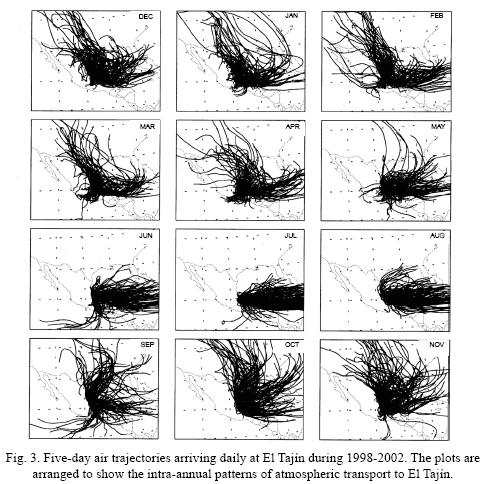
<body><![CDATA[<p align="justify"><font face="verdana" size="2">Wind flow at El Tajin is governed by the Atlantic subtropical high pressure system. During summer this system reaches its peak strength and is centered over the North Atlantic Ocean (<a href="/img/revistas/atm/v20n4/a4f2.jpg" target="_blank">Fig. 2a</a>). Periodically migrating westward toward North America, its clockwise air circulation brings steady easterly winds to Mexico's Gulf coast (<a href="/img/revistas/atm/v20n4/a4f2.jpg" target="_blank">Fig. 2b</a>). In winter the controlling influence of the subtropical high decreases as it weakens and moves eastward toward Portugal (<a href="/img/revistas/atm/v20n4/a4f2.jpg" target="_blank">Fig. 2c</a>). Average boundary&#150;layer winds remain easterly (<a href="/img/revistas/atm/v20n4/a4f2.jpg" target="_blank">Fig. 2d</a>), and cold surges associated with the North American anticyclone bring frequent incursions of northerly winds to southeastern M&eacute;xico (Schultz <i>et al., </i>1988).</font></p>     <p align="justify"><font face="verdana" size="2">Five&#150;day air trajectories arriving daily at El Taj&iacute;n during 1998&#150;2002 are shown in <a href="#f3">Figure 3</a>. The trajectories illustrate two distinct meteorological regimes controlling transport to El Taj&iacute;n. The principal control is the easterly flow associated with the southern portion of the subtropical high. Easterly flow dominates the transport during the summer months (June&#150;August), when nearly all trajectories pass over the Caribbean Sea, crossing the Yucat&aacute;n peninsula and the southern Gulf of M&eacute;xico before arriving at El Tajin. Significant easterly flow is present during all months, although wind speeds are strongest during summer (<a href="/img/revistas/atm/v20n4/a4f4.jpg" target="_blank">Fig. 4a</a>). North to northwesterly flow associated with the North American anticyclone is an important influence during the non&#150;summer months, with five&#150;day trajectories extending as far back as central Canada. During these months the wind patterns favor transport from the south&#150;central United States, with trajectories passing over Texas, the northern Gulf of M&eacute;xico, and northern M&eacute;xico before arriving at El Taj&iacute;n.</font></p>     <p align="center"><font face="verdana" size="2"><a name="f3"></a></font></p>     <p align="center"><font face="verdana" size="2"><img src="/img/revistas/atm/v20n4/a4f3.jpg"></font></p>     <p align="justify"><font face="verdana" size="2">The vertical position of air parcels along their trajectories provides additional insight regarding the potential for upwind source regions to contribute contaminants to downwind receptors (Miller, <i>et al., </i>2002). The mean vertical position of air parcels en route to El Taj&iacute;n is shown in <a href="/img/revistas/atm/v20n4/a4f4.jpg" target="_blank">Figure 4b</a>. From June&#150;August, when the direction of multi&#150;day air transport is almost exclusively easterly, air tends to remain at altitudes between 200&#150;600 m msl (pressures between 980 and 940 hPa) during the entire five&#150;day transit to El Tajin. Air transport at these low altitudes increases the likelihood that significant upwind source regions will contribute contaminants to be carried downwind to the receptor. In the case of El Tajin, significant upwind source regions during these months include Cantarell offshore oil fields in the southern Gulf of M&eacute;xico and the onshore petroleum facilities at Atasta and Dos Bocas in the southwest Yucat&aacute;n peninsula (<a href="/img/revistas/atm/v20n4/a4f1.jpg" target="_blank">Fig. 1</a>). During the rest of the year (September&#150;May) trajectory altitudes are considerably higher, reaching as high as 800 m msl (920 hPa) and 1600 m msl (840 hPa) for air parcels located one day and five days, respectively, upwind of El Taj&iacute;n. Some of this increase in transport altitude is due to topography, as the Mexican Plateau reaches 1,500 m msl (850 hPa) and covers much of the country's interior. However, much of the higher altitude transport (see, for example, the northerly trajectories in the September&#150;November panels in <a href="#f3">Fig. 3</a>) does not pass over the plateau. Trajectory passage at higher altitudes decreases the likelihood of contaminant contributions from upwind source regions, due to the greater potential for dilution over larger air volumes.</font></p>     <p align="justify"><font face="verdana" size="2">&nbsp;</font></p>     <p align="justify"><font face="verdana" size="2"><i>4.2 Long&#150;range transport corresponding to precipitation acidity measurements at El Taj&iacute;n</i></font></p>     <p align="justify"><font face="verdana" size="2">In order to gain insight on possible relationships between air transport pathways and precipitation acidity, we examined trajectories corresponding to each of the 40 precipitation events measured at El Taj&iacute;n during August 2002&#150;January 2003 (Bravo <i>et al, </i>2003). We first considered the representativeness of each event's trajectory using a spatial ensemble technique (Kahl, 1993). This technique assesses the divergence among trajectories arriving at multiple locations surrounding the location of interest. Substantial divergence indicates a large degree of horizontal wind shear, thus reducing the representativeness of the central trajectory (<a href="/img/revistas/atm/v20n4/a4f5.jpg" target="_blank">Fig. 5a</a>). Twenty&#150;one events were found to have representative, non&#150;divergent trajectories. As would be expected from the long&#150;range transport climatology shown in <a href="#f3">Figure 3</a>, trajectories for most events depicted air transport from the northerly or easterly directions. In fact, no clear relationship between precipitation acidity (pH) and trajectory path was evident. In several cases, trajectories corresponding to events with varying levels of acidity were nearly identical (<a href="/img/revistas/atm/v20n4/a4f5.jpg" target="_blank">Figs. 5b, c</a>). A relationship between precipitation pH and trajectory path was similarly absent when trajectories were calculated using a higher&#150;resolution (80 km) meteorological data set (Black, 1994).</font></p>     <p align="justify"><font face="verdana" size="2">&nbsp;</font></p>     <p align="justify"><font face="verdana" size="2"><i>4.3 Local influences</i></font></p>     ]]></body>
<body><![CDATA[<p align="justify"><font face="verdana" size="2">In addition to the large&#150;scale meteorological controls discussed above, winds at El Taj&iacute;n are also influenced by the sea/land breeze circulation. The reduced heat capacity of soil relative to that of water creates a strong horizontal temperature gradient across the coastline. The temperature gradient, directed onshore during the day and offshore at night, creates a horizontal pressure gradient that drives a sea/land breeze circulation, with land breezes at night and sea breezes during the day.</font></p>     <p align="justify"><font face="verdana" size="2">The diurnal variation of wind direction in the region of the El Taj&iacute;n archaeological zone is shown in <a href="/img/revistas/atm/v20n4/a4f6.jpg" target="_blank">Figure 6</a>. Local winds tend to be east&#150;northeasterly in the afternoon/evening, from 1500&#150;midnight local time (2100&#150;0600 UTC). Over the next three hours the winds shift to north&#150;northwesterly and persist from this direction for six hours until noon local time (1800 UTC). The early afternoon is another transition period with winds shifting back to east&#150;northeasterly by 1500 local time (2100 UTC).</font></p>     <p align="justify"><font face="verdana" size="2">The relative abundance of sea breezes (easterly winds for 9 hours) as compared to land breezes (northerly winds for 6 hours) is likely a scale interaction phenomenon: whereas the sea/land breeze is forced by the symmetric diurnal variation in solar heating, the easterly winds driven by the large&#150;scale pressure patterns are relatively unaffected by diurnal variability and are a nearly constant influence. Cloud cover, which peaks in the afternoon (Martinez <i>et al., </i>1989) and reduces the land/sea temperature contrast, also helps to retard the development of the nighttime land breeze.</font></p>     <p align="justify"><font face="verdana" size="2">&nbsp;</font></p>     <p align="justify"><font face="verdana" size="2"><b>5. Discussion and conclusions</b></font></p>     <p align="justify"><font face="verdana" size="2">On an annual basis, both large&#150;scale and local meteorological forcings in the region of the El Taj&iacute;n archaeological zone favor transport from easterly and northerly sources. This is also true during the rainy season of May&#150;October, in which 80% of the annual rainfall of 1200 mm occurs (Mart&iacute;nez, <i>et al., </i>1989; Bryson and Hare, 1974).</font></p>     <p align="justify"><font face="verdana" size="2">Significant acid precursor emissions exist in both of these upwind directions (<a href="/img/revistas/atm/v20n4/a4f1.jpg" target="_blank">Fig. 1</a>). A large area of active oil platforms is located in the Bay of Campeche, about 500 km east or one day upwind of El Taj&iacute;n. These platforms, along with associated processing and shipping facilities and nearby onshore operations, account for 80% of M&eacute;xico's national fossil fuel production and emit an estimated 660,000 tons of air pollutants annually, including 181,000 tons of SO<sub>x</sub> and 287,000 tons of non&#150;methane hydrocarbons (Villase&ntilde;or <i>et al., </i>2003). The most abundant emissions are hydrocarbons and SO<sub>2</sub>, but significant amounts of NO<sub>X</sub> , CO, H<sub>2</sub>S and particulates are also released. In addition, a large electric power plant located in Tuxpan, 30 km north of El Taj&iacute;n, is a potential source of acid precursor emissions. This nearby facility may be an important contributor to dry deposition at El Taj&iacute;n. Farther to the north, the industrial cities of Tampico, Monterrey, and Brownsville/Matamoros may contribute additional contaminants. Other possible sources include oil refineries located in the nearby town of Poza Rica and throughout M&eacute;xico's Gulf coast.</font></p>     <p align="justify"><font face="verdana" size="2">We have attempted to characterize atmospheric transport to the El Taj&iacute;n archaeological zone, an important Mesoamerican heritage site. While our focus has been on meteorological processes, it is also of interest to examine possible relationships between transport and precipitation acidity.</font></p>     <p align="justify"><font face="verdana" size="2">In the present study we found no clear relationship between transport pathway and precipitation acidity for 21 rain events at El Taj&iacute;n. This observation may be due to the abundance of upwind acid precursors emissions along both principal wind directions. The persistent easterly winds transport air from the vicinity of M&eacute;xico's petroleum operations. Northerly winds, common in the morning due to the sea breeze circulation and during the winter months due to the larger&#150;scale influence of the North American anticyclone, carry air from the direction of the Tuxpan power plant and several industrial cities.</font></p>     <p align="justify"><font face="verdana" size="2">The sampling of precipitation at El Taj&iacute;n is an ongoing effort. Once the number of available samples reaches a statistically adequate level, a future study will attempt to quantify the relationship between transport and precipitation chemistry.</font></p>     ]]></body>
<body><![CDATA[<p align="justify"><font face="verdana" size="2">&nbsp;</font></p>     <p align="justify"><font face="verdana" size="2"><b>Acknowledgements</b></font></p>     <p align="justify"><font face="verdana" size="2">The authors wish to thank Dr. Yurgen Brugermann, responsible for the restoration project of the El Taj&iacute;n archaeological zone; Alejandro Santes, responsible for sampling at El Taj&iacute;n; and Dr. V&iacute;ctor Maga&ntilde;a Rueda for his valuable comments and suggestions. Support for this project was provided by the U.S. Fulbright Program, the Mexican Fulbright Commission (COMEXUS), and Programa de Apoyo a Proyectos de Investigaci&oacute;n e Innovaci&oacute;n Tecnol&oacute;gica (PAPIIT) from the Direcci&oacute;n General de Asuntos del Personal Acad&eacute;mico (DGAPA&#150;UNAM).</font></p>     <p align="justify"><font face="verdana" size="2">&nbsp;</font></p>     <p align="justify"><font face="verdana" size="2"><b>References</b></font></p>     <!-- ref --><p align="justify"><font face="verdana" size="2">Black T. L., 1994. The new NMC mesoscale Eta Model: Description and forecast examples. <i>Wea. Forecasting </i><b>9</b>, 265&#150;278.</font>&nbsp;&nbsp;&nbsp;&nbsp;&nbsp;&nbsp;&nbsp;&nbsp;[&#160;<a href="javascript:void(0);" onclick="javascript: window.open('/scielo.php?script=sci_nlinks&ref=1271541&pid=S0187-6236200700040000400001&lng=','','width=640,height=500,resizable=yes,scrollbars=1,menubar=yes,');">Links</a>&#160;]<!-- end-ref --><!-- ref --><p align="justify"><font face="verdana" size="2">Bravo A. H., A. R. Soto, M. I. Saavedra, R. Torres, M. Granada and P. S&aacute;nchez, 1998. Acid rain in Mexico. Case: Maya monuments. In: <i>Air Pollution VI (Advances in Air Pollution). </i>(C. A. Brebbia, C. F. Ratto and H. Power, Eds.) WIT Press, Boston, 661&#150;674.</font>&nbsp;&nbsp;&nbsp;&nbsp;&nbsp;&nbsp;&nbsp;&nbsp;[&#160;<a href="javascript:void(0);" onclick="javascript: window.open('/scielo.php?script=sci_nlinks&ref=1271542&pid=S0187-6236200700040000400002&lng=','','width=640,height=500,resizable=yes,scrollbars=1,menubar=yes,');">Links</a>&#160;]<!-- end-ref --><!-- ref --><p align="justify"><font face="verdana" size="2">Bravo H., R. Soto, R. Sosa, and P. S&aacute;nchez A., 2003. Efecto de la lluvia &aacute;cida en el material constructivo de los monumentos mayas mexicanos. <i>Ingenier&iacute;a, Investigaci&oacute;n y Tecnolog&iacute;a </i><b>4</b>, 195&#150;205.</font>&nbsp;&nbsp;&nbsp;&nbsp;&nbsp;&nbsp;&nbsp;&nbsp;[&#160;<a href="javascript:void(0);" onclick="javascript: window.open('/scielo.php?script=sci_nlinks&ref=1271543&pid=S0187-6236200700040000400003&lng=','','width=640,height=500,resizable=yes,scrollbars=1,menubar=yes,');">Links</a>&#160;]<!-- end-ref --><!-- ref --><p align="justify"><font face="verdana" size="2">Bravo H., R. Soto, R. Sosa, P. S&aacute;nchez, J. Alarcon, J. Kahl and B. Ruiz, 2006. Effects of acid rain on building material of the El Taj&iacute;n archaeological zone. <i>Environ. Pollut. </i><b>144, </b>655&#150;660.</font>&nbsp;&nbsp;&nbsp;&nbsp;&nbsp;&nbsp;&nbsp;&nbsp;[&#160;<a href="javascript:void(0);" onclick="javascript: window.open('/scielo.php?script=sci_nlinks&ref=1271544&pid=S0187-6236200700040000400004&lng=','','width=640,height=500,resizable=yes,scrollbars=1,menubar=yes,');">Links</a>&#160;]<!-- end-ref --><!-- ref --><p align="justify"><font face="verdana" size="2">Bryson R. and F. K. Hare (Eds.), 1974. <i>Climates of North America. </i>Elsevier, New York, 420 pp.</font>&nbsp;&nbsp;&nbsp;&nbsp;&nbsp;&nbsp;&nbsp;&nbsp;[&#160;<a href="javascript:void(0);" onclick="javascript: window.open('/scielo.php?script=sci_nlinks&ref=1271545&pid=S0187-6236200700040000400005&lng=','','width=640,height=500,resizable=yes,scrollbars=1,menubar=yes,');">Links</a>&#160;]<!-- end-ref --><!-- ref --><p align="justify"><font face="verdana" size="2">Camuffo D., 1992. Acid rain and deterioration of monuments: How old is the phenomenon? <i>Atmos. Environ. </i><b>26B, </b>241&#150;247.</font>&nbsp;&nbsp;&nbsp;&nbsp;&nbsp;&nbsp;&nbsp;&nbsp;[&#160;<a href="javascript:void(0);" onclick="javascript: window.open('/scielo.php?script=sci_nlinks&ref=1271546&pid=S0187-6236200700040000400006&lng=','','width=640,height=500,resizable=yes,scrollbars=1,menubar=yes,');">Links</a>&#160;]<!-- end-ref --><!-- ref --><p align="justify"><font face="verdana" size="2">Guerrero Villalobos G., A. Jaime P. y J. Espinosa Gonz&aacute;lez, 2003. Manejo de informaci&oacute;n sin&oacute;ptica hist&oacute;rica. Servicio Meteorol&oacute;gico Nacional, M&eacute;xico, 11 pp.</font>&nbsp;&nbsp;&nbsp;&nbsp;&nbsp;&nbsp;&nbsp;&nbsp;[&#160;<a href="javascript:void(0);" onclick="javascript: window.open('/scielo.php?script=sci_nlinks&ref=1271547&pid=S0187-6236200700040000400007&lng=','','width=640,height=500,resizable=yes,scrollbars=1,menubar=yes,');">Links</a>&#160;]<!-- end-ref --><!-- ref --><p align="justify"><font face="verdana" size="2">Harris J., 2004. Atmospheric transport. In: Summary Report 27. (R. C. Schnell, A. Bugle and R. Rosson, Eds.), Climate Monitoring and Diagnostic Change Laboratory, NOAA, Boulder, CO, 103 pp.</font>&nbsp;&nbsp;&nbsp;&nbsp;&nbsp;&nbsp;&nbsp;&nbsp;[&#160;<a href="javascript:void(0);" onclick="javascript: window.open('/scielo.php?script=sci_nlinks&ref=1271548&pid=S0187-6236200700040000400008&lng=','','width=640,height=500,resizable=yes,scrollbars=1,menubar=yes,');">Links</a>&#160;]<!-- end-ref --><!-- ref --><p align="justify"><font face="verdana" size="2">Harris J. M. and J. D. W. Kahl, 1994. Analysis of 10&#150;day isentropic flow patterns for Barrow, Alaska: 1985&#150;1992. J. <i>Geophys. Res. </i><b>99</b>(D12), 25845&#150;25855.</font>&nbsp;&nbsp;&nbsp;&nbsp;&nbsp;&nbsp;&nbsp;&nbsp;[&#160;<a href="javascript:void(0);" onclick="javascript: window.open('/scielo.php?script=sci_nlinks&ref=1271549&pid=S0187-6236200700040000400009&lng=','','width=640,height=500,resizable=yes,scrollbars=1,menubar=yes,');">Links</a>&#160;]<!-- end-ref --><!-- ref --><p align="justify"><font face="verdana" size="2">Harris J. M., R. Draxler and S. J. Oltmans, 2005. Trajectory model sensitivity to differences in input data and vertical transport method. <i>J. Geophys. Res. </i><b>110</b>, D14109.</font>&nbsp;&nbsp;&nbsp;&nbsp;&nbsp;&nbsp;&nbsp;&nbsp;[&#160;<a href="javascript:void(0);" onclick="javascript: window.open('/scielo.php?script=sci_nlinks&ref=1271550&pid=S0187-6236200700040000400010&lng=','','width=640,height=500,resizable=yes,scrollbars=1,menubar=yes,');">Links</a>&#160;]<!-- end-ref --><!-- ref --><p align="justify"><font face="verdana" size="2">Heckel P. F., T. C. Keener, M. Lu and H. Bravo &Aacute;lvarez (Eds.), 2007. A summary of the International Workshop on the Influences of Air Quality on the Mayan Heritage Sites in Mesoamerica. Environmental Manager, February, 24&#150;30.</font>&nbsp;&nbsp;&nbsp;&nbsp;&nbsp;&nbsp;&nbsp;&nbsp;[&#160;<a href="javascript:void(0);" onclick="javascript: window.open('/scielo.php?script=sci_nlinks&ref=1271551&pid=S0187-6236200700040000400011&lng=','','width=640,height=500,resizable=yes,scrollbars=1,menubar=yes,');">Links</a>&#160;]<!-- end-ref --><!-- ref --><p align="justify"><font face="verdana" size="2">Kahl J. D. W., 1993. A cautionary note on the use of air trajectories in interpreting atmospheric chemistry measurements. <i>Atmos. Environ. </i><b>27A</b>(17/18), 3037&#150;3038.</font>&nbsp;&nbsp;&nbsp;&nbsp;&nbsp;&nbsp;&nbsp;&nbsp;[&#160;<a href="javascript:void(0);" onclick="javascript: window.open('/scielo.php?script=sci_nlinks&ref=1271552&pid=S0187-6236200700040000400012&lng=','','width=640,height=500,resizable=yes,scrollbars=1,menubar=yes,');">Links</a>&#160;]<!-- end-ref --><!-- ref --><p align="justify"><font face="verdana" size="2">Kahl J. D. and P. J. Samson, 1986. Uncertainty in trajectory calculations due to low resolution meteorological data. <i>J. Climate Appl. Meteorol. </i><b>25</b>(12), 1816&#150;1831.</font>&nbsp;&nbsp;&nbsp;&nbsp;&nbsp;&nbsp;&nbsp;&nbsp;[&#160;<a href="javascript:void(0);" onclick="javascript: window.open('/scielo.php?script=sci_nlinks&ref=1271553&pid=S0187-6236200700040000400013&lng=','','width=640,height=500,resizable=yes,scrollbars=1,menubar=yes,');">Links</a>&#160;]<!-- end-ref --><!-- ref --><p align="justify"><font face="verdana" size="2">Kalnay E, M. Kanamitsu, R. Kistler, W. Collins, D. Deaven, L.Gandin, M. Iredell, S. Saha, G. White, J. Woollen, Y. Zhu, M. Chelliah, W. Ebisuzaki, W. Higgins, J. Janowiak, K. C. Mo, C. Ropelewski, J. Wang, A. Leetmaa, R. Reynolds, R. Jenne and D. Joseph, 1996. The NCEP/NCAR 40&#150;year reanalysis project. <i>Bull. Amer. Meteorol. Soc. <b>77</b>, </i>437&#150;471.</font>&nbsp;&nbsp;&nbsp;&nbsp;&nbsp;&nbsp;&nbsp;&nbsp;[&#160;<a href="javascript:void(0);" onclick="javascript: window.open('/scielo.php?script=sci_nlinks&ref=1271554&pid=S0187-6236200700040000400014&lng=','','width=640,height=500,resizable=yes,scrollbars=1,menubar=yes,');">Links</a>&#160;]<!-- end-ref --><!-- ref --><p align="justify"><font face="verdana" size="2">Tejeda&#150;Mart&iacute;nez A., F. Acevedo and E. J&aacute;uregui, 1989. <i>Atlas clim&aacute;tico del estado de Veracruz. </i>Universidad Veracruzana, Xalapa, 150 pp.</font>&nbsp;&nbsp;&nbsp;&nbsp;&nbsp;&nbsp;&nbsp;&nbsp;[&#160;<a href="javascript:void(0);" onclick="javascript: window.open('/scielo.php?script=sci_nlinks&ref=1271555&pid=S0187-6236200700040000400015&lng=','','width=640,height=500,resizable=yes,scrollbars=1,menubar=yes,');">Links</a>&#160;]<!-- end-ref --><!-- ref --><p align="justify"><font face="verdana" size="2">Miller J. E., J. D. W. Kahl, F. Heller and J. M. Harris, 2002. A three&#150;dimensional residence&#150;time analysis of potential summertime atmospheric transport to Summit, Greenland. <i>Annals of Glaciology </i><b>35</b>, 403&#150;408.</font>&nbsp;&nbsp;&nbsp;&nbsp;&nbsp;&nbsp;&nbsp;&nbsp;[&#160;<a href="javascript:void(0);" onclick="javascript: window.open('/scielo.php?script=sci_nlinks&ref=1271556&pid=S0187-6236200700040000400016&lng=','','width=640,height=500,resizable=yes,scrollbars=1,menubar=yes,');">Links</a>&#160;]<!-- end-ref --><!-- ref --><p align="justify"><font face="verdana" size="2">Persson A. and F. Grazzini, 2005. <i>User Guide to ECMWF forecast products. </i>Meteorological Bulletin M3.2, European Centre for Medium Range Weather Forecasts, Reading, UK, 162 pp.</font>&nbsp;&nbsp;&nbsp;&nbsp;&nbsp;&nbsp;&nbsp;&nbsp;[&#160;<a href="javascript:void(0);" onclick="javascript: window.open('/scielo.php?script=sci_nlinks&ref=1271557&pid=S0187-6236200700040000400017&lng=','','width=640,height=500,resizable=yes,scrollbars=1,menubar=yes,');">Links</a>&#160;]<!-- end-ref --><!-- ref --><p align="justify"><font face="verdana" size="2">Schultz D. M., W. E. Bracken and L. F. Bosart, 1998. Planetary&#150; and synoptic&#150;scale signatures associated with Central American cold surges. <i>Mon. Wea. Rev. </i><b>126</b>, 5&#150;27.</font>&nbsp;&nbsp;&nbsp;&nbsp;&nbsp;&nbsp;&nbsp;&nbsp;[&#160;<a href="javascript:void(0);" onclick="javascript: window.open('/scielo.php?script=sci_nlinks&ref=1271558&pid=S0187-6236200700040000400018&lng=','','width=640,height=500,resizable=yes,scrollbars=1,menubar=yes,');">Links</a>&#160;]<!-- end-ref --><!-- ref --><p align="justify"><font face="verdana" size="2">Simmons A. J. R., R. Mureau and T. Petroliagis, 1995. Error growth and estimates of predictability from the ECMWF forecasting system. <i>Q. J. R. Meteorol. Soc. </i><b>121</b>, 1739&#150;1771.</font>&nbsp;&nbsp;&nbsp;&nbsp;&nbsp;&nbsp;&nbsp;&nbsp;[&#160;<a href="javascript:void(0);" onclick="javascript: window.open('/scielo.php?script=sci_nlinks&ref=1271559&pid=S0187-6236200700040000400019&lng=','','width=640,height=500,resizable=yes,scrollbars=1,menubar=yes,');">Links</a>&#160;]<!-- end-ref --><!-- ref --><p align="justify"><font face="verdana" size="2">Stohl A., 1998. Computation, accuracy and applications of trajectories: A review and bibliography. <i>Atmos. Environ. </i><b>32</b>, 947&#150;966.</font>&nbsp;&nbsp;&nbsp;&nbsp;&nbsp;&nbsp;&nbsp;&nbsp;[&#160;<a href="javascript:void(0);" onclick="javascript: window.open('/scielo.php?script=sci_nlinks&ref=1271560&pid=S0187-6236200700040000400020&lng=','','width=640,height=500,resizable=yes,scrollbars=1,menubar=yes,');">Links</a>&#160;]<!-- end-ref --><!-- ref --><p align="justify"><font face="verdana" size="2">Villase&ntilde;or R., M. Magdaleno, A. Quintanar, J. C. Gallardo, M. T. L&oacute;pez, R. Jurado, A. Miranda, M. Aguilar, L. A. Melgarejo, E. Palmer&iacute;n, C. J. Vallejo and W. R. Barchet, 2003. An air quality emission inventory of offshore operations for the exploration and production of petroleum by the Mexican oil industry. <i>Atmos. Environ. </i><b>37</b>, 3713&#150;3729.</font>&nbsp;&nbsp;&nbsp;&nbsp;&nbsp;&nbsp;&nbsp;&nbsp;[&#160;<a href="javascript:void(0);" onclick="javascript: window.open('/scielo.php?script=sci_nlinks&ref=1271561&pid=S0187-6236200700040000400021&lng=','','width=640,height=500,resizable=yes,scrollbars=1,menubar=yes,');">Links</a>&#160;]<!-- end-ref --> ]]></body><back>
<ref-list>
<ref id="B1">
<nlm-citation citation-type="journal">
<person-group person-group-type="author">
<name>
<surname><![CDATA[Black]]></surname>
<given-names><![CDATA[T. L.]]></given-names>
</name>
</person-group>
<article-title xml:lang="en"><![CDATA[The new NMC mesoscale Eta Model: Description and forecast examples]]></article-title>
<source><![CDATA[Wea. Forecasting]]></source>
<year>1994</year>
<volume>9</volume>
<page-range>265-278</page-range></nlm-citation>
</ref>
<ref id="B2">
<nlm-citation citation-type="book">
<person-group person-group-type="author">
<name>
<surname><![CDATA[Bravo]]></surname>
<given-names><![CDATA[A. H.]]></given-names>
</name>
<name>
<surname><![CDATA[Soto]]></surname>
<given-names><![CDATA[A. R.]]></given-names>
</name>
<name>
<surname><![CDATA[Saavedra]]></surname>
<given-names><![CDATA[M. I.]]></given-names>
</name>
<name>
<surname><![CDATA[Torres]]></surname>
<given-names><![CDATA[R.]]></given-names>
</name>
<name>
<surname><![CDATA[Granada]]></surname>
<given-names><![CDATA[M.]]></given-names>
</name>
<name>
<surname><![CDATA[Sánchez]]></surname>
<given-names><![CDATA[P.]]></given-names>
</name>
</person-group>
<article-title xml:lang="en"><![CDATA[Acid rain in Mexico: Case: Maya monuments]]></article-title>
<person-group person-group-type="editor">
<name>
<surname><![CDATA[Brebbia]]></surname>
<given-names><![CDATA[C. A.]]></given-names>
</name>
<name>
<surname><![CDATA[Ratto]]></surname>
<given-names><![CDATA[C. F.]]></given-names>
</name>
<name>
<surname><![CDATA[Power]]></surname>
<given-names><![CDATA[H.]]></given-names>
</name>
</person-group>
<source><![CDATA[Air Pollution VI: (Advances in Air Pollution)]]></source>
<year>1998</year>
<page-range>661-674</page-range><publisher-loc><![CDATA[Boston ]]></publisher-loc>
<publisher-name><![CDATA[WIT Press]]></publisher-name>
</nlm-citation>
</ref>
<ref id="B3">
<nlm-citation citation-type="journal">
<person-group person-group-type="author">
<name>
<surname><![CDATA[Bravo]]></surname>
<given-names><![CDATA[H.]]></given-names>
</name>
<name>
<surname><![CDATA[Soto]]></surname>
<given-names><![CDATA[R.]]></given-names>
</name>
<name>
<surname><![CDATA[Sosa]]></surname>
<given-names><![CDATA[R.]]></given-names>
</name>
<name>
<surname><![CDATA[Sánchez A.]]></surname>
<given-names><![CDATA[P.]]></given-names>
</name>
</person-group>
<article-title xml:lang="es"><![CDATA[Efecto de la lluvia ácida en el material constructivo de los monumentos mayas mexicanos]]></article-title>
<source><![CDATA[Ingeniería, Investigación y Tecnología]]></source>
<year>2003</year>
<volume>4</volume>
<page-range>195-205</page-range></nlm-citation>
</ref>
<ref id="B4">
<nlm-citation citation-type="journal">
<person-group person-group-type="author">
<name>
<surname><![CDATA[Bravo]]></surname>
<given-names><![CDATA[H.]]></given-names>
</name>
<name>
<surname><![CDATA[Soto]]></surname>
<given-names><![CDATA[R.]]></given-names>
</name>
<name>
<surname><![CDATA[Sosa]]></surname>
<given-names><![CDATA[R.]]></given-names>
</name>
<name>
<surname><![CDATA[Sánchez]]></surname>
<given-names><![CDATA[P.]]></given-names>
</name>
<name>
<surname><![CDATA[Alarcon]]></surname>
<given-names><![CDATA[J.]]></given-names>
</name>
<name>
<surname><![CDATA[Kahl]]></surname>
<given-names><![CDATA[J.]]></given-names>
</name>
<name>
<surname><![CDATA[Ruiz]]></surname>
<given-names><![CDATA[B.]]></given-names>
</name>
</person-group>
<article-title xml:lang="en"><![CDATA[Effects of acid rain on building material of the El Tajín archaeological zone]]></article-title>
<source><![CDATA[Environ. Pollut.]]></source>
<year>2006</year>
<volume>144</volume>
<page-range>655-660</page-range></nlm-citation>
</ref>
<ref id="B5">
<nlm-citation citation-type="book">
<person-group person-group-type="author">
<name>
<surname><![CDATA[Bryson]]></surname>
<given-names><![CDATA[R.]]></given-names>
</name>
<name>
<surname><![CDATA[Hare]]></surname>
<given-names><![CDATA[F. K.]]></given-names>
</name>
</person-group>
<source><![CDATA[Climates of North America]]></source>
<year>1974</year>
<page-range>420</page-range><publisher-loc><![CDATA[New York ]]></publisher-loc>
<publisher-name><![CDATA[Elsevier]]></publisher-name>
</nlm-citation>
</ref>
<ref id="B6">
<nlm-citation citation-type="journal">
<person-group person-group-type="author">
<name>
<surname><![CDATA[Camuffo]]></surname>
<given-names><![CDATA[D.]]></given-names>
</name>
</person-group>
<article-title xml:lang="en"><![CDATA[Acid rain and deterioration of monuments: How old is the phenomenon?]]></article-title>
<source><![CDATA[Atmos. Environ.]]></source>
<year>1992</year>
<volume>26B</volume>
<page-range>241-247</page-range></nlm-citation>
</ref>
<ref id="B7">
<nlm-citation citation-type="book">
<person-group person-group-type="author">
<name>
<surname><![CDATA[Guerrero Villalobos]]></surname>
<given-names><![CDATA[G.]]></given-names>
</name>
<name>
<surname><![CDATA[Jaime P.]]></surname>
<given-names><![CDATA[A.]]></given-names>
</name>
<name>
<surname><![CDATA[Espinosa González]]></surname>
<given-names><![CDATA[J.]]></given-names>
</name>
</person-group>
<source><![CDATA[Manejo de información sinóptica histórica]]></source>
<year>2003</year>
<page-range>11</page-range><publisher-name><![CDATA[Servicio Meteorológico Nacional]]></publisher-name>
</nlm-citation>
</ref>
<ref id="B8">
<nlm-citation citation-type="book">
<person-group person-group-type="author">
<name>
<surname><![CDATA[Harris]]></surname>
<given-names><![CDATA[J.]]></given-names>
</name>
</person-group>
<article-title xml:lang="en"><![CDATA[Atmospheric transport]]></article-title>
<person-group person-group-type="editor">
<name>
<surname><![CDATA[Schnell]]></surname>
<given-names><![CDATA[R. C.]]></given-names>
</name>
<name>
<surname><![CDATA[Bugle]]></surname>
<given-names><![CDATA[A.]]></given-names>
</name>
<name>
<surname><![CDATA[Rosson]]></surname>
<given-names><![CDATA[R.]]></given-names>
</name>
</person-group>
<source><![CDATA[Summary Report 27]]></source>
<year>2004</year>
<page-range>103</page-range><publisher-loc><![CDATA[Boulder^eCO CO]]></publisher-loc>
<publisher-name><![CDATA[Climate Monitoring and Diagnostic Change Laboratory, NOAA]]></publisher-name>
</nlm-citation>
</ref>
<ref id="B9">
<nlm-citation citation-type="journal">
<person-group person-group-type="author">
<name>
<surname><![CDATA[Harris]]></surname>
<given-names><![CDATA[J. M.]]></given-names>
</name>
<name>
<surname><![CDATA[Kahl]]></surname>
<given-names><![CDATA[J. D. W.]]></given-names>
</name>
</person-group>
<article-title xml:lang="en"><![CDATA[Analysis of 10-day isentropic flow patterns for Barrow, Alaska: 1985-1992]]></article-title>
<source><![CDATA[J. Geophys. Res.]]></source>
<year>1994</year>
<volume>99</volume>
<numero>D12</numero>
<issue>D12</issue>
<page-range>25845-25855</page-range></nlm-citation>
</ref>
<ref id="B10">
<nlm-citation citation-type="journal">
<person-group person-group-type="author">
<name>
<surname><![CDATA[Harris]]></surname>
<given-names><![CDATA[J. M.]]></given-names>
</name>
<name>
<surname><![CDATA[Draxler]]></surname>
<given-names><![CDATA[R.]]></given-names>
</name>
<name>
<surname><![CDATA[Oltmans]]></surname>
<given-names><![CDATA[S. J.]]></given-names>
</name>
</person-group>
<article-title xml:lang="en"><![CDATA[Trajectory model sensitivity to differences in input data and vertical transport method]]></article-title>
<source><![CDATA[J. Geophys. Res.]]></source>
<year>2005</year>
<volume>110</volume>
<page-range>D14109</page-range></nlm-citation>
</ref>
<ref id="B11">
<nlm-citation citation-type="journal">
<person-group person-group-type="author">
<name>
<surname><![CDATA[Heckel]]></surname>
<given-names><![CDATA[P. F.]]></given-names>
</name>
<name>
<surname><![CDATA[Keener]]></surname>
<given-names><![CDATA[T. C.]]></given-names>
</name>
<name>
<surname><![CDATA[Lu]]></surname>
<given-names><![CDATA[M.]]></given-names>
</name>
<name>
<surname><![CDATA[Bravo Álvarez]]></surname>
<given-names><![CDATA[H.]]></given-names>
</name>
</person-group>
<article-title xml:lang="en"><![CDATA[A summary of the International Workshop on the Influences of Air Quality on the Mayan Heritage Sites in Mesoamerica]]></article-title>
<source><![CDATA[Environmental Manager]]></source>
<year>2007</year>
<page-range>24-30</page-range></nlm-citation>
</ref>
<ref id="B12">
<nlm-citation citation-type="journal">
<person-group person-group-type="author">
<name>
<surname><![CDATA[Kahl]]></surname>
<given-names><![CDATA[J. D. W.]]></given-names>
</name>
</person-group>
<article-title xml:lang="en"><![CDATA[A cautionary note on the use of air trajectories in interpreting atmospheric chemistry measurements]]></article-title>
<source><![CDATA[Atmos. Environ.]]></source>
<year>1993</year>
<volume>27A</volume>
<numero>17/18</numero>
<issue>17/18</issue>
<page-range>3037-3038</page-range></nlm-citation>
</ref>
<ref id="B13">
<nlm-citation citation-type="journal">
<person-group person-group-type="author">
<name>
<surname><![CDATA[Kahl]]></surname>
<given-names><![CDATA[J. D.]]></given-names>
</name>
<name>
<surname><![CDATA[Samson]]></surname>
<given-names><![CDATA[P. J.]]></given-names>
</name>
</person-group>
<article-title xml:lang="en"><![CDATA[Uncertainty in trajectory calculations due to low resolution meteorological data]]></article-title>
<source><![CDATA[J. Climate Appl. Meteorol.]]></source>
<year>1986</year>
<volume>25</volume>
<numero>12</numero>
<issue>12</issue>
<page-range>1816-1831</page-range></nlm-citation>
</ref>
<ref id="B14">
<nlm-citation citation-type="journal">
<person-group person-group-type="author">
<name>
<surname><![CDATA[Kalnay]]></surname>
<given-names><![CDATA[E]]></given-names>
</name>
<name>
<surname><![CDATA[Kanamitsu]]></surname>
<given-names><![CDATA[M.]]></given-names>
</name>
<name>
<surname><![CDATA[Kistler]]></surname>
<given-names><![CDATA[R.]]></given-names>
</name>
<name>
<surname><![CDATA[Collins]]></surname>
<given-names><![CDATA[W.]]></given-names>
</name>
<name>
<surname><![CDATA[Deaven]]></surname>
<given-names><![CDATA[D.]]></given-names>
</name>
<name>
<surname><![CDATA[Gandin]]></surname>
<given-names><![CDATA[L.]]></given-names>
</name>
<name>
<surname><![CDATA[Iredell]]></surname>
<given-names><![CDATA[M.]]></given-names>
</name>
<name>
<surname><![CDATA[Saha]]></surname>
<given-names><![CDATA[S.]]></given-names>
</name>
<name>
<surname><![CDATA[White]]></surname>
<given-names><![CDATA[G.]]></given-names>
</name>
<name>
<surname><![CDATA[Woollen]]></surname>
<given-names><![CDATA[J.]]></given-names>
</name>
<name>
<surname><![CDATA[Zhu]]></surname>
<given-names><![CDATA[Y.]]></given-names>
</name>
<name>
<surname><![CDATA[Chelliah]]></surname>
<given-names><![CDATA[M.]]></given-names>
</name>
<name>
<surname><![CDATA[Ebisuzaki]]></surname>
<given-names><![CDATA[W.]]></given-names>
</name>
<name>
<surname><![CDATA[Higgins]]></surname>
<given-names><![CDATA[W.]]></given-names>
</name>
<name>
<surname><![CDATA[Janowiak]]></surname>
<given-names><![CDATA[J.]]></given-names>
</name>
<name>
<surname><![CDATA[Mo]]></surname>
<given-names><![CDATA[K. C.]]></given-names>
</name>
<name>
<surname><![CDATA[Ropelewski]]></surname>
<given-names><![CDATA[C.]]></given-names>
</name>
<name>
<surname><![CDATA[Wang]]></surname>
<given-names><![CDATA[J.]]></given-names>
</name>
<name>
<surname><![CDATA[Leetmaa]]></surname>
<given-names><![CDATA[A.]]></given-names>
</name>
<name>
<surname><![CDATA[Reynolds]]></surname>
<given-names><![CDATA[R.]]></given-names>
</name>
<name>
<surname><![CDATA[Jenne]]></surname>
<given-names><![CDATA[R.]]></given-names>
</name>
<name>
<surname><![CDATA[Joseph]]></surname>
<given-names><![CDATA[D.]]></given-names>
</name>
</person-group>
<article-title xml:lang="en"><![CDATA[The NCEP/NCAR 40-year reanalysis project]]></article-title>
<source><![CDATA[Bull. Amer. Meteorol. Soc.]]></source>
<year>1996</year>
<volume>77</volume>
<page-range>437-471</page-range></nlm-citation>
</ref>
<ref id="B15">
<nlm-citation citation-type="book">
<person-group person-group-type="author">
<name>
<surname><![CDATA[Tejeda-Martínez]]></surname>
<given-names><![CDATA[A.]]></given-names>
</name>
<name>
<surname><![CDATA[Acevedo]]></surname>
<given-names><![CDATA[F.]]></given-names>
</name>
<name>
<surname><![CDATA[Jáuregui]]></surname>
<given-names><![CDATA[E.]]></given-names>
</name>
</person-group>
<source><![CDATA[Atlas climático del estado de Veracruz]]></source>
<year>1989</year>
<page-range>150</page-range><publisher-loc><![CDATA[Xalapa ]]></publisher-loc>
<publisher-name><![CDATA[Universidad Veracruzana]]></publisher-name>
</nlm-citation>
</ref>
<ref id="B16">
<nlm-citation citation-type="journal">
<person-group person-group-type="author">
<name>
<surname><![CDATA[Miller]]></surname>
<given-names><![CDATA[J. E.]]></given-names>
</name>
<name>
<surname><![CDATA[Kahl]]></surname>
<given-names><![CDATA[J. D. W.]]></given-names>
</name>
<name>
<surname><![CDATA[Heller]]></surname>
<given-names><![CDATA[F.]]></given-names>
</name>
<name>
<surname><![CDATA[Harris]]></surname>
<given-names><![CDATA[J. M.]]></given-names>
</name>
</person-group>
<article-title xml:lang="en"><![CDATA[A three-dimensional residence-time analysis of potential summertime atmospheric transport to Summit, Greenland]]></article-title>
<source><![CDATA[Annals of Glaciology]]></source>
<year>2002</year>
<volume>35</volume>
<page-range>403-408</page-range></nlm-citation>
</ref>
<ref id="B17">
<nlm-citation citation-type="book">
<person-group person-group-type="author">
<name>
<surname><![CDATA[Persson]]></surname>
<given-names><![CDATA[A.]]></given-names>
</name>
<name>
<surname><![CDATA[Grazzini]]></surname>
<given-names><![CDATA[F.]]></given-names>
</name>
</person-group>
<source><![CDATA[User Guide to ECMWF forecast products]]></source>
<year>2005</year>
<volume>M3.2</volume>
<page-range>162</page-range><publisher-loc><![CDATA[Reading ]]></publisher-loc>
<publisher-name><![CDATA[European Centre for Medium Range Weather Forecasts]]></publisher-name>
</nlm-citation>
</ref>
<ref id="B18">
<nlm-citation citation-type="journal">
<person-group person-group-type="author">
<name>
<surname><![CDATA[Schultz]]></surname>
<given-names><![CDATA[D. M.]]></given-names>
</name>
<name>
<surname><![CDATA[Bracken]]></surname>
<given-names><![CDATA[W. E.]]></given-names>
</name>
<name>
<surname><![CDATA[Bosart]]></surname>
<given-names><![CDATA[L. F.]]></given-names>
</name>
</person-group>
<article-title xml:lang="en"><![CDATA[Planetary- and synoptic-scale signatures associated with Central American cold surges]]></article-title>
<source><![CDATA[Mon. Wea. Rev.]]></source>
<year>1998</year>
<volume>126</volume>
<page-range>5-27</page-range></nlm-citation>
</ref>
<ref id="B19">
<nlm-citation citation-type="journal">
<person-group person-group-type="author">
<name>
<surname><![CDATA[Simmons]]></surname>
<given-names><![CDATA[A. J. R.]]></given-names>
</name>
<name>
<surname><![CDATA[Mureau]]></surname>
<given-names><![CDATA[R.]]></given-names>
</name>
<name>
<surname><![CDATA[Petroliagis]]></surname>
<given-names><![CDATA[T.]]></given-names>
</name>
</person-group>
<article-title xml:lang="en"><![CDATA[Error growth and estimates of predictability from the ECMWF forecasting system]]></article-title>
<source><![CDATA[Q. J. R. Meteorol. Soc.]]></source>
<year>1995</year>
<volume>121</volume>
<page-range>1739-1771</page-range></nlm-citation>
</ref>
<ref id="B20">
<nlm-citation citation-type="journal">
<person-group person-group-type="author">
<name>
<surname><![CDATA[Stohl]]></surname>
<given-names><![CDATA[A.]]></given-names>
</name>
</person-group>
<article-title xml:lang="en"><![CDATA[Computation, accuracy and applications of trajectories: A review and bibliography]]></article-title>
<source><![CDATA[Atmos. Environ.]]></source>
<year>1998</year>
<volume>32</volume>
<page-range>947-966</page-range></nlm-citation>
</ref>
<ref id="B21">
<nlm-citation citation-type="journal">
<person-group person-group-type="author">
<name>
<surname><![CDATA[Villaseñor]]></surname>
<given-names><![CDATA[R.]]></given-names>
</name>
<name>
<surname><![CDATA[Magdaleno]]></surname>
<given-names><![CDATA[M.]]></given-names>
</name>
<name>
<surname><![CDATA[Quintanar]]></surname>
<given-names><![CDATA[A.]]></given-names>
</name>
<name>
<surname><![CDATA[Gallardo]]></surname>
<given-names><![CDATA[J. C.]]></given-names>
</name>
<name>
<surname><![CDATA[López]]></surname>
<given-names><![CDATA[M. T.]]></given-names>
</name>
<name>
<surname><![CDATA[Jurado]]></surname>
<given-names><![CDATA[R.]]></given-names>
</name>
<name>
<surname><![CDATA[Miranda]]></surname>
<given-names><![CDATA[A.]]></given-names>
</name>
<name>
<surname><![CDATA[Aguilar]]></surname>
<given-names><![CDATA[M.]]></given-names>
</name>
<name>
<surname><![CDATA[Melgarejo]]></surname>
<given-names><![CDATA[L. A.]]></given-names>
</name>
<name>
<surname><![CDATA[Palmerín]]></surname>
<given-names><![CDATA[E.]]></given-names>
</name>
<name>
<surname><![CDATA[Vallejo]]></surname>
<given-names><![CDATA[C. J.]]></given-names>
</name>
<name>
<surname><![CDATA[Barchet]]></surname>
<given-names><![CDATA[W. R.]]></given-names>
</name>
</person-group>
<article-title xml:lang="en"><![CDATA[An air quality emission inventory of offshore operations for the exploration and production of petroleum by the Mexican oil industry]]></article-title>
<source><![CDATA[Atmos. Environ.]]></source>
<year>2003</year>
<volume>37</volume>
<page-range>3713-3729</page-range></nlm-citation>
</ref>
</ref-list>
</back>
</article>
