<?xml version="1.0" encoding="ISO-8859-1"?><article xmlns:mml="http://www.w3.org/1998/Math/MathML" xmlns:xlink="http://www.w3.org/1999/xlink" xmlns:xsi="http://www.w3.org/2001/XMLSchema-instance">
<front>
<journal-meta>
<journal-id>0187-6236</journal-id>
<journal-title><![CDATA[Atmósfera]]></journal-title>
<abbrev-journal-title><![CDATA[Atmósfera]]></abbrev-journal-title>
<issn>0187-6236</issn>
<publisher>
<publisher-name><![CDATA[Universidad Nacional Autónoma de México, Instituto de Ciencias de la Atmósfera y Cambio Climático]]></publisher-name>
</publisher>
</journal-meta>
<article-meta>
<article-id>S0187-62362007000300005</article-id>
<title-group>
<article-title xml:lang="en"><![CDATA[Total peroxides and sulfate in rainwater in the Mexican eastern Pacific Ocean during the Climatic Experiment in the Americas Warm Water Pools]]></article-title>
</title-group>
<contrib-group>
<contrib contrib-type="author">
<name>
<surname><![CDATA[PADILLA]]></surname>
<given-names><![CDATA[H.]]></given-names>
</name>
<xref ref-type="aff" rid="A01"/>
</contrib>
<contrib contrib-type="author">
<name>
<surname><![CDATA[TORRES]]></surname>
<given-names><![CDATA[M. C.]]></given-names>
</name>
<xref ref-type="aff" rid="A01"/>
</contrib>
<contrib contrib-type="author">
<name>
<surname><![CDATA[BÉLMONT]]></surname>
<given-names><![CDATA[R.]]></given-names>
</name>
<xref ref-type="aff" rid="A01"/>
</contrib>
<contrib contrib-type="author">
<name>
<surname><![CDATA[GARCÍA]]></surname>
<given-names><![CDATA[R.]]></given-names>
</name>
<xref ref-type="aff" rid="A01"/>
</contrib>
<contrib contrib-type="author">
<name>
<surname><![CDATA[BÁEZ]]></surname>
<given-names><![CDATA[A.]]></given-names>
</name>
<xref ref-type="aff" rid="A01"/>
</contrib>
</contrib-group>
<aff id="A01">
<institution><![CDATA[,Universidad Nacional Autónoma de México Centro de Ciencias de la Atmósfera Laboratorio de Química Atmosférica]]></institution>
<addr-line><![CDATA[D. F. ]]></addr-line>
<country>México</country>
</aff>
<pub-date pub-type="pub">
<day>00</day>
<month>07</month>
<year>2007</year>
</pub-date>
<pub-date pub-type="epub">
<day>00</day>
<month>07</month>
<year>2007</year>
</pub-date>
<volume>20</volume>
<numero>3</numero>
<fpage>299</fpage>
<lpage>305</lpage>
<copyright-statement/>
<copyright-year/>
<self-uri xlink:href="http://www.scielo.org.mx/scielo.php?script=sci_arttext&amp;pid=S0187-62362007000300005&amp;lng=en&amp;nrm=iso"></self-uri><self-uri xlink:href="http://www.scielo.org.mx/scielo.php?script=sci_abstract&amp;pid=S0187-62362007000300005&amp;lng=en&amp;nrm=iso"></self-uri><self-uri xlink:href="http://www.scielo.org.mx/scielo.php?script=sci_pdf&amp;pid=S0187-62362007000300005&amp;lng=en&amp;nrm=iso"></self-uri><abstract abstract-type="short" xml:lang="es"><p><![CDATA[Se analizaron peróxidos totales y el ion sulfato en 26 muestras de agua de lluvia colectadas del 23 al 25 de mayo de 2001 a bordo del B/O "El Puma", propiedad de la Universidad Nacional Autónoma de México, durante la campaña denominada Experimento Climático en las Albercas de Agua Caliente de las Américas (ECAC-1) en la zona este del Océano Pacífico entre los 12 y 14° latitud norte, y entre los 98 y 100° longitud oeste. Las medias ponderadas por volumen de las concentraciones de peróxidos totales, sulfato y de sulfato proveniente de la sal marina fueron de 13.1 ± 1.94 &#956;M, 0.76 ± 0.59 y 0.04 ± 0.06 mg L-1, respectivamente. El sulfato en exceso (sulfato que no proviene de la sal marina) representó el 95% del sulfato total. Las concentraciones de peróxidos totales correlacionaron significativamente con sulfato total y sulfato en exceso (0.560 y 0.586 a una p < 0.05, respectivamente) posiblemente debido a que la mayor parte del sulfato en exceso y del peróxido de hidrógeno observados en el Océano Pacífico oriental frente a las costas de México, pudo haber sido producida a partir de la oxidación de compuestos biogénicos de azufre. La correlación no significante entre sulfato de la sal marina y peróxidos totales se debió al hecho de que el H2O2 no reacciona con los sulfatos presentes en los aerosoles de la sal marina. También, la concentración de peróxidos totales no tuvo una correlación significativa con la intensidad de la lluvia, debido a que una fracción del H2O2 pudo haber sido generada dentro de las gotitas de la nube.]]></p></abstract>
<abstract abstract-type="short" xml:lang="en"><p><![CDATA[Total peroxides were analyzed in 26 rainwater samples collected on board of the R/V El Puma of the National Autonomous University of México (UNAM) during the Climatic Experiment in the Americas Warm Water Pools (ECAC-1) over the eastern Pacific Ocean between 12 and 14° N, and between 98 and 100° W, from May 23 to 25, 2001. The volume weighted mean concentration of total peroxides was 13.1 ± 1.94 &#956;M. Also, sulfate ion was analyzed. The volume weighted mean concentrations for sulfate and sea-salt sulfate were 0.76 + 0.59 and 0.04 ± 0.06 mg L-1, respectively. Excess sulfate (non-sea-salt sulfate) represented 95% of the total sulfate. The total peroxides concentration in rainwater correlated significantly with total sulfate and excess sulfate (0.560 and 0.586 at a p < 0.05, respectively) possibly because most of the excess sulfate and hydrogen peroxide, observed in the Mexican eastern Pacific Ocean, could have been produced from the oxidation of biogenic sulfur compounds. The non-significant correlation between sea-salt sulfate and total peroxides was due to the fact that H2O2 does not react with the sulfate already present in sea salt aerosols. Also, the concentration of total peroxides did not correlate with rain intensity probably because a significant fraction of H2O2 could have been generated within cloud droplets.]]></p></abstract>
<kwd-group>
<kwd lng="en"><![CDATA[Total peroxides]]></kwd>
<kwd lng="en"><![CDATA[sulfates]]></kwd>
<kwd lng="en"><![CDATA[rainwater]]></kwd>
</kwd-group>
</article-meta>
</front><body><![CDATA[ <p align="center"><font face="verdana" size="4"> <b>Total peroxides and sulfate in rainwater in the Mexican eastern     <br> Pacific Ocean during the Climatic Experiment in the Americas    <br> Warm Water Pools</b></font></p>     <p align="center"><font face="verdana" size="2"> &nbsp;</font></p>     <p align="center"><font face="verdana" size="2"> H. PADILLA, M. C. TORRES, R. B&Eacute;LMONT, R. GARC&Iacute;A and A. B&Aacute;EZ    <br> <i>Laboratorio de Qu&iacute;mica Atmosf&eacute;rica, Centro de Ciencias de la Atm&oacute;sfera,    <br> </i><i>Universidad Nacional Aut&oacute;noma de M&eacute;xico,    <br> </i><i>Circuito Exterior, Ciudad Universitaria, M&eacute;xico D. F. 04510, M&eacute;xico </i>    <br> Corresponding author: H. Padilla; e&#150;mail: <a href="mailto:hppg@atmosfera.unam.mx">hppg@atmosfera.unam.mx</a></font></p>     <p align="center"><font face="verdana" size="2"> &nbsp;</font></p>     ]]></body>
<body><![CDATA[<p align="center"><font face="verdana" size="2"> Received January 24, 2006; accepted January 8, 2007</font></p>     <p align="justify"><font face="verdana" size="2">&nbsp;</font></p>     <p align="justify"><font face="verdana" size="2"><b>RESUMEN</b></font></p>     <p align="justify"><font face="verdana" size="2">Se analizaron per&oacute;xidos totales y el ion sulfato en 26 muestras de agua de lluvia colectadas del 23 al 25 de mayo de 2001 a bordo del B/O "El Puma", propiedad de la Universidad Nacional Aut&oacute;noma de M&eacute;xico, durante la campa&ntilde;a denominada Experimento Clim&aacute;tico en las Albercas de Agua Caliente de las Am&eacute;ricas (ECAC&#150;1) en la zona este del Oc&eacute;ano Pac&iacute;fico entre los 12 y 14&deg; latitud norte, y entre los 98 y 100&deg; longitud oeste. Las medias ponderadas por volumen de las concentraciones de per&oacute;xidos totales, sulfato y de sulfato proveniente de la sal marina fueron de 13.1 &plusmn; 1.94 &mu;M, 0.76 &plusmn; 0.59 y 0.04 &plusmn; 0.06 mg L<sup>&#150;1</sup>, respectivamente. El sulfato en exceso (sulfato que no proviene de la sal marina) represent&oacute; el 95% del sulfato total. Las concentraciones de per&oacute;xidos totales correlacionaron significativamente con sulfato total y sulfato en exceso (0.560 y 0.586 a una p &lt; 0.05, respectivamente) posiblemente debido a que la mayor parte del sulfato en exceso y del per&oacute;xido de hidr&oacute;geno observados en el Oc&eacute;ano Pac&iacute;fico oriental frente a las costas de M&eacute;xico, pudo haber sido producida a partir de la oxidaci&oacute;n de compuestos biog&eacute;nicos de azufre. La correlaci&oacute;n no significante entre sulfato de la sal marina y per&oacute;xidos totales se debi&oacute; al hecho de que el H<sub>2</sub>O<sub>2</sub> no reacciona con los sulfatos presentes en los aerosoles de la sal marina. Tambi&eacute;n, la concentraci&oacute;n de per&oacute;xidos totales no tuvo una correlaci&oacute;n significativa con la intensidad de la lluvia, debido a que una fracci&oacute;n del H<sub>2</sub>O<sub>2</sub> pudo haber sido generada dentro de las gotitas de la nube.</font></p>     <p align="justify"><font face="verdana" size="2">&nbsp;</font></p>     <p align="justify"><font face="verdana" size="2"><b>ABSTRACT</b></font></p>     <p align="justify"><font face="verdana" size="2">Total peroxides were analyzed in 26 rainwater samples collected on board of the R/V El Puma of the National Autonomous University of M&eacute;xico (UNAM) during the Climatic Experiment in the Americas Warm Water Pools (ECAC&#150;1) over the eastern Pacific Ocean between 12 and 14&deg; N, and between 98 and 100&deg; W, from May 23 to 25, 2001. The volume weighted mean concentration of total peroxides was 13.1 &plusmn; 1.94 &mu;M. Also, sulfate ion was analyzed. The volume weighted mean concentrations for sulfate and sea&#150;salt sulfate were 0.76 + 0.59 and 0.04 &plusmn; 0.06 mg L<sup>&#150;1</sup>, respectively. Excess sulfate (non&#150;sea&#150;salt sulfate) represented 95% of the total sulfate. The total peroxides concentration in rainwater correlated significantly with total sulfate and excess sulfate (0.560 and 0.586 at a p &lt; 0.05, respectively) possibly because most of the excess sulfate and hydrogen peroxide, observed in the Mexican eastern Pacific Ocean, could have been produced from the oxidation of biogenic sulfur compounds. The non&#150;significant correlation between sea&#150;salt sulfate and total peroxides was due to the fact that H<sub>2</sub>O<sub>2</sub> does not react with the sulfate already present in sea salt aerosols. Also, the concentration of total peroxides did not correlate with rain intensity probably because a significant fraction of H<sub>2</sub>O<sub>2</sub> could have been generated within cloud droplets.</font></p>     <p align="justify"><font face="verdana" size="2"><b>Keywords</b>: Total peroxides, sulfates, rainwater.</font></p>     <p align="justify"><font face="verdana" size="2">&nbsp;</font></p>     <p align="justify"><font face="verdana" size="2"><b>1.</b>&nbsp;<b>Introduction</b></font></p>     ]]></body>
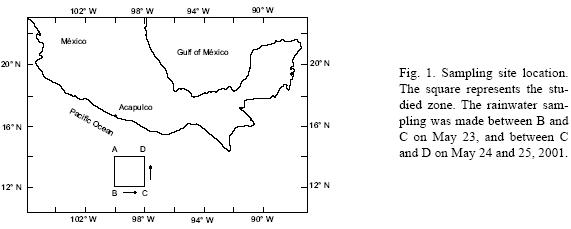
<body><![CDATA[<p align="justify"><font face="verdana" size="2">The number of research projects to study the total peroxides concentration in rainwater over tropical seas and shorelines is very low, let alone over the Mexican eastern Pacific Ocean. The Climatic Experiment in the Americas Warm Water Pools (ECAC&#150;1) was a unique opportunity to measure the concentration of total peroxides in oceanic rains over the open ocean in front of the Mexican Pacific Coast for the first time. Moreover, all the rain samples were collected during the early stages of the formation of hurricane Adolph, which became the strongest hurricane on record for the month of May in the eastern Pacific Ocean. Previous studies over tropical marine environments were made by Zika <i>et al. </i>(1982) in Florida and Bahamas Islands, Cooper <i>et al. </i>(1987) over the Gulf of M&eacute;xico and western Atlantic Ocean, Yuan and Shiller (2000) over the South and Central Atlantic Ocean, and Deng and Zuo (1999) in Florida. Avery <i>et al. </i>(2001) also investigated major components at a coastal site in North Caroline, USA. Studies on hydrogen peroxide on continental areas have been accomplished by Kok (1980) in Claremont, California, Zika <i>et al. </i>(1982) in Miami, Florida, Yoshizumi <i>et al. </i>(1984) in Tokyo, Japan, Kelly <i>et al. </i>(1985) in the eastern United States, and Olszyna <i>et al. </i>(1988) at the Whitetop Mountain in Virginia, USA.</font></p>     <p align="justify"><font face="verdana" size="2">&nbsp;</font></p>     <p align="justify"><font face="verdana" size="2"><b>2.</b>&nbsp;<b>Experimental</b></font></p>     <p align="justify"><font face="verdana" size="2">&nbsp;</font><font face="verdana" size="2"><i>2.1&nbsp;Sampling area</i></font></p>     <p align="justify"><font face="verdana" size="2">Rainwater samples were collected from May 23 to 25, 2001, during the ECAC&#150;1 on board of the R/V El Puma of the National Autonomous University of M&eacute;xico (UNAM) in the eastern Pacific Ocean between 12 and 14&deg; N, and between 98 and 100&deg; W (<a href="#f1">Fig. 1</a>).</font></p>     <p align="center"><font face="verdana" size="2"> <a name="f1"></a></font></p>     <p align="center"><font face="verdana" size="2"> <img src="/img/revistas/atm/v20n3/a5f1.jpg"></font></p>     <p align="justify"><font face="verdana" size="2">&nbsp;</font></p>     <p align="justify"><font face="verdana" size="2"><i>2.2&nbsp;Rainwater sampling method</i></font></p>     <p align="justify"><font face="verdana" size="2">Rainwater samples were collected using a 25 cm in diameter high&#150;density polyethylene funnel, placed 1 m above the floor on the second level of the ship to prevent contamination from splashing. The funnel was uncovered just before the onset of a rain event. The funnel was connected to a 2&#150;L high&#150;density polyethylene bottle. The ship was moving during all rain water samplings.</font></p>     ]]></body>
<body><![CDATA[<p align="justify"><font face="verdana" size="2">&nbsp;</font></p>     <p align="justify"><font face="verdana" size="2"><i>2. 3 Sample field treatment</i></font></p>     <p align="justify"><font face="verdana" size="2">Because of the rapid H<sub>2</sub>O<sub>2</sub> decomposition during the time elapsed from sample collection and analysis (Ortiz <i>et al., </i>2000), rain samples were treated to analyze total peroxides (H<sub>2</sub>O<sub>2</sub> plus organic peroxides) as soon as the rain event ceased, to form the dimer of the p&#150;hydroxiphenilacetic acid.</font></p>     <p align="justify"><font face="verdana" size="2">This dimer is obtained by the reaction of the p&#150;hydroxiphenilacetic acid with peroxides in the presence of peroxidase as a catalyzer (Guilbault et <i>al., </i>1968; Lazrus <i>et al., </i>1985). Aldrich Chemical Co. Inc. p&#150;hydroxiphenilacetic acid and Sigma Aldrich Co. peroxidase were used. Treated samples are stable for several days under ambient conditions (Kelly <i>et al., </i>1985; Lazrus <i>et al., </i>1985; Kok <i>et al., </i>1986; Olszyna <i>et al., </i>1988). Chemical reagents and analytical procedures used in this work are described by Lazrus <i>et al. </i>(1985).</font></p>     <p align="justify"><font face="verdana" size="2">&nbsp;</font></p>     <p align="justify"><font face="verdana" size="2"><i>2.4 Chemical analysis</i></font></p>     <p align="justify"><font face="verdana" size="2">Treated rainwater samples were analyzed by fluorescence at 320&#150;410 nm with the spectra system FL3000 (thermoseparation products) fluorescence meter to determine the concentration of total peroxides. Merck 30% v/v hydrogen peroxide (perhydrol) reagent grade with a stabilizer was used for preparing calibration standards from 2 to 30 (iM. The standard solutions were also treated as described in section 2.3. Only total peroxides were determined because of reagent limitations, however, some tests indicated that H<sub>2</sub>O<sub>2</sub> accounts for 95% of the total peroxides.</font></p>     <p align="justify"><font face="verdana" size="2">Sulfate was also analyzed because the oxidation of SO<sub>2</sub> by H<sub>2</sub>O<sub>2</sub> is the main source of this ion in rainwater. It was analyzed by non&#150;suppressed ion chromatography using a Perkin Elmer instrument equipped with an isocratic LC pump 250 and a conductivity detector conductoMonitor III. Calibration curve was prepared from standard solutions prepared from 1000 mg L<sup>&#150;1</sup> High&#150;Purity Standards (Charleston, SC).</font></p>     <p align="justify"><font face="verdana" size="2">&nbsp;</font></p>     <p align="justify"><font face="verdana" size="2"><i>2.5 Detection limit</i></font></p>     ]]></body>
<body><![CDATA[<p align="justify"><font face="verdana" size="2">The method detection limit (MDL) was determined using the procedure described by Glaser <i>et al. </i>(1981). Measurements were taken on seven samples of deionized water containing the analyte.</font></p>     <p align="justify"><font face="verdana" size="2">The standard deviation was calculated from the obtained data. Using the degrees of freedom from the data set and the 99% confidence level, the critical Student's t value was obtained from tables. The MDL was computed as the product of the standard deviation and the critical t&#150;value. The computed MDL for H<sub>2</sub>O<sub>2</sub> was 0.4 &micro;M and 0.22 mg L<sup>&#150;1</sup> for SO<sub>4</sub><sup>2&#150;</sup> .</font></p>     <p align="justify"><font face="verdana" size="2">&nbsp;</font></p>     <p align="justify"><font face="verdana" size="2"><i>2.6 Statistical analysis</i></font></p>     <p align="justify"><font face="verdana" size="2">The Shapiro&#150;Wilk W test was applied to determine whether data of total peroxides, SO<sub>4</sub><sup>2&#150;</sup>, excess sulfate (non sea&#150;salt sulfate) SO<sub>4</sub><sup>2&#150;</sup><sub>xs</sub>, sea&#150;salt sulfate (SO<sub>4</sub><sup>2&#150;</sup><sub>ss</sub>), rain amount, and rain rate, fitted a normal distribution. The null hypothesis establishing that the data corresponded to a normal distribution was rejected at the 5% significance level for SO<sub>4</sub><sup>2</sup>, SO<sub>4</sub><sup>2&#150;</sup><sub>xs</sub>, SO<sub>4</sub><sup>2&#150;</sup><sub>ss</sub> concentrations, and rain rate. Therefore, the Spearman's rank correlation was applied to compute the correlation between the studied variables.</font></p>     <p align="justify"><font face="verdana" size="2">&nbsp;</font></p>     <p align="justify"><font face="verdana" size="2"><b>3. Results and discussion</b></font></p>     <p align="justify"><font face="verdana" size="2">Twenty&#150;six rainwater samples were collected from May 23 to 25, 2001 during the early stages of the formation of hurricane Adolph, which was a tropical depression located at 13.6&deg; N and 101.1&deg; W on May 25, 2001.</font></p>     <p align="justify"><font face="verdana" size="2">&nbsp;</font></p>     <p align="justify"><font face="verdana" size="2"><i>3.1&nbsp; Total peroxides in rainwater</i></font></p>     ]]></body>
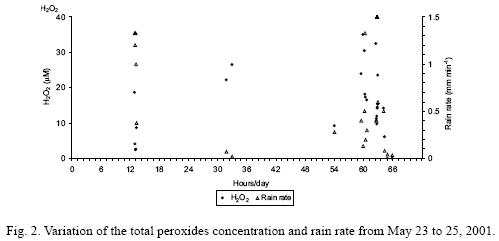
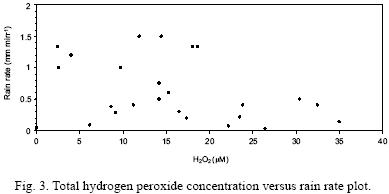
<body><![CDATA[<p align="justify"><font face="verdana" size="2">The volume weighted mean concentration of total peroxides was 13.1 &plusmn; 1.9 &mu;M. This value is noticeably lower than those observed by Cooper <i>et al. </i>(1987) in the Gulf of M&eacute;xico (40 &plusmn;21 &mu;M<i>), </i>Florida Keys (28 &plusmn; 4 &mu;M<i>), </i>but equal to the mean value observed in the western Atlantic Ocean (13 &plusmn; 5 &mu;M<i>). </i>The rains present over large areas and the absence of direct sunlight maintained a low concentration of total peroxides. Also, the low concentrations possibly indicated that there was no advection of air pollutants over the sampling area during the ECAC&#150;1. As far as we know, the results of this study on total peroxides concentrations were the first obtained during the early stages of formation of a category 4 hurricane over the open ocean in the eastern Pacific Ocean, therefore, they are not representative of the rains over the Mexican eastern Pacific Ocean, obviously because there are more atmospheric phenomena that favor deep convection.</font></p>     <p align="justify"><font face="verdana" size="2">&nbsp;</font></p>     <p align="justify"><font face="verdana" size="2"><i>3.2&nbsp;Variations of H<sub>2</sub>O<sub>2</sub> with rain rate</i></font></p>     <p align="justify"><font face="verdana" size="2"><a href="#f2">Figure 2</a> shows the variation of the total peroxides concentration and rain rate from May 23 to 25, 2001. The concentration of total peroxides rapidly decreased from the first to the second rain fraction on May 23, although the rain rate remained fairly constant during the first three rain fractions. This was possibly due to a build up of peroxides before the beginning of rains. On May 24, the concentration of total peroxides was high, corresponding to the low rain rate, as it was expected. On May 25, high concentrations of peroxides also were observed during periods of relatively low rain rates. However, the relationship between the concentration of peroxides and rain rate is much more complex. As examples, the concentration of peroxides increased sharply from 13:30 to 13:35 h despite the rain rate increased slowly from 11:17 to 13:35 h, and the concentration of peroxides presented small variations from 13:35 to 13:51 h, whereas the rain rate alternately increased and decreased. Also, it is not easy to explain why the highest rain rates observed from May 23 to 25 corresponded to very different total peroxides concentrations. It must be realized that the main component of the total peroxides (hydrogen peroxide) decomposes rapidly, adding uncertainty in the variation of its concentration in rain water between the moment when raindrops fall on the funnel and the time when rain water samples are treated for chemical analyses.</font></p>     <p align="center"><font face="verdana" size="2"> <a name="f2"></a></font></p>     <p align="center"><font face="verdana" size="2"> <img src="/img/revistas/atm/v20n3/a5f2.jpg"></font></p>     <p align="justify"><font face="verdana" size="2"><a href="#f3">Figure 3</a> shows a rain rate versus hydrogen peroxide concentration plot. It is observed that only the concentrations of hydrogen peroxide higher than about 20 &mu;M are related to low rain rates. For concentrations below 20 &mu;M the relationship between these parameters is not clear.</font></p>     <p align="center"><font face="verdana" size="2"> <a name="f3"></a></font></p>     <p align="center"><font face="verdana" size="2"> <img src="/img/revistas/atm/v20n3/a5f3.jpg"></font></p>     <p align="justify"><font face="verdana" size="2">&nbsp;</font></p>     ]]></body>
<body><![CDATA[<p align="justify"><font face="verdana" size="2"><i>3.3&nbsp;Sulfate concentrations</i></font></p>     <p align="justify"><font face="verdana" size="2">The volume weighted mean concentrations for SO<sub>4</sub><sup>2&#150;</sup> and SO<sub>4</sub><sup>2&#150;</sup><sub>ss</sub> were 0.76 &plusmn; 0.59 and 0.04 &plusmn; 0.06 mg L<sup>-1</sup>, respectively. The quantification of sea salt contribution was based on sodium. Excess sulfate (non sea&#150;salt sulfate) SO<sub>4</sub><sup>2&#150;</sup><sub>xs</sub> represented 92% of the total sulfate.</font></p>     <p align="justify"><font face="verdana" size="2">&nbsp;</font></p>     <p align="justify"><font face="verdana" size="2"><i>3.4&nbsp;Correlations</i></font></p>     <p align="justify"><font face="verdana" size="2">The total peroxides concentrations in rainwater correlated significantly with SO<sub>4</sub><sup>2&#150;</sup> and SO<sub>4</sub><sup>2&#150;</sup><sub>xs</sub> (0.560 and 0.586 at a p &lt; 0.05, respectively) but not with SO<sub>4</sub><sup>2&#150;</sup><sub>SS</sub>. The significant and positive correlation with SO<sub>4</sub><sup>2&#150;</sup><sub>xs</sub> differs from that obtained by other authors such as Deng and Zuo (1999) in Florida, where the maximum H<sub>2</sub>O<sub>2</sub> concentration was observed when the non&#150;sea&#150;salt sulfate concentration was low. It is possible that most of the non&#150;sea&#150;salt sulfate they observed in Florida came from SO<sub>2</sub> emitted by anthropogenic sources, which reacted with H<sub>2</sub>O<sub>2</sub>. In contrast, in the eastern Pacific Ocean far away from polluting anthropogenic sources, it is possible that H<sub>2</sub>O<sub>2</sub> oxidized the sulfur dioxide formed by photochemical reactions of biogenic sulfur compounds. According to Becker <i>et al. </i>(1993), the non&#150;sea&#150;salt sulfate is produced by oxidation of biogenic sulfur compounds in the presence of water vapor. The positive correlation between H<sub>2</sub>O<sub>2</sub> and non&#150;sea&#150;salt sulfate (SO<sub>4</sub><sup>2&#150;</sup><sub>xs</sub>) could simply indicate that higher H<sub>2</sub>O<sub>2</sub> concentrations can oxidize higher amounts of sulfur dioxide producing higher concentrations of (SO<sub>4</sub><sup>2&#150;</sup><sub>xs</sub>).</font></p>     <p align="justify"><font face="verdana" size="2">On the other hand, the lack of significant correlation between sea&#150;salt sulfate and total peroxides (&#150;0.007, at a p &lt; 0.05) could be due to the fact that H<sub>2</sub>O<sub>2</sub> does not react with the SO<sub>4</sub><sup>2&#150;</sup> already present in sea salt aerosols. Also, the concentration of total peroxides in rainwater samples collected in this study did not correlate with rain rate. The reason could be the significant fraction of H<sub>2</sub>O<sub>2</sub> that is generated within cloud droplets (Zika <i>et al., </i>1982).</font></p>     <p align="justify"><font face="verdana" size="2">&nbsp;</font></p>     <p align="justify"><font face="verdana" size="2"><b>4. Conclusions</b></font></p>     <p align="justify"><font face="verdana" size="2">Most of the non&#150;sea&#150;salt sulfate and total peroxides, observed in the eastern Pacific Ocean, could have been produced by the oxidation of biogenic sulfur compounds.</font></p>     <p align="justify"><font face="verdana" size="2">The significant correlation between total peroxides concentrations and excess sulfate observed in rainwater in the eastern Pacific Ocean, could simply indicate that higher H<sub>2</sub>O<sub>2</sub> concentrations can oxidize higher amounts of sulfur dioxide, produced by oxidation of biogenic sulfur compounds, resulting in higher concentrations of (SO<sub>4</sub><sup>2&#150;</sup><sub>xs</sub>).</font></p>     ]]></body>
<body><![CDATA[<p align="justify"><font face="verdana" size="2">Total peroxides did not correlate with sea&#150;salt sulfate because H<sub>2</sub>O<sub>2</sub> does not react with the sulfate already present in sea salt aerosols.</font></p>     <p align="justify"><font face="verdana" size="2">The concentration of total peroxides in rainwater samples collected in this study did not correlate with rain intensity, suggesting that a significant fraction of H<sub>2</sub>O<sub>2</sub> is generated within cloud droplets.</font></p>     <p align="justify"><font face="verdana" size="2">&nbsp;</font></p>     <p align="justify"><font face="verdana" size="2"><b>Acknowledgements</b></font></p>     <p align="justify"><font face="verdana" size="2">The authors wish to thank Dr. Rosa Cer&oacute;n and Calixto Cuevas for the rainwater sampling, and Dr. Ernesto Caetano for providing navigation information of the R/V El Puma.</font></p>     <p align="justify"><font face="verdana" size="2">&nbsp;</font></p>     <p align="justify"><font face="verdana" size="2"><b>References</b></font></p>     <!-- ref --><p align="justify"><font face="verdana" size="2">Avery Jr. G. B., J. D. Willey and R. J. Kieber, 2001. Diurnal variations in major rainwater components at a coastal site in North Caroline. <i>Atmos. Environ. </i><b>35</b>, 3927&#150;3933.</font>&nbsp;&nbsp;&nbsp;&nbsp;&nbsp;&nbsp;&nbsp;&nbsp;[&#160;<a href="javascript:void(0);" onclick="javascript: window.open('/scielo.php?script=sci_nlinks&ref=1265295&pid=S0187-6236200700030000500001&lng=','','width=640,height=500,resizable=yes,scrollbars=1,menubar=yes,');">Links</a>&#160;]<!-- end-ref --><!-- ref --><p align="justify"><font face="verdana" size="2">Becker K. H., J. Bechara and K. J. Brockmann, 1993. Studies on the formation of H<sub>2</sub>O<sub>2</sub> in the ozonolysis of <i>alkenes. Atmos. Environ. </i><b>27A</b>, 57&#150;61.</font>&nbsp;&nbsp;&nbsp;&nbsp;&nbsp;&nbsp;&nbsp;&nbsp;[&#160;<a href="javascript:void(0);" onclick="javascript: window.open('/scielo.php?script=sci_nlinks&ref=1265296&pid=S0187-6236200700030000500002&lng=','','width=640,height=500,resizable=yes,scrollbars=1,menubar=yes,');">Links</a>&#160;]<!-- end-ref --><!-- ref --><p align="justify"><font face="verdana" size="2">Cooper W. J., E. S. Saltzman and R. G. Zika, 1987. The contribution of rainwater to variability in surface ocean hydrogen peroxide. <i>J. Geophys. Res. </i><b>92</b>, 2970&#150;2980.</font>&nbsp;&nbsp;&nbsp;&nbsp;&nbsp;&nbsp;&nbsp;&nbsp;[&#160;<a href="javascript:void(0);" onclick="javascript: window.open('/scielo.php?script=sci_nlinks&ref=1265297&pid=S0187-6236200700030000500003&lng=','','width=640,height=500,resizable=yes,scrollbars=1,menubar=yes,');">Links</a>&#160;]<!-- end-ref --><!-- ref --><p align="justify"><font face="verdana" size="2">Deng Y. and Y. Zuo, 1999. Factors affecting the levels of hydrogen peroxide in rainwater. <i>Atmos. Environ. </i><b>33</b>, 1469&#150;1478.</font>&nbsp;&nbsp;&nbsp;&nbsp;&nbsp;&nbsp;&nbsp;&nbsp;[&#160;<a href="javascript:void(0);" onclick="javascript: window.open('/scielo.php?script=sci_nlinks&ref=1265298&pid=S0187-6236200700030000500004&lng=','','width=640,height=500,resizable=yes,scrollbars=1,menubar=yes,');">Links</a>&#160;]<!-- end-ref --><!-- ref --><p align="justify"><font face="verdana" size="2">Glaser J. A., D. L. Foerst, G. D. McKee, S. A. Quave and W. L. Budde, 1981. Trace analyses for wastewaters. <i>Environ. Sci. Technol. </i><b>15</b>, 1426&#150;1435.</font>&nbsp;&nbsp;&nbsp;&nbsp;&nbsp;&nbsp;&nbsp;&nbsp;[&#160;<a href="javascript:void(0);" onclick="javascript: window.open('/scielo.php?script=sci_nlinks&ref=1265299&pid=S0187-6236200700030000500005&lng=','','width=640,height=500,resizable=yes,scrollbars=1,menubar=yes,');">Links</a>&#160;]<!-- end-ref --><!-- ref --><p align="justify"><font face="verdana" size="2">Guilbault G. G., P. J. Brignac Jr. and M. Juneau, 1968. New substrate for the fluorometric determination of oxidative enzyme. <i>Anal. Chem. </i><b>40</b>, 1256&#150;1263.</font>&nbsp;&nbsp;&nbsp;&nbsp;&nbsp;&nbsp;&nbsp;&nbsp;[&#160;<a href="javascript:void(0);" onclick="javascript: window.open('/scielo.php?script=sci_nlinks&ref=1265300&pid=S0187-6236200700030000500006&lng=','','width=640,height=500,resizable=yes,scrollbars=1,menubar=yes,');">Links</a>&#160;]<!-- end-ref --><!-- ref --><p align="justify"><font face="verdana" size="2">Kelly T. J., P. H. Daum and S. E. Schwartz, 1985. Measurement of peroxides in cloudwater and rain. <i>J. Geophys. Res. </i><b>90</b> (D5), 7861&#150;7871.</font>&nbsp;&nbsp;&nbsp;&nbsp;&nbsp;&nbsp;&nbsp;&nbsp;[&#160;<a href="javascript:void(0);" onclick="javascript: window.open('/scielo.php?script=sci_nlinks&ref=1265301&pid=S0187-6236200700030000500007&lng=','','width=640,height=500,resizable=yes,scrollbars=1,menubar=yes,');">Links</a>&#160;]<!-- end-ref --><!-- ref --><p align="justify"><font face="verdana" size="2">Kok G. L., 1980. Measurements of hydrogen peroxide in rainwater. <i>Atmos. Environ. </i><b>14</b>, 653&#150;656.</font>&nbsp;&nbsp;&nbsp;&nbsp;&nbsp;&nbsp;&nbsp;&nbsp;[&#160;<a href="javascript:void(0);" onclick="javascript: window.open('/scielo.php?script=sci_nlinks&ref=1265302&pid=S0187-6236200700030000500008&lng=','','width=640,height=500,resizable=yes,scrollbars=1,menubar=yes,');">Links</a>&#160;]<!-- end-ref --><!-- ref --><p align="justify"><font face="verdana" size="2">Kok G. L., K. Thompson, A. L. Lazrus and S. E. McLaren, 1986. Derivatization technique forthe determination of peroxides in precipitation. <i>Anal. Chem. </i><b>58</b>, 1192&#150;1194.</font>&nbsp;&nbsp;&nbsp;&nbsp;&nbsp;&nbsp;&nbsp;&nbsp;[&#160;<a href="javascript:void(0);" onclick="javascript: window.open('/scielo.php?script=sci_nlinks&ref=1265303&pid=S0187-6236200700030000500009&lng=','','width=640,height=500,resizable=yes,scrollbars=1,menubar=yes,');">Links</a>&#160;]<!-- end-ref --><!-- ref --><p align="justify"><font face="verdana" size="2">Lazrus A. L., G. L. Kok, S. N. Gitlin, J. A. Lind and S. E. McLaren, 1985. Automated fluorometric method for hydrogen peroxide in atmospheric precipitation. <i>Anal. Chem. </i><b>57</b>, 917&#150;922.</font>&nbsp;&nbsp;&nbsp;&nbsp;&nbsp;&nbsp;&nbsp;&nbsp;[&#160;<a href="javascript:void(0);" onclick="javascript: window.open('/scielo.php?script=sci_nlinks&ref=1265304&pid=S0187-6236200700030000500010&lng=','','width=640,height=500,resizable=yes,scrollbars=1,menubar=yes,');">Links</a>&#160;]<!-- end-ref --><!-- ref --><p align="justify"><font face="verdana" size="2">Olszyna K. J., J. F. Meagher and E. M. Bailey, 1988. Gas&#150;phase, cloud and rain&#150;water measurements of hydrogen peroxide at a high&#150;elevation site. <i>Atmos. Environ. </i><b>22</b>, 1699&#150;1706.</font>&nbsp;&nbsp;&nbsp;&nbsp;&nbsp;&nbsp;&nbsp;&nbsp;[&#160;<a href="javascript:void(0);" onclick="javascript: window.open('/scielo.php?script=sci_nlinks&ref=1265305&pid=S0187-6236200700030000500011&lng=','','width=640,height=500,resizable=yes,scrollbars=1,menubar=yes,');">Links</a>&#160;]<!-- end-ref --><!-- ref --><p align="justify"><font face="verdana" size="2">Ortiz V., M. A. Rubio and E. A Lissi, 2000. Hydrogen peroxide deposition and decomposition in rain and dew waters. <i>Atmos. Environ. </i><b>34</b>, 1139&#150;1146.</font>&nbsp;&nbsp;&nbsp;&nbsp;&nbsp;&nbsp;&nbsp;&nbsp;[&#160;<a href="javascript:void(0);" onclick="javascript: window.open('/scielo.php?script=sci_nlinks&ref=1265306&pid=S0187-6236200700030000500012&lng=','','width=640,height=500,resizable=yes,scrollbars=1,menubar=yes,');">Links</a>&#160;]<!-- end-ref --><!-- ref --><p align="justify"><font face="verdana" size="2">Yoshizumi K., K. Aoki, I. Nouchi, T. Okita, T. Kobayashi, S. Kamakura and M. Tajima, 1984. Measurements of the concentration in rainwater and of the Henry's law constant of hydrogen peroxide. <i>Atmos. Environ. </i><b>18</b>, 395&#150;401.</font>&nbsp;&nbsp;&nbsp;&nbsp;&nbsp;&nbsp;&nbsp;&nbsp;[&#160;<a href="javascript:void(0);" onclick="javascript: window.open('/scielo.php?script=sci_nlinks&ref=1265307&pid=S0187-6236200700030000500013&lng=','','width=640,height=500,resizable=yes,scrollbars=1,menubar=yes,');">Links</a>&#160;]<!-- end-ref --><!-- ref --><p align="justify"><font face="verdana" size="2">Yuan J. and A. M. Shiller, 2000. The variation of hydrogen peroxide in rainwater over the South and Central Atlantic Ocean. <i>Atmos. Environ. </i><b>34</b>, 3973&#150;3980.</font>&nbsp;&nbsp;&nbsp;&nbsp;&nbsp;&nbsp;&nbsp;&nbsp;[&#160;<a href="javascript:void(0);" onclick="javascript: window.open('/scielo.php?script=sci_nlinks&ref=1265308&pid=S0187-6236200700030000500014&lng=','','width=640,height=500,resizable=yes,scrollbars=1,menubar=yes,');">Links</a>&#160;]<!-- end-ref --><!-- ref --><p align="justify"><font face="verdana" size="2">Zika R., E. Saltzman, W. L. Chameides and D. D. Davis, 1982. H<sub>2</sub>O<sub>2</sub> levels in rainwater collected in South Florida and the Bahama Islands. <i>J. Geophys. Res. </i><b>87</b>, 5015&#150;5017.</font>&nbsp;&nbsp;&nbsp;&nbsp;&nbsp;&nbsp;&nbsp;&nbsp;[&#160;<a href="javascript:void(0);" onclick="javascript: window.open('/scielo.php?script=sci_nlinks&ref=1265309&pid=S0187-6236200700030000500015&lng=','','width=640,height=500,resizable=yes,scrollbars=1,menubar=yes,');">Links</a>&#160;]<!-- end-ref --> ]]></body><back>
<ref-list>
<ref id="B1">
<nlm-citation citation-type="journal">
<person-group person-group-type="author">
<name>
<surname><![CDATA[Avery]]></surname>
<given-names><![CDATA[Jr. G. B.]]></given-names>
</name>
<name>
<surname><![CDATA[Willey]]></surname>
<given-names><![CDATA[J. D.]]></given-names>
</name>
<name>
<surname><![CDATA[Kieber]]></surname>
<given-names><![CDATA[R. J.]]></given-names>
</name>
</person-group>
<article-title xml:lang="en"><![CDATA[Diurnal variations in major rainwater components at a coastal site in North Caroline]]></article-title>
<source><![CDATA[Atmos. Environ.]]></source>
<year>2001</year>
<volume>35</volume>
<page-range>3927-3933</page-range></nlm-citation>
</ref>
<ref id="B2">
<nlm-citation citation-type="journal">
<person-group person-group-type="author">
<name>
<surname><![CDATA[Becker]]></surname>
<given-names><![CDATA[K. H.]]></given-names>
</name>
<name>
<surname><![CDATA[Bechara]]></surname>
<given-names><![CDATA[J.]]></given-names>
</name>
<name>
<surname><![CDATA[Brockmann]]></surname>
<given-names><![CDATA[K. J.]]></given-names>
</name>
</person-group>
<article-title xml:lang="en"><![CDATA[Studies on the formation of H2O2 in the ozonolysis of alkenes]]></article-title>
<source><![CDATA[Atmos. Environ.]]></source>
<year>1993</year>
<volume>27A</volume>
<page-range>57-61</page-range></nlm-citation>
</ref>
<ref id="B3">
<nlm-citation citation-type="journal">
<person-group person-group-type="author">
<name>
<surname><![CDATA[Cooper]]></surname>
<given-names><![CDATA[W. J.]]></given-names>
</name>
<name>
<surname><![CDATA[Saltzman]]></surname>
<given-names><![CDATA[E. S.]]></given-names>
</name>
<name>
<surname><![CDATA[Zika]]></surname>
<given-names><![CDATA[R. G.]]></given-names>
</name>
</person-group>
<article-title xml:lang="en"><![CDATA[The contribution of rainwater to variability in surface ocean hydrogen peroxide]]></article-title>
<source><![CDATA[J. Geophys. Res.]]></source>
<year>1987</year>
<volume>92</volume>
<page-range>2970-2980</page-range></nlm-citation>
</ref>
<ref id="B4">
<nlm-citation citation-type="journal">
<person-group person-group-type="author">
<name>
<surname><![CDATA[Deng]]></surname>
<given-names><![CDATA[Y.]]></given-names>
</name>
<name>
<surname><![CDATA[Zuo]]></surname>
<given-names><![CDATA[Y.]]></given-names>
</name>
</person-group>
<article-title xml:lang="en"><![CDATA[Factors affecting the levels of hydrogen peroxide in rainwater]]></article-title>
<source><![CDATA[Atmos. Environ.]]></source>
<year>1999</year>
<volume>33</volume>
<page-range>1469-1478</page-range></nlm-citation>
</ref>
<ref id="B5">
<nlm-citation citation-type="journal">
<person-group person-group-type="author">
<name>
<surname><![CDATA[Glaser]]></surname>
<given-names><![CDATA[J. A.]]></given-names>
</name>
<name>
<surname><![CDATA[Foerst]]></surname>
<given-names><![CDATA[D. L.]]></given-names>
</name>
<name>
<surname><![CDATA[McKee]]></surname>
<given-names><![CDATA[G. D.]]></given-names>
</name>
<name>
<surname><![CDATA[Quave]]></surname>
<given-names><![CDATA[S. A.]]></given-names>
</name>
<name>
<surname><![CDATA[Budde]]></surname>
<given-names><![CDATA[W. L.]]></given-names>
</name>
</person-group>
<article-title xml:lang="en"><![CDATA[Trace analyses for wastewaters]]></article-title>
<source><![CDATA[Environ. Sci. Technol.]]></source>
<year>1981</year>
<volume>15</volume>
<page-range>1426-1435</page-range></nlm-citation>
</ref>
<ref id="B6">
<nlm-citation citation-type="journal">
<person-group person-group-type="author">
<name>
<surname><![CDATA[Guilbault]]></surname>
<given-names><![CDATA[G. G.]]></given-names>
</name>
<name>
<surname><![CDATA[Brignac Jr.]]></surname>
<given-names><![CDATA[P. J.]]></given-names>
</name>
<name>
<surname><![CDATA[Juneau]]></surname>
<given-names><![CDATA[M.]]></given-names>
</name>
</person-group>
<article-title xml:lang="en"><![CDATA[New substrate for the fluorometric determination of oxidative enzyme]]></article-title>
<source><![CDATA[Anal. Chem.]]></source>
<year>1968</year>
<volume>40</volume>
<page-range>1256-1263</page-range></nlm-citation>
</ref>
<ref id="B7">
<nlm-citation citation-type="journal">
<person-group person-group-type="author">
<name>
<surname><![CDATA[Kelly]]></surname>
<given-names><![CDATA[T. J.]]></given-names>
</name>
<name>
<surname><![CDATA[Daum]]></surname>
<given-names><![CDATA[P. H.]]></given-names>
</name>
<name>
<surname><![CDATA[Schwartz]]></surname>
<given-names><![CDATA[S. E.]]></given-names>
</name>
</person-group>
<article-title xml:lang="en"><![CDATA[Measurement of peroxides in cloudwater and rain]]></article-title>
<source><![CDATA[J. Geophys. Res.]]></source>
<year>1985</year>
<volume>90</volume>
<page-range>7861-7871</page-range></nlm-citation>
</ref>
<ref id="B8">
<nlm-citation citation-type="journal">
<person-group person-group-type="author">
<name>
<surname><![CDATA[Kok]]></surname>
<given-names><![CDATA[G. L.]]></given-names>
</name>
</person-group>
<article-title xml:lang="en"><![CDATA[Measurements of hydrogen peroxide in rainwater]]></article-title>
<source><![CDATA[Atmos. Environ.]]></source>
<year>1980</year>
<volume>14</volume>
<page-range>653-656</page-range></nlm-citation>
</ref>
<ref id="B9">
<nlm-citation citation-type="journal">
<person-group person-group-type="author">
<name>
<surname><![CDATA[Kok]]></surname>
<given-names><![CDATA[G. L.]]></given-names>
</name>
<name>
<surname><![CDATA[Thompson]]></surname>
<given-names><![CDATA[K.]]></given-names>
</name>
<name>
<surname><![CDATA[Lazrus]]></surname>
<given-names><![CDATA[A. L.]]></given-names>
</name>
<name>
<surname><![CDATA[McLaren]]></surname>
<given-names><![CDATA[S. E.]]></given-names>
</name>
</person-group>
<source><![CDATA[Anal. Chem.]]></source>
<year>1986</year>
<volume>58</volume>
<page-range>1192-1194</page-range></nlm-citation>
</ref>
<ref id="B10">
<nlm-citation citation-type="journal">
<person-group person-group-type="author">
<name>
<surname><![CDATA[Lazrus]]></surname>
<given-names><![CDATA[A. L.]]></given-names>
</name>
<name>
<surname><![CDATA[Kok]]></surname>
<given-names><![CDATA[G. L.]]></given-names>
</name>
<name>
<surname><![CDATA[Gitlin]]></surname>
<given-names><![CDATA[S. N.]]></given-names>
</name>
<name>
<surname><![CDATA[Lind]]></surname>
<given-names><![CDATA[J. A.]]></given-names>
</name>
<name>
<surname><![CDATA[McLaren]]></surname>
<given-names><![CDATA[S. E.]]></given-names>
</name>
</person-group>
<article-title xml:lang="en"><![CDATA[Automated fluorometric method for hydrogen peroxide in atmospheric precipitation]]></article-title>
<source><![CDATA[Anal. Chem.]]></source>
<year>1985</year>
<volume>57</volume>
<page-range>917-922</page-range></nlm-citation>
</ref>
<ref id="B11">
<nlm-citation citation-type="journal">
<person-group person-group-type="author">
<name>
<surname><![CDATA[Olszyna]]></surname>
<given-names><![CDATA[K. J.]]></given-names>
</name>
<name>
<surname><![CDATA[Meagher]]></surname>
<given-names><![CDATA[J. F.]]></given-names>
</name>
<name>
<surname><![CDATA[Bailey]]></surname>
<given-names><![CDATA[E. M.]]></given-names>
</name>
</person-group>
<article-title xml:lang="en"><![CDATA[Gas-phase, cloud and rain-water measurements of hydrogen peroxide at a high-elevation site]]></article-title>
<source><![CDATA[Atmos. Environ.]]></source>
<year>1988</year>
<volume>22</volume>
<page-range>1699-1706</page-range></nlm-citation>
</ref>
<ref id="B12">
<nlm-citation citation-type="journal">
<person-group person-group-type="author">
<name>
<surname><![CDATA[Ortiz]]></surname>
<given-names><![CDATA[V.]]></given-names>
</name>
<name>
<surname><![CDATA[Rubio]]></surname>
<given-names><![CDATA[M. A.]]></given-names>
</name>
<name>
<surname><![CDATA[Lissi]]></surname>
<given-names><![CDATA[E. A]]></given-names>
</name>
</person-group>
<article-title xml:lang="en"><![CDATA[Hydrogen peroxide deposition and decomposition in rain and dew waters]]></article-title>
<source><![CDATA[Atmos. Environ.]]></source>
<year>2000</year>
<volume>34</volume>
<page-range>1139-1146</page-range></nlm-citation>
</ref>
<ref id="B13">
<nlm-citation citation-type="journal">
<person-group person-group-type="author">
<name>
<surname><![CDATA[Yoshizumi]]></surname>
<given-names><![CDATA[K.]]></given-names>
</name>
<name>
<surname><![CDATA[Aoki]]></surname>
<given-names><![CDATA[K.]]></given-names>
</name>
<name>
<surname><![CDATA[Nouchi]]></surname>
<given-names><![CDATA[I.]]></given-names>
</name>
<name>
<surname><![CDATA[Okita]]></surname>
<given-names><![CDATA[T.]]></given-names>
</name>
<name>
<surname><![CDATA[Kobayashi]]></surname>
<given-names><![CDATA[T.]]></given-names>
</name>
<name>
<surname><![CDATA[Kamakura]]></surname>
<given-names><![CDATA[S.]]></given-names>
</name>
<name>
<surname><![CDATA[Tajima]]></surname>
<given-names><![CDATA[M.]]></given-names>
</name>
</person-group>
<article-title xml:lang="en"><![CDATA[Measurements of the concentration in rainwater and of the Henry's law constant of hydrogen peroxide]]></article-title>
<source><![CDATA[Atmos. Environ.]]></source>
<year>1984</year>
<volume>18</volume>
<page-range>395-401</page-range></nlm-citation>
</ref>
<ref id="B14">
<nlm-citation citation-type="journal">
<person-group person-group-type="author">
<name>
<surname><![CDATA[Yuan]]></surname>
<given-names><![CDATA[J.]]></given-names>
</name>
<name>
<surname><![CDATA[Shiller]]></surname>
<given-names><![CDATA[A. M.]]></given-names>
</name>
</person-group>
<article-title xml:lang="en"><![CDATA[The variation of hydrogen peroxide in rainwater over the South and Central Atlantic Ocean]]></article-title>
<source><![CDATA[Atmos. Environ.]]></source>
<year>2000</year>
<volume>34</volume>
<page-range>3973-3980</page-range></nlm-citation>
</ref>
<ref id="B15">
<nlm-citation citation-type="journal">
<person-group person-group-type="author">
<name>
<surname><![CDATA[Zika]]></surname>
<given-names><![CDATA[R.]]></given-names>
</name>
<name>
<surname><![CDATA[Saltzman]]></surname>
<given-names><![CDATA[E.]]></given-names>
</name>
<name>
<surname><![CDATA[Chameides]]></surname>
<given-names><![CDATA[W. L.]]></given-names>
</name>
<name>
<surname><![CDATA[Davis]]></surname>
<given-names><![CDATA[D. D.]]></given-names>
</name>
</person-group>
<article-title xml:lang="en"><![CDATA[H2O2 levels in rainwater collected in South Florida and the Bahama Islands]]></article-title>
<source><![CDATA[J. Geophys. Res.]]></source>
<year>1982</year>
<volume>87</volume>
<page-range>5015-5017</page-range></nlm-citation>
</ref>
</ref-list>
</back>
</article>