<?xml version="1.0" encoding="ISO-8859-1"?><article xmlns:mml="http://www.w3.org/1998/Math/MathML" xmlns:xlink="http://www.w3.org/1999/xlink" xmlns:xsi="http://www.w3.org/2001/XMLSchema-instance">
<front>
<journal-meta>
<journal-id>0187-6236</journal-id>
<journal-title><![CDATA[Atmósfera]]></journal-title>
<abbrev-journal-title><![CDATA[Atmósfera]]></abbrev-journal-title>
<issn>0187-6236</issn>
<publisher>
<publisher-name><![CDATA[Universidad Nacional Autónoma de México, Instituto de Ciencias de la Atmósfera y Cambio Climático]]></publisher-name>
</publisher>
</journal-meta>
<article-meta>
<article-id>S0187-62362007000300003</article-id>
<title-group>
<article-title xml:lang="en"><![CDATA[Study of diurnal and seasonal variation of atmospheric NO2, O3, H2O and O4 at Pune, India]]></article-title>
</title-group>
<contrib-group>
<contrib contrib-type="author">
<name>
<surname><![CDATA[MEENA]]></surname>
<given-names><![CDATA[G. S.]]></given-names>
</name>
<xref ref-type="aff" rid="A01"/>
</contrib>
<contrib contrib-type="author">
<name>
<surname><![CDATA[JADHAV]]></surname>
<given-names><![CDATA[D. B.]]></given-names>
</name>
<xref ref-type="aff" rid="A01"/>
</contrib>
</contrib-group>
<aff id="A01">
<institution><![CDATA[,Indian Institute of Tropical Meteorology  ]]></institution>
<addr-line><![CDATA[ ]]></addr-line>
<country>India</country>
</aff>
<pub-date pub-type="pub">
<day>00</day>
<month>07</month>
<year>2007</year>
</pub-date>
<pub-date pub-type="epub">
<day>00</day>
<month>07</month>
<year>2007</year>
</pub-date>
<volume>20</volume>
<numero>3</numero>
<fpage>271</fpage>
<lpage>287</lpage>
<copyright-statement/>
<copyright-year/>
<self-uri xlink:href="http://www.scielo.org.mx/scielo.php?script=sci_arttext&amp;pid=S0187-62362007000300003&amp;lng=en&amp;nrm=iso"></self-uri><self-uri xlink:href="http://www.scielo.org.mx/scielo.php?script=sci_abstract&amp;pid=S0187-62362007000300003&amp;lng=en&amp;nrm=iso"></self-uri><self-uri xlink:href="http://www.scielo.org.mx/scielo.php?script=sci_pdf&amp;pid=S0187-62362007000300003&amp;lng=en&amp;nrm=iso"></self-uri><abstract abstract-type="short" xml:lang="es"><p><![CDATA[El estudio de la variación diurna y estacional de los gases traza atmosféricos es esencial para entender nuestra atmósfera. Para esto, en el período 2000-2003 se realizaron observaciones diarias de luz zenital dispersa utilizando un espectrómetro UV-visible. Para observar las variaciones diurnas de NO2, O3, H2O y O4, se obtuvieron las densidades de columna inclinada (SCD) desde las mañanas (ángulo zenital solar (SZA) = 90º) hasta las tardes (SZA = 90º). Para el estudio de las variaciones estacionales de NO2 y O3, se obtuvieron las densidades de columna vertical (VCD) durante el período mencionado. Para los datos de VCD de NO2 y O3, se encontró una correlación positiva de r = 0.72 para las mañanas y de r = 0.79 para las tardes. Se compararon las observaciones de satélite con las espectroscópicas y se observó una buena correlación. Los valores más altos de VCD para NO2 y O3 aparecen en los meses de verano (mayo y junio) y los más bajos en los meses de invierno (diciembre y enero). Las VCD vespertinas del NO2 son más altas que las matutinas. Para la ciudad de Puna (18º32' N, 73º51' E) se encontró un cambio estacional interesante: las tasas vespertina/matutina (PM/AM) de NO2 y de las temperaturas máximas/mínimas son mayores en los meses de invierno que en los de verano para todo el período de estudio. En los meses de invierno la tasa PM/AM del NO2 llega hasta 3.8 y la menor para los meses de verano es de 1.25. Durante el día, el N2O5 puede fotolizarse para regenerar NO2, lo que se refleja en las tardes. En el invierno las noches son más largas, por lo que durante ellas la conversión de NO2 en N2O5 es mayor y los valores de NO2 son menores en las mañanas, lo que produce una tasa PM/AM elevada. La tasa PM/AM del O3 es ligeramente más elevada en los meses de invierno que en los de verano.]]></p></abstract>
<abstract abstract-type="short" xml:lang="en"><p><![CDATA[Study of diurnal and seasonal variation of atmospheric trace gases is essential to understand our atmosphere. For this, daily zenith-sky scattered light observations have been made by UV-visible spectrometer during the period 2000-2003. Slant column densities (SCD) from morning (solar zenith angle SZA = 90º) to evening (SZA = 90º) were retrieved to see the diurnal variation of NO2, O3, H2O and O4. For the study of seasonal behavior of NO2 and O3, vertical column densities (VCD) were retrieved during the above period. For the whole period, NO2 and O3 VCD are found in a positive correlation of r = 0.72 for the morning data and r = 0.79 for the evening data. Satellites borne observations are compared with the spectroscopic observations, which are found in good correlation. It is seen that highest NO2 and O3 VCD are found in summer months (May and June) and lowest in winter months (December and January). Evening NO2 VCD are found higher compared to morning. There is found an interesting seasonal change that at Pune (18º32' N, 73º51' E), the evening-to-morning (PM/AM) ratios of NO2 as well as temperature maximum/minimum ratios are higher in winter months and lower in summer months during the above period. In winter months NO2 PM/AM ratio goes up to 3.8 and in summer months lowest ratio is 1.25. During the day, N2O5 can be photolyzed to regenerate NO2, which reflects in the evening hours. In the winter, nights are longest; therefore, during night NO2 to N2O5 conversion is more, hence in the morning NO2 value will be less that leads to high PM/AM ratio. O3 PM/AM ratio is slightly higher in winter months compared to summer months.]]></p></abstract>
<kwd-group>
<kwd lng="en"><![CDATA[Ozone]]></kwd>
<kwd lng="en"><![CDATA[nitrogen dioxide]]></kwd>
<kwd lng="en"><![CDATA[vertical column density]]></kwd>
<kwd lng="en"><![CDATA[solar zenith angle]]></kwd>
<kwd lng="en"><![CDATA[diurnal and seasonal variation]]></kwd>
</kwd-group>
</article-meta>
</front><body><![CDATA[ <p align="center"><font face="verdana" size="4"> <b>Study of diurnal and seasonal variation of atmospheric NO<sub>2</sub>, O<sub>3</sub>, H<sub>2</sub>O and O<sub>4</sub> at Pune, India</b></font></p>     <p align="center"><font face="verdana" size="2"> &nbsp;</font></p>     <p align="center"><font face="verdana" size="2"> G. S. MEENA and D. B. JADHAV    <br> <i>Indian Institute of Tropical Meteorology, Pashan, Pune&#150;411008, India </i>    <br> Corresponding author: G. S. Meena; e&#150;mail: <a href="mailto:gsm@tropmet.res.in">gsm@tropmet.res.in</a></font></p>     <p align="center"><font face="verdana" size="2"> &nbsp;</font></p>     <p align="center"><font face="verdana" size="2"> Received March 21, 2006; accepted January 24, 2007</font></p>     <p align="justify"><font face="verdana" size="2">&nbsp;</font></p>     <p align="justify"><font face="verdana" size="2"><b>RESUMEN</b></font></p>     <p align="justify"><font face="verdana" size="2">El estudio de la variaci&oacute;n diurna y estacional de los gases traza atmosf&eacute;ricos es esencial para entender nuestra atm&oacute;sfera. Para esto, en el per&iacute;odo 2000&#150;2003 se realizaron observaciones diarias de luz zenital dispersa utilizando un espectr&oacute;metro UV&#150;visible. Para observar las variaciones diurnas de NO<sub>2</sub>, O<sub>3</sub>, H<sub>2</sub>O y O<sub>4</sub>, se obtuvieron las densidades de columna inclinada (SCD) desde las ma&ntilde;anas (&aacute;ngulo zenital solar (SZA) = 90&ordm;) hasta las tardes (SZA = 90&ordm;). Para el estudio de las variaciones estacionales de NO<sub>2</sub> y O<sub>3</sub>, se obtuvieron las densidades de columna vertical (VCD) durante el per&iacute;odo mencionado. Para los datos de VCD de NO2 y O3, se encontr&oacute; una correlaci&oacute;n positiva de r = 0.72 para las ma&ntilde;anas y de r = 0.79 para las tardes. Se compararon las observaciones de sat&eacute;lite con las espectrosc&oacute;picas y se observ&oacute; una buena correlaci&oacute;n. Los valores m&aacute;s altos de VCD para NO<sub>2</sub> y O3 aparecen en los meses de verano (mayo y junio) y los m&aacute;s bajos en los meses de invierno (diciembre y enero). Las VCD vespertinas del NO2 son m&aacute;s altas que las matutinas. Para la ciudad de Puna (18&ordm;32' N, 73&ordm;51' E) se encontr&oacute; un cambio estacional interesante: las tasas vespertina/matutina (PM/AM) de NO2 y de las temperaturas m&aacute;ximas/m&iacute;nimas son mayores en los meses de invierno que en los de verano para todo el per&iacute;odo de estudio. En los meses de invierno la tasa PM/AM del NO2 llega hasta 3.8 y la menor para los meses de verano es de 1.25. Durante el d&iacute;a, el N<sub>2</sub>O<sub>5</sub> puede fotolizarse para regenerar NO2, lo que se refleja en las tardes. En el invierno las noches son m&aacute;s largas, por lo que durante ellas la conversi&oacute;n de NO<sub>2</sub> en N<sub>2</sub>O<sub>5</sub> es mayor y los valores de NO2 son menores en las ma&ntilde;anas, lo que produce una tasa PM/AM elevada. La tasa PM/AM del O<sub>3</sub> es ligeramente m&aacute;s elevada en los meses de invierno que en los de verano.</font></p>     ]]></body>
<body><![CDATA[<p align="justify"><font face="verdana" size="2">&nbsp;</font></p>     <p align="justify"><font face="verdana" size="2"><b>ABSTRACT</b></font></p>     <p align="justify"><font face="verdana" size="2">Study of diurnal and seasonal variation of atmospheric trace gases is essential to understand our atmosphere. For this, daily zenith&#150;sky scattered light observations have been made by UV&#150;visible spectrometer during the period 2000&#150;2003. Slant column densities (SCD) from morning (solar zenith angle SZA = 90&ordm;) to evening (SZA = 90&ordm;) were retrieved to see the diurnal variation of NO<sub>2</sub>, O<sub>3</sub>, H<sub>2</sub>O and O<sub>4</sub>. For the study of seasonal behavior of NO<sub>2</sub> and O<sub>3</sub>, vertical column densities (VCD) were retrieved during the above period. For the whole period, NO<sub>2</sub> and O<sub>3</sub> VCD are found in a positive correlation of r = 0.72 for the morning data and r = 0.79 for the evening data. Satellites borne observations are compared with the spectroscopic observations, which are found in good correlation. It is seen that highest NO<sub>2</sub> and O<sub>3</sub> VCD are found in summer months (May and June) and lowest in winter months (December and January). Evening NO2 VCD are found higher compared to morning. There is found an interesting seasonal change that at Pune (18&ordm;32' N, 73&ordm;51' E), the evening&#150;to&#150;morning (PM/AM) ratios of NO<sub>2</sub> as well as temperature maximum/minimum ratios are higher in winter months and lower in summer months during the above period. In winter months NO<sub>2</sub> PM/AM ratio goes up to 3.8 and in summer months lowest ratio is 1.25. During the day, N<sub>2</sub>O<sub>5</sub> can be photolyzed to regenerate NO<sub>2</sub>, which reflects in the evening hours. In the winter, nights are longest; therefore, during night NO<sub>2</sub> to N<sub>2</sub>O<sub>5</sub> conversion is more, hence in the morning NO<sub>2</sub> value will be less that leads to high PM/AM ratio. O<sub>3</sub> PM/AM ratio is slightly higher in winter months compared to summer months.</font></p>     <p align="justify"><font face="verdana" size="2"><b>Keywords</b>: Ozone, nitrogen dioxide, vertical column density, solar zenith angle, diurnal and seasonal variation.</font></p>     <p align="justify"><font face="verdana" size="2">&nbsp;</font></p>     <p align="justify"><font face="verdana" size="2"><b>1. Introduction</b></font></p>     <p align="justify"><font face="verdana" size="2">Tropospheric NO<sub>2</sub> plays a key role in both stratospheric and tropospheric chemistry. In the troposphere the photolysis of NO<sub>2</sub> results in the formation of O<sub>3</sub> (Bradshaw <i>et al., </i>2000). NO<sub>2</sub> can react with O<sub>3</sub> to form the nitrate radical (NO<sub>3</sub>), which is a strong oxidant and plays an important role in NO<sub>x</sub> polluted areas at night (Wayne, 1991).</font></p>     <p align="justify"><font face="verdana" size="2">Ozone is one of the most extensively measured trace gases in the atmosphere. Column amounts of O<sub>3</sub> vary with season and altitude. WMO (1990a) has reported that the highest ozone abundances are found at high latitudes in winter and early spring, while the lowest values are located in the tropics. Most ozone is produced at low latitudes, where the solar irradiance is highest. Large day&#150;to&#150;day variations were found to be more at higher latitudes. Latitudinal and seasonal distributions of NO2 have been conducted by Kreher <i>et al. </i>(1995) and by Senne <i>et al. </i>(1996). Daily/seasonal variations in vertical column densities (VCD) of NO<sub>2</sub> and O<sub>3</sub> have been studied using spectroscopic observations (Syed <i>et al., </i>1981; McKenzie and Johnston, 1982; Bhonde <i>et al., </i>1992; Solomon <i>et al., </i>1992; Kondo <i>et al., </i>1994; Gil <i>et al., </i>1996; Nichol <i>et al., </i>1996; Koike <i>et al., </i>1999; Jadhav <i>et al., </i>1999; Meena <i>et al., </i>2004).</font></p>     <p align="justify"><font face="verdana" size="2">Water vapour in the lower stratosphere is a very effective greenhouse gas. The atmospheric water vapour content responds to changes in temperature, microphysical processes and the atmospheric circulation. Water vapour concentration varies substantially in both the vertical and horizontal (Jayaraman and Subbaraya, 1988). Clouds are intimately connected to the water vapour pattern, as clouds occur in connection with high relative humidity, and cloud processes in turn affect the moisture distribution. In the atmospheric physics, O<sub>4</sub> is also an absorber of solar radiation (e.g., Pfeilstickeret <i>al., </i>1997; Solomon <i>et al., </i>1998) and toll to infer atmospheric photon path lengths, and cloud heights (e.g., Erle <i>et al., </i>1995). Pfeilsticker <i>et al. </i>(1997) have reported that O<sub>4</sub> band does not saturate for cloudy skies. Therefore, O<sub>4</sub> can be considered to identify the clouds, which affect the measurements.</font></p>     <p align="justify"><font face="verdana" size="2">In this paper, for the study of diurnal variation differential slant column densities (SCD) of NO<sub>2</sub>, O<sub>3</sub>, H<sub>2</sub>O and O<sub>4</sub> are presented for few days from morning to evening. For the study of diurnal and seasonal variation of NO<sub>2</sub> and O<sub>3</sub>, UV&#150;visible spectrometer is operated during the period 2000&#150;2003. Study of diurnal and seasonal variations of NO<sub>2</sub> and O<sub>3</sub> have been made and daily morning/evening variations in NO<sub>2</sub> and O<sub>3</sub> are discussed. The evening to morning (PM/AM) ratios of NO<sub>2</sub> and O<sub>3</sub> are discussed with maximum/minimum temperature ratios during this period. Spectroscopic observations are compared with satellite borne Nimbus&#150;7 Total Ozone Mapping Spectrometer (TOMS) observations.</font></p>     ]]></body>
<body><![CDATA[<p align="justify"><font face="verdana" size="2">&nbsp;</font></p>     <p align="justify"><font face="verdana" size="2"><b>2. Methodology</b></font></p>     <p align="justify"><font face="verdana" size="2">Zenith scattered light spectra recorded with the spectrometer are analyzed using differential optical absorption spectroscopy (DOAS) technique (Noxon, 1975; Solomon <i>et al., </i>1987; Pommereau and Goutail, 1988; Bhonde <i>et al., </i>1992; Platt, 1994; Londhe <i>et al., </i>1999; Jadhav, 2002; <i>Meena et al., </i>2003; Bhosale <i>et al., </i>2004) to determine vertical column amounts of atmospheric trace gases such as O<sub>3</sub> and NO<sub>2</sub>. The DOAS analysis algorithm uses the log ratio of a twilight spectrum to midday one, i.e. in determination of the slant column amount; Lambert&#150;Beer's law is used. In the log ratio spectrum of wavelength range 462&#150;498 nm; NO<sub>2</sub>, O<sub>3</sub>, H<sub>2</sub>O and O<sub>4</sub> have their absorption signatures. SCD of these gases are derived simultaneously by matrix inversion method. To retrieve vertical column density (VCD), it is necessary to divide the SCD by a factor. For large solar zenith angle (SZA) sunlight passes nearly tangentially through the atmosphere before being scattered down to ground and the absorption path enhances by a factor called air mass factor (AMF).</font></p>     <p align="justify"><font face="verdana" size="2">AMF for different SZA are calculated using single scattering radiative transfer (RT) model (Solomon <i>et al., </i>1987; Meena <i>et al., </i>2003). In order to retrieve VCD, there are two approaches. The first approach is to retrieve ozone vertical columns that plots the observed differential slant column densities (SCD<sub>diff</sub>) against the corresponding AMF (called a Langley plot). Then the slope of the line is equal to the VCD, as shown in equation (1). The Y&#150;intercept should be equal to the negative of the column density of an absorber in the reference spectrum (RCD):</font></p>     <p align="justify"><font face="verdana" size="2"><img src="/img/revistas/atm/v20n3/a3fo1.jpg"></font></p>     <p align="justify"><font face="verdana" size="2">Equation (1) can be rearranged to solve for VCD at particular SZA, &theta;: &nbsp; &nbsp; &nbsp;  &nbsp; &nbsp; &nbsp; &nbsp; &nbsp; &nbsp; </font></p>     <p align="justify"><font face="verdana" size="2"><img src="/img/revistas/atm/v20n3/a3fo2.jpg">&nbsp; &nbsp; &nbsp; &nbsp; &nbsp; &nbsp; &nbsp; &nbsp; &nbsp; &nbsp; &nbsp; &nbsp; &nbsp; &nbsp; &nbsp; &nbsp; &nbsp; &nbsp; &nbsp; &nbsp; &nbsp; &nbsp; </font></p>     <p align="justify"><font face="verdana" size="2">In equation (1) and (2), AMF(&theta;) is the air mass factor at SZA &theta;.</font></p>     <p align="justify"><font face="verdana" size="2">The second approach is based on the assumption that the vertical column in the background measurement is the same as in the actual measurement, and the differences in vertical columns are only due to changes in light path. With this assumption, equation (1) can be written as:</font></p>     <p align="justify"><font face="verdana" size="2"><img src="/img/revistas/atm/v20n3/a3fo3.jpg"></font></p>     ]]></body>
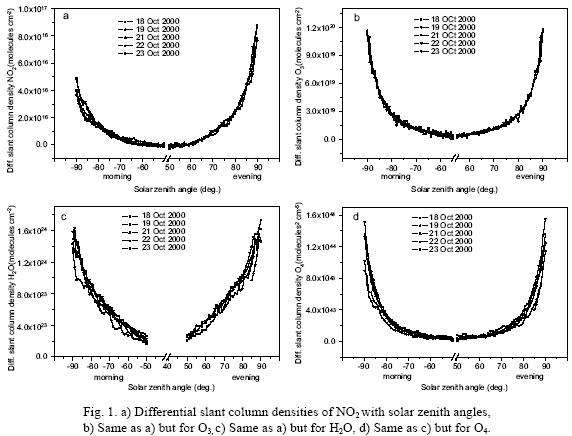
<body><![CDATA[<p align="justify"><font face="verdana" size="2">where &theta;<sub>0</sub> is the SZA of reference spectrum. For the study of seasonal variations O<sub>3</sub>, VCD are derived at 90&ordm; SZA using equation (2). The use of equation (1), and the Langley plot method is less</font></p>     <p align="justify"><font face="verdana" size="2">appropriate for NO<sub>2</sub> because NO<sub>2</sub> concentrations change during twilight. Thus for NO<sub>2</sub>, equation (3) can be applied at 90&ordm; SZA.</font></p>     <p align="justify"><font face="verdana" size="2">&nbsp;</font></p>     <p align="justify"><font face="verdana" size="2"><b>3.</b>&nbsp;<b>Observations</b></font></p>     <p align="justify"><font face="verdana" size="2">Zenith&#150;sky spectra (462&#150;498 nm) are recorded daily by UV&#150;visible spectrometer. Full day observations, from morning (SZA = 90&ordm;) to evening (SZA = 90&ordm;) on 18, 19, 21, 22 and 23 October, 2000, have been carried out to see the diurnal variation of trace gases such as NO<sub>2</sub>, O<sub>3</sub>, H<sub>2</sub>O and 0<sub>4</sub>.&nbsp; Daily morning/evening observations have been made to see the seasonal variations of NO<sub>2 </sub>and O<sub>3</sub> at Pune (18&deg;32' N, 73&deg;51' E) during the period 2000&#150;2003. To retrieve the RCD, plots of SCD<sub>diff</sub> against a set of the corresponding AMF (Langley plot) are needed. Hence, the set of AMF (SZA) for respective SZA is acquired by RT model. For the sake of comparison, data of O<sub>3</sub> VCD from Dobson instrument of Pune station are collected from the web site <A href=http://www.msc-smc.ec.gc.ca/woudc/index_e.html target="_blank">http://www.msc&#150;smc.ec.gc.ca/woudc/index_e.html</A> of World Ozone Data Centre (WODC), and TOMS data for the same station are collected from <A href=http://jwocky.gsfc.nasa.gov/eptoms/ep.html target="_blank">http://jwocky.gsfc.nasa.gov/eptoms/ep.html</A>. Daily maximum/ minimum temperature is collected from Indian Daily Weather Report (IDWR) reported by Indian Meteorological Department to understand the variation in NO<sub>2</sub> PM/AM ratio.</font></p>     <p align="justify"><font face="verdana" size="2">&nbsp;</font></p>     <p align="justify"><font face="verdana" size="2"><b>4. Results and discussion</b></font></p>     <p align="justify"><font face="verdana" size="2">&nbsp;</font><font face="verdana" size="2"><i>4.1 Diurnal variation</i></font></p>     <p align="justify"><font face="verdana" size="2">As an example, full day observations on 18, 19, 21, 22 and 23 October 2000 have been made for the study of diurnal variations of NO<sub>2</sub>, O<sub>3</sub>, H<sub>2</sub>O and O<sub>4</sub>. <a href="#f1">Figures 1a and b</a> shows the SCD<sub>diff</sub> of NO<sub>2</sub> and O<sub>3</sub>, respectively, with SZA for the above mentioned days. Similarly, H<sub>2</sub>O and O<sub>4</sub> SCD<sub>diff </sub>are shown in <a href="#f1">Figure 1c and d</a>. Here, SCD<sub>diff</sub>  is the difference of the SCD in observed spectrum of particular SZA and reference spectrum of 30&deg; SZA. Therefore, SCD<sub>diff</sub> at 30&ordm; SZA will be zero for all the gases. In both the figures, SCD<sub>diff</sub> of above gases are smoothly increasing with increasing SZA due to increasing atmospheric light paths approaching higher SZA.</font></p>     <p align="center"><font face="verdana" size="2"> <a name="f1"></a></font></p>     ]]></body>
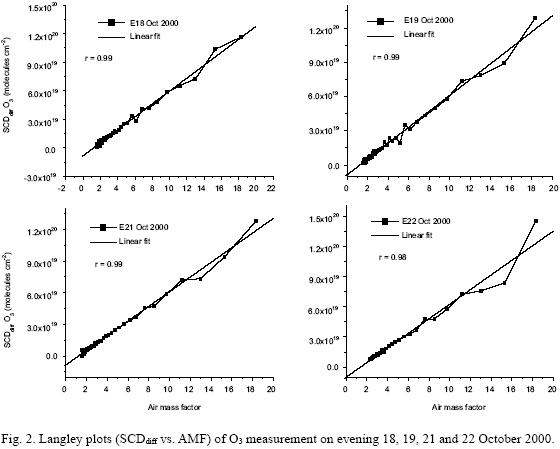
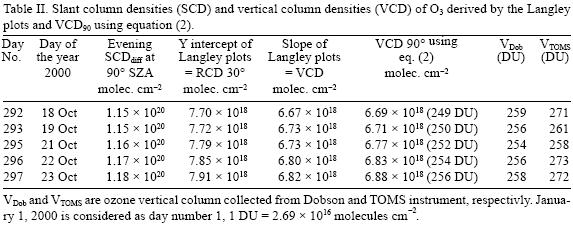
<body><![CDATA[<p align="center"><font face="verdana" size="2"> <img src="/img/revistas/atm/v20n3/a3f1.jpg"></font></p>     <p align="justify"><font face="verdana" size="2">From <a href="#f1">Figure 1a</a>, it is seen that evening NO2 SCD<sub>diff</sub> are higher than morning SCD<sub>diff</sub> at same SZA. At 70&ordm; SZA, percentage difference between evening and morning NO<sub>2</sub> SCD<sub>diff</sub>varies from 50 to 57%; similarly, at 80&ordm; SZA percentage difference varies from 59 to 66% between evening and morning NO<sub>2</sub> SCD<sub>diff</sub>. From <a href="#f1">Figure 1b</a>, it is seen that O<sub>3</sub> SCD<sub>diff</sub> at morning and evening hours are almost similar. O<sub>3</sub> SCD<sub>diff</sub> are increasing with SZA due to increasing absorption path at higher SZA. From <a href="#f1">Figure 1c and d</a>, it has been seen that H<sub>2</sub>O and O<sub>4</sub> SCD<sub>diff</sub> variations are more between the selected days compared to NO<sub>2</sub> and O<sub>3</sub>. Water vapour has large variability in the troposphere and stratosphere. The major absorption is in the lower layer of the atmosphere. Hence, the zenith dependence of wather vapour variability is different compared to other three gases. The atmospheric content of this compound responds to changes in temperature, microphysical processes and the atmospheric circulation. Water vapour concentration varies substantially in both the vertical and horizontal. Clouds are intimately connected to its pattern, as clouds occur in connection with high relative humidity, and cloud processes in turn affect the moisture distribution. <a href="#t1">Table I</a> shows SCD<sub>diff</sub> of NO<sub>2</sub>, O<sub>3</sub>, H<sub>2</sub>O and O<sub>4</sub> at morning (AM) and evening (PM) 90&ordm; SZA for selected days. From <a href="#t1">Table I</a>, it is seen that the evening NO<sub>2</sub> values are almost double of morning NO<sub>2</sub> values at 90&ordm; SZA. The percentage difference between evening and morning NO<sub>2</sub> SCD<sub>diff</sub> values varies from 78 to 107% at 90&ordm; SZA during those days. These higher values of NO<sub>2</sub> in the evening particularly at SZA greater than 85&ordm; compared to morning NO<sub>2</sub> may have occurred due to increased rate of NO&#150;NO<sub>2</sub> conversion and decreases in the rate of photolysis of NO<sub>2</sub> during evening twilight period. From <a href="#t1">Table I</a>, it has been seen that evening densities of O<sub>3</sub> are 1 &#150;5 % higher than morning densities at 90&ordm; SZA during those days. H<sub>2</sub>O SCD<sub>diff</sub> at evening 90&ordm; SZA are found to be 2&#150;11% higher than morning SCD<sub>diff</sub> of same SZA. Similarly, O<sub>4</sub> SCD<sub>diff</sub> are 0&#150;26% higher than morning SCD<sub>diff</sub> at evening 90&ordm; SZA. On October 19, O<sub>4</sub> SCD<sub>diff</sub> at evening is 26% higher than morning. It is also seen that on this day H<sub>2</sub>O SCD<sub>diff</sub> at evening 90&ordm; SZA is 11% higher than morning compared to other days. These higher values of O<sub>4 </sub>and H<sub>2</sub>O on October 19, at evening 90&ordm; SZA may be due to cloud layer occurred at evening hours. Meena <i>et al. </i>(2004) have been noticed that more effects of clouds are seen in increased absorption of tropospheric species like H<sub>2</sub>O and O<sub>4</sub>, which are good indicative of the increased absorption path lengths due to multiple Mie&#150;scattering inside clouds.</font></p>     <p align="center"><font face="verdana" size="2"> <a name="t1"></a></font></p>     <p align="center"><font face="verdana" size="2"> <img src="/img/revistas/atm/v20n3/a3t1.jpg"></font></p>     <p align="justify"><font face="verdana" size="2"><a href="#f2">Figure 2</a> shows the plots of SCD<sub>diff</sub> vs AMF (Langley plot) of O<sub>3</sub> at evening on October 18, 19, 21 and 22. The correlation coefficients (r) between SCD<sub>diff</sub> and AMF are 0.99 for 18, 19 and 21 October and 0.98 for 22 October. The correlation coefficients are significant at 1% level. In <a href="#f2">Figure 2</a>, straight lines are showing the linear fit to the data. From the Langley plots, it is seen that data follow the straight line. According to equation (1), Y intercept gives the slant column amount in reference spectrum and slope of Langley plots gives the VCD, which are listed in <a href="#t2">Table II</a>. This table, it is seen that the VCD derived by the slope of Langley plots and VCD90 using equation (2) have not much difference. They appear to be in good agreement. VCD derived from our spectrometer at evening 90&deg; SZA are observed to be less by 2 to 10 DU compared to Dobson instrument values (V<sub>Dob</sub>) and 6 to 22 DU less from TOMS observed values. The percentage difference in VCD derived by Dobson and our spectrometer varies from 0.8 to 4%. Similarly, the percentage difference between VCD obtained from our spectrometer and TOMS varies from 1 to 8% on these days. There are a number of factors contributing to the total error in the VCD. The basic uncertainty of O<sub>3</sub> and NO<sub>2</sub> is given by the random error from the fit. The random error is 1% for O<sub>3</sub> and 2% for NO<sub>2</sub>. Uncertainty in cross sections is 1.2% for O<sub>3</sub> and 2.3% for NO<sub>2</sub>. Pseudo&#150;random error causing structure in the "filling&#150;in" of absorption features by Raman scattered light is 1% for O<sub>3</sub> and 5% for NO<sub>2</sub>. Another factor is that associated with the calculated AMF due to approximations in the RT model, which is 2.7% for O<sub>3</sub> and 5% for NO<sub>2</sub>. The root&#150;sum&#150;square error calculated from these various error sources is approximately 3% for O<sub>3</sub> and 8% for NO<sub>2</sub>.</font></p>     <p align="center"><font face="verdana" size="2"> <a name="f2"></a></font></p>     <p align="center"><font face="verdana" size="2"> <img src="/img/revistas/atm/v20n3/a3f2.jpg"></font></p>     <p align="center"><font face="verdana" size="2"> <a name="t2"></a></font></p>     <p align="center"><font face="verdana" size="2"> <img src="/img/revistas/atm/v20n3/a3t2.jpg"></font></p>     <p align="justify"><font face="verdana" size="2">&nbsp;</font></p>     ]]></body>
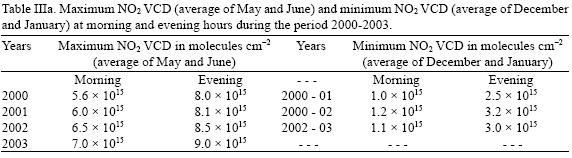
<body><![CDATA[<p align="justify"><font face="verdana" size="2"><i>4.2 Seasonal variation</i></font></p>     <p align="justify"><font face="verdana" size="2"><a href="#f3">Figures 3a and b</a> show the daily VCD of NO<sub>2</sub> and O<sub>3</sub>, respectively, obtained in the morning and evening hours during the period May 4, 2000 to May 24, 2003. VCD were derived from SCD at 90&deg; SZA using the AMF of 18.5 for NO<sub>2</sub> and 18.3 for O<sub>3</sub>, which were calculated by RT model for 90&deg; SZA. Also, daily ozone values obtained by Dobson spectrophotometer are plotted in <a href="#f3">Figure 3b</a> for the above period. From <a href="#f3">Figure 3a</a>, it is seen that maximum NO<sub>2</sub> VCD are found in summer months (May and June) and minimum in winter months (December and January) for all the years.</font></p>     <p align="center"><font size="2" face="verdana"><a name="f3"></a></font></p>     <p align="center"><font size="2" face="verdana"><img src="/img/revistas/atm/v20n3/a3f3.jpg"></font></p>     <p align="justify"><font face="verdana" size="2">Maximum NO<sub>2</sub> VCD (average of May and June) and minimum NO<sub>2</sub> VCD (average of December and January) of morning and evening hours are listed in <a href="#t3a">Table IIIa</a>. From this table, it is seen that at morning and evening hours, maxima of NO<sub>2</sub> of VCD have an increasing trend during the period 2000&#150;2003. The maximum NO<sub>2</sub> VCD in the morning hours are increasing per year in the order of 0.4 <i>x </i>10<sup>15</sup> &#150; 0.5 <i>x </i>10<sup>15</sup> molecules cm&#150;<sup>2</sup> (i.e., 7&#150;8%) and in evening hours it is increasing 5&#150;6% per year. The percentage difference between maximum NO<sub>2</sub> VCD at morning and evening hours varies from 29 to 42%; similarly, percentage difference between minimum NO<sub>2</sub> VCD at morning and evening hours varies from 150 to 172% during the period 2000&#150;2003. Regarding the NO<sub>2 </sub>concentration, it was observed at Pune that two wheelers contribute 74 and cars 20% to the total pollution. The air quality of Pune's surroundings is deteriorating rapidly. Every day hundreds of tons of polluted air are released. Vehicular contribution of Pune's air pollution is approximately 40%. The average air pollution levels in the city are given as: PM<sub>10</sub> 83 ppm, NO<sub>2</sub> 62 ppm and SO<sub>2</sub> 37 ppm. The observation station is in upwind and hence the effect of Pune pollution depends upon wind direction. However, the tropospheric contribution will only affect the observations and stratospheric contributions are representative of large circulation patterns.</font></p>     <p align="center"><font face="verdana" size="2"> <a name="t3a"></a></font></p>     <p align="center"><font face="verdana" size="2"> <img src="/img/revistas/atm/v20n3/a3t3a.jpg"></font></p>     <p align="justify"><font face="verdana" size="2">From <a href="#f3">Figure 3b</a>, it is seen that maximum O<sub>3</sub> VCD are observed in summer months (May and June) and minimum in winter months (December and January). From the figure it is also seen that morning and evening VCD are in good agreement with Dobson spectrophotometer values throughout the observational period. Maximum O<sub>3</sub> VCD (average of May and June) and minimum O<sub>3</sub> VCD (average of December and January) at morning and evening hours are listed in <a href="#t3b">Table IIIb</a>. From table, it is seen that evening O<sub>3</sub> VCD are higher than morning O<sub>3</sub> VCD. The percentage difference between maximum O<sub>3</sub> VCD at morning and evening hours varies from 3 to 10% and the percentage difference between minimum O<sub>3</sub> VCD at morning and evening hours varies from 2 to 18% during the period 2000&#150;2003. <a href="#f3">Figure 3c</a> shows correlation between NO<sub>2</sub> and O<sub>3</sub> for morning (AM) and evening (PM) data. For the whole period, a positive correlation of r = 0.72 in the morning data and r = 0.79 in the evening have been found between NO<sub>2</sub> and O<sub>3</sub> total column amounts.</font></p>     <p align="center"><font face="verdana" size="2"> <a name="t3b"></a></font></p>     <p align="center"><font face="verdana" size="2"> <img src="/img/revistas/atm/v20n3/a3t3b.jpg"></font></p>     ]]></body>
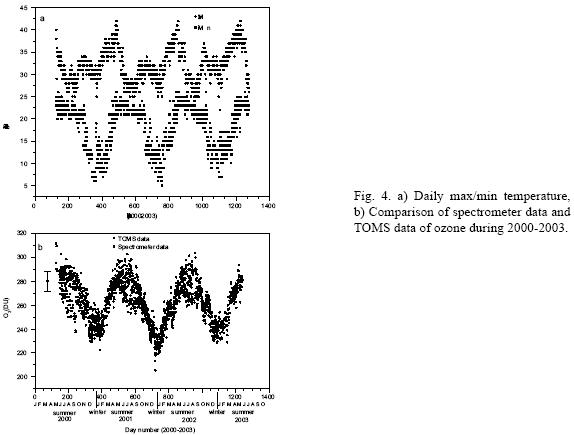
<body><![CDATA[<p align="justify"><font face="verdana" size="2"><a href="#f4">Figures 4a and b</a> show the daily maximum/minimum temperature and VCD of O<sub>3</sub> obtained by spectrometer and TOMS data during 2000&#150;2003. In Pune, summer goes from early March to June, from November to February Pune has it's winter season, and the monsoon season with good rain from July to October. There were maximum temperature ranges from 40 to 42 &deg;C starting in May and minimum temperature ranges from 5 to 7 &deg;C in December&#150;January during 2000&#150;2003. From <a href="#f4">Figure 4a</a>, maximum temperature is observed in April and May of averaged 38 &deg;C and minimum temperature is observed in December and January of averaged 11 &deg;C during all the years.</font></p>     <p align="center"><font face="verdana" size="2"> <a name="f4"></a></font></p>     <p align="center"><font face="verdana" size="2"> <img src="/img/revistas/atm/v20n3/a3f4.jpg"></font></p>     <p align="justify"><font face="verdana" size="2">It has been discussed above that maximum NO<sub>2</sub> and O<sub>3</sub> VCD are observed in May and June during all the years, therefore it can be say that NO<sub>2</sub> and O<sub>3</sub> peaks are one month ahead from maximum temperature peaks. A good agreement is seen between O<sub>3</sub> and minimum temperature variations. It is found from <a href="#f4">Figure 4b</a> that TOMS values are higher than spectrometer values. The TOMS instrument measures UV radiances backscattered by the underlying atmosphere and earth's surface or clouds. The measured radiances are a function of total column ozone, the vertical distribution of that column, solar zenith angle, satellite zenith angle (azimuthal angle and scan angle), and the pressure level and reflectivity of the lower boundary. In clear sky conditions the contribution of backscattered radiation from the atmosphere dominates over the reflected radiation from earth's surface, the effective scattering surface for the backscattered UV radiation to the TOMS instrument is at the middle to upper troposphere (Hudson <i>et al., </i>1995; Klenk <i>et al., </i>1982).</font></p>     <p align="justify"><font face="verdana" size="2">For ozone above the middle to upper troposphere, the TOMS algorithm can retrieve the actual amount of ozone above the effective scattering surface with little error. However, if the assumed ozone profile below the effective scattering surface is different from the actual ozone profile, the retrieval will sense less than the actual deviation because some of the backscattered radiation will not have passed through the middle and lower troposphere. Then, the retrieved total ozone is either overestimated or underestimated depending on whether the assumed ozone amount below the effective scattering surface is less than or greater than the actual ozone amount. In the cloudy sky, incorrect cloud height lead to three errors like errors in the added ozone below clouds and errors in the retrieved ozone above clouds.</font></p>     <p align="justify"><font face="verdana" size="2">The knowledge of ozone and temperature profiles is critical for the calculation of ozone values at higher solar zenith angles. The effect of different profiles on the accuracy of ozone retrievals is an important part. Therefore, the reason of the observed discrepancies may be in the TOMS algorithm, which uses climatological profiles rather than the actual profile at the time of the measurement. High summer ozone concentrations are confined to increased duration of UV&#150;radiation during summer months. Ozone produced in the tropical region gets transported to higher latitudes by the stratospheric mean diabatic circulation. Ozone rich&#150;air during winter moves poleward and downward, which explains the seasonal variations in ozone. Also, day&#150;to&#150;day variability in total ozone is assumed to be caused by changing weather patterns in the troposphere and its effects may extent to the lower stratospheric levels. Ozone has a strong seasonal variation but weak diurnal variation at twilight, with maxima in the summer and minima in the winter. However, the abundance of lower stratospheric ozone is strongly dependent on transport, so that interannual variations in dynamic behavior can also be a source of ozone variability (Hood <i>et al., </i>1997).</font></p>     <p align="justify"><font face="verdana" size="2"><a href="/img/revistas/atm/v20n3/a3f5.jpg" target="_blank">Figures 5a and b</a> show the NO<sub>2</sub> and O<sub>3</sub> evening&#150;to&#150;morning (PM/AM) ratio, respectively, during 2000&#150;2003. Also, <a href="/img/revistas/atm/v20n3/a3f5.jpg" target="_blank">Figure 5a</a> shows temperature maximum/minimum (max/min) ratio. <a href="/img/revistas/atm/v20n3/a3f5.jpg" target="_blank">Figure 5c</a> shows the correlation between NO<sub>2</sub> PM/AM ratio and temperature max/min ratio during 2000&#150;2003. From <a href="/img/revistas/atm/v20n3/a3f5.jpg" target="_blank">Figure 5a</a>, it is found that at Pune the PM/AM ratio of NO<sub>2</sub> density varies from 1.25 to 3.8 during the above period. There is an interesting seasonal change in the PM/AM ratio. NO<sub>2</sub> PM/AM ratios are higher in winter months and lower in summer months for all the years. In winter months NO<sub>2</sub> PM/AM ratio goes up to 3.8 and in summer months lowest ratio is 1.25. From <a href="/img/revistas/atm/v20n3/a3f5.jpg" target="_blank">Figure 5a</a>, it is seen that max/min temperature ratios are higher in winter months and lower in summer months during 2000&#150;2003. Decreasing trend is observed in the maxima of both NO<sub>2 </sub>PM/AM ratio and temperature max/min ratio in winter seasons during the above period. When the max/min temperature differences are more, NO<sub>2</sub> PM/AM differences are also observed more. The NO<sub>2</sub> PM/AM ratio has been plotted against the temperature max/min ratio with a correlation coefficient of 0.55, which is shown in <a href="/img/revistas/atm/v20n3/a3f5.jpg" target="_blank">Figure 5c</a>. Deviation from linearity indicates other processes than pure photochemical and homogeneous chemistry. The NO<sub>2</sub> concentration and its PM/AM ratio is considered to change with the atmospheric temperature in a day/night period.</font></p>     <p align="justify"><font face="verdana" size="2">Temperature of the atmosphere controls the rate of thermal decomposition of N<sub>2</sub>O<sub>5</sub> concentrations. N<sub>2</sub>O<sub>5</sub> forms during the dark hours and is destroyed by photolysis and thermal decomposition. N<sub>2</sub>O<sub>5 </sub>concentration is a function of temperature and wavelength. In the winter nights N<sub>2</sub>O<sub>5</sub> forms more due to more dark hours and in day time it is photolyzed to produce NO<sub>2</sub>, which is reflecting in the evening (PM) hours. Hence, in winter PM/AM ratios are higher than in summer.</font></p>     <p align="justify"><font face="verdana" size="2">Koike <i>et al. </i>(1999) have analyzed the series of PM/AM ratio values of the VCD of NO<sub>2</sub> and found a maximum ratio of 2.32 in winter and a minimum of 1.25 in summer. They obtained residual series of ratio values after eliminating seasonal trends and by considering PM value of the day and AM value of the next day for the two stations: Moshiri (44.4&deg; N, 142.3&deg; E) and Rikubetsu (43.5&deg; N, 143.8&deg; E). A positive correlation between these two stations before and after eliminating seasonal trend is suggestive of day&#150;to&#150;day variation of PM/AM ratios in the VCD of NO<sub>2</sub> in association with the real change in the atmosphere. Otten <i>et al. </i>(1998) observed a PM/AM ratio of the VCD of NO<sub>2</sub> of highest value 4.0 during the mid&#150;winter of 1994/1995 at Kiruna (67.9&deg; N, 21.1&deg; E). The analysis at Pune also shows large day&#150;to&#150;day variability in the VCD of NO<sub>2</sub> with maximum PM/AM ratio of about 3.8 in winter compared to small day&#150;to&#150;day variations in spring and summer with PM/AM ratio of about 1.25. However, tropospheric NO<sub>2</sub> pollution probably by local traffic during the day could also enhance the PM/AM ratio in total atmospheric NO<sub>2</sub>, in particular during winter when the stratospheric NO<sub>2</sub> is low, and the near surface inversion prevents an efficient dispersion of polluted air (Fiedler <i>et al., </i>1993). During the night NO<sub>2</sub> can be oxidized by O<sub>3</sub> to form NO<sub>3</sub>, a strong atmospheric oxidant and a precursor to the formation of N<sub>2</sub>O<sub>5</sub>. During the day N<sub>2</sub>O<sub>5</sub> can be photolyzed to regenerate NO<sub>2</sub> (Nichol <i>et al., </i>1996). In contrast, N<sub>2</sub>O<sub>5</sub> can have morning concentrations in the lower stratosphere comparable to NO<sub>x</sub>, even though its production requires the formation of NO<sub>3</sub>.</font></p>     <p align="justify"><font face="verdana" size="2">NO<sub>2</sub> + O<sub>3</sub> <img src="/img/revistas/atm/v20n3/a3s1.jpg"> NO<sub>3</sub> + O<sub>2 </sub></font></p>     ]]></body>
<body><![CDATA[<p align="justify"><font face="verdana" size="2">NO<sub>3</sub> + hv  <img src="/img/revistas/atm/v20n3/a3s1.jpg">NO + O<sub>2 </sub></font></p>     <p align="justify"><font face="verdana" size="2">	<img src="/img/revistas/atm/v20n3/a3s1.jpg">NO<sub>2</sub> + O</font></p>     <p align="justify"><font face="verdana" size="2">NO<sub>3</sub> + NO<sub>2</sub> + M <img src="/img/revistas/atm/v20n3/a3s2.jpg">N<sub>2</sub> O<sub>5</sub> + M</font></p>     <p align="justify"><font face="verdana" size="2">In the winter, nights are longest; therefore, during night NO<sub>2</sub> to N<sub>2</sub>O<sub>5</sub> conversion is more and hence in the morning NO<sub>2</sub> value will be less, what leads to high PM/AM ratio. During daytime, photochemical reactions take place in the presence of sunlight and N<sub>2</sub>O5 that, formed due to oxidation of NO<sub>2</sub> during night, gets photolyzed to reproduce NO<sub>2</sub> (Kostadinov <i>et al., </i>1999). The formation of NO<sub>2 </sub>during the day leads to an increase in the VCD of NO<sub>2</sub>:</font></p>     <p align="justify"><font face="verdana" size="2">N<sub>2</sub>O<sub>5</sub> + hv <img src="/img/revistas/atm/v20n3/a3s1.jpg"> NO<sub>3</sub> + NO<sub>2</sub></font></p>     <p align="justify"><font face="verdana" size="2">The increase in NO<sub>2</sub> VCD is also possible due to increased pollution during day, which reflects in the evening hours as it is seen from figures. At twilight, NO<sub>2</sub> density depends on NO and controlled by the following reactions:</font></p>     <p align="justify"><font face="verdana" size="2">NO + O<sub>3</sub> <img src="/img/revistas/atm/v20n3/a3s1.jpg"> NO<sub>2</sub> + O<sub>2 </sub></font></p>     <p align="justify"><font face="verdana" size="2">NO<sub>2</sub> + hv <img src="/img/revistas/atm/v20n3/a3s1.jpg"> NO + O </font></p>     <p align="justify"><font face="verdana" size="2">NO<sub>2</sub> + O <img src="/img/revistas/atm/v20n3/a3s1.jpg"> NO + O<sub>2</sub></font></p>     <p align="justify"><font face="verdana" size="2">During evening twilight hours, the rapid decreases in the rate of photolysis of NO<sub>2</sub> and the abundances of atomic oxygen lead to conversion of NO into NO<sub>2</sub>. Thus, the total number of NO<sub>2 </sub>molecules can increase substantially at evening hours and hence the AM/PM differences (Solomon <i>et al., </i>1987; Kerr <i>et al., </i>1977; Boughner <i>et al., </i>1980). These AM/PM differences in VCD of NO<sub>2 </sub>can also be seen in <a href="#f3">Figure 3a</a>. The VCD data at Pune show strong seasonal and diurnal variations of NO<sub>2</sub>, with maxima in summer at sunset and minima in winter at sunrise. This agrees with the results of earlier authors (Noxon <i>et al., </i>1979; Syed <i>et al., </i>1981; Johnston <i>et al., </i>1989; Solomon <i>et al., </i>1992; Bhonde <i>et al., </i>1992; Lal <i>et al., </i>1993; Kondo <i>et al., </i>1994). From <a href="/img/revistas/atm/v20n3/a3f5.jpg" target="_blank">Figure 5b</a>, O<sub>3</sub> PM/AM ratio is slightly higher in winter months compared to summer months. The average PM/AM ratio of about 1.03 is observed. Various nitrogen oxides like NO, NO<sub>2</sub> and NO<sub>3</sub> are involved in reactions, which affect O<sub>3</sub> abundance, N<sub>2</sub>O<sub>5</sub> acts as a temporary reservoir for these nitrogen oxides species. Therefore, the concentration of N<sub>2</sub>O<sub>5</sub> in the atmosphere contributes to the AM/PM O<sub>3</sub> abundance. However, there is not much difference seen in O<sub>3</sub> values. Hence, no much variation is seen in PM/AM ratio.</font></p>     ]]></body>
<body><![CDATA[<p align="justify"><font face="verdana" size="2">&nbsp;</font></p>     <p align="justify"><font face="verdana" size="2"><b>5. Conclusions</b></font></p>     <p align="justify"><font face="verdana" size="2">&bull; Full day observations have been made from morning (SZA 90&deg;) to evening (SZA 90&deg;) to see the diurnal variations of trace gases such as O<sub>3</sub>, NO<sub>2</sub>, H<sub>2</sub>O and O<sub>4</sub>. SCD<sub>diff</sub> of above gases increase smoothly as the AMF increases with SZA. It is seen that evening NO<sub>2</sub> SCD<sub>diff</sub> are higher compared to morning SCD<sub>diff</sub>. It is also noticed that evening NO<sub>2</sub> values are almost double of morning NO<sub>2</sub> values in the month of October 2000. These high values of NO<sub>2</sub> in the evening appear to be related to NO&#150;NO<sub>2</sub> conversion that occurs in twilight period. In O<sub>3</sub>, H<sub>2</sub>O and O<sub>4</sub>, no much differences are observed in morning and evening SCD<sub>diff.</sub></font></p>     <p align="justify"><font face="verdana" size="2">&bull; A time series of daily VCD of NO<sub>2</sub> and O<sub>3</sub> at sunrise and sunset has been obtained during the period from May 2000 to May 2003. There have been found a good correlation between NO<sub>2</sub> and O<sub>3</sub> VCD during the period. The VCD data at Pune show strong seasonal and diurnal variations of NO<sub>2</sub> with maxima in summer at sunset and minima in winter at sunrise. Ozone has strong seasonal variations but weak diurnal variations at sunrise and sunset hours with maxima in summer and minima in winter. A good agreement is found between O<sub>3</sub> VCD and minimum temperature variations during the above period. High summer ozone values are confined to increased duration of UV&#150;radiation during summer months.</font></p>     <p align="justify"><font face="verdana" size="2">&bull; The percentage difference between VCD obtained from Dobson and our spectrometer varies from 0.8 to 4%. Similarly, in VCD obtained from our spectrometer and TOMS, the percentage difference varies from 1 to 8% during the above period.</font></p>     <p align="justify"><font face="verdana" size="2">&bull; The NO<sub>2</sub> PM/AM ratios are found to be higher in winter months and lower in summer months. It has also been found that temperature max/min ratios are higher in winter and lower in summer months during 2000&#150;2003. When the max/min temperature differences are more, NO<sub>2</sub> PM/AM differences are also observed more. In winter months NO<sub>2</sub> PM/AM ratio goes up to 3.8 and in summer months lowest ratio is 1.25. A positive correlation is found between NO<sub>2</sub> PM/AM ratio and temperature max/min ratio during the period 2000&#150;2003.</font></p>     <p align="justify"><font face="verdana" size="2">&bull; Temperature of the atmosphere controls the rate of the thermal decomposition of N<sub>2</sub>O<sub>5 </sub>concentrations. N<sub>2</sub>O<sub>5</sub> forms during dark hours. In the winter, nights are longest; therefore, during night NO<sub>2</sub> to N<sub>2</sub>O<sub>5</sub> conversion is more and hence in the morning NO<sub>2</sub> value will be less that leads to high PM/AM ratio. Further, during evening twilight hours, the rapid decreases in the rate of photolysis of NO<sub>2</sub> and the abundances of atomic oxygen lead to conversion of NO into NO<sub>2</sub>. Thus, the total number of NO<sub>2</sub> molecules can increase substantially at evening hours, and hence the AM/PM differences. O<sub>3</sub> PM/AM ratio is found slightly higher in winter months compared to summer months.</font></p>     <p align="justify"><font face="verdana" size="2">&nbsp;</font></p>     <p align="justify"><font face="verdana" size="2"><b>Acknowledgements</b></font></p>     <p align="justify"><font face="verdana" size="2">The authors are thankful to Prof. B. N. Goswami Director IITM and Dr. P. C. S. Devara Head PM &amp; A Division for his encouragement. The authors are thankful to the Department of Science and Technology (DST), New Delhi, Govt. of India for the financial support during the tenure of this work.</font></p>     ]]></body>
<body><![CDATA[<p align="justify"><font face="verdana" size="2">&nbsp;</font></p>     <p align="justify"><font face="verdana" size="2"><b>References</b></font></p>     <!-- ref --><p align="justify"><font face="verdana" size="2">Bhonde S. D., P. Mehra, S. Bose, A. L. Londhe and D. B. Jadhav, 1992. Simultaneous measurement of low latitude NO<sub>2</sub> and O<sub>3</sub> from zenith sky observations in visible region. <i>Indian J. Radio Space Phys. </i><b>21, </b>18&#150;25.</font>&nbsp;&nbsp;&nbsp;&nbsp;&nbsp;&nbsp;&nbsp;&nbsp;[&#160;<a href="javascript:void(0);" onclick="javascript: window.open('/scielo.php?script=sci_nlinks&ref=1270700&pid=S0187-6236200700030000300001&lng=','','width=640,height=500,resizable=yes,scrollbars=1,menubar=yes,');">Links</a>&#160;]<!-- end-ref --><!-- ref --><p align="justify"><font face="verdana" size="2">Bhosale C. S., G. S. Meena, A. L. Londhe, D. B. Jadhav, O. Puentedara and M. Gil, 2004. Variations of O<sub>3</sub>, NO<sub>2</sub> and O<sub>4</sub> densities in association with NAO indices during winter/spring of 1993/94 and 1994/95 at sub&#150;Arctic station. <i>Indian J. Radio Space Phys. </i><b>33</b>, 104&#150;114.</font>&nbsp;&nbsp;&nbsp;&nbsp;&nbsp;&nbsp;&nbsp;&nbsp;[&#160;<a href="javascript:void(0);" onclick="javascript: window.open('/scielo.php?script=sci_nlinks&ref=1270701&pid=S0187-6236200700030000300002&lng=','','width=640,height=500,resizable=yes,scrollbars=1,menubar=yes,');">Links</a>&#160;]<!-- end-ref --><!-- ref --><p align="justify"><font face="verdana" size="2">Boughner R., J. C. Larsen and M. Natarajan, 1980. The influence of NO and ClO variations at twilight on the interpretation of solar occultation measurements. <i>Geophys. Res. Lett. </i><b>7</b>, 231&#150;234.</font>&nbsp;&nbsp;&nbsp;&nbsp;&nbsp;&nbsp;&nbsp;&nbsp;[&#160;<a href="javascript:void(0);" onclick="javascript: window.open('/scielo.php?script=sci_nlinks&ref=1270702&pid=S0187-6236200700030000300003&lng=','','width=640,height=500,resizable=yes,scrollbars=1,menubar=yes,');">Links</a>&#160;]<!-- end-ref --><!-- ref --><p align="justify"><font face="verdana" size="2">Bradshaw J., D. Davis, G. Grodzinsky, S. Smyth, R. Newell, S. Sandholm and S. Liu, 2000. Observed distributions of nitrogen oxides in the remote free troposphere from the NASA global tropospheric experiment programs. <i>Rev. Geophys. </i><b>38</b>, 61&#150;116.</font>&nbsp;&nbsp;&nbsp;&nbsp;&nbsp;&nbsp;&nbsp;&nbsp;[&#160;<a href="javascript:void(0);" onclick="javascript: window.open('/scielo.php?script=sci_nlinks&ref=1270703&pid=S0187-6236200700030000300004&lng=','','width=640,height=500,resizable=yes,scrollbars=1,menubar=yes,');">Links</a>&#160;]<!-- end-ref --><!-- ref --><p align="justify"><font face="verdana" size="2">Erle F., K. Pfeilsticker and U. Platt, 1995. On the influence of tropospheric clouds on zenith&#150;scattered&#150;light measurements of stratospheric species. <i>Geophys. Res. Lett. </i><b>22</b>, 2725&#150;2728.</font>&nbsp;&nbsp;&nbsp;&nbsp;&nbsp;&nbsp;&nbsp;&nbsp;[&#160;<a href="javascript:void(0);" onclick="javascript: window.open('/scielo.php?script=sci_nlinks&ref=1270704&pid=S0187-6236200700030000300005&lng=','','width=640,height=500,resizable=yes,scrollbars=1,menubar=yes,');">Links</a>&#160;]<!-- end-ref --><!-- ref --><p align="justify"><font face="verdana" size="2">Fiedler M., H. Frank, T. Gomer, M. Hausmann, K. Pfeilsticker and U. Platt, 1993. The 'minihole' event on 6 Feb. 1990: Influence of Mie&#150;scattering on the evaluation of spectroscopic measurements. <i>Geophys. Res. Lett. </i><b>20, </b>959&#150;962.</font>&nbsp;&nbsp;&nbsp;&nbsp;&nbsp;&nbsp;&nbsp;&nbsp;[&#160;<a href="javascript:void(0);" onclick="javascript: window.open('/scielo.php?script=sci_nlinks&ref=1270705&pid=S0187-6236200700030000300006&lng=','','width=640,height=500,resizable=yes,scrollbars=1,menubar=yes,');">Links</a>&#160;]<!-- end-ref --><!-- ref --><p align="justify"><font face="verdana" size="2">Gil M., O. Puentedara, M. Yela, C. Parrondo and D. B. Jadhav, 1996. OClO, NO<sub>2</sub> and O<sub>3</sub> total column observations over Iceland during the winter 1993/94. <i>Geophys. Res. Lett. </i><b>23</b>, 3337&#150;3340.</font>&nbsp;&nbsp;&nbsp;&nbsp;&nbsp;&nbsp;&nbsp;&nbsp;[&#160;<a href="javascript:void(0);" onclick="javascript: window.open('/scielo.php?script=sci_nlinks&ref=1270706&pid=S0187-6236200700030000300007&lng=','','width=640,height=500,resizable=yes,scrollbars=1,menubar=yes,');">Links</a>&#160;]<!-- end-ref --><!-- ref --><p align="justify"><font face="verdana" size="2">Hood L. L., J. P. McCormack and K. Labitzke, 1997. An investigation of dynamical contributions to midlatitude ozone trends in winter. <i>J. Geophys. Res. </i><b>102</b>, 13079&#150;13093.</font>&nbsp;&nbsp;&nbsp;&nbsp;&nbsp;&nbsp;&nbsp;&nbsp;[&#160;<a href="javascript:void(0);" onclick="javascript: window.open('/scielo.php?script=sci_nlinks&ref=1270707&pid=S0187-6236200700030000300008&lng=','','width=640,height=500,resizable=yes,scrollbars=1,menubar=yes,');">Links</a>&#160;]<!-- end-ref --><!-- ref --><p align="justify"><font face="verdana" size="2">Hudson R. D., J.&#150;H. Kim and A. M. Thompson, 1995. On the derivation of tropospheric column from radiances measured by the total ozone mapping spectrometer. <i>J. Geophys. Res. </i><b>100</b>, 11137&#150;11145.</font>&nbsp;&nbsp;&nbsp;&nbsp;&nbsp;&nbsp;&nbsp;&nbsp;[&#160;<a href="javascript:void(0);" onclick="javascript: window.open('/scielo.php?script=sci_nlinks&ref=1270708&pid=S0187-6236200700030000300009&lng=','','width=640,height=500,resizable=yes,scrollbars=1,menubar=yes,');">Links</a>&#160;]<!-- end-ref --><!-- ref --><p align="justify"><font face="verdana" size="2">Jadhav D. B., A. L. Londhe, G. S. Meena, D. Jhurry and J. M. Rossett, 1999. Installation of an automatic spectrometer at Mauritius and preliminary result of NO<sub>2</sub> over Mauritius. <i>Curr. Sci. </i><b>76</b>, 998&#150;1000.</font>&nbsp;&nbsp;&nbsp;&nbsp;&nbsp;&nbsp;&nbsp;&nbsp;[&#160;<a href="javascript:void(0);" onclick="javascript: window.open('/scielo.php?script=sci_nlinks&ref=1270709&pid=S0187-6236200700030000300010&lng=','','width=640,height=500,resizable=yes,scrollbars=1,menubar=yes,');">Links</a>&#160;]<!-- end-ref --><!-- ref --><p align="justify"><font face="verdana" size="2">Jadhav D. B., 2002. Monitoring of atmospheric constituents using UV&#150;visible spectroscopy, Proceedings of National Workshop on Atmospheric Chemistry <i>(NWAC&#150;99), </i>(Devara, P.C.S. and Raj, P.E. Eds.), Indian Institute of Tropical Meteorology, Pune, 145&#150;149 pp.</font>&nbsp;&nbsp;&nbsp;&nbsp;&nbsp;&nbsp;&nbsp;&nbsp;[&#160;<a href="javascript:void(0);" onclick="javascript: window.open('/scielo.php?script=sci_nlinks&ref=1270710&pid=S0187-6236200700030000300011&lng=','','width=640,height=500,resizable=yes,scrollbars=1,menubar=yes,');">Links</a>&#160;]<!-- end-ref --><!-- ref --><p align="justify"><font face="verdana" size="2">Jayaraman A. and B. H. Subbaraya, 1988. Vertical distribution of water vapour over Hydarabad. <i>Indian J. Radio Space Phys. </i><b>17</b>, 63&#150;68.</font>&nbsp;&nbsp;&nbsp;&nbsp;&nbsp;&nbsp;&nbsp;&nbsp;[&#160;<a href="javascript:void(0);" onclick="javascript: window.open('/scielo.php?script=sci_nlinks&ref=1270711&pid=S0187-6236200700030000300012&lng=','','width=640,height=500,resizable=yes,scrollbars=1,menubar=yes,');">Links</a>&#160;]<!-- end-ref --><!-- ref --><p align="justify"><font face="verdana" size="2">Johnston P. V. and R. L. McKenzie, 1989. NO<sub>2</sub> observations at 45&deg; S during the decreasing phase of solar cycle 21, from 1980 to 1987. <i>J. Geophys. Res. </i><b>94</b>, 3473&#150;3486.</font>&nbsp;&nbsp;&nbsp;&nbsp;&nbsp;&nbsp;&nbsp;&nbsp;[&#160;<a href="javascript:void(0);" onclick="javascript: window.open('/scielo.php?script=sci_nlinks&ref=1270712&pid=S0187-6236200700030000300013&lng=','','width=640,height=500,resizable=yes,scrollbars=1,menubar=yes,');">Links</a>&#160;]<!-- end-ref --><!-- ref --><p align="justify"><font face="verdana" size="2">Kerr J. B., W. F. J. Evans and J. C. McConnell, 1977. The effect of NO<sub>2</sub> changes at twilight on tangent ray NO<sub>2</sub> measurements. <i>Geophys. Res. Lett. </i><b>4</b>, 577&#150;579.</font>&nbsp;&nbsp;&nbsp;&nbsp;&nbsp;&nbsp;&nbsp;&nbsp;[&#160;<a href="javascript:void(0);" onclick="javascript: window.open('/scielo.php?script=sci_nlinks&ref=1270713&pid=S0187-6236200700030000300014&lng=','','width=640,height=500,resizable=yes,scrollbars=1,menubar=yes,');">Links</a>&#160;]<!-- end-ref --><!-- ref --><p align="justify"><font face="verdana" size="2">Klenk K. F., P. K. Bhartia, A. J. Fleig, V. G. Kaveeshwar, R. D. McPeters and P. M. Smith, 1982. Total ozone determination from the backscattered ultraviolet (BUV) experiment. <i>J. Appl. Meteor. </i><b>21</b>, 1672&#150;1684.</font>&nbsp;&nbsp;&nbsp;&nbsp;&nbsp;&nbsp;&nbsp;&nbsp;[&#160;<a href="javascript:void(0);" onclick="javascript: window.open('/scielo.php?script=sci_nlinks&ref=1270714&pid=S0187-6236200700030000300015&lng=','','width=640,height=500,resizable=yes,scrollbars=1,menubar=yes,');">Links</a>&#160;]<!-- end-ref --><!-- ref --><p align="justify"><font face="verdana" size="2">Koike M., Y. Kondo, W.A. Matthews, P. V. Johnston, H. Nakajima, A. Kawaguchi, H. Nakane, I. Murata, A. Budiyono, M. Kanada and N. Toriyama, 1999. Assessment of the uncertainties in the NO<sub>2</sub> and O<sub>3</sub> measurements by visible spectrometers. <i>J. Atmos. Chem. </i><b>32</b>, 121&#150;145.</font>&nbsp;&nbsp;&nbsp;&nbsp;&nbsp;&nbsp;&nbsp;&nbsp;[&#160;<a href="javascript:void(0);" onclick="javascript: window.open('/scielo.php?script=sci_nlinks&ref=1270715&pid=S0187-6236200700030000300016&lng=','','width=640,height=500,resizable=yes,scrollbars=1,menubar=yes,');">Links</a>&#160;]<!-- end-ref --><!-- ref --><p align="justify"><font face="verdana" size="2">Kondo Y., W. A. Matthews, S. Solomon, M. Koike, M. Hayashi, K. Yamazaki, H. Nakajima and K. Tsukuui, 1994. Ground based measurements of column amounts of NO<sub>2</sub> over Syowa Station, Antarctica. J. <i>Geophys. Res. </i><b>99</b>, 14535&#150;14548.</font>&nbsp;&nbsp;&nbsp;&nbsp;&nbsp;&nbsp;&nbsp;&nbsp;[&#160;<a href="javascript:void(0);" onclick="javascript: window.open('/scielo.php?script=sci_nlinks&ref=1270716&pid=S0187-6236200700030000300017&lng=','','width=640,height=500,resizable=yes,scrollbars=1,menubar=yes,');">Links</a>&#160;]<!-- end-ref --><!-- ref --><p align="justify"><font face="verdana" size="2">Kostadinov I., G. Giovanelli, F. Ravegnani, D. Bortoli and A. Petritili, 1999. Depolarization ratio of the zenith scattered radiation and measured NO<sub>2</sub> slant columns. <i>Proc. Society of Photo&#150;Optical Instrumentation Engineers </i>(SPIE), 3754, 402&#150;410.</font>&nbsp;&nbsp;&nbsp;&nbsp;&nbsp;&nbsp;&nbsp;&nbsp;[&#160;<a href="javascript:void(0);" onclick="javascript: window.open('/scielo.php?script=sci_nlinks&ref=1270717&pid=S0187-6236200700030000300018&lng=','','width=640,height=500,resizable=yes,scrollbars=1,menubar=yes,');">Links</a>&#160;]<!-- end-ref --><!-- ref --><p align="justify"><font face="verdana" size="2">Kreher K., M. Fiedler, T. Gomer, J. Stutz and U. Platt, 1995. The latitudinal distribution (50&deg; N &#150; 50&deg; S) of NO<sub>2</sub> and O<sub>3</sub> in October/November 1990. <i>Geophys. Res. Lett. </i><b>22</b>, 1217&#150;1220.</font>&nbsp;&nbsp;&nbsp;&nbsp;&nbsp;&nbsp;&nbsp;&nbsp;[&#160;<a href="javascript:void(0);" onclick="javascript: window.open('/scielo.php?script=sci_nlinks&ref=1270718&pid=S0187-6236200700030000300019&lng=','','width=640,height=500,resizable=yes,scrollbars=1,menubar=yes,');">Links</a>&#160;]<!-- end-ref --><!-- ref --><p align="justify"><font face="verdana" size="2">Lal M., D. K. Chakrabarty, J. S. Sidhu, S. R. Das and S. D. Verma, 1993. Some results of ground&#150;based measurements of atmospheric NO<sub>2</sub> at Ahmedabad by visible absorption spectroscopy. <i>Indian J. Radio Space Phys. </i><b>22</b>, 108&#150;113.</font>&nbsp;&nbsp;&nbsp;&nbsp;&nbsp;&nbsp;&nbsp;&nbsp;[&#160;<a href="javascript:void(0);" onclick="javascript: window.open('/scielo.php?script=sci_nlinks&ref=1270719&pid=S0187-6236200700030000300020&lng=','','width=640,height=500,resizable=yes,scrollbars=1,menubar=yes,');">Links</a>&#160;]<!-- end-ref --><!-- ref --><p align="justify"><font face="verdana" size="2">Londhe A. L., C. S. Bhosale, G. S. Meena, D. B. Jadhav, M. Gil, O. Puentedara and M. Yela 1999. Vertical profile variations of NO<sub>2</sub> and O<sub>3</sub> using slant column density observations during twilight period. <i>Indian J. Radio &amp; Space Phys. </i><b>28</b>, 291&#150;301.</font>&nbsp;&nbsp;&nbsp;&nbsp;&nbsp;&nbsp;&nbsp;&nbsp;[&#160;<a href="javascript:void(0);" onclick="javascript: window.open('/scielo.php?script=sci_nlinks&ref=1270720&pid=S0187-6236200700030000300021&lng=','','width=640,height=500,resizable=yes,scrollbars=1,menubar=yes,');">Links</a>&#160;]<!-- end-ref --><!-- ref --><p align="justify"><font face="verdana" size="2">McKenzie R. L. and P. V. Johnston, 1982. Seasonal variations in stratospheric NO<sub>2</sub> of 45&deg; SW. <i>Geophys. Res. Lett. </i>9, 1255&#150;1258.</font>&nbsp;&nbsp;&nbsp;&nbsp;&nbsp;&nbsp;&nbsp;&nbsp;[&#160;<a href="javascript:void(0);" onclick="javascript: window.open('/scielo.php?script=sci_nlinks&ref=1270721&pid=S0187-6236200700030000300022&lng=','','width=640,height=500,resizable=yes,scrollbars=1,menubar=yes,');">Links</a>&#160;]<!-- end-ref --><!-- ref --><p align="justify"><font face="verdana" size="2">Meena G. S., D. B. Jadhav and C. S. Bhosale, 2003. Total column density variations of NO<sub>2</sub> and O<sub>3</sub> by automatic visible spectrometry over Pune, India. <i>Curr. Sci. </i><b>85</b>, 171&#150;179.</font>&nbsp;&nbsp;&nbsp;&nbsp;&nbsp;&nbsp;&nbsp;&nbsp;[&#160;<a href="javascript:void(0);" onclick="javascript: window.open('/scielo.php?script=sci_nlinks&ref=1270722&pid=S0187-6236200700030000300023&lng=','','width=640,height=500,resizable=yes,scrollbars=1,menubar=yes,');">Links</a>&#160;]<!-- end-ref --><!-- ref --><p align="justify"><font face="verdana" size="2">Meena G. S., C. S. Bhosale and D. B. Jadhav, 2004. Influence of tropospheric clouds on ground&#150;based measurements of stratospheric trace gases at tropical station, Pune. <i>Atmos. Environ. </i><b>38</b>, 3459<sub>&#150;</sub>3468.</font>&nbsp;&nbsp;&nbsp;&nbsp;&nbsp;&nbsp;&nbsp;&nbsp;[&#160;<a href="javascript:void(0);" onclick="javascript: window.open('/scielo.php?script=sci_nlinks&ref=1270723&pid=S0187-6236200700030000300024&lng=','','width=640,height=500,resizable=yes,scrollbars=1,menubar=yes,');">Links</a>&#160;]<!-- end-ref --><!-- ref --><p align="justify"><font face="verdana" size="2">Nichol S. E., J. G. Keys, S. W. Wood, P. V. Johnston and G. E. Bodeker, 1996. Intercomparison of total ozone data from a Dobson spectrophotometer, TOMS, visible wavelength spectrometer, and ozonesondes. <i>Geophys. Rev. Lett. </i><b>23</b>, 1087&#150;1090.</font>&nbsp;&nbsp;&nbsp;&nbsp;&nbsp;&nbsp;&nbsp;&nbsp;[&#160;<a href="javascript:void(0);" onclick="javascript: window.open('/scielo.php?script=sci_nlinks&ref=1270724&pid=S0187-6236200700030000300025&lng=','','width=640,height=500,resizable=yes,scrollbars=1,menubar=yes,');">Links</a>&#160;]<!-- end-ref --><!-- ref --><p align="justify"><font face="verdana" size="2">Noxon J. F., 1975. Nitrogen dioxide in the stratosphere and troposphere measured by ground&#150;based absorption spectroscopy. <i>Science </i><b>189</b>, 547&#150;549.</font>&nbsp;&nbsp;&nbsp;&nbsp;&nbsp;&nbsp;&nbsp;&nbsp;[&#160;<a href="javascript:void(0);" onclick="javascript: window.open('/scielo.php?script=sci_nlinks&ref=1270725&pid=S0187-6236200700030000300026&lng=','','width=640,height=500,resizable=yes,scrollbars=1,menubar=yes,');">Links</a>&#160;]<!-- end-ref --><!-- ref --><p align="justify"><font face="verdana" size="2">Noxon J. F., E. C. Whipple and R. S. Hyde, 1979. Stratospheric NO<sub>2</sub>. 1. Observational method and behavior at midlatitudes. <i>J. Geophys. Res. </i><b>84</b>, 5047&#150;5065.</font>&nbsp;&nbsp;&nbsp;&nbsp;&nbsp;&nbsp;&nbsp;&nbsp;[&#160;<a href="javascript:void(0);" onclick="javascript: window.open('/scielo.php?script=sci_nlinks&ref=1270726&pid=S0187-6236200700030000300027&lng=','','width=640,height=500,resizable=yes,scrollbars=1,menubar=yes,');">Links</a>&#160;]<!-- end-ref --><!-- ref --><p align="justify"><font face="verdana" size="2">Otten C., F. Ferlemann, U. Platt, T. Wagner and K. Pfeilsticker, 1998. Groundbased DOAS UV/ visible measurements at Kiruna (Sweden) during SESAME winters 1993/94 and 1994/95. <i>J. Atmos. Chem. </i><b>30</b>, 141&#150;162.</font>&nbsp;&nbsp;&nbsp;&nbsp;&nbsp;&nbsp;&nbsp;&nbsp;[&#160;<a href="javascript:void(0);" onclick="javascript: window.open('/scielo.php?script=sci_nlinks&ref=1270727&pid=S0187-6236200700030000300028&lng=','','width=640,height=500,resizable=yes,scrollbars=1,menubar=yes,');">Links</a>&#160;]<!-- end-ref --><!-- ref --><p align="justify"><font face="verdana" size="2">Pfeilsticker K., F. Erle and U. Platt, 1997. Absorption of solar radiation by atmospheric O<sub>4</sub>. <i>J. Atm. Sci. </i><b>54</b>, 933&#150;939.</font>&nbsp;&nbsp;&nbsp;&nbsp;&nbsp;&nbsp;&nbsp;&nbsp;[&#160;<a href="javascript:void(0);" onclick="javascript: window.open('/scielo.php?script=sci_nlinks&ref=1270728&pid=S0187-6236200700030000300029&lng=','','width=640,height=500,resizable=yes,scrollbars=1,menubar=yes,');">Links</a>&#160;]<!-- end-ref --><!-- ref --><p align="justify"><font face="verdana" size="2">Platt U., 1994. Differential optical absorption spectroscopy (DOAS). In: <i>Air monitoring by spectroscopic techniques </i>(M. W. Sigrist, Ed.), John Wiley, New York, Chem. Anal. Ser., 27&#150;84.</font>&nbsp;&nbsp;&nbsp;&nbsp;&nbsp;&nbsp;&nbsp;&nbsp;[&#160;<a href="javascript:void(0);" onclick="javascript: window.open('/scielo.php?script=sci_nlinks&ref=1270729&pid=S0187-6236200700030000300030&lng=','','width=640,height=500,resizable=yes,scrollbars=1,menubar=yes,');">Links</a>&#160;]<!-- end-ref --><!-- ref --><p align="justify"><font face="verdana" size="2">Pommereau J. P. and F. Goutail, 1988. O<sub>3</sub> and NO<sub>2</sub> ground&#150;based measurements by visible spectrometry during arctic winter and spring 1988. <i>Geophys. Res. Lett. </i><b>15</b>, 891&#150;894.</font>&nbsp;&nbsp;&nbsp;&nbsp;&nbsp;&nbsp;&nbsp;&nbsp;[&#160;<a href="javascript:void(0);" onclick="javascript: window.open('/scielo.php?script=sci_nlinks&ref=1270730&pid=S0187-6236200700030000300031&lng=','','width=640,height=500,resizable=yes,scrollbars=1,menubar=yes,');">Links</a>&#160;]<!-- end-ref --><!-- ref --><p align="justify"><font face="verdana" size="2">Senne T., J. Stutz and U. Platt, 1996. Measurements of the latitudinal distribution of NO<sub>2</sub> column density and layer height in Oct./Nov. 1993. <i>Geophys. Res. Lett. </i><b>23</b>, 805&#150;808.</font>&nbsp;&nbsp;&nbsp;&nbsp;&nbsp;&nbsp;&nbsp;&nbsp;[&#160;<a href="javascript:void(0);" onclick="javascript: window.open('/scielo.php?script=sci_nlinks&ref=1270731&pid=S0187-6236200700030000300032&lng=','','width=640,height=500,resizable=yes,scrollbars=1,menubar=yes,');">Links</a>&#160;]<!-- end-ref --><!-- ref --><p align="justify"><font face="verdana" size="2">Solomon S., A. L. Shmeltekopf and R. W. Sanders, 1987. On the interpretation of zenith sky absorption measurement. J. <i>Geophys. Res. </i><b>92</b>, 8311&#150;8319.</font>&nbsp;&nbsp;&nbsp;&nbsp;&nbsp;&nbsp;&nbsp;&nbsp;[&#160;<a href="javascript:void(0);" onclick="javascript: window.open('/scielo.php?script=sci_nlinks&ref=1270732&pid=S0187-6236200700030000300033&lng=','','width=640,height=500,resizable=yes,scrollbars=1,menubar=yes,');">Links</a>&#160;]<!-- end-ref --><!-- ref --><p align="justify"><font face="verdana" size="2">Solomon S. and J. G. Keys, 1992. Seasonal variation in Antarctic NO<sub>x</sub> chemistry. <i>J. Geophys. Res. </i><b>97</b>, 7971&#150;7978.</font>&nbsp;&nbsp;&nbsp;&nbsp;&nbsp;&nbsp;&nbsp;&nbsp;[&#160;<a href="javascript:void(0);" onclick="javascript: window.open('/scielo.php?script=sci_nlinks&ref=1270733&pid=S0187-6236200700030000300034&lng=','','width=640,height=500,resizable=yes,scrollbars=1,menubar=yes,');">Links</a>&#160;]<!-- end-ref --><!-- ref --><p align="justify"><font face="verdana" size="2">Solomon S., R. W. Portmann, R. W. Sanders and J. S. Daniel, 1998. Absorption of solar radiation by water vapor, oxygen and related collision pairs in the Earth's atmosphere. <i>J. Geophys. Res. </i><b>103</b>, 3847&#150;3858.</font>&nbsp;&nbsp;&nbsp;&nbsp;&nbsp;&nbsp;&nbsp;&nbsp;[&#160;<a href="javascript:void(0);" onclick="javascript: window.open('/scielo.php?script=sci_nlinks&ref=1270734&pid=S0187-6236200700030000300035&lng=','','width=640,height=500,resizable=yes,scrollbars=1,menubar=yes,');">Links</a>&#160;]<!-- end-ref --><!-- ref --><p align="justify"><font face="verdana" size="2">Syed M. Q. and A. W. Harrison, 1981. Seasonal trend of stratospheric NO<sub>2</sub> over Calgary, <i>Can. J. Phys. </i><b>59</b>, 1278&#150;1279.</font>&nbsp;&nbsp;&nbsp;&nbsp;&nbsp;&nbsp;&nbsp;&nbsp;[&#160;<a href="javascript:void(0);" onclick="javascript: window.open('/scielo.php?script=sci_nlinks&ref=1270735&pid=S0187-6236200700030000300036&lng=','','width=640,height=500,resizable=yes,scrollbars=1,menubar=yes,');">Links</a>&#160;]<!-- end-ref --><!-- ref --><p align="justify"><font face="verdana" size="2">Wayne R. P., (Ed), 1991. The nitrate radical: physics, chemistry, and the atmosphere, <i>Atmos. Environ. </i><b>25</b>, 1&#150;203.</font>&nbsp;&nbsp;&nbsp;&nbsp;&nbsp;&nbsp;&nbsp;&nbsp;[&#160;<a href="javascript:void(0);" onclick="javascript: window.open('/scielo.php?script=sci_nlinks&ref=1270736&pid=S0187-6236200700030000300037&lng=','','width=640,height=500,resizable=yes,scrollbars=1,menubar=yes,');">Links</a>&#160;]<!-- end-ref --><!-- ref --><p align="justify"><font face="verdana" size="2">WMO 1990a. Report of the International Ozone Trends Panel: 1988, Report No. 18, two volumes, WMO, Geneva.</font>&nbsp;&nbsp;&nbsp;&nbsp;&nbsp;&nbsp;&nbsp;&nbsp;[&#160;<a href="javascript:void(0);" onclick="javascript: window.open('/scielo.php?script=sci_nlinks&ref=1270737&pid=S0187-6236200700030000300038&lng=','','width=640,height=500,resizable=yes,scrollbars=1,menubar=yes,');">Links</a>&#160;]<!-- end-ref --> ]]></body><back>
<ref-list>
<ref id="B1">
<nlm-citation citation-type="journal">
<person-group person-group-type="author">
<name>
<surname><![CDATA[Bhonde]]></surname>
<given-names><![CDATA[S. D.]]></given-names>
</name>
<name>
<surname><![CDATA[Mehra]]></surname>
<given-names><![CDATA[P.]]></given-names>
</name>
<name>
<surname><![CDATA[Bose]]></surname>
<given-names><![CDATA[S.]]></given-names>
</name>
<name>
<surname><![CDATA[Londhe]]></surname>
<given-names><![CDATA[A. L.]]></given-names>
</name>
<name>
<surname><![CDATA[Jadhav]]></surname>
<given-names><![CDATA[D. B.]]></given-names>
</name>
</person-group>
<article-title xml:lang="en"><![CDATA[Simultaneous measurement of low latitude NO2 and O3 from zenith sky observations in visible region]]></article-title>
<source><![CDATA[Indian J. Radio Space Phys.]]></source>
<year>1992</year>
<volume>21</volume>
<page-range>18-25</page-range></nlm-citation>
</ref>
<ref id="B2">
<nlm-citation citation-type="journal">
<person-group person-group-type="author">
<name>
<surname><![CDATA[Bhosale]]></surname>
<given-names><![CDATA[C. S.]]></given-names>
</name>
<name>
<surname><![CDATA[Meena]]></surname>
<given-names><![CDATA[G. S.]]></given-names>
</name>
<name>
<surname><![CDATA[Londhe]]></surname>
<given-names><![CDATA[A. L.]]></given-names>
</name>
<name>
<surname><![CDATA[Jadhav]]></surname>
<given-names><![CDATA[D. B.]]></given-names>
</name>
<name>
<surname><![CDATA[Puentedara]]></surname>
<given-names><![CDATA[O.]]></given-names>
</name>
<name>
<surname><![CDATA[Gil]]></surname>
<given-names><![CDATA[M.]]></given-names>
</name>
</person-group>
<article-title xml:lang="en"><![CDATA[Variations of O3, NO2 and O4 densities in association with NAO indices during winter/spring of 1993/94 and 1994/95 at sub-Arctic station]]></article-title>
<source><![CDATA[Indian J. Radio Space Phys.]]></source>
<year>2004</year>
<volume>33</volume>
<page-range>104-114</page-range></nlm-citation>
</ref>
<ref id="B3">
<nlm-citation citation-type="journal">
<person-group person-group-type="author">
<name>
<surname><![CDATA[Boughner]]></surname>
<given-names><![CDATA[R.]]></given-names>
</name>
<name>
<surname><![CDATA[Larsen]]></surname>
<given-names><![CDATA[J. C.]]></given-names>
</name>
<name>
<surname><![CDATA[Natarajan]]></surname>
<given-names><![CDATA[M.]]></given-names>
</name>
</person-group>
<article-title xml:lang="en"><![CDATA[The influence of NO and ClO variations at twilight on the interpretation of solar occultation measurements]]></article-title>
<source><![CDATA[Geophys. Res. Lett.]]></source>
<year>1980</year>
<volume>7</volume>
<page-range>231-234</page-range></nlm-citation>
</ref>
<ref id="B4">
<nlm-citation citation-type="journal">
<person-group person-group-type="author">
<name>
<surname><![CDATA[Bradshaw]]></surname>
<given-names><![CDATA[J.]]></given-names>
</name>
<name>
<surname><![CDATA[Davis]]></surname>
</name>
<name>
<surname><![CDATA[Grodzinsky]]></surname>
<given-names><![CDATA[G.]]></given-names>
</name>
<name>
<surname><![CDATA[Smyth]]></surname>
<given-names><![CDATA[S.]]></given-names>
</name>
<name>
<surname><![CDATA[Newell]]></surname>
<given-names><![CDATA[R.]]></given-names>
</name>
<name>
<surname><![CDATA[Sandholm]]></surname>
<given-names><![CDATA[S.]]></given-names>
</name>
<name>
<surname><![CDATA[Liu]]></surname>
<given-names><![CDATA[S.]]></given-names>
</name>
</person-group>
<article-title xml:lang="en"><![CDATA[Observed distributions of nitrogen oxides in the remote free troposphere from the NASA global tropospheric experiment programs]]></article-title>
<source><![CDATA[Rev. Geophys.]]></source>
<year>2000</year>
<volume>38</volume>
<page-range>61-116</page-range></nlm-citation>
</ref>
<ref id="B5">
<nlm-citation citation-type="journal">
<person-group person-group-type="author">
<name>
<surname><![CDATA[Erle]]></surname>
<given-names><![CDATA[F.]]></given-names>
</name>
<name>
<surname><![CDATA[Pfeilsticker]]></surname>
<given-names><![CDATA[K.]]></given-names>
</name>
<name>
<surname><![CDATA[Platt]]></surname>
<given-names><![CDATA[U.]]></given-names>
</name>
</person-group>
<article-title xml:lang="en"><![CDATA[On the influence of tropospheric clouds on zenith-scattered-light measurements of stratospheric species]]></article-title>
<source><![CDATA[Geophys. Res. Lett.]]></source>
<year>1995</year>
<volume>22</volume>
<page-range>2725-2728</page-range></nlm-citation>
</ref>
<ref id="B6">
<nlm-citation citation-type="journal">
<person-group person-group-type="author">
<name>
<surname><![CDATA[Fiedler]]></surname>
<given-names><![CDATA[M.]]></given-names>
</name>
<name>
<surname><![CDATA[Frank]]></surname>
<given-names><![CDATA[H.]]></given-names>
</name>
<name>
<surname><![CDATA[Gomer]]></surname>
</name>
<name>
<surname><![CDATA[Hausmann]]></surname>
<given-names><![CDATA[M.]]></given-names>
</name>
<name>
<surname><![CDATA[Pfeilsticker]]></surname>
<given-names><![CDATA[K.]]></given-names>
</name>
<name>
<surname><![CDATA[Platt]]></surname>
<given-names><![CDATA[U.]]></given-names>
</name>
</person-group>
<article-title xml:lang="en"><![CDATA[The 'minihole' event on 6 Feb. 1990: Influence of Mie-scattering on the evaluation of spectroscopic measurements]]></article-title>
<source><![CDATA[Geophys. Res. Lett.]]></source>
<year>1993</year>
<volume>20</volume>
<page-range>959-962</page-range></nlm-citation>
</ref>
<ref id="B7">
<nlm-citation citation-type="journal">
<person-group person-group-type="author">
<name>
<surname><![CDATA[Gil]]></surname>
<given-names><![CDATA[M.]]></given-names>
</name>
<name>
<surname><![CDATA[Puentedara]]></surname>
<given-names><![CDATA[O.]]></given-names>
</name>
<name>
<surname><![CDATA[Yela]]></surname>
<given-names><![CDATA[M.]]></given-names>
</name>
<name>
<surname><![CDATA[Parrondo]]></surname>
<given-names><![CDATA[C.]]></given-names>
</name>
<name>
<surname><![CDATA[Jadhav]]></surname>
<given-names><![CDATA[D. B.]]></given-names>
</name>
</person-group>
<article-title xml:lang="en"><![CDATA[OClO, NO2 and O3 total column observations over Iceland during the winter 1993/94]]></article-title>
<source><![CDATA[Geophys. Res. Lett.]]></source>
<year>1996</year>
<volume>23</volume>
<page-range>3337-3340</page-range></nlm-citation>
</ref>
<ref id="B8">
<nlm-citation citation-type="journal">
<person-group person-group-type="author">
<name>
<surname><![CDATA[Hood]]></surname>
<given-names><![CDATA[L. L.]]></given-names>
</name>
<name>
<surname><![CDATA[McCormack]]></surname>
<given-names><![CDATA[J. P.]]></given-names>
</name>
<name>
<surname><![CDATA[Labitzke]]></surname>
<given-names><![CDATA[K.]]></given-names>
</name>
</person-group>
<article-title xml:lang="en"><![CDATA[An investigation of dynamical contributions to midlatitude ozone trends in winter]]></article-title>
<source><![CDATA[J. Geophys. Res.]]></source>
<year>1997</year>
<volume>102</volume>
<page-range>13079-13093</page-range></nlm-citation>
</ref>
<ref id="B9">
<nlm-citation citation-type="journal">
<person-group person-group-type="author">
<name>
<surname><![CDATA[Hudson]]></surname>
<given-names><![CDATA[R. D.]]></given-names>
</name>
<name>
<surname><![CDATA[Kim]]></surname>
<given-names><![CDATA[J.-H.]]></given-names>
</name>
<name>
<surname><![CDATA[Thompson]]></surname>
<given-names><![CDATA[A. M.]]></given-names>
</name>
</person-group>
<article-title xml:lang="en"><![CDATA[On the derivation of tropospheric column from radiances measured by the total ozone mapping spectrometer]]></article-title>
<source><![CDATA[J. Geophys. Res.]]></source>
<year>1995</year>
<volume>100</volume>
<page-range>11137-11145</page-range></nlm-citation>
</ref>
<ref id="B10">
<nlm-citation citation-type="journal">
<person-group person-group-type="author">
<name>
<surname><![CDATA[Jadhav]]></surname>
<given-names><![CDATA[D. B.]]></given-names>
</name>
<name>
<surname><![CDATA[Londhe]]></surname>
<given-names><![CDATA[A. L.]]></given-names>
</name>
<name>
<surname><![CDATA[Meena]]></surname>
<given-names><![CDATA[G. S.]]></given-names>
</name>
<name>
<surname><![CDATA[Jhurry]]></surname>
<given-names><![CDATA[D.]]></given-names>
</name>
<name>
<surname><![CDATA[Rossett]]></surname>
<given-names><![CDATA[J. M.]]></given-names>
</name>
</person-group>
<article-title xml:lang="en"><![CDATA[Installation of an automatic spectrometer at Mauritius and preliminary result of NO2 over Mauritius]]></article-title>
<source><![CDATA[Curr. Sci.]]></source>
<year>1999</year>
<volume>76</volume>
<page-range>998-1000</page-range></nlm-citation>
</ref>
<ref id="B11">
<nlm-citation citation-type="confpro">
<person-group person-group-type="author">
<name>
<surname><![CDATA[Jadhav]]></surname>
<given-names><![CDATA[D. B.]]></given-names>
</name>
</person-group>
<source><![CDATA[Monitoring of atmospheric constituents using UV-visible spectroscopy]]></source>
<year>2002</year>
<conf-name><![CDATA[ Proceedings of National Workshop on Atmospheric Chemistry (NWAC-99)]]></conf-name>
<conf-loc>Pune </conf-loc>
<page-range>145-149</page-range></nlm-citation>
</ref>
<ref id="B12">
<nlm-citation citation-type="journal">
<person-group person-group-type="author">
<name>
<surname><![CDATA[Jayaraman]]></surname>
<given-names><![CDATA[A.]]></given-names>
</name>
<name>
<surname><![CDATA[Subbaraya]]></surname>
<given-names><![CDATA[B. H.]]></given-names>
</name>
</person-group>
<article-title xml:lang="en"><![CDATA[Vertical distribution of water vapour over Hydarabad]]></article-title>
<source><![CDATA[Indian J. Radio Space Phys.]]></source>
<year>1988</year>
<volume>17</volume>
<page-range>63-68</page-range></nlm-citation>
</ref>
<ref id="B13">
<nlm-citation citation-type="journal">
<person-group person-group-type="author">
<name>
<surname><![CDATA[Johnston]]></surname>
<given-names><![CDATA[P. V.]]></given-names>
</name>
<name>
<surname><![CDATA[McKenzie]]></surname>
<given-names><![CDATA[R. L.]]></given-names>
</name>
</person-group>
<article-title xml:lang="en"><![CDATA[NO2 observations at 45° S during the decreasing phase of solar cycle 21, from 1980 to 1987]]></article-title>
<source><![CDATA[J. Geophys. Res.]]></source>
<year>1989</year>
<volume>94</volume>
<page-range>3473-3486</page-range></nlm-citation>
</ref>
<ref id="B14">
<nlm-citation citation-type="journal">
<person-group person-group-type="author">
<name>
<surname><![CDATA[Kerr]]></surname>
<given-names><![CDATA[J. B.]]></given-names>
</name>
<name>
<surname><![CDATA[Evans]]></surname>
<given-names><![CDATA[W. F. J.]]></given-names>
</name>
<name>
<surname><![CDATA[McConnell]]></surname>
<given-names><![CDATA[J. C.]]></given-names>
</name>
</person-group>
<article-title xml:lang="en"><![CDATA[The effect of NO2 changes at twilight on tangent ray NO2 measurements]]></article-title>
<source><![CDATA[Geophys. Res. Lett.]]></source>
<year>1977</year>
<volume>4</volume>
<page-range>577-579</page-range></nlm-citation>
</ref>
<ref id="B15">
<nlm-citation citation-type="journal">
<person-group person-group-type="author">
<name>
<surname><![CDATA[Klenk]]></surname>
<given-names><![CDATA[K. F.]]></given-names>
</name>
<name>
<surname><![CDATA[Bhartia]]></surname>
<given-names><![CDATA[P. K.]]></given-names>
</name>
<name>
<surname><![CDATA[Fleig]]></surname>
<given-names><![CDATA[A. J.]]></given-names>
</name>
<name>
<surname><![CDATA[Kaveeshwar]]></surname>
<given-names><![CDATA[V. G.]]></given-names>
</name>
<name>
<surname><![CDATA[McPeters]]></surname>
<given-names><![CDATA[R. D.]]></given-names>
</name>
<name>
<surname><![CDATA[Smith]]></surname>
<given-names><![CDATA[P. M.]]></given-names>
</name>
</person-group>
<article-title xml:lang="en"><![CDATA[Total ozone determination from the backscattered ultraviolet (BUV) experiment]]></article-title>
<source><![CDATA[J. Appl. Meteor.]]></source>
<year>1982</year>
<volume>21</volume>
<page-range>1672-1684</page-range></nlm-citation>
</ref>
<ref id="B16">
<nlm-citation citation-type="journal">
<person-group person-group-type="author">
<name>
<surname><![CDATA[Koike]]></surname>
<given-names><![CDATA[M.]]></given-names>
</name>
<name>
<surname><![CDATA[Kondo]]></surname>
<given-names><![CDATA[Y.]]></given-names>
</name>
<name>
<surname><![CDATA[Matthews]]></surname>
<given-names><![CDATA[W.A.]]></given-names>
</name>
<name>
<surname><![CDATA[Johnston]]></surname>
<given-names><![CDATA[P. V.]]></given-names>
</name>
<name>
<surname><![CDATA[Nakajima]]></surname>
<given-names><![CDATA[H.]]></given-names>
</name>
<name>
<surname><![CDATA[Kawaguchi]]></surname>
<given-names><![CDATA[A.]]></given-names>
</name>
<name>
<surname><![CDATA[Nakane]]></surname>
<given-names><![CDATA[H.]]></given-names>
</name>
<name>
<surname><![CDATA[Murata]]></surname>
<given-names><![CDATA[I.]]></given-names>
</name>
<name>
<surname><![CDATA[Budiyono]]></surname>
<given-names><![CDATA[A.]]></given-names>
</name>
<name>
<surname><![CDATA[Kanada]]></surname>
<given-names><![CDATA[M.]]></given-names>
</name>
<name>
<surname><![CDATA[Toriyama]]></surname>
<given-names><![CDATA[N.]]></given-names>
</name>
</person-group>
<article-title xml:lang="en"><![CDATA[Assessment of the uncertainties in the NO2 and O3 measurements by visible spectrometers]]></article-title>
<source><![CDATA[J. Atmos. Chem.]]></source>
<year>1999</year>
<volume>32</volume>
<page-range>121-145</page-range></nlm-citation>
</ref>
<ref id="B17">
<nlm-citation citation-type="journal">
<person-group person-group-type="author">
<name>
<surname><![CDATA[Kondo]]></surname>
<given-names><![CDATA[Y.]]></given-names>
</name>
<name>
<surname><![CDATA[Matthews]]></surname>
<given-names><![CDATA[W. A.]]></given-names>
</name>
<name>
<surname><![CDATA[Solomon]]></surname>
<given-names><![CDATA[S.]]></given-names>
</name>
<name>
<surname><![CDATA[Koike]]></surname>
<given-names><![CDATA[M.]]></given-names>
</name>
<name>
<surname><![CDATA[Hayashi]]></surname>
<given-names><![CDATA[M.]]></given-names>
</name>
<name>
<surname><![CDATA[Yamazaki]]></surname>
<given-names><![CDATA[K.]]></given-names>
</name>
<name>
<surname><![CDATA[Nakajima]]></surname>
<given-names><![CDATA[H.]]></given-names>
</name>
<name>
<surname><![CDATA[Tsukuui]]></surname>
<given-names><![CDATA[K.]]></given-names>
</name>
</person-group>
<article-title xml:lang="en"><![CDATA[Ground based measurements of column amounts of NO2 over Syowa Station, Antarctica]]></article-title>
<source><![CDATA[J. Geophys. Res.]]></source>
<year>1994</year>
<volume>99</volume>
<page-range>14535-14548</page-range></nlm-citation>
</ref>
<ref id="B18">
<nlm-citation citation-type="confpro">
<person-group person-group-type="author">
<name>
<surname><![CDATA[Kostadinov]]></surname>
<given-names><![CDATA[I.]]></given-names>
</name>
<name>
<surname><![CDATA[Giovanelli]]></surname>
<given-names><![CDATA[G.]]></given-names>
</name>
<name>
<surname><![CDATA[Ravegnani]]></surname>
<given-names><![CDATA[F.]]></given-names>
</name>
<name>
<surname><![CDATA[Bortoli]]></surname>
<given-names><![CDATA[D.]]></given-names>
</name>
<name>
<surname><![CDATA[Petritili]]></surname>
<given-names><![CDATA[A.]]></given-names>
</name>
</person-group>
<source><![CDATA[Depolarization ratio of the zenith scattered radiation and measured NO2 slant columns]]></source>
<year>1999</year>
<conf-name><![CDATA[ Proc. Society of Photo-Optical Instrumentation Engineers (SPIE)]]></conf-name>
<conf-loc> </conf-loc>
<page-range>402-410</page-range></nlm-citation>
</ref>
<ref id="B19">
<nlm-citation citation-type="journal">
<person-group person-group-type="author">
<name>
<surname><![CDATA[Kreher]]></surname>
<given-names><![CDATA[K.]]></given-names>
</name>
<name>
<surname><![CDATA[Fiedler]]></surname>
<given-names><![CDATA[M.]]></given-names>
</name>
<name>
<surname><![CDATA[Gomer]]></surname>
<given-names><![CDATA[T.]]></given-names>
</name>
<name>
<surname><![CDATA[Stutz]]></surname>
<given-names><![CDATA[J.]]></given-names>
</name>
<name>
<surname><![CDATA[Platt]]></surname>
<given-names><![CDATA[U.]]></given-names>
</name>
</person-group>
<article-title xml:lang="en"><![CDATA[The latitudinal distribution (50° N - 50° S) of NO2 and O3 in October/November 1990]]></article-title>
<source><![CDATA[Geophys. Res. Lett.]]></source>
<year>1995</year>
<volume>22</volume>
<page-range>1217-1220</page-range></nlm-citation>
</ref>
<ref id="B20">
<nlm-citation citation-type="journal">
<person-group person-group-type="author">
<name>
<surname><![CDATA[Lal]]></surname>
<given-names><![CDATA[M.]]></given-names>
</name>
<name>
<surname><![CDATA[Chakrabarty]]></surname>
<given-names><![CDATA[D. K.]]></given-names>
</name>
<name>
<surname><![CDATA[Sidhu]]></surname>
<given-names><![CDATA[J. S.]]></given-names>
</name>
<name>
<surname><![CDATA[Das]]></surname>
<given-names><![CDATA[S. R.]]></given-names>
</name>
<name>
<surname><![CDATA[Verma]]></surname>
<given-names><![CDATA[S. D.]]></given-names>
</name>
</person-group>
<article-title xml:lang="en"><![CDATA[Some results of ground-based measurements of atmospheric NO2 at Ahmedabad by visible absorption spectroscopy]]></article-title>
<source><![CDATA[Indian J. Radio Space Phys.]]></source>
<year>1993</year>
<volume>22</volume>
<page-range>108-113</page-range></nlm-citation>
</ref>
<ref id="B21">
<nlm-citation citation-type="journal">
<person-group person-group-type="author">
<name>
<surname><![CDATA[Londhe]]></surname>
<given-names><![CDATA[A. L.]]></given-names>
</name>
<name>
<surname><![CDATA[Bhosale]]></surname>
<given-names><![CDATA[C. S.]]></given-names>
</name>
<name>
<surname><![CDATA[Meena]]></surname>
<given-names><![CDATA[G. S.]]></given-names>
</name>
<name>
<surname><![CDATA[Jadhav]]></surname>
</name>
<name>
<surname><![CDATA[Gil]]></surname>
<given-names><![CDATA[M.]]></given-names>
</name>
<name>
<surname><![CDATA[Puentedara]]></surname>
<given-names><![CDATA[O.]]></given-names>
</name>
<name>
<surname><![CDATA[Yela]]></surname>
<given-names><![CDATA[M.]]></given-names>
</name>
</person-group>
<article-title xml:lang="en"><![CDATA[Vertical profile variations of NO2 and O3 using slant column density observations during twilight period]]></article-title>
<source><![CDATA[Indian J. Radio & Space Phys.]]></source>
<year>1999</year>
<volume>28</volume>
<page-range>291-301</page-range></nlm-citation>
</ref>
<ref id="B22">
<nlm-citation citation-type="journal">
<person-group person-group-type="author">
<name>
<surname><![CDATA[McKenzie]]></surname>
<given-names><![CDATA[R. L.]]></given-names>
</name>
<name>
<surname><![CDATA[Johnston]]></surname>
<given-names><![CDATA[P. V.]]></given-names>
</name>
</person-group>
<article-title xml:lang="en"><![CDATA[Seasonal variations in stratospheric NO2 of 45° SW]]></article-title>
<source><![CDATA[Geophys. Res. Lett.]]></source>
<year>1982</year>
<volume>9</volume>
<page-range>1255-1258</page-range></nlm-citation>
</ref>
<ref id="B23">
<nlm-citation citation-type="journal">
<person-group person-group-type="author">
<name>
<surname><![CDATA[Meena]]></surname>
<given-names><![CDATA[G. S.]]></given-names>
</name>
<name>
<surname><![CDATA[Jadhav]]></surname>
<given-names><![CDATA[D. B.]]></given-names>
</name>
<name>
<surname><![CDATA[Bhosale]]></surname>
<given-names><![CDATA[C. S.]]></given-names>
</name>
</person-group>
<article-title xml:lang="en"><![CDATA[Total column density variations of NO2 and O3 by automatic visible spectrometry over Pune, India]]></article-title>
<source><![CDATA[Curr. Sci.]]></source>
<year>2003</year>
<volume>85</volume>
<page-range>171-179</page-range></nlm-citation>
</ref>
<ref id="B24">
<nlm-citation citation-type="journal">
<person-group person-group-type="author">
<name>
<surname><![CDATA[Meena]]></surname>
<given-names><![CDATA[G. S.]]></given-names>
</name>
<name>
<surname><![CDATA[Bhosale]]></surname>
<given-names><![CDATA[C. S.]]></given-names>
</name>
<name>
<surname><![CDATA[Jadhav]]></surname>
<given-names><![CDATA[D. B.]]></given-names>
</name>
</person-group>
<article-title xml:lang="en"><![CDATA[Influence of tropospheric clouds on ground-based measurements of stratospheric trace gases at tropical station, Pune]]></article-title>
<source><![CDATA[Atmos. Environ.]]></source>
<year>2004</year>
<volume>38</volume>
<page-range>3459-3468</page-range></nlm-citation>
</ref>
<ref id="B25">
<nlm-citation citation-type="journal">
<person-group person-group-type="author">
<name>
<surname><![CDATA[Nichol]]></surname>
<given-names><![CDATA[S. E.]]></given-names>
</name>
<name>
<surname><![CDATA[Keys]]></surname>
<given-names><![CDATA[J. G.]]></given-names>
</name>
<name>
<surname><![CDATA[Wood]]></surname>
<given-names><![CDATA[S. W.]]></given-names>
</name>
<name>
<surname><![CDATA[Johnston]]></surname>
<given-names><![CDATA[P. V.]]></given-names>
</name>
<name>
<surname><![CDATA[Bodeker]]></surname>
<given-names><![CDATA[G. E.]]></given-names>
</name>
</person-group>
<article-title xml:lang="en"><![CDATA[Intercomparison of total ozone data from a Dobson spectrophotometer, TOMS, visible wavelength spectrometer, and ozonesondes]]></article-title>
<source><![CDATA[Geophys. Rev. Lett.]]></source>
<year>1996</year>
<volume>23</volume>
<page-range>1087-1090</page-range></nlm-citation>
</ref>
<ref id="B26">
<nlm-citation citation-type="journal">
<person-group person-group-type="author">
<name>
<surname><![CDATA[Noxon]]></surname>
<given-names><![CDATA[J. F.]]></given-names>
</name>
</person-group>
<article-title xml:lang="en"><![CDATA[Nitrogen dioxide in the stratosphere and troposphere measured by ground-based absorption spectroscopy]]></article-title>
<source><![CDATA[Science]]></source>
<year>1975</year>
<volume>189</volume>
<page-range>547-549</page-range></nlm-citation>
</ref>
<ref id="B27">
<nlm-citation citation-type="journal">
<person-group person-group-type="author">
<name>
<surname><![CDATA[Noxon]]></surname>
<given-names><![CDATA[J. F.]]></given-names>
</name>
<name>
<surname><![CDATA[Whipple]]></surname>
<given-names><![CDATA[E. C.]]></given-names>
</name>
<name>
<surname><![CDATA[Hyde]]></surname>
<given-names><![CDATA[R. S.]]></given-names>
</name>
</person-group>
<article-title xml:lang="en"><![CDATA[Stratospheric NO2. 1: Observational method and behavior at midlatitudes]]></article-title>
<source><![CDATA[J. Geophys. Res.]]></source>
<year>1979</year>
<volume>84</volume>
<page-range>5047-5065</page-range></nlm-citation>
</ref>
<ref id="B28">
<nlm-citation citation-type="journal">
<person-group person-group-type="author">
<name>
<surname><![CDATA[Otten]]></surname>
<given-names><![CDATA[C.]]></given-names>
</name>
<name>
<surname><![CDATA[Ferlemann]]></surname>
<given-names><![CDATA[F.]]></given-names>
</name>
<name>
<surname><![CDATA[Platt]]></surname>
<given-names><![CDATA[U.]]></given-names>
</name>
<name>
<surname><![CDATA[Wagner]]></surname>
<given-names><![CDATA[T.]]></given-names>
</name>
<name>
<surname><![CDATA[Pfeilsticker]]></surname>
<given-names><![CDATA[K.]]></given-names>
</name>
</person-group>
<article-title xml:lang="en"><![CDATA[Groundbased DOAS UV/ visible measurements at Kiruna (Sweden) during SESAME winters 1993/94 and 1994/95]]></article-title>
<source><![CDATA[J. Atmos. Chem.]]></source>
<year>1998</year>
<volume>30</volume>
<page-range>141-162</page-range></nlm-citation>
</ref>
<ref id="B29">
<nlm-citation citation-type="journal">
<person-group person-group-type="author">
<name>
<surname><![CDATA[Pfeilsticker]]></surname>
<given-names><![CDATA[K.]]></given-names>
</name>
<name>
<surname><![CDATA[Erle]]></surname>
<given-names><![CDATA[F.]]></given-names>
</name>
<name>
<surname><![CDATA[Platt]]></surname>
<given-names><![CDATA[U.]]></given-names>
</name>
</person-group>
<article-title xml:lang="en"><![CDATA[Absorption of solar radiation by atmospheric O4]]></article-title>
<source><![CDATA[J. Atm. Sci.]]></source>
<year>1997</year>
<volume>54</volume>
<page-range>933-939</page-range></nlm-citation>
</ref>
<ref id="B30">
<nlm-citation citation-type="book">
<person-group person-group-type="author">
<name>
<surname><![CDATA[Platt]]></surname>
<given-names><![CDATA[U.]]></given-names>
</name>
</person-group>
<article-title xml:lang="en"><![CDATA[Differential optical absorption spectroscopy (DOAS)]]></article-title>
<person-group person-group-type="editor">
<name>
<surname><![CDATA[Sigrist]]></surname>
<given-names><![CDATA[M. W.]]></given-names>
</name>
</person-group>
<source><![CDATA[Air monitoring by spectroscopic techniques]]></source>
<year>1994</year>
<page-range>27-84</page-range><publisher-loc><![CDATA[New York ]]></publisher-loc>
<publisher-name><![CDATA[John Wiley]]></publisher-name>
</nlm-citation>
</ref>
<ref id="B31">
<nlm-citation citation-type="journal">
<person-group person-group-type="author">
<name>
<surname><![CDATA[Pommereau]]></surname>
<given-names><![CDATA[J. P.]]></given-names>
</name>
<name>
<surname><![CDATA[Goutail]]></surname>
<given-names><![CDATA[F.]]></given-names>
</name>
</person-group>
<article-title xml:lang="en"><![CDATA[O3 and NO2 ground-based measurements by visible spectrometry during arctic winter and spring 1988]]></article-title>
<source><![CDATA[Geophys. Res. Lett.]]></source>
<year>1988</year>
<volume>15</volume>
<page-range>891-894</page-range></nlm-citation>
</ref>
<ref id="B32">
<nlm-citation citation-type="journal">
<person-group person-group-type="author">
<name>
<surname><![CDATA[Senne]]></surname>
<given-names><![CDATA[T.]]></given-names>
</name>
<name>
<surname><![CDATA[Stutz]]></surname>
<given-names><![CDATA[J.]]></given-names>
</name>
<name>
<surname><![CDATA[Platt]]></surname>
<given-names><![CDATA[U.]]></given-names>
</name>
</person-group>
<article-title xml:lang="en"><![CDATA[Measurements of the latitudinal distribution of NO2 column density and layer height in Oct./Nov. 199]]></article-title>
<source><![CDATA[Geophys. Res. Lett.]]></source>
<year>1996</year>
<volume>23</volume>
<page-range>805-808</page-range></nlm-citation>
</ref>
<ref id="B33">
<nlm-citation citation-type="journal">
<person-group person-group-type="author">
<name>
<surname><![CDATA[Solomon]]></surname>
<given-names><![CDATA[S.]]></given-names>
</name>
<name>
<surname><![CDATA[Shmeltekopf]]></surname>
<given-names><![CDATA[A. L.]]></given-names>
</name>
<name>
<surname><![CDATA[Sanders]]></surname>
<given-names><![CDATA[R. W.]]></given-names>
</name>
</person-group>
<article-title xml:lang="en"><![CDATA[On the interpretation of zenith sky absorption measurement]]></article-title>
<source><![CDATA[J. Geophys. Res.]]></source>
<year>1987</year>
<volume>92</volume>
<page-range>8311-8319</page-range></nlm-citation>
</ref>
<ref id="B34">
<nlm-citation citation-type="journal">
<person-group person-group-type="author">
<name>
<surname><![CDATA[Solomon]]></surname>
<given-names><![CDATA[S.]]></given-names>
</name>
<name>
<surname><![CDATA[Keys]]></surname>
<given-names><![CDATA[J. G.]]></given-names>
</name>
</person-group>
<article-title xml:lang="en"><![CDATA[Seasonal variation in Antarctic NOx chemistry]]></article-title>
<source><![CDATA[J. Geophys. Res.]]></source>
<year>1992</year>
<volume>97</volume>
<page-range>7971-7978</page-range></nlm-citation>
</ref>
<ref id="B35">
<nlm-citation citation-type="journal">
<person-group person-group-type="author">
<name>
<surname><![CDATA[Solomon]]></surname>
<given-names><![CDATA[S.]]></given-names>
</name>
<name>
<surname><![CDATA[Portmann]]></surname>
<given-names><![CDATA[R. W.]]></given-names>
</name>
<name>
<surname><![CDATA[Sanders]]></surname>
<given-names><![CDATA[R. W.]]></given-names>
</name>
<name>
<surname><![CDATA[Daniel]]></surname>
<given-names><![CDATA[J. S.]]></given-names>
</name>
</person-group>
<article-title xml:lang="en"><![CDATA[Absorption of solar radiation by water vapor, oxygen and related collision pairs in the Earth's atmosphere]]></article-title>
<source><![CDATA[J. Geophys. Res.]]></source>
<year>1998</year>
<volume>103</volume>
<page-range>3847-3858</page-range></nlm-citation>
</ref>
<ref id="B36">
<nlm-citation citation-type="journal">
<person-group person-group-type="author">
<name>
<surname><![CDATA[Syed]]></surname>
<given-names><![CDATA[M. Q.]]></given-names>
</name>
<name>
<surname><![CDATA[Harrison]]></surname>
<given-names><![CDATA[A. W.]]></given-names>
</name>
</person-group>
<article-title xml:lang="en"><![CDATA[Seasonal trend of stratospheric NO2 over Calgary]]></article-title>
<source><![CDATA[Can. J. Phys.]]></source>
<year>1981</year>
<volume>59</volume>
<page-range>1278-1279</page-range></nlm-citation>
</ref>
<ref id="B37">
<nlm-citation citation-type="journal">
<person-group person-group-type="author">
<name>
<surname><![CDATA[Wayne]]></surname>
<given-names><![CDATA[R. P.]]></given-names>
</name>
</person-group>
<article-title xml:lang="en"><![CDATA[The nitrate radical: physics, chemistry, and the atmosphere]]></article-title>
<source><![CDATA[Atmos. Environ.]]></source>
<year>1991</year>
<volume>25</volume>
<page-range>1-203</page-range></nlm-citation>
</ref>
<ref id="B38">
<nlm-citation citation-type="book">
<collab>WMO</collab>
<source><![CDATA[Report of the International Ozone Trends Panel: 1988]]></source>
<year>1990</year>
<month>a</month>
<volume>two volumes</volume>
<publisher-loc><![CDATA[Geneva ]]></publisher-loc>
<publisher-name><![CDATA[WMO]]></publisher-name>
</nlm-citation>
</ref>
</ref-list>
</back>
</article>