<?xml version="1.0" encoding="ISO-8859-1"?><article xmlns:mml="http://www.w3.org/1998/Math/MathML" xmlns:xlink="http://www.w3.org/1999/xlink" xmlns:xsi="http://www.w3.org/2001/XMLSchema-instance">
<front>
<journal-meta>
<journal-id>0187-6236</journal-id>
<journal-title><![CDATA[Atmósfera]]></journal-title>
<abbrev-journal-title><![CDATA[Atmósfera]]></abbrev-journal-title>
<issn>0187-6236</issn>
<publisher>
<publisher-name><![CDATA[Universidad Nacional Autónoma de México, Instituto de Ciencias de la Atmósfera y Cambio Climático]]></publisher-name>
</publisher>
</journal-meta>
<article-meta>
<article-id>S0187-62362005000400002</article-id>
<title-group>
<article-title xml:lang="en"><![CDATA[Dynamics of subtropical vertical motions over the Americas during El Niño boreal winters]]></article-title>
</title-group>
<contrib-group>
<contrib contrib-type="author">
<name>
<surname><![CDATA[MAGAÑA]]></surname>
<given-names><![CDATA[V.]]></given-names>
</name>
<xref ref-type="aff" rid="A01"/>
</contrib>
<contrib contrib-type="author">
<name>
<surname><![CDATA[AMBRIZZI]]></surname>
<given-names><![CDATA[T.]]></given-names>
</name>
<xref ref-type="aff" rid="A02"/>
</contrib>
</contrib-group>
<aff id="A01">
<institution><![CDATA[,UNAM  ]]></institution>
<addr-line><![CDATA[México D. F.]]></addr-line>
</aff>
<aff id="A02">
<institution><![CDATA[,Universidade de São Paulo Instituto Astronômico e Geofísico Departamento de Ciências Atmosféricas]]></institution>
<addr-line><![CDATA[São Paulo ]]></addr-line>
<country>Brasil</country>
</aff>
<pub-date pub-type="pub">
<day>01</day>
<month>10</month>
<year>2005</year>
</pub-date>
<pub-date pub-type="epub">
<day>01</day>
<month>10</month>
<year>2005</year>
</pub-date>
<volume>18</volume>
<numero>4</numero>
<fpage>211</fpage>
<lpage>235</lpage>
<copyright-statement/>
<copyright-year/>
<self-uri xlink:href="http://www.scielo.org.mx/scielo.php?script=sci_arttext&amp;pid=S0187-62362005000400002&amp;lng=en&amp;nrm=iso"></self-uri><self-uri xlink:href="http://www.scielo.org.mx/scielo.php?script=sci_abstract&amp;pid=S0187-62362005000400002&amp;lng=en&amp;nrm=iso"></self-uri><self-uri xlink:href="http://www.scielo.org.mx/scielo.php?script=sci_pdf&amp;pid=S0187-62362005000400002&amp;lng=en&amp;nrm=iso"></self-uri><abstract abstract-type="short" xml:lang="es"><p><![CDATA[En promedio, durante los inviernos boreales (diciembre a febrero), la ocurrencia de El Niño/Oscilación del Sur (ENOS) resulta en más o menos precipitación en varias regiones de las Américas. La convección anómala sobre el océano Pacífico del este y central fuerza ondas de Rossby casi-estacionarias que siguen trayectorias hacia los Hemisferios Norte y Sur. El llamado patrón del Pacífico Norte América (PNA) resulta en movimiento ascendente y más precipitación sobre California y el Golfo de México. El patrón PNA también afecta el Mar Caribe al inhibir la convección tropical de invierno por causa de la subsidencia. En el Hemisferio Sur, un tren de ondas débil casi-estacionario se observa sobre el sureste de América del Sur que resulta en movimientos ascendentes y más precipitación que lo normal. Sobre la región ecuatorial, la rama descendente de una onda de Kelvin estacionaria inhibe la actividad convectiva sobre el noreste de Brasil y otras partes del norte de América del Sur. Sin embargo, existen diferencias significativas en la señal de El Niño de un evento a otro, en lo que se conoce como variabilidad inter-ENOS. A través de análisis casi-geostróficos, los movimientos verticales asociados con ondas de Rossby casi-estacionarias pueden ser separadas de aquellos asociados con una onda de Kelvin ecuatorial estacionaria. Análisis de trazas de rayos muestran que las ondas de Rossby casi estacionarias con números de onda 3, 4 y 5 explican parte de la estructura espacial de las anomalías de circulación sobre la atmósfera subtropical, en relación a los movimientos ascendentes y descendentes. La fase y la amplitud de estas ondas depende de la estructura del flujo medio zonal y de la localización del forzante convectivo anómalo, como se concluye a través de experimentos de sensibilidad con un modelo baroclínico. Un error en la intensidad del flujo medio zonal puede resultar en desfasamientos de los movimientos verticales y consecuentemente en errores en las anomalías de precipitación simulada sobre las Américas subtropicales. Algunos modelos de Circulación General, como el Modelo del Clima de la Comunidad (CCM3) tienen este problema. Aun más, tiene un sesgo sistemático con movimientos verticales en los extratrópicos (trópicos) más débiles (más intensos) que las anomalías observadas, y consecuentemente en anomalías de precipitación más débiles (más intensas) que las observadas. Se discuten los impactos de estos análisis para las predicciones a nivel regional en las Américas subtropicales.]]></p></abstract>
<abstract abstract-type="short" xml:lang="en"><p><![CDATA[On the average, during boreal winter (December through February), the occurrence of El Niño/Southern Oscillation (ENSO) results in enhanced or diminished precipitation in various regions of the Americas. Anomalous convective activity in the central-eastern Pacific forces quasi-stationary Rossby waves that follow paths to the Northern and Southern hemispheres. The so-called Pacific-North American (PNA) pattern results in ascending motion and enhanced precipitation over California and the Gulf of Mexico. The PNA also affects the Caribbean Sea by inhibiting winter tropical convection due to subsidence. In the Southern Hemisphere (SH), a weak quasi-stationary wave train is observed over southeast South America that results in enhanced ascending motion and precipitation. Over the equatorial region, the descending branch of a stationary Kelvin wave inhibits convective activity over northeastern Brazil and other parts of northern South America. However, there are well known differences in the El Niño signal from one event to another in what is known as inter-ENSO variability. Through quasi-geostrophic analyses, the anomalous vertical motions associated with the quasi-stationary Rossby waves may be separated from those associated with the stationary equatorial Kelvin wave. Ray tracing analyses show that quasi-stationary Rossby waves with wavenumbers 3, 4 and 5 explain part of the spatial structure of the circulation anomalies over the subtropical Americas related to the upward and downward vertical motions. The phase and amplitude of these waves depend on the structure of the mean zonal flow and the location of the anomalous convective forcing, as concluded from sensitivity experiments with a baroclinic model. An error in the simulated intensity of the mean zonal flow may result in phase shifts of the vertical motions and consequently, on errors in the simulated precipitation anomalies over the subtropical Americas. Some General Circulation Models, such as the NCAR Community Climate Model (CCM3) have this problem. Even more, a systematic bias is found in the CCM3, with weaker (stronger) than observed anomalies in extratropical (tropical) vertical motions, and consequently, in weaker (stronger) than observed precipitation anomalies. The implication of these analyses for seasonal climate predictions at a regional level in the subtropical Americas is discussed.]]></p></abstract>
<kwd-group>
<kwd lng="en"><![CDATA[ENOS]]></kwd>
<kwd lng="en"><![CDATA[Rossby waves]]></kwd>
<kwd lng="en"><![CDATA[vertical motion]]></kwd>
<kwd lng="en"><![CDATA[precipitation]]></kwd>
</kwd-group>
</article-meta>
</front><body><![CDATA[ <p align="center"><font face="verdana" size="4"><b>Dynamics of subtropical vertical motions over the Americas    <br> during El Ni&ntilde;o boreal winters</b></font></p>     <p align="center"><font face="verdana" size="2">&nbsp;</font></p>     <p align="center"><font face="verdana" size="2">V. MAGA&Ntilde;A    <br>   <i>Centro de Ciencias de la Atm&oacute;sfera, Universidad Nacional Aut&oacute;noma de M&eacute;xico    <br> Circuito exterior, Ciudad Universitaria, M&eacute;xico D. F., 04510, M&eacute;xico    <br> <a href="mailto:victorm@servidor.unam.mx">victorm@servidor.unam.mx</a></i></font></p>     <p align="center"><font face="verdana" size="2">T. AMBRIZZI    <br> Instituto Astron&ocirc;mico e Geof&iacute;sico, Departamento de Ci&ecirc;ncias Atmosf&eacute;ricas    <br> Universidade de S&atilde;o Paulo, S&atilde;o Paulo, 05508&#150;090, Brasil    ]]></body>
<body><![CDATA[<br> <a href="mailto:ambrizzi@model.iag.usp.br">ambrizzi@model.iag.usp.br</a></font></p>     <p align="center"><font face="verdana" size="2">&nbsp;</font></p>     <p align="center"><font face="verdana" size="2">Received July 25, 2005; accepted September 26, 2005</font></p>     <p align="center"><font face="verdana" size="2">&nbsp;</font></p>     <p align="justify"><font face="verdana" size="2"><b>RESUMEN</b></font></p>     <p align="justify"><font face="verdana" size="2">En promedio, durante los inviernos boreales (diciembre a febrero), la ocurrencia de El Ni&ntilde;o/Oscilaci&oacute;n del Sur (ENOS) resulta en m&aacute;s o menos precipitaci&oacute;n en varias regiones de las Am&eacute;ricas. La convecci&oacute;n an&oacute;mala sobre el oc&eacute;ano Pac&iacute;fico del este y central fuerza ondas de Rossby casi&#150;estacionarias que siguen trayectorias hacia los Hemisferios Norte y Sur. El llamado patr&oacute;n del Pac&iacute;fico Norte Am&eacute;rica (PNA) resulta en movimiento ascendente y m&aacute;s precipitaci&oacute;n sobre California y el Golfo de M&eacute;xico. El patr&oacute;n PNA tambi&eacute;n afecta el Mar Caribe al inhibir la convecci&oacute;n tropical de invierno por causa de la subsidencia. En el Hemisferio Sur, un tren de ondas d&eacute;bil casi&#150;estacionario se observa sobre el sureste de Am&eacute;rica del Sur que resulta en movimientos ascendentes y m&aacute;s precipitaci&oacute;n que lo normal. Sobre la regi&oacute;n ecuatorial, la rama descendente de una onda de Kelvin estacionaria inhibe la actividad convectiva sobre el noreste de Brasil y otras partes del norte de Am&eacute;rica del Sur. Sin embargo, existen diferencias significativas en la se&ntilde;al de El Ni&ntilde;o de un evento a otro, en lo que se conoce como variabilidad inter&#150;ENOS. A trav&eacute;s de an&aacute;lisis casi&#150;geostr&oacute;ficos, los movimientos verticales asociados con ondas de Rossby casi&#150;estacionarias pueden ser separadas de aquellos asociados con una onda de Kelvin ecuatorial estacionaria. An&aacute;lisis de trazas de rayos muestran que las ondas de Rossby casi estacionarias con n&uacute;meros de onda 3, 4 y 5 explican parte de la estructura espacial de las anomal&iacute;as de circulaci&oacute;n sobre la atm&oacute;sfera subtropical, en relaci&oacute;n a los movimientos ascendentes y descendentes. La fase y la amplitud de estas ondas depende de la estructura del flujo medio zonal y de la localizaci&oacute;n del forzante convectivo an&oacute;malo, como se concluye a trav&eacute;s de experimentos de sensibilidad con un modelo barocl&iacute;nico. Un error en la intensidad del flujo medio zonal puede resultar en desfasamientos de los movimientos verticales y consecuentemente en errores en las anomal&iacute;as de precipitaci&oacute;n simulada sobre las Am&eacute;ricas subtropicales. Algunos modelos de Circulaci&oacute;n General, como el Modelo del Clima de la Comunidad (CCM3) tienen este problema. Aun m&aacute;s, tiene un sesgo sistem&aacute;tico con movimientos verticales en los extratr&oacute;picos (tr&oacute;picos) m&aacute;s d&eacute;biles (m&aacute;s intensos) que las anomal&iacute;as observadas, y consecuentemente en anomal&iacute;as de precipitaci&oacute;n m&aacute;s d&eacute;biles (m&aacute;s intensas) que las observadas. Se discuten los impactos de estos an&aacute;lisis para las predicciones a nivel regional en las Am&eacute;ricas subtropicales.</font></p>     <p align="justify"><font face="verdana" size="2">&nbsp;</font></p>     <p align="justify"><font face="verdana" size="2"><b>ABSTRACT</b></font></p>     <p align="justify"><font face="verdana" size="2">On the average, during boreal winter (December through February), the occurrence of El Ni&ntilde;o/Southern Oscillation (ENSO) results in enhanced or diminished precipitation in various regions of the Americas. Anomalous convective activity in the central&#150;eastern Pacific forces quasi&#150;stationary Rossby waves that follow paths to the Northern and Southern hemispheres. The so&#150;called Pacific&#150;North American (PNA) pattern results in ascending motion and enhanced precipitation over California and the Gulf of Mexico. The PNA also affects the Caribbean Sea by inhibiting winter tropical convection due to subsidence. In the Southern Hemisphere (SH), a weak quasi&#150;stationary wave train is observed over southeast South America that results in enhanced ascending motion and precipitation. Over the equatorial region, the descending branch of a stationary Kelvin wave inhibits convective activity over northeastern Brazil and other parts of northern South America. However, there are well known differences in the El Ni&ntilde;o signal from one event to another in what is known as inter&#150;ENSO variability. Through quasi&#150;geostrophic analyses, the anomalous vertical motions associated with the quasi&#150;stationary Rossby waves may be separated from those associated with the stationary equatorial Kelvin wave. Ray tracing analyses show that quasi&#150;stationary Rossby waves with wavenumbers 3, 4 and 5 explain part of the spatial structure of the circulation anomalies over the subtropical Americas related to the upward and downward vertical motions. The phase and amplitude of these waves depend on the structure of the mean zonal flow and the location of the anomalous convective forcing, as concluded from sensitivity experiments with a baroclinic model. An error in the simulated intensity of the mean zonal flow may result in phase shifts of the vertical motions and consequently, on errors in the simulated precipitation anomalies over the subtropical Americas. Some General Circulation Models, such as the NCAR Community Climate Model (CCM3) have this problem. Even more, a systematic bias is found in the CCM3, with weaker (stronger) than observed anomalies in extratropical (tropical) vertical motions, and consequently, in weaker (stronger) than observed precipitation anomalies. The implication of these analyses for seasonal climate predictions at a regional level in the subtropical Americas is discussed.</font></p>     <p align="justify"><font face="verdana" size="2"><b>Key words</b>: ENOS, Rossby waves, vertical motion, precipitation.</font></p>     ]]></body>
<body><![CDATA[<p align="justify"><font face="verdana" size="2">&nbsp;</font></p>     <p align="justify"><font face="verdana" size="2"><b>1. Introduction</b></font></p>     <p align="justify"><font face="verdana" size="2">The need for long term precipitation predictions has led to numerous studies on the elements that control interannual climate variability. Fluctuations in tropical sea surface temperature (SST), as those observed during El Ni&ntilde;o/Southern Oscillation (ENSO), act as important modulators of climate in the tropical and subtropical Americas. In the Northern Hemisphere (NH), the Pacific North American (PNA) pattern (Horel and Wallace, 1981) appears during El Ni&ntilde;o boreal winters (December through February) generating positive precipitation anomalies in California and around the Florida peninsula (Ropelewsky and Halpert, 1987). Over South America, precipitation increases in some regions of Ecuador and Per&uacute; (Aceituno, 1988), while intense subsidence over northeast Brazil inhibits tropical convection resulting in precipitation deficit and even drought (Gand&uacute; and Silva Dias, 1998; Kousky <i>et al.</i>, 1984). In the Caribbean Sea, El Ni&ntilde;o results in weak convective activity, particularly over the coast of Central America due to anomalous descending motion. It is not clear if this is the result of the descending branch of a direct Walker type of circulation or part of the stationary Rossby wave over North America. Under such circumstances, seasonal climate predictability in some regions may depend on how influenced they are by stationary Rossby waves or by direct Walker circulations, their phase and amplitude.</font></p>     <p align="justify"><font face="verdana" size="2">The characteristic El Ni&ntilde;o signal over southeastern South America during December, January and February, corresponds to enhanced precipitation (Rao and Hada, 1990; Kousky and Ropelewski, 1989; Grimm <i>et al.</i>, 1998, Coelho <i>et al.</i>, 2002 and references therein). The teleconnection associated with this climatic signal has been referred to as the Pacific&#150;South American pattern (Mo, 2000). Relationship between SSTs in the central&#150;eastern Pacific and regional precipitation anomalies led to seasonal climate prediction schemes (Alves and Repelli, 1992; Hoerling <i>et al.</i>, 1995, Maga&ntilde;a and Quintanar, 1997). Most of them are based on linear relationships. However, inter&#150;ENSO variability may cause error in the predictions. For instance, although El Ni&ntilde;o tends to increase winter precipitation, river streamflows and levels of water reservoirs over northwestern Mexico or Uruguay, inter&#150;ENSO variability may lead to a "dry season" even during El Ni&ntilde;o boreal winters (Maga&ntilde;a and Conde, 2003; Pisciottano <i>et al.</i>,1994).</font></p>     <p align="justify"><font face="verdana" size="2">In northwestern North America and in southeastern South America, inter&#150;ENSO variability is the result of fluctuations in the phase and amplitude of the stationary Rossby waves emanating from the central/eastern Pacific. There is some uncertainty, on whether these changes correspond to real inter&#150;ENSO variability via teleconnections or to internal variability of the mid&#150;latitude circulations. According to Hoerling and Kumar (1997), the signal of anomalous SST during ENSO is small in most of the extratropics and therefore, the potential for modestly useful seasonal predictions based solely on SST information is limited to North America.</font></p>     <p align="justify"><font face="verdana" size="2">Quasi&#150;stationary waves forced by enhanced tropical convective activity result in Rossby waves dispersing over a sphere (Hoskins and Karoly, 1981; Ambrizzi and Hoskins, 1997). The location and intensity of the convective forcing, along with the structure of the mean flow affect the phase of such waves (Ting and Sardeshmukh, 1993). General Circulation Models (GCMs) approximately simulate such large&#150;scale response of the tropical and extratropical atmosphere when observed SST anomalies are prescribed. However current GCMs, still fail to simulate the amplitude and phase of quasi&#150;stationary waves, leading to errors in the simulation of climate anomalies at a regional level (Kumar and Hoerling, 1997; Hoerling and Kumar, 2000). A phase shift in longitude or an error in amplitude of the ENSO triggered quasi&#150;stationary waves over the Americas may change the signal of the climate anomaly at a regional level. This results in reduced predictive skill for linear regression prediction models and even for GCMs.</font></p>     <p align="justify"><font face="verdana" size="2">The source of error in the simulation of regional climate anomalies in the subtropics requires consideration of the dynamics involved in the teleconnection pattern, particularly in what corresponds to vertical motions. For instance, precipitation anomalies over the Caribbean Sea may be related to a direct (Walker type of) circulation or to a part of the PNA pattern. In the former case, the intensity of the convective heating over the central/eastern Pacific is directly proportional to the intensity of subsidence over the Caribbean. The latter is more complicated, since non&#150;linear relationships may affect the phase and amplitude of the quasi&#150;stationary Rossby wave on the sphere. An adequate distinction between a stationary equatorial wave effect and a quasi&#150;stationary Rossby wave on the sphere may help in the analysis of the errors in seasonal climate predictions over the subtropical Americas.</font></p>     <p align="justify"><font face="verdana" size="2">The objective of the present study is to analyze, by mean of examining vertical motions, the mechanisms that result in regional climate anomalies over the subtropical Americas during El Ni&ntilde;o boreal winters. The study is structured as follows. In section 2, the data and methodology used in the study are presented. In section 3, observed data are used to diagnose the dynamics of the El Ni&ntilde;o signal over the subtropical Americas. Some hypotheses on the importance of the convective forcing are examined through the use of a baroclinic model and GCM output in section 4. Conclusions on the potential implication for seasonal precipitation predictions are given in section 5.</font></p>     <p align="justify"><font face="verdana" size="2">&nbsp;</font></p>     <p align="justify"><font face="verdana" size="2"><b>2. Data, models and methodology</b></font></p>     ]]></body>
<body><![CDATA[<p align="justify"><font face="verdana" size="2"><i>a)&nbsp; Data</i></font></p>     <p align="justify"><font face="verdana" size="2">Monthly mean data from the National Environmental Prediction Center (NCEP) (Kalnay <i>et al.</i>, 1996) have been used for the study of atmospheric circulations over the Americas during El Ni&ntilde;o boreal winters 1982&#150;83, 1986&#150;87, 1991&#150;92 and 1997&#150;98. These data include monthly means of horizontal winds <i>(u, v)</i>, vertical p&#150;velocities <i>(&omega;)</i>, geopotential height <i>(Z)</i> and temperature (T) fields on 2.5&deg; X 2.5&deg; longitude&#150;latitude grids for the December, January and February periods. For diagnostic analyses, monthly mean anomalies were constructed subtracting the climatological means (1979&#150;1995) from each field.</font></p>     <p align="justify"><font face="verdana" size="2">Using 300 mb winds, streamfunction fields ( <img src="/img/revistas/atm/v18n4/a02s1.jpg">) were calculated using the relationship <img src="/img/revistas/atm/v18n4/a02s2.jpg"> with <img src="/img/revistas/atm/v18n4/a02s3.jpg"> the relative vorticity.</font></p>     <p align="justify"><font face="verdana" size="2">Monthly mean global precipitation fields, from the NCEP reanalysis were also used. Although these precipitation fields reflect the structure of precipitation anomalies in the subtropics, some differences exists between the corresponding associated diabatic heating and other reanalysis, particularly in the central Pacific (Nigam <i>et al.</i>, 2000). Monthly mean Sea Surface Temperature (SST) data for the same periods on 2.5&deg; x 2.5&deg; grids were also used (Reynolds and Smith, 1994).</font></p>     <p align="justify"><font face="verdana" size="2">Finally, output (ensemble means) from numerical experiments with the National Center for Atmospheric Research (NCAR) Community Climate Model 3 (CCM3) were used (<a href="http://www.cdc.noaa.gov/Composites/CCM/" target="_blank">http://www.cdc.noaa.gov/Composites/CCM/</a>). These experiments correspond to the T42 version of the model, forced with observed SSTs for the 1950 &#150;1999 period.</font></p>     <p align="justify"><font face="verdana" size="2">&nbsp;</font></p>     <p align="justify"><font face="verdana" size="2"><i>b)&nbsp;Methodology</i></font></p>     <p align="justify"><font face="verdana" size="2">To determine the remote signal of ENSO over the subtropical Americas, the dynamics of quasi&#150;stationary waves is examined based on quasi&#150;geostrophic arguments that relate <img src="/img/revistas/atm/v18n4/a02s1.jpg">and <i>&omega;</i>. Using to the <b>Q</b>&#150;vector form of the <i>&omega;</i>&#150;equation (Hoskins <i>et al.</i>, 1978):</font></p>     <p align="justify"><font face="verdana" size="2"><img src="/img/revistas/atm/v18n4/a02e1.jpg"></font></p>     <p align="justify"><font face="verdana" size="2">with</font></p>     ]]></body>
<body><![CDATA[<p align="justify"><font face="verdana" size="2"><img src="/img/revistas/atm/v18n4/a02e2.jpg"></font></p>     <p align="justify"><font face="verdana" size="2">The vertical motion in an <i>f</i>&#150;plane is forced only by the divergence of <b>Q</b> (Holton, 1992). In this way, vertical motions associated with forced extratropical quasi&#150;stationary waves are separated from those of tropical origin (direct circulations). The f&#150;plane approximation may introduce some errors far from the latitude of reference. However, this is an important element of analysis since the extratropical dynamics of the teleconnections over the Americas may be more clearly identified in relation to stationary Rossby waves dispersing on the sphere.</font></p>     <p align="justify"><font face="verdana" size="2">Previous studies on atmospheric teleconnection patterns have shown that linear wave theory may explain some of the observed low&#150;frequency atmospheric variability (Hoskins and Karoly, 1981). The climatological DJF basic flow and the preferred trajectories followed by Rossby waves may be examined through the use of a simple barotropic model as in Hoskins and Ambrizzi (1993). To analyze Rossby wave dispersion, the ray path radius of curvature is used, given by the expression</font></p>     <p align="justify"><font face="verdana" size="2"><img src="/img/revistas/atm/v18n4/a02e3.jpg"></font></p>     <p align="justify"><font face="verdana" size="2">where <i>k</i> is the zonal wavenumber, <img src="/img/revistas/atm/v18n4/a02s4.jpg"> is the stationary wavenumber, with <i>&beta;<sub>*</sub></i> the poleward gradient of absolute vorticity and <img src="/img/revistas/atm/v18n4/a02s5.jpg"> the mean zonal wind. From a global distribution of <i>K</i><sub>S</sub>, it is possible to identify the preferred propagation paths of Rossby waves for various mean flows. Ray tracing is based on the integration of the differential equations,</font></p>     <p align="justify"><font face="verdana" size="2"><img src="/img/revistas/atm/v18n4/a02e4.jpg"></font></p>     <p align="justify"><font face="verdana" size="2">and</font></p>     <p align="justify"><font face="verdana" size="2"><img src="/img/revistas/atm/v18n4/a02e5.jpg"></font></p>     <p align="justify"><font face="verdana" size="2">using a second&#150;order Runge&#150;Kutta scheme for a given initial position, wavenumber and frequency. Here, <i>b</i> is the meridional gradient of absolute vorticity, <i>k</i> and <i>l</i> are the zonal and meridional wavenumbers, and <img src="/img/revistas/atm/v18n4/a02s6.jpg">, is the square of the total wavenumber.</font></p>     <p align="justify"><font face="verdana" size="2">The agreement between the ray paths and numerical solutions of a linearized barotropic model indicates that the essential characteristics of Rossby wave propagation over the sphere are retained by the rays. Stationary Rossby wave theory has successfully explained some observed teleconnection patterns (Hsu and Lin, 1992; Ambrizzi <i>et al.</i>, 1995). However, stationary and low&#150;frequency Rossby waves do not necessarily coincide, particularly when phase speed is considered (Karoly, 1983; Yang and Hoskins, 1996). For simplicity, a stationary Rossby wave will be assumed in the present analysis. Its dispersion will be related to the structure of the mean flow.</font></p>     ]]></body>
<body><![CDATA[<p align="justify"><font face="verdana" size="2">On the other hand, the characteristics of the tropical convective anomalies in the central Pacific during the four El Ni&ntilde;o events will be examined using the vertical velocity, w, since the thermodynamic energy equation in the tropics reduces to a diagnostic relationship:</font></p>     <p align="justify"><font face="verdana" size="2"><i>N<sup>2</sup>w=H</i></font></p>     <p align="justify"><font face="verdana" size="2">with <i>H</i> the diabatic heating and <i>N<sup>2</sup></i> the Brunt&#150;V&auml;isalla frequency. <i>&omega; = &#150;r r g w</i> , provides a good indication of the horizontal and vertical structure of the convective forcing.</font></p>     <p align="justify"><font face="verdana" size="2">&nbsp;</font></p>     <p align="justify"><font face="verdana" size="2"><i>c) Baroclinic model</i></font></p>     <p align="justify"><font face="verdana" size="2">To test to what extent stationary Rossby wave phase and amplitude are determined by the location and spatial structure of the forcing, some numerical experiments with a baroclinic model are conducted, with prescribed convective forcing. The baroclinic model used in the present study was originally developed by Hoskins and Simmons (1975), and extensively used in the study of large scale circulations forced by convective sources (Ambrizzi and Hoskins, 1997). It is a primitive equation model with a global domain, spectrally truncated with a total zonal wavenumber 31 (T31) and 15 vertical levels. The model includes horizontal and vertical diffusion and Newtonian cooling (see Jin and Hoskins 1995, for details). As initial conditions in the baroclinic model, <i>Z, u, v,</i> and <i>T</i>, from NCEP reanalysis are used.</font></p>     <p align="justify"><font face="verdana" size="2">&nbsp;</font></p>     <p align="justify"><font face="verdana" size="2"><b>3. Observational analysis</b></font></p>     <p align="justify"><font face="verdana" size="2"><i>a) Tropical convective activity, circulation anomalies and SSTs</i></font></p>     <p align="justify"><font face="verdana" size="2">The average of four El Ni&ntilde;o events shows quasi&#150;stationary Rossby waves spanning poleward from the central Pacific in the upper troposphere as a result of anomalously intense convective activity <a href="/img/revistas/atm/v18n4/a02f1.jpg" target="_blank">(Fig. 1)</a>. A well defined wave, proceeding towards North America produce positive precipitation anomalies over the western coast of the US, northwestern Mexico, the Gulf of M&eacute;xico and Florida. Diminished convective activity is observed to the northern and western flanks of the positive SST anomaly over the central Pacific and over the Caribbean Sea. A weaker wave train towards South America results in positive precipitation anomalies over northern Argentina and southern Brazil. There is a slight indication of negative precipitation anomalies in some parts of central and southern Brazil.</font></p>     ]]></body>
<body><![CDATA[<p align="justify"><font face="verdana" size="2">The divergence (convergence) of the <b>Q</b>&#150; vector shows regions of vertical quasi&#150;geostrophic descending (ascending) motion <a href="/img/revistas/atm/v18n4/a02f2.jpg" target="_blank">(Fig. 2)</a>. When compared with the anomalous <i>p</i>&#150;vertical velocity, regions of vertical motion forced by the quasi&#150;stationary Rossby waves that extend into the subtropics and midlatitudes may be distinguished from those related to direct circulations (stationary Kelvin waves). Over California and Gulf of M&eacute;xico, vertical ascending motions and precipitation anomalies are forced ahead of the cyclonic circulations of the PNA pattern. Ascending motion over parts of South America (around 30&deg;S), appears to have its origin in a quasi&#150;stationary Rossby waves triggered in the central Pacific. Even over Central America, subsidence appears to be related to quasi&#150;stationary Rossby waves. In contrast, subsidence over northeast Brazil and northern South America is the result of the descending motion of a stationary Kelvin wave. Over South America, vertical motions related to the stationary wave train are more difficult to detect. A close look of <img src="/img/revistas/atm/v18n4/a02s7.jpg"> anomalies suggest the presence of a Rossby wave train from around 120&deg;W, 15&deg;S describing a great circle towards the Atlantic coast of Brazil (<img src="/img/revistas/atm/v18n4/a02s7.jpg"> &gt; 0 implies anomalous upward motion).</font></p>     <p align="justify"><font face="verdana" size="2">In the middle and high latitudes, the <img src="/img/revistas/atm/v18n4/a02s7.jpg"> anomalies slightly differ from the <i>&omega;</i> anomalies, in what appears to be the effects of the f&#150;plane approximation. However, such differences in the phase of some of these anomalies do not affect the conclusions on the importance of the stationary Rossby waves over the subtropics. The vertical structure of El Ni&ntilde;o anomalous tropical convective activity, represented by <i>&omega;</i> anomalies, approximately coincides with the regions of SST anomalies over the central Pacific <a href="/img/revistas/atm/v18n4/a02f3.jpg" target="_blank">(Fig. 3)</a>. The depth of tropical convective activity is closely related to the intensity of the SST anomalies through a non&#150;linear relationship given by the Clausius&#150;Clapeyron equation (Webster 1994). For the strong El Ni&ntilde;o events of 1982&#150;83 and 1997&#150;98 <a href="/img/revistas/atm/v18n4/a02f3.jpg" target="_blank">(Figs.3a and 3d)</a>, the intense ascending motion along the equator spreads from the central Pacific to the western coast of South America, with intense subsidence over the western Pacific and northeast Brazil. The maximum in w is located around 400 mb with a secondary maximum around 700 mb. During 1986&#150;87 and 1991&#150;92, there is basically one maximum in convective heating between 300 and 500 mb. Although the intensity of the SST anomalies is directly related to ascending (descending) motion over the central/ eastern (western) Pacific, the strength of subsidence over northeast Brazil does not appear to follow this relationship.</font></p>     <p align="justify"><font face="verdana" size="2">If precipitation anomalies for particular El Ni&ntilde;o years are to be explained over the subtropical and extratropical Americas, the characteristics of Rossby waves (amplitude, phase, dispersion) have to be examined. These circulations vary from one El Ni&ntilde;o boreal winter to another, probably as part of the internal dynamics of the system (Hoerling and Kumar, 1997) or as a result of changes in the spatial characteristics of the convective forcing and the mean flow (Ting and Hoerling, 1993). Changes in amplitude and phase of quasi&#150;stationary waves result in inter El Ni&ntilde;o regional climate variability, as in northwestern M&eacute;xico (Maga&ntilde;a and Conde, 2003) or in southeastern South America (Pisciottano etal.,\ 994). A shift in phase of a few degrees in the PNA pattern over North America or in the wave train over South America may result in a change of sign in the precipitation anomalies modulated by the stationary Rossby waves vertical motions <a href="/img/revistas/atm/v18n4/a02f4.jpg" target="_blank">(Fig. 4)</a>. For instance, during 1982&#150;83 and 1997&#150;98 <a href="/img/revistas/atm/v18n4/a02f4.jpg" target="_blank">(Figs. 4a and 4d)</a> regions of ascending and descending motion over the west coast of USA and Caribbean region resemble each other. However, when compared with 1986&#150;87 and 1991&#150;92 El Ni&ntilde;o events, a weak convective forcing in the central Pacific resulted in changes in the location (~5&deg;) of vertical motions, in the NH and the SH subtropical Americas <a href="/img/revistas/atm/v18n4/a02f4.jpg" target="_blank">(Fig. 4b and 4c)</a>. For instance, while positive precipitation anomalies existed in southeastern South America in 1997&#150;98, negative precipitation anomalies occurred in 1986&#150;87. Similar contrasts may be observed over northwestern M&eacute;xico. These slight changes in phase of the PNA pattern may lead to erroneous seasonal predictions at a regional level.</font></p>     <p align="justify"><font face="verdana" size="2">&nbsp;</font></p>     <p align="justify"><font face="verdana" size="2"><i>b) Stationary wavenumber analysis</i></font></p>     <p align="justify"><font face="verdana" size="2">It is clear that not all El Ni&ntilde;o events result in similar regional climate anomalies. Most diffrences in ENSO teleconnections are related to the phase of the forced stationary Rossby waves which is related to the structure of the zonal flow and the characteristics of the forcing (Hoerling <i>et al.</i>, 1995; Ting <i>et al.</i>, 1996). The dominant signals in the zonally averaged 300 hPa zonal wind are the westerly jet streams with maxima between 30&deg; and 40&deg;N and between 40&deg; and 50&deg;S <a href="/img/revistas/atm/v18n4/a02f5.jpg" target="_blank">(Fig. 5)</a>. The intensity of the subtropical jets during strong El Ni&ntilde;o events (1982&#150;83 and 1997&#150;98) is larger than during weak El Ni&ntilde;o years (1986&#150;87 and 1991&#150;92) or the long term mean. These differences in intensity in the upper level westerly affect trajectories followed by the planetary waves triggered by equatorial heat sources.</font></p>     <p align="justify"><font face="verdana" size="2">During El Ni&ntilde;o boreal winters, an empirical determination suggests that quasi&#150;stationary waves describing great circles appear to be related to wavenumbers 3, 4 and 5 <a href="/img/revistas/atm/v18n4/a02f6.jpg" target="_blank">(Fig. 6)</a>. The turning point of most rays is located around 30&deg; to 40&deg;N in the NH and 30&deg; to 50&deg;S in the SH. These trajectories coincide with the regions of the maximum amplitude of the subtropical jets <a href="/img/revistas/atm/v18n4/a02f5.jpg" target="_blank">(Fig. 5)</a>. As shown by Hoskins and Karoly (1981), the ray tracing technique shows that the quasi&#150;stationary waves propagate poleward from the source until they reach a latitude where <i>K<sub>s</sub> = k</i>. At this latitude, they refract back to the tropics and propagate in a more meridional direction as they approach the critical latitude (<i>u<sub>c</sub> = 0</i>). Small wavenumber packets propagate rather slowly in a more meridional direction, while larger wavenumber packets propagate more zonally and more rapidly.</font></p>     <p align="justify"><font face="verdana" size="2">For the present ray tracing analysis, the Rossby wave source was determined empirically in a region outside the easterlies, at a point where the ray path adjusts to the wave trains. In this way, zonal wavenumbers 3, 4 and 5 better adjust to the quasi&#150;stationary waves over the Americas (<a href="/img/revistas/atm/v18n4/a02f6.jpg" target="_blank">Fig. 6)</a>. This is the case of zonal wavenumber 3 over the SH in 1982&#150;83 and 1997&#150;98. During 1986&#150;87 and 1991&#150;92, wavenumbers 4 and 5 appear to become more important <a href="/img/revistas/atm/v18n4/a02f5.jpg" target="_blank">(Fig. 5)</a>. The intensification of larger zonal wavenumbes results in larger spatial variability in the circulation anomalies. In this way, anomalous precipitation may occur not only over northwestern M&eacute;xico, but also in its central part. In the SH midlatitudes, weak El Ni&ntilde;o years, appear to result in amplified zonal wavenumbers 4 and 5 and more variable spatial patterns of the precipitation anomalies.</font></p>     <p align="justify"><font face="verdana" size="2">The analysis of trajectories of the quasi stationary waves during El Ni&ntilde;o events leads to conclude that the structure of the SST anomalies and the characteristics of the convective activity anomaly in the central Pacific, as well as the intensity of the mean zonal flows are important in determining the dominant wavenumbers of the ENSO extratropical response over the Americas. It appears that the stronger the anomaly in SST, the lower the wave numbers of the resulting circulation anomalies, especially over the SH. The ray tracing analysis also suggests that the wave train dispersion is affected by the zonal flow structure, i.e. the intensity of the subtropical westerly jets, which is also determined by the amplitude of the SST anomaly in the central Pacific. This may be explored through some basic numerical experiments with a baroclinic model.</font></p>     <p align="justify"><font face="verdana" size="2">&nbsp;</font></p>     ]]></body>
<body><![CDATA[<p align="justify"><font face="verdana" size="2"><b>4. Numerical experiments</b></font></p>     <p align="justify"><font face="verdana" size="2"><i>a) Baroclinic model</i></font></p>     <p align="justify"><font face="verdana" size="2">The spatial characteristics (location, vertical structure, intensity) of the anomalous convective heating over the central Pacific affects the extratropical atmospheric response. Based on the previous observational analysis, quasi&#150;stationary Rossby waves generated during strong ENSO years, as 1982&#150;83 and 1997&#150;98, resulted in dominant long quasi&#150;stationary waves (<a href="/img/revistas/atm/v18n4/a02f4.jpg" target="_blank">Fig. 4a, 4d</a> and <a href="/img/revistas/atm/v18n4/a02f6.jpg" target="_blank">Fig. 6a, 6d</a>). During 1986&#150;87 and 1991&#150;92, a weak convective forcing in the central Pacific resulted in higher zonal wavenumbers over the Americas subtropics and extratropics <a href="/img/revistas/atm/v18n4/a02f4.jpg" target="_blank">(Fig. 4b, 4c)</a>. A number of experiments using a baroclinic model were carried out to sequentially test the El Ni&ntilde;o extratropical response of the atmosphere to various horizontal structures and position of a heat source.</font></p>     <p align="justify"><font face="verdana" size="2">For the numerical experiments, a three dimensional climatological basic state for December, January and February has been constructed without including the ENSO years. In this way, reinforcement of a pre&#150;existing El Ni&ntilde;o conditions is avoided. One of the experiments consisted on running a baroclinic model perturbed with a with a heat source centered at (140&deg;W, 0&deg;) for 15 to 20 days, until a quasi&#150;stationary circulation was reached <a href="/img/revistas/atm/v18n4/a02f7.jpg" target="_blank">(Fig. 7a)</a>. A thermal forcing with a elliptical horizontal shape, and a vertical structure with a maximum of 4&deg;K at 400 mb was used to represent anomalous convective activity during El Ni&ntilde;o events. In a similar experiment, the convective forcing was moved eastward to (160&deg;W, 0N) to show the impact on extratropical circulations <a href="/img/revistas/atm/v18n4/a02f7.jpg" target="_blank">(Fig. 7b)</a>. As the position of the convective forcing varied in longitude from east to west, the phase of the quasi&#150;stationary wave in the NH varied around 10&deg; in longitude. When the center of the heat source was located at (160&deg;W, 0&deg;), as during weak El Ni&ntilde;os the phase of the stationary wave patterns over the NH, displaced westward (&tilde;10&deg; in longitude). In the SH, the phase of the stationary Rossby wave did not change significantly. However, Coelho <i>et al.</i> (2002) have shown SST anomalies around 140&deg;W, 0&deg;N have the largest influence in the South American precipitation during warm ENSO events.</font></p>     <p align="justify"><font face="verdana" size="2">The horizontal structure of the thermal forcing was also examined through a number of sensitivity tests, with elliptical shapes, zonally elongated. For instance, when the eccentricity, e, of the forcing (at 140&deg;W, 0&deg;N) changes from &epsilon; = 1/2 <a href="/img/revistas/atm/v18n4/a02f7.jpg" target="_blank">(Fig. 7a)</a> to &epsilon; =1/6 <a href="/img/revistas/atm/v18n4/a02f7.jpg" target="_blank">(Fig. 7c)</a>, the phase of the quasi&#150;stationary circulations over North America exhibits only minor changes. Under a more elongated forcing, a slight eastward shift of the cyclonic circulation over the Gulf of M&eacute;xico is observed. Over South America there appear to be no major changes in the phase of the stationary wave as the eccentricity of the forcing varies. Consequently, additional elements, as the intensity of the mean zonal flow, should determine the inter ENSO variability over the SH. A more complex model with varying mean zonal flow should be used for this analysis.</font></p>     <p align="justify"><font face="verdana" size="2">In terms of the vertical structure of the convective heating, when such forcing is maximum in the lower troposphere (700 mb), the tropical response is stronger than when the convective heating is maximum at 400mb, i.e., there is a more intense Walker type of circulation. However, in the extratropics the response to anomalous heating in the lower troposphere is weaker when maximum heating is located in the upper troposphere <a href="/img/revistas/atm/v18n4/a02f8.jpg" target="_blank">(Fig. 8)</a>. In this way, more intense vertical motions occur in the PNA region when the heating is concentrated in the upper troposphere.</font></p>     <p align="justify"><font face="verdana" size="2">If a more complex model is used for seasonal climate predictions, it should reflect the sensitivity of the teleconnection patterns to the location as well as the spatial and vertical structure of the convective forcing through an adequate prescription or simulation of the SST anomalies in the central Pacific. Such model should project the tropical anomalies in convection as changes in the intensity of the subtropical upper troposphere jets, which implies an adequate meridional transport of angular momentum. The CCM3 has been used to simulate the global atmospheric response to observed monthly SSTs. This is therefore, a good opportunity to test the sensitivity of this model to various SST patterns and its response in the extratropics. The quality of the simulation may well serve to measure its potential to predict regional climate anomalies during El Ni&ntilde;o boreal winters.</font></p>     <p align="justify"><font face="verdana" size="2">&nbsp;</font></p>     <p align="justify"><font face="verdana" size="2"><i>b) CCM3</i></font></p>     <p align="justify"><font face="verdana" size="2">As in the observational analyses, precipitation and <b>Q</b>&#150;vector divergence anomalies obtained from ensemble mean output data from CCM3 runs for various El Ni&ntilde;o events is examined <a href="/img/revistas/atm/v18n4/a02f9.jpg" target="_blank">(Fig. 9)</a>. In each case, positive and negative precipitation anomalies over the tropical region are reasonably simulated, although there is a tendency for the model to produce excessive heating (cooling) over the SST anomaly (flanks of the SST anomaly) in the central Pacific (Nigam <i>et al.</i>, 2000). This anomalously intense Hadley type of circulation results in more intense ascending and descending motions in the tropical region, and a more intense stationary equatorial Rossby wave. However, ascending and descending motions in the extratropics show weaker amplitudes and some phase shifting with respect to the observed fields. For instance, the descending motion over the Caribbean region is displaced southward for the 82&#150;83, 91&#150;92 and 97&#150;98 episodes <a href="/img/revistas/atm/v18n4/a02f9.jpg" target="_blank">(Figs. 9a, 9c and 9d)</a> and is missing during the 86&#150;87 boreal winter <a href="/img/revistas/atm/v18n4/a02f9.jpg" target="_blank">(Fig. 9b)</a>. Over southeastern South America the ascent motion is not properly simulated in any of the four events. The problem with such weak extratropical signals may be in part related to the vertical structure of the thermal forcing. The CCM3 tends to exhibit a "botton heavy" structure in equatorial heating anomalies (Nigam <i>et al.</i> 2003) which, as shown in the baroclinic model experiments, tends to produce weaker extratropical circulations.</font></p>     ]]></body>
<body><![CDATA[<p align="justify"><font face="verdana" size="2">The zonally averaged 300 hPa zonal wind for the El Ni&ntilde;o cases simulated by CCM3 <a href="#f10">(Fig. 10</a>) is similar to the observed one <a href="/img/revistas/atm/v18n4/a02f5.jpg" target="_blank">(Fig. 5)</a>, but differences in the amplitude in the SH subtropical westerly jet exist (&tilde; 5 ms<sup>&#150;1</sup>), as well as in the NH during the 1991&#150;92 El Ni&ntilde;o events (&tilde; 2 ms<sup>&#150;1</sup>). The impact of such differences in the intensity of the mean flow on the teleconnection patterns may be assessed by ray tracing analysis.</font></p>     <p align="center"><font face="verdana" size="2"><a name="f10"></a></font></p>     <p align="center"><font face="verdana" size="2"><img src="/img/revistas/atm/v18n4/a02f10.jpg"></font></p>     <p align="justify"><font face="verdana" size="2">The anomalous streamfunction at 300 hPa and the corresponding ray tracing for the wavenumbers 3, 4 and 5 approximately agrees with observations <a href="/img/revistas/atm/v18n4/a02f11.jpg" target="_blank">(Fig. 11)</a>. However, some differences exist. For instance, in the SH, wavenumber 3 appears to dominate in all El Ni&ntilde;o cases, independently of the characteristics of boundary tropical forcing (SST anomaly). This result is in agreement with previous general circulation model experiments which found only a weak extratropical sensitivity to changes in tropical Pacific SSTs from one El Ni&ntilde;o event to another (e.g., Geisler <i>et al.</i>, 1985; Kumar and Hoerling, 1997). In the Northern Hemisphere, the trajectories for wavenumbers 4 and 5 are quite similar to the observed ones, but wavenumber 3 shows a completely different trajectory in all Ni&ntilde;o events. The great circle described by wave number 3 is substantially larger than the observed one. Probably due to the structure of the upper troposphere zonal flow in CCM3. It should be noted that in most cases in CCM3, the empirically determined Rossby wave sources do not coincide with the observed ones, reflecting that the extratropical response phase may be affected due to inadequacies in the representation of anomalous convective activity in the SH.</font></p>     <p align="justify"><font face="verdana" size="2">Errors in the phase and amplitude of the large scale circulation anomalies may limit the ability of Regional Climate models to adequately simulate regional climate. CCM3 does not exactly reproduce the intensity of the subtropical vertical motions and consequently, it does not generate the observed anomalous precipitation anomalies, since <i>w</i> in CCM3s tends to be too large in the tropics and too small in the extratropics .</font></p>     <p align="justify"><font face="verdana" size="2">&nbsp;</font></p>     <p align="justify"><font face="verdana" size="2"><b>5. Summary and concluding remarks</b></font></p>     <p align="justify"><font face="verdana" size="2">The most common and simple seasonal forecast precipitation schemes are based on statistical models that use El Ni&ntilde;o signal as input. The skill of this method, as an operational tool, has not been fully assessed, since the number of cases is limited. However, there is substantial inter ENSO variability, particularly at a regional level, that may limit the ability of regression models to predict climate anomalies during El Ni&ntilde;o boreal winters at a regional level.</font></p>     <p align="justify"><font face="verdana" size="2">In the present study, the impact of El Ni&ntilde;o in the boreal winter precipitation of the subtropical Americas has been examined. The occurrence of El Ni&ntilde;o generally reflects as enhanced or weaker precipitation caused by anomalous vertical motion associated with quasi&#150;stationary Rossby waves. Changes in the spatial structure (phase and amplitude) of these quasi&#150;stationary Rossby waves result in inter&#150;El Ni&ntilde;o variability over the subtropical Americas. Observational analyses combined with a simple baroclinic model experiments demonstrate that the location and horizontal structure of the anomalous convective forcing in the central and eastern Pacific can affect the phase and amplitude of the quasi&#150;stationary circulations. The vertical structure of the anomalous heat source also affects the amplitude of the extratropical anomalous circulations. A weak thermal forcing leads to an extratropical response composed of various wavenumbers (<i>k</i> = 3, 4 and 5) as in the 1986&#150;87 and 1991&#150;92 ENSO events. On the other hand, a strong El Ni&ntilde;o forcing results in a smaller dominant wavenumber in the extratropics, as in 1982&#150;83 or 1997&#150;98.</font></p>     <p align="justify"><font face="verdana" size="2">The importance of the location and spatial structure of the Pacific SST anomalies during ENSO warm events was also verified based on baroclinic model integrations. When the forcing eccentricity is diminished (more elongated meridionally), more energy is transferred to the extratropics.</font></p>     ]]></body>
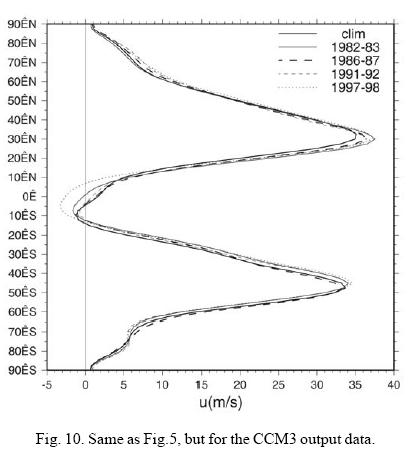
<body><![CDATA[<p align="justify"><font face="verdana" size="2">Ray tracing analyses showed that the phases of the quasi&#150;stationary waves are affected by the structure of the mean flow. A small error in the simulation of the zonal wind flow can modify the wave propagation trajectories from the heat source. The debate about external and internal atmospheric variability is not a closed subject. There is a clear difference between the wave trajectories from one El Ni&ntilde;o event to another. This result suggests that the generation of the zonal mean zonal wind variability induced by the tropical SST anomalies is more important than previously thought.</font></p>     <p align="justify"><font face="verdana" size="2">There are other aspects of the tropical forcing that deserve to be explored in order to examine the response of the subtropical atmosphere during ENSO years. Some baroclinic model experiments have shown the intensity of the vertical motion in the subtropics may be sensitivity to variations in the level of maximum heating in the equatorial central Pacific. Since the characteristics of the thermal forcing are largely in correspondence with the structure of the SST anomaly, one may expect that if SST anomalies are accurately given, our possibilities of getting accurate long term forecasts should substantially increase to the extent of predicting some basic features of regional climate. At present, this is not the case, and neither the intensity nor the spatial patterns of the SST anomalies are accurately predicted. Adjustments of rays for the Rossby waves emanating from the central Pacific in the CCM3 suggests that the Rossby wave forcing is not well simulated, which may lead to errors in the phase and intensity of the PNA pattern during weak El Ni&ntilde;o events.</font></p>     <p align="justify"><font face="verdana" size="2">General Circulation Models, such as the CCM3, are commonly used for seasonal climate predictions. The systematic errors in the models should be taken into account when the predictions are interpreted at a regional level. For instance, the structure of the subtropical mean zonal flow should be accurately reproduced by the model, otherwise it may lead to erroneous dispersion in quasi&#150;stationary waves over the Americas, and therefore to errors in the location of the precipitation anomalies. Seasonal forecasts have become an important element in the planning of socioeconomic activities such as, water management, agriculture or disaster prevention. The demand for more accurate regional climate forecasts is increasing. Our ability to deliver such products will largely depend on a better understanding of El Ni&ntilde;o impacts, and even more, on the inter&#150;ENSO variability.</font></p>     <p align="justify"><font face="verdana" size="2">&nbsp;</font></p>     <p align="justify"><font face="verdana" size="2"><b>Acknowledgments</b></font></p>     <p align="justify"><font face="verdana" size="2">Tercio Ambrizzi has been supported by CNPq (proc. 302459/2002&#150;2) and FAPESP. V&iacute;ctor Maga&ntilde;a was financially supported by PAPIIT&#150;UNAM and CONACyT projects. The joint work is the result of the Collaborative Research Network (IAI&#150;CRN73).</font></p>     <p align="justify"><font face="verdana" size="2">&nbsp;</font></p>     <p align="justify"><font face="verdana" size="2"><b>References</b></font></p>     <!-- ref --><p align="justify"><font face="verdana" size="2">Aceituno, P., 1988. On the functioning of the Southern Oscillation in the South American sector. Part l:   Surface climate. <i>Mon. Wea.Rev</i>. <b>116</b>, 505&#150;524.</font>&nbsp;&nbsp;&nbsp;&nbsp;&nbsp;&nbsp;&nbsp;&nbsp;[&#160;<a href="javascript:void(0);" onclick="javascript: window.open('/scielo.php?script=sci_nlinks&ref=1259434&pid=S0187-6236200500040000200001&lng=','','width=640,height=500,resizable=yes,scrollbars=1,menubar=yes,');">Links</a>&#160;]<!-- end-ref --><!-- ref --><p align="justify"><font face="verdana" size="2">Acker, T. L., L. E. Buja, J. M. Rosinski and J. E. Truesdale, 1996. User's Guide to NCAR CCM3. NCAR <i>Techinical Note</i>, NCAR/TN&#150;421+IA, 155 p.</font>&nbsp;&nbsp;&nbsp;&nbsp;&nbsp;&nbsp;&nbsp;&nbsp;[&#160;<a href="javascript:void(0);" onclick="javascript: window.open('/scielo.php?script=sci_nlinks&ref=1259435&pid=S0187-6236200500040000200002&lng=','','width=640,height=500,resizable=yes,scrollbars=1,menubar=yes,');">Links</a>&#160;]<!-- end-ref --><!-- ref --><p align="justify"><font face="verdana" size="2">Alves, J. M. B. and C. A. Repelli, 1992. Variabilidade pluviom&eacute;trica no setor norte do nordeste e os eventos El Ni&ntilde;o&#150;Oscila&ccedil;&atilde;o Sul. <i>Rev. Bras. Meteo</i>. <b>7</b>, 583&#150;592.</font>&nbsp;&nbsp;&nbsp;&nbsp;&nbsp;&nbsp;&nbsp;&nbsp;[&#160;<a href="javascript:void(0);" onclick="javascript: window.open('/scielo.php?script=sci_nlinks&ref=1259436&pid=S0187-6236200500040000200003&lng=','','width=640,height=500,resizable=yes,scrollbars=1,menubar=yes,');">Links</a>&#160;]<!-- end-ref --><!-- ref --><p align="justify"><font face="verdana" size="2">Ambrizzi, T., B. J. Hoskins and H.&#150;H. Hsu, 1995. Rossby wave propagation and teleconnection patterns in the austral winter. <i>J. Atmos. Sci.</i> <b>52</b>, 3661&#150;3672.</font>&nbsp;&nbsp;&nbsp;&nbsp;&nbsp;&nbsp;&nbsp;&nbsp;[&#160;<a href="javascript:void(0);" onclick="javascript: window.open('/scielo.php?script=sci_nlinks&ref=1259437&pid=S0187-6236200500040000200004&lng=','','width=640,height=500,resizable=yes,scrollbars=1,menubar=yes,');">Links</a>&#160;]<!-- end-ref --><!-- ref --><p align="justify"><font face="verdana" size="2">Ambrizzi, T., and B. J. Hoskins, 1997. Stationary Rossby wave propagation in a baroclinic atmosphere. Q. J. R. <i>Meteorol. Soc.</i> <b>123</b>, 919&#150;928.</font>&nbsp;&nbsp;&nbsp;&nbsp;&nbsp;&nbsp;&nbsp;&nbsp;[&#160;<a href="javascript:void(0);" onclick="javascript: window.open('/scielo.php?script=sci_nlinks&ref=1259438&pid=S0187-6236200500040000200005&lng=','','width=640,height=500,resizable=yes,scrollbars=1,menubar=yes,');">Links</a>&#160;]<!-- end-ref --><!-- ref --><p align="justify"><font face="verdana" size="2">Coelho C. A. S., C. B. Uvo and T. Ambrizzi, 2002. Exploring the impacts of the tropical Pacific SST on the precipitation patterns over South America during ENSO periods. <i>Theor. and Appl. Climat.</i> <b>71</b>, 185&#150;197.</font>&nbsp;&nbsp;&nbsp;&nbsp;&nbsp;&nbsp;&nbsp;&nbsp;[&#160;<a href="javascript:void(0);" onclick="javascript: window.open('/scielo.php?script=sci_nlinks&ref=1259439&pid=S0187-6236200500040000200006&lng=','','width=640,height=500,resizable=yes,scrollbars=1,menubar=yes,');">Links</a>&#160;]<!-- end-ref --><!-- ref --><p align="justify"><font face="verdana" size="2">DeWeaver, E. and S. Nigam, 2002. Linearity in ENSO's atmospheric response. <i>J. Climate</i> <b>15</b>, 2446&#150;2461.</font>&nbsp;&nbsp;&nbsp;&nbsp;&nbsp;&nbsp;&nbsp;&nbsp;[&#160;<a href="javascript:void(0);" onclick="javascript: window.open('/scielo.php?script=sci_nlinks&ref=1259440&pid=S0187-6236200500040000200007&lng=','','width=640,height=500,resizable=yes,scrollbars=1,menubar=yes,');">Links</a>&#160;]<!-- end-ref --><!-- ref --><p align="justify"><font face="verdana" size="2">Diaz, A. F., C. D. Studzinski and C. R. Mechoso, 1998. Relationship between precipitation anomalies in Uruguay and Southern Brazil and Sea Surface Temperature in the Pacific and Atlantic Oceans. <i>J. Climate</i> <b>11</b>, 251&#150;271.</font>&nbsp;&nbsp;&nbsp;&nbsp;&nbsp;&nbsp;&nbsp;&nbsp;[&#160;<a href="javascript:void(0);" onclick="javascript: window.open('/scielo.php?script=sci_nlinks&ref=1259441&pid=S0187-6236200500040000200008&lng=','','width=640,height=500,resizable=yes,scrollbars=1,menubar=yes,');">Links</a>&#160;]<!-- end-ref --><!-- ref --><p align="justify"><font face="verdana" size="2">Gand&uacute;, A. W. and P. L. Silva Dias, 1998. Imparct of tropical heat sources on the South American tropospheric upper circulation and subsidence. <i>J. Geoph. Res.</i> <b>103</b>, 6001&#150;6015.</font>&nbsp;&nbsp;&nbsp;&nbsp;&nbsp;&nbsp;&nbsp;&nbsp;[&#160;<a href="javascript:void(0);" onclick="javascript: window.open('/scielo.php?script=sci_nlinks&ref=1259442&pid=S0187-6236200500040000200009&lng=','','width=640,height=500,resizable=yes,scrollbars=1,menubar=yes,');">Links</a>&#160;]<!-- end-ref --><!-- ref --><p align="justify"><font face="verdana" size="2">Geisler, J. E., M. L. Blackmon, G. T. Bates and S. Munoz, 1985. Sensitivity of January climate response to the magnitude and position of equatorial Pacific sea surface temperature anomalies. <i>J. Atmos. Sci</i>. <b>42</b>, 1037&#150;1049.</font>&nbsp;&nbsp;&nbsp;&nbsp;&nbsp;&nbsp;&nbsp;&nbsp;[&#160;<a href="javascript:void(0);" onclick="javascript: window.open('/scielo.php?script=sci_nlinks&ref=1259443&pid=S0187-6236200500040000200010&lng=','','width=640,height=500,resizable=yes,scrollbars=1,menubar=yes,');">Links</a>&#160;]<!-- end-ref --><!-- ref --><p align="justify"><font face="verdana" size="2">Gill, A. E., 1980. Some simple solutions for heat&#150;induced tropical circulation. <i>Quart .J. R. Meteor. Soc</i>. <b>106</b>, 447&#150;462.</font>&nbsp;&nbsp;&nbsp;&nbsp;&nbsp;&nbsp;&nbsp;&nbsp;[&#160;<a href="javascript:void(0);" onclick="javascript: window.open('/scielo.php?script=sci_nlinks&ref=1259444&pid=S0187-6236200500040000200011&lng=','','width=640,height=500,resizable=yes,scrollbars=1,menubar=yes,');">Links</a>&#160;]<!-- end-ref --><!-- ref --><p align="justify"><font face="verdana" size="2">Grimm, A. M., S. E. T. Ferraz and Gomes, J., 1998. Precipitation anomalies in southern Brazil associated with El Ni&ntilde;o and La Ni&ntilde;a events. <i>J. Climate</i> <b>11</b>, 2863&#150;2880.</font>&nbsp;&nbsp;&nbsp;&nbsp;&nbsp;&nbsp;&nbsp;&nbsp;[&#160;<a href="javascript:void(0);" onclick="javascript: window.open('/scielo.php?script=sci_nlinks&ref=1259445&pid=S0187-6236200500040000200012&lng=','','width=640,height=500,resizable=yes,scrollbars=1,menubar=yes,');">Links</a>&#160;]<!-- end-ref --><!-- ref --><p align="justify"><font face="verdana" size="2">Held, I. M., M. Ting and H. Wang, 2002. Northern winter stationary waves: Theory and Modeling. <i>J.Climate</i> <b>15</b>, 2125&#150;2144.</font>&nbsp;&nbsp;&nbsp;&nbsp;&nbsp;&nbsp;&nbsp;&nbsp;[&#160;<a href="javascript:void(0);" onclick="javascript: window.open('/scielo.php?script=sci_nlinks&ref=1259446&pid=S0187-6236200500040000200013&lng=','','width=640,height=500,resizable=yes,scrollbars=1,menubar=yes,');">Links</a>&#160;]<!-- end-ref --><!-- ref --><p align="justify"><font face="verdana" size="2">Hoerling, M. P. and A. Kumar, 2002. Atmosphere response patterns associated with tropical forcing. <i>J. Climate</i> <b>15</b>, 2184&#150;2203.</font>&nbsp;&nbsp;&nbsp;&nbsp;&nbsp;&nbsp;&nbsp;&nbsp;[&#160;<a href="javascript:void(0);" onclick="javascript: window.open('/scielo.php?script=sci_nlinks&ref=1259447&pid=S0187-6236200500040000200014&lng=','','width=640,height=500,resizable=yes,scrollbars=1,menubar=yes,');">Links</a>&#160;]<!-- end-ref --><!-- ref --><p align="justify"><font face="verdana" size="2">Hoerling, M. P. and A. Kumar, 2000. Understanding and predicting extratropical teleconnections related to ENSO. <i>El Ni&ntilde;o and the Southern Oscillation: Multiscale variability and global and regional impacts</i>. Ed. Henry F. Diaz e Vera Markgraf, Cambridge Press, 57&#150;88.</font>&nbsp;&nbsp;&nbsp;&nbsp;&nbsp;&nbsp;&nbsp;&nbsp;[&#160;<a href="javascript:void(0);" onclick="javascript: window.open('/scielo.php?script=sci_nlinks&ref=1259448&pid=S0187-6236200500040000200015&lng=','','width=640,height=500,resizable=yes,scrollbars=1,menubar=yes,');">Links</a>&#160;]<!-- end-ref --><!-- ref --><p align="justify"><font face="verdana" size="2">Hoerling, M. P. and A. Kumar, 1997. Why do North American climate anomalies differ from one El Ni&ntilde;o event to another? <i>Geoph. Res. Letters</i> <b>24</b>, 1059&#150;1062.</font>&nbsp;&nbsp;&nbsp;&nbsp;&nbsp;&nbsp;&nbsp;&nbsp;[&#160;<a href="javascript:void(0);" onclick="javascript: window.open('/scielo.php?script=sci_nlinks&ref=1259449&pid=S0187-6236200500040000200016&lng=','','width=640,height=500,resizable=yes,scrollbars=1,menubar=yes,');">Links</a>&#160;]<!-- end-ref --><!-- ref --><p align="justify"><font face="verdana" size="2">Hoerling, M. P., A. Kumar and M. Zhong, 1997. El Ni&ntilde;o, La Ni&ntilde;a, and the nonlinearity of their teleconnections. <i>J. Climate</i> <b>10</b>, 1769&#150;1786.</font>&nbsp;&nbsp;&nbsp;&nbsp;&nbsp;&nbsp;&nbsp;&nbsp;[&#160;<a href="javascript:void(0);" onclick="javascript: window.open('/scielo.php?script=sci_nlinks&ref=1259450&pid=S0187-6236200500040000200017&lng=','','width=640,height=500,resizable=yes,scrollbars=1,menubar=yes,');">Links</a>&#160;]<!-- end-ref --><!-- ref --><p align="justify"><font face="verdana" size="2">Hoerling, M. P., M. Ting and A. Kumar, 1995. Zonal flow&#150;stationary wave relationship during El Ni&ntilde;o: Implications for seasonl forecasting. <i>J. Climate,</i> <b>8</b>, 1838&#150;1852.</font>&nbsp;&nbsp;&nbsp;&nbsp;&nbsp;&nbsp;&nbsp;&nbsp;[&#160;<a href="javascript:void(0);" onclick="javascript: window.open('/scielo.php?script=sci_nlinks&ref=1259451&pid=S0187-6236200500040000200018&lng=','','width=640,height=500,resizable=yes,scrollbars=1,menubar=yes,');">Links</a>&#160;]<!-- end-ref --><!-- ref --><p align="justify"><font face="verdana" size="2">Hoerling, M. P., M. L. Blackmon, and M. Ting, 1992. Simulating the atmospheric response to the 1985&#150;87 El Ni&ntilde;o Cycle. <i>J. Climate</i> <b>5</b>, 669&#150;681.</font>&nbsp;&nbsp;&nbsp;&nbsp;&nbsp;&nbsp;&nbsp;&nbsp;[&#160;<a href="javascript:void(0);" onclick="javascript: window.open('/scielo.php?script=sci_nlinks&ref=1259452&pid=S0187-6236200500040000200019&lng=','','width=640,height=500,resizable=yes,scrollbars=1,menubar=yes,');">Links</a>&#160;]<!-- end-ref --><!-- ref --><p align="justify"><font face="verdana" size="2">Holton, J. R., 1992. An introduction to Dynamic Meteorology. Academic Press, 3ed., 511 p.</font>&nbsp;&nbsp;&nbsp;&nbsp;&nbsp;&nbsp;&nbsp;&nbsp;[&#160;<a href="javascript:void(0);" onclick="javascript: window.open('/scielo.php?script=sci_nlinks&ref=1259453&pid=S0187-6236200500040000200020&lng=','','width=640,height=500,resizable=yes,scrollbars=1,menubar=yes,');">Links</a>&#160;]<!-- end-ref --><!-- ref --><p align="justify"><font face="verdana" size="2">Horel, J. D. and J. M. Wallace, 1981. Planetary scale atmospheric phenomena associated with the Southern Oscillation. <i>Mon. Wea. Rev</i>. <b>109</b>, 813&#150;829.</font>&nbsp;&nbsp;&nbsp;&nbsp;&nbsp;&nbsp;&nbsp;&nbsp;[&#160;<a href="javascript:void(0);" onclick="javascript: window.open('/scielo.php?script=sci_nlinks&ref=1259454&pid=S0187-6236200500040000200021&lng=','','width=640,height=500,resizable=yes,scrollbars=1,menubar=yes,');">Links</a>&#160;]<!-- end-ref --><!-- ref --><p align="justify"><font face="verdana" size="2">Hoskins, B. J. and D. Karoly, 1981. The steady linear response of a spherical atmosphere to thermal and orographic forcing. <i>J. Atmos. Sci.</i> <b>38</b>, 1179&#150;1196.</font>&nbsp;&nbsp;&nbsp;&nbsp;&nbsp;&nbsp;&nbsp;&nbsp;[&#160;<a href="javascript:void(0);" onclick="javascript: window.open('/scielo.php?script=sci_nlinks&ref=1259455&pid=S0187-6236200500040000200022&lng=','','width=640,height=500,resizable=yes,scrollbars=1,menubar=yes,');">Links</a>&#160;]<!-- end-ref --><!-- ref --><p align="justify"><font face="verdana" size="2">Hoskins, B.J. and A.J. Simmons, 1975. A multi&#150;layer spectral model and the semi&#150;implicit method. <i>Q. J .R. Meteorol. Soc.</i> <b>101</b>, 637&#150;655.</font>&nbsp;&nbsp;&nbsp;&nbsp;&nbsp;&nbsp;&nbsp;&nbsp;[&#160;<a href="javascript:void(0);" onclick="javascript: window.open('/scielo.php?script=sci_nlinks&ref=1259456&pid=S0187-6236200500040000200023&lng=','','width=640,height=500,resizable=yes,scrollbars=1,menubar=yes,');">Links</a>&#160;]<!-- end-ref --><!-- ref --><p align="justify"><font face="verdana" size="2">Hoskins, B.J., I. Draghici, and H.C. Davies, 1978. A new look at the ww&#150;equation. <i>Quart. J. R. Met. Soc</i>. <b>104</b>, 31&#150;38.</font>&nbsp;&nbsp;&nbsp;&nbsp;&nbsp;&nbsp;&nbsp;&nbsp;[&#160;<a href="javascript:void(0);" onclick="javascript: window.open('/scielo.php?script=sci_nlinks&ref=1259457&pid=S0187-6236200500040000200024&lng=','','width=640,height=500,resizable=yes,scrollbars=1,menubar=yes,');">Links</a>&#160;]<!-- end-ref --><!-- ref --><p align="justify"><font face="verdana" size="2">Hoskins, B. J., and T. Ambrizzi, 1993. Rossby wave propagation on a realistic longitudinally varying flow. <i>J. Atmos. Sci</i>. <b>50</b>, 1661&#150;1671.</font>&nbsp;&nbsp;&nbsp;&nbsp;&nbsp;&nbsp;&nbsp;&nbsp;[&#160;<a href="javascript:void(0);" onclick="javascript: window.open('/scielo.php?script=sci_nlinks&ref=1259458&pid=S0187-6236200500040000200025&lng=','','width=640,height=500,resizable=yes,scrollbars=1,menubar=yes,');">Links</a>&#160;]<!-- end-ref --><!-- ref --><p align="justify"><font face="verdana" size="2">Hsu, H. H. and S.&#150;H. Lin, 1992. Global teleconnections in the 250mb streamfunction field during the Northern Hemisphere winter. <i>Mon. Wea.Rev.</i> <b>120</b>, 1169&#150;1190.</font>&nbsp;&nbsp;&nbsp;&nbsp;&nbsp;&nbsp;&nbsp;&nbsp;[&#160;<a href="javascript:void(0);" onclick="javascript: window.open('/scielo.php?script=sci_nlinks&ref=1259459&pid=S0187-6236200500040000200026&lng=','','width=640,height=500,resizable=yes,scrollbars=1,menubar=yes,');">Links</a>&#160;]<!-- end-ref --><!-- ref --><p align="justify"><font face="verdana" size="2">Jin, F. F. and B. J. Hoskins, 1995. The direct response to tropical heating in a baroclinic atmosphere. <i>J.Atmos.Sci</i>. <b>52</b>, 307&#150;319.</font>&nbsp;&nbsp;&nbsp;&nbsp;&nbsp;&nbsp;&nbsp;&nbsp;[&#160;<a href="javascript:void(0);" onclick="javascript: window.open('/scielo.php?script=sci_nlinks&ref=1259460&pid=S0187-6236200500040000200027&lng=','','width=640,height=500,resizable=yes,scrollbars=1,menubar=yes,');">Links</a>&#160;]<!-- end-ref --><!-- ref --><p align="justify"><font face="verdana" size="2">Kalnay, E., M. Kanamitsu, R. Kistler, W. Collins, D. Deaven, L. Gandin, M. Iredell, S. Saha, G. White, J. Woollen, Y. Zhu, M. Chelliah, W. Ebisuzaki, W. Higgins, J. Janowiak, K.C. Mo, C. Ropelewski, J. Wang, A. Leetmaa, R. Reynolds, R. Jenne, and D. Joseph, 1996. The NCEP/ NCAR 40&#150;year Reanalysis Project. <i>Bull.Amer. Meteor. Soc.</i> <b>77</b>, 437&#150;471.</font>&nbsp;&nbsp;&nbsp;&nbsp;&nbsp;&nbsp;&nbsp;&nbsp;[&#160;<a href="javascript:void(0);" onclick="javascript: window.open('/scielo.php?script=sci_nlinks&ref=1259461&pid=S0187-6236200500040000200028&lng=','','width=640,height=500,resizable=yes,scrollbars=1,menubar=yes,');">Links</a>&#160;]<!-- end-ref --><!-- ref --><p align="justify"><font face="verdana" size="2">Kang, I. S. and N.&#150;C. Lau, 1986. Principal modes of atmospheric variability in model atmospheres with and without sea surface temperature forcing in the tropical Pacific. <i>J. Atmos. Sci.</i> <b>43</b>, 2719&#150;2735.</font>&nbsp;&nbsp;&nbsp;&nbsp;&nbsp;&nbsp;&nbsp;&nbsp;[&#160;<a href="javascript:void(0);" onclick="javascript: window.open('/scielo.php?script=sci_nlinks&ref=1259462&pid=S0187-6236200500040000200029&lng=','','width=640,height=500,resizable=yes,scrollbars=1,menubar=yes,');">Links</a>&#160;]<!-- end-ref --><!-- ref --><p align="justify"><font face="verdana" size="2">Karoly, D. J., 1983. Rossby wave propagation in a barotropic atmosphere. <i>Dyn. Atmos. Oceans</i>. <b>7</b>, 111&#150;125.</font>&nbsp;&nbsp;&nbsp;&nbsp;&nbsp;&nbsp;&nbsp;&nbsp;[&#160;<a href="javascript:void(0);" onclick="javascript: window.open('/scielo.php?script=sci_nlinks&ref=1259463&pid=S0187-6236200500040000200030&lng=','','width=640,height=500,resizable=yes,scrollbars=1,menubar=yes,');">Links</a>&#160;]<!-- end-ref --><!-- ref --><p align="justify"><font face="verdana" size="2">Kousky V. E., M. T. Kayano, and I. F. A Cavalcanti, 1984. A review of the Southern Oscillation: oceanic&#150;atmospheric circulation changes and related rainfall anomalies. <i>Tellus</i>, <b>36A</b>, 490&#150;504.</font>&nbsp;&nbsp;&nbsp;&nbsp;&nbsp;&nbsp;&nbsp;&nbsp;[&#160;<a href="javascript:void(0);" onclick="javascript: window.open('/scielo.php?script=sci_nlinks&ref=1259464&pid=S0187-6236200500040000200031&lng=','','width=640,height=500,resizable=yes,scrollbars=1,menubar=yes,');">Links</a>&#160;]<!-- end-ref --><!-- ref --><p align="justify"><font face="verdana" size="2">Kousky, V. E., and C. F. Ropelewski, 1989. Extremes in the Southern Oscillation and their relationship to precipitation anomalies with emphasis on the South American region. <i>Rev. Bras. Meteo</i>. <b>4</b>, 351&#150;363.</font>&nbsp;&nbsp;&nbsp;&nbsp;&nbsp;&nbsp;&nbsp;&nbsp;[&#160;<a href="javascript:void(0);" onclick="javascript: window.open('/scielo.php?script=sci_nlinks&ref=1259465&pid=S0187-6236200500040000200032&lng=','','width=640,height=500,resizable=yes,scrollbars=1,menubar=yes,');">Links</a>&#160;]<!-- end-ref --><!-- ref --><p align="justify"><font face="verdana" size="2">Kumar, A., and M. P. Hoerling, 1997. Interpretation and implications of the observed inter&#150;El Ni&ntilde;o variability. <i>J. Climate</i> <b>10</b>, 83&#150;91.</font>&nbsp;&nbsp;&nbsp;&nbsp;&nbsp;&nbsp;&nbsp;&nbsp;[&#160;<a href="javascript:void(0);" onclick="javascript: window.open('/scielo.php?script=sci_nlinks&ref=1259466&pid=S0187-6236200500040000200033&lng=','','width=640,height=500,resizable=yes,scrollbars=1,menubar=yes,');">Links</a>&#160;]<!-- end-ref --><!-- ref --><p align="justify"><font face="verdana" size="2">Kumar, A., and M. P. Hoerling, 1995. Prospects and limitations of seasonal atmospheric GCM predictions. <i>Bull. Amer. Meteor. Soc.</i> <b>76</b>, 335&#150;345.</font>&nbsp;&nbsp;&nbsp;&nbsp;&nbsp;&nbsp;&nbsp;&nbsp;[&#160;<a href="javascript:void(0);" onclick="javascript: window.open('/scielo.php?script=sci_nlinks&ref=1259467&pid=S0187-6236200500040000200034&lng=','','width=640,height=500,resizable=yes,scrollbars=1,menubar=yes,');">Links</a>&#160;]<!-- end-ref --><!-- ref --><p align="justify"><font face="verdana" size="2">Li, L., and T. R. Nathan, 1994. The global atmospheric response to low&#150;frequency tropical forcing: Zonally averaged basic states. <i>J. Atmos. Sci</i>. <b>51</b>, 3412&#150;3426.</font>&nbsp;&nbsp;&nbsp;&nbsp;&nbsp;&nbsp;&nbsp;&nbsp;[&#160;<a href="javascript:void(0);" onclick="javascript: window.open('/scielo.php?script=sci_nlinks&ref=1259468&pid=S0187-6236200500040000200035&lng=','','width=640,height=500,resizable=yes,scrollbars=1,menubar=yes,');">Links</a>&#160;]<!-- end-ref --><!-- ref --><p align="justify"><font face="verdana" size="2">Liebmann, B, 1987. Observed relationships between Large&#150;Scale tropical convection and the tropical circulation on subseasonal time scales during Northern Hemisphere Winter. <i>J. Atmos. Sci.</i> <b>44</b>, 2543&#150;2561.</font>&nbsp;&nbsp;&nbsp;&nbsp;&nbsp;&nbsp;&nbsp;&nbsp;[&#160;<a href="javascript:void(0);" onclick="javascript: window.open('/scielo.php?script=sci_nlinks&ref=1259469&pid=S0187-6236200500040000200036&lng=','','width=640,height=500,resizable=yes,scrollbars=1,menubar=yes,');">Links</a>&#160;]<!-- end-ref --><!-- ref --><p align="justify"><font face="verdana" size="2">Liebmann, B., and C. A. Smith, 1996. Description of a complete (interpolated) outgoing longwave radiation data set. <i>Bull. Amer. Meteor. Soc.</i> <b>77</b>, 1275&#150;1277.</font>&nbsp;&nbsp;&nbsp;&nbsp;&nbsp;&nbsp;&nbsp;&nbsp;[&#160;<a href="javascript:void(0);" onclick="javascript: window.open('/scielo.php?script=sci_nlinks&ref=1259470&pid=S0187-6236200500040000200037&lng=','','width=640,height=500,resizable=yes,scrollbars=1,menubar=yes,');">Links</a>&#160;]<!-- end-ref --><!-- ref --><p align="justify"><font face="verdana" size="2">Maga&ntilde;a, V., and A. I. Quintanar, 1997. On the use of General Circulation Models to study regional climate. <i>Proceedings of the Second UNAM&#150;CRAY Supercomputing Conference</i>, 39&#150;48, Cambridge University Press.</font>&nbsp;&nbsp;&nbsp;&nbsp;&nbsp;&nbsp;&nbsp;&nbsp;[&#160;<a href="javascript:void(0);" onclick="javascript: window.open('/scielo.php?script=sci_nlinks&ref=1259471&pid=S0187-6236200500040000200038&lng=','','width=640,height=500,resizable=yes,scrollbars=1,menubar=yes,');">Links</a>&#160;]<!-- end-ref --><!-- ref --><p align="justify"><font face="verdana" size="2">Maga&ntilde;a, V. and C. Conde, 2003. Climate variability and climate change and their impacts on the freshwater resources in the border region: A case study for Sonora, Mexico. <i>Climate and water&#150;transboundary challenges in the Americas</i>, Henry F. Diaz and Barbara S. Morehouse Editors, 373&#150;393.</font>&nbsp;&nbsp;&nbsp;&nbsp;&nbsp;&nbsp;&nbsp;&nbsp;[&#160;<a href="javascript:void(0);" onclick="javascript: window.open('/scielo.php?script=sci_nlinks&ref=1259472&pid=S0187-6236200500040000200039&lng=','','width=640,height=500,resizable=yes,scrollbars=1,menubar=yes,');">Links</a>&#160;]<!-- end-ref --><!-- ref --><p align="justify"><font face="verdana" size="2">Mechoso, C. R., A. Kitoh, S. Moorthi and A. Arakawa, 1987. Numerical simulations of the atmospheric response to a sea surface temperature anomaly over the equatorial eastern Pacific Ocean. <i>Mon. Wea. Rev</i>. <b>115</b>, 2936&#150;2956.</font>&nbsp;&nbsp;&nbsp;&nbsp;&nbsp;&nbsp;&nbsp;&nbsp;[&#160;<a href="javascript:void(0);" onclick="javascript: window.open('/scielo.php?script=sci_nlinks&ref=1259473&pid=S0187-6236200500040000200040&lng=','','width=640,height=500,resizable=yes,scrollbars=1,menubar=yes,');">Links</a>&#160;]<!-- end-ref --><!-- ref --><p align="justify"><font face="verdana" size="2">Mo, K. C., 2000. Relationship between low&#150;frequency variability in the Southern Hemisphere and sea surface temperature anomalies. <i>J. Climate</i> <b>13</b>, 3599&#150;3610.</font>&nbsp;&nbsp;&nbsp;&nbsp;&nbsp;&nbsp;&nbsp;&nbsp;[&#160;<a href="javascript:void(0);" onclick="javascript: window.open('/scielo.php?script=sci_nlinks&ref=1259474&pid=S0187-6236200500040000200041&lng=','','width=640,height=500,resizable=yes,scrollbars=1,menubar=yes,');">Links</a>&#160;]<!-- end-ref --><!-- ref --><p align="justify"><font face="verdana" size="2">Nigam, S., C. Chung, and E. DeWeaver, 2000. ENSO diabatic heating in ECMWF and NCEP&#150;NCAR reanalyses, and NCAR CCM3 simulation.<i> J. Climate</i> <b>13</b>, 3152&#150;3171.</font>&nbsp;&nbsp;&nbsp;&nbsp;&nbsp;&nbsp;&nbsp;&nbsp;[&#160;<a href="javascript:void(0);" onclick="javascript: window.open('/scielo.php?script=sci_nlinks&ref=1259475&pid=S0187-6236200500040000200042&lng=','','width=640,height=500,resizable=yes,scrollbars=1,menubar=yes,');">Links</a>&#160;]<!-- end-ref --><!-- ref --><p align="justify"><font face="verdana" size="2">Pisciottano, G., A. D&iacute;az, G. Cazes, and C. R. Mechoso, 1994. El Ni&ntilde;o&#150;Southern Oscillation impact on rainfall in Uruguay. <i>J. Climat</i>e <b>7</b>, 1286&#150;1302.</font>&nbsp;&nbsp;&nbsp;&nbsp;&nbsp;&nbsp;&nbsp;&nbsp;[&#160;<a href="javascript:void(0);" onclick="javascript: window.open('/scielo.php?script=sci_nlinks&ref=1259476&pid=S0187-6236200500040000200043&lng=','','width=640,height=500,resizable=yes,scrollbars=1,menubar=yes,');">Links</a>&#160;]<!-- end-ref --><!-- ref --><p align="justify"><font face="verdana" size="2">Rao, V. B. and K. Hada, 1990. Characteristics of rainfall over Brazil: Annual variations and connections with the Southern Oscillation. <i>Theor. and App.Climat.</i> <b>42</b>, 81&#150;91.</font>&nbsp;&nbsp;&nbsp;&nbsp;&nbsp;&nbsp;&nbsp;&nbsp;[&#160;<a href="javascript:void(0);" onclick="javascript: window.open('/scielo.php?script=sci_nlinks&ref=1259477&pid=S0187-6236200500040000200044&lng=','','width=640,height=500,resizable=yes,scrollbars=1,menubar=yes,');">Links</a>&#160;]<!-- end-ref --><!-- ref --><p align="justify"><font face="verdana" size="2">Reynolds, R. W., and M. S. Smith, 1994. Improved global sea surface temperature analysis using optimum interpolation. <i>J. Climate 7</i>, <b>929</b>&#150;948.</font>&nbsp;&nbsp;&nbsp;&nbsp;&nbsp;&nbsp;&nbsp;&nbsp;[&#160;<a href="javascript:void(0);" onclick="javascript: window.open('/scielo.php?script=sci_nlinks&ref=1259478&pid=S0187-6236200500040000200045&lng=','','width=640,height=500,resizable=yes,scrollbars=1,menubar=yes,');">Links</a>&#160;]<!-- end-ref --><!-- ref --><p align="justify"><font face="verdana" size="2">Ropelewski, C. F., and M. S. Halpert, 1987. Global and regional scale precipitation patterns associated with the El Ni&ntilde;o/Southern Oscillation. <i>Mon. Wea. Rev.</i>, <b>115</b>, 1606&#150;1626.</font>&nbsp;&nbsp;&nbsp;&nbsp;&nbsp;&nbsp;&nbsp;&nbsp;[&#160;<a href="javascript:void(0);" onclick="javascript: window.open('/scielo.php?script=sci_nlinks&ref=1259479&pid=S0187-6236200500040000200046&lng=','','width=640,height=500,resizable=yes,scrollbars=1,menubar=yes,');">Links</a>&#160;]<!-- end-ref --><!-- ref --><p align="justify"><font face="verdana" size="2">Ting, M., and P. D. Sardeshmukh, 1993. Factor determining the extratropical response to equatorial diabatic heating anomalies. <i>J. Atmos. Sci</i>. <b>50</b>, 907&#150;918.</font>&nbsp;&nbsp;&nbsp;&nbsp;&nbsp;&nbsp;&nbsp;&nbsp;[&#160;<a href="javascript:void(0);" onclick="javascript: window.open('/scielo.php?script=sci_nlinks&ref=1259480&pid=S0187-6236200500040000200047&lng=','','width=640,height=500,resizable=yes,scrollbars=1,menubar=yes,');">Links</a>&#160;]<!-- end-ref --><!-- ref --><p align="justify"><font face="verdana" size="2">Ting, M., and M. P. Hoerling, 1993. The dynamics of stationary wave anomalies during the 1986/87 <i>El Ni&ntilde;o. Climate. Dyn.</i> <b>9</b>, 147&#150;164.</font>&nbsp;&nbsp;&nbsp;&nbsp;&nbsp;&nbsp;&nbsp;&nbsp;[&#160;<a href="javascript:void(0);" onclick="javascript: window.open('/scielo.php?script=sci_nlinks&ref=1259481&pid=S0187-6236200500040000200048&lng=','','width=640,height=500,resizable=yes,scrollbars=1,menubar=yes,');">Links</a>&#160;]<!-- end-ref --><!-- ref --><p align="justify"><font face="verdana" size="2">Ting, M., M. P. Hoerling, T. Xu, and A. Kumar, 1996. Northern Hemisphere teleconnection patterns during extreme phases of the zonal&#150;mean circulation. <i>J. Climate</i> <b>9</b>, 2614&#150;2632.</font>&nbsp;&nbsp;&nbsp;&nbsp;&nbsp;&nbsp;&nbsp;&nbsp;[&#160;<a href="javascript:void(0);" onclick="javascript: window.open('/scielo.php?script=sci_nlinks&ref=1259482&pid=S0187-6236200500040000200049&lng=','','width=640,height=500,resizable=yes,scrollbars=1,menubar=yes,');">Links</a>&#160;]<!-- end-ref --><!-- ref --><p align="justify"><font face="verdana" size="2">Ting, M., and L. Yu, 1998. Steady response to tropical heating in wavy linear and nonlinear baroclinic models. <i>J. Atmos. Sci.</i> <b>55</b>, 3565&#150;3582.</font>&nbsp;&nbsp;&nbsp;&nbsp;&nbsp;&nbsp;&nbsp;&nbsp;[&#160;<a href="javascript:void(0);" onclick="javascript: window.open('/scielo.php?script=sci_nlinks&ref=1259483&pid=S0187-6236200500040000200050&lng=','','width=640,height=500,resizable=yes,scrollbars=1,menubar=yes,');">Links</a>&#160;]<!-- end-ref --><!-- ref --><p align="justify"><font face="verdana" size="2">Trenberth, K. E., 1998. Development and forecasts of the 1997/98 El Ni&ntilde;o: CLIVAR Scientific Issues. <i>CLIVAR&#150;Exchanges</i> <b>3</b>, No. 2/3, 4&#150;14.</font>&nbsp;&nbsp;&nbsp;&nbsp;&nbsp;&nbsp;&nbsp;&nbsp;[&#160;<a href="javascript:void(0);" onclick="javascript: window.open('/scielo.php?script=sci_nlinks&ref=1259484&pid=S0187-6236200500040000200051&lng=','','width=640,height=500,resizable=yes,scrollbars=1,menubar=yes,');">Links</a>&#160;]<!-- end-ref --><!-- ref --><p align="justify"><font face="verdana" size="2">Xie, P., and P. A. Arkin, 1996. Analysis of global monthly precipitation using gauge observations, satellite estimates and numerical model predictions.<i> J. Climate</i> <b>9</b>, 840&#150;858.</font>&nbsp;&nbsp;&nbsp;&nbsp;&nbsp;&nbsp;&nbsp;&nbsp;[&#160;<a href="javascript:void(0);" onclick="javascript: window.open('/scielo.php?script=sci_nlinks&ref=1259485&pid=S0187-6236200500040000200052&lng=','','width=640,height=500,resizable=yes,scrollbars=1,menubar=yes,');">Links</a>&#160;]<!-- end-ref --><!-- ref --><p align="justify"><font face="verdana" size="2">Yang, G. Y., and B. J. Hoskins, 1996. Propagation of Rossby waves of nonzero frequency. <i>J.Atmos.Sci</i>. <b>53</b>, 2365&#150;2378.</font>&nbsp;&nbsp;&nbsp;&nbsp;&nbsp;&nbsp;&nbsp;&nbsp;[&#160;<a href="javascript:void(0);" onclick="javascript: window.open('/scielo.php?script=sci_nlinks&ref=1259486&pid=S0187-6236200500040000200053&lng=','','width=640,height=500,resizable=yes,scrollbars=1,menubar=yes,');">Links</a>&#160;]<!-- end-ref --><!-- ref --><p align="justify"><font face="verdana" size="2">Webster, P. J., 1994. The role of hydrological processes in the atmosphere. <i>Rev. Geophys.</i> <b>32</b>, 427&#150;476.</font>&nbsp;&nbsp;&nbsp;&nbsp;&nbsp;&nbsp;&nbsp;&nbsp;[&#160;<a href="javascript:void(0);" onclick="javascript: window.open('/scielo.php?script=sci_nlinks&ref=1259487&pid=S0187-6236200500040000200054&lng=','','width=640,height=500,resizable=yes,scrollbars=1,menubar=yes,');">Links</a>&#160;]<!-- end-ref --> ]]></body><back>
<ref-list>
<ref id="B1">
<nlm-citation citation-type="journal">
<person-group person-group-type="author">
<name>
<surname><![CDATA[Aceituno]]></surname>
<given-names><![CDATA[P.]]></given-names>
</name>
</person-group>
<article-title xml:lang="en"><![CDATA[On the functioning of the Southern Oscillation in the South American sector: Part l: Surface climate]]></article-title>
<source><![CDATA[Mon. Wea.Rev.]]></source>
<year>1988</year>
<numero>116</numero>
<issue>116</issue>
<page-range>505-524</page-range></nlm-citation>
</ref>
<ref id="B2">
<nlm-citation citation-type="">
<person-group person-group-type="author">
<name>
<surname><![CDATA[Acker]]></surname>
<given-names><![CDATA[T. L.]]></given-names>
</name>
<name>
<surname><![CDATA[Buja]]></surname>
<given-names><![CDATA[L. E.]]></given-names>
</name>
<name>
<surname><![CDATA[Rosinski]]></surname>
<given-names><![CDATA[J. M.]]></given-names>
</name>
<name>
<surname><![CDATA[Truesdale]]></surname>
<given-names><![CDATA[J. E.]]></given-names>
</name>
</person-group>
<source><![CDATA[User's Guide to NCAR CCM3]]></source>
<year>1996</year>
<page-range>155</page-range></nlm-citation>
</ref>
<ref id="B3">
<nlm-citation citation-type="journal">
<person-group person-group-type="author">
<name>
<surname><![CDATA[Alves, J.]]></surname>
<given-names><![CDATA[M. B.]]></given-names>
</name>
<name>
<surname><![CDATA[Repelli]]></surname>
<given-names><![CDATA[C. A.]]></given-names>
</name>
</person-group>
<article-title xml:lang="pt"><![CDATA[Variabilidade pluviométrica no setor norte do nordeste e os eventos El Niño-Oscilação Sul]]></article-title>
<source><![CDATA[Rev. Bras. Meteo.]]></source>
<year>1992</year>
<numero>7</numero>
<issue>7</issue>
<page-range>583-592</page-range></nlm-citation>
</ref>
<ref id="B4">
<nlm-citation citation-type="journal">
<person-group person-group-type="author">
<name>
<surname><![CDATA[Ambrizzi]]></surname>
<given-names><![CDATA[T.]]></given-names>
</name>
<name>
<surname><![CDATA[Hoskins]]></surname>
<given-names><![CDATA[B. J.]]></given-names>
</name>
<name>
<surname><![CDATA[Hsu]]></surname>
<given-names><![CDATA[H.-H.]]></given-names>
</name>
</person-group>
<article-title xml:lang="en"><![CDATA[Rossby wave propagation and teleconnection patterns in the austral winter]]></article-title>
<source><![CDATA[J. Atmos. Sci.]]></source>
<year>1995</year>
<numero>52</numero>
<issue>52</issue>
<page-range>3661-3672</page-range></nlm-citation>
</ref>
<ref id="B5">
<nlm-citation citation-type="journal">
<person-group person-group-type="author">
<name>
<surname><![CDATA[Ambrizzi]]></surname>
<given-names><![CDATA[T.]]></given-names>
</name>
<name>
<surname><![CDATA[Hoskins]]></surname>
<given-names><![CDATA[B. J.]]></given-names>
</name>
</person-group>
<article-title xml:lang="en"><![CDATA[Stationary Rossby wave propagation in a baroclinic atmosphere]]></article-title>
<source><![CDATA[Q. J. R. Meteorol. Soc.]]></source>
<year>1997</year>
<numero>123</numero>
<issue>123</issue>
<page-range>919-928</page-range></nlm-citation>
</ref>
<ref id="B6">
<nlm-citation citation-type="journal">
<person-group person-group-type="author">
<name>
<surname><![CDATA[Coelho C.]]></surname>
<given-names><![CDATA[A. S.]]></given-names>
</name>
<name>
<surname><![CDATA[Uvo]]></surname>
<given-names><![CDATA[C. B.]]></given-names>
</name>
<name>
<surname><![CDATA[Ambrizzi]]></surname>
<given-names><![CDATA[T.]]></given-names>
</name>
</person-group>
<article-title xml:lang="en"><![CDATA[Exploring the impacts of the tropical Pacific SST on the precipitation patterns over South America during ENSO periods]]></article-title>
<source><![CDATA[Theor. and Appl. Climat.]]></source>
<year>2002</year>
<numero>71</numero>
<issue>71</issue>
<page-range>185-197</page-range></nlm-citation>
</ref>
<ref id="B7">
<nlm-citation citation-type="journal">
<person-group person-group-type="author">
<name>
<surname><![CDATA[DeWeaver]]></surname>
<given-names><![CDATA[E.]]></given-names>
</name>
<name>
<surname><![CDATA[Nigam]]></surname>
<given-names><![CDATA[S.]]></given-names>
</name>
</person-group>
<article-title xml:lang="en"><![CDATA[Linearity in ENSO's atmospheric response]]></article-title>
<source><![CDATA[J. Climate]]></source>
<year>2002</year>
<numero>15</numero>
<issue>15</issue>
<page-range>2446-2461</page-range></nlm-citation>
</ref>
<ref id="B8">
<nlm-citation citation-type="journal">
<person-group person-group-type="author">
<name>
<surname><![CDATA[Diaz]]></surname>
<given-names><![CDATA[A. F.]]></given-names>
</name>
<name>
<surname><![CDATA[Studzinski]]></surname>
<given-names><![CDATA[C. D.]]></given-names>
</name>
<name>
<surname><![CDATA[Mechoso]]></surname>
<given-names><![CDATA[C. R.]]></given-names>
</name>
</person-group>
<article-title xml:lang="en"><![CDATA[Relationship between precipitation anomalies in Uruguay and Southern Brazil and Sea Surface Temperature in the Pacific and Atlantic Oceans]]></article-title>
<source><![CDATA[J. Climate]]></source>
<year>1998</year>
<numero>11</numero>
<issue>11</issue>
<page-range>251-271</page-range></nlm-citation>
</ref>
<ref id="B9">
<nlm-citation citation-type="journal">
<person-group person-group-type="author">
<name>
<surname><![CDATA[Gandú]]></surname>
<given-names><![CDATA[A. W.]]></given-names>
</name>
<name>
<surname><![CDATA[Silva Dias]]></surname>
<given-names><![CDATA[P. L.]]></given-names>
</name>
</person-group>
<article-title xml:lang="en"><![CDATA[Imparct of tropical heat sources on the South American tropospheric upper circulation and subsidence]]></article-title>
<source><![CDATA[J. Geoph. Res.]]></source>
<year>1998</year>
<numero>103</numero>
<issue>103</issue>
<page-range>6001-6015</page-range></nlm-citation>
</ref>
<ref id="B10">
<nlm-citation citation-type="journal">
<person-group person-group-type="author">
<name>
<surname><![CDATA[Geisler]]></surname>
<given-names><![CDATA[J. E.]]></given-names>
</name>
<name>
<surname><![CDATA[Blackmon]]></surname>
<given-names><![CDATA[M. L.]]></given-names>
</name>
<name>
<surname><![CDATA[Bates]]></surname>
<given-names><![CDATA[G. T.]]></given-names>
</name>
<name>
<surname><![CDATA[Munoz]]></surname>
<given-names><![CDATA[S.]]></given-names>
</name>
</person-group>
<article-title xml:lang="en"><![CDATA[Sensitivity of January climate response to the magnitude and position of equatorial Pacific sea surface temperature anomalies]]></article-title>
<source><![CDATA[J. Atmos. Sci.]]></source>
<year>1985</year>
<numero>42</numero>
<issue>42</issue>
<page-range>1037-1049</page-range></nlm-citation>
</ref>
<ref id="B11">
<nlm-citation citation-type="journal">
<person-group person-group-type="author">
<name>
<surname><![CDATA[Gill]]></surname>
<given-names><![CDATA[A. E.]]></given-names>
</name>
</person-group>
<article-title xml:lang="en"><![CDATA[Some simple solutions for heat-induced tropical circulation]]></article-title>
<source><![CDATA[Quart .J. R. Meteor. Soc.]]></source>
<year>1980</year>
<numero>106</numero>
<issue>106</issue>
<page-range>447-462</page-range></nlm-citation>
</ref>
<ref id="B12">
<nlm-citation citation-type="journal">
<person-group person-group-type="author">
<name>
<surname><![CDATA[Grimm]]></surname>
<given-names><![CDATA[A. M.]]></given-names>
</name>
<name>
<surname><![CDATA[T. Ferraz]]></surname>
<given-names><![CDATA[S. E.]]></given-names>
</name>
<name>
<surname><![CDATA[Gomes]]></surname>
<given-names><![CDATA[J.]]></given-names>
</name>
</person-group>
<article-title xml:lang="en"><![CDATA[Precipitation anomalies in southern Brazil associated with El Niño and La Niña events]]></article-title>
<source><![CDATA[J. Climate]]></source>
<year>1998</year>
<numero>11</numero>
<issue>11</issue>
<page-range>2863-2880</page-range></nlm-citation>
</ref>
<ref id="B13">
<nlm-citation citation-type="journal">
<person-group person-group-type="author">
<name>
<surname><![CDATA[Held]]></surname>
<given-names><![CDATA[I. M.]]></given-names>
</name>
<name>
<surname><![CDATA[Ting]]></surname>
<given-names><![CDATA[M.]]></given-names>
</name>
<name>
<surname><![CDATA[Wang]]></surname>
<given-names><![CDATA[H.]]></given-names>
</name>
</person-group>
<article-title xml:lang="en"><![CDATA[Northern winter stationary waves: Theory and Modeling]]></article-title>
<source><![CDATA[J.Climate]]></source>
<year>2002</year>
<numero>15</numero>
<issue>15</issue>
<page-range>2125-2144</page-range></nlm-citation>
</ref>
<ref id="B14">
<nlm-citation citation-type="journal">
<person-group person-group-type="author">
<name>
<surname><![CDATA[Hoerling]]></surname>
<given-names><![CDATA[M. P.]]></given-names>
</name>
<name>
<surname><![CDATA[Kumar]]></surname>
<given-names><![CDATA[A.]]></given-names>
</name>
</person-group>
<article-title xml:lang="en"><![CDATA[Atmosphere response patterns associated with tropical forcing]]></article-title>
<source><![CDATA[J. Climate]]></source>
<year>2002</year>
<numero>15</numero>
<issue>15</issue>
<page-range>2184-2203</page-range></nlm-citation>
</ref>
<ref id="B15">
<nlm-citation citation-type="book">
<person-group person-group-type="author">
<name>
<surname><![CDATA[Hoerling]]></surname>
<given-names><![CDATA[M. P.]]></given-names>
</name>
<name>
<surname><![CDATA[Kumar]]></surname>
<given-names><![CDATA[A.]]></given-names>
</name>
<name>
<surname><![CDATA[Diaz]]></surname>
<given-names><![CDATA[Henry F.]]></given-names>
</name>
<name>
<surname><![CDATA[Vera]]></surname>
<given-names><![CDATA[Markgraf]]></given-names>
</name>
</person-group>
<source><![CDATA[Understanding and predicting extratropical teleconnections related to ENSO: El Niño and the Southern Oscillation: Multiscale variability and global and regional impacts]]></source>
<year>2000</year>
<page-range>57-88</page-range><publisher-name><![CDATA[Cambridge Press]]></publisher-name>
</nlm-citation>
</ref>
<ref id="B16">
<nlm-citation citation-type="journal">
<person-group person-group-type="author">
<name>
<surname><![CDATA[Hoerling]]></surname>
<given-names><![CDATA[M. P.]]></given-names>
</name>
<name>
<surname><![CDATA[Kumar]]></surname>
<given-names><![CDATA[A.]]></given-names>
</name>
</person-group>
<article-title xml:lang="en"><![CDATA[Why do North American climate anomalies differ from one El Niño event to another?]]></article-title>
<source><![CDATA[Geoph. Res. Letters]]></source>
<year>1997</year>
<numero>24</numero>
<issue>24</issue>
<page-range>1059-1062</page-range></nlm-citation>
</ref>
<ref id="B17">
<nlm-citation citation-type="journal">
<person-group person-group-type="author">
<name>
<surname><![CDATA[Hoerling]]></surname>
<given-names><![CDATA[M. P.]]></given-names>
</name>
<name>
<surname><![CDATA[Kumar]]></surname>
<given-names><![CDATA[A.]]></given-names>
</name>
<name>
<surname><![CDATA[Zhong]]></surname>
<given-names><![CDATA[M.]]></given-names>
</name>
</person-group>
<article-title xml:lang="en"><![CDATA[El Niño, La Niña, and the nonlinearity of their teleconnections]]></article-title>
<source><![CDATA[J. Climate]]></source>
<year>1997</year>
<numero>10</numero>
<issue>10</issue>
<page-range>1769-1786</page-range></nlm-citation>
</ref>
<ref id="B18">
<nlm-citation citation-type="journal">
<person-group person-group-type="author">
<name>
<surname><![CDATA[Hoerling]]></surname>
<given-names><![CDATA[M. P.]]></given-names>
</name>
<name>
<surname><![CDATA[Ting]]></surname>
<given-names><![CDATA[M.]]></given-names>
</name>
<name>
<surname><![CDATA[Kumar]]></surname>
<given-names><![CDATA[A.]]></given-names>
</name>
</person-group>
<article-title xml:lang="en"><![CDATA[Zonal flow-stationary wave relationship during El Niño: Implications for seasonl forecasting]]></article-title>
<source><![CDATA[J. Climate]]></source>
<year>1995</year>
<numero>8</numero>
<issue>8</issue>
<page-range>1838-1852</page-range></nlm-citation>
</ref>
<ref id="B19">
<nlm-citation citation-type="journal">
<person-group person-group-type="author">
<name>
<surname><![CDATA[Hoerling]]></surname>
<given-names><![CDATA[M. P.]]></given-names>
</name>
<name>
<surname><![CDATA[Blackmon]]></surname>
<given-names><![CDATA[M. L.]]></given-names>
</name>
<name>
<surname><![CDATA[Ting]]></surname>
<given-names><![CDATA[M.]]></given-names>
</name>
</person-group>
<article-title xml:lang="en"><![CDATA[Simulating the atmospheric response to the 1985-87 El Niño Cycle]]></article-title>
<source><![CDATA[J. Climate]]></source>
<year>1992</year>
<numero>5</numero>
<issue>5</issue>
<page-range>669-681</page-range></nlm-citation>
</ref>
<ref id="B20">
<nlm-citation citation-type="book">
<person-group person-group-type="author">
<name>
<surname><![CDATA[Holton]]></surname>
<given-names><![CDATA[J. R.]]></given-names>
</name>
</person-group>
<source><![CDATA[An introduction to Dynamic Meteorology]]></source>
<year>1992</year>
<edition>3</edition>
<page-range>511</page-range><publisher-name><![CDATA[Academic Press]]></publisher-name>
</nlm-citation>
</ref>
<ref id="B21">
<nlm-citation citation-type="journal">
<person-group person-group-type="author">
<name>
<surname><![CDATA[Horel]]></surname>
<given-names><![CDATA[J. D.]]></given-names>
</name>
<name>
<surname><![CDATA[Wallace]]></surname>
<given-names><![CDATA[J. M.]]></given-names>
</name>
</person-group>
<article-title xml:lang="en"><![CDATA[Planetary scale atmospheric phenomena associated with the Southern Oscillation]]></article-title>
<source><![CDATA[Mon. Wea. Rev.]]></source>
<year>1981</year>
<numero>109</numero>
<issue>109</issue>
<page-range>813-829</page-range></nlm-citation>
</ref>
<ref id="B22">
<nlm-citation citation-type="journal">
<person-group person-group-type="author">
<name>
<surname><![CDATA[Hoskins]]></surname>
<given-names><![CDATA[B. J.]]></given-names>
</name>
<name>
<surname><![CDATA[Karoly]]></surname>
<given-names><![CDATA[D.]]></given-names>
</name>
</person-group>
<article-title xml:lang="en"><![CDATA[The steady linear response of a spherical atmosphere to thermal and orographic forcing]]></article-title>
<source><![CDATA[J. Atmos. Sci.]]></source>
<year>1981</year>
<numero>38</numero>
<issue>38</issue>
<page-range>1179-1196</page-range></nlm-citation>
</ref>
<ref id="B23">
<nlm-citation citation-type="journal">
<person-group person-group-type="author">
<name>
<surname><![CDATA[Hoskins]]></surname>
<given-names><![CDATA[B.J.]]></given-names>
</name>
<name>
<surname><![CDATA[Simmons]]></surname>
<given-names><![CDATA[A.J.]]></given-names>
</name>
</person-group>
<article-title xml:lang="en"><![CDATA[A multi-layer spectral model and the semi-implicit method]]></article-title>
<source><![CDATA[Q. J .R. Meteorol. Soc.]]></source>
<year>1975</year>
<numero>101</numero>
<issue>101</issue>
<page-range>637-655</page-range></nlm-citation>
</ref>
<ref id="B24">
<nlm-citation citation-type="journal">
<person-group person-group-type="author">
<name>
<surname><![CDATA[Hoskins]]></surname>
<given-names><![CDATA[B.J.]]></given-names>
</name>
<name>
<surname><![CDATA[Draghici]]></surname>
<given-names><![CDATA[I.]]></given-names>
</name>
<name>
<surname><![CDATA[Davies]]></surname>
<given-names><![CDATA[H.C.]]></given-names>
</name>
</person-group>
<article-title xml:lang="en"><![CDATA[A new look at the ww-equation]]></article-title>
<source><![CDATA[Quart. J. R. Met. Soc.]]></source>
<year>1978</year>
<numero>104</numero>
<issue>104</issue>
<page-range>31-38</page-range></nlm-citation>
</ref>
<ref id="B25">
<nlm-citation citation-type="journal">
<person-group person-group-type="author">
<name>
<surname><![CDATA[Hoskins]]></surname>
<given-names><![CDATA[B. J.]]></given-names>
</name>
<name>
<surname><![CDATA[Ambrizzi]]></surname>
<given-names><![CDATA[T.]]></given-names>
</name>
</person-group>
<article-title xml:lang="en"><![CDATA[Rossby wave propagation on a realistic longitudinally varying flow]]></article-title>
<source><![CDATA[J. Atmos. Sci.]]></source>
<year>1993</year>
<numero>50</numero>
<issue>50</issue>
<page-range>1661-1671</page-range></nlm-citation>
</ref>
<ref id="B26">
<nlm-citation citation-type="journal">
<person-group person-group-type="author">
<name>
<surname><![CDATA[Hsu]]></surname>
<given-names><![CDATA[H. H.]]></given-names>
</name>
<name>
<surname><![CDATA[Lin]]></surname>
<given-names><![CDATA[S.-H.]]></given-names>
</name>
</person-group>
<article-title xml:lang="en"><![CDATA[Global teleconnections in the 250mb streamfunction field during the Northern Hemisphere winter]]></article-title>
<source><![CDATA[Mon. Wea.Rev.]]></source>
<year>1992</year>
<numero>120</numero>
<issue>120</issue>
<page-range>1169-1190</page-range></nlm-citation>
</ref>
<ref id="B27">
<nlm-citation citation-type="journal">
<person-group person-group-type="author">
<name>
<surname><![CDATA[Jin]]></surname>
<given-names><![CDATA[F. F.]]></given-names>
</name>
<name>
<surname><![CDATA[Hoskins]]></surname>
<given-names><![CDATA[B. J.]]></given-names>
</name>
</person-group>
<article-title xml:lang="en"><![CDATA[The direct response to tropical heating in a baroclinic atmosphere]]></article-title>
<source><![CDATA[J.Atmos.Sci.]]></source>
<year>1995</year>
<numero>52</numero>
<issue>52</issue>
<page-range>307-319</page-range></nlm-citation>
</ref>
<ref id="B28">
<nlm-citation citation-type="journal">
<person-group person-group-type="author">
<name>
<surname><![CDATA[Kalnay]]></surname>
<given-names><![CDATA[E.]]></given-names>
</name>
<name>
<surname><![CDATA[Kanamitsu]]></surname>
<given-names><![CDATA[M.]]></given-names>
</name>
<name>
<surname><![CDATA[Kistler]]></surname>
<given-names><![CDATA[R.]]></given-names>
</name>
<name>
<surname><![CDATA[Collins]]></surname>
<given-names><![CDATA[W.]]></given-names>
</name>
<name>
<surname><![CDATA[Deaven]]></surname>
<given-names><![CDATA[D.]]></given-names>
</name>
<name>
<surname><![CDATA[Gandin]]></surname>
<given-names><![CDATA[L.]]></given-names>
</name>
<name>
<surname><![CDATA[Iredell]]></surname>
<given-names><![CDATA[M.]]></given-names>
</name>
<name>
<surname><![CDATA[Saha]]></surname>
<given-names><![CDATA[S.]]></given-names>
</name>
<name>
<surname><![CDATA[White]]></surname>
<given-names><![CDATA[G.]]></given-names>
</name>
<name>
<surname><![CDATA[Woollen]]></surname>
<given-names><![CDATA[J.]]></given-names>
</name>
<name>
<surname><![CDATA[Zhu]]></surname>
<given-names><![CDATA[Y.]]></given-names>
</name>
<name>
<surname><![CDATA[Chelliah]]></surname>
<given-names><![CDATA[M.]]></given-names>
</name>
<name>
<surname><![CDATA[Ebisuzaki]]></surname>
<given-names><![CDATA[W.]]></given-names>
</name>
<name>
<surname><![CDATA[Higgins]]></surname>
<given-names><![CDATA[W.]]></given-names>
</name>
<name>
<surname><![CDATA[Janowiak]]></surname>
<given-names><![CDATA[J.]]></given-names>
</name>
<name>
<surname><![CDATA[Mo]]></surname>
<given-names><![CDATA[K.C.]]></given-names>
</name>
<name>
<surname><![CDATA[Ropelewski]]></surname>
<given-names><![CDATA[C.]]></given-names>
</name>
<name>
<surname><![CDATA[Wang]]></surname>
<given-names><![CDATA[J.]]></given-names>
</name>
<name>
<surname><![CDATA[Leetmaa]]></surname>
<given-names><![CDATA[A.]]></given-names>
</name>
<name>
<surname><![CDATA[Reynolds]]></surname>
<given-names><![CDATA[R.]]></given-names>
</name>
<name>
<surname><![CDATA[Jenne]]></surname>
<given-names><![CDATA[R.]]></given-names>
</name>
<name>
<surname><![CDATA[D.]]></surname>
<given-names><![CDATA[Joseph]]></given-names>
</name>
</person-group>
<article-title xml:lang="en"><![CDATA[The NCEP/ NCAR 40-year Reanalysis Project]]></article-title>
<source><![CDATA[Bull.Amer. Meteor. Soc.]]></source>
<year>1996</year>
<numero>77</numero>
<issue>77</issue>
<page-range>437-471</page-range></nlm-citation>
</ref>
<ref id="B29">
<nlm-citation citation-type="journal">
<person-group person-group-type="author">
<name>
<surname><![CDATA[Kang]]></surname>
<given-names><![CDATA[I. S.]]></given-names>
</name>
<name>
<surname><![CDATA[Lau]]></surname>
<given-names><![CDATA[N.-C.]]></given-names>
</name>
</person-group>
<article-title xml:lang="en"><![CDATA[Principal modes of atmospheric variability in model atmospheres with and without sea surface temperature forcing in the tropical Pacific]]></article-title>
<source><![CDATA[J. Atmos. Sci.]]></source>
<year>1986</year>
<numero>43</numero>
<issue>43</issue>
<page-range>2719-2735</page-range></nlm-citation>
</ref>
<ref id="B30">
<nlm-citation citation-type="journal">
<person-group person-group-type="author">
<name>
<surname><![CDATA[Karoly]]></surname>
<given-names><![CDATA[D. J.]]></given-names>
</name>
</person-group>
<article-title xml:lang="en"><![CDATA[Rossby wave propagation in a barotropic atmosphere]]></article-title>
<source><![CDATA[Dyn. Atmos. Oceans.]]></source>
<year>1983</year>
<numero>7</numero>
<issue>7</issue>
<page-range>111-125</page-range></nlm-citation>
</ref>
<ref id="B31">
<nlm-citation citation-type="journal">
<person-group person-group-type="author">
<name>
<surname><![CDATA[Kousky]]></surname>
<given-names><![CDATA[V. E.]]></given-names>
</name>
<name>
<surname><![CDATA[Kayano]]></surname>
<given-names><![CDATA[M. T.]]></given-names>
</name>
<name>
<surname><![CDATA[A Cavalcanti]]></surname>
<given-names><![CDATA[I. F.]]></given-names>
</name>
</person-group>
<article-title xml:lang="en"><![CDATA[A review of the Southern Oscillation: oceanic-atmospheric circulation changes and related rainfall anomalies]]></article-title>
<source><![CDATA[Tellus]]></source>
<year>1984</year>
<numero>36A</numero>
<issue>36A</issue>
<page-range>490-504</page-range></nlm-citation>
</ref>
<ref id="B32">
<nlm-citation citation-type="journal">
<person-group person-group-type="author">
<name>
<surname><![CDATA[Kousky]]></surname>
<given-names><![CDATA[V. E.]]></given-names>
</name>
<name>
<surname><![CDATA[Ropelewski]]></surname>
<given-names><![CDATA[C. F.]]></given-names>
</name>
</person-group>
<article-title xml:lang="en"><![CDATA[Extremes in the Southern Oscillation and their relationship to precipitation anomalies with emphasis on the South American region]]></article-title>
<source><![CDATA[Rev. Bras. Meteo.]]></source>
<year>1989</year>
<numero>4</numero>
<issue>4</issue>
<page-range>351-363</page-range></nlm-citation>
</ref>
<ref id="B33">
<nlm-citation citation-type="journal">
<person-group person-group-type="author">
<name>
<surname><![CDATA[Kumar]]></surname>
<given-names><![CDATA[A.]]></given-names>
</name>
<name>
<surname><![CDATA[Hoerling]]></surname>
<given-names><![CDATA[M. P.]]></given-names>
</name>
</person-group>
<article-title xml:lang="en"><![CDATA[Interpretation and implications of the observed inter-El Niño variability]]></article-title>
<source><![CDATA[J. Climate]]></source>
<year>1997</year>
<numero>10</numero>
<issue>10</issue>
<page-range>83-91</page-range></nlm-citation>
</ref>
<ref id="B34">
<nlm-citation citation-type="journal">
<person-group person-group-type="author">
<name>
<surname><![CDATA[Kumar]]></surname>
<given-names><![CDATA[A.]]></given-names>
</name>
<name>
<surname><![CDATA[Hoerling]]></surname>
<given-names><![CDATA[M. P.]]></given-names>
</name>
</person-group>
<article-title xml:lang="en"><![CDATA[Prospects and limitations of seasonal atmospheric GCM predictions]]></article-title>
<source><![CDATA[Bull. Amer. Meteor. Soc.]]></source>
<year>1995</year>
<numero>76</numero>
<issue>76</issue>
<page-range>335-345</page-range></nlm-citation>
</ref>
<ref id="B35">
<nlm-citation citation-type="journal">
<person-group person-group-type="author">
<name>
<surname><![CDATA[Li]]></surname>
<given-names><![CDATA[L.]]></given-names>
</name>
<name>
<surname><![CDATA[Nathan]]></surname>
<given-names><![CDATA[T. R.]]></given-names>
</name>
</person-group>
<article-title xml:lang="en"><![CDATA[The global atmospheric response to low-frequency tropical forcing: Zonally averaged basic states]]></article-title>
<source><![CDATA[J. Atmos. Sci.]]></source>
<year>1994</year>
<numero>51</numero>
<issue>51</issue>
<page-range>3412-3426</page-range></nlm-citation>
</ref>
<ref id="B36">
<nlm-citation citation-type="journal">
<person-group person-group-type="author">
<name>
<surname><![CDATA[Liebmann]]></surname>
<given-names><![CDATA[B]]></given-names>
</name>
</person-group>
<article-title xml:lang="en"><![CDATA[Observed relationships between Large-Scale tropical convection and the tropical circulation on subseasonal time scales during Northern Hemisphere Winter]]></article-title>
<source><![CDATA[J. Atmos. Sci.]]></source>
<year>1987</year>
<numero>44</numero>
<issue>44</issue>
<page-range>2543-2561</page-range></nlm-citation>
</ref>
<ref id="B37">
<nlm-citation citation-type="journal">
<person-group person-group-type="author">
<name>
<surname><![CDATA[Liebmann]]></surname>
<given-names><![CDATA[B.]]></given-names>
</name>
<name>
<surname><![CDATA[Smith]]></surname>
<given-names><![CDATA[C. A.]]></given-names>
</name>
</person-group>
<article-title xml:lang="en"><![CDATA[Description of a complete (interpolated) outgoing longwave radiation data set]]></article-title>
<source><![CDATA[Bull. Amer. Meteor. Soc.]]></source>
<year>1996</year>
<numero>77</numero>
<issue>77</issue>
<page-range>1275-1277</page-range></nlm-citation>
</ref>
<ref id="B38">
<nlm-citation citation-type="confpro">
<person-group person-group-type="author">
<name>
<surname><![CDATA[Magaña]]></surname>
<given-names><![CDATA[V.]]></given-names>
</name>
<name>
<surname><![CDATA[Quintanar]]></surname>
<given-names><![CDATA[A. I.]]></given-names>
</name>
</person-group>
<source><![CDATA[On the use of General Circulation Models to study regional climate]]></source>
<year>1997</year>
<conf-name><![CDATA[ Proceedings of the Second UNAM-CRAY Supercomputing Conference]]></conf-name>
<conf-loc> </conf-loc>
<page-range>39-48</page-range><publisher-name><![CDATA[Cambridge University Press]]></publisher-name>
</nlm-citation>
</ref>
<ref id="B39">
<nlm-citation citation-type="">
<person-group person-group-type="author">
<name>
<surname><![CDATA[Magaña]]></surname>
<given-names><![CDATA[V.]]></given-names>
</name>
<name>
<surname><![CDATA[Conde]]></surname>
<given-names><![CDATA[C.]]></given-names>
</name>
<name>
<surname><![CDATA[Diaz]]></surname>
<given-names><![CDATA[Henry F.]]></given-names>
</name>
<name>
<surname><![CDATA[Morehouse]]></surname>
<given-names><![CDATA[Barbara S.]]></given-names>
</name>
</person-group>
<source><![CDATA[Climate variability and climate change and their impacts on the freshwater resources in the border region: A case study for Sonora, Mexico. Climate and water-transboundary challenges in the Americas]]></source>
<year>2003</year>
<page-range>373-393</page-range></nlm-citation>
</ref>
<ref id="B40">
<nlm-citation citation-type="journal">
<person-group person-group-type="author">
<name>
<surname><![CDATA[Mechoso]]></surname>
<given-names><![CDATA[C. R.]]></given-names>
</name>
<name>
<surname><![CDATA[Kitoh]]></surname>
<given-names><![CDATA[A.]]></given-names>
</name>
<name>
<surname><![CDATA[Moorthi]]></surname>
<given-names><![CDATA[S.]]></given-names>
</name>
<name>
<surname><![CDATA[Arakawa]]></surname>
<given-names><![CDATA[A.]]></given-names>
</name>
</person-group>
<article-title xml:lang="en"><![CDATA[Numerical simulations of the atmospheric response to a sea surface temperature anomaly over the equatorial eastern Pacific Ocean]]></article-title>
<source><![CDATA[Mon. Wea. Rev.]]></source>
<year>1987</year>
<numero>115</numero>
<issue>115</issue>
<page-range>2936-2956</page-range></nlm-citation>
</ref>
<ref id="B41">
<nlm-citation citation-type="journal">
<person-group person-group-type="author">
<name>
<surname><![CDATA[Mo]]></surname>
<given-names><![CDATA[K. C.]]></given-names>
</name>
</person-group>
<article-title xml:lang="en"><![CDATA[Relationship between low-frequency variability in the Southern Hemisphere and sea surface temperature anomalies]]></article-title>
<source><![CDATA[J. Climate]]></source>
<year>2000</year>
<numero>13</numero>
<issue>13</issue>
<page-range>3599-3610</page-range></nlm-citation>
</ref>
<ref id="B42">
<nlm-citation citation-type="journal">
<person-group person-group-type="author">
<name>
<surname><![CDATA[Nigam]]></surname>
<given-names><![CDATA[S.]]></given-names>
</name>
<name>
<surname><![CDATA[Chung]]></surname>
<given-names><![CDATA[C.]]></given-names>
</name>
<name>
<surname><![CDATA[DeWeaver]]></surname>
<given-names><![CDATA[E.]]></given-names>
</name>
</person-group>
<article-title xml:lang="en"><![CDATA[ENSO diabatic heating in ECMWF and NCEP-NCAR reanalyses, and NCAR CCM3 simulation]]></article-title>
<source><![CDATA[J. Climate]]></source>
<year>2000</year>
<numero>13</numero>
<issue>13</issue>
<page-range>3152-3171</page-range></nlm-citation>
</ref>
<ref id="B43">
<nlm-citation citation-type="journal">
<person-group person-group-type="author">
<name>
<surname><![CDATA[Pisciottano]]></surname>
<given-names><![CDATA[G.]]></given-names>
</name>
<name>
<surname><![CDATA[Díaz]]></surname>
<given-names><![CDATA[A.]]></given-names>
</name>
<name>
<surname><![CDATA[Cazes]]></surname>
<given-names><![CDATA[G.]]></given-names>
</name>
<name>
<surname><![CDATA[Mechoso]]></surname>
<given-names><![CDATA[C. R.]]></given-names>
</name>
</person-group>
<article-title xml:lang="en"><![CDATA[El Niño-Southern Oscillation impact on rainfall in Uruguay]]></article-title>
<source><![CDATA[J. Climate]]></source>
<year>1994</year>
<numero>7</numero>
<issue>7</issue>
<page-range>1286-1302</page-range></nlm-citation>
</ref>
<ref id="B44">
<nlm-citation citation-type="">
<person-group person-group-type="author">
<name>
<surname><![CDATA[Rao]]></surname>
<given-names><![CDATA[V. B.]]></given-names>
</name>
<name>
<surname><![CDATA[Hada]]></surname>
<given-names><![CDATA[K.]]></given-names>
</name>
</person-group>
<article-title xml:lang="en"><![CDATA[Characteristics of rainfall over Brazil: Annual variations and connections with the Southern Oscillation]]></article-title>
<source><![CDATA[]]></source>
<year>1990</year>
<numero>42</numero>
<issue>42</issue>
<page-range>81-91</page-range></nlm-citation>
</ref>
<ref id="B45">
<nlm-citation citation-type="journal">
<person-group person-group-type="author">
<name>
<surname><![CDATA[Reynolds]]></surname>
<given-names><![CDATA[R. W.]]></given-names>
</name>
<name>
<surname><![CDATA[Smith]]></surname>
<given-names><![CDATA[M. S.]]></given-names>
</name>
</person-group>
<article-title xml:lang="en"><![CDATA[Improved global sea surface temperature analysis using optimum interpolation]]></article-title>
<source><![CDATA[J. Climate]]></source>
<year>1994</year>
<numero>7</numero>
<issue>7</issue>
<page-range>929-948</page-range></nlm-citation>
</ref>
<ref id="B46">
<nlm-citation citation-type="journal">
<person-group person-group-type="author">
<name>
<surname><![CDATA[Ropelewski]]></surname>
<given-names><![CDATA[C. F.]]></given-names>
</name>
<name>
<surname><![CDATA[Halpert]]></surname>
<given-names><![CDATA[M. S.]]></given-names>
</name>
</person-group>
<article-title xml:lang="en"><![CDATA[Global and regional scale precipitation patterns associated with the El Niño/Southern Oscillation]]></article-title>
<source><![CDATA[Mon. Wea. Rev.]]></source>
<year>1987</year>
<numero>115</numero>
<issue>115</issue>
<page-range>1606-1626</page-range></nlm-citation>
</ref>
<ref id="B47">
<nlm-citation citation-type="journal">
<person-group person-group-type="author">
<name>
<surname><![CDATA[Ting]]></surname>
<given-names><![CDATA[M.]]></given-names>
</name>
<name>
<surname><![CDATA[Sardeshmukh]]></surname>
<given-names><![CDATA[P. D.]]></given-names>
</name>
</person-group>
<article-title xml:lang="en"><![CDATA[Factor determining the extratropical response to equatorial diabatic heating anomalies]]></article-title>
<source><![CDATA[J. Atmos. Sci.]]></source>
<year>1993</year>
<numero>50</numero>
<issue>50</issue>
<page-range>907-918</page-range></nlm-citation>
</ref>
<ref id="B48">
<nlm-citation citation-type="journal">
<person-group person-group-type="author">
<name>
<surname><![CDATA[Ting]]></surname>
<given-names><![CDATA[M.]]></given-names>
</name>
<name>
<surname><![CDATA[Hoerling]]></surname>
<given-names><![CDATA[M. P.]]></given-names>
</name>
</person-group>
<article-title xml:lang="en"><![CDATA[The dynamics of stationary wave anomalies during the 1986/87 El Niño]]></article-title>
<source><![CDATA[Climate. Dyn.]]></source>
<year>1993</year>
<numero>9</numero>
<issue>9</issue>
<page-range>147-164</page-range></nlm-citation>
</ref>
<ref id="B49">
<nlm-citation citation-type="journal">
<person-group person-group-type="author">
<name>
<surname><![CDATA[Ting]]></surname>
<given-names><![CDATA[M.]]></given-names>
</name>
<name>
<surname><![CDATA[Hoerling]]></surname>
<given-names><![CDATA[M. P.]]></given-names>
</name>
<name>
<surname><![CDATA[Xu]]></surname>
<given-names><![CDATA[T.]]></given-names>
</name>
<name>
<surname><![CDATA[Kumar]]></surname>
<given-names><![CDATA[A.]]></given-names>
</name>
</person-group>
<article-title xml:lang="en"><![CDATA[Northern Hemisphere teleconnection patterns during extreme phases of the zonal-mean circulation]]></article-title>
<source><![CDATA[J. Climate]]></source>
<year>1996</year>
<numero>9</numero>
<issue>9</issue>
<page-range>2614-2632</page-range></nlm-citation>
</ref>
<ref id="B50">
<nlm-citation citation-type="journal">
<person-group person-group-type="author">
<name>
<surname><![CDATA[Ting]]></surname>
<given-names><![CDATA[M.]]></given-names>
</name>
<name>
<surname><![CDATA[Yu]]></surname>
<given-names><![CDATA[L.]]></given-names>
</name>
</person-group>
<article-title xml:lang="en"><![CDATA[Steady response to tropical heating in wavy linear and nonlinear baroclinic models]]></article-title>
<source><![CDATA[J. Atmos. Sci.]]></source>
<year>1998</year>
<numero>55</numero>
<issue>55</issue>
<page-range>3565-3582</page-range></nlm-citation>
</ref>
<ref id="B51">
<nlm-citation citation-type="journal">
<person-group person-group-type="author">
<name>
<surname><![CDATA[Trenberth]]></surname>
<given-names><![CDATA[K. E.]]></given-names>
</name>
</person-group>
<article-title xml:lang="en"><![CDATA[Development and forecasts of the 1997/98 El Niño: CLIVAR Scientific Issues]]></article-title>
<source><![CDATA[CLIVAR-Exchanges]]></source>
<year>1998</year>
<volume>3</volume>
<numero>2/3</numero>
<issue>2/3</issue>
<page-range>4-14</page-range></nlm-citation>
</ref>
<ref id="B52">
<nlm-citation citation-type="journal">
<person-group person-group-type="author">
<name>
<surname><![CDATA[Xie]]></surname>
<given-names><![CDATA[P.]]></given-names>
</name>
<name>
<surname><![CDATA[Arkin]]></surname>
<given-names><![CDATA[P. A.]]></given-names>
</name>
</person-group>
<article-title xml:lang="en"><![CDATA[Analysis of global monthly precipitation using gauge observations, satellite estimates and numerical model predictions]]></article-title>
<source><![CDATA[J. Climate]]></source>
<year>1996</year>
<numero>9</numero>
<issue>9</issue>
<page-range>840-858</page-range></nlm-citation>
</ref>
<ref id="B53">
<nlm-citation citation-type="journal">
<person-group person-group-type="author">
<name>
<surname><![CDATA[Yang]]></surname>
<given-names><![CDATA[G. Y.]]></given-names>
</name>
<name>
<surname><![CDATA[Hoskins]]></surname>
<given-names><![CDATA[B. J.]]></given-names>
</name>
</person-group>
<article-title xml:lang="en"><![CDATA[Propagation of Rossby waves of nonzero frequency]]></article-title>
<source><![CDATA[J.Atmos.Sci.]]></source>
<year>1996</year>
<numero>53</numero>
<issue>53</issue>
<page-range>2365-2378</page-range></nlm-citation>
</ref>
<ref id="B54">
<nlm-citation citation-type="journal">
<person-group person-group-type="author">
<name>
<surname><![CDATA[Webster]]></surname>
<given-names><![CDATA[P. J.]]></given-names>
</name>
</person-group>
<article-title xml:lang="en"><![CDATA[The role of hydrological processes in the atmosphere]]></article-title>
<source><![CDATA[Rev. Geophys.]]></source>
<year>1994</year>
<numero>32</numero>
<issue>32</issue>
<page-range>427-476</page-range></nlm-citation>
</ref>
</ref-list>
</back>
</article>

