<?xml version="1.0" encoding="ISO-8859-1"?><article xmlns:mml="http://www.w3.org/1998/Math/MathML" xmlns:xlink="http://www.w3.org/1999/xlink" xmlns:xsi="http://www.w3.org/2001/XMLSchema-instance">
<front>
<journal-meta>
<journal-id>0187-6236</journal-id>
<journal-title><![CDATA[Atmósfera]]></journal-title>
<abbrev-journal-title><![CDATA[Atmósfera]]></abbrev-journal-title>
<issn>0187-6236</issn>
<publisher>
<publisher-name><![CDATA[Universidad Nacional Autónoma de México, Instituto de Ciencias de la Atmósfera y Cambio Climático]]></publisher-name>
</publisher>
</journal-meta>
<article-meta>
<article-id>S0187-62362005000300003</article-id>
<title-group>
<article-title xml:lang="en"><![CDATA[Urban effects on precipitation in Ankara]]></article-title>
</title-group>
<contrib-group>
<contrib contrib-type="author">
<name>
<surname><![CDATA[ÇIÇEK]]></surname>
<given-names><![CDATA[I.]]></given-names>
</name>
<xref ref-type="aff" rid="A01"/>
</contrib>
<contrib contrib-type="author">
<name>
<surname><![CDATA[TURKOGLU]]></surname>
<given-names><![CDATA[N.]]></given-names>
</name>
<xref ref-type="aff" rid="A01"/>
</contrib>
</contrib-group>
<aff id="A01">
<institution><![CDATA[,Ankara University Faculty of Letters Department of Geography]]></institution>
<addr-line><![CDATA[ ]]></addr-line>
<country>Turkey</country>
</aff>
<pub-date pub-type="pub">
<day>01</day>
<month>07</month>
<year>2005</year>
</pub-date>
<pub-date pub-type="epub">
<day>01</day>
<month>07</month>
<year>2005</year>
</pub-date>
<volume>18</volume>
<numero>3</numero>
<fpage>173</fpage>
<lpage>187</lpage>
<copyright-statement/>
<copyright-year/>
<self-uri xlink:href="http://www.scielo.org.mx/scielo.php?script=sci_arttext&amp;pid=S0187-62362005000300003&amp;lng=en&amp;nrm=iso"></self-uri><self-uri xlink:href="http://www.scielo.org.mx/scielo.php?script=sci_abstract&amp;pid=S0187-62362005000300003&amp;lng=en&amp;nrm=iso"></self-uri><self-uri xlink:href="http://www.scielo.org.mx/scielo.php?script=sci_pdf&amp;pid=S0187-62362005000300003&amp;lng=en&amp;nrm=iso"></self-uri><abstract abstract-type="short" xml:lang="es"><p><![CDATA[En este estudio se investigaron las tendencias de las clases de los días de precipitación para el periodo caliente (mayo-septiembre) en Ankara. Los datos obtenidos de la Estación Meteorológica de Ankara (AMS), de características urbanas, y los de la Estación Meteorológica de Esenboga (EMS), de características rurales, se analizaron estadísticamente para conocer las tendencias de las clases de los días de precipitación. En ambas estaciones, con los años, se observó un aumento de los días de precipitación y de los días de precipitación ligera. Sin embargo, el número de días con precipitación abundante se incrementó en la estación de características urbanas (AMS) y disminuyó en la de características rurales (EMS). Se observó un incremento de 50% en el número de los días con precipitación abundante (AMS), en comparación con el número de días para este mismo parámetro de la estación rural (EMS). En ambas estaciones la tendencia al aumento en la precipitación y en los días de precipitación ligera puede estar relacionado con cambios en el clima. Sin embargo, el incremento en los días de precipitación abundante únicamente en la estación urbana (AMS) puede deberse a la urbanización.]]></p></abstract>
<abstract abstract-type="short" xml:lang="en"><p><![CDATA[In this study, trends of the precipitation day classes in the warm period (May-September) were investigated for Ankara. Data collected by Ankara Meteorology Station (AMS) which has urban characters, and Esenboga Meteorology Station (EMS) which has rural characters, were statistically analyzed to understand the trends of the precipitation day classes. At both, the urban and rural stations, an increase was observed in the number of precipitation days and light precipitation days within years. However, the number of heavy precipitation days increased at the station with urban character (AMS), while it decreased at the station with rural character (EMS). A 50% increase was observed in the number of heavy precipitation days at the urban station (AMS) in comparison with that of the rural station (EMS). The increasing trend in the precipitation and light precipitation days at both stations may be related to the changes in climate. However, the increase in the number of heavy precipitation days only at the station with urban character (AMS) may be due to urbanization.]]></p></abstract>
<kwd-group>
<kwd lng="en"><![CDATA[Ankara]]></kwd>
<kwd lng="en"><![CDATA[precipitation]]></kwd>
<kwd lng="en"><![CDATA[classification of precipitation days]]></kwd>
<kwd lng="en"><![CDATA[urbanization]]></kwd>
<kwd lng="en"><![CDATA[precipitation trends]]></kwd>
</kwd-group>
</article-meta>
</front><body><![CDATA[ <p align="center"><font face="verdana" size="4"><b>Urban effects on precipitation in Ankara</b></font></p>     <p align="center"><font face="verdana" size="2">&nbsp;</font></p>     <p align="center"><font face="verdana" size="2">I. &Ccedil;I&Ccedil;EK and N. TURKOGLU    <br>   <i>Department of Geography, Faculty of Letters, Ankara University, Turkey    <br> Corresponding author's e-mail: <a href="mailto:cicek@humanity.ankara.edu.tr">cicek@humanity.ankara.edu.tr</a></i></font></p>     <p align="center"><font face="verdana" size="2">&nbsp;</font></p>     <p align="center"><font face="verdana" size="2">Received May 3, 2004; accepted May 5, 2005</font></p>     <p align="center"><font face="verdana" size="2">&nbsp;</font></p>     <p align="justify"><font face="verdana" size="2"><b>RESUMEN</b></font></p>     <p align="justify"><font face="verdana" size="2">En este estudio se investigaron las tendencias de las clases de los d&iacute;as de precipitaci&oacute;n para el periodo caliente (mayo-septiembre) en Ankara. Los datos obtenidos de la Estaci&oacute;n Meteorol&oacute;gica de Ankara (AMS), de caracter&iacute;sticas urbanas, y los de la Estaci&oacute;n Meteorol&oacute;gica de Esenboga (EMS), de caracter&iacute;sticas rurales, se analizaron estad&iacute;sticamente para conocer las tendencias de las clases de los d&iacute;as de precipitaci&oacute;n. En ambas estaciones, con los a&ntilde;os, se observ&oacute; un aumento de los d&iacute;as de precipitaci&oacute;n y de los d&iacute;as de precipitaci&oacute;n ligera. Sin embargo, el n&uacute;mero de d&iacute;as con precipitaci&oacute;n abundante se increment&oacute; en la estaci&oacute;n de caracter&iacute;sticas urbanas (AMS) y disminuy&oacute; en la de caracter&iacute;sticas rurales (EMS). Se observ&oacute; un incremento de 50% en el n&uacute;mero de los d&iacute;as con precipitaci&oacute;n abundante (AMS), en comparaci&oacute;n con el n&uacute;mero de d&iacute;as para este mismo par&aacute;metro de la estaci&oacute;n rural (EMS). En ambas estaciones la tendencia al aumento en la precipitaci&oacute;n y en los d&iacute;as de precipitaci&oacute;n ligera puede estar relacionado con cambios en el clima. Sin embargo, el incremento en los d&iacute;as de precipitaci&oacute;n abundante &uacute;nicamente en la estaci&oacute;n urbana (AMS) puede deberse a la urbanizaci&oacute;n.</font></p>     ]]></body>
<body><![CDATA[<p align="justify"><font face="verdana" size="2">&nbsp;</font></p>     <p align="justify"><font face="verdana" size="2"><b>ABSTRACT</b></font></p>     <p align="justify"><font face="verdana" size="2">In this study, trends of the precipitation day classes in the warm period (May-September) were investigated for Ankara. Data collected by Ankara Meteorology Station (AMS) which has urban characters, and Esenboga Meteorology Station (EMS) which has rural characters, were statistically analyzed to understand the trends of the precipitation day classes. At both, the urban and rural stations, an increase was observed in the number of precipitation days and light precipitation days within years. However, the number of heavy precipitation days increased at the station with urban character (AMS), while it decreased at the station with rural character (EMS). A 50% increase was observed in the number of heavy precipitation days at the urban station (AMS) in comparison with that of the rural station (EMS). The increasing trend in the precipitation and light precipitation days at both stations may be related to the changes in climate. However, the increase in the number of heavy precipitation days only at the station with urban character (AMS) may be due to urbanization.</font></p>     <p align="justify"><font face="verdana" size="2"><b>Key words:</b> Ankara, precipitation, classification of precipitation days, urbanization, precipitation trends.</font></p>     <p align="justify"><font face="verdana" size="2">&nbsp;</font></p>     <p align="justify"><font face="verdana" size="2"><b>1. Introduction</b></font></p>     <p align="justify"><font face="verdana" size="2">Urbanization is increasing in parallel with the increase in population. As a result of urbanization and population increase, the energy consumption has also been increasing due to heating, traffic and industrialization. These are causing remarkable changes in the meteorological conditions, and climate of cities and neighboring areas. The most salient impact of urbanization on the climate can be observed on temperature. It is apparent that in all cities located in the tropics and in the Polar Regions, the temperature has increased. However, the impact of urbanization on precipitation varies with time and area. In various investigations, it was found that both, the number of precipitation days and the intensity of precipitation, have changed due to urbanization especially in mid-latitude countries (Atkinson, 1971; Lowry and Prob&aacute;ld, 1978; Yonetani, 1982; Shafir and Alpert, 1990; Changnon <i>et al</i>., 1991; J&aacute;uregui and Romales, 1996; Changnon, 2001; Bornstein and Lin, 2000).</font></p>     <p align="justify"><font face="verdana" size="2">Chandler (1965) summarized the probable effects of cities on precipitation under three main headings such as the mechanic turbulence caused by the increasing surface roughness, additional sensible heat caused by urban heat islands, and the plenty of condensation nuclei in the atmosphere of cities. Similar results were also obtained in the study carried out by Changnon <i>et al</i>. (1976) in the Metropolitan Meteorological Experiment Project (METROMEX). In the METROMEX project, which is one of the important researches done on urban climatology, it was observed that there is a statistically meaningful increase in summer precipitation in St. Louis (heavy showers, thunderstorm, and hail) due to urbanization (Changnon <i>et al</i>., 1976). In this project, it was also observed that the urban influence on the heavy showers is felt mostly in June, but it is diminished gradually in July and August. The METROMEX proj ect proved that the number of days with showers in summer months increases by 45% due to the urban effect. It was also observed that the urban influence is evident on all weather types producing precipitation (Changnon, 1978). In the light of the analysis of METROMEX data, it was understood that showers are concentrated in the center and especially in the downwind areas of cities. Atkinson (1971) showed that urbanization affects the development of convective clouds and the path of these clouds in London. In Chicago, a significant increase in the number of heavy precipitation days was recorded in spring and summer, and a 12% increase in precipitation was observed in the urban area when compared to the rural areas (Changnon, 2001). Lowry (1998) reviewed the studies about the effects of urbanization on the local climate. The methods used to analyze the effects of urbanization on precipitation are also summarized in this review article.</font></p>     <p align="justify"><font face="verdana" size="2">Studies on the changes in precipitation trends in Turkey were carried out on a regional basis. In a few studies, the relation between urbanization and the change in precipitation was investigated, and no significant relation was found between urbanization and precipitation change. Tayan&ccedil; and Toros (1997) investigated the effects of urbanization on the regional climate change in four big cities in Turkey. They observed a significant relation between temperature and urbanization, but they found no relation between annual precipitation and urbanization. Hence, they argued that the cities are not big enough to affect the precipitation trends. Kadioglu (1997) investigated the influence of urbanization on precipitation in the Marmara region, and found that there was an increase in the number of precipitation days because of the increase in the number of condensation nuclei in the cities. It was also observed that the number of heavy precipitation days (&gt; 30 mm day<sup>1</sup>) decreased. They explained this decrease as a result of the fact that with the increase in the number of the precipitation days, the water vapor falls down more often, and its concentration in the atmosphere does not reach to a point that is enough to feed heavy rains. It is also pointed out in this article that there is a remarkable increase in the number of precipitation days in the downwind eastern parts of big cities such as Istanbul and Bursa.</font></p>     <p align="justify"><font face="verdana" size="2">In warm seasons of recent years there have been many floods in big cities such as Istanbul, Ankara and Izmir. These floods have been explained only as a result of the synoptic conditions and topographic changes due to urbanization. However, they may be at least partly due to the increase in the intensity of precipitation in the warm season as a result of urbanization. In this study, the relations between urbanization and precipitation in the warm season were investigated for Ankara.</font></p>     ]]></body>
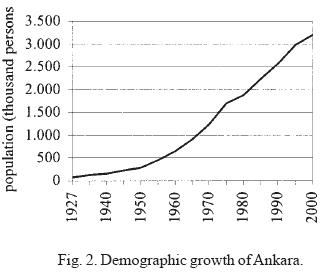
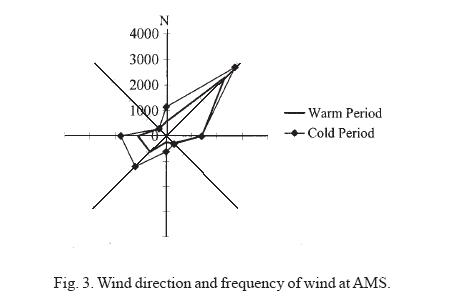
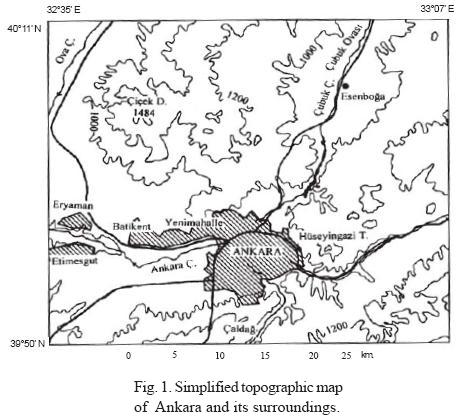
<body><![CDATA[<p align="justify"><font face="verdana" size="2">&nbsp;</font></p>     <p align="justify"><font face="verdana" size="2"><b>2. Research area and stations used</b></font></p>     <p align="justify"><font face="verdana" size="2">The metropolitan city area of Ankara is located between 39&deg; 50' and 40&deg; 00' north latitude and 32&deg; 35' and 33&deg; 00' east longitude. The city of Ankara is located at Ankara plain which has an altitude of 800-850 meters. Ankara plain is formed by &Ccedil;ubuk stream and its branches. This plain is surrounded from the north by the &Ccedil;i&ccedil;ek Mountain, which forms the south parts of Mire Mountain, from the east by the west remainings of Idris Mountain, and from the south by &Ccedil;aldagi and Elmadag <a href="#f1">(Fig. 1)</a>. The plain is open to the west and is connected to M&uuml;rted plain which is formed by the Ova stream. These topographic characteristics determine the distribution of the settlement areas and cause significant changes on the continental climate which is dominant in Ankara.</font></p>     <p align="center"><font face="verdana" size="2"><a name="f1"></a></font></p>     <p align="center"><font face="verdana" size="2"><img src="/img/revistas/atm/v18n3/a03f1.jpg"></font></p>     <p align="justify"><font face="verdana" size="2">In Turkey, the first census was held in 1927, and since then the annual population increase has always been over 2%, except in the Second World War years and in year 2000. The population increased from 13,348,270 in 1927 to 67,803,927 in 2000. As a result of this rapid population increase and due to industrialization in the 1950s, a heavy migration to cities has taken place and the population of this settlements increased rapidly. The city population, which was 23% of the total population in 1950, surpassed the village population for the first time in 1985. In year 2000, the city population in the wholw country reached 64.9% of the total population. The population growth in Ankara was similar to that in Turkey. Ankara, which was a small town with a population of 74,553 in 1927, reached a population of 3,203,362 in 2000 <a href="#f2">(Fig. 2)</a>. The annual population increase rate in Ankara was recorded over 5% between the years 1927 and 2000. This rate was nearly two times the average population increase rate in Turkey in the same period. While in Turkey the population increase rate was 2% between 1990 and 2000, in Ankara it was 8.8% within the same period. In parallel with the population growth, the urban area also expanded rapidly in Ankara, from 3 km2 to 2020 km2 in the 1927-2002 period; this corresponds to a 673 times expansion.</font></p>     <p align="center"><font face="verdana" size="2"><a name="f2"></a></font></p>     <p align="center"><font face="verdana" size="2"><img src="/img/revistas/atm/v18n3/a03f2.jpg"></font></p>     <p align="justify"><font face="verdana" size="2">According to Thornthwaite classification, the climate in Ankara is a first degree mesothermal semi-arid climate (D B'<sub>1</sub>, s<sub>2</sub> b'<sub>3</sub>) with intensive water shortage in summer months (&Ccedil;i&ccedil;ek, 1996). The mean temperature of Ankara and its surroundings is above 20.0&deg;C in three months (June, July and August), it is between 10.0-20.0 &deg;C in four months (April, May, September and October) and it is below 10.0&deg;C in five months of the year (November, December, January, February and March) (&Ccedil;i&ccedil;ek, 2000). The values of some meteorological parameters for Ankara are as follow: The annual mean temperature is 11.7 &deg;C, the mean temperature in January is -0.1 &deg;C, the mean temperature in July is 23.1 &deg;C, the mean annual precipitation is 377.6 mm, the mean annual relative humidity is 60 %, the mean annual vapor pressure is 8.2 hPa, the mean annual wind-speed is 2.1 m sec<sup>-1</sup>, and the mean annual sunshine duration is 4066.6 h.</font></p>     <p align="justify"><font face="verdana" size="2">In Ankara and its surroundings, in the cold period, there are heavily cyclonic activities. As a result of this, frontal precipitation is effective in the cold period. However, in the warm period, anticyclonic conditions are dominant. Because of this, convective precipitation occurs in the warm period. As seen in <a href="#f3">Figure 3</a>, at both stations considered and in all Ankara, the north-eastern directional wind is dominant through the whole year.</font></p>     ]]></body>
<body><![CDATA[<p align="center"><font face="verdana" size="2"><a name="f3"></a></font></p>     <p align="center"><font face="verdana" size="2"><img src="/img/revistas/atm/v18n3/a03f3.jpg"></font></p>     <p align="justify"><font face="verdana" size="2">There are five meteorology stations in Ankara and in the near vicinity. However, only two of these stations have a continuous long term observation history. Therefore, these two stations were chosen for the study of the effects of urbanization on precipitation in Ankara. One of these stations is Ankara Meteorology Station (AMS), which is located in the city and considered reflecting the city characteristics in many respects. The other station is the Esenboga Meteorology Station (EMS) which is located outside Ankara and hence it is considered to have rural characteristics. AMS is located to the north of Ankara at an altitude of 891 meters, at 39&deg; 38' north latitude and 32&deg; 41' east longitude, and has been active since 1926. AMS is not in the center of the city, however it is close to it and there is a heavy urbanization around. Especially in the last 30 years, urbanization around AMS increased considerably. Thus, AMS can be considered as a station that reflects the urban characteristics. EMS is located at Esenboga Airport in the &Ccedil;ubuk plain to the north of Ankara. The altitude of EMS is 949 meters. In the whole year, and especially in the warm season in and around Ankara, a wind with northeast direction is dominant. In this wind direction, EMS is located upwind of the city. Therefore, the effects of urbanization of Ankara on precipitation at EMS can be considered negligible.</font></p>     <p align="justify"><font face="verdana" size="2">&nbsp;</font></p>     <p align="justify"><font face="verdana" size="2"><b>3. Data and methodology</b></font></p>     <p align="justify"><font face="verdana" size="2">Because the effect of urbanization is more effective on summer precipitation, the daily precipitation in the warm seasons at AMS and EMS (May-September) was investigated. The daily precipitation of these stations was analyzed in terms of the classification of Huff and Changnon (1970), that classify the precipitation days as follows:</font></p>     <p align="justify"><font face="verdana" size="2"><u>&gt;</u>&nbsp;0.25 mm day <sup>-1</sup>: precipitation day;    <br> <u>&gt;</u>&nbsp;2.5 mm day <sup>-1</sup>: light precipitation day;    <br> <u>&gt;</u>&nbsp;6.25 mm day <sup>-1</sup>: moderate precipitation day;    <br> <u>&gt;</u>&nbsp;12.5 mm day <sup>-1</sup>: heavy precipitation day.</font></p>     ]]></body>
<body><![CDATA[<p align="justify"><font face="verdana" size="2">However, in this study <u>&gt;</u> 0.1 mm day <sup>-1</sup> was considered as a precipitation day to cover all cases and to be consistent with the precipitation day classification of the State General Directorate of Meteorology Affairs.</font></p>     <p align="justify"><font face="verdana" size="2">Parametrical methods cannot be used for the analysis of precipitation data since these do not have a normal distribution. Hence, non-parametrical methods were employed for the analysis (Sneyers, 1990; WMO, 1966). The basic feature of these methods is that the samples which do not have normal distribution can also be used. In non-parametrical methods, the real values of the variables are not used, but the order of the variables' values in the sequence (Gamgam, 1998).</font></p>     <p align="justify"><font face="verdana" size="2">For the analysis of the data, the non-parametrical Kruskal-Wallis H test was used in order to determine whether there are differences in certain periods in the data series. Under the null hypothesis "there is no change between precipitation values and the number of precipitation days over the years", H sample value <i>(C -1)</i> is approximately distributed as <i>X<sup>2</sup></i> with independence number. The rejection or acceptance of this null hypothesis is based on the value of critical <i>X<sup>2</sup></i> which is compared with <i>f = (C - 1)</i> at the required level of significance. In this study, the sample dimension for the sub-periods was taken as <i>n<sub>j</sub> = 15</i> and the null hypothesis was tested at the significance of level 90% and 95%. According to this test, the null hypothesis in the number of precipitation days (<u>&gt;</u> 0.1 mm day <sup>-1</sup>) at AMS was rejected at a 95% significance level and significant changes were found especially after 1970. In the same way, the null hypothesis was rejected at 90% significance level in the class of light precipitation day (<u>&gt;</u> 2.5 mm day <sup>-1</sup>) and significant changes were found in this class after 1985. No statistically significant difference was found between the sub-periods of other precipitation day classes at AMS. On the other hand, the null hypothesis was rejected at 90% significance level only in the class of precipitation day at EMS and no difference was observed between sub-periods in the other precipitation classes.</font></p>     <p align="justify"><font face="verdana" size="2">To determine the trends of the precipitation data, the method of Mann-Kendall serial correlation was applied to the number of precipitation days. In a time series, for each element <i>y<sub>i</sub></i> , the number <i>n<sub>i</sub></i> of elements <i>y<sub>j</sub></i> preceding it (i &gt; j) is determined such that <i>y<sub>i</sub></i> &gt; <i>y<sub>j</sub></i>.</font></p>     <p align="justify"><font face="verdana" size="2">The test value is then calculated by</font></p>     <p align="justify"><font face="verdana" size="2"><img src="/img/revistas/atm/v18n3/a03e1.jpg"></font></p>     <p align="justify"><font face="verdana" size="2">The test value has nearly a Gaussian normal distribution. The mean of the distribution function and its variance are calculated as follow:</font></p>     <p align="justify"><font face="verdana" size="2"><img src="/img/revistas/atm/v18n3/a03e2.jpg"></font></p>     <p align="justify"><font face="verdana" size="2">A trend can be seen for high values of <img src="/img/revistas/atm/v18n3/a03s1.jpg"> with</font></p>     <p align="justify"><font face="verdana" size="2"><img src="/img/revistas/atm/v18n3/a03e3.jpg"> </font></p>     ]]></body>
<body><![CDATA[<p align="justify"><font face="verdana" size="2">This principle can be extended to the backward series, and <i>u<sub>i</sub>' = - u(t<sub>i</sub>')</i> can be obtained. The intersection of <i>u(t)</i> and <i>u'(t) </i>curves denotes approximately the beginning of a trend. This is called the rank version of the Mann-Kendall test (WMO, 1966; Sneyers, 1990).</font></p>     <p align="justify"><font face="verdana" size="2">If the calculated <i>u(t)</i> value is significant at a level of 90% and 95%, it is concluded that an increasing or decreasing trend is statistically meaningful. By using the sample values of <i>u(t)</i> and <i>u'(t)</i> obtained from the successive analysis by the Mann-Kendall trend test, the trends in the classes of precipitation day were sketched. The overlap of u(t) and u'(t) curves several times in the diagram of the Mann-Kendall test indicates that there is no trend in the sequence. The divergence of these curves from each other indicates that there is a significant trend. Points where the curves intersect and then depart can be used to determine the starting date of any increasing or decreasing trend.</font></p>     <p align="justify"><font face="verdana" size="2">&nbsp;</font></p>     <p align="justify"><font face="verdana" size="2"><b>4. Analysis of the classes of precipitation days in Ankara</b></font></p>     <p align="justify"><font face="verdana" size="2">In order to determine precipitation differences between AMS and EMS in the warm season of the year (May-September), the precipitation data for the 1956-2001 period (except 1972) was statistically analyzed using the methods described above. When <a href="#t1">Table 1</a> is analyzed, it is seen that the number of precipitation days and the number of light precipitation days at EMS are greater than that at AMS, but the number of moderate precipitation days and the number of heavy precipitation days at AMS are greater than that at EMS. When the ratios of the number of the precipitation days, light precipitation days, moderate precipitation days and heavy precipitation days of AMS to EMS are calculated, 0.9, 0.9, 1.1, and 1.2 are obtained, respectively. As seen, at the station with urban characters (AMS), the number of moderate and heavy precipitation days are higher than that at the EMS which has rural characters. At AMS, the precipitation over 50.0 mm day<sup>-1</sup> repeated three times in the period investigated. However, no daily precipitation over 50.0 mm was seen at EMS. Two of the three precipitation days over 50.0 mm day<sup>-1</sup> at AMS occurred after 1995. The maximum daily precipitation of 88.9 mm occurred on 11.06.1997 at AMS, and the maximum daily precipitation of 38.2 mm was recorded on 12.09.1957 at EMS. It is also seen in <a href="#t1">Table 1</a> that at AMS the total precipitation is also higher than that at EMS. These show that the urbanization has caused increases in both the number of moderate and heavy precipitation days and in the total precipitation in Ankara in the warm season. A similar observation was made in the Marmara region by Kadioglu (1997).</font></p>     <p align="center"><font face="verdana" size="2"><a name="t1"></a></font></p>     <p align="center"><font face="verdana" size="2"><img src="/img/revistas/atm/v18n3/a03t1.jpg"></font></p>     <p align="justify"><font face="verdana" size="2">Another important effect of the urbanization is the variation of the precipitation across the days of a week. In different studies, it was observed that weekdays receive more precipitation than weekends. Generally on Mondays least precipitation was recorded than among weekdays, and toward the end of the week, the amount of precipitation increases (Dettwiller and Landsberg, 1974). This is attributed to the fact that at weekends the economical activities are reduced and, as a result, less condensation nuclei form in the atmosphere and thus the amount of precipitation decreases.</font></p>     <p align="justify"><font face="verdana" size="2">To investigate the distribution of precipitation over the days of a week, two subperiods were analyzed in the warm period. These subperiods were chosen as the first five years and the last five years of the period analyzed for AMS and EMS. At AMS, it was observed that Sundays were days with the highest precipitation (20.9%) between 1926-1930. In the same period Saturdays, with 8.7%, were the days with least precipitation <a href="#f4">(Fig. 4)</a>. In the 1996-2000 period, in which the urbanization may be thought to be influential, Wednesdays were the days with highest precipitation with a value of 23%. In this period, Fridays were the least precipitation days with a value of 9.9%. During the week, there is a gradual increase in the precipitation from Monday to Wednesday. After the maximum precipitation on Wednesday, the precipitation suddenly decreases to a value of 10.3%. The fact that at AMS Friday was a generally least precipitation day and Wednesday was the day with most precipitation is not consistent with the findings of Dettwiller and Landsberg (1974) for Paris. The condensation nuclei that are carried over the center of the City by winds prevent the water accumulation in the clouds. Therefore, the water vapor in the atmosphere of the city transforms into precipitation in a shorter time. This causes an increase in the amount of total precipitation in the city. At AMS, between 1996-2000, Wednesdays were the least precipitation days in number, but the intensity of precipitation on Wednesdays was the highest. On the other hand in the same period, the number of Fridays with precipitation was the highest but the intensity of precipitation on these days was the lowest <a href="/img/revistas/atm/v18n3/a03t2.jpg" target="_blank">(Table 2)</a>. Such distribution of data shows that low intensity precipitation falls on the last days of the week, but more intense precipitation falls by the middle of the week. This could be related to the fact that the condensation nuclei, which accumulate in the city atmosphere by the end of the week, cause too much of drizzling. However, a more detailed research on the periodical change of condensation nuclei in the urban atmosphere is necessary to further prove this fact.</font></p>     <p align="center"><font face="verdana" size="2"><a name="f4"></a></font></p>     ]]></body>
<body><![CDATA[<p align="center"><font face="verdana" size="2"><img src="/img/revistas/atm/v18n3/a03f4.jpg"></font></p>     <p align="justify"><font face="verdana" size="2">For EMS, it is not possible to say that there is a clear trend in precipitation over the day of a week between the years 1956-1960. While Mondays and Fridays were the least precipitation days, Thursdays and Sundays were the days of the week receiving most of the precipitation at EMS. Between the years 1995-2000, Tuesdays and Saturdays were the least precipitation days, while Wednesdays were the days with most precipitation. Monday, Thursday and Sunday were days receiving very similar amounts of precipitation <a href="#f4">(Fig. 4)</a>. As seen, there is not a regular distribution of precipitation over the days of the week at EMS.</font></p>     <p align="justify"><font face="verdana" size="2">To observe the variations in the number of each class of precipitation day at AMS and at EMS, they are plotted in <a href="/img/revistas/atm/v18n3/a03f5.jpg" target="_blank">Figure 5</a>. Since the data recording by AMS was started in 1926 and data recording by EMS started in 1956, the graphics for AMS cover the period of 1926-2000, and the graphics for EMS cover the period of 1956-2000. To see the number of precipitation days in shorter periods, the averages for each fifteen years are also shown in the graphics. At both AMS and EMS, the number of the precipitation days (<u>&gt;</u> 0.1 mm day <sup>-1</sup>) and light precipitation days (<u>&gt;</u> 2.5 mm day <sup>-1</sup>) increase with years <a href="/img/revistas/atm/v18n3/a03f5.jpg" target="_blank">(Fig. 5)</a>. This shows that there is an increase in the number of low intensity precipitation days around Ankara, which may be due to the change in climate. &Ccedil;i&ccedil;ek (2003) analyzed the long-term monthly precipitation in Ankara and concluded that there was an increasing trend in the annual and monthly precipitation except for March and September. This increase is statistically significant in April, August and September including the annual precipitation. T&uuml;rkes (1995, 1996), however, found significant increases in summer precipitation in the Central Anatolian Region. At AMS, the increase in the classes of moderate precipitation (<u>&gt;</u> 6.25 mm day <sup>-1</sup>) and heavy precipitation (<u>&gt;</u> 2.5 mm day <sup>-1</sup>) days has continued since 1970. However, there has been a decreasing trend in the classes of moderate and heavy precipitation days since 1985 at EMS. These different trends of moderate and heavy precipitation day classes at AMS and at EMS indicate that due to the urbanization, the number of high intensity precipitation days increased in Ankara.</font></p>     <p align="justify"><font face="verdana" size="2">The classes of precipitation days at two stations were analyzed applying the Mann-Kendall rank correlation test. An increasing trend was observed in the number of precipitation days (<u>&gt;</u> 0.1 mm day <sup>-1</sup>) starting with 1960 at AMS, and this trend was statistically meaningful at the 95% significance level starting with 1983. The increasing trend at EMS started in 1987 and has been significant at the level of 95% since 1998 <a href="/img/revistas/atm/v18n3/a03f6.jpg" target="_blank">(Fig. 6)</a>. At AMS, there was an increase in the number of light precipitation days (<u>&gt;</u> 2.5 mm day <sup>-1</sup>) with a significance level of 95%, since 1988 to the present day. Although there was an increasing trend after the year 1964, it was not statistically significant at EMS. The increasing trend in the number of moderate (<u>&gt;</u> 6.25 mm day <sup>-1</sup>) and heavy precipitation days (<u>&gt;</u> 12.5 mm day <sup>-1</sup>) after 1980s at AMS were found not to be statistically meaningful. There was a significant difference between the two stations. As there was an increasing trend at AMS, there was no trend in the class of moderate precipitation days (<u>&gt;</u> 62.5 mm day :) and a decreasing trend in heavy precipitation days (<u>&gt;</u> 12.5 mm day <sup>-1</sup>) after 1983 at EMS. This remarkable difference in trend of classes of high intensity precipitation days between these two nearby stations can not be accounted for a climatic change. Therefore, it can be concluded that the urbanization induces an increase in the high intensity precipitation day classes in Ankara.</font></p>     <p align="justify"><font face="verdana" size="2">&nbsp;</font></p>     <p align="justify"><font face="verdana" size="2"><b>5. Conclusions</b></font></p>     <p align="justify"><font face="verdana" size="2">The outcomes of the analyses of the precipitation-intensity classes in the warm period (May-September) may be summarized as follows:</font></p>     <blockquote>       <p align="justify"><font face="verdana" size="2">&bull;&nbsp; &nbsp; &nbsp;The number of precipitation days at AMS is not higher than that of EMS. However, there is an increase in the total amount of precipitation at AMS in the warm period studied. There is a considerable increase in the number of heavy precipitation days at AMS (the urban station), and this is 50% higher than that in the rural area.</font></p>       <p align="justify"><font face="verdana" size="2">&bull;&nbsp; &nbsp; &nbsp;At AMS Wednesday is the day of the week with most precipitation, however in urban areas the day with least precipitation is Friday. This is related with the increasing condensation nuclei in the atmosphere of the city by the middle of the week. The distribution of precipitation across the days of the week is random in the rural areas.</font></p>       ]]></body>
<body><![CDATA[<p align="justify"><font face="verdana" size="2">&bull;&nbsp; &nbsp; &nbsp;In urban areas the days on which there is a risk of heavy precipitation are Tuesday and Wednesday.</font></p>       <p align="justify"><font face="verdana" size="2">&bull;&nbsp; &nbsp; &nbsp;Although there is no salient difference between AMS and EMS with reference to the classes of low intensity precipitation days (0.1 mm day <sup>-1</sup> and 2.5 mm day <sup>-1</sup>) in the long-term, the difference becomes evident in the moderate and heavy classes of precipitation days. This indicates that urbanization has effects on high intensity precipitation rather than on low intensity precipitation. This outcome seems to be in contrast with the findings of Kadioglu (1997). He pointed out that the extreme pollution decreases precipitation and causes significant decreases in extreme preicipitation in the cities. The differences between the results of Kadioglu (1997) and the present study may be due to the fact that Kadioglu studied the whole year. However, only the warm period was considered in the present study. Therefore, a research on the warm period in the Marmara Region may yield different results. Urbanization in the tropics and mid-latitudes was found to be influential on convectional precipitation. It is natural that this may be seen in Istanbul also.</font></p>       <p align="justify"><font face="verdana" size="2">&bull;&nbsp; &nbsp; &nbsp;There was an increasing trend in the number of moderate and heavy precipitation days at the urban station (AMS), but there is a decreasing trend at the rural station (EMS). This difference proves that the increase at AMS was related to urbanization rather than to a climatic change.</font></p>       <p align="justify"><font face="verdana" size="2">&bull;&nbsp; &nbsp; &nbsp;The fact that urbanization increases precipitation in the warm period in an area with a continental climate such as Ankara indicates that these precipitations are rather convectional. The increase in the number of moderate and heavy precipitation days also supports this claim. However, the pluviograph nets should be refined in order to fully determine this in Ankara.</font></p>       <p align="justify"><font face="verdana" size="2">&bull;&nbsp; &nbsp; &nbsp;The increasing effect of urbanization on the number of heavy precipitation days also brings about the problem of floods. Therefore, before implementing the projects such as infrastructure systems which require great investment, the frequency and rate of intense precipitation should be determined in the metropolitan area of Ankara.</font></p>       <p align="justify"><font face="verdana" size="2">&bull;&nbsp; &nbsp; &nbsp;Since the cities in the future will get bigger as a result of increasing population and economic development, the impact of urbanization on precipitation will also be greater. Therefore, it is important that investigations on the urban climatology should be initiated soon.</font></p>       <p align="justify"><font face="verdana" size="2">&nbsp;</font></p> </blockquote>     <p align="justify"><font face="verdana" size="2"><b>References</b></font></p>     <!-- ref --><p align="justify"><font face="verdana" size="2">Atkinson, B.W., 1971. The effect of an urban area on the precipitation from a moving thunderstorm. <i>J. Appl. Met.</i> <b>10</b>, 47-55.</font>&nbsp;&nbsp;&nbsp;&nbsp;&nbsp;&nbsp;&nbsp;&nbsp;[&#160;<a href="javascript:void(0);" onclick="javascript: window.open('/scielo.php?script=sci_nlinks&ref=1264716&pid=S0187-6236200500030000300001&lng=','','width=640,height=500,resizable=yes,scrollbars=1,menubar=yes,');">Links</a>&#160;]<!-- end-ref --><!-- ref --><p align="justify"><font face="verdana" size="2">Bornstein, R. and Q. Lin, 2000. Urban heat island and summertime convective thunderstorms in Atlanta: Three case studies. <i>Atmos. Environ.</i> <b>34</b>, 507-516.</font>&nbsp;&nbsp;&nbsp;&nbsp;&nbsp;&nbsp;&nbsp;&nbsp;[&#160;<a href="javascript:void(0);" onclick="javascript: window.open('/scielo.php?script=sci_nlinks&ref=1264717&pid=S0187-6236200500030000300002&lng=','','width=640,height=500,resizable=yes,scrollbars=1,menubar=yes,');">Links</a>&#160;]<!-- end-ref --><!-- ref --><p align="justify"><font face="verdana" size="2">Chandler, T., 1965. <i>The climate of London.</i> Hutchinson, London, 122 p.</font>&nbsp;&nbsp;&nbsp;&nbsp;&nbsp;&nbsp;&nbsp;&nbsp;[&#160;<a href="javascript:void(0);" onclick="javascript: window.open('/scielo.php?script=sci_nlinks&ref=1264718&pid=S0187-6236200500030000300003&lng=','','width=640,height=500,resizable=yes,scrollbars=1,menubar=yes,');">Links</a>&#160;]<!-- end-ref --><!-- ref --><p align="justify"><font face="verdana" size="2">Changnon, S. A, R.G.. Semonin and F. A. Huff, 1976. A hypothesis for urban rainfall anomalies. <i>J. Appl.Met</i> <b>15</b>, 544-560.</font>&nbsp;&nbsp;&nbsp;&nbsp;&nbsp;&nbsp;&nbsp;&nbsp;[&#160;<a href="javascript:void(0);" onclick="javascript: window.open('/scielo.php?script=sci_nlinks&ref=1264719&pid=S0187-6236200500030000300004&lng=','','width=640,height=500,resizable=yes,scrollbars=1,menubar=yes,');">Links</a>&#160;]<!-- end-ref --><!-- ref --><p align="justify"><font face="verdana" size="2">Changnon, S. A., 1978. Urban effects on severe local storm at St Louis. <i>J. Appl. Met.</i> <b>17</b>, 578-586.</font>&nbsp;&nbsp;&nbsp;&nbsp;&nbsp;&nbsp;&nbsp;&nbsp;[&#160;<a href="javascript:void(0);" onclick="javascript: window.open('/scielo.php?script=sci_nlinks&ref=1264720&pid=S0187-6236200500030000300005&lng=','','width=640,height=500,resizable=yes,scrollbars=1,menubar=yes,');">Links</a>&#160;]<!-- end-ref --><!-- ref --><p align="justify"><font face="verdana" size="2">Changnon, S. A., R. Shealy and R. Scott, 1991. Precipitation changes in fall, winter and spring caused by St. Louis. <i>J. Appl. Met.</i> <b>30</b>, 126-134.</font>&nbsp;&nbsp;&nbsp;&nbsp;&nbsp;&nbsp;&nbsp;&nbsp;[&#160;<a href="javascript:void(0);" onclick="javascript: window.open('/scielo.php?script=sci_nlinks&ref=1264721&pid=S0187-6236200500030000300006&lng=','','width=640,height=500,resizable=yes,scrollbars=1,menubar=yes,');">Links</a>&#160;]<!-- end-ref --><!-- ref --><p align="justify"><font face="verdana" size="2">Changnon, S. A., 2001. Assessment of historical thunderstorm data for urban effects: The Chicago case. <i>Climatic Change</i> <b>49</b>, 161-169.</font>&nbsp;&nbsp;&nbsp;&nbsp;&nbsp;&nbsp;&nbsp;&nbsp;[&#160;<a href="javascript:void(0);" onclick="javascript: window.open('/scielo.php?script=sci_nlinks&ref=1264722&pid=S0187-6236200500030000300007&lng=','','width=640,height=500,resizable=yes,scrollbars=1,menubar=yes,');">Links</a>&#160;]<!-- end-ref --><!-- ref --><p align="justify"><font face="verdana" size="2">&Ccedil;i&ccedil;ek, I., 1996. Thorthwaite Metoduna G&ouml;re T&uuml;rkiye'de Iklim Tipleri. Ankara &Uuml;niversitesi, Dil ve Tarih-Cografya Fak&uuml;ltesi, Cografya Arasturmalari Dergisi 12, 33-71</font>&nbsp;&nbsp;&nbsp;&nbsp;&nbsp;&nbsp;&nbsp;&nbsp;[&#160;<a href="javascript:void(0);" onclick="javascript: window.open('/scielo.php?script=sci_nlinks&ref=1264723&pid=S0187-6236200500030000300008&lng=','','width=640,height=500,resizable=yes,scrollbars=1,menubar=yes,');">Links</a>&#160;]<!-- end-ref --><!-- ref --><p align="justify"><font face="verdana" size="2">&Ccedil;i&ccedil;ek, &Yacute;., 2000. T&uuml;rkiye'de Termik D&ouml;nemlerin Yayilisi ve S&uuml;releri.<i> Ankara &Uuml;niversitesi, Dil ve Tarih-Cografya Fak&uuml;ltesi Dergisi</i> 40, 1-2, 189-212</font>&nbsp;&nbsp;&nbsp;&nbsp;&nbsp;&nbsp;&nbsp;&nbsp;[&#160;<a href="javascript:void(0);" onclick="javascript: window.open('/scielo.php?script=sci_nlinks&ref=1264724&pid=S0187-6236200500030000300009&lng=','','width=640,height=500,resizable=yes,scrollbars=1,menubar=yes,');">Links</a>&#160;]<!-- end-ref --><!-- ref --><p align="justify"><font face="verdana" size="2">&Ccedil;i&ccedil;ek, I., 2003. The Statistical Analysis of Precipitation in Ankara, Turkey. <i>Firat &Uuml;niversitesi, Sosyal Bilimler Dergisi</i> <b>13</b>, 1-20.</font>&nbsp;&nbsp;&nbsp;&nbsp;&nbsp;&nbsp;&nbsp;&nbsp;[&#160;<a href="javascript:void(0);" onclick="javascript: window.open('/scielo.php?script=sci_nlinks&ref=1264725&pid=S0187-6236200500030000300010&lng=','','width=640,height=500,resizable=yes,scrollbars=1,menubar=yes,');">Links</a>&#160;]<!-- end-ref --><!-- ref --><p align="justify"><font face="verdana" size="2">Dettwiller, I. and H. E. Landsberg, 1974. Inadvertent atmospheric modification, <i>Weather and Climate Modification</i>, Wilmot N. Hess, Ed. John Willy &amp; Sons 755 p.</font>&nbsp;&nbsp;&nbsp;&nbsp;&nbsp;&nbsp;&nbsp;&nbsp;[&#160;<a href="javascript:void(0);" onclick="javascript: window.open('/scielo.php?script=sci_nlinks&ref=1264726&pid=S0187-6236200500030000300011&lng=','','width=640,height=500,resizable=yes,scrollbars=1,menubar=yes,');">Links</a>&#160;]<!-- end-ref --><!-- ref --><p align="justify"><font face="verdana" size="2">Gamgam, H., 1998. Parametrik Olmayan Istatistiksel Teknikler. Gazi &Uuml;niv. Yay. No: 140, Fen-Ed.Fak. Yay. No: 21.</font>&nbsp;&nbsp;&nbsp;&nbsp;&nbsp;&nbsp;&nbsp;&nbsp;[&#160;<a href="javascript:void(0);" onclick="javascript: window.open('/scielo.php?script=sci_nlinks&ref=1264727&pid=S0187-6236200500030000300012&lng=','','width=640,height=500,resizable=yes,scrollbars=1,menubar=yes,');">Links</a>&#160;]<!-- end-ref --><!-- ref --><p align="justify"><font face="verdana" size="2">Huff, F. A. and S. A. Changnon, 1970. Urban effects on daily rainfall distribution. Second Nat. Conf. Weather Modification, Santa Barbara, Amer. Met. Soc., 215-220.</font>&nbsp;&nbsp;&nbsp;&nbsp;&nbsp;&nbsp;&nbsp;&nbsp;[&#160;<a href="javascript:void(0);" onclick="javascript: window.open('/scielo.php?script=sci_nlinks&ref=1264728&pid=S0187-6236200500030000300013&lng=','','width=640,height=500,resizable=yes,scrollbars=1,menubar=yes,');">Links</a>&#160;]<!-- end-ref --><!-- ref --><p align="justify"><font face="verdana" size="2">Kadioglu, M., 1997. Sehirlesmenin Marmara B&ouml;lgesindeki yagislara etkisi. Su ve &Ccedil;evre Sempozyumu'97, 2-5 Haziran 1997, TMMOB JMO, Genel yay No. 46, Ist. Sub. Yay. No. 1, 37-46.</font>&nbsp;&nbsp;&nbsp;&nbsp;&nbsp;&nbsp;&nbsp;&nbsp;[&#160;<a href="javascript:void(0);" onclick="javascript: window.open('/scielo.php?script=sci_nlinks&ref=1264729&pid=S0187-6236200500030000300014&lng=','','width=640,height=500,resizable=yes,scrollbars=1,menubar=yes,');">Links</a>&#160;]<!-- end-ref --><!-- ref --><p align="justify"><font face="verdana" size="2">J&aacute;uregui, E. and E. Romales, 1996. Urban effects on convective precipitation in M&eacute;xico City. <i>Atmos. Environ.</i> <b>30</b>, 3383-3389.</font>&nbsp;&nbsp;&nbsp;&nbsp;&nbsp;&nbsp;&nbsp;&nbsp;[&#160;<a href="javascript:void(0);" onclick="javascript: window.open('/scielo.php?script=sci_nlinks&ref=1264730&pid=S0187-6236200500030000300015&lng=','','width=640,height=500,resizable=yes,scrollbars=1,menubar=yes,');">Links</a>&#160;]<!-- end-ref --><!-- ref --><p align="justify"><font face="verdana" size="2">Lowry, W. P. and F. Prob&aacute;ld, 1978. An attempt to detect the effect of a steelworks on precipitation amounts in Central Hungary. <i>J. Appl. Met</i>. <b>17</b>, 964-975.</font>&nbsp;&nbsp;&nbsp;&nbsp;&nbsp;&nbsp;&nbsp;&nbsp;[&#160;<a href="javascript:void(0);" onclick="javascript: window.open('/scielo.php?script=sci_nlinks&ref=1264731&pid=S0187-6236200500030000300016&lng=','','width=640,height=500,resizable=yes,scrollbars=1,menubar=yes,');">Links</a>&#160;]<!-- end-ref --><!-- ref --><p align="justify"><font face="verdana" size="2">Lowry, W. P., 1998. Urban effects on precipitation amounth. <i>Progress in Physical Geography</i> <b>22</b>, 477-520.</font>&nbsp;&nbsp;&nbsp;&nbsp;&nbsp;&nbsp;&nbsp;&nbsp;[&#160;<a href="javascript:void(0);" onclick="javascript: window.open('/scielo.php?script=sci_nlinks&ref=1264732&pid=S0187-6236200500030000300017&lng=','','width=640,height=500,resizable=yes,scrollbars=1,menubar=yes,');">Links</a>&#160;]<!-- end-ref --><!-- ref --><p align="justify"><font face="verdana" size="2">Sneyers, R., 1990. On the statistical analysis of series of observations. WMO Technical Note 143, Geneva.</font>&nbsp;&nbsp;&nbsp;&nbsp;&nbsp;&nbsp;&nbsp;&nbsp;[&#160;<a href="javascript:void(0);" onclick="javascript: window.open('/scielo.php?script=sci_nlinks&ref=1264733&pid=S0187-6236200500030000300018&lng=','','width=640,height=500,resizable=yes,scrollbars=1,menubar=yes,');">Links</a>&#160;]<!-- end-ref --><!-- ref --><p align="justify"><font face="verdana" size="2">Shafir, H. and P. Alpert, 1990. On the urban orographic rainfall anomaly in Jerusalem: a numerical study. <i>Atmos. Enviro</i>n. 24(B), 365-375.</font>&nbsp;&nbsp;&nbsp;&nbsp;&nbsp;&nbsp;&nbsp;&nbsp;[&#160;<a href="javascript:void(0);" onclick="javascript: window.open('/scielo.php?script=sci_nlinks&ref=1264734&pid=S0187-6236200500030000300019&lng=','','width=640,height=500,resizable=yes,scrollbars=1,menubar=yes,');">Links</a>&#160;]<!-- end-ref --><!-- ref --><p align="justify"><font face="verdana" size="2">Tayan&ccedil;, M. and M. Toros, 1997. Urbanization effects on regional climate change in the case of four large cities in Turkey. <i>Clim. Change.</i> <b>35</b>, 501-524.</font>&nbsp;&nbsp;&nbsp;&nbsp;&nbsp;&nbsp;&nbsp;&nbsp;[&#160;<a href="javascript:void(0);" onclick="javascript: window.open('/scielo.php?script=sci_nlinks&ref=1264735&pid=S0187-6236200500030000300020&lng=','','width=640,height=500,resizable=yes,scrollbars=1,menubar=yes,');">Links</a>&#160;]<!-- end-ref --><!-- ref --><p align="justify"><font face="verdana" size="2">T&uuml;rkes, M., 1995. T&uuml;rkiye' de yillik ve mevsimlik yagis verilerindeki egilimler ve dalgalanmalar. <i>T&uuml;rk Haritaciliginin Y&uuml;z&uuml;nc&uuml; Yili TJJB ve TUFUAB Kongreleri Bildiri Kitabi </i>1-5 Mayis 1995, Ankara C: <b>3</b>, 694-706.</font>&nbsp;&nbsp;&nbsp;&nbsp;&nbsp;&nbsp;&nbsp;&nbsp;[&#160;<a href="javascript:void(0);" onclick="javascript: window.open('/scielo.php?script=sci_nlinks&ref=1264736&pid=S0187-6236200500030000300021&lng=','','width=640,height=500,resizable=yes,scrollbars=1,menubar=yes,');">Links</a>&#160;]<!-- end-ref --><!-- ref --><p align="justify"><font face="verdana" size="2">T&uuml;rkes, M., 1996. Spatial and temporal analysis of annual rainfall variations in Turkey. <i>Int. J. Climatol.</i> <b>16</b>, 1057-1076.</font>&nbsp;&nbsp;&nbsp;&nbsp;&nbsp;&nbsp;&nbsp;&nbsp;[&#160;<a href="javascript:void(0);" onclick="javascript: window.open('/scielo.php?script=sci_nlinks&ref=1264737&pid=S0187-6236200500030000300022&lng=','','width=640,height=500,resizable=yes,scrollbars=1,menubar=yes,');">Links</a>&#160;]<!-- end-ref --><!-- ref --><p align="justify"><font face="verdana" size="2">Yonetani, T., 1982. Increase in number of days with heavy precipitation in Tokyo urban area. <i>J. Appl. Met</i>. <b>21</b>, 1466-1471.</font>&nbsp;&nbsp;&nbsp;&nbsp;&nbsp;&nbsp;&nbsp;&nbsp;[&#160;<a href="javascript:void(0);" onclick="javascript: window.open('/scielo.php?script=sci_nlinks&ref=1264738&pid=S0187-6236200500030000300023&lng=','','width=640,height=500,resizable=yes,scrollbars=1,menubar=yes,');">Links</a>&#160;]<!-- end-ref --><!-- ref --><p align="justify"><font face="verdana" size="2">WMO, 1966. Climatic Change. WMO Technical Note 79, Geneva.</font>&nbsp;&nbsp;&nbsp;&nbsp;&nbsp;&nbsp;&nbsp;&nbsp;[&#160;<a href="javascript:void(0);" onclick="javascript: window.open('/scielo.php?script=sci_nlinks&ref=1264739&pid=S0187-6236200500030000300024&lng=','','width=640,height=500,resizable=yes,scrollbars=1,menubar=yes,');">Links</a>&#160;]<!-- end-ref --> ]]></body><back>
<ref-list>
<ref id="B1">
<nlm-citation citation-type="journal">
<person-group person-group-type="author">
<name>
<surname><![CDATA[Atkinson]]></surname>
<given-names><![CDATA[B.W.]]></given-names>
</name>
</person-group>
<article-title xml:lang="en"><![CDATA[The effect of an urban area on the precipitation from a moving thunderstorm]]></article-title>
<source><![CDATA[J. Appl. Met.]]></source>
<year>1971</year>
<numero>10</numero>
<issue>10</issue>
<page-range>47-55</page-range></nlm-citation>
</ref>
<ref id="B2">
<nlm-citation citation-type="journal">
<person-group person-group-type="author">
<name>
<surname><![CDATA[Bornstein]]></surname>
<given-names><![CDATA[R.]]></given-names>
</name>
<name>
<surname><![CDATA[Lin]]></surname>
<given-names><![CDATA[Q.]]></given-names>
</name>
</person-group>
<article-title xml:lang="en"><![CDATA[Urban heat island and summertime convective thunderstorms in Atlanta: Three case studies]]></article-title>
<source><![CDATA[Atmos. Environ.]]></source>
<year>2000</year>
<numero>34</numero>
<issue>34</issue>
<page-range>507-516</page-range></nlm-citation>
</ref>
<ref id="B3">
<nlm-citation citation-type="book">
<person-group person-group-type="author">
<name>
<surname><![CDATA[Chandler]]></surname>
<given-names><![CDATA[T.]]></given-names>
</name>
</person-group>
<source><![CDATA[The climate of London]]></source>
<year>1965</year>
<page-range>122</page-range><publisher-loc><![CDATA[London ]]></publisher-loc>
<publisher-name><![CDATA[Hutchinson]]></publisher-name>
</nlm-citation>
</ref>
<ref id="B4">
<nlm-citation citation-type="journal">
<person-group person-group-type="author">
<name>
<surname><![CDATA[Changnon]]></surname>
<given-names><![CDATA[S. A]]></given-names>
</name>
<name>
<surname><![CDATA[Semonin]]></surname>
<given-names><![CDATA[R.G.]]></given-names>
</name>
<name>
<surname><![CDATA[Huff]]></surname>
<given-names><![CDATA[F. A.]]></given-names>
</name>
</person-group>
<article-title xml:lang="en"><![CDATA[A hypothesis for urban rainfall anomalies]]></article-title>
<source><![CDATA[J. Appl.Met]]></source>
<year>1976</year>
<numero>15</numero>
<issue>15</issue>
<page-range>544-560</page-range></nlm-citation>
</ref>
<ref id="B5">
<nlm-citation citation-type="journal">
<person-group person-group-type="author">
<name>
<surname><![CDATA[Changnon]]></surname>
<given-names><![CDATA[S. A.]]></given-names>
</name>
</person-group>
<article-title xml:lang="en"><![CDATA[Urban effects on severe local storm at St Louis]]></article-title>
<source><![CDATA[J. Appl. Met.]]></source>
<year>1978</year>
<numero>17</numero>
<issue>17</issue>
<page-range>578-586</page-range></nlm-citation>
</ref>
<ref id="B6">
<nlm-citation citation-type="journal">
<person-group person-group-type="author">
<name>
<surname><![CDATA[Changnon]]></surname>
<given-names><![CDATA[S. A.]]></given-names>
</name>
<name>
<surname><![CDATA[Shealy]]></surname>
<given-names><![CDATA[R.]]></given-names>
</name>
<name>
<surname><![CDATA[Scott]]></surname>
<given-names><![CDATA[R.]]></given-names>
</name>
</person-group>
<article-title xml:lang="en"><![CDATA[Precipitation changes in fall, winter and spring caused by St. Louis]]></article-title>
<source><![CDATA[J. Appl. Met.]]></source>
<year>1991</year>
<numero>30</numero>
<issue>30</issue>
<page-range>126-134</page-range></nlm-citation>
</ref>
<ref id="B7">
<nlm-citation citation-type="journal">
<person-group person-group-type="author">
<name>
<surname><![CDATA[Changnon]]></surname>
<given-names><![CDATA[S. A.]]></given-names>
</name>
</person-group>
<article-title xml:lang="en"><![CDATA[Assessment of historical thunderstorm data for urban effects: The Chicago case]]></article-title>
<source><![CDATA[Climatic Change]]></source>
<year>2001</year>
<numero>49</numero>
<issue>49</issue>
<page-range>161-169</page-range></nlm-citation>
</ref>
<ref id="B8">
<nlm-citation citation-type="journal">
<person-group person-group-type="author">
<name>
<surname><![CDATA[Çiçek]]></surname>
<given-names><![CDATA[I.]]></given-names>
</name>
</person-group>
<article-title xml:lang="tr"><![CDATA[Thorthwaite Metoduna Göre Türkiye'de Iklim Tipleri]]></article-title>
<source><![CDATA[Ankara Üniversitesi, Dil ve Tarih-Cografya Fakültesi, Cografya Arasturmalari Dergisi]]></source>
<year>1996</year>
<numero>12</numero>
<issue>12</issue>
<page-range>33-71</page-range></nlm-citation>
</ref>
<ref id="B9">
<nlm-citation citation-type="journal">
<person-group person-group-type="author">
<name>
<surname><![CDATA[Çiçek]]></surname>
<given-names><![CDATA[Ý.]]></given-names>
</name>
</person-group>
<article-title xml:lang="tr"><![CDATA[Türkiye'de Termik Dönemlerin Yayilisi ve Süreleri]]></article-title>
<source><![CDATA[Ankara Üniversitesi, Dil ve Tarih-Cografya Fakültesi Dergisi]]></source>
<year>2000</year>
<numero>40</numero>
<issue>40</issue>
<page-range>1-2, 189-212</page-range></nlm-citation>
</ref>
<ref id="B10">
<nlm-citation citation-type="journal">
<person-group person-group-type="author">
<name>
<surname><![CDATA[Çiçek]]></surname>
<given-names><![CDATA[I.]]></given-names>
</name>
</person-group>
<article-title xml:lang="en"><![CDATA[The Statistical Analysis of Precipitation in Ankara, Turkey]]></article-title>
<source><![CDATA[Firat Üniversitesi, Sosyal Bilimler Dergisi]]></source>
<year>2003</year>
<numero>13</numero>
<issue>13</issue>
<page-range>1-20</page-range></nlm-citation>
</ref>
<ref id="B11">
<nlm-citation citation-type="book">
<person-group person-group-type="author">
<name>
<surname><![CDATA[Dettwiller]]></surname>
<given-names><![CDATA[I.]]></given-names>
</name>
<name>
<surname><![CDATA[Landsberg]]></surname>
<given-names><![CDATA[H. E.]]></given-names>
</name>
<name>
<surname><![CDATA[Wilmot]]></surname>
<given-names><![CDATA[N. Hess]]></given-names>
</name>
</person-group>
<source><![CDATA[Inadvertent atmospheric modification, Weather and Climate Modification]]></source>
<year>1974</year>
<page-range>755</page-range><publisher-name><![CDATA[Ed. John Willy & Sons]]></publisher-name>
</nlm-citation>
</ref>
<ref id="B12">
<nlm-citation citation-type="journal">
<person-group person-group-type="author">
<name>
<surname><![CDATA[Gamgam]]></surname>
<given-names><![CDATA[H.]]></given-names>
</name>
</person-group>
<article-title xml:lang="tr"><![CDATA[Parametrik Olmayan Istatistiksel Teknikler]]></article-title>
<source><![CDATA[Gazi Üniv. Yay.]]></source>
<year>1998</year>
<numero>140</numero>
<issue>140</issue>
<publisher-name><![CDATA[Fen-Ed.Fak.]]></publisher-name>
</nlm-citation>
</ref>
<ref id="B13">
<nlm-citation citation-type="confpro">
<person-group person-group-type="author">
<name>
<surname><![CDATA[Huff]]></surname>
<given-names><![CDATA[F. A.]]></given-names>
</name>
<name>
<surname><![CDATA[Changnon]]></surname>
<given-names><![CDATA[S. A.]]></given-names>
</name>
</person-group>
<article-title xml:lang="en"><![CDATA[Urban effects on daily rainfall distribution]]></article-title>
<source><![CDATA[]]></source>
<year>1970</year>
<conf-name><![CDATA[ Second Nat. Conf. Weather Modification, Santa Barbara, Amer. Met. Soc.]]></conf-name>
<conf-loc> </conf-loc>
</nlm-citation>
</ref>
<ref id="B14">
<nlm-citation citation-type="confpro">
<person-group person-group-type="author">
<name>
<surname><![CDATA[Kadioglu]]></surname>
<given-names><![CDATA[M.]]></given-names>
</name>
</person-group>
<article-title xml:lang="tr"><![CDATA[Sehirlesmenin Marmara Bölgesindeki yagislara etkisi]]></article-title>
<source><![CDATA[]]></source>
<year>1997</year>
<month>2-</month>
<day>5 </day>
<volume>46</volume>
<conf-name><![CDATA[ Su ve Çevre Sempozyumu'97]]></conf-name>
<conf-loc> </conf-loc>
<page-range>37-46</page-range></nlm-citation>
</ref>
<ref id="B15">
<nlm-citation citation-type="journal">
<person-group person-group-type="author">
<name>
<surname><![CDATA[Jáuregui]]></surname>
<given-names><![CDATA[E.]]></given-names>
</name>
<name>
<surname><![CDATA[Romales]]></surname>
<given-names><![CDATA[E.]]></given-names>
</name>
</person-group>
<article-title xml:lang="en"><![CDATA[Urban effects on convective precipitation in México City.]]></article-title>
<source><![CDATA[Atmos. Environ.]]></source>
<year>1996</year>
<numero>30</numero>
<issue>30</issue>
<page-range>3383-3389</page-range></nlm-citation>
</ref>
<ref id="B16">
<nlm-citation citation-type="journal">
<person-group person-group-type="author">
<name>
<surname><![CDATA[Lowry]]></surname>
<given-names><![CDATA[W. P.]]></given-names>
</name>
<name>
<surname><![CDATA[Probáld]]></surname>
<given-names><![CDATA[F.]]></given-names>
</name>
</person-group>
<article-title xml:lang="en"><![CDATA[An attempt to detect the effect of a steelworks on precipitation amounts in Central Hungary]]></article-title>
<source><![CDATA[J. Appl. Met.]]></source>
<year>1978</year>
<numero>17</numero>
<issue>17</issue>
<page-range>964-975</page-range></nlm-citation>
</ref>
<ref id="B17">
<nlm-citation citation-type="journal">
<person-group person-group-type="author">
<name>
<surname><![CDATA[Lowry]]></surname>
<given-names><![CDATA[W. P.]]></given-names>
</name>
</person-group>
<article-title xml:lang="en"><![CDATA[Urban effects on precipitation amounth]]></article-title>
<source><![CDATA[Progress in Physical Geography]]></source>
<year>1998</year>
<numero>22</numero>
<issue>22</issue>
<page-range>477-520</page-range></nlm-citation>
</ref>
<ref id="B18">
<nlm-citation citation-type="journal">
<person-group person-group-type="author">
<name>
<surname><![CDATA[Sneyers]]></surname>
<given-names><![CDATA[R.]]></given-names>
</name>
</person-group>
<article-title xml:lang="en"><![CDATA[On the statistical analysis of series of observations]]></article-title>
<source><![CDATA[WMO Technical Note]]></source>
<year>1990</year>
<numero>143</numero>
<issue>143</issue>
<publisher-loc><![CDATA[Geneva ]]></publisher-loc>
</nlm-citation>
</ref>
<ref id="B19">
<nlm-citation citation-type="journal">
<person-group person-group-type="author">
<name>
<surname><![CDATA[Shafir]]></surname>
<given-names><![CDATA[H.]]></given-names>
</name>
<name>
<surname><![CDATA[Alpert]]></surname>
<given-names><![CDATA[P.]]></given-names>
</name>
</person-group>
<article-title xml:lang="en"><![CDATA[On the urban orographic rainfall anomaly in Jerusalem: a numerical study]]></article-title>
<source><![CDATA[Atmos. Environ.]]></source>
<year>1990</year>
<numero>24(B)</numero>
<issue>24(B)</issue>
<page-range>365-375</page-range></nlm-citation>
</ref>
<ref id="B20">
<nlm-citation citation-type="journal">
<person-group person-group-type="author">
<name>
<surname><![CDATA[Tayanç]]></surname>
<given-names><![CDATA[M.]]></given-names>
</name>
<name>
<surname><![CDATA[Toros]]></surname>
<given-names><![CDATA[M.]]></given-names>
</name>
</person-group>
<article-title xml:lang="en"><![CDATA[Urbanization effects on regional climate change in the case of four large cities in Turkey]]></article-title>
<source><![CDATA[Clim. Change]]></source>
<year>1997</year>
<numero>35</numero>
<issue>35</issue>
<page-range>501-524</page-range></nlm-citation>
</ref>
<ref id="B21">
<nlm-citation citation-type="confpro">
<person-group person-group-type="author">
<name>
<surname><![CDATA[Türkes]]></surname>
<given-names><![CDATA[M.]]></given-names>
</name>
</person-group>
<source><![CDATA[]]></source>
<year>1995</year>
<volume>3</volume>
<conf-name><![CDATA[ Türk Haritaciliginin Yüzüncü Yili TJJB ve TUFUAB Kongreleri Bildiri Kitabi]]></conf-name>
<conf-date>1-5 Mayis 1995</conf-date>
<conf-loc>Ankara </conf-loc>
<page-range>694-706</page-range></nlm-citation>
</ref>
<ref id="B22">
<nlm-citation citation-type="journal">
<person-group person-group-type="author">
<name>
<surname><![CDATA[Türkes]]></surname>
<given-names><![CDATA[M.]]></given-names>
</name>
</person-group>
<article-title xml:lang="en"><![CDATA[Spatial and temporal analysis of annual rainfall variations in Turkey]]></article-title>
<source><![CDATA[Int. J. Climatol.]]></source>
<year>1996</year>
<numero>16</numero>
<issue>16</issue>
<page-range>1057-1076</page-range></nlm-citation>
</ref>
<ref id="B23">
<nlm-citation citation-type="journal">
<person-group person-group-type="author">
<name>
<surname><![CDATA[Yonetani]]></surname>
<given-names><![CDATA[T.]]></given-names>
</name>
</person-group>
<article-title xml:lang="en"><![CDATA[Increase in number of days with heavy precipitation in Tokyo urban area]]></article-title>
<source><![CDATA[J. Appl. Met.]]></source>
<year>1982</year>
<numero>21</numero>
<issue>21</issue>
<page-range>1466-1471</page-range></nlm-citation>
</ref>
<ref id="B24">
<nlm-citation citation-type="journal">
<collab>WMO</collab>
<article-title xml:lang="en"><![CDATA[1966: Climatic Change]]></article-title>
<source><![CDATA[WMO Technical Note]]></source>
<year></year>
<numero>79</numero>
<issue>79</issue>
<publisher-loc><![CDATA[Geneva ]]></publisher-loc>
</nlm-citation>
</ref>
</ref-list>
</back>
</article>