<?xml version="1.0" encoding="ISO-8859-1"?><article xmlns:mml="http://www.w3.org/1998/Math/MathML" xmlns:xlink="http://www.w3.org/1999/xlink" xmlns:xsi="http://www.w3.org/2001/XMLSchema-instance">
<front>
<journal-meta>
<journal-id>0187-6236</journal-id>
<journal-title><![CDATA[Atmósfera]]></journal-title>
<abbrev-journal-title><![CDATA[Atmósfera]]></abbrev-journal-title>
<issn>0187-6236</issn>
<publisher>
<publisher-name><![CDATA[Universidad Nacional Autónoma de México, Instituto de Ciencias de la Atmósfera y Cambio Climático]]></publisher-name>
</publisher>
</journal-meta>
<article-meta>
<article-id>S0187-62362005000200004</article-id>
<title-group>
<article-title xml:lang="en"><![CDATA[On the annual cycle of the sea surface temperature and the mixed layer depth in the Gulf of México.]]></article-title>
</title-group>
<contrib-group>
<contrib contrib-type="author">
<name>
<surname><![CDATA[MENDOZA]]></surname>
<given-names><![CDATA[V. M.]]></given-names>
</name>
<xref ref-type="aff" rid="A01"/>
</contrib>
<contrib contrib-type="author">
<name>
<surname><![CDATA[VILLANUEVA]]></surname>
<given-names><![CDATA[E. E.]]></given-names>
</name>
<xref ref-type="aff" rid="A01"/>
</contrib>
<contrib contrib-type="author">
<name>
<surname><![CDATA[ADEM]]></surname>
<given-names><![CDATA[J.]]></given-names>
</name>
<xref ref-type="aff" rid="A01"/>
</contrib>
</contrib-group>
<aff id="A01">
<institution><![CDATA[,UNAM  ]]></institution>
<addr-line><![CDATA[D. F. ]]></addr-line>
<country>México</country>
</aff>
<pub-date pub-type="pub">
<day>01</day>
<month>04</month>
<year>2005</year>
</pub-date>
<pub-date pub-type="epub">
<day>01</day>
<month>04</month>
<year>2005</year>
</pub-date>
<volume>18</volume>
<numero>2</numero>
<fpage>127</fpage>
<lpage>148</lpage>
<copyright-statement/>
<copyright-year/>
<self-uri xlink:href="http://www.scielo.org.mx/scielo.php?script=sci_arttext&amp;pid=S0187-62362005000200004&amp;lng=en&amp;nrm=iso"></self-uri><self-uri xlink:href="http://www.scielo.org.mx/scielo.php?script=sci_abstract&amp;pid=S0187-62362005000200004&amp;lng=en&amp;nrm=iso"></self-uri><self-uri xlink:href="http://www.scielo.org.mx/scielo.php?script=sci_pdf&amp;pid=S0187-62362005000200004&amp;lng=en&amp;nrm=iso"></self-uri><abstract abstract-type="short" xml:lang="es"><p><![CDATA[Usando un modelo integrado en la capa de mezcla hemos obtenido una simulación del ciclo anual de la temperatura de la superficie del mar (SST), de la profundidad de la capa de mezcla (MLD) en el Golfo de México, así como del ciclo anual de la velocidad de penetración vertical turbulenta a través de la termoclina en la región más profunda del Golfo de México. El modelo se basa en las ecuaciones de conservación de energía térmica y mecánica, ésta última derivada de la teoría de Kraus-Turner, ambas ecuaciones están acopladas e integradas verticalmente en la capa de mezcla. Las ecuaciones del modelo se resuelven en una malla regular de 25 km en el Golfo de México, la región noroeste del Mar Caribe y la costa este de Florida. La velocidad de la corriente oceánica superficial y las variables atmosféricas son prescritas en el modelo usando valores observados. Mostramos la importancia que tiene el bombeo de Ekman en la velocidad de penetración turbulenta. Encontramos que la surgencia tiene un papel importante en incrementar la penetración turbulenta produciendo un enfriamiento del agua superficial y una disminución en la profundidad de la capa de mezcla en la Bahía de Campeche. En el resto del Golfo el hundimiento tiende a reducir la penetración turbulenta y a incrementar la temperatura de la superficie y la profundidad de la capa de mezcla. Una comparación del ciclo anual de la SST y de la MLD calculados con el modelo muestran concordancia con las correspondientes observaciones reportadas por Robinson (1973). En la región profunda del Golfo de México, los datos de concentración de pigmentos fotosintéticos, obtenidos de análisis ambientales, muestran en enero, abril, mayo junio y septiembre correlación significativa con el ciclo anual de la velocidad de penetración vertical turbulenta calculada.]]></p></abstract>
<abstract abstract-type="short" xml:lang="en"><p><![CDATA[Using an integrated mixed layer model we carry out a simulation of the annual cycle of the sea surface temperature (SST) and of the mixed layer depth (MLD) in the Gulf of México. We also compute the annual cycle of the entrainment velocity in the deepest region of the Gulf of México. The model is based on the thermal energy equation and on an equation of mechanical and thermal energy balance based on the Kraus-Turner theory; both equations are coupled and are vertically integrated in the mixed layer. The model equations are solved in a uniform grid of 25 km in the Gulf of México, the northwestern region of the Caribbean Sea and the eastern coast of Florida. The surface ocean current velocity and the atmospheric variables are prescribed in the model using observed values. We show the importance of the Ekman pumping in the entrainment velocity. We found that the upwelling plays an important role in increasing the entrainment velocity, producing an important reduction in the SST and diminishing the depth of the mixed layer in the Campeche Bay. In the rest of the Gulf of México the downwelling tends to reduce the entrainment velocity, increasing the SST and the MLD. Comparison of the computed annual cycle of the SST and the MLD with the corresponding observations reported by Robinson (1973), shows a good agreement. In the deepest region of the Gulf of México, the photosynthetic pigment concentration data obtained from the Mexican Pacific CD-ROM of environmental analysis shows significative correlation with the computed annual cycle of the computed entrainment velocity only in January, April, May, June and September.]]></p></abstract>
<kwd-group>
<kwd lng="en"><![CDATA[Sea surface temperature]]></kwd>
<kwd lng="en"><![CDATA[mixed layer depth]]></kwd>
<kwd lng="en"><![CDATA[Gulf of México]]></kwd>
</kwd-group>
</article-meta>
</front><body><![CDATA[ <p align="center"><font face="verdana" size="4"><b>On the annual cycle of the sea surface temperature and the mixed    <br> layer depth in the Gulf of M&eacute;xico.</b></font></p>     <p align="center"><font face="verdana" size="2">&nbsp;</font></p>     <p align="center"><font face="verdana" size="2">V. M. MENDOZA, E. E. VILLANUEVA and J. ADEM    <br>   <i>Centro de Ciencias de la Atm&oacute;sfera, UNAM, Circuito Exterior, C. U., 04510, M&eacute;xico, D. F., M&eacute;xico    <br> Corresponding author: V. M. Mendoza; e&#150;mail: <a href="mailto:victor@atmosfera.unam.mx">victor@atmosfera.unam.mx</a></i></font></p>     <p align="center"><font face="verdana" size="2">&nbsp;</font></p>     <p align="center"><font face="verdana" size="2">Received March 1, 2004; accepted February 22, 2005</font></p>     <p align="center"><font face="verdana" size="2">&nbsp;</font></p>     <p align="justify"><font face="verdana" size="2"><b>RESUMEN</b></font></p>     ]]></body>
<body><![CDATA[<p align="justify"><font face="verdana" size="2">Usando un modelo integrado en la capa de mezcla hemos obtenido una simulaci&oacute;n del ciclo anual de la temperatura de la superficie del mar (SST), de la profundidad de la capa de mezcla (MLD) en el Golfo de M&eacute;xico, as&iacute; como del ciclo anual de la velocidad de penetraci&oacute;n vertical turbulenta a trav&eacute;s de la termoclina en la regi&oacute;n m&aacute;s profunda del Golfo de M&eacute;xico. El modelo se basa en las ecuaciones de conservaci&oacute;n de energ&iacute;a t&eacute;rmica y mec&aacute;nica, &eacute;sta &uacute;ltima derivada de la teor&iacute;a de Kraus&#150;Turner, ambas ecuaciones est&aacute;n acopladas e integradas verticalmente en la capa de mezcla. Las ecuaciones del modelo se resuelven en una malla regular de 25 km en el Golfo de M&eacute;xico, la regi&oacute;n noroeste del Mar Caribe y la costa este de Florida. La velocidad de la corriente oce&aacute;nica superficial y las variables atmosf&eacute;ricas son prescritas en el modelo usando valores observados. Mostramos la importancia que tiene el bombeo de Ekman en la velocidad de penetraci&oacute;n turbulenta. Encontramos que la surgencia tiene un papel importante en incrementar la penetraci&oacute;n turbulenta produciendo un enfriamiento del agua superficial y una disminuci&oacute;n en la profundidad de la capa de mezcla en la Bah&iacute;a de Campeche. En el resto del Golfo el hundimiento tiende a reducir la penetraci&oacute;n turbulenta y a incrementar la temperatura de la superficie y la profundidad de la capa de mezcla. Una comparaci&oacute;n del ciclo anual de la SST y de la MLD calculados con el modelo muestran concordancia con las correspondientes observaciones reportadas por Robinson (1973). En la regi&oacute;n profunda del Golfo de M&eacute;xico, los datos de concentraci&oacute;n de pigmentos fotosint&eacute;ticos, obtenidos de an&aacute;lisis ambientales, muestran en enero, abril, mayo junio y septiembre correlaci&oacute;n significativa con el ciclo anual de la velocidad de penetraci&oacute;n vertical turbulenta calculada.</font></p>     <p align="justify"><font face="verdana" size="2">&nbsp;</font></p>     <p align="justify"><font face="verdana" size="2"><b>ABSTRACT</b></font></p>     <p align="justify"><font face="verdana" size="2">Using an integrated mixed layer model we carry out a simulation of the annual cycle of the sea surface temperature (SST) and of the mixed layer depth (MLD) in the Gulf of M&eacute;xico. We also compute the annual cycle of the entrainment velocity in the deepest region of the Gulf of M&eacute;xico. The model is based on the thermal energy equation and on an equation of mechanical and thermal energy balance based on the Kraus&#150;Turner theory; both equations are coupled and are vertically integrated in the mixed layer. The model equations are solved in a uniform grid of 25 km in the Gulf of M&eacute;xico, the northwestern region of the Caribbean Sea and the eastern coast of Florida. The surface ocean current velocity and the atmospheric variables are prescribed in the model using observed values. We show the importance of the Ekman pumping in the entrainment velocity. We found that the upwelling plays an important role in increasing the entrainment velocity, producing an important reduction in the SST and diminishing the depth of the mixed layer in the Campeche Bay. In the rest of the Gulf of M&eacute;xico the downwelling tends to reduce the entrainment velocity, increasing the SST and the MLD. Comparison of the computed annual cycle of the SST and the MLD with the corresponding observations reported by Robinson (1973), shows a good agreement. In the deepest region of the Gulf of M&eacute;xico, the photosynthetic pigment concentration data obtained from the Mexican Pacific CD&#150;ROM of environmental analysis shows significative correlation with the computed annual cycle of the computed entrainment velocity only in January, April, May, June and September.</font></p>     <p align="justify"><font face="verdana" size="2"><b>Keywords:</b> Sea surface temperature; mixed layer depth; Gulf of M&eacute;xico.</font></p>     <p align="justify"><font face="verdana" size="2">&nbsp;</font></p>     <p align="justify"><font face="verdana" size="2"><b>1.&nbsp; Introduction</b></font></p>     <p align="justify"><font face="verdana" size="2">We have used a model that is based in the thermal energy equation applied to the surface layer of the Gulf of M&eacute;xico to simulate the annual cycle of sea surface temperature (SST) (Adem <i>et al</i>., 1991), the ocean&#150;atmosphere heat fluxes (Adem <i>et al</i>., 1993), as well as to predict the SST anomalies and their month&#150;to&#150;month changes in the Gulf of M&eacute;xico (Adem <i>et al</i>., 1994), obtaining some degree of skill in the simulations and predictions.</font></p>     <p align="justify"><font face="verdana" size="2">The incorporation in the model of the Kraus and Turner (1967) theory and of the Alexander Woo&#150;Kim hypothesis (Niiler and Kraus, 1977; Kim, 1976) to compute the cooling in the mixed layer by entrainment through the thermocline improves the skill of the simulations of the SST anomalies, mainly for the summer and the fall seasons (Mendoza <i>et al</i>., 1997). Other authors as Zavala <i>et al</i>. (2002) have studied the average and seasonal variation of the heat fluxes and the SST in the Gulf of M&eacute;xico, considering the relative importance of the heat advection and the entrainment.</font></p>     <p align="justify"><font face="verdana" size="2">This work is a contribution to modeling of the ocean upper layer using an integrated mixed layer model based in the thermal energy equation instead of one based in the hydrodynamic equations, such as was proposed by Blumberg and Mellor (1983), Price <i>et al</i>. (1978), Price (1983), Price and Weller (1986), and Bender and Ginis (2000). The advantage of this model is that has a less computational cost and provides a method to show the importance of the entrainment mechanism and the Ekman pumping on the annual cycle of the SST and the mixed layer depth (MLD).</font></p>     ]]></body>
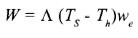
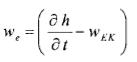
<body><![CDATA[<p align="justify"><font face="verdana" size="2">&nbsp;</font></p>     <p align="justify"><font face="verdana" size="2"><b>2.&nbsp; Mixed&#150;layer model</b></font></p>     <p align="justify"><font face="verdana" size="2">The ocean mixed layer is the top layer which is well mixed by wind, so that we can assume that it has a vertically uniform temperature. The mixed layer thickness (<i>h</i>) is defining the depth at which a sharp gradient of temperature indicates the start of the thermocline. The bottom of the mixed layer allows a mass vertical flux across it, defined as entrainment (if upwards).</font></p>     <p align="justify"><font face="verdana" size="2">The equation for the prediction of the month&#150;to&#150;month changes of SST in the Gulf of M&eacute;xico is the conservation of thermal energy equation given by:</font></p>     <p align="justify"><font face="verdana" size="2"><img src="/img/revistas/atm/v18n2/a04e1.jpg">........(1)</font></p>     <p align="justify"><font face="verdana" size="2">where <i>T<sub>S</sub></i> is the SST, <i>V<sub>ST</sub></i> the horizontal velocity of the ocean currents in the mixed layer, <img src="/img/revistas/atm/v18n2/a04s1.jpg"> the two dimensional gradient operator, <i>K<sub>S</sub></i> the constant horizontal exchange coefficient, <i>W</i> the rate of cooling in the mixed layer due to turbulent vertical penetration of colder water from the thermocline, <i>E<sub>S</sub></i> the rate at which the energy is added by radiation, <i>G<sub>2</sub></i> the rate at which the sensible heat is given off to the atmosphere by turbulent transport, <i>G<sub>3</sub></i> the rate at which the heat is lost by evaporation, <i>&beta;</i> is the solar extinction coefficient, and <img src="/img/revistas/atm/v18n2/a04s2.jpg"> is the solar radiation absorbed by the layer. When the absorption is complete <img src="/img/revistas/atm/v18n2/a04s3.jpg">, this case has been used in a previous paper by Mendoza <i>et al</i>. (1997). The water density, <img src="/img/revistas/atm/v18n2/a04s4.jpg"> and the specific heat, <i>c<sub>S</sub></i>, are considered constant and equal to 1.035 kg m<sup>&#150;3</sup> and 4186.0 Jkg<sup>&#150;1</sup>K<sup>&#150;1</sup> respectively.</font></p>     <p align="justify"><font face="verdana" size="2">The last term, <img src="/img/revistas/atm/v18n2/a04s5.jpg"> in the right side of equation (1), is the penetrative radiation in the layer and has been neglected in a previous paper by Mendoza <i>et al</i>. (1997).</font></p>     <p align="justify"><font face="verdana" size="2">The entrainment term <i>W</i>, in equation (1) can be expressed by:</font></p>     <p align="justify"><font face="verdana" size="2"><img src="/img/revistas/atm/v18n2/a04e2.jpg">............................................................(2)</font></p>     <p align="justify"><font face="verdana" size="2">Where <i>w<sub>e</sub></i> is the entrainment velocity which in agreement with Alexander (1992) is associated with the mixed layer deepening <img src="/img/revistas/atm/v18n2/a04s6.jpg"> modified by Ekman pumping velocity <i>w<sub>EK</sub></i>, and is given by:</font></p>     ]]></body>
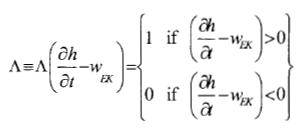
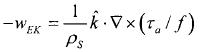
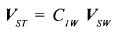
<body><![CDATA[<p align="justify"><font face="verdana" size="2"><img src="/img/revistas/atm/v18n2/a04e3.jpg">............................................................(3)</font></p>     <p align="justify"><font face="verdana" size="2">Where <img src="/img/revistas/atm/v18n2/a04s7.jpg"> is the Heaviside function given by:</font></p>     <p align="justify"><font face="verdana" size="2"><img src="/img/revistas/atm/v18n2/a04e4.jpg">............................(4)</font></p>     <p align="justify"><font face="verdana" size="2">In equation (2), <i>T<sub>h</sub></i> is the sea temperature below the mixed layer, which is assumed constant and equal to 288.15 K(15 &deg;C); and <i>w<sub>EK</sub></i> is Ekman pumping velocity given by:</font></p>     <p align="justify"><font face="verdana" size="2"><img src="/img/revistas/atm/v18n2/a04e5.jpg">...............................................(5)</font></p>     <p align="justify"><font face="verdana" size="2">Where <img src="/img/revistas/atm/v18n2/a04s8.jpg"> is the downward vertical unit vector; <img src="/img/revistas/atm/v18n2/a04s9.jpg">, the surface wind stress vector; and <i>f=2&Omega;sin&phi;</i>, the Coriolis parameter; <i>&Omega;</i>, the angular velocity of the Earth and <i>&phi;</i>, the latitude.</font></p>     <p align="justify"><font face="verdana" size="2">For the horizontal ocean currents in the mixed layer we shall assume that:</font></p>     <p align="justify"><font face="verdana" size="2"><img src="/img/revistas/atm/v18n2/a04e6.jpg">.................................................................(6)</font></p>     <p align="justify"><font face="verdana" size="2">Where <i>C<sub>IW</sub></i> is an empirical coefficient and <i>V<sub>SW</sub></i> is the horizontal velocity of the seasonal surface ocean current, which is prescribed in the model using observed values. We use <i>C<sub>IW</sub></i>=0.235, assuming that the currents in the Gulf of M&eacute;xico have a vertical profile in the whole frictional layer similar to the pure drift current (Adem, 1970).</font></p>     <p align="justify"><font face="verdana" size="2">The other equation of the model represents a balance between mechanical energy and thermal energy, where the entrainment of colder water is determined according to Kraus and Turner (1967) by:</font></p>     ]]></body>
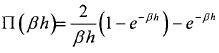
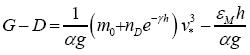
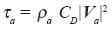
<body><![CDATA[<p align="justify"><font face="verdana" size="2"><img src="/img/revistas/atm/v18n2/a04e7.jpg">.....(7)</font></p>     <p align="justify"><font face="verdana" size="2">Where <i>G</i> is the turbulent kinetic energy input from the wind, <i>D</i> is the dissipation within the layer, and <img src="/img/revistas/atm/v18n2/a04s10.jpg">  is the solar penetration function. On the left&#150;side of equation (7), the first term represent the rate of working needed to lift and mix the denser entrained water; on the right&#150;hand side the first term represent the balance between the wind generation and dissipation of turbulent kinetic energy, and the second and third terms represent the rate of potential energy change produced by the net heating and the penetration of solar radiation in the mixed layer.</font></p>     <p align="justify"><font face="verdana" size="2">The solar penetration function in equation (7) is given by:</font></p>     <p align="justify"><font face="verdana" size="2"><img src="/img/revistas/atm/v18n2/a04e8.jpg">............................................(8)</font></p>     <p align="justify"><font face="verdana" size="2">Alexander and Woo Kim  (1976) found realistic results of mixed layer depth in the North Pacific Ocean using <i>&beta;</i>=0.1m<sup>&#150;1</sup>, therefore we assuming this value for the Gulf of M&eacute;xico, because this value represents very well the typical ocean&#150;water in depths greater than 50 m according to Jerlov (1951,1968).</font></p>     <p align="justify"><font face="verdana" size="2">The difference between the rate of generation and dissipation of turbulent kinetic energy is given in accordance with Alexander and Woo Kim by:</font></p>     <p align="justify"><font face="verdana" size="2"><img src="/img/revistas/atm/v18n2/a04e9.jpg">.......................................(9)</font></p>     <p align="justify"><font face="verdana" size="2">Where <img src="/img/revistas/atm/v18n2/a04s11.jpg">=2.1 x 10<sup>&#150;4</sup>K<sup>&#150;1</sup> is the thermal expansion coefficient of sea water; g=9.8 ms<sup>&#150;2</sup>, the acceleration of gravity; <i>m<sub>0</sub></i>=1.25, an empirical parameter; <i>n<sub>D</sub></i>= 1.25 and <img src="/img/revistas/atm/v18n2/a04s12.jpg">=0.05 m<sup>&#150;1</sup>, parameters of dissipation; <i>v<sub>*</sub></i> the frictional velocity related to the surface wind stress by <img src="/img/revistas/atm/v18n2/a04s13.jpg"> Alexander and Woo Kim obtained optimal results of the mixed layer depth in the summer season, using a parameter of background dissipation <i>&epsilon;<sub>M</sub></i>=2.0x10<sup>&#150;8</sup>m<sup>2</sup>s<sup>&#150;3</sup>, which exists even in the absence of wind stress; we found the best results with <i>&epsilon;<sub>M</sub></i>=2.0x10<sup>&#150;8</sup>m<sup>2</sup>s<sup>&#150;3</sup> for spring, <i>&epsilon;<sub>M</sub></i>=3.2x10<sup>&#150;8</sup>m<sup>2</sup>s<sup>&#150;3</sup> for summer and <i>&epsilon;<sub>M</sub></i>=0 for fall and winter.</font></p>     <p align="justify"><font face="verdana" size="2">For the surface wind stress, we use the bulk formula (Isemer and Hasse, 1987):</font></p>     <p align="justify"><font face="verdana" size="2"><img src="/img/revistas/atm/v18n2/a04e10.jpg">.................................................................(10)</font></p>     ]]></body>
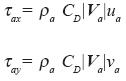
<body><![CDATA[<p align="justify"><font face="verdana" size="2">Where <img src="/img/revistas/atm/v18n2/a04s14.jpg"> and <img src="/img/revistas/atm/v18n2/a04s15.jpg"> are the surface air density and the surface wind speed, respectively; and <i>C<sub>D</sub></i>, the atmospheric drag coefficient.</font></p>     <p align="justify"><font face="verdana" size="2">The components west&#150;east and south&#150;north of the wind stress vector are, respectively, given by:</font></p>     <p align="justify"><font face="verdana" size="2"><img src="/img/revistas/atm/v18n2/a04e11.jpg">..............................................................(11)</font></p>     <p align="justify"><font face="verdana" size="2">Where <i>u<sub>a</sub></i> and <i>v<sub>a</sub></i> are the components west&#150;east and south&#150;north of the surface wind vector, respectively.</font></p>     <p align="justify"><font face="verdana" size="2">&nbsp;</font></p>     <p align="justify"><font face="verdana" size="2"><i>2.1 The heating function</i></font></p>     <p align="justify"><font face="verdana" size="2">The rate at which the energy is added by radiation at the sea surfac (ES) is computed as Budyko (1974):</font></p>     <p align="justify"><font face="verdana" size="2"><img src="/img/revistas/atm/v18n2/a04e12.jpg">......(12)</font></p>     <p align="justify"><font face="verdana" size="2">Where <img src="/img/revistas/atm/v18n2/a04s16.jpg">=0.96 is the emissivity of the sea surface: <img src="/img/revistas/atm/v18n2/a04s17.jpg">, the Stefan&#150;Boltzmann constant; <i>T<sub>a</sub></i> , the surface air temperature; <i>U</i>, the surface air relative humidity; <i>e<sub>S</sub>T<sub>&alpha;</sub></i>, the saturation vapor pressure at the surface air temperature in hPa; &epsilon;, the fractional amount of cloudiness; and <i>c</i>=0.65, a cloud cover coefficient.</font></p>     <p align="justify"><font face="verdana" size="2">For the solar radiation absorbed by the ocean layer <img src="/img/revistas/atm/v18n2/a04s18.jpg">, we use the Barliand&#150;Budyko equation:</font></p>     ]]></body>
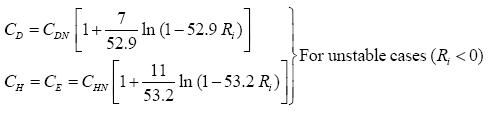
<body><![CDATA[<p align="justify"><font face="verdana" size="2"><img src="/img/revistas/atm/v18n2/a04e13.jpg">..............................(13)</font></p>     <p align="justify"><font face="verdana" size="2">Where (Q + q)<sub>0</sub> is the total solar radiation received by the surface with clear sky; <img src="/img/revistas/atm/v18n2/a04s19.jpg">, the albedo of the sea surface; and <i>a</i> and <i>b</i> are the coefficients taken from Budyko (1974). The coefficient a is a function of the latitude and the coefficient b is a constant equal to 0.38. For the Gulf of M&eacute;xico we use <i>a</i>=0.35, which corresponds to 25 &deg;N of latitude.</font></p>     <p align="justify"><font face="verdana" size="2">The heating functions G<sub>2</sub> and G<sub>3</sub> are given by the following equations (Mendoza <i>et al</i>, 1997):</font></p>     <p align="justify"><font face="verdana" size="2"><img src="/img/revistas/atm/v18n2/a04e14.jpg">..................................................(14)</font></p>     <p align="justify"><font face="verdana" size="2"><img src="/img/revistas/atm/v18n2/a04e15.jpg">...................(15)</font></p>     <p align="justify"><font face="verdana" size="2">Where <i>c<sub>p</sub></i>=1.004 Jkg<sup>&#150;1</sup>K<sup>&#150;1</sup> is the specific heat of air at constant pressure; L=2.44 x10<sup>6</sup>Jkg<sup>&#150;1</sup>, the latent heat of vaporization which is considered constant; <i>P<sub>a</sub></i>, the sea level pressure; <i>C<sub>H</sub></i> and <i>C<sub>E</sub></i>, the vertical turbulent transport coefficients of the sensible and latent heat, respectively. The coefficients <i>C<sub>D</sub></i>, <i>C<sub>H</sub></i> and <i>C<sub>E</sub></i> are determined according with Huang (1978) by:</font></p>     <p align="justify"><font face="verdana" size="2"><img src="/img/revistas/atm/v18n2/a04e16a.jpg">.............................(16a)</font></p>     <p align="justify"><font face="verdana" size="2"><img src="/img/revistas/atm/v18n2/a04e16b.jpg">.........(16b)</font></p>     <p align="justify"><font face="verdana" size="2">Where <i>C<sub>DN</sub></i> =2.5x10<sup>&#150;3</sup> and CHN = 1.2x10<sup>&#150;3</sup> are the drag coefficient for momentum and sensible heat for the neutral case, respectively, and R<sub>1</sub> is the bulk Richardson number given by:</font></p>     <p align="justify"><font face="verdana" size="2"><img src="/img/revistas/atm/v18n2/a04e17.jpg">............................(17)</font></p>     ]]></body>
<body><![CDATA[<p align="justify"><font face="verdana" size="2">Where Z<sub>10</sub>=10 <i>m</i> and T<sub>V0</sub>=298 K are the reference height and the reference temperature in the Richardson number, which is also a function of the surface wind speed and the virtual air&#150;sea temperature difference, where the correction of the virtual temperature is applied to T<sub>a</sub>.</font></p>     <p align="justify"><font face="verdana" size="2">In equations (15) and (17) the saturation vapor pressure is computed using the follow equation (Adem, 1967):</font></p>     <p align="justify"><font face="verdana" size="2"><img src="/img/revistas/atm/v18n2/a04e18.jpg">.............................(18)</font></p>     <p align="justify"><font face="verdana" size="2">where <i>e<sub>S</sub>(t<sup>*</sup>)</i> is in millibars and <i>t<sup>*</sup></i> is the temperature in Celsius degree; <i>a<sub>1</sub></i>= 6.115, <i>b<sub>1</sub></i>= 0.42915, <i>c<sub>1</sub></i>= 0.014206, <i>d<sub>1</sub></i>=3.046x10<sup>&#150;4</sup> and <i>l<sub>1</sub></i>= 3.2x10<sup>&#150;6</sup>.</font></p>     <p align="justify"><font face="verdana" size="2">&nbsp;</font></p>     <p align="justify"><font face="verdana" size="2"><i>2.2 The integration method</i></font></p>     <p align="justify"><font face="verdana" size="2">Equations (1) and (7) are applied to time&#150;averages of one month in a uniform grid on the sea surface of the Gulf of M&eacute;xico, the north&#150;western of the Caribbean Sea and the Atlantic Ocean region contiguous to Florida <a href="/img/revistas/atm/v18n2/a04f1.jpg" target="_blank">(Fig. 1)</a>. For the time integration we apply for equation (1) the explicit Euler method and for equation (7) a backward implicit time finite difference scheme, therefore for equation (1) we obtain:</font></p>     <p align="justify"><font face="verdana" size="2"><img src="/img/revistas/atm/v18n2/a04e19.jpg">............(19)</font></p>     <p align="justify"><font face="verdana" size="2">And for equation (7):</font></p>     <p align="justify"><font face="verdana" size="2"><img src="/img/revistas/atm/v18n2/a04e20.jpg">........................(20)</font></p>     ]]></body>
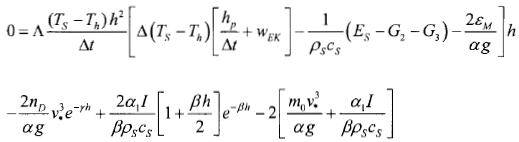
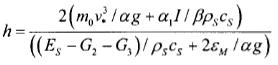
<body><![CDATA[<p align="justify"><font face="verdana" size="2">Where we use (8) and (9) in (7) to obtain equation (20) and where <i>&Delta;t</i> is the time&#150;step which is taken of 2 hours; the sub&#150;index <i>p</i> indicate that <i>T<sub>S</sub></i> and <i>h</i> take values of the previous time step.</font></p>     <p align="justify"><font face="verdana" size="2">In a previous work (Mendoza <i>et al</i>, 1997) we used equation (20) with <img src="/img/revistas/atm/v18n2/a04s20.jpg">=0, and assuming that <img src="/img/revistas/atm/v18n2/a04s21.jpg">, we computed diagnostically the MLD and its effect in the monthly prediction of the SST anomalies. In this case equation (20) is reduced to:</font></p>     <p align="justify"><font face="verdana" size="2"><img src="/img/revistas/atm/v18n2/a04e21.jpg">........................(21)</font></p>     <p align="justify"><font face="verdana" size="2">Therefore:</font></p>     <p align="justify"><font face="verdana" size="2"><img src="/img/revistas/atm/v18n2/a04e22.jpg">....................................................(22)</font></p>     <p align="justify"><font face="verdana" size="2">For summer and fall, equation (22) yields results in agreement with the observations of Robinson (1973); however, for winter and spring we obtain discrepancies between the MLD values computed from equation (22) and those observed. These results suggest that the MLD must be computed, mainly for winter and spring, of the complete equation (20).</font></p>     <p align="justify"><font face="verdana" size="2">In this work to compute h from equation (20), we use the successive approximation method of Newton (Carnahan <i>et al,</i> 1969).</font></p>     <p align="justify"><font face="verdana" size="2">To simulate the annual cycle of <i>T<sub>S</sub></i> and h, we start the computations in January by assuming that <i>h</i>=60 <i>m</i>, <i>T<sub>S</sub></i>=298.15 K (25&deg;C) and that the cooling by entrainment is equal to zero (<i>W<sub>P</sub></i> = 0) in equation (19).</font></p>     <p align="justify"><font face="verdana" size="2">With <i>T<sub>S</sub></i> computed in the first time&#150;step from equation (19), we compute <i>h</i> from equation (20) taking <img src="/img/revistas/atm/v18n2/a04s22.jpg">= 1, which is verified if the first condition in (4) is satisfied. In this way we obtained <i>T<sub>S</sub></i> and <i>h</i> for the first time&#150;step; however, if the second condition in (4) is satisfied, then we compute again <i>h</i> taken now <img src="/img/revistas/atm/v18n2/a04s22.jpg">=0 in equation (20).</font></p>     <p align="justify"><font face="verdana" size="2">For the second time&#150;step, we take as initial condition <i>T<sub>S</sub></i> and <i>h</i> from the first time&#150;step. The process is continued until completing one month, with 360 time&#150;steps of 2 hours.</font></p>     ]]></body>
<body><![CDATA[<p align="justify"><font face="verdana" size="2">The temperature <i>T<sub>S</sub></i> and the depth <i>h</i> computed in the last time&#150;step is now used as initial condition to compute the temperature and the depth for February, and so on.</font></p>     <p align="justify"><font face="verdana" size="2">This iteration process is continued for several annual cycles until the temperature and the depth computed for each month between two consecutive years have a difference smaller than 0.01 &deg;C and 0.01 m, respectively. These conditions are achieved after a run of 5 years.</font></p>     <p align="justify"><font face="verdana" size="2">For the spatial derivatives in equation (19), we use centered differences with a regular grid of 25 Km where the horizontal transport of heat by ocean currents and by turbulent eddies are taken as zero at the points in the closed boundaries (coasts). At the points in the open boundaries (in the Caribbean Sea and Atlantic ocean regions contiguous to Florida), we assume that the horizontal transport of heat by turbulent eddies is zero. For the horizontal transport of heat by ocean currents in the open boundaries, we compute the term <img src="/img/revistas/atm/v18n2/a04s23.jpg"> using climatic observed values of the surface ocean currents and the sea surface temperatures.</font></p>     <p align="justify"><font face="verdana" size="2">&nbsp;</font></p>     <p align="justify"><font face="verdana" size="2"><i>2.3 Input&#150;data</i></font></p>     <p align="justify"><font face="verdana" size="2">For the horizontal velocity vector of the surface ocean currents <i>V<sub>SW</sub></i> <a href="/img/revistas/atm/v18n2/a04f2.jpg" target="_blank">(Fig. 2)</a>, we use the compiled data from the Oceanographic Atlas of the Mexican Marine Office (1985).</font></p>     <p align="justify"><font face="verdana" size="2">For the components <i>u<sub>a</sub></i> and <i>v<sub>a</sub></i> of the surface wind; as well as for the surface air temperature, <i>T<sub>a</sub></i> and the surface relative humidity, U<sub>a</sub>, we use monthly values from NOAA&#150;CIRES, Climate Diagnostic Center of Boulder Colorado (CDC) (Web site at <a href="http://www.cdc.noaa.gov/" target="_blank">http://www.cdc.noaa.gov/</a>). The wind speed computed with the components <i>u<sub>a</sub></i> and <i>v<sub>a</sub></i> results greater that the wind speed reported by NOAA&#150;CIRES CDC; this inconsistency has been eliminated using for  <img src="/img/revistas/atm/v18n2/a04s24.jpg"> seasonal values derived from the revised maps of scalar wind speed taken from the Bunker Climate Atlas of the North Atlantic Ocean, (Isemer and Hasse, 1987), which does not include the components of the surface wind.</font></p>     <p align="justify"><font face="verdana" size="2">Seasonal values of the fractional amount of cloudiness, e, and the albedo of the sea surface, <img src="/img/revistas/atm/v18n2/a04s25.jpg">, were obtained from data files of the Adem's thermodynamic climate model (Adem, 1965).</font></p>     <p align="justify"><font face="verdana" size="2">&nbsp;</font></p>     <p align="justify"><font face="verdana" size="2"><b>3. Results and discussion</b></font></p>     ]]></body>
<body><![CDATA[<p align="justify"><font face="verdana" size="2"><i>3.1 SST, MLD and the entrainment velocity fields</i></font></p>     <p align="justify"><font face="verdana" size="2">We computed the annual cycle of the SST and the MLD from equations (19) and (20), respectively, and compared the results with the corresponding observed average data reported by Robinson (1973). As examples we show the cases of January and July corresponding to winter and summer, respectively. <a href="/img/revistas/atm/v18n2/a04f3.jpg" target="_blank">Figure 3</a> shows the SST, in Celsius degrees, computed for January (Part A) and the corresponding observed values (Part B). <a href="/img/revistas/atm/v18n2/a04f4.jpg" target="_blank">Figure 4</a> is as <a href="/img/revistas/atm/v18n2/a04f3.jpg" target="_blank">Figure 3</a> but for July.</font></p>     <p align="justify"><font face="verdana" size="2">The comparison of part A with part B, for the case of January and July, shows that the model has some skill to simulate the SST.</font></p>     <p align="justify"><font face="verdana" size="2">In January, it is clearly shown the effect that on the SST has the water flow through the Yucat&aacute;n Channel, associated with the Loop Current <a href="/img/revistas/atm/v18n2/a04f3.jpg" target="_blank">(Fig. 3, Part B)</a>. This effect on the SST has been, in part, simulated by the model due to the prescribed observed currents. In the central part of the Gulf of M&eacute;xico the model simulates temperatures very close to the observations. However in the Texas&#150;Louisiana shelf it is observed a more pronounced northward cooling than the one computed by the model. Temperatures approximately uniform of 29&deg;C are observed in July (<a href="/img/revistas/atm/v18n2/a04f4.jpg" target="_blank">Fig. 4, Part B)</a>, decreasing one degree toward the west coast of the Gulf, and toward the Yucat&aacute;n and Florida shelves. The model also simulates approximately uniform temperatures of 29&deg;C in the center of the Gulf, with a decrease towards the northeast, however the temperatures simulated by the model over the Campeche Bay of up to 27 &deg;C <a href="/img/revistas/atm/v18n2/a04f4.jpg" target="_blank">(Fig. 4, Part A)</a> are not observed in the Part B of <a href="/img/revistas/atm/v18n2/a04f4.jpg" target="_blank">Figure 4</a>. These low temperatures, over the Campeche Bay, simulated by the model are produced by a relatively strong upwelling <a href="/img/revistas/atm/v18n2/a04f8.jpg" target="_blank">(Fig. 8, Part B)</a>, that produces an important entrainment of cold water from the thermocline <a href="/img/revistas/atm/v18n2/a04f9.jpg" target="_blank">(Fig. 9, Part B)</a>.</font></p>     <p align="justify"><font face="verdana" size="2"><a href="/img/revistas/atm/v18n2/a04f5.jpg" target="_blank">Figure 5</a> shows the MLD, in meters, computed for January (Part A) and the corresponding observed values (Part B). <a href="/img/revistas/atm/v18n2/a04f6.jpg" target="_blank">Figure 6</a> is as <a href="/img/revistas/atm/v18n2/a04f5.jpg" target="_blank">Figure 5</a> but for July. For January, the model yields minimal values of MLD in the Campeche Bay and in the North of Florida and yields maximal values in the Texas Shelf between Corpus Christi and Mississippi Delta. Also it yields maximal values to the south of Florida and around the island of Cuba, which has certain agreement with the observations <a href="/img/revistas/atm/v18n2/a04f5.jpg" target="_blank">(Fig. 5, Part B)</a>. For July the thermocline is considerably shallower than in January. In this case the result of the model is between about 15 and 30m in the Gulf of M&eacute;xico and of the order of 45m in the northwest portion of the Caribbean Sea, which is also in agreement with the observations.</font></p>     <p align="justify"><font face="verdana" size="2">In accordance with equation (22), to a first approximation, h is proportional to <i>v<sub>*</sub><sup>3</sup>/(E<sub>S</sub>&#150;G<sub>2</sub>&#150;G<sub>3</sub>)</i>, therefore in July, maximal values of <i>h</i> <a href="/img/revistas/atm/v18n2/a04f6.jpg" target="_blank">(Fig. 6, part A)</a> tend to coincide with maximal values of <img src="/img/revistas/atm/v18n2/a04s26.jpg"> <a href="/img/revistas/atm/v18n2/a04f7.jpg" target="_blank">(Fig. 7A)</a> and minimal values of the heating <i>(E<sub>S</sub>&#150;G<sub>2</sub>&#150;G<sub>3</sub>)</i> in the central part of the Gulf <a href="/img/revistas/atm/v18n2/a04f7.jpg" target="_blank">(Fig. 7B)</a>.</font></p>     <p align="justify"><font face="verdana" size="2"><a href="/img/revistas/atm/v18n2/a04f9.jpg" target="_blank">Figure 9</a> shows the entrainment velocity (10<sup>&#150;6</sup> ms<sup>&#150;1</sup>) computed by the model for January (Part A) and July (Part B). In January, values higher than 3x10<sup>&#150;6</sup> ms<sup>&#150;1</sup> in the entrainment velocity are located over the Texas&#150;Louisiana Shelf and towards the north of the Campeche Bay <a href="/img/revistas/atm/v18n2/a04f9.jpg" target="_blank">(Fig. 9A)</a>, whereas in July <a href="/img/revistas/atm/v18n2/a04f9.jpg" target="_blank">(Fig. 9B)</a> they are only located in a reduced area towards the north of the Campeche Bay.</font></p>     <p align="justify"><font face="verdana" size="2">In order to determine the degree of cooling of the mixed layer, as well as its changes in depth, we have made an experiment in which the Ekman pumping velocity is neglected in Equation (20). <a href="/img/revistas/atm/v18n2/a04f10.jpg" target="_blank">Figure 10</a>, shows the difference between the entrainment velocity, computed taking into account the Ekman pumping velocity, and the one computed neglecting it. In all the Campeche Bay, but mainly towards the north part, the upwelling plays an important role in increasing the entrainment <a href="/img/revistas/atm/v18n2/a04f10.jpg" target="_blank">(positive values in Figure 10)</a>, and producing a maximal reduction in the temperature of 1.5&deg;C for January <a href="/img/revistas/atm/v18n2/a04f11.jpg" target="_blank">(Fig. 11 A)</a> and of 3.0&deg;C for July <a href="/img/revistas/atm/v18n2/a04f11.jpg" target="_blank">(Fig. 11B)</a>. In the rest of the Gulf of M&eacute;xico the downwelling <a href="/img/revistas/atm/v18n2/a04f8.jpg" target="_blank">(positive values in Fig. 8)</a> tends to reduce the entrainment velocity and to increase the temperature up to 1.0&deg;C in January and 2.0&deg;C in July, as is shown in <a href="/img/revistas/atm/v18n2/a04f11.jpg" target="_blank">Figure 11</a>.</font></p>     <p align="justify"><font face="verdana" size="2"><a href="/img/revistas/atm/v18n2/a04f12.jpg" target="_blank">Figure 12</a> shows that the upwelling tends to diminish the depth of the mixed layer in the Campeche Bay and, the downwelling tends to increase the depth of the mixed layer in the rest of the Gulf of M&eacute;xico. The most important changes in the depth of the mixed layer due to either upwelling or downwelling occur in January <a href="/img/revistas/atm/v18n2/a04f12.jpg" target="_blank">(Fig. 12A)</a>.</font></p>     <p align="justify"><font face="verdana" size="2">&nbsp;</font></p>     ]]></body>
<body><![CDATA[<p align="justify"><font face="verdana" size="2"><i>3.2 The annual cycle of the SST, the MLD and the entrainment velocity</i></font></p>     <p align="justify"><font face="verdana" size="2">Next we will show the annual cycle of the SST, MLD and entrainment velocity using spatial averages month to month. <a href="/img/revistas/atm/v18n2/a04f13.jpg" target="_blank">Figures 13</a> <a href="/img/revistas/atm/v18n2/a04f14.jpg" target="_blank">and 14</a> show the computed and the observed annual cycle of the SST and of the MLD, respectively, in the basin of the Gulf of M&eacute;xico, delimited by the open boundaries shown by the line B1 in the Yucat&aacute;n Channel and the line B2 in the Florida Strait (<a href="/img/revistas/atm/v18n2/a04f1.jpg" target="_blank">Fig. 1)</a>. The computed annual cycle of SST <a href="/img/revistas/atm/v18n2/a04f13.jpg" target="_blank">(Fig. 13)</a> shows, in agreement with the observations, a variation of 8 &deg;C between February and August, with a minimum value in February and a maximum in August. The MLD shows a variation of 57 m with a minimum value of 19 m in July and a maximum of about 78 m in February <a href="/img/revistas/atm/v18n2/a04f14.jpg" target="_blank">(Fig. 14)</a>.</font></p>     <p align="justify"><font face="verdana" size="2">The photosynthetic pigment concentration, obtained from the Mexican Pacific CD&#150;ROM of environmental analysis, is used for comparison with the computed entrainment velocity. Since we did not take into account the photosynthetic pigment concentration due to the rivers and lagoons, this comparison is carried out in the deepest closed region of the Gulf of M&eacute;xico delimited by the polygon shown in <a href="/img/revistas/atm/v18n2/a04f1.jpg" target="_blank">Figure 1</a>.</font></p>     <p align="justify"><font face="verdana" size="2">Photosynthetic pigment concentration in the deepest region of the Gulf of M&eacute;xico <a href="/img/revistas/atm/v18n2/a04f15.jpg" target="_blank">(Fig. 15)</a>, exhibits maximum values in winter (December, January and February) and minimum values in summer (June, July and August), which is in agreement with the annual cycle of the entrainment velocity. The entrainment velocity shows a maximum in May, which is slightly hinted in the photosynthetic pigment concentration.</font></p>     <p align="justify"><font face="verdana" size="2"><a href="/img/revistas/atm/v18n2/a04f16.jpg" target="_blank">Figures 16</a> <a href="/img/revistas/atm/v18n2/a04f17.jpg" target="_blank">and 17</a> show the annual cycle of the SST and the MLD in the deepest region of the Gulf of M&eacute;xico. These curves exhibit a monthly variability similar to the one of the whole basin of the Gulf of M&eacute;xico <a href="/img/revistas/atm/v18n2/a04f13.jpg" target="_blank">(Figs. 13</a> <a href="/img/revistas/atm/v18n2/a04f14.jpg" target="_blank">and 14)</a>.</font></p>     <p align="justify"><font face="verdana" size="2">The agreement between the computed and the observed annual cycle shown from <a href="/img/revistas/atm/v18n2/a04f13.jpg" target="_blank">figures 13</a> <a href="/img/revistas/atm/v18n2/a04f17.jpg" target="_blank">to 17</a> (<a href="/img/revistas/atm/v18n2/a04f13.jpg" target="_blank">13</a>, <a href="/img/revistas/atm/v18n2/a04f14.jpg" target="_blank">14</a>, <a href="/img/revistas/atm/v18n2/a04f15.jpg" target="_blank">15</a>, <a href="/img/revistas/atm/v18n2/a04f16.jpg" target="_blank">16</a>, <a href="/img/revistas/atm/v18n2/a04f17.jpg" target="_blank">17</a>)does not imply that the spatial distribution of the computed and the observed variables have a similar agreement. Therefore, we have evaluated the similitude between the computed and observed spatial distribution of the SST, and the MLD, using the index of agreement <a href="#apendice">(Appendix A)</a>, and the normalized correlation coefficient between the entrainment velocity and the observed photosynthetic pigment concentration. The index of agreement is not a measure of correlation in the formal sense but rather a measure of the degree to which a model's predictions are error free, at the same time is a standardized measure to estimate the error, regardless of units. It varies between 0.0 and 1.0 where a computed value of 1.0 indicates perfect agreement between the observed and predicted observations, and 0.0 connotes one of a variety of complete disagreements.</font></p>     <p align="justify"><font face="verdana" size="2"><a href="/img/revistas/atm/v18n2/a04f18.jpg" target="_blank">Figure 18</a> shows the index of agreement between the SST computed by the model and the SST observed in the basin of the Gulf of M&eacute;xico (solid line) and in the deepest region of the Gulf of M&eacute;xico (discontinues line), for all months of the year. These curves indicate that in the whole basin of the Gulf of M&eacute;xico, the index of agreement is more significant mainly from October to May (0.8&#150;0.9) than from June to September (0.4&#150;0.5). A similar configuration is observed for the deepest region but with significant values of the index of agreement only from January to May. The low agreement in the deepest region is due probability to the horizontal transport of thermal energy by the anticyclonic eddies shaded of the Loop Current, which is not included in the model.</font></p>     <p align="justify"><font face="verdana" size="2"><a href="/img/revistas/atm/v18n2/a04f19.jpg" target="_blank">Figure 19</a> is similar to <a href="/img/revistas/atm/v18n2/a04f18.jpg" target="_blank">Figure 18</a>, except that for the MLD. This figure indicates that in the whole basin the index of agreement is significant (0.5&#150;0.8) from February to July while that in the rest of the year, the index is not significant ( <u>&lt;</u> 0.4). In the deepest region of the Gulf of M&eacute;xico there are significative values (0.5&#150;0.6) only in June and July.</font></p>     <p align="justify"><font face="verdana" size="2"><a href="/img/revistas/atm/v18n2/a04f20.jpg" target="_blank">Figure 20</a> shows the normalized correlation coefficient between the entrainment velocity and the photosynthetic pigment concentration in the deepest region of the Gulf of M&eacute;xico delimited by the thick line shown in <a href="/img/revistas/atm/v18n2/a04f1.jpg" target="_blank">Figure 1</a>, the comparison month to month between the spatial distribution of entrainment velocity and photosynthetic pigment concentration, shows a significant positive correlation only in January, April, May, June and September. The significant positive correlation may be due in part to the entrainment of colder water, rich in nutrients, from the thermocline which is raising the concentration of photosynthetic pigments.</font></p>     <p align="justify"><font face="verdana" size="2">&nbsp;</font></p>     ]]></body>
<body><![CDATA[<p align="justify"><font face="verdana" size="2"><b>4. Concluding remarks</b></font></p>     <p align="justify"><font face="verdana" size="2">Alexander and Woo&#150;Kim applied the Kraus and Turner theory to compute the MLD in the North Pacific Ocean for summer in the region where the entrainment could be considered as zero, and therefore the MLD was determined from a diagnostic equation, in which the SST was prescribed using observed values. In this work we compute the MLD from equation (7), which includes the entrainment (<img src="/img/revistas/atm/v18n2/a04s27.jpg">=1), and which is coupled with the thermodynamic equation, from which the SST is computed. Therefore our model is able to simulate with certain skill the basic characteristics of the SST and the MLD throughout the whole year. Here we have shown only the results for January (winter) and July (summer).</font></p>     <p align="justify"><font face="verdana" size="2">We have shown the importance of the Ekman pumping in the entrainment velocity; we found that the upwelling plays an important role in increasing the entrainment velocity, producing in the Campeche Bay, an important cooling in the SST and diminishing the depth of the mixed layer. In the rest of the Gulf of M&eacute;xico the downwelling tends to reduce the entrainment velocity, increasing the SST and the MLD.</font></p>     <p align="justify"><font face="verdana" size="2">The computed annual cycle of the SST and the MLD in the whole basin of the Gulf of M&eacute;xico shows some agreement with the observations.</font></p>     <p align="justify"><font face="verdana" size="2">We found a significant positive correlation between the computed entrainment velocity and the observed photosynthetic pigment concentration in January, April, May, June and September which may be due in part to the entrainment of colder water, rich in nutrients from the thermocline, which is raising the concentration of photosynthetic pigments.</font></p>     <p align="justify"><font face="verdana" size="2">Good results have been obtained recently (unpublished paper), applying this model to the study of the effect of cold air&#150;outbreaks, tropical storms and hurricanes on the SST and the MLD in the Gulf of M&eacute;xico.</font></p>     <p align="justify"><font face="verdana" size="2">&nbsp;</font></p>     <p align="justify"><font face="verdana" size="2"><b>Acknowledgements</b></font></p>     <p align="justify"><font face="verdana" size="2">We are indebted to Berta Oda Noda, Alejandro Aguilar Sierra and Rodolfo Meza for the computational technical support.</font></p>     <p align="justify"><font face="verdana" size="2">&nbsp;</font></p>     ]]></body>
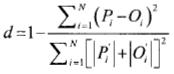
<body><![CDATA[<p align="justify"><font face="verdana" size="2"><a name="apendice"></a><b>Appendix A</b></font></p>     <p align="justify"><font face="verdana" size="2">The index of agreement d (Willmott and Wicks, 1980) is expressed as:</font></p>     <p align="justify"><font face="verdana" size="2"><img src="/img/revistas/atm/v18n2/a04e23.jpg">	</font></p>     <p align="justify"><font face="verdana" size="2">Where <i>O<sub>i</sub></i> is the observed variable, <i>P<sub>i</sub></i> is the predicted variable. The index of agreement <i>d</i>, specifies the degree to which the observed deviations about (observed means) correspond, both in magnitude and sign, to the predicted deviations about <img src="/img/revistas/atm/v18n2/a04s28.jpg"> and <img src="/img/revistas/atm/v18n2/a04s29.jpg"> .It is assumed that the portions of the magnitudes <i>P<sub>i</sub></i> and <i>O<sub>i</sub></i> that are equivalent to <img src="/img/revistas/atm/v18n2/a04s30.jpg"> are not in error since <img src="/img/revistas/atm/v18n2/a04s30.jpg"> is considered to be error free.</font></p>     <p align="justify"><font face="verdana" size="2">&nbsp;</font></p>     <p align="justify"><font face="verdana" size="2"><b>References</b></font></p>     <!-- ref --><p align="justify"><font face="verdana" size="2">Adem, J., 1965. Experiments aiming at monthly and seasonal numerical weather prediction. <i>Mon. Wea. Rev.</i> <b>93</b>, 495&#150;503.</font>&nbsp;&nbsp;&nbsp;&nbsp;&nbsp;&nbsp;&nbsp;&nbsp;[&#160;<a href="javascript:void(0);" onclick="javascript: window.open('/scielo.php?script=sci_nlinks&ref=1258584&pid=S0187-6236200500020000400001&lng=','','width=640,height=500,resizable=yes,scrollbars=1,menubar=yes,');">Links</a>&#160;]<!-- end-ref --><!-- ref --><p align="justify"><font face="verdana" size="2">Adem, J., 1967. Parameterization of atmospheric humidity using cloudiness and temperature. <i>Mon. Wea. Rev.</i> <b>95</b>, 83&#150;88.</font>&nbsp;&nbsp;&nbsp;&nbsp;&nbsp;&nbsp;&nbsp;&nbsp;[&#160;<a href="javascript:void(0);" onclick="javascript: window.open('/scielo.php?script=sci_nlinks&ref=1258585&pid=S0187-6236200500020000400002&lng=','','width=640,height=500,resizable=yes,scrollbars=1,menubar=yes,');">Links</a>&#160;]<!-- end-ref --><!-- ref --><p align="justify"><font face="verdana" size="2">Adem, J., 1970. On the prediction of mean monthly ocean temperature. <i>Tellus</i> 22, 410&#150;430.</font>&nbsp;&nbsp;&nbsp;&nbsp;&nbsp;&nbsp;&nbsp;&nbsp;[&#160;<a href="javascript:void(0);" onclick="javascript: window.open('/scielo.php?script=sci_nlinks&ref=1258586&pid=S0187-6236200500020000400003&lng=','','width=640,height=500,resizable=yes,scrollbars=1,menubar=yes,');">Links</a>&#160;]<!-- end-ref --><!-- ref --><p align="justify"><font face="verdana" size="2">Adem, J., Mendoza, V. M., Villanueva Urrutia, E. E, Monreal&#150;G&oacute;mez, M. A., 1991. On the simulation of the sea surface temperature in the GulfofM&eacute;xico using a thermodynamic model. <i>Atm&oacute;sfera</i>. <b>4</b>, 87&#150;99.</font>&nbsp;&nbsp;&nbsp;&nbsp;&nbsp;&nbsp;&nbsp;&nbsp;[&#160;<a href="javascript:void(0);" onclick="javascript: window.open('/scielo.php?script=sci_nlinks&ref=1258587&pid=S0187-6236200500020000400004&lng=','','width=640,height=500,resizable=yes,scrollbars=1,menubar=yes,');">Links</a>&#160;]<!-- end-ref --><!-- ref --><p align="justify"><font face="verdana" size="2">Adem, J., Villanueva, E. E., Mendoza, V. M., 1993. A new method for estimating the seasonal cycle of the heat balance at the ocean surface, with application to the Gulf of M&eacute;xico. <i>Geof&iacute;s. Int</i>. <b>32</b>, 21&#150;34.</font>&nbsp;&nbsp;&nbsp;&nbsp;&nbsp;&nbsp;&nbsp;&nbsp;[&#160;<a href="javascript:void(0);" onclick="javascript: window.open('/scielo.php?script=sci_nlinks&ref=1258588&pid=S0187-6236200500020000400005&lng=','','width=640,height=500,resizable=yes,scrollbars=1,menubar=yes,');">Links</a>&#160;]<!-- end-ref --><!-- ref --><p align="justify"><font face="verdana" size="2">Adem, J., Villanueva, E. E., Mendoza, V. M., 1994. Preliminary experiments in the prediction of sea surface temperature anomalies in the Gulf of M&eacute;xico. <i>Geof&iacute;s. Int.</i> <b>33</b>, 511&#150;521.</font>&nbsp;&nbsp;&nbsp;&nbsp;&nbsp;&nbsp;&nbsp;&nbsp;[&#160;<a href="javascript:void(0);" onclick="javascript: window.open('/scielo.php?script=sci_nlinks&ref=1258589&pid=S0187-6236200500020000400006&lng=','','width=640,height=500,resizable=yes,scrollbars=1,menubar=yes,');">Links</a>&#160;]<!-- end-ref --><!-- ref --><p align="justify"><font face="verdana" size="2">Alexander, M. A., 1992. Midlatitude atmosphere&#150;ocean interaction during El Ni&ntilde;o. Part I: The North Pacific Ocean. <i>J. Climate,</i> 944&#150;958.</font>&nbsp;&nbsp;&nbsp;&nbsp;&nbsp;&nbsp;&nbsp;&nbsp;[&#160;<a href="javascript:void(0);" onclick="javascript: window.open('/scielo.php?script=sci_nlinks&ref=1258590&pid=S0187-6236200500020000400007&lng=','','width=640,height=500,resizable=yes,scrollbars=1,menubar=yes,');">Links</a>&#160;]<!-- end-ref --><!-- ref --><p align="justify"><font face="verdana" size="2">Alexander, R. C., Jeong&#150;Woo Kim, 1976. Diagnostic model study of mixed&#150;layer depths in the summer North Pacific. J. Phys. <i>Ocean</i>. <b>6</b>, 293&#150;298.</font>&nbsp;&nbsp;&nbsp;&nbsp;&nbsp;&nbsp;&nbsp;&nbsp;[&#160;<a href="javascript:void(0);" onclick="javascript: window.open('/scielo.php?script=sci_nlinks&ref=1258591&pid=S0187-6236200500020000400008&lng=','','width=640,height=500,resizable=yes,scrollbars=1,menubar=yes,');">Links</a>&#160;]<!-- end-ref --><!-- ref --><p align="justify"><font face="verdana" size="2">Bender, M.A. and Ginis, I., 2000. Real&#150;case simulation of hurricane&#150;ocean interaction using a high&#150;resolution coupled model: effects on hurricane intensity. <i>Mon. Wea. Rev.</i> <b>128</b>, 917&#150;946.</font>&nbsp;&nbsp;&nbsp;&nbsp;&nbsp;&nbsp;&nbsp;&nbsp;[&#160;<a href="javascript:void(0);" onclick="javascript: window.open('/scielo.php?script=sci_nlinks&ref=1258592&pid=S0187-6236200500020000400009&lng=','','width=640,height=500,resizable=yes,scrollbars=1,menubar=yes,');">Links</a>&#160;]<!-- end-ref --><!-- ref --><p align="justify"><font face="verdana" size="2">Blumberg, A. F. and Mellor G. L., 1983. Diagnostic and prognostic numerical circulation studies of the South Atlantic Bight. <i>J. Phys. Res</i>. <b>88</b>, C8, 4579&#150;4592.</font>&nbsp;&nbsp;&nbsp;&nbsp;&nbsp;&nbsp;&nbsp;&nbsp;[&#160;<a href="javascript:void(0);" onclick="javascript: window.open('/scielo.php?script=sci_nlinks&ref=1258593&pid=S0187-6236200500020000400010&lng=','','width=640,height=500,resizable=yes,scrollbars=1,menubar=yes,');">Links</a>&#160;]<!-- end-ref --><!-- ref --><p align="justify"><font face="verdana" size="2">Budyko, M. I., 1974. <i>Climate and Life. International Geophysics Series</i>, 18, Academic Press, New York. 508 pp.</font>&nbsp;&nbsp;&nbsp;&nbsp;&nbsp;&nbsp;&nbsp;&nbsp;[&#160;<a href="javascript:void(0);" onclick="javascript: window.open('/scielo.php?script=sci_nlinks&ref=1258594&pid=S0187-6236200500020000400011&lng=','','width=640,height=500,resizable=yes,scrollbars=1,menubar=yes,');">Links</a>&#160;]<!-- end-ref --><!-- ref --><p align="justify"><font face="verdana" size="2">Carnahan, B., Luther, H. A., Wilkes, J. O., 1969. <i>Applied Numerical Methods</i>. John Wiley &amp; Sons, INC. 604 pp.</font>&nbsp;&nbsp;&nbsp;&nbsp;&nbsp;&nbsp;&nbsp;&nbsp;[&#160;<a href="javascript:void(0);" onclick="javascript: window.open('/scielo.php?script=sci_nlinks&ref=1258595&pid=S0187-6236200500020000400012&lng=','','width=640,height=500,resizable=yes,scrollbars=1,menubar=yes,');">Links</a>&#160;]<!-- end-ref --><!-- ref --><p align="justify"><font face="verdana" size="2">Huang, J. C. K., 1978 Numerical simulation studies of oceanic anomalies in the North Pacific Basin, I. The ocean model and the long&#150;term mean state. J<i>. Phys. Oceanogr</i>. <b>8</b>, 755&#150;778.</font>&nbsp;&nbsp;&nbsp;&nbsp;&nbsp;&nbsp;&nbsp;&nbsp;[&#160;<a href="javascript:void(0);" onclick="javascript: window.open('/scielo.php?script=sci_nlinks&ref=1258596&pid=S0187-6236200500020000400013&lng=','','width=640,height=500,resizable=yes,scrollbars=1,menubar=yes,');">Links</a>&#160;]<!-- end-ref --><!-- ref --><p align="justify"><font face="verdana" size="2">Isemer, H. J., Hasse, L., 1987. <i>The Bunker Climatic Atlas of the North Atlantic Ocean</i>, Vol. 2. Air&#150;Sea Interactions. Springer&#150;Verlag, Berlin, 252 pp.</font>&nbsp;&nbsp;&nbsp;&nbsp;&nbsp;&nbsp;&nbsp;&nbsp;[&#160;<a href="javascript:void(0);" onclick="javascript: window.open('/scielo.php?script=sci_nlinks&ref=1258597&pid=S0187-6236200500020000400014&lng=','','width=640,height=500,resizable=yes,scrollbars=1,menubar=yes,');">Links</a>&#160;]<!-- end-ref --><!-- ref --><p align="justify"><font face="verdana" size="2">Jerlov, N. G., 1951. <i>Optical studies of ocean water</i>. Rept. Swed. Deep&#150;Sea Exped., 3, 1&#150;59.</font>&nbsp;&nbsp;&nbsp;&nbsp;&nbsp;&nbsp;&nbsp;&nbsp;[&#160;<a href="javascript:void(0);" onclick="javascript: window.open('/scielo.php?script=sci_nlinks&ref=1258598&pid=S0187-6236200500020000400015&lng=','','width=640,height=500,resizable=yes,scrollbars=1,menubar=yes,');">Links</a>&#160;]<!-- end-ref --><!-- ref --><p align="justify"><font face="verdana" size="2">Jerlov, N. G., 1968. <i>Optical Oceanography</i>. Elsevier, 199 pp.</font>&nbsp;&nbsp;&nbsp;&nbsp;&nbsp;&nbsp;&nbsp;&nbsp;[&#160;<a href="javascript:void(0);" onclick="javascript: window.open('/scielo.php?script=sci_nlinks&ref=1258599&pid=S0187-6236200500020000400016&lng=','','width=640,height=500,resizable=yes,scrollbars=1,menubar=yes,');">Links</a>&#160;]<!-- end-ref --><!-- ref --><p align="justify"><font face="verdana" size="2">Kim, J. W., 1976. A generalized bulk model of the oceanic mixed layer. <i>J. Phys. Ocean</i>. 686&#150;695.</font>&nbsp;&nbsp;&nbsp;&nbsp;&nbsp;&nbsp;&nbsp;&nbsp;[&#160;<a href="javascript:void(0);" onclick="javascript: window.open('/scielo.php?script=sci_nlinks&ref=1258600&pid=S0187-6236200500020000400017&lng=','','width=640,height=500,resizable=yes,scrollbars=1,menubar=yes,');">Links</a>&#160;]<!-- end-ref --><!-- ref --><p align="justify"><font face="verdana" size="2">Kraus, E. B., Turner, J. S., 1967. A one&#150;dimensional model of the seasonal thermocline, II. The general theory and its consequences. <i>Tellus</i> <b>19</b>, 98&#150;106.</font>&nbsp;&nbsp;&nbsp;&nbsp;&nbsp;&nbsp;&nbsp;&nbsp;[&#160;<a href="javascript:void(0);" onclick="javascript: window.open('/scielo.php?script=sci_nlinks&ref=1258601&pid=S0187-6236200500020000400018&lng=','','width=640,height=500,resizable=yes,scrollbars=1,menubar=yes,');">Links</a>&#160;]<!-- end-ref --><!-- ref --><p align="justify"><font face="verdana" size="2">Mendoza, V. M., Villanueva, E. E., Adem, J., 1997. Numerical experiments on the prediction of the sea surface temperature anomalies in the Gulf of M&eacute;xico. <i>J. Mar. Sys.</i> <b>13</b>, 83&#150;99.</font>&nbsp;&nbsp;&nbsp;&nbsp;&nbsp;&nbsp;&nbsp;&nbsp;[&#160;<a href="javascript:void(0);" onclick="javascript: window.open('/scielo.php?script=sci_nlinks&ref=1258602&pid=S0187-6236200500020000400019&lng=','','width=640,height=500,resizable=yes,scrollbars=1,menubar=yes,');">Links</a>&#160;]<!-- end-ref --><!-- ref --><p align="justify"><font face="verdana" size="2">Niiler, P.P., Kraus, E. B., 1977. <i>One&#150;dimensional models of the upper ocean. Modelling and Prediction of the Upper Layers of the ocean</i>. E. B. Kraus, Ed., Pergamon Press, 143&#150;172.</font>&nbsp;&nbsp;&nbsp;&nbsp;&nbsp;&nbsp;&nbsp;&nbsp;[&#160;<a href="javascript:void(0);" onclick="javascript: window.open('/scielo.php?script=sci_nlinks&ref=1258603&pid=S0187-6236200500020000400020&lng=','','width=640,height=500,resizable=yes,scrollbars=1,menubar=yes,');">Links</a>&#160;]<!-- end-ref --><!-- ref --><p align="justify"><font face="verdana" size="2">Price, J. F., Mooers, C. N. K., Van Leer, J. C., 1978. Observation and simulation of storm&#150;induced mixed layer deepening. <i>J. Phys. Ocean.</i> <b>8</b>, 582&#150;599.</font>&nbsp;&nbsp;&nbsp;&nbsp;&nbsp;&nbsp;&nbsp;&nbsp;[&#160;<a href="javascript:void(0);" onclick="javascript: window.open('/scielo.php?script=sci_nlinks&ref=1258604&pid=S0187-6236200500020000400021&lng=','','width=640,height=500,resizable=yes,scrollbars=1,menubar=yes,');">Links</a>&#160;]<!-- end-ref --><!-- ref --><p align="justify"><font face="verdana" size="2">Price, J. F., 1983. Internal wave wake of a moving storm. Part I: scales, energy budget and observations. <i>J. Phys. Ocean</i>. <b>13</b>, 949&#150;965.</font>&nbsp;&nbsp;&nbsp;&nbsp;&nbsp;&nbsp;&nbsp;&nbsp;[&#160;<a href="javascript:void(0);" onclick="javascript: window.open('/scielo.php?script=sci_nlinks&ref=1258605&pid=S0187-6236200500020000400022&lng=','','width=640,height=500,resizable=yes,scrollbars=1,menubar=yes,');">Links</a>&#160;]<!-- end-ref --><!-- ref --><p align="justify"><font face="verdana" size="2">Price, J. F., Weller, R. A., 1986. Diurnal cycling: observations and models of the upper ocean response to diurnal heating, cooling and wind mixing. <i>J. Geophys. Res.</i> <b>91</b>, C7, 8411&#150;8427.</font>&nbsp;&nbsp;&nbsp;&nbsp;&nbsp;&nbsp;&nbsp;&nbsp;[&#160;<a href="javascript:void(0);" onclick="javascript: window.open('/scielo.php?script=sci_nlinks&ref=1258606&pid=S0187-6236200500020000400023&lng=','','width=640,height=500,resizable=yes,scrollbars=1,menubar=yes,');">Links</a>&#160;]<!-- end-ref --><!-- ref --><p align="justify"><font face="verdana" size="2">Robinson, M. K., 1973. Atlas of monthly mean sea surface and subsurface temperature and depth of the top of the thermocline Gulf of M&eacute;xico and Caribbean Sea. Scripps Inst. Ocean., Univ. California, San Diego, SIO Ref. 73&#150;8.</font>&nbsp;&nbsp;&nbsp;&nbsp;&nbsp;&nbsp;&nbsp;&nbsp;[&#160;<a href="javascript:void(0);" onclick="javascript: window.open('/scielo.php?script=sci_nlinks&ref=1258607&pid=S0187-6236200500020000400024&lng=','','width=640,height=500,resizable=yes,scrollbars=1,menubar=yes,');">Links</a>&#160;]<!-- end-ref --><!-- ref --><p align="justify"><font face="verdana" size="2">Willmott, C., Wicks, D. E., 1980. An empirical method for the spatial interpolation of monthly precipitation within California. <i>Phys. Geogr.</i> <b>1</b>, 59&#150;73.</font>&nbsp;&nbsp;&nbsp;&nbsp;&nbsp;&nbsp;&nbsp;&nbsp;[&#160;<a href="javascript:void(0);" onclick="javascript: window.open('/scielo.php?script=sci_nlinks&ref=1258608&pid=S0187-6236200500020000400025&lng=','','width=640,height=500,resizable=yes,scrollbars=1,menubar=yes,');">Links</a>&#160;]<!-- end-ref --><!-- ref --><p align="justify"><font face="verdana" size="2">Zavala&#150;Hidalgo J., Par&eacute;s&#150;Sierra, J., Ochoa, J., 2002. Seasonal variability of the temperature and heat fluxes in the Gulf of M&eacute;xico. <i>Atm&oacute;sfera</i> <b>15</b>, 81&#150;104.</font>&nbsp;&nbsp;&nbsp;&nbsp;&nbsp;&nbsp;&nbsp;&nbsp;[&#160;<a href="javascript:void(0);" onclick="javascript: window.open('/scielo.php?script=sci_nlinks&ref=1258609&pid=S0187-6236200500020000400026&lng=','','width=640,height=500,resizable=yes,scrollbars=1,menubar=yes,');">Links</a>&#160;]<!-- end-ref --> ]]></body><back>

<ref-list>
<ref id="B1">
<nlm-citation citation-type="journal">
<person-group person-group-type="author">
<name>
<surname><![CDATA[Adem]]></surname>
<given-names><![CDATA[J.]]></given-names>
</name>
</person-group>
<article-title xml:lang="en"><![CDATA[Experiments aiming at monthly and seasonal numerical weather prediction]]></article-title>
<source><![CDATA[Mon. Wea. Rev.]]></source>
<year>1965</year>
<numero>93</numero>
<issue>93</issue>
<page-range>495-503</page-range></nlm-citation>
</ref>
<ref id="B2">
<nlm-citation citation-type="journal">
<person-group person-group-type="author">
<name>
<surname><![CDATA[Adem]]></surname>
<given-names><![CDATA[J.]]></given-names>
</name>
</person-group>
<article-title xml:lang="en"><![CDATA[Parameterization of atmospheric humidity using cloudiness and temperature]]></article-title>
<source><![CDATA[Mon. Wea. Rev.]]></source>
<year>1967</year>
<numero>95</numero>
<issue>95</issue>
<page-range>83-88</page-range></nlm-citation>
</ref>
<ref id="B3">
<nlm-citation citation-type="journal">
<person-group person-group-type="author">
<name>
<surname><![CDATA[Adem]]></surname>
<given-names><![CDATA[J.]]></given-names>
</name>
</person-group>
<article-title xml:lang="en"><![CDATA[On the prediction of mean monthly ocean temperature]]></article-title>
<source><![CDATA[Tellus]]></source>
<year>1970</year>
<numero>22</numero>
<issue>22</issue>
<page-range>410-430</page-range></nlm-citation>
</ref>
<ref id="B4">
<nlm-citation citation-type="journal">
<person-group person-group-type="author">
<name>
<surname><![CDATA[Adem]]></surname>
<given-names><![CDATA[J.]]></given-names>
</name>
<name>
<surname><![CDATA[Mendoza]]></surname>
<given-names><![CDATA[V. M.]]></given-names>
</name>
<name>
<surname><![CDATA[Villanueva Urrutia]]></surname>
<given-names><![CDATA[E. E]]></given-names>
</name>
<name>
<surname><![CDATA[Monreal-Gómez]]></surname>
<given-names><![CDATA[M. A.]]></given-names>
</name>
</person-group>
<article-title xml:lang="en"><![CDATA[On the simulation of the sea surface temperature in the GulfofMéxico using a thermodynamic model]]></article-title>
<source><![CDATA[Atmósfera.]]></source>
<year>1991</year>
<numero>4</numero>
<issue>4</issue>
<page-range>87-99</page-range></nlm-citation>
</ref>
<ref id="B5">
<nlm-citation citation-type="journal">
<person-group person-group-type="author">
<name>
<surname><![CDATA[Adem]]></surname>
<given-names><![CDATA[J.]]></given-names>
</name>
<name>
<surname><![CDATA[Villanueva]]></surname>
<given-names><![CDATA[E. E.]]></given-names>
</name>
<name>
<surname><![CDATA[Mendoza]]></surname>
<given-names><![CDATA[V. M.]]></given-names>
</name>
</person-group>
<article-title xml:lang="en"><![CDATA[A new method for estimating the seasonal cycle of the heat balance at the ocean surface, with application to the Gulf of México]]></article-title>
<source><![CDATA[Geofís. Int.]]></source>
<year>1993</year>
<numero>32</numero>
<issue>32</issue>
<page-range>21-34</page-range></nlm-citation>
</ref>
<ref id="B6">
<nlm-citation citation-type="journal">
<person-group person-group-type="author">
<name>
<surname><![CDATA[Adem]]></surname>
<given-names><![CDATA[J.]]></given-names>
</name>
<name>
<surname><![CDATA[Villanueva]]></surname>
<given-names><![CDATA[E. E.]]></given-names>
</name>
<name>
<surname><![CDATA[Mendoza]]></surname>
<given-names><![CDATA[V. M.]]></given-names>
</name>
</person-group>
<article-title xml:lang="en"><![CDATA[Preliminary experiments in the prediction of sea surface temperature anomalies in the Gulf of México]]></article-title>
<source><![CDATA[Geofís. Int.]]></source>
<year>1994</year>
<numero>33</numero>
<issue>33</issue>
<page-range>511-521</page-range></nlm-citation>
</ref>
<ref id="B7">
<nlm-citation citation-type="journal">
<person-group person-group-type="author">
<name>
<surname><![CDATA[Alexander]]></surname>
<given-names><![CDATA[M. A.]]></given-names>
</name>
</person-group>
<article-title xml:lang="en"><![CDATA[Midlatitude atmosphere-ocean interaction during El Niño: Part I: The North Pacific Ocean]]></article-title>
<source><![CDATA[J. Climate]]></source>
<year>1992</year>
<page-range>944-958</page-range></nlm-citation>
</ref>
<ref id="B8">
<nlm-citation citation-type="journal">
<person-group person-group-type="author">
<name>
<surname><![CDATA[Alexander]]></surname>
<given-names><![CDATA[R. C.]]></given-names>
</name>
<name>
<surname><![CDATA[Kim]]></surname>
<given-names><![CDATA[Jeong-Woo]]></given-names>
</name>
</person-group>
<article-title xml:lang="en"><![CDATA[Diagnostic model study of mixed-layer depths in the summer North Pacific]]></article-title>
<source><![CDATA[J. Phys. Ocean.]]></source>
<year>1976</year>
<numero>6</numero>
<issue>6</issue>
<page-range>293-298</page-range></nlm-citation>
</ref>
<ref id="B9">
<nlm-citation citation-type="journal">
<person-group person-group-type="author">
<name>
<surname><![CDATA[Bender]]></surname>
<given-names><![CDATA[M.A.]]></given-names>
</name>
<name>
<surname><![CDATA[Ginis]]></surname>
<given-names><![CDATA[I.]]></given-names>
</name>
</person-group>
<article-title xml:lang="en"><![CDATA[Real-case simulation of hurricane-ocean interaction using a high-resolution coupled model: effects on hurricane intensity]]></article-title>
<source><![CDATA[Mon. Wea. Rev.]]></source>
<year>2000</year>
<numero>128</numero>
<issue>128</issue>
<page-range>917-946</page-range></nlm-citation>
</ref>
<ref id="B10">
<nlm-citation citation-type="journal">
<person-group person-group-type="author">
<name>
<surname><![CDATA[Blumberg]]></surname>
<given-names><![CDATA[A. F.]]></given-names>
</name>
<name>
<surname><![CDATA[Mellor]]></surname>
<given-names><![CDATA[G. L.]]></given-names>
</name>
</person-group>
<article-title xml:lang="en"><![CDATA[Diagnostic and prognostic numerical circulation studies of the South Atlantic Bight]]></article-title>
<source><![CDATA[J. Phys. Res.]]></source>
<year>1983</year>
<numero>88</numero>
<issue>88</issue>
<page-range>4579-4592</page-range></nlm-citation>
</ref>
<ref id="B11">
<nlm-citation citation-type="book">
<person-group person-group-type="author">
<name>
<surname><![CDATA[Budyko]]></surname>
<given-names><![CDATA[M. I.]]></given-names>
</name>
</person-group>
<source><![CDATA[Climate and Life: International Geophysics Series]]></source>
<year>1974</year>
<volume>18</volume>
<page-range>508</page-range><publisher-loc><![CDATA[New York ]]></publisher-loc>
<publisher-name><![CDATA[Academic Press]]></publisher-name>
</nlm-citation>
</ref>
<ref id="B12">
<nlm-citation citation-type="book">
<person-group person-group-type="author">
<name>
<surname><![CDATA[Carnahan]]></surname>
<given-names><![CDATA[B.]]></given-names>
</name>
<name>
<surname><![CDATA[Luther]]></surname>
<given-names><![CDATA[H. A.]]></given-names>
</name>
<name>
<surname><![CDATA[Wilkes]]></surname>
<given-names><![CDATA[J. O.]]></given-names>
</name>
</person-group>
<source><![CDATA[Applied Numerical Methods]]></source>
<year>1969</year>
<page-range>604</page-range><publisher-name><![CDATA[John Wiley & Sons, INC.]]></publisher-name>
</nlm-citation>
</ref>
<ref id="B13">
<nlm-citation citation-type="journal">
<person-group person-group-type="author">
<name>
<surname><![CDATA[Huang, J.]]></surname>
<given-names><![CDATA[C. K.]]></given-names>
</name>
</person-group>
<article-title xml:lang="en"><![CDATA[Numerical simulation studies of oceanic anomalies in the North Pacific Basin, I.: The ocean model and the long-term mean state]]></article-title>
<source><![CDATA[J. Phys. Oceanogr.]]></source>
<year>1978</year>
<numero>8</numero>
<issue>8</issue>
<page-range>755-778</page-range></nlm-citation>
</ref>
<ref id="B14">
<nlm-citation citation-type="book">
<person-group person-group-type="author">
<name>
<surname><![CDATA[Isemer]]></surname>
<given-names><![CDATA[H. J.]]></given-names>
</name>
<name>
<surname><![CDATA[Hasse]]></surname>
<given-names><![CDATA[L.]]></given-names>
</name>
</person-group>
<source><![CDATA[The Bunker Climatic Atlas of the North Atlantic Ocean]]></source>
<year>1987</year>
<volume>2</volume>
<page-range>252</page-range><publisher-loc><![CDATA[Berlin ]]></publisher-loc>
<publisher-name><![CDATA[Springer-Verlag]]></publisher-name>
</nlm-citation>
</ref>
<ref id="B15">
<nlm-citation citation-type="">
<person-group person-group-type="author">
<name>
<surname><![CDATA[Jerlov]]></surname>
<given-names><![CDATA[N. G.]]></given-names>
</name>
</person-group>
<article-title xml:lang="en"><![CDATA[Optical studies of ocean water]]></article-title>
<source><![CDATA[]]></source>
<year>1951</year>
<numero>3</numero>
<issue>3</issue>
<page-range>1-59</page-range></nlm-citation>
</ref>
<ref id="B16">
<nlm-citation citation-type="book">
<person-group person-group-type="author">
<name>
<surname><![CDATA[Jerlov]]></surname>
<given-names><![CDATA[N. G.]]></given-names>
</name>
</person-group>
<source><![CDATA[Optical Oceanography]]></source>
<year>1968</year>
<page-range>199</page-range><publisher-name><![CDATA[Elsevier]]></publisher-name>
</nlm-citation>
</ref>
<ref id="B17">
<nlm-citation citation-type="journal">
<person-group person-group-type="author">
<name>
<surname><![CDATA[Kim]]></surname>
<given-names><![CDATA[J. W.]]></given-names>
</name>
</person-group>
<article-title xml:lang="en"><![CDATA[A generalized bulk model of the oceanic mixed layer]]></article-title>
<source><![CDATA[J. Phys. Ocean.]]></source>
<year>1976</year>
<page-range>686-695</page-range></nlm-citation>
</ref>
<ref id="B18">
<nlm-citation citation-type="journal">
<person-group person-group-type="author">
<name>
<surname><![CDATA[Kraus]]></surname>
<given-names><![CDATA[E. B.]]></given-names>
</name>
<name>
<surname><![CDATA[Turner]]></surname>
<given-names><![CDATA[J. S.]]></given-names>
</name>
</person-group>
<article-title xml:lang="en"><![CDATA[A one-dimensional model of the seasonal thermocline, II: The general theory and its consequences]]></article-title>
<source><![CDATA[Tellus]]></source>
<year>1967</year>
<numero>19</numero>
<issue>19</issue>
<page-range>98-106</page-range></nlm-citation>
</ref>
<ref id="B19">
<nlm-citation citation-type="journal">
<person-group person-group-type="author">
<name>
<surname><![CDATA[Mendoza]]></surname>
<given-names><![CDATA[V. M.]]></given-names>
</name>
<name>
<surname><![CDATA[Villanueva]]></surname>
<given-names><![CDATA[E. E.]]></given-names>
</name>
<name>
<surname><![CDATA[Adem]]></surname>
<given-names><![CDATA[J.]]></given-names>
</name>
</person-group>
<article-title xml:lang="en"><![CDATA[Numerical experiments on the prediction of the sea surface temperature anomalies in the Gulf of México]]></article-title>
<source><![CDATA[J. Mar. Sys.]]></source>
<year>1997</year>
<numero>13</numero>
<issue>13</issue>
<page-range>83-99</page-range></nlm-citation>
</ref>
<ref id="B20">
<nlm-citation citation-type="book">
<person-group person-group-type="author">
<name>
<surname><![CDATA[Niiler]]></surname>
<given-names><![CDATA[P.P.]]></given-names>
</name>
<name>
<surname><![CDATA[Kraus]]></surname>
<given-names><![CDATA[E. B.]]></given-names>
</name>
<name>
<surname><![CDATA[Kraus]]></surname>
<given-names><![CDATA[E. B.]]></given-names>
</name>
</person-group>
<source><![CDATA[One-dimensional models of the upper ocean: Modelling and Prediction of the Upper Layers of the ocean]]></source>
<year>1977</year>
<page-range>143-172</page-range><publisher-name><![CDATA[Pergamon Press]]></publisher-name>
</nlm-citation>
</ref>
<ref id="B21">
<nlm-citation citation-type="journal">
<person-group person-group-type="author">
<name>
<surname><![CDATA[Price]]></surname>
<given-names><![CDATA[J. F.]]></given-names>
</name>
<name>
<surname><![CDATA[Mooers, C.]]></surname>
<given-names><![CDATA[N. K.]]></given-names>
</name>
<name>
<surname><![CDATA[Van Leer]]></surname>
<given-names><![CDATA[J. C.]]></given-names>
</name>
</person-group>
<article-title xml:lang="en"><![CDATA[Observation and simulation of storm-induced mixed layer deepening]]></article-title>
<source><![CDATA[J. Phys. Ocean.]]></source>
<year>1978</year>
<numero>8</numero>
<issue>8</issue>
<page-range>582-599</page-range></nlm-citation>
</ref>
<ref id="B22">
<nlm-citation citation-type="journal">
<person-group person-group-type="author">
<name>
<surname><![CDATA[Price]]></surname>
<given-names><![CDATA[J. F.]]></given-names>
</name>
</person-group>
<article-title xml:lang="en"><![CDATA[Internal wave wake of a moving storm: Part I: scales, energy budget and observations]]></article-title>
<source><![CDATA[J. Phys. Ocean.]]></source>
<year>1983</year>
<numero>13</numero>
<issue>13</issue>
<page-range>949-965</page-range></nlm-citation>
</ref>
<ref id="B23">
<nlm-citation citation-type="journal">
<person-group person-group-type="author">
<name>
<surname><![CDATA[Price]]></surname>
<given-names><![CDATA[J. F.]]></given-names>
</name>
<name>
<surname><![CDATA[Weller]]></surname>
<given-names><![CDATA[R. A.]]></given-names>
</name>
</person-group>
<article-title xml:lang="en"><![CDATA[Diurnal cycling: observations and models of the upper ocean response to diurnal heating, cooling and wind mixing]]></article-title>
<source><![CDATA[J. Geophys. Res.]]></source>
<year>1986</year>
<numero>91</numero>
<issue>91</issue>
<page-range>8411-8427</page-range></nlm-citation>
</ref>
<ref id="B24">
<nlm-citation citation-type="book">
<person-group person-group-type="author">
<name>
<surname><![CDATA[Robinson]]></surname>
<given-names><![CDATA[M. K.]]></given-names>
</name>
</person-group>
<source><![CDATA[Atlas of monthly mean sea surface and subsurface temperature and depth of the top of the thermocline Gulf of México and Caribbean Sea: Scripps Inst. Ocean.]]></source>
<year>1973</year>
<publisher-loc><![CDATA[San Diego ]]></publisher-loc>
<publisher-name><![CDATA[Univ. California]]></publisher-name>
</nlm-citation>
</ref>
<ref id="B25">
<nlm-citation citation-type="journal">
<person-group person-group-type="author">
<name>
<surname><![CDATA[Willmott]]></surname>
<given-names><![CDATA[C.]]></given-names>
</name>
<name>
<surname><![CDATA[Wicks]]></surname>
<given-names><![CDATA[D. E.]]></given-names>
</name>
</person-group>
<article-title xml:lang="en"><![CDATA[An empirical method for the spatial interpolation of monthly precipitation within California]]></article-title>
<source><![CDATA[Phys. Geogr.]]></source>
<year>1980</year>
<numero>1</numero>
<issue>1</issue>
<page-range>59-73</page-range></nlm-citation>
</ref>
<ref id="B26">
<nlm-citation citation-type="journal">
<person-group person-group-type="author">
<name>
<surname><![CDATA[Zavala-Hidalgo]]></surname>
<given-names><![CDATA[J.]]></given-names>
</name>
<name>
<surname><![CDATA[Parés-Sierra]]></surname>
<given-names><![CDATA[J.]]></given-names>
</name>
<name>
<surname><![CDATA[Ochoa]]></surname>
<given-names><![CDATA[J.]]></given-names>
</name>
</person-group>
<article-title xml:lang="en"><![CDATA[Seasonal variability of the temperature and heat fluxes in the Gulf of México]]></article-title>
<source><![CDATA[Atmósfera]]></source>
<year>2002</year>
<numero>15</numero>
<issue>15</issue>
<page-range>81-104</page-range></nlm-citation>
</ref>
</ref-list>
</back>
</article>