<?xml version="1.0" encoding="ISO-8859-1"?><article xmlns:mml="http://www.w3.org/1998/Math/MathML" xmlns:xlink="http://www.w3.org/1999/xlink" xmlns:xsi="http://www.w3.org/2001/XMLSchema-instance">
<front>
<journal-meta>
<journal-id>0187-6236</journal-id>
<journal-title><![CDATA[Atmósfera]]></journal-title>
<abbrev-journal-title><![CDATA[Atmósfera]]></abbrev-journal-title>
<issn>0187-6236</issn>
<publisher>
<publisher-name><![CDATA[Universidad Nacional Autónoma de México, Instituto de Ciencias de la Atmósfera y Cambio Climático]]></publisher-name>
</publisher>
</journal-meta>
<article-meta>
<article-id>S0187-62362004000300003</article-id>
<title-group>
<article-title xml:lang="en"><![CDATA[The Lorenz chaotic systems as nonlinear oscillators with memory]]></article-title>
</title-group>
<contrib-group>
<contrib contrib-type="author">
<name>
<surname><![CDATA[Panchev]]></surname>
<given-names><![CDATA[S.]]></given-names>
</name>
<xref ref-type="aff" rid="A01"/>
</contrib>
<contrib contrib-type="author">
<name>
<surname><![CDATA[Spassova]]></surname>
<given-names><![CDATA[T.]]></given-names>
</name>
<xref ref-type="aff" rid="A02"/>
</contrib>
</contrib-group>
<aff id="A01">
<institution><![CDATA[,Sofia University Faculty of Physics ]]></institution>
<addr-line><![CDATA[Sofia ]]></addr-line>
<country>Bulgaria</country>
</aff>
<aff id="A02">
<institution><![CDATA[,National Institute of Meteorology and Hydrology Bulgarian Academy of Sciences, ]]></institution>
<addr-line><![CDATA[Sofia ]]></addr-line>
<country>Bulgaria</country>
</aff>
<pub-date pub-type="pub">
<day>01</day>
<month>07</month>
<year>2004</year>
</pub-date>
<pub-date pub-type="epub">
<day>01</day>
<month>07</month>
<year>2004</year>
</pub-date>
<volume>17</volume>
<numero>3</numero>
<fpage>171</fpage>
<lpage>181</lpage>
<copyright-statement/>
<copyright-year/>
<self-uri xlink:href="http://www.scielo.org.mx/scielo.php?script=sci_arttext&amp;pid=S0187-62362004000300003&amp;lng=en&amp;nrm=iso"></self-uri><self-uri xlink:href="http://www.scielo.org.mx/scielo.php?script=sci_abstract&amp;pid=S0187-62362004000300003&amp;lng=en&amp;nrm=iso"></self-uri><self-uri xlink:href="http://www.scielo.org.mx/scielo.php?script=sci_pdf&amp;pid=S0187-62362004000300003&amp;lng=en&amp;nrm=iso"></self-uri><abstract abstract-type="short" xml:lang="es"><p><![CDATA[Los sistemas no lineares dinámicos (sistemas de ecuaciones diferenciales ordinarias de 1er orden) capaces de generar caos son no integrables analíticamente. A pesar de esto, se pueden utilizar herramientas analíticas para extraer información útil de ellas. En este trabajo el sistema original de Lorenz y sus modificaciones se reducen a ecuaciones oscilatorias únicas de tipo integral-diferencial con argumento retrasado. Esto lleva a la aparición de un término "endógeno" que se interpreta como memoria para el pasado. Por otra parte, las ecuaciones son válidas más allá del instante inicial (teóricamente en t ->&#8734;), cuando el sistema evoluciona hacia su conjunto atractor. Esto corresponde a las soluciones numéricas cuando una parte inicial adecuada del iterato generalmente se descarta para eliminar a los transitorios. Además la forma de las ecuaciones permite su tratamiento estadístico.]]></p></abstract>
<abstract abstract-type="short" xml:lang="en"><p><![CDATA[Nonlinear dynamical systems (systems of 1st order ordinary differential equations) capable of generating chaos are analytically nonintegrable. Despite of this fact, analytical tools can be used to extract useful information. In this paper the original Lorenz system and its modifications are reduced to single oscillatory type integral-differential equations with delayed argument. This yields to appearance of an "endogenous" term interpreted as memory for the past. Moreover, the equations are valid far from the initial instant (theoretically at t->&#8734;), when the system eventually evolves on its attractor set. This corresponds to the numerical solutions when an appropriate initial part of the iterates is usually discarded to eliminate the transients. Besides, the form of the equations allows statistical treatment.]]></p></abstract>
<kwd-group>
<kwd lng="en"><![CDATA[Chaotic systems]]></kwd>
<kwd lng="en"><![CDATA[memory function]]></kwd>
<kwd lng="en"><![CDATA[Duffing oscillator]]></kwd>
</kwd-group>
</article-meta>
</front><body><![CDATA[ <p align="center"><font face="verdana" size="4"><b>The Lorenz chaotic systems as nonlinear oscillators with memory</b></font></p>     <p align="center"><font face="verdana" size="2">&nbsp;</font></p>     <p align="center"><font face="verdana" size="2">S. Panchev<i>    <br>   Solar Terrestrial Influences Laboratory, Bulgarian Academy of Sciences, 1113 Sofia,    <br>   Bulgaria and Faculty of Physics, Sofia University, 1164 Sofia, Bulgaria    <br> e-mail: <a href="mailto:spanchev@phys.uni-sofia.bg">spanchev@phys.uni-sofia.bg</a></i></font></p>     <p align="center"><font face="verdana" size="2">T. Spassova<i>    <br>   National Institute of Meteorology and Hydrology, Bulgarian Academy of Sciences,    <br>   1784 Sofia, Bulgaria    <br> e-mail: <a href="mailto:tatiana.spassova@meteo.bg">tatiana.spassova@meteo.bg</a></i></font></p>     ]]></body>
<body><![CDATA[<p align="justify"><font face="verdana" size="2">&nbsp;</font></p>     <p align="justify"><font face="verdana" size="2"><b>RESUMEN</b></font></p>     <p align="justify"><font face="verdana" size="2">Los sistemas no lineares din&aacute;micos (sistemas de ecuaciones diferenciales ordinarias de 1er orden) capaces de generar caos son no integrables anal&iacute;ticamente. A pesar de esto, se pueden utilizar herramientas anal&iacute;ticas para extraer informaci&oacute;n &uacute;til de ellas. En este trabajo el sistema original de Lorenz y sus modificaciones se reducen a ecuaciones oscilatorias &uacute;nicas de tipo integral-diferencial con argumento retrasado. Esto lleva a la aparici&oacute;n de un t&eacute;rmino &quot;end&oacute;geno&quot; que se interpreta como memoria para el pasado. Por otra parte, las ecuaciones son v&aacute;lidas m&aacute;s all&aacute; del instante inicial (te&oacute;ricamente en t -&gt;&infin;), cuando el sistema evoluciona hacia su conjunto atractor. Esto corresponde a las soluciones num&eacute;ricas cuando una parte inicial adecuada del iterato generalmente se descarta para eliminar a los transitorios. Adem&aacute;s la forma de las ecuaciones permite su tratamiento estad&iacute;stico.</font></p>     <p align="justify"><font face="verdana" size="2">&nbsp;</font></p>     <p align="justify"><font face="verdana" size="2"><b>ABSTRACT</b></font></p>     <p align="justify"><font face="verdana" size="2">Nonlinear dynamical systems (systems of 1st order ordinary differential equations) capable of generating chaos are analytically nonintegrable. Despite of this fact, analytical tools can be used to extract useful information. In this paper the original Lorenz system and its modifications are reduced to single oscillatory type integral-differential equations with delayed argument. This yields to appearance of an &quot;endogenous&quot; term interpreted as memory for the past. Moreover, the equations are valid far from the initial instant (theoretically at t-&gt;&infin;), when the system eventually evolves on its attractor set. This corresponds to the numerical solutions when an appropriate initial part of the iterates is usually discarded to eliminate the transients. Besides, the form of the equations allows statistical treatment.</font></p>     <p align="justify"><font face="verdana" size="2"><b>Key words</b>: Chaotic systems, memory function, Duffing oscillator.</font></p>     <p align="justify"><font face="verdana" size="2">&nbsp;</font></p>     <p align="justify"><font face="verdana" size="2"><b>1. Introduction</b></font></p>     <p align="justify"><font face="verdana" size="2">In principle, any system of <i>n</i> first order nonlinear ordinary differential equations (ODE) can be transformed into lower number higher order, or to integral-differential equations by means of consistent elimination of dependent variables. In doing so in this paper, we will need some preliminary mathematical derivations:</font></p>     ]]></body>
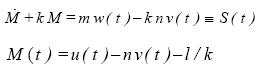
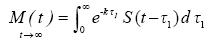
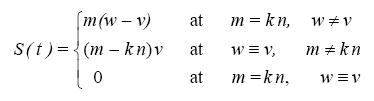
<body><![CDATA[<p align="justify"><font face="verdana" size="2">Let</font></p>     <p align="justify"><font face="verdana" size="2"><img src="/img/revistas/atm/v17n3/a03e11.jpg">...........................................(1.1)</font></p>     <p align="justify"><font face="verdana" size="2">be a differential equation for <i>u(t)</i> with given functions <i>v(t)</i>, <i>w(t)</i>, initial values <i>u<sub>0</sub>, v<sub>0</sub></i> and parameters <i>k, l, m, n</i>. Alternatively,</font></p>     <p align="justify"><font face="verdana" size="2"><img src="/img/revistas/atm/v17n3/a03e11a.jpg">............................................(1.1a)</font></p>     <p align="justify"><font face="verdana" size="2">The general solution of (1.1a) is</font></p>     <p align="justify"><font face="verdana" size="2"><img src="/img/revistas/atm/v17n3/a03e11as.jpg"></font></p>     <p align="justify"><font face="verdana" size="2">Hence, the long time (t-&gt;&infin;) behaviour of the solution will be governed by</font></p>     <p align="justify"><font face="verdana" size="2"><img src="/img/revistas/atm/v17n3/a03e12.jpg"></font><font face="verdana" size="2">........................................................(1.2)</font></p>     <p align="justify"><font face="verdana" size="2">or</font></p>     <p align="justify"><font face="verdana" size="2"><img src="/img/revistas/atm/v17n3/a03e12a.jpg">....................................(1.2a)</font></p>     ]]></body>
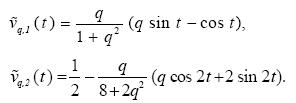
<body><![CDATA[<p align="justify"><font face="verdana" size="2">According to (1.1 a)</font></p>     <p align="justify"><font face="verdana" size="2"><img src="/img/revistas/atm/v17n3/a03e13.jpg">.......................(1.3)</font></p>     <p align="justify"><font face="verdana" size="2">Therefore, the current time value <i>u(t)</i> is determined not only by <i>S(t)</i>, but by <i>S(t - <img src="/img/revistas/atm/v17n3/a03s1.jpg">)</i> as well, the latter being exponentially suppressed. It is reasonable to interpret the integral term in (1.2) as a kind of memory, remaining after the transient has passed (t -&gt;&infin;). To characterize this effect, following Festa <i>et al.</i> (2002), we introduce the memory function</font></p>     <p align="justify"><font face="verdana" size="2"><img src="/img/revistas/atm/v17n3/a03e14.jpg">.................................................(1.4)</font></p>     <p align="justify"><font face="verdana" size="2">with <i>p</i>=1 (linear memory) or <i>p</i>=2 (quadratic memory). For example, if , <i>v(t)=sint </i>then</font></p>     <p align="justify"><font face="verdana" size="2"><img src="/img/revistas/atm/v17n3/a03e14a.jpg"></font></p>     <p align="justify"><font face="verdana" size="2">Obviously <img src="/img/revistas/atm/v17n3/a03s2.jpg">, and</font></p>     <p align="justify"><font face="verdana" size="2"><img src="/img/revistas/atm/v17n3/a03e15.jpg">..........................................................................(1.5)</font></p>     <p align="justify"><font face="verdana" size="2">If <i>v(t)</i> is a random function (Panchev, 1971),  <img src="/img/revistas/atm/v17n3/a03s3.jpg"> will be a random one too and can be treated statistically (see section 4 below).</font></p>     <p align="justify"><font face="verdana" size="2">Equations of the type (1.1) and its solution (1.2) occur in the theory of motion of Stokes' particles in turbulent flow and of linear measurement devices with inertia, e. g. some meteorological instruments (Panchev, 1971, ch. 8).</font></p>     ]]></body>
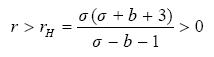
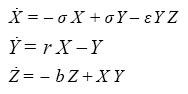
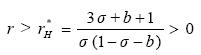
<body><![CDATA[<p align="justify"><font face="verdana" size="2">Here we apply the previous results to the original Lorenz low order system of ODE (section 2) and to its modifications (section 3). In section 4 we show how the obtained solutions of the type (1.2) can be treated statistically. Some conclusions are formulated in section 5.</font></p>     <p align="justify"><font face="verdana" size="2">&nbsp;</font></p>     <p align="justify"><font face="verdana" size="2"><b>2. The original Lorenz (1963) system</b></font></p>     <p align="justify"><font face="verdana" size="2">The system is a 3-dimensional, 3-parametric one</font></p>     <p align="justify"><font face="verdana" size="2"><img src="/img/revistas/atm/v17n3/a03e21.jpg">................................................................(2.1)</font></p>     <p align="justify"><font face="verdana" size="2">For <i>r &gt; 1</i> it has two nonzero fixed points <img src="/img/revistas/atm/v17n3/a03s4.jpg"></font></p>     <p align="justify"><font face="verdana" size="2"><img src="/img/revistas/atm/v17n3/a03e22.jpg">..........................................................(2.2)</font></p>     <p align="justify"><font face="verdana" size="2">At <i>&sigma; &gt; b+1</i> and</font></p>     <p align="justify"><font face="verdana" size="2"><img src="/img/revistas/atm/v17n3/a03e23.jpg">.......................................................(2.3)</font></p>     <p align="justify"><font face="verdana" size="2">the system exhibits chaotic behaviour. Otherwise chaotic regime is impossible. A combination between X- and Z-equations of (2.1) yields</font></p>     ]]></body>
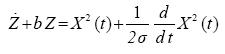
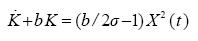
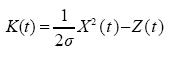
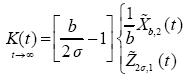
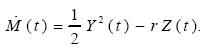
<body><![CDATA[<p align="justify"><font face="verdana" size="2"><img src="/img/revistas/atm/v17n3/a03e24.jpg">.....................................................(2.4)</font></p>     <p align="justify"><font face="verdana" size="2">It can be rewritten as</font></p>     <p align="justify"><font face="verdana" size="2"><img src="/img/revistas/atm/v17n3/a03e25.jpg">...........................................................(2.5)</font></p>     <p align="justify"><font face="verdana" size="2">where</font></p>     <p align="justify"><font face="verdana" size="2"><img src="/img/revistas/atm/v17n3/a03e26.jpg">................................................................(2.6)</font></p>     <p align="justify"><font face="verdana" size="2">Alternatively from (2.1) and (2.6) we derive</font></p>     <p align="justify"><font face="verdana" size="2"><img src="/img/revistas/atm/v17n3/a03e27.jpg">...............................................................(2.7)</font></p>     <p align="justify"><font face="verdana" size="2">Equations (2.4) - (2.7) are of the type (1.1), so that at t-&gt;&infin; the solution (1.2) can be used directly. Thus,</font></p>     <p align="justify"><font face="verdana" size="2"><img src="/img/revistas/atm/v17n3/a03e28.jpg">.............................................................(2.8)</font></p>     <p align="justify"><font face="verdana" size="2">respectively. Hence, it follows that</font></p>     ]]></body>
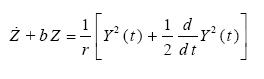
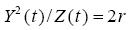
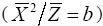
<body><![CDATA[<p align="justify"><font face="verdana" size="2"><img src="/img/revistas/atm/v17n3/a03e29.jpg">...................................................(2.9)</font></p>     <p align="justify"><font face="verdana" size="2">which is the same as</font></p>     <p align="justify"><font face="verdana" size="2"><img src="/img/revistas/atm/v17n3/a03e29a.jpg">...............(2.9a)</font></p>     <p align="justify"><font face="verdana" size="2">If <i>b=2&sigma;</i>, i. e. r<sub>H</sub> in (2.3) does not exist, then <i>K(t)=0</i> and (2.8) yields</font></p>     <p align="justify"><font face="verdana" size="2"><img src="/img/revistas/atm/v17n3/a03e210.jpg">............................................(2.10)</font></p>     <p align="justify"><font face="verdana" size="2">It is worthwhile to compare (2.9) - (2.10) with (2.2) <img src="/img/revistas/atm/v17n3/a03s5.jpg">.</font></p>     <p align="justify"><font face="verdana" size="2">So far, the second equation of the system (2.1) was not used. Eliminating <i>Y(t)</i> and <i>Z(t)</i> one obtains</font></p>     <p align="justify"><font face="verdana" size="2"><img src="/img/revistas/atm/v17n3/a03e211.jpg">.............(2.11)</font></p>     <p align="justify"><font face="verdana" size="2">which is the forced Duffing oscillator. Through (2.9) <img src="/img/revistas/atm/v17n3/a03s6.jpg"> can be introduced instead of  <img src="/img/revistas/atm/v17n3/a03s7.jpg">. Equation (2.11) governs the final behaviour of the system (2.1) at t-&gt;&infin;, when it lies and permanently evolves on its attractor set, eventually oscillating around the two unstable fixed points (2.2). This state is self-sustained by the memory term in (2.11). As it follows from (2.8), the memory is carried either by X- or by Z -variables in (2.1), but with different memory decay time (in the Lorenz time units) - <i>1/b</i> and <i>1/2&sigma;</i>. Besides, the memory term vanishes if <i>b=2&sigma;</i>. However, this is not the case with the traditional Lorenz values <i>b=8/3, &sigma;=10, r=28</i>, when (2.1) and consequently (2.11) behaves chaotically. </font></p>     <p align="justify"><font face="verdana" size="2">Being in force at t-&gt;&infin;, the invariant ratio (2.9) can be used as a criterion for numerical evaluation of the practical duration of the initial transient. Moreover, how fruitful can be the representation of (2.1) in the oscillatory form (2.11) was recently shown in Festa <i>et al.</i> (2002) .</font></p>     ]]></body>
<body><![CDATA[<p align="justify"><font face="verdana" size="2">&nbsp;</font></p>     <p align="justify"><font face="verdana" size="2"><b>3. Quasi-Lorenz systems</b></font></p>     <p align="justify"><font face="verdana" size="2">We call quasi-Lorenz systems those that are &quot;derivatives&quot; (modifications) of the original one (2.1). Such a system was studied in Panchev (2001), and Panchev and Spassova (1999).</font></p>     <p align="justify"><font face="verdana" size="2"><img src="/img/revistas/atm/v17n3/a03e31.jpg">............................................................(3.1)</font></p>     <p align="justify"><font face="verdana" size="2">where <i>&sigma;, &epsilon;, r, b &gt; 0</i>. Unlike (2.1), the first equation is nonlinear while the second one is linear. At <i>r</i> &gt;1 there exist two nonzero fixed points determined by</font></p>     <p align="justify"><font face="verdana" size="2"><img src="/img/revistas/atm/v17n3/a03e32.jpg">.........................................(3.2)</font></p>     <p align="justify"><font face="verdana" size="2">Moreover, at<i> &sigma; + b &lt; 1</i> and</font></p>     <p align="justify"><font face="verdana" size="2"><img src="/img/revistas/atm/v17n3/a03e33.jpg">..........................................................(3.3)</font></p>     <p align="justify"><font face="verdana" size="2">the qualitative behaviour of (3.1) follows that of (2.1) under the conditions (2.3).</font></p>     <p align="justify"><font face="verdana" size="2">The last two equations of (3.1) yield</font></p>     ]]></body>
<body><![CDATA[<p align="justify"><font face="verdana" size="2"><img src="/img/revistas/atm/v17n3/a03e34.jpg">.............................................(3.4)</font></p>     <p align="justify"><font face="verdana" size="2">It can be written in two alternative forms:</font></p>     <p align="justify"><font face="verdana" size="2"><img src="/img/revistas/atm/v17n3/a03e35.jpg">...........................................................(3.5)</font></p>     <p align="justify"><font face="verdana" size="2">and</font></p>     <p align="justify"><font face="verdana" size="2"><img src="/img/revistas/atm/v17n3/a03e35a.jpg">.........................................................(3.5a)</font></p>     <p align="justify"><font face="verdana" size="2"> where</font></p>     <p align="justify"><font face="verdana" size="2"><img src="/img/revistas/atm/v17n3/a03e36.jpg">........................................................(3.6)</font></p>     <p align="justify"><font face="verdana" size="2">Using again (1.2) we obtain</font></p>     <p align="justify"><font face="verdana" size="2"><img src="/img/revistas/atm/v17n3/a03e37.jpg">.....................................................(3.7)</font></p>     <p align="justify"><font face="verdana" size="2">Hence</font></p>     ]]></body>
<body><![CDATA[<p align="justify"><font face="verdana" size="2"><img src="/img/revistas/atm/v17n3/a03e38.jpg">.......................................................(3.8)</font></p>     <p align="justify"><font face="verdana" size="2">which is the same as</font></p>     <p align="justify"><font face="verdana" size="2"><img src="/img/revistas/atm/v17n3/a03e38a.jpg">..................(3.8a)</font></p>     <p align="justify"><font face="verdana" size="2">These expressions correspond to (2.9), (2.9a). Unlike the latter, the ratios (3.8) depend explicitly on <i>r</i>.</font></p>     <p align="justify"><font face="verdana" size="2">Eliminating <i>X(t)</i> and <i>Y(t)</i> in the first equation (3.1) by means of the second one and (3.6), (3.7) one obtains again a Duffing type self-forced oscillator, corresponding to (2.11):</font></p>     <p align="justify"><font face="verdana" size="2"><img src="/img/revistas/atm/v17n3/a03e39.jpg">......................(3.9)</font></p>     <p align="justify"><font face="verdana" size="2">As it is seen, the memory is carried either by Y- or by Z -variables with decay time <i>1/b</i> and 1/2, while in (2.8) we had <i>X</i> and <i>Z</i> with <i>1/b</i> and <i>1/2&sigma;</i> t decay time. Moreover, it follows from (3.7) and (3.9) that at <i>b=2</i> the memory term vanishes and (3.9) degenerates into a regular Duffing oscillator. In this particular case (3.7) and (3.6) yield</font></p>     <p align="justify"><font face="verdana" size="2"><img src="/img/revistas/atm/v17n3/a03e310.jpg">.......................................................................(3.10)</font></p>     <p align="justify"><font face="verdana" size="2">corresponding to (2.10). As rigorous results from the initial systems (2.1) and (3.1) at t-&gt;&infin;, the invariant ratios (2.9), (3.8) and (2.10), (3.10) can be checked numerically, integrating (2.1) and (3.1).</font></p>     <p align="justify"><font face="verdana" size="2">Many other systems can be classified as quasi-Lorenz ones. We shall consider two more examples only. The first one is the four dimensional system of meteorological origin, derived in Stenflo (1996)</font></p>     ]]></body>
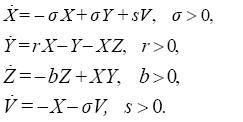
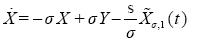
<body><![CDATA[<p align="justify"><font face="verdana" size="2"><img src="/img/revistas/atm/v17n3/a03e311.jpg">.................................................(3.11)</font></p>     <p align="justify"><font face="verdana" size="2">Obviously the original Lorenz system (2.1) is embedded (built) in (3.11). However, the meaning of the parameters is different from the previous ones (Stenflo, 1996).</font></p>     <p align="justify"><font face="verdana" size="2">The new equation in (3.11) implies that</font></p>     <p align="justify"><font face="verdana" size="2"><img src="/img/revistas/atm/v17n3/a03e312.jpg">.................................(3.12)</font></p>     <p align="justify"><font face="verdana" size="2">Therefore, (3.11) is equivalent to the system (2.1) with the first equation replaced by</font></p>     <p align="justify"><font face="verdana" size="2"><img src="/img/revistas/atm/v17n3/a03e313.jpg">..........................................................(3.13)</font></p>     <p align="justify"><font face="verdana" size="2">Consequently, a new term <img src="/img/revistas/atm/v17n3/a03s8.jpg"> appears on the right-hand side of equation (2.4), where</font></p>     <p align="justify"><font face="verdana" size="2"><img src="/img/revistas/atm/v17n3/a03e314.jpg">...........................(3.14)</font></p>     <p align="justify"><font face="verdana" size="2">Hence, we derive the extended version of the equation (2.8)</font></p>     <p align="justify"><font face="verdana" size="2"><img src="/img/revistas/atm/v17n3/a03e315.jpg">.................(3.15)</font></p>     ]]></body>
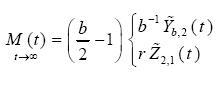
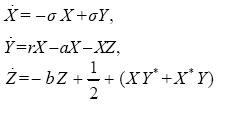
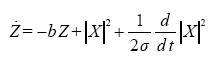
<body><![CDATA[<p align="justify"><font face="verdana" size="2">where</font></p>     <p align="justify"><font face="verdana" size="2"><img src="/img/revistas/atm/v17n3/a03e316.jpg">.....(3.16)</font></p>     <p align="justify"><font face="verdana" size="2">Obviously, <img src="/img/revistas/atm/v17n3/a03s9.jpg"> is a more complicated quadratic type memory (secondary, or mixed one).</font></p>     <p align="justify"><font face="verdana" size="2">The second example is the generalized Lorenz system in the complex domain (Fowler <i>et al.</i>, 1983)</font></p>     <p align="justify"><font face="verdana" size="2"><img src="/img/revistas/atm/v17n3/a03e317.jpg">...................................................(3.17)</font></p>     <p align="justify"><font face="verdana" size="2">where <i>X(t), Y(t), a, r</i> are complex functions and parameters, <i>Z(t)</i> is a real function, <i>&sigma;, b</i> are real parameters and the asterisk (*) denote complex conjugate. Thus, in real quantities (3.17) is a five-dimensional dynamical system. It occurs in the theory of nonlinear baroclinic instability in the atmosphere, a problem of great meteorological significance, and also in the laser physics (Rauh <i>et al.</i>, 1996).</font></p>     <p align="justify"><font face="verdana" size="2">Formally, (3.17) differs from (2.1) by the Z-equation. However, the latter is easy transformed into a form identical to (2.4)</font></p>     <p align="justify"><font face="verdana" size="2"><img src="/img/revistas/atm/v17n3/a03e318.jpg">........................................................(3.18)</font></p>     <p align="justify"><font face="verdana" size="2">where <img src="/img/revistas/atm/v17n3/a03s10.jpg">. Therefore, all equations (2.5) - (2.10) remain in force if <i>X(t)</i> is replaced by   <img src="/img/revistas/atm/v17n3/a03s11.jpg">. The equation (2.11) now takes the form</font></p>     <p align="justify"><font face="verdana" size="2"><img src="/img/revistas/atm/v17n3/a03e319.jpg">.......(3.19)</font></p>     ]]></body>
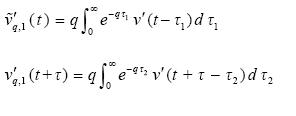
<body><![CDATA[<p align="justify"><font face="verdana" size="2">It is a nonautonomous complex Duffing type equation. In the real domain it is equivalent to two coupled equations of the same type.</font></p>     <p align="justify"><font face="verdana" size="2">&nbsp;</font></p>     <p align="justify"><font face="verdana" size="2"><b>4. An example of statistical treatment</b></font></p>     <p align="justify"><font face="verdana" size="2">Let <i>v(t)</i> be a random (chaotic) function. Then the memory function <img src="/img/revistas/atm/v17n3/a03s12.jpg"> is a random (chaotic) one too. In addition we assume that <i>v(t)</i> is a statistically stationary function (Panchev, 1971), i.e.</font></p>     <p align="justify"><font face="verdana" size="2"><img src="/img/revistas/atm/v17n3/a03e41.jpg">......................................(4.1)</font></p>     <p align="justify"><font face="verdana" size="2">where <img src="/img/revistas/atm/v17n3/a03s13.jpg"> is the deviation from the mean value <img src="/img/revistas/atm/v17n3/a03s14.jpg">. Obviously <img src="/img/revistas/atm/v17n3/a03s15.jpg">, is the dispersion of <i>v'</i>. Under these assumptions it follows that</font></p>     <p align="justify"><font face="verdana" size="2"><img src="/img/revistas/atm/v17n3/a03e41a.jpg"></font></p>     <p align="justify"><font face="verdana" size="2">and</font></p>     <p align="justify"><font face="verdana" size="2"><img src="/img/revistas/atm/v17n3/a03e41b.jpg"></font></p>     <p align="justify"><font face="verdana" size="2">Then, for the memory autocorrelation function we obtain</font></p>     ]]></body>
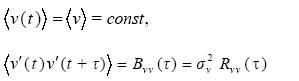
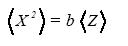
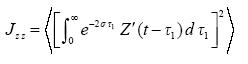
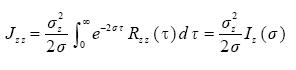
<body><![CDATA[<p align="justify"><font face="verdana" size="2"><img src="/img/revistas/atm/v17n3/a03e42.jpg">.....(4.2)</font></p>     <p align="justify"><font face="verdana" size="2">after one integration has been performed (Panchev, 1971). Hence</font></p>     <p align="justify"><font face="verdana" size="2"><img src="/img/revistas/atm/v17n3/a03e43.jpg">.............................(4.3)</font></p>     <p align="justify"><font face="verdana" size="2">We now apply these results to the Lorenz system (2.1). As an example we take the second solution (2.8)</font></p>     <p align="justify"><font face="verdana" size="2"><img src="/img/revistas/atm/v17n3/a03e44.jpg">...........................(4.4)</font></p>     <p align="justify"><font face="verdana" size="2">valid at t-&gt;&infin;. Zou <i>et al.</i> (1985) showed that the motion on the strange attractor is ergodic. It is reasonable to think that it is also stationary in the above sense (4.1). Thus, we can average (4.4). The result is (cf. (2.2), (2.9))</font></p>     <p align="justify"><font face="verdana" size="2"><img src="/img/revistas/atm/v17n3/a03e45.jpg">........................................................................(4.5)</font></p>     <p align="justify"><font face="verdana" size="2">Subtracting (4.5) from (4.4), squaring and averaging, we obtain</font></p>     <p align="justify"><font face="verdana" size="2"><img src="/img/revistas/atm/v17n3/a03e45a.jpg"></font></p>     <p align="justify"><font face="verdana" size="2">where <img src="/img/revistas/atm/v17n3/a03s16.jpg">,</font></p>     ]]></body>
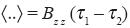
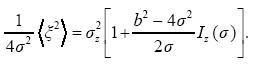
<body><![CDATA[<p align="justify"><font face="verdana" size="2"><img src="/img/revistas/atm/v17n3/a03e45b.jpg"></font></p>     <p align="justify"><font face="verdana" size="2">However, the squared integral equals to a double one</font></p>     <p align="justify"><font face="verdana" size="2"><img src="/img/revistas/atm/v17n3/a03e45c.jpg"></font></p>     <p align="justify"><font face="verdana" size="2">where <img src="/img/revistas/atm/v17n3/a03s17.jpg"> is the autocorrelation function of the Z -variable. Finally (see also (4.3))</font></p>     <p align="justify"><font face="verdana" size="2"><img src="/img/revistas/atm/v17n3/a03e45d.jpg"></font></p>     <p align="justify"><font face="verdana" size="2">so that</font></p>     <p align="justify"><font face="verdana" size="2"><img src="/img/revistas/atm/v17n3/a03e46.jpg">................................................(4.6)</font></p>     <p align="justify"><font face="verdana" size="2">In a similar way other statistical characteristics can be computed.</font></p>     <p align="justify"><font face="verdana" size="2">&nbsp;</font></p>     <p align="justify"><font face="verdana" size="2"><b>5. Conclusion</b></font></p>     ]]></body>
<body><![CDATA[<p align="justify"><font face="verdana" size="2">Normally high order ordinary differential equations are transformed to dynamical systems (systems of 1st order equations), suitable for further analytical treatment and numerical solution. Here we followed the opposite procedure. Owing to the appropriate structure (1.1) of the equations in the original Lorenz low-order system (2.1) and its modifications (3.1), (3.11) and (3.17), single oscillatory type equations with forcing endogenous &quot;memory&quot; terms are derived, valid a <i>t-&gt;&infin;</i>. In this connection linear and quadratic memories were defined by (1.4) and (3.16). For particular relationships among the systems' parameters (<i>b=2&sigma;</i> for (3.1) and <i>b=2</i> for (3.11)), the memory terms in (2.11) and (3.9) vanish. The latter result is new, while the former one is already known. In both cases, the results are autonomous Duffing type equations and invariant ratios (2.10) and (3.10). Moreover, other new invariant ratios (2.9) and (3.8) are rigorously derived from (2.1) and (3.1). Section 4 demonstrates the possibilities of the statistical approach in case of final (<i>t-&gt;&infin;</i>) chaotic behaviour. The results of the previous sections may prove to be useful for various applications of the Lorenz and Lorenz-like systems, including meteorological ones.</font></p>     <p align="justify"><font face="verdana" size="2">The systems considered in sections 2 and 3 are not the only ones that can be reduced to oscillators with memory. We have collected other examples of dynamical systems (mainly 3-dimensional) that can also be transformed and treated by means of the same tools, including statistical ones.</font></p>     <p align="justify"><font face="verdana" size="2">&nbsp;</font></p>     <p align="justify"><font face="verdana" size="2"><b>References</b></font></p>     <!-- ref --><p align="justify"><font face="verdana" size="2">Festa R., A. Mazzino and D. Vincenzi, 2002. Lorenz-like systems and classical dynamical equations with memory forcing: An alternative point of view for singling out the origin of chaos, <i>Phys. Rev</i>. <b>E65</b>, 046205.</font>&nbsp;&nbsp;&nbsp;&nbsp;&nbsp;&nbsp;&nbsp;&nbsp;[&#160;<a href="javascript:void(0);" onclick="javascript: window.open('/scielo.php?script=sci_nlinks&ref=1256438&pid=S0187-6236200400030000300001&lng=','','width=640,height=500,resizable=yes,scrollbars=1,menubar=yes,');">Links</a>&#160;]<!-- end-ref --><!-- ref --><p align="justify"><font face="verdana" size="2">Fowler A. C., J. D.Gibbon and M. J. McGuiness, 1983. The real and complex Lorenz equations and their relevance to physical systems. <i>Physica</i> <b>7D</b>, 126-134.</font>&nbsp;&nbsp;&nbsp;&nbsp;&nbsp;&nbsp;&nbsp;&nbsp;[&#160;<a href="javascript:void(0);" onclick="javascript: window.open('/scielo.php?script=sci_nlinks&ref=1256439&pid=S0187-6236200400030000300002&lng=','','width=640,height=500,resizable=yes,scrollbars=1,menubar=yes,');">Links</a>&#160;]<!-- end-ref --><!-- ref --><p align="justify"><font face="verdana" size="2">Lorenz E. N., 1963. Deterministic nonperiodic flow. <i>J. Atmos. Sci.</i>, <b>20</b>, 130-141.</font>&nbsp;&nbsp;&nbsp;&nbsp;&nbsp;&nbsp;&nbsp;&nbsp;[&#160;<a href="javascript:void(0);" onclick="javascript: window.open('/scielo.php?script=sci_nlinks&ref=1256440&pid=S0187-6236200400030000300003&lng=','','width=640,height=500,resizable=yes,scrollbars=1,menubar=yes,');">Links</a>&#160;]<!-- end-ref --><!-- ref --><p align="justify"><font face="verdana" size="2">Panchev S., 1971. <i>Random functions and turbulence</i>. Pergamom Press. Oxford, 444 p.</font>&nbsp;&nbsp;&nbsp;&nbsp;&nbsp;&nbsp;&nbsp;&nbsp;[&#160;<a href="javascript:void(0);" onclick="javascript: window.open('/scielo.php?script=sci_nlinks&ref=1256441&pid=S0187-6236200400030000300004&lng=','','width=640,height=500,resizable=yes,scrollbars=1,menubar=yes,');">Links</a>&#160;]<!-- end-ref --><!-- ref --><p align="justify"><font face="verdana" size="2">Panchev S., 2001. <i>Theory of chaos</i> (2nd ed. in Bulgarian), Bull. Acad. Press. 450 p.</font>&nbsp;&nbsp;&nbsp;&nbsp;&nbsp;&nbsp;&nbsp;&nbsp;[&#160;<a href="javascript:void(0);" onclick="javascript: window.open('/scielo.php?script=sci_nlinks&ref=1256442&pid=S0187-6236200400030000300005&lng=','','width=640,height=500,resizable=yes,scrollbars=1,menubar=yes,');">Links</a>&#160;]<!-- end-ref --><!-- ref --><p align="justify"><font face="verdana" size="2">Panchev S. and T. Spassova, 1999. The Lorenz chaotic system with modified X-, Y-equations, <i>Bull. Cal. Math. Soc.</i>, <b>91</b>, 17-28.</font>&nbsp;&nbsp;&nbsp;&nbsp;&nbsp;&nbsp;&nbsp;&nbsp;[&#160;<a href="javascript:void(0);" onclick="javascript: window.open('/scielo.php?script=sci_nlinks&ref=1256443&pid=S0187-6236200400030000300006&lng=','','width=640,height=500,resizable=yes,scrollbars=1,menubar=yes,');">Links</a>&#160;]<!-- end-ref --><!-- ref --><p align="justify"><font face="verdana" size="2">Rauh A., L. Hannibal and N. B. Abraham, 1996. Global stability properties of the complex Lorenz model. <i>Physica</i> <b>D99</b>, 45-58.</font>&nbsp;&nbsp;&nbsp;&nbsp;&nbsp;&nbsp;&nbsp;&nbsp;[&#160;<a href="javascript:void(0);" onclick="javascript: window.open('/scielo.php?script=sci_nlinks&ref=1256444&pid=S0187-6236200400030000300007&lng=','','width=640,height=500,resizable=yes,scrollbars=1,menubar=yes,');">Links</a>&#160;]<!-- end-ref --><!-- ref --><p align="justify"><font face="verdana" size="2">Stenflo L., 1996. Generalized Lorenz equations for acoustic-gravity waves in the atmosphere. <i>Physica Scripta</i>, <b>53</b>, 83.</font>&nbsp;&nbsp;&nbsp;&nbsp;&nbsp;&nbsp;&nbsp;&nbsp;[&#160;<a href="javascript:void(0);" onclick="javascript: window.open('/scielo.php?script=sci_nlinks&ref=1256445&pid=S0187-6236200400030000300008&lng=','','width=640,height=500,resizable=yes,scrollbars=1,menubar=yes,');">Links</a>&#160;]<!-- end-ref --><!-- ref --><p align="justify"><font face="verdana" size="2">Zou Chengzhi, Zhou Xiuji, and Yang Peicai, 1985. The statistical structure of Lorenz strange attractor. <i>Adv. Atmos. Sci.</i>, <b>2</b>, 215-224.</font>&nbsp;&nbsp;&nbsp;&nbsp;&nbsp;&nbsp;&nbsp;&nbsp;[&#160;<a href="javascript:void(0);" onclick="javascript: window.open('/scielo.php?script=sci_nlinks&ref=1256446&pid=S0187-6236200400030000300009&lng=','','width=640,height=500,resizable=yes,scrollbars=1,menubar=yes,');">Links</a>&#160;]<!-- end-ref --> ]]></body><back>
<ref-list>
<ref id="B1">
<nlm-citation citation-type="journal">
<person-group person-group-type="author">
<name>
<surname><![CDATA[Festa]]></surname>
<given-names><![CDATA[R.]]></given-names>
</name>
<name>
<surname><![CDATA[Mazzino]]></surname>
<given-names><![CDATA[A.]]></given-names>
</name>
<name>
<surname><![CDATA[Vincenzi]]></surname>
<given-names><![CDATA[D.]]></given-names>
</name>
</person-group>
<article-title xml:lang="en"><![CDATA[Lorenz-like systems and classical dynamical equations with memory forcing: An alternative point of view for singling out the origin of chaos]]></article-title>
<source><![CDATA[Phys. Rev.]]></source>
<year>2002</year>
<numero>E65</numero>
<issue>E65</issue>
<page-range>046205</page-range></nlm-citation>
</ref>
<ref id="B2">
<nlm-citation citation-type="journal">
<person-group person-group-type="author">
<name>
<surname><![CDATA[Fowler]]></surname>
<given-names><![CDATA[A. C.]]></given-names>
</name>
<name>
<surname><![CDATA[Gibbon]]></surname>
<given-names><![CDATA[J. D.]]></given-names>
</name>
<name>
<surname><![CDATA[McGuiness]]></surname>
<given-names><![CDATA[M. J.]]></given-names>
</name>
</person-group>
<article-title xml:lang="en"><![CDATA[The real and complex Lorenz equations and their relevance to physical systems]]></article-title>
<source><![CDATA[Physica]]></source>
<year>1983</year>
<numero>7D</numero>
<issue>7D</issue>
<page-range>126-134</page-range></nlm-citation>
</ref>
<ref id="B3">
<nlm-citation citation-type="journal">
<person-group person-group-type="author">
<name>
<surname><![CDATA[Lorenz]]></surname>
<given-names><![CDATA[E. N.]]></given-names>
</name>
</person-group>
<article-title xml:lang="en"><![CDATA[Deterministic nonperiodic flow]]></article-title>
<source><![CDATA[J. Atmos. Sci.]]></source>
<year>1963</year>
<numero>20</numero>
<issue>20</issue>
<page-range>130-141</page-range></nlm-citation>
</ref>
<ref id="B4">
<nlm-citation citation-type="book">
<person-group person-group-type="author">
<name>
<surname><![CDATA[Panchev]]></surname>
<given-names><![CDATA[S.]]></given-names>
</name>
</person-group>
<source><![CDATA[Random functions and turbulence]]></source>
<year>1971</year>
<page-range>444</page-range><publisher-loc><![CDATA[Oxford ]]></publisher-loc>
<publisher-name><![CDATA[Pergamom Press]]></publisher-name>
</nlm-citation>
</ref>
<ref id="B5">
<nlm-citation citation-type="book">
<person-group person-group-type="author">
<name>
<surname><![CDATA[Panchev]]></surname>
<given-names><![CDATA[S.]]></given-names>
</name>
</person-group>
<source><![CDATA[Theory of chaos]]></source>
<year>2001</year>
<edition>2</edition>
<page-range>450</page-range><publisher-name><![CDATA[Bull. Acad. Press]]></publisher-name>
</nlm-citation>
</ref>
<ref id="B6">
<nlm-citation citation-type="journal">
<person-group person-group-type="author">
<name>
<surname><![CDATA[Panchev]]></surname>
<given-names><![CDATA[S.]]></given-names>
</name>
<name>
<surname><![CDATA[Spassova]]></surname>
<given-names><![CDATA[T.]]></given-names>
</name>
</person-group>
<article-title xml:lang="en"><![CDATA[The Lorenz chaotic system with modified X-, Y-equations]]></article-title>
<source><![CDATA[Bull. Cal. Math. Soc.]]></source>
<year>1999</year>
<numero>91</numero>
<issue>91</issue>
<page-range>17-28</page-range></nlm-citation>
</ref>
<ref id="B7">
<nlm-citation citation-type="journal">
<person-group person-group-type="author">
<name>
<surname><![CDATA[Rauh]]></surname>
<given-names><![CDATA[A.]]></given-names>
</name>
<name>
<surname><![CDATA[Hannibal]]></surname>
<given-names><![CDATA[L.]]></given-names>
</name>
<name>
<surname><![CDATA[Abraham]]></surname>
<given-names><![CDATA[N. B.]]></given-names>
</name>
</person-group>
<article-title xml:lang="en"><![CDATA[Global stability properties of the complex Lorenz model]]></article-title>
<source><![CDATA[Physica]]></source>
<year>1996</year>
<numero>D99</numero>
<issue>D99</issue>
<page-range>45-58</page-range></nlm-citation>
</ref>
<ref id="B8">
<nlm-citation citation-type="journal">
<person-group person-group-type="author">
<name>
<surname><![CDATA[Stenflo]]></surname>
<given-names><![CDATA[L.]]></given-names>
</name>
</person-group>
<article-title xml:lang="en"><![CDATA[Generalized Lorenz equations for acoustic-gravity waves in the atmosphere]]></article-title>
<source><![CDATA[Physica Scripta]]></source>
<year>1996</year>
<numero>53</numero>
<issue>53</issue>
<page-range>83</page-range></nlm-citation>
</ref>
<ref id="B9">
<nlm-citation citation-type="journal">
<person-group person-group-type="author">
<name>
<surname><![CDATA[Chengzhi]]></surname>
<given-names><![CDATA[Zou]]></given-names>
</name>
<name>
<surname><![CDATA[Xiuji]]></surname>
<given-names><![CDATA[Zhou]]></given-names>
</name>
<name>
<surname><![CDATA[Peicai]]></surname>
<given-names><![CDATA[Yang]]></given-names>
</name>
</person-group>
<article-title xml:lang="en"><![CDATA[The statistical structure of Lorenz strange attractor]]></article-title>
<source><![CDATA[Adv. Atmos. Sci.]]></source>
<year>1985</year>
<numero>2</numero>
<issue>2</issue>
<page-range>215-224</page-range></nlm-citation>
</ref>
</ref-list>
</back>
</article>