<?xml version="1.0" encoding="ISO-8859-1"?><article xmlns:mml="http://www.w3.org/1998/Math/MathML" xmlns:xlink="http://www.w3.org/1999/xlink" xmlns:xsi="http://www.w3.org/2001/XMLSchema-instance">
<front>
<journal-meta>
<journal-id>0187-6236</journal-id>
<journal-title><![CDATA[Atmósfera]]></journal-title>
<abbrev-journal-title><![CDATA[Atmósfera]]></abbrev-journal-title>
<issn>0187-6236</issn>
<publisher>
<publisher-name><![CDATA[Universidad Nacional Autónoma de México, Instituto de Ciencias de la Atmósfera y Cambio Climático]]></publisher-name>
</publisher>
</journal-meta>
<article-meta>
<article-id>S0187-62362004000100004</article-id>
<title-group>
<article-title xml:lang="en"><![CDATA[Some atmospheric aerosol characteristics as determined from laser angular scattering measurements at a continental urban station]]></article-title>
</title-group>
<contrib-group>
<contrib contrib-type="author">
<name>
<surname><![CDATA[ERNEST RAJ]]></surname>
<given-names><![CDATA[P.]]></given-names>
</name>
<xref ref-type="aff" rid="A01"/>
</contrib>
<contrib contrib-type="author">
<name>
<surname><![CDATA[DEVARA]]></surname>
<given-names><![CDATA[P. C. S.]]></given-names>
</name>
<xref ref-type="aff" rid="A01"/>
</contrib>
<contrib contrib-type="author">
<name>
<surname><![CDATA[PANDITHURAI]]></surname>
<given-names><![CDATA[G.]]></given-names>
</name>
<xref ref-type="aff" rid="A01"/>
</contrib>
<contrib contrib-type="author">
<name>
<surname><![CDATA[MAHESKUMAR]]></surname>
<given-names><![CDATA[R. S.]]></given-names>
</name>
<xref ref-type="aff" rid="A01"/>
</contrib>
<contrib contrib-type="author">
<name>
<surname><![CDATA[DANI]]></surname>
<given-names><![CDATA[K. K.]]></given-names>
</name>
<xref ref-type="aff" rid="A01"/>
</contrib>
</contrib-group>
<aff id="A01">
<institution><![CDATA[,Indian Institute of Tropical Meteorology  ]]></institution>
<addr-line><![CDATA[Pune ]]></addr-line>
<country>India</country>
</aff>
<pub-date pub-type="pub">
<day>00</day>
<month>01</month>
<year>2004</year>
</pub-date>
<pub-date pub-type="epub">
<day>00</day>
<month>01</month>
<year>2004</year>
</pub-date>
<volume>17</volume>
<numero>1</numero>
<fpage>39</fpage>
<lpage>52</lpage>
<copyright-statement/>
<copyright-year/>
<self-uri xlink:href="http://www.scielo.org.mx/scielo.php?script=sci_arttext&amp;pid=S0187-62362004000100004&amp;lng=en&amp;nrm=iso"></self-uri><self-uri xlink:href="http://www.scielo.org.mx/scielo.php?script=sci_abstract&amp;pid=S0187-62362004000100004&amp;lng=en&amp;nrm=iso"></self-uri><self-uri xlink:href="http://www.scielo.org.mx/scielo.php?script=sci_pdf&amp;pid=S0187-62362004000100004&amp;lng=en&amp;nrm=iso"></self-uri><abstract abstract-type="short" xml:lang="es"><p><![CDATA[Se utilizó un sistema &#8220;lidar&#8221; biestático continuo de onda de argón para obtener información sobre la variación en la intensidad de la señal láser de retorno desde la atmósfera baja con ángulos de dispersión a una altitud fija. Para el estudio se utilizaron datos lidar obtenidos en cincuenta días de cielo claro en una estación tropical urbana durante el periodo de abril de 1987 a diciembre de 1995. Los datos experimentales se compararon con las secciones transversales de dispersión de Mie obtenidas teóricamente a los ángulos comunes de dispersión para determinar el valor más probable del índice de tamaño, v, y el índice complejo de refracción, m, aplicables al ambiente sobre el sitio de observación utilizando un método de búsqueda tipo biblioteca y herramientas estadísticas simples. El estudio demostró que el aerosol que ocurre con más frecuencia es del tipo polvo y que el valor más probable del índice de tamaño es 4.5. La recuperación del número de concentración del aerosol, utilizando esta información junto con los valores experimentales de la intensidad de la señal de dispersión, dan un valor promedio de concentración de 2 - 3 x 10⁻³ cm-3en la capa atmosférica cercana a la superficie.]]></p></abstract>
<abstract abstract-type="short" xml:lang="en"><p><![CDATA[A bistatic continuous wave Argon ion lidar system has been used to collect information on the variation of laser return signal strength from the lower atmosphere with scattering angles at a fixed altitude of scattering. Lidar data collected on 50 clear sky days during the period of April 1987 - December 1995 at a continental tropical urban station have been used for the study. The experimental data have been compared with the theoretically computed differential Mie scattering cross sections at the common scattering angles to determine the most probable value of size index, v, and the complex index of refraction, m, applicable to the environment over the observing site by adopting a library-search method and simple statistical tools. The study showed that the most frequently occurring aerosol type at the location is dust-like with a most probable value of size index 4.5. Retrieval of aerosol number concentration, using this information together with the experimental values of scattered signal strength, yields an average concentration value in the range of 2 x 3 10³ cm-3 in the atmos pheric layer close to the surface.]]></p></abstract>
<kwd-group>
<kwd lng="es"><![CDATA[Lidar]]></kwd>
<kwd lng="es"><![CDATA[aerosols]]></kwd>
<kwd lng="es"><![CDATA[angular scattering]]></kwd>
</kwd-group>
</article-meta>
</front><body><![CDATA[ <p align="center"><b><font size="4">Some atmospheric aerosol characteristics    as determined from laser    <br>   angular scattering measurements at a continental urban station </font></b>  </p>     <p align="center">    <br>   <font size="2">P. ERNEST RAJ, P. C. S. DEVARA, G. PANDITHURAI,    <br>   R. S. MAHESKUMAR and K. K. DANI</font>    <br>   <i>Indian Institute of Tropical Meteorology, Pune - 411008, India</i></p>     <p align="center">&nbsp;</p>     <p align="center">RESUMEN</p>     <p align="justify"> Se utiliz&oacute; un sistema &#8220;lidar&#8221; biest&aacute;tico    continuo de onda de arg&oacute;n para obtener informaci&oacute;n sobre la variaci&oacute;n    en la intensidad de la se&ntilde;al l&aacute;ser de retorno desde la atm&oacute;sfera    baja con &aacute;ngulos de dispersi&oacute;n a una altitud fija. Para el estudio    se utilizaron datos lidar obtenidos en cincuenta d&iacute;as de cielo claro    en una estaci&oacute;n tropical urbana durante el periodo de abril de 1987 a    diciembre de 1995. Los datos experimentales se compararon con las secciones    transversales de dispersi&oacute;n de Mie obtenidas te&oacute;ricamente a los    &aacute;ngulos comunes de dispersi&oacute;n para determinar el valor m&aacute;s    probable del &iacute;ndice de tama&ntilde;o, <i>v</i>, y el &iacute;ndice    complejo de refracci&oacute;n, <i>m</i>, aplicables al ambiente sobre el sitio    de observaci&oacute;n utilizando un m&eacute;todo de b&uacute;squeda tipo biblioteca    y herramientas estad&iacute;sticas simples. El estudio demostr&oacute; que el    aerosol que ocurre con m&aacute;s frecuencia es del tipo polvo y que el valor    m&aacute;s probable del &iacute;ndice de tama&ntilde;o es 4.5. La recuperaci&oacute;n    del n&uacute;mero de concentraci&oacute;n del aerosol, utilizando esta informaci&oacute;n    junto con los valores experimentales de la intensidad de la se&ntilde;al de    dispersi&oacute;n, dan un valor promedio de concentraci&oacute;n de 2 - 3 x    10<sup><font size="2">-3</font></sup> cm<sup><font size="2">-3</font></sup>en    la capa atmosf&eacute;rica cercana a la superficie.</p>     <p align="center">    ]]></body>
<body><![CDATA[<br>   ABSTRACT</p>     <p align="justify">A bistatic continuous wave Argon ion lidar system has been    used to collect information on the variation of laser return signal strength    from the lower atmosphere with scattering angles at a fixed altitude of scattering.    Lidar data collected on 50 clear sky days during the period of April 1987 -    December 1995 at a continental tropical urban station have been used for the    study. The experimental data have been compared with the theoretically computed    differential Mie scattering cross sections at the common scattering angles to    determine the most probable value of size index, <i>v</i>, and the complex    index of refraction, <i>m</i>, applicable to the environment over the observing    site by adopting a library-search method and simple statistical tools. The study    showed that the most frequently occurring aerosol type at the location is dust-like    with a most probable value of size index 4.5. Retrieval of aerosol number concentration,    using this information together with the experimental values of scattered signal    strength, yields an average concentration value in the range of &nbsp;2 x 3    10<sup><font size="2">3</font></sup> cm<sup><font size="2">-3</font></sup> in    the atmos pheric layer close to the surface.</p>     <p align="justify"><b>    <br>   Key words:</b> Lidar, aerosols, angular scattering</p>     <p align="justify">    <br>   <b>1. Introduction</b>    <br>   Particulate material suspended in the atmosphere, commonly referred to as atmospheric    aerosol, is produced by both nature and man. Naturally occurring materials include    volcanic dust, meteoric dust, spores and seeds, particles of soil, sea salt,    etc. Man&#8217;s activities contribute such materials as fly ash from smoke    stacks, mineral particles from industrial sources, dusts from mining, particles    produced from combustion, etc. With the passage of time, these aerosols are    modified from their original forms by coagulation, sedimentation and other processes    which tend to reduce the number of very large and very small particles, leaving    particles of intermediate range ~ 0.1 - 10 &#956;m radius in the atmosphere    which have an atmospheric residence time of about one week. Particles in this    size range produce significant optical effects in the atmosphere, including    perturbation of the radiative transfer of energy between the sun and the earth.    There is growing concern in recent years about the increased amount of aerosols    in the atmosphere, especially due to various human/anthropogenic activities,    and ultimately how they affect the climate on global and regional scales (IPCC,    1996). Thus, the determination of the optical properties of atmospheric aerosols    has become a critical factor in assessing their climatic impact. These properties    are functions of the chemical composition, concentration, morphology and size    distribution of aerosols in different geographical locations, at different altitudes,    etc. In their attempts to study the radiative energy exchange in the earth-atmosphere    system and the effect of aerosols on this exchange, several investigators assumed    aerosols as homogenous spheres so that the aerosol scattering characteristics    may be uniquely and analytically determined using Mie&#8217;s solution of general    scattering theory. Here the scattering coefficients are related to the size    and composition of spherical particles through a size parameter and a complex    refraction index.</p>     <p align="justify"> Many practical problems associated with the scattering of    laser radiation in the atmosphere require knowledge of the energy losses due    to various scattering phenomena as well as that of the angular distribution    and polarization of scattered radiation (Zuev, 1982). The angular variation    of the intensity of light scattered from atmospheric aerosols has been studied    by a few earlier investigators (Grams <i>et al.,</i> 1974; Babenko <i>et    al.,</i> 1975; Tanaka <i>et al.,</i> 1982; Parameswaran <i>et al.,</i>    1984; Takamura and Sasano, 1987; Ernest <i>Raj et al.</i>, 1995; Pandithurai    <i>et al.,</i> 1996). Laser radar (Lidar) systems have been very effectively    utilized to study various aerosol characteristics because aerosols have relatively    large optical scattering cross-sections (e.g., Carswell, 1983). Further, the    capabilities of laser aerosol monitoring methods have been greatly enhanced    with the advent of the bistatic mode of operation of the lidar, where the laser    source and the receiver are separated by a finite distance, to obtain scattered    intensity at various scattering angles (Reagan and Herman, 1970; Ward <i>et    al.,</i> 1973; Parameswaran <i>et al.,</i> 1984; Ernest <i>Raj et al.</i>,    1987). The scattered intensity from molecules varies as the cosine of the scattering    angle and is governed by Rayleigh theory, while that of radiation scattered    by aerosols depends on their size distribution and refractive index, governed    by Mie scattering theory. A bistatic continuous wave Argon ion lidar system    is in operation at the Indian Institute of Tropical Meteorology, Pune (18&deg;    32&#8217;N, 73&deg; 51&#8217;E, 559 m above mean sea level), India since October    1986 to obtain vertical distributions of aerosol number density in the lower    troposphere. This lidar system has been used in the present study to collect    information on the variation of laser-return signal strength with a scattering    angle at a fixed altitude of scattering in the surface layer. This information    has been used to determine the most probable values of size index, <i>v</i>,    which represents the slope of the size distribution curve, and the refractive    index, <i>m</i>, applicable to the observation site, by adopting a library-search    (L-S) method and a simple statistical approach. The methodology followed here,    the data collected and the results obtained are presented in the following sections.</p>     <p align="justify"><b>    <br>   2. Methodology</b>    ]]></body>
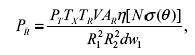
<body><![CDATA[<br>   The bistatic lidar system at this location basically consists of a continuous-wave    4-watt (multi-line) Argon ion laser as the transmitter. The laser is operated    at the prominent laser line of 0.5145 &#956;m and the laser is linearly polarized    in the vertical plane. A beam steering device is used at the transmitter-end    to tilt the laser beam to the desired angle. The receiving system essentially    consists of a 25 cm diameter Newtonian telescope, a narrow-band interference    filter of 1 nm FWHM and a Peltier cooled photomultiplier tube. The transmitter    and the receiver are separated by 60 m in the same horizontal plane. The entire    lidar system is installed on the terrace of the Institute building, which is    about 13 m above ground level. A detailed description of the lidar system at    Pune is given in an earlier publication (Devara and Ernest Raj, 1987). The received    power <i>P<sub><font size="2">R</font></sub></i> at any scattering angle<i>    &#952; </i>in the bistatic configuration is given by</p>     <p align="center"><img src="/img/revistas/atm/v17n1/a04pag41.gif"></p>     <p align="justify">    <br>   where <i>P<sub><font size="2">r</font></sub></i> is the transmitting power    of the laser and <i>V</i> is the volume enclosed by the intersection of the    transmitting and receiving beams (scattering volume). <i>R</i><sub><font size="2"><i>1</i></font></sub>    and <i>R</i><sub><font size="2"><i>2</i></font></sub> are the ranges of    the center of scattering volume from the transmitter and receiver, and <i>T</i><sub><font size="2"><i>x</i></font></sub>    and <i>T</i><sub><font size="2"><i>R</i></font></sub> are atmospheric transmittances    along these paths. <i>A</i><sub><font size="2"><i>R</i></font></sub> is    the collecting area of the receiver, <i>&#951;</i> the system constant including    the overall optical efficiencies of the system, <i>dw<sub><font size="2">1</font></sub></i>    is the transmitted beam solid angle.<i> N</i> is the number density (cm<sup><font size="2">-3</font></sup>)    of the scatterers and &#963; (<i>&#952;</i> ) is the differential scattering    cross-section (cm<sup><font size="2">2</font></sup> sr-<sup><font size="2">1</font></sup>)    at scattering angle <i>&#952;</i>. Rearranging the above equation and taking    all the known terms to the right-hand side, we get</p>     <p align="center"><img src="/img/revistas/atm/v17n1/a04pag41b.gif"></p>     <p align="justify">    <br>   <i>N<sub><font size="2">S</font></sub></i> is subsequently referred to as    normalized signal strength in the text. Now it is evident from the above equation    that once the appropriate values of differential cross-section are known, from    the lidar experimental data it is possible to estimate the aerosol number density    within experimental error.</p>     <p align="justify">The scattered signal from the atmosphere contains contributions    from air molecules and aerosols whose scattering cross sections differ from    each other mainly because of their size differences. Thus the composite angular    variation of the scattered signal depends on aerosols and molecular cross sections    and the number densities, but the average scattered intensity for molecules    vanishes at scattering angle 90&deg;. Also as the probing laser wavelength in    the present experiments is 0.5145 &#956;m, the scattered intensity variations are    assumed to be predominantly due to aerosols. Mie theory assumes spherical scatterers    and for an aerosol unit volume having different particle radii ranging from<i>    r</i><sub><font size="2">1</font></sub> to<i> r</i><sub><font size="2">2</font></sub>,    the differential Mie scattering cross section of aerosols, s<sub><font size="3">a</font></sub>    (<i>q</i>) can be written as</p>     <p align="center"><img src="/img/revistas/atm/v17n1/a04pag42.gif"></p>     <p align="justify">    ]]></body>
<body><![CDATA[<br>   where<i> i</i><sub><font size="2"><i>2</i></font></sub> is the Mie scattering    function when the incident light is polarized parallel to the scattering plane    (McCartney, 1976; Chylek <i>et al.,</i> 1975), <i>dN</i><sub><font size="3">a</font></sub>    (<i>r</i>) represents the number of particles between radii <i>r</i> and    <i>r</i> + <i>dr</i> in unit volume,<i> &#952;</i> is the scattering angle,<i>    m</i> the refractive index, <i>r</i> the particle size and &#955; is the    wavelength. For computations with Mie scattering theory in the case of aerosols,    the nature of the size distribution is to be known. The following modified power    law distribution by McClatchey <i>et al.</i> (1972) has been used in the computations    here.</p>     <p align="center"><img src="/img/revistas/atm/v17n1/a04pag42b.gif"></p>     <p align="justify">    <br>   where<i> v</i> is the aerosol size index (also called the Junge size exponent    or the shaping parameter) and <i>C</i> is a normalized constant. Using the    above equations, the differential Mie scattering cross sections have been computed    and presented here.</p>     <p align="justify"><b>    <br>   3. Experimental scheme and data </b>    <br>   The experimental schematic followed in the laser angular scattering measurements    is shown in <a href="/img/revistas/atm/v17n1/a04pag43.gif">Figure 1</a>. Scattering    angle is varied from 90&deg; to 175&deg; in 16 steps by reorienting the transmitter    and receiver elevation angles appropriately. The transmitter-receiver elevation    angle combinations adopted here and the corresponding scattering angles are    shown in <a href="/img/revistas/atm/v17n1/a04pag43b.gif">Table 1</a>. The Table    also shows the height of the common scattering volume (<i> H<sub><font size="2">v</font></sub></i>    ) and ranges <i>R<sub><font size="2">1</font></sub></i> and <i>R<sub><font size="2">2</font></sub></i>    corresponding to the 16 scattering angles. The mean height of scattering is    30.08 m with the variation being only 0.4%. Thus, the experimental arrangement    could maintain a nearly constant scattering altitude. Also, the maximum range    from the lidar in the horizontal direction is about 170 m. Therefore it is fair    to assume that the composition of aerosols and their number density (which are    expected to vary with altitude and horizontal range) remain reasonably constant    at all the above 16 scattering angles within a radius of 170 m during the experimental    period of about 20 minutes. The laser angular scattering experiment is conducted    generally between 1900 and 2030 hrs LT during clear sky conditions. Laser scattered    signal strength (received power) from the atmosphere at all the above 16 scattering    angles is recorded for a constant laser transmitter power of 200 mW. At each    scattering angle, 10 to 15 values of signal-plus-noise and noise each are collected.    From the mean values of received signal strength, power received is computed    and at each scattering angle the normalized signal strength, <i>N<sub><font size="3">s</font></sub></i>    as given by equation (1) is computed. The angular scattering experiment is conducted    once a month as part of our regular lidar measurement program. Due to unfavorable    weather/sky conditions, fewer observations can be made during the monsoon season    from June to September. But over the 8-year period of observations undertaken    at this lidar site, the observational days were more or less evenly spread out    over all the seasons and the overall average can be representative of the mean    picture for this location. Thus, the data collected on 50 days during the period    of April 1987 - December 1995 have been used in the present analysis.</p>     <p align="center">    <br>   <a href="/img/revistas/atm/v17n1/a04pag43.gif">Fig. 1.</a></p>     <p align="center">Fig. 1. Experimental schematic for laser angular scattering    measurement in the scattering    ]]></body>
<body><![CDATA[<br>   angle range 90&deg; - 175&deg;.</p>     <p align="center">    <br>       <br> </p>     <p align="center"><a href="/img/revistas/atm/v17n1/a04pag43b.gif">Table 1</a></p>     <p align="justify">    <br>   <b>4. Results and discussion</b>    <br>   According to equation (1), within the limitations of experimental error, the    accuracy of estimation of aerosol number density, <i>N</i> depends solely    on the choice of the best possible values of &#963;<sub><font size="3">a</font></sub>    ( <i>&#952;</i> ). Mie scattering cross-section in fact depends on scattering    angle ( <i>&#952;</i> ), wavelength of probing ( &#955; ), size index (<i>    v</i> ) and refractive index ( <i>m </i>). Data collected in the present    study correspond to the fixed Argon ion laser wavelength of 0.5145 &#956;m.    Sixteen scattering angles used in the actual lidar angular scattering experiments    and shown in Table 1 have been considered in the computations of &#963;<sub><font size="3">a</font></sub>    ( <i>&#952;</i> ). In some of the earlier investigations (Parameswaran <i>et    al.,</i> 1984; Pandithurai <i>et al., </i>1996) values of <i>v</i> considered    for the computations of Mie scattering cross-sections are whole numbers like    2.0, 3.0, 4.0 etc. In the present study, 52 values of <i>v</i> in the range    of&nbsp; 2.0 to 7.1 (e.g., 2.0, 2.1, 2.2, 2.3, ...., 6.9, 7.0, 7.1) have been    considered to determine the closest / maximum probable value of <i>v</i> that    can best represent the type of aerosols present over the lidar observational    site. For simplicity and computational convenience, many of the investigators    consider only the real part of the complex refractive index (<i>m</i> = 1.50)    which ignores the absorption property of the aerosol under study. In the present    study also this &#8216;no absorption&#8217; case has been considered. Besides    this, following Shettle and Fenn (1979), complex refractive index values appropriate    for water-soluble (1.53 - <i>i </i>0.005), dust-like (1.53 -<i> i</i> 0.008)    and soot-type (1.75 -<i> i </i>0.45) aerosols appropriate to the laser wavelength    of &nbsp;0.5145 &#956;m are also considered for the analysis here.    <br>   Thus, in all four typical values of <i>m</i> representing different environmental    conditions or those representing four different aerosol compositions are used.    Now for each value of <i>m</i>, Mie scattering cross-section values at 16 scattering    angles for each of the 52 <i>v</i> values (2.0 to 7.1) are computed using the    equation (2). Here the upper and lower limits of integration in the equation    have been taken to be 10 &#956;m ( <i>r<sub><font size="2">2</font></sub></i>    ) and 0.1 &#956;m (<i> r<sub><font size="2">1</font></sub></i> ), respectively.    As such, the computations give 52 curves of &#963;<sub><font size="3">a</font></sub>(    <i>&#952;</i> ) versus <i>&#952;</i> for each value of<i> m</i>. Figs. 2a -    2d show the variations of differential Mie scattering cross-sections with scattering    angles for <i>v</i> = 2.0 to 7.1 (52 curves) for each of the above mentioned    four refractive index types, namely, no absorption, water soluble, dust-like    and soot-type, respectively. The digital output data from these computations    is stored in the computer in readable format for comparison later with the experimental    data and for further analysis by the library-search method. It may be noted    from <a href="/img/revistas/atm/v17n1/a04pag45.gif">Figure 2</a> that the shape    of the curve changes considerably for different combinations of <i>v</i> and    <i>m</i> values, with minimum value of cross-section occurring between 100&deg;    and 110&deg;. Furthermore, it is to be noted here that only 16 values of scattering    angles that correspond to those used in the actual lidar angular scattering    experiment are used to obtain these curves. However, if a larger number of <i>&#952;</i>    values, closely spaced (within the range of 90&deg; - 180&deg;) were used in    the Mie scattering computations, then the curves would have shown a well-defined    minima and a smoother variation. Thus these 52 x 4 curves of &#963;<sub><font size="3">a</font></sub>    ( <i>&#952;</i> ) have been used for comparing the experimental curve of angular    variation of normalized signal strength (<i>N</i><sub><font size="3">s</font></sub>).  </p>     <p align="center">    ]]></body>
<body><![CDATA[<br>   <a href="/img/revistas/atm/v17n1/a04pag45.gif">Fig. 2.</a></p>     <p align="center">Fig. 2. Variation of differential Mie scattering cross section    with scattering angle for v = 2.0     <br>   to 7.1 (52 values) and for four refractive index types representing (a) no absorption,    <br>   (b) water soluble, (c) dust-like and (d) soot-type.</p>     <p align="center">&nbsp;</p>     <p align="justify">The overall mean variation of scattered signal strength (normalized    signal strength, <i>N</i><sub><font size="3">s</font></sub>) with a scattering    angle in the range 90&deg; - 175&deg; obtained for the 50 days of observations    during the period of April 1987 - December 1995 is shown plotted in <a href="#fig3">Figure    3</a>. It is seen that <i>N</i><sub><font size="3">s</font></sub> is maximum    at higher scattering angles and decreases rapidly with decreases in scattering    angles of up to 105&deg;. Then <i>N</i><sub><font size="3">s</font></sub> increases    with further decreases in scattering angles till 90&deg;. In fact, the individual    (day&#8217;s) curves of scattered signal strength versus scattering angle show    that the minimum in <i>N</i><sub><font size="3">s</font></sub> lies anywhere    between 100&deg; and 110&deg;. The position of the observed minimum in scattered    signal strength (or the shape of the curve around the minimum) gives information    on the refractive index of the aerosol.</p>     <p align="justify">The slope of this angular distribution curve between 110&deg;    and 170&deg; gives information on the size distribution of aerosol present in    the atmosphere. It has been observed in the present data set that this slope    changed from day to day. Jinhuan <i>et al.</i> (1985) have pointed out that    there are two scattering angle regions where the volume scattering function    of aerosol is very sensitive to the real part or imaginary part of the refractive    index. Scattering in the range of&nbsp; 70&deg; - 120&deg; is sensitive to the real    part of the complex refractive index while it is more sensitive to the imaginary    part around 50&deg;. Further, the scattering function is sensitive to both the    real and imaginary refractive index parts in the range of 165&deg; - 180&deg;.</p>     <p align="center">    <br>   <a name="fig3"></a><img src="/img/revistas/atm/v17n1/a04pag46.gif"></p>     <p align="center">Fig. 3. Mean variation of scattered signal strength (normalized    signal strength, N<sub><font size="2">S</font></sub> ) with scattering angle.</p>     ]]></body>
<body><![CDATA[<p align="justify">    <br>   It can be seen that the shape of the observed (experimental) mean signal strength    curve in Figure 3 is very similar to the theoretically computed &#963;<sub><font size="3">a</font></sub>    ( <i>&#952;</i> ) curves shown in <a href="/img/revistas/atm/v17n1/a04pag45.gif">Figure    2</a>. This is as expected, since equation (1) indicates that <i>N</i><sub><font size="3">s</font></sub>    is directly proportional to &#963;<sub><font size="3">a</font></sub> ( <i>&#952;</i>    ) at constant aerosol number density, <i>N</i>. Now assuming that atmospheric    aerosols are distributed homogeneously in the horizontal during the period of    the experiment (post sunset period), the estimated aerosol number density at    a constant altitude from different scattering angles should be constant or nearly    equal within the limitations of experimental error. Thus, using the observed    <i>N</i><sub><font size="3">s</font></sub> values at the 16 scattering angles    and choosing a particular set of &#963;<sub><font size="3">a</font></sub> (    <i>&#952;</i> ) values (i. e., for a particular combination of <i>v</i> and    <i>m</i>), corresponding 16 values of <i>N</i> are computed using equation (1).    The mean <i>N</i>, standard deviation and percentage coefficient of variation    (% C. V.) are computed for this set of 16 values. If the above assumption of    of aerosol number density at constant altitude was valid, then it is expected    that the computed C. V. value would be small. Following this procedure, using    the computer stored (library) values of &#963;<sub><font size="3">a</font></sub>    ( <i>&#952;</i> ), percentage C. V. values are determined for a fixed value    of<i> m</i> and for 52 different values of <i>v</i> from 2.0 to 7.1. The procedure    is then repeated for all the four refractive index types considered in the study.    Now the variation of &nbsp;% C. V. with <i>v</i> is plotted to determine for    which value of <i>v</i> the variability is minimum and also for which type of    <i>m</i> it is the least. <a href="#fig4">Figure 4</a> shows these plots on    two typical days of observation, i. e., 3/14/1990 and 4/23/1992. Here the variation    of &nbsp;C. V. with <i>v</i> are shown as separate curves for different m types.    It can be seen that C. V. is high for smaller values of <i>v</i> and it smoothly    decreases with increasing<i> v</i> and reaches a minimum and then again it increases    for higher values of <i>v</i>. This variation is true for all the aerosol types.    The numerical value in the figure near the individual curves gives the value    of <i>v</i> where minimum C. V. occurs for each <i>m</i> type. On both the days    shown in Figure 4 the smallest value of&nbsp; C. V. is obtained for the case    of dust-like aerosols. Thus, the most probable type of aerosol on both days    is dust-like, but the probable value of <i>v</i> is 3.8 and 4.6 respectively.    A smaller value of <i>v</i> indicates the presence of more relatively larger-    sized particles on that particular day and viceversa. Such a day-to-day variation    of <i>v</i> can be expected as the size distribution in the surface layer in    the vicinity of a large urban area can vary in source strength and transient    atmospheric changes.</p>     <p align="center">    <br>   <a name="fig4"></a><img src="/img/revistas/atm/v17n1/a04pag47.gif"></p>     <p align="center">Fig. 4. Variation of percentage C.V. with size index <i>v</i>    for the four different types of aerosols on two     <br>   typical days of observation</p>     <p align="justify">    <br>   Using the mean <i>N</i><sub><font size="3">s</font></sub> curve shown in <a href="#fig3">Figure    3</a>, the variation of % C. V. with <i>v</i> for different <i>m</i> types are    obtained by the same method followed above and shown plotted in <a href="#fig5">Figure    5</a>. Thus, on an average also, it is seen that the most probable type of aerosol    composition at this location is dust-type and the minimum C. V. occurred at    the <i>v</i> value of 4.8. The value of <i>v</i> thus retrieved from individual    days varied from 4.2 to 5.2 for the cases of &#8216;no absorption&#8217;, water    soluble and dust-like aerosols and it varied from 2.2 to 2.9 in the case of    soot-type aerosols. The frequency of occurrence of a particular <i>v</i> value    for the 50 observation days is calculated for all the four <i>m</i> types and    the frequency distribution histograms are shown in <a href="#fig6">Figure 6</a>.    It is seen that the most frequently occurring value of <i>v</i> in the first    three types is 4.5 and if soot-type aerosols are present over the observation    site, the most probable <i>v</i> value then would be 2.6. The frequency distribution    also shows that it is skewed more towards the larger <i>v</i> value side relative    to the most frequently occurring value. This points out that the chances of    the presence of smaller sized aerosol particles in the surface layer is greater,    which again points to the influence of the anthropogenic origin of the aerosols    observed over the site. The analysis further showed that 84% of the cases indicated    the dominant presence of dust-like aerosols at this site. The lidar site is    located on the western edge of the large urban city of Pune. There is open barren    land around the site with few low-level hillocks scattered in the surroundings.    About 1 km further on the western side of the site are some traditional open-air    brick baking kilns and small village-like settlements. There has also been concrete    building construction activity going on for several years in the area around.    All these activities may be directly or indirectly responsible for the observed    aerosol/particle type at the site. As the observations are close to the surface,    wind blown particles may have a dominant influence. Interestingly, the soot-type    aerosols were also present 12% of the time. This further points out that aerosols    of urban origin like transport vehicular emissions, bio-mass burning, etc. are    also showing their influence in modifying the refractive index and size distribution    of aerosols in the surface layer over the lidar site. As the experimental days    are more or less uniformly spread out during all the seasons of the year, the    most probable size index value, <i>v</i> (4.5) and refractive index,<i> m</i>    (1.53 -<i> i</i>0.008) can be employed with greater confidence while computing    the differential Mie scattering cross sections, &#963;<sub><font size="3">a</font></sub>    ( <i>&#952;</i> ) which are ultimately used in the retrieval of vertical distributions    of aerosol number density with the Argon ion lidar data collected at this location.  </p>     <p align="center">    <br>   <a name="fig5"></a><img src="/img/revistas/atm/v17n1/a04pag48.gif"></p>     ]]></body>
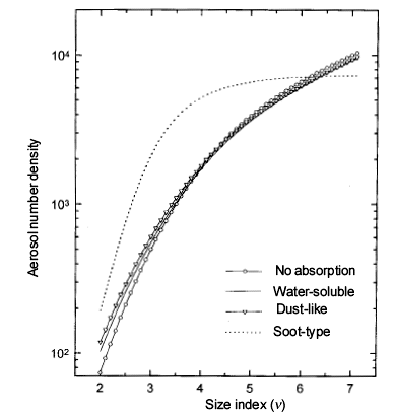
<body><![CDATA[<p align="center">Fig. 5. Variation of percentage C.V. with size index <i>v</i>    for the four different types of aerosols for the    <br>   overal mean experiment data.</p>     <p align="center">&nbsp; </p>     <p align="center"><a name="fig6"></a><img src="/img/revistas/atm/v17n1/a04pag49.gif"></p>     <p align="center">Fig. 6. Frequency distribution of estimated size index <i>v</i>    for the four types of aerosols.</p>     <p align="justify">    <br>   <a href="#fig7">Figure 7</a> shows the variation of mean aerosol number density    with size index for the four types of refractive indices. As expected, aerosol    number concentration would be higher for a choice of a larger value of<i> v</i>.    Thus, for a most probable value of 4.5 of<i> v </i>determined in the present    analysis, the aerosol number density in the surface layer (at 30 <i>m</i>) would    be in the range of&nbsp; 2 x 10<sup><font size="2">3</font></sup> to 3 x 10<sup><font size="2">3</font></sup>    cm<sup><font size="2">-3</font></sup>. It is also seen that for a variation    of <i>v</i> from 2.0 to 7.0, the estimated concentration can vary by more than    2 orders of magnitude. Therefore, for a good estimation of aerosol number density,    it is essential to determine the most appropriate values of <i>v </i>and <i>m</i>,    which in turn can be used to theoretically compute the differential Mie scattering    cross sections. Grams <i>et al.</i> (1974) measured angular scattering intensities    with a polar nephelometer in the range of 10&deg; - 170&deg; and retrieved the    refractive index value, but they reported an uncertainty factor. So, Jinhuan    <i>et al. </i>(1985) first identified the scattering angle regions where volume    scattering function is sensitive to real part and imaginary part of the refractive    index and then using this information found more satisfactory results while    retrieving the refractive index from remote sensing methods. The experimental    scheme followed in the present study and the library search method adopted in    retrieving the size index and refractive index seem to yield a fair estimate    of these parameters, which in turn, facilitate the inversion of lidar data.</p>     <p align="center">    <br>   <a name="fig7"></a><img src="/img/revistas/atm/v17n1/a04pag50.gif"></p>     <p align="center">Fig. 7. Variation of estimated mean aerosol number concentration    with size index <i>v </i>for the four    ]]></body>
<body><![CDATA[<br>   types of refractive indices.</p>     <p align="justify"><b>    <br>   5. Conclusions</b>    <br>   The present study shows one of the unique advantages of operating a lidar system    in the bistatic mode, where angular variation of light intensity scattered from    atmospheric aerosols can be recorded. An experiment designed to make observations    of scattered intensity at different scattering angles but from a constant altitude    of scattering, adopting a bistatic Argon ion lidar system has been described.    A simple library-search method has been used to estimate the most probable size    index and refractive index values that are necessary to compute Mie scattering    cross sections applicable to the observation site. This in turn will help to    better estimates aerosol number density from lidar vertical profiles of scattered    signal strength.</p>     <p align="justify">    <br>   <b>Acknowledgements</b>    <br>   The authors would like to thank the Director, IITM for his constant encouragement.    The assistance from Dr. S. Sharma in the collection of the data is gratefully    acknowledged.</p>     <p align="justify">    <br>   <b>References</b>    <!-- ref --><br>   Babenko, V. A., A. P. Prishivalco and S. T. Leyko, 1975. Angular characteristics    of light scattering by radially inhomogeneous particles of atmospheric aerosol    particles. <i>Atmos. and Oceanic Phys.,</i> <b>11</b>, 398-400.&nbsp;&nbsp;&nbsp;&nbsp;&nbsp;&nbsp;&nbsp;&nbsp;[&#160;<a href="javascript:void(0);" onclick="javascript: window.open('/scielo.php?script=sci_nlinks&ref=1255366&pid=S0187-6236200400010000400001&lng=','','width=640,height=500,resizable=yes,scrollbars=1,menubar=yes,');">Links</a>&#160;]<!-- end-ref --><!-- ref --><p align="justify"> Carswell, A. I., 1983. Lidar measurements of the atmosphere.    <i>Canadian J. Phys., </i><b>61</b>, 378-395.&nbsp;&nbsp;&nbsp;&nbsp;&nbsp;&nbsp;&nbsp;&nbsp;[&#160;<a href="javascript:void(0);" onclick="javascript: window.open('/scielo.php?script=sci_nlinks&ref=1255367&pid=S0187-6236200400010000400002&lng=','','width=640,height=500,resizable=yes,scrollbars=1,menubar=yes,');">Links</a>&#160;]<!-- end-ref --><!-- ref --><p align="justify"> Chylek, P., G. W. Grams, G. A. Smith and P. B. Russell, 1975.    <i>J. Appl. Meteorol.,</i> <b>14</b>, 380.&nbsp;&nbsp;&nbsp;&nbsp;&nbsp;&nbsp;&nbsp;&nbsp;[&#160;<a href="javascript:void(0);" onclick="javascript: window.open('/scielo.php?script=sci_nlinks&ref=1255368&pid=S0187-6236200400010000400003&lng=','','width=640,height=500,resizable=yes,scrollbars=1,menubar=yes,');">Links</a>&#160;]<!-- end-ref --><!-- ref --><p align="justify"> Devara, P. C. S. and P. Ernest Raj, 1987. A bistatic lidar    for aerosol studies. <i>IETE Tech. Rev.,</i> <b>4</b>, 412-415.&nbsp;&nbsp;&nbsp;&nbsp;&nbsp;&nbsp;&nbsp;&nbsp;[&#160;<a href="javascript:void(0);" onclick="javascript: window.open('/scielo.php?script=sci_nlinks&ref=1255369&pid=S0187-6236200400010000400004&lng=','','width=640,height=500,resizable=yes,scrollbars=1,menubar=yes,');">Links</a>&#160;]<!-- end-ref --><!-- ref --><p align="justify"> Ernest Raj, P. and P. C. S. Devara, 1989. Some results of    lidar aerosol measurements and their relationship with meteorological parameters.    <i>Atmos. Environ.,</i> <b>23</b>, 831-838.&nbsp;&nbsp;&nbsp;&nbsp;&nbsp;&nbsp;&nbsp;&nbsp;[&#160;<a href="javascript:void(0);" onclick="javascript: window.open('/scielo.php?script=sci_nlinks&ref=1255370&pid=S0187-6236200400010000400005&lng=','','width=640,height=500,resizable=yes,scrollbars=1,menubar=yes,');">Links</a>&#160;]<!-- end-ref --><!-- ref --><p align="justify"> Ernest Raj, P. and P. C. S. Devara, 1995. Scattering angle    distribution of laser-return signal strength in the lower atmosphere. <i>J.    Aerosol Sci.,</i> <b>26</b>, 51-59.&nbsp;&nbsp;&nbsp;&nbsp;&nbsp;&nbsp;&nbsp;&nbsp;[&#160;<a href="javascript:void(0);" onclick="javascript: window.open('/scielo.php?script=sci_nlinks&ref=1255371&pid=S0187-6236200400010000400006&lng=','','width=640,height=500,resizable=yes,scrollbars=1,menubar=yes,');">Links</a>&#160;]<!-- end-ref --><!-- ref --><p align="justify"> Grams, G. W., I. H. Blifford, D. A. Gillette and P. B. Russell,    1974. Complex index of refraction of airborne soil particles. <i>J. Appl. Meteorol.,</i>    <b>13</b>, 459-471.&nbsp;&nbsp;&nbsp;&nbsp;&nbsp;&nbsp;&nbsp;&nbsp;[&#160;<a href="javascript:void(0);" onclick="javascript: window.open('/scielo.php?script=sci_nlinks&ref=1255372&pid=S0187-6236200400010000400007&lng=','','width=640,height=500,resizable=yes,scrollbars=1,menubar=yes,');">Links</a>&#160;]<!-- end-ref --><!-- ref --><p align="justify"> IPCC, 1996. <i>Climate Change 1995: The Science of Climate    Change,</i> J. T. Houghton, M. Filho, L. G. Callander, N. Harris, A. Kattenberg    and K. Maskell (eds.), Cambridge University Press, New York.&nbsp;&nbsp;&nbsp;&nbsp;&nbsp;&nbsp;&nbsp;&nbsp;[&#160;<a href="javascript:void(0);" onclick="javascript: window.open('/scielo.php?script=sci_nlinks&ref=1255373&pid=S0187-6236200400010000400008&lng=','','width=640,height=500,resizable=yes,scrollbars=1,menubar=yes,');">Links</a>&#160;]<!-- end-ref --><!-- ref --><p align="justify"> Jinhuan Qui, Zhou Xiuji and Zhao Yanzeng, 1985. Theoretical    analysis of remote sensing of aerosol refractive index by angular scattering    method. <i>Scientia Sinica</i> (Series B), <b>28</b>, 745-757. &nbsp;&nbsp;&nbsp;&nbsp;&nbsp;&nbsp;&nbsp;&nbsp;[&#160;<a href="javascript:void(0);" onclick="javascript: window.open('/scielo.php?script=sci_nlinks&ref=1255374&pid=S0187-6236200400010000400009&lng=','','width=640,height=500,resizable=yes,scrollbars=1,menubar=yes,');">Links</a>&#160;]<!-- end-ref --><!-- ref --><p align="justify"> McCartney, E. J., 1976. <i>Optics of the Atmosphere:</i> <i>Scattering    by Molecules and Particles.</i> Wiley, New York.&nbsp;&nbsp;&nbsp;&nbsp;&nbsp;&nbsp;&nbsp;&nbsp;[&#160;<a href="javascript:void(0);" onclick="javascript: window.open('/scielo.php?script=sci_nlinks&ref=1255375&pid=S0187-6236200400010000400010&lng=','','width=640,height=500,resizable=yes,scrollbars=1,menubar=yes,');">Links</a>&#160;]<!-- end-ref --><!-- ref --><p align="justify"> McClatchey, R. A., R. W. Fenn, J. E. A. Selby, F. E. Volz    and J. S. Garing, 1972. Optical Properties of the Atmosphere (third edition),    AFCRL-72-0497, AD753075, Air Force Cambridge Research Laboratories, Bedford.&nbsp;&nbsp;&nbsp;&nbsp;&nbsp;&nbsp;&nbsp;&nbsp;[&#160;<a href="javascript:void(0);" onclick="javascript: window.open('/scielo.php?script=sci_nlinks&ref=1255376&pid=S0187-6236200400010000400011&lng=','','width=640,height=500,resizable=yes,scrollbars=1,menubar=yes,');">Links</a>&#160;]<!-- end-ref --><!-- ref --><p align="justify"> Pandithurai G., P. C. S. Devara, P. Ernest Raj and S. Sharma,    1996. Aerosol size distribution and refractive index from bistatic lidar angular    scattering measurements in the surface layer. <i>Remote Sensing Environ.,</i>    <b>56</b>, 87-96.&nbsp;&nbsp;&nbsp;&nbsp;&nbsp;&nbsp;&nbsp;&nbsp;[&#160;<a href="javascript:void(0);" onclick="javascript: window.open('/scielo.php?script=sci_nlinks&ref=1255377&pid=S0187-6236200400010000400012&lng=','','width=640,height=500,resizable=yes,scrollbars=1,menubar=yes,');">Links</a>&#160;]<!-- end-ref --><!-- ref --><p align="justify"> Parameswaran, K., K. O. Rose and B. V. Krishna Murthy, 1984.    Aerosol characteristics from bistatic lidar observations. <i>J. Geophys. Res.,</i>    <b>89</b>, 2541-2552.&nbsp;&nbsp;&nbsp;&nbsp;&nbsp;&nbsp;&nbsp;&nbsp;[&#160;<a href="javascript:void(0);" onclick="javascript: window.open('/scielo.php?script=sci_nlinks&ref=1255378&pid=S0187-6236200400010000400013&lng=','','width=640,height=500,resizable=yes,scrollbars=1,menubar=yes,');">Links</a>&#160;]<!-- end-ref --><!-- ref --><p align="justify"> Reagan, J. A. and B. M. Herman, 1970. Proc. 14<sup><font size="3">th</font></sup>    Conf. Radar Meteorol., p.275.&nbsp;&nbsp;&nbsp;&nbsp;&nbsp;&nbsp;&nbsp;&nbsp;[&#160;<a href="javascript:void(0);" onclick="javascript: window.open('/scielo.php?script=sci_nlinks&ref=1255379&pid=S0187-6236200400010000400014&lng=','','width=640,height=500,resizable=yes,scrollbars=1,menubar=yes,');">Links</a>&#160;]<!-- end-ref --><!-- ref --><p align="justify"> Shettle, E. P. and R. W. Fenn, 1979. Models for the aerosols    of the lower atmosphere and the effects of humidity variations on their optical    properties. AFGL-TR-79-0214, Air Force Geophysics Laboratory, Hanscom.&nbsp;&nbsp;&nbsp;&nbsp;&nbsp;&nbsp;&nbsp;&nbsp;[&#160;<a href="javascript:void(0);" onclick="javascript: window.open('/scielo.php?script=sci_nlinks&ref=1255380&pid=S0187-6236200400010000400015&lng=','','width=640,height=500,resizable=yes,scrollbars=1,menubar=yes,');">Links</a>&#160;]<!-- end-ref --><!-- ref --><p align="justify"> Takamura, T. and Y. Sasano, 1987. Ratio of aerosol backscatter    to extinction coefficients as determined from angular scattering measurements    for use in atmospheric lidar applications. <i>Optical and Quantum Electr.,</i>    <b>19</b>, 293-302.&nbsp;&nbsp;&nbsp;&nbsp;&nbsp;&nbsp;&nbsp;&nbsp;[&#160;<a href="javascript:void(0);" onclick="javascript: window.open('/scielo.php?script=sci_nlinks&ref=1255381&pid=S0187-6236200400010000400016&lng=','','width=640,height=500,resizable=yes,scrollbars=1,menubar=yes,');">Links</a>&#160;]<!-- end-ref --><!-- ref --><p align="justify"> Tanaka, M., T. Nakajima and T. Takamura, 1982. Simultaneous    determination of complex refractive index and size distribution of airborne    and water-suspended particles from light scattering measurements. <i>J. Meteorol.    Soc. Japan, </i><b>60</b>, 1259-1272.&nbsp;&nbsp;&nbsp;&nbsp;&nbsp;&nbsp;&nbsp;&nbsp;[&#160;<a href="javascript:void(0);" onclick="javascript: window.open('/scielo.php?script=sci_nlinks&ref=1255382&pid=S0187-6236200400010000400017&lng=','','width=640,height=500,resizable=yes,scrollbars=1,menubar=yes,');">Links</a>&#160;]<!-- end-ref --><!-- ref --><p align="justify"> Ward, G., K. M. Kushing, R. D. McPeters and A. E. Green, 1973.    Atmospheric aerosol index of refraction and size-altitude distribution from    bistatic laser scattering and solar aureole measurements. <i>Appl. Opt.</i>,    <b>12</b>, 2585-2592.&nbsp;&nbsp;&nbsp;&nbsp;&nbsp;&nbsp;&nbsp;&nbsp;[&#160;<a href="javascript:void(0);" onclick="javascript: window.open('/scielo.php?script=sci_nlinks&ref=1255383&pid=S0187-6236200400010000400018&lng=','','width=640,height=500,resizable=yes,scrollbars=1,menubar=yes,');">Links</a>&#160;]<!-- end-ref --><!-- ref --><p align="justify"> Zuev, V. E., 1982. <i>Laser Beams in the Atmosphere, Plenum,</i>    New York.&nbsp;&nbsp;&nbsp;&nbsp;&nbsp;&nbsp;&nbsp;&nbsp;[&#160;<a href="javascript:void(0);" onclick="javascript: window.open('/scielo.php?script=sci_nlinks&ref=1255384&pid=S0187-6236200400010000400019&lng=','','width=640,height=500,resizable=yes,scrollbars=1,menubar=yes,');">Links</a>&#160;]<!-- end-ref --> ]]></body><back>
<ref-list>
<ref id="B1">
<nlm-citation citation-type="journal">
<person-group person-group-type="author">
<name>
<surname><![CDATA[Babenko]]></surname>
<given-names><![CDATA[V. A.]]></given-names>
</name>
<name>
<surname><![CDATA[Prishivalco]]></surname>
<given-names><![CDATA[A. P.]]></given-names>
</name>
<name>
<surname><![CDATA[Leyko]]></surname>
<given-names><![CDATA[S. T.]]></given-names>
</name>
</person-group>
<article-title xml:lang="es"><![CDATA[Angular characteristics of light scattering by radially inhomogeneous particles of atmospheric aerosol particles]]></article-title>
<source><![CDATA[Atmos. and Oceanic Phys.]]></source>
<year>1975</year>
<numero>11</numero>
<issue>11</issue>
<page-range>398-400</page-range></nlm-citation>
</ref>
<ref id="B2">
<nlm-citation citation-type="journal">
<person-group person-group-type="author">
<name>
<surname><![CDATA[Carswell]]></surname>
<given-names><![CDATA[A. I.]]></given-names>
</name>
</person-group>
<article-title xml:lang="es"><![CDATA[Lidar measurements of the atmosphere]]></article-title>
<source><![CDATA[Canadian J. Phys.]]></source>
<year>1983</year>
<numero>61</numero>
<issue>61</issue>
<page-range>378-395</page-range></nlm-citation>
</ref>
<ref id="B3">
<nlm-citation citation-type="journal">
<person-group person-group-type="author">
<name>
<surname><![CDATA[Chylek]]></surname>
<given-names><![CDATA[P.]]></given-names>
</name>
<name>
<surname><![CDATA[Grams]]></surname>
<given-names><![CDATA[G. W.]]></given-names>
</name>
<name>
<surname><![CDATA[Smith]]></surname>
<given-names><![CDATA[G. A.]]></given-names>
</name>
<name>
<surname><![CDATA[Russell]]></surname>
<given-names><![CDATA[P. B.]]></given-names>
</name>
</person-group>
<source><![CDATA[J. Appl. Meteorol.]]></source>
<year>1975</year>
<numero>14</numero>
<issue>14</issue>
<page-range>380</page-range></nlm-citation>
</ref>
<ref id="B4">
<nlm-citation citation-type="journal">
<person-group person-group-type="author">
<name>
<surname><![CDATA[Devara]]></surname>
<given-names><![CDATA[P. C. S.]]></given-names>
</name>
<name>
<surname><![CDATA[Ernest Raj]]></surname>
<given-names><![CDATA[P.]]></given-names>
</name>
</person-group>
<article-title xml:lang="en"><![CDATA[A bistatic lidar for aerosol studies]]></article-title>
<source><![CDATA[IETE Tech. Rev.]]></source>
<year>1987</year>
<numero>4</numero>
<issue>4</issue>
<page-range>412-415</page-range></nlm-citation>
</ref>
<ref id="B5">
<nlm-citation citation-type="journal">
<person-group person-group-type="author">
<name>
<surname><![CDATA[Ernest Raj]]></surname>
<given-names><![CDATA[P.]]></given-names>
</name>
<name>
<surname><![CDATA[Devara]]></surname>
<given-names><![CDATA[P. C. S.]]></given-names>
</name>
</person-group>
<article-title xml:lang="en"><![CDATA[Some results of lidar aerosol measurements and their relationship with meteorological parameters]]></article-title>
<source><![CDATA[Atmos. Environ.]]></source>
<year>1989</year>
<numero>23</numero>
<issue>23</issue>
<page-range>831-838</page-range></nlm-citation>
</ref>
<ref id="B6">
<nlm-citation citation-type="journal">
<person-group person-group-type="author">
<name>
<surname><![CDATA[Ernest Raj]]></surname>
<given-names><![CDATA[P.]]></given-names>
</name>
<name>
<surname><![CDATA[Devara]]></surname>
<given-names><![CDATA[P. C. S.]]></given-names>
</name>
</person-group>
<article-title xml:lang="en"><![CDATA[Scattering angle distribution of laser-return signal strength in the lower atmosphere]]></article-title>
<source><![CDATA[J. Aerosol Sci.]]></source>
<year>1995</year>
<numero>26</numero>
<issue>26</issue>
<page-range>51-59</page-range></nlm-citation>
</ref>
<ref id="B7">
<nlm-citation citation-type="journal">
<person-group person-group-type="author">
<name>
<surname><![CDATA[Grams]]></surname>
<given-names><![CDATA[G. W.]]></given-names>
</name>
<name>
<surname><![CDATA[Blifford]]></surname>
<given-names><![CDATA[I. H.]]></given-names>
</name>
<name>
<surname><![CDATA[Gillette]]></surname>
<given-names><![CDATA[D. A.]]></given-names>
</name>
<name>
<surname><![CDATA[Russell]]></surname>
<given-names><![CDATA[P. B.]]></given-names>
</name>
</person-group>
<article-title xml:lang="en"><![CDATA[Complex index of refraction of airborne soil particles]]></article-title>
<source><![CDATA[J. Appl. Meteorol.]]></source>
<year>1974</year>
<numero>13</numero>
<issue>13</issue>
<page-range>459-471</page-range></nlm-citation>
</ref>
<ref id="B8">
<nlm-citation citation-type="book">
<person-group person-group-type="author">
<name>
<surname><![CDATA[Houghton]]></surname>
<given-names><![CDATA[J. T.]]></given-names>
</name>
<name>
<surname><![CDATA[Filho]]></surname>
<given-names><![CDATA[M.]]></given-names>
</name>
<name>
<surname><![CDATA[Callander]]></surname>
<given-names><![CDATA[L. G.]]></given-names>
</name>
<name>
<surname><![CDATA[Harris]]></surname>
<given-names><![CDATA[N.]]></given-names>
</name>
<name>
<surname><![CDATA[Kattenberg]]></surname>
<given-names><![CDATA[A.]]></given-names>
</name>
<name>
<surname><![CDATA[Maskell]]></surname>
<given-names><![CDATA[K.]]></given-names>
</name>
</person-group>
<collab>IPCC</collab>
<source><![CDATA[Climate Change 1995: The Science of Climate Change]]></source>
<year>1996</year>
<publisher-loc><![CDATA[New York ]]></publisher-loc>
<publisher-name><![CDATA[Cambridge University Press]]></publisher-name>
</nlm-citation>
</ref>
<ref id="B9">
<nlm-citation citation-type="journal">
<person-group person-group-type="author">
<name>
<surname><![CDATA[Jinhuan Qui]]></surname>
</name>
<name>
<surname><![CDATA[Zhou Xiuji]]></surname>
</name>
<name>
<surname><![CDATA[Zhao  Yanzeng]]></surname>
</name>
</person-group>
<article-title xml:lang="en"><![CDATA[Theoretical analysis of remote sensing of aerosol refractive index by angular scattering method]]></article-title>
<source><![CDATA[Scientia Sinica (Series B)]]></source>
<year>1985</year>
<numero>28</numero>
<issue>28</issue>
<page-range>745-757</page-range></nlm-citation>
</ref>
<ref id="B10">
<nlm-citation citation-type="book">
<person-group person-group-type="author">
<name>
<surname><![CDATA[McCartney]]></surname>
<given-names><![CDATA[E. J.]]></given-names>
</name>
</person-group>
<source><![CDATA[Optics of the Atmosphere: Scattering by Molecules and Particles]]></source>
<year>1976</year>
<publisher-loc><![CDATA[New York ]]></publisher-loc>
<publisher-name><![CDATA[Wiley]]></publisher-name>
</nlm-citation>
</ref>
<ref id="B11">
<nlm-citation citation-type="book">
<person-group person-group-type="author">
<name>
<surname><![CDATA[McClatchey]]></surname>
<given-names><![CDATA[R. A.]]></given-names>
</name>
<name>
<surname><![CDATA[Fenn]]></surname>
<given-names><![CDATA[R. W.]]></given-names>
</name>
<name>
<surname><![CDATA[Selby]]></surname>
<given-names><![CDATA[J. E. A.]]></given-names>
</name>
<name>
<surname><![CDATA[Volz]]></surname>
<given-names><![CDATA[F. E.]]></given-names>
</name>
<name>
<surname><![CDATA[Garing]]></surname>
<given-names><![CDATA[J. S.]]></given-names>
</name>
</person-group>
<source><![CDATA[Optical Properties of the Atmosphere]]></source>
<year>1972</year>
<edition>third edition</edition>
<publisher-loc><![CDATA[Bedford ]]></publisher-loc>
<publisher-name><![CDATA[Air Force Cambridge Research Laboratories]]></publisher-name>
</nlm-citation>
</ref>
<ref id="B12">
<nlm-citation citation-type="journal">
<person-group person-group-type="author">
<name>
<surname><![CDATA[Pandithurai]]></surname>
<given-names><![CDATA[G.]]></given-names>
</name>
<name>
<surname><![CDATA[Devara]]></surname>
<given-names><![CDATA[P. C. S.]]></given-names>
</name>
<name>
<surname><![CDATA[Ernest Raj]]></surname>
<given-names><![CDATA[P.]]></given-names>
</name>
<name>
<surname><![CDATA[Sharma]]></surname>
<given-names><![CDATA[S.]]></given-names>
</name>
</person-group>
<article-title xml:lang="en"><![CDATA[Aerosol size distribution and refractive index from bistatic lidar angular scattering measurements in the surface layer]]></article-title>
<source><![CDATA[Remote Sensing Environ.]]></source>
<year>1996</year>
<numero>56</numero>
<issue>56</issue>
<page-range>87-96</page-range></nlm-citation>
</ref>
<ref id="B13">
<nlm-citation citation-type="journal">
<person-group person-group-type="author">
<name>
<surname><![CDATA[Parameswaran]]></surname>
<given-names><![CDATA[K.]]></given-names>
</name>
<name>
<surname><![CDATA[Rose]]></surname>
<given-names><![CDATA[K. O.]]></given-names>
</name>
<name>
<surname><![CDATA[Krishna Murthy]]></surname>
<given-names><![CDATA[B. V.]]></given-names>
</name>
</person-group>
<article-title xml:lang="en"><![CDATA[Aerosol characteristics from bistatic lidar observations]]></article-title>
<source><![CDATA[J. Geophys. Res.]]></source>
<year>1984</year>
<numero>89</numero>
<issue>89</issue>
<page-range>2541-2552</page-range></nlm-citation>
</ref>
<ref id="B14">
<nlm-citation citation-type="confpro">
<person-group person-group-type="author">
<name>
<surname><![CDATA[Reagan]]></surname>
<given-names><![CDATA[J. A.]]></given-names>
</name>
<name>
<surname><![CDATA[Herman]]></surname>
<given-names><![CDATA[B. M.]]></given-names>
</name>
</person-group>
<source><![CDATA[]]></source>
<year>1970</year>
<conf-name><![CDATA[14 Conf. Radar Meteorol]]></conf-name>
<conf-loc> </conf-loc>
<page-range>275</page-range></nlm-citation>
</ref>
<ref id="B15">
<nlm-citation citation-type="book">
<person-group person-group-type="author">
<name>
<surname><![CDATA[Shettle]]></surname>
<given-names><![CDATA[E. P.]]></given-names>
</name>
<name>
<surname><![CDATA[Fenn]]></surname>
<given-names><![CDATA[R. W.]]></given-names>
</name>
</person-group>
<source><![CDATA[Models for the aerosols of the lower atmosphere and the effects of humidity variations on their optical properties]]></source>
<year>1979</year>
<publisher-loc><![CDATA[Hanscom ]]></publisher-loc>
<publisher-name><![CDATA[Air Force Geophysics Laboratory]]></publisher-name>
</nlm-citation>
</ref>
<ref id="B16">
<nlm-citation citation-type="journal">
<person-group person-group-type="author">
<name>
<surname><![CDATA[Takamura]]></surname>
<given-names><![CDATA[T.]]></given-names>
</name>
<name>
<surname><![CDATA[Sasano]]></surname>
<given-names><![CDATA[Y.]]></given-names>
</name>
</person-group>
<article-title xml:lang="en"><![CDATA[Ratio of aerosol backscatter to extinction coefficients as determined from angular scattering measurements for use in atmospheric lidar applications]]></article-title>
<source><![CDATA[Optical and Quantum Electr.]]></source>
<year>1987</year>
<numero>19</numero>
<issue>19</issue>
<page-range>293-302</page-range></nlm-citation>
</ref>
<ref id="B17">
<nlm-citation citation-type="journal">
<person-group person-group-type="author">
<name>
<surname><![CDATA[Tanaka]]></surname>
<given-names><![CDATA[M.]]></given-names>
</name>
<name>
<surname><![CDATA[Nakajima]]></surname>
<given-names><![CDATA[T.]]></given-names>
</name>
<name>
<surname><![CDATA[Takamura]]></surname>
<given-names><![CDATA[T.]]></given-names>
</name>
</person-group>
<article-title xml:lang="en"><![CDATA[Simultaneous determination of complex refractive index and size distribution of airborne and water-suspended particles from light scattering measurements]]></article-title>
<source><![CDATA[J. Meteorol. Soc. Japan]]></source>
<year>1982</year>
<numero>60</numero>
<issue>60</issue>
<page-range>1259-1272</page-range></nlm-citation>
</ref>
<ref id="B18">
<nlm-citation citation-type="journal">
<person-group person-group-type="author">
<name>
<surname><![CDATA[Ward]]></surname>
<given-names><![CDATA[G.]]></given-names>
</name>
<name>
<surname><![CDATA[Kushing]]></surname>
<given-names><![CDATA[K. M.]]></given-names>
</name>
<name>
<surname><![CDATA[McPeters]]></surname>
<given-names><![CDATA[R. D.]]></given-names>
</name>
<name>
<surname><![CDATA[Green]]></surname>
<given-names><![CDATA[A. E.]]></given-names>
</name>
</person-group>
<article-title xml:lang="en"><![CDATA[Atmospheric aerosol index of refraction and size-altitude distribution from bistatic laser scattering and solar aureole measurements]]></article-title>
<source><![CDATA[Appl. Opt.]]></source>
<year>1973</year>
<numero>12</numero>
<issue>12</issue>
<page-range>2585-2592</page-range></nlm-citation>
</ref>
<ref id="B19">
<nlm-citation citation-type="book">
<person-group person-group-type="author">
<name>
<surname><![CDATA[Zuev]]></surname>
<given-names><![CDATA[V. E.]]></given-names>
</name>
</person-group>
<source><![CDATA[Laser Beams in the Atmosphere]]></source>
<year>1982</year>
<publisher-loc><![CDATA[New York ]]></publisher-loc>
<publisher-name><![CDATA[Plenum]]></publisher-name>
</nlm-citation>
</ref>
</ref-list>
</back>
</article>