<?xml version="1.0" encoding="ISO-8859-1"?><article xmlns:mml="http://www.w3.org/1998/Math/MathML" xmlns:xlink="http://www.w3.org/1999/xlink" xmlns:xsi="http://www.w3.org/2001/XMLSchema-instance">
<front>
<journal-meta>
<journal-id>0187-6236</journal-id>
<journal-title><![CDATA[Atmósfera]]></journal-title>
<abbrev-journal-title><![CDATA[Atmósfera]]></abbrev-journal-title>
<issn>0187-6236</issn>
<publisher>
<publisher-name><![CDATA[Universidad Nacional Autónoma de México, Instituto de Ciencias de la Atmósfera y Cambio Climático]]></publisher-name>
</publisher>
</journal-meta>
<article-meta>
<article-id>S0187-62362004000100002</article-id>
<title-group>
<article-title xml:lang="en"><![CDATA[Synoptic scale features of the tropospheric circulation over tropical South America during the WETAMC TRMM/LBA experiment]]></article-title>
</title-group>
<contrib-group>
<contrib contrib-type="author">
<name>
<surname><![CDATA[FERREIRA]]></surname>
<given-names><![CDATA[N. J.]]></given-names>
</name>
</contrib>
<contrib contrib-type="author">
<name>
<surname><![CDATA[CORREIA]]></surname>
<given-names><![CDATA[A. A.]]></given-names>
</name>
</contrib>
<contrib contrib-type="author">
<name>
<surname><![CDATA[RAMÍREZ]]></surname>
<given-names><![CDATA[M. C. V.]]></given-names>
</name>
</contrib>
</contrib-group>
<aff id="A01">
<institution><![CDATA[,Instituto Nacional de Pesquisas Espaciais  ]]></institution>
<addr-line><![CDATA[São José dos Campos SP]]></addr-line>
<country>Brazil</country>
</aff>
<pub-date pub-type="pub">
<day>00</day>
<month>01</month>
<year>2004</year>
</pub-date>
<pub-date pub-type="epub">
<day>00</day>
<month>01</month>
<year>2004</year>
</pub-date>
<volume>17</volume>
<numero>1</numero>
<fpage>13</fpage>
<lpage>30</lpage>
<copyright-statement/>
<copyright-year/>
<self-uri xlink:href="http://www.scielo.org.mx/scielo.php?script=sci_arttext&amp;pid=S0187-62362004000100002&amp;lng=en&amp;nrm=iso"></self-uri><self-uri xlink:href="http://www.scielo.org.mx/scielo.php?script=sci_abstract&amp;pid=S0187-62362004000100002&amp;lng=en&amp;nrm=iso"></self-uri><self-uri xlink:href="http://www.scielo.org.mx/scielo.php?script=sci_pdf&amp;pid=S0187-62362004000100002&amp;lng=en&amp;nrm=iso"></self-uri><abstract abstract-type="short" xml:lang="es"><p><![CDATA[Este trabajo analiza las características sinópticas de la circulación de los niveles altos y bajos de la troposfera sobre América del Sur, durante la primera campaña para colecta de datos atmosféricos en mesoescala en la época húmeda (Atmospheric Mesoscale Campaign in the Wet Season - WETAMC) del Experimento de Gran Escala en la Biosfera-Atmósfera de la Amazonia (LBA). Esta campaña fue realizada entre los meses de enero y febrero de 1999 simultáneamente con la validación de los datos del satélite Tropical Rainfall Measuring Mission (TRMM) sobre Brasil. Fueron utilizados datos puntuales reticulares de los National Centers for Environmental Predictions (NCEP) para analizar los vientos y sus campos de divergencia asociados, a manera de definir los patrones prevalecientes de la circulación troposférica en la región. Las imágenes TRMM fueron utilizadas para delinear los patrones de lluvia. Los resultados muestran que ocurrieron por lo menos cuatro patrones diferentes en los campos de viento en la alta troposfera, durante el período estudiado. Estos patrones están asociados, principalmente, a la circulación anticiclónica de Bolivia y a los vórtices ciclónicos en el noreste de Brasil. Los resultados también indican que, en general, la actividad convectiva sobre extensas áreas de América del Sur es dinámicamente sustentada por divergencias a niveles altos. Dos de los seis vórtices observados, presentaron desplazamientos anómalos en la Amazonia durante el período de estudio. En los niveles bajos de la Zona de Convergencia del Atlántico Sur (ZCAS) no hubo actividad, a excepción de la primera quincena de enero; adicionalmente, incursiones en dirección ecuatorial de sistemas frontales de latitud media modularon la actividad convectiva en la región occidental de la Amazonia. Durante el período de estudio, el flujo convergente de vapor de agua de nivel bajo derivado de los datos del NCEP presentó un patrón parcialmente consistente con los campos de lluvia del TRMM.]]></p></abstract>
<abstract abstract-type="short" xml:lang="en"><p><![CDATA[This paper analyzes the synoptic scale features of the upper and lower level tropospheric circulation over tropical South America during the first Atmospheric Mesoscale Campaign in the Wet Season (WETAMC) of the Large Scale Biosphere - Atmosphere Experiment in Amazonia (LBA). This campaign occurred in January and February, 1999 and concomitantly with the validation of the Tropical Rainfall Measuring Mission (TRMM) satellite over Brazil. National Centers for Environmental Predictions (NCEP) grid point data were used to analyze the winds and its associated divergence fields and define the prevailing patterns of the tropospheric circulation in that region. TRMM images were used to depict the rain patterns. The results show at least four distinct patterns in the upper air winds fields during the WETAMC-TRMM/LBA, involving mainly the Bolivian anticyclonic circulation and cyclonic vortices in the vicinity of Northeast Brazil. The results also suggest that, in general, the convective activity over vast areas of South America is dynamically supported by upper level divergence. Two out of a total of six vortices were observed to have anomalous displacements into the Amazonia during the study period. At lower levels, the South Atlantic Convergence Zone (SACZ), except for the first half of January, was not active but equatorward incursions of midlatitude frontal systems disturbed the convective activy in the Southwestern Amazon basin. Besides, during the period of the study, the low-level moisture divergence as derived from NCEP data does not show convergence where the TRMM rain field clearly reveals the existence of precipitation areas.]]></p></abstract>
<kwd-group>
<kwd lng="en"><![CDATA[Cyclonic vortices]]></kwd>
<kwd lng="en"><![CDATA[TRMM]]></kwd>
<kwd lng="en"><![CDATA[South Atlantic convergence zone]]></kwd>
<kwd lng="en"><![CDATA[Bolivian High]]></kwd>
</kwd-group>
</article-meta>
</front><body><![CDATA[ <p align="center"><b><font size="4">Synoptic scale features of the tropospheric    circulation over tropical    <br>   South America during the WETAMC TRMM/LBA experiment    <br>   </font></b> </p>     <p align="center"><font size="2">N. J. FERREIRA, A. A. CORREIA and M. C. V. RAM&Iacute;REZ</font>    <br>   Instituto Nacional de Pesquisas Espaciais    <br>   <font size="2">C. P. 515, 12210-010</font> S&atilde;o Jos&eacute; dos Campos,    SP, Brazil</p>     <p align="center">    <br>   Received February 5, 2002; accepted September 1, 2003</p>     <p align="center">    <br>   RESUMEN</p>     ]]></body>
<body><![CDATA[<p align="justify">Este trabajo analiza las caracter&iacute;sticas sin&oacute;pticas    de la circulaci&oacute;n de los niveles altos y bajos de la troposfera sobre    Am&eacute;rica del Sur, durante la primera campa&ntilde;a para colecta de datos    atmosf&eacute;ricos en mesoescala en la &eacute;poca h&uacute;meda (Atmospheric    Mesoscale Campaign in the Wet Season - WETAMC) del Experimento de Gran Escala    en la Biosfera-Atm&oacute;sfera de la Amazonia (LBA). Esta campa&ntilde;a fue    realizada entre los meses de enero y febrero de 1999 simult&aacute;neamente    con la validaci&oacute;n de los datos del sat&eacute;lite Tropical Rainfall    Measuring Mission (TRMM) sobre Brasil. Fueron utilizados datos puntuales reticulares    de los National Centers for Environmental Predictions (NCEP) para analizar los    vientos y sus campos de divergencia asociados, a manera de definir los patrones    prevalecientes de la circulaci&oacute;n troposf&eacute;rica en la regi&oacute;n.    Las im&aacute;genes TRMM fueron utilizadas para delinear los patrones de lluvia.    Los resultados muestran que ocurrieron por lo menos cuatro patrones diferentes    en los campos de viento en la alta troposfera, durante el per&iacute;odo estudiado.    Estos patrones est&aacute;n asociados, principalmente, a la circulaci&oacute;n    anticicl&oacute;nica de Bolivia y a los v&oacute;rtices cicl&oacute;nicos en    el noreste de Brasil. Los resultados tambi&eacute;n indican que, en general,    la actividad convectiva sobre extensas &aacute;reas de Am&eacute;rica del Sur    es din&aacute;micamente sustentada por divergencias a niveles altos. Dos de    los seis v&oacute;rtices observados, presentaron desplazamientos an&oacute;malos    en la Amazonia durante el per&iacute;odo de estudio. En los niveles bajos de    la Zona de Convergencia del Atl&aacute;ntico Sur (ZCAS) no hubo actividad, a    excepci&oacute;n de la primera quincena de enero; adicionalmente, incursiones    en direcci&oacute;n ecuatorial de sistemas frontales de latitud media modularon    la actividad convectiva en la regi&oacute;n occidental de la Amazonia. Durante    el per&iacute;odo de estudio, el flujo convergente de vapor de agua de nivel    bajo derivado de los datos del NCEP present&oacute; un patr&oacute;n parcialmente    consistente con los campos de lluvia del TRMM.</p>     <p align="center">ABSTRACT</p>     <p align="justify">This paper analyzes the synoptic scale features of the upper    and lower level tropospheric circulation over tropical South America during    the first Atmospheric Mesoscale Campaign in the Wet Season (WETAMC) of the Large    Scale Biosphere &#8211; Atmosphere Experiment in Amazonia (LBA). This campaign    occurred in January and February, 1999 and concomitantly with the validation    of the Tropical Rainfall Measuring Mission (TRMM) satellite over Brazil. National    Centers for Environmental Predictions (NCEP) grid point data were used to analyze    the winds and its associated divergence fields and define the prevailing patterns    of the tropospheric circulation in that region. TRMM images were used to depict    the rain patterns. The results show at least four distinct patterns in the upper    air winds fields during the WETAMC-TRMM/LBA, involving mainly the Bolivian anticyclonic    circulation and cyclonic vortices in the vicinity of Northeast Brazil. The results    also suggest that, in general, the convective activity over vast areas of South    America is dynamically supported by upper level divergence. Two out of a total    of six vortices were observed to have anomalous displacements into the Amazonia    during the study period. At lower levels, the South Atlantic Convergence Zone    (SACZ), except for the first half of January, was not active but equatorward    incursions of midlatitude frontal systems disturbed the convective activy in    the Southwestern Amazon basin. Besides, during the period of the study, the    low-level moisture divergence as derived from NCEP data does not show convergence    where the TRMM rain field clearly reveals the existence of precipitation areas.</p>     <p align="justify"><b>Key words:</b> Cyclonic vortices, TRMM, South    Atlantic convergence zone, Bolivian High</p>     <p align="justify">    <br>   <b>1. Introduction</b>    <br>   The first Atmospheric Mesoscale Campaign in the Wet Season (WETAMC) of the Large    Scale Biosphere &#8211; Atmosphere Experiment in Amazonia (LBA) (Silva <i>Dias    et al.,</i> 2002) occurred in Rondonia, Brazil during the southern summer,    from January to February, 1999. This season was chosen because typically it    is characterized by a pronounced tropospheric circulation variability with great    impact on the regional rainfall regimen. Rutledge <i>et al.</i> (2000) noticed    that during the WETAMC, the development of the mesoscale convective systems    (MCSs) occurred under two distinct meteorological regimens: monsoon and break.    In the former case, low level westerly/northwesterly winds prevailed with humidity    relatively large and abundant precipitation; in the latter, the convective activity    was under low-level easterly flow, with a much drier troposphere. In addition,    Cifelli <i>et al.</i> (2002), suggest that the distinct wind regimens (easterly    and westerly) observed in Rondonia during the WETAMC control the local rainfall    and are associated with the displacements of frontal systems in Southeastern    Brazil.</p>     <p align="justify"> Several studies have shown that many of the large scale characteristics    of the circulation over South America can be simulated using three dimensional    and time varying tropical heat sources (Silva <i>Dias et al., </i>1983; Gandu    and Gesiler, 1991) as well as with a forcing due to the extratropical convection    (Belassiano, 2000). Gandu and Silva Dias (1998) showed that during the austral    summer both the convective activity over the western and central Pacific as    well as over Africa have an impact on the high level tropospheric circulation    and the subsidence patterns in the middle troposphere over South America and    adjacent oceans. Thus, from the synoptic point of view, the tropospheric circulation    over tropical South America and neighboring areas is more easily understood    by considering the dynamics of the upper and lower troposphere separately. In    this context the main features of the upper level circulation in this region    are the interhemispheric bifurcation of the flow over the Eastern Pacific, the    anticyclonic circulation known as the Bolivian High (BH) (Virji, 1981), the    upper level cyclonic vortices in the vicinity of Northeast Brazil (CVNE) (Kousky    and Gan, 1981; Mishra <i>et al.,</i> 2001), the troughs originated from the    Southern Hemisphere mid-latitudes (TRs), the tropical troughs over the Northern    and Southern Pacific Ocean and the troughs over the Northern Atlantic Ocean    (Ram&iacute;rez <i>et al.,</i> 1999). On the other hand, at lower levels the    outstanding features include the South Atlantic Convergence Zone (SACZ) (Kodama,    1992; Carvalho <i>et al.,</i> 2002), the convective activity over the Amazonia    (Greco <i>et al.,</i> 1990) and the stable semi-arid climate of Northeast    Brazil (Rao and Hada, 1999).</p>     <p align="justify"> During the WETAMC-TRMM/LBA experiment the main scientific    interest was on the mesoscale features of the regional circulation. As a consequence,    there was a significant effort addressed to understanding the local interactions    involving the biosphere/atmosphere, cloud dynamics and microphysics, TRMM-satellite    precipitation radar and micrometeorology (e.g., Cifelli <i>et al.,</i> 2002;    Petersen and Rutledge, 2001). However, it was deemed that a diagnostic study    of the most important synoptic scale features of the atmospheric circulation    during the WETAMC-TRMM/LBA experiment would certainly be useful to acquire a    better understanding of the acting mesoscale processes. Thus this work is concerned    with the dominant synoptic aspects of the atmospheric circulation over tropical    South America during that time period. Emphasis was given on the diagnosis of    the upper and lower tropospheric winds and the analysis of the TRMM-derived    rainfall fields.</p>     <p align="justify"><b>    ]]></body>
<body><![CDATA[<br>   2. Data and methodology</b>    <br>   The variables used in this study were the daily air temperature (<i>T</i>),    zonal (<i>u</i>) and meridional (<i>v</i>) wind components and specific    humidity (<i>q</i>) obtained from the global model reanalysis project NCEP/NCAR    (National Centers for Environmental Prediction/National Center for Atmospheric    Research) (Kalnay <i>et al.,</i> 1996). They have a 2.5&deg; x 2.5&deg; lat    &#8211; lon resolution and are given at 1000-, 925-, 850-, 700-, 500-, 250-,    200- and 100-hPa isobaric levels. The spatial domain extends from 15&deg;N to    4&deg;S and 95&deg;W to 15&deg;W and the studied period includes the months    of January and February, for which monthly means (using data from 1978 to 1999)    and daily analyses during the WETAMC&#8211;TRMM/LBA period were analyzed. The    moisture flux and wind divergence were also examined. The first variable is    given in spherical coordinates by</p>     <p align="center"><img src="/img/revistas/atm/v17n1/a02pag15.jpg"></p>     <p align="justify">where:    <br>   <img src="/img/revistas/atm/v17n1/a02pag15b.gif"> is the wind, <i>a</i> is the    Earth&#8217;s mean radius, and &#955; and &#966; are the latitude and longitude,    respectively.    <br>   The software GrADS &#8211; Grid Analysis and Display System (Doty, 1997) was    used for processing and graphical visualization of the results. A script was    also used to plot CVNE trajectories reading the daily lat-lon vortex center    coordinates from an ASCII file with the GrADS &#8220;read&#8221; scripting command,    and appropriate commands to analyze and plot the data over a map background.</p>     <p align="justify">The analyses of rainfall fields over South America were based    on gridded daily rainfall data obtained using the &#8220;3B42-TRMM- Adjusted    Merged-Infrared Precipitation&#8221; algorithm which calibrates VIRS (Visible    and Infrared Sounder) infrared measurements with precipitation estimates given    by TMI (TRMM Microwave Imager). The calibration parameters were then used to    obtain a daily composition of IR data from the available meteorological geostationary    satellites. The algorithm yields estimates of precipitation near the surface    with a 1&deg; x 1&deg; lat - lon resolution, within the tropical belt between    40&deg; N and 40&deg; S. Details of this methodology are described in Huffman    <i>et al.</i> (1995) and in the User&acute;s Guide, made available by the    TRMM Data and Information System (TSDIS) at <a href="http://tsdis.gsfc.nasa.gov" target="_blank">http://tsdis.gsfc.nasa.gov</a>. The    3B42 data were obtained from NASA (National Aeronautics and Space Administration)    via File Transfer Protocol (FTP), at the following address: http://daac.gsfc.nasa.gov/.</p>     <p align="justify"><b>3. Results</b>    <br>   Next a brief description of the climatological characteristics of the upper    and lower levels tropospheric circulation over tropical South America during    the first two months of the austral summer is presented. The dominant features    are compared with those of January/February 1999, the period during which the    WETAMC &#8211; TRMM / LBA experiment was carried out.</p>     <p align="justify"><i>3.1. Upper level features</i>    ]]></body>
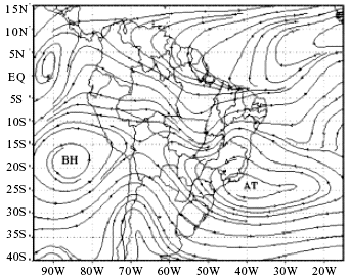
<body><![CDATA[<br>   The upper level circulation in tropical South America in January (<a href="#fig1a">Fig.    1a</a>) is governed by BH and CVNE. Strong divergent areas are observed in the    Southeastern Atlantic Ocean, associated with the SACZ and along the Inter-Tropical    Convergence Zone (ITCZ). The most pronounced areas of divergence over Brazil    are induced by the BH/CVNE circulation system. Since the convective activity    in these areas is strong (not shown), the divergence may be responsible for    the organization of the rainfall in Amazonia and Central and Southeastern Brazil.    Therefore, eventual displacements of the BH/CVNE system would imply shifts of    the convective activity. Furthermore, the observed differences in the divergence    fields over the continent and Southwestern Atlantic Ocean suggest that the SACZ    dynamics may be modulated by distinct processes over these regions. On the other    hand, during January 1999 (<a href="#fig1a">Fig. 1b</a>), the 250 hPa flow in    tropical South America showed a slightly different pattern. Instead of the typical    anticyclonic circulation center and the associated downstream trough, one observes    a pair of anticyclones and the CVNE. The anticyclonic circulation over western    Bolivia is the BH and the other downstream anticyclonic circulation (AT) appears    when BH extends eastward. <i>Ram&iacute;rez et al.</i> (1999) suggest that this    type of situation favors the inland displacement of CVNE and is associated with    the presence of the SACZ or the passage of troughs in Southeastern Brazil. It    becomes evident from the comparison between the climatological pattern and the    January 1999 conditions (<a href="#fig1a">Fig. 1b</a>) that most of the tropospheric    circulation in South and Southeastern Brazil was under the influence of the    AT, thus with anomalous characteristics. A closed circulation, instead of a    trough, was the dominant feature over the Tropical Atlantic Ocean near NE, due    to the high frequency of occurrence of vortices in that region.    <br> </p>     <p align="center"><a name="fig1a"></a> <img src="/img/revistas/atm/v17n1/a02pag17.gif"></p>     <p align="center">Fig. 1. Streamlines and horizontal divergence (1 x 10<sup><font size="2">-6</font></sup>    s<sup><font size="2">-1</font></sup>) of the mean 250 hPa wind for     <br>   (a) Januay, 1978-1999 and (b) January, 1999.</p>     <p align="justify">    <br>   Except for a zone of weaker divergence along the SACZ, the mean upper tropospheric    circulation in February, 1999 (<a href="#fig2">Fig. 2a</a>) is quite similar    to that of the preceding month. On the other hand, during the WETAMC &#8211;    TRMM/LBA (<a href="#fig2">Fig. 2b</a>) one can notice that the BH had shifted    slightly southward and the trough near NE, not yet clearly defined, had a smaller    meridional amplitude with a southeastward orientation. The observed divergence    field suggests weak convective activity along the SACZ, but not along the ITCZ    over the tropical Western Atlantic Ocean.</p>     <p align="center"><a name="fig2"></a><img src="/img/revistas/atm/v17n1/a02pag17b.gif"></p>     <p align="center"> Fig. 2. &nbsp;As in <a href="#fig1a">Fig.1</a>, but for (a)    February, 1978-1999 and (b) February, 1999.</p>     <p align="justify"><i>    ]]></body>
<body><![CDATA[<br>   3.2. Lower level features</i>    <br>   The mean 850 hPa circulation over tropical South America during the austral    summer is dominated by the trade winds at low latitudes and the subtropical    South Atlantic Ocean High (SAH). Under this circumstance, the trade winds have    an important role in advecting moisture from the tropical Atlantic Ocean into    NE and Amazonia (Rao and Marques, 1984). This moisture feeds the convective    activity over land. On the other hand, the northeasterly winds in the occidental    sector of the SAH are important for establishing and maintaining the SACZ&acute;s    oceanic branch.</p>     <p align="justify"> The mean 850 hPa water vapor flux divergence fields during    January and February (<a href="#fig3">Figs. 3a</a>, <a href="#fig4">4a</a>)    show high values along the northern/northeastern coast of Brazil. Moisture convergence    is also observed along portions of the SACZ, the slopes of the Andes in Southwestern    Bolivia (topographic effect), western NE and over the Brazilian Amazonia. The    main observed feature of the lower level circulation during WETAMC &#8211; TRMM/LBA    (Figs. <a href="#fig3">3b</a>, <a href="#fig4">4b</a>) is the vast region of    moisture convergence in the Amazonia and along the SACZ, although other centers    were also observed to the west of NE and Central Amazonia. The 850 hPa moisture    flux convergence was slightly pronounced, extending from the southern part of    the Amazonia to the Southeastern Atlantic Ocean (due to the passage of frontal    systems), despite the absence of SACZ events in February 1999.    <br> </p>     <p align="center"><a name="fig3"></a><img src="/img/revistas/atm/v17n1/a02pag18.gif">  </p>     <p align="center">Fig. 3. &nbsp;Mean 850 hPa streamlines and horizontal moisture flux    divergence (1 x 10<sup><font size="2">-5</font></sup> gKg<sup><font size="2">-1</font></sup>s<sup><font size="2">-1</font></sup>)    for    <br>   (a) January, 1978-1999 and (b) January, 1999.</p>     <p align="center">    <br>   <a name="fig4"></a><img src="/img/revistas/atm/v17n1/a02pag19.gif"></p>     <p align="center">Fig. 4. &nbsp;As in <a href="#fig3">Fig.3</a> , but for (a)    February, 1978-1999 and (b) February, 1999.</p>     ]]></body>
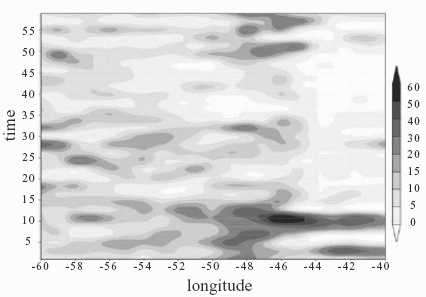
<body><![CDATA[<p align="justify">    <br>   The moisture flux convergence patterns over Amazonia and Southeastern and Northern    Brazil during January and February 1999 are partly consistent with the rainfall    field retrieved from TRMM data (Figs. <a href="#fig5">5a-b</a>). For several    areas (e.g. the eastern slopes of the Andes Mountains near Southwestern Bolivia,    ITCZ, the north/northeast Brazilian coast, western portions of NE Brazil and    the Southwestern Atlantic Ocean) NCEP data do not show convergence where the    satellites indicates the existence of precipitating areas. It is likely that    this disagreement may be associated with the model&#8217;s space resolution,    parametrization schemes and the representativeness of the assimilated data.    It should be pointed out that the conventional meteorological network over tropical    South America is quite sparse.    <br>       <br> </p>     <p align="center"><a name="fig5"></a><img src="/img/revistas/atm/v17n1/a02pag19b.gif"></p>     <p align="center">Fig. 5. 3B42 Rinfall (mm) retrieved from TRMM data for (a) January,    1999 and (b) February, 1999.</p>     <p align="justify">    <br>   A Hovm&ouml;ller diagram of the daily 3B42 TRMM rainfall data (<a href="#fig6">Fig.    6</a>), from Southern Amazonia to the Southwestern Atlantic Ocean (following    SACZ axis), during January and February 1999 reveals that: a) the SACZ was present    only during the period of the 6<sup>th</sup>-18<sup>th</sup> of January when    the rainfall was heavier (about 60 mm) between 44&deg;W and 48&deg;W, over S&atilde;o    Paulo state and b) SACZ episodes were not observed in February although there    were two situations of heavy rainfall due to the penetration of frontal systems    (Feb. 18 and Feb. 26), along the coast of S&atilde;o Paulo state. In all these    events, frontal displacements in Southeastern Brazil prompted rainfall in Rondonia    and Southern Amazonia, in agreement with the findings of Rickenback <i>et al.    </i>(2001), and Cifelli <i>et al.</i> (2001). As they suggested the large scale    modulates the convective activity in Rondonia, so that low-level westerly (easterly)    winds tend to yield larger (smaller) areas of weak (strong) precipitation.</p>     <p align="center">    <br>   <a name="fig6"></a><img src="/img/revistas/atm/v17n1/a02pag20.gif"></p>     ]]></body>
<body><![CDATA[<p align="center">Fig. 6.&nbsp; Hovm&ouml;ller diagram of the daily rainfall data (mm)    derived from TRMM data, from Southern Amazonia (5&deg; S, 60&deg;W)   to Southwestern Alantic Ocean (-30&deg; S, 30&deg;W), during January 1<sup><font size="2">st</font></sup>    to February 28<sup><font size="2">th</font></sup>, 1999.</p>     <p align="justify"><i>    <br>   3.3 Upper level circulation patterns during the WETAMC&#8211;TRMM/LBA</i>    <br>   The upper level circulation during the WETAMC&#8211;TRMM/LBA was characterized    by BH, CVNE, troughs and an anticyclonic system (AT) located between Southeastern    Brazil and adjacent oceanic areas. The BH position was observed to be quite    variable, oscillating between 90&deg;W and 55&deg;W. This displacement was associated    with CVNEs moving inland, the formation of AT and equatorward incursion of middle    latitude troughs (TRs). Six major events of CVNEs (<a href="#fig7">Fig.7</a>)    were observed during the studied period, with a mean life time of approximately    6.9 days and most of them showing a vertical extension between 200 and 400 hPa.</p>     <p align="justify">The first vortex (V1) appeared on January 2<sup>nd</sup>, 1999    at approximately 12&deg;S and 30&deg;W, over the NE eastern coast and gradually    shifted toward the Amazonia where by January 13<sup>th</sup> it had dissipated.    During this movement, its associated subsidence and sensible heat flux were    responsible for an evident suppression of the convective activity over the Amazonia.    Concomitantly, the BH had also shifted westward reaching the Southeastern Pacific    Ocean (Southwestern Per&uacute;). The displacement of V1 into Amazonia may indeed    be regarded as an anomalous situation, for just a few percent of the vortices    originating in the NE region move inland (Ram&iacute;rez <i>et al.,</i> 1999).</p>     <p align="justify"> The second vortex (V2) had a shorter life time (3 days); it    originated between the coast of Rio Grande do Norte state and the Equator, on    January 14<sup>th</sup>, 1999. It also moved westward reaching Northeastern    Par&aacute; state where it dissipated on the 17<sup>th</sup>. The origin of    V2 was associated with a southwestern amplification of a ridge, in its turn,    to an anticyclonic circulation over Northwestern Africa. The genesis of vortices    over the NE, linked to this kind of circulation was studied by Paix&atilde;o    and Gandu (2000). During the active stage of V2, the BH was found in the southwest    of Per&uacute;, over the Pacific Ocean, and connected to the anticyclonic circulation    of the Southwestern Atlantic Ocean. The atmospheric circulation pattern during    this period affected the convective activity over tropical Brazil.</p>     <p align="center">    <br>   <a name="fig7"></a><img src="/img/revistas/atm/v17n1/a02pag21.gif"></p>     <p align="center">&nbsp;</p>     <p align="center">Fig. 7. &nbsp;Trajectories of the CVNEs during the WETAMA-TRMM/LBA    Experiment for    ]]></body>
<body><![CDATA[<br>   (a) January, 1999 and (b) February, 1999.</p>     <p align="justify">    <br>   The third vortex (V3), contrasting to the usual genesis, originated over the    continent, 13&deg;S, 49.5&deg;W (north of Goi&aacute;s state) on January 20<sup>th</sup>,    1999 and shifted eastward reaching the Sergipe state (eastern coast of NE) by    January 25<sup>th</sup>, 1999 where it dissipated. During this period, the BH    moved eastward, toward Bolivia and the AT position was over the Southern Paran&aacute;    state (Southern Brazil).</p>     <p align="justify"> The fourth vortex (V4) originated over the eastern coast of    NE, approximately 12&deg;S on January 29<sup>th</sup>, 1999. This vortex had    a westward displacement, reaching the northern part of Rondonia state, where    it dissipated. At the same time the BH was between Southern Paraguay and Northern    Argentina, thus further south of its climatogical position. This is a situation    that potentially could decrease rainfall along the trajectory of the vortex    center.</p>     <p align="justify"> The fifth vortex (V5) originated over the Atlantic Ocean (18&deg;S,    20&deg;W ) on February 1<sup>st</sup>, 1999. This vortex also moved westward    and dissipated seven days later over the Southern Piaui state (northern NE).    The BH was located during this event over Northern Argentina, further south    than its climatological position. Finally, the sixth vortex (V6) appeared at    the eastern side of Southern Bahia state on February 13<sup>th</sup>, 1999,    due to the expansion of a trough to the east of the BH. This vortex had a westward    displacement, dissipating over the northern part of Minas Gerais state (Southeastern    Brazil) nine days later.    <br>       <br>   An analysis of the prevailing upper circulation patterns over tropical South    America during the WETAMC&#8211;TRMM/LBA period is presented next. The observed    four main patterns are quite distinct, regarding the relative positons of the    BH and CVNEs.</p>     <p align="justify"><i>3.3.1 BH/CVNE circulation pattern</i>    <br>   The BH/CVNE circulation pattern dominated the first days of the first, fourth    and sixth events of CVNE. Under this kind of situation, the vortex geneses is    due to the amplification of an upper level ridge associated with equatorward-moving    cold fronts over South America (Kousky and Gan, 1981). The BH is well defined    and is situated over the Southwestern Amazonia near Bolivia, and the CVNEs are    found over the Southwestern Atlantic Ocean (<a href="#fig8">Fig. 8</a>). By    the beginning of January 1999, the rainfall associated to the BH/CVNE circulation    extended from the Southern Amazonia to the Southwestern Atlantic Ocean due to    a cold front in the region. The highest daily rainfall values (30 to 40 mm)    occurred in Southeastern Brazil where the cold front advanced into the states    of Minas Gerais and Rio de Janeiro (<a href="#fig9">Fig. 9</a>). Fair weather    was observed in the NE when the CVNE was still located over the ocean. As mentioned    before, the rainfall at this time of the year seems to be associated with the    presence of upper level divergence in the transition region between the two    opposite circulation systems: the BH and the CVNE. Therefore, eventual oscillations    of the BH/CVNE system (not shown) are accompanied by northeastward/southeastward    displacements of frontal systems in Southeastern and Southern Brazil.    <br> </p>     ]]></body>
<body><![CDATA[<p align="center"><a name="fig8"></a><img src="/img/revistas/atm/v17n1/a02pag23.gif"></p>     <p align="center">&nbsp;</p>     <p align="center">Fig. 8. 250 hPa streamlines for January 2<sup><font size="2">nd</font></sup>,    1999, associated to the BH/CVNE circulation pattern.</p>     <p align="center">    <br>   <a name="fig9"></a><img src="/img/revistas/atm/v17n1/a02pag23b.gif"></p>     <p align="center">Fig. 9. 3B42 rainfall (mm) retrieved from TRMN data, associated    to the BH/CVNE circulation pattern for     <br>   January 2<sup><font size="2">nd</font></sup>, 1999.</p>     <p align="justify"><i>    <br>   3.3.2 BH /CVNE/AT circulation pattern</i>    <br>   This type of pattern, identified by Ram&iacute;rez <i>et al.</i> (1999), is    more evident when the CVNE is in its intensification stage and during its displacement    inland. In this situation the BH generally acquires a northwest/southeast orientation    as the CVNE initiates its movement. The BH elongates over Southeastern Brazil    as the CVNE moves inland (<a href="#fig10">Fig. 10</a>). Depending on the intensification    of the ridge, the BH may split into two parts, with the eastern flank forming    a new anticyclonic center (AT) over Southeastern Brazil and adjacent oceanic    areas.</p>     ]]></body>
<body><![CDATA[<p align="center"><a name="fig10"></a><img src="/img/revistas/atm/v17n1/a02pag24.gif"></p>     <p align="center">Fig.10.&nbsp;250 hPa streamlines for January 7<sup><font size="2">th</font></sup>,    1999, associated to the BH/CVNE/AT circulation pattern.</p>     <p align="justify">    <br>   The amplification of the ridge along the southeastern side of the BH for the    V1 event mentioned, occurred with the arrival of a frontal system from Argentina,    which remained stationary for five days (Jan. 6&#8211;10) and established the    SACZ. As a consequence, warmer air advection in the lower levels contributed    to the intensification of the upper level ridge, creating favorable conditions    for enhancing the convection in Northern S&atilde;o Paulo state and Western    Amazonia (<a href="#fig11">Fig. 11</a>). During this period, the ridge amplification    favored the formation of an AT to the south of the CVNE, thus establishing the    circulation pattern involving the BH (with a westward shift toward the Southern    Pacific Ocean), the CVNE (moving into the continent) and the AT. Although the    SACZ is a dominant feature in the lower levels of the summer circulation over    Brazil, only one SACZ episode was observed during the January&#8211;February    1999 period. </p>     <p align="justify"> Related to the BH/CVNE/AT pattern, it was observed that despite    the existence of a vortex, a new one may form to the northeast of the AT, as    exemplified by V2, V4 and V6. Ram&iacute;rez <i>et al. </i>(1999) performed    a climatological study on the formation mechanisms of tropical vortices and    concluded that 27 % of the CVNEs are associated with the occurrence of ATs.    During this type of situation, the release of latent heat from stationary frontal    systems or the SACZ would maintain the AT and the associated upper level region    of divergence.</p>     <p align="justify"> Whenever there is an intensification of the southeastern sector    of the BH over Southeastern Brazil and adjacent oceanic areas, the spatial rainfall    pattern resembles a convective cloud band with an NW&#8211;SE orientation to    the west of the ridge and a mid-latitude trough in the upper levels (<a href="#fig9">Fig.    9</a>). This rainfall band is generally associated with a frontal system. Once    the cloudiness of the western and northern sectors of the CVNE reaches the NE    coast, it interacts with the convective activity associated with the BH and    frontal systems, frequently forming a Y pattern of cloudiness (Ferreira <i>et    al.,</i> 2001). The Y pattern follows the CVNE during its inland displacement.    <br> </p>     <p align="center"><a name="fig11"></a><img src="/img/revistas/atm/v17n1/a02pag25.gif"></p>     <p align="center">Fig. 11. 3B42 rainfall (mm) retrieved from TRMM data, associated    to the BH/CVNE circulation pattern,     <br>   for January 7<sup><font size="2">th</font></sup>, 1999.</p>     ]]></body>
<body><![CDATA[<p align="justify"><i>    <br>   3.3.3 BH/AT circulation pattern</i>    <br>   The establishment of the BH/AT pattern, which lasts a few days, is generally    observed after the dissipation of a CVNE over the central continent. The observed    circulation between Jan. 18&#8211;19 (<a href="#fig12">Fig. 12</a>) is a good    example of this type of situation, when the BH moves westward off the Peruvian    coast and the AT is found over the Southwestern Atlantic Ocean near Southeastern    Brazil. In addition, a trough forms between the two anticyclonic circulations    over Argentina, favoring the convection in Southeastern Paraguay. In this case,    the prevailing rainfall pattern consists of a convective band to the southwest    of the AT and stratiform rainfall over vast areas in the Amazonia (<a href="#fig13">Fig.    13</a>).    <br> </p>     <p align="center"><a name="fig12"></a><img src="/img/revistas/atm/v17n1/a02pag26.gif"></p>     <p align="center">Fig. 12. 250 hPa streamlines for January 18<sup><font size="2">th</font></sup>,    1999, associated to the BH/AT circulation pattern.</p>     <p align="justify">&nbsp;</p>     <p align="center"><a name="fig13"></a><img src="/img/revistas/atm/v17n1/a02pag26b.gif"></p>     <p align="center">Fig. 13. 3B42 rainfall (mm) retrieved from TRMM data, associated    to the BH/AT circulation pattern,    <br>   for January 18<sup><font size="2">th</font></sup>, 1999.</p>     ]]></body>
<body><![CDATA[<p align="justify"><i>    <br>   3.3.4 BH/TR circulation pattern</i>    <br>   Two episodes involving BH and TR were observed during the WETAMC-TRMM/LBA experiment.    The first one occurred between Feb. 11 &#8211; 12 when the BH showed an almost    symmetric configuration extending zonally as far as Goi&aacute;s state (central    Brazil), with its core centered near Northern Chile (<a href="#fig14">Fig.14</a>).    A pronounced mid-latitude trough stretching from Northern S&atilde;o Paulo state    to the Southwestern Atlantic Ocean (see marked line, <a href="#fig14">Fig 14</a>),    was associated to a band of moderate rainfall produced by a frontal system (<a href="#fig15">Fig.    15</a>). Under this situation, the CVNE is not present and the frontal system    is free to move northeastward. Similarly, during the second episode (Feb. 23    &#8211; 28) the BH was over Northern Chile, favoring the penetration of two    mid-latitude troughs in Southern Brazil (not shown). As mentioned earlier, this    pattern synchronizes the displacements of the rainfall band northeastward in    Southeastern Brazil and southwestward in Amazonia. In other words, by the time    it reaches Southeastern Brazil, the frontal system interacts with the convection    in Amazonia, organizing and making it shift northeastward. This feature also    favors the formation of troughs with a &#8220;NW/SE&#8221; inclination over    the Atlantic Ocean, near the eastern coast of the NE and the formation of AT    in central Western Brazil.    <br> </p>     <p align="center"><a name="fig14"></a><img src="/img/revistas/atm/v17n1/a02pag27.gif"></p>     <p align="center">Fig. 14. 250 hPa stremlines for January 12<sup><font size="2">th</font></sup>,    1999, associated to the BH/TR circulation pattern.</p>     <p align="center">    <br>   <a name="fig15"></a><img src="/img/revistas/atm/v17n1/a02pag28.gif"></p>     <p align="center">Fig. 15. 3B42 rainfall (mm) retrieved from TRMM data, associated    to the BH/TR circulation pattern,    <br>   for January 12<sup><font size="2">th</font></sup>, 1999.</p>     ]]></body>
<body><![CDATA[<p align="justify"><b>    <br>   4. Concluding remarks</b>    <br>   This study analyzes the synoptic scale features of the upper and lower levels    tropical circulation over South America during the first Atmospheric Mesoscale    Campaign in the Wet Season (WETAMC) of the Large Scale Biosphere &#8211; Atmosphere    Experiment in Amazonia (LBA). The analyses were carried out using the National    Centers for Environmental Predictions (NCEP) data and rainfall fields derived    from TRMM (Tropical Rainfall Measuring Mission) data. During the studied period    (January and February 1999) the tropospheric circulation in the region showed    distinct features from the climatological pattern. At least four distinct flow    patterns were identified in the upper troposphere, mainly related to the Bolivian    High (BH) and cyclonic vortices in the vicinity of Northeast Brazil (CVNEs).    In two observed events, CVNEs moved from the NE coast into Amazonia and their    associated subsidence and changes in the circulation pattern may have impaired    the precipitation in some parts of Amazonia.</p>     <p align="justify"> It was also observed that from the synoptic point of view    the instability in the region is dynamically supported by upper level divergence    in the transition zone of the Bolivian anticyclone (BH) and the cyclonic circulation    in the vicinity of NE Brazil (CVNE) in the upper troposphere. Kousky and Gan    (1981) suggested that the convective activity associated with CVNEs depends    on thermal direct circulation, the position of the vortex and the direction    of their movement. In the present study, it is suggested that the convective    activity depend on the interaction between the BH/CVNE circulations and not    only on CVNE dynamics. At lower levels moisture convergence derived from NCEP    data coincides only partially with the rain areas detected by TRMM satellites.    Also, significant interaction involving frontal systems and convective activity    in Southwestern Amazonia was evident.</p>     <p align="justify"><b>    <br>   Acknowledgements</b>    <br>   This work is part of the &#8220;Intera&ccedil;&atilde;o Biosfera &#8211; Atmosfera    em Mesoscala na Amaz&ocirc;nia&#8221; Project sponsored by FAPESP, Process 1997    /9926 &#8211; 9. The NCEP data used in this work were provided by NOAA &#8211;    CIRES Climate Diagnostics Center, Boulder, Colorado, USA, from the website at    <a href="http://www.cdc.noaa.gov/" target="_blank">http://www.cdc.noaa.gov/</a>. The TRMM data are distributed by Goddard Space Flight    Center (GSFC/NASA) through the website <a href="http://lake.nascom.nasa.gov/data/dataser/TRMM/" target="_blank">http://lake.nascom.nasa.gov/data/dataser/TRMM/</a>    and the software used for reading the satellite data is provided by TRMM Science    and Data Information System (TSDIS). Thanks are due to Mr. Marco A.M. Lemes    for going through the manuscript. We also thank the anonymous reviewers, who    contributed significantly to the final manuscript. The first author was partially    supported by the Conselho Nacional de Desenvolvimento Cient&iacute;fico e Tecnol&oacute;gico    under Grant number 300486/96-0.</p>     <p align="justify">    <br>   <b>References</b>    <!-- ref --><br>   Belassiano, M., 2000. Study of tropical heat sources impact (In Portuguese).    Master Degree Dissertation, <i>Instituto Astr&ocirc;nomico e Geof&iacute;sico,    Universidade de S&atilde;o Paulo, S&atilde;o Paulo, Brazil,</i> 73 pp.&nbsp;&nbsp;&nbsp;&nbsp;&nbsp;&nbsp;&nbsp;&nbsp;[&#160;<a href="javascript:void(0);" onclick="javascript: window.open('/scielo.php?script=sci_nlinks&ref=1258808&pid=S0187-6236200400010000200001&lng=','','width=640,height=500,resizable=yes,scrollbars=1,menubar=yes,');">Links</a>&#160;]<!-- end-ref --><!-- ref --><p align="justify"> Carvalho, L., C. Jones, and B. Liebmann, 2002. Extreme precipitation    events in southeastern South America and large-scale convective patterns in    the South Atlantic Convergence Zone. <i>J. Climate</i>, <b>15</b>,    2377-2394. &nbsp;&nbsp;&nbsp;&nbsp;&nbsp;&nbsp;&nbsp;&nbsp;[&#160;<a href="javascript:void(0);" onclick="javascript: window.open('/scielo.php?script=sci_nlinks&ref=1258809&pid=S0187-6236200400010000200002&lng=','','width=640,height=500,resizable=yes,scrollbars=1,menubar=yes,');">Links</a>&#160;]<!-- end-ref --><!-- ref --><p align="justify">Cifelli, R., W. A. Petersen, L. D. Carey, S. A. Rutledge and    M. A. F. Silva, 2002. Radar observations of the kinematic, microphysical, and    precipitation characteristics of two MCSs in TRMM-LBA. <i>J. Geophys. Res.</i>,    <b>107</b>, NO.D20, 8077, doi:10.1029/2000JD000264. &nbsp;&nbsp;&nbsp;&nbsp;&nbsp;&nbsp;&nbsp;&nbsp;[&#160;<a href="javascript:void(0);" onclick="javascript: window.open('/scielo.php?script=sci_nlinks&ref=1258810&pid=S0187-6236200400010000200003&lng=','','width=640,height=500,resizable=yes,scrollbars=1,menubar=yes,');">Links</a>&#160;]<!-- end-ref --><!-- ref --><p align="justify">Doty, B. E., J. L. Kinter III, M. Fiorino, D. Hooper, R. Budich,    K. Winger, U. Schulzweida, L. Calori, T. Holt, and K. Meier, 1997. The grid    analysis and display system (GrADS): An Update for 1997. In: 13th International    Conference on IIPS for Meteorology, Oceanography and Hydrology, <i>Amer. Meteor.    Soc.</i>, Longbeach, CA., p.117. &nbsp;&nbsp;&nbsp;&nbsp;&nbsp;&nbsp;&nbsp;&nbsp;[&#160;<a href="javascript:void(0);" onclick="javascript: window.open('/scielo.php?script=sci_nlinks&ref=1258811&pid=S0187-6236200400010000200004&lng=','','width=640,height=500,resizable=yes,scrollbars=1,menubar=yes,');">Links</a>&#160;]<!-- end-ref --><!-- ref --><p align="justify">Ferreira, N. J., C. I. V. Lacava, and Z. R. Sobral, 2001. A    climatological study of convective cloudbands in northeastern Brazil. Part I:    Preliminary analysis. <i>Aust. Met. Mag,</i> <b>50</b> 105-113.  &nbsp;&nbsp;&nbsp;&nbsp;&nbsp;&nbsp;&nbsp;&nbsp;[&#160;<a href="javascript:void(0);" onclick="javascript: window.open('/scielo.php?script=sci_nlinks&ref=1258812&pid=S0187-6236200400010000200005&lng=','','width=640,height=500,resizable=yes,scrollbars=1,menubar=yes,');">Links</a>&#160;]<!-- end-ref --><!-- ref --><p align="justify">Gandu, A. W. and J. E. Geisler, 1991. A primitive equations    model study of the effect of topography on the summer circulation over tropical    South America.<i> J. Atmos. Sci.,</i> <b>48</b>, 1822-1836.&nbsp;&nbsp;&nbsp;&nbsp;&nbsp;&nbsp;&nbsp;&nbsp;[&#160;<a href="javascript:void(0);" onclick="javascript: window.open('/scielo.php?script=sci_nlinks&ref=1258813&pid=S0187-6236200400010000200006&lng=','','width=640,height=500,resizable=yes,scrollbars=1,menubar=yes,');">Links</a>&#160;]<!-- end-ref --><!-- ref --><p align="justify"> Gandu, A. W. and P. L. Silva Dias, 1998. Impact of tropical    heat sources on the South American tropospheric upper circulation and subsidence.    <i>J. Geophys. Res.</i>, <b>103</b>, 6001-6015. &nbsp;&nbsp;&nbsp;&nbsp;&nbsp;&nbsp;&nbsp;&nbsp;[&#160;<a href="javascript:void(0);" onclick="javascript: window.open('/scielo.php?script=sci_nlinks&ref=1258814&pid=S0187-6236200400010000200007&lng=','','width=640,height=500,resizable=yes,scrollbars=1,menubar=yes,');">Links</a>&#160;]<!-- end-ref --><!-- ref --><p align="justify">Greco, S., R. Swap, M. Garstang, S. Ulanski, M. Shiphom, R.    C. Harris, R. Talbor, M. O. Andreae and P. Artaxo, 1990. Rainfall and surface    kinematic condition over central Amazonia during ABLE 2B. <i>J. Geophys. Res.,</i>    <b>95</b>, 17001-17014. &nbsp;&nbsp;&nbsp;&nbsp;&nbsp;&nbsp;&nbsp;&nbsp;[&#160;<a href="javascript:void(0);" onclick="javascript: window.open('/scielo.php?script=sci_nlinks&ref=1258815&pid=S0187-6236200400010000200008&lng=','','width=640,height=500,resizable=yes,scrollbars=1,menubar=yes,');">Links</a>&#160;]<!-- end-ref --><!-- ref --><p align="justify">Huffman, G. J., , R. F. Adler, B. Rudorlf, U. Schneider, P.    R. Keehn, 1995, Global precipitation estimates based on a technique for combining    satellite-based estimates, rain gauges analysis, and NWP model precipitation    information. <i>J. Clim</i>., <b>8</b>, 1284-1295.&nbsp;&nbsp;&nbsp;&nbsp;&nbsp;&nbsp;&nbsp;&nbsp;[&#160;<a href="javascript:void(0);" onclick="javascript: window.open('/scielo.php?script=sci_nlinks&ref=1258816&pid=S0187-6236200400010000200009&lng=','','width=640,height=500,resizable=yes,scrollbars=1,menubar=yes,');">Links</a>&#160;]<!-- end-ref --><!-- ref --><p align="justify"> Kalnay, E., M. Kanamitsu, R. Kistler, W. Collins, D. Deaven,    L. Gandin, M. Iredell, S. Saha, G. White, J. Woollen, Y. Zhu, M. Chelliah, W.    Ebisuzaki, W. Higgins, J. Janowiak, K. C. Mo, C. Ropelewski, J. Wang, A. Leetmaa,    R. Reynolds, R. Jenne, and D. Joseph, 1996. The NCEP/NCAR 40-Year reanalysis    project.<i> Bull. Amer. Meteor. Soc.,</i><b> 77</b>, 437-471.&nbsp;&nbsp;&nbsp;&nbsp;&nbsp;&nbsp;&nbsp;&nbsp;[&#160;<a href="javascript:void(0);" onclick="javascript: window.open('/scielo.php?script=sci_nlinks&ref=1258817&pid=S0187-6236200400010000200010&lng=','','width=640,height=500,resizable=yes,scrollbars=1,menubar=yes,');">Links</a>&#160;]<!-- end-ref --><!-- ref --><p align="justify"> Kodama, Y., 1992. Large-scale common features of subtropical    precipitation zones (the Baiu Frontal Zone, the SPCZ, and the SACZ). Part I:    Characteristics of subtropical frontal zones.<i> J. Meteor. Soc. Japan</i>,    <b>70</b>, 813-836. &nbsp;&nbsp;&nbsp;&nbsp;&nbsp;&nbsp;&nbsp;&nbsp;[&#160;<a href="javascript:void(0);" onclick="javascript: window.open('/scielo.php?script=sci_nlinks&ref=1258818&pid=S0187-6236200400010000200011&lng=','','width=640,height=500,resizable=yes,scrollbars=1,menubar=yes,');">Links</a>&#160;]<!-- end-ref --><!-- ref --><p align="justify">Kousky, V. E. and M. A. Gan, 1981. Upper tropospheric cyclonic    vortices in the tropical South-Atlantic. <i>Tellus</i>, <b>33</b>,    538-551.&nbsp;&nbsp;&nbsp;&nbsp;&nbsp;&nbsp;&nbsp;&nbsp;[&#160;<a href="javascript:void(0);" onclick="javascript: window.open('/scielo.php?script=sci_nlinks&ref=1258819&pid=S0187-6236200400010000200012&lng=','','width=640,height=500,resizable=yes,scrollbars=1,menubar=yes,');">Links</a>&#160;]<!-- end-ref --><!-- ref --><p align="justify"> Mishra, S. K., V. B. Rao and M. A. Gan, 2001. Structure and    evolution of the large-scale flow and an embedded upper-tropospheric cyclonic    vortex over Northeast Brazil. <i>Mon. Wea. Rev.</i>, <b>129</b>,    1673&#8211;1688.&nbsp;&nbsp;&nbsp;&nbsp;&nbsp;&nbsp;&nbsp;&nbsp;[&#160;<a href="javascript:void(0);" onclick="javascript: window.open('/scielo.php?script=sci_nlinks&ref=1258820&pid=S0187-6236200400010000200013&lng=','','width=640,height=500,resizable=yes,scrollbars=1,menubar=yes,');">Links</a>&#160;]<!-- end-ref --><!-- ref --><p align="justify"> Paix&atilde;o, E. B. and A. W. Gandu, 2000. Characteristics    of the upper level cyclonic vortices over the Northeastern Brazil (In Portuguese).    <i>XI Congresso Brasileiro Meteorologia</i>, Rio de Janeiro., pp. 3422-3428.&nbsp;&nbsp;&nbsp;&nbsp;&nbsp;&nbsp;&nbsp;&nbsp;[&#160;<a href="javascript:void(0);" onclick="javascript: window.open('/scielo.php?script=sci_nlinks&ref=1258821&pid=S0187-6236200400010000200014&lng=','','width=640,height=500,resizable=yes,scrollbars=1,menubar=yes,');">Links</a>&#160;]<!-- end-ref --><!-- ref --><p align="justify"> Petersen, W.A., and S. A. Rutledge, 2001. Regional variability    in tropical convection: observations from TRMM. <i>J. Clim.,</i> <b>14</b>,    3566-3586.&nbsp;&nbsp;&nbsp;&nbsp;&nbsp;&nbsp;&nbsp;&nbsp;[&#160;<a href="javascript:void(0);" onclick="javascript: window.open('/scielo.php?script=sci_nlinks&ref=1258822&pid=S0187-6236200400010000200015&lng=','','width=640,height=500,resizable=yes,scrollbars=1,menubar=yes,');">Links</a>&#160;]<!-- end-ref --><!-- ref --><p align="justify"> Ram&iacute;rez, M. C. V., M. T. Kayano and N. J. Ferreira,    1999. Statistical analysis of upper tropospheric vortices in the vicinity of    northeast Brazil during the 1980-1989 period. <i>Atm&oacute;sfera,</i> <b>12</b>,    75-88.&nbsp;&nbsp;&nbsp;&nbsp;&nbsp;&nbsp;&nbsp;&nbsp;[&#160;<a href="javascript:void(0);" onclick="javascript: window.open('/scielo.php?script=sci_nlinks&ref=1258823&pid=S0187-6236200400010000200016&lng=','','width=640,height=500,resizable=yes,scrollbars=1,menubar=yes,');">Links</a>&#160;]<!-- end-ref --><!-- ref --><p align="justify"> Rao, V. B. and V. S. Marques, 1984. Water vapor characteristics    over Northeast Brazil during two contrasting years. <i>J. Clim. Appl. Meteor.</i>,    <b>23</b>, 440-444.&nbsp;&nbsp;&nbsp;&nbsp;&nbsp;&nbsp;&nbsp;&nbsp;[&#160;<a href="javascript:void(0);" onclick="javascript: window.open('/scielo.php?script=sci_nlinks&ref=1258824&pid=S0187-6236200400010000200017&lng=','','width=640,height=500,resizable=yes,scrollbars=1,menubar=yes,');">Links</a>&#160;]<!-- end-ref --><!-- ref --><p align="justify"> Rao, V. B. and K. Hada, 1999. Characteristics of rainfall    over Brazil: annual variations and connections with the southern oscillation.    <i>Theor. Appl. Climatol</i>, <b>42</b>, 81-91.&nbsp;&nbsp;&nbsp;&nbsp;&nbsp;&nbsp;&nbsp;&nbsp;[&#160;<a href="javascript:void(0);" onclick="javascript: window.open('/scielo.php?script=sci_nlinks&ref=1258825&pid=S0187-6236200400010000200018&lng=','','width=640,height=500,resizable=yes,scrollbars=1,menubar=yes,');">Links</a>&#160;]<!-- end-ref --><!-- ref --><p align="justify"> Rutledge, S. A., W. A. Petersen, R. Cifelli, and L. D. Carey,    2000. Early results from TRMM-LBA: kinematic and microphysical characteristics    of convection in distinct meteorological regimes. Preprint Volume, <i>American    Meteorological Society</i>, 24th Conference on Hurricanes and Tropical Meteorology,    Fort Lauderdale, Florida.&nbsp;&nbsp;&nbsp;&nbsp;&nbsp;&nbsp;&nbsp;&nbsp;[&#160;<a href="javascript:void(0);" onclick="javascript: window.open('/scielo.php?script=sci_nlinks&ref=1258826&pid=S0187-6236200400010000200019&lng=','','width=640,height=500,resizable=yes,scrollbars=1,menubar=yes,');">Links</a>&#160;]<!-- end-ref --><!-- ref --><p align="justify"> Silva Dias, P. L., W. H. Schubert, and M. DeMaria, 1983. Large-scale    response of the tropical atmosphere to transient forcing. <i>J. Atmos. Sci.</i>,    <b>40</b>, 2689-2707.&nbsp;&nbsp;&nbsp;&nbsp;&nbsp;&nbsp;&nbsp;&nbsp;[&#160;<a href="javascript:void(0);" onclick="javascript: window.open('/scielo.php?script=sci_nlinks&ref=1258827&pid=S0187-6236200400010000200020&lng=','','width=640,height=500,resizable=yes,scrollbars=1,menubar=yes,');">Links</a>&#160;]<!-- end-ref --><!-- ref --><p align="justify"> Silva Dias, M. A. F., S. Rutledge, P. Kabat, P. L. Silva Dias,    C. A. Nobre, G. Fisch, A. J. Dolman, E. Zipser, M. Garstang, A. O. Manzi, J.    D. Fuentes, H. Rocha, J. Marengo, A. Plana-Fattori, L. S&aacute;, R. Alval&aacute;,    O. Andreae, P. Artaxo, R. Gielow, and L. Gatti, 2002. Clouds and rain processes    in a biosphere atmosphere interaction context in the Amazon Region. <i>J. Geophys.    Res.</i>,<b>107</b>, 46.1-46.23.&nbsp;&nbsp;&nbsp;&nbsp;&nbsp;&nbsp;&nbsp;&nbsp;[&#160;<a href="javascript:void(0);" onclick="javascript: window.open('/scielo.php?script=sci_nlinks&ref=1258828&pid=S0187-6236200400010000200021&lng=','','width=640,height=500,resizable=yes,scrollbars=1,menubar=yes,');">Links</a>&#160;]<!-- end-ref --><!-- ref --><p align="justify"> Virji, H., 1981. A preliminary-study of summertime tropospheric    circulation patterns over South-America estimated from cloud winds. <i>Mon.    Wea. Rev</i>., <b>109</b>, 599&#8211;610.&nbsp;&nbsp;&nbsp;&nbsp;&nbsp;&nbsp;&nbsp;&nbsp;[&#160;<a href="javascript:void(0);" onclick="javascript: window.open('/scielo.php?script=sci_nlinks&ref=1258829&pid=S0187-6236200400010000200022&lng=','','width=640,height=500,resizable=yes,scrollbars=1,menubar=yes,');">Links</a>&#160;]<!-- end-ref --> ]]></body><back>
<ref-list>
<ref id="B1">
<nlm-citation citation-type="">
<person-group person-group-type="author">
<name>
<surname><![CDATA[Belassiano]]></surname>
<given-names><![CDATA[M.]]></given-names>
</name>
</person-group>
<source><![CDATA[Study of tropical heat sources impact (In Portuguese)]]></source>
<year>2000</year>
<page-range>73</page-range></nlm-citation>
</ref>
<ref id="B2">
<nlm-citation citation-type="journal">
<person-group person-group-type="author">
<name>
<surname><![CDATA[Carvalho]]></surname>
<given-names><![CDATA[L.]]></given-names>
</name>
<name>
<surname><![CDATA[Jones]]></surname>
<given-names><![CDATA[C.]]></given-names>
</name>
<name>
<surname><![CDATA[Liebmann]]></surname>
<given-names><![CDATA[B.]]></given-names>
</name>
</person-group>
<article-title xml:lang="en"><![CDATA[Extreme precipitation events in southeastern South America and large-scale convective patterns in the South Atlantic Convergence Zone]]></article-title>
<source><![CDATA[J. Climate]]></source>
<year>2002</year>
<numero>15</numero>
<issue>15</issue>
<page-range>2377-2394</page-range></nlm-citation>
</ref>
<ref id="B3">
<nlm-citation citation-type="journal">
<person-group person-group-type="author">
<name>
<surname><![CDATA[Cifelli]]></surname>
<given-names><![CDATA[R.]]></given-names>
</name>
<name>
<surname><![CDATA[Petersen]]></surname>
<given-names><![CDATA[W. A.]]></given-names>
</name>
<name>
<surname><![CDATA[Carey]]></surname>
<given-names><![CDATA[L. D.]]></given-names>
</name>
<name>
<surname><![CDATA[Rutledge]]></surname>
<given-names><![CDATA[S. A.]]></given-names>
</name>
<name>
<surname><![CDATA[Silva]]></surname>
<given-names><![CDATA[M. A. F.]]></given-names>
</name>
</person-group>
<article-title xml:lang="en"><![CDATA[Radar observations of the kinematic, microphysical, and precipitation characteristics of two MCSs in TRMM-LBA]]></article-title>
<source><![CDATA[J. Geophys. Res.]]></source>
<year>2002</year>
<numero>107</numero>
<issue>107</issue>
</nlm-citation>
</ref>
<ref id="B4">
<nlm-citation citation-type="journal">
<person-group person-group-type="author">
<name>
<surname><![CDATA[Doty]]></surname>
<given-names><![CDATA[B. E.]]></given-names>
</name>
<name>
<surname><![CDATA[Kinter III]]></surname>
<given-names><![CDATA[J. L.]]></given-names>
</name>
<name>
<surname><![CDATA[Fiorino]]></surname>
<given-names><![CDATA[M.]]></given-names>
</name>
<name>
<surname><![CDATA[Hooper]]></surname>
<given-names><![CDATA[D.]]></given-names>
</name>
<name>
<surname><![CDATA[Budich]]></surname>
<given-names><![CDATA[R.]]></given-names>
</name>
<name>
<surname><![CDATA[Winger]]></surname>
<given-names><![CDATA[K.]]></given-names>
</name>
<name>
<surname><![CDATA[Schulzweida]]></surname>
<given-names><![CDATA[U.]]></given-names>
</name>
<name>
<surname><![CDATA[Calori]]></surname>
<given-names><![CDATA[L.]]></given-names>
</name>
<name>
<surname><![CDATA[Holt]]></surname>
<given-names><![CDATA[T.]]></given-names>
</name>
<name>
<surname><![CDATA[Meier]]></surname>
<given-names><![CDATA[K.]]></given-names>
</name>
</person-group>
<article-title xml:lang="en"><![CDATA[The grid analysis and display system (GrADS): An Update for 1997]]></article-title>
<source><![CDATA[Amer. Meteor. Soc.]]></source>
<year>1997</year>
<conf-name><![CDATA[13 International Conference on IIPS for Meteorology, Oceanography and Hydrology]]></conf-name>
<conf-loc> </conf-loc>
<page-range>117</page-range><publisher-loc><![CDATA[Longbeach ]]></publisher-loc>
</nlm-citation>
</ref>
<ref id="B5">
<nlm-citation citation-type="journal">
<person-group person-group-type="author">
<name>
<surname><![CDATA[Ferreira]]></surname>
<given-names><![CDATA[N. J.]]></given-names>
</name>
<name>
<surname><![CDATA[Lacava]]></surname>
<given-names><![CDATA[C. I. V.]]></given-names>
</name>
<name>
<surname><![CDATA[Sobral]]></surname>
<given-names><![CDATA[Z. R.]]></given-names>
</name>
</person-group>
<article-title xml:lang="en"><![CDATA[A climatological study of convective cloudbands in northeastern Brazil: Part I: Preliminary analysis]]></article-title>
<source><![CDATA[Aust. Met. Mag]]></source>
<year>2001</year>
<numero>50</numero>
<issue>50</issue>
<page-range>105-113</page-range></nlm-citation>
</ref>
<ref id="B6">
<nlm-citation citation-type="journal">
<person-group person-group-type="author">
<name>
<surname><![CDATA[Gandu]]></surname>
<given-names><![CDATA[A. W.]]></given-names>
</name>
<name>
<surname><![CDATA[Geisler]]></surname>
<given-names><![CDATA[J. E.]]></given-names>
</name>
</person-group>
<article-title xml:lang="en"><![CDATA[A primitive equations model study of the effect of topography on the summer circulation over tropical South America]]></article-title>
<source><![CDATA[J. Atmos. Sci.]]></source>
<year>1991</year>
<numero>48</numero>
<issue>48</issue>
<page-range>1822-1836</page-range></nlm-citation>
</ref>
<ref id="B7">
<nlm-citation citation-type="journal">
<person-group person-group-type="author">
<name>
<surname><![CDATA[Gandu]]></surname>
<given-names><![CDATA[A. W.]]></given-names>
</name>
<name>
<surname><![CDATA[Silva Dias]]></surname>
<given-names><![CDATA[P. L.]]></given-names>
</name>
</person-group>
<article-title xml:lang="en"><![CDATA[Impact of tropical heat sources on the South American tropospheric upper circulation and subsidence]]></article-title>
<source><![CDATA[J. Geophys. Res.]]></source>
<year>1998</year>
<numero>103</numero>
<issue>103</issue>
<page-range>6001-6015</page-range></nlm-citation>
</ref>
<ref id="B8">
<nlm-citation citation-type="journal">
<person-group person-group-type="author">
<name>
<surname><![CDATA[Greco]]></surname>
<given-names><![CDATA[S.]]></given-names>
</name>
<name>
<surname><![CDATA[Swap]]></surname>
<given-names><![CDATA[R.]]></given-names>
</name>
<name>
<surname><![CDATA[Garstang]]></surname>
<given-names><![CDATA[M.]]></given-names>
</name>
<name>
<surname><![CDATA[Ulanski]]></surname>
<given-names><![CDATA[S.]]></given-names>
</name>
<name>
<surname><![CDATA[Shiphom]]></surname>
<given-names><![CDATA[M.]]></given-names>
</name>
<name>
<surname><![CDATA[Harris]]></surname>
<given-names><![CDATA[R. C.]]></given-names>
</name>
<name>
<surname><![CDATA[Talbor]]></surname>
<given-names><![CDATA[R.]]></given-names>
</name>
<name>
<surname><![CDATA[Andreae]]></surname>
<given-names><![CDATA[M. O.]]></given-names>
</name>
<name>
<surname><![CDATA[Artaxo]]></surname>
<given-names><![CDATA[P.]]></given-names>
</name>
</person-group>
<article-title xml:lang="en"><![CDATA[Rainfall and surface kinematic condition over central Amazonia during ABLE 2B]]></article-title>
<source><![CDATA[J. Geophys. Res.]]></source>
<year>1990</year>
<numero>95</numero>
<issue>95</issue>
<page-range>17001-17014</page-range></nlm-citation>
</ref>
<ref id="B9">
<nlm-citation citation-type="journal">
<person-group person-group-type="author">
<name>
<surname><![CDATA[Huffman]]></surname>
<given-names><![CDATA[G. J.]]></given-names>
</name>
<name>
<surname><![CDATA[Adler]]></surname>
<given-names><![CDATA[R. F.]]></given-names>
</name>
<name>
<surname><![CDATA[Rudorlf]]></surname>
<given-names><![CDATA[B.]]></given-names>
</name>
<name>
<surname><![CDATA[Schneider]]></surname>
<given-names><![CDATA[U.]]></given-names>
</name>
<name>
<surname><![CDATA[Keehn]]></surname>
<given-names><![CDATA[P. R.]]></given-names>
</name>
</person-group>
<article-title xml:lang="en"><![CDATA[Global precipitation estimates based on a technique for combining satellite-based estimates, rain gauges analysis, and NWP model precipitation information]]></article-title>
<source><![CDATA[J. Clim.]]></source>
<year>1995</year>
<numero>8</numero>
<issue>8</issue>
<page-range>1284-1295</page-range></nlm-citation>
</ref>
<ref id="B10">
<nlm-citation citation-type="journal">
<person-group person-group-type="author">
<name>
<surname><![CDATA[Kalnay]]></surname>
<given-names><![CDATA[E.]]></given-names>
</name>
<name>
<surname><![CDATA[Kanamitsu]]></surname>
<given-names><![CDATA[M.]]></given-names>
</name>
<name>
<surname><![CDATA[Kistler]]></surname>
<given-names><![CDATA[R.]]></given-names>
</name>
<name>
<surname><![CDATA[Collins]]></surname>
<given-names><![CDATA[W.]]></given-names>
</name>
<name>
<surname><![CDATA[Deaven]]></surname>
<given-names><![CDATA[D.]]></given-names>
</name>
<name>
<surname><![CDATA[Gandin]]></surname>
<given-names><![CDATA[L.]]></given-names>
</name>
<name>
<surname><![CDATA[Iredell]]></surname>
<given-names><![CDATA[M.]]></given-names>
</name>
<name>
<surname><![CDATA[Saha]]></surname>
<given-names><![CDATA[S.]]></given-names>
</name>
<name>
<surname><![CDATA[White]]></surname>
<given-names><![CDATA[G.]]></given-names>
</name>
<name>
<surname><![CDATA[Woollen]]></surname>
<given-names><![CDATA[J.]]></given-names>
</name>
<name>
<surname><![CDATA[Zhu]]></surname>
<given-names><![CDATA[Y.]]></given-names>
</name>
<name>
<surname><![CDATA[Chelliah]]></surname>
<given-names><![CDATA[M.]]></given-names>
</name>
<name>
<surname><![CDATA[Ebisuzaki]]></surname>
<given-names><![CDATA[W.]]></given-names>
</name>
<name>
<surname><![CDATA[Higgins]]></surname>
<given-names><![CDATA[W.]]></given-names>
</name>
<name>
<surname><![CDATA[Janowiak]]></surname>
<given-names><![CDATA[J.]]></given-names>
</name>
<name>
<surname><![CDATA[Mo]]></surname>
<given-names><![CDATA[K. C.]]></given-names>
</name>
<name>
<surname><![CDATA[Ropelewski]]></surname>
<given-names><![CDATA[C.]]></given-names>
</name>
<name>
<surname><![CDATA[Wang]]></surname>
<given-names><![CDATA[J.]]></given-names>
</name>
<name>
<surname><![CDATA[Leetmaa]]></surname>
<given-names><![CDATA[A.]]></given-names>
</name>
<name>
<surname><![CDATA[Reynolds]]></surname>
<given-names><![CDATA[R.]]></given-names>
</name>
<name>
<surname><![CDATA[Jenne]]></surname>
<given-names><![CDATA[R.]]></given-names>
</name>
<name>
<surname><![CDATA[Joseph]]></surname>
<given-names><![CDATA[D.]]></given-names>
</name>
</person-group>
<article-title xml:lang="en"><![CDATA[The NCEP/NCAR 40-Year reanalysis project]]></article-title>
<source><![CDATA[Bull. Amer. Meteor. Soc.]]></source>
<year>1996</year>
<numero>77</numero>
<issue>77</issue>
<page-range>437-471</page-range></nlm-citation>
</ref>
<ref id="B11">
<nlm-citation citation-type="journal">
<person-group person-group-type="author">
<name>
<surname><![CDATA[Kodama]]></surname>
<given-names><![CDATA[Y.]]></given-names>
</name>
</person-group>
<article-title xml:lang="en"><![CDATA[Large-scale common features of subtropical precipitation zones (the Baiu Frontal Zone, the SPCZ, and the SACZ): Part I: Characteristics of subtropical frontal zones]]></article-title>
<source><![CDATA[J. Meteor. Soc. Japan]]></source>
<year>1992</year>
<numero>70</numero>
<issue>70</issue>
<page-range>813-836</page-range></nlm-citation>
</ref>
<ref id="B12">
<nlm-citation citation-type="journal">
<person-group person-group-type="author">
<name>
<surname><![CDATA[Kousky]]></surname>
<given-names><![CDATA[V. E.]]></given-names>
</name>
<name>
<surname><![CDATA[Gan]]></surname>
<given-names><![CDATA[M. A.]]></given-names>
</name>
</person-group>
<article-title xml:lang="en"><![CDATA[Upper tropospheric cyclonic vortices in the tropical South-Atlantic]]></article-title>
<source><![CDATA[Tellus]]></source>
<year>1981</year>
<numero>33</numero>
<issue>33</issue>
<page-range>538-551</page-range></nlm-citation>
</ref>
<ref id="B13">
<nlm-citation citation-type="journal">
<person-group person-group-type="author">
<name>
<surname><![CDATA[Mishra]]></surname>
<given-names><![CDATA[S. K.]]></given-names>
</name>
<name>
<surname><![CDATA[Rao]]></surname>
<given-names><![CDATA[V. B.]]></given-names>
</name>
<name>
<surname><![CDATA[Gan]]></surname>
<given-names><![CDATA[M. A.]]></given-names>
</name>
</person-group>
<article-title xml:lang="en"><![CDATA[Structure and evolution of the large-scale flow and an embedded upper-tropospheric cyclonic vortex over Northeast Brazil]]></article-title>
<source><![CDATA[Mon. Wea. Rev.]]></source>
<year>2001</year>
<numero>129</numero>
<issue>129</issue>
<page-range>1673-1688</page-range></nlm-citation>
</ref>
<ref id="B14">
<nlm-citation citation-type="confpro">
<person-group person-group-type="author">
<name>
<surname><![CDATA[Paixão]]></surname>
<given-names><![CDATA[E. B.]]></given-names>
</name>
<name>
<surname><![CDATA[Gandu]]></surname>
<given-names><![CDATA[A. W.]]></given-names>
</name>
</person-group>
<article-title xml:lang="en"><![CDATA[Characteristics of the upper level cyclonic vortices over the Northeastern Brazil (In Portuguese)]]></article-title>
<source><![CDATA[]]></source>
<year>2000</year>
<conf-name><![CDATA[XI Congresso Brasileiro Meteorologia]]></conf-name>
<conf-loc>Rio de Janeiro </conf-loc>
<page-range>3422-3428</page-range></nlm-citation>
</ref>
<ref id="B15">
<nlm-citation citation-type="journal">
<person-group person-group-type="author">
<name>
<surname><![CDATA[Petersen]]></surname>
<given-names><![CDATA[W.A.]]></given-names>
</name>
<name>
<surname><![CDATA[Rutledge]]></surname>
<given-names><![CDATA[S. A.]]></given-names>
</name>
</person-group>
<article-title xml:lang="en"><![CDATA[Regional variability in tropical convection: observations from TRMM]]></article-title>
<source><![CDATA[J. Clim.]]></source>
<year>2001</year>
<numero>14</numero>
<issue>14</issue>
<page-range>3566-3586</page-range></nlm-citation>
</ref>
<ref id="B16">
<nlm-citation citation-type="journal">
<person-group person-group-type="author">
<name>
<surname><![CDATA[Ramírez]]></surname>
<given-names><![CDATA[M. C. V.]]></given-names>
</name>
<name>
<surname><![CDATA[Kayano]]></surname>
<given-names><![CDATA[M. T.]]></given-names>
</name>
<name>
<surname><![CDATA[Ferreira]]></surname>
<given-names><![CDATA[N. J.]]></given-names>
</name>
</person-group>
<article-title xml:lang="en"><![CDATA[Statistical analysis of upper tropospheric vortices in the vicinity of northeast Brazil during the 1980-1989 period]]></article-title>
<source><![CDATA[Atmósfera]]></source>
<year>1999</year>
<month>.</month>
<numero>12</numero>
<issue>12</issue>
<page-range>75-88</page-range></nlm-citation>
</ref>
<ref id="B17">
<nlm-citation citation-type="journal">
<person-group person-group-type="author">
<name>
<surname><![CDATA[Rao]]></surname>
<given-names><![CDATA[V. B.]]></given-names>
</name>
<name>
<surname><![CDATA[Marques]]></surname>
<given-names><![CDATA[V. S.]]></given-names>
</name>
</person-group>
<article-title xml:lang="en"><![CDATA[Water vapor characteristics over Northeast Brazil during two contrasting years]]></article-title>
<source><![CDATA[J. Clim. Appl. Meteor.]]></source>
<year>1984</year>
<numero>23</numero>
<issue>23</issue>
<page-range>440-444</page-range></nlm-citation>
</ref>
<ref id="B18">
<nlm-citation citation-type="journal">
<person-group person-group-type="author">
<name>
<surname><![CDATA[Rao]]></surname>
<given-names><![CDATA[V. B.]]></given-names>
</name>
<name>
<surname><![CDATA[Hada]]></surname>
<given-names><![CDATA[K.]]></given-names>
</name>
</person-group>
<article-title xml:lang="en"><![CDATA[Characteristics of rainfall over Brazil: annual variations and connections with the southern oscillation]]></article-title>
<source><![CDATA[Theor. Appl. Climatol]]></source>
<year>1999</year>
<numero>42</numero>
<issue>42</issue>
<page-range>81-91</page-range></nlm-citation>
</ref>
<ref id="B19">
<nlm-citation citation-type="confpro">
<person-group person-group-type="author">
<name>
<surname><![CDATA[Rutledge]]></surname>
<given-names><![CDATA[S. A.]]></given-names>
</name>
<name>
<surname><![CDATA[Petersen]]></surname>
<given-names><![CDATA[W. A.]]></given-names>
</name>
<name>
<surname><![CDATA[Cifelli]]></surname>
<given-names><![CDATA[R.]]></given-names>
</name>
<name>
<surname><![CDATA[Carey]]></surname>
<given-names><![CDATA[L. D.]]></given-names>
</name>
</person-group>
<article-title xml:lang="en"><![CDATA[Early results from TRMM-LBA: kinematic and microphysical characteristics of convection in distinct meteorological regimes]]></article-title>
<source><![CDATA[]]></source>
<year>2000</year>
<conf-name><![CDATA[24 Conference on Hurricanes and Tropical Meteorology]]></conf-name>
<conf-loc>Fort Lauderdale Florida</conf-loc>
</nlm-citation>
</ref>
<ref id="B20">
<nlm-citation citation-type="journal">
<person-group person-group-type="author">
<name>
<surname><![CDATA[Silva Dias]]></surname>
<given-names><![CDATA[P. L.]]></given-names>
</name>
<name>
<surname><![CDATA[Schubert]]></surname>
<given-names><![CDATA[W. H.]]></given-names>
</name>
<name>
<surname><![CDATA[DeMaria]]></surname>
<given-names><![CDATA[M.]]></given-names>
</name>
</person-group>
<article-title xml:lang="en"><![CDATA[Large-scale response of the tropical atmosphere to transient forcing]]></article-title>
<source><![CDATA[J. Atmos. Sci.]]></source>
<year>1983</year>
<numero>40</numero>
<issue>40</issue>
<page-range>2689-2707</page-range></nlm-citation>
</ref>
<ref id="B21">
<nlm-citation citation-type="journal">
<person-group person-group-type="author">
<name>
<surname><![CDATA[Silva Dias]]></surname>
<given-names><![CDATA[M. A. F.]]></given-names>
</name>
<name>
<surname><![CDATA[Rutledge]]></surname>
<given-names><![CDATA[S.]]></given-names>
</name>
<name>
<surname><![CDATA[Kabat]]></surname>
<given-names><![CDATA[P.]]></given-names>
</name>
<name>
<surname><![CDATA[Silva Dias]]></surname>
<given-names><![CDATA[P. L.]]></given-names>
</name>
<name>
<surname><![CDATA[Nobre]]></surname>
<given-names><![CDATA[C. A.]]></given-names>
</name>
<name>
<surname><![CDATA[Fisch]]></surname>
<given-names><![CDATA[G.]]></given-names>
</name>
<name>
<surname><![CDATA[Dolman]]></surname>
<given-names><![CDATA[A. J.]]></given-names>
</name>
<name>
<surname><![CDATA[Zipser]]></surname>
<given-names><![CDATA[E.]]></given-names>
</name>
<name>
<surname><![CDATA[Garstang]]></surname>
<given-names><![CDATA[M.]]></given-names>
</name>
<name>
<surname><![CDATA[Manzi]]></surname>
<given-names><![CDATA[A. O.]]></given-names>
</name>
<name>
<surname><![CDATA[Fuentes]]></surname>
<given-names><![CDATA[J. D.]]></given-names>
</name>
<name>
<surname><![CDATA[Rocha]]></surname>
<given-names><![CDATA[H.]]></given-names>
</name>
<name>
<surname><![CDATA[Marengo]]></surname>
<given-names><![CDATA[J.]]></given-names>
</name>
<name>
<surname><![CDATA[Plana-Fattori]]></surname>
<given-names><![CDATA[A.]]></given-names>
</name>
<name>
<surname><![CDATA[Sá]]></surname>
<given-names><![CDATA[L.]]></given-names>
</name>
<name>
<surname><![CDATA[Alvalá]]></surname>
<given-names><![CDATA[R.]]></given-names>
</name>
<name>
<surname><![CDATA[Andreae]]></surname>
<given-names><![CDATA[O.]]></given-names>
</name>
<name>
<surname><![CDATA[Artaxo]]></surname>
<given-names><![CDATA[P.]]></given-names>
</name>
<name>
<surname><![CDATA[Gielow]]></surname>
<given-names><![CDATA[R.]]></given-names>
</name>
<name>
<surname><![CDATA[Gatti]]></surname>
<given-names><![CDATA[L.]]></given-names>
</name>
</person-group>
<article-title xml:lang="en"><![CDATA[Clouds and rain processes in a biosphere atmosphere interaction context in the Amazon Region]]></article-title>
<source><![CDATA[J. Geophys. Res.]]></source>
<year>2002</year>
<volume>107</volume>
<numero>46</numero>
<issue>46</issue>
<page-range>1-46.23</page-range></nlm-citation>
</ref>
<ref id="B22">
<nlm-citation citation-type="journal">
<person-group person-group-type="author">
<name>
<surname><![CDATA[Virji]]></surname>
<given-names><![CDATA[H.]]></given-names>
</name>
</person-group>
<article-title xml:lang="en"><![CDATA[A preliminary-study of summertime tropospheric circulation patterns over South-America estimated from cloud winds]]></article-title>
<source><![CDATA[Mon. Wea. Rev.]]></source>
<year>1981</year>
<numero>109</numero>
<issue>109</issue>
<page-range>599-610</page-range></nlm-citation>
</ref>
</ref-list>
</back>
</article>