<?xml version="1.0" encoding="ISO-8859-1"?><article xmlns:mml="http://www.w3.org/1998/Math/MathML" xmlns:xlink="http://www.w3.org/1999/xlink" xmlns:xsi="http://www.w3.org/2001/XMLSchema-instance">
<front>
<journal-meta>
<journal-id>0187-6236</journal-id>
<journal-title><![CDATA[Atmósfera]]></journal-title>
<abbrev-journal-title><![CDATA[Atmósfera]]></abbrev-journal-title>
<issn>0187-6236</issn>
<publisher>
<publisher-name><![CDATA[Universidad Nacional Autónoma de México, Instituto de Ciencias de la Atmósfera y Cambio Climático]]></publisher-name>
</publisher>
</journal-meta>
<article-meta>
<article-id>S0187-62362004000100001</article-id>
<title-group>
<article-title xml:lang="en"><![CDATA[Classification of thunderstorm and non-thunderstorm days in Calcutta (India) on the basis of linear discriminant analysis]]></article-title>
</title-group>
<contrib-group>
<contrib contrib-type="author">
<name>
<surname><![CDATA[GHOSH]]></surname>
<given-names><![CDATA[S.]]></given-names>
</name>
<xref ref-type="aff" rid="A01"/>
</contrib>
<contrib contrib-type="author">
<name>
<surname><![CDATA[SEN]]></surname>
<given-names><![CDATA[P. K.]]></given-names>
</name>
<xref ref-type="aff" rid="A02"/>
</contrib>
<contrib contrib-type="author">
<name>
<surname><![CDATA[DE]]></surname>
<given-names><![CDATA[U. K.]]></given-names>
</name>
<xref ref-type="aff" rid="A03"/>
</contrib>
</contrib-group>
<aff id="A01">
<institution><![CDATA[,Jadavpur University Faculty of Science ]]></institution>
<addr-line><![CDATA[Calcutta ]]></addr-line>
</aff>
<aff id="A02">
<institution><![CDATA[,Jadavpur University Department of Mathematics ]]></institution>
<addr-line><![CDATA[Calcutta ]]></addr-line>
</aff>
<aff id="A03">
<institution><![CDATA[,Jadavpur University Faculty of Science ]]></institution>
<addr-line><![CDATA[Calcutta ]]></addr-line>
</aff>
<pub-date pub-type="pub">
<day>00</day>
<month>01</month>
<year>2004</year>
</pub-date>
<pub-date pub-type="epub">
<day>00</day>
<month>01</month>
<year>2004</year>
</pub-date>
<volume>17</volume>
<numero>1</numero>
<fpage>1</fpage>
<lpage>12</lpage>
<copyright-statement/>
<copyright-year/>
<self-uri xlink:href="http://www.scielo.org.mx/scielo.php?script=sci_arttext&amp;pid=S0187-62362004000100001&amp;lng=en&amp;nrm=iso"></self-uri><self-uri xlink:href="http://www.scielo.org.mx/scielo.php?script=sci_abstract&amp;pid=S0187-62362004000100001&amp;lng=en&amp;nrm=iso"></self-uri><self-uri xlink:href="http://www.scielo.org.mx/scielo.php?script=sci_pdf&amp;pid=S0187-62362004000100001&amp;lng=en&amp;nrm=iso"></self-uri><abstract abstract-type="short" xml:lang="es"><p><![CDATA[En el presente trabajo se aplicaron dos técnicas multivariadas sofisticadas, el &#8220;Análisis de componente principal&#8221; y el &#8220;Análisis lineal discriminante de dos grupos&#8221;, para analizar el clima pre-monzónico de Calcuta (India) y predecir las tormentas pre-monzónicas de ese lugar. El trabajo se desarrolló en las siguientes etapas: i) Análisis con 20 parámetros dinámicos y termodinámicos derivados de los datos diarios de la radiosonda de Calcuta, ii) Análisis con 10 parámetros nuevos que son los 10 componentes principales formados con los 20 parámetros originales. El estudio indica que se puede construir un índice conocido como &#8220;Función lineal discriminante&#8221; (FLD), para predecir el clima pre-monzónico de Calcuta. Además, la investigación revela que si se reducen las dimensionalidades de las matrices de datos, la exactitud de los resultados se mejora.]]></p></abstract>
<abstract abstract-type="short" xml:lang="en"><p><![CDATA[The two sophisticated applied multivariate techniques, &#8216;Principal Component Analysis&#8217; and &#8216;Two-group Linear Discriminant Analysis&#8217; have been applied in the present work to analyze the pre-monsoon weather in Calcutta (India) and hence to forecast the pre-monsoon thunderstorms there. The work has been performed in the following two stages: i) Analysis with 20 thermodynamic and dynamic parameters derived from daily radiosonde data in Calcutta; ii) Analysis with 10 newly formed parameters which are actually the first 10 principal components formed with the 20 original parameters. The study indicates that an index known as &#8216;Linear Discriminant Function&#8217; (LDF) may be constructed to predict the pre-monsoon weather in Calcutta. Not only that, the study also reveals that if the dimensionalities of the data matrices are reduced, then the accuracy of the results may improve.]]></p></abstract>
<kwd-group>
<kwd lng="en"><![CDATA[Equivalent potential temperature]]></kwd>
<kwd lng="en"><![CDATA[saturated equivalent potential temperature]]></kwd>
<kwd lng="en"><![CDATA[convective instability]]></kwd>
<kwd lng="en"><![CDATA[conditional instability]]></kwd>
<kwd lng="en"><![CDATA[principal component analysis]]></kwd>
<kwd lng="en"><![CDATA[linear discriminant analysis]]></kwd>
</kwd-group>
</article-meta>
</front><body><![CDATA[ <p align="center"><font size="4"><b>Classification of thunderstorm and non-thunderstorm    days in    <br>   Calcutta (India) on the basis of linear discriminant analysis</b></font></p>     <p>&nbsp;</p>     <p align="center"> <font size="2">S. GHOSH</font>    <br>   <i>Atmospheric Science Research Group, Environmental Science Programme    <br>   Faculty of Science, Jadavpur University, Calcutta 700032</i>    <br>   <font size="2">P. K. SEN</font>    <br>   <i>Department of Mathematics, Jadavpur University, Calcutta 700032</i>    <br>   <font size="2">U. K. DE</font>    <br>   <i>Atmospheric Science Research Group, Environmental Science Programme    ]]></body>
<body><![CDATA[<br>   Faculty of Science, Jadavpur University, Calcutta 700032</i></p>     <p align="center"> Received June 6, 2002; accepted August 26, 2003</p>     <p align="center">&nbsp;</p>     <p align="center">RESUMEN</p>     <p align="justify">En el presente trabajo se aplicaron dos t&eacute;cnicas multivariadas    sofisticadas, el &#8220;An&aacute;lisis de componente principal&#8221; y el    &#8220;An&aacute;lisis lineal discriminante de dos grupos&#8221;, para analizar    el clima pre-monz&oacute;nico de Calcuta (India) y predecir las tormentas pre-monz&oacute;nicas    de ese lugar. El trabajo se desarroll&oacute; en las siguientes etapas: i) An&aacute;lisis    con 20 par&aacute;metros din&aacute;micos y termodin&aacute;micos derivados    de los datos diarios de la radiosonda de Calcuta, ii) An&aacute;lisis con 10    par&aacute;metros nuevos que son los 10 componentes principales formados con    los 20 par&aacute;metros originales. El estudio indica que se puede construir    un &iacute;ndice conocido como &#8220;Funci&oacute;n lineal discriminante&#8221;    (FLD), para predecir el clima pre-monz&oacute;nico de Calcuta. Adem&aacute;s,    la investigaci&oacute;n revela que si se reducen las dimensionalidades de las    matrices de datos, la exactitud de los resultados se mejora.</p>     <p align="center">    <br>   ABSTRACT</p>     <p align="justify">The two sophisticated applied multivariate techniques, &#8216;Principal    Component Analysis&#8217; and &#8216;Two-group Linear Discriminant Analysis&#8217;    have been applied in the present work to analyze the pre-monsoon weather in    Calcutta (India) and hence to forecast the pre-monsoon thunderstorms there.    The work has been performed in the following two stages: i) Analysis with 20    thermodynamic and dynamic parameters derived from daily radiosonde data in Calcutta;    ii) Analysis with 10 newly formed parameters which are actually the first 10    principal components formed with the 20 original parameters. The study indicates    that an index known as &#8216;Linear Discriminant Function&#8217; (LDF) may    be constructed to predict the pre-monsoon weather in Calcutta. Not only that,    the study also reveals that if the dimensionalities of the data matrices are    reduced, then the accuracy of the results may improve.</p>     <p align="justify"> <b>Key words: </b>Equivalent potential temperature,    saturated equivalent potential temperature, convective instability, conditional    instability, principal component analysis, linear discriminant analysis.    <br> </p>     ]]></body>
<body><![CDATA[<p align="justify"><b>1. Introduction</b>    <br>   Pre-monsoon thunderstorms over the Eastern Zone of India have many beneficial    effects, though in some cases strong wind squall, hail and intense precipitation    create havoc. As thunderstorm rain is the major source of water here during    the hot pre-monsoon summer days and it gives much relief from hot and humid    weather, it is mostly welcome in this region and there is a need to construct    a statistical index which may help one to identify an unknown day as a thunderstorm    (TS) or non-thunderstorm (NTS) day beforehand. The aim of the present work is    to forecast the development /non-development in Calcutta on the basis of 0000    UTC and 1200 UTC radiosonde data in Calcutta. The classification rule applied    here is based on an index called the &lsquo;Linear Discriminant Function&rsquo; (LDF).</p>     <p align="justify"> The study has been confined up to the 500 hPa level because    the importance of this level has already been stressed by a number of scientists,    <i>viz</i>. Showalter (1953), Galway (1956), Darkow (1968), Fujita <i>et    al.</i> (1970) and Miller (1972). The level of cloud development may also be    taken around 500 hPa (Kessler, 1982). </p>     <p align="justify">The work has been initially started with the following 20 thermodynamic    and dynamic parameters: (<i>&#952;es</i>-<i>&#952;e</i>), (P-PLCL), <i>&#8706;&#952;e/</i>&#8706;<i>z</i>,    <i>&#8706;&#952;es/&#8706;z</i> and <i>&#8706;v</i>/<i>&#8706;z</i> for    each of the following atmospheric layers: (1000-850) hPa, (850-700) hPa, (700-600)    hPa and (600-500) hPa.</p>     <p align="justify">Here <i>&#952;es</i> and <i>&#952;e</i> are respectively    saturated equivalent potential temperature and equivalent potential temperature,    P and PLCL denote the pressure at the reference level and that at the corresponding    lifting condensation level respectively; <i>v</i> and <i>z</i> are respectively    the wind speed in ms<sup><font size="2">-1</font></sup> and geopotential height    in meter. </p>     <p align="justify">It is now a well-known fact that thunderstorms are strongly    favored by convective instability (determined by <i>&#8706;&#952;e/&#8706;z</i>),    abundant moisture at low levels, strong wind shear (measured by <i>&#8706;&#952;v/&#8706;z</i>)    and a dynamical lifting mechanism that can release instability (Kessler, 1982).    Not only that, the vertical shear of the environmental winds has to match the    value of the convective instability for proper development of the convective    cloud (Asnani,1992). Williams and Renno (1993) have emphasized conditional instability    for supporting electrification and lightning.</p>     <p align="justify">The thermodynamic parameter (<i>&#952;es-&#952;e</i>) was    first introduced by Betts (1974). It is considered as the measure of insaturation    of the atmosphere for a layer, <i>&#8706;&#952;e/&#8706;z</i> determines the    convective stability or instability of a layer. On the other hand, <i>&#8706;&#952;es/&#8706;z</i>    decides the conditional stability or instability of a layer and <i>&#8706;v/&#8706;z</i>    gives a measure of vertical shear of horizontal wind for a layer. Here the parameters    <i>&#952;e </i>and <i>&#952;es</i> have been calculated by the standard    formulae introduced by Bolton (1980). PLCL for the surface parcels was considered    as the cloud base by Kuo (1965) and hence the parameter (P-PLCL) may be taken    as the forcing factor necessary for the saturation of a parcel.</p>     <p align="justify">It may be mentioned that the parameter (<i>&#952;es-&#952;</i>e)    has already been examined by Chowdhury <i>et al</i>. (1996) for instantaneous    thunderstorm occurrence in Dhaka, Bangladesh and, Ghosh and De (1997) for instantaneous    thunderstorm occurrence in Agartala and Ranchi, India. The same parameter has    also been studied by Ghosh <i>et al.</i>(1998) before the occurrence of afternoon    pre-monsoon thunderstorms at Calcutta, India. In each of the above mentioned    studies, the parameter (<i>&#952;es-&#952;e</i>) has been found to play a    significant role on thunderstorm days and it also acts as a discriminating factor    between TS (thunderstorm) and NTS (non-thunderstorm / fair-weather) days.</p>     <p align="justify"> At first all the 20 parameters have been used to form the    discriminating functions for the TS and NTS days. But to deal with all the 20    parameters at a time is time-consuming. So, in the second stage of the work    the number of the parameters has been reduced to 10 by Principal Component Analysis    (PCA). These 10 newly formed parameters have been used to construct the discriminant    functions for TS and NTS days. It is very interesting to note that the accuracy    of the results has improved significantly in the second stage of the work. The    present study has been performed separately for the morning and afternoon as    it is clear from a previous work on PCA (Ghosh <i>et al.,</i> 1999) that the    weather in the morning differs structurally from that in the afternoon in Calcutta    during the pre-monsoon season (March, April and May). </p>     <p align="justify">Here, known TS and NTS days have been grouped separately. Each    of these two groups represents a discrete outcome and the forecast consists    of a categorical statement that one of these outcomes will occur. The discriminant    analysis technique has been used as a tool for forecasting by Miller (1962),    Lawson and Cerveny (1985), Ward and Folland (1991) and S&aacute;nchez <i>et al. </i>(1998).</p>     ]]></body>
<body><![CDATA[<p align="justify"><b>    <br>   2. Data</b>    <br>   In the present analysis, daily radiosonde data (viz. geopotential height, pressure,    dry-bulb temperature, dew-point temperature and wind-speed) of 0000 UTC and    1200 UTC taken in Calcutta for the pre-monsoon months (i. e. March, April and    May) of the years 1988, 1990, 1991 and 1993 have been utilized to calculate    the above mentioned 20 parameters. To identify the TS and NTS days in Calcutta,    Monthly Meteorological Report (M. M. R.) data have been used. It should be mentioned    that there are two meteorological observation stations in Calcutta, one in Dumdum    (DD) and the other in Alipore (ALP). Whenever either station reports thunderstorm,    the day is taken as a TS day for Calcutta. The year 1988 has been treated as    &lsquo;unknown&rsquo; to validate the indices which have been constructed using the data    of 1990, 1991 and 1993.</p>     <p align="justify"> In the literature, the group X consists of the parameters    for NTS days and the group Y consists of the parameters for TS days. It is to    be noted that the total number of thunderstorms that occurred during the pre-monsoon    season (i. e. March, April and May) in 1990, 1991 and 1993 is 45. So, originally    each group includes 45 days and 20 parameters. It has been noticed that during    the pre-monsoon season, thunderstorms often occur in Calcutta on consecutive    days. That is why, the days without occurrence just before and after the TS    days have been chosen as NTS days. The intention is to get a clear idea regarding    the behavior of the parameters towards the non-occurrence of the phenomenon,    even when the parameters may be favorable for the occurrence of thunderstorms.    However, the size of each group has been maintained at 45.</p>     <p align="justify">In the second stage, to form the indices, the linear discriminant    analysis has been performed with the two groups, each of which includes the    same 45 days as before, but the number of parameters in each group is 10 (new    parameters formed by the PCA technique) instead of 20.</p>     <p align="justify"><b>    <br>   3. Methodology </b>    <br>   Let us suppose that there are <i>k</i> parameters, <i>Z<sub><font size="2">i</font></sub>    (i</i> = 1 to <i>k</i>) on which we have the following two sets of observations:</p>     <p align="center"><img src="/img/revistas/atm/v17n1/a01pag4.jpg"> </p>     <p align="justify">In the present study, <i>Zi (i</i> = 1 to 20) denotes the    above mentioned 20 parameters; <i>Xij</i> denotes the value of the <i>ith</i>    parameter on <i>jt</i>h NTS day; <i>Yij</i> gives the value of the ith parameter    on <i>jth</i> TS day. Originally, the work has been started with <i>k</i>    = 20 parameters which has been ultimately reduced to <i>M*</i> = 10 by the    PCA technique, where <i>M*</i> is the number of newly formed parameters and    k is the number of original parameters.</p>     ]]></body>
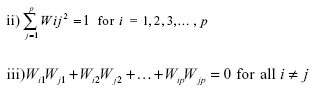
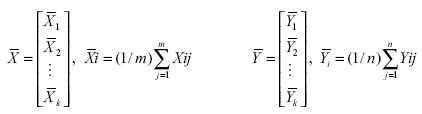
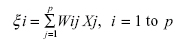
<body><![CDATA[<p align="justify"> In this context, let us discuss the objective of the PCA technique    in short. Assuming that there are p variables <i>Xi</i> (i = 1 to <i>p</i>),    the following <i>p</i> linear combinations &#958;<sub><font size="2"> <i>i</i></font></sub>    (i = 1 to<i> p</i>) wich have been mentioned as newly formed parameters in    the text are formed as follows: </p>     <p align="center"><img src="/img/revistas/atm/v17n1/a01pag4b.jpg"></p>     <p align="justify">where <i>Wij</i> denotes the weight of the <i>jth </i>variable    for the <i>ith</i> principal componente. The weights are estimated such that:    <br>   i) The first principal component ,&#958;<sub><font size="2"><i>1 </i></font></sub>accounts    for the maximum variance in the data, the second principal component, &#958;<sub><font size="2">    2</font></sub>, accounts for the maximum variance that has not been accounted    for by the first principal component, and so on.</p>     <p align="center"><img src="/img/revistas/atm/v17n1/a01pag4c.jpg"></p>     <p align="justify">The weights are obtained mathematically by using calculus (Sharma,    1996).    <br>   In the first part of the work, Linear Discriminant Analysis (LDA) has been performed    with the original k-dimensional raw data vector. But in the second part, the    same analysis has been performed with <i>M*</i>-dimensional data vector whose    elements are the first <i>M*</i> principal components. Here the PCA has been    conducted on the correlation matrix instead of the covariance matrix, since    the data vectors are unlike (i. e. they have different units) (Wilks, 1995).</p>     <p align="justify">Since a previous work on PCA with the same 20 parameters (Ghosh    <i>et al.,</i> 1999) shows that 93.3 % - 98 % information is covered with    the first 10 components which involve the parameters from 1000 hPa to 700 hpa,    in the second part of the present work, the upper-level parameters have been    neglected. Here <i>m</i> = <i>n</i> = 45, <i>m</i> and <i>n</i> being    the number of NTS days and TS days respectively. Each of the groups <i>X</i>    and <i>Y </i>has been characterized as follows:</p>     <p align="center"><img src="/img/revistas/atm/v17n1/a01pag5.jpg"></p>     <p align="justify">Without any loss of generality, let us assume that the population    underlying each of the groups, X and Y has the same covariance matrix. Then    the sample covariance matrices <i>Sx</i> and <i>Sy</i> can be computed from    the data matrices as follows:</p>     ]]></body>
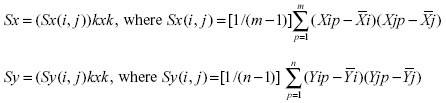
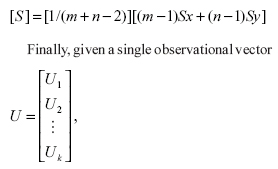
<body><![CDATA[<p align="center"><img src="/img/revistas/atm/v17n1/a01pag5b.jpg"></p>     <p align="justify">Since the covariance structures are assumed to be equal, the    above two matrices are averaged to yield a pooled estimate of the dispersion    of the data around their means as follows:</p>     <p align="center"><img src="/img/revistas/atm/v17n1/a01pag5c.jpg"></p>     <p align="justify">where the elements <i>U</i><sub><font size="2"><i>i</i></font></sub>    (i = 1 to <i>k</i>) to denote the values of the parameters on a particular    day, the nature of which is unknown, the following discriminant functions are    calculated to determine which group <i>U</i> belongs to:</p>     <p align="center"><img src="/img/revistas/atm/v17n1/a01pag6.jpg"></p>     <p align="justify">where &lsquo;/ &rsquo; means as usual the transpose of a matrix.     <br>   If &#124;<i>Dx - Du</i>&#124; &gt; |<i>Dy &ndash; Du</i>&#124;, then <i>U</i> belongs    to the <i>X</i>-group, i. e., the nature of the unknown day is expected to be    as that of an NTS day.    <br>   Similarly, if &#124;<i>Dx &ndash; Du</i>&#124; &gt; &#124;<i>Dy &ndash; Du</i>&#124;, then    <i>U</i> belongs to the <i>Y</i>-group, i. e., the nature of the unknown day    resembles the nature of a TS day.</p>     <p align="justify"> As mentioned earlier, in the second part of the work the PCA    technique has been applied first to reduce the dimensionality of the original    data matrix without losing any physical information. Then the LDA technique    has been performed in a similar manner, as described above, with the newly formed    10-dimensional data matrix. Here also, each of the groups <i>X</i> and <i>Y</i>    consists of 45 days. The LDA method has been named PCLDA in this part of the    work.</p>     <p align="justify"> Next, for the validation of the results, two types of verification    have been performed here, <i>viz.</i>    ]]></body>
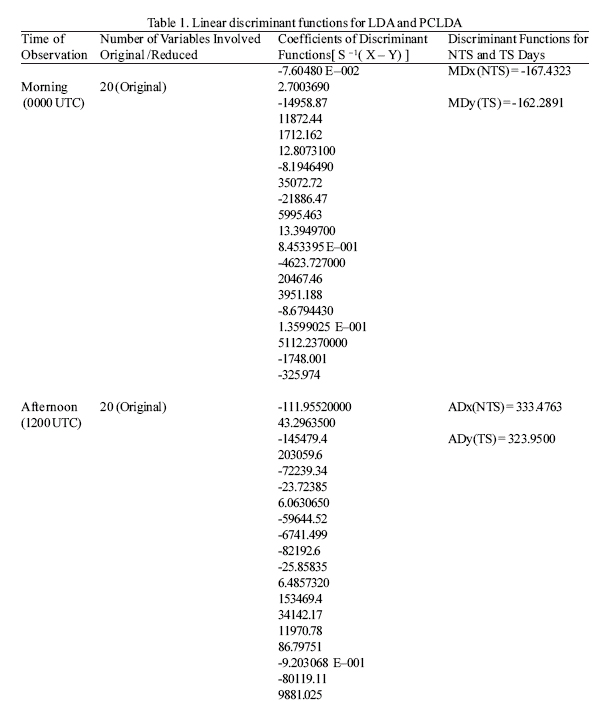
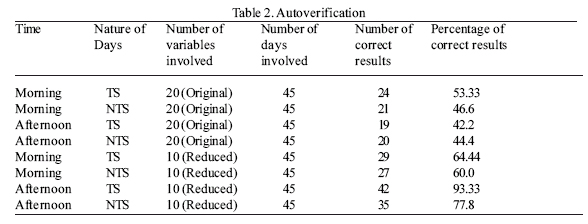
<body><![CDATA[<br>   i) Autoverification;    <br>   ii) Verification with unknown data.     <br>   In &lsquo;Autoverification&rsquo;, the days already involved in the analysis    have been treated as unknown observations. Incidentally, the &lsquo;Autoverification&rsquo;    (<a href="/img/revistas/atm/v17n1/a01pag9.jpg">Table 2</a>) reveals that the    results improve significantly in the second stage of the work (i.e. when the    PCLDA technique has been used). So for the final verification with unknown data    the PCLDA technique has been applied directly.</p>     <p align="justify"> For the final verification, the data of the year 1988, have    been taken as unknown observations which are to be classified. Before verification,    the thunderstorms of 1988 have been grouped as morning-TS and afternoon-TS according    to the Monthly Meteorological Report (M. M. R.) Here, morning-TS means the thunderstorms    occurring between 0000UTC and 1200 UTC and afternoon-TS includes the thunderstorms    which occur after 1200 UTC but before 0000 UTC of the next day. Similarly, morning-NTS    represents the fair weather between 0000 UTC and 1200 UTC and afternoon-NTS    represents that during the next 12 hours.</p>     <p align="justify"><b>    <br>   3. Results and verification</b>    <br>   In <a href="/img/revistas/atm/v17n1/a01pag7.jpg">Table 1</a>, the results of    LDA (with 20 original parameters) and PCLDA (with 10 newly formed parameters),    in <a href="/img/revistas/atm/v17n1/a01pag9.jpg">Table 2</a>, the results of    &lsquo;Autoverification&rsquo; and in Table 3 and 4, the results of final verification    with the data for 1988 have been presented.</p>     <p align="justify"><i>LDA-output (<a href="/img/revistas/atm/v17n1/a01pag7.jpg">Table    1</a>)</i>    <br>   MDx and MDy respectively denote the discriminant functions for NTS and TS for    morning and <i>ADx</i> and <i>ADy</i> denote those for afternoon respectively.    The values of the discriminant functions as obtained from LDA are as follows:</p>     <p align="center"><img src="/img/revistas/atm/v17n1/a01pag6b.jpg"></p>     ]]></body>
<body><![CDATA[<p align="center">    <br>   <a href="/img/revistas/atm/v17n1/a01pag7.jpg">table 1. Linear discriminant functions for LDA and PCLDA</a></p>     <p align="center">    <br>   <a href="/img/revistas/atm/v17n1/a01pag8.jpg">table 1. Continued</a></p>     <p align="justify">    <br>   Autoverification with the above discriminant functions (<a href="/img/revistas/atm/v17n1/a01pag9.jpg">Table    2</a>) reveals that, in the morning, 53.3% TS cases and 46.6% NTS cases are    correctly classified and in the afternoon 2.2% TS cases and 44.4% NTS cases    are correctly classified.</p>     <p align="justify"> <i>PCLDA-output (<a href="/img/revistas/atm/v17n1/a01pag7.jpg">Table    1</a>)</i>    <br>   For the morning, the discriminant functions for NTS and TS are represented by    <i>PMDx</i> and <i>PMDy</i> and those for the afternoon are denoted by PADx    and PADy respectively. The values of the functions as furnished by PCLDA are    given below:</p>     <p align="justify"> <i>PMDx</i> = -3.405151, <i>PMDy</i> = -6.592593 and <i>PADx</i>    = -7.05927, <i>PADy</i> = 27.83625</p>     <p align="justify"> Autoverification with the above discriminant functions (<a href="/img/revistas/atm/v17n1/a01pag9.jpg">Table    2</a>) shows that, in the morning, 64.4% TS cases and 60% NTS cases are correctly    classified, whereas, in the afternoon, 93.3% TS cases and 77.8% NTS cases are    correctly classified.</p>     ]]></body>
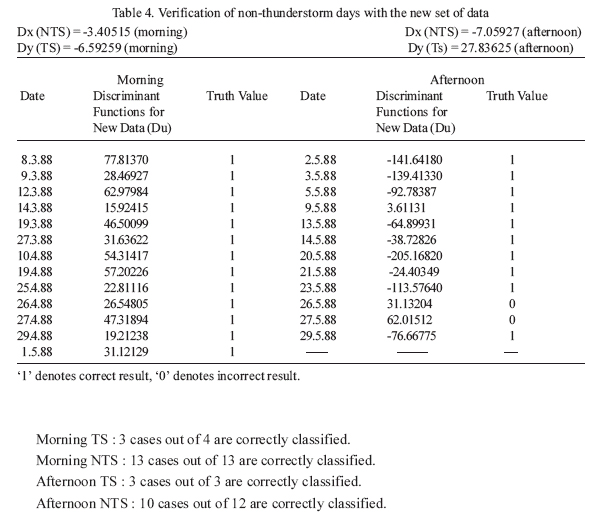
<body><![CDATA[<p align="justify"> In <a href="/img/revistas/atm/v17n1/a01pag9b.jpg">Table 3</a>    and <a href="/img/revistas/atm/v17n1/a01pag10.jpg">Table 4</a>, only the results    of PCLDA for 1988 have been presented. It is to be noted that after categorizing    the TS and NTS cases as &lsquo;Morning-TS&rsquo;, &lsquo;Morning-NTS&rsquo;,    &lsquo;Afternoon-TS&rsquo; and &lsquo;Afternoon-NTS&rsquo; respectively, the    application of PCLDA has interpreted the results in a more meaningful way as    follows:    <br> </p>     <p align="center"><a href="/img/revistas/atm/v17n1/a01pag9.jpg">table 2. Autoverification</a></p>     <p align="center">&nbsp;</p>     <p align="center"><a href="/img/revistas/atm/v17n1/a01pag9b.jpg">table 3. Verification of thunderstorm days with new set of data</a></p>     <p align="center">    <br>   <a href="/img/revistas/atm/v17n1/a01pag10.jpg">table 4. Verification of non-thunderstorm days with the new set of data</a></p>     <p align="left"><b>    <br>       <br>   4. Conclusion </b>    ]]></body>
<body><![CDATA[<br>   The present study reveals that the statistical index constructed above not only    helps to classify a TS or an NTS day, but it can also be used for 12-hour forecasts    of pre-monsoon weather in Calcutta, India. Moreover, since the nature of the    method is objective, it can be expected to produce more accurate results than    any other subjective method.</p>     <p align="left"> Hence, it can be concluded that if the LDA technique is to be    used for the operational purpose of classifying the TS and NTS days in Calcutta,    then instead of dealing with huge data matrices, their dimensionality may be    reduced first with the help of the PCA technique without losing any important    information.</p>     <p align="left">    <br>   <b>Acknowledgement</b>    <br>   The authors thank the India Meteorological Department for the sanction of a    research project. The present work forms a part of that project.</p>     <p align="left">    <br>   <b>References</b>    <!-- ref --><br>   Asnani, G. C., 1992. Tropical Meteorology 2, Asnani G. C., India, pp. 829-833,    852.&nbsp;&nbsp;&nbsp;&nbsp;&nbsp;&nbsp;&nbsp;&nbsp;[&#160;<a href="javascript:void(0);" onclick="javascript: window.open('/scielo.php?script=sci_nlinks&ref=1260564&pid=S0187-6236200400010000100001&lng=','','width=640,height=500,resizable=yes,scrollbars=1,menubar=yes,');">Links</a>&#160;]<!-- end-ref --><!-- ref --><p align="left"> Betts, A. K., 1974. Thermodynamic of tropical convective soundings,    <i>Month. Weather Rev.,</i> <b>102</b>, 760-764.&nbsp;&nbsp;&nbsp;&nbsp;&nbsp;&nbsp;&nbsp;&nbsp;[&#160;<a href="javascript:void(0);" onclick="javascript: window.open('/scielo.php?script=sci_nlinks&ref=1260565&pid=S0187-6236200400010000100002&lng=','','width=640,height=500,resizable=yes,scrollbars=1,menubar=yes,');">Links</a>&#160;]<!-- end-ref --><!-- ref --><p align="left"> Bolton, D., 1980. The computation of equivalent potential temperature,<i>    Month. Weather Rev., </i><b>108</b>, 1046-1053.&nbsp;&nbsp;&nbsp;&nbsp;&nbsp;&nbsp;&nbsp;&nbsp;[&#160;<a href="javascript:void(0);" onclick="javascript: window.open('/scielo.php?script=sci_nlinks&ref=1260566&pid=S0187-6236200400010000100003&lng=','','width=640,height=500,resizable=yes,scrollbars=1,menubar=yes,');">Links</a>&#160;]<!-- end-ref --><!-- ref --><p align="left"> Chowdhury, A. M, S. Ghosh, and U. K. De, 1996. Analysis of pre-monsoon    thunderstorm occurrence at Dhaka from 1983 to 1992 in terms of (&#952;es-&#952;e) and    convergence/divergence at surface,<i><b> </b>Indian J. Phys.<b>,</b></i>    <b>70</b>B(5), 357-366.&nbsp;&nbsp;&nbsp;&nbsp;&nbsp;&nbsp;&nbsp;&nbsp;[&#160;<a href="javascript:void(0);" onclick="javascript: window.open('/scielo.php?script=sci_nlinks&ref=1260567&pid=S0187-6236200400010000100004&lng=','','width=640,height=500,resizable=yes,scrollbars=1,menubar=yes,');">Links</a>&#160;]<!-- end-ref --><!-- ref --><p align="left"> Darkow, G. L., 1968. The total energy environment of storms,    <i>J. Appl. Meteorol., </i><b>7</b>, 199-205.&nbsp;&nbsp;&nbsp;&nbsp;&nbsp;&nbsp;&nbsp;&nbsp;[&#160;<a href="javascript:void(0);" onclick="javascript: window.open('/scielo.php?script=sci_nlinks&ref=1260568&pid=S0187-6236200400010000100005&lng=','','width=640,height=500,resizable=yes,scrollbars=1,menubar=yes,');">Links</a>&#160;]<!-- end-ref --><!-- ref --><p align="left"> Fujita,T. T., D. L. Bradbury and C. F. van Thillenar, 1970. Palm    Sunday tornadoes of April 11, 1965, <i>Month. Weather Rev</i>., <b>98</b>,    26-29.&nbsp;&nbsp;&nbsp;&nbsp;&nbsp;&nbsp;&nbsp;&nbsp;[&#160;<a href="javascript:void(0);" onclick="javascript: window.open('/scielo.php?script=sci_nlinks&ref=1260569&pid=S0187-6236200400010000100006&lng=','','width=640,height=500,resizable=yes,scrollbars=1,menubar=yes,');">Links</a>&#160;]<!-- end-ref --><!-- ref --><p align="left"> Galway, J. G., 1956.The lifted index as a predictor of latent    instability, <i>Bull. Am. Meteorol. Soc.,</i> <b>37</b>, 528-529.  &nbsp;&nbsp;&nbsp;&nbsp;&nbsp;&nbsp;&nbsp;&nbsp;[&#160;<a href="javascript:void(0);" onclick="javascript: window.open('/scielo.php?script=sci_nlinks&ref=1260570&pid=S0187-6236200400010000100007&lng=','','width=640,height=500,resizable=yes,scrollbars=1,menubar=yes,');">Links</a>&#160;]<!-- end-ref --><!-- ref --><p align="left"> Ghosh, S., A. Manna and U. K. De, 1998. Study of Thermodynamic    Nature of the Atmosphere at Dumdum, Calcutta (22.38&deg; N, 88.28&deg; E) on    Thunderstorm and Fair-weather Days, <i>Indian J. Phys.,</i> <b>72</b>B(2),    137-144.&nbsp;&nbsp;&nbsp;&nbsp;&nbsp;&nbsp;&nbsp;&nbsp;[&#160;<a href="javascript:void(0);" onclick="javascript: window.open('/scielo.php?script=sci_nlinks&ref=1260571&pid=S0187-6236200400010000100008&lng=','','width=640,height=500,resizable=yes,scrollbars=1,menubar=yes,');">Links</a>&#160;]<!-- end-ref --><!-- ref --><p align="left"> Ghosh, S., P. K. Sen and U. K. De, 1999. Identification of significant    parameters for the prediction of pre-monsoon thunderstorms at Calcutta, <i>Int.    J. Climatol.,</i> <b>19</b>, 673-681.&nbsp;&nbsp;&nbsp;&nbsp;&nbsp;&nbsp;&nbsp;&nbsp;[&#160;<a href="javascript:void(0);" onclick="javascript: window.open('/scielo.php?script=sci_nlinks&ref=1260572&pid=S0187-6236200400010000100009&lng=','','width=640,height=500,resizable=yes,scrollbars=1,menubar=yes,');">Links</a>&#160;]<!-- end-ref --><!-- ref --><p align="left"> Kessler, E., 1982. Thunderstorm Morphology and Dynamics, US Department    of Commerce, USA, pp. 2, 5-7, 93-95, 146-149.&nbsp;&nbsp;&nbsp;&nbsp;&nbsp;&nbsp;&nbsp;&nbsp;[&#160;<a href="javascript:void(0);" onclick="javascript: window.open('/scielo.php?script=sci_nlinks&ref=1260573&pid=S0187-6236200400010000100010&lng=','','width=640,height=500,resizable=yes,scrollbars=1,menubar=yes,');">Links</a>&#160;]<!-- end-ref --><!-- ref --><p align="left"> Kuo, H. L., 1965. On formation and intensification of tropical    cyclones through latent heat release by cumulus convection, <i>J. Atmos. Sci.,</i>    <b>22</b>, 40-63. &nbsp;&nbsp;&nbsp;&nbsp;&nbsp;&nbsp;&nbsp;&nbsp;[&#160;<a href="javascript:void(0);" onclick="javascript: window.open('/scielo.php?script=sci_nlinks&ref=1260574&pid=S0187-6236200400010000100011&lng=','','width=640,height=500,resizable=yes,scrollbars=1,menubar=yes,');">Links</a>&#160;]<!-- end-ref --><!-- ref --><p align="left">Lawson, M. P. and R. S. Cerveny, 1985. Seasonal temperature forecasts    as products of antecedent linear and spatial temperature arrays, <i>J. Clim.    Appl. Meteorol., </i><b>24</b>, 848-859.&nbsp;&nbsp;&nbsp;&nbsp;&nbsp;&nbsp;&nbsp;&nbsp;[&#160;<a href="javascript:void(0);" onclick="javascript: window.open('/scielo.php?script=sci_nlinks&ref=1260575&pid=S0187-6236200400010000100012&lng=','','width=640,height=500,resizable=yes,scrollbars=1,menubar=yes,');">Links</a>&#160;]<!-- end-ref --><!-- ref --><p align="left"> Miller, R. G., 1962. Statistical prediction by discriminant analysis,    <i>Meteorol. Monog.,</i> <b>4</b>, No. 25, 53. &nbsp;&nbsp;&nbsp;&nbsp;&nbsp;&nbsp;&nbsp;&nbsp;[&#160;<a href="javascript:void(0);" onclick="javascript: window.open('/scielo.php?script=sci_nlinks&ref=1260576&pid=S0187-6236200400010000100013&lng=','','width=640,height=500,resizable=yes,scrollbars=1,menubar=yes,');">Links</a>&#160;]<!-- end-ref --><!-- ref --><p align="left"> Miller, R. G., 1972. Notes on analysis and severe storm forecasting    Procedure of the air Force Global Weather Control, AFGWC Technical Report 200    (Rev), Air Weather Service, US Air Force.&nbsp;&nbsp;&nbsp;&nbsp;&nbsp;&nbsp;&nbsp;&nbsp;[&#160;<a href="javascript:void(0);" onclick="javascript: window.open('/scielo.php?script=sci_nlinks&ref=1260577&pid=S0187-6236200400010000100014&lng=','','width=640,height=500,resizable=yes,scrollbars=1,menubar=yes,');">Links</a>&#160;]<!-- end-ref --><!-- ref --><p align="left"> S&aacute;nchez, J. L., R. Fraile, M. T. de la Fuente and J. L.    Marcos, 1998. Discriminant Analysis Applied to the forecasting of Thunderstorms,    <i>Meteorol. Atmos. Phys.,</i> <b>68</b>, 187-195.&nbsp;&nbsp;&nbsp;&nbsp;&nbsp;&nbsp;&nbsp;&nbsp;[&#160;<a href="javascript:void(0);" onclick="javascript: window.open('/scielo.php?script=sci_nlinks&ref=1260578&pid=S0187-6236200400010000100015&lng=','','width=640,height=500,resizable=yes,scrollbars=1,menubar=yes,');">Links</a>&#160;]<!-- end-ref --><!-- ref --><p align="left"> Sharma, S., 1996. Applied Multivariate Techniques, <i>John Wiley    &amp; Sons, Inc.,</i> 66-67.&nbsp;&nbsp;&nbsp;&nbsp;&nbsp;&nbsp;&nbsp;&nbsp;[&#160;<a href="javascript:void(0);" onclick="javascript: window.open('/scielo.php?script=sci_nlinks&ref=1260579&pid=S0187-6236200400010000100016&lng=','','width=640,height=500,resizable=yes,scrollbars=1,menubar=yes,');">Links</a>&#160;]<!-- end-ref --><!-- ref --><p align="left"> Showalter, A. K., 1953. A Stability Index for Thunderstorm Forecasting,    <i>Bull. Am. Meteorol. Soc.,</i> <b>34</b>, 250-252.&nbsp;&nbsp;&nbsp;&nbsp;&nbsp;&nbsp;&nbsp;&nbsp;[&#160;<a href="javascript:void(0);" onclick="javascript: window.open('/scielo.php?script=sci_nlinks&ref=1260580&pid=S0187-6236200400010000100017&lng=','','width=640,height=500,resizable=yes,scrollbars=1,menubar=yes,');">Links</a>&#160;]<!-- end-ref --><!-- ref --><p align="left"> Ward, M. N. and C. K. Folland, 1991. Prediction of seasonal rainfall    in the north Nordeste of Brazil using eigen vectors of sea-surface temperature,    <i>Int. J. Climatol.</i>, <b>11</b>, 711-743.&nbsp;&nbsp;&nbsp;&nbsp;&nbsp;&nbsp;&nbsp;&nbsp;[&#160;<a href="javascript:void(0);" onclick="javascript: window.open('/scielo.php?script=sci_nlinks&ref=1260581&pid=S0187-6236200400010000100018&lng=','','width=640,height=500,resizable=yes,scrollbars=1,menubar=yes,');">Links</a>&#160;]<!-- end-ref --><!-- ref --><p align="left"> Wilks, D. S., 1995. Statistical Methods in the Atmospheric Sciences,    <i>Academic Press,</i> New York, 409-415.&nbsp;&nbsp;&nbsp;&nbsp;&nbsp;&nbsp;&nbsp;&nbsp;[&#160;<a href="javascript:void(0);" onclick="javascript: window.open('/scielo.php?script=sci_nlinks&ref=1260582&pid=S0187-6236200400010000100019&lng=','','width=640,height=500,resizable=yes,scrollbars=1,menubar=yes,');">Links</a>&#160;]<!-- end-ref --><!-- ref --><p align="left"> Williams, E. and N. Renno, 1993. An analysis of the conditional    instability of the tropical atmosphere, <i>Month. Weather Rev., </i><b>121</b>,    23-26.&nbsp;&nbsp;&nbsp;&nbsp;&nbsp;&nbsp;&nbsp;&nbsp;[&#160;<a href="javascript:void(0);" onclick="javascript: window.open('/scielo.php?script=sci_nlinks&ref=1260583&pid=S0187-6236200400010000100020&lng=','','width=640,height=500,resizable=yes,scrollbars=1,menubar=yes,');">Links</a>&#160;]<!-- end-ref --> ]]></body><back>
<ref-list>
<ref id="B1">
<nlm-citation citation-type="">
<person-group person-group-type="author">
<name>
<surname><![CDATA[Asnani]]></surname>
<given-names><![CDATA[G. C.]]></given-names>
</name>
<name>
<surname><![CDATA[Asnani]]></surname>
<given-names><![CDATA[G. C.]]></given-names>
</name>
</person-group>
<source><![CDATA[Tropical Meteorology 2]]></source>
<year>1992</year>
<page-range>829-833, 852</page-range></nlm-citation>
</ref>
<ref id="B2">
<nlm-citation citation-type="journal">
<person-group person-group-type="author">
<name>
<surname><![CDATA[Betts]]></surname>
<given-names><![CDATA[A. K.]]></given-names>
</name>
</person-group>
<article-title xml:lang="en"><![CDATA[Thermodynamic of tropical convective soundings]]></article-title>
<source><![CDATA[Month. Weather Rev]]></source>
<year>1974</year>
<numero>102</numero>
<issue>102</issue>
<page-range>760-764</page-range></nlm-citation>
</ref>
<ref id="B3">
<nlm-citation citation-type="journal">
<person-group person-group-type="author">
<name>
<surname><![CDATA[Bolton]]></surname>
<given-names><![CDATA[D.]]></given-names>
</name>
</person-group>
<article-title xml:lang="en"><![CDATA[The computation of equivalent potential temperature]]></article-title>
<source><![CDATA[Month. Weather Rev.]]></source>
<year>1980</year>
<numero>108</numero>
<issue>108</issue>
<page-range>1046-1053</page-range></nlm-citation>
</ref>
<ref id="B4">
<nlm-citation citation-type="journal">
<person-group person-group-type="author">
<name>
<surname><![CDATA[Chowdhury]]></surname>
<given-names><![CDATA[A. M.]]></given-names>
</name>
<name>
<surname><![CDATA[Ghosh]]></surname>
<given-names><![CDATA[S.]]></given-names>
</name>
<name>
<surname><![CDATA[De]]></surname>
<given-names><![CDATA[U. K.]]></given-names>
</name>
</person-group>
<article-title xml:lang="en"><![CDATA[Analysis of pre-monsoon thunderstorm occurrence at Dhaka from 1983 to 1992 in terms of (&#952;es-&#952;e) and convergence/divergence at surface]]></article-title>
<source><![CDATA[Indian J. Phys.]]></source>
<year>1996</year>
<volume>70B</volume>
<numero>5</numero>
<issue>5</issue>
<page-range>357-366</page-range></nlm-citation>
</ref>
<ref id="B5">
<nlm-citation citation-type="journal">
<person-group person-group-type="author">
<name>
<surname><![CDATA[Darkow]]></surname>
<given-names><![CDATA[G. L.]]></given-names>
</name>
</person-group>
<article-title xml:lang="en"><![CDATA[The total energy environment of storms]]></article-title>
<source><![CDATA[J. Appl. Meteorol.]]></source>
<year>1968</year>
<numero>7</numero>
<issue>7</issue>
<page-range>199-205</page-range></nlm-citation>
</ref>
<ref id="B6">
<nlm-citation citation-type="journal">
<person-group person-group-type="author">
<name>
<surname><![CDATA[Fujita]]></surname>
<given-names><![CDATA[T. T.]]></given-names>
</name>
<name>
<surname><![CDATA[Bradbury]]></surname>
<given-names><![CDATA[D. L.]]></given-names>
</name>
<name>
<surname><![CDATA[van Thillenar]]></surname>
<given-names><![CDATA[C. F.]]></given-names>
</name>
</person-group>
<article-title xml:lang="es"><![CDATA[Palm Sunday tornadoes of April 11, 1965]]></article-title>
<source><![CDATA[Month. Weather Rev.]]></source>
<year>1970</year>
<numero>98</numero>
<issue>98</issue>
<page-range>26-29</page-range></nlm-citation>
</ref>
<ref id="B7">
<nlm-citation citation-type="journal">
<person-group person-group-type="author">
<name>
<surname><![CDATA[Galway]]></surname>
<given-names><![CDATA[J. G.]]></given-names>
</name>
</person-group>
<article-title xml:lang="en"><![CDATA[The lifted index as a predictor of latent instability]]></article-title>
<source><![CDATA[Bull. Am. Meteorol. Soc.]]></source>
<year>1956</year>
<numero>37</numero>
<issue>37</issue>
<page-range>528-529</page-range></nlm-citation>
</ref>
<ref id="B8">
<nlm-citation citation-type="journal">
<person-group person-group-type="author">
<name>
<surname><![CDATA[Ghosh]]></surname>
<given-names><![CDATA[S.]]></given-names>
</name>
<name>
<surname><![CDATA[Manna]]></surname>
<given-names><![CDATA[A.]]></given-names>
</name>
<name>
<surname><![CDATA[De]]></surname>
<given-names><![CDATA[U. K.]]></given-names>
</name>
</person-group>
<article-title xml:lang="en"><![CDATA[Study of Thermodynamic Nature of the Atmosphere at Dumdum, Calcutta (22.38° N, 88.28° E) on Thunderstorm and Fair-weather Days]]></article-title>
<source><![CDATA[Indian J. Phys.]]></source>
<year>1998</year>
<volume>72B</volume>
<numero>2</numero>
<issue>2</issue>
<page-range>137-144</page-range></nlm-citation>
</ref>
<ref id="B9">
<nlm-citation citation-type="journal">
<person-group person-group-type="author">
<name>
<surname><![CDATA[Ghosh]]></surname>
<given-names><![CDATA[S.]]></given-names>
</name>
<name>
<surname><![CDATA[Sen]]></surname>
<given-names><![CDATA[P. K.]]></given-names>
</name>
<name>
<surname><![CDATA[De]]></surname>
<given-names><![CDATA[U. K.]]></given-names>
</name>
</person-group>
<article-title xml:lang="en"><![CDATA[Identification of significant parameters for the prediction of pre-monsoon thunderstorms at Calcutta]]></article-title>
<source><![CDATA[Int. J. Climatol.]]></source>
<year>1999</year>
<numero>19</numero>
<issue>19</issue>
<page-range>673-681</page-range></nlm-citation>
</ref>
<ref id="B10">
<nlm-citation citation-type="book">
<person-group person-group-type="author">
<name>
<surname><![CDATA[Kessler]]></surname>
<given-names><![CDATA[E.]]></given-names>
</name>
</person-group>
<source><![CDATA[Thunderstorm Morphology and Dynamics]]></source>
<year>1982</year>
<page-range>2, 5-7, 93-95, 146-149</page-range><publisher-name><![CDATA[US Department of Commerce]]></publisher-name>
</nlm-citation>
</ref>
<ref id="B11">
<nlm-citation citation-type="journal">
<person-group person-group-type="author">
<name>
<surname><![CDATA[Kuo]]></surname>
<given-names><![CDATA[H. L.]]></given-names>
</name>
</person-group>
<article-title xml:lang="en"><![CDATA[On formation and intensification of tropical cyclones through latent heat release by cumulus convection]]></article-title>
<source><![CDATA[J. Atmos. Sci.]]></source>
<year>1965</year>
<numero>22</numero>
<issue>22</issue>
<page-range>40-63</page-range></nlm-citation>
</ref>
<ref id="B12">
<nlm-citation citation-type="journal">
<person-group person-group-type="author">
<name>
<surname><![CDATA[Lawson]]></surname>
<given-names><![CDATA[M. P.]]></given-names>
</name>
<name>
<surname><![CDATA[Cerveny]]></surname>
<given-names><![CDATA[R. S.]]></given-names>
</name>
</person-group>
<article-title xml:lang="en"><![CDATA[Seasonal temperature forecasts as products of antecedent linear and spatial temperature arrays]]></article-title>
<source><![CDATA[J. Clim. Appl. Meteorol.]]></source>
<year>1985</year>
<numero>24</numero>
<issue>24</issue>
<page-range>848-859</page-range></nlm-citation>
</ref>
<ref id="B13">
<nlm-citation citation-type="journal">
<person-group person-group-type="author">
<name>
<surname><![CDATA[Miller]]></surname>
<given-names><![CDATA[R. G.]]></given-names>
</name>
</person-group>
<article-title xml:lang="en"><![CDATA[Statistical prediction by discriminant analysis]]></article-title>
<source><![CDATA[Meteorol. Monog.]]></source>
<year>1962</year>
<volume>4</volume>
<numero>25</numero>
<issue>25</issue>
<page-range>53</page-range></nlm-citation>
</ref>
<ref id="B14">
<nlm-citation citation-type="book">
<person-group person-group-type="author">
<name>
<surname><![CDATA[Miller]]></surname>
<given-names><![CDATA[R. G.]]></given-names>
</name>
</person-group>
<source><![CDATA[Notes on analysis and severe storm forecasting Procedure of the air Force Global Weather Control]]></source>
<year>1972</year>
<publisher-name><![CDATA[Air Weather Service, US Air Force]]></publisher-name>
</nlm-citation>
</ref>
<ref id="B15">
<nlm-citation citation-type="journal">
<person-group person-group-type="author">
<name>
<surname><![CDATA[Sánchez]]></surname>
<given-names><![CDATA[J. L.]]></given-names>
</name>
<name>
<surname><![CDATA[Fraile]]></surname>
<given-names><![CDATA[R.]]></given-names>
</name>
<name>
<surname><![CDATA[de la Fuente]]></surname>
<given-names><![CDATA[M. T.]]></given-names>
</name>
<name>
<surname><![CDATA[Marcos]]></surname>
<given-names><![CDATA[J. L.]]></given-names>
</name>
</person-group>
<article-title xml:lang="en"><![CDATA[Discriminant Analysis Applied to the forecasting of Thunderstorms]]></article-title>
<source><![CDATA[Meteorol. Atmos. Phys.]]></source>
<year>1998</year>
<numero>68</numero>
<issue>68</issue>
<page-range>187-195</page-range></nlm-citation>
</ref>
<ref id="B16">
<nlm-citation citation-type="book">
<person-group person-group-type="author">
<name>
<surname><![CDATA[Sharma]]></surname>
<given-names><![CDATA[S.]]></given-names>
</name>
</person-group>
<source><![CDATA[Applied Multivariate Techniques]]></source>
<year>1996</year>
<page-range>66-67</page-range><publisher-name><![CDATA[John Wiley & Sons, Inc.]]></publisher-name>
</nlm-citation>
</ref>
<ref id="B17">
<nlm-citation citation-type="journal">
<person-group person-group-type="author">
<name>
<surname><![CDATA[Showalter]]></surname>
<given-names><![CDATA[A. K.]]></given-names>
</name>
</person-group>
<article-title xml:lang="en"><![CDATA[A Stability Index for Thunderstorm Forecasting]]></article-title>
<source><![CDATA[Bull. Am. Meteorol. Soc.]]></source>
<year>1953</year>
<numero>34</numero>
<issue>34</issue>
<page-range>250-252</page-range></nlm-citation>
</ref>
<ref id="B18">
<nlm-citation citation-type="journal">
<person-group person-group-type="author">
<name>
<surname><![CDATA[Ward]]></surname>
<given-names><![CDATA[M. N.]]></given-names>
</name>
<name>
<surname><![CDATA[Folland]]></surname>
<given-names><![CDATA[C. K.]]></given-names>
</name>
</person-group>
<article-title xml:lang="en"><![CDATA[Prediction of seasonal rainfall in the north Nordeste of Brazil using eigen vectors of sea-surface temperature]]></article-title>
<source><![CDATA[Int. J. Climatol.]]></source>
<year>1991</year>
<numero>11</numero>
<issue>11</issue>
<page-range>711-743</page-range></nlm-citation>
</ref>
<ref id="B19">
<nlm-citation citation-type="book">
<person-group person-group-type="author">
<name>
<surname><![CDATA[Wilks]]></surname>
<given-names><![CDATA[D. S.]]></given-names>
</name>
</person-group>
<source><![CDATA[Statistical Methods in the Atmospheric Sciences]]></source>
<year>1995</year>
<page-range>409-415</page-range><publisher-loc><![CDATA[New York ]]></publisher-loc>
<publisher-name><![CDATA[Academic Press]]></publisher-name>
</nlm-citation>
</ref>
<ref id="B20">
<nlm-citation citation-type="journal">
<person-group person-group-type="author">
<name>
<surname><![CDATA[Williams]]></surname>
<given-names><![CDATA[E.]]></given-names>
</name>
<name>
<surname><![CDATA[Renno]]></surname>
<given-names><![CDATA[N.]]></given-names>
</name>
</person-group>
<article-title xml:lang="en"><![CDATA[An analysis of the conditional instability of the tropical atmosphere]]></article-title>
<source><![CDATA[Month. Weather Rev.]]></source>
<year>1993</year>
<numero>121</numero>
<issue>121</issue>
<page-range>23-26</page-range></nlm-citation>
</ref>
</ref-list>
</back>
</article>