<?xml version="1.0" encoding="ISO-8859-1"?><article xmlns:mml="http://www.w3.org/1998/Math/MathML" xmlns:xlink="http://www.w3.org/1999/xlink" xmlns:xsi="http://www.w3.org/2001/XMLSchema-instance">
<front>
<journal-meta>
<journal-id>0187-6236</journal-id>
<journal-title><![CDATA[Atmósfera]]></journal-title>
<abbrev-journal-title><![CDATA[Atmósfera]]></abbrev-journal-title>
<issn>0187-6236</issn>
<publisher>
<publisher-name><![CDATA[Universidad Nacional Autónoma de México, Instituto de Ciencias de la Atmósfera y Cambio Climático]]></publisher-name>
</publisher>
</journal-meta>
<article-meta>
<article-id>S0187-62362002000300005</article-id>
<title-group>
<article-title xml:lang="en"><![CDATA[Maximum ground level concentration of air pollutant]]></article-title>
</title-group>
<contrib-group>
<contrib contrib-type="author">
<name>
<surname><![CDATA[EMBABY]]></surname>
<given-names><![CDATA[M.]]></given-names>
</name>
<xref ref-type="aff" rid="A01"/>
</contrib>
<contrib contrib-type="author">
<name>
<surname><![CDATA[MAYHOUB]]></surname>
<given-names><![CDATA[A. B.]]></given-names>
</name>
<xref ref-type="aff" rid="A01"/>
</contrib>
<contrib contrib-type="author">
<name>
<surname><![CDATA[ESSA]]></surname>
<given-names><![CDATA[K. S. M.]]></given-names>
</name>
<xref ref-type="aff" rid="A01"/>
</contrib>
<contrib contrib-type="author">
<name>
<surname><![CDATA[ETMAN]]></surname>
<given-names><![CDATA[S.]]></given-names>
</name>
<xref ref-type="aff" rid="A01"/>
</contrib>
</contrib-group>
<aff id="A01">
<institution><![CDATA[,Atomic Energy Authority Nuclear Research Center Mathematics and Theoretical Physics Department]]></institution>
<addr-line><![CDATA[El Cairo ]]></addr-line>
<country>Egipto</country>
</aff>
<pub-date pub-type="pub">
<day>00</day>
<month>00</month>
<year>2002</year>
</pub-date>
<pub-date pub-type="epub">
<day>00</day>
<month>00</month>
<year>2002</year>
</pub-date>
<volume>15</volume>
<numero>3</numero>
<fpage>185</fpage>
<lpage>191</lpage>
<copyright-statement/>
<copyright-year/>
<self-uri xlink:href="http://www.scielo.org.mx/scielo.php?script=sci_arttext&amp;pid=S0187-62362002000300005&amp;lng=en&amp;nrm=iso"></self-uri><self-uri xlink:href="http://www.scielo.org.mx/scielo.php?script=sci_abstract&amp;pid=S0187-62362002000300005&amp;lng=en&amp;nrm=iso"></self-uri><self-uri xlink:href="http://www.scielo.org.mx/scielo.php?script=sci_pdf&amp;pid=S0187-62362002000300005&amp;lng=en&amp;nrm=iso"></self-uri><abstract abstract-type="short" xml:lang="es"><p><![CDATA[Por medio del modelo de pluma gaussiana, se obtiene la concentración superficial de un contaminante aéreo. Sin embargo, la altura efectiva H del contaminante se considera como función de las coordenadas superficiales x y y. Se desarrolla el radio extremo de la chimenea. La constancia de H se estudia como un caso especial del problema. Se deducen argumentos interesantes sobre las concentraciones máxima y peor.]]></p></abstract>
<abstract abstract-type="short" xml:lang="en"><p><![CDATA[The ground level concentration of an air pollutant is obtained using the Gaussian plume model. However, the effective height H of the pollutant has been considered as a function of the ground level coordinates x and y. Extreme radius of the stack is developed. The constancy of H has been studied as a special case for the problem. Interesting arguments about both maximum and worst concentrations have been derived.]]></p></abstract>
<kwd-group>
<kwd lng="en"><![CDATA[Gaussian plume]]></kwd>
<kwd lng="en"><![CDATA[stack]]></kwd>
<kwd lng="en"><![CDATA[pollutant concentration]]></kwd>
</kwd-group>
</article-meta>
</front><body><![CDATA[  	     <p><font face="verdana" size="4">Short contribution</font></p>      <p>&nbsp;</p>  	    <p align="center"><font face="verdana" size="4"><b>Maximum ground level concentration of air pollutant</b></font></p>  	    <p>&nbsp;</p>  	    <p align="center"><font face="verdana" size="2"><b>M. EMBABY, A. B. MAYHOUB, K. S. M. ESSA and S. ETMAN</b></font></p>  	    <p align="center"><font face="verdana" size="2"><i>Mathematics and Theoretical Physics Department, Nuclear Research Center, Atomic Energy Authority, Cairo, Egypt</i></font></p>  	    <p>&nbsp;</p>  	    <p align="center"><font face="verdana" size="2">(Manuscript received Feb. 15, 2001; accepted in final form Aug. 29, 2001)</font></p>  	    <p>&nbsp;</p>  	    ]]></body>
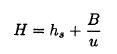
<body><![CDATA[<p align="justify"><font face="verdana" size="2"><b>RESUMEN</b></font></p>  	    <p align="justify"><font face="verdana" size="2">Por medio del modelo de pluma gaussiana, se obtiene la concentraci&oacute;n superficial de un contaminante a&eacute;reo. Sin embargo, la altura efectiva H del contaminante se considera como funci&oacute;n de las coordenadas superficiales <i>x</i> y <i>y.</i> Se desarrolla el radio extremo de la chimenea. La constancia de H se estudia como un caso especial del problema. Se deducen argumentos interesantes sobre las concentraciones m&aacute;xima y peor.</font></p>  	    <p>&nbsp;</p>  	    <p align="justify"><font face="verdana" size="2"><b>ABSTRACT</b></font></p>  	    <p align="justify"><font face="verdana" size="2">The ground level concentration of an air pollutant is obtained using the Gaussian plume model. However, the effective height H of the pollutant has been considered as a function of the ground level coordinates x and y. Extreme radius of the stack is developed. The constancy of H has been studied as a special case for the problem. Interesting arguments about both maximum and worst concentrations have been derived.</font></p>  	    <p align="justify"><font face="verdana" size="2"><b>Key words:</b> Gaussian plume, stack, pollutant concentration.</font></p>  	    <p>&nbsp;</p>  	    <p align="justify"><font face="verdana" size="2"><b>1. Introduction</b></font></p>  	    <p align="justify"><font face="verdana" size="2">The Gaussian plume model (GPM) (Csanady, 1973; Smith, 1973; Turner, 1970) provided the primary method for calculation concentration of non&#45;reactive pollutants from a point source. This model has found widespread application in design of stacks and environmental impact analysis. In the GPM formula for the concentration, the effective height for emission is an important parameter for ground level concentrations. Due to the initial kinetic energy of the released plume and its thermal energy when the plume temperature is above ambient air temperature, there will be an increase in the emission height of the plume. This increase is known as the plume rise <i>&#916;h.</i> The effective source height <i>H</i> is then given by:</font></p>  	    <p align="center"><font face="verdana" size="2"><img src="/img/revistas/atm/v15n3/a5e1.jpg"></font></p>  	    ]]></body>
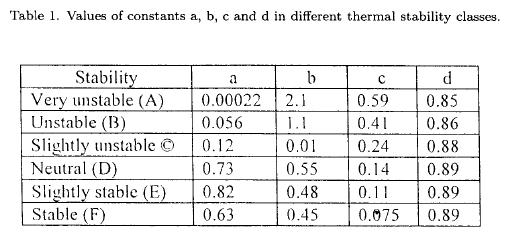
<body><![CDATA[<p align="justify"><font face="verdana" size="2">Where <i>h<sub>s</sub></i> is the physical stack height. In order to predict ground level concentration of pollutants, the plume rise should be taken into consideration. Pasquill (1971); Ragland (1975) and others have obtained the maximum ground level concentration, taking into account a constant plume rise <i>&#916;h</i> with the downwind distance <i>x.</i> In this paper, we shall generalize the case for which <i>&#916;h</i> (and consequently, the effective source height H) is a function of ground level coordinates <i>x.</i> and <i>y,</i> i. e., <i>H = H</i>(<i>x, y</i>)<i>.</i> The effective height <i>H</i> will be obtained in terms of <i>x,</i> and <i>y.</i> Power law forms of the dispersion coefficients <i>&#963;<sub>z</sub></i> and <i>&#963;<sub>y</sub></i> namely (Ragland, 1975):</font></p>  	    <p align="center"><font face="verdana" size="2"><img src="/img/revistas/atm/v15n3/a5e2.jpg"></font></p>  	    <p align="justify"><font face="verdana" size="2">have been assumed through the treatment. The coefficient a, b, c, and d are real numbers depending on the atmospheric stability classes, as shown in <a href="#t1">Table (1)</a> (Ragland, 1975).</font></p>  	    <p align="center"><font face="verdana" size="2"><a name="t1"></a></font></p>  	    <p align="center"><font face="verdana" size="2"><img src="/img/revistas/atm/v15n3/a5t1.jpg"></font></p>  	    <p>&nbsp;</p>  	    <p align="justify"><font face="verdana" size="2"><strong>2. Mathematical treatment</strong></font></p>  	    <p align="justify"><font face="verdana" size="2">The concentration distribution from a single continuous point source at some point above the ground is given by the Gaussian plume model (IAEA, 1983) as:</font></p>  	    <p align="center"><font face="verdana" size="2"><img src="/img/revistas/atm/v15n3/a5e3.jpg"></font></p>  	    <p align="justify"><font face="verdana" size="2">where</font></p>  	    ]]></body>
<body><![CDATA[<blockquote> 		    <p align="justify"><font face="verdana" size="2"><i>x</i> &#45; is the downwind distance from the source (m),</font></p>  		    <p align="justify"><font face="verdana" size="2"><i>y</i> &#45; is the crosswind distance from the source (m),</font></p>  		    <p align="justify"><font face="verdana" size="2"><i>z &#45;</i> is the vertical distance above the ground (m),</font></p>  		    <p align="justify"><font face="verdana" size="2"><i>&#967; &#45;</i> is the concentration of pollutant (g/m<sup>3</sup>),</font></p>  		    <p align="justify"><font face="verdana" size="2"><i>u</i> &#45; is the downwind velocity is taken along the x&#45;axis (positive direction) (m/sec),</font></p>  		    <p align="justify"><font face="verdana" size="2"><i>Q &#45;</i> is the source strength (g/sec),</font></p>  		    <p align="justify"><font face="verdana" size="2"><i>H &#45;</i> is the effective stack height (m),</font></p>  		    <p align="justify"><font face="verdana" size="2"><i>&#963;<sub>y</sub></i> and <i>&#963;<sub>z</sub></i> are given by equation (2) are the standard deviations of plume concentration distribution in the horizontal and vertical directions respectively.</font></p> 	</blockquote>  	    <p align="justify"><font face="verdana" size="2">The ground level concentration is obtained by setting <i>z</i> = 0 in (3), and on substitution the values of <i>&#963;<sub>y</sub></i> and <i>&#963;<sub>z</sub></i> from (2) into (3), we get:</font></p>  	    ]]></body>
<body><![CDATA[<p align="center"><font face="verdana" size="2"><img src="/img/revistas/atm/v15n3/a5e4.jpg"></font></p>  	    <p align="justify"><font face="verdana" size="2">Maximum ground level concentration occurs when <i>&#948;&#967;/&#948;x</i> = 0 which gives</font></p>  	    <p align="center"><font face="verdana" size="2"><img src="/img/revistas/atm/v15n3/a5e41.jpg"></font></p>  	    <p align="justify"><font face="verdana" size="2">From which we get</font></p>  	    <p align="center"><font face="verdana" size="2"><img src="/img/revistas/atm/v15n3/a5e5.jpg"></font></p>  	    <p align="justify"><font face="verdana" size="2">Assuming the following substituting</font></p>  	    <p align="center"><font face="verdana" size="2"><img src="/img/revistas/atm/v15n3/a5e6.jpg"></font></p>  	    <p align="justify"><font face="verdana" size="2">Equation (5) is reduced to:</font></p>  	    <p align="center"><font face="verdana" size="2"><img src="/img/revistas/atm/v15n3/a5e61.jpg"></font></p>  	    <p align="justify"><font face="verdana" size="2">Which on integrating both sides with respect to x, gives:</font></p>  	    ]]></body>
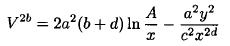
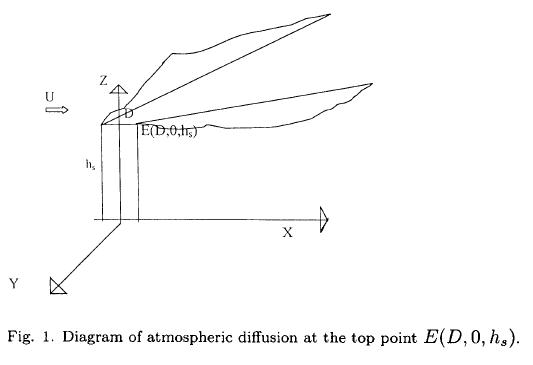
<body><![CDATA[<p align="center"><font face="verdana" size="2"><img src="/img/revistas/atm/v15n3/a5e62.jpg"></font></p>  	    <p align="justify"><font face="verdana" size="2">where <i>A</i> is a constant of integration. From equation (6), we can write:</font></p>  	    <p align="center"><font face="verdana" size="2"><img src="/img/revistas/atm/v15n3/a5e7.jpg"></font></p>  	    <p align="justify"><font face="verdana" size="2">This equation represents a relation between the point (<i>x, y</i>) of the pollutant path and its corresponding height <i>H.</i> In order to deduce <i>A</i> we can satisfy equation (7) at certain point <i>E</i>(<i>D,</i> 0, <i>h<sub>s</sub></i>) on to top of the stack, where the air pollutant starts to move at velocity <i>u</i> along the <i>x</i>&#45;direction, where <i>D</i> is the radius of the stack (<a href="#f1">Fig. 1</a>). Substituting the coordinates of the point <i>E</i> into equation (7), we obtain the constant <i>A</i> in the form:</font></p>  	    <p align="center"><font face="verdana" size="2"><a name="f1"></a></font></p>  	    <p align="center"><font face="verdana" size="2"><img src="/img/revistas/atm/v15n3/a5f1.jpg"></font></p>  	    <p align="center"><font face="verdana" size="2"><img src="/img/revistas/atm/v15n3/a5e8.jpg"></font></p>  	    <p align="justify"><font face="verdana" size="2">Substituting from (8) into equation (7), we get:</font></p>  	    <p align="center"><font face="verdana" size="2"><img src="/img/revistas/atm/v15n3/a5e9.jpg"></font></p>  	    <p align="justify"><font face="verdana" size="2">This equation describes the pollutant height <i>H</i> in terms of the position (<i>x, y</i>)<i>.</i> Now, substituting from (9) into (4), we get the desired expression for the maximum ground level concentration in the form:</font></p>  	    ]]></body>
<body><![CDATA[<p align="center"><font face="verdana" size="2"><img src="/img/revistas/atm/v15n3/a5e10.jpg"></font></p>  	    <p align="justify"><font face="verdana" size="2">It is evident that the concentration <i>&#967;<sub>max</sub></i> depends on both meteorological parameters and release characteristics.</font></p>  	    <p align="justify"><font face="verdana" size="2">From (10) one can determine the extreme radius <i>D</i> for the stack that gives maximum ground level concentration. This can be obtained by differentiating <i>&#967;<sub>max</sub></i> partially with respect to <i>D</i> and let</font></p>  	    <p align="center"><font face="verdana" size="2"><img src="/img/revistas/atm/v15n3/a5e11.jpg"></font></p>  	    <p align="justify"><font face="verdana" size="2">Which implies:</font></p>  	    <p align="center"><font face="verdana" size="2"><img src="/img/revistas/atm/v15n3/a5e12.jpg"></font></p>  	    <p align="justify"><font face="verdana" size="2">Referring to equation (10), when differentiating with respect to <i>h<sub>s</sub></i> and let the result equals zero, we can verify the simple and realistic result that the higher stack the minimum the value of the concentration.</font></p>  	    <p>&nbsp;</p>  	    <p align="justify"><font face="verdana" size="2"><b>3. Special case</b></font></p>  	    <p align="justify"><font face="verdana" size="2">Now, we consider the case where the effective height <i>H</i> is constant, i. e. does not depend on <i>x</i> and <i>y.</i></font></p>  	    ]]></body>
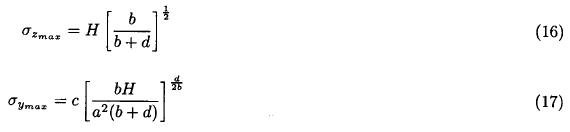
<body><![CDATA[<p align="center"><font face="verdana" size="2"><img src="/img/revistas/atm/v15n3/a5e13.jpg"></font></p>  	    <p align="justify"><font face="verdana" size="2">Since the air pollutant masses just in the wind velocity direction, i. e. along the x&#45;axis where <i>y</i> = 0, the substitution of both <i>y =</i> 0 and <i>&#948;H/&#948;x =</i> 0 into equation (5) gives:</font></p>  	    <p align="center"><font face="verdana" size="2"><img src="/img/revistas/atm/v15n3/a5e14.jpg"></font></p>  	    <p align="justify"><font face="verdana" size="2">Hence, the point of maximum ground level concentration of the pollutant has the coordinates</font></p>  	    <p align="center"><font face="verdana" size="2"><img src="/img/revistas/atm/v15n3/a5e15.jpg"></font></p>  	    <p align="justify"><font face="verdana" size="2">That is lies on the x&#45;axis.</font></p>  	    <p align="justify"><font face="verdana" size="2">Now, substituting the values of <i>x</i><i><sub>max</sub></i> into equation (2) we obtain the maximum dispersion coefficient:</font></p>  	    <p align="center"><font face="verdana" size="2"><img src="/img/revistas/atm/v15n3/a5e16.jpg"></font></p>  	    <p align="justify"><font face="verdana" size="2">Then, the maximum ground level concentration <i>&#967;<sub>max</sub></i> could be easily identified using equation (4) and (15):</font></p>  	    <p align="center"><font face="verdana" size="2"><img src="/img/revistas/atm/v15n3/a5e18.jpg"></font></p>  	    ]]></body>
<body><![CDATA[<p>&nbsp;</p>  	    <p align="justify"><font face="verdana" size="2"><b>4. Worst ground level concentration</b></font></p>  	    <p align="justify"><font face="verdana" size="2">It is well known that the release height <i>H</i> is inversely proportional to the wind velocity, <i>u</i>, hence the plume rise &#916; can be written in the form:</font></p>  	    <p align="center"><font face="verdana" size="2"><img src="/img/revistas/atm/v15n3/a5e19.jpg"></font></p>  	    <p align="justify"><font face="verdana" size="2">where <i>B</i> is a characteristic constant for every stability class and for a particular stack. To find the worst wind velocity <i>u<sub>worst</sub></i> under which, the ground level concentration has maximum value, we find <i>d&#967;/du =</i> 0. Differentiating equation (18), and taking into account that</font></p>  	    <p align="center"><font face="verdana" size="2"><img src="/img/revistas/atm/v15n3/a5e191.jpg"></font></p>  	    <p align="justify"><font face="verdana" size="2">we get</font></p>  	    <p align="center"><font face="verdana" size="2"><img src="/img/revistas/atm/v15n3/a5e20.jpg"></font></p>  	    <p align="justify"><font face="verdana" size="2">From which, the worst emission height <i>H<sub>worst</sub></i> which causes a maximum ground level concentration is given by:</font></p>  	    <p align="center"><font face="verdana" size="2"><img src="/img/revistas/atm/v15n3/a5e21.jpg"></font></p>  	    ]]></body>
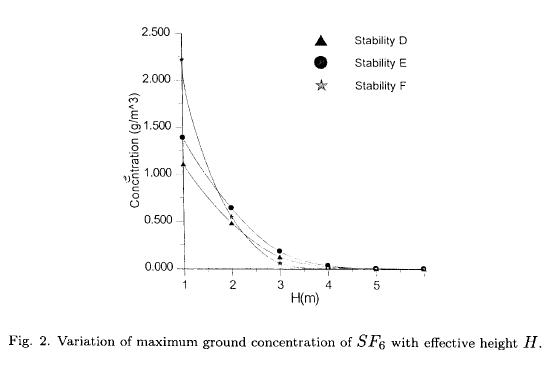
<body><![CDATA[<p align="justify"><font face="verdana" size="2">Finally, substituting <i>u<sub>worst</sub></i> and <i>H<sub>worst</sub></i> back into equation (18), we get the worst ground level concentration, namely:</font></p>  	    <p align="center"><font face="verdana" size="2"><img src="/img/revistas/atm/v15n3/a5e22.jpg"></font></p>  	    <p>&nbsp;</p>  	    <p align="justify"><font face="verdana" size="2"><b>5. Numerical study</b></font></p>  	    <p align="justify"><font face="verdana" size="2">Now, let us consider some specific data (Start and Hoover, 1995) for <i>Q =</i> 9.4 g/sec, <i>u =</i> 4.1 m/sec, and <i>D</i> = 3 m for different stability classes, namely Neutral <i>(D),</i> Slightly stable <i>(E),</i> and Stable <i>(F).</i> Using <a href="#t1">Table (1)</a> in combination of equation (10), we can obtain graphical relation between the maximum values for the ground level concentration of Sulferhexaflouride, SF<sub>6</sub> and its corresponding effective height. It is evident that such concentrations are inversely proportional to the effective height <i>H</i> as shown in <a href="#f2">Figure 2</a>.</font></p>  	    <p align="center"><font face="verdana" size="2"><a name="f2"></a></font></p>  	    <p align="center"><font face="verdana" size="2"><img src="/img/revistas/atm/v15n3/a5f2.jpg"></font></p>  	    <p>&nbsp;</p>  	    <p align="justify"><font face="verdana" size="2"><b>6. Summary and conclusions</b></font></p>  	    <p align="justify"><font face="verdana" size="2">A mathematical treatment has been proposed for the ground level concentration of a pollutant from a continuously&#45;emitted point source. An analytic solution has been obtained in two cases: (1) The effective height <i>H</i> of the pollutant is a function of the ground level coordinates <i>x</i> and <i>y</i>, i. e., <i>H = H</i> (<i>x, y</i>)<i>,</i> and (2) <i>H</i> is constant.</font></p>  	    ]]></body>
<body><![CDATA[<p align="justify"><font face="verdana" size="2">Extreme diameter of the stack has been taken into consideration. The position of maximum ground level concentration has been easily verified in the case of constancy of <i>H.</i> It was difficult to determine such position when <i>H = H</i>(<i>x, y</i>) because of the complexity of relation (9). The worst of both velocity and ground level concentration has been established in order to determine the velocity where maximum ground level concentration occurs. Numerical calculations were considered to realize the values of maximum concentration and its corresponding heights elevations in some different stability classes for SF<sub>6</sub>.</font></p>  	    <p>&nbsp;</p>  	    <p align="justify"><font face="verdana" size="2"><b>REFERENCES</b></font></p>  	    <!-- ref --><p align="justify"><font face="verdana" size="2">Csanady, G. T., 1973. Turbulent diffusion in the environment, Reidel, Dordrecht, Holland, 248 pp.    &nbsp;&nbsp;&nbsp;&nbsp;&nbsp;&nbsp;&nbsp;&nbsp;[&#160;<a href="javascript:void(0);" onclick="javascript: window.open('/scielo.php?script=sci_nlinks&ref=1251212&pid=S0187-6236200200030000500001&lng=','','width=640,height=500,resizable=yes,scrollbars=1,menubar=yes,');">Links</a>&#160;]<!-- end-ref --></font></p>  	    <!-- ref --><p align="justify"><font face="verdana" size="2">IAEA safety guide, 1983, No. 50&#45;SG&#45;S3.    &nbsp;&nbsp;&nbsp;&nbsp;&nbsp;&nbsp;&nbsp;&nbsp;[&#160;<a href="javascript:void(0);" onclick="javascript: window.open('/scielo.php?script=sci_nlinks&ref=1251214&pid=S0187-6236200200030000500002&lng=','','width=640,height=500,resizable=yes,scrollbars=1,menubar=yes,');">Links</a>&#160;]<!-- end-ref --></font></p>  	    <!-- ref --><p align="justify"><font face="verdana" size="2">Pasquill, F., 1971. Atmospheric dispersion of pollution, <i>Q. J. R. Met. Soc.,</i> 97, 369.    &nbsp;&nbsp;&nbsp;&nbsp;&nbsp;&nbsp;&nbsp;&nbsp;[&#160;<a href="javascript:void(0);" onclick="javascript: window.open('/scielo.php?script=sci_nlinks&ref=1251216&pid=S0187-6236200200030000500003&lng=','','width=640,height=500,resizable=yes,scrollbars=1,menubar=yes,');">Links</a>&#160;]<!-- end-ref --></font></p>  	    <!-- ref --><p align="justify"><font face="verdana" size="2">Ragland, K. W., 1975. Point source atmospheric diffusion model with variable wind and diffusivity profiles, <i>Atmospheric Environmental,</i> 9, 175.    &nbsp;&nbsp;&nbsp;&nbsp;&nbsp;&nbsp;&nbsp;&nbsp;[&#160;<a href="javascript:void(0);" onclick="javascript: window.open('/scielo.php?script=sci_nlinks&ref=1251218&pid=S0187-6236200200030000500004&lng=','','width=640,height=500,resizable=yes,scrollbars=1,menubar=yes,');">Links</a>&#160;]<!-- end-ref --></font></p>  	    <!-- ref --><p align="justify"><font face="verdana" size="2">Ragland, K. W., 1975. Worst case ambient air concentration from point source using the Gaussian plume model. <i>Atmospheric Environmental,</i> 10, 371.    &nbsp;&nbsp;&nbsp;&nbsp;&nbsp;&nbsp;&nbsp;&nbsp;[&#160;<a href="javascript:void(0);" onclick="javascript: window.open('/scielo.php?script=sci_nlinks&ref=1251220&pid=S0187-6236200200030000500005&lng=','','width=640,height=500,resizable=yes,scrollbars=1,menubar=yes,');">Links</a>&#160;]<!-- end-ref --></font></p>  	    <!-- ref --><p align="justify"><font face="verdana" size="2">Smith, M. E., 1973. Guide for the prediction of the dispersion of airborne effluent, ASME.    &nbsp;&nbsp;&nbsp;&nbsp;&nbsp;&nbsp;&nbsp;&nbsp;[&#160;<a href="javascript:void(0);" onclick="javascript: window.open('/scielo.php?script=sci_nlinks&ref=1251222&pid=S0187-6236200200030000500006&lng=','','width=640,height=500,resizable=yes,scrollbars=1,menubar=yes,');">Links</a>&#160;]<!-- end-ref --></font></p>  	    <!-- ref --><p align="justify"><font face="verdana" size="2">Start, G. E. and D. Hoover, 1995. Model validation program. Cape Canaveral, Florida, Technical report, NOAA Air Resources Laboratory, Field Research Division, Idaho Falls, ID.    &nbsp;&nbsp;&nbsp;&nbsp;&nbsp;&nbsp;&nbsp;&nbsp;[&#160;<a href="javascript:void(0);" onclick="javascript: window.open('/scielo.php?script=sci_nlinks&ref=1251224&pid=S0187-6236200200030000500007&lng=','','width=640,height=500,resizable=yes,scrollbars=1,menubar=yes,');">Links</a>&#160;]<!-- end-ref --></font></p>  	    <!-- ref --><p align="justify"><font face="verdana" size="2">Turner, D. B., 1970. Workbook of atmospheric dispersion estimates, U. S. Environmental Protection Agency Ap&#45;26.    &nbsp;&nbsp;&nbsp;&nbsp;&nbsp;&nbsp;&nbsp;&nbsp;[&#160;<a href="javascript:void(0);" onclick="javascript: window.open('/scielo.php?script=sci_nlinks&ref=1251226&pid=S0187-6236200200030000500008&lng=','','width=640,height=500,resizable=yes,scrollbars=1,menubar=yes,');">Links</a>&#160;]<!-- end-ref --></font></p>      ]]></body><back>
<ref-list>
<ref id="B1">
<nlm-citation citation-type="book">
<person-group person-group-type="author">
<name>
<surname><![CDATA[Csanady]]></surname>
<given-names><![CDATA[G. T.]]></given-names>
</name>
</person-group>
<source><![CDATA[Turbulent diffusion in the environment]]></source>
<year>1973</year>
<page-range>248</page-range><publisher-loc><![CDATA[Dordrecht ]]></publisher-loc>
<publisher-name><![CDATA[Reidel]]></publisher-name>
</nlm-citation>
</ref>
<ref id="B2">
<nlm-citation citation-type="">
<collab>IAEA</collab>
<source><![CDATA[safety guide]]></source>
<year>1983</year>
</nlm-citation>
</ref>
<ref id="B3">
<nlm-citation citation-type="journal">
<person-group person-group-type="author">
<name>
<surname><![CDATA[Pasquill]]></surname>
<given-names><![CDATA[F.]]></given-names>
</name>
</person-group>
<article-title xml:lang="en"><![CDATA[Atmospheric dispersion of pollution]]></article-title>
<source><![CDATA[Q. J. R. Met. Soc.]]></source>
<year>1971</year>
<volume>97</volume>
<page-range>369</page-range></nlm-citation>
</ref>
<ref id="B4">
<nlm-citation citation-type="journal">
<person-group person-group-type="author">
<name>
<surname><![CDATA[Ragland]]></surname>
<given-names><![CDATA[K. W.]]></given-names>
</name>
</person-group>
<article-title xml:lang="en"><![CDATA[Point source atmospheric diffusion model with variable wind and diffusivity profiles]]></article-title>
<source><![CDATA[Atmospheric Environmental]]></source>
<year>1975</year>
<volume>9</volume>
<page-range>175</page-range></nlm-citation>
</ref>
<ref id="B5">
<nlm-citation citation-type="journal">
<person-group person-group-type="author">
<name>
<surname><![CDATA[Ragland]]></surname>
<given-names><![CDATA[K. W.]]></given-names>
</name>
</person-group>
<article-title xml:lang="en"><![CDATA[Worst case ambient air concentration from point source using the Gaussian plume model]]></article-title>
<source><![CDATA[Atmospheric Environmental]]></source>
<year>1975</year>
<volume>10</volume>
<page-range>371</page-range></nlm-citation>
</ref>
<ref id="B6">
<nlm-citation citation-type="book">
<person-group person-group-type="author">
<name>
<surname><![CDATA[Smith]]></surname>
<given-names><![CDATA[M. E.]]></given-names>
</name>
</person-group>
<source><![CDATA[Guide for the prediction of the dispersion of airborne effluent]]></source>
<year>1973</year>
<publisher-name><![CDATA[ASME]]></publisher-name>
</nlm-citation>
</ref>
<ref id="B7">
<nlm-citation citation-type="book">
<person-group person-group-type="author">
<name>
<surname><![CDATA[Start]]></surname>
<given-names><![CDATA[G. E.]]></given-names>
</name>
<name>
<surname><![CDATA[Hoover]]></surname>
<given-names><![CDATA[D.]]></given-names>
</name>
</person-group>
<source><![CDATA[Model validation program. Cape Canaveral, Florida]]></source>
<year>1995</year>
<publisher-loc><![CDATA[Idaho Falls^eID ID]]></publisher-loc>
<publisher-name><![CDATA[NOAA Air Resources LaboratoryField Research Division]]></publisher-name>
</nlm-citation>
</ref>
<ref id="B8">
<nlm-citation citation-type="book">
<person-group person-group-type="author">
<name>
<surname><![CDATA[Turner]]></surname>
<given-names><![CDATA[D. B.]]></given-names>
</name>
</person-group>
<source><![CDATA[Workbook of atmospheric dispersion estimates]]></source>
<year>1970</year>
<page-range>26</page-range><publisher-name><![CDATA[U. S. Environmental Protection Agency]]></publisher-name>
</nlm-citation>
</ref>
</ref-list>
</back>
</article>