<?xml version="1.0" encoding="ISO-8859-1"?><article xmlns:mml="http://www.w3.org/1998/Math/MathML" xmlns:xlink="http://www.w3.org/1999/xlink" xmlns:xsi="http://www.w3.org/2001/XMLSchema-instance">
<front>
<journal-meta>
<journal-id>0187-6236</journal-id>
<journal-title><![CDATA[Atmósfera]]></journal-title>
<abbrev-journal-title><![CDATA[Atmósfera]]></abbrev-journal-title>
<issn>0187-6236</issn>
<publisher>
<publisher-name><![CDATA[Universidad Nacional Autónoma de México, Instituto de Ciencias de la Atmósfera y Cambio Climático]]></publisher-name>
</publisher>
</journal-meta>
<article-meta>
<article-id>S0187-62362000000300001</article-id>
<title-group>
<article-title xml:lang="en"><![CDATA[Spectral solar irradiance in northern Scandinavia before and after Pinatubo]]></article-title>
</title-group>
<contrib-group>
<contrib contrib-type="author">
<name>
<surname><![CDATA[ADEYEFA]]></surname>
<given-names><![CDATA[Z. D.]]></given-names>
</name>
<xref ref-type="aff" rid="A01"/>
</contrib>
<contrib contrib-type="author">
<name>
<surname><![CDATA[HOLMGREN]]></surname>
<given-names><![CDATA[B.]]></given-names>
</name>
<xref ref-type="aff" rid="A02"/>
</contrib>
<contrib contrib-type="author">
<name>
<surname><![CDATA[ADEDOKUN]]></surname>
<given-names><![CDATA[J. A.]]></given-names>
</name>
<xref ref-type="aff" rid="A03"/>
</contrib>
</contrib-group>
<aff id="A01">
<institution><![CDATA[,Federal University of Technology Department of Meteorology ]]></institution>
<addr-line><![CDATA[Akure Western]]></addr-line>
<country>Nigeria</country>
</aff>
<aff id="A02">
<institution><![CDATA[,Uppsala University Meteorological Institute ]]></institution>
<addr-line><![CDATA[Uppsala ]]></addr-line>
<country>Suecia</country>
</aff>
<aff id="A03">
<institution><![CDATA[,Obafemi Awolowo University Department of Physics ]]></institution>
<addr-line><![CDATA[Ile-Ife ]]></addr-line>
<country>Nigeria</country>
</aff>
<pub-date pub-type="pub">
<day>00</day>
<month>00</month>
<year>2000</year>
</pub-date>
<pub-date pub-type="epub">
<day>00</day>
<month>00</month>
<year>2000</year>
</pub-date>
<volume>13</volume>
<numero>3</numero>
<fpage>133</fpage>
<lpage>146</lpage>
<copyright-statement/>
<copyright-year/>
<self-uri xlink:href="http://www.scielo.org.mx/scielo.php?script=sci_arttext&amp;pid=S0187-62362000000300001&amp;lng=en&amp;nrm=iso"></self-uri><self-uri xlink:href="http://www.scielo.org.mx/scielo.php?script=sci_abstract&amp;pid=S0187-62362000000300001&amp;lng=en&amp;nrm=iso"></self-uri><self-uri xlink:href="http://www.scielo.org.mx/scielo.php?script=sci_pdf&amp;pid=S0187-62362000000300001&amp;lng=en&amp;nrm=iso"></self-uri><abstract abstract-type="short" xml:lang="es"><p><![CDATA[Mediciones de radiación solar en banda ancha y espectrales se llevaron a cabo discontinuadamente entre 1990 y 1994 en Abisko (68°21' N, 18°49' E) ubicada a 200 km al norte del Círculo Polar Artico en Suecia septentrional. El aumento en la turbiedad atmosférica debido a las enormes cantidades de aerosoles volcánicos que fueron inyectados dentro de la estratosfera por las erupciones del Monte Pinatubo, en junio de 1991, condujeron consiguientemente, a una reducción en la irradiancia directa que es considerable en la gama visible, variando de 18 a 30 % a las alturas solares de 40° a 15°, respectivamente. Aunque menor que la irradiación directa, debido al aumento concomitante en la radiación difusa, el cambio en la radiación total fue también significativa (alrededor de 1.4% y 8% a los ángulos de 40° y 15°, respectivamente).]]></p></abstract>
<abstract abstract-type="short" xml:lang="en"><p><![CDATA[Spectral and broad-band solar radiation measurements were made non-continuously between 1990 and 1994 at Abisko (68° 21' N, 18° 49' E), which is about 200 km north of the Arctic Circle in northern Sweden. The increase in the atmospheric turbidity due to the huge amounts of volcanic aerosols which were injected into the stratosphere by the volcanic eruptions of Mount Pinatubo in June 1991 consequently led to a decrease in the direct irradiance which is considerable especially in the visible region, varying between 18% and 30% at solar elevations of 40° and 15° respectively. Although less than the direct irradiance due to the concomitant increase in the diffuse radiation, the change in the total radiation was also significant (about 1.4% and 8% at solar elevation angles of 40° and 15° respectively).]]></p></abstract>
<kwd-group>
<kwd lng="es"><![CDATA[irradiancia solar]]></kwd>
<kwd lng="es"><![CDATA[Monte Pinatubo]]></kwd>
<kwd lng="es"><![CDATA[aerosol volcánico]]></kwd>
<kwd lng="en"><![CDATA[solar irradiance]]></kwd>
<kwd lng="en"><![CDATA[Mount Pinatubo]]></kwd>
<kwd lng="en"><![CDATA[volcanic aerosol]]></kwd>
</kwd-group>
</article-meta>
</front><body><![CDATA[ <p align="center"><font face="verdana" size="4"><b>Spectral solar irradiance in northern Scandinavia before and after Pinatubo</b></font></p>  	    <p align="center">&nbsp;</p>     <p align="center"><font face="verdana" size="2"><b>Z. D. ADEYEFA</b></font></p>  	    <p align="center"><font face="verdana" size="2"><i>Department of Meteorology, Federal University of Technology, Akure, Nigeria.</i></font></p> 	    <p align="center">&nbsp;</p>  	    <p align="center"><font face="verdana" size="2"><b>B. HOLMGREN</b></font></p>  	    <p align="center"><font face="verdana" size="2"><i>Meteorological Institute, Uppsala University, S&#45; 751 SO Uppsala, Sweden.</i> </font></p> 	    <p align="center">&nbsp;</p> 	    <p align="center"><font face="verdana" size="2"><b>J. A. ADEDOKUN</b></font></p>  	    <p align="center"><font face="verdana" size="2"><i>Department of Physics, Obafemi Awolowo University, Ile&#45;Ife, Nigeria.</i> </font></p> 	    ]]></body>
<body><![CDATA[<p align="center">&nbsp;</p> 	    <p align="center"><font face="verdana" size="2">(Manuscript received March 12, 1999; accepted in final form Aug. 17, 1999)</font></p>     <p align="center">&nbsp;</p>      <p align="justify"><font face="verdana" size="2"><b>RESUMEN</b></font></p>  	    <p align="justify"><font face="verdana" size="2">Mediciones de radiaci&oacute;n solar en banda ancha y espectrales se llevaron a cabo discontinuadamente entre 1990 y 1994 en Abisko (68&deg;21' N, 18&deg;49' E) ubicada a 200 km al norte del C&iacute;rculo Polar Artico en Suecia septentrional. El aumento en la turbiedad atmosf&eacute;rica debido a las enormes cantidades de aerosoles volc&aacute;nicos que fueron inyectados dentro de la estratosfera por las erupciones del Monte Pinatubo, en junio de 1991, condujeron consiguientemente, a una reducci&oacute;n en la irradiancia directa que es considerable en la gama visible, variando de 18 a 30 &#37; a las alturas solares de 40&deg; a 15&deg;, respectivamente.</font></p>  	    <p align="justify"><font face="verdana" size="2">Aunque menor que la irradiaci&oacute;n directa, debido al aumento concomitante en la radiaci&oacute;n difusa, el cambio en la radiaci&oacute;n total fue tambi&eacute;n significativa (alrededor de 1.4&#37; y 8&#37; a los &aacute;ngulos de 40&deg; y 15&deg;, respectivamente).</font></p>  	    <p align="justify"><font face="verdana" size="2"><b>Palabras clave:</b> irradiancia solar, Monte Pinatubo, aerosol volc&aacute;nico.</font></p>     <p align="justify">&nbsp;</p>      <p align="justify"><font face="verdana" size="2"><b>ABSTRACT</b></font></p>  	    <p align="justify"><font face="verdana" size="2">Spectral and broad&#45;band solar radiation measurements were made non&#45;continuously between 1990 and 1994 at Abisko (68&deg; 21' N, 18&deg; 49' E), which is about 200 km north of the Arctic Circle in northern Sweden. The increase in the atmospheric turbidity due to the huge amounts of volcanic aerosols which were injected into the stratosphere by the volcanic eruptions of Mount Pinatubo in June 1991 consequently led to a decrease in the direct irradiance which is considerable especially in the visible region, varying between 18&#37; and 30&#37; at solar elevations of 40&deg; and 15&deg; respectively. Although less than the direct irradiance due to the concomitant increase in the diffuse radiation, the change in the total radiation was also significant (about 1.4&#37; and 8&#37; at solar elevation angles of 40&deg; and 15&deg; respectively).</font></p>  	    ]]></body>
<body><![CDATA[<p align="justify"><font face="verdana" size="2"><b>Keywords:</b> solar irradiance, Mount Pinatubo, volcanic aerosol.</font></p>  	    <p align="justify">&nbsp;</p>     <p align="justify"><font face="verdana" size="2"><b>1. Introduction</b></font></p>  	    <p align="justify"><font face="verdana" size="2">The eruptions of Mount Pinatubo (15.1&deg;N, 120.4&deg;E) in June, 1991 no doubt injected large quantities of gas and aerosols into the stratosphere which are capable of altering the earth's radiation budget due particularly to volcanic aerosol forcing.</font></p>  	    <p align="justify"><font face="verdana" size="2">An obvious climatic impact of this eruption is the depletion of solar radiation arriving at the ground level. Hansen <i>et al.</i> (1992) expected the aerosol layer to have a measurable impact on surface insolation over the next few years. According to Blumthaler and Ambach (1994), the Pinatubo eruption indeed, resulted in an increase in the diffuse radiation but a decrease in both the direct and global irradiance in Switzerland. Yamauchi (1995) analyzed direct solar radiation data observed over Japan since 1933 and showed that the 1991 Pinatubo volcanic eruption had a significant effect on the observed direct irradiance and the atmospheric turbidity. Asano <i>et al.</i> (1993) measured spectral aerosol optical thicknesses (AOT) of vertical air columns by a ground&#45;based multi&#45;channel sunphotometer in Japan between January and April in 1991 and 1992. They also observed that average values of the AOTs for the post&#45;Pinatubo season were generally larger than those of the pre&#45;Pinatubo period. Several other authors (e.g. Valero and Pilewskie (1992); Trautmann <i>et al.,</i> 1992; Thomason and Poole, 1993; Hansen <i>et</i> al.,1992; Ohohori, 1992; Russel <i>et al.,</i> 1993; and others), have also investigated divers potential climatic impacts of the Mount Pinatubo volcanic eruption.</font></p>  	    <p align="justify"><font face="verdana" size="2">The impact of the reduction of solar irradiance at the ground level by aerosols of volcanic origin would most probably have a greater effect at high latitudes. This is because a dust layer of any given thickness will be most effective in reducing the solar radiation penetrating to the surface over high latitudes as a result of the oblique path of the rays of the sun through the layer.</font></p>  	    <p align="justify"><font face="verdana" size="2">We have made simultaneous spectroradiometric and pyrheliometric measurements of the direct, diffuse and global solar radiation on some cloudless days between 1990 and 1994. The experiment was carried out at Abisko (68&deg;21'N, 18&deg;49'E) in Northern Sweden. The site is situated in the middle of the Scandinavian mountain range about 200 km north of the Arctic Circle. The results of the measurements made before and after the Pinatubo eruption are discussed. A brief assessment of the solar radiation depletion arising from it is also presented.</font></p>     <p align="justify">&nbsp;</p>      <p align="justify"><font face="verdana" size="2"><b>2. Instrumental set&#45;up</b></font></p>  	    <p align="justify"><font face="verdana" size="2">The instrumental set&#45;up include a spectroradiometer and a pyrheliometer for the spectral and broad&#45;band measurements of the direct irradiance respectively. A Kipp &amp; Zonen pyranometer was used for the broad&#45;band measurements of the global radiation. Records of air temperature, pressure, and relative humidity were obtained from an automatic meteorological station.</font></p>  	    ]]></body>
<body><![CDATA[<p align="justify"><font face="verdana" size="2">A portable spectroradiometer with a trade name, LI&#45;1800 was used for the experiment. The instrument has a spectral range of 300&#45;1100 nm, a resolution of 6 nm with a wavelength accuracy of &plusmn;2 nm. Other characteristics of the instrument have been discussed in Adeyefa <i>et al.</i> (1995).</font></p>  	    <p align="justify"><font face="verdana" size="2">In 1990, a screening tube with an aperture of 9.4&deg; was used for the direct irradiance measurements. Between 1991 and 1994 on the other hand, an aperture with a 5&deg; field&#45;of&#45;view was used to meet the recommendations of the World Meteorological Organization, WMO (WCRP, 1986). Spectral direct irradiances measured with the two tubes were compared at a prevailing atmospheric turbidity coefficient at &#955; = 1<i>&#956;</i>m (<i>&#946;</i>) = 0.06 and solar elevation of about 36&deg;. The tube with 9&deg; received less than 0.5&#37; readings in the UVA region more than the one with 5&deg; field&#45;of&#45;view. No systematic differences were observed in the visible and infrared regions.</font></p>     <p align="justify"><font face="verdana" size="2">A Linke&#45;Feussner Actinometer Pyrheliometer (manufactured by Kipp &amp; Zonen) was also used to monitor the direct solar irradiance. In addition to the direct total, we employed two cutoff filters &#45; OG1 and RG2 (now known as OG530 and RG630 (WCRP, 1986)). The integrated broad&#45;band irradiances of LI&#45;1800 were compared with simultaneous measurements of the Linke&#45;Feussner Actinometer for the ranges &lt; 525 nm, &lt; 630 nm and 525 &#45; 630 nm. The comparisons showed that the pyrheliometer registered more radiation than the spectroradiometer by about 3 &#37;, 1.5&#37; and 0 &#37; respectively in the mean.</font></p>  	    <p align="justify"><font face="verdana" size="2">A third check of the LI&#45;1800 output was done by extrapolating the measured spectral irradiances to air mass zero in spectral regions where there is no selective absorption using the Langley method (Ahern <i>et al.,</i> 1991). The extrapolated values were compared with the extraterrestrial spectrum of WCRP (1986). The comparisons, made under a cloudless day with stable atmospheric stratification, were consistent with the WCRP (1986) spectrum to within 0 &#45; 4&#37; over most part of the spectrum.</font></p>     <p align="justify">&nbsp;</p>      <p align="justify"><font face="verdana" size="2"><b>3. Results and discussions</b></font></p>  	    <p align="justify"><font face="verdana" size="2"><i>3.1 Spectral solar irradiance under different turbidity conditions</i></font></p>  	    <p align="justify"><font face="verdana" size="2">The direct&#45;normal, global&#45;horizontal and diffuse&#45;horizontal spectra were measured on several occasions with the LI&#45;1800 spectroradiometer at Abisko, Sweden. The direct&#45;normal, global&#45;horizontal and diffuse&#45;horizontal spectra of 21st. August, 1992 are shown as a sample in <a href="/img/revistas/atm/v13n3/a1f1.jpg" target="_blank">Figure 1</a>.</font></p>     <p align="justify"><font face="verdana" size="2">Two typical direct irradiance curves taken on 15 July 1990 and 24 June 1992 are shown in <a href="/img/revistas/atm/v13n3/a1f2.jpg" target="_blank">Figure 2</a>. The measurements were taken at local noon but under different turbidity conditions. The significant reduction in the direct spectrum of 24 June 1992 in comparison with that of 15 July, 1990, is due to the increased atmospheric turbidity in 1992 as a result of Mount Pinatubo volcanic eruption in 1991. The significant increase in atmospheric turbidity due to the eruption has been discussed by Adeyefa <i>et al.</i> (1998). The reduction in the case of the 24 June 1992 spectra is significant in spite of the fact that the elevation angle of the sun for this occasion was higher than that of 15 July, 1990.</font></p>     <p align="justify">&nbsp;</p>     ]]></body>
<body><![CDATA[<p align="justify"><font face="verdana" size="2"><i>3.2 Comparison of the diffuse component of solar irradiance before and after Pinatubo</i></font></p>  	    <p align="justify"><font face="verdana" size="2">To compare the scattering patterns of the atmospheric aerosol before and after Pinatubo, some typical direct&#45;normal spectral irradiances measured in the two periods were normalized to the horizontal level. <a href="/img/revistas/atm/v13n3/a1f3.jpg" target="_blank">Figure 3</a> shows the diffuse&#45;to&#45;direct (horizontal) ratios of the solar irradiance at Abisko, 1990 (September 27, October 2) and in 1992 (August, 21, and September 9).</font></p>     <p align="justify"><font face="verdana" size="2">For measurements made at the same elevation and optical air mass (<i>m<sub>r</sub></i> &asymp; 3.0 and<i> m<sub>r</sub></i> &asymp; 2.2), the (horizontal) diffuse&#45;to&#45;direct ratios show a gradual increase in the diffuse radiation with wavelength in 1990 and 1992 at Abisko. Since the diffuse component generally increases with relative air mass, the higher diffuse fraction for the measurements made in 1992 at lower air mass (<i>m<sub>r</sub></i> &asymp; 2.2) compared to 1990 at a higher air mass (<i>m<sub>r</sub></i> &asymp; 3.0) is notable. The considerable difference between 1990 and 1992 is especially significant in the middle part of the spectrum and decreases towards both longer and shorter wavelengths. The two days considered in 1990 (27&#45;09&#45;90 and 02&#45;10&#45;90) were days of low turbidities <i>&#964;<sub>A</sub></i>(500) = 0.034 and 0.038 respectively&#93; and they exhibit the lowest diffuse fraction. High turbidity days (e.g. 21&#45;08&#45;92 with<i> &#964;<sub>A</sub></i>(500) = 0.226 and 09&#45;09&#45;92 with<i> &#964;<sub>A</sub></i>(500) = 0.149&#93; on the other hand, manifested higher diffuse fraction.</font></p>      <p align="justify"><font face="verdana" size="2"><a href="/img/revistas/atm/v13n3/a1f4.jpg" target="_blank">Figure 4</a> shows a similar plot for the diffuse&#45;to&#45;global ratios of the solar irradiance for the same days at Abisko, 1990 and 1992. Again, the higher component of the diffuse radiation in 1992 is apparent at all wavelengths especially above 400 nm. The arrival of the stratospheric aerosols between 1990 and 1992 therefore led to a significant increase of the diffuse component of the solar irradiance.</font></p>  	    <p align="justify">&nbsp;</p>     <p align="justify"><font face="verdana" size="2"><i>3.3 Decrease in the ground&#45;level solar irradiance at Abisko</i></font></p>  	    <p align="justify"><font face="verdana" size="2">As noted earlier, one of the major resultant effects of the presence of stratospheric aerosols, is the measurable decrease of the irradiance reaching the surface. In this section, results of spectral as well as broad&#45;band analyses of the decrease in solar irradiance reaching the surface at Abisko in 1992 (post&#45;Pinatubo) relative to 1990 (pre&#45;Pinatubo) are presented.</font></p>  	    <p align="justify"><font face="verdana" size="2">The spectral variation of the solar irradiance I(&#955;) reaching the ground&#45;level at a given location, is governed by the Bouguer&#45;Beer&#45;Lambert law given by</font></p>      <p align="center"><img src="/img/revistas/atm/v13n3/a1e1.jpg"></p>      <p align="justify"><font face="verdana" size="2">where <i>I<sub>0</sub></i>(&#955;) is the spectral irradiance of the solar radiation at the top of the Earth's atmosphere; <i>R</i> and <i>R<sub>m</sub></i> are the actual and mean sun&#45;earth distances respectively and have been included for the purpose of normalization. The parameter <i>m<sub>r</sub></i> is the relative air mass while the exponential factor, <i>&#964;</i>(&#955;), is the total optical depth.</font></p>      ]]></body>
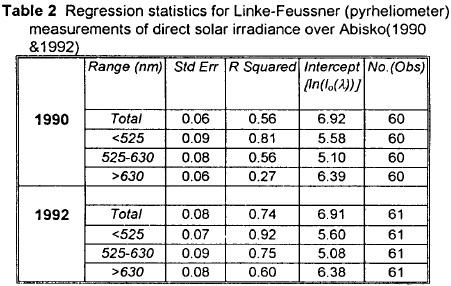
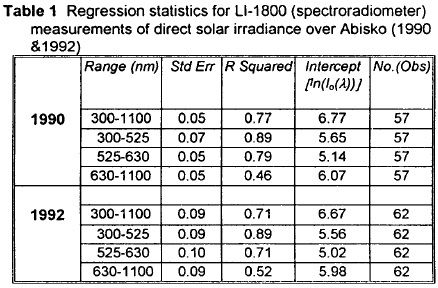
<body><![CDATA[<p align="justify"><font face="verdana" size="2">Due to the diurnal and seasonal variations of solar irradiance, it is clear that surface fluxes are strictly comparable only when measurements are made at the same location (latitude), same day of the year and with due regard to the solar elevation or the relative air mass. The decrease was therefore estimated from the normalized values of the surface fluxes to the same day in a Julian year in terms of the sun&#45;earth distance <i>(R<sub>m</sub>/R)</i> given in equation (1) which varies from day to day. It was also analysed as a function of solar elevation or the air mass.</font></p>  	    <p align="justify">&nbsp;</p>     <p align="justify"><font face="verdana" size="2"><i>3.3.1 Decrease in the direct solar irradiance</i></font></p>  	    <p align="justify"><font face="verdana" size="2">The comparison of direct solar irradiance at Abisko (1990 and 1992) as a function of air mass as measured by the spectroradiometer for the wavelength range, 0.525 &#45; 0.630 <i>&#956;</i>m are shown in <a href="/img/revistas/atm/v13n3/a1f5.jpg" target="_blank">Figure 5</a>. This limit corresponds to the cut&#45;off wavelengths of the pyrheliometric filter measurements. A similar comparison for the same wavelength range, is given in Figure 6 for the pyrheliometer. For the purpose of modelling the decrease in solar irradiance resulting from the stratospheric aerosol layer, similar analyses as those described above were also carried out for the spectroradiometric measurements for the wavelength ranges: 0.300 &#45; 0.525, 0.630 &#45; 1.1, and 0.3&#45;1.1 <i>&#956;</i>m. These wavelength intervals were chosen to compare with the range spectrally possible for the pyrheliometer. Note that the upper spectral limits are different. The curves depicting the normalized comparative direct irradiance measurements by the spectroradiometer for the intervals 0.630 &#45; 1.1, and 0.3&#45;1.1<i> &#956;</i>m&#91;not shown&#93;, are similar to that depicted in <a href="/img/revistas/atm/v13n3/a1f5.jpg" target="_blank">Figure 5</a>. For the pyrheliometer, the computations were carried out within the wavelength ranges: &#955; &le; 0.525, &#955; &ge; 630, and 0 &#45; 3.0<i> &#956;</i>min addition to the 0.525 &#45; 0.630 <i>&#956;</i>m range. The normalized pyrheliometric measurements (also not shown) for the ranges &#955; &ge; 630, and 0.3 &#45; 3.0 <i>&#956;</i>m and the previously specified ranges are similar in pattern to that of <a href="/img/revistas/atm/v13n3/a1f6.jpg" target="_blank">Figure 6</a>.</font></p>     <p align="justify"><font face="verdana" size="2">By taking the natural log of the Bouguer&#45; Beer&#45;Lambert law (equation 1), we obtain a linear relationship:</font></p>  	    <p align="center"><img src="/img/revistas/atm/v13n3/a1e2.jpg"></p>     <p align="justify"><font face="verdana" size="2">or</font></p>  	    <p align="center"><img src="/img/revistas/atm/v13n3/a1e3.jpg"></p>     <p align="justify"><font face="verdana" size="2">where In(<i>I</i>*(&#955;)) = <img src="/img/revistas/atm/v13n3/a1e4.jpg">,is the normalized values of the surface flux. Regressing In(<i>I</i>*(&#955;)) against <i>m<sub>r</sub></i> for the specified spectral ranges, regression lines were obtained from which the decrease in the direct solar irradiance in 1992 relative to 1990 was evaluated. In <a href="#t1">tables 1</a> and <a href="#t2">2</a>, some regression statistics obtained respectively from the measurements of the spectroradiometer and pyrheliometer (in 1990 and 1992) are provided. It should be mentioned, that uncertainties could result from the fact that the Bouguer&#45;Beer&#45;Lambert law applied here for the ranges specified is defined only for monochromatic wavelengths.</font></p>     <p align="center"><a name="t1"></a><img src="/img/revistas/atm/v13n3/a1t1.jpg"></p>     ]]></body>
<body><![CDATA[<p align="center"><a name="t2"></a><img src="/img/revistas/atm/v13n3/a1t2.jpg"></p>     <p align="justify"><font face="verdana" size="2"><a href="/img/revistas/atm/v13n3/a1f7.jpg" target="_blank">Figure 7</a> provides the details of the percentage decrease at the surface as computed from spectroradiometric measurements. Note the distinct decrease within the range 525&#45;630 nm especially at low solar elevation angles. At high elevation angles of about 40&deg;, the decrease within this range is about 20&#37;. This is in line with the findings of Adeyefa <i>et al.</i> (1998) indicating that the extinction due to the stratospheric aerosol is maximum around this region. As registered by the spectroradiometer, the decrease between the ultraviolet and mid&#45;visible regions (typified in the present context, by the radiation between 300 and 525 nm), is about 17&#37; at 40&deg; but increases to about 26&#37; at low solar elevation angles of about 15&deg;. The decrease within the bands 300&#45;1100 and 630&#45;1100 nm are about the same, ranging between 18 to 30&#37; at solar elevation angles of 40 and 15&deg; respectively. The analyses have been restricted to elevation angles not lower than 15&deg; to minimize errors that could be introduced at lower solar angles.</font></p>  	    <p align="justify"><font face="verdana" size="2">Relative to the low turbidity days in 1990, the pyrheliometric observations (<a href="/img/revistas/atm/v13n3/a1f8.jpg" target="_blank">Fig. 8</a>) indicate that there was a significant reduction in the direct solar irradiance in the visible region. At a solar elevation of 40&deg;, the reduction is about 16&#37; and about 32&#37; at an elevation angle of 15&deg;. As in the case of the spectroradiometer, the decrease is lower within the region 300 &#45; 525 nm (10&#37; at 40&#37;, increasing to 26&#37; at 15&deg;). Also, within the ranges 300&#45; 3000 nm and 630&#45;3000 nm, the decline of direct irradiance is essentially the same, increasing from 12 to 26&#37; at elevation angles of 40 to 15&deg;respectively.</font></p>     <p align="justify"><font face="verdana" size="2">For the purpose of comparing the results obtained from the analyses, the percentage decrease in the direct irradiance estimated from pyrheliometric data was subtracted from that computed from the spectroradiometer as a function of solar elevation. This was done for the wavelength intervals considered (<a href="/img/revistas/atm/v13n3/a1f9.jpg" target="_blank">Fig. 9</a>). Below 525 and above 630 nm, the spectroradiometer has a narrower range as previously specified although there is no significant solar irradiance at wavelengths around 300 nm. As could be seen from <a href="/img/revistas/atm/v13n3/a1f9.jpg" target="_blank">Figure 9</a>, differences in the two instruments are within 0 to 5&#37; at low solar elevations. The discrepancies increase with solar elevation and the highest difference is within the range &#955; &le; 525 nm where the difference is about 7&#37;. It is imperative to observe that the smallest difference occurred within the interval 525&#45;630 nm where the two instruments have the same spectral range.</font></p>      <p align="justify"><font face="verdana" size="2">To compare the responses of the two instruments to the incident solar radiation in 1990 and 1992, the ratio of the regression lines derived from the pyrheliometric data to that of the spectroradiometric data between July and October was taken as a function of solar elevation. This was done for the different spectral regions under consideration and the results are shown in <a href="/img/revistas/atm/v13n3/a1f10.jpg" target="_blank">Figures 10</a> and <a href="/img/revistas/atm/v13n3/a1f11.jpg" target="_blank">11</a>.</font></p>     <p align="justify"><font face="verdana" size="2">As can be seen from these figures, the differences generally decrease with increasing solar elevation. In 1990 and 1992, there were practically no differences in the r&eacute;sponses of the instruments for the range, 0.525 &#45; 0.630 nm for solar altitudes of 46 &#45; 30&deg;. At lower angles, the differences increase gradually to about 3&#45;4&#37;. For the different wavelength ranges, average values taken over the whole elevation range for the 1990 data yield 1.28, 1.03, 1.01 and 1.44 for the wavelength intervals 300&#45;1100, 300&#45;525, 525&#45;630 and 630&#45;1100 nm respectively. For 1992, the ratio give 1.34, 1.07, 1.01, and 1.54 for the intervals 300&#45;1100, 300&#45;525, 525&#45;630 and 630&#45; 1100 nm respectively. The largest differences were therefore in 1992 for all the spectral wavebands except 525 &#45; 630 nm. The curves in <a href="/img/revistas/atm/v13n3/a1f12.jpg" target="_blank">Figure 12</a> represent the percentage differences in the response of the two instruments in the two years. It resulted from subtracting the ratio of the two instruments in 1990 as expressed in <a href="/img/revistas/atm/v13n3/a1f10.jpg" target="_blank">Figure 10</a> from a similar ratio for 1992 as shown in <a href="/img/revistas/atm/v13n3/a1f11.jpg" target="_blank">Figure 11</a>.</font></p>  	    <p align="justify"><font face="verdana" size="2">Remembering that the field of view of the spectroradiometer for the direct&#45;normal measurements was changed from 9.4&deg; in 1990 to 5.0&deg; in 1991 while that of the pyrheliometer remained the same (10.2&deg;), the differences are most probably due to the fact that the pyrheliometer accepted more portion of the solar aureole in 1992 as a result of its wider aperture. The intensity of the solar aureole fluctuates with the atmospheric turbidity so that comparisons between two instruments may give different results on different occasions (WCRP, 1991).</font></p>     <p align="justify"><font face="verdana" size="2">Except for regions where the spectroradiometer has narrower ranges (especially "total" and &#955; &ge; 630 nm), the differences in the percentage decrease in the direct irradiance measured by the two instruments as shown in <a href="/img/revistas/atm/v13n3/a1f9.jpg" target="_blank">Figure 9</a> is comparable to the differences in instrumental response in the two years as shown in <a href="/img/revistas/atm/v13n3/a1f12.jpg" target="_blank">Figure 12</a>. We can therefore conclude that the differences in the decrease resulted from actual instrumental responses rather than large statistical errors or errors due to non&#45;simultaneous measurements by both the spectroradiometer and the pyrheliometer.</font></p>     <p align="justify">&nbsp;</p>      <p align="justify"><font face="verdana" size="2"><i>3.3.2 Decrease in the broad&#45;band global irradiance</i></font></p>  	    ]]></body>
<body><![CDATA[<p align="justify"><font face="verdana" size="2">The broad&#45;band global solar irradiance (10&#45;minute averages) was monitored with a Kipp &amp; Zonen pyranometer at Abisko in 1990 and 1992. <a href="/img/revistas/atm/v13n3/a1f13.jpg" target="_blank">Figure 13</a> shows the comparison of global solar irradiance for Abisko 1990 and 1992 as a function of elevation. Each data point in the figure was carefully selected to correspond to near&#45;simultaneous measurements of the direct irradiance discussed in the previous section. Dahlgren (1988) has shown that Kipp &amp; Zonen pyranometers could deviate considerably from the cosine law at solar elevations below 10&deg;. Therefore the estimations of the decrease in global irradiance have been restricted to elevations above 15&deg;.</font></p>     <p align="justify"><font face="verdana" size="2"><a href="/img/revistas/atm/v13n3/a1f14.jpg" target="_blank">Figure 14</a> shows the loss in global irradiance (in W/m<sup>2</sup>) at Abisko (1992) relative to 1990 as a function of elevation. The relative difference decreases with increasing solar altitude and is about 6 W/m<sup>2</sup> for a solar elevation of 45&deg;. The percentage decrease in the global irradiance is conspicuously lower than that of the direct irradiance. As shown in <a href="/img/revistas/atm/v13n3/a1f15.jpg" target="_blank">Figure 15</a>, the decline is as low as 1.4&#37; at a solar altitude of about 40&deg; but increases up to about 8&#37; for a low elevation angle of 15&deg;. The lower percentage decrease in the global radiation compared to the direct&#45;normal, is due to the fact that the irradiance impinging on the pyranometer also includes the scattered (diffuse) radiation which was earlier shown to have significantly increased in 1992.</font></p>  	    <p align="justify">&nbsp;</p>     <p align="justify"><font face="verdana" size="2"><i>3.3.3 Results obtained by other workers</i></font></p>  	    <p align="justify"><font face="verdana" size="2">Using a linear perturbation approach, a recent paper by Trautmann <i>et al.</i> (1992) estimated that volcanic ash aerosols can produce up to 40 Wm<sup>&minus;2</sup> decrease in the surface flux. The effect, climatologically, would be equivalent to a 3&#37; decline of surface irradiance. Their global estimate for the Mount Pinatubo eruption is about 8 to 11 Wm<sup>&minus;2</sup> reduction for the solar insolation on a day&#45;time basis. Expectedly, there are significant differences between our results for the direct irradiance and the figures they obtained. It has to be noted however, that for their model, they used a comparatively low band resolution (23 spectral intervals within 300 and 4000 nm). It is also possible that the effects of background tropospheric and stratospheric aerosols, played larger roles in the cumulative loss of surface flux than expected.</font></p>      <p align="justify"><font face="verdana" size="2">From pyrheliometric measurements made in Australia after the Mount Agung eruption of March 1963, additional attenuation of the direct irradiance by the volcanic dust cloud reached 24&#37; with a concomitant 100&#37; increase in the scattered radiation (Kondratyev, 1988). In two years, the values decreased to 10 and 30&#37; respectively. The doubling of the diffuse skylight led to only a small reduction of the total (global) radiation reaching the surface. These results, though generally broad, are in accord with the present findings.</font></p>  	    <p align="justify"><font face="verdana" size="2">Measurements between May/June, 1991 and 1992 in Switzerland by Blumthaler and Ambach (1994) showed that the Pinatubo eruption resulted in a significant increase of the diffuse radiation but a decrease of about 10&#37; in the direct total irradiance. The solar altitude of this extinction was not stated. In the present study, the estimated decrease in the direct radiation is higher than that quoted above. The differences in the attenuation of the direct irradiance could have resulted from the fact that the stratospheric aerosols scattered more direct irradiance at lower elevation angles prevalent at Abisko. It is also possible that they averaged the decline over a wide solar elevation angle. Their evaluation of the global radiation showed a decrease in the order of 4&#37; between 30&deg; and 60&deg; solar elevation. In the present case, the decrease taken over 30&deg; to 43&deg; is 4&#37;. Also in good agreement with the observations of Adeyefa <i>et al.</i> (1998) for the same location (Abisko), their estimated aerosol optical depth at 427 nm varied between 0.1 &#45; 0.2.</font></p>     <p align="justify">&nbsp;</p>      <p align="justify"><font face="verdana" size="2"><b>4. Conclusions</b></font></p>  	    <p align="justify"><font face="verdana" size="2">Results of spectral and broad&#45;band solar radiation measurements at Abisko (68&deg;21' N, 18&deg;49' E, about 200 km north of the Arctic Circle in northern Sweden) at selected periods between 1990 and 1994 have been presented.</font></p>  	    ]]></body>
<body><![CDATA[<p align="justify"><font face="verdana" size="2">The diffuse&#45;to&#45;direct (horizontal) ratios of the measured spectral irradiance, which have been used to measure the degree of scattering of solar irradiance by atmospheric dust particles and pollutants in the atmosphere, showed that for measurements made at the same elevation and optical air mass, there was an increase in the diffuse radiation in 1992 compared to 1990 in Abisko. The considerable difference between 1990 and 1992 is especially significant in the visible and longer wavelengths. The increase in the atmospheric turbidity consequently led to measurable loss in the direct and total (global) insolation at the surface. The reduction is particularly pronounced in the visible regions for the direct irradiance where there was up to 18&#37; at a solar elevation of 40&deg; and 30&#37; at 15&deg; relative to the low turbidity days in 1990. The increase in the diffuse radiation partly compensated for the large decrease in direct irradiance and therefore, the change in the total radiation was smaller, typically ranging from 1.4&#37; at a solar altitude of about 40&deg; to 8&#37; at a solar elevation of about 15&deg;.</font></p>     <p align="justify">&nbsp;</p>      <p align="justify"><font face="verdana" size="2"><b>Acknowledgements</b></font></p>  	    <p align="justify"><font face="verdana" size="2">The authors thankfully acknowledge the financial and moral support given by the International Program in the Physical Sciences (IPPS), Sweden which has been crucial to the successful completion of this research work. Our thanks are also extended to the Abisko Scientific Station, Abisko, Sweden for the generous support provided throughout the duration of the work.</font></p>     <p align="justify">&nbsp;</p>      <p align="justify"><font face="verdana" size="2"><b>REFERENCES</b></font></p>  	    <!-- ref --><p align="justify"><font face="verdana" size="2">Adeyefa, Z. D., B. Holmgren and J. A. Adedokun, 1995. Spectral Solar Irradiance Under Harmattan Conditions. <i>Int. J. Renewable Energy,</i> Vol. <b>6</b>, No 8, pp. 989 &#45; 996.    &nbsp;&nbsp;&nbsp;&nbsp;&nbsp;&nbsp;&nbsp;&nbsp;[&#160;<a href="javascript:void(0);" onclick="javascript: window.open('/scielo.php?script=sci_nlinks&ref=1245335&pid=S0187-6236200000030000100001&lng=','','width=640,height=500,resizable=yes,scrollbars=1,menubar=yes,');">Links</a>&#160;]<!-- end-ref --></font></p>  	    <!-- ref --><p align="justify"><font face="verdana" size="2">Adeyefa, Z. D., B. Holmgren and J. A. Adedokun, 1998. Aerosol Optical Depths in Northern Scandinavia Before and After Pinatubo. (Submitted for publication).    &nbsp;&nbsp;&nbsp;&nbsp;&nbsp;&nbsp;&nbsp;&nbsp;[&#160;<a href="javascript:void(0);" onclick="javascript: window.open('/scielo.php?script=sci_nlinks&ref=1245337&pid=S0187-6236200000030000100002&lng=','','width=640,height=500,resizable=yes,scrollbars=1,menubar=yes,');">Links</a>&#160;]<!-- end-ref --></font></p>  	    ]]></body>
<body><![CDATA[<!-- ref --><p align="justify"><font face="verdana" size="2">Ahern, F. J., R. P. Gauthier, P. M. Teillet, J. Sirois, G. Fedosejevs and D. Lorente, 1991. Investigations of Continental Aerosols with High&#45; Resolution Solar&#45;Extinction Measurements. <i>Appl. Optics,</i> Vol. <b>30</b>, No. 36, pp. 5276&#45;5257.    &nbsp;&nbsp;&nbsp;&nbsp;&nbsp;&nbsp;&nbsp;&nbsp;[&#160;<a href="javascript:void(0);" onclick="javascript: window.open('/scielo.php?script=sci_nlinks&ref=1245339&pid=S0187-6236200000030000100003&lng=','','width=640,height=500,resizable=yes,scrollbars=1,menubar=yes,');">Links</a>&#160;]<!-- end-ref --></font></p>  	    <!-- ref --><p align="justify"><font face="verdana" size="2">Asano, S., A. Uchiyama and M. Shiobara, 1993. Spectral Optical Thickness and size Distribution of the Pinatubo Volcanic Aerosols as Estimated by Ground&#45; Based Sunphotometry. <i>J Met. Soc. of Japan,</i> Vol. <b>71</b>, No. 1, pp. 165&#45;173.    &nbsp;&nbsp;&nbsp;&nbsp;&nbsp;&nbsp;&nbsp;&nbsp;[&#160;<a href="javascript:void(0);" onclick="javascript: window.open('/scielo.php?script=sci_nlinks&ref=1245341&pid=S0187-6236200000030000100004&lng=','','width=640,height=500,resizable=yes,scrollbars=1,menubar=yes,');">Links</a>&#160;]<!-- end-ref --></font></p>  	    <!-- ref --><p align="justify"><font face="verdana" size="2">Blumthaler, M. and W. Ambach, 1994. Changes in Solar Radiation Fluxes after the Pinatubo Eruption. <i>Tellus,</i> Vol. <b>46B</b>, pp. 76&#45;78.    &nbsp;&nbsp;&nbsp;&nbsp;&nbsp;&nbsp;&nbsp;&nbsp;[&#160;<a href="javascript:void(0);" onclick="javascript: window.open('/scielo.php?script=sci_nlinks&ref=1245343&pid=S0187-6236200000030000100005&lng=','','width=640,height=500,resizable=yes,scrollbars=1,menubar=yes,');">Links</a>&#160;]<!-- end-ref --></font></p>     <!-- ref --><p align="justify"><font face="verdana" size="2">Dahlgren, L., 1988. Cosine Response of Pyranometers Determined by Field Measurements in Norrk&ouml;ping. IEA Task IX: Solar Radiation and Pyranometry Studies.    &nbsp;&nbsp;&nbsp;&nbsp;&nbsp;&nbsp;&nbsp;&nbsp;[&#160;<a href="javascript:void(0);" onclick="javascript: window.open('/scielo.php?script=sci_nlinks&ref=1245345&pid=S0187-6236200000030000100006&lng=','','width=640,height=500,resizable=yes,scrollbars=1,menubar=yes,');">Links</a>&#160;]<!-- end-ref --></font></p>  	    <!-- ref --><p align="justify"><font face="verdana" size="2">Hansen, J. E., A. Lacis, R. Ruedy, and M. Sato, 1992. Potential Climate Impact of Mount Pinatubo Eruption. <i>Geophys. Res. Lett.,</i> <b>19</b>, pp. 215 &#45; 218.    &nbsp;&nbsp;&nbsp;&nbsp;&nbsp;&nbsp;&nbsp;&nbsp;[&#160;<a href="javascript:void(0);" onclick="javascript: window.open('/scielo.php?script=sci_nlinks&ref=1245347&pid=S0187-6236200000030000100007&lng=','','width=640,height=500,resizable=yes,scrollbars=1,menubar=yes,');">Links</a>&#160;]<!-- end-ref --></font></p>  	    ]]></body>
<body><![CDATA[<!-- ref --><p align="justify"><font face="verdana" size="2">Kondratyev, K. Y., 1988. Volcanoes and Climate. World Climate Programme, WCP&#45;54, WMO/TD &#45; No. 166, 103 pp.    &nbsp;&nbsp;&nbsp;&nbsp;&nbsp;&nbsp;&nbsp;&nbsp;[&#160;<a href="javascript:void(0);" onclick="javascript: window.open('/scielo.php?script=sci_nlinks&ref=1245349&pid=S0187-6236200000030000100008&lng=','','width=640,height=500,resizable=yes,scrollbars=1,menubar=yes,');">Links</a>&#160;]<!-- end-ref --></font></p>  	    <!-- ref --><p align="justify"><font face="verdana" size="2">Ohohori, S., 1992. Effects of the 1992 Pinatubo Volcanic Eruptions on the Solar Irradiance. Kishou, Vol. <b>36</b>, pp. 12108&#45;12111.    &nbsp;&nbsp;&nbsp;&nbsp;&nbsp;&nbsp;&nbsp;&nbsp;[&#160;<a href="javascript:void(0);" onclick="javascript: window.open('/scielo.php?script=sci_nlinks&ref=1245351&pid=S0187-6236200000030000100009&lng=','','width=640,height=500,resizable=yes,scrollbars=1,menubar=yes,');">Links</a>&#160;]<!-- end-ref --></font></p>  	    <!-- ref --><p align="justify"><font face="verdana" size="2">Russel, P. B., J. M. Livingston, E. G. Dutton, R. F. Pueschel, J. A. Reagan, T. E. Defoor, M. A. Box, D. Allen, P. Pilewskie, B. M. Herman, S. A. Kinne, and D. J. Hofmann, 1993. Pinatubo and Pre &#45; Pinatubo Optical Depth Spectra: Mauna Loa Measurements, Comparisons, Inferred Particle Size Distributions, and Relationship to Lidar Data. <i>J. Geophys. Res.,</i> Vol. <b>98</b>, No. D12, pp. 22,296&#45;22,985.    &nbsp;&nbsp;&nbsp;&nbsp;&nbsp;&nbsp;&nbsp;&nbsp;[&#160;<a href="javascript:void(0);" onclick="javascript: window.open('/scielo.php?script=sci_nlinks&ref=1245353&pid=S0187-6236200000030000100010&lng=','','width=640,height=500,resizable=yes,scrollbars=1,menubar=yes,');">Links</a>&#160;]<!-- end-ref --></font></p>  	    <!-- ref --><p align="justify"><font face="verdana" size="2">Thomason, L. W. And L. R. Poole, 1993. Use of Stratospheric Aerosol Properties as Diagnostics of Antarctic Vortex Processes. <i>J. Geophys. Res.,</i> Vol. <b>98</b>, No. D12, pp. 23,003 &#45; 23,012.    &nbsp;&nbsp;&nbsp;&nbsp;&nbsp;&nbsp;&nbsp;&nbsp;[&#160;<a href="javascript:void(0);" onclick="javascript: window.open('/scielo.php?script=sci_nlinks&ref=1245355&pid=S0187-6236200000030000100011&lng=','','width=640,height=500,resizable=yes,scrollbars=1,menubar=yes,');">Links</a>&#160;]<!-- end-ref --></font></p>  	    <!-- ref --><p align="justify"><font face="verdana" size="2">Trautmann, T., P. J. Elliot and M. A. Box, 1992. Short&#45;wave Radiative Effects of Standard Aerosol Models: A Perturbation Approach. <i>Beitr. Phys. Atmosph.,</i> Vol. <b>65</b>, No. 1. pp. 59 &#45;78.    &nbsp;&nbsp;&nbsp;&nbsp;&nbsp;&nbsp;&nbsp;&nbsp;[&#160;<a href="javascript:void(0);" onclick="javascript: window.open('/scielo.php?script=sci_nlinks&ref=1245357&pid=S0187-6236200000030000100012&lng=','','width=640,height=500,resizable=yes,scrollbars=1,menubar=yes,');">Links</a>&#160;]<!-- end-ref --></font></p>  	    ]]></body>
<body><![CDATA[<!-- ref --><p align="justify"><font face="verdana" size="2">Valero F. P. J., and P. Pilewskie, 1992. Latitudinal Survey of Spectral Optical Depths of the Pinatubo Volcanic Cloud &#45; Derived Particle Sizes, Columnar Mass Loadings, and Effects on Planetary Albedo. <i>Geoph. Res. Lett.,</i> Vol. <b>19</b>, No. 2, pp. 163 &#45; 166.    &nbsp;&nbsp;&nbsp;&nbsp;&nbsp;&nbsp;&nbsp;&nbsp;[&#160;<a href="javascript:void(0);" onclick="javascript: window.open('/scielo.php?script=sci_nlinks&ref=1245359&pid=S0187-6236200000030000100013&lng=','','width=640,height=500,resizable=yes,scrollbars=1,menubar=yes,');">Links</a>&#160;]<!-- end-ref --></font></p>  	    <!-- ref --><p align="justify"><font face="verdana" size="2">WCRP (World Climate Research Programme), 1986. Revised Instruction Manual On Radiation Instruments and Measurements. WMO/TD &#45; No. 149, pp. 77 &#45; 78; 119 &#45; 126.    &nbsp;&nbsp;&nbsp;&nbsp;&nbsp;&nbsp;&nbsp;&nbsp;[&#160;<a href="javascript:void(0);" onclick="javascript: window.open('/scielo.php?script=sci_nlinks&ref=1245361&pid=S0187-6236200000030000100014&lng=','','width=640,height=500,resizable=yes,scrollbars=1,menubar=yes,');">Links</a>&#160;]<!-- end-ref --></font></p>  	    <!-- ref --><p align="justify"><font face="verdana" size="2">WCRP (World Climate Research Programme), 1991. Radiation and Climate (Second Workshop on the Implementation of the Baseline Surface Radiation Network, Davos, Switzerland, 6&#45;9 August, 1991) WMO/TD &#45; No. 453, p. 3.    &nbsp;&nbsp;&nbsp;&nbsp;&nbsp;&nbsp;&nbsp;&nbsp;[&#160;<a href="javascript:void(0);" onclick="javascript: window.open('/scielo.php?script=sci_nlinks&ref=1245363&pid=S0187-6236200000030000100015&lng=','','width=640,height=500,resizable=yes,scrollbars=1,menubar=yes,');">Links</a>&#160;]<!-- end-ref --></font></p>  	    <!-- ref --><p align="justify"><font face="verdana" size="2">Yamauchi, T., 1995. Statistical Analysis of Atmospheric Turbidity over Japan: The Influence of Three Volcanic Eruptions. <i>J. Met. Soc. of Japan,</i> Vol. <b>73</b>, No. 1, pp. 91&#45;103.    &nbsp;&nbsp;&nbsp;&nbsp;&nbsp;&nbsp;&nbsp;&nbsp;[&#160;<a href="javascript:void(0);" onclick="javascript: window.open('/scielo.php?script=sci_nlinks&ref=1245365&pid=S0187-6236200000030000100016&lng=','','width=640,height=500,resizable=yes,scrollbars=1,menubar=yes,');">Links</a>&#160;]<!-- end-ref --></font></p>      ]]></body><back>
<ref-list>
<ref id="B1">
<nlm-citation citation-type="journal">
<person-group person-group-type="author">
<name>
<surname><![CDATA[Adeyefa]]></surname>
<given-names><![CDATA[Z. D.]]></given-names>
</name>
<name>
<surname><![CDATA[Holmgren]]></surname>
<given-names><![CDATA[B.]]></given-names>
</name>
<name>
<surname><![CDATA[Adedokun]]></surname>
<given-names><![CDATA[J. A.]]></given-names>
</name>
</person-group>
<article-title xml:lang="en"><![CDATA[Spectral Solar Irradiance Under Harmattan Conditions]]></article-title>
<source><![CDATA[Int. J. Renewable Energy]]></source>
<year>1995</year>
<volume>6</volume>
<numero>8</numero>
<issue>8</issue>
<page-range>989 - 996</page-range></nlm-citation>
</ref>
<ref id="B2">
<nlm-citation citation-type="">
<person-group person-group-type="author">
<name>
<surname><![CDATA[Adeyefa]]></surname>
<given-names><![CDATA[Z. D.]]></given-names>
</name>
<name>
<surname><![CDATA[Holmgren]]></surname>
<given-names><![CDATA[B.]]></given-names>
</name>
<name>
<surname><![CDATA[Adedokun]]></surname>
<given-names><![CDATA[J. A.]]></given-names>
</name>
</person-group>
<source><![CDATA[Aerosol Optical Depths in Northern Scandinavia Before and After Pinatubo]]></source>
<year>1998</year>
</nlm-citation>
</ref>
<ref id="B3">
<nlm-citation citation-type="journal">
<person-group person-group-type="author">
<name>
<surname><![CDATA[Ahern]]></surname>
<given-names><![CDATA[F. J.]]></given-names>
</name>
<name>
<surname><![CDATA[Gauthier]]></surname>
<given-names><![CDATA[R. P.]]></given-names>
</name>
<name>
<surname><![CDATA[Teillet]]></surname>
<given-names><![CDATA[P. M.]]></given-names>
</name>
<name>
<surname><![CDATA[Sirois]]></surname>
<given-names><![CDATA[J.]]></given-names>
</name>
<name>
<surname><![CDATA[Fedosejevs]]></surname>
<given-names><![CDATA[G.]]></given-names>
</name>
<name>
<surname><![CDATA[Lorente]]></surname>
<given-names><![CDATA[D.]]></given-names>
</name>
</person-group>
<article-title xml:lang="en"><![CDATA[Investigations of Continental Aerosols with High- Resolution Solar-Extinction Measurements]]></article-title>
<source><![CDATA[Appl. Optics]]></source>
<year>1991</year>
<volume>30</volume>
<numero>36</numero>
<issue>36</issue>
<page-range>5276-5257</page-range></nlm-citation>
</ref>
<ref id="B4">
<nlm-citation citation-type="journal">
<person-group person-group-type="author">
<name>
<surname><![CDATA[Asano]]></surname>
<given-names><![CDATA[S.]]></given-names>
</name>
<name>
<surname><![CDATA[Uchiyama]]></surname>
<given-names><![CDATA[A.]]></given-names>
</name>
<name>
<surname><![CDATA[Shiobara]]></surname>
<given-names><![CDATA[M.]]></given-names>
</name>
</person-group>
<article-title xml:lang="en"><![CDATA[Spectral Optical Thickness and size Distribution of the Pinatubo Volcanic Aerosols as Estimated by Ground- Based Sunphotometry]]></article-title>
<source><![CDATA[J Met. Soc. of Japan]]></source>
<year>1993</year>
<volume>71</volume>
<numero>1</numero>
<issue>1</issue>
<page-range>165-173</page-range></nlm-citation>
</ref>
<ref id="B5">
<nlm-citation citation-type="journal">
<person-group person-group-type="author">
<name>
<surname><![CDATA[Blumthaler]]></surname>
<given-names><![CDATA[M.]]></given-names>
</name>
<name>
<surname><![CDATA[Ambach]]></surname>
<given-names><![CDATA[W.]]></given-names>
</name>
</person-group>
<article-title xml:lang="en"><![CDATA[Changes in Solar Radiation Fluxes after the Pinatubo Eruption]]></article-title>
<source><![CDATA[Tellus]]></source>
<year>1994</year>
<volume>46B</volume>
<page-range>76-78</page-range></nlm-citation>
</ref>
<ref id="B6">
<nlm-citation citation-type="">
<person-group person-group-type="author">
<name>
<surname><![CDATA[Dahlgren]]></surname>
<given-names><![CDATA[L.]]></given-names>
</name>
</person-group>
<article-title xml:lang="en"><![CDATA[Cosine Response of Pyranometers Determined by Field Measurements in Norrköping]]></article-title>
<source><![CDATA[IEA Task IX: Solar Radiation and Pyranometry Studies]]></source>
<year>1988</year>
</nlm-citation>
</ref>
<ref id="B7">
<nlm-citation citation-type="journal">
<person-group person-group-type="author">
<name>
<surname><![CDATA[Hansen]]></surname>
<given-names><![CDATA[J. E.]]></given-names>
</name>
<name>
<surname><![CDATA[Lacis]]></surname>
<given-names><![CDATA[A.]]></given-names>
</name>
<name>
<surname><![CDATA[Ruedy]]></surname>
<given-names><![CDATA[R.]]></given-names>
</name>
<name>
<surname><![CDATA[Sato]]></surname>
<given-names><![CDATA[M.]]></given-names>
</name>
</person-group>
<article-title xml:lang="en"><![CDATA[Potential Climate Impact of Mount Pinatubo Eruption]]></article-title>
<source><![CDATA[Geophys. Res. Lett.]]></source>
<year>1992</year>
<volume>19</volume>
<page-range>215 - 218</page-range></nlm-citation>
</ref>
<ref id="B8">
<nlm-citation citation-type="book">
<person-group person-group-type="author">
<name>
<surname><![CDATA[Kondratyev]]></surname>
<given-names><![CDATA[K. Y.]]></given-names>
</name>
</person-group>
<source><![CDATA[Volcanoes and Climate]]></source>
<year>1988</year>
<page-range>103</page-range><publisher-name><![CDATA[World Climate Programme]]></publisher-name>
</nlm-citation>
</ref>
<ref id="B9">
<nlm-citation citation-type="journal">
<person-group person-group-type="author">
<name>
<surname><![CDATA[Ohohori]]></surname>
<given-names><![CDATA[S.]]></given-names>
</name>
</person-group>
<article-title xml:lang="en"><![CDATA[Effects of the 1992 Pinatubo Volcanic Eruptions on the Solar Irradiance]]></article-title>
<source><![CDATA[Kishou]]></source>
<year>1992</year>
<volume>36</volume>
<page-range>12108-12111</page-range></nlm-citation>
</ref>
<ref id="B10">
<nlm-citation citation-type="journal">
<person-group person-group-type="author">
<name>
<surname><![CDATA[Russel]]></surname>
<given-names><![CDATA[P. B.]]></given-names>
</name>
<name>
<surname><![CDATA[Livingston]]></surname>
<given-names><![CDATA[J. M.]]></given-names>
</name>
<name>
<surname><![CDATA[Dutton]]></surname>
<given-names><![CDATA[E. G.]]></given-names>
</name>
<name>
<surname><![CDATA[Pueschel]]></surname>
<given-names><![CDATA[R. F.]]></given-names>
</name>
<name>
<surname><![CDATA[Reagan]]></surname>
<given-names><![CDATA[J. A.]]></given-names>
</name>
<name>
<surname><![CDATA[Defoor]]></surname>
<given-names><![CDATA[T. E.]]></given-names>
</name>
<name>
<surname><![CDATA[Box]]></surname>
<given-names><![CDATA[M. A.]]></given-names>
</name>
<name>
<surname><![CDATA[Allen]]></surname>
<given-names><![CDATA[D.]]></given-names>
</name>
<name>
<surname><![CDATA[Pilewskie]]></surname>
<given-names><![CDATA[P.]]></given-names>
</name>
<name>
<surname><![CDATA[Herman]]></surname>
<given-names><![CDATA[B. M.]]></given-names>
</name>
<name>
<surname><![CDATA[Kinne]]></surname>
<given-names><![CDATA[S. A.]]></given-names>
</name>
<name>
<surname><![CDATA[Hofmann]]></surname>
<given-names><![CDATA[D. J.]]></given-names>
</name>
</person-group>
<article-title xml:lang="en"><![CDATA[Pinatubo and Pre - Pinatubo Optical Depth Spectra: Mauna Loa Measurements, Comparisons, Inferred Particle Size Distributions, and Relationship to Lidar Data]]></article-title>
<source><![CDATA[J. Geophys. Res.]]></source>
<year>1993</year>
<volume>98</volume>
<numero>D12</numero>
<issue>D12</issue>
<page-range>22,296-22,985</page-range></nlm-citation>
</ref>
<ref id="B11">
<nlm-citation citation-type="journal">
<person-group person-group-type="author">
<name>
<surname><![CDATA[Thomason]]></surname>
<given-names><![CDATA[L. W.]]></given-names>
</name>
<name>
<surname><![CDATA[Poole]]></surname>
<given-names><![CDATA[L. R.]]></given-names>
</name>
</person-group>
<article-title xml:lang="en"><![CDATA[Use of Stratospheric Aerosol Properties as Diagnostics of Antarctic Vortex Processes]]></article-title>
<source><![CDATA[J. Geophys. Res.]]></source>
<year>1993</year>
<volume>98</volume>
<numero>D12</numero>
<issue>D12</issue>
<page-range>23,003 - 23,012</page-range></nlm-citation>
</ref>
<ref id="B12">
<nlm-citation citation-type="journal">
<person-group person-group-type="author">
<name>
<surname><![CDATA[Trautmann]]></surname>
<given-names><![CDATA[T.]]></given-names>
</name>
<name>
<surname><![CDATA[Elliot]]></surname>
<given-names><![CDATA[P. J.]]></given-names>
</name>
<name>
<surname><![CDATA[Box]]></surname>
<given-names><![CDATA[M. A.]]></given-names>
</name>
</person-group>
<article-title xml:lang="en"><![CDATA[Short-wave Radiative Effects of Standard Aerosol Models: A Perturbation Approach]]></article-title>
<source><![CDATA[Beitr. Phys. Atmosph.]]></source>
<year>1992</year>
<volume>65</volume>
<numero>1</numero>
<issue>1</issue>
<page-range>59 -78</page-range></nlm-citation>
</ref>
<ref id="B13">
<nlm-citation citation-type="journal">
<person-group person-group-type="author">
<name>
<surname><![CDATA[Valero]]></surname>
<given-names><![CDATA[F. P. J.]]></given-names>
</name>
<name>
<surname><![CDATA[Pilewskie]]></surname>
<given-names><![CDATA[P.]]></given-names>
</name>
</person-group>
<article-title xml:lang="en"><![CDATA[Latitudinal Survey of Spectral Optical Depths of the Pinatubo Volcanic Cloud - Derived Particle Sizes, Columnar Mass Loadings, and Effects on Planetary Albedo]]></article-title>
<source><![CDATA[Geoph. Res. Lett.]]></source>
<year>1992</year>
<volume>19</volume>
<numero>2</numero>
<issue>2</issue>
<page-range>163 - 166</page-range></nlm-citation>
</ref>
<ref id="B14">
<nlm-citation citation-type="">
<collab>World Climate Research Programme</collab>
<source><![CDATA[Revised Instruction Manual On Radiation Instruments and Measurements]]></source>
<year>1986</year>
<page-range>77 - 78</page-range></nlm-citation>
</ref>
<ref id="B15">
<nlm-citation citation-type="">
<collab>World Climate Research Programme</collab>
<article-title xml:lang="en"><![CDATA[Radiation and Climate]]></article-title>
<source><![CDATA[Second Workshop on the Implementation of the Baseline Surface Radiation Network]]></source>
<year>1991</year>
<month>6-</month>
<day>9 </day>
<page-range>3</page-range><publisher-loc><![CDATA[Davos ]]></publisher-loc>
</nlm-citation>
</ref>
<ref id="B16">
<nlm-citation citation-type="journal">
<person-group person-group-type="author">
<name>
<surname><![CDATA[Yamauchi]]></surname>
<given-names><![CDATA[T.]]></given-names>
</name>
</person-group>
<article-title xml:lang="en"><![CDATA[Statistical Analysis of Atmospheric Turbidity over Japan: The Influence of Three Volcanic Eruptions]]></article-title>
<source><![CDATA[J. Met. Soc. of Japan]]></source>
<year>1995</year>
<volume>73</volume>
<numero>1</numero>
<issue>1</issue>
<page-range>91-103</page-range></nlm-citation>
</ref>
</ref-list>
</back>
</article>