<?xml version="1.0" encoding="ISO-8859-1"?><article xmlns:mml="http://www.w3.org/1998/Math/MathML" xmlns:xlink="http://www.w3.org/1999/xlink" xmlns:xsi="http://www.w3.org/2001/XMLSchema-instance">
<front>
<journal-meta>
<journal-id>0187-3180</journal-id>
<journal-title><![CDATA[Revista mexicana de micología]]></journal-title>
<abbrev-journal-title><![CDATA[Rev. Mex. Mic]]></abbrev-journal-title>
<issn>0187-3180</issn>
<publisher>
<publisher-name><![CDATA[Sociedad Mexicana de Micología]]></publisher-name>
</publisher>
</journal-meta>
<article-meta>
<article-id>S0187-31802014000200006</article-id>
<title-group>
<article-title xml:lang="en"><![CDATA[Antagonistic properties of micromycetes isolated from sinkholes of the Yucatán Península against fungal phytopathogens]]></article-title>
<article-title xml:lang="es"><![CDATA[Propiedades antagonistas de micromicetos aislados de cenotes de la península de Yucatán contra hongos fitopatógenos]]></article-title>
</title-group>
<contrib-group>
<contrib contrib-type="author">
<name>
<surname><![CDATA[Moreno-Pérez]]></surname>
<given-names><![CDATA[Pablo]]></given-names>
</name>
<xref ref-type="aff" rid="A01"/>
</contrib>
<contrib contrib-type="author">
<name>
<surname><![CDATA[Gamboa-Angulo]]></surname>
<given-names><![CDATA[Marcela]]></given-names>
</name>
<xref ref-type="aff" rid="A01"/>
</contrib>
<contrib contrib-type="author">
<name>
<surname><![CDATA[Heredia]]></surname>
<given-names><![CDATA[Gabriela]]></given-names>
</name>
<xref ref-type="aff" rid="A02"/>
</contrib>
<contrib contrib-type="author">
<name>
<surname><![CDATA[Canto-Canché]]></surname>
<given-names><![CDATA[Blondy]]></given-names>
</name>
<xref ref-type="aff" rid="A01"/>
</contrib>
<contrib contrib-type="author">
<name>
<surname><![CDATA[Rosado-Vallado]]></surname>
<given-names><![CDATA[Miguel]]></given-names>
</name>
<xref ref-type="aff" rid="A03"/>
</contrib>
<contrib contrib-type="author">
<name>
<surname><![CDATA[Medina-Baizabat]]></surname>
<given-names><![CDATA[Irma L.]]></given-names>
</name>
<xref ref-type="aff" rid="A01"/>
</contrib>
<contrib contrib-type="author">
<name>
<surname><![CDATA[Tapia-Tussell]]></surname>
<given-names><![CDATA[Raúl]]></given-names>
</name>
<xref ref-type="aff" rid="A01"/>
</contrib>
</contrib-group>
<aff id="A01">
<institution><![CDATA[,Centro de Investigación Científica de Yucatán Unidad de Biotecnología ]]></institution>
<addr-line><![CDATA[Mérida Yucatán]]></addr-line>
<country>México</country>
</aff>
<aff id="A02">
<institution><![CDATA[,Instituto de Ecología, A.C Red de Biodiversidad y Sistemática ]]></institution>
<addr-line><![CDATA[Jalapa Veracruz]]></addr-line>
<country>México</country>
</aff>
<aff id="A03">
<institution><![CDATA[,Universidad Autónoma de Yucatán Centro de Investigación Regional Hideyo Noguchi ]]></institution>
<addr-line><![CDATA[Mérida Yucatán]]></addr-line>
<country>México</country>
</aff>
<pub-date pub-type="pub">
<day>00</day>
<month>00</month>
<year>2014</year>
</pub-date>
<pub-date pub-type="epub">
<day>00</day>
<month>00</month>
<year>2014</year>
</pub-date>
<volume>40</volume>
<fpage>27</fpage>
<lpage>36</lpage>
<copyright-statement/>
<copyright-year/>
<self-uri xlink:href="http://www.scielo.org.mx/scielo.php?script=sci_arttext&amp;pid=S0187-31802014000200006&amp;lng=en&amp;nrm=iso"></self-uri><self-uri xlink:href="http://www.scielo.org.mx/scielo.php?script=sci_abstract&amp;pid=S0187-31802014000200006&amp;lng=en&amp;nrm=iso"></self-uri><self-uri xlink:href="http://www.scielo.org.mx/scielo.php?script=sci_pdf&amp;pid=S0187-31802014000200006&amp;lng=en&amp;nrm=iso"></self-uri><abstract abstract-type="short" xml:lang="en"><p><![CDATA[In the search for natural alternatives to control fungal diseases, antagonistic fungi are valuable sources to find new models. In the present study, a total of 41 tropical micromycetes were isolated from plant debris submerged in sinkholes of the Yucatán Península. All strains were tested in antagonist assays against four phytopathogenic fungi (Colletotrichum gloeosporioides, Corynespora cassiicola, Curvularia sp. and Fusarium sp.). Results of the antagonistic assays showed mycelial growth inhibition (MCI &#8805;50 %) by 17 isolates (41 %) against at least one of the targets tested. The highest inhibition was exhibited by the Hypocrea lixii OSN-37 (MCI=61-77%) and Rhizoctonia solani OSE-73 (MCI=55-64%) strains against all targets while Pestalotiopsis mangiferae OH-02 (51-59%) caused inhibition on three of four pathogen strains. These three strains were cultured in fermented rice to obtain their ethyl acetate and methanol extracts which were tested against C. gloeosporioides using the microdilution assay. Results showed H. lixii OSN-37 and R. solani OSE-73 to be producers of antifungal metabolites as one of their modes of action. In conclusion, three promising antagonistic native strains were isolated from plant debris submerged in the Yucatán sinkholes, representing a valuable contribution to the development of ecofriendly alternatives to control fungal diseases in agriculture crops of the tropical regions.]]></p></abstract>
<abstract abstract-type="short" xml:lang="es"><p><![CDATA[En la búsqueda de alternativas naturales para el control de enfermedades fúngicas, los micromicetos con propiedades antagónicas son considerados una fuente valiosa para detectar modelos novedosos. En el presente estudio, un total de 41 micromicetes tropicales se aislaron a partir de restos vegetales sumergidos en cenotes de la Península de Yucatán. Todas las cepas se evaluaron en ensayos antagonistas contra cuatro hongos fitopatógenos (Colletotrichum gloeosporioides, Corynespora cassiicola, Curvularia sp. y Fusarium sp.). Los resultados de este ensayo detectaron que 17 aislamientos (41 %) provocaron &#8805; 50 % de inhibición del crecimiento micelial (MCI &#8805; 50 %) de al menos uno de los patógenos evaluados. La inhibición más alta fue ocasionada por las cepas Hypocrea lixii OSN-37 (MCI = 61-77 %) y Rhizoctonia solani OSE-73 (MCI = 55-64 %) contra todos los objetivos, mientras que Pestalotiopsis mangiferae OH - 02 (51 -59%) causó la inhibición en tres de las cuatro cepas patógenas. Las cepas antagonistas con mejores resultados fueron cultivadas en arroz fermentado para obtener sus correspondientes extractos de acetato de etilo y metanol los cuales se evaluaron contra C. gloeosporioides en ensayo de microdilución. Los resultados indicaron que H. lixii OSN-37 y R. solani OSE- 73 son productores de metabolitos antifúngicos como uno de sus modos de acción. En conclusion, tres cepas nativas promisorias como antagonistas de fitopatógenos se aislaron de los cenotes de la península de Yucatán, lo que representa una valiosa contribución para desarrollar alternativas eco-amigables en el control de enfermedades fúngicas que afectan los cultivos agrícolas en regiones tropicales.]]></p></abstract>
<kwd-group>
<kwd lng="en"><![CDATA[antagonist]]></kwd>
<kwd lng="en"><![CDATA[Hypocrea lixii]]></kwd>
<kwd lng="en"><![CDATA[micromycetes]]></kwd>
<kwd lng="en"><![CDATA[Pestalotiopsis mangiferae]]></kwd>
<kwd lng="en"><![CDATA[sinkhole]]></kwd>
<kwd lng="en"><![CDATA[Rhizoctonia solani]]></kwd>
<kwd lng="es"><![CDATA[antagonista]]></kwd>
<kwd lng="es"><![CDATA[Hypocrea lixii]]></kwd>
<kwd lng="es"><![CDATA[micromicetos]]></kwd>
<kwd lng="es"><![CDATA[Pestalotiopsis mangiferae]]></kwd>
<kwd lng="es"><![CDATA[cenote]]></kwd>
<kwd lng="es"><![CDATA[Rhizoctonia solani]]></kwd>
</kwd-group>
</article-meta>
</front><body><![CDATA[  	    <p align="justify"><font face="verdana" size="4">Contributions</font></p>      <p>&nbsp;</p>  	    <p align="center"><font face="verdana" size="4"><b>Antagonistic properties of micromycetes isolated from sinkholes of the Yucat&aacute;n Pen&iacute;nsula against fungal phytopathogens</b></font></p>  	    <p>&nbsp;</p>  	    <p align="center"><font face="verdana" size="3"><b>Propiedades antagonistas de micromicetos aislados de cenotes de la pen&iacute;nsula de Yucat&aacute;n contra hongos fitopat&oacute;genos</b></font></p>  	    <p>&nbsp;</p>  	    <p align="center"><font face="verdana" size="2"><b>Pablo Moreno&#45;P&eacute;rez<sup>1</sup>, Marcela Gamboa&#45;Angulo<sup>1*</sup>, Gabriela Heredia<sup>2</sup>, Blondy Canto&#45;Canch&eacute;<sup>1</sup> Miguel Rosado&#45;Vallado<sup>3</sup>, Irma L. Medina&#45;Baizabat<sup>1</sup> y Ra&uacute;l Tapia&#45;Tussell<sup>1</sup></b></font></p>  	    <p>&nbsp;</p>  	    <p align="justify"><font face="verdana" size="2"><i><sup>1</sup> Unidad de Biotecnolog&iacute;a, Centro de Investigaci&oacute;n Cient&iacute;fica de Yucat&aacute;n, Metida 97200, Yucat&aacute;n, M&eacute;xico.</i></font></p>  	    ]]></body>
<body><![CDATA[<p align="justify"><font face="verdana" size="2"><i><sup>2</sup> Red de Biodiversidad y Sistem&aacute;tica, Instituto de Ecolog&iacute;a A.C., Km 2.5 antigua carretera a Coatepec No. 351, Xalapa 91070, Veracruz, M&eacute;xico.</i></font></p>  	    <p align="justify"><font face="verdana" size="2"><i><sup>3</sup> Centro de Investigaci&oacute;n Regional "Hideyo Noguchi", Universidad Aut&oacute;noma de Yucat&aacute;n, M&eacute;xico.</i></font></p>  	    <p>&nbsp;</p> 	    <p><font face="verdana" size="2"><b>* Autor para correspondencia:</b>    <br> 	Marcela Gamboa&#45;Angulo <a href="mailto:mmarcela@cicy.mx">mmarcela@cicy.mx</a></font></p> 	    <p>&nbsp;</p>  	    <p align="justify"><font face="verdana" size="2">Received 22 January 2014.    <br> 	Accepted 30 June 2014.</font></p>  	    <p>&nbsp;</p>  	    <p align="justify"><font face="verdana" size="2"><b>Abstract</b></font></p>  	    ]]></body>
<body><![CDATA[<p align="justify"><font face="verdana" size="2">In the search for natural alternatives to control fungal diseases, antagonistic fungi are valuable sources to find new models. In the present study, a total of 41 tropical micromycetes were isolated from plant debris submerged in sinkholes of the Yucat&aacute;n Pen&iacute;nsula. All strains were tested in antagonist assays against four phytopathogenic fungi (<i>Colletotrichum gloeosporioides, Corynespora cassiicola, Curvularia</i> sp. and <i>Fusarium</i> sp.). Results of the antagonistic assays showed mycelial growth inhibition (MCI &#8805;50 %) by 17 isolates (41 %) against at least one of the targets tested. The highest inhibition was exhibited by the <i>Hypocrea lixii</i> OSN&#45;37 (MCI=61&#45;77%) and <i>Rhizoctonia solani</i> OSE&#45;73 (MCI=55&#45;64%) strains against all targets while <i>Pestalotiopsis mangiferae</i> OH&#45;02 (51&#45;59%) caused inhibition on three of four pathogen strains. These three strains were cultured in fermented rice to obtain their ethyl acetate and methanol extracts which were tested against <i>C. gloeosporioides</i> using the microdilution assay. Results showed <i>H. lixii</i> OSN&#45;37 and <i>R. solani</i> OSE&#45;73 to be producers of antifungal metabolites as one of their modes of action. In conclusion, three promising antagonistic native strains were isolated from plant debris submerged in the Yucat&aacute;n sinkholes, representing a valuable contribution to the development of ecofriendly alternatives to control fungal diseases in agriculture crops of the tropical regions.</font></p>  	    <p align="justify"><font face="verdana" size="2"><b>Keywords:</b> antagonist, <i>Hypocrea lixii,</i> micromycetes, <i>Pestalotiopsis mangiferae,</i> sinkhole, <i>Rhizoctonia solani.</i></font></p>  	    <p>&nbsp;</p>  	    <p align="justify"><font face="verdana" size="2"><b>Resumen</b></font></p>  	    <p align="justify"><font face="verdana" size="2">En la b&uacute;squeda de alternativas naturales para el control de enfermedades f&uacute;ngicas, los micromicetos con propiedades antag&oacute;nicas son considerados una fuente valiosa para detectar modelos novedosos. En el presente estudio, un total de 41 micromicetes tropicales se aislaron a partir de restos vegetales sumergidos en cenotes de la Pen&iacute;nsula de Yucat&aacute;n. Todas las cepas se evaluaron en ensayos antagonistas contra cuatro hongos fitopat&oacute;genos (<i>Colletotrichum gloeosporioides, Corynespora cassiicola, Curvularia</i> sp. y <i>Fusarium</i> sp.). Los resultados de este ensayo detectaron que 17 aislamientos (41 %) provocaron &#8805; 50 % de inhibici&oacute;n del crecimiento micelial (MCI &#8805; 50 %) de al menos uno de los pat&oacute;genos evaluados. La inhibici&oacute;n m&aacute;s alta fue ocasionada por las cepas <i>Hypocrea lixii</i> OSN&#45;37 (MCI = 61&#45;77 %) y <i>Rhizoctonia solani</i> OSE&#45;73 (MCI = 55&#45;64 %) contra todos los objetivos, mientras que <i>Pestalotiopsis mangiferae</i> OH &#45; 02 (51 &#45;59%) caus&oacute; la inhibici&oacute;n en tres de las cuatro cepas pat&oacute;genas. Las cepas antagonistas con mejores resultados fueron cultivadas en arroz fermentado para obtener sus correspondientes extractos de acetato de etilo y metanol los cuales se evaluaron contra C. <i>gloeosporioides</i> en ensayo de microdiluci&oacute;n. Los resultados indicaron que <i>H. lixii OSN</i>&#45;37 <i>y R. solani</i> OSE&#45; 73 son productores de metabolitos antif&uacute;ngicos como uno de sus modos de acci&oacute;n. En conclusion, tres cepas nativas promisorias como antagonistas de fitopat&oacute;genos se aislaron de los cenotes de la pen&iacute;nsula de Yucat&aacute;n, lo que representa una valiosa contribuci&oacute;n para desarrollar alternativas eco&#45;amigables en el control de enfermedades f&uacute;ngicas que afectan los cultivos agr&iacute;colas en regiones tropicales.</font></p>      <p align="justify"><font face="verdana" size="2"><b>Palabras clave:</b> antagonista, <i>Hypocrea lixii,</i> micromicetos, <i>Pestalotiopsis mangiferae,</i> cenote, <i>Rhizoctonia solani.</i></font></p>  	    <p>&nbsp;</p>  	    <p align="justify"><font face="verdana" size="2"><b>Introduction</b></font></p>  	    <p align="justify"><font face="verdana" size="2">The control of pathogenic fungi in agricultural crops using synthetic agrochemicals has been well documented and proven to have adverse side effects on the environment (Alwathnani <i>et al.,</i> 2012). Therefore, there is an urgent need to find effective new strategies to replace them. One alternative is the use of antagonistic fungi that have demonstrated valuable abilities to inhibit the growth or development of fungal pathogen populations, with the additional advantage of reduced environmental and human health impacts (Whipps and Lumsden, 2001). For example, <i>Muscodor</i> sp. produces a mixture of volatile compounds with activity against bacteria, fungi, insects and nematodes (Strobel <i>et al.,</i> 2012), <i>Sphaerodes mycoparasitica</i> is an antifungal agent with wide spectra against members of the genera <i>Fusarium, Pythium, Rhizoctonia</i> and <i>Sclerotinia</i> (Vujanovic, 2012) and <i>Emericella rugulosa</i> is a biocontrol agent of <i>Fusarium</i> wilt of tomato (Sibounnavong <i>et al.,</i> 2012), among others.</font></p>  	    <p align="justify"><font face="verdana" size="2">In M&eacute;xico, relatively few contributions dealing with the evaluation of antagonistic fungal native species for the control of phytopathogenic fungi have been published. Some examples are those of Quiroz&#45;Sarmiento <i>et al.</i> (2008), Michel&#45;Aceves <i>et al.</i> (2009), Galindo&#45;Flores <i>et al.</i> (2005) and Cuervo&#45;Parraera/.(2011).</font></p>  	    ]]></body>
<body><![CDATA[<p align="justify"><font face="verdana" size="2">In this context, our research group has been carrying out antimicrobial screening with extracts from tropical fungi of the southeast of M&eacute;xico against very important  phytopathogens belonging to the <i>Alternar&iacute;a,</i> <i>Colletotrichum </i>and <i>Fusarium</i> genera, among others (Gamboa&#45;Angulo <i>et al.,</i> &pound; 2012; Reyes&#45;Estebanez <i>et al,.</i> 2011). These previous studies &#968; included isolation and identification of saprophytic fungal strains from sinkholes (cenotes in Spanish, from the Mayan word <i>dzonot</i>), which were cultured in fermented rice, and organic extracts tested against a set of bacterial and fungal phytopathogens. These investigations showed a broad antimicrobial spectrum in 53% of the saprophytic strains, and eight of which were also effective against fungal phytopathogens (Gamboa&#45;Angulo <i>et al.,</i> 2012). The sinkholes are special freshwater ecosystems where the low availability of nitrogen and phosphorus sources induces strong competition for survival (Schmitter&#45;Soto <i>et al.,</i> 2002). Around 2241 sinkholes have been reported in the state of Yucat&aacute;n (<a href="http://www.seduma.yucatan.gob.mx" target="_blank">www.seduma.yucatan.gob.mx</a>), most of them have not been investigated for their microbiota, and of course, in their antimicrobial abilities.</font></p>  	    <p align="justify"><font face="verdana" size="2">With these antecedents, the aim of the present work was to isolate native micromycetes from two different sinkholes of Yucat&aacute;n to enrich our collection of fungal strains and to evaluate their antagonistic abilities against <i>Colletotrichum gloeosporioides, Corynespora cassiicola, Curvularia</i> sp. and <i>Fusarium</i> sp., four pathogenic fungi of agricultural importance.</font></p>  	    <p>&nbsp;</p>  	    <p align="justify"><font face="verdana" size="2"><b>Materials and methods</b></font></p>  	    <p align="justify"><font face="verdana" size="2"><b>Isolation of saprophytic fungi</b></font></p>  	    <p align="justify"><font face="verdana" size="2">Two semi&#45;closed cylindrical sinkholes named Oxola (N 20&deg;40'41", W 89&deg;14'30") and Kikal (in the Yalahau reserve, &#925; 20&deg;34'59", W 89&deg;10'49") were selected. Both are located in the center of the state of Yucat&aacute;n and are far from agricultural activities and human settlements. In order to detect a wider range of fungal species, besides collecting plant debris submerged in the study &aacute;reas, litter traps (mesh bags of 20 x 30 cm, 1&#45;mm mesh size) were installed with poles buried within the sinkholes. A set of litter traps was filled with non&#45;sterile material gathered around the sinkholes, and a second one consisted in litter traps with plant debris sterilized and collected in the botanical gardens of the Scientific Research Center of Yucat&aacute;n (CICY for its acronym in Spanish). In both sinkholes, after 7, 14 and 21 days the submerged bags were collected. Samples were washed in laboratory with a slow water flow and then plant debris were gently dried with sterile paper towels and incubated (25 &plusmn; 2&deg;C) in damp chambers, made with glass Petri dishes with wet sterile filter paper. Every day the chambers were ventilated and monitored. With the aid of a stereo microscope structures of fungi were detected and transferred to Petri dishes containing PDA medium (Krug, 2006).</font></p>  	    <p>&nbsp;</p>  	    <p align="justify"><font face="verdana" size="2"><b>Identification of saprophytic fungi</b></font></p>  	    <p align="justify"><font face="verdana" size="2">Fungi were identified according to their morphological characteristics using taxonomic keys (Barnett and Hunter, 1998; Carmichael <i>et al,</i> 1980). The fungal strains that showed antagonistic activity were submitted to molecular analysis. Genomic DNA (gDNA) was obtained according to Conde&#45;Ferr&aacute;ez, (2008). The internal transcribed spacer regions, including the 5.8S rDNA, were amplif&iacute;ed using universal primers ITS1 and ITS4 (White <i>et al,</i> 1990). PCR products were analyzed by gel electrophoresis and the DNA bands carefully cut and purified with the Gene Clean II kit (Roche 1001&#45;400). Samples were sequenced using 20 ng of PCR product and ITS1 primer. Sequences were obtained by Macrogen Inc, Korea. Alignment and edition were done with the BioEdit Program &#957; 7.0.5 (Hall, 2005), and manually corrected. The sequences obtained were compared against those available in the GenBank database (GenBank, <a href="http://www.ncbi.nlm.nih.gov" target="_blank">http://www.ncbi.nlm.nih.gov</a>).</font></p>  	    <p>&nbsp;</p>  	    ]]></body>
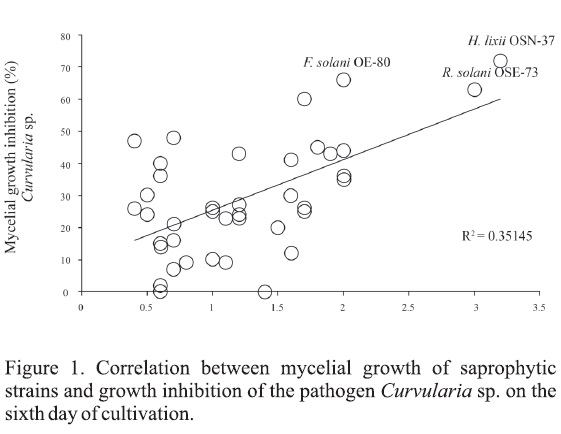
<body><![CDATA[<p align="justify"><font face="verdana" size="2"><b>Target strains</b></font></p>  	    <p align="justify"><font face="verdana" size="2"><i>Colletotrichum gloeosporioides</i> Penz. &amp; Sacc. (CICY&#45;05) were isolated from <i>Carica papaya</i> L., <i>Corynespora cassiicola</i> Berk. &amp; M. A. Curt&iacute;s (ITC&#45;03) from <i>Capsicum anuum</i> L., <i>Curvularia</i> sp. (ITC&#45;01) from <i>Zea mayz</i> L. and <i>Fusarium</i> sp. (CICY&#45;04) from <i>Lycoperscum esculentum.</i> These phytopathogenic fungi were obtained from the CICY and Conkal Technological Institute (ITC) culture collection, and were identified by morphological characteristics using taxonomic keys (Barnett and Hunter, 1998).</font></p>          <p align="justify">&nbsp;</p> 	    <p align="justify"><font face="verdana" size="2"><b>Antagonistic trial</b></font></p> 	    <p align="justify"><font face="verdana" size="2">Antagonistic activity against the phytopathogenic fungi was carried out by the <i>in vitro</i> dual culture assay (Asran&#45;Amal <i>et al,</i> 2010). All phytopathogenic and saprophytic fungal strains were maintained on potato dextrose agar (PDA), with natural light at 25 &plusmn; 2&deg;C. Amycelial disk of a seven day&#45;old culture of the saprophytic strain (5 mm in diameter) was placed on one edge of the Petri dish (6 cm in diameter), while a mycelial disk of a seven day&#45;old culture of the target (5 mm in diameter) was transferred to the opposite edge. For control, each target plant pathogen was confronted with a sterile disk of PDA (5 mm in diameter), and the mycelial growth was measured (negative control of inhibition); a PDA disk (5 mm in diameter) with antifungal Mirage&reg; (Prochloraz 900 &#956;g/mL) was also used as positive control of inhibition; experiments were performed in quadruplicate. All dishes were incubated at 25 &plusmn; 2&deg;C with continuous light, and growth was evaluated at the sixth day by measuring the radius of each mycelium, from the outer edge of the disk with the pathogen to the edge of the growth of the antagonist, using a Truper&reg; millimeter gauge (CALDI&#45;6MP model). Results were reported as percentage of mycelium growth inhibition (%MGI) of each pathogen, determined by Abbott's formula &#91;(C&#45;T/C) x 100&#93; (Abou <i>et al,</i> 2002) where C is the hyphal extension of the target strain in single culture and &#932; is the target fungus growth in dual culture.</font></p>      <p>&nbsp;</p>  	    <p align="justify"><font face="verdana" size="2"><b>Fungal extracts</b></font></p>  	    <p align="justify"><font face="verdana" size="2">Antagonistic strains <i>Hypocrea lixii</i> OSN&#45;37, <i>Pestalotiopsis mangiferae</i> OH&#45;02, and <i>Rhizoctonia solani</i> OSE&#45;73 were inoculated into in fermented rice (160 g of rice was fermented with distilled water overnight and sterilized); these were then incubated at 25 &plusmn; 2&deg;C, using a light&#45;dark photoperiod (12/12 h). After 40 days, cultures were frozen and lyophilized. They were then fragmented and subsequently extracted with ethyl acetate (three times, 50 mL, 24 h at 25&deg;C, each) and methanol (50 mi, 24 h at approximately 50&deg;C). The solvents were eliminated by reduced pressure to obtain the corresponding fungal organic extracts (Soman <i>et al.,</i> 2001). These were dissolved in acetonitrile and defatted with hexane (three times, 2:1,1:1,1:1, v/v) obtaining the hexane and acetonitrile fractions and a precipitate. All organic samples were tested in broth microdilution bioassay.</font></p>  	    <p>&nbsp;</p>  	    <p align="justify"><font face="verdana" size="2"><b>Broth microdilution assay on <i>Colletotrichum gloeosporioides</i></b></font></p>  	    ]]></body>
<body><![CDATA[<p align="justify"><font face="verdana" size="2">The minimum inhibitory concentrations (MIC) of the extracts were determined by broth microdilution techniques according to the National Committee for Clinical Laboratory Standards (NCCLS, 2004) with slight modifications. Each organic extract, fraction, and precipitate was dissolved in dimethyl sulfoxide (DMSO) (40 &#956;g/&#956;L) and 10 &#956;&#917; were transferred to microwells containing medium Roswell Park Memorial Institute (RPMI&#45;1640, 90 &#956;&#917;, <a href="http://www.sigmaaldrich.com" target="_blank">www.sigmaaldrich.com</a>). A conidial suspension of <i>C.</i> <i>gloeosporioides</i> (100 &#956;&#917;) was then added to each microwell to a final concentration of 2.5 x 10<sup>4</sup> conidia/mL, 2000 &#956;g/mL extracts and 5% DMSO. Hexane, acetonitrile fractions and precipitate of <i>P. mangiferae</i> OH&#45;02, <i>T. lixii</i> OSE&#45;37, and <i>R.</i> O <i>solani</i> OSE&#45;73, were tested at final concentrations of 2000, 1000 and 500 &#956;g/mL, with 5, 2.5 and 1.25% of DMSO, respectively, while 25% DMSO was used as positive control, and negative controls were the spore suspension, RPMI&#45;1640, 5% DMSO, and a blank of fermented rice. Tests were carried out in triplicate. The microdilution plates were incubated at 25 &plusmn; 2&deg;C in the dark for 96 hours, after which hyphal growth (HG) was, determined visually with a microscope (50x) following NCCLS standards (2004).</font></p>  	    <p>&nbsp;</p>  	    <p align="justify"><font face="verdana" size="2"><b>Statistical analysis</b></font></p>  	    <p align="justify"><font face="verdana" size="2">Inhibition data were analyzed with <i>t</i>&#45;Student statistical package SPSS. 13.0, compared to negative control (P&lt; 0.05). Subsequently, a linear correlation analysis was performed between percentage of mycelial growth of fungal saprophytic strains and fungal phytopathogen in dual culture (<a href="#f1">Figure 1</a>).</font></p>  	    <p align="center"><font face="verdana" size="2"><a name="f1"></a></font></p>  	    <p align="center"><font face="verdana" size="2"><img src="/img/revistas/rmm/v40/a6f1.jpg"></font></p>  	    <p>&nbsp;</p>  	    <p align="justify"><font face="verdana" size="2"><b>Results</b></font></p>  	    <p align="justify"><font face="verdana" size="2"><b>Isolation and</b> <b>Identification</b> <b>of strains</b></font></p>  	    <p align="justify"><font face="verdana" size="2">Forty&#45;one fungal isolates were obtained from submerged native plant debris and from the litter traps installed in the two sinkholes of Yucat&aacute;n. Most of them were captured by litter traps containing <i>ex situ</i> sterilize plant debris (44%). Among these, 18 (44%) were identified as belonging to the genera <i>Bionectria, Clonostachys, Fomitopsis, Fusarium, Hypocrea, Monodictys, Penicillium, Pestalotiopsis, Pseudorobillarda, Rhizoctonia</i> and <i>Scopulariopsis,</i> and ten were identified at species level (<a href="/img/revistas/rmm/v40/a6t1.jpg" target="_blank">Table 1</a>). The remaining 23 strains (46%) were not taxonomically identified because they did not sporulate in the culture media used. On the other hand, since they were inactive in antagonistic assays, they were not analyzed by molecular techniques (<a href="/img/revistas/rmm/v40/a6t1.jpg" target="_blank">Table 1</a>).</font></p>  	    ]]></body>
<body><![CDATA[<p>&nbsp;</p>  	    <p align="justify"><font face="verdana" size="2"><b>Antagonistic trial</b></font></p>  	    <p align="justify"><font face="verdana" size="2">Results of the antagonistic evaluation of fungal isolations against four fungal phytopathogens in dual culture assay showed statistical differences (P &lt; 0.05) after six days (<a href="/img/revistas/rmm/v40/a6t1.jpg" target="_blank">Table 1</a>). Seventeen of the 41 saprophytic strains were able to inhibit mycelial growth (&#8805; 50%) of at least one target tested, and six of them displayed good antagonistic properties (MGI values of &gt; 60%). Half of these antagonistic fungi were obtained from the litter traps with <i>ex situ</i> sterilized material. The active fungi were <i>Fusarium solani</i> OE&#45;80, <i>Hypocrea lixii</i> OSN&#45;37 (teleomorph of <i>T. harzianum</i>),<i> P. mangiferae</i> OH&#45;02, and <i>R solani</i> OSE&#45;73. The highest antagonist effect was produced by <i>H. lixii</i> OSN&#45;37 (61&#45;77%) and <i>R. solani</i> OSE&#45;73 (55&#45;64%), both were successful against all target phytopathogens (<a href="/img/revistas/rmm/v40/a6t1.jpg" target="_blank">Table 1</a>). Furthermore, <i>H. lixii</i> OSN&#45;37 caused the highest inhibition of <i>C. gloeosporioides, Curvularia</i> sp. and <i>Fusarium</i> sp. (MGI values of 67,72 and 77%, respectively), and was notably active against <i>C. cassiicola</i> (MGI values of 61%). Other attractive antagonist strain was <i>P. mangiferae</i> OH&#45;02 that showed good inhibitory properties against C. <i>cassiicola, Curvularia</i> sp. and <i>Fusarium</i> sp. (MGI values of 51&#45;59%) (<a href="/img/revistas/rmm/v40/a6t1.jpg" target="_blank">Table 1</a>).</font></p>  	    <p align="justify"><font face="verdana" size="2">In this study, the most sensitive pathogen was C. <i>cassiicola</i><b><i>,</i></b> showing inhibition by 16 fungal saprophytes (MGI &#8805; 50). On the other hand, <i>C. gloeosporioides</i> was the most resistant target, being affected only by <i>H. lixii</i> OSN&#45;37 and <i>R. solani</i> OSE&#45;73 at 67 and 62 % (MGI &#8805; 60%) respectively. <i>Curvularia</i> sp. was inhibited (MGI &#8805; 60%) by <i>&#917; solani</i> OE&#45;80, <i>H. lixii</i> OSN&#45;37, <i>P. mangiferae</i> OH&#45;02, <i>Pseudorobillarda sojae</i> OSN&#45;36 and <i>R.</i> <i>solani</i> (<a href="#f1">Figure 1</a>). Finally, <i>Fusarium</i> sp. was affected only by <i>H. lixii</i> OSN&#45;37, <i>P. mangifeare</i> OH&#45;02 and R <i>solani</i> OSE&#45;73 (MGI values of 55&#45;77%).</font></p>      <p>&nbsp;</p>  	    <p align="justify"><font face="verdana" size="2"><b>Antifungal assay of extracts on <i>Colletotrichum gloeosporioides</i></b></font></p>  	    <p align="justify"><font face="verdana" size="2">The three most active antagonistic strains detected were <i>H. lixii</i> OSN&#45;37, <i>P.</i> <i>mangiferae</i> OH&#45;02, and <i>R. solani</i> OSN&#45;73, all of them were cultured on fermented rice. Two extracts (ethyl acetate and methanol) and three fractions (Hexane, acetonitrile and precipitate) were obtained from each strain, and all were assessed against <i>C. gloeosporioides.</i></font></p> 	    <p align="justify"><font face="verdana" size="2">Results showed that all samples of <i>H. lixii</i> OSN&#45;37 were active, with the exception of the polar methanol extract and the acetonitrile fraction of R. <i>solani</i> OSE&#45;73 (<a href="/img/revistas/rmm/v40/a6t2.jpg" target="_blank">Table 2</a>). The lowest MIC was displayed by the acetonitrile fraction of <i>H. lixii</i> OSN&#45;37 with values of 1000 &#956;g/mL.</font></p>      <p>&nbsp;</p>  	    <p align="justify"><font face="verdana" size="2"><b>Discussion</b></font></p>  	    ]]></body>
<body><![CDATA[<p align="justify"><font face="verdana" size="2">The serial collections led to the isolation of 27 saprophytic fungal strains from Oxola (66%) and 14 (34%) from Kikal. Among these, strains belonging to the <i>Bionectria,</i> <i>Fomitopsis, Hypocrea, Monodictys, Pestalotiopsis, Pseudorobillarda</i> and <i>Scopulariopsis</i> genera corresponded to the first fungal contributions of Yucat&aacute;n, M&eacute;xico. The genus <i>Fusarium</i> was predominant in the sinkholes studied, with seven strains isolated, which is congruent with previous reports from other sinkholes (Gamboa&#45;Angulo <i>et al.,</i> 2012).</font></p>  	    <p align="justify"><font face="verdana" size="2">All the strains were tested against four recognized fungal phytopathogens, the most active were <i>H. lixii</i> OSN&#45;37, <i>P. mangiferae</i> OH&#45;02, and i?, <i>solani</i> OSE&#45;73. <i>Hypocrea lixii</i> OSN&#45;37 showed the most active and broadest antagonistic effect against the targets tested. Although <i>H. lixii</i> is widely distributed in the world, (Druzhinina <i>et al.,</i> 2010), this is the first report from the state of Yucat&aacute;n.</font></p>  	    <p align="justify"><font face="verdana" size="2">The antagonistic properties of <i>Trichoderma harzianum,</i> the asexual stage of <i>Hypocrea lixii,</i> have been extensively documented (Elgorban <i>et al.,</i> 2013; Asran&#45;Amal <i>et al,</i> 2010). At present several commercial formulations are available to control diverse fungal plant pathogens, such as Trianum&reg; by Koppert Biological Systems (<i>Trichoderma harzianum</i> T22,), Trichodex&reg; by AMC Chemical (<i>T. harzianum</i> T39) and Tusal&reg; by NewBiotechnic (<i>T. harzianum</i> and <i>T. viride</i>) (Reino <i>et al.,</i> 2008; Xu, <i>et al.,</i> 2010), among others. On the other hand, it is widely known that <i>Trichoderma</i> possess several antagonistic mechanisms. In particular, it was observed that our native strain <i>H. lixii</i> OSN&#45;37 displayed overgrowth on four phytopathogens tested herein, which suggests mycoparasitic action due to its rapid growth and abundance. This effect could be regulated by the production of enzymes such as chitinase, &#946;&#45;glucanase, cellulose and protease, and also by secondary metabolites (Harman, 2006; Reino <i>et al,</i> 2008).</font></p>  	    <p align="justify"><font face="verdana" size="2">Therefore, the ability of <i>H. lixii</i> OSN&#45;37 to produce antimicrobial metabolites was confirmed when this strain was cultured on fermented rice, and its ethyl acetate extract showed hyphal growth inhibition of <i>C. gloeosporioides,</i> as observed in dual culture (<a href="/img/revistas/rmm/v40/a6t2.jpg" target="_blank">Table 2</a>). This pathogen is one of the causal agents of anthracnose in various tropical crops in the world, such as <i>Annona muricata, C. papaya, Coffea arabica, Fragaria vesca, Lycopersicum esculentum, Mangifera indica, Persea americana</i> and <i>Vitis vinifera</i> (Beltr&aacute;n&#45;Cifuentes and Garc&iacute;a&#45;Jaramillo, 2006). This extract was later partitioned and all corresponding fractions displayed antifungal effect; the most effective was the acetonitrile fraction with MIC values of 1000 &#956;g/mL (<a href="/img/revistas/rmm/v40/a6t2.jpg" target="_blank">Table 2</a>). Thus, low and medium polarity compounds are implicated in the mechanism of action of <i>H. lixii</i> OSN&#45;37. A great number of low molecular weight antibiotics with diverse structures have been isolated from several species of the <i>Trichoderma</i> genus (Reino <i>et al,</i> 2008). Chemical purification and identification of these active metabolites, therefore, would be highly recommended.</font></p>  	    <p align="justify"><font face="verdana" size="2">Another antagonistic strain was <i>R. solani</i> OSE&#45;73 which showed overgrowth on all target strains. This effect was similar to that displayed by <i>H. lixii</i> OSN&#45;37, suggesting a mycoparasitism effect. <i>Rhizoctonia solani</i> is classified as a soil fungal pathogen, although it presents saprophytic and symbiotic associations (Bateman, 1970; Masuhara <i>et al,</i> 1993). About organic extract and fractions of this fungus, only the acetonitrile fraction was able to inhibit the growth of <i>C. gloeosporioides.</i> This fact indicated the diffusion of medium polarity and low molecular weight compounds into the medium, as one of its strategies against fungal pathogens. In the literature, only one report was found dealing with metabolic fingerprinting studies of sclerotial extracts from <i>R. solani</i> (Aliferis and Jabaji, 2010).</font></p>  	    <p align="justify"><font face="verdana" size="2">In contrast, the <i>P. mangiferae</i> OH&#45;02 isolate produced a notable inhibition zone without contact with the mycelium surrounding of <i>C. cassiicola, Curvularia</i> sp. and <i>Fusarium</i> sp. This would suggest an antibiosis phenomenon in which could be involved enzyme secretion, release of volatile compounds or diffusion of metabolites into the medium, inhibiting the development of other fungi. <i>Pestalotiopsis mangiferae</i> occur on multiple hosts (Yang <i>et al.,</i> 2012) and more recently, Subban <i>et al.</i> (2013) have reported a novel compound with antibacterial and antiyeast effect, named 4&#45;(2,4,7&#45;trioxa&#45;bicyclo&#91;4.1.0.&#93;heptan&#45;3&#45;yl) phenol. As expected, the organic extract and fractions of <i>P. mangiferae</i> OH&#45;02 showed no effect against <i>C. gloeosporioides.</i></font></p>  	    <p align="justify"><font face="verdana" size="2">Finally, a correlation analysis was carried out between mycelial growth of saprophytic strains (cm) and the percentage of MGI obtained from each of the fungal phytopathogen studied in dual culture, on the sixth day of cultivation. With the exception of <i>H. lixii</i> OSN&#45;37, results showed lower correlation in the interactions. This suggests that the inhibitory effect is not due to direct contact among antagonists and phytopathogen mycelia, or competition for substrate or nutriente. In particular, this mechanism is presented by the <i>P. sojae</i> OSN&#45;36 and <i>F</i> <i>solani</i> OE&#45;80 strains only against this pathogen (<a href="#f1">Figures 1</a> and <a href="/img/revistas/rmm/v40/a6f2.jpg" target="_blank">2</a>).</font></p>  	    <p align="justify"><font face="verdana" size="2">In conclusion, <i>H. lixii</i> OSN&#45;37, <i>P. mangiferae</i> OH&#45;02 and <i>R. solani</i> OSE&#45;73 are the most promising antagonistic saprophytic strains isolated in this work. These strains represent alternatives to control fungal diseases in tropical regions. Furthermore, <i>H.</i> <i>lixii</i> OSN&#45;37 and <i>R. solani</i> OSE&#45;73 produced metabolites effective against <i>C. gloeosporioides.</i> These saprophytic native fungal strains require further research to determine their active principles, mechanisms of action and to establish formulations that will allow the application of fungal extracts at greenhouse and field levels in the near future to protect crops in the tropical regions.</font></p>  	    <p>&nbsp;</p>  	    <p align="justify"><font face="verdana" size="2"><b>Acknowledgements</b></font></p>  	    ]]></body>
<body><![CDATA[<p align="justify"><font face="verdana" size="2">Elmer Medina, Ra&uacute;l Manzanilla for their valuable help in locating the sinkholes; Miguel Tzec, Sergio P&eacute;rez and Narcedalia Gamboa for their technical support. Jairo Crist&oacute;bal Alejo and Andr&eacute;s Quijano Ramayo for giving us phytopathogens. This work was supported by CONACYT project No. 2009/131256 and by graduate student fellowship to P.M.P. (CVU No. 209062).</font></p>  	    <p>&nbsp;</p>  	    <p align="justify"><font face="verdana" size="2"><b>References</b></font></p>  	    <!-- ref --><p align="justify"><font face="verdana" size="2">Abou, J.Y., &#919;. Sobh, A. Salemh, 2002. Antimycotic activities of selected plant flora, growing wild in Lebanon, against phytopathogenic Fungi. Journal of Agricultural and Food Chemistry 50: 3208&#45;3213.    &nbsp;&nbsp;&nbsp;&nbsp;&nbsp;&nbsp;&nbsp;&nbsp;[&#160;<a href="javascript:void(0);" onclick="javascript: window.open('/scielo.php?script=sci_nlinks&ref=8814853&pid=S0187-3180201400020000600001&lng=','','width=640,height=500,resizable=yes,scrollbars=1,menubar=yes,');">Links</a>&#160;]<!-- end-ref --></font></p>  	    <!-- ref --><p align="justify"><font face="verdana" size="2">Alwathnani, H.A., K. Perveen, R. Tahmaz, S. Alhaqbani, 2012. Evaluation of biological control potential of locally isolated antagonist fungi against <i>Fusarium oxysporum</i> under <i>in vitro</i> and pot conditions. African Journal of Microbiology Research 6:312&#45;319.    &nbsp;&nbsp;&nbsp;&nbsp;&nbsp;&nbsp;&nbsp;&nbsp;[&#160;<a href="javascript:void(0);" onclick="javascript: window.open('/scielo.php?script=sci_nlinks&ref=8814855&pid=S0187-3180201400020000600002&lng=','','width=640,height=500,resizable=yes,scrollbars=1,menubar=yes,');">Links</a>&#160;]<!-- end-ref --></font></p>  	    <!-- ref --><p align="justify"><font face="verdana" size="2">Aliferis, K.A., E.S. Jabaji, 2010. &#905; NMR and GC&#45;MS metabolic fingerprinting of developmental stages of <i>Rhizoctonia solani</i> sclerotia. Metabolomics 6:96&#45;108.    &nbsp;&nbsp;&nbsp;&nbsp;&nbsp;&nbsp;&nbsp;&nbsp;[&#160;<a href="javascript:void(0);" onclick="javascript: window.open('/scielo.php?script=sci_nlinks&ref=8814857&pid=S0187-3180201400020000600003&lng=','','width=640,height=500,resizable=yes,scrollbars=1,menubar=yes,');">Links</a>&#160;]<!-- end-ref --></font></p>  	    <!-- ref --><p align="justify"><font face="verdana" size="2">Asran&#45;Amal, S., M. Moustafa&#45;Mahmoud, K.K. Sabe, O.H. Banna, 2010. <i>In vitro</i> antagonism of cotton seedlings fungi and characterization of chitinase isozyme activities in <i>Trichoderma harzianum.</i> Saudi Journal of Biological Sciences 17:153 &#45;157.    &nbsp;&nbsp;&nbsp;&nbsp;&nbsp;&nbsp;&nbsp;&nbsp;[&#160;<a href="javascript:void(0);" onclick="javascript: window.open('/scielo.php?script=sci_nlinks&ref=8814859&pid=S0187-3180201400020000600004&lng=','','width=640,height=500,resizable=yes,scrollbars=1,menubar=yes,');">Links</a>&#160;]<!-- end-ref --></font></p>  	    <!-- ref --><p align="justify"><font face="verdana" size="2">Bateman, D.F., 1970. Pathogenesis and diseases. In: Parmeter, J.R. (ed.), <i>Rhizoctonia solani,</i> Biology and Pathology. Berkeley, CA: University of California Press.pp. 161.    &nbsp;&nbsp;&nbsp;&nbsp;&nbsp;&nbsp;&nbsp;&nbsp;[&#160;<a href="javascript:void(0);" onclick="javascript: window.open('/scielo.php?script=sci_nlinks&ref=8814861&pid=S0187-3180201400020000600005&lng=','','width=640,height=500,resizable=yes,scrollbars=1,menubar=yes,');">Links</a>&#160;]<!-- end-ref --></font></p>  	    <!-- ref --><p align="justify"><font face="verdana" size="2">Barnett, H.L., B. Hunter, 1998. Illustrate Genera of Imperfect Fungy, 4* Ed. The American Phytopatological Society. St Paul, Minnesota, USA. 218p.    &nbsp;&nbsp;&nbsp;&nbsp;&nbsp;&nbsp;&nbsp;&nbsp;[&#160;<a href="javascript:void(0);" onclick="javascript: window.open('/scielo.php?script=sci_nlinks&ref=8814863&pid=S0187-3180201400020000600006&lng=','','width=640,height=500,resizable=yes,scrollbars=1,menubar=yes,');">Links</a>&#160;]<!-- end-ref --></font></p>  	    <!-- ref --><p align="justify"><font face="verdana" size="2">Beltr&aacute;n&#45;Cifuentes, M.C., D.J. Garc&iacute;a&#45;Jaramillo, 2006. <i>Colletotrichum gloeosporioides</i> fitopat&oacute;geno asociado a la nutrici&oacute;n humana. Red de Revistas Cient&iacute;ficas de Am&eacute;rica Latina, el Caribe, Espa&ntilde;a y Portugal 13 73&#45;80.    &nbsp;&nbsp;&nbsp;&nbsp;&nbsp;&nbsp;&nbsp;&nbsp;[&#160;<a href="javascript:void(0);" onclick="javascript: window.open('/scielo.php?script=sci_nlinks&ref=8814865&pid=S0187-3180201400020000600007&lng=','','width=640,height=500,resizable=yes,scrollbars=1,menubar=yes,');">Links</a>&#160;]<!-- end-ref --></font></p>  	    <!-- ref --><p align="justify"><font face="verdana" size="2">Carmichael, J.W., W.B. Kendrick, L. Conners. L. Sigler, 1980. Genera of Hyphomycetes. p. 386. Alberta, Canad&aacute;, University of Alberta Press.    &nbsp;&nbsp;&nbsp;&nbsp;&nbsp;&nbsp;&nbsp;&nbsp;[&#160;<a href="javascript:void(0);" onclick="javascript: window.open('/scielo.php?script=sci_nlinks&ref=8814867&pid=S0187-3180201400020000600008&lng=','','width=640,height=500,resizable=yes,scrollbars=1,menubar=yes,');">Links</a>&#160;]<!-- end-ref --></font></p>  	    <!-- ref --><p align="justify"><font face="verdana" size="2">Conde&#45;Ferr&aacute;ez, L., R. Grijalva&#45;Arango,A.C. James&#45;Kay, 2008. Arapid DNA extraction method from mycelium which is suitable for PCR. Revista Latinoamericana de Microbiolog&iacute;a 50:3&#45;4.    &nbsp;&nbsp;&nbsp;&nbsp;&nbsp;&nbsp;&nbsp;&nbsp;[&#160;<a href="javascript:void(0);" onclick="javascript: window.open('/scielo.php?script=sci_nlinks&ref=8814869&pid=S0187-3180201400020000600009&lng=','','width=640,height=500,resizable=yes,scrollbars=1,menubar=yes,');">Links</a>&#160;]<!-- end-ref --></font></p>  	    <!-- ref --><p align="justify"><font face="verdana" size="2">Cuervo&#45;Parra, J.A., M. Ram&iacute;rez&#45;Suero, V. S&aacute;nchez&#45;L&oacute;pez, M. Ram&iacute;rez&#45;Lepe, 2011. Antagonistic effect of <i>Trichoderma harzianum</i> VSL291 on phytopathogenic fungi isolated from cocoa (<i>Theobroma cacao</i> L.) fruits. African Journal of Biotechnology 10:10657&#45;10663.    &nbsp;&nbsp;&nbsp;&nbsp;&nbsp;&nbsp;&nbsp;&nbsp;[&#160;<a href="javascript:void(0);" onclick="javascript: window.open('/scielo.php?script=sci_nlinks&ref=8814871&pid=S0187-3180201400020000600010&lng=','','width=640,height=500,resizable=yes,scrollbars=1,menubar=yes,');">Links</a>&#160;]<!-- end-ref --></font></p>  	    <!-- ref --><p align="justify"><font face="verdana" size="2">Druzhinina, I.S., CP. Kubicek, M. Komon&#45;Zelazowska, T.B. Mulaw, J. Bissett, 2010. The <i>Trichoderma harzianum</i> demon: complex speciation history resulting in coexistence of hypothetical biological species, recent agamospecies and numerous relict lineages. BMC Evolutionary Biology 10:94 &#45;108.    &nbsp;&nbsp;&nbsp;&nbsp;&nbsp;&nbsp;&nbsp;&nbsp;[&#160;<a href="javascript:void(0);" onclick="javascript: window.open('/scielo.php?script=sci_nlinks&ref=8814873&pid=S0187-3180201400020000600011&lng=','','width=640,height=500,resizable=yes,scrollbars=1,menubar=yes,');">Links</a>&#160;]<!-- end-ref --></font></p>  	    <!-- ref --><p align="justify"><font face="verdana" size="2">Elgorban, A.M., M.A. Abdel&#45;Wahab, A. Bahkali, B. Al&#45;Sum, 2013. Biocontrol of <i>Meloidogyne javanica</i> on tomato plants by <i>Hypocrea lixii</i> (the Teleomorph of <i>Trichoderma harzianum).</i> CLEAN&#45;Soil, Air, Water 41:1&#45;6.    &nbsp;&nbsp;&nbsp;&nbsp;&nbsp;&nbsp;&nbsp;&nbsp;[&#160;<a href="javascript:void(0);" onclick="javascript: window.open('/scielo.php?script=sci_nlinks&ref=8814875&pid=S0187-3180201400020000600012&lng=','','width=640,height=500,resizable=yes,scrollbars=1,menubar=yes,');">Links</a>&#160;]<!-- end-ref --></font></p>  	    <!-- ref --><p align="justify"><font face="verdana" size="2">Galindo&#45;Flores, H., J.C. Mart&iacute;nez&#45;&Aacute;lvarez, E. Nava&#45;P&eacute;rez, RS. Garc&iacute;a&#45;Estrada, LE. Maldonado&#45;Mendoza, 2005. A saprotrophic fungal isolate from northern Sinaloa, M&eacute;xico, with homology to members of the Chaetomiaceae behaves as an antagonist of phytopathogenic fungi <i>in vitro.</i> Revista Mexicana de Fitopatolog&iacute;a. 23:130&#45;139.    &nbsp;&nbsp;&nbsp;&nbsp;&nbsp;&nbsp;&nbsp;&nbsp;[&#160;<a href="javascript:void(0);" onclick="javascript: window.open('/scielo.php?script=sci_nlinks&ref=8814877&pid=S0187-3180201400020000600013&lng=','','width=640,height=500,resizable=yes,scrollbars=1,menubar=yes,');">Links</a>&#160;]<!-- end-ref --></font></p>  	    <!-- ref --><p align="justify"><font face="verdana" size="2">Gamboa&#45;Angulo, M., S.C. De la Rosa&#45;Garc&iacute;a, G. Heredia&#45;Abarca, I. Medina&#45;Baizabal, 2012. Antimicrobial screening of tropical microfungi isolated from sinkholes located in the Yucat&aacute;n peninsula, M&eacute;xico. African Journal of Microbiology 6: 2305 &#45;2312.    &nbsp;&nbsp;&nbsp;&nbsp;&nbsp;&nbsp;&nbsp;&nbsp;[&#160;<a href="javascript:void(0);" onclick="javascript: window.open('/scielo.php?script=sci_nlinks&ref=8814879&pid=S0187-3180201400020000600014&lng=','','width=640,height=500,resizable=yes,scrollbars=1,menubar=yes,');">Links</a>&#160;]<!-- end-ref --></font></p>  	    <!-- ref --><p align="justify"><font face="verdana" size="2">Hall,T,2005. Bio Edit v7.0.5. <a href="http://www.mbio.ncsu.edu/BioEdit/" target="_blank">http://www.mbio.ncsu.edu/BioEdit/</a></font>&nbsp;&nbsp;&nbsp;&nbsp;&nbsp;&nbsp;&nbsp;&nbsp;[&#160;<a href="javascript:void(0);" onclick="javascript: window.open('/scielo.php?script=sci_nlinks&ref=8814881&pid=S0187-3180201400020000600015&lng=','','width=640,height=500,resizable=yes,scrollbars=1,menubar=yes,');">Links</a>&#160;]<!-- end-ref --><!-- ref --><p align="justify"><font face="verdana" size="2">Harman, G.E, 2006. Overview of mechanisms and uses of <i>Trichoderma</i> spp. Phytopathology 96:190&#45;194.    &nbsp;&nbsp;&nbsp;&nbsp;&nbsp;&nbsp;&nbsp;&nbsp;[&#160;<a href="javascript:void(0);" onclick="javascript: window.open('/scielo.php?script=sci_nlinks&ref=8814882&pid=S0187-3180201400020000600016&lng=','','width=640,height=500,resizable=yes,scrollbars=1,menubar=yes,');">Links</a>&#160;]<!-- end-ref --></font></p>  	    <!-- ref --><p align="justify"><font face="verdana" size="2">Krug, J.C, 2006. Moist chamber for the development of fungi. In: Mueller G.M., G.F. Bills, M.S. Foster (eds.), Biodiversity of Fungi Inventory and Monitoring Methods, Part III Ap&eacute;ndice I. USA, Elsevier Academic Press, pp. 589&#45;594.    &nbsp;&nbsp;&nbsp;&nbsp;&nbsp;&nbsp;&nbsp;&nbsp;[&#160;<a href="javascript:void(0);" onclick="javascript: window.open('/scielo.php?script=sci_nlinks&ref=8814884&pid=S0187-3180201400020000600017&lng=','','width=640,height=500,resizable=yes,scrollbars=1,menubar=yes,');">Links</a>&#160;]<!-- end-ref --></font></p>  	    <!-- ref --><p align="justify"><font face="verdana" size="2">Masuhara, G., K. Katsuya, K. Yamaguchi, 1993. Potential for symbiosis of <i>Rhizoctonia solani</i> and binucleate <i>Rhizoctonia</i> with seeds of <i>Spiranthes sinensis</i> var. <i>amoena in vitro.</i> Mycological Research 97:746&#45;752.    &nbsp;&nbsp;&nbsp;&nbsp;&nbsp;&nbsp;&nbsp;&nbsp;[&#160;<a href="javascript:void(0);" onclick="javascript: window.open('/scielo.php?script=sci_nlinks&ref=8814886&pid=S0187-3180201400020000600018&lng=','','width=640,height=500,resizable=yes,scrollbars=1,menubar=yes,');">Links</a>&#160;]<!-- end-ref --></font></p>  	    <!-- ref --><p align="justify"><font face="verdana" size="2">Michel&#45;Aceves, A.C., M.A. Otero&#45;S&aacute;nchez, L.Y Solano&#45;Pascacio, R. Ariza&#45;Flores, A. Barrios&#45;Ayala, A. Rebolledo&#45;Mart&iacute;nez, 2009. Biocontrol <i>in vitro</i> con <i>Trichoderma</i> spp. de <i>Fusarium subglutinans</i> (Wollenweb. y Reinking) Nelson, Toussoun y Marasas y <i>F. oxysporum</i> Schlecht., agentes causales de la "Escoba de Bruja" del mango (<i>Mangifera indica</i> L.). Revista Mexicana de Fitopatolog&iacute;a. 27:18 &#45; 26.    &nbsp;&nbsp;&nbsp;&nbsp;&nbsp;&nbsp;&nbsp;&nbsp;[&#160;<a href="javascript:void(0);" onclick="javascript: window.open('/scielo.php?script=sci_nlinks&ref=8814888&pid=S0187-3180201400020000600019&lng=','','width=640,height=500,resizable=yes,scrollbars=1,menubar=yes,');">Links</a>&#160;]<!-- end-ref --></font></p>  	    ]]></body>
<body><![CDATA[<!-- ref --><p align="justify"><font face="verdana" size="2">National Committee for Clinical Laboratory Standards, 2004. Method for antifungal disk diffusion susceptibility testing of yeasts. Approved guidance. Document M44&#45;A. Wayne, PA: NCCL.    &nbsp;&nbsp;&nbsp;&nbsp;&nbsp;&nbsp;&nbsp;&nbsp;[&#160;<a href="javascript:void(0);" onclick="javascript: window.open('/scielo.php?script=sci_nlinks&ref=8814890&pid=S0187-3180201400020000600020&lng=','','width=640,height=500,resizable=yes,scrollbars=1,menubar=yes,');">Links</a>&#160;]<!-- end-ref --></font></p>  	    <!-- ref --><p align="justify"><font face="verdana" size="2">Quiroz&#45;Sarmiento, V.F., R. Ferrera&#45;Cerrato, A. Alarc&oacute;n, M.E. Lara&#45;Hern&aacute;ndez, 2008. Antagonismo <i>in vitro</i> de <i>Aspergillus y Trichoderma</i> hacia hongos filamentosos que afectan el cultivo del ajo. Revista Mexicana de Micolog&iacute;a 26:27&#45;34.    &nbsp;&nbsp;&nbsp;&nbsp;&nbsp;&nbsp;&nbsp;&nbsp;[&#160;<a href="javascript:void(0);" onclick="javascript: window.open('/scielo.php?script=sci_nlinks&ref=8814892&pid=S0187-3180201400020000600021&lng=','','width=640,height=500,resizable=yes,scrollbars=1,menubar=yes,');">Links</a>&#160;]<!-- end-ref --></font></p>  	    <!-- ref --><p align="justify"><font face="verdana" size="2">Reino, J.L., R.F. Guerrero, R. Hern&aacute;ndez&#45;Gal&aacute;n, I.G. Collado, 2008. Secondary metabolites from species of the biocontrol agent <i>Trichoderma.</i> Phytochemistry Reviews 7:89 &#45;123.    &nbsp;&nbsp;&nbsp;&nbsp;&nbsp;&nbsp;&nbsp;&nbsp;[&#160;<a href="javascript:void(0);" onclick="javascript: window.open('/scielo.php?script=sci_nlinks&ref=8814894&pid=S0187-3180201400020000600022&lng=','','width=640,height=500,resizable=yes,scrollbars=1,menubar=yes,');">Links</a>&#160;]<!-- end-ref --></font></p>  	    <!-- ref --><p align="justify"><font face="verdana" size="2">Reyes&#45;Estebanez, M., J. Crist&oacute;bal&#45;Alejo, E. Herrera&#45;Parra, G. Heredia&#45;Abarca, B. Canto&#45;Canch&eacute;, I.L. Medina&#45;Baizabal, M. Gamboa&#45;Angulo, 2011. Antimicrobial and nematotoxic properties of anamorphic fungi isolated from plant debris of tropical areas in M&eacute;xico. African Journal of Microbiology 5:1083&#45;1089.    &nbsp;&nbsp;&nbsp;&nbsp;&nbsp;&nbsp;&nbsp;&nbsp;[&#160;<a href="javascript:void(0);" onclick="javascript: window.open('/scielo.php?script=sci_nlinks&ref=8814896&pid=S0187-3180201400020000600023&lng=','','width=640,height=500,resizable=yes,scrollbars=1,menubar=yes,');">Links</a>&#160;]<!-- end-ref --></font></p>  	    <!-- ref --><p align="justify"><font face="verdana" size="2">Reyes, Y, B. Mart&iacute;nez, D. Infante, 2008. Evaluaci&oacute;n de la actividad antag&oacute;nica de trece aislamientos de <i>Trichoderma</i> spp. sobre <i>Rhizoctonia</i> sp. Revista de Protecci&oacute;n Vegetal 23 (2): 112&#45;117.    &nbsp;&nbsp;&nbsp;&nbsp;&nbsp;&nbsp;&nbsp;&nbsp;[&#160;<a href="javascript:void(0);" onclick="javascript: window.open('/scielo.php?script=sci_nlinks&ref=8814898&pid=S0187-3180201400020000600024&lng=','','width=640,height=500,resizable=yes,scrollbars=1,menubar=yes,');">Links</a>&#160;]<!-- end-ref --></font></p>  	    ]]></body>
<body><![CDATA[<!-- ref --><p align="justify"><font face="verdana" size="2">Schmitter&#45;Soto, J.J., F.A. Comin, E. Escobar&#45;Briones, J. Herrera&#45;Silveira, J. Alcocer, E. Su&aacute;rez&#45;Morales, M. Elias&#45;Guti&eacute;rrez, V. D&iacute;az&#45;Arce, L.E. Mar&iacute;n, B. Steinich, 2002. Hydrogeochemical and biological characteristics of cenotes in the Yucat&aacute;n Pen&iacute;nsula (SE M&eacute;xico). Hydrobiologia 467:215&#45;228.    &nbsp;&nbsp;&nbsp;&nbsp;&nbsp;&nbsp;&nbsp;&nbsp;[&#160;<a href="javascript:void(0);" onclick="javascript: window.open('/scielo.php?script=sci_nlinks&ref=8814900&pid=S0187-3180201400020000600025&lng=','','width=640,height=500,resizable=yes,scrollbars=1,menubar=yes,');">Links</a>&#160;]<!-- end-ref --></font></p>  	    <!-- ref --><p align="justify"><font face="verdana" size="2">Sibounnavong, P, S. Kanokmedhakul, K. Soytong, 2012. The role of <i>Emericella rugulosa</i> as a bio&#45;control agent for controlling <i>Fusarium</i> wilt tomato. African Journal of Agricultural Research 7:4782&#45;4789.    &nbsp;&nbsp;&nbsp;&nbsp;&nbsp;&nbsp;&nbsp;&nbsp;[&#160;<a href="javascript:void(0);" onclick="javascript: window.open('/scielo.php?script=sci_nlinks&ref=8814902&pid=S0187-3180201400020000600026&lng=','','width=640,height=500,resizable=yes,scrollbars=1,menubar=yes,');">Links</a>&#160;]<!-- end-ref --></font></p>  	    <!-- ref --><p align="justify"><font face="verdana" size="2">Soman, A.G., J.B. Gloer, RE Angawi, D.T. Wicklow, PE Dowd, 2001. Vertilecanins: new phenopicolinic acid analogues from <i>Verticillium lecanii.</i> Journal of Natural Products 64:189 &#45;192.    &nbsp;&nbsp;&nbsp;&nbsp;&nbsp;&nbsp;&nbsp;&nbsp;[&#160;<a href="javascript:void(0);" onclick="javascript: window.open('/scielo.php?script=sci_nlinks&ref=8814904&pid=S0187-3180201400020000600027&lng=','','width=640,height=500,resizable=yes,scrollbars=1,menubar=yes,');">Links</a>&#160;]<!-- end-ref --></font></p>  	    <!-- ref --><p align="justify"><font face="verdana" size="2">Strobel, G., D.C. Manker, J. Mercier, 2012. Novel endophytic fungi and methods of use. PatentNo.; US 2012/0114610 Washington D.C: The United States of America.    &nbsp;&nbsp;&nbsp;&nbsp;&nbsp;&nbsp;&nbsp;&nbsp;[&#160;<a href="javascript:void(0);" onclick="javascript: window.open('/scielo.php?script=sci_nlinks&ref=8814906&pid=S0187-3180201400020000600028&lng=','','width=640,height=500,resizable=yes,scrollbars=1,menubar=yes,');">Links</a>&#160;]<!-- end-ref --></font></p>  	    <!-- ref --><p align="justify"><font face="verdana" size="2">Subban, K., R. Subramani, M. Johnpaul, 2013. A novel antibacterial and antifungal phenolic compound from the endophytic fungus <i>Pestalotiopsis mangiferae.</i> Natural Product Research 27: 1445&#45;1449.    &nbsp;&nbsp;&nbsp;&nbsp;&nbsp;&nbsp;&nbsp;&nbsp;[&#160;<a href="javascript:void(0);" onclick="javascript: window.open('/scielo.php?script=sci_nlinks&ref=8814908&pid=S0187-3180201400020000600029&lng=','','width=640,height=500,resizable=yes,scrollbars=1,menubar=yes,');">Links</a>&#160;]<!-- end-ref --></font></p>      ]]></body>
<body><![CDATA[<!-- ref --><p align="justify"><font face="verdana" size="2">Vujanovic, V., 2012. <i>Fusarium</i> and other pathogenic fungi and mycotoxin biocontrol. Patent No.: US 2012/0156173 Washington DC: The United States of America.    &nbsp;&nbsp;&nbsp;&nbsp;&nbsp;&nbsp;&nbsp;&nbsp;[&#160;<a href="javascript:void(0);" onclick="javascript: window.open('/scielo.php?script=sci_nlinks&ref=8814910&pid=S0187-3180201400020000600030&lng=','','width=640,height=500,resizable=yes,scrollbars=1,menubar=yes,');">Links</a>&#160;]<!-- end-ref --></font></p>  	    <!-- ref --><p align="justify"><font face="verdana" size="2">Whipps, J.M., D.R Lumsden, 2001. Commercial use of fungi as plant disease biological control agents: Status and prospecte. In: Butt, T.M., C.W. Jackson, N. Magan (eds.), Fungi as biocontrol agents: Progress, problems and potentials. Wallingford, CABI Publishing.pp.9&#45;22.    &nbsp;&nbsp;&nbsp;&nbsp;&nbsp;&nbsp;&nbsp;&nbsp;[&#160;<a href="javascript:void(0);" onclick="javascript: window.open('/scielo.php?script=sci_nlinks&ref=8814912&pid=S0187-3180201400020000600031&lng=','','width=640,height=500,resizable=yes,scrollbars=1,menubar=yes,');">Links</a>&#160;]<!-- end-ref --></font></p>  	    <!-- ref --><p align="justify"><font face="verdana" size="2">White, T.J., T. Bruns, S. Lee, J. Taylor, 1990. Amplification and direct sequencing of fungal ribosomal RNA genes forphylogenetics. In: Innis, M., D. Gelfand, J. Sninsky, T.J. White (eds.), PCR protocols, a guide to methods and applications. Academic Press, New York. pp. 315&#45;322.    &nbsp;&nbsp;&nbsp;&nbsp;&nbsp;&nbsp;&nbsp;&nbsp;[&#160;<a href="javascript:void(0);" onclick="javascript: window.open('/scielo.php?script=sci_nlinks&ref=8814914&pid=S0187-3180201400020000600032&lng=','','width=640,height=500,resizable=yes,scrollbars=1,menubar=yes,');">Links</a>&#160;]<!-- end-ref --></font></p>  	    <p align="justify"><font face="verdana" size="2"><a href="http://www.sigmaaldrich.com" target="_blank">www.sigmaaldrich.com</a> &#91;<a href="http://www.sigmaaldrich.com/life-science/cell-culture/classical-media-salts/rpmi-media.html" target="_blank">http://www.sigmaaldrich.com/life&#45;science/cell&#45;culture/classical&#45;media&#45;salts/rpmi&#45;media.html</a>&#93; Access date: 17&#45;07&#45;2014</font></p>  	    <!-- ref --><p align="justify"><font face="verdana" size="2"><a href="http://www.seduma.yucat&aacute;n.gob.mx" target="_blank">www.seduma.yucat&aacute;n.gob.mx</a>. Secretar&iacute;a de Desarrollo Urbano y Medio Ambiente. Cenotes y grutas &#91;En L&iacute;nea&#93; <a href="http://www.seduma.yucatan.gob.mx/cenotes-grutas/censo-cenotes.php" target="_blank">http://www.seduma.yucatan.gob.mx/cenotes&#45;grutas/censo&#45;cenotes.php</a> Access date: 17&#45;06&#45;2014.    &nbsp;&nbsp;&nbsp;&nbsp;&nbsp;&nbsp;&nbsp;&nbsp;[&#160;<a href="javascript:void(0);" onclick="javascript: window.open('/scielo.php?script=sci_nlinks&ref=8814917&pid=S0187-3180201400020000600033&lng=','','width=640,height=500,resizable=yes,scrollbars=1,menubar=yes,');">Links</a>&#160;]<!-- end-ref --></font></p>  	    <!-- ref --><p align="justify"><font face="verdana" size="2">Xu, X., J. Robinson, M. Jeger, P. Jeffries, 2010. Using combinations of biocontrol agents to control <i>Botrytis cin&eacute;rea</i> on strawberry leaves under fluctuating temperatures. Biocontrol Science and Technology 20:359&#45;373.    &nbsp;&nbsp;&nbsp;&nbsp;&nbsp;&nbsp;&nbsp;&nbsp;[&#160;<a href="javascript:void(0);" onclick="javascript: window.open('/scielo.php?script=sci_nlinks&ref=8814919&pid=S0187-3180201400020000600034&lng=','','width=640,height=500,resizable=yes,scrollbars=1,menubar=yes,');">Links</a>&#160;]<!-- end-ref --></font></p>  	    <!-- ref --><p align="justify"><font face="verdana" size="2">Yang, X., J. Zhang, D. Luo, 2012. The taxonomy, biology and chemistry of the fungal <i>Pestalotiopsis</i> genus. Natural Product Reports 29:622 &#45;641.    &nbsp;&nbsp;&nbsp;&nbsp;&nbsp;&nbsp;&nbsp;&nbsp;[&#160;<a href="javascript:void(0);" onclick="javascript: window.open('/scielo.php?script=sci_nlinks&ref=8814921&pid=S0187-3180201400020000600035&lng=','','width=640,height=500,resizable=yes,scrollbars=1,menubar=yes,');">Links</a>&#160;]<!-- end-ref --></font></p>      ]]></body><back>
<ref-list>
<ref id="B1">
<nlm-citation citation-type="journal">
<person-group person-group-type="author">
<name>
<surname><![CDATA[Abou]]></surname>
<given-names><![CDATA[J.Y.]]></given-names>
</name>
<name>
<surname><![CDATA[Sobh]]></surname>
</name>
<name>
<surname><![CDATA[Salemh]]></surname>
<given-names><![CDATA[A.]]></given-names>
</name>
</person-group>
<article-title xml:lang="en"><![CDATA[Antimycotic activities of selected plant flora, growing wild in Lebanon, against phytopathogenic Fungi]]></article-title>
<source><![CDATA[Journal of Agricultural and Food Chemistry]]></source>
<year>2002</year>
<volume>50</volume>
<page-range>3208-3213</page-range></nlm-citation>
</ref>
<ref id="B2">
<nlm-citation citation-type="journal">
<person-group person-group-type="author">
<name>
<surname><![CDATA[Alwathnani]]></surname>
<given-names><![CDATA[H.A.]]></given-names>
</name>
<name>
<surname><![CDATA[Perveen]]></surname>
<given-names><![CDATA[K.]]></given-names>
</name>
<name>
<surname><![CDATA[Tahmaz]]></surname>
<given-names><![CDATA[R.]]></given-names>
</name>
<name>
<surname><![CDATA[Alhaqbani]]></surname>
<given-names><![CDATA[S.]]></given-names>
</name>
</person-group>
<article-title xml:lang="en"><![CDATA[Evaluation of biological control potential of locally isolated antagonist fungi against Fusarium oxysporum under in vitro and pot conditions]]></article-title>
<source><![CDATA[African Journal of Microbiology Research]]></source>
<year>2012</year>
<volume>6</volume>
<page-range>312-319</page-range></nlm-citation>
</ref>
<ref id="B3">
<nlm-citation citation-type="journal">
<person-group person-group-type="author">
<name>
<surname><![CDATA[Aliferis]]></surname>
<given-names><![CDATA[K.A.]]></given-names>
</name>
<name>
<surname><![CDATA[Jabaji]]></surname>
<given-names><![CDATA[E.S.]]></given-names>
</name>
</person-group>
<article-title xml:lang="en"><![CDATA[&#905; NMR and GC-MS metabolic fingerprinting of developmental stages of Rhizoctonia solani sclerotia]]></article-title>
<source><![CDATA[Metabolomics]]></source>
<year>2010</year>
<volume>6</volume>
<page-range>96-108</page-range></nlm-citation>
</ref>
<ref id="B4">
<nlm-citation citation-type="journal">
<person-group person-group-type="author">
<name>
<surname><![CDATA[Asran-Amal]]></surname>
<given-names><![CDATA[S.]]></given-names>
</name>
<name>
<surname><![CDATA[Moustafa-Mahmoud]]></surname>
<given-names><![CDATA[M.]]></given-names>
</name>
<name>
<surname><![CDATA[Sabe]]></surname>
<given-names><![CDATA[K.K.]]></given-names>
</name>
<name>
<surname><![CDATA[Banna]]></surname>
<given-names><![CDATA[O.H.]]></given-names>
</name>
</person-group>
<article-title xml:lang="en"><![CDATA[In vitro antagonism of cotton seedlings fungi and characterization of chitinase isozyme activities in Trichoderma harzianum]]></article-title>
<source><![CDATA[Saudi Journal of Biological Sciences]]></source>
<year>2010</year>
<volume>17</volume>
<page-range>153 -157</page-range></nlm-citation>
</ref>
<ref id="B5">
<nlm-citation citation-type="book">
<person-group person-group-type="author">
<name>
<surname><![CDATA[Bateman]]></surname>
<given-names><![CDATA[D.F.]]></given-names>
</name>
</person-group>
<article-title xml:lang="en"><![CDATA[Pathogenesis and diseases]]></article-title>
<person-group person-group-type="editor">
<name>
<surname><![CDATA[Parmeter]]></surname>
<given-names><![CDATA[J.R.]]></given-names>
</name>
</person-group>
<source><![CDATA[Rhizoctonia solani, Biology and Pathology]]></source>
<year>1970</year>
<page-range>161</page-range><publisher-loc><![CDATA[Berkeley^eCA CA]]></publisher-loc>
<publisher-name><![CDATA[University of California Press]]></publisher-name>
</nlm-citation>
</ref>
<ref id="B6">
<nlm-citation citation-type="book">
<person-group person-group-type="author">
<name>
<surname><![CDATA[Barnett]]></surname>
<given-names><![CDATA[H.L.]]></given-names>
</name>
<name>
<surname><![CDATA[Hunter]]></surname>
<given-names><![CDATA[B.]]></given-names>
</name>
</person-group>
<source><![CDATA[Illustrate Genera of Imperfect Fungy]]></source>
<year>1998</year>
<edition>4</edition>
<page-range>218</page-range><publisher-loc><![CDATA[St Paul^eMinnesota Minnesota]]></publisher-loc>
<publisher-name><![CDATA[The American Phytopatological Society]]></publisher-name>
</nlm-citation>
</ref>
<ref id="B7">
<nlm-citation citation-type="journal">
<person-group person-group-type="author">
<name>
<surname><![CDATA[Beltrán-Cifuentes]]></surname>
<given-names><![CDATA[M.C.]]></given-names>
</name>
<name>
<surname><![CDATA[García-Jaramillo]]></surname>
<given-names><![CDATA[D.J.]]></given-names>
</name>
</person-group>
<article-title xml:lang="es"><![CDATA[Colletotrichum gloeosporioides fitopatógeno asociado a la nutrición humana]]></article-title>
<source><![CDATA[Red de Revistas Científicas de América Latina, el Caribe, España y Portugal]]></source>
<year>2006</year>
<volume>13</volume>
<page-range>73-80</page-range></nlm-citation>
</ref>
<ref id="B8">
<nlm-citation citation-type="book">
<person-group person-group-type="author">
<name>
<surname><![CDATA[Carmichael]]></surname>
<given-names><![CDATA[J.W.]]></given-names>
</name>
<name>
<surname><![CDATA[Kendrick]]></surname>
<given-names><![CDATA[W.B.]]></given-names>
</name>
<name>
<surname><![CDATA[Conners.]]></surname>
<given-names><![CDATA[L.]]></given-names>
</name>
<name>
<surname><![CDATA[Sigler]]></surname>
<given-names><![CDATA[L.]]></given-names>
</name>
</person-group>
<source><![CDATA[Genera of Hyphomycetes]]></source>
<year>1980</year>
<page-range>386</page-range><publisher-loc><![CDATA[^eAlberta Alberta]]></publisher-loc>
<publisher-name><![CDATA[University of Alberta Press]]></publisher-name>
</nlm-citation>
</ref>
<ref id="B9">
<nlm-citation citation-type="journal">
<person-group person-group-type="author">
<name>
<surname><![CDATA[Conde-Ferráez]]></surname>
<given-names><![CDATA[L.]]></given-names>
</name>
<name>
<surname><![CDATA[Grijalva-Arango,A.]]></surname>
<given-names><![CDATA[R.]]></given-names>
</name>
<name>
<surname><![CDATA[James-Kay]]></surname>
<given-names><![CDATA[C.]]></given-names>
</name>
</person-group>
<article-title xml:lang="en"><![CDATA[Arapid DNA extraction method from mycelium which is suitable for PCR]]></article-title>
<source><![CDATA[Revista Latinoamericana de Microbiología]]></source>
<year>2008</year>
<volume>50</volume>
<page-range>3-4</page-range></nlm-citation>
</ref>
<ref id="B10">
<nlm-citation citation-type="journal">
<person-group person-group-type="author">
<name>
<surname><![CDATA[Cuervo-Parra]]></surname>
<given-names><![CDATA[J.A.]]></given-names>
</name>
<name>
<surname><![CDATA[Ramírez-Suero]]></surname>
<given-names><![CDATA[M.]]></given-names>
</name>
<name>
<surname><![CDATA[Sánchez-López]]></surname>
<given-names><![CDATA[V.]]></given-names>
</name>
<name>
<surname><![CDATA[Ramírez-Lepe]]></surname>
<given-names><![CDATA[M.]]></given-names>
</name>
</person-group>
<article-title xml:lang="en"><![CDATA[Antagonistic effect of Trichoderma harzianum VSL291 on phytopathogenic fungi isolated from cocoa (Theobroma cacao L.) fruits]]></article-title>
<source><![CDATA[African Journal of Biotechnology]]></source>
<year>2011</year>
<volume>10</volume>
<page-range>10657-10663</page-range></nlm-citation>
</ref>
<ref id="B11">
<nlm-citation citation-type="journal">
<person-group person-group-type="author">
<name>
<surname><![CDATA[Druzhinina]]></surname>
<given-names><![CDATA[I.S.]]></given-names>
</name>
<name>
<surname><![CDATA[Kubicek]]></surname>
<given-names><![CDATA[CP.]]></given-names>
</name>
<name>
<surname><![CDATA[Komon-Zelazowska]]></surname>
<given-names><![CDATA[M.]]></given-names>
</name>
<name>
<surname><![CDATA[Mulaw]]></surname>
<given-names><![CDATA[T.B.]]></given-names>
</name>
<name>
<surname><![CDATA[Bissett]]></surname>
<given-names><![CDATA[J.]]></given-names>
</name>
</person-group>
<article-title xml:lang="en"><![CDATA[The Trichoderma harzianum demon: complex speciation history resulting in coexistence of hypothetical biological species, recent agamospecies and numerous relict lineages]]></article-title>
<source><![CDATA[BMC Evolutionary Biology]]></source>
<year>2010</year>
<volume>10</volume>
<page-range>94 -108</page-range></nlm-citation>
</ref>
<ref id="B12">
<nlm-citation citation-type="journal">
<person-group person-group-type="author">
<name>
<surname><![CDATA[Elgorban]]></surname>
<given-names><![CDATA[A.M.]]></given-names>
</name>
<name>
<surname><![CDATA[Abdel-Wahab]]></surname>
<given-names><![CDATA[M.A.]]></given-names>
</name>
<name>
<surname><![CDATA[Bahkali]]></surname>
<given-names><![CDATA[A.]]></given-names>
</name>
<name>
<surname><![CDATA[Al-Sum]]></surname>
<given-names><![CDATA[B.]]></given-names>
</name>
</person-group>
<article-title xml:lang="en"><![CDATA[Biocontrol of Meloidogyne javanica on tomato plants by Hypocrea lixii (the Teleomorph of Trichoderma harzianum)]]></article-title>
<source><![CDATA[CLEAN-Soil, Air, Water]]></source>
<year>2013</year>
<volume>41</volume>
<page-range>1-6</page-range></nlm-citation>
</ref>
<ref id="B13">
<nlm-citation citation-type="journal">
<person-group person-group-type="author">
<name>
<surname><![CDATA[Galindo-Flores]]></surname>
<given-names><![CDATA[H.]]></given-names>
</name>
<name>
<surname><![CDATA[Martínez-Álvarez]]></surname>
<given-names><![CDATA[J.C.]]></given-names>
</name>
<name>
<surname><![CDATA[Nava-Pérez]]></surname>
<given-names><![CDATA[E.]]></given-names>
</name>
<name>
<surname><![CDATA[García-Estrada]]></surname>
<given-names><![CDATA[RS.]]></given-names>
</name>
<name>
<surname><![CDATA[Maldonado-Mendoza]]></surname>
<given-names><![CDATA[LE.]]></given-names>
</name>
</person-group>
<article-title xml:lang="en"><![CDATA[A saprotrophic fungal isolate from northern Sinaloa, México, with homology to members of the Chaetomiaceae behaves as an antagonist of phytopathogenic fungi in vitro]]></article-title>
<source><![CDATA[Revista Mexicana de Fitopatología.]]></source>
<year>2005</year>
<volume>23</volume>
<page-range>130-139</page-range></nlm-citation>
</ref>
<ref id="B14">
<nlm-citation citation-type="journal">
<person-group person-group-type="author">
<name>
<surname><![CDATA[Gamboa-Angulo]]></surname>
<given-names><![CDATA[M.]]></given-names>
</name>
<name>
<surname><![CDATA[De la Rosa-García]]></surname>
<given-names><![CDATA[S.C.]]></given-names>
</name>
<name>
<surname><![CDATA[Heredia-Abarca]]></surname>
<given-names><![CDATA[G.]]></given-names>
</name>
<name>
<surname><![CDATA[Medina-Baizabal]]></surname>
<given-names><![CDATA[I.]]></given-names>
</name>
</person-group>
<article-title xml:lang="en"><![CDATA[Antimicrobial screening of tropical microfungi isolated from sinkholes located in the Yucatán peninsula, México]]></article-title>
<source><![CDATA[African Journal of Microbiology]]></source>
<year>2012</year>
<volume>6</volume>
<page-range>2305 -2312</page-range></nlm-citation>
</ref>
<ref id="B15">
<nlm-citation citation-type="journal">
<person-group person-group-type="author">
<name>
<surname><![CDATA[Hall]]></surname>
<given-names><![CDATA[T]]></given-names>
</name>
</person-group>
<source><![CDATA[Bio Edit]]></source>
<year>2005</year>
<volume>7</volume>
<numero>0.5</numero>
<issue>0.5</issue>
</nlm-citation>
</ref>
<ref id="B16">
<nlm-citation citation-type="journal">
<person-group person-group-type="author">
<name>
<surname><![CDATA[Harman]]></surname>
<given-names><![CDATA[G.E]]></given-names>
</name>
</person-group>
<article-title xml:lang="en"><![CDATA[Overview of mechanisms and uses of Trichoderma spp]]></article-title>
<source><![CDATA[Phytopathology]]></source>
<year>2006</year>
<volume>96</volume>
<page-range>190-194</page-range></nlm-citation>
</ref>
<ref id="B17">
<nlm-citation citation-type="book">
<person-group person-group-type="author">
<name>
<surname><![CDATA[Krug]]></surname>
<given-names><![CDATA[J.C]]></given-names>
</name>
</person-group>
<article-title xml:lang="en"><![CDATA[Moist chamber for the development of fungi]]></article-title>
<person-group person-group-type="editor">
<name>
<surname><![CDATA[Mueller]]></surname>
<given-names><![CDATA[G.M.]]></given-names>
</name>
<name>
<surname><![CDATA[Bills]]></surname>
<given-names><![CDATA[G.F.]]></given-names>
</name>
<name>
<surname><![CDATA[Foster]]></surname>
<given-names><![CDATA[M.S.]]></given-names>
</name>
</person-group>
<source><![CDATA[Biodiversity of Fungi Inventory and Monitoring Methods]]></source>
<year>2006</year>
<page-range>589-594</page-range><publisher-name><![CDATA[Elsevier Academic Press]]></publisher-name>
</nlm-citation>
</ref>
<ref id="B18">
<nlm-citation citation-type="journal">
<person-group person-group-type="author">
<name>
<surname><![CDATA[Masuhara]]></surname>
<given-names><![CDATA[G.]]></given-names>
</name>
<name>
<surname><![CDATA[Katsuya]]></surname>
<given-names><![CDATA[K.]]></given-names>
</name>
<name>
<surname><![CDATA[Yamaguchi]]></surname>
<given-names><![CDATA[K.]]></given-names>
</name>
</person-group>
<article-title xml:lang="en"><![CDATA[Potential for symbiosis of Rhizoctonia solani and binucleate Rhizoctonia with seeds of Spiranthes sinensis var. amoena in vitro]]></article-title>
<source><![CDATA[Mycological Research]]></source>
<year>1993</year>
<volume>97</volume>
<page-range>746-752</page-range></nlm-citation>
</ref>
<ref id="B19">
<nlm-citation citation-type="journal">
<person-group person-group-type="author">
<name>
<surname><![CDATA[Michel-Aceves]]></surname>
<given-names><![CDATA[A.C.]]></given-names>
</name>
<name>
<surname><![CDATA[Otero-Sánchez]]></surname>
<given-names><![CDATA[M.A.]]></given-names>
</name>
<name>
<surname><![CDATA[Solano-Pascacio]]></surname>
<given-names><![CDATA[L.Y]]></given-names>
</name>
<name>
<surname><![CDATA[Ariza-Flores]]></surname>
<given-names><![CDATA[R.]]></given-names>
</name>
<name>
<surname><![CDATA[Barrios-Ayala]]></surname>
<given-names><![CDATA[A.]]></given-names>
</name>
<name>
<surname><![CDATA[Rebolledo-Martínez]]></surname>
<given-names><![CDATA[A.]]></given-names>
</name>
</person-group>
<article-title xml:lang="es"><![CDATA[Biocontrol in vitro con Trichoderma spp. de Fusarium subglutinans (Wollenweb. y Reinking) Nelson, Toussoun y Marasas y F. oxysporum Schlecht., agentes causales de la "Escoba de Bruja" del mango (Mangifera indica L.)]]></article-title>
<source><![CDATA[Revista Mexicana de Fitopatología.]]></source>
<year>2009</year>
<volume>27</volume>
<page-range>18 - 26</page-range></nlm-citation>
</ref>
<ref id="B20">
<nlm-citation citation-type="book">
<collab>National Committee for Clinical Laboratory Standards</collab>
<source><![CDATA[Method for antifungal disk diffusion susceptibility testing of yeasts. Approved guidance]]></source>
<year>2004</year>
<publisher-loc><![CDATA[Wayne^ePA PA]]></publisher-loc>
<publisher-name><![CDATA[NCCL]]></publisher-name>
</nlm-citation>
</ref>
<ref id="B21">
<nlm-citation citation-type="journal">
<person-group person-group-type="author">
<name>
<surname><![CDATA[Quiroz-Sarmiento]]></surname>
<given-names><![CDATA[V.F.]]></given-names>
</name>
<name>
<surname><![CDATA[Ferrera-Cerrato]]></surname>
<given-names><![CDATA[R.]]></given-names>
</name>
<name>
<surname><![CDATA[Alarcón]]></surname>
<given-names><![CDATA[A.]]></given-names>
</name>
<name>
<surname><![CDATA[Lara-Hernández]]></surname>
<given-names><![CDATA[M.E.]]></given-names>
</name>
</person-group>
<article-title xml:lang="es"><![CDATA[Antagonismo in vitro de Aspergillus y Trichoderma hacia hongos filamentosos que afectan el cultivo del ajo]]></article-title>
<source><![CDATA[Revista Mexicana de Micología]]></source>
<year>2008</year>
<volume>26</volume>
<page-range>27-34</page-range></nlm-citation>
</ref>
<ref id="B22">
<nlm-citation citation-type="journal">
<person-group person-group-type="author">
<name>
<surname><![CDATA[Reino]]></surname>
<given-names><![CDATA[J.L.]]></given-names>
</name>
<name>
<surname><![CDATA[Guerrero]]></surname>
<given-names><![CDATA[R.F.]]></given-names>
</name>
<name>
<surname><![CDATA[Hernández-Galán]]></surname>
<given-names><![CDATA[R.]]></given-names>
</name>
<name>
<surname><![CDATA[Collado]]></surname>
<given-names><![CDATA[I.G.]]></given-names>
</name>
</person-group>
<article-title xml:lang="en"><![CDATA[Secondary metabolites from species of the biocontrol agent Trichoderma]]></article-title>
<source><![CDATA[Phytochemistry Reviews]]></source>
<year>2008</year>
<volume>7</volume>
<page-range>89 -123</page-range></nlm-citation>
</ref>
<ref id="B23">
<nlm-citation citation-type="journal">
<person-group person-group-type="author">
<name>
<surname><![CDATA[Reyes-Estebanez]]></surname>
<given-names><![CDATA[M.]]></given-names>
</name>
<name>
<surname><![CDATA[Cristóbal-Alejo]]></surname>
<given-names><![CDATA[J.]]></given-names>
</name>
<name>
<surname><![CDATA[Herrera-Parra]]></surname>
<given-names><![CDATA[E.]]></given-names>
</name>
<name>
<surname><![CDATA[Heredia-Abarca]]></surname>
<given-names><![CDATA[G.]]></given-names>
</name>
<name>
<surname><![CDATA[Canto-Canché]]></surname>
<given-names><![CDATA[B.]]></given-names>
</name>
<name>
<surname><![CDATA[Medina-Baizabal]]></surname>
<given-names><![CDATA[I.L.]]></given-names>
</name>
<name>
<surname><![CDATA[Gamboa-Angulo]]></surname>
<given-names><![CDATA[M.]]></given-names>
</name>
</person-group>
<article-title xml:lang="en"><![CDATA[Antimicrobial and nematotoxic properties of anamorphic fungi isolated from plant debris of tropical areas in México]]></article-title>
<source><![CDATA[African Journal of Microbiology]]></source>
<year>2011</year>
<volume>5</volume>
<page-range>1083-1089</page-range></nlm-citation>
</ref>
<ref id="B24">
<nlm-citation citation-type="journal">
<person-group person-group-type="author">
<name>
<surname><![CDATA[Reyes]]></surname>
<given-names><![CDATA[Y]]></given-names>
</name>
<name>
<surname><![CDATA[Martínez]]></surname>
<given-names><![CDATA[B.]]></given-names>
</name>
<name>
<surname><![CDATA[Infante]]></surname>
<given-names><![CDATA[D.]]></given-names>
</name>
</person-group>
<article-title xml:lang="es"><![CDATA[Evaluación de la actividad antagónica de trece aislamientos de Trichoderma spp.sobre Rhizoctonia sp]]></article-title>
<source><![CDATA[Revista de Protección Vegetal]]></source>
<year>2008</year>
<volume>23</volume>
<numero>2</numero>
<issue>2</issue>
<page-range>112-117</page-range></nlm-citation>
</ref>
<ref id="B25">
<nlm-citation citation-type="journal">
<person-group person-group-type="author">
<name>
<surname><![CDATA[Schmitter-Soto]]></surname>
<given-names><![CDATA[J.J.]]></given-names>
</name>
<name>
<surname><![CDATA[Comin]]></surname>
<given-names><![CDATA[F.A.]]></given-names>
</name>
<name>
<surname><![CDATA[Escobar-Briones]]></surname>
<given-names><![CDATA[E.]]></given-names>
</name>
<name>
<surname><![CDATA[Herrera-Silveira]]></surname>
<given-names><![CDATA[J.]]></given-names>
</name>
<name>
<surname><![CDATA[Alcocer]]></surname>
<given-names><![CDATA[J.]]></given-names>
</name>
<name>
<surname><![CDATA[Suárez-Morales]]></surname>
<given-names><![CDATA[E.]]></given-names>
</name>
<name>
<surname><![CDATA[Elias-Gutiérrez]]></surname>
<given-names><![CDATA[M.]]></given-names>
</name>
<name>
<surname><![CDATA[Díaz-Arce]]></surname>
<given-names><![CDATA[V.]]></given-names>
</name>
<name>
<surname><![CDATA[Marín]]></surname>
<given-names><![CDATA[L.E.]]></given-names>
</name>
<name>
<surname><![CDATA[Steinich]]></surname>
<given-names><![CDATA[B.]]></given-names>
</name>
</person-group>
<article-title xml:lang="en"><![CDATA[Hydrogeochemical and biological characteristics of cenotes in the Yucatán Península (SE México)]]></article-title>
<source><![CDATA[Hydrobiologia]]></source>
<year>2002</year>
<volume>467</volume>
<page-range>215-228</page-range></nlm-citation>
</ref>
<ref id="B26">
<nlm-citation citation-type="journal">
<person-group person-group-type="author">
<name>
<surname><![CDATA[Sibounnavong]]></surname>
<given-names><![CDATA[P]]></given-names>
</name>
<name>
<surname><![CDATA[Kanokmedhakul]]></surname>
<given-names><![CDATA[S.]]></given-names>
</name>
<name>
<surname><![CDATA[Soytong]]></surname>
<given-names><![CDATA[K.]]></given-names>
</name>
</person-group>
<article-title xml:lang="en"><![CDATA[The role of Emericella rugulosa as a bio-control agent for controlling Fusarium wilt tomato]]></article-title>
<source><![CDATA[African Journal of Agricultural Research]]></source>
<year>2012</year>
<volume>7</volume>
<page-range>4782-4789</page-range></nlm-citation>
</ref>
<ref id="B27">
<nlm-citation citation-type="journal">
<person-group person-group-type="author">
<name>
<surname><![CDATA[Soman]]></surname>
<given-names><![CDATA[A.G.]]></given-names>
</name>
<name>
<surname><![CDATA[Gloer]]></surname>
<given-names><![CDATA[J.B.]]></given-names>
</name>
<name>
<surname><![CDATA[Angawi]]></surname>
<given-names><![CDATA[RE]]></given-names>
</name>
<name>
<surname><![CDATA[Wicklow]]></surname>
<given-names><![CDATA[D.T.]]></given-names>
</name>
<name>
<surname><![CDATA[Dowd]]></surname>
<given-names><![CDATA[PE]]></given-names>
</name>
</person-group>
<article-title xml:lang="en"><![CDATA[Vertilecanins: new phenopicolinic acid analogues from Verticillium lecanii]]></article-title>
<source><![CDATA[Journal of Natural Products]]></source>
<year>2001</year>
<volume>64</volume>
<page-range>189 -192</page-range></nlm-citation>
</ref>
<ref id="B28">
<nlm-citation citation-type="">
<person-group person-group-type="author">
<name>
<surname><![CDATA[Strobel]]></surname>
<given-names><![CDATA[G.]]></given-names>
</name>
<name>
<surname><![CDATA[Manker]]></surname>
<given-names><![CDATA[D.C.]]></given-names>
</name>
<name>
<surname><![CDATA[Mercier]]></surname>
<given-names><![CDATA[J.]]></given-names>
</name>
</person-group>
<source><![CDATA[Novel endophytic fungi and methods of use]]></source>
<year>2012</year>
<publisher-loc><![CDATA[Washington^eD.C D.C]]></publisher-loc>
</nlm-citation>
</ref>
<ref id="B29">
<nlm-citation citation-type="journal">
<person-group person-group-type="author">
<name>
<surname><![CDATA[Subban]]></surname>
<given-names><![CDATA[K.]]></given-names>
</name>
<name>
<surname><![CDATA[Subramani]]></surname>
<given-names><![CDATA[R.]]></given-names>
</name>
<name>
<surname><![CDATA[Johnpaul]]></surname>
<given-names><![CDATA[M.]]></given-names>
</name>
</person-group>
<article-title xml:lang="en"><![CDATA[A novel antibacterial and antifungal phenolic compound from the endophytic fungus Pestalotiopsis mangiferae]]></article-title>
<source><![CDATA[Natural Product Research]]></source>
<year>2013</year>
<volume>27</volume>
<page-range>1445-1449</page-range></nlm-citation>
</ref>
<ref id="B30">
<nlm-citation citation-type="">
<person-group person-group-type="author">
<name>
<surname><![CDATA[Vujanovic]]></surname>
<given-names><![CDATA[V.]]></given-names>
</name>
</person-group>
<source><![CDATA[Fusarium and other pathogenic fungi and mycotoxin biocontrol]]></source>
<year>2012</year>
<publisher-loc><![CDATA[Washington^eDC DC]]></publisher-loc>
</nlm-citation>
</ref>
<ref id="B31">
<nlm-citation citation-type="book">
<person-group person-group-type="author">
<name>
<surname><![CDATA[Whipps]]></surname>
<given-names><![CDATA[J.M.]]></given-names>
</name>
<name>
<surname><![CDATA[Lumsden]]></surname>
<given-names><![CDATA[D.R]]></given-names>
</name>
</person-group>
<article-title xml:lang="en"><![CDATA[Commercial use of fungi as plant disease biological control agents: Status and prospecte]]></article-title>
<person-group person-group-type="editor">
<name>
<surname><![CDATA[Butt]]></surname>
<given-names><![CDATA[T.M.]]></given-names>
</name>
<name>
<surname><![CDATA[Jackson]]></surname>
<given-names><![CDATA[C.W.]]></given-names>
</name>
<name>
<surname><![CDATA[Magan]]></surname>
<given-names><![CDATA[N.]]></given-names>
</name>
</person-group>
<source><![CDATA[Fungi as biocontrol agents: Progress, problems and potentials]]></source>
<year>2001</year>
<page-range>9-22</page-range><publisher-loc><![CDATA[Wallingford ]]></publisher-loc>
<publisher-name><![CDATA[CABI Publishing]]></publisher-name>
</nlm-citation>
</ref>
<ref id="B32">
<nlm-citation citation-type="book">
<person-group person-group-type="author">
<name>
<surname><![CDATA[White]]></surname>
<given-names><![CDATA[T.J.]]></given-names>
</name>
<name>
<surname><![CDATA[Bruns]]></surname>
<given-names><![CDATA[T.]]></given-names>
</name>
<name>
<surname><![CDATA[Lee]]></surname>
<given-names><![CDATA[S.]]></given-names>
</name>
<name>
<surname><![CDATA[Taylor]]></surname>
<given-names><![CDATA[J.]]></given-names>
</name>
</person-group>
<article-title xml:lang="en"><![CDATA[Amplification and direct sequencing of fungal ribosomal RNA genes forphylogenetics]]></article-title>
<person-group person-group-type="editor">
<name>
<surname><![CDATA[Innis]]></surname>
<given-names><![CDATA[M.]]></given-names>
</name>
<name>
<surname><![CDATA[Gelfand]]></surname>
<given-names><![CDATA[D.]]></given-names>
</name>
<name>
<surname><![CDATA[Sninsky]]></surname>
<given-names><![CDATA[J.]]></given-names>
</name>
<name>
<surname><![CDATA[White]]></surname>
<given-names><![CDATA[T.J.]]></given-names>
</name>
</person-group>
<source><![CDATA[PCR protocols, a guide to methods and applications]]></source>
<year>1990</year>
<page-range>315-322</page-range><publisher-loc><![CDATA[New York ]]></publisher-loc>
<publisher-name><![CDATA[Academic Press]]></publisher-name>
</nlm-citation>
</ref>
<ref id="B33">
<nlm-citation citation-type="">
<collab>Secretaría de Desarrollo Urbano y Medio Ambiente</collab>
<source><![CDATA[Cenotes y grutas]]></source>
<year></year>
</nlm-citation>
</ref>
<ref id="B34">
<nlm-citation citation-type="journal">
<person-group person-group-type="author">
<name>
<surname><![CDATA[Xu]]></surname>
<given-names><![CDATA[X.]]></given-names>
</name>
<name>
<surname><![CDATA[Robinson]]></surname>
<given-names><![CDATA[J.]]></given-names>
</name>
<name>
<surname><![CDATA[Jeger]]></surname>
<given-names><![CDATA[M.]]></given-names>
</name>
<name>
<surname><![CDATA[Jeffries]]></surname>
<given-names><![CDATA[P.]]></given-names>
</name>
</person-group>
<article-title xml:lang="en"><![CDATA[Using combinations of biocontrol agents to control Botrytis cinérea on strawberry leaves under fluctuating temperatures]]></article-title>
<source><![CDATA[Biocontrol Science and Technology]]></source>
<year>2010</year>
<volume>20</volume>
<page-range>359-373</page-range></nlm-citation>
</ref>
<ref id="B35">
<nlm-citation citation-type="journal">
<person-group person-group-type="author">
<name>
<surname><![CDATA[Yang]]></surname>
<given-names><![CDATA[X.]]></given-names>
</name>
<name>
<surname><![CDATA[Zhang]]></surname>
<given-names><![CDATA[J.]]></given-names>
</name>
<name>
<surname><![CDATA[Luo]]></surname>
<given-names><![CDATA[D.]]></given-names>
</name>
</person-group>
<article-title xml:lang="en"><![CDATA[The taxonomy, biology and chemistry of the fungal Pestalotiopsis genus]]></article-title>
<source><![CDATA[Natural Product Reports]]></source>
<year>2012</year>
<volume>29</volume>
<page-range>622 -641</page-range></nlm-citation>
</ref>
</ref-list>
</back>
</article>
