<?xml version="1.0" encoding="ISO-8859-1"?><article xmlns:mml="http://www.w3.org/1998/Math/MathML" xmlns:xlink="http://www.w3.org/1999/xlink" xmlns:xsi="http://www.w3.org/2001/XMLSchema-instance">
<front>
<journal-meta>
<journal-id>0187-3180</journal-id>
<journal-title><![CDATA[Revista mexicana de micología]]></journal-title>
<abbrev-journal-title><![CDATA[Rev. Mex. Mic]]></abbrev-journal-title>
<issn>0187-3180</issn>
<publisher>
<publisher-name><![CDATA[Sociedad Mexicana de Micología]]></publisher-name>
</publisher>
</journal-meta>
<article-meta>
<article-id>S0187-31802014000100002</article-id>
<title-group>
<article-title xml:lang="en"><![CDATA[The antifungal effect of Jacquinia macrocarpa plant extracts on the growth of Aspergillus flavus, A. parasiticus and Fusarium verticillioides]]></article-title>
<article-title xml:lang="es"><![CDATA[Efecto antifúngico de los extractos de la planta Jacquinia macrocarpa en el desarrollo de Aspergillus flavus, A. parasiticus y Fusarium verticillioides]]></article-title>
</title-group>
<contrib-group>
<contrib contrib-type="author">
<name>
<surname><![CDATA[Valenzuela-Cota]]></surname>
<given-names><![CDATA[Daniel Fernando]]></given-names>
</name>
<xref ref-type="aff" rid="A01"/>
</contrib>
<contrib contrib-type="author">
<name>
<surname><![CDATA[Buitimea-Cantúa]]></surname>
<given-names><![CDATA[Génesis Vidal]]></given-names>
</name>
<xref ref-type="aff" rid="A01"/>
</contrib>
<contrib contrib-type="author">
<name>
<surname><![CDATA[Rosas-Burgos]]></surname>
<given-names><![CDATA[Ema Carina]]></given-names>
</name>
<xref ref-type="aff" rid="A01"/>
</contrib>
<contrib contrib-type="author">
<name>
<surname><![CDATA[Cinco-Moroyoqui]]></surname>
<given-names><![CDATA[Francisco Javier]]></given-names>
</name>
<xref ref-type="aff" rid="A01"/>
</contrib>
<contrib contrib-type="author">
<name>
<surname><![CDATA[Yépiz-Gómez]]></surname>
<given-names><![CDATA[María Susana]]></given-names>
</name>
<xref ref-type="aff" rid="A01"/>
</contrib>
<contrib contrib-type="author">
<name>
<surname><![CDATA[Cortez-Rocha]]></surname>
<given-names><![CDATA[Mario Onofre]]></given-names>
</name>
<xref ref-type="aff" rid="A01"/>
</contrib>
<contrib contrib-type="author">
<name>
<surname><![CDATA[Plascencia-Jatomea]]></surname>
<given-names><![CDATA[Maribel]]></given-names>
</name>
<xref ref-type="aff" rid="A01"/>
</contrib>
<contrib contrib-type="author">
<name>
<surname><![CDATA[Burgos-Hernández]]></surname>
<given-names><![CDATA[Armando]]></given-names>
</name>
<xref ref-type="aff" rid="A01"/>
</contrib>
</contrib-group>
<aff id="A01">
<institution><![CDATA[,Universidad de Sonora Departamento de Investigación y Posgrado en Alimentos ]]></institution>
<addr-line><![CDATA[Hermosillo Sonora]]></addr-line>
<country>México</country>
</aff>
<pub-date pub-type="pub">
<day>00</day>
<month>00</month>
<year>2014</year>
</pub-date>
<pub-date pub-type="epub">
<day>00</day>
<month>00</month>
<year>2014</year>
</pub-date>
<volume>39</volume>
<fpage>1</fpage>
<lpage>11</lpage>
<copyright-statement/>
<copyright-year/>
<self-uri xlink:href="http://www.scielo.org.mx/scielo.php?script=sci_arttext&amp;pid=S0187-31802014000100002&amp;lng=en&amp;nrm=iso"></self-uri><self-uri xlink:href="http://www.scielo.org.mx/scielo.php?script=sci_abstract&amp;pid=S0187-31802014000100002&amp;lng=en&amp;nrm=iso"></self-uri><self-uri xlink:href="http://www.scielo.org.mx/scielo.php?script=sci_pdf&amp;pid=S0187-31802014000100002&amp;lng=en&amp;nrm=iso"></self-uri><abstract abstract-type="short" xml:lang="en"><p><![CDATA[The aim of this study was to evaluate the effect of fractions obtained from the plant Jacquinia macrocarpa against phytopathogenic fungi Aspergillus flavus, A. parasiticus and Fusarium verticillioides. The powder of the dried plant materials was extracted with methanol (70 % v/v) and partitioned with hexane, ethyl acetate, and n-butanol. The most active fraction against the radial growth of the fungi was further fractionated by silica gel chromatography. The fraction from J. macrocarpa partitioned in n-butanol (BF) showed the highest antifungal activity against the three fungi. Sub-fraction F5.4 completely inhibited the growth of F. verticillioides, whereas the radial growth of A. flavus and A. parasiticus was inhibited 70 % and 64 %, respectively. Spores germination of A. parasiticus and F. verticillioides was inhibited 7.8 % and 11.8%, respectively. The lengths and diameters of hyphae of the three fungi were smaller than those of controls. Spore diameters of the Aspergillus species were reduced, while spores of F. verticillioides were not affected. The spore viability of A. flavus, A. parasiticus and F. verticillioides was reduced 40.7 %, 44.8 % and 46.3 %, respectively. Fraction F5.4 significantly inhibited the development of the three fungi, mainly F. verticillioides.]]></p></abstract>
<abstract abstract-type="short" xml:lang="es"><p><![CDATA[El objetivo de este estudio fue evaluar el efecto de fracciones obtenidas de la planta Jacquinia macrocarpa contra los hongos fitopatógenos Aspergillus flavus, A. parasiticus y Fusarium verticillioides. Polvos de la planta deshidratada fueron extraídos con metanol (70 % v/v) y particionados con hexano, acetato de etilo y n-butanol. La fracción con mayor actividad contra el crecimiento radial de los hongos fue adicionalmente fraccionada por cromatografía en sílica gel. La fracción particionada en n-butanol (BF) mostro la mayor actividad antifúngica contra los tres hongos. La sub-fracción F5.4 inhibió el crecimiento radial de F. verticillioides completamente, mientras que el de A. flavus y A. parasiticus fue inhibido en 70 % y 64 %, respectivamente. La germinación de esporas de A. parasiticus y F. verticillioides fue inhibida en 7.8 % y 11.8 %, respectivamente. La longitud y el diámetro de las hifas de los tres hongos fueron menores que los de los controles. El diámetro de las esporas de las especies de Aspergillus fueron reducidas, mientras que las esporas de F. verticillioides no fueron afectadas. La viabilidad de A. flavus, A. parasiticus y F. verticillioides fue reducida en 40.7 %, 44.8 % y 46.3 %, respectivamente. La fracción F5.4 inhibió el desarrollo de los tres hongos significativamente, principalmente a F. verticillioides.]]></p></abstract>
<kwd-group>
<kwd lng="en"><![CDATA[antifungal activity]]></kwd>
<kwd lng="en"><![CDATA[maize pathogens]]></kwd>
<kwd lng="en"><![CDATA[plant extracts]]></kwd>
<kwd lng="es"><![CDATA[actividad antifúngica]]></kwd>
<kwd lng="es"><![CDATA[patógenos del maíz]]></kwd>
<kwd lng="es"><![CDATA[extractos de plantas]]></kwd>
</kwd-group>
</article-meta>
</front><body><![CDATA[  	    <p align="justify"><font face="verdana" size="4">Contribuciones</font></p>  	    <p align="justify"><font face="verdana" size="2">&nbsp;</font></p>  	    <p align="center"><font face="verdana" size="4"><b>The antifungal effect of <i>Jacquinia macrocarpa</i> plant extracts on the growth of <i>Aspergillus flavus, A. parasiticus</i> and <i>Fusarium verticillioides</i></b></font></p>  	    <p align="center"><font face="verdana" size="2">&nbsp;</font></p>  	    <p align="center"><font face="verdana" size="3"><b>Efecto antif&uacute;ngico de los extractos de la planta <i>Jacquinia macrocarpa</i> en el desarrollo de <i>Aspergillus flavus, A. parasiticus</i> y <i>Fusarium verticillioides</i></b></font></p>      <p align="center"><font face="verdana" size="2">&nbsp;</font></p>  	    <p align="center"><font face="verdana" size="2"><b>Daniel Fernando Valenzuela&#45;Cota, G&eacute;nesis Vidal Buitimea&#45;Cant&uacute;a, Ema Carina Rosas&#45;Burgos*, Francisco Javier Cinco&#45;Moroyoqui, Mar&iacute;a Susana Y&eacute;piz&#45;G&oacute;mez, Mario Onofre Cortez&#45;Rocha, Maribel Plascencia&#45;Jatomea, Armando Burgos&#45;Hern&aacute;ndez</b></font></p>  	    <p align="center"><font face="verdana" size="2">&nbsp;</font></p>  	    <p align="justify"><font face="verdana" size="2"><i>Departamento de Investigaci&oacute;n y Posgrado en Alimentos. Universidad de Sonora. Blvd. Luis Encinas y Rosales s/n. Col Centro. CP. 83000</i> <i>Hermosillo, Sonora, M&eacute;xico.</i></font></p>  	    ]]></body>
<body><![CDATA[<p align="justify"><font face="verdana" size="2">&nbsp;</font></p>  	    <p align="justify"><font face="verdana" size="2"><b>* Autor para correspondencia:<i>    <br></i></b>Ema Carina Rosas&#45;Burgos <a href="mailto:ecrosas@guayacan.uson.mx">ecrosas@guayacan.uson.mx</a></font></p> 	    <p align="justify">&nbsp;</p>     <p align="justify"><font size="2" face="verdana">Received 7 May 2013;    <br>     Accepted 21 March 2014.</font></p>     <p align="justify"><font face="verdana" size="2">&nbsp;</font></p>  	    <p align="justify"><font face="verdana" size="2"><b>Abstract</b></font></p>     <p align="justify"><font face="verdana" size="2">The aim of this study was to evaluate the effect of fractions obtained from the plant <i>Jacquinia macrocarpa</i> against phytopathogenic fungi <i>Aspergillus flavus, A. parasiticus</i> and <i>Fusarium verticillioides.</i> The powder of the dried plant materials was extracted with methanol (70 % v/v) and partitioned with hexane, ethyl acetate, and n&#45;butanol. The most active fraction against the radial growth of the fungi was further fractionated by silica gel chromatography. The fraction from <i>J. macrocarpa</i> partitioned in n&#45;butanol (BF) showed the highest antifungal activity against the three fungi. Sub&#45;fraction F5.4 completely inhibited the growth of <i>F. verticillioides,</i> whereas the radial growth of <i>A. flavus</i> and <i>A. parasiticus</i> was inhibited 70 % and 64 %, respectively. Spores germination of <i>A. parasiticus</i> and <i>F. verticillioides</i> was inhibited 7.8 % and 11.8%, respectively. The lengths and diameters of hyphae of the three fungi were smaller than those of controls. Spore diameters of the <i>Aspergillus</i> species were reduced, while spores of <i>F. verticillioides</i> were not affected. The spore viability of A. flavus, <i>A. parasiticus</i> and <i>F. verticillioides</i> was reduced 40.7 %, 44.8 % and 46.3 %, respectively. Fraction F5.4 significantly inhibited the development of the three fungi, mainly <i>F. verticillioides.</i></font></p>         <p align="justify"><font face="verdana" size="2"><b>Keywords:</b> antifungal activity, maize pathogens, plant extracts.</font></p>         ]]></body>
<body><![CDATA[<p align="justify">&nbsp;</p>     <p align="justify"><font face="verdana" size="2"><b>Resumen</b></font></p>      <p align="justify"><font face="verdana" size="2">El objetivo de este estudio fue evaluar el efecto de fracciones obtenidas de la planta <i>Jacquinia macrocarpa</i> contra los hongos fitopat&oacute;genos <i>Aspergillus flavus, A. parasiticus</i> y <i>Fusarium verticillioides.</i> Polvos de la planta deshidratada fueron extra&iacute;dos con metanol (70 % v/v) y particionados con hexano, acetato de etilo y n&#45;butanol. La fracci&oacute;n con mayor actividad contra el crecimiento radial de los hongos fue adicionalmente fraccionada por cromatograf&iacute;a en s&iacute;lica gel. La fracci&oacute;n particionada en n&#45;butanol (BF) mostro la mayor actividad antif&uacute;ngica contra los tres hongos. La sub&#45;fracci&oacute;n F5.4 inhibi&oacute; el crecimiento radial de <i>F. verticillioides</i> completamente, mientras que el de <i>A. flavus</i> y <i>A. parasiticus</i> fue inhibido en 70 % y 64 %, respectivamente. La germinaci&oacute;n de esporas de <i>A. parasiticus</i> y <i>F. verticillioides</i> fue inhibida en 7.8 % y 11.8 %, respectivamente. La longitud y el di&aacute;metro de las hifas de los tres hongos fueron menores que los de los controles. El di&aacute;metro de las esporas de las especies <i>de Aspergillus</i> fueron reducidas, mientras que las esporas de <i>F. verticillioides</i> no fueron afectadas. La viabilidad de <i>A. flavus, A. parasiticus</i> y <i>F. verticillioides</i> fue reducida en 40.7 %, 44.8 % y 46.3 %, respectivamente. La fracci&oacute;n F5.4 inhibi&oacute; el desarrollo de los tres hongos significativamente, principalmente a <i>F. verticillioides.</i></font></p>  	    <p align="justify"><font face="verdana" size="2"><b>Palabras clave:</b> actividad antif&uacute;ngica, pat&oacute;genos del ma&iacute;z, extractos de plantas.</font></p> 	    <p align="justify">&nbsp;</p> 	    <p align="justify"><font face="verdana" size="2"><b>Introduction</b></font></p>     <p align="justify"><font face="verdana" size="2">The growth of mycotoxigenic fungi during culture and storage of corn causes serious economic losses and human and animal health problems in producer and consumer communities (Nelson, 1992; Nichols, 1983). Aflatoxins, produced mainly by <i>Aspergillus flavus</i> Link and <i>A. parasiticus</i> Speare (Dorner <i>et al.,</i> 1984) and fumonisins, produced mainly by <i>Fusarium verticillioides</i> (Sacc) Nirenberg (synonym: <i>Fusarium moniliforme</i> J. Sheldon) &#91;teleomorph: <i>Gibberella fujikuroi</i> (Sawada) Wollenw or <i>Gibberella moniliformis</i> Wineland&#93; (Nelson, 1982), cause acute and chronic toxicity in animals of economic importance and are associated to cancer in humans (Eaton and Groopman, 1994; Constable <i>et al.,</i> 2000; Marasas <i>et al,</i> 1984). Aflatoxin B<sub>1</sub> is classified as potent carcinogenic agent, whereas fumonisin B<sub>1</sub> has been considered as possible carcinogenic to human (IARC, 2002).</font></p>  	    <p align="justify"><font face="verdana" size="2">Synthetic fungicides have been employed for controlling pre&#45; and postharvest diseases in plants (Sommer, 1985). However, in recent years, there has been a strong interest on biologically active plant compounds as potential alternatives to synthetic hazardous fungicides as that many microorganisms develop resistance to synthetic fungicide compounds (Cowen and Steinbach, 2008). In addition, use of synthetic fungicides has been increasingly restricted in many countries due to their entrance into the food chain (Sokovi&#263; &nbsp;and Van Griensven, 2006). Plants are generally assumed to be safer alternative than synthetic compounds (El&#45;Ghaouth, 1997) and can be used as alternative antifungal treatments (Jobling, 2000; Rahman <i>et al</i>., 2010).</font></p>  	    <p align="justify"><font face="verdana" size="2"><i>Jacquinia macrocarpa</i> Cav. (San Juanico) is a plant used in the traditional medicine by the native people of Mexico (L&oacute;pez&#45;Estudillo and Hinojosa, 1988). The antimicrobial activity of some species of <i>Jacquinia</i> genus has been studied. An ethanolic extract of <i>Jacquinia ruscifolia</i> petals showed antifungal activity against ten of twelve pathogenic molds evaluated (Sharma <i>et al.,</i> 2008). The methanolic crude extract from roots <i>of Jacquinia flammea</i> showed moderate antifungal activity against dermatophytes and very strong antifungal activity against <i>Colletotrichum gloeosporioides.</i> In that study the compound sakurasosaponin was reported as the main metabolite responsible for the antifungal activity (Garc&iacute;a&#45;Sosa <i>et al.,</i> 2011). Okunade and Wiemer (1985) found that the jacquinonic acid extracted from <i>Jacquinia pungens</i> showed ant repellent activity. Despite of all those studies, there is no research on the antimicrobial activity of <i>Jacquinia macrocarpa</i> specie and their affect against micotoxigenic fitophatogenic molds. The aim of this study was to evaluate the effect of <i>J. macrocarpa</i> crude and purified extracts against <i>A. flavus, A. parasiticus</i> and <i>F. verticillioides.</i></font></p>  	    <p align="justify"><font face="verdana" size="2">&nbsp;</font></p>  	    ]]></body>
<body><![CDATA[<p align="justify"><font face="verdana" size="2"><b>Materials and methods</b></font></p> 	    <p align="justify"><font face="verdana" size="2"><b>Plant materials</b></font></p>      <p align="justify"><font face="verdana" size="2">Aerial parts of the wild plant <i>Jacquinia macrocarpa</i> were collected in Los Arrieros Ranch, Guaymas, Sonora, M&eacute;xico, a rural community located at the southwestern area of the state ofSonora (geographic coordinates: 28&deg;17'00"N, 11&deg;02'00" W). Identification of the plant species was carried out at the Herbarium of Departamento de Investigaciones Cient&iacute;ficas y Tecnol&oacute;gicas de la Universidad de Sonora (DICTUS) in Hermosillo, Sonora, M&eacute;xico (Voucher USON2008&#45;6). Once in the laboratory, the plant samples were cut into small pieces and dried at room temperature (approximately 30 &deg;C) during 15 days, in the dark.</font></p>  	    <p align="justify"><font face="verdana" size="2">&nbsp;</font></p>  	    <p align="justify"><font face="verdana" size="2"><b>Fungal cultures</b></font></p>  	    <p align="justify"><font face="verdana" size="2"><i>Aspergillus flavus</i> Link (NRRL 55210) and <i>A. parasiticus</i> Speare, anamorph (ATCC 16992) were inoculated on potato dextrose agar (PDA, Difco Laboratories; Detroit, MI) and incubated in the dark at 27 &deg;C for 7 days until sporulation. <i>Fusarium verticillioides</i> (Sacc) Nirenberg (syn. <i>Fusarium moniliforme</i> J. Sheld, anamorph (ATCC 52539) was grown at the same conditions, except that the incubation temperature was 25 &deg;C. Spores were harvested, counted using a Neubauer counting chamber and stored at 4 &deg;C.</font></p>  	    <p align="justify"><font face="verdana" size="2">&nbsp;</font></p>  	    <p align="justify"><font face="verdana" size="2"><b>Preparation of plant extracts</b></font></p>  	    <p align="justify"><font face="verdana" size="2">Sixty grams of powdered aerial parts of J. <i>macrocarpa</i> were extracted with 1L of 70 % methanol, stirred for 1 h, and stored at room temperature for 72 h in the dark. After that, the extract was filtered first through Whatman filter paper No. 1 and then through micropore glass filter. The methanolic extract (crude extract) was evaporated to dryness at 40 &deg;C under reduced pressure ( 19 % of yield was obtained), re&#45;suspended in water, and sequentially partitioned with hexane, ethyl acetate and n&#45;butanol (Koketsu <i>et al,</i> 1996), yielding 48.0 %, 6.4 %, 5.0 % and 27.0 % of solids, respectively. The crude and partitioned extracts were evaluated in their antifungal activity.</font></p>  	    <p align="justify"><font face="verdana" size="2">&nbsp;</font></p>  	    ]]></body>
<body><![CDATA[<p align="justify"><font face="verdana" size="2"><b>Chromatography in silica gel</b></font></p>  	    <p align="justify"><font face="verdana" size="2">The antifungal fraction obtained after partition with butanol (BF) was purified via column chromatography (2.5 x 100 cm) using silica gel 60 (Sigma&#45;Aldrich Chemical Co., St. Louis, MO, particle size 70&#45;230 mesh) and further fractionated by continuously washing the column with 500 mL of a solvent mixture containing butanol:acetic acid:water (4:1:5). Fractions of 5 mL were collected using a fraction collector. With the aim to identify and discard those fractions containing compounds of the preceding band, aliquote of 5 &#181;L of every second fraction were analyzed by thin layer chromatography (TLC) using a precoated Kieselgel 60 F254 TLC plates (Merck Co., Darmstadt, Germany) and developed with the same solvent system used in the column separation. Spots in the TLC plates were visualized under UV light. The number of spots visualized on TLC indicated that five fractions eluted from the column and were identified as Fl to F5 according to their order of elution. All these fractions were evaporated to dryness at 40 &deg;C under reduced pressure, dissolved in methanol, and assayed for antifungal activity. Fraction F5, which showed the highest antifungal activity, was further fractionated by TLC using 2 mm thickness plates (DC&#45;Fertigplatten Si G&#45;200 UV254) using the same solvent system employed in the column separation (Buitimea&#45;Cant&uacute;a <i>et al,</i> 2010). Five fractions were obtained and identified as F5.1 to F5.5.</font></p>  	    <p align="justify"><font face="verdana" size="2">&nbsp;</font></p>  	    <p align="justify"><font face="verdana" size="2"><b>Radial extension growth</b></font></p>  	    <p align="justify"><font face="verdana" size="2">Petri dishes with potato dextrose agar (PDA) media containing 5 mg mL<sup>&#45;1</sup> of solids from plant extracts were centrally point&#45;inoculated with 1 &#967; 10<sup>4</sup> spores mL<sup>&#45;1</sup> from 7&#45;day&#45;old cultures of <i>A. flavus, A. parasiticus,</i> and <i>F. verticillioides.</i> Two types of controls were prepared, one contained PDA media plus aliquote of each solvent used to dissolve the solids of the antifungal fraction, and the other one contained only PDA media. The inoculated Petri dishes were incubated in the darkness at 27 &deg;C to grow <i>Aspergillus</i> species, or at 25 &deg;C for <i>F. verticillioides.</i> The colony diameters were measured every 24 h during 336 h with the help of a caliper. The experiment was run in triplicate (Suarez&#45;Jim&eacute;nez <i>et al,</i> 2007).</font></p>  	    <p align="justify"><font face="verdana" size="2">To determine the most appropriate concentration of the antifungal fractions to be used in subsequent analyses, the following experiment was made. The partitioned fraction that showed the highest inhibition activity (n&#45;butanol fraction) was evaporated to dryness under vacuum at 45 &deg;C and re&#45;dissolved in methanol. Petri dishes containing PDA media plus 1.0, 2.0, 3.0, 4.0 and 5.0 mg mL<sup>&#45;1</sup> of the extract were inoculated with 1 &#967; 10<sup>4</sup> spores mL<sup>&#45;1</sup> from 7&#45;day&#45;old cultures of each fungus. Measurement of colonies radius was carried out to determine the extract concentration that caused the maximum radial growth inhibition (MGI), the minimum inhibitory concentration that inhibited 50 % of radial growth (MIC<sub>50</sub>), and the minimum lethal concentration (MLC) that inhibited 100 % of radial growth and that did not succeed when it was transferred to fresh culture media containing no antifungal fraction (Rosas&#45;Burgos <i>et al.,</i> 2009). The experiment was run in triplicate.</font></p>  	    <p align="justify"><font face="verdana" size="2">The radial growth inhibition percentages were calculated using the following formula:</font></p>  	    <p align="center"><font face="verdana" size="2"><img src="/img/revistas/rmm/v39/a2ec1.jpg"></font></p>  	    <p align="justify"><font face="verdana" size="2">Where R<sub>c</sub> is the mean value of colony radius of control PDA and R<sub>i</sub> is the colony radius value of colonies grown in PDA media containing plant extracts taking into account the solvent effect (Plascencia&#45;Jatomea <i>et al.,</i> 2003).</font></p>  	    <p align="justify"><font face="verdana" size="2">&nbsp;</font></p>  	    ]]></body>
<body><![CDATA[<p align="justify"><font face="verdana" size="2"><b>Kinetics of spores germination</b></font></p>  	    <p align="justify"><font face="verdana" size="2">PDA plates containing 5 mg mL<sup>&#45;1</sup> of solids of the antifungal fraction F5.4 were inoculated by spreading 20 &#181;L of a spore suspension containing 1 &#967; 10<sup>5</sup> spores onto the agar surface. The plates were incubated at 27 &deg;C to grow <i>Aspergillus</i> species or 25 &deg;C to grow <i>F. verticillioides.</i> The number of germinated spores per plate was determined every 3 h by counting 200 spores (germinated and non&#45;germinated) using a light microscope. A spore was considered as germinated when the length of its germinal tube reached one&#45;half of the spore diameter (Paul <i>et al.,</i> 1993, Plascencia&#45;Jatomea <i>et al.,</i> 2003). Each germination assay was made in duplicate. Two types of controls were prepared, one contained PDA media plus methanol, and the other one contained only PDA media. The inhibition of spore germination was calculated using the following equation:</font></p>  	    <p align="center"><font face="verdana" size="2"><img src="/img/revistas/rmm/v39/a2ec2.jpg"></font></p>  	    <p align="justify"><font face="verdana" size="2">Where Se represents the percentage of germinated spores in samples treated with the antifungal fraction F5.4, and Sc is the percentage of germinated spores observed in the control containing methanol.</font></p>  	    <p align="justify"><font face="verdana" size="2">&nbsp;</font></p>  	    <p align="justify"><font face="verdana" size="2"><b>Hyphal diameter and length</b></font></p>  	    <p align="justify"><font face="verdana" size="2">Petri dishes with potato dextrose agar (PDA) containing 3.0 mg mL<sup>&#45;1</sup> of the antifungal fraction F5.4 was centrally point&#45;inoculated with 1 &#967; 10<sup>4</sup> spores mL"<sup>1</sup> from 7&#45;day&#45;old cultures of the fungi. After 72 h of incubation, one hundred measurements of diameters and lengths of apical hypha were made on mycelia. The measurements were carried out using the Image&#45;Pro Plus version 6.3 software (Media Cybernetics, Inc.) as reported by Larralde <i>et al.</i> (1997) and Cox <i>et al.</i> (1998). One hundred measurements were also made on mycelia grown in the control plates. The experiment was repeated twice.</font></p>  	    <p align="justify"><font face="verdana" size="2">&nbsp;</font></p>  	    <p align="justify"><font face="verdana" size="2"><b>Spores diameter</b></font></p>  	    <p align="justify"><font face="verdana" size="2">Spores diameter was determined according to the procedure of Harris (1999). Coverslips were placed in Petri plates and covered with 10 mL of potato dextrose broth (PDB) containing 5.0 mg mL<sup>&#45;1</sup> of F5.4. Two types of controls were prepared, one contained PDB plus a volume of methanol equal to that used to dissolve the solids of the antifungal fraction, and the other one contained only PDB. The plates were inoculated with 20 &#181;L of a 1 &#967; 10<sup>5</sup> spore suspension of <i>A. flavus, A. parasiticus,</i> or <i>F. verticillioides,</i> and their development was monitored until they germinated. One coverslip containing spores was removed at random every 3 h from the plates and 100 measurements of spore diameter were carried out using the Image&#45;Pro Plus version 6.3 (Media Cybernetics, Inc.). For <i>F. verticillioides</i> spores, the measurements were made wide&#45; and length&#45;wise. The experiment was repeated twice.</font></p>  	    ]]></body>
<body><![CDATA[<p align="justify"><font face="verdana" size="2">&nbsp;</font></p>  	    <p align="justify"><font face="verdana" size="2"><b>Spores viability</b></font></p>  	    <p align="justify"><font face="verdana" size="2">Spores viability analysis of the fungi was made according the methodology described by Granjo <i>et al.</i> (2007). Discs of sterilized cellophane measuring 2.5 cm in diameter were distributed with sterile forceps on the surface of a Petri dish containing solidified PDA medium plus 5 mg mL<sup>&#45;1</sup> of F5.4. Two types of controls with no cellophane discs were prepared, one contained PDA media plus a volume of methanol equal to that used to dissolve the solids of the antifungal fraction, whereas the other one contained only PDA media. The cellophane discs were inoculated with 50 &#181;L of a 1 &#967; 10<sup>5</sup> spore suspension of each fungus and incubated at 27 &deg;C to grow <i>Aspergillus</i> species or at 25 &deg;C to grow <i>F. verticillioides.</i> The cellophane discs were incubated by 0,12,18,24,48,72 y 96 h. At the end of each incubation time, each cellophane disc was removed from the Petri dish and placed over a microscope slide and covered with equal volumes of final working solutions of FDA &#91;3,6' diacetyl fluorescein&#45;FDA (Sigma Chemical Co., St. Louis, MO, USA); 5 mg mL<sup>&#45;1</sup> acetone and diluted 2500 times in phosphate&#45;bufered saline (PBS), pH 7.4 at the time of use&#93; and EB &#91;2.7&#45;diamino&#45;10&#45;ethyl&#45;9&#45;phenyl phenanthridine (Sigma Chemical Co.); 1 g mL<sup>&#45;1</sup> in PBS and diluted 20 times in PBS at the time of use&#93; (Granjo <i>et al.,</i> 2007). The treated slides were incubated at 25 &deg;C for 30 min, covered with a coverslip, and observed under a fluorescence microscope (Leica DM 2500). One hundred spores were analyzed for each incubation time and the proportion of the green&#45;colored viable spores and the red&#45;colored non&#45;viable spores was determined. The experiment was repeated twice.</font></p>  	    <p align="justify"><font face="verdana" size="2">&nbsp;</font></p>  	    <p align="justify"><font face="verdana" size="2"><b>Statistical analysis</b></font></p>  	    <p align="justify"><font face="verdana" size="2">Analysis of data was carried out by ANOVA using a factorial design (plant and extraction solvent). Comparison of means was performed by the Tukey test (&#929;&lt;0.05) using the SAS program (SAS, 2005).</font></p>  	    <p align="justify"><font face="verdana" size="2">&nbsp;</font></p>  	    <p align="justify"><font face="verdana" size="2"><b>Results</b></font></p>  	    <p align="justify"><font face="verdana" size="2"><b>Radial extension growth</b></font></p>  	    <p align="justify"><font face="verdana" size="2">The crude methanolic extract from <i>J. macrocarpa</i> (CE) and every partitioned fraction showed radial growth inhibition against the three fungi (P&lt;0.05), with major inhibition effect against <i>F. verticillioides</i> (<a href="/img/revistas/rmm/v39/a2t1.jpg" target="_blank">Table 1</a>). The n&#45;butanol fraction (BF) showed the highest radial growth inhibition against the three fungi. <i>F. verticillioides</i> did not show statistical differences (P&lt;0.05) in inhibition growth by BF and CE. Similarly, no statistical differences (P&lt;0.05) were also observed in inhibition growth of <i>A. parasiticus</i> by AEF and WF, whereas the radial growth inhibition values of <i>A. flavus</i> by CE and all fractions differed significantly (P&lt;0.05). The antifungal fractions obtained in the different stapes of purification (F5 and F5.4) showed high radial growth inhibition activity against the three fungi in comparison to those of the partitioned fractions and CE. The radial growth of <i>F. verticillioides</i> was totally inhibited when it was inoculated on PDA containing fractions F5 and F5.4.</font></p>  	    ]]></body>
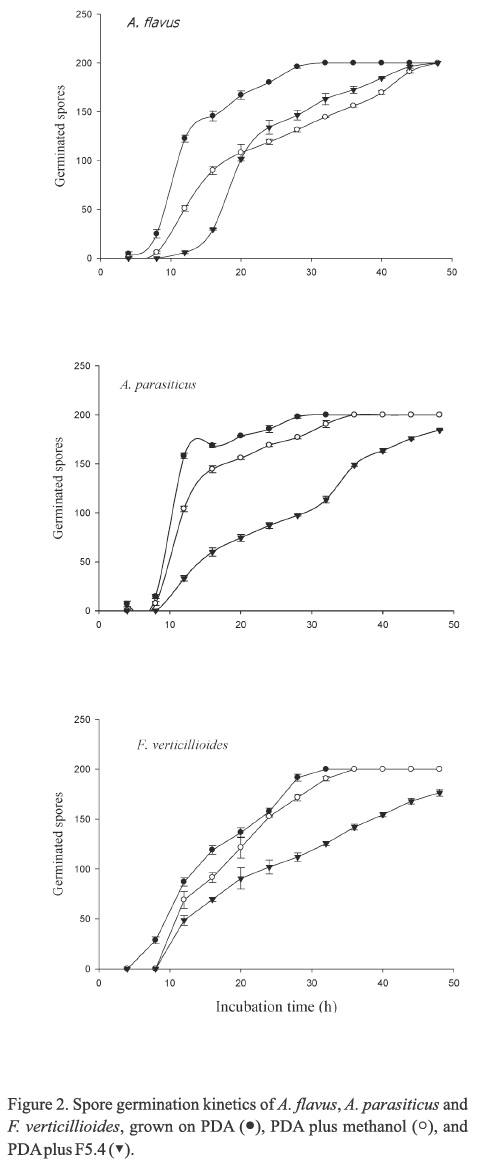
<body><![CDATA[<p align="justify"><font face="verdana" size="2">&nbsp;</font></p>  	    <p align="justify"><font face="verdana" size="2"><b>MGI, MIC<sub>50</sub> and MLC of BF</b></font></p>  	    <p align="justify"><font face="verdana" size="2">The three fungi showed gradual radial growth inhibition when the BF concentration in the PDA media was increased (<a href="/img/revistas/rmm/v39/a2t2.jpg" target="_blank">Table 2</a>). The MGI for <i>A. flavus and A. parasiticus</i> was 5.0 mg mL<sup>&#45;1</sup>, which caused that the fungi did not reach 50 % of radial growth inhibition. <i>F. verticillioides</i> showed MGI and MIC<sub>50</sub> values of 4.0 mg mL<sup>&#45;1</sup> and 1.0 mg mL<sup>&#45;1</sup>, respectively. In the presence of BF, the radial growth inhibition <i>of A. flavus and A. parasiticus</i> were 70 % and 64 %, respectively. However, when <i>F. verticillioides</i> was inoculated on PDA media containing the fractions obtained from BF, its radial growth was completely inhibited (<a href="/img/revistas/rmm/v39/a2t1.jpg" target="_blank">Table 1</a>) although was able to grow when it was transferred to PDB containing no antifungal fraction. The influence of the variable concentration of the antifungal fraction BF over the three fungi is shown in <a href="/img/revistas/rmm/v39/a2f1.jpg" target="_blank">Figure 1</a>.</font></p>  	    <p align="justify"><font face="verdana" size="2">&nbsp;</font></p>  	    <p align="justify"><font face="verdana" size="2"><b>Kinetics of spores germination</b></font></p>  	    <p align="justify"><font face="verdana" size="2">The spores of the three fungi inoculated on the PDB controls completely germinated within 30 h. Although spores germination of <i>A. flavus</i> was delayed when they were grown on PDA containing the antifungal F5.4 fraction, all spores were able to germinate at the end of the experiment (<a href="#f2">Figure 2</a>). Similar results were observed <i>for A. flavus, A. parasiticus</i> and <i>F. verticillioides</i> spores, which were delayed in growth on PDA containing the F5.4 fraction (<a href="#f2">Figure 2</a>). However, the spores of the two last fungi showed significant (P&lt;0.05) germination inhibition at the end of the incubation time (7.8 % and 11.8 % for <i>A. parasiticus</i> and <i>F. verticillioides,</i> respectively).</font></p>  	    <p align="center"><font face="verdana" size="2"><a name="f2"></a></font></p>  	    <p align="center"><font face="verdana" size="2"><img src="/img/revistas/rmm/v39/a2f2.jpg"></font></p>  	    <p align="justify"><font face="verdana" size="2">&nbsp;</font></p>  	    <p align="justify"><font face="verdana" size="2"><b>Hyphal diameter and length</b></font></p>  	    ]]></body>
<body><![CDATA[<p align="justify"><font face="verdana" size="2">The three fungi significantly (P&lt;0.05) underwent a reduction in diameter and length of apical hyphae when they were grown on PDA agar media containing the F5.4 fraction in respect to the PDA and methanol controls. <i>A. flavus</i> apical hyphae showed a reduction in diameter and length in 20.8&plusmn;1.8 % and 43.8&plusmn;2.1 %, whereas those for <i>A. parasiticus</i> were reduced in 18.5&plusmn;0.8 % and 40.1&plusmn;1.7 %, respectively. The decrease in diameter and length of <i>F. verticillioides</i> apical hyphae was of 18.2&plusmn;1.6 % and 41.4&plusmn;2.6 %, respectively. The three fungi showed the higher (P&lt;0.05) reduction percentage in length than in diameter.</font></p>  	    <p align="justify"><font face="verdana" size="2">&nbsp;</font></p>  	    <p align="justify"><font face="verdana" size="2"><b>Spores diameter</b></font></p>  	    <p align="justify"><font face="verdana" size="2">Diameter of spores of each fungi were measured every 3 h of incubation. In both <i>Aspergillus</i> species, the spores diameter increased when they were incubated in PDB and PDB containing methanol, however the diameter of spores of <i>Aspergillus</i> species were reduced in PDB containing the antifungal fraction F5.4 (<a href="/img/revistas/rmm/v39/a2f3.jpg" target="_blank">Figure 3</a>). Spores <i>of F. verticillioides</i> showed no significant differences (P&lt;0.05) in length or diameter throughout the incubation time (<a href="/img/revistas/rmm/v39/a2f3.jpg" target="_blank">Figure 3</a>).</font></p>  	    <p align="justify"><font face="verdana" size="2">&nbsp;</font></p>  	    <p align="justify"><font face="verdana" size="2"><b>Spores viability</b></font></p>  	    <p align="justify"><font face="verdana" size="2">Spores of three fungi treated with the antifungal fraction F5.4 showed a significant viability reduction (P&lt;0.05) after 96 h of incubation. The spores viability of <i>A. flavus, A. parasiticus</i> and <i>F. verticillioides</i> was reduced in 40.7&plusmn;1.8 %, 44.8&plusmn;1.9 % and46.3&plusmn;0.9 %, respectively.</font></p>  	    <p align="justify"><font face="verdana" size="2">&nbsp;</font></p>  	    <p align="justify"><font face="verdana" size="2"><b>Discussion</b></font></p>  	    <p align="justify"><font face="verdana" size="2">Fungal growth inhibition of few <i>Jacquinia</i> species has been reported. Sharma <i>et al.</i> (2008) studied an ethanolic extract of petals of <i>J. ruscifolia</i> and reported growth inhibition of some fungi such as <i>A. flavus</i> and <i>F. moniliforme</i> (syn. <i>F. verticillioides</i>). Garc&iacute;a&#45;Sosa <i>et al.</i> (2011) reported antifungal activity of a methanolic extract of <i>J. flammea</i> against phytopathogenic fungi different to those evaluated in the present study. Although, extracts from other plants have been tested in their antifungal activity against <i>A. flavus, A. parasiticus</i> and <i>F. verticillioides</i> (Dabur <i>et al.,</i> 2005; Rosas&#45;Burgos <i>et al.,</i> 2009; S&aacute;nchez <i>et al.,</i> 2005; Satish <i>et al.,</i> 2007; Su&aacute;rez&#45;Jim&eacute;nez <i>et al.,</i> 2007; Tequida&#45;Meneses <i>et al.,</i> 2002; Vargas&#45;Arispuro <i>et al.,</i> 2005), no studies on the antifungal activity of <i>J. macrocarpa</i> have not been reported before. Results of the radial growth inhibition test for <i>A. flavus</i> were similar to those reported by Tequida&#45;Meneses <i>et al.</i> (2002), although they differed to those reported by other authors (Cowen and Steinbach, 2008; Rosas&#45;Burgos <i>et al.,</i> 2009; Sanchez <i>et al.,</i> 2005; Satish <i>et al.,</i> 2007; Vargas&#45;Arispuro <i>et</i> <i>al.</i>, 2005).</font></p>  	    ]]></body>
<body><![CDATA[<p align="justify"><font face="verdana" size="2">Radial growth inhibition of <i>A. parasiticus</i> and <i>F.</i> <i>verticillioides</i> by methanolic plant extracts have also been observed by S&aacute;nchez <i>et al.</i> (2005) and Su&aacute;rez&#45;Jim&eacute;nez <i>et al.</i> (2007), respectively. The radial growth inhibition value of <i>F.</i> <i>verticillioides</i> was the highest observed in all fungi, which is in agreement with other authors (Tequida&#45;Meneses <i>et al.,</i> 2002; Rosas&#45;Burgos <i>et al.,</i> 2009). Sharma <i>et al.</i> (2008) reported a similar inhibition effect against <i>F. moniliforme</i> and <i>A. flavus</i> of ethanolic petals extracts of J. <i>ruscifolia.</i> In the present study, the fractions obtained after the chromatographic purification steps (F5 and F5.4) from BF, showed the higher antifungal activity over the three fungi than that of the crude extracts and partitioned fractions. It was observed that <i>F. verticillioides</i> was the most inhibited mold when it was inoculated on PDA containing the fraction F5 or F5.4. The concentration of BF that caused the maximum radial growth inhibition of both <i>Aspergillus</i> species was significantly higher (P&lt;0.05) than that for <i>F. verticillioides,</i> which confirms that this last fungus is very sensible to the antifungal fraction of J. <i>macrocarpa.</i> The results of this study indicate that J. macrocarpa contains antifungal compounds that are active against the growth of the fungi tested in the present study, especially against <i>F.</i> <i>verticillioides.</i></font></p>  	    <p align="justify"><font face="verdana" size="2">Retarded spore germination observed in the present study was also reported in <i>F. verticillioides</i> by methanolic extracts of <i>Baecharis glutinosa</i> (Su&aacute;rez&#45;Jim&eacute;nez <i>et al.,</i> 2007). More recently, Rosas&#45;Burgos <i>et al.</i> (2011) reported retarded germination of spores of <i>A. flavus, A. parasiticus</i> and <i>F. verticillioides</i> by a purified fraction of <i>B. glutinosa.</i> Rosas&#45;Burgos <i>et al.</i> (2011) observed lower spore germination inhibition in <i>A. parasiticus</i> than those observed in the present study. However, those authors reported higher inhibition of <i>F. verticillioides</i> spores, which was not observed in this work. The high spore viability inhibition of <i>A. parasiticus</i> and <i>F. verticillioides</i> (P&lt;0.05) coincided with high spore germination inhibition, whereas the opposite was observed in <i>A. flavus,</i> that is, at lower number of viable spores, the lower spores number with germination capacity.</font></p>  	    <p align="justify"><font face="verdana" size="2">Reduction in diameter and length of apical hyphae observed in the three fungi treated with a purified fraction of <i>B. glutinosa</i> was previously observed by Rosas&#45;Burgos <i>et al.</i> (2011), although these authors observed a more pronounced antifungal effect of the plant extract. In the present study, spores of <i>Aspergillus</i> species incubated in PDA controls increased in size, while the spores incubated in the presence of the antifungal F5.4 fraction showed a reduction. Rosas&#45;Burgos <i>et al.</i> (2011) reported that in <i>A. flavus</i> and <i>A. parasiticus</i> the spores diameter increased when they were incubated in media controls and media containing the <i>B. glutinosa</i> antifungal fraction, although the increase observed was smaller with the antifungal treatment in comparison of that of the controls.</font></p>  	    <p align="justify"><font face="verdana" size="2">A study reported by Ha <i>et al.</i> (2006) indicated that <i>Fusarium solani</i> f. sp. <i>pisi,</i> resistant to caspofungin acetate, which target is the fungal wall, decreased its resistance when Fs<i>FKS1</i> that encodes the &szlig;(1,3)&#45;D&#45;glucan synthase was reduced, leading to a reduction in spore viability and causing lysis of spores and hyphae. The radial growth inhibition, delay of spores germination, size reduction of both hyphae and spores and spores and viability observed in the present study, might be due to the loss of cell wall integrity.</font></p>     <p align="justify"><font face="verdana" size="2">It is possible that some compounds such as sakurasosaponin and jacquinonic acid obtained from other <i>Jacquinia</i> species (<i>J. flammea</i> and <i>J. pungens,</i> respectively), which have been reported to show antifungal or repellent activity (Garc&iacute;a&#45;Sosa <i>et al.,</i> 2011; Okunade and Wiemer, 1985), might be responsible of the antifungal activity of J. <i>macrocarpa</i> fractions used in this study.</font></p>  	    <p align="justify"><font face="verdana" size="2">The results of this study demonstrated that <i>J. macrocarpa</i> contains antifungal compounds that could be used as an alternative method to treat corn and other cereals grains to control phytopathogenic molds, especially <i>F. verticillioides.</i></font></p>  	    <p align="justify"><font face="verdana" size="2">&nbsp;</font></p>  	    <p align="justify"><font face="verdana" size="2"><b>Acknowledgments</b></font></p>  	    <p align="justify"><font face="verdana" size="2">The authors are grateful to the National Science Council and Technology (CONACyT)) for granting funding for this study (Ref. 58249).</font></p>  	    <p align="justify"><font face="verdana" size="2">&nbsp;</font></p>  	    ]]></body>
<body><![CDATA[<p align="justify"><font face="verdana" size="2"><b>References</b></font></p>  	    <!-- ref --><p align="justify"><font face="verdana" size="2">Buitimea&#45;Cant&uacute;a, G.V., E.C. Rosas&#45;Burgos, M.O. Cortez&#45;Rocha, J.C. G&aacute;lvez&#45;Ruiz, R.I. S&aacute;nchez&#45;Mar&iacute;&ntilde;ez, 2010. Aislamiento biodirigido y an&aacute;lisis qu&iacute;mico de un extracto con actividad antif&uacute;ngica de <i>Jacquinia macrocarpa</i> (San Juanico). VII Congreso del Noroeste y III Nacional en Ciencias Alimentarias y Biotecnolog&iacute;a, Universidad de Sonora, Hermosillo, M&eacute;xico, pp 1025&#45;1040.    &nbsp;&nbsp;&nbsp;&nbsp;&nbsp;&nbsp;&nbsp;&nbsp;[&#160;<a href="javascript:void(0);" onclick="javascript: window.open('/scielo.php?script=sci_nlinks&ref=8736047&pid=S0187-3180201400010000200001&lng=','','width=640,height=500,resizable=yes,scrollbars=1,menubar=yes,');">Links</a>&#160;]<!-- end-ref --></font></p>  	    <!-- ref --><p align="justify"><font face="verdana" size="2">Constable, P.D., G.W. Smith, GE. Rottinghaus, W.M. Hascheck, 2000. Ingestion of f&uuml;monisin &#914;,&#45;containing culture materials decreases cardiac contractility and mechanical efficiency in swine. Toxicology and Applied Pharmacology 162:151&#45;160.    &nbsp;&nbsp;&nbsp;&nbsp;&nbsp;&nbsp;&nbsp;&nbsp;[&#160;<a href="javascript:void(0);" onclick="javascript: window.open('/scielo.php?script=sci_nlinks&ref=8736049&pid=S0187-3180201400010000200002&lng=','','width=640,height=500,resizable=yes,scrollbars=1,menubar=yes,');">Links</a>&#160;]<!-- end-ref --></font></p>  	    <!-- ref --><p align="justify"><font face="verdana" size="2">Cowen, L.E., W.J. Steinbach, 2008. Stress, drugs, and evolution: the role of cellular signaling in fungal drug resistance. Eukaryotic Cell 7: 747&#45;764.    &nbsp;&nbsp;&nbsp;&nbsp;&nbsp;&nbsp;&nbsp;&nbsp;[&#160;<a href="javascript:void(0);" onclick="javascript: window.open('/scielo.php?script=sci_nlinks&ref=8736051&pid=S0187-3180201400010000200003&lng=','','width=640,height=500,resizable=yes,scrollbars=1,menubar=yes,');">Links</a>&#160;]<!-- end-ref --></font></p>  	    <!-- ref --><p align="justify"><font face="verdana" size="2">Cox, P.W., G.C. Paul, C.R. Thomas, 1998. Image analysis of morphology of filamentous micro&#45;organisms. Microbiology 144:817&#45;827.    &nbsp;&nbsp;&nbsp;&nbsp;&nbsp;&nbsp;&nbsp;&nbsp;[&#160;<a href="javascript:void(0);" onclick="javascript: window.open('/scielo.php?script=sci_nlinks&ref=8736053&pid=S0187-3180201400010000200004&lng=','','width=640,height=500,resizable=yes,scrollbars=1,menubar=yes,');">Links</a>&#160;]<!-- end-ref --></font></p>  	    <!-- ref --><p align="justify"><font face="verdana" size="2">Dabur, R, A.K. Chhillar, V. Yadav, P.K. Kamal, J. Gupta, G.L. Sharma, 2005. <i>In vitro</i> antifungal activity of 2&#45;(3,4&#45;dimethyl&#45;2,5&#45;dihydro&#45;lH&#45;pyrrol&#45;2&#45;yl)&#45;l&#45;methylethyl pentanoate, a dihydropyrrole derivative. Journal of Medical Microbiology 54:549&#45;552.    &nbsp;&nbsp;&nbsp;&nbsp;&nbsp;&nbsp;&nbsp;&nbsp;[&#160;<a href="javascript:void(0);" onclick="javascript: window.open('/scielo.php?script=sci_nlinks&ref=8736055&pid=S0187-3180201400010000200005&lng=','','width=640,height=500,resizable=yes,scrollbars=1,menubar=yes,');">Links</a>&#160;]<!-- end-ref --></font></p>  	    <!-- ref --><p align="justify"><font face="verdana" size="2">Dorner, J.W., R.J. Cole, U.L. Diener, 1984. The relationship of <i>Aspergillus flavus</i> and <i>Aspergillus parasiticus</i> with reference to production of aflatoxins andcyclopiazonic acid. Mycopathologia 87:13&#45;15.    &nbsp;&nbsp;&nbsp;&nbsp;&nbsp;&nbsp;&nbsp;&nbsp;[&#160;<a href="javascript:void(0);" onclick="javascript: window.open('/scielo.php?script=sci_nlinks&ref=8736057&pid=S0187-3180201400010000200006&lng=','','width=640,height=500,resizable=yes,scrollbars=1,menubar=yes,');">Links</a>&#160;]<!-- end-ref --></font></p>  	    <!-- ref --><p align="justify"><font face="verdana" size="2">Eaton, D.L., J.D. Groopman, 1994. The toxicology of aflatoxins. Academic Press Inc., New York.    &nbsp;&nbsp;&nbsp;&nbsp;&nbsp;&nbsp;&nbsp;&nbsp;[&#160;<a href="javascript:void(0);" onclick="javascript: window.open('/scielo.php?script=sci_nlinks&ref=8736059&pid=S0187-3180201400010000200007&lng=','','width=640,height=500,resizable=yes,scrollbars=1,menubar=yes,');">Links</a>&#160;]<!-- end-ref --></font></p>  	    <!-- ref --><p align="justify"><font face="verdana" size="2">El&#45;Ghaouth, A, 1997. Biologically&#45;based alternatives to synthetic fungicides for the control of postharvest diseases. Journal of Industrial Microbiology and Biotechnology 19:160&#45;162.    &nbsp;&nbsp;&nbsp;&nbsp;&nbsp;&nbsp;&nbsp;&nbsp;[&#160;<a href="javascript:void(0);" onclick="javascript: window.open('/scielo.php?script=sci_nlinks&ref=8736061&pid=S0187-3180201400010000200008&lng=','','width=640,height=500,resizable=yes,scrollbars=1,menubar=yes,');">Links</a>&#160;]<!-- end-ref --></font></p>  	    <!-- ref --><p align="justify"><font face="verdana" size="2">Garc&iacute;a&#45;Sosa, &#922;., A. S&aacute;nchez&#45;Medina, SX. Alvarez, S. Zecchino, N.C. Veitch, P. Sim&aacute;&#45;Polanco, L.M. Pe&ntilde;a&#45;Rodr&iacute;guez, 2011. Antifungal activity of sakurasosaponin from the root extract of <i>Jacquinia flammea.</i> Natural Products Research 25:1185&#45;1189.    &nbsp;&nbsp;&nbsp;&nbsp;&nbsp;&nbsp;&nbsp;&nbsp;[&#160;<a href="javascript:void(0);" onclick="javascript: window.open('/scielo.php?script=sci_nlinks&ref=8736063&pid=S0187-3180201400010000200009&lng=','','width=640,height=500,resizable=yes,scrollbars=1,menubar=yes,');">Links</a>&#160;]<!-- end-ref --></font></p>  	    <!-- ref --><p align="justify"><font face="verdana" size="2">Granjo, CA., T.A. dos Reis, W. Gambale, &#914;. Correa, 2007. Morphogenesis and growth kinetics of <i>Fusarium verticillioides.</i> Mycopathologia 164:119&#45;126.    &nbsp;&nbsp;&nbsp;&nbsp;&nbsp;&nbsp;&nbsp;&nbsp;[&#160;<a href="javascript:void(0);" onclick="javascript: window.open('/scielo.php?script=sci_nlinks&ref=8736065&pid=S0187-3180201400010000200010&lng=','','width=640,height=500,resizable=yes,scrollbars=1,menubar=yes,');">Links</a>&#160;]<!-- end-ref --></font></p>  	    <!-- ref --><p align="justify"><font face="verdana" size="2">Ha, Y., S.F. Covert, M. Momany, 2006. FsFKSl, the 1,3&#45;&szlig;&#45;glucan synthase from the caspofungin&#45;resistant fungus <i>Fusarium solani.</i> Eukaryotic Cell 5:1036&#45;1042.    &nbsp;&nbsp;&nbsp;&nbsp;&nbsp;&nbsp;&nbsp;&nbsp;[&#160;<a href="javascript:void(0);" onclick="javascript: window.open('/scielo.php?script=sci_nlinks&ref=8736067&pid=S0187-3180201400010000200011&lng=','','width=640,height=500,resizable=yes,scrollbars=1,menubar=yes,');">Links</a>&#160;]<!-- end-ref --></font></p>  	    <!-- ref --><p align="justify"><font face="verdana" size="2">Harris, S.D., 1999. Morphogenesis is coordinates with nuclear division in germinating <i>Aspergillus nidulans</i> conidiospores. Microbiology 145:2747&#45;2756.    &nbsp;&nbsp;&nbsp;&nbsp;&nbsp;&nbsp;&nbsp;&nbsp;[&#160;<a href="javascript:void(0);" onclick="javascript: window.open('/scielo.php?script=sci_nlinks&ref=8736069&pid=S0187-3180201400010000200012&lng=','','width=640,height=500,resizable=yes,scrollbars=1,menubar=yes,');">Links</a>&#160;]<!-- end-ref --></font></p>  	    <!-- ref --><p align="justify"><font face="verdana" size="2">IARC (International Agency for Research on Cancer), 2002. Fumonisin B<sub>1</sub> IARC monographs on the evaluation of carcinogenic risks to humans 82:301&#45;366.    &nbsp;&nbsp;&nbsp;&nbsp;&nbsp;&nbsp;&nbsp;&nbsp;[&#160;<a href="javascript:void(0);" onclick="javascript: window.open('/scielo.php?script=sci_nlinks&ref=8736071&pid=S0187-3180201400010000200013&lng=','','width=640,height=500,resizable=yes,scrollbars=1,menubar=yes,');">Links</a>&#160;]<!-- end-ref --></font></p>  	    <!-- ref --><p align="justify"><font face="verdana" size="2">Jobling, J., 2000. Essential Oils: a new idea for postharvest disease control. Good Fruit Vegetables Magazine 11:50.    &nbsp;&nbsp;&nbsp;&nbsp;&nbsp;&nbsp;&nbsp;&nbsp;[&#160;<a href="javascript:void(0);" onclick="javascript: window.open('/scielo.php?script=sci_nlinks&ref=8736073&pid=S0187-3180201400010000200014&lng=','','width=640,height=500,resizable=yes,scrollbars=1,menubar=yes,');">Links</a>&#160;]<!-- end-ref --></font></p>  	    <!-- ref --><p align="justify"><font face="verdana" size="2">Koketsu, M., M. Kim, T. Yamamoto, 1996. Antifungal activity against food&#45;borne fungi of <i>Aspidistra eliator</i> Blume. Journal of Agricultural andFood Chemistry 44:301&#45;303.    &nbsp;&nbsp;&nbsp;&nbsp;&nbsp;&nbsp;&nbsp;&nbsp;[&#160;<a href="javascript:void(0);" onclick="javascript: window.open('/scielo.php?script=sci_nlinks&ref=8736075&pid=S0187-3180201400010000200015&lng=','','width=640,height=500,resizable=yes,scrollbars=1,menubar=yes,');">Links</a>&#160;]<!-- end-ref --></font></p>  	    <!-- ref --><p align="justify"><font face="verdana" size="2">Larralde, C.C., L.F. L&oacute;pez, G.G. Viniegra, 1997. Morphometry evaluation of the specific growth rate of <i>Aspergillus niger</i> grown in agar plates at high glucose levels. Biotechnology and Bioengineering 56: 287&#45;294.    &nbsp;&nbsp;&nbsp;&nbsp;&nbsp;&nbsp;&nbsp;&nbsp;[&#160;<a href="javascript:void(0);" onclick="javascript: window.open('/scielo.php?script=sci_nlinks&ref=8736077&pid=S0187-3180201400010000200016&lng=','','width=640,height=500,resizable=yes,scrollbars=1,menubar=yes,');">Links</a>&#160;]<!-- end-ref --></font></p>  	    <!-- ref --><p align="justify"><font face="verdana" size="2">L&oacute;pez&#45;Estudillo, R., A. Hinojosa, 1988. Cat&aacute;logo de Plantas Medicinales Sonorenses. Universidad de Sonora, Hermosillo.    &nbsp;&nbsp;&nbsp;&nbsp;&nbsp;&nbsp;&nbsp;&nbsp;[&#160;<a href="javascript:void(0);" onclick="javascript: window.open('/scielo.php?script=sci_nlinks&ref=8736079&pid=S0187-3180201400010000200017&lng=','','width=640,height=500,resizable=yes,scrollbars=1,menubar=yes,');">Links</a>&#160;]<!-- end-ref --></font></p>  	    <!-- ref --><p align="justify"><font face="verdana" size="2">Marasas, W.F.O.,N.P. Kriek, J.E. Fincham, S.J. van Rensburg, 1984. Primary liver cancer and esophageal basal&#45;cell hyperplasia in rats caused by <i>Fusarium moniliforme.</i> International Journal of Cancer 34: 383&#45;387.    &nbsp;&nbsp;&nbsp;&nbsp;&nbsp;&nbsp;&nbsp;&nbsp;[&#160;<a href="javascript:void(0);" onclick="javascript: window.open('/scielo.php?script=sci_nlinks&ref=8736081&pid=S0187-3180201400010000200018&lng=','','width=640,height=500,resizable=yes,scrollbars=1,menubar=yes,');">Links</a>&#160;]<!-- end-ref --></font></p>  	    <!-- ref --><p align="justify"><font face="verdana" size="2">Nelson, P.E., 1992. Taxonomy and biology of <i>Fusarium moniliforme.</i> Mycopathology 117:29&#45;36.    &nbsp;&nbsp;&nbsp;&nbsp;&nbsp;&nbsp;&nbsp;&nbsp;[&#160;<a href="javascript:void(0);" onclick="javascript: window.open('/scielo.php?script=sci_nlinks&ref=8736083&pid=S0187-3180201400010000200019&lng=','','width=640,height=500,resizable=yes,scrollbars=1,menubar=yes,');">Links</a>&#160;]<!-- end-ref --></font></p>  	    <!-- ref --><p align="justify"><font face="verdana" size="2">Nichols, T.E., 1983. Economic impact of aflatoxins in corn. In: Diener, L., R. Asquith, J. Dickens (ed.), Aflatoxin and <i>Aspergillus flavus</i> in corn. Alabama Agricultural Experimental Station, Auburn, pp. 67&#45;71.    &nbsp;&nbsp;&nbsp;&nbsp;&nbsp;&nbsp;&nbsp;&nbsp;[&#160;<a href="javascript:void(0);" onclick="javascript: window.open('/scielo.php?script=sci_nlinks&ref=8736085&pid=S0187-3180201400010000200020&lng=','','width=640,height=500,resizable=yes,scrollbars=1,menubar=yes,');">Links</a>&#160;]<!-- end-ref --></font></p>  	    <!-- ref --><p align="justify"><font face="verdana" size="2">Okunade, A.L., D.F Wiemer, 1985. Jacquinonic acid, an ant&#45;repellent triterpenoid from <i>Jacquinia pungens.</i> Phytochemistry 24: 1203&#45;1205.    &nbsp;&nbsp;&nbsp;&nbsp;&nbsp;&nbsp;&nbsp;&nbsp;[&#160;<a href="javascript:void(0);" onclick="javascript: window.open('/scielo.php?script=sci_nlinks&ref=8736087&pid=S0187-3180201400010000200021&lng=','','width=640,height=500,resizable=yes,scrollbars=1,menubar=yes,');">Links</a>&#160;]<!-- end-ref --></font></p>  	    <!-- ref --><p align="justify"><font face="verdana" size="2">Paul, G.C, CA. Kent, C.R. Thomas, 1993. Viability testing and characterization of germination of fungal spores by automatic image analysis. Biotechnology and Bioengineering 42:11&#45;23.    &nbsp;&nbsp;&nbsp;&nbsp;&nbsp;&nbsp;&nbsp;&nbsp;[&#160;<a href="javascript:void(0);" onclick="javascript: window.open('/scielo.php?script=sci_nlinks&ref=8736089&pid=S0187-3180201400010000200022&lng=','','width=640,height=500,resizable=yes,scrollbars=1,menubar=yes,');">Links</a>&#160;]<!-- end-ref --></font></p>  	    <!-- ref --><p align="justify"><font face="verdana" size="2">Plascencia&#45;Jatomea, M., G. Viniegra, R. Olayo, M.M. Castillo&#45;Ortega, K. Shirai, 2003. Effect of chitosan and temperature on spore germination of <i>Aspergillus niger.</i> Macromolecular Bioscience 3: 582&#45;586.    &nbsp;&nbsp;&nbsp;&nbsp;&nbsp;&nbsp;&nbsp;&nbsp;[&#160;<a href="javascript:void(0);" onclick="javascript: window.open('/scielo.php?script=sci_nlinks&ref=8736091&pid=S0187-3180201400010000200023&lng=','','width=640,height=500,resizable=yes,scrollbars=1,menubar=yes,');">Links</a>&#160;]<!-- end-ref --></font></p>  	    <!-- ref --><p align="justify"><font face="verdana" size="2">Rahman, &#913;., M.A. Hossain, S.C. Kang, 2010. Control of phytopathogenic fungi by the essential oil and methanolic extracts of <i>Erigeron ramosus</i> (Walt.) B.S.P. European Journal of Plant Pathology 128: 211&#45;219.    &nbsp;&nbsp;&nbsp;&nbsp;&nbsp;&nbsp;&nbsp;&nbsp;[&#160;<a href="javascript:void(0);" onclick="javascript: window.open('/scielo.php?script=sci_nlinks&ref=8736093&pid=S0187-3180201400010000200024&lng=','','width=640,height=500,resizable=yes,scrollbars=1,menubar=yes,');">Links</a>&#160;]<!-- end-ref --></font></p>  	    <!-- ref --><p align="justify"><font face="verdana" size="2">Rosas&#45;Burgos, E.C., M.O. Cortez&#45;Rocha, F.J. Cinco&#45;Moroyoqui, R.E. Robles&#45;Zepeda, J. L&oacute;pez&#45;Cervantes, D.I. S&aacute;nchez&#45;Machado, F. Lares&#45;Villa, 2009. Antifungal activity <i>in vitro</i> of <i>Baccharis glutinosa</i> and <i>Ambrosia confertiflora</i> extracts on <i>Aspergillus flavus, Aspergillus parasiticus</i> and <i>Fusarium verticillioides.</i> World Journal of Microbiology and Biotechnology 25: 2257&#45;2261.    &nbsp;&nbsp;&nbsp;&nbsp;&nbsp;&nbsp;&nbsp;&nbsp;[&#160;<a href="javascript:void(0);" onclick="javascript: window.open('/scielo.php?script=sci_nlinks&ref=8736095&pid=S0187-3180201400010000200025&lng=','','width=640,height=500,resizable=yes,scrollbars=1,menubar=yes,');">Links</a>&#160;]<!-- end-ref --></font></p>  	    <!-- ref --><p align="justify"><font face="verdana" size="2">Rosas&#45;Burgos, E.C., M.O. Cortez&#45;Rocha, M. Plascencia&#45;Jatomea, F.C. Cinco&#45;Moroyoqui, RE. Robles&#45;Zepeda, J. L&oacute;pez&#45;Cervantes, D.I. S&aacute;nchez&#45;Machado, F. Lares&#45;Villa, 2011. The effect of <i>Baccharis glutinosa</i> extract on the growth of mycotoxigenic fungi and fumonisin B<sub>1</sub> and aflatoxin B<sub>1</sub> production. World Journal of Microbiology and Biotechnology 27:1025&#45;1033.    &nbsp;&nbsp;&nbsp;&nbsp;&nbsp;&nbsp;&nbsp;&nbsp;[&#160;<a href="javascript:void(0);" onclick="javascript: window.open('/scielo.php?script=sci_nlinks&ref=8736097&pid=S0187-3180201400010000200026&lng=','','width=640,height=500,resizable=yes,scrollbars=1,menubar=yes,');">Links</a>&#160;]<!-- end-ref --></font></p>  	    <!-- ref --><p align="justify"><font face="verdana" size="2">S&aacute;nchez, E., N. Heredia, S. Garc&iacute;a S., 2005. Inhibition of growth and mycotoxin production of <i>Aspergillus flavus</i> and <i>Aspergillus parasiticus</i> by extracts of Agave species. International Journal of Food Microbiology 98:271&#45;279.    &nbsp;&nbsp;&nbsp;&nbsp;&nbsp;&nbsp;&nbsp;&nbsp;[&#160;<a href="javascript:void(0);" onclick="javascript: window.open('/scielo.php?script=sci_nlinks&ref=8736099&pid=S0187-3180201400010000200027&lng=','','width=640,height=500,resizable=yes,scrollbars=1,menubar=yes,');">Links</a>&#160;]<!-- end-ref --></font></p>  	    <!-- ref --><p align="justify"><font face="verdana" size="2">SAS, Institute, 2005. SAS/STAT User's Guide, Version 8, SAS Publishing, N.C.    &nbsp;&nbsp;&nbsp;&nbsp;&nbsp;&nbsp;&nbsp;&nbsp;[&#160;<a href="javascript:void(0);" onclick="javascript: window.open('/scielo.php?script=sci_nlinks&ref=8736101&pid=S0187-3180201400010000200028&lng=','','width=640,height=500,resizable=yes,scrollbars=1,menubar=yes,');">Links</a>&#160;]<!-- end-ref --></font></p>  	    <!-- ref --><p align="justify"><font face="verdana" size="2">Satish, S., D.C. Mohana, M.P. Raghavendra, K.A. Raveesha, 2007. Antifungal activity of some plant extracts against important seed borne pathogens of <i>Aspergillus</i> sp. Journal of Agricultural Technology 3:109&#45;119.    &nbsp;&nbsp;&nbsp;&nbsp;&nbsp;&nbsp;&nbsp;&nbsp;[&#160;<a href="javascript:void(0);" onclick="javascript: window.open('/scielo.php?script=sci_nlinks&ref=8736103&pid=S0187-3180201400010000200029&lng=','','width=640,height=500,resizable=yes,scrollbars=1,menubar=yes,');">Links</a>&#160;]<!-- end-ref --></font></p>  	    <!-- ref --><p align="justify"><font face="verdana" size="2">Sharma, RS., V. Mishra, R. Singh, N. Seth, C.R. Babu, 2008. Antifungal activity of some Himalayan medicinal plants and cultivated ornamental species. Fitoterapia 79:589&#45;591.    &nbsp;&nbsp;&nbsp;&nbsp;&nbsp;&nbsp;&nbsp;&nbsp;[&#160;<a href="javascript:void(0);" onclick="javascript: window.open('/scielo.php?script=sci_nlinks&ref=8736105&pid=S0187-3180201400010000200030&lng=','','width=640,height=500,resizable=yes,scrollbars=1,menubar=yes,');">Links</a>&#160;]<!-- end-ref --></font></p>  	    <!-- ref --><p align="justify"><font face="verdana" size="2">Sokovi&#263;, M., L.J.L.D. Van Griensven, 2006. Antimicrobial activity of essential oils and their components against the three major pathogens of the cultivated button mushroom, <i>Agaricus bisporus.</i> European Journal of Plant Pathology 116:211&#45;224.    &nbsp;&nbsp;&nbsp;&nbsp;&nbsp;&nbsp;&nbsp;&nbsp;[&#160;<a href="javascript:void(0);" onclick="javascript: window.open('/scielo.php?script=sci_nlinks&ref=8736107&pid=S0187-3180201400010000200031&lng=','','width=640,height=500,resizable=yes,scrollbars=1,menubar=yes,');">Links</a>&#160;]<!-- end-ref --></font></p>  	    <!-- ref --><p align="justify"><font face="verdana" size="2">Sommer,N.F., 1985. Strategies for control ofpostharvest diseases of selected commodities. In: A. Kader, R.F. Kasmine, J.F. Thompson (eds.), Postharvest Technology of Horticultural Crops. Cooperative Extension, Oakland, pp. 83&#45;99.    &nbsp;&nbsp;&nbsp;&nbsp;&nbsp;&nbsp;&nbsp;&nbsp;[&#160;<a href="javascript:void(0);" onclick="javascript: window.open('/scielo.php?script=sci_nlinks&ref=8736109&pid=S0187-3180201400010000200032&lng=','','width=640,height=500,resizable=yes,scrollbars=1,menubar=yes,');">Links</a>&#160;]<!-- end-ref --></font></p>  	    <!-- ref --><p align="justify"><font face="verdana" size="2">Su&aacute;rez&#45;Jim&eacute;nez, GM., M.O. Cortez&#45;Rocha, E.C. Rosas&#45;Burgos, A. Burgos&#45;Hern&aacute;ndez, M. Plascencia&#45;Jatomea, F. J. Cinco&#45;Moroyoqui, 2007. Antifungal activity of plant methanolic extracts against <i>Fusarium verticillioides</i> (Sacc.) Nirenb, and fumonisin B<sub>1</sub>, production. Revista Mexicana de Fitopatolog&iacute;a 25:134&#45;142.    &nbsp;&nbsp;&nbsp;&nbsp;&nbsp;&nbsp;&nbsp;&nbsp;[&#160;<a href="javascript:void(0);" onclick="javascript: window.open('/scielo.php?script=sci_nlinks&ref=8736111&pid=S0187-3180201400010000200033&lng=','','width=640,height=500,resizable=yes,scrollbars=1,menubar=yes,');">Links</a>&#160;]<!-- end-ref --></font></p>  	    <!-- ref --><p align="justify"><font face="verdana" size="2">Tequida&#45;Meneses, M., M.O. Cortez&#45;Rocha, E.C. Rosas&#45;Burgos, S. L&oacute;pez&#45;Sandoval, C. Corrales&#45;Maldonado, 2002. Efecto de extractos alcoh&oacute;licos de plantas silvestres sobre la inhibici&oacute;n de crecimiento de <i>Aspergillus flavus, Aspergillus niger, P&eacute;nicillium chrysogenum, P&eacute;nicillium expansum, Fusarium moniliforme</i> y <i>Fusariumpoae.</i> Revista Iberoamericana de Micologia 19:84&#45;88.    &nbsp;&nbsp;&nbsp;&nbsp;&nbsp;&nbsp;&nbsp;&nbsp;[&#160;<a href="javascript:void(0);" onclick="javascript: window.open('/scielo.php?script=sci_nlinks&ref=8736113&pid=S0187-3180201400010000200034&lng=','','width=640,height=500,resizable=yes,scrollbars=1,menubar=yes,');">Links</a>&#160;]<!-- end-ref --></font></p>  	    <!-- ref --><p align="justify"><font face="verdana" size="2">Vargas&#45;Arispuro, I., R. Reyes&#45;B&aacute;ez, G. Rivera&#45;Casta&ntilde;eda, M.A. Martinez&#45;T&eacute;llez, I. Rivero&#45;Espejel, 2005. Antifungal lignans from the creosotebush <i>(Larrea tridentata).</i> Industrial Crops and Products 22:101&#45;107.    &nbsp;&nbsp;&nbsp;&nbsp;&nbsp;&nbsp;&nbsp;&nbsp;[&#160;<a href="javascript:void(0);" onclick="javascript: window.open('/scielo.php?script=sci_nlinks&ref=8736115&pid=S0187-3180201400010000200035&lng=','','width=640,height=500,resizable=yes,scrollbars=1,menubar=yes,');">Links</a>&#160;]<!-- end-ref --></font></p>      ]]></body><back>
<ref-list>
<ref id="B1">
<nlm-citation citation-type="book">
<person-group person-group-type="author">
<name>
<surname><![CDATA[Buitimea-Cantúa]]></surname>
<given-names><![CDATA[G.V.]]></given-names>
</name>
<name>
<surname><![CDATA[Rosas-Burgos]]></surname>
<given-names><![CDATA[E.C.]]></given-names>
</name>
<name>
<surname><![CDATA[Cortez-Rocha]]></surname>
<given-names><![CDATA[M.O.]]></given-names>
</name>
<name>
<surname><![CDATA[Gálvez-Ruiz]]></surname>
<given-names><![CDATA[J.C.]]></given-names>
</name>
<name>
<surname><![CDATA[Sánchez-Maríñez]]></surname>
<given-names><![CDATA[R.I.]]></given-names>
</name>
</person-group>
<article-title xml:lang="es"><![CDATA[Aislamiento biodirigido y análisis químico de un extracto con actividad antifúngica de Jacquinia macrocarpa (San Juanico)]]></article-title>
<source><![CDATA[VII Congreso del Noroeste y III Nacional en Ciencias Alimentarias y Biotecnología]]></source>
<year>2010</year>
<page-range>1025-1040</page-range><publisher-loc><![CDATA[Hermosillo ]]></publisher-loc>
<publisher-name><![CDATA[Universidad de Sonora]]></publisher-name>
</nlm-citation>
</ref>
<ref id="B2">
<nlm-citation citation-type="journal">
<person-group person-group-type="author">
<name>
<surname><![CDATA[Constable]]></surname>
<given-names><![CDATA[P.D.]]></given-names>
</name>
<name>
<surname><![CDATA[Smith]]></surname>
<given-names><![CDATA[G.W.]]></given-names>
</name>
<name>
<surname><![CDATA[Rottinghaus]]></surname>
<given-names><![CDATA[GE.]]></given-names>
</name>
<name>
<surname><![CDATA[Hascheck]]></surname>
<given-names><![CDATA[W.M.]]></given-names>
</name>
</person-group>
<article-title xml:lang="en"><![CDATA[Ingestion of fümonisin &#914;,-containing culture materials decreases cardiac contractility and mechanical efficiency in swine.]]></article-title>
<source><![CDATA[Toxicology and Applied Pharmacology]]></source>
<year>2000</year>
<volume>162</volume>
<page-range>151-160</page-range></nlm-citation>
</ref>
<ref id="B3">
<nlm-citation citation-type="journal">
<person-group person-group-type="author">
<name>
<surname><![CDATA[Cowen]]></surname>
<given-names><![CDATA[L.E.]]></given-names>
</name>
<name>
<surname><![CDATA[Steinbach]]></surname>
<given-names><![CDATA[W.J.]]></given-names>
</name>
</person-group>
<article-title xml:lang="en"><![CDATA[Stress, drugs, and evolution: the role of cellular signaling in fungal drug resistance]]></article-title>
<source><![CDATA[Eukaryotic Cell]]></source>
<year>2008</year>
<volume>7</volume>
<page-range>747-764</page-range></nlm-citation>
</ref>
<ref id="B4">
<nlm-citation citation-type="journal">
<person-group person-group-type="author">
<name>
<surname><![CDATA[Cox]]></surname>
<given-names><![CDATA[P.W.]]></given-names>
</name>
<name>
<surname><![CDATA[Paul]]></surname>
<given-names><![CDATA[G.C.]]></given-names>
</name>
<name>
<surname><![CDATA[Thomas]]></surname>
<given-names><![CDATA[C.R.]]></given-names>
</name>
</person-group>
<article-title xml:lang="en"><![CDATA[Image analysis of morphology of filamentous micro-organisms]]></article-title>
<source><![CDATA[Microbiology]]></source>
<year>1998</year>
<volume>144</volume>
<page-range>817-827</page-range></nlm-citation>
</ref>
<ref id="B5">
<nlm-citation citation-type="journal">
<person-group person-group-type="author">
<name>
<surname><![CDATA[Dabur]]></surname>
<given-names><![CDATA[R]]></given-names>
</name>
<name>
<surname><![CDATA[Chhillar]]></surname>
<given-names><![CDATA[A.K.]]></given-names>
</name>
<name>
<surname><![CDATA[Yadav]]></surname>
<given-names><![CDATA[V.]]></given-names>
</name>
<name>
<surname><![CDATA[Kamal]]></surname>
<given-names><![CDATA[P.K.]]></given-names>
</name>
<name>
<surname><![CDATA[Gupta]]></surname>
<given-names><![CDATA[J.]]></given-names>
</name>
<name>
<surname><![CDATA[Sharma]]></surname>
<given-names><![CDATA[G.L.]]></given-names>
</name>
</person-group>
<article-title xml:lang="en"><![CDATA[In vitro antifungal activity of 2-(3,4-dimethyl-2,5-dihydro-lH-pyrrol-2-yl)-l-methylethyl pentanoate, a dihydropyrrole derivative]]></article-title>
<source><![CDATA[Journal of Medical Microbiology]]></source>
<year>2005</year>
<volume>54</volume>
<page-range>549-552</page-range></nlm-citation>
</ref>
<ref id="B6">
<nlm-citation citation-type="journal">
<person-group person-group-type="author">
<name>
<surname><![CDATA[Dorner]]></surname>
<given-names><![CDATA[J.W.]]></given-names>
</name>
<name>
<surname><![CDATA[Cole]]></surname>
<given-names><![CDATA[R.J.]]></given-names>
</name>
<name>
<surname><![CDATA[Diener]]></surname>
<given-names><![CDATA[U.L.]]></given-names>
</name>
</person-group>
<article-title xml:lang="en"><![CDATA[The relationship of Aspergillus flavus and Aspergillus parasiticus with reference to production of aflatoxins andcyclopiazonic acid]]></article-title>
<source><![CDATA[Mycopathologia]]></source>
<year>1984</year>
<volume>87</volume>
<page-range>13-15</page-range></nlm-citation>
</ref>
<ref id="B7">
<nlm-citation citation-type="book">
<person-group person-group-type="author">
<name>
<surname><![CDATA[Eaton]]></surname>
<given-names><![CDATA[D.L.]]></given-names>
</name>
<name>
<surname><![CDATA[Groopman]]></surname>
<given-names><![CDATA[J.D.]]></given-names>
</name>
</person-group>
<source><![CDATA[The toxicology of aflatoxins]]></source>
<year>1994</year>
<publisher-loc><![CDATA[New York ]]></publisher-loc>
<publisher-name><![CDATA[Academic Press Inc.]]></publisher-name>
</nlm-citation>
</ref>
<ref id="B8">
<nlm-citation citation-type="journal">
<person-group person-group-type="author">
<name>
<surname><![CDATA[El-Ghaouth]]></surname>
<given-names><![CDATA[A,]]></given-names>
</name>
</person-group>
<article-title xml:lang="en"><![CDATA[Biologically-based alternatives to synthetic fungicides for the control of postharvest diseases]]></article-title>
<source><![CDATA[Journal of Industrial Microbiology and Biotechnology]]></source>
<year>1997</year>
<volume>19</volume>
<page-range>160-162</page-range></nlm-citation>
</ref>
<ref id="B9">
<nlm-citation citation-type="journal">
<person-group person-group-type="author">
<name>
<surname><![CDATA[García-Sosa]]></surname>
<given-names><![CDATA[&#922;.]]></given-names>
</name>
<name>
<surname><![CDATA[Sánchez-Medina]]></surname>
<given-names><![CDATA[A.]]></given-names>
</name>
<name>
<surname><![CDATA[Alvarez]]></surname>
<given-names><![CDATA[SX.]]></given-names>
</name>
<name>
<surname><![CDATA[Zecchino]]></surname>
<given-names><![CDATA[S.]]></given-names>
</name>
<name>
<surname><![CDATA[Veitch]]></surname>
<given-names><![CDATA[N.C.]]></given-names>
</name>
<name>
<surname><![CDATA[Simá-Polanco]]></surname>
<given-names><![CDATA[P.]]></given-names>
</name>
<name>
<surname><![CDATA[Peña-Rodríguez]]></surname>
<given-names><![CDATA[L.M.]]></given-names>
</name>
</person-group>
<article-title xml:lang="en"><![CDATA[Antifungal activity of sakurasosaponin from the root extract of Jacquinia flammea]]></article-title>
<source><![CDATA[Natural Products Research]]></source>
<year>2011</year>
<volume>25</volume>
<page-range>1185-1189</page-range></nlm-citation>
</ref>
<ref id="B10">
<nlm-citation citation-type="journal">
<person-group person-group-type="author">
<name>
<surname><![CDATA[Granjo]]></surname>
<given-names><![CDATA[CA.]]></given-names>
</name>
<name>
<surname><![CDATA[Reis]]></surname>
<given-names><![CDATA[T.A. dos]]></given-names>
</name>
<name>
<surname><![CDATA[Gambale]]></surname>
<given-names><![CDATA[W.]]></given-names>
</name>
<name>
<surname><![CDATA[Correa]]></surname>
<given-names><![CDATA[&#914;.]]></given-names>
</name>
</person-group>
<article-title xml:lang="en"><![CDATA[Morphogenesis and growth kinetics of Fusarium verticillioides]]></article-title>
<source><![CDATA[Mycopathologia]]></source>
<year>2007</year>
<volume>164</volume>
<page-range>119-126</page-range></nlm-citation>
</ref>
<ref id="B11">
<nlm-citation citation-type="journal">
<person-group person-group-type="author">
<name>
<surname><![CDATA[Ha]]></surname>
<given-names><![CDATA[Y.]]></given-names>
</name>
<name>
<surname><![CDATA[Covert]]></surname>
<given-names><![CDATA[S.F.]]></given-names>
</name>
<name>
<surname><![CDATA[Momany]]></surname>
<given-names><![CDATA[M.]]></given-names>
</name>
</person-group>
<article-title xml:lang="en"><![CDATA[FsFKSl, the 1,3-ß-glucan synthase from the caspofungin-resistant fungus Fusarium solani]]></article-title>
<source><![CDATA[Eukaryotic Cell]]></source>
<year>2006</year>
<volume>5</volume>
<page-range>1036-1042</page-range></nlm-citation>
</ref>
<ref id="B12">
<nlm-citation citation-type="journal">
<person-group person-group-type="author">
<name>
<surname><![CDATA[Harris]]></surname>
<given-names><![CDATA[S.D.]]></given-names>
</name>
</person-group>
<article-title xml:lang="en"><![CDATA[Morphogenesis is coordinates with nuclear division in germinating Aspergillus nidulans conidiospores]]></article-title>
<source><![CDATA[Microbiology]]></source>
<year>1999</year>
<volume>145</volume>
<page-range>2747-2756</page-range></nlm-citation>
</ref>
<ref id="B13">
<nlm-citation citation-type="">
<collab>International Agency for Research on Cancer</collab>
<article-title xml:lang="en"><![CDATA[Fumonisin B1]]></article-title>
<source><![CDATA[IARC monographs on the evaluation of carcinogenic risks to humans]]></source>
<year>2002</year>
<volume>82</volume>
<page-range>301-366</page-range></nlm-citation>
</ref>
<ref id="B14">
<nlm-citation citation-type="journal">
<person-group person-group-type="author">
<name>
<surname><![CDATA[Jobling]]></surname>
<given-names><![CDATA[J.]]></given-names>
</name>
</person-group>
<article-title xml:lang="en"><![CDATA[Essential Oils: a new idea for postharvest disease control]]></article-title>
<source><![CDATA[Good Fruit Vegetables Magazine]]></source>
<year>2000</year>
<volume>11</volume>
<page-range>50</page-range></nlm-citation>
</ref>
<ref id="B15">
<nlm-citation citation-type="journal">
<person-group person-group-type="author">
<name>
<surname><![CDATA[Koketsu]]></surname>
<given-names><![CDATA[M.]]></given-names>
</name>
<name>
<surname><![CDATA[Kim]]></surname>
<given-names><![CDATA[M.]]></given-names>
</name>
<name>
<surname><![CDATA[Yamamoto]]></surname>
<given-names><![CDATA[T.]]></given-names>
</name>
</person-group>
<article-title xml:lang="en"><![CDATA[Antifungal activity against food-borne fungi of Aspidistra eliator Blume]]></article-title>
<source><![CDATA[Journal of Agricultural andFood Chemistry]]></source>
<year>1996</year>
<volume>44</volume>
<page-range>301-303</page-range></nlm-citation>
</ref>
<ref id="B16">
<nlm-citation citation-type="journal">
<person-group person-group-type="author">
<name>
<surname><![CDATA[Larralde]]></surname>
<given-names><![CDATA[C.C.]]></given-names>
</name>
<name>
<surname><![CDATA[López]]></surname>
<given-names><![CDATA[L.F.]]></given-names>
</name>
<name>
<surname><![CDATA[Viniegra]]></surname>
<given-names><![CDATA[G.G.]]></given-names>
</name>
</person-group>
<article-title xml:lang="en"><![CDATA[Morphometry evaluation of the specific growth rate of Aspergillus niger grown in agar plates at high glucose levels]]></article-title>
<source><![CDATA[Biotechnology and Bioengineering]]></source>
<year>1997</year>
<volume>56</volume>
<page-range>287-294</page-range></nlm-citation>
</ref>
<ref id="B17">
<nlm-citation citation-type="book">
<person-group person-group-type="author">
<name>
<surname><![CDATA[López-Estudillo]]></surname>
<given-names><![CDATA[R.]]></given-names>
</name>
<name>
<surname><![CDATA[Hinojosa]]></surname>
<given-names><![CDATA[A.]]></given-names>
</name>
</person-group>
<source><![CDATA[Catálogo de Plantas Medicinales Sonorenses]]></source>
<year>1988</year>
<publisher-loc><![CDATA[Hermosillo ]]></publisher-loc>
<publisher-name><![CDATA[Universidad de Sonora]]></publisher-name>
</nlm-citation>
</ref>
<ref id="B18">
<nlm-citation citation-type="journal">
<person-group person-group-type="author">
<name>
<surname><![CDATA[Marasas]]></surname>
<given-names><![CDATA[W.F.O.]]></given-names>
</name>
<name>
<surname><![CDATA[Kriek]]></surname>
<given-names><![CDATA[N.P.]]></given-names>
</name>
<name>
<surname><![CDATA[Fincham]]></surname>
<given-names><![CDATA[J.E.]]></given-names>
</name>
<name>
<surname><![CDATA[Rensburg]]></surname>
<given-names><![CDATA[S.J. van]]></given-names>
</name>
</person-group>
<article-title xml:lang="es"><![CDATA[Primary liver cancer and esophageal basal-cell hyperplasia in rats caused by Fusarium moniliforme]]></article-title>
<source><![CDATA[International Journal of Cancer]]></source>
<year>1984</year>
<volume>34</volume>
<page-range>383-387</page-range></nlm-citation>
</ref>
<ref id="B19">
<nlm-citation citation-type="journal">
<person-group person-group-type="author">
<name>
<surname><![CDATA[Nelson]]></surname>
<given-names><![CDATA[P.E.]]></given-names>
</name>
</person-group>
<article-title xml:lang="en"><![CDATA[Taxonomy and biology of Fusarium moniliforme]]></article-title>
<source><![CDATA[Mycopathology]]></source>
<year>1992</year>
<volume>117</volume>
<page-range>29-36</page-range></nlm-citation>
</ref>
<ref id="B20">
<nlm-citation citation-type="book">
<person-group person-group-type="author">
<name>
<surname><![CDATA[Nichols]]></surname>
<given-names><![CDATA[T.E.]]></given-names>
</name>
</person-group>
<article-title xml:lang="en"><![CDATA[Economic impact of aflatoxins in corn]]></article-title>
<person-group person-group-type="editor">
<name>
<surname><![CDATA[Diener]]></surname>
<given-names><![CDATA[L.]]></given-names>
</name>
<name>
<surname><![CDATA[Asquith]]></surname>
<given-names><![CDATA[R.]]></given-names>
</name>
<name>
<surname><![CDATA[Dickens]]></surname>
<given-names><![CDATA[J.]]></given-names>
</name>
</person-group>
<source><![CDATA[Aflatoxin and Aspergillus flavus in corn]]></source>
<year>1983</year>
<page-range>67-71</page-range><publisher-loc><![CDATA[Auburn ]]></publisher-loc>
<publisher-name><![CDATA[Alabama Agricultural Experimental Station]]></publisher-name>
</nlm-citation>
</ref>
<ref id="B21">
<nlm-citation citation-type="journal">
<person-group person-group-type="author">
<name>
<surname><![CDATA[Okunade]]></surname>
<given-names><![CDATA[A.L.]]></given-names>
</name>
<name>
<surname><![CDATA[Wiemer]]></surname>
<given-names><![CDATA[D.F]]></given-names>
</name>
</person-group>
<article-title xml:lang="en"><![CDATA[Jacquinonic acid, an ant-repellent triterpenoid from Jacquinia pungens]]></article-title>
<source><![CDATA[Phytochemistry]]></source>
<year>1985</year>
<volume>24</volume>
<page-range>1203-1205</page-range></nlm-citation>
</ref>
<ref id="B22">
<nlm-citation citation-type="journal">
<person-group person-group-type="author">
<name>
<surname><![CDATA[Paul]]></surname>
<given-names><![CDATA[G.C]]></given-names>
</name>
<name>
<surname><![CDATA[Kent]]></surname>
<given-names><![CDATA[CA.]]></given-names>
</name>
<name>
<surname><![CDATA[Thomas]]></surname>
<given-names><![CDATA[C.R.]]></given-names>
</name>
</person-group>
<article-title xml:lang="en"><![CDATA[Viability testing and characterization of germination of fungal spores by automatic image analysis]]></article-title>
<source><![CDATA[Biotechnology and Bioengineering]]></source>
<year>1993</year>
<volume>42</volume>
<page-range>11-23</page-range></nlm-citation>
</ref>
<ref id="B23">
<nlm-citation citation-type="journal">
<person-group person-group-type="author">
<name>
<surname><![CDATA[Plascencia-Jatomea]]></surname>
<given-names><![CDATA[M.]]></given-names>
</name>
<name>
<surname><![CDATA[Viniegra]]></surname>
<given-names><![CDATA[G.]]></given-names>
</name>
<name>
<surname><![CDATA[Olayo]]></surname>
<given-names><![CDATA[R.]]></given-names>
</name>
<name>
<surname><![CDATA[Castillo-Ortega]]></surname>
<given-names><![CDATA[M.M.]]></given-names>
</name>
<name>
<surname><![CDATA[Shirai]]></surname>
<given-names><![CDATA[K.]]></given-names>
</name>
</person-group>
<article-title xml:lang="en"><![CDATA[Effect of chitosan and temperature on spore germination of Aspergillus niger]]></article-title>
<source><![CDATA[Macromolecular Bioscience]]></source>
<year>2003</year>
<volume>3</volume>
<page-range>582-586</page-range></nlm-citation>
</ref>
<ref id="B24">
<nlm-citation citation-type="journal">
<person-group person-group-type="author">
<name>
<surname><![CDATA[Rahman]]></surname>
<given-names><![CDATA[&#913;.]]></given-names>
</name>
<name>
<surname><![CDATA[Hossain]]></surname>
<given-names><![CDATA[M.A.]]></given-names>
</name>
<name>
<surname><![CDATA[Kang]]></surname>
<given-names><![CDATA[S.C.]]></given-names>
</name>
</person-group>
<source><![CDATA[European Journal of Plant Pathology]]></source>
<year>2010</year>
<volume>128</volume>
<page-range>211-219</page-range></nlm-citation>
</ref>
<ref id="B25">
<nlm-citation citation-type="journal">
<person-group person-group-type="author">
<name>
<surname><![CDATA[Rosas-Burgos]]></surname>
<given-names><![CDATA[E.C.]]></given-names>
</name>
<name>
<surname><![CDATA[Cortez-Rocha]]></surname>
<given-names><![CDATA[M.O.]]></given-names>
</name>
<name>
<surname><![CDATA[Cinco-Moroyoqui]]></surname>
<given-names><![CDATA[F.J.]]></given-names>
</name>
<name>
<surname><![CDATA[Robles-Zepeda]]></surname>
<given-names><![CDATA[R.E.]]></given-names>
</name>
<name>
<surname><![CDATA[López-Cervantes]]></surname>
<given-names><![CDATA[J.]]></given-names>
</name>
<name>
<surname><![CDATA[Sánchez-Machado]]></surname>
<given-names><![CDATA[D.I.]]></given-names>
</name>
<name>
<surname><![CDATA[Lares-Villa]]></surname>
<given-names><![CDATA[F.]]></given-names>
</name>
</person-group>
<article-title xml:lang="en"><![CDATA[Antifungal activity in vitro of Baccharis glutinosa and Ambrosia confertiflora extracts on Aspergillus flavus, Aspergillus parasiticus and Fusarium verticillioides]]></article-title>
<source><![CDATA[World Journal of Microbiology and Biotechnology]]></source>
<year>2009</year>
<volume>25</volume>
<page-range>2257-2261</page-range></nlm-citation>
</ref>
<ref id="B26">
<nlm-citation citation-type="journal">
<person-group person-group-type="author">
<name>
<surname><![CDATA[Rosas-Burgos]]></surname>
<given-names><![CDATA[E.C.]]></given-names>
</name>
<name>
<surname><![CDATA[Cortez-Rocha]]></surname>
<given-names><![CDATA[M.O.]]></given-names>
</name>
<name>
<surname><![CDATA[Plascencia-Jatomea]]></surname>
<given-names><![CDATA[M.]]></given-names>
</name>
<name>
<surname><![CDATA[Cinco-Moroyoqui]]></surname>
<given-names><![CDATA[F.C.]]></given-names>
</name>
<name>
<surname><![CDATA[Robles-Zepeda]]></surname>
<given-names><![CDATA[RE.]]></given-names>
</name>
<name>
<surname><![CDATA[López-Cervantes]]></surname>
<given-names><![CDATA[J.]]></given-names>
</name>
<name>
<surname><![CDATA[Sánchez-Machado]]></surname>
<given-names><![CDATA[D.I.]]></given-names>
</name>
<name>
<surname><![CDATA[Lares-Villa]]></surname>
<given-names><![CDATA[F.]]></given-names>
</name>
</person-group>
<article-title xml:lang="en"><![CDATA[The effect of Baccharis glutinosa extract on the growth of mycotoxigenic fungi and fumonisin B1 and aflatoxin B1 production.]]></article-title>
<source><![CDATA[World Journal of Microbiology and Biotechnology]]></source>
<year>2011</year>
<volume>27</volume>
<page-range>1025-1033</page-range></nlm-citation>
</ref>
<ref id="B27">
<nlm-citation citation-type="journal">
<person-group person-group-type="author">
<name>
<surname><![CDATA[Sánchez]]></surname>
<given-names><![CDATA[E.]]></given-names>
</name>
<name>
<surname><![CDATA[Heredia]]></surname>
<given-names><![CDATA[N.]]></given-names>
</name>
<name>
<surname><![CDATA[García]]></surname>
<given-names><![CDATA[S.]]></given-names>
</name>
</person-group>
<article-title xml:lang="en"><![CDATA[Inhibition of growth and mycotoxin production of Aspergillus flavus and Aspergillus parasiticus by extracts of Agave species]]></article-title>
<source><![CDATA[International Journal of Food Microbiology]]></source>
<year>2005</year>
<volume>98</volume>
<page-range>271-279</page-range></nlm-citation>
</ref>
<ref id="B28">
<nlm-citation citation-type="book">
<collab>SAS, Institute</collab>
<source><![CDATA[SAS/STAT User's Guide]]></source>
<year>2005</year>
<edition>8</edition>
<publisher-loc><![CDATA[^eN.C. N.C.]]></publisher-loc>
<publisher-name><![CDATA[SAS Publishing]]></publisher-name>
</nlm-citation>
</ref>
<ref id="B29">
<nlm-citation citation-type="journal">
<person-group person-group-type="author">
<name>
<surname><![CDATA[Satish]]></surname>
<given-names><![CDATA[S.]]></given-names>
</name>
<name>
<surname><![CDATA[Mohana]]></surname>
<given-names><![CDATA[D.C.]]></given-names>
</name>
<name>
<surname><![CDATA[Raghavendra]]></surname>
<given-names><![CDATA[M.P.]]></given-names>
</name>
<name>
<surname><![CDATA[Raveesha]]></surname>
<given-names><![CDATA[K.A.]]></given-names>
</name>
</person-group>
<article-title xml:lang="en"><![CDATA[Antifungal activity of some plant extracts against important seed borne pathogens of Aspergillus sp]]></article-title>
<source><![CDATA[Journal of Agricultural Technology]]></source>
<year>2007</year>
<volume>3</volume>
<page-range>109-119</page-range></nlm-citation>
</ref>
<ref id="B30">
<nlm-citation citation-type="journal">
<person-group person-group-type="author">
<name>
<surname><![CDATA[Sharma]]></surname>
<given-names><![CDATA[RS.]]></given-names>
</name>
<name>
<surname><![CDATA[Mishra]]></surname>
<given-names><![CDATA[V.]]></given-names>
</name>
<name>
<surname><![CDATA[Singh]]></surname>
<given-names><![CDATA[R.]]></given-names>
</name>
<name>
<surname><![CDATA[Seth]]></surname>
<given-names><![CDATA[N.]]></given-names>
</name>
<name>
<surname><![CDATA[Babu]]></surname>
<given-names><![CDATA[C.R.]]></given-names>
</name>
</person-group>
<article-title xml:lang="en"><![CDATA[Antifungal activity of some Himalayan medicinal plants and cultivated ornamental species]]></article-title>
<source><![CDATA[Fitoterapia]]></source>
<year>2008</year>
<volume>79</volume>
<page-range>589-591</page-range></nlm-citation>
</ref>
<ref id="B31">
<nlm-citation citation-type="journal">
<person-group person-group-type="author">
<name>
<surname><![CDATA[Sokovi&#263;]]></surname>
<given-names><![CDATA[M.]]></given-names>
</name>
<name>
<surname><![CDATA[Griensven]]></surname>
<given-names><![CDATA[L.J.L.D. Van]]></given-names>
</name>
</person-group>
<article-title xml:lang="en"><![CDATA[Antimicrobial activity of essential oils and their components against the three major pathogens of the cultivated button mushroom, Agaricus bisporus]]></article-title>
<source><![CDATA[European Journal of Plant Pathology]]></source>
<year>2006</year>
<volume>116</volume>
<page-range>211-224</page-range></nlm-citation>
</ref>
<ref id="B32">
<nlm-citation citation-type="book">
<person-group person-group-type="author">
<name>
<surname><![CDATA[Sommer]]></surname>
<given-names><![CDATA[N.F.]]></given-names>
</name>
</person-group>
<article-title xml:lang="en"><![CDATA[Strategies for control ofpostharvest diseases of selected commodities]]></article-title>
<person-group person-group-type="editor">
<name>
<surname><![CDATA[Kader]]></surname>
<given-names><![CDATA[A.]]></given-names>
</name>
<name>
<surname><![CDATA[Kasmine]]></surname>
<given-names><![CDATA[R.F.]]></given-names>
</name>
<name>
<surname><![CDATA[Thompson]]></surname>
<given-names><![CDATA[J.F.]]></given-names>
</name>
</person-group>
<source><![CDATA[Postharvest Technology of Horticultural Crops]]></source>
<year>1985</year>
<page-range>83-99</page-range><publisher-loc><![CDATA[Oakland ]]></publisher-loc>
<publisher-name><![CDATA[Cooperative Extension]]></publisher-name>
</nlm-citation>
</ref>
<ref id="B33">
<nlm-citation citation-type="journal">
<person-group person-group-type="author">
<name>
<surname><![CDATA[Suárez-Jiménez]]></surname>
<given-names><![CDATA[GM.]]></given-names>
</name>
<name>
<surname><![CDATA[Cortez-Rocha]]></surname>
<given-names><![CDATA[M.O.]]></given-names>
</name>
<name>
<surname><![CDATA[Rosas-Burgos]]></surname>
<given-names><![CDATA[E.C.]]></given-names>
</name>
<name>
<surname><![CDATA[Burgos-Hernández]]></surname>
<given-names><![CDATA[A.]]></given-names>
</name>
<name>
<surname><![CDATA[Plascencia-Jatomea]]></surname>
<given-names><![CDATA[M.]]></given-names>
</name>
<name>
<surname><![CDATA[Cinco-Moroyoqui]]></surname>
<given-names><![CDATA[F. J.]]></given-names>
</name>
</person-group>
<article-title xml:lang="en"><![CDATA[Antifungal activity of plant methanolic extracts against Fusarium verticillioides (Sacc.) Nirenb, and fumonisin B1, production]]></article-title>
<source><![CDATA[Revista Mexicana de Fitopatología]]></source>
<year>2007</year>
<volume>25</volume>
<page-range>134-142</page-range></nlm-citation>
</ref>
<ref id="B34">
<nlm-citation citation-type="journal">
<person-group person-group-type="author">
<name>
<surname><![CDATA[Tequida-Meneses]]></surname>
<given-names><![CDATA[M.]]></given-names>
</name>
<name>
<surname><![CDATA[Cortez-Rocha]]></surname>
<given-names><![CDATA[M.O.]]></given-names>
</name>
<name>
<surname><![CDATA[Rosas-Burgos]]></surname>
<given-names><![CDATA[E.C.]]></given-names>
</name>
<name>
<surname><![CDATA[López-Sandoval]]></surname>
<given-names><![CDATA[S.]]></given-names>
</name>
<name>
<surname><![CDATA[Corrales-Maldonado]]></surname>
<given-names><![CDATA[C.]]></given-names>
</name>
</person-group>
<article-title xml:lang="en"><![CDATA[Efecto de extractos alcohólicos de plantas silvestres sobre la inhibición de crecimiento de Aspergillus flavus, Aspergillus niger, Pénicillium chrysogenum, Pénicillium expansum, Fusarium moniliforme y Fusariumpoae]]></article-title>
<source><![CDATA[Revista Iberoamericana de Micologia]]></source>
<year>2002</year>
<volume>19</volume>
<page-range>84-88</page-range></nlm-citation>
</ref>
<ref id="B35">
<nlm-citation citation-type="journal">
<person-group person-group-type="author">
<name>
<surname><![CDATA[Vargas-Arispuro]]></surname>
<given-names><![CDATA[I.]]></given-names>
</name>
<name>
<surname><![CDATA[Reyes-Báez]]></surname>
<given-names><![CDATA[R.]]></given-names>
</name>
<name>
<surname><![CDATA[Rivera-Castañeda]]></surname>
<given-names><![CDATA[G.]]></given-names>
</name>
<name>
<surname><![CDATA[Martinez-Téllez]]></surname>
<given-names><![CDATA[M.A.]]></given-names>
</name>
<name>
<surname><![CDATA[Rivero-Espejel]]></surname>
<given-names><![CDATA[I.]]></given-names>
</name>
</person-group>
<article-title xml:lang="en"><![CDATA[Antifungal lignans from the creosotebush (Larrea tridentata)]]></article-title>
<source><![CDATA[Industrial Crops and Products]]></source>
<year>2005</year>
<volume>22</volume>
<page-range>101-107</page-range></nlm-citation>
</ref>
</ref-list>
</back>
</article>