<?xml version="1.0" encoding="ISO-8859-1"?><article xmlns:mml="http://www.w3.org/1998/Math/MathML" xmlns:xlink="http://www.w3.org/1999/xlink" xmlns:xsi="http://www.w3.org/2001/XMLSchema-instance">
<front>
<journal-meta>
<journal-id>0187-3180</journal-id>
<journal-title><![CDATA[Revista mexicana de micología]]></journal-title>
<abbrev-journal-title><![CDATA[Rev. Mex. Mic]]></abbrev-journal-title>
<issn>0187-3180</issn>
<publisher>
<publisher-name><![CDATA[Sociedad Mexicana de Micología]]></publisher-name>
</publisher>
</journal-meta>
<article-meta>
<article-id>S0187-31802011000100005</article-id>
<title-group>
<article-title xml:lang="en"><![CDATA[Nematophagous fungi (Orbiliales) capturing, destroying and feeding on the histotrophic larvae of Haemonchus contortus (Nematoda: Trichostrongylidae)]]></article-title>
<article-title xml:lang="es"><![CDATA[Hongos nematófagos (Orbiliales) capturando, destruyendo y alimentándose de larvas histiotrópicas de Haemonchus contortus (Nematoda: Trichostrongylidae)]]></article-title>
</title-group>
<contrib-group>
<contrib contrib-type="author">
<name>
<surname><![CDATA[Alfaro Gutiérrez]]></surname>
<given-names><![CDATA[Ivonne Carolina]]></given-names>
</name>
<xref ref-type="aff" rid="A03"/>
</contrib>
<contrib contrib-type="author">
<name>
<surname><![CDATA[Mendoza de Gives]]></surname>
<given-names><![CDATA[Pedro]]></given-names>
</name>
<xref ref-type="aff" rid="A01"/>
</contrib>
<contrib contrib-type="author">
<name>
<surname><![CDATA[Liébano Hernández]]></surname>
<given-names><![CDATA[Enrique]]></given-names>
</name>
<xref ref-type="aff" rid="A01"/>
</contrib>
<contrib contrib-type="author">
<name>
<surname><![CDATA[López Arellano]]></surname>
<given-names><![CDATA[Ma. Eugenia]]></given-names>
</name>
<xref ref-type="aff" rid="A01"/>
</contrib>
<contrib contrib-type="author">
<name>
<surname><![CDATA[Valero Coss]]></surname>
<given-names><![CDATA[Rosa Ofelia]]></given-names>
</name>
<xref ref-type="aff" rid="A01"/>
</contrib>
<contrib contrib-type="author">
<name>
<surname><![CDATA[Hernández Velázquez]]></surname>
<given-names><![CDATA[Víctor Manuel]]></given-names>
</name>
<xref ref-type="aff" rid="A02"/>
</contrib>
</contrib-group>
<aff id="A01">
<institution><![CDATA[,INIFAP  ]]></institution>
<addr-line><![CDATA[Jiutepec Morelos]]></addr-line>
<country>México</country>
</aff>
<aff id="A02">
<institution><![CDATA[,Universidad Autónoma del Estado de Morelos (UAEM) Centro de Investigaciones en Biotecnología ]]></institution>
<addr-line><![CDATA[ ]]></addr-line>
</aff>
<aff id="A03">
<institution><![CDATA[,Universidad Autónoma del Estado de Morelos (UAEM) Facultad de Ciencias Biológicas ]]></institution>
<addr-line><![CDATA[Cuernavaca Morelos]]></addr-line>
<country>México</country>
</aff>
<pub-date pub-type="pub">
<day>00</day>
<month>06</month>
<year>2011</year>
</pub-date>
<pub-date pub-type="epub">
<day>00</day>
<month>06</month>
<year>2011</year>
</pub-date>
<volume>33</volume>
<fpage>29</fpage>
<lpage>35</lpage>
<copyright-statement/>
<copyright-year/>
<self-uri xlink:href="http://www.scielo.org.mx/scielo.php?script=sci_arttext&amp;pid=S0187-31802011000100005&amp;lng=en&amp;nrm=iso"></self-uri><self-uri xlink:href="http://www.scielo.org.mx/scielo.php?script=sci_abstract&amp;pid=S0187-31802011000100005&amp;lng=en&amp;nrm=iso"></self-uri><self-uri xlink:href="http://www.scielo.org.mx/scielo.php?script=sci_pdf&amp;pid=S0187-31802011000100005&amp;lng=en&amp;nrm=iso"></self-uri><abstract abstract-type="short" xml:lang="es"><p><![CDATA[Este trabajo investigó el comportamiento depredador de tres hongos nematófagos (HN) contra larvas histiotróficas (L4) de Haemonchus contortus, usando a larvas infectantes (L3) como patrón de comparación. Los hongos fueron aislados de suelo e identificados como Arthrobotrys oligospora, A. musiformis y Monacrosporium thaumasium. Se utilizaron dos series de placas de agar conteniendo los tres HN. En cada placa de las series 1 y 2, se depositaron 200 larvas histotrópicas, e infectantes; respectivamente y se mantuvieron a temperatura ambiente. La reducción larval se estimó comparando las medias de larvas recuperadas en ambas series. Los tres hongos capturaron y se alimentaron de ambos tipos de larvas de la siguiente manera: Las larvas infectantes se redujeron por acción de A. oligospora en 90.3%, A. musiformis 97% y M. thaumasium 62.3% (P>0.0001). Para el caso de larvas histiotrópicas, los hongos redujeron la población de la siguiente manera: A. oligospora 63.3%; A. musiformis 73.2% y M. thaumasium 69.2% (P>0.0003). La más baja actividad de captura se observó con A. oligospora y A. musiformis sobre larvas histiotrópicas.]]></p></abstract>
<abstract abstract-type="short" xml:lang="en"><p><![CDATA[This research was aimed at investigating the predatory behavior of three nematophagous fungi against the histotrophic larvae of H. contortus (L4). Infective larvae (L3) of H. contortus were used for comparison. Three nematophagous fungi were isolated from soil and identified as Arthrobotrys oligospora, A. musiformis and Monacrosporium thaumasium. Two series of agar plateswere used to grow the three NF. Two hundred histotrophic or infective larvae of H. contortus were added to series 1 plates and series 2 plates, respectively, and kept at room temperature. The reduction in larval population was estimated by comparing the mean number of larvae recovered from both series. Capture rates of infective larvae were as follows: A. oligospora 90.3%, A. musiformis 97%, and M. thaumasium 62.3% (P>0.0001). In comparison, the predatory capture rates of t the histotrophic larval populations were as follows: A. oligospora 63.3%; A. musiformis 73.2% and M. thaumasium 69.2% (P>0.0003). The lowest capture rate of histotrophic larvae was observed with A. oligospora and A. musiformis.]]></p></abstract>
<kwd-group>
<kwd lng="es"><![CDATA[hongos atrapadores de nemátodos]]></kwd>
<kwd lng="es"><![CDATA[Arthrobotrys]]></kwd>
<kwd lng="es"><![CDATA[Monacrosporium]]></kwd>
<kwd lng="en"><![CDATA[nematode-trapping fungi]]></kwd>
<kwd lng="en"><![CDATA[Arthrobotrys]]></kwd>
<kwd lng="en"><![CDATA[Monacrosporium]]></kwd>
</kwd-group>
</article-meta>
</front><body><![CDATA[  	    <p align="justify"><font face="verdana" size="4">Contribuciones</font></p>  	    <p align="center"><font face="verdana" size="2">&nbsp;</font></p>  	    <p align="center"><font face="verdana" size="4"><b>Nematophagous fungi (Orbiliales) capturing, destroying and feeding on the histotrophic larvae of <i>Haemonchus contortus</i> (Nematoda: Trichostrongylidae)</b></font></p>  	    <p align="center"><font face="verdana" size="2">&nbsp;</font></p>  	    <p align="center"><font face="verdana" size="3"><b>Hongos nemat&oacute;fagos (Orbiliales) capturando, destruyendo y aliment&aacute;ndose de larvas histiotr&oacute;picas de <i>Haemonchus contortus</i> (Nematoda: Trichostrongylidae)</b></font></p>  	    <p align="center"><font face="verdana" size="2">&nbsp;</font></p>  	    <p align="center"><font face="verdana" size="2"><b>Ivonne Carolina Alfaro Guti&eacute;rrez<sup>1,3</sup>, Pedro Mendoza de Gives<sup>1</sup>, Enrique Li&eacute;bano Hern&aacute;ndez<sup>1</sup>, Ma. Eugenia L&oacute;pez Arellano<sup>1</sup>, Rosa Ofelia Valero Coss<sup>1</sup>, V&iacute;ctor Manuel Hern&aacute;ndez Vel&aacute;zquez<sup>2</sup></b></font></p>  	    <p align="justify"><font face="verdana" size="2">&nbsp;</font></p>  	    <p align="justify"><font face="verdana" size="2"><i><sup>1</sup> INIFAP, Carretera Federal Cuernavaca&#150;Cuautla, No 8534, Col. Progreso, Jiutepec, Morelos, CP 62500, M&eacute;xico.</i></font></p>  	    ]]></body>
<body><![CDATA[<p align="justify"><font face="verdana" size="2"><i><sup>2</sup> Centro de Investigaciones en Biotecnolog&iacute;a, Universidad Aut&oacute;noma del Estado de Morelos (UAEM).</i></font></p>  	    <p align="justify"><font face="verdana" size="2"><i><sup>3</sup> Facultad de Ciencias Biol&oacute;gicas, (UAEM), Av. Universidad 1001, Col. Chamilpa, Cuernavaca, Morelos, CP 62209, M&eacute;xico.</i></font></p>  	    <p align="justify"><font face="verdana" size="2">&nbsp;</font></p>  	    <p align="justify"><font face="verdana" size="2"><b>Autor para correspondencia:</b>    <br> 	Pedro Mendoza de Gives    <br> 	<a href="mailto:pedromdgives@yahoo.com">pedromdgives@yahoo.com</a></font></p>  	    <p align="justify"><font face="verdana" size="2">&nbsp;</font></p>  	    <p align="justify"><font face="verdana" size="2">Recibido 3 de julio 2010;    <br> 	aceptado 29 de marzo 2011.</font></p>  	    <p align="justify"><font face="verdana" size="2">&nbsp;</font></p>  	    ]]></body>
<body><![CDATA[<p align="justify"><font face="verdana" size="2"><b>Resumen</b></font></p>  	    <p align="justify"><font face="verdana" size="2">Este trabajo investig&oacute; el comportamiento depredador de tres hongos nemat&oacute;fagos (HN) contra larvas histiotr&oacute;ficas (L<sub>4</sub>) de Haemonchus contortus, usando a larvas infectantes (L<sub>3</sub>) como patr&oacute;n de comparaci&oacute;n. Los hongos fueron aislados de suelo e identificados como <i>Arthrobotrys oligospora, A. musiformis y Monacrosporium thaumasium</i>. Se utilizaron dos series de placas de agar conteniendo los tres HN. En cada placa de las series 1 y 2, se depositaron 200 larvas histotr&oacute;picas, e infectantes; respectivamente y se mantuvieron a temperatura ambiente. La reducci&oacute;n larval se estim&oacute; comparando las medias de larvas recuperadas en ambas series. Los tres hongos capturaron y se alimentaron de ambos tipos de larvas de la siguiente manera: Las larvas infectantes se redujeron por acci&oacute;n de <i>A. oligospora</i> en 90.3%, <i>A. musiformis</i> 97% y <i>M. thaumasium</i> 62.3% (P&gt;0.0001). Para el caso de larvas histiotr&oacute;picas, los hongos redujeron la poblaci&oacute;n de la siguiente manera: <i>A. oligospora</i> 63.3%; <i>A. musiformis</i> 73.2% y <i>M. thaumasium</i> 69.2% (P&gt;0.0003). La m&aacute;s baja actividad de captura se observ&oacute; con A. oligospora y A. musiformis sobre larvas histiotr&oacute;picas.</font></p>  	    <p align="justify"><font face="verdana" size="2"><b>Palabras clave:</b> hongos atrapadores de nem&aacute;todos, <i>Arthrobotrys; Monacrosporium</i>.</font></p>  	    <p align="justify"><font face="verdana" size="2">&nbsp;</font></p>  	    <p align="justify"><font face="verdana" size="2"><b>Abstract</b></font></p>  	    <p align="justify"><font face="verdana" size="2">This research was aimed at investigating the predatory behavior of three nematophagous fungi against the histotrophic larvae of H. contortus (L<sub>4</sub>). Infective larvae (L<sub>3</sub>) of H<i>. contortus</i> were used for comparison. Three nematophagous fungi were isolated from soil and identified as <i>Arthrobotrys oligospora, A. musiformis</i> and <i>Monacrosporium thaumasium</i>. Two series of agar plateswere used to grow the three NF. Two hundred histotrophic or infective larvae of H. contortus were added to series 1 plates and series 2 plates, respectively, and kept at room temperature. The reduction in larval population was estimated by comparing the mean number of larvae recovered from both series. Capture rates of infective larvae were as follows: <i>A. oligospora</i> 90.3%, <i>A. musiformis</i> 97%, and <i>M. thaumasium</i> 62.3% (P&gt;0.0001). In comparison, the predatory capture rates of t the histotrophic larval populations were as follows: <i>A. oligospora</i> 63.3%; <i>A. musiformis</i> 73.2% and <i>M. thaumasium</i> 69.2% (P&gt;0.0003). The lowest capture rate of histotrophic larvae was observed with <i>A. oligospora</i> and <i>A. musiformis</i>.</font></p>  	    <p align="justify"><font face="verdana" size="2"><b>Keywords:</b> nematode&#150;trapping fungi; <i>Arthrobotrys; Monacrosporium</i>.</font></p>  	    <p align="justify"><font face="verdana" size="2">&nbsp;</font></p>  	    <p align="justify"><font face="verdana" size="2"><b>Introduction</b></font></p>  	    <p align="justify"><font face="verdana" size="2">Nematophagous fungi have been evaluated as possible biological control agents of both animal and plant parasitic nematodes (Tahseen <i>et al.,</i> 2005, Mendoza de Gives <i>et al.,</i> 1999). In previous studies, some fungi have been evaluated for their capacity to capture infective larvae of <i>Haemonchus contortus</i> (L<sub>3</sub>) under both <i>in vitro</i> and <i>in vivo</i> conditions (Mendoza de Gives <i>et al.,</i> 1994, 2006, Arroyo Bal&aacute;n <i>et al.,</i> 2008, Casillas Aguilar <i>et al.,</i> 2008). The capture of nematodes by nematophagous fungi is determined by a recognition mechanism that is regulated by glycoprotein receptors present in both the cuticle of nematodes and on the fungal cells (Barron, 1977). Previous studies reported differences in the cuticle antigenic mosaic during the different developmental stages of <i>H. contortus</i> (Fetterer, 1989). The protein constitution of the parasitic nematode's cuticle varies among the different developmental stages, i.e., <i>H. contortus</i> adult stages contain higher amounts of basic amino acids than do the larval stages (Cox <i>et al.,</i> 1989). Furthermore, the different surface&#150;protein patterns suggest differences between the exposed antigens of infective (L<sub>3</sub>) and histotrophic (L<sub>4</sub>) larvae. These differences between the L<sub>3</sub> and L<sub>4</sub> larvae are perhaps attributable to the totally different environments in which they normally inhabit. For example,the first endo&#150;parasitic stage of the L<sub>4</sub> larvae occurs in sheep where there is no possible contact with the external environment.</font></p>  	    ]]></body>
<body><![CDATA[<p align="justify"><font face="verdana" size="2">The biochemical structure of these cuticle proteins has an important biological role, such as evading the immune defenses of the host (Cox <i>et al.,</i> 1989). Previously, it was unknown if differences in the antigenic mosaic between the infective and histotrophic larvae of <i>H. contortus</i> influenced the predatory behavior of nematophagous fungi. The present paper tests the hypothesis that histotrophic larvae of <i>H. contortus</i> are less efficiently trapped by nematophagous fungi than are the infective larvae of the parasite. Specifically, this study was aimed at investigating the <i>in vitro</i> predatory activity of three nematophagous fungi against <i>H. contortus</i> histotrophic larvae (L<sub>4</sub>) using infective larvae (L<sub>3</sub>) for comparison.</font></p>  	    <p align="justify"><font face="verdana" size="2">&nbsp;</font></p>  	    <p align="justify"><font face="verdana" size="2"><b>Materials and methods</b></font></p>  	    <p align="justify"><font face="verdana" size="2"><b>Location</b></font></p>  	    <p align="justify"><font face="verdana" size="2">This work was conducted at the National Centre for Disciplinary Research in Veterinary Parasitology, (CENID&#150;PAVET&#150;INIFAP), located at Jiutepec Municipality, State of Morelos, Mexico.</font></p>  	    <p align="justify"><font face="verdana" size="2"><b>Nematophagous fungi</b></font></p>  	    <p align="justify"><font face="verdana" size="2">Fungi were isolated from mossy soil, decaying plant material (a rotten trunk) and the soil containing <i>Brahea</i> palm roots.</font></p>  	    <p align="justify"><font face="verdana" size="2">The "soil sprinkle" technique developed by Barron (1977) was used to capture the nematophagous fungi. The addition of nematode "baits" was used to stimulate the fungal growth. Fungal structures typical of nematophagous fungi, <i>i.e.,</i> conidiophores, conidia, trapping devices and trapped nematodes, were observed under a microscope. Such structures were transferred to Petri dishes containing sterile water agar. After 14 days of growth, fungi were subcultured to sterile water agar plates to obtain pure cultures of the fungal isolates. Fungal isolates were taxonomically identified using the keys for nematophagous fungi published by Cooke and Godfrey (1964) and Rubner (1996).</font></p>  	    <p align="justify"><font face="verdana" size="2"><b><i>Haemonchus contortus</i> infective larvae</b></font></p>  	    <p align="justify"><font face="verdana" size="2">A 6&#150;month&#150;old Pelibuey, male lamb, was experimentally infected with 350 <i>H. contortus</i> infective larvae (L<sub>3</sub>) per kg of body weight. After 21 days of prepatent period (or the incubation period into the animal), the McMaster coprological technique (Anonymous, 1971) was carried out to determine the presence of the infection based on number of nematode eggs eliminated per gram of feces (epg). Once the lamb was shown to be infection positive, it was kept in a metabolic cage and the total volume of feces was collected on a plastic bowl. Feces were then ground and mixed with small pieces of polyurethane. Water was added to obtain a suitable medium for incubating the nematode eggs and supporting a maximum number of hatched larvae. After 5&#150;7 days of incubation, infective larvae were recovered from fecal cultures and purified by density&#150;gradient centrifugation, using a 50% sucrose solution. Recovered larvae were then rinsed in penicillin&#150;streptomycin solution (200 UI and 260 (&micro;g/ml; respectively) and re&#150;suspended in sterile water.</font></p>  	    ]]></body>
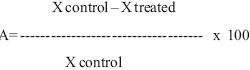
<body><![CDATA[<p align="justify"><font face="verdana" size="2"><b><i>Haemonchus contortus</i> histotropic larvae</b></font></p>  	    <p align="justify"><font face="verdana" size="2">A <i>H. contortus in vitro</i> development technique was conducted to remove the larval sheaths (Ram&iacute;rez Vargas <i>et al.,</i> 2006). This technique was performed in two stages: a) larvae unsheathing, using 6% sodium hydrochloride. (Note: double dilutions were performed until achieving a 0.187% final concentration). The time needed for larvae unsheathing after exposure to the established sodium hydrochloride concentration was observed under the microscope. The loosening of the larvae sheath was facilitated by strong lateral movements of the larvae. To support development of unsheathed infective larvae to histotrophic stages, larvae were put on a medium containing Hank's Solution (49.2 ml), antibiotic&#150;antimycotic supplements (246 of 10,000 units/ml. Penicillin G Sodium, 10,000 &micro;g/ml Streptomycin sulfate, 25 &micro;g/ml amphotericin B ) and sheep's red blood cells (8&micro;l). Larvae were incubated in this medium at 37&deg;C with 95% CO<sub>2</sub> 95% and 5% air for 14 days. After this period, a light microscope was used to observe the typical features of the fourth larval (L<sub>4</sub>) stage of the parasite, including the formation of their oral cavity and perfectly defined intestine (Ram&iacute;rez Vargas <i>et al.,</i> 2006).</font></p>  	    <p align="justify"><font face="verdana" size="2"><b>Quantification of <i>Haemonchus contortus</i> larvae</b></font></p>  	    <p align="justify"><font face="verdana" size="2">To estimate the number of <i>H. contortus</i> larvae in a known volume of a larval suspension, ten 5&#150;&micro;l (vortex) aliquot drops were deposited on a slide and the larvae were counted using a light microscope. The mean number oflarvae in these aliquots was used to estimate the total number of larvae contained in the total volume of the larval suspension.</font></p>  	    <p align="justify"><font face="verdana" size="2"><b>Evaluation of the predatory activity of nematophagous fungi against <i>Haemonchus contortus</i> infective and histotropic larvae</b></font></p>  	    <p align="justify"><font face="verdana" size="2">For the purposes of this study, two series of 40 water agar plates were used. Plates were divided into groups of 10 plates, each with 10 replicates per group. The first three groups of each series were designated as groups 1, 2 and 3, which contained 10&#150;day&#150;old fungal cultures of <i>Arthrobotrys oligospora, A. musiformis</i> or <i>Monacrosporium thaumasium,</i> respectively. Plates in group 4 constituted the control group and contained only water agar. Plates of the series 1 and 2 were supplied with 20 |l of an aqueous suspension with a known number of either infective larvae (184.3&plusmn;64) or histotrophic larvae (107&plusmn;37); respectively. All the plates were incubated at room temperature (25&#150;30&deg;C) for 7 days. After this period, the predatory activity of the fungi was observed under a compound microscope using magnifications of 10, 40, and 100X.</font></p>  	    <p align="justify"><font face="verdana" size="2">At the conclusion of the interaction period between fungi and larvae, the contents of every plate was put in separate Baermann funnels to measure the total of number of non&#150;captured larvae, assuming that the captured larvae were destroyed by the fungal action. The estimation of the reduction in the larval population (A) on each plate was calculated using the following formula provided by Aguilar <i>et al.</i> (2008).</font></p>  	    <p align="center"><font face="verdana" size="2"><img src="/img/revistas/rmm/v33/a5e1.jpg"></font></p>  	    <p align="justify"><font face="verdana" size="2">where:</font></p>  	    <p align="justify"><font face="verdana" size="2">A=Reduction percentage of the larval population</font></p>  	    ]]></body>
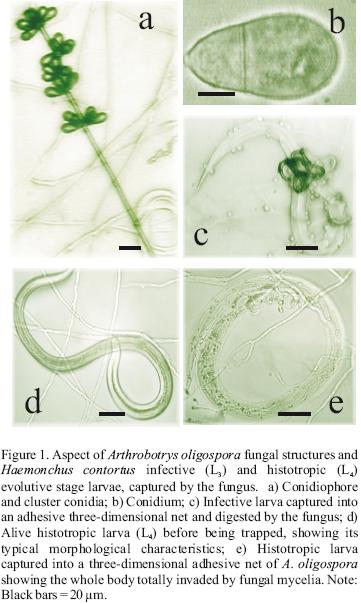
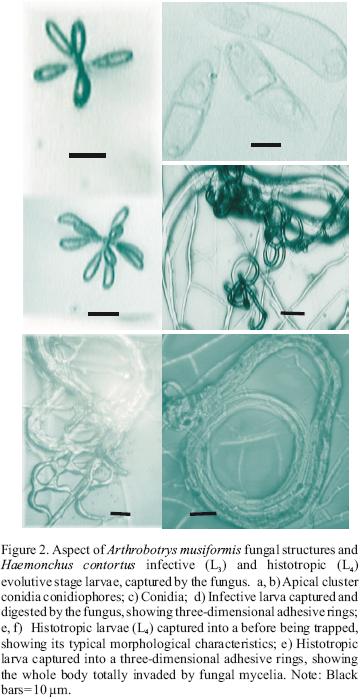
<body><![CDATA[<p align="justify"><font face="verdana" size="2">X control= Number of larvae recovered from the control group.</font></p>  	    <p align="justify"><font face="verdana" size="2">X treated= Number of larvae recovered from the fungal treated group.</font></p>  	    <p align="justify"><font face="verdana" size="2"><b>Statistic analysis</b></font></p>  	    <p align="justify"><font face="verdana" size="2">Data were analyzed by a two factorial analysis of variance (factor 1, <i>H. contortus,</i> L<sub>3</sub> or L<sub>4</sub>; factor 2, three nematophagus fungi) in a completely randomized design with ten replicates using Proc GLM (SAS statistical program, version 9.1). The Tukey honestly significant difference (Tukey HSD) multiple comparison test was also employed to determine significant differences between means in the event of a significant F value for ANOVA. Further separation of each fungal species on the reduction percentage of the L<sub>3</sub> or L<sub>4</sub> was performed using t test (Zar, 1999).</font></p>  	    <p align="justify"><font face="verdana" size="2">&nbsp;</font></p>  	    <p align="justify"><font face="verdana" size="2"><b>Results</b></font></p>  	    <p align="justify"><font face="verdana" size="2">Predatory activities of the three nematophagous fungi against both <i>Haemonchus contortus</i> developmental stages (L<sub>3</sub> and L<sub>4</sub>) were visualized under the microscope (<a href="#f1">Figures 1</a>, <a href="#f2">2</a>, <a href="#f3">3</a>). The number of <i>H. contortus</i> larvae of both development stages recovered from plates of the two series is shown in Table 1. The reduction percentage of the number of larvae of either infective (L<sub>3</sub>) or histotropic (L<sub>4</sub>) larval stages is shown in Table 2. The reduction percentages of the <i>H. contortus</i> infective larvae (L<sub>3</sub>) populations by <i>Arthrobotrys oligospora, A. musiformis</i> and <i>Monacrosporium thaumasium</i> were 90.3 (&plusmn;8), 97 (&plusmn;3.9) and 62.3% (&plusmn;18.5), respectively. Meanwhile, these three nematophagous fungi reduced the histotropic larvae (L<sub>4</sub>) populations by 59.7 (&plusmn;17.5), 75 (&plusmn;13.9) and 69.2% (&plusmn;14); respectively. The statistical analysis revealed that in both cases significant differences were found. When the predatory activity of <i>A. oligospora</i> against larvae of both developmental stages <i>H. contortus</i> was compared, the "t" test showed that larvae of the third stage (L<sub>3</sub>) of the parasite were more efficiently captured and destroyed compared to histotrophic larvae (L<sub>4</sub>) (P&lt;0.0001).</font></p>  	    <p align="center"><font face="verdana" size="2"><a name="f1"></a></font></p>  	    <p align="center"><font face="verdana" size="2"><img src="/img/revistas/rmm/v33/a5f1.jpg"></font></p>  	    <p align="center"><font face="verdana" size="2"><a name="f2"></a></font></p>  	    ]]></body>
<body><![CDATA[<p align="center"><font face="verdana" size="2"><img src="/img/revistas/rmm/v33/a5f2.jpg"></font></p>  	    <p align="center"><font face="verdana" size="2"><a name="f3"></a></font></p>  	    <p align="center"><font face="verdana" size="2"><img src="/img/revistas/rmm/v33/a5f3.jpg"></font></p>  	    <p align="justify"><font face="verdana" size="2">Similarly, <i>A. musiformis</i> also reduced the third stage (L<sub>3</sub>) larval population of the parasite more efficiently than the fourth larval stage (L<sub>4</sub>) (P&lt;0.0051). In contrast, no statistically significant difference was found in the ability of <i>M. thaumasium</i> to capture either infective (L<sub>3</sub>) or histotropic (L<sub>4</sub>) larvae (P&lt;0.515), and the predatory activity of <i>M. thaumasium</i> was lower than the two other <i>Arthrobotrys</i> species tested.</font></p>  	    <p align="justify"><font face="verdana" size="2">A normal distribution of data was assumed and dependence between both series was reveled (P&lt;0.0001) obtaining a variation coefficient of 16.74. The statistical analysis allowed a comparison of the capture percentages of infective larvae (L<sub>3</sub>) among the three fungi evaluated, and also showed a statistical significant difference between <i>M. thaumasium</i> and the other two fungi <i>A. oligospora</i> and <i>A. musiformis;</i> being <i>M. thaumasium</i> less active than the other two fungi. In contrast, no statistically significant differences were observed among the capture percentages of the three fungi against histotropic larvae (L<sub>4</sub>), and the variation coefficient recorded was = 17.84.</font></p>  	    <p align="justify"><font face="verdana" size="2">&nbsp;</font></p>  	    <p align="justify"><font face="verdana" size="2"><b>Discussion</b></font></p>  	    <p align="justify"><font face="verdana" size="2">Nematophagous fungi are capable of producing trapping devices especially designed to capture live nematodes in the soil, kill them, and use them for nutrition (Barron, 1977). At the beginning of the capture process by nematophagous fungi, a receptor&#150;recognition process occurs. Such receptors are presents on the cuticle of the nematodes and they are composed of carbohydrates (Nordbring&#150;Hertz <i>et al.,</i> 1982, Rosenzweig, 1983). Differences in the protein profile between the infective and histotropic larvae of the sheep parasitic nematode <i>Haemonchus contortus</i> have been identified (Cox et al., 1989). The present paper shows evidence that the nematophagous fungal species <i>Arthrobotrys oligospora</i> and <i>A. musiformis</i> capture infective (L.) larvae of <i>H. contortus</i> more efficiently than histotropic (L<sub>4</sub>) larvae. This difference in capture efficiency is perhaps because the histotropic larvae do not possess the complementary molecules in their cuticles that allow for recognition by the nematophagous fungi. In nature, nematophagous fungi typically encounter infective (L<sub>3</sub>) larvae, but not histotropic (L<sub>4</sub>) larvae, in soil and animal feces. Because nematophagous fungi typically only encounter infective (L<sub>3</sub>) larvae in nature, it seems reasonable that the higher capture efficiency of infective larvae is likely due to an adaptation response in the protein profile of the fungi. Such adaptation would allow recognition of carbohydrates present on the nematode's infective larvae cuticle. In this manner, nematophagous fungi are prepared to play their biological role as predatory organisms that help to control nematodes in soil or in animal faeces. In the case of <i>H. contortus</i> the abomasum mucosa of infected sheep is the natural habitat for histotropic larvae (L<sub>4</sub>). Thus, a no direct relationship occurs between <i>histotropic larvae</i> (L<sub>4</sub>) and nematophagous fungi, which likely contributed to lower receptor compatibility. In contrast, <i>Monacrosporium thaumasium</i> showed a similar moderate predatory activity against both development stages of <i>H. contortus.</i> In contrast to our study, a previous work with some species of <i>Monacrosporium</i> found that fungi of this genus generally show a slow predatory activity and a low predatory efficiency against larvae of gastrointestinal parasitic nematodes (Morgan <i>et al.,</i> 1997). Interpreting such complex interactions is complex, but it must be considered that the dynamic evolutionary processes of any organism in nature are dynamic. An organism's genome undergoes a continuous process of adaptation to the environment and selection pressures from numerous interacting organisms (Darwin, 2004). In this manner, the nematodes would be expected to develop mechanisms to evade the capture of nematophagous fungi, perhaps by probably modifying their antigenic mosaic. Similarly, nematophagous fungi are expected to respond by developing mechanisms that allow their continued capture and feeding on nematodes. This dynamic evolutionary process could help to understand why some isolates of the same species display variable predatory activity against the same nematode species. For example, in a previous study, one isolate of <i>Arthrobotrys robusta</i> showed a high <i>in vitro</i> capture efficiency (92.3%) against <i>H. contortus</i> infective larvae (Mendoza de Gives <i>et al.,</i> 1994); while, another isolate of the same species showed a low capture efficiency (32.3%) against <i>Strongyloides papillosus</i> larvae (Gonz&aacute;lez Cruz <i>et</i> al., 1998). Our present study represents the first report on the <i>in vitro</i> predatory activity of nematophagous fungi against histotropic larvae. This study can provide baseline information toward understanding the complex interactions among nematophagous fungi and different developmental stages of nematode larvae. In addition, this approach can be adapted to study recognition mechanisms between nematophagous fungi and nematode larvae.</font></p>  	    <p align="justify"><font face="verdana" size="2">&nbsp;</font></p>  	    <p align="justify"><font face="verdana" size="2"><b>Acknowledgements</b></font></p>  	    ]]></body>
<body><![CDATA[<p align="justify"><font face="verdana" size="2">This research received financial support from <i>S</i>AGARPA&#150;CONACYT, Project No.11990/2005.</font></p>  	    <p align="justify"><font face="verdana" size="2">&nbsp;</font></p>  	    <p align="justify"><font face="verdana" size="2"><b>References</b></font></p>  	    <!-- ref --><p align="justify"><font face="verdana" size="2">Anonymous, 1971. Helminthology. In: Ministry of Agricultura, Fisheries and Food (MAFF) (ed.), Manual of Veterinary Parasitological Laboratory Techniques. Bull. No. 18. Her Majesty's Stationery Office, London, pp. 6&#150;7.    &nbsp;&nbsp;&nbsp;&nbsp;&nbsp;&nbsp;&nbsp;&nbsp;[&#160;<a href="javascript:void(0);" onclick="javascript: window.open('/scielo.php?script=sci_nlinks&ref=8728910&pid=S0187-3180201100010000500001&lng=','','width=640,height=500,resizable=yes,scrollbars=1,menubar=yes,');">Links</a>&#160;]<!-- end-ref --></font></p>  	    <!-- ref --><p align="justify"><font face="verdana" size="2">Arroyo&#150;Bal&aacute;n, L.F., P. Mendoza&#150;de Gives, M. E. L&oacute;pez&#150;Arellano, E. Li&eacute;bano&#150;Hern&aacute;ndez, V.M. V&aacute;zquez&#150;Prats, E. Miranda&#150;Miranda, A.M. Ortiz de Montellano&#150;Nolasco, 2008. Evaluaci&oacute;n de un m&eacute;todo combinado de control de la hemoncosis ovina bajo condiciones controladas. T&eacute;cnica Pecuaria en M&eacute;xico 46, 217&#150;223.    &nbsp;&nbsp;&nbsp;&nbsp;&nbsp;&nbsp;&nbsp;&nbsp;[&#160;<a href="javascript:void(0);" onclick="javascript: window.open('/scielo.php?script=sci_nlinks&ref=8728912&pid=S0187-3180201100010000500002&lng=','','width=640,height=500,resizable=yes,scrollbars=1,menubar=yes,');">Links</a>&#160;]<!-- end-ref --></font></p>  	    <!-- ref --><p align="justify"><font face="verdana" size="2">Barron, G.L., 1977. The Nematode&#150;Destroying Fungi. Canadian Biological Publications. Guelph, Ontario.    &nbsp;&nbsp;&nbsp;&nbsp;&nbsp;&nbsp;&nbsp;&nbsp;[&#160;<a href="javascript:void(0);" onclick="javascript: window.open('/scielo.php?script=sci_nlinks&ref=8728914&pid=S0187-3180201100010000500003&lng=','','width=640,height=500,resizable=yes,scrollbars=1,menubar=yes,');">Links</a>&#160;]<!-- end-ref --></font></p>  	    <!-- ref --><p align="justify"><font face="verdana" size="2">Casillas&#150;Aguilar, J.A., P. Mendoza&#150;de Gives, M.E. L&oacute;pez&#150;Arellano, E. Li&eacute;bano&#150;Hern&aacute;ndez, 2008. Evaluation of Multi&#150;nutritional Biopellets containing <i>Duddingtonia flagrans</i> chlamydospore for the control of ovine haemonchosis. Annals of the New York Academy of Science 1149: 161&#150;163.    &nbsp;&nbsp;&nbsp;&nbsp;&nbsp;&nbsp;&nbsp;&nbsp;[&#160;<a href="javascript:void(0);" onclick="javascript: window.open('/scielo.php?script=sci_nlinks&ref=8728916&pid=S0187-3180201100010000500004&lng=','','width=640,height=500,resizable=yes,scrollbars=1,menubar=yes,');">Links</a>&#160;]<!-- end-ref --></font></p>  	    <!-- ref --><p align="justify"><font face="verdana" size="2">Cooke, C.R., B.E.S. Godfrey, 1964. A key to the nematode&#150;destroying fungi. Transactions of the British Mycological Society 47: 61&#150;74.    &nbsp;&nbsp;&nbsp;&nbsp;&nbsp;&nbsp;&nbsp;&nbsp;[&#160;<a href="javascript:void(0);" onclick="javascript: window.open('/scielo.php?script=sci_nlinks&ref=8728918&pid=S0187-3180201100010000500005&lng=','','width=640,height=500,resizable=yes,scrollbars=1,menubar=yes,');">Links</a>&#160;]<!-- end-ref --></font></p>  	    <!-- ref --><p align="justify"><font face="verdana" size="2">Cox, G.N., L.M. Shamansky, R.J. Boisvenue, 1989. Identification and preliminary characterization of cuticular surface proteins of <i>Haemonchus contortus.</i> Molecular and Biochemical Parasitology 36: 233&#150;242.    &nbsp;&nbsp;&nbsp;&nbsp;&nbsp;&nbsp;&nbsp;&nbsp;[&#160;<a href="javascript:void(0);" onclick="javascript: window.open('/scielo.php?script=sci_nlinks&ref=8728920&pid=S0187-3180201100010000500006&lng=','','width=640,height=500,resizable=yes,scrollbars=1,menubar=yes,');">Links</a>&#160;]<!-- end-ref --></font></p>  	    <!-- ref --><p align="justify"><font face="verdana" size="2">Darwin, C., 2004. El origen de las especies. Libros en Red. Edici&oacute;n electr&oacute;nica. <a href="http://www.librosenred.com/librosgratisclub.aspx" target="_blank">http://www.librosenred.com/librosgratisclub.aspx</a>.    &nbsp;&nbsp;&nbsp;&nbsp;&nbsp;&nbsp;&nbsp;&nbsp;[&#160;<a href="javascript:void(0);" onclick="javascript: window.open('/scielo.php?script=sci_nlinks&ref=8728922&pid=S0187-3180201100010000500007&lng=','','width=640,height=500,resizable=yes,scrollbars=1,menubar=yes,');">Links</a>&#160;]<!-- end-ref --></font></p>      <!-- ref --><p align="justify"><font face="verdana" size="2">Fetterer, R.H., 1989. The cuticular proteins from free&#150;living and parasitic stages of <i>Haemonchus contortus,</i> Isolation and partial characterization. United States Department of Agriculture. Belville Biochem. Physioliology. USA 94, 338&#150;383.    &nbsp;&nbsp;&nbsp;&nbsp;&nbsp;&nbsp;&nbsp;&nbsp;[&#160;<a href="javascript:void(0);" onclick="javascript: window.open('/scielo.php?script=sci_nlinks&ref=8728924&pid=S0187-3180201100010000500008&lng=','','width=640,height=500,resizable=yes,scrollbars=1,menubar=yes,');">Links</a>&#160;]<!-- end-ref --></font></p>  	    <!-- ref --><p align="justify"><font face="verdana" size="2">Gonz&aacute;lez, C.M., P. Mendoza&#150;de Gives, H. Quiroz&#150;Romero, 1998. Comparison of the trapping ability of <i>Arthrobotrys robusta and Monacrosporium gephyropagum</i> on infective larvae of <i>Strongyloides papillosus.</i> Journal of Helminthology 72: 209&#150;213.    &nbsp;&nbsp;&nbsp;&nbsp;&nbsp;&nbsp;&nbsp;&nbsp;[&#160;<a href="javascript:void(0);" onclick="javascript: window.open('/scielo.php?script=sci_nlinks&ref=8728926&pid=S0187-3180201100010000500009&lng=','','width=640,height=500,resizable=yes,scrollbars=1,menubar=yes,');">Links</a>&#160;]<!-- end-ref --><!-- ref --> Mendoza&#150;de Gives, P., 1999. Interaction between nematodes and biocontrol agents with potential for use in biomanagement systems. PhD Thesis, University of Nottingham. 219 p.    &nbsp;&nbsp;&nbsp;&nbsp;&nbsp;&nbsp;&nbsp;&nbsp;[&#160;<a href="javascript:void(0);" onclick="javascript: window.open('/scielo.php?script=sci_nlinks&ref=8728927&pid=S0187-3180201100010000500010&lng=','','width=640,height=500,resizable=yes,scrollbars=1,menubar=yes,');">Links</a>&#160;]<!-- end-ref --></font></p>  	    <!-- ref --><p align="justify"><font face="verdana" size="2">Mendoza&#150;de Gives, P., E. Zavaleta&#150;Mej&iacute;a, D. Herrera&#150;Rodr&iacute;guez, H. Quiroz&#150;Romero, 1994. <i>In vitro</i> trapping capability <i>of Arthrobotrys</i> spp. on infective larvae of <i>Haemonchus contortus</i> and <i>Nacobbus aberrans.</i> Journal of Helminthology 68: 223&#150;229.    &nbsp;&nbsp;&nbsp;&nbsp;&nbsp;&nbsp;&nbsp;&nbsp;[&#160;<a href="javascript:void(0);" onclick="javascript: window.open('/scielo.php?script=sci_nlinks&ref=8728929&pid=S0187-3180201100010000500011&lng=','','width=640,height=500,resizable=yes,scrollbars=1,menubar=yes,');">Links</a>&#160;]<!-- end-ref --></font></p>  	    <!-- ref --><p align="justify"><font face="verdana" size="2">Morgan, M., J.M. Behnke, J.A. Lucas, J.F. Peberdy, 1997. <i>In vitro</i> assessment of the influence of nutrition, temperature and larval density on trapping of the infective larvae of <i>Helligmosomoides polygyrus</i> by <i>Arthrobotrys oligospora,</i> Duddingtonia flagrans and <i>Monacrosporiummegalosporum.</i> Parasitology 115: 303&#150;310.    &nbsp;&nbsp;&nbsp;&nbsp;&nbsp;&nbsp;&nbsp;&nbsp;[&#160;<a href="javascript:void(0);" onclick="javascript: window.open('/scielo.php?script=sci_nlinks&ref=8728931&pid=S0187-3180201100010000500012&lng=','','width=640,height=500,resizable=yes,scrollbars=1,menubar=yes,');">Links</a>&#160;]<!-- end-ref --></font></p>  	    <!-- ref --><p align="justify"><font face="verdana" size="2">Nordbring&#150;Hertz, B., E. Friman, B. Mattiasson, 1982. A recognition mechanism in the adhesion of nematodos to nematode&#150;trapping fungi. In: "Lectins&#150;Biology, Biochemistry" Clinical Biochemistry 2: 83&#150;90.    &nbsp;&nbsp;&nbsp;&nbsp;&nbsp;&nbsp;&nbsp;&nbsp;[&#160;<a href="javascript:void(0);" onclick="javascript: window.open('/scielo.php?script=sci_nlinks&ref=8728933&pid=S0187-3180201100010000500013&lng=','','width=640,height=500,resizable=yes,scrollbars=1,menubar=yes,');">Links</a>&#160;]<!-- end-ref --></font></p>  	    <!-- ref --><p align="justify"><font face="verdana" size="2">Ram&iacute;rez&#150;Vargas, G., Ma. E. L&oacute;pez&#150;Arellano, P. Mendoza&#150;de Gives, E. Li&eacute;bano&#150;Hern&aacute;ndez, V.M. V&aacute;zquez&#150;Prats, 2006. Desarrollo de nematodos endopar&aacute;sitos de <i>Haemonchus contortus in vitro</i> como modelo biol&oacute;gico de estudio. Asociaci&oacute;n Mexicana de Parasit&oacute;logos veterinarios, A. C. VII Congreso Nacional de Parasitolog&iacute;a Veterinaria, 27, 28 y 29 de Agosto del 2006. Acapulco, M&eacute;xico.    &nbsp;&nbsp;&nbsp;&nbsp;&nbsp;&nbsp;&nbsp;&nbsp;[&#160;<a href="javascript:void(0);" onclick="javascript: window.open('/scielo.php?script=sci_nlinks&ref=8728935&pid=S0187-3180201100010000500014&lng=','','width=640,height=500,resizable=yes,scrollbars=1,menubar=yes,');">Links</a>&#160;]<!-- end-ref --></font></p>  	    ]]></body>
<body><![CDATA[<!-- ref --><p align="justify"><font face="verdana" size="2">Rosenzweig, W.D., D. Ackroyd, 1983. Binding Characteristics of Lectins Involved in the Trapping of Nematodes by Fungi. Applied and Environmental Microbiology 46: 1093&#150;1096.    &nbsp;&nbsp;&nbsp;&nbsp;&nbsp;&nbsp;&nbsp;&nbsp;[&#160;<a href="javascript:void(0);" onclick="javascript: window.open('/scielo.php?script=sci_nlinks&ref=8728937&pid=S0187-3180201100010000500015&lng=','','width=640,height=500,resizable=yes,scrollbars=1,menubar=yes,');">Links</a>&#160;]<!-- end-ref --></font></p>  	    <!-- ref --><p align="justify"><font face="verdana" size="2">Rubner, A., 1996. Revision of predacious Hyphomycetes in the <i>Dactylella&#150;Monacrosporium</i> complex. Studies in Mycology 39: 1&#150;134.    &nbsp;&nbsp;&nbsp;&nbsp;&nbsp;&nbsp;&nbsp;&nbsp;[&#160;<a href="javascript:void(0);" onclick="javascript: window.open('/scielo.php?script=sci_nlinks&ref=8728939&pid=S0187-3180201100010000500016&lng=','','width=640,height=500,resizable=yes,scrollbars=1,menubar=yes,');">Links</a>&#160;]<!-- end-ref --></font></p>  	    <!-- ref --><p align="justify"><font face="verdana" size="2">Tahseen, Q., I.M. Clark, S.D. Atkins, R.R. Hirsch, B.R. Kerry, 2005. Impact of the nematophagous fungus <i>Pochonia chlamydosporia</i> on nematode and microbial populations. Communications in Agricultural and Applied Biological Sciences. Ghent University 70: 81&#150;86.    &nbsp;&nbsp;&nbsp;&nbsp;&nbsp;&nbsp;&nbsp;&nbsp;[&#160;<a href="javascript:void(0);" onclick="javascript: window.open('/scielo.php?script=sci_nlinks&ref=8728941&pid=S0187-3180201100010000500017&lng=','','width=640,height=500,resizable=yes,scrollbars=1,menubar=yes,');">Links</a>&#160;]<!-- end-ref --></font></p>  	    <!-- ref --><p align="justify"><font face="verdana" size="2">Zar, H.J., 1999. Biostatistical Analysis. Fourth Edition. Prentice&#150;Hall, Inc, Englewood Cliffs, New Jersey, USA.    &nbsp;&nbsp;&nbsp;&nbsp;&nbsp;&nbsp;&nbsp;&nbsp;[&#160;<a href="javascript:void(0);" onclick="javascript: window.open('/scielo.php?script=sci_nlinks&ref=8728943&pid=S0187-3180201100010000500018&lng=','','width=640,height=500,resizable=yes,scrollbars=1,menubar=yes,');">Links</a>&#160;]<!-- end-ref --></font></p>      ]]></body><back>
<ref-list>
<ref id="B1">
<nlm-citation citation-type="">
<person-group person-group-type="author">
<name>
</name>
<name>
</name>
</person-group>
<article-title xml:lang="en"><![CDATA[Helminthology]]></article-title>
<collab>Ministry of Agricultura, Fisheries and Food (MAFF)</collab>
<source><![CDATA[Manual of Veterinary Parasitological Laboratory Techniques]]></source>
<year>1971</year>
<page-range>6-7</page-range><publisher-loc><![CDATA[London ]]></publisher-loc>
</nlm-citation>
</ref>
<ref id="B2">
<nlm-citation citation-type="journal">
<person-group person-group-type="author">
<name>
<surname><![CDATA[Arroyo-Balán]]></surname>
<given-names><![CDATA[L.F.]]></given-names>
</name>
<name>
<surname><![CDATA[Mendoza-de Gives]]></surname>
<given-names><![CDATA[P.]]></given-names>
</name>
<name>
<surname><![CDATA[López-Arellano]]></surname>
<given-names><![CDATA[M. E.]]></given-names>
</name>
<name>
<surname><![CDATA[Liébano-Hernández]]></surname>
<given-names><![CDATA[E.]]></given-names>
</name>
<name>
<surname><![CDATA[Vázquez-Prats]]></surname>
<given-names><![CDATA[V.M.]]></given-names>
</name>
<name>
<surname><![CDATA[Miranda-Miranda]]></surname>
<given-names><![CDATA[E.]]></given-names>
</name>
<name>
<surname><![CDATA[Ortiz de Montellano-Nolasco]]></surname>
<given-names><![CDATA[A.M.]]></given-names>
</name>
</person-group>
<article-title xml:lang="es"><![CDATA[Evaluación de un método combinado de control de la hemoncosis ovina bajo condiciones controladas]]></article-title>
<source><![CDATA[Técnica Pecuaria en México]]></source>
<year>2008</year>
<numero>46</numero>
<issue>46</issue>
<page-range>217-223</page-range></nlm-citation>
</ref>
<ref id="B3">
<nlm-citation citation-type="book">
<person-group person-group-type="author">
<name>
<surname><![CDATA[Barron]]></surname>
<given-names><![CDATA[G.L.]]></given-names>
</name>
</person-group>
<source><![CDATA[The Nematode-Destroying Fungi]]></source>
<year>1977</year>
<publisher-loc><![CDATA[Guelph^eOntario Ontario]]></publisher-loc>
<publisher-name><![CDATA[Canadian Biological Publications]]></publisher-name>
</nlm-citation>
</ref>
<ref id="B4">
<nlm-citation citation-type="journal">
<person-group person-group-type="author">
<name>
<surname><![CDATA[Casillas-Aguilar]]></surname>
<given-names><![CDATA[J.A.]]></given-names>
</name>
<name>
<surname><![CDATA[Mendoza-de Gives]]></surname>
<given-names><![CDATA[P.]]></given-names>
</name>
<name>
<surname><![CDATA[López-Arellano]]></surname>
<given-names><![CDATA[M.E.]]></given-names>
</name>
<name>
<surname><![CDATA[Liébano-Hernández]]></surname>
<given-names><![CDATA[E.]]></given-names>
</name>
</person-group>
<article-title xml:lang="en"><![CDATA[Evaluation of Multi-nutritional Biopellets containing Duddingtonia flagrans chlamydospore for the control of ovine haemonchosis]]></article-title>
<source><![CDATA[Annals of the New York Academy of Science]]></source>
<year>2008</year>
<volume>1149</volume>
<page-range>161-163</page-range></nlm-citation>
</ref>
<ref id="B5">
<nlm-citation citation-type="journal">
<person-group person-group-type="author">
<name>
<surname><![CDATA[Cooke]]></surname>
<given-names><![CDATA[C.R.]]></given-names>
</name>
<name>
<surname><![CDATA[Godfrey]]></surname>
<given-names><![CDATA[B.E.S.]]></given-names>
</name>
</person-group>
<article-title xml:lang="en"><![CDATA[A key to the nematode-destroying fungi]]></article-title>
<source><![CDATA[Transactions of the British Mycological Society]]></source>
<year>1964</year>
<volume>47</volume>
<page-range>61-74</page-range></nlm-citation>
</ref>
<ref id="B6">
<nlm-citation citation-type="journal">
<person-group person-group-type="author">
<name>
<surname><![CDATA[Cox]]></surname>
<given-names><![CDATA[G.N.]]></given-names>
</name>
<name>
<surname><![CDATA[Shamansky]]></surname>
<given-names><![CDATA[L.M.]]></given-names>
</name>
<name>
<surname><![CDATA[Boisvenue]]></surname>
<given-names><![CDATA[R.J.]]></given-names>
</name>
</person-group>
<article-title xml:lang="en"><![CDATA[Identification and preliminary characterization of cuticular surface proteins of Haemonchus contortus]]></article-title>
<source><![CDATA[Molecular and Biochemical Parasitology]]></source>
<year>1989</year>
<volume>36</volume>
<page-range>233-242</page-range></nlm-citation>
</ref>
<ref id="B7">
<nlm-citation citation-type="book">
<person-group person-group-type="author">
<name>
<surname><![CDATA[Darwin]]></surname>
<given-names><![CDATA[C.]]></given-names>
</name>
</person-group>
<source><![CDATA[El origen de las especies]]></source>
<year>2004</year>
<publisher-name><![CDATA[Libros en Red]]></publisher-name>
</nlm-citation>
</ref>
<ref id="B8">
<nlm-citation citation-type="journal">
<person-group person-group-type="author">
<name>
<surname><![CDATA[Fetterer]]></surname>
<given-names><![CDATA[R.H.]]></given-names>
</name>
</person-group>
<article-title xml:lang="en"><![CDATA[The cuticular proteins from free-living and parasitic stages of Haemonchus contortus, Isolation and partial characterization.]]></article-title>
<source><![CDATA[Biochem. Physioliology. USA]]></source>
<year></year>
<numero>94</numero>
<issue>94</issue>
<page-range>338-383</page-range></nlm-citation>
</ref>
<ref id="B9">
<nlm-citation citation-type="journal">
<person-group person-group-type="author">
<name>
<surname><![CDATA[González]]></surname>
<given-names><![CDATA[C.M.]]></given-names>
</name>
<name>
<surname><![CDATA[Mendoza-de Gives]]></surname>
<given-names><![CDATA[P.]]></given-names>
</name>
<name>
<surname><![CDATA[Quiroz-Romero]]></surname>
<given-names><![CDATA[H.]]></given-names>
</name>
</person-group>
<article-title xml:lang="en"><![CDATA[Comparison of the trapping ability of Arthrobotrys robusta and Monacrosporium gephyropagum on infective larvae of Strongyloides papillosus]]></article-title>
<source><![CDATA[Journal of Helminthology]]></source>
<year>1998</year>
<volume>72</volume>
<page-range>209-213.</page-range></nlm-citation>
</ref>
<ref id="B10">
<nlm-citation citation-type="">
<person-group person-group-type="author">
<name>
<surname><![CDATA[Mendoza-de Gives]]></surname>
<given-names><![CDATA[P.]]></given-names>
</name>
</person-group>
<source><![CDATA[Interaction between nematodes and biocontrol agents with potential for use in biomanagement systems]]></source>
<year>1999</year>
<page-range>219</page-range></nlm-citation>
</ref>
<ref id="B11">
<nlm-citation citation-type="journal">
<person-group person-group-type="author">
<name>
<surname><![CDATA[Mendoza-de Gives]]></surname>
<given-names><![CDATA[P.]]></given-names>
</name>
<name>
<surname><![CDATA[Zavaleta-Mejía]]></surname>
<given-names><![CDATA[E.]]></given-names>
</name>
<name>
<surname><![CDATA[Herrera-Rodríguez]]></surname>
<given-names><![CDATA[D.]]></given-names>
</name>
<name>
<surname><![CDATA[Quiroz-Romero]]></surname>
<given-names><![CDATA[H.]]></given-names>
</name>
</person-group>
<article-title xml:lang="en"><![CDATA[In vitro trapping capability of Arthrobotrys spp. on infective larvae of Haemonchus contortus and Nacobbus aberrans]]></article-title>
<source><![CDATA[Journal of Helminthology]]></source>
<year>1994</year>
<volume>68</volume>
<page-range>223-229</page-range></nlm-citation>
</ref>
<ref id="B12">
<nlm-citation citation-type="journal">
<person-group person-group-type="author">
<name>
<surname><![CDATA[Morgan]]></surname>
<given-names><![CDATA[M.]]></given-names>
</name>
<name>
<surname><![CDATA[Behnke]]></surname>
<given-names><![CDATA[J.M.]]></given-names>
</name>
<name>
<surname><![CDATA[Lucas]]></surname>
<given-names><![CDATA[J.A.]]></given-names>
</name>
<name>
<surname><![CDATA[Peberdy]]></surname>
<given-names><![CDATA[J.F.]]></given-names>
</name>
</person-group>
<article-title xml:lang="en"><![CDATA[In vitro assessment of the influence of nutrition, temperature and larval density on trapping of the infective larvae of Helligmosomoides polygyrus by Arthrobotrys oligospora, Duddingtonia flagrans and Monacrosporiummegalosporum]]></article-title>
<source><![CDATA[Parasitology]]></source>
<year>1997</year>
<volume>115</volume>
<page-range>303-310</page-range></nlm-citation>
</ref>
<ref id="B13">
<nlm-citation citation-type="journal">
<person-group person-group-type="author">
<name>
<surname><![CDATA[Nordbring-Hertz]]></surname>
<given-names><![CDATA[B.]]></given-names>
</name>
<name>
<surname><![CDATA[Friman]]></surname>
<given-names><![CDATA[E.]]></given-names>
</name>
<name>
<surname><![CDATA[Mattiasson]]></surname>
<given-names><![CDATA[B.]]></given-names>
</name>
</person-group>
<article-title xml:lang="en"><![CDATA[A recognition mechanism in the adhesion of nematodos to nematode-trapping fungi]]></article-title>
<source><![CDATA["Lectins-Biology, Biochemistry" Clinical Biochemistry]]></source>
<year>1982</year>
<volume>2</volume>
<page-range>83-90</page-range></nlm-citation>
</ref>
<ref id="B14">
<nlm-citation citation-type="confpro">
<person-group person-group-type="author">
<name>
<surname><![CDATA[Ramírez-Vargas]]></surname>
<given-names><![CDATA[G.]]></given-names>
</name>
<name>
<surname><![CDATA[López-Arellano]]></surname>
<given-names><![CDATA[. E.]]></given-names>
</name>
<name>
<surname><![CDATA[Mendoza-de Gives]]></surname>
<given-names><![CDATA[P.]]></given-names>
</name>
<name>
<surname><![CDATA[Liébano-Hernández]]></surname>
<given-names><![CDATA[E.]]></given-names>
</name>
<name>
<surname><![CDATA[Vázquez-Prats]]></surname>
<given-names><![CDATA[V.M.]]></given-names>
</name>
</person-group>
<source><![CDATA[Desarrollo de nematodos endoparásitos de Haemonchus contortus in vitro como modelo biológico de estudio]]></source>
<year>2006</year>
<conf-name><![CDATA[ VII Congreso Nacional de Parasitología Veterinaria]]></conf-name>
<conf-date>29 de Agosto del 2006</conf-date>
<conf-loc>Acapulco </conf-loc>
</nlm-citation>
</ref>
<ref id="B15">
<nlm-citation citation-type="journal">
<person-group person-group-type="author">
<name>
<surname><![CDATA[Rosenzweig]]></surname>
<given-names><![CDATA[W.D.]]></given-names>
</name>
<name>
<surname><![CDATA[Ackroyd]]></surname>
<given-names><![CDATA[D.]]></given-names>
</name>
</person-group>
<article-title xml:lang="en"><![CDATA[Binding Characteristics of Lectins Involved in the Trapping of Nematodes by Fungi]]></article-title>
<source><![CDATA[Applied and Environmental Microbiology]]></source>
<year>1983</year>
<volume>46</volume>
<page-range>1093-1096</page-range></nlm-citation>
</ref>
<ref id="B16">
<nlm-citation citation-type="journal">
<person-group person-group-type="author">
<name>
<surname><![CDATA[Rubner]]></surname>
<given-names><![CDATA[A.]]></given-names>
</name>
</person-group>
<article-title xml:lang="en"><![CDATA[Revision of predacious Hyphomycetes in the Dactylella-Monacrosporium complex]]></article-title>
<source><![CDATA[Studies in Mycology]]></source>
<year>1996</year>
<volume>39</volume>
<page-range>1-134</page-range></nlm-citation>
</ref>
<ref id="B17">
<nlm-citation citation-type="journal">
<person-group person-group-type="author">
<name>
<surname><![CDATA[Tahseen]]></surname>
<given-names><![CDATA[Q.]]></given-names>
</name>
<name>
<surname><![CDATA[Clark]]></surname>
<given-names><![CDATA[I.M.]]></given-names>
</name>
<name>
<surname><![CDATA[Atkins]]></surname>
<given-names><![CDATA[S.D.]]></given-names>
</name>
<name>
<surname><![CDATA[Hirsch]]></surname>
<given-names><![CDATA[R.R.]]></given-names>
</name>
<name>
<surname><![CDATA[Kerry]]></surname>
<given-names><![CDATA[B.R.]]></given-names>
</name>
</person-group>
<article-title xml:lang="en"><![CDATA[Impact of the nematophagous fungus Pochonia chlamydosporia on nematode and microbial populations]]></article-title>
<source><![CDATA[Communications in Agricultural and Applied Biological Sciences]]></source>
<year>2005</year>
<volume>70</volume>
<page-range>81-86</page-range><publisher-name><![CDATA[Ghent University]]></publisher-name>
</nlm-citation>
</ref>
<ref id="B18">
<nlm-citation citation-type="book">
<person-group person-group-type="author">
<name>
<surname><![CDATA[Zar]]></surname>
<given-names><![CDATA[H.J.]]></given-names>
</name>
</person-group>
<source><![CDATA[Biostatistical Analysis]]></source>
<year>1999</year>
<edition>Fourth</edition>
<publisher-loc><![CDATA[Englewood Cliffs^eNew Jersey New Jersey]]></publisher-loc>
<publisher-name><![CDATA[Prentice-Hall, Inc]]></publisher-name>
</nlm-citation>
</ref>
</ref-list>
</back>
</article>