<?xml version="1.0" encoding="ISO-8859-1"?><article xmlns:mml="http://www.w3.org/1998/Math/MathML" xmlns:xlink="http://www.w3.org/1999/xlink" xmlns:xsi="http://www.w3.org/2001/XMLSchema-instance">
<front>
<journal-meta>
<journal-id>0186-1042</journal-id>
<journal-title><![CDATA[Contaduría y administración]]></journal-title>
<abbrev-journal-title><![CDATA[Contad. Adm]]></abbrev-journal-title>
<issn>0186-1042</issn>
<publisher>
<publisher-name><![CDATA[Universidad Nacional Autónoma de México, Facultad de Contaduría y Administración]]></publisher-name>
</publisher>
</journal-meta>
<article-meta>
<article-id>S0186-10422015000100002</article-id>
<title-group>
<article-title xml:lang="en"><![CDATA[Attitudes towards money and motivational orientation to work in Brazilian young workers]]></article-title>
<article-title xml:lang="es"><![CDATA[Actitudes hacia el dinero y orientación motivacional hacia el trabajo en jóvenes trabajadores brasileños]]></article-title>
</title-group>
<contrib-group>
<contrib contrib-type="author">
<name>
<surname><![CDATA[Monteiro]]></surname>
<given-names><![CDATA[Danielli Leite Campos]]></given-names>
</name>
<xref ref-type="aff" rid="A01"/>
</contrib>
<contrib contrib-type="author">
<name>
<surname><![CDATA[Peñaloza]]></surname>
<given-names><![CDATA[Verónica]]></given-names>
</name>
<xref ref-type="aff" rid="A02"/>
</contrib>
<contrib contrib-type="author">
<name>
<surname><![CDATA[Pinto]]></surname>
<given-names><![CDATA[Francisco Roberto]]></given-names>
</name>
<xref ref-type="aff" rid="A03"/>
</contrib>
<contrib contrib-type="author">
<name>
<surname><![CDATA[Denegri Coria]]></surname>
<given-names><![CDATA[Marianela del Carmen]]></given-names>
</name>
<xref ref-type="aff" rid="A04"/>
</contrib>
<contrib contrib-type="author">
<name>
<surname><![CDATA[Orellana Calderón]]></surname>
<given-names><![CDATA[Ligia María]]></given-names>
</name>
<xref ref-type="aff" rid="A05"/>
</contrib>
</contrib-group>
<aff id="A01">
<institution><![CDATA[,Universidade Estadual do Ceara  ]]></institution>
<addr-line><![CDATA[Fortaleza Ceara]]></addr-line>
<country>Brasil</country>
</aff>
<aff id="A02">
<institution><![CDATA[,Universidade Estadual do Ceara  ]]></institution>
<addr-line><![CDATA[Fortaleza Ceara]]></addr-line>
<country>Brasil</country>
</aff>
<aff id="A03">
<institution><![CDATA[,Universidade Estadual do Ceara  ]]></institution>
<addr-line><![CDATA[Fortaleza Ceara]]></addr-line>
<country>Brasil</country>
</aff>
<aff id="A04">
<institution><![CDATA[,Universidad de La Frontera  ]]></institution>
<addr-line><![CDATA[Temuco Cautín]]></addr-line>
<country>Chile</country>
</aff>
<aff id="A05">
<institution><![CDATA[,Universidad de La Frontera  ]]></institution>
<addr-line><![CDATA[Temuco Cautín]]></addr-line>
<country>Chile</country>
</aff>
<pub-date pub-type="pub">
<day>00</day>
<month>03</month>
<year>2015</year>
</pub-date>
<pub-date pub-type="epub">
<day>00</day>
<month>03</month>
<year>2015</year>
</pub-date>
<volume>60</volume>
<numero>1</numero>
<fpage>11</fpage>
<lpage>30</lpage>
<copyright-statement/>
<copyright-year/>
<self-uri xlink:href="http://www.scielo.org.mx/scielo.php?script=sci_arttext&amp;pid=S0186-10422015000100002&amp;lng=en&amp;nrm=iso"></self-uri><self-uri xlink:href="http://www.scielo.org.mx/scielo.php?script=sci_abstract&amp;pid=S0186-10422015000100002&amp;lng=en&amp;nrm=iso"></self-uri><self-uri xlink:href="http://www.scielo.org.mx/scielo.php?script=sci_pdf&amp;pid=S0186-10422015000100002&amp;lng=en&amp;nrm=iso"></self-uri><abstract abstract-type="short" xml:lang="en"><p><![CDATA[Self-determination theory assumes that there are two motivational orientations: intrinsic and extrinsic motivation. Money is a means to different ends, thus considered an external source of motivation, but individuals may also attribute other meanings to it. The aim of this research was to study the relationship between motivational orientation and the attitude towards money in young employees in Brazil. The sample consisted of 163 young workers attending a Business Administration program at a public university in Fortaleza, Brazil. The Work Preference Inventory (WPI), the Love of Money Scale (LOMS) and a socio-demographic questionnaire were applied. The data was examined using descriptive statistics, correlations, factor analysis and cluster analysis and comparisons. The individuals' motivational orientation to work was found to be associated with their attitude towards money. Two profiles were identified, based on their differences between source of motivation and perception of money as a reward and as evil. Identifying the profiles that connect motivation with meaning of money may allow organizations to design and implement compensation systems according to their employees' needs.]]></p></abstract>
<abstract abstract-type="short" xml:lang="es"><p><![CDATA[La teoría de la autodeterminación asume la existencia de dos tipos de orientación motivacional: motivación intrínseca y extrínseca. El dinero es un medio para lograr diferentes fines y, por tanto, se considera fuente externa de motivación, pero las personas también pueden atribuirle otros significados. El objetivo de esta investigación fue indagar la relación entre orientación motivacional y la actitud hacia el dinero en jóvenes empleados en Brasil. La muestra fue de 163 trabajadores jóvenes que cursaban la carrera de Administración de Empresas en una universidad pública en Fortaleza, Brasil. Los cuestionarios aplicados fueron el Work Preference Inventory (WPI), Love of Money Scale (LOMS) y otro de variables sociodemográficas. Los datos fueron analizados a través de correlaciones, análisis factorial y análisis y comparación de clúster. Se encontró que la orientación motivacional de los individuos hacia el trabajo estaba asociada con su actitud hacia el dinero. Se identificaron dos perfiles, basándose en las diferencias entre la fuente de motivación y la percepción del dinero como recompensa o como vil. El identificar los perfiles que conectan la motivación con el significado del dinero permitirá a las organizaciones diseñar e implementar sistemas de compensación acordes a las necesidades de sus empleados.]]></p></abstract>
<kwd-group>
<kwd lng="en"><![CDATA[motivational orientation]]></kwd>
<kwd lng="en"><![CDATA[extrinsic motivation]]></kwd>
<kwd lng="en"><![CDATA[intrinsic motivation]]></kwd>
<kwd lng="en"><![CDATA[money]]></kwd>
<kwd lng="en"><![CDATA[young workers]]></kwd>
<kwd lng="es"><![CDATA[orientación motivacional]]></kwd>
<kwd lng="es"><![CDATA[motivación extrínseca]]></kwd>
<kwd lng="es"><![CDATA[motivación intrínseca]]></kwd>
<kwd lng="es"><![CDATA[dinero]]></kwd>
<kwd lng="es"><![CDATA[trabajadores jóvenes]]></kwd>
</kwd-group>
</article-meta>
</front><body><![CDATA[  	    <p align="center"><font face="verdana" size="4"><b>Attitudes towards money and motivational orientation to work in Brazilian young workers</b></font></p>  	    <p align="justify"><font face="verdana" size="2">&nbsp;</font></p>  	    <p align="center"><font face="verdana" size="3"><b>Actitudes hacia el dinero y orientaci&oacute;n motivacional hacia el trabajo en j&oacute;venes trabajadores brasile&ntilde;os</b></font></p>  	    <p align="justify"><font face="verdana" size="2">&nbsp;</font></p>  	    <p align="center"><font face="verdana" size="2"><b>Danielli Leite Campos Monteiro*, Ver&oacute;nica Pe&ntilde;aloza**, Francisco Roberto Pinto***, Marianela del Carmen Denegri Coria**** y Ligia Mar&iacute;a Orellana Calder&oacute;n*****</b></font></p>  	    <p align="justify"><font face="verdana" size="2">&nbsp;</font></p>  	    <p align="justify"><font face="verdana" size="2"><i>* Universidade Estadual do Cear&aacute;,</i> <a href="mailto:danieli.campos@uece.br" target="_blank">danieli.campos@uece.br</a></font></p>  	    <p align="justify"><font face="verdana" size="2"><i>** Universidade Estadual do Cear&aacute;,</i> <a href="mailto:veronica.penaloza@uece.br" target="_blank">veronica.penaloza@uece.br</a></font></p>  	    <p align="justify"><font face="verdana" size="2"><i>*** Universidade Estadual do Cear&aacute;,</i> <a href="mailto:roberto.pinto@uece.br" target="_blank">roberto.pinto@uece.br</a></font></p>  	    ]]></body>
<body><![CDATA[<p align="justify"><font face="verdana" size="2"><i>**** Universidad de La Frontera,</i> <a href="mailto:marianela.denegri@ufrontera.cl" target="_blank">marianela.denegri@ufrontera.cl</a></font></p>  	    <p align="justify"><font face="verdana" size="2"><i>***** Universidad de La Frontera,</i> <a href="mailto:lm.orca@gmail.com" target="_blank">lm.orca@gmail.com</a></font></p>  	    <p align="justify"><font face="verdana" size="2">&nbsp;</font></p>  	    <p align="justify"><font face="verdana" size="2">Fecha de recepci&oacute;n: 05.12.2013    <br> 	Fecha de aceptaci&oacute;n: 04.09.2014</font></p>  	    <p align="justify"><font face="verdana" size="2">&nbsp;</font></p>  	    <p align="justify"><font face="verdana" size="2"><b>Abstract</b></font></p>  	    <p align="justify"><font face="verdana" size="2">Self&#45;determination theory assumes that there are two motivational orientations: intrinsic and extrinsic motivation. Money is a means to different ends, thus considered an external source of motivation, but individuals may also attribute other meanings to it. The aim of this research was to study the relationship between motivational orientation and the attitude towards money in young employees in Brazil. The sample consisted of 163 young workers attending a Business Administration program at a public university in Fortaleza, Brazil. The Work Preference Inventory (WPI), the Love of Money Scale (LOMS) and a socio&#45;demographic questionnaire were applied. The data was examined using descriptive statistics, correlations, factor analysis and cluster analysis and comparisons. The individuals' motivational orientation to work was found to be associated with their attitude towards money. Two profiles were identified, based on their differences between source of motivation and perception of money as a reward and as evil. Identifying the profiles that connect motivation with meaning of money may allow organizations to design and implement compensation systems according to their employees' needs.</font></p>  	    <p align="justify"><font face="verdana" size="2"><b>Keywords:</b> motivational orientation, extrinsic motivation, intrinsic motivation, money, young workers.</font></p>  	    <p align="justify"><font face="verdana" size="2">&nbsp;</font></p>  	    ]]></body>
<body><![CDATA[<p align="justify"><font face="verdana" size="2"><b>Resumen</b></font></p>  	    <p align="justify"><font face="verdana" size="2">La teor&iacute;a de la autodeterminaci&oacute;n asume la existencia de dos tipos de orientaci&oacute;n motivacional: motivaci&oacute;n intr&iacute;nseca y extr&iacute;nseca. El dinero es un medio para lograr diferentes fines y, por tanto, se considera fuente externa de motivaci&oacute;n, pero las personas tambi&eacute;n pueden atribuirle otros significados. El objetivo de esta investigaci&oacute;n fue indagar la relaci&oacute;n entre orientaci&oacute;n motivacional y la actitud hacia el dinero en j&oacute;venes empleados en Brasil. La muestra fue de 163 trabajadores j&oacute;venes que cursaban la carrera de Administraci&oacute;n de Empresas en una universidad p&uacute;blica en Fortaleza, Brasil. Los cuestionarios aplicados fueron el Work Preference Inventory (WPI), Love of Money Scale (LOMS) y otro de variables sociodemogr&aacute;ficas. Los datos fueron analizados a trav&eacute;s de correlaciones, an&aacute;lisis factorial y an&aacute;lisis y comparaci&oacute;n de cl&uacute;ster. Se encontr&oacute; que la orientaci&oacute;n motivacional de los individuos hacia el trabajo estaba asociada con su actitud hacia el dinero. Se identificaron dos perfiles, bas&aacute;ndose en las diferencias entre la fuente de motivaci&oacute;n y la percepci&oacute;n del dinero como recompensa o como vil. El identificar los perfiles que conectan la motivaci&oacute;n con el significado del dinero permitir&aacute; a las organizaciones dise&ntilde;ar e implementar sistemas de compensaci&oacute;n acordes a las necesidades de sus empleados.</font></p>  	    <p align="justify"><font face="verdana" size="2"><b>Palabras clave:</b> orientaci&oacute;n motivacional, motivaci&oacute;n extr&iacute;nseca, motivaci&oacute;n intr&iacute;nseca, dinero, trabajadores j&oacute;venes.</font></p>  	    <p align="justify"><font face="verdana" size="2">&nbsp;</font></p>  	    <p align="justify"><font face="verdana" size="2"><b>Introduction</b></font></p>  	    <p align="justify"><font face="verdana" size="2">Motivation is a fundamental issue in psychology, both in terms of biological drives and social influence. In the corporate scenario, where interest is directed towards improving the performance of employees to achieve the goals of the organization, motivation remains a major challenge given the coexistence of diverse interests and distinct motivations (Bergamini, 1990) How to move individuals to consistently take action within a complex and diverse environment is one of the topics of interest to organizations.</font></p>  	    <p align="justify"><font face="verdana" size="2">According to Deci and Ryan (1985), psychological motivational theories seek to identify the direction and power of human behavior. Several theorists have studied motivation (Deci &amp; Ryan, 1985; Maslow, 1970; Ryan &amp; Deci, 2000a; Skinner, 1953/2003; Vroom, 1970) and although they do not differ about the object of research, their studies originate from different influences. The field of motivation is a vast and complex theoretical tangle, and its ideas can be guided by behaviorist, cognitive and humanistic psychoanalytic principles (Penna, 2001).</font></p>  	    <p align="justify"><font face="verdana" size="2">As part of this wide theoretical ground, the Self&#45;Determination Theory (SDT) is a macro&#45;theory of human motivation, personality development and wellbeing, developed by Edward L. Deci and Richard M. Ryan in the 1970s (Deci and Ryan, 1985a), and research continues to the present time (Ryan &amp; Deci, 2000a, 2000b). The hypothesis that humans are organisms instead of mechanisms represents the starting point of the humanist vision adopted in the study of SDT. According to the authors, the objective of research on SDT is to clarify the organic and humanistic hypothesis behind motivation using empirical methods. Two main traditions of psychology are the foundation of the SDT: the assessment of people as organisms by the psychoanalytic tradition, and the use of empirical research methods. Therefore, the SDT can be described as a humanist&#45; empirical one (Deci, 1998).</font></p>  	    <p align="justify"><font face="verdana" size="2">Most motivational theories conceive motivation as a unitary phenomenon that can be measured in degrees (Ryan &amp; Deci, 2000a): a person who does not feel driven to act is considered unmotivated; a person who feels inspired to act for a particular purpose is considered to be motivated. However, people's motivation does not differ only in amount &#151;poorly or very motivated&#151; but also in orientation, which is based on reasons or goals that cause action (Deci &amp; Ryan, 1985). Consequently, the SDT focuses on the interaction among extrinsic forces acting upon people, the individual's own intrinsic forces and basic human needs of competence, autonomy and relatedness (Dysvik &amp; Kuvaas, 2012; McCally, 2010; Ryan &amp; Deci, 2000b).</font></p>  	    <p align="justify"><font face="verdana" size="2">In this regard, some authors (Amabile <i>et al</i>., 1994; Ebert, 2010; Dysvik &amp; Kuuvas, 2012; Deci &amp; Ryan, 2000) have defined types of motivational orientations. Some people seem driven in their work by passion, they find their tasks enjoyable and their involvement and participation are their own reward. This is an autonomous motivation, better known as intrinsic motivation (IM). On the other hand, there are people who seem more motivated by external incentives, their activities are conducted in order to attain a desired consequence or to avoid punishment; this is extrinsic motivation (EM). IM is based on volition and choice while EM is instrumental, based on pressure to act and respond to potential environmental consequences resulting from the performance (Deci &amp; Ryan, 1985; Dysvik &amp; Kuuvas, 2012). Research suggests that motivational orientations can be, aside from a result from social consequences, a relatively stable individual difference (Amabile, 1985; Amabile <i>et al</i>., 1994).</font></p>  	    ]]></body>
<body><![CDATA[<p align="justify"><font face="verdana" size="2">In order to evaluate both motivational orientations in labor and school contexts, Amabile and colleagues (1994) developed the Work Preference Inventory (WPI). Two versions of this instrument were developed, varying in five items that assess compensation: working adults receive wage and promotions, while students are rewarded with good grades and accolades. The remaining items measure factors that are comparable between both populations. Ultimately, the WPI was conceived as an assessment of individual differences in terms of whether people consider themselves intrinsically or extrinsically motivated to carry out their activities. It has been established that IM and EM have a distinct influence on employees' outcomes (Gagn&eacute; &amp; Deci, 2005). While there is a positive relationship between extrinsic motivators and effort at work (Dysvik &amp; Kuvaas, 2012), it has also been found that people with high IM at the workplace have greater motivation and tend to need less supervision (Pascual, Prelec &amp; Dunfield, 2013).</font></p>  	    <p align="justify"><font face="verdana" size="2">Money&#45;based rewards are considered powerful motivators (Furnham, 1996; Luna &amp; Tang, 2004; Medina, Gallegos &amp; Lara, 2008; Tang, 1992, 1993, 1995, 2007, 2010; Tang, Kim &amp; Tang, 2000). Money increasingly acquires value as a result of its perceived instrumentality to access other desired results (Lea &amp; Webley, 2006; Vroom, 1970). The meaning of money depends on the individual but money itself is an objective means to obtaining goods and fulfilling needs and desires, so it is indispensable and it influences several aspects of modern life. Tang (1992) indicated that social values are related to money matters and argued that in a materialistic society, people are highly driven by money and see money as a source of power and happiness.</font></p>  	    <p align="justify"><font face="verdana" size="2">Researchers have examined the attitudes towards money, seeking to define the cognitive structure of this construct and the variables related to it (Moreira, 2002), as well as its relation to motivation, satisfaction and job performance (Medina, Gallegos &amp; Lara, 2008; Tang, Kim &amp; Tang, 2000). Considering money as an individual difference attribute can have a significant impact in the design and implementation of organizational compensation systems (Lim, 2003).</font></p>  	    <p align="justify"><font face="verdana" size="2">In order to measure this construct, Luna&#45;Arocas and Tang (2004) developed the Love of Money Scale (LOMS), which has been tested in several cultures, languages and religions (e.g. Wong, 2008). The LOMS was originally applied to Spanish and American university professors to examine their relation to money and their intrinsic and extrinsic work satisfaction. Five factors originated using exploratory factor analysis: Budget, Success, Motivator, Equity and Evil. Using these factors, the authors performed a cluster analysis and identified four profiles of professors in relation to money: Achieving Money Worshippers, Careless Money Admirers, Apathetic Money Managers and Money Repellent Individuals.</font></p>  	    <p align="justify"><font face="verdana" size="2">The Apathetic Money Managers were more intrinsically satisfied, had internal locus of control, were more self&#45;determined and therefore did not do activities for the money but the satisfaction that they provided. The Achieving Money Worshippers considered money a symbol of success and status, and they also managed their money carefully. Thereby, they were more motivated by money than the other groups and best performed within a system of rewards for job performance.</font></p>  	    <p align="justify"><font face="verdana" size="2">Individuals classified as Careless Money Admirers were extrinsically satisfied, had external locus of control and were less self&#45;determined. Individuals in this group were concerned with extrinsic rewards which lead to less intrinsic satisfaction. Money is an important motivator for these individuals and there was a possible implication, highlighted by more recent studies (Kouchakia <i>et al</i>., 2013; Pascual <i>et al</i>., 2013; Wong, 2008), that these individuals may be tempted to engage in unethical behavior inside their organizations. Finally, the Money Repellent Individuals presented more negative attitudes towards money. Individuals in this group characterized money as evil, they considered it was not a reflection of success and it did not function as reinforcement for them. Considering these four profiles, organizations ought to establish different strategies in order to motivate their employees as a whole and individually (Medina, Gallegos &amp; Lara, 2008).</font></p>  	    <p align="justify"><font face="verdana" size="2">Despite the significant progress in motivational research, the intrinsic and extrinsic motivational orientations in organizational environments need to be further studied, mainly in geographical areas most deprived of attention, as is the case of Brazil. The knowledge of the motivational profile of employees and the meaning that they personally attach to money is strategically interesting because it enables organizations to plan the direction of their motivational support efforts.</font></p>  	    <p align="justify"><font face="verdana" size="2">Consequently, this study aims to answer the following question: what is the relationship between the attitude towards money and the motivational orientation to work? To answer this question, the general objective of this research is to differentiate young workers attending a Business Administration program at a public university in Fortaleza, Brazil, by their attitude towards money and their motivational orientation. To achieve this objective, the following hypotheses are proposed:</font></p>  	    <blockquote> 		    <p align="justify"><font face="verdana" size="2"><i>H</i><sub>1</sub><i>. Individuals driven by money will display extrinsic motivational orientation.</i></font></p>  		    ]]></body>
<body><![CDATA[<p align="justify"><font face="verdana" size="2"><i>H</i><sub>2</sub><i>. Individuals opposed to money will display intrinsic motivational orientation.</i></font></p> 	</blockquote>  	    <p align="justify"><font face="verdana" size="2">&nbsp;</font></p>  	    <p align="justify"><font face="verdana" size="2"><b>Method</b></font></p>  	    <p align="justify"><font face="verdana" size="2"><i>Participants and procedure</i></font></p>  	    <p align="justify"><font face="verdana" size="2">A convenience non&#45;probabilistic sample was considered, applying 180 questionnaires to young people who had a daytime job and attended night school. 17 subjects were excluded on account of being unemployed. Thus the final sample consisted of 163 young employees attending a Business Administration program in a public university of Fortaleza, Brazil. 58.9% of the participants were male and 41.1% female, ranging in age from 18 to 35 years with a mean age of 22.7 years (ED= 2.1). 90.7% were single and 9.3% married, and five people from the latter group declared to have children.</font></p>  	    <p align="justify"><font face="verdana" size="2">Once ethical clearance for the study was obtained, the questionnaires were applied during April 2011, in compulsory Business Administration courses at the public university, by a trained researcher who provided the instructions. Participants remained anonymous and spent on average 20 minutes filling out the questionnaire.</font></p>  	    <p align="justify"><font face="verdana" size="2">Due to the complete randomness of missing cases, the non&#45;responses to certain questionnaire items &#151;missing values&#151; were excluded for the factor analysis using list&#45;wise deletion. Another tested assumption was the absence of <i>outliers</i>, i.e., a response deviating from the standard of other observations in the sample. Thus, no questionnaire was discarded due to outliers or missing values.</font></p>  	    <p align="justify"><font face="verdana" size="2"><i>Instruments</i></font></p>  	    <p align="justify"><font face="verdana" size="2">The questionnaire was divided in three sections. The first one was the 30 item Work Preference Inventory (Amabile <i>et al</i>., 1994). The second section was the 15 item Love of Money Scale (Luna and Tang, 2004). The last section enquired about socio&#45;demographic variables such as gender, age and marital status.</font></p>  	    <p align="justify"><font face="verdana" size="2">Initially, the 30 WPI items were translated from English to Portuguese by an expert in English language, based on a previous translation made by Guimar&atilde;es and Bzuneck (2002). Although these authors have applied the WPI to students following Amabile <i>et al</i>. (1994), this scale differs in five items which assess compensation in the workplace. The 15 LOMS items (Luna&#45;Arocas and Tang, 2004) were also translated by experts in English language, in conjoint work with the researchers.</font></p>  	    ]]></body>
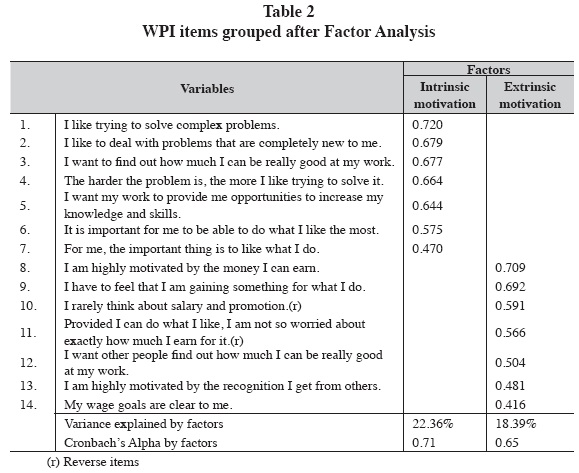
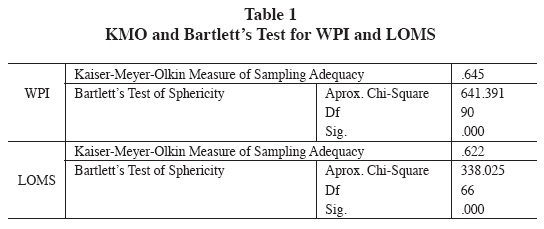
<body><![CDATA[<p align="justify"><font face="verdana" size="2">The four&#45;point Likert&#45;type scale for the WPI was the one used by Amabile <i>et al</i>. (1994). For the LOMS, the same Likert&#45;type scale was adopted to maintain the questionnaire format, although this differs from the original scale used by Luna&#45;Arocas and Tang (2004). Therefore, for the 30 WPI items, 1 corresponds to "it is never true for me" and 4 corresponds to "it is always true for me." In the LOMS, 1 corresponds to "I strongly disagree" and 4 to "I strongly agree".</font></p>  	    <p align="justify"><font face="verdana" size="2">An Factor Analysis (EFA) was conducted to identify representative factors from the WPI and the LOMS. For both scales, the following criteria were adopted: communality was extracted from items higher than 0.4; Bartlett's Sphericity Test was significant at 5%; the Kaiser&#45;Meyer&#45;Olkin (KMO) test should be superior to 0.6. To estimate factor loadings, the principal components method was used, and in order to determine the number of factors, greater&#45;than&#45;one values criterion was used. For both scales, the normalized varimax rotation method was used, as recommended by Hair <i>et al</i>. (2005).</font></p>  	    <p align="justify"><font face="verdana" size="2">&nbsp;</font></p>  	    <p align="justify"><font face="verdana" size="2"><b>Results</b></font></p>  	    <p align="justify"><font face="verdana" size="2"><i>Factor analysis</i></font></p>  	    <p align="justify"><font face="verdana" size="2">For the motivational orientation scales, the Kaiser&#45;Meyer&#45;Olkin (KMO) and Bartlett's Test of Sphericity were examined first to test the adequacy of the factor analysis. As shown on <a href="#t1">table 1</a>, MSA scores were 0.645 and 0.622 and Bartlett's Sphericity was significant, considering the appropriate data for the factor analysis.</font></p>  	    <p align="center"><font face="verdana" size="2"><a name="t1"></a></font></p>  	    <p align="center"><font face="verdana" size="2"><img src="/img/revistas/cya/v60n1/a2t1.jpg"></font></p>  	    <p align="justify"><font face="verdana" size="2">The EFA conducted for the WPI grouped the items into two factors (<a href="#t2">table 2</a>) and explained 40.75% of the total variance: 22.36% corresponded to the first factor, Intrinsic Motivation (IM), and 18.39% corresponded to the second factor, Extrinsic Motivation (EM). Following the procedures performed by Amabile <i>et al</i>. (1994), bi&#45;dimensionality was forced by setting a two&#45;factor extraction. As argued by these authors, although IM and EM may have similarities in their various components, data suggest that the two are distinct constructs. Eight items from each factor were excluded due to low communality.</font></p>  	    <p align="center"><font face="verdana" size="2"><a name="t2"></a></font></p>  	    ]]></body>
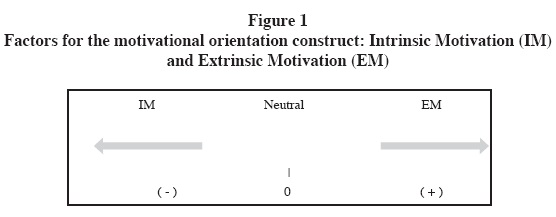
<body><![CDATA[<p align="center"><font face="verdana" size="2"><img src="/img/revistas/cya/v60n1/a2t2.jpg"></font></p>  	    <p align="justify"><font face="verdana" size="2">The reliability of the IM and EM scales was tested using Cronbach's alpha, and the values obtained were 0.71 for IM and 0.65 for EM. The values obtained by Amabile (1994) were 0.79 and 0.78 respectively. According to Kline (1999, cited in Field, 2009), these are acceptable values, since results below 0.7 can be expected from psychological constructs due to the diversity of constructs measured.</font></p>  	    <p align="justify"><font face="verdana" size="2">The Intrinsic Motivator Factor (IMF) and Extrinsic Motivation Factor (EMF) were obtained by adding each score of the coefficient matrix and multiplying by the corresponding variable presented in <a href="#t2">table 2</a>. The construct Motivational Orientation (MO) derived from the formula Extrinsic Motivation Factor minus Intrinsic Motivation Factor (MO = EMF &#45; IMF) and the sample was divided as shown in <a href="#f1">figure 1</a>.</font></p>  	    <p align="center"><font face="verdana" size="2"><a name="f1"></a></font></p>  	    <p align="center"><font face="verdana" size="2"><img src="/img/revistas/cya/v60n1/a2f1.jpg"></font></p>  	    <p align="justify"><font face="verdana" size="2">Thus, the instrument ranges between + 24 as maximum value for EM and &#45;24 as maximum value for IM. Individuals with a negative factor (MO &lt;0) are intrinsically motivated. Accordingly, individuals with a positive factor (MO&gt; 0) are extrinsically motivated.</font></p>  	    <p align="justify"><font face="verdana" size="2">The EFA conducted for the LOMS grouped the items into three factors as shown in <a href="#t3">table 3</a>, and accounted for 48.27% of the total variance: 18.91% corresponded to the Budget factor, 15.50% to Motivator factor and 13.86% to Evil factor. Concerning the fourth factor in the original construct, Equity, three items were excluded due to low communality. These results are in line with findings from previous studies by Luna&#45;Arocas and Tang (1998), in which the Equity factor has a low reliability index. The brief version of the scale applied by Tang (1995) also included three factors: Success, Budget and Evil. Each of these indicates different attitudes towards money. Factor 1, named Budget, comprised four items about money management. Factor 2, Motivator, is made up of four items that define money as an element of personal success and a motivational force. Factor 3, Evil, is made up of four items that define money as an element that generates negative changes in those who possess it.</font></p>  	    <p align="center"><font face="verdana" size="2"><a name="t3"></a></font></p>  	    <p align="center"><font face="verdana" size="2"><img src="/img/revistas/cya/v60n1/a2t3.jpg"></font></p>  	    <p align="justify"><font face="verdana" size="2">The reliability of the Budget, Motivator and Evil scales resulting from the EFA was tested using Cronbach's alpha, obtaining 0.737 for Budget, 0.669 for Motivator and 0.647 for Evil. The items "The work that requires low skills and little responsibility should pay lower wages", "People doing the same job should be paid according to performance" and "People who are doing the same work must be paid in the same way", referring to the Equity factor in the original construct, were excluded due to low communality (cutoff value 0.400).</font></p>  	    ]]></body>
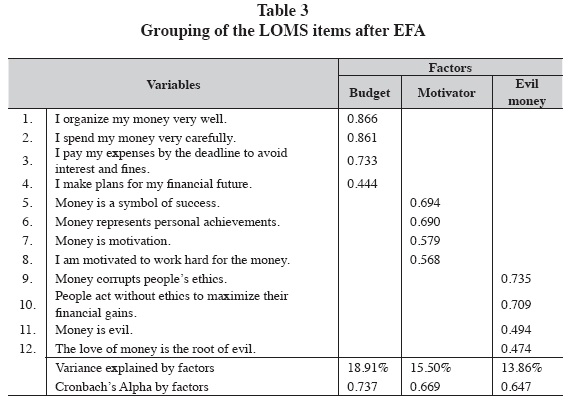
<body><![CDATA[<p align="justify"><font face="verdana" size="2"><i>Correlations</i></font></p>  	    <p align="justify"><font face="verdana" size="2">Pearson's correlation coefficient was used to assess the relations between motivational orientation factors and attitudes towards money. Relations between the LOMS factors and the WPI factors are weak but significant, as shown on <a href="#t4">table 4</a>. It appears that extrinsic motivation correlates positively with Budget and, more strongly, with Motivator (0.441), and correlates negatively with Evil (&#45;0.273). On the contrary, extrinsic motivation correlates positively with Evil (0.249).</font></p>  	    <p align="center"><font face="verdana" size="2"><a name="t4"></a></font></p>  	    <p align="center"><font face="verdana" size="2"><img src="/img/revistas/cya/v60n1/a2t4.jpg"></font></p>  	    <p align="justify"><font face="verdana" size="2"><i>Cluster analysis</i></font></p>  	    <p align="justify"><font face="verdana" size="2">A cluster analysis was conducted based on the factor scores identified for both scales, in order to recognize profiles based on the relationship between attitudes towards money and motivational orientation. Using the three factors resulting from the LOMS and the MO construct, a cluster analysis was conducted following the Two Step Cluster method. The results allowed classifying individuals into two clusters, according to <a href="#t5">table 5</a>.</font></p>  	    <p align="center"><font face="verdana" size="2"><a name="t5"></a></font></p>  	    <p align="center"><font face="verdana" size="2"><img src="/img/revistas/cya/v60n1/a2t5.jpg"></font></p>  	    <p align="justify"><font face="verdana" size="2">Cluster 1 represents 36.9% of the sample and corresponds to individuals driven by money, who have a positive relationship with money as a Motivator (0.41) as well as with the Budget factor (0.20), and a negative relationship with the Evil factor (&#45;0.69). These individuals displayed a positive motivational orientation, that is, they are extrinsically motivated (1.28). This supports hypothesis H<sub>1</sub>.</font></p>  	    <p align="justify"><font face="verdana" size="2">Cluster 2 comprises 63.1% of the sample. These individuals are opposed to money, have a negative relationship with the factors Motivator (&#45;0.26) and Budget (&#45;0.12), and a positive relationship with money as Evil (0.45). Regarding motivation for activities, this group has a negative motivational orientation (&#45;0.76), that is, they are intrinsically motivated, thus confirming H<sub>2</sub>.</font></p>  	    ]]></body>
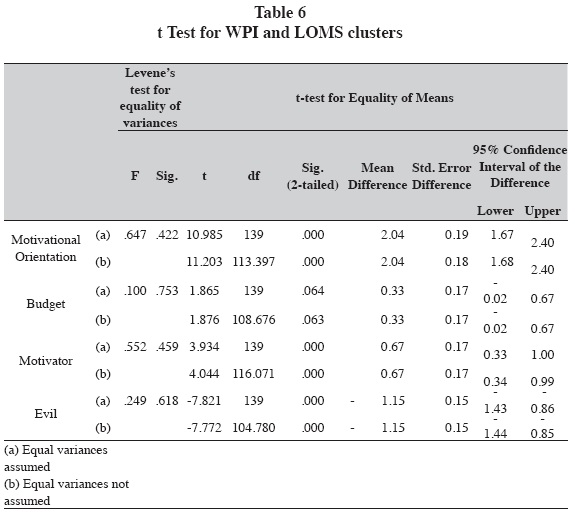
<body><![CDATA[<p align="justify"><font face="verdana" size="2">A t Test (<a href="#t6">table 6</a>) confirms that the differences between clusters are statistically significant for all variables, except for Budget. Thus people who are driven by money differ from those who reject it in terms of motivational orientation and the perception of money both as reinforcement or reward and a source of potential unethical behavior. They do not differ in money management.</font></p>  	    <p align="center"><font face="verdana" size="2"><a name="t6"></a></font></p>  	    <p align="center"><font face="verdana" size="2"><img src="/img/revistas/cya/v60n1/a2t6.jpg"></font></p>  	    <p align="justify"><font face="verdana" size="2">&nbsp;</font></p>  	    <p align="justify"><font face="verdana" size="2"><b>Conclusions</b></font></p>  	    <p align="justify"><font face="verdana" size="2">The study of motivation in the workplace receives considerable attention in the business and psychology literature, due to its close relationship with individual and organizational productivity (Tamayo &amp; Paschoal, 2003). Given the complexity of the current economic and social environment, and the need to ensure survival, organizations require consistently motivated employees to achieve their goals (Gondim &amp; Silva, 2004).</font></p>  	    <p align="justify"><font face="verdana" size="2">The assumptions of the SDT point to the existence of two types of motivational orientation, called intrinsic motivation and extrinsic motivation. As Deci and Ryan (1985) describe, intrinsic motivation refers to engaging in an activity simply for the satisfaction and pleasure of doing it, while for extrinsic motivation this engagement is a consequence of the goal to be achieved. In the present study, factor analysis of the WPI categorized two factors that match those identified by Amabile <i>et al.</i> (1994), intrinsic and extrinsic Motivation. However, there are some differences in the internal distribution of the items which called for the removal of some due to low theoretical consistency or low communality. This is an interesting finding given that Loo (2001) also reported the item elimination when the questionnaire is applied to a sample of business administration graduates. Similar results were obtained by Stuhlfaut (2010) in his research with young employees in advertising: while the original two factors emerge, the item distribution within each factor varies in relation to the original scale. This would suggest that the scale behaves differently in young people with little work experience. This should be addressed in future research by a confirmatory analysis, in order to develop a robust scale for this population.</font></p>  	    <p align="justify"><font face="verdana" size="2">Regarding the relation between money and motivation, according to Deci (1998), money as a reward is a powerful force and has a seductive quality, although it may also have different meanings for each individual (Gellerman, 1976). In this instance, the Love of Money construct (Luna &amp; Tang, 2004) allows assessing the meaning and importance given to money and it may provide a framework for everyday life, including in the workplace (Wong, 2008).</font></p>  	    <p align="justify"><font face="verdana" size="2">In order to better understand the relationship between motivation to work and attitudes towards money in young employees, it was relevant to identify profiles in those terms, thus defining the characteristics of a money&#45;driven profile and an opposed&#45;to&#45;money one. The clusters allowed to further testing the hypotheses that (1) people driven by money would most likely be extrinsically motivated, and (2) people opposed to money would be intrinsically motivated.</font></p>  	    <p align="justify"><font face="verdana" size="2">These profiles differed clearly in relation to intrinsic/extrinsic motivation and their perceptions towards money as motivator and evil. Meanwhile, Budget is different for both groups but it is not significant. This would suggest that handling and managing money cannot be avoided, regardless of the individual's negative or positive perception of it. On the other hand, the Achieving Money Worshipper profile described by Luna and Tang (2004), which highlights the Budget factor, include people with higher income, more work experience and older. It is likely that most participants in this study, due to their age, have little work experience and may have not yet fully developed attitudes and skills for managing money properly.</font></p>  	    ]]></body>
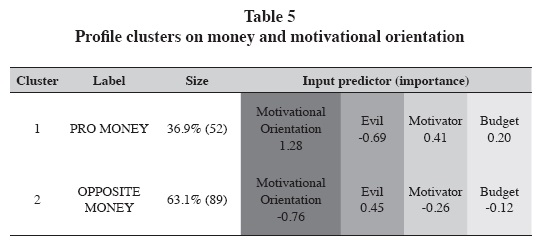
<body><![CDATA[<p align="justify"><font face="verdana" size="2">Based on the expectation theory by Vroom (1970), Porter and Lawler (1988) argue that the effort or motivation to work is a result of how attractive the reward seems and how the person perceives the relationship between effort and reward. These authors also establish the relationship between performance and rewards. In addition to its exchange value, money has a psychological, personal significance and value. From this perspective, people want to make money not only because it allows them to meet their physiological needs, but also because it provides the conditions for meeting social, self&#45;esteem and self&#45;actualization needs. Money is a means, not an end. In this regard, Porter and Lawler postulate that if people believe there is a direct or indirect relationship between increased salary and performance, money can be an excellent motivator. In the present research, this kind of motivation may be the foundation of Cluster 1. Therefore, if people in this group perceive that their performance is simultaneously possible and necessary to make more money, they will perform in the best possible way.</font></p>  	    <p align="justify"><font face="verdana" size="2">In contrast, for people in Cluster 2, it is likely that money itself has little to no effect on their behavior and performance. For these individuals, once their basic needs are met, it may be more important to have other incentives such as more paid vacation days, better insurance benefits and daycare services for their children. Based on the findings by Judge <i>et al</i>. (2010) it may be assumed that, for Group 2, income goals based on the pursuit of power, competition or external control appear to be less gratifying and less effective than income goals based on the search for security, family support and recreation.</font></p>  	    <p align="justify"><font face="verdana" size="2">This study provides support to future research on the relationship between motivational orientations of young employees and their attitudes towards money. It also provides organizations with the knowledge that motivational support should vary according to the meaning given to money by the employees and the motivational orientation that they have; money can be a positive reinforcement or no reinforcement at all to execute tasks and to achieve goals.</font></p>  	    <p align="justify"><font face="verdana" size="2">Some studies report that increased access to money can be more satisfying for the relatively disadvantaged, for whom deprivation of basic needs is the basis of their daily experience (Crosby, 1976; Sweeney, McFarlin, &amp; Inderrieden, 1990; Judge <i>et al</i>., 2010). Therefore, the value of money and its relation to money itself as an extrinsic motivator may be more important for those at the lower end of the wage scale. This is an issue that should be addressed in future studies by comparing attitudes toward money, motivation styles and wage levels. Gender and age are variables that must also be considered in the psychology of money that were absent from this study. Some studies (Tang, 1994; Luna&#45;Arocas &amp; Tang, 1998) have shown that older people and women tend to use money more carefully, and future research should explore whether this tendency in women remains the same in younger generations.</font></p>  	    <p align="justify"><font face="verdana" size="2">Also, in the future, longitudinal research should explore the causal effects of the emotional associations with money and its relation with work motivation, and if such is altered along the individual's development in the workplace and career. This is because one of the limitations of the study is that the sample considered only young workers who were also undergraduate students, which is a condition which cannot be made general to other types of employees.</font></p>  	    <p align="justify"><font face="verdana" size="2">Lastly, the findings from this study may provide guidance from the field of psychology to business managers, since, from the understanding of human behavior based on the theoretical perspectives of motivation and meaning of money, companies can direct their incentives and motivational programs for positive reinforcement towards superior performance.</font></p>  	    <p align="justify"><font face="verdana" size="2">&nbsp;</font></p>  	    <p align="justify"><font face="verdana" size="2"><b>References</b></font></p>  	    <!-- ref --><p align="justify"><font face="verdana" size="2">Amabile, T. (1985). Motivation and creativity: Effects of motivational orientation on creative writers. <i>Journal of Personality and Social Psychology</i> 48: 393&#45;399</font>&nbsp;&nbsp;&nbsp;&nbsp;&nbsp;&nbsp;&nbsp;&nbsp;[&#160;<a href="javascript:void(0);" onclick="javascript: window.open('/scielo.php?script=sci_nlinks&ref=2263810&pid=S0186-1042201500010000200001&lng=','','width=640,height=500,resizable=yes,scrollbars=1,menubar=yes,');">Links</a>&#160;]<!-- end-ref --><!-- ref --><p align="justify"><font face="verdana" size="2">Amabile, T., K. Hill, B. Hennessey &amp; E. Tighe (1994). The work preference inventory assessing intrinsic and extrinsic motivational orientation. <i>Journal of Personality and Social Psychology</i> 66: 950&#45;967.    &nbsp;&nbsp;&nbsp;&nbsp;&nbsp;&nbsp;&nbsp;&nbsp;[&#160;<a href="javascript:void(0);" onclick="javascript: window.open('/scielo.php?script=sci_nlinks&ref=2263811&pid=S0186-1042201500010000200002&lng=','','width=640,height=500,resizable=yes,scrollbars=1,menubar=yes,');">Links</a>&#160;]<!-- end-ref --></font></p>  	    <!-- ref --><p align="justify"><font face="verdana" size="2">Bergamini, C. (1990). Motiva&#231;&atilde;o: mitos, cren&#231;as e mal&#45;entendidos. <i>Revista de Administra&#231;&atilde;o de Empresas</i> 30 (2): 23&#45;34.    &nbsp;&nbsp;&nbsp;&nbsp;&nbsp;&nbsp;&nbsp;&nbsp;[&#160;<a href="javascript:void(0);" onclick="javascript: window.open('/scielo.php?script=sci_nlinks&ref=2263813&pid=S0186-1042201500010000200003&lng=','','width=640,height=500,resizable=yes,scrollbars=1,menubar=yes,');">Links</a>&#160;]<!-- end-ref --></font></p>  	    <!-- ref --><p align="justify"><font face="verdana" size="2">Crosby, F. (1976). A model of egoistical relative deprivation. <i>Psychological Review</i> 83: 95&#8722;113.    &nbsp;&nbsp;&nbsp;&nbsp;&nbsp;&nbsp;&nbsp;&nbsp;[&#160;<a href="javascript:void(0);" onclick="javascript: window.open('/scielo.php?script=sci_nlinks&ref=2263815&pid=S0186-1042201500010000200004&lng=','','width=640,height=500,resizable=yes,scrollbars=1,menubar=yes,');">Links</a>&#160;]<!-- end-ref --></font></p>  	    <!-- ref --><p align="justify"><font face="verdana" size="2">Deci, E. (1998). <i>Por que fazemos o que fazemos: entendendo a automotiva&#231;&atilde;o</i>. S&atilde;o Paulo: Neg&oacute;cio.    &nbsp;&nbsp;&nbsp;&nbsp;&nbsp;&nbsp;&nbsp;&nbsp;[&#160;<a href="javascript:void(0);" onclick="javascript: window.open('/scielo.php?script=sci_nlinks&ref=2263817&pid=S0186-1042201500010000200005&lng=','','width=640,height=500,resizable=yes,scrollbars=1,menubar=yes,');">Links</a>&#160;]<!-- end-ref --></font></p>  	    <!-- ref --><p align="justify"><font face="verdana" size="2">&#45;&#45;&#45;&#45;&#45;&#45;&#45;&#45;&#45;&#45; &amp; R. Ryan (1985). <i>Intrinsic motivation and self&#45;determination in human behavior</i>. New York: Plenum.    &nbsp;&nbsp;&nbsp;&nbsp;&nbsp;&nbsp;&nbsp;&nbsp;[&#160;<a href="javascript:void(0);" onclick="javascript: window.open('/scielo.php?script=sci_nlinks&ref=2263819&pid=S0186-1042201500010000200006&lng=','','width=640,height=500,resizable=yes,scrollbars=1,menubar=yes,');">Links</a>&#160;]<!-- end-ref --></font></p>  	    <!-- ref --><p align="justify"><font face="verdana" size="2">&#45;&#45;&#45;&#45;&#45;&#45;&#45;&#45;&#45;&#45; &amp; R. Ryan (2000). The what and the why of goal pursuits: human needs and the self&#45;determination of behavior. <i>Psychological Inquiry</i> 11 (4): 227&#45;268.    &nbsp;&nbsp;&nbsp;&nbsp;&nbsp;&nbsp;&nbsp;&nbsp;[&#160;<a href="javascript:void(0);" onclick="javascript: window.open('/scielo.php?script=sci_nlinks&ref=2263821&pid=S0186-1042201500010000200007&lng=','','width=640,height=500,resizable=yes,scrollbars=1,menubar=yes,');">Links</a>&#160;]<!-- end-ref --></font></p>  	    <!-- ref --><p align="justify"><font face="verdana" size="2">Diener, E. &amp; M. E. P. Seligman (2004). Beyond money: Toward an economy of well&#45;being. <i>Psychological Science in the Public Interest</i> 5 (1): 1&#45;31.    &nbsp;&nbsp;&nbsp;&nbsp;&nbsp;&nbsp;&nbsp;&nbsp;[&#160;<a href="javascript:void(0);" onclick="javascript: window.open('/scielo.php?script=sci_nlinks&ref=2263823&pid=S0186-1042201500010000200008&lng=','','width=640,height=500,resizable=yes,scrollbars=1,menubar=yes,');">Links</a>&#160;]<!-- end-ref --></font></p>  	    <!-- ref --><p align="justify"><font face="verdana" size="2">Dysvik, A. &amp; B. Kuvaas (2012). Intrinsic and extrinsic motivation as predictors of work effort: The moderating role of achievement goals. <i>British Journal of Social Psychology</i>. Doi: 10.1111/j.2044&#45;8309.2011.02090.x.    &nbsp;&nbsp;&nbsp;&nbsp;&nbsp;&nbsp;&nbsp;&nbsp;[&#160;<a href="javascript:void(0);" onclick="javascript: window.open('/scielo.php?script=sci_nlinks&ref=2263825&pid=S0186-1042201500010000200009&lng=','','width=640,height=500,resizable=yes,scrollbars=1,menubar=yes,');">Links</a>&#160;]<!-- end-ref --></font></p>  	    <!-- ref --><p align="justify"><font face="verdana" size="2">Ebert, J. (2010). The surprisingly low motivational power of future rewards: Comparing conventional money&#45;based measures of discounting with motivation&#45;based measures. <i>Organizational Behavior and Human Decision Processes</i> 111: 91&#45;92.    &nbsp;&nbsp;&nbsp;&nbsp;&nbsp;&nbsp;&nbsp;&nbsp;[&#160;<a href="javascript:void(0);" onclick="javascript: window.open('/scielo.php?script=sci_nlinks&ref=2263827&pid=S0186-1042201500010000200010&lng=','','width=640,height=500,resizable=yes,scrollbars=1,menubar=yes,');">Links</a>&#160;]<!-- end-ref --></font></p>  	    <!-- ref --><p align="justify"><font face="verdana" size="2">Field, A. (2009). <i>Descobrindo a estat&iacute;stica usando o SPSS</i> (2a ed.). Porto Alegre, RS, Brasil: Artmed.    &nbsp;&nbsp;&nbsp;&nbsp;&nbsp;&nbsp;&nbsp;&nbsp;[&#160;<a href="javascript:void(0);" onclick="javascript: window.open('/scielo.php?script=sci_nlinks&ref=2263829&pid=S0186-1042201500010000200011&lng=','','width=640,height=500,resizable=yes,scrollbars=1,menubar=yes,');">Links</a>&#160;]<!-- end-ref --></font></p>  	    <!-- ref --><p align="justify"><font face="verdana" size="2">Furnham, A. (1996). Attitudinal correlates and demographic predictors of monetary beliefs and behaviors. <i>Journal of Organizational Behavior</i> 17 (4): 375&#45;388.    &nbsp;&nbsp;&nbsp;&nbsp;&nbsp;&nbsp;&nbsp;&nbsp;[&#160;<a href="javascript:void(0);" onclick="javascript: window.open('/scielo.php?script=sci_nlinks&ref=2263831&pid=S0186-1042201500010000200012&lng=','','width=640,height=500,resizable=yes,scrollbars=1,menubar=yes,');">Links</a>&#160;]<!-- end-ref --></font></p>  	    <!-- ref --><p align="justify"><font face="verdana" size="2">Gagn&eacute;, M. &amp; E. Deci (2005). Self&#45;determination theory and work motivation. <i>Journal of Organizational Behavior</i> 26 (4): 331&#150;362. doi:10.1002/job.322.    &nbsp;&nbsp;&nbsp;&nbsp;&nbsp;&nbsp;&nbsp;&nbsp;[&#160;<a href="javascript:void(0);" onclick="javascript: window.open('/scielo.php?script=sci_nlinks&ref=2263833&pid=S0186-1042201500010000200013&lng=','','width=640,height=500,resizable=yes,scrollbars=1,menubar=yes,');">Links</a>&#160;]<!-- end-ref --></font></p>  	    <!-- ref --><p align="justify"><font face="verdana" size="2">Gellerman, S. (1976). <i>Motiva&#231;&atilde;o e produtividade</i>. S&atilde;o Paulo: S&atilde;o Paulo.    &nbsp;&nbsp;&nbsp;&nbsp;&nbsp;&nbsp;&nbsp;&nbsp;[&#160;<a href="javascript:void(0);" onclick="javascript: window.open('/scielo.php?script=sci_nlinks&ref=2263835&pid=S0186-1042201500010000200014&lng=','','width=640,height=500,resizable=yes,scrollbars=1,menubar=yes,');">Links</a>&#160;]<!-- end-ref --></font></p>  	    <!-- ref --><p align="justify"><font face="verdana" size="2">Gondim, S. &amp; N. Silva (2004). Motiva&#231;&atilde;o no trabalho. In J. C. Zanelli, J. E. Borges&#45;Andrade &amp; A. V. Bastos, <i>Psicologia, organiza&#231;&otilde;es e trabalho no Brasi.</i> Porto Alegre, RS, Brasil: Artmed: 145&#45;176.    &nbsp;&nbsp;&nbsp;&nbsp;&nbsp;&nbsp;&nbsp;&nbsp;[&#160;<a href="javascript:void(0);" onclick="javascript: window.open('/scielo.php?script=sci_nlinks&ref=2263837&pid=S0186-1042201500010000200015&lng=','','width=640,height=500,resizable=yes,scrollbars=1,menubar=yes,');">Links</a>&#160;]<!-- end-ref --></font></p>  	    <!-- ref --><p align="justify"><font face="verdana" size="2">Guimar&auml;es, S, &amp; J. Bzuneck (2002). Propriedades psicom&eacute;tricas de uma medida de avalia&#231;&atilde;o da motiva&#231;&atilde;o intr&iacute;nseca e extr&iacute;nseca: um estudo explorat&oacute;rio. <i>Psico&#45;USF</i> 7 (1): 1&#45;8.    &nbsp;&nbsp;&nbsp;&nbsp;&nbsp;&nbsp;&nbsp;&nbsp;[&#160;<a href="javascript:void(0);" onclick="javascript: window.open('/scielo.php?script=sci_nlinks&ref=2263839&pid=S0186-1042201500010000200016&lng=','','width=640,height=500,resizable=yes,scrollbars=1,menubar=yes,');">Links</a>&#160;]<!-- end-ref --></font></p>  	    <!-- ref --><p align="justify"><font face="verdana" size="2">Hair, J., W. Black, B. Babin, R. Anderson &amp; R. L. Tatham (2005). <i>Multivariate data analysis</i>. New Jersey: Prentice Hall.    &nbsp;&nbsp;&nbsp;&nbsp;&nbsp;&nbsp;&nbsp;&nbsp;[&#160;<a href="javascript:void(0);" onclick="javascript: window.open('/scielo.php?script=sci_nlinks&ref=2263841&pid=S0186-1042201500010000200017&lng=','','width=640,height=500,resizable=yes,scrollbars=1,menubar=yes,');">Links</a>&#160;]<!-- end-ref --></font></p>  	    <!-- ref --><p align="justify"><font face="verdana" size="2">Judge, T., R. Piccolo, N. Podsakoff, J. Shawd &amp; B. Riche (2010 )The relationship between pay and job satisfaction: A meta&#45;analysis of the literature. <i>Journal of Vocational Behavior</i> 77: 157&#45;167</font>&nbsp;&nbsp;&nbsp;&nbsp;&nbsp;&nbsp;&nbsp;&nbsp;[&#160;<a href="javascript:void(0);" onclick="javascript: window.open('/scielo.php?script=sci_nlinks&ref=2263843&pid=S0186-1042201500010000200018&lng=','','width=640,height=500,resizable=yes,scrollbars=1,menubar=yes,');">Links</a>&#160;]<!-- end-ref --><!-- ref --><p align="justify"><font face="verdana" size="2">Kouchakia, M., K. Smith&#45;Crowe, A. Brief, C. Sousa (2013). Seeing green: Mere exposure to money triggers a business decision frame and unethical outcomes. <i>Organizational Behavior and Human Decision Processes</i> 121: 53&#45;61.    &nbsp;&nbsp;&nbsp;&nbsp;&nbsp;&nbsp;&nbsp;&nbsp;[&#160;<a href="javascript:void(0);" onclick="javascript: window.open('/scielo.php?script=sci_nlinks&ref=2263844&pid=S0186-1042201500010000200019&lng=','','width=640,height=500,resizable=yes,scrollbars=1,menubar=yes,');">Links</a>&#160;]<!-- end-ref --></font></p>  	    <!-- ref --><p align="justify"><font face="verdana" size="2">Lea, S., &amp; P. Webley (2006). Money as tool, money as drug: The biological psychology of a strong incentive. <i>Behavioural and Brain Sciences</i> 29 (2): 161&#45;209.    &nbsp;&nbsp;&nbsp;&nbsp;&nbsp;&nbsp;&nbsp;&nbsp;[&#160;<a href="javascript:void(0);" onclick="javascript: window.open('/scielo.php?script=sci_nlinks&ref=2263846&pid=S0186-1042201500010000200020&lng=','','width=640,height=500,resizable=yes,scrollbars=1,menubar=yes,');">Links</a>&#160;]<!-- end-ref --></font></p>  	    <!-- ref --><p align="justify"><font face="verdana" size="2">Lim, V. (2003). Money matters: an empirical investigation of money, face and Confucian work ethic. <i>Personality and Individual Differences</i> 35: 953&#45;970.    &nbsp;&nbsp;&nbsp;&nbsp;&nbsp;&nbsp;&nbsp;&nbsp;[&#160;<a href="javascript:void(0);" onclick="javascript: window.open('/scielo.php?script=sci_nlinks&ref=2263848&pid=S0186-1042201500010000200021&lng=','','width=640,height=500,resizable=yes,scrollbars=1,menubar=yes,');">Links</a>&#160;]<!-- end-ref --></font></p>  	    <!-- ref --><p align="justify"><font face="verdana" size="2">Loo, R. (2001) Motivational orientations toward work: An evaluation of the Work Preference Inventory (student form). <i>Measurement and Evaluation in Counseling and Development</i> 33 (4): 222&#45;233.    &nbsp;&nbsp;&nbsp;&nbsp;&nbsp;&nbsp;&nbsp;&nbsp;[&#160;<a href="javascript:void(0);" onclick="javascript: window.open('/scielo.php?script=sci_nlinks&ref=2263850&pid=S0186-1042201500010000200022&lng=','','width=640,height=500,resizable=yes,scrollbars=1,menubar=yes,');">Links</a>&#160;]<!-- end-ref --></font></p>  	    ]]></body>
<body><![CDATA[<!-- ref --><p align="justify"><font face="verdana" size="2">Luna&#45;Arocas, R. &amp; T. Tang (2004). The love of money, satisfaction, and the Protestant work ethic: money profiles among university professors in the USA and Spain. <i>Journal of Business Ethics</i> 50: 329&#45;354.    &nbsp;&nbsp;&nbsp;&nbsp;&nbsp;&nbsp;&nbsp;&nbsp;[&#160;<a href="javascript:void(0);" onclick="javascript: window.open('/scielo.php?script=sci_nlinks&ref=2263852&pid=S0186-1042201500010000200023&lng=','','width=640,height=500,resizable=yes,scrollbars=1,menubar=yes,');">Links</a>&#160;]<!-- end-ref --></font></p>  	    <!-- ref --><p align="justify"><font face="verdana" size="2">&#45;&#45;&#45;&#45;&#45;&#45;&#45;&#45;&#45;&#45; (1998). La psicolog&iacute;a econ&oacute;mica del dinero: an&aacute;lisis de la escala &eacute;tica del dinero (M.E.S.) y la escala de actitudes hacia hacia el dinero (E.A.D.&#45;6). <i>Revista de Psicolog&iacute;a del Trabajo y de las Organizaciones</i> 14 (3): 295&#45;313.    &nbsp;&nbsp;&nbsp;&nbsp;&nbsp;&nbsp;&nbsp;&nbsp;[&#160;<a href="javascript:void(0);" onclick="javascript: window.open('/scielo.php?script=sci_nlinks&ref=2263854&pid=S0186-1042201500010000200024&lng=','','width=640,height=500,resizable=yes,scrollbars=1,menubar=yes,');">Links</a>&#160;]<!-- end-ref --></font></p>  	    <!-- ref --><p align="justify"><font face="verdana" size="2">Maslow, A. (1970). A theory of human Motivation. In V. Vroom &amp; E. Deci, <i>Management and motivation</i>. Baltimore: Penguin Books: 27&#45;41.    &nbsp;&nbsp;&nbsp;&nbsp;&nbsp;&nbsp;&nbsp;&nbsp;[&#160;<a href="javascript:void(0);" onclick="javascript: window.open('/scielo.php?script=sci_nlinks&ref=2263856&pid=S0186-1042201500010000200025&lng=','','width=640,height=500,resizable=yes,scrollbars=1,menubar=yes,');">Links</a>&#160;]<!-- end-ref --></font></p>  	    <!-- ref --><p align="justify"><font face="verdana" size="2">McCally, K. (2010). Self&#45;determined: what motivates you? <i>Rochester Review</i> 72 (6): 19&#45;21.    &nbsp;&nbsp;&nbsp;&nbsp;&nbsp;&nbsp;&nbsp;&nbsp;[&#160;<a href="javascript:void(0);" onclick="javascript: window.open('/scielo.php?script=sci_nlinks&ref=2263858&pid=S0186-1042201500010000200026&lng=','','width=640,height=500,resizable=yes,scrollbars=1,menubar=yes,');">Links</a>&#160;]<!-- end-ref --></font></p>  	    <!-- ref --><p align="justify"><font face="verdana" size="2">Medina, A., C. Gallegos &amp; P. Lara (2008). Motivaci&oacute;n y satisfacci&oacute;n de los trabajadores y su influencia en la creaci&oacute;n de valor econ&oacute;mico en la empresa. <i>Revista de Administraci&oacute;n P&uacute;blica</i> 42 (6): 1213&#45;1230.    &nbsp;&nbsp;&nbsp;&nbsp;&nbsp;&nbsp;&nbsp;&nbsp;[&#160;<a href="javascript:void(0);" onclick="javascript: window.open('/scielo.php?script=sci_nlinks&ref=2263860&pid=S0186-1042201500010000200027&lng=','','width=640,height=500,resizable=yes,scrollbars=1,menubar=yes,');">Links</a>&#160;]<!-- end-ref --></font></p>  	    ]]></body>
<body><![CDATA[<!-- ref --><p align="justify"><font face="verdana" size="2">Moreira, A. (2002). Dinheiro no Brasil: um estudo comparativo do significado do dinheiro entre as regi&otilde;es geogr&aacute;ficas brasileiras. <i>Estudos de Psicologia</i> 7 (2): 379&#45;387.    &nbsp;&nbsp;&nbsp;&nbsp;&nbsp;&nbsp;&nbsp;&nbsp;[&#160;<a href="javascript:void(0);" onclick="javascript: window.open('/scielo.php?script=sci_nlinks&ref=2263862&pid=S0186-1042201500010000200028&lng=','','width=640,height=500,resizable=yes,scrollbars=1,menubar=yes,');">Links</a>&#160;]<!-- end-ref --></font></p>  	    <!-- ref --><p align="justify"><font face="verdana" size="2">Pascual&#45;Ezama, D., D. Prelec &amp; D. Dunfield (2013). Motivation, money, prestige and cheats. <i>Journal of Economic Behavior &amp; Organization</i> 93: 367&#45;373.    &nbsp;&nbsp;&nbsp;&nbsp;&nbsp;&nbsp;&nbsp;&nbsp;[&#160;<a href="javascript:void(0);" onclick="javascript: window.open('/scielo.php?script=sci_nlinks&ref=2263864&pid=S0186-1042201500010000200029&lng=','','width=640,height=500,resizable=yes,scrollbars=1,menubar=yes,');">Links</a>&#160;]<!-- end-ref --></font></p>  	    <!-- ref --><p align="justify"><font face="verdana" size="2">Penna, A. (2001). <i>Introdu&#231;&atilde;o a Motiva&#231;&atilde;o e a Emo&#231;&atilde;o</i>. Rio de Janeiro: Imago.    &nbsp;&nbsp;&nbsp;&nbsp;&nbsp;&nbsp;&nbsp;&nbsp;[&#160;<a href="javascript:void(0);" onclick="javascript: window.open('/scielo.php?script=sci_nlinks&ref=2263866&pid=S0186-1042201500010000200030&lng=','','width=640,height=500,resizable=yes,scrollbars=1,menubar=yes,');">Links</a>&#160;]<!-- end-ref --></font></p>  	    <!-- ref --><p align="justify"><font face="verdana" size="2">Porter, L. &amp; S. Lawler (1988) <i>Teor&iacute;as de Motivaci&oacute;n.</i> M&eacute;xico: Edit. Prentice.    &nbsp;&nbsp;&nbsp;&nbsp;&nbsp;&nbsp;&nbsp;&nbsp;[&#160;<a href="javascript:void(0);" onclick="javascript: window.open('/scielo.php?script=sci_nlinks&ref=2263868&pid=S0186-1042201500010000200031&lng=','','width=640,height=500,resizable=yes,scrollbars=1,menubar=yes,');">Links</a>&#160;]<!-- end-ref --></font></p>  	    <!-- ref --><p align="justify"><font face="verdana" size="2">Ryan, R. &amp; E. Deci (2000a). Intrinsic and extrinsic motivations: classic definitions and new directions. <i>Contemporary Educational Psychology</i> 25 (1): 54&#45;67.    &nbsp;&nbsp;&nbsp;&nbsp;&nbsp;&nbsp;&nbsp;&nbsp;[&#160;<a href="javascript:void(0);" onclick="javascript: window.open('/scielo.php?script=sci_nlinks&ref=2263870&pid=S0186-1042201500010000200032&lng=','','width=640,height=500,resizable=yes,scrollbars=1,menubar=yes,');">Links</a>&#160;]<!-- end-ref --></font></p>  	    ]]></body>
<body><![CDATA[<!-- ref --><p align="justify"><font face="verdana" size="2">&#45;&#45;&#45;&#45;&#45;&#45;&#45;&#45;&#45;&#45; (2000b). Self&#45;determination theory and the facilitation of intrinsic motivation, social development, and well&#45;being. <i>American Psychologist</i> 55 (1): 68&#45;78.    &nbsp;&nbsp;&nbsp;&nbsp;&nbsp;&nbsp;&nbsp;&nbsp;[&#160;<a href="javascript:void(0);" onclick="javascript: window.open('/scielo.php?script=sci_nlinks&ref=2263872&pid=S0186-1042201500010000200033&lng=','','width=640,height=500,resizable=yes,scrollbars=1,menubar=yes,');">Links</a>&#160;]<!-- end-ref --></font></p>  	    <!-- ref --><p align="justify"><font face="verdana" size="2">Skinner, B. (1953/2003). <i>Ci&ecirc;ncia e comportamento humano</i>. 11th ed. S&atilde;o Paulo: Martins Fontes.    &nbsp;&nbsp;&nbsp;&nbsp;&nbsp;&nbsp;&nbsp;&nbsp;[&#160;<a href="javascript:void(0);" onclick="javascript: window.open('/scielo.php?script=sci_nlinks&ref=2263874&pid=S0186-1042201500010000200034&lng=','','width=640,height=500,resizable=yes,scrollbars=1,menubar=yes,');">Links</a>&#160;]<!-- end-ref --></font></p>  	    <!-- ref --><p align="justify"><font face="verdana" size="2">Stuhlfaut, W. (2010). Evaluating the Work Preference Inventory and its measurement of motivation in creative advertising professionals. <i>Journal of Current Issues &amp; Research in Advertising</i> 32: 81&#45;93.    &nbsp;&nbsp;&nbsp;&nbsp;&nbsp;&nbsp;&nbsp;&nbsp;[&#160;<a href="javascript:void(0);" onclick="javascript: window.open('/scielo.php?script=sci_nlinks&ref=2263876&pid=S0186-1042201500010000200035&lng=','','width=640,height=500,resizable=yes,scrollbars=1,menubar=yes,');">Links</a>&#160;]<!-- end-ref --></font></p>  	    <!-- ref --><p align="justify"><font face="verdana" size="2">Sweeney, P., D. McFarlin &amp; E. Inderrieden (1990). Using relative deprivation theory to explain satisfaction with income and pay level: A multistudy examination. <i>Academy of Management Journal</i> 33: 423&#45;436.    &nbsp;&nbsp;&nbsp;&nbsp;&nbsp;&nbsp;&nbsp;&nbsp;[&#160;<a href="javascript:void(0);" onclick="javascript: window.open('/scielo.php?script=sci_nlinks&ref=2263878&pid=S0186-1042201500010000200036&lng=','','width=640,height=500,resizable=yes,scrollbars=1,menubar=yes,');">Links</a>&#160;]<!-- end-ref --></font></p>  	    <!-- ref --><p align="justify"><font face="verdana" size="2">Tamayo, A. &amp; T. Paschoal (2003). A rela&#231;&atilde;o da motiva&#231;&atilde;o para o trabalho com as metas do trabalhador. <i>Revista de Administra&#231;&atilde;o Contempor&acirc;nea</i> 7: 33&#45;54.    &nbsp;&nbsp;&nbsp;&nbsp;&nbsp;&nbsp;&nbsp;&nbsp;[&#160;<a href="javascript:void(0);" onclick="javascript: window.open('/scielo.php?script=sci_nlinks&ref=2263880&pid=S0186-1042201500010000200037&lng=','','width=640,height=500,resizable=yes,scrollbars=1,menubar=yes,');">Links</a>&#160;]<!-- end-ref --></font></p>  	    ]]></body>
<body><![CDATA[<!-- ref --><p align="justify"><font face="verdana" size="2">Tang, T. (1992). The meaning of money revisited. <i>Journal of Organizational Behavior</i> 13 (2): 197&#45;202.    &nbsp;&nbsp;&nbsp;&nbsp;&nbsp;&nbsp;&nbsp;&nbsp;[&#160;<a href="javascript:void(0);" onclick="javascript: window.open('/scielo.php?script=sci_nlinks&ref=2263882&pid=S0186-1042201500010000200038&lng=','','width=640,height=500,resizable=yes,scrollbars=1,menubar=yes,');">Links</a>&#160;]<!-- end-ref --></font></p>  	    <!-- ref --><p align="justify"><font face="verdana" size="2">&#45;&#45;&#45;&#45;&#45;&#45;&#45;&#45;&#45;&#45; (1993). The meaning of money: extension and exploration of the Money Ethic Scale in a sample of university students in Taiwan. <i>Journal of Organizational Behavior</i> 14: 93&#45;99.    &nbsp;&nbsp;&nbsp;&nbsp;&nbsp;&nbsp;&nbsp;&nbsp;[&#160;<a href="javascript:void(0);" onclick="javascript: window.open('/scielo.php?script=sci_nlinks&ref=2263884&pid=S0186-1042201500010000200039&lng=','','width=640,height=500,resizable=yes,scrollbars=1,menubar=yes,');">Links</a>&#160;]<!-- end-ref --></font></p>  	    <!-- ref --><p align="justify"><font face="verdana" size="2">&#45;&#45;&#45;&#45;&#45;&#45;&#45;&#45;&#45;&#45; (1995). The development of a short money ethic scale: attitudes towards money and pay satisfaction revisited. <i>Personality and Individual Differences</i> 19: 809&#45;816.    &nbsp;&nbsp;&nbsp;&nbsp;&nbsp;&nbsp;&nbsp;&nbsp;[&#160;<a href="javascript:void(0);" onclick="javascript: window.open('/scielo.php?script=sci_nlinks&ref=2263886&pid=S0186-1042201500010000200040&lng=','','width=640,height=500,resizable=yes,scrollbars=1,menubar=yes,');">Links</a>&#160;]<!-- end-ref --></font></p>  	    <!-- ref --><p align="justify"><font face="verdana" size="2">&#45;&#45;&#45;&#45;&#45;&#45;&#45;&#45;&#45;&#45; (2007). Income and quality of life. <i>Journal of Business Ethics</i> 72: 375&#45;393.    &nbsp;&nbsp;&nbsp;&nbsp;&nbsp;&nbsp;&nbsp;&nbsp;[&#160;<a href="javascript:void(0);" onclick="javascript: window.open('/scielo.php?script=sci_nlinks&ref=2263888&pid=S0186-1042201500010000200041&lng=','','width=640,height=500,resizable=yes,scrollbars=1,menubar=yes,');">Links</a>&#160;]<!-- end-ref --></font></p>  	    <!-- ref --><p align="justify"><font face="verdana" size="2">&#45;&#45;&#45;&#45;&#45;&#45;&#45;&#45;&#45;&#45; (2010). Money, the meaning on money, management, spirituality and religion. <i>Journal of Management, Spirituality and Religion</i> 7: 173&#45;189.    &nbsp;&nbsp;&nbsp;&nbsp;&nbsp;&nbsp;&nbsp;&nbsp;[&#160;<a href="javascript:void(0);" onclick="javascript: window.open('/scielo.php?script=sci_nlinks&ref=2263890&pid=S0186-1042201500010000200042&lng=','','width=640,height=500,resizable=yes,scrollbars=1,menubar=yes,');">Links</a>&#160;]<!-- end-ref --></font></p>  	    ]]></body>
<body><![CDATA[<!-- ref --><p align="justify"><font face="verdana" size="2">&#45;&#45;&#45;&#45;&#45;&#45;&#45;&#45;&#45;&#45;, Kim, J &amp; D. Tang (2000). Does attitude toward money moderate the relationship between intrinsic job satisfaction and voluntary turnover? <i>Human Relations</i> 52 (2): 213&#45;245.    &nbsp;&nbsp;&nbsp;&nbsp;&nbsp;&nbsp;&nbsp;&nbsp;[&#160;<a href="javascript:void(0);" onclick="javascript: window.open('/scielo.php?script=sci_nlinks&ref=2263892&pid=S0186-1042201500010000200043&lng=','','width=640,height=500,resizable=yes,scrollbars=1,menubar=yes,');">Links</a>&#160;]<!-- end-ref --></font></p>  	    <!-- ref --><p align="justify"><font face="verdana" size="2">&#45;&#45;&#45;&#45;&#45;&#45;&#45;&#45;&#45;&#45;, R. Luna&#45;Arocas, T. Sutarso (2005) From income to pay satisfaction: the love of money and pay equity comparison as mediators and culture (the United States and Spain) and gender as moderators. <i>The Journal of the Iberoamerican Academy of Management</i> 3 (1): 7&#45;26.    &nbsp;&nbsp;&nbsp;&nbsp;&nbsp;&nbsp;&nbsp;&nbsp;[&#160;<a href="javascript:void(0);" onclick="javascript: window.open('/scielo.php?script=sci_nlinks&ref=2263894&pid=S0186-1042201500010000200044&lng=','','width=640,height=500,resizable=yes,scrollbars=1,menubar=yes,');">Links</a>&#160;]<!-- end-ref --></font></p>  	    <!-- ref --><p align="justify"><font face="verdana" size="2">Vroom, V. (1970). The nature of relationship between motivation and performance. In V. H. Vroom &amp; E. L. Deci, <i>Management and motivation</i>. Baltimore: Penguin Books: 229&#45;235</font>&nbsp;&nbsp;&nbsp;&nbsp;&nbsp;&nbsp;&nbsp;&nbsp;[&#160;<a href="javascript:void(0);" onclick="javascript: window.open('/scielo.php?script=sci_nlinks&ref=2263896&pid=S0186-1042201500010000200045&lng=','','width=640,height=500,resizable=yes,scrollbars=1,menubar=yes,');">Links</a>&#160;]<!-- end-ref --><!-- ref --><p align="justify"><font face="verdana" size="2">Wong, H. (2008). Religiousness, love of money, and ethical attitudes of Malaysian evangelical christians in business. <i>Journal of Business Ethics</i> 81: 169&#45;191.    &nbsp;&nbsp;&nbsp;&nbsp;&nbsp;&nbsp;&nbsp;&nbsp;[&#160;<a href="javascript:void(0);" onclick="javascript: window.open('/scielo.php?script=sci_nlinks&ref=2263897&pid=S0186-1042201500010000200046&lng=','','width=640,height=500,resizable=yes,scrollbars=1,menubar=yes,');">Links</a>&#160;]<!-- end-ref -->&#9;</font></p>      ]]></body><back>
<ref-list>
<ref id="B1">
<nlm-citation citation-type="journal">
<person-group person-group-type="author">
<name>
<surname><![CDATA[Amabile]]></surname>
<given-names><![CDATA[T.]]></given-names>
</name>
</person-group>
<article-title xml:lang="en"><![CDATA[Motivation and creativity: Effects of motivational orientation on creative writers]]></article-title>
<source><![CDATA[Journal of Personality and Social Psychology]]></source>
<year>1985</year>
<volume>48</volume>
<page-range>393-399</page-range></nlm-citation>
</ref>
<ref id="B2">
<nlm-citation citation-type="journal">
<person-group person-group-type="author">
<name>
<surname><![CDATA[Amabile]]></surname>
<given-names><![CDATA[T.]]></given-names>
</name>
<name>
<surname><![CDATA[Hill]]></surname>
<given-names><![CDATA[K.]]></given-names>
</name>
<name>
<surname><![CDATA[Hennessey]]></surname>
<given-names><![CDATA[B.]]></given-names>
</name>
<name>
<surname><![CDATA[Tighe]]></surname>
<given-names><![CDATA[E.]]></given-names>
</name>
</person-group>
<article-title xml:lang="en"><![CDATA[The work preference inventory assessing intrinsic and extrinsic motivational orientation]]></article-title>
<source><![CDATA[Journal of Personality and Social Psychology]]></source>
<year>1994</year>
<volume>66</volume>
<page-range>950-967</page-range></nlm-citation>
</ref>
<ref id="B3">
<nlm-citation citation-type="journal">
<person-group person-group-type="author">
<name>
<surname><![CDATA[Bergamini]]></surname>
<given-names><![CDATA[C.]]></given-names>
</name>
</person-group>
<article-title xml:lang="pt"><![CDATA[Motivação: mitos, crenças e mal-entendidos]]></article-title>
<source><![CDATA[Revista de Administração de Empresas]]></source>
<year>1990</year>
<volume>30</volume>
<numero>2</numero>
<issue>2</issue>
<page-range>23-34</page-range></nlm-citation>
</ref>
<ref id="B4">
<nlm-citation citation-type="journal">
<person-group person-group-type="author">
<name>
<surname><![CDATA[Crosby]]></surname>
<given-names><![CDATA[F.]]></given-names>
</name>
</person-group>
<article-title xml:lang="en"><![CDATA[A model of egoistical relative deprivation]]></article-title>
<source><![CDATA[Psychological Review]]></source>
<year>1976</year>
<volume>83</volume>
<page-range>95&#8722;113</page-range></nlm-citation>
</ref>
<ref id="B5">
<nlm-citation citation-type="book">
<person-group person-group-type="author">
<name>
<surname><![CDATA[Deci]]></surname>
<given-names><![CDATA[E.]]></given-names>
</name>
</person-group>
<source><![CDATA[Por que fazemos o que fazemos: entendendo a automotivação]]></source>
<year>1998</year>
<publisher-loc><![CDATA[São Paulo ]]></publisher-loc>
<publisher-name><![CDATA[Negócio]]></publisher-name>
</nlm-citation>
</ref>
<ref id="B6">
<nlm-citation citation-type="book">
<person-group person-group-type="author">
<name>
<surname><![CDATA[Deci]]></surname>
<given-names><![CDATA[E.]]></given-names>
</name>
</person-group>
<person-group person-group-type="editor">
<name>
</name>
<name>
<surname><![CDATA[Ryan]]></surname>
<given-names><![CDATA[R.]]></given-names>
</name>
</person-group>
<source><![CDATA[Intrinsic motivation and self-determination in human behavior]]></source>
<year>1985</year>
<publisher-loc><![CDATA[New York ]]></publisher-loc>
<publisher-name><![CDATA[Plenum]]></publisher-name>
</nlm-citation>
</ref>
<ref id="B7">
<nlm-citation citation-type="journal">
<person-group person-group-type="author">
<name>
<surname><![CDATA[Deci]]></surname>
<given-names><![CDATA[E.]]></given-names>
</name>
<name>
<surname><![CDATA[Ryan]]></surname>
<given-names><![CDATA[R.]]></given-names>
</name>
</person-group>
<article-title xml:lang="en"><![CDATA[The what and the why of goal pursuits: human needs and the self-determination of behavior]]></article-title>
<source><![CDATA[Psychological Inquiry]]></source>
<year>2000</year>
<volume>11</volume>
<numero>4</numero>
<issue>4</issue>
<page-range>227-268</page-range></nlm-citation>
</ref>
<ref id="B8">
<nlm-citation citation-type="journal">
<person-group person-group-type="author">
<name>
<surname><![CDATA[Diener]]></surname>
<given-names><![CDATA[E.]]></given-names>
</name>
<name>
<surname><![CDATA[Seligman]]></surname>
<given-names><![CDATA[M. E. P.]]></given-names>
</name>
</person-group>
<article-title xml:lang="en"><![CDATA[Beyond money: Toward an economy of well-being]]></article-title>
<source><![CDATA[Psychological Science in the Public Interest]]></source>
<year>2004</year>
<volume>5</volume>
<numero>1</numero>
<issue>1</issue>
<page-range>1-31</page-range></nlm-citation>
</ref>
<ref id="B9">
<nlm-citation citation-type="journal">
<person-group person-group-type="author">
<name>
<surname><![CDATA[Dysvik]]></surname>
<given-names><![CDATA[A.]]></given-names>
</name>
<name>
<surname><![CDATA[Kuvaas]]></surname>
<given-names><![CDATA[B.]]></given-names>
</name>
</person-group>
<article-title xml:lang="en"><![CDATA[Intrinsic and extrinsic motivation as predictors of work effort: The moderating role of achievement goals]]></article-title>
<source><![CDATA[British Journal of Social Psychology]]></source>
<year>2012</year>
</nlm-citation>
</ref>
<ref id="B10">
<nlm-citation citation-type="journal">
<person-group person-group-type="author">
<name>
<surname><![CDATA[Ebert]]></surname>
<given-names><![CDATA[J.]]></given-names>
</name>
</person-group>
<article-title xml:lang="en"><![CDATA[The surprisingly low motivational power of future rewards: Comparing conventional money-based measures of discounting with motivation-based measures]]></article-title>
<source><![CDATA[Organizational Behavior and Human Decision Processes]]></source>
<year>2010</year>
<volume>111</volume>
<page-range>91-92</page-range></nlm-citation>
</ref>
<ref id="B11">
<nlm-citation citation-type="book">
<person-group person-group-type="author">
<name>
<surname><![CDATA[Field]]></surname>
<given-names><![CDATA[A.]]></given-names>
</name>
</person-group>
<source><![CDATA[Descobrindo a estatística usando o SPSS]]></source>
<year>2009</year>
<edition>2a</edition>
<publisher-loc><![CDATA[Porto Alegre^eRS RS]]></publisher-loc>
<publisher-name><![CDATA[Artmed]]></publisher-name>
</nlm-citation>
</ref>
<ref id="B12">
<nlm-citation citation-type="journal">
<person-group person-group-type="author">
<name>
<surname><![CDATA[Furnham]]></surname>
<given-names><![CDATA[A.]]></given-names>
</name>
</person-group>
<article-title xml:lang="en"><![CDATA[Attitudinal correlates and demographic predictors of monetary beliefs and behaviors]]></article-title>
<source><![CDATA[Journal of Organizational Behavior]]></source>
<year>1996</year>
<volume>17</volume>
<numero>4</numero>
<issue>4</issue>
<page-range>375-388</page-range></nlm-citation>
</ref>
<ref id="B13">
<nlm-citation citation-type="journal">
<person-group person-group-type="author">
<name>
<surname><![CDATA[Gagné]]></surname>
<given-names><![CDATA[M.]]></given-names>
</name>
<name>
<given-names><![CDATA[E.]]></given-names>
</name>
</person-group>
<article-title xml:lang="en"><![CDATA[Self-determination theory and work motivation]]></article-title>
<source><![CDATA[Journal of Organizational Behavior]]></source>
<year>2005</year>
<volume>26</volume>
<numero>4</numero>
<issue>4</issue>
<page-range>331-362</page-range></nlm-citation>
</ref>
<ref id="B14">
<nlm-citation citation-type="">
<person-group person-group-type="author">
<name>
<surname><![CDATA[Gellerman]]></surname>
<given-names><![CDATA[S.]]></given-names>
</name>
</person-group>
<source><![CDATA[Motivação e produtividade]]></source>
<year>1976</year>
<publisher-loc><![CDATA[São PauloSão Paulo ]]></publisher-loc>
</nlm-citation>
</ref>
<ref id="B15">
<nlm-citation citation-type="book">
<person-group person-group-type="author">
<name>
<surname><![CDATA[Gondim]]></surname>
<given-names><![CDATA[S.]]></given-names>
</name>
<name>
<surname><![CDATA[Silva]]></surname>
<given-names><![CDATA[N.]]></given-names>
</name>
</person-group>
<article-title xml:lang="pt"><![CDATA[Motivação no trabalho]]></article-title>
<person-group person-group-type="editor">
<name>
<surname><![CDATA[Zanelli]]></surname>
<given-names><![CDATA[J. C.]]></given-names>
</name>
<name>
<surname><![CDATA[Borges-Andrade]]></surname>
<given-names><![CDATA[J. E.]]></given-names>
</name>
<name>
<surname><![CDATA[Bastos]]></surname>
<given-names><![CDATA[A. V.]]></given-names>
</name>
</person-group>
<source><![CDATA[Psicologia, organizações e trabalho no Brasi]]></source>
<year>2004</year>
<page-range>145-176</page-range><publisher-loc><![CDATA[Porto Alegre^eRS RS]]></publisher-loc>
<publisher-name><![CDATA[Artmed]]></publisher-name>
</nlm-citation>
</ref>
<ref id="B16">
<nlm-citation citation-type="journal">
<person-group person-group-type="author">
<name>
<surname><![CDATA[Guimaräes]]></surname>
<given-names><![CDATA[S]]></given-names>
</name>
<name>
<surname><![CDATA[Bzuneck]]></surname>
<given-names><![CDATA[J.]]></given-names>
</name>
</person-group>
<article-title xml:lang="pt"><![CDATA[Propriedades psicométricas de uma medida de avaliação da motivação intrínseca e extrínseca: um estudo exploratório]]></article-title>
<source><![CDATA[Psico-USF]]></source>
<year>2002</year>
<volume>7</volume>
<numero>1</numero>
<issue>1</issue>
<page-range>1-8</page-range></nlm-citation>
</ref>
<ref id="B17">
<nlm-citation citation-type="book">
<person-group person-group-type="author">
<name>
<surname><![CDATA[Hair]]></surname>
<given-names><![CDATA[J.]]></given-names>
</name>
<name>
<surname><![CDATA[Black]]></surname>
<given-names><![CDATA[W.]]></given-names>
</name>
<name>
<surname><![CDATA[Babin]]></surname>
<given-names><![CDATA[B.]]></given-names>
</name>
<name>
<surname><![CDATA[Anderson]]></surname>
<given-names><![CDATA[R.]]></given-names>
</name>
<name>
<surname><![CDATA[Tatham]]></surname>
<given-names><![CDATA[R. L.]]></given-names>
</name>
</person-group>
<source><![CDATA[Multivariate data analysis]]></source>
<year>2005</year>
<publisher-loc><![CDATA[^eNew Jersey New Jersey]]></publisher-loc>
<publisher-name><![CDATA[Prentice Hall]]></publisher-name>
</nlm-citation>
</ref>
<ref id="B18">
<nlm-citation citation-type="journal">
<person-group person-group-type="author">
<name>
<surname><![CDATA[Judge]]></surname>
<given-names><![CDATA[T.]]></given-names>
</name>
<name>
<surname><![CDATA[Piccolo]]></surname>
<given-names><![CDATA[R.]]></given-names>
</name>
<name>
<surname><![CDATA[Podsakoff]]></surname>
<given-names><![CDATA[N.]]></given-names>
</name>
<name>
<surname><![CDATA[Shawd]]></surname>
<given-names><![CDATA[J.]]></given-names>
</name>
<name>
<surname><![CDATA[Riche]]></surname>
<given-names><![CDATA[B.]]></given-names>
</name>
</person-group>
<article-title xml:lang="en"><![CDATA[The relationship between pay and job satisfaction: A meta-analysis of the literature]]></article-title>
<source><![CDATA[Journal of Vocational Behavior]]></source>
<year>2010</year>
<volume>77</volume>
<page-range>157-167</page-range></nlm-citation>
</ref>
<ref id="B19">
<nlm-citation citation-type="journal">
<person-group person-group-type="author">
<name>
<surname><![CDATA[Kouchakia]]></surname>
<given-names><![CDATA[M.]]></given-names>
</name>
<name>
<surname><![CDATA[Smith-Crowe]]></surname>
<given-names><![CDATA[K.]]></given-names>
</name>
<name>
<surname><![CDATA[Brief]]></surname>
<given-names><![CDATA[A.]]></given-names>
</name>
<name>
<surname><![CDATA[Sousa]]></surname>
<given-names><![CDATA[C.]]></given-names>
</name>
</person-group>
<article-title xml:lang="en"><![CDATA[Seeing green: Mere exposure to money triggers a business decision frame and unethical outcomes]]></article-title>
<source><![CDATA[Organizational Behavior and Human Decision Processes]]></source>
<year>2013</year>
<volume>121</volume>
<page-range>53-61</page-range></nlm-citation>
</ref>
<ref id="B20">
<nlm-citation citation-type="journal">
<person-group person-group-type="author">
<name>
<surname><![CDATA[Lea]]></surname>
<given-names><![CDATA[S.]]></given-names>
</name>
<name>
<surname><![CDATA[Webley]]></surname>
<given-names><![CDATA[P.]]></given-names>
</name>
</person-group>
<article-title xml:lang="en"><![CDATA[Money as tool, money as drug: The biological psychology of a strong incentive]]></article-title>
<source><![CDATA[Behavioural and Brain Sciences]]></source>
<year>2006</year>
<volume>29</volume>
<numero>2</numero>
<issue>2</issue>
<page-range>161-209</page-range></nlm-citation>
</ref>
<ref id="B21">
<nlm-citation citation-type="journal">
<person-group person-group-type="author">
<name>
<surname><![CDATA[Lim]]></surname>
<given-names><![CDATA[V.]]></given-names>
</name>
</person-group>
<article-title xml:lang="en"><![CDATA[Money matters: an empirical investigation of money, face and Confucian work ethic]]></article-title>
<source><![CDATA[Personality and Individual Differences]]></source>
<year>2003</year>
<volume>35</volume>
<page-range>953-970</page-range></nlm-citation>
</ref>
<ref id="B22">
<nlm-citation citation-type="journal">
<person-group person-group-type="author">
<name>
<surname><![CDATA[Loo]]></surname>
<given-names><![CDATA[R.]]></given-names>
</name>
</person-group>
<article-title xml:lang="en"><![CDATA[Motivational orientations toward work: An evaluation of the Work Preference Inventory (student form)]]></article-title>
<source><![CDATA[Measurement and Evaluation in Counseling and Development]]></source>
<year>2001</year>
<volume>33</volume>
<numero>4</numero>
<issue>4</issue>
<page-range>222-233</page-range></nlm-citation>
</ref>
<ref id="B23">
<nlm-citation citation-type="journal">
<person-group person-group-type="author">
<name>
<surname><![CDATA[Luna-Arocas]]></surname>
<given-names><![CDATA[R.]]></given-names>
</name>
<name>
<surname><![CDATA[Tang]]></surname>
<given-names><![CDATA[T.]]></given-names>
</name>
</person-group>
<article-title xml:lang="en"><![CDATA[The love of money, satisfaction, and the Protestant work ethic: money profiles among university professors in the USA and Spain]]></article-title>
<source><![CDATA[Journal of Business Ethics]]></source>
<year>2004</year>
<volume>50</volume>
<page-range>329-354</page-range></nlm-citation>
</ref>
<ref id="B24">
<nlm-citation citation-type="journal">
<person-group person-group-type="author">
<name>
<surname><![CDATA[Luna-Arocas]]></surname>
<given-names><![CDATA[R.]]></given-names>
</name>
</person-group>
<article-title xml:lang="es"><![CDATA[La psicología económica del dinero: análisis de la escala ética del dinero (M.E.S.) y la escala de actitudes hacia hacia el dinero (E.A.D.-6)]]></article-title>
<source><![CDATA[Revista de Psicología del Trabajo y de las Organizaciones]]></source>
<year>1998</year>
<volume>14</volume>
<numero>3</numero>
<issue>3</issue>
<page-range>295-313</page-range></nlm-citation>
</ref>
<ref id="B25">
<nlm-citation citation-type="book">
<person-group person-group-type="author">
<name>
<surname><![CDATA[Maslow]]></surname>
<given-names><![CDATA[A.]]></given-names>
</name>
</person-group>
<article-title xml:lang="en"><![CDATA[A theory of human Motivation]]></article-title>
<person-group person-group-type="editor">
<name>
<surname><![CDATA[Vroom]]></surname>
<given-names><![CDATA[V.]]></given-names>
</name>
<name>
<surname><![CDATA[Deci]]></surname>
<given-names><![CDATA[E.]]></given-names>
</name>
</person-group>
<source><![CDATA[Management and motivation]]></source>
<year>1970</year>
<page-range>27-41</page-range><publisher-loc><![CDATA[Baltimore ]]></publisher-loc>
<publisher-name><![CDATA[Penguin Books]]></publisher-name>
</nlm-citation>
</ref>
<ref id="B26">
<nlm-citation citation-type="journal">
<person-group person-group-type="author">
<name>
<surname><![CDATA[McCally]]></surname>
<given-names><![CDATA[K.]]></given-names>
</name>
</person-group>
<article-title xml:lang="en"><![CDATA[Self-determined: what motivates you?]]></article-title>
<source><![CDATA[Rochester Review]]></source>
<year>2010</year>
<volume>72</volume>
<numero>6</numero>
<issue>6</issue>
<page-range>19-21</page-range></nlm-citation>
</ref>
<ref id="B27">
<nlm-citation citation-type="journal">
<person-group person-group-type="author">
<name>
<surname><![CDATA[Medina]]></surname>
<given-names><![CDATA[A.]]></given-names>
</name>
<name>
<surname><![CDATA[Gallegos]]></surname>
<given-names><![CDATA[C.]]></given-names>
</name>
<name>
<surname><![CDATA[Lara]]></surname>
<given-names><![CDATA[P.]]></given-names>
</name>
</person-group>
<article-title xml:lang="es"><![CDATA[Motivación y satisfacción de los trabajadores y su influencia en la creación de valor económico en la empresa]]></article-title>
<source><![CDATA[Revista de Administración Pública]]></source>
<year>2008</year>
<volume>42</volume>
<numero>6</numero>
<issue>6</issue>
<page-range>1213-1230</page-range></nlm-citation>
</ref>
<ref id="B28">
<nlm-citation citation-type="journal">
<person-group person-group-type="author">
<name>
<surname><![CDATA[Moreira]]></surname>
<given-names><![CDATA[A.]]></given-names>
</name>
</person-group>
<article-title xml:lang="pt"><![CDATA[Dinheiro no Brasil: um estudo comparativo do significado do dinheiro entre as regiões geográficas brasileiras]]></article-title>
<source><![CDATA[Estudos de Psicologia]]></source>
<year>2002</year>
<volume>7</volume>
<numero>2</numero>
<issue>2</issue>
<page-range>379-387</page-range></nlm-citation>
</ref>
<ref id="B29">
<nlm-citation citation-type="journal">
<person-group person-group-type="author">
<name>
<surname><![CDATA[Pascual-Ezama]]></surname>
<given-names><![CDATA[D.]]></given-names>
</name>
<name>
<surname><![CDATA[Prelec]]></surname>
<given-names><![CDATA[D.]]></given-names>
</name>
<name>
<surname><![CDATA[Dunfield]]></surname>
<given-names><![CDATA[D.]]></given-names>
</name>
</person-group>
<article-title xml:lang="en"><![CDATA[Motivation, money, prestige and cheats]]></article-title>
<source><![CDATA[Journal of Economic Behavior & Organization]]></source>
<year>2013</year>
<volume>93</volume>
<page-range>367-373</page-range></nlm-citation>
</ref>
<ref id="B30">
<nlm-citation citation-type="book">
<person-group person-group-type="author">
<name>
<surname><![CDATA[Penna]]></surname>
<given-names><![CDATA[A.]]></given-names>
</name>
</person-group>
<source><![CDATA[Introdução a Motivação e a Emoção]]></source>
<year>2001</year>
<publisher-loc><![CDATA[Rio de Janeiro ]]></publisher-loc>
<publisher-name><![CDATA[Imago]]></publisher-name>
</nlm-citation>
</ref>
<ref id="B31">
<nlm-citation citation-type="book">
<person-group person-group-type="author">
<name>
<surname><![CDATA[Porter]]></surname>
<given-names><![CDATA[L.]]></given-names>
</name>
<name>
<surname><![CDATA[Lawler]]></surname>
<given-names><![CDATA[S.]]></given-names>
</name>
</person-group>
<source><![CDATA[Teorías de Motivación]]></source>
<year>1988</year>
<publisher-loc><![CDATA[México ]]></publisher-loc>
<publisher-name><![CDATA[Prentice]]></publisher-name>
</nlm-citation>
</ref>
<ref id="B32">
<nlm-citation citation-type="journal">
<person-group person-group-type="author">
<name>
<surname><![CDATA[Ryan]]></surname>
<given-names><![CDATA[R.]]></given-names>
</name>
<name>
<surname><![CDATA[Deci]]></surname>
<given-names><![CDATA[E.]]></given-names>
</name>
</person-group>
<article-title xml:lang="es"><![CDATA[Intrinsic and extrinsic motivations: classic definitions and new directions]]></article-title>
<source><![CDATA[Contemporary Educational Psychology]]></source>
<year>2000</year>
<volume>25</volume>
<numero>1</numero>
<issue>1</issue>
<page-range>54-67</page-range></nlm-citation>
</ref>
<ref id="B33">
<nlm-citation citation-type="journal">
<person-group person-group-type="author">
<name>
<surname><![CDATA[Ryan]]></surname>
<given-names><![CDATA[R.]]></given-names>
</name>
</person-group>
<article-title xml:lang="en"><![CDATA[Self-determination theory and the facilitation of intrinsic motivation, social development, and well-being]]></article-title>
<source><![CDATA[American Psychologist]]></source>
<year>2000</year>
<volume>55</volume>
<numero>1</numero>
<issue>1</issue>
<page-range>68-78</page-range></nlm-citation>
</ref>
<ref id="B34">
<nlm-citation citation-type="book">
<person-group person-group-type="author">
<name>
<surname><![CDATA[Skinner]]></surname>
<given-names><![CDATA[B.]]></given-names>
</name>
</person-group>
<source><![CDATA[Ciência e comportamento humano]]></source>
<year>1953</year>
<month>/2</month>
<day>00</day>
<edition>11th</edition>
<publisher-loc><![CDATA[São Paulo ]]></publisher-loc>
<publisher-name><![CDATA[Martins Fontes]]></publisher-name>
</nlm-citation>
</ref>
<ref id="B35">
<nlm-citation citation-type="journal">
<person-group person-group-type="author">
<name>
<surname><![CDATA[Stuhlfaut]]></surname>
<given-names><![CDATA[W.]]></given-names>
</name>
</person-group>
<article-title xml:lang="en"><![CDATA[Evaluating the Work Preference Inventory and its measurement of motivation in creative advertising professionals]]></article-title>
<source><![CDATA[Journal of Current Issues & Research in Advertising]]></source>
<year>2010</year>
<volume>32</volume>
<page-range>81-93</page-range></nlm-citation>
</ref>
<ref id="B36">
<nlm-citation citation-type="journal">
<person-group person-group-type="author">
<name>
<surname><![CDATA[Sweeney]]></surname>
<given-names><![CDATA[P.]]></given-names>
</name>
<name>
<surname><![CDATA[McFarlin]]></surname>
<given-names><![CDATA[D.]]></given-names>
</name>
<name>
<surname><![CDATA[Inderrieden]]></surname>
<given-names><![CDATA[E.]]></given-names>
</name>
</person-group>
<article-title xml:lang="en"><![CDATA[Using relative deprivation theory to explain satisfaction with income and pay level: A multistudy examination]]></article-title>
<source><![CDATA[Academy of Management Journal]]></source>
<year>1990</year>
<volume>33</volume>
<page-range>423-436</page-range></nlm-citation>
</ref>
<ref id="B37">
<nlm-citation citation-type="journal">
<person-group person-group-type="author">
<name>
<surname><![CDATA[Tamayo]]></surname>
<given-names><![CDATA[A.]]></given-names>
</name>
<name>
<surname><![CDATA[Paschoal]]></surname>
<given-names><![CDATA[T.]]></given-names>
</name>
</person-group>
<article-title xml:lang="pt"><![CDATA[A relação da motivação para o trabalho com as metas do trabalhador]]></article-title>
<source><![CDATA[Revista de Administração Contemporânea]]></source>
<year>2003</year>
<volume>7</volume>
<page-range>33-54</page-range></nlm-citation>
</ref>
<ref id="B38">
<nlm-citation citation-type="journal">
<person-group person-group-type="author">
<name>
<surname><![CDATA[Tang]]></surname>
<given-names><![CDATA[T.]]></given-names>
</name>
</person-group>
<article-title xml:lang="en"><![CDATA[The meaning of money revisited]]></article-title>
<source><![CDATA[Journal of Organizational Behavior]]></source>
<year>1992</year>
<volume>13</volume>
<numero>2</numero>
<issue>2</issue>
<page-range>197-202</page-range></nlm-citation>
</ref>
<ref id="B39">
<nlm-citation citation-type="journal">
<person-group person-group-type="author">
<name>
<surname><![CDATA[Tang]]></surname>
<given-names><![CDATA[T.]]></given-names>
</name>
</person-group>
<article-title xml:lang="en"><![CDATA[The meaning of money: extension and exploration of the Money Ethic Scale in a sample of university students in Taiwan]]></article-title>
<source><![CDATA[Journal of Organizational Behavior]]></source>
<year>1993</year>
<volume>14</volume>
<page-range>93-99</page-range></nlm-citation>
</ref>
<ref id="B40">
<nlm-citation citation-type="journal">
<person-group person-group-type="author">
<name>
<surname><![CDATA[Tang]]></surname>
<given-names><![CDATA[T.]]></given-names>
</name>
</person-group>
<article-title xml:lang="en"><![CDATA[The development of a short money ethic scale: attitudes towards money and pay satisfaction revisited]]></article-title>
<source><![CDATA[Personality and Individual Differences]]></source>
<year>1995</year>
<volume>19</volume>
<page-range>809-816</page-range></nlm-citation>
</ref>
<ref id="B41">
<nlm-citation citation-type="journal">
<person-group person-group-type="author">
<name>
<surname><![CDATA[Tang]]></surname>
<given-names><![CDATA[T.]]></given-names>
</name>
</person-group>
<article-title xml:lang="en"><![CDATA[Income and quality of life]]></article-title>
<source><![CDATA[Journal of Business Ethics]]></source>
<year>2007</year>
<volume>72</volume>
<page-range>375-393</page-range></nlm-citation>
</ref>
<ref id="B42">
<nlm-citation citation-type="journal">
<person-group person-group-type="author">
<name>
<surname><![CDATA[Tang]]></surname>
<given-names><![CDATA[T.]]></given-names>
</name>
</person-group>
<article-title xml:lang="en"><![CDATA[Money, the meaning on money, management, spirituality and religion]]></article-title>
<source><![CDATA[Journal of Management, Spirituality and Religion]]></source>
<year>2010</year>
<volume>7</volume>
<page-range>173-189</page-range></nlm-citation>
</ref>
<ref id="B43">
<nlm-citation citation-type="journal">
<person-group person-group-type="author">
<name>
<surname><![CDATA[Tang]]></surname>
<given-names><![CDATA[T.]]></given-names>
</name>
<name>
<surname><![CDATA[Kim]]></surname>
<given-names><![CDATA[J]]></given-names>
</name>
<name>
<surname><![CDATA[Tang]]></surname>
<given-names><![CDATA[D.]]></given-names>
</name>
</person-group>
<article-title xml:lang="en"><![CDATA[Does attitude toward money moderate the relationship between intrinsic job satisfaction and voluntary turnover?]]></article-title>
<source><![CDATA[Human Relations]]></source>
<year>2000</year>
<volume>52</volume>
<numero>2</numero>
<issue>2</issue>
<page-range>213-245</page-range></nlm-citation>
</ref>
<ref id="B44">
<nlm-citation citation-type="journal">
<person-group person-group-type="author">
<name>
<surname><![CDATA[Tang]]></surname>
<given-names><![CDATA[T.]]></given-names>
</name>
<name>
<surname><![CDATA[Luna-Arocas]]></surname>
<given-names><![CDATA[R.]]></given-names>
</name>
<name>
<surname><![CDATA[Sutarso]]></surname>
<given-names><![CDATA[T.]]></given-names>
</name>
</person-group>
<article-title xml:lang="en"><![CDATA[From income to pay satisfaction: the love of money and pay equity comparison as mediators and culture (the United States and Spain) and gender as moderators]]></article-title>
<source><![CDATA[The Journal of the Iberoamerican Academy of Management]]></source>
<year>2005</year>
<volume>3</volume>
<numero>1</numero>
<issue>1</issue>
<page-range>7-26</page-range></nlm-citation>
</ref>
<ref id="B45">
<nlm-citation citation-type="book">
<person-group person-group-type="author">
<name>
<surname><![CDATA[Vroom]]></surname>
<given-names><![CDATA[V.]]></given-names>
</name>
</person-group>
<article-title xml:lang="en"><![CDATA[The nature of relationship between motivation and performance]]></article-title>
<person-group person-group-type="editor">
<name>
<surname><![CDATA[Vroom]]></surname>
<given-names><![CDATA[V. H.]]></given-names>
</name>
<name>
<surname><![CDATA[Deci]]></surname>
<given-names><![CDATA[E. L.]]></given-names>
</name>
</person-group>
<source><![CDATA[Management and motivation]]></source>
<year>1970</year>
<page-range>229-235</page-range><publisher-loc><![CDATA[Baltimore ]]></publisher-loc>
<publisher-name><![CDATA[Penguin Books]]></publisher-name>
</nlm-citation>
</ref>
<ref id="B46">
<nlm-citation citation-type="journal">
<person-group person-group-type="author">
<name>
<surname><![CDATA[Wong]]></surname>
<given-names><![CDATA[H.]]></given-names>
</name>
</person-group>
<article-title xml:lang="en"><![CDATA[Religiousness, love of money, and ethical attitudes of Malaysian evangelical christians in business]]></article-title>
<source><![CDATA[Journal of Business Ethics]]></source>
<year>2008</year>
<volume>81</volume>
<page-range>169-191</page-range></nlm-citation>
</ref>
</ref-list>
</back>
</article>