<?xml version="1.0" encoding="ISO-8859-1"?><article xmlns:mml="http://www.w3.org/1998/Math/MathML" xmlns:xlink="http://www.w3.org/1999/xlink" xmlns:xsi="http://www.w3.org/2001/XMLSchema-instance">
<front>
<journal-meta>
<journal-id>0186-1042</journal-id>
<journal-title><![CDATA[Contaduría y administración]]></journal-title>
<abbrev-journal-title><![CDATA[Contad. Adm]]></abbrev-journal-title>
<issn>0186-1042</issn>
<publisher>
<publisher-name><![CDATA[Universidad Nacional Autónoma de México, Facultad de Contaduría y Administración]]></publisher-name>
</publisher>
</journal-meta>
<article-meta>
<article-id>S0186-10422010000100002</article-id>
<title-group>
<article-title xml:lang="en"><![CDATA[Optimal portfolio and consumption decisions under exchange rate and interest rate risks: A jump-diffusion approach]]></article-title>
<article-title xml:lang="es"><![CDATA[Decisiones de portafolio óptimo y consumo bajo riesgos de tipo de cambio y tasa de interés: Un enfoque de difusión con saltos]]></article-title>
</title-group>
<contrib-group>
<contrib contrib-type="author">
<name>
<surname><![CDATA[Venegas Martínez]]></surname>
<given-names><![CDATA[Francisco]]></given-names>
</name>
<xref ref-type="aff" rid="A01"/>
</contrib>
<contrib contrib-type="author">
<name>
<surname><![CDATA[Rodríguez Nava]]></surname>
<given-names><![CDATA[Abigail]]></given-names>
</name>
<xref ref-type="aff" rid="A02"/>
</contrib>
</contrib-group>
<aff id="A01">
<institution><![CDATA[,Instituto Politécnico Nacional Escuela Superior de Economía ]]></institution>
<addr-line><![CDATA[ ]]></addr-line>
</aff>
<aff id="A02">
<institution><![CDATA[,Universidad Autónoma Metropolitana - Azcapotzalco Departamento de Producción Económica ]]></institution>
<addr-line><![CDATA[ ]]></addr-line>
</aff>
<pub-date pub-type="pub">
<day>00</day>
<month>04</month>
<year>2010</year>
</pub-date>
<pub-date pub-type="epub">
<day>00</day>
<month>04</month>
<year>2010</year>
</pub-date>
<numero>230</numero>
<fpage>9</fpage>
<lpage>24</lpage>
<copyright-statement/>
<copyright-year/>
<self-uri xlink:href="http://www.scielo.org.mx/scielo.php?script=sci_arttext&amp;pid=S0186-10422010000100002&amp;lng=en&amp;nrm=iso"></self-uri><self-uri xlink:href="http://www.scielo.org.mx/scielo.php?script=sci_abstract&amp;pid=S0186-10422010000100002&amp;lng=en&amp;nrm=iso"></self-uri><self-uri xlink:href="http://www.scielo.org.mx/scielo.php?script=sci_pdf&amp;pid=S0186-10422010000100002&amp;lng=en&amp;nrm=iso"></self-uri><abstract abstract-type="short" xml:lang="en"><p><![CDATA[This research develops a stochastic model of the consumer's decision making under an environment of risk and uncertainty. In the proposed model agents perceive that a mixed diffusion-jump process drives the exchange rate depreciation and a diffusion process governs the real interest rate, these processes are supposed to be correlated. We generalize the proposals from Giuliano and Turnovsky (2003), Grinols and Turnovsky (1993) and Merton (1969 and 1971) by including sudden and unexpected jumps in the stochastic dynamics of relevant variables in the intended model. We examine portfolio, consumption and wealth equilibrium dynamics under the optimal decisions. We also assess the effects on portfolio, consumption and welfare of sudden and permanent changes in the parameters determining the expectations of the exchange rate depreciation.]]></p></abstract>
<abstract abstract-type="short" xml:lang="es"><p><![CDATA[Esta investigación desarrolla un modelo estocástico sobre las decisiones de los consumidores en un ambiente de riesgo e incertidumbre. En el modelo propuesto, los agentes perciben que la tasa de depreciación del tipo de cambio es conducida por un proceso de difusión con saltos y que la tasa de interés real es guiada por un proceso de difusión; se supone que estos procesos están correlacionados entre sí. Este trabajo generaliza las propuestas de Giuliano y Turnovsky (2003), Grinols y Turnovsky (1993) y Merton (1969 y 1971) a través de la inclusión de saltos repentinos e inesperados en la dinámica estocástica de las variables relevantes del modelo propuesto. Asimismo, se examina la dinámica de equilibrio del portafolio elegido, la demanda de consumo y la riqueza, en el equilibrio, asociados a las decisiones óptimas. Además, se evalúan los impactos que sobre el portafolio, el consumo y el bienestar tienen los cambios repentinos y permanentes en los parámetros que determinan las expectativas de la depreciación del tipo de cambio.]]></p></abstract>
<kwd-group>
<kwd lng="en"><![CDATA[portfolio choice]]></kwd>
<kwd lng="en"><![CDATA[intertemporal consumer choice]]></kwd>
<kwd lng="en"><![CDATA[consumer behavior]]></kwd>
<kwd lng="es"><![CDATA[selección de portafolio]]></kwd>
<kwd lng="es"><![CDATA[selección intertemporal de consumo]]></kwd>
<kwd lng="es"><![CDATA[conducta del consumidor]]></kwd>
</kwd-group>
</article-meta>
</front><body><![CDATA[ <p align="justify"><font face="verdana" size="4">Art&iacute;culos de investigaci&oacute;n</font></p>     <p align="justify"><font face="verdana" size="4">&nbsp;</font></p>     <p align="center"><font face="verdana" size="4"><b>Optimal portfolio and consumption decisions under exchange rate and interest rate risks. A jump&#150;diffusion approach<a href="#nota">*</a></b></font></p>     <p align="center"><font face="verdana" size="2">&nbsp;</font></p>     <p align="center"><font face="verdana" size="3"><b>Decisiones de portafolio &oacute;ptimo y consumo bajo riesgos de tipo de cambio y tasa de inter&eacute;s. Un enfoque de difusi&oacute;n con saltos</b></font></p>     <p align="center"><font face="verdana" size="2">&nbsp;</font></p>     <p align="center"><font face="verdana" size="2"><b>Francisco Venegas Mart&iacute;nez* y Abigail Rodr&iacute;guez Nava**</b></font></p>     <p align="justify"><font face="verdana" size="2">&nbsp;</font></p>     <p align="justify"><font face="verdana" size="2"><i>* Profesor investigador, Escuela Superior de Econom&iacute;a, Instituto Polit&eacute;cnico Nacional.</i> E&#150; mail: <a href="mailto:fvenegas1111@yahoo.com.mx">fvenegas1111@yahoo.com.mx</a></font></p>     <p align="justify"><font face="verdana" size="2"><i>** Profesora investigadora, Departamento de Producci&oacute;n Econ&oacute;mica,  Universidad  Aut&oacute;noma Metropolitana &#150; Azcapotzalco.</i> E&#150;mail: <a href="mailto:arnava@correo.xoc.uam.mx">arnava@correo.xoc.uam.mx</a></font></p>     ]]></body>
<body><![CDATA[<p align="justify"><font face="verdana" size="2">&nbsp;</font></p>     <p align="justify"><font face="verdana" size="2">Fecha de recepci&oacute;n: 14.04.2009    <br> Fecha de aceptaci&oacute;n: 11.11.2009</font></p>     <p align="justify"><font face="verdana" size="2">&nbsp;</font></p>     <p align="justify"><font face="verdana" size="2"><b>Abstract</b></font></p>     <p align="justify"><font face="verdana" size="2">This research develops a stochastic model of the consumer's decision making under an environment of risk and uncertainty. In the proposed model agents perceive that a mixed diffusion&#150;jump process drives the exchange rate depreciation and a diffusion process governs the real interest rate, these processes are supposed to be correlated. We generalize the proposals from Giuliano and Turnovsky (2003), Grinols and Turnovsky (1993) and Merton (1969 and 1971) by including sudden and unexpected jumps in the stochastic dynamics of relevant variables in the intended model. We examine portfolio, consumption and wealth equilibrium dynamics under the optimal decisions. We also assess the effects on portfolio, consumption and welfare of sudden and permanent changes in the parameters determining the expectations of the exchange rate depreciation.</font></p>     <p align="justify"><font face="verdana" size="2"><b>Keywords:</b> portfolio choice, intertemporal consumer choice, consumer behavior.</font></p>     <p align="justify"><font face="verdana" size="2">&nbsp;</font></p>     <p align="justify"><font face="verdana" size="2"><b>Resumen</b></font></p>     <p align="justify"><font face="verdana" size="2">Esta investigaci&oacute;n desarrolla un modelo estoc&aacute;stico sobre las decisiones de los consumidores en un ambiente de riesgo e incertidumbre. En el modelo propuesto, los agentes perciben que la tasa de depreciaci&oacute;n del tipo de cambio es conducida por un proceso de difusi&oacute;n con saltos y que la tasa de inter&eacute;s real es guiada por un proceso de difusi&oacute;n; se supone que estos procesos est&aacute;n correlacionados entre s&iacute;. Este trabajo generaliza las propuestas de Giuliano y Turnovsky (2003), Grinols y Turnovsky (1993) y Merton (1969 y 1971) a trav&eacute;s de la inclusi&oacute;n de saltos repentinos e inesperados en la din&aacute;mica estoc&aacute;stica de las variables relevantes del modelo propuesto. Asimismo, se examina la din&aacute;mica de equilibrio del portafolio elegido, la demanda de consumo y la riqueza, en el equilibrio, asociados a las decisiones &oacute;ptimas. Adem&aacute;s, se eval&uacute;an los impactos que sobre el portafolio, el consumo y el bienestar tienen los cambios repentinos y permanentes en los par&aacute;metros que determinan las expectativas de la depreciaci&oacute;n del tipo de cambio.</font></p>     ]]></body>
<body><![CDATA[<p align="justify"><font face="verdana" size="2"><b>Palabras clave: </b>selecci&oacute;n de portafolio, selecci&oacute;n intertemporal de consumo, conducta del consumidor.</font></p>     <p align="justify"><font face="verdana" size="2">&nbsp;</font></p>     <p align="justify"><font face="verdana" size="2"><b>Introduction</b></font></p>     <p align="justify"><font face="verdana" size="2">This paper develops a stochastic model of consumer's decision making in an environment of risk, emphasizing the role of uncertainty in the dynamics of both the depreciation rate and the real interest rate. It is assumed that 1) the exchange rate depreciation follows a mixed diffusion&#150;jump process, and 2) the expected dynamics of the real interest rate is driven by a Brownian motion. These processes are supposed to be correlated; as stylized fact shows. This framework generalizes the proposals in Giuliano and Turnovsky (2003), Grinols and Turnovsky (1993), and Merton (1969) and (1971) by including sudden and unexpected jumps in the stochastic dynamics of relevant variables. By assuming logarithmic utility, we examine the equilibrium dynamics of portfolio, consumption and wealth in an environment of risk and uncertainty. We also study the effects on portfolio, consumption and economic welfare of once&#150;and&#150;for&#150;all changes in the key parameters that determine the expected depreciation rate.</font></p>     <p align="justify"><font face="verdana" size="2">The financial literature has by now exhausted a class of deterministic models aimed at explaining the consumer's decision making under risk and uncertainty.</font></p>     <p align="justify"><font face="verdana" size="2">Most of the existing models ignore uncertainty, providing a very elaborate economic interpretation of why uncertainty does not need to be considered. Until fairly recently, no many attempts had been made to study consumers' portfolio decisions under exchange rate and interest rate risks; see for instance: Penati and Pennacchi (1989) and Svensson (1992).</font></p>     <p align="justify"><font face="verdana" size="2">The analytical framework is based on Venegas&#150;Mart&iacute;nez (2001), (2005), (2006a), (2006b), (2006c), (2008) and (2009) and Merton (1969) y (1971). The proposed model, in which the exchange rate depreciation is driven by a mixed diffusion&#150;jump process and the expected dynamics of the real exchange rate is modeled by a diffusion process (useful approximations to reality), is by itself capable of dealing with a range of interesting issues. Moreover, we analyze consumption and wealth equilibrium dynamics, and examine the effects on consumption and welfare of sudden changes in the expected depreciation of the exchange rate.</font></p>     <p align="justify"><font face="verdana" size="2">This research is organized as follows. In the next section, we work out a Ramsey&#150;type, one&#150;good, cash&#150;in&#150;advance, stochastic model where agents have expectations of devaluation driven by a mixed diffusion&#150;jump process and the expected dynamics of the real interest rate is guided by a diffusion process. In section 3, we solve for the equilibrium dynamics, undertake the policy experiment, and examine the welfare implications. We also examine the dynamic behavior of portfolio, consumption and wealth, and address a number of exchange&#150;rate policy issues. In section 4, we present conclusions, acknowledge limitations, and make suggestions for further research. Three appendices contain some technical details on the consumer's choice problem.</font></p>     <p align="justify"><font face="verdana" size="2">&nbsp;</font></p>     <p align="justify"><font face="verdana" size="2"><b>Structure of the economy</b></font></p>     ]]></body>
<body><![CDATA[<p align="justify"><font face="verdana" size="2">In order to derive solutions which are analytically tractable, the structure of the economy will be kept as simple as possible. Let us consider a small open stochastic economy with a representative infinitely lived investor in a world with a single perishable consumption good. The good is freely traded at a domestic price <i>P<sub>t</sub>, </i>determined by the purchasing power parity condition, <i>P<sub>t</sub> = P<i><sub>t</sub></i>*E<sub>t</sub>, </i>where <i>P<i><sub>t</sub></i>* </i> is the dollar price of the good in the rest of world, and <i>E<sub>t</sub> </i>is the nominal exchange rate. It will be assumed, from now on, that <i>P* </i>is fixed and for simplicity equal to 1, which readily implies that the price level, <i>P<sub>t</sub>, </i>is equal to the exchange rate, <i>E<sub>f</sub> </i>The initial value <i>E<sub>0</sub> </i>is supposed to be known.</font></p>     <p align="justify"><font face="verdana" size="2">The ongoing uncertainty about the dynamics of the expected rate of depreciation is driven by a mixed diffusion&#150;jump process. In such a case, we suppose that the representative investor perceives that the expected inflation rate, <i>dP<sub>t</sub> /P<sub>t</sub>, </i>and thus the expected rate of depreciation, <i>dE<sub>t</sub> /E<sub>t</sub>, </i>is driven by a geometric Brownian motion with Poisson jumps:</font></p>     <p align="center"><font face="verdana" size="2"><img src="/img/revistas/cya/n230/a2s1.jpg"></font></p>     <p align="justify"><font face="verdana" size="2">where the drift &#949; is the mean expected rate of depreciation conditional on no jumps, &sigma; is the instantaneous volatility of the expected rate of depreciation, v is the mean expected size of upward jumps in the exchange rate, and <i>z<sub>t</sub> </i>is a standard Wiener process, that is, <i>dz<i><sub>t</sub></i> </i>is a temporally independent normally distributed random variable with E&#91;<i>dz<sub>t</sub></i> &#93; = 0 and Var&#91;<i>dz<sub>t</sub></i> &#93;= d<i>t. </i>The number of devaluations per unit of time occurs according to a Poisson process <i>q<sub>t</sub> </i>with intensity &lambda; , so</font></p>     <p align="center"><font face="verdana" size="2"><img src="/img/revistas/cya/n230/a2s2.jpg"></font></p>     <p align="justify"><font face="verdana" size="2">whereas</font></p>     <p align="center"><font face="verdana" size="2"><img src="/img/revistas/cya/n230/a2s3.jpg"></font></p>     <p align="justify"><font face="verdana" size="2">We initially set <i>q<sub>0</sub> = </i>0. Moreover, processes <i>dz<sub>t</sub> </i>and <i>dq<sub>t</sub> </i>are assumed to be correlated. Because of the specific interest of this paper in once&#150;and&#150;for&#150;all changes in the rate of depreciation and in the intensity parameter, we assume that <i>&epsilon;, &sigma;, v </i>and <i>&lambda; </i>are all positive constants. Investors will hold two real assets: real cash balances, <i>m<i><sub>t</sub></i> = M<i><sub>t</sub></i>/P<i><sub>t</sub></i>, </i>where <i>M<i><sub>t</sub></i></i> is the nominal stock of money, and an international bond, <i>b<i><sub>t</sub></i>. </i>Thus, the investor's real wealth, <i>W<i><sub>t</sub></i></i> is defined by</font></p>     <p align="center"><font face="verdana" size="2"><img src="/img/revistas/cya/n230/a2s4.jpg"></font></p>     <p align="justify"><font face="verdana" size="2">where the initial wealth, <i>W<sub>0</sub> , </i>is exogenously determined. Furthermore, we suppose that the rest of the world does not hold domestic currency <i>(i.e., </i>the peso is not an asset for foreigners). The stochastic dynamics of the real rate of return on bonds evolves in accordance with</font></p>     ]]></body>
<body><![CDATA[<p align="center"><font face="verdana" size="2"><img src="/img/revistas/cya/n230/a2s5.jpg"></font></p>     <p align="justify"><font face="verdana" size="2">where the drift, r<sub>0</sub>, is the mean rate of return, &sigma;<sub>0</sub> is the instantaneous volatility of the expected rate of return, and <i>x<sub>t</sub> </i>is a standard Wiener process; <i>i.e., </i>d<i>x<sub>t</sub></i> is a temporally independent normally distributed random variable with E&#91;d<i>x<sub>t</sub></i>&#93; = 0 and Var&#91;d<i>x<sub>t</sub></i>&#93; = di. Moreover, we suppose that <i>dz<sub>t</sub> </i>and dx<sub>t</sub> are correlated</font></p>     <p align="center"><font face="verdana" size="2"><img src="/img/revistas/cya/n230/a2s6.jpg"></font></p>     <p align="justify"><font face="verdana" size="2">where Cov(d<i>x<sub>t</sub></i>,d<i>z<sub>t</sub></i>) is the covariance between d<i>x<sub>t</sub></i> and <i>d<i>z<sub>t</sub></i>. </i>We will assume that disturbances in the return rate and the exchange rate are positively correlated, that is, Cov(d<i>x<sub>t</sub></i> ,<i>d<i>z<sub>t</sub></i></i>) &gt; 0.</font></p>     <p align="justify"><font face="verdana" size="2">If capital is perfectly mobile, the real domestic interest rate, defined as <i>(dR<sub>t</sub> /R<sub>t</sub>) &#150; (dE<sub>t</sub> /E<sub>t</sub>), </i>must be equal to d<i>r<sub>t</sub></i> /<i>r<sub>t</sub> </i>over any instant. Consequently, the expected nominal interest rate is given by</font></p>     <p align="center"><font face="verdana" size="2"><img src="/img/revistas/cya/n230/a2s7.jpg"></font></p>     <p align="justify"><font face="verdana" size="2">where <i>i</i> = <i>r</i><sub>0</sub> + &epsilon;, is the mean expected nominal interest rate conditional on no jumps.</font></p>     <p align="justify"><font face="verdana" size="2">Consider now a Clower&#150;type constraint of the form, <i>m<sub>t</sub> <u>&gt;</u> </i>&alpha; <i>c<sub>t</sub>, </i>where <i>c<sub>t</sub> </i>is consumption and &alpha; &gt; <i>0</i>  is the time that money must be held to finance consumption. Given that <i>i &gt; </i>0, the investor has incentive to hold only</font></p>     <p align="center"><font face="verdana" size="2"><img src="/img/revistas/cya/n230/a2s8.jpg"></font></p>     <p align="justify"><font face="verdana" size="2">The stochastic rate of return of holding real cash balances, <i>dR<sub>M</sub>, </i>is simply the percentage change in the inverse of the price level. By applying the generalized It&ocirc;'s lemma for diffusion&#150;jump processes to the inverse of the price level with (1) as the underlying process (see <a href="/img/revistas/cya/n230/a2a3.jpg" target="_blank">Appendix III</a>, formula (III.1), see also Lamberton and Lapeyre (1996)), we obtain:</font></p>     ]]></body>
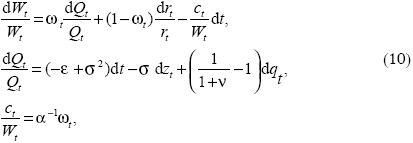
<body><![CDATA[<p align="center"><font face="verdana" size="2"><img src="/img/revistas/cya/n230/a2s9.jpg"></font></p>     <p align="center"><font face="verdana" size="2">&nbsp;</font></p>     <p align="justify"><font face="verdana" size="2">Investor's Portfolio Problem</font></p>     <p align="justify"><font face="verdana" size="2">The stochastic investor's wealth accumulation in terms of the portfolio shares, <img src="/img/revistas/cya/n230/a2s10.jpg"><i><sub>t</sub> = m<sub>t</sub> </i>/<i>W<sub>t</sub>, </i>and 1<i> &#150; &omega;<sub>t</sub> = b<sub>t</sub> </i>/<i>W<sub>t</sub>,</i></font></p>     <p align="justify"><font face="verdana" size="2">and consumption, <i>c<sub>t</sub> </i>(the numeraire good), is determined by the following system of stochastic differential equations:</font></p>     <p align="center"><font face="verdana" size="2"><img src="/img/revistas/cya/n230/a2s11.jpg"></font></p>     <p align="justify"><font face="verdana" size="2">where <i>Q<sub>t</sub></i> = 1/<i>P<sub>t</sub> </i>is the price of money in terms of goods. Observe that the portfolio optimal decision <img src="/img/revistas/cya/n230/a2s12.jpg"> , which is associated with monetary real balances, is, in virtue of the cash&#150;in&#150;advance constraint, linked with consumption. Of course, the optimal complementary proportion 1 &#150; <img src="/img/revistas/cya/n230/a2s12.jpg"> is intended for holding bonds. To avoid unnecessary technical complications, we exclude the investor real wage from the analysis. By solving system (10) in terms <i>of </i>d<i>W<sub>t</sub> </i>/<i>W<sub>t</sub>, </i>we get</font></p>     <p align="center"><font face="verdana" size="2"><img src="/img/revistas/cya/n230/a2s13.jpg"></font></p>     <p align="justify"><font face="verdana" size="2">where &rho; depends only on exogenous parameters. Our analysis will be only concerned with small values of the total volatility compared with the mean expected rate of depreciation in such a way that</font></p>     <p align="center"><font face="verdana" size="2"><img src="/img/revistas/cya/n230/a2s14.jpg"></font></p>     ]]></body>
<body><![CDATA[<p align="justify"><font face="verdana" size="2">The competitive, risk&#150;averse investor derives utility from consumption, <i>c<sub>t</sub></i>, and wishes to maximize her/his overall discounted, Von Neumann&#150;Morgenstern utility, at time <i>t = </i>0, given by</font></p>     <p align="center"><font face="verdana" size="2"><img src="/img/revistas/cya/n230/a2s15.jpg"></font></p>     <p align="justify"><font face="verdana" size="2">where <i>F<sub>0</sub> </i>is all available information at <i>t = </i>0. In order to generate closed&#150;form solutions, we have chosen the logarithmic utility function.</font></p>     <p align="justify"><font face="verdana" size="2">&nbsp;</font></p>     <p align="justify"><font face="verdana" size="2"><b>Comparative Statics</b></font></p>     <p align="justify"><font face="verdana" size="2">In maximizing (13) subject to the wealth constraint as given in (11), the first&#150;order condition for an interior solution is (see <a href="/img/revistas/cya/n230/a2a1.jpg" target="_blank">Appendix I</a>)</font></p>     <p align="center"><font face="verdana" size="2">&nbsp;</font></p>     <p align="center"><font face="verdana" size="2"><img src="/img/revistas/cya/n230/a2s16.jpg"></font></p>     <p align="justify"><font face="verdana" size="2">where <i>A </i>and <i>B </i>depend on parameters and on Cov(d<i>x<sub>t</sub></i>,d<i>z<sub>t</sub></i>) &gt; 0. We have not imposed any positivity constraint of the form <img src="/img/revistas/cya/n230/a2s10.jpg" width="15" height="17"><sub>t</sub> <u>&gt;</u> 0 , so unrestricted short sales are permitted. In what follows, without loss of generality, we will suppose that Cov(d<i>x<sub>t</sub></i>,d<i>z<sub>t</sub></i>) is bounded from above so that</font></p>     <p align="center"><font face="verdana" size="2"><img src="/img/revistas/cya/n230/a2s17.jpg"></font></p>     ]]></body>
<body><![CDATA[<p align="justify"><font face="verdana" size="2">From (15), we immediately find that <i>A &gt; </i>0. Observe that (14) is a cubic equation with one negative and two positive roots, and only one root satisfying 0&lt; &omega; <sup>*</sup>&lt;1.</font></p>     <p align="justify"><font face="verdana" size="2">We have now the first important results: a once&#150;and&#150;for&#150;all increase in the rate of depreciation, which results in an increase in the future opportunity cost of purchasing goods, leads to a permanent decrease in the proportion of wealth devoted to future consumption. It is enough to differentiate (14) to obtain</font></p>     <p align="center"><font face="verdana" size="2"><img src="/img/revistas/cya/n230/a2s18.jpg"></font></p>     <p align="justify"><font face="verdana" size="2">Another relevant result is the response of the equilibrium share of real monetary balances, &omega; <sup>*</sup>, to once&#150;and&#150;for&#150;all changes in the intensity parameter, &lambda;. A once&#150;and&#150;for&#150;all increase in the expected number of devaluations per unit of time causes an increase in the future opportunity cost of purchasing goods. This, in turn, permanently decreases the proportion of wealth set aside for future consumption. By differentiating (14), we get</font></p>     <p align="center"><font face="verdana" size="2"><img src="/img/revistas/cya/n230/a2s19.jpg"></font></p>     <p align="justify"><font face="verdana" size="2">Thus, the elasticity of the depreciation rate satisfies:</font></p>     <p align="center"><font face="verdana" size="2"><img src="/img/revistas/cya/n230/a2s20.jpg"></font></p>     <p align="justify"><font face="verdana" size="2">In other words, portfolio shares are more responsive to changes in the mean expected depreciation rate than to changes in the expected number of devaluations.</font></p>     <p align="justify"><font face="verdana" size="2">&nbsp;</font></p>     <p align="justify"><font face="verdana" size="2"><b>Welfare implications</b></font></p>     ]]></body>
<body><![CDATA[<p align="justify"><font face="verdana" size="2">We assess now the magnitudes of the impacts on welfare of once&#150;and&#150;for&#150;all changes in the mean expected rate of depreciation and in the probability of devaluation. As usual, the welfare criterion, W, of the representative investor is the maximized utility starting from the initial real wealth, <i>W</i><sub>0</sub>. Therefore, economic welfare is given by (see <a href="/img/revistas/cya/n230/a2a1.jpg" target="_blank">Appendix I</a>, formula (I.3))</font></p>     <p align="center"><font face="verdana" size="2"><img src="/img/revistas/cya/n230/a2s21.jpg"></font></p>     <p align="justify"><font face="verdana" size="2">A routine exercise of comparative statics leads to:</font></p>     <p align="center"><font face="verdana" size="2"><img src="/img/revistas/cya/n230/a2s22.jpg"></font></p>     <p align="justify"><font face="verdana" size="2">and</font></p>     <p align="center"><font face="verdana" size="2"><img src="/img/revistas/cya/n230/a2s23.jpg"></font></p>     <p align="justify"><font face="verdana" size="2">As it might be expected, welfare behaves as a decreasing function of both the mean expected rate of depreciation.</font></p>     <p align="justify"><font face="verdana" size="2">&nbsp;</font></p>     <p align="justify"><font face="verdana" size="2"><b>Money in utility index</b></font></p>     <p align="justify"><font face="verdana" size="2">The cash&#150;in&#150;advance assumption is somewhat restrictive in the sense that money is only seen as medium of exchange. We ease this assumption by including currency directly in the utility function because of its liquidity services. In such a case, the stochastic wealth accumulation in terms of the portfolio shares and consumption becomes</font></p>     ]]></body>
<body><![CDATA[<p align="center"><font face="verdana" size="2"><img src="/img/revistas/cya/n230/a2s24.jpg"></font></p>     <p align="justify"><font face="verdana" size="2">where  <img src="/img/revistas/cya/n230/a2s25.jpg"> depends on exogenous parameters. The expected utility at time <i>t = </i>0, <i>V</i><sub>0</sub>, now takes the form:</font></p>     <p align="center"><font face="verdana" size="2"><img src="/img/revistas/cya/n230/a2s26.jpg"></font></p>     <p align="justify"><font face="verdana" size="2">We have chosen again the logarithmic utility function to generate closed&#150;form solutions.</font></p>     <p align="justify"><font face="verdana" size="2">The first order conditions for an interior solution to the problem of maximizing</font></p>     <p align="center"><font face="verdana" size="2"><img src="/img/revistas/cya/n230/a2s27.jpg"></font></p>     <p align="justify"><font face="verdana" size="2">where <i>D </i>and <i>B </i>are taken as in section 2. The second equation above is similar to</font></p>     <p align="justify"><font face="verdana" size="2">that of (14), except for the factor 1/(1 + &theta;) ) that now appears in the first term of the left&#150;hand side of (22).</font></p>     <p align="justify"><font face="verdana" size="2">&nbsp;</font></p>     <p align="justify"><font face="verdana" size="2"><b>Concluding remarks</b></font></p>     ]]></body>
<body><![CDATA[<p align="justify"><font face="verdana" size="2">We have presented a stochastic model of exchange rate and interest rate risks. Specifically, it was assumed that agents have expectations of the exchange rate depreciation driven by a mixed diffusion&#150;jump process and a diffusion process guides the real interest rate. By using a logarithmic utility, we have derived explicit solutions and examined the dynamic implications of uncertainty. Our analytical framework, in which the expectations of devaluation are driven by a combination of Brownian motion with a Poisson process and the real interest rate is guided by a Brownian motion, provides new elements to understand the consumer behavior.</font></p>     <p align="justify"><font face="verdana" size="2">Several of the obtained results throughout this research deserve further attention and discussion. For example, it is observed from Equation (9) that the returns of real money balances for low levels of volatility in prices may lead to a negative trend due to inflation. Nonetheless, this trend can be reversed for higher levels of volatility, since fluctuations in prices, although large, can be upward (inflation) or down (deflation); and in the last case the trend can be positively modified. With respect to equation (10), after replacing the optimal proportion of wealth allocated for holding real balances (which, on the basis of equation (14), is maintained constant by the agent to manage future uncertainty), it is concluded that consumption should be always proportional to wealth. When the level of volatility remains constant, the above result is similar to that found in Modigliani (1971) in the following sense: a risk&#150;averse agent (with logarithmic utility) to deal with future uncertainty should continue the strategy of maintaining its consumption proportional to his/her wealth. On the other hand, if a consumer&#150;investor makes decisions on portfolio and consumption in a deterministic environment and has access to both bonds (free of default risk) and real balances, then the agent can determine his/her optimal consumption path. Whereas in the stochastic case, the consumption path cannot be determined because consumption becomes a random variable; a situation closer to reality. Finally, we have that an increase in the probability of a jump in the exchange rate and a rise in the average expected rate of depreciation may lead to a reduction in the economic welfare of the agents, that is, their levels of satisfaction will be lessened; the same arguments and considerations apply when money is included in the utility function (according to equation (22)).</font></p>     <p align="justify"><font face="verdana" size="2">It is worthwhile mentioning that the results obtained strongly depend on the assumption of logarithmic utility, which is a limit case of the family of constant relative risk aversion utility function. The extension of our stochastic analysis to such a family does not provide closed&#150;form solutions, and result might be only obtained via numerical methods. More work is needed in the above aspect.</font></p>     <p align="justify"><font face="verdana" size="2">Finally, we believe that more research should be undertaken in this stochastic framework to include government transfers and a stochastic budget constraint for the government (in a full general equilibrium), and to extend the analysis to include both non&#150;tradable and durable goods. Needless to say, further work is required in this regard.</font></p>     <p align="justify"><font face="verdana" size="2">&nbsp;</font></p>     <p align="center"><font size="2" face="verdana"><b><a href="/img/revistas/cya/n230/a2a1.jpg" target="_blank">Appendix I</a></b></font></p>     <p align="center"><font size="2" face="verdana"><b><a href="/img/revistas/cya/n230/a2a2.jpg" target="_blank">Appendix II</a></b></font></p>     <p align="center"><font size="2" face="verdana"><b><a href="/img/revistas/cya/n230/a2a3.jpg" target="_blank">Appendix III</a></b></font></p>     <p align="justify"><font face="verdana" size="2">&nbsp;</font></p>     <p align="justify"><font face="verdana" size="2"><b>References</b></font></p>     ]]></body>
<body><![CDATA[<!-- ref --><p align="justify"><font face="verdana" size="2">Giuliano, P., and S. J. Turnovsky (2003). Intertemporal substitution, risk aversion, and economic performance in a stochastically growing open economy. <i>Journal of International Money and Finance, </i>Vol.22, No. 4, pp. 529&#150;556.</font>&nbsp;&nbsp;&nbsp;&nbsp;&nbsp;&nbsp;&nbsp;&nbsp;[&#160;<a href="javascript:void(0);" onclick="javascript: window.open('/scielo.php?script=sci_nlinks&ref=2234171&pid=S0186-1042201000010000200001&lng=','','width=640,height=500,resizable=yes,scrollbars=1,menubar=yes,');">Links</a>&#160;]<!-- end-ref --><!-- ref --><p align="justify"><font face="verdana" size="2">Grinols, E. A. and S. J. Turnovsky (1993). Risk, the financial market, and ma&#150;croeconomic equilibrium. <i>Journal of Economic Dynamics and Control, </i>Vol. 17, No. 1&#150;2, pp. 1&#150;36.</font>&nbsp;&nbsp;&nbsp;&nbsp;&nbsp;&nbsp;&nbsp;&nbsp;[&#160;<a href="javascript:void(0);" onclick="javascript: window.open('/scielo.php?script=sci_nlinks&ref=2234172&pid=S0186-1042201000010000200002&lng=','','width=640,height=500,resizable=yes,scrollbars=1,menubar=yes,');">Links</a>&#160;]<!-- end-ref --><!-- ref --><p align="justify"><font face="verdana" size="2">Lamberton, D. and B. Lapeyre (1996). Introduction to Stochastic Calculus Applied to Finance. Chapman &amp; Hall.</font>&nbsp;&nbsp;&nbsp;&nbsp;&nbsp;&nbsp;&nbsp;&nbsp;[&#160;<a href="javascript:void(0);" onclick="javascript: window.open('/scielo.php?script=sci_nlinks&ref=2234173&pid=S0186-1042201000010000200003&lng=','','width=640,height=500,resizable=yes,scrollbars=1,menubar=yes,');">Links</a>&#160;]<!-- end-ref --><!-- ref --><p align="justify"><font face="verdana" size="2">Merton, R. C. (1969). "Lifetime Portfolio Selection under Uncertainty: The Continuous&#150;Time Case". <i>Review of Economics and Statistics, </i>Vol. 51, No. 3, pp. 247&#150;257.</font>&nbsp;&nbsp;&nbsp;&nbsp;&nbsp;&nbsp;&nbsp;&nbsp;[&#160;<a href="javascript:void(0);" onclick="javascript: window.open('/scielo.php?script=sci_nlinks&ref=2234174&pid=S0186-1042201000010000200004&lng=','','width=640,height=500,resizable=yes,scrollbars=1,menubar=yes,');">Links</a>&#160;]<!-- end-ref --><!-- ref --><p align="justify"><font face="verdana" size="2">&#150;&#150;&#150;&#150;&#150;&#150;&#150;&#150;&#150;&#150;<i>(1971), </i>Optimum Consumption and Portfolio Rules in a Continuous&#150;Time Model, <i>Journal of Economic Theory, </i>Vol. 3, No. 4, pp. 373&#150;413.</font>&nbsp;&nbsp;&nbsp;&nbsp;&nbsp;&nbsp;&nbsp;&nbsp;[&#160;<a href="javascript:void(0);" onclick="javascript: window.open('/scielo.php?script=sci_nlinks&ref=2234175&pid=S0186-1042201000010000200005&lng=','','width=640,height=500,resizable=yes,scrollbars=1,menubar=yes,');">Links</a>&#160;]<!-- end-ref --><!-- ref --><p align="justify"><font face="verdana" size="2">Modigliani, F. (1971), "Monetary Policy and Consumption", <i>in Consumer Spending and Monetary Policy: the linkages, </i>Federal Reserve Bank of Boston, <i>Conference Series </i>No. 5, pp. 9&#150;84.</font>&nbsp;&nbsp;&nbsp;&nbsp;&nbsp;&nbsp;&nbsp;&nbsp;[&#160;<a href="javascript:void(0);" onclick="javascript: window.open('/scielo.php?script=sci_nlinks&ref=2234176&pid=S0186-1042201000010000200006&lng=','','width=640,height=500,resizable=yes,scrollbars=1,menubar=yes,');">Links</a>&#160;]<!-- end-ref --><!-- ref --><p align="justify"><font face="verdana" size="2">Penati, A. and G. Pennacchi (1989). "Optimal Portfolio Choice and the Collapse of a Fixed&#150;Exchange Rate Regime". <i>Journal of International Economics, </i>Vol. 27, No. 1&#150;2, pp. 1&#150;24.</font>&nbsp;&nbsp;&nbsp;&nbsp;&nbsp;&nbsp;&nbsp;&nbsp;[&#160;<a href="javascript:void(0);" onclick="javascript: window.open('/scielo.php?script=sci_nlinks&ref=2234177&pid=S0186-1042201000010000200007&lng=','','width=640,height=500,resizable=yes,scrollbars=1,menubar=yes,');">Links</a>&#160;]<!-- end-ref --><!-- ref --><p align="justify"><font face="verdana" size="2">Svensson, L. E. O. (1992). The Foreign Exchange Risk Premium in a Target Zone with Devaluation Risk. <i>Journal of International Economics, </i>Vol. 33, No. 1&#150;2, pp. 21&#150;40.</font>&nbsp;&nbsp;&nbsp;&nbsp;&nbsp;&nbsp;&nbsp;&nbsp;[&#160;<a href="javascript:void(0);" onclick="javascript: window.open('/scielo.php?script=sci_nlinks&ref=2234178&pid=S0186-1042201000010000200008&lng=','','width=640,height=500,resizable=yes,scrollbars=1,menubar=yes,');">Links</a>&#160;]<!-- end-ref --><!-- ref --><p align="justify"><font face="verdana" size="2">Venegas&#150;Mart&iacute;nez, F. (2001). "Temporary Stabilization: A Stochastic Analysis". <i>Journal of Economics Dynamics and Control, </i>Vol. 25, No. 9, pp. 1429&#150;1449.</font>&nbsp;&nbsp;&nbsp;&nbsp;&nbsp;&nbsp;&nbsp;&nbsp;[&#160;<a href="javascript:void(0);" onclick="javascript: window.open('/scielo.php?script=sci_nlinks&ref=2234179&pid=S0186-1042201000010000200009&lng=','','width=640,height=500,resizable=yes,scrollbars=1,menubar=yes,');">Links</a>&#160;]<!-- end-ref --><!-- ref --><p align="justify"><font face="verdana" size="2">&#150;&#150;&#150;&#150;&#150;&#150;&#150;&#150;&#150;&#150;(2005). "Bayesian Inference, Prior Information on Volatility, and Option Pricing: A Maximum Entropy Approach". <i>International Journal of Theoretical and Applied Finance, </i>Vol. 8, No.1, pp.1&#150;12.</font>&nbsp;&nbsp;&nbsp;&nbsp;&nbsp;&nbsp;&nbsp;&nbsp;[&#160;<a href="javascript:void(0);" onclick="javascript: window.open('/scielo.php?script=sci_nlinks&ref=2234180&pid=S0186-1042201000010000200010&lng=','','width=640,height=500,resizable=yes,scrollbars=1,menubar=yes,');">Links</a>&#160;]<!-- end-ref --><!-- ref --><p align="justify"><font face="verdana" size="2">&#150;&#150;&#150;&#150;&#150;&#150;&#150;&#150;&#150;&#150;(2006a). "Stochastic Temporary Stabilization: Undiversifiable Devaluationand Income Risks". <i>Economic Modelling, </i>Vol. 23, No. 1, pp. 157&#150;173.</font>&nbsp;&nbsp;&nbsp;&nbsp;&nbsp;&nbsp;&nbsp;&nbsp;[&#160;<a href="javascript:void(0);" onclick="javascript: window.open('/scielo.php?script=sci_nlinks&ref=2234181&pid=S0186-1042201000010000200011&lng=','','width=640,height=500,resizable=yes,scrollbars=1,menubar=yes,');">Links</a>&#160;]<!-- end-ref --><!-- ref --><p align="justify"><font face="verdana" size="2">&#150;&#150;&#150;&#150;&#150;&#150;&#150;&#150;&#150;&#150;(2006b). "Fiscal Policy in a Stochastic Temporary Stabilization Model: Undiversifiable Devaluation Risk". <i>Journal of World Economic Review, </i>Vol. 1. No. 1, pp. 87&#150;106.</font>&nbsp;&nbsp;&nbsp;&nbsp;&nbsp;&nbsp;&nbsp;&nbsp;[&#160;<a href="javascript:void(0);" onclick="javascript: window.open('/scielo.php?script=sci_nlinks&ref=2234182&pid=S0186-1042201000010000200012&lng=','','width=640,height=500,resizable=yes,scrollbars=1,menubar=yes,');">Links</a>&#160;]<!-- end-ref --><!-- ref --><p align="justify"><font face="verdana" size="2">&#150;&#150;&#150;&#150;&#150;&#150;&#150;&#150;&#150;&#150;(2006c). <i>Riesgos financieros y econ&oacute;micos (productos derivados y </i><i>decisiones econ&oacute;micas bajo incertidumbre, </i>International Thomson Editors.</font>&nbsp;&nbsp;&nbsp;&nbsp;&nbsp;&nbsp;&nbsp;&nbsp;[&#160;<a href="javascript:void(0);" onclick="javascript: window.open('/scielo.php?script=sci_nlinks&ref=2234183&pid=S0186-1042201000010000200013&lng=','','width=640,height=500,resizable=yes,scrollbars=1,menubar=yes,');">Links</a>&#160;]<!-- end-ref --><!-- ref --><p align="justify"><font face="verdana" size="2">&#150;&#150;&#150;&#150;&#150;&#150;&#150;&#150;&#150;&#150;(2008). <i>Riesgos financieros y econ&oacute;micos (productos derivados y </i><i>decisiones econ&oacute;micas bajo incertidumbre, </i>2a. edici&oacute;n. Cengage Learning (anteriormente International Thomson Editors).</font>&nbsp;&nbsp;&nbsp;&nbsp;&nbsp;&nbsp;&nbsp;&nbsp;[&#160;<a href="javascript:void(0);" onclick="javascript: window.open('/scielo.php?script=sci_nlinks&ref=2234184&pid=S0186-1042201000010000200014&lng=','','width=640,height=500,resizable=yes,scrollbars=1,menubar=yes,');">Links</a>&#160;]<!-- end-ref --><!-- ref --><p align="justify"><font face="verdana" size="2">&#150;&#150;&#150;&#150;&#150;&#150;&#150;&#150;&#150;&#150;(2009). "Temporary Stabilization in Developing Countries and the Real Option of Waiting, when Consumption Can Be Delayed". <i>International Journal of Economic Research, </i>Vol. 6, No. 2, 229&#150;249.</font>&nbsp;&nbsp;&nbsp;&nbsp;&nbsp;&nbsp;&nbsp;&nbsp;[&#160;<a href="javascript:void(0);" onclick="javascript: window.open('/scielo.php?script=sci_nlinks&ref=2234185&pid=S0186-1042201000010000200015&lng=','','width=640,height=500,resizable=yes,scrollbars=1,menubar=yes,');">Links</a>&#160;]<!-- end-ref --><p align="justify"><font face="verdana" size="2">&nbsp;</font></p>     <p align="justify"><font face="verdana" size="2"><b><a name="nota"></a>Nota</b></font></p>     <p align="justify"><font face="verdana" size="2"><sup>*</sup> The authors are very gratefully for many valuable comments and suggestions made for two anonymous referees.</font></p>      ]]></body><back>
<ref-list>
<ref id="B1">
<nlm-citation citation-type="journal">
<person-group person-group-type="author">
<name>
<surname><![CDATA[Giuliano]]></surname>
<given-names><![CDATA[P.]]></given-names>
</name>
<name>
<surname><![CDATA[Turnovsky]]></surname>
<given-names><![CDATA[S. J.]]></given-names>
</name>
</person-group>
<article-title xml:lang="en"><![CDATA[Intertemporal substitution, risk aversion, and economic performance in a stochastically growing open economy]]></article-title>
<source><![CDATA[Journal of International Money and Finance]]></source>
<year>2003</year>
<volume>22</volume>
<numero>4</numero>
<issue>4</issue>
<page-range>529-556</page-range></nlm-citation>
</ref>
<ref id="B2">
<nlm-citation citation-type="journal">
<person-group person-group-type="author">
<name>
<surname><![CDATA[Grinols]]></surname>
<given-names><![CDATA[E. A.]]></given-names>
</name>
<name>
<surname><![CDATA[Turnovsky]]></surname>
<given-names><![CDATA[S. J.]]></given-names>
</name>
</person-group>
<article-title xml:lang="en"><![CDATA[Risk, the financial market, and ma-croeconomic equilibrium]]></article-title>
<source><![CDATA[Journal of Economic Dynamics and Control]]></source>
<year>1993</year>
<volume>17</volume>
<numero>1-2</numero>
<issue>1-2</issue>
<page-range>1-36</page-range></nlm-citation>
</ref>
<ref id="B3">
<nlm-citation citation-type="book">
<person-group person-group-type="author">
<name>
<surname><![CDATA[Lamberton]]></surname>
<given-names><![CDATA[D.]]></given-names>
</name>
<name>
<surname><![CDATA[Lapeyre]]></surname>
<given-names><![CDATA[B.]]></given-names>
</name>
</person-group>
<source><![CDATA[Introduction to Stochastic Calculus Applied to Finance]]></source>
<year>1996</year>
<publisher-name><![CDATA[Chapman & Hall]]></publisher-name>
</nlm-citation>
</ref>
<ref id="B4">
<nlm-citation citation-type="journal">
<person-group person-group-type="author">
<name>
<surname><![CDATA[Merton]]></surname>
<given-names><![CDATA[R. C.]]></given-names>
</name>
</person-group>
<article-title xml:lang="en"><![CDATA["Lifetime Portfolio Selection under Uncertainty: The Continuous-Time Case"]]></article-title>
<source><![CDATA[Review of Economics and Statistics]]></source>
<year>1969</year>
<volume>51</volume>
<numero>3</numero>
<issue>3</issue>
<page-range>247-257</page-range></nlm-citation>
</ref>
<ref id="B5">
<nlm-citation citation-type="journal">
<person-group person-group-type="author">
<name>
<surname><![CDATA[Merton]]></surname>
<given-names><![CDATA[R. C.]]></given-names>
</name>
</person-group>
<article-title xml:lang="en"><![CDATA[Optimum Consumption and Portfolio Rules in a Continuous-Time Model]]></article-title>
<source><![CDATA[Journal of Economic Theory]]></source>
<year>1971</year>
<volume>3</volume>
<numero>4</numero>
<issue>4</issue>
<page-range>373-413</page-range></nlm-citation>
</ref>
<ref id="B6">
<nlm-citation citation-type="book">
<person-group person-group-type="author">
<name>
<surname><![CDATA[Modigliani]]></surname>
<given-names><![CDATA[F.]]></given-names>
</name>
</person-group>
<article-title xml:lang="en"><![CDATA["Monetary Policy and Consumption"]]></article-title>
<source><![CDATA[Consumer Spending and Monetary Policy: the linkages]]></source>
<year>1971</year>
<volume>5</volume>
<page-range>9-84</page-range><publisher-name><![CDATA[Federal Reserve Bank of Boston]]></publisher-name>
</nlm-citation>
</ref>
<ref id="B7">
<nlm-citation citation-type="journal">
<person-group person-group-type="author">
<name>
<surname><![CDATA[Penati]]></surname>
<given-names><![CDATA[A.]]></given-names>
</name>
<name>
<surname><![CDATA[Pennacchi]]></surname>
<given-names><![CDATA[G.]]></given-names>
</name>
</person-group>
<article-title xml:lang="en"><![CDATA["Optimal Portfolio Choice and the Collapse of a Fixed-Exchange Rate Regime"]]></article-title>
<source><![CDATA[Journal of International Economics]]></source>
<year>1989</year>
<volume>27</volume>
<numero>1-2</numero>
<issue>1-2</issue>
<page-range>1-24</page-range></nlm-citation>
</ref>
<ref id="B8">
<nlm-citation citation-type="journal">
<person-group person-group-type="author">
<name>
<surname><![CDATA[Svensson]]></surname>
<given-names><![CDATA[L. E. O.]]></given-names>
</name>
</person-group>
<article-title xml:lang="en"><![CDATA[The Foreign Exchange Risk Premium in a Target Zone with Devaluation Risk]]></article-title>
<source><![CDATA[Journal of International Economics]]></source>
<year>1992</year>
<volume>33</volume>
<numero>1-2</numero>
<issue>1-2</issue>
<page-range>21-40</page-range></nlm-citation>
</ref>
<ref id="B9">
<nlm-citation citation-type="journal">
<person-group person-group-type="author">
<name>
<surname><![CDATA[Venegas-Martínez]]></surname>
<given-names><![CDATA[F.]]></given-names>
</name>
</person-group>
<article-title xml:lang="en"><![CDATA["Temporary Stabilization: A Stochastic Analysis"]]></article-title>
<source><![CDATA[Journal of Economics Dynamics and Control]]></source>
<year>2001</year>
<volume>25</volume>
<numero>9</numero>
<issue>9</issue>
<page-range>1429-1449</page-range></nlm-citation>
</ref>
<ref id="B10">
<nlm-citation citation-type="journal">
<person-group person-group-type="author">
<name>
<surname><![CDATA[Venegas-Martínez]]></surname>
<given-names><![CDATA[F.]]></given-names>
</name>
</person-group>
<article-title xml:lang="en"><![CDATA["Bayesian Inference, Prior Information on Volatility, and Option Pricing: A Maximum Entropy Approach"]]></article-title>
<source><![CDATA[International Journal of Theoretical and Applied Finance]]></source>
<year>2005</year>
<volume>8</volume>
<numero>1</numero>
<issue>1</issue>
<page-range>1-12</page-range></nlm-citation>
</ref>
<ref id="B11">
<nlm-citation citation-type="journal">
<person-group person-group-type="author">
<name>
<surname><![CDATA[Venegas-Martínez]]></surname>
<given-names><![CDATA[F.]]></given-names>
</name>
</person-group>
<article-title xml:lang="en"><![CDATA["Stochastic Temporary Stabilization: Undiversifiable Devaluationand Income Risks"]]></article-title>
<source><![CDATA[Economic Modelling]]></source>
<year>2006</year>
<volume>23</volume>
<numero>1</numero>
<issue>1</issue>
<page-range>157-173</page-range></nlm-citation>
</ref>
<ref id="B12">
<nlm-citation citation-type="journal">
<person-group person-group-type="author">
<name>
<surname><![CDATA[Venegas-Martínez]]></surname>
<given-names><![CDATA[F.]]></given-names>
</name>
</person-group>
<article-title xml:lang="en"><![CDATA["Fiscal Policy in a Stochastic Temporary Stabilization Model: Undiversifiable Devaluation Risk"]]></article-title>
<source><![CDATA[Journal of World Economic Review]]></source>
<year>2006</year>
<volume>1</volume>
<numero>1</numero>
<issue>1</issue>
<page-range>87-106</page-range></nlm-citation>
</ref>
<ref id="B13">
<nlm-citation citation-type="book">
<person-group person-group-type="author">
<name>
<surname><![CDATA[Venegas-Martínez]]></surname>
<given-names><![CDATA[F.]]></given-names>
</name>
</person-group>
<person-group person-group-type="editor">
<name>
</name>
</person-group>
<source><![CDATA[Riesgos financieros y económicos (productos derivados y decisiones económicas bajo incertidumbre]]></source>
<year>2006</year>
<publisher-name><![CDATA[International Thomson Editors]]></publisher-name>
</nlm-citation>
</ref>
<ref id="B14">
<nlm-citation citation-type="book">
<person-group person-group-type="author">
<name>
<surname><![CDATA[Venegas-Martínez]]></surname>
<given-names><![CDATA[F.]]></given-names>
</name>
</person-group>
<person-group person-group-type="editor">
<name>
</name>
</person-group>
<source><![CDATA[Riesgos financieros y económicos (productos derivados y decisiones económicas bajo incertidumbre]]></source>
<year>2008</year>
<edition>2a</edition>
<publisher-name><![CDATA[Cengage Learning]]></publisher-name>
</nlm-citation>
</ref>
<ref id="B15">
<nlm-citation citation-type="journal">
<person-group person-group-type="author">
<name>
<surname><![CDATA[Venegas-Martínez]]></surname>
<given-names><![CDATA[F.]]></given-names>
</name>
</person-group>
<article-title xml:lang="en"><![CDATA["Temporary Stabilization in Developing Countries and the Real Option of Waiting, when Consumption Can Be Delayed"]]></article-title>
<source><![CDATA[International Journal of Economic Research]]></source>
<year>2009</year>
<volume>6</volume>
<numero>2</numero>
<issue>2</issue>
<page-range>229-249</page-range></nlm-citation>
</ref>
</ref-list>
</back>
</article>