<?xml version="1.0" encoding="ISO-8859-1"?><article xmlns:mml="http://www.w3.org/1998/Math/MathML" xmlns:xlink="http://www.w3.org/1999/xlink" xmlns:xsi="http://www.w3.org/2001/XMLSchema-instance">
<front>
<journal-meta>
<journal-id>0185-3880</journal-id>
<journal-title><![CDATA[Ciencias marinas]]></journal-title>
<abbrev-journal-title><![CDATA[Cienc. mar]]></abbrev-journal-title>
<issn>0185-3880</issn>
<publisher>
<publisher-name><![CDATA[Universidad Autónoma de Baja California, Instituto de Investigaciones Oceanológicas]]></publisher-name>
</publisher>
</journal-meta>
<article-meta>
<article-id>S0185-38802013000400005</article-id>
<title-group>
<article-title xml:lang="en"><![CDATA[Difference in reproductive strategies of two scleractinian corals (branching vs massive) along the west coast of Mexico]]></article-title>
<article-title xml:lang="es"><![CDATA[Diferencia en las estrategias reproductivas de dos corales escleractinios (ramificado vs masivo) a lo largo de la costa occidental de México]]></article-title>
</title-group>
<contrib-group>
<contrib contrib-type="author">
<name>
<surname><![CDATA[Chávez-Romo]]></surname>
<given-names><![CDATA[Héctor Efraín]]></given-names>
</name>
<xref ref-type="aff" rid="A01"/>
</contrib>
<contrib contrib-type="author">
<name>
<surname><![CDATA[Paz-García]]></surname>
<given-names><![CDATA[David Arturo]]></given-names>
</name>
<xref ref-type="aff" rid="A03"/>
</contrib>
<contrib contrib-type="author">
<name>
<surname><![CDATA[Correa-Sandoval]]></surname>
<given-names><![CDATA[Francisco]]></given-names>
</name>
<xref ref-type="aff" rid="A02"/>
</contrib>
<contrib contrib-type="author">
<name>
<surname><![CDATA[Reyes-Bonilla]]></surname>
<given-names><![CDATA[Héctor]]></given-names>
</name>
<xref ref-type="aff" rid="A04"/>
</contrib>
<contrib contrib-type="author">
<name>
<surname><![CDATA[López-Pérez]]></surname>
<given-names><![CDATA[Ramón Andrés]]></given-names>
</name>
<xref ref-type="aff" rid="A05"/>
</contrib>
<contrib contrib-type="author">
<name>
<surname><![CDATA[Medina-Rosas]]></surname>
<given-names><![CDATA[Pedro]]></given-names>
</name>
<xref ref-type="aff" rid="A06"/>
</contrib>
</contrib-group>
<aff id="A01">
<institution><![CDATA[,Universidad Autónoma de Baja California Facultad de Ciencias Marinas ]]></institution>
<addr-line><![CDATA[Ensenada Baja California]]></addr-line>
<country>México</country>
</aff>
<aff id="A02">
<institution><![CDATA[,Universidad Autónoma de Baja California Instituto de Investigaciones Oceanológicas ]]></institution>
<addr-line><![CDATA[Ensenada Baja California]]></addr-line>
<country>México</country>
</aff>
<aff id="A03">
<institution><![CDATA[,Instituto Politécnico Nacional Centro de Investigaciones Biológicas del Noroeste Laboratorio de Genética para la Conservación]]></institution>
<addr-line><![CDATA[La Paz Baja California Sur]]></addr-line>
<country>México</country>
</aff>
<aff id="A04">
<institution><![CDATA[,Universidad Autónoma de Baja California Sur Departamento de Biología Marina ]]></institution>
<addr-line><![CDATA[La Paz Baja California Sur]]></addr-line>
<country>México</country>
</aff>
<aff id="A05">
<institution><![CDATA[,Universidad del Mar Instituto de Recursos ]]></institution>
<addr-line><![CDATA[Puerto Ángel Oaxaca]]></addr-line>
<country>México</country>
</aff>
<aff id="A06">
<institution><![CDATA[,Universidad de Guadalajara Centro Universitario de la Costa Departamento de Ciencias]]></institution>
<addr-line><![CDATA[Puerto Vallarta Jalisco]]></addr-line>
<country>México</country>
</aff>
<pub-date pub-type="pub">
<day>00</day>
<month>12</month>
<year>2013</year>
</pub-date>
<pub-date pub-type="epub">
<day>00</day>
<month>12</month>
<year>2013</year>
</pub-date>
<volume>39</volume>
<numero>4</numero>
<fpage>387</fpage>
<lpage>400</lpage>
<copyright-statement/>
<copyright-year/>
<self-uri xlink:href="http://www.scielo.org.mx/scielo.php?script=sci_arttext&amp;pid=S0185-38802013000400005&amp;lng=en&amp;nrm=iso"></self-uri><self-uri xlink:href="http://www.scielo.org.mx/scielo.php?script=sci_abstract&amp;pid=S0185-38802013000400005&amp;lng=en&amp;nrm=iso"></self-uri><self-uri xlink:href="http://www.scielo.org.mx/scielo.php?script=sci_pdf&amp;pid=S0185-38802013000400005&amp;lng=en&amp;nrm=iso"></self-uri><abstract abstract-type="short" xml:lang="en"><p><![CDATA[This study addressed the relative contribution of sexual and asexual reproduction to the genetic composition of populations of two scleractinian corals, Pocillopora damicornis and Porites panamensis, off the west coast of mainland Mexico. Reproductive indexes showed that P. damicornis reproduced both sexually and asexually; P. panamensis reproduced sexually, but colonies with an asexual origin were also observed (10-30%). Asexual reproduction is usually attributed to fragmentation caused by hurricanes; however, no significant association between reproductive index values and frequency of hurricanes was observed for either species. Environmental conditions in the Gulf of California seem to be more favorable for sexual reproduction in both species than other parts of the west coast of Mexico. This study contributes baseline information of differences in sexual and asexual reproduction in massive and branching corals.]]></p></abstract>
<abstract abstract-type="short" xml:lang="es"><p><![CDATA[Se estudió la contribución relativa de la reproducción sexual y asexual a la composición genética de dos corales escleractinios, Pocillopora damicornis y Porites panamensis, de la costa occidental de México. Los índices reproductivos mostraron que P. damicornis presentó reproducción sexual y asexual; P. panamensis presentó reproducción sexual, pero también se observaron colonias que tuvieron un origen asexual (10-30%). La reproducción asexual es usualmente atribuida a la fragmentación por causa de huracanes; sin embargo, no hubo una asociación significativa entre los índices reproductivos de las dos especies y la frecuencia de huracanes. Las condiciones ambientales en el golfo de California parecen ser más favorables para la reproducción sexual en ambas especies que otras partes del Pacífico mexicano. Este estudio contribuye con información básica sobre las diferencias en reproducción sexual y asexual en las especies de coral masivo y ramificado.]]></p></abstract>
<kwd-group>
<kwd lng="en"><![CDATA[sexual reproduction]]></kwd>
<kwd lng="en"><![CDATA[genotypic diversity]]></kwd>
<kwd lng="en"><![CDATA[reproductive mode]]></kwd>
<kwd lng="en"><![CDATA[genetic composition]]></kwd>
<kwd lng="en"><![CDATA[Eastern Pacific]]></kwd>
<kwd lng="es"><![CDATA[reproducción sexual]]></kwd>
<kwd lng="es"><![CDATA[diversidad genotípica]]></kwd>
<kwd lng="es"><![CDATA[modo reproductivo]]></kwd>
<kwd lng="es"><![CDATA[composición genética]]></kwd>
<kwd lng="es"><![CDATA[Pacífico oriental]]></kwd>
</kwd-group>
</article-meta>
</front><body><![CDATA[ <p align="center"><font face="verdana" size="4"><b>Difference in reproductive strategies of two scleractinian corals (branching <i>vs</i> massive) along the west coast of Mexico</b></font></p>              <p align="justify"><font face="verdana" size="2">&nbsp;</font></p>              <p align="center"><font face="verdana" size="3"><b>Diferencia en las estrategias reproductivas de dos corales escleractinios (ramificado <i>vs</i> masivo) a lo largo de la costa occidental de M&eacute;xico</b></font></p>              <p align="justify"><font face="verdana" size="2">&nbsp;</font></p>              <p align="center"><font face="verdana" size="2"><b>H&eacute;ctor Efra&iacute;n Ch&aacute;vez&#45;Romo<sup>1,2</sup>, David Arturo Paz&#45;Garc&iacute;a<sup>3*</sup>, Francisco Correa&#45;Sandoval<sup>2</sup>, H&eacute;ctor Reyes&#45;Bonilla<sup>4</sup>, Ram&oacute;n Andr&eacute;s L&oacute;pez&#45;P&eacute;rez<sup>5</sup>, Pedro Medina&#45;Rosas<sup>6</sup></b></font></p>              <p align="justify"><font face="verdana" size="2">&nbsp;</font></p>              <p align="justify"><font face="verdana" size="2"><sup><i>1</i></sup><i> Facultad de Ciencias Marinas, Universidad Aut&oacute;noma de Baja California (UABC), Carretera Transpeninsular Ensenada&#45;Tijuana No. 3917, Fraccionamiento Playitas, Ensenada 22860, Baja California, M&eacute;xico.</i></font></p>              <p align="justify"><font face="verdana" size="2"><i><sup>2</sup> Instituto de Investigaciones Oceanol&oacute;gicas, Universidad Aut&oacute;noma de Baja California, Carretera Transpeninsular Ensenada&#45;Tijuana No. 3917, Fraccionamiento Playitas, Ensenada 22860, Baja California, M&eacute;xico.</i></font></p>              <p align="justify"><font face="verdana" size="2"><i><sup>3</sup> Laboratorio de Gen&eacute;tica para la Conservaci&oacute;n, Centro de Investigaciones Biol&oacute;gicas del Noroeste (CIBNOR), Instituto Polit&eacute;cnico Nacional 195, Colonia Playa Palo de Santa Rita Sur, La Paz 23096, Baja California Sur, M&eacute;xico.</i> <i>*Corresponding author. E&#45;mail:</i> <a href="mailto:dpaz@cibnor.mx">dpaz@cibnor.mx</a>.</font></p>              <p align="justify"><font face="verdana" size="2"><i><sup>4</sup> Departamento de Biolog&iacute;a Marina, Universidad Aut&oacute;noma de Baja California Sur (UABCS), Carretera al Sur Km 5.5, La Paz 23280, Baja California Sur, M&eacute;xico.</i></font></p>              ]]></body>
<body><![CDATA[<p align="justify"><font face="verdana" size="2"><i><sup>5</sup> Instituto de Recursos, Universidad del Mar, Puerto &Aacute;ngel 70902, Oaxaca, M&eacute;xico.</i></font></p>              <p align="justify"><font face="verdana" size="2"><i><sup>6</sup> Departamento de Ciencias, Centro Universitario de la Costa&#45;Universidad de Guadalajara, Av. Universidad de Guadalajara No. 203, Delegaci&oacute;n Ixtapa, Puerto Vallarta 48280, Jalisco, M&eacute;xico.</i></font></p>              <p align="justify"><font face="verdana" size="2">&nbsp;</font></p>              <p align="justify"><font face="verdana" size="2">Received January 2013,    <br>     received in revised form October 2013,    <br>     accepted October 2013.</font></p>              <p align="justify"><font face="verdana" size="2">&nbsp;</font></p>              <p align="justify"><font face="verdana" size="2"><b>ABSTRACT</b></font></p>              <p align="justify"><font face="verdana" size="2">This study addressed the relative contribution of sexual and asexual reproduction to the genetic composition of populations of two scleractinian corals, <i>Pocillopora damicornis</i> and <i>Porites panamensis,</i> off the west coast of mainland Mexico. Reproductive indexes showed that <i>P. damicornis</i> reproduced both sexually and asexually; <i>P. panamensis</i> reproduced sexually, but colonies with an asexual origin were also observed (10&#45;30%). Asexual reproduction is usually attributed to fragmentation caused by hurricanes; however, no significant association between reproductive index values and frequency of hurricanes was observed for either species. Environmental conditions in the Gulf of California seem to be more favorable for sexual reproduction in both species than other parts of the west coast of Mexico. This study contributes baseline information of differences in sexual and asexual reproduction in massive and branching corals.</font></p>              <p align="justify"><font face="verdana" size="2"><b>Key words:</b> sexual reproduction, genotypic diversity, reproductive mode, genetic composition, Eastern Pacific.</font></p>              ]]></body>
<body><![CDATA[<p align="justify"><font face="verdana" size="2">&nbsp;</font></p>              <p align="justify"><font face="verdana" size="2"><b>RESUMEN</b></font></p>              <p align="justify"><font face="verdana" size="2">Se estudi&oacute; la contribuci&oacute;n relativa de la reproducci&oacute;n sexual y asexual a la composici&oacute;n gen&eacute;tica de dos corales escleractinios, <i>Pocillopora damicornis</i> y <i>Porites panamensis,</i> de la costa occidental de M&eacute;xico. Los &iacute;ndices reproductivos mostraron que <i>P. damicornis</i> present&oacute; reproducci&oacute;n sexual y asexual; <i>P. panamensis</i> present&oacute; reproducci&oacute;n sexual, pero tambi&eacute;n se observaron colonias que tuvieron un origen asexual (10&#45;30%). La reproducci&oacute;n asexual es usualmente atribuida a la fragmentaci&oacute;n por causa de huracanes; sin embargo, no hubo una asociaci&oacute;n significativa entre los &iacute;ndices reproductivos de las dos especies y la frecuencia de huracanes. Las condiciones ambientales en el golfo de California parecen ser m&aacute;s favorables para la reproducci&oacute;n sexual en ambas especies que otras partes del Pac&iacute;fico mexicano. Este estudio contribuye con informaci&oacute;n b&aacute;sica sobre las diferencias en reproducci&oacute;n sexual y asexual en las especies de coral masivo y ramificado.</font></p>              <p align="justify"><font face="verdana" size="2"><b>Palabras clave:</b> reproducci&oacute;n sexual, diversidad genot&iacute;pica, modo reproductivo, composici&oacute;n gen&eacute;tica, Pac&iacute;fico oriental.</font></p>              <p align="justify"><font face="verdana" size="2">&nbsp;</font></p>              <p align="justify"><font face="verdana" size="2"><b>INTRODUCTION</b></font></p>              <p align="justify"><font face="verdana" size="2">Corals are long&#45;lived organisms composed of thousands of individuals in a single colony that can potentially employ different strategies of sexual or asexual reproduction in their life history. Strategies of sexual and asexual reproduction of coral species are important for maintaining resilience of their populations; these strategies represent fundamental evolutionary processes resulting from environmental disturbances of natural or human causes (Harrison 2011). The contribution of sexual and asexual reproductive strategies can vary among populations of a single species across its range; in some species, the contribution can be approximately equal, while in others, one strategy can dominate in a specific area and time (Whitaker 2006, Starger <i>et al.</i> 2010).</font></p>              <p align="justify"><font face="verdana" size="2">During the life history of these long&#45;lived organisms, sexual reproduction produces opportunities for generating new genetic combinations and opens possibilities for the dispersion of gametes and larvae within and between coral reefs or the colonization of new locations (van Oppen and Gates 2006). Asexual reproduction enables well&#45;adapted local genotypes to increase the possibility of surviving disturbances and die&#45;off events and expanding to nearby localities (Highsmith 1982, Baums <i>et al.</i> 2006). Asexual reproduction by fragmentation is advantageous because it provides a means of reaching sites where larvae are unable to settle (such as sandy areas at the periphery of a reef), it facilitates local dispersion and rapid occupation of space for the persistence of populations when conditions are unfavorable for sexual reproduction or larval recruitment, and it reduces the risk of genetic extinction (Highsmith 1982).</font></p>              <p align="justify"><font face="verdana" size="2">Branching corals are particularly susceptible to fragmentation from strong waves caused by hurricanes. Some corals appear to use fragmentation as part of their life histories after reaching a certain size (Highsmith 1982); however, fragmentation, as a reproductive strategy, is not exclusive to branched species. Long&#45;lived massive corals, although less affected by storms, can be overturned or fragmented during these events (Lirman <i>et al.</i> 2001), and persist in local populations (Boulay <i>et al.</i> 2012). Genetic studies show that fragmentation contributes up to 25% of massive coral species (Miller and Ayre 2008). Thus, the evidence indicates that massive corals can propagate by asexual means, even though sexual strategies predominate (Miller and Ayre 2008, Boulay <i>et al.</i> 2012). To date, few massive coral species have been studied and no comparison has been made between species with different morphologies from the same sites.</font></p>              <p align="justify"><font face="verdana" size="2">Traditionally, the success of sexual reproduction has been addressed by following the presence or release of gametes and settlement of recruits (Harrison 2011, Schmidt&#45;Roach <i>et al.</i> 2012), while the success of asexual reproduction by fragmentation has been addressed by counting fragments before and after disturbances and following the condition of naturally&#45; or artificially&#45;generated fragments (Smith and Hughes 1999). Genetic markers can be used to determine the genotypic diversity of a population, the number of distinct genets (genetically&#45;different colonies originated by sexual means) or ramets (colonies generated by fragmantaion), giving the contribution of the reproductive strategy (sexual <i>vs</i> asexual reproduction) to the existing genetic structure of the populations (Aranceta&#45;Garza <i>et al.</i> 2012, Pinz&oacute;n <i>et al.</i> 2012).</font></p>              ]]></body>
<body><![CDATA[<p align="justify"><font face="verdana" size="2">After the 1997&#45;1998 El Ni&ntilde;o event, coral reefs along the west coast of mainland Mexico experienced massive die&#45;offs, with losses of 60&#45;90%; in the Gulf of California, die&#45;offs were less than 18% (Reyes&#45;Bonilla <i>et al.</i> 2002). Despite massive die&#45;offs, coral reefs along the west coast of Mexico recovered by sexual reproduction, as suggested in histological (Ch&aacute;vez&#45;Romo and Reyes&#45;Bonilla 2007, Carpizo&#45;Ituarte <i>et al.</i> 2011, Rodr&iacute;guez&#45;Troncoso <i>et al.</i> 2011) and recruitment studies (Medina&#45;Rosas <i>et al.</i> 2005, L&oacute;pez&#45;P&eacute;rez <i>et al.</i> 2007). However, to understand the function of coral communities in reef recovery following disturbances, it is necessary to disentangle the importance of reproductive strategies in the genetic structure of the populations.</font></p>              <p align="justify"><font face="verdana" size="2">In this study, two scleractinian species, <i>Pocillopora damicornis</i> and <i>Porites panamensis,</i> were selected because they are abundant and widespread on the west coast of Mexico, display contrasting morphology, and have different reproductive strategies (Ch&aacute;vez&#45;Romo and Reyes&#45;Bonilla 2007, Carpizo&#45;Ituarte <i>et al.</i> 2011). <i>Pocillopora damicornis</i> is a branching and hermaphroditic species that reproduces sexually in the Gulf of California and Gulf of Panama by broadcast spawning (Glynn <i>et al.</i> 1991, Ch&aacute;vez&#45;Romo and Reyes&#45;Bonilla 2007), and is typically susceptible to fragmentation (<a href="/img/revistas/ciemar/v39n4/a5f1.jpg" target="_blank">fig. 1a</a>). In contrast, <i>P. panamensis</i> is a massive and gonochoric species, sexually active along the west coast of Mexico and Panama (Glynn <i>et al.</i> 1994, Carpizo&#45;Ituarte <i>et al.</i> 2011, Rodr&iacute;guez&#45;Troncoso <i>et al.</i> 2011). Asexual reproduction in massive corals is rare, but abrasion of whole colonies and multiple fragmentations of <i>P. panamensis</i> have been observed in the Gulf of California (<a href="/img/revistas/ciemar/v39n4/a5f1.jpg" target="_blank">fig. 1b</a>). From this unusual situation, we explored the relative contribution of sexual and asexual reproductive strategies of <i>P. damicornis</i> and <i>P. panamensis</i> to the existing genetic structure of populations along the west coast of Mexico.</font></p>              <p align="justify"><font face="verdana" size="2">&nbsp;</font></p>              <p align="justify"><font face="verdana" size="2"><b>MATERIALS AND METHODS</b></font></p>              <p align="justify"><font face="verdana" size="2"><b>Locations and collection</b></font></p>              <p align="justify"><font face="verdana" size="2">Collections were made in the most important regions of coral development off the west coast of mainland Mexico (Gulf of California, Bah&iacute;a de Banderas, and Bah&iacute;as de Huatulco; <a href="/img/revistas/ciemar/v39n4/a5f2.jpg" target="_blank">fig. 2</a>). In the Gulf of California, samples of <i>P. damicornis</i> were collected at El Portugu&eacute;s (POR) and in the southern part of Bah&iacute;a de La Paz (BLP); samples of <i>P. panamensis</i> were collected at Bah&iacute;a de los &Aacute;ngeles (BLA), Bah&iacute;a Concepci&oacute;n (BCO), and BLP. Samples of both species were collected at Punta Arena de la Ventana (PAV), close to the entrance of the Gulf of California, and further south, at Isla Redonda (IRD) in Bah&iacute;a de Banderas. In Bah&iacute;as de Huatulco, <i>P. damicornis</i> was collected at Dos Hermanas (DOH) and La Entrega (LET); <i>P. panamensis</i> was collected only at LET. All coral samples were frozen in liquid nitrogen, transported to the laboratory, and stored at &#45;80 &deg;C.</font></p>              <p align="justify"><font face="verdana" size="2"><b>Allozyme electrophoresis</b></font></p>              <p align="justify"><font face="verdana" size="2">Extractions of coral tissue were conducted in Stoddart's modified buffer (Stoddart 1983, Weil 1992) with a sonic dismembrator (model 100, Fisher Scientific, Waltham, MA). Then, 2 mL of the blastate was centrifuged at 2600 x <i>g</i> for 10 min at 4 &deg;C. The resulting supernatant was placed in vials and stored at &#45;80 &deg;C until analysis. The samples were analyzed after protein separation by polyacrylamide gel electrophoresis at 4 &deg;C by a discontinuous gel system under native conditions (Manchenko 1994) using 8% acrylamide. The multi&#45;genotype of each colony was determined in four enzyme systems (five polymorphic loci) in both species (Paz&#45;Garc&iacute;a <i>et al.</i> 2008b, Ch&aacute;vez&#45;Romo <i>et al.</i> 2009). These enzyme systems were leucine&#45;glycyl&#45;glycyl peptidase <i>(LGG&#45;1,</i> E.C. 3.4.11.1), malic enzyme <i>(ME&#45;1,</i> E.C. 1.1.1.40), glutamate dehydrogenase <i>(GDH&#45;1</i> and <i>GDH&#45;2,</i> E.C. 1.4.1.3), and esterase <i>(EST&#45;1</i> and <i>EST&#45;2,</i> E.C. 3.1.1.1). Two loci were observed in the <i>EST</i> and <i>GDH</i> enzyme systems in <i>P. damicornis</i> and <i>P. panamensis,</i> respectively. Alleles at each locus were labeled alphabetically, based on decreasing mobility from the origin.</font></p>              <p align="justify"><font face="verdana" size="2"><b>Reproductive strategies</b></font></p>              <p align="justify"><font face="verdana" size="2">We followed different approaches to estimate the contribution of sexual and asexual reproduction to the genetic structure. First, samples that had identical alleles at all five loci were identified as clone mates belonging to the same genet. Then, we obtained the number of unique multi&#45;genotypes detected at each location <i>(N</i><i><sub>g</sub>)</i> for each species. The probability of identity (PID) was calculated to give a conservative estimate of the probability that two individuals sampled in the same general location share a multi&#45;locus genotype by chance, not by descent (Waits <i>et al.</i> 2001). An overall unbiased PID was calculated after sequentially multiplying PID values for all loci, using the GIMLET software (Vali&egrave;re 2002); low overall P<sub>ID</sub> values for <i>P. damicornis</i> (P<sub>ID</sub> = 2.9 &times; 10<sup>&#45;3</sup>) and <i>P. panamensis</i> (P<sub>ID</sub> = 0.88 &times;10<sup>&#45;3</sup>) indicated that the loci used in this study were accurate to assign ramets to clones.</font></p>              ]]></body>
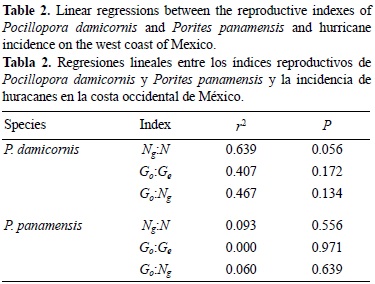
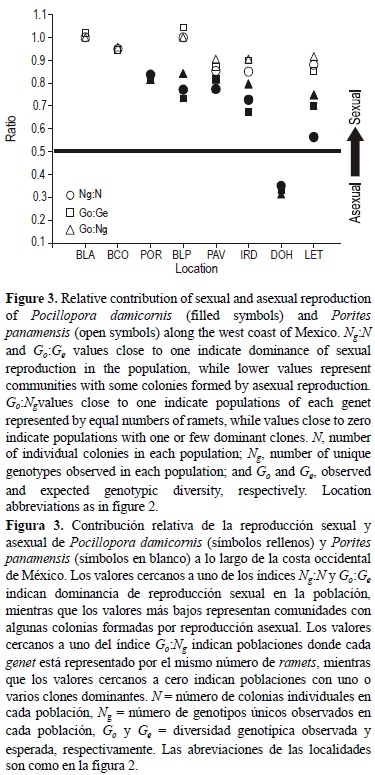
<body><![CDATA[<p align="justify"><font face="verdana" size="2">Second, we calculated three reproductive indexes: (a) genotype richness <i>(N</i><i><sub>g</sub></i><i>:N),</i> where <i>N</i><i><sub>g</sub></i> was calculated as described above and <i>N</i> is the number of individuals analyzed at a location; (b) genotypic diversity <i>(G<sub>O</sub>:G</i><i><sub>e</sub>),</i> where <i>G</i><i><sub>o</sub></i> is the observed genotype diversity and <i>G</i><i>e</i> is the expected genotype diversity; and (c) genotypic evenness <i>(G<sub>O</sub>:N</i><i><sub>g</sub>).</i> Values close to one in the <i>N</i><i><sub>g</sub></i><i>:N</i> and <i>G<sub>O</sub>:G<sub>e</sub></i> ratios indicate that sexual reproduction is dominant at the location; values close to zero indicate locations that have colonies with high levels of asexual reproduction (Stoddart and Taylor 1988, Ayre <i>et al.</i> 1997). The <i>Go:Ge</i> ratio was calculated using the equations of Stoddart and Taylor (1988). Values close to one in the <i>G<sub>O</sub>:N</i><i><sub>g</sub></i> ratio indicate locations where each genet is represented by equal numbers of ramets; values close to zero indicate locations with one or few dominant clones (Coffroth and Lasker 1998).</font></p>              <p align="justify"><font face="verdana" size="2"><b>Cloning and frequency of disturbance</b></font></p>              <p align="justify"><font face="verdana" size="2">To test whether there is a relationship between the level of cloning and frequency of disturbance, we tabulated the number of hurricanes that occurred at each location from 1958 through 2006. Standard buffer zones around each location were defined according to storm strength: 35 km for category 1 and 2 hurricanes (maximum sustained winds of 120&#45;176 km/h), 60 km for category 3 hurricanes (177212 km/h), and 100 km for category 4 and 5 hurricanes (&gt;213 km/h) (Stoddart <i>et al.</i> 1985, Done 1992, Gardner <i>et al.</i> 2005). Data on occurrence and strength of hurricanes were obtained from the NOAA Historical Hurricane Tracks website (<a href="http://csc.noaa.gov/hurricanes/" target="_blank">http://csc.noaa.gov/hurricanes/</a>). Using this data set, a storm was considered if it entered a strength&#45;specific buffer zone. Linear regressions were performed, where the number of storms approaching each location was the independent variable and the <i>N<sub>g</sub>:N, G<sub>o</sub>:G<sub>e</sub>,</i> and <i>G<sub>o</sub>:N<sub>g</sub></i> ratios were the dependent variables.</font></p>              <p align="justify"><font face="verdana" size="2">&nbsp;</font></p>              <p align="justify"><font face="verdana" size="2"><b>RESULTS AND DISCUSSION</b></font></p>              <p align="justify"><font face="verdana" size="2"><b>Reproductive strategies of <i>Pocillopora damicornis</i></b></font></p>              <p align="justify"><font face="verdana" size="2">Two hundred <i>P. damicornis</i> colonies were sampled and most colonies showed unique genotypes <i>(N</i><i><sub>g</sub></i> = 136). The average percentage of unique multi&#45;genotypes <i>(N</i><i><sub>g</sub>)</i> was 66.66 (&plusmn; 16.45, SD), and the values at each location ranged from 35% to 83% (<a href="#f3">fig. 3</a>). The <i>Ng:N</i> average was 0.67 (&plusmn;0.16), ranging from 0.35 to 0.83 (<a href="/img/revistas/ciemar/v39n4/a5t1.jpg" target="_blank">table 1</a>); observed and expected genotypic diversity <i>(G<sub>o</sub>:G<sub>e</sub>)</i> averaged 0.67 &plusmn; 0.16, ranging from 0.33 to 0.82. The percentage of unique genotypes and reproductive indexes <i>(N</i><i><sub>g</sub></i><i>:N</i> and <i>G</i><i><sub>o</sub></i><i>:G</i><i><sub>e</sub>)</i> indicate that <i>P. damicornis</i> uses sexual and asexual strategies. The <i>G</i><i><sub>o</sub></i><i>:N</i><i><sub>g</sub></i> ratio indicated that each genet is represented by almost equal numbers of ramets (0.72 &plusmn; 0.20), with values ranging from 0.31 to 0.84 (<a href="/img/revistas/ciemar/v39n4/a5t1.jpg" target="_blank">table 1</a>). This result indicates that most of the locations are dominated by a few clones (i.e., high sexual reproduction indicated by <i>G<sub>o</sub>:N<sub>g</sub></i> values close to one), whereas in DOH there is high asexual reproduction (Coffroth and Lasker 1998).</font></p>              <p align="center"><font face="verdana" size="2"><a name="f3"></a></font></p>              <p align="center"><font face="verdana" size="2"><img src="/img/revistas/ciemar/v39n4/a5f3.jpg"></font></p>              <p align="justify"><font face="verdana" size="2">The highest numbers of clonal colonies (42&#45;56%) were found in Bah&iacute;as de Huatulco (DOH and LET), supporting earlier findings in the region. Previous histological studies based on surveys in Bah&iacute;a de Banderas and Bah&iacute;as de Huatulco over several years (2001&#45;2004) did not detect mature gametes (only stages I&#45;III), suggesting the predominance of asexual reproduction in these areas (Carpizo&#45;Ituarte <i>et al.</i> 2011, Rodr&iacute;guez&#45;Troncoso <i>et al.</i> 2011). Interestingly, <i>P. damicornis</i> in Bah&iacute;as de Huatulco had years of reproductive inactivity followed by periods of reproduction in subsequent years, but the causes for this have not yet been determined (Rodr&iacute;guez&#45;Troncoso <i>et al.</i> 2011).</font></p>              ]]></body>
<body><![CDATA[<p align="justify"><font face="verdana" size="2">Genetic studies of <i>Pocillopora</i> corals have shown evidence of asexual reproduction by fragmentation or by asexual larvae in Japan (Adjeround and Tsuchiya 1999), Taiwan (Yeoh and Dai 2010), the west coast of Australia (Stoddart 1983), and the Gulf of California (Aranceta&#45;Garza <i>et al.</i> 2012, Pinz&oacute;n <i>et al.</i> 2012), indicating the tendency of this group to form clonal communities. The contribution of asexual reproduction to the coral communities is usually attributed to fragmentation caused by storms and hurricanes, low frequency of sexual reproduction, and disturbance (Highsmith 1982, Hunter 1993).</font></p>              <p align="justify"><font face="verdana" size="2">From 1958 through 2006, in the Gulf of California 44 hurricanes impacted the surrounding waters of these coral communities; 21 were category 1 and 2, 12 were category 3, and 11 were category 4 and 5 hurricanes. Contrary to expectations, no significant association was found between the <i>P. damicornis</i> reproductive index values and frequency of hurricanes along the west coast of Mexico (<a href="#t2">table 2</a>). Few studies have explored the association of hurricanes and reproductive indexes in corals from genetic studies (Baums <i>et al.</i> 2006, Aranceta&#45;Garza <i>et al.</i> 2012) or reproduction effects in disturbed habitats (Hunter 1993). Similar to the findings in this study, Baums <i>et al.</i> (2006) found higher clonal structure of the branching coral <i>Acropora palmata</i> in the Caribbean and no correlation with the incidence of hurricanes.</font></p>              <p align="center"><font face="verdana" size="2"><a name="t2"></a></font></p>              <p align="center"><font face="verdana" size="2"><img src="/img/revistas/ciemar/v39n4/a5t2.jpg"></font></p>              <p align="justify"><font face="verdana" size="2">Aranceta&#45;Garza <i>et al.</i> (2012) found a significant relationship between hurricane frequency and reproductive indexes of <i>Pocillopora verrucosa</i> in the Gulf of California (i.e., asexual reproduction by fragmentation). The differences in the results of their study and this study may be attributed to the following factors. First, <i>P. verrucosa</i> is more abundant than <i>P. damicornis;</i> in fact, some coral reef communities are composed almost entirely of <i>P. verrucosa</i> colonies (Aranceta&#45;Garza <i>et al.</i> 2012, Paz&#45;Garc&iacute;a <i>et al.</i> 2012a, Pinz&oacute;n <i>et al.</i> 2012). Therefore, this species is more susceptible to fragmentation than <i>P. damicornis.</i> Second, during storms, large pieces of reef framework can be broken, coral colonies can be overturned or transported, and branches can be fragmented into smaller sizes (Lirman <i>et al.</i> 2001). Survival of fragments after disturbances is related to their size (Smith and Hughes 1999); thus bigger fragments have a better chance of survival. As <i>P. verrucosa</i> has wider and longer branches than <i>P. damicornis,</i> it may be more successful at asexual reproduction by fragmentation and hence present an association with storms.</font></p>              <p align="justify"><font face="verdana" size="2">The highest number of colonies with unique genotypes (72&#45;83%) and the highest reproductive indexes in this study were found in the Gulf of California and Bah&iacute;a de Banderas, suggesting that sexual reproduction plays a major role in these areas. These results are also supported by previous studies, which indicate higher recruitment levels of <i>Pocillopora</i> sp. in the Gulf of California (0.36 ind m<sup>&#45;2</sup> yr<sup>&#45;1</sup>, <a href="/img/revistas/ciemar/v39n4/a5t3.jpg" target="_blank">table 3</a>), compared to the tropical part of the west coast of Mexico (L&oacute;pez&#45;P&eacute;rez <i>et al.</i> 2007, Cabral&#45;Tena 2012; <a href="/img/revistas/ciemar/v39n4/a5t3.jpg" target="_blank">table 3</a>). Moreover, it has been suggested that there was an exchange of propagules between coral communities after the 1997&#45;1998 El Ni&ntilde;o in the southern Gulf of California and Bah&iacute;a de Banderas (Paz&#45;Garc&iacute;a <i>et al.</i> 2012b). These findings indicate more favorable environmental conditions for sexual reproduction for <i>P. damicornis</i> and other coral species in the Gulf of California, which has an extended warm season and relatively more stable oceanographic conditions than Bah&iacute;as de Huatulco (Ch&aacute;vez&#45;Romo and Reyes&#45;Bonilla 2007, Cabral&#45;Tena 2012, Paz&#45;Garc&iacute;a <i>et al.</i> 2012b). Thus, coral communities from the Gulf of California represent an important resource for generating genetic diversity by sexual reproduction and exporting propagules for the recovery of damaged coral communities.</font></p>              <p align="justify"><font face="verdana" size="2"><i>Pocillopora</i> corals have been extensively studied, and the relative contribution of reproductive strategies has been inferred in different regions using genetic markers (Stoddart 1983, Adjeroud and Tsuchiya 1999, Miller and Ayre 2004, Sherman <i>et al.</i> 2006). In Japan, Taiwan, Australia, southwestern Mexico and the southern Gulf of California, asexual reproduction by fragmentation or the production of asexual larvae are the dominant reproductive strategy (Ward 1992, Adjeroud and Tsuchiya 1999, L&oacute;pez&#45;P&eacute;rez <i>et al.</i> 2007, Carpizo&#45;Ituarte <i>et al.</i> 2011). In Indonesia, eastern Australia, and elsewhere in the Gulf of California, sexual reproduction is dominant (Sherman <i>et al.</i> 2006, Starger <i>et al.</i> 2010, Pinz&oacute;n <i>et al.</i> 2012).</font></p>              <p align="justify"><font face="verdana" size="2">Additionally, histological studies have provided evidence that the reproductive strategy of <i>P. damicornis</i> varies (Glynn <i>et al.</i> 1991, Ward 1992, Ch&aacute;vez&#45;Romo and Reyes&#45;Bonilla 2007). Across its range, this species can spawn gametes for external fertilization or broadcast larvae (Stoddart 1983, Ayre and Miller 2004; see Harrison 2011 for a review). Shifts in modes of reproduction, from brooding larvae to free&#45;spawning gametes, seem to occur in peripheral populations of <i>Pocillopora</i> off the coast of South Africa and the southwestern coast of Australia, and in the Red Sea and the Eastern Pacific (Glynn <i>et al.</i> 1991, Ward 1992, Ch&aacute;vez&#45;Romo and Reyes&#45;Bonilla 2007, Harrison 2011). However, different reproductive traits in <i>P. damicornis</i> across its distribution may be associated with cryptic species diversity (Schmidt&#45;Roach <i>et al.</i> 2012). Recent studies show that morphological plasticity is higher than previously thought (Flot <i>et al.</i> 2008, Souter 2010, Pinz&oacute;n and LaJeunesse 2011). This will require detailed and integrated taxonomic studies (morphological and host&#45;symbiont genetics) to unambiguously recognize <i>Pocillopora</i> species. In the studied locations, <i>Pocillopora</i> corals comprise one genetic group <i>(Pocillopora</i> type 1, <i>sensu</i> Pinz&oacute;n and LaJeunesse 2011).</font></p>              <p align="justify"><font face="verdana" size="2"><b>Reproductive strategies of <i>Porites panamensis</i></b></font></p>              <p align="justify"><font face="verdana" size="2">We sampled 139 colonies of <i>P. panamensis;</i> most of the colonies had unique genotypes <i>(N</i><i><sub>g</sub></i> = 127). The unique multi&#45;genotypes ranged from 85% to 100% at each location (on average, 92.21 &plusmn; 6.4; <a href="#f3">fig. 3</a>). The <i>N<sub>g</sub>:N</i> average was 0.92 &plusmn; 0.06, ranging from 0.85 to 1.00 among locations (<a href="/img/revistas/ciemar/v39n4/a5t4.jpg" target="_blank">table 4</a>). Observed and expected genotypic diversity <i>(G<sub>o</sub>:G<sub>e</sub></i> ratio) averaged 0.93 &plusmn; 0.07, ranging from 0.85 to 1.04. The <i>G<sub>o</sub>:N<sub>g</sub></i> ratio revealed that, on average, each genet is represented by an equal number of ramets (0.94 &plusmn; 0.04), ranging from 0.90 to 1.00 among locations (<a href="/img/revistas/ciemar/v39n4/a5t4.jpg" target="_blank">table 4</a>); this result indicates high sexual reproduction, with <i>G<sub>o</sub>:N<sub>g</sub></i> values close to one (Coffroth and Lasker 1998). The percentage of unique genotypes and reproductive indexes showed that the massive coral <i>P. panamensis</i> mainly reproduced sexually along the west coast of Mexico, but also had low asexual reproduction at the southern locations. Recent studies of massive coral species show that fragmentation is higher than previously thought (Miller and Ayre 2008, Boulay <i>et al.</i> 2012). In this study, 24&#45;30% of <i>P. panamensis</i> colonies at PAV, IRD, and LET originated by asexual reproduction. Similar percentages of asexual reproduction (8&#45;25%) have been estimated for other four massive species: <i>Porites lobata</i> (Boulay <i>et al.</i> 2012), <i>Montastraea annularis</i> (Severance and Karl 2006), <i>Montas&#45;traea faveolata</i> (Severance and Karl 2006), and <i>Platygyra daedalea</i> (Miller and Ayre 2008).</font></p>              ]]></body>
<body><![CDATA[<p align="justify"><font face="verdana" size="2">In the Gulf of California, detached fragments and whole <i>P. panamensis</i> colonies were observed (<a href="/img/revistas/ciemar/v39n4/a5f1.jpg" target="_blank">fig. 1</a>). No significant association was found between the reproductive index values and frequency of hurricanes along the west coast of Mexico for <i>P. panamensis</i> colonies (<a href="#t2">table 2</a>). Different processes may contribute to fragmentation in this species. For example, bioerosion by polychaetes, bivalves, and excavating sponges could make the coral skeleton more susceptible to fragmentation (Carriquiry and Reyes&#45;Bonilla 1997, Reyes&#45;Bonilla 2003), or differences in regeneration and partial mortality may cause fission of large colonies (Paz&#45;Garc&iacute;a and Reyes&#45;Bonilla 2006).</font></p>              <p align="justify"><font face="verdana" size="2">Histological studies of <i>P. panamensis</i> indicate that successful sexual reproduction is feasible along the west coast of Mexico (<a href="/img/revistas/ciemar/v39n4/a5t3.jpg" target="_blank">table 3</a>). Release of larvae occurs most of the year in BLP (Gulf of California), but usually during summer (two&#45;four months) in Bah&iacute;a de Banderas and Bah&iacute;as de Huatulco (Carpizo&#45;Ituarte <i>et al.</i> 2011, Rodr&iacute;guez&#45;Troncoso <i>et al.</i> 2011, Paz&#45;Garc&iacute;a <i>et al.</i> 2008a; see <a href="/img/revistas/ciemar/v39n4/a5t3.jpg" target="_blank">table 3</a>). Other differences along the west coast of Mexico are that the Gulf of California had the highest N<sub>g</sub>:N and <i>G<sub>o</sub>:G<sub>e</sub></i> ratios and number of oocytes per polyp (Mora&#45;P&eacute;rez 2005, Carpizo&#45;Ituarte <i>et al.</i> 2011, Rodr&iacute;guez&#45;Troncoso <i>et al.</i> 2011), suggesting that even with relatively large changes in environmental conditions over an annual cycle, this coral is well adapted for survival and reproduces under harsh conditions.</font></p>              <p align="justify"><font face="verdana" size="2">High recruitment ratios of <i>Porites</i> in the Gulf of California and Bah&iacute;as de Huatulco (0.63&#45;78.71 ind m<sup>&#45;2</sup> yr<sup>&#45;1</sup>, see <a href="/img/revistas/ciemar/v39n4/a5t3.jpg" target="_blank">table 3</a>) suggest recovery of coral reefs in other areas of the west coast of Mexico because their reproduction ratios are high (L&oacute;pez&#45;P&eacute;rez <i>et al.</i> 2007, Cabral&#45;Tena 2012, Paz&#45;Garc&iacute;a <i>et al.</i> 2012b). Differences in reproductive strategies of coral communities in the Gulf of California could have evolutionary significance because there is high reproduction potential when there are multiple larval releases. This may be a survival strategy under fluctuating environmental conditions. Long&#45;term studies and more attention to massive species are necessary to understand the role of asexual reproduction and population dynamics among coral reefs.</font></p>              <p align="justify"><font face="verdana" size="2">In summary, this study provides genetic evidence of the importance of sexual and asexual reproduction in the reef corals <i>P. damicornis</i> and <i>P. panamensis</i> at diverse sites along the west coast of Mexico. These results support previous histological and recruitment studies in this region. Our findings indicate that locations in the Gulf of California have high levels of sexual reproduction, recruitment, and genotypic diversity of corals that could be important for recovery in other locations (Saavedra&#45;Sotelo <i>et al.</i> 2011, Paz&#45;Garc&iacute;a <i>et al.</i> 2012b). Further integrated research of coral communities would improve our understanding of population structure and reproductive response to global climate change in these ecosystems.</font></p>              <p align="justify"><font face="verdana" size="2">&nbsp;</font></p>              <p align="justify"><font face="verdana" size="2"><b>ACKNOWLEDGMENTS</b></font></p>              <p align="justify"><font face="verdana" size="2">This study was funded by the Project AWARE Foundation (to DAPG) and SEMARNAT project 2002&#45;c01&#45;0605 (to Luis Calderon of CICESE). HECR (#198888) and DAPG (#160065) are recipients of fellowship grants from the National Council for Science and Technology (CONACYT, Mexico). We thank the work group at the Parque Nacional Islas Marietas, and Diana S&aacute;nchez, Luis Lombardo, and Karina Xolaltenco (UABC) for their laboratory assistance. Salwa El Khattabi (UABCS) helped with the Spanish translation of the paper. Ira Fogel (CIBNOR) provided editorial services.</font></p>              <p align="justify"><font face="verdana" size="2">&nbsp;</font></p>              <p align="justify"><font face="verdana" size="2"><b>REFERENCES</b></font></p>              <!-- ref --><p align="justify"><font face="verdana" size="2">Adjeround M, Tsuchiya M. 1999. Genetic variation and clonal structure in the scleractinian coral <i>Pocillopora damicornis</i> in the Ryukyu Archipelago, southern Japan. Mar. Biol. 134: 753&#45;769. <a href="http://dx.doi.org/10.1007/s002270050592" target="_blank">http://dx.doi.org/10.1007/s002270050592</a></font>&nbsp;&nbsp;&nbsp;&nbsp;&nbsp;&nbsp;&nbsp;&nbsp;[&#160;<a href="javascript:void(0);" onclick="javascript: window.open('/scielo.php?script=sci_nlinks&ref=1953002&pid=S0185-3880201300040000500001&lng=','','width=640,height=500,resizable=yes,scrollbars=1,menubar=yes,');">Links</a>&#160;]<!-- end-ref --><!-- ref --><p align="justify"><font face="verdana" size="2">Aranceta&#45;Garza F, Balart EF, Reyes&#45;Bonilla H, Cruz&#45;Hern&aacute;ndez P. 2012. Effect of tropical storms on sexual and asexual reproduction in coral <i>Pocillopora verrucosa</i> subpopulations in the Gulf of California. Coral Reefs 31: 1157&#45;1167. <a href="http://dx.doi.org/10.1007/s00338-012-0941-9" target="_blank">http://dx.doi.org/10.1007/s00338&#45;012&#45;0941&#45;9</a></font>&nbsp;&nbsp;&nbsp;&nbsp;&nbsp;&nbsp;&nbsp;&nbsp;[&#160;<a href="javascript:void(0);" onclick="javascript: window.open('/scielo.php?script=sci_nlinks&ref=1953003&pid=S0185-3880201300040000500002&lng=','','width=640,height=500,resizable=yes,scrollbars=1,menubar=yes,');">Links</a>&#160;]<!-- end-ref --><!-- ref --><p align="justify"><font face="verdana" size="2">Ayre DJ, Miller KJ. 2004. Where do clonal coral larvae go? Adult genotypic diversity conflicts with reproductive effort in the brooding coral <i>Pocillopora damicornis.</i> Mar. Ecol. Prog. Ser. 277: 95&#45;105. <a href="http://dx.doi.org/10.3354/meps277095" target="_blank">http://dx.doi.org/10.3354/meps277095</a></font>&nbsp;&nbsp;&nbsp;&nbsp;&nbsp;&nbsp;&nbsp;&nbsp;[&#160;<a href="javascript:void(0);" onclick="javascript: window.open('/scielo.php?script=sci_nlinks&ref=1953004&pid=S0185-3880201300040000500003&lng=','','width=640,height=500,resizable=yes,scrollbars=1,menubar=yes,');">Links</a>&#160;]<!-- end-ref --><!-- ref --><p align="justify"><font face="verdana" size="2">Ayre DJ, Hughes TP, Standish RJ. 1997. Genetic differentiation, reproductive mode, and gene flow in the brooding coral <i>Pocillopora damicornis</i> along the Great Barrier Reef, Australia. Mar. Ecol. Prog. Ser. 159: 175&#45;187. <a href="http://dx.doi.org/10.3354/meps159175" target="_blank">http://dx.doi.org/10.3354/meps159175</a></font>&nbsp;&nbsp;&nbsp;&nbsp;&nbsp;&nbsp;&nbsp;&nbsp;[&#160;<a href="javascript:void(0);" onclick="javascript: window.open('/scielo.php?script=sci_nlinks&ref=1953005&pid=S0185-3880201300040000500004&lng=','','width=640,height=500,resizable=yes,scrollbars=1,menubar=yes,');">Links</a>&#160;]<!-- end-ref --><!-- ref --><p align="justify"><font face="verdana" size="2">Baums IB, Miller MW, Hellberg ME. 2006. Geographic variation in clonal structure in a reef&#45;building Caribbean coral, <i>Acropora palmata.</i> Ecol. Monogr. 76: 503&#45;519.    &nbsp;&nbsp;&nbsp;&nbsp;&nbsp;&nbsp;&nbsp;&nbsp;[&#160;<a href="javascript:void(0);" onclick="javascript: window.open('/scielo.php?script=sci_nlinks&ref=1953006&pid=S0185-3880201300040000500005&lng=','','width=640,height=500,resizable=yes,scrollbars=1,menubar=yes,');">Links</a>&#160;]<!-- end-ref --></font></p>              <!-- ref --><p align="justify"><font face="verdana" size="2">Boulay JN, Cortes J, Nivia&#45;Ruiz J, Baums IB. 2012. High genotypic diversity of the reef&#45;building coral <i>Porites lobata</i> (Scleractinia: Poritidae) in Isla del Coco National Park, Costa Rica. Rev. Biol. Trop. 60: 279&#45;292.    &nbsp;&nbsp;&nbsp;&nbsp;&nbsp;&nbsp;&nbsp;&nbsp;[&#160;<a href="javascript:void(0);" onclick="javascript: window.open('/scielo.php?script=sci_nlinks&ref=1953008&pid=S0185-3880201300040000500006&lng=','','width=640,height=500,resizable=yes,scrollbars=1,menubar=yes,');">Links</a>&#160;]<!-- end-ref --></font></p>              <!-- ref --><p align="justify"><font face="verdana" size="2">Cabral&#45;Tena RA. 2012. Reclutamiento coralino en un arrecife restaurado en La Paz, BCS. In: P&eacute;rez&#45;Ram&iacute;rez M, Lluch&#45;Cota SE (eds.), Biodiversidad y Vulnerabilidad de Ecosistemas Costeros en Baja California Sur. Centro de Investigaciones Biol&oacute;gicas del Noroeste, La Paz, BCS, M&eacute;xico, pp. 331&#45;345.    &nbsp;&nbsp;&nbsp;&nbsp;&nbsp;&nbsp;&nbsp;&nbsp;[&#160;<a href="javascript:void(0);" onclick="javascript: window.open('/scielo.php?script=sci_nlinks&ref=1953010&pid=S0185-3880201300040000500007&lng=','','width=640,height=500,resizable=yes,scrollbars=1,menubar=yes,');">Links</a>&#160;]<!-- end-ref --></font></p>              <!-- ref --><p align="justify"><font face="verdana" size="2">Carpizo&#45;Ituarte E, Vizca&iacute;no&#45;Ochoa V, Chi&#45;Barrag&aacute;n G, Tapia&#45;V&aacute;zquez O, Cupul&#45;Maga&ntilde;a AL, Medina&#45;Rosas P. 2011. Evidence of sexual reproduction in the hermatypic corals <i>Pocillopora damicornis, Porites panamensis,</i> and <i>Pavona gigantea</i> in Banderas Bay, Mexican Pacific. Cienc. Mar. 37: 97&#45;112. <a href="http://dx.doi.org/10.7773/cm.v37i1.1773" target="_blank">http://dx.doi.org/10.7773/cm.v37i1.1773</a></font>&nbsp;&nbsp;&nbsp;&nbsp;&nbsp;&nbsp;&nbsp;&nbsp;[&#160;<a href="javascript:void(0);" onclick="javascript: window.open('/scielo.php?script=sci_nlinks&ref=1953012&pid=S0185-3880201300040000500008&lng=','','width=640,height=500,resizable=yes,scrollbars=1,menubar=yes,');">Links</a>&#160;]<!-- end-ref --><!-- ref --><p align="justify"><font face="verdana" size="2">Carriquiry JD, Reyes&#45;Bonilla H. 1997. Estructura de la comunidad y distribuci&oacute;n geogr&aacute;fica de los arrecifes coralinos de Nayarit, Pac&iacute;fico de M&eacute;xico. Cienc. Mar. 23: 227&#45;248.    &nbsp;&nbsp;&nbsp;&nbsp;&nbsp;&nbsp;&nbsp;&nbsp;[&#160;<a href="javascript:void(0);" onclick="javascript: window.open('/scielo.php?script=sci_nlinks&ref=1953013&pid=S0185-3880201300040000500009&lng=','','width=640,height=500,resizable=yes,scrollbars=1,menubar=yes,');">Links</a>&#160;]<!-- end-ref --> </font></p>         <!-- ref --><p align="justify"><font face="verdana" size="2">Ch&aacute;vez&#45;Romo HE, Reyes&#45;Bonilla H. 2007. Sexual reproduction of the coral <i>Pocillopora damicornis</i> in the southern Gulf of California, Mexico. Cienc. Mar. 33: 495&#45;501.    &nbsp;&nbsp;&nbsp;&nbsp;&nbsp;&nbsp;&nbsp;&nbsp;[&#160;<a href="javascript:void(0);" onclick="javascript: window.open('/scielo.php?script=sci_nlinks&ref=1953015&pid=S0185-3880201300040000500010&lng=','','width=640,height=500,resizable=yes,scrollbars=1,menubar=yes,');">Links</a>&#160;]<!-- end-ref --></font></p>              <!-- ref --><p align="justify"><font face="verdana" size="2">Ch&aacute;vez&#45;Romo HE, Correa&#45;Sandoval F, Paz&#45;Garc&iacute;a DA, Reyes&#45;Bonilla H, L&oacute;pez&#45;P&eacute;rez RA, Medina&#45;Rosas P, Hern&aacute;ndez&#45;Cort&eacute;s MP. 2009. Genetic structure of a scleractinian coral, <i>Pocillopora damicornis,</i> in the Mexican Pacific. Proc. 11th Int. Coral Reef Symp., pp. 429&#45;433.    &nbsp;&nbsp;&nbsp;&nbsp;&nbsp;&nbsp;&nbsp;&nbsp;[&#160;<a href="javascript:void(0);" onclick="javascript: window.open('/scielo.php?script=sci_nlinks&ref=1953017&pid=S0185-3880201300040000500011&lng=','','width=640,height=500,resizable=yes,scrollbars=1,menubar=yes,');">Links</a>&#160;]<!-- end-ref --></font></p>              <!-- ref --><p align="justify"><font face="verdana" size="2">Coffroth MA, Lasker HR. 1998. Population structure of a clonal gorgonian coral: The interplay between clonal reproduction and disturbance. Evolution 52: 379&#45;393.    &nbsp;&nbsp;&nbsp;&nbsp;&nbsp;&nbsp;&nbsp;&nbsp;[&#160;<a href="javascript:void(0);" onclick="javascript: window.open('/scielo.php?script=sci_nlinks&ref=1953019&pid=S0185-3880201300040000500012&lng=','','width=640,height=500,resizable=yes,scrollbars=1,menubar=yes,');">Links</a>&#160;]<!-- end-ref --></font></p>              <!-- ref --><p align="justify"><font face="verdana" size="2">Done TJ. 1992. Effects of tropical cyclone waves on ecological and geomorphological structures on the Great Barrier Reef. Cont. Shelf Res. 12: 859&#45;872.    &nbsp;&nbsp;&nbsp;&nbsp;&nbsp;&nbsp;&nbsp;&nbsp;[&#160;<a href="javascript:void(0);" onclick="javascript: window.open('/scielo.php?script=sci_nlinks&ref=1953021&pid=S0185-3880201300040000500013&lng=','','width=640,height=500,resizable=yes,scrollbars=1,menubar=yes,');">Links</a>&#160;]<!-- end-ref --></font></p>              ]]></body>
<body><![CDATA[<!-- ref --><p align="justify"><font face="verdana" size="2">Flot J&#45;F, Magalo H, Cruaud C, Couloux A, Tillier S. 2008. Patterns of genetic structure among Hawaiian corals of the genus <i>Pocillopora</i> yield clusters of individuals that are compatible with morphology. C. R. Biol. 331: 239&#45;247.    &nbsp;&nbsp;&nbsp;&nbsp;&nbsp;&nbsp;&nbsp;&nbsp;[&#160;<a href="javascript:void(0);" onclick="javascript: window.open('/scielo.php?script=sci_nlinks&ref=1953023&pid=S0185-3880201300040000500014&lng=','','width=640,height=500,resizable=yes,scrollbars=1,menubar=yes,');">Links</a>&#160;]<!-- end-ref --></font></p>              <!-- ref --><p align="justify"><font face="verdana" size="2">Gardner TA, Cote IM, Gill JA, Grant A, Watkinson AR. 2005. Hurricanes and Caribbean coral reefs: Impacts, recovery patterns, and role in long&#45;term decline. Ecology 86: 174&#45;184. <a href="http://dx.doi.org/10.1890/04-0141" target="_blank">http://dx.doi.org/10.1890/04&#45;0141</a></font>&nbsp;&nbsp;&nbsp;&nbsp;&nbsp;&nbsp;&nbsp;&nbsp;[&#160;<a href="javascript:void(0);" onclick="javascript: window.open('/scielo.php?script=sci_nlinks&ref=1953025&pid=S0185-3880201300040000500015&lng=','','width=640,height=500,resizable=yes,scrollbars=1,menubar=yes,');">Links</a>&#160;]<!-- end-ref --><!-- ref --><p align="justify"><font face="verdana" size="2">Glynn PW, Gassman NJ, Eakin CM, Cort&eacute;s J, Smith DB, Guzm&aacute;n HM. 1991. Reef coral reproduction in the eastern Pacific: Costa Rica, Panama, and Galapagos Islands (Ecuador). I. Pocilloporidae. Mar. Biol. 109: 355&#45;368. <a href="http://dx.doi.org/10.1007/BF01313501" target="_blank">http://dx.doi.org/10.1007/BF01313501</a></font>&nbsp;&nbsp;&nbsp;&nbsp;&nbsp;&nbsp;&nbsp;&nbsp;[&#160;<a href="javascript:void(0);" onclick="javascript: window.open('/scielo.php?script=sci_nlinks&ref=1953026&pid=S0185-3880201300040000500016&lng=','','width=640,height=500,resizable=yes,scrollbars=1,menubar=yes,');">Links</a>&#160;]<!-- end-ref --><!-- ref --><p align="justify"><font face="verdana" size="2">Glynn PW, Colley SB, Eakin CM, Smith DB, Cort&eacute;s J, Gassman NJ, Guzm&aacute;n HM, Del Rosario JB, Feingold JS. 1994. Reef coral reproduction in the eastern Pacific: Costa Rica, Panama, and Galapagos Islands (Ecuador). II. Poritidae. Mar. Biol. 118: 191&#45;208. <a href="http://dx.doi.org/10.1007/BF00349785" target="_blank">http://dx.doi.org/10.1007/BF00349785</a></font>&nbsp;&nbsp;&nbsp;&nbsp;&nbsp;&nbsp;&nbsp;&nbsp;[&#160;<a href="javascript:void(0);" onclick="javascript: window.open('/scielo.php?script=sci_nlinks&ref=1953027&pid=S0185-3880201300040000500017&lng=','','width=640,height=500,resizable=yes,scrollbars=1,menubar=yes,');">Links</a>&#160;]<!-- end-ref --><!-- ref --><p align="justify"><font face="verdana" size="2">Harrison PL. 2011. Sexual reproduction of scleractinian corals. In: Dubinsky Z, Stambler N (eds.), Coral Reefs: An Ecosystem in Transition. Springer, New York, pp. 59&#45;85.    &nbsp;&nbsp;&nbsp;&nbsp;&nbsp;&nbsp;&nbsp;&nbsp;[&#160;<a href="javascript:void(0);" onclick="javascript: window.open('/scielo.php?script=sci_nlinks&ref=1953028&pid=S0185-3880201300040000500018&lng=','','width=640,height=500,resizable=yes,scrollbars=1,menubar=yes,');">Links</a>&#160;]<!-- end-ref --></font></p>              <!-- ref --><p align="justify"><font face="verdana" size="2">Highsmith R. 1982. Reproduction by fragmentation in corals. Mar. Ecol. Prog. Ser. 7: 207&#45;226.    &nbsp;&nbsp;&nbsp;&nbsp;&nbsp;&nbsp;&nbsp;&nbsp;[&#160;<a href="javascript:void(0);" onclick="javascript: window.open('/scielo.php?script=sci_nlinks&ref=1953030&pid=S0185-3880201300040000500019&lng=','','width=640,height=500,resizable=yes,scrollbars=1,menubar=yes,');">Links</a>&#160;]<!-- end-ref --></font></p>              <!-- ref --><p align="justify"><font face="verdana" size="2">Hunter CL. 1993. Clonal diversity and population structure of scleractinian coral populations under different disturbance histories. Evolution 47: 1213&#45;1228.    &nbsp;&nbsp;&nbsp;&nbsp;&nbsp;&nbsp;&nbsp;&nbsp;[&#160;<a href="javascript:void(0);" onclick="javascript: window.open('/scielo.php?script=sci_nlinks&ref=1953032&pid=S0185-3880201300040000500020&lng=','','width=640,height=500,resizable=yes,scrollbars=1,menubar=yes,');">Links</a>&#160;]<!-- end-ref --></font></p>              <!-- ref --><p align="justify"><font face="verdana" size="2">Lirman D, Glynn PW, Baker AC, Leyte&#45;Morales GE. 2001. Combined effects of three sequential storms on the Huatulco coral reef tract, Mexico. Bull. Mar. Sci. 69: 267&#45;278.    &nbsp;&nbsp;&nbsp;&nbsp;&nbsp;&nbsp;&nbsp;&nbsp;[&#160;<a href="javascript:void(0);" onclick="javascript: window.open('/scielo.php?script=sci_nlinks&ref=1953034&pid=S0185-3880201300040000500021&lng=','','width=640,height=500,resizable=yes,scrollbars=1,menubar=yes,');">Links</a>&#160;]<!-- end-ref --></font></p>              <!-- ref --><p align="justify"><font face="verdana" size="2">L&oacute;pez&#45;P&eacute;rez RA, Mora&#45;P&eacute;rez MG, Leyte&#45;Morales GE. 2007. Coral (Anthozoa: Scleractinia) recruitment at Bah&iacute;as de Huatulco, western Mexico: Implications for coral community structure and dynamics. Pac. Sci. 61: 355&#45;369. <a href="http://dx.doi.org/10.1353/psc.2007.0032" target="_blank">http://dx.doi.org/10.1353/psc.2007.0032</a></font>&nbsp;&nbsp;&nbsp;&nbsp;&nbsp;&nbsp;&nbsp;&nbsp;[&#160;<a href="javascript:void(0);" onclick="javascript: window.open('/scielo.php?script=sci_nlinks&ref=1953036&pid=S0185-3880201300040000500022&lng=','','width=640,height=500,resizable=yes,scrollbars=1,menubar=yes,');">Links</a>&#160;]<!-- end-ref --><!-- ref --><p align="justify"><font face="verdana" size="2">Manchenko GP. 1994. Handbook of Detection of Enzymes on Electrophoretic Gels. CRC Press, Boca Raton, FL. 554 pp.    &nbsp;&nbsp;&nbsp;&nbsp;&nbsp;&nbsp;&nbsp;&nbsp;[&#160;<a href="javascript:void(0);" onclick="javascript: window.open('/scielo.php?script=sci_nlinks&ref=1953037&pid=S0185-3880201300040000500023&lng=','','width=640,height=500,resizable=yes,scrollbars=1,menubar=yes,');">Links</a>&#160;]<!-- end-ref --></font></p>              <!-- ref --><p align="justify"><font face="verdana" size="2">Medina&#45;Rosas P, Carriquiry JD, Cupul&#45;Maga&ntilde;a AL. 2005. Recruitment of <i>Porites</i> (Scleractinia) on artificial substrate in reefs affected by the 1997&#45;98 El Ni&ntilde;o in Banderas Bay, Mexican Pacific. Cienc. Mar. 31: 103&#45;109. <a href="http://dx.doi.org/10.7773/cm.v31i11.75" target="_blank">http://dx.doi.org/10.7773/cm.v31i11.75</a></font>&nbsp;&nbsp;&nbsp;&nbsp;&nbsp;&nbsp;&nbsp;&nbsp;[&#160;<a href="javascript:void(0);" onclick="javascript: window.open('/scielo.php?script=sci_nlinks&ref=1953039&pid=S0185-3880201300040000500024&lng=','','width=640,height=500,resizable=yes,scrollbars=1,menubar=yes,');">Links</a>&#160;]<!-- end-ref --><!-- ref --><p align="justify"><font face="verdana" size="2">Miller KJ, Ayre DJ. 2004. The role of sexual and asexual reproduction in structuring high latitude populations of the reef coral <i>Pocillopora damicornis.</i> Heredity 92: 557&#45;568. <a href="http://dx.doi.org/10.1038/sj.hdy.6800459" target="_blank">http://dx.doi.org/10.1038/sj.hdy.6800459</a></font>&nbsp;&nbsp;&nbsp;&nbsp;&nbsp;&nbsp;&nbsp;&nbsp;[&#160;<a href="javascript:void(0);" onclick="javascript: window.open('/scielo.php?script=sci_nlinks&ref=1953040&pid=S0185-3880201300040000500025&lng=','','width=640,height=500,resizable=yes,scrollbars=1,menubar=yes,');">Links</a>&#160;]<!-- end-ref --><!-- ref --><p align="justify"><font face="verdana" size="2">Miller KJ, Ayre DJ. 2008. Population structure is not a simple function of reproductive mode and larval type: Insights from tropical corals. J. Anim. Ecol. 77: 713&#45;724. <a href="http://dx.doi.org/10.1111/j.1365-2656.2008.01387.x" target="_blank">http://dx.doi.org/10.1111/j.1365&#45;2656.2008.01387.x</a></font>&nbsp;&nbsp;&nbsp;&nbsp;&nbsp;&nbsp;&nbsp;&nbsp;[&#160;<a href="javascript:void(0);" onclick="javascript: window.open('/scielo.php?script=sci_nlinks&ref=1953041&pid=S0185-3880201300040000500026&lng=','','width=640,height=500,resizable=yes,scrollbars=1,menubar=yes,');">Links</a>&#160;]<!-- end-ref --><!-- ref --><p align="justify"><font face="verdana" size="2">Mora&#45;P&eacute;rez MG. 2005. Biolog&iacute;a reproductiva del coral <i>Porites panamensis</i> Verrill 1866 (Anthozoa: Scleractinia), en Bah&iacute;a de La Paz, Baja California Sur, M&eacute;xico. MSc thesis, Centro Interdisciplinario de Ciencias Marinas, La Paz, BCS, M&eacute;xico. 81 pp.    &nbsp;&nbsp;&nbsp;&nbsp;&nbsp;&nbsp;&nbsp;&nbsp;[&#160;<a href="javascript:void(0);" onclick="javascript: window.open('/scielo.php?script=sci_nlinks&ref=1953042&pid=S0185-3880201300040000500027&lng=','','width=640,height=500,resizable=yes,scrollbars=1,menubar=yes,');">Links</a>&#160;]<!-- end-ref --></font></p>              <!-- ref --><p align="justify"><font face="verdana" size="2">Paz&#45;Garc&iacute;a DA, Reyes&#45;Bonilla H. 2006. Temporal variation in the regeneration rate of artificial lesions in two morphotypes of <i>Porites panamensis.</i> Cienc. Mar. 32: 187&#45;194.    &nbsp;&nbsp;&nbsp;&nbsp;&nbsp;&nbsp;&nbsp;&nbsp;[&#160;<a href="javascript:void(0);" onclick="javascript: window.open('/scielo.php?script=sci_nlinks&ref=1953044&pid=S0185-3880201300040000500028&lng=','','width=640,height=500,resizable=yes,scrollbars=1,menubar=yes,');">Links</a>&#160;]<!-- end-ref --></font></p>              <!-- ref --><p align="justify"><font face="verdana" size="2">Paz&#45;Garc&iacute;a DA, Reyes&#45;Bonilla H, Hern&aacute;ndez&#45;Cort&eacute;s MP. 2008a. Genetic variation in two morphotypes of <i>Porites panamensis</i> from the Gulf of California, Mexico. Proc. 11th Int. Coral Reef Symp., pp. 444&#45;448.    &nbsp;&nbsp;&nbsp;&nbsp;&nbsp;&nbsp;&nbsp;&nbsp;[&#160;<a href="javascript:void(0);" onclick="javascript: window.open('/scielo.php?script=sci_nlinks&ref=1953046&pid=S0185-3880201300040000500029&lng=','','width=640,height=500,resizable=yes,scrollbars=1,menubar=yes,');">Links</a>&#160;]<!-- end-ref --></font></p>              <!-- ref --><p align="justify"><font face="verdana" size="2">Paz&#45;Garc&iacute;a DA, Correa&#45;Sandoval F, Ch&aacute;vez&#45;Romo HE, Reyes&#45;Bonilla H, L&oacute;pez&#45;P&eacute;rez A, Medina&#45;Rosas P, Hern&aacute;ndez&#45;Cort&eacute;s MP. 2008b. Genetic structure of the massive coral <i>Porites panamensis</i> (Anthozoa: Scleractinia) from the Mexican Pacific. Proc. 11th Int. Coral Reef Symp., pp. 449&#45;453.    &nbsp;&nbsp;&nbsp;&nbsp;&nbsp;&nbsp;&nbsp;&nbsp;[&#160;<a href="javascript:void(0);" onclick="javascript: window.open('/scielo.php?script=sci_nlinks&ref=1953048&pid=S0185-3880201300040000500030&lng=','','width=640,height=500,resizable=yes,scrollbars=1,menubar=yes,');">Links</a>&#160;]<!-- end-ref --></font></p>              <!-- ref --><p align="justify"><font face="verdana" size="2">Paz&#45;Garc&iacute;a DA, Balart EF, Garc&iacute;a&#45;de&#45;Le&oacute;n, FJ. 2012a. Cold water bleaching of <i>Pocillopora</i> in the Gulf of California. Proc. 12th Int. Coral Reef Symp. 9A&#45;10: 1&#45;5.    &nbsp;&nbsp;&nbsp;&nbsp;&nbsp;&nbsp;&nbsp;&nbsp;[&#160;<a href="javascript:void(0);" onclick="javascript: window.open('/scielo.php?script=sci_nlinks&ref=1953050&pid=S0185-3880201300040000500031&lng=','','width=640,height=500,resizable=yes,scrollbars=1,menubar=yes,');">Links</a>&#160;]<!-- end-ref --></font></p>              <!-- ref --><p align="justify"><font face="verdana" size="2">Paz&#45;Garc&iacute;a DA, Ch&aacute;vez&#45;Romo HE, Correa&#45;Sandoval F, Reyes&#45;Bonilla H, L&oacute;pez&#45;P&eacute;rez A, Medina&#45;Rosas P, Hern&aacute;ndez&#45;Cort&eacute;s MP. 2012b. Genetic connectivity patterns of corals <i>Pocillopora damicornis</i> and <i>Porites panamensis</i> (Anthozoa: Scleractinia) along the west coast of Mexico. Pacific Sci. 66: 43&#45;61. <a href="http://dx.doi.org/10.2984/66.L3" target="_blank">http://dx.doi.org/10.2984/66.L3</a></font>&nbsp;&nbsp;&nbsp;&nbsp;&nbsp;&nbsp;&nbsp;&nbsp;[&#160;<a href="javascript:void(0);" onclick="javascript: window.open('/scielo.php?script=sci_nlinks&ref=1953052&pid=S0185-3880201300040000500032&lng=','','width=640,height=500,resizable=yes,scrollbars=1,menubar=yes,');">Links</a>&#160;]<!-- end-ref --><!-- ref --><p align="justify"><font face="verdana" size="2">Pinz&oacute;n JH, LaJeunesse TC. 2011. Species delimitation of common reef corals in the genus <i>Pocillopora</i> using nucleotide sequence phylogenies, population genetics and symbiosis ecology. Mol. Ecol. 20: 311&#45;325. <a href="http://dx.doi.org/10.1111/j.1365-294X.2010.04939.x" target="_blank">http://dx.doi.org/10.1111/j.1365&#45;294X.2010.04939.x</a></font>&nbsp;&nbsp;&nbsp;&nbsp;&nbsp;&nbsp;&nbsp;&nbsp;[&#160;<a href="javascript:void(0);" onclick="javascript: window.open('/scielo.php?script=sci_nlinks&ref=1953053&pid=S0185-3880201300040000500033&lng=','','width=640,height=500,resizable=yes,scrollbars=1,menubar=yes,');">Links</a>&#160;]<!-- end-ref --><!-- ref --><p align="justify"><font face="verdana" size="2">Pinz&oacute;n JH, Reyes&#45;Bonilla H, Baums IB, LaJeunesse TC. 2012. Contrasting clonal structure among <i>Pocillopora</i> (Scleractinia) communities at two environmentally distinct sites in the Gulf of California. Coral Reefs. 31: 765&#45;777. <a href="http://dx.doi.org/10.1007/s00338-012-0887-y" target="_blank">http://dx.doi.org/10.1007/s00338&#45;012&#45;0887&#45;y</a></font>&nbsp;&nbsp;&nbsp;&nbsp;&nbsp;&nbsp;&nbsp;&nbsp;[&#160;<a href="javascript:void(0);" onclick="javascript: window.open('/scielo.php?script=sci_nlinks&ref=1953054&pid=S0185-3880201300040000500034&lng=','','width=640,height=500,resizable=yes,scrollbars=1,menubar=yes,');">Links</a>&#160;]<!-- end-ref --><!-- ref --><p align="justify"><font face="verdana" size="2">Reyes&#45;Bonilla H. 2003. Coral reefs of the Pacific coast of Mexico. In: Cort&eacute;s J (ed.), Latin American Coral Reefs. Elsevier Science, Amsterdam, pp. 331&#45;349.    &nbsp;&nbsp;&nbsp;&nbsp;&nbsp;&nbsp;&nbsp;&nbsp;[&#160;<a href="javascript:void(0);" onclick="javascript: window.open('/scielo.php?script=sci_nlinks&ref=1953055&pid=S0185-3880201300040000500035&lng=','','width=640,height=500,resizable=yes,scrollbars=1,menubar=yes,');">Links</a>&#160;]<!-- end-ref --></font></p>              <!-- ref --><p align="justify"><font face="verdana" size="2">Reyes&#45;Bonilla H, Carriquiry JD, Leyte&#45;Morales GE, Cupul&#45;Maga&ntilde;a AL. 2002. Effects of the El Ni&ntilde;o&#45;Southern Oscillation and the anti&#45;El Ni&ntilde;o event (1997&#45;1999) on coral reefs of the western coast of Mexico. Coral Reefs 21: 368&#45;372. <a href="http://dx.doi.org/10.1007/s00338-002-0255-4" target="_blank">http://dx.doi.org/10.1007/s00338&#45;002&#45;0255&#45;4</a></font>&nbsp;&nbsp;&nbsp;&nbsp;&nbsp;&nbsp;&nbsp;&nbsp;[&#160;<a href="javascript:void(0);" onclick="javascript: window.open('/scielo.php?script=sci_nlinks&ref=1953057&pid=S0185-3880201300040000500036&lng=','','width=640,height=500,resizable=yes,scrollbars=1,menubar=yes,');">Links</a>&#160;]<!-- end-ref --><!-- ref --><p align="justify"><font face="verdana" size="2">Rodr&iacute;guez&#45;Troncoso AP, Carpizo&#45;Ituarte E, Leyte&#45;Morales GE, Chi&#45;Barrag&aacute;n G, Tapia&#45;V&aacute;zquez O. 2011. Sexual reproduction of three coral species from the Mexican South Pacific. Mar. Biol. 158: 2673&#45;2683. <a href="http://dx.doi.org/10.1007/s00227-011-1765-9" target="_blank">http://dx.doi.org/10.1007/s00227&#45;011&#45;1765&#45;9</a></font>&nbsp;&nbsp;&nbsp;&nbsp;&nbsp;&nbsp;&nbsp;&nbsp;[&#160;<a href="javascript:void(0);" onclick="javascript: window.open('/scielo.php?script=sci_nlinks&ref=1953058&pid=S0185-3880201300040000500037&lng=','','width=640,height=500,resizable=yes,scrollbars=1,menubar=yes,');">Links</a>&#160;]<!-- end-ref --><!-- ref --><p align="justify"><font face="verdana" size="2">Saavedra&#45;Sotelo NC, Calder&oacute;n&#45;Aguilera LE, Reyes&#45;Bonilla RA, L&oacute;pez&#45;P&eacute;rez RA, Medina&#45;Rosas P, Rocha&#45;Olivares A. 2011. Limited genetic connectivity of <i>Pavona gigantea</i> in the Mexican Pacific. Coral Reefs 30: 677&#45;686. <a href="http://dx.doi.org/10.1007/s00338-011-0742-6" target="_blank">http://dx.doi.org/10.1007/s00338&#45;011&#45;0742&#45;6</a></font>&nbsp;&nbsp;&nbsp;&nbsp;&nbsp;&nbsp;&nbsp;&nbsp;[&#160;<a href="javascript:void(0);" onclick="javascript: window.open('/scielo.php?script=sci_nlinks&ref=1953059&pid=S0185-3880201300040000500038&lng=','','width=640,height=500,resizable=yes,scrollbars=1,menubar=yes,');">Links</a>&#160;]<!-- end-ref --><!-- ref --><p align="justify"><font face="verdana" size="2">Schmidt&#45;Roach S, Miller KJ, Woolsey E, Gerlach G, Baird AH. 2012. Broadcast spawning by <i>Pocillopora</i> species on the Great Barrier Reef. PLoS ONE 7(12): e50847. <a href="http://dx.doi.org/10.1371/journal.pone.0050847" target="_blank">http://dx.doi.org/10.1371/journal.pone.0050847</a></font>&nbsp;&nbsp;&nbsp;&nbsp;&nbsp;&nbsp;&nbsp;&nbsp;[&#160;<a href="javascript:void(0);" onclick="javascript: window.open('/scielo.php?script=sci_nlinks&ref=1953060&pid=S0185-3880201300040000500039&lng=','','width=640,height=500,resizable=yes,scrollbars=1,menubar=yes,');">Links</a>&#160;]<!-- end-ref --><!-- ref --><p align="justify"><font face="verdana" size="2">Severance EG, Karl SA. 2006. Contrasting population genetic structure of sympatric mass&#45;spawning Caribbean corals. Mar. Biol. 150: 57&#45;68. <a href="http://dx.doi.org/10.1007/s00227-006-0332-2" target="_blank">http://dx.doi.org/10.1007/s00227&#45;006&#45;0332&#45;2</a></font>&nbsp;&nbsp;&nbsp;&nbsp;&nbsp;&nbsp;&nbsp;&nbsp;[&#160;<a href="javascript:void(0);" onclick="javascript: window.open('/scielo.php?script=sci_nlinks&ref=1953061&pid=S0185-3880201300040000500040&lng=','','width=640,height=500,resizable=yes,scrollbars=1,menubar=yes,');">Links</a>&#160;]<!-- end-ref --><!-- ref --><p align="justify"><font face="verdana" size="2">Sherman CDH, Ayre DJ, Miller KJ. 2006. Asexual reproduction does not produce clonal populations of the brooding coral <i>Pocillopora damicornis</i> on the Great Barrier Reef, Australia. Coral Reefs 25: 7&#45;18. <a href="http://dx.doi.org/10.1007/s00338-005-0053-x" target="_blank">http://dx.doi.org/10.1007/s00338&#45;005&#45;0053&#45;x</a></font>&nbsp;&nbsp;&nbsp;&nbsp;&nbsp;&nbsp;&nbsp;&nbsp;[&#160;<a href="javascript:void(0);" onclick="javascript: window.open('/scielo.php?script=sci_nlinks&ref=1953062&pid=S0185-3880201300040000500041&lng=','','width=640,height=500,resizable=yes,scrollbars=1,menubar=yes,');">Links</a>&#160;]<!-- end-ref --><!-- ref --><p align="justify"><font face="verdana" size="2">Smith LD, Hughes TP. 1999. An experimental assessment of survival, re&#45;attachment and fecundity of coral fragments. J. Exp. Mar. Biol. Ecol. 235: 147&#45;164. <a href="http://dx.doi.org/10.1016/S0022-0981(98)00178-6" target="_blank">http://dx.doi.org/10.1016/S0022&#45;0981(98)00178&#45;6</a></font>&nbsp;&nbsp;&nbsp;&nbsp;&nbsp;&nbsp;&nbsp;&nbsp;[&#160;<a href="javascript:void(0);" onclick="javascript: window.open('/scielo.php?script=sci_nlinks&ref=1953063&pid=S0185-3880201300040000500042&lng=','','width=640,height=500,resizable=yes,scrollbars=1,menubar=yes,');">Links</a>&#160;]<!-- end-ref --><!-- ref --><p align="justify"><font face="verdana" size="2">Souter P. 2010. Hidden genetic diversity in a key model species of coral. Mar. Biol. 157: 875&#45;885. <a href="http://dx.doi.org/10.1007/s00227-009-1370-3" target="_blank">http://dx.doi.org/10.1007/s00227&#45;009&#45;1370&#45;3</a></font>&nbsp;&nbsp;&nbsp;&nbsp;&nbsp;&nbsp;&nbsp;&nbsp;[&#160;<a href="javascript:void(0);" onclick="javascript: window.open('/scielo.php?script=sci_nlinks&ref=1953064&pid=S0185-3880201300040000500043&lng=','','width=640,height=500,resizable=yes,scrollbars=1,menubar=yes,');">Links</a>&#160;]<!-- end-ref --><!-- ref --><p align="justify"><font face="verdana" size="2">Starger CJ, Barber PH, Ambariyanto Baker AC. 2010. The recovery of coral genetic diversity in the Sunda Strait following the 1883 eruption of Krakatau. Coral Reefs 29: 547&#45;565. <a href="http://dx.doi.org/10.1007/s00338-010-0609-2" target="_blank">http://dx.doi.org/10.1007/s00338&#45;010&#45;0609&#45;2</a></font>&nbsp;&nbsp;&nbsp;&nbsp;&nbsp;&nbsp;&nbsp;&nbsp;[&#160;<a href="javascript:void(0);" onclick="javascript: window.open('/scielo.php?script=sci_nlinks&ref=1953065&pid=S0185-3880201300040000500044&lng=','','width=640,height=500,resizable=yes,scrollbars=1,menubar=yes,');">Links</a>&#160;]<!-- end-ref --><!-- ref --><p align="justify"><font face="verdana" size="2">Stoddart JA. 1983. Asexual production of planulae in the coral <i>Pocillopora damicornis.</i> Mar. Biol. 76: 279&#45;284. <a href="http://dx.doi.org/10.1007/BF00393029" target="_blank">http://dx.doi.org/10.1007/BF00393029</a></font>&nbsp;&nbsp;&nbsp;&nbsp;&nbsp;&nbsp;&nbsp;&nbsp;[&#160;<a href="javascript:void(0);" onclick="javascript: window.open('/scielo.php?script=sci_nlinks&ref=1953066&pid=S0185-3880201300040000500045&lng=','','width=640,height=500,resizable=yes,scrollbars=1,menubar=yes,');">Links</a>&#160;]<!-- end-ref --><!-- ref --><p align="justify"><font face="verdana" size="2">Stoddart JA, Taylor JF. 1988. Genotypic diversity: Estimation and prediction in samples. Genetics 118: 705&#45;711</font>&nbsp;&nbsp;&nbsp;&nbsp;&nbsp;&nbsp;&nbsp;&nbsp;[&#160;<a href="javascript:void(0);" onclick="javascript: window.open('/scielo.php?script=sci_nlinks&ref=1953067&pid=S0185-3880201300040000500046&lng=','','width=640,height=500,resizable=yes,scrollbars=1,menubar=yes,');">Links</a>&#160;]<!-- end-ref --><!-- ref --><p align="justify"><font face="verdana" size="2">Stoddart JA, Ayre DJ, Willis B, Heyward AJ. 1985. Self&#45;recognition in sponges and corals. Evolution 39: 461&#45;463.    &nbsp;&nbsp;&nbsp;&nbsp;&nbsp;&nbsp;&nbsp;&nbsp;[&#160;<a href="javascript:void(0);" onclick="javascript: window.open('/scielo.php?script=sci_nlinks&ref=1953068&pid=S0185-3880201300040000500047&lng=','','width=640,height=500,resizable=yes,scrollbars=1,menubar=yes,');">Links</a>&#160;]<!-- end-ref --></font></p>              <!-- ref --><p align="justify"><font face="verdana" size="2">Vali&egrave;re N. 2002. GIMLET: A computer program for analyzing genetic individual identification data. Mol. Ecol. Notes 2: 377&#45;379. <a href="http://dx.doi.org/10.1046/j.1471-8286.2002.00228.x-i2" target="_blank">http://dx.doi.org/10.1046/j.1471&#45;8286.2002.00228.x&#45;i2</a></font>&nbsp;&nbsp;&nbsp;&nbsp;&nbsp;&nbsp;&nbsp;&nbsp;[&#160;<a href="javascript:void(0);" onclick="javascript: window.open('/scielo.php?script=sci_nlinks&ref=1953070&pid=S0185-3880201300040000500048&lng=','','width=640,height=500,resizable=yes,scrollbars=1,menubar=yes,');">Links</a>&#160;]<!-- end-ref --><!-- ref --><p align="justify"><font face="verdana" size="2">Van Oppen MJH, Gates RD. 2006. Conservation genetics and the resilience of reef&#45;building corals. Mol. Ecol. 15: 3863&#45;3883. <a href="http://dx.doi.org/10.1111/j.1365-294X.2006.03026.x" target="_blank">http://dx.doi.org/10.1111/j.1365&#45;294X.2006.03026.x</a></font>&nbsp;&nbsp;&nbsp;&nbsp;&nbsp;&nbsp;&nbsp;&nbsp;[&#160;<a href="javascript:void(0);" onclick="javascript: window.open('/scielo.php?script=sci_nlinks&ref=1953071&pid=S0185-3880201300040000500049&lng=','','width=640,height=500,resizable=yes,scrollbars=1,menubar=yes,');">Links</a>&#160;]<!-- end-ref --><!-- ref --><p align="justify"><font face="verdana" size="2">Waits LP, Luikart G, Taberlet P. 2001. Estimating the probability of identity among genotypes in natural populations: Cautions and guidelines. Mol. Ecol. 10: 249&#45;256. <a href="http://dx.doi.org/10.1046/j.1365-294X.2001.01185.x" target="_blank">http://dx.doi.org/10.1046/j.1365&#45;294X.2001.01185.x</a></font>&nbsp;&nbsp;&nbsp;&nbsp;&nbsp;&nbsp;&nbsp;&nbsp;[&#160;<a href="javascript:void(0);" onclick="javascript: window.open('/scielo.php?script=sci_nlinks&ref=1953072&pid=S0185-3880201300040000500050&lng=','','width=640,height=500,resizable=yes,scrollbars=1,menubar=yes,');">Links</a>&#160;]<!-- end-ref --><!-- ref --><p align="justify"><font face="verdana" size="2">Ward S. 1992. Evidence for broadcast spawning as well as brooding in the scleractinian coral <i>Pocillopora damicornis.</i> Mar. Biol. 112: 641&#45;646. <a href="http://dx.doi.org/10.1007/BF00346182" target="_blank">http://dx.doi.org/10.1007/BF00346182</a></font>&nbsp;&nbsp;&nbsp;&nbsp;&nbsp;&nbsp;&nbsp;&nbsp;[&#160;<a href="javascript:void(0);" onclick="javascript: window.open('/scielo.php?script=sci_nlinks&ref=1953073&pid=S0185-3880201300040000500051&lng=','','width=640,height=500,resizable=yes,scrollbars=1,menubar=yes,');">Links</a>&#160;]<!-- end-ref --><!-- ref --><p align="justify"><font face="verdana" size="2">Weil E. 1992. Genetic and morphlogical variation in Caribbean and eastern Pacific <i>Porites</i> (Anthozoa, Scleractinia). Preliminary results. Proc. 7th Int. Coral Reef Symp. 2: 643&#45;656.    &nbsp;&nbsp;&nbsp;&nbsp;&nbsp;&nbsp;&nbsp;&nbsp;[&#160;<a href="javascript:void(0);" onclick="javascript: window.open('/scielo.php?script=sci_nlinks&ref=1953074&pid=S0185-3880201300040000500052&lng=','','width=640,height=500,resizable=yes,scrollbars=1,menubar=yes,');">Links</a>&#160;]<!-- end-ref --></font></p>              <!-- ref --><p align="justify"><font face="verdana" size="2">Whitaker K. 2006. Genetic evidence for mixed modes of reproduction in the coral <i>Pocillopora damicornis</i> and its effect on population structure. Mar. Ecol. Prog. Ser. 306: 115&#45;124. <a href="http://dx.doi.org/10.3354/meps306115" target="_blank">http://dx.doi.org/10.3354/meps306115</a></font>&nbsp;&nbsp;&nbsp;&nbsp;&nbsp;&nbsp;&nbsp;&nbsp;[&#160;<a href="javascript:void(0);" onclick="javascript: window.open('/scielo.php?script=sci_nlinks&ref=1953076&pid=S0185-3880201300040000500053&lng=','','width=640,height=500,resizable=yes,scrollbars=1,menubar=yes,');">Links</a>&#160;]<!-- end-ref --><!-- ref --><p align="justify"><font face="verdana" size="2">Yeoh S, Dai C. 2010. The production of sexual and asexual larvae within single broods of the scleractinian coral, <i>Pocillopora</i> <i>damicornis.</i> Mar. Biol. 157: 351&#45;359. <a href="http://dx.doi.org/10.1007/s00227&#45;009&#45;1322&#45;y" target="_blank">http://dx.doi.org/10.1007/s00227&#45;009&#45;1322&#45;y</a></font>&nbsp;&nbsp;&nbsp;&nbsp;&nbsp;&nbsp;&nbsp;&nbsp;[&#160;<a href="javascript:void(0);" onclick="javascript: window.open('/scielo.php?script=sci_nlinks&ref=1953077&pid=S0185-3880201300040000500054&lng=','','width=640,height=500,resizable=yes,scrollbars=1,menubar=yes,');">Links</a>&#160;]<!-- end-ref --> ]]></body><back>
<ref-list>
<ref id="B1">
<nlm-citation citation-type="journal">
<person-group person-group-type="author">
<name>
<surname><![CDATA[Adjeround]]></surname>
<given-names><![CDATA[M]]></given-names>
</name>
<name>
<surname><![CDATA[Tsuchiya]]></surname>
<given-names><![CDATA[M]]></given-names>
</name>
</person-group>
<article-title xml:lang="en"><![CDATA[Genetic variation and clonal structure in the scleractinian coral Pocillopora damicornis in the Ryukyu Archipelago, southern Japan]]></article-title>
<source><![CDATA[Mar. Biol]]></source>
<year>1999</year>
<volume>134</volume>
<page-range>753-769</page-range></nlm-citation>
</ref>
<ref id="B2">
<nlm-citation citation-type="journal">
<person-group person-group-type="author">
<name>
<surname><![CDATA[Aranceta-Garza]]></surname>
<given-names><![CDATA[F]]></given-names>
</name>
<name>
<surname><![CDATA[Balart]]></surname>
<given-names><![CDATA[EF]]></given-names>
</name>
<name>
<surname><![CDATA[Reyes-Bonilla]]></surname>
<given-names><![CDATA[H]]></given-names>
</name>
<name>
<surname><![CDATA[Cruz-Hernández]]></surname>
<given-names><![CDATA[P]]></given-names>
</name>
</person-group>
<article-title xml:lang="en"><![CDATA[Effect of tropical storms on sexual and asexual reproduction in coral Pocillopora verrucosa subpopulations in the Gulf of California]]></article-title>
<source><![CDATA[Coral Reefs]]></source>
<year>2012</year>
<volume>31</volume>
<page-range>1157-1167</page-range></nlm-citation>
</ref>
<ref id="B3">
<nlm-citation citation-type="journal">
<person-group person-group-type="author">
<name>
<surname><![CDATA[Ayre]]></surname>
<given-names><![CDATA[DJ]]></given-names>
</name>
<name>
<surname><![CDATA[Miller]]></surname>
<given-names><![CDATA[KJ]]></given-names>
</name>
</person-group>
<article-title xml:lang="en"><![CDATA[Where do clonal coral larvae go? Adult genotypic diversity conflicts with reproductive effort in the brooding coral Pocillopora damicornis]]></article-title>
<source><![CDATA[Mar. Ecol. Prog. Ser]]></source>
<year>2004</year>
<volume>277</volume>
<page-range>95-105</page-range></nlm-citation>
</ref>
<ref id="B4">
<nlm-citation citation-type="journal">
<person-group person-group-type="author">
<name>
<surname><![CDATA[Ayre]]></surname>
<given-names><![CDATA[DJ]]></given-names>
</name>
<name>
<surname><![CDATA[Hughes]]></surname>
<given-names><![CDATA[TP]]></given-names>
</name>
<name>
<surname><![CDATA[Standish]]></surname>
<given-names><![CDATA[RJ]]></given-names>
</name>
</person-group>
<article-title xml:lang="en"><![CDATA[Genetic differentiation, reproductive mode, and gene flow in the brooding coral Pocillopora damicornis along the Great Barrier Reef, Australia]]></article-title>
<source><![CDATA[Mar. Ecol. Prog. Ser]]></source>
<year>1997</year>
<volume>159</volume>
<page-range>175-187</page-range></nlm-citation>
</ref>
<ref id="B5">
<nlm-citation citation-type="journal">
<person-group person-group-type="author">
<name>
<surname><![CDATA[Baums]]></surname>
<given-names><![CDATA[IB]]></given-names>
</name>
<name>
<surname><![CDATA[Miller]]></surname>
<given-names><![CDATA[MW]]></given-names>
</name>
<name>
<surname><![CDATA[Hellberg]]></surname>
<given-names><![CDATA[ME]]></given-names>
</name>
</person-group>
<article-title xml:lang="en"><![CDATA[Geographic variation in clonal structure in a reef-building Caribbean coral, Acropora palmata]]></article-title>
<source><![CDATA[Ecol. Monogr]]></source>
<year>2006</year>
<volume>76</volume>
<page-range>503-519</page-range></nlm-citation>
</ref>
<ref id="B6">
<nlm-citation citation-type="journal">
<person-group person-group-type="author">
<name>
<surname><![CDATA[Boulay]]></surname>
<given-names><![CDATA[JN]]></given-names>
</name>
<name>
<surname><![CDATA[Cortes]]></surname>
<given-names><![CDATA[J]]></given-names>
</name>
<name>
<surname><![CDATA[Nivia-Ruiz]]></surname>
<given-names><![CDATA[J]]></given-names>
</name>
<name>
<surname><![CDATA[Baums]]></surname>
<given-names><![CDATA[IB]]></given-names>
</name>
</person-group>
<article-title xml:lang="en"><![CDATA[High genotypic diversity of the reef-building coral Porites lobata (Scleractinia: Poritidae) in Isla del Coco National Park, Costa Rica]]></article-title>
<source><![CDATA[Rev. Biol. Trop]]></source>
<year>2012</year>
<volume>60</volume>
<page-range>279-292</page-range></nlm-citation>
</ref>
<ref id="B7">
<nlm-citation citation-type="">
<person-group person-group-type="author">
<name>
<surname><![CDATA[Cabral-Tena]]></surname>
<given-names><![CDATA[RA]]></given-names>
</name>
</person-group>
<article-title xml:lang="en"><![CDATA[Reclutamiento coralino en un arrecife restaurado en La Paz, BCS]]></article-title>
<person-group person-group-type="editor">
<name>
<surname><![CDATA[Pérez-Ramírez]]></surname>
<given-names><![CDATA[M]]></given-names>
</name>
<name>
<surname><![CDATA[Lluch-Cota]]></surname>
<given-names><![CDATA[SE]]></given-names>
</name>
</person-group>
<source><![CDATA[Biodiversidad y Vulnerabilidad de Ecosistemas Costeros en Baja California Sur. Centro de Investigaciones Biológicas del Noroeste]]></source>
<year>2012</year>
<page-range>331-345</page-range><publisher-loc><![CDATA[La Paz^eBCS BCS]]></publisher-loc>
</nlm-citation>
</ref>
<ref id="B8">
<nlm-citation citation-type="journal">
<person-group person-group-type="author">
<name>
<surname><![CDATA[Carpizo-Ituarte]]></surname>
<given-names><![CDATA[E]]></given-names>
</name>
<name>
<surname><![CDATA[Vizcaíno-Ochoa]]></surname>
<given-names><![CDATA[V]]></given-names>
</name>
<name>
<surname><![CDATA[Chi-Barragán]]></surname>
<given-names><![CDATA[G]]></given-names>
</name>
<name>
<surname><![CDATA[Tapia-Vázquez]]></surname>
<given-names><![CDATA[O]]></given-names>
</name>
<name>
<surname><![CDATA[Cupul-Magaña]]></surname>
<given-names><![CDATA[AL]]></given-names>
</name>
<name>
<surname><![CDATA[Medina-Rosas]]></surname>
<given-names><![CDATA[P]]></given-names>
</name>
</person-group>
<article-title xml:lang="en"><![CDATA[Evidence of sexual reproduction in the hermatypic corals Pocillopora damicornis, Porites panamensis, and Pavona gigantea in Banderas Bay, Mexican Pacific]]></article-title>
<source><![CDATA[Cienc. Mar]]></source>
<year>2011</year>
<volume>37</volume>
<page-range>97-112</page-range></nlm-citation>
</ref>
<ref id="B9">
<nlm-citation citation-type="journal">
<person-group person-group-type="author">
<name>
<surname><![CDATA[Carriquiry]]></surname>
<given-names><![CDATA[JD]]></given-names>
</name>
<name>
<surname><![CDATA[Reyes-Bonilla]]></surname>
<given-names><![CDATA[H]]></given-names>
</name>
</person-group>
<article-title xml:lang="en"><![CDATA[Estructura de la comunidad y distribución geográfica de los arrecifes coralinos de Nayarit, Pacífico de México]]></article-title>
<source><![CDATA[Cienc. Mar]]></source>
<year>1997</year>
<volume>23</volume>
<page-range>227-248.</page-range></nlm-citation>
</ref>
<ref id="B10">
<nlm-citation citation-type="journal">
<person-group person-group-type="author">
<name>
<surname><![CDATA[Chávez-Romo]]></surname>
<given-names><![CDATA[HE]]></given-names>
</name>
<name>
<surname><![CDATA[Reyes-Bonilla]]></surname>
<given-names><![CDATA[H]]></given-names>
</name>
</person-group>
<article-title xml:lang="en"><![CDATA[Sexual reproduction of the coral Pocillopora damicornis in the southern Gulf of California, Mexico]]></article-title>
<source><![CDATA[Cienc. Mar]]></source>
<year>2007</year>
<volume>33</volume>
<page-range>495-501</page-range></nlm-citation>
</ref>
<ref id="B11">
<nlm-citation citation-type="">
<person-group person-group-type="author">
<name>
<surname><![CDATA[Chávez-Romo]]></surname>
<given-names><![CDATA[HE]]></given-names>
</name>
<name>
<surname><![CDATA[Correa-Sandoval]]></surname>
<given-names><![CDATA[F]]></given-names>
</name>
<name>
<surname><![CDATA[Paz-García]]></surname>
<given-names><![CDATA[DA]]></given-names>
</name>
<name>
<surname><![CDATA[Reyes-Bonilla]]></surname>
<given-names><![CDATA[H]]></given-names>
</name>
<name>
<surname><![CDATA[López-Pérez]]></surname>
<given-names><![CDATA[RA]]></given-names>
</name>
<name>
<surname><![CDATA[Medina-Rosas]]></surname>
<given-names><![CDATA[P]]></given-names>
</name>
<name>
<surname><![CDATA[Hernández-Cortés]]></surname>
<given-names><![CDATA[MP]]></given-names>
</name>
</person-group>
<source><![CDATA[Genetic structure of a scleractinian coral, Pocillopora damicornis, in the Mexican Pacific. Proc. 11th Int. Coral Reef Symp]]></source>
<year>2009</year>
<page-range>429-433</page-range></nlm-citation>
</ref>
<ref id="B12">
<nlm-citation citation-type="journal">
<person-group person-group-type="author">
<name>
<surname><![CDATA[Coffroth]]></surname>
<given-names><![CDATA[MA]]></given-names>
</name>
<name>
<surname><![CDATA[Lasker]]></surname>
<given-names><![CDATA[HR]]></given-names>
</name>
</person-group>
<article-title xml:lang="en"><![CDATA[Population structure of a clonal gorgonian coral: The interplay between clonal reproduction and disturbance]]></article-title>
<source><![CDATA[Evolution]]></source>
<year>1998</year>
<volume>52</volume>
<page-range>379-393</page-range></nlm-citation>
</ref>
<ref id="B13">
<nlm-citation citation-type="journal">
<person-group person-group-type="author">
<name>
<surname><![CDATA[Done]]></surname>
<given-names><![CDATA[TJ]]></given-names>
</name>
</person-group>
<article-title xml:lang="en"><![CDATA[Effects of tropical cyclone waves on ecological and geomorphological structures on the Great Barrier Reef]]></article-title>
<source><![CDATA[Cont. Shelf Res]]></source>
<year>1992</year>
<volume>12</volume>
<page-range>859-872</page-range></nlm-citation>
</ref>
<ref id="B14">
<nlm-citation citation-type="journal">
<person-group person-group-type="author">
<name>
<surname><![CDATA[Flot]]></surname>
<given-names><![CDATA[J-F]]></given-names>
</name>
<name>
<surname><![CDATA[Magalo]]></surname>
<given-names><![CDATA[H]]></given-names>
</name>
<name>
<surname><![CDATA[Cruaud]]></surname>
<given-names><![CDATA[C]]></given-names>
</name>
<name>
<surname><![CDATA[Couloux]]></surname>
<given-names><![CDATA[A]]></given-names>
</name>
<name>
<surname><![CDATA[Tillier]]></surname>
<given-names><![CDATA[S]]></given-names>
</name>
</person-group>
<article-title xml:lang="en"><![CDATA[Patterns of genetic structure among Hawaiian corals of the genus Pocillopora yield clusters of individuals that are compatible with morphology]]></article-title>
<source><![CDATA[C. R. Biol]]></source>
<year>2008</year>
<volume>331</volume>
<page-range>239-247</page-range></nlm-citation>
</ref>
<ref id="B15">
<nlm-citation citation-type="journal">
<person-group person-group-type="author">
<name>
<surname><![CDATA[Gardner]]></surname>
<given-names><![CDATA[TA]]></given-names>
</name>
<name>
<surname><![CDATA[Cote]]></surname>
<given-names><![CDATA[IM]]></given-names>
</name>
<name>
<surname><![CDATA[Gill]]></surname>
<given-names><![CDATA[JA]]></given-names>
</name>
<name>
<surname><![CDATA[Grant]]></surname>
<given-names><![CDATA[A]]></given-names>
</name>
<name>
<surname><![CDATA[Watkinson]]></surname>
<given-names><![CDATA[AR]]></given-names>
</name>
</person-group>
<article-title xml:lang="en"><![CDATA[Hurricanes and Caribbean coral reefs: Impacts, recovery patterns, and role in long-term decline]]></article-title>
<source><![CDATA[Ecology]]></source>
<year>2005</year>
<volume>86</volume>
<page-range>174-184</page-range></nlm-citation>
</ref>
<ref id="B16">
<nlm-citation citation-type="journal">
<person-group person-group-type="author">
<name>
<surname><![CDATA[Glynn]]></surname>
<given-names><![CDATA[PW]]></given-names>
</name>
<name>
<surname><![CDATA[Gassman]]></surname>
<given-names><![CDATA[NJ]]></given-names>
</name>
<name>
<surname><![CDATA[Eakin]]></surname>
<given-names><![CDATA[CM]]></given-names>
</name>
<name>
<surname><![CDATA[Cortés]]></surname>
<given-names><![CDATA[J]]></given-names>
</name>
<name>
<surname><![CDATA[Smith]]></surname>
<given-names><![CDATA[DB]]></given-names>
</name>
<name>
<surname><![CDATA[Guzmán]]></surname>
<given-names><![CDATA[HM]]></given-names>
</name>
</person-group>
<article-title xml:lang="en"><![CDATA[Reef coral reproduction in the eastern Pacific: Costa Rica, Panama, and Galapagos Islands (Ecuador)]]></article-title>
<source><![CDATA[I. Pocilloporidae. Mar. Biol]]></source>
<year>1991</year>
<volume>109</volume>
<page-range>355-368</page-range></nlm-citation>
</ref>
<ref id="B17">
<nlm-citation citation-type="journal">
<person-group person-group-type="author">
<name>
<surname><![CDATA[Glynn]]></surname>
<given-names><![CDATA[PW]]></given-names>
</name>
<name>
<surname><![CDATA[Colley]]></surname>
<given-names><![CDATA[SB]]></given-names>
</name>
<name>
<surname><![CDATA[Eakin]]></surname>
<given-names><![CDATA[CM]]></given-names>
</name>
<name>
<surname><![CDATA[Smith]]></surname>
<given-names><![CDATA[DB]]></given-names>
</name>
<name>
<surname><![CDATA[Cortés]]></surname>
<given-names><![CDATA[J]]></given-names>
</name>
<name>
<surname><![CDATA[Gassman]]></surname>
<given-names><![CDATA[NJ]]></given-names>
</name>
<name>
<surname><![CDATA[Guzmán]]></surname>
<given-names><![CDATA[HM]]></given-names>
</name>
<name>
<surname><![CDATA[Del]]></surname>
<given-names><![CDATA[Rosario JB]]></given-names>
</name>
<name>
<surname><![CDATA[Feingold]]></surname>
<given-names><![CDATA[JS]]></given-names>
</name>
</person-group>
<article-title xml:lang="en"><![CDATA[Reef coral reproduction in the eastern Pacific: Costa Rica, Panama, and Galapagos Islands (Ecuador)]]></article-title>
<source><![CDATA[II. Poritidae. Mar. Biol]]></source>
<year>1994</year>
<volume>118</volume>
<page-range>191-208</page-range></nlm-citation>
</ref>
<ref id="B18">
<nlm-citation citation-type="book">
<person-group person-group-type="author">
<name>
<surname><![CDATA[Harrison]]></surname>
<given-names><![CDATA[PL]]></given-names>
</name>
</person-group>
<article-title xml:lang="en"><![CDATA[Sexual reproduction of scleractinian corals]]></article-title>
<person-group person-group-type="editor">
<name>
<surname><![CDATA[Dubinsky]]></surname>
<given-names><![CDATA[Z]]></given-names>
</name>
<name>
<surname><![CDATA[Stambler]]></surname>
<given-names><![CDATA[N]]></given-names>
</name>
</person-group>
<source><![CDATA[Coral Reefs: An Ecosystem in Transition]]></source>
<year>2011</year>
<page-range>59-85</page-range><publisher-loc><![CDATA[New York ]]></publisher-loc>
<publisher-name><![CDATA[Springer]]></publisher-name>
</nlm-citation>
</ref>
<ref id="B19">
<nlm-citation citation-type="journal">
<person-group person-group-type="author">
<name>
<surname><![CDATA[Highsmith]]></surname>
<given-names><![CDATA[R]]></given-names>
</name>
</person-group>
<article-title xml:lang="en"><![CDATA[Reproduction by fragmentation in corals]]></article-title>
<source><![CDATA[Mar. Ecol. Prog. Ser]]></source>
<year>1982</year>
<volume>7</volume>
<page-range>207-226</page-range></nlm-citation>
</ref>
<ref id="B20">
<nlm-citation citation-type="journal">
<person-group person-group-type="author">
<name>
<surname><![CDATA[Hunter]]></surname>
<given-names><![CDATA[CL]]></given-names>
</name>
</person-group>
<article-title xml:lang="en"><![CDATA[Clonal diversity and population structure of scleractinian coral populations under different disturbance histories]]></article-title>
<source><![CDATA[Evolution]]></source>
<year>1993</year>
<volume>47</volume>
<page-range>1213-1228</page-range></nlm-citation>
</ref>
<ref id="B21">
<nlm-citation citation-type="journal">
<person-group person-group-type="author">
<name>
<surname><![CDATA[Lirman]]></surname>
<given-names><![CDATA[D]]></given-names>
</name>
<name>
<surname><![CDATA[Glynn]]></surname>
<given-names><![CDATA[PW]]></given-names>
</name>
<name>
<surname><![CDATA[Baker]]></surname>
<given-names><![CDATA[AC]]></given-names>
</name>
<name>
<surname><![CDATA[Leyte-Morales]]></surname>
<given-names><![CDATA[GE]]></given-names>
</name>
</person-group>
<article-title xml:lang="en"><![CDATA[Combined effects of three sequential storms on the Huatulco coral reef tract, Mexico]]></article-title>
<source><![CDATA[Bull. Mar. Sci]]></source>
<year>2001</year>
<volume>69</volume>
<page-range>267-278</page-range></nlm-citation>
</ref>
<ref id="B22">
<nlm-citation citation-type="journal">
<person-group person-group-type="author">
<name>
<surname><![CDATA[López-Pérez]]></surname>
<given-names><![CDATA[RA]]></given-names>
</name>
<name>
<surname><![CDATA[Mora-Pérez]]></surname>
<given-names><![CDATA[MG]]></given-names>
</name>
<name>
<surname><![CDATA[Leyte-Morales]]></surname>
<given-names><![CDATA[GE]]></given-names>
</name>
</person-group>
<article-title xml:lang="en"><![CDATA[Coral (Anthozoa: Scleractinia) recruitment at Bahías de Huatulco, western Mexico: Implications for coral community structure and dynamics]]></article-title>
<source><![CDATA[Pac. Sci]]></source>
<year>2007</year>
<volume>61</volume>
<page-range>355-369</page-range></nlm-citation>
</ref>
<ref id="B23">
<nlm-citation citation-type="book">
<person-group person-group-type="author">
<name>
<surname><![CDATA[Manchenko]]></surname>
<given-names><![CDATA[GP]]></given-names>
</name>
</person-group>
<source><![CDATA[Handbook of Detection of Enzymes on Electrophoretic Gels]]></source>
<year>1994</year>
<page-range>554</page-range><publisher-loc><![CDATA[Boca Raton^eFL FL]]></publisher-loc>
<publisher-name><![CDATA[CRC Press]]></publisher-name>
</nlm-citation>
</ref>
<ref id="B24">
<nlm-citation citation-type="journal">
<person-group person-group-type="author">
<name>
<surname><![CDATA[Medina-Rosas]]></surname>
<given-names><![CDATA[P]]></given-names>
</name>
<name>
<surname><![CDATA[Carriquiry]]></surname>
<given-names><![CDATA[JD]]></given-names>
</name>
<name>
<surname><![CDATA[Cupul-Magaña]]></surname>
<given-names><![CDATA[AL]]></given-names>
</name>
</person-group>
<article-title xml:lang="en"><![CDATA[Recruitment of Porites (Scleractinia) on artificial substrate in reefs affected by the 1997-98 El Niño in Banderas Bay, Mexican Pacific]]></article-title>
<source><![CDATA[Cienc. Mar]]></source>
<year>2005</year>
<volume>31</volume>
<page-range>103-109</page-range></nlm-citation>
</ref>
<ref id="B25">
<nlm-citation citation-type="journal">
<person-group person-group-type="author">
<name>
<surname><![CDATA[Miller]]></surname>
<given-names><![CDATA[KJ]]></given-names>
</name>
<name>
<surname><![CDATA[Ayre]]></surname>
<given-names><![CDATA[DJ]]></given-names>
</name>
</person-group>
<article-title xml:lang="en"><![CDATA[The role of sexual and asexual reproduction in structuring high latitude populations of the reef coral Pocillopora damicornis]]></article-title>
<source><![CDATA[Heredity]]></source>
<year>2004</year>
<volume>92</volume>
<page-range>557-568</page-range></nlm-citation>
</ref>
<ref id="B26">
<nlm-citation citation-type="journal">
<person-group person-group-type="author">
<name>
<surname><![CDATA[Miller]]></surname>
<given-names><![CDATA[KJ]]></given-names>
</name>
<name>
<surname><![CDATA[Ayre]]></surname>
<given-names><![CDATA[DJ]]></given-names>
</name>
</person-group>
<article-title xml:lang="en"><![CDATA[Population structure is not a simple function of reproductive mode and larval type: Insights from tropical corals]]></article-title>
<source><![CDATA[J. Anim. Ecol]]></source>
<year>2008</year>
<volume>77</volume>
<page-range>713-724</page-range></nlm-citation>
</ref>
<ref id="B27">
<nlm-citation citation-type="">
<person-group person-group-type="author">
<name>
<surname><![CDATA[Mora-Pérez]]></surname>
<given-names><![CDATA[MG]]></given-names>
</name>
</person-group>
<source><![CDATA[Biología reproductiva del coral Porites panamensis Verrill 1866 (Anthozoa: Scleractinia), en Bahía de La Paz, Baja California Sur, México]]></source>
<year>2005</year>
<page-range>81</page-range></nlm-citation>
</ref>
<ref id="B28">
<nlm-citation citation-type="journal">
<person-group person-group-type="author">
<name>
<surname><![CDATA[Paz-García]]></surname>
<given-names><![CDATA[DA]]></given-names>
</name>
<name>
<surname><![CDATA[Reyes-Bonilla]]></surname>
<given-names><![CDATA[H]]></given-names>
</name>
</person-group>
<article-title xml:lang="en"><![CDATA[Temporal variation in the regeneration rate of artificial lesions in two morphotypes of Porites panamensis]]></article-title>
<source><![CDATA[Cienc. Mar]]></source>
<year>2006</year>
<volume>32</volume>
<page-range>187-194</page-range></nlm-citation>
</ref>
<ref id="B29">
<nlm-citation citation-type="">
<person-group person-group-type="author">
<name>
<surname><![CDATA[Paz-García]]></surname>
<given-names><![CDATA[DA]]></given-names>
</name>
<name>
<surname><![CDATA[Reyes-Bonilla]]></surname>
<given-names><![CDATA[H]]></given-names>
</name>
<name>
<surname><![CDATA[Hernández-Cortés]]></surname>
<given-names><![CDATA[MP]]></given-names>
</name>
</person-group>
<source><![CDATA[Genetic variation in two morphotypes of Porites panamensis from the Gulf of California, Mexico. Proc. 11th Int. Coral Reef Symp.]]></source>
<year>2008</year>
<page-range>444-448</page-range></nlm-citation>
</ref>
<ref id="B30">
<nlm-citation citation-type="">
<person-group person-group-type="author">
<name>
<surname><![CDATA[Paz-García]]></surname>
<given-names><![CDATA[DA]]></given-names>
</name>
<name>
<surname><![CDATA[Correa-Sandoval]]></surname>
<given-names><![CDATA[F]]></given-names>
</name>
<name>
<surname><![CDATA[Chávez-Romo]]></surname>
<given-names><![CDATA[HE]]></given-names>
</name>
<name>
<surname><![CDATA[Reyes-Bonilla]]></surname>
<given-names><![CDATA[H]]></given-names>
</name>
<name>
<surname><![CDATA[López-Pérez]]></surname>
<given-names><![CDATA[A]]></given-names>
</name>
<name>
<surname><![CDATA[Medina-Rosas]]></surname>
<given-names><![CDATA[P]]></given-names>
</name>
<name>
<surname><![CDATA[Hernández-Cortés]]></surname>
<given-names><![CDATA[MP]]></given-names>
</name>
</person-group>
<source><![CDATA[Genetic structure of the massive coral Porites panamensis (Anthozoa: Scleractinia) from the Mexican Pacific. Proc. 11th Int. Coral Reef Symp.]]></source>
<year>2008</year>
<page-range>449-453</page-range></nlm-citation>
</ref>
<ref id="B31">
<nlm-citation citation-type="journal">
<person-group person-group-type="author">
<name>
<surname><![CDATA[Paz-García]]></surname>
<given-names><![CDATA[DA]]></given-names>
</name>
<name>
<surname><![CDATA[Balart]]></surname>
<given-names><![CDATA[EF]]></given-names>
</name>
<name>
<surname><![CDATA[García-de-León]]></surname>
<given-names><![CDATA[FJ]]></given-names>
</name>
</person-group>
<article-title xml:lang="en"><![CDATA[Cold water bleaching of Pocillopora in the Gulf of California]]></article-title>
<source><![CDATA[Proc. 12th Int. Coral Reef Symp]]></source>
<year>2012</year>
<volume>9A-10</volume>
<page-range>1-5</page-range></nlm-citation>
</ref>
<ref id="B32">
<nlm-citation citation-type="journal">
<person-group person-group-type="author">
<name>
<surname><![CDATA[Paz-García]]></surname>
<given-names><![CDATA[DA]]></given-names>
</name>
<name>
<surname><![CDATA[Chávez-Romo]]></surname>
<given-names><![CDATA[HE]]></given-names>
</name>
<name>
<surname><![CDATA[Correa-Sandoval]]></surname>
<given-names><![CDATA[F]]></given-names>
</name>
<name>
<surname><![CDATA[Reyes-Bonilla]]></surname>
<given-names><![CDATA[H]]></given-names>
</name>
<name>
<surname><![CDATA[López-Pérez]]></surname>
<given-names><![CDATA[A]]></given-names>
</name>
<name>
<surname><![CDATA[Medina-Rosas]]></surname>
<given-names><![CDATA[P]]></given-names>
</name>
<name>
<surname><![CDATA[Hernández-Cortés]]></surname>
<given-names><![CDATA[MP]]></given-names>
</name>
</person-group>
<article-title xml:lang="en"><![CDATA[Genetic connectivity patterns of corals Pocillopora damicornis and Porites panamensis (Anthozoa: Scleractinia) along the west coast of Mexico]]></article-title>
<source><![CDATA[Pacific Sci]]></source>
<year>2012</year>
<volume>66</volume>
<page-range>43-61</page-range></nlm-citation>
</ref>
<ref id="B33">
<nlm-citation citation-type="journal">
<person-group person-group-type="author">
<name>
<surname><![CDATA[Pinzón]]></surname>
<given-names><![CDATA[JH]]></given-names>
</name>
<name>
<surname><![CDATA[LaJeunesse]]></surname>
<given-names><![CDATA[TC]]></given-names>
</name>
</person-group>
<article-title xml:lang="en"><![CDATA[Species delimitation of common reef corals in the genus Pocillopora using nucleotide sequence phylogenies, population genetics and symbiosis ecology]]></article-title>
<source><![CDATA[Mol. Ecol]]></source>
<year>2011</year>
<volume>20</volume>
<page-range>311-325</page-range></nlm-citation>
</ref>
<ref id="B34">
<nlm-citation citation-type="journal">
<person-group person-group-type="author">
<name>
<surname><![CDATA[Pinzón]]></surname>
<given-names><![CDATA[JH]]></given-names>
</name>
<name>
<surname><![CDATA[Reyes-Bonilla]]></surname>
<given-names><![CDATA[H]]></given-names>
</name>
<name>
<surname><![CDATA[Baums]]></surname>
<given-names><![CDATA[IB]]></given-names>
</name>
<name>
<surname><![CDATA[LaJeunesse]]></surname>
<given-names><![CDATA[TC]]></given-names>
</name>
</person-group>
<article-title xml:lang="en"><![CDATA[Contrasting clonal structure among Pocillopora (Scleractinia) communities at two environmentally distinct sites in the Gulf of California]]></article-title>
<source><![CDATA[Coral Reefs]]></source>
<year>2012</year>
<volume>31</volume>
<page-range>765-777</page-range></nlm-citation>
</ref>
<ref id="B35">
<nlm-citation citation-type="book">
<person-group person-group-type="author">
<name>
<surname><![CDATA[Reyes-Bonilla]]></surname>
<given-names><![CDATA[H]]></given-names>
</name>
</person-group>
<article-title xml:lang="en"><![CDATA[Coral reefs of the Pacific coast of Mexico]]></article-title>
<person-group person-group-type="editor">
<name>
<surname><![CDATA[Cortés]]></surname>
<given-names><![CDATA[J]]></given-names>
</name>
</person-group>
<source><![CDATA[Latin American Coral Reefs]]></source>
<year>2003</year>
<page-range>331-349</page-range><publisher-loc><![CDATA[Amsterdam ]]></publisher-loc>
<publisher-name><![CDATA[Elsevier Science]]></publisher-name>
</nlm-citation>
</ref>
<ref id="B36">
<nlm-citation citation-type="journal">
<person-group person-group-type="author">
<name>
<surname><![CDATA[Reyes-Bonilla]]></surname>
<given-names><![CDATA[H]]></given-names>
</name>
<name>
<surname><![CDATA[Carriquiry]]></surname>
<given-names><![CDATA[JD]]></given-names>
</name>
<name>
<surname><![CDATA[Leyte-Morales]]></surname>
<given-names><![CDATA[GE]]></given-names>
</name>
<name>
<surname><![CDATA[Cupul-Magaña]]></surname>
<given-names><![CDATA[AL]]></given-names>
</name>
</person-group>
<article-title xml:lang="en"><![CDATA[Effects of the El Niño-Southern Oscillation and the anti-El Niño event (1997-1999) on coral reefs of the western coast of Mexico]]></article-title>
<source><![CDATA[Coral Reefs]]></source>
<year>2002</year>
<volume>21</volume>
<page-range>368-372</page-range></nlm-citation>
</ref>
<ref id="B37">
<nlm-citation citation-type="journal">
<person-group person-group-type="author">
<name>
<surname><![CDATA[Rodríguez-Troncoso]]></surname>
<given-names><![CDATA[AP]]></given-names>
</name>
<name>
<surname><![CDATA[Carpizo-Ituarte]]></surname>
<given-names><![CDATA[E]]></given-names>
</name>
<name>
<surname><![CDATA[Leyte-Morales]]></surname>
<given-names><![CDATA[GE]]></given-names>
</name>
<name>
<surname><![CDATA[Chi-Barragán]]></surname>
<given-names><![CDATA[G]]></given-names>
</name>
<name>
<surname><![CDATA[Tapia-Vázquez]]></surname>
<given-names><![CDATA[O]]></given-names>
</name>
</person-group>
<article-title xml:lang="en"><![CDATA[Sexual reproduction of three coral species from the Mexican South Pacific]]></article-title>
<source><![CDATA[Mar. Biol]]></source>
<year>2011</year>
<volume>158</volume>
<page-range>2673-2683</page-range></nlm-citation>
</ref>
<ref id="B38">
<nlm-citation citation-type="journal">
<person-group person-group-type="author">
<name>
<surname><![CDATA[Saavedra-Sotelo]]></surname>
<given-names><![CDATA[NC]]></given-names>
</name>
<name>
<surname><![CDATA[Calderón-Aguilera]]></surname>
<given-names><![CDATA[LE]]></given-names>
</name>
<name>
<surname><![CDATA[Reyes-Bonilla]]></surname>
<given-names><![CDATA[RA]]></given-names>
</name>
<name>
<surname><![CDATA[López-Pérez]]></surname>
<given-names><![CDATA[RA]]></given-names>
</name>
<name>
<surname><![CDATA[Medina-Rosas]]></surname>
<given-names><![CDATA[P]]></given-names>
</name>
<name>
<surname><![CDATA[Rocha-Olivares]]></surname>
<given-names><![CDATA[A]]></given-names>
</name>
</person-group>
<article-title xml:lang="en"><![CDATA[Limited genetic connectivity of Pavona gigantea in the Mexican Pacific]]></article-title>
<source><![CDATA[Coral Reefs]]></source>
<year>2011</year>
<volume>30</volume>
<page-range>677-686</page-range></nlm-citation>
</ref>
<ref id="B39">
<nlm-citation citation-type="journal">
<person-group person-group-type="author">
<name>
<surname><![CDATA[Schmidt-Roach]]></surname>
<given-names><![CDATA[S]]></given-names>
</name>
<name>
<surname><![CDATA[Miller]]></surname>
<given-names><![CDATA[KJ]]></given-names>
</name>
<name>
<surname><![CDATA[Woolsey]]></surname>
<given-names><![CDATA[E]]></given-names>
</name>
<name>
<surname><![CDATA[Gerlach]]></surname>
<given-names><![CDATA[G]]></given-names>
</name>
<name>
<surname><![CDATA[Baird]]></surname>
<given-names><![CDATA[AH]]></given-names>
</name>
</person-group>
<article-title xml:lang="en"><![CDATA[Broadcast spawning by Pocillopora species on the Great Barrier Reef]]></article-title>
<source><![CDATA[PLoS ONE]]></source>
<year>2012</year>
<volume>7</volume>
<numero>12</numero>
<issue>12</issue>
<page-range>e50847</page-range></nlm-citation>
</ref>
<ref id="B40">
<nlm-citation citation-type="journal">
<person-group person-group-type="author">
<name>
<surname><![CDATA[Severance]]></surname>
<given-names><![CDATA[EG]]></given-names>
</name>
<name>
<surname><![CDATA[Karl]]></surname>
<given-names><![CDATA[SA]]></given-names>
</name>
</person-group>
<article-title xml:lang="en"><![CDATA[Contrasting population genetic structure of sympatric mass-spawning Caribbean corals]]></article-title>
<source><![CDATA[Mar. Biol]]></source>
<year>2006</year>
<volume>150</volume>
<page-range>57-68</page-range></nlm-citation>
</ref>
<ref id="B41">
<nlm-citation citation-type="journal">
<person-group person-group-type="author">
<name>
<surname><![CDATA[Sherman]]></surname>
<given-names><![CDATA[CDH]]></given-names>
</name>
<name>
<surname><![CDATA[Ayre]]></surname>
<given-names><![CDATA[DJ]]></given-names>
</name>
<name>
<surname><![CDATA[Miller]]></surname>
<given-names><![CDATA[KJ]]></given-names>
</name>
</person-group>
<article-title xml:lang="en"><![CDATA[Asexual reproduction does not produce clonal populations of the brooding coral Pocillopora damicornis on the Great Barrier Reef, Australia]]></article-title>
<source><![CDATA[Coral Reefs]]></source>
<year>2006</year>
<volume>25</volume>
<page-range>7-18</page-range></nlm-citation>
</ref>
<ref id="B42">
<nlm-citation citation-type="journal">
<person-group person-group-type="author">
<name>
<surname><![CDATA[Smith]]></surname>
<given-names><![CDATA[LD]]></given-names>
</name>
<name>
<surname><![CDATA[Hughes]]></surname>
<given-names><![CDATA[TP]]></given-names>
</name>
</person-group>
<article-title xml:lang="en"><![CDATA[An experimental assessment of survival, re-attachment and fecundity of coral fragments]]></article-title>
<source><![CDATA[J. Exp. Mar. Biol. Ecol]]></source>
<year>1999</year>
<volume>235</volume>
<page-range>147-164</page-range></nlm-citation>
</ref>
<ref id="B43">
<nlm-citation citation-type="journal">
<person-group person-group-type="author">
<name>
<surname><![CDATA[Souter]]></surname>
<given-names><![CDATA[P]]></given-names>
</name>
</person-group>
<article-title xml:lang="en"><![CDATA[Hidden genetic diversity in a key model species of coral]]></article-title>
<source><![CDATA[Mar. Biol]]></source>
<year>2010</year>
<volume>157</volume>
<page-range>875-885</page-range></nlm-citation>
</ref>
<ref id="B44">
<nlm-citation citation-type="journal">
<person-group person-group-type="author">
<name>
<surname><![CDATA[Starger]]></surname>
<given-names><![CDATA[CJ]]></given-names>
</name>
<name>
<surname><![CDATA[Barber]]></surname>
<given-names><![CDATA[PH]]></given-names>
</name>
<name>
<surname><![CDATA[Ambariyanto]]></surname>
<given-names><![CDATA[Baker AC]]></given-names>
</name>
</person-group>
<article-title xml:lang="en"><![CDATA[The recovery of coral genetic diversity in the Sunda Strait following the 1883 eruption of Krakatau]]></article-title>
<source><![CDATA[Coral Reefs]]></source>
<year>2010</year>
<volume>29</volume>
<page-range>547-565</page-range></nlm-citation>
</ref>
<ref id="B45">
<nlm-citation citation-type="journal">
<person-group person-group-type="author">
<name>
<surname><![CDATA[Stoddart]]></surname>
<given-names><![CDATA[JA]]></given-names>
</name>
</person-group>
<article-title xml:lang="en"><![CDATA[Asexual production of planulae in the coral Pocillopora damicornis]]></article-title>
<source><![CDATA[Mar. Biol]]></source>
<year>1983</year>
<volume>76</volume>
<page-range>279-284</page-range></nlm-citation>
</ref>
<ref id="B46">
<nlm-citation citation-type="journal">
<person-group person-group-type="author">
<name>
<surname><![CDATA[Stoddart]]></surname>
<given-names><![CDATA[JA]]></given-names>
</name>
<name>
<surname><![CDATA[Taylor]]></surname>
<given-names><![CDATA[JF]]></given-names>
</name>
</person-group>
<article-title xml:lang="en"><![CDATA[Genotypic diversity: Estimation and prediction in samples]]></article-title>
<source><![CDATA[Genetics]]></source>
<year>1988</year>
<volume>118</volume>
<page-range>705-711</page-range></nlm-citation>
</ref>
<ref id="B47">
<nlm-citation citation-type="journal">
<person-group person-group-type="author">
<name>
<surname><![CDATA[Stoddart]]></surname>
<given-names><![CDATA[JA]]></given-names>
</name>
<name>
<surname><![CDATA[Ayre]]></surname>
<given-names><![CDATA[DJ]]></given-names>
</name>
<name>
<surname><![CDATA[Willis]]></surname>
<given-names><![CDATA[B]]></given-names>
</name>
<name>
<surname><![CDATA[Heyward]]></surname>
<given-names><![CDATA[AJ]]></given-names>
</name>
</person-group>
<article-title xml:lang="en"><![CDATA[Self-recognition in sponges and corals]]></article-title>
<source><![CDATA[Evolution]]></source>
<year>1985</year>
<volume>39</volume>
<page-range>461-463</page-range></nlm-citation>
</ref>
<ref id="B48">
<nlm-citation citation-type="journal">
<person-group person-group-type="author">
<name>
<surname><![CDATA[Valière]]></surname>
<given-names><![CDATA[N]]></given-names>
</name>
</person-group>
<article-title xml:lang="en"><![CDATA[GIMLET: A computer program for analyzing genetic individual identification data]]></article-title>
<source><![CDATA[Mol. Ecol. Notes]]></source>
<year>2002</year>
<volume>2</volume>
<page-range>377-379</page-range></nlm-citation>
</ref>
<ref id="B49">
<nlm-citation citation-type="journal">
<person-group person-group-type="author">
<name>
<surname><![CDATA[Van]]></surname>
<given-names><![CDATA[Oppen MJH]]></given-names>
</name>
<name>
<surname><![CDATA[Gates]]></surname>
<given-names><![CDATA[RD]]></given-names>
</name>
</person-group>
<article-title xml:lang="en"><![CDATA[Conservation genetics and the resilience of reef-building corals]]></article-title>
<source><![CDATA[Mol. Ecol]]></source>
<year>2006</year>
<volume>15</volume>
<page-range>3863-3883</page-range></nlm-citation>
</ref>
<ref id="B50">
<nlm-citation citation-type="journal">
<person-group person-group-type="author">
<name>
<surname><![CDATA[Waits]]></surname>
<given-names><![CDATA[LP]]></given-names>
</name>
<name>
<surname><![CDATA[Luikart]]></surname>
<given-names><![CDATA[G]]></given-names>
</name>
<name>
<surname><![CDATA[Taberlet]]></surname>
<given-names><![CDATA[P]]></given-names>
</name>
</person-group>
<article-title xml:lang="en"><![CDATA[Estimating the probability of identity among genotypes in natural populations: Cautions and guidelines]]></article-title>
<source><![CDATA[Mol. Ecol]]></source>
<year>2001</year>
<volume>10</volume>
<page-range>249-256</page-range></nlm-citation>
</ref>
<ref id="B51">
<nlm-citation citation-type="journal">
<person-group person-group-type="author">
<name>
<surname><![CDATA[Ward]]></surname>
<given-names><![CDATA[S]]></given-names>
</name>
</person-group>
<article-title xml:lang="en"><![CDATA[Evidence for broadcast spawning as well as brooding in the scleractinian coral Pocillopora damicornis]]></article-title>
<source><![CDATA[Mar. Biol]]></source>
<year>1992</year>
<volume>112</volume>
<page-range>641-646</page-range></nlm-citation>
</ref>
<ref id="B52">
<nlm-citation citation-type="journal">
<person-group person-group-type="author">
<name>
<surname><![CDATA[Weil]]></surname>
<given-names><![CDATA[E]]></given-names>
</name>
</person-group>
<article-title xml:lang="en"><![CDATA[Genetic and morphlogical variation in Caribbean and eastern Pacific Porites (Anthozoa, Scleractinia)]]></article-title>
<source><![CDATA[Preliminary results. Proc. 7th Int. Coral Reef Symp]]></source>
<year>1992</year>
<volume>2</volume>
<page-range>643-656</page-range></nlm-citation>
</ref>
<ref id="B53">
<nlm-citation citation-type="journal">
<person-group person-group-type="author">
<name>
<surname><![CDATA[Whitaker]]></surname>
<given-names><![CDATA[K]]></given-names>
</name>
</person-group>
<article-title xml:lang="en"><![CDATA[Genetic evidence for mixed modes of reproduction in the coral Pocillopora damicornis and its effect on population structure]]></article-title>
<source><![CDATA[Mar. Ecol. Prog. Ser]]></source>
<year>2006</year>
<volume>306</volume>
<page-range>115-124</page-range></nlm-citation>
</ref>
<ref id="B54">
<nlm-citation citation-type="journal">
<person-group person-group-type="author">
<name>
<surname><![CDATA[Yeoh]]></surname>
<given-names><![CDATA[S]]></given-names>
</name>
<name>
<surname><![CDATA[Dai]]></surname>
<given-names><![CDATA[C]]></given-names>
</name>
</person-group>
<article-title xml:lang="en"><![CDATA[The production of sexual and asexual larvae within single broods of the scleractinian coral, Pocillopora damicornis]]></article-title>
<source><![CDATA[Mar. Biol]]></source>
<year>2010</year>
<volume>157</volume>
<page-range>351-359</page-range></nlm-citation>
</ref>
</ref-list>
</back>
</article>