<?xml version="1.0" encoding="ISO-8859-1"?><article xmlns:mml="http://www.w3.org/1998/Math/MathML" xmlns:xlink="http://www.w3.org/1999/xlink" xmlns:xsi="http://www.w3.org/2001/XMLSchema-instance">
<front>
<journal-meta>
<journal-id>0185-3880</journal-id>
<journal-title><![CDATA[Ciencias marinas]]></journal-title>
<abbrev-journal-title><![CDATA[Cienc. mar]]></abbrev-journal-title>
<issn>0185-3880</issn>
<publisher>
<publisher-name><![CDATA[Universidad Autónoma de Baja California, Instituto de Investigaciones Oceanológicas]]></publisher-name>
</publisher>
</journal-meta>
<article-meta>
<article-id>S0185-38802006000700009</article-id>
<title-group>
<article-title xml:lang="es"><![CDATA[Notas sobre la estructura poblacional del tiburón Squalus megalops en el sureste de Australia]]></article-title>
<article-title xml:lang="en"><![CDATA[Notes on the population structure of the piked spurdog (Squalus megalops) in southeastern Australia]]></article-title>
</title-group>
<contrib-group>
<contrib contrib-type="author">
<name>
<surname><![CDATA[Braccini]]></surname>
<given-names><![CDATA[JM]]></given-names>
</name>
<xref ref-type="aff" rid="A01"/>
</contrib>
<contrib contrib-type="author">
<name>
<surname><![CDATA[Gillanders]]></surname>
<given-names><![CDATA[BM]]></given-names>
</name>
<xref ref-type="aff" rid="A01"/>
</contrib>
<contrib contrib-type="author">
<name>
<surname><![CDATA[Walker]]></surname>
<given-names><![CDATA[TI]]></given-names>
</name>
<xref ref-type="aff" rid="A02"/>
</contrib>
</contrib-group>
<aff id="A01">
<institution><![CDATA[,University of Adelaide School of Earth and Environmental Sciences Southern Seas Ecology Laboratories]]></institution>
<addr-line><![CDATA[Adelaide Australia del Sur]]></addr-line>
<country>Australia</country>
</aff>
<aff id="A02">
<institution><![CDATA[,Primary Industries Research Victoria  ]]></institution>
<addr-line><![CDATA[Queenscliff Vic]]></addr-line>
<country>Australia</country>
</aff>
<pub-date pub-type="pub">
<day>00</day>
<month>12</month>
<year>2006</year>
</pub-date>
<pub-date pub-type="epub">
<day>00</day>
<month>12</month>
<year>2006</year>
</pub-date>
<volume>32</volume>
<numero>4</numero>
<fpage>705</fpage>
<lpage>712</lpage>
<copyright-statement/>
<copyright-year/>
<self-uri xlink:href="http://www.scielo.org.mx/scielo.php?script=sci_arttext&amp;pid=S0185-38802006000700009&amp;lng=en&amp;nrm=iso"></self-uri><self-uri xlink:href="http://www.scielo.org.mx/scielo.php?script=sci_abstract&amp;pid=S0185-38802006000700009&amp;lng=en&amp;nrm=iso"></self-uri><self-uri xlink:href="http://www.scielo.org.mx/scielo.php?script=sci_pdf&amp;pid=S0185-38802006000700009&amp;lng=en&amp;nrm=iso"></self-uri><abstract abstract-type="short" xml:lang="es"><p><![CDATA[Un muestreo oportunista reveló una estructura poblacional compleja para Squalus megalops en el sureste de Australia. Se analizaron un total de 929 tiburones. La razón de sexos estuvo sesgada hacia las hembras y se observó dimorfismo sexual en la talla, alcanzando las hembras una mayor talla máxima que los machos. El análisis individual de algunos lances de pesca mostró que S. megalops tiene una estructura poblacional compleja y que presenta segregación por sexo, talla y condición reproductiva. Las hembras y los machos de talla pequeña se segregaron de las hembras grandes, y las hembras en su primer año de preñez parecieran separarse de las que estaban en su segundo año de preñez.]]></p></abstract>
<abstract abstract-type="short" xml:lang="en"><p><![CDATA[Opportunistic sampling suggested a complex population structure for Squalus megalops in southeastern Australia. A total of 929 sharks were analyzed. The sex ratio was biased towards females and there was sexual size dimorphism, with females attaining a larger maximum size than males. Individual analysis of selected fishing shots suggested that S. megalops had a complex population structure, and was segregated by sex, size and breeding condition. Small females and males segregated from large females. In addition, large females in the first year of pregnancy seemed to be separated from those in the second year of pregnancy.]]></p></abstract>
<kwd-group>
<kwd lng="es"><![CDATA[Squalus megalops]]></kwd>
<kwd lng="es"><![CDATA[estructura poblacional]]></kwd>
<kwd lng="es"><![CDATA[dimorfismo en talla]]></kwd>
<kwd lng="en"><![CDATA[Squalus megalops]]></kwd>
<kwd lng="en"><![CDATA[population structure]]></kwd>
<kwd lng="en"><![CDATA[size dimorphism]]></kwd>
</kwd-group>
</article-meta>
</front><body><![CDATA[  	    <p align="justify"><font face="verdana" size="4">Notas de Investigaci&oacute;n</font></p> 	    <p align="justify">&nbsp;</p> 	    <p align="center"><font face="verdana" size="4"><b>Notas sobre la estructura poblacional del tibur&oacute;n <i>Squalus megalops</i> en el sureste de Australia</b></font></p>     <p align="center">&nbsp;</p>     <p align="center"><font face="verdana" size="3"><b>Notes on the population structure of the piked spurdog (<i>Squalus megalops)</i> in southeastern Australia</b></font></p>     <p align="center">&nbsp;</p>     <p align="center"><font face="verdana" size="2"><b>JM Braccini<sup>1,2</sup>*, BM Gillanders<sup>1</sup>, TI Walker<sup>2</sup></b></font></p>     <p align="justify">&nbsp;</p>      <p align="justify"><font face="verdana" size="2"><sup><i>1</i></sup><i>&nbsp;Southern Seas Ecology Laboratories, Darling Building DP 418, School of Earth and Environmental Sciences, University of Adelaide, Adelaide, SA 5005, Australia.</i> * E&#45;mail: <a href="mailto:matias.braccini@adelaide.edu.au">matias.braccini@adelaide.edu.au</a></font></p>  	    ]]></body>
<body><![CDATA[<p align="justify"><font face="verdana" size="2"><sup><i>2</i></sup><i>&nbsp;Primary Industries Research Victoria, P.O. Box 114, Queenscliff, Vic 3225, Australia.</i></font></p> 	    <p align="justify">&nbsp;</p> 	    <p align="justify"><font face="verdana" size="2">Recibido en noviembre de 2005    <br> 	  Aceptado en septiembre de 2006.</font></p> 	    <p align="justify">&nbsp;</p> 	    <p align="justify"><font face="verdana" size="2"><b>Resumen</b></font></p>     <p align="justify"><font face="verdana" size="2">Un muestreo oportunista revel&oacute; una estructura poblacional compleja para <i>Squalus megalops</i> en el sureste de Australia. Se analizaron un total de 929 tiburones. La raz&oacute;n de sexos estuvo sesgada hacia las hembras y se observ&oacute; dimorfismo sexual en la talla, alcanzando las hembras una mayor talla m&aacute;xima que los machos. El an&aacute;lisis individual de algunos lances de pesca mostr&oacute; que <i>S. megalops</i> tiene una estructura poblacional compleja y que presenta segregaci&oacute;n por sexo, talla y condici&oacute;n reproductiva. Las hembras y los machos de talla peque&ntilde;a se segregaron de las hembras grandes, y las hembras en su primer a&ntilde;o de pre&ntilde;ez parecieran separarse de las que estaban en su segundo a&ntilde;o de pre&ntilde;ez.</font></p>  	    <p align="justify"><font face="verdana" size="2"><b>Palabras clave:</b> <i>Squalus megalops,</i> estructura poblacional, dimorfismo en talla.</font></p>  	    <p align="justify">&nbsp;</p> 	    <p align="justify"><font face="verdana" size="2"><b>Abstract</b></font></p>      ]]></body>
<body><![CDATA[<p align="justify"><font face="verdana" size="2">Opportunistic sampling suggested a complex population structure for <i>Squalus megalops</i> in southeastern Australia. A total of 929 sharks were analyzed. The sex ratio was biased towards females and there was sexual size dimorphism, with females attaining a larger maximum size than males. Individual analysis of selected fishing shots suggested that <i>S. megalops</i> had a complex population structure, and was segregated by sex, size and breeding condition. Small females and males segregated from large females. In addition, large females in the first year of pregnancy seemed to be separated from those in the second year of pregnancy.</font></p>  	    <p align="justify"><font face="verdana" size="2"><b>Key words:</b><i> Squalus megalops,</i> population structure, size dimorphism.</font></p>  	    <p align="justify">&nbsp;</p> 	    <p align="justify"><font face="verdana" size="2"><b>Introducci&oacute;n</b></font></p>      <p align="justify"><font face="verdana" size="2">La mayor&iacute;a de las especies de tiburones peque&ntilde;os del orden Squaliformes tienen estructuras poblacionales complejas. Una caracter&iacute;stica com&uacute;n de este grupo de peces es la segregaci&oacute;n temporal y espacial por sexo, talla y condici&oacute;n de madurez. Seha observado que las hembras pre&ntilde;adas y en la fase de ovulaci&oacute;n de <i>Centroscymnus owstoni</i> se separan de los espec&iacute;menes inmaduros (Yano y Tanaka 1988). Existen reportes sobre la segregaci&oacute;n por talla y sexo de <i>Centroscyllium fabricii</i> (Yano 1995), <i>Etmopterus granulosus</i> (Wetherbee 1996), <i>Centrophorus squamosus</i> y <i>Centroscymnus coelolepis</i> (Clarke 2000), y <i>Deania calcea</i> (Clark y King 1989, Clarke <i>et al.</i> 2002). Entre las especies del g&eacute;nero <i>Squalus, S. acanthias</i> L muestra una compleja estructura problacional relacionada con su ciclo reproductivo (e.g., Ketchen 1986). Enfrente de Nueva Zelanda, el alumbramiento, la ovulaci&oacute;n y el apareamiento se producen en aguas profundas, mientras que las hembras pre&ntilde;adas permanecen en aguas someras durante su primer a&ntilde;o de gestaci&oacute;n, antes de migrar de nuevo a aguas profundas durante su segundo a&ntilde;o (Hanchet 1988).</font></p>  	    <p align="justify"><font face="verdana" size="2"><i>Squalus megalops</i> (Macleay 1881) (<a href="#f1">fig. 1</a>) es otra especie que presenta una estructura poblacional compleja. En Sud&aacute;frica, <i>S.</i> cf. <i>megalops</i> forma card&uacute;menes grandes, frecuentemente segregados por sexo y talla (Compagno 1990). En las costas de Nueva Gales del Sur, al sureste de Australia, las hembras de talla grande se separan de los machos y juveniles, agrup&aacute;ndose en aguas m&aacute;s profundas y en regiones diferentes (Graham 2005). En Australia, particularmente en el sur, se han agotado muchas de las especies de tibur&oacute;n capturadas y la abundancia de la mayor&iacute;a de las otras especies de tibur&oacute;n ha disminuido (Graham <i>et al.</i> 2001). La abundancia natural de <i>S. megalops</i> a&uacute;n es alta (Bulman <i>et al.</i> 2001, Graham <i>et al.</i> 2001), por lo que es de esperarse que aumente el inter&eacute;s en esta especie. Considerando que <i>S. megalops</i> ya compone la mayor parte de la captura comercial de tiburones peque&ntilde;os en el sureste de Australia (Daley <i>et al.</i> 2002), es necesario un mejor conocimiento de su estructura poblacional.</font></p> 	    <p align="center"><a name="f1"></a></p> 	    <p align="center"><img src="/img/revistas/ciemar/v32n4/a9f1.jpg"></p>     <p align="justify"><font face="verdana" size="2">Este estudio tiene por objeto determinar la estructura poblacional de <i>S. megalops</i> en el sureste de Australia. Debido a la complejidad de los patrones de segregaci&oacute;n que presentan las especies del g&eacute;nero <i>Squalus,</i> se hace &eacute;nfasis en la separaci&oacute;n entre sexos, tallas y condiciones reproductivas.</font></p>  	    <p align="justify">&nbsp;</p>     ]]></body>
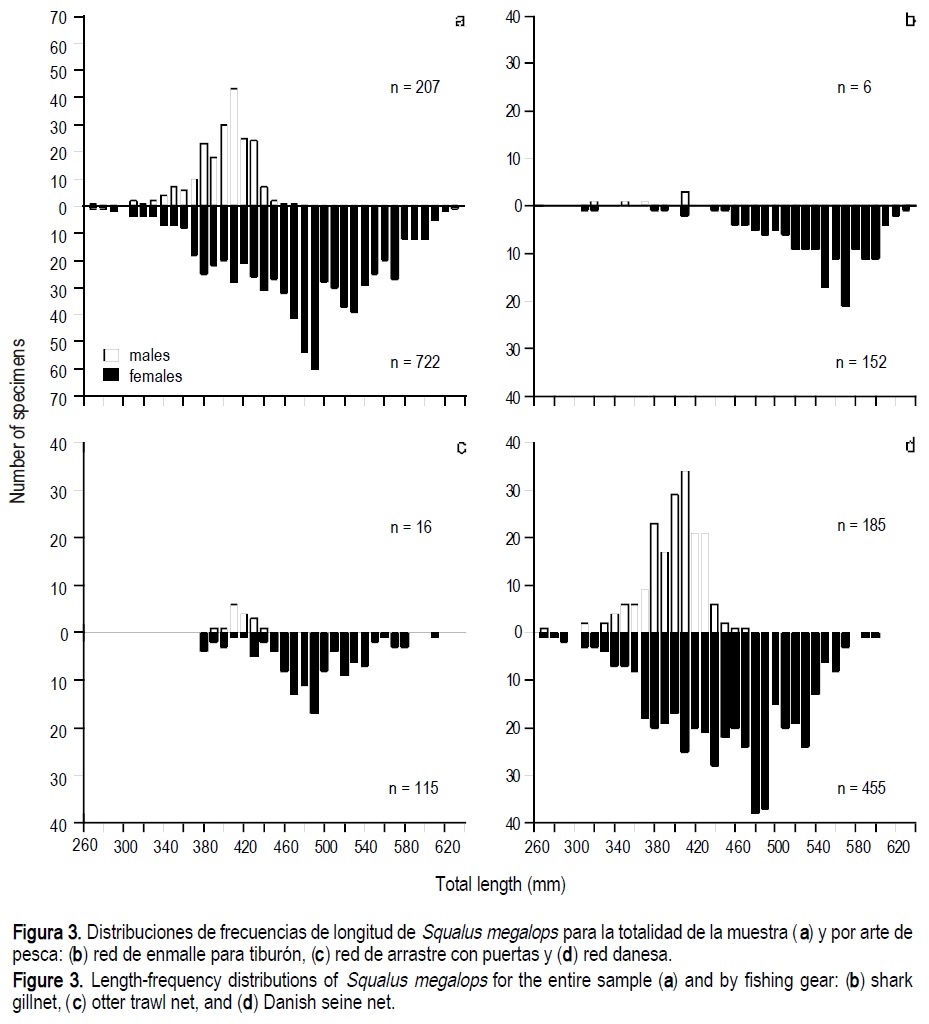
<body><![CDATA[<p align="justify"><font face="verdana" size="2"><b>Material y m&eacute;todos</b></font></p>      <p align="justify"><font face="verdana" size="2">Se recolectaron espec&iacute;menes de <i>S. megalops</i> de manera oportunista entre la captura incidental de las embarcaciones de pesca con red de enmalle para tibur&oacute;n y red de arrastre demersal que operan en la pesquer&iacute;a de tibur&oacute;n y peces de escama en el sur y este de Australia. Las muestras se recolectaron entre octubre de 2002 y abril de 2004, principalmente de las localidades de Robe, Lakes Entrance y Ulladulla (<a href="#f2">fig. 2</a>). Se emple&oacute; de 4 a 8 horas una red de enmalle para tibur&oacute;n, de monofilamento, luz de malla de 16.5 cm, ~4000 m de longitud y 2.4 m de profundidad, durante la noche y el d&iacute;a. Los aparejos de arrastre de fondo utilizados fueron la red de arrastre de puertas y la red danesa, el primero con una relinga superior de 24&#45;50 m y luz de malla estirada en el copo de 90 mm y el segundo con una relinga superior de 30&#45;59 m y luz de malla estirada en el copo de 38 mm. Los arrastres se realizaron por 3&#45;4 horas durante la noche y el d&iacute;a. La profundidad de pesca fue de entre 21 y 238m y vari&oacute; seg&uacute;n la localidad y el arte de pesca. Las longitudes totales (LT) de <i>S. megalops</i> fueron medidas al mil&iacute;metro m&aacute;s cercano y la condici&oacute;n reproductiva de los machos y las hembras se determin&oacute; siguiendo las recomendaciones de Braccini <i>et al.</i> (2006).</font></p>     <p align="center"><a name="f2"></a></p>     <p align="center"><img src="/img/revistas/ciemar/v32n4/a9f2.jpg"></p>  	    <p align="justify"><font face="verdana" size="2">Se determinaron la raz&oacute;n de sexos y la distribuci&oacute;n de frecuencias de longitud para la totalidad de la muestra y por lance de pesca cuando se contaba con los datos de profundidad y el tama&ntilde;o de muestra por lance fue &gt; 10. Para la muestra total se utilizaron la prueba chi&#45;cuadrada con la correcci&oacute;n de continuidad de Yates y la prueba de Kolmogorov&#45;Smirnov (KS) (Zar 1999) para probar si exist&iacute;an diferencias en la raz&oacute;n de sexos y la distribuci&oacute;n de frecuencia de longitud de machos y hembras, respectivamente.</font></p>  	    <p align="justify">&nbsp;</p>     <p align="justify"><font face="verdana" size="2"><b>Resultados</b></font></p>     <p align="justify"><font face="verdana" size="2">Se analizaron datos de un total de 929 tiburones. Para la totalidad de la muestra, la raz&oacute;n de sexos (macho:hembra) estuvo muy sesgada hacia las hembras (1:3.49, &#967;<sup>2</sup> = 284.39, g.l. = 1, <i>P</i> &lt; 0.001). Por arte de pesca, la raz&oacute;n de sexos tambi&eacute;n present&oacute; un sesgo hacia las hembras (1:25.34, &#967;<sup>2</sup> = 133.07, g.l. = 1, <i>P</i> &lt; 0.001, para las redes de enmalle; y 1:2.83, &#967;<sup>2</sup> = 175.64, g.l. = 1, <i>P</i> &lt; 0.001, para las redes de arrastre de fondo). La talla vari&oacute; de 274 a 470 mm LT para los machos y de 270 a 635 mm LT para las hembras. Se observ&oacute; dimorfismo sexual en la talla m&aacute;xima, siendo laLT media (&plusmn;EE) de machos de 404(t2) mm, mientras que la de hembras fue de 480(&plusmn;3) mm. Las distribuciones de frecuencias de longitud de los machos y las hembras (<a href="/img/revistas/ciemar/v32n4/a9f3.jpg" target="_blank">fig. 3a</a>) fueron significativamente diferentes (KS, <i>d</i><sub>Max</sub> = 0.685, <i>n</i><sub>machos</sub> = 207, <i>n</i><sub>hembras</sub> = 722, <i>P</i> &lt; 0.001). Las redes de enmalle capturaron principalmente hembras de talla grande (<a href="/img/revistas/ciemar/v32n4/a9f3.jpg" target="_blank">fig. 3b</a>), por lo que las muestras recolectadas con &eacute;stas fueron excluidas del an&aacute;lisis de la estructura poblacional ya que probablemente no se muestrearon hembras y machos peque&ntilde;os debido a la posible selectividad de talla de este aparejo. En vista de que la red de arrastre de puertas y la red danesa capturaron ambos sexos con mayor intervalo de tallas (<a href="/img/revistas/ciemar/v32n4/a9f3.jpg">fig. 3c</a>, <a href="/img/revistas/ciemar/v32n4/a9f3.jpg" target="_blank">d</a>), estas muestras s&iacute; se usaron para tal an&aacute;lisis.</font></p>      <p align="justify"><font face="verdana" size="2">Los an&aacute;lisis de la raz&oacute;n de sexos y las distribuciones de frecuencias de longitud de algunos arrastres seleccionados <i>(n</i> =18) indicaron que <i>S. megalops</i> presenta un patr&oacute;n de agrupaci&oacute;n complejo. En algunos lances, machos y hembras peque&ntilde;as (&lt;460 mm LT) fueron capturados juntos (<a href="/img/revistas/ciemar/v32n4/a9f4.jpg" target="_blank">fig. 4a</a>; <a href="/img/revistas/ciemar/v32n4/a9t1.jpg" target="_blank">tabla 1</a>, lances 146, 155), mientras que en otros, se capturaron principalmente hembras inmaduras (<a href="/img/revistas/ciemar/v32n4/a9f4.jpg" target="_blank">fig. 4b</a>; <a href="/img/revistas/ciemar/v32n4/a9t1.jpg" target="_blank">tabla 1</a>, lance 205) o de talla grande (<a href="/img/revistas/ciemar/v32n4/a9f4.jpg" target="_blank">fig. 4c</a>; <a href="/img/revistas/ciemar/v32n4/a9t1.jpg" target="_blank">tabla 1</a>, lances 497, 509, 540). Entrelas hembras grandes, las que se encontraban en su primer a&ntilde;o de pre&ntilde;ez tend&iacute;an a separarse de las que estaban en su segundo a&ntilde;o (<a href="/img/revistas/ciemar/v32n4/a9t1.jpg" target="_blank">tabla 1</a>, lances 497, 509, 540). En un lance se captur&oacute; un cardumen de machos de talla grande (<a href="/img/revistas/ciemar/v32n4/a9f4.jpg" target="_blank">fig. 4d</a>;</font> <a href="/img/revistas/ciemar/v32n4/a9t1.jpg" target="_blank"><font face="verdana" size="2">tabla 1</font></a><font face="verdana" size="2">, lance 491).</font></p>     <p align="justify">&nbsp;</p>     ]]></body>
<body><![CDATA[<p align="justify"><font face="verdana" size="2"><b>Discusi&oacute;n</b></font></p>      <p align="justify"><font face="verdana" size="2">El presente estudio evidencia una estructura poblacional compleja para <i>S. megalops</i> en el sureste de Australia. A pesar de que la naturaleza oportunista del dise&ntilde;o de muestreo no permiti&oacute; comprobar rigurosamente los efectos del tiempo, la regi&oacute;n, la profundidad o el arte de pesca, el an&aacute;lisis individual de algunos lances de pesca indica que <i>S. megalops</i> se segrega por sexo, talla y condici&oacute;n reproductiva. La segregaci&oacute;n por sexo y talla es una caracter&iacute;stica com&uacute;n de muchas especies de  tibur&oacute;n, formando los juveniles, machos adultos y hembras adultas grupos diferentes (Springer 1967). Machos y hembras peque&ntilde;as de <i>S. megalops</i> fueron capturados juntos pero no coincidieron con hembras de talla grande. Asimismo, en un lance se captur&oacute; un cardumen compuesto exclusivamente por machos maduros y grandes, mientras que en otras ocasiones se capturaron card&uacute;menes formados s&oacute;lo de hembras grandes. Graham (2005) observ&oacute; un patr&oacute;n similar frente a Nueva Gales del Sur, donde hembras y machos se encuentran en diferentes regiones y profundidades. Adem&aacute;s, las hembras grandes en su primer a&ntilde;o de pre&ntilde;ez parecieran separarse de las que se encontraban en su segundo a&ntilde;o. Las hembras de <i>S. acanthias</i> tambi&eacute;n presentan segregaci&oacute;n por condici&oacute;n reproductiva, ya que &eacute;stas permanecen en aguas someras durante su primer a&ntilde;o de pre&ntilde;ez, posiblemente debido a los requerimientos de agua m&aacute;s c&aacute;lida para el desarrollo embrionario temprano, y luego migran a aguas m&aacute;s profundas durante su segundo a&ntilde;o de gestaci&oacute;n (Hanchet 1988). Nuestros resultados, aunque fragmentarios, tambi&eacute;n indican que las hembras de <i>S. megalops</i> en su segundo a&ntilde;o reproductivo habitan aguas m&aacute;s profundas que las que est&aacute;n en su primer a&ntilde;o de pre&ntilde;ez.</font></p>     <p align="justify"><font face="verdana" size="2">Las hembras de <i>S. megalops</i> alcanzaron tallas mayores que los machos. Frecuentemente se observa dimorfismo sexual en talla entre tiburones y &eacute;ste es m&aacute;s com&uacute;n entre especies viv&iacute;paras ya que, debido a que el modo reproductivo de las hembras es m&aacute;s energ&eacute;ticamente demandante, existe una fuerte presi&oacute;n de selecci&oacute;n para una talla m&aacute;s grande (Sims 2003). Varias especies que presentan dimorfismo sexual en talla tambi&eacute;n muestran segregaci&oacute;n sexual (Sims 2003). En mam&iacute;feros que presentan dimorfismo sexual los machos alcanzan una mayor talla y buscan h&aacute;bitats con mayor disponibilidad de alimento, mientras que las hembras prefieren h&aacute;bitats que brindan mayor protecci&oacute;n contra depredadores (Main <i>et al.</i> 1996). El uso de h&aacute;bitats espec&iacute;ficos por machos y hembras ha sido registrado para varias especies de tibur&oacute;n (e.g., McLaughlin y O'Gower 1971, Sims <i>et al.</i> 2001). Hembras del tibur&oacute;n martillo <i>Sphyrna lewini</i> (Griffith y Smith) seleccionan h&aacute;bitats con mayor abundancia de presas de alto contenido energ&eacute;tico (Klimley 1987). Las hembras grandes de <i>Squalus megalops</i> tuvieron una dieta diferente y consumieron mayor cantidad de presas ricas en energ&iacute;a que los machos y las hembras peque&ntilde;as durante el verano y oto&ntilde;o (Braccini <i>et al.</i> 2005). Si las hembras de talla grande tienen diferentes requerimientos energ&eacute;ticos, la selecci&oacute;n de una calidad de dieta diferente puede resultar en la segregaci&oacute;n por talla y sexo (Main <i>et al.</i> 1996). Las hembras grandes pueden habitar zonas con mayor disponibilidad de alimento, mientras que los machos y hembras peque&ntilde;as cambian preferencias de alimento por &aacute;reas con menos depredadores (Bowyer 2004). Otras hip&oacute;tesis, sin embargo, tales como la migraci&oacute;n, diferencias en la capacidad natatoria, evitar a los machos o la agresi&oacute;n entre individuos del mismo tama&ntilde;o, tambi&eacute;n han sido propuestas para explicar la segregaci&oacute;n entre tiburones (Springer 1967, Sims 2003). En vista de que <i>S. megalops</i> es la especie de tibur&oacute;n de mayor captura incidental en el sureste de Australia (Walker <i>et al.</i> 2005), se requiere  informaci&oacute;n adicional sobre la localizaci&oacute;n de las zonas de alumbramiento y sobre la distribuci&oacute;n espacial de los juveniles, as&iacute; como de los machos y las hembras maduras en diferentes condiciones reproductivas. Un dise&ntilde;o de muestreo m&aacute;s riguroso permitir&iacute;a determinar el grado del patr&oacute;n de segregaci&oacute;n de <i>S. megalops</i> y comprobar la hip&oacute;tesis propuesta para explicar este fen&oacute;meno.</font></p>     <p align="justify"><font face="verdana" size="2">No se obtuvieron espec&iacute;menes peque&ntilde;os de <i>S. megalops</i> con las artes de pesca utilizadas. Las clases de talla peque&ntilde;a frecuentemente est&aacute;n ausentes en los estudios sobre galludos (Clarke 2000). Las redes de enmalle seleccionan espec&iacute;menes de mayor tama&ntilde;o, pero las de arrastre de fondo pudieron capturar <i>S. megalops</i> m&aacute;s peque&ntilde;os. Se ha demostrado que, cuando est&aacute;n presentes, las clases de menor talla son capturadas por el copo de 90 mm de luz de malla (Graham 2005); por tanto, es probable que existan individuos peque&ntilde;os fuera de las zonas de arrastre. Para <i>S. acanthias</i> se ha informado que el alumbramiento y los estadios de vida tempranos se desarrollan en el nivel medio del agua (Ketchen 1986), y para juveniles de <i>S. megalops</i> se ha propuesto una fase pel&aacute;gica (Compagno <i>et al.</i> 1991). Esta estrategia de vida podr&iacute;a disminuir el riesgo de predaci&oacute;n, ya que los tiburones y tele&oacute;steos predadores de mayor talla tienden a encontrarse cerca del fondo del mar (Graham 2005).</font></p>     <p align="justify"><font face="verdana" size="2">La raz&oacute;n de sexos sugiere ya sea que las hembras son m&aacute;s comunes en la poblaci&oacute;n o que son m&aacute;s vulnerables a la pesca que los machos. En este &uacute;ltimo caso, esto tendr&iacute;a que considerarse en el manejo de la especie puesto que la captura selectiva de hembras pudiera tener un efecto desproporcionado sobre el rendimiento reproductivo de la poblaci&oacute;n. Tambi&eacute;n es necesario considerar el patr&oacute;n de segregaci&oacute;n de <i>S. megalops</i> en los planes de manejo. Ya se ha propuesto un manejo diferente de machos y hembras para mam&iacute;feros que presentan segregaci&oacute;n sexual (Bowyer 2004).</font></p>  	    <p align="justify">&nbsp;</p> 	    <p align="justify"><font face="verdana" size="2"><b>Agradecimientos</b></font></p>      <p align="justify"><font face="verdana" size="2">Agradecemos a P Risley, G Richardson y la tripulaci&oacute;n del barco pesquero <i>Nungurner</i> su ayuda en la recolecci&oacute;n de muestras, as&iacute; como el apoyo de los siguientes programas: International Postgraduate Research Scholarship y University of Adelaide Postgraduate Research Scholarship a JMB, Australian Fisheries Research and Development Corporation (beca FRDC 2002/033) a TIW, y Australian Research Council QEII Research Fellowship a BMG. Las siguientes instituciones proporcionaron fondos para el material de laboratorio y campo: Sea World Research and Rescue Foundation, Royal Zoological Society of New South Wales, Nature Foundation SA y Royal Zoological Society of South Australia.</font></p>  	    <p align="justify"><font face="verdana" size="2">Traducido al espa&ntilde;ol por Christine Harris.</font></p>  	    <p align="justify">&nbsp;</p> 	    ]]></body>
<body><![CDATA[<p align="justify"><font face="verdana" size="2"><b>Referencias</b></font></p>      <!-- ref --><p align="justify"><font face="verdana" size="2">Bowyer TR. 2004. Sexual segregation in ruminants: Definitions, hypotheses, and implications for conservation and management. J.Mammal. 85(6): 1039&#45;1052.    &nbsp;&nbsp;&nbsp;&nbsp;&nbsp;&nbsp;&nbsp;&nbsp;[&#160;<a href="javascript:void(0);" onclick="javascript: window.open('/scielo.php?script=sci_nlinks&ref=1899623&pid=S0185-3880200600070000900001&lng=','','width=640,height=500,resizable=yes,scrollbars=1,menubar=yes,');">Links</a>&#160;]<!-- end-ref --></font></p>  	    <!-- ref --><p align="justify"><font face="verdana" size="2">Braccini JM, Gillanders BM, Walker TI. 2005. Sources of variation in the feeding ecology of the piked spurdog <i>(Squalus megalops):</i> Implications for inferring predator&#45;prey interactions from overall dietary composition. ICES J. Mar. Sci. 62(6): 1076&#45;1094.    &nbsp;&nbsp;&nbsp;&nbsp;&nbsp;&nbsp;&nbsp;&nbsp;[&#160;<a href="javascript:void(0);" onclick="javascript: window.open('/scielo.php?script=sci_nlinks&ref=1899625&pid=S0185-3880200600070000900002&lng=','','width=640,height=500,resizable=yes,scrollbars=1,menubar=yes,');">Links</a>&#160;]<!-- end-ref --></font></p>     <!-- ref --><p align="justify"><font face="verdana" size="2">Braccini JM, Gillanders BM, Walker TI. 2006. Determining reproductive parameters for population assessments of chondrichthyan species with asynchronous ovulation and parturition: piked spurdog <i>(Squalus megalops)</i> as a case study. Mar. Freshwat. Res. 57: 105&#45;119.    &nbsp;&nbsp;&nbsp;&nbsp;&nbsp;&nbsp;&nbsp;&nbsp;[&#160;<a href="javascript:void(0);" onclick="javascript: window.open('/scielo.php?script=sci_nlinks&ref=1899627&pid=S0185-3880200600070000900003&lng=','','width=640,height=500,resizable=yes,scrollbars=1,menubar=yes,');">Links</a>&#160;]<!-- end-ref --></font></p>  	    <!-- ref --><p align="justify"><font face="verdana" size="2">Bulman C, Althaus F, He X, Bax NJ, Williams A. 2001. Diets and trophic guilds of demersal fishes of the south&#45;eastern Australian shelf. Mar. Freshwat. Res. 52: 537&#45;548.    &nbsp;&nbsp;&nbsp;&nbsp;&nbsp;&nbsp;&nbsp;&nbsp;[&#160;<a href="javascript:void(0);" onclick="javascript: window.open('/scielo.php?script=sci_nlinks&ref=1899629&pid=S0185-3880200600070000900004&lng=','','width=640,height=500,resizable=yes,scrollbars=1,menubar=yes,');">Links</a>&#160;]<!-- end-ref --></font></p>     <!-- ref --><p align="justify"><font face="verdana" size="2">Clark MR, King KJ. 1989. Deepwater fish resources off the North Island, New Zealand: Results of a trawl survey, May 1985 to June 1986. New Zealand Fish. Tech. Rep. No. 11, 56 pp.    &nbsp;&nbsp;&nbsp;&nbsp;&nbsp;&nbsp;&nbsp;&nbsp;[&#160;<a href="javascript:void(0);" onclick="javascript: window.open('/scielo.php?script=sci_nlinks&ref=1899631&pid=S0185-3880200600070000900005&lng=','','width=640,height=500,resizable=yes,scrollbars=1,menubar=yes,');">Links</a>&#160;]<!-- end-ref --></font></p>     <!-- ref --><p align="justify"><font face="verdana" size="2">Clarke MW. 2000. Aspects of the biology of three exploited deepwater sharks <i>Centrophorus squamosus, Centroscymnus coelolepis</i> and <i>Deania calceus</i> (Elasmobranchii: Squalidae) from the continental slopes of the Rockall Trough and Porcupine Bank. Ph.D. thesis, University College Dublin, 306 pp.    &nbsp;&nbsp;&nbsp;&nbsp;&nbsp;&nbsp;&nbsp;&nbsp;[&#160;<a href="javascript:void(0);" onclick="javascript: window.open('/scielo.php?script=sci_nlinks&ref=1899633&pid=S0185-3880200600070000900006&lng=','','width=640,height=500,resizable=yes,scrollbars=1,menubar=yes,');">Links</a>&#160;]<!-- end-ref --></font></p>  	    <!-- ref --><p align="justify"><font face="verdana" size="2">Clarke MW, Connolly PL, Bracken JJ. 2002. Catch, discarding, age estimation, growth and maturity of the squalid shark <i>Deania calceus</i> west and north of Ireland. Fish. Res. 56: 139&#45;153.    &nbsp;&nbsp;&nbsp;&nbsp;&nbsp;&nbsp;&nbsp;&nbsp;[&#160;<a href="javascript:void(0);" onclick="javascript: window.open('/scielo.php?script=sci_nlinks&ref=1899635&pid=S0185-3880200600070000900007&lng=','','width=640,height=500,resizable=yes,scrollbars=1,menubar=yes,');">Links</a>&#160;]<!-- end-ref --> </font></p>     <!-- ref --><p align="justify"><font face="verdana" size="2">Compagno LJV. 1990. Alternative life&#45;history styles of cartilaginous fishes in time and space. Environ. Biol. Fish. 28: 33&#45;75.    &nbsp;&nbsp;&nbsp;&nbsp;&nbsp;&nbsp;&nbsp;&nbsp;[&#160;<a href="javascript:void(0);" onclick="javascript: window.open('/scielo.php?script=sci_nlinks&ref=1899637&pid=S0185-3880200600070000900008&lng=','','width=640,height=500,resizable=yes,scrollbars=1,menubar=yes,');">Links</a>&#160;]<!-- end-ref --> </font></p> 	    <!-- ref --><p align="justify"><font face="verdana" size="2">Compagno LJV, Ebert DA, Cowley PD. 1991. Distribution of offshore demersal cartilaginous fish (Class Chondrichthyes) off the west coast of Southern Africa, with notes on their systematics. S. Afr. J. Mar. Sci. 11: 43&#45;139.    &nbsp;&nbsp;&nbsp;&nbsp;&nbsp;&nbsp;&nbsp;&nbsp;[&#160;<a href="javascript:void(0);" onclick="javascript: window.open('/scielo.php?script=sci_nlinks&ref=1899639&pid=S0185-3880200600070000900009&lng=','','width=640,height=500,resizable=yes,scrollbars=1,menubar=yes,');">Links</a>&#160;]<!-- end-ref --> </font></p> 	    <!-- ref --><p align="justify"><font face="verdana" size="2">Daley RK, Stevens JD, Graham KJ. 2002. Catch analysis and productivity of the deepwater dogfish resource in southern Australia. FRDC Project 1998/108, 106 pp.    &nbsp;&nbsp;&nbsp;&nbsp;&nbsp;&nbsp;&nbsp;&nbsp;[&#160;<a href="javascript:void(0);" onclick="javascript: window.open('/scielo.php?script=sci_nlinks&ref=1899641&pid=S0185-3880200600070000900010&lng=','','width=640,height=500,resizable=yes,scrollbars=1,menubar=yes,');">Links</a>&#160;]<!-- end-ref --> </font></p> 	    <!-- ref --><p align="justify"><font face="verdana" size="2">Graham KJ. 2005. Distribution, population structure and biological aspects of <i>Squalus</i> spp. (Chondrichthyes: Squaliformes) from New South Wales and adjacent Australian waters. Mar. Freshwat. Res. 56: 405&#45;416.    &nbsp;&nbsp;&nbsp;&nbsp;&nbsp;&nbsp;&nbsp;&nbsp;[&#160;<a href="javascript:void(0);" onclick="javascript: window.open('/scielo.php?script=sci_nlinks&ref=1899643&pid=S0185-3880200600070000900011&lng=','','width=640,height=500,resizable=yes,scrollbars=1,menubar=yes,');">Links</a>&#160;]<!-- end-ref --></font></p>     <!-- ref --><p align="justify"><font face="verdana" size="2">Graham KJ, Andrew NL, Hodgson KE. 2001. Changes in relative abundance of sharks and rays on Australian South East Fishery trawl grounds after twenty years of fishing. Mar. Freshwat. Res. 52: 549&#45;561.    &nbsp;&nbsp;&nbsp;&nbsp;&nbsp;&nbsp;&nbsp;&nbsp;[&#160;<a href="javascript:void(0);" onclick="javascript: window.open('/scielo.php?script=sci_nlinks&ref=1899645&pid=S0185-3880200600070000900012&lng=','','width=640,height=500,resizable=yes,scrollbars=1,menubar=yes,');">Links</a>&#160;]<!-- end-ref --></font></p>     <!-- ref --><p align="justify"><font face="verdana" size="2">Hanchet S. 1988. Reproductive biology of <i>Squalusacanthias</i> from the east coast, South Island, New Zealand. N.Z. J. Mar. Freshwat. Res. 22(4): 537&#45;549.    &nbsp;&nbsp;&nbsp;&nbsp;&nbsp;&nbsp;&nbsp;&nbsp;[&#160;<a href="javascript:void(0);" onclick="javascript: window.open('/scielo.php?script=sci_nlinks&ref=1899647&pid=S0185-3880200600070000900013&lng=','','width=640,height=500,resizable=yes,scrollbars=1,menubar=yes,');">Links</a>&#160;]<!-- end-ref --></font></p>     <!-- ref --><p align="justify"><font face="verdana" size="2">Ketchen KS. 1986. The spiny dogfish <i>(Squalus acanthias)</i> in the northeast Pacific and a history of its utilization. Can. Spec. Publ.  Fish. Aquat. Sci. 88: 78.    &nbsp;&nbsp;&nbsp;&nbsp;&nbsp;&nbsp;&nbsp;&nbsp;[&#160;<a href="javascript:void(0);" onclick="javascript: window.open('/scielo.php?script=sci_nlinks&ref=1899649&pid=S0185-3880200600070000900014&lng=','','width=640,height=500,resizable=yes,scrollbars=1,menubar=yes,');">Links</a>&#160;]<!-- end-ref --></font></p>     <!-- ref --><p align="justify"><font face="verdana" size="2">Klimley AP. 1987. The determinants of sexual segregation in the scalloped hammerhead, <i>Sphyrna lewini</i>. Environ. Biol. Fish. 18: 27&#45;40.    &nbsp;&nbsp;&nbsp;&nbsp;&nbsp;&nbsp;&nbsp;&nbsp;[&#160;<a href="javascript:void(0);" onclick="javascript: window.open('/scielo.php?script=sci_nlinks&ref=1899651&pid=S0185-3880200600070000900015&lng=','','width=640,height=500,resizable=yes,scrollbars=1,menubar=yes,');">Links</a>&#160;]<!-- end-ref --></font></p>     <!-- ref --><p align="justify"><font face="verdana" size="2">Main MB, Weckerly FW, Bleich VC. 1996. Sexual segregation in ungulates: New directions for research. J. Mammal. 77(2): 449&#45;461.    &nbsp;&nbsp;&nbsp;&nbsp;&nbsp;&nbsp;&nbsp;&nbsp;[&#160;<a href="javascript:void(0);" onclick="javascript: window.open('/scielo.php?script=sci_nlinks&ref=1899653&pid=S0185-3880200600070000900016&lng=','','width=640,height=500,resizable=yes,scrollbars=1,menubar=yes,');">Links</a>&#160;]<!-- end-ref --></font></p>      <!-- ref --><p align="justify"><font face="verdana" size="2">McLaughlin RH, O'Gower AK. 1971. Life history and underwater studies of a Heterodont shark. Ecol. Monogr. 41(4): 271&#45;289.    &nbsp;&nbsp;&nbsp;&nbsp;&nbsp;&nbsp;&nbsp;&nbsp;[&#160;<a href="javascript:void(0);" onclick="javascript: window.open('/scielo.php?script=sci_nlinks&ref=1899655&pid=S0185-3880200600070000900017&lng=','','width=640,height=500,resizable=yes,scrollbars=1,menubar=yes,');">Links</a>&#160;]<!-- end-ref --> </font></p>     <!-- ref --><p align="justify"><font face="verdana" size="2">Sims DW. 2003. Tractable models for testing theories about natural strategies: Foraging behaviour and habitat selection of freeranging sharks. J. Fish Biol. 63(A): 53&#45;73.    &nbsp;&nbsp;&nbsp;&nbsp;&nbsp;&nbsp;&nbsp;&nbsp;[&#160;<a href="javascript:void(0);" onclick="javascript: window.open('/scielo.php?script=sci_nlinks&ref=1899657&pid=S0185-3880200600070000900018&lng=','','width=640,height=500,resizable=yes,scrollbars=1,menubar=yes,');">Links</a>&#160;]<!-- end-ref --> </font></p>     <!-- ref --><p align="justify"><font face="verdana" size="2">Sims DW, Nash JP, Morritt D. 2001. Movements and activity of male and female dogfish in a tidal sea lough: Alternative behavioural strategies and apparent sexual segregation. Mar. Biol. 139(6): 1165&#45;1175.    &nbsp;&nbsp;&nbsp;&nbsp;&nbsp;&nbsp;&nbsp;&nbsp;[&#160;<a href="javascript:void(0);" onclick="javascript: window.open('/scielo.php?script=sci_nlinks&ref=1899659&pid=S0185-3880200600070000900019&lng=','','width=640,height=500,resizable=yes,scrollbars=1,menubar=yes,');">Links</a>&#160;]<!-- end-ref --></font></p>     <!-- ref --><p align="justify"><font face="verdana" size="2">Springer S. 1967. Social organization of shark populations. In: Gilbert PW, Mathewson RF, Rall DP (eds.), Sharks, Skates, and Rays. Johns Hopkins Press, Baltimore, pp. 149&#45;174.    &nbsp;&nbsp;&nbsp;&nbsp;&nbsp;&nbsp;&nbsp;&nbsp;[&#160;<a href="javascript:void(0);" onclick="javascript: window.open('/scielo.php?script=sci_nlinks&ref=1899661&pid=S0185-3880200600070000900020&lng=','','width=640,height=500,resizable=yes,scrollbars=1,menubar=yes,');">Links</a>&#160;]<!-- end-ref --> </font></p>     <!-- ref --><p align="justify"><font face="verdana" size="2">Walker TI, Hudson RJ, Gason AS. 2005. Catch evaluation of target, by&#45;product and by&#45;catch species taken by gillnets and longlines in the shark fishery of south&#45;eastern Australia. J. Northwest Atl. Fish. Sci. 35: 505&#45;530.    &nbsp;&nbsp;&nbsp;&nbsp;&nbsp;&nbsp;&nbsp;&nbsp;[&#160;<a href="javascript:void(0);" onclick="javascript: window.open('/scielo.php?script=sci_nlinks&ref=1899663&pid=S0185-3880200600070000900021&lng=','','width=640,height=500,resizable=yes,scrollbars=1,menubar=yes,');">Links</a>&#160;]<!-- end-ref --></font></p>     <!-- ref --><p align="justify"><font face="verdana" size="2">Wetherbee BM. 1996. Distribution and reproduction of the southern lantern shark from New Zealand. J. Fish Biol. 49(6): 1186&#45;1196.    &nbsp;&nbsp;&nbsp;&nbsp;&nbsp;&nbsp;&nbsp;&nbsp;[&#160;<a href="javascript:void(0);" onclick="javascript: window.open('/scielo.php?script=sci_nlinks&ref=1899665&pid=S0185-3880200600070000900022&lng=','','width=640,height=500,resizable=yes,scrollbars=1,menubar=yes,');">Links</a>&#160;]<!-- end-ref --></font></p>  	    <!-- ref --><p align="justify"><font face="verdana" size="2">Yano K. 1995. Reproductive biology of the black dogfish, <i>Centroscyllium fabricii,</i> collected from waters off western Greenland. J. Mar. Biol. Assoc. UK, 75(2): 285&#45;310.    &nbsp;&nbsp;&nbsp;&nbsp;&nbsp;&nbsp;&nbsp;&nbsp;[&#160;<a href="javascript:void(0);" onclick="javascript: window.open('/scielo.php?script=sci_nlinks&ref=1899667&pid=S0185-3880200600070000900023&lng=','','width=640,height=500,resizable=yes,scrollbars=1,menubar=yes,');">Links</a>&#160;]<!-- end-ref --></font></p>  	    <!-- ref --><p align="justify"><font face="verdana" size="2">Yano K, Tanaka S. 1988. Size at maturity, reproductive cycle, fecundity, and depth segregation of the deep sea squaloid sharks <i>Centroscymnus owstoni</i> and <i>C. coelolepis</i> in Suruga Bay, Japan. Nippon Suisan Gakkaishi 54(2): 167&#45;174.    &nbsp;&nbsp;&nbsp;&nbsp;&nbsp;&nbsp;&nbsp;&nbsp;[&#160;<a href="javascript:void(0);" onclick="javascript: window.open('/scielo.php?script=sci_nlinks&ref=1899669&pid=S0185-3880200600070000900024&lng=','','width=640,height=500,resizable=yes,scrollbars=1,menubar=yes,');">Links</a>&#160;]<!-- end-ref --></font></p>  	    <!-- ref --><p align="justify"><font face="verdana" size="2">Zar JH. 1999. Biostatistical Analysis. Prentice Hall, London, 663 pp.    &nbsp;&nbsp;&nbsp;&nbsp;&nbsp;&nbsp;&nbsp;&nbsp;[&#160;<a href="javascript:void(0);" onclick="javascript: window.open('/scielo.php?script=sci_nlinks&ref=1899671&pid=S0185-3880200600070000900025&lng=','','width=640,height=500,resizable=yes,scrollbars=1,menubar=yes,');">Links</a>&#160;]<!-- end-ref --></font></p>      ]]></body><back>
<ref-list>
<ref id="B1">
<nlm-citation citation-type="journal">
<person-group person-group-type="author">
<name>
<surname><![CDATA[Bowyer]]></surname>
<given-names><![CDATA[TR]]></given-names>
</name>
</person-group>
<article-title xml:lang="en"><![CDATA[Sexual segregation in ruminants: Definitions, hypotheses, and implications for conservation and management]]></article-title>
<source><![CDATA[J.Mammal]]></source>
<year>2004</year>
<volume>85</volume>
<numero>6</numero>
<issue>6</issue>
<page-range>1039-1052</page-range></nlm-citation>
</ref>
<ref id="B2">
<nlm-citation citation-type="journal">
<person-group person-group-type="author">
<name>
<surname><![CDATA[Braccini]]></surname>
<given-names><![CDATA[JM]]></given-names>
</name>
<name>
<surname><![CDATA[Gillanders]]></surname>
<given-names><![CDATA[BM]]></given-names>
</name>
<name>
<surname><![CDATA[Walker]]></surname>
<given-names><![CDATA[TI]]></given-names>
</name>
</person-group>
<article-title xml:lang="en"><![CDATA[Sources of variation in the feeding ecology of the piked spurdog (Squalus megalops): Implications for inferring predator-prey interactions from overall dietary composition]]></article-title>
<source><![CDATA[ICES J. Mar. Sci]]></source>
<year>2005</year>
<volume>62</volume>
<numero>6</numero>
<issue>6</issue>
<page-range>1076-1094</page-range></nlm-citation>
</ref>
<ref id="B3">
<nlm-citation citation-type="journal">
<person-group person-group-type="author">
<name>
<surname><![CDATA[Braccini]]></surname>
<given-names><![CDATA[JM]]></given-names>
</name>
<name>
<surname><![CDATA[Gillanders]]></surname>
<given-names><![CDATA[BM]]></given-names>
</name>
<name>
<surname><![CDATA[Walker]]></surname>
<given-names><![CDATA[TI]]></given-names>
</name>
</person-group>
<article-title xml:lang="en"><![CDATA[Determining reproductive parameters for population assessments of chondrichthyan species with asynchronous ovulation and parturition: piked spurdog (Squalus megalops) as a case study]]></article-title>
<source><![CDATA[Mar. Freshwat. Res]]></source>
<year>2006</year>
<volume>57</volume>
<page-range>105-119</page-range></nlm-citation>
</ref>
<ref id="B4">
<nlm-citation citation-type="journal">
<person-group person-group-type="author">
<name>
<surname><![CDATA[Bulman]]></surname>
<given-names><![CDATA[C]]></given-names>
</name>
<name>
<surname><![CDATA[Althaus]]></surname>
<given-names><![CDATA[F]]></given-names>
</name>
<name>
<surname><![CDATA[He]]></surname>
<given-names><![CDATA[X]]></given-names>
</name>
<name>
<surname><![CDATA[Bax]]></surname>
<given-names><![CDATA[NJ]]></given-names>
</name>
<name>
<surname><![CDATA[Williams]]></surname>
<given-names><![CDATA[A]]></given-names>
</name>
</person-group>
<article-title xml:lang="en"><![CDATA[Diets and trophic guilds of demersal fishes of the south-eastern Australian shelf]]></article-title>
<source><![CDATA[Mar. Freshwat. Res]]></source>
<year>2001</year>
<volume>52</volume>
<page-range>537-548</page-range></nlm-citation>
</ref>
<ref id="B5">
<nlm-citation citation-type="journal">
<person-group person-group-type="author">
<name>
<surname><![CDATA[Clark]]></surname>
<given-names><![CDATA[MR]]></given-names>
</name>
<name>
<surname><![CDATA[King]]></surname>
<given-names><![CDATA[KJ]]></given-names>
</name>
</person-group>
<article-title xml:lang="en"><![CDATA[Deepwater fish resources off the North Island, New Zealand: Results of a trawl survey, May 1985 to June 1986]]></article-title>
<source><![CDATA[New Zealand Fish. Tech. Rep.]]></source>
<year>1989</year>
<numero>11</numero>
<issue>11</issue>
<page-range>56</page-range></nlm-citation>
</ref>
<ref id="B6">
<nlm-citation citation-type="">
<person-group person-group-type="author">
<name>
<surname><![CDATA[Clarke]]></surname>
<given-names><![CDATA[MW]]></given-names>
</name>
</person-group>
<source><![CDATA[Aspects of the biology of three exploited deepwater sharks Centrophorus squamosus, Centroscymnus coelolepis and Deania calceus (Elasmobranchii: Squalidae) from the continental slopes of the Rockall Trough and Porcupine Bank]]></source>
<year>2000</year>
<page-range>306</page-range></nlm-citation>
</ref>
<ref id="B7">
<nlm-citation citation-type="journal">
<person-group person-group-type="author">
<name>
<surname><![CDATA[Clarke]]></surname>
<given-names><![CDATA[MW]]></given-names>
</name>
<name>
<surname><![CDATA[Connolly]]></surname>
<given-names><![CDATA[PL]]></given-names>
</name>
<name>
<surname><![CDATA[Bracken]]></surname>
<given-names><![CDATA[JJ]]></given-names>
</name>
</person-group>
<article-title xml:lang="en"><![CDATA[Catch, discarding, age estimation, growth and maturity of the squalid shark Deania calceus west and north of Ireland]]></article-title>
<source><![CDATA[Fish. Res]]></source>
<year>2002</year>
<volume>56</volume>
<page-range>139-153.</page-range></nlm-citation>
</ref>
<ref id="B8">
<nlm-citation citation-type="journal">
<person-group person-group-type="author">
<name>
<surname><![CDATA[Compagno]]></surname>
<given-names><![CDATA[LJV]]></given-names>
</name>
</person-group>
<article-title xml:lang="en"><![CDATA[Alternative life-history styles of cartilaginous fishes in time and space]]></article-title>
<source><![CDATA[Environ. Biol. Fish]]></source>
<year>1990</year>
<volume>28</volume>
<page-range>33-75.</page-range></nlm-citation>
</ref>
<ref id="B9">
<nlm-citation citation-type="journal">
<person-group person-group-type="author">
<name>
<surname><![CDATA[Compagno]]></surname>
<given-names><![CDATA[LJV]]></given-names>
</name>
<name>
<surname><![CDATA[Ebert]]></surname>
<given-names><![CDATA[DA]]></given-names>
</name>
<name>
<surname><![CDATA[Cowley]]></surname>
<given-names><![CDATA[PD]]></given-names>
</name>
</person-group>
<article-title xml:lang="en"><![CDATA[Distribution of offshore demersal cartilaginous fish (Class Chondrichthyes) off the west coast of Southern Africa, with notes on their systematics]]></article-title>
<source><![CDATA[S. Afr. J. Mar. Sci]]></source>
<year>1991</year>
<volume>11</volume>
<page-range>43-139.</page-range></nlm-citation>
</ref>
<ref id="B10">
<nlm-citation citation-type="book">
<person-group person-group-type="author">
<name>
<surname><![CDATA[Daley]]></surname>
<given-names><![CDATA[RK]]></given-names>
</name>
<name>
<surname><![CDATA[Stevens]]></surname>
<given-names><![CDATA[JD]]></given-names>
</name>
<name>
<surname><![CDATA[Graham]]></surname>
<given-names><![CDATA[KJ]]></given-names>
</name>
</person-group>
<source><![CDATA[Catch analysis and productivity of the deepwater dogfish resource in southern Australia]]></source>
<year>2002</year>
<page-range>106</page-range><publisher-name><![CDATA[FRDC]]></publisher-name>
</nlm-citation>
</ref>
<ref id="B11">
<nlm-citation citation-type="journal">
<person-group person-group-type="author">
<name>
<surname><![CDATA[Graham]]></surname>
<given-names><![CDATA[KJ]]></given-names>
</name>
</person-group>
<article-title xml:lang="en"><![CDATA[Distribution, population structure and biological aspects of Squalus spp. (Chondrichthyes: Squaliformes) from New South Wales and adjacent Australian waters]]></article-title>
<source><![CDATA[Mar. Freshwat. Res]]></source>
<year>2005</year>
<volume>56</volume>
<page-range>405-416</page-range></nlm-citation>
</ref>
<ref id="B12">
<nlm-citation citation-type="journal">
<person-group person-group-type="author">
<name>
<surname><![CDATA[Graham]]></surname>
<given-names><![CDATA[KJ]]></given-names>
</name>
<name>
<surname><![CDATA[Andrew]]></surname>
<given-names><![CDATA[NL]]></given-names>
</name>
<name>
<surname><![CDATA[Hodgson]]></surname>
<given-names><![CDATA[KE]]></given-names>
</name>
</person-group>
<article-title xml:lang="en"><![CDATA[Changes in relative abundance of sharks and rays on Australian South East Fishery trawl grounds after twenty years of fishing]]></article-title>
<source><![CDATA[Mar. Freshwat. Res]]></source>
<year>2001</year>
<volume>52</volume>
<page-range>549-561</page-range></nlm-citation>
</ref>
<ref id="B13">
<nlm-citation citation-type="journal">
<person-group person-group-type="author">
<name>
<surname><![CDATA[Hanchet]]></surname>
<given-names><![CDATA[S]]></given-names>
</name>
</person-group>
<article-title xml:lang="en"><![CDATA[Reproductive biology of Squalusacanthias from the east coast, South Island, New Zealand]]></article-title>
<source><![CDATA[N.Z. J. Mar. Freshwat. Res]]></source>
<year>1988</year>
<volume>22</volume>
<numero>4</numero>
<issue>4</issue>
<page-range>537-549</page-range></nlm-citation>
</ref>
<ref id="B14">
<nlm-citation citation-type="journal">
<person-group person-group-type="author">
<name>
<surname><![CDATA[Ketchen]]></surname>
<given-names><![CDATA[KS]]></given-names>
</name>
</person-group>
<article-title xml:lang="en"><![CDATA[The spiny dogfish (Squalus acanthias) in the northeast Pacific and a history of its utilization]]></article-title>
<source><![CDATA[Can. Spec. Publ. Fish. Aquat. Sci]]></source>
<year>1986</year>
<volume>88</volume>
<page-range>78</page-range></nlm-citation>
</ref>
<ref id="B15">
<nlm-citation citation-type="journal">
<person-group person-group-type="author">
<name>
<surname><![CDATA[Klimley]]></surname>
<given-names><![CDATA[AP]]></given-names>
</name>
</person-group>
<article-title xml:lang="en"><![CDATA[The determinants of sexual segregation in the scalloped hammerhead, Sphyrna lewini]]></article-title>
<source><![CDATA[Environ. Biol. Fish]]></source>
<year>1987</year>
<volume>18</volume>
<page-range>27-40</page-range></nlm-citation>
</ref>
<ref id="B16">
<nlm-citation citation-type="journal">
<person-group person-group-type="author">
<name>
<surname><![CDATA[Main]]></surname>
<given-names><![CDATA[MB]]></given-names>
</name>
<name>
<surname><![CDATA[Weckerly]]></surname>
<given-names><![CDATA[FW]]></given-names>
</name>
<name>
<surname><![CDATA[Bleich]]></surname>
<given-names><![CDATA[VC]]></given-names>
</name>
</person-group>
<article-title xml:lang="en"><![CDATA[Sexual segregation in ungulates: New directions for research]]></article-title>
<source><![CDATA[J. Mammal]]></source>
<year>1996</year>
<volume>77</volume>
<numero>2</numero>
<issue>2</issue>
<page-range>449-461</page-range></nlm-citation>
</ref>
<ref id="B17">
<nlm-citation citation-type="journal">
<person-group person-group-type="author">
<name>
<surname><![CDATA[McLaughlin]]></surname>
<given-names><![CDATA[RH]]></given-names>
</name>
<name>
<surname><![CDATA[O'Gower]]></surname>
<given-names><![CDATA[AK]]></given-names>
</name>
</person-group>
<article-title xml:lang="en"><![CDATA[Life history and underwater studies of a Heterodont shark]]></article-title>
<source><![CDATA[Ecol. Monogr]]></source>
<year>1971</year>
<volume>41</volume>
<numero>4</numero>
<issue>4</issue>
<page-range>271-289</page-range></nlm-citation>
</ref>
<ref id="B18">
<nlm-citation citation-type="journal">
<person-group person-group-type="author">
<name>
<surname><![CDATA[Sims]]></surname>
<given-names><![CDATA[DW]]></given-names>
</name>
</person-group>
<article-title xml:lang="en"><![CDATA[Tractable models for testing theories about natural strategies: Foraging behaviour and habitat selection of freeranging sharks]]></article-title>
<source><![CDATA[J. Fish Biol]]></source>
<year>2003</year>
<volume>63</volume>
<page-range>53-73</page-range></nlm-citation>
</ref>
<ref id="B19">
<nlm-citation citation-type="journal">
<person-group person-group-type="author">
<name>
<surname><![CDATA[Sims]]></surname>
<given-names><![CDATA[DW]]></given-names>
</name>
<name>
<surname><![CDATA[Nash]]></surname>
<given-names><![CDATA[JP]]></given-names>
</name>
<name>
<surname><![CDATA[Morritt]]></surname>
<given-names><![CDATA[D]]></given-names>
</name>
</person-group>
<article-title xml:lang="en"><![CDATA[Movements and activity of male and female dogfish in a tidal sea lough: Alternative behavioural strategies and apparent sexual segregation]]></article-title>
<source><![CDATA[Mar. Biol]]></source>
<year>2001</year>
<volume>139</volume>
<numero>6</numero>
<issue>6</issue>
<page-range>1165-1175</page-range></nlm-citation>
</ref>
<ref id="B20">
<nlm-citation citation-type="book">
<person-group person-group-type="author">
<name>
<surname><![CDATA[Springer]]></surname>
<given-names><![CDATA[S]]></given-names>
</name>
</person-group>
<article-title xml:lang="en"><![CDATA[Social organization of shark populations]]></article-title>
<person-group person-group-type="editor">
<name>
<surname><![CDATA[Gilbert]]></surname>
<given-names><![CDATA[PW]]></given-names>
</name>
<name>
<surname><![CDATA[Mathewson]]></surname>
<given-names><![CDATA[RF]]></given-names>
</name>
<name>
<surname><![CDATA[Rall]]></surname>
<given-names><![CDATA[DP]]></given-names>
</name>
</person-group>
<source><![CDATA[Sharks, Skates, and Rays]]></source>
<year>1967</year>
<page-range>149-174</page-range><publisher-loc><![CDATA[Baltimore ]]></publisher-loc>
<publisher-name><![CDATA[Johns Hopkins Press]]></publisher-name>
</nlm-citation>
</ref>
<ref id="B21">
<nlm-citation citation-type="journal">
<person-group person-group-type="author">
<name>
<surname><![CDATA[Walker]]></surname>
<given-names><![CDATA[TI]]></given-names>
</name>
<name>
<surname><![CDATA[Hudson]]></surname>
<given-names><![CDATA[RJ]]></given-names>
</name>
<name>
<surname><![CDATA[Gason]]></surname>
<given-names><![CDATA[AS]]></given-names>
</name>
</person-group>
<article-title xml:lang="en"><![CDATA[Catch evaluation of target, by-product and by-catch species taken by gillnets and longlines in the shark fishery of south-eastern Australia]]></article-title>
<source><![CDATA[J. Northwest Atl. Fish. Sci]]></source>
<year>2005</year>
<volume>35</volume>
<page-range>505-530</page-range></nlm-citation>
</ref>
<ref id="B22">
<nlm-citation citation-type="journal">
<person-group person-group-type="author">
<name>
<surname><![CDATA[Wetherbee]]></surname>
<given-names><![CDATA[BM]]></given-names>
</name>
</person-group>
<article-title xml:lang="en"><![CDATA[Distribution and reproduction of the southern lantern shark from New Zealand]]></article-title>
<source><![CDATA[J. Fish Biol]]></source>
<year>1996</year>
<volume>49</volume>
<numero>6</numero>
<issue>6</issue>
<page-range>1186-1196</page-range></nlm-citation>
</ref>
<ref id="B23">
<nlm-citation citation-type="journal">
<person-group person-group-type="author">
<name>
<surname><![CDATA[Yano]]></surname>
<given-names><![CDATA[K]]></given-names>
</name>
</person-group>
<article-title xml:lang="en"><![CDATA[Reproductive biology of the black dogfish, Centroscyllium fabricii, collected from waters off western Greenland]]></article-title>
<source><![CDATA[J. Mar. Biol. Assoc. UK,]]></source>
<year>1995</year>
<volume>75</volume>
<numero>2</numero>
<issue>2</issue>
<page-range>285-310</page-range></nlm-citation>
</ref>
<ref id="B24">
<nlm-citation citation-type="journal">
<person-group person-group-type="author">
<name>
<surname><![CDATA[Yano]]></surname>
<given-names><![CDATA[K]]></given-names>
</name>
<name>
<surname><![CDATA[Tanaka]]></surname>
<given-names><![CDATA[S]]></given-names>
</name>
</person-group>
<article-title xml:lang="en"><![CDATA[Size at maturity, reproductive cycle, fecundity, and depth segregation of the deep sea squaloid sharks Centroscymnus owstoni and C. coelolepis in Suruga Bay, Japan]]></article-title>
<source><![CDATA[Nippon Suisan Gakkaishi]]></source>
<year>1988</year>
<volume>54</volume>
<numero>2</numero>
<issue>2</issue>
<page-range>167-174</page-range></nlm-citation>
</ref>
<ref id="B25">
<nlm-citation citation-type="book">
<person-group person-group-type="author">
<name>
<surname><![CDATA[Zar]]></surname>
<given-names><![CDATA[JH]]></given-names>
</name>
</person-group>
<source><![CDATA[Biostatistical Analysis]]></source>
<year>1999</year>
<page-range>663</page-range><publisher-loc><![CDATA[London ]]></publisher-loc>
<publisher-name><![CDATA[Prentice Hall]]></publisher-name>
</nlm-citation>
</ref>
</ref-list>
</back>
</article>