<?xml version="1.0" encoding="ISO-8859-1"?><article xmlns:mml="http://www.w3.org/1998/Math/MathML" xmlns:xlink="http://www.w3.org/1999/xlink" xmlns:xsi="http://www.w3.org/2001/XMLSchema-instance">
<front>
<journal-meta>
<journal-id>0185-3880</journal-id>
<journal-title><![CDATA[Ciencias marinas]]></journal-title>
<abbrev-journal-title><![CDATA[Cienc. mar]]></abbrev-journal-title>
<issn>0185-3880</issn>
<publisher>
<publisher-name><![CDATA[Universidad Autónoma de Baja California, Instituto de Investigaciones Oceanológicas]]></publisher-name>
</publisher>
</journal-meta>
<article-meta>
<article-id>S0185-38802005000400008</article-id>
<title-group>
<article-title xml:lang="en"><![CDATA[Oceanographic conditions west of the Baja California coast, 2002-2003: A weak El Niño and subarctic water enhancement]]></article-title>
<article-title xml:lang="es"><![CDATA[Condiciones oceanográficas frente a la costa occidental de Baja California, 2002-2003: Influencia de un El Niño débil y del incremento de agua subártica]]></article-title>
</title-group>
<contrib-group>
<contrib contrib-type="author">
<name>
<surname><![CDATA[Durazo]]></surname>
<given-names><![CDATA[Reginaldo]]></given-names>
</name>
<xref ref-type="aff" rid="A01"/>
</contrib>
<contrib contrib-type="author">
<name>
<surname><![CDATA[Gaxiola-Castro]]></surname>
<given-names><![CDATA[Gilberto]]></given-names>
</name>
<xref ref-type="aff" rid="A02"/>
</contrib>
<contrib contrib-type="author">
<name>
<surname><![CDATA[Lavaniegos]]></surname>
<given-names><![CDATA[Bertha]]></given-names>
</name>
<xref ref-type="aff" rid="A02"/>
</contrib>
<contrib contrib-type="author">
<name>
<surname><![CDATA[Castro-Valdez]]></surname>
<given-names><![CDATA[Rubén]]></given-names>
</name>
<xref ref-type="aff" rid="A01"/>
</contrib>
<contrib contrib-type="author">
<name>
<surname><![CDATA[Gómez-Valdés]]></surname>
<given-names><![CDATA[José]]></given-names>
</name>
<xref ref-type="aff" rid="A02"/>
</contrib>
<contrib contrib-type="author">
<name>
<surname><![CDATA[Da S. Mascarenhas Jr]]></surname>
<given-names><![CDATA[Affonso]]></given-names>
</name>
<xref ref-type="aff" rid="A03"/>
</contrib>
</contrib-group>
<aff id="A01">
<institution><![CDATA[,Universidad Autónoma de Baja California Facultad de Ciencias Marinas ]]></institution>
<addr-line><![CDATA[Ensenada Baja California]]></addr-line>
<country>México</country>
</aff>
<aff id="A02">
<institution><![CDATA[,Centro de Investigación Científica y de Educación Superior de Ensenada  ]]></institution>
<addr-line><![CDATA[Ensenada Baja California]]></addr-line>
<country>México</country>
</aff>
<aff id="A03">
<institution><![CDATA[,Universidad Autónoma de Baja California Instituto de Investigaciones Oceanológicas ]]></institution>
<addr-line><![CDATA[Ensenada Baja California]]></addr-line>
<country>México</country>
</aff>
<pub-date pub-type="pub">
<day>00</day>
<month>00</month>
<year>2005</year>
</pub-date>
<pub-date pub-type="epub">
<day>00</day>
<month>00</month>
<year>2005</year>
</pub-date>
<volume>31</volume>
<numero>3</numero>
<fpage>537</fpage>
<lpage>552</lpage>
<copyright-statement/>
<copyright-year/>
<self-uri xlink:href="http://www.scielo.org.mx/scielo.php?script=sci_arttext&amp;pid=S0185-38802005000400008&amp;lng=en&amp;nrm=iso"></self-uri><self-uri xlink:href="http://www.scielo.org.mx/scielo.php?script=sci_abstract&amp;pid=S0185-38802005000400008&amp;lng=en&amp;nrm=iso"></self-uri><self-uri xlink:href="http://www.scielo.org.mx/scielo.php?script=sci_pdf&amp;pid=S0185-38802005000400008&amp;lng=en&amp;nrm=iso"></self-uri><abstract abstract-type="short" xml:lang="en"><p><![CDATA[Oceanographic conditions in the Pacific waters off Baja California are described for the period 2002-2003. Anomalies in the temperature-salinity relationships were observed from October 2002 to April 2003, with a clear contribution of low salinity and low temperature subarctic water in the upper 100 m of the water column. Below 100 m, physical data suggested weak El Niño conditions. Weakened or poleward winds were not observed. The pelagic ecosystem during the intrusion of subarctic waters showed strong seasonal changes, with localized centers of high chlorophyll and zooplankton in July 2002, followed by a strong decrease in the following autumn and winter seasons. Both chlorophyll and zooplankton rebounded in April 2003, but zooplankton showed a stronger onshore-offshore gradient. There was no strong biological signal. The zooplankton taxa that showed an increase during El Niño 2002-2003 were salps and chaetognaths. The increase of salps did not appear to be related to this event, due to their seasonal occurrence limited to the northern region. In contrast the increase of chaetognaths presented a similar pattern to that observed in El Niño 1997-1998.]]></p></abstract>
<abstract abstract-type="short" xml:lang="es"><p><![CDATA[En este trabajo se describen las condiciones oceanográficas del Océano Pacífico frente a Baja California durante el periodo 2002-2003. De octubre de 2002 a abril de 2003 se observaron relaciones anómalas entre la temperatura y la salinidad debidas a la fuerte presencia de agua de origen subártico, con baja salinidad y baja temperatura, en los 100 m superiores de la columna de agua. Por debajo de los 100 m de profundidad los datos físicos sugirieron condiciones que indican la presencia de un evento El Niño débil. Durante el periodo de estudio no se observó una disminución en los vientos dominantes o vientos con dirección hacia el polo. El ecosistema pelágico mostró fuertes cambios estacionales debidos a la intrusión de agua subártica, con zonas de alta clorofila y zooplancton en julio de 2002, con un fuerte decremento durante el otoño e invierno siguientes. Tanto la clorofila como el zooplancton resurgieron en abril de 2003, con un mayor gradiente costa-océano en el zooplancton. No se presentó una fuerte señal biológica durante el período. Los grupos de zooplancton que mostraron un incremento durante El Niño 2002-2003 fueron las salpas y los quetognatos. El incremento de salpas no parece estar asociado al evento, ya que su incidencia fue estacional y restringida a la región norte. En cambio el incremento en quetognatos presentó un patrón similar al de El Niño 1997-1998.]]></p></abstract>
<kwd-group>
<kwd lng="en"><![CDATA[El Niño]]></kwd>
<kwd lng="en"><![CDATA[California Current System]]></kwd>
<kwd lng="en"><![CDATA[Baja California]]></kwd>
<kwd lng="en"><![CDATA[bio-physical coupling]]></kwd>
<kwd lng="es"><![CDATA[El Niño]]></kwd>
<kwd lng="es"><![CDATA[Sistema de la Corriente de California]]></kwd>
<kwd lng="es"><![CDATA[Baja California]]></kwd>
<kwd lng="es"><![CDATA[acoplamiento físico-biológico]]></kwd>
</kwd-group>
</article-meta>
</front><body><![CDATA[  	    <p align="justify"><font face="verdana" size="4">Art&iacute;culos</font></p>  	    <p>&nbsp;</p>  	    <p align="center"><font face="verdana" size="4"><b>Oceanographic conditions west of the Baja California coast, 2002&#45;2003: A weak El Ni&ntilde;o and subarctic water enhancement</b></font></p>  	    <p>&nbsp;</p>  	    <p align="center"><font face="verdana" size="3"><b>Condiciones oceanogr&aacute;ficas frente a la costa occidental de Baja California, 2002&#45;2003: Influencia de un El Ni&ntilde;o d&eacute;bil y del incremento de agua sub&aacute;rtica</b></font></p>  	    <p>&nbsp;</p>  	    <p align="center"><font face="verdana" size="2"><b>Reginaldo Durazo<sup>1*</sup>, Gilberto Gaxiola&#45;Castro<sup>2</sup>, Bertha Lavaniegos<sup>2</sup>, Rub&eacute;n Castro&#45;Valdez<sup>1</sup>, Jos&eacute; G&oacute;mez&#45;Vald&eacute;s<sup>2</sup> and Affonso Da S. Mascarenhas Jr.<sup>3</sup></b></font></p>  	    <p>&nbsp;</p>  	    <p align="justify"><font face="verdana" size="2"><sup><i>1</i></sup> <i>Facultad de Ciencias Marinas <sup>3</sup> Instituto de Investigaciones Oceanol&oacute;gicas Universidad Aut&oacute;noma de Baja California Apartado postal 453 Ensenada, CP 22860, Baja California, M&eacute;xico.</i> * E&#45;mail: <a href="mailto:rdurazo@uabc.mx">rdurazo@uabc.mx</a></font></p>  	    ]]></body>
<body><![CDATA[<p align="justify"><font face="verdana" size="2"><sup><i>2</i></sup> <i>Centro de Investigaci&oacute;n Cient&iacute;fica y de Educaci&oacute;n Superior de Ensenada Km. 107 carretera Tijuana&#45;Ensenada Ensenada, Baja California, M&eacute;xico.</i></font></p>  	    <p><font face="verdana" size="2"><i><sup>3</sup> Instituto de Investigaciones Oceanol&oacute;gicas Universidad Aut&oacute;noma de Baja California Apartado postal 453 Ensenada, CP 22860, Baja California, M&eacute;xico.</i></font></p> 	    <p>&nbsp;</p>  	    <p align="justify"><font face="verdana" size="2">Recibido en abril de 2004;    <br> 	aceptado en abril de 2005.</font></p>  	    <p>&nbsp;</p>  	    <p align="justify"><font face="verdana" size="2"><b>Abstract</b></font></p>  	    <p align="justify"><font face="verdana" size="2">Oceanographic conditions in the Pacific waters off Baja California are described for the period 2002&#45;2003. Anomalies in the temperature&#45;salinity relationships were observed from October 2002 to April 2003, with a clear contribution of low salinity and low temperature subarctic water in the upper 100 m of the water column. Below 100 m, physical data suggested weak El Ni&ntilde;o conditions. Weakened or poleward winds were not observed. The pelagic ecosystem during the intrusion of subarctic waters showed strong seasonal changes, with localized centers of high chlorophyll and zooplankton in July 2002, followed by a strong decrease in the following autumn and winter seasons. Both chlorophyll and zooplankton rebounded in April 2003, but zooplankton showed a stronger onshore&#45;offshore gradient. There was no strong biological signal. The zooplankton taxa that showed an increase during El Ni&ntilde;o 2002&#45;2003 were salps and chaetognaths. The increase of salps did not appear to be related to this event, due to their seasonal occurrence limited to the northern region. In contrast the increase of chaetognaths presented a similar pattern to that observed in El Ni&ntilde;o 1997&#45;1998.</font></p>  	    <p align="justify"><font face="verdana" size="2"><b>Key words:</b> El Ni&ntilde;o, California Current System, Baja California, bio&#45;physical coupling.</font></p>  	    <p>&nbsp;</p>  	    ]]></body>
<body><![CDATA[<p align="justify"><font face="verdana" size="2"><b>Resumen</b></font></p>  	    <p align="justify"><font face="verdana" size="2">En este trabajo se describen las condiciones oceanogr&aacute;ficas del Oc&eacute;ano Pac&iacute;fico frente a Baja California durante el periodo 2002&#45;2003. De octubre de 2002 a abril de 2003 se observaron relaciones an&oacute;malas entre la temperatura y la salinidad debidas a la fuerte presencia de agua de origen sub&aacute;rtico, con baja salinidad y baja temperatura, en los 100 m superiores de la columna de agua. Por debajo de los 100 m de profundidad los datos f&iacute;sicos sugirieron condiciones que indican la presencia de un evento El Ni&ntilde;o d&eacute;bil. Durante el periodo de estudio no se observ&oacute; una disminuci&oacute;n en los vientos dominantes o vientos con direcci&oacute;n hacia el polo. El ecosistema pel&aacute;gico mostr&oacute; fuertes cambios estacionales debidos a la intrusi&oacute;n de agua sub&aacute;rtica, con zonas de alta clorofila y zooplancton en julio de 2002, con un fuerte decremento durante el oto&ntilde;o e invierno siguientes. Tanto la clorofila como el zooplancton resurgieron en abril de 2003, con un mayor gradiente costa&#45;oc&eacute;ano en el zooplancton. No se present&oacute; una fuerte se&ntilde;al biol&oacute;gica durante el per&iacute;odo. Los grupos de zooplancton que mostraron un incremento durante El Ni&ntilde;o 2002&#45;2003 fueron las salpas y los quetognatos. El incremento de salpas no parece estar asociado al evento, ya que su incidencia fue estacional y restringida a la regi&oacute;n norte. En cambio el incremento en quetognatos present&oacute; un patr&oacute;n similar al de El Ni&ntilde;o 1997&#45;1998.</font></p>  	    <p align="justify"><font face="verdana" size="2"><b>Palabras clave:</b> El Ni&ntilde;o, Sistema de la Corriente de California, Baja California, acoplamiento f&iacute;sico&#45;biol&oacute;gico.</font></p>  	    <p>&nbsp;</p>  	    <p align="justify"><font face="verdana" size="2"><b>Introduction</b></font></p>  	    <p align="justify"><font face="verdana" size="2">The California Current System (CCS) is comprised of the near&#45;surface equatorward California Current (CC), the subsurface poleward California Undercurrent (CU), and the nearshore seasonally intermittent California Countercurrent (CCC). These currents change in strength at seasonal and inter&#45;annual scales. Interannual variability is closely linked to changes in the mid&#45;latitude atmospheric circulation associated with El Ni&ntilde;o events. During El Ni&ntilde;o, the Aleutian low pressure cell strengthens and produces stronger winter storms (Strub and James, 2003), weakened clockwise (cyclonic anomaly) atmospheric circulation (Schwing <i>et al.,</i> 2002), increased onshore Ekman transport and a deeper thermocline. These were in general the changes observed along the northeastern Pacific during the 1997&#45;1998 El Ni&ntilde;o event.</font></p>  	    <p align="justify"><font face="verdana" size="2">The anomalous conditions off Baja California described above coincided with near&#45;surface coastal poleward currents, warmer and saltier than usual waters (up to 9&deg;C and 0.8, respectively), an expansion of the volume of the CU (Durazo and Baumgartner, 2002), and a shifting in the species composition of zooplankton (Lavaniegos <i>et al.,</i> 2002). The conditions observed were seen as the response to anomalous cyclonic atmospheric circulation, which displaced the CC core offshore and favored the poleward intrusion of subtropical waters into the coastal region (Durazo and Baumgartner, 2002).</font></p>  	    <p align="justify"><font face="verdana" size="2">During the period 2002&#45;2003, an El Ni&ntilde;o event took place. For the equatorial Pacific, this climatic episode was described as moderate (McPhaden, 2004), with sea surface temperature (SST) anomalies developing between September and December 2002. These SST anomalies occurred in conjunction with strong, sustained eastward surface current anomalies that began in July (Lagerloef <i>et al.,</i> 2003) and were detected in the eastern equatorial Pacific in the second half of 2002 (McPhaden, 2004). Within the CCS, El Ni&ntilde;o 2002&#45;2003 was marked by cold and fresh surface waters during 2002 and weak warming in early 2003 (Venrick <i>et al.,</i> 2003). Off California, cold and fresh conditions have been associated with an excess of subarctic water (Bograd and Lynn, 2003). There have been no reports that indicate such conditions off Baja California. The purpose of this paper is to analyze the oceanographic conditions in the southern portion of the CCS during El Ni&ntilde;o 2002&#45;2003, using hydrographic data collected during this period, and define whether subarctic waters reached southern latitudes. Relevant biological data were also analyzed to study the pelagic ecosystem response.</font></p>  	    <p>&nbsp;</p>  	    <p align="justify"><font face="verdana" size="2"><b>Methods</b></font></p>  	    ]]></body>
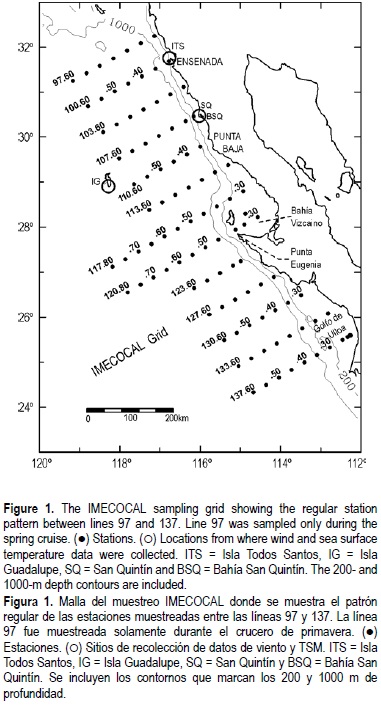
<body><![CDATA[<p align="justify"><font face="verdana" size="2">Winds were measured using Aanderaa meteorological stations at four selected locations along the northern Baja California coast, from January 2000 to July 2003. These include two coastal stations, one at Isla Todos Santos (ITS) and another at Bah&iacute;a San Quint&iacute;n (BSQ); one inland station at San Quint&iacute;n (SQ); and an oceanic station at Isla Guadalupe (IG) (see <a href="/img/revistas/ciemar/v31n3/a8t1.jpg" target="_blank">table 1</a> and <a href="#f1">fig. 1</a>). The ITS station is located in the northern part of the island, about 15 km west of Ensenada. The BSQ station is located near the shoreline north of San Quint&iacute;n Bay, while the SQ station is about 20 km inland. The IG station is located in the southern part of the island. The time frame of measurements differs among the four stations but the basic statistics of all data at each station are included here in order to provide a reference for future works.</font></p>  	    <p align="center"><font face="verdana" size="2"><a name="f1"></a></font></p>  	    <p align="center"><font face="verdana" size="2"><img src="/img/revistas/ciemar/v31n3/a8f1.jpg"></font></p>  	    <p align="justify"><font face="verdana" size="2">Starting in November 1998, SST was measured at IG adjacent to the meteorological station, using a SBE 26 SEAGAUGE. Accuracy and resolution of the temperature sensor are 0.02&deg;C and 0.01&deg;C, respectively. An analysis of the temperature time series from 2000 to 2003 is presented, although a seasonal mean was obtained with all available data.</font></p>  	    <p align="justify"><font face="verdana" size="2">Since 1997, the Investigaciones Mexicanas de la Corriente de California (IMECOCAL) program conducts quarterly surveys off Baja California along a subset grid of the original California Cooperative Fisheries Investigations (CalCOFI) program (<a href="#f1">fig. 1</a>). This report analyzes data gathered mainly during cruises conducted in July and October 2002, and January/February and April 2003 (hereafter cruises 0207, 0210, 0301 and 0304, respectively). Some previous data are also analyzed. At each oceanographic station, CTD casts were made to 1000 m (bottom depth permitting) and water samples were collected from seven depths (0, 10, 20, 50, 100, 150 and 200 m) for the determination of dissolved oxygen and chlorophyll <i>a.</i> To determine chlorophyll <i>a,</i> samples were screened through Whatman GF/F filters with 0.7&#45;&micro;.m nominal pore size in order to collect phytoplankton cells, and analyzed by the fluorometric technique with a Turner Designs AU&#45;05 fluorometer (Holm Hansen <i>et al.,</i> 1965; Yentsch and Menzel, 1963; Venrick and Hayward, 1984).</font></p>  	    <p align="justify"><font face="verdana" size="2">Standard (0.505&#45;mm mesh) double oblique bongo tows from 210 m depth (or from 10 m above the bottom) to the surface were carried out at each station. A flow meter in the net entrance was used to measure the volume of water strained (Smith and Richardson, 1977). Zooplankton volume was measured by displacement in a graduated cylinder (Smith and Richardson, 1977), one month after the end of each cruise. Taxonomic analyses were done for cruises 0207 and 0301, and for previous winter and summer IMECOCAL cruises (9801, 9807, 9901, 9908 and 0001). Samples were subdivided with a Folsom splitter to 1/8 or 1/16 and in some cases to 1/32. All specimens in the subsample were counted. Zooplankton volume and abundance were standardized to 1 m<sup>3</sup> of filtered water. Mean and confidence intervals were estimated from log&#45;transformed data. Zooplankton volume data from previous CalCOFI cruises conducted off Baja California were used to estimate seasonal anomalies. First, CalCOFI data collected in January, April, July and October from 1951 to 1984 were selected and log&#45;transformed. Then, seasonal means for the period 1951&#45;1984 were computed. Finally, mean zooplankton volumes for each cruise (0207, 0210, 0301 and 0304) were compared to seasonal means to compute anomalies. The area was divided into north (lines 100&#45;110) and central (lines 113130) regions as described in Lavaniegos <i>et al.</i> (2002).</font></p>  	    <p>&nbsp;</p>  	    <p align="justify"><font face="verdana" size="2"><b>Results</b></font></p>  	    <p align="justify"><font face="verdana" size="2"><i>Wind observations</i></font></p>  	    <p align="justify"><font face="verdana" size="2">For each station, ellipse components were computed in order to determine the axis of maximum variability. Because the coastline and major axis orientations are very similar (<a href="/img/revistas/ciemar/v31n3/a8t1.jpg" target="_blank">table 1</a>), wind velocity components were rotated so as to define alongshore and across&#45;shore components to coincide with the major and minor axes, respectively. Time series of the alongshore wind component for all stations, as well as SST at IG superimposed on the annual fit, are shown in <a href="#f2">figure 2</a>. Right panels (<a href="#f2">fig. 2a&#45;d</a>) denote wind direction frequency distributions. In this paper, wind and SST anomalies are defined as those observations above (weaker wind or lower SST) or below (stronger wind or higher SST) the seasonal mean of the alongshore component (or SST), plus or minus the standard error (shaded band in <a href="#f2">fig. 2</a>). It is important to note that since records are short, seasonal fits may not adequately reflect the true seasonal variability. The results may therefore change at a later stage when larger data sets are obtained.</font></p>  	    ]]></body>
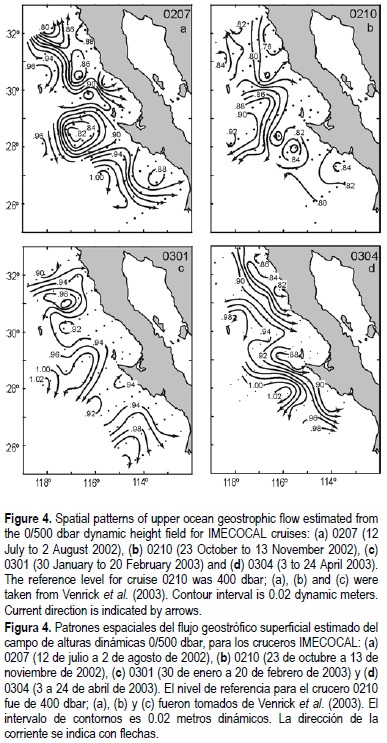
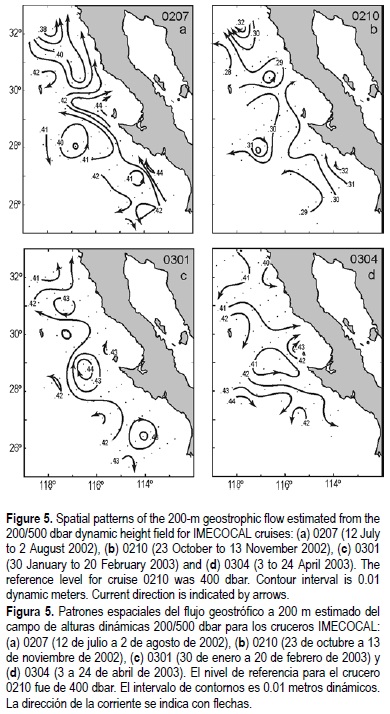
<body><![CDATA[<p align="center"><font face="verdana" size="2"><a name="f2"></a></font></p>  	    <p align="center"><font face="verdana" size="2"><img src="/img/revistas/ciemar/v31n3/a8f2.jpg"></font></p>  	    <p align="justify"><font face="verdana" size="2">Data reveal generally equatorward winds (negative alongshore component) and a dominance of northwesterly (~315&deg;) winds, strongest around May/June and weakest in January. Except for the SQ station (inland, <a href="#f2">fig. 2c</a>), a relative maximum in intensity is also seen in October. At the ITS and SQ coastal stations (<a href="#f2">fig. 2a, c</a>), large variability in the frequency distributions and the presence of winds in the cross&#45;shore direction suggest the influence of the local topography and breezes. The amplitude of the seasonal mean is larger for the oceanic station (~2 m<sup>&#45;1</sup> at IG, <a href="#f2">fig. 2d</a>). The IG station presents the more intense and persistent winds, with high variability of alongshore wind speed around the seasonal mean. The ITS station shows the largest variability relative to SQ and BSQ, due to the diurnal breeze. Mean wind speed (<a href="/img/revistas/ciemar/v31n3/a8t1.jpg" target="_blank">table 1</a>) is maximum at the oceanic station (IG) and minimum at the inland location (SQ). Anomalously weak winds signaling El Ni&ntilde;o conditions were not recorded at any of the stations, except for events lasting two to three weeks at IG during winter (late 2002 and early 2003).</font></p>  	    <p align="justify"><font face="verdana" size="2">On the other hand, the SST time series for IG exhibits a strong seasonal cycle, with a relative maximum (~20&deg;C) around September and a minimum (~15&deg;C) around March (<a href="#f2">fig. 2e</a>). Above normal temperatures were observed from January to September 2000 and in early 2003.</font></p>  	    <p align="justify"><font face="verdana" size="2"><i>Thermohaline characteristics</i></font></p>  	    <p align="justify"><font face="verdana" size="2">Temperature&#45;salinity (T&#45;S) diagrams are used here to illustrate the main thermohaline characteristics that prevailed during the surveys (<a href="/img/revistas/ciemar/v31n3/a8f3.jpg" target="_blank">fig. 3</a>). In order to better visualize changes in the existing conditions, T&#45;S data pairs are contrasted to cli&#45;matological profiles (&plusmn;1 standard deviation) for each season, computed from the 1950&#45;1978 CalCOFI and the 1997&#45;2003 IMECOCAL data. Mean temperature and salinity were computed over selected density ranges. Red and green thick curves depict the climatological and cruise means, respectively. Care was taken to compare T&#45;S diagrams and the corresponding mean profiles for the same oceanic stations occupied during each cruise. Cruise mean curves (green) indicate that near normal conditions persisted during the summer of 2002 (<a href="/img/revistas/ciemar/v31n3/a8f3.jpg" target="_blank">fig. 3a</a>), since data points for the 0207 cruise fall near the climatological mean. The exception for this cruise are warm surface waters (&#963;<sub>t</sub> &lt; 24), which are not observed in the climatological mean. Starting in October 2002 (<a href="/img/revistas/ciemar/v31n3/a8f3.jpg" target="_blank">fig. 3b</a>), fresher than usual waters are observed for 24.5 &lt;&#963;<sub>t</sub> &lt; 25, while in January (0301) and April (0304) near&#45;surface waters were fresher than the mean profile for &#963;<sub>t</sub> &lt; 24.6 and &#963;<sub>t</sub> &lt; 25.5, respectively. Besides the difference in salinity, data from October 2002 (<a href="/img/revistas/ciemar/v31n3/a8f3.jpg" target="_blank">fig. 3b</a>) also showed lower than seasonal mean surface temperatures (~2&#45;3 &deg;C). These last three cruises showed the presence of less saline water (S ~ 33) around the near&#45;surface salinity minimum (&#963;<sub>t</sub> ~25, 0&#45;100 m). This minimum is associated with the CC core, a water mass of subarctic origin. The presence of this relative salinity minimum suggests that during these months, subarctic water entered the region through intensification of equatorward flows or larger spatial extension, or both, of the CC.</font></p>  	    <p align="justify"><font face="verdana" size="2">Below the &#963;<sub>t</sub> = 26 isopycnal (200&#45;500 m), mean T&#45;S curves derived from the four cruises are near normal; however, T&#45;S value pairs differing up to two standard deviations from the climatological mean profile are discernible during July, October and January. The presence of more saline waters along 26 &lt; &#963;<sub>t</sub> &lt; 26.5 suggests a slight increment in the volume of water carried by the CU between 200 and 500 m depth (see Durazo and Baumgartner, 2002).</font></p>  	    <p align="justify"><font face="verdana" size="2"><i>Geostrophic flow</i></font></p>  	    <p align="justify"><font face="verdana" size="2">Dynamic height anomalies at 0 and 200 dbar over the 500 dbar level, except for October 2002 when the length of the hydrographic cable permitted sampling only to 400 m, are used to describe the surface and subsurface fields of flow, respectively (<a href="#f4">figs. 4</a>, <a href="#f5">5</a>). Note that near&#45;surface currents for cruises 0207, 0210 and 0301 have been described in Venrick <i>et al.</i> (2003).</font></p>  	    <p align="justify"><font face="verdana" size="2">Near&#45;surface dynamic heights depict in general an equator&#45;ward flow with considerable mesoscale features (<a href="#f4">fig. 4a&#45;d</a>). There are indications of poleward flows only at selected coastal locations associated with coastal prominences and upwelling, or near the coast of Punta Eugenia during July 2002 when the northward flow is due to the presence of a cyclonic gyre centered around 200 km offshore. Thus, the expected northward flow carrying waters from the south, as is usually seen for an El Ni&ntilde;o event, was not present.</font></p>  	    ]]></body>
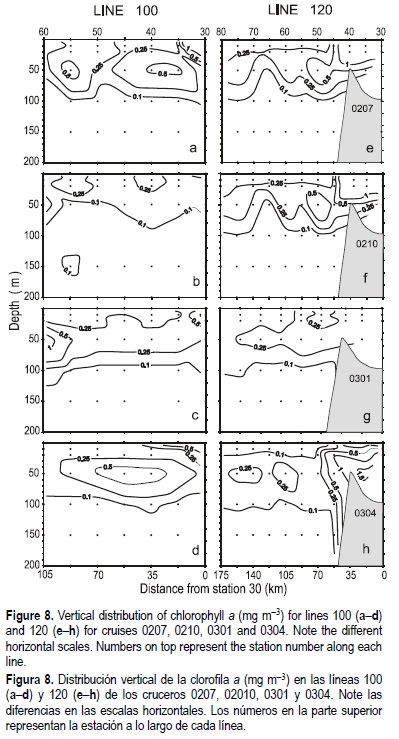
<body><![CDATA[<p align="center"><font face="verdana" size="2"><a name="f4"></a></font></p>  	    <p align="center"><font face="verdana" size="2"><img src="/img/revistas/ciemar/v31n3/a8f4.jpg"></font></p>  	    <p align="justify"><font face="verdana" size="2">Below the surface, geostrophic flows at 200 dbar for cruises 0207, 0210 and 0301 (<a href="#f5">fig. 5a&#45;c</a>) show poleward flows depicting the presence of the CU, adjacent to the coast and the shelf break (July and October 2002) or displaced offshore and circulating around clockwise eddies (January 2003). During the spring of 2003 (<a href="#f5">fig. 5d</a>), the CU is not clearly discernible in the dynamic height anomaly field.</font></p>  	    <p align="center"><font face="verdana" size="2"><a name="f5"></a></font></p>  	    <p align="center"><font face="verdana" size="2"><img src="/img/revistas/ciemar/v31n3/a8f5.jpg"></font></p>  	    <p align="justify"><font face="verdana" size="2"><i>Temperature and salinity anomalies</i></font></p>  	    <p align="justify"><font face="verdana" size="2">A measure of the changes induced by local and remote forcing during 2002&#45;2003 are temperature and salinity anomaly fields for line 120 (<a href="/img/revistas/ciemar/v31n3/a8f6.jpg" target="_blank">fig. 6</a>), a line that represents the locus of the greatest latitudinal variability of water properties within the CCS. Anomalies are referred to climatological means derived from 33 years of historical data (CalCOFI and IMECOCAL).</font></p>  	    <p align="justify"><font face="verdana" size="2">The data from summer 2002 (<a href="/img/revistas/ciemar/v31n3/a8f6.jpg" target="_blank">fig. 6a, b</a>) show cores of negative temperature anomalies (&oacute;3.5&deg;C) at about 70 m depth (<a href="/img/revistas/ciemar/v31n3/a8f6.jpg" target="_blank">fig. 6a</a>) and positive salinity anomalies (~0.3) between 100 and 150 m depth (<a href="/img/revistas/ciemar/v31n3/a8f6.jpg" target="_blank">fig. 6b</a>). Saltier conditions could indicate El Ni&ntilde;o conditions with southern waters being carried northward along the coast. However, as is suggested by the surface and 200 dbar geostrophic currents (<a href="#f4">figs. 4a</a>, <a href="#f5">5a</a>), the cores of colder and saltier water are apparently associated with a cyclonic gyre off Punta Eugenia.</font></p>  	    <p align="justify"><font face="verdana" size="2">The October 2002 temperature and salinity anomalies (<a href="/img/revistas/ciemar/v31n3/a8f6.jpg" target="_blank">fig. 6c, d</a>) show colder and fresher (&#45;2&deg;C, &#45;0.3) than usual conditions over the upper 100 m. This was reflected in the T&#45;S curves of <a href="/img/revistas/ciemar/v31n3/a8f3.jpg" target="_blank">figure 3b</a> as a shifted relative salinity minimum along the &#963;<sub>t</sub> ~ 25 isopycnal surface. These anomalous conditions suggest that more volume of the CC, that is, an excess of subarctic water, reached the survey region during this season. At around 200 dbar, positive temperature and salinity anomalies for this cruise, as well as the large dispersion of T&#45;S points along the &#963;<sub>t</sub> = 26 in <a href="/img/revistas/ciemar/v31n3/a8f3.jpg" target="_blank">figure 3b</a>, suggest an increment of the volume of water of equatorial origin carried by the CU (<a href="#f5">fig. 5b</a>).</font></p>  	    <p align="justify"><font face="verdana" size="2">Small temperature anomalies (~1&deg;C) during January 2003 (<a href="/img/revistas/ciemar/v31n3/a8f6.jpg" target="_blank">fig. 6e</a>) depict near&#45;normal conditions, while near&#45;surface salinity values lower than the mean (&#45;&#45;0.3, <a href="/img/revistas/ciemar/v31n3/a8f6.jpg" target="_blank">fig. 6f</a>) suggest that a greater volume of subarctic waters encroached upon the Baja California survey region. As in the October cruise, this is substantiated by the shifting in the T&#45;S diagrams towards lower salinities above the &#963;<sub>t</sub> &gt; 25.3 (<a href="/img/revistas/ciemar/v31n3/a8f3.jpg" target="_blank">fig. 3c</a>). Below 100 m depth, positive temperature and salinity anomalies (1&deg;C, 0.2) suggest, as in cruise 0207, an enhancement of flow of the equatorial waters (CU, <a href="#f5">fig. 5c</a>).</font></p>  	    ]]></body>
<body><![CDATA[<p align="justify"><font face="verdana" size="2">Finally, the April 2003 (0304) data depicted warmer than usual waters (~3&deg;C, <a href="/img/revistas/ciemar/v31n3/a8f6.jpg" target="_blank">fig. 6g</a>) in a core centered at 70 m depth. As suggested by the near&#45;surface geostrophic currents of <a href="#f4">figure 4</a>, this anomalous warming could be of local origin. This can result from surface waters being transported into Vizca&iacute;no Bay, recirculated inside in an almost permanent clockwise gyre (Palacios&#45;Hern&aacute;ndez <i>et al.,</i> 1996) and later transported outside (warmer), to be incorporated again into the southern flow of the CC (<a href="#f4">fig. 4</a>). Lower than normal (&#45;0.4 to 0) salinities were found throughout most of the section, but they were largest (&oacute;0.4) in a subsurface core centered between 100 and 150 m adjacent to the shelf break (<a href="/img/revistas/ciemar/v31n3/a8f6.jpg" target="_blank">fig. 6h</a>). The T&#45;S diagram (<a href="/img/revistas/ciemar/v31n3/a8f3.jpg" target="_blank">fig. 3d</a>) and the geostrophic velocities depicting equa&#45;torward flow and absence of poleward flows (CU) at 200 m (<a href="#f5">figs. 4</a>, <a href="#f5">5d</a>), indicate that these waters come from a northern source, namely the subarctic.</font></p>  	    <p align="justify"><font face="verdana" size="2"><i>Biological patterns</i></font></p>  	    <p align="justify"><font face="verdana" size="2">The July 2002 cruise (0207) exhibited high zooplankton biomass (100&#45;500 &micro;L m<sup>&#45;3</sup>) over most of the survey area (<a href="/img/revistas/ciemar/v31n3/a8f7.jpg" target="_blank">fig. 7a</a>), separated by two zonal bands of lower biomass (&lt;100 &micro;L m<sup>&#45;3</sup>). In the Gulf of Ulloa (~24.5&#45;26.5&deg;N) even higher biomass was found (&gt;500 m<sup>&#45;3</sup>). Zooplankton biomass anomalies during cruise 0207 (logarithms, <a href="/img/revistas/ciemar/v31n3/a8f7.jpg" target="_blank">fig. 7e</a>) were highly variable from one sampled station to another; however, a negative tendency was evident in the coastal zone off northern Baja California and a positive one in the central lines and the Gulf of Ulloa.</font></p>  	    <p align="justify"><font face="verdana" size="2">Phytoplankton chlorophyll <i>a</i> in summer 2002 was high (&gt;1.0 mg m<sup>&#45;3</sup>, <a href="#f8">fig. 8</a>) near the coastal locations of lines 100 and 120 (<a href="#f8">fig. 8a, e</a>). These low chlorophyll concentrations are associated with warm and low nutrient waters recirculated by the Southern California Bight Eddy (Lynn and Simpson, 1987). Nearshore locations with the highest chlorophyll were related to 10&#45;m water with temperature below 15&deg;C (Venrick <i>et al.,</i> 2003), indicating that coastal upwelling processes during this survey increased phytoplankton production. High chlorophyll concentrations extending offshore in line 120 (<a href="#f8">fig. 8e</a>) appear to be related to nutrient&#45;rich waters advected from the coast and circulated through a cyclonic gyre off Punta Eugenia.</font></p>  	    <p align="center"><font face="verdana" size="2"><a name="f8"></a></font></p>  	    <p align="center"><font face="verdana" size="2"><img src="/img/revistas/ciemar/v31n3/a8f8.jpg"></font></p>  	    <p align="justify"><font face="verdana" size="2">Zooplankton biomass decreased during the autumn survey (0210, <a href="/img/revistas/ciemar/v31n3/a8f7.jpg" target="_blank">fig. 7b</a>), with volumes lower than 100 &micro;L m<sup>&#45;3</sup> over most of the IMECOCAL grid. It remained slightly higher at some coastal locations and offshore south of Punta Eugenia. Logarithmic anomalies were negative in most of the area, indicating a season less rich than the historic mean (<a href="/img/revistas/ciemar/v31n3/a8f7.jpg" target="_blank">fig. 7f</a>). Generally, low phytoplankton biomass (<a href="#f8">fig. 8</a>) was related to decreased coastal upwelling and increased near&#45;surface temperatures (Venrick <i>et al.,</i> 2003). High concentrations of chlorophyll (&gt;1.0 mg m<sup>&#45;3</sup>) were only located inside Vizca&iacute;no Bay, and at one inshore station of line 120 (<a href="#f8">fig. 8f</a>). For most of the sampled area phytoplankton chlorophyll was below 0.25 mg m<sup>&#45;3</sup>, with high concentrations only at nearshore stations of line 120.</font></p>  	    <p align="justify"><font face="verdana" size="2">Winter (0301) zooplankton biomass was extremely low (<a href="/img/revistas/ciemar/v31n3/a8f7.jpg" target="_blank">fig. 7c</a>), with values less than 100 &micro;L m<sup>&#45;3</sup> over most of the region; however, the maximum negative anomalies were found toward the north (<a href="/img/revistas/ciemar/v31n3/a8f7.jpg" target="_blank">fig. 7g</a>). Chlorophyll concentrations were also very low, with values &gt;1.0 mg m<sup>&#45;3</sup> only in offshore subsurface waters of line 100 (<a href="#f8">fig. 8c</a>). The 10&#45;m temperature had a north&#45;south gradient (see Venrick <i>et al.</i>, 2003), which indicated that coastal upwelling processes were absent or very weak during this period. Phytoplankton biomass showed a typical condition of winter season, with low near&#45;surface values and small vertical changes in the water column.</font></p>  	    <p align="justify"><font face="verdana" size="2">Zooplankton volumes along the coast rebounded during April 2003 (<a href="/img/revistas/ciemar/v31n3/a8f7.jpg" target="_blank">fig. 7d</a>), surpassing 500 &micro;L m<sup>&#45;3</sup> in coastal prominences such as Punta Colonet (~30.8&deg;N), Vizca&iacute;no Bay and Punta Abreojos (~26.5&deg;N). This recovery appears to be due to the increased phytoplankton biomass (<a href="#f8">fig. 8d</a>). Zooplankton positive anomalies (<a href="/img/revistas/ciemar/v31n3/a8f7.jpg" target="_blank">fig. 7h</a>) indicate that this rebound over the coastal zone was higher than usual for spring 2003. Chlorophyll concentrations were high (<a href="#f8">fig. 8d, h</a>), mainly at inshore locations associated with an increase of wind stress (<a href="#f2">fig. 2d</a>) and equatorward flow (<a href="#f4">fig. 4</a>).</font></p>  	    <p align="justify"><font face="verdana" size="2">Total zooplankton abundance and structure for northern and central Baja California are depicted in <a href="#f9">figure 9</a>. Abundances for summer (0207) and winter (0301) (<a href="#f9">fig. 9a, b</a>) follow the tendency observed in biomass, with high values in July 2002 and low values in February 2003. Total abundance was similar in the northern and central zones during the 0207 cruise (antilogged mean = 49 ind m<sup>&#45;3</sup>), whereas in 0301 it was lower in the northern than in the central region (antilogged means = 10 and 22 ind m<sup>&#45;3</sup>, respectively). The seasonal change was similar to that observed in previous summer to winter transitions for the period 1999&#45;2000. Winter 1998 was anomalous, displaying abundances in the range usually observed during the summer, while in other winters they were low (<a href="#f9">fig. 9a, b</a>).</font></p>  	    ]]></body>
<body><![CDATA[<p align="center"><font face="verdana" size="2"><a name="f9"></a></font></p>  	    <p align="center"><font face="verdana" size="2"><img src="/img/revistas/ciemar/v31n3/a8f9.jpg"></font></p>  	    <p align="justify"><font face="verdana" size="2">The zooplankton structure did not show clear seasonal differences, but there were interannual and regional differences (<a href="#f9">fig. 9c, d</a>). While copepods usually occupy 50&#45;60% of the zooplankton abundance in the central region, they represented only 36&#45;44% during winter 1998 and its transition to La Ni&ntilde;a in 1999, due mainly to the presence of salp blooms (<a href="#f9">fig. 9d</a>). In the northern region, salps were abundant only in January 1999 and July 2002 (<a href="#f9">fig. 9c</a>). A high percentage of chaetognaths was a feature of winter 1998, observed again in February 2003 (mainly in the central region), and could be related to the weak El Ni&ntilde;o conditions. The larger size of salps, compared to chaetognaths, could explain the main differences in biomass between both cruises. The high percentage of salps found in July 2002 was also observed in July 1998, although restricted to the central region. These regional differences could be related to the kind of species present in each case. For example, <i>Thalia orientalis</i> was dominant during cruise 9807 (Hereu <i>et</i> al., 2003), while the large <i>Pegea socia</i> was very abundant in 0207.</font></p>  	    <p>&nbsp;</p>  	    <p align="justify"><font face="verdana" size="2"><b>Discussion</b></font></p>  	    <p align="justify"><font face="verdana" size="2">Near&#45;surface thermohaline data, the absence of poleward coastal flow and the typical northwesterly winds reported here, do not indicate the presence of an El Ni&ntilde;o during 2002&#45;2003, as has been defined from previous events, e.g. 1997&#45;1998 (Lynn <i>et al.,</i> 1998; Hayward <i>et al.,</i> 1999; Bograd <i>et al.,</i> 2000; Durazo and Baumgartner, 2002; Lynn and Bograd, 2002). The T&#45;S relationships indicated that waters above 25.5 &#963;<sub>t</sub> (0&#45;100 m) had lower salinity than the climatological mean for most of the cruises. Low&#45;salinity waters were observed near the surface from July 2002 through April 2003. The lowest salinity values (S ~ 33) were measured in October 2002 and January 2003. Only during October 2002 were these low salinity waters associated with negative temperature anomalies. Lower than the mean salinities may be seen as a logical consequence of stronger than usual equatorward winds that transport more volume of water of northern origin. More intense winds are the typical conditions of a La Ni&ntilde;a event. However, the wind records presented above and the T&#45;S diagrams for 2002&#45;2003 indicated that the atmospheric and hydrographic conditions were substantially different than those reported for La Ni&ntilde;a 1999&#45;2000 (Durazo <i>et al.,</i> 2001; Durazo and Baumgartner, 2002). During La Ni&ntilde;a, increased upwelling rises the nutricline in the coastal region of Baja California (Espinosa&#45;Carre&oacute;n <i>et al.,</i> 2004) and brings higher salinity waters to the surface; therefore, the relative salinity minimum between 25 and 25.5 &#963;<sub>t</sub>, signaling the core of the CC, is not as evident (Durazo and Baumgartner, 2002).</font></p>  	    <p align="justify"><font face="verdana" size="2">Subarctic water is the source of low salinity in the northeastern Pacific (Lynn and Simpson, 1987), and it has been influencing the CCS since the summer of 2002 (Huyer, 2003; Kosro, 2003; Venrick <i>et al.,</i> 2003). The results shown here suggest that the subarctic water enhancement observed at northern latitudes, reached as far south as 28&deg;N during the period from July 2002 to April 2003. In consequence, the weak El Ni&ntilde;o 2002&#45;2003 could have been concealed by the subarctic influence.</font></p>  	    <p align="justify"><font face="verdana" size="2">Below approximately 100 m depth, a well&#45;developed CU and the dispersion of T&#45;S data towards higher salinities along the 26&#45;26.5 &#963;<sub>t</sub> suggested that El Ni&ntilde;o was present from July 2002 to January 2003. The timing of the positive anomalies observed differs from the findings of Venrick <i>et al.</i> (2003), who reported a moderate El Ni&ntilde;o over southern California waters only during early 2003. When compared to anomalies recorded during the 1997&#45;1998 El Ni&ntilde;o event, the magnitude of the temperature and salinity anomalies (1&#45;2&deg;C, 0.2&#45;0.4) indicated that its effect was weak.</font></p>  	    <p align="justify"><font face="verdana" size="2">The chlorophyll <i>a</i> data also substantiate the absence of surface warming associated with El Ni&ntilde;o conditions. Even April 2003 showed increased phytoplankton biomass at coastal locations, two&#45;fold higher than those reported by Lavaniegos <i>et al.</i> (2003) for waters off Baja California during the 1997&#45;1998 El Ni&ntilde;o event. The increased chlorophyll levels in April 2003 could also be interpreted as the end of El Ni&ntilde;o, since January/ February 2003 reported almost normal conditions for the eastern and central equatorial Pacific, and by May 2003 the anomalous warm conditions had completely dissipated (<a href="http://www.cpc.ncep.noaa.gov" target="_blank">http://www.cpc.ncep.noaa.gov</a>; McPhaden, 2004).</font></p>  	    <p align="justify"><font face="verdana" size="2">Changes in zooplankton biomass followed a similar pattern, responding to the increase in chlorophyll with anomalously high values in nearshore stations; however, the situation was conspicuously different to that observed during the previous strong El Ni&ntilde;o 1997&#45;1998 in Baja California (Lavaniegos <i>et al.</i> , 2002). The zooplankton biomass maintained a typical level during autumn 1997, with a small increment in January 1998 (Lavaniegos <i>et al.,</i> 2002), while winter 2003 exhibited impoverished conditions, both in biomass and total abundance.</font></p>  	    ]]></body>
<body><![CDATA[<p align="justify"><font face="verdana" size="2">The seasonal changes in zooplankton biomass distribution showed the typical maximum in summer and minimum in winter (Lavaniegos <i>et al.,</i> 1998), as well as the strong onshore&#45;offshore spring gradient. The anomalies in zooplankton distribution suggest that the transition from summer to autumn in 2002, as well as the transition from winter to spring in 2003, were more drastic than usual because of the presence of abundant salps in summer, decreasing thereafter. Salps are large pelagic tunicates, which impact the measurements based on biovolume. However, this acute transition from July to October 2002 does not appear to be influenced by a pattern typical of El Ni&ntilde;o because of the unusual surface cooling observed during these months (e.g., Bograd and Lynn, 2003). A subarctic influence originated 10&#45;m temperature anomalies in the range of &#45;3&deg;C to 0&deg;C during cruise 0207, and of &#45;2&deg;C to 0&deg;C during 0210. The species observed during El Ni&ntilde;o 1997&#45;1998 were related to saline water from the southwest (Hereu <i>et al.,</i> 2003), while the blooms of <i>Pegea socia</i> present in northern Baja California during the summer of 2002 seem to be transported to the region from northern latitudes.</font></p>  	    <p align="justify"><font face="verdana" size="2">The zooplankton community structure of major taxa revealed drastic changes in tunicates and large carnivores, while other groups kept more conservative proportions. Tuni&#45;cates are an important herbivorous assemblage in the CCS (Berner, 1967; Smith, 1985; Lavaniegos and Ohman, 2003), significantly altering the flux of matter in the pelagic ecosystem (Fortier <i>et al.,</i> 1994). Although the causes triggering salps and other tunicate blooms must still be investigated, it has been suggested that these may be driven by periods of stratification followed by wind&#45;induced mixing (M&eacute;nard <i>et al.,</i> 1994). The thermal and saline fronts often recorded off Baja California (Roden, 1971) may provide the appropriate niches for the development of these organisms, which would find good conditions for grazing at moderate phytoplankton concentrations in the region. The ocean off Baja California is a very unstable area because of the strong replacement of species that occurs.</font></p>  	    <p>&nbsp;</p>  	    <p align="justify"><font face="verdana" size="2"><b>Acknowledgements</b></font></p>  	    <p align="justify"><font face="verdana" size="2">Funding was provided by CONACYT (projects G0041T, G35326&#45;T, SEP&#45;2003&#45;C0242569 y U40822&#45;F), CICESE and UABC (program 311). We are grateful to the captain and crew of the R/V <i>Francisco de Ulloa</i> for their help during the field work. Thanks to all the students and technicians that participated during the IMECOCAL surveys and the sample analyses. J. Garc&iacute;a processed all the CTD data. M. de la Cruz, J.M. Dom&iacute;nguez and F. Ponce worked on some figures. Wind data were obtained by E. Gil. Historical data of zooplankton volumes were provided by Paul Smith. The comments and suggestions made by three reviewers greatly improved this manuscript.</font></p>  	    <p>&nbsp;</p>  	    <p align="justify"><font face="verdana" size="2"><b>References</b></font></p>  	    <!-- ref --><p align="justify"><font face="verdana" size="2">Berner, L.D. (1967). Distributional Atlas of <i>Thaliacea</i> in the California Current region. CalCOFI Atlas, 8: 1&#45;322.    &nbsp;&nbsp;&nbsp;&nbsp;&nbsp;&nbsp;&nbsp;&nbsp;[&#160;<a href="javascript:void(0);" onclick="javascript: window.open('/scielo.php?script=sci_nlinks&ref=1888594&pid=S0185-3880200500040000800001&lng=','','width=640,height=500,resizable=yes,scrollbars=1,menubar=yes,');">Links</a>&#160;]<!-- end-ref --></font></p>  	    <!-- ref --><p align="justify"><font face="verdana" size="2">Bograd, S.J. and Lynn, R.J. (2003). Anomalous subarctic influence in the southern California Current during 2002. Geophys. Res. Lett., 30, 8020, doi: 10.1029/2003GL017446.    &nbsp;&nbsp;&nbsp;&nbsp;&nbsp;&nbsp;&nbsp;&nbsp;[&#160;<a href="javascript:void(0);" onclick="javascript: window.open('/scielo.php?script=sci_nlinks&ref=1888596&pid=S0185-3880200500040000800002&lng=','','width=640,height=500,resizable=yes,scrollbars=1,menubar=yes,');">Links</a>&#160;]<!-- end-ref --></font></p>  	    <!-- ref --><p align="justify"><font face="verdana" size="2">Bograd, S.J., DiGiacomo, P.M. Durazo, R., Hayward, T.L., Hyrenbach, K.D., Lynn, R.J., Mantyla, A.W., Schwing, F.B., Sydeman, W.J., Baumgartner, T., Lavaniegos, B. and Moore, C.S. (2000). The state of the California Current, 1999&#45;2000: Forward to a new regime? CalCOFI Rep., 41: 26&#45;52.    &nbsp;&nbsp;&nbsp;&nbsp;&nbsp;&nbsp;&nbsp;&nbsp;[&#160;<a href="javascript:void(0);" onclick="javascript: window.open('/scielo.php?script=sci_nlinks&ref=1888598&pid=S0185-3880200500040000800003&lng=','','width=640,height=500,resizable=yes,scrollbars=1,menubar=yes,');">Links</a>&#160;]<!-- end-ref --></font></p>  	    <!-- ref --><p align="justify"><font face="verdana" size="2">Durazo, R. and Baumgartner, T. (2002) Evolution of oceanographic conditions off Baja California: 1997&#45;1999. Prog. Oceanogr., 54: 7&#45;31.    &nbsp;&nbsp;&nbsp;&nbsp;&nbsp;&nbsp;&nbsp;&nbsp;[&#160;<a href="javascript:void(0);" onclick="javascript: window.open('/scielo.php?script=sci_nlinks&ref=1888600&pid=S0185-3880200500040000800004&lng=','','width=640,height=500,resizable=yes,scrollbars=1,menubar=yes,');">Links</a>&#160;]<!-- end-ref --></font></p>  	    <!-- ref --><p align="justify"><font face="verdana" size="2">Durazo, R., Baumgartner, T.R., Bograd, S.J., Collins, C.A., de la Campa, S., Garc&iacute;a, J., Gaxiola&#45;Castro, G., Huyer, A., Hyrenbach, D., Loya, D., Lynn, R.J., Schwing, F.B., Smith, R.L., Sydeman, W.J. and Wheeler, P. (2001) The state of the California Current 2000&#45;2001: A third straight La Ni&ntilde;a year. CalCOFI Rep., 42: 29&#45;60.    &nbsp;&nbsp;&nbsp;&nbsp;&nbsp;&nbsp;&nbsp;&nbsp;[&#160;<a href="javascript:void(0);" onclick="javascript: window.open('/scielo.php?script=sci_nlinks&ref=1888602&pid=S0185-3880200500040000800005&lng=','','width=640,height=500,resizable=yes,scrollbars=1,menubar=yes,');">Links</a>&#160;]<!-- end-ref --></font></p>  	    <!-- ref --><p align="justify"><font face="verdana" size="2">Espinosa&#45;Carre&oacute;n, T.L., Strub, T., Bier, E., Ocampo, F. and Gaxiola&#45;Castro, G. (2004). Seasonal and interannual variability of satellite derived chlorophyll, surface height and temperature off Baja California. J. Geophys. Res., 109, C03039, doi:10.1029/2003JC002105.    &nbsp;&nbsp;&nbsp;&nbsp;&nbsp;&nbsp;&nbsp;&nbsp;[&#160;<a href="javascript:void(0);" onclick="javascript: window.open('/scielo.php?script=sci_nlinks&ref=1888604&pid=S0185-3880200500040000800006&lng=','','width=640,height=500,resizable=yes,scrollbars=1,menubar=yes,');">Links</a>&#160;]<!-- end-ref --></font></p>  	    <!-- ref --><p align="justify"><font face="verdana" size="2">Fortier, L., Lefevre, J. and Legendre, L. (1994). Export of biogenic carbon to fish and to the deep&#45;ocean. The role of large planktonic microphages. J. Plankton Res., 16: 809&#45;839.    &nbsp;&nbsp;&nbsp;&nbsp;&nbsp;&nbsp;&nbsp;&nbsp;[&#160;<a href="javascript:void(0);" onclick="javascript: window.open('/scielo.php?script=sci_nlinks&ref=1888606&pid=S0185-3880200500040000800007&lng=','','width=640,height=500,resizable=yes,scrollbars=1,menubar=yes,');">Links</a>&#160;]<!-- end-ref --></font></p>  	    <!-- ref --><p align="justify"><font face="verdana" size="2">Hayward, T.L., Baumgartner, T.R., Checkley, D.M., Durazo, R., Gaxiola&#45;Castro, G., Hyrenbach, K.D., Mantyla, A.W., Mullin, M.M., Murphree, T., Schwing, F.B., Smith, P.E. and Tegner, M.J. (1999). The state of the California Current in 1998&#45;1999: Transition to cool&#45;water conditions. CalCOFI Rep., 40: 29&#45;62.    &nbsp;&nbsp;&nbsp;&nbsp;&nbsp;&nbsp;&nbsp;&nbsp;[&#160;<a href="javascript:void(0);" onclick="javascript: window.open('/scielo.php?script=sci_nlinks&ref=1888608&pid=S0185-3880200500040000800008&lng=','','width=640,height=500,resizable=yes,scrollbars=1,menubar=yes,');">Links</a>&#160;]<!-- end-ref --></font></p>  	    <!-- ref --><p align="justify"><font face="verdana" size="2">Hereu, C.M., Jim&eacute;nez&#45;P&eacute;rez, L.C. and Lavaniegos, B.E. (2003). Effects of the El Ni&ntilde;o 1997&#45;1998 and the rapid transition to cool conditions in the winter 1998&#45;1999 on the copepods and salps of the California Current. 3rd International Zooplankton Production Symp., 20&#45;23 May 2003, Gij&oacute;n, Spain, Program and Abstracts, p. 53.    &nbsp;&nbsp;&nbsp;&nbsp;&nbsp;&nbsp;&nbsp;&nbsp;[&#160;<a href="javascript:void(0);" onclick="javascript: window.open('/scielo.php?script=sci_nlinks&ref=1888610&pid=S0185-3880200500040000800009&lng=','','width=640,height=500,resizable=yes,scrollbars=1,menubar=yes,');">Links</a>&#160;]<!-- end-ref --></font></p>  	    <!-- ref --><p align="justify"><font face="verdana" size="2">Holm Hansen, O., Lorenzen, C.J., Holmes, R.W. and Strickland, J.D.H. (1965). Fluorometric determination of chlorophyll. J. Cons. Int. Explor. Mer, 30: 3&#45;15.    &nbsp;&nbsp;&nbsp;&nbsp;&nbsp;&nbsp;&nbsp;&nbsp;[&#160;<a href="javascript:void(0);" onclick="javascript: window.open('/scielo.php?script=sci_nlinks&ref=1888612&pid=S0185-3880200500040000800010&lng=','','width=640,height=500,resizable=yes,scrollbars=1,menubar=yes,');">Links</a>&#160;]<!-- end-ref --></font></p>  	    <!-- ref --><p align="justify"><font face="verdana" size="2">Huyer, A. (2003). Prefase to special section on enhanced subarctic influence in the California Current, 2002. Geophys. Res. Lett., 30, 8019, doi:10.1029/2003GL017724.    &nbsp;&nbsp;&nbsp;&nbsp;&nbsp;&nbsp;&nbsp;&nbsp;[&#160;<a href="javascript:void(0);" onclick="javascript: window.open('/scielo.php?script=sci_nlinks&ref=1888614&pid=S0185-3880200500040000800011&lng=','','width=640,height=500,resizable=yes,scrollbars=1,menubar=yes,');">Links</a>&#160;]<!-- end-ref --></font></p>  	    <!-- ref --><p align="justify"><font face="verdana" size="2">Kosro, P.M. (2003). Enhanced southward flow over the Oregon shelf in 2002: A conduit for subarctic water. Geophys. Res. Lett., 30, doi: 10.1029/2003GL017436.    &nbsp;&nbsp;&nbsp;&nbsp;&nbsp;&nbsp;&nbsp;&nbsp;[&#160;<a href="javascript:void(0);" onclick="javascript: window.open('/scielo.php?script=sci_nlinks&ref=1888616&pid=S0185-3880200500040000800012&lng=','','width=640,height=500,resizable=yes,scrollbars=1,menubar=yes,');">Links</a>&#160;]<!-- end-ref --></font></p>  	    <!-- ref --><p align="justify"><font face="verdana" size="2">Lagerloef, G.S.E., Lukas, R., Bonjean, F., Gunn, J.T., Mitchum, G.T., Bourassa, M. and Busalacchi, J. (2003) El Ni&ntilde;o tropical Pacific Ocean surface current and temperature evolution in 2002 and outlook for early 2003. Geophys. Res. Lett., 30, 1514, doi:10.1029/2003GL017096.    &nbsp;&nbsp;&nbsp;&nbsp;&nbsp;&nbsp;&nbsp;&nbsp;[&#160;<a href="javascript:void(0);" onclick="javascript: window.open('/scielo.php?script=sci_nlinks&ref=1888618&pid=S0185-3880200500040000800013&lng=','','width=640,height=500,resizable=yes,scrollbars=1,menubar=yes,');">Links</a>&#160;]<!-- end-ref --></font></p>  	    <!-- ref --><p align="justify"><font face="verdana" size="2">Lavaniegos, B.E. and Ohman, M.D. (2003). Long&#45;term changes in pelagic tunicates in the California Current. Deep&#45;Sea Res. II, 50: 2493&#45;2518.    &nbsp;&nbsp;&nbsp;&nbsp;&nbsp;&nbsp;&nbsp;&nbsp;[&#160;<a href="javascript:void(0);" onclick="javascript: window.open('/scielo.php?script=sci_nlinks&ref=1888620&pid=S0185-3880200500040000800014&lng=','','width=640,height=500,resizable=yes,scrollbars=1,menubar=yes,');">Links</a>&#160;]<!-- end-ref --></font></p>  	    <!-- ref --><p align="justify"><font face="verdana" size="2">Lavaniegos, B.E., G&oacute;mez&#45;Guti&eacute;rrez, J., Lara&#45;Lara, J.R. and Hern&aacute;ndez&#45;V&aacute;zquez, S. (1998). Long&#45;term changes of zooplankton volumes in the California Current System. The Baja California region. Mar. Ecol. Prog. Ser., 169: 55&#45;64.    &nbsp;&nbsp;&nbsp;&nbsp;&nbsp;&nbsp;&nbsp;&nbsp;[&#160;<a href="javascript:void(0);" onclick="javascript: window.open('/scielo.php?script=sci_nlinks&ref=1888622&pid=S0185-3880200500040000800015&lng=','','width=640,height=500,resizable=yes,scrollbars=1,menubar=yes,');">Links</a>&#160;]<!-- end-ref --></font></p>  	    <!-- ref --><p align="justify"><font face="verdana" size="2">Lavaniegos, B.E., Jim&eacute;nez&#45;P&eacute;rez, L.C. and Gaxiola&#45;Castro, G. (2002). Plankton response to El Ni&ntilde;o 1997&#45;1998 and La Ni&ntilde;a 1999 in the southern region of the California Current. Prog. Oceanogr., 54: 33&#45;58.    &nbsp;&nbsp;&nbsp;&nbsp;&nbsp;&nbsp;&nbsp;&nbsp;[&#160;<a href="javascript:void(0);" onclick="javascript: window.open('/scielo.php?script=sci_nlinks&ref=1888624&pid=S0185-3880200500040000800016&lng=','','width=640,height=500,resizable=yes,scrollbars=1,menubar=yes,');">Links</a>&#160;]<!-- end-ref --></font></p>  	    <!-- ref --><p align="justify"><font face="verdana" size="2">Lavaniegos, B.E., Gaxiola&#45;Castro, G., Jim&eacute;nez&#45;P&eacute;rez, L.C., Gonz&aacute;lez&#45;Esparza, M.R., Baumgartner, T. and J. Garc&iacute;a&#45;C&oacute;rdova (2003). 1997&#45;98 El Ni&ntilde;o effects on the pelagic ecosystem of the California Current off Baja California, Mexico. Geof&iacute;s. Int., 42: 483&#45;494.    &nbsp;&nbsp;&nbsp;&nbsp;&nbsp;&nbsp;&nbsp;&nbsp;[&#160;<a href="javascript:void(0);" onclick="javascript: window.open('/scielo.php?script=sci_nlinks&ref=1888626&pid=S0185-3880200500040000800017&lng=','','width=640,height=500,resizable=yes,scrollbars=1,menubar=yes,');">Links</a>&#160;]<!-- end-ref --></font></p>  	    <!-- ref --><p align="justify"><font face="verdana" size="2">Lynn, R.J. and Simpson, J.J. (1987) The California Current system: The seasonal variability of physical characteristics. J Geophys. Res., 92: 12947&#45;12966.    &nbsp;&nbsp;&nbsp;&nbsp;&nbsp;&nbsp;&nbsp;&nbsp;[&#160;<a href="javascript:void(0);" onclick="javascript: window.open('/scielo.php?script=sci_nlinks&ref=1888628&pid=S0185-3880200500040000800018&lng=','','width=640,height=500,resizable=yes,scrollbars=1,menubar=yes,');">Links</a>&#160;]<!-- end-ref --></font></p>  	    <!-- ref --><p align="justify"><font face="verdana" size="2">Lynn, R.J. and Bograd, S. (2002). Dynamic evolution of the 19971999 El Ni&ntilde;o&#45;La Ni&ntilde;a cycle in the southern California Current System. Prog. Oceanogr., 54: 59&#45;75.    &nbsp;&nbsp;&nbsp;&nbsp;&nbsp;&nbsp;&nbsp;&nbsp;[&#160;<a href="javascript:void(0);" onclick="javascript: window.open('/scielo.php?script=sci_nlinks&ref=1888630&pid=S0185-3880200500040000800019&lng=','','width=640,height=500,resizable=yes,scrollbars=1,menubar=yes,');">Links</a>&#160;]<!-- end-ref --></font></p>  	    <!-- ref --><p align="justify"><font face="verdana" size="2">Lynn, R.J., Baumgartner, T., Garc&iacute;a, J., Collins, C.A., Hayward, T.L., Hyrenbach, K.D., Mantyla, A.W., Murphree, T., Shankle, A., Schwing, F.B., Sakuma, K.M. and Tegner, M.J. (1998). The state of the California Current, 1997&#45;1998: Transition to El Ni&ntilde;o conditions. CalCOFI Rep., 39: 25&#45;49.    &nbsp;&nbsp;&nbsp;&nbsp;&nbsp;&nbsp;&nbsp;&nbsp;[&#160;<a href="javascript:void(0);" onclick="javascript: window.open('/scielo.php?script=sci_nlinks&ref=1888632&pid=S0185-3880200500040000800020&lng=','','width=640,height=500,resizable=yes,scrollbars=1,menubar=yes,');">Links</a>&#160;]<!-- end-ref --></font></p>  	    <!-- ref --><p align="justify"><font face="verdana" size="2">McPhaden, M.J. (2004). Evolution of the 2002&#45;2003 El Ni&ntilde;o. Bull. Am. Meteor. Soc., 85, 677, doi:10.1175/BAMS&#45;85&#45;5&#45;677.    &nbsp;&nbsp;&nbsp;&nbsp;&nbsp;&nbsp;&nbsp;&nbsp;[&#160;<a href="javascript:void(0);" onclick="javascript: window.open('/scielo.php?script=sci_nlinks&ref=1888634&pid=S0185-3880200500040000800021&lng=','','width=640,height=500,resizable=yes,scrollbars=1,menubar=yes,');">Links</a>&#160;]<!-- end-ref --></font></p>  	    <!-- ref --><p align="justify"><font face="verdana" size="2">M&eacute;nard, F., Dallot, S., Thomas, G. and Braconnot, J.C. (1994). Temporal fluctuations of two Mediterranean salp populations from 1967 to 1990. Analysis of the influence of environmental variables using a Markov chain model. Mar. Ecol. Prog. Ser., 104: 139&#45;152.    &nbsp;&nbsp;&nbsp;&nbsp;&nbsp;&nbsp;&nbsp;&nbsp;[&#160;<a href="javascript:void(0);" onclick="javascript: window.open('/scielo.php?script=sci_nlinks&ref=1888636&pid=S0185-3880200500040000800022&lng=','','width=640,height=500,resizable=yes,scrollbars=1,menubar=yes,');">Links</a>&#160;]<!-- end-ref --></font></p>  	    <!-- ref --><p align="justify"><font face="verdana" size="2">Palacios&#45;Hern&aacute;ndez, E., Argote, M.L., Amador, A. y Mancilla, M. (1996). Simulaci&oacute;n barotr&oacute;pica inducida por viento en Bah&iacute;a Sebasti&aacute;n Vizca&iacute;no, B.C. Atm&oacute;sfera, 9: 171&#45;188.    &nbsp;&nbsp;&nbsp;&nbsp;&nbsp;&nbsp;&nbsp;&nbsp;[&#160;<a href="javascript:void(0);" onclick="javascript: window.open('/scielo.php?script=sci_nlinks&ref=1888638&pid=S0185-3880200500040000800023&lng=','','width=640,height=500,resizable=yes,scrollbars=1,menubar=yes,');">Links</a>&#160;]<!-- end-ref --></font></p>  	    <!-- ref --><p align="justify"><font face="verdana" size="2">Roden, G.I. (1971). Aspects of the transition zone in the northeastern Pacific. J. Geohys. Res., 76: 3462&#45;3475.    &nbsp;&nbsp;&nbsp;&nbsp;&nbsp;&nbsp;&nbsp;&nbsp;[&#160;<a href="javascript:void(0);" onclick="javascript: window.open('/scielo.php?script=sci_nlinks&ref=1888640&pid=S0185-3880200500040000800024&lng=','','width=640,height=500,resizable=yes,scrollbars=1,menubar=yes,');">Links</a>&#160;]<!-- end-ref --></font></p>  	    <!-- ref --><p align="justify"><font face="verdana" size="2">Schwing, F.B., Murphree, T., de Witt, L. and Green, P.M. (2002). The evolution of oceanic and atmospheric anomalies in the northeast Pacific during the El Ni&ntilde;o and La Ni&ntilde;a events of 1995&#45;2001. Prog. Oceanogr., 54: 459&#45;491.    &nbsp;&nbsp;&nbsp;&nbsp;&nbsp;&nbsp;&nbsp;&nbsp;[&#160;<a href="javascript:void(0);" onclick="javascript: window.open('/scielo.php?script=sci_nlinks&ref=1888642&pid=S0185-3880200500040000800025&lng=','','width=640,height=500,resizable=yes,scrollbars=1,menubar=yes,');">Links</a>&#160;]<!-- end-ref --></font></p>  	    <!-- ref --><p align="justify"><font face="verdana" size="2">Smith, P.E. (1985). A case history of an anti&#45;El Ni&ntilde;o to El Ni&ntilde;o transition on plankton and nekton distribution and abundances. In: W.S. Wooster and D.L. Fluharty (eds.), El Ni&ntilde;o north &#45; Ni&ntilde;o effects on the eastern subarctic Pacific Ocean. Washington Sea Grant Program, Seattle, pp. 121&#45;142.    &nbsp;&nbsp;&nbsp;&nbsp;&nbsp;&nbsp;&nbsp;&nbsp;[&#160;<a href="javascript:void(0);" onclick="javascript: window.open('/scielo.php?script=sci_nlinks&ref=1888644&pid=S0185-3880200500040000800026&lng=','','width=640,height=500,resizable=yes,scrollbars=1,menubar=yes,');">Links</a>&#160;]<!-- end-ref --></font></p>  	    <!-- ref --><p align="justify"><font face="verdana" size="2">Smith, P.E. and Richardson, S.L. (1977). Standard techniques for pelagic fish egg and larva surveys. FAO Fish. Tech. Pap., 175: 1&#45;100.    &nbsp;&nbsp;&nbsp;&nbsp;&nbsp;&nbsp;&nbsp;&nbsp;[&#160;<a href="javascript:void(0);" onclick="javascript: window.open('/scielo.php?script=sci_nlinks&ref=1888646&pid=S0185-3880200500040000800027&lng=','','width=640,height=500,resizable=yes,scrollbars=1,menubar=yes,');">Links</a>&#160;]<!-- end-ref --></font></p>  	    <!-- ref --><p align="justify"><font face="verdana" size="2">Strub, P.T. and James, C. (2003). Altimeter estimates of anomalous transports into the California Current during 2000&#45;2002. Geophys. Res. Lett., doi: 10,1029/2003GL017513.    &nbsp;&nbsp;&nbsp;&nbsp;&nbsp;&nbsp;&nbsp;&nbsp;[&#160;<a href="javascript:void(0);" onclick="javascript: window.open('/scielo.php?script=sci_nlinks&ref=1888648&pid=S0185-3880200500040000800028&lng=','','width=640,height=500,resizable=yes,scrollbars=1,menubar=yes,');">Links</a>&#160;]<!-- end-ref --></font></p>  	    <!-- ref --><p align="justify"><font face="verdana" size="2">Venrick, E.L. and Hayward, T.L. (1984). Determining chlorophyll on the 1984 CalCOFI surveys. CalCOFI Rep., 25: 74&#45;79.    &nbsp;&nbsp;&nbsp;&nbsp;&nbsp;&nbsp;&nbsp;&nbsp;[&#160;<a href="javascript:void(0);" onclick="javascript: window.open('/scielo.php?script=sci_nlinks&ref=1888650&pid=S0185-3880200500040000800029&lng=','','width=640,height=500,resizable=yes,scrollbars=1,menubar=yes,');">Links</a>&#160;]<!-- end-ref --></font></p>  	    <!-- ref --><p align="justify"><font face="verdana" size="2">Venrick, E., Bograd, S., Checkley, D., Cummings, S., Durazo, R., Gaxiola&#45;Castro, G., Hunter, J., Huyer, A., Hyrenbach, K.D., Lavaniegos, B.E., Mantyla, A., Schwing, F.B., Smith, R.L., Sydeman, W.J. and Wheeler, P.A. (2003). The state of the California Current, 2002&#45;2003: Tropical and subarctic influences vie for dominance. CalCOFI Rep., 44: 28&#45;60.    &nbsp;&nbsp;&nbsp;&nbsp;&nbsp;&nbsp;&nbsp;&nbsp;[&#160;<a href="javascript:void(0);" onclick="javascript: window.open('/scielo.php?script=sci_nlinks&ref=1888652&pid=S0185-3880200500040000800030&lng=','','width=640,height=500,resizable=yes,scrollbars=1,menubar=yes,');">Links</a>&#160;]<!-- end-ref --></font></p>  	    <!-- ref --><p align="justify"><font face="verdana" size="2">Yentsch, C.S. and Menzel, D.W. (1963). A method for the determination of phytoplankton chlorophyll and phaeophytin by flourescence. Deep&#45;Sea Res., 10: 221&#45;231.    &nbsp;&nbsp;&nbsp;&nbsp;&nbsp;&nbsp;&nbsp;&nbsp;[&#160;<a href="javascript:void(0);" onclick="javascript: window.open('/scielo.php?script=sci_nlinks&ref=1888654&pid=S0185-3880200500040000800031&lng=','','width=640,height=500,resizable=yes,scrollbars=1,menubar=yes,');">Links</a>&#160;]<!-- end-ref --></font></p>      ]]></body><back>
<ref-list>
<ref id="B1">
<nlm-citation citation-type="journal">
<person-group person-group-type="author">
<name>
<surname><![CDATA[Berner]]></surname>
<given-names><![CDATA[L.D.]]></given-names>
</name>
</person-group>
<article-title xml:lang="en"><![CDATA[Distributional Atlas of Thaliacea in the California Current region]]></article-title>
<source><![CDATA[CalCOFI Atlas]]></source>
<year>1967</year>
<volume>8</volume>
<page-range>1-322</page-range></nlm-citation>
</ref>
<ref id="B2">
<nlm-citation citation-type="journal">
<person-group person-group-type="author">
<name>
<surname><![CDATA[Bograd]]></surname>
<given-names><![CDATA[S.J.]]></given-names>
</name>
<name>
<surname><![CDATA[Lynn]]></surname>
<given-names><![CDATA[R.J.]]></given-names>
</name>
</person-group>
<article-title xml:lang="en"><![CDATA[Anomalous subarctic influence in the southern California Current during 2002]]></article-title>
<source><![CDATA[Geophys. Res. Lett.]]></source>
<year>2003</year>
<volume>30</volume>
<page-range>8020</page-range></nlm-citation>
</ref>
<ref id="B3">
<nlm-citation citation-type="journal">
<person-group person-group-type="author">
<name>
<surname><![CDATA[Bograd]]></surname>
<given-names><![CDATA[S.J.]]></given-names>
</name>
<name>
<surname><![CDATA[DiGiacomo]]></surname>
<given-names><![CDATA[P.M.]]></given-names>
</name>
<name>
<surname><![CDATA[Durazo]]></surname>
<given-names><![CDATA[R.]]></given-names>
</name>
<name>
<surname><![CDATA[Hayward]]></surname>
<given-names><![CDATA[T.L.]]></given-names>
</name>
<name>
<surname><![CDATA[Hyrenbach]]></surname>
<given-names><![CDATA[K.D.]]></given-names>
</name>
<name>
<surname><![CDATA[Lynn]]></surname>
<given-names><![CDATA[R.J.]]></given-names>
</name>
<name>
<surname><![CDATA[Mantyla]]></surname>
<given-names><![CDATA[A.W.]]></given-names>
</name>
<name>
<surname><![CDATA[Schwing]]></surname>
<given-names><![CDATA[F.B.]]></given-names>
</name>
<name>
<surname><![CDATA[Sydeman]]></surname>
<given-names><![CDATA[W.J.]]></given-names>
</name>
<name>
<surname><![CDATA[Baumgartner]]></surname>
<given-names><![CDATA[T.]]></given-names>
</name>
<name>
<surname><![CDATA[Lavaniegos]]></surname>
<given-names><![CDATA[B.]]></given-names>
</name>
<name>
<surname><![CDATA[Moore]]></surname>
<given-names><![CDATA[C.S.]]></given-names>
</name>
</person-group>
<article-title xml:lang="en"><![CDATA[The state of the California Current, 1999-2000: Forward to a new regime?]]></article-title>
<source><![CDATA[CalCOFI Rep.]]></source>
<year>2000</year>
<volume>41</volume>
<page-range>26-52</page-range></nlm-citation>
</ref>
<ref id="B4">
<nlm-citation citation-type="journal">
<person-group person-group-type="author">
<name>
<surname><![CDATA[Durazo]]></surname>
<given-names><![CDATA[R.]]></given-names>
</name>
<name>
<surname><![CDATA[Baumgartner]]></surname>
<given-names><![CDATA[T.]]></given-names>
</name>
</person-group>
<article-title xml:lang="en"><![CDATA[Evolution of oceanographic conditions off Baja California: 1997-1999]]></article-title>
<source><![CDATA[Prog. Oceanogr.]]></source>
<year>2002</year>
<volume>54</volume>
<page-range>7-31</page-range></nlm-citation>
</ref>
<ref id="B5">
<nlm-citation citation-type="journal">
<person-group person-group-type="author">
<name>
<surname><![CDATA[Durazo]]></surname>
<given-names><![CDATA[R.]]></given-names>
</name>
<name>
<surname><![CDATA[Baumgartner]]></surname>
<given-names><![CDATA[T.R.]]></given-names>
</name>
<name>
<surname><![CDATA[Bograd]]></surname>
<given-names><![CDATA[S.J.]]></given-names>
</name>
<name>
<surname><![CDATA[Collins]]></surname>
<given-names><![CDATA[C.A.]]></given-names>
</name>
<name>
<surname><![CDATA[de la Campa]]></surname>
<given-names><![CDATA[S.]]></given-names>
</name>
<name>
<surname><![CDATA[García]]></surname>
<given-names><![CDATA[J.]]></given-names>
</name>
<name>
<surname><![CDATA[Gaxiola-Castro]]></surname>
<given-names><![CDATA[G.]]></given-names>
</name>
<name>
<surname><![CDATA[Huyer]]></surname>
<given-names><![CDATA[A.]]></given-names>
</name>
<name>
<surname><![CDATA[Hyrenbach]]></surname>
<given-names><![CDATA[D.]]></given-names>
</name>
<name>
<surname><![CDATA[Loya]]></surname>
<given-names><![CDATA[D.]]></given-names>
</name>
<name>
<surname><![CDATA[Lynn]]></surname>
<given-names><![CDATA[R.J.]]></given-names>
</name>
<name>
<surname><![CDATA[Schwing]]></surname>
<given-names><![CDATA[F.B.]]></given-names>
</name>
<name>
<surname><![CDATA[Smith]]></surname>
<given-names><![CDATA[R.L.]]></given-names>
</name>
<name>
<surname><![CDATA[Sydeman]]></surname>
<given-names><![CDATA[W.J.]]></given-names>
</name>
<name>
<surname><![CDATA[Wheeler]]></surname>
<given-names><![CDATA[P.]]></given-names>
</name>
</person-group>
<article-title xml:lang="en"><![CDATA[The state of the California Current 2000-2001: A third straight La Niña year]]></article-title>
<source><![CDATA[CalCOFI Rep.]]></source>
<year>2001</year>
<volume>42</volume>
<page-range>29-60</page-range></nlm-citation>
</ref>
<ref id="B6">
<nlm-citation citation-type="journal">
<person-group person-group-type="author">
<name>
<surname><![CDATA[Espinosa-Carreón]]></surname>
<given-names><![CDATA[T.L.]]></given-names>
</name>
<name>
<surname><![CDATA[Strub]]></surname>
<given-names><![CDATA[T.]]></given-names>
</name>
<name>
<surname><![CDATA[Bier]]></surname>
<given-names><![CDATA[E.]]></given-names>
</name>
<name>
<surname><![CDATA[Ocampo]]></surname>
<given-names><![CDATA[F.]]></given-names>
</name>
<name>
<surname><![CDATA[Gaxiola-Castro]]></surname>
<given-names><![CDATA[G.]]></given-names>
</name>
</person-group>
<article-title xml:lang="en"><![CDATA[Seasonal and interannual variability of satellite derived chlorophyll, surface height and temperature off Baja California]]></article-title>
<source><![CDATA[J. Geophys. Res.]]></source>
<year>2004</year>
<volume>109</volume>
<page-range>C03039</page-range></nlm-citation>
</ref>
<ref id="B7">
<nlm-citation citation-type="journal">
<person-group person-group-type="author">
<name>
<surname><![CDATA[Fortier]]></surname>
<given-names><![CDATA[L.]]></given-names>
</name>
<name>
<surname><![CDATA[Lefevre]]></surname>
<given-names><![CDATA[J.]]></given-names>
</name>
<name>
<surname><![CDATA[Legendre]]></surname>
<given-names><![CDATA[L.]]></given-names>
</name>
</person-group>
<article-title xml:lang="en"><![CDATA[Export of biogenic carbon to fish and to the deep-ocean. The role of large planktonic microphages]]></article-title>
<source><![CDATA[J. Plankton Res.]]></source>
<year>1994</year>
<volume>16</volume>
<page-range>809-839</page-range></nlm-citation>
</ref>
<ref id="B8">
<nlm-citation citation-type="journal">
<person-group person-group-type="author">
<name>
<surname><![CDATA[Hayward]]></surname>
<given-names><![CDATA[T.L.]]></given-names>
</name>
<name>
<surname><![CDATA[Baumgartner]]></surname>
<given-names><![CDATA[T.R.]]></given-names>
</name>
<name>
<surname><![CDATA[Checkley]]></surname>
<given-names><![CDATA[D.M.]]></given-names>
</name>
<name>
<surname><![CDATA[Durazo]]></surname>
<given-names><![CDATA[R.]]></given-names>
</name>
<name>
<surname><![CDATA[Gaxiola-Castro]]></surname>
<given-names><![CDATA[G.]]></given-names>
</name>
<name>
<surname><![CDATA[Hyrenbach]]></surname>
<given-names><![CDATA[K.D.]]></given-names>
</name>
<name>
<surname><![CDATA[Mantyla]]></surname>
<given-names><![CDATA[A.W.]]></given-names>
</name>
<name>
<surname><![CDATA[Mullin]]></surname>
<given-names><![CDATA[M.M.]]></given-names>
</name>
<name>
<surname><![CDATA[Murphree]]></surname>
<given-names><![CDATA[T.]]></given-names>
</name>
<name>
<surname><![CDATA[Schwing]]></surname>
<given-names><![CDATA[F.B.]]></given-names>
</name>
<name>
<surname><![CDATA[Smith]]></surname>
<given-names><![CDATA[P.E.]]></given-names>
</name>
<name>
<surname><![CDATA[Tegner]]></surname>
<given-names><![CDATA[M.J.]]></given-names>
</name>
</person-group>
<article-title xml:lang="en"><![CDATA[The state of the California Current in 1998-1999: Transition to cool-water conditions]]></article-title>
<source><![CDATA[CalCOFI Rep.]]></source>
<year>1999</year>
<volume>40</volume>
<page-range>29-62</page-range></nlm-citation>
</ref>
<ref id="B9">
<nlm-citation citation-type="book">
<person-group person-group-type="author">
<name>
<surname><![CDATA[Hereu]]></surname>
<given-names><![CDATA[C.M.]]></given-names>
</name>
<name>
<surname><![CDATA[Jiménez-Pérez]]></surname>
<given-names><![CDATA[L.C.]]></given-names>
</name>
<name>
<surname><![CDATA[Lavaniegos]]></surname>
<given-names><![CDATA[B.E.]]></given-names>
</name>
</person-group>
<source><![CDATA[Effects of the El Niño 1997-1998 and the rapid transition to cool conditions in the winter 1998-1999 on the copepods and salps of the California Current]]></source>
<year>2003</year>
<page-range>53</page-range><publisher-loc><![CDATA[Gijón ]]></publisher-loc>
<publisher-name><![CDATA[3rd International Zooplankton Production Symp.]]></publisher-name>
</nlm-citation>
</ref>
<ref id="B10">
<nlm-citation citation-type="journal">
<person-group person-group-type="author">
<name>
<surname><![CDATA[Holm Hansen]]></surname>
<given-names><![CDATA[O.]]></given-names>
</name>
<name>
<surname><![CDATA[Lorenzen]]></surname>
<given-names><![CDATA[C.J.]]></given-names>
</name>
<name>
<surname><![CDATA[Holmes]]></surname>
<given-names><![CDATA[R.W.]]></given-names>
</name>
<name>
<surname><![CDATA[Strickland]]></surname>
<given-names><![CDATA[J.D.H.]]></given-names>
</name>
</person-group>
<article-title xml:lang="en"><![CDATA[Fluorometric determination of chlorophyll]]></article-title>
<source><![CDATA[J. Cons. Int. Explor. Mer]]></source>
<year>1965</year>
<volume>30</volume>
<page-range>3-15</page-range></nlm-citation>
</ref>
<ref id="B11">
<nlm-citation citation-type="journal">
<person-group person-group-type="author">
<name>
<surname><![CDATA[Huyer]]></surname>
<given-names><![CDATA[A.]]></given-names>
</name>
</person-group>
<article-title xml:lang="en"><![CDATA[Prefase to special section on enhanced subarctic influence in the California Current, 2002]]></article-title>
<source><![CDATA[Geophys. Res. Lett.]]></source>
<year>2003</year>
<volume>30</volume>
</nlm-citation>
</ref>
<ref id="B12">
<nlm-citation citation-type="journal">
<person-group person-group-type="author">
<name>
<surname><![CDATA[Kosro]]></surname>
<given-names><![CDATA[P.M.]]></given-names>
</name>
</person-group>
<article-title xml:lang="en"><![CDATA[Enhanced southward flow over the Oregon shelf in 2002: A conduit for subarctic water]]></article-title>
<source><![CDATA[Geophys. Res. Lett.]]></source>
<year>2003</year>
<volume>30</volume>
</nlm-citation>
</ref>
<ref id="B13">
<nlm-citation citation-type="journal">
<person-group person-group-type="author">
<name>
<surname><![CDATA[Lagerloef]]></surname>
<given-names><![CDATA[G.S.E.]]></given-names>
</name>
<name>
<surname><![CDATA[Lukas]]></surname>
<given-names><![CDATA[R.]]></given-names>
</name>
<name>
<surname><![CDATA[Bonjean]]></surname>
<given-names><![CDATA[F.]]></given-names>
</name>
<name>
<surname><![CDATA[Gunn]]></surname>
<given-names><![CDATA[J.T.]]></given-names>
</name>
<name>
<surname><![CDATA[Mitchum]]></surname>
<given-names><![CDATA[G.T.]]></given-names>
</name>
<name>
<surname><![CDATA[Bourassa]]></surname>
<given-names><![CDATA[M.]]></given-names>
</name>
<name>
<surname><![CDATA[Busalacchi]]></surname>
<given-names><![CDATA[J.]]></given-names>
</name>
</person-group>
<article-title xml:lang="en"><![CDATA[El Niño tropical Pacific Ocean surface current and temperature evolution in 2002 and outlook for early 2003]]></article-title>
<source><![CDATA[Geophys. Res. Lett.]]></source>
<year>2003</year>
<volume>30</volume>
<page-range>1514</page-range></nlm-citation>
</ref>
<ref id="B14">
<nlm-citation citation-type="journal">
<person-group person-group-type="author">
<name>
<surname><![CDATA[Lavaniegos]]></surname>
<given-names><![CDATA[B.E.]]></given-names>
</name>
<name>
<surname><![CDATA[Ohman]]></surname>
<given-names><![CDATA[M.D.]]></given-names>
</name>
</person-group>
<article-title xml:lang="en"><![CDATA[Long-term changes in pelagic tunicates in the California Current]]></article-title>
<source><![CDATA[Deep-Sea Res.]]></source>
<year>2003</year>
<volume>II</volume>
<numero>50</numero>
<issue>50</issue>
<page-range>2493-2518</page-range></nlm-citation>
</ref>
<ref id="B15">
<nlm-citation citation-type="journal">
<person-group person-group-type="author">
<name>
<surname><![CDATA[Lavaniegos]]></surname>
<given-names><![CDATA[B.E.]]></given-names>
</name>
<name>
<surname><![CDATA[Gómez-Gutiérrez]]></surname>
<given-names><![CDATA[J.]]></given-names>
</name>
<name>
<surname><![CDATA[Lara-Lara]]></surname>
<given-names><![CDATA[J.R.]]></given-names>
</name>
<name>
<surname><![CDATA[Hernández-Vázquez]]></surname>
<given-names><![CDATA[S.]]></given-names>
</name>
</person-group>
<article-title xml:lang="en"><![CDATA[Long-term changes of zooplankton volumes in the California Current System. The Baja California region]]></article-title>
<source><![CDATA[Mar. Ecol. Prog. Ser.]]></source>
<year>1998</year>
<volume>169</volume>
<page-range>55-64</page-range></nlm-citation>
</ref>
<ref id="B16">
<nlm-citation citation-type="journal">
<person-group person-group-type="author">
<name>
<surname><![CDATA[Lavaniegos]]></surname>
<given-names><![CDATA[B.E.]]></given-names>
</name>
<name>
<surname><![CDATA[Jiménez-Pérez]]></surname>
<given-names><![CDATA[L.C.]]></given-names>
</name>
<name>
<surname><![CDATA[Gaxiola-Castro]]></surname>
<given-names><![CDATA[G.]]></given-names>
</name>
</person-group>
<article-title xml:lang="en"><![CDATA[Plankton response to El Niño 1997-1998 and La Niña 1999 in the southern region of the California Current]]></article-title>
<source><![CDATA[Prog. Oceanogr.]]></source>
<year>2002</year>
<volume>54</volume>
<page-range>33-58</page-range></nlm-citation>
</ref>
<ref id="B17">
<nlm-citation citation-type="journal">
<person-group person-group-type="author">
<name>
<surname><![CDATA[Lavaniegos]]></surname>
<given-names><![CDATA[B.E.]]></given-names>
</name>
<name>
<surname><![CDATA[Gaxiola-Castro]]></surname>
<given-names><![CDATA[G.]]></given-names>
</name>
<name>
<surname><![CDATA[Jiménez-Pérez]]></surname>
<given-names><![CDATA[L.C.]]></given-names>
</name>
<name>
<surname><![CDATA[González-Esparza]]></surname>
<given-names><![CDATA[M.R.]]></given-names>
</name>
<name>
<surname><![CDATA[Baumgartner]]></surname>
<given-names><![CDATA[T.]]></given-names>
</name>
<name>
<surname><![CDATA[García-Córdova]]></surname>
<given-names><![CDATA[J.]]></given-names>
</name>
</person-group>
<article-title xml:lang="en"><![CDATA[1997-98 El Niño effects on the pelagic ecosystem of the California Current off Baja California, Mexico]]></article-title>
<source><![CDATA[Geofís. Int.]]></source>
<year>2003</year>
<volume>42</volume>
<page-range>483-494</page-range></nlm-citation>
</ref>
<ref id="B18">
<nlm-citation citation-type="journal">
<person-group person-group-type="author">
<name>
<surname><![CDATA[Lynn]]></surname>
<given-names><![CDATA[R.J.]]></given-names>
</name>
<name>
<surname><![CDATA[Simpson]]></surname>
<given-names><![CDATA[J.J.]]></given-names>
</name>
</person-group>
<article-title xml:lang="en"><![CDATA[The California Current system: The seasonal variability of physical characteristics]]></article-title>
<source><![CDATA[J Geophys. Res.]]></source>
<year>1987</year>
<volume>92</volume>
<page-range>12947-12966</page-range></nlm-citation>
</ref>
<ref id="B19">
<nlm-citation citation-type="journal">
<person-group person-group-type="author">
<name>
<surname><![CDATA[Lynn]]></surname>
<given-names><![CDATA[R.J.]]></given-names>
</name>
<name>
<surname><![CDATA[Bograd]]></surname>
<given-names><![CDATA[S.]]></given-names>
</name>
</person-group>
<article-title xml:lang="en"><![CDATA[Dynamic evolution of the 19971999 El Niño-La Niña cycle in the southern California Current System]]></article-title>
<source><![CDATA[Prog. Oceanogr.]]></source>
<year>2002</year>
<volume>54</volume>
<page-range>59-75</page-range></nlm-citation>
</ref>
<ref id="B20">
<nlm-citation citation-type="journal">
<person-group person-group-type="author">
<name>
<surname><![CDATA[Lynn]]></surname>
<given-names><![CDATA[R.J.]]></given-names>
</name>
<name>
<surname><![CDATA[Baumgartner]]></surname>
<given-names><![CDATA[T.]]></given-names>
</name>
<name>
<surname><![CDATA[García]]></surname>
<given-names><![CDATA[J.]]></given-names>
</name>
<name>
<surname><![CDATA[Collins]]></surname>
<given-names><![CDATA[C.A.]]></given-names>
</name>
<name>
<surname><![CDATA[Hayward]]></surname>
<given-names><![CDATA[T.L.]]></given-names>
</name>
<name>
<surname><![CDATA[Hyrenbach]]></surname>
<given-names><![CDATA[K.D.]]></given-names>
</name>
<name>
<surname><![CDATA[Mantyla]]></surname>
<given-names><![CDATA[A.W.]]></given-names>
</name>
<name>
<surname><![CDATA[Murphree]]></surname>
<given-names><![CDATA[T.]]></given-names>
</name>
<name>
<surname><![CDATA[Shankle]]></surname>
<given-names><![CDATA[A.]]></given-names>
</name>
<name>
<surname><![CDATA[Schwing]]></surname>
<given-names><![CDATA[F.B.]]></given-names>
</name>
<name>
<surname><![CDATA[Sakuma]]></surname>
<given-names><![CDATA[K.M.]]></given-names>
</name>
<name>
<surname><![CDATA[Tegner]]></surname>
<given-names><![CDATA[M.J.]]></given-names>
</name>
</person-group>
<article-title xml:lang="en"><![CDATA[The state of the California Current, 1997-1998: Transition to El Niño conditions]]></article-title>
<source><![CDATA[CalCOFI Rep.]]></source>
<year>1998</year>
<volume>39</volume>
<page-range>25-49</page-range></nlm-citation>
</ref>
<ref id="B21">
<nlm-citation citation-type="journal">
<person-group person-group-type="author">
<name>
<surname><![CDATA[McPhaden]]></surname>
<given-names><![CDATA[M.J.]]></given-names>
</name>
</person-group>
<article-title xml:lang="en"><![CDATA[Evolution of the 2002-2003 El Niño]]></article-title>
<source><![CDATA[Bull. Am. Meteor. Soc.]]></source>
<year>2004</year>
<volume>85</volume>
<page-range>677</page-range></nlm-citation>
</ref>
<ref id="B22">
<nlm-citation citation-type="journal">
<person-group person-group-type="author">
<name>
<surname><![CDATA[Ménard]]></surname>
<given-names><![CDATA[F.]]></given-names>
</name>
<name>
<surname><![CDATA[Dallot]]></surname>
<given-names><![CDATA[S.]]></given-names>
</name>
<name>
<surname><![CDATA[Thomas]]></surname>
<given-names><![CDATA[G.]]></given-names>
</name>
<name>
<surname><![CDATA[Braconnot]]></surname>
<given-names><![CDATA[J.C.]]></given-names>
</name>
</person-group>
<article-title xml:lang="en"><![CDATA[Temporal fluctuations of two Mediterranean salp populations from 1967 to 1990. Analysis of the influence of environmental variables using a Markov chain model]]></article-title>
<source><![CDATA[Mar. Ecol. Prog. Ser.]]></source>
<year>1994</year>
<volume>104</volume>
<page-range>139-152</page-range></nlm-citation>
</ref>
<ref id="B23">
<nlm-citation citation-type="journal">
<person-group person-group-type="author">
<name>
<surname><![CDATA[Palacios-Hernández]]></surname>
<given-names><![CDATA[E.]]></given-names>
</name>
<name>
<surname><![CDATA[Argote]]></surname>
<given-names><![CDATA[M.L.]]></given-names>
</name>
<name>
<surname><![CDATA[Amador]]></surname>
<given-names><![CDATA[A.]]></given-names>
</name>
<name>
<surname><![CDATA[Mancilla]]></surname>
<given-names><![CDATA[M.]]></given-names>
</name>
</person-group>
<article-title xml:lang="es"><![CDATA[Simulación barotrópica inducida por viento en Bahía Sebastián Vizcaíno, B.C.]]></article-title>
<source><![CDATA[Atmósfera]]></source>
<year>1996</year>
<volume>9</volume>
<page-range>171-188</page-range></nlm-citation>
</ref>
<ref id="B24">
<nlm-citation citation-type="journal">
<person-group person-group-type="author">
<name>
<surname><![CDATA[Roden]]></surname>
<given-names><![CDATA[G.I.]]></given-names>
</name>
</person-group>
<article-title xml:lang="en"><![CDATA[Aspects of the transition zone in the northeastern Pacific]]></article-title>
<source><![CDATA[J. Geohys. Res.]]></source>
<year>1971</year>
<volume>76</volume>
<page-range>3462-3475</page-range></nlm-citation>
</ref>
<ref id="B25">
<nlm-citation citation-type="journal">
<person-group person-group-type="author">
<name>
<surname><![CDATA[Schwing]]></surname>
<given-names><![CDATA[F.B.]]></given-names>
</name>
<name>
<surname><![CDATA[Murphree]]></surname>
<given-names><![CDATA[T.]]></given-names>
</name>
<name>
<surname><![CDATA[de Witt]]></surname>
<given-names><![CDATA[L.]]></given-names>
</name>
<name>
<surname><![CDATA[Green]]></surname>
<given-names><![CDATA[P.M.]]></given-names>
</name>
</person-group>
<article-title xml:lang="en"><![CDATA[The evolution of oceanic and atmospheric anomalies in the northeast Pacific during the El Niño and La Niña events of 1995-2001]]></article-title>
<source><![CDATA[Prog. Oceanogr.]]></source>
<year>2002</year>
<volume>54</volume>
<page-range>459-491</page-range></nlm-citation>
</ref>
<ref id="B26">
<nlm-citation citation-type="book">
<person-group person-group-type="author">
<name>
<surname><![CDATA[Smith]]></surname>
<given-names><![CDATA[P.E.]]></given-names>
</name>
</person-group>
<article-title xml:lang="en"><![CDATA[A case history of an anti-El Niño to El Niño transition on plankton and nekton distribution and abundances]]></article-title>
<person-group person-group-type="editor">
<name>
<surname><![CDATA[Wooster]]></surname>
<given-names><![CDATA[W.S.]]></given-names>
</name>
<name>
<surname><![CDATA[Fluharty]]></surname>
<given-names><![CDATA[D.L.]]></given-names>
</name>
</person-group>
<source><![CDATA[El Niño north - Niño effects on the eastern subarctic Pacific Ocean]]></source>
<year>1985</year>
<page-range>121-142</page-range><publisher-loc><![CDATA[Seattle ]]></publisher-loc>
<publisher-name><![CDATA[Washington Sea Grant Program]]></publisher-name>
</nlm-citation>
</ref>
<ref id="B27">
<nlm-citation citation-type="journal">
<person-group person-group-type="author">
<name>
<surname><![CDATA[Smith]]></surname>
<given-names><![CDATA[P.E.]]></given-names>
</name>
<name>
<surname><![CDATA[Richardson]]></surname>
<given-names><![CDATA[S.L.]]></given-names>
</name>
</person-group>
<article-title xml:lang="en"><![CDATA[Standard techniques for pelagic fish egg and larva surveys]]></article-title>
<source><![CDATA[FAO Fish. Tech. Pap.]]></source>
<year>1977</year>
<volume>175</volume>
<page-range>1-100</page-range></nlm-citation>
</ref>
<ref id="B28">
<nlm-citation citation-type="journal">
<person-group person-group-type="author">
<name>
<surname><![CDATA[Strub]]></surname>
<given-names><![CDATA[P.T.]]></given-names>
</name>
<name>
<surname><![CDATA[James]]></surname>
<given-names><![CDATA[C.]]></given-names>
</name>
</person-group>
<article-title xml:lang="en"><![CDATA[Altimeter estimates of anomalous transports into the California Current during 2000-2002]]></article-title>
<source><![CDATA[Geophys. Res. Lett.]]></source>
<year>2003</year>
</nlm-citation>
</ref>
<ref id="B29">
<nlm-citation citation-type="journal">
<person-group person-group-type="author">
<name>
<surname><![CDATA[Venrick]]></surname>
<given-names><![CDATA[E.L.]]></given-names>
</name>
<name>
<surname><![CDATA[Hayward]]></surname>
<given-names><![CDATA[T.L.]]></given-names>
</name>
</person-group>
<article-title xml:lang="en"><![CDATA[Determining chlorophyll on the 1984 CalCOFI surveys]]></article-title>
<source><![CDATA[CalCOFI Rep.]]></source>
<year>1984</year>
<volume>25</volume>
<page-range>74-79</page-range></nlm-citation>
</ref>
<ref id="B30">
<nlm-citation citation-type="journal">
<person-group person-group-type="author">
<name>
<surname><![CDATA[Venrick]]></surname>
<given-names><![CDATA[E.]]></given-names>
</name>
<name>
<surname><![CDATA[Bograd]]></surname>
<given-names><![CDATA[S.]]></given-names>
</name>
<name>
<surname><![CDATA[Checkley]]></surname>
<given-names><![CDATA[D.]]></given-names>
</name>
<name>
<surname><![CDATA[Cummings]]></surname>
<given-names><![CDATA[S.]]></given-names>
</name>
<name>
<surname><![CDATA[Durazo]]></surname>
<given-names><![CDATA[R.]]></given-names>
</name>
<name>
<surname><![CDATA[Gaxiola-Castro]]></surname>
<given-names><![CDATA[G.]]></given-names>
</name>
<name>
<surname><![CDATA[Hunter]]></surname>
<given-names><![CDATA[J.]]></given-names>
</name>
<name>
<surname><![CDATA[Huyer]]></surname>
<given-names><![CDATA[A.]]></given-names>
</name>
<name>
<surname><![CDATA[Hyrenbach]]></surname>
<given-names><![CDATA[K.D.]]></given-names>
</name>
<name>
<surname><![CDATA[Lavaniegos]]></surname>
<given-names><![CDATA[B.E.]]></given-names>
</name>
<name>
<surname><![CDATA[Mantyla]]></surname>
<given-names><![CDATA[A.]]></given-names>
</name>
<name>
<surname><![CDATA[Schwing]]></surname>
<given-names><![CDATA[F.B.]]></given-names>
</name>
<name>
<surname><![CDATA[Smith]]></surname>
<given-names><![CDATA[R.L.]]></given-names>
</name>
<name>
<surname><![CDATA[Sydeman]]></surname>
<given-names><![CDATA[W.J.]]></given-names>
</name>
<name>
<surname><![CDATA[Wheeler]]></surname>
<given-names><![CDATA[P.A.]]></given-names>
</name>
</person-group>
<article-title xml:lang="en"><![CDATA[The state of the California Current, 2002-2003: Tropical and subarctic influences vie for dominance]]></article-title>
<source><![CDATA[CalCOFI Rep.]]></source>
<year>2003</year>
<volume>44</volume>
<page-range>28-60</page-range></nlm-citation>
</ref>
<ref id="B31">
<nlm-citation citation-type="journal">
<person-group person-group-type="author">
<name>
<surname><![CDATA[Yentsch]]></surname>
<given-names><![CDATA[C.S.]]></given-names>
</name>
<name>
<surname><![CDATA[Menzel]]></surname>
<given-names><![CDATA[D.W.]]></given-names>
</name>
</person-group>
<article-title xml:lang="en"><![CDATA[A method for the determination of phytoplankton chlorophyll and phaeophytin by flourescence]]></article-title>
<source><![CDATA[Deep-Sea Res.]]></source>
<year>1963</year>
<volume>10</volume>
<page-range>221-231</page-range></nlm-citation>
</ref>
</ref-list>
</back>
</article>