<?xml version="1.0" encoding="ISO-8859-1"?><article xmlns:mml="http://www.w3.org/1998/Math/MathML" xmlns:xlink="http://www.w3.org/1999/xlink" xmlns:xsi="http://www.w3.org/2001/XMLSchema-instance">
<front>
<journal-meta>
<journal-id>0185-3880</journal-id>
<journal-title><![CDATA[Ciencias marinas]]></journal-title>
<abbrev-journal-title><![CDATA[Cienc. mar]]></abbrev-journal-title>
<issn>0185-3880</issn>
<publisher>
<publisher-name><![CDATA[Universidad Autónoma de Baja California, Instituto de Investigaciones Oceanológicas]]></publisher-name>
</publisher>
</journal-meta>
<article-meta>
<article-id>S0185-38802005000200016</article-id>
<title-group>
<article-title xml:lang="en"><![CDATA[Geochemical, textural, mineralogical and micropaleontological data used for climatic reconstruction during the Holocene in the Galician sector of the Iberian continental margin]]></article-title>
<article-title xml:lang="es"><![CDATA[Reconstrucción climática durante el Holoceno en el sector gallego del margen continental ibérico: Datos geoquímicos, texturales, mineralógicos y micropaleontológicos]]></article-title>
</title-group>
<contrib-group>
<contrib contrib-type="author">
<name>
<surname><![CDATA[Martins]]></surname>
<given-names><![CDATA[V]]></given-names>
</name>
<xref ref-type="aff" rid="A01"/>
</contrib>
<contrib contrib-type="author">
<name>
<surname><![CDATA[Rocha]]></surname>
<given-names><![CDATA[F.]]></given-names>
</name>
<xref ref-type="aff" rid="A01"/>
</contrib>
<contrib contrib-type="author">
<name>
<surname><![CDATA[Gomes]]></surname>
<given-names><![CDATA[C.]]></given-names>
</name>
<xref ref-type="aff" rid="A01"/>
</contrib>
<contrib contrib-type="author">
<name>
<surname><![CDATA[Gomes]]></surname>
<given-names><![CDATA[V]]></given-names>
</name>
<xref ref-type="aff" rid="A01"/>
</contrib>
<contrib contrib-type="author">
<name>
<surname><![CDATA[Jouanneau]]></surname>
<given-names><![CDATA[J.]]></given-names>
</name>
<xref ref-type="aff" rid="A02"/>
</contrib>
<contrib contrib-type="author">
<name>
<surname><![CDATA[Weber]]></surname>
<given-names><![CDATA[O.]]></given-names>
</name>
<xref ref-type="aff" rid="A02"/>
</contrib>
<contrib contrib-type="author">
<name>
<surname><![CDATA[Dias]]></surname>
<given-names><![CDATA[J.]]></given-names>
</name>
<xref ref-type="aff" rid="A03"/>
</contrib>
</contrib-group>
<aff id="A01">
<institution><![CDATA[,Universidade de Aveiro  ]]></institution>
<addr-line><![CDATA[Aveiro ]]></addr-line>
<country>Portugal</country>
</aff>
<aff id="A02">
<institution><![CDATA[,Universite de Bordeaux I  ]]></institution>
<addr-line><![CDATA[Talence Gironde]]></addr-line>
<country>Francia</country>
</aff>
<aff id="A03">
<institution><![CDATA[,Universidade de Algarve Unidade de Ciências e Tecnologias Aquáticas ]]></institution>
<addr-line><![CDATA[Faro Algarve]]></addr-line>
<country>Portugal</country>
</aff>
<pub-date pub-type="pub">
<day>00</day>
<month>00</month>
<year>2005</year>
</pub-date>
<pub-date pub-type="epub">
<day>00</day>
<month>00</month>
<year>2005</year>
</pub-date>
<volume>31</volume>
<numero>1b</numero>
<fpage>293</fpage>
<lpage>308</lpage>
<copyright-statement/>
<copyright-year/>
<self-uri xlink:href="http://www.scielo.org.mx/scielo.php?script=sci_arttext&amp;pid=S0185-38802005000200016&amp;lng=en&amp;nrm=iso"></self-uri><self-uri xlink:href="http://www.scielo.org.mx/scielo.php?script=sci_abstract&amp;pid=S0185-38802005000200016&amp;lng=en&amp;nrm=iso"></self-uri><self-uri xlink:href="http://www.scielo.org.mx/scielo.php?script=sci_pdf&amp;pid=S0185-38802005000200016&amp;lng=en&amp;nrm=iso"></self-uri><abstract abstract-type="short" xml:lang="en"><p><![CDATA[In the present study, Al, Ca, Cd, Co, Cr, Cu, Fe, Mg, Mn, Ni, Pb and Cd concentrations were determined in the sediments of the KSGX 40 core collected from the Galicia muddy patch (NW Iberian continental shelf). The results were integrated together with textural, mineralogical and micropaleontological (foraminifera) data in order to determine the possible climatic influence on the type of sedimentation that took place in the muddy patch. The geochemical data of the KSGX 40 core suggest that sediment composition and texture were significantly influenced, over the last 5.2 kyr, by the Holocene sea transgression and by climatic oscillations consisting of both relatively temperate/cold periods and relatively warm/wet periods.]]></p></abstract>
<abstract abstract-type="short" xml:lang="es"><p><![CDATA[En el presente estudio se han determinado las concentraciones de Al, Ca, Cd, Co, Cr, Cu, Fe, Mg, Mn, Ni, Pb y Cd en un sondeo de sedimento recogido en el depósito lodoso de Galicia (NW de la plataforma continental ibérica). Estos resultados se han comparado con datos texturales mineralógicos y micropaleontológicos (foraminíferos) para estudiar la influencia climática en la sedimentación de este depósito lodoso. Los datos geoquímicos del sondeo KSGX 40 sugieren que la composición de los sedimentos y su tamaño de grano han estado influenciados durante los últimos 5.2 ka por la transgresión holocénica del nivel del mar y por oscilaciones climáticas que consisten tanto de periodos relativamente templados/fríos como de periodos cálidos/ lluviosos.]]></p></abstract>
<kwd-group>
<kwd lng="en"><![CDATA[geochemical data]]></kwd>
<kwd lng="en"><![CDATA[marine sediments]]></kwd>
<kwd lng="en"><![CDATA[climatic oscillations]]></kwd>
<kwd lng="en"><![CDATA[Holocene]]></kwd>
<kwd lng="en"><![CDATA[Galicia]]></kwd>
<kwd lng="es"><![CDATA[datos geoquímicos]]></kwd>
<kwd lng="es"><![CDATA[oscilaciones climáticas]]></kwd>
<kwd lng="es"><![CDATA[Holoceno]]></kwd>
<kwd lng="es"><![CDATA[sedimentos]]></kwd>
<kwd lng="es"><![CDATA[depósito lodoso de Galicia]]></kwd>
</kwd-group>
</article-meta>
</front><body><![CDATA[  	    <p align="justify"><font face="verdana" size="4">Art&iacute;culos</font></p>  	    <p>&nbsp;</p>  	    <p align="center"><font face="verdana" size="4"><b>Geochemical, textural, mineralogical and micropaleontological data used for climatic reconstruction during the Holocene in the Galician sector of the Iberian continental margin</b></font></p>  	    <p>&nbsp;</p>  	    <p align="center"><font face="verdana" size="3"><b>Reconstrucci&oacute;n clim&aacute;tica durante el Holoceno en el sector gallego del margen continental ib&eacute;rico: Datos geoqu&iacute;micos, texturales, mineral&oacute;gicos y micropaleontol&oacute;gicos</b></font></p>  	    <p>&nbsp;</p>  	    <p align="center"><font face="verdana" size="2"><b>V&nbsp;Martins<sup>1</sup>, F. Rocha<sup>1</sup>, C. Gomes<sup>1</sup>*, V&nbsp;Gomes<sup>1</sup>, J. Jouanneau<sup>2</sup>, O. Weber<sup>2</sup> and J. Dias<sup>3</sup></b></font></p>  	    <p>&nbsp;</p>  	    <p align="justify"><font face="verdana" size="2"><sup><i>1</i></sup> <i>Departamento de Geoci&ecirc;ncias Universidade de Aveiro Campus de Santiago 3810&#45;193 Aveiro, Portugal.</i> * E&#45;mail: <a href="mailto:cgomes@geo.ua.pt">cgomes@geo.ua.pt</a></font></p>      ]]></body>
<body><![CDATA[<p align="justify"><font face="verdana" size="2"><i><sup>2</sup> D&eacute;partement de G&eacute;ologie et d'Oc&eacute;anographie Universit&eacute; de Bordeaux I/CNRS France, UMR&#45;CNRS 5805.</i></font></p>  	    <p align="justify"><font face="verdana" size="2"><i><sup>3</sup> Universidade de Algarve, UCTRA Campus de Gambelas 8000 Faro, Portugal.</i></font></p>  	    <p>&nbsp;</p>  	    <p align="justify"><font face="verdana" size="2">Recibido en junio de 2003;    <br> 	aceptado en abril de 2004.</font></p>  	    <p>&nbsp;</p>  	    <p align="justify"><font face="verdana" size="2"><b>Abstract</b></font></p>  	    <p align="justify"><font face="verdana" size="2">In the present study, Al, Ca, Cd, Co, Cr, Cu, Fe, Mg, Mn, Ni, Pb and Cd concentrations were determined in the sediments of the KSGX 40 core collected from the Galicia muddy patch (NW Iberian continental shelf). The results were integrated together with textural, mineralogical and micropaleontological (foraminifera) data in order to determine the possible climatic influence on the type of sedimentation that took place in the muddy patch. The geochemical data of the KSGX 40 core suggest that sediment composition and texture were significantly influenced, over the last 5.2 kyr, by the Holocene sea transgression and by climatic oscillations consisting of both relatively temperate/cold periods and relatively warm/wet periods.</font></p>  	    <p align="justify"><font face="verdana" size="2"><b>Key words:</b> geochemical data, marine sediments, climatic oscillations, Holocene, Galicia.</font></p>  	    <p>&nbsp;</p>  	    ]]></body>
<body><![CDATA[<p align="justify"><font face="verdana" size="2"><b>Resumen</b></font></p>  	    <p align="justify"><font face="verdana" size="2">En el presente estudio se han determinado las concentraciones de Al, Ca, Cd, Co, Cr, Cu, Fe, Mg, Mn, Ni, Pb y Cd en un sondeo de sedimento recogido en el dep&oacute;sito lodoso de Galicia (NW de la plataforma continental ib&eacute;rica). Estos resultados se han comparado con datos texturales mineral&oacute;gicos y micropaleontol&oacute;gicos (foramin&iacute;feros) para estudiar la influencia clim&aacute;tica en la sedimentaci&oacute;n de este dep&oacute;sito lodoso. Los datos geoqu&iacute;micos del sondeo KSGX 40 sugieren que la composici&oacute;n de los sedimentos y su tama&ntilde;o de grano han estado influenciados durante los &uacute;ltimos 5.2 ka por la transgresi&oacute;n holoc&eacute;nica del nivel del mar y por oscilaciones clim&aacute;ticas que consisten tanto de periodos relativamente templados/fr&iacute;os como de periodos c&aacute;lidos/ lluviosos.</font></p>  	    <p align="justify"><font face="verdana" size="2"><b>Palabras clave:</b> datos geoqu&iacute;micos, oscilaciones clim&aacute;ticas, Holoceno, sedimentos, dep&oacute;sito lodoso de Galicia.</font></p>  	    <p>&nbsp;</p>  	    <p align="justify"><font face="verdana" size="2"><b>Introduction</b></font></p>  	    <p align="justify"><font face="verdana" size="2">In this work we present and analyze data from the Ocean Margin Exchange (OMEX) core KSGX 40, collected in the Galicia muddy patch (NW Iberian continental shelf) (<a href="#f1">fig. 1</a>).</font></p>  	    <p align="center"><font face="verdana" size="2"><a name="f1"></a></font></p>  	    <p align="center"><font face="verdana" size="2"><img src="/img/revistas/ciemar/v31n1b/a16f1.jpg"></font></p>  	    <p align="justify"><font face="verdana" size="2">The OMEX project aims to gain a better understanding of the physical, chemical, biological and sedimentological processes that occur at the ocean margin of the European continental shelf in order to quantify energy and matter fluxes across this boundary.</font></p>  	    <p align="justify"><font face="verdana" size="2">The main features of the NW Iberian continental shelf that define the circulation, transport and deposition of fine sediments were discussed by Jouanneau <i>et al.</i> (1998) and Dias <i>et al.</i> (2002a, b). Araujo <i>et al.</i> (2002) studied the geochemistry of the sediments from both the Galicia and Douro muddy deposits and Oliveira <i>et al.</i> (2002) studied the distribution of clay minerals in the same sediments. The Iberian continental margin is affected by coastal upwelling (Frouin <i>et al.,</i> 1990), responsible for the high oceanic productivity in the region.</font></p>  	    ]]></body>
<body><![CDATA[<p align="justify"><font face="verdana" size="2">This area is characterized by a high energy regime where hydrodynamic forces are capable of transporting and reworking sediments as deep as 100 m (Dias <i>et al.</i> 2002a, b). In the outer continental shelf, the transport ability of oceanic currents is reduced, allowing the sinking of fine particulate matter enriched in heavy metals either of natural or anthropic origin, supplied by the Galician r&iacute;as and the rivers of northern Portugal. They discharge into the continental shelf, with maximum discharges during winter (Araujo <i>et al.,</i> 2002). There is also some atmospheric supply of this elements.</font></p>  	    <p align="justify"><font face="verdana" size="2">In the present work, the distribution of Al, Ca, Fe, Mg, Cu, Pb, Zn, Cr, Co, Ni and Cd concentrations in sediments from the KSGX 40 core is discussed and related to textural, mineralogical and micropaleontological (benthic and planktonic foraminifera) data with the aims of checking for a possible climatic change record during sedimentation.</font></p>  	    <p>&nbsp;</p>  	    <p align="justify"><font face="verdana" size="2"><b>Materials and methods</b></font></p>  	    <p align="justify"><font face="verdana" size="2">The OMEX KSGX 40 core (164 cm long) was collected from the muddy patch (42&deg;14'98" N, 09&deg;01'01" W) located at the Galician continental shelf off R&iacute;a de Vigo (<a href="#f1">fig. 1</a>), at a sea depth of 115 m.</font></p>  	    <p align="justify"><font face="verdana" size="2">The grain size analysis was carried out using a Malvern 3600E laser diffraction particle sizer, which provided the grain size distribution in the 0.05&#45;878 &micro;m size range. Calcium carbonate content was determined by a gasometric method.</font></p>  	    <p align="justify"><font face="verdana" size="2">To reduce the effects of sediment variable grain size, only the fine fractions (&lt;63 &micro;m) were analyzed. These fractions were obtained by wet sieving and dried at 60&deg;C. Chemical element concentrations in the sediment samples studied were determined following the method proposed by Lecomte and Sondag (1980): 1 g of sediment was digested with a mixture of 3 mL of HCl (37%), 2 mL of HNO<sub>3</sub> (65%) and 1 mL of HF (40%). After drying at 120&deg;C, the residue was mixed with 10 mL of HNO<sub>3</sub>. The resulting solution was centrifuged, filtered and mixed with demineralized water. Determinations of Al, Ca, Cd, Co, Cr, Cu, Fe, Mg, Mn, Ni, Pb and Zn were carried out by flame atomic absorption spectrometry on a GBC 600 spectrophotometer.</font></p>  	    <p align="justify"><font face="verdana" size="2">Mineralogical studies were conducted on the &lt;2 &micro;m sediment size fraction using X&#45;ray diffraction techniques. The clay fraction (&lt;2 &micro;m) was obtained by conventional sedimentation techniques, according to Stokes' Law. Qualitative and semi&#45;quantitative mineralogical analyses of the clay fractions followed the criteria recommended by Schultz (1964), Barahona (1974), Thorez (1976), Mellinger (1979) and Pevear and Mumpton (1989).</font></p>  	    <p align="justify"><font face="verdana" size="2">Biostratigraphic and palaeoecological studies based on benthic foraminifera and the assessment of the relative contents of terrigenous and biogenic components were carried out using a binocular on the &gt;63 sediment fraction of samples collected every centimeter along the core. We determined the evolution of the total abundance of endofaunal species characteristic of the inner and middle shelf (less than 50 m depth), which are markers of both high organic matter contents and low oxygen contents, as well as that of suspension feeders associated with temperate/cold waters. Also, species diversity was assessed using the Shannon&#45;Wiener index (according to Shannon, 1948):</font></p>  	    <p align="center"><font face="verdana" size="2"><img src="/img/revistas/ciemar/v31n1b/a16e1.jpg"></font></p>  	    ]]></body>
<body><![CDATA[<p align="justify"><font face="verdana" size="2">where <i>H</i> is the information function, <i>pi</i> is the proportion of species and <i>S</i> the number of species. The total density of foraminifera (number of shells per gram of sediment) and the density of autochthonous benthic foraminifera (deposited <i>in situ,</i> without evidence of transport) were also determined.</font></p>  	    <p align="justify"><font face="verdana" size="2">For <sup>14</sup>C dating using AMS (accelerator mass spectrometry), 10&#45;20 mg of foraminifera shells were separated from the sediment fractions &gt;125 &micro;m corresponding to the sediment layers of 39&#45;40 cm, 69&#45;70 cm and 134&#45;135 cm, in the laboratory of Beta Analytic Inc., Miami, Florida (USA).</font></p>  	    <p align="justify"><font face="verdana" size="2">The data obtained were subjected to multivariate statistical analysis (principal components analysis and Pearson correlations) using the Statistica (v. 5.1) software.</font></p>  	    <p>&nbsp;</p>  	    <p align="justify"><font face="verdana" size="2"><b>Results</b></font></p>  	    <p align="justify"><font face="verdana" size="2">Carbon&#45;14 dating provided ages for three sediment layers (<a href="/img/revistas/ciemar/v31n1b/a16t1.jpg" target="_blank">table 1</a>). The intercalated ages were estimated on the basis of these values. Core KSGX 40 contains sediments that were deposited during the last 5200 years BP.</font></p>  	    <p align="justify"><font face="verdana" size="2">The KSGX 40 core consists, from the base to the top, of a sedimentary sequence exhibiting gradual upward decrease of grain size (<a href="#f2">fig. 2</a>). In the upper section of the core, approximately from the depth of 100 cm upwards, the fine fraction of sediment &lt;63 (silt + clay) is abundant (60&#45;90%), whereas the sand fraction (&gt;63 &micro;m) becomes more abundant in the lower section of the core (<a href="#f2">fig. 2</a>).</font></p>  	    <p align="center"><font face="verdana" size="2"><a name="f2"></a></font></p>  	    <p align="center"><font face="verdana" size="2"><img src="/img/revistas/ciemar/v31n1b/a16f2.jpg"></font></p>  	    <p align="justify"><font face="verdana" size="2">The relative abundance of non&#45;cohesive sediment particles presents values &gt; 65% in the 33&#45;55 cm sections and below 76 cm (<a href="#f2">fig. 2</a>). The CaCO3 content ranges from 2% to 18% of the dry sediment weight and is higher in the lower section of the core (<a href="#f2">fig. 2</a>). Foraminifera and mollusc shells are important sediment biogenic components, significantly contributing to the total sediment CaCO3.</font></p>  	    ]]></body>
<body><![CDATA[<p align="justify"><font face="verdana" size="2">Illite (50&#45;75%) is the predominant clay mineral, followed by kaolinite (16&#45;18%), smectite (0&#45;15%) and chlorite (210%). Illite and kaolinite, as well as chlorite and smectite, vary in an opposite way along the core studied (<a href="#f3">fig. 3</a>).</font></p>  	    <p align="center"><font face="verdana" size="2"><a name="f3"></a></font></p>  	    <p align="center"><font face="verdana" size="2"><img src="/img/revistas/ciemar/v31n1b/a16f3.jpg"></font></p>  	    <p align="justify"><font face="verdana" size="2">The values of the Kubler index of illite crystallinity (Kubler, 1964; Segonzac, 1969) and the kaolinite/illite ratio are higher in two particular sections of the core, between 164 and 120 cm, and between 85 and 45 cm, and show a tendency to increase between 20 and 0 cm (<a href="#f3">fig. 3</a>).</font></p>  	    <p align="justify"><font face="verdana" size="2">In the 164&#45;115 cm section, higher contents of kaolinite and smectite occur. In the 115&#45;95 cm section, the abundance of these clay minerals decreases, but illite and chlorite contents increase. In the 90&#45;50 cm section, smectite content increases and kaolinite content shows the highest values despite the reduction of kaolinite content starting at 85 cm (<a href="#f3">fig. 3</a>). In the sediments of the upper 50 cm of the core, chlorite persists in higher contents whereas smectite is absent or rare. Between 18 and 30 cm, the kaolinite/illite ratio decreases notably (<a href="#f3">fig. 3</a>).</font></p>  	    <p align="justify"><font face="verdana" size="2">Pyrite is always present along the core, both in the sand fractions as framboidal sedimentary deposits and in pyritized shells of benthic foraminifera.</font></p>  	    <p align="justify"><font face="verdana" size="2">Benthic foraminifera assemblages along core KSGX 40 consist of autochthonous individuals (not showing transport marks) and of transported shells (broken or abraded).</font></p>  	    <p align="justify"><font face="verdana" size="2">The total number of foraminifera (benthic and planktonic) shells per gram of sediment is, as a rule, higher below the depth of 80 cm down to the basis of the core (&lt;6500 shells per gram of sediment), this section also being characterized by a higher number of autochthonous benthic foraminifera and transported shells (<a href="#f4">fig. 4</a>).</font></p>  	    <p align="center"><font face="verdana" size="2"><a name="f4"></a></font></p>  	    <p align="center"><font face="verdana" size="2"><img src="/img/revistas/ciemar/v31n1b/a16f4.jpg"></font></p>  	    ]]></body>
<body><![CDATA[<p align="justify"><font face="verdana" size="2">Some species of the benthic foraminifera assemblages found in core KSGX 40 are better represented in the inner and/ or middle shelf environments of this North Atlantic region. Such is the case of <i>Ammonia beccarii, Asterigerinata mamila,</i> <i>Bolivina pseudoplicata, Cibicides ungerianus, Cribrononion gerthi, Discorbis mira, D. williamsoni, Eggerelloides scaber, Elphidium complanatum, E. crispum, E. discoidale, E. macellum</i> var. <i>aculeatum, E. pulvereum, Haynesina depressula, Lepidodeuterammina ochracea, Planorbulina mediterranensis, Quinqueloculina seminulum</i> and <i>Remaneica helgolandica</i> (Pujos, 1976; Blanc&#45;Vernet <i>et al.,</i> 1984; Cearreta, 1986, 1989, 1994; Mathieu, 1986; Murray, 1991; Alve and Murray, 1994; Banner <i>et al.,</i> 1994; Levy <i>et al.,</i> 1995; Martins and Carapito, 1999; Mendes <i>et al.,</i> 2004).</font></p>  	    <p align="justify"><font face="verdana" size="2">Hence, the number of foraminifera shells increases in the bottom section of core KSGX 40, where the sediment grain size increases, as does the number of species transported from both the inner and middle shelf and the diversity of benthic foraminifera species, expressed by the Shannon&#45;Wiener index (<a href="#f4">fig. 4</a>).</font></p>  	    <p align="justify"><font face="verdana" size="2">The Shannon&#45;Wiener index values (or diversity of benthic foraminifera) decrease in the upper 70 cm of the core, i.e., in the last 2380 &plusmn; 100 years cal BP (<a href="#f4">fig. 4</a>).</font></p>  	    <p align="justify"><font face="verdana" size="2">Throughout the core, the thanatocoenosis of benthic foraminifera is mainly composed of infaunal species (<a href="#f5">fig. 5</a>), such as <i>Bolivina dilatata, B. ordinaria, B. pseudoplicata, B. skagerrakensis, Brizalina spathulata, Bulimina exilis, Buliminella tenuata, Chilostomella oolina, C. ovoidea, Fursenkoina loeblichi, F. pauciloculata, Globobulimina</i> spp., <i>Nonionella bradyi, N. iridea, N. stella, N. turgida, Sphaeroidina bulloides, Stainforthia complanata, S. feylingi, S. fusiformis</i> and <i>Uvigerina peregrine</i> (Corliss and Emerson, 1990; Corliss, 1991; Buzas <i>et al.,</i> 1993; Rathburn and Corliss, 1994; Alve and Murray, 1995; Bernhard and Sen Gupta, 1999; Ernst, 2002).</font></p>  	    <p align="center"><font face="verdana" size="2"><a name="f5"></a></font></p>  	    <p align="center"><font face="verdana" size="2"><img src="/img/revistas/ciemar/v31n1b/a16f5.jpg"></font></p>  	    <p align="justify"><font face="verdana" size="2">The relative abundance of infaunal specimens increases from the base to the top of the core, but particularly from the 100&#45;cm level up to the top of the core (<a href="#f5">fig. 5</a>).</font></p>  	    <p align="justify"><font face="verdana" size="2">The total relative abundance of species like <i>Ammonia beccarii, Buliminella tenuata, Chilostomella oolina, C. ovoidea, Eggerelloides scaber, Fursenkoina loeblichi, F. pauciloculata, Globobulimina</i> spp., <i>Nonionella stella, N. turgida, Stainforthia complanata, S. feylingi</i> and <i>S. fusiformis,</i> with higher tolerance to significant oxygen depletion in pore water, shows either dysoxic or microxic environments due to high availability of organic matter in the sediment (Mullineaux and Lohmann, 1981; van der Zwaan and Jorissen, 1991; Sen Gupta and Machain&#45;Castillo, 1993; Moodley <i>et al.,</i> 1997, 1998; Bernhard and Sen Gupta, 1999; van der Zwaan <i>et al.,</i> 1999; Rijk <i>et al.,</i> 1999; Ernst, 2002). This group of benthic for&#45;aminifera shows higher values in the core section of 90&#45;50 cm (<a href="#f5">fig. 5</a>), where the relative abundance of sediment fine fraction is higher (<a href="#f2">fig. 2</a>). In the lower section of the core, the percentage of passive suspension feeders such as <i>Cibicides refulgens, C. ungerianus, Discorbis mira, D. williamsoni, Discorbis</i> spp., <i>Dyocibicides bisserialis, Gavelinopsis praegeri, Hanzawaia nitidula, Lobatula lobatula, Paumotua terebra</i> and <i>Planorbulina mediterranensis,</i> is higher (Murray, 1991; Vergnaud&#45;Grazzini <i>et al.,</i> 1989) (<a href="#f5">fig. 5</a>).</font></p>  	    <p align="justify"><font face="verdana" size="2">Also present in the assemblages of core KSGX 40 is another group of benthic foraminifera, such as <i>Amphicoryna scalaris, Bigenerina nodosaria, Bolivina albatrossi, B. difformis, B. dilatata, B. striatula, B. seminuda, B. robusta, B. skagerrakensis, Brizalina pacifica, B. spathulata, Bulimina exilis, B. aculeate, B. alazanensis, B. marginata, Cassidulina laevigata</i> var. <i>carinata, C. teretis, Cassidulinoides bradyi, Chilostomella oolina, Eggerella bradyi, Globocassidulina subglobosa, Hoeglundina elegans, Hyalinea balthica, Melonis barleeanum, M. pompilioides, Neolenticulina peregrina, Nonionella bradii, Sphaeroidina bulloides, Trifarina angulosa, Uvigerina peregrina</i> and <i>Valvulineria bradyana;</i> however it is generally better represented in temperate/cold waters of outer neritic and bathyal environments (Pujos, 1976; Blanc&#45;Vernet <i>et</i> <i>al</i>., 1984; Cearreta, 1986, 1989, 1994; Mathieu, 1986; Murray, 1991; Alve and Murray, 1994; Banner <i>et al.,</i> 1994; Levy <i>et al.,</i> 1995; Martins and Carapito, 1999; Mendes <i>et al.,</i> in press). The total abundance of this group of benthic foraminifera is lower in the 90&#45;50 cm core section and higher in the 115&#45;95 cm and 30&#45;18 cm core sections (<a href="#f5">fig. 5</a>).</font></p>  	    <p align="justify"><font face="verdana" size="2">The chemical data determined are shown in <a href="#f6">figures 6</a>, <a href="#f7">7</a> and <a href="#f8">8</a>. All samples have Cd concentrations below the detection limit (0.05 mg kg<sup>&#45;1</sup>).</font></p>  	    ]]></body>
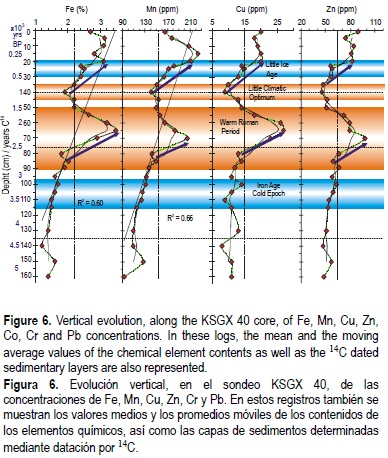
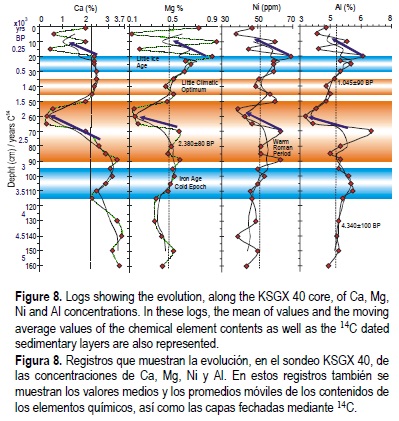
<body><![CDATA[<p align="center"><font face="verdana" size="2"><a name="f6"></a></font></p>  	    <p align="center"><font face="verdana" size="2"><img src="/img/revistas/ciemar/v31n1b/a16f6.jpg"></font></p>  	    <p align="center"><font face="verdana" size="2"><a name="f7"></a></font></p>  	    <p align="center"><font face="verdana" size="2"><img src="/img/revistas/ciemar/v31n1b/a16f7.jpg"></font></p>  	    <p align="center"><font face="verdana" size="2"><a name="f8"></a></font></p>  	    <p align="center"><font face="verdana" size="2"><img src="/img/revistas/ciemar/v31n1b/a16f8.jpg"></font></p>  	    <p align="justify"><font face="verdana" size="2">The analysis of the logs shown in <a href="#f6">figures 6</a>, <a href="#f7">7</a> and <a href="#f8">8</a> allowed the definition of two main zones in the core in relation to the distribution of the chemical element concentration values: zone 1, above the 80 cm level, is characterized by higher (than below this level) concentrations of Fe, Mn and Co, and two concentration maxima for Fe, Mn, Zn, Co, Cu, Cr and Pb identified approximately at 80&#45;50 cm and 20&#45;0 cm; zone 2, below the 80 cm level, is characterized by higher Ca, Mg and Al concentrations that decrease at 80&#45;50 cm and 20&#45;0 cm, where the elements referred to in zone 1 show higher concentrations.</font></p>  	    <p align="justify"><font face="verdana" size="2">The values of Ca concentration decrease, as a rule, from the base to the top of the core, whereas Fe, Mn and Co concentrations show an opposite trend.</font></p>  	    <p align="justify"><font face="verdana" size="2">Spearman's correlations between chemical element concentrations and textural, mineralogical and micropaleonto&#45;logical parameters subjected to principal components analysis (<a href="#f9">fig. 9</a>), allowed the definition of the following groups of parameters:</font></p>  	    <p align="center"><font face="verdana" size="2"><a name="f9"></a></font></p>  	    ]]></body>
<body><![CDATA[<p align="center"><font face="verdana" size="2"><img src="/img/revistas/ciemar/v31n1b/a16f9.jpg"></font></p>  	    <blockquote> 		    <p align="justify"><font face="verdana" size="2">&bull; Group 1, associated with the sediment sand fraction (&gt;63 &micro;m), comprises the following parameters: Ca and CaCO3 contents, foraminifera density and total number of suspension feeders. These parameters show significant positive correlations between them, whereas significant negative correlations were found with the parameters of group 2.</font></p>  		    <p align="justify"><font face="verdana" size="2">&bull; Group 2, associated with sediment fine fractions (&lt;63 and &lt;15 &micro;m), comprises the following parameters: Fe, Mn, Cu, Zn, Pb, Co and Cr concentrations. These concentrations exhibit significant positive correlations with the endofauna of benthic foraminifera and with the total number of species related to high organic matter and low oxygen contents.</font></p>  		    <p align="justify"><font face="verdana" size="2">&bull; Group 3, associated with the clay minerals chlorite and illite and with benthic foraminifera characteristic of cold waters, comprises the following parameters: Al, Ni and Mg concentrations, which show significant positive correlations between them.</font></p>  		    <p align="justify"><font face="verdana" size="2">&bull; Group 4, associated with the clay minerals kaolinite and smectite, consists of parameters considered markers of relatively warm and wet climates that prevail in the source areas of clay mineral genesis.</font></p> 	</blockquote>  	    <p align="justify"><font face="verdana" size="2">Principal components analysis (<a href="#f9">fig. 9</a>) allows the distinction of two main factors important for the definition of the groups identified. Altogether, factors 1 and 2 explain 71% of the variance of the data used; these factors are shown in <a href="#t2">table 2</a>. Factor 1 represents the distribution of the parameters of groups 1 and 2, whereas factor 2 is related to the parameters of groups 3 and 4.</font></p>  	    <p align="center"><font face="verdana" size="2"><a name="t2"></a></font></p>  	    <p align="center"><font face="verdana" size="2"><img src="/img/revistas/ciemar/v31n1b/a16t2.jpg"></font></p>  	    <p align="justify"><font face="verdana" size="2">Factor 1 seems to be associated with sediment texture. On the one hand, heavy metal concentrations in the sediments increase as the fine fraction and organic matter contents increase and oxygen content decreases. On the other hand, coarse sediments deposited under more energetic hydrodynamic conditions, expressed by higher concentrations of suspension feeding foraminifera, seem to favour the preservation of CaCO3, expressed by higher Ca, CaCO3 and foraminifera shell contents in the sediments.</font></p>  	    ]]></body>
<body><![CDATA[<p align="justify"><font face="verdana" size="2">Factor 2 is particularly determined by clay mineral assemblages and by their dependence on the weather conditions prevailing at sediment source areas. Chlorite and illite, whose genesis is particularly favoured by cold and dry weather, are included in the same group of benthic foraminifera considered to be markers of cold waters, suggesting that most of the oceanic water cooling episodes occurred because of periods of colder climate. Smectite and kaolinite, whose genesis is particularly favoured by relatively warm and wet climate, are included in group 4.</font></p>  	    <p align="justify"><font face="verdana" size="2">The concentrations of Ni, Mg and Al are included in group 3, which is related to periods of cold climate. It is not easy to explain this association; however, it is known that plankton uses these chemical elements and that oceanic productivity is, as a rule, higher during cold episodes. Therefore, it is possible that the increase of the concentration of these elements could be related to the accumulation of biodetritus as a consequence of high oceanic productivity.</font></p>  	    <p>&nbsp;</p>  	    <p align="justify"><font face="verdana" size="2"><b>Discussion</b></font></p>  	    <p align="justify"><font face="verdana" size="2">The gradual grain size decrease found in core KSGX 40 could most probably be due to the sea transgression occurred during the Holocene. According to Zazo <i>et al.</i> (1996), after the Holocene transgressive maximum, reached at 6900 years BP, a small drop in the sea level occurred, followed by a small rise in its level between 2400 years and the present.</font></p>  	    <p align="justify"><font face="verdana" size="2">Some climatic changes that occurred during the Holocene appear to have conditioned the marine sedimentation regime. Based on the analytical data available it was possible to establish three zones in core KSGX 40.</font></p>  	    <p align="justify"><font face="verdana" size="2"><i>Zone 1</i></font></p>  	    <p align="justify"><font face="verdana" size="2">Zone 1, corresponding to the 164&#45;90 cm section, is characterized by: (a) coarse grain size sediment; (b) higher Ca, CaCO3 and foraminifera (number of benthic and planktonic foraminifera per gram) contents; (c) higher Mg, Ni and Al concentrations; (d) lower Fe, Mn, Cu, Zn, Co, Cr, and Pb concentrations; (e) higher number of foraminifera species characteristic of the inner and middle continental shelf and higher number of suspension feeders; and (f) illite + kaolinite + smectite + chlorite assemblages indicating a general temperate and wet climate with intercalated oscillations prevailing during sediment deposition. The occurrence of a relatively warm and wet period, corresponding to the core section from the base to the 120&#45;cm level, allowed the input of higher amounts of sediments characterized by coarser grain size into the oceanic system. Together with the terrigenous components, foramin&#45;ifera were also transported from shallower zones of the shelf. The accumulation of coarse sediments on the outer shelf allowed the easier removal of sediment interstitial water, a fact that favoured the preservation of CaCO3 expressed by the relatively high Ca content found in sediments and by the fair preservation of foraminifera shells. This rainy period was identified in Europe by Bohncke and Vanderberghe (1991), Zolitschka and Negendank (1993), and Magri (1997).</font></p>  	    <p align="justify"><font face="verdana" size="2">In the sediment section between 120 and 90 cm, the high content of illite + chlorite indicates the occurrence of relatively cold climatic conditions that prevailed in the continent at the time of the genesis of these clay minerals, 3800&#45;3000 years cal BP. From the base to the top of this section, a decrease in smectite content associated with an increase in chlorite content was recorded in this subsection. Also, a decrease, in this same subsection, of the kaolite/illite ratio, allowed the identification of an episode of cold and dry climate, at least partially responsible for a decrease in sand supply to the deposit studied. This climatic cooling could be related to the thermal oscillation, the "Lobben Stage", around 3600 years BP (Ehlers, 1996) that caused the expansion of the glaciers of the Austrian and Swiss Alps.</font></p>  	    <p align="justify"><font face="verdana" size="2"><i>Zone 2</i></font></p>  	    ]]></body>
<body><![CDATA[<p align="justify"><font face="verdana" size="2">Zone 2 corresponds to the 90&#45;50 cm section in core KSGX 40 and is characterized by: (a) a rapid increase in silt (&lt;63 &micro;m) and fine silt + clay (&lt;15 &micro;m) contents; (b) reduction of the total content of non&#45;cohesive particles; (c) reduction of Ca, Mg, Ni, Al, CaCO3 and foraminifera contents; (d) higher Fe, Mn, Cu, Zn, Co, Cr and P concentrations; (e) illite + kaolinite + chlorite + smectite assemblage, in which the smectite content and the illite crystallinity index exhibit a gradual increase towards the top of the core, whereas kaolinite content decreases being compensated by the symmetric increase of illite content. The clay mineral assemblages previously mentioned (kaolinite content decrease and smectite content increase), suggest the occurrence of a relatively warmer and dryer climatic period between 2900 and 1500 years cal BP. Temperate/cold water benthic foraminifera from outer neritic and bathyal environments also suggest higher oceanic temperatures on the bottom during this period. This ameliorating climatic oscillation began near the dawn of the Roman Empire (Crowley and North, 1991), and was reported in the Galician area by Cortizas <i>et al.</i> (1999, 2000). A dryer climate and a higher sea level during this period (mentioned by e.g. Fidalgo and Vidal&#45;Romani, 1993; Fidalgo <i>et al.,</i> 1993; Pascual <i>et al.,</i> 1998) caused a higher deposition of finer sediments and organic matter.</font></p>  	    <p align="justify"><font face="verdana" size="2">The chemical elements Fe, Mn, Cu, Pb, Zn, Cr, Co and Ni are usually adsorbed onto sediments, particularly onto clay minerals, due to both their high specific surface area and global negative electric charge. This fact supports the significant positive correlation found between sediment fine silt + clay (&lt;15 &micro;m) content and the concentration of these elements.</font></p>  	    <p align="justify"><font face="verdana" size="2">The main source of Al is lithogenic. This element participates largely in the structures of both primary and secondary aluminosilicates existing in weathered products, which are introduced into the oceanic system transported mainly by the rivers. However, Al contents show a weak positive correlation with the sediment fine fraction content and a significant negative correlation with the chemical elements of group 1. The content of Al is reduced in this zone of the core, evidencing a decrease in the transport of fine clayey terrigenous sediments that could be compensated by higher deposition of organic matter, mostly transported laterally. Benthic foraminifera assemblages support this assumption, since a higher number of individuals associated with high organic matter content and infaunal species were found in this core section. A high consumption of oxygen by benthic fauna led to an oxygen depletion in sediments.</font></p>  	    <p align="justify"><font face="verdana" size="2">Biological, physical, chemical and diagenetic processes can change the sediment properties (Zuo <i>et al.,</i> 1991; Nolting and Helder, 1991). Reducing conditions at the sediment&#45;water interface create the conditions needed for diagenetic enrichment (i.e. occuring after sediment deposition) of metals that undergo a redox change and become less soluble, or of metals that form insoluble sulphides. In this zone, Fe and Mn redox behaviour could play a central role in the cycling of other metals that can be adsorbed onto Fe and Mn precipitates.</font></p>  	    <p align="justify"><font face="verdana" size="2"><i>Zone 3</i></font></p>  	    <p align="justify"><font face="verdana" size="2">Zone 3 corresponds to the 50&#45;0 cm section of core KSGX 40 and to a climate similar to the actual climate: Sub&#45;Atlantic (cold and wet). This zone comprises two sub&#45;zones. Sub&#45;zone 3.1</font></p>  	    <p align="justify"><font face="verdana" size="2">Sub&#45;zone 3.1 corresponds to core section 50&#45;20 cm and is characterized by: (a) a slight increase in the sand fraction and a slight decrease in the &lt;15 &micro;m fraction; (b) decrease of the kaolinite/illite ratio; (c) increase of chlorite content; (d) increase of Al, Ca, Mg and Ni concentrations; and (e) reduction of Fe, Mn, Cu, Pb, Zn, Cr and Co concentrations. The increased Al content expresses the higher input of fine clayey terrigenous sediments relative to organic matter, justifying both the better preservation of CaCO<sub>3</sub> and the higher Ca content values in the sediments. Less deposition of fine particles may have determined the lower contents of Fe, Mn, Cu, Pb, Zn, Cr and Co.</font></p>  	    <p align="justify"><font face="verdana" size="2">The higher illite and chlorite contents, as well as the higher content of benthic foraminifera associated with cold waters, present in the 30&#45;18 cm core section, could be related to the climatic cooling episode&oacute;Little Ice Age, a neo&#45;historical glacial fluctuation (between XVI and XIX centuries, according to Grove, 2001)&oacute;that seems to have caused lower sea water temperatures. On the other hand, the 46&#45;35 cm core section could be related to the warmer episode&oacute;Little Climatic Optimum&oacute; as described by Brown (1998). During these two climatic episodes, dry periods alternating with huge river floods would have occurred, expressed by the slight increase of the sand fraction content and Al concentration in the sediments.</font></p>  	    <p align="justify"><font face="verdana" size="2">Sub&#45;zone 3.2</font></p>  	    <p align="justify"><font face="verdana" size="2">Sub&#45;zone 3.2, corresponding to the 20&#45;0 cm core section, is characterized by: (a) a notable increase of the sediment fine fraction (&lt;15 &micro;m); (b) increased Fe, Mn, Cu, Pb, Zn, Cr and Co concentrations; (c) the increase of the kaolinite/illite ratio; (d) decrease of chlorite content; and (e) decrease of Al, Ca, Mg and Ni concentrations. This section, corresponding to the subrecent period, shows similarities with the 90&#45;50 cm section, with a higher accumulation of finer sediments and organic matter because of a tendency in the sea level to rise and lower hydrodynamics in the area where core KSGX 40 was collected.</font></p>  	    ]]></body>
<body><![CDATA[<p>&nbsp;</p>  	    <p align="justify"><font face="verdana" size="2"><b>Conclusions</b></font></p>  	    <p align="justify"><font face="verdana" size="2">The presence of pyrite in core KSGX 40 indicates the occurrence of periods of anoxic conditions just below the sediment&#45;water interface and/or inside foraminifera shells. Pyrite is a diagenetic mineral common in anoxic environments. It is formed by reaction of the sulphate ion with the reduced form of iron (Fe<sup>2+</sup>). This process is mediated by organic matter reaching the sea floor and then being oxidized in a characteristic sequence of reactions (Kaplan <i>et al.,</i> 1963).</font></p>  	    <p align="justify"><font face="verdana" size="2">The origin of Mn, Cu, Co, Fe, Zn, Cr and Pb in the sediments is mainly related to detrital inputs from continental soils and weathered rocks.</font></p>  	    <p align="justify"><font face="verdana" size="2">Taking into account the mineralogical and geochemical data determined, the grain size distribution and the total content of benthic foraminifera species, it was possible to establish the zonography of the KSGX 40 core. Such zonography indicates the occurrence of some climatic oscillations during the Holocene that conditioned the sedimentary record of the Galician continental shelf muddy patch.</font></p>  	    <p align="justify"><font face="verdana" size="2">Climatic oscillations that occurred during the Holocene and oceanic conditions probably related to small sea level oscillations seem to have conditioned the inflow of these sediment types (texture and composition) into the ocean, as well as its redistribution and deposition.</font></p>  	    <p align="justify"><font face="verdana" size="2">The trace metal content of the sediments in this zone is a consequence not only of natural weathering but also of local influences, reflecting changes in hydrodynamic conditions and deposition of finer particles and organic carbon in sediments and influencing diagenetic changes.</font></p>  	    <p>&nbsp;</p>  	    <p align="justify"><font face="verdana" size="2"><b>Acknowledgements</b></font></p>  	    <p align="justify"><font face="verdana" size="2">This research was supported by the Industrial Minerals and Clays Research Center of the Foundation for Science and Technology (FCT) and by the University of Aveiro. This project was partly supported by the European Union within the Marine Science and Technology programme (contract MAS3&#45;CT97&#45;0076).</font></p>  	    ]]></body>
<body><![CDATA[<p>&nbsp;</p>  	    <p align="justify"><font face="verdana" size="2"><b>References</b></font></p>  	    <!-- ref --><p align="justify"><font face="verdana" size="2">Alve, E. and Murray, J.W. (1994). Ecology and taphonomy of benthic foraminifera in a temperate mesotidal inlet. J. Foraminifer. Res., 24(1): 18&#45;27.    &nbsp;&nbsp;&nbsp;&nbsp;&nbsp;&nbsp;&nbsp;&nbsp;[&#160;<a href="javascript:void(0);" onclick="javascript: window.open('/scielo.php?script=sci_nlinks&ref=1883437&pid=S0185-3880200500020001600001&lng=','','width=640,height=500,resizable=yes,scrollbars=1,menubar=yes,');">Links</a>&#160;]<!-- end-ref --></font></p>  	    <!-- ref --><p align="justify"><font face="verdana" size="2">Alve, E. and Murray, J.W. (1995). Benthic foraminiferal distribution and abundance changes in Skagerrak surface sediments: 1937 (Hoglund) and 1992/1993 data compared. Mar. Micropalaeontol., 25: 269&#45;288.    &nbsp;&nbsp;&nbsp;&nbsp;&nbsp;&nbsp;&nbsp;&nbsp;[&#160;<a href="javascript:void(0);" onclick="javascript: window.open('/scielo.php?script=sci_nlinks&ref=1883439&pid=S0185-3880200500020001600002&lng=','','width=640,height=500,resizable=yes,scrollbars=1,menubar=yes,');">Links</a>&#160;]<!-- end-ref --></font></p>  	    <!-- ref --><p align="justify"><font face="verdana" size="2">Araujo, M.F., Jouanneau, J.M., Val&eacute;rio, P., Barbosa, T., Gouveia, A., Weber, O., Oliveira, A., Rodrigues, A. and Dias, J.M.A. (2002). Geochemical tracers of northern Portuguese estuarine sediments on the shelf. Prog. Oceanogr., 52: 277&#45;297.    &nbsp;&nbsp;&nbsp;&nbsp;&nbsp;&nbsp;&nbsp;&nbsp;[&#160;<a href="javascript:void(0);" onclick="javascript: window.open('/scielo.php?script=sci_nlinks&ref=1883441&pid=S0185-3880200500020001600003&lng=','','width=640,height=500,resizable=yes,scrollbars=1,menubar=yes,');">Links</a>&#160;]<!-- end-ref --></font></p>  	    <!-- ref --><p align="justify"><font face="verdana" size="2">Banner, F.T., Knight&#45;Jones, E.W. and Wright, J.M. (1994). Protozoa. In: P.J. Hayward and J.S. Ryland (eds.), The Marine Fauna of the British Isles and North&#45;West Europe. Introduction and Protozoans to Arthropods. Oxford Science Publications, pp. 36&#45;50.    &nbsp;&nbsp;&nbsp;&nbsp;&nbsp;&nbsp;&nbsp;&nbsp;[&#160;<a href="javascript:void(0);" onclick="javascript: window.open('/scielo.php?script=sci_nlinks&ref=1883443&pid=S0185-3880200500020001600004&lng=','','width=640,height=500,resizable=yes,scrollbars=1,menubar=yes,');">Links</a>&#160;]<!-- end-ref --></font></p>  	    ]]></body>
<body><![CDATA[<!-- ref --><p align="justify"><font face="verdana" size="2">Barahona, E. (1974). Arcillas de ladriller&iacute;a de la provincia de Granada: Evaluaci&oacute;n de algunos ensayos de materias primas. Ph.D. thesis, Granada University, Spain, 398 pp.    &nbsp;&nbsp;&nbsp;&nbsp;&nbsp;&nbsp;&nbsp;&nbsp;[&#160;<a href="javascript:void(0);" onclick="javascript: window.open('/scielo.php?script=sci_nlinks&ref=1883445&pid=S0185-3880200500020001600005&lng=','','width=640,height=500,resizable=yes,scrollbars=1,menubar=yes,');">Links</a>&#160;]<!-- end-ref --></font></p>  	    <!-- ref --><p align="justify"><font face="verdana" size="2">Bernhard, J.M and Sen Gupta, B.K. (1999). Foraminifera of oxygen&#45;depleted environments. In: B.K. Sen Gupta (ed.), Modern Foraminifera. Kluwer Academic Publishers, pp. 201&#45;216.    &nbsp;&nbsp;&nbsp;&nbsp;&nbsp;&nbsp;&nbsp;&nbsp;[&#160;<a href="javascript:void(0);" onclick="javascript: window.open('/scielo.php?script=sci_nlinks&ref=1883447&pid=S0185-3880200500020001600006&lng=','','width=640,height=500,resizable=yes,scrollbars=1,menubar=yes,');">Links</a>&#160;]<!-- end-ref --></font></p>  	    <!-- ref --><p align="justify"><font face="verdana" size="2">Blanc&#45;Vernet, L., Pujos, M. and Rosset Moulinier, M. (1984). Les bioc&eacute;noses de foraminif&eacute;res benthiques des plateaux continentaux franjais (Manche, Sud&#45;Gasconhe, Ouest Provence). Benthos' 83, 2nd International Symposium Benthic Foraminifera (Pau, April 1983). Pau and Bordeaux, pp. 71&#45;79.    &nbsp;&nbsp;&nbsp;&nbsp;&nbsp;&nbsp;&nbsp;&nbsp;[&#160;<a href="javascript:void(0);" onclick="javascript: window.open('/scielo.php?script=sci_nlinks&ref=1883449&pid=S0185-3880200500020001600007&lng=','','width=640,height=500,resizable=yes,scrollbars=1,menubar=yes,');">Links</a>&#160;]<!-- end-ref --></font></p>  	    <!-- ref --><p align="justify"><font face="verdana" size="2">Bohncke, S. and Vanderberghe, J. (1991). Small river basins of S&#45;Netherlands. In: L. Starkel, K.J. Gregiory and J.B. Thornes (eds.), Fluvial Processes in the Temperate zone during the last 15.000 years. J. Wiley, pp. 253&#45;281.    &nbsp;&nbsp;&nbsp;&nbsp;&nbsp;&nbsp;&nbsp;&nbsp;[&#160;<a href="javascript:void(0);" onclick="javascript: window.open('/scielo.php?script=sci_nlinks&ref=1883451&pid=S0185-3880200500020001600008&lng=','','width=640,height=500,resizable=yes,scrollbars=1,menubar=yes,');">Links</a>&#160;]<!-- end-ref --></font></p>  	    <!-- ref --><p align="justify"><font face="verdana" size="2">Brown, A. (1998). Fluvial evidence of the Medieval warm period and the Late Medieval climate deterioration in Europe. In: G. Benito, V. Baker and K. Gregory (eds.), Palaeohydrology and Environmental Change. John Wiley, pp. 43&#45;52.    &nbsp;&nbsp;&nbsp;&nbsp;&nbsp;&nbsp;&nbsp;&nbsp;[&#160;<a href="javascript:void(0);" onclick="javascript: window.open('/scielo.php?script=sci_nlinks&ref=1883453&pid=S0185-3880200500020001600009&lng=','','width=640,height=500,resizable=yes,scrollbars=1,menubar=yes,');">Links</a>&#160;]<!-- end-ref --></font></p>  	    ]]></body>
<body><![CDATA[<!-- ref --><p align="justify"><font face="verdana" size="2">Buzas, M.A., Culver, S.J. and Jorissen, F.J. (1993). A statistical evaluation of the microhabitats of living (stained) infaunal benthic foraminifera. Mar. Micropalaeontol., 20: 311&#45;320.    &nbsp;&nbsp;&nbsp;&nbsp;&nbsp;&nbsp;&nbsp;&nbsp;[&#160;<a href="javascript:void(0);" onclick="javascript: window.open('/scielo.php?script=sci_nlinks&ref=1883455&pid=S0185-3880200500020001600010&lng=','','width=640,height=500,resizable=yes,scrollbars=1,menubar=yes,');">Links</a>&#160;]<!-- end-ref --></font></p>  	    <!-- ref --><p align="justify"><font face="verdana" size="2">Cearreta, A. (1986). Distribution and ecology of benthic foraminifera in the rias of Santo&ntilde;a and San Vicent de la Barquera (Spain). Ph.D. thesis, University of Exeter, 307 pp.    &nbsp;&nbsp;&nbsp;&nbsp;&nbsp;&nbsp;&nbsp;&nbsp;[&#160;<a href="javascript:void(0);" onclick="javascript: window.open('/scielo.php?script=sci_nlinks&ref=1883457&pid=S0185-3880200500020001600011&lng=','','width=640,height=500,resizable=yes,scrollbars=1,menubar=yes,');">Links</a>&#160;]<!-- end-ref --></font></p>  	    <!-- ref --><p align="justify"><font face="verdana" size="2">Cearreta, A. (1989). Foraminiferal assemblages in the Ria of San Vicente de la Barquera (Cantabria, Spain). Rev. Esp. Micropaleontol. Madrid, 12(1): 67&#45;80.    &nbsp;&nbsp;&nbsp;&nbsp;&nbsp;&nbsp;&nbsp;&nbsp;[&#160;<a href="javascript:void(0);" onclick="javascript: window.open('/scielo.php?script=sci_nlinks&ref=1883459&pid=S0185-3880200500020001600012&lng=','','width=640,height=500,resizable=yes,scrollbars=1,menubar=yes,');">Links</a>&#160;]<!-- end-ref --></font></p>  	    <!-- ref --><p align="justify"><font face="verdana" size="2">Cearreta, A. (1994). Analisis micropaleontol&oacute;gico e interpretaci&oacute;n paleoecol&oacute;gica del relleno sedimentario Holoceno en El Estuario del Bidasoa (Golfo de Bizkaia). Geobios, 27(3): 271&#45;283.    &nbsp;&nbsp;&nbsp;&nbsp;&nbsp;&nbsp;&nbsp;&nbsp;[&#160;<a href="javascript:void(0);" onclick="javascript: window.open('/scielo.php?script=sci_nlinks&ref=1883461&pid=S0185-3880200500020001600013&lng=','','width=640,height=500,resizable=yes,scrollbars=1,menubar=yes,');">Links</a>&#160;]<!-- end-ref --></font></p>  	    <!-- ref --><p align="justify"><font face="verdana" size="2">Corliss, B.H. (1991). Morphology and microhabitat preferences of benthic foraminifera from the northwest Atlantic Ocean. Mar. Micropalaeontol., 17: 195&#45;236.    &nbsp;&nbsp;&nbsp;&nbsp;&nbsp;&nbsp;&nbsp;&nbsp;[&#160;<a href="javascript:void(0);" onclick="javascript: window.open('/scielo.php?script=sci_nlinks&ref=1883463&pid=S0185-3880200500020001600014&lng=','','width=640,height=500,resizable=yes,scrollbars=1,menubar=yes,');">Links</a>&#160;]<!-- end-ref --></font></p>  	    ]]></body>
<body><![CDATA[<!-- ref --><p align="justify"><font face="verdana" size="2">Corliss, B.H. and Emerson, S. (1990). Distribution of Rose Bengal stained deep&#45;sea benthic foraminifera from the Nova Scotian continental margin and Gulf of Maine. Deep&#45;Sea Res., 37(3A): 381&#45;400.    &nbsp;&nbsp;&nbsp;&nbsp;&nbsp;&nbsp;&nbsp;&nbsp;[&#160;<a href="javascript:void(0);" onclick="javascript: window.open('/scielo.php?script=sci_nlinks&ref=1883465&pid=S0185-3880200500020001600015&lng=','','width=640,height=500,resizable=yes,scrollbars=1,menubar=yes,');">Links</a>&#160;]<!-- end-ref --></font></p>  	    <!-- ref --><p align="justify"><font face="verdana" size="2">Cortizas, A.M., Pontevedra&#45;Pombal, X., Garc&iacute;a&#45;Rodeja, E., Novoa&#45;Mu&ntilde;oz, J.C and Shotyk, W. (1999). Mercury in a Spanish peat bog: Archive of climate change and atmospheric metal deposition. Science, 284: 939&#45;942.    &nbsp;&nbsp;&nbsp;&nbsp;&nbsp;&nbsp;&nbsp;&nbsp;[&#160;<a href="javascript:void(0);" onclick="javascript: window.open('/scielo.php?script=sci_nlinks&ref=1883467&pid=S0185-3880200500020001600016&lng=','','width=640,height=500,resizable=yes,scrollbars=1,menubar=yes,');">Links</a>&#160;]<!-- end-ref --></font></p>  	    <!-- ref --><p align="justify"><font face="verdana" size="2">Cortizas, A.M., P&eacute;rez&#45;Alberti, A., Franco&#45;Maside, S. and Garc&iacute;a&#45;Rodeja, E. (2000). Evoluci&oacute;n del paisaje durante el Holoceno en Galicia (NW de la Pen&iacute;nsula Ib&eacute;rica). In: F. D&iacute;az del Olmo, D. Faust y A.I. Porras (eds.), Environmental Changes during the Holocene. Commission on the Holocene, Universidad de Sevilla, Katolische Universitat Eichstatt and AEQA, Sevilla, pp. 61&#45;64.    &nbsp;&nbsp;&nbsp;&nbsp;&nbsp;&nbsp;&nbsp;&nbsp;[&#160;<a href="javascript:void(0);" onclick="javascript: window.open('/scielo.php?script=sci_nlinks&ref=1883469&pid=S0185-3880200500020001600017&lng=','','width=640,height=500,resizable=yes,scrollbars=1,menubar=yes,');">Links</a>&#160;]<!-- end-ref --></font></p>  	    <!-- ref --><p align="justify"><font face="verdana" size="2">Crowley, T.J. and North, G.R. (1991). Paleoclimatology. Oxford Monographs on Geology and Geophysics No. 18, 349 pp.    &nbsp;&nbsp;&nbsp;&nbsp;&nbsp;&nbsp;&nbsp;&nbsp;[&#160;<a href="javascript:void(0);" onclick="javascript: window.open('/scielo.php?script=sci_nlinks&ref=1883471&pid=S0185-3880200500020001600018&lng=','','width=640,height=500,resizable=yes,scrollbars=1,menubar=yes,');">Links</a>&#160;]<!-- end-ref --></font></p>  	    <!-- ref --><p align="justify"><font face="verdana" size="2">Dias, J., Jouanneau, J., Gonzalez, R., Ara&uacute;jo, M., Drago, T., Garcia, C., Oliveira, A., Rodrigues, A., Vitorino, J. and Weber, O. (2002a). Present day sedimentary processes on the northern Iberian shelf. Prog. Oceanogr., 52(2&#45;4): 249&#45;259.    &nbsp;&nbsp;&nbsp;&nbsp;&nbsp;&nbsp;&nbsp;&nbsp;[&#160;<a href="javascript:void(0);" onclick="javascript: window.open('/scielo.php?script=sci_nlinks&ref=1883473&pid=S0185-3880200500020001600019&lng=','','width=640,height=500,resizable=yes,scrollbars=1,menubar=yes,');">Links</a>&#160;]<!-- end-ref --></font></p>  	    ]]></body>
<body><![CDATA[<!-- ref --><p align="justify"><font face="verdana" size="2">Dias, J., Gonzalez, R., Garcia, C. and Diaz&#45;del&#45;Rio, V. (2002b). Sediment distribution patterns on the Galicia&#45;Minho continental shelf. Prog. Oceanogr., 52(2&#45;4): 215&#45;231.    &nbsp;&nbsp;&nbsp;&nbsp;&nbsp;&nbsp;&nbsp;&nbsp;[&#160;<a href="javascript:void(0);" onclick="javascript: window.open('/scielo.php?script=sci_nlinks&ref=1883475&pid=S0185-3880200500020001600020&lng=','','width=640,height=500,resizable=yes,scrollbars=1,menubar=yes,');">Links</a>&#160;]<!-- end-ref --> </font></p> 	    <!-- ref --><p align="justify"><font face="verdana" size="2">Ehlers, J. (1996). Quaternary and Glacial Geology. John Wiley, 578 pp.    &nbsp;&nbsp;&nbsp;&nbsp;&nbsp;&nbsp;&nbsp;&nbsp;[&#160;<a href="javascript:void(0);" onclick="javascript: window.open('/scielo.php?script=sci_nlinks&ref=1883477&pid=S0185-3880200500020001600021&lng=','','width=640,height=500,resizable=yes,scrollbars=1,menubar=yes,');">Links</a>&#160;]<!-- end-ref --></font></p>      <!-- ref --><p align="justify"><font face="verdana" size="2">Ernst, S.R. (2002). An experimental study on the proxy value of benthic foraminifera. The impact of physical disturbance, oxygen deplection and organic flux. Geologica Ultraiectina, 220: 157 pp.    &nbsp;&nbsp;&nbsp;&nbsp;&nbsp;&nbsp;&nbsp;&nbsp;[&#160;<a href="javascript:void(0);" onclick="javascript: window.open('/scielo.php?script=sci_nlinks&ref=1883479&pid=S0185-3880200500020001600022&lng=','','width=640,height=500,resizable=yes,scrollbars=1,menubar=yes,');">Links</a>&#160;]<!-- end-ref --></font></p>  	    <!-- ref --><p align="justify"><font face="verdana" size="2">Fidalgo, L.S. and Vidal&#45;Romani, J.R. (1993). La transgresi&oacute;n Holocene en la R&iacute;a de Ares (a Coru&ntilde;a, Galicia, Espa&ntilde;a). Datos cronol&oacute;gicos, sedimentarios y geomorfol&oacute;gicos. Actas 3a Reuniao do Quatern&aacute;rio Ib&eacute;rico, Universidade de Coimbra, pp. 339&#45;345.    &nbsp;&nbsp;&nbsp;&nbsp;&nbsp;&nbsp;&nbsp;&nbsp;[&#160;<a href="javascript:void(0);" onclick="javascript: window.open('/scielo.php?script=sci_nlinks&ref=1883481&pid=S0185-3880200500020001600023&lng=','','width=640,height=500,resizable=yes,scrollbars=1,menubar=yes,');">Links</a>&#160;]<!-- end-ref --></font></p>  	    <!-- ref --><p align="justify"><font face="verdana" size="2">Fidalgo, L.S., Bao&#45;Casal, R. and Jalut, G. (1993). Estudio micropaleontol&oacute;gico de una turbera litoral holocena en la R&iacute;a de Ares (A Coru&ntilde;a, Espana). Cuaderno Lab. Xeol&oacute;xico de Laxe, 18: 54&#45;66.    &nbsp;&nbsp;&nbsp;&nbsp;&nbsp;&nbsp;&nbsp;&nbsp;[&#160;<a href="javascript:void(0);" onclick="javascript: window.open('/scielo.php?script=sci_nlinks&ref=1883483&pid=S0185-3880200500020001600024&lng=','','width=640,height=500,resizable=yes,scrollbars=1,menubar=yes,');">Links</a>&#160;]<!-- end-ref --></font></p>  	    ]]></body>
<body><![CDATA[<!-- ref --><p align="justify"><font face="verdana" size="2">Frouin, R., Fiuza, A., Ambar, I. and Boyd, T. (1990). Observations of a poleward surface current off the coast of Portugal and Spain during winter. J. Geophys. Res., 95: 679&#45;691.    &nbsp;&nbsp;&nbsp;&nbsp;&nbsp;&nbsp;&nbsp;&nbsp;[&#160;<a href="javascript:void(0);" onclick="javascript: window.open('/scielo.php?script=sci_nlinks&ref=1883485&pid=S0185-3880200500020001600025&lng=','','width=640,height=500,resizable=yes,scrollbars=1,menubar=yes,');">Links</a>&#160;]<!-- end-ref --></font></p>  	    <!-- ref --><p align="justify"><font face="verdana" size="2">Grove, J.M. (2001). The Little Ice Age. Routledge, London and York, 498 pp.    &nbsp;&nbsp;&nbsp;&nbsp;&nbsp;&nbsp;&nbsp;&nbsp;[&#160;<a href="javascript:void(0);" onclick="javascript: window.open('/scielo.php?script=sci_nlinks&ref=1883487&pid=S0185-3880200500020001600026&lng=','','width=640,height=500,resizable=yes,scrollbars=1,menubar=yes,');">Links</a>&#160;]<!-- end-ref --></font></p>  	    <!-- ref --><p align="justify"><font face="verdana" size="2">Jouanneau, J., Garcia, C., Oliveira, A., Rodrigues, A., Dias, J. and Weber, O. (1998). Dispersal and deposition of suspended sediment on the shelf off the Tagus and Sado estuaries, SW Portugal. Prog. Oceanogr., 42: 233&#45;257.    &nbsp;&nbsp;&nbsp;&nbsp;&nbsp;&nbsp;&nbsp;&nbsp;[&#160;<a href="javascript:void(0);" onclick="javascript: window.open('/scielo.php?script=sci_nlinks&ref=1883489&pid=S0185-3880200500020001600027&lng=','','width=640,height=500,resizable=yes,scrollbars=1,menubar=yes,');">Links</a>&#160;]<!-- end-ref --></font></p>  	    <!-- ref --><p align="justify"><font face="verdana" size="2">Kaplan, I.R., Emery, K.O. and Rittenber, S.C. (1963) The distribution and isotopic abundance of sulphur. Recent marine sediments off southern California. Geochim. Cosmochim. Acta, 27: 297&#45;335.    &nbsp;&nbsp;&nbsp;&nbsp;&nbsp;&nbsp;&nbsp;&nbsp;[&#160;<a href="javascript:void(0);" onclick="javascript: window.open('/scielo.php?script=sci_nlinks&ref=1883491&pid=S0185-3880200500020001600028&lng=','','width=640,height=500,resizable=yes,scrollbars=1,menubar=yes,');">Links</a>&#160;]<!-- end-ref --></font></p>  	    <!-- ref --><p align="justify"><font face="verdana" size="2">Kubler, B. (1964). Les argiles, indicateurs de m&eacute;tamorphisme. Rev. Inst. Fran&ccedil;ais P&eacute;trole, 19: 1093&#45;1112.    &nbsp;&nbsp;&nbsp;&nbsp;&nbsp;&nbsp;&nbsp;&nbsp;[&#160;<a href="javascript:void(0);" onclick="javascript: window.open('/scielo.php?script=sci_nlinks&ref=1883493&pid=S0185-3880200500020001600029&lng=','','width=640,height=500,resizable=yes,scrollbars=1,menubar=yes,');">Links</a>&#160;]<!-- end-ref --></font></p>  	    ]]></body>
<body><![CDATA[<!-- ref --><p align="justify"><font face="verdana" size="2">Lecomte, P. and Sondag, F. (1980). Regional geochemical reconnaissance in the Belgian Ardennes, secondary dispersion patterns in stream sediments. Mineralium Deposita, 15(1): 47&#45;60.    &nbsp;&nbsp;&nbsp;&nbsp;&nbsp;&nbsp;&nbsp;&nbsp;[&#160;<a href="javascript:void(0);" onclick="javascript: window.open('/scielo.php?script=sci_nlinks&ref=1883495&pid=S0185-3880200500020001600030&lng=','','width=640,height=500,resizable=yes,scrollbars=1,menubar=yes,');">Links</a>&#160;]<!-- end-ref --></font></p>  	    <!-- ref --><p align="justify"><font face="verdana" size="2">Levy, A., Mathieu, R., Poignant, A., Rosset&#45;Moulinier, M., Ubaldo, M.L. and Lebreiro, S. (1995). Foraminiferes actuels de la marge continentale Portuguaise&#45;inventaire et distribution. Mem&oacute;rias do Instituto Geol&oacute;gico e Mineiro, Lisboa, 32: 116 pp.    &nbsp;&nbsp;&nbsp;&nbsp;&nbsp;&nbsp;&nbsp;&nbsp;[&#160;<a href="javascript:void(0);" onclick="javascript: window.open('/scielo.php?script=sci_nlinks&ref=1883497&pid=S0185-3880200500020001600031&lng=','','width=640,height=500,resizable=yes,scrollbars=1,menubar=yes,');">Links</a>&#160;]<!-- end-ref --></font></p>  	    <!-- ref --><p align="justify"><font face="verdana" size="2">Magri, D. (1997). Middle and late Holocene vegetaion and climate changes in peninsular Italy. In: H.N. Dalfes, G. Kukia and H. Weiss (eds.), Third Millennium BC Climate Change and Old World Collapse. NATO ASI Ser., 149, Springer&#45;Verlag, pp. 517&#45;530.    &nbsp;&nbsp;&nbsp;&nbsp;&nbsp;&nbsp;&nbsp;&nbsp;[&#160;<a href="javascript:void(0);" onclick="javascript: window.open('/scielo.php?script=sci_nlinks&ref=1883499&pid=S0185-3880200500020001600032&lng=','','width=640,height=500,resizable=yes,scrollbars=1,menubar=yes,');">Links</a>&#160;]<!-- end-ref --></font></p>  	    <!-- ref --><p align="justify"><font face="verdana" size="2">Martins, M.V. and Carapito, M.C. (1999). Distribui&ccedil;&atilde;o das comunidades bent&oacute;nicas de foramin&iacute;feros na plataforma continental de Aveiro. Comunica&ccedil;&otilde;es dos Servi&ccedil;os Geol&oacute;gicos de Portugal, 86: 255&#45;278.    &nbsp;&nbsp;&nbsp;&nbsp;&nbsp;&nbsp;&nbsp;&nbsp;[&#160;<a href="javascript:void(0);" onclick="javascript: window.open('/scielo.php?script=sci_nlinks&ref=1883501&pid=S0185-3880200500020001600033&lng=','','width=640,height=500,resizable=yes,scrollbars=1,menubar=yes,');">Links</a>&#160;]<!-- end-ref --></font></p>  	    <!-- ref --><p align="justify"><font face="verdana" size="2">Mathieu, R. (1986). Sediments et foraminiferes actuels et ressurgences cotieres sur la marge continentale Atlantique du Maroc. Revue de Pal&eacute;obiologie, Benthos '86, Spec. No. 2, pp. 845&#45;850.    &nbsp;&nbsp;&nbsp;&nbsp;&nbsp;&nbsp;&nbsp;&nbsp;[&#160;<a href="javascript:void(0);" onclick="javascript: window.open('/scielo.php?script=sci_nlinks&ref=1883503&pid=S0185-3880200500020001600034&lng=','','width=640,height=500,resizable=yes,scrollbars=1,menubar=yes,');">Links</a>&#160;]<!-- end-ref --></font></p>  	    ]]></body>
<body><![CDATA[<!-- ref --><p align="justify"><font face="verdana" size="2">Mellinger, R.M. (1979). Quantitative X&#45;ray diffraction analysis of clay minerals. An evaluation. Saskatchewan Research Council, Canada, SRC Report G&#45;79: 1&#45;46.    &nbsp;&nbsp;&nbsp;&nbsp;&nbsp;&nbsp;&nbsp;&nbsp;[&#160;<a href="javascript:void(0);" onclick="javascript: window.open('/scielo.php?script=sci_nlinks&ref=1883505&pid=S0185-3880200500020001600035&lng=','','width=640,height=500,resizable=yes,scrollbars=1,menubar=yes,');">Links</a>&#160;]<!-- end-ref --></font></p>  	    <!-- ref --><p align="justify"><font face="verdana" size="2">Mendes, I., Gonzalez, R., Lobo, F., Dias, J.M.A. and Martins, V. (2004). Factors influencing the distribution of recent benthic foraminifera on the Guadiana Shelf (southwestern Iberia). Mar. Micropaleontol., 51: 171&#45;192</font>&nbsp;&nbsp;&nbsp;&nbsp;&nbsp;&nbsp;&nbsp;&nbsp;[&#160;<a href="javascript:void(0);" onclick="javascript: window.open('/scielo.php?script=sci_nlinks&ref=1883507&pid=S0185-3880200500020001600036&lng=','','width=640,height=500,resizable=yes,scrollbars=1,menubar=yes,');">Links</a>&#160;]<!-- end-ref --><!-- ref --><p align="justify"><font face="verdana" size="2">Moodley, L., Van der Zwaan, G.J., Herman, P.M.J., Kempers, L. and Van Breugel, P. (1997). Differential response of benthic meiofauna to long&#45;term anoxia with special reference to foraminifera (Protista: Sarcodina). Mar. Ecol. Prog. Ser., 158: 151&#45;163.    &nbsp;&nbsp;&nbsp;&nbsp;&nbsp;&nbsp;&nbsp;&nbsp;[&#160;<a href="javascript:void(0);" onclick="javascript: window.open('/scielo.php?script=sci_nlinks&ref=1883508&pid=S0185-3880200500020001600037&lng=','','width=640,height=500,resizable=yes,scrollbars=1,menubar=yes,');">Links</a>&#160;]<!-- end-ref --></font></p>  	    <!-- ref --><p align="justify"><font face="verdana" size="2">Moodley, L., Zwaan, G.L., Rutten, G.M.W. Boom, R.C.E. and Kempers, A.J. (1998). Subsurface activity of benthic foraminifera in relation to porewater oxygen content: Laboratory experiments. Mar. Micropaleontol., 34: 91&#45;106.    &nbsp;&nbsp;&nbsp;&nbsp;&nbsp;&nbsp;&nbsp;&nbsp;[&#160;<a href="javascript:void(0);" onclick="javascript: window.open('/scielo.php?script=sci_nlinks&ref=1883510&pid=S0185-3880200500020001600038&lng=','','width=640,height=500,resizable=yes,scrollbars=1,menubar=yes,');">Links</a>&#160;]<!-- end-ref --></font></p>  	    <!-- ref --><p align="justify"><font face="verdana" size="2">Mullineaux, L.S and Lohmann, G.P. (1981). Late Quaternary stagnations and recirculation of the eastern Mediterranean: Changes in the deep water recorded by fossil benthic foraminifera. J. Foraminifer. Res., 11(1): 20&#45;39.    &nbsp;&nbsp;&nbsp;&nbsp;&nbsp;&nbsp;&nbsp;&nbsp;[&#160;<a href="javascript:void(0);" onclick="javascript: window.open('/scielo.php?script=sci_nlinks&ref=1883512&pid=S0185-3880200500020001600039&lng=','','width=640,height=500,resizable=yes,scrollbars=1,menubar=yes,');">Links</a>&#160;]<!-- end-ref --></font></p>  	    <!-- ref --><p align="justify"><font face="verdana" size="2">Murray, J.W. (1991). Ecology and Palaeoecology of Benthic Foraminifera. Longman Scientific and Technical, London, 397 pp.    &nbsp;&nbsp;&nbsp;&nbsp;&nbsp;&nbsp;&nbsp;&nbsp;[&#160;<a href="javascript:void(0);" onclick="javascript: window.open('/scielo.php?script=sci_nlinks&ref=1883514&pid=S0185-3880200500020001600040&lng=','','width=640,height=500,resizable=yes,scrollbars=1,menubar=yes,');">Links</a>&#160;]<!-- end-ref --></font></p>  	    <!-- ref --><p align="justify"><font face="verdana" size="2">Nolting, R.F. and Helder, W. (1991). Lead and zinc as indicators for atmospheric and riverine particle transport to sediments in the Gulf of Lions. Oceanol. Acta, 14(4): 357&#45;367.    &nbsp;&nbsp;&nbsp;&nbsp;&nbsp;&nbsp;&nbsp;&nbsp;[&#160;<a href="javascript:void(0);" onclick="javascript: window.open('/scielo.php?script=sci_nlinks&ref=1883516&pid=S0185-3880200500020001600041&lng=','','width=640,height=500,resizable=yes,scrollbars=1,menubar=yes,');">Links</a>&#160;]<!-- end-ref --></font></p>  	    <!-- ref --><p align="justify"><font face="verdana" size="2">Oliveira, A., Rocha, F., Rodrigues, A., Jouanneau, J., Dias, A., Weber, O. and Gomes, C. (2002). Clay minerals from the sedimentary cover from the northwest Iberian shelf. Prog. Oceanogr., 52(2&#45;4): 233&#45;247.    &nbsp;&nbsp;&nbsp;&nbsp;&nbsp;&nbsp;&nbsp;&nbsp;[&#160;<a href="javascript:void(0);" onclick="javascript: window.open('/scielo.php?script=sci_nlinks&ref=1883518&pid=S0185-3880200500020001600042&lng=','','width=640,height=500,resizable=yes,scrollbars=1,menubar=yes,');">Links</a>&#160;]<!-- end-ref --></font></p>  	    <!-- ref --><p align="justify"><font face="verdana" size="2">Pascual, A., Weber, O., Rodriguez&#45;Lazaro, J., Jouanneau, J.M. and Pujos, M. (1998). Le comblement de ria de Gernika (Golfe de Gascogne) &aacute; l'Holoc&eacute;ne terminal. Oceanol. Acta, 21(2): 263&#45;260.    &nbsp;&nbsp;&nbsp;&nbsp;&nbsp;&nbsp;&nbsp;&nbsp;[&#160;<a href="javascript:void(0);" onclick="javascript: window.open('/scielo.php?script=sci_nlinks&ref=1883520&pid=S0185-3880200500020001600043&lng=','','width=640,height=500,resizable=yes,scrollbars=1,menubar=yes,');">Links</a>&#160;]<!-- end-ref --></font></p>  	    <!-- ref --><p align="justify"><font face="verdana" size="2">Pevear, D.R. and Mumpton, D.R. (1989). Quantitative mineral analysis of clays. CMS Workshop Lectures, 1. The Clay Minerals Society, Colorado (USA).    &nbsp;&nbsp;&nbsp;&nbsp;&nbsp;&nbsp;&nbsp;&nbsp;[&#160;<a href="javascript:void(0);" onclick="javascript: window.open('/scielo.php?script=sci_nlinks&ref=1883522&pid=S0185-3880200500020001600044&lng=','','width=640,height=500,resizable=yes,scrollbars=1,menubar=yes,');">Links</a>&#160;]<!-- end-ref --></font></p>  	    <!-- ref --><p align="justify"><font face="verdana" size="2">Pujos, M. (1976). Ecologie des foraminiferes benthiques et des thecamoebiens de la Girond et du plateu continental sud&#45;Gascogne. Application a la connaissance du Quaternaire terminal de la region ouest&#45;Gironde. Th&egrave;se Doctorat d' &Egrave;tat &eacute;s Sciences, Univ. Bordeaux I, M&eacute;moires de l'Institute de Geologie du Bassin D'Aquitaine, Bordeaux, 8, 274 pp.    &nbsp;&nbsp;&nbsp;&nbsp;&nbsp;&nbsp;&nbsp;&nbsp;[&#160;<a href="javascript:void(0);" onclick="javascript: window.open('/scielo.php?script=sci_nlinks&ref=1883524&pid=S0185-3880200500020001600045&lng=','','width=640,height=500,resizable=yes,scrollbars=1,menubar=yes,');">Links</a>&#160;]<!-- end-ref --></font></p>  	    <!-- ref --><p align="justify"><font face="verdana" size="2">Rathburn, A.E. and Corliss, B.H. (1994). The ecology of living (stained) deep&#45;sea benthic foraminifera from the Sulu Sea. Paleoceanography, 9(1): 87&#45;150.    &nbsp;&nbsp;&nbsp;&nbsp;&nbsp;&nbsp;&nbsp;&nbsp;[&#160;<a href="javascript:void(0);" onclick="javascript: window.open('/scielo.php?script=sci_nlinks&ref=1883526&pid=S0185-3880200500020001600046&lng=','','width=640,height=500,resizable=yes,scrollbars=1,menubar=yes,');">Links</a>&#160;]<!-- end-ref --></font></p>  	    <!-- ref --><p align="justify"><font face="verdana" size="2">Rijk, S., Troelstra, S.R. and Rohling, E.J. (1999). Benthic foraminiferal distribution in the Mediterranean Sea. J. Foraminifer. Res., 20(2): 93&#45;103.    &nbsp;&nbsp;&nbsp;&nbsp;&nbsp;&nbsp;&nbsp;&nbsp;[&#160;<a href="javascript:void(0);" onclick="javascript: window.open('/scielo.php?script=sci_nlinks&ref=1883528&pid=S0185-3880200500020001600047&lng=','','width=640,height=500,resizable=yes,scrollbars=1,menubar=yes,');">Links</a>&#160;]<!-- end-ref --></font></p>  	    <!-- ref --><p align="justify"><font face="verdana" size="2">Schultz, L.G. (1964). Quantitative interpretation of mineralogical composition from X&#45;ray and chemical data for the Pierre Shale. US Geol. Surv. Prof. Paper, 391&#45;C: 1&#45;31.    &nbsp;&nbsp;&nbsp;&nbsp;&nbsp;&nbsp;&nbsp;&nbsp;[&#160;<a href="javascript:void(0);" onclick="javascript: window.open('/scielo.php?script=sci_nlinks&ref=1883530&pid=S0185-3880200500020001600048&lng=','','width=640,height=500,resizable=yes,scrollbars=1,menubar=yes,');">Links</a>&#160;]<!-- end-ref --></font></p>  	    <!-- ref --><p align="justify"><font face="verdana" size="2">Segonzac, G.D. (1969). Les min&eacute;raux argileux dans la diagen&egrave;se. Passage au m&eacute;tamorphisme. Mem. Service Carte G&eacute;ol. Alsace&#45;Lorraine, 29, p. 320.    &nbsp;&nbsp;&nbsp;&nbsp;&nbsp;&nbsp;&nbsp;&nbsp;[&#160;<a href="javascript:void(0);" onclick="javascript: window.open('/scielo.php?script=sci_nlinks&ref=1883532&pid=S0185-3880200500020001600049&lng=','','width=640,height=500,resizable=yes,scrollbars=1,menubar=yes,');">Links</a>&#160;]<!-- end-ref --></font></p>  	    <!-- ref --><p align="justify"><font face="verdana" size="2">Sen Gupta, B.K. and Machain&#45;Castillo, M.L. (1993). Benthic foraminifera in oxygen&#45;poor habitats. Mar. Micropalaeontol., 20: 183&#45;201.    &nbsp;&nbsp;&nbsp;&nbsp;&nbsp;&nbsp;&nbsp;&nbsp;[&#160;<a href="javascript:void(0);" onclick="javascript: window.open('/scielo.php?script=sci_nlinks&ref=1883534&pid=S0185-3880200500020001600050&lng=','','width=640,height=500,resizable=yes,scrollbars=1,menubar=yes,');">Links</a>&#160;]<!-- end-ref --></font></p>  	    <!-- ref --><p align="justify"><font face="verdana" size="2">Shannon, C.E. (1948). The mathematical theory of communication. Bell System Technical J., 27: 379&#45;423; 623&#45;656.    &nbsp;&nbsp;&nbsp;&nbsp;&nbsp;&nbsp;&nbsp;&nbsp;[&#160;<a href="javascript:void(0);" onclick="javascript: window.open('/scielo.php?script=sci_nlinks&ref=1883536&pid=S0185-3880200500020001600051&lng=','','width=640,height=500,resizable=yes,scrollbars=1,menubar=yes,');">Links</a>&#160;]<!-- end-ref --></font></p>  	    <!-- ref --><p align="justify"><font face="verdana" size="2">Thorez, J. (1976). Practical Identification of Clay Minerals. G. Lelotte, Belgique. 307</font>&nbsp;&nbsp;&nbsp;&nbsp;&nbsp;&nbsp;&nbsp;&nbsp;[&#160;<a href="javascript:void(0);" onclick="javascript: window.open('/scielo.php?script=sci_nlinks&ref=1883538&pid=S0185-3880200500020001600052&lng=','','width=640,height=500,resizable=yes,scrollbars=1,menubar=yes,');">Links</a>&#160;]<!-- end-ref --><!-- ref --><p align="justify"><font face="verdana" size="2">Van der Zwaan, G.J. and Jorissen, F.J. (1991). Biofacial patterns in river&#45;induced shelf anoxia. In: R.V. Tyson and T.H. Pearson (eds.), Modern and Ancient Continental Shelf Anoxia. Geol. Soc. London Spec. Publ., 58: 65&#45;82.    &nbsp;&nbsp;&nbsp;&nbsp;&nbsp;&nbsp;&nbsp;&nbsp;[&#160;<a href="javascript:void(0);" onclick="javascript: window.open('/scielo.php?script=sci_nlinks&ref=1883539&pid=S0185-3880200500020001600053&lng=','','width=640,height=500,resizable=yes,scrollbars=1,menubar=yes,');">Links</a>&#160;]<!-- end-ref --></font></p>  	    <!-- ref --><p align="justify"><font face="verdana" size="2">Van der Zwaan G.J., Duijnstee, I.A.P., den Dulk M., Ernst, S.R., Jannink, N.T. and Kouwenhoven, T.J. (1999). Benthic foraminifers: Proxies or problems? A review of paleoecological concepts. Earth Sci. Rev., 46: 213&#45;236.    &nbsp;&nbsp;&nbsp;&nbsp;&nbsp;&nbsp;&nbsp;&nbsp;[&#160;<a href="javascript:void(0);" onclick="javascript: window.open('/scielo.php?script=sci_nlinks&ref=1883541&pid=S0185-3880200500020001600054&lng=','','width=640,height=500,resizable=yes,scrollbars=1,menubar=yes,');">Links</a>&#160;]<!-- end-ref --></font></p>  	    <!-- ref --><p align="justify"><font face="verdana" size="2">Vergnaud&#45;Grazzini, C., Caralp, M., Faug&egrave;res, J.C., Gonthier E., Grousset, F.E., Pujol, C. and Sali&egrave;ge, J.F. (1989). Mediterranean outflow through the Strait of Gibraltar since 18,000 years BP. Oceanol. Acta, 12(4): 305&#45;324.    &nbsp;&nbsp;&nbsp;&nbsp;&nbsp;&nbsp;&nbsp;&nbsp;[&#160;<a href="javascript:void(0);" onclick="javascript: window.open('/scielo.php?script=sci_nlinks&ref=1883543&pid=S0185-3880200500020001600055&lng=','','width=640,height=500,resizable=yes,scrollbars=1,menubar=yes,');">Links</a>&#160;]<!-- end-ref --></font></p>  	    ]]></body>
<body><![CDATA[<!-- ref --><p align="justify"><font face="verdana" size="2">Zazo, C., Goy, J.L., Lario, J. and Silva, P.G. (1996). Littoral zone and rapid climatic changes during the last 20,000 years. The Iberian study case. Z. Geomorph. NF, Suppl. Bd. 102: 119&#45;134.    &nbsp;&nbsp;&nbsp;&nbsp;&nbsp;&nbsp;&nbsp;&nbsp;[&#160;<a href="javascript:void(0);" onclick="javascript: window.open('/scielo.php?script=sci_nlinks&ref=1883545&pid=S0185-3880200500020001600056&lng=','','width=640,height=500,resizable=yes,scrollbars=1,menubar=yes,');">Links</a>&#160;]<!-- end-ref --></font></p>  	    <!-- ref --><p align="justify"><font face="verdana" size="2">Zolitschka, B. and Negendank, J.F.W. (1993). Lago Grande di Monticchio (southern Italy): A high resolution sedimentry record of the last 70,000 years. In: J.F.W. Negendank and B. Zolitschka (eds.), Palaeolimnology of European Maar Lakes. Lecture Notes in Earth Sciences. Springer, Heidelberg, 49, pp. 277&#45;288.    &nbsp;&nbsp;&nbsp;&nbsp;&nbsp;&nbsp;&nbsp;&nbsp;[&#160;<a href="javascript:void(0);" onclick="javascript: window.open('/scielo.php?script=sci_nlinks&ref=1883547&pid=S0185-3880200500020001600057&lng=','','width=640,height=500,resizable=yes,scrollbars=1,menubar=yes,');">Links</a>&#160;]<!-- end-ref --></font></p>  	    <!-- ref --><p align="justify"><font face="verdana" size="2">Zuo, Z., Eisma, D. and Berger, G.W. (1991). Determination of sediment accumulation and mixing rates in the Gulf of Lions, the Mediterranean Sea. Oceanol. Acta, 14: 253&#45;262.    &nbsp;&nbsp;&nbsp;&nbsp;&nbsp;&nbsp;&nbsp;&nbsp;[&#160;<a href="javascript:void(0);" onclick="javascript: window.open('/scielo.php?script=sci_nlinks&ref=1883549&pid=S0185-3880200500020001600058&lng=','','width=640,height=500,resizable=yes,scrollbars=1,menubar=yes,');">Links</a>&#160;]<!-- end-ref --></font></p>      ]]></body><back>
<ref-list>
<ref id="B1">
<nlm-citation citation-type="journal">
<person-group person-group-type="author">
<name>
<surname><![CDATA[Alve]]></surname>
<given-names><![CDATA[E.]]></given-names>
</name>
<name>
<surname><![CDATA[Murray]]></surname>
<given-names><![CDATA[J.W.]]></given-names>
</name>
</person-group>
<article-title xml:lang="en"><![CDATA[Ecology and taphonomy of benthic foraminifera in a temperate mesotidal inlet]]></article-title>
<source><![CDATA[J. Foraminifer. Res.]]></source>
<year>1994</year>
<volume>24</volume>
<numero>1</numero>
<issue>1</issue>
<page-range>18-27</page-range></nlm-citation>
</ref>
<ref id="B2">
<nlm-citation citation-type="journal">
<person-group person-group-type="author">
<name>
<surname><![CDATA[Alve]]></surname>
<given-names><![CDATA[E.]]></given-names>
</name>
<name>
<surname><![CDATA[Murray]]></surname>
<given-names><![CDATA[J.W.]]></given-names>
</name>
</person-group>
<article-title xml:lang="en"><![CDATA[Benthic foraminiferal distribution and abundance changes in Skagerrak surface sediments: 1937 (Hoglund) and 1992/1993 data compared]]></article-title>
<source><![CDATA[Mar. Micropalaeontol.]]></source>
<year>1995</year>
<volume>25</volume>
<page-range>269-288</page-range></nlm-citation>
</ref>
<ref id="B3">
<nlm-citation citation-type="journal">
<person-group person-group-type="author">
<name>
<surname><![CDATA[Araujo]]></surname>
<given-names><![CDATA[M.F.]]></given-names>
</name>
<name>
<surname><![CDATA[Jouanneau]]></surname>
<given-names><![CDATA[J.M.]]></given-names>
</name>
<name>
<surname><![CDATA[Valério]]></surname>
<given-names><![CDATA[P.]]></given-names>
</name>
<name>
<surname><![CDATA[Barbosa]]></surname>
<given-names><![CDATA[T.]]></given-names>
</name>
<name>
<surname><![CDATA[Gouveia]]></surname>
<given-names><![CDATA[A.]]></given-names>
</name>
<name>
<surname><![CDATA[Weber]]></surname>
<given-names><![CDATA[O.]]></given-names>
</name>
<name>
<surname><![CDATA[Oliveira]]></surname>
<given-names><![CDATA[A.]]></given-names>
</name>
<name>
<surname><![CDATA[Rodrigues]]></surname>
<given-names><![CDATA[A.]]></given-names>
</name>
<name>
<surname><![CDATA[Dias]]></surname>
<given-names><![CDATA[J.M.A.]]></given-names>
</name>
</person-group>
<article-title xml:lang="en"><![CDATA[Geochemical tracers of northern Portuguese estuarine sediments on the shelf]]></article-title>
<source><![CDATA[Prog. Oceanogr.]]></source>
<year>2002</year>
<volume>52</volume>
<page-range>277-297</page-range></nlm-citation>
</ref>
<ref id="B4">
<nlm-citation citation-type="book">
<person-group person-group-type="author">
<name>
<surname><![CDATA[Banner]]></surname>
<given-names><![CDATA[F.T.]]></given-names>
</name>
<name>
<surname><![CDATA[Knight-Jones]]></surname>
<given-names><![CDATA[E.W.]]></given-names>
</name>
<name>
<surname><![CDATA[Wright]]></surname>
<given-names><![CDATA[J.M.]]></given-names>
</name>
</person-group>
<article-title xml:lang="en"><![CDATA[Protozoa]]></article-title>
<person-group person-group-type="editor">
<name>
<surname><![CDATA[Hayward]]></surname>
<given-names><![CDATA[P.J.]]></given-names>
</name>
<name>
<surname><![CDATA[Ryland]]></surname>
<given-names><![CDATA[J.S.]]></given-names>
</name>
</person-group>
<source><![CDATA[The Marine Fauna of the British Isles and North-West Europe. Introduction and Protozoans to Arthropods]]></source>
<year>1994</year>
<page-range>36-50</page-range><publisher-name><![CDATA[Oxford Science Publications]]></publisher-name>
</nlm-citation>
</ref>
<ref id="B5">
<nlm-citation citation-type="">
<person-group person-group-type="author">
<name>
<surname><![CDATA[Barahona]]></surname>
<given-names><![CDATA[E.]]></given-names>
</name>
</person-group>
<source><![CDATA[Arcillas de ladrillería de la provincia de Granada: Evaluación de algunos ensayos de materias primas]]></source>
<year>1974</year>
<page-range>398</page-range></nlm-citation>
</ref>
<ref id="B6">
<nlm-citation citation-type="book">
<person-group person-group-type="author">
<name>
<surname><![CDATA[Bernhard]]></surname>
<given-names><![CDATA[J.M]]></given-names>
</name>
<name>
<surname><![CDATA[Sen Gupta]]></surname>
<given-names><![CDATA[B.K.]]></given-names>
</name>
</person-group>
<article-title xml:lang="en"><![CDATA[Foraminifera of oxygen-depleted environments]]></article-title>
<person-group person-group-type="editor">
<name>
<surname><![CDATA[Sen Gupta]]></surname>
<given-names><![CDATA[B.K.]]></given-names>
</name>
</person-group>
<source><![CDATA[Modern Foraminifera]]></source>
<year>1999</year>
<page-range>201-216</page-range><publisher-name><![CDATA[Kluwer Academic Publishers]]></publisher-name>
</nlm-citation>
</ref>
<ref id="B7">
<nlm-citation citation-type="book">
<person-group person-group-type="author">
<name>
<surname><![CDATA[Blanc-Vernet]]></surname>
<given-names><![CDATA[L.]]></given-names>
</name>
<name>
<surname><![CDATA[Pujos]]></surname>
<given-names><![CDATA[M.]]></given-names>
</name>
<name>
<surname><![CDATA[Rosset Moulinier]]></surname>
<given-names><![CDATA[M.]]></given-names>
</name>
</person-group>
<source><![CDATA[Les biocénoses de foraminiféres benthiques des plateaux continentaux franjais (Manche, Sud-Gasconhe, Ouest Provence). Benthos' 83, 2nd International Symposium Benthic Foraminifera (Pau, April 1983)]]></source>
<year>1984</year>
<page-range>71-79</page-range><publisher-name><![CDATA[Pau and Bordeaux]]></publisher-name>
</nlm-citation>
</ref>
<ref id="B8">
<nlm-citation citation-type="book">
<person-group person-group-type="author">
<name>
<surname><![CDATA[Bohncke]]></surname>
<given-names><![CDATA[S.]]></given-names>
</name>
<name>
<surname><![CDATA[Vanderberghe]]></surname>
<given-names><![CDATA[J.]]></given-names>
</name>
</person-group>
<article-title xml:lang="en"><![CDATA[Small river basins of S-Netherlands]]></article-title>
<person-group person-group-type="editor">
<name>
<surname><![CDATA[Starkel]]></surname>
<given-names><![CDATA[L.]]></given-names>
</name>
<name>
<surname><![CDATA[Gregiory]]></surname>
<given-names><![CDATA[K.J.]]></given-names>
</name>
<name>
<surname><![CDATA[Thornes]]></surname>
<given-names><![CDATA[J.B.]]></given-names>
</name>
</person-group>
<source><![CDATA[Fluvial Processes in the Temperate zone during the last 15.000 years]]></source>
<year>1991</year>
<page-range>253-281</page-range><publisher-name><![CDATA[J. Wiley]]></publisher-name>
</nlm-citation>
</ref>
<ref id="B9">
<nlm-citation citation-type="book">
<person-group person-group-type="author">
<name>
<surname><![CDATA[Brown]]></surname>
<given-names><![CDATA[A.]]></given-names>
</name>
</person-group>
<article-title xml:lang="en"><![CDATA[Fluvial evidence of the Medieval warm period and the Late Medieval climate deterioration in Europe]]></article-title>
<person-group person-group-type="editor">
<name>
<surname><![CDATA[Benito]]></surname>
<given-names><![CDATA[G.]]></given-names>
</name>
<name>
<surname><![CDATA[Baker]]></surname>
<given-names><![CDATA[V.]]></given-names>
</name>
<name>
<surname><![CDATA[Gregory]]></surname>
<given-names><![CDATA[K.]]></given-names>
</name>
</person-group>
<source><![CDATA[Palaeohydrology and Environmental Change]]></source>
<year>1998</year>
<page-range>43-52</page-range><publisher-name><![CDATA[John Wiley]]></publisher-name>
</nlm-citation>
</ref>
<ref id="B10">
<nlm-citation citation-type="journal">
<person-group person-group-type="author">
<name>
<surname><![CDATA[Buzas]]></surname>
<given-names><![CDATA[M.A.]]></given-names>
</name>
<name>
<surname><![CDATA[Culver]]></surname>
<given-names><![CDATA[S.J.]]></given-names>
</name>
<name>
<surname><![CDATA[Jorissen]]></surname>
<given-names><![CDATA[F.J.]]></given-names>
</name>
</person-group>
<article-title xml:lang="en"><![CDATA[A statistical evaluation of the microhabitats of living (stained) infaunal benthic foraminifera]]></article-title>
<source><![CDATA[Mar. Micropalaeontol.]]></source>
<year>1993</year>
<volume>20</volume>
<page-range>311-320</page-range></nlm-citation>
</ref>
<ref id="B11">
<nlm-citation citation-type="">
<person-group person-group-type="author">
<name>
<surname><![CDATA[Cearreta]]></surname>
<given-names><![CDATA[A.]]></given-names>
</name>
</person-group>
<source><![CDATA[Distribution and ecology of benthic foraminifera in the rias of Santoña and San Vicent de la Barquera (Spain)]]></source>
<year>1986</year>
<page-range>307</page-range></nlm-citation>
</ref>
<ref id="B12">
<nlm-citation citation-type="journal">
<person-group person-group-type="author">
<name>
<surname><![CDATA[Cearreta]]></surname>
<given-names><![CDATA[A.]]></given-names>
</name>
</person-group>
<article-title xml:lang="en"><![CDATA[Foraminiferal assemblages in the Ria of San Vicente de la Barquera (Cantabria, Spain)]]></article-title>
<source><![CDATA[Rev. Esp. Micropaleontol.]]></source>
<year>1989</year>
<volume>12</volume>
<numero>1</numero>
<issue>1</issue>
<page-range>67-80</page-range></nlm-citation>
</ref>
<ref id="B13">
<nlm-citation citation-type="journal">
<person-group person-group-type="author">
<name>
<surname><![CDATA[Cearreta]]></surname>
<given-names><![CDATA[A.]]></given-names>
</name>
</person-group>
<article-title xml:lang="es"><![CDATA[Analisis micropaleontológico e interpretación paleoecológica del relleno sedimentario Holoceno en El Estuario del Bidasoa (Golfo de Bizkaia)]]></article-title>
<source><![CDATA[Geobios]]></source>
<year>1994</year>
<volume>27</volume>
<numero>3</numero>
<issue>3</issue>
<page-range>271-283</page-range></nlm-citation>
</ref>
<ref id="B14">
<nlm-citation citation-type="journal">
<person-group person-group-type="author">
<name>
<surname><![CDATA[Corliss]]></surname>
<given-names><![CDATA[B.H.]]></given-names>
</name>
</person-group>
<article-title xml:lang="en"><![CDATA[Morphology and microhabitat preferences of benthic foraminifera from the northwest Atlantic Ocean]]></article-title>
<source><![CDATA[Mar. Micropalaeontol.]]></source>
<year>1991</year>
<volume>17</volume>
<page-range>195-236</page-range></nlm-citation>
</ref>
<ref id="B15">
<nlm-citation citation-type="journal">
<person-group person-group-type="author">
<name>
<surname><![CDATA[Corliss]]></surname>
<given-names><![CDATA[B.H.]]></given-names>
</name>
<name>
<surname><![CDATA[Emerson]]></surname>
<given-names><![CDATA[S.]]></given-names>
</name>
</person-group>
<article-title xml:lang="en"><![CDATA[Distribution of Rose Bengal stained deep-sea benthic foraminifera from the Nova Scotian continental margin and Gulf of Maine]]></article-title>
<source><![CDATA[Deep-Sea Res.]]></source>
<year>1990</year>
<volume>37</volume>
<numero>3A</numero>
<issue>3A</issue>
<page-range>381-400</page-range></nlm-citation>
</ref>
<ref id="B16">
<nlm-citation citation-type="journal">
<person-group person-group-type="author">
<name>
<surname><![CDATA[Cortizas]]></surname>
<given-names><![CDATA[A.M.]]></given-names>
</name>
<name>
<surname><![CDATA[Pontevedra-Pombal]]></surname>
<given-names><![CDATA[X.]]></given-names>
</name>
<name>
<surname><![CDATA[García-Rodeja]]></surname>
<given-names><![CDATA[E.]]></given-names>
</name>
<name>
<surname><![CDATA[Novoa-Muñoz]]></surname>
<given-names><![CDATA[J.C]]></given-names>
</name>
<name>
<surname><![CDATA[Shotyk]]></surname>
<given-names><![CDATA[W.]]></given-names>
</name>
</person-group>
<article-title xml:lang="en"><![CDATA[Mercury in a Spanish peat bog: Archive of climate change and atmospheric metal deposition]]></article-title>
<source><![CDATA[Science]]></source>
<year>1999</year>
<volume>284</volume>
<page-range>939-942</page-range></nlm-citation>
</ref>
<ref id="B17">
<nlm-citation citation-type="book">
<person-group person-group-type="author">
<name>
<surname><![CDATA[Cortizas]]></surname>
<given-names><![CDATA[A.M.]]></given-names>
</name>
<name>
<surname><![CDATA[Pérez-Alberti]]></surname>
<given-names><![CDATA[A.]]></given-names>
</name>
<name>
<surname><![CDATA[Franco-Maside]]></surname>
<given-names><![CDATA[S.]]></given-names>
</name>
<name>
<surname><![CDATA[García-Rodeja]]></surname>
<given-names><![CDATA[E.]]></given-names>
</name>
</person-group>
<article-title xml:lang="es"><![CDATA[Evolución del paisaje durante el Holoceno en Galicia (NW de la Península Ibérica)]]></article-title>
<person-group person-group-type="editor">
<name>
<surname><![CDATA[Díaz del Olmo]]></surname>
<given-names><![CDATA[F.]]></given-names>
</name>
<name>
<surname><![CDATA[Faust]]></surname>
<given-names><![CDATA[D.]]></given-names>
</name>
<name>
<surname><![CDATA[Porras]]></surname>
<given-names><![CDATA[A.I.]]></given-names>
</name>
</person-group>
<source><![CDATA[Environmental Changes during the Holocene]]></source>
<year>2000</year>
<page-range>61-64</page-range><publisher-loc><![CDATA[Sevilla ]]></publisher-loc>
<publisher-name><![CDATA[Commission on the HoloceneUniversidad de SevillaKatolische Universitat Eichstatt and AEQA]]></publisher-name>
</nlm-citation>
</ref>
<ref id="B18">
<nlm-citation citation-type="">
<person-group person-group-type="author">
<name>
<surname><![CDATA[Crowley]]></surname>
<given-names><![CDATA[T.J.]]></given-names>
</name>
<name>
<surname><![CDATA[North]]></surname>
<given-names><![CDATA[G.R.]]></given-names>
</name>
</person-group>
<source><![CDATA[Paleoclimatology]]></source>
<year>1991</year>
<page-range>349</page-range></nlm-citation>
</ref>
<ref id="B19">
<nlm-citation citation-type="journal">
<person-group person-group-type="author">
<name>
<surname><![CDATA[Dias]]></surname>
<given-names><![CDATA[J.]]></given-names>
</name>
<name>
<surname><![CDATA[Jouanneau]]></surname>
<given-names><![CDATA[J.]]></given-names>
</name>
<name>
<surname><![CDATA[Gonzalez]]></surname>
<given-names><![CDATA[R.]]></given-names>
</name>
<name>
<surname><![CDATA[Araújo]]></surname>
<given-names><![CDATA[M.]]></given-names>
</name>
<name>
<surname><![CDATA[Drago]]></surname>
<given-names><![CDATA[T.]]></given-names>
</name>
<name>
<surname><![CDATA[Garcia]]></surname>
<given-names><![CDATA[C.]]></given-names>
</name>
<name>
<surname><![CDATA[Oliveira]]></surname>
<given-names><![CDATA[A.]]></given-names>
</name>
<name>
<surname><![CDATA[Rodrigues]]></surname>
<given-names><![CDATA[A.]]></given-names>
</name>
<name>
<surname><![CDATA[Vitorino]]></surname>
<given-names><![CDATA[J.]]></given-names>
</name>
<name>
<surname><![CDATA[Weber]]></surname>
<given-names><![CDATA[O.]]></given-names>
</name>
</person-group>
<article-title xml:lang="en"><![CDATA[Present day sedimentary processes on the northern Iberian shelf]]></article-title>
<source><![CDATA[Prog. Oceanogr.]]></source>
<year>2002</year>
<volume>52</volume>
<numero>2-4</numero>
<issue>2-4</issue>
<page-range>249-259</page-range></nlm-citation>
</ref>
<ref id="B20">
<nlm-citation citation-type="journal">
<person-group person-group-type="author">
<name>
<surname><![CDATA[Dias]]></surname>
<given-names><![CDATA[J.]]></given-names>
</name>
<name>
<surname><![CDATA[Gonzalez]]></surname>
<given-names><![CDATA[R.]]></given-names>
</name>
<name>
<surname><![CDATA[Garcia]]></surname>
<given-names><![CDATA[C.]]></given-names>
</name>
<name>
<surname><![CDATA[Diaz-del-Rio]]></surname>
<given-names><![CDATA[V.]]></given-names>
</name>
</person-group>
<article-title xml:lang="en"><![CDATA[Sediment distribution patterns on the Galicia-Minho continental shelf]]></article-title>
<source><![CDATA[Prog. Oceanogr.]]></source>
<year>2002</year>
<volume>52</volume>
<numero>2-4</numero>
<issue>2-4</issue>
<page-range>215-231</page-range></nlm-citation>
</ref>
<ref id="B21">
<nlm-citation citation-type="book">
<person-group person-group-type="author">
<name>
<surname><![CDATA[Ehlers]]></surname>
<given-names><![CDATA[J.]]></given-names>
</name>
</person-group>
<source><![CDATA[Quaternary and Glacial Geology]]></source>
<year>1996</year>
<page-range>578</page-range><publisher-name><![CDATA[John Wiley]]></publisher-name>
</nlm-citation>
</ref>
<ref id="B22">
<nlm-citation citation-type="journal">
<person-group person-group-type="author">
<name>
<surname><![CDATA[Ernst]]></surname>
<given-names><![CDATA[S.R.]]></given-names>
</name>
</person-group>
<article-title xml:lang="en"><![CDATA[An experimental study on the proxy value of benthic foraminifera. The impact of physical disturbance, oxygen deplection and organic flux]]></article-title>
<source><![CDATA[Geologica Ultraiectina]]></source>
<year>2002</year>
<volume>220</volume>
<page-range>157</page-range></nlm-citation>
</ref>
<ref id="B23">
<nlm-citation citation-type="book">
<person-group person-group-type="author">
<name>
<surname><![CDATA[Fidalgo]]></surname>
<given-names><![CDATA[L.S.]]></given-names>
</name>
<name>
<surname><![CDATA[Vidal-Romani]]></surname>
<given-names><![CDATA[J.R.]]></given-names>
</name>
</person-group>
<source><![CDATA[La transgresión Holocene en la Ría de Ares (a Coruña, Galicia, España). Datos cronológicos, sedimentarios y geomorfológicos.]]></source>
<year>1993</year>
<page-range>339-345</page-range><publisher-name><![CDATA[Actas 3a Reuniao do Quaternário IbéricoUniversidade de Coimbra]]></publisher-name>
</nlm-citation>
</ref>
<ref id="B24">
<nlm-citation citation-type="journal">
<person-group person-group-type="author">
<name>
<surname><![CDATA[Fidalgo]]></surname>
<given-names><![CDATA[L.S.]]></given-names>
</name>
<name>
<surname><![CDATA[Bao-Casal]]></surname>
<given-names><![CDATA[R.]]></given-names>
</name>
<name>
<surname><![CDATA[Jalut]]></surname>
<given-names><![CDATA[G.]]></given-names>
</name>
</person-group>
<article-title xml:lang="es"><![CDATA[Estudio micropaleontológico de una turbera litoral holocena en la Ría de Ares (A Coruña, Espana)]]></article-title>
<source><![CDATA[Cuaderno Lab. Xeolóxico de Laxe]]></source>
<year>1993</year>
<volume>18</volume>
<page-range>54-66</page-range></nlm-citation>
</ref>
<ref id="B25">
<nlm-citation citation-type="journal">
<person-group person-group-type="author">
<name>
<surname><![CDATA[Frouin]]></surname>
<given-names><![CDATA[R.]]></given-names>
</name>
<name>
<surname><![CDATA[Fiuza]]></surname>
<given-names><![CDATA[A.]]></given-names>
</name>
<name>
<surname><![CDATA[Ambar]]></surname>
<given-names><![CDATA[I.]]></given-names>
</name>
<name>
<surname><![CDATA[Boyd]]></surname>
<given-names><![CDATA[T.]]></given-names>
</name>
</person-group>
<article-title xml:lang="en"><![CDATA[Observations of a poleward surface current off the coast of Portugal and Spain during winter]]></article-title>
<source><![CDATA[J. Geophys. Res.]]></source>
<year>1990</year>
<volume>95</volume>
<page-range>679-691</page-range></nlm-citation>
</ref>
<ref id="B26">
<nlm-citation citation-type="book">
<person-group person-group-type="author">
<name>
<surname><![CDATA[Grove]]></surname>
<given-names><![CDATA[J.M.]]></given-names>
</name>
</person-group>
<source><![CDATA[The Little Ice Age]]></source>
<year>2001</year>
<page-range>498</page-range><publisher-loc><![CDATA[LondonYork ]]></publisher-loc>
<publisher-name><![CDATA[Routledge]]></publisher-name>
</nlm-citation>
</ref>
<ref id="B27">
<nlm-citation citation-type="journal">
<person-group person-group-type="author">
<name>
<surname><![CDATA[Jouanneau]]></surname>
<given-names><![CDATA[J.]]></given-names>
</name>
<name>
<surname><![CDATA[Garcia]]></surname>
<given-names><![CDATA[C.]]></given-names>
</name>
<name>
<surname><![CDATA[Oliveira]]></surname>
<given-names><![CDATA[A.]]></given-names>
</name>
<name>
<surname><![CDATA[Rodrigues]]></surname>
<given-names><![CDATA[A.]]></given-names>
</name>
<name>
<surname><![CDATA[Dias]]></surname>
<given-names><![CDATA[J.]]></given-names>
</name>
<name>
<surname><![CDATA[Weber]]></surname>
<given-names><![CDATA[O.]]></given-names>
</name>
</person-group>
<article-title xml:lang="en"><![CDATA[Dispersal and deposition of suspended sediment on the shelf off the Tagus and Sado estuaries, SW Portugal]]></article-title>
<source><![CDATA[Prog. Oceanogr.]]></source>
<year>1998</year>
<volume>42</volume>
<page-range>233-257</page-range></nlm-citation>
</ref>
<ref id="B28">
<nlm-citation citation-type="journal">
<person-group person-group-type="author">
<name>
<surname><![CDATA[Kaplan]]></surname>
<given-names><![CDATA[I.R.]]></given-names>
</name>
<name>
<surname><![CDATA[Emery]]></surname>
<given-names><![CDATA[K.O.]]></given-names>
</name>
<name>
<surname><![CDATA[Rittenber]]></surname>
<given-names><![CDATA[S.C.]]></given-names>
</name>
</person-group>
<article-title xml:lang="en"><![CDATA[The distribution and isotopic abundance of sulphur. Recent marine sediments off southern California]]></article-title>
<source><![CDATA[Geochim. Cosmochim. Acta]]></source>
<year>1963</year>
<volume>27</volume>
<page-range>297-335</page-range></nlm-citation>
</ref>
<ref id="B29">
<nlm-citation citation-type="journal">
<person-group person-group-type="author">
<name>
<surname><![CDATA[Kubler]]></surname>
<given-names><![CDATA[B.]]></given-names>
</name>
</person-group>
<article-title xml:lang="fr"><![CDATA[Les argiles, indicateurs de métamorphisme]]></article-title>
<source><![CDATA[Rev. Inst. Français Pétrole]]></source>
<year>1964</year>
<volume>19</volume>
<page-range>1093-1112</page-range></nlm-citation>
</ref>
<ref id="B30">
<nlm-citation citation-type="journal">
<person-group person-group-type="author">
<name>
<surname><![CDATA[Lecomte]]></surname>
<given-names><![CDATA[P.]]></given-names>
</name>
<name>
<surname><![CDATA[Sondag]]></surname>
<given-names><![CDATA[F.]]></given-names>
</name>
</person-group>
<article-title xml:lang="en"><![CDATA[Regional geochemical reconnaissance in the Belgian Ardennes, secondary dispersion patterns in stream sediments]]></article-title>
<source><![CDATA[Mineralium Deposita]]></source>
<year>1980</year>
<volume>15</volume>
<numero>1</numero>
<issue>1</issue>
<page-range>47-60</page-range></nlm-citation>
</ref>
<ref id="B31">
<nlm-citation citation-type="journal">
<person-group person-group-type="author">
<name>
<surname><![CDATA[Levy]]></surname>
<given-names><![CDATA[A.]]></given-names>
</name>
<name>
<surname><![CDATA[Mathieu]]></surname>
<given-names><![CDATA[R.]]></given-names>
</name>
<name>
<surname><![CDATA[Poignant]]></surname>
<given-names><![CDATA[A.]]></given-names>
</name>
<name>
<surname><![CDATA[Rosset-Moulinier]]></surname>
<given-names><![CDATA[M.]]></given-names>
</name>
<name>
<surname><![CDATA[Ubaldo]]></surname>
<given-names><![CDATA[M.L.]]></given-names>
</name>
<name>
<surname><![CDATA[Lebreiro]]></surname>
<given-names><![CDATA[S.]]></given-names>
</name>
</person-group>
<article-title xml:lang="pt"><![CDATA[Foraminiferes actuels de la marge continentale Portuguaise-inventaire et distribution]]></article-title>
<source><![CDATA[Memórias do Instituto Geológico e Mineiro]]></source>
<year>1995</year>
<volume>32</volume>
<page-range>116</page-range><publisher-loc><![CDATA[Lisboa ]]></publisher-loc>
</nlm-citation>
</ref>
<ref id="B32">
<nlm-citation citation-type="book">
<person-group person-group-type="author">
<name>
<surname><![CDATA[Magri]]></surname>
<given-names><![CDATA[D.]]></given-names>
</name>
</person-group>
<article-title xml:lang="en"><![CDATA[Middle and late Holocene vegetaion and climate changes in peninsular Italy]]></article-title>
<person-group person-group-type="editor">
<name>
<surname><![CDATA[Dalfes]]></surname>
<given-names><![CDATA[H.N.]]></given-names>
</name>
<name>
<surname><![CDATA[Kukia]]></surname>
<given-names><![CDATA[G.]]></given-names>
</name>
<name>
<surname><![CDATA[Weiss]]></surname>
<given-names><![CDATA[H.]]></given-names>
</name>
</person-group>
<source><![CDATA[Third Millennium BC Climate Change and Old World Collapse]]></source>
<year>1997</year>
<page-range>517-530</page-range><publisher-name><![CDATA[Springer-Verlag]]></publisher-name>
</nlm-citation>
</ref>
<ref id="B33">
<nlm-citation citation-type="journal">
<person-group person-group-type="author">
<name>
<surname><![CDATA[Martins]]></surname>
<given-names><![CDATA[M.V.]]></given-names>
</name>
<name>
<surname><![CDATA[Carapito]]></surname>
<given-names><![CDATA[M.C.]]></given-names>
</name>
</person-group>
<article-title xml:lang="pt"><![CDATA[Distribuição das comunidades bentónicas de foraminíferos na plataforma continental de Aveiro]]></article-title>
<source><![CDATA[Comunicações dos Serviços Geológicos de Portugal]]></source>
<year>1999</year>
<volume>86</volume>
<page-range>255-278</page-range></nlm-citation>
</ref>
<ref id="B34">
<nlm-citation citation-type="">
<person-group person-group-type="author">
<name>
<surname><![CDATA[Mathieu]]></surname>
<given-names><![CDATA[R.]]></given-names>
</name>
</person-group>
<source><![CDATA[Sediments et foraminiferes actuels et ressurgences cotieres sur la marge continentale Atlantique du Maroc. Revue de Paléobiologie, Benthos '86]]></source>
<year>1986</year>
<page-range>845-850</page-range></nlm-citation>
</ref>
<ref id="B35">
<nlm-citation citation-type="book">
<person-group person-group-type="author">
<name>
<surname><![CDATA[Mellinger]]></surname>
<given-names><![CDATA[R.M.]]></given-names>
</name>
</person-group>
<source><![CDATA[Quantitative X-ray diffraction analysis of clay minerals. An evaluation]]></source>
<year>1979</year>
<page-range>1-46</page-range><publisher-name><![CDATA[Saskatchewan Research Council]]></publisher-name>
</nlm-citation>
</ref>
<ref id="B36">
<nlm-citation citation-type="journal">
<person-group person-group-type="author">
<name>
<surname><![CDATA[Mendes]]></surname>
<given-names><![CDATA[I.]]></given-names>
</name>
<name>
<surname><![CDATA[Gonzalez]]></surname>
<given-names><![CDATA[R.]]></given-names>
</name>
<name>
<surname><![CDATA[Lobo]]></surname>
<given-names><![CDATA[F.]]></given-names>
</name>
<name>
<surname><![CDATA[Dias]]></surname>
<given-names><![CDATA[J.M.A.]]></given-names>
</name>
<name>
<surname><![CDATA[Martins]]></surname>
<given-names><![CDATA[V.]]></given-names>
</name>
</person-group>
<article-title xml:lang="en"><![CDATA[Factors influencing the distribution of recent benthic foraminifera on the Guadiana Shelf (southwestern Iberia)]]></article-title>
<source><![CDATA[Mar. Micropaleontol.]]></source>
<year>2004</year>
<volume>51</volume>
<page-range>171-192</page-range></nlm-citation>
</ref>
<ref id="B37">
<nlm-citation citation-type="journal">
<person-group person-group-type="author">
<name>
<surname><![CDATA[Moodley]]></surname>
<given-names><![CDATA[L.]]></given-names>
</name>
<name>
<surname><![CDATA[Van der Zwaan]]></surname>
<given-names><![CDATA[G.J.]]></given-names>
</name>
<name>
<surname><![CDATA[Herman]]></surname>
<given-names><![CDATA[P.M.J.]]></given-names>
</name>
<name>
<surname><![CDATA[Kempers]]></surname>
<given-names><![CDATA[L.]]></given-names>
</name>
<name>
<surname><![CDATA[Van Breugel]]></surname>
<given-names><![CDATA[P.]]></given-names>
</name>
</person-group>
<article-title xml:lang="en"><![CDATA[Differential response of benthic meiofauna to long-term anoxia with special reference to foraminifera (Protista: Sarcodina)]]></article-title>
<source><![CDATA[Mar. Ecol. Prog. Ser.]]></source>
<year>1997</year>
<volume>158</volume>
<page-range>151-163</page-range></nlm-citation>
</ref>
<ref id="B38">
<nlm-citation citation-type="journal">
<person-group person-group-type="author">
<name>
<surname><![CDATA[Moodley]]></surname>
<given-names><![CDATA[L.]]></given-names>
</name>
<name>
<surname><![CDATA[Zwaan]]></surname>
<given-names><![CDATA[G.L.]]></given-names>
</name>
<name>
<surname><![CDATA[Rutten]]></surname>
<given-names><![CDATA[G.M.W.]]></given-names>
</name>
<name>
<surname><![CDATA[Boom]]></surname>
<given-names><![CDATA[R.C.E.]]></given-names>
</name>
<name>
<surname><![CDATA[Kempers]]></surname>
<given-names><![CDATA[A.J.]]></given-names>
</name>
</person-group>
<article-title xml:lang="en"><![CDATA[Subsurface activity of benthic foraminifera in relation to porewater oxygen content: Laboratory experiments]]></article-title>
<source><![CDATA[Mar. Micropaleontol.]]></source>
<year>1998</year>
<volume>34</volume>
<page-range>91-106</page-range></nlm-citation>
</ref>
<ref id="B39">
<nlm-citation citation-type="journal">
<person-group person-group-type="author">
<name>
<surname><![CDATA[Mullineaux]]></surname>
<given-names><![CDATA[L.S]]></given-names>
</name>
<name>
<surname><![CDATA[Lohmann]]></surname>
<given-names><![CDATA[G.P.]]></given-names>
</name>
</person-group>
<article-title xml:lang="en"><![CDATA[Late Quaternary stagnations and recirculation of the eastern Mediterranean: Changes in the deep water recorded by fossil benthic foraminifera]]></article-title>
<source><![CDATA[J. Foraminifer. Res.]]></source>
<year>1981</year>
<volume>11</volume>
<numero>1</numero>
<issue>1</issue>
<page-range>20-39</page-range></nlm-citation>
</ref>
<ref id="B40">
<nlm-citation citation-type="book">
<person-group person-group-type="author">
<name>
<surname><![CDATA[Murray]]></surname>
<given-names><![CDATA[J.W.]]></given-names>
</name>
</person-group>
<source><![CDATA[Ecology and Palaeoecology of Benthic Foraminifera]]></source>
<year>1991</year>
<page-range>397</page-range><publisher-loc><![CDATA[London ]]></publisher-loc>
<publisher-name><![CDATA[Longman Scientific and Technical]]></publisher-name>
</nlm-citation>
</ref>
<ref id="B41">
<nlm-citation citation-type="journal">
<person-group person-group-type="author">
<name>
<surname><![CDATA[Nolting]]></surname>
<given-names><![CDATA[R.F.]]></given-names>
</name>
<name>
<surname><![CDATA[Helder]]></surname>
<given-names><![CDATA[W.]]></given-names>
</name>
</person-group>
<article-title xml:lang="en"><![CDATA[Lead and zinc as indicators for atmospheric and riverine particle transport to sediments in the Gulf of Lions]]></article-title>
<source><![CDATA[Oceanol. Acta]]></source>
<year>1991</year>
<volume>14</volume>
<numero>4</numero>
<issue>4</issue>
<page-range>357-367</page-range></nlm-citation>
</ref>
<ref id="B42">
<nlm-citation citation-type="journal">
<person-group person-group-type="author">
<name>
<surname><![CDATA[Oliveira]]></surname>
<given-names><![CDATA[A.]]></given-names>
</name>
<name>
<surname><![CDATA[Rocha]]></surname>
<given-names><![CDATA[F.]]></given-names>
</name>
<name>
<surname><![CDATA[Rodrigues]]></surname>
<given-names><![CDATA[A.]]></given-names>
</name>
<name>
<surname><![CDATA[Jouanneau]]></surname>
<given-names><![CDATA[J.]]></given-names>
</name>
<name>
<surname><![CDATA[Dias]]></surname>
<given-names><![CDATA[A.]]></given-names>
</name>
<name>
<surname><![CDATA[Weber]]></surname>
<given-names><![CDATA[O.]]></given-names>
</name>
<name>
<surname><![CDATA[Gomes]]></surname>
<given-names><![CDATA[C.]]></given-names>
</name>
</person-group>
<article-title xml:lang="en"><![CDATA[Clay minerals from the sedimentary cover from the northwest Iberian shelf]]></article-title>
<source><![CDATA[Prog. Oceanogr.]]></source>
<year>2002</year>
<volume>52</volume>
<numero>2-4</numero>
<issue>2-4</issue>
<page-range>233-247</page-range></nlm-citation>
</ref>
<ref id="B43">
<nlm-citation citation-type="journal">
<person-group person-group-type="author">
<name>
<surname><![CDATA[Pascual]]></surname>
<given-names><![CDATA[A.]]></given-names>
</name>
<name>
<surname><![CDATA[Weber]]></surname>
<given-names><![CDATA[O.]]></given-names>
</name>
<name>
<surname><![CDATA[Rodriguez-Lazaro]]></surname>
<given-names><![CDATA[J.]]></given-names>
</name>
<name>
<surname><![CDATA[Jouanneau]]></surname>
<given-names><![CDATA[J.M.]]></given-names>
</name>
<name>
<surname><![CDATA[Pujos]]></surname>
<given-names><![CDATA[M.]]></given-names>
</name>
</person-group>
<article-title xml:lang="fr"><![CDATA[Le comblement de ria de Gernika (Golfe de Gascogne) á l'Holocéne terminal]]></article-title>
<source><![CDATA[Oceanol. Acta]]></source>
<year>1998</year>
<volume>21</volume>
<numero>2</numero>
<issue>2</issue>
<page-range>263-260</page-range></nlm-citation>
</ref>
<ref id="B44">
<nlm-citation citation-type="book">
<person-group person-group-type="author">
<name>
<surname><![CDATA[Pevear]]></surname>
<given-names><![CDATA[D.R.]]></given-names>
</name>
<name>
<surname><![CDATA[Mumpton]]></surname>
<given-names><![CDATA[D.R.]]></given-names>
</name>
</person-group>
<source><![CDATA[Quantitative mineral analysis of clays]]></source>
<year>1989</year>
<publisher-loc><![CDATA[Colorado ]]></publisher-loc>
<publisher-name><![CDATA[Clay Minerals Society]]></publisher-name>
</nlm-citation>
</ref>
<ref id="B45">
<nlm-citation citation-type="book">
<person-group person-group-type="author">
<name>
<surname><![CDATA[Pujos]]></surname>
<given-names><![CDATA[M.]]></given-names>
</name>
</person-group>
<source><![CDATA[Ecologie des foraminiferes benthiques et des thecamoebiens de la Girond et du plateu continental sud-Gascogne. Application a la connaissance du Quaternaire terminal de la region ouest-Gironde. Thèse Doctorat d' Ètat és Sciences]]></source>
<year>1976</year>
<volume>8</volume>
<page-range>274</page-range><publisher-loc><![CDATA[Bordeaux ]]></publisher-loc>
<publisher-name><![CDATA[Univ. Bordeaux IMémoires de l'Institute de Geologie du Bassin D'Aquitaine]]></publisher-name>
</nlm-citation>
</ref>
<ref id="B46">
<nlm-citation citation-type="journal">
<person-group person-group-type="author">
<name>
<surname><![CDATA[Rathburn]]></surname>
<given-names><![CDATA[A.E.]]></given-names>
</name>
<name>
<surname><![CDATA[Corliss]]></surname>
<given-names><![CDATA[B.H.]]></given-names>
</name>
</person-group>
<article-title xml:lang="en"><![CDATA[The ecology of living (stained) deep-sea benthic foraminifera from the Sulu Sea]]></article-title>
<source><![CDATA[Paleoceanography]]></source>
<year>1994</year>
<volume>9</volume>
<numero>1</numero>
<issue>1</issue>
<page-range>87-150</page-range></nlm-citation>
</ref>
<ref id="B47">
<nlm-citation citation-type="journal">
<person-group person-group-type="author">
<name>
<surname><![CDATA[Rijk]]></surname>
<given-names><![CDATA[S.]]></given-names>
</name>
<name>
<surname><![CDATA[Troelstra]]></surname>
<given-names><![CDATA[S.R.]]></given-names>
</name>
<name>
<surname><![CDATA[Rohling]]></surname>
<given-names><![CDATA[E.J.]]></given-names>
</name>
</person-group>
<article-title xml:lang="en"><![CDATA[Benthic foraminiferal distribution in the Mediterranean Sea]]></article-title>
<source><![CDATA[J. Foraminifer. Res.]]></source>
<year>1999</year>
<volume>20</volume>
<numero>2</numero>
<issue>2</issue>
<page-range>93-103</page-range></nlm-citation>
</ref>
<ref id="B48">
<nlm-citation citation-type="journal">
<person-group person-group-type="author">
<name>
<surname><![CDATA[Schultz]]></surname>
<given-names><![CDATA[L.G.]]></given-names>
</name>
</person-group>
<article-title xml:lang="en"><![CDATA[Quantitative interpretation of mineralogical composition from X-ray and chemical data for the Pierre Shale]]></article-title>
<source><![CDATA[US Geol. Surv. Prof. Paper]]></source>
<year>1964</year>
<volume>391-C</volume>
<page-range>1-31</page-range></nlm-citation>
</ref>
<ref id="B49">
<nlm-citation citation-type="journal">
<person-group person-group-type="author">
<name>
<surname><![CDATA[Segonzac]]></surname>
<given-names><![CDATA[G.D.]]></given-names>
</name>
</person-group>
<article-title xml:lang="fr"><![CDATA[Les minéraux argileux dans la diagenèse. Passage au métamorphisme]]></article-title>
<source><![CDATA[Mem. Service Carte Géol.]]></source>
<year>1969</year>
<volume>29</volume>
<page-range>320</page-range><publisher-name><![CDATA[Alsace-Lorraine]]></publisher-name>
</nlm-citation>
</ref>
<ref id="B50">
<nlm-citation citation-type="journal">
<person-group person-group-type="author">
<name>
<surname><![CDATA[Sen Gupta]]></surname>
<given-names><![CDATA[B.K.]]></given-names>
</name>
<name>
<surname><![CDATA[Machain-Castillo]]></surname>
<given-names><![CDATA[M.L.]]></given-names>
</name>
</person-group>
<article-title xml:lang="en"><![CDATA[Benthic foraminifera in oxygen-poor habitats]]></article-title>
<source><![CDATA[Mar. Micropalaeontol.]]></source>
<year>1993</year>
<volume>20</volume>
<page-range>183-201</page-range></nlm-citation>
</ref>
<ref id="B51">
<nlm-citation citation-type="journal">
<person-group person-group-type="author">
<name>
<surname><![CDATA[Shannon]]></surname>
<given-names><![CDATA[C.E.]]></given-names>
</name>
</person-group>
<article-title xml:lang="en"><![CDATA[The mathematical theory of communication]]></article-title>
<source><![CDATA[Bell System Technical J.]]></source>
<year>1948</year>
<volume>27</volume>
<page-range>379-423; 623-656</page-range></nlm-citation>
</ref>
<ref id="B52">
<nlm-citation citation-type="book">
<person-group person-group-type="author">
<name>
<surname><![CDATA[Thorez]]></surname>
<given-names><![CDATA[J.]]></given-names>
</name>
</person-group>
<source><![CDATA[Practical Identification of Clay Minerals]]></source>
<year>1976</year>
<page-range>307</page-range><publisher-name><![CDATA[G. Lelotte]]></publisher-name>
</nlm-citation>
</ref>
<ref id="B53">
<nlm-citation citation-type="book">
<person-group person-group-type="author">
<name>
<surname><![CDATA[Van der Zwaan]]></surname>
<given-names><![CDATA[G.J.]]></given-names>
</name>
<name>
<surname><![CDATA[Jorissen]]></surname>
<given-names><![CDATA[F.J.]]></given-names>
</name>
</person-group>
<article-title xml:lang="en"><![CDATA[Biofacial patterns in river-induced shelf anoxia]]></article-title>
<person-group person-group-type="editor">
<name>
<surname><![CDATA[Tyson]]></surname>
<given-names><![CDATA[R.V.]]></given-names>
</name>
<name>
<surname><![CDATA[Pearson]]></surname>
<given-names><![CDATA[T.H.]]></given-names>
</name>
</person-group>
<source><![CDATA[Modern and Ancient Continental Shelf Anoxia]]></source>
<year>1991</year>
<volume>58</volume>
<page-range>65-82</page-range><publisher-name><![CDATA[Geol. Soc. London Spec. Publ.]]></publisher-name>
</nlm-citation>
</ref>
<ref id="B54">
<nlm-citation citation-type="journal">
<person-group person-group-type="author">
<name>
<surname><![CDATA[Van der Zwaan]]></surname>
<given-names><![CDATA[G.J.]]></given-names>
</name>
<name>
<surname><![CDATA[Duijnstee]]></surname>
<given-names><![CDATA[I.A.P.]]></given-names>
</name>
<name>
<surname><![CDATA[den Dulk]]></surname>
<given-names><![CDATA[M.]]></given-names>
</name>
<name>
<surname><![CDATA[Ernst]]></surname>
<given-names><![CDATA[S.R.]]></given-names>
</name>
<name>
<surname><![CDATA[Jannink]]></surname>
<given-names><![CDATA[N.T.]]></given-names>
</name>
<name>
<surname><![CDATA[Kouwenhoven]]></surname>
<given-names><![CDATA[T.J.]]></given-names>
</name>
</person-group>
<article-title xml:lang="en"><![CDATA[Benthic foraminifers: Proxies or problems? A review of paleoecological concepts]]></article-title>
<source><![CDATA[Earth Sci. Rev.]]></source>
<year></year>
<volume>46</volume>
<page-range>213-236</page-range></nlm-citation>
</ref>
<ref id="B55">
<nlm-citation citation-type="journal">
<person-group person-group-type="author">
<name>
<surname><![CDATA[Vergnaud-Grazzini]]></surname>
<given-names><![CDATA[C.]]></given-names>
</name>
<name>
<surname><![CDATA[Caralp]]></surname>
<given-names><![CDATA[M.]]></given-names>
</name>
<name>
<surname><![CDATA[Faugères]]></surname>
<given-names><![CDATA[J.C.]]></given-names>
</name>
<name>
<surname><![CDATA[Gonthier]]></surname>
<given-names><![CDATA[E.]]></given-names>
</name>
<name>
<surname><![CDATA[Grousset]]></surname>
<given-names><![CDATA[F.E.]]></given-names>
</name>
<name>
<surname><![CDATA[Pujol]]></surname>
<given-names><![CDATA[C.]]></given-names>
</name>
<name>
<surname><![CDATA[Saliège]]></surname>
<given-names><![CDATA[J.F.]]></given-names>
</name>
</person-group>
<article-title xml:lang="en"><![CDATA[Mediterranean outflow through the Strait of Gibraltar since 18,000 years BP]]></article-title>
<source><![CDATA[Oceanol. Acta]]></source>
<year>1989</year>
<volume>12</volume>
<numero>4</numero>
<issue>4</issue>
<page-range>305-324</page-range></nlm-citation>
</ref>
<ref id="B56">
<nlm-citation citation-type="journal">
<person-group person-group-type="author">
<name>
<surname><![CDATA[Zazo]]></surname>
<given-names><![CDATA[C.]]></given-names>
</name>
<name>
<surname><![CDATA[Goy]]></surname>
<given-names><![CDATA[J.L.]]></given-names>
</name>
<name>
<surname><![CDATA[Lario]]></surname>
<given-names><![CDATA[J.]]></given-names>
</name>
<name>
<surname><![CDATA[Silva]]></surname>
<given-names><![CDATA[P.G.]]></given-names>
</name>
</person-group>
<article-title xml:lang="en"><![CDATA[Littoral zone and rapid climatic changes during the last 20,000 years. The Iberian study case]]></article-title>
<source><![CDATA[Z. Geomorph. NF]]></source>
<year>1996</year>
<numero>^s102</numero>
<issue>^s102</issue>
<supplement>102</supplement>
<page-range>119-134</page-range></nlm-citation>
</ref>
<ref id="B57">
<nlm-citation citation-type="book">
<person-group person-group-type="author">
<name>
<surname><![CDATA[Zolitschka]]></surname>
<given-names><![CDATA[B.]]></given-names>
</name>
<name>
<surname><![CDATA[Negendank]]></surname>
<given-names><![CDATA[J.F.W.]]></given-names>
</name>
</person-group>
<article-title xml:lang="en"><![CDATA[Lago Grande di Monticchio (southern Italy): A high resolution sedimentry record of the last 70,000 years]]></article-title>
<person-group person-group-type="editor">
<name>
<surname><![CDATA[Negendank]]></surname>
<given-names><![CDATA[J.F.W.]]></given-names>
</name>
<name>
<surname><![CDATA[Zolitschka]]></surname>
<given-names><![CDATA[B.]]></given-names>
</name>
</person-group>
<source><![CDATA[Palaeolimnology of European Maar Lakes. Lecture Notes in Earth Sciences]]></source>
<year>1993</year>
<volume>49</volume>
<page-range>277-288</page-range><publisher-loc><![CDATA[Heidelberg ]]></publisher-loc>
<publisher-name><![CDATA[Springer]]></publisher-name>
</nlm-citation>
</ref>
<ref id="B58">
<nlm-citation citation-type="journal">
<person-group person-group-type="author">
<name>
<surname><![CDATA[Zuo]]></surname>
<given-names><![CDATA[Z.]]></given-names>
</name>
<name>
<surname><![CDATA[Eisma]]></surname>
<given-names><![CDATA[D.]]></given-names>
</name>
<name>
<surname><![CDATA[Berger]]></surname>
<given-names><![CDATA[G.W.]]></given-names>
</name>
</person-group>
<article-title xml:lang="en"><![CDATA[Determination of sediment accumulation and mixing rates in the Gulf of Lions, the Mediterranean Sea]]></article-title>
<source><![CDATA[Oceanol. Acta]]></source>
<year>1991</year>
<volume>14</volume>
<page-range>253-262</page-range></nlm-citation>
</ref>
</ref-list>
</back>
</article>