<?xml version="1.0" encoding="ISO-8859-1"?><article xmlns:mml="http://www.w3.org/1998/Math/MathML" xmlns:xlink="http://www.w3.org/1999/xlink" xmlns:xsi="http://www.w3.org/2001/XMLSchema-instance">
<front>
<journal-meta>
<journal-id>0185-3880</journal-id>
<journal-title><![CDATA[Ciencias marinas]]></journal-title>
<abbrev-journal-title><![CDATA[Cienc. mar]]></abbrev-journal-title>
<issn>0185-3880</issn>
<publisher>
<publisher-name><![CDATA[Universidad Autónoma de Baja California, Instituto de Investigaciones Oceanológicas]]></publisher-name>
</publisher>
</journal-meta>
<article-meta>
<article-id>S0185-38802004000500001</article-id>
<title-group>
<article-title xml:lang="en"><![CDATA[Transport of benthic diatoms across the continental shelf off southern Baja California Peninsula]]></article-title>
<article-title xml:lang="es"><![CDATA[Transporte de diatomeas bentónicas sobre la plataforma continental en frente de la parte sur de la Península de Baja California]]></article-title>
</title-group>
<contrib-group>
<contrib contrib-type="author">
<name>
<surname><![CDATA[Martínez-López]]></surname>
<given-names><![CDATA[A.]]></given-names>
</name>
<xref ref-type="aff" rid="A01"/>
</contrib>
<contrib contrib-type="author">
<name>
<surname><![CDATA[Siqueiros-Beltrones]]></surname>
<given-names><![CDATA[D.A.]]></given-names>
</name>
<xref ref-type="aff" rid="A02"/>
</contrib>
<contrib contrib-type="author">
<name>
<surname><![CDATA[Silverberg]]></surname>
<given-names><![CDATA[N.]]></given-names>
</name>
<xref ref-type="aff" rid="A01"/>
</contrib>
</contrib-group>
<aff id="A01">
<institution><![CDATA[,Instituto Politécnico Nacional Centro Interdisciplinario de Ciencias Marinas ]]></institution>
<addr-line><![CDATA[La Paz Baja California Sur]]></addr-line>
<country>México</country>
</aff>
<aff id="A02">
<institution><![CDATA[,Universidad Autónoma de Baja California Sur  Departamento de Biología Marina]]></institution>
<addr-line><![CDATA[La Paz Baja California Sur]]></addr-line>
<country>México</country>
</aff>
<pub-date pub-type="pub">
<day>00</day>
<month>12</month>
<year>2004</year>
</pub-date>
<pub-date pub-type="epub">
<day>00</day>
<month>12</month>
<year>2004</year>
</pub-date>
<volume>30</volume>
<numero>4</numero>
<fpage>503</fpage>
<lpage>513</lpage>
<copyright-statement/>
<copyright-year/>
<self-uri xlink:href="http://www.scielo.org.mx/scielo.php?script=sci_arttext&amp;pid=S0185-38802004000500001&amp;lng=en&amp;nrm=iso"></self-uri><self-uri xlink:href="http://www.scielo.org.mx/scielo.php?script=sci_abstract&amp;pid=S0185-38802004000500001&amp;lng=en&amp;nrm=iso"></self-uri><self-uri xlink:href="http://www.scielo.org.mx/scielo.php?script=sci_pdf&amp;pid=S0185-38802004000500001&amp;lng=en&amp;nrm=iso"></self-uri><abstract abstract-type="short" xml:lang="en"><p><![CDATA[Material collected with a time-series sediment trap moored in San Lázaro Basin, near the NE Pacific upwelling zone off Bahía Magdalena, Baja California Sur (Mexico), from August to November 1996 and December 1997 to June 1998, revealed temporal changes in the flux of benthic diatoms. Fluxes were highest during fall and spring. Lateral transport of benthic diatoms from the coastal zone seems to be an important phenomenon at this site. The species assemblage includes components found mainly in mangrove environments of Bahía Magdalena, as well as nearby rocky coastlines, indicating that locally the northward counter current or coastal gyres carry living cells, and possibly other particles of lagoon origin, across the continental shelf.]]></p></abstract>
<abstract abstract-type="short" xml:lang="es"><p><![CDATA[Material recolectado en una trampa de sedimento de serie de tiempo anclada en la Cuenca San Lázaro, cerca de la zona de surgencias del Pacífico nororiental frente a Bahía Magdalena, Baja California Sur (México), de agosto a noviembre de 1996 y de diciembre de 1997 a 1998, reveló cambios temporales en el flujo de diatomeas bentónicas. Los mayores flujos se registraron en otoño y primavera. El transporte lateral de diatomeas bentónicas desde la zona costera parece ser un fenómeno importante en la zona. Las asociaciones de especies encontradas incluye especies que se encuentran principalmente en ambientes de manglar de Bahía Magdalena, así como en los litorales rocosos cercanos, lo que indica que la contracorriente en dirección norte o los giros costeros acarrean localmente células vivas, y posiblemente otras partículas de origen lagunar, a través de la plataforma continental.]]></p></abstract>
<kwd-group>
<kwd lng="en"><![CDATA[benthic diatoms]]></kwd>
<kwd lng="en"><![CDATA[sediment trap]]></kwd>
<kwd lng="en"><![CDATA[transport]]></kwd>
<kwd lng="en"><![CDATA[Baja California Peninsula]]></kwd>
<kwd lng="es"><![CDATA[diatomeas bentónicas]]></kwd>
<kwd lng="es"><![CDATA[trampa de sedimento]]></kwd>
<kwd lng="es"><![CDATA[transporte]]></kwd>
<kwd lng="es"><![CDATA[Península de Baja California]]></kwd>
</kwd-group>
</article-meta>
</front><body><![CDATA[ <p align="justify"><font face="verdana" size="4">Art&iacute;culos</font></p>     <p>&nbsp;</p>      <p align="center"><font face="verdana" size="4"><b>Transport of benthic diatoms across the continental shelf off southern Baja California Peninsula</b></font></p>     <p align="center">&nbsp;</p>           <p align="center"><font face="verdana" size="3"><b>Transporte de diatomeas bent&oacute;nicas sobre la plataforma continental en frente de la parte sur de la Pen&iacute;nsula de Baja California</b></font></p>         <p align="center">&nbsp;</p>     <p align="center"><font face="verdana" size="2"><b>A. Mart&iacute;nez-L&oacute;pez<sup>1</sup>*, D.A. Siqueiros-Beltrones<sup>1,2</sup>, N. Silverberg<sup>1</sup></b></font></p>          <p>&nbsp;</p>     <p align="justify"><font face="verdana" size="2"><sup><i>1</i></sup> <i>Centro Interdisciplinario de Ciencias Marinas Av. Instituto Polit&eacute;cnico Nacional s/n Col. Playa Palo de Santa Rita Apartado postal 592 La Paz, CP 23096, Baja California Sur, M&eacute;xico.</i> *E-mail: <a href="mailto:amartin@ipn.mx">amartin@ipn.mx</a></font></p>           <p align="justify"><font face="verdana" size="2"><sup><i>2</i></sup> <i>Departamento de Biolog&iacute;a Marina Universidad Aut&oacute;noma de Baja California Sur La Paz, Baja California Sur, M&eacute;xico.</i></font></p>          ]]></body>
<body><![CDATA[<p>&nbsp;</p>     <p align="justify"><font face="verdana" size="2">Recibido en mayo de 2003;    <br> aceptado en septiembre de 2003.</font></p>     <p>&nbsp;</p>     <p align="justify"><font face="verdana" size="2"><b>Abstract</b></font></p>           <p align="justify"><font face="verdana" size="2">Material collected with a time&#45;series sediment trap moored in San L&aacute;zaro Basin, near the NE Pacific upwelling zone off Bah&iacute;a Magdalena, Baja California Sur (Mexico), from August to November 1996 and December 1997 to June 1998, revealed temporal changes in the flux of benthic diatoms. Fluxes were highest during fall and spring. Lateral transport of benthic diatoms from the coastal zone seems to be an important phenomenon at this site. The species assemblage includes components found mainly in mangrove environments of Bah&iacute;a Magdalena, as well as nearby rocky coastlines, indicating that locally the northward counter current or coastal gyres carry living cells, and possibly other particles of lagoon origin, across the continental shelf.</font></p>                <p align="justify"><font face="verdana" size="2"><b>Key words:</b> benthic diatoms, sediment trap, transport, Baja California Peninsula.</font></p>           <p>&nbsp;</p>     <p align="justify"><font face="verdana" size="2"><b>Resumen</b></font></p>           <p align="justify"><font face="verdana" size="2">Material recolectado en una trampa de sedimento de serie de tiempo anclada en la Cuenca San L&aacute;zaro, cerca de la zona de surgencias del Pac&iacute;fico nororiental frente a Bah&iacute;a Magdalena, Baja California Sur (M&eacute;xico), de agosto a noviembre de 1996 y de diciembre de 1997 a 1998, revel&oacute; cambios temporales en el flujo de diatomeas bent&oacute;nicas. Los mayores flujos se registraron en oto&ntilde;o y primavera. El transporte lateral de diatomeas bent&oacute;nicas desde la zona costera parece ser un fen&oacute;meno importante en la zona. Las asociaciones de especies encontradas incluye especies que se encuentran principalmente en ambientes de manglar de Bah&iacute;a Magdalena, as&iacute; como en los litorales rocosos cercanos, lo que indica que la contracorriente en direcci&oacute;n norte o los giros costeros acarrean localmente c&eacute;lulas vivas, y posiblemente otras part&iacute;culas de origen lagunar, a trav&eacute;s de la plataforma continental.</font></p>                ]]></body>
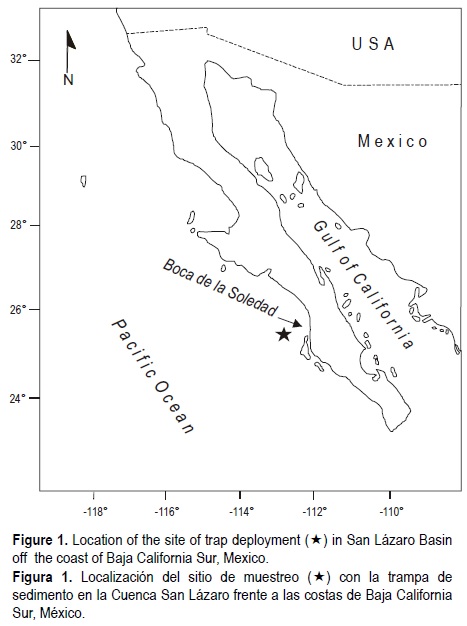
<body><![CDATA[<p align="justify"><font face="verdana" size="2"><b>Palabras clave:</b> diatomeas bent&oacute;nicas, trampa de sedimento, transporte, Pen&iacute;nsula de Baja California.</font></p>               <p>&nbsp;</p>     <p align="justify"><font face="verdana" size="2"><b>Introduction</b></font></p>          <p align="justify"><font face="verdana" size="2">When identifying benthic marine diatoms one often relies on key species or floristic inventories from distant localities, some separated by unbridgeable barriers (continents). None&#45;theless, many of the taxa are the same, at least under the morphological species concept (Mann and Kociolek, 1990), as is the case for the coasts of England, Indian Ocean and Baja California Peninsula (Siqueiros&#45;Beltrones, 2002). This wide distribution of benthic diatom species could be explained on the basis of a dispersion biogeographic model considering basic oceanic circulation. The mechanisms of dispersion may not be clear because there is not enough oceanographic information available on a local or regional basis. However, particular environments and/or substrates contain characteristic diatom assemblages. The presence of certain taxa found in some highly productive areas, such as seagrass or mangrove ecosystems, may be used as an indicator of the influence that such systems exert on the offshore environment, which suggests the existence of some type of mechanism for dispersion.</font></p>          <p align="justify"><font face="verdana" size="2">Highly productive diatom mats on the continental shelf have been detected down to water depths of 40 m, caused by the successful establishment of benthic diatoms transported from inshore sediments. They settle and may grow well even under low light levels, possibly down to depths of 200 m (Cahoon <i>et al.,</i> 1990).</font></p>          <p align="justify"><font face="verdana" size="2">The marine sediment record of benthic diatoms may provide evidence of displacement of shallow&#45;water material, or when the diatoms are autochthonous, indicate the depth of the sea floor at the time of sediment deposition. The features of marine benthic diatoms that make such applications possible are: (1) in general, benthic forms are readily distinguished from planktonic ones; and (2) benthic diatoms are generally restricted to depths of less than &#126;100 m.</font></p>          <p align="justify"><font face="verdana" size="2">Recognition of associations that recur in similar habitats at different geographic locations is useful for the understanding of habitat preference or selection. Trap samples of particulate matter from 300 m depth in San L&aacute;zaro Basin, about 100 km offshore, showed a much greater component of benthic than planktonic diatom species. To evaluate the origin of these species and the possibility of transport from another location to the sampling site, we have undertaken the precise taxonomic identification and description of the assemblage structure of the benthic diatoms, and determined their flux variations in the area.</font></p>              <p>&nbsp;</p>              <p align="justify"><font face="verdana" size="2"><b>Materials and methods</b></font></p>          <p align="justify"><font face="verdana" size="2">Samples were collected using a 12&#45;cup Technicap PPS3/3 sediment trap, at San L&aacute;zaro Basin (25&deg;11.8' N, 112&deg;39.9' W), a semi&#45;isolated depression on the edge of the continental shelf, northwest of the highly productive Magdalena Bay lagoon system (<a href="#f1">fig. 1</a>). This system includes the northernmost presence of mangroves in the northeastern Pacific (outside the Gulf of California).</font></p>              ]]></body>
<body><![CDATA[<p align="center"><a name="f1"></a><img src="/img/revistas/ciemar/v30n4/a1f1.jpg"></p>          <p align="justify"><font face="verdana" size="2">The trap was deployed from August to November 1996 and from December 1997 to June 1998 at a depth of 300 m and a distance of 150 m from the bottom. Each cup had been acidcleaned and filled with NaCl&#45;enhanced seawater (40 ppt) containing 4% buffered formalin to preserve the samples. The trap was programmed to collect samples on an 8&#45;day basis in 1996, and a 15&#45;day basis during the second deployment. Whole trap samples were split using a MacLaren&#45;Honjo&#45;style rotary splitter. Initially, from samples of a 1/16 split, an aliquot of fresh (untreated) material was placed in a small volume sedimentation chamber and examined to estimate the proportion of "live" cells (pigmentation still evident). Subsequently, the aliquot was returned to the original split, and rinsed and centrifuged in distilled water several times in order to remove salts and preservatives. The entire split was placed in a 15&#45;mL graduated test tube and cleaned following the methods of Hasle and Fryxell (1970). In addition, selected historical phytoplankton samples from surface net tows obtained at the northern entrance (Boca de La Soledad) of Magdalena Bay were analyzed for benthic diatom species.</font></p>      <p align="justify"><font face="verdana" size="2">For the enumeration of diatoms, the acid&#45;cleaned samples were placed in a 10&#45;mL sedimentation chamber. After a 24&#45;h settling period, the entire surface of the bottom of the chamber was examined using an Olympus CH&#45;3 inverted microscope. The resulting counts were converted to daily fluxes of each diatom species, calculated by multiplying by 16 to obtain total trap numbers and dividing by the trap collecting surface and the number of days sampled. After enumeration, the samples were deposited on cover&#45;slips and mounted in Hyrax (R.I. = 1.65). From these slides selected diatoms were photographed at 400x and 1000x magnification.</font></p>      <p align="justify"><font face="verdana" size="2">Taxonomic determinations were done using an Olympus CH&#45;2 phase contrast microscope with mounted camera, following the classic works of Desikachary (1986&#45;1989), Hendey (1964), Hustedt (1955, 1959, 1961&#45;1966), Peragallo and Peragallo (1897&#45;1908), Schmidt <i>et al.</i> (1874&#45;1959); recent literature (Navarro, 1982; Foged, 1984; Round <i>et al.,</i> 1990); and regional studies (Siqueiros&#45;Beltrones, 2002).</font></p>      <p align="justify"><font face="verdana" size="2">Several indices were applied to the trap samples in order to describe the structure of the diatom assemblages in samples from six dates representative of the two sampling periods. Because of the scarcity of specimens all the valves present in one or two slides were counted. Planktonic forms were also enumerated.</font></p>      <p align="justify"><font face="verdana" size="2">To determine the most important taxa based on abundance and frequency the Biological Value Index was used. Diversity was measured using indices based on information theory (log 2): Shannon's H', Pielou's equitability index (J'), and the redundancy index (REDI).</font></p>      <p align="justify"><font face="verdana" size="2">Also, the similarity between samples was measured using the Jaccard and Morisita indices. The former is based solely on the presence/absence of species, while the latter also considers the abundance of each taxon.</font></p>     <p align="justify">&nbsp;</p>      <p align="justify"><font face="verdana" size="2"><b>Results and discussion</b></font></p>     <p align="justify"><font face="verdana" size="2"><i>Fluxes</i></font></p>      ]]></body>
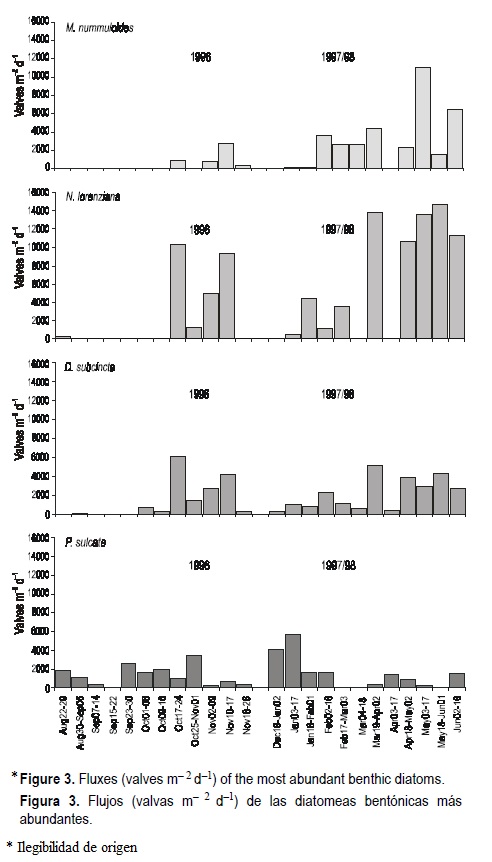
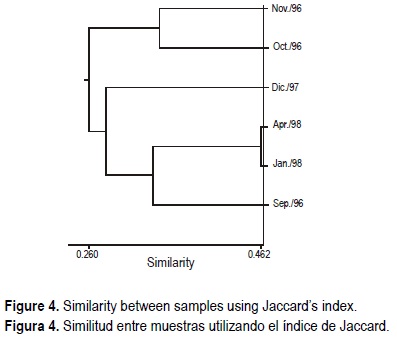
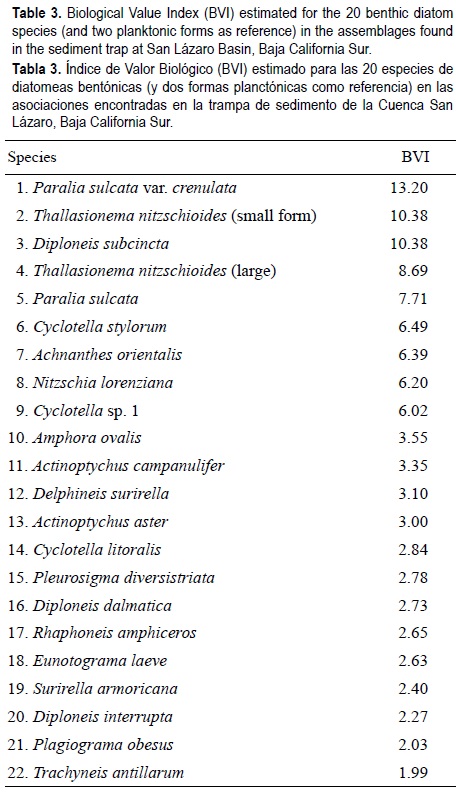
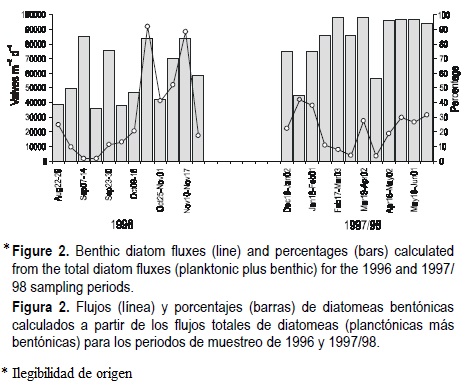
<body><![CDATA[<p align="justify"><font face="verdana" size="2">The rates of benthic diatom flux and their percentage of the total diatom flux for the two trapping periods are shown in <a href="#f2">figure 2</a>. Diatoms showed a seasonal pattern, although the two series are not contiguous. There were maxima in the fall (late October to November 1996), of 91,000 valves m<sup>&#45;2</sup> d<sup>&#45;1</sup>, and winter (late December 1997 to mid&#45;February 1998), of 88,000 valves m<sup>&#45;2</sup> d<sup>&#45;1</sup>. Higher fluxes were observed in January 1998, of 40,000 valves m<sup>&#45;2</sup> d<sup>&#45;1</sup>. A minor peak was recorded during the spring of 1998. This was associated with an increase in the percentage of benthic component after late January, amounting to more than 90% during the spring (<a href="#f2">fig. 2</a>).</font></p>  	    <p align="center"><a name="f2"></a><img src="/img/revistas/ciemar/v30n4/a1f2.jpg"></p>      <p align="justify"><font face="verdana" size="2"><i>Taxonomy and possible origins</i></font></p>      <p align="justify"><font face="verdana" size="2">A total of 93 taxa of benthic diatoms were identified in the sediment trap material. These (and four planktonic taxa) are listed in <a href="/img/revistas/ciemar/v30n4/a1t1.jpg" target="_blank">table 1</a>, with their corresponding authorities and type of environment in which they have been noted. Four abundant species <i>(Melosira nummuloides</i> Agardh, <i>Nitzschia lorenziana</i> Grunow, <i>Diploneis subcincta</i> (A.S.) Cleve, and <i>Paralia sulcata</i> (Ehr.) Cleve) accounted for about 74% of the total flux. The numeric fluxes of these species (<a href="#f3">fig. 3</a>) tended individually to follow that of the total benthic diatom flux, with most displaying notable flux variations as well.</font></p>  	    <p align="center"><a name="f3"></a><img src="/img/revistas/ciemar/v30n4/a1f3.jpg"></p>      <p align="justify"><font face="verdana" size="2">The estimated diversity values were high, similar to those of productive environments (Siqueiros&#45;Beltrones, 1990), in spite of the scarcity of specimens in the small samples available (<a href="/img/revistas/ciemar/v30n4/a1t2.jpg" target="_blank">table 2</a>). Although the lower values corresponded to lower species richness (S), equitability was also low in such cases. The highest H' value was observed in the September sample (4.76), along with the highest J' (0.867) and lowest redundancy (0.215), but not the highest S (45).</font></p>       <p align="justify"><font face="verdana" size="2">The comparison between samples showed a similar behavior with the Jaccard and Morisita indices, i.e., the grouping of the January and April 1998 samples with the highest value of similarity (<a href="#f4">fig. 4</a>). Presence/absence was relatively low (Jac = 0.462), but considering the species abundances, Morisita's index reached a value of 1. The samples for October and November 1996 were very similar but clearly segregated from the other samples. This indicated that most of the similarity was caused by abundant taxa that differed in these two months in their order of numerical importance (<a href="#t3">table 3</a>). Thus, the most abundant species in these two samples were <i>Achnanthes orientalis</i> Hustedt, <i>Diploneis subcincta</i> (A.S.) Cleve, <i>Cyclotella stylorum</i> Brightwell, <i>Nitzschia lorenziana</i> Grunow and <i>Amphora ovalis</i> K&uuml;tzing, while the other assemblages were dominated mainly by <i>Thallasionema nitzchioides</i> Grunow (two forms), <i>Paralia sulcata</i> (Ehr.) Cleve, <i>P. sulcata</i> var. <i>crenulata</i> Grunow and <i>P. sulcata</i> var. <i>radiata</i> (Grunow) Peragallo &amp; Peragallo.</font></p>      <p align="center"><a name="f4"></a><img src="/img/revistas/ciemar/v30n4/a1f4.jpg"></p>      <p align="center"><a name="t3"></a><img src="/img/revistas/ciemar/v30n4/a1t3.jpg"></p>       <p align="justify"><font face="verdana" size="2">Much of the taxonomic assemblage found in the traps is similar to that found in mangrove environments located in La Paz Bay (Siqueiros&#45;Beltrones and Morzaria&#45;Luna, 1999; Siqueiros&#45;Beltrones and S&aacute;nchez&#45;Castrej&oacute;n, 1999), or in other mangrove habitats (Navarro, 1982; Foged, 1984). Likewise, the H' values are as high as those estimated for benthic diatom assemblages in mangrove systems in the southern peninsula (Siqueiros&#45;Beltrones and S&aacute;nchez&#45;Castrej&oacute;n, 1999; L&oacute;pez&#45;Fuerte, 2002).</font></p>      ]]></body>
<body><![CDATA[<p align="justify"><font face="verdana" size="2">The <i>Cocconeis</i> species in <a href="/img/revistas/ciemar/v30n4/a1t1.jpg" target="_blank">table 1</a>, which are epilithic or epiphytic forms, are common in the rocky environment outside the Magdalena&#45;Almejas lagoon system (Siqueiros&#45;Beltrones, 2000). They are mostly pioneer species that adhere strongly to rocks or to macroalgae including corallines. Strong growth and little grazing may combine to allow waves and currents to dislodge some of the diatoms and parts of their substratum. A clump of <i>Odontinium marinum</i> Grunow was noted, partially preserved through the mounting process. In the laboratory, the formation and detachment of small clumps of other species has been observed in three&#45;week old microalgal films growing on artificial substratum (Siqueiros&#45;Beltrones, 1999).</font></p>      <p align="justify"><font face="verdana" size="2">Some of the more abundant taxa, such as <i>Diploneis subcincta</i> and <i>D. dalmatica</i> (<a href="/img/revistas/ciemar/v30n4/a1p1.jpg" target="_blank">plate 1</a>), had not been collected previously in southern Baja California. Other species, such as <i>Nitzschia capitellata</i> Hustedt and <i>Amphora coffeaeformis</i> var. <i>dussenii</i> (Brun.) A. Cleve, had not been previously recorded in the south either. <i>Diploneis subcincta</i> was recorded from the Ensenada area and San Quint&iacute;n Bay, in the northern part of Baja California, while <i>D. dalmatica</i> and <i>Pleurosigma diversistriata</i> Meister, along with 13 other taxa, constitute new records for the entire west coast of the peninsula (<a href="/img/revistas/ciemar/v30n4/a1t1.jpg" target="_blank">table 1</a>). This indicates that much floristic work remains to be done for the northwestern region of Mexico.</font></p>      <p align="justify"><font face="verdana" size="2">Only 18.6% of the taxa collected in our trap (<a href="/img/revistas/ciemar/v30n4/a1t1.jpg" target="_blank">table 1</a>) are known exclusively from mangrove environments, but 40% have been recorded from nearby mangrove and/or rocky habitats, though not in the northern (state of Baja California) part of the peninsula (Siqueiros&#45;Beltrones, 2000, 2002; Siqueiros&#45;Beltrones and Morzaria&#45;Luna, 1999). About 47% of the taxa have been collected in both extremes of the peninsula, and &#8776;20% of the taxa are unidentified species or of uncertain habitat (new records). Although we did not propose a name for those taxa, our experience indicates that they have not been observed previously in the region (Siqueiros&#45;Beltrones, 2002). Thus, the transitional nature of this region is well represented by the benthic diatom assemblage, containing species of temperate latitudes, and species of tropical (mangrove) affinity (<a href="/img/revistas/ciemar/v30n4/a1p2.jpg" target="_blank">plate 2</a>).</font></p>      <p align="justify"><font face="verdana" size="2">Analysis of historical samples collected in the shallow northern opening (Boca de La Soledad) of Magdalena Bay, which is closer to San L&aacute;zaro Basin, yielded 62 taxa of benthic diatoms. Twenty&#45;one of these taxa ocurred in the samples from the traps (<a href="/img/revistas/ciemar/v30n4/a1t1.jpg" target="_blank">table 1</a>), including the second observation of <i>Pleurosigma diversistriata,</i> plus <i>Biddulphia alternans</i> (Bailey) Van Heurck, <i>Cyclotella stylorum</i> Brightwell, <i>Cymatosira belgica</i> Van Heurck, <i>Eunotogramma leave</i> Grunow, <i>Lyrella lyra</i> f. <i>subtypica</i> (A. Schmidt) comb. nov, <i>Paralia sulcata, P. sulcata</i> var. <i>radiata, Trachyneis aspera</i> (Ehr.) Cleve and <i>T. velata</i> Peragallo. These were recorded mainly during spring (April&#45;June) when the maximum phytoplankton production occurs inside Magdalena Bay (G&aacute;rate&#45;Liz&aacute;rraga and Siqueiros&#45;Beltrones, 1998). All of these species (except <i>P. diversistriata)</i> are commonly found on mangrove prop roots in the bay (L&oacute;pez&#45;Fuerte, 2002).</font></p>      <p align="justify"><font face="verdana" size="2">Observation of the fresh material from the trap samples showed that, although loose valves and fragments were also present, most of the benthic diatoms collected were alive. The additional buoyancy provided by their organic contents would have made their transport more feasible. It is still uncertain if all of the (living) benthic diatom cells are local, which would imply that this area of the coast is an important transition region, or if some are from distant localities, which would imply a great resistance over meso&#45;scale distances. The occurrence of more temperate species this far south suggests that the California Current can apparently transport these cells to lower latitudes. On the other hand, the similarities in species composition clearly indicate a strong influence from the Magdalena&#45;Almejas lagoon system. The occurrence of benthic diatoms in the samples from tows in the northern opening of Magdalena Bay supports our assumption that biogenic material is exported from this system.</font></p>      <p align="justify"><font face="verdana" size="2">The precise method of dispersal of the benthic diatoms so that they end up being intercepted by our sediment trap at 300 m depth is not known. Some of the valves are likely carried away from the coast and interior shallow portions of Magdalena Bay by tidal currents (G&aacute;rate&#45;Liz&aacute;rraga and Siqueiros&#45;Beltrones, 1998), and exported to the shelf. Here they may undergo prolonged random dispersion by storm waves and shelf currents (Stanley and Swift, 1974) and simply sink permanently in the calm waters of San L&aacute;zaro Basin. Others may derive from the sandy shelf platform east of the basin. The trap was situated in a deep, broad valley tributary to the main basin, and may thus have been exposed to mass movements (such as sand cascades or less likely, turbidity currents) from the walls of the basin. It is difficult to imagine such seafloor&#45;hugging events being responsible for carrying the fine&#45;grained, biogenic&#45;rich material collected to the center of the valley 150 m above the bottom.</font></p>      <p align="justify"><font face="verdana" size="2">The phenomenon discussed here is relevant to this subtropical region because the export of benthic diatoms as well as dissolved and particulate carbon and nutrients contribute to biological production in this area. This could be very important during anomalous periods of oligotrophic condition related to events like El Ni&ntilde;o 1997&#45;98, since it attenuates its impact.</font></p>     <p align="justify">&nbsp;</p>      <p align="justify"><font face="verdana" size="2"><b>Acknowledgements</b></font></p>      <p align="justify"><font face="verdana" size="2">Financial support was provided by the <i>Direcci&oacute;n de Estudios de Posgrado e Investigaci&oacute;n, Instituto Polit&eacute;cnico Nacional,</i> for the research projects "Variabilidad estacional a decenal de indicadores de la productividad en el Pac&iacute;fico nororiental: Un estudio combinado de la columna de agua y los sedimentos laminados" (DEPI 966592) and "Variaci&oacute;n estacional del r&eacute;gimen biooceanogr&aacute;fico en la Cuenca San L&aacute;zaro" (DEPI 968104), and by the Mexican Consejo Nacional de Ciencia y Tecnolog&iacute;a for the same project (CONACYT 3920P&#45;T9608). Salaries for the authors are supported in part by Est&iacute;mulos al Desempe&ntilde;o en Investigaci&oacute;n (EDI fellowships) and COFFAA from the Instituto Polit&eacute;cnico Nacional.</font></p>     ]]></body>
<body><![CDATA[<p align="justify">&nbsp;</p>      <p align="justify"><font face="verdana" size="2"><b>References</b></font></p>      <!-- ref --><p align="justify"><font face="verdana" size="2">Cahoon, L.B., Redman, R.S. and Tronzo, C.R. (1990). Benthic microalgal biomass in sediments of Onslow Bay, North Carolina. Estuar. Coast. Shelf Sci., 31: 805&#45;816.    &nbsp;&nbsp;&nbsp;&nbsp;&nbsp;&nbsp;&nbsp;&nbsp;[&#160;<a href="javascript:void(0);" onclick="javascript: window.open('/scielo.php?script=sci_nlinks&ref=1878547&pid=S0185-3880200400050000100001&lng=','','width=640,height=500,resizable=yes,scrollbars=1,menubar=yes,');">Links</a>&#160;]<!-- end-ref --></font></p>      <!-- ref --><p align="justify"><font face="verdana" size="2">Desikachary, T.V. (1986). Atlas of Diatoms. Fasc. I, 8 p., Plates 1&#45;77. Madras Science Foundation, India.    &nbsp;&nbsp;&nbsp;&nbsp;&nbsp;&nbsp;&nbsp;&nbsp;[&#160;<a href="javascript:void(0);" onclick="javascript: window.open('/scielo.php?script=sci_nlinks&ref=1878549&pid=S0185-3880200400050000100002&lng=','','width=640,height=500,resizable=yes,scrollbars=1,menubar=yes,');">Links</a>&#160;]<!-- end-ref --></font></p>      <!-- ref --><p align="justify"><font face="verdana" size="2">Desikachary, T.V. (1987). Atlas of Diatoms. Fasc. II, 10 p., Plates 78&#45;221. Madras Science Foundation, India.    &nbsp;&nbsp;&nbsp;&nbsp;&nbsp;&nbsp;&nbsp;&nbsp;[&#160;<a href="javascript:void(0);" onclick="javascript: window.open('/scielo.php?script=sci_nlinks&ref=1878551&pid=S0185-3880200400050000100003&lng=','','width=640,height=500,resizable=yes,scrollbars=1,menubar=yes,');">Links</a>&#160;]<!-- end-ref --></font></p>      <!-- ref --><p align="justify"><font face="verdana" size="2">Desikachary, T.V. (1987). Atlas of Diatoms. Fasc. III, 10 p., Plates 222&#45;400. Madras Science Foundation, India.    &nbsp;&nbsp;&nbsp;&nbsp;&nbsp;&nbsp;&nbsp;&nbsp;[&#160;<a href="javascript:void(0);" onclick="javascript: window.open('/scielo.php?script=sci_nlinks&ref=1878553&pid=S0185-3880200400050000100004&lng=','','width=640,height=500,resizable=yes,scrollbars=1,menubar=yes,');">Links</a>&#160;]<!-- end-ref --></font></p>      ]]></body>
<body><![CDATA[<!-- ref --><p align="justify"><font face="verdana" size="2">Desikachary, T.V. (1988). Atlas of Diatoms. Fasc. IV, 13 p., Plates 401&#45;621. Madras Science Foundation, India.    &nbsp;&nbsp;&nbsp;&nbsp;&nbsp;&nbsp;&nbsp;&nbsp;[&#160;<a href="javascript:void(0);" onclick="javascript: window.open('/scielo.php?script=sci_nlinks&ref=1878555&pid=S0185-3880200400050000100005&lng=','','width=640,height=500,resizable=yes,scrollbars=1,menubar=yes,');">Links</a>&#160;]<!-- end-ref --></font></p>      <!-- ref --><p align="justify"><font face="verdana" size="2">Desikachary, T.V. (1989). Atlas of Diatoms. Fasc. V, 13 p., Plates 622&#45;809. Madras Science Foundation, India.    &nbsp;&nbsp;&nbsp;&nbsp;&nbsp;&nbsp;&nbsp;&nbsp;[&#160;<a href="javascript:void(0);" onclick="javascript: window.open('/scielo.php?script=sci_nlinks&ref=1878557&pid=S0185-3880200400050000100006&lng=','','width=640,height=500,resizable=yes,scrollbars=1,menubar=yes,');">Links</a>&#160;]<!-- end-ref --></font></p>      <!-- ref --><p align="justify"><font face="verdana" size="2">Foged, N. (1984). Freshwater and littoral diatoms from Cuba. Bibliotheca Diatomologica, Kramer. Germany, 123 pp., 60 plates.    &nbsp;&nbsp;&nbsp;&nbsp;&nbsp;&nbsp;&nbsp;&nbsp;[&#160;<a href="javascript:void(0);" onclick="javascript: window.open('/scielo.php?script=sci_nlinks&ref=1878559&pid=S0185-3880200400050000100007&lng=','','width=640,height=500,resizable=yes,scrollbars=1,menubar=yes,');">Links</a>&#160;]<!-- end-ref --></font></p>      <!-- ref --><p align="justify"><font face="verdana" size="2">G&aacute;rate&#45;Liz&aacute;rraga, I. and Siqueiros&#45;Beltrones, D.A. (1998). Time variation in phytoplankton assemblages in a subtropical lagoon system after the 1982&#45;1983 El Ni&ntilde;o event (1984 to 1986). Pac. Sci., 52, 79&#45;97.    &nbsp;&nbsp;&nbsp;&nbsp;&nbsp;&nbsp;&nbsp;&nbsp;[&#160;<a href="javascript:void(0);" onclick="javascript: window.open('/scielo.php?script=sci_nlinks&ref=1878561&pid=S0185-3880200400050000100008&lng=','','width=640,height=500,resizable=yes,scrollbars=1,menubar=yes,');">Links</a>&#160;]<!-- end-ref --></font></p>      <!-- ref --><p align="justify"><font face="verdana" size="2">Hasle, G.R. and Fryxell, G.A. (1970). Diatoms: Cleaning and mounting for light and electron microscopy. Trans. Am. Microscop. Soc., 89 (4): 469&#45;474.    &nbsp;&nbsp;&nbsp;&nbsp;&nbsp;&nbsp;&nbsp;&nbsp;[&#160;<a href="javascript:void(0);" onclick="javascript: window.open('/scielo.php?script=sci_nlinks&ref=1878563&pid=S0185-3880200400050000100009&lng=','','width=640,height=500,resizable=yes,scrollbars=1,menubar=yes,');">Links</a>&#160;]<!-- end-ref --></font></p>      ]]></body>
<body><![CDATA[<!-- ref --><p align="justify"><font face="verdana" size="2">Hendey, N.I. (1964). An introductory account of the smaller algae of Brittish coastal waters. Part V: Bacillarophyceae (Diatoms). Fish. Invest. Ser. IV, HMSO, London, 317 pp.    &nbsp;&nbsp;&nbsp;&nbsp;&nbsp;&nbsp;&nbsp;&nbsp;[&#160;<a href="javascript:void(0);" onclick="javascript: window.open('/scielo.php?script=sci_nlinks&ref=1878565&pid=S0185-3880200400050000100010&lng=','','width=640,height=500,resizable=yes,scrollbars=1,menubar=yes,');">Links</a>&#160;]<!-- end-ref --></font></p>      <!-- ref --><p align="justify"><font face="verdana" size="2">Hustedt, F. (1955). Marine littoral diatoms of Beaufort, North Carolina. Duke Univ. Mar. Stat. Bull., 6: 1&#45;67.    &nbsp;&nbsp;&nbsp;&nbsp;&nbsp;&nbsp;&nbsp;&nbsp;[&#160;<a href="javascript:void(0);" onclick="javascript: window.open('/scielo.php?script=sci_nlinks&ref=1878567&pid=S0185-3880200400050000100011&lng=','','width=640,height=500,resizable=yes,scrollbars=1,menubar=yes,');">Links</a>&#160;]<!-- end-ref --></font></p>      <!-- ref --><p align="justify"><font face="verdana" size="2">Hustedt, F. (1959). Die Kieselalgen Deutschland, Osterreichs und der Schweiz. In: L. Rabenhorst (ed.), Kryptogamen&#45;Flora von Deutschland, Osterreich und Schweiz, VII Band, II Teil. Koetz Scientific Books (Rep. 1991), Germany, 845 pp.    &nbsp;&nbsp;&nbsp;&nbsp;&nbsp;&nbsp;&nbsp;&nbsp;[&#160;<a href="javascript:void(0);" onclick="javascript: window.open('/scielo.php?script=sci_nlinks&ref=1878569&pid=S0185-3880200400050000100012&lng=','','width=640,height=500,resizable=yes,scrollbars=1,menubar=yes,');">Links</a>&#160;]<!-- end-ref --></font></p>      <!-- ref --><p align="justify"><font face="verdana" size="2">Hustedt, F. (1961&#45;1966). Die Kieselalgen Deutschland, Osterreichs und der Schweiz. In: L. Rabenhorst (ed.), Kryptogamen&#45;Flora von Deutschland, Osterreich und Schweiz, VII Band, III Teil. Koeltz Scientific Books (Rep. 1991), Germany, 816 pp.    &nbsp;&nbsp;&nbsp;&nbsp;&nbsp;&nbsp;&nbsp;&nbsp;[&#160;<a href="javascript:void(0);" onclick="javascript: window.open('/scielo.php?script=sci_nlinks&ref=1878571&pid=S0185-3880200400050000100013&lng=','','width=640,height=500,resizable=yes,scrollbars=1,menubar=yes,');">Links</a>&#160;]<!-- end-ref --></font></p>      <!-- ref --><p align="justify"><font face="verdana" size="2">L&oacute;pez&#45;Fuerte, F.O. (2002). Estructura de las asociaciones de diatomeas ep&iacute;fitas en ra&iacute;ces de <i>Rhizophora mangle</i> L. en Bah&iacute;a Magdalena, BCS, M&eacute;xico. B.Sc. thesis, Universidad Aut&oacute;noma de Baja California Sur, Mexico, 56 pp.    &nbsp;&nbsp;&nbsp;&nbsp;&nbsp;&nbsp;&nbsp;&nbsp;[&#160;<a href="javascript:void(0);" onclick="javascript: window.open('/scielo.php?script=sci_nlinks&ref=1878573&pid=S0185-3880200400050000100014&lng=','','width=640,height=500,resizable=yes,scrollbars=1,menubar=yes,');">Links</a>&#160;]<!-- end-ref --></font></p>      ]]></body>
<body><![CDATA[<!-- ref --><p align="justify"><font face="verdana" size="2">Mann, D.G. and Kociolek, J.P. (1990). The species concept in diatoms: Report on a workshop. In: H. Simola eEd.), Proc. 10th International Diatom Symposium, Koenigstein, Koeltz.    &nbsp;&nbsp;&nbsp;&nbsp;&nbsp;&nbsp;&nbsp;&nbsp;[&#160;<a href="javascript:void(0);" onclick="javascript: window.open('/scielo.php?script=sci_nlinks&ref=1878575&pid=S0185-3880200400050000100015&lng=','','width=640,height=500,resizable=yes,scrollbars=1,menubar=yes,');">Links</a>&#160;]<!-- end-ref --></font></p>      <!-- ref --><p align="justify"><font face="verdana" size="2">Navarro, N. (1982). Marine diatoms associated with mangrove prop roots in the Indian River, Florida, USA. Bibliotheca Phycologica, 61: 1&#45;151, 37 plates.    &nbsp;&nbsp;&nbsp;&nbsp;&nbsp;&nbsp;&nbsp;&nbsp;[&#160;<a href="javascript:void(0);" onclick="javascript: window.open('/scielo.php?script=sci_nlinks&ref=1878577&pid=S0185-3880200400050000100016&lng=','','width=640,height=500,resizable=yes,scrollbars=1,menubar=yes,');">Links</a>&#160;]<!-- end-ref --></font></p>      <!-- ref --><p align="justify"><font face="verdana" size="2">Peragallo, H. and Peragallo, M. (1897&#45;1908). Diatomees marines de France et districts maritimes voisins. Ed. M.J. Tempere, Grez&#45;sur&#45;Loing, France, 492 pp.    &nbsp;&nbsp;&nbsp;&nbsp;&nbsp;&nbsp;&nbsp;&nbsp;[&#160;<a href="javascript:void(0);" onclick="javascript: window.open('/scielo.php?script=sci_nlinks&ref=1878579&pid=S0185-3880200400050000100017&lng=','','width=640,height=500,resizable=yes,scrollbars=1,menubar=yes,');">Links</a>&#160;]<!-- end-ref --></font></p>      <!-- ref --><p align="justify"><font face="verdana" size="2">Round, F.E., Crawford, R.M. and Mann, D.G. (1990). The Diatoms: Biology and Morphology of the Genera. Cambridge Univ. Press, 747 pp.    &nbsp;&nbsp;&nbsp;&nbsp;&nbsp;&nbsp;&nbsp;&nbsp;[&#160;<a href="javascript:void(0);" onclick="javascript: window.open('/scielo.php?script=sci_nlinks&ref=1878581&pid=S0185-3880200400050000100018&lng=','','width=640,height=500,resizable=yes,scrollbars=1,menubar=yes,');">Links</a>&#160;]<!-- end-ref --></font></p>      <!-- ref --><p align="justify"><font face="verdana" size="2">Schmidt, A., Schmidt, M., Fricke, F., Heiden, H., M&uuml;ller, O. and Hustedt, F. (1874&#45;1959). Atlas der Diatomaceenkunde. Reisland, Leipzig.    &nbsp;&nbsp;&nbsp;&nbsp;&nbsp;&nbsp;&nbsp;&nbsp;[&#160;<a href="javascript:void(0);" onclick="javascript: window.open('/scielo.php?script=sci_nlinks&ref=1878583&pid=S0185-3880200400050000100019&lng=','','width=640,height=500,resizable=yes,scrollbars=1,menubar=yes,');">Links</a>&#160;]<!-- end-ref --></font></p>      ]]></body>
<body><![CDATA[<!-- ref --><p align="justify"><font face="verdana" size="2">Siqueiros&#45;Beltrones, D.A. (1990). A view of the indices used to assess species diversity in benthic diatoms associations. Cienc. Mar., 16(1): 91&#45;99.    &nbsp;&nbsp;&nbsp;&nbsp;&nbsp;&nbsp;&nbsp;&nbsp;[&#160;<a href="javascript:void(0);" onclick="javascript: window.open('/scielo.php?script=sci_nlinks&ref=1878585&pid=S0185-3880200400050000100020&lng=','','width=640,height=500,resizable=yes,scrollbars=1,menubar=yes,');">Links</a>&#160;]<!-- end-ref --></font></p>      <!-- ref --><p align="justify"><font face="verdana" size="2">Siqueiros&#45;Beltrones, D.A. (1999). Estructura y sucesi&oacute;n en asociaciones de diatomeas bent&oacute;nicas utilizadas como pastura de abulones <i>Haliotis</i> spp. en cultivo. Ph.D thesis, Universidad Aut&oacute;noma de Baja California, Ensenada, Mexico, 93 pp.    &nbsp;&nbsp;&nbsp;&nbsp;&nbsp;&nbsp;&nbsp;&nbsp;[&#160;<a href="javascript:void(0);" onclick="javascript: window.open('/scielo.php?script=sci_nlinks&ref=1878587&pid=S0185-3880200400050000100021&lng=','','width=640,height=500,resizable=yes,scrollbars=1,menubar=yes,');">Links</a>&#160;]<!-- end-ref --></font></p>      <!-- ref --><p align="justify"><font face="verdana" size="2">Siqueiros&#45;Beltrones, D.A. (2000). Benthic diatoms associated to abalone <i>(Haliotis),</i> Magdalena, Baja California Sur, Mexico. Oce&aacute;nides, 15(1): 35&#45;46.    &nbsp;&nbsp;&nbsp;&nbsp;&nbsp;&nbsp;&nbsp;&nbsp;[&#160;<a href="javascript:void(0);" onclick="javascript: window.open('/scielo.php?script=sci_nlinks&ref=1878589&pid=S0185-3880200400050000100022&lng=','','width=640,height=500,resizable=yes,scrollbars=1,menubar=yes,');">Links</a>&#160;]<!-- end-ref --></font></p>      <!-- ref --><p align="justify"><font face="verdana" size="2">Siqueiros&#45;Beltrones, D.A. (2002). Diatomeas bent&oacute;nicas de la pen&iacute;nsula de Baja California; diversidad y potencial ecol&oacute;gico. Oce&aacute;nides&#45;CICIMAR/IPN&#45;UABCS, 102 pp.    &nbsp;&nbsp;&nbsp;&nbsp;&nbsp;&nbsp;&nbsp;&nbsp;[&#160;<a href="javascript:void(0);" onclick="javascript: window.open('/scielo.php?script=sci_nlinks&ref=1878591&pid=S0185-3880200400050000100023&lng=','','width=640,height=500,resizable=yes,scrollbars=1,menubar=yes,');">Links</a>&#160;]<!-- end-ref --></font></p>      <!-- ref --><p align="justify"><font face="verdana" size="2">Siqueiros&#45;Beltrones, D.A. and Morzaria&#45;Luna, H.N. (1999). New records of marine benthic diatom species for the northwestern Mexican region. Oce&aacute;nides, 14(2): 89&#45;96.    &nbsp;&nbsp;&nbsp;&nbsp;&nbsp;&nbsp;&nbsp;&nbsp;[&#160;<a href="javascript:void(0);" onclick="javascript: window.open('/scielo.php?script=sci_nlinks&ref=1878593&pid=S0185-3880200400050000100024&lng=','','width=640,height=500,resizable=yes,scrollbars=1,menubar=yes,');">Links</a>&#160;]<!-- end-ref --></font></p>      ]]></body>
<body><![CDATA[<!-- ref --><p align="justify"><font face="verdana" size="2">Siqueiros&#45;Beltrones, D.A. and S&aacute;nchez&#45;Castrej&oacute;n, E. (1999). Structure of benthic diatom assemblages from a mangrove environment in a Mexican subtropical lagoon. Biotropica, 31(1): 48&#45;70.    &nbsp;&nbsp;&nbsp;&nbsp;&nbsp;&nbsp;&nbsp;&nbsp;[&#160;<a href="javascript:void(0);" onclick="javascript: window.open('/scielo.php?script=sci_nlinks&ref=1878595&pid=S0185-3880200400050000100025&lng=','','width=640,height=500,resizable=yes,scrollbars=1,menubar=yes,');">Links</a>&#160;]<!-- end-ref --></font></p>      <!-- ref --><p align="justify"><font face="verdana" size="2">Stanley, D.J. and Swift, D.J.P. (1974). Marine Sediment Transport and Environmental Management. John Wiley, New York, 638 pp.    &nbsp;&nbsp;&nbsp;&nbsp;&nbsp;&nbsp;&nbsp;&nbsp;[&#160;<a href="javascript:void(0);" onclick="javascript: window.open('/scielo.php?script=sci_nlinks&ref=1878597&pid=S0185-3880200400050000100026&lng=','','width=640,height=500,resizable=yes,scrollbars=1,menubar=yes,');">Links</a>&#160;]<!-- end-ref --></font></p>      ]]></body><back>
<ref-list>
<ref id="B1">
<nlm-citation citation-type="journal">
<person-group person-group-type="author">
<name>
<surname><![CDATA[Cahoon]]></surname>
<given-names><![CDATA[L.B.]]></given-names>
</name>
<name>
<surname><![CDATA[Redman]]></surname>
<given-names><![CDATA[R.S.]]></given-names>
</name>
<name>
<surname><![CDATA[Tronzo]]></surname>
<given-names><![CDATA[C.R.]]></given-names>
</name>
</person-group>
<article-title xml:lang="en"><![CDATA[Benthic microalgal biomass in sediments of Onslow Bay, North Carolina]]></article-title>
<source><![CDATA[Estuar. Coast. Shelf Sci.]]></source>
<year>1990</year>
<volume>31</volume>
<page-range>805-816</page-range></nlm-citation>
</ref>
<ref id="B2">
<nlm-citation citation-type="book">
<person-group person-group-type="author">
<name>
<surname><![CDATA[Desikachary]]></surname>
<given-names><![CDATA[T.V.]]></given-names>
</name>
</person-group>
<source><![CDATA[Atlas of Diatoms]]></source>
<year>1986</year>
<volume>I</volume>
<page-range>8</page-range><publisher-name><![CDATA[Madras Science Foundation]]></publisher-name>
</nlm-citation>
</ref>
<ref id="B3">
<nlm-citation citation-type="book">
<person-group person-group-type="author">
<name>
<surname><![CDATA[Desikachary]]></surname>
<given-names><![CDATA[T.V.]]></given-names>
</name>
</person-group>
<source><![CDATA[Atlas of Diatoms]]></source>
<year>1987</year>
<volume>II</volume>
<page-range>10</page-range><publisher-name><![CDATA[Madras Science Foundation]]></publisher-name>
</nlm-citation>
</ref>
<ref id="B4">
<nlm-citation citation-type="book">
<person-group person-group-type="author">
<name>
<surname><![CDATA[Desikachary]]></surname>
<given-names><![CDATA[T.V.]]></given-names>
</name>
</person-group>
<source><![CDATA[Atlas of Diatoms]]></source>
<year>1987</year>
<volume>III</volume>
<page-range>10</page-range><publisher-name><![CDATA[Madras Science Foundation]]></publisher-name>
</nlm-citation>
</ref>
<ref id="B5">
<nlm-citation citation-type="">
<person-group person-group-type="author">
<name>
<surname><![CDATA[Desikachary]]></surname>
<given-names><![CDATA[T.V.]]></given-names>
</name>
</person-group>
<source><![CDATA[Atlas of Diatoms]]></source>
<year>1988</year>
<volume>IV</volume>
<page-range>13</page-range></nlm-citation>
</ref>
<ref id="B6">
<nlm-citation citation-type="book">
<person-group person-group-type="author">
<name>
<surname><![CDATA[Desikachary]]></surname>
<given-names><![CDATA[T.V.]]></given-names>
</name>
</person-group>
<source><![CDATA[Atlas of Diatoms]]></source>
<year>1989</year>
<volume>V</volume>
<page-range>13</page-range><publisher-name><![CDATA[Madras Science Foundation]]></publisher-name>
</nlm-citation>
</ref>
<ref id="B7">
<nlm-citation citation-type="book">
<person-group person-group-type="author">
<name>
<surname><![CDATA[Foged]]></surname>
<given-names><![CDATA[N.]]></given-names>
</name>
</person-group>
<source><![CDATA[Freshwater and littoral diatoms from Cuba]]></source>
<year>1984</year>
<page-range>123</page-range><publisher-name><![CDATA[Kramer]]></publisher-name>
</nlm-citation>
</ref>
<ref id="B8">
<nlm-citation citation-type="journal">
<person-group person-group-type="author">
<name>
<surname><![CDATA[Gárate-Lizárraga]]></surname>
<given-names><![CDATA[I.]]></given-names>
</name>
<name>
<surname><![CDATA[Siqueiros-Beltrones]]></surname>
<given-names><![CDATA[D.A.]]></given-names>
</name>
</person-group>
<article-title xml:lang="en"><![CDATA[Time variation in phytoplankton assemblages in a subtropical lagoon system after the 1982-1983 El Niño event (1984 to 1986)]]></article-title>
<source><![CDATA[Pac. Sci.]]></source>
<year>1998</year>
<volume>52</volume>
<page-range>79-97</page-range></nlm-citation>
</ref>
<ref id="B9">
<nlm-citation citation-type="journal">
<person-group person-group-type="author">
<name>
<surname><![CDATA[Hasle]]></surname>
<given-names><![CDATA[G.R.]]></given-names>
</name>
<name>
<surname><![CDATA[Fryxell]]></surname>
<given-names><![CDATA[G.A.]]></given-names>
</name>
</person-group>
<article-title xml:lang="en"><![CDATA[Diatoms: Cleaning and mounting for light and electron microscopy]]></article-title>
<source><![CDATA[Trans. Am. Microscop. Soc.]]></source>
<year>1970</year>
<volume>89</volume>
<numero>4</numero>
<issue>4</issue>
<page-range>469-474</page-range></nlm-citation>
</ref>
<ref id="B10">
<nlm-citation citation-type="book">
<person-group person-group-type="author">
<name>
<surname><![CDATA[Hendey]]></surname>
<given-names><![CDATA[N.I.]]></given-names>
</name>
</person-group>
<source><![CDATA[An introductory account of the smaller algae of Brittish coastal waters. Part V: Bacillarophyceae (Diatoms)]]></source>
<year>1964</year>
<page-range>317</page-range><publisher-loc><![CDATA[London ]]></publisher-loc>
<publisher-name><![CDATA[HMSO]]></publisher-name>
</nlm-citation>
</ref>
<ref id="B11">
<nlm-citation citation-type="journal">
<person-group person-group-type="author">
<name>
<surname><![CDATA[Hustedt]]></surname>
<given-names><![CDATA[F.]]></given-names>
</name>
</person-group>
<article-title xml:lang="en"><![CDATA[Marine littoral diatoms of Beaufort, North Carolina]]></article-title>
<source><![CDATA[Duke Univ. Mar. Stat. Bull.]]></source>
<year>1955</year>
<volume>6</volume>
<page-range>1-67</page-range></nlm-citation>
</ref>
<ref id="B12">
<nlm-citation citation-type="book">
<person-group person-group-type="author">
<name>
<surname><![CDATA[Hustedt]]></surname>
<given-names><![CDATA[F.]]></given-names>
</name>
</person-group>
<article-title xml:lang="de"><![CDATA[Die Kieselalgen Deutschland, Osterreichs und der Schweiz]]></article-title>
<person-group person-group-type="editor">
<name>
<surname><![CDATA[Rabenhorst]]></surname>
<given-names><![CDATA[L.]]></given-names>
</name>
</person-group>
<source><![CDATA[Kryptogamen-Flora von Deutschland, Osterreich und Schweiz, VII Band, II Teil]]></source>
<year>1959</year>
<page-range>845</page-range><publisher-name><![CDATA[Koetz Scientific Books]]></publisher-name>
</nlm-citation>
</ref>
<ref id="B13">
<nlm-citation citation-type="book">
<person-group person-group-type="author">
<name>
<surname><![CDATA[Hustedt]]></surname>
<given-names><![CDATA[F.]]></given-names>
</name>
</person-group>
<article-title xml:lang="de"><![CDATA[Die Kieselalgen Deutschland, Osterreichs und der Schweiz]]></article-title>
<person-group person-group-type="editor">
<name>
<surname><![CDATA[Rabenhorst]]></surname>
<given-names><![CDATA[L.]]></given-names>
</name>
</person-group>
<source><![CDATA[Kryptogamen-Flora von Deutschland, Osterreich und Schweiz, VII Band, III Teil]]></source>
<year>1966</year>
<page-range>816</page-range><publisher-name><![CDATA[Koeltz Scientific Books]]></publisher-name>
</nlm-citation>
</ref>
<ref id="B14">
<nlm-citation citation-type="">
<person-group person-group-type="author">
<name>
<surname><![CDATA[López-Fuerte]]></surname>
<given-names><![CDATA[F.O.]]></given-names>
</name>
</person-group>
<source><![CDATA[Estructura de las asociaciones de diatomeas epífitas en raíces de Rhizophora mangle L. en Bahía Magdalena, BCS, México]]></source>
<year>2002</year>
<page-range>56</page-range></nlm-citation>
</ref>
<ref id="B15">
<nlm-citation citation-type="book">
<person-group person-group-type="author">
<name>
<surname><![CDATA[Mann]]></surname>
<given-names><![CDATA[D.G.]]></given-names>
</name>
<name>
<surname><![CDATA[Kociolek]]></surname>
<given-names><![CDATA[J.P.]]></given-names>
</name>
</person-group>
<article-title xml:lang="es"><![CDATA[The species concept in diatoms: Report on a workshop]]></article-title>
<person-group person-group-type="editor">
<name>
<surname><![CDATA[Simola]]></surname>
<given-names><![CDATA[H.]]></given-names>
</name>
</person-group>
<source><![CDATA[Proc. 10th International Diatom Symposium]]></source>
<year>1990</year>
<publisher-loc><![CDATA[Koenigstein ]]></publisher-loc>
<publisher-name><![CDATA[Koeltz]]></publisher-name>
</nlm-citation>
</ref>
<ref id="B16">
<nlm-citation citation-type="journal">
<person-group person-group-type="author">
<name>
<surname><![CDATA[Navarro]]></surname>
<given-names><![CDATA[N.]]></given-names>
</name>
</person-group>
<article-title xml:lang="en"><![CDATA[Marine diatoms associated with mangrove prop roots in the Indian River, Florida, USA]]></article-title>
<source><![CDATA[Bibliotheca Phycologica]]></source>
<year>1982</year>
<volume>61</volume>
<page-range>1-151</page-range></nlm-citation>
</ref>
<ref id="B17">
<nlm-citation citation-type="">
<person-group person-group-type="author">
<name>
<surname><![CDATA[Peragallo]]></surname>
<given-names><![CDATA[H.]]></given-names>
</name>
<name>
<surname><![CDATA[Peragallo]]></surname>
<given-names><![CDATA[M.]]></given-names>
</name>
</person-group>
<source><![CDATA[Diatomees marines de France et districts maritimes voisins]]></source>
<year>1908</year>
<page-range>492</page-range><publisher-loc><![CDATA[Grez-sur-Loing ]]></publisher-loc>
</nlm-citation>
</ref>
<ref id="B18">
<nlm-citation citation-type="book">
<person-group person-group-type="author">
<name>
<surname><![CDATA[Round]]></surname>
<given-names><![CDATA[F.E.]]></given-names>
</name>
<name>
<surname><![CDATA[Crawford]]></surname>
<given-names><![CDATA[R.M.]]></given-names>
</name>
<name>
<surname><![CDATA[Mann]]></surname>
<given-names><![CDATA[D.G.]]></given-names>
</name>
</person-group>
<source><![CDATA[The Diatoms: Biology and Morphology of the Genera]]></source>
<year>1990</year>
<page-range>747</page-range><publisher-name><![CDATA[Cambridge Univ. Press]]></publisher-name>
</nlm-citation>
</ref>
<ref id="B19">
<nlm-citation citation-type="book">
<person-group person-group-type="author">
<name>
<surname><![CDATA[Schmidt]]></surname>
<given-names><![CDATA[A.]]></given-names>
</name>
<name>
<surname><![CDATA[Schmidt]]></surname>
<given-names><![CDATA[M.]]></given-names>
</name>
<name>
<surname><![CDATA[Fricke]]></surname>
<given-names><![CDATA[F.]]></given-names>
</name>
<name>
<surname><![CDATA[Heiden]]></surname>
<given-names><![CDATA[H.]]></given-names>
</name>
<name>
<surname><![CDATA[Müller]]></surname>
<given-names><![CDATA[O.]]></given-names>
</name>
<name>
<surname><![CDATA[Hustedt]]></surname>
<given-names><![CDATA[F.]]></given-names>
</name>
</person-group>
<source><![CDATA[Atlas der Diatomaceenkunde]]></source>
<year>1959</year>
<publisher-loc><![CDATA[Leipzig ]]></publisher-loc>
<publisher-name><![CDATA[Reisland]]></publisher-name>
</nlm-citation>
</ref>
<ref id="B20">
<nlm-citation citation-type="journal">
<person-group person-group-type="author">
<name>
<surname><![CDATA[Siqueiros-Beltrones]]></surname>
<given-names><![CDATA[D.A.]]></given-names>
</name>
</person-group>
<article-title xml:lang="en"><![CDATA[A view of the indices used to assess species diversity in benthic diatoms associations]]></article-title>
<source><![CDATA[Cienc. Mar.]]></source>
<year>1990</year>
<volume>16</volume>
<numero>1</numero>
<issue>1</issue>
<page-range>91-99</page-range></nlm-citation>
</ref>
<ref id="B21">
<nlm-citation citation-type="">
<person-group person-group-type="author">
<name>
<surname><![CDATA[Siqueiros-Beltrones]]></surname>
<given-names><![CDATA[D.A.]]></given-names>
</name>
</person-group>
<source><![CDATA[Estructura y sucesión en asociaciones de diatomeas bentónicas utilizadas como pastura de abulones Haliotis spp. en cultivo]]></source>
<year>1999</year>
<page-range>93</page-range></nlm-citation>
</ref>
<ref id="B22">
<nlm-citation citation-type="journal">
<person-group person-group-type="author">
<name>
<surname><![CDATA[Siqueiros-Beltrones]]></surname>
<given-names><![CDATA[D.A.]]></given-names>
</name>
</person-group>
<article-title xml:lang="en"><![CDATA[Benthic diatoms associated to abalone (Haliotis), Magdalena, Baja California Sur, Mexico]]></article-title>
<source><![CDATA[Oceánides]]></source>
<year>2000</year>
<volume>15</volume>
<numero>1</numero>
<issue>1</issue>
<page-range>35-46</page-range></nlm-citation>
</ref>
<ref id="B23">
<nlm-citation citation-type="book">
<person-group person-group-type="author">
<name>
<surname><![CDATA[Siqueiros-Beltrones]]></surname>
<given-names><![CDATA[D.A.]]></given-names>
</name>
</person-group>
<source><![CDATA[Diatomeas bentónicas de la península de Baja California; diversidad y potencial ecológico]]></source>
<year>2002</year>
<page-range>102</page-range><publisher-name><![CDATA[OceánidesCICIMAR/IPNUABCS]]></publisher-name>
</nlm-citation>
</ref>
<ref id="B24">
<nlm-citation citation-type="journal">
<person-group person-group-type="author">
<name>
<surname><![CDATA[Siqueiros-Beltrones]]></surname>
<given-names><![CDATA[D.A.]]></given-names>
</name>
<name>
<surname><![CDATA[Morzaria-Luna]]></surname>
<given-names><![CDATA[H.N.]]></given-names>
</name>
</person-group>
<article-title xml:lang="en"><![CDATA[New records of marine benthic diatom species for the northwestern Mexican region]]></article-title>
<source><![CDATA[Oceánides]]></source>
<year>1999</year>
<volume>14</volume>
<numero>2</numero>
<issue>2</issue>
<page-range>89-96</page-range></nlm-citation>
</ref>
<ref id="B25">
<nlm-citation citation-type="journal">
<person-group person-group-type="author">
<name>
<surname><![CDATA[Siqueiros-Beltrones]]></surname>
<given-names><![CDATA[D.A.]]></given-names>
</name>
<name>
<surname><![CDATA[Sánchez-Castrejón]]></surname>
<given-names><![CDATA[E.]]></given-names>
</name>
</person-group>
<article-title xml:lang="en"><![CDATA[Structure of benthic diatom assemblages from a mangrove environment in a Mexican subtropical lagoon]]></article-title>
<source><![CDATA[Biotropica]]></source>
<year>1999</year>
<volume>31</volume>
<numero>1</numero>
<issue>1</issue>
<page-range>48-70</page-range></nlm-citation>
</ref>
<ref id="B26">
<nlm-citation citation-type="book">
<person-group person-group-type="author">
<name>
<surname><![CDATA[Stanley]]></surname>
<given-names><![CDATA[D.J.]]></given-names>
</name>
<name>
<surname><![CDATA[Swift]]></surname>
<given-names><![CDATA[D.J.P.]]></given-names>
</name>
</person-group>
<source><![CDATA[Marine Sediment Transport and Environmental Management]]></source>
<year>1974</year>
<page-range>638</page-range><publisher-loc><![CDATA[New York ]]></publisher-loc>
<publisher-name><![CDATA[John Wiley]]></publisher-name>
</nlm-citation>
</ref>
</ref-list>
</back>
</article>