<?xml version="1.0" encoding="ISO-8859-1"?><article xmlns:mml="http://www.w3.org/1998/Math/MathML" xmlns:xlink="http://www.w3.org/1999/xlink" xmlns:xsi="http://www.w3.org/2001/XMLSchema-instance">
<front>
<journal-meta>
<journal-id>0185-3325</journal-id>
<journal-title><![CDATA[Salud mental]]></journal-title>
<abbrev-journal-title><![CDATA[Salud Ment]]></abbrev-journal-title>
<issn>0185-3325</issn>
<publisher>
<publisher-name><![CDATA[Instituto Nacional de Psiquiatría Ramón de la Fuente Muñiz]]></publisher-name>
</publisher>
</journal-meta>
<article-meta>
<article-id>S0185-33252014000600007</article-id>
<title-group>
<article-title xml:lang="en"><![CDATA[Psychometric properties of the big five inventory in a Mexican sample]]></article-title>
<article-title xml:lang="es"><![CDATA[Propiedades psicométricas del inventario de los Cinco Grandes en una muestra mexicana]]></article-title>
</title-group>
<contrib-group>
<contrib contrib-type="author">
<name>
<surname><![CDATA[Reyes Zamorano]]></surname>
<given-names><![CDATA[Ernesto]]></given-names>
</name>
<xref ref-type="aff" rid="A01"/>
</contrib>
<contrib contrib-type="author">
<name>
<surname><![CDATA[Álvarez Carrillo]]></surname>
<given-names><![CDATA[Carolina]]></given-names>
</name>
<xref ref-type="aff" rid="A02"/>
</contrib>
<contrib contrib-type="author">
<name>
<surname><![CDATA[Peredo Silva]]></surname>
<given-names><![CDATA[Ana]]></given-names>
</name>
<xref ref-type="aff" rid="A03"/>
</contrib>
<contrib contrib-type="author">
<name>
<surname><![CDATA[Miranda Sandoval]]></surname>
<given-names><![CDATA[Ana]]></given-names>
</name>
<xref ref-type="aff" rid="A03"/>
</contrib>
<contrib contrib-type="author">
<name>
<surname><![CDATA[Rebolledo Pastrana]]></surname>
<given-names><![CDATA[Itzel Montzerrat]]></given-names>
</name>
<xref ref-type="aff" rid="A03"/>
</contrib>
</contrib-group>
<aff id="A01">
<institution><![CDATA[,Instituto Nacional de Psiquiatría Ramón de la Fuente Muñiz Dirección de Servicios Clínicos ]]></institution>
<addr-line><![CDATA[México Distrito Federal]]></addr-line>
<country>México</country>
</aff>
<aff id="A02">
<institution><![CDATA[,Universidad Anáhuac Centro de Investigación en Psicología y Salud Mental ]]></institution>
<addr-line><![CDATA[México Distrito Federal]]></addr-line>
<country>México</country>
</aff>
<aff id="A03">
<institution><![CDATA[,Universidad Intercontinental Facultad de Psicología ]]></institution>
<addr-line><![CDATA[México Distrito Federal]]></addr-line>
<country>México</country>
</aff>
<pub-date pub-type="pub">
<day>00</day>
<month>12</month>
<year>2014</year>
</pub-date>
<pub-date pub-type="epub">
<day>00</day>
<month>12</month>
<year>2014</year>
</pub-date>
<volume>37</volume>
<numero>6</numero>
<fpage>491</fpage>
<lpage>497</lpage>
<copyright-statement/>
<copyright-year/>
<self-uri xlink:href="http://www.scielo.org.mx/scielo.php?script=sci_arttext&amp;pid=S0185-33252014000600007&amp;lng=en&amp;nrm=iso"></self-uri><self-uri xlink:href="http://www.scielo.org.mx/scielo.php?script=sci_abstract&amp;pid=S0185-33252014000600007&amp;lng=en&amp;nrm=iso"></self-uri><self-uri xlink:href="http://www.scielo.org.mx/scielo.php?script=sci_pdf&amp;pid=S0185-33252014000600007&amp;lng=en&amp;nrm=iso"></self-uri><abstract abstract-type="short" xml:lang="en"><p><![CDATA[Introduction One of the most researched theories of personality is the Five Factor Model, frequently evaluated through the Big Five Inventory. Even though there is a Spanish version, its psychometrical properties in Mexican population are yet unknown. Methods We evaluated 472 adults (217 male/255 female) from an open population from Mexico City. Results We obtained a total scale reliability score of &#945;=0.72. Principal Component Analysis using Velicer's Minimun Average Partial validated a 5 factor structure. We also found differences between subjects that had been diagnosed with a psychiatric or neurological disorder by a health professional in agreeableness, responsability and neuroticism. Conclusions Our results suggest that the Big Five Inventory is useful to evaluate the personality in Mexican population. However, a review of the Agreeableness scale may be needed because its low reliability and poor item loadings.]]></p></abstract>
<abstract abstract-type="short" xml:lang="es"><p><![CDATA[Antecedentes Una de las teorías de la personalidad más estudiadas es el modelo de los cinco factores, frecuentemente evaluado por medio del Inventario de los Cinco Grandes. A pesar de que existe una versión en español, aún se desconocen las características psicométricas de dicho instrumento en población mexicana. Método Se evaluaron 472 adultos (217 hombres/255 mujeres) de población abierta de la Ciudad de México. Resultados La confiabilidad fue de &#945;=0.72 para toda la escala. Por medio de un Análisis de Componentes Principales, replicamos la estructura de cinco factores de la prueba. También encontramos diferencias entre los sujetos que reportaron haber recibido alguna vez un diagnóstico psiquiátrico o neurológico por un profesionista de la salud y los que no, en las escalas de agradabilidad, responsabilidad y neuroticismo. Conclusiones Nuestros resultados sugieren que el Inventario de los Cinco Factores es útil para evaluar la personalidad en población mexicana. Sin embargo, una revisión de la escala de agradabilidad puede ser necesaria dada su baja confiabilidad y mala carga factorial de los reactivos que la componen.]]></p></abstract>
<kwd-group>
<kwd lng="en"><![CDATA[Big Five Inventory Construct]]></kwd>
<kwd lng="en"><![CDATA[Validity]]></kwd>
<kwd lng="es"><![CDATA[Inventario de los Cinco Grandes]]></kwd>
<kwd lng="es"><![CDATA[validez de constructo]]></kwd>
</kwd-group>
</article-meta>
</front><body><![CDATA[  	    <p align="justify"><font face="verdana" size="4">Art&iacute;culo original</font></p>  	    <p align="justify"><font face="verdana" size="2">&nbsp;</font></p>  	    <p align="center"><font face="verdana" size="4"><b>Psychometric properties of the big five inventory in a Mexican sample</b></font></p>  	    <p align="center"><font face="verdana" size="2">&nbsp;</font></p>  	    <p align="center"><font face="verdana" size="3"><b>Propiedades psicom&eacute;tricas del inventario de los Cinco Grandes en una muestra mexicana</b></font></p>  	    <p align="center"><font face="verdana" size="2">&nbsp;</font></p>  	    <p align="center"><font face="verdana" size="2"><b>Ernesto Reyes Zamorano,<sup>1,2</sup> Carolina &Aacute;lvarez Carrillo,<sup>2</sup> Ana Peredo Silva,<sup>3</sup> Ana Miranda Sandoval,<sup>3</sup> Itzel Montzerrat Rebolledo Pastrana<sup>3</sup></b></font></p>  	    <p align="justify"><font face="verdana" size="2">&nbsp;</font></p>  	    <p align="justify"><font face="verdana" size="2"><sup><i>1</i></sup> <i>Direcci&oacute;n de Servicios Cl&iacute;nicos, Instituto Nacional de Psiquiatr&iacute;a Ram&oacute;n de la Fuente Mu&ntilde;iz.</i></font></p>  	    ]]></body>
<body><![CDATA[<p align="justify"><font face="verdana" size="2"><i><sup>2</sup> Centro de Investigaci&oacute;n en Psicolog&iacute;a y Salud Mental, Universidad An&aacute;huac M&eacute;xico Sur.</i></font></p>  	    <p align="justify"><font face="verdana" size="2"><i><sup>3</sup> Facultad de Psicolog&iacute;a, Universidad Intercontinental.</i></font></p>  	    <p align="justify"><font face="verdana" size="2">&nbsp;</font></p>  	    <p align="justify"><font face="verdana" size="2"><b>Correspondence:</b>    <br> 	<i>Ernesto Reyes Zamorano,    <br> 	Centro de Investigaci&oacute;n en Psicolog&iacute;a y Salud Mental,    <br> 	Universidad An&aacute;huac M&eacute;xico Sur,    <br> 	Av. de las Torres 131, Olivar de los Padres, 01780, M&eacute;xico DF.</i>    <br> 	<i>E&#45;mail:</i> <a href="mailto:errezam@imp.edu.mx">errezam@imp.edu.mx</a></font></p>  	    <p align="justify"><font face="verdana" size="2">&nbsp;</font></p>  	    ]]></body>
<body><![CDATA[<p align="justify"><font face="verdana" size="2">Received first version: July 31, 2014.    <br> 	2nd. version: October 13, 2014.    <br> 	3rd. version: October 17, 2014.    <br> 	Accepted: October 20, 2014.</font></p>  	    <p align="justify"><font face="verdana" size="2">&nbsp;</font></p>  	    <p align="justify"><font face="verdana" size="2"><b>ABSTRACT</b></font></p>  	    <p align="justify"><font face="verdana" size="2"><b>Introduction</b></font></p>  	    <p align="justify"><font face="verdana" size="2">One of the most researched theories of personality is the Five Factor Model, frequently evaluated through the Big Five Inventory. Even though there is a Spanish version, its psychometrical properties in Mexican population are yet unknown.</font></p>  	    <p align="justify"><font face="verdana" size="2"><b>Methods</b></font></p>  	    <p align="justify"><font face="verdana" size="2">We evaluated 472 adults &#40;217 male/255 female) from an open population from Mexico City.</font></p>  	    ]]></body>
<body><![CDATA[<p align="justify"><font face="verdana" size="2"><b>Results</b></font></p>  	    <p align="justify"><font face="verdana" size="2">We obtained a total scale reliability score of &#945;=0.72. Principal Component Analysis using Velicer's Minimun Average Partial validated a 5 factor structure. We also found differences between subjects that had been diagnosed with a psychiatric or neurological disorder by a health professional in agreeableness, responsability and neuroticism.</font></p>  	    <p align="justify"><font face="verdana" size="2"><b>Conclusions</b></font></p>  	    <p align="justify"><font face="verdana" size="2">Our results suggest that the Big Five Inventory is useful to evaluate the personality in Mexican population. However, a review of the Agreeableness scale may be needed because its low reliability and poor item loadings.</font></p>  	    <p align="justify"><font face="verdana" size="2"><b>Key words:</b> Big Five Inventory Construct, Validity.</font></p>  	    <p align="justify"><font face="verdana" size="2">&nbsp;</font></p>  	    <p align="justify"><font face="verdana" size="2"><b>RESUMEN</b></font></p>  	    <p align="justify"><font face="verdana" size="2"><b>Antecedentes</b></font></p>  	    <p align="justify"><font face="verdana" size="2">Una de las teor&iacute;as de la personalidad m&aacute;s estudiadas es el modelo de los cinco factores, frecuentemente evaluado por medio del Inventario de los Cinco Grandes. A pesar de que existe una versi&oacute;n en espa&ntilde;ol, a&uacute;n se desconocen las caracter&iacute;sticas psicom&eacute;tricas de dicho instrumento en poblaci&oacute;n mexicana.</font></p>  	    <p align="justify"><font face="verdana" size="2"><b>M&eacute;todo</b></font></p>  	    ]]></body>
<body><![CDATA[<p align="justify"><font face="verdana" size="2">Se evaluaron 472 adultos &#40;217 hombres/255 mujeres) de poblaci&oacute;n abierta de la Ciudad de M&eacute;xico.</font></p>  	    <p align="justify"><font face="verdana" size="2"><b>Resultados</b></font></p>  	    <p align="justify"><font face="verdana" size="2">La confiabilidad fue de &#945;=0.72 para toda la escala. Por medio de un An&aacute;lisis de Componentes Principales, replicamos la estructura de cinco factores de la prueba. Tambi&eacute;n encontramos diferencias entre los sujetos que reportaron haber recibido alguna vez un diagn&oacute;stico psiqui&aacute;trico o neurol&oacute;gico por un profesionista de la salud y los que no, en las escalas de agradabilidad, responsabilidad y neuroticismo.</font></p>  	    <p align="justify"><font face="verdana" size="2"><b>Conclusiones</b></font></p>  	    <p align="justify"><font face="verdana" size="2">Nuestros resultados sugieren que el Inventario de los Cinco Factores es &uacute;til para evaluar la personalidad en poblaci&oacute;n mexicana. Sin embargo, una revisi&oacute;n de la escala de agradabilidad puede ser necesaria dada su baja confiabilidad y mala carga factorial de los reactivos que la componen.</font></p>  	    <p align="justify"><font face="verdana" size="2"><b>Palabras clave:</b> Inventario de los Cinco Grandes, validez de constructo.</font></p>  	    <p align="justify"><font face="verdana" size="2">&nbsp;</font></p>  	    <p align="justify"><font face="verdana" size="2">&nbsp;</font></p>  	    <p align="justify"><font face="verdana" size="2"><b>INTRODUCTION</b></font></p>  	    <p align="justify"><font face="verdana" size="2">Personality is a complex pattern of deeply embedded psychological characteristics that express themselves automatically in practically every domain of psychological functioning.<sup>1</sup> One of the most commonly used models to explain exactly what these psychological characteristics are is the Five Factor Model &#40;FFM). There's a great amount of evidence about the validity of this model and it was one of two&#45;dimensional models explored as an alternative to the current categorical diagnostic method used in the fifth edition of the Diagnostic and Statistical Manual of Mental Disorders &#40;DSM&#45;5).<sup>2</sup></font></p>  	    ]]></body>
<body><![CDATA[<p align="justify"><font face="verdana" size="2">The most accepted form of the FFM was originally developed by McCrae and Costa,<sup>3</sup> who proposed the following factors: 1. energy or extroversion, 2. emotional stability or neuroticism, 3. openness to experience, 4. agreeableness and 5. conscientiousness. These characteristics are considered universal and they can be found in many cultures.</font></p>  	    <p align="justify"><font face="verdana" size="2">Overall, extroversion refers to someone's preference to be alone or with others; agreeableness defines the tendency to be kind, gentle, trustworthy and warm towards others; conscientiousness is related to the way in which tasks are developed; neuroticism is associated with a person's emotional life and openness to experience modulates cognitive experiences.<sup>4,5</sup></font></p>  	    <p align="justify"><font face="verdana" size="2">The FFM has been studied extensively and its validity has been tested in different settings. Maybe one of the most thoroughly tested and studied correlations of the model is the association between neuroticism and psychopathology. The influence of this factor on mental health has been consistently reported and there is extensive research, specially on its correlation with depression and anxiety,<sup>6&#45;14</sup> but also with schizophrenia and psychotic disorders,<sup>15&#45;17</sup> substance abuse,<sup>18,19</sup> internet gaming disorder,<sup>20</sup> the frequency in engaging in different risk behaviors,<sup>21</sup> response to treatment<sup>13,22</sup> and even health<sup>23</sup> and psychopathology in general.<sup>24,25</sup></font></p>  	    <p align="justify"><font face="verdana" size="2">Rodriguez de Diaz and Diaz Guerrero<sup>26</sup> evaluated the applicability of the FFM to the Mexican personality. These authors found a different model for Mexico of only four factors in which items were not grouped as they should according to theory. However, at least one important limitation of the Rodriguez de Diaz and Diaz Guerrero study should be considered, as they used an instrument designed for their study with unknown psychometric characteristics. So, in order to reevaluate the applicability of the FFM to the Mexican personality, it is still necessary to do it with a commonly used instrument such as the Big Five Inventory &#40;BFI).</font></p>  	    <p align="justify"><font face="verdana" size="2">Costa and McCrae<sup>4</sup> developed the "NEO&#45;PI". This is considered the gold standard in the evaluation of the FFM and has been translated and adapted into many languages of different linguistic families. Its factor structure, which has been replicated in many countries, constitutes one of the most solid evidences about the universality of the FFM. The NEO&#45;PI has 240 questions, about daily behaviors and feelings, answered in a 5 point Likert scale. Nevertheless, the number of questions and the time needed to answer them make this test inadequate in several settings. The need for less time&#45;consuming evaluations led John, Donahue and Kentle<sup>27</sup> to create the Big Five Inventory &#40;BFI), a 44 item test, based on Goldberg's lexical hypothesis,<sup>28,29</sup> that promptly evaluates the FFM. Each item is a short phrase that the person must use to evaluate how much it describes him/her through a 5 point Likert scale. It has been translated into at least 10 languages, including Spanish, and it takes less than 15 minutes to answer. Even though Benet&#45;Martinez and John<sup>30</sup> translated the BFI with the goal of it being used in different Spanish speaking countries, there have been surprisingly few studies done with Mexican population.</font></p>  	    <p align="justify"><font face="verdana" size="2">The objective of this study was to evaluate the psychometric properties of the BFI and its factorial structure in a Mexican sample. In order to do that, we used the BFI to evaluate a sample from Mexico City and hypothesized that: 1. Cronbach's alpha will be &gt;0.70 for the total test and every scale &#40;reliability), 2. we would be able to replicate the five factor structure using Principal Component Analysis &#40;validity), and 3. participants who reported that they had been diagnosed by a healthcare professional with a neurological or psychiatric illness would score significantly higher in the neuroticism factor &#40;validity).</font></p>  	    <p align="justify"><font face="verdana" size="2">&nbsp;</font></p>  	    <p align="justify"><font face="verdana" size="2"><b>METHOD</b></font></p>  	    <p align="justify"><font face="verdana" size="2">Every conditions and procedures in our study were carried out according to the international guidelines for biomedical research involving humans of the Council for International Organizations of Medical Sciences, as well as the Helsinki declaration and the Psychologist Code of Ethics of the Mexican Psychological Society.</font></p>  	    <p align="justify"><font face="verdana" size="2">Sample size was determined according to Comrey and Lee,<sup>31</sup> who urged researchers to obtain samples of 500 observations whenever possible in factor analytic studies. Since we believed our procedure allowed for false data to be collected, we added an extra 50 observations so those could be eliminated.</font></p>  	    ]]></body>
<body><![CDATA[<p align="justify"><font face="verdana" size="2">&nbsp;</font></p>  	    <p align="justify"><font face="verdana" size="2"><b>Participants</b></font></p>  	    <p align="justify"><font face="verdana" size="2">We evaluated 550 male and females, all adults between 18 and 60 years old. All subjects were inhabitants of Mexico City; Spanish was their first language and verbally expressed their acceptance to participate in the study. In addition to completing the BFI, every participant was asked whether he or she had ever been diagnosed by a healthcare professional with a neurological or mental illness. In no case we collected information that could allow the identification of a participant identity.</font></p>  	    <p align="justify"><font face="verdana" size="2">&nbsp;</font></p>  	    <p align="justify"><font face="verdana" size="2"><b>Procedure</b></font></p>  	    <p align="justify"><font face="verdana" size="2">Sample was collected through three different class projects done in two private universities in Mexico City. As class requisite, every student enrolled had to participate in a research project and the first author &#40;ERZ) offered them the opportunity to incorporate in this one. A student could choose not to participate and lead his or her own research project; no student choose this second option. As part of their participation they had to contact and evaluate at least 20 participants. Every evaluation was coded according to the student that had performed the evaluation and, in order to avoid fake information entering the analysis, the following controls were implemented:</font></p>  	    <blockquote> 		    <p align="justify"><font face="verdana" size="2">&bull; At the end of the semester and once grades had been assigned, every student was asked to anonymously write in a piece of paper whether they or anyone else they knew had falsified or made up data. The piece of paper was then deposited it in a closed box that was opened two weeks later. All questionnaires from mentioned students were eliminated from the database &#40;n=72).</font></p>  		    <p align="justify"><font face="verdana" size="2">&bull; At least six months after the semester ended, we once more contacted the students through email and asked them again if they or anyone else they knew had falsified or made up data. All questionnaires mentioned this second time &#40;n=34) had already been removed from the database in the previous step.</font></p> 	</blockquote>  	    <p align="justify"><font face="verdana" size="2">Every student was invited to participate in the preparation of this manuscript as authors. The ones who did not accept are mentioned in the Acknowledgments.</font></p>  	    ]]></body>
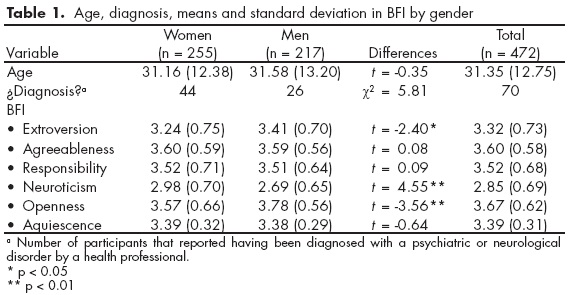
<body><![CDATA[<p align="justify"><font face="verdana" size="2">For BFI grading, we followed John, Robins &amp;&nbsp;Pervin's<sup>32</sup> and Soto, John &amp;&nbsp;Gosling<sup>33</sup> instructions. Participants who failed to answer six or more questions &#40;n=3) or who did not give their age or sex information &#40;n=3) were eliminated from the database. Next, we replaced the remaining not answered items with the rounded average from the scale to which they belonged and calculated the acquiescence and extreme answers scores which we used to ipsatize every item answer. For reliability analysis we used crude data and for validity analysis, the ipsatized scores. Every statistical analysis was done using the R Project for Statistical Computing.<sup>34</sup> Significance level was established in p &lt;0.05.</font></p>  	    <p align="justify"><font face="verdana" size="2">&nbsp;</font></p>  	    <p align="justify"><font face="verdana" size="2"><b>RESULTS</b></font></p>  	    <p align="justify"><font face="verdana" size="2">The final sample &#40;n=472) consisted of 255 &#40;54.03%) women and 217 &#40;45.97%) men. It is below the 500 we initially intended for, but it is still a "good" sample size for a factor analysis according to Comrey and Lee.<sup>31</sup> <a href="#t1">Table 1</a> shows averages, standard deviations and comparisons between genders in main variables.</font></p>  	    <p align="center"><font face="verdana" size="2"><a name="t1"></a></font></p>  	    <p align="center"><font face="verdana" size="2"><img src="/img/revistas/sm/v37n6/a7t1.jpg"></font></p>  	    <p align="center"><font face="verdana" size="2">&nbsp;</font></p>  	    <p align="justify"><font face="verdana" size="2">Statistically significant differences were found between men and women in extroversion, neuroticism and openness.</font></p>  	    <p align="justify"><font face="verdana" size="2">&bull; <i>Reliability.</i> Reliability analysis was done using Cronbach's alpha procedure. The following coefficients were obtained on each scale: extroversion a=0.76; agreeableness a=0.62; conscientiousness a=0.78; neuroticism a=0.74 and openness a=0.77. For the complete scale we obtained a reliability of a=0.72.</font></p>  	    <p align="justify"><font face="verdana" size="2">&bull; <i>Validity.</i> In order to evaluate the five factor structure, we conducted a principal component analysis &#40;PCA) with a Varimax rotation on the ipsatized data. According to the theoretical assumption, the number of components to retain was set on five. This criterion was confirmed through Velicer's Minimun Average Partial.<sup>35</sup></font></p>  	    ]]></body>
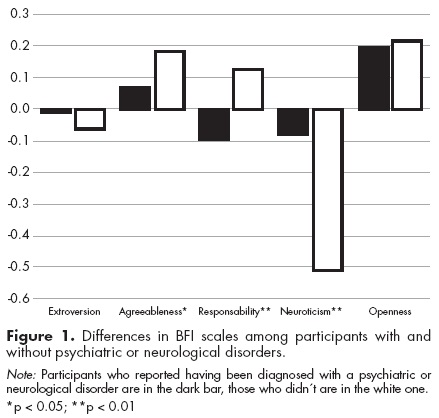
<body><![CDATA[<p align="justify"><font face="verdana" size="2">A five component solution explains 38% of the total variance and the Kaiser&#45;Meyer Olkin measure of sample adequacy was KMO=0.04. <a href="/img/revistas/sm/v37n6/a7t2.jpg" target="_blank">Table 2</a> shows the item loadings on each factor after rotation.</font></p>  	    <p align="justify"><font face="verdana" size="2">&bull; <i>Mental health.</i> Differences in the BFI between participants that had received any psychiatric or neurologic diagnosis by a healthcare professional and those who did not were evaluated through one&#45;way ANOVA tests. Differences were found in the scales of agreeableness F&#40;1,470) = 6.04 MSE = 0.13 p = 0.01 &#945;2 = 0.01, conscientiousness F&#40;1,470) = 14.46 MSE = 0.20 p &lt;&nbsp;0.01 &#945;2 = 0.03 and neuroticism F&#40;1,470) = 35.26 MSE = 0.31 p &lt;&nbsp;0.01 &#945;2= 0.07 &#40;<a href="#f1">figure 1</a>).</font></p>  	    <p align="center"><font face="verdana" size="2"><a name="f1"></a></font></p>  	    <p align="center"><font face="verdana" size="2"><img src="/img/revistas/sm/v37n6/a7f1.jpg"></font></p>  	    <p align="justify"><font face="verdana" size="2">&nbsp;</font></p>  	    <p align="justify"><font face="verdana" size="2"><b>DISCUSSION</b></font></p>  	    <p align="justify"><font face="verdana" size="2">The first interesting result in our study was the difference between men and women in three of the five factors &#40;extroversion, neuroticism, and openness) because gender differences in personality are an issue that has been studied at length. In their classic book about this, Maccoby and Jacklin<sup>36</sup> concluded that men were more assertive &#40;dominant), aggressive and less anxious than women; this result was confirmed by subsequent meta&#45;analysis.<sup>37,38</sup> However, a later review of those firsts meta&#45;analysis using new methods showed that women are more extroverted and have higher levels of anxiety than men,<sup>39</sup> which is consistent with our result of higher levels of neuroticism in women, because anxiety is one of the central characteristics of neuroticism.<sup>32</sup></font></p>  	    <p align="justify"><font face="verdana" size="2">Most of the early research exploring gender differences in the FFM suggested that these tended to be either nonexistent or very small.<sup>30</sup> However, further studies have continued to evaluate this issue and now it seems a well&#45;known fact that women tend to score higher on neuroticism and agreeableness.<sup>40</sup> This finding has been thoroughly replicated in different countries&#58; United States of America &#40;USA&#41;,<sup>41</sup> United Kingdom and Germany&#59;<sup>42</sup> multinational samples;<sup>43,44</sup> also in different age groups&#58; college students,<sup>45</sup> elderly,<sup>40</sup> across the life span&#59;<sup>42</sup> again using different FFM measures: BFI,<sup>43</sup> 15 item BFI,<sup>42</sup> NEO&#45;PI&#45;R<sup>43</sup> and NEO&#45;FFI<sup>40</sup> and even with samples from different decades.<sup>45</sup></font></p>      <p align="justify"><font face="verdana" size="2">Similar to all research available to date, in our study women scored higher in neuroticism. The effect size we found &#40;d=0.42&#41; was lower than that reported by Costa et al.,<sup>43</sup> but was well within the range of those obtained by Donellan and Lucas<sup>41</sup> in several age groups &#40;d from .30 to .64&#41; and very similar to that reported &#40;d=0.44&#41; by the International Sexuality Description Project &#40;ISDP&#41; study in a Mexican sample.<sup>44</sup></font></p>  	    <p align="justify"><font face="verdana" size="2">Differences have also been found in other factors but they are not as robust. For example Costa, Terracciano and McCrae<sup>43</sup> reported differences in openness &#40;women higher than men) in USA and other countries, but not Donnellan and Lucas, neither in a British nor a German sample.<sup>42</sup> The ISDP also found mixed results in openness across countries. In 18 of the nations evaluated, women scored higher than men, while in the other 37 &#40;included Mexico) openness was higher in men.<sup>44</sup> The effect size we found is almost three times that of the ISDP study &#40;&#45;0.33 <i>vs</i>. &#45;0.12&#41;. However, it should be noted that, while we used ipzatized data &#40;as suggested in John et al.<sup>32</sup>), Schmitt et al did not report making such adjustment to their data.<sup>44</sup></font></p>  	    ]]></body>
<body><![CDATA[<p align="justify"><font face="verdana" size="2">Concerning the reliability analysis, the Cronbach's a obtained in our study for the complete scale &#40;&#945;=0.72) could be considered acceptable.<sup>46</sup> This result is similar to the one obtained in the original Benet Mart&iacute;nez &amp;&nbsp;John<sup>30</sup> study of the Spanish version using different Spanish&#45;speaking samples, the reported by the ISDP in their Mexican sample<sup>44</sup> and is higher than Rodr&iacute;guez &amp;&nbsp;Cruch's<sup>47</sup> study of college students from the north of Mexico. It should be noted that the reliability value obtained in our study is below that reported for the BFI in other languages; for example Dutch &#945;=0.79,<sup>48</sup> Italian &#945;=0.79<sup>49</sup> or English &#945;=0.82<sup>30</sup>.</font></p>  	    <p align="justify"><font face="verdana" size="2">In the reliability analysis of each scale, only agreeableness obtained an internal consistency value that could be considered questionable &#40;&#945;=0.62). This scale was also the one that obtained the lower reliability in the original validation study<sup>30</sup> and in the study by Rodr&iacute;guez and Church.<sup>47</sup></font></p>  	    <p align="justify"><font face="verdana" size="2">The finding of lower reliability in a Mexican sample seems to be consistent across personality research, because not only was it reported by other studies using the BFI in Mexican samples,<sup>47,50</sup> it was also found in several validation studies of other personality tests for example: the Millon Index of Personality Styles,<sup>51,52</sup> the Eysenck Personality Questionnaire,<sup>53,54</sup> or the Cloninger's Temperament and Character Inventory.<sup>55</sup> Ortiz<sup>56</sup> first noticed this tendency but as of today there is no hypothesis to explain it, further research on this area is surely needed.</font></p>  	    <p align="justify"><font face="verdana" size="2">The five&#45;component solution from the PCA is consistent with both the FFM theory and the gross of BFI research. The percentage of total variance explained by this solution is similar to that reported by Rodr&iacute;guez and Church.<sup>47</sup> However, in contrast to our study, those authors could not replicate the FFM using a Varimax rotation, but we were able to do so, using an oblique one. It should be noted that Rodr&iacute;guez and Church used raw data since the acquiescence correction was not available at the time.</font></p>  	    <p align="justify"><font face="verdana" size="2">Perhaps the most noteworthy finding of the PCA is that only three of the nine questions that evaluate the agreeableness factor obtained factorial loads above 0.30. This result explains the low reliability of that scale in ours and other studies, and suggests that the design and translation of those items should be reviewed.</font></p>  	    <p align="justify"><font face="verdana" size="2">Finally, in our study, 14.83% &#40;n=70) of the sample reported that they had received a psychiatric or neurologic diagnose by a healthcare professional. This prevalence is lower than the 28.6% ICD&#45;10 psychiatric disorders reported in the National Epidemiology Psychiatric Survey done in Metropolitan Areas of Mexico.<sup>57</sup> However, it should be noted that this survey used a structured interview to establish diagnoses, so their estimation, unlike our own, also includes those subjects who, in spite of being highly likely to have a psychopathology, have never been evaluated by a health professional. It is also possible that subjects either did not remember getting a diagnosis or chose to hide such information because of the stigma of psychiatric disorders and the enrollment method &#40;i.e. an student inviting a close friend to participate in the study). If that was the case, differences in neuroticism may be greater than those observed.</font></p>  	    <p align="justify"><font face="verdana" size="2">As can be seen in <a href="#f1">figure 1</a>, and as we hypothesized, differences were found in neuroticism scores of participants that reported they had received a psychiatric or neurologic diagnose and the ones that did not. This result is coherent with the extensive literature that associates this factor with mental health disorders. Similarly to the results of our study, another common finding in the validations studies is that the neuroticism scale is the one with the lowest score &#40;for example: Denissen et al.;<sup>48</sup> Srivastava et al.<sup>58</sup>).</font></p>  	    <p align="justify"><font face="verdana" size="2">The main limitation in this study was the way the sample was contacted. Since no criterion &#40;other than inclusion criteria) was specified, students enrolled subjects with no particular order. This is hardly an ideal situation, but since reliability and validity were the main goal of this study and not normative data, this limitation may be less important. It is to be noted that averages and standard deviations for each scale in our study are not that different form those reported by Benet&#45;Mart&iacute;nez and John.<sup>30</sup> Normative data from an open population stratified random sample is still needed.</font></p>  	    <p align="justify"><font face="verdana" size="2">In conclusion, evidence from our study supports the use of the BFI to measure the FFM in Mexican population. It is a valid and reliable tool. However the reliability data and the factorial analysis suggest that the translation of the agreeableness scale should be evaluated more carefully in future studies in order to improve its internal consistency.</font></p>  	    <p align="justify"><font face="verdana" size="2">&nbsp;</font></p>  	    ]]></body>
<body><![CDATA[<p align="justify"><font face="verdana" size="2"><b>ACKNOWLEDGMENTS</b></font></p>  	    <p align="justify"><font face="verdana" size="2">Authors would like to thank: Mariana Arciniega, Jos&eacute; Barrio, Jos&eacute; Antonio Campos, Rodrigo C&aacute;rcamo, Ver&oacute;nica Carazo, Mar&iacute;a Fernanda de Rivas, Mayra D&iacute;az, Karime Fajer, Ana Gabriela Guzm&aacute;n, Alejandra Jim&eacute;nez, Cintia Elliet Mendoza, Lena Lilia G. Montes de Oca, Gabriela Orta, Lilian Montserrat Pe&ntilde;a, Marite Porras, Estibaliz Poucel, Paulina Quiroz, Mar&iacute;a Fernanda Ram&iacute;rez, Anna Karen Rodr&iacute;guez and Diana Villegas, all of them psychology students who collaborated in evaluation and data capture for this paper. This work was supported, in part, by a research grant from Pernod&#45;Ricard Foundation.</font></p>  	    <p align="justify"><font face="verdana" size="2">&nbsp;</font></p>  	    <p align="justify"><font face="verdana" size="2"><b>REFERENCES</b></font></p>  	    <!-- ref --><p align="justify"><font face="verdana" size="2">1. Millon T, Grossman S, Millon C, Meagher S et al. Personality disorders in modern life. Second edition. New Jersey: John Wiley &amp;&nbsp;Sons; 2005.    &nbsp;&nbsp;&nbsp;&nbsp;&nbsp;&nbsp;&nbsp;&nbsp;[&#160;<a href="javascript:void(0);" onclick="javascript: window.open('/scielo.php?script=sci_nlinks&ref=9110047&pid=S0185-3325201400060000700001&lng=','','width=640,height=500,resizable=yes,scrollbars=1,menubar=yes,');">Links</a>&#160;]<!-- end-ref --></font></p>  	    <!-- ref --><p align="justify"><font face="verdana" size="2">2. Skodol AE, Bender DS. The future of personality disorders in DSM&#45;V? Am J Psychiatry 2009;166&#40;4):388&#45;391.    &nbsp;&nbsp;&nbsp;&nbsp;&nbsp;&nbsp;&nbsp;&nbsp;[&#160;<a href="javascript:void(0);" onclick="javascript: window.open('/scielo.php?script=sci_nlinks&ref=9110049&pid=S0185-3325201400060000700002&lng=','','width=640,height=500,resizable=yes,scrollbars=1,menubar=yes,');">Links</a>&#160;]<!-- end-ref --></font></p>  	    <!-- ref --><p align="justify"><font face="verdana" size="2">3. McCrae R, Costa PT. Personality in adulthood: A five&#45;factor theory. New York: The Guilford Press; 2003.    &nbsp;&nbsp;&nbsp;&nbsp;&nbsp;&nbsp;&nbsp;&nbsp;[&#160;<a href="javascript:void(0);" onclick="javascript: window.open('/scielo.php?script=sci_nlinks&ref=9110051&pid=S0185-3325201400060000700003&lng=','','width=640,height=500,resizable=yes,scrollbars=1,menubar=yes,');">Links</a>&#160;]<!-- end-ref --></font></p>  	    ]]></body>
<body><![CDATA[<!-- ref --><p align="justify"><font face="verdana" size="2">4. Costa PT, McCrae R. Revised NEO Personality Invetory &#40;NEO&#45;PI R) and NEO Five&#45;Factor Inventory &#40;NEO&#45;FFI) manual. Odessa: Psychological Assessment Resources; 1992.    &nbsp;&nbsp;&nbsp;&nbsp;&nbsp;&nbsp;&nbsp;&nbsp;[&#160;<a href="javascript:void(0);" onclick="javascript: window.open('/scielo.php?script=sci_nlinks&ref=9110053&pid=S0185-3325201400060000700004&lng=','','width=640,height=500,resizable=yes,scrollbars=1,menubar=yes,');">Links</a>&#160;]<!-- end-ref --></font></p>  	    <!-- ref --><p align="justify"><font face="verdana" size="2">5. Trull TJ, Widiger TA. Dimensional models of personality: the five&#45;factor model and the DSM&#45;5. Dialogues Clin Neurosci 2013;15&#40;2):135&#45;146.    &nbsp;&nbsp;&nbsp;&nbsp;&nbsp;&nbsp;&nbsp;&nbsp;[&#160;<a href="javascript:void(0);" onclick="javascript: window.open('/scielo.php?script=sci_nlinks&ref=9110055&pid=S0185-3325201400060000700005&lng=','','width=640,height=500,resizable=yes,scrollbars=1,menubar=yes,');">Links</a>&#160;]<!-- end-ref --></font></p>  	    <!-- ref --><p align="justify"><font face="verdana" size="2">6. Aldinger M, Stopsack M, Ulrich I, Appel K et al. Neuroticism developmental courses&#45;implications for depression, anxiety and everyday emotional experience; a prospective study from adolescence to young adulthood. BMC Psychiatry 2014;14:210&#45;223.    &nbsp;&nbsp;&nbsp;&nbsp;&nbsp;&nbsp;&nbsp;&nbsp;[&#160;<a href="javascript:void(0);" onclick="javascript: window.open('/scielo.php?script=sci_nlinks&ref=9110057&pid=S0185-3325201400060000700006&lng=','','width=640,height=500,resizable=yes,scrollbars=1,menubar=yes,');">Links</a>&#160;]<!-- end-ref --></font></p>  	    <!-- ref --><p align="justify"><font face="verdana" size="2">7. Jylh&auml; P, Isomets&auml; E. The relationship of neuroticism and extraversion to symptoms of anxiety and depression in the general population. Depress Anxiety 2006;23&#40;5):281&#45;289.    &nbsp;&nbsp;&nbsp;&nbsp;&nbsp;&nbsp;&nbsp;&nbsp;[&#160;<a href="javascript:void(0);" onclick="javascript: window.open('/scielo.php?script=sci_nlinks&ref=9110059&pid=S0185-3325201400060000700007&lng=','','width=640,height=500,resizable=yes,scrollbars=1,menubar=yes,');">Links</a>&#160;]<!-- end-ref --></font></p>  	    <!-- ref --><p align="justify"><font face="verdana" size="2">8. Jylh&auml; P, Melartin T, Ryts&auml;l&auml; H, Isomets&auml; E. Neuroticism, introversion, and major depressive disorder&#45;traits, states, or scars? Depress Anxiety 2009;26&#40;4):325&#45;334.    &nbsp;&nbsp;&nbsp;&nbsp;&nbsp;&nbsp;&nbsp;&nbsp;[&#160;<a href="javascript:void(0);" onclick="javascript: window.open('/scielo.php?script=sci_nlinks&ref=9110061&pid=S0185-3325201400060000700008&lng=','','width=640,height=500,resizable=yes,scrollbars=1,menubar=yes,');">Links</a>&#160;]<!-- end-ref --></font></p>  	    ]]></body>
<body><![CDATA[<!-- ref --><p align="justify"><font face="verdana" size="2">9. Leach LS, Christensen H, Mackinnon AJ, Windsor TD, Butterworth P. Gender differences in depression and anxiety across the adult lifespan: the role of psychosocial mediators. Soc Psychiatry Psychiatr Epidemiol 2008;43&#40;12):983&#45;998.    &nbsp;&nbsp;&nbsp;&nbsp;&nbsp;&nbsp;&nbsp;&nbsp;[&#160;<a href="javascript:void(0);" onclick="javascript: window.open('/scielo.php?script=sci_nlinks&ref=9110063&pid=S0185-3325201400060000700009&lng=','','width=640,height=500,resizable=yes,scrollbars=1,menubar=yes,');">Links</a>&#160;]<!-- end-ref --></font></p>  	    <!-- ref --><p align="justify"><font face="verdana" size="2">10. Munaf Ograve MR, Clark TG, Roberts KH, Johnstone EC. Neuroti&#45;cism mediates the association of the serotonin transporter gene with lifetime major depression. Neuropsychobiology 2006;53&#40;1):1&#45;8.    &nbsp;&nbsp;&nbsp;&nbsp;&nbsp;&nbsp;&nbsp;&nbsp;[&#160;<a href="javascript:void(0);" onclick="javascript: window.open('/scielo.php?script=sci_nlinks&ref=9110065&pid=S0185-3325201400060000700010&lng=','','width=640,height=500,resizable=yes,scrollbars=1,menubar=yes,');">Links</a>&#160;]<!-- end-ref --></font></p>  	    <!-- ref --><p align="justify"><font face="verdana" size="2">11. Ormel J, Rosmalen J, Farmer A. Neuroticism: a non&#45;informative marker of vulnerability to psychopathology. Soc Psychiatry Psychiatr Epidemiol 2004;39&#40;11):906&#45;912.    &nbsp;&nbsp;&nbsp;&nbsp;&nbsp;&nbsp;&nbsp;&nbsp;[&#160;<a href="javascript:void(0);" onclick="javascript: window.open('/scielo.php?script=sci_nlinks&ref=9110067&pid=S0185-3325201400060000700011&lng=','','width=640,height=500,resizable=yes,scrollbars=1,menubar=yes,');">Links</a>&#160;]<!-- end-ref --></font></p>  	    <!-- ref --><p align="justify"><font face="verdana" size="2">12. Wang Y, Yao L, Liu L, Yang X et al. The mediating role of self&#45;efficacy in the relationship between Big five personality and depressive symptoms among Chinese unemployed population: a cross&#45;sectional study. BMC Psychiatr 2014;14:61&#45;68.    &nbsp;&nbsp;&nbsp;&nbsp;&nbsp;&nbsp;&nbsp;&nbsp;[&#160;<a href="javascript:void(0);" onclick="javascript: window.open('/scielo.php?script=sci_nlinks&ref=9110069&pid=S0185-3325201400060000700012&lng=','','width=640,height=500,resizable=yes,scrollbars=1,menubar=yes,');">Links</a>&#160;]<!-- end-ref --></font></p>  	    <!-- ref --><p align="justify"><font face="verdana" size="2">13. Wardenaar KJ, Conradi HJ, Bos EH, de Jonge P. Personality modulates the efficacy of treatment in patients with mahor depressive disorder. J Clin Psychiatry 2014;75&#40;9):916&#45;923.    &nbsp;&nbsp;&nbsp;&nbsp;&nbsp;&nbsp;&nbsp;&nbsp;[&#160;<a href="javascript:void(0);" onclick="javascript: window.open('/scielo.php?script=sci_nlinks&ref=9110071&pid=S0185-3325201400060000700013&lng=','','width=640,height=500,resizable=yes,scrollbars=1,menubar=yes,');">Links</a>&#160;]<!-- end-ref --></font></p>  	    ]]></body>
<body><![CDATA[<!-- ref --><p align="justify"><font face="verdana" size="2">14. Yeh MY, Lee Y, Sung SC, Tung TH. Clinical predictors associated with full remission versus episode of major depressive disorder outpatients: the experience at a teaching hospital in Taiwan. BMC Psychiatry 2014;14:273&#45;280.    &nbsp;&nbsp;&nbsp;&nbsp;&nbsp;&nbsp;&nbsp;&nbsp;[&#160;<a href="javascript:void(0);" onclick="javascript: window.open('/scielo.php?script=sci_nlinks&ref=9110073&pid=S0185-3325201400060000700014&lng=','','width=640,height=500,resizable=yes,scrollbars=1,menubar=yes,');">Links</a>&#160;]<!-- end-ref --></font></p>  	    <!-- ref --><p align="justify"><font face="verdana" size="2">15. Boyette LL, Korver&#45;Nieberg N, Verweij K, Meijer C et al. Associations between the five&#45;factor model personality traits and psychotic experiences in patients with psychotic disorders, their siblings and controls. Psychiatry Res 2013;210&#40;2):491&#45;497.    &nbsp;&nbsp;&nbsp;&nbsp;&nbsp;&nbsp;&nbsp;&nbsp;[&#160;<a href="javascript:void(0);" onclick="javascript: window.open('/scielo.php?script=sci_nlinks&ref=9110075&pid=S0185-3325201400060000700015&lng=','','width=640,height=500,resizable=yes,scrollbars=1,menubar=yes,');">Links</a>&#160;]<!-- end-ref --></font></p>  	    <!-- ref --><p align="justify"><font face="verdana" size="2">16. Gleeson JF, Rawlings D, Jackson HJ, McGorry PD. Agreeable&#45;ness and neuroticism as predictors of relapse after first&#45;episode psychosis: A prospective follow&#45;up study. J Nerv Ment Dis 2005;193&#40;3):160&#45;169.    &nbsp;&nbsp;&nbsp;&nbsp;&nbsp;&nbsp;&nbsp;&nbsp;[&#160;<a href="javascript:void(0);" onclick="javascript: window.open('/scielo.php?script=sci_nlinks&ref=9110077&pid=S0185-3325201400060000700016&lng=','','width=640,height=500,resizable=yes,scrollbars=1,menubar=yes,');">Links</a>&#160;]<!-- end-ref --></font></p>  	    <!-- ref --><p align="justify"><font face="verdana" size="2">17. Van Os J, Jones PB. Neuroticism as a risk factor for schizophrenia. Psychol Med 2001;31&#40;6):1129&#45;1134.    &nbsp;&nbsp;&nbsp;&nbsp;&nbsp;&nbsp;&nbsp;&nbsp;[&#160;<a href="javascript:void(0);" onclick="javascript: window.open('/scielo.php?script=sci_nlinks&ref=9110079&pid=S0185-3325201400060000700017&lng=','','width=640,height=500,resizable=yes,scrollbars=1,menubar=yes,');">Links</a>&#160;]<!-- end-ref --></font></p>  	    <!-- ref --><p align="justify"><font face="verdana" size="2">18. Kotov R, Gamez W, Schmidt F, Watson D. Linking "Big" personality traits to anxiety, depressive and substance use disorders: A metaanalysis. Psychol Bull 2010;136&#40;5):768&#45;821.    &nbsp;&nbsp;&nbsp;&nbsp;&nbsp;&nbsp;&nbsp;&nbsp;[&#160;<a href="javascript:void(0);" onclick="javascript: window.open('/scielo.php?script=sci_nlinks&ref=9110081&pid=S0185-3325201400060000700018&lng=','','width=640,height=500,resizable=yes,scrollbars=1,menubar=yes,');">Links</a>&#160;]<!-- end-ref --></font></p>  	    ]]></body>
<body><![CDATA[<!-- ref --><p align="justify"><font face="verdana" size="2">19. Terracciano A, L&ouml;ckenhoff CE, Crum RM, Bienvenu OJ et al. Five&#45;factor model personality profiles of drug users. BMC Psychiatry 2008;8:22&#45;32.    &nbsp;&nbsp;&nbsp;&nbsp;&nbsp;&nbsp;&nbsp;&nbsp;[&#160;<a href="javascript:void(0);" onclick="javascript: window.open('/scielo.php?script=sci_nlinks&ref=9110083&pid=S0185-3325201400060000700019&lng=','','width=640,height=500,resizable=yes,scrollbars=1,menubar=yes,');">Links</a>&#160;]<!-- end-ref --></font></p>  	    <!-- ref --><p align="justify"><font face="verdana" size="2">20. M&uuml;ller KW, Beutel ME, Egloff B, W&ouml;lfling K. Investigating risk factors for Internet gaming disorder: a comparison of patients with addictive gaming, pathological gamblers and healthy controls regarding the big five personality traits. Eur Addict Res 2014;20&#40;3):129&#45;136.    &nbsp;&nbsp;&nbsp;&nbsp;&nbsp;&nbsp;&nbsp;&nbsp;[&#160;<a href="javascript:void(0);" onclick="javascript: window.open('/scielo.php?script=sci_nlinks&ref=9110085&pid=S0185-3325201400060000700020&lng=','','width=640,height=500,resizable=yes,scrollbars=1,menubar=yes,');">Links</a>&#160;]<!-- end-ref --></font></p>  	    <!-- ref --><p align="justify"><font face="verdana" size="2">21. Vollrath ME, Torgersen S. Personality types and risky health behaviors in Norwegian students. Scandi J Psychol 2008;49&#40;3):287&#45;292.    &nbsp;&nbsp;&nbsp;&nbsp;&nbsp;&nbsp;&nbsp;&nbsp;[&#160;<a href="javascript:void(0);" onclick="javascript: window.open('/scielo.php?script=sci_nlinks&ref=9110087&pid=S0185-3325201400060000700021&lng=','','width=640,height=500,resizable=yes,scrollbars=1,menubar=yes,');">Links</a>&#160;]<!-- end-ref --></font></p>  	    <!-- ref --><p align="justify"><font face="verdana" size="2">22. Bagby RM, Quilty LC, Segal ZV, McBride CC et al. Personality and differential treatment response in major depression: A randomized controlled trial comparing cognitive&#45;behavioral therapy and pharmacotherapy. Can J Psychiatry 2008;53&#40;6):361&#45;370.    &nbsp;&nbsp;&nbsp;&nbsp;&nbsp;&nbsp;&nbsp;&nbsp;[&#160;<a href="javascript:void(0);" onclick="javascript: window.open('/scielo.php?script=sci_nlinks&ref=9110089&pid=S0185-3325201400060000700022&lng=','','width=640,height=500,resizable=yes,scrollbars=1,menubar=yes,');">Links</a>&#160;]<!-- end-ref --></font></p>  	    <!-- ref --><p align="justify"><font face="verdana" size="2">23. Kinnunen ML, Mets&auml;pelto RL, Feldt T, Kokko K et al. Personality profiles and health: longitudinal evidence among Finnish adults. Scand J Psychol 2012;53&#40;6):512&#45;522.    &nbsp;&nbsp;&nbsp;&nbsp;&nbsp;&nbsp;&nbsp;&nbsp;[&#160;<a href="javascript:void(0);" onclick="javascript: window.open('/scielo.php?script=sci_nlinks&ref=9110091&pid=S0185-3325201400060000700023&lng=','','width=640,height=500,resizable=yes,scrollbars=1,menubar=yes,');">Links</a>&#160;]<!-- end-ref --></font></p>  	    ]]></body>
<body><![CDATA[<!-- ref --><p align="justify"><font face="verdana" size="2">24. Granada Jim&eacute;nez O, Morales Socorro MP, L&oacute;pez&#45;Ibor Ali&ntilde;o JJ. Risk factor for psycopathology during residency. Actas Esp Psiquiatr 2010;38&#40;2):65&#45;71.    &nbsp;&nbsp;&nbsp;&nbsp;&nbsp;&nbsp;&nbsp;&nbsp;[&#160;<a href="javascript:void(0);" onclick="javascript: window.open('/scielo.php?script=sci_nlinks&ref=9110093&pid=S0185-3325201400060000700024&lng=','','width=640,height=500,resizable=yes,scrollbars=1,menubar=yes,');">Links</a>&#160;]<!-- end-ref --></font></p>  	    <!-- ref --><p align="justify"><font face="verdana" size="2">25. Mirnics Z, Heincz O, Bagdy G, Sur&aacute;nyi Z et al. The relationship between the big five personality dimensions and acute psychopathology: mediating and moderating effects of coping strategies. Psychiatria Danubia 2013;25&#40;4):379&#45;388.    &nbsp;&nbsp;&nbsp;&nbsp;&nbsp;&nbsp;&nbsp;&nbsp;[&#160;<a href="javascript:void(0);" onclick="javascript: window.open('/scielo.php?script=sci_nlinks&ref=9110095&pid=S0185-3325201400060000700025&lng=','','width=640,height=500,resizable=yes,scrollbars=1,menubar=yes,');">Links</a>&#160;]<!-- end-ref --></font></p>  	    <!-- ref --><p align="justify"><font face="verdana" size="2">26. Rodr&iacute;guez de D&iacute;az ML, D&iacute;az Guerrero R. &iquest;Son universales los rasgos de la personalidad? Revista Latinoamericana Psicolog&iacute;a 1997;29&#40;1):35&#45;48.    &nbsp;&nbsp;&nbsp;&nbsp;&nbsp;&nbsp;&nbsp;&nbsp;[&#160;<a href="javascript:void(0);" onclick="javascript: window.open('/scielo.php?script=sci_nlinks&ref=9110097&pid=S0185-3325201400060000700026&lng=','','width=640,height=500,resizable=yes,scrollbars=1,menubar=yes,');">Links</a>&#160;]<!-- end-ref --></font></p>  	    <!-- ref --><p align="justify"><font face="verdana" size="2">27. John OP, Donahue EM, Kentle RL. The Big Five Inventory&#45;Versions 4a and 54. California: Institute of Personality and Social Research; 1991.    &nbsp;&nbsp;&nbsp;&nbsp;&nbsp;&nbsp;&nbsp;&nbsp;[&#160;<a href="javascript:void(0);" onclick="javascript: window.open('/scielo.php?script=sci_nlinks&ref=9110099&pid=S0185-3325201400060000700027&lng=','','width=640,height=500,resizable=yes,scrollbars=1,menubar=yes,');">Links</a>&#160;]<!-- end-ref --></font></p>  	    <!-- ref --><p align="justify"><font face="verdana" size="2">28. Goldberg LR. Language and individual differences: The search for universals in personality lexicons. Rev Pers Soc Psychol 1981;2:141&#45;165.    &nbsp;&nbsp;&nbsp;&nbsp;&nbsp;&nbsp;&nbsp;&nbsp;[&#160;<a href="javascript:void(0);" onclick="javascript: window.open('/scielo.php?script=sci_nlinks&ref=9110101&pid=S0185-3325201400060000700028&lng=','','width=640,height=500,resizable=yes,scrollbars=1,menubar=yes,');">Links</a>&#160;]<!-- end-ref --></font></p>  	    ]]></body>
<body><![CDATA[<!-- ref --><p align="justify"><font face="verdana" size="2">29. Goldberg LR. The structure of phenotypic personality traits. Am Psychol 1993;48&#40;1):26&#45;34.    &nbsp;&nbsp;&nbsp;&nbsp;&nbsp;&nbsp;&nbsp;&nbsp;[&#160;<a href="javascript:void(0);" onclick="javascript: window.open('/scielo.php?script=sci_nlinks&ref=9110103&pid=S0185-3325201400060000700029&lng=','','width=640,height=500,resizable=yes,scrollbars=1,menubar=yes,');">Links</a>&#160;]<!-- end-ref --></font></p>  	    <!-- ref --><p align="justify"><font face="verdana" size="2">30. Benet&#45;Mart&iacute;nez V, John OP. Los cinco grandes across cultures and ethnic groups: Multitrait&#45;multimethod analyses of the Big Five in Spanish and English. J Pers Soc Psychol 1998;75&#40;3):729&#45;750.    &nbsp;&nbsp;&nbsp;&nbsp;&nbsp;&nbsp;&nbsp;&nbsp;[&#160;<a href="javascript:void(0);" onclick="javascript: window.open('/scielo.php?script=sci_nlinks&ref=9110105&pid=S0185-3325201400060000700030&lng=','','width=640,height=500,resizable=yes,scrollbars=1,menubar=yes,');">Links</a>&#160;]<!-- end-ref --></font></p>  	    <!-- ref --><p align="justify"><font face="verdana" size="2">31. Comray AL, Lee HB. A first course in factor analysis. Hillsdale: Erlbaum; 1992.    &nbsp;&nbsp;&nbsp;&nbsp;&nbsp;&nbsp;&nbsp;&nbsp;[&#160;<a href="javascript:void(0);" onclick="javascript: window.open('/scielo.php?script=sci_nlinks&ref=9110107&pid=S0185-3325201400060000700031&lng=','','width=640,height=500,resizable=yes,scrollbars=1,menubar=yes,');">Links</a>&#160;]<!-- end-ref --></font></p>  	    <!-- ref --><p align="justify"><font face="verdana" size="2">32. John OP, Robins RW, Pervin LA. Paradigm shift to integrative Big&#45;Five trait taxonomy: History, measurement and conceptual issues. In: Handbook of personality: Theory and reseach. New York: The Guilford Press; 2008.    &nbsp;&nbsp;&nbsp;&nbsp;&nbsp;&nbsp;&nbsp;&nbsp;[&#160;<a href="javascript:void(0);" onclick="javascript: window.open('/scielo.php?script=sci_nlinks&ref=9110109&pid=S0185-3325201400060000700032&lng=','','width=640,height=500,resizable=yes,scrollbars=1,menubar=yes,');">Links</a>&#160;]<!-- end-ref --></font></p>  	    <!-- ref --><p align="justify"><font face="verdana" size="2">33. Soto CJ, John OP, Gosling SD, Potter J. The developmental psychometrics of big five self&#45;reports: Acquiescence, factor structure, coherence, and differentiation from ages 10 to 20. J Pers Soc Psychol 2008;94&#40;4):718&#45;737.    &nbsp;&nbsp;&nbsp;&nbsp;&nbsp;&nbsp;&nbsp;&nbsp;[&#160;<a href="javascript:void(0);" onclick="javascript: window.open('/scielo.php?script=sci_nlinks&ref=9110111&pid=S0185-3325201400060000700033&lng=','','width=640,height=500,resizable=yes,scrollbars=1,menubar=yes,');">Links</a>&#160;]<!-- end-ref --></font></p>  	    ]]></body>
<body><![CDATA[<!-- ref --><p align="justify"><font face="verdana" size="2">34. R Core Team R: A Language and Environment for Statistical Computing. Vienna: R Foundation for Statistical Computing; 2013.    &nbsp;&nbsp;&nbsp;&nbsp;&nbsp;&nbsp;&nbsp;&nbsp;[&#160;<a href="javascript:void(0);" onclick="javascript: window.open('/scielo.php?script=sci_nlinks&ref=9110113&pid=S0185-3325201400060000700034&lng=','','width=640,height=500,resizable=yes,scrollbars=1,menubar=yes,');">Links</a>&#160;]<!-- end-ref --></font></p>  	    <!-- ref --><p align="justify"><font face="verdana" size="2">35. Velicer WF. Determining the number of components from the matrix of partial correlations. Psychometrika 1976;41&#40;3):321&#45;327.    &nbsp;&nbsp;&nbsp;&nbsp;&nbsp;&nbsp;&nbsp;&nbsp;[&#160;<a href="javascript:void(0);" onclick="javascript: window.open('/scielo.php?script=sci_nlinks&ref=9110115&pid=S0185-3325201400060000700035&lng=','','width=640,height=500,resizable=yes,scrollbars=1,menubar=yes,');">Links</a>&#160;]<!-- end-ref --></font></p>  	    <!-- ref --><p align="justify"><font face="verdana" size="2">36. Maccoby EE, Jacklin C. The psychology of sex differences. Stanford: Stanford University Press; 1974.    &nbsp;&nbsp;&nbsp;&nbsp;&nbsp;&nbsp;&nbsp;&nbsp;[&#160;<a href="javascript:void(0);" onclick="javascript: window.open('/scielo.php?script=sci_nlinks&ref=9110117&pid=S0185-3325201400060000700036&lng=','','width=640,height=500,resizable=yes,scrollbars=1,menubar=yes,');">Links</a>&#160;]<!-- end-ref --></font></p>  	    <!-- ref --><p align="justify"><font face="verdana" size="2">37. Eagly AH, Steffen VJ. Gender and aggressive behavior: A meta&#45;analytic review of the social psychological literature. Psychol Bull 1986;100&#40;3):309&#45;330.    &nbsp;&nbsp;&nbsp;&nbsp;&nbsp;&nbsp;&nbsp;&nbsp;[&#160;<a href="javascript:void(0);" onclick="javascript: window.open('/scielo.php?script=sci_nlinks&ref=9110119&pid=S0185-3325201400060000700037&lng=','','width=640,height=500,resizable=yes,scrollbars=1,menubar=yes,');">Links</a>&#160;]<!-- end-ref --></font></p>  	    <!-- ref --><p align="justify"><font face="verdana" size="2">38. Hyde JS. How large are gender differences in aggression? A developmental meta&#45;analysis. Dev Psychol 1984;20&#40;4):722&#45;736.    &nbsp;&nbsp;&nbsp;&nbsp;&nbsp;&nbsp;&nbsp;&nbsp;[&#160;<a href="javascript:void(0);" onclick="javascript: window.open('/scielo.php?script=sci_nlinks&ref=9110121&pid=S0185-3325201400060000700038&lng=','','width=640,height=500,resizable=yes,scrollbars=1,menubar=yes,');">Links</a>&#160;]<!-- end-ref --></font></p>  	    ]]></body>
<body><![CDATA[<!-- ref --><p align="justify"><font face="verdana" size="2">39. Feingold A. Gender differences in personality: A meta&#45;analysis. Psychol Bull 1994;116&#40;3):429&#45;456.    &nbsp;&nbsp;&nbsp;&nbsp;&nbsp;&nbsp;&nbsp;&nbsp;[&#160;<a href="javascript:void(0);" onclick="javascript: window.open('/scielo.php?script=sci_nlinks&ref=9110123&pid=S0185-3325201400060000700039&lng=','','width=640,height=500,resizable=yes,scrollbars=1,menubar=yes,');">Links</a>&#160;]<!-- end-ref --></font></p>  	    <!-- ref --><p align="justify"><font face="verdana" size="2">40. Chapman BP, Duberstein PR, S&ouml;rensen S, Lyness JM. Gender differences in Five Factor Model personality traits in an elderly cohort. Pers Individ Dif 2007;43&#40;6):1594&#45;1603.    &nbsp;&nbsp;&nbsp;&nbsp;&nbsp;&nbsp;&nbsp;&nbsp;[&#160;<a href="javascript:void(0);" onclick="javascript: window.open('/scielo.php?script=sci_nlinks&ref=9110125&pid=S0185-3325201400060000700040&lng=','','width=640,height=500,resizable=yes,scrollbars=1,menubar=yes,');">Links</a>&#160;]<!-- end-ref --></font></p>  	    <!-- ref --><p align="justify"><font face="verdana" size="2">41. Goodwin RD, Gotlib IH. Gender differences in depression: the role of personality factors. Psychiatry Res 2004;126&#40;2):135&#45;142.    &nbsp;&nbsp;&nbsp;&nbsp;&nbsp;&nbsp;&nbsp;&nbsp;[&#160;<a href="javascript:void(0);" onclick="javascript: window.open('/scielo.php?script=sci_nlinks&ref=9110127&pid=S0185-3325201400060000700041&lng=','','width=640,height=500,resizable=yes,scrollbars=1,menubar=yes,');">Links</a>&#160;]<!-- end-ref --></font></p>  	    <!-- ref --><p align="justify"><font face="verdana" size="2">42. Donnelan MB, Lucas RE. Age differences in the big five across the life span: Evidence from two national samples. Psychol Aging 2008;23&#40;3):558&#45;566.    &nbsp;&nbsp;&nbsp;&nbsp;&nbsp;&nbsp;&nbsp;&nbsp;[&#160;<a href="javascript:void(0);" onclick="javascript: window.open('/scielo.php?script=sci_nlinks&ref=9110129&pid=S0185-3325201400060000700042&lng=','','width=640,height=500,resizable=yes,scrollbars=1,menubar=yes,');">Links</a>&#160;]<!-- end-ref --></font></p>  	    <!-- ref --><p align="justify"><font face="verdana" size="2">43. Costa PT, Jr, Terracciano A, McCrae RR. Gender differences in personality traits across cultures: Robust and surprising findings. J Pers Soc Psychol 2001;81&#40;2):232&#45;231.    &nbsp;&nbsp;&nbsp;&nbsp;&nbsp;&nbsp;&nbsp;&nbsp;[&#160;<a href="javascript:void(0);" onclick="javascript: window.open('/scielo.php?script=sci_nlinks&ref=9110131&pid=S0185-3325201400060000700043&lng=','','width=640,height=500,resizable=yes,scrollbars=1,menubar=yes,');">Links</a>&#160;]<!-- end-ref --></font></p>  	    ]]></body>
<body><![CDATA[<!-- ref --><p align="justify"><font face="verdana" size="2">44. Schmitt DP, Realo A, Voracek M, Allik J. Why can't a man be more like a woman? Sex differences in Big Five Personality traits across 55 cultures. J Pers Soc Psychol 2008;94&#40;1):168&#45;182.    &nbsp;&nbsp;&nbsp;&nbsp;&nbsp;&nbsp;&nbsp;&nbsp;[&#160;<a href="javascript:void(0);" onclick="javascript: window.open('/scielo.php?script=sci_nlinks&ref=9110133&pid=S0185-3325201400060000700044&lng=','','width=640,height=500,resizable=yes,scrollbars=1,menubar=yes,');">Links</a>&#160;]<!-- end-ref --></font></p>  	    <!-- ref --><p align="justify"><font face="verdana" size="2">45. Budaev SV. Sex differences in the Big Five personality factors: Testing an evolutionary hypothesis. Pers Individ Dif 1999;26&#40;5):801&#45;813.    &nbsp;&nbsp;&nbsp;&nbsp;&nbsp;&nbsp;&nbsp;&nbsp;[&#160;<a href="javascript:void(0);" onclick="javascript: window.open('/scielo.php?script=sci_nlinks&ref=9110135&pid=S0185-3325201400060000700045&lng=','','width=640,height=500,resizable=yes,scrollbars=1,menubar=yes,');">Links</a>&#160;]<!-- end-ref --></font></p>  	    <!-- ref --><p align="justify"><font face="verdana" size="2">46. George D, Mallery P. SPSS for Windows Step by Step: A Simple guide and reference, 11.0 update. Columbus: Allyn and Bacon; 2003.    &nbsp;&nbsp;&nbsp;&nbsp;&nbsp;&nbsp;&nbsp;&nbsp;[&#160;<a href="javascript:void(0);" onclick="javascript: window.open('/scielo.php?script=sci_nlinks&ref=9110137&pid=S0185-3325201400060000700046&lng=','','width=640,height=500,resizable=yes,scrollbars=1,menubar=yes,');">Links</a>&#160;]<!-- end-ref --></font></p>  	    <!-- ref --><p align="justify"><font face="verdana" size="2">47. Rodr&iacute;guez C, Church AT. The Structure and personality correlates of affect in Mexico: Evidence of cross&#45;cultural comparability using the Spanish language. J Cross Cult Psychol 2003;34&#40;2):211&#45;230.    &nbsp;&nbsp;&nbsp;&nbsp;&nbsp;&nbsp;&nbsp;&nbsp;[&#160;<a href="javascript:void(0);" onclick="javascript: window.open('/scielo.php?script=sci_nlinks&ref=9110139&pid=S0185-3325201400060000700047&lng=','','width=640,height=500,resizable=yes,scrollbars=1,menubar=yes,');">Links</a>&#160;]<!-- end-ref --></font></p>  	    <!-- ref --><p align="justify"><font face="verdana" size="2">48. Denissen JJA, Geenen R, van Aken MAG, Gosling SD et al. Development and validation of a Dutch translation of the Big Five Inventory &#40;BFI). J Pers Assess 2008;90&#40;2):152&#45;157.    &nbsp;&nbsp;&nbsp;&nbsp;&nbsp;&nbsp;&nbsp;&nbsp;[&#160;<a href="javascript:void(0);" onclick="javascript: window.open('/scielo.php?script=sci_nlinks&ref=9110141&pid=S0185-3325201400060000700048&lng=','','width=640,height=500,resizable=yes,scrollbars=1,menubar=yes,');">Links</a>&#160;]<!-- end-ref --></font></p>  	    ]]></body>
<body><![CDATA[<!-- ref --><p align="justify"><font face="verdana" size="2">49. Fossati A, Borroni S, Marchione D, Maffei C. The Big Five Inventory &#40;BFI). Eur J Psychol Assess 2011;27&#40;1):50&#45;58.    &nbsp;&nbsp;&nbsp;&nbsp;&nbsp;&nbsp;&nbsp;&nbsp;[&#160;<a href="javascript:void(0);" onclick="javascript: window.open('/scielo.php?script=sci_nlinks&ref=9110143&pid=S0185-3325201400060000700049&lng=','','width=640,height=500,resizable=yes,scrollbars=1,menubar=yes,');">Links</a>&#160;]<!-- end-ref --></font></p>  	    <!-- ref --><p align="justify"><font face="verdana" size="2">50. Schmitt DP, Allik J, McCrae RR, Benet&#45;Mart&iacute;nez V. The geographic distribution of Big Five Personality traits: Patterns and profiles of human self&#45;description across 56 nations. J Cross Cult Psychol 2007;38&#40;2):173&#45;212.    &nbsp;&nbsp;&nbsp;&nbsp;&nbsp;&nbsp;&nbsp;&nbsp;[&#160;<a href="javascript:void(0);" onclick="javascript: window.open('/scielo.php?script=sci_nlinks&ref=9110145&pid=S0185-3325201400060000700050&lng=','','width=640,height=500,resizable=yes,scrollbars=1,menubar=yes,');">Links</a>&#160;]<!-- end-ref --></font></p>  	    <!-- ref --><p align="justify"><font face="verdana" size="2">51. Aparicio Garc&iacute;a ME, S&aacute;nchez&#45;L&oacute;pez, MP. Los estilos de personalidad: su medida a trav&eacute;s del inventario millon de estilos de personalidad. Anales Psicolog&iacute;a 1999;15&#40;2):191&#45;211.    &nbsp;&nbsp;&nbsp;&nbsp;&nbsp;&nbsp;&nbsp;&nbsp;[&#160;<a href="javascript:void(0);" onclick="javascript: window.open('/scielo.php?script=sci_nlinks&ref=9110147&pid=S0185-3325201400060000700051&lng=','','width=640,height=500,resizable=yes,scrollbars=1,menubar=yes,');">Links</a>&#160;]<!-- end-ref --></font></p>  	    <!-- ref --><p align="justify"><font face="verdana" size="2">52. Millon T, Weiss LG, Millon C, Davis R. The millon index of personality styles manual. San Antonio: Psychological Corporation; 1994.    &nbsp;&nbsp;&nbsp;&nbsp;&nbsp;&nbsp;&nbsp;&nbsp;[&#160;<a href="javascript:void(0);" onclick="javascript: window.open('/scielo.php?script=sci_nlinks&ref=9110149&pid=S0185-3325201400060000700052&lng=','','width=640,height=500,resizable=yes,scrollbars=1,menubar=yes,');">Links</a>&#160;]<!-- end-ref --></font></p>  	    <!-- ref --><p align="justify"><font face="verdana" size="2">53. Cort&eacute;s JF, Verduzco MA, Lara Cant&uacute;, MA. Datos adicionales sobre la validez y confiabilidad del cuestionario de personalidad de Eysenck en M&eacute;xico. Revista Mexicana Psicolog&iacute;a 1992;9:45&#45;50.    &nbsp;&nbsp;&nbsp;&nbsp;&nbsp;&nbsp;&nbsp;&nbsp;[&#160;<a href="javascript:void(0);" onclick="javascript: window.open('/scielo.php?script=sci_nlinks&ref=9110151&pid=S0185-3325201400060000700053&lng=','','width=640,height=500,resizable=yes,scrollbars=1,menubar=yes,');">Links</a>&#160;]<!-- end-ref --></font></p>  	    ]]></body>
<body><![CDATA[<!-- ref --><p align="justify"><font face="verdana" size="2">54. Eysenck HJ, Eysenck SBG. Manual of the Eysenck Personality Questionnaire. London: Hodder and Stoughton; 1975.    &nbsp;&nbsp;&nbsp;&nbsp;&nbsp;&nbsp;&nbsp;&nbsp;[&#160;<a href="javascript:void(0);" onclick="javascript: window.open('/scielo.php?script=sci_nlinks&ref=9110153&pid=S0185-3325201400060000700054&lng=','','width=640,height=500,resizable=yes,scrollbars=1,menubar=yes,');">Links</a>&#160;]<!-- end-ref --></font></p>  	    <!-- ref --><p align="justify"><font face="verdana" size="2">55. S&aacute;nchez de Carmona M, P&aacute;ez F, L&oacute;pez J, Nicoline H. Traducci&oacute;n y Confiabilidad del Inventario de Temperamento y Caracter &#40;ITC). Salud Mental 1996;19:5&#45;9.    &nbsp;&nbsp;&nbsp;&nbsp;&nbsp;&nbsp;&nbsp;&nbsp;[&#160;<a href="javascript:void(0);" onclick="javascript: window.open('/scielo.php?script=sci_nlinks&ref=9110155&pid=S0185-3325201400060000700055&lng=','','width=640,height=500,resizable=yes,scrollbars=1,menubar=yes,');">Links</a>&#160;]<!-- end-ref --></font></p>  	    <!-- ref --><p align="justify"><font face="verdana" size="2">56. Ortiz F. Structure and measurement of Mexican personality: Indigenous and cross&#45;cultural perspectives. Washington: Washington State University; 2005.    &nbsp;&nbsp;&nbsp;&nbsp;&nbsp;&nbsp;&nbsp;&nbsp;[&#160;<a href="javascript:void(0);" onclick="javascript: window.open('/scielo.php?script=sci_nlinks&ref=9110157&pid=S0185-3325201400060000700056&lng=','','width=640,height=500,resizable=yes,scrollbars=1,menubar=yes,');">Links</a>&#160;]<!-- end-ref --></font></p>  	    <!-- ref --><p align="justify"><font face="verdana" size="2">57. Media&#45;Mora ME, Borges G, Benjet C, Lara C et al. Psychiatric disorders in Mexico: lifetime prevalence in a nationally representative sample. Br J Psychiatry 2007;190&#40;6):521&#45;528.    &nbsp;&nbsp;&nbsp;&nbsp;&nbsp;&nbsp;&nbsp;&nbsp;[&#160;<a href="javascript:void(0);" onclick="javascript: window.open('/scielo.php?script=sci_nlinks&ref=9110159&pid=S0185-3325201400060000700057&lng=','','width=640,height=500,resizable=yes,scrollbars=1,menubar=yes,');">Links</a>&#160;]<!-- end-ref --></font></p>  	    <!-- ref --><p align="justify"><font face="verdana" size="2">58. Srivastava S, John OP, Gosling SD, Potter J. Development of personality in early and middle adulthood: Set like plaster or persistent change? J Pers Soc Psychol 2003;84&#40;5):1041&#45;1053.    &nbsp;&nbsp;&nbsp;&nbsp;&nbsp;&nbsp;&nbsp;&nbsp;[&#160;<a href="javascript:void(0);" onclick="javascript: window.open('/scielo.php?script=sci_nlinks&ref=9110161&pid=S0185-3325201400060000700058&lng=','','width=640,height=500,resizable=yes,scrollbars=1,menubar=yes,');">Links</a>&#160;]<!-- end-ref --></font></p>  	    ]]></body>
<body><![CDATA[<p align="center"><font face="verdana" size="2">&nbsp;</font></p>  	    <p align="center"><font face="verdana" size="2"><b>Declaration of conflict of interests: None</b></font></p>      ]]></body><back>
<ref-list>
<ref id="B1">
<label>1</label><nlm-citation citation-type="book">
<person-group person-group-type="author">
<name>
<surname><![CDATA[Millon]]></surname>
<given-names><![CDATA[T]]></given-names>
</name>
<name>
<surname><![CDATA[Grossman]]></surname>
<given-names><![CDATA[S]]></given-names>
</name>
<name>
<surname><![CDATA[Millon]]></surname>
<given-names><![CDATA[C]]></given-names>
</name>
<name>
<surname><![CDATA[Meagher]]></surname>
<given-names><![CDATA[S]]></given-names>
</name>
</person-group>
<source><![CDATA[Personality disorders in modern life]]></source>
<year>2005</year>
<edition>Second</edition>
<publisher-loc><![CDATA[^eNew Jersey New Jersey]]></publisher-loc>
<publisher-name><![CDATA[John Wiley & Sons]]></publisher-name>
</nlm-citation>
</ref>
<ref id="B2">
<label>2</label><nlm-citation citation-type="journal">
<person-group person-group-type="author">
<name>
<surname><![CDATA[Skodol]]></surname>
<given-names><![CDATA[AE]]></given-names>
</name>
<name>
<surname><![CDATA[Bender]]></surname>
<given-names><![CDATA[DS]]></given-names>
</name>
</person-group>
<article-title xml:lang="en"><![CDATA[The future of personality disorders in DSM-V?]]></article-title>
<source><![CDATA[Am J Psychiatry]]></source>
<year>2009</year>
<volume>166</volume>
<numero>4</numero>
<issue>4</issue>
<page-range>388-391</page-range></nlm-citation>
</ref>
<ref id="B3">
<label>3</label><nlm-citation citation-type="book">
<person-group person-group-type="author">
<name>
<surname><![CDATA[McCrae]]></surname>
<given-names><![CDATA[R]]></given-names>
</name>
<name>
<surname><![CDATA[Costa]]></surname>
<given-names><![CDATA[PT]]></given-names>
</name>
</person-group>
<source><![CDATA[Personality in adulthood: A five-factor theory]]></source>
<year>2003</year>
<publisher-loc><![CDATA[New York ]]></publisher-loc>
<publisher-name><![CDATA[The Guilford Press]]></publisher-name>
</nlm-citation>
</ref>
<ref id="B4">
<label>4</label><nlm-citation citation-type="book">
<person-group person-group-type="author">
<name>
<surname><![CDATA[Costa]]></surname>
<given-names><![CDATA[PT]]></given-names>
</name>
<name>
<surname><![CDATA[McCrae]]></surname>
<given-names><![CDATA[R]]></given-names>
</name>
</person-group>
<source><![CDATA[Revised NEO Personality Invetory (NEO-PI R) and NEO Five-Factor Inventory (NEO-FFI) manual]]></source>
<year>1992</year>
<publisher-loc><![CDATA[Odessa ]]></publisher-loc>
<publisher-name><![CDATA[Psychological Assessment Resources]]></publisher-name>
</nlm-citation>
</ref>
<ref id="B5">
<label>5</label><nlm-citation citation-type="journal">
<person-group person-group-type="author">
<name>
<surname><![CDATA[Trull]]></surname>
<given-names><![CDATA[TJ]]></given-names>
</name>
<name>
<surname><![CDATA[Widiger]]></surname>
<given-names><![CDATA[TA]]></given-names>
</name>
</person-group>
<article-title xml:lang="en"><![CDATA[Dimensional models of personality: the five-factor model and the DSM-5]]></article-title>
<source><![CDATA[Dialogues Clin Neurosci]]></source>
<year>2013</year>
<volume>15</volume>
<numero>2</numero>
<issue>2</issue>
<page-range>135-146</page-range></nlm-citation>
</ref>
<ref id="B6">
<label>6</label><nlm-citation citation-type="journal">
<person-group person-group-type="author">
<name>
<surname><![CDATA[Aldinger]]></surname>
<given-names><![CDATA[M]]></given-names>
</name>
<name>
<surname><![CDATA[Stopsack]]></surname>
<given-names><![CDATA[M]]></given-names>
</name>
<name>
<surname><![CDATA[Ulrich]]></surname>
<given-names><![CDATA[I]]></given-names>
</name>
<name>
<surname><![CDATA[Appel]]></surname>
<given-names><![CDATA[K]]></given-names>
</name>
</person-group>
<article-title xml:lang="en"><![CDATA[Neuroticism developmental courses-implications for depression, anxiety and everyday emotional experience; a prospective study from adolescence to young adulthood]]></article-title>
<source><![CDATA[BMC Psychiatry]]></source>
<year>2014</year>
<volume>14</volume>
<page-range>210-223</page-range></nlm-citation>
</ref>
<ref id="B7">
<label>7</label><nlm-citation citation-type="journal">
<person-group person-group-type="author">
<name>
<surname><![CDATA[Jylhä]]></surname>
<given-names><![CDATA[P]]></given-names>
</name>
<name>
<surname><![CDATA[Isometsä]]></surname>
<given-names><![CDATA[E]]></given-names>
</name>
</person-group>
<article-title xml:lang="en"><![CDATA[The relationship of neuroticism and extraversion to symptoms of anxiety and depression in the general population]]></article-title>
<source><![CDATA[Depress Anxiety]]></source>
<year>2006</year>
<volume>23</volume>
<numero>5</numero>
<issue>5</issue>
<page-range>281-289</page-range></nlm-citation>
</ref>
<ref id="B8">
<label>8</label><nlm-citation citation-type="journal">
<person-group person-group-type="author">
<name>
<surname><![CDATA[Jylhä]]></surname>
<given-names><![CDATA[P]]></given-names>
</name>
<name>
<surname><![CDATA[Melartin]]></surname>
<given-names><![CDATA[T]]></given-names>
</name>
<name>
<surname><![CDATA[Rytsälä]]></surname>
<given-names><![CDATA[H]]></given-names>
</name>
<name>
<surname><![CDATA[Isometsä]]></surname>
<given-names><![CDATA[E]]></given-names>
</name>
</person-group>
<article-title xml:lang="en"><![CDATA[Neuroticism, introversion, and major depressive disorder-traits, states, or scars?]]></article-title>
<source><![CDATA[Depress Anxiety]]></source>
<year>2009</year>
<volume>26</volume>
<numero>4</numero>
<issue>4</issue>
<page-range>325-334</page-range></nlm-citation>
</ref>
<ref id="B9">
<label>9</label><nlm-citation citation-type="journal">
<person-group person-group-type="author">
<name>
<surname><![CDATA[Leach]]></surname>
<given-names><![CDATA[LS]]></given-names>
</name>
<name>
<surname><![CDATA[Christensen]]></surname>
<given-names><![CDATA[H]]></given-names>
</name>
<name>
<surname><![CDATA[Mackinnon]]></surname>
<given-names><![CDATA[AJ]]></given-names>
</name>
<name>
<surname><![CDATA[Windsor]]></surname>
<given-names><![CDATA[TD]]></given-names>
</name>
<name>
<surname><![CDATA[Butterworth]]></surname>
<given-names><![CDATA[P]]></given-names>
</name>
</person-group>
<article-title xml:lang="en"><![CDATA[Gender differences in depression and anxiety across the adult lifespan: the role of psychosocial mediators]]></article-title>
<source><![CDATA[Soc Psychiatry Psychiatr Epidemiol]]></source>
<year>2008</year>
<volume>43</volume>
<numero>12</numero>
<issue>12</issue>
<page-range>983-998</page-range></nlm-citation>
</ref>
<ref id="B10">
<label>10</label><nlm-citation citation-type="journal">
<person-group person-group-type="author">
<name>
<surname><![CDATA[Munaf Ograve]]></surname>
<given-names><![CDATA[MR]]></given-names>
</name>
<name>
<surname><![CDATA[Clark]]></surname>
<given-names><![CDATA[TG]]></given-names>
</name>
<name>
<surname><![CDATA[Roberts]]></surname>
<given-names><![CDATA[KH]]></given-names>
</name>
<name>
<surname><![CDATA[Johnstone]]></surname>
<given-names><![CDATA[EC]]></given-names>
</name>
</person-group>
<article-title xml:lang="en"><![CDATA[Neuroti-cism mediates the association of the serotonin transporter gene with lifetime major depression]]></article-title>
<source><![CDATA[Neuropsychobiology]]></source>
<year>2006</year>
<volume>53</volume>
<numero>1</numero>
<issue>1</issue>
<page-range>1-8</page-range></nlm-citation>
</ref>
<ref id="B11">
<label>11</label><nlm-citation citation-type="journal">
<person-group person-group-type="author">
<name>
<surname><![CDATA[Ormel]]></surname>
<given-names><![CDATA[J]]></given-names>
</name>
<name>
<surname><![CDATA[Rosmalen]]></surname>
<given-names><![CDATA[J]]></given-names>
</name>
<name>
<surname><![CDATA[Farmer]]></surname>
<given-names><![CDATA[A]]></given-names>
</name>
</person-group>
<article-title xml:lang="en"><![CDATA[Neuroticism: a non-informative marker of vulnerability to psychopathology]]></article-title>
<source><![CDATA[Soc Psychiatry Psychiatr Epidemiol]]></source>
<year>2004</year>
<volume>39</volume>
<numero>11</numero>
<issue>11</issue>
<page-range>906-912</page-range></nlm-citation>
</ref>
<ref id="B12">
<label>12</label><nlm-citation citation-type="journal">
<person-group person-group-type="author">
<name>
<surname><![CDATA[Wang]]></surname>
<given-names><![CDATA[Y]]></given-names>
</name>
<name>
<surname><![CDATA[Yao]]></surname>
<given-names><![CDATA[L]]></given-names>
</name>
<name>
<surname><![CDATA[Liu]]></surname>
<given-names><![CDATA[L]]></given-names>
</name>
<name>
<surname><![CDATA[Yang]]></surname>
<given-names><![CDATA[X]]></given-names>
</name>
</person-group>
<article-title xml:lang="en"><![CDATA[The mediating role of self-efficacy in the relationship between Big five personality and depressive symptoms among Chinese unemployed population: a cross-sectional study]]></article-title>
<source><![CDATA[BMC Psychiatr]]></source>
<year>2014</year>
<volume>14</volume>
<page-range>61-68</page-range></nlm-citation>
</ref>
<ref id="B13">
<label>13</label><nlm-citation citation-type="journal">
<person-group person-group-type="author">
<name>
<surname><![CDATA[Wardenaar]]></surname>
<given-names><![CDATA[KJ]]></given-names>
</name>
<name>
<surname><![CDATA[Conradi]]></surname>
<given-names><![CDATA[HJ]]></given-names>
</name>
<name>
<surname><![CDATA[Bos]]></surname>
<given-names><![CDATA[EH]]></given-names>
</name>
<name>
<surname><![CDATA[de Jonge]]></surname>
<given-names><![CDATA[P]]></given-names>
</name>
</person-group>
<article-title xml:lang="en"><![CDATA[Personality modulates the efficacy of treatment in patients with mahor depressive disorder]]></article-title>
<source><![CDATA[J Clin Psychiatry]]></source>
<year>2014</year>
<volume>75</volume>
<numero>9</numero>
<issue>9</issue>
<page-range>916-923</page-range></nlm-citation>
</ref>
<ref id="B14">
<label>14</label><nlm-citation citation-type="journal">
<person-group person-group-type="author">
<name>
<surname><![CDATA[Yeh]]></surname>
<given-names><![CDATA[MY]]></given-names>
</name>
<name>
<surname><![CDATA[Lee]]></surname>
<given-names><![CDATA[Y]]></given-names>
</name>
<name>
<surname><![CDATA[Sung]]></surname>
<given-names><![CDATA[SC]]></given-names>
</name>
<name>
<surname><![CDATA[Tung]]></surname>
<given-names><![CDATA[TH]]></given-names>
</name>
</person-group>
<article-title xml:lang="en"><![CDATA[Clinical predictors associated with full remission versus episode of major depressive disorder outpatients: the experience at a teaching hospital in Taiwan]]></article-title>
<source><![CDATA[BMC Psychiatry]]></source>
<year>2014</year>
<volume>14</volume>
<page-range>273-280</page-range></nlm-citation>
</ref>
<ref id="B15">
<label>15</label><nlm-citation citation-type="journal">
<person-group person-group-type="author">
<name>
<surname><![CDATA[Boyette]]></surname>
<given-names><![CDATA[LL]]></given-names>
</name>
<name>
<surname><![CDATA[Korver-Nieberg]]></surname>
<given-names><![CDATA[N]]></given-names>
</name>
<name>
<surname><![CDATA[Verweij]]></surname>
<given-names><![CDATA[K]]></given-names>
</name>
<name>
<surname><![CDATA[Meijer]]></surname>
<given-names><![CDATA[C]]></given-names>
</name>
</person-group>
<article-title xml:lang="en"><![CDATA[Associations between the five-factor model personality traits and psychotic experiences in patients with psychotic disorders, their siblings and controls]]></article-title>
<source><![CDATA[Psychiatry Res]]></source>
<year>2013</year>
<volume>210</volume>
<numero>2</numero>
<issue>2</issue>
<page-range>491-497</page-range></nlm-citation>
</ref>
<ref id="B16">
<label>16</label><nlm-citation citation-type="journal">
<person-group person-group-type="author">
<name>
<surname><![CDATA[Gleeson]]></surname>
<given-names><![CDATA[JF]]></given-names>
</name>
<name>
<surname><![CDATA[Rawlings]]></surname>
<given-names><![CDATA[D]]></given-names>
</name>
<name>
<surname><![CDATA[Jackson]]></surname>
<given-names><![CDATA[HJ]]></given-names>
</name>
<name>
<surname><![CDATA[McGorry]]></surname>
<given-names><![CDATA[PD]]></given-names>
</name>
</person-group>
<article-title xml:lang="en"><![CDATA[Agreeable-ness and neuroticism as predictors of relapse after first-episode psychosis: A prospective follow-up study]]></article-title>
<source><![CDATA[J Nerv Ment Dis]]></source>
<year>2005</year>
<volume>193</volume>
<numero>3</numero>
<issue>3</issue>
<page-range>160-169</page-range></nlm-citation>
</ref>
<ref id="B17">
<label>17</label><nlm-citation citation-type="journal">
<person-group person-group-type="author">
<name>
<surname><![CDATA[Van Os]]></surname>
<given-names><![CDATA[J]]></given-names>
</name>
<name>
<surname><![CDATA[Jones]]></surname>
<given-names><![CDATA[PB]]></given-names>
</name>
</person-group>
<article-title xml:lang="en"><![CDATA[Neuroticism as a risk factor for schizophrenia]]></article-title>
<source><![CDATA[Psychol Med]]></source>
<year>2001</year>
<volume>31</volume>
<numero>6</numero>
<issue>6</issue>
<page-range>1129-1134</page-range></nlm-citation>
</ref>
<ref id="B18">
<label>18</label><nlm-citation citation-type="journal">
<person-group person-group-type="author">
<name>
<surname><![CDATA[Kotov]]></surname>
<given-names><![CDATA[R]]></given-names>
</name>
<name>
<surname><![CDATA[Gamez]]></surname>
<given-names><![CDATA[W]]></given-names>
</name>
<name>
<surname><![CDATA[Schmidt]]></surname>
<given-names><![CDATA[F]]></given-names>
</name>
<name>
<surname><![CDATA[Watson]]></surname>
<given-names><![CDATA[D]]></given-names>
</name>
</person-group>
<article-title xml:lang="es"><![CDATA[Linking "Big" personality traits to anxiety, depressive and substance use disorders: A metaanalysis]]></article-title>
<source><![CDATA[Psychol Bull]]></source>
<year>2010</year>
<volume>136</volume>
<numero>5</numero>
<issue>5</issue>
<page-range>768-821</page-range></nlm-citation>
</ref>
<ref id="B19">
<label>19</label><nlm-citation citation-type="journal">
<person-group person-group-type="author">
<name>
<surname><![CDATA[Terracciano]]></surname>
<given-names><![CDATA[A]]></given-names>
</name>
<name>
<surname><![CDATA[Löckenhoff]]></surname>
<given-names><![CDATA[CE]]></given-names>
</name>
<name>
<surname><![CDATA[Crum]]></surname>
<given-names><![CDATA[RM]]></given-names>
</name>
<name>
<surname><![CDATA[Bienvenu]]></surname>
<given-names><![CDATA[OJ]]></given-names>
</name>
</person-group>
<article-title xml:lang="en"><![CDATA[Five-factor model personality profiles of drug users]]></article-title>
<source><![CDATA[BMC Psychiatry]]></source>
<year>2008</year>
<volume>8</volume>
<page-range>22-32</page-range></nlm-citation>
</ref>
<ref id="B20">
<label>20</label><nlm-citation citation-type="journal">
<person-group person-group-type="author">
<name>
<surname><![CDATA[Müller]]></surname>
<given-names><![CDATA[KW]]></given-names>
</name>
<name>
<surname><![CDATA[Beutel]]></surname>
<given-names><![CDATA[ME]]></given-names>
</name>
<name>
<surname><![CDATA[Egloff]]></surname>
<given-names><![CDATA[B]]></given-names>
</name>
<name>
<surname><![CDATA[Wölfling]]></surname>
<given-names><![CDATA[K]]></given-names>
</name>
</person-group>
<article-title xml:lang="en"><![CDATA[Investigating risk factors for Internet gaming disorder: a comparison of patients with addictive gaming, pathological gamblers and healthy controls regarding the big five personality traits]]></article-title>
<source><![CDATA[Eur Addict Res]]></source>
<year>2014</year>
<volume>20</volume>
<numero>3</numero>
<issue>3</issue>
<page-range>129-136</page-range></nlm-citation>
</ref>
<ref id="B21">
<label>21</label><nlm-citation citation-type="journal">
<person-group person-group-type="author">
<name>
<surname><![CDATA[Vollrath]]></surname>
<given-names><![CDATA[ME]]></given-names>
</name>
<name>
<surname><![CDATA[Torgersen]]></surname>
<given-names><![CDATA[S]]></given-names>
</name>
</person-group>
<article-title xml:lang="en"><![CDATA[Personality types and risky health behaviors in Norwegian students]]></article-title>
<source><![CDATA[Scandi J Psychol]]></source>
<year>2008</year>
<volume>49</volume>
<numero>3</numero>
<issue>3</issue>
<page-range>287-292</page-range></nlm-citation>
</ref>
<ref id="B22">
<label>22</label><nlm-citation citation-type="journal">
<person-group person-group-type="author">
<name>
<surname><![CDATA[Bagby]]></surname>
<given-names><![CDATA[RM]]></given-names>
</name>
<name>
<surname><![CDATA[Quilty]]></surname>
<given-names><![CDATA[LC]]></given-names>
</name>
<name>
<surname><![CDATA[Segal]]></surname>
<given-names><![CDATA[ZV]]></given-names>
</name>
<name>
<surname><![CDATA[McBride]]></surname>
<given-names><![CDATA[CC]]></given-names>
</name>
</person-group>
<article-title xml:lang="en"><![CDATA[Personality and differential treatment response in major depression: A randomized controlled trial comparing cognitive-behavioral therapy and pharmacotherapy]]></article-title>
<source><![CDATA[Can J Psychiatry]]></source>
<year>2008</year>
<volume>53</volume>
<numero>6</numero>
<issue>6</issue>
<page-range>361-370</page-range></nlm-citation>
</ref>
<ref id="B23">
<label>23</label><nlm-citation citation-type="journal">
<person-group person-group-type="author">
<name>
<surname><![CDATA[Kinnunen]]></surname>
<given-names><![CDATA[ML]]></given-names>
</name>
<name>
<surname><![CDATA[Metsäpelto]]></surname>
<given-names><![CDATA[RL]]></given-names>
</name>
<name>
<surname><![CDATA[Feldt]]></surname>
<given-names><![CDATA[T]]></given-names>
</name>
<name>
<surname><![CDATA[Kokko]]></surname>
<given-names><![CDATA[K]]></given-names>
</name>
</person-group>
<article-title xml:lang="en"><![CDATA[Personality profiles and health: longitudinal evidence among Finnish adults]]></article-title>
<source><![CDATA[Scand J Psychol]]></source>
<year>2012</year>
<volume>53</volume>
<numero>6</numero>
<issue>6</issue>
<page-range>512-522</page-range></nlm-citation>
</ref>
<ref id="B24">
<label>24</label><nlm-citation citation-type="journal">
<person-group person-group-type="author">
<name>
<surname><![CDATA[Granada Jiménez]]></surname>
<given-names><![CDATA[O]]></given-names>
</name>
<name>
<surname><![CDATA[Morales Socorro]]></surname>
<given-names><![CDATA[MP]]></given-names>
</name>
<name>
<surname><![CDATA[López-Ibor Aliño]]></surname>
<given-names><![CDATA[JJ]]></given-names>
</name>
</person-group>
<article-title xml:lang="en"><![CDATA[Risk factor for psycopathology during residency]]></article-title>
<source><![CDATA[Actas Esp Psiquiatr]]></source>
<year>2010</year>
<volume>38</volume>
<numero>2</numero>
<issue>2</issue>
<page-range>65-71</page-range></nlm-citation>
</ref>
<ref id="B25">
<label>25</label><nlm-citation citation-type="journal">
<person-group person-group-type="author">
<name>
<surname><![CDATA[Mirnics]]></surname>
<given-names><![CDATA[Z]]></given-names>
</name>
<name>
<surname><![CDATA[Heincz]]></surname>
<given-names><![CDATA[O]]></given-names>
</name>
<name>
<surname><![CDATA[Bagdy]]></surname>
<given-names><![CDATA[G]]></given-names>
</name>
<name>
<surname><![CDATA[Surányi]]></surname>
<given-names><![CDATA[Z]]></given-names>
</name>
</person-group>
<article-title xml:lang="en"><![CDATA[The relationship between the big five personality dimensions and acute psychopathology: mediating and moderating effects of coping strategies]]></article-title>
<source><![CDATA[Psychiatria Danubia]]></source>
<year>2013</year>
<volume>25</volume>
<numero>4</numero>
<issue>4</issue>
<page-range>379-388</page-range></nlm-citation>
</ref>
<ref id="B26">
<label>26</label><nlm-citation citation-type="journal">
<person-group person-group-type="author">
<name>
<surname><![CDATA[Rodríguez de Díaz]]></surname>
<given-names><![CDATA[ML]]></given-names>
</name>
<name>
<surname><![CDATA[Díaz Guerrero]]></surname>
<given-names><![CDATA[R]]></given-names>
</name>
</person-group>
<article-title xml:lang="es"><![CDATA[¿Son universales los rasgos de la personalidad]]></article-title>
<source><![CDATA[Revista Latinoamericana Psicología]]></source>
<year>1997</year>
<volume>29</volume>
<numero>1</numero>
<issue>1</issue>
<page-range>35-48</page-range></nlm-citation>
</ref>
<ref id="B27">
<label>27</label><nlm-citation citation-type="book">
<person-group person-group-type="author">
<name>
<surname><![CDATA[John]]></surname>
<given-names><![CDATA[OP]]></given-names>
</name>
<name>
<surname><![CDATA[Donahue]]></surname>
<given-names><![CDATA[EM]]></given-names>
</name>
<name>
<surname><![CDATA[Kentle]]></surname>
<given-names><![CDATA[RL]]></given-names>
</name>
</person-group>
<source><![CDATA[The Big Five Inventory-Versions 4a and 54]]></source>
<year>1991</year>
<publisher-loc><![CDATA[California ]]></publisher-loc>
<publisher-name><![CDATA[Institute of Personality and Social Research]]></publisher-name>
</nlm-citation>
</ref>
<ref id="B28">
<label>28</label><nlm-citation citation-type="journal">
<person-group person-group-type="author">
<name>
<surname><![CDATA[Goldberg]]></surname>
<given-names><![CDATA[LR]]></given-names>
</name>
</person-group>
<article-title xml:lang="en"><![CDATA[Language and individual differences: The search for universals in personality lexicons]]></article-title>
<source><![CDATA[Rev Pers Soc Psychol]]></source>
<year>1981</year>
<volume>2</volume>
<page-range>141-165</page-range></nlm-citation>
</ref>
<ref id="B29">
<label>29</label><nlm-citation citation-type="journal">
<person-group person-group-type="author">
<name>
<surname><![CDATA[Goldberg]]></surname>
<given-names><![CDATA[LR]]></given-names>
</name>
</person-group>
<article-title xml:lang="en"><![CDATA[The structure of phenotypic personality traits]]></article-title>
<source><![CDATA[Am Psychol]]></source>
<year>1993</year>
<volume>48</volume>
<numero>1</numero>
<issue>1</issue>
<page-range>26-34</page-range></nlm-citation>
</ref>
<ref id="B30">
<label>30</label><nlm-citation citation-type="journal">
<person-group person-group-type="author">
<name>
<surname><![CDATA[Benet-Martínez]]></surname>
<given-names><![CDATA[V]]></given-names>
</name>
<name>
<surname><![CDATA[John]]></surname>
<given-names><![CDATA[OP]]></given-names>
</name>
</person-group>
<article-title xml:lang="en"><![CDATA[Los cinco grandes across cultures and ethnic groups: Multitrait-multimethod analyses of the Big Five in Spanish and English]]></article-title>
<source><![CDATA[J Pers Soc Psychol]]></source>
<year>1998</year>
<volume>75</volume>
<numero>3</numero>
<issue>3</issue>
<page-range>729-750</page-range></nlm-citation>
</ref>
<ref id="B31">
<label>31</label><nlm-citation citation-type="book">
<person-group person-group-type="author">
<name>
<surname><![CDATA[Comray]]></surname>
<given-names><![CDATA[AL]]></given-names>
</name>
<name>
<surname><![CDATA[Lee]]></surname>
<given-names><![CDATA[HB]]></given-names>
</name>
</person-group>
<source><![CDATA[A first course in factor analysis]]></source>
<year>1992</year>
<publisher-loc><![CDATA[Hillsdale ]]></publisher-loc>
<publisher-name><![CDATA[Erlbaum]]></publisher-name>
</nlm-citation>
</ref>
<ref id="B32">
<label>32</label><nlm-citation citation-type="book">
<person-group person-group-type="author">
<name>
<surname><![CDATA[John]]></surname>
<given-names><![CDATA[OP]]></given-names>
</name>
<name>
<surname><![CDATA[Robins]]></surname>
<given-names><![CDATA[RW]]></given-names>
</name>
<name>
<surname><![CDATA[Pervin]]></surname>
<given-names><![CDATA[LA]]></given-names>
</name>
</person-group>
<article-title xml:lang="en"><![CDATA[Paradigm shift to integrative Big-Five trait taxonomy: History, measurement and conceptual issues]]></article-title>
<source><![CDATA[Handbook of personality: Theory and reseach]]></source>
<year>2008</year>
<publisher-loc><![CDATA[New York ]]></publisher-loc>
<publisher-name><![CDATA[The Guilford Press]]></publisher-name>
</nlm-citation>
</ref>
<ref id="B33">
<label>33</label><nlm-citation citation-type="journal">
<person-group person-group-type="author">
<name>
<surname><![CDATA[Soto]]></surname>
<given-names><![CDATA[CJ]]></given-names>
</name>
<name>
<surname><![CDATA[John]]></surname>
<given-names><![CDATA[OP]]></given-names>
</name>
<name>
<surname><![CDATA[Gosling]]></surname>
<given-names><![CDATA[SD]]></given-names>
</name>
<name>
<surname><![CDATA[Potter]]></surname>
<given-names><![CDATA[J]]></given-names>
</name>
</person-group>
<article-title xml:lang="en"><![CDATA[The developmental psychometrics of big five self-reports: Acquiescence, factor structure, coherence, and differentiation from ages 10 to 20]]></article-title>
<source><![CDATA[J Pers Soc Psychol]]></source>
<year>2008</year>
<volume>94</volume>
<numero>4</numero>
<issue>4</issue>
<page-range>718-737</page-range></nlm-citation>
</ref>
<ref id="B34">
<label>34</label><nlm-citation citation-type="book">
<collab>R Core Team</collab>
<source><![CDATA[R: A Language and Environment for Statistical Computing]]></source>
<year>2013</year>
<publisher-loc><![CDATA[Vienna ]]></publisher-loc>
<publisher-name><![CDATA[R Foundation for Statistical Computing]]></publisher-name>
</nlm-citation>
</ref>
<ref id="B35">
<label>35</label><nlm-citation citation-type="journal">
<person-group person-group-type="author">
<name>
<surname><![CDATA[Velicer]]></surname>
<given-names><![CDATA[WF]]></given-names>
</name>
</person-group>
<article-title xml:lang="en"><![CDATA[Determining the number of components from the matrix of partial correlations]]></article-title>
<source><![CDATA[Psychometrika]]></source>
<year>1976</year>
<volume>41</volume>
<numero>3</numero>
<issue>3</issue>
<page-range>321-327</page-range></nlm-citation>
</ref>
<ref id="B36">
<label>36</label><nlm-citation citation-type="book">
<person-group person-group-type="author">
<name>
<surname><![CDATA[Maccoby]]></surname>
<given-names><![CDATA[EE]]></given-names>
</name>
<name>
<surname><![CDATA[Jacklin]]></surname>
<given-names><![CDATA[C]]></given-names>
</name>
</person-group>
<source><![CDATA[The psychology of sex differences]]></source>
<year>1974</year>
<publisher-loc><![CDATA[Stanford ]]></publisher-loc>
<publisher-name><![CDATA[Stanford University Press]]></publisher-name>
</nlm-citation>
</ref>
<ref id="B37">
<label>37</label><nlm-citation citation-type="journal">
<person-group person-group-type="author">
<name>
<surname><![CDATA[Eagly]]></surname>
<given-names><![CDATA[AH]]></given-names>
</name>
<name>
<surname><![CDATA[Steffen]]></surname>
<given-names><![CDATA[VJ]]></given-names>
</name>
</person-group>
<article-title xml:lang="en"><![CDATA[Gender and aggressive behavior: A meta-analytic review of the social psychological literature]]></article-title>
<source><![CDATA[Psychol Bull]]></source>
<year>1986</year>
<volume>100</volume>
<numero>3</numero>
<issue>3</issue>
<page-range>309-330</page-range></nlm-citation>
</ref>
<ref id="B38">
<label>38</label><nlm-citation citation-type="journal">
<person-group person-group-type="author">
<name>
<surname><![CDATA[Hyde]]></surname>
<given-names><![CDATA[JS]]></given-names>
</name>
</person-group>
<article-title xml:lang="en"><![CDATA[How large are gender differences in aggression? A developmental meta-analysis]]></article-title>
<source><![CDATA[Dev Psychol]]></source>
<year>1984</year>
<volume>20</volume>
<numero>4</numero>
<issue>4</issue>
<page-range>722-736</page-range></nlm-citation>
</ref>
<ref id="B39">
<label>39</label><nlm-citation citation-type="journal">
<person-group person-group-type="author">
<name>
<surname><![CDATA[Feingold]]></surname>
<given-names><![CDATA[A]]></given-names>
</name>
</person-group>
<article-title xml:lang="en"><![CDATA[Gender differences in personality: A meta-analysis]]></article-title>
<source><![CDATA[Psychol Bull]]></source>
<year>1994</year>
<volume>116</volume>
<numero>3</numero>
<issue>3</issue>
<page-range>429-456</page-range></nlm-citation>
</ref>
<ref id="B40">
<label>40</label><nlm-citation citation-type="journal">
<person-group person-group-type="author">
<name>
<surname><![CDATA[Chapman]]></surname>
<given-names><![CDATA[BP]]></given-names>
</name>
<name>
<surname><![CDATA[Duberstein]]></surname>
<given-names><![CDATA[PR]]></given-names>
</name>
<name>
<surname><![CDATA[Sörensen]]></surname>
<given-names><![CDATA[S]]></given-names>
</name>
<name>
<surname><![CDATA[Lyness]]></surname>
<given-names><![CDATA[JM]]></given-names>
</name>
</person-group>
<article-title xml:lang="en"><![CDATA[Gender differences in Five Factor Model personality traits in an elderly cohort]]></article-title>
<source><![CDATA[Pers Individ Dif]]></source>
<year>2007</year>
<volume>43</volume>
<numero>6</numero>
<issue>6</issue>
<page-range>1594-1603</page-range></nlm-citation>
</ref>
<ref id="B41">
<label>41</label><nlm-citation citation-type="journal">
<person-group person-group-type="author">
<name>
<surname><![CDATA[Goodwin]]></surname>
<given-names><![CDATA[RD]]></given-names>
</name>
<name>
<surname><![CDATA[Gotlib]]></surname>
<given-names><![CDATA[IH]]></given-names>
</name>
</person-group>
<article-title xml:lang="en"><![CDATA[Gender differences in depression: the role of personality factors]]></article-title>
<source><![CDATA[Psychiatry Res]]></source>
<year>2004</year>
<volume>126</volume>
<numero>2</numero>
<issue>2</issue>
<page-range>135-142</page-range></nlm-citation>
</ref>
<ref id="B42">
<label>42</label><nlm-citation citation-type="journal">
<person-group person-group-type="author">
<name>
<surname><![CDATA[Donnelan]]></surname>
<given-names><![CDATA[MB]]></given-names>
</name>
<name>
<surname><![CDATA[Lucas]]></surname>
<given-names><![CDATA[RE]]></given-names>
</name>
</person-group>
<article-title xml:lang="en"><![CDATA[Age differences in the big five across the life span: Evidence from two national samples]]></article-title>
<source><![CDATA[Psychol Aging]]></source>
<year>2008</year>
<volume>23</volume>
<numero>3</numero>
<issue>3</issue>
<page-range>558-566</page-range></nlm-citation>
</ref>
<ref id="B43">
<label>43</label><nlm-citation citation-type="journal">
<person-group person-group-type="author">
<name>
<surname><![CDATA[Costa]]></surname>
<given-names><![CDATA[PT, Jr]]></given-names>
</name>
<name>
<surname><![CDATA[Terracciano]]></surname>
<given-names><![CDATA[A]]></given-names>
</name>
<name>
<surname><![CDATA[McCrae]]></surname>
<given-names><![CDATA[RR]]></given-names>
</name>
</person-group>
<article-title xml:lang="en"><![CDATA[Gender differences in personality traits across cultures: Robust and surprising findings]]></article-title>
<source><![CDATA[J Pers Soc Psychol]]></source>
<year>2001</year>
<volume>81</volume>
<numero>2</numero>
<issue>2</issue>
<page-range>232-231</page-range></nlm-citation>
</ref>
<ref id="B44">
<label>44</label><nlm-citation citation-type="journal">
<person-group person-group-type="author">
<name>
<surname><![CDATA[Schmitt]]></surname>
<given-names><![CDATA[DP]]></given-names>
</name>
<name>
<surname><![CDATA[Realo]]></surname>
<given-names><![CDATA[A]]></given-names>
</name>
<name>
<surname><![CDATA[Voracek]]></surname>
<given-names><![CDATA[M]]></given-names>
</name>
<name>
<surname><![CDATA[Allik]]></surname>
<given-names><![CDATA[J]]></given-names>
</name>
</person-group>
<article-title xml:lang="en"><![CDATA[Why can't a man be more like a woman? Sex differences in Big Five Personality traits across 55 cultures]]></article-title>
<source><![CDATA[J Pers Soc Psychol]]></source>
<year>2008</year>
<volume>94</volume>
<numero>1</numero>
<issue>1</issue>
<page-range>168-182</page-range></nlm-citation>
</ref>
<ref id="B45">
<label>45</label><nlm-citation citation-type="journal">
<person-group person-group-type="author">
<name>
<surname><![CDATA[Budaev]]></surname>
<given-names><![CDATA[SV]]></given-names>
</name>
</person-group>
<article-title xml:lang="en"><![CDATA[Sex differences in the Big Five personality factors: Testing an evolutionary hypothesis]]></article-title>
<source><![CDATA[Pers Individ Dif]]></source>
<year>1999</year>
<volume>26</volume>
<numero>5</numero>
<issue>5</issue>
<page-range>801-813</page-range></nlm-citation>
</ref>
<ref id="B46">
<label>46</label><nlm-citation citation-type="book">
<person-group person-group-type="author">
<name>
<surname><![CDATA[George]]></surname>
<given-names><![CDATA[D]]></given-names>
</name>
<name>
<surname><![CDATA[Mallery]]></surname>
<given-names><![CDATA[P]]></given-names>
</name>
</person-group>
<source><![CDATA[SPSS for Windows Step by Step: A Simple guide and reference, 11.0 update]]></source>
<year>2003</year>
<publisher-loc><![CDATA[Columbus ]]></publisher-loc>
<publisher-name><![CDATA[Allyn and Bacon]]></publisher-name>
</nlm-citation>
</ref>
<ref id="B47">
<label>47</label><nlm-citation citation-type="journal">
<person-group person-group-type="author">
<name>
<surname><![CDATA[Rodríguez]]></surname>
<given-names><![CDATA[C]]></given-names>
</name>
<name>
<surname><![CDATA[Church]]></surname>
<given-names><![CDATA[AT]]></given-names>
</name>
</person-group>
<article-title xml:lang="en"><![CDATA[The Structure and personality correlates of affect in Mexico: Evidence of cross-cultural comparability using the Spanish language]]></article-title>
<source><![CDATA[J Cross Cult Psychol]]></source>
<year>2003</year>
<volume>34</volume>
<numero>2</numero>
<issue>2</issue>
<page-range>211-230</page-range></nlm-citation>
</ref>
<ref id="B48">
<label>48</label><nlm-citation citation-type="journal">
<person-group person-group-type="author">
<name>
<surname><![CDATA[Denissen]]></surname>
<given-names><![CDATA[JJA]]></given-names>
</name>
<name>
<surname><![CDATA[Geenen]]></surname>
<given-names><![CDATA[R]]></given-names>
</name>
<name>
<surname><![CDATA[van Aken]]></surname>
<given-names><![CDATA[MAG]]></given-names>
</name>
<name>
<surname><![CDATA[Gosling]]></surname>
<given-names><![CDATA[SD]]></given-names>
</name>
</person-group>
<article-title xml:lang="en"><![CDATA[Development and validation of a Dutch translation of the Big Five Inventory (BFI)]]></article-title>
<source><![CDATA[J Pers Assess]]></source>
<year>2008</year>
<volume>90</volume>
<numero>2</numero>
<issue>2</issue>
<page-range>152-157</page-range></nlm-citation>
</ref>
<ref id="B49">
<label>49</label><nlm-citation citation-type="journal">
<person-group person-group-type="author">
<name>
<surname><![CDATA[Fossati]]></surname>
<given-names><![CDATA[A]]></given-names>
</name>
<name>
<surname><![CDATA[Borroni]]></surname>
<given-names><![CDATA[S]]></given-names>
</name>
<name>
<surname><![CDATA[Marchione]]></surname>
<given-names><![CDATA[D]]></given-names>
</name>
<name>
<surname><![CDATA[Maffei]]></surname>
<given-names><![CDATA[C]]></given-names>
</name>
</person-group>
<article-title xml:lang="en"><![CDATA[The Big Five Inventory (BFI)]]></article-title>
<source><![CDATA[Eur J Psychol Assess]]></source>
<year>2011</year>
<volume>27</volume>
<numero>1</numero>
<issue>1</issue>
<page-range>50-58</page-range></nlm-citation>
</ref>
<ref id="B50">
<label>50</label><nlm-citation citation-type="journal">
<person-group person-group-type="author">
<name>
<surname><![CDATA[Schmitt]]></surname>
<given-names><![CDATA[DP]]></given-names>
</name>
<name>
<surname><![CDATA[Allik]]></surname>
<given-names><![CDATA[J]]></given-names>
</name>
<name>
<surname><![CDATA[McCrae]]></surname>
<given-names><![CDATA[RR]]></given-names>
</name>
<name>
<surname><![CDATA[Benet-Martínez]]></surname>
<given-names><![CDATA[V]]></given-names>
</name>
</person-group>
<article-title xml:lang="en"><![CDATA[The geographic distribution of Big Five Personality traits: Patterns and profiles of human self-description across 56 nations]]></article-title>
<source><![CDATA[J Cross Cult Psychol]]></source>
<year>2007</year>
<volume>38</volume>
<numero>2</numero>
<issue>2</issue>
<page-range>173-212</page-range></nlm-citation>
</ref>
<ref id="B51">
<label>51</label><nlm-citation citation-type="journal">
<person-group person-group-type="author">
<name>
<surname><![CDATA[Aparicio García]]></surname>
<given-names><![CDATA[ME]]></given-names>
</name>
<name>
<surname><![CDATA[Sánchez-López]]></surname>
<given-names><![CDATA[MP]]></given-names>
</name>
</person-group>
<article-title xml:lang="es"><![CDATA[Los estilos de personalidad: su medida a través del inventario millon de estilos de personalidad]]></article-title>
<source><![CDATA[Anales Psicología]]></source>
<year>1999</year>
<volume>15</volume>
<numero>2</numero>
<issue>2</issue>
<page-range>191-211</page-range></nlm-citation>
</ref>
<ref id="B52">
<label>52</label><nlm-citation citation-type="book">
<person-group person-group-type="author">
<name>
<surname><![CDATA[Millon]]></surname>
<given-names><![CDATA[T]]></given-names>
</name>
<name>
<surname><![CDATA[Weiss]]></surname>
<given-names><![CDATA[LG]]></given-names>
</name>
<name>
<surname><![CDATA[Millon]]></surname>
<given-names><![CDATA[C]]></given-names>
</name>
<name>
<surname><![CDATA[Davis]]></surname>
<given-names><![CDATA[R]]></given-names>
</name>
</person-group>
<source><![CDATA[The millon index of personality styles manual]]></source>
<year>1994</year>
<publisher-loc><![CDATA[San Antonio ]]></publisher-loc>
<publisher-name><![CDATA[Psychological Corporation]]></publisher-name>
</nlm-citation>
</ref>
<ref id="B53">
<label>53</label><nlm-citation citation-type="journal">
<person-group person-group-type="author">
<name>
<surname><![CDATA[Cortés]]></surname>
<given-names><![CDATA[JF]]></given-names>
</name>
<name>
<surname><![CDATA[Verduzco]]></surname>
<given-names><![CDATA[MA]]></given-names>
</name>
<name>
<surname><![CDATA[Lara Cantú]]></surname>
<given-names><![CDATA[MA]]></given-names>
</name>
</person-group>
<article-title xml:lang="es"><![CDATA[Datos adicionales sobre la validez y confiabilidad del cuestionario de personalidad de Eysenck en México]]></article-title>
<source><![CDATA[Revista Mexicana Psicología]]></source>
<year>1992</year>
<volume>9</volume>
<page-range>45-50</page-range></nlm-citation>
</ref>
<ref id="B54">
<label>54</label><nlm-citation citation-type="book">
<person-group person-group-type="author">
<name>
<surname><![CDATA[Eysenck]]></surname>
<given-names><![CDATA[HJ]]></given-names>
</name>
<name>
<surname><![CDATA[Eysenck]]></surname>
<given-names><![CDATA[SBG]]></given-names>
</name>
</person-group>
<source><![CDATA[Manual of the Eysenck Personality Questionnaire]]></source>
<year>1975</year>
<publisher-loc><![CDATA[London ]]></publisher-loc>
<publisher-name><![CDATA[Hodder and Stoughton]]></publisher-name>
</nlm-citation>
</ref>
<ref id="B55">
<label>55</label><nlm-citation citation-type="journal">
<person-group person-group-type="author">
<name>
<surname><![CDATA[Sánchez de Carmona]]></surname>
<given-names><![CDATA[M]]></given-names>
</name>
<name>
<surname><![CDATA[Páez]]></surname>
<given-names><![CDATA[F]]></given-names>
</name>
<name>
<surname><![CDATA[López]]></surname>
<given-names><![CDATA[J]]></given-names>
</name>
<name>
<surname><![CDATA[Nicoline]]></surname>
<given-names><![CDATA[H]]></given-names>
</name>
</person-group>
<article-title xml:lang="es"><![CDATA[Traducción y Confiabilidad del Inventario de Temperamento y Caracter (ITC)]]></article-title>
<source><![CDATA[Salud Mental]]></source>
<year>1996</year>
<volume>19</volume>
<page-range>5-9</page-range></nlm-citation>
</ref>
<ref id="B56">
<label>56</label><nlm-citation citation-type="book">
<person-group person-group-type="author">
<name>
<surname><![CDATA[Ortiz]]></surname>
<given-names><![CDATA[F]]></given-names>
</name>
</person-group>
<source><![CDATA[Structure and measurement of Mexican personality: Indigenous and cross-cultural perspectives]]></source>
<year>2005</year>
<publisher-loc><![CDATA[Washington ]]></publisher-loc>
<publisher-name><![CDATA[Washington State University]]></publisher-name>
</nlm-citation>
</ref>
<ref id="B57">
<label>57</label><nlm-citation citation-type="journal">
<person-group person-group-type="author">
<name>
<surname><![CDATA[Media-Mora]]></surname>
<given-names><![CDATA[ME]]></given-names>
</name>
<name>
<surname><![CDATA[Borges]]></surname>
<given-names><![CDATA[G]]></given-names>
</name>
<name>
<surname><![CDATA[Benjet]]></surname>
<given-names><![CDATA[C]]></given-names>
</name>
<name>
<surname><![CDATA[Lara]]></surname>
<given-names><![CDATA[C]]></given-names>
</name>
</person-group>
<article-title xml:lang="en"><![CDATA[Psychiatric disorders in Mexico: lifetime prevalence in a nationally representative sample]]></article-title>
<source><![CDATA[Br J Psychiatry]]></source>
<year>2007</year>
<volume>190</volume>
<numero>6</numero>
<issue>6</issue>
<page-range>521-528</page-range></nlm-citation>
</ref>
<ref id="B58">
<label>58</label><nlm-citation citation-type="journal">
<person-group person-group-type="author">
<name>
<surname><![CDATA[Srivastava]]></surname>
<given-names><![CDATA[S]]></given-names>
</name>
<name>
<surname><![CDATA[John]]></surname>
<given-names><![CDATA[OP]]></given-names>
</name>
<name>
<surname><![CDATA[Gosling]]></surname>
<given-names><![CDATA[SD]]></given-names>
</name>
<name>
<surname><![CDATA[Potter]]></surname>
<given-names><![CDATA[J]]></given-names>
</name>
</person-group>
<article-title xml:lang="en"><![CDATA[Development of personality in early and middle adulthood: Set like plaster or persistent change?]]></article-title>
<source><![CDATA[J Pers Soc Psychol]]></source>
<year>2003</year>
<volume>84</volume>
<numero>5</numero>
<issue>5</issue>
<page-range>1041-1053</page-range></nlm-citation>
</ref>
</ref-list>
</back>
</article>