<?xml version="1.0" encoding="ISO-8859-1"?><article xmlns:mml="http://www.w3.org/1998/Math/MathML" xmlns:xlink="http://www.w3.org/1999/xlink" xmlns:xsi="http://www.w3.org/2001/XMLSchema-instance">
<front>
<journal-meta>
<journal-id>0185-3325</journal-id>
<journal-title><![CDATA[Salud mental]]></journal-title>
<abbrev-journal-title><![CDATA[Salud Ment]]></abbrev-journal-title>
<issn>0185-3325</issn>
<publisher>
<publisher-name><![CDATA[Instituto Nacional de Psiquiatría Ramón de la Fuente Muñiz]]></publisher-name>
</publisher>
</journal-meta>
<article-meta>
<article-id>S0185-33252014000300007</article-id>
<title-group>
<article-title xml:lang="en"><![CDATA[Socioeconomic and demographic aspects related to stress and the burnout syndrome among Brazilian physiotherapists]]></article-title>
<article-title xml:lang="es"><![CDATA[Aspectos socioeconómicos y demográficos relacionados con el estrés y el síndrome de burnout entre fisioterapeutas de Brasil]]></article-title>
</title-group>
<contrib-group>
<contrib contrib-type="author">
<name>
<surname><![CDATA[de Araújo Silva]]></surname>
<given-names><![CDATA[Tatiane Lima]]></given-names>
</name>
<xref ref-type="aff" rid="A01"/>
</contrib>
<contrib contrib-type="author">
<name>
<surname><![CDATA[Alchieri]]></surname>
<given-names><![CDATA[João Carlos]]></given-names>
</name>
<xref ref-type="aff" rid="A01"/>
</contrib>
</contrib-group>
<aff id="A01">
<institution><![CDATA[,Federal University of Rio Grande do Norte Health Sciences Program ]]></institution>
<addr-line><![CDATA[ ]]></addr-line>
</aff>
<pub-date pub-type="pub">
<day>00</day>
<month>06</month>
<year>2014</year>
</pub-date>
<pub-date pub-type="epub">
<day>00</day>
<month>06</month>
<year>2014</year>
</pub-date>
<volume>37</volume>
<numero>3</numero>
<fpage>233</fpage>
<lpage>238</lpage>
<copyright-statement/>
<copyright-year/>
<self-uri xlink:href="http://www.scielo.org.mx/scielo.php?script=sci_arttext&amp;pid=S0185-33252014000300007&amp;lng=en&amp;nrm=iso"></self-uri><self-uri xlink:href="http://www.scielo.org.mx/scielo.php?script=sci_abstract&amp;pid=S0185-33252014000300007&amp;lng=en&amp;nrm=iso"></self-uri><self-uri xlink:href="http://www.scielo.org.mx/scielo.php?script=sci_pdf&amp;pid=S0185-33252014000300007&amp;lng=en&amp;nrm=iso"></self-uri><abstract abstract-type="short" xml:lang="en"><p><![CDATA[Background From the health problems affecting workers, 18% are related to the psychic system, such as stress and burnout syndrome. Objective To identify the relationship between the socioeconomic and demographic aspects with stress and burnout syndrome in physiotherapists. Method This is a cross-sectional study, with 1040 Brazilian physiotherapists, through a snowball and non-probabilistic sampling type. We have used a socioeconomic, demographic and professional questionnaire, the Work Stress Scale (WSS) and the adaptation of the Cuestionario para la Evaluación del Síndrome de Quemarse por el Trabajo (CESQT). The data were analyzed by means of descriptive and inferential statistics. Results The greater representativeness was from the Northeast Region (48.7%), average age of 31 years, female gender (75.7%), weekly working time of 35.4 hours, with 3-5 years of professional practice. It was found that 37% had stress statistically related with age (p=0.008), physical activity (p=0.039) and satisfaction with health status (r=-0.322; p<0.001). There were no cases of burnout, but there was a high average in the dimensions psychic wear, indolence and guilt, totaling 49% with a tendency to develop the syndrome at stake. Conclusions The variables age, physical activity and satisfaction with health status have demonstrated a relation to stress. For burnout, it should be emphasized the region of residence (Midwest), satisfaction with health status, workplace (clinics and hospitals), in addition to the highest number of workplaces.]]></p></abstract>
<abstract abstract-type="short" xml:lang="es"><p><![CDATA[Contextualización De los problemas de salud que afectan al trabajador, 18% se refieren al aparato psíquico, como el estrés y el síndrome de burnout. Objetivo Identificar la relación de los aspectos socioeconómicos y demográficos con el estrés y el síndrome de burnout en fisioterapeutas. Método Estudio de tipo transversal, con 1040 fisioterapeutas de Brasil, por medio de una muestra tipo snowball y no probabilística. Se utilizó un cuestionario socioeconómico, demográfico y profesional, la escala de estrés en el trabajo (EET) y la adaptación del Cuestionario para la Evaluación del Síndrome de Quemarse por el Trabajo (CESQT). Los datos fueron analizados por medio de estadística descriptiva e inferencial. Resultados Mayor representatividad de la Región Nordeste (48.7%), edad media de 31 años, sexo femenino (75.7%), carga horaria semanal de 35.4 horas, con 3-5 años de actuación profesional. Se observó que 37% presentaban estrés relacionado estadísticamente con la edad (p=0.008), actividad física (p=0.039) y satisfacción con la salud (r=-0.322; p<0.001). Aunque no se observó ningún caso de burnout, hubo una media elevada en las dimensiones desgaste psíquico, indolencia y culpa, para un total de 49% con tendencia a desarrollar el síndrome en cuestión. Conclusiones Las variables edad, práctica de actividad física y satisfacción con la salud demostraron relación con el estrés. Para el burnout, se destacó la región de residencia (centro-oeste), satisfacción con la salud, local de trabajo (clínicas y hospitales), además del mayor número de locales de trabajo.]]></p></abstract>
<kwd-group>
<kwd lng="en"><![CDATA[Mental health]]></kwd>
<kwd lng="en"><![CDATA[professional exhaustion]]></kwd>
<kwd lng="en"><![CDATA[physiotherapy]]></kwd>
<kwd lng="en"><![CDATA[stress]]></kwd>
<kwd lng="en"><![CDATA[burnout]]></kwd>
<kwd lng="es"><![CDATA[Salud mental]]></kwd>
<kwd lng="es"><![CDATA[agotamiento profesional]]></kwd>
<kwd lng="es"><![CDATA[fisioterapia]]></kwd>
<kwd lng="es"><![CDATA[estrés]]></kwd>
<kwd lng="es"><![CDATA[burnout]]></kwd>
</kwd-group>
</article-meta>
</front><body><![CDATA[  	    <p align="justify"><font face="verdana" size="4">Art&iacute;culos originales</font></p>  	    <p>&nbsp;</p>  	    <p align="center"><font face="verdana" size="4"><b>Socioeconomic and demographic aspects related to stress and the burnout syndrome among Brazilian physiotherapists</b></font></p>          <p align="center">&nbsp;</p>      	    <p align="center"><font face="verdana" size="3"><b>Aspectos socioecon&oacute;micos y demogr&aacute;ficos relacionados con el estr&eacute;s y el s&iacute;ndrome de burnout entre fisioterapeutas de Brasil</b></font></p>      <p>&nbsp;</p>  	    <p align="center"><font face="verdana" size="2"><b>Tatiane Lima de Ara&uacute;jo Silva,<sup>1</sup> Jo&atilde;o Carlos Alchieri<sup>1</sup></b></font></p>  	    <p>&nbsp;</p>  	    <p align="justify"><font face="verdana" size="2"><sup><i>1</i></sup> <i>Health Sciences Program, Federal University of Rio Grande do Norte (UFRN), Natal, RN, Brazil.</i></font></p>  	    ]]></body>
<body><![CDATA[<p>&nbsp;</p>  	    <p align="justify"><font face="verdana" size="2"><b>Correspondence:</b>    <br>     <i>Tatiane Lima de Ara&uacute;jo Silva.    <br> 	Zeferina Gaud&ecirc;ncio, 191,    <br> 	Na&ccedil;&otilde;es Neighborhood,    <br> 	ZIP Code: 58.402&#45;733.    <br> 	Campina Grande &#45; PB, Brazil.    <br> 	Phone Number: (83) 8722&#45;2279, (83) 3321&#45;1520.    <br> 	E&#45;mail:</i> <a href="mailto:tati.fisio.cg@hotmail.com">tati.fisio.cg@hotmail.com</a></font></p>  	    <p>&nbsp;</p>  	    ]]></body>
<body><![CDATA[<p align="justify"><font face="verdana" size="2">Received: September 11, 2013.    <br> 	Accepted: March 21, 2014.</font></p>  	    <p>&nbsp;</p>  	    <p align="justify"><font face="verdana" size="2"><b>ABSTRACT</b></font></p>  	    <p align="justify"><font face="verdana" size="2"><b>Background</b></font></p>  	    <p align="justify"><font face="verdana" size="2">From the health problems affecting workers, 18% are related to the psychic system, such as stress and burnout syndrome.</font></p>  	    <p align="justify"><font face="verdana" size="2"><b>Objective</b></font></p>  	    <p align="justify"><font face="verdana" size="2">To identify the relationship between the socioeconomic and demographic aspects with stress and burnout syndrome in physiotherapists.</font></p>  	    <p align="justify"><font face="verdana" size="2"><b>Method</b></font></p>  	    <p align="justify"><font face="verdana" size="2">This is a cross&#45;sectional study, with 1040 Brazilian physiotherapists, through a snowball and non&#45;probabilistic sampling type. We have used a socioeconomic, demographic and professional questionnaire, the Work Stress Scale (WSS) and the adaptation of the <i>Cuestionario para la Evaluaci&oacute;n del S&iacute;ndrome de Quemarse por el Trabajo</i> (CESQT). The data were analyzed by means of descriptive and inferential statistics.</font></p>  	    ]]></body>
<body><![CDATA[<p align="justify"><font face="verdana" size="2"><b>Results</b></font></p>  	    <p align="justify"><font face="verdana" size="2">The greater representativeness was from the Northeast Region (48.7%), average age of 31 years, female gender (75.7%), weekly working time of 35.4 hours, with 3&#45;5 years of professional practice. It was found that 37% had stress statistically related with age (p=0.008), physical activity (p=0.039) and satisfaction with health status (r=&#45;0.322; p&lt;0.001). There were no cases of burnout, but there was a high average in the dimensions psychic wear, indolence and guilt, totaling 49% with a tendency to develop the syndrome at stake.</font></p>  	    <p align="justify"><font face="verdana" size="2"><b>Conclusions</b></font></p>  	    <p align="justify"><font face="verdana" size="2">The variables age, physical activity and satisfaction with health status have demonstrated a relation to stress. For burnout, it should be emphasized the region of residence (Midwest), satisfaction with health status, workplace (clinics and hospitals), in addition to the highest number of workplaces.</font></p>  	    <p align="justify"><font face="verdana" size="2"><b>Key words:</b> Mental health, professional exhaustion, physiotherapy, stress, burnout.</font></p>  	    <p>&nbsp;</p>  	    <p align="justify"><font face="verdana" size="2"><b>RESUMEN</b></font></p>  	    <p align="justify"><font face="verdana" size="2"><b>Contextualizaci&oacute;n</b></font></p>  	    <p align="justify"><font face="verdana" size="2">De los problemas de salud que afectan al trabajador, 18% se refieren al aparato ps&iacute;quico, como el estr&eacute;s y el s&iacute;ndrome de <i>burnout.</i></font></p>  	    <p align="justify"><font face="verdana" size="2"><b>Objetivo</b></font></p>  	    ]]></body>
<body><![CDATA[<p align="justify"><font face="verdana" size="2">Identificar la relaci&oacute;n de los aspectos socioecon&oacute;micos y demogr&aacute;ficos con el estr&eacute;s y el s&iacute;ndrome de <i>burnout</i> en fisioterapeutas.</font></p>  	    <p align="justify"><font face="verdana" size="2"><b>M&eacute;todo</b></font></p>  	    <p align="justify"><font face="verdana" size="2">Estudio de tipo transversal, con 1040 fisioterapeutas de Brasil, por medio de una muestra tipo <i>snowball</i> y no probabil&iacute;stica. Se utiliz&oacute; un cuestionario socioecon&oacute;mico, demogr&aacute;fico y profesional, la escala de estr&eacute;s en el trabajo (EET) y la adaptaci&oacute;n del Cuestionario para la Evaluaci&oacute;n del S&iacute;ndrome de Quemarse por el Trabajo (CESQT). Los datos fueron analizados por medio de estad&iacute;stica descriptiva e inferencial.</font></p>  	    <p align="justify"><font face="verdana" size="2"><b>Resultados</b></font></p>  	    <p align="justify"><font face="verdana" size="2">Mayor representatividad de la Regi&oacute;n Nordeste (48.7%), edad media de 31 a&ntilde;os, sexo femenino (75.7%), carga horaria semanal de 35.4 horas, con 3&#45;5 a&ntilde;os de actuaci&oacute;n profesional. Se observ&oacute; que 37% presentaban estr&eacute;s relacionado estad&iacute;sticamente con la edad (p=0.008), actividad f&iacute;sica (p=0.039) y satisfacci&oacute;n con la salud (r=&#45;0.322; p&lt;0.001). Aunque no se observ&oacute; ning&uacute;n caso de <i>burnout,</i> hubo una media elevada en las dimensiones desgaste ps&iacute;quico, indolencia y culpa, para un total de 49% con tendencia a desarrollar el s&iacute;ndrome en cuesti&oacute;n.</font></p>  	    <p align="justify"><font face="verdana" size="2"><b>Conclusiones</b></font></p>  	    <p align="justify"><font face="verdana" size="2">Las variables edad, pr&aacute;ctica de actividad f&iacute;sica y satisfacci&oacute;n con la salud demostraron relaci&oacute;n con el estr&eacute;s. Para el <i>burnout,</i> se destac&oacute; la regi&oacute;n de residencia (centro&#45;oeste), satisfacci&oacute;n con la salud, local de trabajo (cl&iacute;nicas y hospitales), adem&aacute;s del mayor n&uacute;mero de locales de trabajo.</font></p>  	    <p align="justify"><font face="verdana" size="2"><b>Palabras clave:</b> Salud mental, agotamiento profesional, fisioterapia, estr&eacute;s, <i>burnout.</i></font></p>  	    <p>&nbsp;</p>  	    <p align="justify"><font face="verdana" size="2"><b>INTRODUCTION</b></font></p>  	    ]]></body>
<body><![CDATA[<p align="justify"><font face="verdana" size="2">Throughout history, work has been considered one of the most important ways for the human being to position him/ herself as an individual, constituting the main form of organization of society, and might be a source of achievement of several human needs, as well as a source of suffering, dissatisfaction and illness.<sup>1</sup> The activities at work have undergone important changes over the last few years, and this situation is due to the process of economic globalization, the increased technological sophistication, the highly competitive environment, the loss of the sense of community and the decreased intrinsic value of work. These events have affected the physical and mental welfare of workers.<sup>2</sup> Hence, as a result of these problems in the psychic system, several theoretical models seek to analyze the relationship between work and mental health, and many of them are in the line of stress.<sup>3</sup></font></p>  	    <p align="justify"><font face="verdana" size="2">Stress has occupied a prominent place by its dissemination in books, newspapers, magazines, and studies, and by its importance in people's lives. It is approached as being the cause or explanation for numerous events that affect modern human life.<sup>4</sup> Selye, in 1956, was the first author to use the term stress in the health care scope, characterizing it as a "general adaptation syndrome" (GAS) due to an event that requires effort from the individual in terms of adaptation. This stressor causes the breakdown of the internal homeostasis of the individual by altering the body's ability to maintain its constancy.<sup>5</sup> Therefore, stress is a general wear of the body, caused by the psychological and physiological changes that take place when the individual is forced to face situations that irritate, excite, frighten, or even make him/ her stay immensely happy.<sup>6</sup> From a biopsychosocial viewpoint, stress is composed by a particular relationship among the subject, the environment and the circumstances to which him/her is submitted.<sup>7</sup></font></p>  	    <p align="justify"><font face="verdana" size="2">In recent years, studies on stress have been conducted in multiple contexts, by associating it with different variables. Among these studies, it has been observed a concern with the investigation on the relationship between stress and work, highlighting the construct of occupational stress.<sup>8</sup> Occupational stress is not a new phenomenon, but a new field of study that is emphasized due to the onset of diseases related to working stress.<sup>9</sup> Accordingly, it is defined as the result of physical and mental responses, as well as physiological reactions that, when stepped up in such a way as to exceed the confrontation capacity of the individual, are transformed into negative emotional reactions. Occupational stress has a negative impact on the workers' health, but also on the functioning of organizations, resulting in a loss of productivity and decreased quality of products and services.<sup>10</sup></font></p>  	    <p align="justify"><font face="verdana" size="2">Amid the evolution of studies on occupational stress, the burnout syndrome is raised up, which is the result of chronic sources of emotional and interpersonal stress at the workplace. This syndrome is not the result of stress itself, but rather the result of a lack of support that the organizational system provides to the individual.<sup>2</sup> In Brazil, the first publication on burnout dates from 1987,<sup>11</sup> disseminated in the <i>Brazilian Journal of Medicine,</i> which discusses the burnout syndrome. In the 1990s, the first theses and other publications began to appear, calling for the attention of some professionals to this issue, to the point that, on May 6th, 1996, in the Regulation of Social Security, the burnout syndrome started to be included in Annex II, regarding the case of <i>Pathogen Agents Causing Occupational Diseases.</i> And, in 2001, the burnout syndrome was included in the Manual of Procedures for the Health Care Services, at the section of Work&#45;Related Diseases, published by the Brazilian Ministry of Health.<sup>12</sup> Burnout is considered one of the most important occupational health problems of psychosocial character in today's society.<sup>13,14</sup></font></p>  	    <p align="justify"><font face="verdana" size="2">The burnout syndrome is characterized by low levels of illusion for work, and is associated with high levels of psychic wear, indolence and guilt. The illusion for work is characterized by the expectation of the individual to achieve labor targets, since it presupposes a source of personal and professional achievement. Psychic exhaustion is defined as the presence of emotional and physical wear arising from work activities, given the need to daily relate with people who have or cause problems. Indolence is defined as the presence of negative attitudes of indifference and cynicism in relation to customers. And, finally, guilt is perceived as the occurrence of feelings of blame due to negative behaviors and attitudes developed at the work environment, especially, towards those people with whom the employee should interact in a professional manner.<sup>15</sup></font></p>  	    <p align="justify"><font face="verdana" size="2">The causes and symptoms of the burnout syndrome are not universal; depending on the characteristics of the subject and the circumstances in which him/her is inserted, the degree and manifestations will be different.<sup>16</sup> They affect, mainly, services sector professionals or caregivers in direct contact with users, such as employees of education, health care professionals, policemen, social workers, and prison guards.<sup>17</sup> The physiotherapist, as part of the health care category, has a tiring rhythm of work, because, often, he/she has to conduct several functions at the same time. Burnout in physiotherapists means a feeling of physical and emotional exhaustion, accompanied by a deep sense of frustration and failure, in adition to a negative self&#45;concept and professional attitudes, manifested by a decreased concern towards the patient, as well as alienation with regard to its work environment.<sup>18</sup></font></p>  	    <p align="justify"><font face="verdana" size="2">The burnout syndrome is presented as one of the main psychosocial problems, which has generated a big interest and concern, not only from the international scientific community, but also from government, business and union&#45;related American and European entities, due to the severity of its consequences, both in the individual and in the organizational level.<sup>19</sup> Some authors in the United States and the Netherlands have published studies on the burnout syndrome in physiotherapists, but the research in health care professionals in Brazil is still very scarce, and, when it is carried out, it is more directed to physicians and nurses. These studies are presented as elements of relevance within the context of the prevention of occupational hazards and the analysis of working conditions.</font></p>  	    <p align="justify"><font face="verdana" size="2">In the light of this, the present study aimed at identifying the relationship of socioeconomic and demographic aspects related to stress and burnout syndrome in physiotherapists, given the lack of studies that characterize the extrinsic factors of the profession and which might make the individual to develop stress and burnout. To identify whether socioeconomic and demographic factors are correlated with the development of these pathologies might be very relevant for the prevention and control of these occupational diseases.</font></p>  	    <p>&nbsp;</p>  	    <p align="justify"><font face="verdana" size="2"><b>MATERIALS AND METHODS</b></font></p>  	    ]]></body>
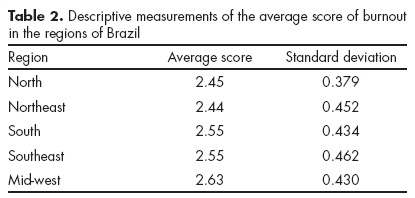
<body><![CDATA[<p align="justify"><font face="verdana" size="2">This is a descriptive and cross&#45;sectional study, conducted from March to July 2012, with 1040 physiotherapists registered in the professional boards from several Brazilian regions (North, Northeast, South, Southeast and Midwest), through a snowball and non&#45;probabilistic sampling type. Among the research tools, initially, we have used a questionnaire containing socioeconomic and demographic questions, as well as questions related to the professional performance of physiotherapists. It consisted of 19 items designed by the authors.</font></p>  	    <p align="justify"><font face="verdana" size="2">To measure stress, we have used the Work Stress Scale (known in Brazil as EET),<sup>20</sup> which assesses, through 23 items, the main stressing labor factors. These items are answerable to a 5&#45;point Likert scale, ranging from 1, <i>strongly disagree,</i> to 5, <i>strongly agree.</i> To validate this tool, 437 workers from various public and private organizations were approached, obtaining a Cronbach's alpha coefficient of 0.91. The results are given by means of the average of the factors, which, when it is equal to or higher than 2.5, should already be understood as an indicator of stress. The EET is not a psychological test, but a tool for organizational diagnosis and was subjected to psychometric tests and requirements.</font></p>  	    <p align="justify"><font face="verdana" size="2">Regarding the burnout syndrome, an adaptation produced by the authors of the <i>Cuestionario para la Evaluaci&oacute;n del S&iacute;ndrome de Quemarse por el Trabajo</i> (CESQT)<sup>21</sup> for physiotherapists was used. This tool is comprised of 20 items, divided into scales that assess the illusion for work, psychic wear, indolence and guilt, answering to a 5&#45;point Likert scale, ranging from 0, <i>never,</i> to 4, <i>very often:</i> every single day. To validate this tool, 714 teachers from all levels of teaching were approached, obtaining a Cronbach's alpha coefficient of 0.80. Each subscale was calculated through the average of the scores of the items comprising it. Low scores on illusion for work (&lt;2) and high scores on psychic wear, indolence and guilt (&#8805;2) presuppose high levels of burnout.</font></p>  	    <p align="justify"><font face="verdana" size="2">This study was approved by the Research Ethics Committee of the State University of Para&iacute;ba (UEPB), in relation to surveys involving human beings, in accordance with the Resolution n&deg; 196/96&#45;CNS. Data collection was conducted through a website exclusively designed by the authors for this study, in which participants initially accepted the Free and Informed Consent Form (CAAE: 0551.0.133.000&#45;09), and then responded to questionnaires. The research dissemination has been carried out on social networks, boards and associations of physiotherapy, with the view to reduce sampling losses, since only the interested people fulfilled the research tools. The data were inserted into an electronic spreadsheet and analyzed by means of the Statistical Program SPSS (Statistical Package for the Social Sciences) for Windows, version 19.0. We have adopted a significance level of 95%. In data analysis, we have used descriptive and inferential statistics.</font></p>  	    <p>&nbsp;</p>  	    <p align="justify"><font face="verdana" size="2"><b>RESULTS</b></font></p>  	    <p align="justify"><font face="verdana" size="2">To characterize the sample, socioeconomic, demographic, professional, life habits and self&#45;assessment of the general health status of 1040 physiotherapists from the Brazilian regions were analyzed. The largest representativeness was from the Northeast Region (<a href="#t1">table 1</a>), with 79.3% (824) of physiotherapists who lived in hinterland's cities, being that 47.6% (495) worked in these cities.</font></p>  	    <p align="center"><font face="verdana" size="2"><a name="t1"></a></font></p>  	    <p align="center"><font face="verdana" size="2"><img src="/img/revistas/sm/v37n3/a7t1.jpg"></font></p>  	    <p align="justify"><font face="verdana" size="2">The average age was 31 years &plusmn;7.43, ranging from 20 to 61 years; the female gender was the most prevalent (75.7%, 787), with 55.1% (573) being single, 69.4% (722) who had children and 77.6% (807) who had some religious creed. As for the occupational aspects, the average workload of weekly working time was 35.4 &plusmn; 16.35 hours, with a predominance of post&#45;graduate physiotherapists (69%, 717), who had from three to five years of professional experience (22.5%, 234), followed by workers who had from six to ten years (21.7%, 225). It was found out that 61.7% (641) worked in only one place, with 49.2% (512) having clinics as a workplace and 81.7% (850) who had physiotherapy as their only professional activity.</font></p>  	    ]]></body>
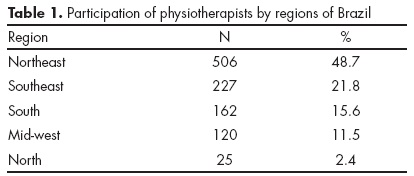
<body><![CDATA[<p align="justify"><font face="verdana" size="2">In relation to life habits, the sleeping average time was 6.8 &plusmn; 1.15 hours per day and the level of satisfaction with the sleep hours, on a scale from 0 to 10, showed an average score of 6.37 &plusmn; 2.38. As for physical activity, 55% (572) of the participants had practiced it on a regular basis. In the analysis of the general health status, participants assigned an average score of 7.1 &plusmn; 1.83, where 10 indicated greater satisfaction with their health statuses.</font></p>  	    <p align="justify"><font face="verdana" size="2">By analyzing the occupational stress and its stressing factors, it was perceived that 37% of the physiotherapists showed stress, obtaining a general average of 2.3 &plusmn; 0.861. The main stressing factors found were low growth prospects (3.4 &plusmn; 1.48), deficiency in professional training (2.99 &plusmn; 1.44), deficiency in the disclosure of organizational decisions (2.85 &plusmn; 1.40), division of tasks at work (2.71 &plusmn; 1.22) and prolonged time at work (2.62 &plusmn; 1.43).</font></p>  	    <p align="justify"><font face="verdana" size="2">The analysis of socioeconomic aspects associated with stress, through the Chi&#45;square test, obtained a significant linkage to the variable age (p=0.008), with it being more frequent in physiotherapists aged over 30 years. Although there was no significant difference, it was found out that male professionals, with higher schooling level, as post&#45;degrees and with over 10 years of professional activity, had higher stress levels. By means of the Mann&#45;Whitney test, the physical activity variable showed statistical significance among the groups (p=0.039), noting that professionals who practice physical activities had lower stress level. There were no statistically significant differences among the average scores of the professional characteristics of the study subjects (p&gt;0.05). By using the Spearman correlation test, it was found out that the satisfaction with health status associated with stress obtained inverse and significant correlation (r=&#45;0.322; p&lt;0,001), indicating that, to the extent that stress increases, satisfaction with health status decreases.</font></p>      <p align="justify"><font face="verdana" size="2">To characterize the burnout syndrome, we have assessed the dimensions illusion for work (3.93 &plusmn; 0.166), psychic wear (1.72 &plusmn; 0.523), indolence (1.82 &plusmn; 0.314), and guilt (1.76 &plusmn; 0.201). The comparative analysis of the domains was performed through a variance analysis (known in Brazil as ANOVA) and Tukey's post&#45;hoc test. The results demonstrate statistical significance among the domains (p&lt;0.001) and point the illusion for work domain with a higher score. According to the standardization of the research tool, there were no cases of burnout. However, a high average in the dimensions psychic wear, indolence and guilt should be noted, totaling 49% (509) of the physiotherapists with a tendency to develop burnout.</font></p>  	    <p align="justify"><font face="verdana" size="2">By means of the Chi&#45;square test, the association among the variables gender, age, schooling, and length of occupational activity with the burnout syndrome showed no significant connection. By using the Kruskal&#45;Wallis test, a statistical significance (p=0.009) among the average scores of the region of residence variable among the study subjects was found, therefore, indicating that the subjects who live in the Mid&#45;west are more likely to develop the burnout syndrome (<a href="#t2">table 2</a>).</font></p>  	    <p align="center"><font face="verdana" size="2"><a name="t2"></a></font></p>  	    <p align="center"><font face="verdana" size="2"><img src="/img/revistas/sm/v37n3/a7t2.jpg"></font></p>  	    <p align="justify"><font face="verdana" size="2">Similarly, a statistically significant difference was found among the average scores of the workplaces (p=0.018) and number of workplaces (p=0.050) variables, where the results suggest that professionals working in hospitals and clinics, as well as having many places of work, are more likely to develop burnout. The correlation analysis by means of the Spearman test showed a statistically significant correlation between satisfaction with health status and burnout (r=&#45;0.223; p&lt;0.001), thus indicating that to the extent that burnout increases, satisfaction with health status decreases.</font></p>  	    <p>&nbsp;</p>  	    <p align="justify"><font face="verdana" size="2"><b>DISCUSSION</b></font></p>  	    ]]></body>
<body><![CDATA[<p align="justify"><font face="verdana" size="2">The study of stress and the burnout syndrome in health care professionals has aroused the attention of many researchers who seek to understand this problem in terms of its manifestations and consequences for the functioning of these workers.<sup>3,4,9</sup> Accordingly, we have sought information about the socioeconomic and demographic aspects related to work in a sample of Brazilian physiotherapists. Additionally, we have tried to contribute to the development of methodologies to monitor and assess health aspects specific to these professionals.</font></p>  	    <p align="justify"><font face="verdana" size="2">Studies report that 18% of the health problems that affect the psychic system are consequences of work organization, such as stress, depression, and anxiety.<sup>4</sup> The stress assessment by means of a research tool that focuses on the reactions of the individual in the face of stressing factors showed that the minority of physiotherapists had indicative symptoms of occupational stress, with the prospects of growth and professional acceptance being their main stressors, in addition to work organization. Professionals, such as nurses, have shown a higher prevalence of occupational stress than the surveyed sample.<sup>22,23</sup></font></p>  	    <p align="justify"><font face="verdana" size="2">A prolonged response to chronic emotional and interpersonal stressors at work is known as burnout syndrome, which is considered one of the most important occupational health problems of psychosocial character in today's society.<sup>13,14,24</sup> The human being has suffered burnout symptoms in his/her ongoing process of struggle for survival and adaptation to constant changes and lifestyles that are increasingly competitive, or even aggressive. Regarding the burnout syndrome, there were no cases, but almost half of the study population had a tendency to develop it. These data corroborated those of one of the first studies on the burnout syndrome in physiotherapists, where, in a sample of 160 physiotherapists in the United States, it was found out that 53% claimed that they were experiencing burnout sensations.<sup>18</sup> Furthermore, in another study addressed to nurses, 4.7% of them presented burnout.<sup>25</sup></font></p>  	    <p align="justify"><font face="verdana" size="2">Age stood out as a significant sociodemographic aspect, given that a relatively young group was found, consistent with the professional activity of physiotherapists, requiring a high degree of dexterity, agility, and energy, which are all characteristics of young people. There was a statistical significance of stress with the age group of less than 30 years, which differs from other studies.<sup>26</sup> Regarding gender, there was a predominance of women, which was already expected, since health&#45;related labor is more focused on females. Several authors<sup>26&#45;28</sup> reinforce these data in their surveys, and there is no statistically significant relationship in this category with stress and burnout.</font></p>  	    <p align="justify"><font face="verdana" size="2">Concerning life habits, in relation to physical activities there was a statistically significant relationship, which agrees with some authors<sup>29</sup> who report that situational variables that are not restricted to organizational aspects, such as regular physical activity, also appear to have an influence on occupational stress. Workers who do not regularly practice physical exercises frequently tend to show a higher level of stress. The regular practice of exercises develops the cardiac conditioning, which in turn provokes, into the bloodstream, a reduction of substances associated with stress. In addition to the physiological dimension, the psychosocial dimension of several forms of physical activity should be highlighted, were social interaction and interpersonal communication might serve as strategies to cope with stressful situations.</font></p>  	    <p align="justify"><font face="verdana" size="2">In spite of presenting a high workload, with insufficient sleeping hours, there was a satisfactory analysis of the general health status, thus evidencing a low prevalence of occupational stress and a tendency to develop burnout. This might be seen as a resiliency factor, whose original concept tries to explain how people can manage their lives in spite of adverse living conditions.<sup>30</sup> As to the demographic characteristics, there was a tendency for the development of the burnout syndrome in physiotherapists who lived in the most densely populated regions and those who had a higher number of workplaces.</font></p>  	    <p align="justify"><font face="verdana" size="2">Concerning the professional aspects, the average workload of the weekly working time exceeded what is advocated by Resolution n&deg; 8.856, of 03/01/1994 from the Brazilian Federal Board of Physiotherapy and Occupational Therapy (COFFITO), which establishes a weekly workload of 30h for physiotherapists. These data are important because they demonstrate a work overload, since most physiotherapists have physiotherapy as their only professional activity.</font></p>  	    <p align="justify"><font face="verdana" size="2">These results allow us to recommend that physiotherapists should adopt preventive measures and mechanisms for coping with stress and preventing burnout, taking into consideration the inclusion of professional development activities.</font></p>  	    <p>&nbsp;</p>  	    <p align="justify"><font face="verdana" size="2"><b>REFERENCES</b></font></p>  	    ]]></body>
<body><![CDATA[<!-- ref --><p align="justify"><font face="verdana" size="2">1. Mendes AM, Borges LO, Ferreira MC (Org.). Trabalho em transi&ccedil;&atilde;o, sa&uacute;de em Risco. Bras&iacute;lia: Ed. Universidade de Bras&iacute;lia; 2002.    &nbsp;&nbsp;&nbsp;&nbsp;&nbsp;&nbsp;&nbsp;&nbsp;[&#160;<a href="javascript:void(0);" onclick="javascript: window.open('/scielo.php?script=sci_nlinks&ref=9103688&pid=S0185-3325201400030000700001&lng=','','width=640,height=500,resizable=yes,scrollbars=1,menubar=yes,');">Links</a>&#160;]<!-- end-ref --></font></p>  	    <!-- ref --><p align="justify"><font face="verdana" size="2">2. Carlotto MS, Gobbi MD. S&iacute;ndrome de Burnout: um problema do indiv&iacute;duo ou do seu contexto de trabalho? Aletheia 2000;10:103&#45;114.    &nbsp;&nbsp;&nbsp;&nbsp;&nbsp;&nbsp;&nbsp;&nbsp;[&#160;<a href="javascript:void(0);" onclick="javascript: window.open('/scielo.php?script=sci_nlinks&ref=9103690&pid=S0185-3325201400030000700002&lng=','','width=640,height=500,resizable=yes,scrollbars=1,menubar=yes,');">Links</a>&#160;]<!-- end-ref --></font></p>  	    <!-- ref --><p align="justify"><font face="verdana" size="2">3. Palacios M, Duarte F, C&acirc;mara VM. Trabalho e sofrimento ps&iacute;quico de caixas de ag&ecirc;ncias banc&aacute;rias na cidade do Rio de Janeiro. Cad Sa&uacute;de P&uacute;blica 2002;18(3):843&#45;851.    &nbsp;&nbsp;&nbsp;&nbsp;&nbsp;&nbsp;&nbsp;&nbsp;[&#160;<a href="javascript:void(0);" onclick="javascript: window.open('/scielo.php?script=sci_nlinks&ref=9103692&pid=S0185-3325201400030000700003&lng=','','width=640,height=500,resizable=yes,scrollbars=1,menubar=yes,');">Links</a>&#160;]<!-- end-ref --></font></p>  	    <!-- ref --><p align="justify"><font face="verdana" size="2">4. Murofuse NT, Abranches SS, Napole&atilde;o AMA. Reflex&otilde;es sobre estresse e burnout e a rela&ccedil;&atilde;o com a enfermagem. Rev Latino&#45;Americana Enfermagem 2005;13(2):255&#45;261.    &nbsp;&nbsp;&nbsp;&nbsp;&nbsp;&nbsp;&nbsp;&nbsp;[&#160;<a href="javascript:void(0);" onclick="javascript: window.open('/scielo.php?script=sci_nlinks&ref=9103694&pid=S0185-3325201400030000700004&lng=','','width=640,height=500,resizable=yes,scrollbars=1,menubar=yes,');">Links</a>&#160;]<!-- end-ref --></font></p>  	    <!-- ref --><p align="justify"><font face="verdana" size="2">5. Selye N. The stress of life. New York: McGrawHill; 1956.    &nbsp;&nbsp;&nbsp;&nbsp;&nbsp;&nbsp;&nbsp;&nbsp;[&#160;<a href="javascript:void(0);" onclick="javascript: window.open('/scielo.php?script=sci_nlinks&ref=9103696&pid=S0185-3325201400030000700005&lng=','','width=640,height=500,resizable=yes,scrollbars=1,menubar=yes,');">Links</a>&#160;]<!-- end-ref --></font></p>  	    ]]></body>
<body><![CDATA[<!-- ref --><p align="justify"><font face="verdana" size="2">6. Lipp MN. Invent&aacute;rio de sintomas de stress para adultos de Lipp (ISSL). S&atilde;o Paulo: Casa do Psic&oacute;logo; 2000.    &nbsp;&nbsp;&nbsp;&nbsp;&nbsp;&nbsp;&nbsp;&nbsp;[&#160;<a href="javascript:void(0);" onclick="javascript: window.open('/scielo.php?script=sci_nlinks&ref=9103698&pid=S0185-3325201400030000700006&lng=','','width=640,height=500,resizable=yes,scrollbars=1,menubar=yes,');">Links</a>&#160;]<!-- end-ref --></font></p>  	    <!-- ref --><p align="justify"><font face="verdana" size="2">7. Lazarus RS, Folkman S. Stress, appraisal and coping. New York: Springer Publishing Company; 1984.    &nbsp;&nbsp;&nbsp;&nbsp;&nbsp;&nbsp;&nbsp;&nbsp;[&#160;<a href="javascript:void(0);" onclick="javascript: window.open('/scielo.php?script=sci_nlinks&ref=9103700&pid=S0185-3325201400030000700007&lng=','','width=640,height=500,resizable=yes,scrollbars=1,menubar=yes,');">Links</a>&#160;]<!-- end-ref --></font></p>  	    <!-- ref --><p align="justify"><font face="verdana" size="2">8. Santos AFO, Caedoso LC. Profissionais de sa&uacute;de mental: Estresse e estressores ocupacionais em sa&uacute;de mental. Psicologia Estudo 2010;15(2):245&#45;253.    &nbsp;&nbsp;&nbsp;&nbsp;&nbsp;&nbsp;&nbsp;&nbsp;[&#160;<a href="javascript:void(0);" onclick="javascript: window.open('/scielo.php?script=sci_nlinks&ref=9103702&pid=S0185-3325201400030000700008&lng=','','width=640,height=500,resizable=yes,scrollbars=1,menubar=yes,');">Links</a>&#160;]<!-- end-ref --></font></p>  	    <!-- ref --><p align="justify"><font face="verdana" size="2">9. Stacciarini JMR, Tr&oacute;ccoli BT. O estresse na atividade ocupacional do enfermeiro. Rev Latino&#45;Americana Enfermagem 2001;9(2):17&#45;25.    &nbsp;&nbsp;&nbsp;&nbsp;&nbsp;&nbsp;&nbsp;&nbsp;[&#160;<a href="javascript:void(0);" onclick="javascript: window.open('/scielo.php?script=sci_nlinks&ref=9103704&pid=S0185-3325201400030000700009&lng=','','width=640,height=500,resizable=yes,scrollbars=1,menubar=yes,');">Links</a>&#160;]<!-- end-ref --></font></p>  	    <!-- ref --><p align="justify"><font face="verdana" size="2">10. Yarker J, Donaldson&#45;Feilder E, Flaxman P. Management competencies for preventing and reducing stress at work: Identifying and developing the management behaviours necessary to implement the HSE Management Standards. London: Health and Safety Executive Books; 2007. Recuperado em 12 de fevereiro de 2013 de <a href="http://www.hse.gov.uk/research/rrpdf/rr553.pdf" target="_blank">http://www.hse.gov.uk/research/rrpdf/rr553.pdf</a></font>&nbsp;&nbsp;&nbsp;&nbsp;&nbsp;&nbsp;&nbsp;&nbsp;[&#160;<a href="javascript:void(0);" onclick="javascript: window.open('/scielo.php?script=sci_nlinks&ref=9103706&pid=S0185-3325201400030000700010&lng=','','width=640,height=500,resizable=yes,scrollbars=1,menubar=yes,');">Links</a>&#160;]<!-- end-ref --><!-- ref --><p align="justify"><font face="verdana" size="2">11. Fran&ccedil;a HH. A s&iacute;ndrome de "Burnout". Rev Brasileira Medicina 1987;44:197&#45;199.    &nbsp;&nbsp;&nbsp;&nbsp;&nbsp;&nbsp;&nbsp;&nbsp;[&#160;<a href="javascript:void(0);" onclick="javascript: window.open('/scielo.php?script=sci_nlinks&ref=9103707&pid=S0185-3325201400030000700011&lng=','','width=640,height=500,resizable=yes,scrollbars=1,menubar=yes,');">Links</a>&#160;]<!-- end-ref --></font></p>  	    <!-- ref --><p align="justify"><font face="verdana" size="2">12. Benevides&#45;Pereira AMT, Alves RN. A study on burnout syndrome in healthcare providers to people living with HIV. AIDS Care 2003;19(4):565&#45;571.    &nbsp;&nbsp;&nbsp;&nbsp;&nbsp;&nbsp;&nbsp;&nbsp;[&#160;<a href="javascript:void(0);" onclick="javascript: window.open('/scielo.php?script=sci_nlinks&ref=9103709&pid=S0185-3325201400030000700012&lng=','','width=640,height=500,resizable=yes,scrollbars=1,menubar=yes,');">Links</a>&#160;]<!-- end-ref --></font></p>  	    <!-- ref --><p align="justify"><font face="verdana" size="2">13. Salanova M, Llorens S. Estado actual y retos futuros en el estudio del burnout. Papeles Psic&oacute;logo 2008;29(1):59&#45;67.    &nbsp;&nbsp;&nbsp;&nbsp;&nbsp;&nbsp;&nbsp;&nbsp;[&#160;<a href="javascript:void(0);" onclick="javascript: window.open('/scielo.php?script=sci_nlinks&ref=9103711&pid=S0185-3325201400030000700013&lng=','','width=640,height=500,resizable=yes,scrollbars=1,menubar=yes,');">Links</a>&#160;]<!-- end-ref --></font></p>  	    <!-- ref --><p align="justify"><font face="verdana" size="2">14. Schaufeli BW, Leiter MP, Maslach C. Burnout: 35 years of research and practice. Career Development Inter&#45;national 2009;14(3):204&#45;220.    &nbsp;&nbsp;&nbsp;&nbsp;&nbsp;&nbsp;&nbsp;&nbsp;[&#160;<a href="javascript:void(0);" onclick="javascript: window.open('/scielo.php?script=sci_nlinks&ref=9103713&pid=S0185-3325201400030000700014&lng=','','width=640,height=500,resizable=yes,scrollbars=1,menubar=yes,');">Links</a>&#160;]<!-- end-ref --></font></p>      <!-- ref --><p align="justify"><font face="verdana" size="2">15. Gil&#45;Monte PR. El s&iacute;ndrome de quemarse por el trabajo (Burnout): una enfermedad laboral en la sociedad del bienestar. Madrid: Pir&aacute;mide; 2005.    &nbsp;&nbsp;&nbsp;&nbsp;&nbsp;&nbsp;&nbsp;&nbsp;[&#160;<a href="javascript:void(0);" onclick="javascript: window.open('/scielo.php?script=sci_nlinks&ref=9103715&pid=S0185-3325201400030000700015&lng=','','width=640,height=500,resizable=yes,scrollbars=1,menubar=yes,');">Links</a>&#160;]<!-- end-ref --></font></p>  	    <!-- ref --><p align="justify"><font face="verdana" size="2">16. Benevides&#45;Pereira AMT. A sa&uacute;de mental de profissionais de sa&uacute;de mental. Maring&aacute;: EDUEM; 2001.    &nbsp;&nbsp;&nbsp;&nbsp;&nbsp;&nbsp;&nbsp;&nbsp;[&#160;<a href="javascript:void(0);" onclick="javascript: window.open('/scielo.php?script=sci_nlinks&ref=9103717&pid=S0185-3325201400030000700016&lng=','','width=640,height=500,resizable=yes,scrollbars=1,menubar=yes,');">Links</a>&#160;]<!-- end-ref --></font></p>  	    <!-- ref --><p align="justify"><font face="verdana" size="2">17. Rodrigues CD, Chaves LB, Carlotto MS. S&iacute;ndrome de Burnout em Professores de Educa&ccedil;&atilde;o Pr&eacute;&#45;Escolar. Intera&ccedil;&atilde;o Psicologia. 2010;14(2):197&#45;204.    &nbsp;&nbsp;&nbsp;&nbsp;&nbsp;&nbsp;&nbsp;&nbsp;[&#160;<a href="javascript:void(0);" onclick="javascript: window.open('/scielo.php?script=sci_nlinks&ref=9103719&pid=S0185-3325201400030000700017&lng=','','width=640,height=500,resizable=yes,scrollbars=1,menubar=yes,');">Links</a>&#160;]<!-- end-ref --></font></p>  	    <!-- ref --><p align="justify"><font face="verdana" size="2">18. Benevides&#45;Pereira AMT. Burnout: quando o trabalho amea&ccedil;a o bemestar do trabalhador. S&atilde;o Paulo: Casa do Psic&oacute;logo; 2002.    &nbsp;&nbsp;&nbsp;&nbsp;&nbsp;&nbsp;&nbsp;&nbsp;[&#160;<a href="javascript:void(0);" onclick="javascript: window.open('/scielo.php?script=sci_nlinks&ref=9103721&pid=S0185-3325201400030000700018&lng=','','width=640,height=500,resizable=yes,scrollbars=1,menubar=yes,');">Links</a>&#160;]<!-- end-ref --></font></p>  	    <!-- ref --><p align="justify"><font face="verdana" size="2">19. Savoia MG. Escalas de eventos vitais e de estrat&eacute;gias de enfrentamento (coping). Rev Psiquiatria Cl&iacute;nica 1999;26(2):57&#45;67.    &nbsp;&nbsp;&nbsp;&nbsp;&nbsp;&nbsp;&nbsp;&nbsp;[&#160;<a href="javascript:void(0);" onclick="javascript: window.open('/scielo.php?script=sci_nlinks&ref=9103723&pid=S0185-3325201400030000700019&lng=','','width=640,height=500,resizable=yes,scrollbars=1,menubar=yes,');">Links</a>&#160;]<!-- end-ref --></font></p>  	    <!-- ref --><p align="justify"><font face="verdana" size="2">20. Paschoal T, Tamayo A. Valida&ccedil;&atilde;o da Escala de Estresse no trabalho. Estudos Psicologia 2004;9(1):45&#45;52.    &nbsp;&nbsp;&nbsp;&nbsp;&nbsp;&nbsp;&nbsp;&nbsp;[&#160;<a href="javascript:void(0);" onclick="javascript: window.open('/scielo.php?script=sci_nlinks&ref=9103725&pid=S0185-3325201400030000700020&lng=','','width=640,height=500,resizable=yes,scrollbars=1,menubar=yes,');">Links</a>&#160;]<!-- end-ref --></font></p>  	    <!-- ref --><p align="justify"><font face="verdana" size="2">21. Gil&#45;Monte PR, Carlotto MS, C&acirc;mara SG. Valida&ccedil;&atilde;o da vers&atilde;o brasileira do "Cuestionario para la Evaluci&oacute;n del S&iacute;ndrome de Quermarse por el Trabajo" em professores. Rev Sa&uacute;de P&uacute;blica 2010;44(1):140&#45;147.    &nbsp;&nbsp;&nbsp;&nbsp;&nbsp;&nbsp;&nbsp;&nbsp;[&#160;<a href="javascript:void(0);" onclick="javascript: window.open('/scielo.php?script=sci_nlinks&ref=9103727&pid=S0185-3325201400030000700021&lng=','','width=640,height=500,resizable=yes,scrollbars=1,menubar=yes,');">Links</a>&#160;]<!-- end-ref --></font></p>  	    <!-- ref --><p align="justify"><font face="verdana" size="2">22. Miquelin JDL, Carvalho CBO, Gir L, Pel&aacute; NTR. Estresse nos profissionais de enfermagem que atuam em uma unidade de pacientes portadores de HIV&#45;AIDS. DST &#45; J Bras Doen&ccedil;as Sex Transm 2004;16(3):24&#45;31.    &nbsp;&nbsp;&nbsp;&nbsp;&nbsp;&nbsp;&nbsp;&nbsp;[&#160;<a href="javascript:void(0);" onclick="javascript: window.open('/scielo.php?script=sci_nlinks&ref=9103729&pid=S0185-3325201400030000700022&lng=','','width=640,height=500,resizable=yes,scrollbars=1,menubar=yes,');">Links</a>&#160;]<!-- end-ref --></font></p>  	    <!-- ref --><p align="justify"><font face="verdana" size="2">23. Malagris LEN, Fiorito ACC. Avalia&ccedil;&atilde;o do n&iacute;vel de stress de t&eacute;cnicos da &aacute;rea de sa&uacute;de. Estudos Psicologia 2006;23(4):391&#45;398.    &nbsp;&nbsp;&nbsp;&nbsp;&nbsp;&nbsp;&nbsp;&nbsp;[&#160;<a href="javascript:void(0);" onclick="javascript: window.open('/scielo.php?script=sci_nlinks&ref=9103731&pid=S0185-3325201400030000700023&lng=','','width=640,height=500,resizable=yes,scrollbars=1,menubar=yes,');">Links</a>&#160;]<!-- end-ref --></font></p>  	    <!-- ref --><p align="justify"><font face="verdana" size="2">24. Minist&eacute;rio da Sa&uacute;de. Doen&ccedil;as relacionadas ao trabalho: Manual de procedimentos para os servi&ccedil;os de sa&uacute;de. Minist&eacute;rio da Sa&uacute;de; 2001.    &nbsp;&nbsp;&nbsp;&nbsp;&nbsp;&nbsp;&nbsp;&nbsp;[&#160;<a href="javascript:void(0);" onclick="javascript: window.open('/scielo.php?script=sci_nlinks&ref=9103733&pid=S0185-3325201400030000700024&lng=','','width=640,height=500,resizable=yes,scrollbars=1,menubar=yes,');">Links</a>&#160;]<!-- end-ref --></font></p>  	    <!-- ref --><p align="justify"><font face="verdana" size="2">25. Galindo RH, Feliciano KVO, Lima RASS, Ariani I. S&iacute;ndrome de Burnout entre enfermeiros de um hospital geral da cidade do Recife. Rev Esc Enferm. USP &#91;online&#93;. 2012;46(2):420&#45;427.    &nbsp;&nbsp;&nbsp;&nbsp;&nbsp;&nbsp;&nbsp;&nbsp;[&#160;<a href="javascript:void(0);" onclick="javascript: window.open('/scielo.php?script=sci_nlinks&ref=9103735&pid=S0185-3325201400030000700025&lng=','','width=640,height=500,resizable=yes,scrollbars=1,menubar=yes,');">Links</a>&#160;]<!-- end-ref --></font></p>  	    <!-- ref --><p align="justify"><font face="verdana" size="2">26. Silva MCM, Gomes ARS. Stress ocupacional em profissionais de sa&uacute;de: um estudo com m&eacute;dicos e enfermeiros portugueses. Estudos Psicologia 2009;14(3):239&#45;248.    &nbsp;&nbsp;&nbsp;&nbsp;&nbsp;&nbsp;&nbsp;&nbsp;[&#160;<a href="javascript:void(0);" onclick="javascript: window.open('/scielo.php?script=sci_nlinks&ref=9103737&pid=S0185-3325201400030000700026&lng=','','width=640,height=500,resizable=yes,scrollbars=1,menubar=yes,');">Links</a>&#160;]<!-- end-ref --></font></p>  	    <!-- ref --><p align="justify"><font face="verdana" size="2">27. Ferrareze MVG, Ferreira V, Carvalho AMP. Percep&ccedil;&atilde;o do estresse entre os enfermeiros que atuam em Terapia Intensiva. Acta Paul Enferm 2006;19(3):310&#45;315.    &nbsp;&nbsp;&nbsp;&nbsp;&nbsp;&nbsp;&nbsp;&nbsp;[&#160;<a href="javascript:void(0);" onclick="javascript: window.open('/scielo.php?script=sci_nlinks&ref=9103739&pid=S0185-3325201400030000700027&lng=','','width=640,height=500,resizable=yes,scrollbars=1,menubar=yes,');">Links</a>&#160;]<!-- end-ref --></font></p>  	    <!-- ref --><p align="justify"><font face="verdana" size="2">28. Telles SH, Pimenta AMC. S&iacute;ndrome de Burnout em Agentes Comunit&aacute;rios de Sa&uacute;de e Estrat&eacute;gias de Enfrentamento. Sa&uacute;de Soc S&atilde;o Paulo 2009;18(3):467&#45;478.    &nbsp;&nbsp;&nbsp;&nbsp;&nbsp;&nbsp;&nbsp;&nbsp;[&#160;<a href="javascript:void(0);" onclick="javascript: window.open('/scielo.php?script=sci_nlinks&ref=9103741&pid=S0185-3325201400030000700028&lng=','','width=640,height=500,resizable=yes,scrollbars=1,menubar=yes,');">Links</a>&#160;]<!-- end-ref --></font></p>  	    <!-- ref --><p align="justify"><font face="verdana" size="2">29. Tamayo A. Prioridades axiol&oacute;gicas, atividade f&iacute;sica e estresse ocupacional. Revista Administra&ccedil;&atilde;o Contempor&acirc;nea. 2001;5(3):127&#45;147.    &nbsp;&nbsp;&nbsp;&nbsp;&nbsp;&nbsp;&nbsp;&nbsp;[&#160;<a href="javascript:void(0);" onclick="javascript: window.open('/scielo.php?script=sci_nlinks&ref=9103743&pid=S0185-3325201400030000700029&lng=','','width=640,height=500,resizable=yes,scrollbars=1,menubar=yes,');">Links</a>&#160;]<!-- end-ref --></font></p>  	    <!-- ref --><p align="justify"><font face="verdana" size="2">30. Lindstrom B. O significado de resili&ecirc;ncia. Adolescencia Latinoamericana 2001;2:133&#45;137.    &nbsp;&nbsp;&nbsp;&nbsp;&nbsp;&nbsp;&nbsp;&nbsp;[&#160;<a href="javascript:void(0);" onclick="javascript: window.open('/scielo.php?script=sci_nlinks&ref=9103745&pid=S0185-3325201400030000700030&lng=','','width=640,height=500,resizable=yes,scrollbars=1,menubar=yes,');">Links</a>&#160;]<!-- end-ref --></font></p>  	    <p>&nbsp;</p>  	    ]]></body>
<body><![CDATA[<p align="center"><font face="verdana" size="2"><b>Declaration of conflict interest: None</b></font></p>      ]]></body><back>
<ref-list>
<ref id="B1">
<label>1</label><nlm-citation citation-type="book">
<person-group person-group-type="author">
<name>
<surname><![CDATA[Mendes]]></surname>
<given-names><![CDATA[AM]]></given-names>
</name>
<name>
<surname><![CDATA[Borges]]></surname>
<given-names><![CDATA[LO]]></given-names>
</name>
<name>
<surname><![CDATA[Ferreira]]></surname>
<given-names><![CDATA[MC]]></given-names>
</name>
</person-group>
<source><![CDATA[Trabalho em transição, saúde em Risco]]></source>
<year>2002</year>
<publisher-loc><![CDATA[Brasília ]]></publisher-loc>
<publisher-name><![CDATA[Ed. Universidade de Brasília]]></publisher-name>
</nlm-citation>
</ref>
<ref id="B2">
<label>2</label><nlm-citation citation-type="journal">
<person-group person-group-type="author">
<name>
<surname><![CDATA[Carlotto]]></surname>
<given-names><![CDATA[MS]]></given-names>
</name>
<name>
<surname><![CDATA[Gobbi]]></surname>
<given-names><![CDATA[MD]]></given-names>
</name>
</person-group>
<article-title xml:lang="pt"><![CDATA[Síndrome de Burnout: um problema do indivíduo ou do seu contexto de trabalho]]></article-title>
<source><![CDATA[Aletheia]]></source>
<year>2000</year>
<volume>10</volume>
<page-range>103-114</page-range></nlm-citation>
</ref>
<ref id="B3">
<label>3</label><nlm-citation citation-type="journal">
<person-group person-group-type="author">
<name>
<surname><![CDATA[Palacios]]></surname>
<given-names><![CDATA[M]]></given-names>
</name>
<name>
<surname><![CDATA[Duarte]]></surname>
<given-names><![CDATA[F]]></given-names>
</name>
<name>
<surname><![CDATA[Câmara]]></surname>
<given-names><![CDATA[VM]]></given-names>
</name>
</person-group>
<article-title xml:lang="pt"><![CDATA[Trabalho e sofrimento psíquico de caixas de agências bancárias na cidade do Rio de Janeiro]]></article-title>
<source><![CDATA[Cad Saúde Pública]]></source>
<year>2002</year>
<volume>18</volume>
<numero>3</numero>
<issue>3</issue>
<page-range>843-851</page-range></nlm-citation>
</ref>
<ref id="B4">
<label>4</label><nlm-citation citation-type="journal">
<person-group person-group-type="author">
<name>
<surname><![CDATA[Murofuse]]></surname>
<given-names><![CDATA[NT]]></given-names>
</name>
<name>
<surname><![CDATA[Abranches]]></surname>
<given-names><![CDATA[SS]]></given-names>
</name>
<name>
<surname><![CDATA[Napoleão]]></surname>
<given-names><![CDATA[AMA]]></given-names>
</name>
</person-group>
<article-title xml:lang="pt"><![CDATA[Reflexões sobre estresse e burnout e a relação com a enfermagem]]></article-title>
<source><![CDATA[Rev Latino-Americana Enfermagem]]></source>
<year>2005</year>
<volume>13</volume>
<numero>2</numero>
<issue>2</issue>
<page-range>255-261</page-range></nlm-citation>
</ref>
<ref id="B5">
<label>5</label><nlm-citation citation-type="book">
<person-group person-group-type="author">
<name>
<surname><![CDATA[Selye]]></surname>
<given-names><![CDATA[N]]></given-names>
</name>
</person-group>
<source><![CDATA[The stress of life]]></source>
<year>1956</year>
<publisher-loc><![CDATA[New York ]]></publisher-loc>
<publisher-name><![CDATA[McGrawHill]]></publisher-name>
</nlm-citation>
</ref>
<ref id="B6">
<label>6</label><nlm-citation citation-type="book">
<person-group person-group-type="author">
<name>
<surname><![CDATA[Lipp]]></surname>
<given-names><![CDATA[MN]]></given-names>
</name>
</person-group>
<source><![CDATA[Inventário de sintomas de stress para adultos de Lipp (ISSL)]]></source>
<year>2000</year>
<publisher-loc><![CDATA[São Paulo ]]></publisher-loc>
<publisher-name><![CDATA[Casa do Psicólogo]]></publisher-name>
</nlm-citation>
</ref>
<ref id="B7">
<label>7</label><nlm-citation citation-type="book">
<person-group person-group-type="author">
<name>
<surname><![CDATA[Lazarus]]></surname>
<given-names><![CDATA[RS]]></given-names>
</name>
<name>
<surname><![CDATA[Folkman]]></surname>
<given-names><![CDATA[S]]></given-names>
</name>
</person-group>
<source><![CDATA[Stress, appraisal and coping]]></source>
<year>1984</year>
<publisher-loc><![CDATA[New York ]]></publisher-loc>
<publisher-name><![CDATA[Springer Publishing Company]]></publisher-name>
</nlm-citation>
</ref>
<ref id="B8">
<label>8</label><nlm-citation citation-type="journal">
<person-group person-group-type="author">
<name>
<surname><![CDATA[Santos]]></surname>
<given-names><![CDATA[AFO]]></given-names>
</name>
<name>
<surname><![CDATA[Caedoso]]></surname>
<given-names><![CDATA[LC]]></given-names>
</name>
</person-group>
<article-title xml:lang="pt"><![CDATA[Profissionais de saúde mental: Estresse e estressores ocupacionais em saúde mental]]></article-title>
<source><![CDATA[Psicologia Estudo]]></source>
<year>2010</year>
<volume>15</volume>
<numero>2</numero>
<issue>2</issue>
<page-range>245-253</page-range></nlm-citation>
</ref>
<ref id="B9">
<label>9</label><nlm-citation citation-type="journal">
<person-group person-group-type="author">
<name>
<surname><![CDATA[Stacciarini]]></surname>
<given-names><![CDATA[JMR]]></given-names>
</name>
<name>
<surname><![CDATA[Tróccoli]]></surname>
<given-names><![CDATA[BT]]></given-names>
</name>
</person-group>
<article-title xml:lang="pt"><![CDATA[O estresse na atividade ocupacional do enfermeiro]]></article-title>
<source><![CDATA[Rev Latino-Americana Enfermagem]]></source>
<year>2001</year>
<volume>9</volume>
<numero>2</numero>
<issue>2</issue>
<page-range>17-25</page-range></nlm-citation>
</ref>
<ref id="B10">
<label>10</label><nlm-citation citation-type="book">
<person-group person-group-type="author">
<name>
<surname><![CDATA[Yarker]]></surname>
<given-names><![CDATA[J]]></given-names>
</name>
<name>
<surname><![CDATA[Donaldson-Feilder]]></surname>
<given-names><![CDATA[E]]></given-names>
</name>
<name>
<surname><![CDATA[Flaxman]]></surname>
<given-names><![CDATA[P]]></given-names>
</name>
</person-group>
<source><![CDATA[Management competencies for preventing and reducing stress at work: Identifying and developing the management behaviours necessary to implement the HSE Management Standards]]></source>
<year>2007</year>
<publisher-loc><![CDATA[London ]]></publisher-loc>
<publisher-name><![CDATA[Health and Safety Executive Books]]></publisher-name>
</nlm-citation>
</ref>
<ref id="B11">
<label>11</label><nlm-citation citation-type="journal">
<person-group person-group-type="author">
<name>
<surname><![CDATA[França]]></surname>
<given-names><![CDATA[HH]]></given-names>
</name>
</person-group>
<article-title xml:lang="pt"><![CDATA[A síndrome de "Burnout"]]></article-title>
<source><![CDATA[Rev Brasileira Medicina]]></source>
<year>1987</year>
<volume>44</volume>
<page-range>197-199</page-range></nlm-citation>
</ref>
<ref id="B12">
<label>12</label><nlm-citation citation-type="journal">
<person-group person-group-type="author">
<name>
<surname><![CDATA[Benevides-Pereira]]></surname>
<given-names><![CDATA[AMT]]></given-names>
</name>
<name>
<surname><![CDATA[Alves]]></surname>
<given-names><![CDATA[RN]]></given-names>
</name>
</person-group>
<article-title xml:lang="en"><![CDATA[A study on burnout syndrome in healthcare providers to people living with HIV]]></article-title>
<source><![CDATA[AIDS Care]]></source>
<year>2003</year>
<volume>19</volume>
<numero>4</numero>
<issue>4</issue>
<page-range>565-571</page-range></nlm-citation>
</ref>
<ref id="B13">
<label>13</label><nlm-citation citation-type="journal">
<person-group person-group-type="author">
<name>
<surname><![CDATA[Salanova]]></surname>
<given-names><![CDATA[M]]></given-names>
</name>
<name>
<surname><![CDATA[Llorens]]></surname>
<given-names><![CDATA[S]]></given-names>
</name>
</person-group>
<article-title xml:lang="es"><![CDATA[Estado actual y retos futuros en el estudio del burnout]]></article-title>
<source><![CDATA[Papeles Psicólogo]]></source>
<year>2008</year>
<volume>29</volume>
<numero>1</numero>
<issue>1</issue>
<page-range>59-67</page-range></nlm-citation>
</ref>
<ref id="B14">
<label>14</label><nlm-citation citation-type="journal">
<person-group person-group-type="author">
<name>
<surname><![CDATA[Schaufeli]]></surname>
<given-names><![CDATA[BW]]></given-names>
</name>
<name>
<surname><![CDATA[Leiter]]></surname>
<given-names><![CDATA[MP]]></given-names>
</name>
<name>
<surname><![CDATA[Maslach]]></surname>
<given-names><![CDATA[C]]></given-names>
</name>
</person-group>
<article-title xml:lang="en"><![CDATA[Burnout: 35 years of research and practice]]></article-title>
<source><![CDATA[Career Development Inter-national]]></source>
<year>2009</year>
<volume>14</volume>
<numero>3</numero>
<issue>3</issue>
<page-range>204-220</page-range></nlm-citation>
</ref>
<ref id="B15">
<label>15</label><nlm-citation citation-type="book">
<person-group person-group-type="author">
<name>
<surname><![CDATA[Gil-Monte]]></surname>
<given-names><![CDATA[PR]]></given-names>
</name>
</person-group>
<source><![CDATA[El síndrome de quemarse por el trabajo (Burnout): una enfermedad laboral en la sociedad del bienestar]]></source>
<year>2005</year>
<publisher-loc><![CDATA[Madrid ]]></publisher-loc>
<publisher-name><![CDATA[Pirámide]]></publisher-name>
</nlm-citation>
</ref>
<ref id="B16">
<label>16</label><nlm-citation citation-type="book">
<person-group person-group-type="author">
<name>
<surname><![CDATA[Benevides-Pereira]]></surname>
<given-names><![CDATA[AMT]]></given-names>
</name>
</person-group>
<source><![CDATA[A saúde mental de profissionais de saúde mental]]></source>
<year>2001</year>
<publisher-loc><![CDATA[Maringá ]]></publisher-loc>
<publisher-name><![CDATA[EDUEM]]></publisher-name>
</nlm-citation>
</ref>
<ref id="B17">
<label>17</label><nlm-citation citation-type="journal">
<person-group person-group-type="author">
<name>
<surname><![CDATA[Rodrigues]]></surname>
<given-names><![CDATA[CD]]></given-names>
</name>
<name>
<surname><![CDATA[Chaves]]></surname>
<given-names><![CDATA[LB]]></given-names>
</name>
<name>
<surname><![CDATA[Carlotto]]></surname>
<given-names><![CDATA[MS]]></given-names>
</name>
</person-group>
<article-title xml:lang="pt"><![CDATA[Síndrome de Burnout em Professores de Educação Pré-Escolar]]></article-title>
<source><![CDATA[Interação Psicologia.]]></source>
<year>2010</year>
<volume>14</volume>
<numero>2</numero>
<issue>2</issue>
<page-range>197-204</page-range></nlm-citation>
</ref>
<ref id="B18">
<label>18</label><nlm-citation citation-type="book">
<person-group person-group-type="author">
<name>
<surname><![CDATA[Benevides-Pereira]]></surname>
<given-names><![CDATA[AMT]]></given-names>
</name>
</person-group>
<source><![CDATA[Burnout: quando o trabalho ameaça o bemestar do trabalhador]]></source>
<year>2002</year>
<publisher-loc><![CDATA[São Paulo ]]></publisher-loc>
<publisher-name><![CDATA[Casa do Psicólogo]]></publisher-name>
</nlm-citation>
</ref>
<ref id="B19">
<label>19</label><nlm-citation citation-type="journal">
<person-group person-group-type="author">
<name>
<surname><![CDATA[Savoia]]></surname>
<given-names><![CDATA[MG]]></given-names>
</name>
</person-group>
<article-title xml:lang="pt"><![CDATA[Escalas de eventos vitais e de estratégias de enfrentamento (coping)]]></article-title>
<source><![CDATA[Rev Psiquiatria Clínica]]></source>
<year>1999</year>
<volume>26</volume>
<numero>2</numero>
<issue>2</issue>
<page-range>57-67</page-range></nlm-citation>
</ref>
<ref id="B20">
<label>20</label><nlm-citation citation-type="journal">
<person-group person-group-type="author">
<name>
<surname><![CDATA[Paschoal]]></surname>
<given-names><![CDATA[T]]></given-names>
</name>
<name>
<surname><![CDATA[Tamayo]]></surname>
<given-names><![CDATA[A]]></given-names>
</name>
</person-group>
<article-title xml:lang="pt"><![CDATA[Validação da Escala de Estresse no trabalho]]></article-title>
<source><![CDATA[Estudos Psicologia]]></source>
<year>2004</year>
<volume>9</volume>
<numero>1</numero>
<issue>1</issue>
<page-range>45-52</page-range></nlm-citation>
</ref>
<ref id="B21">
<label>21</label><nlm-citation citation-type="journal">
<person-group person-group-type="author">
<name>
<surname><![CDATA[Gil-Monte]]></surname>
<given-names><![CDATA[PR]]></given-names>
</name>
<name>
<surname><![CDATA[Carlotto]]></surname>
<given-names><![CDATA[MS]]></given-names>
</name>
<name>
<surname><![CDATA[Câmara]]></surname>
<given-names><![CDATA[SG]]></given-names>
</name>
</person-group>
<article-title xml:lang="pt"><![CDATA[Validação da versão brasileira do "Cuestionario para la Evalución del Síndrome de Quermarse por el Trabajo" em professores]]></article-title>
<source><![CDATA[Rev Saúde Pública]]></source>
<year>2010</year>
<volume>44</volume>
<numero>1</numero>
<issue>1</issue>
<page-range>140-147</page-range></nlm-citation>
</ref>
<ref id="B22">
<label>22</label><nlm-citation citation-type="journal">
<person-group person-group-type="author">
<name>
<surname><![CDATA[Miquelin]]></surname>
<given-names><![CDATA[JDL]]></given-names>
</name>
<name>
<surname><![CDATA[Carvalho]]></surname>
<given-names><![CDATA[CBO]]></given-names>
</name>
<name>
<surname><![CDATA[Gir]]></surname>
<given-names><![CDATA[L]]></given-names>
</name>
<name>
<surname><![CDATA[Pelá]]></surname>
<given-names><![CDATA[NTR]]></given-names>
</name>
</person-group>
<article-title xml:lang="pt"><![CDATA[Estresse nos profissionais de enfermagem que atuam em uma unidade de pacientes portadores de HIV-AIDS]]></article-title>
<source><![CDATA[DST - J Bras Doenças Sex Transm]]></source>
<year>2004</year>
<volume>16</volume>
<numero>3</numero>
<issue>3</issue>
<page-range>24-31</page-range></nlm-citation>
</ref>
<ref id="B23">
<label>23</label><nlm-citation citation-type="journal">
<person-group person-group-type="author">
<name>
<surname><![CDATA[Malagris]]></surname>
<given-names><![CDATA[LEN]]></given-names>
</name>
<name>
<surname><![CDATA[Fiorito]]></surname>
<given-names><![CDATA[ACC]]></given-names>
</name>
</person-group>
<article-title xml:lang="pt"><![CDATA[Avaliação do nível de stress de técnicos da área de saúde]]></article-title>
<source><![CDATA[Estudos Psicologia]]></source>
<year>2006</year>
<volume>23</volume>
<numero>4</numero>
<issue>4</issue>
<page-range>391-398</page-range></nlm-citation>
</ref>
<ref id="B24">
<label>24</label><nlm-citation citation-type="book">
<collab>Ministério da Saúde</collab>
<source><![CDATA[Doenças relacionadas ao trabalho: Manual de procedimentos para os serviços de saúde]]></source>
<year>2001</year>
<publisher-name><![CDATA[Ministério da Saúde]]></publisher-name>
</nlm-citation>
</ref>
<ref id="B25">
<label>25</label><nlm-citation citation-type="journal">
<person-group person-group-type="author">
<name>
<surname><![CDATA[Galindo]]></surname>
<given-names><![CDATA[RH]]></given-names>
</name>
<name>
<surname><![CDATA[Feliciano]]></surname>
<given-names><![CDATA[KVO]]></given-names>
</name>
<name>
<surname><![CDATA[Lima]]></surname>
<given-names><![CDATA[RASS]]></given-names>
</name>
<name>
<surname><![CDATA[Ariani]]></surname>
<given-names><![CDATA[I]]></given-names>
</name>
</person-group>
<article-title xml:lang="pt"><![CDATA[Síndrome de Burnout entre enfermeiros de um hospital geral da cidade do Recife]]></article-title>
<source><![CDATA[Rev Esc Enferm. USP]]></source>
<year>2012</year>
<volume>46</volume>
<numero>2</numero>
<issue>2</issue>
<page-range>420-427</page-range></nlm-citation>
</ref>
<ref id="B26">
<label>26</label><nlm-citation citation-type="journal">
<person-group person-group-type="author">
<name>
<surname><![CDATA[Silva]]></surname>
<given-names><![CDATA[MCM]]></given-names>
</name>
<name>
<surname><![CDATA[Gomes]]></surname>
<given-names><![CDATA[ARS]]></given-names>
</name>
</person-group>
<article-title xml:lang="pt"><![CDATA[Stress ocupacional em profissionais de saúde: um estudo com médicos e enfermeiros portugueses]]></article-title>
<source><![CDATA[Estudos Psicologia]]></source>
<year>2009</year>
<volume>14</volume>
<numero>3</numero>
<issue>3</issue>
<page-range>239-248</page-range></nlm-citation>
</ref>
<ref id="B27">
<label>27</label><nlm-citation citation-type="journal">
<person-group person-group-type="author">
<name>
<surname><![CDATA[Ferrareze]]></surname>
<given-names><![CDATA[MVG]]></given-names>
</name>
<name>
<surname><![CDATA[Ferreira]]></surname>
<given-names><![CDATA[V]]></given-names>
</name>
<name>
<surname><![CDATA[Carvalho]]></surname>
<given-names><![CDATA[AMP]]></given-names>
</name>
</person-group>
<article-title xml:lang="pt"><![CDATA[Percepção do estresse entre os enfermeiros que atuam em Terapia Intensiva]]></article-title>
<source><![CDATA[Acta Paul Enferm]]></source>
<year>2006</year>
<volume>19</volume>
<numero>3</numero>
<issue>3</issue>
<page-range>310-315</page-range></nlm-citation>
</ref>
<ref id="B28">
<label>28</label><nlm-citation citation-type="journal">
<person-group person-group-type="author">
<name>
<surname><![CDATA[Telles]]></surname>
<given-names><![CDATA[SH]]></given-names>
</name>
<name>
<surname><![CDATA[Pimenta]]></surname>
<given-names><![CDATA[AMC]]></given-names>
</name>
</person-group>
<article-title xml:lang="pt"><![CDATA[Síndrome de Burnout em Agentes Comunitários de Saúde e Estratégias de Enfrentamento]]></article-title>
<source><![CDATA[Saúde Soc São Paulo]]></source>
<year>2009</year>
<volume>18</volume>
<numero>3</numero>
<issue>3</issue>
<page-range>467-478</page-range></nlm-citation>
</ref>
<ref id="B29">
<label>29</label><nlm-citation citation-type="journal">
<person-group person-group-type="author">
<name>
<surname><![CDATA[Tamayo]]></surname>
<given-names><![CDATA[A]]></given-names>
</name>
</person-group>
<article-title xml:lang="pt"><![CDATA[Prioridades axiológicas, atividade física e estresse ocupacional]]></article-title>
<source><![CDATA[Revista Administração Contemporânea.]]></source>
<year>2001</year>
<volume>5</volume>
<numero>3</numero>
<issue>3</issue>
<page-range>127-147</page-range></nlm-citation>
</ref>
<ref id="B30">
<label>30</label><nlm-citation citation-type="journal">
<person-group person-group-type="author">
<name>
<surname><![CDATA[Lindstrom]]></surname>
<given-names><![CDATA[B]]></given-names>
</name>
</person-group>
<article-title xml:lang="es"><![CDATA[O significado de resiliência]]></article-title>
<source><![CDATA[Adolescencia Latinoamericana]]></source>
<year>2001</year>
<volume>2</volume>
<page-range>133-137</page-range></nlm-citation>
</ref>
</ref-list>
</back>
</article>