<?xml version="1.0" encoding="ISO-8859-1"?><article xmlns:mml="http://www.w3.org/1998/Math/MathML" xmlns:xlink="http://www.w3.org/1999/xlink" xmlns:xsi="http://www.w3.org/2001/XMLSchema-instance">
<front>
<journal-meta>
<journal-id>0185-3325</journal-id>
<journal-title><![CDATA[Salud mental]]></journal-title>
<abbrev-journal-title><![CDATA[Salud Ment]]></abbrev-journal-title>
<issn>0185-3325</issn>
<publisher>
<publisher-name><![CDATA[Instituto Nacional de Psiquiatría Ramón de la Fuente Muñiz]]></publisher-name>
</publisher>
</journal-meta>
<article-meta>
<article-id>S0185-33252013000200006</article-id>
<title-group>
<article-title xml:lang="en"><![CDATA[Endogenous opioids participation in the effect of Rosmarinus officinalis L. in the visceral, inflammatory and gout arthritis nociception in rodents]]></article-title>
<article-title xml:lang="es"><![CDATA[Participación de los opioides endógenos en el efecto de Rosmarinus officinalis L. en la nocicepción visceral, inflamatoria y artritis gotosa en roedores]]></article-title>
</title-group>
<contrib-group>
<contrib contrib-type="author">
<name>
<surname><![CDATA[Martínez]]></surname>
<given-names><![CDATA[Ana Laura]]></given-names>
</name>
<xref ref-type="aff" rid="A01"/>
<xref ref-type="aff" rid="A02"/>
</contrib>
<contrib contrib-type="author">
<name>
<surname><![CDATA[González-Trujano]]></surname>
<given-names><![CDATA[Ma. Eva]]></given-names>
</name>
<xref ref-type="aff" rid="A01"/>
</contrib>
<contrib contrib-type="author">
<name>
<surname><![CDATA[López-Muñoz]]></surname>
<given-names><![CDATA[Francisco J.]]></given-names>
</name>
<xref ref-type="aff" rid="A02"/>
</contrib>
</contrib-group>
<aff id="A01">
<institution><![CDATA[,Dirección de Investigaciones en Neurociencias del Instituto Nacional de Psiquiatría Ramón de la Fuente Muñíz Laboratorio de Neurofarmacología de Productos Naturales ]]></institution>
<addr-line><![CDATA[ ]]></addr-line>
</aff>
<aff id="A02">
<institution><![CDATA[,Instituto Politécnico Nacional Centro de Investigación y de Estudios Avanzados Departamento de Farmacobiología]]></institution>
<addr-line><![CDATA[ ]]></addr-line>
</aff>
<pub-date pub-type="pub">
<day>00</day>
<month>04</month>
<year>2013</year>
</pub-date>
<pub-date pub-type="epub">
<day>00</day>
<month>04</month>
<year>2013</year>
</pub-date>
<volume>36</volume>
<numero>2</numero>
<fpage>133</fpage>
<lpage>139</lpage>
<copyright-statement/>
<copyright-year/>
<self-uri xlink:href="http://www.scielo.org.mx/scielo.php?script=sci_arttext&amp;pid=S0185-33252013000200006&amp;lng=en&amp;nrm=iso"></self-uri><self-uri xlink:href="http://www.scielo.org.mx/scielo.php?script=sci_abstract&amp;pid=S0185-33252013000200006&amp;lng=en&amp;nrm=iso"></self-uri><self-uri xlink:href="http://www.scielo.org.mx/scielo.php?script=sci_pdf&amp;pid=S0185-33252013000200006&amp;lng=en&amp;nrm=iso"></self-uri><abstract abstract-type="short" xml:lang="en"><p><![CDATA[The aim of this study was to investigate the endogenous opioid participation in the antinociceptive effect of R. officinalis aerial parts in experimental models of visceral, inflammatory and gout arthritis nociception. Acid-acetic induced writhing and formalin tests as well as the pain-induced functional impairment model in the rat (PIFIR) assay were studied. Antinociceptive doses of R. officinalis via oral, alone and in presence of an opioid antagonist were evaluated in comparison to the reference analgesic drug tramadol (31.6 and 50mg/kg i.p., in mice and rats, respectively). The antinociceptive effect of R. officinalis at a 300mg/kg dosage was significantly reverted in presence of 1.0mg/ kg s.c. of naloxone in writhing and formalin tests. Concerning PIFIR model, significant antinociceptive response produced for 1000 and 3000mg/kg was not inhibited in presence of 1.0 or 3.16mg/kg, s.c. of naloxone. In the antinociceptive effect of tramadol, naloxone produced partial inhibition in all models tested. These results suggest that antinociceptive and anti-inflammatory activities of R. officinalis aerial parts involve endogenous opioids, but activation of these mediators depends on the experimental model and the physiological process of the induced nociception.]]></p></abstract>
<abstract abstract-type="short" xml:lang="es"><p><![CDATA[El objetivo de este estudio fue investigar la participación de los opioides endógenos en el efecto antinociceptivo producido por un extracto preparado con las partes aéreas de Rosmarinus officinalis en modelos experimentales de nocicepción visceral, inflamatoria y tipo artritis gotosa. Para la inducción de nocicepción visceral e inflamatoria se utilizaron los modelos de estiramiento abdominal "writhing" y de formalina intraplantar al 1 %, respectivamente, en ratones. A su vez, para la nocicepción de tipo artritis gotosa se utilizó el modelo de disfunción inducida por ácido úrico al 20% intraarticular en ratas conocido como PIFIR (por sus siglas en inglés). Dosis antinociceptivas de R. officinalis vía oral se evaluaron solas y en presencia del antagonista de opioides endógenos naloxona. Adicionalmente, dicho efecto se comparó con el fármaco analgésico de referencia tramadol (31.6 y 50mg/kg i.p., en ratones y ratas, respectivamente). El efecto antinociceptivo de R. officinalis significativo en la dosis de 300mg/kg se revirtió en presencia de 1mg/kg s.c. de naloxona en las pruebas de estiramiento abdominal y formalina. En cuanto al modelo PIFIR, la respuesta antinociceptiva producida por 1000 y 3000mg/kg no se inhibió en presencia de 1 o 3.16mg/kg, s.c. de naloxona. En el efecto de tramadol, opioide atípico, la naloxona produjo inhibición parcial de la respuesta antinociceptiva en todos los modelos probados. Los resultados sugieren que la actividad antinociceptiva producida por el extracto de las partes aéreas de R. officinalis involucra al sistema de opioides endógenos, pero la presencia de estos mediadores depende del tipo de estímulo y del proceso fisiológico involucrado en la nocicepción inducida.]]></p></abstract>
<kwd-group>
<kwd lng="en"><![CDATA[Antinociceptive]]></kwd>
<kwd lng="en"><![CDATA[nociception]]></kwd>
<kwd lng="en"><![CDATA[Rosmarinus officinalis]]></kwd>
<kwd lng="en"><![CDATA[traditional medicine]]></kwd>
<kwd lng="en"><![CDATA[tramadol]]></kwd>
<kwd lng="es"><![CDATA[Antinociceptivo]]></kwd>
<kwd lng="es"><![CDATA[nocicepción]]></kwd>
<kwd lng="es"><![CDATA[medicina tradicional]]></kwd>
<kwd lng="es"><![CDATA[Rosmarinus officinalis]]></kwd>
<kwd lng="es"><![CDATA[tramadol]]></kwd>
</kwd-group>
</article-meta>
</front><body><![CDATA[  	    <p align="justify"><font face="verdana" size="4">Art&iacute;culo original</font></p>      <p align="justify"><font face="verdana" size="2">&nbsp;</font></p>  	    <p align="center"><font face="verdana" size="4"><b>Endogenous opioids participation in the effect of <i>Rosmarinus officinalis L.</i> in the visceral, inflammatory and gout arthritis nociception in rodents</b></font></p>  	    <p align="center"><font face="verdana" size="2">&nbsp;</font></p>  	    <p align="center"><font face="verdana" size="3"><b>Participaci&oacute;n de los opioides end&oacute;genos en el efecto de <i>Rosmarinus officinalis L.</i> en la nocicepci&oacute;n visceral, inflamatoria y artritis gotosa en roedores</b></font></p>  	    <p align="center"><font face="verdana" size="2">&nbsp;</font></p>  	    <p align="center"><font face="verdana" size="2"><b>Ana Laura Mart&iacute;nez,<sup>1,2</sup> Ma. Eva Gonz&aacute;lez&#45;Trujano,<sup>1</sup> Francisco J. L&oacute;pez&#45;Mu&ntilde;oz<sup>2</sup></b></font></p>  	    <p align="justify"><font face="verdana" size="2">&nbsp;</font></p>  	    <p align="justify"><font face="verdana" size="2"><i><sup>1</sup> Laboratorio de Neurofarmacolog&iacute;a de Productos Naturales. Direcci&oacute;n de Investigaciones en Neurociencias del Instituto Nacional de Psiquiatr&iacute;a Ram&oacute;n de la Fuente Mu&ntilde;&iacute;z.</i></font></p>  	    ]]></body>
<body><![CDATA[<p align="justify"><font face="verdana" size="2"><i><sup>2</sup> Departamento de Farmacobiolog&iacute;a, Cinvestav&#45;Sede Sur. INP.</i></font></p>  	    <p align="justify"><font face="verdana" size="2">&nbsp;</font></p>  	    <p align="justify"><font face="verdana" size="2"><b>Corresponding:    <br></b> Ma. Eva Gonz&aacute;lez&#45;Trujano.    <br> 	Laboratorio de Neurofarmacolog&iacute;a de Productos Naturales.    <br> 	Instituto Nacional de Psiquiatr&iacute;a Ram&oacute;n de la Fuente Mu&ntilde;iz.    <br> 	Calz. M&eacute;xico&#45;Xochimilco 101, Sn Lorenzo Huipulco,    <br> 	Tlalpan, 14370, M&eacute;xico, DF.    <br> 	Tel: (+52 55) 4160&#45;5085. Fax: (+52 55) 5655&#45;9980.    <br> 	E&#45;mail: <a href="mailto:evag@imp.edu.mx">evag@imp.edu.mx</a></font></p>  	    ]]></body>
<body><![CDATA[<p align="justify"><font face="verdana" size="2">&nbsp;</font></p>  	    <p align="justify"><font face="verdana" size="2">Recibido: 9 de mayo de 2012.    <br> 	Aceptado: 20 de noviembre de 2012.</font></p>  	    <p align="justify"><font face="verdana" size="2">&nbsp;</font></p>  	    <p align="justify"><font face="verdana" size="2"><b>ABSTRACT</b></font></p>  	    <p align="justify"><font face="verdana" size="2">The aim of this study was to investigate the endogenous opioid participation in the antinociceptive effect of <i>R. officinalis</i> aerial parts in experimental models of visceral, inflammatory and gout arthritis nociception. Acid&#45;acetic induced writhing and formalin tests as well as the pain&#45;induced functional impairment model in the rat (PIFIR) assay were studied. Antinociceptive doses of <i>R. officinalis</i> via oral, alone and in presence of an opioid antagonist were evaluated in comparison to the reference analgesic drug tramadol (31.6 and 50mg/kg i.p., in mice and rats, respectively). The antinociceptive effect of <i>R. officinalis</i> at a 300mg/kg dosage was significantly reverted in presence of 1.0mg/ kg s.c. of naloxone in writhing and formalin tests. Concerning PIFIR model, significant antinociceptive response produced for 1000 and 3000mg/kg was not inhibited in presence of 1.0 or 3.16mg/kg, s.c. of naloxone. In the antinociceptive effect of tramadol, naloxone produced partial inhibition in all models tested. These results suggest that antinociceptive and anti&#45;inflammatory activities of <i>R. officinalis</i> aerial parts involve endogenous opioids, but activation of these mediators depends on the experimental model and the physiological process of the induced nociception.</font></p>  	    <p align="justify"><font face="verdana" size="2"><b>Key words:</b> Antinociceptive, nociception, <i>Rosmarinus officinalis,</i> traditional medicine, tramadol.</font></p>  	    <p align="justify"><font face="verdana" size="2">&nbsp;</font></p>  	    <p align="justify"><font face="verdana" size="2"><b>RESUMEN</b></font></p>  	    <p align="justify"><font face="verdana" size="2">El objetivo de este estudio fue investigar la participaci&oacute;n de los opioides end&oacute;genos en el efecto antinociceptivo producido por un extracto preparado con las partes a&eacute;reas de <i>Rosmarinus officinalis</i> en modelos experimentales de nocicepci&oacute;n visceral, inflamatoria y tipo artritis gotosa. Para la inducci&oacute;n de nocicepci&oacute;n visceral e inflamatoria se utilizaron los modelos de estiramiento abdominal "writhing" y de formalina intraplantar al 1 %, respectivamente, en ratones. A su vez, para la nocicepci&oacute;n de tipo artritis gotosa se utiliz&oacute; el modelo de disfunci&oacute;n inducida por &aacute;cido &uacute;rico al 20% intraarticular en ratas conocido como PIFIR (por sus siglas en ingl&eacute;s). Dosis antinociceptivas de <i>R. officinalis</i> v&iacute;a oral se evaluaron solas y en presencia del antagonista de opioides end&oacute;genos naloxona. Adicionalmente, dicho efecto se compar&oacute; con el f&aacute;rmaco analg&eacute;sico de referencia tramadol (31.6 y 50mg/kg i.p., en ratones y ratas, respectivamente). El efecto antinociceptivo de <i>R. officinalis</i> significativo en la dosis de 300mg/kg se revirti&oacute; en presencia de 1mg/kg s.c. de naloxona en las pruebas de estiramiento abdominal y formalina. En cuanto al modelo PIFIR, la respuesta antinociceptiva producida por 1000 y 3000mg/kg no se inhibi&oacute; en presencia de 1 o 3.16mg/kg, s.c. de naloxona. En el efecto de tramadol, opioide at&iacute;pico, la naloxona produjo inhibici&oacute;n parcial de la respuesta antinociceptiva en todos los modelos probados. Los resultados sugieren que la actividad antinociceptiva producida por el extracto de las partes a&eacute;reas de <i>R. officinalis</i> involucra al sistema de opioides end&oacute;genos, pero la presencia de estos mediadores depende del tipo de est&iacute;mulo y del proceso fisiol&oacute;gico involucrado en la nocicepci&oacute;n inducida.</font></p>  	    ]]></body>
<body><![CDATA[<p align="justify"><font face="verdana" size="2"><b>Palabras clave:</b> Antinociceptivo, nocicepci&oacute;n, medicina tradicional, <i>Rosmarinus officinalis,</i> tramadol.</font></p>  	    <p align="justify"><font face="verdana" size="2">&nbsp;</font></p>  	    <p align="justify"><font face="verdana" size="2"><b>INTRODUCTION</b></font></p>  	    <p align="justify"><font face="verdana" size="2">It is known that systemically administered opioid drugs may produce antinociceptive effects through inhibition of the ascending nociceptive transmission and activation of descending pathways.<sup>1&#45;3</sup> Opioid drugs induce antinociception by activating opioid receptors not only within the Central Nervous System but also on peripheral sensory neurons.<sup>4,5</sup></font></p>  	    <p align="justify"><font face="verdana" size="2">Many species of plants are used by humans throughout the world to achieve central psycholeptic activities, such as analgesic action. <i>Rosmarinus officinalis (Lamiaceae)</i> is a common spice and household plant widely used around the world for medicinal purposes. In folk medicine, its aerial parts are used in oral administration to cure renal colic and dysmenorrhoea and as antispasmodic.<sup>6</sup> In Mexico, it is prepared as maceration in ethanol and used as topical administration to cure rheumatic pain in humans. A tisane made of the boiled leaves is used to improve digestion and to cure stomachache.<sup>7&#45;9</sup> In experimental studies, it has been reported a reduction in the morphine withdrawal syndrome at 0.96g/kg dosage in mice.<sup>10</sup> Phytochemical studies showed that the ethanol extract of <i>R. officinalis</i> aerial parts contains flavonoids, tannins and saponins constituents.<sup>9</sup> It has been reported that some of these constituents, mainly flavonoids, produce opioid analgesic effect.<sup>11&#45;13</sup> In a previous study we demonstrated the dose&#45;dependent antino&#45;ciceptive effect of an ethanol extract of <i>R. officinalis</i> using either the writhing and formalin tests in mice or the PIFIR assay in rats.<sup>14</sup> However, there is a lack of studies analysing the mechanism of action in the antinociceptive effect of this plant. The purpose of the present study was to evaluate the participation of the endogenous opiods in the effect of <i>R. officinalis</i> using some experimental models of nociception in rodents.</font></p>  	    <p align="justify"><font face="verdana" size="2">&nbsp;</font></p>  	    <p align="justify"><font face="verdana" size="2"><b>MATERIAL AND METHODS</b></font></p>  	    <p align="justify"><font face="verdana" size="2"><b>Animals</b></font></p>  	    <p align="justify"><font face="verdana" size="2">Male Swiss Webster mice weighing 25&#45;30g (Instituto Nacional de Psiquiatr&iacute;a Ram&oacute;n de la Fuente Mu&ntilde;iz) and male Wi&#45;star rats weighing 180&#45;200g &#91;Crl(WI)fBR&#93; (Cinvestav&#45;Sede Sur) were used in this study. They were housed in a temperature&#45; and light controlled room under a 12:12h light: dark cycle (light on at 7:00 a.m.) with water and food provided ad <i>libitum.</i> Twelve hours before the experiments, food was withheld, but the animals had free access to tap drinking water. All experimental procedures followed the Guidelines on Ethical Standards for Investigations of Experimental Pain in Animals,<sup>15</sup> and were carried out according to a protocol approved by the local Animal Ethics Committee. The number of experimental animals was kept to a minimum and they were used only once. All animals were adapted to manipulation through a daily saline solution (s.s.) injection (10ml/kg) for five days before extract or vehicle solutions were administered. For each experimental procedure, animal groups consisted of six mice or rats each.</font></p>  	    <p align="justify"><font face="verdana" size="2"><b>Plant material</b></font></p>  	    ]]></body>
<body><![CDATA[<p align="justify"><font face="verdana" size="2">The <i>R. officinalis</i> aerial parts were collected in June 2004 in Morelos, Mexico. MSc Abigail Aguilar identified a specimen and a voucher specimen (IMSSM&#45;15005) was deposited in the herbarium of the Instituto Mexicano del Seguro Social, Mexico, for future reference. This project (number INP3280) was approved by the ethical committee on September 2006.</font></p>  	    <p align="justify"><font face="verdana" size="2"><b>Preparation of the extract</b></font></p>  	    <p align="justify"><font face="verdana" size="2">The dried mature aerial parts of <i>R. officinalis</i> were cut into small bits (330g) and kept in a container for extraction by successive maceration at room temperature (22&deg;C&plusmn;1) for 48h. A first extraction with hexane (1200mL x 3) was carried out followed by filtration. The residue was extracted with ethanol (1200mL x 3) and after filtration it was discarded and the final filtrate was concentrated under vacuum to eliminate ethanol solvent and to yield 111g of a green solid ethanol extract (33.6%).</font></p>  	    <p align="justify"><font face="verdana" size="2"><b>Drugs preparation</b></font></p>  	    <p align="justify"><font face="verdana" size="2">The <i>R. officinalis</i> ethanol extract was suspended in vehicle (0.2% or 0.5% tween 80 in s.s. for mice and rats, respectively). Tramadol chloridrate (Gr&uuml;nenthal de Mexico, S.A. de C.V. 98% purity) was diluted in s.s. and used as antinociceptive reference drug. The extract and tramadol were administered via oral (p.o.) and via intraperitoneal (i.p.), respectively, in a volume of 0.1mL/10g body weight. Control animals received the same volume of vehicle or s.s. alone by the respective route of administration. To induce noci&#45;ception, acetic acid (Merck), formalin (Baker) and uric acid (Sigma) were used in solution at 0.6%, 1% and 20%, correspondingly. Acetic acid and formalin were diluted in s.s. and uric acid was suspended in mineral oil. Naloxone hydrochloride (Sigma) was used as an opioid antagonist and dissolved with s.s. Drugs were freshly prepared on the day of the experiments.</font></p>  	    <p align="justify"><font face="verdana" size="2"><b>Antinociceptive activity evaluation</b></font></p>  	    <p align="justify"><font face="verdana" size="2">Different groups of mice were administrated with <i>R. officinalis</i> ethanol extract (300mg/kg, p.o.), tramadol (50mg/kg, i.p.) or the respective vehicle (p.o. or i.p.) 30 minutes before writhing and formalin tests. Other groups of mice were treated with naloxone (1 or 3.16mg/kg, s.c.) and after 15 min these animals received the same doses of extract, tramadol or the respective vehicle.</font></p>  	    <p align="justify"><font face="verdana" size="2"><b>Writhing Test</b></font></p>  	    <p align="justify"><font face="verdana" size="2">This test consists in to induce nociception by an i.p. acetic acid at 0.6% administration in a volume of 10mg/kg in mice. The induced nociceptive behaviour is characterized by abdominal contraction defined as an exaggerated extension of the abdomen, combined with the outstretching of the hind limbs known as writhing.<sup>16</sup> The accumulated number of writhes manifested by each mouse was recorded in the following periods: 0&#45;5, 5&#45;10, 10&#45;15, 15&#45;20, 20&#45;25 and 25&#45;30min immediately after the injection of acetic acid 0.6%. These data were expressed as a temporal course to observe changes in the maximal number of writhes induced, and in a dose&#45;response curve to determine the significant antinociceptive dose.</font></p>  	    <p align="justify"><font face="verdana" size="2"><b>Formalin test</b></font></p>  	    ]]></body>
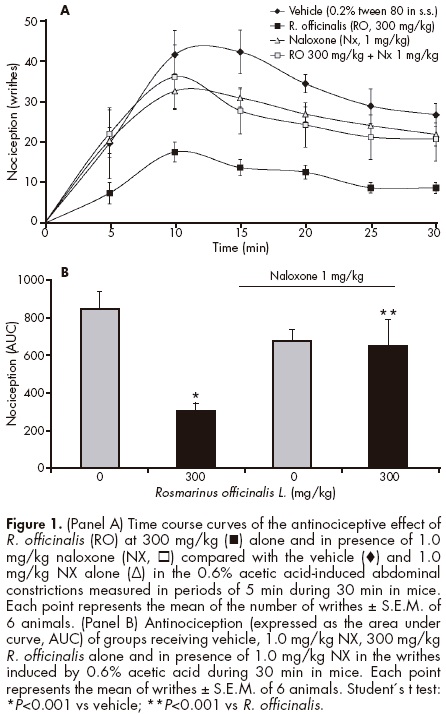
<body><![CDATA[<p align="justify"><font face="verdana" size="2">The method used was similar to that described by Hun&#45;skaar and Hole.<sup>17</sup> To induce nociception, mice were injected under the skin of the dorsal surface of the right hind paw with 20|iL of dilute formalin (1% in s.s.) by using a 30&#45;gauge needle. Immediately after, each single mouse was led into a cylinder of glass, with two mirrors behind of it, to have a total panorama of nociceptive behavior. Number of shakings and the accumulated time spent in licking the injected paw was taken as nociceptive response. Two periods of high licking and shaking activity were considered: the first one was obtained immediately after injection for a period of 5 min known as "early phase". A second period was observed from 20&#45;25 min after formalin injection and determined as the "late phase".</font></p>  	    <p align="justify"><font face="verdana" size="2"><b>PIFIR assay</b></font></p>  	    <p align="justify"><font face="verdana" size="2">Antinociceptive activity was measured using the PIFIR model.<sup>18</sup> Nociception was induced by injection of 50|iL of 20% uric acid into the knee joint of the right hind limb (i.art.), under light anaesthesia with ether. After uric acid injection, the animals developed a progressive dysfunction of the injured limb. The time of contact of the injured hind limb reached a zero value at 2&#45;2.5h after the uric acid injection. Rats were forced to walk on the rotating cylinder for periods of 2min, and then, rats were allowed to rest between recording periods. Data are expressed as the percentage of the functionality index (FI%), i.e., the time of contact of injected foot divided by the time of contact of the control left foot and multiplied by 100. Once the FI% was zero, different groups of rats received one of the following treatments: vehicle (0.5% tween 80 in s.s., p.o.), <i>R. officinalis</i> extract (1000 and 3000mg/kg, p.o) or tramadol (31.6mg/kg, i.p.). Other groups of rats received naloxone (1.0 or 3.16mg/kg s.c.) 15 min previous to <i>R. officinalis</i> extract (1000 and 3000mg/kg, p.o.), tramadol (31.6mg/ kg) or the respective vehicle administration. Recordings were taken every 15 min in the first 2h, and after this time every 30 min until 4h were completed. Recovery of the FI% was considered as expression of the antinociceptive effect. Time&#45;response curves were constructed to observe the onset of the antinociceptive effect, but also dose&#45;response curves were obtained to determine the significant antinociceptive dose. For the purpose of this study, inducing nociception in the experimental animals was unavoidable. However, care was taken to avoid unnecessary suffering.</font></p>  	    <p align="justify"><font face="verdana" size="2"><b>Data analysis</b></font></p>  	    <p align="justify"><font face="verdana" size="2">Data are expressed as the mean &plusmn; standard error of the mean (S.E.M.). The area under the curve (AUC) values were calculated from the respective time course curves of writhing and PIFIR assays and considered as an expression of the overall antinociceptive activity during the 30min or 4h observation period, respectively, using the trapezoidal rule.<sup>19</sup> All data were compared by analysis of variance (ANOVA) followed by Dunnett's test or by Student's t test using SIGMA STAT&reg; software, version 2.3. P&lt;0.05 was considered statistically significant.</font></p>  	    <p align="justify"><font face="verdana" size="2">&nbsp;</font></p>  	    <p align="justify"><font face="verdana" size="2"><b>RESULTS</b></font></p>  	    <p align="justify"><font face="verdana" size="2"><b>Effect of R. officinalis in the writing test</b></font></p>  	    <p align="justify"><font face="verdana" size="2">The number of writhes (nociception) induced by acetic acid 0.6% in the vehicle group (0.2% tween 80 in s.s.) was diminished from the first five minutes of the R. officinalis administration (300mg/kg); this diminution was kept until the end of the test (<a href="#fig1">figure 1A</a>). The nociceptive activity in the R. officinalis group measured as AUC=306&plusmn;39 area units (au) was significantly (t=5.56, df=10, <i>P</i>&lt;0.001) diminished in comparison with AUC=854&plusmn;91 au of nociceptive activity observed in the vehicle group (<a href="#fig1">figure 1B</a>). Presence of tramadol (50 mg/kg) produced a total inhibition (AUC=15&plusmn;4au) on the number of writhes induced by acetic acid 0.6% in the vehicle group (s.s., AUC=802&plusmn;61au); this inhibition was observed from the beginning until the end of the test (<a href="#fig2">figure 2A</a>). The antinociceptive effect of R. officinalis was almost totally reverted in presence of 1 mg/kg of naloxone (AUC=656&plusmn;138au) (t=&#45;8.09, df=10, P&lt;0.001) (figures 1A and 1B). Whereas, a partial inhibition was observed with 50mg/kg of tramadol in presence of the same dose of naloxone (AUC=434&plusmn;28au) (t=&#45;14.69, fd=10, <i>P</i>&lt;0.001) (<a href="#fig2">figures 2A</a> and <a href="#fig2">2B</a>).</font></p>      <p align="center"><font face="verdana" size="2"><a name="fig1"></a></font></p>  	    ]]></body>
<body><![CDATA[<p align="center"><font face="verdana" size="2"><img src="/img/revistas/sm/v36n2/a6f1.jpg"></font></p>  	    <p align="center"><font face="verdana" size="2"><a name="fig2"></a></font></p>  	    <p align="center"><font face="verdana" size="2"><img src="/img/revistas/sm/v36n2/a6f2.jpg"></font></p>  	    <p align="justify"><font face="verdana" size="2"><b>Effect of R. officinalis in the formalin test</b></font></p>      <p align="justify"><font face="verdana" size="2">Significant antinociceptive responses were observed in the shaking and in the licking time spent in mice with <i>R. officinalis</i> (300mg/kg) using formalin test. Both phases (early and late phases) were reverted in presence of 1mg/kg of naloxone (<a href="/img/revistas/sm/v36n2/a6t1.jpg" target="_blank">table 1</a>). In the case of tramadol, the antinociceptive effect produced for 50mg/kg was totally reverted in presence of 1mg/kg of naloxone in the early phase and partially on shaking behavior in the late phase. Both <i>R. officinalis</i> and tramadol showed a partial inhibition in the licking behavior of the late phase (<a href="/img/revistas/sm/v36n2/a6t1.jpg" target="_blank">table 1</a>).</font></p>      <p align="justify"><font face="verdana" size="2"><b>Effect of R. officinalis in the PIFIR assay</b></font></p>  	    <p align="justify"><font face="verdana" size="2">Both controls (receiving vehicle: s.s. and 0.5% tween 80 in s.s.) showed a FI%=0 during the lasting 4h of the experiment alone or in presence of 1 and/or 3.16 mg/kg naloxone (<a href="#fig3">figures 3A</a> and <a href="#fig4">4A</a>). Whereas, a significant and in a dosedependent antinociceptive effect observed with <i>R. officinalis</i> at 1000 and 3000 mg/kg was not reverted in presence of 1 or 3.16mg/kg naloxone, respectively (<a href="#fig3">figures 3A</a> and <a href="#fig3">3B</a>). While as it was expected, the antinociceptive effect produced for 31.6mg/kg of tramadol was partially inhibited by naloxone at 3.16mg/kg in this experimental model (F<sub>5,30</sub>=110.6.05, <i>P</i> &lt;0.001) (<a href="#fig4">figures 4A</a> and <a href="#fig4">4B</a>).</font></p>      <p align="center"><font face="verdana" size="2"><a name="fig3"></a></font></p>  	    <p align="center"><font face="verdana" size="2"><img src="/img/revistas/sm/v36n2/a6f3.jpg"></font></p>  	    <p align="center"><font face="verdana" size="2">&nbsp;</font></p>  	    ]]></body>
<body><![CDATA[<p align="center"><font face="verdana" size="2"><a name="fig4"></a></font></p>  	    <p align="center"><font face="verdana" size="2"><img src="/img/revistas/sm/v36n2/a6f4.jpg"></font></p>  	    <p align="justify"><font face="verdana" size="2">&nbsp;</font></p>  	    <p align="justify"><font face="verdana" size="2"><b>DISCUSSION</b></font></p>  	    <p align="justify"><font face="verdana" size="2">In the present study, it was investigated the endogenous opioid participation in the antinociceptive effect obtained with <i>R. officinalis</i> in three different kinds of induced nociception in rodents as previously observed.<sup>14</sup> As we demonstrate in our present research, presence of naloxone, an opioid antagonist, reverted the effect of <i>R. officinalis</i> in writhing test, an experimental model used in the screening of analgesic drugs.<sup>20</sup> These results are in agreement with a previous report where higher doses as 640 and 1120mg/kg of <i>R. officinalis</i> inhibited the number of writhes in mice and these effects were totally reverted with naloxone 1mg/kg s.c.<sup>10</sup> Additionally, antinociceptive effects of <i>R. officinalis,</i> observed in the formalin test,<sup>21</sup> were reverted in both licking and shaking behavior in either early (neurogenic) or late (inflammatory) phases in presence of naloxone. It is known that centrally acting drugs, such as opioids, inhibit both phases of nociception equally<sup>22</sup> involving the effect produced by prostaglandins released at this level in response to inflammation<sup>17,23</sup> or by endogenous opioid through their action on the Central Nervous System.<sup>24</sup> Inhibition of the antinociceptive effects of <i>R. officinalis</i> in writhing and in both phases of the formalin test in presence of naloxone may involve participation of endogenous opioids at central level. However, in spite of it, it has been thought that opioid drugs act exclusively within the Central Nervous System. Both animal<sup>4,25,26</sup> and human<sup>27</sup> studies have demonstrated that peripheral opioid mechanism plays a role in antinociception, particularly prominent under painful inflammatory conditions.<sup>28</sup></font></p>  	    <p align="justify"><font face="verdana" size="2">During inflammatory processes, opioid receptors are transported from dorsal root ganglia towards the peripheral sensory nerve endings. At the same time, immune cells containing endogenous opioid peptides accumulate within the inflamed tissue, which can liberate them to interact with the neuronal opioid receptors and elicit local analgesia.<sup>29</sup> DAMGO, a &#181;&#45;opioid receptor agonist, was able to suppress nociception on the late behaviour induced by formalin, but also decreases post&#45;surgical pain after instillation into the knee joint in humans.<sup>27</sup> Rodrigues and Duarte<sup>30</sup> reported that peripheral antinociceptive effect induced by morphine might result from activation of ATP&#45;sensitive K<sup>+</sup> channels, which may cause a hyperpolarization of peripheral terminal of primary afferents, leading to a decrease in action potential generation. But also, in the Central Nervous System, the opening of K+ channels plays a role in opioid&#45;mediated antinociception.<sup>31</sup> In the late phase of formalin test, it was observed an increase on the formalin&#45;induced nociception when a 300mg/kg dosage of <i>R. officinalis</i> was tested after 15min of 1mg/kg of naloxone. This pro&#45;nociceptive effect has been previously observed when local treatment with naloxone increases post&#45;surgical pain in humans.<sup>32</sup> It may be interesting in the future to evaluate the specific central and/or peripheral participation of the opioid system in the antinociceptive effects of <i>R. officinalis.</i></font></p>  	    <p align="justify"><font face="verdana" size="2">In the PIFIR assay, naloxone administration did not modify the <i>R. officinalis</i> antinociception; this suggests that an endogenous opioid participation is not the main mechanism of action involved in this kind of induced nociception. These results suggest that <i>R. officinalis</i> activity may be associated with different vias to produce antinociceptive effects depending on the kind and intensity of the induced nociception, but also different constituents of the <i>R. officinalis</i> may also be implicated.</font></p>  	    <p align="justify"><font face="verdana" size="2">Tramadol was used as a reference drug producing antinociceptive effect in all models used in this study. The specific mechanism of action of this analgesic drug is unknown. However, it has been described that tramadol produces analgesic activity by modulation of monoamines like noradrenaline and serotonin, but also by GABAergic neuro&#45;transmission.<sup>33</sup> Moreover, it is considered that mechanisms of action of tramadol involve a partial action through u.&#45;opi&#45;oid receptors,<sup>34</sup> which is in accord with our results because the presence of naloxone partially reverted the antinociceptive effect of this analgesic drug in all models experienced in our study.</font></p>  	    <p align="justify"><font face="verdana" size="2">In conclusion, antinociceptive effects of an ethanol extract of <i>R. officinalis</i> were reverted in presence of naloxone in visceral and inflammatory nociception, but not in the gout arthritis assay in rats. The outcome of the present study demonstrates that opioid participation is involved in the mechanism of action of <i>R. officinalis</i> antinociceptive activity which depends on the nociceptive stimulus and likely to the participation of different constituents in the plant.</font></p>      <p align="justify"><font face="verdana" size="2">&nbsp;</font></p>  	    ]]></body>
<body><![CDATA[<p align="justify"><font face="verdana" size="2"><b>ACKNOWLEDGEMENTS</b></font></p>  	    <p align="justify"><font face="verdana" size="2">We wish to thank Froyl&aacute;n S&aacute;nchez, Luis Oliva and Rub&eacute;n Luviano for their technical assistance. This work was partially supported by CONACYT&#45;80811 and INP3280 grants. Ana Laura Mart&iacute;nez received fellowship CONACYT&#45;203600.</font></p>  	    <p align="justify"><font face="verdana" size="2">&nbsp;</font></p>  	    <p align="justify"><font face="verdana" size="2"><b>REFERENCES</b></font></p>  	    <!-- ref --><p align="justify"><font face="verdana" size="2">1. Herz A, Teschemacher H. Activities and sites of antinociceptive action of morphine&#45;like analgesics. Adv Drug Res 1971;6:79&#45;119.    &nbsp;&nbsp;&nbsp;&nbsp;&nbsp;&nbsp;&nbsp;&nbsp;[&#160;<a href="javascript:void(0);" onclick="javascript: window.open('/scielo.php?script=sci_nlinks&ref=9086322&pid=S0185-3325201300020000600001&lng=','','width=640,height=500,resizable=yes,scrollbars=1,menubar=yes,');">Links</a>&#160;]<!-- end-ref --></font></p>  	    <!-- ref --><p align="justify"><font face="verdana" size="2">2. Yaksh TL, Rudy TA. Analgesia mediated by a direct spinal action of narcotics. Science 1976;192:1357&#45;1358.    &nbsp;&nbsp;&nbsp;&nbsp;&nbsp;&nbsp;&nbsp;&nbsp;[&#160;<a href="javascript:void(0);" onclick="javascript: window.open('/scielo.php?script=sci_nlinks&ref=9086324&pid=S0185-3325201300020000600002&lng=','','width=640,height=500,resizable=yes,scrollbars=1,menubar=yes,');">Links</a>&#160;]<!-- end-ref --></font></p>  	    <!-- ref --><p align="justify"><font face="verdana" size="2">3. Chen SR, Pan HL. Blocking mu opioid receptors in the spinal cord prevents the analgesic action by subsequent systemic opioids. Brain Res 2006;1081:119&#45;125.    &nbsp;&nbsp;&nbsp;&nbsp;&nbsp;&nbsp;&nbsp;&nbsp;[&#160;<a href="javascript:void(0);" onclick="javascript: window.open('/scielo.php?script=sci_nlinks&ref=9086326&pid=S0185-3325201300020000600003&lng=','','width=640,height=500,resizable=yes,scrollbars=1,menubar=yes,');">Links</a>&#160;]<!-- end-ref --></font></p>  	    ]]></body>
<body><![CDATA[<!-- ref --><p align="justify"><font face="verdana" size="2">4. Ferreira SH, Nakamura M. Prostaglandin hyperalgesia: The peripheral analgesic activity of morphine, enkephalins and opioid antagonists. Prostaglandins 1979a;18:191&#45;200.    &nbsp;&nbsp;&nbsp;&nbsp;&nbsp;&nbsp;&nbsp;&nbsp;[&#160;<a href="javascript:void(0);" onclick="javascript: window.open('/scielo.php?script=sci_nlinks&ref=9086328&pid=S0185-3325201300020000600004&lng=','','width=640,height=500,resizable=yes,scrollbars=1,menubar=yes,');">Links</a>&#160;]<!-- end-ref --></font></p>  	    <!-- ref --><p align="justify"><font face="verdana" size="2">5. Stein C, Gramsch C, Herz A. Intrinsic mechanisms of antinociception in inflammation: local opioid receptors and &szlig;&#45;endorphin. J Neurosci 1990;10:1292&#45;1298.    &nbsp;&nbsp;&nbsp;&nbsp;&nbsp;&nbsp;&nbsp;&nbsp;[&#160;<a href="javascript:void(0);" onclick="javascript: window.open('/scielo.php?script=sci_nlinks&ref=9086330&pid=S0185-3325201300020000600005&lng=','','width=640,height=500,resizable=yes,scrollbars=1,menubar=yes,');">Links</a>&#160;]<!-- end-ref --></font></p>  	    <!-- ref --><p align="justify"><font face="verdana" size="2">6. Al&#45;Sereiti MR, Abu&#45;Amer KM, Sen P. Pharmacology of rosemary <i>(Rosmarinus officinalis Linn.)</i> and its therapeutic potentials. Indian J Exp Biol 1999;37:124&#45;130.    &nbsp;&nbsp;&nbsp;&nbsp;&nbsp;&nbsp;&nbsp;&nbsp;[&#160;<a href="javascript:void(0);" onclick="javascript: window.open('/scielo.php?script=sci_nlinks&ref=9086332&pid=S0185-3325201300020000600006&lng=','','width=640,height=500,resizable=yes,scrollbars=1,menubar=yes,');">Links</a>&#160;]<!-- end-ref --></font></p>  	    <!-- ref --><p align="justify"><font face="verdana" size="2">7. Romo de Vivar A. Productos Naturales de la Flora Mexicana. M&eacute;xico: Limusa; 1985.    &nbsp;&nbsp;&nbsp;&nbsp;&nbsp;&nbsp;&nbsp;&nbsp;[&#160;<a href="javascript:void(0);" onclick="javascript: window.open('/scielo.php?script=sci_nlinks&ref=9086334&pid=S0185-3325201300020000600007&lng=','','width=640,height=500,resizable=yes,scrollbars=1,menubar=yes,');">Links</a>&#160;]<!-- end-ref --></font></p>  	    <!-- ref --><p align="justify"><font face="verdana" size="2">8. Mart&iacute;nez M. Las plantas medicinales de M&eacute;xico. 6th Ed. Mexico City: Botas; 1989.    &nbsp;&nbsp;&nbsp;&nbsp;&nbsp;&nbsp;&nbsp;&nbsp;[&#160;<a href="javascript:void(0);" onclick="javascript: window.open('/scielo.php?script=sci_nlinks&ref=9086336&pid=S0185-3325201300020000600008&lng=','','width=640,height=500,resizable=yes,scrollbars=1,menubar=yes,');">Links</a>&#160;]<!-- end-ref --></font></p>  	    ]]></body>
<body><![CDATA[<!-- ref --><p align="justify"><font face="verdana" size="2">9. Argueta VA. Atlas de las plantas medicinales tradicionales mexicanas. M&eacute;xico: Instituto Indigenista; 1994.    &nbsp;&nbsp;&nbsp;&nbsp;&nbsp;&nbsp;&nbsp;&nbsp;[&#160;<a href="javascript:void(0);" onclick="javascript: window.open('/scielo.php?script=sci_nlinks&ref=9086338&pid=S0185-3325201300020000600009&lng=','','width=640,height=500,resizable=yes,scrollbars=1,menubar=yes,');">Links</a>&#160;]<!-- end-ref --></font></p>  	    <!-- ref --><p align="justify"><font face="verdana" size="2">10. Hosseinzadeh H, Nourbakhsh M. Effect of <i>Rosmarinus officinalis L.</i> aerial parts extract on morphine withdrawal syndrome in mice. Phytother Res 2003;17:938&#45;941.    &nbsp;&nbsp;&nbsp;&nbsp;&nbsp;&nbsp;&nbsp;&nbsp;[&#160;<a href="javascript:void(0);" onclick="javascript: window.open('/scielo.php?script=sci_nlinks&ref=9086340&pid=S0185-3325201300020000600010&lng=','','width=640,height=500,resizable=yes,scrollbars=1,menubar=yes,');">Links</a>&#160;]<!-- end-ref --></font></p>  	    <!-- ref --><p align="justify"><font face="verdana" size="2">11. Capasso A, Picacente S, Pizza C, Sorrentino L. Flavonoids reduce morphine withdrawal in vitro. J Pharm Pharmacol 1998;50:561&#45;564.    &nbsp;&nbsp;&nbsp;&nbsp;&nbsp;&nbsp;&nbsp;&nbsp;[&#160;<a href="javascript:void(0);" onclick="javascript: window.open('/scielo.php?script=sci_nlinks&ref=9086342&pid=S0185-3325201300020000600011&lng=','','width=640,height=500,resizable=yes,scrollbars=1,menubar=yes,');">Links</a>&#160;]<!-- end-ref --></font></p>  	    <!-- ref --><p align="justify"><font face="verdana" size="2">12. Capasso A, Saturnino P, Simone FD, Aquino R. Flavonol glycosides from Aristeguietia discolor reduce morphine withdrawal in vitro. Phytother Res 2000;14:538&#45;540.    &nbsp;&nbsp;&nbsp;&nbsp;&nbsp;&nbsp;&nbsp;&nbsp;[&#160;<a href="javascript:void(0);" onclick="javascript: window.open('/scielo.php?script=sci_nlinks&ref=9086344&pid=S0185-3325201300020000600012&lng=','','width=640,height=500,resizable=yes,scrollbars=1,menubar=yes,');">Links</a>&#160;]<!-- end-ref --></font></p>  	    <!-- ref --><p align="justify"><font face="verdana" size="2">13. Rajendran NN, Thirugnanasambandam P, Viswanathan S, Parvathavarthini S et al. Antinociceptive pattern of flavone and its mechanism as tested by formalin assay. Indian J Exp Biol 2000;38:182&#45;185.    &nbsp;&nbsp;&nbsp;&nbsp;&nbsp;&nbsp;&nbsp;&nbsp;[&#160;<a href="javascript:void(0);" onclick="javascript: window.open('/scielo.php?script=sci_nlinks&ref=9086346&pid=S0185-3325201300020000600013&lng=','','width=640,height=500,resizable=yes,scrollbars=1,menubar=yes,');">Links</a>&#160;]<!-- end-ref --></font></p>  	    ]]></body>
<body><![CDATA[<!-- ref --><p align="justify"><font face="verdana" size="2">14. Gonz&aacute;lez&#45;Trujano ME, Pe&ntilde;a EI, Mart&iacute;nez AL, Guevara&#45;Fefer P et al. Evaluation of the antinociceptive effect of <i>Rosmarinus officinalis L.</i> using three different experimental models in rodents. J Ethnopharmacol 2007;111:476&#45;482.    &nbsp;&nbsp;&nbsp;&nbsp;&nbsp;&nbsp;&nbsp;&nbsp;[&#160;<a href="javascript:void(0);" onclick="javascript: window.open('/scielo.php?script=sci_nlinks&ref=9086348&pid=S0185-3325201300020000600014&lng=','','width=640,height=500,resizable=yes,scrollbars=1,menubar=yes,');">Links</a>&#160;]<!-- end-ref --></font></p>  	    <!-- ref --><p align="justify"><font face="verdana" size="2">15. Ferrada M. Etnograf&iacute;a, un enfoque para la investigaci&oacute;n de Weblogs en Biblioteconom&iacute;a y documentaci&oacute;n. Biblios &#91;edici&oacute;n online&#93;. 2006;7(23) &#91;9 p&aacute;ginas&#93;. Accesible en URL: <a href="http://eprints.rclis.org/7395/:1/2005_19.pdf" target="_blank">http://eprints.rclis.org/7395/:1/2005_19.pdf</a>. Consultada el 11 de mayo de 2011.    &nbsp;&nbsp;&nbsp;&nbsp;&nbsp;&nbsp;&nbsp;&nbsp;[&#160;<a href="javascript:void(0);" onclick="javascript: window.open('/scielo.php?script=sci_nlinks&ref=9086350&pid=S0185-3325201300020000600015&lng=','','width=640,height=500,resizable=yes,scrollbars=1,menubar=yes,');">Links</a>&#160;]<!-- end-ref --></font></p>  	    <!-- ref --><p align="justify"><font face="verdana" size="2">16. Collier HO, Dinneen LC, Johnson CA, Schneider C. The abdominal constriction response and its suppression by analgesic drugs in the mouse. Br J Pharmacol Chemother 1968;32:295&#45;310.    &nbsp;&nbsp;&nbsp;&nbsp;&nbsp;&nbsp;&nbsp;&nbsp;[&#160;<a href="javascript:void(0);" onclick="javascript: window.open('/scielo.php?script=sci_nlinks&ref=9086352&pid=S0185-3325201300020000600016&lng=','','width=640,height=500,resizable=yes,scrollbars=1,menubar=yes,');">Links</a>&#160;]<!-- end-ref --></font></p>  	    <!-- ref --><p align="justify"><font face="verdana" size="2">17. Mayring P. Qualitative Content Analysis. Forum Qual Soc Res &#91;edici&oacute;n online&#93;. 2000;1(2) &#91;10 p&aacute;ginas&#93;. Accesible en URL: <a href="http://www.qualitative&#45;research.nel/index.php/fqs/article/view/1089" target="_blank">http://www.qualitative&#45;research.nel/index.php/fqs/article/view/1089</a>. Consultada el 6 de enero de 2011.    &nbsp;&nbsp;&nbsp;&nbsp;&nbsp;&nbsp;&nbsp;&nbsp;[&#160;<a href="javascript:void(0);" onclick="javascript: window.open('/scielo.php?script=sci_nlinks&ref=9086354&pid=S0185-3325201300020000600017&lng=','','width=640,height=500,resizable=yes,scrollbars=1,menubar=yes,');">Links</a>&#160;]<!-- end-ref --></font></p>  	    <!-- ref --><p align="justify"><font face="verdana" size="2">18. L&oacute;pez&#45;Mu&ntilde;oz FJ, Salazar LA, Casta&ntilde;eda&#45;Hern&aacute;ndez G, Villarreal JE. A new model to assess analgesic activity: pain&#45;induced functional impairment in the rat (PIFIR). Drug Dev Res 1993;28:169&#45;175.    &nbsp;&nbsp;&nbsp;&nbsp;&nbsp;&nbsp;&nbsp;&nbsp;[&#160;<a href="javascript:void(0);" onclick="javascript: window.open('/scielo.php?script=sci_nlinks&ref=9086356&pid=S0185-3325201300020000600018&lng=','','width=640,height=500,resizable=yes,scrollbars=1,menubar=yes,');">Links</a>&#160;]<!-- end-ref --></font></p>  	    ]]></body>
<body><![CDATA[<!-- ref --><p align="justify"><font face="verdana" size="2">19. Rowland M, Toser TN. Clinical Pharmacokinetics: concepts and applications. 2nd Ed. Philadelphia: Lea &amp; Febiger; 1989.    &nbsp;&nbsp;&nbsp;&nbsp;&nbsp;&nbsp;&nbsp;&nbsp;[&#160;<a href="javascript:void(0);" onclick="javascript: window.open('/scielo.php?script=sci_nlinks&ref=9086358&pid=S0185-3325201300020000600019&lng=','','width=640,height=500,resizable=yes,scrollbars=1,menubar=yes,');">Links</a>&#160;]<!-- end-ref --></font></p>  	    <!-- ref --><p align="justify"><font face="verdana" size="2">20. Koster R, Anderson M, De Beer EJ. Acetic acid analgesic screening. Fed Proc 1959;18:418&#45;420.    &nbsp;&nbsp;&nbsp;&nbsp;&nbsp;&nbsp;&nbsp;&nbsp;[&#160;<a href="javascript:void(0);" onclick="javascript: window.open('/scielo.php?script=sci_nlinks&ref=9086360&pid=S0185-3325201300020000600020&lng=','','width=640,height=500,resizable=yes,scrollbars=1,menubar=yes,');">Links</a>&#160;]<!-- end-ref --></font></p>  	    <!-- ref --><p align="justify"><font face="verdana" size="2">21. Abbott FV, Franklin KBJ, Westbrook RF. The formalin test: scoring properties of the first and second phases of the pain response in rats. Pain 1995;60:91&#45;102.    &nbsp;&nbsp;&nbsp;&nbsp;&nbsp;&nbsp;&nbsp;&nbsp;[&#160;<a href="javascript:void(0);" onclick="javascript: window.open('/scielo.php?script=sci_nlinks&ref=9086362&pid=S0185-3325201300020000600021&lng=','','width=640,height=500,resizable=yes,scrollbars=1,menubar=yes,');">Links</a>&#160;]<!-- end-ref --></font></p>  	    <!-- ref --><p align="justify"><font face="verdana" size="2">22. Shibata M, Okhubo T, Takahashi H, Inoki R. Modified formalin test: Characteristics biphasic pain response. Pain 1989;38:346&#45;352.    &nbsp;&nbsp;&nbsp;&nbsp;&nbsp;&nbsp;&nbsp;&nbsp;[&#160;<a href="javascript:void(0);" onclick="javascript: window.open('/scielo.php?script=sci_nlinks&ref=9086364&pid=S0185-3325201300020000600022&lng=','','width=640,height=500,resizable=yes,scrollbars=1,menubar=yes,');">Links</a>&#160;]<!-- end-ref --></font></p>  	    <!-- ref --><p align="justify"><font face="verdana" size="2">23. Ferreira SH. Inflammatory pain, prostaglandin hyperalgesia and the development of peripheral analgesics. Trends Pharmacol Sci 1981;2:183&#45;186.    &nbsp;&nbsp;&nbsp;&nbsp;&nbsp;&nbsp;&nbsp;&nbsp;[&#160;<a href="javascript:void(0);" onclick="javascript: window.open('/scielo.php?script=sci_nlinks&ref=9086366&pid=S0185-3325201300020000600023&lng=','','width=640,height=500,resizable=yes,scrollbars=1,menubar=yes,');">Links</a>&#160;]<!-- end-ref --></font></p>  	    ]]></body>
<body><![CDATA[<!-- ref --><p align="justify"><font face="verdana" size="2">24. Jaffe JH, Martin WR. Opioid analgesics and antagonists. En: Gilman AG, Rall TW, Nies AS, Taylor P (eds.). Goodman and Gilman's the pharmacological basis of therapeutics. 9th Ed. New York: MacMillan; 1990.    &nbsp;&nbsp;&nbsp;&nbsp;&nbsp;&nbsp;&nbsp;&nbsp;[&#160;<a href="javascript:void(0);" onclick="javascript: window.open('/scielo.php?script=sci_nlinks&ref=9086368&pid=S0185-3325201300020000600024&lng=','','width=640,height=500,resizable=yes,scrollbars=1,menubar=yes,');">Links</a>&#160;]<!-- end-ref --></font></p>  	    <!-- ref --><p align="justify"><font face="verdana" size="2">25. Ferreira SH, Nakamura M. Prostaglandin hyperalgesia: a cAMP/Ca+2&#45;dependent process. Prostaglandins 1979b;18:179&#45;190.    &nbsp;&nbsp;&nbsp;&nbsp;&nbsp;&nbsp;&nbsp;&nbsp;[&#160;<a href="javascript:void(0);" onclick="javascript: window.open('/scielo.php?script=sci_nlinks&ref=9086370&pid=S0185-3325201300020000600025&lng=','','width=640,height=500,resizable=yes,scrollbars=1,menubar=yes,');">Links</a>&#160;]<!-- end-ref --></font></p>  	    <!-- ref --><p align="justify"><font face="verdana" size="2">26. Stein C, Millan MJ, St&uuml;ppenberg TS, Peter K et al. Peripheral opioid receptors mediating antinociception in inflammation. Evidence for involvement of mu, delta and kappa receptors. J Pharmacol Exp Ther 1989;248:1269&#45;1275.    &nbsp;&nbsp;&nbsp;&nbsp;&nbsp;&nbsp;&nbsp;&nbsp;[&#160;<a href="javascript:void(0);" onclick="javascript: window.open('/scielo.php?script=sci_nlinks&ref=9086372&pid=S0185-3325201300020000600026&lng=','','width=640,height=500,resizable=yes,scrollbars=1,menubar=yes,');">Links</a>&#160;]<!-- end-ref --></font></p>  	    <!-- ref --><p align="justify"><font face="verdana" size="2">27. Khoury GF, Chen ACN, Garland DE, Stein C. Intraarticular morphine, bupivacaine and morphine/bupivacaine for pain control after knee videoarthroscopy. Anesthesiology 1992;77:263&#45;266.    &nbsp;&nbsp;&nbsp;&nbsp;&nbsp;&nbsp;&nbsp;&nbsp;[&#160;<a href="javascript:void(0);" onclick="javascript: window.open('/scielo.php?script=sci_nlinks&ref=9086374&pid=S0185-3325201300020000600027&lng=','','width=640,height=500,resizable=yes,scrollbars=1,menubar=yes,');">Links</a>&#160;]<!-- end-ref --></font></p>  	    <!-- ref --><p align="justify"><font face="verdana" size="2">28. Hong Y, Abbott FV. Peripheral opioid modulation of pain and inflammation in the formalin test. Eur J Pharmacol 1995;277:21&#45;28.    &nbsp;&nbsp;&nbsp;&nbsp;&nbsp;&nbsp;&nbsp;&nbsp;[&#160;<a href="javascript:void(0);" onclick="javascript: window.open('/scielo.php?script=sci_nlinks&ref=9086376&pid=S0185-3325201300020000600028&lng=','','width=640,height=500,resizable=yes,scrollbars=1,menubar=yes,');">Links</a>&#160;]<!-- end-ref --></font></p>  	    ]]></body>
<body><![CDATA[<!-- ref --><p align="justify"><font face="verdana" size="2">29. Janson W, Stein C. Peripheral opioid analgesia. Curr Pharm Biotechnol 2003;4:270&#45;274.    &nbsp;&nbsp;&nbsp;&nbsp;&nbsp;&nbsp;&nbsp;&nbsp;[&#160;<a href="javascript:void(0);" onclick="javascript: window.open('/scielo.php?script=sci_nlinks&ref=9086378&pid=S0185-3325201300020000600029&lng=','','width=640,height=500,resizable=yes,scrollbars=1,menubar=yes,');">Links</a>&#160;]<!-- end-ref --></font></p>  	    <!-- ref --><p align="justify"><font face="verdana" size="2">30. Rodrigues ARA, Duarte IDG. The peripheral antinociceptive effect induced by morphine is associated with ATP&#45;sensitive K+ channels. Br J Pharmacol 2000;129:110&#45;114.    &nbsp;&nbsp;&nbsp;&nbsp;&nbsp;&nbsp;&nbsp;&nbsp;[&#160;<a href="javascript:void(0);" onclick="javascript: window.open('/scielo.php?script=sci_nlinks&ref=9086380&pid=S0185-3325201300020000600030&lng=','','width=640,height=500,resizable=yes,scrollbars=1,menubar=yes,');">Links</a>&#160;]<!-- end-ref --></font></p>  	    <!-- ref --><p align="justify"><font face="verdana" size="2">31. Roane DS, Boyd NE. Reduction of food intake and morphine analgesia by central glybenclamide. Pharmacol Biochem Behav 1993;46:205&#45;207.    &nbsp;&nbsp;&nbsp;&nbsp;&nbsp;&nbsp;&nbsp;&nbsp;[&#160;<a href="javascript:void(0);" onclick="javascript: window.open('/scielo.php?script=sci_nlinks&ref=9086382&pid=S0185-3325201300020000600031&lng=','','width=640,height=500,resizable=yes,scrollbars=1,menubar=yes,');">Links</a>&#160;]<!-- end-ref --></font></p>  	    <!-- ref --><p align="justify"><font face="verdana" size="2">32. Stein C, Hassan AHS, Lehrberger K, Giefing J. Local analgesic effect of endogenous opioid peptides. Lancet 1993;342:321&#45;324.    &nbsp;&nbsp;&nbsp;&nbsp;&nbsp;&nbsp;&nbsp;&nbsp;[&#160;<a href="javascript:void(0);" onclick="javascript: window.open('/scielo.php?script=sci_nlinks&ref=9086384&pid=S0185-3325201300020000600032&lng=','','width=640,height=500,resizable=yes,scrollbars=1,menubar=yes,');">Links</a>&#160;]<!-- end-ref --></font></p>  	    <!-- ref --><p align="justify"><font face="verdana" size="2">33. Hara K, Minami K, Sata T. The effects of tramadol and its metabolite on glycine, gamma&#45;aminobutyric acid A, and N&#45;methyl&#45;D&#45;aspartate receptors expressed in Xenopus oocytes. Anesth Analg 2005;100:1400&#45;1405.    &nbsp;&nbsp;&nbsp;&nbsp;&nbsp;&nbsp;&nbsp;&nbsp;[&#160;<a href="javascript:void(0);" onclick="javascript: window.open('/scielo.php?script=sci_nlinks&ref=9086386&pid=S0185-3325201300020000600033&lng=','','width=640,height=500,resizable=yes,scrollbars=1,menubar=yes,');">Links</a>&#160;]<!-- end-ref --></font></p>  	    ]]></body>
<body><![CDATA[<!-- ref --><p align="justify"><font face="verdana" size="2">34. Koga A, Fujita T, Totoki T, Kumamoto E. Tramadol produces outward currents by activating mu&#45;opioid receptors in adult rat substantia gelatinosa neurones. Br J Pharmacol 2005;145:602&#45;607.    &nbsp;&nbsp;&nbsp;&nbsp;&nbsp;&nbsp;&nbsp;&nbsp;[&#160;<a href="javascript:void(0);" onclick="javascript: window.open('/scielo.php?script=sci_nlinks&ref=9086388&pid=S0185-3325201300020000600034&lng=','','width=640,height=500,resizable=yes,scrollbars=1,menubar=yes,');">Links</a>&#160;]<!-- end-ref --></font></p>       ]]></body><back>
<ref-list>
<ref id="B1">
<label>1</label><nlm-citation citation-type="journal">
<person-group person-group-type="author">
<name>
<surname><![CDATA[Herz]]></surname>
<given-names><![CDATA[A]]></given-names>
</name>
<name>
<surname><![CDATA[Teschemacher]]></surname>
<given-names><![CDATA[H]]></given-names>
</name>
</person-group>
<article-title xml:lang="en"><![CDATA[Activities and sites of antinociceptive action of morphine-like analgesics]]></article-title>
<source><![CDATA[Adv Drug Res]]></source>
<year>1971</year>
<volume>6</volume>
<page-range>79-119</page-range></nlm-citation>
</ref>
<ref id="B2">
<label>2</label><nlm-citation citation-type="journal">
<person-group person-group-type="author">
<name>
<surname><![CDATA[Yaksh]]></surname>
<given-names><![CDATA[TL]]></given-names>
</name>
<name>
<surname><![CDATA[Rudy]]></surname>
<given-names><![CDATA[TA]]></given-names>
</name>
</person-group>
<article-title xml:lang="en"><![CDATA[Analgesia mediated by a direct spinal action of narcotics]]></article-title>
<source><![CDATA[Science]]></source>
<year>1976</year>
<volume>192</volume>
<page-range>1357-1358</page-range></nlm-citation>
</ref>
<ref id="B3">
<label>3</label><nlm-citation citation-type="journal">
<person-group person-group-type="author">
<name>
<surname><![CDATA[Chen]]></surname>
<given-names><![CDATA[SR]]></given-names>
</name>
<name>
<surname><![CDATA[Pan]]></surname>
<given-names><![CDATA[HL]]></given-names>
</name>
</person-group>
<article-title xml:lang="en"><![CDATA[Blocking mu opioid receptors in the spinal cord prevents the analgesic action by subsequent systemic opioids]]></article-title>
<source><![CDATA[Brain Res]]></source>
<year>2006</year>
<volume>1081</volume>
<page-range>119-125</page-range></nlm-citation>
</ref>
<ref id="B4">
<label>4</label><nlm-citation citation-type="journal">
<person-group person-group-type="author">
<name>
<surname><![CDATA[Ferreira]]></surname>
<given-names><![CDATA[SH]]></given-names>
</name>
<name>
<surname><![CDATA[Nakamura]]></surname>
<given-names><![CDATA[M]]></given-names>
</name>
</person-group>
<article-title xml:lang="en"><![CDATA[Prostaglandin hyperalgesia: The peripheral analgesic activity of morphine, enkephalins and opioid antagonists]]></article-title>
<source><![CDATA[Prostaglandins]]></source>
<year>1979</year>
<volume>18</volume>
<page-range>191-200</page-range></nlm-citation>
</ref>
<ref id="B5">
<label>5</label><nlm-citation citation-type="journal">
<person-group person-group-type="author">
<name>
<surname><![CDATA[Stein]]></surname>
<given-names><![CDATA[C]]></given-names>
</name>
<name>
<surname><![CDATA[Gramsch]]></surname>
<given-names><![CDATA[C]]></given-names>
</name>
<name>
<surname><![CDATA[Herz]]></surname>
<given-names><![CDATA[A]]></given-names>
</name>
</person-group>
<article-title xml:lang="es"><![CDATA[Intrinsic mechanisms of antinociception in inflammation: local opioid receptors and ß-endorphin]]></article-title>
<source><![CDATA[J Neurosci]]></source>
<year>1990</year>
<volume>10</volume>
<page-range>1292-1298</page-range></nlm-citation>
</ref>
<ref id="B6">
<label>6</label><nlm-citation citation-type="journal">
<person-group person-group-type="author">
<name>
<surname><![CDATA[Al-Sereiti]]></surname>
<given-names><![CDATA[MR]]></given-names>
</name>
<name>
<surname><![CDATA[Abu-Amer]]></surname>
<given-names><![CDATA[KM]]></given-names>
</name>
<name>
<surname><![CDATA[Sen]]></surname>
<given-names><![CDATA[P]]></given-names>
</name>
</person-group>
<article-title xml:lang="en"><![CDATA[Pharmacology of rosemary (Rosmarinus officinalis Linn.) and its therapeutic potentials]]></article-title>
<source><![CDATA[Indian J Exp Biol]]></source>
<year>1999</year>
<volume>37</volume>
<page-range>124-130</page-range></nlm-citation>
</ref>
<ref id="B7">
<label>7</label><nlm-citation citation-type="book">
<person-group person-group-type="author">
<name>
<surname><![CDATA[Romo de Vivar]]></surname>
<given-names><![CDATA[A]]></given-names>
</name>
</person-group>
<source><![CDATA[Productos Naturales de la Flora Mexicana]]></source>
<year>1985</year>
<publisher-loc><![CDATA[México ]]></publisher-loc>
<publisher-name><![CDATA[Limusa]]></publisher-name>
</nlm-citation>
</ref>
<ref id="B8">
<label>8</label><nlm-citation citation-type="book">
<person-group person-group-type="author">
<name>
<surname><![CDATA[Martínez]]></surname>
<given-names><![CDATA[M]]></given-names>
</name>
</person-group>
<source><![CDATA[Las plantas medicinales de México]]></source>
<year>1989</year>
<edition>6th</edition>
<publisher-loc><![CDATA[Mexico ]]></publisher-loc>
<publisher-name><![CDATA[Botas]]></publisher-name>
</nlm-citation>
</ref>
<ref id="B9">
<label>9</label><nlm-citation citation-type="book">
<person-group person-group-type="author">
<name>
<surname><![CDATA[Argueta]]></surname>
<given-names><![CDATA[VA]]></given-names>
</name>
</person-group>
<source><![CDATA[Atlas de las plantas medicinales tradicionales mexicanas]]></source>
<year>1994</year>
<publisher-loc><![CDATA[México ]]></publisher-loc>
<publisher-name><![CDATA[Instituto Indigenista]]></publisher-name>
</nlm-citation>
</ref>
<ref id="B10">
<label>10</label><nlm-citation citation-type="journal">
<person-group person-group-type="author">
<name>
<surname><![CDATA[Hosseinzadeh]]></surname>
<given-names><![CDATA[H]]></given-names>
</name>
<name>
<surname><![CDATA[Nourbakhsh]]></surname>
<given-names><![CDATA[M]]></given-names>
</name>
</person-group>
<article-title xml:lang="en"><![CDATA[Effect of Rosmarinus officinalis L. aerial parts extract on morphine withdrawal syndrome in mice.]]></article-title>
<source><![CDATA[Phytother Res]]></source>
<year>2003</year>
<volume>17</volume>
<page-range>938-941</page-range></nlm-citation>
</ref>
<ref id="B11">
<label>11</label><nlm-citation citation-type="journal">
<person-group person-group-type="author">
<name>
<surname><![CDATA[Capasso]]></surname>
<given-names><![CDATA[A]]></given-names>
</name>
<name>
<surname><![CDATA[Picacente]]></surname>
<given-names><![CDATA[S]]></given-names>
</name>
<name>
<surname><![CDATA[Pizza]]></surname>
<given-names><![CDATA[C]]></given-names>
</name>
<name>
<surname><![CDATA[Sorrentino]]></surname>
<given-names><![CDATA[L]]></given-names>
</name>
</person-group>
<article-title xml:lang="en"><![CDATA[Flavonoids reduce morphine withdrawal in vitro]]></article-title>
<source><![CDATA[J Pharm Pharmacol]]></source>
<year>1998</year>
<volume>50</volume>
<page-range>561-564</page-range></nlm-citation>
</ref>
<ref id="B12">
<label>12</label><nlm-citation citation-type="journal">
<person-group person-group-type="author">
<name>
<surname><![CDATA[Capasso]]></surname>
<given-names><![CDATA[A]]></given-names>
</name>
<name>
<surname><![CDATA[Saturnino]]></surname>
<given-names><![CDATA[P]]></given-names>
</name>
<name>
<surname><![CDATA[Simone]]></surname>
<given-names><![CDATA[FD]]></given-names>
</name>
<name>
<surname><![CDATA[Aquino]]></surname>
<given-names><![CDATA[R]]></given-names>
</name>
</person-group>
<article-title xml:lang="en"><![CDATA[Flavonol glycosides from Aristeguietia discolor reduce morphine withdrawal in vitro]]></article-title>
<source><![CDATA[Phytother Res]]></source>
<year>2000</year>
<volume>14</volume>
<page-range>538-540</page-range></nlm-citation>
</ref>
<ref id="B13">
<label>13</label><nlm-citation citation-type="journal">
<person-group person-group-type="author">
<name>
<surname><![CDATA[Rajendran]]></surname>
<given-names><![CDATA[NN]]></given-names>
</name>
<name>
<surname><![CDATA[Thirugnanasambandam]]></surname>
<given-names><![CDATA[P]]></given-names>
</name>
<name>
<surname><![CDATA[Viswanathan]]></surname>
<given-names><![CDATA[S]]></given-names>
</name>
<name>
<surname><![CDATA[Parvathavarthini]]></surname>
<given-names><![CDATA[S]]></given-names>
</name>
</person-group>
<article-title xml:lang="en"><![CDATA[Antinociceptive pattern of flavone and its mechanism as tested by formalin assay]]></article-title>
<source><![CDATA[Indian J Exp Biol]]></source>
<year>2000</year>
<volume>38</volume>
<page-range>182-185</page-range></nlm-citation>
</ref>
<ref id="B14">
<label>14</label><nlm-citation citation-type="journal">
<person-group person-group-type="author">
<name>
<surname><![CDATA[González-Trujano]]></surname>
<given-names><![CDATA[ME]]></given-names>
</name>
<name>
<surname><![CDATA[Peña]]></surname>
<given-names><![CDATA[EI]]></given-names>
</name>
<name>
<surname><![CDATA[Martínez]]></surname>
<given-names><![CDATA[AL]]></given-names>
</name>
<name>
<surname><![CDATA[Guevara-Fefer]]></surname>
<given-names><![CDATA[P]]></given-names>
</name>
</person-group>
<article-title xml:lang="en"><![CDATA[Evaluation of the antinociceptive effect of Rosmarinus officinalis L]]></article-title>
<source><![CDATA[J Ethnopharmacol]]></source>
<year>2007</year>
<volume>111</volume>
<page-range>476-482</page-range></nlm-citation>
</ref>
<ref id="B15">
<label>15</label><nlm-citation citation-type="journal">
<person-group person-group-type="author">
<name>
<surname><![CDATA[Ferrada]]></surname>
<given-names><![CDATA[M]]></given-names>
</name>
</person-group>
<article-title xml:lang="es"><![CDATA[Etnografía, un enfoque para la investigación de Weblogs en Biblioteconomía y documentación]]></article-title>
<source><![CDATA[Biblios]]></source>
<year>2006</year>
<volume>7</volume>
<numero>23</numero>
<issue>23</issue>
</nlm-citation>
</ref>
<ref id="B16">
<label>16</label><nlm-citation citation-type="journal">
<person-group person-group-type="author">
<name>
<surname><![CDATA[Collier]]></surname>
<given-names><![CDATA[HO]]></given-names>
</name>
<name>
<surname><![CDATA[Dinneen]]></surname>
<given-names><![CDATA[LC]]></given-names>
</name>
<name>
<surname><![CDATA[Johnson]]></surname>
<given-names><![CDATA[CA]]></given-names>
</name>
<name>
<surname><![CDATA[Schneider]]></surname>
<given-names><![CDATA[C]]></given-names>
</name>
</person-group>
<article-title xml:lang="en"><![CDATA[The abdominal constriction response and its suppression by analgesic drugs in the mouse]]></article-title>
<source><![CDATA[Br J Pharmacol Chemother]]></source>
<year>1968</year>
<volume>32</volume>
<page-range>295-310</page-range></nlm-citation>
</ref>
<ref id="B17">
<label>17</label><nlm-citation citation-type="journal">
<person-group person-group-type="author">
<name>
<surname><![CDATA[Mayring]]></surname>
<given-names><![CDATA[P]]></given-names>
</name>
</person-group>
<article-title xml:lang="en"><![CDATA[Qualitative Content Analysis]]></article-title>
<source><![CDATA[]Forum Qual Soc Res]]></source>
<year>2000</year>
</nlm-citation>
</ref>
<ref id="B18">
<label>18</label><nlm-citation citation-type="journal">
<person-group person-group-type="author">
<name>
<surname><![CDATA[López-Muñoz]]></surname>
<given-names><![CDATA[FJ]]></given-names>
</name>
<name>
<surname><![CDATA[Salazar]]></surname>
<given-names><![CDATA[LA]]></given-names>
</name>
<name>
<surname><![CDATA[Castañeda-Hernández]]></surname>
<given-names><![CDATA[G]]></given-names>
</name>
<name>
<surname><![CDATA[Villarreal]]></surname>
<given-names><![CDATA[JE]]></given-names>
</name>
</person-group>
<article-title xml:lang="en"><![CDATA[A new model to assess analgesic activity: pain-induced functional impairment in the rat (PIFIR)]]></article-title>
<source><![CDATA[Drug Dev Res]]></source>
<year>1993</year>
<volume>28</volume>
<page-range>169-175</page-range></nlm-citation>
</ref>
<ref id="B19">
<label>19</label><nlm-citation citation-type="book">
<person-group person-group-type="author">
<name>
<surname><![CDATA[Rowland]]></surname>
<given-names><![CDATA[M]]></given-names>
</name>
<name>
<surname><![CDATA[Toser]]></surname>
<given-names><![CDATA[TN]]></given-names>
</name>
</person-group>
<source><![CDATA[Clinical Pharmacokinetics: concepts and applications]]></source>
<year>1989</year>
<edition>2nd</edition>
<publisher-loc><![CDATA[Philadelphia ]]></publisher-loc>
<publisher-name><![CDATA[Lea & Febiger]]></publisher-name>
</nlm-citation>
</ref>
<ref id="B20">
<label>20</label><nlm-citation citation-type="journal">
<person-group person-group-type="author">
<name>
<surname><![CDATA[Koster]]></surname>
<given-names><![CDATA[R]]></given-names>
</name>
<name>
<surname><![CDATA[Anderson]]></surname>
<given-names><![CDATA[M]]></given-names>
</name>
<name>
<surname><![CDATA[De Beer]]></surname>
<given-names><![CDATA[EJ]]></given-names>
</name>
</person-group>
<article-title xml:lang="en"><![CDATA[Acetic acid analgesic screening]]></article-title>
<source><![CDATA[Fed Proc]]></source>
<year>1959</year>
<volume>18</volume>
<page-range>418-420</page-range></nlm-citation>
</ref>
<ref id="B21">
<label>21</label><nlm-citation citation-type="journal">
<person-group person-group-type="author">
<name>
<surname><![CDATA[Abbott]]></surname>
<given-names><![CDATA[FV]]></given-names>
</name>
<name>
<surname><![CDATA[Franklin]]></surname>
<given-names><![CDATA[KBJ]]></given-names>
</name>
<name>
<surname><![CDATA[Westbrook]]></surname>
<given-names><![CDATA[RF]]></given-names>
</name>
</person-group>
<article-title xml:lang="en"><![CDATA[The formalin test: scoring properties of the first and second phases of the pain response in rats]]></article-title>
<source><![CDATA[Pain]]></source>
<year>1995</year>
<volume>60</volume>
<page-range>91-102</page-range></nlm-citation>
</ref>
<ref id="B22">
<label>22</label><nlm-citation citation-type="journal">
<person-group person-group-type="author">
<name>
<surname><![CDATA[Shibata]]></surname>
<given-names><![CDATA[M]]></given-names>
</name>
<name>
<surname><![CDATA[Okhubo]]></surname>
<given-names><![CDATA[T]]></given-names>
</name>
<name>
<surname><![CDATA[Takahashi]]></surname>
<given-names><![CDATA[H]]></given-names>
</name>
<name>
<surname><![CDATA[Inoki]]></surname>
<given-names><![CDATA[R]]></given-names>
</name>
</person-group>
<article-title xml:lang="en"><![CDATA[Modified formalin test: Characteristics biphasic pain response]]></article-title>
<source><![CDATA[Pain]]></source>
<year>1989</year>
<volume>38</volume>
<page-range>346-352</page-range></nlm-citation>
</ref>
<ref id="B23">
<label>23</label><nlm-citation citation-type="journal">
<person-group person-group-type="author">
<name>
<surname><![CDATA[Ferreira]]></surname>
<given-names><![CDATA[SH]]></given-names>
</name>
</person-group>
<article-title xml:lang="en"><![CDATA[Inflammatory pain, prostaglandin hyperalgesia and the development of peripheral analgesics]]></article-title>
<source><![CDATA[Trends Pharmacol Sci]]></source>
<year>1981</year>
<volume>2</volume>
<page-range>183-186</page-range></nlm-citation>
</ref>
<ref id="B24">
<label>24</label><nlm-citation citation-type="book">
<person-group person-group-type="author">
<name>
<surname><![CDATA[Jaffe]]></surname>
<given-names><![CDATA[JH]]></given-names>
</name>
<name>
<surname><![CDATA[Martin]]></surname>
<given-names><![CDATA[WR]]></given-names>
</name>
</person-group>
<article-title xml:lang="en"><![CDATA[Opioid analgesics and antagonists]]></article-title>
<person-group person-group-type="editor">
<name>
<surname><![CDATA[Gilman]]></surname>
<given-names><![CDATA[AG]]></given-names>
</name>
<name>
<surname><![CDATA[Rall]]></surname>
<given-names><![CDATA[TW]]></given-names>
</name>
<name>
<surname><![CDATA[Nies]]></surname>
<given-names><![CDATA[AS]]></given-names>
</name>
<name>
<surname><![CDATA[Taylor]]></surname>
<given-names><![CDATA[P]]></given-names>
</name>
</person-group>
<source><![CDATA[Goodman and Gilman's the pharmacological basis of therapeutics]]></source>
<year>1990</year>
<publisher-loc><![CDATA[9th Ed. New York ]]></publisher-loc>
<publisher-name><![CDATA[MacMillan]]></publisher-name>
</nlm-citation>
</ref>
<ref id="B25">
<label>25</label><nlm-citation citation-type="journal">
<person-group person-group-type="author">
<name>
<surname><![CDATA[Ferreira]]></surname>
<given-names><![CDATA[SH]]></given-names>
</name>
<name>
<surname><![CDATA[Nakamura]]></surname>
<given-names><![CDATA[M]]></given-names>
</name>
</person-group>
<article-title xml:lang="en"><![CDATA[Prostaglandin hyperalgesia: a cAMP/Ca+2-dependent process]]></article-title>
<source><![CDATA[Prostaglandins]]></source>
<year>1979</year>
<volume>18</volume>
<page-range>179-190</page-range></nlm-citation>
</ref>
<ref id="B26">
<label>26</label><nlm-citation citation-type="journal">
<person-group person-group-type="author">
<name>
<surname><![CDATA[Stein]]></surname>
<given-names><![CDATA[C]]></given-names>
</name>
<name>
<surname><![CDATA[Millan]]></surname>
<given-names><![CDATA[MJ]]></given-names>
</name>
<name>
<surname><![CDATA[Stüppenberg]]></surname>
<given-names><![CDATA[TS]]></given-names>
</name>
<name>
<surname><![CDATA[Peter]]></surname>
<given-names><![CDATA[K]]></given-names>
</name>
</person-group>
<article-title xml:lang="en"><![CDATA[Peripheral opioid receptors mediating antinociception in inflammation. Evidence for involvement of mu, delta and kappa receptors.]]></article-title>
<source><![CDATA[J Pharmacol Exp Ther]]></source>
<year>1989</year>
<volume>248</volume>
<page-range>1269-1275</page-range></nlm-citation>
</ref>
<ref id="B27">
<label>27</label><nlm-citation citation-type="journal">
<person-group person-group-type="author">
<name>
<surname><![CDATA[Khoury]]></surname>
<given-names><![CDATA[GF]]></given-names>
</name>
<name>
<surname><![CDATA[Chen]]></surname>
<given-names><![CDATA[ACN]]></given-names>
</name>
<name>
<surname><![CDATA[Garland]]></surname>
<given-names><![CDATA[DE]]></given-names>
</name>
<name>
<surname><![CDATA[Stein]]></surname>
<given-names><![CDATA[C]]></given-names>
</name>
</person-group>
<article-title xml:lang="en"><![CDATA[Intraarticular morphine, bupivacaine and morphine/bupivacaine for pain control after knee videoarthroscopy]]></article-title>
<source><![CDATA[Anesthesiology]]></source>
<year>1992</year>
<volume>77</volume>
<page-range>263-266</page-range></nlm-citation>
</ref>
<ref id="B28">
<label>28</label><nlm-citation citation-type="journal">
<person-group person-group-type="author">
<name>
<surname><![CDATA[Hong]]></surname>
<given-names><![CDATA[Y]]></given-names>
</name>
<name>
<surname><![CDATA[Abbott]]></surname>
<given-names><![CDATA[FV]]></given-names>
</name>
</person-group>
<article-title xml:lang="en"><![CDATA[Peripheral opioid modulation of pain and inflammation in the formalin test]]></article-title>
<source><![CDATA[Eur J Pharmacol]]></source>
<year>1995</year>
<volume>277</volume>
<page-range>21-28</page-range></nlm-citation>
</ref>
<ref id="B29">
<label>29</label><nlm-citation citation-type="journal">
<person-group person-group-type="author">
<name>
<surname><![CDATA[Janson]]></surname>
<given-names><![CDATA[W]]></given-names>
</name>
<name>
<surname><![CDATA[Stein]]></surname>
<given-names><![CDATA[C]]></given-names>
</name>
</person-group>
<article-title xml:lang="en"><![CDATA[Peripheral opioid analgesia]]></article-title>
<source><![CDATA[Curr Pharm Biotechnol]]></source>
<year>2003</year>
<volume>4</volume>
<page-range>270-274</page-range></nlm-citation>
</ref>
<ref id="B30">
<label>30</label><nlm-citation citation-type="journal">
<person-group person-group-type="author">
<name>
<surname><![CDATA[Rodrigues]]></surname>
<given-names><![CDATA[ARA]]></given-names>
</name>
<name>
<surname><![CDATA[Duarte]]></surname>
<given-names><![CDATA[IDG]]></given-names>
</name>
</person-group>
<article-title xml:lang="en"><![CDATA[The peripheral antinociceptive effect induced by morphine is associated with ATP-sensitive K+ channels]]></article-title>
<source><![CDATA[Br J Pharmacol]]></source>
<year>2000</year>
<volume>129</volume>
<page-range>110-114</page-range></nlm-citation>
</ref>
<ref id="B31">
<label>31</label><nlm-citation citation-type="journal">
<person-group person-group-type="author">
<name>
<surname><![CDATA[Roane]]></surname>
<given-names><![CDATA[DS]]></given-names>
</name>
<name>
<surname><![CDATA[Boyd]]></surname>
<given-names><![CDATA[NE]]></given-names>
</name>
</person-group>
<article-title xml:lang="en"><![CDATA[Reduction of food intake and morphine analgesia by central glybenclamide]]></article-title>
<source><![CDATA[Pharmacol Biochem Behav]]></source>
<year>1993</year>
<volume>46</volume>
<page-range>205-207</page-range></nlm-citation>
</ref>
<ref id="B32">
<label>32</label><nlm-citation citation-type="journal">
<person-group person-group-type="author">
<name>
<surname><![CDATA[Stein]]></surname>
<given-names><![CDATA[C]]></given-names>
</name>
<name>
<surname><![CDATA[Hassan]]></surname>
<given-names><![CDATA[AHS]]></given-names>
</name>
<name>
<surname><![CDATA[Lehrberger]]></surname>
<given-names><![CDATA[K]]></given-names>
</name>
<name>
<surname><![CDATA[Giefing]]></surname>
<given-names><![CDATA[J]]></given-names>
</name>
</person-group>
<article-title xml:lang="en"><![CDATA[Local analgesic effect of endogenous opioid peptides]]></article-title>
<source><![CDATA[Lancet]]></source>
<year>1993</year>
<volume>342</volume>
<page-range>321-324</page-range></nlm-citation>
</ref>
<ref id="B33">
<label>33</label><nlm-citation citation-type="journal">
<person-group person-group-type="author">
<name>
<surname><![CDATA[Hara]]></surname>
<given-names><![CDATA[K]]></given-names>
</name>
<name>
<surname><![CDATA[Minami]]></surname>
<given-names><![CDATA[K]]></given-names>
</name>
<name>
<surname><![CDATA[Sata]]></surname>
<given-names><![CDATA[T]]></given-names>
</name>
</person-group>
<article-title xml:lang="en"><![CDATA[The effects of tramadol and its metabolite on glycine, gamma-aminobutyric acid A, and N-methyl-D-aspartate receptors expressed in Xenopus oocytes]]></article-title>
<source><![CDATA[Anesth Analg]]></source>
<year>2005</year>
<volume>100</volume>
<page-range>1400-1405</page-range></nlm-citation>
</ref>
<ref id="B34">
<label>34</label><nlm-citation citation-type="journal">
<person-group person-group-type="author">
<name>
<surname><![CDATA[Koga]]></surname>
<given-names><![CDATA[A]]></given-names>
</name>
<name>
<surname><![CDATA[Fujita]]></surname>
<given-names><![CDATA[T]]></given-names>
</name>
<name>
<surname><![CDATA[Totoki]]></surname>
<given-names><![CDATA[T]]></given-names>
</name>
<name>
<surname><![CDATA[Kumamoto]]></surname>
<given-names><![CDATA[E]]></given-names>
</name>
</person-group>
<article-title xml:lang="en"><![CDATA[Tramadol produces outward currents by activating mu-opioid receptors in adult rat substantia gelatinosa neurones]]></article-title>
<source><![CDATA[Br J Pharmacol]]></source>
<year>2005</year>
<volume>145</volume>
<page-range>602-607</page-range></nlm-citation>
</ref>
</ref-list>
</back>
</article>