<?xml version="1.0" encoding="ISO-8859-1"?><article xmlns:mml="http://www.w3.org/1998/Math/MathML" xmlns:xlink="http://www.w3.org/1999/xlink" xmlns:xsi="http://www.w3.org/2001/XMLSchema-instance">
<front>
<journal-meta>
<journal-id>0185-3325</journal-id>
<journal-title><![CDATA[Salud mental]]></journal-title>
<abbrev-journal-title><![CDATA[Salud Ment]]></abbrev-journal-title>
<issn>0185-3325</issn>
<publisher>
<publisher-name><![CDATA[Instituto Nacional de Psiquiatría Ramón de la Fuente Muñiz]]></publisher-name>
</publisher>
</journal-meta>
<article-meta>
<article-id>S0185-33252011000600003</article-id>
<title-group>
<article-title xml:lang="en"><![CDATA[Validation of a cocaine craving questionnaire (CCQ-G) in Mexican population]]></article-title>
<article-title xml:lang="es"><![CDATA[Cuestionario del craving (apetencia) de cocaína (CCQ-G) en población mexicana]]></article-title>
</title-group>
<contrib-group>
<contrib contrib-type="author">
<name>
<surname><![CDATA[Marín-Navarrete]]></surname>
<given-names><![CDATA[Rodrigo]]></given-names>
</name>
<xref ref-type="aff" rid="A01"/>
</contrib>
<contrib contrib-type="author">
<name>
<surname><![CDATA[Mejía-Cruz]]></surname>
<given-names><![CDATA[Diana]]></given-names>
</name>
<xref ref-type="aff" rid="A01"/>
</contrib>
<contrib contrib-type="author">
<name>
<surname><![CDATA[Templos-Nuñez]]></surname>
<given-names><![CDATA[Liliana]]></given-names>
</name>
<xref ref-type="aff" rid="A01"/>
</contrib>
<contrib contrib-type="author">
<name>
<surname><![CDATA[Rosendo-Robles]]></surname>
<given-names><![CDATA[Alejandro]]></given-names>
</name>
<xref ref-type="aff" rid="A01"/>
</contrib>
<contrib contrib-type="author">
<name>
<surname><![CDATA[González-Zavala]]></surname>
<given-names><![CDATA[Mario]]></given-names>
</name>
<xref ref-type="aff" rid="A02"/>
</contrib>
<contrib contrib-type="author">
<name>
<surname><![CDATA[Nanni-Alvarado]]></surname>
<given-names><![CDATA[Ricardo]]></given-names>
</name>
<xref ref-type="aff" rid="A02"/>
</contrib>
<contrib contrib-type="author">
<name>
<surname><![CDATA[García]]></surname>
<given-names><![CDATA[Isis]]></given-names>
</name>
<xref ref-type="aff" rid="A02"/>
</contrib>
<contrib contrib-type="author">
<name>
<surname><![CDATA[Leff]]></surname>
<given-names><![CDATA[Philippe]]></given-names>
</name>
<xref ref-type="aff" rid="A03"/>
</contrib>
<contrib contrib-type="author">
<name>
<surname><![CDATA[Salazar-Juárez]]></surname>
<given-names><![CDATA[Alberto]]></given-names>
</name>
<xref ref-type="aff" rid="A04"/>
</contrib>
<contrib contrib-type="author">
<name>
<surname><![CDATA[Antón-Palma]]></surname>
<given-names><![CDATA[Benito]]></given-names>
</name>
<xref ref-type="aff" rid="A04"/>
</contrib>
</contrib-group>
<aff id="A01">
<institution><![CDATA[,Instituto Nacional de Psiquiatría Ramón de la Fuente Muñiz (INPRF)  ]]></institution>
<addr-line><![CDATA[ ]]></addr-line>
</aff>
<aff id="A02">
<institution><![CDATA[,Instituto Nacional de Psiquiatría Ramón de la Fuente Muñiz (INPRF) Clínica de Trastornos Adictivos ]]></institution>
<addr-line><![CDATA[ ]]></addr-line>
</aff>
<aff id="A03">
<institution><![CDATA[,Instituto Nacional de Perinatología Isidro Espinosa de los Reyes Subdirección de Investigaciones Biomédicas ]]></institution>
<addr-line><![CDATA[ ]]></addr-line>
</aff>
<aff id="A04">
<institution><![CDATA[,Instituto Nacional de Psiquiatría Ramón de la Fuente Muñiz (INPRF) Unidad de Neurobiología y Neuroquímica de las Adicciones ]]></institution>
<addr-line><![CDATA[ ]]></addr-line>
</aff>
<pub-date pub-type="pub">
<day>00</day>
<month>12</month>
<year>2011</year>
</pub-date>
<pub-date pub-type="epub">
<day>00</day>
<month>12</month>
<year>2011</year>
</pub-date>
<volume>34</volume>
<numero>6</numero>
<fpage>491</fpage>
<lpage>496</lpage>
<copyright-statement/>
<copyright-year/>
<self-uri xlink:href="http://www.scielo.org.mx/scielo.php?script=sci_arttext&amp;pid=S0185-33252011000600003&amp;lng=en&amp;nrm=iso"></self-uri><self-uri xlink:href="http://www.scielo.org.mx/scielo.php?script=sci_abstract&amp;pid=S0185-33252011000600003&amp;lng=en&amp;nrm=iso"></self-uri><self-uri xlink:href="http://www.scielo.org.mx/scielo.php?script=sci_pdf&amp;pid=S0185-33252011000600003&amp;lng=en&amp;nrm=iso"></self-uri><abstract abstract-type="short" xml:lang="en"><p><![CDATA[This study aimed for the validation of the General Cocaine Craving Questionnaire (CCQ-G) in Mexican population. To achieve this, the scale was applied by interviewing 233 cocaine users, of which 214 met inclusion criteria for the final analysis. This study's inclusion criterion was: not having a psychotic episode and/or manic or depressive or cognitive damage that could impede adequate test solving. The sample consisted entirely of male participants, aged between 18 and 59 years (M = 27, SD = 9.2). All participants met DSM-IV-TR criteria for substance abuse and dependence. 83% of the sample were polydrug users, but reported cocaine as their main drug of use. 74.8% of the sample reported previously having attended treatment for cocaine dependence. At the time of the study, all of the sample was under residential treatment between their 4th and 12th week and was distributed in 5 different institutions whose treatment model is grounded in the philosophy of Alcoholics Anonymous. After factor analysis was performed, the model was adjusted to three factors. Factor 1 referred to intention to use cocaine, factor 2 expressed desire for cocaine consumption, and factor 3 referred to positive expectancies for cocaine consumption. The instrument showed good internal consistency with an &#945;=.87.]]></p></abstract>
<abstract abstract-type="short" xml:lang="es"><p><![CDATA[El presente estudio tuvo como objetivo validar en la población mexicana la escala Cocaine Craving Questionnaire General (CCQ-G). Para conseguir tal objetivo, se entrevistó y aplicó la escala a una N = 233 consumidores de cocaína que decidieron participar voluntariamente en el estudio. Los criterios para ingresar al estudio fueron los siguientes: no sufrir un episodio psicótico, maniaco, depresivo o daño cognitivo que impidiera resolver adecuadamente la escala. La muestra estuvo constituida por participantes masculinos, que reunían los criterios del DSM-IV-TR para abuso y dependencia a sustancias, con edades comprendidas entre 18 y 59 años (M=27, SD=9.2). En el momento de las entrevistas estaban bajo tratamiento residencial entre la cuarta y duodécima semanas en cinco diferentes instituciones cuyo tratamiento se basa en el modelo de Alcohólicos Anónimos. El análisis factorial que se realizó señaló que el modelo se ajustaba a tres factores. El Factor 1 hacía referencia a la intención de uso de cocaína; el Factor 2 expresaba deseos de consumo de cocaína; el Factor 3 hacía referencia a las expectativas positivas del consumo de cocaína. El instrumento también mostró una adecuada consistencia interna con un &#945;=.87.]]></p></abstract>
<kwd-group>
<kwd lng="en"><![CDATA[Craving]]></kwd>
<kwd lng="en"><![CDATA[cocaine dependence]]></kwd>
<kwd lng="en"><![CDATA[validation]]></kwd>
<kwd lng="es"><![CDATA[Craving]]></kwd>
<kwd lng="es"><![CDATA[dependencia a la cocaína]]></kwd>
<kwd lng="es"><![CDATA[validación]]></kwd>
</kwd-group>
</article-meta>
</front><body><![CDATA[ <p align="justify"><font face="verdana" size="4">Art&iacute;culo original</font></p>     <p align="justify"><font face="verdana" size="4">&nbsp;</font></p>     <p align="center"><font face="verdana" size="4"><b>Validation of a cocaine craving questionnaire (CCQ&#150;G) in Mexican population</b></font></p>     <p align="justify"><font face="verdana" size="4">&nbsp;</font></p>     <p align="center"><font face="verdana" size="3"><b>Cuestionario del craving (apetencia) de coca&iacute;na (CCQ-G) en poblaci&oacute;n mexicana</b></font></p>     <p align="center"><font face="verdana" size="2">&nbsp;</font></p>     <p align="center"><font face="verdana" size="2"><b>Rodrigo Mar&iacute;n&#150;Navarrete,<sup>1</sup> Diana Mej&iacute;a&#150;Cruz,<sup>1</sup> Liliana Templos&#150;Nu&ntilde;ez,<sup>1</sup> Alejandro Rosendo&#150;Robles,<sup>1 </sup>Mario Gonz&aacute;lez&#150;Zavala,<sup>2</sup> Ricardo Nanni&#150;Alvarado,<sup>2</sup> Isis Garc&iacute;a,<sup>2</sup> Philippe Leff,<sup>3 </sup>Alberto Salazar&#150;Ju&aacute;rez,<sup>4</sup> Benito Ant&oacute;n&#150;Palma<sup>4</sup></b></font></p>     <p align="justify"><font face="verdana" size="2">&nbsp;</font></p>     <p align="justify"><font face="verdana" size="2"><i><sup>1</sup> Unidad de Ensayos Cl&iacute;nicos, Sub&#150;Direcci&oacute;n de Investigaciones Cl&iacute;nicas. Instituto Nacional de Psiquiatr&iacute;a Ram&oacute;n de la Fuente Mu&ntilde;iz (INPRF).</i></font></p>     <p align="justify"><font face="verdana" size="2"><i><sup>2</sup>&nbsp;Cl&iacute;nica de Trastornos Adictivos(INPRF).</i></font></p>     ]]></body>
<body><![CDATA[<p align="justify"><font face="verdana" size="2"><i><sup>3</sup>&nbsp;Subdirecci&oacute;n de Investigaciones Biom&eacute;dicas, Instituto Nacional de Perinatolog&iacute;a Isidro Espinosa de los Reyes.</i></font></p>     <p align="justify"><font face="verdana" size="2"><i><i><sup>4</sup></i> Unidad de Neurobiolog&iacute;a y Neuroqu&iacute;mica de las Adicciones (INPRF). </i></font></p>     <p align="justify"><font face="verdana" size="2">&nbsp;</font></p>     <p align="justify"><font face="verdana" size="2"><b>Correspondence: </b>    <br>   Rodrigo Mar&iacute;n&#150;Navarrete.     <br> Unidad de Ensayos Cl&iacute;nicos, Sub&#150;Direcci&oacute;n de Investigaciones Cl&iacute;nicas,     <br> Instituto Nacional de Psiquiatr&iacute;a Ram&oacute;n de la Fuente Mu&ntilde;iz, Calz. M&eacute;xico&#150;Xochimilco 101,     <br> San Lorenzo Huipulco, Tlalpan, 14370 M&eacute;xico D.F. Tel.: (55) 4160&#150;5480 y 5481.     <br> E&#150;mail: <a href="mailto:rmarin@inprf.gob.mx">rmarin@inprf.gob.mx</a></font></p>     <p align="justify"><font face="verdana" size="2">&nbsp;</font></p>     ]]></body>
<body><![CDATA[<p align="justify"><font face="verdana" size="2">Recibido: 6 de septiembre de 2011.     <br>   Aceptado: 28 de octubre de 2011.</font></p>     <p align="justify"><font face="verdana" size="2">&nbsp;</font></p>     <p align="justify"><font face="verdana" size="2"><b>SUMMARY</b></font></p>     <p align="justify"><font face="verdana" size="2">This study aimed for the validation of the General Cocaine Craving Questionnaire (CCQ&#150;G) in Mexican population. To achieve this, the scale was applied by interviewing 233 cocaine users, of which 214 met inclusion criteria for the final analysis. This study's inclusion criterion was: not having a psychotic episode and/or manic or depressive or cognitive damage that could impede adequate test solving. The sample consisted entirely of male participants, aged between 18 and 59 years (M = 27, SD = 9.2). All participants met DSM&#150;IV&#150;TR criteria for substance abuse and dependence. 83% of the sample were polydrug users, but reported cocaine as their main drug of use. 74.8% of the sample reported previously having attended treatment for cocaine dependence. At the time of the study, all of the sample was under residential treatment between their 4<sup>th</sup> and 12<sup>th </sup>week and was distributed in 5 different institutions whose treatment model is grounded in the philosophy of Alcoholics Anonymous. After factor analysis was performed, the model was adjusted to three factors. Factor 1 referred to intention to use cocaine, factor 2 expressed desire for cocaine consumption, and factor 3 referred to positive expectancies for cocaine consumption. The instrument showed good internal consistency with an &#945;=.87.</font></p>     <p align="justify"><font face="verdana" size="2"><b>Key words:</b> Craving, cocaine dependence, validation.</font></p>     <p align="justify"><font face="verdana" size="2">&nbsp;</font></p>     <p align="justify"><font face="verdana" size="2"><b>RESUMEN</b></font></p>     <p align="justify"><font face="verdana" size="2">El presente estudio tuvo como objetivo validar en la poblaci&oacute;n mexicana la escala Cocaine Craving Questionnaire General (CCQ&#150;G). Para conseguir tal objetivo, se entrevist&oacute; y aplic&oacute; la escala a una N = 233 consumidores de coca&iacute;na que decidieron participar voluntariamente en el estudio. Los criterios para ingresar al estudio fueron los siguientes: no sufrir un episodio psic&oacute;tico, maniaco, depresivo o da&ntilde;o cognitivo que impidiera resolver adecuadamente la escala. La muestra estuvo constituida por participantes masculinos, que reun&iacute;an los criterios del DSM&#150;IV&#150;TR para abuso y dependencia a sustancias, con edades comprendidas entre 18 y 59 a&ntilde;os (M=27, SD=9.2). En el momento de las entrevistas estaban bajo tratamiento residencial entre la cuarta y duod&eacute;cima semanas en cinco diferentes instituciones cuyo tratamiento se basa en el modelo de Alcoh&oacute;licos An&oacute;nimos. El an&aacute;lisis factorial que se realiz&oacute; se&ntilde;al&oacute; que el modelo se ajustaba a tres factores. El Factor 1 hac&iacute;a referencia a la intenci&oacute;n de uso de coca&iacute;na; el Factor 2 expresaba deseos de consumo de coca&iacute;na; el Factor 3 hac&iacute;a referencia a las expectativas positivas del consumo de coca&iacute;na. El instrumento tambi&eacute;n mostr&oacute; una adecuada consistencia interna con un &#945;=.87.</font></p>     <p align="justify"><font face="verdana" size="2"><b>Palabras clave:</b> <i>Craving, </i>dependencia a la coca&iacute;na, validaci&oacute;n.</font></p>     ]]></body>
<body><![CDATA[<p align="justify"><font face="verdana" size="2">&nbsp;</font></p>     <p align="justify"><font face="verdana" size="2"><b>INTRODUCTION</b></font></p>     <p align="justify"><font face="verdana" size="2">Currently, cocaine is one of the most used drugs; according to the World Drug Report,<sup>1</sup> there are approximately 15 to 19.3 million annual users in the world. In M&eacute;xico it is the second most used drug after marijuana. Both substances have shown important increases in consumption incidence, according to the National Addiction Survey.<sup>2</sup> Of both substances, cocaine showed the bigger increase, regarding data from the previous survey, duplicating population consumption prevalence<sup>2</sup> from 1.2% to 2.4%. Moreover, cocaine users are affected in their health and social functioning both in the short and long terms.<sup>3</sup> Short term effects include increases in heart rate, blood pressure, and in body temperature and pupil dilatation. These changes can lead to other health complications such as heart attacks, heart strokes, heart seizures, headaches and even induce coma on the long term. Prolonged use also leads to loss of appetite resulting in significant weight loss and malnutrition. In addition to health problems, cocaine users also experience problems related to their workplace and family. Cocaine users tend to restrict social relations and further commit criminal acts in order to procure the drug.<sup>4</sup></font></p>     <p align="justify"><font face="verdana" size="2">On the other hand, changes in brain and its functioning are relevant and constitute the explanation for compulsive use. Nucleus accumbens (Na) and ventral tegmental area (VTA) have shown to be important in explaining addiction behavior due to their function as reward centers.</font></p>     <p align="justify"><font face="verdana" size="2">Cocaine acts in the brain by blocking dopamine recapture in the synaptic gap in the nucleus accumbens. Due to this action, pleasure is experienced and cocaine use behavior is repeated,<sup>5</sup> through a positive reinforcement process. Craving in this sense, is presented as a phenomenon resulting from neuroadaptative changes in amygdale: environmental cues associated to cocaine use activate this structure which in turn activates VTA and Na. This activation stimulates prefrontal cortex, where planning, searching and using cocaine take place.</font></p>     <p align="justify"><font face="verdana" size="2">Although it has not been demonstrated that craving is directly related with drug abuse and relapse,<sup>6</sup> it has been considered a cue element to take into account when developing and testing the efficacy of treatments on substance use disorders.<sup>7</sup> For this reason, conceptualizing and measuring of craving is considered of importance.</font></p>     <p align="justify"><font face="verdana" size="2">There are many approaches that have tried to conceptualize what craving is, but there is not a unique and completely accepted definition.<sup>8&#150;11</sup> Attempts to explain it started in the middle of the last century with Jellinek's<sup>12,13 </sup>writings about alcohol etiology. Since then, different approaches have been yielded in order to explain craving like the phenomenological perspective, conditioning models and cognitive theories.<sup>10</sup> The phenomenological perspective emphasizes clinical experience and substance users' views as a primary source for describing craving but not for explaining it. Conditioning models are based on conditioning theory, taking special relevance in environmental cues and conditioned and unconditioned responses. Cognitive theories also include concepts like memory, expectancies, interpretation and automatic behavior.<sup>6 </sup>Marlatt and Gordon<sup>14</sup> propose that craving is mediated by outcome expectancies and self&#150;efficacy and at the same time, it challenges the addict's coping skills.</font></p>     <p align="justify"><font face="verdana" size="2">Tiffany and Drobes,<sup>15</sup> whose theory is also a part of cognitive models, posit that craving is a non&#150;automatic process, while drug use behavior is an automatic one. Craving and urges to consume occur when the drug consumption automatic schema is interrupted by an unexpected event or when a substance user tries to stay abstinent. In these cases, non&#150;automatic cognitive processes start acting in order to solve the problematic situation with two possible outcomes: drug use or avoidance of such drug use; that is, craving and drug/alcohol use are independent processes, but can occur simultaneously. This approach is referred as cognitive processing model.</font></p>     <p align="justify"><font face="verdana" size="2">Among the many existing conceptualizations of craving, there have been different efforts to measure it. Between these efforts we can find the <i>Shiffman&#150;Jarvik Smoking Withdrawal </i>Questionnaire,<sup>16</sup> the <i>Minnesota Cocaine Craving </i>Scale,<sup>17</sup> <i>Alcohol Urge Questionnaire </i>or AUQ<sup>18</sup> and the <i>Escala Multidimensional de Craving de Alcohol </i>or EMCA.<sup>19</sup></font></p>     <p align="justify"><font face="verdana" size="2">Tiffany has also developed three tests to measure craving for different substances: Q<i>uestionnaire of Smoking Urges </i>or QSU;<sup>15</sup> <i>Cocaine Craving Questionnaire or </i>CCQ<sup>7</sup> and the <i>Alcohol Craving Questionnaire </i>or ACQ.<sup>20</sup></font></p>     ]]></body>
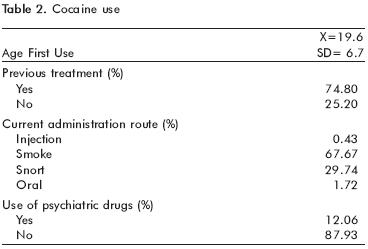
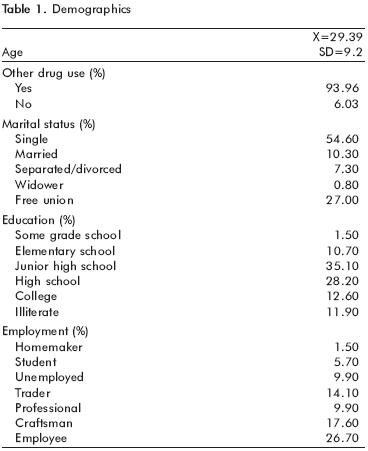
<body><![CDATA[<p align="justify"><font face="verdana" size="2">The CCQ<sup>7</sup> is one of the most used tests to measure cocaine craving. CCQ was developed by using five dimensions that represent a multidimensional conception of the phenomenon: 1) desire to use cocaine; 2) anticipation of positive outcomes from cocaine use; 3) anticipation of relief from cocaine withdrawal symptoms or relief from negative mood; 4) intention and planning to use cocaine; 5) lack of control over use. This test counts with two versions: <i>General </i>(that measures craving during the previous week to the response day) and <i>Now </i>(measures current craving at the moment it is answered); both of them are Likert&#150;type questionnaires. CCQ general is constituted by 45 items distributed in a structure of four factors, and has a good internal consistency of 0.92; these four factors represent the five&#150;dimension model described above and each factor has an internal consistency ranging from 0.70 to 0.89. CCQ general has concurrent validity: total scores are associated with lower confidence in ability to quit using cocaine and greater frequency of use over the previous six months.</font></p>     <p align="justify"><font face="verdana" size="2">The CCQ instrument has been used previously in Spanish speaking populations.<sup>21</sup> A group of researchers created a 12 item brief form of the test and proved its ability to measure craving in Spanish population. They obtained a general reliability coefficient with a four factor structure: Intense and Overwhelming Desires to Use (alpha coefficient=.64); Perceived Lack of Control over Use (alpha coefficient=.64); Lack of Positive Reinforcement Expectancies (alpha coefficient=.76) and Stimulation Expectancies from Cocaine Use (alpha coefficient=.79). Regarding validity, it was found that cocaine users reported higher levels of craving in the test than abstainers.</font></p>     <p align="justify"><font face="verdana" size="2">Nevertheless, in Mexico there is an important lack of tests to measure cocaine craving. Due to this situation, our objective was to translate and validate &laquo;the CCQ general version&raquo; in order to have a reliable test for measuring this phenomenon in Mexican population.</font></p>     <p align="justify"><font face="verdana" size="2">&nbsp;</font></p>     <p align="justify"><font face="verdana" size="2"><b>METHODS</b></font></p>     <p align="justify"><font face="verdana" size="2"><b>Participants</b></font></p>     <p align="justify"><font face="verdana" size="2">The sample consisted of 233 Mexican male participants of which 214 met inclusion criteria, aged between 18 and 59 (M=27; SD=9.2). At the moment of the study, they were under residential treatment between their 4<sup>th</sup> and 12<sup>th</sup> week and were distributed in five different treatment facilities whose model is grounded on the philosophy of Alcoholics Anonymous. After initial assessments, it was determined that the participants did not suffer from any psychotic, maniac or depressive symptoms or cognitive damage that could impede them to solve the test. Participants met DSM&#150;IV&#150;TR substance abuse and dependence criteria. Likewise, 83% of the sample was polydrug users but reported cocaine as their main drug of use. Mean age of first substance use was 18 (SD = 6.7). The most common route of self&#150;administration was smoked (59.9%), followed by nasal (26.3%). 74.8% of the sample reported attendance to previous substance abuse and dependence treatment (<a href="#t1">tables 1</a> and <a href="#t2">2</a>).</font></p>     <p align="center"><font face="verdana" size="2"><a name="t1"></a></font></p>     <p align="center"><font face="verdana" size="2"><img src="/img/revistas/sm/v34n6/a3t1.jpg"></font></p>     <p align="center"><font face="verdana" size="2"><a name="t2"></a></font></p>     ]]></body>
<body><![CDATA[<p align="center"><font face="verdana" size="2"><img src="/img/revistas/sm/v34n6/a3t2.jpg"></font></p>     <p align="justify"><font face="verdana" size="2"><b>Instruments</b></font></p>     <p align="justify"><font face="verdana" size="2">For initial assessment and in order to determine if participants did not suffer from psychotic, maniac or depressive symptoms, we used the Mini International Neuropsychiatric Interview (MINI PLUS).<sup>22</sup></font></p>     <p align="justify"><font face="verdana" size="2">Participants completed a drug&#150;use history questionnaire along with the Spanish translation of the CCQ General. The CCQ&#150;G<sup>7</sup> assesses the level of craving during the previous week through 45 Likert&#150;type statements. In this test, the respondent is asked to indicate how strongly he agrees or not with each of the sentences in every item. The Likert scale consisted of seven answer options going from 1 to 7 in which number 1 indicates total disagreement and number 7 means total agreement.</font></p>     <p align="justify"><font face="verdana" size="2">The drug&#150;use history questionnaire asked participants for information such as age, preferred route for cocaine self&#150;administration, number of previous treatments, frequency of cocaine use (number of times per week), and average level of consumption per occasion and number of years using cocaine.</font></p>     <p align="justify"><font face="verdana" size="2"><i>Procedures</i></font></p>     <p align="justify"><font face="verdana" size="2">The validation process consisted of three stages. Stage one consisted of translation in to Spanish of the original version of the CCQ General by 10 experts in the area of addiction research; this translation was then reviewed by three Spanish native speakers (who speak English fluently) and one native English speaker to verify equivalence between translations.</font></p>     <p align="justify"><font face="verdana" size="2">In stage two, residential treatment centers were contacted in order to ask for the participation of the cocaine user population within each center. After this, in every center an interview process was conducted with support from psychiatrists to verify that all the inclusion criteria were accomplished by the participants. Information about the study and an informed consent form were given to all patients interested in participating in the study.</font></p>     <p align="justify"><font face="verdana" size="2">In stage three, the instrument application was conducted with all participants in the treatment centers and, once it was finished, data analysis was made to know test reliability and factor structure.</font></p>     <p align="justify"><font face="verdana" size="2">&nbsp;</font></p>     ]]></body>
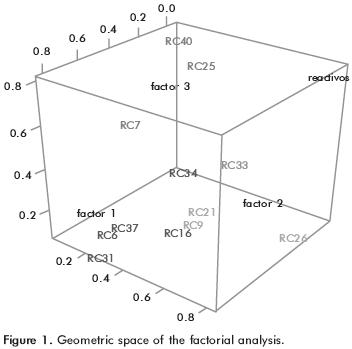
<body><![CDATA[<p align="justify"><font face="verdana" size="2"><b>RESULTS</b></font></p>     <p align="justify"><font face="verdana" size="2">To determine whether the data were suitable for factor analysis, Kaiser's measure of sample adequacy was examined, obtaining an MSA rate of .89; these data fall within the optimal values of the sample according to Kaiser.<sup>23</sup></font></p>     <p align="justify"><font face="verdana" size="2">All 45 items were measured through factor analysis with varimax rotation to obtain a three factor structure. We selected twelve items that show the least specificity for each factor (<a href="/img/revistas/sm/v34n6/a3t3.jpg" target="_blank">table 3</a>). All items had adequate factorial loadings equal or major than 0.40.</font></p>     <p align="justify"><font face="verdana" size="2">Three factors and general test internal consistency coefficients were high and significant in all the cases. General standardized alpha was .87, and the scores of each of the three factors showed high values too (<a href="/img/revistas/sm/v34n6/a3t3.jpg" target="_blank">table 3</a>). The dispersion found between items inside factors and general instrument was low; therefore, integration and conceptual clarity obtained was adequate.</font></p>     <p align="justify"><font face="verdana" size="2">With the 12 items described we specified a three&#150;dimensional model and performed CFA with Maximum Likelihood estimation (<a href="#f1">figure 1</a>). Also with the %<sup>2</sup> statistic (and associated <i>p </i>value), the results of the CFA supported the three&#150;factor model. Fit indices suggested an excellent fit, %<sup>2</sup> (33, n= 214) =30.32, p=.60. The interfactor correlations ranged from .16 to .69, with the highest interfactor correlations being between factor 1 and factor 3 (<i>r</i>=&#150;.68). All other interfactor correlations were below <i>r</i>=.04 (factors 1 and 2). The overall mean correlation between factors was <i>r</i>=.38 (<i>SD</i>=.25).</font></p>     <p align="center"><font face="verdana" size="2"><a name="f1"></a></font></p>     <p align="center"><font face="verdana" size="2"><img src="/img/revistas/sm/v34n6/a3f1.jpg"></font></p>     <p align="justify"><font face="verdana" size="2">&nbsp;</font></p>     <p align="justify"><font face="verdana" size="2"><b>DISCUSSION</b></font></p>     <p align="justify"><font face="verdana" size="2">The objective of this study was to translate and validate the Cocaine Craving Questionnaire General version<sup>7</sup> to be used in Mexican population. The results found indicate that the psychometrical characteristics of the Mexican version of the Cocaine Craving Questionnaire General version are good. We found three factors that are similar to those pointed out by Tiffany.<sup>7</sup> We named them: intention to use cocaine, desire for cocaine consumption and positive expectancies for cocaine consumption. These three factors described a part of the five dimensions that constitute the original test: 1) desire to use cocaine; 2) anticipation of positive outcomes from cocaine use; 3) anticipation of relief from cocaine withdrawal symptoms or relief from negative mood; 4) intention and planning to use cocaine; 5) lack of control over use.</font></p>     ]]></body>
<body><![CDATA[<p align="justify"><font face="verdana" size="2">These three factors are also similar to those found in the study of the brief Spanish Cocaine Craving Questionnaire&#150;General: Intense and Overwhelming Desires to Use, Perceived Lack of Control over Use, Lack of Positive Reinforcement Expectancies and Stimulation Expectancies from Cocaine.<sup>21</sup></font></p>     <p align="justify"><font face="verdana" size="2">An important issue to discuss is the fact that our test is constituted by 12 items and has still a very good internal consistency. Tiffany, Carter and Singleton<sup>24</sup> point out that one item scales are not sufficient to evaluate a multi dimensional construct such as craving, since they may not have a good internal consistency, no possibilities to calculate it and therefore, may lack validity. On the other hand, extended tests could be intrusive and cause craving states. Our test showed to have good reliability and has the advantage to be a short, practical scale, avoiding the intrusiveness present in longer tests.</font></p>     <p align="justify"><font face="verdana" size="2">Limitations of this study include the lack of women in the sample, as well as the lack of a construct validity process. Future studies should include a variable related to craving in order to prove construct validity.</font></p>     <p align="justify"><font face="verdana" size="2">It is also needed further research using the test to get a criterion validation. This validation could be reached by using the present questionnaire in a pharmacological protocol in order to measure the impact of anticraving drugs.</font></p>     <p align="justify"><font face="verdana" size="2">&nbsp;</font></p>     <p align="justify"><font face="verdana" size="2"><b>ACKNOWLEDGMENTS</b></font></p>     <p align="justify"><font face="verdana" size="2">This work was financially supported by contract #69373 from CONACYT &laquo;Consejo Nacional de Ciencia y Tecnolog&iacute;a.&raquo; We acknowledge Stephen Tiffany PhD. for providing the original English version of the questionnaire and for showing support to our research work.</font></p>     <p align="justify"><font face="verdana" size="2">On the other hand we acknowledge the following researchers for their help and supervision on the translation: Corina Benjet PhD, Silvia Morales PhD, Cirilo Bail&oacute;n PhD, Jos&eacute; Fernandez BSc (Psych), Marcos Ayala MA., Everardo Lagaspi MA., Carlos Lima MD., Ana de la Fuente MD., Hugo Gonz&aacute;lez MD.</font></p>     <p align="justify"><font face="verdana" size="2">&nbsp;</font></p>     <p align="justify"><font face="verdana" size="2"><b>REFERENCES</b></font></p>     ]]></body>
<body><![CDATA[<!-- ref --><p align="justify"><font face="verdana" size="2">1. UNODC. World Drug Report 2010 (United Nations Office on Drugs and Crime). Consulted on: <a href="http://www.unodc.org/unodc/en/data-and-analysis/WDR-2010.html" target="_blank">http://www.unodc.org/unodc/en/data&#150;and&#150;analysis/WDR&#150;2010.html</a> on March 10<sup>th</sup> 2011.    &nbsp;&nbsp;&nbsp;&nbsp;&nbsp;&nbsp;&nbsp;&nbsp;[&#160;<a href="javascript:void(0);" onclick="javascript: window.open('/scielo.php?script=sci_nlinks&ref=9066351&pid=S0185-3325201100060000300001&lng=','','width=640,height=500,resizable=yes,scrollbars=1,menubar=yes,');">Links</a>&#160;]<!-- end-ref --></font></p>     <!-- ref --><p align="justify"><font face="verdana" size="2">2. ENA 2008. Encuesta Nacional de Adicciones del Consejo Nacional Contra las Adicciones. Consulted on: http://www.conadic.salud.gob.mx/ pdfs/ena08/ENA08_NACIONAL.pdf on November 24<sup>th</sup> 2010.    &nbsp;&nbsp;&nbsp;&nbsp;&nbsp;&nbsp;&nbsp;&nbsp;[&#160;<a href="javascript:void(0);" onclick="javascript: window.open('/scielo.php?script=sci_nlinks&ref=9066353&pid=S0185-3325201100060000300002&lng=','','width=640,height=500,resizable=yes,scrollbars=1,menubar=yes,');">Links</a>&#160;]<!-- end-ref --></font></p>     <!-- ref --><p align="justify"><font face="verdana" size="2">3. Substance Abuse and Mental Health Services Administration. Results from the 2009 National Survey on Drug Use and Health: Volume I. Summary of National Findings (Office of Applied Studies, NSDUH Series H&#150;38A, HHS Publication No. SMA 10&#150;4586Findings); Rockville, MD.    &nbsp;&nbsp;&nbsp;&nbsp;&nbsp;&nbsp;&nbsp;&nbsp;[&#160;<a href="javascript:void(0);" onclick="javascript: window.open('/scielo.php?script=sci_nlinks&ref=9066355&pid=S0185-3325201100060000300003&lng=','','width=640,height=500,resizable=yes,scrollbars=1,menubar=yes,');">Links</a>&#160;]<!-- end-ref --></font></p>     <!-- ref --><p align="justify"><font face="verdana" size="2">4. WHO. Global Health Risks: Mortality and burden of disease attributable to selected major risks. Consulted on: http://www.who.int/health&#150;info/global_burden_disease/global_health_risks/en/index.html on December 14<sup>th</sup> 2010.    &nbsp;&nbsp;&nbsp;&nbsp;&nbsp;&nbsp;&nbsp;&nbsp;[&#160;<a href="javascript:void(0);" onclick="javascript: window.open('/scielo.php?script=sci_nlinks&ref=9066357&pid=S0185-3325201100060000300004&lng=','','width=640,height=500,resizable=yes,scrollbars=1,menubar=yes,');">Links</a>&#160;]<!-- end-ref --></font></p>     <!-- ref --><p align="justify"><font face="verdana" size="2">5. Volkow N, Wang G, Fowler J, Logan J et al. Decreased striatal dopaminergic responsiveness in detoxified cocaine&#150;dependent subjects. Nature 1997;386:830&#150;833.    &nbsp;&nbsp;&nbsp;&nbsp;&nbsp;&nbsp;&nbsp;&nbsp;[&#160;<a href="javascript:void(0);" onclick="javascript: window.open('/scielo.php?script=sci_nlinks&ref=9066359&pid=S0185-3325201100060000300005&lng=','','width=640,height=500,resizable=yes,scrollbars=1,menubar=yes,');">Links</a>&#160;]<!-- end-ref --></font></p>     ]]></body>
<body><![CDATA[<!-- ref --><p align="justify"><font face="verdana" size="2">6. Tiffany ST. Cognitive concepts of craving. Alcohol Research Health 1999;23:215&#150;224.    &nbsp;&nbsp;&nbsp;&nbsp;&nbsp;&nbsp;&nbsp;&nbsp;[&#160;<a href="javascript:void(0);" onclick="javascript: window.open('/scielo.php?script=sci_nlinks&ref=9066361&pid=S0185-3325201100060000300006&lng=','','width=640,height=500,resizable=yes,scrollbars=1,menubar=yes,');">Links</a>&#160;]<!-- end-ref --></font></p>     <!-- ref --><p align="justify"><font face="verdana" size="2">7. Tiffany S, Singleton E, Haertzen C, Henningfield J. The development of a Cocaine Craving Questionnarie. Drug Alcohol Dependence 1993;34:19&#150;28.    &nbsp;&nbsp;&nbsp;&nbsp;&nbsp;&nbsp;&nbsp;&nbsp;[&#160;<a href="javascript:void(0);" onclick="javascript: window.open('/scielo.php?script=sci_nlinks&ref=9066363&pid=S0185-3325201100060000300007&lng=','','width=640,height=500,resizable=yes,scrollbars=1,menubar=yes,');">Links</a>&#160;]<!-- end-ref --></font></p>     <!-- ref --><p align="justify"><font face="verdana" size="2">8. Anton RF. What is craving? Models and implications for treatment. Alcohol Research Health 1999;23:165&#150;173.    &nbsp;&nbsp;&nbsp;&nbsp;&nbsp;&nbsp;&nbsp;&nbsp;[&#160;<a href="javascript:void(0);" onclick="javascript: window.open('/scielo.php?script=sci_nlinks&ref=9066365&pid=S0185-3325201100060000300008&lng=','','width=640,height=500,resizable=yes,scrollbars=1,menubar=yes,');">Links</a>&#160;]<!-- end-ref --></font></p>     <!-- ref --><p align="justify"><font face="verdana" size="2">9. Toneatto T. A Metacogonitive analysis of craving: implications for treatment. J Clin Psychol 1999;55:527&#150;537.    &nbsp;&nbsp;&nbsp;&nbsp;&nbsp;&nbsp;&nbsp;&nbsp;[&#160;<a href="javascript:void(0);" onclick="javascript: window.open('/scielo.php?script=sci_nlinks&ref=9066367&pid=S0185-3325201100060000300009&lng=','','width=640,height=500,resizable=yes,scrollbars=1,menubar=yes,');">Links</a>&#160;]<!-- end-ref --></font></p>     <!-- ref --><p align="justify"><font face="verdana" size="2">10. Drummond DC. Theories of drug craving, ancient and modern. Addiction 2001;96:33&#150;46.    &nbsp;&nbsp;&nbsp;&nbsp;&nbsp;&nbsp;&nbsp;&nbsp;[&#160;<a href="javascript:void(0);" onclick="javascript: window.open('/scielo.php?script=sci_nlinks&ref=9066369&pid=S0185-3325201100060000300010&lng=','','width=640,height=500,resizable=yes,scrollbars=1,menubar=yes,');">Links</a>&#160;]<!-- end-ref --></font></p>     ]]></body>
<body><![CDATA[<!-- ref --><p align="justify"><font face="verdana" size="2">11. Iraurgi I, Corcuera N. Craving: concepto, medici&oacute;n y terap&eacute;utica. Norte Salud Mental 2008;32:9&#150;22.    &nbsp;&nbsp;&nbsp;&nbsp;&nbsp;&nbsp;&nbsp;&nbsp;[&#160;<a href="javascript:void(0);" onclick="javascript: window.open('/scielo.php?script=sci_nlinks&ref=9066371&pid=S0185-3325201100060000300011&lng=','','width=640,height=500,resizable=yes,scrollbars=1,menubar=yes,');">Links</a>&#160;]<!-- end-ref --></font></p>     <!-- ref --><p align="justify"><font face="verdana" size="2">12. Jellinek EM. The &laquo;craving&raquo; for alcohol. Quarterly J Studies Alcohol 1955;16:35&#150;38.    &nbsp;&nbsp;&nbsp;&nbsp;&nbsp;&nbsp;&nbsp;&nbsp;[&#160;<a href="javascript:void(0);" onclick="javascript: window.open('/scielo.php?script=sci_nlinks&ref=9066373&pid=S0185-3325201100060000300012&lng=','','width=640,height=500,resizable=yes,scrollbars=1,menubar=yes,');">Links</a>&#160;]<!-- end-ref --></font></p>     <!-- ref --><p align="justify"><font face="verdana" size="2">13. Jellinek EM. The disease concept of alcoholism. New Brunswick, NJ: Hillhouse Press; 1960.    &nbsp;&nbsp;&nbsp;&nbsp;&nbsp;&nbsp;&nbsp;&nbsp;[&#160;<a href="javascript:void(0);" onclick="javascript: window.open('/scielo.php?script=sci_nlinks&ref=9066375&pid=S0185-3325201100060000300013&lng=','','width=640,height=500,resizable=yes,scrollbars=1,menubar=yes,');">Links</a>&#160;]<!-- end-ref --></font></p>     <!-- ref --><p align="justify"><font face="verdana" size="2">14. Marlatt G, Gordon J. Relapse prevention. New York: Guilford Press; 1985.    &nbsp;&nbsp;&nbsp;&nbsp;&nbsp;&nbsp;&nbsp;&nbsp;[&#160;<a href="javascript:void(0);" onclick="javascript: window.open('/scielo.php?script=sci_nlinks&ref=9066377&pid=S0185-3325201100060000300014&lng=','','width=640,height=500,resizable=yes,scrollbars=1,menubar=yes,');">Links</a>&#160;]<!-- end-ref --></font></p>     <!-- ref --><p align="justify"><font face="verdana" size="2">15. Tiffany S, Drobes D. The development and initial validation of a questionnaire of smoking urges. British J Addiction 1991;86:1467&#150;1476.    &nbsp;&nbsp;&nbsp;&nbsp;&nbsp;&nbsp;&nbsp;&nbsp;[&#160;<a href="javascript:void(0);" onclick="javascript: window.open('/scielo.php?script=sci_nlinks&ref=9066379&pid=S0185-3325201100060000300015&lng=','','width=640,height=500,resizable=yes,scrollbars=1,menubar=yes,');">Links</a>&#160;]<!-- end-ref --></font></p>     ]]></body>
<body><![CDATA[<!-- ref --><p align="justify"><font face="verdana" size="2">16. West R, Schneider N. Craving for cigarettes. British J Addiction 1987;82:407&#150;415.    &nbsp;&nbsp;&nbsp;&nbsp;&nbsp;&nbsp;&nbsp;&nbsp;[&#160;<a href="javascript:void(0);" onclick="javascript: window.open('/scielo.php?script=sci_nlinks&ref=9066381&pid=S0185-3325201100060000300016&lng=','','width=640,height=500,resizable=yes,scrollbars=1,menubar=yes,');">Links</a>&#160;]<!-- end-ref --></font></p>     <!-- ref --><p align="justify"><font face="verdana" size="2">17. Halikas J, Kuhn K, Crosby R, Carlson G et al. The measurement of craving in cocaine patients using the Minnesota Cocaine Craving Scale. Compr Psychiatry 1991;32:22&#150;27.    &nbsp;&nbsp;&nbsp;&nbsp;&nbsp;&nbsp;&nbsp;&nbsp;[&#160;<a href="javascript:void(0);" onclick="javascript: window.open('/scielo.php?script=sci_nlinks&ref=9066383&pid=S0185-3325201100060000300017&lng=','','width=640,height=500,resizable=yes,scrollbars=1,menubar=yes,');">Links</a>&#160;]<!-- end-ref --></font></p>     <!-- ref --><p align="justify"><font face="verdana" size="2">18. Bohn M, Krahn D, Staeheler B. Development and initial validation of a measure of drinking urges in abstinent alcoholics. Alcohol Clin Exp Res 1995;19:600&#150;606.    &nbsp;&nbsp;&nbsp;&nbsp;&nbsp;&nbsp;&nbsp;&nbsp;[&#160;<a href="javascript:void(0);" onclick="javascript: window.open('/scielo.php?script=sci_nlinks&ref=9066385&pid=S0185-3325201100060000300018&lng=','','width=640,height=500,resizable=yes,scrollbars=1,menubar=yes,');">Links</a>&#160;]<!-- end-ref --></font></p>     <!-- ref --><p align="justify"><font face="verdana" size="2">19. Guardia J, Segura L, Gonzalvo B, Trujols J et al. Estudio de validaci&oacute;n de la Escala Multidimensional de Craving de Alcohol. Med Clin (Barc) 2004;123:211&#150;216.    &nbsp;&nbsp;&nbsp;&nbsp;&nbsp;&nbsp;&nbsp;&nbsp;[&#160;<a href="javascript:void(0);" onclick="javascript: window.open('/scielo.php?script=sci_nlinks&ref=9066387&pid=S0185-3325201100060000300019&lng=','','width=640,height=500,resizable=yes,scrollbars=1,menubar=yes,');">Links</a>&#160;]<!-- end-ref --></font></p>     <!-- ref --><p align="justify"><font face="verdana" size="2">20. Singleton E, Tiffany S, Henningfield J. Development and validation of a new questionnaire to assess craving for alcohol. Problems of Drug Dependence: Proceeding of the 56th Annual Meeting. The College on Problems of Drug Dependence, Inc., Volume II: Abstracts. NIDA Research Monograph 153. Rockville, MD: National Institute on Drug Abuse; 1994.    &nbsp;&nbsp;&nbsp;&nbsp;&nbsp;&nbsp;&nbsp;&nbsp;[&#160;<a href="javascript:void(0);" onclick="javascript: window.open('/scielo.php?script=sci_nlinks&ref=9066389&pid=S0185-3325201100060000300020&lng=','','width=640,height=500,resizable=yes,scrollbars=1,menubar=yes,');">Links</a>&#160;]<!-- end-ref --></font></p>     ]]></body>
<body><![CDATA[<!-- ref --><p align="justify"><font face="verdana" size="2">21. Mu&ntilde;oz M, Mart&iacute;nez J, Tejero A, Cepeda&#150;Benito A. Development of the brief Spanish Cocaine Craving Questionnaire&#150;General. Psicothema 2008;20(4):545&#150;550.    &nbsp;&nbsp;&nbsp;&nbsp;&nbsp;&nbsp;&nbsp;&nbsp;[&#160;<a href="javascript:void(0);" onclick="javascript: window.open('/scielo.php?script=sci_nlinks&ref=9066391&pid=S0185-3325201100060000300021&lng=','','width=640,height=500,resizable=yes,scrollbars=1,menubar=yes,');">Links</a>&#160;]<!-- end-ref --></font></p>     <!-- ref --><p align="justify"><font face="verdana" size="2">22. Sheehan D, Lecrubier Y, Sheehan K. The Mini&#150;International Neuropsychiatric Interview (MINI): The development and validation of a structured diagnostic psychiatric interview for DSM&#150;IV and ICD&#150;10. J Clin Psychiatry 1998;59(20):22&#150;33.    &nbsp;&nbsp;&nbsp;&nbsp;&nbsp;&nbsp;&nbsp;&nbsp;[&#160;<a href="javascript:void(0);" onclick="javascript: window.open('/scielo.php?script=sci_nlinks&ref=9066393&pid=S0185-3325201100060000300022&lng=','','width=640,height=500,resizable=yes,scrollbars=1,menubar=yes,');">Links</a>&#160;]<!-- end-ref --></font></p>     <!-- ref --><p align="justify"><font face="verdana" size="2">23. Kaiser HF. An index of factorial simplicity. Psychometrika 1974;39:31&#150;36.    &nbsp;&nbsp;&nbsp;&nbsp;&nbsp;&nbsp;&nbsp;&nbsp;[&#160;<a href="javascript:void(0);" onclick="javascript: window.open('/scielo.php?script=sci_nlinks&ref=9066395&pid=S0185-3325201100060000300023&lng=','','width=640,height=500,resizable=yes,scrollbars=1,menubar=yes,');">Links</a>&#160;]<!-- end-ref --></font></p>     <!-- ref --><p align="justify"><font face="verdana" size="2">24. Tiffany S, Carter B, Singleton E. Challenges in the manipulation, assessment and interpretation of craving relevant variables. Addiction 2000;95(2):S177&#150;S187.    &nbsp;&nbsp;&nbsp;&nbsp;&nbsp;&nbsp;&nbsp;&nbsp;[&#160;<a href="javascript:void(0);" onclick="javascript: window.open('/scielo.php?script=sci_nlinks&ref=9066397&pid=S0185-3325201100060000300024&lng=','','width=640,height=500,resizable=yes,scrollbars=1,menubar=yes,');">Links</a>&#160;]<!-- end-ref --></font></p>      ]]></body><back>
<ref-list>
<ref id="B1">
<label>1</label><nlm-citation citation-type="">
<collab>United Nations Office on Drugs and Crime</collab>
<source><![CDATA[]]></source>
<year></year>
</nlm-citation>
</ref>
<ref id="B2">
<label>2</label><nlm-citation citation-type="">
<collab>ENA</collab>
<source><![CDATA[Encuesta Nacional de Adicciones del Consejo Nacional Contra las Adicciones]]></source>
<year>2008</year>
</nlm-citation>
</ref>
<ref id="B3">
<label>3.</label><nlm-citation citation-type="">
<collab>Substance Abuse and Mental Health Services Administration</collab>
<source><![CDATA[Results from the 2009 National Survey on Drug Use and Health: Volume I. Summary of National Findings]]></source>
<year></year>
<publisher-loc><![CDATA[Rockville^eMD MD]]></publisher-loc>
</nlm-citation>
</ref>
<ref id="B4">
<label>4</label><nlm-citation citation-type="">
<collab>WHO</collab>
<source><![CDATA[Global Health Risks: Mortality and burden of disease attributable to selected major risks]]></source>
<year></year>
</nlm-citation>
</ref>
<ref id="B5">
<label>5</label><nlm-citation citation-type="journal">
<person-group person-group-type="author">
<name>
<surname><![CDATA[Volkow]]></surname>
<given-names><![CDATA[N]]></given-names>
</name>
<name>
<surname><![CDATA[Wang]]></surname>
<given-names><![CDATA[G]]></given-names>
</name>
<name>
<surname><![CDATA[Fowler]]></surname>
<given-names><![CDATA[J]]></given-names>
</name>
<name>
<surname><![CDATA[Logan]]></surname>
<given-names><![CDATA[J]]></given-names>
</name>
</person-group>
<article-title xml:lang="en"><![CDATA[Decreased striatal dopaminergic responsiveness in detoxified cocaine-dependent subjects]]></article-title>
<source><![CDATA[Nature]]></source>
<year>1997</year>
<volume>386</volume>
<page-range>830-833</page-range></nlm-citation>
</ref>
<ref id="B6">
<label>6</label><nlm-citation citation-type="journal">
<person-group person-group-type="author">
<name>
<surname><![CDATA[Tiffany]]></surname>
<given-names><![CDATA[ST.]]></given-names>
</name>
</person-group>
<article-title xml:lang="en"><![CDATA[Cognitive concepts of craving]]></article-title>
<source><![CDATA[Alcohol Research Health]]></source>
<year>1999</year>
<volume>23</volume>
<page-range>215-224</page-range></nlm-citation>
</ref>
<ref id="B7">
<label>7</label><nlm-citation citation-type="journal">
<person-group person-group-type="author">
<name>
<surname><![CDATA[Tiffany]]></surname>
<given-names><![CDATA[S]]></given-names>
</name>
<name>
<surname><![CDATA[Singleton]]></surname>
<given-names><![CDATA[E]]></given-names>
</name>
<name>
<surname><![CDATA[Haertzen]]></surname>
<given-names><![CDATA[C]]></given-names>
</name>
<name>
<surname><![CDATA[Henningfield]]></surname>
<given-names><![CDATA[J]]></given-names>
</name>
</person-group>
<article-title xml:lang="en"><![CDATA[The development of a Cocaine Craving Questionnarie]]></article-title>
<source><![CDATA[Drug Alcohol Dependence]]></source>
<year>1993</year>
<volume>34</volume>
<page-range>9-28</page-range></nlm-citation>
</ref>
<ref id="B8">
<label>8</label><nlm-citation citation-type="journal">
<person-group person-group-type="author">
<name>
<surname><![CDATA[Anton]]></surname>
<given-names><![CDATA[RF]]></given-names>
</name>
</person-group>
<article-title xml:lang="en"><![CDATA[What is craving? Models and implications for treatment]]></article-title>
<source><![CDATA[Alcohol Research Health]]></source>
<year>1999</year>
<volume>23</volume>
<page-range>165-173</page-range></nlm-citation>
</ref>
<ref id="B9">
<label>9</label><nlm-citation citation-type="journal">
<person-group person-group-type="author">
<name>
<surname><![CDATA[Toneatto]]></surname>
<given-names><![CDATA[T.]]></given-names>
</name>
</person-group>
<article-title xml:lang="en"><![CDATA[A Metacogonitive analysis of craving: implications for treatment]]></article-title>
<source><![CDATA[J Clin Psychol]]></source>
<year>1999</year>
<volume>55</volume>
<page-range>527-537</page-range></nlm-citation>
</ref>
<ref id="B10">
<label>10</label><nlm-citation citation-type="journal">
<person-group person-group-type="author">
<name>
<surname><![CDATA[Drummond]]></surname>
<given-names><![CDATA[DC]]></given-names>
</name>
</person-group>
<article-title xml:lang="en"><![CDATA[Theories of drug craving, ancient and modern]]></article-title>
<source><![CDATA[Addiction]]></source>
<year>2001</year>
<volume>96</volume>
<page-range>33-46</page-range></nlm-citation>
</ref>
<ref id="B11">
<label>11</label><nlm-citation citation-type="journal">
<person-group person-group-type="author">
<name>
<surname><![CDATA[Iraurgi]]></surname>
<given-names><![CDATA[I]]></given-names>
</name>
<name>
<surname><![CDATA[Corcuera]]></surname>
<given-names><![CDATA[N.]]></given-names>
</name>
</person-group>
<article-title xml:lang="es"><![CDATA[Craving: concepto, medición y terapéutica]]></article-title>
<source><![CDATA[Norte Salud Mental]]></source>
<year>2008</year>
<volume>32</volume>
<page-range>9-22</page-range></nlm-citation>
</ref>
<ref id="B12">
<label>12</label><nlm-citation citation-type="journal">
<person-group person-group-type="author">
<name>
<surname><![CDATA[Jellinek]]></surname>
<given-names><![CDATA[EM.]]></given-names>
</name>
</person-group>
<article-title xml:lang="en"><![CDATA[The «craving» for alcohol]]></article-title>
<source><![CDATA[Quarterly J Studies Alcohol]]></source>
<year>1955</year>
<volume>16</volume>
<page-range>35-38</page-range></nlm-citation>
</ref>
<ref id="B13">
<label>13</label><nlm-citation citation-type="book">
<person-group person-group-type="author">
<name>
<surname><![CDATA[Jellinek]]></surname>
<given-names><![CDATA[EM.]]></given-names>
</name>
</person-group>
<source><![CDATA[The disease concept of alcoholism]]></source>
<year>1960</year>
<publisher-loc><![CDATA[New Brunswick^eNJ NJ]]></publisher-loc>
<publisher-name><![CDATA[Hillhouse Press]]></publisher-name>
</nlm-citation>
</ref>
<ref id="B14">
<label>14</label><nlm-citation citation-type="book">
<person-group person-group-type="author">
<name>
<surname><![CDATA[Marlatt]]></surname>
<given-names><![CDATA[G]]></given-names>
</name>
<name>
<surname><![CDATA[Gordon]]></surname>
<given-names><![CDATA[J.]]></given-names>
</name>
</person-group>
<source><![CDATA[Relapse prevention]]></source>
<year>1985</year>
<publisher-loc><![CDATA[New York ]]></publisher-loc>
<publisher-name><![CDATA[Guilford Press]]></publisher-name>
</nlm-citation>
</ref>
<ref id="B15">
<label>15</label><nlm-citation citation-type="journal">
<person-group person-group-type="author">
<name>
<surname><![CDATA[Tiffany]]></surname>
<given-names><![CDATA[S]]></given-names>
</name>
<name>
<surname><![CDATA[Drobes]]></surname>
<given-names><![CDATA[D.]]></given-names>
</name>
</person-group>
<article-title xml:lang="en"><![CDATA[The development and initial validation of a questionnaire of smoking urges]]></article-title>
<source><![CDATA[British J Addiction]]></source>
<year>1991</year>
<volume>86</volume>
<page-range>1467-1476</page-range></nlm-citation>
</ref>
<ref id="B16">
<label>16</label><nlm-citation citation-type="journal">
<person-group person-group-type="author">
<name>
<surname><![CDATA[West]]></surname>
<given-names><![CDATA[R]]></given-names>
</name>
<name>
<surname><![CDATA[Schneider]]></surname>
<given-names><![CDATA[N.]]></given-names>
</name>
</person-group>
<article-title xml:lang="en"><![CDATA[Craving for cigarettes]]></article-title>
<source><![CDATA[British J Addiction]]></source>
<year>1987</year>
<volume>82</volume>
<page-range>407-415</page-range></nlm-citation>
</ref>
<ref id="B17">
<label>17</label><nlm-citation citation-type="journal">
<person-group person-group-type="author">
<name>
<surname><![CDATA[Halikas]]></surname>
<given-names><![CDATA[J]]></given-names>
</name>
<name>
<surname><![CDATA[Kuhn]]></surname>
<given-names><![CDATA[K]]></given-names>
</name>
<name>
<surname><![CDATA[Crosby]]></surname>
<given-names><![CDATA[R]]></given-names>
</name>
<name>
<surname><![CDATA[Carlson]]></surname>
<given-names><![CDATA[G]]></given-names>
</name>
</person-group>
<article-title xml:lang="en"><![CDATA[The measurement of craving in cocaine patients using the Minnesota Cocaine Craving Scale]]></article-title>
<source><![CDATA[Compr Psychiatry]]></source>
<year>1991</year>
<volume>32</volume>
<page-range>22-27</page-range></nlm-citation>
</ref>
<ref id="B18">
<label>18</label><nlm-citation citation-type="journal">
<person-group person-group-type="author">
<name>
<surname><![CDATA[Bohn]]></surname>
<given-names><![CDATA[M]]></given-names>
</name>
<name>
<surname><![CDATA[Krahn]]></surname>
<given-names><![CDATA[D]]></given-names>
</name>
<name>
<surname><![CDATA[Staeheler]]></surname>
<given-names><![CDATA[B.]]></given-names>
</name>
</person-group>
<article-title xml:lang="en"><![CDATA[Development and initial validation of a measure of drinking urges in abstinent alcoholics]]></article-title>
<source><![CDATA[Alcohol Clin Exp Res]]></source>
<year>1995</year>
<volume>19</volume>
<page-range>600-606</page-range></nlm-citation>
</ref>
<ref id="B19">
<label>19</label><nlm-citation citation-type="journal">
<person-group person-group-type="author">
<name>
<surname><![CDATA[Guardia]]></surname>
<given-names><![CDATA[J]]></given-names>
</name>
<name>
<surname><![CDATA[Segura]]></surname>
<given-names><![CDATA[L]]></given-names>
</name>
<name>
<surname><![CDATA[Gonzalvo]]></surname>
<given-names><![CDATA[B]]></given-names>
</name>
<name>
<surname><![CDATA[Trujols]]></surname>
<given-names><![CDATA[J]]></given-names>
</name>
</person-group>
<article-title xml:lang="es"><![CDATA[Estudio de validación de la Escala Multidimensional de Craving de Alcohol]]></article-title>
<source><![CDATA[Med Clin]]></source>
<year>2004</year>
<volume>123</volume>
<page-range>211-216</page-range></nlm-citation>
</ref>
<ref id="B20">
<label>20</label><nlm-citation citation-type="confpro">
<person-group person-group-type="author">
<name>
<surname><![CDATA[Singleton]]></surname>
<given-names><![CDATA[E]]></given-names>
</name>
<name>
<surname><![CDATA[Tiffany]]></surname>
<given-names><![CDATA[S]]></given-names>
</name>
<name>
<surname><![CDATA[Henningfield]]></surname>
<given-names><![CDATA[J.]]></given-names>
</name>
</person-group>
<source><![CDATA[Development and validation of a new questionnaire to assess craving for alcohol. Problems of Drug Dependence]]></source>
<year>1994</year>
<volume>II</volume>
<conf-name><![CDATA[56 Meeting. The College on Problems of Drug Dependence, Inc.]]></conf-name>
<conf-loc> </conf-loc>
<publisher-loc><![CDATA[Rockville^eMD MD]]></publisher-loc>
<publisher-name><![CDATA[National Institute on Drug Abuse]]></publisher-name>
</nlm-citation>
</ref>
<ref id="B21">
<label>21</label><nlm-citation citation-type="journal">
<person-group person-group-type="author">
<name>
<surname><![CDATA[Muñoz]]></surname>
<given-names><![CDATA[M]]></given-names>
</name>
<name>
<surname><![CDATA[Martínez]]></surname>
<given-names><![CDATA[J]]></given-names>
</name>
<name>
<surname><![CDATA[Tejero]]></surname>
<given-names><![CDATA[A]]></given-names>
</name>
<name>
<surname><![CDATA[Cepeda-Benito]]></surname>
<given-names><![CDATA[A.]]></given-names>
</name>
</person-group>
<article-title xml:lang="en"><![CDATA[Development of the brief Spanish Cocaine Craving Questionnaire-General]]></article-title>
<source><![CDATA[Psicothema]]></source>
<year>2008</year>
<volume>20</volume>
<numero>4</numero>
<issue>4</issue>
<page-range>545-550</page-range></nlm-citation>
</ref>
<ref id="B22">
<label>22</label><nlm-citation citation-type="journal">
<person-group person-group-type="author">
<name>
<surname><![CDATA[Sheehan]]></surname>
<given-names><![CDATA[D]]></given-names>
</name>
<name>
<surname><![CDATA[Lecrubier]]></surname>
<given-names><![CDATA[Y]]></given-names>
</name>
<name>
<surname><![CDATA[Sheehan]]></surname>
<given-names><![CDATA[K]]></given-names>
</name>
</person-group>
<article-title xml:lang="en"><![CDATA[The Mini-International Neuropsychiatric Interview (MINI): The development and validation of a structured diagnostic psychiatric interview for DSM-IV and ICD-10]]></article-title>
<source><![CDATA[J Clin Psychiatry]]></source>
<year>1998</year>
<volume>59</volume>
<numero>20</numero>
<issue>20</issue>
<page-range>22-33</page-range></nlm-citation>
</ref>
<ref id="B23">
<label>23</label><nlm-citation citation-type="journal">
<person-group person-group-type="author">
<name>
<surname><![CDATA[Kaiser]]></surname>
<given-names><![CDATA[HF.]]></given-names>
</name>
</person-group>
<article-title xml:lang="en"><![CDATA[An index of factorial simplicity]]></article-title>
<source><![CDATA[Psychometrika]]></source>
<year>1974</year>
<volume>39</volume>
<page-range>31-36</page-range></nlm-citation>
</ref>
<ref id="B24">
<label>24</label><nlm-citation citation-type="journal">
<person-group person-group-type="author">
<name>
<surname><![CDATA[Tiffany]]></surname>
<given-names><![CDATA[S]]></given-names>
</name>
<name>
<surname><![CDATA[Carter]]></surname>
<given-names><![CDATA[B]]></given-names>
</name>
<name>
<surname><![CDATA[Singleton]]></surname>
<given-names><![CDATA[E.]]></given-names>
</name>
</person-group>
<article-title xml:lang="en"><![CDATA[Challenges in the manipulation, assessment and interpretation of craving relevant variables]]></article-title>
<source><![CDATA[Addiction]]></source>
<year>2000</year>
<volume>95</volume>
<numero>2</numero>
<issue>2</issue>
</nlm-citation>
</ref>
</ref-list>
</back>
</article>